sdsucollegian.com
Wednesday, September 20, 2017
SOUTH DAKOTA STATE UNIVERSITY’S STUDENT-RUN INDEPENDENT NEWSPAPER SINCE 1885
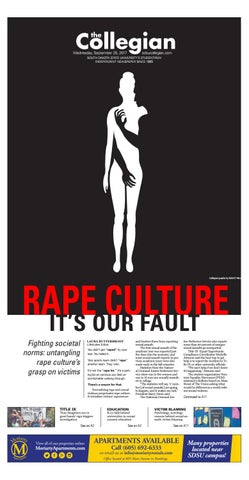
RAPE CULTURE IT’S OUR FAULT
Collegian graphic by BAILEY HILL
Fighting societal norms: untangling rape culture’s grasp on victims
LAURA BUTTERBRODT Lifestyles Editor You didn’t get “raped” by your test. You failed it. Your sports team didn’t “rape” another team. They won. It’s not the “rape lot.” It’s a parking lot on campus you feel uncomfortable walking through. There’s a reason for that. Normalizing rape and sexual violence perpetuates rape culture. It trivializes victims’ experiences
TITLE IX
‘Your daughters are in good hands’ sign triggers investigation
See on A2
and hinders them from reporting sexual assault. The first sexual assault of the academic year was reported just five days into the semester, and most sexual assault reports in previous academic years were also made early in the fall semester. Statistics from the National Criminal Justice Reference Service show one in five women and one in 16 men are sexually assaulted in college. “The statistics will say, ‘x’ number [of sexual assaults] are going to happen, and it makes me sick,” President Barry Dunn said. The National Criminal Jus-
EDUCATION
K-12 falls behind universities in sexual consent education
See on A2
tice Reference Service also reports more than 90 percent of campus sexual assaults go unreported. Title IX Equal Opportunity Compliance Coordinator Michelle Johnson said the best way to get help is to report the incident to Title IX or other university officials. “We can’t help if we don’t know it’s happening,” Johnson said. The student organization Feminist Equality Movement (FEM) stationed a bulletin board on Main Street of The Union asking what would be different in a world without sexual violence.
Continued to A11
VICTIM BLAMING
Psychology, sociology reasons behind sexual assault, victim blaming
See on A11
A2
The Collegian • Sexual Assault
September 20, 2017
sdsucollegian.com
Imagine a world without sexual violence ... what’s different? The excerpts are from the Imagine a World Without Sexual Violence board, posted on Main Street of the Student Union by FEM. Continued on A11.
We wouldn’t have had a sexual assault four days into the semester.
We wouldn’t have a parking lot nicknamed “rape lot” on campus.
I wouldn’t need to carry a knife around or be wary of the clothes I wear.
I wouldn’t have to carry pepper spray at night.
I wouldn’t see my assaulter daily.
We could wear what we want without feeling threatened.
‘Offensive’ sign triggers Title IX investigation GARRETT AMMESMAKI News Editor “Your daughters are in good hands,” the sign read. And underneath it, the drawing of a hand making the sexually suggestive “shocker” symbol. In front of it, seven men drinking beer. “It’s going to be one hell of a year!” senior economics major Thomas Swanson commented underneath it. The sign was hung in front of an off-campus residence over move-in weekend late August and has drawn criticism from students and administration after it was widely shared. Currently, the sign is under investigation by the South Dakota State University Title IX office for harassment. According to the U.S. Department of Justice, Title IX is a federal law passed in 1972 to eliminate sexual discrimination by any federally-funded education program or activity. Though she cannot speak specifically on the active investigation, Title IX Equal Opportunity Compliance Coordinator Michelle Johnson said her office is aware of the sign some people find “offensive.” “Sometimes when people put up similar types of signs or postage, some students may like it, some students may think it’s funny and some students might encourage it,” Johnson said. “And because of that the students who are offended by it can be harmed, but that is something we, of course, have to look into.” Though the sign was not on campus, Title IX guidelines regarding sexual discrimination and harassment apply to any student enrolled at SDSU, whether they are on campus or not, Johnson said. South Dakota State alum-
na Mercedes Muñoz saw the post when she was browsing Instagram, took a screen shot and shared it on her Facebook page. “When I see this image, it makes me uncomfortable. It brings back awful memories,” Muñoz said. Muñoz said she was sexually assaulted her sophomore year at SDSU. She believes the people who wrote the sign, though they have a “right to express freedom of speech,” are mentors and should not be teaching those behaviors to
“
WHEN I SEE THIS IMAGE, IT MAKES ME UNCOMFORTABLE. IT BRINGS BACK AWFUL MEMORIES. MERCEDES MUÑOZ SDSU Alumna
younger men. “I don’t think they should have posted that image and tagged SDSU. I don’t think they should be in an SDSU fraternity and post that picture, or hang up that sign,” she said. “Those men represent SDSU, and they are showing others that those actions are acceptable.” Swanson apologized for the sign Aug. 27 in a Facebook post, a day after his original Instagram post. “To anyone hurt or offended by my previous post, I’m sorry,” Swanson wrote in the post. “Was this in poor taste and stupid? Yes. I would never in my life condone poor treatment of anyone, especially women. Anyone that knows me I hope would know this about
me.” Swanson made his social media accounts private for a short amount of time until “things cooled down,” and then posted the apology. “I, as well as my family members, were then bombarded with a very few, but loud, people on social media harassing us, saying how terrible of people we are,” Swanson said. “I personally didn’t want to reply to feed into the social media frenzy.” Swanson said he was called many names, but being referred to as a “rape apologist,” was one that stuck with him the most. “Anyone that knows me knows I would never even wish harm on someone, much less something as terrible as that,” he said. Swanson said he is aware of the Title IX investigation and is looking forward to “setting the record straight.” It is unclear whether conduct charges will be brought against Swanson and the other students involved. “Whenever we look at information on a harassment basis, one of the things we really have to balance is the right for an individual to have freedom of speech versus the rights of the campus community,” Johnson said. “If it causes some emotional distress and some harm, that’s when we have to step in and investigate to determine whether or not it is freedom of speech or if it’s harassment.” Director of Diversity, Equity, Inclusion and Access Nathan Ziegler said the sign and the humor behind it are endemic of the societal issues involving the objectification of women and a hypersexualized society. “There’s kind of two mes-
SUBMITTED PHOTO
Thomas Swanson, senior economics major, recieved backlash from administration and students after posting this photo to Instagram late August. The incedent has sparked a Title IX investigation
sages there, one is the sentence that was on the banner, ‘your daughters are in good hands.’ If you kind of break down what that is implying, it’s implying that women are objects,”
Ziegler said. “It’s objectifying them, it’s making them seem like property. It’s a continuation of traditions that have viewed women as that for centuries.”
Colleges push sexual violence prevention while K-12 struggles EMILY De WAARD Managing Editor While universities across the nation are making strides to discuss, combat and prevent sexual violence on campuses, K-12 schools are struggling to keep up. Around the time students go through puberty, they learn about sex, pregnancy and sexually-transmitted diseases in the Brooking School District. But what they don’t learn about so much, if at all, is sexual violence, or consent to sex and what that should look like. Klint Willert, superintendent of the Brookings School District, said in a prepared statement that sex education is “built into health curriculum throughout middle school and high school,” but that the only specific education dedicated to sex-related topics is a presentation for fifthgrade students on puberty, body changes and similar topics related to hygiene and personal well being. As far as sexual violence and consent go, there is even less to show for. “There is no formally adopted curriculum for the topics of sexual violence or consent for sex in the district,” Willert said. “However, the district curriculum does incorporate aspects of these topics in health courses
and, on occasion, some electives at the high school.” All educational institutions, public and private, though, are required by law to comply with Title IX, which states: “No person in the United States shall, on the basis of sex, be excluded from participation in, be denied the benefits of, or be subjected to discrimination under any education program or activity receiving Federal financial assistance.” Because Title IX prohibits sexual or gender discrimination, Title IX deals with matters of sexual assault, including education of matters surrounding it, like consent. South Dakota State Title IX Equal Opportunity Compliance Coordinator Michelle Johnson said she has tried reaching out to K-12 schools to assist with Title IX compliance through presentations or classes and said she “didn’t receive a whole lot of feedback.” Johnson said it may have been a “timing concern” and is something she plans to continue pursuing. At SDSU, Johnson said there are several ways they try to educate about consent. “For incoming freshmen, we have mandated that prior to move-in weekend they complete an online training,” Johnson said. “This year, we realized the completion rate was too low in the past, so this year we man-
dated that they complete it.” Additionally, Johnson said she and the Dean of Student Affairs Sam Jennings give a presentation at Thump Start. This year’s incoming freshman class was 2,200 students, and Johnson said there were about 1,700 to 1,800 students at Thump Start to view the presentation.
“
THERE IS NO FORMALLY ADOPTED CURRICULUM FOR THE TOPICS OF SEXUAL VIOLENCE OR CONSENT FOR SEX IN THE DISTRICT. KLINT WILLERT Superintendent of the Brookings School District
“We break them down into three groups, do 45-minute presentations about sexual assault, consent and sexual activity generally,” Johnson said. “Consent is a very big component of that conversation. We talk about when individuals can consent, when they can’t, when they lack the ability and what consent means.” As for the online training,
Johnson reported they went from 6 percent completion last year to 93 percent this year in freshmen and transfer students. If students do not comply with the mandatory training, Johnson said it could lead to being cited as a failure to adhere to the student conduct code. She said this has not yet occurred, and students who have not taken it still have time, but she said Title IX will pursue several different avenues before coming to that point. “We’re going to try other means to get students to complete before we go down that route. We want this experience to be positive and educational,” Johnson said. There are other ways to complete the training for individuals with disabilities, as well as for those who are sexual assault survivors and may find the training triggering. For them, Johnson said they would receive in-person training with Title IX explaining what is taught in the online training in a less visual manner. At the University of South Dakota, Title IX is a one-person office led by Khara Iverson. She reported all USD students receive yearly CampusClarity training and that all freshmen, transfer students, Greek organizations and athletics receive sexual assault prevention training.
Additionally, she covers training on sexual assault and consent with all new-hires for faculty and staff, including student employees. After recently receiving a grant from the U.S. Department of Justice, Iverson said USD’s Title IX will provide more programming and preventative training this year. With the grant came a program coordinator to help facilitate panel discussions, lectures, screenings and more. “With this grant, we are looking forward to doing much more programming. Student organizations, the athletic director, our vice president of student services and also local police and university police are all members of this grant,” Iverson said. “It’s really more inclusive and representative of who wants to be involved with prevention programming for sexual violence.” In the meantime, Johnson is focusing some efforts on a new program called Step Up, which is a bystander intervention program through workshops and awareness-focused communication. “It will teach students to help address some of the situations and also be more comfortable coming forward and reporting situations so that the university can take more action to help prevent [sexual assault],” Johnson said.
The Collegian • News
September 20, 2017
sdsucollegian.com
A3
IN THE
EYE OF THE
STORM GERALD PEDEN Reporter
SUBMITTED PHOTO
L
t. Col. Brian Schroeder has been watching with keen interest the past two weeks as the southeastern part of the nation has been hammered by Hurricanes Harvey and Irma. Now Maria, a Category 5 storm, is making its way through the Caribbean. Schroeder is interested in these storms, even though they’re hundreds of miles away, because he’s had the chance to be in the eye of storms like these. “Most storms had pretty severe turbulence and you get bumped around a lot,” Schroeder said. “It’s definitely not for the faint of heart and those who don’t like to fly, that’s for sure.” The professor of aerospace studies and Air Force ROTC Detachment 780 commander entered into hurricanes 47 times during his career as a “hurricane hunter,” as well as a few tropical storms. Schroeder, who moved to Brookings in August, has served in the Air Force for 22 years as a weather officer, with six of those years working as a hurricane hunter. He was part of an aircrew that flies directly into mammoth storms, like Harvey and Irma, to gather data for the National Hurricane Center. A Nebraska native, Schroeder graduated from the Uni-
versity of Nebraska - Lincoln, where he studied meteorology and climatology. Schroeder said he would fly into hurricanes and tropical storms and gather information by flying close to the surface of the water, searching for the circulation for the storm. He would then remain flying in the storm as long as it was a threat to coastal areas, which could last hours at times. Schroeder recalled a flight over the northeast Pacific that lasted about 13 1/2 hours.
“
IT’S DEFINITELY NOT FOR THE FAINT OF HEART AND THOSE WHO DON’T LIKE TO FLY, THAT’S FOR SURE. BRIAN SCHROEDER Professor of aerospace studies and Air Force ROTC Detachment 780 commander
As a result of the recent hurricanes ravaging the southern region of the U.S., there have been fatalities, massive damage and flooding in several cities. Although storms like Irma and Harvey have had the hardest impact, hurricanes like these would be the easiest for Lt. Col. Schroeder to en-
gage during flights. “Actually, some of the storms that are the most tranquil and easy to fly through are those like Irma,” Schroeder said. “It’s a strong, Category 5 storm, very well developed and not changing much dynamically. Meteorologically, it’s a pretty sound storm, so it’s not undergoing many low-level changes.” Schroeder said the storm that caused him to have a, “Do I really want to do this as a career?” moment was Hurricane Paloma, an Atlantic hurricane that occurred in Nov. 2008. “We flew through and the storm just bombed out and exploded into this category three storm and was going through a lot of dynamic change. At that point and we were getting batted around like little toys,” Schroeder said. Todd Heitkamp, warning coordination meteorologist at the Sioux Falls, National Weather Service, said that Harvey and Irma were opposites on the polar spectrum, with Harvey being a severe threat because of the heavy rain and Irma being a severe threat because of the strong winds. “Harvey and Irma were both Category 4 hurricanes when they hit the mainland and that’s the first time two hurricanes that intense have hit in the same year,” Heitkamp said.
Researchers, students study state drought repercussions
ABBY FULLENKAMP • The Collegian
Lt. Col. Brian Schroeder, experienced “hurricane hunter” is a professor of aerospace studies and the Air Force ROTC Detachment 780 Commander
Kool Beans: home business to downtown destination EMILY De WAARD Managing Editor
IAN LACK Reporter The worst drought South Dakota has experienced since 2012 continues to impact farmers and ranchers across the state. About 72 percent is currently in a state of drought, according to a recent report from the U.S. Drought Monitor. In the past weeks, extreme drought (D3) expanded across counties in western South Dakota. The categories can range from D0, abnormally dry, to D4, exceptional drought. Roughly a quarter of South Dakota corn being produced is rated in poor or very poor condition and 17 percent of the state’s soybeans is also in poor or very poor condition. South Dakota farmers face even lower prices for their crops
SUBMITTED PHOTO
Photo Illustration by BAILEY HILL
due to consistent yields of corn and soybeans in Minnesota and Iowa. Donald Marshall, interim dean of the College of Agriculture and Biological Sciences, said he believes courses offered by the college will prepare students for the challenges harsh drought conditions bring. “It’s [drought studies is] covered in a number of different classes where it’s relevant for students,” Marshall said. “It’s not only important to respond to those conditions, but to have long term risk-mitigation plans.
Financial knowledge on the economic side of the industry is also important for reacting to a drought.” Marshall said rotational grazing, no-till farming and green storage are important drought lessons taught in these classes. Rotational grazing and notill farming help to preserve pastures and soil moisture, while green storage helps ranchers conserve feed for livestock in drought years.
Continued to A4
Twelve years ago, Kool Beans Coffee and Roasterie owner Kurt Osborne started roasting his own coffee on his stove top, and later his garage. Today, he’s serving Brookings from a coffee shop in the heart of downtown. “I read a story about how you can roast your own coffee in the top of a popcorn popper and the interest just grew from there,” Osborne said. “Pretty soon people were asking about buying it so we bought a small home roaster. In May 2012, my partner Joy Nelson and I formed Kool Beans. Until now, we’ve been working out of the garage.” Osborne met Nelson in 2012 at Joy Ranch in Watertown. Together, they turned Kool Beans into a fully-operating business.
Kool Beans began building in their downtown location in March and opened a month ago. Their shop features some personal touches, like a Hobo Day mug collection and Osborne’s father’s and grandfather’s letterman jackets in a shadowbox on the wall from their days as athletes at South Dakota State. The shop is a collaborative, local effort, with glossy wooden countertops and tables built by the Ugly Duckling downtown. The baked goods served at Kool Beans are produced and delivered fresh daily by Carlie Appletoft, owner of CC Bakery and Bread. “We get a lot of comments on the space that it’s welcoming and inviting. To hear that feedback is great,” Osborne said.
Continued to A4
A4
The Collegian • News
September 20, 2017
DAILY CRIME LOG 9.11.17 • 2:14 p.m. @ Lot 164 Briggs Ag Engineering. Int. Damage/Vandalism. 9.12.17 • 3:20 p.m. @ Pierson Hall. Possession Controlled Drug or Substance. 9.13.17 • 3:09 a.m. @ West Tailgate Area. Lost Person. • 1:43 p.m. @ University Student Union. Theft. 9.14.17 • 1:42 p.m. @ Young Hall. Theft. • 4:35 p.m. @ Morril Hall. Miscellaneous Incident. 9.15.17 • 4:25 p.m. @ Pugsley Continuing Ed Center. Int. Damage/Vandalism. 9.16.17 • 12:06 a.m. @ 8th and Medary Ave. Fleeing From Police Officer. Underage Purchase or Possession of Alcoholic Beverages. • 12:27 a.m. @ 600 Block of 20th Ave. False Impersonation to Deceive Law Enforcement. Underage Purchase or Possession of Alcoholic Beverages. Possession or Use Drug Paraphernalia. Ingest, Inhale Substance to Become Intoxicated. • 2:20 a.m. @ Binnewies Hall. Underage Purchase or Possession of Alcoholic Beverages. • 3:50 p.m. @ Caldwell Hall. Liquor/Possession/ Consumption. • 6:24 p.m. @ Dana J. Dykhouse Football Stadium. Drunkenness. • 6:36 p.m. @ Dana J. Dykhouse Football Stadium. Underage Purchase or Possession of Alcoholic Beverages. • 9:34 p.m. @ Student Union. Theft. • 11:25 p.m. @ Art Museum. Underage Purchase or Possession of Alcoholic Beverages. False Impersonation to Deceive Law Enforcement.
CLASSIFIEDS HELP WANTED / SERVICES OFFERED M&S Business Cleaning. Hours from approx. 5 to 9 p.m., 1 to 5 days per week available. For more information call (605) 690-1554. Carpenters/Laborers needed at Dakota Land Design. Competitive wages and flexible schedules. Email kyle@DakotaLandDesign or Call 605-2221234.
is hiring!
The Elkton Bar is seeking Part Time Day Bartender. Will work primarily 11 a.m. - 6 p.m. a few days during the week. Possible weekend and evening shifts as needed. Must be 21 to apply and have a valid driver’s license. Please call 605542-3061 or stop in to apply.
Stop by our office in the lower level of the Union (Room 069) to grab an application.
>> KOOL BEANS Continued from A3 Before establishing Kool Beans as a coffee shop, Osborne could be seen on weekends at the Brookings Farmer’s Market offering pour over coffee. Kool Beans was also found in downtown locations such as The Carrot Seed and Threads of Memories, as well as Mission Coffee House at First Lutheran Church. Kool Beans offers coffee from 12 countries around the world, 22 flavors in brewed coffee, espresso, French press and a pour over bar. The shop also features nitro cold brew, which is a cold brew coffee on tap from a keg. “The nitrogen bubbles are smaller than O2 bubbles which adds volume and creaminess to the coffee,” Osborne said. “It’s a new trend in the coffee business, we really wanted to have it from the get-go.” Kool Beans roasts all their own coffee in-house with two brand new roasters. “We still have the one in
the garage for a backup, but we wanted people to be able to watch us roasting in the shop,” Osborne said, pointing out the viewing window and counter outside the roasting room.
“
YOU WILL BE TREATED LIKE FAMILY HERE, AND HOWEVER SPECIFIC PEOPLE’S NEEDS ARE, WE WILL FIND A WAY TO MEET THEM. ERIN HOLLMANN Employee at Kool Beans
Sophomore human biology major Cole McDougall has already established himself a regular at Kool Beans since its first week in business. He said he’d never had their coffee before their shop opened, but it’s already a staple in his week. “It’s definitely some of the best coffee I’ve ever tried, and I love coffee; I’m definitely a coffee connoisseur,” McDougall said. “It has its own hom-
sdsucollegian.com ey feel. It’s got so much character compared to other coffee shops. That’s the big thing that drew me in and kept me coming, especially since they do everything themselves by roasting their own coffee.” Although Kool Beans is only open until 6 p.m. daily, Osborne said there will often be events in the evenings keeping the shop open later, and groups are also welcome to inquire about renting the space for events. Kool Beans’ first public event is this Friday, Sept. 22 from 6 to 8 p.m. for the first day of fall. Osborne said they will be serving pumpkin cold brew and pumpkin baked goods. Kool Beans is also looking forward to national coffee day on Sept. 29 and participating in “Sip ‘N Shop” with other downtown businesses, as well as Hobo Day on Oct. 14. Osborne said he’d like to host educational events about coffee, like “coffee around the world.” “Helping people enjoy coffee in a lot of different ways makes it all worthwhile,” Osborne said.
“It’s been fun. We have a really talented crew. It’s a good vibe and a good place to work. It’s been a pretty diverse crowd of college students, business people and families with kids playing in our ‘Kool Kids Corner.’” One of Osborne’s employees, Erin Hollmann, moved to Brookings during the summer and was in search of another job outside of the school year when she isn’t teaching. She stumbled upon Kool Beans right before the shop opened and said it was “all hands on deck” to get things up and running. Learning to make lattes and various drinks typical of coffee shops was a result of many YouTube tutorials and customer feedback, Hollmann said. “It’s a really nice environment as a worker or as a customer,” Hollmann said. “You will be treated like family here, and however specific people’s needs are, we will find a way to meet them.” Kool Beans is open 6 a.m. to 6 p.m. Monday through Saturday. Students can bring their student ID for $1 off coffee.
ABBY FULLENKAMP • The Collegian
(Top left) Manager Erin Hollmann helps senior education major Kailyn Smith pour a nitro cold brew Sept. 14 at the new Kool Beans storefront. (Bottom left) One of Kool Beans’ drinks, the nitro cold brew, has nitrogen bubbles to add volume and creaminess. (Right) Students visit Kool Beans as a relaxing place to study off campus Sept. 14.
Senators debate future plans for Student Union SYDNEY SLEEP Reporter Senators discussed two options for renovating the Student Union at the Students’ Association Monday meeting. Some senators suggested the renovation be abandoned following the culmination of the yearlong space study. Most of the meeting was spent debating the results of the space study, which was funded by General Activity Fee (GAF) dollars. Vice President Ally Helms said they had hoped for renovation prices of $500,000 to $1.5 million, but final costs were estimated at $5 to $10 million. Option one brings all student organizations to The Union main level and option two moves them to the lower level. Sen. Nick Lorang supported option two because it would create a collaborative space for student organizations and “could be a major centerpiece for student engagement.” Helms argued in favor of option one because she said it responds to what people actually wanted, whereas option two would be a gamble as to whether students would go downstairs. Sen. Cole McDougall argued for avoiding a renovation to “make one group happy” and instead save up for an expansion to make all groups happy. With either option, SA Adviser and Vice President of Student Affairs Michaela Willis said getting offices for every student organization is unrealistic. It’s “not necessarily how the world is going,” she said, referencing how SDSU gives student organizations more office space than peer institutions already. During the open forum, administration officials updated senators on results from last year’s Campus Climate survey. The purpose of the survey, which was completed by
Parking Space: Sen. Danielle Rang reported the Frost Arena Commuter Lot will be permanently closed starting the first week of October. 1,651 students, was to gain insight on how students and employees perceive the campus environment. Director of Assessment and Institutional Research Jana Hanson reported the lowest-scoring parts of the survey were perceptions of administration, as well as the perception of peers, such as the ability to have open-minded discussions with others on campus. “With these results, we hope to increase efforts to create a more welcoming and respectful campus culture,” Hanson said. Sen. Danielle Rang reported the Frost Arena Commuter Lot will be closed the first week of October and remain closed permanently. The current intramural fields will be turned into parking lots next year, adding 400 spots. A new student organization, The Society for Electronics Engineering Technology, had their constitution approved. SA gave a first reading of Resolution 17-03-R, which supports reinstating the use of cowbells at home football games. The resolution will be addressed at the next meeting. A special allocation of $5,000 for the Office of Student Activities was approved to recover costs of the Student Engagement Expo, the Student Organization Summit and student organization awards. The next SA meeting is 7 p.m. Monday, Sept. 25 in the Lewis and Clark room of The Union.
>> SD DROUGHT Continued from A3 Recent drought conditions have also impacted SDSU research facilities around the state, according to Dwayne Beck, manager of the Dakota Lakes Field Agricultural Experiment Station. “In some sense, the drought made it harder for us to do some of our research. If we look at the plant breeders, some of their corn experiments failed because of the conditions,” Beck said. “But, the drought’s also helping us develop techniques and crop varieties that are resistant to the drought’s effects. We learn from everything that happens.” Located 20 miles east of Pierre, the research station runs a variety of experiments to improve state agriculture and livestock. During some summer days, sales of cattle tripled in Aberdeen, South Dakota, according to Steve Hellwig, co-owner of Hub City Livestock Auction. Cattle ranchers were eager to sell cattle to better feed smaller herds with fewer pastures and
alfalfa available. Boaz Swift, a senior animal science major, worked as a farm hand at Jorgensen Cattle and Land over the summer. Swift said the alfalfa that was gathered for cattle was about half of what the operation typically brings in. If his employers are not able to replenish their alfalfa stock next year, Swift said they could face a financial loss in having to purchase more. “Droughts are kind of something that you always have to deal with in the area, but this year’s has definitely been harder,” Swift said. “I’m not too worried about it now, because we have insurance, but I know it’s probably something that I’ll have to deal with in the future too.” The National Weather Service predicts that the drought will likely persist throughout western South Dakota into November. The full financial impact of the drought will become more clear in the coming months, when crops are harvested in October and reports from the National Agricultural Statistics Service are submitted to the Drought Monitor.
Feature Photo:
ABBY FULLENKAMP • The Collegian
A painted lady butterfly rests on flowers near the Medal of Honor Park outside DePuy Military Hall Sept 12. The painted lady will be in the area for the next few weeks until the temperature drops, then they will migrate to Michoacan, Mexico for the winter.
Opinion
A5
sdsucollegian.com/opinion • twitter.com/sdsucollegian • September 20, 2017
It can happen to anyone, even you
Editorial
ANONYMOUS Guest Columnist
Issue:
There is a lack of education surrounding sexual violence and consent
A
simple question we asked each other during our editorial board meeting, “Who here received education about sexual assault in K-12?” Nobody raised their hand. None of us received any type of Title IX standard education about consent, how to prevent sexual assault or what to do after it happens until we came to school at South Dakota State and saw the tea video or took online compliance training. A simple Google search will tell you our staff is not alone, and likely many of our readers, did not receive education about sexual violence in their K-12 education either. This is a problem. In a Jan. 2016 article, the Washington Post reported an increase in reports of sexual assault in K-12 schools from the U.S. Department of Education. The Post cited a 2014 study by researchers at the University of Illinois at Urbana-Champaign that found 21 percent of middle school students reported experiencing unwanted physical touching on school grounds. The Department of Education received 65 civil complaints related to K-12 school districts’ handling of sexual assaults in fiscal year 2015 — triple the number the agency received the year before, according to the Washington Post. Long story short, sexual assault is happening in K-12 schools just like it is happening on college campuses, but K-12 schools are failing to sufficiently comply with Title IX in these situations. As a result, the number of complaints filed about how K-12 schools are handling these issues has not just risen, but tripled. It’s important to note these sexual assaults occur in many forms; whether it’s unwanted physical touch,
forced sexual acts or harassment. Instead of spending so much time on stranger danger and abstinence education, we, at The Collegian, urge K-12 schools to work more closely with Title IX and to not fail the next generation of victims by avoiding difficult topics. We are not accusing K-12 schools of negligence, but calling for change to sexual education and prioritization of these issues. When Texas high school student Rachel Bradshaw-Bean reported being raped to her school, she was kicked out of school for “public lewdness” and transferred to a special school for students with discipline problems alongside her attacker, according to a Dec. 13 NBC story. Bradshaw-Bean is just one of many. In our Student Union right now, you will find a board with sticky notes from students sharing their experiences with sexual violence. Our editorial board suggests the lack of education in K-12 is a root of the issue of sexual assaults on college campuses. Sex education in South Dakota often favors abstinence and avoids teaching students the breadth of risks involving sexual activity, such as drug or alcohol influence impairing one’s ability to consent. Sometimes students are taught to just not have sex, but that if it happens they need to wear a condom so they don’t get pregnant or a sexually transmitted disease. They learn about every STD known to man, but they don’t learn what to do when their roommate is sexually assaulted by someone they know. “Acquaintance rape,” sexual assault by an acquaintance, is the most common type of sexual violence on our campus, according to Michelle Johnson, SDSU Title IX compliance
coordinator. As a result, students come to college with new freedom and not much prior knowledge on how to protect themselves from becoming victims, or assaulters. One member of our board noted what sociologists call the theory of material attraction. A person, typically a man, uses a material (alcohol in this case) as currency in a party setting, expecting something in return from the female the alcohol is supplied to. The alcohol inebriates the female and impairs her judgment, making consent difficult or impossible. It’s a platform for sexual predators to operate on, but do they realize they are becoming a sexual predator? Probably not. It’s just like the old stereotype when a couple goes on a date. One pays for the meal and the other is supposed to “put out.” The perpetuation of rape culture and the lack of education about consent has made these predatory “transactions” commonplace. Meanwhile, on the SDSU campus, when you use the bathroom in The Union, you’ll find flyers about how to wash your hands — just in case you missed that lesson in kindergarten. Where are the signs that tell you who to call if you were assaulted? Where are the flyers teaching friends how to help their assaulted friends, or how to intervene before it happens? Where are the flyers explaining what consent is, explaining that just because someone didn’t verbally say ‘no’ when they were drunk, doesn’t mean they were saying yes? Nobody wants to talk about sexual violence, and nobody thinks it will happen to them. But it happens. It is happening, and students need to be educated for protection and prevention.
Stance: Schools need to establish education on sexual violence, and it needs to start in K-12. The Collegian staff meets weekly and agrees on the issue of the editorial. The editorial represents the opinion of The Collegian.
When I was a freshman, I was a victim of sexual assault. I never reported it because — “We were both drunk.” “Maybe it was my fault for leading him on.” “I don’t want to ruin his life.” “He was my friend.” I kept telling myself these excuses to try to play it off like it wasn’t that big of a deal. I was (almost) able to forget it bothered me until I got a phone call from my best friend, screaming and crying because she’d been raped. As I tried to calm her down, I listened to her do the exact same thing I had done, telling me — “Maybe it was my fault for getting so high.” “I should’ve locked the door.” “My friend liked him; she’s gonna be so mad at me.” Then she said the exact same thing I said two years ago: “I never thought this would happen to me.” It made me so much more upset to think of it happening to my best friend than I felt when it happened to me. My heart broke as I told her there isn’t really anything you can do to make it better. Eventually it won’t consume every thought in your head, but you’ll always be sick when you think of what he did to you. For us, it’s something that makes us second guess our selfworth, our safety, our value. For them, it was just a drunken one-night stand where they got lucky. I doubt they even realize what they did. When I think back to that time in my life, I think about how I’ve learned since then to always get a ride home. I’ve learned to make sure I don’t pass out from drinking. I’ve learned to be careful that I’m not too friendly. I’ve learned to never trust a boy to sleep in the same room as me. But why should I be the one who needs to learn from it? I didn’t do anything wrong other than be naïve. The ones who need to learn from it often don’t even realize they did something wrong. Victims, like my best friend and me, don’t do anything about it other than block their number, and avoid their gaze in class. We never told them how they ruined our minds when they touched our bodies, how they turned us against everyone when they turned us over. Sexual assault can happen to anyone. You never think it will happen to you. Until it does.
Five perks of breaking down the language barrier KALYNN SLABAUGH Columnist From job searching to improving overall intelligence, learning a second language can be advantageous. Research conducted by the University of Columbia shows that people who are multilingual are better at processing information and performing analytical tasks. Unfortunately, fewer American students take German classes than those who take Spanish or French in school or in universities, according to Mosalingua. With the number of German language learners dwindling, it’s important to remember the unique benefits of becoming a “Deutscher Sprecher.” Here are five of the top reasons to learn German: 1. Grammar structure German grammar structure is the most difficult part of learning the language. With-
in the language, speakers find rules for syntax and conjugation, but once learned, these rules rarely flex. Though the rules vary for English, both languages derive from Germanic, and are therefore similar. This makes learning German simpler than learning many other languages. Additionally, learning German can greatly assist English speaking ability. The similar parts of speech (i.e.—“conjunctive” and “konjunktiv”), allow German language learners to better understand English and how grammar functions within their native tongue. German language learners stuck on word genders might also find a new appreciation for the gender-neutral articles English possesses. 2. German is the largest demographic in the US Around 15 percent of U.S. citizens have German ancestry,
which makes Germans the largest ancestral heritage group in the United States. Although German culture has predominantly assimilated into everyday American culture, a few strong examples remain today, including hot dogs and Christmas trees. The classic American food comes from the German wurst, and the song “Oh, Christmas Tree” was an original German classic, called, “Oh Tannenbaum.” Americans can thank Germany for beer lagers, too. 3. Business outlook and economics Studying German may also have economic benefits. Germany is the economic powerhouse of the European Union with EU banking headquarters in Frankfurt. Germany is also home to a variety of strong businesses marketing everything from Volkswagen to Bayer’s Aspirin. The country’s central loca-
tion and strong political sphere also greatly influence EU decisions. Anyone studying political science or business and economics might find learning German a strong supplement to their studies. 4. Widespread European use In Europe, German is the most widely-spoken native language. Combined with those who learn German as a second language, German speakers make up a majority of the European continent. Between German and English, any European traveler should have little issue communicating on the road. 5. German is fun German is simply a fun language. Germany has contributed several of the world’s largest influences of modern science and music through Albert Einstein and Johann Sebastian Bach.
They are also responsible for unprecedented cultural influences through events like Oktoberfest and Spiel Essen. The guttural language of the country is also one of the few in which an offer to eat a slice of cake sounds gritty and menacing. The language may not be pretty, but it is fun. Despite these benefits, the number of German language learners is declining every year, with fewer students learning German in schools and universities. This might eventually leave students with fewer job outlooks and little cultural appreciation. However, with nearly 185 million people worldwide speaking German, and just over 1 million speakers calling the U.S. home, the German language — certainly along with the culture — is not yet dead. Kalynn Slabaugh is an English major and can be reached at kalynn.slabaugh@jacks.sdstate.edu.
A6
The Collegian • Opinion
September 20, 2017
sdsucollegian.com
Budget this semester with these helpful tactics Living a Lorna Saboe-Wounded Head Guest columnist
It’s the beginning of the semester. Your bank account is flush with money you earned over the summer, financial aid refund or other sources. You are feeling good now, but will it last? Keep the financial positivity alive by creating and using a budget. A budget, or spending plan, is an essential tool for managing personal finances. When your income is irregular, which is common for college students, it may be difficult to develop a plan that will get you through the semester. To develop a budget, you first need to know your income. Remember the source of funds that are padding your bank account right now?
That is where your income comes from. If you know you won’t get any more funds for the rest of the semester, divide the amount you have by four. That is the money you have for each month to spend.
Some expenses are flexible, such as food, transportation, entertainment and clothes. Now, calculate your savings. Yes, even college students should save money. Why? There are unexpected expenses that occur that you didn’t plan for, like a flat tire or THERE ARE UNEXPECTED an extra textbook your favorite EXPENSES THAT OCCUR THAT teacher is insisting you should YOU DIDN’T PLAN FOR, LIKE buy. A FLAT TIRE OR AN EXTRA How do you put all this information together? Create an TEXTBOOK YOUR FAVORITE excel file, find a budgeting app TEACHER IS INSISTING YOU or use the Budget Wizard at the SHOULD BUY. Cash Course website. LORNA SABOE-WOUNDED HEAD Cash Course is a personal fiGuest Columnist nance program designed specifically for college students. Next, you figure out your When you go to this site, set expenses. Some expenses are up your log-in, select South Dafixed, such as rent, cell phone kota and SDSU for the college. bill and loan payments. Develop your budget using
“
the Budget Wizard tool. This tool allows you to make changes, track your spending, and overall keep that good feeling about your finances. Still need more information about how to develop a budget? For more articles about personal finance and managing your money, go to igrow.org and search family finances. No matter what amount of money you have to spend, budgeting will guide you in making decisions and having control over your finances. Work with your budget regularly to develop a plan that works for you. Lorna Saboe-Wounded Head is the SDSU Extension Family Resource Management Field Specialist and can be reached at lorna.woundedhead@sdstate.edu.
Letter to the Editor Derrick Glander Aurora Resident This is something that I’ve had on my mind since I bought my home in Aurora and lived close to individuals with noisy dogs they leave outside for hours everyday. The biggest offender owns a number of businesses in Aurora. Some new neighbors moved in across the street. Though their dogs aren’t nearly as bad, they do the same thing: leave their dogs either leashed, caged or roaming in a fenced back yard without properly training them to not bark, for hours every day. This was reinforced when I went and visited my old hometown in the house I grew up in that my father still owns recently in eastern Wisconsin. I noticed that I could keep the patio door open, go out and relax
and read in the back yard, wwork in the garden, or hang clothes out, and not hear a single dog for hours. When I was out and about on my bike driving through the neighborhoods, no barking! People who owned their dogs in this community seemed to be considerate to their neighbors and kept the dogs quiet. Amazing! Maybe it was the stricter animal ordinance they have, but it got me thinking. Why should we have to listen to five percent of pet owners who are inconsiderate and leave their dogs out for hours every day to end up barking all the time, disturbing our peaceful enjoyment of our own residence? I encourage the residents of Brookings, Aurora and Volga to contact their respective city coun-
cils to pass more strict animal ordinance laws that clearly specify fines and what is defined as nuisance. Barking, for example. A dog that is barking more than 30 consecutive minutes in a three hour period should be defined as a nuisance. Many other communities have already implemented more harsh penalties for these offenses. With first time offenses in the range of a $250 fine, and where third time offenses can result in court hearings with potentially judge issued court orders to remove or remedy the situation. It’s the only way some of these people will get it through their heads that neighbors do not want to hear their dogs barking all day and that they’re being inconsiderate.
life with less RACHEL ASTLEFORD Columnist Advertisements are seemingly everywhere in our lives. Unfortunately, they program us to feel as though there’s always something missing. In a generation where material items can easily take precedence over the more important aspects in life, I applaud anyone who makes a commitment to living a life with less. Less clothes, less electronics, less of the unnecessary. When I was younger, my friends would poke fun at me because I didn’t have the latest iPod or the newest phone. Meanwhile, all of my teammates had the latest technology. Despite being content with what I had, I could not help but feel like I was worse than them somehow. I’m sure many people can relate to that story. It’s quite sad people are made to feel inadequate because of the man-made technology they own, and not the substance of their soul and values. Don’t be embarrassed to admit that you need to spend less money, and don’t be hesitant to get rid of things you don’t need. It can be a relief to rid yourself of material possessions. Think twice about how necessary the things you own are. It’s time we start realizing that a minimum amount of material possessions is best sometimes. Living a life with less holding us down can be freeing. Rachel Astleford is a nutrition & dietetics major at SDSU and can be reached at rachel.astleford@jacks.sdstate.edu.
Living a legacy of faith & fellowship. Come join us.
Collegian the
SUDOKU
9am Sunday School 10:30 am Worship 11:30 Coffee & fellowship
Wednesday night choirs Bible studies • movie nights Youth group
First Presbyterian Church
692-2416• 405 7th Ave • brookingspresbyterian.org
Collegian CROSSWORD the
Across
To solve the Sudoku puzzle, each row, column and box must contain the numbers 1 to 9.
Copyright ©2017 PuzzleJunction.com
1 Bowling green 5 “Ali ___ and the 40 Thieves” 9 Stooge 14 Woodwind 15 USA part 16 Cow catcher 17 Stimulate to action 19 Hatred 20 Nauseate 21 Nail polish 23 Strict 24 Fastener 25 French article 28 Office note 30 Perched 31 Mischief-maker 32 Gray wolf 35 Dadaism founder 37 Greek letter 39 Allege as fact Copyright ©2017 PuzzleJunction.com 40 Gallops, e.g. 69 Cousin of a 8 Sports venues 36 43 Burlesque mandolin 9 Cues 38 actress 10 Campaign worker 41 44 Medical research 70 Taro root 71 Reservations 11 Rear auto feature aims 72 Brand, in a way 12 Disco ___ 42 46 India’s smallest 73 Musical symbol (character on state “The Simpsons”) 45 47 Feminine suffix Down 13 Air potato 50 48 Actor Wallach 18 British royal 51 49 Angle starter 1 Corporate 22 King of Judah 52 Miniature sci-fi symbols 24 Mrs. Dithers in 53 vehicles 2 To the rear “Blondie” 56 54 Cubby hole? 3 Look Homeward, 26 Ant, in dialect 58 55 Dashboard Angel writer 27 Fifth wheel 59 feature Thomas 29 Time, briefly 60 57 Imperial decree 4 Raven’s quote 32 Spiked 62 61 Bellyaches 5 Boston or 33 Seed structure 63 63 Movie preview Chicago, e.g. 34 It’s between 64 64 Alleviated 6 Pal for Pierre Alaska and 65 66 Helping out 7 Cutting tool edge Siberia 67 68 Vista
Kind of iron Olympic athlete Map type, for short ___ Paulo, Brazil Progress Criminal charge Worthy principles Membership fees Distribute Actor’s line Ships Plant disease Cost of living? Bleacher feature Suffix with lion Duffer’s dream Depot (Abbr.)
Find the answers at sdsucollegian.com
Lifestyles
A7
sdsucollegian.com/lifestyles • twitter.com/sdsucollegian • September 20, 2017
Amanda’s tips ‘n’ tricks to treat yo’ self
AMANDA JOHN Lifestyles Columnist
Collegian illustration by LAURA BUTTERBRODT, MAKENZIE HUBER, ABBY FULLENKAMP
Treat yo’ self to Brookings’ valued treasures, treats JONATHAN NESWICK Lifestyles Reporter Classes and time commitments on campus can lead to a lot of stress in a student’s life, so it is necessary to reward hard work with a little treat in your day. South Dakota State University and the Brookings community have plenty of places to “treat yo’ self ” whenever the stress comes in hot. When studying for tests or working on long assignments are taking a toll on work ethic, a little pick-me-up from Choco Latte, one of Brookings’ locally-owned coffee shops, might do the trick. “We are a coffee shop and a drive through,” said Donna Behrend, owner of Choco Latte. “In the morning it’s all about getting your cup of joe and leaving, but in the afternoon there is a large variety of student and community traffic in the shop that attracts students to study, host casual business meetings and provides a nice place to unwind.” The caramel sauce latte is one of their most popular drinks, but coffee is not the only draw to their business. “We have many treats and desserts to offer outside of coffee, and our salted nut roll fudge is one item that is sure to please,” Behrend said. Along with the shop’s drinks and treats, the atmosphere of the shop is something Behrend takes pride in. “Walking into our shop feels just like a warm, inviting cup of coffee,” Behrend said. If sugary treats and drinks do not satisfy all cravings, maybe a visit to Brookings’ most beloved
sports bar and grill might. Chris Stoltenberg, manager of Cubby’s Sports Bar and Grill, said there is something for everyone at his business. “I can’t say one particular item is a favorite, but once a customer comes in and finds what they like they keep coming back,” Stoltenberg said. “Our signature burgers appeal to all crowds, our 40 different beers on tap please many of our 21+ crowds and our Coke and Pepsi products along with shakes and smoothies allow anyone to walk away satisfied.” Stoltenberg said they try to appeal to students specifically at SDSU to take advantage of their “treat yo’ self ” opportunities. “We have a lot of social media platforms that advertise a lot of our specials that appeal to university students throughout the week,” Stoltenberg said. Stoltenberg said the welcoming staff and electric atmosphere is the center of Cubby’s longlived success. “The fact that we’ve been here for 17 years has made us a Brookings ‘go-to’ location downtown. Along with our 61 televisions and our many broadcasts of different athletics events, we try to make our restaurant appealing to everyone.” If food is not going to relieve student stress, exercising and taking fitness classes at the Wellness Center may be the perfect treat. Brandon Hansen, the SDSU Wellness Center manager, emphasized the importance of mental health and treating yourself in a way that physically relieves stress. “A lot of people do release
their stress in many different ways,” Hansen said. “We, at the Wellness Center, offer a variety of outlets in which to release individual stress, whether it’s our wide range of counseling, cardio classes, workout equipment or intramurals.” Most of the services provided at the Wellness Center are either already paid for through the student General Activity Fee (GAF) or have a minimal cost. “Intramurals have one $25 deposit, but it is given right back to you at the end of the season if the teams follow the guidelines.” Hansen says. “All cardio and yoga classes cost $75 for the whole semester, but it covers any classes you would like to take. Everything else, including counseling and exercising, is incorporated in the price of the GAF, so you as student should take advantage of the awesome opportunity.” Hansen said physical stress relief can positively impact work ethic and motivation. “Out of all stressful situations
comes a sense of comfort when you treat yourself,” Hansen said. “When you revisit your work, you will feel much more calm and experience how easy it is to be productive.” Behrend said just a little treat can also do wonders for motivation. “Treating yourself at Choco Latte can motivate you to do your best and gives you that little ‘sugar rush’ to get everything you need to done,” Behrend said. Stoltenberg said treating yourself off-campus can help you experience the wonderful community around you. “It’s a good way to get off of campus and detach from the routine of student life,” Stoltenberg said. “Cubby’s offers a different atmosphere and it’s a great way to deflate from the stress of school and helps you become immersed in the culture of Brookings.” So take a break, set down that textbook and go treat yo’ self.
Graphic courtesy of METRO TIMES
NBC’s “Parks and Recreation” characters Donna Meagle and Tom Haverford declared Oct. 13 “Treat Yo’ Self Day.” The phrase became popular on the show in 2011 and encourages people to let themselves indulge in life’s luxuries.
When not to treat yo’ self: budgets, weight gain HANNAH ANDREWS Reporter Coming to college can be a scary thing for people. Worries about money and stress start to set in, and students run to the nearest source of comfort. Whether you choose shopping or eating as a coping mechanism, there comes a time when treating yo’ self goes too far. The first red flag could be blowing a weekly budget. This means savings are depleting, which could lead to problems paying bills and expenses for that month or year. The second red flag is weight gain, per the freshman 15. This is dangerous because it could lead to an inability to function normally and fatigue, which could further lead to an inability to focus and a drop in efficiency in school work.
“Eating fast food is one of the quickest ways to work toward the freshman fifteen,” said Shawndra Thielen, freshman English education major. “I try not to order out too much.” Food is expensive and with apps like Tapingo and GrubHub it’s ready at students’ fingertips. According to a Jan. 2017 article in Life Money, an average college student spends around $200 a month on food. That calculates out to about $2,000 during the school year just on food, making it the number one spending point for most students. Medical News Today recommends males consume around 2,700 calories daily, and females 2,200 calories a day, depending on the individual’s age, height, size, lifestyle and overall health. Students often snack while studying, order food high in cal-
ories or eat more than their suggested caloric intake. With unhealthy eating or overeating comes weight gain, acne and other health issues. Sophomore precision agriculture major Logan Held said he keeps weight off and stress away by exercising at least five times a week. “My workouts usually last about an hour; any longer feels like I’m wasting the day,” he said. According to The Nemours Foundation, only 30 minutes of exercise a day combined with healthy eating choices will prevent weight gain. Another de-stressing technique some students use is shopping. As soon as the first big deadline hits, or as fast as the professor can say “test,” students are on Amazon or in the bookstore going on their latest
unbudgeted spending spree. Sure, that new sweatshirt is so soft it makes you feel like you’re wrapped in feathers, but it was $50 and you still haven’t paid rent. There are many ways to treat yourself that don’t include over-indulging. Maybe it’s getting Union Coffee after a successful workout or taking the elevator to the third floor after acing a test. It’s important to know when to stop and how to move forward in a healthy way. Instead of ordering out, try the more nutritious options at Larson Commons, Extreme Pita or the Market. Instead of blowing a budget on unnecessary things, find activities and events that are free. Most university activity fees are included in the student bill, and lots of free stuff is given out around campus daily.
We are officially in our fourth week of school, and by now we’re all ready to call it a semester. We’ve got quizzes, labs and professors who just won’t cut us a break. We need a break, to treat ourselves and just relax. Unfortunately, most of us are on a college budget. But, have no fear, I’m going to give you some affordable ways to treat yo’ self. Affordable Shopping Sprees: Love makeup but can’t afford the weekly or even monthly trips to Sephora? I would like to introduce you to my amazing friends Ipsy and Miss A. Ipsy is an online subscription service that sends samples of great makeup products for the unbelievable price of $10 per month. Yes, you heard right. Miss A is an equally incredible site where everything, and I mean everything, is a dollar: makeup, jewelry and accessories — thank me later. Not big on makeup, but would like a shot at some awesome deals? UNiDays is the site for you. It’s a great membership app that allows students to access exclusive deals from a wide variety of brands. Wary of a membership fee? You’re in luck, because it’s free. All you have to do is register with your student email. Now, I know not everyone is into shopping, so here are some self-care tips to keep you slaying, not stressing. 1. Coconut oil is perhaps the greatest open secret in the black community due to it’s versatility. Coconut oil helps put shine in your hair and moisture on your skin. Just apply a handful to your hair or gently apply a soft layer onto your skin for a moisturized, naturally-glowing look. The tropical smell and essence doesn’t hurt either. 2. Essential oils were not named by mistake — they are essential. They are great for skin and have calming effects on the mind. They should never be directly applied to the skin, but there are several ways to dilute them. They can be placed in baths and diffusers or added to lotions, carrier oils and masks for direct application. 3. Face masks are the latest wave in the beauty industry with several companies coming out with their own unique blends. However, like all trends, they can be quite pricey. That’s why I’m going to leave you with my own personal formula. It’s affordable, accessible and you know exactly what’s going on your skin. What you’ll need: - A case of Aztec clay mask – it’s cheap and lasts a long time. It works great for clearing pores and getting rid of pimples - A small bowl for mixing - Essential oil of your choice: great smell and soothes nerves - Turmeric: brightens dark spots - Apple cider vinegar (optional): amazing with pimples Directions: Take a teaspoon of Aztec clay, add a drop of essential oil, sprinkle turmeric (you’re going to want just a pinch to avoid “yellow stains,” and add water/apple cider vinegar, depending on how sensitive your skin is. Mix it all, apply to your face, wait ten minutes and rinse off with cold water. You’re welcome. Amanda John is a political science and sociology major and can be reached at amandafortune.john@jacks.sdstate.edu.
A8
The Collegian • News
September 20, 2017
sdsucollegian.com
Oh ‘mother!’ religion, horror disturb in Aronofsky thriller Movie night
with Ian Lack Editor’s Note: The grading system used here is similar to the 10-point scale used in SDSU courses.
GRADE: BIn the beginning, God made the heavens and the earth. Then God said, “let there be light,” and there was light. God saw that the light was good, and he shaped the earth with dirt and water, creating vegetation and animals to feed off it. He set the sun in the sky and the world was perfect. But then God went ahead and screwed it all up. He made people. This is the story of “mother!” This movie isn’t a horror film. Instead, it’s more of an allegory; one about the Christian religion and its God as it relates to Mother Nature. The film asks the question: what might Mother Nature have thought about God bringing people into the world after cre-
COURTESY OF PARAMOUNT PICTURES
Jennifer Lawrence and Javier Bardem star in Darren Aronofsky’s psychological thriller “mother!” The controversial narrative and vague trailers earned mixed reviews from critics and viewers.
ation? While the trailers for the film don’t reveal this, I do think it’s necessary to know before going into the theater. For one, it’s important to know for the plot of the film as well as its message.
But it’s also important to know the type of film you’re going to see. Herein lies one of my chief complaints about the film: its misleading advertising campaign. The trailers and promotions for the film teased horror.
What “mother!” delivers is a metaphor about the evils of mankind and our misuse of the earth. This bait-and-switch is part of why the film received an F grade with CinemaScore, a polling service for audience opinions on films. But with respect to the film’s allegory, it’s a haunting environmentalist piece with a brilliant performance from Jennifer Lawrence and jaw-dropping cinematography. So what is the message of this film, the point that director Darren Aronofsky is trying to drive home? From what I can understand, it is that humanity’s very presence in the world creates hostile conditions for the balance of the planet. If we want to succeed within our home, we have to learn to appease our hostess, Mother Nature. Lawrence does an amazing job portraying this entity. The film really depends on her performance and she is likely the best part of it. Javier Bardem plays the big man upstairs, God himself. As more people arrive at the house the couple lives in, his character becomes more demented in allowing the people to stay.
But when the film fails, it fails because of its commitment to this Biblical allegory, for which it is entirely dedicated. There is no actual story in this film, except for the one that serves to provide commentary on the one in the Bible. But, as with other Aronofsky films, the cinematography on display is gorgeous. The entire film is shot handheld and mostly from three perspectives: the close-up, the overthe-shoulder and the point-ofview shot, but some exceptions are made. This might seem tiresome and repetitive after a while, but the film actually succeeds this way and the camera work is magnificent. Is this film something you must see in a theater? No, not unless you want to see something that is exclusively about religion and the evils of human nature. But if you’ve decided on that, the film satisfies, providing interesting food for thought, great performances and visuals - but not much else. Ian Lack is a reporter at The Collegian and can be reached at ilack@sdsucollegian.com.
Jack’s Weekly
Horoscopes Aries
A focus on wellness will help you feel on top of things. Ask a fellow Jackrabbit for advice.
Libra
Take time to connect with your thoughts and feelings. You can hibernate in your den.
Taurus
Get out and about and socialize with your bunny buddies. A flame could spark or rekindle.
Scorpio
Be sure to keep realistic expectations of other Jacks while your social life is hopping.
Gemini
A change to your rabbit den can help you with your fresh start, and will channel creativity.
Sagittarius
Your Jackrabbit charm can help you impress others with your goals and ambitions.
Cancer
Spend time networking and connecting with like-minded Jacks to help promote a project.
Capricorn
Take a hop out of your comfort zone when taking advice from somebunny, but be sure it’s reliable.
Leo A new beginning can help set you on track for a commitment related to Hobo Dough.
Aquarius
Find out what’s been holding you back and hop away. Take time to work through it.
stuff. 22 Multicultural Center Film Series “How to be a Latin Lover” 7pm Union Market 23 Outdoor Programs Camp & Paddle Trip Register at Wellness Center 24 UPC Trip to Aladdin & Mall of America Tickets at Info Exchange in the Union 29 The Rough & Tumble Band A teeny tiny folk band 7pm Union Market 30 Bicycle Olympics Go for gold! 8pm Union (by hobo statue)
Virgo
Don’t let others stop you from jumping toward your goals. Take care of yourself.
Pisces
Collaborating with fellow Jackrabbits will allow for new insights and possibilities.
We’re hiring! DESIGNER REPORTERS PHOTOGRAPHERS Stop by our office in the lower level of the Union (Room 069) to grab an application.
Sports
A9
sdsucollegian.com/sports • @CollegianSports • September 20, 2017
ABBY FULLENKAMP • The Collegian
Sophomore goalie Maggie Smither takes a goal kick against Northern Colorado Sept. 17. SDSU won the match 2-1. Smither had two saves and allowed no goals in 45 minutes of play. She wants to help her team reach the second round of the NCAA Tournament.
Sophomore goalkeeper Smither leads team by example NATALIE HILDEN Sports Reporter Sophomore goalkeeper Maggie Smither may be a young face among South Dakota State soccer starters, but she is a leader on the team. She strives to get better every day while focusing on team goals and expectations. As a freshman, Smither played 19 games and started 10 of them, splitting time with senior Nicole Inskeep. She ranked second nationally for her goalsagainst average of .340 and allowed four goals. She also had consecutive shutouts in the Summit League Tournament
championship and the first round of the NCAA Tournament. “Maggie is one of the best keepers in the country. I am not afraid to say that,” said head coach Brock Thompson. “She has made herself that way the last few years,” Smither enjoys the pressure of her position because it fits her intensity. “I feed off of the pressure … like the 1v1’s and PK’s. I absolutely love being in those situations,” Smither said. She enjoys her position in the back of the field and said staying level headed is the key to
being a successful keeper. “Staying in the right mindset, it is all about keeping a positive attitude, and you can only help so much from the back of the field,” Smither said. Even with the praise from her head coach, Smither continues to be humble and work hard. Smither has improved everyday, not only on the field, but with her leadership and impact on her team. “She brings the intensity, definitely, but the biggest thing I think she brings is consistency,” said junior defender Annie Williams. “In the back, we know she will sacrifice and support al-
ways.” Williams said Smither isn’t just a leader with the way she plays, but also with her voice.
“
MAGGIE IS ONE OF THE BEST KEEPERS IN THE COUNTRY. I AM NOT AFRAID TO SAY THAT. BROCK THOMPSON Head coach
“The way she hypes everyone up, she makes sure we are
always focused on our game and ready to go,” Williams said. Smither said her only personal goal is to help the team meet the expectation of getting to the second round of the NCAA Tournament a reality while encouraging everyone along the way. “I always think of this quote from Maggie herself, ‘I show up every day; I want to get better and help my team win,’” Thompson said. “I think if she continues to think that way and have that mentality she will continue to be a leader for us and grow even more as a player.”
Staying in the Jackrabbit football family: Lujan becomes coach TYLER ULSES Sports Reporter Former South Dakota State quarterback Zach Lujan’s playing days might be over, but he is still part of the team. After graduation, Lujan planned on entering law school and took the LSAT. But after talking with coaches, he decided to stick around Brookings and become the offensive quality control coach. Head coach John Stiegelmeier was hesitant to hire him at first. “I wanted him to go to law school. The coaching profession is a unique and difficult profession so I just wanted to make sure he was all in,” Stiegelmeier said. Lujan’s role as a coach now may be small in comparison to some, but his love of the game could make people think otherwise. “He is unbelievably driven to be as good as he can be in all phases of his life,” Stiegelmeier said. Every week, Lujan breaks down footage with players and oversees play call sheets and quarterback wristbands. A self-proclaimed “nerd” when it comes to preparing game plans on upcoming opposition, he hopes to continue his coaching career wherever it may take him. With the 2016 Missouri Valley Football Conference Coach of the Year about 20 steps down the hall, he’s learning how to transition from player to coach quickly. “As a coach, you become a
ABBY FULLENKAMP • The Collegian
(Left) Zach Lujan, former SDSU quarterback and now head of offensive control, helps sophomore wide receiver Marquise Lewis work on his ball security during practice Sept. 19. (Right) Lujan and defensive coordinator Clint Brown observe practice on Sept. 19. This is Lujan’s first year as a coach.
teacher of football and the guys that can take the mental part of it and be able to communicate that to the players is special,” Stiegelmeier said. “He understands how to paint a picture and break things down.” Lujan started to become a teacher of football after suffering an injury midway through his junior season. He was replaced then-freshman quarterback Taryn Christion for the next three games, but returned to a two-quarterback system for the remainder of the season. Heading into his senior sea-
son in 2016, Lujan and Christion were told it was an open competition heading into fall camp. Christion beat him out for the spot, and that’s when Lujan became a mentor for Christion. “When he had success because of something I said or a tip I shared with him, it made me feel proud,” Lujan said. Christion threw for 3,714 yards and tied a single-season school record with 30 touchdowns in 2016. “Lujan was really everything for me at first. I would always go
to him with questions about the offense or really just life in general. I really learned from a lot of the things that he did,” Christion said. Lujan wasn’t exclusively on the sidelines. He appeared in six games his senior season where the Jacks finished 9-4, shared the Missouri Valley Football Conference title and won a playoff game. Christion said it’s different having Lujan as coach because he was also his teammate, but they are still close. “It’s not everyday that you go
from playing with a guy to being coached by that guy. I’ll just go into his office and talk to him about football or just small talk,” Christion said. “During games at halftime he’ll tell me things he sees from up in the booth.” Lujan said he didn’t think he was going to get into coaching while he was playing, but now that he is one, he plans on staying in the business. “If you asked me this time last year, I thought I was going to go to law school,” Lujan said. “I never thought I’d be in South Dakota, but I’m glad I am.”
The Collegian • Sports
A10 September 20, 2017
Pay attention to the MVFC, most dominant conference ANDREW HOLTAN Sports Editor The Missouri Valley Football Conference is the best conference in the Football Championship Subdivision (FCS). Don’t believe me? Then take a look at the most recent STATS FCS Top 25 poll. The MVFC has six teams in the top 25, which is more than half of the conference. It also has the most teams in the top 25 out of all the conferences. The Colonial Athletic Association has the second-most with four. The Valley has three teams in the top five with North Dakota State (2), South Dakota State (4) and Youngstown State (5). South Dakota is ranked No. 13, Illinois State is ranked No. 14 and Western Illinois is ranked No. 19. These teams are all undefeated and some have a couple impressive wins. USD beat No.17 North Dakota 45-17 Saturday and NDSU beat No. 11 Eastern Washington 40-13 Sept. 9. Teams in the MVFC will begin conference play Sept. 30 and it will be interesting to see if they can stay this high in the rankings throughout the season. There will be two top 25 matchups Sept. 30. SDSU will
be at Youngstown State and USD at Western Illinois. All of these teams are undefeated and have put themselves in a position to make the playoffs. If any of them remain undefeated, then they will likely get a top four seed. But it’s not very likely that one of them finishes the season undefeated because they will all play each other. SDSU will have to play all of these top 25 ranked teams. The end of their schedule will be the toughest as they finish at Western Illinois, at home against NDSU and Illinois State and then at USD. I’m excited to see how the Jacks do against NDSU at home, in front of a sell out crowd, after beating them last year in Fargo. As much as it pains me to say it, it’s kind of nice that USD has a good team this year because SDSU has dominated the rivalry since USD became Division I in 2010. If the Jacks lose only one game this season, I would expect that they will get a top four seed in the playoffs because of the strength of their schedule. SDSU is not the only team you should pay attention to throughout the rest of the season though. All of the MVFC games should be competitive and fun to watch, so you should tune in.
sdsucollegian.com
ATHLETE OF THE WEEK: CARLOS MARTINEZ Year: Freshman Hometown: Albecete, Spain Major: Computer Science ANDREW HOLTAN Sports Editor The South Dakota State men’s tennis team started its fall season this past weekend in West Lafayette, Indiana, at the Purdue Invitational.
Freshman Carlos Martinez won the first four matches of his career and won the tournament. He defeated Alec Robillard of Ball State 6-3, 6-1 in the championship match. For these efforts Martinez has been The Collegian Athlete of the Week. The Jacks will be back on the court Sept. 29 when they participate in the Bluejay Invitational hosted by Creighton in Omaha.
GOJACKS.COM
GOJACKS.COM
Freshman Carlos Martinez celebrates his tournament win with teammates at the Purdue Invitational Sunday in West Lafayette, Indiana. The Jacks will head to Omaha Sept. 29 to play in the Bluejay Invitational.
Sports
in brief
Soccer
Men’s Golf
Closing out its non-conference schedule, the South Dakota State soccer team played at the University of North Dakota Friday and hosted Northern Colorado Sunday. The Jacks tied UND 1-1. Senior forward Nicole Hatcher scored the lone goal for SDSU. After giving up an early goal, SDSU rallied with two goals in the second half to defeat Northern Colorado 2-1. Sophomore forward Leah Manuleleua tied the game in the 49th minute and Hatcher scored the game winner in the 76th minute.
Junior Alejandro Perazzo led SDSU as he tied for 31st Tuesday in the Rams Masters Invitational in Fort Collins, Colorado. Perazzo shot a 70 in the final round and had three birdies. Junior Jared Nicolls tied for 59th and had the Jacks first eagle of the season. Sophomores Alejandro Restrepo and Jacob Otta tied for 66th and 88th, respectively. SDSU as a team tied for 17th. Colorado State, the host of the event, came out on top. What’s next: The Jacks will be in Omaha Oct. 1 through Oct. 3 as they will host the third annual Jackrabbit.
What’s next: The Jacks will begin Summit League play in Denver Sept. 29.
Football In their final non-conference game, the No. 4 ranked Jacks throttled Drake 51-10. The goal before the game was to get out to an early lead so SDSU could rest their starters, which they did as they led 41-3 at halftime. Junior quarterback Taryn Christion threw for 171 yards and two touchdowns. Senior wide receiver Jake Wieneke had four receptions for 33 yards and one touchdown. He also had a 35-yard run. Redshirt freshman wide receiver Cade Johnson had a 95-yard kickoff return for a touchdown. What’s next: SDSU will have a bye week before starting Missouri Valley Football Conference play Sept. 30 in Youngstown, Ohio, as they take on the No. 5 ranked Youngstown State Penguins.
Women’s Golf
ALEC KRUEGER • The Collegian
Senior midfielder Julia Lam gets ready to hit a corner kick Sept. 17 during a 2-1 victory over Northern Colorado.
Volleyball ABBY FULLENKAMP • The Collegian
Junior quarterback Taryn Christion gets ready to throw the ball during a 51-10 win against Drake Sept. 16 in Brookings. SDSU will play at Youngstown State Sept. 30.
Feature Photo:
SDSU snapped an 11-match losing streak over the weekend when they defeated University of Missouri-Kansas City 3-1 at the Citizens Equity Credit Union Invitational in Peoria, Illinois. Before the match, SDSU lost 16 sets in a row. Sophomore outside hitter Makenzie Hennen led the team with 13 kills. Junior setter Mattison Munger had 26 assists and senior libero Ellie Benson had 25 digs. Sophomore outside hitter Ashlynn Smith had a double-double with a career-high 16 digs and 11 kills. The Jacks are now 2-11. What’s next: SDSU will start Summit League play Friday at Omaha and will host North Dakota State Sunday.
Men’s Tennis In their opening tournament of the fall season, one Jackrabbit was able to come away with a championship trophy. Freshman Carlos Martinez won the Purdue Invitational Sunday in West Lafeyette, Indiana. Martinez won his first match of his collegiate career against Matt Moe of IUPUI Friday to advance to the second round Saturday, where he defeated David Buchinsky of Washington. Later that day, Martinez beat Collin Rigney of Ball State to advance to the finals on Sunday. Martinez won the championship match 6-3, 6-1 over Alec Robillard of Ball State. ABBY FULLENKAMP • The Collegian
Freshmen SDSU wrestlers Blake Wolters (left) and Henry Pohlmeyer (right) play cornhole while tailgaiting for the Jacks football game Sept. 16.
What’s next: The Jacks will be in the Bluejay Invitational Sept. 29 through Oct. 1, which will be hosted by Creighton in Omaha, Nebraska.
Two Jackrabbits finished in the top 15 Sept. 12 at the Missouri State University Payne Stewart Memorial in Springfield, Missouri. Freshman Cassidy Laidlaw led the Jacks as she tied for 11th place and sophomore Sydney Bormann tied for 15th. The Jacks as a team finished eighth in the event and Memphis won the event. What’s next: The Jacks will be back in action this weekend in the Coeur’ d’Alene Resort Collegiate Invitational in Coeur’ d’Alene, Idaho.
The Collegian • Sexual Assaut
September 20, 2017
sdsucollegian.com A11
Imagine a world without sexual violence ... what’s different? I won’t worry my four younger siblings, which are all girls, will be victims of sexual assault.
I wouldn’t be afraid to walk by myself at night. I would feel safe on campus.
I wouldn’t feel the need to protect and defend young women on campus.
Maybe I wouldn’t have anxiety and PTSD.
I wouldn’t have bought myself a knife.
We wouldn’t have so many women afraid of men.
>> RAPE CULTURE Continued from A1 “I wouldn’t have to see my assaulter daily,” read one of the notes. Others wrote about the fear of walking alone at night, needing to carry weapons to feel safe and the fear they have for themselves or siblings. “I don’t think we have a rape culture here, but I think one rape is too many,” Dunn said. Victim blaming is a part of rape culture that diminishes claims of victims and places the blame on the victim rather than the assaulter, according to Tracy Chapman, part-time counselor at the Wellness Center who also works at the Brookings Domestic Abuse Shelter. “We don’t need to educate the victim on how to protect themselves and not get raped,” Chapman said. “We need to educate that consent is always needed, what is consent, when can it not be given … we have to educate about those things.” Senior agricultural education major Sam Ellison reported a university employee to Title IX for verbally assaulting her last spring, but no charges were made against the alleged assaulter. Ellison said she received backlash when she made her report, including victim blaming and people making assumptions about the assault, even though none of them were present. “I’ve had three cases of sexu-
al violence and this is the first one I’ve reported, and I regret it,” Ellison said. Although SDSU is taking steps to help eliminate the rape culture atmosphere and occurrence of sexual assaults, Ellison said she still thinks there is more Title IX and university officials can do. “We need people to talk with us,” Johnson said. “If they feel we’re not doing enough, or the administration isn’t supporting them, we need individuals to come forward and tell us that … Now, If there are things going on, I recommend people report. If they feel there is a rape culture, that people report and give specific examples.” A video from the SDSU athletic department speaking out against sexual assault premiered at Saturday’s football game against Drake. The video features student athletes Mike Daum, Taryn Christion, Madi Guebert and Maggie Smither. Dunn said he hopes the wellknown students will help change the attitude about sexual assault. Ellison said she wishes there were more proactive campaigns to stop sexual assault, rather than just people saying it’s bad then not doing anything else. Last year at Take Back the Night, a march around campus with sexual assault survivors and friends, Ellison invited all male athletes to attend a “Survivor Story Share.” No male athletes attended the event, Ellison said. “It’s great to see them all in the videos, and it’s great to see that they support it, but I don’t see a
EVERYTHING OK? If you’re in immediate danger, call the police. If you or someone you know has been sexually assaulted, you can contact any of the offices below for help. If you’d like to report a sexual assault, you can report directly to the Title IX office either through email or phone. You can also contact the Division of Technology and Safety or the University Police Department. If you don’t feel comfortable with any of these options, you can submit an anonymous form online found at sdstate.edu and search Title IX. You can also call this toll-free number: 1-844-880-0004. All of these offices are here to maintain a safe campus and community environment free from discrimination and harassment.
Title IX/ EEO Michelle Johnson 605-688-4128
Brookings Sheriff’s Department 605-696-8300
Division of Technology and Safety Michael Adelaine 605-688-4988
*Brookings Domestic Abuse Shelter 605-692-7233
*Counseling Services Darci Nichols 605-688-6146 University Police Department 605-688-5117 From a campus phone: 111 Brookings Health System (Hospital) 605-696-9000
Brookings Police Department 605-692-2113 SDSU Sexual Assault Survivor Network 507-380-4245 *If victims want to talk about but not report their sexual assault, these organizations remain confidential.
GARRETT AMMESMAKI • The Collegian
The Feminist Equality Movement at SDSU placed a bulletin board on Main Ave in the Union and invited people to share their thoughts on what a world without sexual violence would look like.
whole lot of action,” Ellison said. Sigma Phi Epsilon’s programming chair, junior nursing major Tucker Hammer, said SigEp is hoping to break the stigma and speak out against sexual assault and the rape culture environment that feeds it by holding Sexual Assault Awareness Week next week, Sept. 25 to 28. “A huge problem is that sexual assault awareness month isn’t until April and we really need to get this message out a lot sooner than that,” Hammer said. The group Sex Signals will have a presentation 7 p.m. Sept. 27 at the Volstorff Ballroom to discuss the harmful effects of sexual assault and the importance of bystander intervention. Hammer said he hopes the events will start conversations about rape culture and bring awareness to the issues that surround that culture. “We can’t be part of the problem, we have to be part of the solution,” Hammer said. “Everybody needs to be involved in the conver-
sation that will hopefully, ultimately end the rape culture and make colleges a safer place for ourselves, the next generation [and] the generation after that.” Dunn said the training, resources and “proactive response” to the first reported sexual assault show the university is promoting a safe environment. In this instance, they took immediate legal action against the assaulter and gave the victim access to recovery resources. Dunn also heard positive feedback from students about campus safety, which he said is his number one priority. Title IX is currently investigating a sign hung at an off-campus residence during move-in weekend. The sign said “Your daughters are in good hands” with a drawing of a hand making a sexually-suggestive signal. A Facebook post relating the sign to rape culture was shared 228 times and generated 76 comments. “From my perspective, from when I see things day in and day out, the administration is very sup-
portive of Title IX and of having an atmosphere that promotes rape prevention,” Johnson said. Johnson said Title IX has taken steps to teach students about sexual assault on college campuses. The university filmed videos last year that included students, staff and faculty for the “It’s On Us” national campaign, and Johnson said bystander intervention is highly emphasized in education methods. The biggest initiative Title IX has is the “Think About It” online training introduced a few years ago, but made mandatory for all incoming students this year. Last year, 6 percent of incoming undergraduate students completed the training. This year Johnson said 93 percent of incoming undergraduate students have completed it, and the training is still open for students to complete. “Now, If there are things going on, I recommend people report,” Johnson said. “If they feel there is a rape culture, that people report and give specific examples.”
Psychological, sociological reasons behind sexual assault, victim blaming MAKENZIE HUBER Editor-in-Chief Sexual assault is an intentional act. It doesn’t matter if there was alcohol. It was a decision made by the perpetrator where they knew it was wrong, but they did it anyway, according to South Dakota State faculty, staff and administration officials who work closely with sexual assault. “I think that they always know that it’s wrong, but their inhibitions are lowered so they justify it. Whereas if they were sober, they wouldn’t be able to justify it that way,” said Title IX Equal Opportunity Compliance Coordinator Michelle Johnson. “Their justifications to themselves are inaccurate justifications.” Alcohol use is commonly associated with sexual assault on college campuses. This is because the use of alcohol creates a higher risk situation and can debilitate judgment. A cocktail of alcohol, new freedom and parties create a “college culture” with increased risk of sexual assault. This leaves one in five female college students experiencing sexual assault and female students three times more at risk, according to Rape, Abuse, and Incest National Network (RAINN). Not only is the increased risk theory of alcohol use one possibility behind sexual assault, there
are other psychological and sociological theories as well. These include the need for power and control and men needing to prove their masculinity by accepting sex whenever available, according to Julie Yingling, assistant professor of criminal studies. A lack of education also attributes to the commonness of sexual assaults on campus and in general, according to Tracy Chapman, part-time counselor on campus who also works at the Brookings Domestic Abuse Shelter. “By the time you’re in college, those ideas have already been formed and it’s hard to undo that,” Chapman said. Counseling Services and Title IX have put programs together to educate incoming college students, but it’s not enough for Chapman. Yingling hasn’t found any theories in her research of sexual violence that encapsulate why people commit sexual assault. “It’s just people who feel entitled to sex,” Yingling said. Alcohol is used to debilitate someone’s judgment and put their guard down, Yingling said. It’s typically used as an excuse and is a trend to perpetrate offenses. But associating a victim’s assault with how much they drank perpetuates rape culture and victim blaming. Besides the standard victim blaming through alcohol use and what the victim was wearing,
Yingling said that even prevention attempts aimed solely at potential victims perpetuates rape culture. This includes telling potential victims to watch their drinks, track how much alcohol they drink or other safety measures to counteract sexual assault because it focuses on the victim and not the perpetrator. Even if a person is being as cautious as they can, “no one is immune to sexual violence,” Yingling said. “If students are out drinking too much, getting way too drunk — nothing’s wrong with that. It may be illegal, might be a bad choice, but that doesn’t mean it’s their fault for getting victimized,” Yingling said. “You should be able to be as drunk as you want, naked somewhere, and no one should touch your body.” Victim blaming doesn’t just perpetuate rape culture by trivializing victims’ experiences, but it deters them from seeking help by shaming and guilting them, Chapman said. That makes them struggle with mental health disorders such as depression, anxiety and PTSD from the attack further. “I think that speaks to how important it is to always believe the victim, always believe the survivor,” Chapman said. “Even if there was alcohol involved, because we want victims to continue seeking out the support that they need.”
The Collegian • Sexual Assault
A12 September 20, 2017
sdsucollegian.com
BY THE NUMBERS: SEXUAL OFFENSES AND SDSU
WHAT IS SEXUAL ASSAULT?
SDSU’S PERSPECTIVE
PROFESSIONAL PERSPECTIVE
State and federal laws strictly prohibit sexual assault and violence, often treating it as a criminal offense. Such misconduct isn’t permitted or tolerated at SDSU, according to the SDSU Policy and Procedure Manual.
Sexual assault is any type of sexual contact or behavior that occurs without the explicit consent of the recipient, according to The United States Department of Justice.
SEXUAL OFFENSE RECORDS OF SDSU
78% 20%
Male college-aged students (18-24) are 78 percent more likely than non-students of the same age to be a victim of rape or sexual assault.
of female student victims, age 18-24, report to law enforcement.
THE LIKELIHOOD Among undergraduate students, 23.1 percent of females and 5.4 percent of males experience rape or sexual assault through physical force, violence or incapacitation. Among graduate and professional students, 8.8 percent of females and 2.2 percent of males experience rape or sexual assault through physical force, violence or incapacitation. Rape
Forcible offenses Domestic violence
THE PROTECTION Among 4-year academic institutions with 2,500 students or more, 75 percent employ armed officers, a 10 percent increase in the last decade.
Dating violence Stalking
Information is not available for “Rape” in 2013 and 2014; “Forcible offenses” in 2015; “Dating violence” in 2013; “Domestic violence” in 2013; “Stalking” in 2013.
Information taken from www.sdstate.edu/sites/default/files/2016-10/2016%20Annual%20Security%20 and%20Fire%20Safety%20Reports.pdf and https://www.rainn.org/statistics/. Collegian graphic by BAILEY HILL
Check out the groovy characters on KSDJ Radio. Tune in at 90.7FM or listen live at ksdjradio.com or using the TuneIn app.