Dougherty & Company LLC is now Colliers Securities LLC We are excited to share that we have completed our previously announced agreement to join Colliers International. Dougherty’s senior leadership team will continue to drive operations and will remain significant shareholders. Colliers Securities will encompass all business previously conducted under Dougherty & Company, offering the same robust foundation in serving the needs of non-profits, units of state and local government and other tax-exempt entities. For over 40 years we have served South Dakota’s local and state governments, school districts, counties and cities, underwriting over $6 billion in bonds for South Dakota public entities since 1990. We look forward to serving South Dakota as part of the Colliers team! Tom Grimmond Sioux Falls, South Dakota Phone 605.339.9800 | 800.339.1111 tom.grimmond@colliers.com
colliers.com Colliers Securities LLC is a Member SIPC/FINRA
Toby Morris Pierre, South Dakota Phone 605.224.5557 | 877.224.5557 tobin.morris@colliers.com
Official Monthly Publication
Member of National League of Cities
www.sdmunicipalleague.org
South Dakota MUNICIPALITIES
Managing Editor: Yvonne A. Taylor
PRESIDENT Debbie Houseman Finance Officer, Lake Andes 1st VICE PRESIDENT Steve Allender Mayor, Rapid City
2nd VICE PRESIDENT Amy Leon City Manager, Yankton
TRUSTEES Fay Bueno Finance Officer, Sturgis
Karl Alberts Finance Officer, Aberdeen Carolynn Anderson Finance Officer, Wall
Christine Erickson Councilmember, Sioux Falls Harry Weller Mayor, Kadoka
Editor: Sara M. Rankin
DISTRICT CHAIRS Dist. 1 - Mike Grosek Mayor, Webster
Dist. 2 - Jennifer Eimers Finance Officer, Madison Dist. 3 - Dawn Murphy Finance Officer, Tea
Dist. 4 - Becky Brunsing City Administrator, Wagner Dist. 5 - Renae Phinney President, Ree Heights
Dist. 6 - Leland Treichel Mayor, Roscoe
Dist. 7 - Gary Weismantel Councilmember, Herreid Dist. 8 - VACANT
Dist. 9 - Carolynn Anderson Finance Officer, Wall
Features
Contents
State Historical Society Announces Fall Deadwood Grant Fund Applications . . . . . . . . . . .6
DENR Accepting Applications for Water Quality Projects . . . . . . . . . . . . . . . . . . . . . .6 Racial and Social Justice Issues: The SDPAA’s Expanding Array of Training Resources . . . . . . . . . . . . . . . . . . . . . . . . . . .8
USDA Can Help Rural Communities Envision a Big Future . . . . . . . . . . . .10
Trump Administration Seeks Applications for Capacity Building and Planning Grants in Rural Communities . . . . . . . . . . . . . . . . . . . . . . . . .13
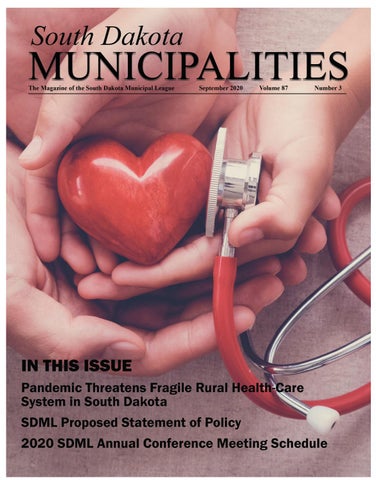
Pandemic Threatens Fragile Rural Health-Care System in South Dakota . . . . . . . . . . . .14
SDMEA Hometown Power . . . . . . . . . . . . . . . . . . . .22
State of SD Fiscal Year 2019 Citizen-Centric Report . . . . . . . . . . . . . . . . . . . . . . . .24
SDML Hall of Fame Nomination Form . . . . . . . . . . .32
2020 SDML Annual Conference Meeting Schedule . . . . . . . . . . . . . . . . . . . . . . . . . . .33
SDML Proposed Statement of Policy . . . . . . . . . . . . .34
Columns
Dist. 10 - Michelle DeNeui Finance Officer, Spearfish
Director’s Notes . . . . . . . . . . . . . . . . . . . . . . . . . . . . . . .4
LEAGUE STAFF 1-800-658-3633 Fax: 605-224-8655
Risk-Sharing News . . . . . . . . . . . . . . . . . . . . . . . . . .28
PAST PRESIDENT Pauline Sumption Finance Officer, Rapid City
Yvonne Taylor Executive Director Sandi Larson Director of Risk Sharing Services Lori Martinec Director of Research and Training Chris Hill Director of Municipal Electric Services Sara Rankin Director of Marketing & Communications Lori Butler Director of Finance Carla McGregor Accounting Assistant Lisa Nold Office Manager SD Public Assurance Alliance: David Pfeifle Executive Director Lynn Bren Deputy Director Kristina Peterson Underwriter Paytra Nichols Underwriter Jerry Krambeck Member Services Representative Deb Corkill Executive Assistant
President’s Report . . . . . . . . . . . . . . . . . . . . . . . . . . . .5 Washington Report: Senator Rounds . . . . . . . . . . . . .30
In Every Issue
SDML Events Calendar . . . . . . . . . . . . . . . . . . . . . . . .4
City Highlight - Wagner . . . . . . . . . . . . . . . . . . . . .12
Hometown Happenings . . . . . . . . . . . . . . . . . . . . . . .53
Classifieds . . . . . . . . . . . . . . . . . . . . . . . . . . . . . . . . .56
Municipal Calendar . . . . . . . . . . . . . . . . . . . . . . . . . .58
SOUTH DAKOTA MUNICIPALITIES (ISSN 0300-6182, USPS 503-120) is the official publication of the South Dakota Municipal League, published monthly at 208 Island Drive, Ft. Pierre, South Dakota 57532, phone 605-224-8654. This institution is an equal opportunity provider, and employer. Periodical postage paid at Pierre, South Dakota and additional mailing offices. Non-member subscriptions are available for $30.00 annually. The opinions expressed herein are not necessarily those of the South Dakota Municipal League. Postmaster: Send address changes to SOUTH DAKOTA MUNICIPALITIES, 208 Island Drive, Ft. Pierre, South Dakota 57532.
SEPTEMBER 2020
VOLUME 87, NUMBER 3
3
Director's Notes
extremely weird year.
There is a theory that as you get older, time seems to go faster because every day is proportionally that much smaller of a piece of your entire experience. I am feeling about 100 years old as I realize school is about to start, and we’re reaching the end of another summer – seemingly only days after it started, even in this
Time has also flown by for the pools established more than 30 years ago by the SDML to provide coverage for municipalities. Beginning with the SD Public Assurance Alliance, followed quickly by the creation of the SDML Workers’ Compensation Fund, the pools were started at a time when coverage was either not available at all, or was simply too expensive. There is even a story dating back to the beginning of the pools about a city that was offered one million dollars of coverage – for the bargain price of a one-million-dollar premium. It was realized at the time that an answer must be developed, and the concept of pooling was brought to South Dakota. The pools allow local entities to “pool” their resources and purchase reliable, affordable coverage for property, liability, workers compensation, and, as of nearly 25 years ago, health. Thirty years ago, much of the coverage offered by these pools was the only option available.
2020 SDML Events Calendar
September 2
Elected Officials Workshop, Pierre
18-21
NLC City Summit, Tampa, FL
9
Joint SDML Board Meeting with County Association, Pierre
November December
4
Times have certainly changed, and the pools have brought stability to rates, solid and responsible coverage for cities and towns, counties, and other local entities, even as they face increased competition in the market.
Credit for creating the pools belongs to the predecessors of this Board and staff, but we still take great pride in the fact that these programs offer such responsible coverage, and my personal favorite feature is that the members of the pool are in complete control. They elect boards of trustees to work with service providers and govern the services offered by the pools – the boards are made up of mayors, finance officers, council members, and other city officials who have as their only interest providing solid coverage at reasonable rates. That cannot be said of any of the competing products.
Thirty years after their inception, the vast majority of South Dakota’s cities and towns belong to one or more of the pools. The League thanks them for their support and urges all entities to continue to use these pools. They are a strong tool in protecting your city’s employees and assets.
Until next month, remember we are always available at 1-800-658-3633 or yvonne@sdmunicipalleague.org Yvonne Taylor Executive Director
SDML Committees
2020 Nominating Committee
Al Cerny, City Administrator/ Finance Officer, Gregory, Chair Meri Jo Anderson, Finance Officer, New Underwood Becky Brunsing, City Administrator, Wagner
2020 Auditing Committee
Becky Brunsing, City Administrator, Wagner Michelle De Neui, Finance Officer, Spearfish Tracy Davis, Deputy Finance Officer, Rapid City Claire Baartman, Finance Officer, Dell Rapids
SOUTH DAKOTA MUNICIPALITIES
President's Report
Have you ever thought about the importance of shopping And what does shopping local do for your local? community? First of all, when the citizens of a community support their local businesses it is great economic support to the business owners that are operating those businesses allowing them to stay afloat in these very hard economic times. It also shows loyalty and support to the community you live in. A strong local shopping community also may make it attractive to draw in new businesses giving the appearance or the awareness that there will be local support to open that boutique on the corner or any other business that someone coming to or currently living in your community is wanting to open.
On the municipal government side what does shopping local mean? Well let’s see remember that street that is full of potholes? Or the complaint regarding limited hours of your library being open, or perhaps why the swimming pool does or doesn’t open. Well these are all tax supported projects and as we all know property tax can only do so much. Municipalities depend highly on the sales tax revenue that is generated by the local businesses. The local businesses thriving helps to support the annual street
repairs, it helps to keep the facilities recreational functioning like the pool, the library and the even helps to keep your city parks in good repair. So yes!!!! shopping local is very important to help your community thrive it is important to buy what you can local and to buy what you can from within the state of South Dakota to allow those revenues being spent to stay within our state and help our state thrive economically. As local governmental leaders we should all encourage and campaign for local shopping!! Well those are my thoughts for the month. Have a blessed September! Debbra Houseman
!R C HI T EC T UR AL /UT DOOR AND 2OADWAY ,I GHT I NG
7I T H OV ER A C ENT UR Y OF EX PER I ENC E I N PR OV I DI NG R EL I A BL E
ENER GY S A V I NG OUT DOOR A ND R OA DWA Y L I GHT I NG S OL UT I ONS
(OL OPHA NE A ND !%, A R E PA R T NER S Y OU C A N R EL Y ON #ONT A C T US T ODA Y A T
SEPTEMBER 2020
5
State Historical Society Announces Fall Deadwood Fund Grant Applications
The South Dakota State Historical Society announces that the applications for the next round of the Deadwood Fund grant program should be postmarked no later than Oct. 1 for work beginning no sooner than Jan. 1, 2021.
The program is designed to encourage large-scale restoration or rehabilitation of historic properties by individuals, organizations, or public agencies, according to Jay D. Vogt, director of the State Historical Society, whose historic preservation office administers the program.
Grants will be awarded in amounts ranging from $1,000 to $25,000. The grant amount must be matched on a dollar-for-dollar basis from nonfederal and nonstate sources. Nonprofit organizations will be allowed to use in-kind services for one-half of their match. Grant forms are available online at https://history.sd.gov/preservation/fundingopportunities.aspx. In 2019, $120,676 was distributed among nine projects, which had matching funds of $327,812. This resulted in a total publicprivate investment of $448,488. Funding for the program is from Deadwood gaming revenue earmarked by state law for historic preservation projects throughout the state and distributed by the State Historical Society.
For more information on the South Dakota State Historical Society’s Deadwood Fund grant program, contact the State Historic Preservation Office at the Cultural Heritage Center, 900 Governors Drive, Pierre, SD 57501-2217; telephone 605-773-3458; e-mail shpo@state.sd.us.
DENR Accepting Applications for Water Quality Projects
The South Dakota Department of Environment and Natural Resources (DENR) is accepting applications through October 1, 2020, for projects eligible for federal Clean Water Act, Section 319 nonpoint source control grants. Eligible applicants include governmental agencies; state government subdivisions, such as conservation districts, water development districts, counties and municipalities; universities;certain nonprofit organizations; and federally recognized Indian tribes. Other groups may participate by applying through one of the eligible entities as a project partner. Entities interested in applying for Section 319 grant funds by the October 1, 2020, deadline are encouraged to contact DENR at (605) 773-4254 or obtain application guidance at http://denr.sd.gov/dfta/wp/319.aspx. The federal Environmental Protection Agency grants require 40 percent local match. Section 319 of the federal Clean Water Act provides grants to reduce water pollution from nonpoint sources, such as polluted runoff from urban, agricultural and forest lands. DENR historically has used the Section 319 funds primarily to develop and implement projects designed to reduce nonpoint source pollution to meet Total Maximum Daily Loads (TMDLs). South Dakota water bodies in need of TMDLs are listed in the “2020 Integrated Report for Surface Water Quality Assessment.” A copy of the report is available from the DENR website at https://denr.sd.gov/documents/SD_2020_IR_final.pdf. Nonpoint source pollution originates from many sources, including heavily fertilized lawns, urban runoff that carries street and pet wastes, agricultural fields, small livestock operations and natural sources, such as highly erosive soils. The primary nonpoint source pollutants in South Dakota are sediment, phosphorus, nitrogen and E. coli bacteria. 6
SOUTH DAKOTA MUNICIPALITIES
ENGINEERING A BETTER COMMUNITY We're thinkers. We're problem solvers. We're innovators. We exist to provide comprehensive engineering and surveying services to communities throughout the upper Midwest. You can count on us to engineer a better community.
#engineeringabettercommunity
Brookings | Sioux Falls | Vermillion | Rapid City | Milbank 605.692.6342 | Toll Free 1.855.323.6342
www.bannerassociates.com
Racial and Social Justice Issues: The SDPAA’s Expanding Array of Training Resources
ability to make the “right call” at exactly the “right time” can mean the difference between a good and bad outcome. The hundreds of law enforcement officers with whom I have worked have said these situations require a “rolodex” of information that your brain must sort through in a splitsecond. Having the right information in that rolodex, which we should now call an “electronic folder,” should lead to a correct decision. Creating and storing the right information in that electronic folder requires comprehensive training and the wisdom gleaned from years of experience.
By:
Dave Pfeifle, SDPAA Executive Director
Racial discrimination is prevalent in all parts of our society. Recent national surveys reveal that over 70% of African-Americans and members of other diverse groups believe that they have been the victims of discrimination. A majority of white respondents believe they have also been the victims of racial discrimination. While I served as City Attorney for Sioux Falls, our office worked with the Sioux Falls Human Relations Commission who investigated complaints of many types of discrimination in the workplace and places of public accommodation. These investigations showed that instances of overt discrimination were decreasing, yet sadly many instances of possible covert discrimination were still occurring in our community.
Today’s discussions about racial/social justice issues are focused on law enforcement. However, our entire society must address them, especially the public sector if we are to effectively serve our constituencies. While many local law enforcement agencies have been making commendable improvements in community policing and adopting inclusive practices, others are lagging behind.
Law enforcement officers perform a vital service in addressing all types of social strife. An interaction between law enforcement and an individual has the potential to escalate quickly if certain decisions and/or actions are not properly taken at the proper moment. The 8
To improve that foundation of information, crisis intervention training has become a key focus in the law enforcement community. Last year the SD Sheriffs Association, the SD Division of Criminal Investigation, and the SD Public Assurance Alliance (SDPAA) sponsored the creation of crisis intervention training modules for all law enforcement officers in South Dakota. This training
WANT AFFORDABLE HOUSING FOR YOUR COMMUNITY? START THE DISCUSSION WITH SDHDA AND TAKE THE NEXT STEP
S O U T H
D A K O T A
D E V E L O P M E N T
A U T H O R I T Y
sdhda.org SOUTH DAKOTA MUNICIPALITIES
has been especially beneficial for those dealing with an emotionally-charged encounter. The most recent racial/social justice issues have created the need for additional specialized training. As one law enforcement officer told me recently, this additional training will prove to be, “either beneficial as a refresher course or essential if it is a wake-up call.”
Many studies have shown that discriminatory practices are learned. They must be unlearned. As Mark Twain said: “Education consists mainly in what we have unlearned.” The initial acceptance and then the appreciation of the diversity of our fellow human beings takes a mindset that must be developed if it does not already exist when someone joins your team. The SDPAA is working with the SD Police Chiefs Association and the SD Sheriffs’ Association to develop unique training for all law enforcement officers to improve their diversity mindset at all levels. We are pleased to be working with Vaney Hariri, co-founder of Think 3D Solutions, a local consultant. Hariri was the prior Chair of the Sioux Falls Human Relations Commission with whom I worked while I was with the City of Sioux Falls. He will be the closing speaker at the Annual SD County Convention in September. He is working with local law enforcement across South Dakota to identify common issues to develop trainings that will foster a culture of inclusion and a diversity mindset. While this training is commencing with local law enforcement, the SDPAA plans to expand it to all others in local government in the coming months. The SDPAA is honored to join with our local law enforcement community to offer this training to their officers. We appreciate their service and want to assist them in their public service mission. The issue of racial/social justice does not need to polarize us to the extent that we are prevented from collectively taking positive steps. It is possible to be sensitive and responsive to racial/social justice issues while also being supportive of improving good law enforcement practices.
In addition to this latest training opportunity, the SDPAA through its local vendor Safety Benefits, Inc., offers thousands of hours of other trainings on hundreds of topics. Several thousand local government employees and officials benefit from these trainings every year. If you are not a Member of the SDPAA but believe your public entity’s team members would benefit from these trainings and many other SDPAA services, then please contact the SDPAA office at 800-658-3633 option 2 or by email at sdpaa@sdmunicipalleague.org.
SEPTEMBER 2020
9
USDA Can Help Rural Communities Envision a Big Future
By: Julie Gross, USDA Rural Development State Director
USDA Rural Development offers programs and services to help rural municipalities thrive. Through direct loans and grants, and loan guarantees, our programs promote job growth and retention to support thriving rural communities.
I have seen firsthand the challenges that our rural communities face and understand the critical need for safe and affordable housing, essential community infrastructure and facilities, to enhance economic development opportunities.
The Single-Family Housing Programs play an important role in keeping South Dakota strong. In 2019, more than $131 million in homeownership loan guarantees helped 916 low-and moderate- income rural South Dakota residents purchase a home in rural areas up to 35,000 in population. Loans are available to provide low- and moderate-income households the opportunity to buy or build new homes. For existing homeowners, funds are available to perform necessary repairs to make homes safer and more efficient.
Through the Community Facilities Direct Loan & Grant Program, more than 100 types of projects are eligible for funding to improve a rural community. If you need health care facilities such as hospitals, medical clinics, dental clinics, nursing homes or assisted living facilities; or public facilities such as town halls, courthouses, airport hangars or street improvements, we can help. Interest rates are at an all-time low. Effective now through September 30, 2020 the following interest rate is 2.255% for direct community facility loans. In some cases, your community may qualify for disaster funding.
•
10
Through three USDA Rural Development Community Facilities loan and grant packages totaling $138,400, Lake Andes-Ravinia Fire Protection District is in the process of purchasing a 1.5-ton grass rig with a 300-gallon tank, as well as a new chassis to replace the old rescue truck. In addition to these two trucks, the District has purchased three new sets of fire gear including boots, pants, vests, helmets, hoods, and an electric fan. These investments will help the District fulfill their mission to prevent loss of life and property for 2,438 individuals in the District’s service area, which is comprised of five townships and the three municipalities of Lakes Andes, Ravinia and Pickstown.
Through the Water and Environmental Programs (WEP) rural communities can obtain technical assistance and financing necessary to develop drinking water and waste disposal systems. Safe drinking water and sanitary waste disposal systems are vital not only to public health, but also to the economic vitality of rural America. If your rural water system or community need water and/or wastewater improvements, we can help you obtain a new water tank or make upgrades and improvements. The interest rates on WEP loans can go as low as 1.125% depending on the town’s population and medium household income. In some cases, your community may qualify for an Emergency Community Water Assistance Grant if a disaster has caused a loss of quantity or quality of water. •
South Lincoln Rural Water System, in Beresford, received a $12,392,000 WEP loan to build a water treatment plant, improve small diameter pipe looping, and improve the main line. The project will improve water quality and water delivery for the system's 7,113 customers. The project also will help ensure the system has the capacity to support future growth.
Infrastructure investments can be a major, or even decisive factor in a business’s decision to relocate or expand to a town or area. While there is no ironclad guarantee that jobs and businesses will follow, the odds are favorable for places that provide housing and build or modernize its infrastructure.
In addition, USDA increased the rural population eligibility limit to 50,000 residents for the Community Facilities Guaranteed Loan Program (CF) and the Guaranteed Water and Waste Disposal Loan Program (WEP). This provides new funding opportunities for communities over 10,000 and less than 50,000 including the communities of Aberdeen, Brookings, Watertown, Mitchell, Yankton, Pierre, Huron, Spearfish, Vermillion and Brandon.
President Trump and Agriculture Secretary Perdue are committed to helping our rural communities build prosperity because they know when rural America thrives, all of America thrives. I am available to meet with you to discuss how USDA can help your community prosper and envision a big future. I look forward to hearing from you. Contact me at julie.gross@usda.gov or (605) 352-1101 and visit www.rd.usdsa.gov/sd and follow RD on Twitter @RD_SouthDakota. SOUTH DAKOTA MUNICIPALITIES
Yoour Coomplete ITT Source Riverside Technolo Techno ologies, Inc. (RTI) is a local, trusted IT source e with years of experience meeting the technology nee eds of cities and municipalities. We specialize in proviiding customized IT solutions, including mana aged IT services, managed print, ha ardware, software, and promotional products. RTI understands unique u challenges, devvelops creative solution ns, and provides unmatched respo onsiveness.
Hardware
Sof tware
Managed Ser vices
Managed Print
Embroider y
Apparel
Bags
Cabling
Entterprise Soolut ions
Wirreless Soluut ions
Callll or eemailil us toda C dayy for moree informattion! ion! w w w.1RTI . com
Promoot ional Products
Mo Thompsson ™ MThomp pson@1RTI.com Ó 866.804..4388 x1067 866.804 4.4388
CITY HIGHLIGHT
Wagner
:HOFRPH WR :DJQHU $ SODFH WR FDOO KRPH ,I \RXU WUDYHOV WDNH \RX ZHVW RQ 6' KLJKZD\ \RX ZLOO JR ULJKW WKURXJK WKH KHDUW RI :DJQHU :LWK D VQXJ OLWWOH VSRW ULJKW DORQJ WKH KLJKZD\ :DJQHU KDV D ORW RI KRPHWRZQ DGYHQWXUH DQG IXQ PHPRULHV WR EH PDGH WKDW \RX FDQ WDNH DORQJ ZLWK \RX RQ \RXU MRXUQH\ 2U HYHQ EHWWHU \HW PDNH PHPRULHV LQ D SODFH WKDW \RX FDQ FDOO KRPH 7KH /DUJHVW /DERU 'D\ &HOHEUDWLRQ LQ 6RXWK 'DNRWD DOVR FDOOV WKH FLW\ RI :DJQHU KRPH :LWK D OHJDF\ RI \HDUV FHOHEUDWLQJ /DERU 'D\ :DJQHU KDV EHHQ KRVW WR PDQ\ JXHVWV RYHU WKDW KROLGD\ ZHHNHQG WKDW WDNH SDUW LQ DOO WKH IHVWLYLWLHV 6RPH RI WKRVH JUHDW DFWLYLWLHV WKH IHVWLYLWLHV 6RPH RI WKRVH JUHDW DFWLYLWLHV LQFOXGH FRRN R൵ V DUWV LQ WKH SDUN DQG D PLOH ORQJ SDUDGH WKDW KDV EHHQ NQRZQ WR ODVW XS WR DQ KRXU DQG KDOI 7KH URGHR JURXQGV DQG WKH UDFHWUDFN HYHQWV NHHS SHRSOH HQWHUWDLQHG DV ZHOO DV WKH ELJ FDUQLYDO WKDW WDNHV XS WKH HQWLUH PDLQ VWUHHW ,PDJLQH DOO WKH FDQG\ DQG GpFRU ,I \RX KDSSHQ WR PLVV RXU ELJJHVW FHOHEUDWLRQ ZHHNHQG ZH KDYH SOHQW\ RI RWKHU KRPHWRZQ DWWUDFWLRQV WKDW \RX FDQ HQMR\ DOO \HDU DURXQG :DJQHU /DNH LV RXU KLGGHQ JHP 1HVWOHG LQ WKH QRUWKZHVW FRUQHU RI WRZQ ZLWK IRXQWDLQV ¿ VKLQJ SLHUV SLFQLF VKHOWHUV SOD\JURXQGV DQG
D VFHQLF L ZDON SDWK DQG HYHQ VRPH JUHDW RXWGRRU H[HUFLVH HTXLSPHQW ,W LV VXUHO\ D SODFH RI SULGH IRU WKH FRPPXQLW\ :DJQHU /DNH R൵ HUV D SLFWXUHVTXH EDFNGURS IRU DQ\ FHOHEUDWLRQ DQG IDPLO\ UHXQLRQV 2WKHU DWWUDFWLRQV VSRWWHG WKURXJKRXW :DJQHU DUH WKH &LW\ 3DUN ZKLFK KRVWV WKH IDUPHUV PDUNHW DUW VKRZV DQG YHQGRU WUHDWV 7KH SDUN LV LQ D JUHDW ORFDWLRQ LQ WKH PLGGOH RI WRZQ QH[W WR RXU OLEUDU\ DQG MXVW D EORFN DZD\ IURP RXU QHZ GLVF JXOI FRXUVH 2XU GLVF JROI FRXUVH LV SODFHG RQ D ZLGH RSHQ DFUH ORW ZLWK EXVLQHVV VSRQVRUHG EDVNHWV DQG D SLFQLF DUHD $QG LI \RX DUHQ¶W GULYLQJ \RX FDQ À \RX FDQ À\ \ LQ WR RXU DLUSRUW ZLWK RXU QHZO\ LQ WR RXU DLUSRUW ZLWK RXU QHZO\ FRQVWUXFWHG SODQH KDQJDU EXLOGLQJ 2I FRXUVH QRQH RI WKHVH JUHDW SODFHV LQ RXU FLW\ DUH SRVVLEOH ZLWKRXW WKH SHRSOH 7KH SULGH LQ RXU DJULFXOWXUH FRPPXQLW\ GULYHV RXU ORFDO HFRQRP\ DQG ZLWK MXVW XQGHU FKDPEHU EXVLQHVV PHPEHUV ZH KDYH SOHQW\ RI SODFHV WR VKRS GLQH DQG IHHG DQ\ RI \RXU DUWLVWLF QHHGV 7KH SHRSOH RI :DJQHU DUH KRPHWRZQ IULHQGO\ DQG ZLOO WUHDW \RX DV RQH RI WKHLU RZQ 6R QH[W WLPH \RXU MRXUQH\ WDNHV \RX RQ WKH URDG RU LQ WKH DLU PDNH VXUH \RX YLVLW :DJQHU <RX QHYHU NQRZ \RX PD\ MXVW FDOO LW KRPH
Provided by: City of Wagner
12
SOUTH DAKOTA MUNICIPALITIES
Trump Administration Seeks Applications for Capacity Building and Planning Grants in Rural Communities
The Trump Administration today announced that the United States Department of Agriculture (USDA) is accepting applications to help rural communities enhance capacity for broadband access; preserve cultural and historic structures; and support the development of transportation, housing, and recreational spaces.
USDA is making $1 million in grants available under the Rural Placemaking Innovation Challenge (RPIC). Eligible recipients may use the grants to develop multijurisdictional plans to benefit cities or towns with 50,000 residents or less. Organizations may use funds to develop actionable plans, convene partners, identify community needs and implement priorities to build rural prosperity. Public or private groups, organizations, or institutions that demonstrate experience in providing placemaking technical assistance to rural communities are eligible to apply.
USDA encourages applicants to develop projects and plans that provide measurable results to help create livable communities; encourage partnerships; contribute to long-
term community investment; and support community resiliency, social stability and collective identity.
USDA seeks to partner with one organization each located in the northeast, southern, midwestern and western regions of the United States. The maximum grant award is $250,000. Applicants must provide a 15 percent match in funding. Eligible placemaking plans will provide assistance to rural communities for two years. Electronic applications must be submitted via grants.gov and a copy of the submission must be emailed to RD.Innovation@usda.gov by midnight Eastern Standard Time on Sept. 10, 2020. For more information, contact Angela.Callie@usda.gov or call (202) 568-9738.
USDA encourages applications that will support recommendations made in the Report to the President of the United States from the Task Force on Agriculture and Rural Prosperity (PDF, 5.4 MB). If you’d like to subscribe to USDA Rural Development updates, visit our GovDelivery subscriber page.
Census data impacts funding for things like: Supplemental Nutrition Assistance Program
Children’s Health Insurance Program School Breakfast Program
Rural Rental Assistance Payments Unemployment Insurance Section 8 Housing Choice Vouchers Medicare Part B
Community Development Block Grants
For more information, visit:
2020CENSUS.GOV SEPTEMBER 2020
13
Pandemic Threatens Fragile Rural Health-Care System in South Dakota
By Bart Pfankuch, South Dakota News Watch
Editor’s note: This article is the second of three parts of a special report by South Dakota News Watch called “Small Towns, Big Challenges.” See the entire series at sdnewswatch.org.
The COVID-19 pandemic has placed a significant and unexpected financial burden on rural health-care providers who were already struggling to maintain hospitals and clinics that help keep small-town residents — and their communities — alive and well.
A slowdown in patient visits and drop in medical procedures due to fears of spreading the virus have led to a major loss of revenues for medical providers and healthcare systems that serve rural areas. While the virus has not led to mass infections in small towns, the drop-off in activity and billable services has put stress on the already fragile financial state of many rural clinics, small hospitals and dental offices.
14
With the first wave of the pandemic possibly over, more safety measures in place and life returning somewhat to normal, most clinics and hospitals in rural South Dakota have headed off any imminent concern of closure. Yet in a rural health-care system made up of a patchwork of providers and hospital systems, the losses from the pandemic could curtail the hiring of health-care workers, slow plans to expand services, and further restrict access to health care for hundreds of thousands of small-town and rural residents of the state.
In a state of 885,000 people spread out over roughly 76,000 square miles, and with only nine of 66 counties having more than 20,000 people, South Dakota is among the most rural of all states and home to a heavily diffused population. Even before the pandemic, that equation presented a major challenge for health-care providers to serve small-town and remote populations, and do so in a financially viable manner. Likewise, rural residents have a hard time getting adequate preventive, maintenance,
SOUTH DAKOTA MUNICIPALITIES
emergency and palliative health care.
“Do I think rural health care is at risk? Absolutely,” said Thomas Worsley, president of Spearfish Hospital and Hills Markets for Monument Health, the largest medical system in West River with its flagship hospital in Rapid City and smaller facilities in Hot Springs, Custer, Sturgis, LeadDeadwood, Wall and Buffalo, among others. “It’s always going to be at risk because it’s not a profitable endeavor or something that is going to attract big dollars, but it’s something that fills a real need in these rural communities.”
Worsley, who also serves on the Future of Rural Health Task Force within the American Hospital Association, said the challenge for rural health-care providers and hospital groups is to maintain the highest level of care possible while also protecting the overall financial viability of the health-care system.
“If you polled all these rural health-care CEOs [on the task force], I think they all feel like they’re fighting for their lives on a daily and yearly basis,” he said.
Horizon Health Care, a rural health provider with more
SEPTEMBER 2020
than two dozen medical and dental clinics in small towns across South Dakota, saw its revenue fall by roughly half in the weeks after the pandemic hit and patients began staying home, according to Wade Erickson, chief financial and operations officer. By early June, patient activity and revenues had returned to about 90% of normal, Erickson said, and the group benefited from receiving about $3 million in emergency aid from the federal CARES Act pandemic bailout fund. The aid and bounceback in procedures have been critical to Horizon, based in Howard, S.D., but especially to its patients in rural communities who are never turned away because of ability to pay, Erickson said. About a third of Horizon’s funding comes from the federal government, and about 20% of its patients are uninsured.
“In really rural communities where we are, just about touching every corner of South Dakota, we’re really the only access to care that they have,” Erickson said.
Access to health care remains a serious challenge in much of rural South Dakota, where federal data show that residents tend to have greater rates of serious illness and death from diseases and far less access to doctors, nurses
15
and dentists than in the state’s few urban areas.
Rural residents “face a unique combination of factors that create disparities in health care not found in urban areas,” according to the National Rural Health Association.
The South Dakota Office of Rural Health has performed a needs assessment that ranks all 66 counties in terms of resident health status, access to health care and other health-risk factors. Ten counties — all rural and several home to Native American reservations — have consistently ranked in the bottom quartile in all health and access categories (Buffalo, Bennett, Corson, Dewey, Gregory, Jackson, Mellette, Roberts, Todd and Ziebach.) The pandemic has heightened the challenge of providing medical care to rural areas and small towns that the vast majority of South Dakotans call home.
The rural medical system in South Dakota varies by location, but in general, health care is provided through an informal continuum of care in which patients must travel more owing to the remoteness of their residence or as their care needs increase.
The smallest towns and most remote areas likely have no local health-care provider; as towns get larger, they are more likely to have non-emergency clinics that provide basic diagnostics or treatment during regular business hours; medium-size cities often have a “Critical Access Hospital” with 24/7 emergency services and greater diagnostic and treatment capabilities that qualify for significant federal funding; and urban areas are home to full-service hospitals with critical care, extensive diagnostics, multiple surgical options and specialty providers. In major medical emergencies, rural residents can expect to drive hundreds of miles or pay for a ride in an ambulance or a helicopter in order to survive.
CEO of the Community Healthcare Association of the Dakotas, which represents rural health providers.
Before and during the pandemic, Ten Napel has lobbied for greater state and federal support for community hospitals and clinics.
“Without help, we would not make it through this, or we would just make it and it would be such a different picture of [which] communities providers can afford to be in,” she said.
Even with federal CARES Act aid, however, Ten Napel said elected officials, policymakers and the public must think deeply about the need for rural health care and find ways to continue to support providers who serve small communities.
“It’s kind of mind-blowing when you see your revenue crater,” she said. “We as a community need to figure out what services we think are important and figure out a way to support that. It’s not enough to say, ‘Well, this is a small town, it’s not economically viable so they’re just not going to have health care. We need to collectively figure out a reasonable set of services that can be provided.”
Ten Napel and others say that if rural health care is allowed to diminish, small towns in South Dakota and across the country — and the cherished way of life they provide — may falter or even cease to exist.
“We talk about the life of a town and a community and we’ve all seen different exoduses from Main Street, but once you get down to losing your health care, your school, your grocery store, a few of those core entities, at what point does a community become non-viable?”
During the pandemic, the urban medical centers in South Dakota collectively lost hundreds of millions of dollars in revenue due to a lack of elective surgeries and routine and preventive care. Though federal emergency funding has helped counter those losses, some staff was laid off and the long-term impacts are still unknown.
Because they already had small staffs, most rural clinics were unable to cut positions or reduce services, though those providers also aren’t yet sure what the future may hold as billing cycles close and revenue reductions become fully clear. As a result, the long-range effects of the pandemic on rural health care in South Dakota are not yet known. “Imagine running an operation that is mostly staff salaries and your revenue is cut in half or by a third, and you still have to try to make that work,” said Shelly Ten Napel, 16
Many small town in South Dakota, including Faith, are served by small clinics that provide basic preventative, routine and diagnostic care that can be a first step toward receiving more extensive or invasive treatment at hospitals in larger cities. This clinic is operated by Horizon Health Care. Photo: Bart Pfankuch, South Dakota News Watch SOUTH DAKOTA MUNICIPALITIES
Medical access a trade-off in rural areas Federal data show that rural residents fare worse than their urban counterparts in several health-related categories, such as death rates from cancer, heart and lung disease and from accidents. They also tend to have higher rates of obesity and a lower life expectancy. While attitudes about medical care may play a role, medical experts say a lack of access to preventive care and a variety of treatment options is also a factor.
Conversely, some rural residents, such as farmers and ranchers, tend to be hearty and remain healthy into their elderly years, Worsley said. But they may also eschew preventive treatment and tend to suffer from slowprogressing illnesses like skin cancer and orthopedic problems that crop up after years of agricultural work.
Many small-town residents in South Dakota accept the trade-off they make when choosing a remote, rural lifestyle that doesn’t include access to immediate or highlevel medical care, Worsley said.
“The folks that live in those communities understand that they are not going to have at-the-elbow, immediate access to care, and that’s one of the understandings they have about living in those locations,” Worsley said. “I’m not sure those small towns need a cardiologist or a surgeon, but they really need strong access to primary care.” Rural clinics and hospitals in medium-size cities are a critical part of the health-care spectrum in rural America, providing basic care in small towns and more advanced diagnostics and treatment in the larger communities, he said.
historically been on the decline in South Dakota.
“Any kind of a business that wants to be located in a small community, they’re always going to look at what access to health care do employees have,” he said. “Education, public safety, there’s a very short list of things people want to look at when considering a move to small communities, and health care is right there at the top.” A rural clinic or small hospital is also an economic driver and creator of jobs that help rural communities thrive, Worsley said.
“I would say it’s vital,” he said. “If you think about what are good jobs that folks who grow up in a small community can come back to, health care would surely fall into that category.” Small-town health care in rural areas across the country is supported by the federal Critical Access Hospital program, which provides targeted funding through a federal Medicare reimbursement program for small regional hospitals with 25 or fewer beds.
Bryan Breitling is the regional administrator at Hand County Memorial Hospital in Miller, a critical-access hospital that is part of the Avera Health system. Breitling said critical-access facilities were better-positioned to withstand the revenue drop associated with the pandemic than urban medical centers.
Monument clinics in towns like Buffalo, Belle Fourche, Hill City, Hot Springs and Wall are able to provide rural residents with routine care but also foster strong relationships between provider and patient that allow for diagnosis and treatment of more serious issues.
In rural clinics, nurse practitioners or physician’s assistants are able to provide basic care and can also save lives by referring patients to more well-equipped facilities when the need arises.
Rural providers also may perform a variety of functions in the same community, Worsley said. A small-town physician or provider may manage an emergency room, treat patients as a family doctor and also oversee care at a nursing home, for example.
Worsley said small clinics, even those with only basic care, are critical components of what a rural community needs to retain population, attract new residents and establish a healthy economy. Those factors are crucial to maintaining population and economic stability in small towns that have SEPTEMBER 2020
Many areas of South Dakota are served by 38 “Critical Access Hospitals’ that receive federal funding to remain viable in small towns, including the privately run nonprofit Fall River Health Services hospital in Hot Springs. Photo: Bart Pfankuch, South Dakota News Watch
“COVID-19 is going to have less of an impact on criticalaccess hospitals [than] it will have on our more urban counterparts,” Breitling said. “We do have a cost-based reimbursement mechanism in there from Medicare ... and so, from that standpoint, we’re going to largely be protected.” 17
Yet despite those protections, the 38 critical-access hospitals in South Dakota — including facilities in Armour, Burke, De Smet, Eureka, Freeman, Mobridge, Parkston, Philip, Viborg, Webster and Winner, among others — have also taken a financial hit, Breitling said.
“The revenues have taken a dive, clearly. So anyone who presents through the emergency room who has a broken arm or a heart attack, those types of patients are still being seen and being cared for,” he said. “It’s the patients that used to come in for routine physicals, for screenings, all of those traditional regular health-related issues. Those have essentially ended for the last two months and so we’re in the process of restarting those again, and that’s where a lot of that revenue issue is.”
The drop in people seeking medical treatment during the pandemic may have unexpected consequences, including among patients who miss an annual physical and could be exposed to greater danger from slow-developing illnesses such as skin cancer.
Breitling said one pressing concern is that children may be less protected against other illnesses upon returning to school in the fall.
“There are some stats out there that say over the last couple of months, fewer people have brought their kids in for wellness visits, which translates into fewer vaccinations and things like that,” he said. “So we need to get back to the vaccinations to get them protected this fall once the traditional cold or flu season comes into place.”
Recruitment a challenge; tele-health on the rise Recruiting doctors, nurses and dentists to practice in towns of 2,000 people or fewer has been an ongoing challenge for health-care systems and rural hospitals.
community and its people, and in living in a safe, quiet community, Erickson said.
“We have this opportunity in rural places to bring back true primary care through the entire life spectrum, and there’s great satisfaction in that,” he said. “There’s this great opportunity to see kids all the way up to our elder populations, and there’s a challenge in that you’ve got to know a lot more things.” Federal programs that allow new practitioners to eliminate part or all of their student debt by agreeing to practice in underserved areas can also be a strong incentive.
The COVID-19 pandemic has led to an expansion of telehealth services in which patients use computers and an internet connection to visit in real time with a doctor or nurse. Avera Health has been a national leader in providing tele-health, but the pandemic has sped up the transition to tele-health by smaller community health systems as well.
One problem providers have faced is that federal Medicare and Medicaid programs did not in many cases reimburse providers for tele-health appointments and care. During the pandemic, the CARES Act has expanded reimbursement of tele-health and provided $158 million in funding for providers to engage in tele-health and improve tele-health services. The Community HealthCare Association of the Dakotas received about $450,000 in the latest round of payments on June 24 for computers and videoconferencing equipment to expand services. Rural health providers are hopeful the tele-health reimbursements may be made permanent once the pandemic subsides.
Some practitioners seek higher pay, greater social options, easier access to housing, and the prestige of working in big-city hospitals, and are not interested in living in a small town in the early stages of their careers.
Horizon Health Care is in almost constant need of qualified personnel and tries to highlight the benefits of living and working in a small community when pitching prospective employees, Erickson said.
“It is hard at times because a lot of times they see the money, and money talks, and we try to compete as best we can with salaries,” he said.
But Horizon has had success in attracting practitioners who either grew up in a small town or who see the value in providing a service that is absolutely critical to the 18
SOUTH DAKOTA MUNICIPALITIES
support much of that care. The option to expand protection has been available for several years; it does not appear at this time that the state is moving toward expanding eligibility.
The pandemic has made it even harder for Native Americans in South Dakota to get health care at any level, from preventive and emergency care to treatment for major illnesses or by specialists, said Jerilyn Church, CEO of the Great Plains Tribal Chairmen’s Health Board.
Rural health-care providers have played a critical role in stopping the spread of the COVID-19 pandemic. This temporary testing facility was operated by the Horizon health Care clinic in Alpena in May. Photo: Bart Pfankuch, South Dakota News Watch
Another growing gap in rural health is the dearth of behavioral-health options for small-town residents and a lack of follow-up care after surgeries or physical injuries. Small-town clinics sometimes serve as hubs for independent providers who treat rural patients. In Faith, S.D., the Horizon clinic rents space to a private, independent physical therapist who visits weekly and has a strong patient base. A roadblock to expanding rural health care in South Dakota has been the state’s refusal to expand Medicaid coverage as allowed by the Affordable Care Act. Lawmakers have not approved the eligibility expansion that would cover about 43,000 more people under Medicaid and enable the state to receive federal funding to
Native Americans have access to care at federally supported Indian Health Service facilities, but those hospitals have been underfunded for years, Church said. “Indian Health Services have been funded at 50% of the need for a really long time,” Church said. “So, while facilities are there, they’re not designed to meet the need and demand of what is needed.”
Meanwhile, a long-range trend has seen IHS hospitals become centralized geographically and offer less services over time by replacing full-service hospitals with local clinics, increasing travel times for Native patients and forcing more into the non-federal health-care system. During the pandemic, tribal leaders have locked down reservations and taken bold steps to reduce the spread of the virus, generally seeing success in limiting infections. But Church said tribal health facilities remain woefully inadequate to meet the needs of Native Americans, who suffer high levels of poverty and high rates of chronic illness.
“The ideal situation during a pandemic is that we would have the ability to manage in-patient care on the reservation,” she said. “But with Indian Health Services as it is, tribal members are relying more on large health systems to provide care, requiring them to travel great distances.”
Church said her organization is working on a long-range solution by increasing the number of Native Americans who enter the health field, thereby building a system in which tribal members become able to live with and treat members of their own communities.
“We hope to accomplish much if we are a healthy people,” she said. “It really does begin with growing our own and ensuring that our babies, our children, our new moms all the way up to our elders are receiving the best quality care that they can.”
- South Dakota News Watch reporter Nick Lowrey contributed to this report.
SEPTEMBER 2020
19
6287+ ' '$.27$ 332/,&( & &+,()6¡ ASSOCIATION An Affiliate of the South Dakota Municipal League
Dear South Dakota Municipalities, 7KH 6RXWK 'DNRWD 3ROLFH &KLHIVÂś $VVRFLDWLRQ LV SDUWQHULQJ ZLWK WKH 1R 1HHG )RU :HHG EDOORW PHDVXUH committee in educating the citizens of our state regarding the Initiated Measure 26 (IM 26) that will be voted on at the upcoming General Election. Please see the information on the next page. The South Dakota Police Chiefs Association has many concerns with IM 26, which attempts to legalize Marijuana for medical use in the state of South Dakota. The Association recognizes that certain chemicals contained in marijuana may be useful in treating certain medical conditions, however, legitimate medicine used to treat patients requires a meticulous and regulated manufacturing, evaluation, and dispensing process that involves strict standards for patient safety. Legitimate medicine is prescribed by a medical doctor and dispensed through trained pharmacists. IM 26 will not require Marijuana to be dispensed through the normal processes of a pharmacy. IM 26 does not consider risks to public safety regarding driving and working under the influence of marijuana. IM 26 could allow certain previously convicted offenders of drug dealing the ability to possess marijuana. The South Dakota Police ChiefsÂś Association is committed to the public safety and welfare of our South Dakota communities. IM 26 seems to circumvent the normal process of how legitimate medicine is made and dispensed, and it poses many legitimate concerns regarding criminality regarding the use and possession of marijuana for medical use. The South Dakota Police ChiefsÂś Association opposes IM 26 for its risks to public safety under the guise of medical treatment. On behalf of the South Dakota Police Chiefs Association, Chief Dave McNeil, Aberdeen SD 3UHVLGHQW 6RXWK 'DNRWD 3ROLFH &KLHIVÂś $VVRFLation
______________________________________________________________________________ 208 Island Drive ‡ Ft. Pierre, South Dakota 57532 ‡ ‡ FAX 605.224.8655 20
SOUTH DAKOTA MUNICIPALITIES
NO NEE ED FOR WEED VOTE NO N ON IM 26 Explanation of stance against IM 26 as, although it touts itself as medical MJ, the IM doesn't tre eat it like medicine. Lacks standards to prevent driving or working under the influence. Risk to public safety Risk to public and private property Risk to com o pany productivity i Risk to com o pany liability
"Disqualiffying felony offense" Only limitts violent offenders r from obtaining the prescrip ption, being a caregiver, or working in a dispensary a . Silent on offenders convicteed of: Distrib buting Controlled Substan a c es Possesssion or Ingestion of Meth, Cocaine, Heroin, and drugs not prescribed to them Offenders convicted of DUI Contrib i uting to the delinquency of a minor Fraud Theft
SEPTEMBER 2020
Medicine = Phar macy Marijuana = Dispensary No dosage limitatio on s No limit on THC or CBD in products Bla l nket approach: 3 oz. per every two weeks Patients would be allowed to grow their own "medicine" No trained pharmacist required at a dispen nsary In ndividuals and careegivers are alllowed to get their "p prescription" as soo on as they seend in their applications; without being approved first.
Lacks accountability No required backgrou und check for p patient or caregiver Onlly a $150 fine for failure to notify the Department of Health lh Onlly a class 2 misdemeanor for lyin ng to law enforcement. Onlly a class 2 misdemeanor for a doctor referring patients to a medical cannabis establishment.
21
By Chris Hill, Director of Municipal Electric Services
on the F-16. I attended Mitchell Technical Institute and received my degree in Powerline Construction and Maintenance. My wife Maisie and I have two children, Charlie (7) and Maggie (4), and two Golden Retrievers.
You have been the Electrical Superintendent with Beresford for nearly two years. Did your South Dakota roots contribute to your decision to apply for your position in Beresford? I started working as a Lineman for the City of Elk Point in 2003, and always thought it would be nice to move back to the town and work where I grew up. In 2016, I was given the opportunity to work for the Beresford Electric Dept. and serve the community I’ve always called home.
Mike Antonson
The September Hometown Power will highlight board member Mike Antonson. Mike was one of the first people that I met in my position with the SDMEA. My first Hometown Power was written about the City of Beresford and he was a lineman at the time. Since then, Mike has taken over as the Electrical Superintendent and has found a home on the SDMEA Board. Mike has been a great attribute to the SDMEA and has taken an active role in becoming part of the legislative process. I consider Mike to be a friend as well as a colleague and hope to continue working with him to make a stronger voice to support municipal electric utilities.
Mike, tell us a little bit about yourself. Where are you from? Education background? Family? I grew up on a farm south of Beresford along with 3 siblings. I graduated from Beresford and then joined the South Dakota Air Natl. Guard and served as a Crew Chief 22
How has your role with Beresford changed since taking over as the electrical superintendent? I became Superintendent in April, 2019. Coming into the position, following a very committed hard working Superintendent, I knew it was not going to be an easy transition of trying to fill in from his past years of experience and the years of respect he built within the community. Cultivating a place that emphasized continued safety for the guys, being their voice, becoming more cognitive on expenditures, and having a stronger sense of betterment for the community, has been a few of my primary focuses since I took on this new role.
South Dakota has 35 municipal electric communities. How do you think the SDMEA best represents those communities? SDMEA best represents member communities by providing a voice during Legislation and promoting the many benefits Public Power has to offer.
What do you do for fun when you aren’t working? Away from work, my wife and I are kept busy chasing our kids around and spending time with them. I enjoy being outdoors, hunting, camping, and a passion for pheasant hunting. SOUTH DAKOTA MUNICIPALITIES
SEPTEMBER 2020 2016
23
State of South Dakotaa
FY2019 Citizen-Centric Report | 1
State of South Dako ota Fiscal Ye ear 2019 Citi Cittizen-Centric Centric Rep C port Aboutt South Dakota D
Elected Off Offfiicials
South Dakota has ofteen been referred to as the land of infinite variety. That variety is reflected in everything from our weather to our scenery, our economy to our state symbols. South Dakotta ranks 16th in size among the 50 states. It was the 40th state to join the Union in 1889 9 and encompasses 75,885 square miles, averaging 12 people per square mile. South Dakota boasts more miles of shoreline than the state of Florida and the highesst point in the United States east of the Rocky Mountains.
Governor Noem Kristi N Lieutenant Governor Larry Rh hoden Secretary of State Steve Baarnett Attorney General Jason Ravvnsborg
Profile off the t Government Structure: State government is comprised of three distinct and separate branches of government: legislativve, executive, and judicial. The legislature is composed of a 35member Senate and a 70-member House of Representatives. Legislators are elected for two-year terms and limited to four consecutive terms for the same seat. The Governor may be elected for two consecutive four-year terms. Heads of state departments are appointed by and serve at the pleasure of the Governor. The judiicial branch is governed by the Unified Judicial System consisting off the t Supreme Courtt, circuit courts, and courts off limited li jurisdiction. Budget Process: State law requires annual preparation and approval of the State'ss budget, which has a fiscal year of July 1st through June 30th. The Governor presentss the annual budget to the State Legislature by the first Tuesday after the first Mond day in December. The legislature is required to approve a budget by the end of the legislative session. The Constitution of the State of South Dakota requires the legislature to pass a balanced annual budget in which expenditures and appropriations may not exceed anticipated revenue. Annual budget information caan be found on the Bureau off Fin Finance and Management website at bfm.sd.gov/budgeet. Demographic and Economic Indicators
2016
2017
2018
2019
State Real GDP (millions)* Farm Income (millions) Nonfarm Income (millions)* US/SD Unemployment Rate (percent) Per Capita Personal Income* Resident Population*
$45,686 $1 009 $1,009 $40,951 4.9/3.0 $48,627 862,890
$45,619 $939 $42,336 4.4/3.2 $49,554 873,286
$46,491 $1 447 $1,447 $44,619 3.9/3.0 $52,216 882,235
$46,828 N/A $46,466 3.7/2.9 $53,899 884,659
N/A - Inf nformation fo for the given demographics was not yet available at the time of of this publication.
State Auditor Rich Satttgast State Tre easurer Josh Haaeder School and Public Lands Ryan Brunner Public Utilities Commission Kristie FFiegen Gary Haanson Chris Nelson Legislative Branch President Pro Tempore Brock L. Greenfield Speaker Steve Haugaard Senate Majority Leaader Kris K. Langer Senate Minority Leaader Troy Heinert House Majority Leeader Lee Qualm House Minority Leaader Jamie Smith Judicial Branch Chief Justice David E. Gilbertson Justice Janin ne M. Kern Justice Steven R. Jensen Justice Mark E. Salter Justice Patriciaa J. DeVaney US Congressional Delegation Senator Mikke Rounds Senator John Thune Representative Dusty Johnson
* 2019 data are estimates.
For further economic info nformation, please reffer er to the Bureau of of Finance F anĚ DĂŶĂŐĞŵĞŶƚ͛Ɛ ͛Ɛ website at bfm.s fm.sd.gov/d v/dashboard ds.
24
SOUTH DAKOTA MUNICIPALITIES
State of South Dakota
FY2019 Citizen-Centric Report | 2
South Dakota Perffo ormance Measures The below metrics look at key indicators within the specific s expenditure categories off stat state government ʹ All Govvernment, Education, Agriculture and Natural Resources, Transsportation, p , Takingg Care o off P People, p , and Protectingg Peop People.
Fo or further metric ŝŶĨ ŶĨŽƌŵ ŵĂƚŝŽŶ͕ ƉůĞĂƐĞ ƌĞĨ ĞĨĞƌ ƚŽ ƚŚĞ ƵƌĞĂƵ ŽĨ &ŝŶĂŶĐĞ ĂŶĚ DĂŶĂŐĞŵĞŶƚ͛Ɛ ͛Ɛ ǁĞĞďƐŝƚĞ Ăƚ bfm.sd.gov/c fm.s v/cafr afr within th he statiisstics section.
SEPTEMBER 2020 2016
25
State of South Dakota
FY2019 Citizen-Centric Report | 3
Financial Summary of South Dako ota Total Pr P imary Gove 1 rnment Revenues TTotal otal revenue revenue increas increased ed $150.7 $150 7 million million from from FY2018 FY2018 to FY2019. FY2019 In FY2019, FY2019 South South Dakota Dakota received received 41% 41% of of its its revenues revenues from from taxes taxes (sales, motor fuel, con ntractors excise, bank card, ban nk franchise, and other taxes), and 37% from federal grants and contributions. Charges for service acccounted for 17%. Revenues include all funds and are reported under the accrual basis of accounting.
FY2019 Revenue Source Bank Card & Franchise Tax 1%
FY2019 ( t ho us a nd s )
$ 1,554,231
$ 1,620,350
1,025,111
1,089,336
Cha rge s fo or Se rvi ce
729,902
751,334
Motor Fue l Ta x
183,441
184,027
Contra ctorrs Exci s e Ta x
112,518
118,873
31,448
35,411
566,650
554,693
$ 4,203,301
$ 4,354,024
Gra nts & Contri buti ons
Other 13%
Contractors Excise Tax 3% Motor Fuel T ax 4%
FY2018 ( t ho us a nd s )
Re ve nue Source
Charges for Service 17%
Sa l e s Ta x
Grants & Contributions 37%
Sales Tax 25%
Ba nk Ca rd & Fra nchi s e Ta x Othe r Total Rev venues
Total Pr P imary Government Expenses TTotal otal expenses expenses increased increased $250.7 $250 7 million million from from FY201 FY201 18 8 to FY2019. FY2019 In FY2019, FY2019 Taking Taking Care Care of of People People (Health, (Health Human Human and and Social Social Services) accounted for 37% off the t StĂƚĞ͛Ɛ ĞdžƉĞŶƐĞƐƐ͕ ĨŽůůŽǁĞĚ ďLJ Ϯ4% to Education n (K-12 and post-secondary), 12% to Transportation (constructing and maintaining roads and bridges), and 7% to Protecting People (law, justice, public protection, and regulation). Expenses include all funds and are reported under the accrual basis off accounting. a
FY2019 Program Expense e
FY2018
FY2019
( t ho us a nd s )
( t ho us a nd s )
$ 1,500 0,037
$ 1,552,490
Educa ti on
971 1,540
1,002,056
Tra ns porta a ti on
455 5,118
533,336
Protecti ng Pe opl e
258 8,727
301,008
Ge ne ra l G ove rnme nt
217 7,355
215,879
A i cull ture Agri tu & Na N tura tu l Re R s ource s
144 144,690 4 690
155 789 155,789
Othe r
362,571
400,164
$ 3,910,038
$ 4,160,722
Program Expe nse Ta ki ng Ca re r of Pe opl e
Transportation 13% Agriculture & Natural Resources 4% Protecting People 7%
Other 10%
Education 24%
Taki aking Care C of People 37%
General Government 5%
Total Expenses
An independent audit was w conducted d,, resulting in a clean audit opinion. Complete financiall in nfo formation can be ffo ound on the Bureau of of Finance and DĂŶĂŐĞŵĞŶƚ͛Ɛ ͛Ɛ website at bfm.s fm.sd.gov/c v/cafr afr.
26
SOUTH DAKOTA MUNICIPALITIES
State of South Dakota
FY2019 Citizen-Centric Report | 4
Looking Forward ny areas, but we continue to look for ways to improve our pro South Dakota sets an example for the nation in man ograms and services. Below are specific plans to invest in new and growing growin ng industries and improve publ public ic safety. safety
Investing in Next Generation Industries
Improving Public Safety
Governor Noem is preparing South Dakota for tomorrow by increasing high-speed internet access, bolstering cybersecurity development, and investing in healthcare training programs.
Governor Noem is prioritizing the safety of our families and communities by combating the meth epidemic and w enforcement with modernized equipping law communicatio on tools
Connecting South Dakota ¾ This year, Governor Noem invested $5 million that leveraged more than $11.4 million in project costs to increase connectivity across South Dakota. ¾ Eight projects were awarded funding to bring internet access to approximately 4,800 households and more than 100 businesses in underserved parts of South Dakota. ¾ 'ŽǀĞƌŶŽƌ EŽĞŵ͛Ɛ ďƵĚŐĞƚ ƉƌŽƉŽƐĂů ĨŽƌ &ŝƐĐĂů Year 2021 allocates $5 million in one-time funds to continue expanding internet access ʹ and online opportunity ʹ throughout the state.
Combating the Meth Epidemic ¾ Comp m ared to the national average, twice as man ny children in South Dakota, ages 12 to 17, have reported meth use in the past year. ¾ From 2014 to 2018, South Dakota has seen a 200 percent increase in people seekking treat a ment with a primary diagnosis of meth. ¾ Addiction to meth requires more intensive therapy than many other addictionss, which is why providing the necessary resources is crucial to combating the meth crisis in South Dakkota. ¾ Governor Noem is committing $3.7 million to support intensive meth treatment and law enfo orcement. ¾ With this funding, Governor Noem has made a com mmitment to ensure the criminal justice system has the necessary resources to enforce the law.
Bolstering Cybersecurity ¾ 'ŽǀĞƌŶŽƌ EŽĞŵ͛Ɛ ďƵĚŐĞƚ ƉƌŽƉŽƐĂů ĨŽƌ &ŝƐĐĂů Year 2021 invests $396,000 for the Cyber Incubator and Entrepreneurial Center at Dakota State University. ¾ dŚŝƐ ŝŶǀĞƐƚŵĞŶƚ ǁŝůů ĨƵƌƚŚĞƌ ĞŶŚĂŶĐĞ ^h͛Ɛ cybersecurity operation to spur economic development, visibility, and thought-leadership ʹ in turn, providing greater opportunities for South Dakota families and helping keep top talent in South Dakota. Investing in Healthcare Training Programs ¾ South Dakota continues to see a greater demand for health professionals, and Governor Noem is allocating dollars to train the workforce to meet it. ¾ 'ŽǀĞƌŶŽƌ EŽĞŵ͛Ɛ ďƵĚŐĞƚ ŝŶǀĞƐƚƐ Ψϱ ŵŝůůŝŽŶ toward the construction of a new School of Health Sciences Buildings at the Univeersity of South Dakota.
Equipping Law w Enforcement ¾ In 2003, South Dakota created the state radio system that formed a single, uniform com mmunications system for first responders across the state. The aging infrastructure and software need an update. ¾ 'ŽǀĞƌŶŽƌ EŽĞŵ͛Ɛ ďƵĚŐĞƚ ĚĞĚŝĐĂƚĞƐ Ψϱ͘ϭ million to improve the statewide com mmunication systems for local law w enfo orcement and first responders across South Dakkota. ¾ Thiss builds on the $4.6 million appropriated by Governor Noem and the legislature last year to ĨƵůĨŝůů ƚŚĞ ^ƚĂƚĞ͛Ɛ ĐŽŵŵŝƚŵĞŶƚ ƚŽ ůĂǁ enforcement and ensure a smooth transition to the new, modernized system.
We want to hear from you! Do you like this i report? Do you believe it should include any other information? Please let us know by contacting bfminfo@state.sd.us
SEPTEMBER 2020 2016
27
Risk-Sharing
Trenching Safety in 2020
It should be an easy choice: Take the time needed to implement safety measures when trenching OR use that time for an emergency rescue or recovery. Unfortunately, workers continue to make the wrong choice. And workers continue to die because of it.
The purpose of this article isn’t to teach you how to set up a trench box, test soil or situate a spoil pile when trenching. Instead, it’s meant to encourage those of you who’ve already been trained in trenching safety to take the actions you already know or perhaps convince a coworker to take proper safety measures when trenching. For those of you who aren’t familiar with trenching safety, this article is to convince you never to get in a trench until you are properly trained.
The walls of a trench can collapse in an instant. Workers might not have any warning, and often don’t have time to get out of harm’s way even when warned of a collapse. Suffocation can occur quickly. If your face is even partially covered by soil in a collapse, death is almost certain.
Trenching fatalities are preventable. Yet we continue to hear stories like the following: Immediately following the trench collapse rescuers were able to talk with the trapped worker and provide him with basic emergency care. They couldn't, however, provide a quick or easy way out. The worker seemed alright, even though he was trapped by tons of dirt. He was awake and talking. His injuries just didn’t appear to be that serious. After four hours, he was freed from the trench and sent to the hospital. He died in the ER shortly after he arrived.
There are questions that everyone seems to ask when an incident like this occurs: What happened inside the trench? Why did the worker die if he was only buried to his waist? The answers are frighteningly simple. What happened inside the trench? Gravity happened. Trench walls collapse unless they're supported by shoring or trench boxes. Why did the employee die if he was only buried to his waist? Soil is heavy. Really heavy. A cube of soil measuring 1 foot on each side weighs approximately 100 lbs. A cubic yard of soil contains 27 of these, or 2,700 lbs. total. One cubic yard of soil weighs 28
almost as much as a mid-sized automobile! A trench wall collapse might contain 3 to 5 cubic yards of soil, weighing from 8,000 to 14,000 lbs.
A worker buried under only a couple of feet of soil would experience enough pressure on the chest area to prevent his lungs from expanding. Suffocation would take place within about 3 minutes. Even if the person is rescued before suffocation occurs, the heavy soil load is likely to inflict serious internal injuries.
As explained above, there is no mystery about why a worker is likely to die when a trench collapses. Rather, the mystery is why it keeps happening when we know what to do to prevent it. And for those who aren’t sure what to do, training and guidance are readily available.
According to the Occupational Safety and Health Administration (OSHA) - By working safely, trenching operations can reduce worker exposure to cave-ins, falling loads, hazardous atmospheres, and hazards from mobile equipment. OSHA standards require that trenches and protective systems be inspected daily and as conditions change by a competent person before work begins. OSHA advises workers to:
Never enter a trench unless: • It has been properly inspected by a competent person. (A competent person as described by OSHA is someone who has been designated by the employer for the express purpose of designing, inspecting, and supervising the trench.) • Cave-in protection measures are in place. • There is a safe way to enter and exit. • Equipment and materials are away from the edge. • It is free of standing water and atmospheric hazards.
Take action to prevent trench collapses: • Trenches 5 feet deep or great require a protective system. • Trenches 20 feet deep or greater require a protective system designed by a registered professional engineer.
Use protective systems for trenches: • SLOPE or bench trench walls by cutting back the trench wall at an angle inclined away from the excavation. • SHORE trench walls by installing aluminum hydraulic or other types of supports to prevent soil movement. • SHIELD trench walls by using trench boxes or other types of supports to prevent soil cave-ins.
Each incident, each death, began with someone deciding that a trench didn’t require protection for the workers entering that trench. The incidents listed below happened SOUTH DAKOTA MUNICIPALITIES
in South Dakota and resulted in injury or death for the worker involved. • JUL 8, 2016 – A worker was fatally injured when the dirt sides of a trench fell on him and another worker. • MAY 23, 2017 - A worker survived despite being completely buried when the walls of a 14-foot trench collapsed around him. • MAY 3, 2018 - A worker died after a partial wall collapse in a trench. • AUG 30, 2018 – A worker was injured when the trench he was standing near collapsed. • MAY 15, 2019 – A worker survived being trapped in a trench collapse in which he was buried up to his mid-thighs. • MAY 22, 2019 – A worker was struck when a portion of a trench wall collapsed. • DEC 27, 2019 – A trench collapsed on a worker’s leg. • MAY 28, 2020 – A worker survived being trapped in a trench collapse in which he was buried up to his chest.
Clearly these numbers are trending in the wrong direction. Unfortunately, just having the safety equipment available isn’t going to save any lives. You need to understand how to properly use the equipment. Then you need to make the decision to use it. Every injury and every death caused by a trench collapse could have been prevented simply by using methods that have been known for decades.
Members of the SDML WC Fund can work with Safety Benefits Inc. (888-313-0839 / 605-334-9567) to participate in Trenching and Excavation Training free of charge. The course includes both classroom and hands-on training. The classroom coursework includes a soil classification session. It also includes a review of OSHA and NIOSH safety requirements and best practices for working in trenches. Attendees receive hands-on training with a trench box, hydraulic shoring and more of the latest shoring and shielding equipment.
Explore these Trenching and Excavation Safety Resources: • South Dakota Safety Council – https://www.southdakotasafetycouncil.org/ • National Safety Council – https://www.nsc.org/ • OSHA Trenching & Excavation Safety https://www.osha.gov/Publications/osha2226.pdf • NIOSH - https://www.cdc.gov/niosh/
Tracie Everson Loss Control Consultant SDML Workers’ Compensation Fund South Dakota Public Assurance Alliance tracie.everson@safety-benefits.com 888-313-0839 SEPTEMBER 2020
29
Washington Report: By U.S. Sen. Mike Rounds
South Dakota is a special place. We all know that. It’s where we choose to live, work and raise our kids. It’s where we call home and are surrounded by the people we love, our family.
I was out in the Black Hills visiting with folks recently. On my way home to Fort Pierre, I stopped in Philip, as I often do, to grab coffee and see a few familiar faces.
Near the end of our visit, I was stopped by a lady who asked, "You're that Rounds guy, aren't ya?" I said, "Yes, I'm Mike." She told me her name was Lynn and she was from Cavour, a small town outside of Huron. Lynn said her uncle was the late state Representative Bob Glanzer. Bob was my brother Tim’s seatmate in the South Dakota legislature until Bob’s tragic death earlier this year. He was an honorable man and his perspective will be missed in the state legislature. Lynn told me she often enjoys getting together with my cousins while camping so she figured she would stop and say ‘hello’. It’s a “small world” in small town South Dakota.
As we made our way out the door and to our cars, Lynn was joined by the two ladies traveling with her. I asked “Where are you guys heading?" They were headed home because the next day they’d be going to Aberdeen to attend the National Guard welcome home ceremony. I said, "Well you must be going to the welcome home for the 1-147th. I'll be there, too."
That's when I was introduced to Lindsey Friedrichsen, but she won’t be a Friedrichsen for long. Lindsey told me that she was looking forward to welcoming home Specialist Brandon Haber, who left for his ten-month deployment to Europe as her long-term boyfriend. In a lot of cases when folks get deployed, life all but stops for their loved ones back home. But there’s one thing a deployment cannot stop, and that’s love. In this case, Specialist Haber certainly didn’t let it stop him. During Lindsey’s visit to see him in March, Brandon got down on one knee in front of the Neuschwanstein Castle in Germany and asked her to marry him– a setting fit for a fairytale. 30
South Dakota: Small World, Big Family When you activate the National Guard in South Dakota, you not only activate the unit, you activate the community and an entire state. In South Dakota, we’re all so tightly woven together in this “small world” that it feels like we’re part of one big family. Just like a family, we experience the ups and downs of life together. When we lose good people like Bob Glanzer, we cry together. When we see kids like Brandon and Lindsey get engaged, we feel overjoyed together. And when our troops come home from a tour overseas, we all breathe a sigh of relief together. Maybe I’m biased, but life doesn’t get much better than living in South Dakota. In larger places like California, New York or DC, you don’t come across genuine “small world” connections like you do in South Dakota. I’m so proud to call this state my home and be part of this big family.
Trusted. Professiona al. Solutions. > Streets > Sewer > Drainage > Water > Airpor ts > GIS > Electrical Power
dgr.com
Four locations including Sioux Falls, SD 605-339-4157
SOUTH DAKOTA MUNICIPALITIES
RELIIABLEE, PRO ODUCTTIVE & FUEL EFFICIENTT
950 GC WHEEL LOADER L The Cat ® 950 GC C Wheel Loader is des igned specifically to handle h many jobs on your woorksite from material h andling and truck load ing, to general construction, to stockpiling. This machhine is purpose-built t o be just the right machine too get your everyday jobbs done. Great machin e performance combined with low l owning and operatting costs make the 9550 GC the right choice for your business. business
BUTLERMACHIN NERY Y.COM .COM
ϮϬϮϬ ^ D> ŶŶƵĂů ŽŶĨĞƌĞŶĐĞ KĐƚŽďĞƌ ϲͲϵ͕ ϮϬϮϬ KŶůŝŶĞ sŝĂ ŽŽŵ dĞŶƚĂƚŝǀĞ ^ĐŚĞĚƵůĞ dŚĞ ŽŽŵ ŵĞĞƚŝŶŐ ůŽŐͲŝŶ ĐƌĞĚĞŶƚŝĂůƐ ĂŶĚ ĂĚĚŝƚŝŽŶĂů ŝŶĨŽƌŵĂƚŝŽŶ ĨŽƌ ĞĂĐŚ ŵĞĞƚŝŶŐ ĐĂŶ ďĞ ĨŽƵŶĚ ŽŶ ƚŚĞ >ĞĂŐƵĞ ǁĞďƐŝƚĞ ŚŽŵĞƉĂŐĞ Ăƚ ǁǁǁ͘ƐĚŵƵŶŝĐŝƉĂůůĞĂŐƵĞ͘ŽƌŐ͘ ϲƚŚ
ϳƚŚ
ϳƚŚ
ϴƚŚ
ϴƚŚ
ϵƚŚ
7XHVGD\ D P S P 6'0/ 3ROLF\ &RPPLWWHH 0HHWLQJV S P S P S P S P :HGQHVGD\ 0RUQLQJ D P D P D P 1RRQ
6'3$$ %RDUG 0HHWLQJ 6'0/ %RDUG RI 'LUHFWRUV 0HHWLQJ *HQHUDO *RYHUQPHQW 3XEOLF +HDOWK 6DIHW\ :HOIDUH 3XEOLF :RUNV 7D[DWLRQ 5HYHQXH
6' &LW\ 0DQDJHPHQW $VVRFLDWLRQ 6' 0XQLFLSDO (OHFWULF $VVRFLDWLRQ 6'0/ 3RROLQJ 0HHWLQJV 6'3$$ +HDOWK 3RRO WKHQ :RUN &RPS
:HGQHVGD\ $IWHUQRRQ S P S P S P S P
6' %XLOGLQJ 2IILFLDOV $VVRFLDWLRQ 6' *RYHUQPHQWDO )LQDQFH 2IILFHUV $VVRFLDWLRQ 6' 0XQLFLSDO $WWRUQH\V $VVRFLDWLRQ 6' 0XQLFLSDO 3ROLFH &KLHIV $VVRFLDWLRQ
7KXUVGD\ 0RUQLQJ D P D P D P
5HVROXWLRQV &RPPLWWHH 6' *RYHUQPHQWDO +XPDQ 5HVRXUFH $VVRFLDWLRQ 6' 0XQLFLSDO 6WUHHWV 0DLQWHQDQFH $VVRFLDWLRQ
7KXUVGD\ $IWHUQRRQ S P S P S P S P
6' $VVRFLDWLRQ RI &RGH (QIRUFHPHQW 6' $LUSRUW 0DQDJHPHQW $VVRFLDWLRQ 6'0/ $XGLWLQJ &RPPLWWHH YLD FRQIHUHQFH FDOO 6'0/ 1RPLQDWLQJ &RPPLWWHH YLD FRQIHUHQFH FDOO
)ULGD\ 0RUQLQJ D P 1RRQ
6'0/ $QQXDO %XVLQHVV 0HHWLQJ DQG (OHFWLRQ
SEPTEMBER 2020
33
South Proposed Dakota Statement Municipal of League Policy Proposed Statement of Policy
The following are the policies as suggested by the four Policy Committees, which met August 19 and 20 in Fort Pierre. Several important steps will be taken before any of these policies become the official Statement of Policy of the Municipal League. First, the Policy Committees will meet again on Tuesday , October 6, to review these changes, and to consider any new information or suggestions from members. The Policies will then be submitted to the Resolutions Committee, which will meet Thursday morning, October 9, and will recommend the final set of policies for a vote of the membership at the Annual Business Meeting on Friday, October 10. All meetings will be held virtually.
8. 9.
General Government Committee
10.
MUNICIPAL EMPLOYEES 1. The SDML supports an amendment to restrict or repeal the presumptions included in SDCL 9-1645 pertaining to circulatory or respiratory disease as “occupational” in fire fighters and opposes any amendment to expand the disease presumption regarding occupational diseases affecting volunteer and active paid firefighters. (GG – 2000; CB7)
11.
POLICIES
2. 3.
finance officer to check the residence and voter registrations of candidates for municipal office and voter registration of petition signatures. (GG – 2018; 2019)
The SDML supports clarifying the initial election of officers in a newly incorporated municipality. (GG – 2016)
The SDML supports amending SDCL 9-19-13 to provide that all administrative resolutions would be effective upon passage and publication. (T&R – 2004) (Referred from T&R 2018)
The SDML supports amending state law to clarify residence requirements for municipal elected officials. (GG – 2014) The SDML supports efforts by the Secretary of
The SDML supports legislation authorizing municipal access to federal background checks for licensees. (GG – 2008; 2009)
The SDML supports legislation to make municipal laws consistent as to the use of the term “finance officer” rather than “clerk/treasurer.” (GG – 2010)
GOVERNMENT ETHICS AND OPERATIONS 4. The SDML supports legislation that would exempt municipalities from the regulations of the unclaimed property laws. (GG – 2000; 12)
5. 6. 7.
34
The SDML supports amending SDCL 12-1-5 to include municipal election officials on the State Board of Elections. (GG – 2000; 13)
The SDML supports clarifying signature requirements on all municipal election petitions. (GG – 2016) The SDML supports allowing the municipal
SOUTH DAKOTA MUNICIPALITIES
Proposed Statement of Policy
12 13. 14. 15. B.
State to provide consistency in election statutes. (GG – 2017)
The SDML supports making the language on “secondary” or “run-off” elections consistent. (GG – 2019)
16.
17.
The SDML supports working cooperatively with other state entities to clarify residence for voter registration. (GG – 2015)
18.
The SDML supports increasing the bid limit for public improvement projects. (GG – 2010).
19.
The SDML supports making provisions for supplementing municipal budgets consistent with provisions found in county law. (GG – 2015)
The SDML supports increasing the bid limit for materials and supplies to match the $50,000 bid limit for equipment). (GG – 2020)
20.
The SDML supports updating the surplus property laws. (GG – 2019)
The SDML supports amending state law to continue to provide the tax levy request to the county by October 1 each year, but to allow more time to develop the annual municipal budget. (GG – 2018)
The SDML supports cooperative activities between county and municipal governments, the protection of existing joint activities, and elimination of barriers that hinder the creation of such arrangements. (added by SDML Board of Directors, Dec. 9, 2015) (GG – 2016)
The SDML supports increasing the audit “trigger” to $750,000. (GG – 2014)
The SDML supports increasing the Internal Control Review range to between $100,000 and $750,000. (GG – 2014)
QUALITY WATER T WASTEWATER TREATMENT
SUSTAINABLE ROADS
WATER RESOURCEES
INTERACTIVE GIS
IT MA ATT TERS TERS. To us, your project isn isn’tt a job - it’s it s an opportunity to make a positive impact, protect otect future generations, and ensure the vitality of w where we live and work. It matters.
Providing engineering g and related services to help clients achieve success. Advanced Engineering and a Environmental Services, Inc. South Dakota Offices: Rapid City, Sioux Falls, Spearfish
SEPTEMBER 2020
www.ae2s.com
35
21.
22.
23. 24. 25.
26.
27.
28.
29.
30.
C.
36
Proposed Statement of Policy
The SDML supports changing the makeup of the local board of equalization to more appropriately reflect the distribution of property tax revenues. (GG – 2008)
31.
The SDML supports allowing citizens to vote on their preferred method of receiving public notices. (GG – 2017)
33.
The SDML would support county efforts to impose a penalty of up to $250 for failure to appear at a requested property tax assessment appeal to the Office of Hearing Examiners. (GG – 2017)
The SDML supports allowing alternative publication options for local governments. (GG – 2003; 2018)
The SDML supports a safe harbor provision for publication errors made by newspapers when legible, timely information has been submitted by the local government for elections. (GG – 2018)
The SDML supports amending statutes regarding designation of official newspapers to require the newspaper submit the circulation density by local government jurisdiction. (GG – 2011; 2013)
The SDML supports legislation to allow a local option for resolutions to be published by title and abbreviated explanation only, with a reference to where the full text can be found. (GG – 2006) The SDML supports legislation to allow publication of bond resolutions, bond ordinances, and franchise ordinances by reference. (GG – 2003)
The SDML supports clarifying state law to allow municipalities to purchase brokered and negotiated CD’s that meet FDIC requirements. (Resolutions Committee 2018)
The SDML supports reviewing open meeting laws in conjunction with any Open Government Task Force so long as the SDML is adequately represented. (GG – 2009; 2012)
The SDML supports making the 2020 emergency ability to meet by remote-only means a permanent option. (GG – 2020)
32.
34.
35. 36.
37. 38. 39.
The SDML opposes state regulation of the Health Pool of South Dakota, the South Dakota Public Assurance Alliance, or the SDML Workers’ Compensation Fund. (GG – 2003)
The SDML supports legislation amending SDCL 34A-6-29 to make the collection of delinquent garbage collection fees consistent with the collection of other delinquent municipal utility fees. (GG – 2006)
The SDML supports allowing counties to add a processing fee of up to 5%, or a minimum of $15.00, for the collection of delinquent municipal utility and other service fees and charges and for nuisance actions. (GG – 2016) The SDML supports legislation to allow funds to be deposited directly to municipalities from the state, rather than going first through the counties. (GG – 2006)
The SDML supports changing the vote to create a hospital district to a simple majority. (GG – 2007)
The SDML supports equal treatment of all government facilities which serve as the official office of elected officials or any buildings where governing bodies officially meet on a regular basis. (GG – 2012)
The SDML supports making special assessments for sidewalks consistent with all other special assessment procedures. (GG – 2013) The SDML supports clarifying that nuisance assessments may be made by local resolution. (GG – 2013)
The SDML supports amending SDCL 21-10-6 to distinguish between an “assessment” and a “special assessment.” (GG – 2016)
COMMUNITY AND ECONOMIC DEVELOPMENT 40. The SDML supports allowing a separate and additional class of on-sale liquor licenses for golf courses. (GG – 2003; 2007; 2008) 41.
The SDML opposes any change to the requirement that alcoholic beverage licenses be given only to a single legal description. (GG – 2000; 21) SOUTH DAKOTA MUNICIPALITIES
42.
43. 44. A.
Proposed Statement of Policy
The SDML supports the valuation of platted land based on use, rather than zoning designation, and urges cities and counties to work cooperatively to develop legislation. (GG – 2014) The SDML supports the public financing toolbox for local governments. (GG – 2014)
The SDML supports a reduced rate for ballot publications. (GG – 2009)
The SDML opposes measures on social policy that have a detrimental effect on quality of life infrastructure investments and the visitor industry. (SDML Board Adopted 2019)
LOCAL CONTROL AND HOME RULE 45. The SDML supports permissive legislation granting municipalities the power to control the number and the fees for on-sale and off-sale liquor licenses to be granted within the municipality. (GG – 2000; 24)
46.
47. 48.
The SDML supports local control of the sale, use, distribution, marketing, and promotion of tobacco products that are more restrictive than those provided by the Legislature. (GG – 2003)
The SDML strongly supports legislation to distance state laws from Dillon’s Rule. (GG – 2005) The SDML supports the ability to use drones for any local government purpose. (Resolutions – 2014) CORE BELIEFS
Municipal Employees CB1. The SDML endorses the retention of the existing state constitutional right to work law and opposes any state or federal legislation that interferes with or affects that right. While recognizing the right of employees to organize, it is fundamental that each employee be guaranteed individual freedom
Ideas transform communities Sioux Falls 605.977.7740 Rapid City 605.791.6100
hdrinc.com
SEPTEMBER 2016
37
Proposed Statement of Policy
CB2.
CB3. CB4.
CB5.
CB6. CB7.
38
of choice in joining or not joining a union or other employee organization. (GG – 2000; CB1)
The SDML advocates that the cities continue to review and upgrade job safety and health standards for all municipal employees and require the use of safety equipment by municipal employees while on duty. (GG – 2000; CB2)
CB8.
The SDML supports legislation that prohibits violence in the workplace. (GG – 2000; CB3)
The SDML urges local governing bodies to adopt those portions of the Municipal League Personnel Manual that meet their local needs. (GG – 2000; CB4)
The SDML encourages member municipalities to allot funding and paid time for employee and officials training and educational opportunities so that municipal service is made more effective and at the same time employees may become qualified for promotion to higher level positions. The SDML encourages municipal employees and officials to join and participate in professional associations, job related organizations, and other continuing education activities and urges cities to allot funding and paid time for such membership and participation. (GG – 2000; CB5)
The SDML urges municipalities to prepare and adopt Equal Employment Opportunity policies that comply with law. (GG – 2000; CB6; 2013)
The SDML is opposed to any legislation or
CB9.
CB10.
CB11. CB12.
administrative rules adopting binding arbitration. (GG – 2000; 2007; CB10)
The SDML opposes repeal of Article III, Section 26 of the South Dakota Constitution relating to municipal powers denied to private organizations. The SDML opposes any further changes in SDCL 3-18-3 providing for the voting procedure for determination of bargaining unit representation. The SDML supports SDCL 3-1810 which prohibits strikes by public employees. (GG – 2000; CB11)
The SDML supports local consideration of “equal pay for equal work” but opposes the development of comparable worth pay systems through DOL rulemaking that advances the notion that government should dictate an organization’s compensation program. (GG – 2000; CB12; 2013) The SDML urges cities who do not have a retirement system to join the South Dakota Retirement System after careful fiscal review. (GG – 2000; CB13) The SDML recommends that municipalities make available health and life insurance coverage for their employees. (GG – 2000; CB14)
The SDML urges municipalities and other units of local government to consider joining the SDML Workers’ Compensation Fund, the South Dakota Public Assurance Alliance, the South Dakota Public Funds Investment Trust, the
SOUTH DAKOTA MUNICIPALITIES
Proposed Statement of Policy
CB13. CB14.
Health Pool of South Dakota, and SDML Municipal Government Software; and to review other services available through the SDML. (GG – 2000; CB15)
The SDML opposes any investment of the assets of the South Dakota Retirement System in “social investing” or “venture capital.” (GG – 2000; 5)
The SDML opposes any legislative action allowing a participating entity or group of members being removed from the South Dakota Retirement System. (GG – 2000; 6)
Community and Economic Development CB15. The SDML urges all municipalities to adopt a fair housing policy. (GG – 2000; CB16) CB16.
The SDML opposes bills similar to the “Bradley Bill” because of the potential environmental, social and economic impacts on the people and governments of South Dakota. (GG – 2000; 20)
CB17.
CB18.
The SDML encourages the Governor and the Legislature and the Ellsworth Authority to assist in the efforts to retain Ellsworth Air Force Base as a viable military facility. (GG – 2003; 15)
The SDML urges federal and state support for alternative transportation programs that take into account new technologies, mobility, community quality of life, and demographic trends as well as maintenance of traditional modes of transportation. (GG – 2015; 2016) (Moved from General Policy)
Government Ethics and Operations CB19. The SDML endorses the Core Beliefs espoused by the National League of Cities.1 (GG – 2000; CB18) CB20.
CB21. CB22.
The SDML encourages municipalities to initiate policies to oppose racial profiling in any municipal activity. (GG – 2000; CB19) The SDML strongly supports municipal elections remaining non-partisan. (GG – 2003)
The SDML supports efforts to review and update state statutes related to municipal government provided the South Dakota Municipal League has appropriate representation in that process. (GG – 2000)
Local Control and Home Rule CB23. The SDML encourages federal, state, and local government leaders to continue to work with American Indian tribes to resolve taxation, regulatory, environmental and infrastructure issues, and law enforcement concerns. Such efforts should address concerns resulting from the federal government placing land into trust on behalf of American Indian tribes without such tribes having entered into a binding agreement with state and local entities on the collection of taxes, law enforcement, infrastructure and environmental concerns, and regulations. (GG – 2000; CB20)
CB24.
SEPTEMBER 2020
The SDML encourages consolidation of the Boards of Equalization with the cooperation of all entities of local government in order to relieve taxpayers of unnecessary burdens and encourages legislation to require counties to consolidate Boards of Equalization when requested by a municipality. (GG – 2000; CB21) 39
CB25.
CB26. CB27.
Proposed Statement of Policy
The SDML opposes any legislation expanding the power and authority of special districts, subdistricts, cooperatives, and sanitary districts to render services without allowing municipalities the same options. (GG – 2000; CB22)
The SDML proactively opposes the mandatory OSHA requirements being applied to municipalities. (GG – 2000; 2)
The SDML opposes any legislation which would inhibit municipalities from providing services requested by citizens in whatever form the citizens approve. (GG – 2006)
Public Health, Safety, and Welfare Committee POLICIES
PUBLIC HEALTH AND SAFETY 1. The SDML supports legislation to expand affordable and workforce housing opportunities in South Dakota. (PHSW – 2014; 2018) 2.
3.
4.
5.
40
The SDML supports making affordable public and private health care coverage available to all South Dakotans and strongly encourages efforts to expand Medicaid. (PHSW – 2014; 2015; 2016)
The SDML supports a statewide task force to review access and resources for the treatment of alcoholism, drug addiction, tobacco addiction, and gambling addiction. The SDML calls for the State of South Dakota to assume increased responsibility for funding of detoxification and alcoholic, drug addiction, tobacco addiction, and gambling treatment facilities from state alcohol beverage taxes, tobacco taxes, and gaming revenues. (PHSW – 2000; 2014 CB2; 2015; 2018) (Amended and moved from Core Beliefs)
6.
7. 8.
9.
10.
11. 12.
13. 14.
The SDML supports legislation to remove restrictions which prohibit municipalities from prohibiting the use of phosphates in lawn fertilizers within city limits. (PHSW – 2010)
The SDML supports continued efforts to reduce distracted driving. (PHSW – 2012; 2014)
The SDML supports adoption of the most recent edition of the International Codes, with the option of local amendments. (PHSW – 2013; 2014; 2017)
The SDML strongly supports a statewide task force to review access and resources for the treatment of mental healthcare and increased funding for services and programs. (PHSW – 2015)
The SDML supports legislation that eliminates any regulatory barriers within state law that prevent or stifle the creation of triage centers, which provide detoxification services to those seeking treatment for substance abuse and crisis stabilization for mental health issues. (PHSW – 2019)
The SDML supports making seatbelt violations a primary offense. (PHSW – 2016)
The SDML opposes any effort to weaken the statewide smoking ban, and will support legislation that strengthens state and local efforts to enforce this prohibition. (PHSW – 2016) The SDML supports measures to keep public safety entities viable. (PHSW – 2019)
The SDML supports a reliable statewide
The SDML supports a mechanism for blighted, vacant, or nuisance properties to assist in the costs of their own remediation, including any asbestos testing and removal. (PHSW – 2014; 2016; 2018) The SDML supports legislation to provide stronger penalties and increase requirements for mandatory vehicle insurance. (PHSW – 2007)
SOUTH DAKOTA MUNICIPALITIES
Proposed Statement of Policy
15.
16.
emergency radio system that allows users across the state to communicate within and outside of their agencies. In order to sustain this capability and enhance operations locally, statewide, amongst other states, and with federal agencies, the SDML supports continued state funding initiatives to maintain and upgrade the statewide system to the most current national standards for public safety communications utilized by both federal and state governments known as Project 25 (P25). (PHSW – 2017; 2018; 2020)
The SDML supports a state funding initiative to mitigate the emerald ash borer infestation, similar to the state’s successful response to the pine beetle infestation and supports a statewide ban on the sale of ash trees or untreated firewood from ash trees. (PHSW 2018; 2020) The SDML supports legislation and funding to prevent human and sex trafficking. (PHSW 2018)
MUNICIPAL FINANCE 17. The SDML supports efforts to increase Medicaid reimbursement rates for ambulance and
SEPTEMBER 2020
18.
emergency medical services. (PHSW – 2016)
The SDML supports amending state law to allow municipalities to establish policies on accepting donations. (PHSW – 2019)
LOCAL CONTROL AND HOME RULE 19. The SDML opposes state legislation limiting municipalities from adopting whichever portions of the International Codes deemed necessary. (PHSW – 2009; 2016) CORE BELIEFS
Public Health and Safety CB1. The SDML believes that the main emphasis of environmental protection should be information and assistance to municipalities and education of the general public. The League urges the State and Federal Government to fully fund programs and provide technical assistance for planning and implementing programs and regulations established by state and federal laws. The League urges continued research and pilot studies in the
41
Proposed Statement of Policy
CB2.
CB3.
CB4.
CB5.
CB6.
CB7.
CB8.
42
fields of pollution control, flood control, water and conservation, river siltation, forest management and waste management. (PHSW – 2000; CB1)
The SDML recognizes the costs associated with maintaining and training regional emergency response teams in South Dakota and supports continued funding from the State of South Dakota. (PHSW – 2006; 2007; 2010) (Amended and moved from General Policy)
The SDML supports legislation that requires that users of private telephone switches or services be provided capabilities of the same level of 911 services as is available to other residents of the jurisdiction. (PHSW – 2000; 1) (Moved from General Policy)
The SDML supports legislation that continues to maintain compliance with the Juvenile Justice and Delinquency Act of 1974 and supports legislation for funding compliance. (PHSW – 2000; 2007; 3) (Moved from General Policy)
The SDML supports the right of local jurisdictions to establish firefighting standards. The SDML does not oppose fire standards such as those issued by the National Fire Protection Association (NFPA) as long as such standards allow municipalities real and substantial flexibility for the way municipalities provide fire and emergency medical services. (PHSW – 2002; 7; 2016) (Moved from General Policy)
The SDML encourages the local units of government to use the funds available from the State of SD to combat West Nile and other mosquito-borne diseases and encourages the State of SD to increase these funds. (PHSW – 2007; 2016) (Amended and moved from General Policy)
The SDML urges cities to continue weekly testing of pools and public bodies of water as previously required by the Department of Environment and Natural Resources. (PHSW – 2011; 2016) (Moved from General Policy) The SDML encourages the licensing of building contractors by local units of government to ensure that contractors comply with minimum
standards to protect the consumer. (PHSW – 2004) (Moved from main policy statement 2018)
Municipal Finance CB9. The SDML encourages local governments to maintain 911 systems using the Funding Surcharge allowed by SDCL 34-45 (Emergency Reporting Telephone) and encourages legislation to increase this surcharge to fully fund the system. (PHSW – 2000; 2007; 2010; CB3)
Local Control and Home Rule CB10. The SDML opposes any state environmental laws and regulations that are more stringent than existing federal environmental laws, standards and regulations. (PHSW – 2000; CB4) CB11.
The SDML encourages standards be developed to provide equal 911 service to all citizens and visitors and encourages cooperative efforts to improve 911 services and efficiency. The SDML opposes mandated consolidation of 911 service centers. (Adopted at Joint Board Meeting between SDML and SDACC, December,1999; 8; Amended by SDML Board, December, 2006; PHSW – 2016) (Moved from General Policy)
Community and Economic Development CB12. The SDML supports ensuring K-12 education is at the highest academically competitive levels as well as the teaching of basic life skills and responsibilities. (PHSW – 2003) CB13.
CB14.
CB15. CB16.
The SDML supports the use of public and private colleges and universities in producing labor studies and other studies on local needs and resources, and in the development of a statewide master plan for economic development. (PHSW – 2003)
The SDML encourages general education cost forgiveness for South Dakota university and technical school graduates who stay in-state for a specified length of time. (PHSW – 2003; 2010) The SDML supports the creation of a long-range technology master plan for South Dakota. (PHSW – 2003) The SDML urges investment in research and development and intellectual property using research triangles and incubator programs to SOUTH DAKOTA MUNICIPALITIES
Proposed Statement of Policy
CB17.
CB18.
CB19.
CB20.
promote these endeavors. (PHSW – 2003)
The SDML recognizes that any mismanagement of the Black Hills National Forest is a health, safety and economic development issue for residents of South Dakota. The SDML supports policies that prioritize quality of life and economic development in the Black Hills National Forest. (PHSW – 2003; 2016)
The SDML urges the SD Department of Environment and Natural Resources to recognize that environmental regulations cost municipalities an immense amount of money, which could otherwise be spent on economic development and quality of life improvements. The SDML urges DENR to keep environmental regulation as reasonable and affordable as possible for municipalities in South Dakota. (PHSW – 2003)
The SDML recognizes the importance of maintaining the National Science Lab, and strongly supports its continued scientific efforts at the former Homestake mine. (PHSW – 2005; 14) (Moved from General Policy)
The SDML encourages the development of a state-wide economic development policy in South Dakota -recognizing that quality of life in communities is a major factor. (PHSW – 2002) (Moved from General Policy)
Public Works Committee POLICIES
LOCAL CONTROL AND HOME RULE 1. The SDML recommends that the Department of Transportation, the Legislature, and any county affected, carefully review the financial impact of the transfer of any roads, bridges or highways to the municipality. The SDML supports legislation to require counties and the state to provide to municipalities all maintenance records and bridge inspections prior to the negotiation of a transfer. (PW – 2000; 2010; 1)
2.
The SDML strongly supports legislation affirming the authority of municipal government to control activities and charge for the use by utilities within public rights-of-way within municipal jurisdiction. (PW – 2000; 2)
SEPTEMBER 2020
3.
The SDML opposes any regulation by others of any service provided by or regulated by a municipality. However, the SDML strongly feels that municipalities should be included in any discussion on restructuring of the energy and telecommunication industries. (PW – 2000; 3)
PUBLIC HEALTH AND SAFETY 4. The SDML recommends that the State Department of Transportation analyze and make recommendations to the legislature regarding the adverse effects of state load and length limits on municipal streets, bridges, and traffic patterns regarding state load limits, issuing of permits, or truck lengths. (PW – 2000; 2010; 6)
5.
6.
7.
The SDML strongly urges the Department of Environment and Natural Resources and the South Dakota State Legislature to adopt rules, regulations and appropriate legislation to designate the entire Big Sioux River Basin as a water source protection area and to establish a management plan for the allocation of water in the Big Sioux River Basin (the river and associated aquifers.) (PW – 2000; 7)
The SDML supports the Safe Drinking Water Act; however, the SDML opposes federally mandated drinking water standards unless based upon proven human health risks substantiated by scientific data. The SDML continues to support monetary assistance to public water systems based upon flexible and reasonable incentives. (PW – 2000; 2008; 8; 2019)
The SDML opposes any US Corps of Engineers’ proposal to levy fees on the storage of water in the Missouri River reservoirs to recover costs of constructing the Missouri River dams as these fees would pose severe economic impacts to municipal and rural water systems in the state. (PW – 2011; 2019)
COMMUNITY AND ECONOMIC DEVELOPMENT 8. The SDML recognizes the importance of water, sewer, electric, and other utilities to the economic development of South Dakota. The SDML strongly opposes any measure that would hinder the growth and development of municipal public utilities. (PW – 2019) 9.
The SDML supports planning and zoning legislation that will encourage continuity between 43
Proposed Statement of Policy
10.
11.
12. 13.
14.
44
city and county planning and zoning procedures and reduce ambiguities within the adoption process, enabling municipalities to more effectively adopt and administer their comprehensive plan, zoning regulations, and subdivision regulations. (PW – 2000; 10)
The SDML would strongly oppose any legislation to overrule local zoning or building codes pertaining to mobile homes, manufactured houses or trailer houses. (PW – 2000; 11)
The SDML supports the right and authority of municipalities to have at least an equal voice in platting, zoning, planning, code enforcement, and flood management control in the extraterritorial area. The SDML also supports legislation to enhance municipalities’ ability to gain extraterritorial jurisdiction, and permissive legislation allowing cities and counties to enter into intergovernmental agreements for Urban Growth Areas. (PW – 2000; 12)
The SDML supports amendments to annexation laws that increase local authority. (PW – 2000; 9)
The SDML supports legislation to clarify that the governing board of a municipality under 5,000 may serve as the planning and zoning commission. (PW – 2019)
The SDML supports legislation to amend SDCL 9-4-1 to exclude “registered voters” from the petition process for annexation of contiguous territory. (Transferred from GG – 2000; 13)
15.
16.
17.
18.
The SDML opposes any legislation which would hinder municipal control of planning, zoning, and development issues within the corporate limits or municipal growth areas. (PW – 2003; 2019)
The SDML believes municipal governments should be notified of and participate in economic development efforts within their jurisdiction. (PW – 2014)
The SDML supports state and federal funding for the Lewis and Clark Regional Water System to complete services to South Dakota communities. (PW – 2014)
The SDML would support legislation to prohibit creation of any entity with municipal powers within five miles of any existing municipal boundaries. (PW – 2015)
MUNICIPAL UTILITIES 19. The SDML opposes forced transfer or sale of ownership of state or federally owned dams and power marketing administrations. (PW – 2000; 2010; 15) (Deleted portion moved to Core Beliefs)
20.
The SDML opposes the practice of the federal government threatening the loss of funding to ensure compliance with federal guidelines. The SDML requests the Department of Environment and Natural Resources to allow flexibility to water systems to meet water certification requirements and urges the Department of Environment and Natural Resources to continue monetary assistance and free training for water
SOUTH DAKOTA MUNICIPALITIES
Proposed Statement of Policy
21.
22.
23.
24.
25.
certification. (PW – 2000; 2008; 16)
The SDML opposes any legislative and regulatory barriers to the creation of municipal electric utilities and supports the fundamental principle of public power and the right of municipalities to provide any utility service desired by their citizens. (PW – 2004) The SDML opposes legislation that removes the ability of municipalities to determine responsibility for service lines between the homeowner and the city. (PW – 2005; 2016)
The SDML supports the right and authority of municipalities to retain local control over all aspects of placement and use of individual alternative power systems. (PW – 2008)
The SDML encourages policymakers at all levels to understand the importance of robust broadband and other technology deployment in rural America to avoid a digital divide between rural and urban citizens. (PW – 2010; 2019)
(Moved from Taxation and Revenue Committee; 31; 2019) CORE BELIEFS
Public Health and Safety CB1. The SDML urges municipalities to develop ordinances that establish water and energy priorities within the municipality to conserve these resources. Further, the SDML urges municipalities to develop and implement public education programs designated to encourage water and energy conservation methods. (PW – 2000; CB1)
CB2.
The SDML endorses the wise use of energy and urges local officials to be able to provide adequate input into any energy management or energy standards plan or regulation that affects local government. (PW – 2000; CB2)
The SDML supports amending annexation laws to ensure non-contiguous municipal utility facilities, specifically wastewater treatment plants and landfills, be considered as being within municipal boundaries. (PW – 2012)
MUNICIPAL FINANCE 26. The SDML supports continuation, reinstatement, or new state and federal grants and loans, at sustained levels, including State Revolving Fund monies, to local governments to facilitate construction and upgrading of sewer, stormwater utility, water, and solid waste facilities as mandated by state and federal regulations. (PW – 2000; 2007; 19) 27.
28.
The SDML supports state funding to restore the funds transferred from the Aeronautics Trust Fund in order to allow South Dakota airports to continue to comply with safety regulations and to provide needed infrastructure improvements. (PW – 2016)
The SDML supports legislation to require that all aviation funds, grants, revenues, taxes or monies from any other source collected previously and in the future be dedicated for aviation use only.
SEPTEMBER 2020
45
CB3.
CB4.
Proposed Statement of Policy
The SDML feels strongly that a concerted effort should be made by the state, counties, and cities of this state to eliminate traffic hazards and provide uniform traffic control devices and signing for streets and highways. (PW – 2000; CB3)
The SDML supports the Department of Environment and Natural Resources establishing water quality standards that protect public health and the environment, but opposes EPA mandates that establish national one-size-fits-all standards that do not fit South Dakota because they are overly protective, have negligible environmental benefit, and have a dramatic economic impact to publicly owned wastewater treatment works. (PW – 2011; 2016) (Moved from General Policy)
Local Control and Home Rule CB5. The SDML recommends that streets and highways constructed with state/federal funds be based upon consultation and coordination with
46
CB6.
CB7.
the local government. (PW – 2000; CB4)
The SDML urges the Transportation Commission, with input from municipal government, to develop and adhere to an adequate transportation plan and supports the development of an access management model. Further, municipalities must be offered participation in any change affecting their area. (PW – 2000; CB5)
The SDML opposes any state mandated prohibition against the cities’ right to construct with their own crews. (PW – 2003)
Community and Economic Development CB8. The SDML believes that municipal and county governments should formulate and control all local planning and zoning programs. (PW – 2000; CB7) CB9.
The SDML supports enhanced state and federal
SOUTH DAKOTA MUNICIPALITIES
Proposed Statement of Policy
funding for water supply and wastewater systems. (PW – 2014; 2018)
Municipal Utilities CB10. The SDML supports the rights of municipalities to establish electric utility systems to provide service within their corporate limits and adjacent urban growth areas. (PW – 2006)
3.
CB12.
The SDML encourages the state and federal government to maintain dams in a safe and usable condition. (PW – 2010) (Partially moved from General Policy)
4.
The SDML opposes any changes to the Power Marketing Administrations and specifically the Western Area Power Administration which deviate from the principles of beneficiary pays and cost-based rates. (PW – 2012)
5.
CB11.
CB13. CB14.
The SDML opposes any legislation limiting or eliminating a municipal electric utility’s right to serve customers facilitated by annexation and/or condemnation. (PW – 2006)
The SDML supports the continued training and certification of landfill operators. (PW – 2000; 2004; 2010; 17) (Moved from General Policy)
Taxation and Revenue Committee POLICIES
COMMUNITY AND ECONOMIC DEVELOPMENT 1. The SDML supports revising the business improvement district statutes to allow municipalities and counties to enter into joint
2.
The SDML supports creating incentives within the REDI fund for investment, not just job creation. (T&R – 2003)
The SDML supports making REDI funds available for infrastructure and infrastructure master planning. There is plenty of raw land, but it needs infrastructure before it can be sold to prospects or developed in a timely manner. (T&R – 2003)
The SDML supports allowing maximum local control of tax increment financing (TIF) districts, an economic development tool that has led to millions of dollars in increased property value, benefitting both the state as a whole and the local entities sponsoring the districts, while at the same time maintaining the integrity of the process. (T&R – 2017) The SDML supports legislation allowing a local vote on up to an additional one cent temporary municipal sales tax to be used for infrastructure improvement projects. (T&R – 2014)
MUNICIPAL FINANCE 6. The SDML supports cooperative efforts to return a portion of the video lottery revenues to municipalities. (T&R – 2000; 2)
7.
8.
9. 10.
11. SEPTEMBER 2020
projects and to locally determine all rates. (T&R – 2003)
The SDML supports legislation to increase the license fee that municipalities may charge on video lottery machines. (T&R – 2000; 3) The SDML supports amending SDCL 6-3-3 to return the required percentage of the vote to pass a joint bond issue to a simple majority. (T&R – 2000; 4)
The SDML strongly supports legislation to amend SDCL 10-52A-2 to allow up to 2 percent “bed, booze, and board” tax. (T&R – 2005)
The SDML supports legislation requiring counties to notify municipalities of any changes to road and bridge reserve fund levies. (T&R – 2015)
The SDML supports legislation to make provisions for taxing all products and services, 47
Proposed Statement of Policy
12.
such as electronic amusement devices, consistent between the state and municipalities. (T&R – 2017) The SDML supports the option to change the Business Improvement District room fee to a percentage basis. (T&R 2019)
Sales Tax 13. The SDML opposes any legislation that would reduce, remove, repeal or reallocate the municipal sales tax, liquor tax reversion or any other municipal revenues to any other unit of government or that would expand the power to impose a sales or use tax to any other unit of government. (T&R – 2000; 9)
14. 15. 16.
17.
18.
19.
20.
48
The SDML opposes any further exemptions from the sales tax laws. (T&R – 2000; 10) The SDML opposes the repeal of the sales tax on groceries. (T&R – 2004)
The SDML supports legislation to allow municipalities to impose an additional tax on the leases or rentals of hotel, motel, campsites, or other lodging accommodations within the municipality. (T&R – 2000; 11)
21.
22.
23. 24.
25.
The SDML is opposed to de minimus exceptions. (The exceptions do not serve to level the playing field and the collection allowance will reimburse sellers for the costs of collecting the taxes.) (T&R – 2002; 23)
The SDML opposes any municipal funding of a sales tax collection allowance for all sellers, whether in or out of state. (T&R – 2002; 2004; 2012; 2013) The SDML supports continued local control over local rates and opposes weighted averaging or a state-imposed single rate. (T&R – 2002; 25)
The SDML supports retaining the ability of municipalities to impose, adjust, and determine local rates, protect current revenues, prevent loss of revenue, and to account for any future growth. (T&R – 2002; 26) The SDML supports reinstatement of the ability
The SDML opposes any attempt by the state to extend their authority over the collection, administration, and redistribution of the municipal sales tax for any purpose. (T&R – 2000; 12)
The SDML strongly opposes any formula-driven redistribution of sales and use tax revenues. The SDML strongly supports maintaining the current system of returning revenues based on sales actually attributed to that point of delivery. (T&R – 2002; 15)
The SDML supports allowing broad, local-option authority to municipalities that would enable the return of any potential tax revenue increases to entities or persons deemed appropriate by the municipality. (T&R – 2002; 20)
The SDML supports a requirement that all prior debt obligations be covered regardless of any potential initiative, referendum, or legislative action. (T&R – 2002; 22)
SOUTH DAKOTA MUNICIPALITIES
Proposed Statement of Policy
A.
to tax Internet services. (T&R – 2002; 2010; 27)
In order to support more accurate financial planning, the SDML supports continued efforts by the Department of Revenue to provide municipalities better and more detailed information on sales tax receipts.
State/Federal Funding 26. The SDML supports repeal of state taxation on alternative fuels used by local governments and supports federal tax incentives for government purchases of alternative fuel vehicles. (T&R – 2007)
27. 28. 29.
30.
31.
The SDML supports exempting government projects from the contractors’ excise tax. (T&R – 2004; 2015)
The SDML supports exempting government owned and provided materials from the contractors’ excise tax. (T&R – 2015)
The SDML supports legislation to allow a local option, gross receipts tax on alcoholic beverages for the counties to fund public-safety related items. (T&R – 2015)
The SDML supports exempting all municipal projects, facilities, and equipment from sales and use taxes, so long as the municipality retains ownership and control, regardless of who installs or operates the facility or equipment. (T&R – 2011)
35.
36.
37.
The SDML supports continuing liens and encumbrances on property purchased through a tax deed. (T&R – 2013) The SDML supports legislation to amend SDCL 10-13-35 to set the property tax cap at 3% or the rate of inflation, whichever is greater. (T&R – 2015)
The SDML supports enhancing and streamlining the information provided by the county director of equalization to the local board of equalization regarding reassessment plans, growth, and listing of properties inspected during the prior year. (T&R 2018)
User Fees The SDML supports the concept of user fees for 38. public service calls, including but not limited to law enforcement and fire protection for all taxexempt properties. (T&R – 2000; 2008; 2010; 33; 2015) Moved to Core Beliefs 39.
The SDML opposes discriminatory charges on county taxpayers living within municipal boundaries for services, including but not limited to 911 emergency services. (T&R – 2012)
PUBLIC HEALTH AND SAFETY 40. The SDML supports efforts to hold telecom wireless companies accountable for all surcharge
The SDML opposes removing or reducing tax exemptions for municipal bonds. (T&R – 2013)
Property Tax 32. The SDML supports legislation to allow, at local option, the creation of library districts to allow for the equitable funding for libraries that provide service to municipalities, counties, and other overlapping entities. (T&R – 2000; 31)
33. 34.
The SDML opposes any legislation that would shift more of the current property tax levy from ag to non-ag property. (T&R – 2000; 32)
The SDML opposes attempts to amend the Constitution to cap the growth of property values and base the value on the acquisition value of property. (T&R – 2005)
SEPTEMBER 2020
49
Proposed Statement of Policy
41. 42.
remittance on wireless services provided. The SDML also supports legislation allowing inflationary increase in the surcharge to keep pace with continued growing costs and inflation. (T&R – 2017)
The SDML supports expanding the base for the 911 surcharge to include all means of communicating with a 911 system. (T&R – 2005)
The SDML supports enhanced revenue from the state and federal governments to implement heightened security standards necessitated by any state or federal Homeland Security requirements. (T&R – 2002; 36) CORE BELIEFS
Municipal Finance State/Federal Funding CB1. The SDML strongly supports the federal government honoring all of its funding obligations, including but not limited to federal highway funding and airport funding. The SDML
50
CB2.
CB3. CB4.
CB5.
also strongly supports the continued assistance of the SD Department of Transportation in assuming the local matching portion of federal highway monies. (T&R – 2000; 2010; 2011; CB1)
The SDML supports periodic evaluation and increases in state motor vehicle license fees for the funding of streets and highways and supports exploring other revenue to fund the highway transportation needs of the state. (T&R – 2000; CB2) The SDML will support legislation to repeal the reduction in license fees for commercial vehicles, based on age of the vehicle. (T&R – 2000; CB3)
The SDML would oppose any redistribution of the motor fuel taxation that would violate the accord reached by the State and local governments in 1985. (T&R – 2000; CB4)
The SDML supports funding of the South Dakota Local Technical Assistance Program. (T&R – 2000; CB5)
SOUTH DAKOTA MUNICIPALITIES
CB6.
CB7.
CB8.
Proposed Statement of Policy
The SDML recognizes that the US Army Corps of Engineers is responsible for the operation and maintenance of dams on the Missouri River, which due to design deficiencies, have caused stream bank erosion, channel sedimentation, and riverbed degradation. Therefore, the cost to operate and maintain the Missouri River system as envisioned in the Flood Control Act of 1944 (Pick-Sloan) should be borne by the Federal Government. (T&R – 2000; CB7)
The SDML supports legislation for state general funds for training programs at the local level required by the state for firefighters and EMS workers and especially including funds to reimburse volunteers for expenses incurred in training. (T&R – 2000; CB8)
The SDML requests that the state financially underwrite the full costs of all law enforcement training that is required by the state. Funds levied for training should be used only for training. Adequate funding of the law enforcement
CB9.
CB10. CB11.
CB12.
academy is essential to the provision of law enforcement officer training. (T&R – 2000; CB9; 2015)
The SDML supports the provisions of SDCL 615-1 and 6-15-2, relating to unfunded mandates, and believes that any new federal or state program, fee, legislation, rule, or regulation imposed upon municipalities must be federally or state funded. (T&R – 2000; CB10) The SDML supports repeal of state taxation on fuels used by local governments. (T&R – 2003; 31)
The SDML believes that whenever possible and proper, additional local government costs should not be funded through increased real estate taxes, but through appropriate user fees or user tax systems or any other non-ad valorem revenue sources. (T&R – 2000; 33)
The SDML supports continued state and federal
STREET DESIGN LAND SURVEYING UTILITY ANALYSIS & DESIGN LANDSCAPE ARCHITECTURE AGRICULTURAL ENGINEERING WATER/WASTEWATER TREATMENT Sioux Falls, SD 605.338.6668 SEPTEMBER 2020
www.stockwellengineers.com
Yankton, SD 605.665.8092 51
Proposed Statement of Policy
CB13.
CB14.
financing at sustained levels to local governments for projects rehabilitating and preserving water quality in South Dakota streams, rivers, lakes and aquifers. (T&R – 2000; 29) (Moved from General Policy) The SDML supports developing an open, stronger, more cooperative working relationship with the SD Department of Revenue. (T&R – 2010; 2012) (Moved from General Policy)
The SDML supports federal funding, including the “state-side” share of the Land and Water Conservation Fund, on the condition that the state continues its practice of sharing those funds with municipalities. (T&R – 2000; 2016; 30) (Amended and moved from General Policy)
Local Control and Home Rule CB15. The SDML opposes any measure that restricts local control over taxation and spending and urges the defeat of any such measure. Further, the SDML encourages municipalities to work individually and with other local governments to inform citizens of the negative impact of tax and spending limitation measures. (T&R – 2000; CB11) CB16.
2015; 2020 moved to Core Beliefs)
1 Core Beliefs of the National League of Cities We Believe in... • Representative, participatory local government • Local government as the cornerstone of g overnment in the United States • The value of public service • The value of diversity throughout our organization and our communities • Municipal authority over municipal issues • A commitment to the highest ethical standards among all public officials • Civility and mutual respect • Anticipating the needs of communities and developing strategies to meet those needs and improve the quality of life • Partnerships, coalitions, and collaborations to strengthen cities and our advocacy efforts
The SDML opposes any attempt to impose a tax or regulation on self-insured local government pools or individual self-insured local government entities. (T&R – 2000; CB12)
Community and Economic Development CB17. The SDML encourages the Legislature and the Governor to review all laws as they pertain to economic development, and to work with municipalities to develop opportunities and remove impediments to development of our communities. (T&R – 2002; 1)
Municipal Utilities CB18. The SDML opposes the imposition of any federal or state taxes, fees, or regulations that would have an effect upon municipally owned enterprises or utilities. (T&R – 2000; 2016; 37; 2019) (Moved from General Policy) User Fees 38. The SDML supports the concept of user fees for public service calls, including but not limited to law enforcement and fire protection for all taxexempt properties. (T&R – 2000; 2008; 2010; 33; 52
SOUTH DAKOTA MUNICIPALITIES
October 1 - 3 Oktoberfest Deadwood
OCTOBER Hometown Happenings
October 2 - 4 SD Festival of Books Brookings
October 3 Prairie Village Hobo Marlin Pumpkin Train Madison
Cruiser Car Show & Street Fair Rapid City Winefest Renaissance Aberdeen
October 3 - 4 Run Crazy Horse Marathon and Races Crazy Horse Harvest Festival Harrisburg
SEPTEMBER 2020
October 3 - 18 Pumpkin Festival Canton
October 8 - 10 Wild West Songwriters Festival Deadwood
October 10 - 11 Pumpkin Festival Harrisburg
October 10 Annual Ag Day at the Washington Pavilion Sioux Falls
Strawbale Winery Harvest Festival Renner Bierborse Rapid City
Wingapalooza Mitchell
October 12 Native American Day at Crazy Horse Memorial Crazy Horse
October 17 - January 3, 2020 Opening Pheasant Hunting Weekend Pierre
October 23 - 24 Governor Noem’s Sportsmen’s Showcase Sioux Falls
October 24 ZooBoo Sioux Falls
October 29 - 31 Deadweird Deadwood
October 31 Scare in the Square Rapid City
For details on each event visit www.travelsouthdakota.com.
53
American Council of Engineering Companies of South Dakota Members Engineering for a better South Dakota since 1956 VISIT US! www.acecsd.org
Trusted. Professional. Solutions.
Rapid City 605.388.0029 Pierre 605.224.9535 Sioux Falls 605.332.5371 www.amengtest.com
Four locations including Sioux Falls, SD 605-339-4157
dg gr.com co
GEOTECHNICAL • ENVIRONMENTAL • NONDESTRUCTIVE TESTING CONSTRUCTION MATERIALS TESTING PETROGRAPHY • BUILDING TECHNOLOGY • PAVEMENT
email:dgr@dgr.com
ENGINEERING A
BETTER COMMUNITY civil/municipal/transpor tation land /site development drainage analysis & sys tems wa te r t r e a t m e n t , s to r a g e & d i s t r i b u t i o n was tewater c olle c tion & treatment GIS/sur veying Brook ings | Sioux Falls | Vermillion | Milbank | Rapid Cit y Y Y Y D C P P G T CU U Q E KC VG U E Q OŢ ^ Ţ VQ NN H TG G
Z 4 31 N . P h i l l i p s Ave , S u i t e 4 0 0
| S i o u x Fa l l s , So u t h Da ko t a
Z HRGREEN.COM
T R A NSP OR TAT ION + WAT ER + GOV ER NMEN TA L SER V I C E S L A ND DE V E LOPMEN T + EN V IRONMEN TA L + C ONS T RU C T ION
54
DƵŶŝĐŝƉĂů ŶŐŝŶĞĞƌŝŶŐ͕ >ĂŶĚ ^ƵƌǀĞLJŝŶŐ͕ dƌĂŶƐƉŽƌƚĂƟŽŶ͕ ŽŶƐƚƌƵĐƟŽŶ ĚŵŝŶŝƐƚƌĂƟŽŶ͕ ĞǀĞůŽƉŵĞŶƚ ĂŶĚ ^ƵďĚŝǀŝƐŝŽŶ WůĂŶŶŝŶŐ͕ ƌĂŝŶĂŐĞ͕ tĞƚůĂŶĚ ĞůŝŶĞĂƟŽŶ ĂŶĚ DŝƟŐĂƟŽŶ
SOUTH DAKOTA MUNICIPALITIES www.sayreassociates.com / Phone: (605) 332-7211
Sioux Falls | W a terto wn | Mitchell
605-271-5527 InfrastructureDG.com
w w w. i n t e r s t a t e e n g . c o m 123 E Jackson Blvd #1, Spearfish / (605) 642-4772
Structural Engineering | Municipal Engineering Transportation Engineering/ Planning | Water Resources | Site Development Land Surveying | Construction Observation | Parks & Recreation
SPN H
Schmucker, Paul, Nohr and Associates
elms & Associates Civil Engineers & Land Surveyors
2100 North Sanborn Blvd.²PO Box 398 Mitchell, SD 57301 Toll Free 1-800-952-3598 221 Brown Co. Hwy 19 P.O. Box 111 Aberdeen, S.D. 57402 Toll Free 1-888-378-4394
CIVIL / MUNICIPAL ENGINEERING Water Distribution and Treatment, Wastewater Collection and Treatment, Drainage, Streets, Highways, Airports, Land Development, Master Planning, GIS, Solid Waste, Ag Waste, Land Surveying-GPS
KLJENG.COM
Building a Better World for All of Us
®
Engineers | Architects | Planners | Scientists 800.325.2055 • sehinc.com/subscribe
STREET DESIGN LAND SURVEYING UTILITY ANALYSIS & DESIGN LANDSCAPE ARCHITECTURE AGRICULTURAL ENGINEERING WATER/WASTEWATER TREATMENT Sioux Falls, SD 605.338.6668
www.stockwellengineers.com
Yankton, SD 605.665.8092
CLASSIFIEDS
CLASSIFIED ADS POLICY: Member municipalities receive free insertions and free postings on the League website. Non-member advertisers are billed $50 per insertion. All ads are subject to editing if necessary. The next deadline is September 10 for the October 2020 issue. Email ads to sara@sdmunicipalleague.org or fax to 605224-8655. Visit www.sdmunicipalleague.org for more classifieds.
AIRPORT ARFF/MAINTENANCE/OPERATIONS TECHNICIAN: Pierre, SD - This position is responsible for performing building maintenance, grounds keeping and providing general daily oversight of airside operations by monitoring overall airfield safety and performs as an aircraft rescue firefighter. Maintains grounds, structures, lighting systems, vehicles, equipment, pavement and turf. Maintain documentation and records of all actions taken to ensure compliance with FAR Part 139 certification requirements. May work evenings, holidays and/or weekends. Skilled in operating equipment and tools used in airport operations such as tractors, mowers, snow removal equipment, power tools and ARFF apparatus. Must be or able to be certified aircraft rescue firefighter within six months. Knowledge of relevant FAA rules and regulations preferred. Must possess strong oral and written communication skills. Strong computer skills desirable. Must be able to work without direct supervision . $19.54 $21.58 per hour plus comprehensive benefit package. Applications: Human Resource Office, City of Pierre, PO Box 1253, Pierre, SD 57501. Phone: 605-773-7429 or www.cityofpierre.org. EOE.
COMMUNICATIONS OFFICER: Pierre, SD - The Communications Officer will work as part of a team operating the Central South Dakota Communications Center, the 911-Emergency Dispatch Center for central South Dakota. This position will be receiving calls for assistance from the public, documenting and dispatching appropriate public safety personnel for those calls. They will also receive, process and send radio communications for various Law Enforcement Agencies, Emergency Medical Services, and local Fire Departments. Must have a high school diploma or GED, computer knowledge and good typing skills, ability to remain calm in stressful situations, ability to multi-task and must have good communication and public relations skills. Must be able to work in a fastpaced environment and multi-task several items at one time. Knowledge of public safety preferred, but not required. Applicants must pass a written exam and a hearing test, preemployment drug screening & background check. $18.60 minimum plus comprehensive benefit package. 56
Applications: www.cityofpierre.org. Phone: 605-773-7429. EOE.
ELECTRIC SUPERINTENDENT: Miller, SD - The City of Miller is looking for an Electric Superintendent to manage the functions of the municipal electric department. A minimum of four years experience or a combination of education and experience is preferred. For a job description and application please contact the City of Miller Finance Office at 605-853-2705 or finance.officer@cityofmiller.com. Please submit cover letter, resume, references to City of Miller, 120 W 2nd St, Miller, SD 57362. Salary DOE. Position open until filled. EOE.
POLICE CHIEF: Gregory, SD - The City of Gregory is seeking a Police Chief to work in a 3-person department. Must be SD State Law Enforcement Certified. A competitive wage along with health insurance, State retirement and generous holiday pay is offered. Applications can be downloaded from the City’s website at www.cityofgregory.com or contact the finance office at 120 West 6th Street, Gregory, SD 57533. Phone 605-835-8270. Position is open until filled. This institution is an equal opportunity provider and employer. POLICE CHIEF: Burke, SD - The City of Burke (pop 604) is accepting applications for the Chief of Police. Salary negotiable based on qualifications. Minimum qualifications include two years of qualified supervisory or administrative law enforcement experience. Bachelor’s degree preferred. Must be certified or be able to be certified through the South Dakota Law Enforcement Training Center within one year of hiring. Applicant must be highly motivated with a great work ethic and have the ability to work cooperatively with other agencies, the public and city personnel. The position will remain open until September 14, 2020. Please submit cover letter and resume to City of Burke, Attn: City Finance Officer, PO Box 250, Burke, SD 57523 or email burkecc@gwtc.net. Phone 605-775-2913. The City of Burke is an Equal Opportunity Employer. POLICE OFFICER: Faith, SD - The City of Faith is accepting applications for a full-time Police Officer. Applications can be picked up at the City Finance Office between the hours of 7:30 a.m. and 4:00 p.m. Monday through Friday or call 605-967-2261. Base salary is $36,000 or DOE. Experience preferred but willing to train. Open until filled. EOE.
POLICE OFFICER: Hot Springs, SD - The City of Hot Springs has an opening for a full-time Police Officer. This is general and varied duty police work in the protection of life and property through the enforcement of laws and SOUTH DAKOTA MUNICIPALITIES
ordinances. Officers are responsible for patrol, accident and criminal investigation, public relations, traffic enforcement and other duties as assigned. South Dakota certification is preferred by not required. Starting wage range is $17.80$22.00/hour. depending on experience and certifications. Will be required to work weekends, nights and holidays. For a complete job description and application, visit hs-sd.org and search city employment opportunities. Applications and additional information are also available by contacting the Police Department at 605-745-5200.
PUBLIC WORKS MAINTENANCE: Philip, SD - The City Philip is accepting applications to fill the Public Works Maintenance II position. This is a full-time position that will assist in all phases of maintaining the city streets, water distribution and wastewater system. This individual will also assist with the maintenance of public buildings and open spaces including the airport, rubble site and swimming pool. Individual must possess or be able to obtain water or wastewater certifications. Knowledge and experience with all types of equipment is desired. A commercial driver’s license is also encouraged. Wage is depending on qualifications and experience with an excellent benefits package. Applications and detailed job description are available at the City Finance Office, 140 S Howard, 4th floor, PO Box 408, Philip, SD 57567. 605-859-2175; online at www.philipsd.us; or email cityadmin@philipsd.us. Applications will be accepted until the position is filled.
NOTICE OF SALE OF SURPLUS PROPERTY: Dell Rapids, SD - Notice is hereby given that the Finance Officer of Dell Rapids, SD, will receive sealed bids for the sale of the following surplus personal property, pursuant to the provisions of SDCL 6-13-4 at City Hall in Dell Rapids, SD on the 17th day of September, 2020, at 10:00 a.m. Such bids will be publicly opened and read at the time. The bids will be acted upon by the City Council at City Hall on the 21st day of September, 2020, at 7:30 p.m. Sale will be to the highest bidder for cash (but not less than 90% of the appraised value of said property). ITEM: Dell Rapids Public Works Department - 2002 Sewer Machine Model 747 FR2000 Trailer Jetter - Diesel - Rotating Safety Reel 65 Gallon Per Minute - 3000 PSI - 700 Gallon Poly Water Tanks - Tandem Axel Trailer. Appraised value - $25,000. Copies of the bid documents may be obtained at the office of the Municipal Finance Officer, 302 E 4th St., Dell Rapids, SD. All sealed bids must be accompanied by a certified check or cashiers check made payable to the City of Dell Rapids, South Dakota, in the amount of ten percent (10%) of the bid. All bids shall be on forms provided by the City and may not be withdrawn for a period of thirty (30) days after the opening bids.
Visit www.sdmunicipalleague.org for additional classifieds. SEPTEMBER 2020 2016
57
Municipal Calendar S
6 13 20 27
M
7 14 21 28
September 2020 T W T 1 2 3 8 9 10 15 16 17 22 23 24 29 30
F 4 11 18 25
S 5 12 19 26
S
4 11 18 25
October 2020 T W T F 1 2 5 6 7 8 9 12 13 14 15 16 19 20 21 22 23 26 27 28 29 30 M
September
S 3 10 17 24 31
On or before September 1 – The finance officer must report annually to the governing body an estimate of the expenses of the municipality and likewise the revenue necessary to be raised for the current year in budget form similar to that recommended by the municipal accounting manual as provided in SDCL 4-11-6. (SDCL 9-22-23; See Hdbk., sec. 12.065)
Before September 2 – If the number of on-sale and offsale liquor licenses is not fixed by ordinance, the governing body may determine by resolution the number of on-sale and off-sale liquor licenses and the fees to be charged for each. (SDCL 35-4-11; See Hdbk., sec. 11.205) First Monday of September – Labor Day – State holiday (SDCL 1-5-1)
At the first regular meeting in September, or within ten days thereafter – The annual appropriation ordinance for the ensuing year must be introduced. (SDCL 9-21-2; See Hdbk., sec. 12.066) On or before October 1 – The governing board of any municipality may, on or before the first of October preceding the annual municipal election, approve an ordinance requiring a secondary election as found in SDCL 9-13-27.1 and SDCL 9-13-26.1 (SDCL 9-13-25; See Hdbk., sec. 7.600)
On or before October 1 – Immediately upon passage and publication of the annual appropriation ordinance, the auditor or clerk must certify the tax levies contained therein to the county auditor on or before October first in the following form: For general purposes________________________________ For interest and debt service fund_____________________ (SDCL 9-21-20 and SDCL 10-12-7; See Hdbk., sec. 12.066)
Boundary changes – Municipalities must notify the Department of Revenue of any resolution or amendment enacted which changes the boundaries of the municipality. Notification shall be in written form, shall contain a copy 58
of the resolution or amendment, and may be sent by electronic means or registered mail. Municipalities shall also provide any changes and additions to streets and addresses. (SDCL 10-52-13; See Hdbk., sec. 14.172)
October
On or before October 1 – The tax levies for the ensuing year must be certified to the county auditor. (SDCL 10-127; See Hdbk. Sec. 12.066)
In October – The State Department of Revenue mails out liquor license application forms to all licensees to be completed and submitted to the local authorities for initial action at the first regular meeting of the governing body in November. (NOTE: This is an administrative determination so no statutory citation is possible.) Second Monday of October – Native Americans’ Day – State holiday (SDCL 1-5-1)
By October 15 – The secretary of revenue shall apportion the money in the local government highway and bridge fund. (SDCL 32-11-35; See Hdbk., sec. 12.255(6))
No later than November 1 – The special assessment roll for all assessments payable under the Plan One option must be delivered to the county auditor. (SDCL 9-43-105; See Hdbk., sec. 12.160) No later than November 1 – Delinquent special assessment installments which are payable under the Plan Two option must be certified to the county auditor. (SDCL 9-43-106; See Hdbk., sec. 12.160)
No later than second Tuesday in November – Governing boards wishing to consolidate boards of equalization must approve a resolution outlining consolidated board membership no later than the second Tuesday in November. (SDCL 10-11-66; See Hdbk., sec. 12.120)
Boundary changes – Municipalities must notify the Department of Revenue of any resolution or amendment enacted which changes the boundaries of the municipality. Notification shall be in written form, shall contain a copy of the resolution or amendment, and may be sent by electronic means or registered mail. Municipalities shall also provide any changes and additions to streets and addresses. (SDCL 10-52-13; See Hdbk., sec. 14.172)
Visit the League’s website!
Visit the Events section frequently on the SDML website, www.sdmunicipalleague.org, to find out what meetings are coming up. SOUTH DAKOTA MUNICIPALITIES
ALIGNED VISIONS. SUSTAINABLE PROJECTS. A BETTER WORLD.
SOLVING YOUR MOST COMPLEX CHALLENGES. With SEH, you are a true partner and collaborator.
Engineers | Architects | Planners | Scientists 800.325.2055 | sehinc.com/subscribe
SDML • 208 Island Drive Ft. Pierre, SD 57532
Periodical