The
· e of the South Dakota Munici
CITY OF
Pl ERRE DAKOTA
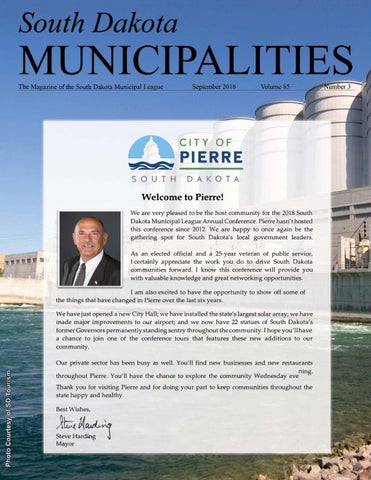
Welcome to Pierre! We are very pleased to be the host community for the 2018 South Dakota Municipal League Annual Conference. Pierre hasn't hosted this conference since 2012. We are happy to once again be the gathering spot for South Dakota's local government leaders. As an elected official and a 25-year veteran of public service, I certainly appreciate the work you do to drive South Dakota communities forward. I know this conference will provide you with valuable knowledge and great networking opportunities. I am also excited to have the opportunity to show off some of the things that have changed in Pierre over the last six years. We have just opened a new City Hall; we have installed the state's largest solar array; we have made major improvements to our airport; and we now have 22 statues of South Dakota's former Governors permanently standing sentry throughout the community. I hope you'll have a chance to join one of the conference tours that features these new additions to our community.
--E---- C/)
·;:: :J
C
en
o::,;;------=_;, 0 0
.s::. a.
Our private sector has been busy as well. You'll find new businesses and new restaurants ning. throughout Pierre. You'll have the chance to explore the community Wednesday eve Thank you for visiting Pierre and for doing your part to keep communities throughout the state happy and healthy. Best Wishes,
���
Mayor
Official Monthly Publication
Member of National League of Cities
www.sdmunicipalleague.org
South Dakota MUNICIPALITIES
Managing Editor: Yvonne A. Taylor
PRESIDENT Mike Wendland City Administrator, Baltic
1st VICE PRESIDENT Pauline Sumption Finance Officer, Rapid City
2nd VICE PRESIDENT Debbie Houseman Finance Officer, Lake Andes TRUSTEES Fay Bueno Finance Officer, Sturgis
Editor: Sara M. Rankin
Obituary: David Hahn . . . . . . . . . . . . . . . . . . . . . . . . .7
Local Government Option in the Era of State Preemption . . . . . . . . . . . . . . . . . . . . . . . . . . .8
SDMEA Hometown Power - Arlington . . . . . . . . . .16 Leave a Legacy That Matters . . . . . . . . . . . . . . . . . . .18
Healing Divisions in the Governing Body: Can’t We All Just Get Along . . . . . . . . . . . . . . . . . . .20
Dist. 3 - Dawn Murphy Finance Officer, Tea
SDML Proposed Statement of Policy . . . . . . . . . . . . .41
Dist. 2 - Paullyn Carey Finance Director, Huron Dist. 4 - Becky Brunsing Finance Officer, Wagner Dist. 5 - Renae Phinney President, Ree Heights
Dist. 6 - Leland Treichel Mayor, Roscoe
Christine Erickson Councilmember, Sioux Falls
Dist. 8 - Harry Weller Mayor, Kadoka
Amy Leon City Manager, Yankton
2018 Municipal/School Election Workshops . . . . . . . .6
DISTRICT CHAIRS Dist. 1 - Mike Grosek Mayor, Webster
Karl Alberts Finance Officer, Aberdeen Steve Allender, Mayor, Rapid City
Features
Contents
Dist. 7 - Arnold Schott Mayor, McLaughlin
Dist. 9 - Carolynn Anderson Finance Officer, Wall
Stubbornness is Never A Good Leadership Trait or Virtue . . . . . . . . . . . . . . . . . . . . . . . . . . . . . . .24 SDML Annual Conference Information
Making the Most of the SDML Conference . . . . . . .30
Preliminary Conference Program . . . . . .Center Pullout
Conference Registration . . . . . . . . . . . . . . . . . . . . . . .37 Golf Scramble Registration . . . . . . . . . . . . . . . . . . . .38 SDML Hall of Fame Nomination Form . . . . . . . . . . .39 Fun Walk/Run Registration . . . . . . . . . . . . . . . . . . . .40
Columns
Dist. 10 - Michelle DeNeui Assistant Finance Officer, Spearfish
Director’s Notes . . . . . . . . . . . . . . . . . . . . . . . . . . . . . . .4
LEAGUE STAFF 1-800-658-3633 Fax: 605-224-8655
Risk-Sharing News . . . . . . . . . . . . . . . . . . . . . . . . . .26
PAST PRESIDENT Meri Jo Anderson Finance Officer, New Underwood
Yvonne Taylor Executive Director Sandi Larson Director of Risk Sharing Services Lori Martinec Director of Research and Training Chris Hill Director of Municipal Electric Services Sara Rankin Director of Marketing & Communications Lori Butler Director of Finance Carla McGregor Accounting Assistant Lisa Nold Office Manager SD Public Assurance Alliance: David Pfeifle Executive Director Kristina Peterson Director of Underwriting Ron Burmood Director of Member Services Paytra Nichols Underwriter Jerry Krambeck Member Services Representative Deb Corkill Executive Assistant
President’s Report . . . . . . . . . . . . . . . . . . . . . . . . . . . .5 Washington Report: Senator Rounds . . . . . . . . . . . . .28
In Every Issue
SDML Events Calendar . . . . . . . . . . . . . . . . . . . . . . . .5
Hometown Happenings . . . . . . . . . . . . . . . . . . . . . . .60
Classifieds . . . . . . . . . . . . . . . . . . . . . . . . . . . . . . . . .64
Municipal Calendar . . . . . . . . . . . . . . . . . . . . . . . . . .66
SOUTH DAKOTA MUNICIPALITIES (ISSN 0300-6182, USPS 503-120) is the official publication of the South Dakota Municipal League, published monthly at 208 Island Drive, Ft. Pierre, South Dakota 57532, phone 605-224-8654. This institution is an equal opportunity provider, and employer. Periodical postage paid at Pierre, South Dakota and additional mailing offices. Non-member subscriptions are available for $30.00 annually. The opinions expressed herein are not necessarily those of the South Dakota Municipal League. Postmaster: Send address changes to SOUTH DAKOTA MUNICIPALITIES, 208 Island Drive, Ft. Pierre, South Dakota 57532.
SEPTEMBER 2018
VOLUME 85, NUMBER 3
3
Director's Notes
Boy, I hope you are all planning to come to the Annual Conference in October – together with the City of Pierre, we have put together a fantastic range of programs and opportunities for you. This year’s Annual Conference is going to offer an incredible range of quality and depth, and once again, the best speakers have been recommended by our members.
We are very excited about our keynote speaker, David Ivan, who will be presenting two programs on Thursday (October 4). First, Dr. Ivan will be asking our elected officials “Can Small Cities be Cool?” then he will speaking at our General Session about Regionalism and Community Success. Following Dr. Ivan will be our own panel of experts – in showing bad examples! – for a Mock Council Meeting that will be both educational and great fun.
Friday morning leads off with South Dakota Housing, working with you to address one of the biggest problems we face. Following that is a session on Open Meetings, Records, and Executive Sessions – an area that continually leads to many questions throughout the year. Great information is also going to be available throughout Wednesday and Thursday morning as all of
the affiliate groups meet, and on Wednesday morning, make sure you keep up with your Pools – you own them, and these are your membership meetings.
If you are able to get away early, any member should feel free to sit in on the SDML Board Meeting, Tuesday, October 2 at 7:00 p.m.
And don’t forget the lighter side! Starting with the golf tournament Tuesday afternoon, to a really great Wednesday night experience the City of Pierre is lining up, to the Thursday evening entertainment and dinner, and wrapping up with some terrific door prizes at Friday’s Annual Business Meeting. There is something for everyone at this year’s conference, and we are so looking forward to seeing you all there!
Until next month, remember we are always available at 1-800-658-3633 or yvonne@sdmunicipalleague.org Yvonne Taylor Executive Director
CIVIL ENGINEERING & LAND L SURVEYING SERVICES
infrastructure noun in·fra·struc·ture the underlying foundation, framework and structures tha at are needed for a country, region, or organization to function properly.
IT’S WHAT T WE DO.
1111 N. LAKE AVENUE SIOUX FALLS, SD
20 S. MAPLE E WATERTOWN, SD D
605-271-5527 605-8 78-2120 0 InfrastructureDG.com m
STRUCTURAL ENGINEERING / MUNICIP PAL AL ENGINEERING / TRANSPOR T TATION ENGINEERING & PLANNING / W WA ATER RESOURCES SITE DEVELOPMENT / CONSTRUCTION OBSERVA ATION T TION / PARKS & RECREATION T / LAND SUR SURVEYING VEYING
4
SOUTH DAKOTA MUNICIPALITIES
President's Report
Can you believe it? Fall is right around the corner. Just like that, all of the hustle and bustle of summer is over. For a number of us, we have made the transition of sending a child off to college. However, that doesn’t mean we will be sitting around and wondering what there is to do. By the time the September issue of the SDML magazine arrives in your mailbox; school, football, volleyball, cross country and band will all be back in full swing.
Last month I talked about having a vision for your city. This month I would like to share with you how the City of Baltic partnered with an organization to compliment efforts we are already working on. The program is called Healthy HometownSM offered through Wellmark. To quote from www.wellmark.com; “Healthy HometownSM Powered by Wellmark is a way to make your community an even better place to live, work and play by using proven strategies and techniques that help make the healthy choice the easy choice. At NO COST, you can work with Healthy Hometown experts to identify ways to make positive and lasting changes that enhance well-being in your community.”
One of the strategies of the program is a “walk audit.” On a very warm day in July the following individuals took a walk around Baltic: myself, council member, school superintendent, county economic development director, youth and two Healthy Hometown experts. We put on our yellow safety vests and literally walked around town. Looking for opportunities we could connect different points of interest to each other. As an example, Baltic has a very vibrant Community Garden but generally speaking, the fastest and easiest way to get there is driving. If there was a safer means other than walking on the shoulder of the street, Mike would be able to walk or bike to get a tomato when Dawn would like one with supper.
I realize this may sound like constructing bike paths or sidewalks. Of course that is a piece of the program. But as the name indicates, it’s about creating, promoting and educating your citizens on how to make healthier changes to their lifestyle.
If this sounds like something your city would like to look into, I would encourage you to visit www.wellmark.com/healthyhometown.com. Don’t forget! October 3-5 in Pierre for our SDML Annual Conference. Mike
2018 Events Calendar
October 2
SDML Board of Directors Meeting, Pierre
2-5
SDML Annual Conference, Pierre
7-10
NLC City Summit, Los Angeles, CA
12
Joint SDML Board Meeting with County Association, Pierre
November December
SEPTEMBER 2018
5
2018 Municipal/School Election Workshops Presented by: South Dakota Municipal League • Office of South Dakota Secretary of State Associated School Boards of South Dakota
One in-person workshop and five webinar workshops are scheduled to assist election officers in conducting elections. The Secretary of State’s office, Associated School Boards of South Dakota and the South Dakota Municipal League will again co-sponsor workshops covering all aspects of elections – from notices to the final canvass – including question-and-answer sessions.
Municipal finance officers and school business managers have statutory responsibility to conduct elections in their local jurisdictions. Properly conducted elections are an integral part of the democratic process. The many hours of diligent work on the part of the election officers enhances candidate and voter participation, and provides for accurate and consistent elections. In-person Worksop (there will be only one in-person workshop held): September 19th Pierre, Ramkota Hotel ($25 fee) 10:00 am-3:00 pm (CST) *New Finance Officers and Business Managers are encouraged to attend the in-person training. • Training covers all aspects of elections in one day (lunch is provided)
Webinar Workshops - All aspects of elections will be covered over five different webinar workshops December 5th Webinar*(estimated time 45+ min) 9:30 am or 2:30 pm (CST) • Election types and dates, combining elections vs. holding them the same day, Election Calendar, Precinct and Election Boards, Public Notices and more.
December 20th Webinar* (estimated 70+ min) 9:30 am or 2:30 pm (CST) • Candidate eligibility requirements, petitions, financial interest statements, vacancies and campaign finance.
March 5, 2019 Webinar* (estimated 40+ min) 9:30 am or 2:30 pm (CST) • Ballot preparation, voter registration and residency and absentee voting.
March 12, 2019 Webinar* (estimated 60+ min) 9:30 am or 2:30 pm (CST) • Absentee Voting - Application, Voting in-person or by mail, UOCAVA Voters
March 19, 2019 Webinar* (estimated 75+ min) 9:30 am or 2:30 pm (CST) • Election Worker Training and a guide on “What to do on Election Day”
March 21, 2019 Webinar* (estimated 30+ min) 9:30 am or 2:30 pm (CST) • What to ask your County Auditor, what should you do on election day.
There is no registration fee for the webinars. Those who register to attend the webinar will be emailed the login and call-in information one week prior to the workshop date. The webinar will go through the lunch hour, so please plan accordingly.
*Each webinar is limited to 100 participants, so please register early if you plan to attend via webinar.
Registration due by September 5, 2018 and can be found at www.sdmunicipalleague.org
Recreational Trails Receive Funding
Gov. Dennis Daugaard has awarded Recreational Trails Program (RTP) funding to several cities, trail groups and state parks totaling over $1.1 million. The five-person citizen RTP Advisory Council reviewed the applications and made the recommendations to Gov. Daugaard. The federal assistance program provides up to 80 percent reimbursement for trail-related development and maintenance projects. The following applicants were awarded grants for trail construction and upgrades: • • • •
Aberdeen - Moccasin Creek Recreational Trails, $95,800 Deadwood - Whitewood Creek Trail & Boardwalk Rehabilitation, $60,000 Dell Rapids - Sioux River Red Rock Trail, Dam Site, $100,000 Elk Point - Recreational Trail, $24,903
Additional grants were awarded for trail improvement projects at the following locations: Bear Butte State Park, George S. Mickelson Trail and the Black Hills Snowmobile Trail System. “The sponsors of these projects have thoroughly demonstrated their commitment to improving our communities, parks and recreation areas,” said Gov. Daugaard. “These funds come will aid them in their efforts to benefit South Dakotans and future generations.” The Recreational Trails Program is funded by the Federal Highway Administration and administered in South Dakota by the Department of Game, Fish and Parks. The funds come from the Federal Highway Trust Fund and represent a portion of the motor fuel excise tax collected from non-highway recreational fuel use. For more information on this program, contact Randy Kittle, grants coordinator, at 605-773-5490 or by email at randy.kittle@state.sd.us.
SEPTEMBER 2018
Obituary: David Hahn
David L. Hahn was born November 15, 1939 in Wheaton, Minnesota. He attended Rosholt High School and went on to South Dakota State University where he earned a bachelor and master’s degree and learned to fly. Dave started his professional career teaching music before going on to become the principal in Gregory and the superintendent in Wall.
Dave taught numerous individuals to play music, sing in the choir, waterski, and obtain their pilots license over the years. Dave a was a wonderful asset to the town of Wall. Over the years he owned the hardware store and a gas station, was a member of the ambulance crew and was the Mayor of Wall for thirty years. Dave’s wishes were to donate his body to the Sanford USD Medical School, where he will continue his legacy of teaching and giving people the opportunity to further their knowledge.
Survivors include his wife Carol of Wall; three stepchildren Mitch Richter and his wife Julie, Shannon Schaefers, and Londa Richter, all of Rapid City; seven step-grandchildren; one step-great-grandson; his brother Dale Hahn and his wife Kathy of Minneapolis; one sister Arleen Bietz and her husband Dwight of Scotland; and a host of other relatives and friends. Dave was preceded in death by his parents.
2019 Bridge Improvement Grant Program
According to the Bridge Improvement Grant Administrative Rules, “At least annually, the department shall propose comprehensive program procedures for commission approval.” On Thursday June 28, 2018, the Transportation Commission approved the 2019 versions of the ‘Five-Year County Highway and Bridge Improvement Plan Guide’ and ‘Bridge Improvement Grant (BIG) Procedure’. The links on the SDDOT Bridge Improvement Grant webpage have consequently been updated with 2019 versions along with all the supporting documents and applications forms. http://sddot.com/business/local/big/ Word and Excel versions of the documents are available on the FTP server. DUE DATE FOR 2019 Preliminary Engineering BIGs – AUGUST 1, 2018
DUE DATE FOR 2019 Preservation and Rehabilitation/Replacement BIGs – JANUARY 2, 2019 7
Local Government Options in the Era of State Preemption
By David Swindell, James Svara, and Carl Stenberg
Leaders must do more now to preserve the autonomy necessary for representing residents’ needs. Local governments continue to grow in importance in solving public problems at a time of increased politicization in state and federal governments as well as expanded activism in many local governments. But states are rapidly placing new kinds of limits on local governments’ ability to act. What can local government leaders do? Local governments have historically faced such challenges as increasing demands for service, limited fiscal resources, and contending with economic forces beyond their control. Still, local governments remain a primary engine of innovative government services and enjoy high levels of resident trust.
In recent years, state legislatures have encroached on the ability of local governments to meet these challenges and have become increasingly intrusive in local affairs. Reports by the National League of Cities (NLC)1 as well as the Local Government Research Collaborative,2 a partnership of ICMA, the Alliance for Innovation, and the Center for Urban Innovation at Arizona State University, have found significant changes in state-local relations, including: 1) a sharp increase in the number of states involved with this movement, and 2) an increase in the overall number of limitations placed on local governments by their state legislatures.
having been created, their powers may be restricted or enlarged or altogether withdrawn at the will of the legislature.”3
This ruling, known as “Dillon’s Rule” or the “creature of the state” doctrine, remains the basic principle underlying state-local relationships today. The courts determine whether a local government could exercise a power. But this is not the end of the story.
While Dillon’s Rule was emerging, western states were going a different direction. Residents and progressive reform groups began championing a competing doctrine by which local governments would have greater authority to act on their own behalf. This doctrine, referred to as “home rule” or “local autonomy,” asserted that municipalities should have the freedom to implement ordinances and policies in line with local citizen preferences as long as not expressly prohibited by the state constitution or legislature. So even with an established U.S. Supreme Court position on the issue, the balance between state control and local
What options do local managers and elected officials have as they try to tailor local public services to the needs and preferences of residents? This article provides an overview of this changing environment and highlights the array of actions available to local governments as they respond to state limitations.
Dillon’s Ghost The U.S. Constitution lays out the general two-tiered structure of government in which powers are allocated between the national and the state governments. Yet, it is silent about the powers allocated to local governments. Simply put, there are none. It was not until 1903 that the U.S. Supreme Court formally established an earlier ruling by Iowa State Supreme Court Chief Justice John Dillon as the law of the land, saying:
“Such [municipal] corporations are the creatures—mere political subdivisions—of the state, for the purpose of exercising a part of its powers. They may exert only such powers as are expressly granted to them, or such as may be necessarily implied from those granted. . . . They are, in every essential sense, only auxiliaries of the state for the purposes of local government. They may be created, or, 8
SOUTH DAKOTA MUNICIPALITIES
autonomy has continued to evolve over the past 115 years, with states clustered in “expressly permitted” and “expressly forbidden” categories. Still, the differences were not always clear-cut. A common practice in Dillon’s Rule states, for instance, has been to make exceptions through targeted legislation granting powers to a specific government in response to a request from the local legislative delegation. Dillon Today and the Attack on Local Autonomy Several arguments support both philosophical approaches to local autonomy. The most common argument for greater state control, for instance, is premised on economic development grounds: statewide policy, particularly in terms of regulatory authority, creates a more standardized business environment. Furthermore, as was common in the civil rights era of the late 1960s and 1970s, state governments have intruded on local authority to ensure adherence to state and federal civil rights guidelines.
Proponents of local authority argue that the spate of recent actions by states to take away local control is in response to special interests (e.g., conservative groups like the American Legislative Exchange Council) and industry groups that are exercising influence with legislatures to circumvent local preferences. Telecommunications companies involved in the rollout of 5G cellular
infrastructures, for example, have successfully convinced several legislatures to intervene on their behalf over local governments.
Champions of local autonomy argue that local governments need flexibility to experiment with alternative and innovative solutions to service delivery and processes. Local control is a better vehicle for expressing resident preferences. As noted by a recent survey by ALG Research, residents agree that local governments are better able to reflect their community’s values than state government (regardless of party affiliation).4 Recent Research Results Increased legislative actions affecting local authority have garnered attention from both academic and practitioner researchers. Dr. Lori Riverstone-Newell’s work identified a steady increase in preemption-specific bills across the country from 2011 to 2016.5 NLC’s 2017 report and 2018 update identified numerous limitations across many policy areas.
A total of 41 states, for example, had preempted local authority over ride-sharing services, 28 had preempted local minimum wage actions, 23 had preempted paid leave policy, and another 20 had restricted municipal broadband authority. Rather than waiting for the courts to resolve a
Brookings | Sioux Falls | Vermillion | Rapid City | Milbank 605.692.6342 | TTo oll Free 1.855.323.6342
www.bannerass a ociates.com
SEPTEMBER 2018
9
challenge to a local power under the traditional Dillon’s Rule approach, states are increasingly restricting local control in advance.
We conducted a review of state actions affecting local government authority, beginning with a pilot review of eight states from 2001 to mid-2017. This review examined all local-related bills enacted into law regardless of the policy focus. We expanded the search to cover all states, but narrowed the focus to only those laws addressing minimum wage policy and telecommunication issues.
We identified 167 laws passed during this period aimed at local government. The vast majority represented a limitation on local governments (72.5 percent) and another sizeable portion imposed additional requirements on local governments (17.4 percent). Only 10.1 percent expanded local autonomy in any way. More striking is the nearly consistent increase in such legislative activity over this period.
While much of the attention given to the increase in local control limitations has focused on conservative Republican state legislators trying to undermine predominately liberal Democratic central city governments, our data suggest something different. Rather, there appears to be a greater likelihood of state intervention when one party (Republican or Democratic) controls both legislative chambers and the governor’s office in a political “trifecta.”
Currently, Republicans have far more trifectas than Democrats so there is more intrusion in local affairs by Republican trifectas. Democratic trifectas also are engaged in these activities, including the state of New York preempting the ability of New York City from imposing a tax on plastic bags. Therefore, this rise in state interference does not appear to be as simple as party politics as much FIGURE 1 | State Actions on Local Governments by Year: 2001 to 2016
as it is an outcome of political party power in each state.
It Isn’t Just About Preemption Current conversations about state interference and limitations of local autonomy focus on preemption. Yet preemption is only one form of interference with local discretion. In our research, we identify three categories of state actions: permissions, restrictions, and requirements. There are several specific activities within each category, including preemption.
Figures 2, 3, and 4 illustrate the wide range of tools state governments use to control local activities. Of the 15 states that passed minimum wage legislation from 2001 to 2017, for example, 13 limited local governments’ ability to regulate the minimum wage, one placed a requirement on localities, and one passed expanded local authority. Republican trifectas enacted 77 percent of the minimum wage legislation. Currently, Republicans have far more trifectas than Democrats so there is more intrusion in local affairs by Republican trifectas. Democratic trifectas also are engaged in these activities, including the state of New York preempting the ability of New York City from imposing a tax on plastic bags. Therefore, this rise in state interference does not appear to be as simple as party politics as much as it is an outcome of political party power in each state. It Isn’t Just About Preemption Current conversations about state interference and limitations of local autonomy focus on preemption. Yet preemption is only one form of interference with local discretion. In our research, we identify three categories of state actions: permissions, restrictions, and requirements. There are several specific activities within each category, including preemption.
Figures 2, 3, and 4 illustrate the wide range of tools state governments use to control local activities. Of the 15 states that passed minimum wage legislation from 2001 to 2017, for example, 13 limited local governments’ ability to regulate the minimum wage, one placed a requirement on localities, and one passed expanded local authority. Republican trifectas enacted 77 percent of the minimum wage legislation. Scholars, practitioners, think tanks, and the media have written extensively in recent years highlighting cases in each of these situations. But most of the attention has fallen on restrictive actions. North Carolina initiated its “bathroom bill” (H.B. 2) as a nullification of an ordinance passed by the city of Charlotte. In the legislative language, the state preempted all state agencies, including all local jurisdictions and the university system, from passing future workplace legislation deviating from state law.
n=162 (excluding the five cases from early 2017 10
Penalties are also receiving attention due to some cities’ desires to declare themselves “sanctuary cities” and offering a place of safety to immigrants, refugees, and SOUTH DAKOTA MUNICIPALITIES
WE ARE PLEASED TO ANNOUNCE
Riverside Technologies, Inc. (RTI) is the primary equipment provider for the municipalities that received technical infrastructure improvements through the state sponsored South Dakota Broadband Initiative. ,PSURYHPHQWV LQFOXGHG ZLUHG DQG ZLUHOHVV QHWZRUN HTXLSPHQW VHUYHUV njUHZDOOV IRU HGJH VHFXULW\ DQG end user devices such as computers, laptops and tablets. The SDBI project has now closed and RTI would like to help South Dakota PARTNERS: municipalities sustain those • HP technical improvements and • Cisco • Meraki PD[LPL]H WKHLU SRWHQWLDO • VMWARE Therefore, we are continuing to • EMC • Nimble RNjHU WKH VDPH SURGXFWV DQG • Fortinet services to our state’s • APC municipalities and related RUJDQL]DWLRQV WKURXJK D QHZ project called ConnectSD. RTI has a long standing history with public sector, and looks forward to delivering the same level of products and services to which they are accustomed through the ConnectSD project.
Connect with us at: www.riversidetechnologies.com/connectsd/cart
HARDWARE: • Laptops & Chromebooks • Desktops & Workstations • Servers • Storage • Access Points • Printers
DEPLOYMENT: • Hard Drive imaging • Asset tagging • Google Management Console • Chromebook Elite Services
CUSTOMIZATION: • Embroidery • Laser Engraving • Decals • Banners • Carrying Cases & Backpacks
FOR MORE INFORMATION, CONTACT RTI TODAY: 866-804-4388 | 866-812-5370 www.RiversideTechnologies.com Passion | Creativity | Teamwork
INTEGRATION: • Active Directory Migration • Wireless Assessment • Network Assessment • Managed IT Services Ũ %UHDN nj[ 6HUYLFHV • Green Delivery • RTI Backup
others threatened by deportation. Texas Governor Greg Abbott, for example, signed a law in 2017 to preempt Texas cities from declaring themselves as sanctuary cities, which included language that penalizes police officials who fail to cooperate with federal immigration officials with removal from office, fines, and prison time.
What’s a City to Do? Given the encroachment of state governments into the actions of local jurisdictions, local officials face the decision of how best to respond. They can simply do nothing and give in to the state’s desires, regardless of how 12
well or poorly the state’s actions align with the preferences of a local community. But they have a range of other options.
The NLC report recommends that local officials “choose their preemption battles wisely.” This requires communication with state officials to determine the extent to which there is an opportunity to shape legislation moving forward. Local officials should address the preemption narrative to better frame debate. In our work, we highlight six additional options. Some of SOUTH DAKOTA MUNICIPALITIES
these vary depending on the type of state-local legal arrangement.
These options come with costs and different likelihoods of success. Defying the state legislature is a risky proposition and ties to the importance of the NLC recommendation to choose a preemption battle wisely. Local officials need to understand how likely and in what ways the state will push back. A local government can also use its own legal powers to test the limits of state control in a particular policy or service area by making a proactive case that it has the authority to act. Being the first government in a state to enter a new policy area does not necessarily mean that it is not permitted. The city of Seattle, Washington, recently passed a municipal income tax, a first in the state, which is under review by the state supreme court to determine if Washington cities have the right to levy such a tax.
state legislature can pass new laws to circumvent the intent of the referendum.
A more likely pathway to success is the “workaround.” Generally, this option comports with the letter of the law, but it still tries to achieve the desires of the local
Still, challenges can be costly if unsuccessful. In North Carolina since 2011, a judge may award attorneys’ fees and court costs to challengers that prevail in suits against local governments if the judge finds that the local government “acted outside the scope of its legal authority.”6
A more challenging path is to pursue a statewide popular referendum designed to overturn or circumscribe a state intervention. There are three significant challenges to this approach. First, only 26 states have access to this form of direct action. Second, an individual city is rarely equipped to coordinate a statewide campaign on an issue. This means the city will have to partner with others and build a coalition of supporters in other jurisdictions or organizations, which is not a common practice for local officials. Finally, even if a referendum were to succeed, a SEPTEMBER 2018
13
jurisdiction. As more states have considered “bathroom bills” similar to North Carolina’s, some localities have already implemented various workarounds to the gender issues, replacing group bathrooms with individual bathrooms available to everyone equally.
Local governments have the option to ask their state legislators to introduce legislation on their behalf. This grant of power can be targeted at a single jurisdiction, but more likely would empower action by all cities or counties that joined in the request. This was a common tactic for cities and counties in Dillon’s Rule states on issues related to access to such new revenue tools as a county option income tax, certain economic development tools, or other specific powers not normally available to local governments. It typically depended on a willingness of the legislature to adopt a special act supported by the local legislative delegation as a “legislative courtesy.” Polarization in legislatures makes such grants unlikely if the party majority in the local delegation is different than the legislative majority. Seeking a local bill today requires negotiation with state officials and signals the local government’s interest in entering an area where they do not have clear authority.
Perhaps the option with the greatest general likelihood of success is working with other jurisdictions or organizations to promote local government goals at the statehouse. This closely aligns with NLC’s recommendation to address the preemption narrative. Local governments should work with their statewide partners at their state league of municipalities, state association of counties, state chapter of ICMA, or the equivalents of these entities.
These organizations can be useful partners in many ways. For instance, many serve as a watchdog on legislative actions. Further, they can lobby on behalf of local government interests broadly. They can help coordinate a coherent message on pending legislation to state officials on behalf of local governments, sharing lessons from other states. In this role, they can collaborate on drafting legislation and developing compromise language when necessary to blunt the worst effects of state actions on local governments. They can also help coordinate appeals to local residents and stakeholder groups to help legislators understand the implications of their actions on communities.
Here
Today.
Here
Tomorrow. We are celebrating 80 years! We are pleased with the success we’ve had throughout the years and thrilled for what is yet to come. We couldn’t of done it without you! Thank you for trusting in us to partner with you as your consulting engineering and land surveying advisors. Clark-eng.com
14
Sioux Falls | Aberdeen | Pierre | Watertown | Minneapolis
SOUTH DAKOTA MUNICIPALITIES
The current environment is in flux regarding the balance between state control and local autonomy. States are increasingly interfering in local actions and placing more limits on what local jurisdictions can do, regardless of the preferences of local residents. These actions take many forms, but local officials are not completely unable to respond.
The tools we have identified highlight several options available to local governments and their allies to engage in this challenge to local autonomy. There is evidence to suggest that state legislative activity is not going to slow any time soon. Local government leaders, therefore, must do more now if they want to preserve the autonomy necessary for representing the desires of their residents.
David Swindell is associate professor and director, Center for Urban Innovation, Arizona State University, Phoenix, Arizona (david.swindell@asu.edu). James Svara, formerly a faculty member at Arizona State University, is visiting scholar, University of North Carolina at Chapel Hill, residing in Durham, North Carolina (James.Svara@sog.unc.edu). Carl Stenberg is professor, University of North Carolina at Chapel Hill, Chapel Hill, North Carolina (stenberg@sog.unc.edu).
This article is reprinted with special permission from LGR: Local Government Review, a special section of the
SEPTEMBER 2018
July 2018 Public Management (PM) magazine, copyrighted and published by ICMA, the International City/County Management Association, Washington, D.C. LGR is available for purchase through the ICMA Bookstore at https://icma.org/july-2018-LGR. Endnotes 1 DuPuis, N., et al. (2018). City Rights in an Era of Preemption: A State-by-State Analysis. Washington, D.C.: National League of Cities. 2 Swindell, D., Stenberg, C., & Svara, J. (2017). Navigating the Waters Between Local Autonomy and State Preemption. Phoenix, AZ: Local Government Research Collaborative. 3 Atkins v. Kansas, 181 U.S. 207 (1903). 4 National Employment Law Project. (2018, March 1). Poll Results: Groundbreaking New Polls on Local Democracy, Home Rule, Minimum Wage [Press Release]. Retrieved from http://www.nelp.org/news-releases/pollresults-groundbreaking-new-polls-on-local-democracyhome-rule-minimum-wage. 5 Riverstone-Newell, L. (2017). “The Rise of State Preemption Laws in Response to Local Policy Innovation.” Publius: The Journal of Federalism, 47(3): 403–25. 6 Bluestein, F. (2012). “Is North Carolina a Dillon’s Rule State?” Retrieved from https://canons.sog.unc.edu/isnorth-carolina-a-dillons-rule-state.
15
By Chris Hill, Director of Municipal Electric Services
ARLINGTON
I’ve passed by Arlington several times traveling on Highway 81. August 10th, 2018 was the first time I drove through Arlington. The first thing I notice was the pond on the west side of 81, then of course the baseball field caught my eye. Electrical Superintendent Matt Asmussen let me know that the maintenance shop is on the left side of Highway 14 as you are heading towards main street. I showed up a little bit early to drive through town and instantly appreciate the wonderful roads, nice street light poles with LED lights, and the lack of overhead wires.
New Sub Station completed in 2017
Utility Superintendent Marshal Mix mentioned a new development on the south side of Arlington with three new houses developed so far and a few more lots for sale. Marshal and Matt also drove me out to the Industrial Park which has three businesses and hopes to add more businesses in the future.
Utility Superintendent Marshal Mix and Electrical Superintendent Matt Asmussen
Arlington is 99.9% underground with only 1 overhead primary left in the town. They have been replacing light poles and lights as needed and have replaced all along the main roads. Matt informed me that they have about half of the poles left to replace and have used grants for street lights from Heartland Consumers Power District.
In the center of town is a new sub station that was completed in 2017 as they converted the town voltage from 2400/4160 to 7200/12470. The sub station is fed from a 1-mile feeder line from East River Electric. 16
Main Street looking south
Visiting with Marshal and Matt, I can tell that Arlington is a very proactive community with a lot to offer. They have residential and industrial lots for sale and are proud of their school system which has one of the highest ratings for ACT scores in the state. I enjoyed spending time with SOUTH DAKOTA MUNICIPALITIES
Marshal and Matt and am excited for the future of Arlington as they have two great guys on their side.
MAKE YOUR R
HUNTIN NG
RE ESERVA RV VA ATIONS TIO ONS
NOW!
Mural on Highway 14
Upon saying my goodbyes to Matt and Marshal, I stopped by the beautiful Municipal Building to talk to Finance Officer Sue Falconer and Assistant Finance Officer Jodie Henry. It is always nice to put a face with a name as I do ask a lot from the Finance Officers throughout the year. Sue and Jodie were great to visit with and I again had a great time visiting another great community. I got to meet four great city employees in Arlington, and it was not tough to see what makes their HOMETOWN great!
Arlington Municipal Building
Questions? Comments? Email chris@sdmunicipalleague.org or call 605-770-6299
MARK YOUR CALENDAR! SDMEA Superintendent/Foreman Conference March 5 - 6, 2018 Watertown, SD
SEPTEMBER 2018
17
Leave a Legacy That Matters
By Ron Holifield, Strategic Government Resources CEO is CEO of Strategic Government Resources
THIS IS A TOUGH AND BRUTAL time to serve your community. The personal cost of leadership has never been so high — and the need for character-driven leaders who put service above self has never been more critical. Public service has always been hard, but in too many communities, public service has devolved from hard to brutal.”
It can be emotionally wearying just to endure the constant slings and arrows of trolls who thrive on mean-spirited name-calling. They often knowingly disseminate false information with a conscious goal of dividing the community. It is even more frustrating and hurtful when it is a colleague on the council modeling the worst behaviors of divisiveness to try and get his or her way.
Sometimes you can feel so ground down that it becomes easy to forget that you originally ran for office because you love your community and wanted to create a future that is better than it would have been without your influence. Sometimes, it can take all you have just to survive the daily onslaught of incoming social media slime missiles just to get through the next meeting, without worrying about the impact your decision will have 25 years from now.
The temptation to abandon the importance of the future, and satisfy the urgency of the rock throwers who want
SNYDER-ASSOCIATES .COM
TRAN S PORTATIO N
LAND DE V E L OP ME N T
W AT E R
M UNI C IPA L E N G I NE ERIN G
S TRU C TUR A L
PUBLIC SPACES
18
what they want and want it now, can be highly seductive. But sacrificing the important for the urgent is always exactly the wrong thing to do. When you were elected, you were entrusted with a sacred duty to shape the future for the next generation, and the generation after that, and the generation after that.
And although you were elected to leave a positive legacy that will still matter long after you have left office, in the middle of the political insanity it can feel like a “mission impossible” with no simple answers. But Ronald Reagan was right when he said: “People say there are no simple answers. There are simple answers. They just are not easy answers.”
Walking the talk of authentic servant leadership will help you leave a legacy that matters, and provides the simple answer to the dysfunctionality and hatefulness that seem to inspire so much civic discourse these days. The forces of hatefulness and mediocrity make walking the talk difficult — they do not want you to think about the future, they want you to “obey.” But if you have the courage to walk the talk of authentic servant leadership, the 11 simple commitments outlined to the right will provide you the path for success. May you have the courage to walk the talk of an authentic servant leader, and in so doing leave a legacy that matters.
Because I am committed to creating a future that is brighter and healthier and more beneficial to all citizens, I will:
Base my decisions on the next generation more than the next election, committed to the ideal that my loyalty must be to the entire community (both now and in the future) and not merely to those who got me elected.
Focus on mission, vision, and values as the benchmark for my decisions and recognize that my responsibility is the pursuit of the greatest good for the entire community and not the satisfaction of any particular group’s agenda.
Make decisions based on fact-based evidence and not allow myself to be manipulated into bad decisions for the future based on the decibel level of critics.
Recognize that “it takes a smart man to know where he is stupid” and have the wisdom to be smart. Accordingly, I will value those who have the courage to tell me what they really think, and will listen sincerely to those who disagree SOUTH DAKOTA MUNICIPALITIES
with me to truly understand their perspective, recognizing that understanding other perspectives makes me a better leader.
Embrace my responsibility to govern rather than to manage; recognizing that if I am doing staff’s job I am not doing my job, while also understanding and embracing the appropriately exercised governance role of holding staff accountable. Place a greater emphasis on solutions than on problem, while refusing to offer solutions before I understand the problem.
Understand that mutual trust is the foundation for everything, and that if I refuse to trust others, they will be unable to trust me. Protect the integrity of the process more than the rightness of my position; I will fight hard for my issue but then unify behind the governing body when the decision is made because the decision was made with integrity of process, even if I disagree with the outcome. Understand that my deeply held beliefs, values, and
positions will be strengthened, not compromised, by courteous, respectful, and civil discourse. I will not treat someone as the enemy just because we disagree. Treat everyone with dignity and respect because of who I am as a leader … not because of how they treat me or what I think about them. Be a role model for civility. I will not treat my colleagues or staff in any way that would embarrassed me if my 5year-old child treated someone the same way.
Ron Holifield, Strategic Government Resources CEO is CEO of Strategic Government Resources (www.governmentresource.com), which helps local governments recruit, assess, and develop innovative, collaborative, and authentic leaders. His current clients include more than 550 local governments in 47 states. Holifield also has provided strategic consultation to some of the leading companies in America, from American Express to Xerox. He previously served almost two decades in city management with six different cities. This article first appeared in the August 2018 issue of the Colorado Municipalities magazine.
Nelson Autto Center¶V Government Fleet Sales Department has over 50 years off eexperiennce working with agencies just like yours fulffilling il g your vehicle needs. We offfffeer: x x x x
Available ffor or Immediate Delivery:
Cooperaattive Purchasing Connection o competitive contract pricing! Complete upffiitttting services! Police Car Trade-ins Welcome! Municipal Lease Plaans! ns!
Call us today for a quote! SEPTEMBER 2018
* 2018 Ford Police Interceptor U Uttilities ± on ground, ready ffoor upffiitttting * 2017 Close Ouutts remaining: = Ram ProMasterr City ± starrtting aat $19,999 = Dodge Grand Caravan ± $20,4999 = GMC Savana boxx Van
Fleet Saales 2228 College Way, Fergus Falls, F MN 800-477-3013 www.nelsonfergusfalls er falls.com m & Affi Affiliates
19
Healing Divisions in the Governing Body: Can’t We All Just Get Along
By Tami Tanoue
THERE ARE MORE AND MORE instances of governing bodies with intractable divisions that cut across virtually all of the body’s decision-making. This division is affecting productivity, driving away opportunity, and undermining citizen confidence. This article explores the causes and impacts of such divisions, and examines some possible ways to break out of the patterns that cause them. First, though, let’s be clear about the situation under discussion: •
•
•
Every governing body has disagreements, and there is nothing wrong with that. It would be strange, indeed, if all members agreed on all issues all the time. If that were the case, why would we even need five, seven, or nine members? Sometimes, disagreements create a residue of misunderstanding or hurt feelings, but that is to be expected, too. Most governing body members are able to leave that residue behind and move on to the next matter at hand. This is not about the “outlier” issue, where one or some members of the body have made it their mission to separate themselves from the rest of the group, with the sole goal of embarrassing the rest and proving that they are the only “ethical,” “transparent,” or “responsive” (or insert description of your choice) member of the body, at least in their opinion. There are ways to address the “outlier” issue.
What we are talking about here is a governing body in a condition that we can all agree is severely dysfunctional. We are talking about a body that is intractably divided, and whose every debate, discussion, and decision are characterized by lingering unresolved matters, mutual contempt, and hard feelings that calcify into hardline positions. We are talking about meetings that staff and citizens refer to as the “Thursday night fights” (or insert evening of your choice). We are talking about meetings where members regularly yell or snipe at each other, namecall, storm out, or maybe even resort to fisticuffs. And even if it is not that dramatic, meetings may still be characterized by tension, passive-aggressive behavior, an inability to see beyond the players and focus on the merits of any issue, and maybe an angry social media post or two after the meeting. Whatever 20
the
level
of
dysfunction,
destructive
consequences can result. Once you “write off” or “demonize” colleagues (“she’s just clueless,” “he’s completely hopeless,” “I can’t even look at the guy,” “there’s no reasoning with her, so why even bother”), there may be no coming back. Why can’t we all get along? A look at some possible causes.
Happy families are all alike; every unhappy family is unhappy in its own way. — Tolstoy
Happy councils are all alike; every unhappy council is unhappy in its own way. — Tanoue
Potential Reasons
There are any number of reasons why the “marriage” of governing body members can go bad. Here are a few:
Underlying divisions. Underlying divisions within the community are reflected in the governing body. Communities can have fracture lines. There may be friction between the “old timer” part of the community and more newly developed areas that are full of “newcomers.” The interests of “old timers” and “newcomers” may not always be the same, and “newcomers” may not recognize the history and traditions of the community in the same way that “old timers” do. These differences may be reflected in the makeup of the governing body.
Members may have been swept into office as a result of a controversial and divisive issue that divided the community. Perhaps there was a recall election. Unless the slate was wiped clean, the governing body makeup may reflect the divisions that grew from the underlying issue. It may be difficult to get past that issue.
New or younger members may clash with veteran members. A sentiment that “you young ’uns haven’t been around long enough to understand this town” may cause unwarranted rifts. And expressing or acting on such sentiments can contribute to a feeling of “inequality” in the body. Isn’t each member entitled to an equal voice in discussion and decision-making?
That sense of inequality can also be the result of partisanship, and partisanship does not necessarily have to spring from the type of political partisanship that exists at other levels of government. Of course, municipal SOUTH DAKOTA MUNICIPALITIES
government is avowedly and proudly nonpartisan in the political sense. But an “in crowd” and an “out crowd” based on other considerations can be a type of partisanship that is just as problematic.
Personalities. Voters are not judging whether the individuals they elect will be compatible with each other, so it is possible that fundamentally incompatible personalities will end up in the body. If you have some “alpha dogs” in the body who are in constant competition, friction might be a predictable result. If others then line up behind their favorite “alpha,” division can ensue.
Sometimes, an elected official’s personality and proclivities seem to be just plain incompatible with holding elected office! Politics, at the governing body level, has to be a team sport: decision-making requires collaboration and consensus. One member’s “agenda” can become the “agenda” of the body only by successful team play. A “lone wolf” who lacks the capacity or desire to be a team member is not going to be successful in the body. Add a few more “lone wolves,” and frustration and paralysis are the result.
Governance is also about leadership. If the voters put someone in office who is afraid to take a stand, is perennially “on the fence,” or is strictly a follower, leadership qualities may be lacking. A majority of nonleaders can create a perception of a “rubber stamp” governing body, resulting in extreme frustration for those members who are willing to stick their necks out. Preconceived personal agenda. There are many good reasons why citizens run for public office. However, the workings of municipal government are not always clear until well after you are seated. So the agenda that a candidate ran on may collide with reality, and turn out not to be a workable agenda after all. Under those circumstances, clinging to the preconceived agenda is only going to sow the seeds of discord. If you have several members, each bent on pursuing only his or her own particular agenda, a fractured body can result.
One newly elected councilmember said his one campaign promise was to ensure that water and sewer rates were lowered. But when he took office, he began to understand the economic realities of operating the town’s water and sewer system, and he saw that demanding the lowering of
Evolved.
Perfectly designed to thrivee in its environment. Adaptable enough to evolve with the times. Building smart for a solid ffuture. It’s second nature at KLJ. KLJENG.COM
SEPTEMBER 2018
21
rates was unrealistic and fiscally irresponsible. He said he had some explaining to do to the citizens, but he was not going to cling to his agenda given the realities he now understood. That is a smart elected official.
Potential Impacts
The impacts of severe dysfunction and discord are manifold: Lack of productivity. The body’s agenda may hit a standstill. Or getting through it might be slow and painful. Even if decisions are made, they may not necessarily be the best decisions.
Power transfer to tiebreaker. If you are constantly split down the middle, then you may be transferring all decision-making power to the tiebreaker (often the mayor). Is that desirable?
Financial consequences. If you have developed a public reputation as a dysfunctional body, then your community may be missing out on economic opportunities. Businesses want a predictable environment. Volatility may be driving them away.
Public embarrassment and loss of public confidence. If you are airing your discord on cable, your TV ratings may be up, but public confidence will be down!
Driving away the best and brightest. People say they were reluctant to run for office because they witnessed the discord and did not want to be a part of it. So you may end up repelling, not attracting, potential leaders who could make great contributions to the community. Or you may lose great members to “burnout.” Likewise, if your community develops a reputation for governing body dysfunction, you may not be able to attract and keep the “best and brightest” for key staff positions. This can become a self-perpetuating and self-defeating cycle: dysfunctional governance repels good people, and the lack of good people contributes to dysfunctional governance.
Steps to Consider
So you think you may be part of a dysfunctional governing body?
You may have experienced some jolts of recognition in reviewing the foregoing. If so, condolences and congratulations! The condolences are self-evident, but congratulations are also due, because recognition of a problem is the first step to dealing with it. So now, what do you do? Here are some steps to consider:
See if you can gain a consensus that there is a problem. 22
Even if you recognize it, if no one else does, you are not going to get anywhere. If there is a consensus, then you are halfway to solving the problem!
Start by talking about meeting “values.” The values discussion is a critical first step. (Values are the philosophical underpinnings that you want as guides for behavior in your interactions with one another.) If you can agree on these values, then additional steps are possible. If you cannot, you are going to stall out. Such values might include: •
• •
•
•
•
Courtesy and civility toward one another, staff, and citizens. Nonpartisanship. Equality of participation, including equal opportunities to be part of the discussion and decision, and equal opportunities to gain, insofar as possible, the same information at the same time as needed for good decision-making. Acknowledgement of the role of the mayor or presiding officer in presiding over meetings. Every meeting needs a presiding officer, and in most communities, that is the mayor. The role of the presiding officer must be honored if you want to have orderly, productive, efficient meetings. If there’s no acknowledgement of this fundamental need, then you won’t get anywhere. Engagement: a commitment to be prepared for meetings, to arrive on time, to stay for the whole meeting, to give your undivided attention during the meeting, to participate in decision-making, and to be absent no more than necessary. Others?
Norms or rules of conduct. If you can form a consensus around values, you are close to the point where you can discuss (and, it is hoped, agree upon) the norms or rules of conduct that you want for the body. The content of your norms or rules will not be discussed here, because they will be specific to your community and the values that serve as the jumping-off point for them. But it is worthwhile to look at examples from other communities around the state and nation. Stay alert for revisions, because periodic fine-tuning may be happening with the examples you gather. You can see some examples from Castle Pines (bit.ly/2tWKpH9), Mead (bit.ly/2IW51UK), Durango (bit.ly/2NsG3zW, modified in 2017), Littleton (bit.ly/2KBabv5), and Camp Verde, Ariz. (bit.ly/2zkvwnw). There are many other examples on the web.
Why rules or norms? It is because the level of formality to be accorded really depends on your community’s needs SOUTH DAKOTA MUNICIPALITIES
and desires. If you have members whose attitude is “Rules? We don’t need no stinkin’ rules,” then perhaps a softer approach of agreeing on “norms” of conduct may be a good starting point. On the other hand, you might see reasons to elevate the adoption process by using a resolution or even an ordinance.
Individual Steps
In despair? You can still help. You may feel your governing body will never come together to recognize the problem, much less move on toward seeking solutions. Should you give up? No! There are still things you can do as an individual. If enough individuals on the body do these things, then perhaps there will be an opening to go further! Suggestions for individuals include:
Assume good faith and best intentions on the part of everyone on the body. Some smart person once said that we judge ourselves by our intentions, and others solely by their actions. This perceptual gap can lead to misunderstandings and unfounded assumptions. Let’s give everyone the same benefit of the doubt we give ourselves, by assuming that they, too, are acting on the basis of honorable intentions.
Listen more than you talk. Do your best to see and understand things from the perspective of others. Ask questions before reaching your own conclusions, and repeat back what you think you are hearing from others, so that you know you are on the same page. Listen for points of agreement, and emphasize and build on them.
Try to meet others more than halfway. If everyone goes only so far to try to bridge the gaps, then you may never meet in the middle. Sometimes one person’s generosity in going more than halfway is the catalyst for breaking down misunderstandings.
mediator might be helpful in identifying issues that are hard to see from the “inside.” If you are an experienced member, mentor the newbies. You have valuable experience from which newer members can benefit. Show them the ropes, teach them your own hard-earned lessons, and model the behaviors you want them to emulate. And if you are a new member, seek out mentors.
Acknowledge and appreciate when you see others making the same effort.
Conclusion: “Until Next Election Do You Part.”
A governing body might be characterized as a kind of arranged marriage … one arranged by the citizens. If the conditions for civil and productive discourse are lacking from the start, it is no wonder that such a “marriage” can go bad quickly. But divorce is not an option! So start looking at ways to improve your relationships, as individuals and as a body. And take to heart the idea that by “acting as if,” your deepest hope for a strong, highfunctioning team can come closer to becoming a reality. Tami Tanoue has been in-house with CIRSA since 2001, serving as general counsel/deputy executive director. She was previously in private practice with the firm of Griffiths Tanoue Light Harrington & Dawes, where she served CIRSA as its contract general counsel for 12 years, and was city or town attorney for several Colorado municipalities. Prior to that, she was staff attorney for the Colorado Municipal League, where she represented the collective interests of Colorado municipalities. Tanoue is a regular speaker on local government liability topics, and has written several publications on liability issues.
Use the postures, tone, and body language of respect and engagement. Do this even if you are not “feeling it;” “acting as if” can be helpful in bringing a hoped-for harmony closer to reality. Make sure your body language and tone of voice aren’t inadvertently communicating something you didn’t intend. Keep your voice down, even if others are starting to yell. Avoid the hair-trigger, kneejerk, angry response.
Try some things to break down barriers. Maybe switch up positions where you sit on the council dais. Suggest a pre-meeting dinner; breaking bread together can be a way to get people talking (make sure you have a “no-business” rule in effect). Team-building, especially in a retreat setting, can be productive. An outside facilitator or SEPTEMBER 2018
23
Stubbornness is Never a Good Leadership Trait or Virtue
By Jon Mertz
It can be said that stubbornness is a trait of people in the Midwest. While growing up on a farm in South Dakota, stubbornness came out in sticking to the status quo or weathering whatever unexpected situations came into our path. In farming, there are many more elements that are uncontrollable than controllable, so maybe this sense of being stubborn comes from this lopsided formula.
The same can be said for certain patients, especially the ones who are trying to survive or recover from a major health issue. Stubbornness shines in their never quitting. Never giving up can be a good form of stubbornness.
In both cases, being stubborn plays a role, but it is not an enduring trait. Farmers know that they must adapt to be able to survive. From crop rotation to using satellite technology, farmers have put aside their stubbornness and embraced change. The same can be said of patients. To recover, they listen to clinicians and physical therapists, trying new approaches to gain their lives back. Learning, trying, and persevering tamp down stubbornness, and lifechanging and life-survival adaptation prevails.
Stubbornness in the Workplace In our workplaces and communities, we encounter those stubborn leaders. We may point to entrepreneurial situations in which we say that, if it was not for the entrepreneur’s stubbornness, the venture would have never succeeded. We point to community and political leaders who stick to their positions no matter what, and we say how principled they are.
The reality is that we are substituting stubbornness for the real virtues of patience, perseverance, courage, learning to grow, and changing to thrive. Stubborn entrepreneurs rarely succeed. Stubborn political leaders lack moral courage and, eventually, fail.
Negative Side of True Stubbornness The negative side of true stubbornness creates barriers at every turn and delivers missteps at great costs. • When their ideas are the only ones worth considering, stalemate turns to dis-innovation, market share loses, and employee disengagement. • When conversations drag on, repeating ground already covered many times before, the objective becomes wearing everyone down rather than getting the best ideas on the table. • When an organizational culture remains stagnated, change is sought by employees going to more progressive and intention-based companies. 24
Stubbornness is not a leadership virtue. It is a leadership failure. The Audacity of Stubborn Leaders How do we ensure that we do not become that stubborn leader?
In many ways, there is an unsubtle difference between being stubborn and leading with the virtue of perseverance, patience, courage, and growth. The gap is wide.
Just think of it in this way. The best ways to describe stubbornness is bullheadedness or obstinateness. Some will fool themselves and think stubbornness is being tough-minded. They are only fooling themselves. Stubbornness is simply self-centeredness. Preventing Stubborn Leadership To avoid being stubborn, apply these instead:
Persevere To persevere, it takes a strong leadership philosophy, which means a willingness to alter direction or practices to achieve a common good goal. Preventing stubbornness is then knowing what the greater purpose or common good is and then working with others to determine the best
WK Ždž ϰϯϳ EĞǁĞůů͕ ^ ϱϳϳϲϬ ϲϬϱ-ϰϱϲ-ϮϲϬϬ ǁǁǁ͘ŵĐŽŶ͘ĐŽŵ ŵĂŝů͗ ĐŽŶĐƌĞƚĞΛŵĐŽŶ͘ĐŽŵ
sĂƌŝŽƵƐ >ĂŶĚƐĐĂƉĞ Θ WƌĞĐĂƐƚ WƌŽĚƵĐƚƐ ǀĂŝůĂďůĞ ůŽǀĞƌŵŝƐƚ sĂƵůƚ dŽŝůĞƚƐ ĞŶĐŚĞƐ ŝƌĚ ĂƚŚƐ ŝƐƚĞƌŶƐ 'ĂƌďĂŐĞ ĂŶƐ &ƵĞů ŽŶƚĂŝŶŵĞŶƚ dĂŶŬƐ ZĞƚĂŝŶŝŶŐ tĂůůƐ ^ĞƉƟĐ dĂŶŬƐ ^ƚŽĐŬ dĂŶŬƐ ^ƚŽƌŵ ^ŚĞůƚĞƌƐ Ăůů ĨŽƌ Ă ŽŵƉůĞƚĞ >ŝƐƚ WƌŽĚƵĐƚƐ Θ WƌŝĐĞƐ ůŽǀĞƌŵŝƐƚ ^ƚĂŶĚĂƌĚ
ůŽǀĞƌŵŝƐƚ WůƵƐ
ůŽǀĞƌŵŝƐƚ ŽƵďůĞ
SOUTH DAKOTA MUNICIPALITIES
options, plans, and way forward. If these actions do not describe what you are doing, you may be stubborn.
Patience To be patient, it takes a sense of timing. Patience is not waiting your turn or stalling to get your way. Patience is taking the time to combine the right mix of thoughtfulness with action. Being patient is a mix of strategy, action, metrics, and a willingness to adapt. If these actions do not describe the way you are leading, then you may be stubborn.
Growth To be growth-oriented, it takes an attitude and behavior to drop certain beliefs and engage better ones. Having a growth mindset means always learning while converting what is learned to new actions. Being a growth-oriented leader is not for the faint of heart nor is it superficial. Individuals know when you are just talking about growth or change with no growth or change. Be real and substantive. If you are doing things the same way this year as you did two years ago, you may be stubborn. Fortitude When you have an inkling of stubbornness, replace it with fortitude. Fortitude is strength of character to navigate
SEPTEMBER 2018
difficult situations with grace and courage. In our society, we are missing grace and moral courage. Fortitude grows in strength as new information is absorbed and new collaborative energy is untapped. When leaders incite this type of fortitude, positive change materializes. Fortitude gives us more than survival; it releases momentum to thrive. If people around you are timid and worthy initiatives are often scrapped, you may be a stubborn leader.
Be a Persevering, Patient, and Growth-Oriented Leader How do you avoid being a stubborn individual? Be a leader who demonstrates real perseverance, patience, growth, and fortitude. Be a leader who avoids using stubbornness as an excuse for having a backbone. A real leader has the backbone of perseverance, patience, growth, and fortitude. Stubbornness is just a self-importance crutch. Focus on the bigger mission. Adapt to achieve the greater mission.
Jon Mertz is the author of Activate Leadership: Aspen Truths to Empower Millennial Leaders and founder of ThinDifference.com, an online community designed to inspire the next generation of leader
25
Risk-Sharing
The Benefits of a Self-Inspection Process
A self-inspection program is a key part of any loss control or safety program. The goal of a self-inspection program is to identify and correct safety hazards before an accident (liability) or employee injury (worker’s compensation) occurs. An effective program should involve top management as well as employees.
Self-inspections can occur at various times and can be conducted by various people depending on the size of your entity/department, the scope and the purpose of the inspection.
Establishing the Program
A planned monthly inspection should cover all areas, even those remote areas with little employee or public traffic. It is advisable to schedule the inspections when maximum observations can be made with the least amount of work interruption. The inspection group should be limited in size to approximately 2 to 4 members. Ideally, they should represent employees, supervisors, and safety. The team should be under the direction of a responsible member of management who will provide authority necessary to ensure its effectiveness. Specific responsibilities should be assigned (i.e. who will take notes, be the spokesperson, follow up on recommendations, etc.) Preparation for the Self-Inspection Process: 1.
Daily:
Each employee has the daily responsibility of inspecting their work area, tools, vehicles, and equipment at the beginning of each workday. Maintenance personnel, supervisors, and others whose duties take them into the various entity-owned buildings or areas such as playgrounds and ballfields should check for unsafe actions and conditions. In all cases where remedial action is needed, it should be reported and corrected as soon as possible.
Weekly:
Department heads and supervisors should take time from their busy schedules and tour their work sites looking for potential hazards and unsafe acts by employees. Supervisors should make safety contacts with the employees, not just looking for unsafe acts but to compliment employees for such things as following safety procedures and the proper use of PPE. This also gives supervisors an opportunity to hear about any safety concerns or suggestions on how to improve safety.
Monthly: This frequency allows for a more planned and thorough inspection by a safety committee or safety person. If your entity/department does not have a safety person or a safety committee, then someone should be assigned to perform monthly self-inspections. The participation of top management is also significant because it shows they are committed to safety. 26
2. 3.
4. 5.
Training of inexperienced individuals or team members must be conducted. Such areas as building layouts and various work tasks performed by employees of the department should be reviewed. Additionally, anyone involved in the self-inspection process should be made aware of any regulatory standards or codes for specific departments. Other areas that should be covered include hazard recognition of unsafe acts and conditions and the purpose of the inspection. The risk-sharing pools have training resources available. Previous inspections should be reviewed. This is to ensure that previous recommendations have been completed.
Accident records for the various areas or departments should be reviewed. Information concerning how a particular accident occurred often will reveal hazards which need to be corrected.
Dress accordingly. All necessary personal protective equipment should be provided and worn in areas where it is required.
A preplanned route should be developed. This will ensure that all areas will be inspected completely and thoroughly. It also will eliminate backtracking, unnecessary interruptions of work tasks, and distractions.
Documentation:
Accurate inspection records are important. They serve as evidence of the program, provide documentation of necessary corrective actions, and provide a method of SOUTH DAKOTA MUNICIPALITIES
follow-up to ensure completion. One of the easiest methods to record an inspection is to use a checklist. These can be secured from a variety of sources or one can be tailored to suit your individual requirements. We have sample self-inspection checklists available upon request. Checklists have several advantages but should be used as an aid to the inspection process, not as an end in itself.
The use of checklists is especially helpful when periodic inspections are required for certain equipment. Such items as hoists, cranes, fire extinguishers, sprinkler systems, etc., should be inspected by qualified persons on a schedule designed to ensure compliance. Instituting Corrective Actions
The results of an inspection should prompt actions to correct the problems. The following guidelines should be used: 1.
2. 3.
4.
Correct the cause of the problem whenever possible. If the authority needed is above the inspector’s, make certain that this is brought to the attention of someone who has the proper authority.
When an individual has the authority to correct or minimize a problem or hazard, do it immediately.
Conditions that cannot be corrected immediately should be conveyed to management in a written report. The conditions should be listed in the order of priority, including suggested solutions and compliance dates, if possible.
Management should advise the inspectors as to what actions are being planned from the suggestions, or the reasons why actions will not be taken.
Supervisors should be made aware of any unsafe acts and conditions observed during inspections. The supervisor should then discuss the items with the employee(s) and their suggestions solicited to prevent recurrence.
Self-inspections are a necessary part of any safety and loss control program. They get employees involved in the loss control efforts, uncover unsafe conditions and practices, and increase morale when items are corrected. Doug Kirkus Loss Control Consultant SDML Workers’ Compensation Fund South Dakota Public Assurance Alliance dkirkus@safety-benefits.com
SEPTEMBER 2018
27
Washington Report: Across the country, Americans are experiencing the benefits that come from a healthy, growing economy. In just the month of June, 213,000 new jobs were created and more than 600,000 people re-entered the work force. Since the Tax Cuts and Jobs Act was signed into law, 1.5 million jobs have been created. This growth is due in large part to policies enacted by the current Congress and the Trump Administration.
In addition to strong job numbers, retail sales continue to show strong numbers. Consumers feel confident in the economy once again and because they are paying less to the government in taxes, they are free to spend their hardearned dollars how they see fit. Their spending provides a boost to businesses, who are then able to hire more workers to meet demand and pay their employees higher wages. This is a win-win-win for consumers, American businesses and employees.
Congress and the White House have also been able to work together on reforms to the Dodd-Frank Act, which has saddled our financial institutions with burdensome regulations and hindered their ability to serve their customers. Earlier this year, the president signed into law the Economic Growth, Regulatory Relief and Consumer Protection Act, which included a number of provisions that I offered. This law provides relief to smaller, community banks and credit unions that had no part in the financial crisis but were subject to the same regulations after the fact that were put in place to keep big banks in check. When
Economy is Improving, but Trade Instability Must be Addressed
South Dakota’s banks and credit unions don’t have to spend so much on compliance costs, they can offer more services to customers and support businesses in their communities, which helps our economy flourish.
I serve on the Senate Banking Committee, which recently held a hearing to receive an economic update from Federal Reserve Chairman Jerome Powell. He reported that Americans are optimistic about the state of our economy and about finding a good-paying job. I appreciated our discussion about the positive impact the Tax Cuts and Jobs Act, as well as the reduction of burdensome regulations, is having on our Gross Domestic Product (GDP) growth rate this year. Like Chairman Powell, I believe we have a very good opportunity for continued GDP growth. However, I shared with him my concern that trade instability— especially for the ag industry—will stifle our ability to reach our full economic potential. Without strong trading deals, I fear we may begin to lose some of the gains we’ve made in growing our economy.
It is up to the White House to finalize trade deals with our partners in Canada and Mexico, as well as the TransPacific Partnership (TPP) countries, as soon as possible. Retaliatory tariffs from China on South Dakota products like corn, wheat and soybeans has cost producers millions of dollars since the tariffs were announced. With the farm economy down more than 50 percent in South Dakota over the past five years, we need stability in our commodity prices and we need strong trade deals in place—right now.
We’ll continue working to improve the economy for all Americans, and that means pushing for fair, strong trade deals. We are pleased to see that businesses are flourishing and workers are making more money, but we can’t let trade instability become an obstacle on our way to record-high economic growth.
Tomor o rrow
In nves vesting in infrastructure is an inves vestment in
> Streets > Se ewer > Drainage > Water > Airports > GIS > Electrical Power
Sioux Falls, SD 605-339-4157
Trusted. Prroffessional. essional. Solutions. 28
Yankt a on, SD 605-665-2002
dgr.com
SOUTH DAKOTA MUNICIPALITIES
STA ABLE BLAD DE TECHNOLOGY Y.
CONTROL BOUNCE. MINIMIZE REWORK. CUT COSTS.
% Experience the most comfortable cab in the industry. Joystick
fatigue for better productivity.
.
A new standardd Economy (ECO) Mode can be tuurned on to help save fuel by redducing engine speed so the maachine works in a MOREÏEFlCIENTÏRANGE
*Compared to traditional motorgraders. **Compared to previous models.
BUTLERMACHINERY Y.COM .COM
M Series equippedd with Product Link™, WHICHÏHELPSÏmEETÏOWNERSÏTRACKÏ location,, hours, fuel usage, productivvity, idle time, and diagnosttic codes through the online VisionLink® interface.
Making the Most of the SDML Conference
Before you go Bring a good idea from home to share and a supply of business cards. If your city has promotional stickers or pins, bring a supply to share to make your hometown visible and help you make connections.
Make a plan When you arrive, review the full program of sessions. Map out the sessions you will attend. If others from your community are attending, decide together who will go to what. Your municipality will gain the most when attendees divide and conquer. ALL MEETINGS ARE OPEN TO ALL ATTENDEES.
Orientation If you are a first time attendee, plan on going to the “Orientation for New Attendees” session on Wednesday morning so you can learn more about the conference and the League, as well as meet other first-timers.
Attend the sessions All sessions listed on the conference program are open to ALL conference attendees – you do not have to be a member of the affiliate group to attend their meeting.
For the Elected Officials While you are welcome to attend any of the meetings you see in the program, the elected officials are especially invited to join the SD Finance Officers’ Association to hear about dealing with both planned events and natural disasters. The Incident Command System will be discussed, along with the significance of the local officials’ roles and responsibilities. On Thursday, Elected Officials have their own session dealing with the local impact of methamphetamines; project management, technology, and federal postal services.
Take notes Good session notes – complete with notations of who you want to share the information with after the conference and ideas the information generates – will be invaluable when you prepare a summary. Plan to share it with other municipal officials, citizens and appropriate staff.
All SDML Annual Conference information can be found at www.sdmunicipalleague.org. 30
Daily review Each evening as you wind down from the day of sensory overload, review your session notes and jot down the top three discoveries. What were the most important, pertinent, useful or amazing discoveries that day? How are they significant to your municipality? Write them down. And – on a specific day in your calendar – note an idea you want to pursue.
Network Make it a habit to introduce yourself to others around you at session and events. Have plenty of business cards to share. You can start conversations by asking questions. What part of the conference have they enjoyed most so far? How long has he/she held his/her position? What are the biggest issues the community faces? You may have common concerns to explore, or solutions that your community has developed. Visit the exhibits Exhibitors have a lot of experience with municipalities and are experts in their field. They can be great sources of information and solutions for municipal concerns. Exhibits are open 8 a.m. to 4 p.m. on Wednesday and 8 a.m. to 11 a.m. on Thursday.
Policy Committees If you serve on a Policy Committee, those meet on Wednesday afternoon. If you are not on a policy committee, this is an excellent opportunity to sit in on one that is of interest to you. Policy Committees shape the Statement of Policy that guides the League’s legislative agenda for the coming session.
Vote Make sure your municipality has a voting delegate at the business meeting on Friday morning so your voice is counted in the election of League board members and the adoption of the Policy Statement.
Cost/Benefit Know what it costs your municipality to send you to the conference and be prepared to talk about the benefits your local government receives as a result. Municipal government is a lot like parenthood. It is impossible to know all about it until you are in the thick of it. There is a lot of on-the-job learning – and the SDML Conference is the single best forum for learning about municipal governance in South Dakota. SOUTH DAKOTA MUNICIPALITIES
Relax Relax and enjoy the sights and delights of Pierre. Take time to renew yourself every evening to be refreshed the next day. Return home with your notes, contacts, resources, ideas, and dreams – and the commitment to make a difference with what you have learned! 2018 Topics at a Glance Pierre is the place to be October 2-5 as SDML members gather for the Annual Conference.
Can Small Cities Be Cool? Dr. David Ivan, Michigan State University We live in a changing world. Achieving community vitality requires non-traditional community and economic development strategies. Based on successful approaches of high performing small to mid-sized towns across North America, this session provides real strategies from real communities on enhancing entrepreneurship, strengthening human talent, addressing youth migration, and building successful regional partnerships.
Other Sessions Include: •Strengthening the City Manager/Police Chief Relationship • Charting Your Leadership Journey • Code Enforcement Best Practices • Community Facility, Water and Environment Programs: Funding Opportunities for Your City • You and Your City’s Finances: What an Elected Official Needs to Know • Supreme Court Status Update • Utility Rates and Financial Planning: What the Future Holds • Regionalism and Community Success: Stretching Your Resources • Top Security Threats and Protecting Your City • Emergency Managment: Public Employee Do’s and Dont’s • New Employee Orientation and Onboarding Best Practices • Performance Evaluations and Reviews • Thin Overlay Pilot Project and other Street Maintenance Strategies • Understanding your South Dakota Retirement System, Supplemental Retirement Plan & Special Pay Plan Benefits • Housing: What You Need, How to Get It • Open Meeting - Open Record - Executive Sessions: Everything You Need to Know
SEPTEMBER 2018
First-Time Attendees
City employees and elected officials who have not previously attended an annual conference are invited to attend the Orientation for New Attendees meeting in Pierre on Wednesday, October 3, 2018 at 9:00 a.m. This is an opportunity to learn more about the South Dakota Municipal League (SDML), get a chance to meet the Municipal League staff and Board Members and get a better understanding of what the League does for the municipalities in South Dakota.
This meeting will be hosted by SDML President Mike Wendland, who is also the City Administrator of Baltic, and other members of the SDML Board of Directors and Staff. They will review the conference agenda, share some of the success stories of the SDML and explain the purpose of the policy committees. Other Board members and League staff will be introduced and have an opportunity to share some of their thoughts.
Past Orientation for New Attendees meeting goers have spoken very highly of attending this gathering and learning more about the SDML.
If this is your first conference, you are encouraged to attend this meeting. See you in Pierre!
SDML Committees
2018 Nominating Committee
Dennis Olson, Assistant City Administrator/ Finance Officer, Brandon, Chair Al Cerny, City Administrator/ Finance Officer, Gregory Meri Jo Anderson, Finance Officer, New Underwood
2018 Auditing Committee
Karl Alberts, Finance Officer, Aberdeen, Chair Pauline Sumption, Finance Officer, Rapid City Becky Brunsing, Finance Officer, Wagner Michelle De Neui, Assistant Finance Officer, Spearfish Tracy Davis, Deputy Finance Officer, Rapid City 31
FOR OORR A D REA RRE EEAACCHH FFO DIAMOND. DI IIAAAM MOOONND M NDD.. At Diamond Mowers, we belie b ve that no task should be beyond your reach. REAR CRADLE
BOOM MOWER
3-P T HIT CH
BOOM MOWER
SIDE
FLAIL MOWER
SIDE
RO TAR Y MOWER
For more information, contact Paul Schreur hreurs at 605 929.3083 605.929 3083 or PSchreurs@DiamondMower s@DiamondMow wers.com s com
Preliminary Agenda Subject to Change
2:00 p.m. 7:00 p.m.
Tuesday, October 2, 2018
SDML Golf Tournament Pre-registration required. (Visit www.sdmunicipalleague.org for registration form.) Hillsview Golf Course, Pierre Hosted by: City of Pierre South Dakota Municipal League SDML Board of Directors Meeting
Wednesday, October 3, 2018
8:00 a.m.
Registration
9:00 a.m.
Orientation for New Attendees
8:00 a.m.
9:00 a.m. to 4:00 p.m. 9:00 a.m.
9:30 a.m.
10:00 a.m. 11:00 a.m.
Noon 1:00 p.m.
Exhibits Open
SD City Management Association Presiding: Justin Weiland, SDCMA President, Dell Rapids 1. Charting Your Leadership Journey Rick Melmer, Director, Leadership South Dakota 2. Business Meeting and Election
SD Municipal Electric Association Presiding: Russell Halgerson, SDMEA Vice President, Brookings Municipal Utilities 1. Missouri River Energy Services Jeff Peters, Director, Federal & Distributed Power Programs, Missouri River Energy Services 2. Heartland Consumers Power District Update Casey Crabtree, Director of Economic Development, Heartland Consumers Power District 3. SD One Call 811 Update Larry Janes, Executive Director, SD One Call 4. Western Area Power Administration Update 5 Business Meeting and Election
Guided Tours - sign up at registration desk • Capitol Tour Take a guided tour of South Dakota’s Capitol Building and its outdoor memorials (weather permitting). • New City Facilities Tour Tour some of the City of Pierre’s newest facilities including City Hall, Pierre Solar, Pierre Municipal Airport and Airport Rescue Firefighter Facility. • Trail of Governors Tour (walking tour) Take a guided walking tour of the nation’s only Trail of Governors. The two-mile trail, featuring 22 life-size bronze statues of former South Dakota Governors, between the State Capitol Campus and historic Downtown Pierre. SDML Pooling Meetings • South Dakota Public Assurance Alliance • Health Pool of South Dakota • SDML Workers’ Compensation Fund
Pooling Escape Room Want to get away? Escape the conference and join us to test your risk-sharing pool trivia knowledge...hope you are not claustrophobic! Brad Wilson, Administrator, SDML Workers’ Compensation Fund and President of Insurance Benefits, Inc. Lynn Bren, Director of Member Services, SDPAA Jerry Krambeck, Member Services Representative, SDPAA Gary Drewes, Marketing Representative, SDML Workers’ Compensation Fund/Insurance Benefits, Inc. Ladene Bachtell, Account Executive, SDML Workers’ Compensation Fund/Insurance Benefits, Inc. Safety Awards Luncheon Presiding: Doug Kirkus, Safety Benefits, Inc. Hosted by: SDML Workers’ Compensation Fund South Dakota Public Assurance Alliance
Elected Officials Workshop 1. Code Enforcement Best Practices Geoff Fillingsness, Code Enforcement Officer, City of Beresford
1:00 p.m. 1:00 p.m. 1:00 p.m.
1:00 p.m.
1:30 p.m.
4:00 p.m.
2. Community Facility, Water, and Environment Programs: Funding Opportunities For Your City Tim Potts, Community Program Director, United States Department of Agriculture 3. You and Your City’s Finances: What an Elected Official Needs to Know Rod Fortin, Director of Local Government Assistance, SD Department of Legislative Audit
SD Municipal Attorneys’ Association Presiding: Gary Blue, SDMAA President, Wessington Springs 1. Business Meeting and Election 2. Supreme Court Status Update - Brant Lake Case Todd Meierhenry, Meierhenry Sargent LLP
SD Building Officials Association Presiding: Brett Bill, SDBOA President, Aberdeen 1. Business Meeting 2. TBD
SD Governmental Finance Officers’ Association Presiding: Dawn Murphy, SDGFOA President, Tea 1. Business Meeting and Election 2. DLA Updates Rod Fortin, Director of Local Government Assistance, SD Department of Legislative Audit 3. Utility Rates and Financial Planning - What the Future Holds Kevin Smith, Operations Manager, AE2S
SD Police Chiefs’ Association Presiding: Lee McPeek, SDPCA President, Watertown 1. Presentations Marty Jackley, SD Attorney General Denny Kaemingk, SD Department of Corrections Trevor Jones, SD Department of Public Safety Craig Price, SD Highway Patrol Bryan Gortmaker, SD Department of Criminal Investigation Stefan Pluta, SD Homeland Security Jeff Pierce, SD Bureau of Information & Telecommunications 2. National Violent Death Reporting System Grant and Naloxone Project Ashley Miller, Epidemiologist, SD Department of Health Marty Link, Director of EMS and Trauma, Department of Health 3. Business Meeting and Election
Guided Tours - sign up at registration desk • Capitol Tour Take a guided tour of South Dakota’s Capitol Building and its outdoor memorials (weather permitting). • New City Facilities Tour Tour some of the City of Pierre’s newest facilities including City Hall, Pierre Solar, Pierre Municipal Airport and Airport Rescue Firefighter Facility. • Trail of Governors Tour (walking tour) Take a guided walking tour of the nation’s only Trail of Governors. The two-mile trail, featuring 22 life-size bronze statues of former South Dakota Governors, between the State Capitol Campus and historic Downtown Pierre. SDML Policy Committee Meetings
General Government Presiding: Stephanie Ellwein, City Administrator, Mitchell
Public Health, Safety, and Welfare Presiding: Tom Paisley, Building Official, Spearfish, Chair
Public Works Presiding: Mark Cotter, Public Works Director, Sioux Falls, Chair
4:00 p.m.
4:00 p.m.
5:00 p.m.
Taxation and Revenue Presiding: Pauline Sumption, Finance Officer, Rapid City, Chair
SDML Auditing Committee Presiding: Karl Alberts, Finance Officer, Aberdeen, Chair
SDML Nominating Committee Presiding: Dennis Olson, Assistant City Administrator/Finance Officer, Brandon, Chair
Exhibit Area Social
6:00 p.m.
The City of Pierre invites you to enjoy their downtown!
7:00 a.m.
SDML 15th Annual Walk/Run Pre-registration required. Starts at Ramkota Hotel lobby at 6:30 a.m.. Hosted by: Health Pool of SD SDML Workers’ Compensation Fund South Dakota Public Assurance Alliance
Thursday, October 4, 2018
7:45 a.m.
7:45 a.m.
8:00 a.m.
8:00 a.m.
8:00 a.m.
8:30 a.m.
9:00 a.m. 9:00 a.m. 9:00 a.m.
9:00 a.m.
9:00 a.m.
Noon
1:30 p.m. 1:30 p.m.
Breakfast
SDML Past Presidents’ Breakfast
Registration
Exhibits Open
Resolutions Committee Presiding: Pauline Sumption, Finance Officer, Rapid City
Guided Tours - sign up at registration desk • Capitol Tour Take a guided tour of South Dakota’s Capitol Building and its outdoor memorials (weather permitting). • New City Facilities Tour Tour some of the City of Pierre’s newest facilities including City Hall, Pierre Solar, Pierre Municipal Airport and Airport Rescue Firefighter Facility. • Trail of Governors Tour (walking tour) Take a guided walking tour of the nation’s only Trail of Governors. The two-mile trail, featuring 22 life-size bronze statues of former South Dakota Governors, between the State Capitol Campus and historic Downtown Pierre. Elected Officials Workshop 1. Regionalism and Community Success: Stretching Your Resources David Ivan, Michigan State University 2. Top Security Threats and Protecting Your City James Fry, Enterprise Solutions Engineer, Riverside Technologies Inc.
SD Airport Management Association Presiding: Cody Roggatz, SDAMA President, Aberdeen 1. Business Meeting and Election 2. TBA
SD Association of Code Enforcement Presiding: Geoff Fillingsness, SoDACE President, Beresford 1. Business Meeting 2. Emergency Management - Public Employee Do’s and Dont’s Randy Hartmann, State Voluntary Agency Liaison, SD Office of Emergency Management Harold Timmerman, Lincoln County Emergency Manager Geoff Fillingsness, Code Enforcement Officer, City of Beresford
SD Governmental Human Resource Association Presiding: Paullyn Carey, SDGHRA President, Huron 1. Business Meeting and Election 2. New Employee Orientation and Onboarding - Best Practices Donna Bottema, Human Resource Generalist, City of Rapid City 3. Performance Evaluations and Reviews Nick Stroot, Community Resource Director, City of Rapid City
SD Municipal Street Maintenance Association Presiding: Pete Jahn, SDMSMA President, Vermillion 1. Thin Overlay Pilot Project and other Street Maintenance Strategies Mark Metzinger, Street Superintendent, City of Pierre Kyle Kurth, Engineer Staff Assistant EIT, City of Pierre 2. Understanding your South Dakota Retirement System, Supplemental Retirement Plan & Special Pay Plan Benefits Alan Freng, Retirement Planner, SD Retirement System 3. Business Meeting and Election
Excellence in SD Municipal Government Award Luncheon Featured Speaker: David Owen, President, South Dakota Chamber of Commerce and Industry Presentation of the 2018 Excellence in SD Municipal Government Award SDML Hall of Fame Induction – Honoring 20 years and more of municipal service. Hosted by: BankWest Trust Department The First National Bank in Sioux Falls – Trust Department
SD Chapter, American Public Works Association Presiding: Jackie Lanning, President, SD Chapter APWA 1. Ken Justice, National Ready Mix Concrete Association 2. Round Table Discussion or Tour 3. Business Meeting South Dakota Fire Chiefs Association Presiding: Michael Koopman, President, SDFCA 1. Welcome and Introductions 2. Fire Marshal’s Office 3. SD EMS 4. Business Meeting
1:30 p.m.
5:30 p.m.
6:30 p.m.
General Session 1. Can Small Cities Be Cool? Dr. David Ivan, Michigan State University We live in a changing world. Achieving community vitality requires non-traditional community and economic development strategies. Based on the successful approaches of high performing small to mid-sized towns across North America, this session provides real strategies from real communities on enhancing entrepreneurship, strengthening human talent, addressing youth migration, and building successful regional partnerships. 2. Mock Council Meeting Learn about doing the right thing by watching this cast of characters do the wrong thing! The most entertaining way to learn! 3. Forum
President’s Reception (for all attendees)
Dinner Hosted by: Dougherty & Company LLC
Entertainment: Todd Oliver and Friends Have you ever met a talking dog, a real talking dog?
Get ready because when comedian and ventriloquist Todd Oliver takes the stage you’ll meet his two funny companions - Irving and Lucy. These little dogs are making crowds across the country howl for more. When they get behind the microphone they turn everyday K-9 experiences into knockout comedy. Todd Oliver & Friends are traveling the country with outrageous comedy that has everyone talking. And here’s what audiences are saying: “I’ve never laughed so hard in my life, amazing!” “Incredibly funny!” “A great act!” Hosted by: Midcontinent Communications 8:00 a.m.
8:00 a.m.
8:30 a.m.
9:30 a.m.
Registration
Friday, October 5, 2018
Breakfast
General Sessions 1. Housing: What You Need, How to Get It Join the SD Housing Authority as we learn about solving one of the biggest problems in South Dakota: the availability of workforce housing. Lorraine Polak; Director of Rural Housing Development, South Dakota Housing Development Authority Eric Ambroson, Community Development Specialist, Planning & Development District III Margo Gillette, SD Executive Director, Beadle and Spink Enterprise Community (BASEC)
2. Open Meeting - Open Records - Executive Sessions: Everything You Need to Know Our experts will take you through all the ins and outs of open meetings, when executive sessions are appropriate, and what you need to know about open records. David Pfeifle, Executive Director, SDPAA Diane Best, Assistant City Attorney, City of Sioux Falls
10:30 a.m. SDML Annual Business Meeting and Election 1. Auditing Committee Report 2. Executive Director’s Report 3. Resolutions Committee Report 4. Discussion and Adoption of 2019 Statement of Policy 5. President’s Report 6. Nominating Committee Report 7. Annual Election of Officers 8. Other Business 9. Prize Drawing – Must be Present to Win!
Accommodations Hotel Ramkota (Host Hotel) ClubHouse Governors Inn Baymont Quality Inn Holiday Inn Express My Place Days Inn
Phone 605-224-6877 605-494-2582 605-224-4200 605-224-4140 605-224-0377 605-223-9045 605-494-2090 605-224-1336
ANNUAL CONFERENCE REGISTRATION FORM Pierre ~ October 2-5, 2018 Municipality Represented: ___________________________________________________________
Please TYPE OR PRINT your information as you would like it to appear on the name tag. For each attendee, check the box(s) of the days they will be attending. Registration Fee Schedule is below. FIRST TIME CONFERENCE ATTENDEES: Please check the box next to your name and include your email. This only applies to SDML Members that are attending the Annual Conference for the first time. Name Title Email *If you are a First Time Attendee, please check the box next to your name.
*If you are a First Time Attendee, please list your email to receive additional information.
Wed Thurs Fri 3rd 4th 5th
Amt Paid
TOTAL AMOUNT ENCLOSED: $ Please Return Registration By September 14, 2018 to: *No Refunds After 5:00 p.m. September 21, 2018
South Dakota Municipal League 208 Island Drive Fort Pierre, SD 57532
Payment Must Accompany Registration CONFERENCE REGISTRATION FEES SDML Members* SDML Members* Non-member/Government/Non-Profit Company Representative** Spouse/Guest Single Day Attendee
Pre-Registration for multiple day attendance ʹ must be postmarked or received by 9/14/18 Registration for multiple day attendance ʹ received after 9/14/18 Registration for multiple day attendance ʹ received at any time Registration ʹ received at any time Registration ʹ received at any time Registration for only a single day of attendance ʹ received at any time for only a single day of attendance **Does not apply to Company Representatives
$100.00 $115.00 $200.00 $500.00 $65.00 $65.00
*Members are officials and employees of a municipality that pay annual dues to the SD Municipal League. **Company representatives are individuals representing a company or business that are not participating in the exhibitor program. If you are unsure which category you should register under, please contact the League at 1-800-658-3633 or info@sdmunicipalleague.org.
SDML OFFICE USE ONLY :
DATE: _____________________ CHECK #:____________________ AMOUNT:__________________
2018 SDM ML GOLF SCRAMBLE D DATE/TIME
Sponsored By: South Dakota Municipal League
TTuesday, October 2, 2018 S Sign in at 1:00 p.m. 7HH RII DW 2:00 p.m.
L LOCATION Hillsview Golf Course H 4 4201 E. Hwy 34 Pierre, SD 57501 ( (605) 773-6191 http://ci.pierre.sd.us/124/Golf
FFORMAT
and the
Competition will be 9 holes, 4 person scramble, shotgun start. C
**Teams will be paired up after signing in at golf cours rse and not before.*
City of Pierre
EELIGIBILITY Any individual attending the SDML Conference and their guests. A
FFEES $$30/person (includes green fee and cart). To avoid delays, everryyone will be required to ride carts. e
Novice and Adv vanced Players Welcome! Prizes will be Awarded! 2018 SDML G Golf Scramble Registration Form Name : _______ _____________________________ ______________ Email: ________ _______________________________ Municipality/Organization: i i lit /O i ti _______________________________________________________________ Nine hole handicap or average: __________ __________________ Nine hole score: __________ ________________ Return by September 14, 2018 to:
South Dakota Municipal League 208 Island Drive Ft. Pierre, SD 57532
Please enclose your $30/person fe ee with the registration form.
*Only Pers rsonal Checks ks orr C Cash willl b be e accepted.* SDML OFFICE USE ONLY :
DATE:_____ _______ _______ _______ ______ ____ CHECK #:___________ _______ _______ ____ AMOUNT:_________ ______ ________ ____
$"#* ,QGXFWHH ,QIRUPDWLRQ 7\SH RU SULQW FOHDUO\
BBBBBBBBBBBBBBBBBBBBBBBBBBBBBBBBBBBB BBBBBBB BBBBBBBBB 7KH 6RXWK 'DNRWD 0XQLFLSDO /HDJXH 1DPH /LYLQJ 'HFHDVHG +DOO RI )DPH ZDV FUHDWHG WR KRQRU WKRVH HOHFWHG DQG DSSRLQWHG RIILFLDOV DQG HPSOR\HHV ZKR KDYH VHUYHG BBBBBBBBBBBBBBBBBBBBBBBBBBBBBBBBBBBBBBBBBBBBB BBBBBBBBB PXQLFLSDOLWLHV LQ 6RXWK 'DNRWD IRU 7LWOH 5HWLUHG < 1 \HDUV RU PRUH $SSOLFDQWV OLYLQJ RU GHFHDVHG PXVW BBBBBBBBBBBBBBBBBBBBBBBBBBBBBBBBBBBBBBBBBBBBBBBBBBBBBB $SSOLFDQWV KDYH FRPSOHWHG \HDUV RI VHUYLFH 0XQLFLSDOLW\ DV RI 6HSWHPEHU ,QGXFWHHV ZLOO EH UHFRJQL]HG DW WKH 2FWREHU WK BBBBBBBBBBBBBBBBBBBBBBBBBBBBBBBBBBBBBBBBBBBBBBBBBBBBBB $QQXDO &RQIHUHQFH /XQFKHRQ 0DLOLQJ $GGUHVV <HDUV RI VHUYLFH GR QRW KDYH WR EH FRQVHFXWLYH RU ZLWK WKH VDPH PXQLFL BBBBBBBBBBBBBBBB BBBBBBBBBBBBBBBBBBBBBBBBBBBBBBBBBBBBB SDOLW\ 5HFRJQLWLRQ ZLOO EH RQH WLPH 7RWDO <HDUV 6HUYHG 2IILFHV 3RVLWLRQV +HOG SHU LQGLYLGXDO 7KLV UHFRJQLWLRQ ZLOO EH RQJRLQJ LI BBBBBBBBBBBBBBBBBBBBB BBBBBBBBBBBBBBBBBBBBBBBBBBBBBBBB \HDUV RI VHUYLFH LV FRPSOHWHG DIWHU 3KRQH 3KRQH (PDLO 6HSWHPEHU WKH RIILFLDO ZLOO EH HOLJLEOH WR EH LQGXFWHG LQWR WKH :LOO ,QGXFWHH EH DWWHQGLQJ WKH UHFRJQLWLRQ OXQFKHRQ" <HVBB 1RBB +DOO RI )DPH ,I QRW UHJLVWHUHG IRU FRQIHUHQFH PHDO WLFNHWV FDQ EH SXUFKDVHG RQ VLWH
,I \RX RU VRPHRQH \RX NQRZ LV HOLJLEOH SOHDVH FRPSOHWH DQG UHWXUQ WKLV IRUP E\ 6HSWHPEHU WR EH UHFRJQL]HG DW WKH 6'0/ $QQXDO &RQIHUHQFH LQ 2FWREHU DQG LQ WKH 1RYHPEHU LVVXH RI 6RXWK 'DNRWD 0XQLFLSDO 0DJD]LQH 3OHDVH SURYLGH D SKRWR DQG D RQH SDUDJUDSK GHVFULSWLRQ ZRUGV PD[ SOHDVH HPDLO LI SRVVLEOH RI WKH ,QGXFWHH¶V ELRJUDSK\ RU PDMRU DFFRPSOLVKPHQWV ZKLOH VHUYLQJ WKH PXQLFL SDOLW\ WR EH XVHG LQ WKH 1RYHPEHU PDJD]LQH 'LJLWDO SKRWRV PXVW EH DW OHDVW GSL 5HWXUQ WR 6'0/ ,VODQG 'ULYH )RUW 3LHUUH 6' )D[ (PDLO OLVD#VGPXQLFLSDOOHDJXH RUJ
u
I
OU
15th Annual
fun Walk/Kun
Just for the Health of It!
Free to all registered delegates and guests HOSTED BY SDML SPONOSORED RISK SHARING POOLS: • SDML WORKERS' COMPENSATION FUND • SOUTH DAKOTA PUBLIC ASSURANCE ALLIANCE • HEALTH POOL OF SOUTH DAKOTA
Thursday, October 4 • Route begins and ends at the Ramkota • Meet in the Ramkota lobby at 6:30 a.m. for a ride • Starts at 7 a.m. • 5K Route
Registration Due to the SDML Office By September 7th 1 Entry Form Per Participant - make additional copies as needed. (Please Print) Name
____________ City______________
Adult T-Shirt Size:
s
M
L
XL
___XXL
RELEASE AND WAIVER OF LIABILITY, ASSUMPTION OF THE RISK AND INDEMNITY AGREEMENT AND CONSENT TO MEDICAL TREATMENT By my signature below, I acknowledge that I am aware of, appreciate the character of, and voluntarily assume the risks involved in participating in the 2017 14th Annual Walk/Run at the 2017 South Dakota Municipal League Annual Conference in Sioux Falls. By my signature below, on behalf of myself, my heirs, next of kin, successors in interest, assigns, personal rep resentatives, and agents, I hereby: 1. Waive any claim or cause of action against and release from liability the South Dakota Municipal League, SDPAA, SDML WC Fund and the HPSD, its officers, employees, and agents for any liability for injuries to my person or property resulting from my participation in the activity listed above; 2. Agree to indemnify and hold harmless the South Dakota Municipal League, SDPAA, SDML WC Fund and the HPSD, its officers, employees, and agents for any claims, causes of action, or liability to any other person arising from my participation in the activity listed above; and 3. Consent to receive any medical treatment deemed advisable during my participation in the activity listed above. I HAVE READ THIS RELEASE AND WAIVER OF LIABILITY, ASSUMPTION OF THE RISK AND INDEMNITY AGREEMENT AND CONSENT TO MEDICAL TREATMENT, FULLY UNDERSTAND ITS TERMS, UNDERSTAND THAT I HAVE GIVEN UP SUBSTANTIAL RIGHTS BY SIGNING IT, AND HAVE SIGNED IT FREELY AND VOLUN TARILY WITHOUT ANY INDUCEMENT, ASSURANCE, OR GUARANTEE BEING MADE TO ME AND INTEND MY SIGNATURE TO BE A COMPLETE AND UNCONDITIONAL RELEASE OF ALL LIABILITY TO THE GREATEST EXTENT ALLOWED BY LAW. Name Date of Birth Address Signature Signature of Guardian if under the age of 18
I HAVE READ THIS RELEASE. I HAVE READ THIS RELEASE.
South Dakota Municipal League Proposed Statement of Policy
The following are the policies as suggested by the four Policy Committees, which met August 22 and 23 in For Pierre. During the Annual Conference, to be held October 2-5 in Pierre, there will be several important steps taken before any of these policies become the official Statement of Policy of the Municipal League. First, the Policy Committees will meet again on Wednesday afternoon, October 3 to review these changes, and to consider any new information or suggestions from members. The Policies will then be submitted to the Resolutions Committee, which will meet Thursday morning, October 4, and will recommend the final set of policies for a vote of the membership at the Annual Business Meeting on Friday, October 5.
General Government Committee POLICIES
MUNICIPAL EMPLOYEES 1. The SDML supports an amendment to restrict or repeal the presumptions included in SDCL 9-1645 pertaining to circulatory or respiratory disease as “occupational” in firefighters, and opposes any amendment to expand the disease presumption regarding occupational diseases affecting volunteer and active paid firefighters. (GG – 2000; CB7)
2. 3.
4.
The SDML supports legislation authorizing municipal access to federal background checks for licensees. (GG – 2008; 2009)
The SDML supports legislation to make municipal laws consistent as to the use of the term “finance officer” rather than “clerk/treasurer.” (GG – 2010) The SDML supports allowing the Finance Officer or their designee to attend meetings. (GG – 2017)
GOVERNMENT ETHICS AND OPERATIONS 5. The SDML supports legislation that would exempt municipalities from the regulations of the unclaimed property laws. (GG – 2000; 12)
6. 7.
The SDML supports amending SDCL 12-1-5 to include municipal election officials on the State Board of Elections. (GG – 2000; 13) The SDML supports clarifying signature
SEPTEMBER 2018
requirements all municipal election petitions. (GG – 2016)
A.
The SDML supports allowing the municipal finance officer to check the residence and voter registrations of candidates for municipal office. (GG – 2018)
8.
The SDML supports clarifying the initial election of officers in a newly incorporated municipality. (GG – 2016)
9. 9TR.
The SDML supports resolving the conflict between § 9-9-14 and § 9-9-17. (GG – 2017) The SDML supports amending SDCL 9-19-13 to provide that all administrative resolutions would be effective upon passage and publication. (T&R – 2004) REFERRED FROM TAX AND REVENUE
Serving municipalities for more than a centur y. T R A N S P O R TAT I O N + W AT E R + G O V E R N M E N TA L S E R V I C E S + L AND DEVELOPMENT + E N V I R O N M E N TA L + CONSTRUCTION
Z 4 31 N . P h i l l i p s Ave | S u i t e 4 0 0
S i o u x F a l l s , S D 5 7 10 4 Z Phone 605.334.449 9
ZHRGREEN.COM
41
10. 11. 12. 13. 14. B.
Proposed Statement of Policy
The SDML supports amending state law to clarify residence requirements for municipal elected officials. (GG – 2014)
The SDML supports moving the deadline established in 9-20-11.2 forward one week. (GG – 2017)
The SDML supports efforts by the Secretary of State to provide consistency in election statutes. (GG – 2017) The SDML supports working cooperatively with other state entities to clarify residence for voter registration. (GG – 2015) The SDML supports making provisions for supplementing municipal budgets consistent with provisions found in county law. (GG – 2015)
The SDML supports amending state law to continue to provide the tax levy request to the county by October 1 each year, but to allow more time to develop the annual municipal budget.
15.
16. 17. 18.
19.
The SDML supports cooperative activities between county and municipal governments, the protection of existing joint activities, and elimination of barriers that hinder the creation of such arrangements. (added by SDML Board of Directors, Dec. 9, 2015) (GG – 2016)
The SDML supports increasing the audit “trigger” to $750,000. (GG – 2014)
The SDML supports increasing the Internal Control Review range to between $100,000 and $750,000. (GG – 2014) The SDML supports changing the makeup of the local board of equalization to more appropriately reflect the distribution of property tax revenues. (GG – 2008)
The SDML would support county efforts to impose a penalty of up to $250 for failure to appear at a requested property tax assessment
QUALITY WATER T WASTEWATER TREATMENT
SUSTAINABLE ROADS
WATER RESOURCEES
INTERACTIVE GIS
IT MA ATT TERS TERS. To us, your project isn isn’tt a job - it’s it s an opportunity to make a positive impact, protect otect future generations, and ensure the vitality of w where we live and work. It matters.
Providing engineering g and related services to help clients achieve success. Advanced Engineering and a Environmental Services, Inc. South Dakota Offices: Rapid City, Sioux Falls, Spearfish
42
www.ae2s.com
SOUTH DAKOTA MUNICIPALITIES
Proposed Statement of Policy
20. 21. 22. C.
23.
24. 25. D. E. 26.
27.
28.
appeal to the Office of Hearing Examiners. (GG – 2017) The SDML supports publishing minutes within 15 days of the newspaper receiving the minutes from a municipality. (GG – 2017)
The SDML supports allowing citizens to vote on their preferred method of receiving public notices. (GG – 2017)
The SDML supports allowing municipalities alternative publication options for local governments. (GG – 2003) The SDML supports a safe harbor provision for publication errors made by newspapers when legible, timely information has been submitted by the local government for elections. (GG – 2018)
The SDML supports amending statutes regarding designation of official newspapers to require the newspaper submit the circulation density by local government jurisdiction. (GG – 2011; 2013)
The SDML supports legislation to allow a local option for resolutions to be published by title and abbreviated explanation only. (GG – 2006)
The SDML supports legislation to allow publication of bond resolutions, bond ordinances, and franchise ordinances by reference. (GG – 2003) The SDML supports simplifying and clarifying the provisions of SDCL 1-25-1 (open meetings law). (GG – 2018)
The SDML supports allowing security issues to be discussed during executive session. (GG – 2018) The SDML supports reviewing open meeting laws in conjunction with any Open Government Task Force so long as the SDML is adequately represented. (GG – 2009; 2012)
The SDML opposes state regulation of the Health Pool of South Dakota, the South Dakota Public Assurance Alliance, or the SDML Workers’ Compensation Fund. (GG – 2003)
The SDML supports legislation amending SDCL 34A-6-29 to make the collection of delinquent
SEPTEMBER 2018
29.
30.
31.
32.
33. 34. 35.
36. 37. 38.
garbage collection fees consistent with the collection of other delinquent municipal utility fees. (GG – 2006)
The SDML supports allowing counties to add a processing fee of up to 5%, or a minimum of $15.00, for the collection of delinquent municipal utility and other service fees and charges and for nuisance actions. (GG – 2016) The SDML supports legislation to allow funds to be deposited directly to municipalities from the state, rather than going first through the counties. (GG – 2006) The SDML supports allowing the governing body to annually establish compensation for all citizen boards, committees, and commissions, notwithstanding other state laws. (GG – 2017)
The SDML will not oppose the addition of a penalty for the late submission of an annual report as long as the deadline for submission can be moved back to May 31 of each year and there is a provision for the Department of Legislative Audit to allow for an extension as circumstances merit. (GG – 2006) The SDML supports amending § 9-22-21 to include all municipalities. (GG – 2017)
The SDML supports changing the vote to create a hospital district to a simple majority. (GG – 2007)
The SDML supports equal treatment of all government facilities which serve as the official office of elected officials or any buildings where governing bodies officially meet on a regular basis. (GG – 2012) The SDML supports making special assessments for sidewalks consistent with all other special assessment procedures. (GG – 2013)
The SDML supports clarifying that nuisance assessments may be made by local resolution. (GG – 2013)
The SDML supports amending SDCL 21-10-6 to distinguish between an “assessment” and a “special assessment.” (GG – 2016)
43
Proposed Statement of Policy
COMMUNITY AND ECONOMIC DEVELOPMENT 39. The SDML supports allowing a separate and additional class of on-sale liquor licenses for golf courses. (GG – 2003; 2007; 2008)
40.
41.
42.
43.
44
The SDML opposes any change to the requirement that alcoholic beverage licenses be given only to a single legal description. (GG – 2000; 21) The SDML supports amending §35-4-11.2 to allow municipalities under 20,000 in population access to convention facility licenses with seating for 150 and 40 sleeping rooms. (GG – 2017)
The SDML supports the valuation of platted land based on use, rather than zoning designation, and urges cities and counties to work cooperatively to develop legislation. (GG – 2014) The SDML supports the public financing toolbox for local governments. (GG – 2014)
44.
The SDML supports a reduced rate for ballot publications. (GG – 2009)
LOCAL CONTROL AND HOME RULE 45. The SDML supports legislation that would exclude club licenses (class M licenses) from the limitation on the total number of liquor licenses allowed within a municipality. (GG – 2000; 23) 46.
47.
48.
The SDML supports permissive legislation granting municipalities the power to control the number and the fees for on-sale and off-sale liquor, wine, and malt beverage licenses to be granted within the municipality. (GG – 2000; 24) The SDML supports local control of the sale, use, distribution, marketing, and promotion of tobacco products that are more restrictive than those provided by the Legislature. (GG – 2003)
The SDML strongly supports legislation to distance state laws from Dillon’s Rule. (GG – 2005)
SOUTH DAKOTA MUNICIPALITIES
49.
50.
Proposed Statement of Policy
The SDML supports legislation to allow municipalities under 5,000 the same ability to establish the price of a liquor license as is allowed to those municipalities over 5,000 population. (GG – 2007)
CB5.
The SDML supports the ability to use drones for any local government purpose. (Resolutions – 2014) CORE BELIEFS
Municipal Employees CB1. The SDML endorses the retention of the existing state constitutional right to work law and opposes any state or federal legislation that interferes with or affects that right. While recognizing the right of employees to organize, it is fundamental that each employee be guaranteed individual freedom of choice in joining or not joining a union or other employee organization. (GG – 2000; CB1)
CB2.
CB3. CB4.
The SDML advocates that the cities continue to review and upgrade job safety and health standards for all municipal employees and require the use of safety equipment by municipal employees while on duty. (GG – 2000; CB2)
The SDML supports legislation that prohibits violence in the workplace. (GG – 2000; CB3)
The SDML urges local governing bodies to adopt those portions of the Municipal League Personnel Manual that meet their local needs. (GG – 2000; CB4)
CB6. CB7. CB8.
CB9.
The SDML encourages member municipalities to allot funding and paid time for employee and officials training and educational opportunities so that municipal service is made more effective and at the same time employees may become qualified for promotion to higher level positions. The SDML encourages municipal employees and officials to join and participate in professional associations, job related organizations, and other continuing education activities and urges cities to allot funding and paid time for such membership and participation. (GG – 2000; CB5) The SDML urges municipalities to prepare and adopt Equal Employment Opportunity policies that comply with law. (GG – 2000; CB6; 2013)
The SDML is opposed to any legislation or administrative rules adopting binding arbitration. (GG – 2000; 2007; CB10)
The SDML opposes repeal of Article III, Section 26 of the South Dakota Constitution relating to municipal powers denied to private organizations. The SDML opposes any further changes in SDCL 3-18-3 providing for the voting procedure for determination of bargaining unit representation. The SDML supports SDCL 3-1810 which prohibits strikes by public employees. (GG – 2000; CB11)
The SDML supports local consideration of “equal pay for equal work” but opposes the development of comparable worth pay systems through DOL rulemaking that advances the notion that
SOUTH DAKOTA BASIC CODE Affordable Codification for Small and Mid-Sized South Dakota Municipalities A comprehensive model code of ordinances for municipalities featuring: x Subject matter encountered by municipalities x Annual state law updates x
x x SEPTEMBER 2018
A comprehensive index and a title devoted to your unique local ordinances Published by American Legal and the South Dakota Municipal League For more information call or e-mail deRicci Getty at 1-800-445-5588 or dgetty@amlegal.com 45
Proposed Statement of Policy
CB10.
CB11. CB12.
CB13.
CB14. CB15.
government should dictate an organization’s compensation program. (GG – 2000; CB12; 2013)
Community and Economic Development CB16. The SDML urges all municipalities to adopt a fair housing policy. (GG – 2000; CB16)
The SDML recommends that municipalities make available health and life insurance coverage for their employees. (GG – 2000; CB14)
CB18.
The SDML urges cities who do not have a retirement system to join the South Dakota Retirement System after careful fiscal review. (GG – 2000; CB13)
The SDML urges municipalities and other units of local government to consider joining the SDML Workers’ Compensation Fund, the South Dakota Public Assurance Alliance, the South Dakota Public Funds Investment Trust, the Health Pool of South Dakota, and SDML Municipal Government Software; and to review other services available through the SDML. (GG – 2000; CB15) The SDML supports legislation amending SDCL 62-1-5 and SDCL 62-1-5.1 by revising the compensation rate for volunteers not to exceed the salary from regular employment, and for unemployed volunteers not to exceed the minimum compensation rate under law. (GG – 2000; 4)
The SDML opposes any investment of the assets of the South Dakota Retirement System in “social investing” or “venture capital.” (GG – 2000; 5)
The SDML opposes any legislative action allowing a participating entity or group of members from being removed from the South Dakota Retirement System. (GG – 2000; 6)
!"#$%&'(&)*$+,'-'.$/!0"+1$*$"+$+,' 2+$*34'5)/*34'6&/7$8&4'-'9+3*)%%)*$"+' !
"#$%&'!!()*+,-)*.*++/! 0$11.23&&'!!4.-//.5/6./+7)! 89:;1'!!<:1&<=>?3$@9;%%&<$?:AB$9! ! !! !!!
!!!!!
!
!!!!!!
4+6//!C&%;?#!DE&!F!G!F?&!4/-!G!HI3%<E;11&J!KL!!**776! MMMA>?3$@9;%%&<$?:AB$9!
46
!
CB17.
CB19.
The SDML opposes bills similar to the “Bradley Bill” because of the potential environmental, social and economic impacts on the people and governments of South Dakota. (GG – 2000; 20)
The SDML encourages the Governor and the Legislature and the Ellsworth Authority to assist in the efforts to retain Ellsworth Air Force Base as a viable military facility. (GG – 2003; 15)
The SDML urges federal and state support for alternative transportation programs that take into account new technologies, mobility, community quality of life, and demographic trends as well as maintenance of traditional modes of transportation. (GG – 2015; 2016) (Moved from General Policy)
Government Ethics and Operations CB20. The SDML endorses the Core Beliefs espoused by the National League of Cities.1 (GG – 2000; CB18) CB21.
CB22. CB23.
The SDML encourages municipalities to initiate policies to oppose racial profiling in any municipal activity. (GG – 2000; CB19)
The SDML strongly supports encourages municipal elections remaining to remain nonpartisan. (GG – 2003)
The SDML supports efforts to review and update state statutes related to municipal government provided the South Dakota Municipal League has appropriate representation in that process. (GG – 2000)
Local Control and Home Rule CB24. The SDML encourages federal, state, and local government leaders to continue to work with American Indian tribes to resolve taxation, regulatory, environmental and infrastructure issues, and law enforcement concerns. Such efforts should address concerns resulting from the federal government placing land into trust on behalf of American Indian tribes without such tribes having entered into a binding agreement with state and local entities on the collection of taxes, law enforcement, infrastructure and SOUTH DAKOTA MUNICIPALITIES
Proposed Statement of Policy
CB25.
CB26.
CB27. CB28.
Public Health, Safety, and Welfare Committee
environmental concerns, and regulations. (GG – 2000; CB20)
The SDML encourages consolidation of the Boards of Equalization with the cooperation of all entities of local government in order to relieve taxpayers of unnecessary burdens and encourages legislation to require counties to consolidate Boards of Equalization when requested by a municipality. (GG – 2000; CB21)
The SDML opposes any legislation expanding the power and authority of special districts, subdistricts, cooperatives, and sanitary districts to render services without allowing municipalities the same options. (GG – 2000; CB22)
The SDML proactively opposes the mandatory OSHA requirements being applied to municipalities. (GG – 2000; 2)
The SDML opposes any legislation which would inhibit municipalities from providing services requested by citizens in whatever form the citizens approve. (GG – 2006) _________________________________________
POLICIES
PUBLIC HEALTH AND SAFETY 1. The SDML encourages the licensing of building contractors by local units of government to ensure that contractors comply with minimum standards to protect the consumer. (PHSW – 2004) MOVE TO CORE BELIEFS
2.
3.
4.
1 Core Beliefs of the National League of Cities
We Believe in... • Representative, participatory local government • Local government as the cornerstone of government in the United States • The value of public service • The value of diversity throughout our organization and our communities • Municipal authority over municipal issues • A commitment to the highest ethical standards among all public officials • Civility and mutual respect
• •
5.
The SDML supports legislation to expand affordable and workforce housing opportunities in South Dakota. (PHSW – 2014; 2018)
The SDML supports making affordable public and private health care coverage available to all South Dakotans and strongly encourages efforts to expand Medicaid. (PHSW – 2014; 2015; 2016)
The SDML supports a statewide task force to review access and resources the treatment of alcoholism, drug addiction, tobacco addition, and gambling addiction. The SDML calls for the State of South Dakota to assume increased responsibility for funding of detoxification and alcoholic, drug addiction, tobacco addiction, and gambling treatment facilities from state alcohol beverage taxes, tobacco taxes, and gaming revenues. (PHSW – 2000; 2014 CB2; 2015; 2018) (Amended and moved from Core Beliefs) The SDML supports a mechanism for blighted, vacant, or nuisance properties to assist in the costs of their own remediation, including any asbestos testing and removal. (PHSW – 2014; 2016; 2018)
Anticipating the needs of communities and developing strategies to meet those needs and improve the quality of life Partnerships, coalitions, and collaborations to strengthen cities and our advocacy efforts
SEPTEMBER 2018
47
6. 7.
8. 9.
10.
48
Proposed Statement of Policy
The SDML supports legislation to provide stronger penalties and increase requirements for mandatory vehicle insurance. (PHSW – 2007)
The SDML supports legislation to remove restrictions which prohibit municipalities from prohibiting the use of phosphates in lawn fertilizers within city limits. (PHSW – 2010)
The SDML supports continued efforts to reduce distracted driving. (PHSW – 2012; 2014)
The SDML supports adoption of the most recent edition of the International Codes, with the option of local amendments. (PHSW – 2013; 2014; 2017)
The SDML strongly supports a statewide task force to review access and resources for the treatment of mental healthcare and increased funding for services and programs. (PHSW – 2015)
11.
12.
13.
The SDML supports making seatbelt violations a primary offense. (PHSW – 2016)
The SDML opposes any effort to weaken the statewide smoking ban, and will support legislation that strengthens state and local efforts to enforce this prohibition. (PHSW – 2016)
The SDML supports state funding for the State Radio System and supports upgrading to P25 technology. The SDML supports a reliable statewide emergency radio system that allows users across the state to communicate within and outside of their agencies. In order to sustain this capability and enhance operations locally, statewide, amongst other states, and with federal agencies, the SDML supports state funding initiatives to upgrade the statewide system to the national standard for public safety communications utilized by both federal and state governments known as Project 25 (P25). (PHSW – 2017; 2018)
SOUTH DAKOTA MUNICIPALITIES
Proposed Statement of Policy
The SDML supports a state funding initiative to mitigate the emerald ash borer infestation similar to the state’s successful response to the pine beetle infestation. (PHSW 2018)
CB5.
LOCAL CONTROL AND HOME RULE 15. The SDML opposes state legislation limiting municipalities from adopting whichever portions of the International Codes deemed necessary. (PHSW – 2009; 2016)
CB6.
Public Health and Safety CB1. The SDML believes that the main emphasis of environmental protection should be information and assistance to municipalities and education of the general public. The League urges the State and Federal Government to fully fund programs and provide technical assistance for planning and implementing programs and regulations established by state and federal laws. The League urges continued research and pilot studies in the fields of pollution control, flood control, water and conservation, river siltation, forest management and waste management. (PHSW – 2000; CB1)
CB7.
A.
MUNICIPAL FINANCE 14. The SDML supports efforts to increase Medicaid reimbursement rates for ambulance and emergency medical services. (PHSW – 2016)
CORE BELIEFS
CB2.
CB3.
CB4.
The SDML recognizes the costs associated with maintaining and training regional emergency response teams in South Dakota and supports continued funding from the State of South Dakota. (PHSW – 2006; 2007; 2010) (Amended and moved from General Policy)
The SDML supports legislation that requires that users of private telephone switches or services be provided capabilities of the same level of 911 services as is available to other residents of the jurisdiction. (PHSW – 2000; 1) (Moved from General Policy)
The SDML supports legislation that continues to maintain compliance with the Juvenile Justice and Delinquency Act of 1974 and supports legislation for funding compliance. (PHSW – 2000; 2007; 3) (Moved from General Policy)
SEPTEMBER 2018
1.
The SDML supports the right of local jurisdictions to establish firefighting standards. The SDML does not oppose fire standards such as those issued by the National Fire Protection Association (NFPA) as long as such standards allow municipalities real and substantial flexibility for the way municipalities provide fire and emergency medical services. (PHSW – 2002; 7; 2016) (Moved from General Policy)
The SDML encourages the local units of government to use the funds available from the State of SD to combat West Nile and other mosquito-borne diseases and encourages the State of SD to increase these funds. (PHSW – 2007; 2016) (Amended and moved from General Policy)
The SDML urges cities to continue weekly testing of pools and public bodies of water as previously required by the Department of Environment and Natural Resources. (PHSW – 2011; 2016) (Moved from General Policy)
The SDML encourages the licensing of building contractors by local units of government to ensure that contractors comply with minimum standards to protect the consumer. (PHSW – 2004) MOVED FROM MAIN POLICY STATEMENT
Municipal Finance CB8. The SDML encourages local governments to install 911 and maintain systems using the Funding Surcharge allowed by SDCL 34-45 (Emergency Reporting Telephone) and encourages legislation to increase this surcharge to fully fund the system. (PHSW – 2000; 2007; 2010; CB3) Local Control and Home Rule CB9. The SDML opposes any state environmental laws and regulations that are more stringent than existing federal environmental laws, standards and regulations. (PHSW – 2000; CB4)
CB10.
The SDML encourages standards be developed to provide equal 911 service to all citizens and visitors, and encourages cooperative efforts to improve 911 services and efficiency. The SDML opposes mandated consolidation of 911 service centers. (Adopted at Joint Board Meeting 49
Proposed Statement of Policy
between SDML and SDACC, December, 1999; 8; Amended by SDML Board, December, 2006; PHSW – 2016) (Moved from General Policy)
Community and Economic Development CB11. The SDML supports ensuring K-12 education is at the highest academically competitive levels as well as the teaching of basic life skills and responsibilities. (PHSW – 2003)
CB12.
CB13.
CB14. CB15.
CB16.
CB17.
CB18.
50
The SDML supports the use of public and private colleges and universities in producing labor studies and other studies on local needs and resources, and in the development of a statewide master plan for economic development. (PHSW – 2003) The SDML encourages general education cost forgiveness for South Dakota university and technical school graduates who stay in-state for a specified length of time. (PHSW – 2003; 2010)
The SDML supports the creation of a long-range technology master plan for South Dakota. (PHSW – 2003)
The SDML urges investment in research and development and intellectual property using research triangles and incubator programs to promote these endeavors. (PHSW – 2003)
The SDML recognizes that any mismanagement of the Black Hills National Forest is a health, safety and economic development issue for residents of South Dakota. The SDML supports policies that prioritize quality of life and economic development in the Black Hills National Forest. (PHSW – 2003; 2016)
The SDML urges the SD Department of Environment and Natural Resources to recognize that environmental regulations cost municipalities an immense amount of money, which could otherwise be spent on economic development and quality of life improvements. The SDML urges DENR to keep environmental regulation as reasonable and affordable as possible for municipalities in South Dakota. (PHSW – 2003)
The SDML recognizes the importance of maintaining the National Science Lab, and strongly supports its continued scientific efforts at the former Homestake mine. (PHSW – 2005;
CB19.
14) (Moved from General Policy)
The SDML encourages the development of a state-wide economic development policy in South Dakota -recognizing that quality of life in communities is a major factor. (PHSW – 2002) (Moved from General Policy)
Public Works Committee POLICIES
LOCAL CONTROL AND HOME RULE 1. The SDML recommends that the Department of Transportation, the Legislature, and any county affected, carefully review the financial impact of the transfer of any roads, bridges or highways to the municipality. The SDML supports legislation to require counties and the state to provide to municipalities all maintenance records and bridge inspections prior to the negotiation of a transfer. (PW – 2000; 2010; 1)
2.
3.
4.
The SDML strongly supports legislation affirming the authority of municipal government to control activities and charge for the use by utilities within public rights-of-way within municipal jurisdiction. (PW – 2000; 2)
The SDML opposes any regulation by others of any service provided by or regulated by a municipality. However, the SDML strongly feels that municipalities should be included in any discussion on restructuring of the energy and telecommunication industries. (PW – 2000; 3)
The SDML supports state legislation allowing the municipality to own and operate a cable TV system, when allowed by federal law. (PW – 2000; 5)
PUBLIC HEALTH AND SAFETY 5. The SDML recommends that the State Department of Transportation analyze and make recommendations to the legislature regarding the adverse effects of state load and length limits on municipal streets, bridges, and traffic patterns regarding state load limits, issuing of permits, or truck lengths. (PW – 2000; 2010; 6)
6.
The SDML strongly urges the Department of Environment and Natural Resources and the South Dakota State Legislature to adopt rules, SOUTH DAKOTA MUNICIPALITIES
Proposed Statement of Policy
7.
8.
regulations and appropriate legislation to designate the entire Big Sioux River Basin as a water source protection area and to establish a management plan for the allocation of water in the Big Sioux River Basin (the river and associated aquifers.) (PW – 2000; 7)
The SDML supports the Safe Drinking Water Act Amendments of 1996; however, the SDML opposes federally mandated drinking water standards unless based upon proven human health risks substantiated by scientific data. The SDML continues to support monetary assistance to public water systems based upon flexible and reasonable incentives. (PW – 2000; 2008; 8)
The SDML opposes the US Corps of Engineers’ proposal to levy fees on the storage of water in the Missouri River reservoirs to recover costs of constructing the Missouri River dams. The policy would pose severe economic impacts to municipal and rural water systems in the state. (PW – 2011)
13.
14.
15.
16.
17.
The SDML supports legislation to amend SDCL 9-4-1 to exclude “registered voters” from the petition process for annexation of contiguous territory. (Transferred from GG – 2000; 13)
The SDML supports legislation to ensure that municipalities control planning, zoning, and development issues within the corporate limits. (PW – 2003) The SDML believes municipal governments should be notified of and participate in economic development efforts within their jurisdiction. (PW – 2014)
The SDML supports state and federal funding for the Lewis and Clark Regional Water System to complete services to South Dakota communities. (PW – 2014)
The SDML would support legislation to prohibit creation of any entity with municipal powers
COMMUNITY AND ECONOMIC DEVELOPMENT 9. The SDML supports amendments to annexation laws that increase local authority. (PW – 2000; 9) 10.
11.
12.
The SDML supports planning and zoning legislation that will encourage continuity between city and county planning and zoning procedures and reduce ambiguities within the adoption process, enabling municipalities to more effectively adopt and administer their comprehensive plan, zoning regulations, and subdivision regulations. (PW – 2000; 10)
The SDML would strongly oppose any legislation to overrule local zoning or building codes pertaining to mobile homes, manufactured houses or trailer houses. (PW – 2000; 11)
The SDML supports the right and authority of municipalities to have at least an equal voice in platting, zoning, planning, code enforcement, and flood management control in the extraterritorial area. The SDML also supports legislation to enhance municipalities’ ability to gain extraterritorial jurisdiction, and permissive legislation following cities and counties to enter into intergovernmental agreements for Urban Growth Areas. (PW – 2000; 12)
SEPTEMBER 2018
Engi n ineerin ing solution utio s siince 1969. Ȼ Municipal Engin i eering Ȼ Land Surveying g Ȼ Drainage and Erosion Control Ȼ Construction Administration
L o c a t e d i n S i o u x Fa l l s , S o u t h D a k o t a w w w. s a y r e a s s o c i a t e s . c o m ƒ ( 6 0 5) 3 3 2 - 7 2 11
51
Proposed Statement of Policy
within five miles of any existing municipal boundaries. (PW – 2015)
MUNICIPAL UTILITIES 18. The SDML opposes forced transfer or sale of ownership of state or federally owned dams and power marketing administrations. (PW – 2000; 2010; 15) (Deleted portion moved to Core Beliefs)
19.
20.
21.
22.
23.
24.
The SDML opposes the practice of the federal government threatening the loss of funding to ensure compliance with federal guidelines. The SDML requests the Department of Environment and Natural Resources to allow flexibility to water systems to meet water certification requirements and urges the Department of Environment and Natural Resources to continue monetary assistance and free training for water certification. (PW – 2000; 2008; 16)
The SDML opposes any legislative and regulatory barriers to the creation of municipal electric utilities and supports the fundamental principle of public power and the right of municipalities to provide any utility service desired by their citizens. (PW – 2004)
MUNICIPAL FINANCE 25. The SDML supports continuation, reinstatement, or new state and federal grants and loans, at sustained levels, including State Revolving Fund monies, to local governments to facilitate construction and upgrading of sewer, stormwater utility, water, and solid waste facilities as mandated by state and federal regulations. (PW – 2000; 2007; 19)
26.
27.
The SDML supports state funding to restore the funds transferred from the Aeronautics Trust Fund in order to allow South Dakota airports to continue to comply with safety regulations and to provide needed infrastructure improvements. (PW – 2016)
The SDML supports amending the fee structure for wastewater and storm water permits to support SD Department of Environment and Natural Resources staff and programming. (PW – 2017)
A Strong Public Finance Partner in South Dakota
The SDML opposes legislation that removes the ability of municipalities to determine responsibility for service lines between the homeowner and the city. (PW – 2005; 2016)
D.A. Davidson & Co. is committed to strengthening the infrastructure and enriching the lives of people in our communities throughout South Dakota and across the nation.
The SDML supports the right and authority of municipalities to retain local control over all aspects of placement and use of individual alternative power systems. (PW – 2008)
The SDML encourages policymakers in Congress, the FCC, and the USDA to understand the importance of robust broadband deployment in rural America and how the National Broadband Plan needs to be dramatically altered to avoid a digital divide between rural and urban citizens. (PW – 2010)
The SDML supports amending annexation laws to ensure non-contiguous municipal utility facilities, specifically wastewater treatment plants and landfills, be considered to be within municipal boundaries. (PW – 2012)
Gerald J. Spethman, Jr. Senior Vice President, Public Finance Banker
Primary areas of focus include:
(402) 392-7933 (866) 466-9368 JSpethman@dadco.com
2XU SXEOLF ¿QDQFH EDQNHUV DYHUDJH over 20 years of experience LQ FRQYHQWLRQDO ¿[HG UDWH GHEW ¿QDQFLQJ YDULDEOH UDWH ERQGV FUHGLW HQKDQFHG VWUXFWXUHV DQG QRQ UDWHG ERQGV · Cities · Counties · School Districts · Rural Water Utility Finance · Healthcare Finance · Lease-Purchase Financing ā 1RQSUR¿W (QWLWLHV ā $OWHUQDWLYH (QHUJ\
450 Regency Parkway | Suite 400 | 2PDKD 1( | dadavidson.com
52
SOUTH DAKOTA MUNICIPALITIES
Proposed Statement of Policy
CORE BELIEFS
Public Health and Safety CB1. The SDML urges municipalities to develop ordinances that establish water and energy priorities within the municipality to conserve these resources. Further, the SDML urges municipalities to develop and implement public education programs designated to encourage water and energy conservation methods. (PW – 2000; CB1)
CB2.
CB3.
The SDML endorses the wise use of energy and urges local officials to be able to provide adequate input into any energy management or energy standards plan or regulation that affects local government. (PW – 2000; CB2)
The SDML feels strongly that a concerted effort should be made by the state, counties, and cities of this state to eliminate traffic hazards and provide uniform traffic control devices and
SEPTEMBER 2018
CB4.
signing for streets and highways. (PW – 2000; CB3)
The SDML supports the Department of Environment and Natural Resources establishing water quality standards that protect public health and the environment, but opposes EPA mandates that establish national one-size-fits-all standards that do not fit South Dakota because they are overly protective, have negligible environmental benefit, and have a dramatic economic impact to publicly owned wastewater treatment works. (PW – 2011; 2016) (Moved from General Policy)
Local Control and Home Rule CB5. The SDML recommends that streets and highways constructed with state/federal funds be based upon consultation and coordination with the local government. (PW – 2000; CB4) CB6.
The SDML urges the Transportation Commission, with input from municipal
53
Proposed Statement of Policy
CB7.
government, to develop and adhere to an adequate transportation plan and supports the development of an access management model. Further, municipalities must be offered participation in any change affecting their area. (PW – 2000; CB5)
The SDML opposes any state mandated prohibition against the cities’ right to construct with their own crews. (PW – 2003)
Community and Economic Development CB8. The SDML believes that municipal and county governments should formulate and control all local planning and zoning programs. (PW – 2000; CB7) CB9.
The SDML supports enhanced state and federal funding for water supply systems. (PW – 2014)
Municipal Utilities CB10. The SDML supports the rights of municipalities to establish electric utility systems to provide service within their corporate limits and adjacent urban growth areas. (PW – 2006)
CB11.
CB12.
CB13.
The SDML opposes any legislation limiting or eliminating a municipal electric utility’s right to serve customers facilitated by annexation and/or condemnation. (PW – 2006)
CB14.
Taxation and Revenue Committee POLICIES
COMMUNITY AND ECONOMIC DEVELOPMENT 1. The SDML supports revising the business improvement district statutes to allow municipalities and counties to enter into joint projects and to locally determine all rates. (T&R – 2003)
2. 3.
4.
The SDML encourages the state and federal government to maintain dams in a safe and usable condition. (PW – 2010) (Partially moved from General Policy)
The SDML supports the continued training and certification of landfill operators. (PW – 2000; 2004; 2010; 17) (Moved from General Policy)
The SDML opposes any changes to the Power Marketing Administrations and specifically the Western Area Power Administration which deviate from the principles of beneficiary pays and cost-based rates. (PW – 2012)
5.
The SDML supports creating incentives within the REDI fund for investment, not just job creation. (T&R – 2003)
The SDML supports making REDI funds available for infrastructure and infrastructure master planning. There is plenty of raw land, but it needs infrastructure before it can be sold to prospects or developed in a timely manner. (T&R – 2003)
The SDML supports allowing maximum local control of tax increment financing (TIF) districts, an economic development tool that has led to millions of dollars in increased property value, benefitting both the state as a whole and the local entities sponsoring the districts, while at the same time maintaining the integrity of the process. (T&R – 2017) The SDML supports legislation allowing a local vote on up to an additional one cent temporary municipal sales tax to be used for infrastructure projects. (T&R – 2014)
MUNICIPAL FINANCE 6. The SDML supports cooperative efforts to return a portion of the video lottery revenues to municipalities. (T&R – 2000; 2) 7.
8. 54
The SDML supports legislation to increase the license fee that municipalities may charge on video lottery machines. (T&R – 2000; 3) The SDML supports amending SDCL 6-3-3 to return the required percentage of the vote to pass SOUTH DAKOTA MUNICIPALITIES
Proposed Statement of Policy
9.
10. 11.
12.
a joint bond issue to a simple majority. (T&R – 2000; 4)
The SDML supports amending SDCL 9-19-13 to provide that all administrative resolutions would be effective upon passage and publication. (T&R – 2004) REFER TO GENERAL GOVERNMENT
The SDML strongly supports legislation to amend SDCL 10-52A-2 to allow up to 2 percent “bed, booze, and board” tax. (T&R – 2005)
The SDML supports legislation requiring counties to notify municipalities of any changes to road and bridge reserve fund levies. (T&R – 2015)
The SDML supports legislation to make provisions for taxing all products and services, such as electronic amusement devices, consistent between the state and municipalities. (T&R – 2017)
19.
20.
21.
22.
The SDML strongly opposes any formula-driven redistribution of sales and use tax revenues. The SDML strongly supports maintaining the current system of returning revenues based on sales actually attributed to that point of delivery. (T&R – 2002; 15)
The SDML supports allowing broad, local-option authority to municipalities that would enable the return of any potential tax revenue increases to entities or persons deemed appropriate by the municipality. (T&R – 2002; 20) The SDML supports a requirement that all prior debt obligations be covered regardless of any potential initiative, referendum, or legislative action. (T&R – 2002; 22)
The SDML is opposed to de minimus exceptions. (The exceptions do not serve to level the playing field and the collection allowance will reimburse
Sales Tax 13. The SDML opposes any legislation that would reduce, remove, repeal or reallocate the municipal sales tax, liquor tax reversion or any other municipal revenues to any other unit of government or that would expand the power to impose a sales or use tax to any other unit of government. (T&R – 2000; 9)
14. 15.
16.
17.
18.
The SDML opposes any further exemptions from the sales tax laws. (T&R – 2000; 10) The SDML opposes the repeal of the sales tax on groceries. (T&R – 2004)
The SDML supports legislation to allow municipalities to impose an additional tax on the leases or rentals of hotel, motel, campsites, or other lodging accommodations within the municipality. (T&R – 2000; 11)
The SDML opposes any attempt by the state to extend their authority over the collection, administration, and redistribution of the municipal sales tax for any purpose. (T&R – 2000; 12) The SDML supports a sales tax on all catalog and Internet sales. (T&R – 2000; 14)
SEPTEMBER 2018
55
Proposed Statement of Policy
23.
24. 25.
26.
sellers for the costs of collecting the taxes.) (T&R – 2002; 23)
The SDML opposes any municipal funding of a sales tax collection allowance for all sellers,
whether in or out of state. (T&R – 2002; 2004; 2012; 2013)
The SDML supports continued local control over local rates and opposes weighted averaging or a state-imposed single rate. (T&R – 2002; 25)
The SDML supports retaining the ability of municipalities to impose, adjust, and determine local rates, protect current revenues, prevent loss of revenue, and to account for any future growth. (T&R – 2002; 26) The SDML supports reinstatement of the ability to tax Internet services. (T&R – 2002; 2010; 27)
State/Federal Funding 27. The SDML supports repeal of state taxation on alternative fuels used by local governments, and supports federal tax incentives for government purchases of alternative fuel vehicles. (T&R – 2007)
28.
29. 30.
31.
32.
56
The SDML supports exempting government projects from the contractors excise tax. (T&R – 2004; 2015)
33.
(T&R – 2000; 2010; CB6) (Moved from Core Beliefs) The SDML opposes removing or reducing tax exemptions for municipal bonds. (T&R – 2013)
Property Tax 34. The SDML supports legislation to allow, at local option, the creation of library districts to allow for the equitable funding for libraries that provide service to municipalities, counties, and other overlapping entities. (T&R – 2000; 31) 35.
36.
37. 38.
The SDML opposes any legislation that would shift more of the current property tax levy from ag to non-ag property. (T&R – 2000; 32) The SDML opposes attempts to amend the Constitution to cap the growth of property values and base the value on the acquisition value of property. (T&R – 2005)
The SDML supports continuing liens and encumbrances on property purchased through a tax deed. (T&R – 2013)
The SDML supports legislation to amend SDCL 10-13-35 to set the property tax cap at 3% or the
rate of inflation, whichever is greater. (T&R – 2015)
The SDML supports exempting government owned and provided materials from the contractors excise tax. (T&R – 2015)
The SDML supports legislation to allow a local option, gross receipts tax on alcoholic beverages for the counties to fund public-safety related items. (T&R – 2015)
The SDML supports exempting all municipal projects, facilities, and equipment from sales and use taxes, so long as the municipality retains ownership and control, regardless of who installs or operates the facility or equipment. (T&R – 2011)
The SDML supports legislation to require that all aviation funds, grants, revenues, taxes, or monies from any other source collected previously and in the future be dedicated for aviation use only.
SOUTH DAKOTA MUNICIPALITIES
A.
Proposed Statement of Policy
The SDML supports enhancing and streamlining the information provided by the county director of equalization to the local board of equalization regarding reassessment plans, growth, and listing of properties inspected during the prior year. (T&R 2018)
User Fees 39. The SDML supports the concept of user fees for public service calls, including but not limited to law enforcement and fire protection for all taxexempt properties. (T&R – 2000; 2008; 2010; 33; 2015)
40.
The SDML opposes discriminatory charges on county taxpayers living within municipal boundaries for services, including but not limited to 911 emergency services. (T&R – 2012)
PUBLIC HEALTH AND SAFETY 41. The SDML supports repealing the sunset on the 911 surcharge and supports efforts to hold telecom wireless companies accountable for all surcharge remittance on wireless services provided. The SDML also supports legislation
SEPTEMBER 2018
42. 43.
allowing inflationary increase in the surcharge to keep pace with continued growing costs and inflation. (T&R – 2017)
The SDML supports expanding the base for the 911 surcharge to include all means of communicating with a 911 system. (T&R – 2005) The SDML supports enhanced revenue from the state and federal governments to implement heightened security standards necessitated by any state or federal Homeland Security requirements. (T&R – 2002; 36) CORE BELIEFS
Municipal Finance State/Federal Funding CB1. The SDML strongly supports the federal government honoring all of its funding obligations, including but not limited to federal highway funding and airport funding. The SDML also strongly supports the continued assistance of the SD Department of Transportation in assuming the local matching portion of federal highway monies. (T&R – 2000; 2010; 2011; CB1)
57
CB2.
CB3. CB4. CB5. CB6.
58
Proposed Statement of Policy
The SDML supports periodic evaluation and increases in state motor vehicle license fees for the funding of streets and highways and supports exploring other revenue to fund the highway transportation needs of the state. (T&R – 2000; CB2)
The SDML will support legislation to repeal the reduction in license fees for commercial vehicles, based on age of the vehicle. (T&R – 2000; CB3)
The SDML would oppose any redistribution of the motor fuel taxation that would violate the accord reached by the State and local governments in 1985. (T&R – 2000; CB4) The SDML supports funding of the South Dakota Local Technical Assistance Program. (T&R – 2000; CB5) The SDML recognizes that the US Army Corps of Engineers is responsible for the operation and
CB7.
CB8.
maintenance of dams on the Missouri River, which due to design deficiencies, have caused stream bank erosion, channel sedimentation, and river bed degradation. Therefore, the cost to operate and maintain the Missouri River system as envisioned in the Flood Control Act of 1944 (Pick-Sloan) should be borne by the Federal Government. (T&R – 2000; CB7)
The SDML supports legislation for state general funds for training programs at the local level required by the state for firefighters and EMS workers and especially including funds to reimburse volunteers for expenses incurred in training. (T&R – 2000; CB8)
The SDML requests that the state financially underwrite the full costs of all law enforcement training that is required by the state. Funds levied for training should be used only for training. Adequate funding of the law enforcement
SOUTH DAKOTA MUNICIPALITIES
Proposed Statement of Policy
CB9.
CB10. CB11.
CB12.
CB13.
CB14.
academy is essential to the provision of law enforcement officer training. (T&R – 2000; CB9; 2015)
The SDML supports the provisions of SDCL 615-1 and 6-15-2, relating to unfunded mandates, and believes that any new federal or state program, fee, legislation, rule, or regulation imposed upon municipalities must be federally or state funded. (T&R – 2000; CB10)
The SDML supports repeal of state taxation on fuels used by local governments. (T&R – 2003; 31)
The SDML believes that whenever possible and proper, additional local government costs should not be funded through increased real estate taxes, but through appropriate user fees or user tax systems or any other non-ad valorem revenue sources. (T&R – 2000; 33)
The SDML supports continued state and federal financing at sustained levels to local governments for projects rehabilitating and preserving water quality in South Dakota streams, rivers, lakes and aquifers. (T&R – 2000; 29) (Moved from General Policy)
CB16.
The SDML opposes any attempt to impose a tax or regulation on self-insured local government pools or individual self-insured local government entities. (T&R – 2000; CB12)
Community and Economic Development CB17. The SDML encourages the Legislature and the Governor to review all laws as they pertain to economic development, and to work with municipalities to develop opportunities and remove impediments to development of our communities. (T&R – 2002; 1)
Municipal Utilities CB18. The SDML opposes the imposition of any federal or state taxes or fees that would have an effect upon municipally owned enterprises or utilities. (T&R – 2000; 2016; 37) (Moved from General Policy)
The SDML supports developing an open, stronger, more cooperative working relationship with the SD Department of Revenue. (T&R – 2010; 2012) (Moved from General Policy)
The SDML supports federal funding, including the “state-side” share of the Land and Water Conservation Fund, on the condition that the state continues its practice of sharing those funds with municipalities. (T&R – 2000; 2016; 30) (Amended and moved from General Policy)
Local Control and Home Rule CB15. The SDML opposes any measure that restricts local control over taxation and spending, and urges the defeat of any such measure. Further, the SDML encourages municipalities to work individually and with other local governments to inform citizens of the negative impact of tax and spending limitation measures. (T&R – 2000; CB11) SEPTEMBER 2018
59
October 4 - 6 Oktoberfest Deadwood
OCTOBER Hometown Happenings
October 5 - 7 Black Hills Powwow Rapid City
Black Hills Horse Expo Rapid City
October 6 - 7 Run Crazy Horse Marathon and Races Crazy Horse October 6 Prairie Village Hobo Marlin Pumpkin Train Madison Bierborse Rapid City
FestiFall/Candlelight Walk Canton
October 8 Native American Day at Crazy Horse Memorial Crazy Horse October 11 - 14 Great Scarecrow Festival Huron
60
October 11 - 13 Wild West Songwriters Festival Deadwood October 12 Webster Area Pumpkin Fest & Parade of Lights Webster October 13 South Dakota Women’s Expo Huron
Strawbale Winery Harvest Festival Renner Haunted Fort Lake City
Forest Drive Fright Night Aberdeen
October 20 Korczak Ziolkowski Remembrance Day Crazy Horse
October 26 - 28 Autumn Festival, An Arts & Crafts Affair Sioux Falls ZooBoo Sioux Falls
October 26 -27 Yankton’s Harvest Halloween Yankton Deadweird Deadwood
October 27 Scare in the Square Rapid City ZOO BOO Watertown
For details on each event visit www.travelsouthdakota.com.
October 20 - 21 South Dakota State and National Hand Corn Picking Contest Flandreau Opening Pheasant Hunting Weekend Pierre
SOUTH DAKOTA MUNICIPALITIES
State Historical Society announces fall Deadwood Fund grant applications
The South Dakota State Historical Society announces that the applications for the next round of the Deadwood Fund grant program should be postmarked no later than Oct. 1 for work beginning no sooner than Jan. 1, 2019.
Grant forms are available online at https://history.sd.gov/preservation/fundingopportunities.as px.
The program is designed to encourage large-scale restoration or rehabilitation of historic properties by individuals, organizations or public agencies, according to Jay D. Vogt, director of the State Historical Society, whose historic preservation office administers the program.
Grants will be awarded in amounts ranging from $1,000 to $25,000. The grant amount must be matched on a dollarfor-dollar basis from nonfederal and non-state sources. Nonprofit organizations will be allowed to use in-kind services for one-half of their match.
In 2017, $147,496 was distributed among 11 projects, which had matching funds of $133,217. This resulted in a total public-private investment of $280,713.
Funding for the program is from Deadwood gaming revenue earmarked by state law for historic preservation projects throughout the state and distributed by the State Historical Society. The first round of 2019 applications will be due on Feb. 1, 2019.
For more information on the South Dakota State Historical Society’s Deadwood Fund grant program, contact the State Historic Preservation Office at the Cultural Heritage Center, 900 Governors Drive, Pierre, SD 57501-2217; telephone 605-773-3458; e-mail shpo@state.sd.us.
About the South Dakota State Historical Society The South Dakota State Historical Society is a division of the Department of Education. The State Historical Society, an Affiliate of the Smithsonian Institution, is headquartered at the South Dakota Cultural Heritage Center in Pierre. The center houses the society’s worldclass museum, the archives, and the historic preservation, publishing and administrative/development offices. Call 605-773-3458 or visit www.history.sd.gov for more information. The society also has an archaeology office in Rapid City; call 605-394-1936 for more information.
American Council of Engineering Companies of South Dakota Members Engineering for a better South Dakota since 1956 VISIT US! www.acecsd.org
Providing the services communities need for more than a a centur y. T R A NSP OR TAT ION + WAT ER + GOV ER NMEN TA L SER V I C E S L A ND DE V E LOPMEN T + EN V IRONMEN TA L + C ONS T RUC T ION Z 4 31 N . P h i l l i p s Ave , S u i t e 4 0 0
| S i o u x Fa l l s , So u t h Da ko t a
Z HRGREEN.COM
Sioux Falls | W a terto wn | Mitchell
605-271-5527 InfrastructureDG.com
w w w. i n t e r s t a t e e n g . c o m 316 S. Coteau, Ste. 300, Pierre / (605) 224-4380 123 E . Jackson,, Ste. 1,, Spearfish p / (605) ( ) 642-4772 /
/
/
/
/
/
Structural Engineering | Municipal Engineering Transportation Engineering/ Planning | Water Resources | Site Development Land Surveying | Construction Observation | Parks & Recreation
STREET DESIGN LAND SURVEYING UTILITY ANALYSIS & DESIGN LANDSCAPE ARCHITECTURE AGRICULTURAL ENGINEERING WATER/WASTEWATER TREATMENT Sioux Falls, SD 605.338.6668
www.stockwellengineers.com
Yankton, SD 605.665.8092
CLASSIFIEDS
CLASSIFIED ADS POLICY: Member municipalities receive free insertions and free postings on the League website. Non-member advertisers are billed $50 per insertion. All ads are subject to editing if necessary. The next deadline is September 14 for the October 2018 issue. Email ads to sara@sdmunicipalleague.org or fax to 605224-8655. Visit www.sdmunicipalleague.org for more classifieds.
CITY ENGINEER: Belle Fourche, SD - The City of Belle Fourche is looking for a full-time City Engineer. This position is appointed by the Mayor and confirmed by the City Council. Compensation depends on experience. Excellent benefits package. Bachelor’s degree froma fouryear college or university and two years related experience or combination equivalent of training/experience as deemed acceptable by Mayor and Council or Engineer-intraining with certification per recommendation. This senior-level position is responsible for all duties undertaken by the Engineering, Planning and Zoning and Building Inspection departments and assisting the other city departments in maintaining and improving the City’s buildings and infrastructure. A full description, application form and benefits listing are located at our website at www.bellefourche.org or at Belle Fourche City Hall, 511 6th Avenue, Belle Fourche, SD 57717. Applications accepted until position is filled. EOE.
ELECTRICAL SUPERINTENDENT: Arlington, SD The City of Arlington, South Dakota (population 925) is seeking an Electrical Superintendent to manage the municipal electric system. Candidates for this position must have successfully completed an approved Electrical Line Worker program and have Journeyman experience. This position requires a strong working knowledge of a municipal electrical system, departmental budgeting, and a vision for long range electrical system planning. Applicants must be proficient with computer including Microsoft, mapping and AMI systems. The Electrical Superintendent reports directly to the Utility Superintendent. The ideal candidate will display excellent communication, leadership and supervisory skills for this position. Candidates must also demonstrate the ability to engage the general public and address any electrical outages or concerns. Candidates must possess a Class A Driver’s license and are subject to random drug and alcohol testing. Salary Range from $34.00 - $42.00 per hour depending on experience and qualifications, with competitive benefits package. To apply, submit a cover letter, resume, salary history and three workrelated references to Sue Falconer, Finance Officer, City of Arlington, SD. Send to cityofarlington@arlingtonsd.com or mail to PO Box 379, Arlington, SD 57212. For more information or questions related to this position contact Marshal Mix (Utility Supt) at 605-203-1121 or Sue Falconer at 605-983.5251. Position open until filled. EOE. 64
ELECTRICAL SUPERINTENDENT: Pierre, SD - This position supervises and coordinates all activities of the workers in the Electric Department. The Superintendent directly manages maintenance and repair of the underground electric distribution system and coordinates with regional transmission operators on the City overhead transmission system. Applicants must have training and seven years of experience as a Journeyman Lineman. Supervisory experience over the installation, repair and maintenance of an underground distribution system would be advantageous. Understanding of electrical theory, underground electrical infrastructure, and NERC Reliability Standards is desirable. We are looking for demonstrated skills and experience in management, organization and supervision. Strong oral and written communication skills and computer skills are essential. $72,395.86 to $90,412.50 depending on experience, comprehensive benefit package. Open until closed. Applications can be found at www.cityofpierre.org, Human Resources Director, 2301 Patron Parkway, Pierre SD 57501, (605)773-7429. EOE
ENGINEERING TECHNICIAN: Brookings, SD Brookings Municipal Utilities currently has a position for a full time Engineering Technician to perform work related to planning, design, construction, and management of utility projects and operations. This individual would be responsible for various fieldwork to include but not limited to topographic survey, construction staking, and construction observation. The ideal candidate will have a degree in Civil Engineering, Engineering Technology, Drafting and Design Technology or other related field. The candidate must have knowledge on the methods, materials, and instruments used in the drafting, design, and construction process. To apply please visit www.brookingsutilities.com. Questions can be directed to Human Resources kkrogman@swiftel-bmu.com or 605692-6325. Open until filled.
FINANCE OFFICER: Deadwood, SD - The City of Deadwood is looking for a Finance Officer to lead the finance office and manage city finances, overseeing all accounting duties including Annual Financial Report and budget. Interested candidates must have graduated from an accredited four year college or university with a degree in accounting, finance, business or public administration or have five (5) years of progressively responsible municipal finance work including knowledge of Governmental Accounting Standards and Generally Accepted Accounting Principles, Residency required within 30 minute response time from City Hall. Salary depends on experience. Preemployment drug testing is required. Open until filled. To apply, submit cover letter, and resume to: Ronda Morrison, Assistant Finance Director, 102 Sherman Street, Deadwood, SD 57732. For info or job description, see www.cityofdeadwood.com or phone 605-578-2600 and ask for Ronda. The City of Deadwood is an EOE.
FINANCE OFFICER: Herreid, SD - The City of Herreid is seeking a full-time Finance Officer. Duties include but SOUTH DAKOTA MUNICIPALITIES
are not limited to: planning, organizing and directing all financial activities; preparing, administering and implementing City budget; advise Mayor and Council on current and long-term financial planning; responsible for various monthly, quarterly and annual reports for the council and other state/federal agencies; involved in grant writing and implementation policies; attends all official meeting of the City Council and serves as the recording officer and oversees all City elections. Other duties include responsibility for all financial aspects of the City, as well as implementation of policies and applicable rules and laws. Must be self-motivated and have effective problem-solving skills. Attention to detail, with finance background would be helpful. Must be able to read, analyze and interpret documents, keep detailed records and respond in a timely manner to meet state statute. Will also handle all bookings, rentals and billing for the Community Center. Will serve as the cemetery sexton and keep accurate records of all burials and cemetery lot sales, as well as the collection/recording of perpetual care fees/donations. Responsible for utility billing and collections, including deposits and orders of disconnect on delinquent accounts. Must have good oral and written communication skills. Applicant must reside within the City limits of Herreid, or be willing to relocate to Herreid. The City of Herreid offers SD Retirement, paid vacation and sick leave, 11 paid holidays, and a stipend in lieu of health insurance. For more information or an genera application, contact City Hall at 605-437-2302. The City of Herreid is an EOE.
HEAVY EQUIPMENT OPERATOR: Belle Fourche, SD The City of Belle Fource is seeking a Heavy Equipment Operator. Duties include: operating a variety of equipment, manual labor as needed, direct delivery of solid waste to designated areas of the facility, paper pickup, clear landfill sale of snow, ice and debris, customer service for the public. Full job description available on website. Candidate must possess valid driver’s license, Class B driver’s license with air brakes and tanker and endorsement (or able to obtain). Candidate must also possess a High school diploma or GED, one to three months of experience and training or an acceptable combination of both. Wage depends on experience. Full benefits package. Apply at Belle Fourche City Hall, 511 Sixth Avenue, Belle Fourche, SD or online at www.bellefourche.org/employment. Applications accepted until position is filled. Applications must be turned into Human Resources at City Hall. A City employment application must be filled out to be considered for this position. EOE.
JOURNEYMAN LINEMAN: Winner, SD - The City of Winner is accepting applications for a Journeyman Lineman. $34.49 per hour plus full benefits. Moving and signing bonus is available. Must be at least 18 years old with a valid driver’s license and must be Journeyman Lineman certified. To apply contact Winner Job Service or winnerhr@gwtc.net. Closing date is September 10, 2018.
POLICE OFFICER: Belle Fourche, SD - The City of Belle Fourche, SD is seeking part-time and full-time Police SEPTEMBER 2018
Officers. Duties include: protection of life and property, conducting investigations of reported crimes, respond to emergencies, conduct public education programs, perform first aid and provide other assistance to accident and other victims and traffic control. Applicant must maintain a specified level of physical and mental fitness, valid driver’s license, be a citizen of the United States, live within the state of South Dakota, have a high school diploma or GED equivalent, be 21 years of age at time of hire, have no felony or domestic violence convictions, acquire a South Dakota Law Enforcement Certification within one year of hire date. Candidate must also have knowledge of Constitutional, State and Local laws. Full job description is available at www.bellefourche.org/employment. Applications are available at Belle Fourche City Hall, 511 Sixth Avenue, Belle Fourche, SD 57717 or online at www.bellefourche.org/employment. Applications must be turned in or sent to Human Resources at City Hall. A City employment application must be returned for you to be considered for this position. Contact Police Secretary Mardi Reeves at 605-892-4354 if you have questions. Applicants will be contacted with the testing date and time.
STREET/SOLID WASTE SUPERINTENDENT: Spearfish, SD - The City of Spearfish is seeking a full-time Street/Solid Waste Superintendent. This position will direct and oversee the overall operation of the Street, Motor Pool and Solid Waste Departments under the supervision of the Public Works Director or designee. A Bachelor’s degree from a four-year college or university in a related field is required. Fiver years progressively responsible experience with street and road maintenance activities, including two years of supervisory experience or any such combination of education and experience as may be acceptable by the hiring authority. Candidates should have knowledge of materials, methods, and current practices essential to the construction and maintenance of City streets and roadways; knowledge of Manual on Uniform Traffic Control Devices (MUTCD) standards; experience with heavy equipment, truck, and machinery operation and maintenance; ability to be tactful, courteous, and effective with the public and co-workers; supervisory experience; skills in computers and associated with software to perform the essential functions of this position; possession or ability to obtain a valid South Dakota CDL Class 1A driving certificate with air brakes, combination and tanker endorsement license within 90 days of employment; must possess or obtain National Incident Management System Certification (NIMS) level 100, 200 and 700; insurable driving history. Residency required within a distance from adequate to meet a thirty (30) minute response time requirement. Interested persons must submit City application, cover letter, resume and salary requirements to the Human Resource Office, 625 Fifth Street, Spearfish, SD 57783; 605-642-1354 or jodi.friedel@cityofspearfish.com. EOE. Visit www.sdmunicipalleague.org for additional classifieds. 65
Municipal Calendar S
2 9 16
23 30
M
3 10 17 24
September 2018 T W T F 4 11 18 25
5 12 19 26
6 13 20 27
7 14 21 28
S 1 8 15 22 29
S
7 14 21 28
M 1 8 15 22 29
September
October 2018 T W T F 2 3 4 5 9 10 11 12 16 17 18 19 23 24 25 26 30 31
S 6 13 20 27
On or before September 1 – The finance officer must report annually to the governing body an estimate of the expenses of the municipality and likewise the revenue necessary to be raised for the current year in budget form similar to that recommended by the municipal accounting manual as provided in SDCL 4-11-6. (SDCL 9-22-23; See Hdbk., sec. 12.065)
Before September 2 – If the number of on-sale and offsale liquor licenses is not fixed by ordinance, the governing body may determine by resolution the number of on-sale and off-sale liquor licenses and the fees to be charged for each. (SDCL 35-4-11; See Hdbk., sec. 11.205) First Monday of September – Labor Day – State holiday (SDCL 1-5-1)
At the first regular meeting in September, or within ten days thereafter – The annual appropriation ordinance for the ensuing year must be introduced. (SDCL 9-21-2; See Hdbk., sec. 12.066) On or before October 1 – The governing board of any municipality may, on or before the first of October preceding the annual municipal election, approve an ordinance requiring a secondary election as found in SDCL 9-13-27.1 and SDCL 9-13-26.1 (SDCL 9-13-25; See Hdbk., sec. 7.600)
On or before October 1 – Immediately upon passage and publication of the annual appropriation ordinance, the auditor or clerk must certify the tax levies contained therein to the county auditor on or before October first in the following form: For general purposes________________________________ For interest and debt service fund_____________________ (SDCL 9-21-20 and SDCL 10-12-7; See Hdbk., sec. 12.066)
Boundary changes – Municipalities must notify the Department of Revenue of any resolution or amendment enacted which changes the boundaries of the municipality. Notification shall be in written form, shall contain a copy of the resolution or amendment, and may be sent by 66
electronic means or registered mail. Municipalities shall also provide any changes and additions to streets and addresses. (SDCL 10-52-13; See Hdbk., sec. 14.172)
October
On or before October 1 – The tax levies for the ensuing year must be certified to the county auditor. (SDCL 10-127; See Hdbk. Sec. 12.066)
In October – The State Department of Revenue mails out liquor license application forms to all licensees to be completed and submitted to the local authorities for initial action at the first regular meeting of the governing body in November. (NOTE: This is an administrative determination so no statutory citation is possible.) Second Monday of October – Native Americans’ Day – State holiday (SDCL 1-5-1)
By October 15 – The secretary of revenue shall apportion the money in the local government highway and bridge fund. (SDCL 32-11-35; See Hdbk., sec. 12.255(6))
No later than November 1 – The special assessment roll for all assessments payable under the Plan One option must be delivered to the county auditor. (SDCL 9-43-105; See Hdbk., sec. 12.160) No later than November 1 – Delinquent special assessment installments which are payable under the Plan Two option must be certified to the county auditor. (SDCL 9-43-106; See Hdbk., sec. 12.160)
No later than second Tuesday in November – Governing boards wishing to consolidate boards of equalization must approve a resolution outlining consolidated board membership no later than the second Tuesday in November. (SDCL 10-11-66; See Hdbk., sec. 12.120)
Boundary changes – Municipalities must notify the Department of Revenue of any resolution or amendment enacted which changes the boundaries of the municipality. Notification shall be in written form, shall contain a copy of the resolution or amendment, and may be sent by electronic means or registered mail. Municipalities shall also provide any changes and additions to streets and addresses. (SDCL 10-52-13; See Hdbk., sec. 14.172)
Visit the League’s website!
Visit the Events section frequently on the SDML website, www.sdmunicipalleague.org, to find out what meetings are coming up. SOUTH DAKOTA MUNICIPALITIES
Let’s show the world what we can do together. Day by day. Project by project. Together we’re engineering clean water and preserving the world’s most valuable resource.
sehinc.com • 800.325.2055
SDML • 208 Island Drive Ft. Pierre, SD 57532
Periodical