CITY OF RAPID CITY RAPID CITY, SOUTH DAKOTA 57701-2724
OFFICE OF THE MAYOR 300 Sixth Street Phone: 605.394.4110 Fax: 605.394.6793 mayorsoffice@rcgov.org
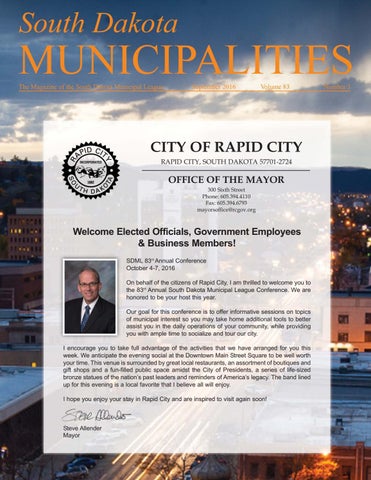
Welcome Elected Officials, Government Employees & Business Members! SDML 83rd Annual Conference October 4-7, 2016 On behalf of the citizens of Rapid City, I am thrilled to welcome you to the 83rd Annual South Dakota Municipal League Conference. We are honored to be your host this year. Our goal for this conference is to offer informative sessions on topics of municipal interest so you may take home additional tools to better assist you in the daily operations of your community, while providing you with ample time to socialize and tour our city. I encourage you to take full advantage of the activities that we have arranged for you this week. We anticipate the evening social at the Downtown Main Street Square to be well worth your time. This venue is surrounded by great local restaurants, an assortment of boutiques and gift shops and a fun-filled public space amidst the City of Presidents, a series of life-sized bronze statues of the nation’s past leaders and reminders of America’s legacy. The band lined up for this evening is a local favorite that I believe all will enjoy. I hope you enjoy your stay in Rapid City and are inspired to visit again soon!
Steve Allender Mayor
Official Monthly Publication
Member of National League of Cities
Contents Features
www.sdmunicipalleague.org
2016 Municipal/School Election Workshops . . . . . . . .6
South Dakota MUNICIPALITIES
Obituary: Karen Harford . . . . . . . . . . . . . . . . . . . . . . .7
Managing Editor: Yvonne A. Taylor
PRESIDENT Meri Jo Anderson Finance Officer, New Underwood 1st VICE PRESIDENT Laurie Gill Mayor, Pierre 2nd VICE PRESIDENT
Editor: Carrie A. Harer
DISTRICT CHAIRS Dist. 1 - Mike Grosek Mayor, Webster
SDML Proposed Statement of Policy . . . . . . . . . . . . .39
Dist. 5 - Renae Phinney President, Ree Heights
Christine Erickson Councilmember, Sioux Falls PAST PRESIDENT
Revitalization and Main Street Transformation . . . . .14
Dist. 3 - Amy Nelson City Manager, Yankton
TRUSTEES Pauline Sumption Finance Officer, Rapid City
Anita Lowary Finance Officer, Groton
GFOA’s 21st Annual Governmental GAAP Update . . . . . . . . . . . . . . . . . . .12
Planning More Meaningful Meetings . . . . . . . . . . . .18
Dist. 4 - Debbie Houseman Finance Officer, Lake Andes
Steve Allender, Mayor, Rapid City
When Does a Request For Further Information Under the ADA Violate the Law? . . . . . . . . . . . . . . .10
Dist. 2 - Tim Reed Mayor, Brookings
Mike Wendland Mayor, Baltic
Karl Alberts Finance Officer, Aberdeen
Vendor Risk Management . . . . . . . . . . . . . . . . . . . . . .8
Dist. 6 - Leland Treichel Mayor, Roscoe Dist. 7 - Arnold Schott Mayor, McLaughlin Dist. 8 - Harry Weller Mayor, Kadoka Dist. 9 - Carolynn Anderson Finance Officer, Wall Dist. 10 - Fay Bueno Finance Officer, Sturgis
SDML Annual Conference Information Making the Most of the SDML Conference . . . . . . .28 Golf Scramble Registration . . . . . . . . . . . . . . . . . . . .31 Conference Registration . . . . . . . . . . . . . . . . . . . . . . .32 Preliminary Conference Program . . . . . .Center Pullout SDML Hall of Fame Nomination Form . . . . . . . . . . .37 Fun Walk/Run Registration . . . . . . . . . . . . . . . . . . . .38
Columns Director’s Notes . . . . . . . . . . . . . . . . . . . . . . . . . . . . . . .4 President’s Report . . . . . . . . . . . . . . . . . . . . . . . . . . . .5
LEAGUE STAFF 1-800-658-3633 Fax: 605-224-8655
Risk-Sharing News . . . . . . . . . . . . . . . . . . . . . . . . . .24
Yvonne Taylor Sandi Larson Lori Martinec
Washington Report: Senator Rounds . . . . . . . . . . . . .26
Executive Director Director of Risk Sharing Services Director of Research and Training Director of Municipal Electric Services Carrie Harer Director of Marketing & Communications Lori Butler Director of Finance Kristi Brakke Accounting Assistant Office Manager SD Public Assurance Alliance: Judith Payne Executive Director Kristina Peterson Director of Underwriting Ron Burmood Director of Member Services Paytra Nichols Underwriter Jerry Krambeck Member Services Representative Deb Corkill Executive Assistant
In Every Issue Community Calendar . . . . . . . . . . . . . . . . . . . . . . . . .58 Classifieds . . . . . . . . . . . . . . . . . . . . . . . . . . . . . . . . .62 Directory Changes . . . . . . . . . . . . . . . . . . . . . . . . . . .23 Municipal Calendar . . . . . . . . . . . . . . . . . . . . . . . . . .66 Cover Photo By Rapid City Convention & Visitors Bureau
SOUTH DAKOTA MUNICIPALITIES (ISSN 0300-6182, USPS 503-120) is the official publication of the South Dakota Municipal League, published monthly at 208 Island Drive, Ft. Pierre, South Dakota 57532, phone 605-224-8654. This institution is an equal opportunity provider, and employer. Periodical postage paid at Pierre, South Dakota and additional mailing offices. Non-member subscriptions are available for $30.00 annually. The opinions expressed herein are not necessarily those of the South Dakota Municipal League. Postmaster: Send address changes to SOUTH DAKOTA MUNICIPALITIES, 208 Island Drive, Ft. Pierre, South Dakota 57532.
SEPTEMBER 2016
VOLUME 83, NUMBER 3
3
Director's Notes I probably shouldn’t admit that I sometimes fake enthusiasm about the Conference until the details are nailed down and we know for sure who is speaking, but regardless, I’m at the REAL ENTHUSIASM level now. (I always think, when running around checking on things during the meetings, “Wow, this Conference looks great, I wish I could attend some day!”) This year’s Annual Conference is going to offer an incredible range of quality and depth, and once again, the best speakers have been recommended by our members. Several of our cities work with our keynote speaker on Thursday afternoon (October 6). Patrick Ibarra will bring this real South Dakota experience to his presentation “A Sense of Place: The Value of Government.” Beyond delivery of high-quality public services and programs, Mr. Ibarra will provide a roadmap on transitioning the discussion from the cost of government toward the value of government. Friday morning continues this theme with Beth Noymer Levine, who will help you learn how to inform and build stakeholder groups to give your citizens a fresh outlook on your efforts to build community, improve public spaces, and provide infrastructure.
4
An exciting general session panel will feature three current legislators and one former legislator (now a city councilperson) who will let you know how to best approach your representatives in Pierre. These legislators are some of our strongest advocates for local control, so they will have important tips for you to make sure you are being heard. Great information is also going to be available throughout Wednesday and Thursday morning as all of the affiliate groups meet, and on Wednesday morning, make sure you keep up your Pools – you own them, and these are your membership meetings. If you are able to get away early, you should feel free to sit in on the SDML Board Meeting, Tuesday, October 4 at 7:00 p.m. And don’t forget the lighter side! Starting with the golf tournament Tuesday afternoon, to a really great Wednesday night experience Rapid City is lining up in their beautiful downtown square (featuring a social and live music), to the Thursday evening comedian (also recommended by members!) and dinner. There is something for everyone at this year’s conference, and we are so looking forward to seeing you all there! Until next month, remember we are always available at 1-800-658-3633 or yvonne@sdmunicipalleague.org. Yvonne Taylor Executive Director
SOUTH DAKOTA MUNICIPALITIES
President's Report I look forward to seeing all of you next month in Rapid City for the annual Conference! It looks like it will be a very busy one with informative sessions. Thanks to everyone who is participating by serving on the four policy committees: general government, public works, public health, safety and welfare, and tax and revenue. You are the guiding force behind the necessary directions our organization must take to be successful. It takes so many dedicated public servants with a can do attitude to make our group successful. Thank you so much! Most households have a mess maker, as does every town/city. Our job is to clean up the messes made by others, be it previous administrations as well as the citizens within. It is an ever evolving world and what was a solution at the time becomes a mess later. Hind sight is always twenty/twenty and who could possibly foresee the problems that a changing world brings. So instead of criticizing, realize that we continue to change and must find solutions that deal with these problems as our city/towns rotate in growth and success. There are so many good citizens within your city/town, who want to make things
better and find the solution to the messes around us. Do not give in to the negativity of the naysayers, instead look at the majority of good people that reside in your city/town. Realize that these citizens are the backbone of any town and their voices matter as much as the greasy wheels. Do not let them down by becoming negative yourself. You must remain optimistic as a leader and public servant remember there is a solution to any problem that comes your way. Remain hopeful and confident that there is a way to solve any mess and that with the help of the optimistic people it will be found. As a public servant have the confidence that the positive always succeeds over the negative. Do not give in to the negative side of citizens, help them to see we can all work together to make our city great. If you lose your optimism you have lost the battle of being a good public servant and become part of the mess. It does not help anyone if we lose our optimistic attitude, especially the people we work with and the citizenry within. The foundation of a city crumbles when the ones who make up this foundation lose their optimism. I know I could never have remained in this job this long without that all important key. A jewel of a key for your chain “OPTIMISM.” Respectfully, Meri Jo Anderson President
SEPTEMBER 2016
5
2016 Municipal/School Election Workshops Presented by: South Dakota Municipal League Office of South Dakota Secretary of State Associated School Boards of South Dakota Three election workshops are scheduled to assist election officers in conducting elections. The Secretary of State’s office, Associated School Boards of South Dakota and the South Dakota Municipal League will again co-sponsor workshops covering all aspects of elections – from notices to the final canvass – including question-and-answer sessions. Municipal finance officers and school business managers have statutory responsibility to conduct elections in their local jurisdictions. Properly conducted elections are an integral part of the democratic process. The many hours of diligent work on the part of the election officers enhances candidate and voter participation, and provides for accurate and consistent elections. Election officers may choose to attend one of the following three election workshops: October 18th Webinar* 9:00 am-1:00 pm Central Time October 24th Webinar* 9:00 am-1:00 pm Central Time November 18th Pierre, Ramkota Hotel 10:00 am-3:00 pm Central Time There is no registration fee. Those who register to attend the webinar will be emailed the login and callin information one week prior to the workshop date. The webinar will go through the lunch hour, so please plan accordingly. *Each webinar is limited to 100 participants, so please register early if you plan to attend via webinar. Those who register for the in-person training in Pierre should plan to get lunch on their own during the 12:00-1:00 break.
Registration Form 2016 Municipal/School Election Workshops Municipality: ______________________________________________________________________ Title Email Name(Please Print) ________________________________ _____________________ ____________________________ ________________________________ _____________________ ____________________________ ________________________________ _____________________ ____________________________ Please choose one workshop to attend:
Oct. 18 Webinar
Registration Deadline: September 30, 2016 Please send to: South Dakota Municipal League 208 Island Drive Fort Pierre, SD 57532 Email to: info@sdmunicipalleague.org
Oct. 24 Webinar
Nov. 18 Pierre
Obituary: Karen Harford Karen Harford, age 54, passed away following a courageous battle with cancer on Sunday, August 7, 2016 in the Sanford Hospital, Sioux Falls, SD. Karen M. Bolden, was born December 16, 1961, in Madison, MN, to parents Carl and Vivian Bolden. She was baptized and confirmed in the Lutheran faith, at Garfield Lutheran Church, rural Madison, MN. She attended school at Madison Public School where she graduated in 1980. Karen then attended Willmar Vo-Tech College, graduating in 1982. After graduation, Karen worked at the Deuel County Memorial Hospital, in the Business Office. She then went to work as secretary for the Gunderson, Evenson, and Boyd Law Firm in Clear Lake. In 2011, Karen became the Finance Officer for the City of Clear Lake, where she was currently employed. On August 30, 1986, Karen was united in marriage to Steven D. Harford, at Garfield Lutheran Church, Madison, MN. To this union, two special sons were born: Tyler and Travis. Karen was a member of St Paul’s Lutheran Church, Clear Lake, SD, where she served as a Sunday School teacher, chairperson in the Patience Circle and other various capacities. She had been a Notary Public, and has attended numerous finance officer/municipal league conferences. Karen’s most cherished past time was spending time with family and friends, celebrating birthdays, special events, and hosting many holidays at her and Steve’s home. Karen passed away Sunday, August 7, 2016 in the Sanford Hospital in Sioux Falls, SD at the age of 54 years, 7 months and 22 days. She is lovingly remembered by her husband of 30 years, Steve; sons, Tyler and Travis, Sioux Falls; mother, Vivian Bolden, Madison, MN; sister, Arlene and husband Dan Miland, Janesville, WI; brother, Mark and wife Barb Bolden, Clear Lake. She is also survived by father and mother-in-law, Wayne and Bonnie Harford, Rapid City; sister-in-law, Becky Bender and special friend, Gene Mason, Rapid City; brother-in-law, Russ and Col Harford, Chadron, NE; sister-in-law, Chris and husband James Finney, Baton Rouge, LA, and numerous nieces and nephews. Karen was preceded in death by her father, Carl Bolden; sister, Debbie Bolden; brother, Bradley Bolden; as well as maternal and paternal grandparents; and a special uncle, Richard Zick. SEPTEMBER 2016
7
Vendor Risk Management By Kristina Peterson, Director of Underwriting, SDPAA Many public entities sponsor events and functions which involve outside vendors. And, many entities allow their facilities and/or property to be utilized by an outside party for an event or function which may include vendors. To protect the entity it is important to transfer as much of the risk of the function or event as possible and to ensure outside parties, including vendors, are responsible for the risks associated with their participation in the function or event. In addition to the entity utilizing a Facilities Use Agreement and requiring the appropriate insurance coverage, hold harmless/indemnification language, and waivers (if appropriate) of the user, it is important that the risks presented by the vendor be evaluated and appropriate risk management requirements met. Once you have completed your evaluation of the risks, you may find that minimal requirements are warranted. However, if you determine the risks associated with the activities, goods or services being provided by the vendor are such that protection of your entity is appropriate, we recommend the following risk transfer methods be utilized: j Evidence of a minimum of $1,000,000 in general liability insurance coverage of the vendor with a Certificate of Insurance to be provided to the entity with the entity being named an additional insured. j Evidence of a minimum of $500,000 in auto liability insurance coverage of the vendor with a Certificate of Insurance to be provided to the entity with the entity being named an additional insured. j Agreement to maintain workers’ compensation and employers’ liability insurance as required by South Dakota law. j Agreement in which the vendor agrees to hold harmless and indemnify the entity as appropriate (sample language can be found on our website).
8
Vendors may have a policy or coverage in place and be able to provide evidence of liability coverage. Other vendors may ask for assistance in finding coverage. There are several ways to obtain coverage. One is to apply for event coverage. Two companies that offer this type of coverage are the TULIP Program and the Alliant Special Event Program. Both offer a $1,000,000 general liability limit and add the public entity as an additional insured. Both have an application online and the premium can be paid online as well. Websites with additional information for these programs is below. TULIP: www.onebeaconentertainment.com. Alliant Special Event Program: https://specialevents. alliantinsurance.com/Authentication/Default.aspx?Return Url=%2fdefault.aspx. SDPAA is always available to discuss risk management issues associated with your event and to assist with loss control measures and sample language or recommendations. Contact our office at 800.658.3633 to talk with a staff member about your event.
SOUTH DAKOTA MUNICIPALITIES
When Does a Request For Further Information Under the ADA Violate the Law? By Abbey Moland, Attorney, McGrath North It is clear under the Americans with Disabilities Act (ADA) that, in certain situations, an employer is entitled to seek additional medical documentation regarding the nature of an employee’s restriction and their need for accommodation. However, employers making a request for such information must be wary of crossing the line so that their request does not constitute interference with the employee’s rights under the ADA. In a recent decision in Hafermann v. Wisconsin Department of Corrections, a federal district court in Wisconsin examined the employer’s treatment of an employee who had informed them he could not work the third shift because of severe sleep apnea and cardiac problems. The employee had submitted a letter from a nurse practitioner stating that the night shift was a known risk factor for individuals with sleep apnea and, in particular, those with cardiac health conditions. The
10
employer then requested more information from the healthcare providers. Although the employee had been temporarily assigned to work first and second shifts, he was then reassigned back to the third shift. He returned the employer’s questionnaire in which the healthcare provider stated that he needed time to adapt to sleeping during the day and that the duration of his impairment was unknown. It was emphasized that the employee needed to work the day shift. The employer then again requested further information and refused to assign the employee to a vacant first shift position. The employee resigned. He filed suit under the Rehabilitation Act, rather than the ADA, although the principles governing both laws are substantially similar. In the lawsuit the employer first argued that Plaintiff was not an individual with a disability. The Court brushed that argument aside pointing out that to prove disability a Plaintiff need only show a substantial limitation on a major life activity, not that he is unable to work.
SOUTH DAKOTA MUNICIPALITIES
The employer then argued that the information from the healthcare providers failed to show that the employee needed a requested accommodation in order to perform his job. The Court viewed the information provided by the healthcare provider and found no reason to question the conclusion that the employee should not be working the night shift due to his disability. Finally, when the employer contended that the letters from the healthcare providers did not clearly explain why the disabilities prevented him from working the third shift, the Court noted that such an argument raised the question of the extent to which an employer is entitled to demand information to support the conclusion that an employee needs an accommodation. The Court pointed out that the employer did not tell the employee what it believed was insufficient about the information submitted by the healthcare provider or even to specify what additional information was necessary. It pointed out that the employer had only asked general questions in its supplemental questionnaire regarding the nature of the disability. The Court concluded that a reasonable jury could find that by failing to provide that information, the employer caused a breakdown in the required interactive process.
SEPTEMBER 2016
The holding in Hafermann sheds light on an employer’s obligation when seeking follow-up information about a potential disability and accommodation from its employees. First, the employer has an obligation to inform employees of the specific insufficiencies in the information provided by the healthcare provider. Second, and at the same time, it should point out to the employee and; obviously, to the healthcare provider at the same time, the specific nature of the additional information it believes to be necessary. Simply making generalized inquiries to the employee and the healthcare provider to provide more information will not be sufficient and, indeed, could lead it directly to a finding of interference with the employee’s rights under either the Rehabilitation Act or, impliedly, the ADA. Clearly, the Court concluded that transparency in the employer’s activity was absent, and led to the inference that the employee’s rights under the Act had been interfered with. Contact Abbey Moland at amoland@mcgrathnorth.com or 402-633-9566.
11
GFOA’s 21st Annual Governmental GAAP Update Program Description: The Government Finance Officers Association (GFOA) will offer its 21st Annual Governmental GAAP Update on November 3, 2016, and again on December 1, 2016, using the latest video and audio streaming technology. The seminar offers an incomparable opportunity to learn everything you need to know about the most recent developments in accounting and financial reporting for state and local governments from the convenience of your own computer! Enjoy all the benefits of the highest quality continuing professional education without the time and expense of travel!
Special group discounts! Make a day of it and build an event around this training as an affordable way to train staff and/or educate clients. Sign up with your colleagues and save with group pricing.
The training will take place on November 3, 2016, with an encore presentation on December 1, 2016, 1:00 p.m.−5:00 p.m. (Eastern). Earn 4 CPE credits with your participation.
Prerequisite: Intermediate Governmental Accounting (or equivalent = basic understanding of GAAP for state and local governments)
Early discounts! Sign up by September 30 and take advantage of an early registration fee on the November offering (or register by November 8 to save on the registration fee for the December offering).
12
Act now and register! For the brochure and registration form or to register online visit http://www.gfoa.org/21st-annual-governmental-gaapupdate. If you have any questions about the training, contact GFOA at 312-977-9700. GFOA Member Price: $180.00 Non-Member Price: $195.00
Speakers: j Stephen J. Gauthier, Director, Technical Services Center, GFOA j Steven A. Solomon, Deputy Director, Technical Services Center, GFOA
SOUTH DAKOTA MUNICIPALITIES
Coverage: This year’s Annual Governmental GAAP Update will provide comprehensive coverage of the most recent developments in accounting and financial reporting for state and local governments, including: j Additional authoritative guidance on pensions and other postemployment benefits (OPEB); j Proposed final guidance on leases; j New standard for money-market type investment pools and participating governments; j Proposed final guidance on the use of fiduciary funds; j Authoritative guidance on split-interest agreements; j New standard that expands the criteria for blending component units; j Proposed final guidance on capital asset retirement obligations; j Progress on project to reexamine the governmental financial reporting model; j Forthcoming proposal on accounting for debt extinguishments that use existing resources; j Recent GASB implementation guidance; j Other ongoing GASB projects (GASB Technical Plan); and j Common financial reporting deficiencies.
SEPTEMBER 2016
Seminar Objectives: Participants in this year’s GAAP Update should obtain a practical understanding of: j GASB Statement No. 78, Pensions Provided through Certain Multiple-Employer Defined Benefit Pension Plans; j GASB Statement No. 79, Certain External Investment Pools and Pool Participants; j GASB Statement No. 80, Blending Requirements for Certain Component Units; j Pending GASB final statement on Accounting and Financial Reporting for Irrevocable Split-Interest Agreements; j Pending GASB final statement on Pension Issues; j GASB exposure draft (ED) on Leases; j GASB ED on Fiduciary Activities; j GASB ED on Asset Retirement Obligations; j Recent GASB implementation guidance; j Forthcoming GASB ED on Certain Debt Extinguishments Using Existing Resources; j Forthcoming invitation to comment on the Financial Reporting Model; j GASB Technical Plan; and j Common financial reporting deficiencies encountered in the GFOA’s Certificate of Achievement for Excellence in Financial Reporting Program.
13
Revitalization and Main Street Transformation Improvements to Main Street’s Signature Revitalization Framework Are around the Corner
By Patrice Frey Over the course of the past decade, America’s downtowns have experienced a renaissance, with boomers and millennials choosing to live in communities that are walkable and that provide distinctive character and diverse amenities. This is true for the biggest of counties and smallest of towns. But even with these powerful demographic forces at work, downtowns and neighborhood commercial districts can still face an uphill battle. Achieving the right mix of housing, retail, restaurants, transportation, green space, and more is a complicated calculus. For a lucky few downtowns, greatness may happen effortlessly with a strong sense of place that seems to develop organically and simply sustain itself. For most places, success doesn’t happen by chance. Vibrant downtowns—like Lake City, Colorado (http://www.lakecitydirt.com); Woodbine, Iowa (http://www.woodbineia.org/main-street); or Birmingham, Alabama (http://www.revbirmingham.org)—are successful because of long-term, strategic, tactical growth and management. Over the past 35 years one tool in particular—the Main Street Approach—has helped communities to effectively organize, execute, and achieve their vision for success downtown. A Way Forward The Main Street Approach, and indeed the Main Street movement, grew out of rising concerns in the late 1970s and early 80s that the increasing suburbanization of the American landscape and urban renewal efforts were doing irreparable harm to downtowns and their older and historic structures. Harnessing a unique mixture of professional downtown management and volunteer engagement, the program offered a way forward for communities. It helped them prevent or reverse deterioration of the character of downtowns and commercial districts by focusing comprehensively on the overall health of these areas. 14
While Main Street-style revitalization has always looked slightly different depending on the local context, successful downtowns typically have one thing in common: They have pursued revitalization strategies that are comprehensive in scope. There is no quick fix or single project that can turn a downtown around. Successful place management and transformation can only be achieved through forwardlooking strategies, a comprehensive focus, and work across these four key areas: 1. Development of targeted economic development strategies that improve the mix and vitality of downtown businesses, cultural institutions, and housing. 2. The pursuit of quality design, including improving transit accessibility and walkability, as well as building rehabilitation and façade improvements. 3. Marketing of the district, including the development of a distinct branding and programming for the area to attract shoppers and visitors. 4. The successful development of a professionally managed downtown organization—whether that entity is housed with a city or county, or is a stand-alone nonprofit. Main Street America’s long-standing revitalization strategy, called the Four Point Approach, offers a critical playbook that corresponds to each of these four areas of focus—economic vitality, design, promotions, and organization—enabling local leaders, downtown managers, and volunteers to take revitalization into their own hands. Over the past 35 years, this approach has been used in more than 2,000 communities, generating nearly $65.6 billion in downtown reinvestment—often in downtowns and neighborhood commercial districts that have faced significant disinvestment and decline (see Figure 1).
Figure 1. Cumulative Main Street America reinvestment statistics since 1980.
Dollars reinvested: $65.6 billion
Net gain in jobs: 556,960
Number of building rehabilitations: 260,011
Net gain in businesses: 126,476
SOUTH DAKOTA MUNICIPALITIES
An Enhanced Tool A refreshed version of the Main Street Approach was launched last fall and is in beta mode now. It’s aimed at helping communities of all sizes embrace a more strategic, outcome-oriented approach to revitalization. Fundamentals of the Main Street Approach remain the same, but there is increased focus on long-term economic transformation and helping local leaders to strategically organize their efforts to achieve tangible, measurable goals. Since implementation of the Main Street Approach makes use of professional downtown managers and mobilizes volunteers, it can substantially lessen the burden on local government to “turn around downtown” or reinvigorate fledgling neighborhood commercial districts. In successful communities, however, lasting revitalization depends on strong partnerships and coordination between the Main Street organization, local government, and small business owners. Modest financial support from local government, combined with small business sponsorships and event-generated revenue, are needed to sustain downtown improvement efforts. Where special district financing is available, it can be particularly effective at generating a sustainable revenue stream for revitalization work.
SEPTEMBER 2016
Main Streets at Work What does Main Street revitalization look like in practice? Communities using the Main Street Approach come in all stripes, from the bustling H Street NE corridor in Washington, D.C.; to the scenic college town of Milledgeville, Georgia; to rural Rawlins, Wyoming. As different as they are, each of these places has used Main Street as a framework to guide inclusive, strategic, and effective revitalization efforts. The H Street NE corridor, for example, has undergone dramatic transformation since the mid-20th century. Disinvestment, segregation, violence, and high-vacancy rates all posed serious challenges to this neighborhood that, at one time, was a major hub of African American culture and industry in the city. While the District of Columbia is now one of the hottest real estate markets in the country, H Street’s dramatic resurgence is not simply attributable to the city’s overall economic boom. The commercial district, with the support and leadership of this H Street Main Street program, has strategically navigated the forces of new development, gentrification, and preservation using Main Street as a guide. Today, H Street NE is a diverse, lively neighborhood filled with a mix of historic character, local flavor, and
15
new development. It has become a destination for residents from other neighborhoods, while still managing to support a mixed-income population and diverse group of business owners.
setting and strong leadership. Rawlins, Wyoming (population 9,200), like rural communities across the country, faced significant economic challenges in the late 1990s and early 2000s.
Main Street Director Anwar Saleem sees his role—and that of the H Street Main Street Program (HSMS)—as the community’s go-to resource for residents, business owners, and developers.
Since adopting Main Street in 2006, Rawlins has brought the downtown vacancy rate down to 10 percent from 45 percent and leveraged local community involvement, amounting to more than 7,000 volunteer hours.
“HSMS has been the on-the-ground and accessible clearinghouse of relevant information about proposed or pending development projects,” says Saleem. He notes that the success of the H Street District is related directly to intensive engagement with the community and partnership building with local businesses.
While maintaining the town’s historic character and charm is a key priority, the leaders at the Rawlins Downtown Development Authority/Main Street program are not relying on charm alone to shape the future of the community. The Main Street program, for example, was instrumental in helping to open the Rainbow Te-Ton Entrepreneur Center (RTEC).
“‘Traditional approaches’ [to economic development] are very distant into the past now, since we have actively engaged residents and the business community for 14 years now about the need for growth and managed change.” While different in scale, the revitalization challenges in smaller, more traditional Main Street-style communities can be equally challenging, and require strategic goal
16
Situated partly in an old hotel—once known locally as the “pigeon hotel” for its state of disrepair—the RTEC now gives fledgling businesses a chance to share expenses and ideas with one another. It offers conference and training rooms, virtual office space, and monthly business classes. And it works: The center has generated 200 new jobs and 28 new businesses downtown. This innovative reuse
SOUTH DAKOTA MUNICIPALITIES
of a historic building, dedication to fostering local entrepreneurship, and clear economic impact are illustrative of the way Main Street can help small communities live up to their full potential. On the other side of the country, Milledgeville, Georgia (population 19,401), serves as yet another example of how Main Street communities can tap into local resources, build partnerships, and build on their history to ensure a strong future. The Milledgeville Main Street program is nearing its 30th year in the program and has continuously built on its successes to ensure the downtown is an inviting, economically thriving, and diverse destination. Since its founding in 1988, the Milledgeville Main Street program has helped generate 394 jobs and 89 building rehabs, as well as bringing in 154 net new businesses and adding 22 downtown housing units—all while reducing the vacancy rate from 50 percent to 8 percent and tapping into a network of thousands of local volunteers of all ages. While this success alone is testament to the strength of Milledgeville’s program, Milledgeville is embracing change and is an early adopter of an updated version of the Main Street Approach. Carlee Schulte, director of the Milledgeville Main Street program, attributes the Main Street “refresh” with helping her program to “envision our downtown in a way that makes for easier and more strategic planning for the future. We now have a tool with which to identify our unique strengths and leverage them for invaluable community ownership and identity.” Thus, what makes a place like Milledgeville or H Street or Rawlins work and what makes them thrive is precisely what sets them apart from other places—their authenticity, their distinct vision, and their residents. What unites them is a shared commitment to partnership building, strategic growth, and community engagement.
A Movement of the Future At its core, this commitment is what Main Street is about. While preserving authentic character, harnessing the value of historic buildings, and helping communities get started on their revitalization efforts are all important components of what Main Street does, the work is never really done. Even the most successful Main Street programs in communities that are seen by standard metrics as successful, are constantly confronted with change. Managing that change is just as important and central to what Main Street does as getting started. As the field of community development and revitalization shifts to respond to new trends and challenges (think: housing, transit-oriented development, the rise of online commerce, sustainability, brownfields remediation, and more), Main Street continues to be a tool that helps local government leaders adapt to and make the most of these changes. Main Street always has been, and continues to be, a movement of the future. For more information on Main Street America and for details on how to get your community involved, visit mainstreet.org. Patrice Frey is president and chief executive officer, National Main Street Center, Chicago, Illinois (pfrey@savingplaces.org; www.mainstreet.org). Reprinted with permission from the August 2016 Public Management (PM) magazine, copyrighted and published by ICMA (International City-County Management Association), Washington, D.C.
SOUTH DAKOTA BASIC CODE Affordable Codification for Small and Mid-Sized South Dakota Municipalities A comprehensive model code of ordinances for municipalities featuring: x Subject matter encountered by municipalities x Annual state law updates x
x x
SEPTEMBER 2016
A comprehensive index and a title devoted to your unique local ordinances Published by American Legal and the South Dakota Municipal League For more information call or e-mail deRicci Getty at 1-800-445-5588 or dgetty@amlegal.com 17
Planning More Meaningful Meetings By Laura Larsen We’ve all been there: the meeting that didn’t start on time, had no focus, and could have been resolved through an email. It’s not just you; research suggests that poorly planned meetings are a waste of time and resources. Employees consider between one-quarter and-three quarters of their time spent in meetings wasted.1 On average, employees spend more than 20 hours a month in meetings, which might not include prep time.2 Imagine the time and money that could be saved and the improvement to employee morale that could be achieved by getting better value for meeting time. Employees might be able to gain the equivalent of roughly two more days of work time per person per month by eliminating wasted meeting time. Research also indicates that more productive and meaningful meetings can boost the quality of the decisions made there.3 The secret to a meaningful meeting has as much to do with the format and preparation as it does the content itself. In order to get the most out of meetings, be clear about what the meeting participants expect and create an environment where individuals have space to share insights and provide meaningful feedback. Finance professionals often lead processes that involve many other people, so effective meetings are critically important to fulfilling deadlines. This article examines the elements of a meeting—its organization, the roles of participants, its ground rules, and action items—that come together to create an environment where staff members feel engaged in the decision-making process. Organization and Planning A successful meeting begins with a clear sense of purpose. Explicitly stated objectives ensure that the correct individuals are in attendance; having the right mix of people ensures that participants are invested and engaged in the topic at hand. It is sometimes appropriate to allow optional participation by giving participants the opportunity to self-select, based on their determination of what they will be able to contribute to the dialogue. These steps can be accomplished by drafting a detailed agenda and sharing it with participants at least 24 hours before the meeting. Effective agendas include the following components: j Objectives: Define why the meeting is being held. j Logistics: State start and stop times, location, etc. j Participants: Create a list of people, including whether or not their attendance is required or optional. 18
j j
Preparation: Inform participants about any tasks (including reading) that must be completed before the meeting. Agenda items: Outline how the meeting objective will be accomplished. Each agenda item should include an expected duration and indicate who will lead the discussion for that item.
When drafting the agenda, keep the meeting objectives foremost in your thoughts. The objectives should be organized logically, and the other meeting components should contribute to reaching the objectives. Also consider if a meeting is the best way to achieve those objectives— if you aren’t able to define a clear and compelling objective for your meeting, it probably isn’t necessary. In the City of Madison, Wisconsin, for example, city officials applied this standard to a long-standing meeting between the mayor and staff that covered updates on ad hoc projects. As the steering committee set out to develop an agenda format, it became apparent the existing structure lacked a clear objective. Rather than continuing a meeting that lacked direction, staff worked to retool the format and ensure that meetings only take place when there is a clear objective (which the mayor now decides). Staff in the City of Burnsville, Minnesota, had a similar experience when applying this approach to a monthly department head meeting. Participants often lacked a clear understanding of the meeting goal and felt overwhelmed by an overly ambitious agenda. The meetings were cut back to every other month, with an agreement that a meeting would be scheduled if substantive discussion were needed. Assigning Roles to Participants In this section, we examine ways in which participants can make meetings more effective. Four key roles—leader, facilitator, recorder, and coordinator—will assist with the organization, execution, and outcome (The number of attendees and the dynamics of the group will ultimately determine whether some of these roles can be combined or if they are even necessary.) Leader. The leader organizes the meeting and owns the agenda. This is the person who develops the agenda, often with the input of the other meeting attendees, establishes the timeframe for each item on the agenda, and articulates objectives and expected outcomes. This is important work that must occur before the meeting starts to keep it on topic and running smoothly. During the meeting, the leader manages the agenda and the time spent on each topic and, along with the facilitator, makes sure the ground rules are followed. The leader also makes any assignments that SOUTH DAKOTA MUNICIPALITIES
come from the meeting; this includes ensuring that assignments are given to the people most likely to succeed with them—which can be especially challenging for crossdepartmental meetings, since attendees from different areas may not agree on what department is ultimately responsible for the task. Facilitator. In smaller meetings, one person might take the roles of both the facilitator and leader. In larger meetings, or meetings about controversial topics, the facilitator’s role is critical, especially if the meeting leader is perceived to have a bias toward a certain outcome. While the leader manages the agenda and keeps it on track from a timing perspective, the facilitator manages the people (and personalities). This means ensuring that one or two loud voices don’t dominate the discussion and keeping everyone engaged and participating. That includes encouraging those who don’t typically participate. Personality issues can distract attendees from the meeting’s goals, so a good facilitator can make the difference between a successful and unsuccessful meeting. Recorder. The role of the recorder can be difficult to properly define. He or she is expected to capture highlights of key discussion and decisions, which can result in a robust set of meeting minutes—but at a cost. First, to keep
SEPTEMBER 2016
the momentum going and ensure that assigned tasks are completed by established deadlines, the recorder needs to provide meeting notes to all attendees within one business day of the meeting. Producing an extremely detailed set of minutes makes this difficult. Second, the person taking the minutes cannot provide optimal input as a meeting participant if he or she is preoccupied with capturing minute details of the meeting. To allow the recorder to both produce a record of the meeting in timely fashion and participate fully in the meeting itself, that person should focus on summarizing each agenda item at a high level, capturing the decisions that were made and clearly documenting any action items, rather than attempting to document everything that is said verbatim. Coordinator. The coordinator takes care of the logistics associated with the meeting, such as securing a meeting space that will adequately accommodate the attendees, ensuring that the technology is in place (e.g., audio-video, projectors, microphones), coordinating with speakers or other meeting guests, and handling any other pre-meeting tasks (e.g., procuring refreshments). This role involves scheduling the meeting and ensuring that materials are distributed to attendees in advance. As we all know from experience, a meeting that is delayed due to poor coordination, like malfunctioning audio-video or the a too-
19
Lateness, Absences, and Distractions: Valuable Clues The meeting organizer should take lateness, absences, or participants doing other work during the meeting as clues that perhaps the meeting objective is not compelling to all of the attendees—after all, people are less likely to miss a meeting that is important to them. This might present an opportunity to streamline the list of invitees, structure the agenda so that participants attend the portions of the meeting that are directly relevant to them, or even to discontinue the meeting altogether.
small conference room, gets off track quickly and may have trouble recovering. No meeting time should be spent on items that should have been ready in advance. Meeting Guidelines Guidelines help cultivate a space where participants can speak freely and work creatively. Meeting rules make sure participants feel that their time and opinions are being respected by other members of the group. To ensure that all attendees are committed to the following the rules, spend time before the meeting establishing rules as a group (or for a recurring meeting, during one of the initial meetings). After guidelines are established, participants can be quickly reminded of them at the beginning of future meetings. The following list includes suggested guidelines, based on the experiences of four cities—San Mateo, California; Burnsville, Minnesota; Portland, Oregon; and Madison, Wisconsin—which field tested the methods explored in this article.
Take the time to accurately absorb the perspectives of other attendees. A prerequisite for good group interaction is for the members of the group to accurately understand each other’s viewpoints. For example, if the purpose of a meeting is to forecast hotel tax revenue, and a participant thinks that tourism will decrease next year, each attendee should be able to restate that argument in their own words, in a way that the person who originally expressed the opinion would agree with. Understanding the perspective of others helps prevent groups from getting into personality conflicts.4 Practice the art of precision questioning. Understanding another person’s perspective does not mean you have to agree with it. How disagreement is expressed makes a big difference in whether a meeting is productive or destructive. When one person questions another person in precise terms, rather just posing a broad or vague challenge to the veracity of the other person’s views, it helps the team focus in on the real differences in viewpoints and explore those differences in a meaningful, productive way. Going back to the previous example, you might ask your colleague why he believes that tourism will decline. Is he referring to tourism for special events or for more routine amenities? What time of year might the decline occur? The goal is to understand the thinking behind a position so it can be tested. For instance, if it turns out your colleague believes the number of special events that attract tourists will decline, the team can take steps to investigate, like talking to the convention and visitors’ bureau to compare the upcoming year’s schedule of events held in prior years. Define the way in which decisions will be made. The purpose of meetings is often to make decisions. Participants should therefore have a clear understanding of how decisions
Be on time, or let the organizer know if you will be late. Start and end the meeting on time. When you consider the total compensation of the all people taking part in even a moderately sized meeting, the cost of wasting time by starting late is considerable. Just as the meeting attendees should respect the start time, so the organizer should make every effort start and end the proceedings on schedule. Be prepared and attentive. Meeting attendees should commit to doing any readings or other tasks that are a prerequisite for accomplishing the meeting’s objectives. The meeting organizer should commit to clearly delineating what these tasks are in the agenda and sending the agenda out with enough lead time for attendees to do their part. Once the meeting begins, all attendants should commit to giving their full attention and avoid doing other work (e.g., checking e-mail). 20
SOUTH DAKOTA MUNICIPALITIES
will be made. Consensus may be necessary at some meetings, and a majority at others. For some decisions, it can be useful to clarify which meeting participants have the ability to make the decisions. For example, in meetings involving the chief executive officer, his or her opinion will be given a stronger consideration. Not every meeting needs to adhere to the same rules, but in the case of disagreement, all participants should feel that issues were addressed fairly and decisions were made in a transparent way. Create a space in which everyone can voice an opinion. The quality of information at a meeting will be better if all the attendees share their perspectives. This can be more easily said than done, however, as some participants may feel inhibited. The leader and facilitator can help by explicitly addressing the confidentiality of the views voiced at the meeting. For certain issues, creating a confidential space can offer additional assurance that it’s OK to speak openly. Another strategy the leader/facilitator can use is to ask the least senior participants in the meeting to give their views first, as these people might otherwise not feel comfortable speaking freely or at all if more senior staff set the tone on an agenda item by speaking first. Finally, don’t expect everyone to be entirely comfortable with the idea of meeting guidelines right away. Being late
SEPTEMBER 2016
to meetings, doing other work during a meeting, or any of the other bad meeting habits can become so ingrained that it is difficult for people to imagine giving them up. Once the guidelines are established, each meeting should have a positive effect on the next, until even the those colleagues who are habitually late or unprepared feel the pressure to join their colleagues in following the rules—which then inspires others to do the same.5 Assignments A good meeting ends with all participants on the same page. To ensure that you end on time, be sure to build in wrap-up time into the agenda. At the end of the meeting, summarize the decisions that were made and review the action items. Make sure assignments are clear. Assignments often go to just a few members of the group. The facilitator should recognize this tendency and encourage all members of the group to volunteer for tasks, where practical. (In some cases, only certain people will be qualified for specific tasks.) For example, in Madison, team members often cited capacity concerns with their existing workload as their reason for not volunteering to complete team tasks. To overcome this challenge, the team set clear timelines and deliverables. This gave meeting participants a much better sense of what was expected and
21
when, allowing them to better envision how the team’s work could fit in with their other work commitments and making them more comfortable with volunteering to help with the team’s work outside of the meeting. Tweaking Future Meetings After your organization has revamped the way in which it conducts meetings, focus on continual improvement by taking stock of how different strategies are working in practice. One thing to watch for is making sure the right participants are at the table. You might need to take steps to optimize participation, such as inviting some new people, or you might also need to give other, less critical participants the ability to opt out, or at least attend only the portion of the meeting that is most relevant to them. Next, consider how the format can be adjusted to get the most from and for meeting participants. Don’t expect perfect results the first time out. Establishing a new standard for the meeting structure, especially if your organization hasn’t really had any discernable meeting structure, is a big shift that might require a period of adjustment. For example, the City of San Mateo revised its finance department’s division head meeting. Despite some rough patches in the meeting, it was a positive experience. Much of the difficulty associated with the first meeting
22
was attributed to team members adjusting to their roles. The meeting was more focused and the participants were more engaged than before. Decisions that were made were well documented, as were assignments that came out of the meeting. Despite these initial challenges, the total time for the meeting was reduced by 20 percent, from 90 minutes to about 70 minutes. Much of the efficiency was attributable to an agenda with explicit time allocations for each topic and the work of the leader and facilitator to keep things on track and moving. Eventually, it is expected that this standing meeting will be reduced to 60 minutes. Participants appreciated the structure provided by the format and felt that the approach was ultimately more efficient. The increased focus was evident even at the first meeting. Some participants observed that a pre-meeting to clearly explain the roles, review the new agenda format, and establish ground rules would have been helpful, however. The city also found that more planning time would have paid dividends. Conclusions We spend a lot of time in meetings making important decisions. Why not take steps to make this time more productive and engaging for all participants? When meetings are structured optimally, the quality of the
SOUTH DAKOTA MUNICIPALITIES
decisions we make will be better and employees will feel more satisfied. Notes 1. A number of surveys show that managers and employees believe that a significant amount of time spent in meetings is wasted. For a summary of some of the relevant surveys, see: Ray Williams. “Why Meetings Kill Productivity,” Psychology Today, April 15, 2012. The New York Times article cited below also includes some of these statistics. 2. Lisa Belkin, “Time Wasted? Perhaps it’s Well Spent,” The New York Times, May 31, 2007. The author cites a Microsoft survey showing that employees spend approximately 5.6 hours a week in meetings. Other surveys show similar results. 3. Part of the research for this article is based on Wiser: Getting Beyond Groupthink to Make Groups Smarter, by Cass R. Sunstein and Reid Hastie (Harvard Business Review Press, 2014). The authors cite ample scientific evidence that conventional group decisionmaking practices result in sub-optimal decisions. 4. Perspective taking and precision questioning are two techniques suggested by the work of Phillip Tetlock and Daniel Gardner in Superforecasting. (Penguin Random House, 2015). Examples of hotel tax application come from an upcoming GFOA book on forecasting. 5. Chip Heath and Dan Heath, Switch: How to Change Things When Change is Hard (Crown Publishing, 2010). The authors show research that indicating that peer pressure is an effective way to help create organizational change. Laura Larsen is budget and program evaluation manager of the City of Madison, Wisconsin. She would like to acknowledge the assistance of Drew Corbett, finance director, City of San Mateo, California; Ryan Kinsella, senior financial analyst, City of Portland, Oregon; and Heather Johnston, city manager of Burnsville, Minnesota.
SDML Directory Changes Arlington
Delete: ES Jason Niemann
Beresford
Delete: CM Daniel Williams Add: CM Jason Muellenberg
Brookings
Delete: HR Katie Krogman Add: HR Donna Langland
Clear Lake
Delete: FO Karen Harford
Dell Rapids Add:
CM Bill Schmidt
Florence
Delete: T Christy Busskohl Add: T Chris Meyer
Kimball
Delete: CM Matthew Dykstra CM James Kroupa Add: CM Paul Dorwart CM Shelly Janish
Long Lake
Add:
Midland
Delete: T Rock Gillaspie Add: T Dakota Fosheim
Miller
Delete: AIR Jim Bonebright SS Jim Bonebright WS Jim Bonebright Add: AIR Terry Manning SS Terry Manning WS Terry Manning
Salem
Add:
FO Donna Hoffman
CM Mary Jo Heiberger
Email Directory changes to info@sdmunicipalleague.org. Visit www.sdmunicipalleague.org for a cumulative listing of changes to the 2016-2017 Directory of Municipal Officials.
The article was originally published in the June 2016 issue of Government Finance Review (www.gfoa.org).
SEPTEMBER 2016
23
Risk-Sharing
contact hours by attending this same training. These classes are held annually between January and April. The dates and locations are emailed to members ahead of time and they can also be found on the risk-sharing pools’ websites.
Are Your Employees Adequately Trained? Where is employee training on your long list of safety priorities? Front and center or pushed way to the back? Few entities design a training program. It evolves over time by adding a required training class here, a DVD there, and then another and another. Over time, there are many bits and pieces of training, not a comprehensive program. Managing and promoting a positive, effective program takes effort, time and planning, which are often difficult for an already stretched staff and budget. We tend to push training to the back of the stack due to lack of resources and manpower, or safety becomes invisible when training is not required and/or there are no employee injuries. The SDML Workers’ Compensation Fund and the South Dakota Public Assurance Alliance offer multiple training resources to assist you with your training efforts. These resources are free to members and they can be found on their respective websites. For the SDML WC Fund go to www.sdmlwcfund.com and for the SDPAA go to www.sdpaaonline.org. Ask yourself, “what does your employee training program look like”? Here are some considerations for establishing a written program or reviewing an existing one. One of the first questions you should ask yourself is “why do we train”? Are we training employees because of regulations, employee requests or due to a task analysis of hazards? A comprehensive training program should include all of these. Some positions require contact or recertification hours within a certain time period. How many of you have found yourself short of hours right before the deadline? A written training program will help ensure that employees stay current on any recertification or contact hour requirements by scheduling the required training ahead of time. For example, entities who have employees working in gravel pits are required by MSHA to receive 8 hours of annual refresher training. Each year the risk-sharing pools offer 39 one-day regional safety training courses where member employees can get this training. Likewise, water-wastewater operators are required by SD DENR to have a certain number of contact hours every three years depending on what class of operator they are. Operators can get five 24
Another aspect of developing or reviewing a safety training program should include a task analysis of hazards. What hazards are your employees exposed to? Are you providing them with adequate training so they know how to perform their assigned tasks safely? Task training needs to start with each new employee. Now is a good time to review your new employee training program. Don’t forget to provide safety training whenever an existing employee is assigned a new task or your department receives a new piece of equipment. Some of the best safety training comes from suggestions from your own employees. What topics do your employees want or feel they need? Do you get your employees involved in providing training suggestions or even the training itself? We have a series of “tailgate” or “toolbox” safety topics entitled, “Take Time for Safety.” These are safety training sessions designed to take 10 to 15 minutes each. Each course comes with a trainer outline, a handout, a quiz, a registration sheet and a certificate. How do you train? There are several options available. Here are some of the resources that the risk-sharing pools have for their members. The pools maintain a DVD library of various safety and risk management topics. These can be found on their websites. The pools work with some well-known companies that produce safety and risk management videos. Each year new and updated titles are added to the library. The pools have retained the services of FirstNet Learning to provide online safety and risk management training sessions. Several different topics are available, including seasonally featured courses. These can be accessed through the pools’ websites. Once a course has been completed, employees can print a certificate of completion. SD DENR has approved several of these courses that are eligible for contact hours that can be used for recertification. MSHA also recognizes online training that qualifies towards the 24 hours of new miner training that is required before they can work in a gravel pit unsupervised by a competent person. The SDPAA has contracted with PATC to provide online training for law enforcement and corrections. PATC has just developed a new site that features several video training sessions on a wide variety of topics. South Dakota Law Enforcement Training will give recertification hours for these training sessions. We provide on-site training for both of the risk-sharing pools. Last year we provided 161 regional training sessions on 39 different topics for pool members. To host an on-site training session all you have to provide is a classroom and SOUTH DAKOTA MUNICIPALITIES
agree to allow other members in your area to attend. We will provide the instructor and email out a flyer to all the members within a 70-mile radius of your location. Through funding provided by the SDML WC Fund, we offer classroom and “hands-on” training on confined space entry and trenching and excavation safety. Through the use of a mobile classroom we can provide your employees with realistic training using some of the latest safety equipment that is available. How often should you be providing safety training? We encourage departments to do some type of safety training on a monthly basis. Regularly held safety training helps guard against complacency. These training sessions can also prove valuable before employees perform tasks that are not done on a routine basis. Last but not least, documentation. Many of you have heard of the old saying, “if it’s not on paper, it didn’t happen.” Make sure that you document any training that your employees attend, even those short “tailgate” or “toolbox” meetings. Use a roster that includes the training topic, the date and the name of the instructor. Have each employee who attended the session then sign the roster. Now you have a written record that you can retain and hopefully never need. Training helps you know that each employee is adequately armed with the knowledge and ability to work safely. While you cannot ensure each employee will actually use the knowledge and not take shortcuts, you have made a goodfaith effort to make the workplace safer. With employees comes free will to choose safe work habits. Unfortunately, all too often, we learn of these shortcuts after an employee is seriously injured or killed. Well documented, often-presented training helps reinforce correct behaviors in the workplace. You cannot make any employee work safely, but you can train and document they have been taught over and over the correct procedures and processes to work safely. Reviewing your training program keeps you from forgetting or overlooking important issues and moves your program forward. If your program is not improving through training efforts, it is worsening, day by day, from neglect. The reality is that training is never completed, no matter how tired everyone gets of it. Your training goal is simple: to educate to the point of working safely without even realizing it. Training professionals call it “training to second nature,” and it works with repetition and constant updating of your topics. Remember, your employees deserve the best training available and don’t forget to take advantage of the many training resources that the risk-sharing pools offer. Doug Kirkus, Loss Control Consultant South Dakota Public Assurance Alliance SDML Workers’ Compensation Fund dkirkus@safety-benefits.com SEPTEMBER 2016
25
Washington Report: By Senator Mike Rounds As a member of the Senate Banking, Housing, and Urban Affairs Committee, one of my top priorities has been to provide regulatory relief to financial institutions so that South Dakota families can have better access to loans and capital—capital that is used to buy a home, start a business, purchase a car and invest in the future of our state. One flaw in our banking rules today is that, too often, the administration takes a “one-size-fits-all” approach to regulating. In South Dakota, we are home to both large and small financial institutions that serve a host of purposes for our state. All agree that when it comes to banking regulation, one size does not always fit all. This type of approach is particularly harmful to our smaller financial institutions which are so vital to our communities. I recently introduced legislation that would require federal regulatory agencies to take risk profiles and business models of institutions into account when crafting regulations. The Taking Account of Institutions with Low Operation Risk (TAILOR) Act would allow smaller financial institutions to focus their resources on taking care of their customers, rather than spending time and money on regulatory compliance. This will allow them to better meet the needs of families and local businesses, which will in turn lead to a stronger economy and healthier communities across our state.
26
Helping South Dakota Families Access Capital The TAILOR Act also requires regulators to conduct a review of all the regulations issued by the relevant agencies since the 2010 passage of the Dodd-Frank Act. Approximately 500 new final rules have been issued since Dodd-Frank was enacted, many of which have placed undue burdens on our banks and our economy. If the review finds that the regulations issued since 2010 do not conform to the TAILOR Act, the agency would be required to revise the regulations. I also recently introduced legislation that would exempt community banks and credit unions from the Consumer Financial Protection Bureau’s revised Regulation C final rule, which amends the 1975 Home Mortgage Disclosure Act (HMDA). The intent of HMDA is to determine whether certain financial institutions are properly serving the communities in which they are located. However, the revised rule is harmful to our smaller banks and credit unions. It would require them to collect nearly 50 unique data points on loan applications and share that information with the federal government—with a huge cost to comply. Too often today, financial institutions are forced to divert their resources from providing loans and services within their communities in order to comply with onerous regulations. The TAILOR Act and Home Mortgage Disclosure Adjustment Act would alleviate compliance hurdles facing many of our community banks and credit unions today. Rather, these bills would allow our financial industry to do what they do best—serve their customers and strengthen our communities. Sound regulation is necessary for a strong economy, but DoddFrank goes too far.
SOUTH DAKOTA MUNICIPALITIES
Making the Most of the SDML Conference Before you go Bring a good idea from home to share and a supply of business cards. If your city has promotional stickers or pins, bring a supply to share to make your hometown visible and help you make connections. Make a plan When you arrive, review the full program of sessions. Map out the sessions you will attend. If others from your community are attending, decide together who will go to what. Your municipality will gain the most when attendees divide and conquer. ALL MEETINGS ARE OPEN TO ALL ATTENDEES. Orientation If you are a first time attendee, plan on going to the “Orientation for New Attendees” session on Wednesday morning so you can learn more about the conference and the League, as well as meet other first-timers. Attend the sessions All sessions listed on the conference program are open to ALL conference attendees – you do not have to be a member of the affiliate group to attend their meeting. For the Elected Officials While you are welcome to attend any of the meetings you see in the program, the elected officials are especially invited to join the SD Finance Officers’ Association to hear about dealing with both planned events and natural disasters. The Incident Command System will be discussed, along with the significance of the local officials’ roles and responsibilities. On Thursday, Elected Officials have their own session dealing with the local impact of methamphetamines; project management, technology, and federal postal services. Take notes Good session notes – complete with notations of who you want to share the information with after the conference and ideas the information generates – will be invaluable when you prepare a summary. Plan to share it with other municipal officials, citizens and appropriate staff.
All SDML Annual Conference information can be found at www.sdmunicipalleague.org.
28
Daily review Each evening as you wind down from the day of sensory overload, review your session notes and jot down the top three discoveries. What were the most important, pertinent, useful or amazing discoveries that day? How are they significant to your municipality? Write them down. And – on a specific day in your calendar – note an idea you want to pursue. Network Make it a habit to introduce yourself to others around you at session and events. Have plenty of business cards to share. You can start conversations by asking questions. What part of the conference have they enjoyed most so far? How long has he/she held his/her position? What are the biggest issues the community faces? You may have common concerns to explore, or solutions that your community has developed. Visit the exhibits Exhibitors have a lot of experience with municipalities and are experts in their field. They can be great sources of information and solutions for municipal concerns. Exhibits are open 8 a.m. to 4 p.m. on Wednesday and 8 a.m. to 11 a.m. on Thursday. Policy Committees If you serve on a Policy Committee, those meet on Wednesday afternoon. If you are not on a policy committee, this is an excellent opportunity to sit in on one that is of interest to you. Policy Committees shape the Statement of Policy that guides the League’s legislative agenda for the coming session. Vote Make sure your municipality has a voting delegate at the business meeting on Friday morning so your voice is counted in the election of League board members and the adoption of the Policy Statement. Cost/Benefit Know what it costs your municipality to send you to the conference and be prepared to talk about the benefits your local government receives as a result. Municipal government is a lot like parenthood. It is impossible to know all about it until you are in the thick of it. There is a lot of on-the-job learning – and the SDML Conference is the single best forum for learning about municipal governance in South Dakota. Relax Relax and enjoy the sights and delights of Rapid City. Take time to renew yourself every evening to be refreshed the SOUTH DAKOTA MUNICIPALITIES
next day. Return home with your notes, contacts, resources, ideas, and dreams – and the commitment to make a difference with what you have learned! 2016 Topics at a Glance Rapid City is the place to be October 4-7 as SDML members gather for the Annual Conference. A Sense of Place: The Value of Government Patrick Ibarra, Co-Founder and Partner, Mejorando Group Besides its function as a democratic institution, the role of government is to be the protagonist for a better quality of life for citizens. In that pursuit, beyond the delivery of high-quality public services and programs, government also creates a sensory experience, which requires the investment of tax dollars. In this session Patrick Ibarra will provide a roadmap on transitioning the discussion from the cost or price of government and toward the value of government. Stakeholder Communications: Being Your Best, Preparing for the Worst Beth Noymer Levine, Founder and Principal, SmartMouth Communications Building community. Improving public spaces, roads and byways. Managing growth and/or downturn. Providing basic services. These – and so many other of the undertakings of municipal governments – are efforts that seek to do good. However, informing and persuading stakeholders can get tricky. Selling ideas or change can be fraught with peril. Even when doing good. In this session, participants will gain specific insights and tips that will help them be better, more efficient and effective communicators – under the best or worst circumstances. We’ll begin with a look at the audience experience and then dive into some tools and strategies that will give participants a fresh outlook on both their preparation and their delivery of high-stakes messages. Come to this session to gain an offensive game strategy so you don’t feel like you’re always on the defensive. Other Sessions Include: j The Local Impact of Methamphetamines j Project Management: On Budget, On Target, On Time j A Date With the State: Making Your Voice Heard in Pierre j Information Technology Security on a Budget j Code Enforcement and Nuisance Abatement j The Future of Our Urban Forests j Historic Properties in SD: What You Need to Know j USPS: Supporting Customers in Rural America j Infrastructure, Obtaining Funding, Planning, and Budgeting j Tree Care and Emerald Ash Bore j Bridge Preservation and Maintenance j And much more! SEPTEMBER 2016
First-Time Attendees City employees and elected officials who have not previously attended an annual conference are invited to attend the Orientation for New Attendees meeting in Rapid City on Wednesday, October 5, 2016 at 9:00 a.m. This is an opportunity to learn more about the South Dakota Municipal League (SDML), get a chance to meet the Municipal League staff and Board Members and get a better understanding of what the League does for the municipalities in South Dakota. This meeting will be hosted by SDML President Meri Jo Anderson, who is also the Finance Officer in New Underwood, and other members of the SDML Board of Directors and Staff. They will review the conference agenda, share some of the success stories of the SDML and explain the purpose of the policy committees. SDML Past President Becky Brunsing, who is also the Finance Officer in Wagner will share with you her perspective on what the League means to her, her community and the State of South Dakota as a whole. Other Board members and League staff will be introduced and have an opportunity to share some of their thoughts. Past Orientation for New Attendees meeting goers have spoken very highly of attending this gathering and learning more about the SDML. If this is your first conference, you are encouraged to attend this meeting. See you in Rapid City!
SDML Committees 2016 Nominating Committee Dennis Olson, Assistant City Administrator/ Finance Officer, Brandon, Chair Al Cerny, City Administrator/ Finance Officer, Gregory Becky Brunsing, Finance Officer, Wagner
2016 Auditing Committee Karl Alberts, Finance Officer, Aberdeen, Chair Pauline Sumption, Finance Officer, Rapid City Becky Brunsing, Finance Officer, Wagner Michelle De Neui, Assistant Finance Officer, Spearfish
29
SDML Office Use Only: Date:_________________ Check #:____________________ Amount: $_________________
2016 ANNUAL CONFERENCE REGISTRATION FORM Rapid City ~ October 4-7, 2016 Municipality Represented:_________________________________________________________ j Please TYPE OR PRINT your information as you would like it to appear on the name tag. j For each attendee, check the box(s) of the days they will be attending. Registration Fee Schedule is below. j FIRST TIME CONFERENCE ATTENDEES: Please check the box next to your name and include your email. This only applies to SDML Members that are attending the Annual Conference for the first time. Name *If you are a First Time Attendee, please check the box next to your name.
Title
Email *If you are a First Time Attendee, list your email to receive additional information.
Wed Oct. 5
Thurs Oct. 6
Fri Amount Oct. 7 Paid
_________________________________________________________________________________________________ _________________________________________________________________________________________________ _________________________________________________________________________________________________ _________________________________________________________________________________________________ _________________________________________________________________________________________________ _________________________________________________________________________________________________ _________________________________________________________________________________________________ _________________________________________________________________________________________________ TOTAL AMOUNT ENCLOSED $___________________ Please Return Registration By September 15, 2016 to: South Dakota Municipal League *No Refunds After 5:00 p.m. September 22, 2016 208 Island Drive Fort Pierre, SD 57532 Payment Must Accompany Registration (Sorry No Credit Cards Accepted) CONFERENCE REGISTRATION FEES SDML Members*
Pre-Registration for multiple day attendance – must be postmarked or received by 9/15/16
$100.00
SDML Members*
Registration for multiple day attendance – received after 9/15/16
$115.00
Non-member/Government/Non-Profit
Registration for multiple day attendance – received at any time
$200.00
Company Representative**
Registration – received at any time
$500.00
Spouse/Guest
Registration – received at any time
$65.00
Single Day Attendee
Registration for only a single day of attendance – received at any time for only a single day of attendance **Does not apply to Company Representatives
$65.00
*Members are officials and employees of a municipality that pay annual dues to the SD Municipal League. **Company representatives are individuals representing a company or business that are not participating in the exhibitor program. If you are unsure which category you should register under, please contact the League at 1-800-658-3633 or info@sdmunicipalleague.org.
SDML Office Use Only: Date:_________________ Check #:____________________ Amount: $_________________
j Preliminary Agenda j Subject to Change j
Tuesday, October 4, 2016 2:00 p.m.
SDML Golf Tournament Pre-registration required. (Complete details and registration form on page 31.) Meadowbrook Golf Course, Rapid City Hosted by: City of Rapid City South Dakota Municipal League
7:00 p.m.
SDML Board of Directors Meeting
Wednesday, October 5, 2016 8:00 a.m.
Registration
8:00 a.m.
Exhibits Open
9:00 a.m.
Orientation for New Attendees
9:00 a.m.
SD City Management Association Presiding: Amy Nelson, SDCMA President, Yankton 1. Business Meeting and Election 2. “Mr. Attitude” Bob Prentice, Motivational Speaker, Trainer, and Life Coach Mr. Attitude specializes in customer service, planning, team building, memory power, and decision making. He also delivers powerful messages about stress and time management, creative thinking, and goal setting. He is guaranteed to get you laughing and feeling reenergized about the important work you do and roles you play personally and professionally.
9:00 a.m.
SD Municipal Electric Association Presiding: Todd Chambers, SDMEA President, Watertown Municipal Utilities 1. Heartland Consumers Power District – Southwest Power Pool Update Nate Jones, Chief Operations Officer, Heartland Consumers Power District 2. Missouri River Energy Services – Pierre Solar Project and Laramie River Station Haze Update Deb Birgen, Director of Legislative and Government Relations, Missouri River Energy Services 3. Western Area Power Administration – Update and News Marsha Thomas, Public Utility Specialist, Western Area Power Administration 4. Business Meeting and Election
10:00 a.m.
SDML Pooling Meetings j South Dakota Public Assurance Alliance j Health Pool of South Dakota j SDML Workers’ Compensation Fund
11:00 a.m.
Pooling Feud Join us for the Risk-Sharing Pool’s version of the TV game show “Family Feud.” You don’t want to miss this one. Let’s play the Feud! Brad Wilson, Administrator, SDML Workers’ Compensation Fund and President of Insurance Benefits, Inc. Ron Burmood, Director of Member Services, SDPAA Jerry Krambeck, Member Services Representative, SDPAA Gary Drewes, Marketing Representative, SDML Workers’ Compensation Fund/Insurance Benefits, Inc. Ladene Bachtell, Account Executive, SDML Workers’ Compensation Fund/Insurance Benefits, Inc.
Noon
Safety Awards Luncheon Presiding: Doug Kirkus, Safety Benefits, Inc. Hosted by: SDML Workers’ Compensation Fund South Dakota Public Assurance Alliance
1:00 p.m.
Elected Officials Workshop Join the SD Governmental Finance Officers’ Association for a program that directly affects elected and appointed officials with both planned events and natural disasters. This program will review the importance of the Incident Command System and will stress the significance of the local officials’ roles and responsibilities.
1:00 p.m.
SD Municipal Attorneys’ Association Presiding: Steve Britzman, SDMAA President, Brookings 1. Business Meeting and Election 2. Roundtable Discussion – Reed vs. Town of Gilbert: Sign Regulation and First Amendment Issues
1:00 p.m.
SD Building Officials’ Association Presiding: Mike McMahon, SDBOA President, Harrisburg 1. Business Meeting 2. Historic Properties in South Dakota: What You Need to Know Kate Nelson, Restoration Specialist, SD State Historical Society, State Historic Preservation Office 3. ICC Evaluation Service (ICC-ES) Building Product Evaluation & Certification Richard Hauffe, Senior Regional Manager, State and Local Government Relations, ICC, Inc.
1:00 p.m.
SD Governmental Finance Officers’ Association Presiding: Monna Van Lint, SDGFOA President, Philip 1. Business Meeting and Election 2. FEMA G402 – An Overview of the Incident Command System for Elected and Senior Officials Patrick Gerdes, NREMT, EMSI, COMT(3), COML(T), Special Projects, The Blue Cell, LLC 3. International Institute of Municipal Clerks RaNae Edwards, City Clerk, Grand Island, NE, IIMC Region VIII Director
1:00 p.m.
SD Police Chiefs’ Association Presiding: Dave Kull, SDPCA President, Brandon 1. Business Meeting and Election 2. FBI in South Dakota Bob Perry, ASAC – FBI Minneapolis, Branch 2D (North and South Dakota) 3. Marsy’s Law for South Dakota Jason Glodt, State Director, Marsy’s Law for South Dakota 4. Presentations: Materials Recovery Facility Randy Seiler, US Attorney (MRF) Tour Marty Jackley, SD Attorney General Denny Kaemingk, SD Department of Corrections Bryan Gortmaker, SD Department of Criminal Investigation The MRF is a state of the art Brian Zeeb, SD Department of Criminal Investigation facility that processes recycling Dan Satterlee, SD Department of Criminal Investigation and produces co-compost Stefan Pluta, SD Homeland Security from household trash. Craig Price, SD Highway Patrol Mike Waldner, SD Bureau of Information & Telecommunications Tour times: Wednesday, October 5 SDML Policy Committee Meetings 1:00 p.m. and 2:00 p.m. General Government Thursday, October 6 Presiding: Mike Wendland, Mayor, Baltic, Chair 10:00 a.m.
4:00 p.m.
Public Health, Safety, and Welfare Presiding: Tom Paisley, Building Official, Spearfish, Chair Public Works Presiding: Mark Cotter, Public Works Director, Sioux Falls, Chair
Sign up for a tour on-site at the Conference Registration Desk. Transportation provided.
Taxation and Revenue Presiding: Pauline Sumption, Finance Officer, Rapid City, Chair 4:00 p.m.
SDML Auditing Committee Presiding: Karl Alberts, Finance Officer, Aberdeen, Chair
4:00 p.m.
SDML Nominating Committee Presiding: Dennis Olson, Assistant City Administrator/Finance Officer, Brandon, Chair
5:00 p.m.
Exhibit Area Social
6:00 p.m.
The City of Rapid City invites you to enjoy their downtown and Main Street Square! A social will be held at the Main Street Square from 6:30 p.m.to 9:30 p.m. Abbey Road, a Beatles tribute band, will be playing from 7:00 p.m. to 9:00 p.m.
Thursday, October 6, 2016 7:00 a.m.
SDML 13th Annual Walk/Run Pre-registration required. (Complete details and registration form on page 38.) Starts at Founders Park, meet in Ramkota Hotel lobby at 6:30 a.m. for a ride. Hosted by: Health Pool of SD SDML Workers’ Compensation Fund South Dakota Public Assurance Alliance
7:45 a.m.
Breakfast
7:45 a.m.
SDML Past Presidents’ Breakfast
8:00 a.m.
Registration
8:00 a.m.
Exhibits Open
8:00 a.m.
Resolutions Committee Presiding: Laurie Gill, Mayor, Pierre, Chair
9:00 a.m.
Elected Officials Workshop 1. The Local Impact of Methamphetamines Dave Kull, Police Chief, City of Brandon Brian Zeeb, SD Department of Criminal Investigation Karl Jegeris, Police Chief, City of Rapid City Scott Jones, Police Chief, City of Belle Fourche 2. Project Management: On Budget, On Target, On Time Rachel Headley, Owner, Cobblestone Science 3. Information Technology Security On a Budget James Fry, Enterprise Solutions Engineer, Riverside Technologies Inc. 4. USPS: Supporting our Customers in Rural America Doug Stephens, District Manager, US Postal Service
9:00 a.m.
SD Airport Management Association Presiding: Cody Roggatz, SDAMA President, Aberdeen 1. Business Meeting and Election 2. TBA
9:00 a.m.
SD Association of Code Enforcement Presiding: Dave Smith, SoDACE President, Sturgis 1. Business Meeting 2. Code Enforcement and the Abatement of Nuisances Brad Solon, Division Manager, Building Services, City of Rapid City
9:00 a.m.
SD Governmental Human Resource Association Presiding: Marie Marlow, SDGHRA President, Britton 1. Business Meeting and Election 2. Municipal HR Hot Topics and Updates Chris Hoyme, Principal, Attorney at Law, Jackson Lewis P.C.
9:00 a.m.
SD Municipal Street Maintenance Association Presiding: Beau Riopel, SDMSMA President, Spearfish 1. Business Meeting and Election 2. Infrastructure, Obtaining Funding, Planning and Budgeting Dana Foreman, Rapid City Municipal Group Manager, KLJ Engineering 3. Tree Care and Emerald Ash Bore – Video Presentation Kelby Mieras, Park Operations Manager, Parks and Recreation Department, City of Sioux Falls 4. Bridge Preservation and Maintenance: Identifying Effective Strategies for Improving our Infrastructure. Vanessa Victor, PE MsCE, Infrastructure Design Group, Inc. 5. Accelerated Bridge Construction and Replacement Strategies Ray Pierson, PE, Sales Territory Manager, Hancock Concrete Products
Noon
Excellence in SD Municipal Government Award Luncheon Featured Speaker: Governor Dennis Daugaard (Invited) Presentation of the 2016 Excellence in SD Municipal Government Award SDML Hall of Fame Induction – Honoring 20 years and more of municipal service. (Complete details and nomination form on page 37.) Hosted by: BankWest Trust Department The First National Bank in Sioux Falls – Trust Department
1:30 p.m.
SD Chapter, American Public Works Association Presiding: Stuart Nelson, President, SD Chapter APWA 1. TBA 2. Round Table Discussion 3. Business Meeting
1:30 p.m.
South Dakota Fire Chiefs Association Presiding: Michael Koopman, 1st Vice President, SDFCA 1. Welcome and Introductions 2. Fire Marshal’s Office 3. SD EMS 4. Business Meeting
1:30 p.m.
General Session Sense of Place: The Value of Government Patrick Ibarra, Co-Founder and Partner, Mejorando Group Besides its function as a democratic institution, the role of government is to be the protagonist for a better quality of life for citizens. In that pursuit, beyond the delivery of high-quality public services and programs, government also creates a sensory experience, which requires the investment of tax dollars. In this session Patrick Ibarra will provide a roadmap on transitioning the discussion from the cost or price of government and toward the value of government.
5:30 p.m.
President’s Reception (for all attendees) Hosted by: D.A. Davidson & Co.
6:30 p.m.
Dinner Hosted by: Dougherty & Company LLC Entertainment: The Swinger David Scott Not only is there great stand-up comedy but there is so much more. There’s a straight jacket. There’s the ‘World’s Most Dangerous Bit in Comedy.” Even a little mind reading. Not to mention one of the best finales in the business. David Scott has been featured on HBO and Comedy Central, is the host of his own nationally syndicated radio show. Forget everything you think you know about Stand-up Comedy. This is a show unlike anything you have ever seen. Hosted by: Midco
Friday, October 7, 2016 7:00 a.m.
Yoga with Amy (Bring your own mat or towel.)
8:00 a.m.
Registration
8:00 a.m.
Breakfast
8:30 a.m.
General Sessions 1. The Future of our Urban Forests TBA, SD Division of Resource Conservation and Forestry
9:00 a.m.
2. A Date with the State: Making Your Voice Heard in Pierre Our panel of experts tells you how to make sure you are getting what you need from the Legislative process. Senator Craig Tieszen, Rapid City Representative Kris Conzet, Rapid City Senator Bob Ewing, Spearfish Former Representative Christine Erickson, Sioux Falls
9:30 a.m.
3. Stakeholder Communications: Being Your Best, Preparing for the Worst Beth Noymer Levine, Founder and Principal, SmartMouth Communications Building community. Improving public spaces, roads and byways. Managing growth and/or downturn. Providing basic services. These – and so many other of the undertakings of municipal governments – are efforts that seek to do good. However, informing and persuading stakeholders can get tricky. Selling ideas or change can be fraught with peril. Even when doing good. In this session, participants will gain specific insights and tips that will help them be better, more efficient and effective communicators – under the best or worst circumstances. We’ll begin with a look at the audience experience and then dive into some tools and strategies that will give participants a fresh outlook on both their preparation and their delivery of high-stakes messages. Come to this session to gain an offensive game strategy so you don’t feel like you’re always on the defensive.
10:30 a.m.
SDML Annual Business Meeting and Election 1. Auditing Committee Report 2. Executive Director’s Report 3. Resolutions Committee Report 4. Discussion and Adoption of 2017 Statement of Policy 5. President’s Report 6. Nominating Committee Report 7. Annual Election of Officers 8. Other Business 9. Prize Drawing – Must be Present to Win!
2016
Inductee Information The South Dakota Municipal League Hall of Fame was created to honor those elected and appointed officials and employees who have served municipalities in South Dakota for 20 or more years. Applicants, living or deceased, must have completed 20 years of municipal service as of September 30, 2016. Inductees will be recognized at the October 6th luncheon during the Annual Conference in Rapid City and in the November issue of South Dakota Municipalities. Years of service do not have to be consecutive or with the same municipality. Recognition will be one time per individual. This recognition will be ongoing, if 20 years of service is completed after September 30, 2016 the official or employee is eligible to be inducted into the 2017 Hall of Fame.
(Type or print clearly) ____________________________________ Name
_______ Living
_____________________________________________ Title
_________ Deceased _________ Retired: Y/N
________________________________________________________ Municipality ________________________________________________________ Mailing Address _________________ Total Years Served
_____________________________________ Offices/Positions Held
______________________ Phone
________________________________ Email
Will Inductee be attending the recognition luncheon? Yes__ No__ (If not registered for conference, meal tickets can be purchased on site.)
________________________________________________________ Name and Title of Person Making Nomination (if other than inductee) ______________________ Phone
________________________________ Email
If you or someone you know is eligible, please complete and return this form by September 15, 2016 to be recognized at the SDML Annual Conference in October and in the November issue of South Dakota Municipalities. Please provide a photo and a one paragraph description (100 words max, please email if possible) of the Inductee’s biography or major accomplishments while serving the municipality to be used in the November magazine. Digital photos must be at least 300 dpi. Return to: SDML, 208 Island Drive, Ft. Pierre, SD 57532 Fax: 605-224-8655 Email: carrie@sdmunicipalleague.org
13th Annual
Fun Walk/Run Just for the Health of It!
Free To All Registered Delegates and Guests Thursd
ay, O
Hosted By SDML Sponsored Risk Sharing Pools: j SDML Workers’ Compensation Fund j South Dakota Public Assurance Alliance j Health Pool of South Dakota
ctober th j Rou 6 te begin s and e at Foun n d d s ers Par j Mee k t in Hotel lothe Ramkot for a rid bby at 6:30 a am e j Star ts at 7: 00 am j 5K R oute
Registration Due to the SDML Office By September 8th 1 Entry Form Per Participant - make additional copies as needed. (Please Print)
Name_____________________________ City_______________________________ Adult T-Shirt Size: ___S ___M ___L ___XL ___XXL RELEASE AND WAIVER OF LIABILITY, ASSUMPTION OF THE RISK AND INDEMNITY AGREEMENT AND CONSENT TO MEDICAL TREATMENT By my signature below, I acknowledge that I am aware of, appreciate the character of, and voluntarily assume the risks involved in participating in the 2016 13th Annual Walk/Run at the 2016 South Dakota Municipal League Annual Conference in Rapid City. By my signature below, on behalf of myself, my heirs, next of kin, successors in interest, assigns, personal representatives, and agents, I hereby: 1. Waive any claim or cause of action against and release from liability the South Dakota Municipal League, SDPAA, SDML WC Fund and the HPSD, its officers, employees, and agents for any liability for injuries to my person or property resulting from my participation in the activity listed above; 2. Agree to indemnify and hold harmless the South Dakota Municipal League, SDPAA, SDML WC Fund and the HPSD, its officers, employees, and agents for any claims, causes of action, or liability to any other person arising from my participation in the activity listed above; and 3. Consent to receive any medical treatment deemed advisable during my participation in the activity listed above. I HAVE READ THIS RELEASE AND WAIVER OF LIABILITY, ASSUMPTION OF THE RISK AND INDEMNITY AGREEMENT AND CONSENT TO MEDICAL TREATMENT, FULLY UNDERSTAND ITS TERMS, UNDERSTAND THAT I HAVE GIVEN UP SUBSTANTIAL RIGHTS BY SIGNING IT, AND HAVE SIGNED IT FREELY AND VOLUNTARILY WITHOUT ANY INDUCEMENT, ASSURANCE, OR GUARANTEE BEING MADE TO ME AND INTEND MY SIGNATURE TO BE A COMPLETE AND UNCONDITIONAL RELEASE OF ALL LIABILITY TO THE GREATEST EXTENT ALLOWED BY LAW. Name ____________________________________________________________ Date of Birth __________________________ Signature __________________________________________ Address _____________________________________________ I HAVE READ THIS RELEASE.
Signature of Guardian if under the age of 18 ___________________________________________________________________ I HAVE READ THIS RELEASE.
South Dakota Municipal League Proposed Statement of Policy The following are the policies as suggested by the four Policy Committees, which met August 17 and 18 in Ft. Pierre. During the Annual Conference, to be held October 4-7 in Rapid City, there will be several important steps taken before any of these policies become the official Statement of Policy of the Municipal League. First, the Policy Committees will meet again on Wednesday afternoon, October 5 to review these changes, and to consider any new information or suggestions from members. The Polices will then be submitted to the Resolutions Committee, which will meet on Thursday morning, October 6, and will recommend the final set of policies for a vote of the membership at the Annual Business Meeting on Friday, October 7. The Statement of Policy guides the League Staff and lobbyists during the legislative session and functions as a reference for the League’s position on various issues affecting local government.
General Government Committee
C.
The SDML supports clarifying signature requirements for nominating petitions, recall election petitions, initiative, and referendum. (GG – 2016)
D.
The SDML supports establishing a deadline for holding a recount. (GG – 2016)
E.
The SDML supports clarifying the initial election of officers in a newly incorporated municipality. (GG – 2016)
6.
The SDML supports establishing a deadline 90 days in advance of the annual municipal election for the submission of initiative or referendum petitions or petitions involving recall elections. (GG – 2011)
7.
The SDML supports clarifying the voting requirements for non-ordinance items in provisions of the aldermanic form of government
POLICIES MUNICIPAL EMPLOYEES 1. The SDML supports an amendment to restrict or repeal the presumptions included in SDCL 9-1645 pertaining to circulatory or respiratory disease as “occupational” in firefighters, and opposes any amendment to expand the disease presumption regarding occupational diseases affecting volunteer and active paid firefighters. (GG – 2000; CB7) 2.
The SDML supports legislation authorizing municipal access to federal background checks for licensees. (GG – 2008; 2009)
3.
The SDML supports legislation to make municipal laws consistent as to the use of the term “finance officer” rather than “clerk/treasurer.” (GG – 2010)
GOVERNMENT ETHICS AND OPERATIONS 4. The SDML supports legislation that would exempt municipalities from the regulations of the unclaimed property laws. (GG – 2000; 12) 5.
The SDML supports amending SDCL 12-1-5 to include municipal election officials on the State Board of Elections. (GG – 2000; 13)
SEPTEMBER 2016
39
Proposed Statement of Policy to a majority of the quorum present at the meeting. (GG – 2010; 2015; 2016) 8.
The SDML supports amending state law to clarify residence requirements for municipal elected officials. (GG – 2014)
9.
The SDML supports refining the definition of residence for purposes of incorporating a municipality. (GG – 2015)
10.
The SDML supports working cooperatively with other state entities to clarify residence for voter registration. (GG – 2015)
11.
The SDML supports making provisions for the time to qualify for office consistent. (GG – 2015)
12.
The SDML supports making provisions for supplementing municipal budgets consistent with provisions found in county law. (GG – 2015)
40
A.
The SDML supports cooperative activities between county and municipal governments, the protection of existing joint activities, and elimination of barriers that hinder the creation of such arrangements. (added by SDML Board of Directors, Dec. 9, 2015) (GG – 2016)
13.
The SDML supports legislation allowing elected officials to continue to serve in office even though displaced from their residence by a natural disaster. (GG – 2015)
14.
The SDML supports increasing the audit “trigger” to $750,000. (GG – 2014)
15.
The SDML supports increasing the Internal Control Review range to between $100,000 and $750,000. (GG – 2014)
16.
The SDML supports changing the makeup of the local board of equalization to more appropriately reflect the distribution of property tax revenues. (GG – 2008)
SOUTH DAKOTA MUNICIPALITIES
Proposed Statement of Policy 17.
The SDML supports allowing municipalities alternative publication options. (GG – 2003)
18.
The SDML supports amending statutes regarding designation of official newspapers to require the newspaper submit the circulation density by local government jurisdiction. (GG – 2011; 2013)
Audit to allow for an extension as circumstances merit. (GG – 2006) 27.
The SDML supports changing the vote to create a hospital district to a simple majority. (GG – 2007)
28.
The SDML supports equal treatment of all government facilities which serve as the official office of elected officials or any buildings where governing bodies officially meet on a regular basis. (GG – 2012)
19.
The SDML supports legislation to allow a local option for resolutions to be published by title and abbreviated explanation only. (GG – 2006)
20.
The SDML supports legislation to allow publication of bond resolutions, bond ordinances, and franchise ordinances by reference. (GG – 2003)
29.
The SDML supports making special assessments for sidewalks consistent with all other special assessment procedures. (GG – 2013)
21.
The SDML supports reviewing open meeting laws in conjunction with any Open Government Task Force so long as the SDML is adequately represented. (GG – 2009; 2012)
30.
The SDML supports legislation clarifying SDCL 45-6-77 to include municipalities using their own materials on their own projects. (GG – 2015)
31.
The SDML supports clarifying that nuisance assessments may be made by local resolution. (GG – 2013)
B.
The SDML supports amending SDCL 21-10-6 to distinguish between an “assessment” and a “special assessment.” (GG – 2016)
22.
23.
The SDML opposes state regulation of the Health Pool of South Dakota, the South Dakota Public Assurance Alliance, or the SDML Workers’ Compensation Fund. (GG – 2003) The SDML supports extending the time for awarding bids for materials, supplies, and equipment to 45 days, when so specified in the bid letting. (GG – 2015)
24.
The SDML supports legislation amending SDCL 34A-6-29 to make the collection of delinquent garbage collection fees consistent with the collection of other delinquent municipal utility fees. (GG – 2006)
G.
The SDML supports allowing counties to add a processing fee of up to 5%, or a minimum of $15.00, for the collection of delinquent municipal utility and other service fees and charges and for nuisance actions. (GG – 2016)
25.
The SDML supports legislation to allow funds to be deposited directly to municipalities from the state, rather than going first through the counties. (GG – 2006)
26.
The SDML will not oppose the addition of a penalty for the late submission of an annual report as long as the deadline for submission can be moved back to May 31 of each year and there is a provision for the Department of Legislative
SEPTEMBER 2016
COMMUNITY AND ECONOMIC DEVELOPMENT 32. The SDML supports allowing a separate and additional class of on-sale liquor licenses for golf courses. (GG – 2003; 2007; 2008)
41
Proposed Statement of Policy 33.
The SDML opposes any change to the requirement that alcoholic beverage licenses be given only to a single legal description. (GG – 2000; 21)
34.
The SDML supports the valuation of platted land based on use, rather than zoning designation, and urges cities and counties to work cooperatively to develop legislation. (GG – 2014)
35.
The SDML supports the public financing toolbox for local governments. (GG – 2014)
36.
The SDML supports a reduced rate for ballot publications. (GG – 2009)
37.
The SDML urges federal and state support for alternative transportation programs that take into account new technologies, mobility, community quality of life, and demographic trends as well as maintenance of traditional modes of transportation. (GG – 2015) (Moved to Core Beliefs)
42
LOCAL CONTROL AND HOME RULE 38. The SDML supports legislation that would exclude club licenses (class M licenses) from the limitation on the total number of liquor licenses allowed within a municipality. (GG – 2000; 23) 39.
The SDML supports permissive legislation granting municipalities the power to control the number and the fees for on-sale and off-sale liquor, wine, and malt beverage licenses to be granted within the municipality. (GG – 2000; 24)
F.
The SDML supports making the provisions of SDCL 35-4-60.2 fair to all retail establishments. (GG – 2016)
40.
The SDML supports local control of the sale, use, distribution, marketing, and promotion of tobacco products that are more restrictive than those provided by the Legislature. (GG – 2003)
41.
The SDML strongly supports legislation to distance state laws from Dillon’s Rule. (GG – 2005)
SOUTH DAKOTA MUNICIPALITIES
Proposed Statement of Policy 42.
The SDML supports legislation to allow municipalities under 5,000 the same ability to establish the price of a liquor license as is allowed to those municipalities over 5,000 population. (GG – 2007)
43.
The SDML supports the ability to use drones for any local government purpose. (Resolutions – 2014)
CB5.
The SDML encourages member municipalities to allot funding and paid time for employee and officials training and educational opportunities so that municipal service is made more effective and at the same time employees may become qualified for promotion to higher level positions. The SDML encourages municipal employees and officials to join and participate in professional associations, job related organizations, and other continuing education activities and urges cities to allot funding and paid time for such membership and participation. (GG – 2000; CB5)
CB6.
The SDML urges municipalities to prepare and adopt Equal Employment Opportunity policies that comply with law. (GG – 2000; CB6; 2013)
CB7.
The SDML is opposed to any legislation or administrative rules adopting binding arbitration. (GG – 2000; 2007; CB10)
CB8.
The SDML opposes repeal of Article III, Section 26 of the South Dakota Constitution relating to municipal powers denied to private organizations. The SDML opposes any further changes in SDCL 3-18-3 providing for the voting procedure for determination of bargaining unit representation. The SDML supports SDCL 3-18-10 which prohibits strikes by public employees. (GG – 2000; CB11)
CB9.
The SDML supports local consideration of “equal pay for equal work” but opposes the development of comparable worth pay systems through DOL rulemaking that advances the notion that government should dictate an organization’s compensation program. (GG – 2000; CB12; 2013)
CORE BELIEFS Municipal Employees CB1. The SDML endorses the retention of the existing state constitutional right to work law and opposes any state or federal legislation that interferes with or affects that right. While recognizing the right of employees to organize, it is fundamental that each employee be guaranteed individual freedom of choice in joining or not joining a union or other employee organization. (GG – 2000; CB1) CB2.
The SDML advocates that the cities continue to review and upgrade job safety and health standards for all municipal employees and require the use of safety equipment by municipal employees while on duty. (GG – 2000; CB2)
CB3.
The SDML supports legislation that prohibits violence in the workplace. (GG – 2000; CB3)
CB4.
The SDML urges local governing bodies to adopt those portions of the Municipal League Personnel Manual that meet their local needs. (GG – 2000; CB4)
SEPTEMBER 2016
43
Proposed Statement of Policy CB10.
The SDML urges cities who do not have a retirement system to join the South Dakota Retirement System after careful fiscal review. (GG – 2000; CB13)
CB11.
The SDML recommends that municipalities make available health and life insurance coverage for their employees. (GG – 2000; CB14)
CB12.
The SDML urges municipalities and other units of local government to consider joining the SDML Workers’ Compensation Fund, the South Dakota Public Assurance Alliance, the South Dakota Public Funds Investment Trust, the Health Pool of South Dakota, and SDML Municipal Government Software; and to review other services available through the SDML. (GG – 2000; CB15)
CB13.
The SDML supports legislation amending SDCL 62-1-5 and SDCL 62-1-5.1 by revising the compensation rate for volunteers not to exceed the salary from regular employment, and for unemployed volunteers not to exceed the minimum compensation rate under law. (GG – 2000; 4)
CB14.
The SDML opposes any investment of the assets of the South Dakota Retirement System in “social investing” or “venture capital.” (GG – 2000; 5)
CB15.
The SDML opposes any legislative action allowing a participating entity or group of members from being removed from the South Dakota Retirement System. (GG – 2000; 6)
Community and Economic Development CB16. The SDML urges all municipalities to adopt a fair housing policy. (GG – 2000; CB16) CB17.
The SDML opposes bills similar to the “Bradley Bill” because of the potential environmental, social and economic impacts on the people and governments of South Dakota. (GG – 2000; 20)
CB18.
The SDML encourages the Governor and the Legislature and the Ellsworth Authority to assist in the efforts to retain Ellsworth Air Force Base as a viable military facility. (GG – 2003; 15)
37.
The SDML urges federal and state support for alternative transportation programs that take into account new technologies, mobility, community quality of life, and demographic
44
trends as well as maintenance of traditional modes of transportation. (GG – 2015; 2016) (Moved from General Policy) Government Ethics and Operations CB19. The SDML endorses the Core Beliefs espoused by the National League of Cities.1 (GG – 2000; CB18) CB20.
The SDML encourages municipalities to initiate policies to oppose racial profiling in any municipal activity. (GG – 2000; CB19)
CB21.
The SDML encourages municipal elections to remain non-partisan. (GG – 2003)
CB22.
The SDML supports efforts to review and update state statutes related to municipal government provided the South Dakota Municipal League has appropriate representation in that process. (GG – 2000)
Local Control and Home Rule CB23. The SDML encourages federal, state, and local government leaders to continue to work with American Indian tribes to resolve taxation, regulatory, environmental and infrastructure issues, and law enforcement concerns. Such efforts should address concerns resulting from the federal government placing land into trust on behalf of American Indian tribes without such tribes having entered into a binding agreement with state and local entities on the collection of taxes, law enforcement, infrastructure and environmental concerns, and regulations. (GG – 2000; CB20) CB24.
The SDML encourages consolidation of the Boards of Equalization with the cooperation of all entities of local government in order to relieve taxpayers of unnecessary burdens and encourages legislation to require counties to consolidate Boards of Equalization when requested by a municipality. (GG – 2000; CB21)
CB25.
The SDML opposes any legislation expanding the power and authority of special districts, subdistricts, cooperatives, and sanitary districts to render services without allowing municipalities the same options. (GG – 2000; CB22)
CB26.
The SDML proactively opposes the mandatory OSHA requirements being applied to municipalities. (GG – 2000; 2) SOUTH DAKOTA MUNICIPALITIES
Proposed Statement of Policy CB27.
The SDML opposes any legislation which would inhibit municipalities from providing services requested by citizens in whatever form the citizens approve. (GG – 2006) _________________________________________
the State of SD to increase these funds. (PHSW – 2007) (Amended and moved to Core Beliefs) 5.
The SDML supports making affordable public and private health care coverage available to all South Dakotans and strongly encourages efforts to expand Medicaid. (PHSW – 2014; 2015; 2016)
6.
The SDML supports a statewide task force to review access and resources the treatment of alcoholism, drug addiction, and gambling addiction. The SDML calls for the State of South Dakota to assume increased responsibility for funding of detoxification and alcoholic, drug addiction, and gambling treatment facilities from state alcohol beverage taxes and gaming revenues. (PHSW – 2000; 2014 CB2; 2015) (Amended and moved from Core Beliefs)
7.
The SDML supports a mechanism to allow for blighted, vacant, or nuisance properties to assist in the costs of their own remediation. (PHSW – 2014; 2016)
8.
The SDML supports legislation to provide stronger penalties and increase requirements for mandatory vehicle insurance. (PHSW – 2007)
9.
The SDML supports legislation to remove restrictions which prohibit municipalities from prohibiting the use of phosphates in lawn fertilizers within city limits. (PHSW – 2010)
10.
The SDML urges cities to continue weekly testing of pools and public bodies of water as previously required by the Department of Environment and Natural Resources. (PHSW – 2011) (Moved to Core Beliefs)
1
Core Beliefs of the National League of Cities We Believe in... j Representative, participatory local government j Local government as the cornerstone of government in the United States j The value of public service j The value of diversity throughout our organization and our communities j Municipal authority over municipal issues j A commitment to the highest ethical standards among all public officials j Civility and mutual respect j Anticipating the needs of communities and developing strategies to meet those needs and improve the quality of life j Partnerships, coalitions, and collaborations to strengthen cities and our advocacy efforts
Public Health, Safety, and Welfare Committee POLICIES PUBLIC HEALTH AND SAFETY 1. The SDML supports the right of local jurisdictions to establish firefighting standards. The SDML does not oppose fire standards such as those issued by the National Fire Protection Association (NFPA) as long as such standards allow municipalities real and substantial flexibility for the way municipalities provide fire and emergency medical services. (PHSW – 2002; 7) (Moved to Core Beliefs) 2.
The SDML encourages the licensing of building contractors by local units of government to ensure that contractors comply with minimum standards to protect the consumer. (PHSW – 2004)
3.
The SDML supports legislation to expand affordable housing opportunities in South Dakota. (PHSW – 2014)
4.
The SDML encourages the local units of government to use the funds available from the State of SD to combat West Nile and encourages
SEPTEMBER 2016
45
Proposed Statement of Policy 11.
The SDML supports continued efforts to reduce distracted driving. (PHSW – 2012; 2014)
12.
The SDML supports code enforcement efforts including the enacting of the International Property Maintenance Code, with the option of local administration. (PHSW – 2013; 2014)
13.
The SDML supports the recommendations of the SD EMS Stakeholder Group, and commends the efforts of the Department of Health in the collaborative process. (PHSW – 2015)
14.
The SDML strongly supports a statewide task force to review access and resources for the treatment of mental healthcare and increased funding for services and programs. (PHSW – 2015)
improve 911 services and efficiency. The SDML opposes mandated consolidation of 911 service centers. (Adopted at Joint Board Meeting between SDML and SDACC, December, 1999; 8; Amended by SDML Board, December, 2006) (Moved to Core Beliefs) 16.
The SDML opposes state legislation limiting municipalities from adopting whichever portions of the International Building Code deemed necessary. (PHSW – 2009) CORE BELIEFS
A.
The SDML supports making seatbelt violations a primary offense. (PHSW – 2016)
LOCAL CONTROL AND HOME RULE 15. The SDML encourages standards be developed to provide equal 911 service to all citizens and visitors, and encourages cooperative efforts to
46
Public Health and Safety CB1. The SDML believes that the main emphasis of environmental protection should be information and assistance to municipalities and education of the general public. The League urges the State and Federal Government to fully fund programs and provide technical assistance for planning and implementing programs and regulations established by state and federal laws. The League urges continued research and pilot studies in the fields of pollution control, flood control, water
SOUTH DAKOTA MUNICIPALITIES
Proposed Statement of Policy and conservation, river siltation, forest management and waste management. (PHSW – 2000; CB1) CB2.
The SDML recognizes the costs associated with maintaining and training regional emergency response teams in South Dakota and supports continued funding from the State of South Dakota. (PHSW – 2006; 2007; 2010) (Amended and moved from General Policy)
CB3.
The SDML supports legislation that requires that users of private telephone switches or services be provided capabilities of the same level of 911 services as is available to other residents of the jurisdiction. (PHSW – 2000; 1) (Moved from General Policy)
CB4.
The SDML supports legislation that continues to maintain compliance with the Juvenile Justice and Delinquency Act of 1974 and supports legislation for funding compliance. (PHSW – 2000; 2007; 3) (Moved from General Policy)
SEPTEMBER 2016
1.
The SDML supports the right of local jurisdictions to establish firefighting standards. The SDML does not oppose fire standards such as those issued by the National Fire Protection Association (NFPA) as long as such standards allow municipalities real and substantial flexibility for the way municipalities provide fire and emergency medical services. (PHSW – 2002; 7; 2016) (Moved from General Policy)
4.
The SDML encourages the local units of government to use the funds available from the State of SD to combat West Nile and other mosquito-borne diseases and encourages the State of SD to increase these funds. (PHSW – 2007; 2016) (Amended and moved from General Policy)
10.
The SDML urges cities to continue weekly testing of pools and public bodies of water as previously required by the Department of Environment and Natural Resources. (PHSW – 2011; 2016) (Moved from General Policy)
47
Proposed Statement of Policy Municipal Finance CB5. The SDML encourages local governments to install 911 and maintain systems using the Funding Surcharge allowed by SDCL 34-45 (Emergency Reporting Telephone) and encourages legislation to increase this surcharge to fully fund the system. (PHSW – 2000; 2007; 2010; CB3)
is a health, safety and economic development issue for residents of South Dakota. The SDML supports policies that prioritize quality of life and economic development in the Black Hills National Forest. (PHSW – 2003; 2016) CB13.
The SDML urges the SD Department of Environment and Natural Resources to recognize that environmental regulations cost municipalities an immense amount of money, which could otherwise be spent on economic development and quality of life improvements. The SDML urges DENR to keep environmental regulation as reasonable and affordable as possible for municipalities in South Dakota. (PHSW – 2003)
CB14.
The SDML recognizes the importance of maintaining the National Science Lab, and strongly supports its development at the former Homestake mine. (PHSW – 2005; 14) (Moved from General Policy)
CB15.
The SDML encourages the development of a state-wide economic development policy in South Dakota—recognizing that quality of life in communities is a major factor. (PHSW – 2002) (Moved from General Policy)
Local Control and Home Rule CB6. The SDML opposes any state environmental laws and regulations that are more stringent than existing federal environmental laws, standards and regulations. (PHSW – 2000; CB4) 15.
The SDML encourages standards be developed to provide equal 911 service to all citizens and visitors, and encourages cooperative efforts to improve 911 services and efficiency. The SDML opposes mandated consolidation of 911 service centers. (Adopted at Joint Board Meeting between SDML and SDACC, December, 1999; 8; Amended by SDML Board, December, 2006; PHSW – 2016) (Moved from General Policy)
Community and Economic Development CB7. The SDML supports ensuring K-12 education is at the highest academically competitive levels as well as the teaching of basic life skills and responsibilities. (PHSW – 2003)
Public Works Committee POLICIES
CB8.
The SDML supports the use of public and private colleges and universities in producing labor studies and other studies on local needs and resources, and in the development of a statewide master plan for economic development. (PHSW – 2003)
CB9.
The SDML encourages general education cost forgiveness for South Dakota university and technical school graduates who stay in-state for a specified length of time. (PHSW – 2003; 2010)
CB10.
The SDML supports the creation of a long-range technology master plan for South Dakota. (PHSW – 2003)
CB11.
CB12.
48
The SDML urges investment in research and development and intellectual property using research triangles and incubator programs to promote these endeavors. (PHSW – 2003) The SDML recognizes that the any mismanagement of the Black Hills National Forest
LOCAL CONTROL AND HOME RULE 1. The SDML recommends that the Department of Transportation, the Legislature, and any county affected, carefully review the financial impact of the transfer of any roads, bridges or highways to the municipality. The SDML supports legislation to require counties and the state to provide to municipalities all maintenance records and bridge inspections prior to the negotiation of a transfer. (PW – 2000; 2010; 1) 2.
The SDML strongly supports legislation affirming the authority of municipal government to control activities and charge for the use by utilities within public rights-of-way within municipal jurisdiction. (PW – 2000; 2)
3.
The SDML opposes any regulation by others of any service provided by or regulated by a municipality. However, the SDML strongly feels that municipalities should be included in any SOUTH DAKOTA MUNICIPALITIES
Proposed Statement of Policy discussion on restructuring of the energy and telecommunication industries. (PW – 2000; 3) 4.
The SDML supports state legislation allowing the municipality to own and operate a cable TV system, when allowed by federal law. (PW – 2000; 5)
PUBLIC HEALTH AND SAFETY 5. The SDML recommends that the State Department of Transportation analyze and make recommendations to the legislature regarding the adverse effects of state load and length limits on municipal streets, bridges, and traffic patterns regarding state load limits, issuing of permits, or truck lengths. (PW – 2000; 2010; 6) 6.
The SDML strongly urges the Department of Environment and Natural Resources and the South Dakota State Legislature to adopt rules, regulations and appropriate legislation to designate the entire Big Sioux River Basin as a water source protection area and to establish a management plan for the allocation of water in the Big Sioux River Basin (the river and associated aquifers.) (PW – 2000; 7)
7.
The SDML supports the Safe Drinking Water Act Amendments of 1996; however, the SDML opposes federally mandated drinking water standards unless based upon proven human health risks substantiated by scientific data. The SDML continues to support monetary assistance to public water systems based upon flexible and reasonable incentives. (PW – 2000; 2008; 8)
8.
The SDML opposes the US Corps of Engineers’ proposal to levy fees on the storage of water in the Missouri River reservoirs to recover costs of constructing the Missouri River dams. The policy
SEPTEMBER 2016
would pose severe economic impacts to municipal and rural water systems in the state. (PW – 2011) 9.
The SDML supports the Department of Environment and Natural Resources establishing water quality standards that protect public health and the environment, but opposes EPA mandates that establish national one-size-fits-all standards that do not fit South Dakota because they are overly protective, have negligible environmental benefit, and have a dramatic economic impact to publicly owned wastewater treatment works. (PW – 2011) (Moved to Core Beliefs)
COMMUNITY AND ECONOMIC DEVELOPMENT 10. The SDML supports amendments to annexation laws that increase local authority. (PW – 2000; 9) 11.
The SDML supports planning and zoning legislation that will encourage continuity between city and county planning and zoning procedures and reduce ambiguities within the adoption process, enabling municipalities to more effectively
49
Proposed Statement of Policy adopt and administer their comprehensive plan, zoning regulations, and subdivision regulations. (PW – 2000; 10) 12.
13.
The SDML would strongly oppose any legislation to overrule local zoning or building codes pertaining to mobile homes, manufactured houses or trailer houses. (PW – 2000; 11) The SDML supports the right and authority of municipalities to have at least an equal voice in platting, zoning, planning, code enforcement, and flood management control in the extraterritorial area. The SDML also supports legislation to enhance municipalities’ ability to gain extraterritorial jurisdiction, and permissive legislation allowing cities and counties to enter into intergovernmental agreements for Urban Growth Areas. (PW – 2000; 12)
14.
The SDML supports legislation to amend SDCL 9-4-1 to exclude “registered voters” from the petition process for annexation of contiguous territory. (Transferred from GG – 2000; 13)
15.
The SDML supports legislation to ensure that municipalities control planning, zoning, and development issues within the corporate limits. (PW – 2003)
16.
The SDML believes municipal governments should be notified of and participate in economic development efforts within their jurisdiction. (PW – 2014)
17.
The SDML supports state and federal funding for the Lewis and Clark Regional Water System to complete services to South Dakota communities. (PW – 2014)
18.
The SDML supports legislation that reduces risk to municipal tax payers when sharing costs of improvements through special assessments in newly annexed areas. (PW – 2015)
19.
The SDML would support legislation to prohibit creation of any entity with municipal powers within five miles of any existing municipal boundaries. (PW – 2015)
MUNICIPAL UTILITIES 20. The SDML opposes forced transfer or sale of ownership of state or federally owned dams and power marketing administrations. (PW – 2000; 2010; 15) (Deleted portion moved to Core Beliefs) 21.
The SDML opposes the practice of the federal government threatening the loss of funding to ensure compliance with federal guidelines. The SDML requests the Department of Environment and Natural Resources to allow flexibility to water systems to meet water certification requirements and urges the Department of Environment and
ARENS ENGINEERING municipal engineering water & wastewater engineering storm drainage - municipal streets Vernon Arens, PE 230 Capitol St. j Yankton, SD j 57078 605-665-2002 j Fax 605-260-2140 arenseng@iw.net
50
SOUTH DAKOTA MUNICIPALITIES
Proposed Statement of Policy Natural Resources to continue monetary assistance and free training for water certification. (PW – 2000; 2008; 16) 22.
23.
24.
25.
The SDML opposes any legislative and regulatory barriers to the creation of municipal electric utilities and supports the fundamental principle of public power and the right of municipalities to provide any utility service desired by their citizens. (PW – 2004) The SDML supports opposes legislation that removes the ability of empowers municipalities to determine responsibility for service lines between the homeowner and the city. (PW – 2005; 2016) The SDML supports the right and authority of municipalities to retain local control over all aspects of placement and use of individual alternative power systems. (PW – 2008) The SDML encourages policymakers in Congress, the FCC, and the USDA to understand
SEPTEMBER 2016
the importance of robust broadband deployment in rural America and how the National Broadband Plan needs to be dramatically altered to avoid a digital divide between rural and urban citizens. (PW – 2010) 26.
The SDML supports amending annexation laws to ensure non-contiguous municipal utility facilities, specifically wastewater treatment plants and landfills, be considered to be within municipal boundaries. (PW – 2012)
MUNICIPAL FINANCE 27. The SDML urges the Board of Water and Natural Resources to remove the percentages set by SDCL 34A-6-85 for the Solid Waste Management Grant Program, thereby allowing all applications equal opportunity to be considered for funding based on the merit of the project. (PW – 2000; 18) 28.
The SDML supports continuation, reinstatement, or new state and federal grants and loans, at sustained levels, including State Revolving Fund monies, to local governments to facilitate
51
Proposed Statement of Policy construction and upgrading of sewer, stormwater utility, water, and solid waste facilities as mandated by state and federal regulations. (PW – 2000; 2007; 19) CORE BELIEFS Public Health and Safety CB1. The SDML urges municipalities to develop ordinances that establish water and energy priorities within the municipality to conserve these resources. Further, the SDML urges municipalities to develop and implement public education programs designated to encourage water and energy conservation methods. (PW – 2000; CB1) CB2.
The SDML endorses the wise use of energy and urges local officials to be able to provide adequate input into any energy management or energy standards plan or regulation that affects local government. (PW – 2000; CB2)
CB3.
The SDML feels strongly that a concerted effort should be made by the state, counties, and cities of this state to eliminate traffic hazards and provide uniform traffic control devices and signing for streets and highways. (PW – 2000; CB3)
9.
The SDML supports the Department of Environment and Natural Resources establishing water quality standards that protect public health and the environment, but opposes EPA mandates that establish national one-size-fits-all standards that do not fit South Dakota because they are overly protective, have negligible environmental benefit, and have a dramatic economic impact to publicly owned wastewater treatment works. (PW – 2011; 2016) (Moved from General Policy)
CB6.
The SDML opposes any state mandated prohibition against the cities’ right to construct with their own crews. (PW – 2003)
Community and Economic Development CB7. The SDML believes that municipal and county governments should formulate and control all local planning and zoning programs. (PW – 2000; CB7) CB8.
The SDML supports enhanced state and federal funding for water supply systems. (PW – 2014)
Municipal Utilities CB9. The SDML supports the rights of municipalities to establish electric utility systems to provide service within their corporate limits and adjacent urban growth areas. (PW – 2006) CB10.
The SDML opposes any legislation limiting or eliminating a municipal electric utility’s right to serve customers facilitated by annexation and/or condemnation. (PW – 2006)
CB11.
The SDML encourages the state and federal government to maintain said dams in a safe and usable condition. (PW – 2010) (Partially moved from General Policy)
CB12.
The SDML supports the continued training and certification of landfill operators. (PW – 2000; 2004; 2010; 17) (Moved from General Policy)
CB13.
The SDML opposes any changes to the Power Marketing Administrations and specifically the Western Area Power Administration which deviate from the principles of beneficiary pays and cost-based rates. (PW – 2012)
Local Control and Home Rule CB4. The SDML recommends that streets and highways constructed with state/federal funds be based upon consultation and coordination with the local government. (PW – 2000; CB4) CB5.
52
The SDML urges the Transportation Commission, with input from municipal government, to develop and adhere to an adequate transportation plan and supports the development of an access management model. Further, municipalities must be offered participation in any change affecting their area. (PW – 2000; CB5) SOUTH DAKOTA MUNICIPALITIES
Proposed Statement of Policy Taxation and Revenue Committee
11.
The SDML supports amending SDCL 9-19-13 to provide that all administrative resolutions would be effective upon passage and publication. (T&R – 2004)
12.
The SDML strongly supports legislation to amend SDCL 10-52A-2 to allow up to 2 percent “bed, booze, and board” tax. (T&R – 2005)
13.
The SDML supports legislation requiring counties to notify municipalities of any changes to road and bridge reserve fund levies. (T&R – 2015)
14.
The SDML supports making water and sewer assessments consistent by adding the provisions of 9-48-15 to chapter 9-47. (T&R – 2015)
POLICIES COMMUNITY AND ECONOMIC DEVELOPMENT 1. The SDML supports revising the business improvement district statutes to allow municipalities and counties to enter into joint projects and to locally determine all rates. (T&R – 2003) 2.
The SDML supports creating incentives within the REDI fund for investment, not just job creation. (T&R – 2003)
3.
The SDML supports making REDI funds available for infrastructure and infrastructure master planning. There is plenty of raw land, but it needs infrastructure before it can be sold to prospects or developed in a timely manner. (T&R – 2003)
4.
The SDML strongly opposes any changes to Tax Increment Financing Districts which would inhibit the growth and development of South Dakota. (T&R – 2014)
5.
The SDML supports legislation allowing a local vote on up to an additional one cent temporary municipal sales tax to be used for infrastructure projects. (T&R – 2014)
6.
The SDML supports allowing municipalities to rebate municipal property taxes to homeowners to encourage housing with conditions as determined by the governing body. (T&R – 2015)
Sales Tax 15. The SDML opposes any legislation that would reduce, remove, repeal or reallocate the municipal sales tax, liquor tax reversion or any other municipal revenues to any other unit of government or that would expand the power to impose a sales or use tax to any other unit of government. (T&R – 2000; 9)
MUNICIPAL FINANCE 7. The SDML supports cooperative efforts to return a portion of the video lottery revenues to municipalities. (T&R – 2000; 2) 8.
The SDML supports legislation to increase the license fee that municipalities may charge on video lottery machines. (T&R – 2000; 3)
9.
The SDML supports amending SDCL 6-3-3 to return the required percentage of the vote to pass a joint bond issue to a simple majority. (T&R – 2000; 4)
10.
The SDML supports allowing local governing bodies to set the cap on the accumulation of funds allowed in SDCL 9-47-1, 9-21-14.1, and 9-48-2. (T&R – 2004; 2015)
SEPTEMBER 2016
53
Proposed Statement of Policy 16.
The SDML opposes any further exemptions from the sales tax laws. (T&R – 2000; 10)
17.
The SDML opposes the repeal of the sales tax on groceries. (T&R – 2004)
18.
The SDML supports legislation to allow municipalities to impose an additional tax on the leases or rentals of hotel, motel, campsites, or other lodging accommodations within the municipality. (T&R – 2000; 11)
19.
The SDML opposes any attempt by the state to extend their authority over the collection, administration, and redistribution of the municipal sales tax for any purpose. (T&R – 2000; 12)
20.
The SDML supports a sales tax on all catalog and Internet sales. (T&R – 2000; 14)
21.
The SDML strongly opposes any formula-driven redistribution of sales and use tax revenues. The SDML strongly supports maintaining the current system of returning revenues based on sales
54
actually attributed to that point of delivery. (T&R – 2002; 15) 22.
The SDML supports allowing broad, local-option authority to municipalities that would enable the return of any potential tax revenue increases to entities or persons deemed appropriate by the municipality. (T&R – 2002; 20)
23.
The SDML supports a requirement that all prior debt obligations be covered regardless of any potential initiative, referendum, or legislative action. (T&R – 2002; 22)
24.
The SDML is opposed to de minimus exceptions. (The exceptions do not serve to level the playing field and the collection allowance will reimburse sellers for the costs of collecting the taxes.) (T&R – 2002; 23)
25.
The SDML opposes any municipal funding of a sales tax collection allowance for all sellers, whether in or out of state. (T&R – 2002; 2004; 2012; 2013)
SOUTH DAKOTA MUNICIPALITIES
Proposed Statement of Policy 26.
The SDML supports continued local control over local rates and opposes weighted averaging or a state-imposed single rate. (T&R – 2002; 25)
27.
The SDML supports retaining the ability of municipalities to impose, adjust, and determine local rates, protect current revenues, prevent loss of revenue, and to account for any future growth. (T&R – 2002; 26)
28.
The SDML opposes any moratorium on taxation of Internet services. (T&R – 2002; 2010; 27)
State/Federal Funding 29. The SDML supports federal funding of the “state-side” share of the Land and Water Conservation Fund, on the condition that the state continues its practice of sharing those funds with municipalities. (T&R – 2000; 30) (Amended and moved to Core Beliefs) 30.
The SDML supports repeal of state taxation on alternative fuels used by local governments, and supports federal tax incentives for government purchases of alternative fuel vehicles. (T&R – 2007)
31.
The SDML supports exempting government projects from the contractors excise tax. (T&R – 2004; 2015)
32.
The SDML supports exempting government owned and provided materials from the contractors excise tax. (T&R – 2015)
33.
The SDML supports legislation to allow a local option, gross receipts tax on alcoholic beverages for the counties to fund public-safety related items. (T&R – 2015)
34.
The SDML supports exempting all municipal projects, facilities, and equipment from sales and use taxes, so long as the municipality retains ownership and control, regardless of who installs or operates the facility or equipment. (T&R – 2011)
36.
Property Tax 37. The SDML supports legislation to allow, at local option, the creation of library districts to allow for the equitable funding for libraries that provide service to municipalities, counties, and other overlapping entities. (T&R – 2000; 31) 38.
The SDML opposes any legislation that would shift more of the current property tax levy from ag to non-ag property. (T&R – 2000; 32)
39.
The SDML opposes attempts to amend the Constitution to cap the growth of property values and base the value on the acquisition value of property. (T&R – 2005)
40.
The SDML supports continuing liens and encumbrances on property purchased through a tax deed. (T&R – 2013)
41.
The SDML supports legislation to amend SDCL 1013-35 to set the property tax cap at 3% or the rate of inflation, whichever is greater. (T&R – 2015)
User Fees 42. The SDML supports the concept of user fees for public service calls, including but not limited to law enforcement and fire protection for all taxexempt properties. (T&R – 2000; 2008; 2010; 33; 2015) 43.
35.
The SDML supports legislation to require that all aviation funds, grants, revenues, taxes, or monies from any other source collected previously and in the future be dedicated for aviation use only. (T&R – 2000; 2010; CB6) (Moved from Core Beliefs)
SEPTEMBER 2016
The SDML opposes removing or reducing tax exemptions for municipal bonds. (T&R – 2013)
The SDML opposes discriminatory charges on county taxpayers living within municipal boundaries for services, including but not limited to 911 emergency services. (T&R – 2012)
PUBLIC HEALTH AND SAFETY 44. The SDML supports extending or repealing the sunset on the increased 911 surcharge. (T&R – 2000; 35; 2015) 45.
The SDML supports expanding the base for the 911 surcharge to include all means of communicating with a 911 system. (T&R – 2005)
46.
The SDML supports enhanced revenue from the state and federal governments to implement heightened security standards necessitated by any state or federal Homeland Security requirements. (T&R – 2002; 36) 55
Proposed Statement of Policy MUNICIPAL UTILITIES 47. The SDML opposes the imposition of any federal or state taxes or fees that would have an effect upon municipally owned enterprises or utilities. (T&R – 2000; 37) (Moved to Core Beliefs) LOCAL CONTROL AND HOME RULE 48. The SDML supports allowing counties greater local control to move revenue among funds to adequately fund county services. (T&R – 2015) CORE BELIEFS Municipal Finance State/Federal Funding CB1. The SDML strongly supports the federal government honoring all of its funding obligations, including but not limited to federal highway funding and airport funding. The SDML also strongly supports the continued assistance of the SD Department of Transportation in assuming the local matching portion of federal highway monies. (T&R – 2000; 2010; 2011; CB1)
56
CB2.
The SDML supports periodic evaluation and increases in state motor vehicle license fees for the funding of streets and highways and supports exploring other revenue to fund the highway transportation needs of the state. (T&R – 2000; CB2)
CB3.
The SDML will support legislation to repeal the reduction in license fees for commercial vehicles, based on age of the vehicle. (T&R – 2000; CB3)
CB4.
The SDML would oppose any redistribution of the motor fuel taxation that would violate the accord reached by the State and local governments in 1985. (T&R – 2000; CB4)
CB5.
The SDML supports funding of the South Dakota Local Technical Assistance Program. (T&R – 2000; CB5)
CB6.
The SDML recognizes that the US Army Corps of Engineers is responsible for the operation and maintenance of dams on the Missouri River, which due to design deficiencies, have caused
SOUTH DAKOTA MUNICIPALITIES
Proposed Statement of Policy stream bank erosion, channel sedimentation, and river bed degradation. Therefore, the cost to operate and maintain the Missouri River system as envisioned in the Flood Control Act of 1944 (Pick-Sloan) should be borne by the Federal Government. (T&R – 2000; CB7) CB7.
The SDML supports legislation for state general funds for training programs at the local level required by the state for firefighters and EMS workers and especially including funds to reimburse volunteers for expenses incurred in training. (T&R – 2000; CB8)
CB8.
The SDML requests that the state financially underwrite the full costs of all law enforcement training that is required by the state. Funds levied for training should be used only for training. Adequate funding of the law enforcement academy is essential to the provision of law enforcement officer training. (T&R – 2000; CB9; 2015)
CB9.
The SDML supports the provisions of SDCL 615-1 and 6-15-2, relating to unfunded mandates, and believes that any new federal or state program, fee, legislation, rule, or regulation imposed upon municipalities must be federally or state funded. (T&R – 2000; CB10)
CB10.
The SDML supports repeal of state taxation on fuels used by local governments. (T&R – 2003; 31)
CB11.
The SDML believes that whenever possible and proper, additional local government costs should not be funded through increased real estate taxes, but through appropriate user fees or user tax systems or any other non-ad valorem revenue sources. (T&R – 2000; 33)
CB12.
The SDML supports continued state and federal financing at sustained levels to local governments for projects rehabilitating and preserving water quality in South Dakota streams, rivers, lakes and aquifers. (T&R – 2000; 29) (Moved from General Policy)
CB13.
29.
The SDML supports developing an open, stronger, more cooperative working relationship with the SD Department of Revenue. (T&R – 2010; 2012) (Moved from General Policy) The SDML supports federal funding, including of the “state-side” share of the Land and Water
SEPTEMBER 2016
Conservation Fund, on the condition that the state continues its practice of sharing those funds with municipalities. (T&R – 2000; 2016; 30) (Amended and moved from General Policy) Local Control and Home Rule CB14. The SDML opposes any measure that restricts local control over taxation and spending, and urges the defeat of any such measure. Further, the SDML encourages municipalities to work individually and with other local governments to inform citizens of the negative impact of tax and spending limitation measures. (T&R – 2000; CB11) CB15.
The SDML opposes any attempt to impose a tax or regulation on self-insured local government pools or individual self-insured local government entities. (T&R – 2000; CB12)
Community and Economic Development CB16. The SDML encourages the Legislature and the Governor to review all laws as they pertain to economic development, and to work with municipalities to develop opportunities and remove impediments to development of our communities. (T&R – 2002; 1) Municipal Utilities 47. The SDML opposes the imposition of any federal or state taxes or fees that would have an effect upon municipally owned enterprises or utilities. (T&R – 2000; 2016; 37) (Moved from General Policy)
Available Now! 2016 Supplement to the SDML Handbook for South Dakota Municipal Officials The 2016 Supplement is now available which contains all the changes and additions made during the 2016 Legislative Session to South Dakota municipal laws. Visit www.sdmunicipalleague.org for the order form or call 800-658-3633.
57
OCTOBER Community Events May 27 - October 10 Legends in Light® Laser Light Show Crazy Horse
October 4 Celtic Thunder: Legacy Sioux Falls
October 20 Korczak Ziolkowski Remembrance Day Crazy Horse
August 12 - October 23 Heartland Country Corn Maze Harrisburg
October 8 Strawbale Winery Harvest Festival Renner
C&NW Historic Railroad Depot Box Lunch Day Redfield
September 29 - October 1 Custer State Park Buffalo Roundup & Arts Festival Custer
Oktoberfest Aberdeen
October 21 - 23 Autumn Festival, An Arts & Crafts Affair Sioux Falls
September 30 - October 1 Oktoberfest Deadwood October 1 Prairie Village Hobo Marlin Pumpkin Train Madison Bierbörse Rapid City 27th Annual Buffalo Wallow Chili Cook-off Custer 11th Annual Custer Stampede Buffalo Art Auction Custer October 3 Animal Collective Sioux Falls
58
Carrie Underwood: The Storyteller Tour Sioux Falls October 10 Native American Day Crazy Horse October 13 - 15 Wild West Songwriters Festival Deadwood October 14 Derek Amato with Tony DeBlois & Friends Sioux Falls October 15 Arts and Crafts Festival Faulkton A Haunted Fort Lake City October 15 - January 1 2016 Pheasant Hunting Season
October 22 Chris Young in concert Brookings October 24 Pentatonix Sioux Falls October 28 - 30 ZooBoo Sioux Falls October 29 Zoo Boo Watertown October 29 - 30 Haunted Heartland Country Corn Maze Harrisburg For details on each event visit www.travelsouthdakota.com.
SOUTH DAKOTA MUNICIPALITIES
American Council of Engineering Companies of South Dakota Members Engineering for a better South Dakota since 1956 VISIT US! www.acecsd.org
CLASSIFIEDS CLASSIFIED ADS POLICY: Member municipalities receive free insertions and free postings on the League website. Non-member advertisers are billed $50 per insertion. All ads are subject to editing if necessary. The next deadline is September 14 for the October 2016 issue. Email ads to carrie@sdmunicipalleague.org or fax to 605224-8655. Visit www.sdmunicipalleague.org for more classifieds. AIRPORT OPERATIONS / MAINTENANCE TECHNICIAN: The City of Brookings is seeking a fulltime non-exempt staff member to provide general daily oversight of airside operations by monitoring overall airfield safety. Will maintain grounds and equipment for the operation of airport facilities to ensure compliance with FAR Part 139 certification requirements, federal and state regulations and City policies. Inspects airport facilities such as runways, buildings, beacons, lighting, fencing, gates and signs. Maintains documentation of all inspection activities. Performs maintenance on runways, taxiways, lighting systems, safety areas and navigational aids in compliance with FAA regulations. Serves as an Aircraft Rescue Firefighter (ARFF) as prescribed by the Federal Aviation Regulations Part 139 and airport procedures. Serves as Airport Security Coordinator complying with all regulations of TSA and ARFF crew scheduler during air carrier operations. Operates airport equipment to include snow plow, snow blower, front-end loader, tractor, mower, etc. Performs building maintenance duties and repairs. Associate’s or bachelor’s degree in related field preferred with experience commensurate with two (2) years in airport operations and maintenance, facility maintenance, equipment maintenance or related occupational field desirable. Combination of education, training, and experience may be considered. Must have ability to pass FBI, TSA, and FAA security background checks if required. Must have ability to obtain valid SD Commercial’s Driver’s License (Class B) if required. Must possess or have the ability to obtain within six months Aircraft Rescue Firefighter certification and First Responder certification. Must be willing to work odd hours, shifts, holidays, weekends, extended hours during emergency situations and in inclement weather. Visit www.cityofbrookings.org for detailed job description and position profile. Range of pay is $17.64 - $21.48. Excellent benefit package. Position is open until filled. Submit City of Brookings application with resume to Attn: Human Resources Dept., City of Brookings, PO Box 270, Brookings, SD 57006-0270, PHONE 605.697.8668. FAX 605.697.8661. dlangland@cityofbrookings.org. EOE. CITY ENGINEER: Belle Fourche, SD. We are a thriving and progressive community seeking the best individual to join our workforce. This position is appointed by the Mayor 62
and confirmed by City Council. Wage depends on training and experience. Excellent benefits package. Bachelor’s degree from a four-year college or university and two years related experience or combination equivalent of training/experience as deemed acceptable by Mayor and Council. Plans, designs, and directs engineering projects such as roads, airports, bridges, irrigation systems, pipelines, landfill, parks and buildings and water/waste water treatment plants and responsible for the bidding for these projects. A full job description, application form and benefits listing are located at www.bellefourche.org or at Belle Fourche City Hall, 511 6th Avenue, Belle Fourche, SD, 57717. Applications accepted until position is filled. EOE. CITY SERVICES CLERK: A full-time job opportunity for a team player with a good work ethic to work in the Finance Office of the City of Belle Fourche. Job duties include: Maintain the city services, water and landfill billing systems; serve as secondary receptionist at City Hall, prepare agendas as needed. To perform this job successfully, an individual must be able to follow procedures outlined in job description and city procedure manual. Must be organized, deadline oriented, have good communication skills and working knowledge of accounting, be familiar with pertinent laws and regulations. Performs a large amount of computer data entry. High school diploma or GED, 1-2 years of related experience and/or training, or equivalent combination of education and experience. Previous billing experience, strong computer and office machine skills are definite assets. Applications available at Belle Fourche City Hall, Human Resources, 511 Sixth Avenue, Belle Fourche, SD 57717 or online at www.bellefourche.org under City Jobs tab. Applications accepted until position is filled. EOE. CODE ENFORCEMENT OFFICER: The City of Brookings is seeking a full-time non-exempt staff member for inspecting rental housing, enforcing housing codes, maintenance and nuisance ordinances; provides staff assistance to the City Planner in the area of zoning violations and land use complaints. Inspect existing residential buildings and dwelling units to determine compliance with city ordinance standards, and safety regulations; determine compliance for life safety and egress regulations; accept complaints, conduct field inspections, maintain case files and gather supporting evidence of rental housing, property maintenance, and nuisance violation cases. Prepares forms and correspondence advising property owners and tenants of possible violations and time allowed for correcting deficiencies; consult file of violation reports and revisit premises at periodic intervals to ensure violations are corrected; maintain and update records for all residential properties used for rental purposes within the City of Brookings. Ensure compliance with housing and zoning regulations through voluntary action, court action, or Board of Adjustment; answer and explain requirements SOUTH DAKOTA MUNICIPALITIES
of housing standards ordinance to property owners, building contractors, and other interested parties. Position requires a Bachelor’s degree in Criminal Justice, Planning, Public or Business Administration, Political Science, Geography, Construction or other closely related field with two (2) years of experience in code enforcement, planning and zoning, or government relations preferred. Acceptable combination of education and experience in a related field may be considered. Prefer applicants with prior working knowledge/experience in city ordinances, standards, safety regulations and enforcement desirable, including public contact in a municipal setting. Visit www.cityofbrookings.org for detailed job description and position profile. Range of pay is $19.82 - $24.12. Excellent benefit package. Position is open until filled. Submit City of Brookings application with resume to Attn: Human Resources Dept., City of Brookings, PO Box 270, Brookings, SD 57006-0270, PHONE 605.697.8668. FAX 605.697.8661. dlangland@cityofbrookings.org. EOE. ELECTRICAL LINEMAN/UTILITIES MAINTENANCE TECHNICIAN: The City of Tyndall, SD (Population 1067) is seeking a full time position in its Utilities Department (Electric/Water/Wastewater). Work areas include, but are not limited to electrical lineman duties, water, sewer, streets, pool and parks. Candidate must have completed a recognized electrical apprenticeship program; must have the ability to acquire necessary state operator certificates in water and wastewater after one year, and must have, or be able to obtain, a CDL. Excellent benefits package. Salary is negotiable DOQ. Position open until filled. Submit letter of interest, detailed resume and application to: City of Tyndall, PO Box 29, Tyndall, SD 57066. Phone 605-589-3481. ELECTRICAL SUPERINTENDENT: The City of Arlington, South Dakota (population 925) is seeking an Electrical Superintendent to manage the municipal electric system. Candidates for this position must have successfully completed an approved Electrical Line Worker program and have Journeyman experience. This position requires a strong working knowledge of a municipal electrical system, departmental budgeting, and a vision for long range electrical system planning. Applicants must be proficient with computers including Microsoft, mapping and AMI systems. The Electrical Superintendent reports directly to the Utility Superintendent. The ideal candidate will display excellent communication, leadership and supervisory skills for this position. Candidates must also demonstrate the ability to engage the general public and address any electrical outages or concerns. Candidates must possess a Class A Driver’s license and are subject to random drug and alcohol testing. Salary Range from $34.00 - $42.00 per hour depending on experience, with competitive benefits package. To apply, submit a cover letter, resume, salary history and three work-related references to Sue Falconer, Finance Officer, City of Arlington. Electronic: SEPTEMBER 2016
cityofarlington@arlingtonsd.com or mail to: PO Box 379, Arlington, SD 57212. For more information or questions related to this position, contact Marshal Mix (Utility Supt) at 605-203-1121 or Sue Falconer at 605-983-5251. Position open until filled. EOE. FINANCE OFFICER: The City of Clear Lake is seeking a professional candidate for the full-time position of Finance Officer. Candidates for this position must have at least two years college or vocational school and three years of job experience; or an equivalent combination of experience, education and training which provides the desired knowledge, skills and abilities. Must be bondable and have a valid driver’s license. Salary depending on experience and benefits package. The position will remain open until filled. Interested applicants can obtain an application and full job description at the Clear Lake City. Finance Office at 125 3rd Ave S or by calling 605-8742121 during regular business hours. Applications are also available on the city’s website: www.clearlakesd.com – City Information/Employment. EOE. FINANCE OFFICER: McLaughlin, SD is accepting applications for the position of City Finance Officer. The Finance Officer’s responsibilities are set forth in SDCL Chpt 9-14. The Finance Officer’s primary job is as chief accounting and financial officer providing accounting advice and counsel to the Mayor, Departmental heads and City Council. Business, Management or closely related major with coursework and/or experience in governmental accounting preferred. Minimum of One (1) year experience in financial and office accounting required with preference given for governmental accounting. Applicants must be eligible for bonding. Excellent benefits package. Salary is negotiable DOQ. Position open until filled. Submit letter of interest, detailed resume and application to: Attn: Finance Office Opening, Finance Office, City of McLaughlin, PO Box 169, McLaughlin, SD 57642. FINANCE OFFICER: The City of Summerset is accepting applications for a full time Finance Officer. This is an appointed position that works closely with the Mayor, City Administrator and Commissioners. The Finance Officer is the chief financial officer of the City and directs all financial activities of the City including accounting and financial reporting, preparation and implementation of the City budget, and providing guidance to ensure financial stability. Additional duties include attending all official meetings of the City Commission as recording officer, performing duties necessary as Human Resource Manager and overseeing City elections. A Bachelor’s degree in Accounting, Finance or related field is required with course work in governmental accounting preferred. Five years of experience performing or supervising accounting functions with preference given to experience in governmental accounting. Please see announcement and job description at www.summerset.us or call 605-718-9858 Ext. 4 for information. 63
MAINTENANCE TECHNICIAN: Pierre, SD. Responsible for the installation repair and maintenance of all water and sewer mains. Minimum Qualifications: State of SD Board of Operator Certification in water distribution after 18 months of employment. SD CDL within 90 days of hire. Skill in the installation, maintenance, and repair of water and sewer lines and mains would be beneficial. Salary: $15.96 minimum plus comprehensive benefit package. Open until filled. City of Pierre Human Resources Director, PO Box 1253, Pierre SD 57501, 605-773-7429, www.cityofpierre.org. EOE. MAINTENANCE WORKER: Hoven, SD. Work areas include but are not limited to water, sewer, streets, snow removal, landfill, swimming pool and airport. The following certifications/licenses must be possessed or be able to obtain: Commercial Applicators License, Class I Water Distribution, Class I Wastewater Treatment and Collection. Knowledge with all types of equipment is desired. Wage DOE. Please contact the City of Hoven, PO Box 157, Hoven, SD 57450. You may also call 605-9482257. Position open until filled. PATROL OFFICER: City of Brookings, SD. Full-time hourly position. Responsible for providing law enforcement services to citizens. Must exercise independent judgment and use discretion acting decisively during times of crisis and emergency. Must be 21 years of age with no convictions of any crime by any state or federal government punishable by imprisonment in a federal or state penitentiary. Valid driver’s license required with acceptable driving record. Law Enforcement Standards and Training Commission certification must be obtained within one year of hire date. Will work rotation of various shifts. Hourly pay range $21.79 - $26.51/hr. Full benefit package with shift differential. To apply: Visit www.cityofbrookings.org for job application and position description. Positions are open until filled. Submit application with resume to Attn: HR Dept., City of Brookings, PO Box 270, 520 Third St., Suite 230, Brookings, SD 57006, 605-697-8668 phone. 605-697-8661 fax. Email: dlangland@cityofbrookings.org. AA/EOE. POLICE OFFICER: City of Lennox, (population 2111) is accepting applications for a full-time certified police officer. Qualifications: a high school diploma/GED certificate and state law enforcement academy certification. Benefits include SD Retirement System, health and life insurance, dental insurance, AFLAC, flex plan, vacation and sick leave. Applications can be picked up at the City Finance Office at 107 S Main St., requested at 605-6472286 or downloaded at www.cityoflennoxsd.com. Open until filled. EOE. PUBLIC WORKS MAINTENANCE TECHNICIAN I: Streets – Water – Sewer. Full Time Position. We are seeking 64
an individual willing to do a variety of jobs for the City of Belle Fourche. Duties include: Operating a variety of equipment; manual labor as needed; install and maintain water meters, pumps, pipelines, water and sewer mains as necessary; maintenance, cleaning of streets and other related duties. Must have South Dakota driver’s license, including CDL or able to obtain within one year. Benefit package includes vacation, sick leave, paid holidays, health/dental/life/disability/vision insurance and retirement. Wage depends on experience. Applications accepted until position is filled. Questions may be directed to Human Resources at 605-892-2494. Completed applications should be returned to the Human Resources office at City Hall. Applications are available at Belle Fourche City Hall, Human Resources, 511 Sixth Avenue, Belle Fourche, SD 57717 or online at our website www.bellefourche.org (Employment). EOE. RECREATION MANAGER: The City of Brookings is seeking a full-time management exempt staff member for coordinating and supervising activities of paid and volunteer recreation service personnel, administration of broad program of recreational activities, and directing programs. Will design and implement recreational programs in specified facilities to include both summer and winter recreation programs and coordinate daily operation of recreation programs and facilities with emphasis on aquatics, nature, seniors, ice skating, baseball/softball, volleyball, basketball, and soccer; promote recreation programs including sports, lifetime leisure skills, health and fitness, music, dance, arts and crafts, cultural arts, nature study, swimming, social recreation and games and camping; and develop advertising, marketing and promotional materials for recreation programs and facilities; and hiring, train and schedule temporary and seasonal employees. In addition, will assist in completing and maintaining recreation budgets specific to assigned facilities; establish rules and regulations for recreation programs, recommend program fees, and research and inform Park and Recreation Board of these; work cooperatively with youth and adult sport organizations; coordinate scheduling and oversee facilities of the department; and supervise, schedule and direct the activities of part-time, temporary, seasonal employees and volunteers who staff programs and facilities with responsibility for overall direction, coordination, and evaluation of specified units and carries out supervisory responsibilities in accordance with the organization’s policies and applicable laws. Position requires a Bachelor’s degree in recreation or related field with minimum of three (3) years of full-time, year-round municipal professional recreation experience to include two (2) years of supervisory experience preferred. A combination of education, experience and training may be considered in lieu of degree requirement. Must have knowledge and ability to lead and instruct children, youth and adults in a SOUTH DAKOTA MUNICIPALITIES
variety of recreational activities. Must be willing to work flexible hours including evenings and weekends. Visit www.cityofbrookings.org for detailed job description and position profile. 2016 Salary Range - $47,944 - $64,724 DOE. Excellent benefit package. Position is open until filled. Submit City of Brookings application with resume to Attn: Human Resources Dept., City of Brookings, PO Box 270, Brookings, SD 57006-0270, PHONE 605.697.8668. FAX 605.697.8661. dlangland@cityofbrookings.org. EOE. FOR SALE: The City of Salem is offering for sale a 1993 Elgin S.E. Sweeper. Sealed bids will be accepted until 6:15 p.m. on Tuesday, September 6, 2016. For further information on the sweeper please contact the City of Salem, 605-425-2301. Bids can be sent to “City of Salem, PO Box 249, Salem, SD 57058” or dropped off at Salem City Hall located at 400 N. Main, Salem, SD. All Bids must be clearly marked “Bid for 1993 Elgin S.E. Sweeper”. The City reserves the right to reject any or all bids. FOR SALE: John Deere 503 Rotary Mower, 3 pt., 540 PTO. Very good condition. Make an offer. Winpower 50/30 KW Generator. 3 phase, 540 PTO, Trailer and Cable. Like new condition. Make an offer. Town of Langford, SD. Call Blair at 605-228-6691 or Joe at 605-381-4139.
SEPTEMBER 2016
FOR SALE: Onan 30 GenSet-30 kw generator, 3 phase, with Ford six-cylinder gasoline engine. Mounted on single axle trailer. Snow-Ex sander: Model V-Maxx 8500, polyvinyl hopper with hydraulic hoses. On steel frame for truck bed mounting. All sold as is. Some items partially disassembled. Contact the City of Eureka at 605-284-2441. FOR SALE: Sensus RadioRead Water Meter Equipment – The City of Piedmont, SD has seventy-eight (78) new “Sensus Radio Readers” Model # M510P-F1-3W-X-P for sale. Asking price is $75.00 each. Sensus RadioRead features the most robust, high-powered radio frequency transmitter available for use with walk-by or drive-by automatic meter reading systems. A handheld unit can be used for reading RadioRead equipped meters. If interested, contact the City of Piedmont at 605-716-5495. SURPLUS PROPERTY: City of Hoven, SD. 17 Fire Hydrants that are complete and work - $300.00 a piece. 12 man hole covers with rings - $150.00. 138 3/4” plastic water meters and 19 1” plastic water meters. Contact Wendy Rausch at 605-948-2257 or hovencity@venturecomm.net. Visit www.sdmunicipalleague.org for more classifieds.
65
Municipal Calendar S
M
4 11 18 25
5 12 19 26
September 2016 T W T 1 6 7 8 13 14 15 20 21 22 27 28 29
F 2 9 16 23 30
S 3 10 17 24
S
M
2 9 16
3 10 17
23
30
24
31
October 2016 T W T
F
4 11 18 25
7 14 21 28
5 12 19 26
6 13 20 27
S 1 8 15 22 29
September On or before September 1 – The finance officer must report annually to the governing body an estimate of the expenses of the municipality and likewise the revenue necessary to be raised for the current year in budget form similar to that recommended by the municipal accounting manual as provided in SDCL 4-11-6. (SDCL 9-22-23; See Hdbk., sec. 12.065) On or before September 1 – If the number of on-sale and off-sale liquor licenses is not fixed by ordinance, the governing body may determine by resolution the number of on-sale and off-sale liquor licenses and the fees to be charged for each. (SDCL 35-4-11; See Hdbk., sec. 11.205) First Monday of September – Labor Day – State holiday (SDCL 1-5-1) At the first regular meeting in September, or within ten days thereafter – The annual appropriation ordinance for the ensuing year must be introduced. (SDCL 9-21-2; See Hdbk., sec. 12.066) On or before October 1 – The governing board of any municipality may, on or before the first of October preceding the annual municipal election, approve an ordinance requiring a secondary election as found in SDCL 9-13-27.1 and SDCL 9-13-26.1 (SDCL 9-13-25; See Hdbk., sec. 7.600) On or before October 1 – Immediately upon passage and publication of the annual appropriation ordinance, the auditor or clerk must certify the tax levies contained therein to the county auditor on or before October first in the following form: For general purposes__________________________ For interest and debt service fund_________________ (SDCL 9-21-20 and SDCL 10-12-7; See Hdbk., sec. 12.066) Boundary changes – Municipalities must notify the Department of Revenue of any resolution or amendment enacted which changes the boundaries of the municipality. Notification shall be in written form, shall contain a copy 66
of the resolution or amendment, and may be sent by electronic means or registered mail. Municipalities shall also provide any changes and additions to streets and addresses. (SDCL 10-52-13; See Hdbk., sec. 14.172)
October On or before October 1 – The tax levies for the ensuing year must be certified to the county auditor. (SDCL 10-127; See Hdbk. Sec. 12.066) In October – The State Department of Revenue mails out liquor license application forms to all licensees to be completed and submitted to the local authorities for initial action at the first regular meeting of the governing body in November. (NOTE: This is an administrative determination so no statutory citation is possible.) Second Monday of October – Native Americans’ Day – State holiday (SDCL 1-5-1) By October 15 – The secretary of revenue shall apportion the money in the local government highway and bridge fund. (SDCL 32-11-35; See Hdbk., sec. 12.255(6)) No later than November 1 – The special assessment roll for all assessments payable under the Plan One option must be delivered to the county auditor. (SDCL 9-43-105; See Hdbk., sec. 12.160) No later than November 1 – Delinquent special assessment installments which are payable under the Plan Two option must be certified to the county auditor. (SDCL 9-43-106; See Hdbk., sec. 12.160) No later than second Tuesday in November – Governing boards wishing to consolidate boards of equalization must approve a resolution outlining consolidated board membership no later than the second Tuesday in November. (SDCL 10-11-66; See Hdbk., sec. 12.120) Boundary changes – Municipalities must notify the Department of Revenue of any resolution or amendment enacted which changes the boundaries of the municipality. Notification shall be in written form, shall contain a copy of the resolution or amendment, and may be sent by electronic means or registered mail. Municipalities shall also provide any changes and additions to streets and addresses. (SDCL 10-52-13; See Hdbk., sec. 14.172)
Visit the League’s website! Visit the Events section frequently on the SDML website, www.sdmunicipalleague.org, to find out what meetings are coming up.
SOUTH DAKOTA MUNICIPALITIES
SDML j 208 Island Drive Ft. Pierre, SD 57532
Periodical