Official Monthly Publication
Member of National League of Cities
Contents Features
www.sdmunicipalleague.org
Special Feature: Medicaid Expansion . . . . . . . .6-10
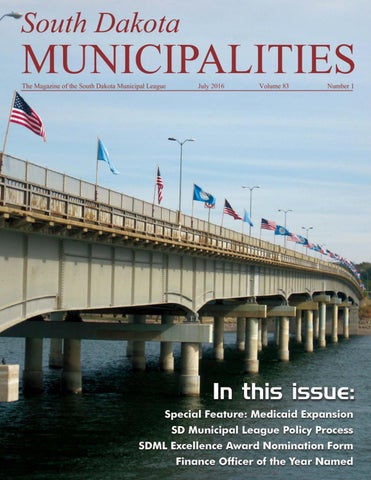
South Dakota MUNICIPALITIES
Transient Vendor Season in South Dakota . . . . . . . . .11
Managing Editor: Yvonne A. Taylor
PRESIDENT Meri Jo Anderson Finance Officer, New Underwood 1st VICE PRESIDENT Laurie Gill Mayor, Pierre 2nd VICE PRESIDENT Mike Wendland Mayor, Baltic TRUSTEES Pauline Sumption Finance Officer, Rapid City Karl Alberts Finance Officer, Aberdeen Steve Allender, Mayor, Rapid City Anita Lowary Finance Officer, Groton Christine Erickson Councilmember, Sioux Falls PAST PRESIDENT
Editor: Carrie A. Harer
SDML Welcomes New Staff Member . . . . . . . . . . . .12 Governor Awards Eight CDBG Grants . . . . . . . . . . .12 Elected Officials Workshop . . . . . . . . . . . . . . . . . . . .13
DISTRICT CHAIRS Dist. 1 - Mike Grosek Mayor, Webster
SD Municipal League Policy Process . . . . . . . . . . . .14
Dist. 2 - Tim Reed Mayor, Brookings
SDML Annual Conference Schedule . . . . . . . . . . . . .16
Dist. 3 - Amy Nelson City Manager, Yankton Dist. 4 - Debbie Houseman Finance Officer, Lake Andes Dist. 5 - Renae Phinney President, Ree Heights Dist. 6 - Leland Treichel Mayor, Roscoe Dist. 7 - Arnold Schott Mayor, McLaughlin
2017 District Meetings Schedule . . . . . . . . . . . . . . . .15
2016 SDML Excellence Award Nomination Form . . .17 Finance Officer of the Year Award Goes to... . . . . . .19 Working With the New Overtime Rules . . . . . . . . . .20 Transportation Alternatives Funding Available . . . . .22 Can the Water Issue in Flint Happen in My System? . . . . . . . . . . . . . . . . . . . . . . .24 Encouraging Entrepreneurship in Communities . . . .28 The 6 Qualities of Innovation . . . . . . . . . . . . . . . . . .30
Dist. 8 - Harry Weller Mayor, Kadoka
Deleting the Silos: Maximizing Regional Services . . .34
Dist. 9 - Carolynn Anderson Finance Officer, Wall
Even in Receiving Gifts, Doing Your Homework Usually Pays Off . . . . . . . . .36
Dist. 10 - Fay Bueno Finance Officer, Sturgis
3 Ways Infrastructure Drives Economic Development . . . . . . . . . . . . . . . . . . . . . . .39
Columns LEAGUE STAFF 1-800-658-3633 Fax: 605-224-8655 Yvonne Taylor Sandi Larson Lori Martinec
Executive Director Director of Risk Sharing Services Director of Research and Training Director of Municipal Electric Services Carrie Harer Director of Marketing & Communications Lori Butler Director of Finance Kristi Brakke Accounting Assistant De Costello Administrative Coordinator SD Public Assurance Alliance: Judith Payne Executive Director Kristina Peterson Director of Underwriting Ron Burmood Director of Member Services Paytra Nichols Assistant Underwriter Jerry Krambeck Member Services Representative Deb Corkill Executive Assistant
Director’s Notes . . . . . . . . . . . . . . . . . . . . . . . . . . . . . . .4 President’s Report . . . . . . . . . . . . . . . . . . . . . . . . . . . .5 Risk-Sharing News . . . . . . . . . . . . . . . . . . . . . . . . . .42 Washington Report: Senator Thune . . . . . . . . . . . . .44
In Every Issue Community Calendar . . . . . . . . . . . . . . . . . . . . . . . . .46 Classifieds . . . . . . . . . . . . . . . . . . . . . . . . . . . . . . . . .50 Municipal Calendar . . . . . . . . . . . . . . . . . . . . . . . . . .53
SOUTH DAKOTA MUNICIPALITIES (ISSN 0300-6182, USPS 503-120) is the official publication of the South Dakota Municipal League, published monthly at 208 Island Drive, Ft. Pierre, South Dakota 57532, phone 605-224-8654. This institution is an equal opportunity provider, and employer. Periodical postage paid at Pierre, South Dakota and additional mailing offices. Non-member subscriptions are available for $30.00 annually. The opinions expressed herein are not necessarily those of the South Dakota Municipal League. Postmaster: Send address changes to SOUTH DAKOTA MUNICIPALITIES, 208 Island Drive, Ft. Pierre, South Dakota 57532.
JULY 2016
VOLUME 83, NUMBER 1
3
Director's Notes One of the things we hear most often in our training sessions is “This is great information – How can we get it to our elected officials? They really need to know this!” We all know how difficult it is to get the time away from real jobs, all the other activities that come with family and community, and go to a school or seminar, but it is one of the most important things you can do as an elected official. There are two fantastic opportunities for our elected officials to get better at their jobs, both in July. Budget training sessions, aimed specifically at the mayors, councilmembers and trustees, will be held in four locations – July 6 in Rapid City; July 7 in Pierre; July 13 in Aberdeen; and July 14 in Sioux Falls. We had great reviews on the quality of these sessions last year, so please try to get to one near you. More information and registration forms can be found at sdmunicipalleague.org.
right – and give you the chance to correct it before it becomes a real problem. We continue to make other arrangements for the Conference, and think you will find a lot of very valuable content, as well as the chance to meet new friends and greet our old acquaintances. Please make plans now to attend, October 57 in Rapid City. We have wrapped up another successful HR and Finance Officers’ school, and our thanks to all those who attended and participated in educating these vital groups of municipal officials. Please make the effort to thank your finance officer – they are truly an amazing group of public servants. Along with wishing our Nation a happy birthday this month, we wish you a safe and enjoyable Fourth of July. Until next month, remember we are always available at 1-800-658-3633 or yvonne@sdmunicipalleague.org. Yvonne Taylor Executive Director
For those who are newly elected, or who’d like to brush up on the basics, the best opportunity is coming up on July 20, in Pierre. The Elected Officials Workshop will take you through ordinances and resolutions, forms of government, dealing with employees, open meeting laws, bids and contracts, and budgeting, as well as other chances to talk with experts and get to hear from other elected officials. It is a full day, and the range of topics doesn’t allow us to delve deeply into any one issue, but it is a great chance to get a broad overview that will allow you to recognize when things are perhaps not going just
4
SOUTH DAKOTA MUNICIPALITIES
President's Report It was a busy June! We had the SDML Executive Board meeting in New Underwood. (The June meeting is always held in the town of the current President of the SDML.) It was to be held at the Community Center, but my brain was out of gear again and I had booked the Community Center to Game, Fish, and Parks for the day, so we improvised and held it where we were having the supper. Everything from the meeting, tour of the town (hay ride), and steak supper came off great with a lot of teamwork from family, friends, staff, Mayor and Council. Thanks everyone for your help, enthusiasm, and attendance. It was a big deal to our town! The Human Resource School and Finance Officers’ School were very informative and I am glad so many could attend this vital continuing education. I always learn so much from the speakers, peers, and all the people in attendance. The topics, information, and advice came fast and furious with each session and we all came away refreshed with the knowledge we need to apply to our life as public servants. Again, all the team work of so many from the SDML staff,
the planning committee, the teachers, the city in which it is held, and the attendees all worked together to make it a year to remember. Again, thank you all! Also congratulations to Vanessa Row who is a shining example of what a public servant should be and the people she influences with her dedication. You are a finance officer of the year every year. In fact, in my opinion, all of you are deserving of this award and I admire each of you. With every project we undertake at a city/town we need to use teamwork to accomplish our objectives. Our common goal is for an effective and efficient solution to any problem that our city is facing and so includes that teamwork is fundamental for its success. Do not shy from calling on others for their help. The resourcefulness of people is what makes the difference between success and failure. Ego cannot be allowed to get in the way of what is good for your community. Remember that teamwork makes your dream work! A most effective key “TEAMWORK” and an indispensable key for your key chain! Respectfully, Meri Jo Anderson President
JULY 2016
5
Transient Vendor Season in South Dakota Many transient vendors have begun selling products and services in South Dakota. While many of these vendors are legitimate, the South Dakota Department of Revenue and the Attorney General’s Consumer Protection Office advise people to take commonsense steps to ensure vendors are reputable, before doing business with them. “The Attorney General’s Consumer Protection receives complaints each spring from consumers who have been bilked by transient contractors and their questionable sales tactics. Consumers need to protect themselves by avoiding quick decision making and taking their time to find the best contractor for the job,” said Attorney General Jackley. “The Department of Revenue wants to ensure that transient vendors pay the proper amount of tax when they are operating in South Dakota, which is only fair to our instate businesses,” Doug Schinkel, director of the Department of Revenue’s business tax division said. “We want to safeguard against anyone taking advantage of our citizens. If you are considering making a purchase from a transient vendor, please take steps to verify that they are reputable. If the vendor can’t or won’t provide proof of a South Dakota business tax license, you should contact the Department of Revenue.” If you are considering hiring a person to provide repair or construction services, please be advised to: j Ask for a price quote, in advance, in writing. j Question the contractor about a permanent address and telephone number, and do not assume that if the information they provide is local, they are a local business. Transient vendors often have business cards printed with local mailing services or motel addresses and telephone numbers. j Ask for a list of local references and check them before making a decision. j Ask if the contractor has worker’s compensation and general liability insurance. If vendors are not properly insured, homeowners may be liable for accidents that occur on their property. j Be careful about paying for work in advance; before making final payments, make sure transient vendors have paid their local suppliers or you may be held liable for unpaid materials. j Make sure you are completely satisfied with the work before paying the bill, and do not pay more for the job than originally quoted unless you have given written approval for the additional work or cost. j Ask the contractor for an excise tax license. JULY 2016
Out-of-state vendors often travel to South Dakota to sell items like fruit, seafood, meat packages, paintings, magazine subscriptions, rugs, T-shirts, sunglasses, household cleaners, furniture, stuffed animals and asphalting and roofing services. Asking the right questions when approached by those vendors can help you avoid making a purchase you may regret: j Question the salesperson about the product, warranties, guarantees, etc. j Get something in writing with the company’s name, address and phone number. j Ask to see their current South Dakota tax license. State law requires everyone selling products or services to have a current South Dakota sales or contractors’ excise tax license. To verify if the license is valid, call the Department’s toll-free helpline at 800-829-9188. j All sellers must provide you with a contract or receipt at the time of sale showing the date, the merchant’s name and address, and a statement informing you of your right to cancel the contract within three days. After proper cancellation, the seller has 10 days to refund your money. If you have doubts about the vendor or think you may have been the victim of a scam, call your local police department or county sheriff’s office immediately. You can also contact the Attorney General’s Consumer Protection Office at 800300-1986 or by email at consumerhelp@state.sd.us. Be prepared to give as much information as you can about the vendor, including the name of the company and salesperson; company address and telephone number; and make, model and license number (if possible) of the vehicle the vendor was driving. Without tips from the public, law enforcement officials may not be able to catch illegal vendors before they move on to the next community. For more information on transient vendors, contact the South Dakota Department of Revenue’s toll-free helpline at 800-829-9188, press “1” for the Business Tax Division.
11
SDML Welcomes New Staff Member De Costello joined the South Dakota Municipal League as the new Administrative Coordinator in May.
De Costello
Prior to joining the League, she spent the last 21 years working as the Property Manager for the Pierre Mall. De is originally from Nebraska. De and her husband Jim lived the last 22 years in Pierre.
Governor Awards Eight CDBG Grants Gov. Dennis Daugaard awarded more than $3.3 million in Community Development Block Grant (CDBG) funds to eight projects throughout South Dakota. The money, awarded to Bridgewater, Canistota, Keystone, Lead, Midland, Viborg, Vermillion and Waubay, will assist with projects totaling more than $11.2 million. “The CDBG program is meant to assist South Dakota communities with projects that help improve quality of life,” said Gov. Daugaard. “We’re very fortunate to have so many community-minded leaders across South Dakota, and I greatly appreciate their continued efforts to better their towns and cities.”
She has three grown children and one granddaughter. She spends her extra time traveling and visiting her children. Her hobbies are biking, reading and spending time at the river.
The CDBG awards include the following:
De is excited to and eager to contribute to the success of South Dakota Municipal League.
j
You can contact De at 800-658-3633 or email her at de@sdmunicipalleague.org.
j
j j
Pool Testing Municipal swimming pools are not regulated by the State of South Dakota, however, these facilities should be tested for coliform bacteria during each week of operation. All pool samples should be tested for “total coliform,” which is an indicator of bacteria for drinking water and pools. j “Total Coliform – Negative” means that no coliform bacteria were found and the water is safe. j “Total Coliform – Positive” means that coliform bacteria were found. Two or more consecutive positive samples indicates a general trend of bacteria presence in the pool. Corrective measures should be taken, such as superchlorination, to prevent a health related incident caused by poor water quality.
12
j j j j
The city of Bridgewater will utilize a $117,500 grant to assist the replacement of two blocks of iron water main piping with PVC mains. The city of Canistota was approved for a $396,550 grant that will assist the community’s Main Street improvement project, replacing water and sewer service lines. The town of Keystone was approved for a $375,205 grant that will assist the community’s improvements to its water and wastewater systems. The city of Lead plans to increase efficiencies in its water distribution system and install 300 feet of storm sewer with the help of a $411,465 grant. The town of Midland will utilize a $515,000 grant to improve its water system, including the storage and distribution systems. The city of Viborg will also utilize a $515,000 grant to improve its water and wastewater systems. The city of Vermillion plans to replace a portion of its downstream sewer system and its Prentis Street Lift Station with the help of a $515,000 grant. The city of Waubay will utilize a $515,000 grant to make improvements to its wastewater treatment facility.
The CDBG program provides local governments with funding to complete projects that improve living conditions. The CDBG program is funded through the U.S. Department of Housing and Urban Development and administered by the Governor’s Office of Economic Development. For more information about the CDBG program and other financing programs offered through the GOED, please visit www.sdreadytowork.com. SOUTH DAKOTA MUNICIPALITIES
Elected Officials Workshop Wednesday, July 20, 2016 j Ramkota Hotel j Pierre The purpose of this workshop is to provide a basic crash course on local government.
i THIS WORKSHOP IS OPEN TO ALL ELECTED OFFICIALS i Agenda 9:00 a.m.
Registration
11:45 a.m.
Lunch (provided) – Gallery A
9:30 a.m.
Welcome and Introduction to the League* Yvonne Taylor, Executive Director, South Dakota Municipal League
12:30 p.m.
Financial and Compliance Matters Rod Fortin, Director of Local Government Assistance, South Dakota Department of Legislative Audit
9:35 a.m.
Ordinances, Resolutions, Initiatives and Referendums Yvonne Taylor, Executive Director, South Dakota Municipal League
2:00 p.m.
Interviewing Prospective Employees: What to Say and What Not to Say Lisa Marso, Boyce Law Firm, L.L.P.
3:00 p.m.
Best Practices: How to Manage City Staff as a Part-Time Elected Official Mark Carstensen, Mayor, City of Sturgis Gloria Hanson, Mayor, City of Fort Pierre Meri Jo Anderson, Finance Officer, City of New Underwood
10:00 a.m.
Open Meetings and Executive Sessions Do’s and Don’ts Steven Blair, Assistant Attorney General, Office of the Attorney General
11:00 a.m.
Setting the Agenda and Parliamentary Procedure 3:30 p.m. Roxanne Heezen, Finance Officer, City of Fort Pierre Lindsey Riter-Rapp, City Attorney, City of Pierre Larry Nelson, City Attorney, Cities of Canton, Hartford and Worthing
Adjourn *Sessions are in Galleries B & C
Registration Form Municipality _____________________________________ Form of Government ___________________________ Please Print Name and Title as you would like it to appear on the nametag. Name Title
__________________________________
___________________________ ______________________________
__________________________________
___________________________ ______________________________
__________________________________
___________________________ ______________________________
Number Attending ______ @ $50.00/person = $_______________________ $50.00 per person includes workshop material, the SDML Handbook for Municipal Officials ($60 value), and lunch. Please return the form and payment by July 6, 2016* to: *No refunds will be given after July 6, 2016. Make checks payable to SDML. Sorry no credit cards accepted. SDML Office Use Only:
Date:_______________
South Dakota Municipal League 208 Island Drive Ft. Pierre, SD 57532
Check #:_______________
Amount:________________
SD Municipal League Policy Process March/April:
Members are asked at District Meetings and through the South Dakota Municipalities magazine if they are interested in serving on a policy committee.
May/June:
The SDML President appoints the policy committees, usually made up of members from previous years, plus any new people who have volunteered. There are four policy committees, with about 25 people on each committee. Policy committee members come from all sizes of towns, and from all regions of the state. The committees are: j General Government Committee j Public Health, Safety, and Welfare Committee j Public Works Committee j Taxation and Revenue Committee
August:
The four policy committees meet to review their own sections of the existing Statement of Policy, delete policies no longer needed, and add any new suggestions they agree upon.
September:
Staff follows up on questions or comments from the August meetings, and prepares information for the committees to consider when they meet again in October.
October:
Policy committees meet again on the first day of the Annual Conference. The next day, the Resolutions Committee, made up of about 25 people representing all four policy committees, reviews the entire Statement of Policy and makes a final recommendation to be voted on by the entire membership at the Annual Business Meeting, held on the final day of the Annual Conference.
November:
Staff uses the Statement of Policy adopted by the members at the Annual Business Meeting to develop a package of Legislation to take to the next Legislative Session. In addition, the staff uses the policies to guide positions taken by the Municipal League in response to legislation brought forward by others, and to answer questions about the League’s position on a variety of issues.
Policy Suggestions Needed The SD Municipal League needs to hear from you! The League is beginning the legislative policy process that will end with a Statement of Policy adopted by the members at the Annual Conference in October. The current Statement of Policy can be found at www.sdmunicipalleague.org under the About the League tab. If you have thoughts or suggestions you would like to have addressed by the Municipal League or the State Legislature, please explain them below (use additional sheets if necessary) and return this form by July 18, 2016 to: Yvonne Taylor, SD Municipal League, 208 Island Drive, Ft. Pierre, SD 57532 or fax to 605-224-8655 or e-mail to yvonne@sdmunicipalleague.org. Suggestions will be taken to the policy committees, where they will consider them for incorporation into the Statement of Policy. Suggestions may also be brought up from the floor on October 7, during the Annual Business Meeting, held at the SDML Annual Conference, October 4-7, 2016 in Rapid City. City: ________________________________________________________ Your Name:___________________________________________________ Phone Number:_______________________ Suggested Legislative or Policy Change:________________________________________________________________ _________________________________________________________________________________________________ _________________________________________________________________________________________________ _________________________________________________________________________________________________ _________________________________________________________________________________________________ _________________________________________________________________________________________________ _________________________________________________________________________________________________
2017 District Meetings Schedule District
Chairman
Vice-Chairman
2017 Date
2017 Site
1
Mike Grosek, Webster
Terry Jaspers, Sisseton
March 21
Big Stone City
2
Tim Reed, Brookings
Paullyn Carey, Huron
March 22
De Smet
3
Amy Nelson, Yankton
Dawn Murphy, Tea
March 23
Hartford
4
Debbie Houseman, Lake Andes
Becky Brunsing, Wagner
March 16
Lake Andes
5
Renae Phinney, Ree Heights
Ron Blachford, Miller
March 30
Miller
6
Leland Treichel, Roscoe
Vacant
March 28
Bowdle
7
Arnold Schott, McLaughlin
Gary Weismantel, Herreid
March 29
Akaska
8
Harry Weller, Kadoka
David Geisler, Murdo
April 4
Murdo
9
Carolynn Anderson, Wall
Kwinn Neff, Keystone
April 5
Hot Springs
10
Fay Bueno, Sturgis
Michelle De Neui, Spearfish
April 6
Whitewood
JULY 2016
15
SDML Annual Conference October 4-7, 2016 Rapid City Ramkota Hotel & Conference Center Tentative Schedule Tuesday All Day 2 p.m. tee off 7 p.m.
SDPAA Board Meeting SDML Golf Tournament SDML Board of Directors Meeting
Wednesday Morning 8 a.m. to 4 p.m. 8 a.m. to 4 p.m. 9 a.m. 9 a.m. 9 a.m. 10 a.m. Noon
Registration Exhibits Open Orientation for New Attendees SD City Management Association SD Municipal Electric Association SDML Pooling Meetings/Fun Info Session Safety Awards Luncheon
Wednesday Afternoon 1 p.m. 1 p.m. 1 p.m. 1 p.m. 1 p.m.. 4 p.m. 4 p.m. 4 p.m.
Elected Officials Workshop SD Municipal Attorneys’ Association SD Building Officials’ Association SD Governmental Finance Officers’ Association SD Police Chiefs’ Association SDML Policy Committee Meetings SDML Auditing Committee SDML Nominating Committee
Wednesday Evening 5:00 p.m. 6:00 p.m.
Exhibit Area Social Evening on Your Own to Enjoy Rapid City!
Thursday Morning 7 a.m. 7:45 a.m. 8 a.m. to 4 p.m. 8 a.m. to 11 a.m. 8 a.m. 9 a.m. 9 a.m. 9 a.m. 9 a.m. 9 a.m. Noon
SDML 13th Annual Walk/Run Breakfast and SDML Past Presidents’ Breakfast Registration Exhibits Open Resolutions Committee Elected Officials Workshop SD Airport Management Association SD Association of Code Enforcement SD Governmental Human Resource Association SD Municipal Street Maintenance Association Excellence in SD Municipal Government Award Luncheon
Thursday Afternoon 1:30 p.m. 1:30 p.m. 1:30 p.m.
General Sessions SD Chapter, American Public Works Association South Dakota Fire Chiefs Association
Thursday Evening 5:30 p.m. 6:30 p.m.
President’s Reception Dinner and Entertainment
Friday Morning 7 a.m. Yoga with Amy 8 a.m. to 10 a.m. Registration 8 a.m. Breakfast 8:30 a.m. General Sessions 10:30 a.m. SDML Annual Business Meeting and Election
Accommodations Hotel Ramkota (Host Hotel) The Rushmore Hotel (formerly Adoba) Comfort Suites Hotel GrandStay Suites Hotel Hilton Garden Inn Hotel Alex Johnson Rushmore Plaza Holiday Inn
Phone 605-343-8550 605-348-8300 605-791-5087 605-341-5100 605-791-9000 605-342-1210 605-399-7035
2016 SDML “EXCELLENCE IN MUNICIPAL GOVERNMENT AWARD”
EXCELLENCE in South Dakota Municipal Government 2016
Official Nomination Form ELECTED OFFICIAL
This year, the Excellence in South Dakota Municipal Government award will be presented to an elected municipal official in South Dakota. The award recipient will be selected from nominations received by the South Dakota Municipal League Past Presidents’ Committee. All nominations must be submitted in writing by August 15, 2016. The award will be presented at the SDML Annual Conference in Rapid City on October 6, 2016. Name of Nominee: ____________________________ Title: _______________________________ Address of Nominee: ______________________________________________________________ Significant contributions to the municipality: ____________________________________________
________________________________________________________________________________ ________________________________________________________________________________ ________________________________________________________________________________ Significant contributions to the community: _____________________________________________
________________________________________________________________________________ ________________________________________________________________________________ ________________________________________________________________________________ Significant contributions to other organizations: _________________________________________
________________________________________________________________________________ ________________________________________________________________________________ ________________________________________________________________________________ Significant contributions to South Dakota Municipal Government: ___________________________
________________________________________________________________________________ ________________________________________________________________________________ ________________________________________________________________________________ Other Comments: _________________________________________________________________
________________________________________________________________________________ ________________________________________________________________________________ Submitted by: _________________________________ Phone: ____________________________ DEADLINE: August 15, 2016 Please submit to: South Dakota Municipal League Nominations are confidential. 208 Island Drive, Ft. Pierre, SD 57532 Additional supporting documents welcome. FAX to 605-224-8655
2016 Finance Officers’ School Photo Album
2016 Finance Officer of the Year Award Goes to... The following was read by Monna Van Lint, SDGFOA President and City of Philip Finance Officer, when presenting the Award. “The highlight of our evening is honoring our Finance Officer of the Year. We had seven nominations for Finance Officer of the Year. Our independent judges, once again, found it very difficult to pick a winner as all were very deserving. Each nomination highlighted the contributions the Finance Officers make to their communities through the endless hours they put in both professionally and personally. The number of accomplishments and sincere accolades found in this year’s winner’s nomination form is astounding. This Finance Officer has been working for 24 years in their city. According to the nomination narrative, this person is loyal, kind-hearted, organized and the ultimate perfect employee! This person is happy to answer many questions that other finance officers have and does it with a kind heart. This person does their job well and pushes through with the dedication it takes to make things work. They are not a 9-5 employee; they come in early and leave late. This person takes care of all of the employees and the board members. Everyone wants the best for the community but this person does it with “heart” and dedication. This person’s personal commitment to the community over the years includes involvement in organizations including the church board, volunteer fire department, veterans and other fundraising events, and working with children in the
2017 Human Resource School
2016 Finance Officer of the Year Vanessa Row Finance Officer of Keystone. local library. In addition, personal accomplishments include spending time with grandchildren, family, friends, gardening and fishing. Within the past year, this person graciously stepped up to be a substitute finance officer to help a neighboring town, in the absence of their finance officer, who was suffering from a serious illness. This person spent many hours attending the neighboring town’s board meetings in the evenings, leaving work early to travel to the neighboring town to complete payroll and became involved in the fundraiser for the neighboring town’s finance officer. This person did not once complain, but trudged through and did what they had to do to make it work. Yes, it was stressful, but this just shows you this person’s fantastic character! I am extremely honored to be presenting the 2016 Finance Officer of the Year Award to Vanessa Row of Keystone.”
June 6 - 7, 2017
2017 Finance Officers’ School June 7 - 9, 2017 Ramkota Hotel, Pierre, SD Accommodations Ramkota Hotel, 605-224-6877 Presentations from the 2016 HR School and 2016 FO School can be found at www.sdmunicipalleague.org/affiliates.
JULY 2016
19
Working With the New Overtime Rules By Lisa Marso, Boyce Law Firm, LLP After years of discussion, in May of 2016, the United States Department of Labor announced the new overtime rules that will go into effect on December 1, 2016. The rules update the salary and compensation levels. They do not redefine the exemption tests pertaining to employee duties. More specifically, to be exempt from being owed overtime pay under the Fair Labor Standards Act (“FLSA”), employees must both (1) meet a threshold salary or fee level (“salary test”); and (2) fall within classifications of Administrative, Executive, or Professional (“duties test”). The new rules have raised the salary test threshold and left the duties test. The changes include: j Raising the minimum salary level for exempt employees to $913/week ($47,476/year), from $455/week. j Raising the minimum salary for “highly compensated employees” to $134,004/year, from $100,000/year. [Note: To be a “highly compensated employee,” the employee must still perform “office or non-manual work” and must still “customarily and regularly perform” any one of the exempt duties of an executive, administrative, or professional employee.] j Amending the salary test to allow employers to use commissions/incentives and non-discretionary bonuses paid at least quarterly to satisfy up to 10 percent of the new salary threshold.
work overtime, you will nevertheless be responsible to pay the overtime worked if you are aware or should have reasonably been aware that the employee is violating the directive and working overtime (a very easy to establish standard). Another option to address overtime costs for employees for whom you do not raise the threshold pay is to reduce the hourly base rate so that when overtime is worked, the overall cost is not substantial to your budgeted year. While this approach is allowed, it may result in declined employee morale and increased turnover. Visit https://www.dol.gov/whd/overtime/final2016 for more information on the rules. Lastly, these new FLSA changes bring a good opportunity for employers to review the duties test for employees to verify that the position meets the required definition. Failure to properly classify employees can result in substantial compensation being paid to the employees including two to three years of back pay and further penalties and attorney’s fees. For more information on duty classifications, you should visit with your attorney and review the regulations located at: https://www.dol.gov/whd/overtime/fs17a_overview.pdf. Author Note: Lisa Marso is an employment law attorney, representing governmental and private employers. She works at Boyce Law Firm, LLP in Sioux Falls, SD and may be contacted at: lkmarso@boycelaw.com or 605-3362424. She also fields employment questions through the SDPAA Employment Hotline, which may be reached by SDPAA members at 1-888-313-0839.
The new rules also establish a mechanism for automatically updating the salary levels for exempt employees to maintain the compensation levels at the 40th percentile for administrative, executive and professional exempt employees and the 90th percentile for highly compensated employees. These automatic three-year updates will begin on January 1, 2020. Employers should be proactive in determining whether or not to raise their employees’ salaries to meet the new threshold to keep the employee “exempt” or to “declassify” the employee as exempt. In doing so, you should keep in mind that in three short years, the threshold will again be raised, and you will need to evaluate whether to again increase the salary to keep up with the minimum threshold. If you determine to eliminate the exempt status, then you will be responsible to pay overtime for worked hours. This approach may be more economically beneficial where the employee works very little overtime. Yet keep in mind that while you may instruct “declassified” employees to not 20
SOUTH DAKOTA MUNICIPALITIES
Transportation Alternatives Program Funding Available The South Dakota Department of Transportation says Letters of Intent are now being accepted for the Transportation Alternatives Program (TAP). The TAP is a grant program that uses federal transportation funds, designated by Congress, for specific activities that enhance the intermodal transportation system and provide safe alternative transportation options. The TAP was authorized by the Moving Ahead for Progress in the 21st Century Act (MAP-21), signed into law on July 6, 2012. The TAP builds upon the legacy of the former Transportation Enhancement, Safe Routes to School and Scenic Byways programs by expanding travel choices, strengthening the local economy, improving the quality of life and protecting the environment. Approximately $2.1 million is available through this competitive grant process administered by the South Department of Transportation (SDDOT) office of Project Development. Each grant will be for a maximum amount of $400,000, although the SDDOT may approve a larger amount for phased projects. The minimum grant amount for infrastructure projects is $50,000 with no set minimum grant amount for non-infrastructure projects. There is an 18.05 percent local match requirement for each project. A full description of the TAP, along with the necessary forms, is available on the SDDOT Transportation Alternatives Program webpage at: http://www.sddot.com/ services/transalt. The submittal of a Letter of Intent form, found on the webpage, is a mandatory requirement in order to be eligible to submit a full application for funding and must be submitted by the deadline of July 15, 2016.
22
This will be the only call for Letters of Intent for the 2016 Fiscal Year. Requests for additional information, site visits and/or meetings on potential projects should be directed to Jerry Ortbahn by phone at 605-773-3281 or by email at jerry.ortbahn@state.sd.us. Following the receipt of the Letters of Intent, on-site meetings with project sponsors will be scheduled prior to September 15, 2016. The deadline for full applications is September 30, 2016. Eligible Activities A variety of activities are eligible for TAP funding. Eligible projects must meet one or more of these activities and must relate to surface transportation. There is no requirement for TAP projects to be located along Federalaid highways. Eligible activities under TAP consist of: A. Facilities for pedestrians, bicyclists and other non-motorized forms of transportation. This eligible activity includes the planning, design and construction of on-road or off-road facilities. Projects may include, but are not limited to, sidewalks, bicycle infrastructure, pedestrian and bicycle signals, traffic calming techniques, lighting and other safety-related infrastructure, as well as transportation projects to achieve compliance with the Americans with Disabilities Act of 1990. Off road sidewalks, bike paths and other pathways in this category are meant to serve as a safe transportation route, connecting two logical destinations and are usually a minimum of 10 feet wide. B. Safe routes for non-drivers. This eligible activity includes the planning, design and construction of infrastructure-related projects and systems that will
SOUTH DAKOTA MUNICIPALITIES
C.
D. E.
F.
G.
provide safe routes to access daily needs for non-drivers. Nondrivers may include, but would not be limited to, children, older adults and individuals with disabilities. Off road sidewalks and other pathways in this category are meant to serve as an alternate transportation route, connecting two logical destinations and are usually a minimum of 5 feet wide. Conversion and use of abandoned railroad corridors for trails. Under this activity, the trails may be for pedestrians, bicyclists or other non-motorized transportation users. Construction of turnouts, overlooks, and viewing areas. Planning and implementation of community improvement activities. Community improvement activities may include, but are not limited, to the following: j inventory, control or removal of outdoor advertising; j historic preservation and rehabilitation of historic transportation facilities; j vegetation management practices in transportation rights-of-way to improve roadway safety, prevent against invasive species and provide erosion control; and j archaeological activities relating to impacts from implementation of a transportation project eligible under Title 23, also known as a Federal Highway Administration eligible transportation project. Environmental mitigation. Mitigation activities may include, but are not limited, to pollution prevention and pollution abatement activities and mitigation to: j Address stormwater management, control and water pollution prevention or abatement related to highway construction or due to highway runoff, including participation in natural habitat and wetlands mitigation efforts related to projects funded under Title 23. These mitigation efforts may include participation in natural and wetlands mitigation banks; contributions to statewide and regional efforts to conserve, restore, enhance, and create natural habitats and wetlands; and development of statewide and regional natural habitat and wetlands conservation and mitigation plans, environmental restoration and pollution abatement, and the control of noxious weeds; and j Reduce vehicle-caused wildlife mortality or restore and maintain connectivity among terrestrial or aquatic habitats. Implementation of the Safe Routes to School Program (under section 1404 of the SAFETEA-LU) including, but not limited to: j Infrastructure-related projects. Defined as the planning, design and construction of projects on any public road or any bicycle or pedestrian pathway or trail in the vicinity of schools that
JULY 2016
will substantially improve the ability of students to walk and bicycle to school. Safe Routes to School projects must be within approximately two miles of a school for kindergarten through eighth grade, including: sidewalk improvements, traffic calming and speed reduction improvements, pedestrian and bicycle crossing improvements, on-street bicycle facilities, off-street bicycle and pedestrian facilities, secure bicycle parking facilities and traffic diversion improvements in the vicinity of schools. Off road sidewalks and other pathways in this category are meant to serve as an alternate transportation route, connecting two logical destinations and are usually a minimum of 5 feet wide. j Non-infrastructure-related projects. Defined as activities to encourage walking and bicycling to school, including: public awareness campaigns and outreach to press and community leaders; traffic education and enforcement in the vicinity of schools; student sessions on bicycle and pedestrian safety, health, and environment; and funding for training, volunteers, and managers of safe routes to school programs. H. Boulevards and other roadways largely in the right-of-way of former Interstate System routes or other divided highways. Projects may include, but are not limited to, planning, design or construction of boulevards and other roadways largely in the right-ofway of former Interstate System routes or other divided highways. Note: The Recreational Trails Program under section 206 of title 23 is also funded under TAP. In South Dakota, the program is administered by the South Dakota Department of Game, Fish and Parks. Information on and applications for the Recreational Trails Program may be accessed at http://gfp.sd.gov/agency/partnerships/rtp.aspx.
23
Can the Water Issue in Flint Happen in My System? By Delvin DeBoer, Special Projects Engineer, AE2S
received from the City of Detroit, and decided to switch to the Flint River treated water for economic reasons. The Drinking water quality issues in Flint, Michigan have Flint River was to be a temporary water source, since the drawn the attention of national news media. Decisions City of Flint was to obtain Lake Huron raw water from a were made that changed pipeline being constructed by distribution system water the Karegnondi Water Authority, quality, causing increased lead scheduled to be completed in Water quality factors that can affect concentrations at the customer’s late 2016. corrosivity toward iron, lead and copper tap and additional water quality include temperature, pH, disinfectant issues. Articles from news media During the summer of 2014, outlets and information from the customers in some areas of the types and concentrations, the City of Flint web site were used city experienced “rusty” water as concentrations of various anions such to prepare the following general a result of cast iron pipe as chloride, sulfate and bicarbonate, summary of the technical water corrosion. The City of Flint and corrosion inhibitor concentrations. supply story, without delving water supply received total into the underlying political, coliform and E. coli violations in professional or social undertones August and September 2014, and of this account. a total trihalomethane violation in December of 2014. In response, the city moved to decrease water age in the According to the City of Flint 2014 Annual Water Quality distribution system, optimized their ozone treatment Report, in May 2014 the City of Flint began distributing process, and installed granular activated carbon in the Flint River water treated at the Flint water treatment filters at the water treatment plant. facility. Prior to that time, Flint distributed treated water
24
SOUTH DAKOTA MUNICIPALITIES
The issue that sparked the recent national media attention was elevated blood lead levels found in children during a study by the Hurley Medical Center in Flint. Subsequently, a research team headed by Dr. Marc Edwards, an engineering professor from Virginia Tech and expert in lead and copper corrosion, found elevated lead levels in water samples collected from Flint households. Further studies by Dr. Edwards’ team found that the Flint River treated water was much more corrosive than the Detroit water. The switch to the Flint water likely released lead from customer service lines and premise plumbing. To mitigate the corrosion issue, Flint switched their water supply back to Detroit treated water in October 2015, and have begun dosing additional orthophosphate to the water to inhibit lead corrosion. News accounts and professional reports generally agree that changing water sources caused a substantial change in water quality in the Flint distribution system. Dr. Edwards’ group linked high chloride levels relative to sulfate in the Flint River treated water to its increased corrosivity relative to the Detroit treated water. Additionally, the Detroit water contained an orthophosphate corrosion inhibitor whereas the Flint River treated water did not. These water quality differences likely caused increased potential for iron and lead corrosion.
JULY 2016
This incident should draw the attention of water professionals. A likely question might be “Could something like this happen in my water supply system?” Perhaps a question more to the point, “What water quality changes could occur in my system that might cause issues with my customers?” Water quality factors that can affect corrosivity toward iron, lead and copper include temperature, pH, disinfectant types and concentrations, the concentrations of various anions such as chloride, sulfate and bicarbonate, and corrosion inhibitor concentrations. Whenever the values of these parameters change substantially in a distribution system, the water may become more or less aggressive to metals. It is not unusual for untreated ground water in the upper Midwest to be corrosive. Most water systems with corrosive groundwater have addressed that issue in response to compliance with the Lead and Copper Rule, most commonly by pH adjustment or by treatment with a corrosion inhibiting phosphate chemical. Systems using corrosion inhibitors must be careful to provide a consistent residual of the corrosion inhibiting chemical, since inhibitor concentration changes or loss of the inhibitor concentration could activate the metal surfaces to corrosion.
25
The quality of surface water sources varies more widely than ground water. For example, surface water temperatures in the upper Midwest can vary from close to freezing to 25 degrees C. This change in temperature impacts chlorine decay in the distribution system, with potential influence on the corrosion process. Temperature changes also can affect the concentrations of phosphate chemicals, especially the reversion of polyphosphate to orthophosphate that occurs if polyphosphate or blended poly/orthophosphate chemicals are applied. As illustrated by the Flint experience, if a system anticipates switching to a new source of supply (or considers blending water from multiple sources), the potential exists for a change in corrosion activity, and an evaluation of this change is certainly warranted. Changing forms of disinfectant (free chlorine versus chloramine) can also impact corrosivity. These source water or disinfectant changes will frequently trigger attention to the Lead and Copper Rule sampling requirements, especially if the system has been on reduced monitoring. These sampling and reporting requirements must be confirmed by communication with the appropriate state of federal regulatory compliance agency.
26
The Flint experience also alerts the water supply industry to the presence of corrodible metals, (such as iron, lead or copper) in water distribution systems and premise plumbing. Even though systems may have an effective corrosion control program that minimizes the risk of exposure to the customer and complies with the Lead and Copper Rule, asset management initiatives should consider the benefits of removing, replacing or lining (where appropriate) corrodible metals to mitigate the potential risk of potential metals release. Perhaps the simplest applications of this idea are to complete a lead service line replacement program or a cast iron pipe lining or replacement project. Finally, the Flint experience raises the importance of protecting water quality in the distribution system. Beyond appropriate treatment at the water treatment plant, cross connection control, flushing programs, preventing stratification in water towers, and maintaining appropriate chlorine residuals are among the tools that public water supply systems employ to ensure water quality is maintained in the water distribution system. Responding appropriately to customer water quality concerns, collecting and reporting the required regulatory compliance samples and communicating the results to customers in annual water quality reports provides a basis for customer confidence in their public water supply.
SOUTH DAKOTA MUNICIPALITIES
Encouraging Entrepreneurship in Your Communities By Rachel Quednau, Communications Specialist, Strong Towns A strong town needs strong local businesses. Local businesses provide jobs and opportunities for wealth creation. They can become a draw, encouraging visitors from outside your community, as well as a way for community members to support each other by buying local. Only with a thriving locally-based economy—one that isn’t owned or propped up by someone six states away—can we succeed in creating sustainable jobs and lasting economic prosperity. “Entrepreneurship” is a hot word these days. Lots of towns say they would like to attract more entrepreneurs and grow their small business communities. But how do you do it? There are many ways to encourage entrepreneurship in your community, both through government leadership and private sector/neighborhood-level work. The Government’s Role in Encouraging Entrepreneurship 1. Adjust zoning codes to reduce business costs. Do your zoning codes allow for mixed-use buildings where a shop owner runs her business on the first floor and lives upstairs? Would current codes allow for a vacant home to be turned into a store? Are food trucks permitted in your community? These are good questions to ask if you want to encourage small business growth. Buying or renting and renovating a building for a new business can be extremely costly. If your community allows for creative use of space, diverse income streams and smaller options than the typical stand-alone store, you lower the barriers to entry for small business owners.
3. Simplify local regulations for starting new businesses. Make the business start-up process simple. Instead of forcing entrepreneurs to jump from government office to government office filling out forms and asking questions, create a central space on your local government website that walks business owners through the process of getting started. This section can include which forms to fill out, who to contact, how long each step takes, etc. Cut out any superfluous steps if possible. Consult existing business owners in the process to find out how they got started. 4. Dedicate resources to economic gardening. While it’s important to focus on helping people start businesses, a concerted effort should be put into helping businesses grow. Growth presents a whole new set of challenges. Providing businesses with resources to take their business to the next level is a proven way to strengthen the local economy. Visit the podcast section on the Strong Towns website at strongtowns.com to view our podcast with Chris Gibbons, a leading proponent of economic gardening.
2. Help facilitate walkable business districts. Walkability is a huge factor in small business success and can create fertile soil for entrepreneurship to thrive. In a concentrated, walkable neighborhood with shops and restaurants, passersby are far more likely to frequent multiple businesses than if they were just driving to a specific store in an auto-oriented area. And as a bonus, walkable neighborhoods in city after city across the country demonstrate far greater tax revenue per square foot than any other type of development. So help your city move toward walkable neighborhoods by slowing cars in existing business districts, widening sidewalks, and placing public benches and planters to improve the landscape. When you have the choice between using land for a parking lot or a productive business, make the right choice and enable a business instead of car storage. 28
SOUTH DAKOTA MUNICIPALITIES
The Private Sector’s Role in Encouraging Entrepreneurship 1. Provide easy access to small business loans and/or grants. Banks, community development corporations (CDCs) and other community development financial institutions (CDFIs) are all in a position to offer loans to small businesses that are starting out. Other organizations in your community may also be able to offer grants to new businesses. 2. Offer business development classes at local colleges and community education programs. Whether it’s a full-fledged, credited class that goes in depth on how to set up a business, or just a short workshop with tips on online marketing, local education opportunities can play a helpful role in encouraging successful business growth. One-on-one business counselor can also be a beneficial option for entrepreneurs to utilize. 3. Host a small business day. Designate a Saturday (summer and fall are great times for this) to encourage patronage of local businesses. This could include outdoor music, food stands, and
JULY 2016
other fun activities, or it could simply be a day when you invite people to check out their local businesses. Some businesses may choose to offer special discounts on this day. Make sure to advertise the event around your town. 4. Get organized. Create a small business guide on your town’s website listing local businesses, days/time they are open, and descriptions of their services. This is a great way to promote existing businesses to your town, as well as attract customers who may be visiting your community. Another way to get organized is to develop a small business association or chamber of commerce to help local businesses work together and promote their interests. 5. Get Social. Programs such as “One Million Cups”, “Business after Hours” and ‘Start-up Drinks” are great ways to help entrepreneurs network, share and be inspired by one another. Originally published on StrongTowns.org.
29
The 6 Qualities of Innovation By Karen Thoreson Ever wonder why some cities seem to win lots of awards— or are constantly showcased as having outstanding programs? Over the last five years, the Alliance for Innovation and Arizona State University’s School of Public Affairs have studied hundreds of local governments that won national, state, or local awards, seeking to find out if there were some common denominators that these lauded organizations shared. This study revealed six qualities of innovation. Of course, sustained innovation in any organization requires a commitment to change, a process to sustain change, intent to implement change, and the people to carry out change. Still, there are certain attributes that make organizational innovation more likely. 1. Inclusive Leadership “Never before in history has innovation offered promise of so much to so many in so short a time.” –BILL GATES Not surprisingly, having a key leader (or leaders) driving change within the organization makes a dramatic difference. That leader could be the manager, or it might be a key elected official or the whole executive team. The important thing is not necessarily who the leader is, but the type of leadership that person or group embodies. Leaders in innovative organizations are visionary, inclusive, proactive, and organization-centered, rather than leadercentered. These leaders promote innovation by working to develop leaders throughout the organization. These are “unselfish” leaders, who share credit, recognize contributions, and make leadership development a higher priority than celebrating a single individual. In his book Good to Great, Jim Collins called this “Level 5” leadership. Organizations that cultivate inclusive, sustained leadership have a head start on producing great results. Although all six qualities of innovation are important, perhaps the most critical is leadership, as it sustains the effort, rightly manages risk, and propels the morale of the group at all levels in order to achieve greater and greater success. 2. Relentless Creativity “Problems cannot be solved by the same kind of thinking that created them.” –ALBERT EINSTEIN While brain science tells us that only about 20 percent of humans regularly think in creative ways, organizations that 30
engage the entire workforce to achieve their potential are able to beat those odds. To harness its employees’ talent, an organization must offer processes and policies that allow employees to give their best while on the job. To do this, you need to create an environment that isn’t satisfied with the status quo. Ask these questions: Could this be better? How have others solved this problem? Is there a different approach that would yield better results? These questions are great starts toward increasing the creativity of your team. Critical to encouraging creativity is allowing for failure— because not all new ideas will work. Organizations need to have some good “failure and risk” conversations in the workplace. This will build employees’ confidence in trying new things, and let them know that their new ideas are welcome. 3. Extensive Internal Collaboration “The secret is to gang up on the problem, rather than each other.” –THOMAS STALLKAMP Over the course of a couple of decades, many local governments have crawled out of their silos and begun to see the value of working in cross-functional teams. In successful innovative groups, we see a real disrespect for silos. Instead, they have non-hierarchal teams charged with solving problems outside of their individual expertise—because those employees can bring fresh ideas and help rethink a problem or challenge. The organization that identifies a problem in public works, for instance, will experience a direct benefit in bringing in non-public works staff to brainstorm solutions. It is surprising how often a diverse team of insiders and outsiders can collectively review, ask probing questions, make suggestions, and implement change.
ARENS ENGINEERING municipal engineering water & wastewater engineering storm drainage - municipal streets Vernon Arens, PE 230 Capitol St. j Yankton, SD j 57078 605-665-2002 j Fax 605-260-2140 arenseng@iw.net
SOUTH DAKOTA MUNICIPALITIES
Of the six qualities, this one has perhaps the lowest upfront cost and the fewest downsides. It is also the easiest to implement. By simply forming a team from various departments and helping them define and investigate a problem, you can grow staff engagement and morale. 4. Robust External Partnerships “The strength of the team is each individual member. The strength of each member is the team.” –PHIL JACKSON Public/private partnerships have been around a long time. But the partnerships seen in this quality go beyond the normal quid-pro-quo approach. Public partnerships have long relied on a standard of “I give you a dollar and I get a dollar’s value back.” But these new partnerships are built on a platform of community benefit, rather than an individual organization’s return. Successful external partnerships look at a variety of unique factors: j Do they further one another’s goals? j How do they expand beyond the simple economicbenefit criteria? j Can they develop common missions, visions, and values for the project? j Do they focus on common interests rather than differences?
JULY 2016
j
Do they address ground rules, evaluation, and how to manage conflict?
Organizations that use these more unusual criteria are frequently able to craft partnerships with one or more external partners that benefit each other and the community as a whole. These partnerships are not easy to establish; it requires a willingness to trust and take risk. But it’s worth it because organizations that use these approaches are able to craft partnerships—like city/school joint facility agreements or economic development projects—that are much more comprehensive and impactful than what a single organization could undertake. 5. Authentic Community Connections “A dream you dream alone is only a dream. A dream you dream together is reality.” –JOHN LENNON After more than 100 years of the government reform movement that moved political decisions out of the smokefilled back rooms and created a system of nonpolitical, professional management, have we become a victim of our own success? There was a time when residents happily embraced the formation of their city because it symbolized improved safety, security, utilities, and other services. Today, though, many residents feel cut off from their local government
31
leaders, and may have the sense that these leaders would prefer to have their own experts solve community problems. Innovative governments have shown community and organizational benefits when citizens are authentically welcomed into the deliberations on local priorities and neighborhood improvements. Fundamental questions to test your organization against include: j If I come, will you listen? j If I speak, will you consider what I said? j How and when will I see action? Employees, citizens, and businesses need to connect not only with their local government, but also with each other. Local governments can provide the connection points, the tools, expertise, and resources. 6. Reality-Focused, Results-Driven “Start by doing what’s necessary; then do what’s possible; and suddenly you are doing the impossible.” –ST. FRANCIS OF ASSISI In the end, innovation for its own sake is simply play. Organizations that care about innovation, care about results and take the time to measure whether a new practice is producing better results and for whom.
32
Truly innovative organizations make time at the start of a project to think about what results would signal success. They build in checkpoints beforehand to make sure a project is on track, and try to have any failure early, so that course corrections can lead to earlier success. They focus on innovations that will make a difference, that are sustainable, and that are constantly being reviewed, changed, and updated. So, which of these six qualities of innovation do you think are strongest in your city—and which areas might you focus on to see improvement? How can you focus on one or more of these areas to map out a brighter and more successful future for your city? By making these areas an organizationwide focus, cities can reinforce the rewards of innovation. It only takes the will to start the process. Karen Thoreson is president of the Alliance for Innovation. This was adapted from an article that originally appeared in ICMA’s Public Management magazine in 2012. Reprinted with permission from Minnesota Cities, a publication of the League of Minnesota Cities, copyright 2016.
SOUTH DAKOTA MUNICIPALITIES
State Historical Society Awards Grants Historic preservation projects in Elk Point, Groton, Keystone, Lead, Mobridge and Rapid City recently received matching grants from the South Dakota State Historical Society.
j j j
“This is the 19th year for this historic preservation grants program,” said Jay D. Vogt, director of the State Historical Society. “In 2015 we awarded $113,744 between eight projects which will result in a total public-private investment of over $297,162. This program is designed to encourage restoration or rehabilitation of historic properties and is one more way we can promote and protect our history and culture.” The grants are awarded through the State Historical Society’s Deadwood Fund grant program. Funding for the program is from Deadwood gaming revenue earmarked by state law for historic preservation projects throughout the state. The program is administered by the society’s State Historic Preservation Office at the Cultural Heritage Center in Pierre. The following projects were the most recent to receive grants to supplement their work: j Elk Point: Murtha House, built in 1892, $3,752 for roof replacement.
JULY 2016
j j
Groton: Trinity Episcopal Church, built in 1884, $9,000 for stained glass window rehabilitation. Keystone: Keystone Museum/Old Keystone School, built in 1900, $18,000 for roof replacement. Lead: Homestake Powder House, built in the late 1890s, $2,137 for repointing the structure. Mobridge: Mobridge Auditorium/Scheer-Howe Arena, built in 1936, $3,800 for foundation repair. Rapid City: Aby’s Feed and Seed, built in 1911, $15,000 for roofing, patching, interior work, painting and general rehabilitation.
These new recipients represent a total award amount of $51,689 and public-private matching funds of $54,715. Deadwood Fund grants are awarded twice a year with grant application deadlines of February 1 and October 1. They are reviewed at the spring and winter meetings of the State Historical Society’s board of trustees. For more information on the Deadwood Fund grant program, contact the State Historic Preservation Office at the Cultural Heritage Center, 900 Governors Drive, Pierre, SD 57501-2217; telephone 605-773-3458; or website history.sd.gov/Preservation.
33
Deleting the Silos: Maximizing Regional Services By Anna Gruber I accepted the position of city administrator for Pierz, MN in 2009. I was 22 years old and only had one year of professional working experience under my belt. During this time, we were seeing and feeling the impact of the 2008 financial crisis. The local government aid (LGA) from the state, which cities had relied on, was now being frozen or decreased. Resources for city staff were limited. Taxpayers were hurting and couldn’t bear any increase in property taxes or municipal rates or fees. With the help of my Council and department heads, we began working to offer the same amount of services with no increase in LGA or the local levy. In the five years that I served as the city administrator, we never once increased the levy. We were able to continue providing services, maintain all employees, and ensure that public safety was never sacrificed. Art of collaboration How was this possible? I learned a valuable lesson early in my professional career; we did more with less—by working together. We perfected the art of collaboration.
34
We were able to do this by: j Partnering with neighboring communities on grant programs to lower administration costs. j Collaborating with the school district. j Teaming up with regional partners and agencies. We knocked down walls, relied on each other, and deleted the silos that seemed to separate us from others. There was no other way to survive in hard economic times like we were experiencing. Countywide collaborative A large silo that needed deleting was our dependence on ourselves. By breaking down the walls, we could build up the collaboration among other cities within Morrison County. With the help of the other administrators and mayors in neighboring communities, we began the Morrison County Community Collaborative group. It began as a monthly meeting to simply get to know each other better. It grew into collaborative efforts on grant administration, staff time, equipment, and overall sharing of services. Awareness about our monthly meetings grew, and we saw an increase in attendance.
SOUTH DAKOTA MUNICIPALITIES
The group became a resource, not only for staff but for elected officials. We helped each other through ordinance amendments and requirements, personnel changes, road projects, reporting requirements, trainings for new clerks, referrals to consultants, and more. We also shared personal triumphs and tribulations. For some cities, it involved sharing staff between two cities through various joint powers agreements. For others, it meant sharing equipment through shared service contracts. This group built each other’s morale and offered support in a career that at times, I learned, could be extremely stressful. Regional collaborative There are also regional collaborative efforts that have taken place to delete silos. The Resilient Region project, for example, began in 2011 and has grown to a monumental regional effort toward collaboration in multiple theme areas. It involved a group of local municipalities in central Minnesota, made up of Cass, Crow Wing, Todd, Morrison, and Wadena counties. Known as Region Five, this group came together to provide services collaboratively, instead of individually.
JULY 2016
The Resilient Region partners work to establish community-driven partnership, assisted by various organizations focused on sustaining the region. The theme areas are housing, transportation, natural environment, and economic development. Today, the Resilient Region effort has worked together to secure nearly $32 billion in funding for the region. Much of this funding would not have been made possible without the creation of the Resilient Region, a truly authentic collaborative effort of deleting the silos and working together. Learn more about this project at www.resilientregion.org. There simply is no time for metaphorical silos in today’s age. The municipalities mentioned here broke down walls between organizations and found success and a lasting model. We all need to recognize that we must work together for the betterment of our communities. Anna Gruber is manager of city and county solutions with the National Joint Powers Alliance (www.njpacoop.org). Reprinted with permission from Minnesota Cities, a publication of the League of Minnesota Cities, copyright 2016.
35
Even in Receiving Gifts, Doing Your Homework Usually Pays Off Many public-minded donors love their communities and have the best of intentions. Still, towns and cities should use caution before accepting gifts, and should be clear about the intended use. By Stephanie Bouchard Everybody loves receiving a gift, right? Well, that depends. For most, getting a gift is a simple pleasure, but gifts are much more complicated for towns and cities. Take for example the Charlotte Rhoades Park and Butterfly Garden. Today a popular town park and cherished butterfly garden overlooking Norwood Cove that draws people from all over the country, the Charlotte Rhoades Park and Butterfly Garden was gifted to the town of Southwest Harbor in 1970. The trust agreement had several conditions, including directives about the home, called the Rhoades House, on the property. The trust also named the Sierra Club as a beneficiary of the property.
36
Over the years, the condition of the home, built in the late 1800s, deteriorated. By 2013, the town realized that the cost to maintain the house was prohibitive and sought to demolish it and replace it with a structure that would enhance the park and butterfly garden, said Donald Lagrange, Southwest Harbor’s town manager. “We didn’t want to change the purpose of the gift,” he said, just remove the dilapidated building. But removing the building required an amendment to the trust agreement, a situation that required a formal legal process and approval from a judge. Amending or breaking the conditions of gifts given to municipalities is usually not an easy thing to do, said Attorney Shana Cook Mueller, of Berstein Shur, the law firm that represents Southwest Harbor. Because municipalities generally agree to the conditions in perpetuity, courts are reluctant to make changes without the consent of the donor or the donor’s heirs, which can be difficult, if not impossible, to get, she said. But because it is also impossible to predict the future, courts do allow amendments under certain
SOUTH DAKOTA MUNICIPALITIES
circumstances, such as with the Charlotte Rhoades Park and Butterfly Garden. With the understanding that Southwest Harbor would continue to maintain the park and garden for public use as the trust originally required, the Sierra Club agreed to the removal of the building and other amendments to the original trust and relinquished its role as a beneficiary. ‘A Different Way’ When it comes to gifts, what it comes down to is that municipalities must be careful about how they handle them – careful in considering them, accepting or rejecting them, soliciting them and managing them once accepted, say town managers and municipal counsel. “On the front end, there’s a bit of a don’t-look-a-gifthorse-in-the-mouth element to it,” said Lee Bragg, an attorney with Bernstein Shur. “Those offers, as generous and well-intended as they are, might merit some discussion about the administrative burden that goes along with it and maybe some negotiations, so to speak, with the donor, saying ‘We’ve got some realities on our side of it. Can we do this in a different way?’ ” Gifts can bring substantial benefits to communities, said Cook Mueller. “Financial or in-kind donations to
JULY 2016
municipalities can have a tremendously positive impact by either reducing tax liability on residents or enabling projects or services that wouldn’t otherwise be possible,” she said. The Town of Raymond, for example, needed land to build a new public safety building along Route 302, where land is expensive and hard to come by – especially to accommodate a facility of nearly 20,000 square feet. The town benefitted greatly when the daughter of a former volunteer fire chief donated 10 acres of land fronting on highway, said Don Willard, Raymond’s town manager. “That was a gift everyone was happy about.” But gifts can have downsides, too. Some gifts come with strings attached that may not be doable for towns and cities. And some may be downright toxic, literally. The most important thing municipal administrators can do before accepting a gift is to seriously examine its public benefit and any potential burden it may place on the community if accepted, Willard said. “If someone offers you property, make sure you have adequate due diligence and it meets your mission and the goals and objectives of the community and that it goes through the proper machinery for approval,” said Willard.
37
Long-term costs Sometimes, the offer may be a wonderful, beautiful and significant gift, but if there are sizeable costs associated with maintaining it, for example, city or town administrators or the residents in a community may have to say no thanks, he noted.
Navigating Gifts: Best Practices j
Use good judgment and planning. Ask questions: - Will the gift have a public benefit now or in the future? - What are the conditions, if any, associated with the gift? - If a trust must be established to manage the gift, will the municipal officers be willing/able to act as trustees if that is required? - Can the municipality now and in the future comply with the conditions of the gift? - What are the potential future costs (insurance, staff time, management)? - What about potential future costs that aren’t obvious? - Will the gift help the municipality achieve its goals? - Does it fit in/complement your comprehensive plan?
j
Do your due diligence. Is the property contaminated? Is there a lien on it? For gifts of art or historic items, make sure to learn provenance.
j
When negotiating with donors, be respectful and be upfront with them about how the town will likely use the gift. Be clear about the process. Many donors may not realize that even though the municipal administrators want to accept their gift, voters could decline it.
j
Follow the legal process, including proper notice for public meetings for voting on gifts. You don’t want to be in the position where it looks like you’re taking a gift as a quid pro quo. Know the state statutes. Follow the legal time table. Make sure you have the appropriate documentation. Put things in writing using clear language to minimize potential misinterpretation.
j
Don’t shy away from asking for a gift. There are many public-spirited people out there who may be happy to help your community meet its goals.
j
If your donor is amenable, publicly recognize him or her. It’s always good form to say thank you.
While it’s impossible to know all the future situations that could impact a gift, municipalities are best served by “being proactive” about accepting gifts, said Jonathan Pottle, an attorney with Eaton Peabody. That means municipalities should establish a process for accepting gifts beyond following the state statutes, to minimize trouble. Peter Nielsen, Winthrop’s town manager, agreed. “My best advice would be to put as much of it in writing as possible between all the groups involved so the donors and the beneficiaries (the town/city) have as clear an understanding as possible as to what’s being done and what’s expected.” Additionally, said Nielsen, when the town or city receives a gift, it should make provisions for maintaining that gift going forward. “It’s nice to get something, but it’s wise also to provide for it once it’s yours.” When everything comes to together, gifts to municipalities are “pretty cool,” said Nat Tupper, Yarmouth’s town manager. “People do have an affinity for their home town and do often want to leave something nice,” he said. “(Many of these gifts) are very positive and make a town feel pretty proud with the generosity of individuals and coming together to make nice things happen.” Stephanie Bouchard is a freelance writer from Bath and a new contributor to the Maine Townsman, email her at stephane_bouchard@myfairpoint.net. Re-printed with permission from the Maine Municipal Association.
38
SOUTH DAKOTA MUNICIPALITIES
3 Ways Infrastructure Drives Economic Development Broken Arrow, Oklahoma, Mayor Craig Thurmond shares exactly how the practice of placing a high level of importance on maintaining and expanding infrastructure has resulted in successful economic outcomes for his city. By Broken Arrow, Oklahoma, Mayor Craig Thurmond Investments in modern infrastructure lay the foundations for economic development and growth in all communities. Building streets, bridges, utilities (i.e. water, sewer, electrical, gas, etc.) and making other improvements create jobs. When completed, these projects help a community increase its wealth and its citizens’ standard of living. The city of Broken Arrow, Oklahoma, recognized this long ago and has always placed a high level of importance on maintaining and expanding its infrastructure. Doing so has resulted in the following three outcomes. 1. Infrastructure creates (and keeps) jobs. Our experience with Flight Safety International underscores the case for infrastructure to be improved and modernized as new needs and technologies emerge. By 2010, Flight Safety had grown to almost 600 employees and was operating out of two different facilities.
JULY 2016
The international advanced manufacturing firm develops and produces flight simulators for commercial and military application and training. In order to streamline its operations and position itself for growth, the company needed a larger combined facility to build its flight simulators. Losing the company to another city was a very real threat, one that would have dealt a devastating blow to the local economy. To keep Flight Safety in Broken Arrow, the city provided a $6.4 million job retention and creation package. With those funds, the company was able to build a new, state-of-the-art 375,000 square-foot facility in which to build its flight simulators from conception to completion. Not only did Flight Safety stay in town, the city also achieved additional public infrastructure through new water lines and roadway and signal improvements. Today, Flight Safety is the largest private employer in Broken Arrow, providing jobs to nearly 800 people, while creating 760 indirect jobs locally. 2. Infrastructure attracts and retains a skilled workforce. Highly educated, skilled workers today expect more from their jobs than just a paycheck and a secure future. That’s why cities compete fiercely to make their communities an attractive place to live. Quality of life plays a big role in one’s decision to seek a job in a particular city, relocate an
39
existing business or start a new one. Quality of life factors include walkability, alternate transportation methods, bicycle paths, urban centers, a vibrant cultural scene, nightlife, access to higher education, and more. We knew that to attract, retain and nurture a talented workforce, we had to revitalize the core of Broken Arrow. Since 2010, the city has sunk nearly $10 million into infrastructure improvements on Main Street and the surrounding area. The private sector has responded with nearly $30 million of investment, creating hundreds of jobs and opportunities to shop local.
3. Infrastructure fosters sustainability. Broken Arrow now has the ability to sustain growth, thanks to the infrastructure investments into Flight Safety and the Rose District. During the construction of both projects, the city upsized water lines to increase capacity. This ensures sufficient water delivery to new businesses and the necessary fire suppression to comply with building code regulations. This is particularly of value in the Rose District, where the lack of water capacity in the past has been cost prohibitive to new development. That issue is no longer an obstacle for investors looking to rehabilitate an existing space or construct a new one.
Downtown redevelopment, in what we now call the Rose District, took shape in the form of widened sidewalks with brick lined pavers, decorative street lamps, and mid-block crossings to accommodate pedestrian traffic. Forwardthinking streetscape design makes it conducive for visitors to enjoy new public gathering spaces, such as Centennial Park and the Rose District plaza, where farmers markets are held weekly during the growing season. The city also invested in cultural institutions that work to preserve Broken Arrow’s rich history and honor those who have served in our country’s armed forces. Still to come is a creative arts center that will provide hands-on learning experiences for visitors of all ages and complement the existing Broken Arrow Performing Arts Center just a few blocks away.
In 2014, the International Economic Development Council awarded the Rose District a Gold Award for Excellence in Economic Development for Public/Private Partnership. Additionally, the Oklahoma Chapter of the American Planning Association awarded its 2015 Great Street Award to the Rose District because of its unique identity, cultural interest, community involvement, and a sustainable vision for tomorrow. Not only does the Rose District promote sustainability through minimizing runoff, reusing water, ensuring groundwater quality, minimizing heat islands, and responding to climatic demands, it’s also capable of being maintained without excessive costs. Another component of sustainability involves transportation. The city has a plan in place to build a network of pedestrian and
40
SOUTH DAKOTA MUNICIPALITIES
cycling trails throughout the community and connect it all to the Rose District, the heart of Broken Arrow. Finally, the infrastructure we build today is the legacy we leave to future generations. It will need to provide for current water, energy and transportation demands, while at the same time, remain flexible enough to adapt to future technological, environmental and regulatory changes. We believe by making the necessary investments in our infrastructure now, we meet the current needs of our community, while increasing opportunities for future growth and prosperity. It’s a strategy that is sure to yield dividends for years to come. About the Author: Mayor Craig Thurmond was elected to the Broken Arrow, Oklahoma, City Council in 2001. He has served as Mayor since 2012, focusing on Economic Development and Public Safety. Mayor Thurmond serves on 18 local and national boards, councils and committees. He has worked in the land development and construction industries for 35 years in Oklahoma and California. To learn more about the city of Broken Arrow, visit BrokenArrowOK.gov. Reprinted from CitiesSpeak.org, the official blog of the National League of Cities.
JULY 2016
41
Risk-Sharing Understanding Workers’ Compensation Coverage Pricing If you have employees in South Dakota, it is mandatory that you purchase workers’ compensation coverage to pay for compensable work related injuries to employees. That includes Cities. Workers’ compensation rates and the factors that affect an individual City’s costs can be complicated. The purpose of this article is to give you a basic understanding of how workers’ compensation rates are determined and what you can do to help control your workers’ compensation costs. To help with that understanding I will use language that everyone can understand and avoid using insurance industry terminology. The SDML Workers’ Compensation Fund only provides workers’ compensation coverage to public entities in South Dakota and your rates are calculated based on our membership, not the pool of private businesses and other entities in the region and surrounding states. Following are several factors that affect the calculation of contributions paid for workers’ compensation coverage.
42
1. The first factor is the amount of payroll. Workers’ compensation contributions are calculated per $100 of payroll. For example, if your City has $200,000 of payroll in the Street Department, your contribution will be based on 2,000 units ($200,000 of payroll divided by $100 = 2,000 units). 2. The second factor is the rate for coverage. The SDML Workers’ Compensation Fund contracts with an Actuary to calculate the rate for each job classification. The Classification Code for the Street Department is 5506 and the rate is $6.65 per $100 of payroll. 3. The third factor is the credits that the SDML Workers’ Compensation Fund gives to it’s members. There are three credits available; Renewal, Loss Control and Equity Credits. The Board of Trustees are your peers and they want your City to receive all of these credits. Most of our members receive all three of these credits which reduce their contribution by over 25% which puts money back into your City’s budget. 4. The fourth factor is the Fund Modifier. Each member has a Fund Modifier. The base modifier is 1.00 and is adjusted with either a debit or credit depending on an individual City’s claims experience and how that experience compares to the other members with the same classification over the past three full years. This is where you have control over your workers’ compensation costs. The lower the number and the cost of your City’s claims, the lower your Fund Modifier and therefore the lower your contribution. Here are two examples of how your claims history affects your workers’ compensation contribution. Keep in mind that this is a simplified example and does not consider the 25% of credits that most Cities receive as a member of the SDML Workers’ Compensation Fund.
SOUTH DAKOTA MUNICIPALITIES
Contribution Calculation Example #1 (Worse than Average Claims History) Classification Code: 5506 Streets/Highways $6.65 Rate per $100 of payroll $200,000 of Payroll divided by $100 = 2,000 x $6.65 = $13,300 $13,300 x 1.10 Fund Modifier (10% Debit) = $14,630 Contribution Calculation Example #2 (Better than Average Claims History) Classification Code: 5506 Streets/Highways Incl. Snow Removal $6.65 Rate per $100 of payroll $200,000 of Payroll divided by $100 = 2,000 x $6.65 = $13,300 $13,300 x 0.90 Fund Modifier (10% Credit) = $11,970 The difference between the two examples is 20% or $2,660 for workers’ compensation coverage for the Street Department alone. Building a culture of safety begins with training and educating your employees on best practices for maintaining a safe work environment. As a member of the SDML Workers’ Compensation Fund you have access to free loss control services that include a video library, online courses and onsite training. Begin by visiting our website at www.sdmlwcfund.com and click on the Safety & Loss Control tab. Pick a topic and have a short discussion with your employees. You have now taken the first step to developing a monthly safety meeting. Also, be sure to “Save the Date” to attend the Annual Safety & Loss Control Training Conference on November 9-10 at the Pierre Ramkota. This year is a joint conference between the SDML Workers’ Compensation Fund, the SD Public Assurance Alliance and the State of SD. The speaker line-up is top notch and will be worth attending for all levels of governmental employees and elected officials. For more information regarding SDML Workers’ Compensation Fund, contact the Fund Administrator, Brad Wilson at Insurance Benefits, Inc. at 800-233-9073 or info@sdmlwcfund.com. Brad Wilson, CIC, AIC, SDWCS SDML Workers’ Compensation Fund Fund Administrator - Insurance Benefits, Inc. JULY 2016
43
Washington Report: By Senator John Thune The wide open spaces that make South Dakota such a unique place to live, work, and raise a family define our landscape, provide habitat for pheasants and other wildlife, and help make agriculture our state’s top industry. While the open air and vast plains certainly have their benefits, they can oftentimes present some big challenges too. Proximity to grocery stores, shopping centers, or other day-to-day necessities is obviously important, but what’s critical for families across rural areas, like those in South Dakota, is the availability and access to high quality health care.
Closing the Health Care Gap Last November, the committee took up and unanimously approved my bill, the Rural Health Care Connectivity Act, which will help streamline the process for skilled nursing facilities across the state, like nursing homes, to tap into federal funding for telecommunications and broadband services used to provide health care to rural communities. The full Senate recognized the importance of my legislation, which is why my colleagues approved the bill by voice vote and sent it to the president for his signature. The Evangelical Lutheran Good Samaritan Society (Good Sam), which is headquartered in Sioux Falls, South Dakota, operates hundreds of skilled nursing facilities throughout the country. Most of them are located in rural communities. Through technical advancements and infrastructure located at their headquarters in Sioux Falls, Good Sam remotely connects rural patients with hospitals and doctors who are hundreds – sometimes thousands – of miles away.
One of my goals in Washington is to make it easier and cheaper to provide quick access to health care facilities and medical professionals to all South Dakotans. Closing the gap between the care that our rural communities currently receive and the care they deserve is important, and legislation I authored will help make that gap get even smaller.
Good Sam’s president and CEO, David Horazdovsky, praised the Senate’s passage of my bill, saying it “will offer much-needed assistance to residents of Good Samaritan and other skilled nursing care centers in a variety of locations in South Dakota and in other rural areas of the country.”
As chairman of the Senate Committee on Commerce, Science, and Transportation, I’m in a unique position where I’m able to help advance legislation that directly benefits the people of South Dakota, and I take that responsibility seriously. Since taking over as chairman last year, I’ve looked for opportunities to pursue legislation to achieve that goal.
If everything in Washington was viewed through a prism of effectiveness and efficiency, we’d all be better for it. Telehealth meets both those standards, and I’m proud to be a part of this movement in any way I can, because making it easier for health care facilities to establish the necessary infrastructure for bringing telehealth even further into the 21st century is an investment worth making.
44
SOUTH DAKOTA MUNICIPALITIES
AUGUST Community Events May 27 - October 10 Legends in Light® Laser Light Show at Crazy Horse Memorial Crazy Horse
August 4 - 7 Oglala Lakota Nation Wacipi Rodeo Fair Pine Ridge
June 5 - August 14 The 48th Annual Red Cloud Indian Art Show Pine Ridge
August 5 - 7 37th Annual Sioux River Folk Festival Canton
July 5 - August 3 The Phantom of The Matthews Opera House Spearfish August 4 Summer Porch at Strawbale Winery Renner Main Street Square Concert Series ft. Dogs Without Sweaters Rapid City
46
August 5 - 14 Custer Cruisin’ Custer Sioux Empire Fair Sioux Falls August 6 BBQ Pit Row Winner Outdoor University 2016 Sioux Falls
Fort Sisseton Lantern Tour Lake City August 7 Prairie Village 23rd Annual Madison Car Show Madison Strawbale Winery Sangria Sunday Renner August 8 - 14 Sturgis Motorcycle Rally 2016 Sturgis August 10 Beauty & the Beast Rodeo Porcupine August 11 Midcontinent Free Day at Bramble Park Zoo Watertown
SOUTH DAKOTA MUNICIPALITIES
Summer Porch at Strawbale Winery Renner Main Street Square Concert Series Rally Edition ft. James Otto Rapid City Journey Sioux Falls Movie in the Park - Salem Park Spearfish August 12 - October 23 Heartland Country Corn Maze Harrisburg August 13 Downtown Riverfest Sioux Falls August 14 Strawbale Winery Sangria Sunday Renner
Main Street Square Concert Series ft. Crash Wagon Rapid City
August 25 Summer Porch at Strawbale Winery Renner
August 19 - 21 White River Frontier Days Rodeo White River
Main Street Square Concert Series ft. The Suspects Rapid City
Yankton Riverboat Days Yankton
Movie in the Park - Evans Park Spearfish
August 20 WildCat Classic Mountain Bike Race Hot Springs
August 25 - 28 Prairie Village 54th Annual Steam Threshing Jamboree Madison
Wing & Brew Festival Brookings
Kool Deadwood Nites Deadwood
Mount Rushmore Rodeo at Palmer Gulch Hill City
Hugh Glass Rendezvous Lemmon
August 20 - 21 28th Annual Rosholt Threshing Bee Rosholt
August 15 - 21 Brown County Fair Aberdeen
August 21 Leading Ladies Marathon Spearfish
August 17 Beauty & the Beast Rodeo Finals Porcupine
Strawbale Winery Sangria Sunday Renner
August 18 Summer Porch at Strawbale Winery Renner
August 24 - 28 Corn Palace Festival Mitchell
August 26 - 27 Southern Hills Music and Arts Festival Custer August 27 1880 Train’s Rails & Ales Hill City Lean Horse 100 Ultra-Marathon Custer August 28 Strawbale Winery Sangria Sunday Renner For details on each event visit www.travelsouthdakota.com.
SOUTH DAKOTA BASIC CODE Affordable Codification for Small and Mid-Sized South Dakota Municipalities A comprehensive model code of ordinances for municipalities featuring: x Subject matter encountered by municipalities x Annual state law updates x
x x
JULY 2016
A comprehensive index and a title devoted to your unique local ordinances Published by American Legal and the South Dakota Municipal League For more information call or e-mail deRicci Getty at 1-800-445-5588 or dgetty@amlegal.com 47
American Council of Engineering Companies of South Dakota Members Engineering for a better South Dakota since 1956 VISIT US! www.acecsd.org
CLASSIFIEDS CLASSIFIED ADS POLICY: Member municipalities receive free insertions and free postings on the League website. Non-member advertisers are billed $50 per insertion. All ads are subject to editing if necessary. The next deadline is July 11 for the August 2016 issue. Email ads to carrie@sdmunicipalleague.org or fax to 605-224-8655. Visit www.sdmunicipalleague.org for more classifieds. BUILDING INSPECTOR: Yankton, SD. This position will inspect new and existing buildings and structures to enforce conformance to building, plumbing, grading, and zoning laws; interprets building code requirements and recommends compliance procedures to contractors and owners; issues building permits and maintains records on computer; issues notices for weeds, trees, and sidewalk cleaning, issues notices for public nuisances; and interprets compliance with building in relation to flood zone. All candidates for this position must have a high school diploma or GED, and advanced training. International Conference of Building Officials certification as building Inspector or Plans Examiner within one year of employment. Plumbing Inspector’s Certification within two years of employment. Experience in enforcement of building codes and zoning ordinances or two years’ experience in related field. Salary range $40,216-$50,913 annually, plus benefits. Applications available online at cityofyankton.org or by request from Human Resources Department, 416 Walnut Street, Yankton, SD 57078. Phone: 605-668-5222. Application deadline July 13, 2016. EOE. CITY PLANNER: City of Brookings, SD. Full-time exempt position. Responsible for current and long range planning; development and implementation of land use, growth management, and related policies, regulations and permits. Will administer, update, and enforce zoning, subdivision, and floodplain management ordinances and official zoning map in the City and Joint Jurisdictional Area. Responsible for identifying, collecting, interpreting and developing complex data and information used to prepare plans and reports. Regularly interacts with the public on issues pertaining to city ordinances, permits, policies, procedures and protocols. Will present reports and plans during City Council, Planning Commission, Board of Adjustment, and other meetings as well as conduct pre-application meetings with developers, land owners, and representatives. Bachelor’s degree in Planning, Geography, Landscape Architecture, Public Administration or related field required. Master’s degree preferred. Three or more years of municipal planning experience preferred. An acceptable combination of education, training and experience may be considered. Valid SD driver’s license with acceptable driving record required. Salary Range - $55,922-$75,498 DOE. Excellent benefit package. To apply: visit www.cityofbrookings.org 50
for job application and position description. Position is open until filled. Submit application with resume to Attn: HR Dept., City of Brookings, PO Box 270, 520 Third St., Suite 230, Brookings, SD 57006, 605-697-8668 phone. 605-697-8661 fax. Email: dlangland@cityofbrookings.org. AA/EOE. CODE ENFORCEMENT OFFICER: Centerville, SD. Position to work on a consultant basis with flexible part-time hours, 4-8 hours/week. Responsible for the administrative and technical work in enforcing the City’s zoning, ordinances and land use regulations. The job includes proactive and reactive investigation of potential violations and enforcing municipal and state codes, ordinances and regulations as related to nuisance abatement, snow removal, landscaping, signage, parking, and other zoning and ordinance code violations. Previous code enforcement background or experience preferred. Must have ability to learn city codes, ordinances, laws and regulations. Must have excellent written and oral communication skills and be able to interact effectively with individual citizens and groups of people, especially in an emotional or stressful setting. This position interacts constantly with the general public and works closely with the City Attorney. Full job description available at City Hall, 741 Main Street, Centerville, SD 57014, 605-563-2302. Send resumes or applications to City Hall, PO Box C, Centerville, SD 57014. Applications may be downloaded from www.centervillesd.com and mailed to the address listed above. Open until filled. EOE. ELECTRIC ENGINEER: The Owatonna Public Utilities (OPU) has an opening for an Electric Engineer. This position is OPU’s main knowledge resource for electrical engineering, system design, specifications and procedures for new and rebuild project construction needs. Performs conduct fault, sectionalizing, load flows, reliability, contingency, voltage drop studies and operational analysis of electrical system. Designs, draws and performs field inspections on construction projects. Issues specifications for material needs and procurement. Responds to customer inquiries. Generates various engineering reports. Qualifications for this position are the following: BS Degree in Electric Power Engineering is required. 2 years’ work experience in electric engineering design at a utility is required. Working knowledge of ESRI or auto cad software, Microsoft Outlook, Word, Excel, and Access is required. Working knowledge of design code and construction specifications for electric installations. Ability to interpret construction/architectural plans. Minnesota Class “D” Driver’s License is required. An employment application can be picked up at our office or obtained from our website at www.owatonnautilities.com. Salary range: $66,986.40 $89,315.20. Position open until filled. Review of applications will begin on July 18, 2016. Return applications to: Human Resource Manager, Owatonna Public Utilities, 208 S. Walnut Avenue, PO Box 800, Owatonna, MN 55060, 507-446-5414 or 446-5488. EOE-M/F/H/V. SOUTH DAKOTA MUNICIPALITIES
FINANCE/CITY ADMINISTRATOR: Box Elder, SD is looking for someone with City Administration experience to help develop continuity in all Departments. The Finance Officer’s responsibilities are set forth in SDCL 9-14-17, 914-18, 9-14-19, 9-14-20, 9-14-21. Their primary job is as chief accounting and financial officer providing accounting advice and counsel to the Mayor, Department heads and City Council. Various job responsibilities include: financial reporting; cash management and investments; preparation, facilitation and maintenance of annual budget; direct city’s Human Resources functions and maintain employee files and records; and other duties as designated by the Mayor and Council. Bachelor’s degree in Accounting, Business, Management or closely related major required with coursework and /or experience in Governmental Accounting preferred. Five years of experience in financing and office accounting required with preference given for governmental accounting. Minimum of two years overseeing professional and technical staff in administrative or supervisory capacity required with management of information. Applicants must be eligible for bonding. Excellent benefits package. Salary is negotiable DOQ. Position open until filled. Submit letter of interest, detailed resume and application to: Attn: Finance Opening, Finance Office, 420 Villa Drive, Box Elder, SD 57719. Phone: 605-923-1404.
JULY 2016
MAINTENANCE WORKER: Hoven, SD. Work areas include but are not limited to water, sewer, streets, snow removal, landfill, swimming pool and airport. The following certifications/licenses must be possessed or be able to obtain: Commercial Applicators License, Class I Water Distribution, Class I Wastewater Treatment and Collection. Knowledge with all types of equipment is desired. Wage DOE. Please contact the City of Hoven, PO Box 157, Hoven, SD 57450. You may also call 605-948-2257. Position open until filled. MAINTENANCE WORKER (PART-TIME): Java, SD. Work areas include but are not limited to water, sewer, streets, parks, snow removal, landfill, and cemetery. The following certifications/licenses must be possessed or be able to obtain within 6 months of employment: Class I Water Distribution, Class I Wastewater Treatment and Collection. Applicant must have a valid SD driver’s license and be competent to operate a blade, front end loader and a tandem gravel truck. Position open until filled. For an application and job description contact: Town of Java, PO Box 56, Java, SD 57452-0056. Call 605-649-6226, Fax: 605-649-6229 or Email: javacity@venturecomm.net. MAINTENANCE WORKER: Letcher, SD. Full-time position. Work areas include but are not limited to water,
51
sewer, streets, snow removal, landfill, mowing, and summer duties. The following certification/licenses must be processed or be able to obtain: Commercial Applicators License and Class I Water Distribution. Knowledge with all types of equipment is desired. Wage DOE. Please contact the City of Letcher at 605-248-2242 or email us at letchertown@santel.net for more information. PATROL OFFICER: City of Brookings, SD. Full-time hourly position. Responsible for providing law enforcement services to citizens. Must exercise independent judgment and use discretion acting decisively during times of crisis and emergency. Must be 21 years of age with no convictions of any crime by any state or federal government punishable by imprisonment in a federal or state penitentiary. Valid driver’s license required with acceptable driving record. Law Enforcement Standards and Training Commission certification must be obtained within one year of hire date. Will work rotation of various shifts. Hourly pay range $21.79 - $26.51/hr. Full benefit package with shift differential. To apply: Visit www.cityofbrookings.org for job application and position description. Positions are open until filled. Submit application with resume to Attn: HR Dept., City of Brookings, PO Box 270, 520 Third St., Suite 230, Brookings, SD 57006, 605-697-8668 phone. 605-6978661 fax. Email: dlangland@cityofbrookings.org. AA/EOE. POLICE CHIEF/ PATROL OFFICER: Parkston, SD. Full coverage health insurance for employee, SD State Retirement, vacation, holiday, and sick leave. High School Diploma required. Certified officer preferred. Relocation to Parkston area is required. Salary: DOE. Submit resume, request application from City Finance Office, City of Parkston, PO Box 490, Parkston, SD 57366, 605-9283321, parkstoncity@santel.net, or obtain an application online at www.cityofparkston.org. Open until filled. EOE. WATER SUPERINTENDENT: Freeman, SD. Reports directly to the City Administrator. Applicant shall have great communication skills; participate in the daily operation of the water distribution system, street maintenance and care of public properties. A Class B CDL truck driving license must be obtain within three months of hire. High School Diploma or G.E.D. is required. A SD Water Certification Class 1 distribution licenses is preferred but must be obtained within one year. Salary is dependent on qualifications and experience, EOE. Copies of the applications and full job description can be obtained at carroll@cityoffreeman.org or by mail to Carroll Vizecky, City Administrator, PO Box 178, Freeman, SD 57029. Open until filled.
FOR SALE: John Deere 503 Rotary Mower, 3 pt., 540 PTO. Very good condition. $900/make an offer. Winpower 50/30 KW Generator. 3 phase, 540 PTO, Trailer and Cable. Like new condition. $4,000/make an offer. Town of Langford, SD. Call Blair at 605-228-6691 or Joe at 605-381-4139. FOR SALE: Mosquito Fogger-Leco CV model E with Leco ULV MD fogger, with 11 HP Briggs & Stratton engine. Needs battery. Onan 30 GenSet-30 kw generator, 3 phase, with Ford six-cylinder gasoline engine. Mounted on single axle trailer. Snow-Ex sander: Model V-Maxx 8500, poly-vinyl hopper with hydraulic hoses. On steel frame for truck bed mounting. All sold as is. Some items partially disassembled. Contact the City of Eureka at 605-284-2441. FOR SALE: 1979 International Binder, 60,0000 miles, 750 gallon steel tank on 13’ flatbed without pump. Make offer to Lebanon, SD Fire Department. 605-769-1663 or 605-768-2136. FOR SALE: Sensus RadioRead Water Meter Equipment – The City of Piedmont, SD has seventy-eight (78) new “Sensus Radio Readers” Model # M510P-F1-3W-X-P for sale. Asking price is $75.00 each. Sensus RadioRead features the most robust, high-powered radio frequency transmitter available for use with walk-by or drive-by automatic meter reading systems. A handheld unit can be used for reading RadioRead equipped meters. If interested, contact the City of Piedmont at 605-716-5495. FOR SALE: Older (New 2004) but barely used Hussey brand bleachers. Each section has 10 Rows with 93 seats total. There are four telescopic sections, the jacks for moving them, and the motorized device for extending the bleachers into operation. Call Lee Harstad at 605-578-1876 or lee@deadwood.org. SURPLUS PROPERTY: City of Hoven, SD. 17 Fire Hydrants that are complete and work - $300.00 a piece. 12 man hole covers with rings - $150.00. 138 3/4” plastic water meters and 19 1” plastic water meters. Contact Wendy Rausch at 605-948-2257 or hovencity@venturecomm.net.
FOR SALE BY AUCTION BID: The City of Bowdle will be selling by Auction Bid at their regular Council Meeting on July 5, 2016 at 7:15 pm at the Bowdle Community Room, 8001 W. 5th Street – 1997 L70C Volvo Pay Loader w/3rd remote, 2.5 yard bucket, 6,000 hrs, Good Shape. Any questions call city office at 605-285-6350. 52
SOUTH DAKOTA MUNICIPALITIES
Municipal Calendar S
M
July 2016 T W T
3 10 17
4 11 18 25
5 12 19 26
24
31
6 13 20 27
7 14 21 28
F 1 8 15 22 29
S 2 9 16 23 30
S 7 14 21 28
M 1 8 15 22 29
August 2016 T W T 2 3 4 9 10 11 16 17 18 23 24 25 30 31
F 5 12 19 26
S 6 13 20 27
July July 1 – The effective date of any new or amended municipal sales tax ordinance. The municipality must notify the Department of Revenue of the ordinance at least 90 days prior to the effective date. (SDCL 10-52-9; 1052A-13; See Hdbk., sec. 12.260) No later than July 1 – Each municipal governing body shall provide to the Department of Public Safety, Division of Emergency Management, information that will enable emergency agencies to reach the members of the municipal governing board and the mayor at any time, day or night. The information necessary shall include home, business, and other personal telephone numbers including any
JULY 2016
facsimile transmission machines and cellular or mobile telephone numbers; home, business, and other personal addresses; employer’s name and telephone number; and home, business, and other personal email or internet addresses. In addition, each municipal governing body shall provide contact information for the municipal employees responsible for the following functions if the municipality employs a person in such a capacity: City administrator or city manager; Building inspection; Engineering; Electrical; Fire; Police and law enforcement; Public works; Streets and highways; Sewer and waste water; Water; Telephone; Utilities; Emergency services or civil defense; Coroner; and 911 coordinator. (SDCL 33-1511.1; 33-15-11.2; See Hdbk., sec. 9.400) July 4 – Independence Day – State holiday (SDCL 1-5-1) First meeting following election – Except as otherwise provided, every officer of the municipality will begin to discharge the duties of the office as soon as the officer has qualified by filing an oath or affirmation of office. The oath must be filed within ten days after the first meeting of the month following the appointment. (SDCL 9-14-5; See Hdbk., sec. 5.115) First meeting following election – Appointed municipal officials are usually appointed. The appointment may be
53
annual, or for an interval determined by the governing body. (SDCL 9-14-3)
August
First meeting following election – In municipalities having the mayor and common council form of government, the council must elect a president and vice-president for the ensuing year. (SDCL 9-8-7; See Hdbk., sec. 2.520)
No later than August 1 – The liquor tax reversion must be made. (SDCL 35-5-22; See Hdbk., sec. 11.600)
First meeting following election – In municipalities governed by a mayor and four commissioners, the board must designate by a majority vote, the following commissioners: Public Safety, Public Works, Utilities, and Finance and Revenue. Commissioners are assigned areas of responsibility under the law. (SDCL 9-9-18 to 9-9-24; See Hdbk., sec. 2.590) First meeting following election – In municipalities governed by a mayor and two commissioners, the board shall by a resolution adopted by a majority, assign and apportion between the members, all duties that are not assigned to the mayor. (SDCL 9-9-27; See Hdbk., sec. 2.595) First meeting following election – In those municipalities employing a city manager and under the commissioner form of government, at the first regular meeting in the month following the annual election, the commissioners must elect one of their members to serve as mayor for a term of one year. (SDCL 9-10-6; See Hdbk., sec. 2.615) On or before July 15 – The governing body of the municipality may impose an excess tax levy with an affirmative two-thirds vote of the governing body on or before July fifteenth of the year prior to the year the taxes are payable. The decision to increase taxes must be published within 10 days of the decision, (certain publication size restrictions apply), and may be referred upon a resolution of the governing body of the municipality or by a petition signed by at least five percent of the registered voters in the municipality and filed within twenty days of publication of the decision. The referendum election shall be held on or before October first preceding the year the taxes are payable. (SDCL 10-13-36; See Hdbk., sec. 12.170)
No later than August 1 – In those municipalities employing a city manager, the city manager is required to prepare and submit an annual budget to the governing body. (SDCL 9-10-15(5); See Hdbk., sec. 12.065) Sales tax ordinance deadlines – The effective date of any new or amended municipal sales tax ordinance must fall on either January first or July first. The municipality must notify the Department of Revenue of the ordinance at least 90 days prior to the effective date. (SDCL 10-52-9; 1052A-13; See Hdbk. Sec. 12.260) On or before September 1 – The finance officer must report annually to the governing body an estimate of the expenses of the municipality and likewise the revenue necessary to be raised for the current year in budget form similar to that recommended by the municipal accounting manual as provided in SDCL 4-11-6. (SDCL 9-22-23; See Hdbk., sec. 12.065) At the first regular meeting in September, or within ten days thereafter – The annual appropriation ordinance for the ensuing year must be introduced. (SDCL 9-21-2; See Hdbk., sec. 12.066) Boundary changes – Municipalities must notify the Department of Revenue of any resolution or amendment enacted which changes the boundaries of the municipality. Notification shall be in written form, shall contain a copy of the resolution or amendment, and may be sent by electronic means or registered mail. Municipalities shall also provide any changes and additions to streets and addresses. (SDCL 10-52-13; See Hdbk., sec. 14.172) Find the Municipal Calendar for the entire year in the SDML Handbook for Municipal Officials, Directory of SD Municipal Officials, or at www.sdmunicipalleague.org.
By July 15 – The secretary of revenue shall apportion the money in the local government highway and bridge fund. (SDCL 32-11-35; See Hdbk., sec. 12.255(6)) Boundary changes – Municipalities must notify the Department of Revenue of any resolution or amendment enacted which changes the boundaries of the municipality. Notification shall be in written form, shall contain a copy of the resolution or amendment, and may be sent by electronic means or registered mail. Municipalities shall also provide any changes and additions to streets and addresses. (SDCL 10-52-13; See Hdbk., sec. 14.172) 54
SOUTH DAKOTA MUNICIPALITIES
SDML j 208 Island Drive Ft. Pierre, SD 57532
Periodical