Dougherty & Company LLC is now Colliers Securities LLC We are excited to share that we have completed our previously announced agreement to join Colliers International. Dougherty’s senior leadership team will continue to drive operations and will remain significant shareholders. Colliers Securities will encompass all business previously conducted under Dougherty & Company, offering the same robust foundation in serving the needs of non-profits, units of state and local government and other tax-exempt entities. For over 40 years we have served South Dakota’s local and state governments, school districts, counties and cities, underwriting over $6 billion in bonds for South Dakota public entities since 1990. We look forward to serving South Dakota as part of the Colliers team! Tom Grimmond Sioux Falls, South Dakota Phone 605.339.9800 | 800.339.1111 tom.grimmond@colliers.com
colliers.com Colliers Securities LLC is a Member SIPC/FINRA
Toby Morris Pierre, South Dakota Phone 605.224.5557 | 877.224.5557 tobin.morris@colliers.com
Official Monthly Publication
Member of National League of Cities
www.sdmunicipalleague.org
South Dakota MUNICIPALITIES
Managing Editor: Yvonne A. Taylor
PRESIDENT Debbie Houseman Finance Officer, Lake Andes 1st VICE PRESIDENT Steve Allender Mayor, Rapid City
2nd VICE PRESIDENT Amy Leon City Manager, Yankton
TRUSTEES Fay Bueno Finance Officer, Sturgis
Karl Alberts Finance Officer, Aberdeen Carolynn Anderson Finance Officer, Wall
Christine Erickson Councilmember, Sioux Falls Harry Weller Mayor, Kadoka
PAST PRESIDENT Pauline Sumption Finance Officer, Rapid City
Editor: Sara M. Rankin
DISTRICT CHAIRS Dist. 1 - Mike Grosek Mayor, Webster
Dist. 2 - Paullyn Carey Finance Director, Huron Dist. 3 - Dawn Murphy Finance Officer, Tea
Dist. 4 - Becky Brunsing City Administrator, Wagner Dist. 5 - Renae Phinney President, Ree Heights
Dist. 6 - Leland Treichel Mayor, Roscoe
Dist. 7 - Brittany Smith City Administrator, Philip
Dist. 8 - Gary Weismantel Mayor, Herreid
Dist. 9 - Laurie Woodward Finance Officer, Custer Dist 10 - Michelle DeNeui Finance Officer, Spearfish
LEAGUE STAFF 1-800-658-3633 Fax: 605-224-8655
Yvonne Taylor Executive Director Sandi Larson Director of Risk Sharing Services Lori Martinec Director of Research and Training Chris Hill Director of Municipal Electric Services Sara Rankin Director of Marketing & Communications Lori Butler Director of Finance Carla McGregor Accounting Assistant Lisa Nold Office Manager SD Public Assurance Alliance: David Pfeifle Executive Director Lynn Bren Deputy Director Kristina Peterson Underwriter Paytra Nichols Underwriter Jerry Krambeck Member Services Representative Deb Corkill Executive Assistant
Features
Contents
2021 Joint Chiefs’ and Sheriffs’ Spring Conference . . . . . . . . . . . . . . . . . . . . . . . . . . . .7
Scholarship Funds Available . . . . . . . . . . . . . . . . . . . .8 Funding Available for Outdoor Recreation . . . . . . . . .8
Circle the Virtual Wagon . . . . . . . . . . . . . . . . . . . . . .10 Why We Feel So Right Doing the Wrong Thing . . . . . . . . . . . . . . . . . . . . . .12
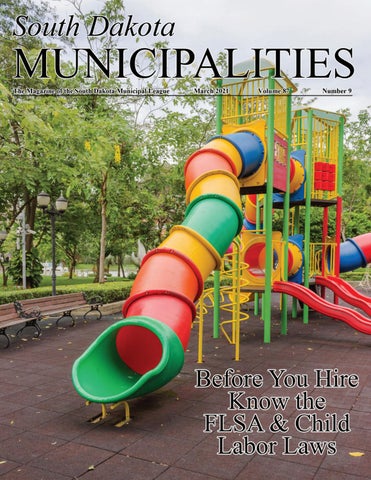
FLSA, Seasonal/Temporary Employees and Child Labor Laws . . . . . . . . . . . . . . .16 FLSA Child Labor Regulations Refresher . . . . . . . . .17
Employment of Lifeguards . . . . . . . . . . . . . . . . . . . .22
Small Community Planning Grant . . . . . . . . . . . . . .26
SDMEA Hometown Power . . . . . . . . . . . . . . . . . . . .28
Supreme Court Midterm for Local Governments . . . . . . . . . . . . . . . . . . . . . . . . . .30
Columns
Director’s Notes . . . . . . . . . . . . . . . . . . . . . . . . . . . . . . .4
President’s Report . . . . . . . . . . . . . . . . . . . . . . . . . . . .5 Risk-Sharing News . . . . . . . . . . . . . . . . . . . . . . . . . .32
Washington Report: Senator Rounds . . . . . . . . . . . . .34
In Every Issue
SDML Events Calendar . . . . . . . . . . . . . . . . . . . . . . . .9 City Highlight Promotion . . . . . . . . . . . . . . . . . . . . . . .6
Hometown Happenings . . . . . . . . . . . . . . . . . . . . . . .32
Classifieds . . . . . . . . . . . . . . . . . . . . . . . . . . . . . . . . .38
Directory Changes . . . . . . . . . . . . . . . . . . . . . . . . . . .31
Municipal Calendar . . . . . . . . . . . . . . . . . . . . . . . . . .40
SOUTH DAKOTA MUNICIPALITIES (ISSN 0300-6182, USPS 503-120) is the official publication of the South Dakota Municipal League, published monthly at 208 Island Drive, Ft. Pierre, South Dakota 57532, phone 605-224-8654. This institution is an equal opportunity provider, and employer. Periodical postage paid at Pierre, South Dakota and additional mailing offices. Non-member subscriptions are available for $30.00 annually. The opinions expressed herein are not necessarily those of the South Dakota Municipal League. Postmaster: Send address changes to SOUTH DAKOTA MUNICIPALITIES,
MARCH 2021
VOLUME 87, NUMBER 9
3
Director's Notes The Legislative Session will only have a couple weeks left once you receive this, but believe me, the last days are the longest days. At this writing, we have steadily worked toward the League’s goals, although admittedly our agenda, given the election year, wasn’t as aggressive as in some past years.
Due to the uncertainty caused by the pandemic, we won’t be able to see you in person for the District Meetings, but we do hope you will join us for your district’s Zoom meeting. We are looking forward to seeing you all, even if for now it is just on a screen. Affiliate groups are usually active this time of year, and
4
while we hope to be able to meet in person, all have a “plan B”. Meetings are scheduled for the Building Officials ICC Code Officials Institute Training April 6 and 8; Street Maintenance Association meeting May 34; Police Chiefs’ Association and Sheriffs’ Joint Meeting April 20-22; and Code Enforcement Workshop May 12-13. Plans are also well underway for the annual Finance Officers’ Schools and Human Resource School. Please go to www.sdmunicipalleague.org for all the dates, agendas, and details so you can get these excellent training opportunities on your calendar. We hope to see many of you at your Virtual District Meeting, but until then, remember we are always available at 1-800-658-3633 or yvonne@sdmunicipalleague.org. Yvonne Taylor Executive Director
SOUTH DAKOTA MUNICIPALITIES
President's Report
March 2021 has arrived and with March we get to see the first day of spring and we are all anxious for the warm temperatures to return. As I sit here writing this article today, I am feeling a little excited and a little disappointed in the same breath. March is the month of our District Meetings that occur annually. Last year the meetings were cancelled. This year we are holding the meetings via Zoom, so we will meet virtually which is not the same but at least it is something. I am hoping to see many of you virtually. I know Yvonne will be prepared to give a legislative update and I am sure the hot topic will be what happened with Marijuana both on the medical and recreational sides and what the status of Amendment A is, and how the laws set forth will impact our municipalities. I am curious to see how this will all play out. I hope that
even though this year looks a little different, with a virtual platform, that we still have the great participation from our districts that we have every year. Hopefully by next year we can meet in person and have that socialization that we have all been waiting for. In closing, I hope to see all of you virtually at the district meetings!!
SAME E
people e,
NEW W
formerly
The FUTURE. Built Smarter.
services i s. IMEG is the leading g U.S.-based design HQJLQHHULQJ ÀUP delivering that rare e FRPELQDWLRQ ² WKH broad expertise of a national leader with the personal relationships and deep collaboration RI D ORFDO ÀUP )LQG RXW PRUH YLVLW imegcorp.com.
MARCH 2021
5
GħĞĤ ĞĤĽħĞ ħĞĤ Ĥż ż ¿ōƁů ħżƱ ħħŅŅ ōƁżĤ &áĺōżá eƁŅħýħŬáĽħżħĈŵ eáĞáƺħŅĈ 8 L M W M W E R S T T S V X Y R M X ] X S T V S Q S X I ]S S Y V G M X ] S V X S[ [R XS RIEVP] Q Y R M G M T E P P I E H I V W I P I G X I H S J J MGG M E P W E R H M R H Y W X V ] EH H Z I V X MWW I V W 4 VS S Z M H I E W L S V X E V X MGG P I RS S Q S V I X L E R [SVHW LMKLPMKLXMRK ]SYV GMX] SV XS[R W FIWX EWWIXW ERH TLSXSW ERH [I [MPP HS XLI VIWX '328%'8 7%6% %8 7%6%$7(192-'-4%00)%+9) 36+
2021 Spring Conference Agenda - Deadwood, SD Law Enforcement Training Courses Tuesday, April 20th
8:00-9:45 am
Course
Instructor
Description
Marijuana Impairment Investigations
Sgt. Keith Carlson & Deputy Anthoy White Pennginton Co SO
This course will provide law enforcement officers with general knowledge of how to observe, identify, and articulate the signs of vehicle driver impairment related to drugs, alcohol or a combination of both.
Break (Vendors will be available for visitors during this time)
9:45-10:15 am
10:15-noon
Initial Response to Missing Children Cases
Dave Keith - FBI Brett Garland - DPS
How the first responder reacts and the actions he or she takes when notified of a missing or abducted child can have a profound impact of the recovery of the child and the solvability of the case. This training explores the appropriate and necessary steps for the first responder when notified of a missing child case.
Noon-1:00pm
Lunch Break (Vendors will be available for visitors during this time)
1:00 - 5:00 pm
Business Meeting
Wednesday, April 21st Course
Instructor
Description Conference Welcome / Posting of Colors
8:00-8:15 am
Corrections Training
Tate McCotter National Institute for Jail Operations
(see separate attachment)
8:15-9:15am
2021 Legislative Updates
SDSA & Police Chiefs Lobbyists, AG Office
Highlights from the 2021 legislative session that have an impact on law enforcement
9:15-10:00am
Legal and Liability Risk Management Institute
Steve Campbell
Various topics to include: Crowd Management & Protecting Civil Rights
8:00-12:00 am
Break (Vendors will be available for visitors during this time)
10:00-10:30 am
10:30-noon
LLRMI Continued
Steve Campbell
Topics continued: - Response to Resistance Policy/Procedures and EO 13929 banning Chokeholds Lunch Break
Noon-1:00pm
12:00-5:00pm
Corrections Training
Tate McCotter National Institute for Jail Operations
1:00-2:45pm
LLRMI Continued
Steve Campbell
(see separate attachment)
Topics continued: -President Trump's EO 13929, Safe Policing for Safe Communities Sexual Harassment and Discrimination
-
Break
2:45-3:00pm 3:00-4:00pm
LLRMI Continued
Steve Campbell
- Dealing with 1st Amendment Auditors and steps to protect yourself and the department
4:00-5:00pm
State LET Administrative Rules and Agency Certification
Chad Mosteller
How your agency can ensure compliance with State LET and Federal guidelines for certification
Course
Instructor
Description
Corrections Training
Tate McCotter National Institute for Jail Operations
(see separate attachment)
It Starts With Attitude
Michael Oster
As the Assistant Adjutant General for the SD Army National Guard, Oster discusses positioning ourselves to attain and maintain a positive attitude all day, every day. It Starts With Attitude reminds us that there is always an opportunity to grow, regardless of our current status and fortune, and, when we become better at who we are, we become better in all we do.
Thursday, April 22nd
8:00-12:00 pm 8:00-9:50 am
Break
9:50-10:10
10:10-noon
Leading for "The Winning Mind"
Dave & Betsy Smith
Lunch Break
Noon-1:00pm
1:00-2:50pm
The Truth About Gender Differences
Dave & Betsy Smith
džƉĞƌŝĞŶĐĞĚ ĨĂĐŝůŝƚĂƚŽƌ ĂŶĚ ƚƌĂŝŶĞƌ ^ĞƌŐĞĂŶƚ ĞƚƐLJ ^ŵŝƚŚ ůĞĂǀĞƐ ͞ƉŽůŝƚŝĐĂů ĐŽƌƌĞĐƚŶĞƐƐ͟ ďĞŚŝŶĚ ĂŶĚ ƵƐĞƐ ƌĞĂůͲǁŽƌůĚ experience combined with the science of gender intelligence to inspire, motivate, and encourage the men and women of your organization to understand each other like never before and truly excel, regardless of assignment. Break
2:50-3:10pm
3:10-5:00pm
ĂǀĞ ^ŵŝƚŚ͛Ɛ Η>ĞĂĚŝŶŐ ĨŽƌ dŚĞ tŝŶŶŝŶŐ DŝŶĚΗ ĂĚĚƌĞƐƐĞƐ ƚŚĞ ĐƌŝƚŝĐĂů ƚƌƵƚŚ ƚŚĂƚ ͞ůĞĂĚĞƌƐŚŝƉ͟ ŝƐ ŶŽƚ ƚŚĞ ĨƵŶĐƚŝŽŶ ŽĨ Ă particular rank within an agency but what each individual does with the position they are in. Presented by Dave ͞: ƵĐŬ ^ĂǀĂŐĞ͟ ^ŵŝƚŚ ĂŶĚ ŚŝƐ ǁŝĨĞ ^Őƚ͘ ĞƚƐLJ ^ŵŝƚŚ͕ ƚŚŝƐ ƉƌŽŐƌĂŵ ŝĚĞŶƚŝĨŝĞƐ ĂŶĚ ĞdžƉůŽƌĞƐ ƚŚĞ ƐŬŝůůƐ ĞĂĐŚ ŽĨ ƵƐ needs to bring out the best in ourselves and in others.
Crisis Intervention and De-Escalation
Sgt. Walton will discuss how to recognize and effectively communicate with individuals in crisis while reducing Sgt. Tarah Walton - Sioux injury to both officers and civilians. Falls PD This training meets the State requirement for 2 hours of mandatory crisis intervention and mental health training for LE re-certification.
Scholarship Funds Available
SDCMA Professional Development Scholarship Application Applicant must be a member of the South Dakota City Management Association.
As part of the scholarship, the winner shall share their experience from the professional development/educational activity with the SDCMA membership during the annual Spring Training.
The scholarship fund allows for up to $2,000 per year, which may be awarded to more than one applicant at the discretion of the Board. SDCMA will reimburse the City of the scholarship recipient expenses related to registration, airfare, lodging, transportation, and meals not included in the conference package. Recipient is responsible for keeping all receipts and submitting them to SDML for reimbursement. All reimbursement costs are subject to SDCMA board approval.
Please submit the completed application to SDML, 208 Island Drive, Fort Pierre, SD 57532 or fax to 605-2248655 no later than May 1, 2021, to be considered for the scholarship. Applications can also be emailed to Lori Martinec at martinec@sdmunicipalleague.org.
An application and additional infomation can be found at www.sdmunicipalleague.org/citymanagement.
Other Upcoming Events
Funding Available for Outdoor Recreation
South Dakota State Parks and Recreation Director Scott Simpson announced today that applications are being accepted for grants from the Land and Water Conservation Fund (LWCF).
Public outdoor recreation projects sponsored by city, county, township, and tribal governments are eligible to receive the grant money.
“Outdoor recreation is important to a healthy community,” Simpson said. “The variety of recreational activities that local parks have to offer allows families to spend time together close to home.” The Land and Water Conservation Fund provides up to 50 percent reimbursement for approved outdoor recreation projects.
“Grants will be awarded for development or renovation of public outdoor recreation facilities or the acquisition of park land. We will consider grant requests for public outdoor recreation projects seeking at least $10,000 in grant assistance,” Simpson said. The application deadline is April 30, 2021.
LWCF funds are federal dollars that are apportioned to states by Congress to fund public outdoor recreation projects.
Application packets are available on the Game, Fish and Parks website. For more information contact Grants Coordinator Randy Kittle at 605.773.5490 or by email at randy.kittle@state.sd.us
GOED Annual Conference April 28, 2021 Convention Center at Denny Sanford PREMIER Center, Sioux Falls
Visit www.sdgoed.com for more information
8
SOUTH DAKOTA MUNICIPALITIES
2021 Events Calendar
March
Municipal/School Election Workshop Webinars (See Registration) 7-8 NLC Congressional City Conference, Washington, DC District Meetings - Via Zoom (See Registration)
April 6
8
15 20-22
May 3-4
12-13
25-28
June TBD 8-9 9-11
SD Building Officials, ICC Code Officials Institute Program, Rapid City SD Building Officials, ICC Code Officials Institute Program, Sioux Falls SD Airport Management Association Meeting SD Police Chiefs/SD Sheriffs Joint Association Meeting, Deadwood SD Municipal Street Maintenance Association Meeting, Sioux Falls SD Association of Code Enforcement Workshop, Fort Pierre SD City Management Association – GOSCMA Conference, Spearfish SDML Board of Directors Meeting Human Resource School, Pierre Finance Officers’ School, Pierre
TBD 23
July 7 14 TBD
SD Municipal Attorneys’ Association Meeting, Sioux Falls Budget Training, Rapid City Budget Training, Sioux Falls Elected Officials Workshop, Pierre SD Building Officials’ Association Meeting, Pierre
August 18-19
Policy Committee Meetings, Fort Pierre
5 5-8
SDML Board of Directors Meeting, Spearfish SDML Annual Conference, Spearfish
17-20
NLC City Summit, Salt Lake City, UT
8
Joint SDML Board Meeting with County Association, Pierre
October
November December
SD Airport Managers Association Spring Meeting April 15, 2021 Via Zoom
Visit www.sdmunicipalleague.org/events for more information and agenda MARCH 2021
9
Circle the Virtual Wagons
collective public service experience in South Dakota. Several internal SDPAA team members will also attend to answer your questions. We have walked in your shoes so you will have our empathetic and sympathetic ears listening to your concerns or suggestions. Members will be receiving general information then a follow-up meeting invitation with the link in advance of their scheduled session. The first series of roundtables will be completed by the time this goes to print. “See” you sometime this year!
By: Dave Pfeifle, SDPAA Executive Director The month of March marks the one-year anniversary of the COVID-19 pandemic reaching South Dakota. We extend our sympathies to everyone who has been impacted. Thanks to the pandemic we have been attending more virtual meetings, providing a convenient forum to commiserate and to share ideas with our fellow public sector officials/employees. These virtual meetings have shown that we share common challenges across our state and across our country. We need to circle our wagons, but we must do it virtually this time.
National webinars have now been focusing on COVID-19 vaccinations. Two webinars that I attended had local governments in over 30 states represented. One of those webinars was hosted by the National League of Cities who had a physician present to us in the afternoon after he had attended a session that morning as part of the CDC’s expert panel on this issue—now that’s timely and first-hand information! Everyone is analyzing the best ways to
Along that trail, the South Dakota Public Assurance Alliance (SDPAA) is hosting a series of virtual Member roundtables throughout this calendar year. We miss seeing you in person! We will leverage our use of video conferencing technology to stay connected with each other. We want to hear about your latest challenges and opportunities, then identify the ways that we can serve you even better in the future. So the actual topics for these roundtables will be chosen by the participating Members at each session. Each roundtable session will be held with other similarly-situated public entities who share common interests and concerns. Only about two dozen public entities will be invited to participate at each session, so people should not need to talk over each other. We are always available to talk individually also. An SDPAA Board member will attend each session to learn first-hand about your issues, concerns, or suggestions. The SDPAA Board is comprised of your fellow Member officials/employees who have centuries of 10
SOUTH DAKOTA MUNICIPALITIES
ensure their team members are safe and healthy. The questions are many, the answers still few: do local governments have the ability to require some or all of their employees get vaccinated? Should a local government provide incentives for its team members to get vaccinated rather than mandate it? What are the legal implications of any course of action or inaction? The information on these issues changes on a daily basis, or even an hourly basis. Anything written here could be obsolete by the time this article goes to print. Vaccination guidance can rapidly evolve and change so you will need to consult sources that are updated daily. One good source for background information and general guidance to employers is the Equal Employment Opportunity Commission website at: https://www.eeoc.gov/coronavirus. Every public entity should consult with its attorney to determine the answers to these questions which are best tailored to their unique circumstances. The 434 Members of the SDPAA have additional resources that other public entities do not. SDPAA Members will be receiving guidance on this particular issue tailored to local governments. Members can also contact the SDPAA Employment Practices Hotline to receive up to one hour of free legal advice on this or any other employment topic from expert employment lawyers. The SDPAA is honored to have Attorneys Lisa Marso of the Boyce Law Firm and Sara Frankenstein of the Gunderson Palmer Law Firm field these calls for our Members. Lisa handles East River; Sara handles West River. Each of them has decades of experience helping local governments wrestle with their employment law issues. Thank you to both of them for being such a great resource for our Members! If you are an SDPAA Member and need their legal expertise on any employment-related topic, please contact the SDPAA Employment Practices Hotline at 888-313-0839. Over 100 SDPAA Members per year avail themselves of this service which is included with their SDPAA membership. Your entire team at the SDPAA is ready to assist you in your public service mission. We are your fellow public employees who share your passion for servant leadership. If you have any questions or would like your public entity to explore becoming a Member of the SDPAA, please contact the SDPAA at 800-658-3633 option 2 or by email at sdpaa@sdmunicipalleague.org. MARCH 2021
11
Why We Feel So Right Doing the Wrong Thing By Eric Giordano
The election is over . . . sort of. But about half the voting populace is highly concerned that our country is moving in the wrong direction. Rather than resolve our differences, the election seems to have merely built the scaffolding for the next round of hyperpartisanship, incivility, and fear. Can we overcome this cycle of distrust and begin to reconcile our differences or are we locked into a predestined future of political strife and unrest? Fortunately, there is something we can do about it.
Be Skeptical, Not Cynical When my colleague and I prepare students to meet with policymakers on Capitol Hill as part of their Washington Seminar course, we drum into their consciousness two interrelated ideas: Be skeptical, not cynical. Being skeptical allows room for intellectual curiosity, honest inquiry, critical thinking and evidence-based approaches. Healthy skepticism encourages us to examine assumptions, including our own, and remain open to changing our minds when we are confronted with contrary facts. Training ourselves to test human assumptions rather than blindly follow them not only mediates truth, but can lead to greater understanding, innovation, and creativity.
Cynicism is qualitatively different from skepticism. To accept cynicism is to lose hope and become contemptuously distrustful of human nature; or worse, to become preoccupied with one's own interests and to disregard “accepted or appropriate standards in order to achieve them.”1 When we see the daily onslaught of grandstanding public officials or talking heads in the media, it is hard not to feel cynical—and we all go there at times.
When habitual cynicism takes hold it encourages a phenomenon known as detrimental motivated reasoning, which is the "tendency to find arguments in favor of conclusions we want to believe to be stronger than arguments for conclusions we do not want to believe.”2 We cease to be objective inquirers because we have already decided the truth. Hardcore cynics often become certain of their “rightness” but intolerant of other people’s ideas. This further undermines relationships with those who think differently from us. Ultimately, it becomes extremely difficult to heal divisions in our families, in our communities and in our nation if we cannot shake off the chains of cynicism. Admit We Could Be Being Wrong Unfortunately, too often our latter day public leaders seem to embrace the misplaced belief that being wrong means there is something fundamentally wrong with us. As a result, we have little incentive to admit we are wrong and are usually rewarded for insisting that we are always right. To be right means ipso facto that we are virtuous and, perhaps more important, that we are not weak or fallible. Journalist and author Kathryn Schulz3 warns us about this mindset. Trusting too much in the feeling of being on the correct side of anything can be very dangerous. This internal sense of rightness that we all experience so often is not a reliable guide to what is actually going on in the external world.
“And when we act like it is,” Schulz continues, “and we stop entertaining the possibility that we could be wrong,” we become like Wyle E. Coyote who has run off the cliff chasing Roadrunner without a clue of his predicament until it is too late. Think of the Challenger shuttle tragedy in 1986 or the Deepwater Horizon BP oil spill in the Gulf of
Optimization a , Design and Operrations Water treaatment Wastewater treatment + Reuse
Vir tual Water/Wastew t ater Operatoor Training - Earn SD D Contact Ho o ours - Wide range r of topics ccs - No Charge
101 South Reid Street + Suite 202 Sioux Falls, SD, 57103 605 274 6401 605.274.6401 Info@ISGInc com Info@ISGInc.com
Visit the liink to find out more: m bit .ly/OnlineW-W W Tr ainings
Architecture + Engineering + Enviironmental + Planning
12
ISG GInc.com
SOUTH DAKOTA MUNICIPALITIES
Mexico in 2010. The inability of a few individuals to admit they could be wrong—supported by a culture that discouraged fallibility—provided the conditions that led to these catastrophic failures. Our inability to be wrong also exacts a steep price on healthy interpersonal relationships by encouraging distrust and division while fueling the cynicism discussed earlier.
Schulz brilliantly captures this predicament by observing a “series of unfortunate assumptions” that we make when we are convinced we are right and bump up against people who disagree with us. First, we make an “ignorance assumption.” We assume disagreement is due to others not knowing what we know. But when information and facts are provided and people still disagree, we make the “idiot assumption.” Here, we believe people who disagree with us are not very bright or are too stubborn to yield to evidence and admit they are wrong. If we can repeat the facts, authoritatively make our case, and show them the error of their ways, they will undoubtedly agree with us. However, when others appear to be sufficiently intelligent but still choose to disagree with us, we quickly descend to the “evil assumption.” We assume that others know the truth and know we are right, but they choose to be manipulative due to hidden and questionable motives. Cynicism quickly follows and relationships become increasingly empty and transactional. It doesn’t take much before we begin demonizing others,
that are proven to reduce motivated reasoning, counteract cynicism, and repair and restore trusting relationships. The list below summarizes ten actions drawn from social psychology and cognitive behavior literature.
1.
2. 3.
4.
5.
6.
7. 8.
9.
10.
which has dire consequences for community and democracy. According to political activist and law professor Roger Conner, eventually, people “start treating each other as not just wrong, but as wrongdoers, and then as enemies. . . . Once the trap is set, breaking the circle of blame is extraordinarily difficult.”4 In reality, Conner reminds us, “There are few profoundly evil people in the world, but if you think you’re surrounded by them, you probably need to change your own psyche.”5 Mending Fences To bring about change, we must consider concrete actions MARCH 2021
Reducing Motivated Reasoning and Improving Relationships
Avoid rushed decision-making. If possible, slow down and reflect. Consider multiple possibilities, especially tradeoffs, counterarguments, or reasons why you might be wrong. Invite others to walk this path. When attempting to debunk, do not simply attack beliefs—provide a viable alternative. When attempting to correct, don't attack identity; allow people to save face. Authentically engage people before decisions are made. Spark genuine, non-hostile interaction among diverse individuals. Support the expression of dissenting and minority views. Create a climate where doubt and uncertainty are welcome and appropriate. Encourage situations where people are accountable for their position; provide both the expectation and opportunity for them and explain it clearly. Create opportunities for real relationships based on trust and respect.
Rather than elaborate on these suggestions, I would like to propose one concrete experiment with the goal of improving a specific relationship of your choice. I invite you to begin by reaching out to someone you know with a very different opinion from you about one or more issues. Feel free to tell them you are doing an experiment you read about in The Municipality (being “in” on the plan can help people drop their guard a bit). Transparently explain that your goal is to try and better understand where they are coming from, what they think about the issue, and why it matters to them. Next, commit yourself to this goal. Research shows that the simple act of listening to understand and acknowledging that you “see” the other person reduces defenses, builds trust, and opens people to new ideas. Come prepared with a list of basic questions designed to elicit their views, not to play “gotcha” or to impugn their facts or logic. Some examples include: • Tell me about how you feel about the topic. • How did you come to your current beliefs or conclusions about the topic? • Why is this topic important to you? (Or why not?) 13
•
What is something you worry might happen if the topic is not addressed or resolved? Is there any information you wish you had that might clarify something about the topic?
•
The final part of the experiment is reflection. Depending on how the conversation goes this could be an internal selfreflection, a shared reflection with your partner, or some combination of both. If the experiment goes well and you think it is relevant, consider sharing something positive about the conversation. If you cannot think of anything positive about their viewpoint, maybe there is something positive about how they expressed it. Whatever you choose to say, be authentic. If appropriate, you might consider summarizing areas of common ground. If there is no common ground it is okay to point that out politely. But above all be careful to avoid correcting, critiquing or moralizing about your partner’s perspective. You might also ask your partner a reflective question such as, “How did you feel sharing your perspective with me?”
There are some risks. You could end up talking with someone who rambles a lot and has a hard time keeping on topic. You could be legitimately offended by something the person says and feel unable listen because of emotional harm. Or, perhaps after hearing something, you might feel like you cannot bite your tongue any longer. Here is where
An Experimental Conversation Guide
1.
•
•
2.
3.
4.
5.
6.
Trusted. Professiona al. Solutions. > Project Funding & Financcing Guidance > Streets > Sewer > Drainage > Water > Airpor ts > GIS > Electrical Power
dgr g .com
14
Three locations including Sioux Falls, SD 605-339-4157
•
•
Initial inquiry Reach out to someone with whom you have political/issue differences. Explain that you are conducting an experiment designed to get people with different viewpoints talking to one another. Explain the purpose and goals of the conversation: − Listen carefully to their viewpoint − Learn about their perspective and why it matters − See if there is any common ground (optional) Choose a mutually agreed topic. (Have one or two in mind) Prepare for the conversation − Set a place and time for the conversation. − Set a time limit. − Create your list of questions (share if desired). − Commit internally to the goals. Hold the conversation − Focus on listening to understand. Politely conclude the conversation and thank your partner. Self-reflection − What went well? − Did you learn anything about yourself, the topic or your partner? − How did you feel about your partner as you listened to them? Shared reflection (optional) − If appropriate, share positive feelings you had while listening. − If appropriate, ask your partner to share how they felt. − If appropriate, share instances of common ground.
some common sense and discretion comes in. You can end the conversation at any time and not feel guilty about it. Remember, this is an experiment. You can always pull the plug and claim that you reached the time limit.
There is Hope This experimental conversation is a point of departure, not an end. The intent is to create space to build or repair relationships with others who think differently by consciously valuing them as human beings. We can do this without sacrificing our core values and beliefs, and while still maintaining a healthy skepticism. We need to remind SOUTH DAKOTA MUNICIPALITIES
ourselves that most disagreements—even intense ones— are not representative of good versus evil. Despite our differences by choosing to build a bridge through respectful listening, we can begin to overcome cynicism and motivated reasoning, , repair damaged relationships and reimagine new ones. And although we cannot undo the bitter experiences of the past, let us commit to not be prematurely disappointed with the future. As the beloved childhood poet, Shel Silverstein, reminds us:
Listen to the mustn'ts, child. Listen to the don'ts. Listen to the shouldn'ts, the impossibles, the won'ts. Listen to the never haves, then listen close to me... Anything can happen, child. Anything can be.
1 See Oxfordlanguages.oup.com 2 Kunda, Z. (1990) “The case for motivated reasoning”. Psychological Bulletin. 108 (3): 480-498. doi:10.10370033-2909.108.3.480 3 See Schulz, Being Wrong: Adventures in the Margin of Error (New York HarperCollins, 2010). 4 Quoted in James Hoggan with Grania Litwin, I’m Right and You’re an Idiot: The Toxic State of Public Discourse and How to Clean it Up (Canada: New Society Publishers, 2016), pp. 17-18 5 Quoted in Hoggan, p. 17.
WANT AFFORDABLE HOUSING FOR YOUR COMMUNITY? START THE DISCUSSION WITH SDHDA AND TAKE THE NEXT STEP
S O U T H
D A K O T A
D E V E L O P M E N T
A U T H O R I T Y
sdhda.org MARCH 2021
15
FLSA, Seasonal/Temporary Employees and Child Labor Laws
It is important to regularly review Fair Labor Standards and Child Labor regulations PRIOR to seasonal hiring. Often we become complacent and continue to do things the way we have always done them. Reminders like this give us an opportunity to verify that we are adhering to the law. In this economy, none of us can afford to make mistakes that cost our communities back wages for overtime.
The Fair Labor Standards Act (FLSA) allows for specific exemptions from minimum wage and overtime including administrative, executive and professional exemptions. For purposes of this article, we will assume that most employees hired for seasonal and temporary positions are non-exempt from minimum wage and overtime provisions. This means that these employees will be eligible to receive minimum wage at $9.45 per hour. Seasonal and temporary employees are eligible to receive 1.5 times the hourly wage for all hours worked over 40 in any given workweek as required by FLSA.
Since 1913, HR Green has provided solutions that build communities and improve lives.
FLSA DOES include an exemption from minimum wage and overtime for Seasonal Amusement or Recreational Establishments - Section 13(a)(3). Tests for this exemption include: a) does not operate for more than seven months in any calendar year; OR b) during the preceding calendar year, average receipts for any six months of such year were not more that 33 1/3% of its average receipts for the other six months of such year.
It would seem apparent that a swimming pool or other facility that is open only for the summer months would qualify for this exemption from overtime and minimum wage provisions of the FLSA. But please note, if seasonal employees who qualify for this exemption perform other jobs for the city, this exemption from overtime may not apply.
Also please review the “FLSA Child Labor Regulations Refresher” article on pages 17-21. It is important to consider the duties that employees under age 18 are permitted to perform. With limited resources and limited staff, it becomes essential to understand the law.
The majority of the questions that the Municipal League receives are regarding “children” under eighteen years of age (16-17) and if they are allowed to run lawn mowers. In a later article the actual Prohibited Occupations for 16-17 year olds (non-adult) are reviewed. Even though lawn mowers are not specifically mentioned, there are enough related references to this type of work that many cities across South Dakota do not use child labor for these duties. The League discourages cities from doing so but we will leave that to you and your City Attorney to work out. It would also be prudent to review the Child Labor Violation Penalties which is in a later article as well.
These laws can be complicated and difficult to sort out. If there are questions, employers are required to follow the law that provides the greatest benefit to the employee.
Z Sioux Falls
ZH R G R E E N . C O M
Phone 605.334.4499
SD Codified law can be found online at sdlegislature.gov/ Statutes/Codified_Laws/ under Title 60 Labor and Employment. The South Dakota Department of Labor staff is also a great resource. You also have access to the knowledgeable SDML staff (800-658-3633) and the SD Governmental Human Resource Association.
T R A N S P O R TAT I O N + WAT E R + G O V E R N M E N TA L S E R V I C E S L A N D D E V E L O P M E N T + E N V I R O N M E N TA L + C O N S T R U C T I O N
16
SOUTH DAKOTA MUNICIPALITIES
FLSA Child Labor Regulations Refresher
Reprinted from the United States Department of Labor Wage and Hour Division website. The information in this article is a snapshot of what is provided via the DOL website. For more details follow visit http://www.dol.gov/ whd/regs/compliance/childlabor101.pdf
With summer just around the corner, it may be a good time to have a little refresher course on the Fair Labor Standards Act (FLSA) regarding child labor regulations. Employers may employ youth only under certain conditions and child labor regulations vary significantly depending on the age of the youth.
Federal Child Labor Provisions The federal child labor provisions, also known as the child labor laws, are authorized by the Fair Labor Standards Act (FLSA) of 1938. These provisions were enacted to ensure that when young people work, the work is safe and does not jeopardize their health, well-being or educational opportunities. By knowing, understanding, and complying with these provisions, employers, parents, and teachers can help working teens enjoy those safe, positive, early work experiences that can be so important to their development.
Other Laws That Impact Child Labor Other federal and state laws may have higher standards. When these apply, the more stringent standard must be observed. All states have child labor provisions, compulsory school attendance laws, and establish the minimum ages and conditions under which youths may operate motor vehicles.
Unless otherwise exempt, a covered minor employee is entitled to receive the same minimum wage, overtime, safety and health, and non-discrimination protections as adult workers.
MARCH 2021
Minimum Age Standards for Nonagricultural Employment 14 Minimum age for employment in specified occupations outside of school hours for limited periods of time each day and each week.
16 Basic minimum age for employment. At 16 years of age, youth may be employed for unlimited hours in any occupation other than one declared to be hazardous by the Secretary of Labor.
18 Minimum age for employment in nonagricultural occupations declared hazardous by the Secretary of Labor.
Occupation Standards for 14- and 15-Year-Olds The following list, which is not exhaustive, are jobs that 14- and 15-year-olds may not be employed in: 1. Any manufacturing occupation.1 2. Any mining occupation. 3. Most processing occupations such as filleting of fish, dressing poultry, cracking nuts, developing of photographs, laundering, bulk or mass mailings (except certain occupations expressly permitted as discussed below). 4. Occupations requiring the performance of any duties in workrooms or workplaces where goods are manufactured, mined or otherwise processed (except to the extent expressly permitted as discussed below; and as discussed in footnote 1). 5. Any occupation found and declared to be hazardous by the Secretary of Labor. 6. Occupations involved with the operating, tending, setting up, adjusting, cleaning, oiling or repairing of hoisting apparatus. 7. Work performed in or about boiler or engine rooms or in connection with the maintenance or repair of the establishment, machines, or equipment. 8. Occupations involved with the operating, tending, setting up, adjusting, cleaning, oiling or repairing of any power-driven machinery, including, but not limited to, lawnmowers, golf carts, all-terrain vehicles, trimmers, cutters, weed-eaters, edgers, food slicers, food grinders, food choppers, food processors, food cutters, and food mixers. Fourteen- and 15-yearolds may operate most office machinery and those machines that are expressly permitted. 9. The operation of motor vehicles or service as helpers on such vehicles. 17
10. The riding on a motor vehicle inside or outside of an enclosed passenger compartment except as permitted in #16 in the next list. 11. Outside window washing that involves working from window sills. 12. All work requiring the use of ladders, scaffolds, or their substitutes. 13. All baking and most cooking activities except as discussed in the following #3. 14. Work in freezers and meat coolers and all work in the processing of meat for sale; however, youth are permitted to occasionally enter freezers only momentarily to retrieve items. 15. Youth peddling, including not only the attempt to make a sale or the actual consummation of a sale, but also the preparatory and concluding tasks normally performed by a youth peddler, such as the loading and unloading of motor vehicles, the stocking and restocking of sales kits and trays, the exchanging of cash and checks with the employer, and the transportation of the minors to where the sales will be made. 16. Loading and unloading of goods or property onto
18
or from motor vehicles, railroad cars, and conveyors, except as discussed in the following #12. 17. Catching and cooping of poultry in preparation for transport or for market. 18. Public messenger service. 19. Occupations in connection with: a. Transportation of persons or property by rail, highway, air, on water, pipeline, or other means. b. Warehousing and storage. c. Communications and public utilities. d. Construction (including repair). Except 14- and 15-year-olds may perform office or sales work in connection with a, b, c, and d above when not performed on transportation media, on an actual means of transportation, or at the actual construction site.
The following is the list of jobs the Secretary of Labor has determined will not interfere with the schooling, health, and well-being of 14- and 15-year-olds and therefore MAY BE performed by such youth. Any job not specifically permitted, is prohibited. 1. Office and clerical work, including operation of office
SOUTH DAKOTA MUNICIPALITIES
machines. 2. Work of an intellectual or artistically creative nature such as but not limited to computer programming, the writing of software, teaching or performing as a tutor, serving as a peer counselor or teacher’s assistant, singing, the playing of a musical instrument, and drawing, as long as such employment complies with all the other provisions contained in §§ 570.33, .34, and .35. 3. Cooking with electric or gas grills that do not involve cooking over an open flame and with deep fat fryers that are equipped with and utilize devices that automatically lower and raise the baskets into and out of the oil or grease. NOTE: this section does not permit cooking with equipment such as rotisseries, broilers, pressurized equipment including fryolators, and cooking devices that operate at extremely high temperatures such as “Neico broilers.” 4. Cashiering, selling, modeling, art work, work in advertising departments, window trimming and comparative shopping. 5. Price marking and tagging by hand or by machine. Assembling orders, packing and shelving. 6. Bagging and carrying out customer orders. 7. Errand and delivery work by foot, bicycle, and public transportation. Except such youth may not be employed by a public messenger service. 8. Cleanup work, including the use of vacuum cleaners and floor waxers, and the maintenance of grounds, but not including the use of power-driven mowers, cutters, trimmers, edgers, or similar equipment. 9. Kitchen work and other work involved in preparing and serving food and beverages, including operating machines and devices used in performing such work. Examples of permitted machines and devices include, but are not limited to, dishwashers, toasters, dumbwaiters, popcorn poppers, milk shake blenders, coffee grinders, automatic coffee machines, devices used to maintain the temperature of prepared foods (such as warmers, steam tables, and heat lamps), and microwave ovens that are used only to warm prepared food and do not have the capacity to warm above 140°F. 10. Cleaning kitchen equipment. Minors are permitted to clean kitchen equipment (not otherwise prohibited), remove oil or grease filters, pour oil or grease through filters, and move receptacles containing hot grease or hot oil, but only when the equipment, surfaces, containers and liquids do not exceed a temperature of 100°F. 11. Cleaning vegetables and fruits, and the wrapping, sealing, labeling, weighing, pricing, and stocking of items, including vegetables, fruits, and meats, when MARCH 2021
performed in areas physically separate from a freezer or meat cooler.
HO 1
Manufacturing and storing of explosives.
HO 3
Coal mining.
HO 2 HO 4 HO 5* HO 6 HO 7 HO 8* HO 9
Motor-vehicle driving and outside helper on a motor vehicle. Occupations in forest fire fighting, forest fire prevention, timber tract operations, forestry service, logging, and sawmilling. Power-driven woodworking machines. Exposure to radioactive substances.
Power-driven hoisting apparatus, including forklifts.
Power-driven metal-forming, punching, and shearing machines. Mining, other than coal mining.
Operating power-driven meat processing equipment, including meat slicers and other food slicers, in retail establishments (such as HO 10* grocery stores, restaurants kitchens and delis) and wholesale establishments, and most occupations in meat and poultry slaughtering, packing, processing, or rendering. HO 11
HO 12* HO 13
Power-driven bakery machines including vertical dough or batter mixers.
Power-driven balers, compactors, and paper processing machines. Manufacturing bricks, tile, and kindred products.
Power-driven circular saws, bandsaws, chain HO 14* saws, guillotine shears, wood chippers, and abrasive cutting discs. HO 15
HO 16*
Wrecking, demolition, and shipbreaking operations.
Roofing operations and all work on or about a roof.
HO 17* Excavation operations.
* These HOs provide limited exemptions for 16- and 17-yearolds who are bona-fide student-learners and apprentices.
12. Loading onto motor vehicles and the unloading from motor vehicles of the light, non-power-driven, hand tools and personal protective equipment that the minor will use as part of his or her employment at the work site; and the loading onto motor vehicles and the unloading from motor vehicles of personal items such 19
as a back pack, a lunch box, or a coat that the minor is permitted to take to the work site. Such light tools would include, but not be limited to, rakes, hand-held clippers, shovels, and brooms. Such light tools would not include items like trash, sales kits, promotion items or items for sale, lawn mowers, or other power-driven lawn maintenance equipment. Such minors would not be permitted to load or unload safety equipment such as barriers, cones, or signage. 13. The occupation of lifeguard (15-year-olds but not 14-year-olds) at traditional swimming pools and water amusement parks (including such water park facilities as wave pools, lazy rivers, specialized activity areas, and baby pools, but not including the elevated areas of water slides) when properly trained and certified in aquatics and water safety by the American Red Cross or a similar certifying organization. No youth under 16 years of age may be employed as a lifeguard at a natural environment such as an ocean side beach, lake, pond, river, quarry, or pier. 14. Employment of certain youth under specified conditions inside and outside of establishments where machinery is used to process wood products.
20
See the DOL link at the beginning of this article for information on this exemption. 15. Work in connection with cars and trucks if confined to the following: - Dispensing gasoline and oil. - Courtesy service on premises of gasoline service station. - Car cleaning, washing, and polishing by hand. - Other occupations permitted by Child Labor Regulation No. 3, but not including work involving the use of pits, racks or lifting apparatus or involving the inflation of any tire mounted on a rim equipped with a removable retaining ring. 16. Work in connection with riding inside passenger compartments of motor vehicles except as prohibited in #10 in the previous list or when a significant reason for the minor being a passenger in the vehicle is for the purpose of performing work in connection with the transporting—or assisting in the transporting of— other persons or property. Each minor riding as a passenger in a motor vehicle must have his or her own seat in the passenger compartment; each seat must be equipped with a seat belt or similar restraining device;
SOUTH DAKOTA MUNICIPALITIES
and the employer must instruct the minors that such belts or other devices must be used. In addition, each driver transporting the young workers must hold a valid state driver’s license for the type of vehicle being driven and, if the driver is under the age of 18, his or her employment must comply with the provisions of HO 2 (see chart).
Employment Standards for 16- and 17-Year-Olds in Nonagricultural Employment
The Hazardous Occupations Orders (HOs) for Nonagricultural Employment These Orders are published in Subpart E of Part 570 of Title 29 of the Code of Federal Regulations.
The FLSA provides a minimum age of 18 years for any nonagricultural occupations which the Secretary of Labor “shall find and by order declare” to be particularly hazardous for 16- and 17-year-old persons, or detrimental to their health and well-being. This minimum age applies even when the minor is employed by the parent or person standing in place of the parent.
The seventeen HOs apply either on an industry basis, specifying the occupations in the industry that are not permitted, or an occupational basis irrespective of the industry in which found. Some of the HOs contain limited exemptions.
Enforcement of the Federal Child Labor Provisions The Wage and Hour Division, which is part of the Department of Labor, administers and enforces the child labor, minimum wage, overtime and recordkeeping provisions of the Fair Labor Standards Act. The Wage and Hour Division also has enforcement responsibility for programs covering such things as prevailing wages for government contracts, the payment of special minimum wages, farm labor, family and medical leave, immigration and polygraph testing. Wage and Hour Division Investigators, who are stationed across the United States, are authorized to conduct investigations and gather data on wages, hours of work, and compliance with all the provisions of the FLSA, including the child labor provisions.
violations are determined to be repeated or willful. When a civil money penalty is assessed against an employer for a child labor violation, the employer has the right, within 15 days after receipt of the notice of such penalty, to file an exception to the determination that the violation or violations occurred.
When such an exception is filed with the office making the assessment, the matter is referred to the Chief Administrative Law Judge, and a formal hearing is scheduled. At such a hearing, the employer may, or an attorney retained by the employer may, present such witnesses, introduce such evidence and establish such facts as the employer believes will support the exception. The determination of the amount of any civil money penalty becomes final if no exception is taken to the administrative assessment thereof, or if no exception is filed pursuant to the decision and order of the administrative law judge.
Injunction to Compel Compliance The FLSA authorizes the Department of Labor to seek injunctions against violators of the child labor provisions to compel their compliance with the law. Further violations could result in sanctions against such persons for contempt of court. Criminal Sanctions The FLSA also provides, in the case of a willful violation, for a fine up to $10,000; or, for a second offense committed after the conviction of such person for a similar offense, for a fine of not more than $10,000 or imprisonment for not more than 6 months, or both.
Penalties for Violation Civil Money Penalties Employers may be subject to a civil money penalty of up to $13,227 for each employee who is the subject of a child labor violation. The penalty may be increased to $60,115 for each violation that causes the death or serious injury of a minor, and that penalty may be doubled when the MARCH 2021
21
Additional Information For information about the federal child labor requirements, visit the YouthRules! at http://www.youthrules.dol.gov.
Inquiries about the Fair Labor Standards Act or any other law administered by the Wage and Hour Division may be addressed to any local office of the Wage and Hour Division. Additional information is available at http://www.dol.gov/ whd/index.htm.
Locate the Wage and Hour Division office nearest to you, telephone the toll-free information and helpline at 1-8664US-WAGE (1-866-487-9243): a customer service representative is available to assist you with referral information from 8am to 5pm in your own time zone; or log onto the nationwide listing of Wage-Hour District Offices located at: http://www.dol.gov/whd/america2.htm.
Notes 1. Section 13(c)(7) of the FLSA, enacted in 2004, permits the employment of certain minors between the ages of 14 and 18, who have been excused from compulsory school attendance, inside and outside of places of business where machinery is used to process wood products. This provision, however, does not permit such minors to operate, or assist in the operation of power-driven woodworking machines.
22
SOUTH DAKOTA MUNICIPALITIES
Now is the Time to Plan: Summer Food Service Program Seeking Sponsors
The South Dakota Department of Education’s office of Child and Adult Nutrition Services is seeking sponsors for a federally funded program that provides nutritious meals and snacks to children in low-income areas during the summer months.
Community organizations, nonprofits, schools, and tribal and local governments can apply to be sponsors if they operate in low-income areas, serve a group of mostly lowincome children, or operate a summer camp with a high proportion of low-income participants. Parks and recreation departments, city and county health departments, libraries, and neighborhood service agencies can participate as sites or sponsors.
“When school is out during the summer, access to healthy meals is limited for many children because they don’t have access to the National School Lunch Program,” said Brigitta Bly, program specialist with South Dakota’s Child and Adult Nutrition Services. “The Summer Food Service Program helps children in low‐income areas continue to receive healthy food.”
There is a high need for Summer Food Service sponsors. In summer 2019, only about 16% of children in need were reached.
Sponsors are needed statewide, with especially high need for new sponsors in the following counties: Aurora, Bennett, Brule, Buffalo, Butte, Charles Mix, Clark, Clay, Corson, Deuel, Dewey, Gregory, Haakon, Hand, Hyde, Jackson, Jones, Kingsbury, Miner, Stanley, Turner, and Union.
Organizations interested in reviewing sponsor responsibilities are invited to use the SFSP pre-screen tool at https://ican.sd.gov/ican/PreScreen/PreScreenOverview.aspx by April 2. Once eligibility is determined, department staff will contact sponsors with more information.
and policies, the USDA, its Agencies, offices and employees, and institutions participating in or administering USDA programs are prohibited from discriminating based on race, color, national origin, sex, religious creed, disability, age, political beliefs or reprisal or retaliation for prior civil rights activity in any program or activity conducted or funded by USDA.
Persons with disabilities who require alternative means of communication for program information (e.g. Braille, large print, audiotape, American Sign Language, etc.), should contact the Agency (State or local) where they applied for benefits. Individuals who are deaf, hard of hearing, or have speech disabilities may contact USDA through the Federal Relay Service at 800-877-8339. Additionally, program information may be made available in languages other than English. To file a program complaint of discrimination, complete the USDA Program Discrimination Complaint Form, (AD-3027) found online at http://www.ascr.usda.gov/complaint_filing_cust.html and at any USDA office, or write a letter addressed to USDA and provide in the letter all of the information requested in the form. To request a copy of the complaint form, call 866-632-9992. Submit your completed form or letter to USDA by: (1)
(2) (3)
mail: U.S. Department of Agriculture Office of the Assistant Secretary for Civil Rights 1400 Independence Avenue, SW Washington, D.C. 20250-9410 fax: 202-690-7442; or
email: program.intake@usda.gov.
This institution is an equal opportunity provider.
To learn more about serving as a sponsor or site, call Child and Adult Nutrition Services at 605-773-3413. For more information, go to http://doe.sd.gov/cans/sfsp.aspx.
USDA Nondiscrimination Statement
In accordance with Federal civil rights law and U.S. Department of Agriculture (USDA) civil rights regulations MARCH 2021
23
Application of the Federal Child Labor Provisions to the Employment of Lifeguards
Fact Sheet # 60: Application of the Federal Child Labor Provisions of the Fair Labor Standards Act (FLSA) to the Employment of Lifeguards
The Fair Labor Standards Act (FLSA), administered by the U.S. Department of Labor’s Wage and Hour Division (WHD), requires that most employees be paid at least the applicable federal minimum wage and overtime pay for all hours worked at time and one-half the regular rate of pay after 40 hours in a workweek. The FLSA also includes child labor and recordkeeping provisions. While some seasonal and recreational establishments such as outdoor swimming pools may be exempt from the minimum wage and overtime requirements of the FLSA if they meet certain tests, this exemption does not apply to the child labor or record keeping provisions of the FLSA. Child labor Provisions of the FLSA
The federal child labor provisions were enacted to protect the educational opportunities of minors and prohibit their employment in jobs and under conditions detrimental to their health or well-being.
18 years of age Once a minor reaches 18 years of age, the federal child labor provisions no longer apply to their employment.
16 and 17 years of age Sixteen and 17-year-olds employed as lifeguards may perform any nonhazardous job, for unlimited hours. The Secretary of Labor has declared 17 Hazardous Occupations Orders (HOs) which restrict the types of jobs and/or industries in which youth under 18 years of age may be employed. Not exhaustive, the following list represents some common tasks which occur at establishments that employ lifeguards. Under the federal child labor provisions, workers
Ideas transform communities Sioux Falls, Rapid City
hdrinc.com
24
SOUTH DAKOTA MUNICIPALITIES
under 18 years of age generally may not: • Operate or assist to operate, clean, oil, set up, adjust, or repair certain power-driven woodworking, metalworking, bakery, meat processing, and paper products machinery including meat slicers, compactors, balers, mixers, and saws. • Drive or serve as an outside-helper on a motor vehicle on a public road; but 17-year-olds who meet certain specific requirements may drive automobiles and trucks that do not exceed 6,000 pounds gross vehicle weight for limited amounts of time during daylight hours as part of their job (see Fact Sheet #34). • Operate power-driven hoists such as elevators, cranes, derricks, and high-lift trucks. However, 16- and 17-yearolds may operate and assist in the operation of most water amusement park and recreation establishment rides. • Load, operate, or unload power-driven balers and compactors used in the disposal of waste. A limited exemption exists that permits the loading, but not the operating or unloading, of certain scrap paper balers and paper box compactors under certain specific conditions (see Fact Sheet #57).
MARCH 2021 2017
14 and 15 years of age Fifteen-year-olds, but not youth less than 15 years of age, may be employed as lifeguards at traditional swimming pools and most facilities of water amusement parks. Such employment must meet the following conditions: • The 15-year-old must be trained and certified by the American Red Cross, or a similar certifying organization, in aquatics and water safety; and • The 15-year-old must be employed in compliance with all the other applicable provisions of the federal child labor rules contained in Child Labor Regulations No. 3 (see Subpart C of 29 CFR Part 570), including the restrictions on the hours and times of day that 15-yearolds may be employed as discussed below; and • The federal child labor rules require that 15-year-olds who are employed to teach or assist in teaching others how to swim must also be certified as swimming instructors by the American Red Cross or some other similar certifying agency. The occupation of lifeguard, as per 29 C.F.R. § 570.34(l), encompasses the duties of rescuing swimmers in danger of drowning, the monitoring of activities at a swimming pool
25
to prevent accidents, the teaching of water safety, and providing assistance to patrons. Lifeguards may also help to maintain order and cleanliness in the pool and pool areas, conduct or officiate at swimming meets, and administer first aid. Additional ancillary lifeguard duties may include checking in and out such items as towels, rings, watches and apparel. Properly certified 15-year-old lifeguards are also permitted to use a ladder to access and descend from the lifeguard chair; use hand tools to clean the pool and pool area; and test and record water quality for temperature and/or pH levels, using all of the tools of the testing process including adding chemicals to the test water sample. Such youth would, however, be prohibited from entering or working in any chemical storage areas, including any areas where the filtration and chlorinating systems are housed.
As mentioned, a core and defining duty of a lifeguard is the rescuing of swimmers in danger of drowning, often by entering the water and physically bringing the swimmer to safety. Under 29 C.F.R. § 570.34(l), any employee under the age of 16 whose duties include this core duty—such as a “junior lifeguard” or a “swim-teacher aide”—or whose employment could place him or her in a situation where the employer would reasonably expect him or her to perform such rescue duties, would be performing the duties of a lifeguard while working in such a position. For such
employment to comply with these child labor provisions, the employee would have to be at least 15 years of age and possess the proper certification.
A traditional swimming pool means a water tight structure of concrete, masonry, or other approved materials located either indoors or outdoors, used for bathing or swimming and filled with a filtered and disinfected water supply, together with buildings, appurtenances and equipment used in connection therewith. A water amusement park means a facility that not only encompasses the features of a traditional swimming pool, but also includes such additional attractions as wave pools, lazy rivers, activities areas and elevated water sides.
Properly certified 15-year-olds may be employed as lifeguards at water amusement park wave pools, lazy rivers, and activities areas, but not at the top of elevated water slides. Generally, all youth under 16 years of age are prohibited from operating or tending power-driven equipment and may not assist the public as they enter, “ride,” and leave water-park or amusement-park-type rides. Thus, minors under 16, even if properly certified as lifeguards, may not be employed as dispatchers, attendants, or slide monitors at the top of elevated water slides. Fifteen-year-olds who are properly certified may be employed as lifeguards stationed at the splashdown pools
%
%
"
" %
!
%-
" ,
(1
%+
'
# !
,
)
! . &# $ #$/ 0 &# 23 4# % /
" " #
*& !
"
% (
% 5 $ ,# %
26
% %
"
;
" & %
#
$ '%
"
' 67338 9:7 2922 % "% < " SOUTH DAKOTA MUNICIPALITIES
located at the bottom of elevated water slides.
Youth under 16 years of age may not be employed as lifeguards at natural environment facilities such as rivers, streams, lakes, ponds, quarries, reservoirs, wharfs, piers, or ocean-side beaches.
Hours Limitations The employment of 14- and 15-year-olds, including those 15-year-olds employed as lifeguards, is generally limited to: • Outside of school hours; • 3 hours on a school day, including Fridays; • 8 hours on a non-school day; • 18 hours in a week that school is in session; • 40 hours in a week that school is not in session. Also, such youth may not work before 7 a.m. or after 7 p.m. (except from June 1 through Labor Day when the evening limit is extended to 9 p.m.).
Occupations Limitations Fourteen- and 15-year-olds, including properly certified 15-year-olds who are employed as lifeguards, may not be employed in the following occupations that are often found at establishments that have traditional swimming pools: • Work involving the operation or tending of any powerdriven machinery and hoists (except office machinery). This prohibition includes work involving most amusement park and recreation establishment rides – including dispatchers on elevated water slides – and power-driven lawn mowers and trimmers. • All baking and most cooking. These minors may perform cooking with electric and gas grilles that does not involve cooking with open flames. They may also cook with deep fryers that are equipped with and utilize devices that automatically lower and raise the fryer baskets into and out of the hot oil or grease. They may not operate NEICO broilers, pressure cookers, ovens or rotisseries. • The cleaning of cooking equipment and the filtering, transporting, and disposing of hot oil and grease when the surfaces or hot oil or grease exceed 100° F. • All work in construction, including demolition and repair. • All work involving the use of ladders or scaffolding, except properly certified 15-year-old lifeguards may use a ladder to access and descend from the lifeguard chair. • All work in freezers, but they may enter freezers equipped with safety latches, for brief periods of time, to retrieve items.
does allow a parent who is the sole-owner of a business to employ his or her child in any occupations other than mining, manufacturing or those declared to be hazardous by the Secretary of Labor. Where to Obtain Additional Information For more information on the FLSA child labor provisions, including a complete list of all hazardous occupation orders, visit the YouthRules! Web site at www.youthrules.gov.
For additional information on the Fair Labor Standards Act, visit the Wage and Hour Division Web site: http://www.dol.gov/whd/ or call the toll-free information and helpline, available 8 a.m. to 5 p.m. in your time zone, 1-866-4USWAGE (1-866-487-9243). When state child labor laws differ from the federal provisions, an employer must comply with the higher standard. Links to your state labor department can be found at http://www.dol.gov/whd/contacts/state_of.htm. This publication is for general information and is not to be considered in the same light as official statements of position contained in the regulations.
Reprinted from http://www.dol.gov/whd/regs/compliance/ whdfs60.pdf.
13 years of age and younger Youth under 14 years of age are generally not allowed to work in nonagricultural occupations. However, the FLSA MARCH 2021 2017
27
Small Community Planning Grant
The Small Community Planning Grant Program was established to promote a proactive approach to water and wastewater infrastructure management. This program provides small communities with funds to hire an engineering consultant to develop a project specific engineering report. The engineering report’s level of detail will be on par with the facilities plan required for SRF projects.
The Small Community Planning Grant Program also includes utility rate analysis and review. Communities can access grant funds to procure professional services to conduct a rate analysis and review using the Show-me Ratemaker™. Eligibility Requirements The grant is available to systems serving a population of 2,500 or fewer. Grants will be made on a first come, first served basis.
The project sponsor must be an entity of government (county, municipality, or township), or a special purpose
district with the authority to construct a water or wastewater project (sanitary, water user, watershed, or water project).
Nonprofit organizations are also eligible provided they were formed for the primary purpose of supplying water or sanitary service. Nonprofit water systems applying for this grant must meet the definition of a community water system (a public water system which serves at least 15 service connections used by year-round residents or regularly serves at least 25 year-round residents).
This grant is not available for projects already on the State Water Plan.
Application Requirements An applicant must submit an original application to the Department of Environment and Natural Resources. The application will be reviewed by staff for completeness and technical merit. Staff will work with applicants to correct any identified deficiencies. The application is available for download or to complete online at https://denr.sd.gov/dfta/wwf/statewaterplan/smallcommunityp lanning.aspx.
Wondering how to navigate your municipal infrastructure needs?
Today’s municipal infrastructure needs a r e d i ve r s e a n d r e q u i r e continuous effor t to keep up w i t h ma in te na n c e a n d expansion. Banner works d i l i ge n t l y t o p r o v i d e o u r c l i e n t s w i t h i n n o v at i ve solutions while creating a s e amle s s flow f r om t h e planning and design stage, through constrruction. F o r a l l yo u r i n f r a s t r u c t u r e needs, we’ve built our fir m to o ff e r a comprehensive list of s e r v ic e s f r om e ng in e e r ing a n d e nv ir o n m e n t a l to sur veying.
Brookings | Sioux Falls | Vermillion | Rapid City | Mi M lbank 605.692.6342 | Toll Free 1.855.323.6342
w w w.bannerassociates.com 28
SOUTH DAKOTA MUNICIPALITIES
Award Dates The Department of Environment and Natural Resources may make a small community planning grant award at any time following department review of the application.
Award Criteria Communities will be reimbursed 80 percent of the cost of the engineering study upon completion of the engineering report. The maximum reimbursement a community may receive is $8,000 for a water engineering study. Wastewater related studies may receive reimbursement up to $10,000.
Communities conducting a utility rate analysis and review study may receive reimbursement of 80 percent of costs up to $1,600. The study must be an analysis using the Showme Ratemaker™ process.
The remaining cost will be paid by the community and may consist of local cash or other non-state grant assistance. In-kind contributions will not be accepted as local match. The engineering or utility rate report will be considered complete and payment made to the grantee only if all the items discussed in the Report Requirements section are
QUALITY WATER T WASTEWATER TREATMENT
INTERACTIVE GIS
addressed. The department will determine completeness of the study.
Report Requirements The engineering study must contain adequate information to be used as a facilities plan. An outline of items that must be included in a facilities plan is located in the Small Community Planning Grant application. A professional engineer licensed in the state of South Dakota must prepare the study. The Show-me Ratemaker™ analysis must be conducted by a recognized technical assistance provider or financial planning professional competent in providing this service. The report must include the background assumptions and the information generated by the Show-me Ratemaker™ software. More Information Department of Environment and Natural Resources Water and Waste Funding Program 523 East Capitol Avenue, Pierre, South Dakota 57501 Contact: Andy Bruels E-mail: denrinternet@state.sd.us Phone: 605-773-4216 Fax: 605-773-4068
SUSTAINABLE ROADS
WATER RESOURCEES
FOCUS ON WHA ATT’S IMPORTTANT A To us, yyour project isn isn’tt a job - it it’ss an opportunity o to make a positive impact, mpact, protect future generations, and ensure the vitality of where we live and work.
Providing engineering g and related services to help clients achieve success. Advanced Engineering and a Environmental Services, Inc. South Dakota Offices: Rapid City, Sioux Falls, Spearfish
MARCH 2021 2017
www.ae2s.com
29
By Chris Hill, SDMEA Director of Municipal Electric Services
Bad news. During session we have endured rolling outages, freezing temperatures and a Covid outbreak. As of the time this was written, 8 of the 105 have been confirmed as testing positive for the coronavirus. Actually, the second week of session is when I had tested positive, however, I was not around anyone at the capitol as I was not feeling well and tested before I decided to go to the
30
Capitol. It seems like everything has been unpleasant news as of late, and now it is my turn to deliver some more unpleasant news. The 2021 SDMEA Conference and Technology Expo, formerly the SDMEA Superintendent/Foreman Conference has been cancelled. This year, we were looking forward to increasing attendance by opening it up to anyone working in a municipal electric community. I always look forward to seeing everyone and catching up on what has been happening in your cities. The mixing of ideas and
SOUTH DAKOTA MUNICIPALITIES
networking is a great opportunity for everyone to have the opportunity to gather information and help us to grow as we help our municipal electric communities operate.
How about some good news? One bill that was interesting to me, SB 171 was up last week in Senate State Affairs. I listened to testimony for the bill, which will provide needsbased scholarship funding for South Dakota students. Testimony from public and private schools, along with students from SDSU was heard. Two things were clear; everyone sees a need and desire to promote education in South Dakota and retain those students in the state, and when the private sector is going to contribute to the funding 3:1 it is hard to pass up an opportunity to continue to grow South Dakota by helping students receive financial aid. The Committee passed the Bill 9-0 to send it to the Joint Committee on Appropriations. This bill will help with financial aid to all eligible institutions beyond high school in South Dakota. This includes four-year colleges, community and junior colleges, technical or vocational schools, trade schools,nursing or of the health professions or any institution of health professionals. This is great for South Dakota, and hopefully can be great for our municipalities. It’s no surprise that it is tough to keep our youth in the state. This bill also commits the student in
MARCH 2021 2017
writing to live and work in the state for three years after graduation. Clearly the hope is that the students will be rooted and find that living in South Dakota offers a great way of life and is a wonderful place to start and raise a family. My hope is that we have students that see this as an opportunity to move back to their hometowns and find a way to help pay for their schooling as they create that opportunity. Electrical Linemen are a need in our 35 municipal electric communities and this would offer any student interested in being a lineman in our communities a way to help fund that education. Hopefully anyone moving to our cities are also willing to be civic leaders and continuing education may give them an opportunity to learn more about government interactions and local government. Our leaders of tomorrow will benefit from this bill and it was exciting to hear all of the testimony in favor of growing our youth and growing South Dakota. Although this bill didn’t directly affect municipal electric utilities, the indirect result of our youth being employed in our state should and could mean that we are finding employees easier because they are seeking out the jobs that the municipal electrics offer. After hearing testimony I personally agree that SB 171 is good for the state and will help to make all of the South Dakota HOMETOWNS great.
31
Supreme Court Midterm for Local Governments
By: Lisa Soronen, State and Local Legal Center, Washington, D.C.
The State and Local Legal Center (SLLC) files Supreme Court amicus curiae briefs on behalf of the Big Seven national organizations representing state and local governments. *Indicates a case where the SLLC has filed or will file an amicus brief.
This year’s U.S. Supreme Court Midterm article for local governments features something rare, if not unique—a decision in a case of significance to local governments. In December and January, the Court typically issues just a handful of decisions, this year including City of Chicago v. Fulton.
As of the end of January 2021, the Supreme Court has filled its docket with all the cases it intends to hear this term. The last opinions of this term should be issued by the end of June. Since the summer of 2020, when the SLLC published its Supreme Court Preview for Local Governments 2020-2021, the Supreme Court has decided to hear a number of other cases impacting the local governments on a wide range of issues. Two of the most interesting and significant cases for local governments are summarized below.
In an 8-0 decision in City of Chicago v. Fulton,* the Supreme Court held that the City of Chicago didn’t violate the Bankruptcy Code’s automatic stay provision by holding onto a vehicle impounded after a bankruptcy petition was filed.
The City of Chicago impounds vehicles where debtors have three or more unpaid fines. Robbin Fulton’s vehicle was impounded for this reason. She filed for bankruptcy and asked the City to return her vehicle; it refused.
The Seventh Circuit held the City violated the Bankruptcy Code’s automatic stay provision. The Supreme Court unanimously reversed.
When a bankruptcy petition is filed, an “estate” is created which includes most of the debtor’s property. An automatic consequence of the bankruptcy petition is a “stay” which prevents creditors from trying to collect outside of the bankruptcy forum. 32
The automatic stay prohibits “any act to obtain possession of property of the estate or of property from the estate or to exercise control over property of the estate.” The Bankruptcy Code also has a “turnover” provision which requires those in possession of property of the bankruptcy estate to “deliver to the trustee, and account for” that property.
The Supreme Court held that “mere retention” of a debtor’s property after a bankruptcy petition is filed doesn’t violate the automatic stay. According to Justice Alito, “[t]aken together, the most natural reading of . . . ‘stay,’ ‘act,’ and ‘exercise control’—is that [the automatic stay provision] prohibits affirmative acts that would disturb the status quo of estate property as of the time when the bankruptcy petition was filed.”
However, the Court, conceded it did not “maintain that these terms definitively rule out” an alternative interpretation. According to the Court, “[a]ny ambiguity in the text of [the automatic stay provision] is resolved decidedly in the City’s favor” by the turnover provision. First, reading “any act . . . to exercise control” in the automatic stay provision “to include merely retaining possession of a debtor’s property would make that section a blanket turnover provision,” rendering the turnover provision “largely superfluous.”
Second, the turnover provision includes exceptions that the automatic stay provision doesn’t include. “Under respondents’ reading, in cases where those exceptions to turnover . . . would apply, [the automatic stay provision] would command turnover all the same.”
The issue the Supreme Court will decide in Caniglia v. Strom* is whether the Fourth Amendment “community caretaking” exception to the warrant requirement extends to the home.
A police officer determined Edward Caniglia was “imminently dangerous to himself and others” after the previous evening he had thrown a gun on the dining room table and said something to his wife like “shoot me now and get it over with.” Officers convinced Caniglia to go to the hospital for a psychiatric evaluation after apparently telling him they wouldn’t confiscated his firearms. The officers went into his home and seized the guns regardless. SOUTH DAKOTA MUNICIPALITIES
Caniglia sued the officers for money damages claiming that he and his guns were unconstitutionally seized without a warrant in violation of the Fourth Amendment.
The First Circuit held that the Fourth Amendment’s “community caretaker” exception to the warrant requirement applies in this case and that neither of the seizures violated the Fourth Amendment.
The Supreme Court first applied the community caretaking exception in Cady v. Dombrowski (1973). In that case the Supreme Court held police officers could search without a warrant a disabled vehicle they reasonably believed contained a gun in the truck and was vulnerable to vandals. Police activity in furtherance of the community caretaker function is permissible as long as it is “executed in a reasonable manner pursuant to either ‘state law or sound police procedure.’”
Importantly, the Supreme Court has never extended the community caretaking exception beyond the motor vehicle context.
The First Circuit decided to do so in this case in light of the “special role” that police officers play in our society.
The First Circuit reasoned: “[A] police officer — over and above his weighty responsibilities for enforcing the criminal law — must act as a master of all emergencies, who is ‘expected to aid those in distress, combat actual hazards, prevent potential hazards from materializing, and provide an infinite variety of services to preserve and protect community safety.’”
In Cedar Point Nursery v. Hassid,* the Supreme Court will decide whether a temporary easement is a taking.
The U.S. Constitution’s Fifth Amendment allows the government to “take” private property as long as it pays “just compensation.”
In this case a number of agriculture employers argue California statutes “take” their property by allowing union organizers access to agricultural employees on the grower’s property. The access period may be during four 30-day periods each year for up to three hours each day. The union organizers must provide notice to the employers.
The Ninth Circuit ruled against the employers. According to the Ninth Circuit, “[t]he Growers base their Fifth Amendment argument entirely on the theory that the MARCH 2021 2017
access regulation constitutes a permanent physical invasion of their property and therefore is a per se taking.” The Ninth Circuit found no permanent physical invasion in this case.
The lower court compared this case to Nollan v. California Coastal Commission (1987), where the California Coastal Commission offered to give a homeowner a permit to rebuild a house in exchange for an easement allowing the public to cross the property to access the beach. In Nollan, the Supreme Court required the Coastal Commission to provide just compensation for the easement. Here, according to the Ninth Circuit, “[t]he regulation significantly limits organizers’ access to the Growers’ property. Unlike in Nollan, it does not allow random members of the public to unpredictably traverse their property 24 hours a day, 365 days a year.” Conclusion
Beyond the cases discussed in this article, this has been a banner term from local governments. The Court will decide cases on a wide range of issues where Philadelphia, San Antonio, and Baltimore are a named party. While City of Chicago v. Fulton was unanimous, it is not likely most of the other cases will be including Cedar Point Nursery v. Hassid or Caniglia v. Strom.
SDML Directory Changes Hill City Madison Miller
White
Delete: CM William Miner Add: CM Gary Auch Add:
FO Sonya Wilt
Add:
FO Rachel Byers
Delete: CM SuAnne Meyer ES Josh Koeck Add: CM Tammy Lichty ES Haydn Herman
Email Directory changes to lisa@sdmunicipalleague.org. Visit www.sdmunicipalleague.org for a cumulative listing of changes to the 2020-2021 Directory of Municipal Officials.
33
Risk-Sharing
Kids’ Chance of South Dakota: Offering Education Scholarships since 2016
By Jennifer Andrisen Selzler
developed Kids Chance of South Dakota. We in South Dakota are the first chapter to offer scholarships to those in the tribal workers compensation program.
Kids’ Chance is a national organization offering needbased higher education scholarships to children affected by a workplace injury. Unfortunately, when a parent is severely or fatally injured at work the children’s goals of higher education may be unattainable. In 1988, an attorney from Georgia saw the impact that serious workplace injuries had on the children and began raising money to fund scholarships. By 2002, other states followed Georgia’s lead and also had programs. Discussions of a national organization began, and in 2007, Kids’ Chance of America Inc was alive and ready to continue its mission.
If you know of a student in need, please check out www.kidschanceofsd.org to review the criteria and application. The deadline is April 15.
South Dakota workers compensation professionals working for injured workers and the insurance carriers are usually at odds. However, in 2015, they came together on common ground. No one wanted children to lose opportunities after a parent was injured. Therefore, they
Claims Associates Inc and SDML Workers’ Compensation Fund are proud to be a part of the workers compensation community supporting Kids’ Chance of South Dakota.
Nationally, Kids’ Chance is working to have a local chapter in every state, which may be complete this year!
Thanks to the generosity of many individuals and businesses, Kids’ Chance of South Dakota began offering scholarships in 2016. They now have alumni who have graduated and succeeded through this program. For the 2019-2020 term, Kids’ Chance of South Dakota paid over $30,000 in scholarships.
If you are interested in contributing with a tax deductible donation, please contact Jennifer Andrisen Selzler 605275-5250, jselzler@claimsassoc.com, or visit the website www.kidschanceofsd.org for mailing information.
APRIL Hometown Happenings
April 9 - 10 Forks, Corks and Kegs Food, Wine and Beer Festival Deadwood April 17 Winefest Renaissance Aberdeen
34
April 23 - 24 Junkin’ Market Days Sioux Falls
For details on each event visit www.travelsouthdakota.com.
SOUTH DAKOTA MUNICIPALITIES
RELIIABLEE, PRO ODUCTTIVE & EAS SY TO OPERA O ATE T
950 GC WHEEL LOADER L
LEARN MORE ABO OUT THE 950 GC, AND OTHER MEDIUM-SSIZED WHEEL LOADERS, AT BUTLERMAC HINERY Y.COM .COM
Washington Report: By Senator Mike Rounds
I was talking to a friend the other day about the effectiveness of online advertisements. When you’re scrolling through social media, you’ll often see ads for products you’ve previously looked at online or items related to your search history. “It’s kind of scary,” my friend said. “It almost feels like they know what I want to buy before I do.”
I was recently greeted by a surprise when I returned home to Ft. Pierre. Jean handed me something we had received in the mail while I was working in DC for the week - a stimulus check from the IRS. Clearly, that’s not right. I am a member of the United States Senate and should not have been a recipient of this money. There’s something wrong when a small business can do better targeting with a few bucks and a Facebook page than the federal government can with trillions of dollars.
Earlier this year, President Biden announced his proposal for COVID-19 relief, which he calls the “American Rescue Plan,” that costs $1.9 trillion and includes, among other things, direct payments up to $1,400. While all the specifics haven’t been fully laid out yet, we are expecting that the Democrats will use one of their previous bills as a starting point. In one of their proposals, a married couple with two children making $300,000 per year would still receive a stimulus check. It’s no wonder President Biden’s proposal would cost taxpayers $1.9 trillion.
Now, just how expensive is $1.9 trillion? The quick answer is too expensive, especially when we passed a $900 billion COVID-19 relief bill not too long ago and much of that money has yet to be spent.
To be frank, the Democrats’ proposal reads more like a radical wish list than a practical plan. Their proposal is filled with items that have nothing to do with COVID-19, like a provision that more than doubles the federal 36
Targeted minimum wage to $15 per hour. This alone would be a major job killer and devastating to small businesses and workers in South Dakota. I’ve already talked to several business owners in South Dakota who have indicated they will be forced to cut staff just to stay open should this drastic hike to the minimum wage take place.
Nine of my Republican colleagues and I met with President Biden to discuss our conservative alternative to COVID-19 relief. Our plan costs one-third of the price and specifically addresses the pandemic by targeting relief to those who need it most – families, schools, hospitals and small businesses. It also focuses on the expansion of testing and vaccines for states and tribes. Importantly, it omits unnecessary proposals, like the minimum wage, that are not specific to COVID-19 relief but were included in the Democrats’ proposal. We told President Biden if he continues to submit to demands from the left-wing of his party, he will likely be the first president to run the country $30 trillion in debt.
While our meeting with the president was productive, it does not appear that it will change the outcome. This is evident by the fact that Senate Democrats passed a Budget Resolution proposed by Bernie Sanders in the middle of the night. This is a legislative procedure that will allow Democrats to shove through their relief package even without the support of any Republicans.
If Democrats pass this legislation, it will be the sixth COVID-19 relief package that Congress has passed since the start of the pandemic. However, it will be the first that does not have wide bipartisan support. When the pandemic first began in March, members of Congress worked together to pass the CARES Act, a bipartisan bill (passed 96-0 in the Senate) which helped speed up the production of vaccines and save countless small businesses and jobs.
A pandemic is not an excuse to pass a partisan agenda that will saddle future generations with debt they’re forced to pay back. Now is not the time to play political games. Now is the time to lead our country from the center, not from the left. Our goal should be to respond to this pandemic with targeted and specific relief to those who need our help the most. SOUTH DAKOTA MUNICIPALITIES
The Exclusive Distributor in South Dakota
Your Com Yo Complete te Recre rea eation Resource! Consultation • Design • Municipal Grade Recreation Equipment • Installation • Service
87 8 7 7- 8 9 6 - 8 4 42 | 2 | c rs 4 r e c .co m
American Council of Engineering Companies of South Dakota Members Engineering for a better South Dakota since 1956 VISIT US! www.acecsd.org
Rapid City 605.388.0029 Pierre 605.224.9535 Sioux Falls 605.332.5371 www.amengtest.com
GEOTECHNICAL • ENVIRONMENTAL • NONDESTRUCTIVE TESTING CONSTRUCTION MATERIALS TESTING PETROGRAPHY • BUILDING TECHNOLOGY • PAVEMENT
ENGINEERING A
BETTER COMMUNITY civil/municipal/transpor tation land /site development drainage analysis & sys tems wa te r t r e a t m e n t , s to r a g e & d i s t r i b u t i o n was tewater c olle c tion & treatment GIS/sur veying
Trusted. Professional. Solutions.
Three locations including Sioux Falls, SD 605-339-4157
dg gr.com co email:dgr@dgr.com
Ideas transform communities Sioux Falls 605.977.7740 Rapid City 605.791.6100
Brook ings | Sioux Falls | Vermillion | Milbank | Rapid Cit y
hdrinc.com
Y Y Y D C P P G T CU U Q E KC VG U E Q OŢ ^ Ţ VQ NN H TG G
ZH R G R E E N . C O M
675((7 '(6,*1 _ 67250 :$7(5 02'(/,1* :$7(5 6(:(5 '(6,*1 _ 6859(< *,6 &216758&7,21 $'0,1,675$7,21 352-(&7 )81',1* $66,67$1&(
3,(55( 6,28; )$//6 6785*,6 6287+ '$.27$ EURV]HQJ FRP
Since 1913, HR Green has provided solutions that build communities and improve lives. Z Sioux Falls Phone 605.334.4499
|
T R A NSP OR TAT ION + WAT ER + GOV ERNMEN TA L SER V IC ES L A ND DE V ELOPMEN T + EN V IRONMEN TA L + C ONS T RUC T ION
Sioux Falls | W a terto wn | Mitchell
605-271-5527 InfrastructureDG.com
Structural Engineering | Municipal Engineering Transportation Engineering/ Planning | Water Resources | Site Development Land Surveying | Construction Observation | Parks & Recreation
SPN H
Schmucker, Paul, Nohr and Associates
elms & Associates Civil Engineers & Land Surveyors
2100 North Sanborn Blvd.²PO Box 398 Mitchell, SD 57301 Toll Free 1-800-952-3598 221 Brown Co. Hwy 19 P.O. Box 111 Aberdeen, S.D. 57402 Toll Free 1-888-378-4394
CIVIL / MUNICIPAL ENGINEERING Water Distribution and Treatment, Wastewater Collection and Treatment, Drainage, Streets, Highways, Airports, Land Development, Master Planning, GIS, Solid Waste, Ag Waste, Land Surveying-GPS
LOCAL EXPERTS IN Street Design Land Surveying Utility Analysis & Design Landscape Architecture Agricultural Engineering Water/Wastewater Treatment
STOCKWELLENGINEERS COM STOCKWELLENGINEERS.COM 801 N. Phillips Ave., Ste 100 / Siooux Falls, South Dakota / 605.338.6668 201 Walnut Street / Yankton, South Dakota / 605.665.8092
CLASSIFIEDS
CLASSIFIED ADS POLICY: Member municipalities receive free insertions and free postings on the League website. Non-member advertisers are billed $50 per insertion. All ads are subject to editing if necessary. The next deadline is March 10 for the April 2021 issue. Email ads to sara@sdmunicipalleague.org or fax to 605-224-8655. Visit www.sdmunicipalleague.org for more classifieds.
ASSISTANT FINANCE OFFICER: Vermillion, SD The City of Vermillion is accepting applications for a fulltime Assistant Finance Officer (Finance Officer Trainee). This position will begin their employment assisting the Finance Officer in overseeing the functions of the Finance Department at the City of Vermillion. Among other duties, this position assists the Finance Officer with overseeing the City’s financial operations, including special assessments, receipts, investments, banking, transfers, accounting, and auditing procedures, internal controls, contracts, licenses/permits, insurance, inventory, and property management, elections, and Finance Office budget, as well as assisting the City Manager with annual budget preparation. The Assistant Finance Officer will learn from and train with the outgoing Finance Officer who is retiring after 31 years of exemplary service. Upon successful completion of the training program, and/or retirement of the incumbent Finance Officer, the Assistant Finance Officer will be eligible for appointment by the Vermillion City Council to the position of the Finance Officer and a salary increase. Position requires a bachelor’s degree from an accredited college or university in an applicable field such as accounting, business administration, or municipal finance; a minimum of five (5) years of experience or equivalent in varied office work, risk management, and accounting functions; or any such combination of education, experience, and training as may be acceptable to the hiring authority. Municipal government experience is highly desirable. The salary range for this position is $60,000 - $64,000. The City of Vermillion offers an excellent benefits package. For confidential consideration please submit an application online, along with a resume, cover letter, and four references. For an application and complete job description visit vermillion.us/jobs.
CITY ADMINISTRATOR: Lead, SD - The City of Lead is taking applications for the position of City Administrator. The City Administrator oversees all operations of the City of Lead, including Public Safety and Public Works. This is a 40
full-time position with competitive wages and benefits. Decision making and leadership expertise are paramount for the qualified candidate. The City Administrator manages the Lead City Office and must possess strong financial, communication and computer skills. Strong financial skills include budgeting, revenues, expenditures, and reporting. Competent communication skills are required, both verbal and written. Computer skills include a strong knowledge of the Microsoft Office suite of programs and capabilities in GIS and mapping. A minimum of three years in management or administration is highly recommended. For further information and a complete job description stop in at Lead City Hall, 801 West Main Street, Lead, SD or call 605584-1401. Applications will be taken until March 6, 2021.
ELECTRIC UTILITY SUPERVISOR: Madison, SD The City of Madison is accepting applications for a full-time Electric Utility Supervisor. This position is responsible for supervising and participating in the operation, construction, maintenance and repair of electric utility infrastructure. Requires frequent lifting/moving of 75+lbs. Advanced Journeyman’s license required. Must obtain a SD commercial driver’s license upon hire. Wage starts at $42.56. Excellent benefit package.
FINANCE OFFICER: Arlington, SD - The City of Arlington is accepting applications for a full-time Finance Officer. Duties include but are not limited to: planning, organizing, and directing all financial activities; preparing, administering, and implementing the City budget; responsible for payroll, fixed assets, accounts payable, accounts receivable; responsible for various monthly, quarterly, and annual reports for the council and other state/federal agencies; attends all official meetings of the City Council and serves as the recording officer and oversees all city ordinances, resolutions, and notices. The Finance Officer is in charge of all City elections. Must be self-motivated and have effective problem-solving skills. Applicant must have the ability to communicate effectively with the public and have the ability to communicate effectively with the public and have the ability to handle confidential material. This position requires attention to detail, keeping detailed records and responding in a timely manner to meet state statute. Will serve as the cemetery sexton and keep accurate records of all burials and cemetery sales. The City of Arlington offers an excellent benefits package which includes paid vacation and sick leave and holidays, insurance and South Dakota Retirement. Experience in bookkeeping or in a city office is preferred. Application forms are available at Arlington City Finance SOUTH DAKOTA MUNICIPALITIES
Office, 202 West Elm Street, PO Box 379, Arlington, SD 57212, Phone: 605-983-5251, or requests can be emailed to cityofarlington@arlingtonsd.com. To be considered for the position, submit cover letter, resume, and application. Position is open until filled. EOE.
POLICE CHIEF: Yankton, SD - The City of Yankton is seeking a proven leader to serve as its Chief of Police. The desired candidate will be an enthusiastic and committed professional, have a passion for community-oriented policing, and an outstanding ability to work with and develop teams. A bachelor’s degree in criminal justice or related field and seven years of experience including five years of supervisory experience or a master’s degree in criminal justice or a related field is desirable. Experience in a local government and law enforcement may substitute for education. The annual salary range is $84,971 to $107,572. Placement in this range is dependent on qualifications and experience of the individual selected. An equal opportunity employer, the City of Yankton welcomes and encourages ALL to apply. Applications may be filled out online and may be found at www.cityofyankton.org/employment and must be accompanied by a cover letter, resume, and three personal references. Applications can be submitted online or emailed to Corey Pospisil, Human Resources at cpospisil@cityofyankton.org. Position is open until filled, with the first review of applications beginning April 5, 2021.
salary range from $66,593 to $84,556 DOE and a comprehensive benefit package. The capital city of Pierre is a premier destination for out recreation and has been highlighted as one of the best small towns in the upper Midwest. Application and detailed job description available at www.cityofpierre.org. Open until filled. PUBLIC WORKS LABORER: Salem, SD - The City of Salem, SD, is accepting applications for a full-time Public Works Laborer worker. Qualifications include a high school diploma or GED equivalent, and a valid CDL South Dakota driver’s. Wage: DOE/DOQ; Equal Opportunity Employer. Request job application, job description and benefit package information from the Salem Finance Office, 400 N Main Street, PO Box 249, Salem, SD 57058, 605-425-2301; email citysalem@salemsd.com, or www.salemsd.com. Closing date is March 8, 2021, 5:00 p.m. Visit www.sdmunicipalleague.org for additional classifieds.
WASTEWATER SUPERINTENDENT: Pierre, SD - The City of Pierre seeks a passionate individual to join our team in making Pierre one of the best communities in which to live, work, and play. We are accepting qualified applications for the Wastewater Treatment Plant Superintendent position. The Superintendent is responsible for directing and leading the operation, maintenance, and new expansion of our wastewater treatment facilities and lift stations. The Superintendent will: assist in developing the department budget; work with our management team in overseeing a major plant expansion; lead a dynamic team of plant operators; and must possess strong administrative, oral and written communication skills. The Superintendent is responsible for the plant meeting South Dakota DENR and EPA rules and regulation and for compliance monitoring. Must possess a valid Wastewater Treatment Class IV Certificate issued by the South Dakota DENR or obtain certification within one year. Prefer candidates have a college or vocational school degree majoring in environmental sciences, or related fields and four years’ experience including at least two years of experience in a Municipal Class III or higher facility. We offer an attractive MARCH 2021 2017
41
Municipal Calendar S
7 14 21 28
M 1 8 15 22 29
March 2021 T W T 2 3 4 9 10 11 16 17 18 23 24 25 30 31
F 5 12 19 26
S 6 13 20 27
S
4 11 18 25
M
5 12 19 26
April 2021 T W T 1 6 7 8 13 14 15 20 21 22 27 28 29
F 2 9 16 23 30
S 3 10 17 24
March
Not later than the third Monday in March – A copy of the assessment roll must be furnished to each requesting municipality. (SDCL 10-3-28; See Hdbk., sec. 12.105)
Third Monday of March (Equalization meeting) – The governing body and the finance officer together representing the municipality with a member of the school board are required to meet for the purpose of equalizing the assessment of property. The Equalization Board may adjourn from day to day until the process has been completed within five days. (SDCL 10-11-13, 10-11-14; See Hdbk., sec. 12.120)
On or before the fourth Monday of March – After completing the equalization the clerk of the equalization board is required to deliver the assessment roll to the county Director of Equalization. (SDCL 10-11-21; See Hdbk., sec. 12.120)
At least six days prior to the last Tuesday of March – The county director of equalization must publish a list of all tax exempt property in the county. This publication must be in the official newspapers of the county. (SDCL 10-4-15.1; See Hdbk., sec. 12.105)
On or before March 31 – The Urban Renewal Agency is required to file a report of its activities with the governing body. The report must include a complete financial statement for the preceding year. (SDCL 11-8-47) The Urban Renewal Agency must file a similar report with the Auditor-General on or by the same date. (SDCL 11-8-48; See Hdbk., sec. 14.200, The Urban Renewal Agency)
April election – Follow the Municipal Election Calendar for all election deadlines.
42
April
At least one day before the election – The Finance Officer must deliver the precinct registration lists to the local election officials. (SDCL 12-4-24; See Hdbk., sec. 7.170) Second Tuesday of April – Annual elections for the officers of a municipality are required to be held. (SDCL 9-13-1; See Hdbk., sec. 7.050) A municipality may combine its election with a school district election and hold this election on the school election date (third Tuesday in June) or on the first Tuesday in June, or in conjunction with the June primary. (SDCL 9-13-1.1; 9-1337; 9-13-6) Second Tuesday in April – The consolidated board of equalization meets and completes equalization in no more than three weeks. (SDCL 10-11-66 through 10-11-76; See Hdbk., sec. 12.120)
Within two days after the election is declared – The finance officer must notify all persons elected to office. The officials elected to office then have ten days after the first meeting of the month next succeeding the election to qualify for the office by filing an oath or affirmation of office. (SDCL 9-13-28) If the governing body chooses an election day other than the second Tuesday of April, as provided in SDCL 9-13, that Election Day must be established by January 14 of the election year. (SDCL 913-1) Within seven days following the election – Election returns are to be canvassed. (SDCL 9-13-24; See Hdbk., sec. 7.600)
Three weeks from Election Day – If a municipality has passed an ordinance requiring a secondary election and no candidate in a race involving three or more candidates receives a majority of the votes cast, a secondary election shall be held three weeks from the date of the first election. Provisions for tie votes in the first election are also provided for. The person receiving the highest number of votes at the secondary election is elected. (SDCL 9-1326.1; See Hdbk., sec. 7.600) June elections – Follow the Municipal Election Calendar for all election deadlines.
Find the Municipal Calendar for the entire year in the SDML Handbook for Municipal Officials, Directory of SD Municipal Officials, or at www.sdmunicipalleague.org.
SOUTH DAKOTA MUNICIPALITIES
DRINKING WATER. WASTEWATER TREATMENT. WATER RESOURCES.
SOLVING YOUR MOST PRESSING WATER CHALLENGES. With SEH, you are a true partner and collaborator.
Engineers | Architects | Planners | Scientists 800.325.2055 | sehinc.com/subscribe
SDML • 208 Island Drive Ft. Pierre, SD 57532
Periodical