Official Monthly Publication
Member of National League of Cities
Contents Features
www.sdmunicipalleague.org
A Tale of Two Senators . . . . . . . . . . . . . . . . . . . . . . . .6
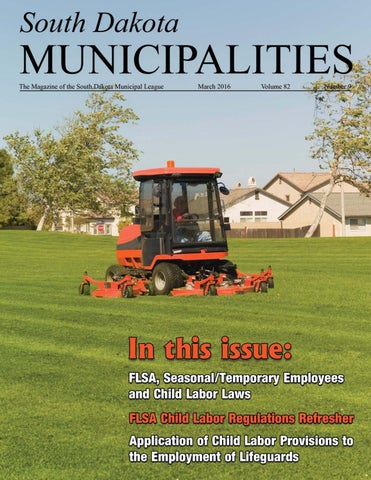
South Dakota MUNICIPALITIES
Newspaper Lines Rate Increase Letter . . . . . . . . . . . .10
Managing Editor: Yvonne A. Taylor
PRESIDENT Meri Jo Anderson Finance Officer, New Underwood 1st VICE PRESIDENT Laurie Gill Mayor, Pierre 2nd VICE PRESIDENT Mike Wendland Mayor, Baltic TRUSTEES Pauline Sumption Finance Officer, Rapid City Greg Jamison Councilmember, Sioux Falls Karl Alberts Finance Officer, Aberdeen Steve Allender, Mayor, Rapid City Anita Lowary Finance Officer, Groton PAST PRESIDENT
Editor: Carrie A. Harer
DISTRICT CHAIRS Dist. 1 - Mike Grosek Mayor, Webster Dist. 2 - Tim Reed Mayor, Brookings Dist. 3 - Amy Nelson City Manager, Yankton Dist. 4 - Debbie Houseman Finance Officer, Lake Andes Dist. 5 - Renae Phinney President, Ree Heights Dist. 6 - Mike Hammrich Councilmember, Ipswich Dist. 7 - Arnold Schott Mayor, McLaughlin Dist. 8 - Harry Weller Mayor, Kadoka Dist. 9 - Carolynn Anderson Finance Officer, Wall Dist. 10 - Fay Bueno Finance Officer, Sturgis
Street Maintenance Association Meeting . . . . . . . . . .12 Code Enforcement Training Conference . . . . . . . . . .13 Police Chiefs & Sheriffs Spring Conference . . . . . . .14 SD Police Chiefs’ Association Scholarship . . . . . . .15 Updates to SDPAA Underwriting and Coverage Documents for 2016 . . . . . . . . . . . . . . . . .16 Finance Officer of the Year Nomination Form . . . . .18 FLSA, Seasonal/Temporary Employees and Child Labor Laws . . . . . . . . . . . . . . .19 FLSA Child Labor Regulations Refresher . . . . . . . . .20 Employment of Lifeguards . . . . . . . . . . . . . . . . . . . .24 Built FOR a Community BY a Community . . . . . . . .28 FAA Registered Nearly 300,000 Unmanned Aircraft . . . . . . . . . . . . . . . . . . . . . . . . . . .29 SDSU Community Development Team . . . . . . . . . . .30 Apply for Innovations in Government Awards . . . . .35 Help for Hoarders . . . . . . . . . . . . . . . . . . . . . . . . . . .36 Five Keys to Setting Water and Sewer Rates . . . . . . .40 Addressing Employee Harassment Complaints . . . . .42
Columns LEAGUE STAFF 1-800-658-3633 Fax: 605-224-8655
Director’s Notes . . . . . . . . . . . . . . . . . . . . . . . . . . . . . . .4
Yvonne Taylor Executive Director Sandi Larson Director of Risk Sharing Services Lori Martinec Director of Research and Training Jeff Mehlhaff Director of Municipal Electric Services Carrie Harer Director of Marketing & Communications Lori Butler Director of Finance Kristi Brakke Accounting Assistant Paula Lind Administrative Coordinator SD Public Assurance Alliance: Judith Payne Executive Director Kristina Peterson Director of Underwriting Ron Burmood Director of Member Services Paytra Nichols Assistant Underwriter Jerry Krambeck Member Services Representative Deb Corkill Executive Assistant
President’s Report . . . . . . . . . . . . . . . . . . . . . . . . . . . .5 Risk-Sharing News . . . . . . . . . . . . . . . . . . . . . . . . . .44 Washington Report: Senator Rounds . . . . . . . . . . . .46
In Every Issue Community Calendar . . . . . . . . . . . . . . . . . . . . . . . . .45 Classifieds . . . . . . . . . . . . . . . . . . . . . . . . . . . . . . . . .50 Directory Changes . . . . . . . . . . . . . . . . . . . . . . . . . . .52 Municipal Calendar . . . . . . . . . . . . . . . . . . . . . . . . . .53
SOUTH DAKOTA MUNICIPALITIES (ISSN 0300-6182, USPS 503-120) is the official publication of the South Dakota Municipal League, published monthly at 208 Island Drive, Ft. Pierre, South Dakota 57532, phone 605-224-8654. This institution is an equal opportunity provider, and employer. Periodical postage paid at Pierre, South Dakota and additional mailing offices. Non-member subscriptions are available for $30.00 annually. The opinions expressed herein are not necessarily those of the South Dakota Municipal League. Postmaster: Send address changes to SOUTH DAKOTA MUNICIPALITIES, 208 Island Drive, Ft. Pierre, South Dakota 57532.
MARCH 2016
VOLUME 82, NUMBER 9
3
Director's Notes The Legislative Session will only have a couple weeks left once you receive this, but believe me, the last days are the LONGEST days. At this writing, we have made good progress on many of the League’s goals, but the final results won’t be in until the 11th. We are looking forward to seeing you all as we visit the District Meeting communities of Milbank, Howard, Elk Point, Colome, Wessington Springs, Faulkton, Herreid, Kadoka, Hill City, and Faith. We find great events and sites in each town we go to, and we really wish this opportunity to “leave the beaten path” were something all of our citizens and visitors could have.
4
Affiliate groups are active this time of year, with meetings scheduled for the Municipal Electric SuperintendentForeman Conference March 1-2; Building Officials ICC Seminar March 29 (Rapid City) and 31 (Sioux Falls); Street Maintenance Association meeting April 13-14; Police Chiefs’ Association and Sheriffs’ Joint Meeting April 20-22; City Management Association Spring Training April 28-29; and Code Enforcement Workshop May 4-5. Plans are also well underway for the annual Finance Officers’ School and Human Resource School. Please go to www.sdmunicipalleague.org for all the dates, agendas, and details so you can get these excellent training opportunities on your calendar. We hope to see many of you at District Meetings, but until then, remember we are always available at 1-800-6583633 or yvonne@sdmunicipalleague.org. Yvonne Taylor Executive Director
SOUTH DAKOTA MUNICIPALITIES
President's Report I am so excited about the upcoming District Meetings and seeing all of you on your home turf! And I can’t wait to hear from each City/Town in attendance to tell us a unique, interesting, or little known fact about their City/Town. So be thinking and ready to deliver some entertaining local knowledge to us. See you later this month! “Men do not differ much about what things they will call evils; They differ enormously about what evils they call excusable.” — G.K. Chesterton (An English writer, lay theologian, poet, philosopher, dramatist, journalist, orator, literary and art critic, biographer, and Christian apologist.) This is one of the quotations hanging on my husband’s workbench. Does make you stop and think doesn’t it? With me it is so many ways to go with the thoughts and of course the events of the day that form those thoughts. We are all human and people, circumstances, and life’s events all direct us. We try to be fair, nonjudgmental, and impartial with the decisions we must make while following the ordinances in place. I said we, but I do realize it is the trustees, council, and commissioners who have to sort through each issue presented and try to find the resolution to this issue. But we, the worker bees, have to carry out the decisions made and try to make it palatable to the citizens.
of you to try to remain impartial with each decision you make, it doesn’t matter the who, it matters the why and how it will affect your community. What you dictate and deliver affects people’s lives. What an awesome responsibility! Thanks to all of you, the public servants, in every office and department, for the service you provide. You are the backbone of your community! Be strong leaders, advisors, and caring guiders, but most important be impartial with each dilemma that comes your way. “Impartiality is a pompous name for indifference, which is an elegant name for ignorance.” — G.K. Chesterton I do not agree with this quote and hope all of you will use impartiality by its true definition: evenhandedness or fairmindedness with the principle of justice to all. There’s that other key for your key chain - IMPARTIALITY! Respectfully, Meri Jo Anderson President
I know this is sounding depressing, but it is not! We must always look at all the reasons given for the decision and realize why they are delivering this motion. I caution all
SD Airports Conference April 6-7, 2016 The Lodge at Deadwood, Deadwood, SD The SD Airports Conference will include a wide variety of topics, presentations to include: Essential Air Service, Increasing Aviation in South Dakota, the Pilot Source Study, UAV Rules and Registration Questions, Based Aircraft Count, Changes at Airports and Military/Civil Aviation Issues. The registration form is available online at www.sdmunicipalleague.org. $45 registration fee. Questions? Call 605-773-4430 or email Jennifer at Jennifer.boehm@state.sd.us. The South Dakota Airport Management Association will meet at 5:15 pm on April 6 during the SD Airports Conference.
MARCH 2016
5
A Tale of Two Senators Compiled by Yvonne Taylor, SDML Executive Director On February 11, the U.S. Senate passed what is called the Customs Act – normally not of much interest to SD municipalities – but a rider was attached to that Act that will repeal a grandfathering clause SD was operating under, meaning your cities and towns will lose $4.3 Million in sales tax revenues, and the State will lose $9.3 Million. While that loss is delayed for 4 years, it will be a loss nevertheless. Your two South Dakota Senators had vastly different opinions of this. Below is the National League of Cities explanation of what happened, with which the SD Municipal League agrees. Following that is Senator Mike Rounds’ opposition to the rider that was added on; and Senator John Thune’s statement regarding this “deal.” Following that is the estimated loss to each of your cities. Please thank Senator Rounds for his support. From NLC: “Let us be clear about what this deal means. This deal would permanently remove local tax policy control on telecommunications services in exchange for mere consideration of the Marketplace Fairness Act, with no guarantee as to the outcome. This is a very bad deal for local governments… Over time, PITFA [Permanent Internet Tax Freedom Act] will essentially exempt an entire, and enormously fastgrowing and prosperous sector of the economy – the telecommunications and cable industries – from state and local taxation. Impacts of this exemption will result in a shift of the tax burden from these industries to other businesses and residents in our communities to recover the tax shortfall.
businesses aren’t at a competitive disadvantage to companies who have no physical presence, employees or investment in states like South Dakota. Brick and mortar stores are the businesses that provide good-paying jobs to South Dakotans, pay local property taxes, sponsor community baseball leagues, send their kids and grandkids to South Dakota schools and invest in the future of our state. We have an opportunity to level the playing field for them – rather than picking winners and losers – so they can continue to be successful and enrich the lives of South Dakotans.” “If the President signs the Customs Conference Report into law – in its current form with ITFA attached to it – municipalities in my home state of South Dakota will lose $4.3 million dollars of revenue annually. That is revenue they rely upon to fund essential services such as training for firefighters and police officers, maintenance for parks, upkeep of community centers and libraries, and repairs to critical roads and bridges. Without any way of recouping that loss – local leaders will be forced to make the tough decision: to cut those important services communities depend upon, or raise other taxes.” Thune Applauds Senate Passage of Bill to Permanently Ban Internet Taxes WASHINGTON — U.S. Sen. John Thune (R-S.D.), chairman of the Senate Republican Conference, delivered remarks at a press conference on Capitol Hill after the Senate passed legislation he authored to permanently ban taxes on Internet access. Thune’s legislation is an example of the Republican-led Senate tackling difficult issues on a bipartisan basis for the benefit of the American people. A detailed listing of the $4.3 Million loss in sales tax revenues is on pages 7 and 8.
At the individual consumer level, poorer, largely rural consumers of plain old telephone services will have to pay higher taxes, while wealthy, largely urban and suburban, consumers escape taxes by moving entirely to broadband.” Rounds Stands Up For South Dakota Businesses on Senate Floor Opposes Customs Conference Report due to Inclusion of the Internet Tax Freedom Act “Conventional wisdom – in this body and elsewhere – has always been that ITFA, which would stop the taxing the cost of internet services, would be paired with MFA [Marketplace Fairness Act] because MFA lets state and local governments recover the losses from ITFA,” said Rounds. “MFA would make certain that main street 6
ARENS ENGINEERING municipal engineering water & wastewater engineering storm drainage - municipal streets Vernon Arens, PE 230 Capitol St. j Yankton, SD j 57078 605-665-2002 j Fax 605-260-2140 arenseng@iw.net
SOUTH DAKOTA MUNICIPALITIES
$4.3 Million General Loss by Municipality Aberdeen Akaska
$219,694.47
Central City
$921.50
$361.76
Chamberlain
$16,940.67
Alcester
$2,516.47
Chancellor
Alexandria
$1,597.60
Clark
Alpena Andover
$2,272.33 $289.17
Arlington Armour
$7,480.51
Garretson
$4,444.29
Gary
$685.41
$5,394.01
Gayville
$600.33
Clear Lake
$6,376.10
Geddes
$735.34
Colman
$2,538.79
Gettysburg
$6,680.20
Colome
$678.41
$3,395.04
Colton
$1,605.57
Artesian
$261.80
Conde
$361.79
Grenville
Ashton
$206.52
Corona
$237.31
Groton
Astoria
$158.74
Corsica
$4,640.28
Harrisburg
Aurora
$782.12
Crooks
$1,937.01
Harrold
Avon
$1,912.59
Custer
$19,253.02
Hartford
$9,438.08
Baltic
$1,885.87
Dallas
$447.51
Hayti
$1,048.74
$32,006.88
Davis
$183.00
Hazel
$139.25
$7,139.20
Hecla
$723.31
Belle Fourche
$758.90
Freeman
Glenham Gregory
$7,641.98 $360.88 $8,412.70 $204.03 $6,736.55 $11,523.82 $830.76
Belvidere
$171.27
Beresford
$10,414.48
Deadwood
$33,145.64
Henry
Big Stone City
$4,784.06
Dell Rapids
$12,464.69
Hermosa
$1,867.55
Bison
$2,177.02
Delmont
$661.97
Herreid
$3,392.69
Blunt
$589.95
Dimock
$385.12
Highmore
$5,718.16
Bonesteel
$985.70
Doland
$832.01
Hill City
$10,100.86
$1,875.09
Dupree
$637.03
Hitchcock
$282.68
Hosmer
$697.72
Bowdle
De Smet
Box Elder
$18,892.05
Eagle Butte
Brandon
$37,846.03
Eden
Brandt Bridgewater
$275.11 $1,329.61
$19,914.69
Hoven
$2,358.56
$345.23
Howard
$5,437.44
Hudson
$1,445.31
$8,977.71
Elkton
$2,424.97
Humboldt
$2,310.80
$166,187.11
Emery
$2,514.10
Hurley
$715.28
Estelline
$2,069.32
Huron
$83,487.90
Britton Bruce
$2,561.69
Hot Springs
$6,015.75
$782.71
$378.35
Egan
$294.42
Elk Point
Bristol Brookings
Edgemont
$5,442.36
$373.09
Bryant
$1,977.47
Ethan
$1,883.41
Interior
$543.68
Buffalo
$2,736.04
Eureka
$4,142.42
Ipswich
$5,598.01
Burke
$3,719.84
Fairfax
$518.41
Irene
$1,338.58
Camp Crook Canistota
$118.88 $2,066.26
Canova
$376.03
Canton
$13,828.73
Carthage Castlewood Cavour Centerville MARCH 2016
$586.99 $1,672.09
Fairview
$44.51
Iroquois
$430.25
Faith
$3,089.35
Isabel
Faulkton
$4,487.89
Java
Flandreau
$8,463.56
Jefferson
$1,634.75
Kadoka
$3,430.99
$15,326.59
Kennebec
$1,306.90
Florence Fort Pierre
$912.42
$1,049.19 $234.15
$441.87
Frankfort
$270.34
Keystone
$8,495.93
$1,849.20
Frederick
$423.49
Kimball
$4,070.43 7
$4.3 Million General Loss by Municipality Tea
$13,900.19
Kranzburg
$338.57
Orient
$221.21
La Bolt
$138.92
Parker
$3,816.45
Timber Lake
$6,508.24
Toronto
$610.27
$256.55
Trent
$172.81 $1,784.24
Lake Andes
$2,018.32
Parkston
Lake Norden
$2,437.98
Peever
Lake Preston
$2,346.91
Philip
$6,508.79
Tripp
Pickstown
$1,278.25
Tulare
$2,174.15
Tyndall
Langford
$873.17
Lead
$9,634.79
Piedmont
Lemmon
$8,358.15
Pierpont
Lennox
$6,821.23
Pierre
Leola
$1,532.84
Plankinton
$2,403.46
Veblen
$209.10 $99,444.85
Utica Valley Springs
$2,884.60
$527.74 $3,968.55 $93.28 $1,408.11 $521.84
Lesterville
$644.33
Platte
$8,917.36
Vermillion
$44,506.54
Letcher
$464.35
Pollock
$1,430.99
Viborg
$3,272.93
Madison
$41,826.25
Presho
$1,930.03
Volga
$5,779.00
Marion
$3,354.34
Pringle
$224.08
Volin
$287.57
Martin
$6,224.32
Pukwana
$498.40
Wagner
McIntosh McLaughlin Mellette Menno
$500.32 $1,725.11 $535.63
Quinn Ramona Rapid City
$75.62 $187.08 $701,673.17
Wakonda Wall
$9,861.05 $993.58 $15,140.89
Wallace
$100.06
Ward
$184.29
$2,691.35
Redfield
$11,702.58
Midland
$949.17
Reliance
$833.64
Warner
Milbank
$28,878.82
Revillo
$242.83
Wasta
Miller
$10,250.70
Roscoe
$1,332.65
Watertown
Mission
$5,937.47
Rosholt
$1,169.38
Waubay
$1,598.51
Mitchell
$145,361.13
Roslyn
$673.69
Webster
$11,084.84
Mobridge
$22,322.77
Saint Lawrence
$603.54
Wentworth
$631.67
$1,039.56 $64.44 $192,950.55
Monroe
$127.57
Salem
$6,123.79
Wessington
$1,061.33
Montrose
$954.74
Scotland
$4,851.44
Wessington Springs
$4,581.40
Selby
$3,397.37
White
$2,010.35
$110.67
White Lake
$1,173.98
$1,474,521.26
White River
$1,919.09
$13,748.36
Whitewood
$3,430.66
Morristown
$89.95
Mound City
$224.32
Sherman
Mount Vernon
$892.78
Sioux Falls
Murdo New Effington New Underwood New Witten
$5,279.22 $529.93 $1,330.91 $121.72
Sisseton South Shore
$265.77
Wilmot
$2,011.39
$305.03
Winner
$20,143.50
Springfield
$2,917.37
Wolsey
$1,612.09
Wood
Spencer
$2,713.03
Nisland
$281.02
Stickney
$1,884.80
$29,725.23
Stratford
$130.00
Sturgis
$40,300.20
$163.30
Woonsocket
$2,594.05
Worthing
$1,890.87
Oacoma
$6,816.07
Oldham
$231.23
Summerset
$5,488.98
Yale
Olivet
$105.38
Summit
$1,549.65
Yankton
Onida
$3,461.85
Tabor
$1,315.72
General Total:
8
$948.23
$96,457.45
Spearfish
Newell North Sioux City
Willow Lake
$269.57 $111,014.73 $4,300,000.00
SOUTH DAKOTA MUNICIPALITIES
Associated School Boards of SD • SD Association of County Commissioners • SD Association of County Officials • Large School Group • SD Municipal League January 21, 2016 Mr. Jeff Holden Commissioner, Bureau of Administration 500 East Capitol Pierre, SD 57501-1234 Dear Commissioner Holden: Please consider this letter, as well as any possible presentations at the January 29, 2016 Rules Hearing as the response of the South Dakota Municipal League, the South Dakota Association of County Commissioners, the SD Association of County Officials, the Associated School Boards of SD, and the Large School Group to the proposed rules numbered §§10:02:02:01 and §§ 10:02:02:02. In short, we object to increasing the costs to taxpayers for state-mandated publications. Counties, municipalities, and schools have long argued that the use of more efficient technology offers local entities better methods to fully inform their citizens, while at the same time saving tax payer money. Those methods include use of websites and e-mailed notices directly to citizens.
10
SOUTH DAKOTA MUNICIPALITIES
At the same time, it has widely been noted that newspaper readership is in a steep decline, and newspapers are becoming an obsolete mechanism for reaching our citizens. To increase the cost to citizens for a less effective method of communication flies in the face of common sense. In addition, we would submit that state statute, specifically § 6-15-1 and § 1-26-4.7, is offended by this proposed increase. § 6-15-1 states, “No state law, rule, or regulation which mandates any county, municipality, or school district to engage in any new activity, to provide any new service, to increase any current level of activity or to provide any service beyond that required by existing law has the force of law unless or until the state provides sufficient new funding or a means of new funding to the county, municipality, or school district to pay the cost of performing the mandated activity or service for the period of time during which the activity or service is required to be performed.” And § 1-26-4.7 states that the interim rules committee may take action when: “(9) The proposed rule may impose more than nominal costs upon a unit of local government or school district when the unit of local government or school district may not have sufficient funding to perform the activity required by the proposed rule.” We argue that the proposed rule constitutes a mandated service beyond that required by existing law and that it imposes more than nominal costs upon units of local government, violating both the letter and the intent of state law. Finally, while the industry continually objects to allowing local entities the savings of more efficient communication with taxpayers, there has been no objection when local entities use technology to submit documents to newspapers, saving the industry the costs of recreating the documents for publication. Our taxpayers saw no reduction in newspaper rates at the time those savings were realized by this government-subsidized industry. For the reasons submitted above, the Associated School Boards of South Dakota, the Large School Group, the South Dakota Association of County Commissioners, the South Dakota Association of County Officials, and the South Dakota Municipal League strongly object to mandating these increased costs to our local taxpayers. Sincerely, SD Municipal League SD Association of County Commissioners SD Association of County Officials Associated School Boards of SD Large School Group
MARCH 2016
11
SD Municipal Street Maintenance Association Spring Meeting April 13-14, 2016 j Crossroads Hotel & Huron Convention Center j Huron, SD Wednesday, April 13
Thursday, April 14
Noon to 1:00 pm Registration
8:00 to 9:00 am Federal Highway Bill Affecting SD Municipalities & SD Bridge Funding Lori Schultz, SD DOT
1:00 to 1:15
Welcome and Business Meeting
1:15 to 2:30
Pavement Maintenance 1.Warm-Mix – Wes Philips & Galynn Huber, Sioux Falls 2.Micro-surfacing – Craig Wagner, Hartford 3.ADA Payment Maintenance – SD LTAP
2:30 to 3:00
Break
3:00 to 3:30
Pavement Management Ratings & IMS Survey Wes Philips & Galynn Huber, Sioux Falls
3:30 to 5:00
Round Table on Your City Street Projects
5:00 to 6:00
Exhibit Area Social
6:00
Banquet
Registration Fee:
9:00 to 9:45
South Dakota Bid Laws & Utilizing MJPA Rod Fortin, SD Legislative Audit
9:45 to 10:30
Supervisor’s Role in Safety & Safety Attitudes Doug Kirkus, Safety Benefits, Inc.
10:30 to 11:00
Break
11:00 to Noon
Round Tables
SDMSMA Member $50 and Non-member $65.
Accommodations: A room block has been reserved at the Crossroads Hotel (605-352-3204) at a rate of $80.99+tax. Be sure to mention SD Municipal Streets Maintenance Association when making reservations. **IMPORTANT: to guarantee this rate your reservation must be made by March 30, 2016.
REGISTRATION Street Maintenance Association Meeting j April 13-14, 2016 Municipality __________________________________________________________________________________ Name
Title
______________________________________________________________________________________________ ______________________________________________________________________________________________ ______________________________________________________________________________________________ Return registration with payment by April 1, 2016 to: No refunds will be given after April 1, 2016. Office Use Only:
Date:________________
SD Municipal Street Maintenance Association 208 Island Drive, Ft. Pierre, SD 57532
Check #:________________
Amount:________________
SD Association of Code Enforcement (SoDACE) Information and Training Conference May 4-5, 2016 j Ramkota Hotel j Pierre, SD Wednesday, May 4 8:30 – 9:00 am Registration 9:00 – 9:15
Welcome – Amphitheatre II
9:15 – 11:45
Foreclosures and Abandonment: Understanding the Mortgage Servicing World, Impacts on and Solutions for Cities Heather Lazar, Safeguard Properties As the numbers of foreclosures within communities across the state continue to mount, elected officials, department leaders, and code enforcement officers are faced with the many negative impacts of property abandonment, which affect both their constituents and neighborhoods.
to do, but are working in systems that are broken, kinked or clogged. This session will help you understand how to straighten the pipes (processes) that are kinked and clogged. You will learn how to improve organizational processes and address the common service delivery challenges we face in local government. 2:30 – 2:45
Break
3:15 – 5:00
It’s Not a People Problem – It’s a Plumbing Problem cont’d
5:30
Social and Dinner and Presentation of the Code Enforcement Officer of the Year Award – Gallery F&G (Nomination Form online at www.sdmunicipalleague.org.)
11:45 – 1:00 pm Lunch – Gallery F&G 1:00 – 1:30
Business Meeting
1:30 – 2:30
It’s Not a People Problem – It’s a Plumbing Problem Greg Carr – Arvada, Colorado How would you like to work 80% faster? The problems we face in government is a capacity problem, not a capability problem. We have good people that know what
Thursday, May 5 9:00 – 10:15 am Active Shooter Training – Amphitheatre II Sgt. Kevin Burke, SD Highway Patrol 10:15 – 10:30
Break
10:30 – Noon
Active Shooter Training cont’d
Registration Fee:
Advance Registration: $50/SoDACE member and $90/non-member. On-site Registration: $60/SoDACE member and $100/non-member.
Accommodations:
A room block has been reserved at the Ramkota Hotel (605-224-6877) at a rate of $89.99+tax. Be sure to mention you are with the Code Enforcement Association. **IMPORTANT: to guarantee this rate your reservation must be made by April 4, 2016.
REGISTRATION SD Code Enforcement Training Conference j May 4-5, 2016 Municipality __________________________________________________________________________________ Name Title Email ______________________________________________________________________________________________ ______________________________________________________________________________________________ Return registration with payment by April 16, 2016 to: No refunds will be given after April 16, 2016. Office Use Only:
Date:________________
South Dakota Association of Code Enforcement 208 Island Drive, Ft. Pierre, SD 57532
Check #:________________
Amount:________________
South Dakota Police Chiefs’ Association South Dakota Sheriffs’ Association Spring Conference April 20 – 22, 2016 j The Lodge at Deadwood j Deadwood, SD Agenda Wednesday, April 20
4:00 p.m.
Marijuana Initiatives Brian Zeeb, SD Division of Criminal Investigation Tony Harrison, Sergeant, Pennington County Sheriff’s Office, Unified Narcotics Enforcement Team
5:00 p.m.
Exhibit Area Social Hour
7 – 8:00 a.m. Conference Registration 7:00 a.m.
Exhibit Area opens
8:00 a.m.
Welcome and Presentation of Colors Rapid City Police Department Honor Guard and Pennington County Sheriff’s Honor Guard
8:15 a.m.
Federal/State Guest Speakers Randy Seiler, SD U.S. Attorney Dan Mosteller, SD U.S. Attorney’s Office Jeffrey Hoover, U.S. Immigration and Customs Enforcement (ICE) Steve Pluta, SD Office of Homeland Security Scott Davis, Department of Homeland Security Denny Kaemingk, Department of Corrections Craig Price, SD Highway Patrol Trevor Jones, Department of Public Safety Brian Gortmaker, Division of Criminal Investigation Mike Waldner, SD BIT, FirstNet and State Radio Chief Jeff Miller, Brookings Police Department
Dinner on your own The Lodge will provide shuttling to and from downtown if you wish. Ask at the Front Desk. Thursday, April 21 8:00 a.m.
Jack Ryan, Public Agency Training Council, Legal & Liability Risk Management Institute
9:30 a.m.
Break in the Vendor Area
10:00 a.m. Jack Ryan continued 12:00 p.m. Lunch 12:30 p.m. Jack Ryan continued
Break in the Vendor Area
3:00 p.m.
Break
10:00 a.m. Officer Driving Safety Kimberly Schlau, Safe Driving Advocate
3:15 p.m.
Jack Ryan continued
5:30 p.m.
Social
6:30 p.m.
Banquet and Awards Presentation
9:45 a.m.
11:00 a.m. Marty Jackley, SD Attorney General 11:10 a.m. Statewide Juvenile Detention Alternatives Initiative (JDAI) Liz Heidelberger, JDAI Coordinator, SD Unified Judicial System
Friday, April 22 8:30 a.m.
Breakfast and Joint Meeting Cassie Lindquist, Adult Services and Aging, Department of Social Services Laurie Morrison, SD Office of Emergency Management, Department of Public Safety
9:30 a.m.
Individual Business Meetings SDSA Meeting SDPCA Meeting
12:00 p.m. Lunch 1:00 p.m.
Training Safety Officer (TSO) Program Rob Boe, Public Safety Training Coordinator, League of Minnesota Cities
2:30 p.m.
Break in the Vendor Area
3:00 p.m.
Generational Differences in the Workplace Jo Vitek, Supervisor of Law Enforcement, Lake Area Tech
Registration can be found at www.sdmunicipalleague.org or call the SD Municipal League office at 800-658-3633. Register by April 1, 2016.
SOUTH DAKOTA POLICE CHIEFS’ ASSOCIATION An Affiliate of the South Dakota Municipal League
Scholarship Application to attend 2016 IACP Conference Name: ______________________________________ Title: _____________________________________ Email Address: _________________________________________________________________________ Mailing address: ________________________________________________________________________ Number of years in law enforcement: _____________ Would your agency budget allow for you to attend this conference without the scholarship? ____________ What is your agency’s budget? ____________________ Have you attended an IACP conference before? ______
Are you currently a member of IACP? _______
What do you hope to gain from your attendance at the IACP Conference? __________________________ _____________________________________________________________________________________ _____________________________________________________________________________________ As part of the scholarship, the winner shall share their experience from the 2016 IACP Conference with the SDPCA membership during the next Annual Spring meeting. Is this something you are willing to do? _____ Estimate of Conference expenses:
___________________ Airfare ___________________ Hotel ___________________ Transportation ___________________ Meals ___________________ Other: ___________________ ___________________ Total
Applicant must be a member of the South Dakota Police Chiefs’ Association in good standing; must have at least five years of SD Law Enforcement experience; must be a current Chief of Police of a city under 10,000 in population; must never have attended IACP before; and must be a member of IACP. A copy of applicant’s City Councils’ approval for the travel must be received with application. SDPCA will pay for roundtrip airfare, lodging for the conference dates only, IACP conference registration fee, transportation (taxi, airport shuttle; not rental car) and meals not included in the conference package. Recipient is responsible for keeping all receipts and submitting them to the SDML for reimbursement following attendance at the IACP conference. All reimbursement costs are subject to SDPCA board approval. Please submit application to the SDML, 208 Island Drive, Ft. Pierre, SD 57532 or fax to 605-224-8655 by March 15, 2016, to be considered for the scholarship. The 2016 IACP Conference is October 15-18 in San Diego, CA and information can be found at: http://www.theiacpconference.org/.
Updates to SDPAA Underwriting and Coverage Documents for 2016 By Kristina Peterson, Director of Underwriting, SDPAA 2016 began with exciting updates for the South Dakota Public Assurance Alliance. We updated our underwriting rating system and rewrote our liability coverage document. With the completion of these developments, we are able to provide SDPAA Members with a more tailored service, simpler renewal process, and broader coverages, all while maintaining SDPAA’s history of stable, competitive rates.
j
with payroll figures of $5,000,000 or less and $25,000 for Members with payroll figures of more than $5,000,000. Replacement of our traditional employee dishonesty coverage with an enhanced crime coverage program which provides a limit of $1,000,000 per occurrence with no aggregate. This broader coverage fulfills the bonding requirements required by state statutes and covers all employees and elected and appointed officials. This coverage is an opt-in coverage.
Highlights of the underwriting rating changes include: General Liability: j Consolidation of general liability and public officials coverages to one coverage. Members purchasing general liability will automatically receive public officials coverage with a default deductible of the current general liability deductible. j Cyber liability is a standard coverage to all Members. This coverage has a $350,000 annual aggregate limit per Member. Deductibles are $10,000 per Member
16
Automobile Liability: j Consolidation of classifications from fourteen to seven. Law Enforcement Liability: j Consolidation of classifications from fourteen to eight. Auto Physical Damage: j Implementation of credit and debit factors based on criteria comprised of the age of the vehicle, valuation amount, and deductibles.
SOUTH DAKOTA MUNICIPALITIES
j
Availability of your Statement of Values, in Excel format, to adjust and return via email.
Property: j Deductibles available for each building location. This change allows for buildings to have a separate deductible versus outdoor property such as light poles or fire hydrants. j Miscellaneous tools and equipment is now called mobile equipment. This is simply a name change and encompasses property in this category to include skidsteers, tractors and sweepers, as well as individual tools and equipment not attached to property or vehicles. j Addition of a Property Valuation Report, which is included in the renewal packet. This report is a snapshot of current valued property and the latest SDPAA valued amount (performed by Safety Benefits, Inc.) for each property. The report includes the location number, occupancy description, building address, current valuation, current building value, building replacement cost established by Safety Benefits, Inc., the year the property was last valuated, and the contents value for each property on your Statement of Values.
MARCH 2016
j
Availability of your Statement of Values, in Excel format, to adjust and return via email.
SDPAA staff worked diligently to update our systems and documents. In turn, our General Liability coverage document was rewritten and an Automobile Liability coverage document was developed. By rewriting and forming these documents, we were able to clear up ambiguities and provide SDPAA Members with documents which are easier to understand and interpret. These documents, the General Liability Memorandum of Coverage and Automobile Liability Memorandum of Coverage, will be included in your 2016 Declarations Packet and will take effect on the effective date of your 2016 coverage term. SDPAA saw many changes in 2015, which have resulted in better coverage, better service, an increase in SDPAA Membership and a great outlook for 2016. We are committed to furthering our efforts and providing exceptional coverages, services and a positive future for you, our SDPAA Member-Owners.
17
FLSA, Seasonal/Temporary Employees and Child Labor Laws It is important to regularly review Fair Labor Standards and Child Labor regulations PRIOR to seasonal hiring. Often we become complacent and continue to do things the way we have always done them. Reminders like this give us an opportunity to verify that we are adhering to the law. In this economy, none of us can afford to make mistakes that cost our communities back wages for overtime. The Fair Labor Standards Act (FLSA) allows for specific exemptions from minimum wage and overtime including administrative, executive and professional exemptions. For purposes of this article, we will assume that most employees hired for seasonal and temporary positions are non-exempt from minimum wage and overtime provisions. This means that these employees will be eligible to receive minimum wage at $8.55 per hour. Seasonal and temporary employees are eligible to receive 1.5 times the hourly wage for all hours worked over 40 in any given workweek as required by FLSA. FLSA DOES include an exemption from minimum wage and overtime for Seasonal Amusement or Recreational Establishments - Section 13(a)(3). Tests for this exemption include: a) does not operate for more than seven months in any calendar year; OR b) during the preceding calendar year, average receipts for any six months of such year were not more that 33 1/3% of its average receipts for the other six months of such year. It would seem apparent that a swimming pool or other facility that is open only for the summer months would qualify for this exemption from overtime and minimum wage provisions of the FLSA. But please note, if
MARCH 2016
seasonal employees who qualify for this exemption perform other jobs for the city, this exemption from overtime may not apply. Also please review the “FLSA Child Labor Regulations Refresher” article on pages 20-23. It is important to consider the duties that employees under age 18 are permitted to perform. With limited resources and limited staff, it becomes essential to understand the law. The majority of the questions that the Municipal League receives are regarding “children” under eighteen years of age (16-17) and if they are allowed to run lawn mowers. In a later article the actual Prohibited Occupations for 16-17 year olds (non-adult) are reviewed. Even though lawn mowers are not specifically mentioned, there are enough related references to this type of work that many cities across South Dakota do not use child labor for these duties. The League discourages cities from doing so but we will leave that to you and your City Attorney to work out. It would also be prudent to review the Child Labor Violation Penalties which is in a later article as well. These laws can be complicated and difficult to sort out. If there are questions, employers are required to follow the law that provides the greatest benefit to the employee. State codified law can be found online at http://legis.sd.gov/statutes/Codified_Laws/ under Title 60 Labor and Employment. The South Dakota Department of Labor staff is also a great resource. You also have access to SDML knowledgeable staff (800-658-3633) and the SD Governmental Human Resource Association.
19
FLSA Child Labor Regulations Refresher Reprinted from the United States Department of Labor Wage and Hour Division website. The information in this article is a snapshot of what is provided via the DOL website. For more details follow visit http://www.dol.gov/ whd/regs/compliance/childlabor101_text.htm.
Minimum Age Standards for Nonagricultural Employment 14 Minimum age for employment in specified occupations outside of school hours for limited periods of time each day and each week.
With summer just around the corner, it may be a good time to have a little refresher course on the Fair Labor Standards Act (FLSA) regarding child labor regulations. Employers may employ youth only under certain conditions and child labor regulations vary significantly depending on the age of the youth.
16 Basic minimum age for employment. At 16 years of age, youth may be employed for unlimited hours in any occupation other than one declared to be hazardous by the Secretary of Labor.
Federal Child Labor Provisions The federal child labor provisions, also known as the child labor laws, are authorized by the Fair Labor Standards Act (FLSA) of 1938. These provisions were enacted to ensure that when young people work, the work is safe and does not jeopardize their health, well-being or educational opportunities. By knowing, understanding, and complying with these provisions, employers, parents, and teachers can help working teens enjoy those safe, positive, early work experiences that can be so important to their development. Other Laws That Impact Child Labor Other federal and state laws may have higher standards. When these apply, the more stringent standard must be observed. All states have child labor provisions, compulsory school attendance laws, and establish the minimum ages and conditions under which youths may operate motor vehicles. Unless otherwise exempt, a covered minor employee is entitled to receive the same minimum wage, overtime, safety and health, and non-discrimination protections as adult workers.
20
18 Minimum age for employment in nonagricultural occupations declared hazardous by the Secretary of Labor. Occupation Standards for 14- and 15-Year-Olds The following list, which is not exhaustive, are jobs that 14- and 15-year-olds may not be employed in: 1. Any manufacturing occupation.1 2. Any mining occupation. 3. Most processing occupations such as filleting of fish, dressing poultry, cracking nuts, developing of photographs, laundering, bulk or mass mailings (except certain occupations expressly permitted as discussed below). 4. Occupations requiring the performance of any duties in workrooms or workplaces where goods are manufactured, mined or otherwise processed (except to the extent expressly permitted as discussed below; and as discussed in footnote 1). 5. Any occupation found and declared to be hazardous by the Secretary of Labor. 6. Occupations involved with the operating, tending, setting up, adjusting, cleaning, oiling or repairing of hoisting apparatus. 7. Work performed in or about boiler or engine rooms or in connection with the maintenance or repair of the establishment, machines, or equipment. 8. Occupations involved with the operating, tending, setting up, adjusting, cleaning, oiling or repairing of any power-driven machinery, including, but not limited to, lawnmowers, golf carts, all-terrain vehicles, trimmers, cutters, weed-eaters, edgers, food slicers, food grinders, food choppers, food processors, food cutters, and food mixers. Fourteen- and 15-yearolds may operate most office machinery and those machines that are expressly permitted. 9. The operation of motor vehicles or service as helpers on such vehicles. 10. The riding on a motor vehicle inside or outside of an enclosed passenger compartment except as permitted in #16 in the next list. 11. Outside window washing that involves working from window sills. SOUTH DAKOTA MUNICIPALITIES
12. All work requiring the use of ladders, scaffolds, or their substitutes. 13. All baking and most cooking activities except as discussed in the following #3. 14. Work in freezers and meat coolers and all work in the processing of meat for sale; however, youth are permitted to occasionally enter freezers only momentarily to retrieve items. 15. Youth peddling, including not only the attempt to make a sale or the actual consummation of a sale, but also the preparatory and concluding tasks normally performed by a youth peddler, such as the loading and unloading of motor vehicles, the stocking and restocking of sales kits and trays, the exchanging of cash and checks with the employer, and the transportation of the minors to where the sales will be made. 16. Loading and unloading of goods or property onto or from motor vehicles, railroad cars, and conveyors, except as discussed in the following #12. 17. Catching and cooping of poultry in preparation for transport or for market. 18. Public messenger service. 19. Occupations in connection with: a. Transportation of persons or property by rail, highway, air, on water, pipeline, or other means. b. Warehousing and storage. c. Communications and public utilities. d. Construction (including repair). Except 14- and 15-year-olds may perform office or sales work in connection with a, b, c, and d above when not performed on transportation media, on an actual means of transportation, or at the actual construction site.
4.
5. 6. 7.
8.
9.
10.
11. The following is the list of jobs the Secretary of Labor has determined will not interfere with the schooling, health, and well-being of 14- and 15-year-olds and therefore MAYBE performed by such youth. Any job not specifically permitted, is prohibited. 1. Office and clerical work, including operation of office machines. 2. Work of an intellectual or artistically creative nature such as but not limited to computer programming, the writing of software, teaching or performing as a tutor, serving as a peer counselor or teacher’s assistant, singing, the playing of a musical instrument, and drawing, as long as such employment complies with all the other provisions contained in §§ 570.33, .34, and .35. 3. Cooking with electric or gas grills that do not involve cooking over an open flame and with deep fat fryers that are equipped with and utilize devices that automatically lower and raise the baskets into and out of the oil or grease. NOTE: this section does not permit cooking with equipment such as rotisseries, MARCH 2016
12.
13.
broilers, pressurized equipment including fryolators, and cooking devices that operate at extremely high temperatures such as “Neico broilers.” Cashiering, selling, modeling, art work, work in advertising departments, window trimming and comparative shopping. Price marking and tagging by hand or by machine. Assembling orders, packing and shelving. Bagging and carrying out customer orders. Errand and delivery work by foot, bicycle, and public transportation. Except such youth may not be employed by a public messenger service. Cleanup work, including the use of vacuum cleaners and floor waxers, and the maintenance of grounds, but not including the use of power-driven mowers, cutters, trimmers, edgers, or similar equipment. Kitchen work and other work involved in preparing and serving food and beverages, including operating machines and devices used in performing such work. Examples of permitted machines and devices include, but are not limited to, dishwashers, toasters, dumbwaiters, popcorn poppers, milk shake blenders, coffee grinders, automatic coffee machines, devices used to maintain the temperature of prepared foods (such as warmers, steam tables, and heat lamps), and microwave ovens that are used only to warm prepared food and do not have the capacity to warm above 140°F. Cleaning kitchen equipment. Minors are permitted to clean kitchen equipment (not otherwise prohibited), remove oil or grease filters, pour oil or grease through filters, and move receptacles containing hot grease or hot oil, but only when the equipment, surfaces, containers and liquids do not exceed a temperature of 100°F. Cleaning vegetables and fruits, and the wrapping, sealing, labeling, weighing, pricing, and stocking of items, including vegetables, fruits, and meats, when performed in areas physically separate from a freezer or meat cooler. Loading onto motor vehicles and the unloading from motor vehicles of the light, non-power-driven, hand tools and personal protective equipment that the minor will use as part of his or her employment at the work site; and the loading onto motor vehicles and the unloading from motor vehicles of personal items such as a back pack, a lunch box, or a coat that the minor is permitted to take to the work site. Such light tools would include, but not be limited to, rakes, hand-held clippers, shovels, and brooms. Such light tools would not include items like trash, sales kits, promotion items or items for sale, lawn mowers, or other power-driven lawn maintenance equipment. Such minors would not be permitted to load or unload safety equipment such as barriers, cones, or signage. The occupation of lifeguard (15-year-olds but not 14year-olds) at traditional swimming pools and water 21
amusement parks (including such water park facilities as wave pools, lazy rivers, specialized activity areas, and baby pools, but not including the elevated areas of water slides) when properly trained and certified in aquatics and water safety by the American Red Cross or a similar certifying organization. No youth under 16 years of age may be employed as a lifeguard at a natural environment such as an ocean side beach, lake, pond, river, quarry, or pier. 14. Employment of certain youth under specified conditions inside and outside of establishments where machinery is used to process wood products. See the DOL link at the beginning of this article for information on this exemption. 15. Work in connection with cars and trucks if confined to the following: j Dispensing gasoline and oil. j Courtesy service on premises of gasoline service station. j Car cleaning, washing, and polishing by hand. j Other occupations permitted by Child Labor Regulation No. 3, but not including work involving the use of pits, racks or lifting apparatus or involving the inflation of any tire mounted on a rim equipped with a removable retaining ring. 16. Work in connection with riding inside passenger compartments of motor vehicles except as prohibited in #10 in the previous list or when a significant reason for the minor being a passenger in the vehicle is for the purpose of performing work in connection with the transporting—or assisting in the transporting of— other persons or property. Each minor riding as a passenger in a motor vehicle must have his or her own seat in the passenger compartment; each seat must be equipped with a seat belt or similar restraining device; and the employer must instruct the minors that such belts or other devices must be used. In addition, each driver transporting the young workers must hold a valid state driver’s license for the type of vehicle being driven and, if the driver is under the age of 18, his or her employment must comply with the provisions of HO 2 (see chart). Employment Standards for 16- and 17-Year-Olds in Nonagricultural Employment The Hazardous Occupations Orders (HOs) for Nonagricultural Employment These Orders are published in Subpart E of Part 570 of Title 29 of the Code of Federal Regulations. The FLSA provides a minimum age of 18 years for any nonagricultural occupations which the Secretary of Labor “shall find and by order declare” to be particularly hazardous for 16- and 17-year-old persons, or detrimental to their health and well-being. This minimum age applies 22
even when the minor is employed by the parent or person standing in place of the parent. The seventeen HOs apply either on an industry basis, specifying the occupations in the industry that are not permitted, or an occupational basis irrespective of the industry in which found. Some of the HOs contain limited exemptions.
HO 1
Manufacturing and storing of explosives.
HO 2
Motor-vehicle driving and outside helper on a motor vehicle.
HO 3
Coal mining.
HO 4
Occupations in forest fire fighting, forest fire prevention, timber tract operations, forestry service, logging, and sawmilling.
HO 5*
Power-driven woodworking machines.
HO 6
Exposure to radioactive substances.
HO 7
Power-driven hoisting apparatus, including forklifts.
HO 8*
Power-driven metal-forming, punching, and shearing machines.
HO 9
Mining, other than coal mining.
Operating power-driven meat processing equipment, including meat slicers and other food slicers, in retail establishments (such as HO 10* grocery stores, restaurants kitchens and delis) and wholesale establishments, and most occupations in meat and poultry slaughtering, packing, processing, or rendering. HO 11
Power-driven bakery machines including vertical dough or batter mixers.
HO 12*
Power-driven balers, compactors, and paper processing machines.
HO 13
Manufacturing bricks, tile, and kindred products.
Power-driven circular saws, bandsaws, chain HO 14* saws, guillotine shears, wood chippers, and abrasive cutting discs. HO 15
Wrecking, demolition, and shipbreaking operations.
HO 16*
Roofing operations and all work on or about a roof.
HO 17* Excavation operations. * These HOs provide limited exemptions for 16- and 17-yearolds who are bona-fide student-learners and apprentices.
SOUTH DAKOTA MUNICIPALITIES
Enforcement of the Federal Child Labor Provisions The Wage and Hour Division, which is part of the Department of Labor, administers and enforces the child labor, minimum wage, overtime and recordkeeping provisions of the Fair Labor Standards Act. The Wage and Hour Division also has enforcement responsibility for programs covering such things as prevailing wages for government contracts, the payment of special minimum wages, farm labor, family and medical leave, immigration and polygraph testing. Wage and Hour Division Investigators, who are stationed across the United States, are authorized to conduct investigations and gather data on wages, hours of work, and compliance with all the provisions of the FLSA, including the child labor provisions. Penalties for Violation Civil Money Penalties Employers may be subject to a civil money penalty of up to $11,000 for each employee who is the subject of a child labor violation. The penalty may be increased to $50,000 for each violation that causes the death or serious injury of a minor, and that penalty may be doubled when the violations are determined to be repeated or willful. When a civil money penalty is assessed against an employer for a child labor violation, the employer has the right, within 15 days after receipt of the notice of such penalty, to file an exception to the determination that the violation or violations occurred. When such an exception is filed with the office making the assessment, the matter is referred to the Chief Administrative Law Judge, and a formal hearing is scheduled. At such a hearing, the employer may, or an attorney retained by the employer may, present such witnesses, introduce such evidence and establish such facts as the employer believes will support the exception. The determination of the amount of any civil money penalty becomes final if no exception is taken to the administrative assessment thereof, or if no exception is filed pursuant to the decision and order of the administrative law judge.
MARCH 2016
Injunction to Compel Compliance The FLSA authorizes the Department of Labor to seek injunctions against violators of the child labor provisions to compel their compliance with the law. Further violations could result in sanctions against such persons for contempt of court. Criminal Sanctions The FLSA also provides, in the case of a willful violation, for a fine up to $10,000; or, for a second offense committed after the conviction of such person for a similar offense, for a fine of not more than $10,000 or imprisonment for not more than 6 months, or both. Additional Information For information about the federal child labor requirements, visit the YouthRules! at http://www.youthrules.dol.gov. Inquiries about the Fair Labor Standards Act or any other law administered by the Wage and Hour Division may be addressed to any local office of the Wage and Hour Division. Additional information is available at http://www.dol.gov/ whd/index.htm. Locate the Wage and Hour Division office nearest to you, telephone the toll-free information and helpline at 1-8664US-WAGE (1-866-487-9243): a customer service representative is available to assist you with referral information from 8am to 5pm in your own time zone; or log onto the nationwide listing of Wage-Hour District Offices located at: http://www.dol.gov/whd/america2.htm. Notes 1. Section 13(c)(7) of the FLSA, enacted in 2004, permits the employment of certain minors between the ages of 14 and 18, who have been excused from compulsory school attendance, inside and outside of places of business where machinery is used to process wood products. This provision, however, does not permit such minors to operate, or assist in the operation of power-driven woodworking machines.
23
Application of the Federal Child Labor Provisions to the Employment of Lifeguards Fact Sheet # 60: Application of the Federal Child Labor Provisions of the Fair Labor Standards Act (FLSA) to the Employment of Lifeguards
18 years of age Once a minor reaches 18 years of age, the federal child labor provisions no longer apply to their employment.
The Fair Labor Standards Act (FLSA), administered by the U.S. Department of Labor’s Wage and Hour Division (WHD), requires that most employees be paid at least the applicable federal minimum wage and overtime pay for all hours worked at time and one-half the regular rate of pay after 40 hours in a workweek. The FLSA also includes child labor and recordkeeping provisions. While some seasonal and recreational establishments such as outdoor swimming pools may be exempt from the minimum wage and overtime requirements of the FLSA if they meet certain tests, this exemption does not apply to the child labor or record keeping provisions of the FLSA.
16 and 17 years of age Sixteen and 17-year-olds employed as lifeguards may perform any nonhazardous job, for unlimited hours. The Secretary of Labor has declared 17 Hazardous Occupations Orders (HOs) which restrict the types of jobs and/or industries in which youth under 18 years of age may be employed. Not exhaustive, the following list represents some common tasks which occur at establishments that employ lifeguards. Under the federal child labor provisions, workers under 18 years of age generally may not: j Operate or assist to operate, clean, oil, set up, adjust, or repair certain power-driven woodworking, metalworking, bakery, meat processing, and paper products machinery including meat slicers, compactors, balers, mixers, and saws. j Drive or serve as an outside-helper on a motor vehicle on a public road; but 17-year-olds who meet certain
Child labor Provisions of the FLSA The federal child labor provisions were enacted to protect the educational opportunities of minors and prohibit their employment in jobs and under conditions detrimental to their health or well-being.
24
SOUTH DAKOTA MUNICIPALITIES
j
j
specific requirements may drive automobiles and trucks that do not exceed 6,000 pounds gross vehicle weight for limited amounts of time during daylight hours as part of their job (see Fact Sheet #34). Operate power-driven hoists such as elevators, cranes, derricks, and high-lift trucks. However, 16- and 17-yearolds may operate and assist in the operation of most water amusement park and recreation establishment rides. Load, operate, or unload power-driven balers and compactors used in the disposal of waste. A limited exemption exists that permits the loading, but not the operating or unloading, of certain scrap paper balers and paper box compactors under certain specific conditions (see Fact Sheet #57).
14 and 15 years of age Fifteen-year-olds, but not youth less than 15 years of age, may be employed as lifeguards at traditional swimming pools and most facilities of water amusement parks. Such employment must meet the following conditions: j The 15-year-old must be trained and certified by the American Red Cross, or a similar certifying organization, in aquatics and water safety; and j The 15-year-old must be employed in compliance with all the other applicable provisions of the federal child labor rules contained in Child Labor Regulations No. 3 (see Subpart C of 29 CFR Part 570), including the
MARCH 2016
j
restrictions on the hours and times of day that 15-yearolds may be employed as discussed below; and The federal child labor rules require that 15-year-olds who are employed to teach or assist in teaching others how to swim must also be certified as swimming instructors by the American Red Cross or some other similar certifying agency.
The occupation of lifeguard, as per 29 C.F.R. § 570.34(l), encompasses the duties of rescuing swimmers in danger of drowning, the monitoring of activities at a swimming pool to prevent accidents, the teaching of water safety, and providing assistance to patrons. Lifeguards may also help to maintain order and cleanliness in the pool and pool areas, conduct or officiate at swimming meets, and administer first aid. Additional ancillary lifeguard duties may include checking in and out such items as towels, rings, watches and apparel. Properly certified 15-year-old lifeguards are also permitted to use a ladder to access and descend from the lifeguard chair; use hand tools to clean the pool and pool area; and test and record water quality for temperature and/or pH levels, using all of the tools of the testing process including adding chemicals to the test water sample. Such youth would, however, be prohibited from entering or working in any chemical storage areas, including any areas where the filtration and chlorinating systems are housed.
25
As mentioned, a core and defining duty of a lifeguard is the rescuing of swimmers in danger of drowning, often by entering the water and physically bringing the swimmer to safety. Under 29 C.F.R. § 570.34(l), any employee under the age of 16 whose duties include this core duty—such as a “junior lifeguard” or a “swim-teacher aide”—or whose employment could place him or her in a situation where the employer would reasonably expect him or her to perform such rescue duties, would be performing the duties of a lifeguard while working in such a position. For such employment to comply with these child labor provisions, the employee would have to be at least 15 years of age and possess the proper certification.
equipment and may not assist the public as they enter, “ride,” and leave water-park or amusement-park-type rides. Thus, minors under 16, even if properly certified as lifeguards, may not be employed as dispatchers, attendants, or slide monitors at the top of elevated water slides. Fifteen-year-olds who are properly certified may be employed as lifeguards stationed at the splashdown pools located at the bottom of elevated water slides.
A traditional swimming pool means a water tight structure of concrete, masonry, or other approved materials located either indoors or outdoors, used for bathing or swimming and filled with a filtered and disinfected water supply, together with buildings, appurtenances and equipment used in connection therewith. A water amusement park means a facility that not only encompasses the features of a traditional swimming pool, but also includes such additional attractions as wave pools, lazy rivers, activities areas and elevated water sides.
Hours Limitations The employment of 14- and 15-year-olds, including those 15-year-olds employed as lifeguards, is generally limited to: j Outside of school hours; j 3 hours on a school day, including Fridays; j 8 hours on a nonschool day; j 18 hours in a week that school is in session; j 40 hours in a week that school is not in session.
Properly certified 15-year-olds may be employed as lifeguards at water amusement park wave pools, lazy rivers, and activities areas, but not at the top of elevated water slides. Generally, all youth under 16 years of age are prohibited from operating or tending power-driven
26
Youth under 16 years of age may not be employed as lifeguards at natural environment facilities such as rivers, streams, lakes, ponds, quarries, reservoirs, wharfs, piers, or ocean-side beaches.
Also, such youth may not work before 7 a.m. or after 7 p.m. (except from June 1 through Labor Day when the evening limit is extended to 9 p.m.). Occupations Limitations Fourteen- and 15-year-olds, including properly certified 15year-olds who are employed as lifeguards, may not be
SOUTH DAKOTA MUNICIPALITIES
employed in the following occupations that are often found at establishments that have traditional swimming pools: j Work involving the operation or tending of any powerdriven machinery and hoists (except office machinery). This prohibition includes work involving most amusement park and recreation establishment rides – including dispatchers on elevated water slides – and power-driven lawn mowers and trimmers. j All baking and most cooking. These minors may perform cooking with electric and gas grilles that does not involve cooking with open flames. They may also cook with deep fryers that are equipped with and utilize devices that automatically lower and raise the fryer baskets into and out of the hot oil or grease. They may not operate NEICO broilers, pressure cookers, ovens or rotisseries. j The cleaning of cooking equipment and the filtering, transporting, and disposing of hot oil and grease when the surfaces or hot oil or grease exceed 100° F. j All work in construction, including demolition and repair. j All work involving the use of ladders or scaffolding, except properly certified 15-year-old lifeguards may use a ladder to access and descend from the lifeguard chair. j All work in freezers, but they may enter freezers equipped with safety latches, for brief periods of time, to retrieve items. 13 years of age and younger Youth under 14 years of age are generally not allowed to work in nonagricultural occupations. However, the FLSA does allow a parent who is the sole-owner of a business to employ his or her child in any occupations other than mining, manufacturing or those declared to be hazardous by the Secretary of Labor. Where to Obtain Additional Information For more information on the FLSA child labor provisions, including a complete list of all hazardous occupation orders, visit the YouthRules! Web site at www.youthrules.gov. For additional information on the Fair Labor Standards Act, visit the Wage and Hour Division Web site: http://www.dol.gov/whd/ and/or call our toll-free information and helpline, available 8 a.m. to 5 p.m. in your time zone, 1-866-4USWAGE (1-866-487-9243). When state child labor laws differ from the federal provisions, an employer must comply with the higher standard. Links to your state labor department can be found at http://www.dol.gov/whd/contacts/state_of.htm. This publication is for general information and is not to be considered in the same light as official statements of position contained in the regulations. Reprinted from http://www.dol.gov/whd/regs/compliance/ whdfs60.pdf. MARCH 2016
27
Built FOR a Community BY a Community The Pointe Golf & Event Center located in Elk Point became a reality in 2013 through the work of nearly 200 volunteers who donated over 6,500 hours of labor toward the building’s construction. Community members provided nearly all the labor to tear down the original country club building and also did tile, plumbing and electrical work. The Pointe features an event center, meeting room and lounge. The event center seats up to 350 people and can open up into the lounge for seating up to 450 people. It has become popular for area weddings and graduations. A spacious kitchen is onsite to assist with catering for any event. The Kalstad room is perfect for meetings, showers and birthday parties; it seats 25-30 people. The Nifty Nine Lounge has a unique restaurant that specializes in flat
28
breads and burgers. It can hold up to 75 people and also serves as the clubhouse for the golf course. The patio outside the lounge is a great spot for golfers and non-golfers to hang out and enjoy the view of the golf course. The golf course features nine holes on a meticulouslygroomed, mature course. Towering ash and elm trees provide the perfect setting for outdoor weddings. The SDML District 3 meeting will be held at the Pointe Golf & Event Center on Thursday, March 17, 2016. Please plan to attend and see this beautiful new facility. Courtesy of the Southern Union County Leader-Courier.
SOUTH DAKOTA MUNICIPALITIES
FAA Registered Nearly 300,000 Unmanned Aircraft Nearly 300,000 owners have registered their small unmanned aircraft in the first 30 days after the Federal Aviation Administration’s (FAA) online registration system went live. Owners who registered in the first month received a refund for the $5 application fee. “I am pleased the public responded to our call to register,” said U.S. Transportation Secretary Anthony Foxx. “The National Airspace System is a great resource and all users of it, including UAS users, are responsible for keeping it safe.” The agency continues to see a steady stream of daily registrations. While the refund period has expired, the fee will still cover all the small unmanned aircraft that owners intend to use exclusively for recreational or hobby purposes. “The registration numbers we’re seeing so far are very encouraging,” said FAA Administrator Michael Huerta. “We’re working hard to build on this early momentum and ensure everyone understands the registration requirement.” The FAA’s registration rule, which took effect on December 21, 2015, applies to small unmanned aircraft that weigh between 0.55 lbs. and 55 lbs. Owners of these aircraft must
MARCH 2016
register before they fly outdoors. People who operated their small unmanned aircraft before December 21 must register by February 19, 2016. The current online system is only available for owners who intend to use their small unmanned aircraft exclusively for recreational or hobby purposes. The FAA is working to make the online registration system available for non-model aircraft users – such as commercial operators – by March 21. Registration is simple and is done online. Once the owner enters the required information – complete name, mailing address, physical address, and email address – they receive a registration number and certificate that they can print out. The certificate includes the registration number that must be marked on all aircraft that meet the registration requirement. Registration is valid for three years. In addition to being an education opportunity, registration helps new flyers become part of the safety culture that has been deeply embedded in traditional aviation for more than a century, while still allowing for the recreation and innovation that are staples of American aviation. To register, go to www.faa.gov/uas/registration.
29
SDSU Community Development Team In October of 2011 SDSU Extension launched a new organization and within this new structure the Community Development Team for SDSU Extension was born. This new system was implemented due to financial reasons along with the need to provide innovative and progressive outreach services. Oh sure there have been some growing pains, however, during the past five years, the Community Development Team, has done a great job of providing new and progressive programs. Below are a few of the programs the Community Development Team offers: Marketing Hometown America j This program empowers communities to create a vision to grow. Designed as a tool to create dialogue that moves toward action, it can be the spark to help a rural community look at itself in a new way. Small Business Beginnings j SDSU Extension has developed a series of tools designed to provide technical assistance to early stage entrepreneurs, start-up businesses and existing small firms. These tools assist business owners in determining the feasibility of a proposed business venture and creating a solid business plan to support it.
30
Board Development: Elected and Appointed Services j The Community Development Team uses what is called situational leadership program design to analyze the situation that the board is in and determine what training might be appropriate. The program can be tailored to meet your specific board development needs. The content varies depending on the analysis of the individual board. Growing Leaders SD j This is a one day leadership development workshop that focuses on building your individual leadership and learning how to apply those skills in group settings. Developing leaders to strengthen our South Dakota communities. The team also offers programing in strategic planning, facilitation, ripple mapping, Stronger Economies Together (SET), Sustainable Local Foods and a grant writing conference, (you will read more regarding the conference later in this article). There are five team members that cover the state of South Dakota. There are Community Development Field Specialists located in Lemmon, Mitchell, Martin and Rapid City and one Program Director located on campus
SOUTH DAKOTA MUNICIPALITIES
in Brookings. (Extension is looking to fill a Community Development Field Specialist position in Aberdeen.) You can find out more about the SDSU Extension Community Development Team and review their programs offered at http://igrow.org/, click on the Community Development tab. Here are some examples of the success the SDSU Community Development Team had during 2015. SDSU Extension Receives Funding to Launch Dakota Fresh Food Hub In October of 2015 Secretary of Agriculture Tom Vilsack announced recipients of USDA grants to strengthen local food systems across the nation in an effort to revitalize rural economies and communities. SDSU Extension was chosen to receive a 2-year Local Foods Promotion Program Implementation grant, funded through USDA’s Ag Marketing Service. The grant will assist the newly organized Dakota Fresh food hub in their early stages of marketing and sales. Throughout 2015, over 25 local food producers in southeastern South Dakota have been meeting to plan for the hub, which will allow them to aggregate and market products to larger venues such as restaurants and
MARCH 2016
institutions in the region. Using a 1-year planning grant from USDA’s Ag Marketing Service, SDSU Extension was able to draw in the producers, assist them in strategic planning processes, and lead a field trip to visit Midwestern food hubs in Wisconsin and Illinois. In July the group hosted area chefs at four “Meet the Farmer” receptions in the region. Dakota Fresh has developed into a producer-owned LLC, which will seek membership from no more than 25 producers in the region. The LLFP Implementation grant will assist the group in completing the following objectives: j Obtain commitments from up to 25 farmers as members in Dakota Fresh. j File paperwork necessary to obtain LLC status in South Dakota. j Build a website and extended marketing campaign. j Hire a part-time manager to lead marketing and distribution efforts. j Select and equip a small warehouse site for aggregation of products. j Lease a delivery vehicle for transportation to markets. j Certify producer-members in food and farm safety plans.
31
j j j j
class started) Encourage the city council to form a housing development board Community beautification and clean-up Seek business development opportunities beyond retail Deliver gift bags to new residents while caroling at Christmas
The community spirit at the action forum was energizing. The Mt. Vernon residents involved in Marketing Hometown America are excited about the future of Mt. Vernon, SD. Chef Dustin Allen, Edge Restaurant, Peoria, IL creating a hors d’oeuvre from local produce at reception held in Brookings. Photo by O’Neill. The LLFP Implementation grant comes at a critical time in building South Dakota’s local food system. Consumers not only want to eat fresh, high quality foods, but they are more interested in ever in knowing where and how their food was produced. Building strong relationships between eaters and producers can benefit everyone, and boost local economies. Dakota Fresh looks forward to providing new markets that will offer incentives to new young farmers, as well as boosting production for established local foods producers. Marketing Hometown America In 2015, Mt. Vernon, successfully used Marketing Hometown America in their community to identify several areas that will improve its ability to attract new residents. A few of the action items from the process include: j Develop a better communication strategy to increase community involvement j Enhance existing community events and create new opportunities. (There is already a new women’s exercise
32
Small Business is Everybody’s Business On Friday, April 24, 2015, the community development team hosted the “Small Business is Everybody’s Business” conference at six locations (DeSmet, Faith, Gregory, Irene, Tri-Valley and Wall) across the state via DDN. Over 60 community members learned about the importance of developing an “entrepreneur friendly” environment as they listened to speakers Craig Schroeder, Center for Rural Entrepreneurship; and Dell Gines, Senior Community Development Advisor, Federal Reserve Bank of Kansas City share their experiences. Participants also listened to a local panel at each site and participated in community discussions at each site. The conference was very well received. Energy Development Conference Held in Belle Fourche What are the impacts of uranium, oil and gas energy development on communities within energy development regions? That was the focus of a one-day conference held in Belle Fourche, SD on February 11, 2015. The event was coordinated by SDSU Extension’s community development specialists and was attended by community leaders, government and school officials and other stakeholders living in energy development regions.
SOUTH DAKOTA MUNICIPALITIES
and meetings have been held in Philip, Kadoka, Interior, Midland and Wall to accommodate the residents of this region that covers over 5,000 square miles. More than 40 local leaders and residents participated in the educational sessions. Participants have invested countless hours in discussions and strategic plan development.
Dr. Steve Willard, Superintendent of Schools in Belle Fourche, speaks at the Community Impacts of Energy Development Conference on February 11, 2015. The conference theme focused on the Community Impacts of Energy Development. Topics included discussions on the positive and negative impacts of energy development, resources available to assist communities impacted, the pitfalls and how to overcome them, and how to work with the industry. The goal was to provide an opportunity for participants to understand successes and failures of communities impacted by boom/bust energy development and to learn about the resources that can help communities. Writing Your Future Grant Conference The Writing Your Future Grant Conference was a huge success! We had over 50 registrations for the June 3, 2015, event in Huron, SD. The attendees, speakers, presenters and panelists all contributed to a day of networking, skill building and resource sharing. We say, “SDSU Extension Community Development is your resource for tips, tools, and ideas to help your community achieve its goals.” We achieved that goal on Wednesday, June 3 in Huron. We will continue to work on behalf of SD communities. We are part of the outreach arm of South Dakota State University, which is supported by you, residents of South Dakota. It is our mission to work on your behalf. We also truly appreciate our sponsors for helping us keep the cost down on such an excellent event: The Wellmark Foundation, NorthWestern Energy, The Greater Huron Development Corporation and USDA/NIFA.
Early in the SET process, the group was able to select a Regional Vision “The Badlands/Bad River region is an area of potential growth in agriculturally based businesses, natural resources, and small businesses utilizing modern technology. Our hard working people and opportunities for continuing education maintain our small town atmosphere and Constitutional freedoms.” The plan focuses on two main goals with many strategies listed to reach those goals. The first goal will develop brand recognition by those living within and outside the region. “By Spring 2015, The Badlands/Bad River Region brand will be recognized by entities and individuals throughout the region, as shown by increased use and support.” While this did not happen by the deadline of spring 2015, the group is working to make it happen yet this year. The residents also wanted to develop a strong economic base and grow the business opportunities in the region which lead to the development of the second goal. “Establish a business development support network and complete resource base for entrepreneurs to create 10 new businesses and retain or expand 95% of existing businesses by January 2024.” A long range strategy is to develop a regional business incubator to provide a place for new businesses to start and for new and existing businesses to find and share resources. When the Badlands/Bad River Region was notified in February 2015 that their plan had been designated as a High Quality Plan, participants became re-energized and motivated to focus on the goals. Efforts continue to be made to get more people involved. Presentations showcasing the
Stronger Economies Together – Badlands/Bad River Region The Badlands/Bad River Region was formed in 2012 for the purpose of participating in the third round of Stronger Economies Together (SET) and in November 2012, their first session was held in Philip, SD. Since then, sessions MARCH 2016
33
Del Bartels, Dave Hahn, Peggy Schlechter, Eric Leonard, Mary Burnett, Jody Bielmaier, Kari O’Neill and Christine Sorenson proudly display the plaque received for the High Quality Plan designation.
plan have been made to more members of local chambers and economic development groups. Participants are inviting others to get involved and bringing them along to meetings. One of the first strategies of the second goal was met when the community of Wall hosted the conference, “Small Business is Everybody’s Business.” Participants listened to and interacted with speakers Dell Gines, Senior Community Development Advisor with the Federal Reserve Bank and Craig Schroeder, Senior Fellow for Youth Engagement with the Center for Rural Entrepreneurship. Participants also interacted with members of a local panel that included a loan officer/small business owner, a mayor/ telecommunications representative, a representative of USDA Rural Development and a representative of the Small Business Development Center. The panel discussion focused on promoting and supporting small business in your community. With the High Quality Plan designation, the region gained access to $5,000 in seed money to start carrying out the plan. The $5,000 was used to leverage funds when
34
Dawn Hilgenkamp facilitates the panel discussion during the “Small Business is Everybody’s Business” conference. Participating in the panel were Marcella Hurley, Small Business Development Center; Kent Jordan, loan office and owner of a local grocery store; Hetti Cekalla, USDA Rural Development; and Marty Huether, Wall Mayor and Manager at Golden West Technologies. an application was submitted to the South Dakota Community Foundation for a $10,000 Community Innovation Grant to support the region in moving forward with both goals. On April 20, 2015, the group was notified that the grant was approved and the region would receive a check for $10,000. With $15,000 now available to continue working on the goals, participants became serious about strategies to carry out the plan. Originally it was decided to take a break throughout the summer months because the Badlands/Bad River Region is in a high tourism area; however the new funding motivated participants to keep moving forward. For more help, contact Paul Thares Community Development Field Specialist at the SDSU Extension Lemmon Regional office at paul.thares@sdstate.edu or 605374-4177. You can also check out the SDSU Extension Community Development Team at http://igrow.org/.
SOUTH DAKOTA MUNICIPALITIES
Apply Now for the Innovations in American Government Awards
Bullet-Proofing Your RFPs: A Survival Guide for Practitioners
Applications are now being accepted for the $100,000 Innovations in American Government Awards.
A Workshop for Cities, States, Universities and Related Professional Associations
Offered by Harvard Kennedy School’s Ash Center for Democratic Governance and Innovation, the Innovations Award is the nation’s premier award for the public sector. It recognizes programs that demonstrate creative and effective government at its best.
Friday, April 22, 2016 8:30 am. Registration & Continental Breakfast 9:00 am. to 4:00 pm. Workshop University of South Dakota, Vermillion, SD
All units of government – federal, state, local, tribal, and territorial – from all policy areas are eligible to apply for recognition. This year, the Ash Center is also once again offering the Roy and Lila Ash Innovations Award for Public Engagement in Government, a special Innovations Award that will recognize government-led programs that demonstrate novel and effective approaches to increasing public engagement and participation in the governance of towns, cities, states, and the nation. The winners of the Innovations in American Government Award and the Roy and Lila Ash Award will each receive a $100,000 grant to support replication and dissemination activities in 2017. Top finalists will also receive monetary grants. Applications and additional information are available at www.innovationsaward.harvard.edu. Applications are due on April 15, 2016.
MARCH 2016
Presentation Learning Objectives j Best practices from more than 60 jurisdictions j When to use an RFP j Worldwide trend to fair, open and transparent procurement j Choices in Selecting an Evaluation Methodology j Best practices for each step in the RFP Process About This Workshop Creating effective, problem free RFPs (Request for Proposal) is difficult! Learning about best RFP practices and how to reduce risks is easy! We are thrilled to invite you to join Michael Asner, one of North America’s leading experts and authors on the RFP process, to a full day workshop where you learn how to get it right! Michael’s coming to Vermillion and this workshop, being offered at a reduced rate, will raise money for the SD Shakespeare Festival. This presentation is focused on the entire RFP process, from inception to closing the file, thus will appeal to both the novice and experienced practitioner. For complete details and registration form visit the Other Events section at www.sdmunicipalleague.org.
35
Help for Hoarders Why a response team is more effective and less expensive for towns than more traditional responses By Elizabeth Wade, Community Liaison, Mental Health Association in New Jersey, and David Buzby, Atlantic County Fire Marshal Officials in towns and cities across the country face the same challenge: how to manage the neighbor or renter who has accumulated too much stuff. Hoarders live among precarious towers of unused possessions that create increasingly dangerous situations for them and their neighbors. Hoarding is certainly not new, but recently there is more public awareness of the disorder thanks to popular TV depictions. The term “hoarding” is being replaced with the less-stigmatizing term “finder/keeper.” There’s also been a shift in the way communities respond to hoarding situations. The concept, based on a task force or alliance model, has been successfully duplicated in parts of many states, including the first, which started in Virginia in 1998. Among other states with utilizing this model are
36
Massachusetts, California, Delaware, Pennsylvania, Arizona, Minnesota, and Connecticut, among others. Tragic stories of injury or death sometimes prompt the change; in other cases a human service worker is touched by someone’s sad circumstances. New Jersey is joining the growing list of states that have adopted community-based collaborations. The model unites officials from multiple disciplines, such as firefighting, public health, code enforcement, housing providers, and social workers to affect positive change. Often animal welfare is included as well. “There are not many mental health issues that require a collaboration or coordination of efforts like this,” said Robert Kley of the Mental Health Association in New Jersey (MHANJ), which is introducing evidence based techniques designed to assist Finders/Keepers. “But certainly this qualifies as one of them.” In an alliance such as this, members typically meet quarterly to problem solve cases as a group.
SOUTH DAKOTA MUNICIPALITIES
“Recently, I was working with a tenant who had about 16 clean take out boxes stacked on her stove,” recalled Charlie Miller, Brigantine Rental Inspector. “And she was very stressed about cleaning a three foot path for egresses to at least one window in every room.” Since his participation in a hoarding conference, his understanding of the disorder has improved. He uses a non-punitive, judgement-free approach to break down the overwhelming task into prioritized, smaller jobs. “People look frustrated and stressed,” says Miller. “But, the approach you take makes a difference.” When Miller returned to re-inspect, he said she’d complied and even worked ahead on other rooms, which she was proud to show him. He also provided her with information about a local support group. Support Groups In these groups, a mental health professional works with the Finder/Keepers on ways to reduce clutter, learn to sort and discard, develop organizational skills, and understand their own complex behavior. In contrast, the outdated approach of systematically throwing away the possessions typically fails, with hoards returning in 18 months. Not only was the clean out costly and ineffective, it was also a damaging experience for the individual, who would develop mistrust and resentment. Research shows that taking a more compassionate approach provides cost savings to cities and municipalities. One state reported that the cost of case management for working with one client over a two year period was $1,800 in contrast to the cost of eviction which can reach $10,000 or more.
“We know this is something that demands and requires attention,” said Kley. “Looking ahead to population projections, this issue is expected to become more complicated. The number of Americans age 65 and over will double in number by 2050. This behavior peaks at age 50.” Individuals with a tendency to live in clutter do not generally seek help. Though some recognize their behavior as problematic; others do not. Stigma, fear of punishment and the stress of letting go of possessions prevents most from taking steps to change their behavior. In general, a tenant or renter in need of help is more likely to be identified and referred for help. The problem is more likely to begin to affect others, and a call for assistance is made due to concerns about mold, mildew, dust, rodents, insects, odor or air quality. In the case of homeowners, the behavior is more easily concealed and can become extreme. Local municipalities often have codes that address issues outside the house, but do little to affect conditions inside. Emergency Response When a municipal worker enters a home in response to a 9-1-1 call, there is an opportunity to help. If a first responder observes blocked egresses, unsanitary conditions, or a child living in an unsafe environment, those concerns can be shared with a variety of social supports, such as Child or Adult Protective Services, among others. Firefighters face additional challenges at Finder/Keeper properties. The fire load, or the higher weight of the dwelling’s contents, puts the building at a higher risk for
Peer-Led Hoarding Response Teams comprised of individuals who have first-hand, lived experience with accumulating and collecting are currently in the development phase. A member of the alliance would be able to refer a Finder/Keeper to the team and help provide support for another Finder/Keeper. Agencies like MHANJ often secure grants to cover the cost for this type of support, which can be required for months or years. A peer response team can be helpful to homeowners as well as renters. Many states have collected data on tenants that reveal very high success rates. When tenants accept help, the overwhelming majority come into compliance and maintains their housing, which creates stability and reduces homelessness. A Common Problem Research reveals that approximately one in 50 individuals have hoarding behaviors. MARCH 2016
37
collapse. Consider the weight of clothing when saturated with water. Firefighters are also more likely to be injured by falling objects. Finding victims inside a burning dwelling is also more difficult because these fires produce more smoke, and serious fires, injuries, and deaths can result. In addition, properties adjacent or connected to the dwelling are at increased risk. At any given time, approximately 15 million Americans are believed to be living with Hoarding Disorder, according to the International OCD Foundation. From the social work perspective, working with individuals on behavior modification is imperative for the individual as well as the community. Changing behaviors can lead to improved socialization, reduced isolation, enhanced quality of life, and improved health and safety. In Atlantic County, issues with clutter came to light following Hurricane Sandy. Case managers identified residents who were not cleaning out the wet contents of their storm-damaged homes. “If they could help themselves, they would,” observed Vicki Phillips, Executive Director of the Mental Health Association in Atlantic County. “Very quickly, we realized that there were significant barriers in our county.”
38
Bringing New Resources When she looked for community partners who could assist these residents, there were none. And so began the effort to bring resources to South Jersey. Mental Health Association staff has attended national conferences and worked with representatives from evidence-based programs in other states in an effort to bring peer response teams to New Jersey. The office currently runs a successful bi-monthly support group called “Got Too Much Stuff?” that they are duplicating in other parts of the state. “Though considered a private matter, this is something that becomes an issue for the community. These are some solutions that make a difference,” said Phillips. If you’re interested in becoming a member of the New Jersey Hoarding Alliance or want additional information on how to support someone in your community, call 609652-3800. Reprinted from New Jersey Municipalities Magazine, courtesy of the New Jersey League of Municipalities (njslom.org).
SOUTH DAKOTA MUNICIPALITIES
Five Keys to Setting Water and Sewer Rates By Bill Brickey and Keith Szymanski In many communities, the only “business-type activities” (as they’re referred to by us accountants) are water and sewer operations. It can be challenging for rate-setters to change their mindset as they go from budgeting their governmental funds to projecting operations of what should be a self-sustaining enterprise within a governmental entity. Setting water and sewer rates should be a deliberate, annual process that includes the following key steps: 1. Understand Your Objectives Some of the objectives are obvious. Water and sewer funds should generate enough cash to cover operating costs, pay debt service, and make necessary capital improvements, but paying the bills and keeping the water flowing are just the basics. Rate-setters should also consider how much cash should be held in reserves—more on this in a bit. To the extent possible, rate-setters should also seek to limit the variability in the rate increases passed on to customers. While it’s almost impossible to make everyone happy,
40
most customers can understand the need for reasonable and steady increases in rates from year to year. What’s more likely to draw an outcry is a dramatic spike in rates after multiple years of little or no increases. 2. Understand Your Operating Costs and What Drives Them For the most part, all systems have the same categories of operating expenses: the actual cost of water and sewage treatment, operations, maintenance, and administrative costs. It is one thing to know the costs, but another to understand what drives them. Are they fixed each year or variable based on sales? Are we in a mature community in which consumption is decreasing as homes become more efficient or is development adding new users to our system? How much will a dry summer impact the system compared to one with a lot of rain? It is important to break down the costs and consider the answers to these questions before beginning to consider changes in rates. The more variation in consumption, the greater the need to maintain adequate working capital reserves to cover fixed costs if consumption does not meet expectations.
SOUTH DAKOTA MUNICIPALITIES
3. Consider Other Cash Outflows After evaluating your costs, it is necessary to consider those cash outlay items that don’t show up on a system’s income statement because they only impact the balance sheet: debt service principal payments and capital improvement outlays. Debt service principal requirements are relatively easy to project using amortization schedules. For capital improvements, we recommend creating a plan that covers the next five to 10 years and details the needed purchases for equipment and vehicles as well as infrastructure projects. Once the future needs are known, determine whether they will be paid in cash or funded with debt. If paid from cash reserves, begin planning for them now in order to ensure enough is on hand at the time the purchase will be made. 4. Establish Adequate Reserves As alluded to before, there’s more to maintaining a fiscally healthy water and sewer system than simply being able to pay the bills. A strong system also maintains an adequate amount of cash on hand for operations and emergencies. There is no working capital reserve amount that is right for every system, but a common benchmark is 60 to 120 days of operating costs. Most systems have to pay providers monthly and employees twice monthly
whereas collections from customers can lag many months from the date of usage, to billing, to ultimate collection. For an emergency replacement reserve, it is recommended to have 1–2 percent of the net book value of capital assets (net book value equals original cost less accumulated depreciation). Additionally, some systems may have other required reserves based on debt agreements or orders from the Environmental Protection Agency. When setting rates, it’s important to consider not only cash outflows, but also amounts that should be kept on hand. Rate-setters should also be careful not to accumulate excessive reserves. For the most part, today’s customers should only be asked to pay for today’s costs (plus reasonable additions to reserves). 5. Develop a Multiyear Tool Clearly there is a lot that goes into setting water and sewer rates. In order to accumulate the information and evaluate the future needs of the system, we recommend creating a multiyear forecast that incorporates all of the items mentioned above. It should be a “living document” that is updated to reflect changes in facts or assumptions. While it may not be necessary to share all of the details with those responsible for approving the rates, they should understand and agree with the key inputs and assumptions. Finally, it should be an objective of the forecast to have the necessary reserves on hand at the end of a number of years. The rate increases needed to achieve those reserves can be smoothed over all years as long as adequate cash is available for operations at all times. We hope these five keys will be helpful the next time your community begins the process of setting water and sewer rates. For more information please contact Bill Brickey at William.Brickey@plantemoran.com or Keith Szymanski at Keith.Szymanski@plantemoran.com. Reprinted with permission from Plante Moran’s Government Perspectives newsletter.
MARCH 2016
41
Addressing Employee Harassment Complaints By Amy Robinson, JD, SPHR, SHRM-SCP It is not uncommon for an attorney to receive urgent telephone calls from employers who have been confronted with allegations of co-worker harassment and are scrambling to figure out what to do next. Understandably, the mere word “harassment” often fuels anxiety and frustration for everyone involved: the employee may feel entitled to a meaningful, and often immediate, solution to what he or she perceives to be unreasonable and offensive behavior; the manager, often in the dark about the source of the concern, immediately imagines a long, contentious battle in the court of law and a potential public relations nightmare. Often the conduct being complained of, while problematic from an employee’s perspective, does not constitute unlawful harassment as defined by law. This does not mean that the issue should be ignored, of course, but it may affect how formally an employer should respond and what remedies are available to the employee. When it does constitute unlawful harassment, however, often the “worst case scenario” of a contentious courtroom battle
42
can be avoided by responding promptly and appropriately to the employee and properly addressing the source of his or her dissatisfaction. With that in mind, here are some guidelines for managers and supervisors to consider when a subordinate alleges, or appears to allege, problem behavior by a co-worker that may constitute unlawful harassment: Refer to Your Written Harassment Policy An effective harassment policy should clearly outline the procedure for dealing with internal complaints of harassment. It should also include: j A commitment to protect confidentiality to the extent possible under the circumstances, without promising absolute confidentiality; j A commitment to take prompt and effective remedial action if the employer determines that harassment has, or may have, occurred; and j A commitment to protect employees who raise complaints in good faith from retaliation.
SOUTH DAKOTA MUNICIPALITIES
Provide a Safe and Receptive Intake Environment to the Complaining Employee Employees are often reluctant to raise harassment concerns to their managers for a variety of reasons, including fear of being dismissed as a whiner, or worse, retaliation. When complaints are handled inappropriately, these fears are fueled. Employees begin to lose faith in the system and eventually stop notifying management of harassment issues. Managers can prevent this from happening by providing a safe, confidential, and compassionate environment where employees can express their concerns to an appropriate employer representative, such as an onsite human resources representative or qualified member of leadership. The employer representative should not be the employee’s direct supervisor if there is any indication that the complaint may involve favoritism toward the offending employee or other potential bias on the part of the supervisor. In appropriate circumstances, a written statement may be requested from the employee, but generally should not be required. Be aware that the law generally obligates the employer to act on all information available to prevent unlawful harassment, including complaints received through channels other than the process outlined in the harassment policy. That means if an employee submits a complaint, or you otherwise learn of potentially harassing conduct, as a manager you likely have an obligation to bring it forward to the appropriate parties so that it can be appropriately addressed. And this obligation likely still exists even if the employee asks you to “keep it to yourself for now,” or tells you they are only telling you “as a friend.” Conduct a Proper Investigation There is no “one size fits all” approach to harassment investigations. Each investigation must be tailored to suit the particular allegations and workplace environment. The key is to make sure that the investigation is as prompt and thorough as warranted under the circumstances. In some circumstances, it may be appropriate for someone to conduct the investigation, like a manager or human resource professional with appropriate training or experience. Other times, depending on the circumstances and the particular allegations, it may be necessary to engage an outside investigator to conduct a more formal investigation. Typically, this is the kind of decision that legal counsel will be involved with.
victim, wherever possible, or this could be considered retaliation too. Take Appropriate Remedial Action, and Document, Document, Document! If it is determined that the employee’s complaint has merit or that unlawful harassment has occurred, it is critical that prompt, appropriate disciplinary action occur. While discharging an offender is often the simplest way to prevent and deter future acts of harassment, a number of alternative measures may also be taken, depending on the severity of the conduct and the individual circumstances. Examples of consequences for the offender include: transfer or demotion; final warning or last chance agreement; suspension without pay; and voluntary resignation in lieu of termination. The disciplinary action taken should reasonably ensure that harassment does not continue or reoccur. All steps taken in the disciplinary action process must be well documented. It is also important to follow up with the complaining party in the weeks and months following the complaint to confirm that no retaliation or further harassing conduct has occurred. These efforts should also be well documented. One final note: be exceedingly cautious about disciplining or terminating a complaining employee, whether the complaint of harassment has been substantiated or not. Even if a termination or other action is justified, when such acts occur close in time to a complaint, they can appear to be retaliatory and provide fodder for a formal dispute. When considering this option, attorneys typically recommend that counsel be consulted before taking any disciplinary action against the complaining employee. Amy Robinson practices in Jordan Ramis PC’s employment and business practice groups. Contact her at amy.robinson@jordanramis.com. The above article first appeared in the January edition of Local Focus, the magazine of the League of Oregon Cities. It is re-printed here with permission.
In all cases, be sure to consider how to best protect the complaining employee from further harassing behavior or retaliation while the investigation is under way. This might mean separating the employee from the offending coworker, or placing the alleged offender on leave pending the outcome of the investigation. Take care to ensure your interim protective steps don’t negatively impact the potential MARCH 2016
43
Risk-Sharing
In 2015, the South Dakota chapter was developed by professionals on both sides of the workers compensation aisle. Realizing that children should not be collateral damage provided the common ground between representatives of both claimants and insurers. We in South Dakota are the first chapter to offer scholarships to those in the tribal workers compensation program. Thanks to the generosity of many individuals and businesses, Kids’ Chance of SD will already offer scholarships in 2016.
Introducing Kids’ Chance of South Dakota
If you know of a student in need, please check out www.kidschanceofsd.org to review the criteria and application. The deadline is April 15, 2016.
Kids’ Chance is a national organization offering need-based higher education scholarships to children affected by a workplace injury. Unfortunately, when a parent is severely or fatally injured at work the children’s goals of higher education may be unattainable. In 1988, an attorney from Georgia saw the impact that serious workplace injuries had on the children and began raising money to fund scholarships. By 2002, other states followed Georgia’s lead and also had programs. Discussions of a national organization began, and in 2007, Kids’ Chance of America Inc was alive and ready to continue its mission.
If you are interested in donating to the mission, please contact Mike McKnight (605-336-2424) or Renee Christensen (605-335-1778). Claims Associates Inc is proud to be a part of the workers compensation community supporting Kids’ Chance of South Dakota. Jennifer Andrisen Selzler SCLA AIC CSRP SDWCS Claims Associates, Inc Phone: 605-275-5250 Email: jselzler@claimsassoc.com
Kids’ Chance would like to have a local chapter in every state and South Dakota is rising to the challenge.
44
SOUTH DAKOTA MUNICIPALITIES
APRIL Community Events December 10 - April 9 Sioux Falls Stampede Hockey Sioux Falls Rapid City Rush Hockey Rapid City February 20 - June 18 Sioux Falls Storm Sioux Falls April 1 - 3 Annual Hats Off to the Artists Art Show Faulkton April 2 - 3 Professional Bull Riders Built Ford Tough Series Sioux Falls April 8 The Big Grape Sioux Falls April 8 - 10 Sioux Empire Film Festival Sioux Falls April 14 Red Green “I’m Not Old - I’m Ripe” Tour Sioux Falls April 23 Jeff Dunham: Perfectly Unbalanced Tour Sioux Falls For details visit www.travelsouthdakota.com.
MARCH 2016
45
Washington Report: By Senator Mike Rounds South Dakotans who plan to travel abroad this year should make certain their passport is current. Or, if it is about to expire, they should renew their passport immediately to avoid delays or backlogs. The reason is because nearly 10 years ago, the Western Hemisphere Travel Initiative required every U.S. citizen to have a passport to travel to all countries—including Canada, Mexico and the Caribbean. Previously, U.S citizens often only needed to verbally declare their citizenship. Because passports are valid for 10 years for most Americans, the uptick in passport applications from this 2006 requirement means approximately 47 million passports will expire this year alone. This has the potential to lead to a backlog in processing passports, as was the case when the U.S. Department of State tried to process them a decade ago. As we approach peak travel time, awareness is especially important. If you are planning an international trip any time soon and don’t have a valid passport, you’ll want to apply or reapply as soon as you can. Additionally, 26 European countries don’t accept U.S. passports within six months of their expiration dates, so you should also check when yours expires, if you are planning any European travel.
Renewing Your Passport According to the State Department, routine processing time takes approximately six weeks under normal circumstances. Renewing a passport costs $110 and can be done by mail or in-person. For those in a time crunch, expediting a passport costs an additional $60 and can be done in two to three weeks. If you are applying for a passport for the first time, you must do so in-person at a Passport Acceptance Facility. Oftentimes, these are local post offices, but they can also be county clerk of courts offices. South Dakota has approximately 60 passport offices where applications can be submitted. You can visit www.travel.state.gov to find a facility close to your home. Passports for children under the age of 15 are only good for five years, and a legal guardian must accompany the child when renewing or applying for a passport. Keep in mind that even infants need a passport if they will be traveling abroad. Our South Dakota offices will do their best to help you with the passport renewal process if you need it. We will try to help with expediting your passport if you believe you may be short on time. However the sooner you apply, the better. You can find contact information for each of my offices on my website, www.rounds.senate.gov/contact. Whether you are traveling for work or going on a vacation, we hope you have an enjoyable experience. Making sure your passport is up-to-date is an easy step you can take ahead of time to cut back on travel stress. If you know you’ll be traveling internationally this year, be sure to take a look at your passport’s expiration date to see if you need to renew it now.
SOUTH DAKOTA BASIC CODE Affordable Codification for Small and Mid-Sized South Dakota Municipalities A comprehensive model code of ordinances for municipalities featuring: x Subject matter encountered by municipalities x Annual state law updates x
x x
46
A comprehensive index and a title devoted to your unique local ordinances Published by American Legal and the South Dakota Municipal League For more information call or e-mail deRicci Getty at 1-800-445-5588 or dgetty@amlegal.com SOUTH DAKOTA MUNICIPALITIES
American Council of Engineering Companies of South Dakota Members Engineering for a better South Dakota since 1956 VISIT US! www.acecsd.org
CLASSIFIEDS CLASSIFIED ADS POLICY: Member municipalities receive free insertions and free postings on the League website. Non-member advertisers are billed $50 per insertion. All ads are subject to editing if necessary. The next deadline is March 9 for the April 2016 issue. Email ads to carrie@sdmunicipalleague.org or fax to 605-224-8655. Visit www.sdmunicipalleague.org for more classifieds. CHIEF OF POLICE: Kimball, SD. Salary negotiable based on qualifications. Must be certified or be able to be certified through the South Dakota Law Enforcement Training Center within one year of hiring. Applicants must be highly motivated with a great work ethic and have the ability to work cooperatively with other agencies, the public and city personnel. The position will remain open until filled. Must be willing to relocate to Kimball. Please submit cover letter and resume to City of Kimball, Attn: City Finance Officer, PO Box 16, Kimball, SD 57355 or email to kimballcitysd@midstatesd.net. Phone: 605-778-6277. EOE. CITY ENGINEER: The City of Sturgis is currently recruiting a City Engineer. This position is responsible for the design, review and management of City infrastructure projects, including those handled by outside contractors and/or engineering firms. The City Engineer provides plan and plat reviews as well as assistance with easement and right-of-way management as well as long range planning. Compensation: $65,000 to $75,000 depending on successful candidate’s qualifications and experiences. Full-time, salaried (exempt) position with medical, dental, SDRS retirement, etc. All applicants must submit a City employment application until position is filled. For a complete job description or if you wish to apply, please call Human Resources at 347-4422 ext 4, stop by City Hall, or email Lkatzenstein@sturgisgov.com. COMMUNICATIONS OFFICER: Pierre, SD. Qualifications: Must have a high school diploma or GED, good typing skills, ability to remain calm in stressful situations, ability to multi-task and must have good communication and public relations skills. Must be able to work in a fast-paced environment and multitask several items at one time. Applicants must pass a written exam and a hearing test, pre-employment drug screening and background check. As a communications officer you will be working as part of a team operating the Central South Dakota Communications Center, the 911-Emergency Dispatch Center for central South Dakota. You will be receiving calls for assistance from the public, documenting and dispatching appropriate public safety personnel for those calls. You will also be receiving, processing and sending radio communications for various Law Enforcement Agencies, Emergency Medical Services, and local Fire Departments. Hours: 40 hours per week - Shift work. Salary: $16.46 minimum plus comprehensive benefit package. Closing 50
Date: Open until filled. Applications: Human Resources Office, City of Pierre, Box 1253, 222 E. Dakota, Pierre, SD 57501, Phone 605-773-7429 or www.pierre.sd.org. EOE. MAINTENANCE WORKER: Hoven, SD. Work areas include but are not limited to water, sewer, streets, snow removal, landfill, swimming pool and airport. The following certifications/licenses must be possessed or be able to obtain: Commercial Applicators License, Class I Water Distribution, Class I Wastewater Treatment and Collection. Knowledge with all types of equipment is desired. Wage DOE. Please contact the City of Hoven, PO Box 157, Hoven, SD 57450. You may also call 605-948-2257. Position open until filled. MAINTENANCE WORKER: The City of Parkston is accepting applications for a full-time Maintenance Worker. Must be able to perform manual labor, which involves heavy lifting, and operate heavy equipment. Must have a valid driver’s license and be able to obtain a Class A (CDL), with city assistance, within 60 days of hire. Employee will be subject to pre-employment physical plus, pre-employment, random, reasonable-suspicion, post-accident, follow up, and return-to-duty drug and alcohol testing. The employee will work in all departments, which include but not limited to streets, water, sewer, parks and swimming pool. Position requires working outdoors in all weather conditions and may require reporting to and working at unusual times of the day or night, which may include holidays and weekends. Benefits: Employee health insurance, S.D. Retirement, Vacation, Sick Leave and 9 paid holidays. Wage depending on experience. Position open until filled. Interested applicants can obtain an application at the Parkston Finance Office at 207 W. Main St. or by calling 605-9283321 during regular business hours. Applications are also available on the city’s website: www.cityofparkston.org. Click on Job Openings. EOE. PATROL OFFICER: Brookings, SD. Must exercise independent judgment and use discretion acting decisively during times of crisis and emergency. Must be 21 years of age with no convictions of any crime by any state or federal government punishable by imprisonment in a federal or state penitentiary. Valid driver’s license required with acceptable driving record. Law Enforcement Standards and Training Commission certification must be obtained within one year of hire date. Will work rotation of various shifts. Hourly pay range $21.79 - $26.51/hr. Full benefit package with shift differential. To apply: Visit www.cityofbrookings.org for job application and position description. Submit application with resume to SD Department of Labor and Regulation – Brookings or: City of Brookings, 520 3rd St., Suite 230, PO Box 270, Brookings, SD 57006-0270, 605.697.8668 Fax 605.697.8661. dlangland@cityofbrookings.org. AA/EOE. POLICE OFFICER: The Viborg Police Department has an opening for a part-time Police Officer. This position will be SOUTH DAKOTA MUNICIPALITIES
under the direct supervision of the Chief of Police. Hours include days, nights, weekends and holidays. A certified officer is preferred but not required. Interested parties may obtain an application by contacting the Police Department or City Hall at 110 North Main Street in Viborg, SD. This position will be open until filled. EOE. PUBLIC RELATIONS DIRECTOR: The City of Lennox, population 2111, is accepting qualified applications for the Public Relations Director position. The Director is responsible for, but not limited to, working with the Mayor and City Council and all the city departments, the enforcement of the city ordinances, building permits, code enforcement and to assist in economic development of our community with the local economic development corporation. The requirements for the position include a two year degree in administration preferred and two year of professional management in a municipal environment. Salary will depend on experience and qualifications. The position includes an excellent benefit package including SD Retirement System, health insurance, life insurance, AFLAC, Delta Dental and paid sick leave and vacation. A completed application, resume and cover letter are required. Job description and application are available at the Finance Office, 107 S Main St., Lennox, SD 57039 and on the City’s website www.cityoflennoxsd.com. The position will be open until filled. EOE.
MARCH 2016
PUBLIC WORKS EMPLOYEE: The City of Onida is seeking a public works employee. Full Time, with benefits. Must have a valid driver’s license. Must be able to understand and effectively carry out oral or written instructions. Knowledge of heavy equipment preferable. Employment is contingent upon a pre-employment physical. Salary is DOQ. Open until filled. Applications may be picked up at the Onida City Office, 117 South Main Street, Onida, SD 57564. For more information call 605-258-2441. PUBLIC WORKS SUPERINTENDENT: Selby, SD. 40 hours a week with benefits. Salary negotiable/DOE to be discussed at interview. Must have a high school diploma or GED equivalent. The following certifications will be required to be obtained within 1 year of employment: Water Distribution Class I, Wastewater Treatment Class I, Wastewater Collection Class I and a Class B CDL. Must be competent to operate a blade, front end loader and a tandem gravel truck. Work areas include but not limited to water, sewer, streets, parks, buildings, snow removal and swimming pool. Person must be dependable, reliable, friendly and be able to work with others. Must be able to work all hours including weekends if necessary for water emergencies and snow removal. Must reside in Selby City limits. Send applications and resumes to Selby City, PO Box 346, Selby, SD 57472, Phone 605-649-7301, Fax: 605-649-
51
1212, e-mail: cityofselby@venturecomm.net. This position will be open until filled. Selby City reserves the right to refuse any and all applications. FOR SALE OR MAKE OFFER: 1975 Chevy C65 5 speed manual transmission Smeal 1,000 gal tank 750 gpm stationary pumper firetruck 5,902 original miles. 1979 GMC 7000 4 wheel drive automatic transmission 500 gal tank Emergency One Box, pump and roll firetruck 23,868 miles on chassis 3,000 miles on engine. Both sold as is, contact Dana Horn, City of Tripp, 605-935-6332 or 605-770-9542. FOR SALE: Older (New 2004) but barely used Hussey (www.husseyseating.com) brand bleachers for sale. Each section has 10 Rows with 93 seats total. There are four telescopic sections, the jacks for moving them, and the motorized device for extending the bleachers into operation. Will sell individually or as a set and assistance will be provided with loading the bleachers in Deadwood. Currently located at the Deadwood Pavilion. Call Lee Harstad at 605-578-1876 or lee@deadwood.org for more information and to make an offer. If you are interested in seeing images of the bleachers they can be sent via email. SURPLUS PROPERTY: City of Hoven, SD. 17 Fire Hydrants that are complete and work - $300.00 a piece. 12 man hole covers with rings - $150.00. 138 3/4” plastic water meters and 19 1” plastic water meters, we do not have a price as of now for the water meters. Contact Wendy Rausch at 605-948-2257 or hovencity@venturecomm.net. FOR SALE: 2003, JX 55 Case IH Tractor, 55 HP, 530 Hrs, Mechanical Front Wheel Assist, Turf Tires, 540 PTO, 3 Pt. Hitch, Double Hydraulics. Includes: 2006, “Sweepster” sweeper, Model QC32M6D18, 6 Foot, Quick Connect To Tractor, (no bolts to remove), Self Contained Hyd. Drive/
Other Events SD Asphalt Conference April 6-7, 2016 Ramkota Hotel, Pierre www.sdstate.edu/engr/ltap
2016 Wastewater Seminar April 20-21, 2016 Red Rossa/Clubhouse Suites, Pierre www.sdwwa.org
52
With PTO Pump, Dual Hyd. Motors, Hyd. Angle, Quick Change 32” Poly/Wire Brushes/50%. Small dent on hood. Photos available. To sell as unit. $20,500. Town of Langford, SD, Cell: 605-228-6691, 605-381-4139, Office: 605-493-6457. Email: langfordcity@venturecomm.net.
SDML Directory Changes Artesian
Delete: FO Molly Ebersdorfer Add: FO Tracey Steele
Baltic
Add:
Canistota
Delete: CM Anita Weiland Add: CM Rihannon Delle
Carthage
Add:
CM Kris Magerko
Colton
Add:
CM Colby Jensen
Cottonwood
Delete: FO Jacob Jedlicka
Crooks
Delete: BI Dave Swier Add: FO Toby Schantz BI Bill Pearson PS Chad Rezac STS Chad Rezac
Gary
Add:
Hazel
Delete: PR Joe Trautner T Roger Smith WS Joe Trautner Add: PR David Donahoe T Alan Hojnacke
Kimball
Delete: PC Frank Scott
Marion
Delete: CM Dave Hughes Add: CM John Ptak
North Sioux City
Add:
Pickstown
Delete: FO Jigs Cole
Pierre
Delete: BDG John Irvine Add: BDG Jeff Runyan
Plankinton
Delete: FO Cindy Grohs
Sioux Falls
Delete: PC Doug Barthel Add: PC Matt Burns
Spearfish
Delete: CM Don Aaker 645-2227 CE Pat Fahey Add: CM John Lee 210-0983
CE Mike Uhl
CM Cory Borg
ADM Ted Cherry
Email Directory changes to paula@sdmunicipalleague.org.
SOUTH DAKOTA MUNICIPALITIES
Municipal Calendar S
M
6 13 20 27
7 14 21 28
March 2016 T W T 1 2 3 8 9 10 15 16 17 22 23 24 29 30 31
F 4 11 18 25
S 5 12 19 26
S
M
April 2016 T W T
3 10 17 24
4 11 18 25
5 12 19 26
6 13 20 27
7 14 21 28
F 1 8 15 22 29
S 2 9 16 23 30
Not later than the third Monday in March – A copy of the assessment roll must be furnished to each requesting municipality. (SDCL 10-3-28; See Hdbk., sec. 12.105) Third Monday of March (Equalization meeting) – The governing body and the finance officer together representing the municipality with a member of the school board are required to meet for the purpose of equalizing the assessment of property. The Equalization Board may adjourn from day to day until the process has been completed within five days. (SDCL 10-11-13, 10-11-14; See Hdbk., sec. 12.120)
March First meeting in March – The financial officer is required to make an annual report to the governing body. The report must include the receipts, expenses, and financial condition of the municipality, including the amount of funds in the treasury at the time of making the report and where and in what amounts such funds are deposited or invested. The report shall be published within thirty days or upon completion of the annual audit in the official newspaper. Immediately after the report to the governing body, the finance officer shall file a copy of the report with the Department of Legislative Audit. A thirty day extension may be granted with approval. (SDCL 9-22-21; See Hdbk., sec. 12.080)
MARCH 2016
On or before the fourth Monday of March – After completing the equalization the clerk of the equalization board is required to deliver the assessment roll to the county Director of Equalization. (SDCL 10-11-21; See Hdbk., sec. 12.120) At least six days prior to the last Tuesday of March – The county director of equalization must publish a list of all tax exempt property in the county. This publication must be in the official newspapers of the county. (SDCL 10-4-15.1; See Hdbk., sec. 12.105) On or before March 31 – The Urban Renewal Agency is required to file a report of its activities with the governing body. The report must include a complete financial
53
statement for the preceding year. (SDCL 11-8-47) The Urban Renewal Agency must file a similar report with the Auditor-General on or by the same date. (SDCL 11-8-48; See Hdbk., sec. 14.200, The Urban Renewal Agency) April election – Follow the Municipal Election Calendar for all election deadlines.
April At least one day before the election – The Finance Officer must deliver the precinct registration lists to the local election officials. (SDCL 12-4-24; See Hdbk., sec. 7.170)
Within two days after the election is declared – The finance officer must notify all persons elected to office. The officials elected to office then have ten days after the first meeting of the month next succeeding the election to qualify for the office by filing an oath or affirmation of office. (SDCL 9-13-28) If the governing body chooses an election day other than the second Tuesday of April, as provided in SDCL 9-13, that Election Day must be established by January 14 of the election year. (SDCL 9-13-1) Within seven days following the election – Election returns are to be canvassed. (SDCL 9-13-24; See Hdbk., sec. 7.600)
Second Tuesday of April – Annual elections for the officers of a municipality are required to be held. (SDCL 9-13-1; See Hdbk., sec. 7.050) A municipality may combine its election with a school district election and hold this election on the school election date (third Tuesday in June) or on the first Tuesday in June, or in conjunction with the June primary. (SDCL 9-13-1.1; 9-13-37; 9-13-6)
Three weeks from Election Day – If a municipality has passed an ordinance requiring a secondary election and no candidate in a race involving three or more candidates receives a majority of the votes cast, a secondary election shall be held three weeks from the date of the first election. Provisions for tie votes in the first election are also provided for. The person receiving the highest number of votes at the secondary election is elected. (SDCL 9-1326.1; See Hdbk., sec. 7.600)
Second Tuesday in April – The consolidated board of equalization meets and completes equalization in no more than three weeks. (SDCL 10-11-66 through 10-11-76; See Hdbk., sec. 12.120)
June elections – Follow the Municipal Election Calendar for all election deadlines.
54
SOUTH DAKOTA MUNICIPALITIES
SDML j 208 Island Drive Ft. Pierre, SD 57532
Periodical