Official Monthly Publication
Member of National League of Cities
www.sdmunicipalleague.org
South Dakota MUNICIPALITIES
Managing Editor: Yvonne A. Taylor
PRESIDENT Mike Wendland Mayor, Pierre
1st VICE PRESIDENT Pauline Sumption Finance Officer, Rapid City
2nd VICE PRESIDENT Debbie Houseman Finance Officer, Lake Andes TRUSTEES Fay Bueno Finance Officer, Sturgis
Editor: Sara M. Rankin
DISTRICT CHAIRS Dist. 1 - Mike Grosek Mayor, Webster
Dist. 2 - Paullyn Carey Finance Director, Huron Dist. 3 - Dawn Murphy Finance Officer, Tea
Dist. 4 - Becky Brunsing Finance Officer, Wagner Dist. 5 - Renae Phinney President, Ree Heights
Karl Alberts Finance Officer, Aberdeen
Dist. 6 - Leland Treichel Mayor, Roscoe
Christine Erickson Councilmember, Sioux Falls
Dist. 8 - Harry Weller Mayor, Kadoka
Steve Allender, Mayor, Rapid City
Amy Nelson City Manager, Yankton PAST PRESIDENT Meri Jo Anderson Finance Officer, New Underwood
Dist. 7 - Arnold Schott Mayor, McLaughlin
Dist. 9 - Carolynn Anderson Finance Officer, Wall Dist. 10 - Michelle DeNeui Assistant Finance Officer, Spearfish
LEAGUE STAFF 1-800-658-3633 Fax: 605-224-8655
Yvonne Taylor Executive Director Sandi Larson Director of Risk Sharing Services Lori Martinec Director of Research and Training Chris Hill Director of Municipal Electric Services Sara Rankin Director of Marketing & Communications Lori Butler Director of Finance Carla McGregor Accounting Assistant Lisa Nold Office Manager SD Public Assurance Alliance: David Pfeifle Executive Director Kristina Peterson Director of Underwriting Lynn Bren Director of Member Services Paytra Nichols Underwriter Jerry Krambeck Member Services Representative Deb Corkill Executive Assistant
Features
Contents
Police Chiefs & Sheriffs Spring Conference . . . . . . . .6
Street Maintenance Spring Meeting . . . . . . . . . . . . . .8
City Manager’s Spring Conference . . . . . . . . . . . . . . .9
SoDACE Spring Training Conference . . . . . . . . . . . .10
Finance Officer of the Year Nomination Form . . . . . .11
Scholarship Funds Available . . . . . . . . . . . . . . . . . . .12 Building Permits and the Public Doctrine . . . . . . . . . . . . . . . . . . . . . .14
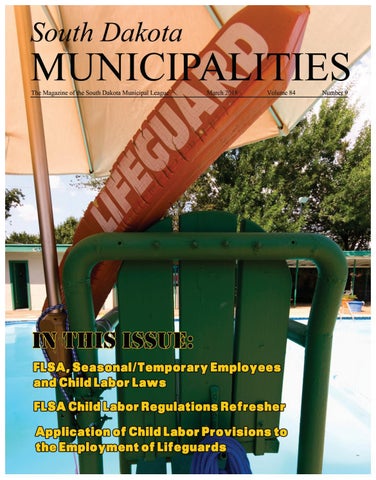
FLSA, Seasonal/Temporary Employees and Child Labor Laws . . . . . . . . . . . . . . .17 FLSA Child Labor Regulations Refresher . . . . . . . . .18
Employment of Lifeguards . . . . . . . . . . . . . . . . . . . .22
Small Community Planning Grant . . . . . . . . . . . . . . .26
SDMEA Hometown Power . . . . . . . . . . . . . . . . . . . .28
City Planner Main Street Assessment . . . . . . . . . . . .30
Beware the Security Risks of “Free” Website . . . . . . . . . . . . . . . . . . . . . .34
Energize! Explore Innovative Rural Communities Conference . . . . . . . . . . . . . . . .36
Columns
Director’s Notes . . . . . . . . . . . . . . . . . . . . . . . . . . . . . . .4
President’s Report . . . . . . . . . . . . . . . . . . . . . . . . . . . .5 Risk-Sharing News . . . . . . . . . . . . . . . . . . . . . . . . . .38 Washington Report: Senator Rounds . . . . . . . . . . . . .40
In Every Issue
Hometown Happenings . . . . . . . . . . . . . . . . . . . . . . .42
Classifieds . . . . . . . . . . . . . . . . . . . . . . . . . . . . . . . . .46
Directory Changes . . . . . . . . . . . . . . . . . . . . . . . . . . .39
Municipal Calendar . . . . . . . . . . . . . . . . . . . . . . . . . .49
SOUTH DAKOTA MUNICIPALITIES (ISSN 0300-6182, USPS 503-120) is the official publication of the South Dakota Municipal League, published monthly at 208 Island Drive, Ft. Pierre, South Dakota 57532, phone 605-224-8654. This institution is an equal opportunity provider, and employer. Periodical postage paid at Pierre, South Dakota and additional mailing offices. Non-member subscriptions are available for $30.00 annually. The opinions expressed herein are not necessarily those of the South Dakota Municipal League. Postmaster: Send address changes to SOUTH DAKOTA MUNICIPALITIES, 208 Island Drive, Ft. Pierre, South Dakota 57532.
MARCH 2018
VOLUME 84, NUMBER 9
3
Director's Notes The Legislative Session will only have a couple weeks left once you receive this, but believe me, the last days are the LONGEST days. At this writing, we have steadily worked toward the League’s goals, although admittedly our agenda, given the election year, wasn’t as aggressive as in some past years.
We are looking forward to seeing you all as we visit the District Meeting communities of Webster, Huron, Harrisburg, Geddes, Wessington Springs, Roscoe, Selby, Ft. Pierre, Wall and Deadwood. We find such great events and sites in each town we go to, we really wish this opportunity to “leave the beaten path” were something all of our citizens and visitors could have.
4
Affiliate groups are active this time of year, with meetings scheduled for the Municipal Electric Superintendent and Foreman Conference March 6-7; Building Officials ICC Code Officials Institute Program April 3 and 5; Street Maintenance Association meeting April 23-24; Police Chiefs’ Association and Sheriffs’ Joint Meeting April 17-19; and Code Enforcement Workshop May 9-10. Plans are also well underway for the annual Finance Officers’ School and Human Resource School. Please go to www.sdmunicipalleague.org for all the dates, agendas, and details so you can get these excellent training opportunities on your calendar.
We hope to see many of you at District Meetings, but until then, remember we are always available at 1-800658-3633 or yvonne@sdmunicipalleague.org. Yvonne Taylor Executive Director
SOUTH DAKOTA MUNICIPALITIES
President's Report
March Madness! I am sure we have all heard of that phrase before. More times than not, we think of basketball when we hear March Madness. Whether it is your local high school girls and boys or the college basketball teams, it signifies one final opportunity to try and win a championship.
By the time the March issue of the South Dakota Municipalities Magazine hits your mailbox, the South Dakota Legislature will have concluded the 2018 session. Although not in March, the session can be compared to a tournament run. Much time and energy are put into considering the pros and cons of each bill and ultimately deciding to pass or fail them. Although we at the local level are not a voting member at session, we and our hard working SDML staff are more than just fans. Our voice is very well valued and respected. Thank you to everyone who was able to make it to Pierre for the Legislative Rib Dinner.
MARCH 2017
March madness continues with our yearly District meetings. This year our “Road to the District Meetings” takes us to Harrisburg, Geddes, Webster, Wessington Springs, Roscoe, Selby, Ft. Pierre, Huron, Wall and Deadwood. A chance to get the Legislative post game (session) report from Yvonne. I hope you are all making plans to attend, and I am looking forward to seeing each of you. Mike
5
South Dakota Police Chiefs’ Association South Dakota Sheriffs’ Association Spring Conference April 17-19, 2018 • The Lodge at Deadwood • Deadwood, SD Agenda
Tuesday, April 17 1:00 p.m. to 5:00 p.m.
Individual Business Meetings SDSA Meeting SDPCA Meeting Joint Business Meeting • Mental Health First Aid and Crisis Intervention Training Don Hedrick, Assistant Chief, Rapid City Police Department Mike Leidholt, Sheiff, Hughes County
Wednesday, April 18 7:30 a.m. to 7:00 p.m.
Conference Registration - Foyer Area • 7:30 a.m. - breakfast buffet opens
8:30 to 8:40 a.m.
Welcome and Presentation of Colors Rapid City Police Department Honor Guard and Pennington County Sheriff’s Honor Guard
7:30 a.m.
8:40 to 9 a.m. 9:00 to 10:00 a.m.
10:00 to 10:15 a.m.
Exhibit Area Open - Pine Crest A&D
SD Special Olympics Law Enforcement Torch Run Jeff Miller, Board of Directors Member, SD LE Torch Run
Pennington County Drug Court Hon. Matt Brown, Judge, 7th Circuit Court Kelly Veneklasen, Court Services Officer, 7th Circuit Court Adam Shiffermiller, Prosecutor, Pennington Co. State’s Attorney’s Office Cathy Bock, Special Operation Lieutenant, Rapid City Police Dept.
Break in Exhibit Area Pine Crest A & D
10:15 to 10:45 a.m.
Teen Court Pine - Crest B Jennifer Stalley, SD Teen Court Assoc.
Noon to 1:00 p.m.
Lunch - Pine Crest C
10:45 a.m. to Federal/State Guest Speakers 12:00 p.m. Ron Parsons, U.S. Attorney Marty Jackley, SD Attorney General Bryan Gortmaker, DCI Scott Rechtenbaugh, DCI Dana Svendsen, SD Highway Patrol Jeff Pierce, SD BIT
1:00 p.m. to 2:00 p.m.
2:00 to 2:30 p.m.
2:30 to 3:00 p.m. 3:00 to 4:00 p.m.
.
Opioid Panel - Pine Crest B Brian Zeeb, Division of Criminal Investigation Lyle Tolsma, Special Assistant Attorney General Melissa DeNoon, Director, SD Prescription Drug Monitoring Program Dr. Christopher Dietrich, The Rehab Doctors, Rapid City Dr. Kari Scovel, Scovel Psychological, Rapid City
Operation Safe Streets Keith Gries, Captain, Sioux Falls Police Department Jason Husby, Captain, South Dakota Highway Patrol
Break in Vendor Area Pine Crest A & D
Project Hope - Pine Crest B Hon. Scott Myren, Judge, 5th Circuit Court Garrett Ortmeier, Chief Court Services Officer, 5th Circuit Court
South Dakota Police Chiefs’ Association South Dakota Sheriffs’ Association Spring Conference April 17-19, 2018 • The Lodge at Deadwood • Deadwood, SD Agenda
4:00 to 5:00 p.m.
5:00 to 6:00 p.m.
6:00 p.m.
Staff Recruitment and Retention Andy Howe, Sheriff, Clay County Stephanie McCoy, HR Manager, Pennington County Sheriff’s Office Dave Kull, Chief, Brandon Police Dept. Matt Burns, Chief, Sioux Falls Police Dept. Exhibit Area Social Hour Pine Crest A & D
Banquet and Awards Presentation Pine Crest C
Thursday, April 19
8:00 a.m. to 5:00 p.m.
Law Enforcement Legal Update; Case Law Impacting Law Enforcement Operations Jack Ryan, Public Agency Training Council, Legal & Liability Risk Management Institute Sponsored by SDPAA
• Policing after Ferguson, after Baltimore • Legal Update and Emergin Legal Trends
• Body Cameras - When to Record Privacy - Policy Development
• Social Media developing legal cases • • • • •
impact on officers and agencies Citizens Recording of Law Enforcement Officers on Duty Law Enforcement Unmanned Aircraft Systems (Drones) Eyewitness Identification and Wrongful Convictions Dealing with Mentally Ill & Emotionally Disturbed Persons and Use of Force Preventing Friendly Fire Deaths and
Injuries
• Pursuits and Emergency Vehicle Operations
• Legal Issues in the Jails: Strip Searches, Jail Suicides
9:30 to 10:00 a.m.
Break in the Vendor Area Pine Crest A & D
3:00 to 3:15 p.m.
Break Pine Crest B
12:00 to 12:30 p.m.
Lunch Pine Crest C
Accommodations A block of rooms has been reserved at the The Lodge at Deadwood (877-393-5634). Room Blocks are for April 17, 18 and 19, 2018. Be sure to mention SD Police Chiefs’ Association. **IMPORTANT: to guarantee this rate your reservation must be made by March 18, 2018. If a city has not set up direct billing and wants to be direct billed, request that when making the reservation. Registration Registration can be found at www.sdmunicipalleague.org or call the SD Municipal League office at 800-658-3633. Register by March 30, 2018.
Questions may be directed to Lori Martinec at martinec@sdmunicipalleague.org or by calling 605-2248654 or 800-658-3633.
SD Municipal Street Maintenance Association Spring Meeting April 23 - 24, 2018
Monday, April 23
HIghlands Conference Center
Tuesday, April 24
Noon to 1:00 pm Registration 1:00 to 1:15
1:15 to 1:45
1:45 to 2:15
2:15 to 2:45
2:455 to 3:30
3:30 to 5:00
5:00 to 6:30
Registration Fee:
Mitchell, SD
8:00 to 9:00 am Mitchell Street Project - Benelli Terry Johnson, Engineer, City of Mitchell Rick Bradner, PE, Engineer III, Mitchell Area, SD Dept. of Transportation
Welcome and Business Meeting
Municipal Procurement Laws Rod Fortin, Director of Local Government Assistance , SD Dept. of Legislative Audit
9:00 to 9:30
Concrete Repair with TechCrete Eric Thompson, PE, Business Development and Analytics, BX Civil & Construction, Inc.
9:30 to 10:30
Break - Ballroom C/Winchester
Hotand Cold Applied Concrete and Asphalt Repair Materials Mark Wegehaupt, Outside Sales, Brock White Company, LLC Kevin Ageton, Product Manager, Brock White Company, LLC
10:30 to 11:00 11:00 to Noon
Vendor Lightning Rounds Exhibit Area Social
Liability Claims Involving Municipal Streets David Pfeifle, Executive Director, SD Public Assurance Alliance
MUTCD - Basic Traffic Signing Cliff Reuer, Western Technical Assistance Provider, SD Local Transportation Assistance Program (LTAP) Break
How to Buy Using an NJPA Contract - Benelli Jim Kane, Membership Development Administrator, NJPA
SDMSMA Member NO FEE and Non-member $65.
Accommodations: A block of rooms has been reserved at the following hotels at a rate of $93.00 + tax. Comfort Inn & Suites (605-990-2400) and Hampton Inn (605-995-1575). Be sure to mention you are with the Street Maintenance Association. **IMPORTANT: to guarantee this rate your reservation must be made by April 9, 2018.
REGISTRATION
Street Maintenance Association Meeting April 23 - 24, 2018
Municipality _____________________________________________________________________________________
Name
Title
_______________________________ ____________________________________ ___________________________ _______________________________ ____________________________________ ___________________________
Return registration with payment by April 9, 2018 to: No refunds will be given after April 9, 2018. Office Use Only:
Date:________________
SD Municipal Street Maintenance Association 208 Island Drive, Ft. Pierre, SD 57532
Check #:________________
Amount:________________
2018 SDCMA Spring Training Conference April 11 - 12, 2018
Red Rossa
9:00 a.m.
Wednesday, April 11 5:00 p.m.
6:00 p.m.
7:00 p.m.
Social Hour - Prairies Room
Dinner
Insights Discovery Profile Training Dr. Richard Fursman Ed.D., President, Huelife
11:00 a.m.
Thursday, April 12
Breakfast (ClubHouse Hotel provides a complimentary breakfast for guests.) 8:00 a.m.
Registration Fee:
Insights Discovery Profile Training, cont. - Prairies Room Dr. Richard Fursman Ed.D., President, Huelife
12:00 p.m.
Pierre, SD
Strategic Planning Dr. Richard Fursman Ed.D., President, Huelife • What is Strategic Planning (what makes it strategic?) • Why Strategic Planning is important and why you should do it • Key Elements of Strategic Planning Career Development Dr. Richard Fursman Ed.D., President, Huelife • Recruiters bias [The secrets of a recruiter] • Timing your moves • Preparing for entering job market • Preparing for interiews • When to move Adjourn
$100.00.
Accommodations: A block of rooms has been reserved at the ClubHouse Suites (605-494-2582) at a rate of $134.00 + tax (queen) and $139.00 + tax (king). Be sure to mention you are with the City Manager’s Spring Meeting. **IMPORTANT: to guarantee this rate your reservation must be made by March 11, 2018.
REGISTRATION
SD City Management Association Meeting April 11 - 12, 2018
Municipality _____________________________________________________________________________________
Name
Title
_______________________________ ____________________________________ ___________________________ _______________________________ ____________________________________ ___________________________ Return registration with payment by March 30, 2018 to: No refunds will be given after March 30, 2018. Office Use Only:
Date:________________
SD Municipal Street Maintenance Association 208 Island Drive, Ft. Pierre, SD 57532
Check #:________________
Amount:________________
SD Association of Code Enforcement (SoDACE) Information and Training Conference May 9-10, 2018
Wednesday, May 9 8:30 – 9:00 am Registration
9:00 – 9:15
9:15 – 9:30
9:30 – 10:30
10:30 – 10:45 10:45 – 12:00
Ramkota Hotel 3:00 – 3:15
3:15 – 5:00
Welcome – Amphitheatre II
Business Meeting *update from 2018 SoDace AACE scholarhip winner
International Property Maintenance Code (IPMC) Fundamentals Tim Ryan, C.B.O., International Code Council Break
IPMC Fundamentals, cont. Amphitheatre II
Break
IPMC Fundamentals, cont. Amphitheatre II
Thursday, May 11 9:00 – 10:00 am Condemned Property Demolition Geoff Fillingsness, Code Enforcement Officer, City of Beresford Tom Frieberg, City Attorney, City of Beresford Brad Bies, Code Enforcement Officer, City of Yankton 10:00 – 10:15 10:15 – Noon
12:00 – 1:00 pm Luncheon and Presentation of the Code Enforcement Officer of the Year Award – Gallery F&G
1:00 – 3:00
Pierre, SD
Break
Condemned Property Demolition, cont.
IPMC Fundamentals, cont. Amphitheare II
Registration Fee: Accommodations:
Advance Registration: $50/SoDACE member and $90/non-member. On-site Registration: $60/SoDACE member and $100/non-member.
A room block has been reserved at the Ramkota Hotel (605-224-6877) at a rate of $93.00 + tax. Be sure to mention you are with the Code Enforcement Association. **IMPORTANT: to guarantee this rate your reservation must be made by April 8, 2018.
REGISTRATION
SD Code Enforcement Training Conference
May 9-10, 2018
Municipality _____________________________________________________________________________________
Name
Title
_______________________________ ____________________________________ ___________________________ _______________________________ ____________________________________ ___________________________
Return registration with payment by April 20, 2018 to: South Dakota Association of Code Enforcement No refunds will be given after April 20, 2018 208 Island Drive, Ft. Pierre, SD 57532
Office Use Only:
Date:________________
Check #:________________
Amount:________________
Finance Officer of the Year 2018 - 2019 South Dakota Governmental Finance Officers’ Association
2018 - 2019 "FINANCE OFFICER OF THE YEAR" Official Nomination Form All nominations must be submitted in writing by May 1, 2018. The Finance Officer of the Year award will be presented during the 2018 Finance Officers’ School held June 6-8 in Sioux Falls.
Name of Nominee: Position: Years of service to the municipality: Contributions to the municipality as a Finance Officer:
Contributions to the community as a citizen:
Significant contributions to any other organizations:
Personal accomplishments:
Other Comments:
Submitted by: DEADLINE: May 1, 2018 Nominations will be kept confidential. Use additional paper if necessary. Additional nomination letters are welcome.
Phone: Please submit to: South Dakota Municipal League 208 Island Drive Ft. Pierre, SD 57532 )D[ -224-8655
Scholarship Funds
SD Municipal Street Maintenance Association Scholarship Funds
Applicant must be a member of the South Dakota Municipal Street Maintenance Association.
Scholarship funds must be used to attend the American Public Works Association PWX Conference August 26-29, 2018 in Kansas City, MO. Information can be found at http://www.apwa.net/PWX.
SDMSMA will pay the cost of airfare, mileage at the state rate, lodging for the conference dates only, APWA PWX Conference registration fee and meals not included in the conference package at the state meal rate. Recipient is responsible for keeping all receipts and submitting them to the SDML for reimbursement. All reimbursement costs are subject to SDMSMA board approval.
Submit the completed application to SDML, 208 Island Drive, Ft. Pierre, SD 57532 or fax to 605-224-8655 no later than June 1, 2018, to be considered for the scholarship.
An official scholarship form can be obtained by visiting www.sdmunicipalleague.org then the Street Maintenance section under the Affiliate Organizations tab.
Outdoor Recreation Projects Funded
Gov. Dennis Daugaard has awarded a total of $424,862 in Land and Water Conservation Fund (LWCF) grants to several communities. The federal assistance program provides up to 50 percent reimbursement for outdoor recreation projects.
The following communities were awarded LWCF grants for outdoor recreation projects: • Aberdeen – Wylie Park Land of Oz playground development, $50,000 • Blunt – City Park playground equipment replacement, $38,383 • Box Elder – Community Park playground equipment replacement, $70,000 • Colton –Redway Park playground equipment replacement, $15,935 • Doland – City Park splash pad development, $59,120 • Freeman – Lions Park playground equipment replacement, $30,000 • Herried – Karl Deibert Park playground equipment replacement, $54,408 • Sisseton – development of 2 baseball fields, $75,000 • Tabor – Takota Park playground equipment replacement, $20,000 • Viborg – Glood Park playground equipment replacement, $12,016
“I commend these project sponsors for their strong commitment to improve their communities and make South Dakota a better place to live, work and play,” Gov. Daugaard said. “Their efforts will benefit future generations of South Dakotans.”
Land and Water Conservation Funds come from the National Park Service and are administered in South Dakota by the state Department of Game, Fish and Parks. For more information on the LWCF program, contact grants coordinator Randy Kittle at 605.773.5490 or randy.kittle@state.sd.us.
The SD Municipal League invites you to follow us on twitter @sdmunileague.
12
SOUTH DAKOTA MUNICIPALITIES
March 6-7
11-14 13
14
15
20
21
22
27
28
April
2018 Events Calendar SD Municipal Electric Assoc Superintendent-Foreman Conference, Watertown NLC Congressional City Conference, Washington, DC District 3 Meeting, Harrisburg District 4 Meeting, Geddes
District 1 Meeting, Webster
District 5 Meeting, Wessington Springs
District 2 Meeting, Huron
SD Building Officials ICC Code Officials Institute Program, Rapid City SD Building Officials ICC Code Officials Institute Program, Sioux Falls
SD City Management Assoc Meeting, Pierre
17-19
SD Police Chiefs/SD Sheriffs Joint Association Meeting, Deadwood SD Municipal Street Maintenance Assoc Meeting, Mitchell
9-10
SD Association of Code Enforcement Workshop, Pierre
13-14
SDML Board of Directors Meeting, Baltic/Sioux Falls
June 5-6
12
Budget Training, Rapid City
19-20
SD Building Officials’ Assoc Meeting, Pierre
18
26
Elected Officials Workshop, Pierre Budget Training, Sioux Falls
22-23
Policy Committee Meetings, Fort Pierre
2
SDML Board of Directors Meeting, Pierre
2-5
SDML Annual Conference, Pierre
7-10
NLC City Summit, Los Angeles, CA
12
Joint SDML Board Meeting with County Association, Pierre
November December
SD Airport Management Assoc Meeting, Deadwood
11-12
May
July
October
District 10 Meeting, Deadwood
23-24
SD Municipal Attorneys’ Association Meeting, Sioux Falls
Municipal Debit/Credit Workshop, Pierre
District 8 Meeting, Fort Pierre
District 7 Meeting, Selby
4
TBD
TBD
27
August
District 9 Meeting, Wall
5
Finance Officers’ School, Sioux Falls
District 6 Meeting, Roscoe
3
3
6-8
Human Resource School, Sioux Falls
SNYDER-ASSOCIATES .COM
TRAN S PORTATIO N
LAND DE V E L OP ME N T
W AT E R
M UNI C IPA L E N G I NE ERIN G
S TRU C TUR A L
PUBLIC SPACES
Building Permits and the Public Duty Doctrine:
The South Dakota Supreme Court rules that a local government did not owe a duty to an individual class of persons to enforce local ordinances and state historic regulations.
By: Dave Pfeifle, Executive Director, South Dakota Public Assurance Alliance
Each year tens of thousands of building permits are issued by local governments across South Dakota as part of an effort to gain compliance with local building codes. A recent lawsuit illustrated the potential liability exposure with the permitting process. The adjacent property owners to a new home constructed in the historic district of the McKennan Park area of Sioux Falls, SD commenced a lawsuit against the new home owners and the City of Sioux Falls, alleging that the new home violated state historic district regulations and local ordinances. As a Member of the SDPAA, the City of Sioux Falls was provided a defense to the lawsuit. The Circuit Court, Second Judicial Circuit of South Dakota, granted an injunction requiring modification or reconstruction of the new home. The Circuit Court also held that the City of Sioux Falls owed a duty to the adjacent property owners to properly enforce local building codes and state historic district regulations. On appeal, the South Dakota Supreme Court affirmed the issuance of an injunction as to the new home owners, but reversed the Circuit Court’s ruling on the duty conclusion for the City of Sioux Falls. The SD Supreme Court ruled in favor of the municipality due to the public duty doctrine, which holds that governmental entities generally owe a governmental duty only to the public at large, not to individuals or a particular class of persons. The SD Supreme Court held:
14
[The] primary purpose of building permits . . . is to secure to local government consistent compliance with construction, zoning and land use ordinances. Building codes, the issuance of building permits, and building inspections are devices used by municipalities to make sure that construction within the corporate limits of the municipality meets the standards established. But by issuing a permit, municipalities do not imply that the plans submitted are in compliance with all applicable codes. Local governments should not, for the particular benefit of individual persons, bear the burden of ensuring that every single building constructed within its jurisdiction fully complies with applicable codes. The duty to ensure compliance rests with the individuals responsible for construction. Permit applicants, builders and developers are in a better position to prevent harm to a foreseeable plaintiff than are local governments. McDowells v. Sapienzas & City of Sioux Falls, 2018 SD 1 at ¶ 39 (citations and quotations omitted).
The public duty doctrine avoids the unreasonable burden that would be placed on local governments if they were required to ensure that all state and local laws are followed by building permit holders and their chosen private contractors. Many South Dakota communities may have hundreds or even thousands of permits issued and pending at any given time. Numerous open permits could not all be inspected on a regular basis with the limited governmental resources available. An analogy often used is that law enforcement cannot attain full compliance with the speed limit laws despite their noble efforts.
SOUTH DAKOTA MUNICIPALITIES
This lawsuit is a good reminder that local governments need to take steps to recognize and minimize any potential liability exposure from the permitting process:
1. Continue education efforts on applicable laws affecting the permitting process Local governments should continue their efforts to educate those in the industry on their applicable local building codes. These educational efforts may include providing brochures and/or informational sessions on the various codes as locally adopted.
2. Fully utilize any local boards established as part of the adoption of a particular code Many codes as adopted by state and local governments include provisions to establish local boards that are often comprised of people with experience in that code. For example, larger communities may have local plumbing, electrical, or mechanical boards whose members are from those various trades. These boards serve as a sounding board to identify potential issues with various codes and also to help “spread the word” on any local code changes or issues. Larger communities may also work in conjunction with these specialized boards to establish their own licensure requirements for individual contractors who would be responsible to comply with local codes. It would provide a comfort level for citizens to know that their chosen contractor has passed an examination
demonstrating a minimum proficiency with the applicable code.
3. Consider pooling of resources to jointly retain a code official Local communities without the resources to hire their own code official should consider joining with other communities to retain someone to perform that service on a contract basis. Local communities should consult with their legal counsel about the possible contractual arrangements for jointly retaining a regional code official. A regional code official could review building permit applications and perform building inspections as needed. This regional code official could identify emerging issues and suggest possible solutions for each of the contracting local governments.
4. Consult with legal counsel The resources available and the procedures used by local governments in the permitting process likely vary as much as our landscape; after all, South Dakota is known as “the land of infinite variety.” Local governments should consult with their legal counsel to ensure that their particular permit application procedures are able to identify any possible issues with any applicable laws in the building plans as submitted. Procedures may also need to be revised to address those situations where significant revisions or changes are made “in the field” after a permit is issued. A revision to the building permit application process may require the applicant/owner/builder to notify the permitting authority before implementing any significant change that would vary from the original plans as submitted. Disclaimer: while the author is an attorney, this article is for general information purposes only and should not be construed as providing legal advice or opinions for a specific situation. The reader is encouraged to contact the attorney of their choice for any specific legal discussion and legal advice.
JE Marsh Consulting James Marsh, Owner Employment Law Consultation; Arbitration; Mediation; Contract Hearing Officer
ǯ got 30 y ǯ experience in helping people with W ǯ Compensation; EEO/Discrimination; FLSA; and Public Employee Laws (Collective Bargaining; Unfair Labor Practices; Grievances; Terminations). Let me help you! www.jemarshconsulting.com JE Marsh Consulting, PO Box 188, Tripp, SD 57376 605-505-1401 | email: jamesmarshadr@gmail.com
MARCH 2018
15
Funding Available for Trails
South Dakota State Parks Director Katie Ceroll announced today that applications are being accepted for grants from the Recreation Trails Program (RTP). The grants will be available for trail projects sponsored by municipalities, counties, state parks, federal land management agencies or tribal governments.
“When it comes to promoting healthy communities, recreational trails are key,” Ceroll said. “As safe corridors for exercise and recreation, trails give families the opportunity to spend quality time together and enjoy the natural beauty of our state.”
The Recreational Trails Program provides partial reimbursement for approved trail projects. Eligible projects include construction of new public trails, rehabilitation of existing public trails, development of trail-related facilities and educational programs that relate to recreational trails. The application deadline is Friday, April 27, 2018.
RTP funds come to the state through the Federal Highway Administration and are apportioned to states by Congress to fund both motorized and non-motorized public recreation trail projects. The amount of funds available is based upon the number of recreational vehicles licensed in each state.
Application packets are available online at the Game, Fish and Parks website. For more information, contact grants coordinator Randy Kittle at 605.773.5490 or randy.kittle@state.sd.us.
Department of Revenue Launches Live Chat Feature
The South Dakota Department of Revenue’s customers now have a new way to receive assistance from the state’s tax experts.
The Department of Revenue’s business tax division recently launched a live chat option, which allows customers to quickly receive answers to their questions. The live chat feature is available on all business tax related webpages as well as the state’s online tax filing and payment website, EPath.
“The Department of Revenue’s top priority is ensuring customer-oriented, fair and reliable tax administration,” Department of Revenue Secretary Andy Gerlach said. “Our live chat feature will provide our partners with another convenient option to seek assistance from our dedicated staff.” The Department of Revenue’s business tax division administers sales, use, municipal, contractor’s excise and tourism taxes along with the 911 surcharge.
The live chat feature is available Monday through Friday from 8 a.m. to 5 p.m. CST. To launch a chat session, simply visit http://dor.sd.gov/Taxes/Business_Taxes then click the chat button on the bottom, right corner of the page.
Tomor o rrow
In nves vesting in infrastructure is an inves vestment in
> Streets > Se ewer > Drainage > Water > Airports > GIS > Electrical Power
Sioux Falls, SD 605-339-4157
Trusted. Prroffessional. essional.. Solutions. 16
Yankt a on, SD 605-665-2002
dgr.com
SOUTH DAKOTA MUNICIPALITIES
FLSA, Seasonal/Temporary Employees and Child Labor Laws
It is important to regularly review Fair Labor Standards and Child Labor regulations PRIOR to seasonal hiring. Often we become complacent and continue to do things the way we have always done them. Reminders like this give us an opportunity to verify that we are adhering to the law. In this economy, none of us can afford to make mistakes that cost our communities back wages for overtime.
The Fair Labor Standards Act (FLSA) allows for specific exemptions from minimum wage and overtime including administrative, executive and professional exemptions. For purposes of this article, we will assume that most employees hired for seasonal and temporary positions are non-exempt from minimum wage and overtime provisions. This means that these employees will be eligible to receive minimum wage at $8.85 per hour. Seasonal and temporary employees are eligible to receive 1.5 times the hourly wage for all hours worked over 40 in any given workweek as required by FLSA.
FLSA DOES include an exemption from minimum wage and overtime for Seasonal Amusement or Recreational Establishments - Section 13(a)(3). Tests for this exemption include: a) does not operate for more than seven months in any calendar year; OR b) during the preceding calendar year, average receipts for any six months of such year were not more that 33 1/3% of its average receipts for the other six months of such year.
It would seem apparent that a swimming pool or other facility that is open only for the summer months would qualify for this exemption from overtime and minimum wage provisions of the FLSA. But please note, if seasonal employees who qualify for this exemption perform
other jobs for the city, this exemption from overtime may not apply.
Also please review the “FLSA Child Labor Regulations Refresher” article on pages 16-19. It is important to consider the duties that employees under age 18 are permitted to perform. With limited resources and limited staff, it becomes essential to understand the law.
The majority of the questions that the Municipal League receives are regarding “children” under eighteen years of age (16-17) and if they are allowed to run lawn mowers. In a later article the actual Prohibited Occupations for 16-17 year olds (non-adult) are reviewed. Even though lawn mowers are not specifically mentioned, there are enough related references to this type of work that many cities across South Dakota do not use child labor for these duties. The League discourages cities from doing so but we will leave that to you and your City Attorney to work out. It would also be prudent to review the Child Labor Violation Penalties which is in a later article as well.
These laws can be complicated and difficult to sort out. If there are questions, employers are required to follow the law that provides the greatest benefit to the employee. SD Codified law can be found online at sdlegislature.gov/ Statutes/Codified_Laws/ under Title 60 Labor and Employment. The South Dakota Department of Labor staff is also a great resource. You also have access to the knowledgeable SDML staff (800-658-3633) and the SD Governmental Human Resource Association.
SOUTH DAKOTA BASIC CODE Affordable Codification for Small and Mid-Sized South Dakota Municipalities A comprehensive model code of ordinances for municipalities featuring: x Subject matter encountered by municipalities x Annual state law updates x
x x MARCH 2018
A comprehensive index and a title devoted to your unique local ordinances Published by American Legal and the South Dakota Municipal League For more information call or e-mail deRicci Getty at 1-800-445-5588 or dgetty@amlegal.com 17
FLSA Child Labor Regulations Refresher
Reprinted from the United States Department of Labor Wage and Hour Division website. The information in this article is a snapshot of what is provided via the DOL website. For more details follow visit http://www.dol.gov/ whd/regs/compliance/childlabor101_text.htm.
With summer just around the corner, it may be a good time to have a little refresher course on the Fair Labor Standards Act (FLSA) regarding child labor regulations. Employers may employ youth only under certain conditions and child labor regulations vary significantly depending on the age of the youth.
Federal Child Labor Provisions The federal child labor provisions, also known as the child labor laws, are authorized by the Fair Labor Standards Act (FLSA) of 1938. These provisions were enacted to ensure that when young people work, the work is safe and does not jeopardize their health, well-being or educational opportunities. By knowing, understanding, and complying with these provisions, employers, parents, and teachers can help working teens enjoy those safe, positive, early work experiences that can be so important to their development.
Other Laws That Impact Child Labor Other federal and state laws may have higher standards. When these apply, the more stringent standard must be observed. All states have child labor provisions, compulsory school attendance laws, and establish the minimum ages and conditions under which youths may operate motor vehicles.
Unless otherwise exempt, a covered minor employee is entitled to receive the same minimum wage, overtime, safety and health, and non-discrimination protections as adult workers.
18
Minimum Age Standards for Nonagricultural Employment 14 Minimum age for employment in specified occupations outside of school hours for limited periods of time each day and each week.
16 Basic minimum age for employment. At 16 years of age, youth may be employed for unlimited hours in any occupation other than one declared to be hazardous by the Secretary of Labor.
18 Minimum age for employment in nonagricultural occupations declared hazardous by the Secretary of Labor.
Occupation Standards for 14- and 15-Year-Olds The following list, which is not exhaustive, are jobs that 14- and 15-year-olds may not be employed in: 1. Any manufacturing occupation.1 2. Any mining occupation. 3. Most processing occupations such as filleting of fish, dressing poultry, cracking nuts, developing of photographs, laundering, bulk or mass mailings (except certain occupations expressly permitted as discussed below). 4. Occupations requiring the performance of any duties in workrooms or workplaces where goods are manufactured, mined or otherwise processed (except to the extent expressly permitted as discussed below; and as discussed in footnote 1). 5. Any occupation found and declared to be hazardous by the Secretary of Labor. 6. Occupations involved with the operating, tending, setting up, adjusting, cleaning, oiling or repairing of hoisting apparatus. 7. Work performed in or about boiler or engine rooms or in connection with the maintenance or repair of the establishment, machines, or equipment. 8. Occupations involved with the operating, tending, setting up, adjusting, cleaning, oiling or repairing of any power-driven machinery, including, but not limited to, lawnmowers, golf carts, all-terrain vehicles, trimmers, cutters, weed-eaters, edgers, food slicers, food grinders, food choppers, food processors, food cutters, and food mixers. Fourteen- and 15-yearolds may operate most office machinery and those machines that are expressly permitted. 9. The operation of motor vehicles or service as helpers on such vehicles. 10. The riding on a motor vehicle inside or outside of an enclosed passenger compartment except as permitted in #16 in the next list. 11. Outside window washing that involves working from window sills. SOUTH DAKOTA MUNICIPALITIES
12. All work requiring the use of ladders, scaffolds, or their substitutes. 13. All baking and most cooking activities except as discussed in the following #3. 14. Work in freezers and meat coolers and all work in the processing of meat for sale; however, youth are permitted to occasionally enter freezers only momentarily to retrieve items. 15. Youth peddling, including not only the attempt to make a sale or the actual consummation of a sale, but also the preparatory and concluding tasks normally performed by a youth peddler, such as the loading and unloading of motor vehicles, the stocking and restocking of sales kits and trays, the exchanging of cash and checks with the employer, and the transportation of the minors to where the sales will be made. 16. Loading and unloading of goods or property onto or from motor vehicles, railroad cars, and conveyors, except as discussed in the following #12. 17. Catching and cooping of poultry in preparation for transport or for market. 18. Public messenger service. 19. Occupations in connection with: a. Transportation of persons or property by rail, highway, air, on water, pipeline, or other means. b. Warehousing and storage. c. Communications and public utilities. d. Construction (including repair). Except 14- and 15-year-olds may perform office or sales work in connection with a, b, c, and d above when not performed on transportation media, on an actual means of transportation, or at the actual construction site.
The following is the list of jobs the Secretary of Labor has determined will not interfere with the schooling, health, and well-being of 14- and 15-year-olds and therefore MAY BE performed by such youth. Any job not specifically permitted, is prohibited. 1. Office and clerical work, including operation of office machines. 2. Work of an intellectual or artistically creative nature such as but not limited to computer programming, the writing of software, teaching or performing as a tutor, serving as a peer counselor or teacher’s assistant, singing, the playing of a musical instrument, and drawing, as long as such employment complies with all the other provisions contained in §§ 570.33, .34, and .35. 3. Cooking with electric or gas grills that do not involve cooking over an open flame and with deep fat fryers that are equipped with and utilize devices that automatically lower and raise the baskets into and out of the oil or grease. NOTE: this section does not permit cooking with equipment such as rotisseries, MARCH 2018
4. 5.
6. 7. 8. 9.
10.
11.
12.
13.
broilers, pressurized equipment including fryolators, and cooking devices that operate at extremely high temperatures such as “Neico broilers.” Cashiering, selling, modeling, art work, work in advertising departments, window trimming and comparative shopping. Price marking and tagging by hand or by machine. Assembling orders, packing and shelving. Bagging and carrying out customer orders. Errand and delivery work by foot, bicycle, and public transportation. Except such youth may not be employed by a public messenger service. Cleanup work, including the use of vacuum cleaners and floor waxers, and the maintenance of grounds, but not including the use of power-driven mowers, cutters, trimmers, edgers, or similar equipment. Kitchen work and other work involved in preparing and serving food and beverages, including operating machines and devices used in performing such work. Examples of permitted machines and devices include, but are not limited to, dishwashers, toasters, dumbwaiters, popcorn poppers, milk shake blenders, coffee grinders, automatic coffee machines, devices used to maintain the temperature of prepared foods (such as warmers, steam tables, and heat lamps), and microwave ovens that are used only to warm prepared food and do not have the capacity to warm above 140°F. Cleaning kitchen equipment. Minors are permitted to clean kitchen equipment (not otherwise prohibited), remove oil or grease filters, pour oil or grease through filters, and move receptacles containing hot grease or hot oil, but only when the equipment, surfaces, containers and liquids do not exceed a temperature of 100°F. Cleaning vegetables and fruits, and the wrapping, sealing, labeling, weighing, pricing, and stocking of items, including vegetables, fruits, and meats, when performed in areas physically separate from a freezer or meat cooler. Loading onto motor vehicles and the unloading from motor vehicles of the light, non-power-driven, hand tools and personal protective equipment that the minor will use as part of his or her employment at the work site; and the loading onto motor vehicles and the unloading from motor vehicles of personal items such as a back pack, a lunch box, or a coat that the minor is permitted to take to the work site. Such light tools would include, but not be limited to, rakes, hand-held clippers, shovels, and brooms. Such light tools would not include items like trash, sales kits, promotion items or items for sale, lawn mowers, or other power-driven lawn maintenance equipment. Such minors would not be permitted to load or unload safety equipment such as barriers, cones, or signage. The occupation of lifeguard (15-year-olds but not 14year-olds) at traditional swimming pools and water 19
amusement parks (including such water park facilities as wave pools, lazy rivers, specialized activity areas, and baby pools, but not including the elevated areas of water slides) when properly trained and certified in aquatics and water safety by the American Red Cross or a similar certifying organization. No youth under 16 years of age may be employed as a lifeguard at a natural environment such as an ocean side beach, lake, pond, river, quarry, or pier. 14. Employment of certain youth under specified conditions inside and outside of establishments where machinery is used to process wood products. See the DOL link at the beginning of this article for information on this exemption. 15. Work in connection with cars and trucks if confined to the following: Dispensing gasoline and oil. Courtesy service on premises of gasoline service station. Car cleaning, washing, and polishing by hand. Other occupations permitted by Child Labor Regulation No. 3, but not including work involving the use of pits, racks or lifting apparatus or involving the inflation of any tire mounted on a rim equipped with a removable retaining ring. 16. Work in connection with riding inside passenger compartments of motor vehicles except as prohibited in #10 in the previous list or when a significant reason for the minor being a passenger in the vehicle is for the purpose of performing work in connection with the transporting—or assisting in the transporting of— other persons or property. Each minor riding as a passenger in a motor vehicle must have his or her own seat in the passenger compartment; each seat must be equipped with a seat belt or similar restraining device; and the employer must instruct the minors that such belts or other devices must be used. In addition, each driver transporting the young workers must hold a valid state driver’s license for the type of vehicle being driven and, if the driver is under the age of 18, his or her employment must comply with the provisions of HO 2 (see chart).
Employment Standards for 16- and 17-Year-Olds in Nonagricultural Employment
The Hazardous Occupations Orders (HOs) for Nonagricultural Employment These Orders are published in Subpart E of Part 570 of Title 29 of the Code of Federal Regulations.
The FLSA provides a minimum age of 18 years for any nonagricultural occupations which the Secretary of Labor “shall find and by order declare” to be particularly hazardous for 16- and 17-year-old persons, or detrimental to their health and well-being. This minimum age applies 20
even when the minor is employed by the parent or person standing in place of the parent.
The seventeen HOs apply either on an industry basis, specifying the occupations in the industry that are not permitted, or an occupational basis irrespective of the industry in which found. Some of the HOs contain limited exemptions. HO 1
Manufacturing and storing of explosives.
HO 3
Coal mining.
HO 2 HO 4 HO 5* HO 6 HO 7 HO 8* HO 9
Motor-vehicle driving and outside helper on a motor vehicle. Occupations in forest fire fighting, forest fire prevention, timber tract operations, forestry service, logging, and sawmilling. Power-driven woodworking machines. Exposure to radioactive substances.
Power-driven hoisting apparatus, including forklifts.
Power-driven metal-forming, punching, and shearing machines. Mining, other than coal mining.
Operating power-driven meat processing equipment, including meat slicers and other food slicers, in retail establishments (such as HO 10* grocery stores, restaurants kitchens and delis) and wholesale establishments, and most occupations in meat and poultry slaughtering, packing, processing, or rendering. HO 11
HO 12* HO 13
Power-driven bakery machines including vertical dough or batter mixers.
Power-driven balers, compactors, and paper processing machines. Manufacturing bricks, tile, and kindred products.
Power-driven circular saws, bandsaws, chain HO 14* saws, guillotine shears, wood chippers, and abrasive cutting discs. HO 15
HO 16*
Wrecking, demolition, and shipbreaking operations.
Roofing operations and all work on or about a roof.
HO 17* Excavation operations.
* These HOs provide limited exemptions for 16- and 17-yearolds who are bona-fide student-learners and apprentices.
SOUTH DAKOTA MUNICIPALITIES
Enforcement of the Federal Child Labor Provisions The Wage and Hour Division, which is part of the Department of Labor, administers and enforces the child labor, minimum wage, overtime and recordkeeping provisions of the Fair Labor Standards Act. The Wage and Hour Division also has enforcement responsibility for programs covering such things as prevailing wages for government contracts, the payment of special minimum wages, farm labor, family and medical leave, immigration and polygraph testing. Wage and Hour Division Investigators, who are stationed across the United States, are authorized to conduct investigations and gather data on wages, hours of work, and compliance with all the provisions of the FLSA, including the child labor provisions.
Penalties for Violation Civil Money Penalties Employers may be subject to a civil money penalty of up to $12, 278 for each employee who is the subject of a child labor violation. The penalty may be increased to $58,808 for each violation that causes the death or serious injury of a minor, and that penalty may be doubled when the violations are determined to be repeated or willful. When a civil money penalty is assessed against an employer for a child labor violation, the employer has the right, within 15 days after receipt of the notice of such penalty, to file an exception to the determination that the violation or violations occurred.
When such an exception is filed with the office making the assessment, the matter is referred to the Chief Administrative Law Judge, and a formal hearing is scheduled. At such a hearing, the employer may, or an attorney retained by the employer may, present such witnesses, introduce such evidence and establish such facts as the employer believes will support the exception. The determination of the amount of any civil money penalty becomes final if no exception is taken to the administrative assessment thereof, or if no exception is filed pursuant to the decision and order of the administrative law judge.
Injunction to Compel Compliance The FLSA authorizes the Department of Labor to seek injunctions against violators of the child labor provisions to compel their compliance with the law. Further violations could result in sanctions against such persons for contempt of court.
Criminal Sanctions The FLSA also provides, in the case of a willful violation, for a fine up to $10,000; or, for a second offense committed after the conviction of such person for a similar offense, for a fine of not more than $10,000 or imprisonment for not more than 6 months, or both.
Additional Information For information about the federal child labor requirements, visit the YouthRules! at http://www.youthrules.dol.gov.
Inquiries about the Fair Labor Standards Act or any other law administered by the Wage and Hour Division may be addressed to any local office of the Wage and Hour Division. Additional information is available at http://www.dol.gov/ whd/index.htm.
Locate the Wage and Hour Division office nearest to you, telephone the toll-free information and helpline at 1-8664US-WAGE (1-866-487-9243): a customer service representative is available to assist you with referral information from 8am to 5pm in your own time zone; or log onto the nationwide listing of Wage-Hour District Offices located at: http://www.dol.gov/whd/america2.htm.
Notes 1. Section 13(c)(7) of the FLSA, enacted in 2004, permits the employment of certain minors between the ages of 14 and 18, who have been excused from compulsory school attendance, inside and outside of places of business where machinery is used to process wood products. This provision, however, does not permit such minors to operate, or assist in the operation of power-driven woodworking machines.
CIVIL ENGINEERING & LAND L SURVEYING SERVICES
infrastructure noun in·fra·struc·ture the underlying foundation, framework and structures tha at are needed for a country, region, or organization to function n properly.
IT’S WHAT T WE DO.
1111 N. LAKE AVENUE SIOUX FALLS, SD
20 S. MAPLE E WATERTOWN, SD D
605-271-5527 605-8 78-2120 0 InfrastructureDG.com m
STRUCTURAL ENGINEERING / MUNICIP PAL AL ENGINEERING / TRANSPOR T TATION ENGINEERING & PLANNING / W WA ATER RESOURCES SITE DEVELOPMENT / CONSTRUCTION OBSERVA ATION T TION / PARKS & RECREATION T / LAND SUR SURVEYING VEYING
MARCH 2018
21
Application of the Federal Child Labor Provisions to the Employment of Lifeguards
Fact Sheet # 60: Application of the Federal Child Labor Provisions of the Fair Labor Standards Act (FLSA) to the Employment of Lifeguards
The Fair Labor Standards Act (FLSA), administered by the U.S. Department of Labor’s Wage and Hour Division (WHD), requires that most employees be paid at least the applicable federal minimum wage and overtime pay for all hours worked at time and one-half the regular rate of pay after 40 hours in a workweek. The FLSA also includes child labor and recordkeeping provisions. While some seasonal and recreational establishments such as outdoor swimming pools may be exempt from the minimum wage and overtime requirements of the FLSA if they meet certain tests, this exemption does not apply to the child labor or record keeping provisions of the FLSA.
Child labor Provisions of the FLSA The federal child labor provisions were enacted to protect the educational opportunities of minors and prohibit their employment in jobs and under conditions detrimental to their health or well-being.
22
18 years of age Once a minor reaches 18 years of age, the federal child labor provisions no longer apply to their employment.
16 and 17 years of age Sixteen and 17-year-olds employed as lifeguards may perform any nonhazardous job, for unlimited hours. The Secretary of Labor has declared 17 Hazardous Occupations Orders (HOs) which restrict the types of jobs and/or industries in which youth under 18 years of age may be employed. Not exhaustive, the following list represents some common tasks which occur at establishments that employ lifeguards. Under the federal child labor provisions, workers under 18 years of age generally may not: • Operate or assist to operate, clean, oil, set up, adjust, or repair certain power-driven woodworking, metalworking, bakery, meat processing, and paper products machinery including meat slicers, compactors, balers, mixers, and saws. • Drive or serve as an outside-helper on a motor vehicle on a public road; but 17-year-olds who meet certain specific requirements may drive automobiles and
SOUTH DAKOTA MUNICIPALITIES
• •
trucks that do not exceed 6,000 pounds gross vehicle weight for limited amounts of time during daylight hours as part of their job (see Fact Sheet #34). Operate power-driven hoists such as elevators, cranes, derricks, and high-lift trucks. However, 16- and 17-yearolds may operate and assist in the operation of most water amusement park and recreation establishment rides. Load, operate, or unload power-driven balers and compactors used in the disposal of waste. A limited exemption exists that permits the loading, but not the operating or unloading, of certain scrap paper balers and paper box compactors under certain specific conditions (see Fact Sheet #57).
14 and 15 years of age Fifteen-year-olds, but not youth less than 15 years of age, may be employed as lifeguards at traditional swimming pools and most facilities of water amusement parks. Such employment must meet the following conditions: • The 15-year-old must be trained and certified by the American Red Cross, or a similar certifying organization, in aquatics and water safety; and • The 15-year-old must be employed in compliance with all the other applicable provisions of the federal child labor rules contained in Child Labor Regulations No. 3 (see Subpart C of 29 CFR Part 570), including the restrictions on the hours and times of day that 15-yearolds may be employed as discussed below; and
MARCH 2018
•
The federal child labor rules require that 15-year-olds who are employed to teach or assist in teaching others how to swim must also be certified as swimming instructors by the American Red Cross or some other similar certifying agency.
The occupation of lifeguard, as per 29 C.F.R. § 570.34(l), encompasses the duties of rescuing swimmers in danger of drowning, the monitoring of activities at a swimming pool to prevent accidents, the teaching of water safety, and providing assistance to patrons. Lifeguards may also help to maintain order and cleanliness in the pool and pool areas, conduct or officiate at swimming meets, and administer first aid. Additional ancillary lifeguard duties may include checking in and out such items as towels, rings, watches and apparel. Properly certified 15-year-old lifeguards are also permitted to use a ladder to access and descend from the lifeguard chair; use hand tools to clean the pool and pool area; and test and record water quality for temperature and/or pH levels, using all of the tools of the testing process including adding chemicals to the test water sample. Such youth would, however, be prohibited from entering or working in any chemical storage areas, including any areas where the filtration and chlorinating systems are housed. As mentioned, a core and defining duty of a lifeguard is the rescuing of swimmers in danger of drowning, often by
23
entering the water and physically bringing the swimmer to safety. Under 29 C.F.R. § 570.34(l), any employee under the age of 16 whose duties include this core duty—such as a “junior lifeguard” or a “swim-teacher aide”—or whose employment could place him or her in a situation where the employer would reasonably expect him or her to perform such rescue duties, would be performing the duties of a lifeguard while working in such a position. For such employment to comply with these child labor provisions, the employee would have to be at least 15 years of age and possess the proper certification.
A traditional swimming pool means a water tight structure of concrete, masonry, or other approved materials located either indoors or outdoors, used for bathing or swimming and filled with a filtered and disinfected water supply, together with buildings, appurtenances and equipment used in connection therewith. A water amusement park means a facility that not only encompasses the features of a traditional swimming pool, but also includes such additional attractions as wave pools, lazy rivers, activities areas and elevated water sides.
Properly certified 15-year-olds may be employed as lifeguards at water amusement park wave pools, lazy rivers, and activities areas, but not at the top of elevated water slides. Generally, all youth under 16 years of age are prohibited from operating or tending power-driven equipment and may not assist the public as they enter, “ride,” and leave water-park or amusement-park-type
rides. Thus, minors under 16, even if properly certified as lifeguards, may not be employed as dispatchers, attendants, or slide monitors at the top of elevated water slides. Fifteen-year-olds who are properly certified may be employed as lifeguards stationed at the splashdown pools located at the bottom of elevated water slides.
Youth under 16 years of age may not be employed as lifeguards at natural environment facilities such as rivers, streams, lakes, ponds, quarries, reservoirs, wharfs, piers, or ocean-side beaches.
Hours Limitations The employment of 14- and 15-year-olds, including those 15-year-olds employed as lifeguards, is generally limited to: • Outside of school hours; • 3 hours on a school day, including Fridays; • 8 hours on a nonschool day; • 18 hours in a week that school is in session; • 40 hours in a week that school is not in session.
Also, such youth may not work before 7 a.m. or after 7 p.m. (except from June 1 through Labor Day when the evening limit is extended to 9 p.m.).
Occupations Limitations Fourteen- and 15-year-olds, including properly certified 15-year-olds who are employed as lifeguards, may not be employed in the following occupations that are often found at establishments that have traditional swimming pools:
6DUD 5DQNLQ VDUD 24
SOUTH DAKOTA MUNICIPALITIES
•
•
• • • •
Work involving the operation or tending of any powerdriven machinery and hoists (except office machinery). This prohibition includes work involving most amusement park and recreation establishment rides – including dispatchers on elevated water slides – and power-driven lawn mowers and trimmers. All baking and most cooking. These minors may perform cooking with electric and gas grilles that does not involve cooking with open flames. They may also cook with deep fryers that are equipped with and utilize devices that automatically lower and raise the fryer baskets into and out of the hot oil or grease. They may not operate NEICO broilers, pressure cookers, ovens or rotisseries. The cleaning of cooking equipment and the filtering, transporting, and disposing of hot oil and grease when the surfaces or hot oil or grease exceed 100° F. All work in construction, including demolition and repair. All work involving the use of ladders or scaffolding, except properly certified 15-year-old lifeguards may use a ladder to access and descend from the lifeguard chair. All work in freezers, but they may enter freezers equipped with safety latches, for brief periods of time, to retrieve items.
13 years of age and younger Youth under 14 years of age are generally not allowed to work in nonagricultural occupations. However, the FLSA does allow a parent who is the sole-owner of a business to employ his or her child in any occupations other than mining, manufacturing or those declared to be hazardous by the Secretary of Labor.
Where to Obtain Additional Information For more information on the FLSA child labor provisions, including a complete list of all hazardous occupation orders, visit the YouthRules! Web site at www.youthrules.gov.
For additional information on the Fair Labor Standards Act, visit the Wage and Hour Division Web site: http://www.dol.gov/whd/ or call the toll-free information and helpline, available 8 a.m. to 5 p.m. in your time zone, 1-866-4USWAGE (1-866-487-9243).
When state child labor laws differ from the federal provisions, an employer must comply with the higher standard. Links to your state labor department can be found at http://www.dol.gov/whd/contacts/state_of.htm.
This publication is for general information and is not to be considered in the same light as official statements of position contained in the regulations.
Reprinted from http://www.dol.gov/whd/regs/compliance/ whdfs60.pdf. MARCH 2018
25
Small Community Planning Grant
The Small Community Planning Grant Program was established to promote a proactive approach to water and wastewater infrastructure management. This program provides small communities with funds to hire an engineering consultant to develop a project specific engineering report. The engineering report’s level of detail will be on par with the facilities plan required for SRF projects.
The Small Community Planning Grant Program also includes utility rate analysis and review. Communities can access grant funds to procure professional services to conduct a rate analysis and review using the Show-me Ratemaker™. Eligibility Requirements The grant is available to systems serving a population of 2,500 or fewer. Grants will be made on a first come, first served basis.
The project sponsor must be an entity of government (county, municipality, or township), or a special purpose
district with the authority to construct a water or wastewater project (sanitary, water user, watershed, or water project).
Nonprofit organizations are also eligible provided they were formed for the primary purpose of supplying water or sanitary service. Nonprofit water systems applying for this grant must meet the definition of a community water system (a public water system which serves at least 15 service connections used by year-round residents or regularly serves at least 25 year-round residents).
This grant is not available for projects already on the State Water Plan.
Application Requirements An applicant must submit an original application to the Department of Environment and Natural Resources. The application will be reviewed by staff for completeness and technical merit. Staff will work with applicants to correct any identified deficiencies. The application is available for download or to complete online at https://denr.sd.gov/dfta/ wwf/statewaterplan/smallcommunityplanning.aspx.
Evolved.
Perfectly designed to thrive in its environment. Adaptable enough to evolve with the times. Building smart for a solid future. It’s second nature at KLJ. KLJENG.COM
26
SOUTH DAKOTA MUNICIPALITIES
Award Dates The Department of Environment and Natural Resources may make a small community planning grant award at any time following department review of the application.
Award Criteria Communities will be reimbursed 80 percent of the cost of the engineering study upon completion of the engineering report. The maximum reimbursement a community may receive is $8,000 for a water engineering study. Wastewater related studies may receive reimbursement up to $10,000.
Communities conducting a utility rate analysis and review study may receive reimbursement of 80 percent of costs up to $1,600. The study must be an analysis using the Showme Ratemaker™ process.
The remaining cost will be paid by the community and may consist of local cash or other non-state grant assistance. In-kind contributions will not be accepted as local match. The engineering or utility rate report will be considered complete and payment made to the grantee only if all the items discussed in the Report Requirements section are
addressed. The department will determine completeness of the study.
Report Requirements The engineering study must contain adequate information to be used as a facilities plan. An outline of items that must be included in a facilities plan is located in the Small Community Planning Grant application. A professional engineer licensed in the state of South Dakota must prepare the study. The Show-me Ratemaker™ analysis must be conducted by a recognized technical assistance provider or financial planning professional competent in providing this service. The report must include the background assumptions and the information generated by the Show-me Ratemaker™ software. More Information Department of Environment and Natural Resources Water and Waste Funding Program 523 East Capitol Avenue, Pierre, South Dakota 57501 Contact: Andy Bruels E-mail: denrinternet@state.sd.us Phone: 605-773-4216 Fax: 605-773-4068
IT MA M T TEERS. WA ATER. T TER It grows our children hild a and d crops. It develops our cities and co ountry. It powers o our industries and bu usinesses. It cleansses our bodies and th he land. Provid ding water engineering a and related services to h help clients achieve succcess. WAT TER ENGINEERING | CIV VIL ENGINEERING | LAND SERVICES | SURVEY/MAPPING/GIS MUNICIPA AL FINANCIAL SERVIC CES | ASSET MANAGEMENT | INSTR RUMENTA ATION & CONTROLS ELECTRICAL ENGINEERING | STRUCTURAL ENGINEERING | COMMUNIC MMUNICAT TION SERVICES
Advanced Engineering and Environmentall Services, Inc. South Dak kota Offices: Rapid City, Sioux Fa alls, Spearfish
www www.ae2s.com w ae2s com
MARCH 2018
27
By Chris Hill, SDMEA Director of Municipal Electric Services MUNICIPAL ELECTRIC UTILITIES
As I am at the Capitol during legislative session, I think to myself, what do I want the SDMEA member municipalities and the people that live in those communities to know about their Municipal Electric Services? What do I need to be searching for to make sure that their Electric Utilities are not in any jeopardy of being restricted or challenged by any bills that may be brought forward? I immediately think of our municipalities and think that maybe we need to educate our citizens on what they need to know about our services.
utilities that provide electric services to our citizens. 35 Municipalities have their own electric utilities. There are also 28 Rural Electric Cooperatives, and 6 Investor-owned utilities. I am just going to hit the main points of Municipal Electric Utilities. Municipal utilities have several benefits, but first and foremost, it is to provide reliable power at affordable costs to citizens. Most of the Muni Electrics in South Dakota have a Western Area Power Administration (WAPA) allocation, which is a set amount of power that they provide to the Municipal Utility. WAPA is one of four Power Marketing Administrations within the U.S. Department of Energy. Their allocations are set, and the Municipality must also purchase supplemental power from other power providers. The two main supplemental power providers used in South Dakota Municipalities are Heartland Consumers Power District, and Missouri River Energy Services.
Now that we know where we purchase our power from, we must ask, why Municipal Electric? Well, the short answer is that Municipal Electric Utilities are owned and operated by the citizens of the community. The Municipal Utility reports to and is responsible to the citizens of that community. The citizens have ultimate control over every aspect and that ownership of the utility by the citizens allows the citizens to decide on improvements to the system and set the electrical rates. South Dakota State Capitol Building
For some who are reading this, it may just be boring. For others, it may be a refresher. For a few, you could even stop reading now as this edition of Hometown Power isn’t for those of us who already know about the benefits of Municipal Electric Systems, or Municipal Utilities. This edition and the information within is something that should be passed on to your community members who are unclear of the excellent services that YOU provide to them.
First, in South Dakota, we have three types of electrical 28
SOUTH DAKOTA MUNICIPALITIES
How do we get our power? Three steps get power to your home or business.
1. Generation. Electric Power is typically generated through coal, natural gas, hydro, nuclear, solar, and wind facilities. A large portion is generated right here in South Dakota. About 45% of our power is generated through hydro plants along the Missouri river. WAPA markets and transmits the Federal electric power generated by the hydropower facilities at Gavins Point, Ft. Randall, Big Bend, Oahe, Garrison, Ft. Peck, Yellowtail, and Canyon Ferry Dams. As stated previously, WAPA’s allocation only meets a set amount of power needed, so supplemental power must be purchased. 2. Transmission. Once the power has been generated, it must be transferred to the city. This is done through large transmission lines and substations. These lines and substations are operated as part of an Integrated System. Most of the South Dakota Municipalities do not have direct connections to the Federal System and would have to pay wheeling agreements to get the
Engi n ineerin ing solution utio s siince 1969.
power from the Integrated System to the Municipal Electrical System. 3. Distribution. Distribution is the point from the Municipal Electric system to a citizen’s house. This process can be done in either overhead (visible power lines overhead), underground (buried), or both. An overhead system typically consists of traditional poles with transformers mounted at the top and lines running from pole to pole. Your community may be in the process of burying your older lines and may use underground for newer developments. The benefits of underground included aesthetically pleasing (no overhead lines), and fewer weather related outages. However, underground systems usually cost more than a traditional overhead system.
Those are the basics of Municipal Electric Utilities. Affordable, reliable power throughout your municipality is very important to your community and your citizens. Please feel free to share any information with the public as your citizens should know the benefits of Municipal Electric Utilities. There are several other benefits not mentioned, so try to inform your community and keep up the good work!
On a side note, WAPA CEO and Administrator Mark A. Gabriel will be speaking at the SDMEA Superintendent/Foreman Conference on Wednesday, March 7th at 9:30 AM. I strongly encourage all electrical personnel to attend as well as any Mayors or Council members who would like to hear Mark give his presentation. However, lunch will only be available to those who have preregistered.
Ȼ Municipal Engineering Ȼ Land Surveying Ȼ Drainage and Erosion Contrrol Ȼ Con o struction Administration n
Senate Chamber
Questions? Comments? Call 605-770-6299 or email me at Chris@sdmunicipalleague.org. L o c a t e d i n S i o u x Fa l l s , S o u t h D a k o t a w w w. s a y r e a s s o c i a t e s . c o m ƒ ( 6 0 5) 3 3 2 - 7 2 11
MARCH 2018
29
Citizen Planner Main Street Assessment
The Main Street Sandwich Method guide introduces urban design terms commonly used in code to help demystify planning language. PLANNING GRAPHIC INSPIRED FROM ANDRES DUANY, ADAPTED TO ILLUSTRATE THE VARIOUS SEGMENTS OF A TYPICAL RURAL MAIN STREET IN CONTEXT (Duany & Talen, 2001). By Paul Moberly, AICP, Utah
Special thanks to Aubrey Larsen, Flint Timmins, and Kyle Slaughter in Utah’s Community Development Office for their ideas, thoughts, edits, and contributions.
Successful communities recognize the importance of Main Street; it is the community’s “public face” and often serves as the cultural, social, and economic center for small communities. Residents, workers, and visitors benefit from the access to goods, services, amenities, employment, and opportunities to participate in the community life that main street provides. Since Main Streets serve as core components of both community and economic development, they can be an engine for revitalization and prosperity; conversely, losing such amenities and gathering places can dramatically weaken any community’s identity and can contribute to an economic downturn.
Many small cities and rural towns in Utah struggle to keep their main streets viable and thriving. Due to the lack of paid planners and a state-sponsored Main Street program in Utah, many communities are left without the necessary resources to address struggling, unattractive main streets—many don’t know where to start. The State of Utah’s Community Development Office (CDO) saw a need for a simple, quality resource for citizen planners to use so that they can confidently assess their local main streets and identify needed improvements, then move towards positive change. They created the award-winning Main Street Sandwich Method for rural citizen planners to help assess a community’s main street. 30
The best main streets are built like your favorite sandwich. The buns hold everything together while the condiments add flavor and compliment the meat. Just as a hamburger differs from a turkey hoagie, each community’s main street has a different “flavor,” emphasis, or makeup that makes it unique. An excellent main street supports the needs of residents, businesses, tourism, and recreation alike.
Just like a great sandwich has different ingredients with different roles, the sandwich metaphor in Main Street Sandwich Method is used three ways: one, to examine the various segments of a Main Street individually; two, that a good Main Street is made up of a variety of different elements unique to each community; and three, that the assessment should similarly be unique to the community and situation.
A familiar planning graphic adapted to illustrate the various segments of a typical rural main street in context. The Main Street Sandwich Method is specifically tailored for small towns and citizen planners. It helps those not otherwise familiar with urban planning look at and understand their main street and identify opportunities for improvement. Local residents are the experts on how their community functions. They are intimately aware of what is SOUTH DAKOTA MUNICIPALITIES
going on but lack methods and language to express their understanding. Community member input and participation in a Main Street planning project are essential because not only are they local experts but any changes that are made will directly impact their lives. The Main Street Sandwich Method aims to facilitate and empower the involvement of local citizens. It first breaks down Main Street into three distinct segments which should be individually evaluated:
GATEWAYS (Buns): Located at each end of Main Street, a gateway signals that you have arrived or that you are leaving town. Gateways hold main streets together and define your sense of arrival and departure. They can be a sign, a cluster of buildings, a landmark, or anything else that signals arrival or departure to the community via Main Street. When Main Street is a highway entering a town, the gateway is an important identity and wayfinding element.
TRANSITION AREAS (Condiments): Located between gateways and the core, transition areas should provide clear wayfinding (signs) to important destinations as well as prepare visitors for the core by slowing traffic. Transition areas create first impressions of town but are frequently neglected.
CORE (Meat): The core or downtown of Main Street is a destination and often forms the identity of a community. A good core provides a variety of experiences, activities, and is an inviting place to be. Comfortable places to sit, walk, and eat are essential. The core should make visitors want to get out of their car and experience what the community has to offer.
While the majority of a town’s focus will be on the core, the Main Street Sandwich Method encourages communities to examine the entirety of their main street as an interconnected center of the community. While examining the whole main street, the initial groundwork for any sort of main street improvement project must begin by establishing what is in need of improvement. The Main Street Sandwich Method provides rural communities with guidelines and tools for conducting a successful evaluation of their Main Street. Having this type of methodology and process is useful for gathering credible local evidence for action. As the Project for Public Spaces stated, “By providing concrete evidence of a problem or of an opportunity to make things better, a community can build its case for enacting positive change.” (Espiau, Renee and Burillo, Renee. (2008). Streets as Places: Using Streets to Rebuild Communities. Project for Public Spaces, Inc. (www.pps.org/pdf/bookstore/Using_Streets_to_Rebuild_ Communities.pdf). MARCH 2018
Integrating best practices, the Main Street Sandwich Method uses multiple assessment tools to look at all the attributes of main streets. The methods included can be used in multiple ways by staff or in public meetings for citizen engagement. It first prepares users for the assessment by describing roles and forms of Main Street and then evaluates Main Street’s performance. The methods include: • •
•
•
• • • • • •
Preparing for your assessment Simple survey for all parts of the main street which examines the arrival, impressions, and transition to the core. In the core, it directs surveyors towards basic elements of design, safety, security, comfort, access, and interest. Perspectives exercise called “Purpose from Perspective” where participants proverbially walk a mile in someone else’s shoes. Surveyors or participants imagine experiencing the main street from the perspective of various people (e.g., sixyear-old child, retiree, college student, mother of young children, etc.) Brief, 2 minutes on the street surveys for individuals and business owners. Simple way of documenting different uses Quick audit of vacant buildings and parking Guide for marking up a map of the main street Main street form snapshot with notes SWOT for streetscape and overall Brief guide for after completion of the assessment
The guide can help people think from various perspectives when considering their main street.
Many of these methods have been used independently and can be easily adapted. For example, the Purpose from Perspective method was used successfully in a highly divided town to develop common frameworks and identify united priorities for their main street. The growing tourist town had a major divide between those who desired tourism and those who resisted its promotion. Town leadership was nervous that strong opposition would gridlock any forward visioning for their main street core. Consulting planners used the Purpose from Perspective approach to try to diffuse any tension. During a public meeting to discuss a vision for Main Street, planners implementing this method began by 31
introducing hypothetical, but realistic people including: a little girl, a teenage boy, a visiting college student on break, a mother of young children, an elderly retired resident, a local business owner, and a lifetime “old-guard” resident. Each of these people was given a backstory, preferences, and context for their activities on Main Street (e.g., the six-year-old girl Kaylee is learning to ride a bike, and crosses to attend school; the college student goes out hiking and wants somewhere safe to drink and socialize afterward). Then the planners asked the residents to list what they think each person’s goals for the main street would be. For example, Kaylee, the little girl learning to ride her bike, wants to cross safely, ride her bike without being scared by loud cars, find ice cream, go to the park; Kathy the business owner wants visibility, customers driving slowly past her storefront, advertising space, easy parking, good lighting, etc.
Pulling the residents out of their own entrenched views and opinions, the townspeople were asked to adopt the perspective of each of these fictional people and rationally express someone else’s top concerns, and how other’s would rate the current structure and function of the main street. After dialog around these neutral perspectives, the goals that the townspeople identified for each of the fictional characters were compiled into common macrothemes. The planners then presented these themes to the townspeople and asked if they supported them as well. These were basic but foundational for setting common goals, such as safety for all, good wayfinding, relaxing social spaces, dining options, and retaining local heritage.
This process enabled the planners to avoid discussing tourism, traffic, or parking conflicts and bypassed local political rifts that had formed. Once these common priorities and goals were formed, it helped the town to understand the space could be enjoyed by all. The Main Street Sandwich Method guide includes a simplified version of that approach that can be used as a simple survey or adapted for a similar public meeting approach. The guide places multiple simple methods, like the Purpose from Perspective method, at the disposal of citizen planners.
While many tools exist to assist cities to assess and improve main streets, those are largely intensive projects that rely on capital, knowledge of urban planning and design, and a program. While these are certainly beneficial, small towns and citizen planners may not always be able to access these resources. The Main Street Sandwich Method uses several simple evaluations for users to quickly and effectively lay the groundwork for a main street improvement project or program. The guide prompts users to look for certain attributes with a critical eye, take notes as they walk the street, and identify 32
improvement opportunities. By using a sandwich analogy, the Main Street Sandwich Method makes a daunting task fun, relatable, and memorable.
In preparing this guide, Utah’s Community Development Office (CDO) researched best practices in community engagement, urban design, and main street revitalization. CDO obtained the input from industry professionals, including local government urban planners and faculty from the USU Landscape Architecture and Environmental Planning department. The CDO tested elements with various communities, and at the Spring 2017 Utah APA conference, CDO conducted a walking tour of Brigham City’s main street using the guide for attendees. It has been tested in several other small communities in Utah and is starting to be used outside the state. One community leader stated “I was grateful to receive the assessment and shared it with our Planning Commissioners and staff. As we begin to update our General Plan in Layton …it has opened up some great discussions amongst Planning Commissioners and staff. I thought that was a most engaging and productive exercise.” The input and feedback received were crucial to creating a usable resource for small towns across Utah and rural America. The CDO continues to share and refine the guide. The guide is meant to be part of a typical planning process: helping leaders gain insight and information into their community. Each element of the guide can be adapted for public meetings and citizen engagement. Leaders, professionals, and citizen planners can use pieces of the guide as an idea generator for public engagement techniques or take the whole guide as a worksheet for selfassessment. Once the information is collected, leaders can create well-founded programs, draft informed policies, and plan intelligently for their Main Streets.
The guide is adaptable to each small town’s unique needs. Its discussion of principles and variety of assessment tools ensure that all users can walk away with a greater awareness of their main street needs and confidence in their ability to improve the street. This guide helps small towns become self-reliant, self-determined, and prepared for the future. Download the guide to use in your community at http://www.ruralplanning.org/main_street_audit.
Further Reading/References •Espiau, Renee and Burillo, Renee. (2008). Streets as Places: Using Streets to Rebuild Communities. Project for Public Spaces, Inc. www.pps.org/pdf/bookstore/Using_Streets_to_Rebuild_C ommunities.pdf •The Main Street Sandwich Method. http://www.ruralplanning.org/main_street_audit . SOUTH DAKOTA MUNICIPALITIES
MARCH 2018
33
Beware the Security Risks of “Free” Websites
Adrian McWethy, Account Manager Sophicity: We put the IT in city
One great result of modern technology is that it’s easier than ever to set up a website. 20 years ago, you would need a webmaster who knew how to code and host your website on a complicated server. Today, there are so many free website and content management system platforms that you can set up in a short time. Because the cost is so compelling, many smaller organizations, businesses, and even cities go this route to set up a very low-cost website.
That approach leads to significant security risks. For example, a recent SC Media article points out that WordPress websites (which are quite popular) are prone to ransomware attacks from criminals specifically targeting them. Why go after WordPress websites? It’s not because there is anything bad about the platform. Instead, it’s because criminals know that many of these sites are set up by non-technical people who will not know how to configure, manage, code, and update their websites to eliminate security issues.
If you took a low-cost approach to get your city’s website up and running, you may be at risk. To perform a quick assessment, ask yourself the following questions. 1. Where is my website hosted and what do I know about the hosting provider?
Free or cheap website hosting providers may not adhere to strict security standards, leaving your website at risk. Are they regularly providing security updates? Are they monitoring for security vulnerabilities? Where are they hosting the servers? Within sovereign U.S. borders? Is the information hosted in a country where security and compliance laws might differ from the United States? Will they allow for a third party to scan your website for security vulnerabilities? If you’re not sure of the answers
to most of these questions, then you might want to reexamine where you’re hosting your website. In some cases, less reputable vendors can even go out of business or sell their platform to another vendor who may not have your best interests in mind.
Another common situation with cities involves a single employee acting like a webmaster who holds all of your information hostage. If that employees leaves, gets fired, or even dies, then you may not be able to access your website. Cities that host their own website in-house on a server may also not follow security best practices if they have limited or reactive IT resources at their disposal. 2. Who manages your website’s security?
If you’re thinking “I need to manage my website’s security,” then you’re in trouble. Website security involves a lot of aspects including: • Permissions: Who gets administrative access? Who gets to upload and edit content? Who gets review-only permissions? • Password management: Are you enforcing strong password best practices that help prevent hackers from accessing your website? Too many stories still occur where a hacker gets into a website because an organization’s password is something simple like “123456” or “admin.” • Technical backend security: We won’t go into technical details here, but hackers have many ways they can take advantage of poor website configurations to attack your website through everything from uploading malicious files to using your error messages to discover ways to hack your website. You also need IT professionals to assess and vet any third party plug-ins to your website.
inspiring
34
SOUTH DAKOTA MUNICIPALITIES
3. How is payment information secured on your website? It’s likely that you allow citizens to pay for tickets, fines, utilities, licenses, or other services online. How is payment information secured when citizens share it with you? In order to comply with PCI DSS standards, you need to secure and encrypt payment information when it’s entered, in transit, and in your hands. Otherwise, it’s easy for hackers to steal credit card information, banking information, and personal details such as birthdays or a physical address. 4. Who is regularly patching and updating your website software?
Technically, this may seem part of #2 above. But in light of the WannaCry ransomware attack and Equifax data breach this year, it’s important to specifically highlight patching and updating software. A failure to patch software led to many organizations losing data to ransomware this year especially a shame because patches existed for many months that could have prevented those attacks.
Websites inevitably contain bugs and security vulnerabilities that need patching on an ongoing basis. In addition, software updates improve your website’s performance and give you access to new features that will enhance how you use the software. If you’re not keeping
MARCH 2018
up on patching or your website software doesn’t provide regular updates, then your website may be at risk.
5. Do you have a backup plan if your website data is lost?
Like any repository that stores data, there is a risk of permanently losing that data. That means you need a data backup and disaster recovery plan in case something goes wrong. If you host your website onsite, then you will need both an onsite and offsite data backup and disaster recovery plan. Otherwise, a fire, flood, or tornado could completely eradicate your website. Even if you’re using a website hosting provider, you need to ensure that they have a data backup and disaster recovery plan. They can still lose data from human error or a disaster at a data center. What are their contingency plans? If they can’t answer you with confidence and specificity, then you might want to consider another hosting provider. Going the free or cheap route with a website involves consequences that might become more costly in the longrun. Make sure your website is hosted, managed, secured, patched, updated, and backed up so that it continues to run and keeps your citizens’ information safe.
35
Energize! Explore Innovative Rural Communities Conference
The SDSU Community Vitality Team and the Community of DeSmet will be hosting the Energize! Exploring Innovative Rural Communities Conference on May 8-9, 2018.
Extension, Small Business Development, and Economic Development discussed tools to assist their entreprenuers. The combination was powerful, with both groups learning from each other.
McCook shop owners and managers share their entrepreneurial journeys, while resource providers like
Del Gines presenting on Developing Entrepreneurial Leadership in Brown’s Shoe Store in downtown McCook, NE.
The idea for creating and hosting the Energize! Exploring Innovative Rural Communities Conference came when members of the SDSU Community Vitality Team spent two days in April attending a “Connecting Entrepreneurial Communities” Conference in McCook, Nebraska. The conference, hosted by University of Nebraska Extension, offered an interesting venue twist: conference sessions were held in main street businesses. First tried by Michigan State University with success, McCook replicated the innnovative idea. Now SDSU Extension is replicating the idea.
Serving municipalities for more than a centur y. T R A N S P O R TAT I O N + W AT E R + G O V E R N M E N TA L S E R V I C E S + L AND DEVELOPMENT + E N V I R O N M E N TA L + CONSTRUCTION
Z 4 31 N . P h i l l i p s Ave | S u i t e 4 0 0
S i o u x F a l l s , S D 5 7 10 4 Z Phone 605.334.449 9
36
ZHRGREEN.COM
With the Energize! Exploring Innovative Rural Communities Conference being held in downtown businesses in DeSmet there will be a variety of sessions offered in the interest areas of: Funding for Community Projects, Entrepreneurial Experiences, Agritourism and Value Added Agriculture, and Engaging Community Members. There will also be a panel of young entrepreneurs. The Keynote Speaker will be Sarah Calhoun, owner of Red Ant Pants. She is also Executive Director of the Red Ants Pants Foundation and Producer of the Red Ants Pants Music Festival.
Sarah Calhoun has nearly two decades of leadership experience in both the non-profit and small business sectors, working in the outdoor education industry before founding Red Ants Pants in 2006. Raised on a farm in rural Conneticut, Calhoun was inspired to move to Montana by Ivan Doig’s This House of Sky. From her home in the small town of White Sulphur Springs, she has become an inspiration to entrepreneurs nationwide and is known for her dedication to supporting rural communities.
A few acolades for which Sarah and her company have been recognized for: • In 2015, one of the only 100 businesses selected SOUTH DAKOTA MUNICIPALITIES
• •
• •
nationwide to participate in the Small Business Majority’s Small Business Leadership Summit in Washington, DC. In 2012, named the National Women in Business Champion for the Small Business Administration. In 2011, invited by President Obama to attend a White House forum on jobs and economic development after serving as a US Delegate to the APEC Women in Buiness Summit in San Francisco. Sarah was honored to be named 2011 Entrepreneur of the Year for the State of Montana. Calhoun and her company have been featured in many national publications including Entrepreneur, National Geographic, Delta Sky, Country Woman, Sunset and Airstream Life.
Calhoun has been called a “revolutionary figure in rural business today” and a “powerhouse of inspiration for women in business.” Her dynamic style and inspiring experiences as an entrepreneur make her a highly sought after keynote speaker. She has given dozens of keynote
addresses, and has been featured on national television programs such as CNBC, CNN, and Bloomberg. Calhoun has risen to the top echelons of success as a rural entrepreneur.
Save the date! May 8-9, 2018 participate in the 1st Annual Energize! Exlporing Innovative Rural Communities Conference and listen to Sarah tell her incredible story and enjoy the downtown setting of DeSmet, SD If you have questions about this article, contact Paul Thares, Community Development Field Specialist with SDSU Extension in the Lemmon Regional Center at 605374-4177 or paul.thares@sdstate.edu.
Nelson Auto Center¶V Government Fleet Sales Department has over 50 years off eexperiennce working with agencies just like yours fulffil illingg your vehicle needs. We offffer: x Cooperative Purchasing P Connection competitive contract pricing! x Complete upffit itting services! x Police Car Traade-ins Welcome! x Municipal Leaase Plans!
Call us today for a quote! MARCH 2018
Fleet Sa ales 2228 College Way, Fergus F Falls, MN 800-477-3013 www.nelsonf nfergusfalls er falls.com m & Affi Affiliates
37
Risk-Sharing
to be stored in fireproof cabinets or vaults. Now, when we run out of storage space, we buy bigger hard drives or add another server to the lineup and we hedge against data failures or destruction by storing backups off-site or backing up to “the cloud.”
Electronic Data Storage is Great...Until You Get Sued A little prior planning can prevent big headaches later
Chris Madsen, Claims Associates
I’m just old enough to remember when the business world dealt with paper, as opposed to megabytes of data. Running out of storage space literally meant there was no more physical room to house more paper. That meant, gasp, actually destroying old files to make room for new ones, or perhaps converting papers to images on microfilm or microfiche. Really important documents and films had
WK Ždž ϰϯϳ EĞǁĞůů͕ ^ ϱϳϳϲϬ ϲϬϱ-ϰϱϲ-ϮϲϬϬ ǁǁǁ͘ŵĐŽŶ͘ĐŽŵ ŵĂŝů͗ ĐŽŶĐƌĞƚĞΛŵĐŽŶ͘ĐŽŵ
sĂƌŝŽƵƐ >ĂŶĚƐĐĂƉĞ Θ WƌĞĐĂƐƚ WƌŽĚƵĐƚƐ ǀĂŝůĂďůĞ ůŽǀĞƌŵŝƐƚ sĂƵůƚ dŽŝůĞƚƐ ĞŶĐŚĞƐ ŝƌĚ ĂƚŚƐ ŝƐƚĞƌŶƐ 'ĂƌďĂŐĞ ĂŶƐ &ƵĞů ŽŶƚĂŝŶŵĞŶƚ dĂŶŬƐ ZĞƚĂŝŶŝŶŐ tĂůůƐ ^ĞƉƟĐ dĂŶŬƐ ^ƚŽĐŬ dĂŶŬƐ ^ƚŽƌŵ ^ŚĞůƚĞƌƐ Ăůů ĨŽƌ Ă ŽŵƉůĞƚĞ >ŝƐƚ WƌŽĚƵĐƚƐ Θ WƌŝĐĞƐ ůŽǀĞƌŵŝƐƚ ^ƚĂŶĚĂƌĚ
38
ůŽǀĞƌŵŝƐƚ WůƵƐ
ůŽǀĞƌŵŝƐƚ ŽƵďůĞ
Most of us are familiar with the discovery process involved in litigation. The lawyers exchange requests for information in the form of interrogatories (questions to answer) and requests for production (inspection or copies of documents). In today’s world, “documents” pretty much includes “data,” so in addition to any paper files, request for production also encompass things like spreadsheets, drafts of reports or letters, emails, photos, text messages, and all sorts of other things that may never have been on paper. It can really be overwhelming and finding and producing these things can be time consuming and expensive. But, you can take some steps to make things easier on yourself, and perhaps better position yourself if and when litigation arises.
The first step is to devise, actively manage, and vigorously enforce a thorough data retention policy. Your lawyers would love it if you destroyed all data the second it became un-needed or outdated. In reality, businesses (including governmental entities) need some legacy data to perform their functions today. And, it is also important to bear in mind that statutes, business contracts, or other legal mandates may require that certain information be held for some particular length of time. A good retention policy balances these needs. It also looks at all data, wherever it may reside, including servers, backups and cloud files, down to individual employee email accounts, workstation hard drives, and external devices (like flash drives). If you can devise and enforce a good policy so you are keeping only what you have to, just like in the old file cabinet days, you are going to be in much better shape in the event of litigation.
The second step is to know your obligations. Parties to litigation have obligations to preserve and produce information. The lawyers will help you with the produce part. The duty to preserve, however, may arise well before anyone serves a lawsuit or gives notice of a claim. Courts have generally held parties have a duty to preserve information that may be relevant as soon as litigation is reasonably anticipated. What is “reasonably anticipated” will vary, but suffice to say a threat to sue over some given situation will most likely trigger the duty to preserve. When that happens, a good organization has a plan in place to suspend part of that vigorous data retention plan to make sure all emails, documents, and files touching on the dispute are pretty much frozen in place. SOUTH DAKOTA MUNICIPALITIES
Failure to preserve, or worse yet, destroying or altering electronic files after the fact, can have dire consequences in litigation. Lawyers refer to lost or altered information as “spoliation” (pronounced spoh-lee-a-shun). Depending on how careless or intentional the loss was, courts have discretion to address spoliation of evidence by giving what lawyers call a negative inference instruction. In other words, a court can instruct the jury that a party lost or destroyed certain evidence and a jury can go ahead and conclude that evidence was not favorable to the party who lost or destroyed it. You don’t want to be on the receiving end of one of those. Neither does your lawyer.
If your organization has not had to deal with these issues in the past, that’s great. But that is no guarantee you will continue to avoid them. If you don’t have a data retention policy in place, don’t delay. Get together with your IT people, legal advisers, and key data users to start crafting an appropriate policy. Educate employees about the importance of adhering to the policy, including preservation requirements. And, be prepared to preserve information to assist your lawyers if litigation ensues.
SDML Directory Changes Belle Fourche
Delete: CM Jim Smit Add: CM Toni Moncur
Blunt
Add:
Freeman
Delete: PC Richard Cummings Add: PC Kirk McCormick
Hartford
Hayti
Hill City
Murdo
Nunda
Add:
Add:
Add:
ATT Chris Jongeling 605-870-0617
CE Lance VanMoer
PC Tristan Molitor
CE Dani Schade
Delete: ATT Tom Harmon CM Arnie Wadell Add: ATT Samuel Kerr 605-342-2592 CM Russ Wilbur
Delete: CM Eugene Dragseth Add: CM Cody Tveito
Watertown: Delete: Randy Tupper
Email Directory changes to lisa@sdmunicipalleague.org. Visit www.sdmunicipalleague.org for a cumulative listing of changes to the 2017-2018 Directory of Municipal Officials.
MARCH 2018
39
Washington Report: By Senator Mike Rounds
Over the past year, Congress and the White House made important changes to get away from the centralized, overregulated system of government that stifled American innovation and economic growth for years. We’re now laying the groundwork to make America even stronger, safer and freer in the coming year.
Last year, we were successful in undoing or stopping 1,600 burdensome federal regulations, including 15 under the Congressional Review Act. This will help businesses thrive by reducing the time and money they were forced to spend complying with costly and unnecessary regulations. We were also able to repeal Obamacare’s individual mandate so Americans aren’t forced to pay for expensive health insurance that they don’t like, want or need.
We restored balance to the courts by confirming fairminded judges who adhere to the Constitution as it was written. We confirmed 22 of President Trump’s judicial nominees—12 of whom now sit on our country’s circuit courts—in addition to confirming Supreme Court Justice Neil Gorsuch. These men and women base their decisions on the rule of law rather than their personal policy preferences or feelings, which is important in their duty to faithfully and impartially apply the law.
Have City News to Share?
Email us your copy (250 words max.) detailing your city’s notable achievement (a project, initiative, award or individual honor), preferably with an image. Contact: Sara Rankin sara@sdmunicipalleague.org
40
Last Year’s Accomplishments lay Groundwork for More Changes in 2018
One of our most important accomplishments—and one that will make a positive impact on the lives of a majority of Americans—is the enactment of historic tax reform. Tax reform is already leading to bigger paychecks and is creating a healthy, more vibrant economy—one that we can be proud to pass onto our kids and grandkids. Most Americans can expect to see more money in their paychecks this month. Already, more than 3 million Americans are feeling the benefits as more than 270 major employers announced raises and other benefits to their employees. Because of tax reform, the stock market has improved. This leads to more money in folks’ pensions and retirement accounts.
In his State of the Union address this year, President Trump laid out a vision for a more united country in which government is less intrusive and the American dream is possible for everyone. The progress we made over the past year provides a strong base to build on his priorities for 2018.
This year, we’ll focus on strengthening our armed forces, as directed by the National Defense Authorization Act (NDAA) that was signed into law last year. Giving our military a much-needed boost will allow military leaders to take necessary steps to regain the required level of readiness. A strong military is necessary to deter attacks from our enemies, and in the case of an attack on us or our allies, defeat them in combat.
We’ll also focus on developing a strong workforce to fill jobs here in the United States. We’ll work to equip potential employees with the skills and experience they need to thrive in this economy, whether through job training, apprenticeships or improving high school curriculum. The economic policies that Congress and the White House are working to implement will create more high-paying jobs, and we need skilled American workers to fill them.
While we have much progress to be proud of, we also have much work to do, and it will take hard work from both parties in both chambers and the White House to accomplish our goals. I look forward to continue working with the president and my colleagues as we address the most pressing issues before us. With just eight years until America’s 250th birthday, we must not let up on our efforts as we continue to make progress on our vision for America in which we are freer, safer and more prosperous for generations to come. SOUTH DAKOTA MUNICIPALITIES
STA ABLE BLAD DE TECHNOLOGY Y.
CONTROL BOUNCE. MINIMIZE REWORK. CUT COSTS.
% Experience the most comfortable cab in the industry. Joystick
fatigue for better productivity.
.
A new standardd Economy (ECO) Mode can be tuurned on to help save fuel by redducing engine speed so the maachine works in a MOREÏEFlCIENTÏRANGE
*Compared to traditional motorgraders. **Compared to previous models.
BUTLERMACHINERY.COM .
M Series equippedd with Product Link™, WHICHÏHELPSÏmEETÏOWNERSÏTRACKÏ location,, hours, fuel usage, productivvity, idle time, and diagnosttic codes through the online VisionLink® interface.
January 12 - April 15 Dino-Roars! Sioux Falls
APRIL Hometown Happenings April 13 The Big Grape Sioux Falls
April 6-7 Forks, Corks and Kegs Food, Wine and Beer Festival Deadwood
April 20-21 Deadwood Craft Beer Fest Deadwood
April 6-8 Professional Bull Riders Built Ford Tough Series Sioux Falls April 7 Winefest Renaissance Aberdeen
April 10 “Othello” by National Players Touring Theater Spearfish
April 12 ArtCentral FILM FESTIVAL: “More Than a Word” Spearfish
April 20-22 First Dakota Classic Archery Tournament Yankton April 20 Annual Rapid City Dark Sky Festival Rapid City April 21 Earth Day Bluebird Box Workshops Custer April 25-29 Black Hills Film Festival Hill City
For details on each event visit www.travelsouthdakota.com.
LET ’S ENGINEER A BETTER TOMORROOW ROOSEVELLTT STREET PROJECT Aberdeen,, SD
TRANSPORTTAATION AND ROAD DESIGGN Clark develops innovative solutions for for soil compacting, noise minimiza m tion, surfacing, paving, underdrains, drainage utilities, storm sewer systems, and struccture durability. Our ability to cost-effffec ectively coordinate a project among agencies is complemented by our talent for smoothly handling the offtten complicated regulatory approval and compliance processes. Clark-eng.com | Arbber deen | Waatert tetrotow wn || Miinneapolis inneapolis Sioux uxSxiou Fuux allsFalls | Asber deen | P|iePrrieeerre| Wa W eer wn p s 42
SOUTH DAKOTA MUNICIPALITIES
American Council of Engineering Companies of South Dakota Members Engineering for a better South Dakota since 1956 VISIT US! www.acecsd.org
Providing the services communities need for more than a a centur y. T R A NSP OR TAT ION + WAT ER + GOV ER NMEN TA L SER V I C E S L A ND DE V E LOPMEN T + EN V IRONMEN TA L + C ONS T RUC T ION Z 4 31 N . P h i l l i p s Ave , S u i t e 4 0 0
| S i o u x Fa l l s , So u t h Da ko t a
Z HRGREEN.COM
CLASSIFIEDS
CLASSIFIED ADS POLICY: Member municipalities receive free insertions and free postings on the League website. Non-member advertisers are billed $50 per insertion. All ads are subject to editing if necessary. The next deadline is March 10 for the April 2018 issue. Email ads to sara@sdmunicipalleague.org or fax to 605-224-8655. Visit www.sdmunicipalleague.org for more classifieds.
CITY MANAGER: - Brookings, SD is seeking an experienced, motivated, and innovative municipal executive to assist the community through a period of extensive growth and economic diversification. Located in an ideal setting, Brookings is the county seat and home to South Dakota State University. The city operates under a home rule charter Council-Manager form of government with an elected Mayor and six (6) city council members. Position supervises 138 FT employees and annual budget of $53.5 M. Requirements for this position include: Bachelor’s degree in business or public administration, political science, or related field; minimum of five (5) years of progressively responsible municipal government experience, including supervision and/or executive level management with at least two (2) years as
manager/administrator, assistant manager/administrator, or general government administrator; and prior experience in municipal government operations, finance/budgeting, economic development, strategic planning, Council/staff relations, and personnel management. A combination of education, experience and training may be considered in lieu of degree requirement. Preferred qualifications include: Master’s degree in public administration or closely related field and ICMA Credentialed Manager designation. Expected hiring range is $130,000 - $160,000 with excellent benefit package to include car allowance and relocation assistance. Visit www.cityofbrookings.org for detailed posting and application process. The position is open until filled. First review of resumes – March 14, 2018. Submit letter of interest and confidential resume to: Attn: Donna Langland, Human Resources Director, City of Brookings, PO Box 270, Brookings, SD 57006, PHONE 605.697.8668/FAX 605.697.8661 or by email at dlangland@cityofbrookings.org AA/EOE DEPUTY POLICE OFFICER (PART-TIME/FULLTIME): Burke, SD - The City of Burke is accepting applications for a part-time or full-time Deputy Police Officer. Salary negotiable based on qualifications. Minimum qualifications include two years of qualified supervisory or administrative law enforcement experience.
Brookings | Sioux Falls | Vermillion | Rapid City | Milbank 605.692.6342 | TTo oll Free 1.855.323.6342
www.bannerass a ociates.com
46
SOUTH DAKOTA MUNICIPALITIES
Must be certified through the South Dakota Law Enforcement Training Center. Applicant must be highly motivated with a great work ethic and have the ability to work cooperatively with other agencies, the public and city personnel. The position will remain open until filled. Please submit cover letter and resume to City of Burke, Attn: City Finance Officer, PO Box 250, Burke, SD 57523 or email burkecc@gwtc.net. Phone 605-775-2913. The City of Burke is a small, friendly community located in the heart of great hunting and fishing, and excellent school system, beautiful 9-hole golf course and an all around great place to raise a family. EOE.
ELECTRICAL SUPERINTENDENT: Plankinton, SD The City of Plankinton is seeking an Electrical Superintendent to manage & maintain the municipal electic system. Candidates for this position must have succssfully completed an approved Electrical Line Worker program and have Journeyman experience. This position requires a strong working knowledge of a municipal electrical system, departmental budgeting and a vision for long range electrical system planning. Applicants must be proficient with computers including Microsoft, mapping and AMI systems. The Electrical Superintendent reports directly to the Mayor. Candidates must possess a Class A Driver’s license and are subject to random drug and alcohol testing. Salary range from $24.00-$32.00 per hour depending on experience and qualifications. The city also offers a competitive benefits package. To apply, submit a cover letter, resume, salary history and three work-related references to Jeanette Smith, Finance Officer, City of Plankinton, PO Box 517, Plankinton, SD 57368 or email finance@plankinton.com. For more information or questions related to this position, contact the above at 605942-7767. Position open until filled. EOE.
ELECTRICAL SUPERINTENDENT: Wessington Springs, SD - The City of Wessington Springs is accepting applications for a full-time Electrical Superintendent and/or assistant to manage and maintain the municipal electrical system. Candidates for this position must have successfully completed an approved Electrical Line worker program and have Journeyman experience. This position requires a strong working knowledge of an electrical distribution system, departmental budgeting and a vision for long range electrical system planning. Applicants must be proficient with committees. Must possess a valid Class A CDL and will be subject to DOT alcohol and drug testing. Applicant subject to a preemployment physical. The City offers a competitive benefit package and wages with a range from $24 to $32 dependent on experience and qualifications. To apply submit a cover letter, resume, work and salary history, and three work related references to Linda Willman, Finance Officer. Electronic: wessprsd@venturecomm.net or mail to City Hall PO Box 443, Wessington Springs, SD 57382. MARCH 2018
For questions, please call 605-539-1691. Applications accepted until 4 p.m. on Friday, March 16, 2018. Position is open until filled. City of Wessington Spring is an EOE.
HUMAN RESOURCES DIRECTOR: Aberdeen, SD The City of Aberdeen is seekin a Human Resources Director. This psotion is responsible for the review, development, implementation and direction of personnel program services, personnel policies, employee benefit programs, position openings and descriptions, wage and salary surveys, and employee personnel files; BS in Human Resources, Personnel Administration, Public Administration, Business Administration or related field and five years experience in personnel management/administrative personnel experience, three of which have been in a supervisory capacity. For more information contact hr@aberdeen.sd.us or www.aberdeen.sd.us.
PUBLIC WORKS DIRECTOR: Dell Rapids, SD - The City of Dell Rapids Public Works Department is seeking to hire a Public Works Director. This Full-Time Public Works Director position is expected to perform a variety of supervisory, administrative, skilled, technical and maintenance related tasks. The position is responsible for planning and managing the activities and operations of the Public Works Department. This includes planning, scheduling and implementing construction, maintenance and operation of the water, sewer, street, storm drainage and park facilities for the City. Manages all activities of the public works employees, including supervising, training and discipline. Supervises the purchasing of all supplies and equipment and the maintenance of inventory. Acts as the key official responding to public inquiries related to the Public Works Department. Advises the City Administrator and the City Council in matters related to Public Works Department activities and future planning. Desired minimum qualification include; Graduation from High School or GED, Minimum of 4 years previous public works experience including at least 2 years of experience relating to construction repair and maintenance of water, sewer and storm drainage systems; Minimum of 2 years’ supervisory experience OR any equivalent combination of education and experience. Commercial Driver’s License Required. Must possess or be able to obtain within six months of hire, certification as a Class II Water Distribution System Operator, Class II Water Treatment Operator, Class II Wastewater Treatment Operator and Class II Wastewater Collection Operator. Starting wage depends on qualifications. An application and a job description may be obtained at Dell Rapids City Hall 302 East Fourth Street, or online at www.cityofdellrapids.org. Completed Application necessary to be considered for position. All applications must be received on or before March 9th, 2018 at 5:00 PM. Please direct any questions or electronic application submissions to Justin Weiland, City 47
Administrator, at 428-3595 or cityadmin@cityofdellrapids.com.
PUBLIC WORKS SUPERINTENDENT: Buffalo, SD The Town of Buffalo is seeking applicants for a full time Public Works Superintendent and Maintenance Worker. Responsibilities include administration, operation and maintenance of all phases of water treatment and distributions systems, sewer, streets, snow removal, parks, restricted use site, and care and maintenance of Town vehicles and equipment. Applicant must be in possession of the following certifications/licenses or able to obtain within 6 months of employment; Drinking water and Wastewater certification, Certified Spraying License, and a Commercial Drivers License. Applicant must be competent to operate a front end loader and gravel truck. Applicant, if chosen, must live within or adjacent to the Town limits of Buffalo. Salary is negotiable depending on experience. For an application and job description, contact: The Town of Buffalo, PO Box 82, Buffalo, SD 57720-0082. You may also call 605-375-3130, or email: townofbuffalo@sdplains.com. The Town of Buffalo is EOE. Applications are due by April 9, 2018 or until position is filled. Position begins June 1, 2018.
UTILITIES OPERATOR: Canton, SD - The City of Canton is seeking applicants for 2 full-time Utilities Operators. The Utility Operator performs a variety of duties involving general operations of water treatment and distribution, wastewater collection, and treatment, storm sewer maintenance, and overall system construction and repair. This invdividual also responds to emergency situations involving disruptions in City services, snow and ice removal, etc. Applicant must have or be able to obtain Class 1 Water and Wastewater Certifications within 18 months; and Class 2 certifications within 36 months. Preference given to those with certifications. Must have or be able to obtain Commercial Driver’s License within 6 months and have a safe driving record. Salary is negotiable depending on experience and certifications. For an application and complete job description, Contact Larissa Thorne at 605-987-2881 or larissa.thorne@cantonsd.org. They are also available at www.cantonsd.org/employment. The City of Canton is an EOE. Applications are due by March 9, 2018 or until position is filled.
WASTE WATER TREATMENT PLANT OPERATOR: Dell Rapids, SD - The City of Dell Rapids Public Works Department is seeking to hire a Waste Water Treatment Plant Operator. This Full-Time Waste Water Treatment Plant Operator is expected to operate the new Dell Rapids Waste Water Treatment Sequence Batch Reactor Facility. The position is expected to perform a variety of semiskilled and skilled work of above average difficulty in the operation, service and maintenance of the waste water treatment facility and City-wide wastewater collection system. 48
The position will also be required to perform a variety of skilled and semi-skilled tasks across the Public Works Department including water utility, street, storm sewer and parks and recreation department functions. Desired minimum qualification include; Graduation from High School or GED, Minimum of 4 years previous public works experience including at least 2 years of experience relating to construction repair and maintenance of water, sewer and storm drainage systems; 2 years’ experience involving the use of medium and heavy equipment OR any equivalent combination of education and experience. Commercial Driver’s License Required. Must possess, or be able to obtain within six (6) months of hire, certification as a Class III Wastewater Treatment System Operator and Class III Wastewater Collection Certification. Class II Waste Water Treatment Operator and Distribution License required. Starting wage depends on qualifications. An application and a job description may be obtained at Dell Rapids City Hall 302 East Fourth Street, or online at www.cityofdellrapids.org. Completed Application necessary to be considered. All applications must be received on or before March 26, 2018 at 5:00 PM. Please direct any questions or electronic application submissions to Justin Weiland, City Administrator, at 428-3595 or cityadmin@cityofdellrapids.com.
FOR SALE: Mobridge, SD - Pentair Water, MegaTherm Commercial Pool and Spa Heater, Maximum W.P., Water 160 PSI, Maximum Water Temp 250 degrees, Heating surface 123 square feet, Minimum Relief Valve Cap 1230 lbs/hr. Used two seasons. Sold as is. Contact Heather Beck at the City of Mobridge, 605-845-3509. NOTICE OF BIDS: Herried, SD - The City of Herreid is now accepting sealed bids for a 1961 Adams Model 330 motor grader. Mechanical controls with 7,397 hours. Cummins diesel engine, 100 hp with 14 ft. blade. Sealed bids will be opened on Monday, March 5, 2018 at 7:15 p.m. at City Hall, 102 Main St. N. Bids should be mailed to: PO Box 676, Herreid, SD 57632, and the envelope MUST be clearly marked on the outside “Motor Grader Bid” For more information please call the Finance Office @ 605-437-2302. The City of Herreid reserves the right to accept or reject any or all bids.
NOTICE OF BIDS: Wall, SD - The City of Wall will accept proposals from qualified engineering firms for general engineering services. Proposals will be accepted until 2:00 p.m. on March 12, 2018, and are to be submitted to: City of Wall, 501 Main St., PO Box 314, Wall, SD 57790. Please submit five (5) proposals for the selection committee. Please visit the City of Wall website at www.wallsd.us for further information and proposal requirements. Visit www.sdmunicipalleague.org for more classifieds.
SOUTH DAKOTA MUNICIPALITIES
Municipal Calendar S
4 11 18 25
M
5 12 19 26
March 2018 T W T 1 6 7 8 13 14 15 20 21 22 27 28 29
F 2 9 16 23 30
S 3 10 17 24 31
S 1 8 15 22 29
M 2 9 16 23 30
April 2018 T W T 3 4 5 10 11 12 17 18 19 24 25 26
F 6 13 20 27
March
S 7 14 21 28
First meeting in March – The financial officer is required to make an annual report to the governing body. The report must include the receipts, expenses, and financial condition of the municipality, including the amount of funds in the treasury at the time of making the report and where and in what amounts such funds are deposited or invested. The report shall be published within thirty days or upon completion of the annual audit in the official newspaper. Immediately after the report to the governing body, the finance officer shall file a copy of the report with the Department of Legislative Audit. A thirty day extension may be granted with approval. (SDCL 9-22-21; See Hdbk., sec. 12.080)
A Strong Public Finance Partner in South Dakota D.A. Davidson & Co. is committed to strengthening the infrastructure and enriching the lives of people in our communities throughout South Dakota and across the nation.
Gerald J. Spethman, Jr. Senior Vice President, Public Finance Banker
(402) 392-7933 (866) 466-9368 JSpethman@dadco.com
Not later than the third Monday in March – A copy of the assessment roll must be furnished to each requesting municipality. (SDCL 10-3-28; See Hdbk., sec. 12.105)
Third Monday of March (Equalization meeting) – The governing body and the finance officer together representing the municipality with a member of the school board are required to meet for the purpose of equalizing the assessment of property. The Equalization Board may adjourn from day to day until the process has been completed within five days. (SDCL 10-11-13, 10-11-14; See Hdbk., sec. 12.120)
On or before the fourth Monday of March – After completing the equalization the clerk of the equalization board is required to deliver the assessment roll to the county Director of Equalization. (SDCL 10-11-21; See Hdbk., sec. 12.120)
At least six days prior to the last Tuesday of March – The county director of equalization must publish a list of all tax exempt property in the county. This publication must be in the official newspapers of the county. (SDCL 10-4-15.1; See Hdbk., sec. 12.105)
On or before March 31 – The Urban Renewal Agency is required to file a report of its activities with the governing body. The report must include a complete financial statement for the preceding year. (SDCL 11-8-47) The Urban Renewal Agency must file a similar report with the Auditor-General on or by the same date. (SDCL 11-8-48; See Hdbk., sec. 14.200, The Urban Renewal Agency)
April election – Follow the Municipal Election Calendar for all election deadlines.
2XU SXEOLF ¿QDQFH EDQNHUV DYHUDJH over 20 years of experience LQ FRQYHQWLRQDO ¿[HG UDWH GHEW ¿QDQFLQJ YDULDEOH UDWH ERQGV FUHGLW HQKDQFHG VWUXFWXUHV DQG QRQ UDWHG ERQGV Primary areas of focus include: · Cities · Counties · School Districts · Rural Water Utility Finance · Healthcare Finance · Lease-Purchase Financing ā 1RQSUR¿W (QWLWLHV ā $OWHUQDWLYH (QHUJ\
450 Regency Parkway | Suite 400 | 2PDKD 1( | dadavidson.com
MARCH 2018
49
April
At least one day before the election – The Finance Officer must deliver the precinct registration lists to the local election officials. (SDCL 12-4-24; See Hdbk., sec. 7.170)
Second Tuesday of April – Annual elections for the officers of a municipality are required to be held. (SDCL 9-13-1; See Hdbk., sec. 7.050) A municipality may combine its election with a school district election and hold this election on the school election date (third Tuesday in June) or on the first Tuesday in June, or in conjunction with the June primary. (SDCL 9-13-1.1; 9-1337; 9-13-6)
Second Tuesday in April – The consolidated board of equalization meets and completes equalization in no more than three weeks. (SDCL 10-11-66 through 10-11-76; See Hdbk., sec. 12.120)
Within two days after the election is declared – The finance officer must notify all persons elected to office. The officials elected to office then have ten days after the first meeting of the month next succeeding the election to qualify for the office by filing an oath or affirmation of
office. (SDCL 9-13-28) If the governing body chooses an election day other than the second Tuesday of April, as provided in SDCL 9-13, that Election Day must be established by January 14 of the election year. (SDCL 913-1) Within seven days following the election – Election returns are to be canvassed. (SDCL 9-13-24; See Hdbk., sec. 7.600) Three weeks from Election Day – If a municipality has passed an ordinance requiring a secondary election and no candidate in a race involving three or more candidates receives a majority of the votes cast, a secondary election shall be held three weeks from the date of the first election. Provisions for tie votes in the first election are also provided for. The person receiving the highest number of votes at the secondary election is elected. (SDCL 9-1326.1; See Hdbk., sec. 7.600) June elections – Follow the Municipal Election Calendar for all election deadlines.
Find the Municipal Calendar for the entire year in the SDML Handbook for Municipal Officials, Directory of SD Municipal Officials, or at www.sdmunicipalleague.org.
6RXWK 'DNRWD 3DUNV DQG 5HFUHDWLRQ $VVRFLDWLRQ
0,':(67 5(*,21$/ &21)(5(1&( $SULO _ 1)$$ (DVWRQ <DQNWRQ $UFKHU\ &HQWHU _ <DQNWRQ
50
SOUTH DAKOTA MUNICIPALITIES
Let’s show the world what we can do together. Day by day. Project by project. Together we’re engineering clean water and preserving the world’s most valuable resource.
sehinc.com • 800.325.2055
SDML 208 Island Drive Ft. Pierre, SD 57532
Periodical