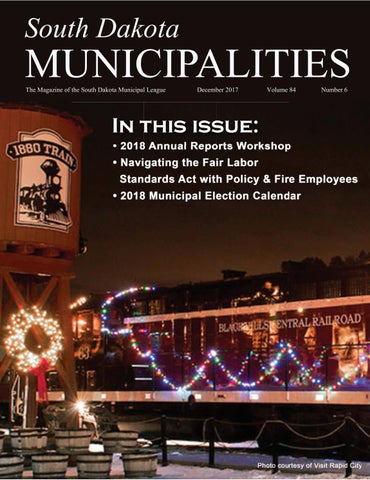
Dec 17_Cover_Cvr.qxd 11/20/2017 2:16 PM Page 1
6RXWK 'DNRWD
081,&,3$/,7,(6 7KH 0DJD]LQH RI WKH 6RXWK 'DNRWD 0XQLFLSDO /HDJXH 'HFHPEHU 9ROXPH 1XPEHU
,Q WKLV LVVXH
Dec 17_Cover_Cvr.qxd 11/20/2017 2:16 PM Page 2
Official Monthly Publication
Member of National League of Cities
www.sdmunicipalleague.org
South Dakota MUNICIPALITIES
Managing Editor: Yvonne A. Taylor
PRESIDENT Mike Wendland Mayor, Baltic
1st VICE PRESIDENT Pauline Sumption Finance Officer, Rapid City
2nd VICE PRESIDENT Debbie Houseman Finance Officer, Lake Andes TRUSTEES Fay Bueno Finance Officer, Sturgis
Editor: Sara M. Rankin
DISTRICT CHAIRS Dist. 1 - Mike Grosek Mayor, Webster
Dist. 2 - Paullyn Carey Mayor, Brookings
Dist. 3 - Dawn Murphy Finance Officer, Tea
Dist. 4 - Becky Brunsing Finance Officer, Wagner Dist. 5 - Renae Phinney President, Ree Heights
Karl Alberts Finance Officer, Aberdeen
Dist. 6 - Leland Treichel Mayor, Roscoe
Christine Erickson Councilmember, Sioux Falls
Dist. 8 - Harry Weller Mayor, Kadoka
Steve Allender, Mayor, Rapid City
Amy Nelson City Manager, Yankton PAST PRESIDENT Meri Jo Anderson Finance Officer, New Underwood
Dist. 7 - Arnold Schott Mayor, McLaughlin
Dist. 9 - Carolynn Anderson Finance Officer, Wall Dist. 10 - Michelle DeNeui Assistant Finance Officer, Spearfish
LEAGUE STAFF 1-800-658-3633 Fax: 605-224-8655
Yvonne Taylor Executive Director Sandi Larson Director of Risk Sharing Services Lori Martinec Director of Research and Training Chris Hill Director of Municipal Electric Services Sara Rankin Director of Marketing & Communications Lori Butler Director of Finance Carla McGregor Accounting Assistant Lisa Nold Office Manager SD Public Assurance Alliance: Judith Payne Executive Director Kristina Peterson Director of Underwriting Lynn Bren Director of Member Services Paytra Nichols Underwriter Jerry Krambeck Member Services Representative Deb Corkill Executive Assistant
Features
Contents
2018 Annual Report Workshops . . . . . . . . . . . . . . . . . .6
Comprehensive Challenge Grant . . . . . . . . . . . . . . . . .7
SDML Affiliate Membership Options . . . . . . . . . . . . . .8
Municipal Election Resources on SDML Website . . .12
2018 Municipal Election Calendar . . . . . . . . . . . . . . .14
Credits and Credits and Credits, Oh My! . . . . . . . . . .16 Rib Dinner Registration . . . . . . . . . . . . . . . . . . . . . . . .17
Representative Tieszen Lived a Life to be Admired . . . . . . . . . . . . . . . . . . . . . . . . . . . .18 Lowering Risk by Raising Wellness . . . . . . . . . . . . . .20
Free Online Citizen Preparation Guide . . . . . . . . . . . .23
SDMEA Hometown Power: Langford . . . . . . . . . . . .24 Badger Mayor Marks Decades of Leadership . . . . . . . . . . . . . . . . . . . . . . . . . . . . . . . .26 Security Pitfalls When Setting Up Your Own Software . . . . . . . . . . . . . . . . . . . . . . . . . .28
Navigating the Fair Labor Standards Act with Police and Fire Employees . . . . . . . . . . . . . . . .30
Columns
Director’s Notes . . . . . . . . . . . . . . . . . . . . . . . . . . . . . . .4
President’s Report . . . . . . . . . . . . . . . . . . . . . . . . . . . .5 Risk-Sharing News . . . . . . . . . . . . . . . . . . . . . . . . . .36 Washington Report: Senator Rounds . . . . . . . . . . . . .38
In Every Issue
Directory Changes . . . . . . . . . . . . . . . . . . . . . . . . . . .25
Hometown Happenings . . . . . . . . . . . . . . . . . . . . . . .40
Classifieds . . . . . . . . . . . . . . . . . . . . . . . . . . . . . . . . .44
Municipal Calendar . . . . . . . . . . . . . . . . . . . . . . . . . .45
SOUTH DAKOTA MUNICIPALITIES (ISSN 0300-6182, USPS 503-120) is the official publication of the South Dakota Municipal League, published monthly at 208 Island Drive, Ft. Pierre, South Dakota 57532, phone 605-224-8654. This institution is an equal opportunity provider, and employer. Periodical postage paid at Pierre, South Dakota and additional mailing offices. Non-member subscriptions are available for $30.00 annually. The opinions expressed herein are not necessarily those of the South Dakota Municipal League. Postmaster: Send address changes to SOUTH DAKOTA MUNICIPALITIES, 208 Island Drive, Ft. Pierre, South Dakota 57532.
DECEMBER 2017
VOLUME 84, NUMBER 6
3
Director's Notes
The article below was written before we heard about the loss of Craig Tieszen, former Rapid City Police Chief, current State Legislator, and long-time friend and supporter of the Municipal League. Please see page 18 for a tribute to Representative Tieszen, but our hearts go out to his family for their tragic loss, and when you read below, please keep in mind that Representative Tieszen was the embodiment of a fine legislator and a true supporter of local control. We have lost one of the jewels.
This time of year means “holidays” for most people, but for us, it means the 2018 Session is almost here. And again this year, my Christmas wish is to see the support for local control grow stronger.
Keep on top of what goes on under the Dome Subscribe to the SDML’s Legislative Update.
The SDML’s Legislative Update informs you on the hottest issues affecting municipalities as the South Dakota Legislature considers them. Each week League staff compiles an analysis of current and upcoming committee and floor action in the Senate and House.
As local leaders, you need to be a part of the action in Pierre. The Legislative Update helps get you there.
As you know, decisions in Pierre are made at a fast and furious pace, and the Update gives you a grasp of issues affecting how you govern on the local level.
Updates are issued throughout the session on a weekly or as needed basis, via fax, mail or email. Email is free, including an unlimited number of addresses to each city.
To receive the Legislative Update via email contact Yvonne at yvonne@sdmunicipalleague.org and be sure to follow us on Facebook and Twitter for up to the minute updates.
To get the Update sent to you by mail or fax please send $10 along with a request (include your mailing address, phone number or fax number) to: SDML, 208 Island Drive, Fort Pierre, SD 57532.
4
Local control has always been a very selective issue in the Capitol, touted about when it serves someone’s purpose, but not all that often acted upon in any meaningful way. There are notable exceptions to that, and most often the true-believers have arrived at the Legislature with some local service in their background. It has been wonderful to work with the legislators who have been mayors, or councilmembers, or police chiefs. With one sentence, you can describe an issue to them and they not only grasp it, they run with it.
To me, local control is a continuum, with the State’s interests on one end, and local interests on the other, and issues that fall somewhere in between, sometimes more heavily weighted toward the local end, where there should be control on your part and very little State involvement, and sometimes falling toward the State end, where you are going to have little say as the city council or town board, and the State will have control. The citizens, of course, are served by both, and the important question is, where are they best served on each issue? We very often think the weight falls at the local end of the spectrum, and the citizens are best served by you. The real jewels in the legislature are people who see the continuum, and know for a fact they can trust the locally elected officials. They know it because they’ve been there, taking the phone calls, talking to constituents in the gas station, or grocery store, or wherever they’ve found them.
This will be my 25th year lobbying for the Municipal League. My whole-hearted belief in local control has come from getting to know so many of you. There is no doubt in my mind that you have the best interests of the citizens at heart as you make the decisions that truly affect their quality of life and the every-day services on which they depend. Defending local control comes easily when you know so many of the people who are elected or appointed to work for their cities.
As term limits kick in even harder with time, it is ever more important that you keep in touch with your legislators. One message from home means more than a week of our lobbying in Pierre. Please subscribe to our legislative update (see side note on this page) and please contact your legislators on our issues. Keep in touch with the League, also, so we can present a unified effort. There is no doubt that you are absolutely the best lobbyists we have. Until next month, remember we are always available at 1800-658-3633 or yvonne@sdmunicipalleague.org. We wish you all the blessings of the season. Yvonne Taylor Executive Director
SOUTH DAKOTA MUNICIPALITIES
President's Report
Well, here we are already. Approaching the end of 2017. Of course, that means it’s the Holiday Season. Thanksgiving, Black Friday, school and church concerts, office parties and of course, Christmas. Anyone tired just talking about it?
As we enter this time of year, I encourage you to pause, take a deep breath and remember how blessed and thankful we are. Family is and should be on everyone’s list and taking time out to be with your family during this time should be a priority.
I would like you to stop and think for a minute, about how each of us from different cities across South Dakota, are like a big family ourselves. In a sense a City family, where a lot of our citizens know us very well. But the noticing does not stop there. We visit our neighboring cities and those citizens at times recognize and visit with us.
There are times throughout the year where this City family gathers. Here are a few; District meetings, Elected Officials workshop, Finance Officer’s school, Policy committee meetings and then of course, our big family reunion- Annual Conference. No matter how many of these you attend throughout the year, it’s a chance to talk about our spouse, kids or grandkids. Just like you would do at your own family reunion.
family? They come together, without hesitation or a “what’s in it for me” attitude when someone is in need. Many of us have been called upon to help. Whether that’s filling in for a maintenance person or a finance officer, providing a sample ordinance, calling the League office or simply asking for assistance.
So, as we enter this Holiday Season, let’s not only take time to be thankful for our personal families but let’s also be thankful for the acquaintances and network we have with our City family. Thank you and God bless. Mike
What else does a City family do that compares to your
DECEMBER 2017
5
2018 Annual Report Workshops The South Dakota Municipal League and the South Dakota Department of Legislative Audit are co-sponsoring one-day workshops on preparing this year¶s annual report. Remember, annual reports are required to be filed by ALL municipalities. The filing status of annual reports has had a renewed focus in recent years. The federal government has recently promulgated a sense of transparency and timeliness of financial data. This seminar will move you a giant step closer to meeting those goals. These workshops are brought to you without cost by the South Dakota Municipal League and the Auditor General¶s office. They will be conducted by the staff of the Department of Legislative Audit. Finance officers, clerks, auditors and treasurers should plan to attend. This year we are providing a limited offering of annual report workshops for all sizes of cities. If you have questions on which workshop you should attend please call Rod Fortin with Legislative Audit at 605-367-5810. Small Cities: those with less than $600,000 in revenue. This class is targeted for all cities of this size range. Please bring your Municipal Accounting Manual and previous year¶s annual report to use as reference material. Also, bring a copy of your 2018 published budget ordinance to assist in participating in a discussion in this area as well as copies of several receipt/voucher transactions so that we can work together on coding solutions. x Fort Pierre: Wednesday, January 10, 2018 Noon-3:00pm, SD Municipal League Building, 208 Island Drive *lunch on your own x Aberdeen: Thursday, January 25, 2018 Noon-3:00pm, County Court House, Community Room, Basement Annex, 25 Market Street *lunch on your own Large Cities (cash basis): those with $600,000 or more in revenue. This class is targeted for only those personnel that have approximately two years or less of annual report preparation experience. Please bring your previous year¶s annual report to use as reference material. Also, for further discussion, bring a copy of your general ledger containing equity accounts for each fund (GASB 54). x Huron: Wednesday, January 17, 2018 11:00-3:00pm, Campus Center, Pyle Room, 333 9th St. SW *working lunch by ordering pizza in Large Cities (GAAP basis): those with $600,000 or more in revenue. This class is targeted for only those personnel that have approximately two years or less of annual report preparation experience. Please bring your previous year¶s annual report to use as reference material. Also, for further discussion, bring a copy of your general ledger containing equity accounts for each fund (GASB 54). x Fort Pierre: Thursday, January 11, 2018 10:00-3:00pm, SD Municipal League Building, 208 Island Drive *working lunch by ordering pizza in DEADLINE for Registration is ONE WEEK PRIOR to each meeting. Notes: If the weather looks inclement, call 605-367-5810 or 800-658-3633 to determine if the seminar has been postponed. Please do not take any driving risks. Dress is business casual. Individuals needing assistance, pursuant to the Americans with Disabilities Act, should contact the League office in advance of the meeting to make any necessary arrangements. MUNICIPALITY: NAME
CHECK ONE:
____Fort Pierre January 10
TITLE
____Fort Pierre January 11
____Huron January 17
____Aberdeen January 25
PLEASE RETURN TO: South Dakota Municipal League, 208 Island Drive, Ft. Pierre, SD 57532, Fax 605-224-8655 Email: Lisa@sdmunicipalleague.org, Website: http://www.sdmunicipalleague.org
Urban & Community Forestry Comprehensive Challenge Grant
Through the Urban & Community Forestry Program, the SD Department of Agriculture Resource Conservation and Forestry Division has provided financial assistance to our communities each year since 1991. A portion of the division’s annual allocation of Urban and Community Forestry Assistance funds from the US Forest Service is awarded to communities in the form of Challenge grants.
These grants are used to fund community forestry projects that solve a specific community forestry problem or demonstrate the importance of trees in our communities. The community or service organization must match challenge grants.
The Division has developed the challenge grant program to require increased commitment and effort from a community. The criteria for the challenge grants are outlined below in highest to lowest priority:
1. Professional Services — ($5,000) 2. Tree Inventory/Assessment — ($5,000) 3. Existing Tree Care & Maintenance — ($1,000) (An applicant may receive a maximum of $1,000 per year for existing tree care and maintenance.) 4. Education/Training — ($5,000)
5. New Tree Planting — ($1,000) (An applicant may receive a maximum of $1,000 per year for new tree plantings.) 6. Other Activities — ($5,000)
Grants have a maximum limit of $5,000. The required match may be met through volunteer labor, donated and/or purchased supplies, or actual cash expenditures.
Grant applications will be accepted at any time during the year. For the application forms and more information visit sdda.sd.gov/conservation-forestry/grants-loans/communityforestry-challenge-grants/ or contact the SDDA Resource Conservation and Forestry Division. Contact Information: Division of Resource Conservation & Forestry South Dakota Department of Agriculture Phone: 605-773-3623, Toll-Free: 800-228-5254 Email: SDRCF@state.sd.us
Investing in your
INFRASTRUCTUR RE is an INVESTMENT inn
. w o r r o tom
Q Streets Q Sewer SNYDER-ASSOCIATES .COM
Q Drainage Q Water Q Airports
TRAN S PORTATIO N
LAND DE V E L OP ME N T
Q GIS Q Electrical
Power
W AT E R
M UNI C IPA L E N G I NE ERIN G
Trusted. Proffessional. essional. Soluttions. S TRU C TUR A L
PUBLIC SPACES
DECEMBER 2017
Sioux Falls, SD 605-339-4157
dgr.com
Yankton, SD S 605-665-2 2002
email:dgr@dgr.com
7
SDML Affiliate Membership Options
Ten affiliate organizations enjoy the advantage of being members of the South Dakota Municipal League. These organizations receive SDML staff support and hold their meetings at the League’s Annual Conference and many of the affiliate groups meet at other times during the year. Visit www.sdmunicipalleague.org/sdmlevents for a listing of all the events.
Dues notices for the Affiliates were recently sent to each city office and can be found under the Affiliate Organizations tab at www.sdmunicipalleague.org or by calling the League office at 800-658-3633. Affiliate membership options include:
SD Airport Management Association • The purpose of this association shall be to foster the planning, development, use and operation of public airports in the State of South Dakota; • To assist its membership in resolving problems though mutual experiences in airport operations; and • In cooperation with the South Dakota Municipal League, to take an active part in legislation that may affect public airports in the State of South Dakota. • ANNUAL DUES of the association are $25 per city; Associate membership is $50/person. SD Municipal Attorneys’ Association • The purpose of this association is to establish a forum by which municipalities may promote matters of mutual interest and provide a closer working relationship in municipal government and administration by the following means: Holding meetings for the discussion of legal and
8
other questions affecting municipal governments; The furnishing of information to municipal law officers and departments in order to enable them to better to perform their functions; and - Studying legislation, court decisions and administrative rulings relating to the public interest of municipalities. ANNUAL DUES of the association are $35 for each city represented that is over 5,000 population and $20 for each city that is under 5,000 population. -
•
SD Building Officials’ Association • The purpose of the association shall be the consideration of principles and practices underlying the laws and ordinances relative to the construction, maintenance and occupancy of buildings, use of land, and methods of uniform administration; and • To develop requirements and regulations pertaining to training of building officials and administration officers. • ANNUAL DUES of the association are as follows: - Governmental Membership (GM) is $50.00; each additional Governmental Individual (GI) membership is $5.00. • Governmental Members shall be a designated individual, usually the building official, of a government agency (state, county or municipal), which is responsible for the enforcement or administration of laws and ordinances relating to building construction. • Governmental Individual Members shall be additional employees of governmental agencies which are responsible for the enforcement, or administration of laws and ordinances relating to building construction.
SOUTH DAKOTA MUNICIPALITIES
-
-
Professional Membership (PM) is $50.00; each additional Professional Individual (PI) membership is $10.00. • Professional Member shall be a designated individual of a firm, incorporated or unincorporated, engaged in the practice of architecture, engineering, inspection, research, testing or related activities. • Professional Individual Member shall be additional employees of professional firms that practice architecture, engineering, inspection, research, testing or related activities. Annual Associate Membership (AM) is $25.00. • Associate Member shall be a representative of firms or corporations of commercial and industrial concerns engaged in the sale, manufacture or processing of materials and assemblies.
SD City Management Association The purpose of this association shall be to increase the proficiency of Managers and Administrators of local governments; To strengthen the quality of local government through
DECEMBER 2017
professional management; To encourage and support the precepts of the Council/Manager plan; To maintain the high ethical standards of the profession of City Management; and To provide opportunities to enhance the professional development of its members. ANNUAL DUES of the association are as follows: - Full membership is $150 per person. • Full Members: Any person who is a City Manager or Administrator, or an assistant to City Manager or Administrator of a South Dakota City shall be eligible for full membership in the Association. - Associate membership is $75 per person. • Associate Members: Persons holding responsible administrative positions in South Dakota cities and other persons who are interested in the objectives of the Association shall be eligible for associate membership. - Student membership is $15 per person. • Student Members: Any person currently enrolled full or part-time in a graduate or undergraduate program with an interest in local government.
9
SD Association of Code Enforcement The purpose of this association is to operate, without profit to the Association, or its members, as a state association to advance, educate and improve efforts of state, county, city and other political subdivision employees who are actively involved with and responsible for the enforcement of housing, municipal, county, state or federal codes without regard to race, creed, color, national origin, or sex; • To encourage professionalism with regard to the standardization of enforcement of environmental and housing codes; and • To supply and advance the science and practice of code enforcement through certification and to provide training workshops, seminars and conferences facilitating and advancing the administration of the various codes with which the Association is concerned. • ANNUAL DUES of the association are $40 per city.
SD Municipal Electric Association The South Dakota Municipal Electric Association, formed in 1950, serves member municipalities that provide electricity to approximately 100,000 South Dakotans.
10
The Annual Meeting is held each October during the Municipal League Annual Conference.
The Electric Superintendent-Foreman Conference is held each March in Watertown.
SD Governmental Finance Officers’ Association • The purpose of this association is to establish a forum by which cities and towns may promote matters of mutual interest and provide a closer working relationship that there may be improvement in municipal government and administration; • To promote the improvement of methods of governmental finance in South Dakota including the development of mutually understandable procedures of accounting, budgeting, and financial reporting; and the encouragement of the use of common terminology, classification, and principles in regard to those subjects; and • To take an active part in legislation that may affect municipalities of the state through the South Dakota Municipal League. • ANNUAL DUES of the association are $40 for the first person and $30 for each additional person of the same city.
SOUTH DAKOTA MUNICIPALITIES
SD Governmental Human Resource Association • The purpose of this association is to advance the profession of human resource management in governmental entities by promoting matters of mutual interest and providing a closer working relationship so that there may be improvement in government and administration; and • To promote the improvement of all aspects dealing with Human Resources in South Dakota through information sharing and consolidated training with a special emphasis on assisting smaller communities and to take an active part in legislation that may affect the governmental entities of the state through the South Dakota Municipal League. • ANNUAL DUES of the association are $25 per person.
SD Police Chiefs’ Association • The purpose of this association shall be of an educational, scientific, benevolent, fraternal and charitable nature and to develop a closer official and personal relationship between the various law enforcement officials of the State of South Dakota. • To maintain a steadfast resolution to guard the rights, liberties, and welfare of all citizens; • To foster any project which will help bring law enforcement officials recognition as professionals, to increase the efficiency of the member of aiding in the improvement of the laws of the State of South Dakota and demanding the enforcement of the same; and • To encourage the members to attain a high degree of skill and efficiency in law enforcement work, thereby advancing the standards of all enforcement officers. • ANNUAL DUES of the association, for Chiefs and Assistant Chiefs, are determined by a formula that takes into account population in addition to a base of $95. Please call the League office for the actual dues amount for your city. Command Staff and Associate membership is $25 per person.
SD Municipal Street Maintenance Association • The purpose of this association is to provide education and instruction for municipal street maintenance workers and to assist in meeting their goals through encouragement and friendly exchange of knowledge and experience among its members. • ANNUAL DUES of the association are $35 per city.
For more information visit the Affiliate Organizations tab at www.sdmunicipalleague.org.
DECEMBER 2017
11
Municipal Election Resources on SDML Website
The following Municipal Election Resources can be found on the SDML website at www.sdmunicipalleague.org and by clicking on the Library tab, then Elections. 1.
Municipal Election Resources - This is a quick link to the Secretary of State’s website that contains many resources including the Election Calendar, Initiative and Referendum information, Petitions and more.
2. Election School Powerpoint Presentation- This link is to the most recent powerpoint presentation from each year’s Election School.
3. 2018 Municipal Election Calendar- The calendar will help keep you on track regarding all deadlines for publication of election notices as well as timelines for circulation and receipt of petitions, availability of absentee ballots and other election related timelines.
4. How to Circulate a Nominating Petition- This document, created by the Secretary of State’s Office, provides specific guidelines on timeframes, circulator requirements, signer requirements and filing requirements.
5. Candidate Nominating Petition Requirements Checklist- This document, created by the Secretary of State’s Office, provides a checklist for the Finance Officer to reference, when validating a nomination petition, to ensure all sections are completed correctly.
6. What Happens If No One Files a Petition? – This document provides information regarding recent changes in statute regarding the process for appointment of elected officials in the event of a vacancy. 7. Municipal Elections Handbook- Updated annually, this document provides information, in laymen’s terms, about the State Statutes and Administrative Rules related to conducting an election. It has a frequently asked questions section that is particularly helpful in addressing common issues that arise in municipal elections as well as a collection of all necessary Election Notices and Forms.
8. Municipal Initiative and Referendum- This document, created by the Secretary of State’s Office, provides a step-by-step guideline for those wanting to file an Initiative or Referendum Petition with their governing body. 9. Municipal Recall Election Guidelines- This
12
SOUTH DAKOTA MUNICIPALITIES
document, created by the Secretary of State’s Office, provides information regarding publication of notices, petition circulation and filing timeframes, and ballot information for a Recall Election.
10. Election Worker Training Powerpoint- This is a quick link to the PowerPoint created by the Secretary of State’s Office to use for training Precinct Workers on Election Day responsibilities.
11. Election Day Precinct Manual - This is a quick link to the Secretary of State’s document that goes through all information needed on Election Day.
12. Election Code Book- This is a quick link to the Secretary of State’s Election Code Book that spells out all South Dakota Codified Law and Administrative Rules of South Dakota that govern Elections in the state. This document is updated anytime there is a change.
13. Poll Watcher Guidelines- This document, created by the Secretary of State’s Office, provides information for those wanting to be poll watchers on Election Day. 14. Polling Place Voter Key- This document, created by the Secretary of State’s Office, provides a flow chart for Election Workers and others to use as they determine voter eligibility.
DECEMBER 2017
15. Voter Registration Forms- This is a quick link to the Secretary of State’s Office website that provides information to the user on how and where to register to vote in South Dakota as well as a Registration Form to download. The site also provides information to public Agencies who assist people with voter registration.
16. Guidelines for Absentee Voting Process- This document, created by the Secretary of State’s Office, provides information on the process that a municipality must follow to implement the Absentee voting process. 17. Absentee Ballot Log (Sample)- This document provides a template to use for an Absentee Ballot Log. 18. Elections Supplies List (Sample) - This document provides a good list to start from for creating your own Election Day supplies list.
19. Election Day Checklist for Municipal Election Board (Sample) – This document provides a good list to start from for creating your own Election Day Checklist for setting up the actual voting site, organizing election workers, and processing ballots. 20. Oath of Office- This is a sample oath to use for elected or appointed municipal officials.
21. Recount Manual- This is a quick link to the document, created by the Secretary of State’s Office, to provide information regarding procedures to follow in the event that a recount is either requested via petition or required by law.
13
14
SOUTH DAKOTA MUNICIPALITIES
DECEMBER 2017
15
Credits and Credits and Credits, Oh My!
By Kristina Peterson, SDPAA Director of Underwriting and Lynn Bren, SDPAA Director of Member Services
In our personal lives, there are several options for finding solutions to shortfalls in our budget. Public entities may not have as many opportunities for filling those gaps. When those opportunities do arise, they must be seized before they disappear like the latest and greatest electronics during a Black Friday sales event.
As a Member of the SDPAA, there are credits which are available to you. Our Members enjoy credits often times for doing nothing more than returning their properly completed renewal packets on time! The SDPAA offers four separate credits each year: Law Enforcement, Loss Control, Loss Ratio and Renewal. Members received a total of $948,890 in credits last year!
The Law Enforcement and Loss Control credits are obtained by satisfying loss control recommendations made during the Loss Control Surveys conducted by Safety Benefits for the SDPAA . These surveys are completed every three years, and the credit is automatically renewed each year for three years. By simply working through recommendations made during the Loss Control Survey, Members saw savings of up to $19,844.71 for loss control credits and up to $9,786.30 for law enforcement credits in 2016.
Members with a Loss Ratio of 60% or less receive a Loss Ratio Credit. This credit is reviewed each year at renewal time and is based upon contributions and losses incurred by a Member. Our Loss Ratio credits provided savings of
16
up to $27,286.48 in 2016.
The final credit that the SDPAA offers its Members is the Renewal Credit. This credit is earned by returning your renewal packet on or before the due date provided in the renewal packet cover letter. Renewal Credit savings earned by our Members ranged up to $2,480.59 in 2016.
Distribution Credits offered by the SDPAA are not the only method we utilize to help maximize the benefits that are offered to our Members. Property Contributions are based, in part, on coverage values. Every four years, the SDPAA provides Property Evaluations to each of our Members. Safety Benefits evaluates and prepares valuations for all Member owned property. This information is compared with the current statements of values, and those amounts are updated. This also assists Members in identifying properties which are not scheduled. Unscheduled property can cost a Member in the event of a claim. Property evaluations are reviewed by our Member Services team, and visits are made to review the evaluations with our Members. By continuing to work with our Members each year, we are able to offer them opportunities to save some of those budget dollars and to continue to provide the best property and liability coverage available in the state!
Not a Member of the SDPAA, but want to be? Give us a call at 800-658-3633 Option 2 or head over to our website at www.sdpaaonline.org! We would be delighted to work with you to take those first steps to becoming a Member of the South Dakota Public Assurance Alliance.
SOUTH DAKOTA MUNICIPALITIES
RIB DINNER WITH YOUR LEGISLATORS Mayors, councilmembers, finance officers and all municipal employees, please join us Tuesday, February 6, 2018 for an informal rib dinner with your state legislators. The dinner will be held at Drifters Bar & Grille in Fort Pierre beginning at 6:00 p.m. Prior to dinner, a legislative briefing will be held to update you on discussion topics and on the committee meetings for Wednesday, February 7, 2018.
MUNICIPAL GOVERNMENT DAY AT THE LEGISLATURE Wednesday, February 7, 2018 will be Municipal Government Day at the Legislature. This is the day all municipal officials are invited to Pierre to watch the Legislature in action. Tuesday, February 6, 2018
Wednesday, February 7, 2018
5 to 6:00 p.m.
Registration Drifters Bar & Grille, Fort Pierre
5:30 p.m.
Legislative Briefing Drifters Bar & Grille, Fort Pierre
7:45 a.m. to Noon Legislative Committee Meetings Various Committee Rooms in the State Capitol Building (Registration packets available at the Rib Dinner will have the details.)
6:00 p.m.
Rib Dinner Drifters Bar & Grille, Fort Pierre
Please return the registration form with payment by Tuesday, January 23, 2018. We need to know how many will be attending so that we may plan for the meal accordingly. No refunds will be given after January 23, 2018. A block of rooms has been reserved at the Holiday Inn Express in Fort Pierre (605-223-9045) for Tuesday, February 6, 2018 (room block release date is January 16, 2018). Room rate is $119.99 single/double plus tax. Be sure to mention the SDML block when making your reservations. Individuals needing assistance, pursuant to the Americans with Disabilities Act should contact the League office in advance of the meeting to make any necessary arrangements.
REGISTRATION FORM February 6-7, 2018 *Note: Rib Dinner has been moved to Drifters Bar & Grille in Ft. Pierre for 2018 ¾ Please TYPE OR PRINT your information as you would like it to appear on the name tag. Municipality Represented: _______________________________________________ Name
Title
Rib Dinner $25
TOTAL AMOUNT ENCLOSED: $ Return Registration and Payment by January 23rd to: *No Refunds after January 23, 2018 *Payment Must Accompany Registration
South Dakota Municipal League 208 Island Drive Fort Pierre, SD 57532
Amount Paid
Representative Tieszen Lived a Life to be Admired “A true gentleman who was respected by all who knew him.” “He was a kind and decent man to the very core.”
“We are diminished by his loss.”
How far the 68-year-old state lawmaker and former police chief was willing to go to help another was evident Wednesday, the day of his daughter’s wedding in a faraway romantic setting where family members gathered for a momentous event.
“A heavy heart this Thanksgiving.”
He was kayaking with his brother-in-law, Brent Moline, at Cook Islands in the South Pacific. According to local police reports, Brent got into trouble and Craig attempted to rescue him, but both men were claimed by the ocean — a catastrophic family tragedy.
The news of Craig Tieszen’s death struck Rapid City and much of South Dakota like a thunderbolt. By all measures — as the Twitter comments above indicate — he was a beloved and generous public figure who respected others and their viewpoints while working in challenging leadership positions.
Rep. Tieszen became Rapid City police officer Craig Tieszen in 1975 when his career in law enforcement began. Before that, he was a Peace Corps volunteer where his
“I have never met anyone so likeable, so professional and so dedicated to public service.”
“He was a good, good man.”
It was the final measure of a man admired by his peers and countless others whose lives he touched in 42 years of public service where he consistently and to the very end demonstrated what kind of man he was and will forever be.
IT MA M T TEERS. WA ATER. T TER It grows our children hild and d crops. It develops our cities and co ountry. It powers o our industries and bu usinesses. It cleansses our bodies and th he land. Provid ding water engineering and a related services to h help clients achieve succcess. WAT TER ENGINEERING | CIV VIL ENGINEERING | LAND SERVICES | SURVEY/MAPPING/GIS MUNICIPA AL FINANCIAL SERVIC CES | ASSET MANAGEMENT | INSTR RUMENTA ATION & CONTROLS ELECTRICAL ENGINEERING | STRUCTURAL ENGINEERING | COMMUNICA COMMUNIC T TION SERVICES
Advanced Engineering and Environmentall Services, Inc. South Dak kota Offices: Rapid City, Sioux Falls, Spearfish
www www.ae2s.com w ae2s com
18
SOUTH DAKOTA MUNICIPALITIES
legacy of caring, kindness, humor and commitment likely began to take shape.
In 2000, he was named police chief of Rapid City, a position he held for seven years before retiring from law enforcement and then taking a run at elected office. In 2009, the Republican won a seat in the state Senate, where he served for seven years. In 2016, he returned to the Legislature as a representative for District 34 on the west side of Rapid City.
In his years in law enforcement and politics, his path crossed with those in every station of life — from children to senior citizens, the affluent to the less fortunate, the powerful to the average working-class citizen. Judging by the outpouring of grief and recollections on the career and life of Craig Tieszen, many benefited from their association with him and proclaimed it to the world. Not many of us will be so honored upon our passing.
How many of us would be willing to risk our lives, especially on a child's wedding day? What type of person is willing to put another life ahead of their own? The answer has been right in front of all those who have known Craig Tieszen.
DECEMBER 2017
In the end, most are remembered and judged by how they lived. It is the final and ultimate verdict. Craig Tieszen, however, also will be remembered for dying the way he lived — in service to others. On the day before Thanksgiving, he made a selfless sacrifice that cost him a life that he had worked hard to achieve. Yet for those who knew him, there can be little doubt that he was only thinking of his brother-in-law when he made what would turn out to be the last decision of his earthly life. Craig Tieszen will be missed by many and the pain of this loss won't soon pass. Death is always hard to accept, especially when we lose someone who has given so much to so many. We thank him for his public service and express our sincerest condolences to his family. Upon his return to this community, we need to celebrate his life and support his family.
It is the least we can do for a man who through his actions showed others how to live and had the courage to put it all on the line. Reprinted with permission from the Rapid City Journal
19
Lowering Risk by Raising Wellness
When local governments keep city employees physically and emotionally healthy, residents and businesses can reap rewards, too. Luckily, cities have countless tools to improve employee wellness.
Wellness programs can attract and retain employees, make a city an employer of choice, foster creativity, enhance employees' performance and decrease burnout, according to Sara Rauch, director of strategy and planning for the Wellness Council of America.
These benefits go beyond the old thinking, which focused mostly on saving health insurance and workers' compensation costs. To be successful, wellness programs must be tailored for each entity.
The Wellness Council of America developed several essential benchmarks, including the following:
• • • •
Enlist senior-level support. Empower a cohesive team to drive the program. Gather city-specific data on wellness needs. Make a detailed plan.
• • •
Choose appropriate wellness interventions. Create a supportive environment. Carefully evaluate outcomes.
Common challenges to employee wellness include poor nutrition, fatigue and stress, all of which impact physical and behavioral health, safety and performance.
A better diet Approximately 127 million American adults are overweight, and 60 million are obese, which is considered to be more than 30 pounds overweight.
The Peapod Biz Bites Survey suggests that about two out of three employees find eating healthy at work a challenge. "Cities can support healthy eating by substituting any unhealthy snacks or meals provided by the city with healthier alternatives," said Meredith Kaiser, loss control consultant for the Municipal Association's Risk Management Services.
It's also helpful to remind employees that eating more fruits and vegetables and less saturated fat reduces the risk of heart attack and stroke. It also lowers the risk of getting diabetes and certain cancers, such as cancers of the mouth, throat, lung, esophagus, stomach and colon. Obesity is associated with more than 30 serious medical conditions. So consider offering all employees access to nutritional counseling, not just those with certain health diagnoses. Free online educational newsletters, such as one from the American Heart Association, can also supplement onsite resources.
When fatigue affects safety Forty-three percent of U.S. workers believe they are too tired to function safely at work, according to a new National Safety Council report, Fatigue in the Workplace: Causes and Consequences of Employee Fatigue, which focused on 2,000 working adults.
20
SOUTH DAKOTA MUNICIPALITIES
The study also found that 97 percent of workers have at least one risk factor for fatigue, such as working late-night or early-morning shift, working long shifts without regular breaks, working more than 50 hours each week, and having long commutes. The NSC revealed that 76 percent of respondents reported feeling tired at work, 53 percent say they are less productive and 44 percent have trouble focusing.
"Impairment stems not just from alcohol and drugs but lack of restorative rest," said NSC President and CEO Deborah A.P. Hersman. "Fitness for duty starts with getting a good night's sleep."
According to the report, workplace fatigue can be caused by a variety of factors, including work schedules and job demands. NSC says employers must understand the underlying causes of fatigue in order to identify potential sources of safety risks and ultimately implement appropriate countermeasures.
The document points to three levels of fatigue: decreased cognitive performance, microsleeps or nodding off, and increased risk for workplace injuries. The NSC cites one study that found a person who loses two hours of sleep
DECEMBER 2017
from a normal eight-hour sleep schedule performs similar to someone who has consumed two to three beers.
Gordon Graham, a law enforcement risk management expert, said that even low-risk tasks can become dangerous when employees are fatigued, complacent or distracted.
Long-term sleep deprivation can lead to other complications, including the following: • • • • •
high blood pressure, increased risk of heart disease and diabetes, depression, substance abuse, and obesity.
An estimated 50 million to 70 million Americans struggle to fall asleep or stay asleep, according to the National Institutes of Health. A National Sleep Foundation poll found that American adults sleep less than the recommended seven hours each night, and more than half had symptoms of insomnia at least two nights each week. Being mindful of work schedules and job demands can support an employee's quality of sleep, safety and health.
21
The effects of stress Workplace Options, a provider of Employee Assistance Program services, examined data representing more than 100,000 employees' EAP inquiries from 2012 to 2014. While the number of cases dealing with personal emotional health issues remained relatively constant over the period, those related to stress, anxiety, and depression showed an "alarming" increase.
About four out of every 10 cases were related to personal emotional health issues. The number of cases around depression increased 58 percent between 2012 and 2014. Anxiety cases were up 74 percent and cases of employee stress increased 28 percent.
"If your employees' emotional well-being wasn't already on the top of your list of priorities, it needs to be," said Dean Debnam, CEO of Workplace Options.
Aetna surveyed its employees and found that those who reported the highest levels of stress incurred on average $2,000 more per year in health care costs.
Cities cannot eliminate the causes of stress in employees' personal lives. But it is important to try to reduce causes of
22
work-related stress, according to the National Institute for Occupational Safety and Health.
There are some concrete steps that may help to achieve this. Group discussions or employee surveys can help identify sources of stress and possible solutions. Employee Assistance Program providers can be a resource for individual counseling as well as classroom training on topics such as stress-management and conflict resolution. First responders also have a behavioral health benefit established to reimburse them for out-of-pocket costs related to mental health care.
A variety of studies have suggested that mindfulness techniques are an effective way to manage stress. Employees can download an app like Headspace for tips.
For more information, SCMIT and SCMIRF members may contact Meredith Kaiser at 803.933.1279 or mkaiser@masc.sc. Portions of this article are reprinted with permission from Safety National.
SOUTH DAKOTA MUNICIPALITIES
Free Online Citizenship Preparation Guides
The South Dakota State Library provides dozens of electronic resources at no cost to all South Dakota residents. This includes tutorials, study guides, and practice tests for helping residents prepare for the U.S. Naturalization Test. Pro Citizen is an interactive course to help prepare one of the civics, reading and writing parts of the USCIS Naturalization Test. It provides 100 instructional videos, drills and quizzes in both English and Spanish.
To use Pro Citizen, either choose ‘instant access’ or register. To access Learning Express Library, you will need either local library card or a State Library e-card. To obtain a card, go to http://library.sd.gov/forms/librarycard/index.aspx
To learn more about these resources, contact your local library, or David Bradford with the State Library at david.bradford@state.sd.us
Another database provided by the SD State Library is Learning Express Library. It contains e-books, articles, and practice test to help one become a U.S. Citizen, in both English and Spanish. There is also a guide to assist in obtaining an official United States Green Card. You must register to use Learning Express and reside in South Dakota.
You can use all of these resources at home or in your local library. Please go to the South Dakota State Library website: http://library.sd.gov/LIB/ERD/category/languages
DECEMBER 2017
23
By Chris Hill, Director of Municipal Electric Services
Langford
Another first. On November 6th, I traveled to Langford to visit with Blair Healy. From my home, I travel north on 281. This particular day, the snow was coming down (not much of an accumulation) and the wind was blowing. From Plankinton to Redfield, the roads were covered in scattered ice and visibility was reduced so I was quite sure that I was going to have to call Blair and let him know that I was going to be late. Then, all of the sudden, the skies opened up and it was smooth sailing-or driving I should say. Knowing that I was now going to be on time, which is usually 20 minutes early for me, I decided to take 212 East to 37 North. Another first. My phone lights up and said turn left on to highway 37 North. Then it happens. I see signs for Turton, Conde, Verdon and Ferney. Usually when I travel, I see communities that I hadn’t heard of, but these little communities, except for Conde, I had NEVER heard of. Great little communities along the way and I knew that I had to travel through them on the way back home when I had more time.
South Dakota surprises me again. North through Grotonanother Muni Electric. East to Pierpont. Finally, north to Langford. What could have been a two-and-a-half-hour trip to Langford has now become two hours and forty-five minutes, and I enjoyed every minute of the drive because I was exploring. Much like Lewis and Clark, I am exploring! Much unlike them, it is behind my heated steering wheel and heated seats. They would be jealous.
Blair told me to come to the city shop. The green building on the north side of main street as you get in to town. I see the bucket truck, so I know this must be the place. Its chilly, but not COLD. I go into the office, knowing full well that I had enough time to drive around Langford for a few minutes before our meeting, and still being 20 minutes early, and Blair is nowhere to be found. I head out front to 24
where I parked and looked up. Town of Langford Maintenance Shop. Ok, this was right, so I wander more and see Joe Keough. Joe leads me to Blair, and I ask if they have time to visit with me-yes, I ask, even though the meeting has been set up for a while now.
Employees Joe Keough and Blair Healy
Blair and Joe already know how great Langford is. I mentioned some of my sights and how impressed I was with their community with a population of 326. They are the only two maintenance workers and much like several of our communities, Blair and Joe wear many hats with their positions.
Langford is looking at installing a new AMR system and is currently talking to vendors about possible system improvements for water and electric meters. Blair and Joe also mentioned that they would like to have pole testing completed throughout the town. Another project that was completed in 2016 was the installation of LED lighting throughout the town. They informed me that they used 70 Watt LED on main street and 40Watt LED on the side streets. The community had a positive reception of the LED lighting. The main source for the LED improvements in Langford was a grant from Heartland Consumers Power District for LED improvements. SOUTH DAKOTA MUNICIPALITIES
SDML Directory Changes
Aberdeen Blunt:
Britton
Town of Langford
The Town of Langford has much to be proud of with their Maintenance workers and the direction of their community. They are very proactive and local investors recently built a new community restaurant that has offices for a hair salon, Chiropractor, and an office for the NE SD Community Action Program.
Brookings
Happy Holidays from the South Dakota Municipal Electric Association! DECEMBER 2017
Delete: PC Jeff Miller Add: Acting PC Dave Erickson
Delete: ES Paul Melby Add: ES Russ Halgerson
Interior
Delete: ATT Ryan McNight Add: ATT Stephanie Trask (605) 859-2783
Hosmer
New Effington
Questions? Comments? Email me at chris@sdmunicipalleague.org or call me at (605) 770-6299
Delete: CM Linda Bosse Add: CM Austin Sasker
Add:
Midland
Langford Area Schools are also adding on to their existing building. With an enrollment of 229, the school is up 38 students from 10 years ago, which is always a great sign. If you ever get the chance, stop in and visit with Blair and Joe. They are very great people and two of approximately 326 that make their HOMETOWN great!
Delete: ATT Jerry Wattier
Hill City
Leola
Langford Business
Delete: CM Laure Swanson Add: CM Mike Olson
Oldham
FO Carla Sheldon
Delete: CM Chris Holmes
Delete: CM Shawn Patton CM Karl Moser CM Jon Mardian Add: CM Richard Reis CM Jessica Lipke CM Lindsey Bollinger
Delete: T Derek Flom Add: T Keith Garrigan
Delete: ATT Michael Hogan
Add:
ATT Jesse Ronning (605) 692-9415
Ree Heights Delete: T Delton Beck Add: T Ted Schaff
Roscoe
Rosholt
Tripp
Turton Warner White
Delete: ATT David Von Wald Add: ATT Justin Scott (605) 225-2232 Delete: ATT Michael Hogan
Delete: ATT James Haar
Delete: ATT Marshall Lovrien Add: ATT Justin Scott (605) 225-2232
Delete: FO Louise Zumbaum Add: FO Nichol Townsend Add:
CM Martha Brandt
White Rock Delete: ATT Michael Hogan
Email Directory changes to lisa@sdmunicipalleague.org. Visit www.sdmunicipalleague.org for a cumulative listing of changes to the 2017-2018 Directory of Municipal Officials.
25
Badger Mayor Marks Decades of Leadership
By Kelli Volk KELOLAND Media Group
Sometimes, being a leader means wearing a few different hats. A man in Kingsbury County is a shining example of that.
Like many small towns, Badger has changed over time.
"We used to have a grocery store and a cafe and whatever, but that's gone," Badger Mayor Myron Andersen said.
Still, there's one thing that has remained the same over the past several decades. "I was appointed mayor in 1967," Andersen said.
Today, 80-year-old Myron Andersen is still leading this community of about 130 people.
If you're keeping track, that's 50 years as mayor. Being mayor means being a multi-tasker.
"You might say I take care of the electrical system, the
26
sewer system, the water system, the roads," Andersen said.
Andersen oversees all of it and he has an impressive selection of hardware to prove his dedication to his hometown.
Those who have watched him lead over the years can attest to his contributions to the community, including his son Terry who's also a longtime Badger resident. "Hardworker. Dedicated to Badger of course," Terry Andersen said.
Andersen has about a year and a half left of his current term. He's not sure what's next after that, but he does know the answer to this question: Volk: Why do you remain so dedicated to the town? Andersen: I don't know. I guess it's my town. I've been here forever. I was born and raised here and I'm still here. I've been here for 80 years.
While this town is small, it can take up a big spot in someone's heart.
SOUTH DAKOTA MUNICIPALITIES
Managers & Administrators in Local Government
As the President of the South Dakota City Management Association, I would like to provide some insight into the role of Managers & Administrators in local governments.
The concept of professionally managed communities is fairly new in South Dakota. The concept is based upon a business organization's chief executive officer, the appointed professional manager (or administrator) administers the daily operations of the community. Through a professional staff, the manager ensures the effective provision of services and enforces the policies adopted by the elected body. He or she, in turn, uses merit as the leading criterion for making all hiring and personnel decisions.
A growing number of South Dakotan communities have moved towards professional management. Especially in small communities, professionals who are educated and experienced in local government provide a significant benefit that is difficult to emulate without a professional manager. There are compelling reasons why 59% of the nation’s communities have adopted council-manager government: - Appointed local government managers have no guaranteed term of office or tenure. They can be dismissed by the council at any time, for any reason. As a result, they constantly must respond to citizens and be dedicated to the highest ideals of honesty, integrity, and excellence in the management and delivery of public services. - The elected city, town, or county council hires a manager to implement their policies and programs, and oversee the day-to-day business of the government in an ethical, transparent manner. - Council-manager government diffuses the power of special interests and eliminates partisan politics from municipal hiring, firing, and contracting decisions. - The Code of Ethics of all Administers ensure their commitment to accountability, integrity, and public service beyond self interest
I invite the residents of South Dakota to contact me or other members of the Association to discuss the roles and benefits of professional City Administration. Justin Weiland President, SD City Management Association City Administrator, City of Dell Rapids DECEMBER 2017
27
Security Pitfalls When Setting Up Your Own Software
Sarah Northcutt, Account Manager Sophicity: We put the IT in city
It’s still tempting for cities (especially smaller cities) to roll up their sleeves, purchase some software to fill a basic need, and install it themselves. After all, there can’t be much to worry about. You don’t need IT professionals for that, right?
Wrong. As much as we admire a “go get ‘em” attitude, even the “simplest” software improperly installed can open you up to major security risks. As an example, Bitdefender published a recent article that described how lax security settings led to a sophisticated phishing attack against an Office 365 system that tricked users into giving up their usernames and passwords. As the article warns:
“...this isn’t the case of a hacker forging your email headers to pretend that the messages they are sending are
coming from your business’s servers. They really are originating from inside your company’s email system. A compromised business email system. If you don’t act now to harden your defenses and make it difficult for an attacker to breach your Office 365 system via this technique, then you have a ticking time bomb on your hands.” This warning applies not only to Office 365 but any software that you may attempt to install yourself. Here are some reasons why you need IT professionals to install, configure, and maintain even your most “basic” software.
1. Advanced administrative capabilities help IT professionals smoothly monitor and maintain software.
Today, quality software includes sophisticated administrative management tools that IT professionals understand how to use. For example, email software may include settings that involve storage limits and antispam filters. Document management software may include settings that involve retention schedules or permissions to access files. There are even administrative tools to manage compliance and user activity. All these administrative tools help IT professionals resolve issues, keep your city secure, and make sure you stay compliant with any laws and policies. 2. Security and privacy settings need careful attention.
When non-technical users set up their own software, it’s typical to find that the security settings are set to default. But also, and all too common, we find that non-technical users have set up full access and administrative rights for themselves and other users. This creates great risk. As a result, security needs to be tight.
IT professionals can navigate advanced security settings to help you with: • • • • • •
User access and authorization Password management Two-factor or multi-factor authentication Encryption Monitoring suspicious activity Taking specific actions after a security incident
3. Remote access needs careful attention. Non-technical people often unknowingly give unsecured, open access to their networks through software. Whether your staff uses their own laptops, smartphones, or tablets 28
SOUTH DAKOTA MUNICIPALITIES
to access software, danger exists if sensitive or confidential information gets stored on those devices. Suddenly, you’ve increased your risk of a data breach nightmare.
Solutions like a thin client, application streaming, or a VPN along with device and data encryption need to be considered when giving users remote access. These solutions avoid problems related to data leakage or theft while only giving users access to necessary aspects of the software for their work use. 4. Improper software installation and deployment can lead to security issues.
While this may seem the same as the second point above, it goes beyond simply setting up the software. When you install software, you’re installing it on servers and computers that may be unsecured or configured improperly. And when you deploy software, you are activating it within a network of switches, routers, and firewalls that may have security issues. Many variables exist when software interacts with an IT environment. IT professionals are familiar with such complex
environments and can avert security issues related to installation and deployment. 5. Failure to patch and update software leaves you open to hackers.
This year, something that used to get treated as a technical, menial task has become part of front-page headlines in mainstream news publications. Why? Failure to patch and update software is at the root of companies losing data to ransomware (such as the WannaCry attack earlier this year) and even at the heart of the Equifax data breach— one of the biggest and most devastating data breaches ever. Software vendors regularly put out patches and updates but many organizations—including many cities—fail to apply those patches and updates. That failure leads to gaping security holes that hackers exploit. Their attacks lead to data breaches and data loss.
Maybe you could go it alone in the old days of technology, but today you need IT professionals to help you set up your software. Despite your natural technical know-how, there are just too many security risks that a non-technical employee may miss when setting up software.
6DUD 5DQNLQ VDUD
DECEMBER 2017
29
Navigating the Fair Labor Standards Act with Police and Fire Employees
By: Tim D. Norris, Collins, Loughran & Peloquin, Norwood, Massachusetts and Amber G. Eisenschenk,Staff Attorney, League of Minnesota Cities
Special issues arise when applying the Fair Labor Standards Act (FLSA) to police and fire employees, including the option to define an extended work period, the FLSA’s application to small departments, different ceilings on accrual of compensatory time, and rules for volunteer versus paid on-call fighters. I. Administrative and executive exemptions
As a general rule, employees who perform police and firefighter work will be considered non-exempt under the FLSA, and must receive overtime or compensatory time off unless they fall under the small police/fire department exemption discussed below.1 However, certain highranking police and fire department employees such as police or fire chiefs, deputy chiefs, captains, lieutenants, sergeants, and corporals may meet the requirements of the administrative or executive exemption. Each city should determine on a case-by-case basis whether these positions meet the requirements of those tests.
Some guidelines cities may look at to help determine whether a police or fire employee would meet those requirements include the following: Police or firefighting work Does the employee perform police or firefighting work (e.g. preventing, controlling, extinguishing fires, crime prevention, investigations, apprehending suspects, interviewing witnesses,etc.) on more than just an occasional basis? The more direct police and firefighting
work performed, the less likely the employee will be considered exempt.
Discretion Is the employee dispatched to calls, or does he or she have discretion to determine whether and where his or her assistance is needed? Employees who are not dispatched to calls but have discretion to determine their own involvement are more likely to be considered exempt.
Managerial tasks Does the employee meet all of the requirements to be exempt under the executive or administrative exemption and primarily perform managerial tasks? Managerial tasks include: • •
• •
• • • • • • • •
Evaluating performance of employees under their supervision. Enforcing and imposing penalties for violations of rules/regulations. Making recommendations as to hiring,promotion, discipline or termination. Coordinating and implementing training programs. Maintaining payroll and personnel records. Handling community complaints, including decisions whether to refer them to internal affairs for further investigation. Preparing budgets and controlling expenditures. Ensuring operational readiness through supervision and inspection of personnel, equipment and quarters. Deciding how and where to allocate personnel. Managing the distribution of equipment. Maintaining inventory of property and supplies. Directing operations at a crime, fire or accident scene, including deciding whether additional personnel or equipment are needed.
Employees who spend the majority of their time performing duties such as those listed above are more likely to be considered exempt.
TRANSOURCE TRUCK & EQUIPMENT, INC. Aberdeen l 800.753.6225 Rapid City l 800.999.6286 Sioux Falls l 800.289.6225
30
A police or fire supervisor who directs the work of assigned staff during his or her shift but is also expected to routinely respond to dispatch calls and primarily does work investigating crimes or fighting fires is probably not going to be considered exempt. However, a police or fire supervisor who primarily SOUTH DAKOTA MUNICIPALITIES
manages the department and performs administrative and office work and seldom does any work “on the street” fighting fires or investigating crime is likely to meet the qualifications to be considered “exempt.” II. Small police/fire departments
The FLSA provides a complete overtime (but not minimum wage) exemption for any city employee who performs law enforcement work if the city has fewer than five employees who perform law enforcement work during the work period. Part-time employees and employees on leave are counted. This exemption holds true for fire protection work as well. This exemption applies on a work period basis, so it is possible for a city to use the exemption some weeks and not others. III. Extended work period exemption
A city can establish a work period for police and firefighters of anything between seven and 28 days. The police or fire protection employee would then earn time and one-half overtime only for those hours that exceed the limits under their work period schedule. (A table specifying the maximum hours worked before overtime is earned is attached as Appendix A at the end of this article). The work period does not have to be the same as the pay period, but there must be a notation on the payroll records that shows the work period for each employee and indicates the length of the period and the starting time. Different work periods may be established for different positions or groups of employees as long as each employee group is told what their work period is and it is documented.
policy or collective bargaining agreement based on a more generous overtime threshold, but does not calculate the regular rate as required by the FLSA.
The FLSA requires that for qualifying overtime, all stipends and differentials must be included in the regular rate. However, non-FLSA premium pay can be offset against a claimed underpayment, which in many cases can avoid or substantially limit liability.
The overpayment can unquestionably be applied to the same work period in which it is earned, and some courts have extended this reasoning to allow offsets to prepay overtime obligations in subsequent work periods. IV. Compensatory time
Police and firefighters may accrue up to 480 hours of compensatory time (as opposed to the 240 hour limit for other employees). In most cases, cities should set much lower limits on compensatory time accrual.
Since cities need to have constant coverage in police and fire services, it is difficult to give employees time off
The extended work period can help a city avoid FLSA liability, if it pays employees for overtime pursuant to a
DECEMBER 2017
31
without calling in another employee to cover the shift, often at overtime rates. Also, compensatory time earned in lieu of overtime must be paid when an employee leaves the city, which is usually at a higher rate of pay.
V. Volunteer and paid on-call firefighters
Cities are not required to pay minimum wage or overtime to true “volunteers.” However, in order to qualify as volunteers, individuals cannot receive anything but “expenses, reasonable benefits or a nominal fee” for the work they perform. For example, a fire department might provide uniforms at no expense or reimburse volunteers for their uniform cleaning, meals, and transportation expenses. Generally, pension benefits provided to volunteer firefighters are also viewed by the Department of Labor (DOL) as “reasonable.”
“Nominal fee” is not specifically defined in the law; however, the closer compensation is to minimum wage, the less likely it will be viewed as “nominal.” Many fire protection employees in Minnesota cities would probably not meet this definition due to the level of compensation paid and are often referred to as “paid on-call” employees.
The regulations do provide some guidance on factors to examine to determine whether fees and stipends are nominal. These include: • The distance traveled and the time and effort expended by the volunteer; • whether the volunteer has agreed to be available around-the-clock or only during certain specified time periods; and • whether the volunteer provides services as needed or throughout the year.
The DOL has stated that fees and stipends paid to volunteer firefighters that are less than 20 percent of what would be paid to a full-time firefighter are likely to be found to be nominal. “So long as the City’s calculations are based on an approximation of the prevailing wages of a driver or firefighter within its area and the fee amount does not exceed 20 percent of that driver or firefighter’s wages for the same services, the Department would find that such a fee would be nominal within the meaning of 29 C.F.R. § 553.106. Moreover, in evaluating whether a fee is nominal, the City should consider that, in addition to paying a nominal fee, as noted above the City may reimburse an individual for the approximate out-of- pocket expenses incurred.” Cities should also avoid paying employees on an hourly basis or on any basis tied to productivity. Per-call rates are, however, specifically allowed within the regulations.
City employees cannot “volunteer” to perform the same or similar duties on their off-hours as they perform during their regular employment with city (e.g. a fire inspector probably cannot “volunteer” to perform fire protection duties after-hours). Even if the work is different, employees who hold two jobs with the city are likely to qualify for overtime if they exceed 40 hours in one work period in either or both jobs. With the agreement of the employee, the overtime wages can be paid at one and onehalf times the regular rate for the actual work that is being performed during the overtime hours. Otherwise, the city must determine a weighted average hourly rate earned for that work period and pay the overtime hours at one and one-half times that rate. For example, a city has a street department maintenance worker who also serves as a paid on-call firefighter. The maintenance worker puts in 40 hours of work (Monday-
SOUTH DAKOTA BASIC CODE Affordable Codification for Small and Mid-Sized South Dakota Municipalities A comprehensive model code of ordinances for municipalities featuring: x Subject matter encountered by municipalities x Annual state law updates x
x x 32
A comprehensive index and a title devoted to your unique local ordinances Published by American Legal and the South Dakota Municipal League For more information call or e-mail deRicci Getty at 1-800-445-5588 or dgetty@amlegal.com SOUTH DAKOTA MUNICIPALITIES
Friday) in his regular job at $20/hour, then, in the same work period, puts in an additional six hours (on Saturday) as a firefighter at an hourly wage of $10/hour. The six hours over 40 can be paid at $15/hour ($10 x 1.5 time) if the employee agrees in advance. Or, they can be paid at the blended rate of $28.05/hour (40 hours x $20 plus six hours x $10 = $860/46 hours= $18.70/hour x 1.5 time = $28.05/hour). VI. Hours worked
Time that is spent on pre-shift or post-shift activities is generally included when computing “hours worked.” For example, the time a police officer spends at “roll call” before or after each shift generally counts as hours worked. Time spent writing reports at the end of the shift and time spent racking up fire hoses after a fire call are also counted.
Regular home-to-work travel, even if it is in a take-home patrol car, does not count toward “hours worked.” Once an officer responds to a call, however, the time counts as “hours worked.”
Time spent caring for a police canine is generally considered “hours worked.” However, some court and arbitration decisions have upheld agreements that are in place specifying a set amount of paid time or extra compensation that an officer will receive for caring for the dog.
The Fair Labor Standards Act (FLSA) under certain circumstances, permits two employees of a public agency, with that agency’s approval, to substitute for one another during scheduled work hours in the same capacity without those hours being subject to overtime. Even though a substitution has occurred, each employee will be considered to have worked his or her normal schedule, and the traded time will not be considered in calculating hours for overtime for the substituting employee. The arrangement for trading time and payback is left to the two employees involved.
Key points of a shift swap/time trade for hours that would not be overtime for the substituting employee include: • The employee’s decision to substitute must be freely made, and without coercion, direct or implied, so the request is exclusively for the scheduled employee’s convenience. The regulations note, an employer may suggest that an employee substitutes or “trades time” with another employee working in the same capacity during regularly scheduled hours, but each employee must be free to refuse to perform such work without sanction and without being required
Shift swapping/time trading The substitution of one employee to work hours (partial or full shifts) scheduled for another of the same rank or position is often referred to as “shift swapping” or “time trading,” and is a common practice in many public safety departments. The Fair Labor Standards Act provides guidance on how shift swapping/time trading should be administered.
DECEMBER 2017
33
•
•
to explain or justify the decision. The employer must be aware and approve of the substitution beforehand, thus the city must know what work is being done, by whom it is being done, and where and when it is being done.
However, the employer is not required to keep a record of the hours of substituted work.
VII. Outside employment
There are special provisions for police and fire employees who perform special duty work in fire protection, law enforcement, or related activities for a separate and independent employer during their off-duty hours. The hours of work for the separate and independent employer are not combined with the hours worked for the city for purposes of overtime compensation if both of the following guidelines are met: • The special duty work is performed solely at the employee’s option. • The two employers are, in fact, separate and independent.
The City may facilitate the employment or affect the conditions of employment of such employees. For example, a police department may:
•
•
•
Maintain a roster of officers who wish to perform special duty work during their off-duty hours. Select the officers from a list of those wishing to participate, negotiate their pay, and retain a fee for administrative expenses. Require that the separate and independent employer pay the fee for such services directly to the department, and establish procedures for the officers to receive their pay for the special duty work through the police department’s payroll system. For the purposes of calculating overtime, the officers would not be eligible for overtime pay since the employee opted to perform this special duty work and the work was performed for a separate and independent organization.
There may be times that a state law or local ordinance requires police or fire protection at an event and that only law enforcement or fire protection employees of a public agency in the same city perform the work. For example, a city ordinance may require the presence of city police officers at a convention center or during concerts or sporting events. If the officers perform such work at their own option, the hours of work do not need to be combined with the hours of work for the city in computing overtime compensation.
Evolved. Perfectly designed to thrive in its environment. Adaptable enough to evolve with the times. Building smart for a solid future. It’s second nature at KLJ. KLJENG.COM
34
SOUTH DAKOTA MUNICIPALITIES
Risk-Sharing
chances of becoming involved in a crash. Remember you not only have to drive for yourself but also for the other users of the roadway. You’ll thank yourself for using these techniques when the car ahead suddenly spins out because the road was covered with snow, ice or slush.
Winter Driving Tips
Winter is fast approaching and with it comes hazardous driving conditions. Motor vehicle crashes are still the leading cause of all work-related fatalities. Now is a good time to review some safety tips for winter driving.
Clear Snow and Ice from your Vehicle
How many times have you met a motorist driving with only that small “porthole” of ice scraped from their windshield? Whenever I meet one of these motorists, it serves as a reminder of why each of us needs to drive defensively. We certainly cannot control the unsafe choices that other drivers make, but we can reduce our chances of becoming a statistic by driving defensively. Take some time and make sure that you clear the snow off your vehicle, including your headlights and tail lamps and be sure to scrape all the windows. Keep in mind that snow blowing from the roof and hood of your vehicle poses a visibility hazard to the driver behind you. Don’t forget to turn your headlights on dim whenever visibility has been reduced from snow or blowing snow. Don’t Overdrive Road Conditions
Remember that speed limits are meant for dry roads, not roads covered in ice and snow. Accelerate and decelerate slowly. Applying the gas slowly to accelerate is the best method for regaining traction and avoiding skids. Don’t try to get moving in a hurry. And take time to slow down for a stoplight. Remember: It takes longer to slow down on icy roads. Be cautious on bridges and overpasses as they are commonly the first areas to become icy. Do not use cruise control when driving on a slippery surface. Keep a Safe Distance
Tailgating often ends in rear-end collisions and can also provoke road rage incidents. The safe following distance, in ideal conditions, between your vehicle and the vehicle in front of you is three seconds. The National Safety Council also recommends that you add at least one more second of following distance for every adverse condition you encounter. In winter driving conditions, slowing down and increasing your following distance are two key defensive driving techniques that will greatly reduce your 36
If you are driving with four-wheel drive or all-wheel drive, remember the stopping distance is the same for you as it is for two-wheel drive vehicles. And because four-wheel drive and all-wheel drive vehicles tend to be taller and have a higher center of gravity, once they begin to slide, they’re harder to keep upright. Wear your Seatbelt!
So far in 2017, over 66 percent of occupants killed in motor vehicle crashes in South Dakota were not wearing a seat belt. The National Safety Council estimates that wearing a seat belt can increase chances of surviving a motor vehicle crash by about 50 percent and reduce the risk of a fatal injury to front-seat passenger-car occupants by 45 percent. Why wouldn’t you want the statistics working in your favor? Know how to Brake
Up until a few years ago, we taught the “off-off” technique for keeping a vehicle under control in a skid. If you went into a skid, you were taught to keep your foot off the accelerator and brakes and you were to steer into the skid and regain control. If you had to stop right away, you pumped your brakes – not slam on them.
Today we also teach another method for those vehicles equipped with anti-lock brakes (ABS). For vehicles equipped with ABS, you need to keep steady pressure on the brake pedal. As long as you do so, you will continue to be able to steer the vehicle and maintain control. A problem for most that are unaccustomed to anti-lock brakes is when you do so, you will feel the brake pedal “pulsate” and you will hear a “clattering” noise. Often the initial reaction is to remove your foot from the brake pedal and that defeats the advantage of having anti-lock brakes. Oh, one more thing. For those of you who drive multiple different vehicles, check whether or not the current vehicle is equipped with ABS so you apply the correct technique. Winterize your Vehicle
Back in my younger days, we used to change to snow tires for the winter and if we were lucky we might even get studded tires. All-season radials and front-wheel drive vehicles no longer make this necessary in most areas. We still need to make sure that our vehicles are prepared for cold and icy weather. Be sure to always keep the fuel tank at least half full. Make sure the battery is in good condition. Keep your tires properly inflated and in good condition. Don’t forget to check the spare. Make sure the wiper blades are in good condition and that you have plenty of washer fluid that is formulated not to freeze. SOUTH DAKOTA MUNICIPALITIES
Don’t forget to include a shovel, jumper cables, ice scraper and snowbrush. Some even recommend carrying a bag of sand, salt or cat litter for traction. Winterize Yourself
Do you have a winter survival kit? Make sure that you include spare warm clothing and a pair of boots and gloves. (Actually, mittens are warmer than gloves.) Don’t forget to include blankets, candles and food in your kit. Keep your cell phone charged and let someone know where you are headed, the route that you are going to take, and when you expect to arrive at your destination. If you do not have GPS, keep track of your location by noting the odometer reading on your vehicle in conjunction with a mile marker. You can also reset the trip odometer when you have gone through a town, so you can tell rescuers your location if you become stranded. If you do become stranded, stay in your vehicle until help arrives.
Be in the Know
Check the weather and road conditions before you travel. Two excellent resources for current road conditions are the website, www.safetravelusa.com or the traffic information phone number, 511. Remember talking on your cell phone while driving is a big distraction, so don’t while driving in adverse conditions. Whenever officials advise “no travel,” do yourself, your loved ones, and those public servants that must work in these trying conditions a favor; stay off the roads. Stay Safe in a Winter Emergency
If you are stopped or stalled in wintery weather, follow these safety rules. Stay with your vehicle and don’t overexert yourself. Put bright markers on the antenna or windows and keep the interior dome light turned on. To avoid asphyxiation from carbon monoxide poisoning, don’t run your vehicle for long periods of time with the windows up or in an enclosed space. If you must run your vehicle, clear the exhaust pipe of any snow and run it only sporadically, just long enough to stay warm. Open your window slightly to help prevent any buildup of carbon monoxide. Remember…
Whenever you are behind the wheel with less than ideal road conditions, remember these three important defensive driving tips: buckle up, slow down, and increase your following distance. By taking your time and driving defensively, we should all be able to survive another South Dakota winter. Doug Kirkus Loss Control Consultant SDPAA - SDML Workers’ Compensation Fund dkirkus@safety-benefits.com DECEMBER 2017
37
Washington Report: By Senator Mike Rounds
Free and fair trade is vital to South Dakota’s economy. Not only does it open up important markets for South Dakota products, it results in higher wages and supports our small businesses and producers. Last year, we exported $1.2 billion in products to other countries, including goods, machinery and electronic equipment. In particular, the North American Free Trade Agreement— NAFTA—between the U.S., Mexico and Canada, South Dakota’s top two exporters in 2016, continues to benefit our farmers, ranchers and manufacturers.
Since taking office, President Trump has indicated that he has a desire to renegotiate our trade agreements, and in May of this year, he announced the administration would begin talks with Canada and Mexico to renegotiate NAFTA. I am supportive of him making the best possible deals for American producers, however simply withdrawing from NAFTA, without a similar structure in place, would harm South Dakota’s producers.
Trade is Important to South Dakota’s Economy
closely by grains. South Dakota is a top producer of these products.
I have encouraged the administration to maintain strong ties with our NAFTA partners as they continue their negotiations. I have repeatedly asked our U.S. Trade Representative, Robert Lighthizer, to stand up for the United States’ agricultural industry abroad, and work to open up new markets for American products. Earlier this year, the administration reached an agreement to allow for U.S. exports of beef into China. This was a win for South Dakota ranchers, who are now able to sell their top-quality beef in a lucrative market.
Canada and Mexico are essential trading partners for our state and nation, and I encourage the administration to continue working with their leaders to maintain an agreement for free and fair trade among our countries. At a time of economic downturn in our agricultural sector, continuing to increase trade with our North American neighbors and other global allies is of vital importance.
Just last year, American producers sent $20.5 billion worth of exports to Canada and $17.8 billion worth of exports to Mexico, which is the largest market for U.S. corn and soymeal. Mexico is also the second largest market for U.S. soybeans and the third largest market for U.S. beef. American trade with our NAFTA partners has more than tripled since the agreement took effect, and has increased more rapidly than trade with the rest of the world. Between 1993 and 2016, according to trade data reported by the U.S. International Trade Commission, U.S. trade with Mexico increased by 544 percent and trade with Canada increased 158 percent.
Agriculture is South Dakota’s number one industry, and trade contributes to the overall health of the ag economy. The U.S. Department of Agriculture (USDA) concluded in a recent report that NAFTA has had a positive impact on North American agriculture over the past two decades. The value of U.S. agricultural trade with our NAFTA partners has increased from $8.7 billion in 1992—before the agreement was implemented—to $38.1 billion in 2016, while imports rose from $6.5 billion to $44.5 billion. The leading NAFTAtraded products are meat and dairy products, followed 38
SOUTH DAKOTA MUNICIPALITIES
JANUARY Hometown Happenings
October 21 - January 7, 2018 2017 Pheasant Hunting Season
November 17 - January 7, 2018 Winter Wonderland Sioux Falls
October 15 - March 31, 2018 South Dakota Snowmobile Trails Season Lead January 19-20 ISOC Deadwood SnoCross Showdown Deadwood January 19 Portland Cello Project Concert Spearfish
January 20 - 21 ISOC Deadwood SnoCross Showdown Deadwood January 26 - February 4 Black Hills Stock Show & Rodeo Rapid City
40
For details on each event visit www.travelsouthdakota.com.
SOUTH DAKOTA MUNICIPALITIES
CLASSIFIEDS
CLASSIFIED ADS POLICY: Member municipalities receive free insertions and free postings on the League website. Non-member advertisers are billed $50 per insertion. All ads are subject to editing if necessary. The next deadline is December 11 for the January 2018 issue. Email ads to sara@sdmunicipalleague.org or fax to 605224-8655. Visit www.sdmunicipalleague.org for more classifieds.
CHIEF OF POLICE: Brookings, SD - The City of Brookings is seeking an experienced, committed law enforcement professional with a high level of ethics, integrity and proven leadership skills to serve as its new Chief of Police. Located in an ideal setting, Brookings is the county seat and home to South Dakota State University. The city operates under a home rule charter CouncilManager form of Government with an elected Mayor and six (6) city council members. Position supervises 48 FT employees and total annual budget of $4.5 M. Bachelor’s degree in Criminal Justice or related field required. Master’s degree and Advanced Law Enforcement Training are preferred. Candidate should posses at least 10 years of progressive responsible experience in law enforcement including management/command level experience of at least five (5) years preferred. Previous experience in Police Administration in municipal setting desired. Salary range is $84,223 to $113,705 DOQ. Excellent benefit package. Open until filled. City of Brookings, PO Box 270, Brookings, SD 57006. dlangland@cityofbrookings.org EOE.
DEVELOPMENT COORDINATOR: Hot Springs, SD The City of Hot Springs is seeking a Development Coordinator to perform a variety of technical duties related to ensuring compliance with building, zoning and property maintenance ordinances and regulations of the City of Hot Springs, as well as ensuring compliance with the Comprehensive Plan. The four major areas of responsibility of the Development Coordinator include: to serve as the City’s liaison to the Planning and Zoning Commission, to serve as the Building Official and Building Inspector, to serve as the Code Compliance Officer and assist the City Administrator with planning projects. Candidate should possess a valid South Dakota Driver’s License or have the ability to obtain one and must also have the ability to obtain IBC Residential Building Inspector Certification within one-year of hire. The candidate must also possess a Bachelor’s degree from an accredited college or university with an applicable degree or an equivalent combination of related education and experience. Salary range is $20 to $25.50 per hour DOEQ. City of Hot Springs, 303 N. River Street, Hot Springs, SD 57747. 605-745-3135.
competitive wage along with health insurance, SD State retirement, vacation and generous holiday package is offered. Applications can be downloaded from the City’s website at www.cityofgregory.com or contact the Finance Office at PO Box 436, 120 W. 6th Street, Gregory, SD 57533. 605-835-8270. Position is open until filled. EOE.
WATER/WASTEWATER PLANT & ENGINEERING SUPERVISOR: Brookings, SD - This position is responsible for overseeing the utilities engineering department and the water and wastewater treatment facilities operations. This includes performing engineering analysis, design, and construction management for utility projects. The ideal candidate will possess an engineering degree or a combination of education and experience in the engineering and/or water and wastewater treatment fields. Brookings Municipal Utilities offers a great work environment, competitive salary and benefits package. Salary range for this position is dependent upon qualifications and experience. See website for complete description. If interested, please submit an online application and professional resume by visiting www.brookingsutilities.com. Questions may be directed to Human Resources, Brookings Municipal Utilities, 605692-6325 or HR@swiftel-bmu.com. EOE.
FOR SALE: Eureka, SD - Snow-Ex sander, Model VMaxx 8500, poly-vinyl hopper with hydraulic hoses. On steel frame for truck mounting. Sold as is. Contact the City of Eureka at 605-284-2441.
FOR SALE: Mobridge, SD - Pentair Water, MegaTherm Commercial Pool and Spa Heater. Maximum W.P., Water 160 PSI, Maximum Water Temp 250 degrees, Heating Surface 123 sq feet, Minimum Relief Valve Cap 1230 lbs/hr. Used 2 seasons. Sold as is. Contact Heather Beck at the City of Mobridge at 605-845-3509.
FOR SALE: Blackhawk, SD - Approximately 45 used water meters (rockwell and invensys), sold as is. Contact Woodland Hills Sanitary District at 605-787-5265.
Visit www.sdmunicipalleague.org for more classifieds.
POLICE OFFICER: Gregory, SD - The City of Gregory has an opening for a police officer. SD State certification is preferred but will accept non-certified application. A 44
SOUTH DAKOTA MUNICIPALITIES
Municipal Calendar S
3 10 17
M
4 11 18 25
December 2017 T W T F 1 5 6 7 8 12 13 14 15 19 20 21 22 26 27 28 29
S 2 9 16 23 30
S
7 14 21 28
M 1 8 15 22 29
January 2018 T W T F 2 3 4 5 9 10 11 12 16 17 18 19 23 24 25 26 30 31
S 6 13 20 27
December
December 25 – Christmas Day – State holiday (SDCL 15-1)
December 31 – Liquor licenses are valid from twelve o’clock midnight on the thirty-first day of December until twelve o’clock midnight on the thirty-first day of the following December. (SDCL 35-4-41; See Hdbk., sec. 11.465)
By January 14 – If the governing body chooses an election day other than the second Tuesday of April, as provided in SDCL 9-13, that Election Day must be
DECEMBER 2017 2016
established by January 14 of the election year. (SDCL 913-1; See Hdbk., sec. 7.050)
First meeting of the year – A complete list of all the salaries for all officers and employees of the municipal corporation shall be published with the minutes of the first meeting following the beginning of the fiscal year or within 30 days thereafter. Added salaries of new employees and increased salaries of the old employees should be shown in the month in which they occur. A total of payroll by department shall be published monthly in the minutes. (SDCL 6-1-10; See Hdbk., sec. 5.095)
Newspaper designation – The official newspaper must be designated annually or for a period of time specified by the governing body, but not to be less than twelve months. (SDCL 9-12-6)
Boundary changes – Municipalities must notify the Department of Revenue of any resolution or amendment enacted which changes the boundaries of the municipality. Notification shall be in written form, shall contain a copy of the resolution or amendment, and may be sent by electronic means or registered mail. Municipalities shall also provide any changes and additions to streets and addresses. (SDCL 10-52-13; See Hdbk., sec. 14.172)
45
January
January 1 – New Year’s Day – State holiday (SDCL 1-5-1)
January 1 – The municipal fiscal year begins. (SDCL 921-1; See Hdbk., sec. 12.065)
January 1 – Special assessment installments which are payable under either the Plan One or Plan Two option are due. (SDCL 9-43-103; See Hdbk., sec. 12.160)
January 1 – The effective date of any new or amended municipal tax ordinance. The municipality must notify the Department of Revenue of the ordinance at least 90 days prior to the effective date. (SDCL 10-52-9; 10-52A-13; See Hdbk., sec. 12.260)
First meeting of the year – A complete list of all the salaries for all officers and employees of the municipal corporation shall be published with the minutes of the first meeting following the beginning of the fiscal year or within 30 days thereafter. Added salaries of new employees and increased salaries of the old employees should be shown in the month in which they occur. A total of payroll by department shall be published monthly in the minutes. (SDCL 6-1-10; See Hdbk., sec. 5.095)
By January 14 – If the governing body chooses an election day other than the second Tuesday of April, as provided in SDCL 9-13, that Election Day must be established by January 14 of the election year. (SDCL 913-1; See Hdbk., sec. 7.050)
By January 15 – The secretary of revenue shall apportion the money in the local government highway and bridge
46
fund. (SDCL 32-11-35; See Hdbk., sec. 12.255(6)) Between January 15 and 30 – Publication of the notices of vacancies of the municipal election to be held in April is required to be published in the official newspaper once each week for two consecutive weeks between January 15th and 30th. This notice shall identify the vacancies to be filled and the time and place for filing nominating petitions. (SDCL 9-13-6; See Hdbk., sec. 7.650) Follow the Municipal Election Calendar for all election deadlines.
Third Monday of January – Martin Luther King, Jr. Day – State holiday (SDCL 1-5-1)
Utility board – Is required to make an annual report of its operations upon thirty days notice at the end of the fiscal year. (SDCL 9-39-29; See Hdbk., sec. 12.080)
Newspaper designation – The official newspaper must be designated annually or for a period of time specified by the governing body, but not to be less than twelve months. (SDCL 9-12-6)
Boundary changes – Municipalities must notify the Department of Revenue of any resolution or amendment enacted which changes the boundaries of the municipality. Notification shall be in written form, shall contain a copy of the resolution or amendment, and may be sent by electronic means or registered mail. Municipalities shall also provide any changes and additions to streets and addresses. (SDCL 10-52-13; See Hdbk., sec. 14.172) Find the Municipal Calendar for the entire year in the SDML Handbook for Municipal Officials, Directory of SD Municipal Officials, or at www.sdmunicipalleague.org.
SOUTH DAKOTA MUNICIPALITIES
Dec 17_Cover_Cvr.qxd 11/20/2017 2:16 PM Page 3
Let’s show the world what we we can n do togetherr.. Day by day. Project by project. Together we’re renewing infrastructure Tog and keeping the world in business.
sehinc.com • 800.325.2055
Dec 17_Cover_Cvr.qxd 11/20/2017 2:16 PM Page 4
SDML | 208 Island Drive Ft. Pierre, SD 57532
Periodical