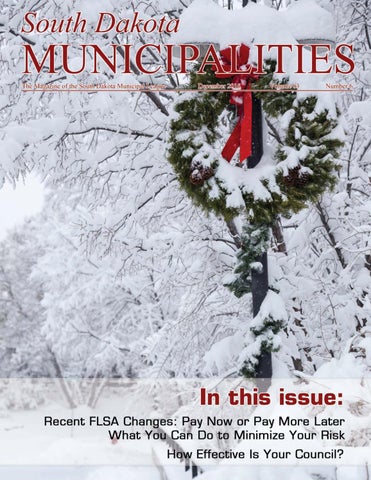
Official Monthly Publication
Member of National League of Cities
Contents Features
www.sdmunicipalleague.org
2017 Annual Report Workshops . . . . . . . . . . . . . . . . . .6
South Dakota MUNICIPALITIES
Comprehensive Challenge Grant . . . . . . . . . . . . . . . . .7
Managing Editor: Yvonne A. Taylor
SDML Affiliate Membership Options . . . . . . . . . . . . . .8 Outdoor Recreation Projects Funded . . . . . . . . . . . . . .11
Editor: Carrie A. Harer
Municipal Election Resources on SDML Website . . .12 PRESIDENT Laurie Gill Mayor, Pierre
DISTRICT CHAIRS Dist. 1 - Mike Grosek Mayor, Webster
1st VICE PRESIDENT Mike Wendland Mayor, Baltic
Dist. 2 - Tim Reed Mayor, Brookings
2nd VICE PRESIDENT Anita Lowary Finance Officer, Groton
Dist. 3 - Amy Nelson City Manager, Yankton Dist. 4 - Becky Brunsing Finance Officer, Wagner
2017 Municipal Election Calendar . . . . . . . . . . . . . . .14 Ribbon Cut for Pierre Solar Project . . . . . . . . . . . . . . .16 Local Preservation at Work in South Dakota . . . . . . .18 Recent FLSA Changes: Pay Now or Pay More Later–What You Can Do to Minimize Your Risk . . . .20 How Effective Is Your Council? . . . . . . . . . . . . . . . . .26
TRUSTEES Pauline Sumption Finance Officer, Rapid City
Dist. 5 - Renae Phinney President, Ree Heights
Stop Hoarding Data and Start Managing It . . . . . . . . .30
Karl Alberts Finance Officer, Aberdeen
Dist. 6 - Leland Treichel Mayor, Roscoe
The Next in Line . . . . . . . . . . . . . . . . . . . . . . . . . . . .32
Steve Allender, Mayor, Rapid City
Dist. 7 - Arnold Schott Mayor, McLaughlin
Christine Erickson Councilmember, Sioux Falls
Dist. 8 - Harry Weller Mayor, Kadoka
Debbie Houseman Finance Officer, Lake Andes
Dist. 9 - Carolynn Anderson Finance Officer, Wall
PAST PRESIDENT Meri Jo Anderson Finance Officer, New Underwood
Dist. 10 - Fay Bueno Finance Officer, Sturgis
Build Your Character, Make Better Decisions . . . . . .36 A Prescription for Action: Ending the Opioid Crisis . . .38 Establishing a Comprehensive Framework for Internal Control . . . . . . . . . . . . . . . . . .41
Columns Director’s Notes . . . . . . . . . . . . . . . . . . . . . . . . . . . . . . .4
LEAGUE STAFF 1-800-658-3633 Fax: 605-224-8655 Yvonne Taylor Sandi Larson Lori Martinec Chris Hill Carrie Harer Lori Butler
Office Space . . . . . . . . . . . . . . . . . . . . . . . . . . . . . . . .34
Executive Director Director of Risk Sharing Services Director of Research and Training Director of Municipal Electric Services Director of Marketing & Communications Director of Finance Accounting Assistant Lisa Nold Office Manager SD Public Assurance Alliance: Judith Payne Executive Director Kristina Peterson Director of Underwriting Director of Member Services Paytra Nichols Underwriter Jerry Krambeck Member Services Representative Deb Corkill Executive Assistant
President’s Report . . . . . . . . . . . . . . . . . . . . . . . . . . . .5 Risk-Sharing News . . . . . . . . . . . . . . . . . . . . . . . . . .42 Washington Report: Senator Rounds . . . . . . . . . . . . .44
In Every Issue Community Calendar . . . . . . . . . . . . . . . . . . . . . . . . .46 Classifieds . . . . . . . . . . . . . . . . . . . . . . . . . . . . . . . . .50 Directory Changes . . . . . . . . . . . . . . . . . . . . . . . . . . .39 Municipal Calendar . . . . . . . . . . . . . . . . . . . . . . . . . .53
SOUTH DAKOTA MUNICIPALITIES (ISSN 0300-6182, USPS 503-120) is the official publication of the South Dakota Municipal League, published monthly at 208 Island Drive, Ft. Pierre, South Dakota 57532, phone 605-224-8654. This institution is an equal opportunity provider, and employer. Periodical postage paid at Pierre, South Dakota and additional mailing offices. Non-member subscriptions are available for $30.00 annually. The opinions expressed herein are not necessarily those of the South Dakota Municipal League. Postmaster: Send address changes to SOUTH DAKOTA MUNICIPALITIES, 208 Island Drive, Ft. Pierre, South Dakota 57532.
DECEMBER 2016
VOLUME 83, NUMBER 6
3
Director's Notes I’ve always believed the saying, “elections have consequences” but WOW was this last one a doozie! Federal election aside, the voters of SD passed number of ballot measures the effects of which will be rattling through the system for years to come. Few people are more critical of Congress than I (and they deserve every harsh word) but we do need to distinguish between how our various levels of government work. I know many of you have received complaints about something the county is responsible for, or the state. In general, citizens just see “government” and want services
Keep on top of what goes on under the Dome Subscribe to the SDML’s Legislative Update. The SDML’s Legislative Update informs you on the hottest issues affecting municipalities as the South Dakota Legislature considers them. Each week League staff compiles an analysis of current and upcoming committee and floor action in the Senate and House. As local leaders, you need to be a part of the action in Pierre. The Legislative Update helps get you there. As you know, decisions in Pierre are made at a fast and furious pace, and the Update gives you a grasp of issues affecting how you govern on the local level. Updates are issued throughout the session on a weekly or as needed basis, via fax, mail or email. Email is free, including an unlimited number of addresses to each city.
4
and accountability for their tax dollars. They get both in South Dakota, but we all get painted by the same brush created by the dysfunction at the federal level. As a result, citizens have enacted some pretty unworkable measures that will result in fewer people being able to serve in public positions. Like term limits, which were aimed at the federal level elected officials (US Senators and Representatives) they didn’t hit the intended target, and instead did great damage here in SD. How many cases can we think of where, because the federal government has fallen down on the job, State and local entities have had to pick up the pieces, at great expense to our citizens? And the average citizen, watching such a mess, has lost all faith in government. What they really don’t trust is the folks in D.C., but in frustration and anger, they take broad swipes at everything that looks like government. They are angry at D.C., but take actions that end up harming the very people who are providing good government, good service, and taxpayer accountability. Trashing “government” has certainly made some people famous and wealthy, but it has done tremendous damage to our democracy. Certainly government needs strong oversight at all levels, but at the local level, “government” is how we have collectively decided on the rules that allow us to live in close proximity to each other. You are a local phone call, or a chat in the grocery store or gas station. It is hard to get more accountable than that. I wish I had the answers, but until we can recover the faith of citizens in our representative democracy, it is very hard to see a path forward in any positive direction. God Bless America. We’re gonna need it. Yvonne Taylor Executive Director
To receive the Legislative Update via email contact Yvonne at yvonne@sdmunicipalleague.org.
Minimum Wage to Increase on January 1
To get the Update sent to you by mail or fax please send $10 along with a request (include your mailing address, phone number or fax number) to: SDML, 208 Island Drive, Fort Pierre, SD 57532.
The state minimum wage will increase from $8.55/hour to $8.65/hour effective January 1, 2017. For more information visit http://dlr.sd.gov/wagehrs/ minimumwage.aspx.
SOUTH DAKOTA MUNICIPALITIES
President's Report Put the 2016 election in the books! With such a full ballot in South Dakota this year, all of our communities are likely impacted in some way, shape or form. Whether you’re pleased with the outcome of the constitutional amendments, the referred laws, the initiated measures, or the people we elected as leaders, we should all be pleased that we live in a country that upholds the democratic process. Former Governor Bill Janklow often talked about the peaceful transfer of power we enjoy in the United States. In some countries, new leadership is ushered in by armed guards and gunfire. In America, God willing, we do it with a handshake. As we look back on the losses and gains of the 2016 election, let us appreciate the successful process that affords each and every one of our community members a voice. Elections are busy and sometimes emotional times for local governments. Our city and county governments often
DECEMBER 2016
work together for months to plan, execute and ultimately validate the results. These combined elections are a tremendous effort that require open communications, teamwork, and sharing of resources between local governments. Despite the work, the partnerships lead to an efficient and effective election process for our citizens. If you participated in the election process this year, thank you! Democracy as we know it, wouldn’t exist without your work. Laurie Gill President
5
2017 Annual Report Workshops The South Dakota Municipal League and the South Dakota Department of Legislative Audit are co-sponsoring one-day workshops on preparing this year’s annual report. Remember, annual reports are required to be filed by ALL municipalities. The filing status of annual reports has had a renewed focus in recent years. The federal government has recently promulgated a sense of transparency and timeliness of financial data. This seminar will move you a giant step closer to meeting those goals. These workshops are brought to you without cost by the South Dakota Municipal League and the Auditor General’s office. They will be conducted by the staff of the Department of Legislative Audit. Finance officers, clerks, auditors and treasurers should plan to attend. This year we are providing a limited offering of annual report workshops for all sizes of cities. If you have questions on which workshop you should attend please call Rod Fortin with Legislative Audit at 605-367-5810. Small Cities: those with less than $600,000 in revenue. This class is targeted for all cities of this size range. Please bring your Municipal Accounting Manual and previous year’s annual report to use as reference material. Also, bring a copy of your 2017 published budget ordinance to assist in participating in a discussion in this area as well as copies of several receipt/voucher transactions so that we can work together on coding solutions. j Fort Pierre: Wednesday, January 11, 2017, Noon-3:00pm, SD Municipal League Building, 208 Island Drive. *lunch on your own j Aberdeen: Thursday, January 26, 2017, Noon-3:00pm, County Court House, Community Room, Basement Annex, 25 Market Street. *lunch on your own Large Cities (cash basis): those with $600,000 or more in revenue. This class is targeted for only those personnel that have approximately two years or less of annual report preparation experience. Please bring your previous year’s annual report to use as reference material. Also, for further discussion, bring a copy of your general ledger containing equity accounts for each fund (GASB 54). j Huron: Wednesday, January 18, 2017, 11:00-3:00pm, Campus Center, Pyle Room, 333 9th St. SW. *working lunch by ordering pizza in Large Cities (GAAP basis): those with $600,000 or more in revenue. This class is targeted for only those personnel that have approximately two years or less of annual report preparation experience. Please bring your previous year’s annual report to use as reference material. Also, for further discussion, bring a copy of your general ledger containing equity accounts for each fund (GASB 54). j Fort Pierre: Thursday, January 12, 2017, 10:00-3:00pm, SD Municipal League Building, 208 Island Drive. *working lunch by ordering pizza in DEADLINE for Registration is a WEEK PRIOR to each meeting. Notes: If the weather looks bad, call 605-367-5810 or 800-658-3633 to determine if the seminar has been postponed. Please do not take any driving risks. Dress is business casual. Individuals needing assistance, pursuant to the Americans with Disabilities Act, should contact the League office in advance of the meeting to make any necessary arrangements.
Annual Report Workshops Registration Municipality_____________________________________________________________________________ Name
Title
______________________________________________
_____________________________________________
______________________________________________
_____________________________________________
Check One:
____Huron January 18
Please return to:
____Fort Pierre January 11
____Fort Pierre January 12
____Aberdeen January 26
South Dakota Municipal League, 208 Island Drive, Fort Pierre, SD 57532, Fax: 605-224-8655 email: lisa@sdmunicipalleague.org, website: www.sdmunicipalleague.org
Urban & Community Forestry Comprehensive Challenge Grant Through the Urban & Community Forestry Program, the SD Department of Agriculture Resource Conservation and Forestry Division has provided financial assistance to our communities each year since 1991. A portion of the division’s annual allocation of Urban and Community Forestry Assistance funds from the US Forest Service is awarded to communities in the form of Challenge grants. These grants are used to fund community forestry projects that solve a specific community forestry problem or demonstrate the importance of trees in our communities. The community or service organization must match challenge grants. The Division has developed the challenge grant program to require increased commitment and effort from a community. The criteria for the challenge grants are outlined below in highest to lowest priority: 1. Professional Services — ($5,000) 2. Tree Inventory/Assessment — ($5,000)
DECEMBER 2016
3. Existing Tree Care & Maintenance — ($1,000) (An applicant may receive a maximum of $1,000 per year for existing tree care and maintenance.) 4. Education/Training — ($5,000) 5. New Tree Planting — ($1,000) (An applicant may receive a maximum of $1,000 per year for new tree plantings.) 6. Other Activities — ($5,000) Grants have a maximum limit of $5,000. The required match may be met through volunteer labor, donated and/or purchased supplies, or actual cash expenditures. Grant applications will be accepted at any time during the year. For the application forms and more information visit sdda.sd.gov/conservation-forestry/grants-loans/communityforestry-challenge-grants/ or contact the SDDA Resource Conservation and Forestry Division. Contact Information: Division of Resource Conservation & Forestry South Dakota Department of Agriculture Phone: 605-773-3623, Toll-Free: 800-228-5254 Email: SDRCF@state.sd.us
7
SDML Affiliate Membership Options Ten affiliate organizations enjoy the advantage of being members of the South Dakota Municipal League. These organizations receive SDML staff support and hold their meetings at the League’s Annual Conference and many of the affiliate groups meet at other times during the year. Visit www.sdmunicipalleague.org/sdmlevents for a listing of all the events. Dues notices for the Affiliates were recently sent to each city office and can be found under the Affiliate Organizations tab at www.sdmunicipalleague.org or by calling the League office at 800-658-3633. Affiliate membership options include: SD Airport Management Association j The purpose of this association shall be to foster the planning, development, use and operation of public airports in the State of South Dakota; j To assist its membership in resolving problems though mutual experiences in airport operations; and j In cooperation with the South Dakota Municipal League, to take an active part in legislation that may affect public airports in the State of South Dakota. j ANNUAL DUES of the association are $25 per city; Associate membership is $50/person. SD Municipal Attorneys’ Association j The purpose of this association is to establish a forum by which municipalities may promote matters of mutual interest and provide a closer working relationship in municipal government and administration by the following means: x Holding meetings for the discussion of legal and other questions affecting municipal governments; x The furnishing of information to municipal law officers and departments in order to enable them to better to perform their functions; and
x
j
Studying legislation, court decisions and administrative rulings relating to the public interest of municipalities. ANNUAL DUES of the association are $35 for each city represented that is over 5,000 population and $20 for each city that is under 5,000 population.
SD Building Officials’ Association j The purpose of the association shall be the consideration of principles and practices underlying the laws and ordinances relative to the construction, maintenance and occupancy of buildings, use of land, and methods of uniform administration; and j To develop requirements and regulations pertaining to training of building officials and administration officers. j ANNUAL DUES of the association are as follows: x Governmental Membership (GM) is $50.00; each additional Governmental Individual (GI) membership is $5.00. - Governmental Members shall be a designated individual, usually the building official, of a government agency (state, county or municipal), which is responsible for the enforcement or administration of laws and ordinances relating to building construction. - Governmental Individual Members shall be additional employees of governmental agencies which are responsible for the enforcement, or administration of laws and ordinances relating to building construction. x Professional Membership (PM) is $50.00; each additional Professional Individual (PI) membership is $10.00. - Professional Member shall be a designated individual of a firm, incorporated or unincorporated, engaged in the practice of architecture, engineering, inspection, research, testing or related activities.
ARENS ENGINEERING municipal engineering water & wastewater engineering storm drainage - municipal streets Vernon Arens, PE 230 Capitol St. j Yankton, SD j 57078 605-665-2002 j Fax 605-260-2140 arenseng@iw.net
8
SOUTH DAKOTA MUNICIPALITIES
x
- Professional Individual Member shall be additional employees of professional firms that practice architecture, engineering, inspection, research, testing or related activities. Annual Associate Membership (AM) is $25.00. - Associate Member shall be a representative of firms or corporations of commercial and industrial concerns engaged in the sale, manufacture or processing of materials and assemblies.
SD City Management Association j The purpose of this association shall be to increase the proficiency of Managers and Administrators of local governments; j To strengthen the quality of local government through professional management; j To encourage and support the precepts of the Council/Manager plan; j To maintain the high ethical standards of the profession of City Management; and j To provide opportunities to enhance the professional development of its members. j ANNUAL DUES of the association are as follows: x Full membership is $150 per person.
DECEMBER 2016
x
x
- Full Members: Any person who is a City Manager or Administrator, or an assistant to City Manager or Administrator of a South Dakota City shall be eligible for full membership in the Association. Associate membership is $75 per person. - Associate Members: Persons holding responsible administrative positions in South Dakota cities and other persons who are interested in the objectives of the Association shall be eligible for associate membership. Student membership is $15 per person. - Student Members: Any person currently enrolled full or part-time in a graduate or undergraduate program with an interest in local government.
SD Association of Code Enforcement j The purpose of this association is to operate, without profit to the Association, or its members, as a state association to advance, educate and improve efforts of state, county, city and other political subdivision employees who are actively involved with and responsible for the enforcement of housing, municipal, county, state or federal codes without regard to race, creed, color, national origin, or sex;
9
j j
j
To encourage professionalism with regard to the standardization of enforcement of environmental and housing codes; and To supply and advance the science and practice of code enforcement through certification and to provide training workshops, seminars and conferences facilitating and advancing the administration of the various codes with which the Association is concerned. ANNUAL DUES of the association are $40 per city.
SD Municipal Electric Association The South Dakota Municipal Electric Association, formed in 1950, serves member municipalities that provide electricity to approximately 100,000 South Dakotans. The Annual Meeting is held each October during the Municipal League Annual Conference. The Electric Superintendent-Foreman Conference is held each March in Watertown. SD Governmental Finance Officers’ Association j The purpose of this association is to establish a forum by which cities and towns may promote matters of mutual interest and provide a closer working relationship that there may be improvement in municipal government and administration; j To promote the improvement of methods of governmental finance in South Dakota including the development of mutually understandable procedures of accounting, budgeting, and financial reporting; and the encouragement of the use of common terminology, classification, and principles in regard to those subjects; and j To take an active part in legislation that may affect municipalities of the state through the South Dakota Municipal League. j ANNUAL DUES of the association are $40 for the first person and $30 for each additional person of the same city.
SD Police Chiefs’ Association j The purpose of this association shall be of an educational, scientific, benevolent, fraternal and charitable nature and to develop a closer official and personal relationship between the various law enforcement officials of the State of South Dakota. j To maintain a steadfast resolution to guard the rights, liberties, and welfare of all citizens; j To foster any project which will help bring law enforcement officials recognition as professionals, to increase the efficiency of the member of aiding in the improvement of the laws of the State of South Dakota and demanding the enforcement of the same; and j To encourage the members to attain a high degree of skill and efficiency in law enforcement work, thereby advancing the standards of all enforcement officers. j ANNUAL DUES of the association, for Chiefs and Assistant Chiefs, are determined by a formula that takes into account population in addition to a base of $95. Please call the League office for the actual dues amount for your city. Command Staff and Associate membership is $25 per person. SD Municipal Street Maintenance Association j The purpose of this association is to provide education and instruction for municipal street maintenance workers and to assist in meeting their goals through encouragement and friendly exchange of knowledge and experience among its members. j ANNUAL DUES of the association are $35 per city. For more information visit the Affiliate Organizations tab at www.sdmunicipalleague.org.
SD Governmental Human Resource Association j The purpose of this association is to advance the profession of human resource management in governmental entities by promoting matters of mutual interest and providing a closer working relationship so that there may be improvement in government and administration; and j To promote the improvement of all aspects dealing with Human Resources in South Dakota through information sharing and consolidated training with a special emphasis on assisting smaller communities and to take an active part in legislation that may affect the governmental entities of the state through the South Dakota Municipal League. j ANNUAL DUES of the association are $25 per person. 10
SOUTH DAKOTA MUNICIPALITIES
Outdoor Recreation Projects Funded Governor Dennis Daugaard has awarded a total of $429,000 in Land and Water Conservation Fund (LWCF) money to several communities. The federal assistance program provides up to 50 percent reimbursement for outdoor recreation projects. The following communities were awarded LWCF grants for outdoor recreation projects: j Aberdeen – 12th Street multipurpose play court development, $35,000 j Dell Rapids – campground and comfort station development, $75,000 j Elk Point – playground equipment replacement, $54,800 j Emery – playground equipment replacement, $22,800 j Groton – playground equipment replacement at ball park, $24,900 j Hayti – playground equipment replacement, $11,900 j Hot Springs – tennis court resurfacing, $11,000 j Huron – Memorial Park playground equipment replacement, $23,000 j Lead – Manuel Park renovation, $75,000
DECEMBER 2016
j j
Onida – swimming pool renovation, $50,000 Presho – outdoor basketball court development, $49,000
“I commend these project sponsors for their strong commitment to improve their communities and make South Dakota a better place to live, work and play,” Governor Daugaard said. “Their efforts will benefit future generations of South Dakotans.” Land and Water Conservation Funds come from the National Park Service and are administered in South Dakota by the state Department of Game, Fish and Parks. For more information on the LWCF program, contact grants coordinator Randy Kittle by calling 605-773-5490 or email at randy.kittle@state.sd.us. GFP Mission: The South Dakota Game, Fish and Parks provides sustainable outdoor recreational opportunities through responsible management of our state’s parks, fisheries and wildlife by fostering partnerships, cultivating stewardship and safely connecting people with the outdoors.
11
Municipal Election Resources on SDML Website The following Municipal Election Resources can be found on the SDML website at www.sdmunicipalleague.org and by clicking on the Library tab, then Elections. 1. Municipal Election Resources – This is a quick link to the Secretary of State’s website that contains many resources including the Election Calendar, Initiative and Referendum information, Petitions and more. 2. Election School Powerpoint Presentation – This link is to the most recent powerpoint presentation from each year’s Election School. 3. 2017 Municipal Election Calendar – The calendar will help keep you on track regarding all deadlines for publication of election notices as well as timelines for circulation and receipt of petitions, availability of absentee ballots and other election related timelines. (This year’s calendar can be found on pages 14-15.) 4. How to Circulate a Nominating Petition – This document, created by the Secretary of State’s Office,
12
provides specific guidelines on timeframes, circulator requirements, signer requirements and filing requirements. 5. Candidate Nominating Petition Requirements Checklist – This document, created by the Secretary of State’s Office, provides a checklist for the Finance Officer to reference, when validating a nomination petition, to ensure all sections are completed correctly. 6. What Happens If No One Files a Petition? – This document provides information regarding recent changes in statute regarding the process for appointment of elected officials in the event of a vacancy. 7. Municipal Elections Handbook – Recently Updated! This document provides information, in laymen’s terms, about the State Statutes and Administrative Rules related to conducting an election. It has a frequently asked questions section that is particularly helpful in addressing common issues that arise in municipal elections as well as a collection of all necessary Election Notices and Forms.
SOUTH DAKOTA MUNICIPALITIES
8. Municipal Initiative and Referendum – This document, created by the Secretary of State’s Office, provides a step-by-step guideline for those wanting to file an Initiative or Referendum Petition with their governing body. 9. Municipal Recall Election Guidelines – This document, created by the Secretary of State’s Office, provides information regarding publication of notices, petition circulation and filing timeframes, and ballot information for a Recall Election. 10. Election Worker Training Powerpoint – This is a quick link to the PowerPoint created by the Secretary of State’s Office to use for training Precinct Workers on Election Day responsibilities. 11. Election Day Precinct Manual and Addendum for 2010 General Election – This is a quick link to the Secretary of State’s document that goes through all information needed on Election Day. 12. Election Code Book – This is a quick link to the Secretary of State’s Election Code Book that spells out all South Dakota Codified Law and Administrative Rules of South Dakota that govern Elections in the state. This document is updated anytime there is a change. 13. Poll Watcher Guidelines – This document, created by the Secretary of State’s Office, provides information for those wanting to be poll watchers on Election Day.
14. Polling Place Voter Key – This document, created by the Secretary of State’s Office, provides a flow chart for Election Workers and others to use as they determine voter eligibility. 15. Voter Registration Forms – This is a quick link to the Secretary of State’s Office website that provides information to the user on how and where to register to vote in South Dakota as well as a Registration Form to download. The site also provides information to public Agencies who assist people with voter registration. 16. Guidelines for Absentee Voting Process – This document, created by the Secretary of State’s Office, provides information on the process that a municipality must follow to implement the Absentee voting process. 17. Absentee Ballot Log (Sample) – This document provides a template to use for an Absentee Ballot Log. 18. Elections Supplies List (Sample) – This document provides a good list to start from for creating your own Election Day supplies list. 19. Election Day Checklist for Municipal Election Board (Sample) – This document provides a good list to start from for creating your own Election Day Checklist for setting up the actual voting site, organizing election workers, and processing ballots. 20. Oath of Office – This is a sample oath to use for elected or appointed municipal officials. 21. Recount Manual – This is a quick link to the document, created by the Secretary of State’s Office, to provide information regarding procedures to follow in the event that a recount is either requested via petition or required by law.
DECEMBER 2016
13
2017 Municipal Election Calendar Second Tuesday in April
First Tuesday after the first Monday in June
Combine with the school on the third Tuesday in June
The governing board must establish the election date no later than January 14th of the election year if they choose a different election date other than the 2nd Tuesday in April. (9-13-1 & 9-13-1.1 & 9-13-1.2)
April 11th
June 6th
June 20th
Publish notice of vacancies and time and place for filing petitions each week for two consecutive weeks. (9-13-6, 9-13-37, 9-13-40 & 05:02:04:06 & 13-7-5)
Between the dates of January 15th and 30th
Between the dates of Feb. 15th and March 1st
Between the dates of March 15th and 30th
Earliest date to begin petition circulation and earliest date to file nominating petition. (9-13-9, 9-13-40, 9-13-37, 13-7-6)
January 27th
March 1st
April 11th
Deadline for filing nominating petition. If this is a Friday, please plan accordingly to be available to accept petitions. Registered mail is acceptable if postmarked by the deadline date and time. (9-13-7, 9-13-40, 9-13-37, 13-7-6)
Feb. 24th 5:00 pm
March 28th 5:00 pm
May 12th 5:00 pm
Deadline for submission of written request to withdraw candidate’s name from nomination. (9-13-7.1, 13-7-7)
Feb. 24th 5:00 pm
March 28th 5:00 pm
May 12th 5:00 pm
j
The dates to the right are the only date options for the annual municipal election. The School may request to combine with you on any of these dates.
j
Have you ordered your election kit yet? If you plan to, consider ordering soon. McLeod’s Printing in Mitchell is the only company in SD that sells election Kits. Do you need to order absentee ballot combined envelopes? 05:02:10:01.03 In a first class municipality, within 15 days of filing a nominating petition, a candidate must file a Candidate Financial Interest Statement (12-25-30). This is filed with the person in charge of the election and a sample form can be found at sdsos.gov. Drawing for candidate order on the ballot needs to be conducted. (9-13-21) Don’t forget to have your governing board appoint your Election Board. (9-13-16.1 & 05:02:05:11.01) Publish first deadline of voter registration notice that needs to be published each week for two consecutive weeks. (12-4-5.2 & 05:02:04:04)
Between the dates of March 6th and 10th
Between the dates of May 1st and 5th
Between the dates of May 15th and 19th
Publish last deadline of voter registration notice that needs to be published each week for two consecutive weeks. (12-4-5.2 & 05:02:04:04)
Between the dates of March 13th and 17th
Between the dates of May 8th and 12th
Between the dates of May 22nd and 26th
Is your ballot ready? Absentee voting begins soon. The ballot form can be found at 05:02:06:12. Sample ballots must be printed in Yellow and we encourage you to put the word SAMPLE on the ballot. Deadline for voter registration. (12-4-5)
March 27th
May 22nd
June 5th
Absentee ballots must be made available no later than 15 days prior to the election. (9-13-21)
March 27th
May 22nd
June 5th
14
SOUTH DAKOTA MUNICIPALITIES
Publish notice of election that needs to be published each week for two consecutive weeks. First publication must be at least 10 days before election. (9-13-13 & 05:02:04:08)
Weeks of March 27th and April 3rd
Weeks of May 22nd and May 29th
Weeks of June 5th and June 12th
Publish facsimile ballot in the calendar week before the election. The calendar week falls from the Monday to the Saturday of the week prior to the Tuesday of Election Day. (9-13-13 & 12-16-16.2 talks about the size for publication)
Week of April 3rd
Week of May 29th
Week of June 12th
Automatic tabulating systems only. Conduct a public test of the system. Must publish notice 48 hours before test. (12-17B-5 & 05:02:09:01.01)
April 1 – 10
May 27 – June 5
June 10 – 19
5:00 pm the day before the election is the deadline for a voter to absentee vote in person.
Election Day. Polls open 7:00 am to 7:00 pm. (9-13-1); a voter can request an absentee ballot via authorized messenger up to 3:00pm the day of the election and the ballot has to be returned in time to get it to the polling location.
Deadline for official canvass. (9-13-24)
April 11th
June 6th
June 20th
April 18th
June 13th
June 27th
In a first class municipality, within 15 days of being elected, an official must file an Elected Official Financial Interest Statement (3-1A-4). This is filed with the person in charge of the election and a sample form can be found at sdsos.gov. Issue certificates of election within two days after the result of the election is declared via the canvass. (9-13-5 & 9-13-28; 05:02:15:08 & 05:02:15:09)
Note: If the school election is combined with a municipal election on a date other than the 2nd Tuesday in April, all dates follow SDCL 13-7 (except when combined with the county for a primary election). Ballot color for combined elections: if combining, one ballot must be white and the other jurisdiction will use a contrasting color (do not use yellow as that is the color for sample ballots). ARSD 05:02:06:18 Notify County Auditor: Contact your county auditor when you know you will have an election and ask if he/she can be available from 7:00 am to 7:00 pm on that date to answer questions regarding voter registration. (SDCL 7-7-2) Missed Election Notices: We do encourage any jurisdiction that misses a publication to try to get it published and post the notice around their jurisdiction. The notice would still be considered late and the election could still be challenged. If you intend to check the registration status of the candidate and/or petition signers (you are not required by law to do this), you must do it for all petitions and all signers, go to: http://cityandschoollookup.sdsos.gov/Login.aspx. If you forgot your username and password, or never had one, contact the Secretary of State’s Election Team and we will provide it to you. Contact a member of the Secretary of State’s Election Team with any questions at Elections@state.sd.us or 605-773-3537. Additional election resources can be found at: https://sdsos.gov then clicking Elections and Voting.
DECEMBER 2016
15
Ribbon Cut for Pierre Solar Project Missouri River Energy Services (MRES), city and state officials, and other dignitaries celebrated the Pierre Solar Project during a dedication and ribbon-cutting ceremony held September 26 on the grounds of the solar farm. Nearly 80 people attended the event, which also included tours of the project. Several officials spoke during the ceremony, including Pierre Mayor Laurie Gill and Hunter Roberts, policy advisor to Governor Dennis Daugaard. “Certainly there is some degree of prestige that comes with being home to this project, but more importantly, this is a step toward renewable energy. One of the values we hold dear at the City of Pierre is the preservation of our natural environment,” said Mayor Gill. “We are committed to providing a healthy legacy for our current and future generations, and the one-megawatt of power these panels are producing each day is one step in the right direction.” The one-megawatt solar photovoltaic facility, which is located on the premises of the Pierre Regional Airport, is the largest such farm in the state of South Dakota. The project will generate enough energy to power about 200 homes. The solar energy farm is a joint effort by the City of Pierre, Geronimo Energy of Edina, Minn., and MRES.
Celebrating the dedication of the Pierre Solar Project are, from left: Hunter Roberts, policy advisor for the Office of Governor Dennis Daugaard; Jeff Peters, MRES director of Federal and Distributed Power Programs; Harold Schiebout, chairman of the MRES Board of Directors; Mayor Laurie Gill, Pierre, SD; Tom Heller, CEO of MRES; Noel Rahn, chairman and founder of Geronimo Energy; Leon Schochenmaier, city administrator, Pierre, SD.
“We’re especially happy that all three organizations have come together to make a public and private partnership work,” said Roberts. “We are excited to have this project come to fruition.”
Geronimo Energy is developing the project, and MRES will be entitled to the output under a power purchase agreement. Once operational, Pierre Solar will produce clean, renewable energy using sunlight as free fuel. Commercial operation occurred October 7. The Pierre Solar Project will be the first renewable energy project for MRES that will be located in South Dakota, as well as its first experience in solar energy. Reprinted with permission of Missouri River Energy Services. 16
SOUTH DAKOTA MUNICIPALITIES
Local Preservation at Work in South Dakota The scope of historic preservation is constantly changing. A movement that began with the goal of saving homes of prominent Americans has evolved to include railroad depots in small towns, barns in rural areas, and commercial buildings in cities. In short, preservation has gone local. In South Dakota, the State Historic Preservation Office (SHPO) is that local link. The SHPO works with local governments, federal and state agencies, historical organizations, and citizens interested in preserving the state’s historic and cultural resources. One way the SHPO does this is through the Certified Local Government (CLG) program. The CLG program is a partnership between the National Park Service (NPS), SHPO, and the local government. To participate in the program, a municipal or county government must establish a historic preservation program and have it certified by the NPS. The SHPO assists the local government throughout this process.
18
Once certified, the local government is eligible for preservation grants that cover a wide variety of activities, including National Register of Historic Places nominations, architectural surveys, public workshops, feasibility studies, and preservation planning. There are eighteen CLGs in South Dakota. Most are municipalities, varying in size from Sioux Falls to Lead, but others are county designations such as Clay County. Each CLG is eligible for a minimum grant of $2,000 per year with supplemental grants also available ranging $1,000-$20,000. Rapid City has been a certified CLG since 1986. The city has used recent grants to resurvey the Rapid City West Boulevard Historic District, which is listed in the National Register of Historic Places. The updated information will help the city manage their historic properties. This year Rapid City received a grant to survey properties downtown, east of the Rapid City Commercial Historic District. This survey will supplement the city’s downtown area master plan by identifying historic properties. Buildings
SOUTH DAKOTA MUNICIPALITIES
subsequently listed in the National Register as a result of the survey may then be eligible for such programs as Deadwood Fund Grants, the State Property Tax Moratorium, and Federal Historic Preservation Tax Credits – key incentives for developers. Other communities have used grants to promote local heritage tourism. The Pierre/Fort Pierre and Spearfish CLGs recently produced driving and walking tour brochures that feature historic houses, buildings and sites in their communities. Chambers of Commerce and local businesses distribute these brochures to visitors. Many communities use grants for websites that keep citizens informed and educate the public on the benefits of historic preservation. Clay County’s website (http://cchpc.org/) offers links to its publications and projects as well as its local preservation plan. Finally, public outreach is also popular. In 2014, Brookings used a grant to bring in preservation specialist Bob Yapp as part of Greenfest. Yapp provided hands-on workshops for contractors and homeowners on exterior wood and window repair while also providing seminars on a wide range of preservation topics.
DECEMBER 2016
Local communities embrace preservation every day, sometimes without even knowing it. Whether it’s a financial commitment to restore their historic city hall or planning focused on the rehabilitation of downtown, preservation is playing a role. The CLG program is just one more way to legitimize that commitment. For more information on the Certified Local Government program, please contact the South Dakota State Historic Preservation Office at 605-773-3458. About the South Dakota State Historical Society The South Dakota State Historical Society is a division of the Department of Education. The State Historical Society, an Affiliate of the Smithsonian Institution, is headquartered at the South Dakota Cultural Heritage Center in Pierre. The center houses the society’s world-class museum, the archives, and the historic preservation, publishing and administrative/development offices. Call 605-773-3458 or visit www.history.sd.gov for more information. The society also has an archaeology office in Rapid City; call 605-394-1936 for more information.
19
Recent FLSA Changes: Pay Now or Pay More Later–What You Can Do to Minimize Your Risk By Larry Lee and Adam Brown, Fisher & Phillips, LLC, Denver, Colorado The U.S Labor Department (USDOL) has finally released the anxiously awaited revised regulations affecting certain kinds of employees who may be treated as exempt from the federal Fair Labor Standards Act’s (FLSA) overtime and minimum-wage requirements. After nearly a year of uncertainty, the final rules were published on May 23, 2016. These rules apply to government employers, and they have an effective date of December 1, 2016. Public employers who currently consider any employees to be exempt “white collar” employees might have to make some sweeping changes. Exemption Overview To understand why the new regulations will have such a large effect, it is worthwhile to engage in a quick refresher of the exemptions that will be affected by the new regulations. The FLSA is the federal statute that mandates that all employees receive at least minimum wage for all hours worked, and they are to receive overtime payments at a rate of time and a half of their regular rate for all hours worked in excess of 40 in any workweek. The FLSA starts from a presumption that every employee is entitled to overtime for all hours worked in excess of 40 in a given week. However, there are exemptions or exceptions to this requirement. As relevant here, employees are exempt from overtime if they meet two tests: The duties test and the salary test. Duties test: Many employers erroneously believe that any employee that is paid on a salary basis instead of an hourly basis is exempt from overtime. However, in order to be properly exempt from overtime under the FLSA under one of the “white collar” exemptions, the employee must work in an executive, administrative, professional, outside sales, or certain types of computer positions. Each of these duties categories has specific and lengthy definitions and regulations that explain how a particular employee qualifies for the exemption.
Specific and Wide-Ranging Changes For This Year and Beyond Under the new final rule published on May 23, 2016, the following changes have been made in the USDOL’s definitions of executive, administrative, professional, computer-employee, and highly compensated exemptions under the FLSA’s Section 13(a)(1): The minimum salary threshold is increasing to $913 per week, which annualizes to $47,476 (up from $455 per week, or $23,660 per year). USDOL says that this figure is set at the 40th percentile of data representing what it calls “earnings of full-time salaried workers” in the lowest-wage Census region (currently the South). This more than doubling of the minimum salary threshold is sure to affect large numbers of exempt public sector employees, who currently earn more than $23,660, but less than $47,476 per year. This minimum salary amount will now be “updated” every three years (meaning that it will likely increase with each “update”), beginning on January 1, 2020. USDOL will announce these changes 150 days in advance. The practical impact of this change is that public sector employers will now be forced to increase the compensation of exempt employees whose salaries are at the minimum level or below the new “updated” level every three years, regardless of employee performance, budgetary concerns, or other factors that affect the amount of money available for salary increases. The 150-day announcement period also presents issues for public sector employers, who often operate based on yearly budgets. These employers will need to be aware of any impending increases when new budgets are in the process of being drafted and approved. Unfortunately, employers may be forced to estimate the updated amount, if it is not released in detail before the new budget is finalized.
Salary test: In addition to the duties test, exempt employees must also meet a salary test. Under the old FLSA regulations, which remain in effect until December 1, 2016, the employee must be paid at least $455 per week, which annualizes to a yearly salary of $23,660. If an employee meets one of the duties tests and is paid at least $455 per week, the employee can be properly exempted from the overtime requirements of the FLSA. 20
SOUTH DAKOTA MUNICIPALITIES
Employers will be able to satisfy up to 10% of this new salary threshold through nondiscretionary bonuses and other incentive payments, including commissions, provided that the payments are made at least quarterly. This crediting will not be permitted as to the salaries paid to employees treated as exempt “highly compensated” ones. This change is less likely to impact public sector employers, but it is important to keep in mind in the event that it can be utilized to offset some of the burden associated with the mandated salary increases. The total-annual-compensation threshold for the “highly compensated employee” exemption will increase from $100,000 to $134,004 (which will also be “updated” every three years). USDOL says that this figure is set at the 90th percentile of data representing what it calls “earnings of fulltime salaried workers” nationally. These rules will become effective on December 1, 2016, which is considerably later than had been proposed. Unless this is effective date is somehow postponed, by December 1 employers must have done what is necessary to continue to rely upon one or more of these exemptions (or another exemption) as to each affected employee, or they must forgo exempt status and begin paying overtime to any employee who no longer satisfies all of the requirements.
DECEMBER 2016
Considerations for the Public Employer Essentially, USDOL is doubling the current salary threshold. This is likely intended to both reduce the proportion of exempt workers sharply and increase the compensation of many who will remain exempt, rather than engaging in the fundamentally definitional process called for under the FLSA. This represents a stark departure from past USDOL interpretations of the agency’s power, when even the agency itself said that manipulating exemption requirements to “give employees a raise” or to establish a minimum wage for exempt employees was not, and never has been, an authorized or legitimate pursuit for USDOL to undertake. Additionally, as discussed above, for the first time in the more-than-75-year history of the white collar exemption regulations, USDOL will publish what amounts to an automatic “update” to the minimum salary threshold. This departs from the prior USDOL practice of engaging in what should instead ultimately be a qualitative evaluation that also takes into account a variety of non-numerical considerations. This new imposition also creates a real hardship for public sector employers, which are often constrained by budgetary concerns. Thankfully, USDOL did not change any of the exemptions’ requirements as they relate to the kinds or amounts of work
21
necessary to sustain exempt status. The USDOL had previously asked for comments directed to whether there should be a strict more-than-50% requirement for exempt work. The agency, however, apparently decided that this was not necessary in light of the fact that the number of workers for whom employers must apply the duties test is reduced by virtue of the salary increase alone. What These Changes Mean for Public Employers Many public sector employers do not closely track the hours worked by their exempt employees. Under these new regulations, tracking hours has become even more important than it ever has been. First, there is a good probability that some employees who were formerly classified as exempt and who received a salary will be reclassified as nonexempt because there simply is not money in the budget to increase their salaries to meet the new salary test. Many public sector employees are not used to working strict 40 hour workweeks, and many of them in fact routinely work more than 40 hours per week. Public sector employers will need to begin closely tracking employees’ work hours, to ensure employees are properly compensated for any hours worked in excess of 40 in a workweek, or employers risk increased liability in future lawsuits brought by nonexempt employees alleging unpaid or improperly paid
22
overtime. Another reason to closely monitor hours worked is to avoid future risk from a disgruntled exempt employee who argues that he or she was improperly classified as exempt, and who claims to have worked a large amount of overtime hours. In the absence of a proper timekeeping system that generates contemporaneous records of hours worked, courts have held that an employee’s recollection alone is sufficient to prove the amount of overtime hours worked. Proof of hours worked is the foundation for damages in FLSA cases. Thus, it is extremely important for employers to require all employees to record and track their time every week. Unfortunately, there is likely no way to avoid feeling the impact of these changes in some fashion. Municipal employer funding is usually defined by taxes, federal or state contributions, and creative budgeting. Public entities are unlikely to see a sufficient funding increase to help place all salaries at the necessary new levels, because tax increases are unpopular, and even if they are passed, they likely will not make up the gap between the old salary basis amount and the newly doubled amount. This very real possibility has the potential to harm both the local government themselves and the public in general. If public entities are forced to raise some salaries large amounts to meet the new minimum requirements in the regulations,
SOUTH DAKOTA MUNICIPALITIES
they will be forced to cut other services or programs. The extent of these cuts depend on how many employees are affected in each entity. By that same token, if public sector employers choose not to raise salaries and to begin classifying affected formerly exempt employees as non-exempt employees, they will still have difficulty making up the necessary funds, because they will likely be paying overtime premiums to employees whose job duties and work habits have evolved to necessitate more than 40 hours per week under the old regulations. Employers who elect to prohibit employees from working overtime will find it difficult to adjust to the decline in productivity associated with key employees reducing their work hours each week. While granting comp time in lieu of overtime is permissible under the FLSA for public sector employers, the budgetary and decreased productivity issues discussed above will not be improved if employers elect to give comp time in lieu of overtime. This practice usually results in municipal employers paying affected employees to not work, which could further exacerbate the existing issues. Under any scenario, government employers may likely see less work being done and/or more money being paid out. This conclusion is particularly difficult for public sector employers with limited funding, many of whom will be unable to hire additional employees to make up for any productivity gaps that arise. To make up for the monetary gap necessary to maintain exemptions, more funds will be
DECEMBER 2016
shifted from programs and services that benefit the public over to increased employee salaries. The extent of these issues is unknown at this time, and will vary between different public employers, but what is clear is that these new regulations will have a profound impact on public sector payroll practices, as well as programs and services offered to the communities as a whole. These changes also carry the significant administrative burden of figuring out how to implement them, and deciding which of the multiple unpleasant options is the least unpleasant for each affected employee within a particular municipal employer. These tasks will likely include a full compensation review for any exempt employees, as well as an analysis of any needed changes for each employee. For any employee whose salary is not increased to the new minimum $47,500, there will be significant work to decide whether to convert them to hourly or to pay overtime with a salary. The latter could be a problem if such employees are regularly working overtime, but might work well if employees generally work 40 hours or less and only occasionally have overtime spikes. Finally, although most governmental employers do not have many employees who meet the “highly compensated employee” exemption, the change to that exemption may force some employers to reevaluate whether a few of their people who presently fall under that designation will be raised to meet the new amount or not. This is likely to be minimal for most public sector employers, but some
23
government entities have employees who qualified for this exemption under the old salary test, who would not qualify under the new test. How Can Public Sector Employers comply with the new Rules? The new rules have left many employers puzzled about how to ensure compliance. While the practical impact of the solutions proposed by this article may be somewhat harsh, fortunately the concepts and methods necessary to ensure compliance are not complex. First, the simplest, yet perhaps least plausible, way to ensure compliance is to make sure all employees who are exempt under one of the exemptions discussed in this article are paid a salary of at least $913 per week, and that their job duties qualify them for one of the relevant exemptions. However, this option may not be available to cash strapped municipal employers. Fortunately, there are other solutions available. Public sector employers can also convert exempt employees who will no longer meet the salary basis test to nonexempt employees. These employees can lawfully receive their wages either as a salary, or as hourly pay, but they must be paid overtime at time and a half of their regular rate of pay for any hours worked in excess of 40 in a week. For this
24
reason, employers should always track the hours worked by these employees, and should consider implementing strict “no overtime” policies that require prior managerial approval for any overtime hours. These policies will not completely protect against liability for future claims of unpaid overtime, but they will likely dissuade employees from working overtime. If nonexempt employees do work overtime, the FLSA allows public sector employers to grant employees compensatory time off, or comp time, in lieu of cash overtime. This comp time must be granted at a rate not less than one and one half hours of comp time for every overtime hour worked, and employees must be free to use comp time within a reasonable period of time after it is earned. Additionally, employers may not permit employees to accrue more than 240 hours of comp time (except for certain safety-related positions), and employers must compensate employees for all banked comp time hours upon separation from employment for any reason. Why is this Important? Compliance with the FLSA is mandatory for all employers, and there are multiple avenues of risk associated with noncompliance. First, the employer may face a lawsuit from one or more employees alleging violations. Its
SOUTH DAKOTA MUNICIPALITIES
application is very mechanical, and damages in these cases are ordinarily very easy for employees to prove, by using simple math. Employers that violate the statute, even unintentionally, face harsh consequences. FLSA lawsuits are difficult for employers to win, and prevailing plaintiffs under the FLSA are presumptively entitled to their entire amount of unpaid wages, plus an additional equal amount as liquidated damages designed to compensate the employee for the period where they were forced to live without wages they were owed under the FLSA, plus full payment of their attorneys’ fees by the employer. This last point is important, because it is not uncommon for FLSA plaintiffs to have a relatively small amount of damages, and for their attorneys to spend far more litigating the case than the amount to which the plaintiff is entitled, since the attorneys know that the employer will ultimately be on the hook for their fees if they win. Additionally, the FLSA has a separate statutory provision that allows employees to join together in a “collective action” which is easier to maintain than a traditional class action. Obviously, the larger a collective action against an employer becomes, the more potential exposure there is to increased damages and attorneys’ fees. Employers also face potential risk if FLSA violations are discovered during a USDOL audit. USDOL has the power to audit any business at any time, but audits come about most frequently in response to employee complaints. If violations are found, the USDOL has the power to recover back wages and liquidated damages for employees either administratively, or through its own lawsuit. Additionally the USDOL may assess civil money penalties of up to $1,100 per violation against noncompliant employers. Finally, USDOL can recommend felony criminal charges under the FLSA against any person if violations are egregious enough. Put simply, it is critical that all employers ensure full compliance with the FLSA at all times.
DECEMBER 2016
What Should You Do Now? Some members of Congress are still considering action aimed at stopping these changes, and it is possible that lawsuits will be filed with the same goal. The Obama Administration intends to make the new rules a key piece of its legacy, and thus the President is extremely likely to veto any such legislation that makes it to his desk. Additionally, only time will tell whether any lawsuits will be filed, and how successful they may be if ultimately filed. While one or more of these challenges may be successful, municipal employers should assume for the time being that the new requirements will take effect as scheduled. Employers would be wise to immediately begin analyzing and addressing any issues presented by the new rules, in light of the bureaucratic process inherent in making such changes, and the lengthy timeline that often accompanies such changes. Right now, public sector employers should be: j Analyzing whether the requirements for the “white collar” exemptions they have been relying upon will continue to be met under the new rules; j Evaluating what might be changed about one or more jobs so that the incumbents may be treated as exempt in the future; j Considering the possible application of alternative FLSA exemptions; j Developing FLSA-compliant pay plans for employees who have been treated as exempt but who will be reclassified as non-exempt after December 1, 2016; and j Contacting your internal personnel attorney or a reputable and knowledgeable private employment attorney that is well-versed in wage and hour law. Reprinted with permission from Municipal Lawyer magazine, © 2016 International Municipal Lawyers Association (www.imla.org). All rights reserved.
25
How Effective Is Your Council? By JoAnne Mounce
The challenge of abandoning the often combative approach used in campaigning can be compounded by differences in communication styles among members of the council. Each of us has a unique way of communicating with others. Experts attribute these differences to a variety of factors — an individual’s personality, cultural background and gender can all play a role in personal communication style.
How Councils Court Disaster A city council that has not developed the skills necessary to communicate respectfully, both within the council and with others, is courting disaster on several fronts. First, if the council maintains a competitive dynamic over several election cycles, it becomes the council’s culture and its norm. A council that is known for bickering and infighting on the dais: j Hampers its effectiveness because issues aren’t addressed calmly and thoughtfully; j Sets a poor example of public discourse for the community; j Erodes public trust in local government and City Hall; j Discourages people from participating in the process because they don’t believe their voices will be heard; and j Dampens the enthusiasm of young people who might otherwise consider pursuing careers in local government.
Effective leaders, however, typically find a way to talk about even the most controversial issues in a thoughtful and non-inflammatory way as part of a deliberative discussion.
Interpersonal dynamics on a council can be challenging. Furthermore, when one member consistently behaves badly, the entire council gets a black eye. What can be
Many cities in California use the at-large system for their city council elections, whereby council members represent the entire city rather than a specific district. In such cities, after the election is over it can be hard to put aside the competitive mindset, move beyond politics and begin working together as a cohesive team to do what’s best for the community.
26
SOUTH DAKOTA MUNICIPALITIES
done to turn around a council whose communication has devolved into arguments and personal attacks? Why Civility Matters It can be helpful to start by examining the role civility plays in local governance. An “Everyday Ethics for Local Officials” article titled “Promoting Civility at Public Meetings” (August 2003, Western City) offers the following observations and advice: Civility refers to the way people treat each other with respect — even when they disagree. Though disagreement and confrontation play a necessary role in politics, the issue is how that disagreement is expressed. The key is to focus on the strengths and weaknesses of proposed solutions to community problems — not to engage in personal attacks against those who favor different solutions. … If an agency finds itself in a situation in which those with the minority view are acting increasingly contentious and uncivil, a question to ponder is whether they would have a more constructive approach if they felt their views were being listened to and taken into account. Being perceived as a force of unity in the community as opposed to a force of division can have real political benefits as well. Put another way, constant bickering among community leaders can reflect poorly on all who engage in it. … So how do we achieve more civility in public discourse? In their essay “The Meaning of Civility,” Guy and Heidi Burgess, co-directors of the University of Colorado Conflict Information Consortium, offer these suggestions: Separate the people from the problem. Recognize that other thoughtful and caring people have very different views on how best to address their community’s many complex problems. Focus on solutions that are most likely to be successful. Avoid resolving disputes on the basis of “us versus them” animosity and seek the relative merits of competing problem-solving strategies.
Limit interpersonal misunderstandings. Make an honest and continuing effort to understand the views and reasoning of your opponents. Use fair processes. Genuinely solicit and consider public input. Make decisions on the basis of substantive arguments. Keep trying to persuade and allow yourself to be persuaded. One crucial element of civility is the recognition by conflicting parties that it is possible they are wrong and the policies advocated by their opponents are actually better. Seriously consider the persuasive arguments made by your opponents and explain your own position. Another strategy suggested by Tom Terez in Civility at Work: 20 Ways to Build a Kinder Workplace is to “identify the biggest redeeming quality of that person who’s always driving you crazy. Keep it in mind the next time the two of you interact.” Practical Steps for Addressing Conflict In cities with a council-manager form of government, the city manager can play a key role in mitigating the causes of conflict in the council. If your council is fraught with infighting, it’s likely that the city manager is also experiencing this conflict firsthand. Bringing in a third-party neutral facilitator can be a very effective way to work through the issues underlying the animosity and lack of civility among council members. The City of Rancho Cucamonga has successfully used this strategy for over 10 years. “Every year, we bring in a consulting psychologist who meets individually with each council member and the city manager,” says Rancho Cucamonga Mayor and League Past President L. Dennis Michael. “Then he meets in a retreat setting with the entire group to develop norms on how to conduct ourselves and council business in public. This exercise makes an enormous, positive difference in how the council communicates and functions.”
Obtain the facts. Many public policy disputes involve factual disagreements that are amenable to resolution through some type of fact-finding process. Work together to resolve factual disagreements wherever possible. There are, of course, many cases in which factual issues can’t be resolved because of irreducible uncertainties associated with the limits of scientific inquiry. When this is true, contending parties need to publicly explain the reasoning behind their differing interpretations of the factual information that is available. DECEMBER 2016
27
If your city doesn’t currently participate in a similar exercise and your council’s interactions are contentious, bringing in outside expert help can be an excellent tool for effecting change. This type of team building also provides an opportunity to step outside the distractions and demands of council meetings and focus on improving how the council functions. Constructive team building creates a mutual understanding of the importance of respectful communication and its central role in doing what is best for the community. Working together to find solutions to vexing local issues is very hard, if not impossible, when the council does not function as a cohesive, collaborative team. Council members must trust each other if they are to be optimally effective, and team-building exercises focus on building trust. Team-building activities also develop the ability to identify commonalities — issues where the group can agree on values or priorities for the community. This ability to focus on areas of agreement is an essential tool for councils when dealing with difficult people in public meetings that address controversial or highly charged emotional issues. Adopting a code of conduct for your council is another tactic your city may want to examine. Many cities have adopted such codes. Like codes of ethics, a code of conduct typically emphasizes respect for those with divergent viewpoints. The idea is to create an opportunity to engage in discussion without unpleasantness or personal attacks. Things to Bear in Mind If your council experiences ongoing challenges around civility, keep in mind these tips from the experts: Focus on commonalities. Look for areas where people can agree on what’s important.
Trust is key. Find ways to cultivate and foster trust among your council colleagues, city manager, staff and your community. Put your ego aside. When fulfilling your responsibilities as an elected local official, concentrate on doing the best possible for the greater community. This is easier for some people than others.
How Does Your Council Conduct Business? It’s helpful to reflect on the dynamics of your city council and the challenges associated with its communication style. This short quiz can be used as a discussion tool with your fellow council members and city manager. My fellow council members are respectful of each other, staff and the public and listen without interrupting. y Always y Sometimes y Never When we disagree, we do so without being disagreeable toward each other. y Always y Sometimes y Never We are open to hearing information that may change our position on an issue. y Always y Sometimes y Never We may ask questions of department heads, but rely on the city manager to give direction to staff. y Always y Sometimes y Never Our council participates regularly in team-building exercises. y Always y Sometimes y Never We actively foster an atmosphere of trust and collaboration. y Always y Sometimes y Never I can count on my fellow council members to conduct themselves professionally. y Always y Sometimes y Never We consistently use agreed-upon procedures for dealing with dissension on the council. y Always y Sometimes y Never
28
SOUTH DAKOTA MUNICIPALITIES
Don’t respond when someone pushes your buttons or baits you. This takes practice and self-discipline, but it can be done. Staying calm is your best defense when being attacked, and it can prevent you from saying something in the heat of the moment that you may later regret. It also tends to discourage the antagonist in the long term if he or she cannot provoke an adverse reaction. Public Perception and Your Legacy Consider how your actions and words on the dais come across to your constituents and the local media. Is your council seen as argumentative, uncooperative or even boorish? If your council is contentious, think about these questions: j What’s your legacy to the community likely to be? j Will you be remembered as a thoughtful problemsolver or a malicious bomb-thrower? j Is your behavior constructive and solution-oriented or destructive and self-promoting at the expense of the greater good? Remember: It’s not war, it’s public service and public policy. Successful councils focus on doing the best for their community. It’s our responsibility as council members to investigate the facts and ensure that we are doing everything possible for the good of the community. This includes speaking up on behalf of those who do not have a voice in the process and those who are less affluent or privileged. Doing so requires a culture of civility and mutual respect on the council and in the council chambers. (And here I must add a side note related to civility. Don’t berate or criticize staff in public meetings. It’s damaging and counterproductive. Any criticism should be tactfully worded and delivered in a private setting.) Based on my personal experience in dealing with these types of issues, I found the material presented here helpful and hope these tips are useful for you. There is always room for improvement, even on the most smoothly functioning council. I encourage you to explore the resources provided by the League and the Institute for Local Government pertaining to these issues. And in the spirit of constructive self-evaluation, take the quiz on page 28, “How Does Your Council Conduct Business?” © 2016 League of California Cities®. All rights reserved. Printed with permission from the November 2016 issue of Western City® magazine, the monthly publication of the League of California Cities®. For related information, visit www.westerncity.com. DECEMBER 2016
29
Stop Hoarding Data and Start Managing It Today’s rapid pace of data growth provides agencies with unprecedented insight into the needs of the citizens they serve. With more data, however, comes new challenges around organizing, storing and protecting this information, according to a report from GovLoop and Veritas.
administrators to better prioritize investments. They also “promote standardization, not only within an agency, but between organizations. Its processes become more efficient, repeatable, and independent of bias. And it is easier to put controls on the protection of information.”
The report cites a study indicating that approximately 69 percent of a government agency’s data had no value to the business of government. Another study indicated that 80 percent of an organization’s electronically stored information is redundant, outdated, or trivial. Still another found that 78 percent of technology decision makers believed that less than half of their unstructured data had any value or was mined for content in any way.
A significant source of data that must be managed is e-mail. The Capstone approach for e-mail records management, developed by the National Archives Record Association, helps improve transparency and also helps resolve issues with information governance. “Capstone requires federal agencies to improve their management of electronic records, beginning with e-mail,” according to the report. “Adopting this approach simplifies management of email retention, implements controls of e-mail deletion, and provides a more practical method for managing email accounts.”
And by the way, data are proliferating at an average rate of 39 percent a year. The annual cost of data ownership is 39 cents per gigabyte per month, according to another citation – not an insignificant cost. To cut costs and make better use of information, the report suggests that governments create an information governance strategy, incorporating the policies, controls, and information lifecycle management processes organizations use to control cost and risk. The first suggestion is that the quality of data be consistent, the result of well-documented and repeatable processes and accurate data collection automation. Another suggestion: make sure information conforms to set standards, which can be controlled by automated data tagging or other strategies. Finally, the report stresses that the volume and complexity of the data must be easily manageable; “this is usually done with automated data processing for analytics, and visualizations such as dashboard interfaces.” The report urges governments to think of information as a strategic asset. Establishing policies about data allow
Regarding compliance and security, the report advises that “the best way to minimize risk is to expose it.” This is done by making sure the organization understands its information structure by determining the age of its information, its location, and its ownership. “Understanding the risk profile of information allows agencies to shift from the “store everything” mentality to a value-focused perspective.” “Information governance is ultimately about the discovery of authoritative data,” the report concludes. A governance strategy will help governments save money, improve transparency, and make better use of its important data. The report is available for download at GovLoop.com. Originally published in Government Finance Review, October 2016 (www.gfoa.org).
SOUTH DAKOTA BASIC CODE Affordable Codification for Small and Mid-Sized South Dakota Municipalities A comprehensive model code of ordinances for municipalities featuring: x Subject matter encountered by municipalities x Annual state law updates x
x x
30
A comprehensive index and a title devoted to your unique local ordinances Published by American Legal and the South Dakota Municipal League For more information call or e-mail deRicci Getty at 1-800-445-5588 or dgetty@amlegal.com SOUTH DAKOTA MUNICIPALITIES
The Next in Line By Ron Sinnwell and Mickey Shields, Iowa League of Cities Across our state (and the nation) the number of volunteer firefighters is on the decline, and the fire service has been working on recruitment and retention of new volunteers. One approach to develop new and younger firefighters is junior firefighter programs. There are two national model programs available to fire departments interested in pursuing a junior firefighter program; one developed by the National Volunteer Fire Council (NVFC) and another by the Boys Scouts of America (BSA) Explorer program. Both programs have similar goals: to introduce fire, rescue and emergency service skills to young people in a controlled environment while providing local departments with an excellent recruitment mechanism. Both programs provide guidelines for activities, events and procedures to set-up and maintain a junior firefighter program. Both programs address the issue of liability and do not advocate junior firefighters participating in operational and emergency response activities. Indeed, state and federal child labor laws prohibit youth under the age of 18 be allowed to be placed in dangerous or hazardous occupations, and there are few if any more dangerous or hazardous than that of a firefighter. Now, imagine if your local high school and community college were to partner with your fire department to introduce firefighting to junior and senior high school students as a for-credit course, and students received both high school and college credit for the course. And at the end of the course and upon completing certification, the graduate was already fully Firefighter I and Firefighter II trained?
Chief Cory Snowgren in Denison imagined this, and together with the high school and Western Iowa Tech Community College, they got together and made it a reality. New Approach to Recruitment and Training When Chief Snowgren arrived in Denison six years ago, the average age of “first-due” firefighters was 57, and the average age of the first two firefighters through the door at a fire scene was 53. It was quickly determined that this was not sustainable, and the city needed a new approach to recruit the next generation of volunteers. In addition, Chief Snowgren felt it was important to train volunteers above the minimum standard to create a stronger fire service for the community.
The SAFER Program The Assistance to Firefighter Grant (AFG) program is a grant program from the Federal Emergency Management Agency (FEMA). While most departments are familiar with the equipment (fire trucks, self-contained breathing apparatus, protective clothing, radios and the like), a lesser known but equally important program initiative of AFG is the Staffing for Adequate Fire and Emergency Response (SAFER) Grant program. These grants were created “to provide funding directly to fire departments and volunteer firefighter interest organizations to help them increase the number of trained, “front line” firefighters available in their communities.” Congress has authorized $670 million to support the AFG in 2016. Of this, 50 percent ($335 million) will support SAFER grants. These grants are often used by career departments to hire full-time firefighters. However, the grants may also be utilized to develop innovative and creative methods to recruit new volunteers. While those shiny new trucks and tankers or state of the art radios are great to receive through an AFG grant, without volunteers to staff that equipment they are useless. And remember, SAFER grants can be applied for on a regional basis. Thus, two or three nearby departments or a whole county could apply for a grant to fund a junior firefighter program!
Denison’s junior firefighter program provides training and course credit for area high school students, including classes at the city’s excellent fire training facility. 32
Information provided by George Oster of George Oster and Associates, LLC.
SOUTH DAKOTA MUNICIPALITIES
To achieve the objectives of better recruiting and a higher level of training, Chief Snowgren realized he needed to connect with the community’s youth and develop a program that provided firefighting education. A significant boost came in the form of a Staffing for Adequate Fire and Emergency Response (SAFER) grant, which provided $250,000 in funding to support the city’s recruitment and retention efforts. With funding secured, Chief Snowgren met with school district and Western Iowa Tech Community College officials to develop curriculum for a new course offered to high school students. Denison Community Schools offers its high school students a variety of dual-credit classes that provide an opportunity to learn new skills while earning college credit. Superintendent Mike Pardun saw the program as a great opportunity for area students. “We have a great fire department. We want kids to understand the value of that,” he said. An Immediate Success The junior firefighter program began in 2013 and quickly took off as both students and fire department personnel found many benefits. Students take the 90 minute class within their normal block schedule, allowing them to receive hands-on training from experienced instructors. The curriculum is based on the National Fire Protection Association Standard for Fire Fighter Professional Qualifications (NFPA 1001). Going through the class provides students the training and education they need to meet Firefighter II, only needing to take the certification test once they are of age (minimum age is 18). The Denison fire department collected old gear and equipment from departments around the state for students to use, giving them a chance to conduct exercises at the city’s training facility (minors are prevented from participating in training that uses real smoke and fire).
“I took the class as a filler. I was the only girl, but I enjoyed it,” said former student RaShae Moeller. She wasn’t sure what to expect after signing up for the class, but gained a lot from it and is now a volunteer firefighter with the Denison Fire Department. In addition to learning important firefighter skills, students walk away with hard-earned college credit. Doug Dorhout, Denison Campus Director for Western Iowa Tech, says partnering with the school district to offer college credit has significant upsides. “Students build a competency for a lifetime, which adds value to the community,” he explained. This fall 30 students have enrolled in the class, including Chief Snowgren’s son. Three years later the average age of Denison’s first two through the door is 34 and it keeps getting lower. The city’s fire department has seen an overall increase in its training levels, resulting in more experience to handle different fire scenes and a better fire service. Most importantly, Chief Snowgren says students are learning valuable skills. “We want them to learn teamwork, communication and accountability. Whether they serve as a volunteer firefighter or not, it helps the community.” Ron Sinnwell is the loss control coordinator for the Iowa Municipalities Workers’ Compensation Association, a program endorsed and administered by the League. Ron can be reached at ronsinnwell@iowaleague.org or 515-2447282. Mickey Shields is the League’s assistant director of membership services and can be reached at 515-244-7282 or mickeyshields@iowaleague.org. The piece originally ran in the October 2016 issue of Cityscape magazine, a publication of the Iowa League of Cities.
Denison’s junior firefighter program benefits students and the community. DECEMBER 2016
33
Office Space Co-work spaces accelerate growth of local start-ups By Nancy Chafin Not everyone relishes the idea of working at home in their pajamas with the cats all day long. Nor does the home office offer much brand exposure for new businesses. That’s part of why co-work spaces are catching on quickly in Virginia. Think of them as another pioneer of the sharing economy. They offer entrepreneurs a community in which to grow their business faster. It’s called accelerated serendipity and it simply means that big things happen when a lot of creative people share their workspace. Co-work spaces Co-work spaces are a close cousin to the incubator. The key difference is that, in addition to operating space, business incubators provide long-term coaching and consulting services for the start-up companies. Co-work spaces do not provide business coaching typically, but they provide a professional work environment with all technology and amenities in one reasonable monthly fee. Both models serve as a catalyst for economic development in small or large communities. Like most co-work spaces, “gather” in Richmond offers their clients all of the amenities of a traditional office environment. Members can purchase a dedicated desk or private office starting at $350/month or use the co-work area for just $250/month. All members have access to conference rooms where they can meet with clients in a professional environment. A large
conference room includes state-of-the-art A/V equipment for presentations to large groups. The opportunity to network with other entrepreneurs is the key benefit says Managing Partner James Crenshaw. Gather’s clients include a wide variety of businesses that intersect, such as graphic designers and web developers or realtors and property managers. They get to know one another organically just by sharing the same building and soon, “They all send business to one another,” says Crenshaw. Ariel Lev, director of Co-Lab in Roanoke agrees. “We build a community that would otherwise never exist.” Founded in 2014, CoLab now has more than 140 members. Like most co-work spaces, co-lab took an empty run-down space and revitalized it. In doing so, they eliminated an eyesore in an otherwise attractive neighborhood and replaced it with an attractive space that also drives traffic.
Top seven benefits of a local co-work space 1. Accelerated serendipity – when creative people meet, ideas flow, partnerships form and referrals soar. 2. A place for small businesses to meet with clients in a professional setting. 3. Fledgling businesses appreciate one set monthly fee for all utilities and amenities. 4. Large conference rooms with A/V and other technology that businesses need to host polished presentations. 5. Attract large companies/retain local talent – Large companies rent space from co-work facilities to offer remote employees a work space outside the home. 6. Revitalize a district – most co-work spaces are launched in formerly vacant downtown spaces.
Lauchpad is a business incubator located in a lively retail district in Williamsburg. 34
7. Members spend money in area restaurants, coffee shops and stores.
SOUTH DAKOTA MUNICIPALITIES
“We intentionally create opportunities for networking,” says Crenshaw, noting that gather organizes weekly socials onsite, happy hours, a running club for members, a book club and other social opportunities. Co-work spaces are not only for entrepreneurs. Nowadays, large corporations are buying co-work memberships in order to provide remote employees with a work space outside of their home. Conaway Haskins, Executive Director of the Virginia Community Economic Network says, “This is a way to retain talent in the community.” By having co-work spaces, a locality can make itself more attractive to large companies and corporations. Though privately owned, gather and Co-Lab offer interesting models for a publicly funded co-work spaces, which could play an integral role in a community’s economic development strategy. Municipally-sponsored incubators Business incubators are also making their mark in small and mid-size communities in Virginia. The three localities of James City County, York County and the City of Williamsburg teamed up to open Launchpad about six years ago. The localities share the costs as well as any tax revenues.
“we have a high number of start-ups and small businesses in an area with many new retirees.” The Franklin Business Center is another example of a municipally-sponsored incubator. The City of Franklin and Southampton County are key partners in the business incubator, which is operated by Franklin Southampton Economic Development, Inc. Businesses must apply to become members. If approved, they get office space and all amenities starting at just $82 per month. Clients also receive hands-on management assistance, access to equipment, and technical support services under one roof. Currently there are 24 businesses occupying the space. Fifteen businesses have graduated since the center began in 2005. The co-work space creates connections organically and accelerates the development of new businesses. It also improves the quality of life for people who would otherwise work at home every day and it revitalizes neighborhoods. As Crenshaw says, “Put a diverse group of talent in one space and the possibilities are endless.” Nancy Chafin is editor of Virginia Town & City. This article is reprinted with permission from Virginia Town & City, the magazine of the Virginia Municipal League.
Because incubators also provide business coaching, entrepreneurs must apply to become a member of Launchpad. As with other incubators, members eventually graduate from the program and the space. Some of Launchpad’s graduates include Breathe Healthy, makers of a re-usable, germ-resistant mask, and MODU USA, a manufacturer of conveyor belt systems. James City County Economic Development Director Russell Seymour says that incubators aren’t right for every locality, but Launchpad works well in their region because
CoLab’s open work space is bright and spacious with allinclusive amenities. DECEMBER 2016
35
Build Your Character, Make Better Decisions 10 activities to strengthen you and your organization By Robert Beezat When I began my career in local government management, I was fortunate that three experienced city managers shared their wisdom with me, which has guided me in my own management career. From them I learned: “If it weren’t for the people, this job would be easy.” I chuckled when one of them said it, but over the years of managing organizations, I learned he was right. “People who do the work every day usually know better ways to get the work done.” It is crucial to include those who do the work every day to define a problem, come up with a solution, and make the best decision possible. “Trust in the wisdom of deliberative bodies.” Honest, open, and respectful discussions will result in better decisions and outcomes than those decided by one person. Then 10 years ago I was teaching a university course on principles of management and learned this pearl of wisdom
36
that comes from author Henri Fayol (1841–1925), and wished I had known it earlier in my career: “In making decisions . . . the moral character (of the decisionmaker). . .determines the quality of the decisions.” At the time I wondered: “Who is Henri Fayol, and what does he mean by that statement?” It turns out that Fayol was one of the first to write about management theory and practice. His work is still one of the foundations of organizational management. Character and Success Fayol’s statement made me think more seriously and deeply about the possible connection between moral character and managing an effective and successful organization. For my own writing pursuits, I explored the link between character and decision making. My premise is that our behaviors reflect and grow out of our character and that our character greatly influences the quality and effectiveness of our decisions and the success of our organizations.
SOUTH DAKOTA MUNICIPALITIES
Ten character-building activities, which involve considerable self-reflection, can help us make better decisions, improve our organizations’ productivity and effectiveness, and increase job satisfaction for the organizations’ employees: 1. Listen. Do I really think other people are worth listening to? How well do I listen to understand what the person is really saying? Am I willing to invest time in this kind of listening?
10. Be healthy. Do I exercise regularly? Do I eat a healthy diet? Do I do things that are relaxing and refreshing to my body and mind? Am I willing to invest time in getting healthier? The app BABU (Be a Better You) at https://babu.character basedmanagement.net will help you rank yourself on a scale of 1 to 5 on each of the 10 activities outlined in this article. Enjoy your character-building journey!
2. Involve employees in defining and solving a problem. Do I come to discussions about defining and solving a problem with answers I want my employees to accept or do I welcome honest and broad input that may change my initial ideas? Do I really think my employees have good ideas on how to get work done better and more effectively? Am I willing to invest time in this type of group effort? 3. Allow oneself to be challenged by staff members. Am I open and willing to changing my mind based on the input of the people I manage? Am I afraid that I will look weak or indecisive if I change my mind?
Robert Beezat is of counsel, GovHR USA, Northbrook, Illinois, and a former local government manager. He is author of the book Character Based Management: A Key to More Productive & Effective Organizations (www.characterbasedmanagement.com; rbeezat@ govhrusa.com). Reprinted with permission from the October 2016 issue of Public Management (PM) magazine, published and copyrighted by ICMA (International City/County Management Association), Washington, D.C.
4. Help people grow. What have I done to honestly assess the strengths and weaknesses of my organization’s employees? Have I assisted them in growing their talents and skills? 5. Help people solve their work-related problems. Have I asked employees what they are struggling with that hinders their own productivity and effectiveness or of someone they manage? Have I made a deliberate effort on a timely basis to help them resolve the matter? 6. Be friendly and genuinely respectful and caring for employees. Do I genuinely respect employees? Am I friendly and kind to employees? Am I also firm with them when necessary? 7. Treat everyone equitably and fairly. Am I perceived as favoring one or more employees? Do I show the same patience and understanding to everyone? Do I equitably share praise for work that is well done by an individual or a team? 8. Always learn as broadly as possible. Do I have a plan and am I willing to invest time to broaden my base of knowledge? What have I learned recently that was not work-related and new to me? 9. Be a person of your word. Do I always do what I say I will do? Do I tell the truth even when it is unpleasant? Am I trustworthy? DECEMBER 2016
37
A Prescription for Action: Ending the Opioid Crisis By Paul Konz A new report on the opioid epidemic issued by the National League of Cities (NLC) and National Association of Counties (NACo) brings the knowledge and experience of city and county leaders to peers in local government and to partners at the state and federal levels. According to the CDC, “more people died from drug overdoses in 2014 than in any year on record. The majority of drug overdose deaths (more than six out of ten) involve an opioid. And since 1999, the rate of overdose deaths involving opioids (including prescription opioid pain relievers and heroin) nearly quadrupled.” Incidents of prescription drug and heroin overdoses and deaths is at epidemic levels. The number of deaths from these causes now exceeds those from automobile accidents according to the Centers for Disease Control and Prevention (CDC). While the raw numbers are overwhelming in themselves, they fail to shed adequate light on the extent of the human tragedy in America’s cities and counties where local leaders confront the realities of this public health epidemic one life at a time. In response to the growing opioid crisis, the National League of Cities (NLC) and the National Association of
38
Counties (NACo) released, “A Prescription for Action: Local Resolve in Ending the Opioid Crisis.” The report brings the knowledge and experience of city and county leaders to peers in local government and to partners at the state and federal levels. Specifically, it addresses issues of leadership, prevention and education, treatment, public safety and law enforcement, as well as specialized recommendations for federal and state governments. The report comes from the National City-County Task Force on the Opioid Epidemic, which was convened by NLC and NACo earlier this year. The members of the taskforce – city and county leaders from across the country – are intimately familiar with the devastating impact the opioid epidemic has had on local communities. Luckily, however, cities and counties are the places where creative and innovative strategies may be tested and scaled up. As in so many cases, the solutions being implemented across America by city and county governments to address the opioids epidemic are proving successful. Whether it’s the Safe Stations initiative in Manchester, N.H., drug market intervention in High Point, N.C., Recovery Coaches in Ocean County, N.J., or the Seattle-King County LEAD program, these harm-reduction efforts are changing the dynamics of the epidemic and are helping reverse the negative stigma attached to the illness of addiction.
SOUTH DAKOTA MUNICIPALITIES
These efforts must be reflected at the state and federal level as well. In its report, the task force recommends that state and federal officials work to expand treatment options, tighten medication prescribing practices and prescription drug monitoring programs (PDMP), reform Medicaid mandates, reduce barriers to clean needle and syringe programs, and intensify efforts to stop drug trafficking. Of course, a more extensive list of recommendations and a set of resources are directed at local leaders. We know well that it is the city and county leaders who are entrusted with preserving the health, safety, and vitality of our communities. It is those leaders who have the duty to act with urgency to break the cycle of addiction, overdose, and death that has taken hold in so many corners of our nation. The task force report challenges city and county officials to lead. From federal and state governments, the report seeks a partnership and a shared responsibility. For all parties, the report and the website, http://opioidaction.org/, offers tools and snapshots of promising practices that can be replicated.
SDML Directory Changes Altamont
Delete: ATT Dennis Evenson
Avon
Delete: PC Roland Luke Add: PC Don Mudder
Belle Fourche
Delete: ATT Dwight Grubbard Add: ATT Kellen Willert
Box Elder
Delete: E-Mail mystee@boxelder.us FO Mystee Lashwood Add: E-Mail Nicole.Schneider@boxelder.us ADM Nicole Schneider FO Nicole Schneider
Bushnell
Add:
About the Author: Jim Brooks is NLC’s Director for City Solutions. He specializes in local practice areas related to housing, neighborhoods, infrastructure, and community development and engagement. Follow Jim on Twitter @JamesABrooks. Reprinted from CitiesSpeak.org, the official blog of the National League of Cities.
Attorney General Coordinating Efforts to Implement Marsy’s Law South Dakota voters have passed Marsy’s Law, Constitutional Amendment S, supporting victims’ rights. The Amendment received 60 percent of the vote. “South Dakota voters have emphasized the importance and priority of helping victims. I am working to help our counties and to make sure victims are receiving the information that they need,” said Attorney General Jackley. “I have authorized 100,000 victim notification cards from our consumer fund settlements, and I am working to expand our state’s victim notification program to incorporate our new law from funding sources other than victim use fees or counties. Counties are already working on very tight budgets and putting the entire cost of program implementation on local government would not be in our best interest.” With the passage of the law, constitutional requirements must be met including victim notification cards distributed to victims via law enforcement. The Marsy’s Card outlines all the victims’ rights and the process to invoke them.
E-Mail townofbushnell@yahoo.com
Eagle Butte Delete: ATT Dwight Grubbard Add: E-Mail sjganje@cityofeaglebutte.com ATT Kellen Willert Lake Preston
Delete: ATT Steve Britzman
White
Add:
CM Chris Wilts
Email Directory changes to lisa@sdmunicipalleague.org. Visit www.sdmunicipalleague.org for a cumulative listing of changes to the 2016-2017 Directory of Municipal Officials.
DECEMBER 2016
Although this report concludes the work of the task force, both NLC and NACo have been directed to continue their efforts in this field, especially in efforts to confront the racial disparities in access to treatment and in the operation of the criminal justice system for those suffering from addiction.
Marsy’s Law expanded the definition of a victim and will require more access to the newly implemented Statewide Automated Notification System (SAVIN). SAVIN System, which was rolled out in August 2016, is a free, automated service that provides crime victims with vital information and notification 24 hours a day, 365 days a year. Victims can access the SAVIN website at https://savin.sd.gov/portal/ or contact the call center at 1-844-299-4608. For a copy of the Marsy’s Card visit http://atg.sd.gov/ docs/MarsysLawCard11.15.2016.pdf.
39
Cities and Their Mayors Can Change the Future of Aging in America By Paul Irving. Nearly 90 percent of older adults want to remain in their homes and communities, according to the AARP. More than 80 percent age 65 and over now live in metropolitan areas. Clearly, enabling Americans to age with dignity, opportunity and support is a central issue for the future of our urban environments. With a federal government hamstrung by partisanship and politics, cities and their mayors are on the front lines. That might just be good a thing. After all, cities are labs for ideas and incubation. They are economic engines and enablers of purpose. They are places where innovation happens. A growing number of U.S. mayors are stepping up and demonstrating vision as they plan for a new demographic future. Their ground-level experience with change opens the door to solutions that can be replicated at the state, national and global levels. More and more mayors appreciate that age-friendly environments improve quality of life for all. These environments foster individual well-being and impede age-associated decline. When they enable aging adults to prosper as consumers, workers, learners and volunteers, the public health, economic and social benefits accrue not only to them, but to younger people and the broader community as well. More mayors are promoting changes in policy and practice. They are creating agency-wide understanding and embedding consideration of aging adults into planning processes, seeking age-friendly results as they seek to innovate for the benefit of all residents. Progress is happening, but more can be done. More can be done to optimize health and security as well as engagement and productivity. More can be done to expand housing and transit options, social services and opportunities for education, work and interaction. More can be done to capitalize on innovative technologies and communications solutions that allow people to age independently in their homes. In the face of funding challenges, even comparatively small steps can make a difference. Mayors can ensure that older residents contribute to the economy and strengthen society, applying their abilities to keep their cities vibrant. They can acknowledge that older 40
adults offer wisdom and experience that enriches families as well as business, educational and social institutions. They can encourage mentoring, training and intergenerational connection in workplaces. They can elevate awareness that older entrepreneurs boost economic growth and that encore careerists and volunteers contribute to society’s well-being. Rather than focusing on the stereotypes of decline and disengagement, mayors can recognize the potential of older adults as assets rather than burdens. Nationwide, more than 100 communities representing more than 53 million people have joined the AARP Network of Age-Friendly Communities, an affiliate of the World Health Organization’s global Age-Friendly Cities and Communities Program. The World Health Organization’s checklist of age-friendly attributes – in categories such as outdoor spaces, respect and inclusion, civic and social participation, and housing and transportation – provides valuable guidance to mayors and their staffs. As the Milken Institute Center for the Future of Aging prepares to release the latest version of its widely followed “Best Cities for Successful Aging” index, its Advisory Board is once again calling on U.S. mayors to sign the Mayor’s Pledge. This non-partisan initiative asks mayors to commit their ideas and efforts to make their communities work well for their aging populations while enabling older residents to work toward a better future for all. The upcoming “Best Cities” report will publicly recognize mayors who sign the Pledge, joining their colleagues in civic leadership across the country to promote purpose and well-being in their communities. The Pledge presents a unique opportunity for cities and their mayors. At a time when public institutions and officials face troubling challenges, leaders who sign the Pledge demonstrate welcome dedication to improving the lives of today’s older adults and of generations to come. About the Author: Paul Irving is chairman of the Center for the Future of Aging at the Milken Institute and distinguished scholar in residence at the University of Southern California Davis School of Gerontology. Reprinted from CitiesSpeak.org, the official blog of the National League of Cities.
SOUTH DAKOTA MUNICIPALITIES
Establishing a Comprehensive Framework for Internal Control Internal control is necessary to provide governments a reasonable basis for believing and asserting that they are meeting their operational (effectiveness, efficiency, safeguarding of assets), reporting, and compliance objectives. Since 1992, the most widely recognized source of guidance on internal control has been the Committee of Sponsoring Organizations (COSO), which released its classic Internal Control—Integrated Framework in 1992. In May 2013, the COSO significantly expanded its 1992 guidance to address a number of important environmental changes that have occurred since then. Those environmental changes include: higher expectations for governance oversight, increased operational and regulatory complexity, reliance on evolving technologies, and higher expectations relating to the prevention and detection of fraud. The updated and expanded COSO guidance identifies: 1. Five essential components of a comprehensive framework of internal control; 2. 17 principles to assess whether those components are effective; and
3. Numerous points of focus to highlight important characteristics relating to those principles. It also offers guidance on how to assess the effectiveness of internal control in the light of those components, principles, and points of focus. The Government Finance Officers Association (GFOA) wishes to encourage state and local governments to take full advantage of the enhanced COSO guidelines. Furthermore, the GFOA commits itself to providing additional guidance, as needed, on the practical application of the COSO guidance to state and local governments. The GFOA recommends that state and local governments adopt the COSO’s Internal Control—Integrated Framework (2013) as the conceptual basis for designing, implementing, operating, and evaluating internal control so as to provide reasonable assurance that they are achieving their operational, reporting, and compliance objectives. To implement that guidance, a government needs to: 1. Establish a comprehensive framework for internal control that includes all five essential components identified by the COSO (control environment, risk assessment, control activities, information and communication, and monitoring); 2. Ensure that each component of internal control is functioning in a manner consistent with all relevant principles; and 3. Ensure that the various components complement one another and operate together effectively. Furthermore, the GFOA commits itself to providing additional guidance, as needed, on the practical application of the COSO guidance to state and local governments. Reprinted from a Government Finance Officers Association (GFOA) Best Practices article.
DECEMBER 2016
41
Risk-Sharing
distance for every adverse condition you encounter. In winter driving conditions, slowing down and increasing your following distance are two key defensive driving techniques that will greatly reduce your chances of becoming involved in a crash. Remember you not only have to drive for yourself but also for the other users of the roadway. You’ll thank yourself for using these techniques when the car ahead suddenly spins out because the road was covered with snow, ice or slush.
Winter Driving Tips Motor vehicle crashes are still the leading cause of all work-related fatalities. Now might be a good time to once again review some safety tips for winter driving. Clear Snow and Ice from your Vehicle How many times have you met a motorist driving with only that small “porthole” of ice scraped from their windshield? Whenever I meet one of these motorists, it serves as a reminder of why each of us needs to drive defensively. We certainly cannot control the unsafe choices that other drivers make, but we can reduce our chances of becoming a statistic by driving defensively. Take some time and make sure that you clear the snow off your vehicle, including your headlights and tail lamps and be sure to scrape “all” the windows. Keep in mind that snow blowing from the roof and hood of your vehicle poses a visibility hazard to the driver behind you. Don’t forget to turn your lights on dim whenever visibility has been reduced from snow or blowing snow. Over Driving Conditions Tailgating often ends in rear-end collisions and can also provoke road rage incidents. The safe following distance, in ideal conditions, between your vehicle and the vehicle in front of you is 3 seconds. The National Safety Council also recommends that you add 1 more second of following
42
If you are driving with 4WD or AWD, remember the stopping distance is the same for you as it is for 2WD vehicles. And because 4WD and AWD vehicles tend to be taller and have a higher center of gravity, once they begin to slide, they’re harder to keep upright. WEAR YOUR SEATBELT! In 2015 there were 95 occupants killed in motor vehicle crashes in South Dakota, 60 of those occupants were not wearing a seat belt. The National Safety Council estimates that wearing a seat belt can increase chances of surviving a motor vehicle crash by about 50% and reduce the risk of a fatal injury to front-seat passenger-car occupants by 45%. Why wouldn’t you want the statistics working in your favor? Braking Up until a few years ago, we taught the “off-off” technique for keeping a vehicle under control in a skid. If you went into a skid, you were taught to keep your foot off the accelerator and brakes and you were to steer into the skid and regain control. If you had to stop right away, you pumped your brakes – not slam on them. Today we also have to teach another method for those vehicles equipped with anti-lock brakes (ABS). For vehicles equipped with ABS, you need to keep steady pressure on the brake pedal. As long as you do so, you will continue to be able to steer the vehicle and maintain control. A problem for most that are unaccustomed to anti-lock brakes is when you do so, you will feel the brake pedal “pulsate” and you will
SOUTH DAKOTA MUNICIPALITIES
hear a “clattering” noise. Often the initial reaction is to remove your foot from the brake pedal and that defeats the advantage of having anti-lock brakes. Oh, one more thing. For those of you who drive multiple different vehicles, check whether or not the current vehicle is equipped with ABS so you apply the correct technique. Winterize Your Vehicle and Yourself Back in my younger days, we used to change to snow tires for the winter and if we were lucky we might even get studded tires. All-season radials and front-wheel drive vehicles no longer make this necessary in most areas. We still need to make sure that our vehicles are prepared for cold and icy weather. Be sure to always keep the fuel tank above one-half. Make sure the battery is in good condition. Keep your tires properly inflated and in good condition and don’t forget to check the spare. Make sure the wiper blades are in good condition and that you have plenty of washer fluid. Don’t forget to include a shovel, jumper cables, ice scraper and snowbrush. Some even recommend carrying a bag of sand, salt or cat litter for traction. Do you have a winter survival kit? Make sure that you include spare warm clothing and a pair of boots and gloves. Actually mittens are warmer than gloves. Don’t forget to include blankets, candles and food in your kit. Keep your cell phone charged and let someone know where you are headed, the route that you are going to take and when you expect to arrive at your destination. If you do not have GPS, keep track of your location by noting the odometer reading on your vehicle in conjunction with a mile marker or reset the trip odometer when you have gone through a community so you can tell rescuers your location if you become stranded. If you do become stranded, stay in your vehicle until help arrives. Check the weather and road conditions before you travel. The Internet site, http://safetravelusa.com or dialing 511 on your cell phone are two excellent resources for getting current road conditions. Remember talking on your cell phone while driving is a big distraction, so don’t while driving in adverse conditions. Whenever officials advise “no travel”, do yourself, your loved ones and those public servants that have to work in these trying conditions a favor; stay off the roads. Whenever you are behind the wheel with less than ideal road conditions, remember these three important defensive driving tips, “buckle up,” “slow down” and “increase your following distance.” By taking your time and driving defensively, we should all be able to survive another South Dakota winter. Doug Kirkus, Loss Control Consultant South Dakota Public Assurance Alliance SDML Workers’ Compensation Fund dkirkus@safety-benefits.com DECEMBER 2016
43
Washington Report: By Senator Mike Rounds Determining how the federal government spends your taxpayer dollars is an important responsibility. Congress, in conjunction with the president, is tasked with deciding how to fund federal programs and various agencies through careful debate and consideration. Unfortunately, that is not happening today. Instead of thoughtful debate, too often in recent years Congress has passed spending bills that largely maintain the status quo and fail to bring about any meaningful discussions about whether federal programs and policies are working effectively and responsibly. It is broken and inefficient. This was evident when Congress passed a short-term bill to fund the government past the end of the fiscal year, once again barely meeting our deadline as concerns about a partial shutdown of government services loomed. Many of us in Congress, along with the American people, are rightly frustrated by this last-minute reprieve. It is a reminder of our broken federal budget process – and why we can no longer afford to continue down this dangerous path.
A Better Way to Decide How Congress Spends Tax Dollars have concluded in the past, the biggest driver of spending isn’t the $1.1 trillion we actually are able to amend and debate in Congress, it is part of the other $2.7 trillion dollars that is on auto-pilot, and it is growing at an alarming rate. In other words, our fiscal crisis will continue to grow if we do nothing about these auto-pilot programs which we in Congress do not debate and consider. It is another symptom of a broken system and another example of the importance of reviving the federal budget process. I have been working with other senators to come up with some serious proposals on how to change the budget process so we can have thoughtful debate on how and where all federal money is spent, not just one-quarter of it. Doing so will help make government more efficient and bring long-term stability to Medicare, Medicaid and Social Security, and the people these programs are meant to benefit. We owe it to every American to be responsible stewards of their hard-earned money. We can no longer afford to kick the can down the road.
The nonpartisan Congressional Budget Office (CBO) released a report earlier this year that forecast a grim future for the U.S. if we fail to get our federal budget in order. The report found that by the year 2026, just 10 years from now, deficits will double as a share of GDP to 4.9 percent and more than triple in dollar terms to $1.37 trillion. It also found that in 2026, 99 percent of revenue will go to mandatory payments and net interest spending, leaving no room to pay for roads, healthcare, our armed forces or education. The report concluded that the driver of this rising debt is largely from growing mandatory payments – Medicare, Medicaid and Social Security – as well as interest on our debt. Yet, here in the Senate, when we work through the appropriations process to determine the best way to spend Americans hard-earned taxpayer dollars, we don’t even vote on mandatory payments – programs that account for nearly three-quarters of all federal spending. All the funding bills we debate in Congress, including the continuing resolution we recently voted on, only cover approximately 28 percent of our annual spending. Yet the CBO report, just like many other projections and reports 44
SOUTH DAKOTA MUNICIPALITIES
JANUARY Community Events November 18 - January 8 Winter Wonderland Sioux Falls
January 21 Bark Beetle Blues Crawl Custer
December 15 - March 31 South Dakota snowmobile trails season Lead
January 27 - February 5 Annual Black Hills Stock Show & Rodeo Rapid City
January 12 The Ennis Sisters in concert Spearfish
For details on each event visit www.travelsouthdakota.com.
January 12 - 14 16th Annual Mobridge Ice Fishing Tournament Mobridge January 19 - 21 Snowmobile Rally Deadwood January 20 - 21 ISOC Deadwood SnoCross Showdown Deadwood
46
Submit your event! Want to submit an in-state event for the Department of Tourism’s Calendar of Events on www.travelsouthdakota.com? Visit sdvisit.com/ programs/coop/events/index.asp for details.
SOUTH DAKOTA MUNICIPALITIES
American Council of Engineering Companies of South Dakota Members Engineering for a better South Dakota since 1956 VISIT US! www.acecsd.org
CLASSIFIEDS CLASSIFIED ADS POLICY: Member municipalities receive free insertions and free postings on the League website. Non-member advertisers are billed $50 per insertion. All ads are subject to editing if necessary. The next deadline is December 12 for the January 2017 issue. Email ads to carrie@sdmunicipalleague.org or fax to 605224-8655. Visit www.sdmunicipalleague.org for more classifieds. EQUIPMENT OPERATOR: The City of Dell Rapids Public Works Department is seeking to hire an Equipment Operator. This Full-Time Equipment Operator is expected to perform several labor related semi-skilled tasks, operate a variety of equipment and trucks utilized in construction, have ability to maintain and repair equipment and perform light duties associated with maintaining street, water, sewer and storm drainage systems. Desired minimum qualification include; Graduation from High School or GED, Minimum of 4 years previous public works experience including at least 2 years of experience relating to construction repair and maintenance of water, sewer and storm drainage systems; 2 years’ experience involving the use of medium and heavy equipment OR any equivalent combination of education and experience. Commercial Driver’s License Required. Water and/or Waste Water State Certifications preferred. Starting wage depends on qualifications. An application and a job description may be obtained at Dell Rapids City Hall, 302 East Fourth Street, or online at www.cityofdellrapids.org. Completed application necessary to be considered. All applications must be received on or before December 15, 2016 at 5:00 PM. Please direct any questions or electronic application submissions to Justin Weiland, City Administrator, at 605428-3595 or cityadmin@cityofdellrapids.com. FIELD OPERATOR II: Box Elder, SD. Pay Range: $16.31 to $18.42 per hour. Wage credit can be awarded for experience. This position will encompass the majority of the employees in the department. All employees will be required to work cross functional with respect to the water, wastewater, streets, and parks divisions and may be required to make operational decisions occasionally. May perform all duties of Field Operator I, and in addition, will work in a team environment on water break digs, road maintenance operations, operate motorized equipment, heavy trucks, and snow plow operations. Will perform water valve exercising and hydrant flushing. Will perform light mechanical repair and servicing of vehicles and equipment. Will complete all required paper work associated with the above work activities including DMR reporting to DENR. Minimum Qualifications: Have a current Commercial Drivers License. Have all required DENR Level 2 certifications in water and waste water. Or 50
be proficient in the operation of motorized equipment used by the City. Able to work with minimal supervision. Able to lift 75 pounds. Able to work in confined spaces. Able to work in a safe manner. Able to work effectively with the general public. Able to work effectively in a team environment. Able to communicate effectively with others. Graduation from High School or possesses a GED certificate. Find the application at www.boxelder.us. Send the application and a resume to public.works@boxelder.us. Position open until filled. MAINTENANCE TECHNICIAN: Pierre, SD. Responsible for the installation repair and maintenance of all water and sewer mains. Minimum Qualifications: State of SD Board of Operator Certification in water distribution after 18 months of employment. SD CDL within 90 days of hire. Skill in the installation, maintenance, and repair of water and sewer lines and mains would be beneficial. Salary: $15.96 minimum plus comprehensive benefit package. Open until filled. City of Pierre Human Resources Director, PO Box 1253, Pierre SD 57501, 605-773-7429, www.cityofpierre.org. EOE. MAINTENANCE WORKER: Hoven, SD. Work areas include but are not limited to water, sewer, streets, snow removal, landfill, swimming pool and airport. The following certifications/licenses must be possessed or be able to obtain: Commercial Applicators License, Class I Water Distribution, Class I Wastewater Treatment and Collection. Knowledge with all types of equipment is desired. Wage DOE. Please contact the City of Hoven, PO Box 157, Hoven, SD 57450. Call 605-948-2257. Position will remain open until filled. MARKETING COORDINATOR: Freeman, SD. This person will report directly to the Mayor. We’re looking for someone with excellent communication skills, who will actively participate with community and state organizations, organize and implement a marketing development program, develop strategies to promote Freeman, coordinate and draw visitors to the community, communicate through social media, attend city council meetings, and perform other tasks as assigned. Postsecondary education is desired. The selected candidate must be able to attend evening and out-of-town meetings, possess a valid South Dakota driver’s license as travel is required, and have the ability to work 24 hours per week. Salary is dependent on qualifications and experience. Applications and a full job description are available at adam@cityoffreeman.org, by mail at PO Box 178, Freeman, SD 57029, or by stopping in to City Hall at 185 East 3rd Street, Freeman. Review of applications will begin on October 31, 2016. Position will remain open until filled.
SOUTH DAKOTA MUNICIPALITIES
PATROL OFFICER: Brookings, SD. Full-time hourly position. Responsible for providing law enforcement services to citizens. Must exercise independent judgment and use discretion acting decisively during times of crisis and emergency. Must be 21 years of age with no convictions of any crime by any state or federal government punishable by imprisonment in a federal or state penitentiary. Valid driver’s license required with acceptable driving record. Law Enforcement Standards and Training Commission certification must be obtained within one year of hire date. Will work rotation of various shifts. Hourly pay range $21.79 - $26.51/hr. Full benefit package with shift differential. To apply: Visit www.cityofbrookings.org for job application and position description. Positions are open until filled. Submit application with resume to Attn: HR Dept., City of Brookings, PO Box 270, 520 Third St., Suite 230, Brookings, SD 57006, 605-697-8668 phone. 605-6978661 fax. Email: dlangland@cityofbrookings.org. AA/EOE. PARKS AND RECREATION DIRECTOR: Spearfish, SD. Responsibilities: The Parks and Recreation Director will plan, promote, organize, and administer the public parks, recreation services, and City events department for the City of Spearfish. The Parks and Recreation Director will be responsible for financial management of the department, short range and long term planning, and public relations. Requirements: Graduation from an accredited college or university with a Bachelor’s Degree in Parks and Recreation Management or related field; eight years progressively responsible recreation management experience, including four years supervisory experience or any such combination of education/experience as may be acceptable to the hiring authority. How to Apply: Interested persons must submit City application to the Human Resource Office, 625 Fifth Street, Spearfish, SD 57783; phone 605-642-1354; fax 605-642-1329; email jodi.friedel@cityofspearfish.com. Minimum annual salary: $66,081.60; Salary dependent upon qualifications/ experience; Excellent benefits; Equal Opportunity Employer. Position open until filled. To view entire position description please visit the City’s web page at www.cityofspearfish.com. Individuals with disabilities who need reasonable accommodations to complete the job application process are encouraged to apply and should contact the Human Resource Director to commence the accommodation interactive process.
obtained at the City Finance Office, PO Box 705, Howard, SD 57349, 605-772-4391. Open until filled. EOE. FOR SALE BY SEALED BID: 2010 John Deere 544K, approx. 3,250 hrs., AC, Joystick with 3rd function, JRB cplr. w/ 3yd bkt, 20.5r25 tires (35%). Questions: call Ron Hoftiezer at 605-204-0563. Bids must be sealed and clearly marked “Loader Bid”. Enclose a check for 10% of bid amount, remainder to be paid by December 27, 2016. Mail to City of Miller, 120 W 2nd St., Miller, SD, 57362 or drop off in the finance office by December 19, 2016, at 4:00 p.m. Bids opening will be on December 19, 2016, at 6:30 p.m. and awarded at the regular city council meeting to follow at 7:00 p.m. The City has the right to reject any or all bids. FOR SALE: Town of Keystone is selling used Bridger Steel panels that were removed off of the Community Center due to hail damage. Roughly 8,000 to 10,000 square feet of panels and rain gutters and will sell all for $1,000. They are damaged from the removal. Contact the Town of Keystone at 605-666-4827. SURPLUS EQUIPMENT: The Lennox City Council has surplused the 1991 Ford F-800 and Swenson sander and
WATER/WASTEWATER FOREMAN: Howard, SD. Work areas include but not limited to streets, snow removal, water, sewer and equipment maintenance. Will be required to become South Dakota certified in water and wastewater. We will provide training. Must have a valid driver’s license. Wage: $17 - $19 DOQ. Excellent benefit package. Complete job description and applications may be DECEMBER 2016
51
has offered to the public by sealed bids. The bids must be received by 5:00 PM on December 12, 2016 and will be opened during the December 12, 2016 regular Council meeting. The bids must be in a sealed envelope with “1991 Ford Truck and Sander” written on the outside. The unit can be inspected at the Lennox City Shop at 800 West 1st Avenue during regular business hours of 7:00 AM to 4:00 PM Monday through Friday. Any questions concerning the unit can be addressed to the Lennox Street Dept at 605647-2286. The City has the right to accept or reject any or all bids. SURPLUS PROPERTY: Aberdeen, SD. 2009 Allianz Model 3000P Street Sweeper with 4,258 hours. Asking price $10,000. 1979 Athey Snow Loader with 2,295 hours. Asking price $7,500. Both units were in working condition when last used. Contact Chuck Achen at 605-626-3530. FOR SALE/BEST OFFER: Keystone, SD. Allen Bradley SLC 500 Series PLC system. Includes the following components: (1) - 1746-A13 - 13 slot Chassis; (6) - 1746IA 16 - 16 point 120VAC Input Module; (2) - 1746-OW 16 - 16 point Relay Output Module; (2) - 1746- NI4 - 4 point Analog Input Module; (2) - 1746- NO4I - 4 point Analog Output Module; (1) - 1746-P2 - Power Supply; ** Processor Not Included** (this was the defective part that
52
prompted the upgrade). Best Offer. Call Keystone City Hall at 605-666-4827. FOR SALE: City of Bristol has a 500 gallon propane tank for $350.00 and a Tennant Model 255 Series II Parking Lot Sweeper for $2750.00 for sale. Please contact Bristol City at 605-492-3225 or Maintenance Manager at 605-216-2212. FOR SALE: Onan 30 GenSet-30 kw generator, 3 phase, with Ford six-cylinder gasoline engine. Mounted on single axle trailer. Snow-Ex sander: Model V-Maxx 8500, polyvinyl hopper with hydraulic hoses. On steel frame for truck bed mounting. All sold as is. Some items partially disassembled. Contact the City of Eureka at 605-284-2441. FOR SALE: Sensus RadioRead Water Meter Equipment – The City of Piedmont, SD has seventy-eight (78) new “Sensus Radio Readers” Model # M510P-F1-3W-X-P for sale. Asking price is $75.00 each. Sensus RadioRead features the most robust, high-powered radio frequency transmitter available for use with walk-by or drive-by automatic meter reading systems. A handheld unit can be used for reading RadioRead equipped meters. If interested, contact the City of Piedmont at 605-716-5495. Visit www.sdmunicipalleague.org for more classifieds.
SOUTH DAKOTA MUNICIPALITIES
Municipal Calendar S
M
4 11 18 25
5 12 19 26
December 2016 T W T 1 6 7 8 13 14 15 20 21 22 27 28 29
F 2 9 16 23 30
S 3 10 17 24 31
S 1 8 15 22 29
M 2 9 16 23 30
January 2017 T W T F 3 4 5 6 10 11 12 13 17 18 19 20 24 25 26 27 31
S 7 14 21 28
December December 25 – Christmas Day – State holiday (SDCL 15-1) December 31 – Liquor licenses are valid from twelve o’clock midnight on the thirty-first day of December until twelve o’clock midnight on the thirty-first day of the following December. (SDCL 35-4-41; See Hdbk., sec. 11.465) By January 14 – If the governing body chooses an election day other than the second Tuesday of April, as provided in SDCL 9-13, that Election Day must be
DECEMBER 2016
established by January 14 of the election year. (SDCL 913-1; See Hdbk., sec. 7.050) First meeting of the year – A complete list of all the salaries for all officers and employees of the municipal corporation shall be published with the minutes of the first meeting following the beginning of the fiscal year or within 30 days thereafter. Added salaries of new employees and increased salaries of the old employees should be shown in the month in which they occur. A total of payroll by department shall be published monthly in the minutes. (SDCL 6-1-10; See Hdbk., sec. 5.095) Newspaper designation – The official newspaper must be designated annually or for a period of time specified by the governing body, but not to be less than twelve months. (SDCL 9-12-6) Boundary changes – Municipalities must notify the Department of Revenue of any resolution or amendment enacted which changes the boundaries of the municipality. Notification shall be in written form, shall contain a copy of the resolution or amendment, and may be sent by electronic means or registered mail. Municipalities shall
53
also provide any changes and additions to streets and addresses. (SDCL 10-52-13; See Hdbk., sec. 14.172)
January January 1 – New Year’s Day – State holiday (SDCL 1-5-1) January 1 – The municipal fiscal year begins. (SDCL 921-1; See Hdbk., sec. 12.065) January 1 – Special assessment installments which are payable under either the Plan One or Plan Two option are due. (SDCL 9-43-103; See Hdbk., sec. 12.160) January 1 – The effective date of any new or amended municipal tax ordinance. The municipality must notify the Department of Revenue of the ordinance at least 90 days prior to the effective date. (SDCL 10-52-9; 10-52A-13; See Hdbk., sec. 12.260) First meeting of the year – A complete list of all the salaries for all officers and employees of the municipal corporation shall be published with the minutes of the first meeting following the beginning of the fiscal year or within 30 days thereafter. Added salaries of new employees and increased salaries of the old employees should be shown in the month in which they occur. A total of payroll by department shall be published monthly in the minutes. (SDCL 6-1-10; See Hdbk., sec. 5.095) By January 14 – If the governing body chooses an election day other than the second Tuesday of April, as provided in SDCL 9-13, that Election Day must be established by January 14 of the election year. (SDCL 913-1; See Hdbk., sec. 7.050)
54
By January 15 – The secretary of revenue shall apportion the money in the local government highway and bridge fund. (SDCL 32-11-35; See Hdbk., sec. 12.255(6)) Between January 15 and 30 – Publication of the notices of vacancies of the municipal election to be held in April is required to be published in the official newspaper once each week for two consecutive weeks between January 15th and 30th. This notice shall identify the vacancies to be filled and the time and place for filing nominating petitions. (SDCL 9-13-6; See Hdbk., sec. 7.650) Follow the Municipal Election Calendar for all election deadlines. Third Monday of January – Martin Luther King, Jr. Day – State holiday (SDCL 1-5-1) Utility board – Is required to make an annual report of its operations upon thirty days notice at the end of the fiscal year. (SDCL 9-39-29; See Hdbk., sec. 12.080) Newspaper designation – The official newspaper must be designated annually or for a period of time specified by the governing body, but not to be less than twelve months. (SDCL 9-12-6) Boundary changes – Municipalities must notify the Department of Revenue of any resolution or amendment enacted which changes the boundaries of the municipality. Notification shall be in written form, shall contain a copy of the resolution or amendment, and may be sent by electronic means or registered mail. Municipalities shall also provide any changes and additions to streets and addresses. (SDCL 10-52-13; See Hdbk., sec. 14.172) Find the Municipal Calendar for the entire year in the SDML Handbook for Municipal Officials, Directory of SD Municipal Officials, or at www.sdmunicipalleague.org.
SOUTH DAKOTA MUNICIPALITIES
SDML j 208 Island Drive Ft. Pierre, SD 57532
Periodical