Official Monthly Publication
Member of National League of Cities
www.sdmunicipalleague.org
South Dakota MUNICIPALITIES
Managing Editor: Yvonne A. Taylor
PRESIDENT Mike Wendland City Administrator, Baltic
1st VICE PRESIDENT Pauline Sumption Finance Officer, Rapid City
2nd VICE PRESIDENT Debbie Houseman Finance Officer, Lake Andes TRUSTEES Fay Bueno Finance Officer, Sturgis
Editor: Sara M.Rankin
DISTRICT CHAIRS Dist. 1 - Mike Grosek Mayor, Webster
Dist. 2 - Paullyn Carey Finance Director, Huron Dist. 3 - Dawn Murphy Finance Officer, Tea
Dist. 4 - Becky Brunsing Finance Officer, Wagner Dist. 5 - Renae Phinney President, Ree Heights
Karl Alberts Finance Officer, Aberdeen
Dist. 6 - Leland Treichel Mayor, Roscoe
Christine Erickson Councilmember, Sioux Falls
Dist. 8 - Harry Weller Mayor, Kadoka
Steve Allender Mayor, Rapid City
Amy Leon City Manager, Yankton PAST PRESIDENT Meri Jo Anderson Finance Officer, New Underwood
Features
Contents
2018 Municipal/School Election Workshops . . . . . . . .6
Bridge Improvement Grant Recipients Announced . . . . . . . . . . . . . . . . . . . . . . . .7
Funding Available for Outdoor Rec . . . . . . . . . . . . . .7
2018 Ballot Questions . . . . . . . . . . . . . . . . . . . . . . .8-13
Meet the Candidates for: US Representative . . . . . . . . . . . . . . . . . . . . . . . . . . .14 Governor . . . . . . . . . . . . . . . . . . . . . . . . . . . . . . . . . .15 Attorney General . . . . . . . . . . . . . . . . . . . . . . . . . . . 16 Secretary of State . . . . . . . . . . . . . . . . . . . . . . . . . . . .17 State Treasurer . . . . . . . . . . . . . . . . . . . . . . . . . . . . . .18 State Auditor . . . . . . . . . . . . . . . . . . . . . . . . . . . . . . 19 Public Utilities Commissioner. . . . . . . . . . . . . . . . . . 20
The More We Grow, The Poorer We Become . . . . . 22
What’s Your Risk Management Portfolio Look Like . . . . . . . . . . . . . . . . . . . . . . . . . .26
SDMEA Hometown Power - Public Power . . . . . . . 28
Dist. 7 - Arnold Schott Mayor, McLaughlin
Secrets of Successful Communities . . . . . . . . . . . . .30
Dist. 9 - Carolyn Anderson Finance Officer, Wall
Department of Revenue Publishes Tax Increment Financing Annual Report . . . . . . . . . . . . . . . . . . . . .43
Dist. 10 - Michelle DeNeui Assistant Finance Officer, Spearfish
LEAGUE STAFF 1-800-658-3633 Fax: 605-224-8655
Yvonne Taylor Executive Director Sandi Larson Director of Risk Sharing Services Lori Martinec Director of Research and Training Chris Hill Director of Municipal Electric Services Sara Rankin Director of Marketing & Communications Lori Butler Director of Finance Carla McGregor Accounting Assistant Lisa Nold Office Manager SD Public Assurance Alliance: David Pfeifle Executive Director Kristina Peterson Director of Underwriting Lynn Bren Director of Member Services Paytra Nichols Underwriter Jerry Krambeck Member Services Representative Deb Corkill Executive Assistant
Supreme Court Preview . . . . . . . . . . . . . . . . . . . . . . .36
SDML Publication Order Form . . . . . . . . . . . . . . . . .53
Columns
Director’s Notes . . . . . . . . . . . . . . . . . . . . . . . . . . . . . . .4
President’s Report . . . . . . . . . . . . . . . . . . . . . . . . . . . .5 Risk-Sharing News . . . . . . . . . . . . . . . . . . . . . . . . . .46 Washington Report: Senator Thune . . . . . . . . . . . . . .48
In Every Issue
SDML Calendar of Events . . . . . . . . . . . . . . . . . . . . 25
Hometown Happenings . . . . . . . . . . . . . . . . . . . . . . .52
Classifieds . . . . . . . . . . . . . . . . . . . . . . . . . . . . . . . . .54 Directory Changes . . . . . . . . . . . . . . . . . . . . . . . . . . .24 Municipal Calendar . . . . . . . . . . . . . . . . . . . . . . . . . .57
SOUTH DAKOTA MUNICIPALITIES (ISSN 0300-6182, USPS 503-120) is the official publication of the South Dakota Municipal League, published monthly at 208 Island Drive, Ft. Pierre, South Dakota 57532, phone 605-224-8654. This institution is an equal opportunity provider, and employer. Periodical postage paid at Pierre, South Dakota and additional mailing offices. Non-member subscriptions are available for $30.00 annually. The opinions expressed herein are not necessarily those of the South Dakota Municipal League. Postmaster: Send address changes to SOUTH DAKOTA MUNICIPALITIES, 208 Island Drive, Ft. Pierre, South Dakota 57532.
OCTOBER 2018
VOLUME 85, NUMBER 4
3
Director's Notes You will again be facing a cluttered ballot in November, and while I appreciate the seriousness with which South Dakotans approach ballot issues, I’m quite tired of seeing our citizens used as lab rats for out of state groups.
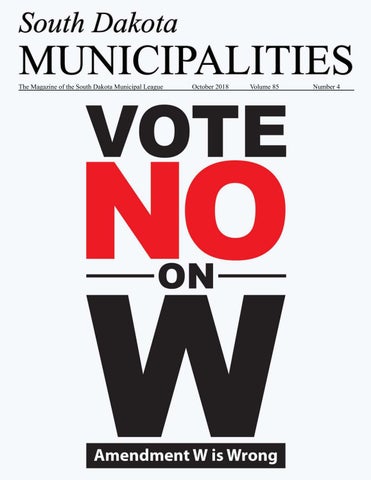
You will find information on the ballot measures on pages 9-13, but only one has gotten our firm “VOTE NO” – on Constitutional Amendment W. The SDML Board voted unanimously to oppose this measure at their June Board Meeting.
Why Vote No on W? The main reason for our local officials is that it creates an unelected tribunal that can investigate and harass any other elected officials and public employees. It takes only three commission members to start an investigation and issue subpoenas.
That’s right – an amendment that essentially kicks out any other part of the Constitution with which it does not agree. And blessing on you if you can read those 3,329 words and make sense of what it means, or how it will work. The one thing I can guarantee is that it will require fixing – and that won’t be allowed except by another ballot measure. The Attorney General – legally mandated to provide an unbiased explanation -would seem to agree, stating in the ballot statement, “It is likely to be challenged on constitutional grounds.” W is wordy, it is written poorly, it is wrong. Vote no on W!
Until next month, remember we are always available at 1-800-658-3633 or yvonne@sdmunicipalleague.org. Yvonne Taylor Executive Director
The tribunal will have an unchecked power to create rules for every elected official and public employee – from the Mayor to the kid mowing the park part-time in the summer, and everyone in between.
This tribunal will have a constitutionally-mandated $389,000 budget, with constitutionally-mandated annual increases.
The tribunal answers to no one. The out-of-state group that put this measure on the ballot asks you to believe it puts power in the hands of the people – it does not - it puts power in the hands of a seven-member group of commissioners. Elected by no one. Answerable to no one. With unlimited power to investigate you (yes, you personally) based on anonymous complaints.
There are 3,329 other reasons to Vote No on W – 8 pages worth. That is how many words it will put in our Constitution. Words that cannot be changed, no matter how awful the impact, without another vote of the public. Words that say, in part, that they take precedence over any other measure in our Constitution. 4
SOUTH DAKOTA MUNICIPALITIES
President's Report
Already? That is what I would say to myself every month when the infamous “magazine content” email from Sara would show up in my inbox. Didn’t I just send her last month’s? Almost every month a second “friendly reminder” email would be necessary. To be honest, I think Sara would just send that email because she knew my wife Dawn would see it and Sara would then have an ambassador to help keep me on task. If you find a little humor in that, just think about this happening 16 times. The last couple of months my articles have focused on vision for the future. As important as that is, looking back on past successes and shortcomings can also be very beneficial. So, as I started to think about this month’s article, I took a couple of minutes to look back at topics from my previous articles; Building blocks, Communication, Teamwork, Networking, Planning, Acquaintances, District Meetings, Tourism, Vision, Dedication, Guidance, Annual Conference, Customer Service.
In Baltic, our Volunteer Fire & Rescue responds to ~125 calls per year with an average of 1 hour per call and mostly attributed to an EMS related situation. As I look back to the topics of my previous articles, there are a number of them that are vital to ensuring these members safely return to their home and family. If you would, please take time to support and thank each and every member of your community’s fire department. I am truly honored and blessed to have served as your SDML President. Thank you for your support. Mike Wendland
Well, for my last article, I thought I would throw you a real curve ball and talk about a group of your friends and neighbors who far too often go unnoticed and under appreciated (not on purpose). This group of people is your Volunteer Fire Department! When the pager goes off, these dedicated individuals excuse themselves from the family dinner table, birthday party or sleeping to respond to the call for help. Truth be told, the commitment these folks have to their community is second to none. The average citizen is not aware of the time, dangers and emotional toll each of the department’s members deal with.
OCTOBER 2018
5
2018 Municipal/School Election Workshops Presented by: South Dakota Municipal League • Office of South Dakota Secretary of State Associated School Boards of South Dakota
Six webinar workshops are scheduled to assist election officers in conducting elections. The Secretary of State’s office, Associated School Boards of South Dakota and the South Dakota Municipal League will again co-sponsor workshops covering all aspects of elections - from notices to final canvass - including question and answer sessions.
Municipal finance officers and school business managers have statutory responsibility to conduct elections in their local jurisdictions. Properly conducted elections are an integral part of the democratic process. The many hours of diligent work on the part of the election officers enhances candidate and voter participation, and provides for accurate and consistent elections. Webinar Workshops - All aspects of elections will be covered over six different webinar workshops
December 5th Webinar*(estimated time 45+ min) 9:30 am or 2:30 pm (CST) • Election types and dates, combining elections vs. holding them the same day, Election Calendar, Precinct and Election Boards, Public Notices and more. December 20th Webinar*(estimated time 70+ min) 9:30 am or 2:30 pm (CST) • Candidate eligibility requirements, petitions, financial interest statements, vacancies and campaign finance.
March 5, 2019 Webinar* (estimated 40+ min) • Ballot preparation, voter registration and residency.
9:30 am or 2:30 pm (CST)
March 12, 2019 Webinar* (estimated 60+ min) 9:30 am or 2:30 pm (CST) • Absentee Voting - Application, Voting in-person or by mail, UOCAVA Voters.
March 19, 2019 Webinar* (estimated 1.5+ hours) 9:30 am or 2:30 pm (CST) • Election Worker Training and a guide on “What to do on Election Day.”
March 21, 2019 Webinar* (estimated 30+ min) 9:30 am or 2:30 pm (CST) • What to ask your County Auditor, what should you do on election day.
There is no registration fee for the webinars. Those who register to attend a webinar will be emailed the login and call-in information one week prior to workshop date.
*Each webinar is limited to 100 participants, so please register early if you plan to attend via webinar. Registration for the webinars may be found online at www.sdmunicipalleauge.org
Bridge Improvement Grant Recipients Announced
The South Dakota Transportation Commission awarded 35 Preliminary Engineering Bridge Improvement Grants (BIG) totaling approximately $1.345 million at their meeting today in Pierre.
The remaining $13.655 million in BIG funds will be used for Preservation, Rehabilitation and Replacement grants to be approved by next April.
Grant recipients are: city of Aberdeen, Aurora County (2), Beadle County (3), Bon Homme County, Brookings County, Brown County, Butte County (3), Davison County, Day County (2), city of Gary (2), Grant County, Hamlin County, Hanson County, Jackson County, Lawrence County (3), Lincoln County, Lyman County, Perkins County, Roberts County (2), Sanborn County, and Union County (5). Forty-one applications totaling $1.58 million were received by the South Dakota Department of Transportation (SDDOT). Two cities submitted three applications and 22 counties submitted a total of 38 applications.
Local governments are required to pay a minimum of 20 percent matching funds and have three years to expend the grant. Counties must have a wheel tax and a five-year Highway and Bridge Improvement Plan to receive a grant.
The BIG program was created in 2015 by Senate Bill 1. SB 1 set aside $7 million per year from funds generated by license plate fees to be used to repair and replace aging local bridges. The SDDOT adds an additional $8 million annually, making $15 million available.
The next round of BIG program applications is due Jan. 2, 2019, for the Preservation, Rehabilitation and Replacement categories. Applications are available online at: http://sddot.com/business/local/big/Default.aspx For more information regarding the BIG program, contact Doug Kinniburgh at 605-773-4284.
Funding Available for Outdoor Rec
South Dakota State Parks and Recreation Director Katie Ceroll announced today that applications are being accepted for grants from the Land and Water Conservation Fund (LWCF).
Public outdoor recreation projects sponsored by city, county, township and tribal governments are eligible to receive the grant money.
“Outdoor recreation is important to a healthy community,” Ceroll said. “The variety of recreational activities that local parks have to offer allows families to spend time together close to home.” The Land and Water Conservation Fund provides up to 50 percent reimbursement for approved outdoor recreation projects.
“Grants will be awarded for development or renovation of public outdoor recreation facilities or the acquisition of park land,” Ceroll said. “The grants will be awarded for a minimum of $10,000 and the maximum will be $75,000 in federal funds.” The application deadline is October 31, 2018.
LWCF funds are federal dollars that are apportioned to states by Congress to fund public outdoor recreation projects.
Application packets are available on the Game, Fish and Parks website. For more information, contact grants coordinator Randy Kittle at 605.773.5490 or by email at randy.kittle@state.sd.us.
Tomor o rrow
In nves vesting in infrastructure is an inves vestment in
> Streets > Se ewer > Drainage > Water > Airports > GIS > Electrical Power
Sioux Falls, SD 605-339-4157
Trusted. Prroffessional. essional. Solutions. OCTOBER 2018
Yankt a on, SD 605-665-2002
dgr.com 7
2018 Ballot Questions
Pursuant to SDCL12-13-23, the Secretary of State is required to prepare and distribute public information concerning constitutional amendments, initiatives and referred measures. This pamphlet is prepared by soliciting statements from the proponents and opponents of amendments and measures.
Election Day 2018 November 6th
The title, explanation and effect of a vote for each ballot question were provided by the Honorable Marty Jackley, Attorney General. No other statements on this pamphlet reflect the opinion of the State or the Attorney General.
The information was compiled by the Secretary of State as supplied by the writers, was not verified by the Secretary of State and does not reflect the position of the State regarding the legality or effect of the amendments or measures. The Secretary of State is not responsible for the contents, objectivity or accuracy of the statements written by the proponent and opponent writers in this pamphlet.
This pamphlet is available at sdsos.gov and in large print, Braille or on tape by calling the SD State Library at 1-800423-6665.
A Strong Public Finance Partner in South Dakota D.A. Davidson & Co. is committed to strengthening the infrastructure and enriching the lives of people in our communities throughout South Dakota and across the nation.
Gerald J. Spethman, Jr. Senior Vice President, Public Finance Banker
(402) 392-7933 (866) 466-9368 JSpethman@dadco.com
2XU SXEOLF ¿QDQFH EDQNHUV DYHUDJH over 20 years of experience LQ FRQYHQWLRQDO ¿[HG UDWH GHEW ¿QDQFLQJ YDULDEOH UDWH ERQGV FUHGLW HQKDQFHG VWUXFWXUHV DQG QRQ UDWHG ERQGV Primary areas of focus include: · Cities · Counties · School Districts · Rural Water Utility Finance · Healthcare Finance · Lease-Purchase Financing ā 1RQSUR¿W (QWLWLHV ā $OWHUQDWLYH (QHUJ\
For election returns on November 6, visit the Secretary of State’s website at sdsos.gov starting at 8:00 p.m. CST. Please feel free to photocopy and distribute this pamphlet.
Editor’s Note: Poll Hours for all elections are 7:00 a.m. to 7:00 p.m. local time. You can confirm your voter registration at sdsos.gov or you may contact your county auditor.
SDML Invitation to Political Candidates Policy
Whenever invitations are issued to political candidates to participate in the Annual Conference of the South Dakota Municipal League or the South Dakota Municipalities magazine, it is the policy of the SDML to invite only major party candidates to participate. For purposes of this policy, the major parties are the Democratic and Republican parties.
When considering only the Democratic and Republican candidates, for some races there was only one candidate, therefore they are not included in this publication. A complete list of candidates can be found at sdsos.gov.
450 Regency Parkway | Suite 400 | 2PDKD 1( | dadavidson.com
8
SOUTH DAKOTA MUNICIPALITIES
Constitutional Amendment W Title
An initiated amendment to the South Dakota Constitution changing campaign finance and lobbying laws, creating a government accountability board, and changing certain initiative and referendum provisions.
Attorney General Explanation This constitutional amendment lowers campaign contribution amounts to candidates and political parties. It prohibits contributions to candidates or political parties by labor unions and corporations. Candidates and elected officials are prohibited from using campaign contributions for personal use. The amendment expands the scope of activities requiring people to register as lobbyists, and places additional restrictions on lobbyists. The amendment replaces the government accountability board recently created by the Legislature. The new board is granted broad power, including the power to investigate, adopt rules, issue advisory opinions, and conduct audits. It may impose sanctions, including fines, on any elected or appointed official, judge, or State or local government employee. The amendment annually appropriates State funds to be solely administered by the board. The amendment limits the number of votes necessary for approval of any initiative or referendum to a simple majority. It requires the Legislature to make specific factual findings when enacting laws that are not subject to referral. If the Legislature wants to change the initiative or referendum process, or a law passed by initiative, it must submit the change to the voters. This multiple-section amendment makes other additions to the Constitution. It will likely be challenged on constitutional grounds. . Vote “Yes” to adopt amendment, Vote “No” to leave the Constitution as it is.
Pro – Constitutional Amendment W
Vote YES on Amendment W, the South Dakota Anti-Corruption Amendment. Corruption, government waste, and misuse of office have taken a clear toll on our state costing taxpayers millions of dollars. Be part of the solution, hold politicians accountable, and give voters the final say. Amendment W responds to the failure of politicians to address our growing concerns. Lobbyists can still give politicians unlimited gifts like food, alcohol, and entertainment. We remain one of the only states with no independent accountability for swaths of political rulebreakers. Clearly special interests and lobbyists have too much influence over state government. We must demand integrity by putting the power where it belongs: with the people. Here are the facts. Amendment W will crack down on self-dealing politicians, the corrupting influence of big money, secrecy, and lack of accountability by: • Restricting unlimited lobbyist gifts to politicians. • Prohibiting the personal use of campaign funds and stopping politicians from using their office for personal gain. • Banning foreign, corporate, and union donations to politicians. • Toughening ethics law enforcement to hold rulebreakers accountable. • Protecting voter-approved laws by giving voters the final say. Amendment W was written by South Dakotans for South Dakotans. Conservatives, progressives, students, retirees, small business owners, and many others came together to demand integrity from our state government with over 50,000 South Dakotans signing petitions to put Amendment W on the ballot. Special interest lobbyists and establishment politicians oppose Amendment W because they profit off of the status quo. But that is precisely why we, the voters, need to start setting the rules. Voting Yes on Amendment W will send a clear message: we stand by our state’s motto, “Under God, the People Rule.”
Vote Yes on Amendment W. Hold politicians accountable. Give voters the final say.
Mitch Richter, Republican small business owner Co-Chair, Represent South Dakota Darrell Solberg, Democratic small business owner Co-Chair, Represent South Dakota
OCTOBER 2018
Con – Constitutional Amendment W
Amendment W is Wrong. It creates a new branch of government that is not elected by the people, has powers that can’t be limited by the legislature, courts, or the Governor. Amendment W will require a statewide vote to fix mistakes. It is too risky to put in the state constitution, too confusing and too long (8 pages/3,329 words). The Amendment bluntly states “any conflicts with other parts of the constitution-this article controls”. It uses the phrase “notwithstanding any other part of the constitution” three other times. Amendment W creates a non-elected, seven member tribunal, with two appointed by the Supreme Court, two appointed by the Governor and those four choosing three others. This tribunal is empowered to create rules for 11 sections of law. This group will have unchecked power to create rules that could require disclosure of tax returns for every elected official and public employee including teachers and law enforcement. Amendment W forces an annual expenditure of $389,000 to be given to the board that is increased annually for inflation. Beyond that mandatory expenditure the amendment gives the tribunal authority to intervene in civil lawsuits including challenging “the sufficiency of resources provided for the board's implementation and operation”. Much of this large appropriation could be better spent on schools and law enforcement. Amendment W is being promoted by a Ballot Question Committee that exists only to pass this amendment using out of state money. As of the latest financial reports, they have not received a single donation from South Dakota. Amendment W is too confusing, takes a statewide vote to change, takes control over every other part of the constitution, and creates a non-elected tribunal and forces tax money to fund it. W is Wrong – Vote NO on Amendment W.
David Owen, President South Dakota Chamber of Commerce and Industry
9
Constitutional Amendment X
Title An amendment to the South Dakota Constitution increasing the number of votes needed to approve a constitutional amendment. Attorney General Explanation The South Dakota Constitution may only be amended by a vote of the people. Currently, the Constitution provides that a proposed amendment must receive a majority of the votes cast in order to be approved. Constitutional Amendment X changes the Constitution, increasing the number of votes needed to approve an amendment from a majority to 55% of the votes cast on the amendment. Vote “Yes” to adopt the amendment, Vote “No” to leave the Constitution as it is. Pro – Constitutional Amendment X
Amendment X is the result of a bipartisan, multi-group task force, that met in the summer of 2017. It made recommendations concerning the use of the initiative process to change our codified laws and the constitution of our state. This measure, approved overwhelmingly by the task force, would establish a 55% majority to change our constitution. It is patterned after a similar proposal, overwhelmingly approved by voters in Colorado in 2016. Our state constitution is the foundational political document of South Dakota. We should require more than a simple majority for approval of amendments to our state constitution. Think of the high standard that is needed to adjust the United States constitution. Amendments to that document require a two thirds vote of each chamber of our congress and then ratification by three quarters of the states. What Amendment X proposes is a modest adjustment that will protect our state constitution from efforts for unneeded changes, these efforts often promoted and funded by out of state special interests. Finally, think of school bond issues. They require a 60% majority for passage. If a bond issue needs 60%, should not passage of amendments to our state Constitution require a higher standard than a simple majority??
Please vote Yes on Amendment X.
It will protect our constitution from unwarranted efforts for changes, often promoted and funded by out of state special interests.
State Senator Jim Bolin - Lincoln and Union counties. Vice Chair of the Bi-Partisan and Multi Group Task Force that Recommended Amendment X be approved and placed on the ballot
Con – Constitutional Amendment X
The legislators pushing X claim, “Our constitution needs protection against a wide range of efforts to change it.” This claim makes three false assumptions.
Falsehood #1: Legislators pushing X assume we voters propose too many amendments. In 129 years of statehood, 244 amendments have appeared on our ballots. Of these, 227, including X, have come from the state legislature. Only 17 have come from voter initiative. Legislators have proposed 93% of the amendments we’ve voted on. If legislators want to protect the constitution from change, they need simply stop proposing so many amendments instead of trying, again, with X, to change the constitution.
Falsehood #2: Legislators pushing X assume it’s too easy for us voters to amend our constitution. Yet from 1980 to 2016, the difficult, costly amendment petition process placed only 16 citizen amendments on the ballot, compared to 55 Legislative amendments. During the same period, voters passed 38% of citizen amendments and 49% of Legislative amendments. Those numbers show that citizens face greater hurdles in proposing and passing amendments. We don’t need X to make the process harder.
Falsehood #3: Legislators pushing X assume a 55% vote threshold would protect us from “bad” amendments. Of the six citizen amendments passed since 1980, X would have stopped only one. In 2016, X would have stopped the amendment that improved vo-tech governance, a good amendment proposed by the Legislature and backed by the vo-techs and business. At the same time, X would not have stopped Marsy’s Law, a flawed and costly California amendment that legislators threatened to repeal. Legislators claim X will solve a problem. That problem doesn’t exist. Even if the problem did exist, X wouldn’t solve it.
The real problem is X. Keep X and its false assumptions out of our constitution. Senator Reynold Nesiba District 15 Sioux Falls, SD
Cory Allen Heidelberger Journalist, Candidate for District 3 Senate Aberdeen, SD
10
SOUTH DAKOTA MUNICIPALITIES
Constitutional Amendment Z
Title An amendment to the South Dakota Constitution establishing that a proposed constitutional amendment may embrace only one subject, and requiring proposed amendments to be presented and voted on separately.
Attorney General Explanation By law, any proposed amendment to the South Dakota Constitution must first be submitted to and approved by a vote of the people. Constitutional Amendment Z changes the Constitution to add the requirement that a proposed amendment may not embrace more than one subject. In addition, multiple amendments proposed at the same election must be individually presented and voted on separately. Vote “Yes” to adopt the amendment. Vote “No” to leave the Constitution as it is
Pro – Constitutional Amendment Z
Con – Constitutional Amendment Z
Amendments to South Dakota’s constitution should be Changing the constitution shouldn’t be easy--and it isn’t. limited to a single subject. This ensures that each idea presented to South Dakota voters for their consideration is While Amendment Z affects all constitutional amendments, most clearly presented. including those proposed by the legislature, legislators only need a few dozen votes to get an amendment (like this one) In addition, requiring amendments to be separately on the ballot--citizens must collect tens of thousands of considered prevents unfavorable but lower profile petition signatures for each one. amendments from being combined with more popular favorable amendments and forcing voters to choose all or Citizen-initiated constitutional amendments often contain none. multiple subjects to achieve the desired effect. For example, an anti-corruption amendment might contain campaign The language in this amendment is found in other states’ finance reform and an ethics commission. If voters agree, constitutions. they vote yes. If they don’t, they vote no. Please vote yes on Amendment Z.
G. Mark Mickelson Speaker, South Dakota House of Representatives
Under Amendment Z, an opponent could claim that campaign finance reform and an ethics commission are two subjects, and ask a judge throw the whole amendment out, rather than letting South Dakota voters decide. Forcing citizens to separate obviously related subjects into multiple amendments (and gather signatures for each one) is a waste of time and money and only benefits those with deep pockets who can pay for multiple campaigns.
South Dakota’s motto is, “Under God, The People Rule.” Amendment Z takes away the people’s power and gives it to judges and wealthy special interests. Vote NO. Anthony Helland, Board Secretary Dakota Rural Action
OCTOBER 2018
11
Initiated Measure 24
Title An initiated measure prohibiting contributions to ballot question committees by non-residents, out-of-state political committees, and entities that are not filed with the Secretary of State.
Attorney General Explanation This measure prohibits contributions to statewide ballot question committees by non-residents, by political committees organized outside South Dakota, and by any entity that is not filed as an entity with the Secretary of State for the four years prior to making a contribution. It requires the Secretary of State to impose a civil penalty on any ballot question committee that accepts a prohibited contribution. The civil penalty is double the amount of the contribution. The measure requires the Secretary of State to investigate alleged contribution violations prohibited by this measure. Currently, there are state laws regulating other kinds of election-related contributions, disclaimers, and disclosures. Violations of these laws are classified as misdemeanors and are subject to criminal penalties. The measure allows a court to impose a civil penalty (up to $5,000 per violation) in addition to the criminal penalty. Under the measure, the Secretary of State must investigate alleged violations of these particular election-related laws. All civil penalties collected under this measure will be placed in the State general fund. The measure is likely to be challenged on constitutional grounds. Vote “Yes” to adopt the initiated measure. Vote “No” to leave South Dakota law as it is Pro – Initiated Measure 24
It is our right, as South Dakotans, to petition our government. If we gather enough signatures, the public will vote on the quality of our ideas. This is an appropriate check on our representative form of democracy. It’s a South Dakotan’s right to exercise direct democracy. In 2016, there were seven initiated measures on our ballot, including four that proposed to re-write our constitution. • Six of those seven ideas were brought to us by outof-state interests. • Nearly $9.6 million was spent on these ballot measures; 97% of the money was from out-of-state. That year, out-of-state interests used South Dakota’s low signature requirements and cheap media markets as a testing ground for their ideas. They have turned our state founders’ intent completely on its head. Let’s send their political business model somewhere else. Support initiated measure 24 to ban out-of-state financial contributions to ballot committees. Let’s protect a SOUTH DAKOTAN’s right to petition the people, but deny that privilege to New York, Massachusetts and California business interests. They don’t have kids in our schools, they don’t attend our churches, and you won’t see them at the football game this weekend. That’s because they don’t live here. Let’s limit their involvement unless they can demonstrate either residency or a legitimate business interest in South Dakota.
Please vote yes on initiated measure 24.
Dennis Daugaard
12
Con – Initiated Measure 24
IM 24 limits out of state contributions to ballot question committees and puts it in law. And while it sounds good, similar bills died in the past two legislatures because the idea can’t survive a closer look. And it won’t survive a court challenge.
The problems are easy to see. It doesn’t ban independent expenditures. It doesn’t limit state entities from receiving and spending out of state contributions. Out of staters could easily avoid the law, spend what they want, and report even less. It doesn’t accomplish its goal.
It assumes people outside of South Dakota don’t have an interest or a stake in our elections. That’s just wrong. Ask tobacco and the tech schools.
Do you belong to, or work for an organization or association or business or union with a national or regional affiliate? Unless registered, they can’t give money to a committee. No more offers or calls for help.
Industries that move to South Dakota from out of state can’t contribute to a committee for four years. It doesn’t matter if their new enterprise is affected. That’s bad business.
And that’s the short list.
We’ve had first amendment attorneys review IM24. They tell us that it’s not defensible. It denies people and companies and organizations outside South Dakota their constitutional rights. We think they’re right.
And finally. In any election, you choose whom to listen to and you choose how to vote. We all do. We decide. An out of state message or messenger doesn’t decide anything. It’s just noise. And we can ignore it. That’s better than banning out of state voices by law. It’s better than censoring noise that we don’t agree with. That’s how bad things begin. Please vote no on 24. Steve Willard, President South Dakota Broadcasters Association
SOUTH DAKOTA MUNICIPALITIES
Initiated Measure 25
Title An initiated measure increasing the State tobacco tax and creating a postsecondary technical institute fund for the purposes of lowering student tuition and providing financial support to the State postsecondary technical institutes.
Attorney General Explanation This measure increases the State tax on tobacco products sold in the state. The tax on packs containing 20 cigarettes would increase $1.00 per pack, and 25-cigarette packs would increase $1.25 per pack. Tax on other types of tobacco products such as cigars, roll-your-own, and chewing tobacco would change from the current rate (35% of the wholesale price) and be increased to 55% of the wholesale price.
The measure also creates a postsecondary technical institute tuition reduction and workforce training fund that will be administered by the State Board of Technical Education, which oversees the State postsecondary technical institutes. Currently there are four: Lake Area Technical Institute, Mitchell Technical Institute, Southeast Technical Institute, and Western Dakota Technical Institute. The fund's purposes include lowering tuition and providing financial support for these technical institutes.
Under current law, the first $30 million of tobacco tax revenue collected annually is deposited into the State general fund, and the next $5 million is deposited into the existing tobacco prevention and reduction trust fund. This measure would require the next $20 million to be deposited into the technical institute fund created by this measure.
Vote “Yes” to adopt the initiated measure. Vote “No” to leave South Dakota law as it is
Pro – Initiated Measure 25
South Dakota could keep more students in state to learn, work and raise a family if we had more competitive tuition at our four twoyear post-secondary schools (Lake Area Tech, Mitchell Tech, Southeast Tech and Western Dakota Tech).
Con – Initiated Measure 25
Workforce development is important, but IM-25 is a flawed measure that raises $35 million in new tax revenues and gives government officials a blank check.
PIERRE’S HISTORY OF DIVERTING FUNDS Pierre has a history of raising taxes for one thing and diverting those Did you know that the tuition at these two-year schools is the third funds for something else. The last time South Dakota voters increased taxes, elected officials said it would be used for property tax highest in the country? Our cost of $235 a credit hour is double the tobacco relief and education. Then, they diverted that money to the General cost of attending a two-year school in Nebraska, Wyoming and Fund.
Montana and significantly higher than the cost of attending a Government officials have mismanaged public funds and diverted twoyear school in our other neighboring states.
dedicated tax dollars. Look at what happened with the GEAR-UP
Despite high tuition, total spending per student in South Dakota is education grant program and money from the video lottery. Three years ago, politicians siphoned a half-million dollars from the state’s tobacco the lowest in the 7-state region, averaging about $3,000 less per prevention fund for mosquito control! student per year than the regional average.
NOTHING IN IM-25 PROTECTS TAXPAYERS FROM ANOTHER DIVERSION The same politician behind IM-25 voted to divert funds from property To lower this tuition to be competitive in the region and to provide tax relief to the general fund, and there’s nothing in IM-25 to stop the same thing from happening again.
This is no way to retain and grow a trained work force.
funding necessary to address needed training, a $1 increase in the tax on a pack of cigarettes (and a corresponding tax increase on other tobacco products) is proposed. State budget officials estimate this will raise a total of $25 million in new revenue for the state of South Dakota. $20 million of this will be given to the state board of postsecondary technical schools to lower tuition to fund additional courses and training.
If we are going to raise taxes, South Dakotans need real protections that ensure our tax dollars will go where we want them and not end up in a slush fund for government officials to spend however they want.
IGNORES OTHER EDUCATIONAL NEEDS IM-25 raises taxes to fund the state’s four technical institutes but doesn’t include necessary protections against waste, fraud or abuse. And IM-25 ignores other important educational needs. Preschools, K-12 schools, The American Cancer Society Cancer Action Network estimates colleges and universities in South Dakota will be shut out of this new that raising this proposed tax increase will prevent 3,200 youth from tax money.
starting smoking and save $148 million in health care costs.
Please vote yes on initiated measure 25.
Dick Muth, CEO, Muth Electric, Mitchell, SD Allen E. Nord, MD, volunteer advocate, American Cancer Society Cancer Action Network Dana Dykhouse, CEO, First Premier Bank Paul Amundson, MD, family practice physician, Sioux Falls, SD Mark Mickelson, President, Mickelson & Company
OCTOBER 2018
VOTE NO ON IM-25 IM-25 lacks taxpayer protections, fails to rein in technical schools’ wasteful spending and could lead to closed businesses and lost jobs. It’s so bad organizations and individuals across the state, including both the South Dakota Republican and Democratic parties, recommend a NO vote on IM-25. Steve Westra Chair, South Dakotans Against Higher Taxes
Past Assistant Majority Leader, South Dakota House of Representatives
13
Meet the Candidates for US Representative Tim Bjorkman Democrat
I’m Tim Bjorkman and I’m running for Congress.
I’ve lived my life in rural South Dakota. My wife Kay and I raised our four sons here, three of whom served deployments in the Army in the Iraqi War Era.
My family has deep roots in this state: our two grandchildren represent our family’s seventh South Dakota generation. I know what it’s like to run a business, serve in the community and invest in those around us. I’ve served as a missionary, on the parole board, an adult Sunday School teacher, and as a judge.
I served as a municipal attorney for five different communities over the course of more than two decades and intimately understand their challenges. That’s a key reason why I’ve pledged to have every member of my congressional staff cross-trained in economic development for our 310 South Dakota towns and cities, to aid them in awareness of infrastructure, economic development, Main Street, and other grants. I’ll also stand guard over Social Security and Medicare to ensure that Congress doesn’t go back on the promises made to hard working people who’ve paid in for decades.
Politicians need to stop making a political football of our healthcare. As a judge, I saw how critical affordable healthcare is to a healthy workforce, reducing crime and prison rates, and ensuring children have safe, healthy homes to grow up in.
Finally, too many elected officials from both parties are beholden to special interests instead of our interests. That’s why I reject the leadership of Nancy Pelosi and call for new leadership in both parties. It’s time again for a strong new voice for us again who will be independent of both the special interests and national Congressional leaders.
We need to return to traditional values that honor hard work and allow us to live good, productive lives. Government should lend people a hand up rather than a handout, and we must encourage a strong work ethic, personal responsibility, diligence and perseverance.
Our time on earth is brief, but how we live determines the kind of America and South Dakota we leave for our children and grandchildren. That’s why I am running for Congress. . 14
Dusty Johnson Republican
For the past eighteen months, I haven’t stopped moving.
I have visited dozens of cities and towns in South Dakota and met tens of thousands of your citizens. I have heard from Mayors, City Commissioners, and City Administrators. I have listened to everyday South Dakotans. I have also shared my plans for making South Dakota an even better place.
I have energy to burn, and I plan to use every ounce of it on your behalf. I will be a tireless advocate for South Dakota in Washington, DC. I will work to end gridlock and dysfunction and return power to where it belongs – our communities.
For too long, Congress and the executive branch gathered and assigned authority to themselves. For decades, the federal government systematically increased its reach into our communities through regulations and restrictions, not just on businesses and ag producers, but on municipalities, counties, and schools as well. The costs of federal compliance have gone up on our local governments for tasks that used to be commonplace. The trend of ever-growing federal intrusion is unacceptable.
I believe that the best decisions are made closest to those impacted. I believe that our city commissions know best how to keep their city’s roads in good repair. I believe that local taxpayers know best whether an opt-out is warranted for a given project. Local decisions should be made locally. When Washington, DC starts to think it knows better than our local communities, we get unbelievable deficits and debt, shoddy or non-existent oversight, and one-size-fitsall regulations. What works for Newark, New Jersey likely will not work in Sisseton, South Dakota.
I will be a tireless fighter for giving our local governments more room to make decisions with their constituents in mind. I will also work hard to reduce the regulations and restrictions that make the administration of local government more costly. I won’t stop moving. Send me to Washington, DC and let me put that energy to work for you.
SOUTH DAKOTA MUNICIPALITIES
Meet the Candidates for Governor Billie Sutton Democrat
In my day job as a finance professional, I’ve learned that the economy is pretty simple: it’s people. And in South Dakota, we’re lucky to have some of the most honest, common sense, and hard-working folks to build our economy. Our approach to building a stronger South Dakota should be centered around our best resource, our people. I’m focused on creating opportunities for South Dakotans and working together to make sure nobody gets left behind as we develop, grow, and prosper. I’ll fight to make sure our economy rewards the hard-working families that make our state strong.
And I know a thing or two about fighting. Eleven years ago, I was a professional bronc rider with what I thought would be a long rodeo career ahead of me. That all changed one day when the horse I drew flipped on me in the shoot and left me paralyzed from the waist down. In that life changing moment, I could have rolled over and quit. But that’s not how South Dakotans are raised. We are fighters instilled with the values of hard work, honesty, and integrity. So I dusted myself off, put my education to work as a finance professional at a community bank, and ran for the legislature to represent the community that stood by me when I needed them most.
I spent 8 years in the Senate fighting to increase government transparency, for economic and workforce development, for educational opportunities for students rural and urban, for local infrastructure improvements for ag producers, for local control and prioritized funding for our local governments, and to work across the aisle to balance the budget and lower taxes for hard working families. Now, I’m running for Governor to further those same goals and to help build stronger communities. I believe in making sure government is as honest as the hardworking people of our state. I am running for Governor for all those who believe as I do that the system is broken and together we can rise to the occasion, meet our challenges, and build a stronger South Dakota.
OCTOBER 2018
Kristi Noem Republican
I believe in local control, because I believe those closest to the people are best situated when making decisions that affect our families, schools, and communities.
That, of course, doesn’t mean every solution to every problem must be carried on the shoulders of municipal government alone. For instance, I know many local budgets are strained today as a result of rising violent and drug-related crimes. Working collaboratively with you, I want to end the cycle of crime and make sure we remain a state in which both families and growing businesses can feel safe to call South Dakota home. That means, among other things, getting proactive on mental health and supporting local control of school safety.
Another area ripe for collaboration is education. We cannot underestimate the influence of a good education. Students gain confidence, communities often experience decreased crime rates, and local employers get access to a skilled workforce, bringing good jobs and higher wages to the area. As governor, I’ll work to redirect dollars toward the classroom and help local employers play a role in inspiring kids to pursue job-ready programs.
But we can’t take a one-size-fits-all approach to improving education’s impact. Larger cities and small towns have different workforce needs, which must be acknowledged. Over the last two decades, South Dakota’s population has grown by more than 100,000 people. During that time, it’s been exciting to see our larger communities flourish, but we must make sure South Dakota’s small town culture isn’t lost. As such, rural broadband, telehealth, and rural economic development will be priorities in my administration. At the same time, we must partner to bring affordable housing to all communities - large and small.
I’ll close with four key commitments I’ve made in this campaign: 1. I won’t raise taxes on your residents. 2. I won’t grow the state government. 3. I am committed to fighting against federal overreach whether it’s encroaching on states’ rights or local decisionmaking. 4. I will increase transparency, so your constituents have better access to the deliberative process.
Thank you for everything you do for the people of South Dakota. Please visit kristiforgovernor.com/ThePlan to learn more about the policies I’ll pursue. I hope to see you soon!
15
Meet the Candidates for Attorney General Randy Seiler
Democrat
I am a life-long South Dakotan and I have spent my professional career serving the people of this state. After graduating from Herreid High School, I spent four years in the military, including a year in Vietnam. I have always been proud to be an American, but in Vietnam, I learned how lucky I was to be an American. With that good fortune comes the responsibility to work hard, take care of your family, and stand up for the things you believe in.
After 14 years in private practice, I became a Federal prosecutor. Representing victims of terrible crimes – homicide, child sexual abuse, and rape - broadened my understanding of justice. I’m proud to say that I’ve never walked away from the tough cases.
As South Dakota’s U.S. Attorney, I was the managing partner of a statewide law firm with sixty of our state’s most talented legal professionals. I worked with tribal officials to foster government-to-government relationships. Understanding that justice transcends criminal prosecution, I made a commitment to community engagement. We partnered with healthcare providers to promote the rights of people with disabilities, combat child sexual abuse, and take on opioid addiction.
As I’ve traveled across the state, it has become apparent that there is a general consensus regarding the most pressing issues facing our justice system. The prevalence of drug abuse and addiction is tearing apart our families and communities in epic proportions, while consuming criminal justice system resources. As your Attorney General, I will work to form public and private partnerships that focus on prevention and treatment. Treating addiction with incarceration is not always the answer. We must find better solutions.
Through tragedy, we have learned that public corruption can be even worse than the betrayal of public trust. If I am elected as South Dakota’s Attorney General, it will no longer be politics as usual. I vow to remove politics from legal decisions and hold our leaders to the highest ethical standards. I believe the Attorney General must put S outh Dakota before party. The safety of our communities, our children – all South D akotans – depend on it. 16
Jason Rvansborg Republican
I grew up on a farm where we raised hogs, cows, and calves and grew corn, soybeans, and alfalfa. My amazing parents taught me to work hard, take care of the family, the land and go to church. My dad taught me to respect my elders, our Country, and the U.S. flag.
In 1998, I earned degrees in history and political science from the University of South Dakota and my commission through the universities’ Army ROTC program. Three years later, I graduated from USD School of Law and while in law school, I also earned my Master of Arts in History.
I have served twenty-two years in the Army Reserves. I have had four company commands of approximately 180 servicemembers. I have also been deployed three times. The first deployment was to Germany in 2003. In 2004-2005, I deployed to the combat zone of Al Asad, Iraq. For my service in Iraq, I was awarded the Bronze Star Medal and honored before Congress in 2006. I was then deployed for the third time to Kandahar, Afghanistan in 2009-2010. Today, I command over 600 Servicemembers, in four different states, as a Lieutenant Colonel and Battalion Commander. Serving my community is also important to me. I have served as president of the Yankton Sertoma club and was selected to be the Sertoman of the Year in 2013. Currently, I am a member of the Elks, the VFW, American Legion and the Knights of Columbus.
Currently, I serve as the Deputy States Attorney for Union County and a partner in the law firm of Harmelink Fox & Ravnsborg in Yankton. In the 17 years, I have been an attorney, I have had considerable experiences in both prosecuting and defending criminal cases, along with complex civil matters.
Our new attorney general must be a leader. My professional and personal life has been dedicated to service and leadership. Taxpayers deserve an attorney general who will be responsible to them; I’ll keep our families safe, protect our most vulnerable populations, and run an organized and fiscally conservative office.
SOUTH DAKOTA MUNICIPALITIES
Meet the Candidates for Secretary of State Alexandria Frederick Democrat
Candidate did not respond.
Steve Barnett Republican
The Secretary of State’s office is responsible for a wide number of important duties that help ensure our government operates efficiently. It oversees an election division that must provide steady leadership and work collaboratively with county and city leaders to foster successful elections. It also oversees a business services division that serves as a vital resource and plays an important role within many business proceedings throughout our state.
During this campaign, I’ve traveled across our great state and listened to concerns and ideas from our fellow South Dakotans. Election security, campaign finance, and a prompt business filing system were often repeated topics we discussed.
In today’s world, election security is a principal concern. As Secretary of State, identifying and supporting policies and procedures that strengthen this security will be a top priority. Voters need to have faith in our voting mechanisms and be confident that our elections are free from outside influence. We must also place a focus on voter education. Our citizens need to have election information available to them to encourage their participation.
Providing prompt service to businesses working with the office will also be a key priority. This focus is not only beneficial to those doing business with the State, but also serves as a key revenue driver for the office.
As State Auditor for the past eight years, I’ve strived to run our office as efficiently and effectively as possible. We’ve been able to reduce our staff size, add protections and safeguards to the reimbursement process, and revert over $375,000 back to the State’s general fund at the close of our fiscal years. Through these efforts, I was honored to be selected by my colleagues around the country as Vice-President of the National Association of State Comptrollers last March. This focus on providing frugal leadership and working collaboratively with others will be continued as your Secretary of State.
As the election draws near, I look forward to continuing to discuss my vision for the office with South Dakotans across our state and am asking for your support on November 6th! OCTOBER 2018
17
Meet the Candidates for State Treasurer Aaron Matson Democrat
I am a 4th-generation South Dakotan, and except for a couple years of seminary, I have lived in South Dakota my whole life. Before joining the South Dakota Democratic Party as the Communications Director, I was a reporter at the Watertown Public Opinion, and a Lutheran pastor in the Watertown and Brookings area. I received a Ph.D. in Political Science with a focus on Public Administration from the University of South Dakota in December of 2017.
I am running to be your State Treasurer because I believe that the political establishment has forgotten the key point about public administration and public service – it is first and foremost, about the public.
The State Treasurer doesn’t often receive the same press attention as other offices. But there are still some important things we can do from this office to make people’s lives better: • increase the transparency of the State Treasurer’s office to increase the transparency of state government as a whole, • return unclaimed property to the original owner or his/her heirs as quickly as possible, • remit city sales tax revenue back to the cities of South Dakota in a timely manner to help our cities have a stable and reliable cash flow, • work to increase financial literacy in our state, and • make smart investments in local banks through the State Treasurer’s CD program so they can invest in their communities.
The State Treasurer deals with a lot of important issues. But it's also important to remember that the work of the State Treasurer, and any elected official, is not just about lines on a budget sheet. My time as a pastor and my doctoral work in political science and public administration have driven home to me that behind every political decision and every budget line are people – who are doing their best to get by and whose lives will be impacted by those decisions. As your state treasurer, I will always remember that I serve the people of South Dakota – not a governor, not a political party, not big banks, not investment brokers – but you.
18
Josh Haeder Republican
I’m blessed to have my beautiful wife Amanda and our two little girls by my side throughout this journey. As a small business owner and lifelong resident of Huron, my roots run more than a century deep in South Dakota.
My decision to run for Treasurer begins with a story of lost and found. During the course of a friendly conversation, I came to find out I had unclaimed property. Money that I had “lost” or more accurately of which I had lost track. One of the more popular jobs of the State Treasurer’s office is helping people reclaim “lost” funds — money from utilities or closed bank accounts or other ways that money didn’t get to its rightful owner.
Through that encounter, I found a new opportunity to serve our state. My background in banking and credit counseling uniquely prepared me to perform the work done by our state’s chief banking officer — our State Treasurer. My top priority and that of the office is keeping our state’s funds accounted for by daily reconciling the taxes and fees paid to state government, then making sure it’s getting to the correct agency or program. However, it’s important to realize the responsibility of the office doesn’t stop there. I believe it’s my duty to protect the people’s money.
I have a Master’s degree in Intelligence and Global Security Studies. While the internet has opened up vast opportunities, it’s also increased risks to networks, and state accounts are vulnerable. To help safeguard our state accounts, upon taking office, I would upgrade and expand the measures the office has to monitor and protect our funds from criminals intent on wrongdoing. I believe the best way to achieve this is by creating public and private partnerships. South Dakota is home to top-notch internet security experts. I think we can work together to ensure our accounts are secured. It’s a challenge, I’m prepared to lead on.
SOUTH DAKOTA MUNICIPALITIES
Meet the Candidates for State Auditor Tom Cool Democrat
The citizens of our state have a proud tradition of hard work and honesty. And our taxpayers deserve a government with the same values.
Yet in the past few years we’ve seen a couple of major financial scandals such as EB5 and Gearup resulting in the loss of untold millions in state funds, the misdirection of state resources and sadly the tragic loss of life. At the same time a national organization has given our state an “F” when it comes to the potential for corruption and the lack of protective guidelines.
As a onetime investigative report and an experience nonprofit administrator – used to keeping a close eye on the bottom line – I’d like a chance to undertake the role which is described on the current state web site as the taxpayers’ watchdog.
It is the State Auditor who scrutinizes the manner in which state tax dollars are spent. Simply stated, the office of State Auditor has been described as constitutionally the “checks and balances” of state government.
So the big question is where have the current officeholders (auditor and treasurer) been the past several years in fulfilling this function.
I grew up in Platte, sight of the Gear Up tragedy, and I know that residents of that city had concerns about the operation of the program and the spending of state funds long before any problems were cited by state government. South Dakota’s taxpayers deserve a watchdog – not a bureaucratic lapdog – and I welcome the opportunity to undertake that job for you.
As a brief background I am a graduate of the University of South Dakota, after which I spent a few years In Indiana working for a local daily newspaper. I returned to the state in 1980 with my wife and three sons. I worked a brief time for St. Michael Church in western Sioux Falls during construction of a new building and a new parish. Later I served as an administrator for the Foundation for the Arts in South Dakota, operated a small computer consulting business and eventually joined the organization now known as the Council on College Admission in SD where I have spent the past 30+ years coordinating college fairs, workshops and publications aimed at promoting informed decision-making by students planning for life after high school. The programs have involved bringing together persons and institutions from throughout the state. OCTOBER 2018
Rich Sattgast Republican
The three most important roles within the Auditor’s office are to be accountable, accurate and timely. Having served as one of the chief financial officers for the state for the last 15 ½ years, I have the knowledge to ensure success in those areas. I have state auditing and payroll experience as well as the knowledge and background in the use of the state’s accounting system. This knowledge and experience is imperative when we hire the State Auditor. In addition, our State Auditor is mandated to ensure state and local governments are compliant with IRS and Social Security regulations. My experience in these areas, as well as having served as the Director for the Association of County Officials, gives me the knowledge and the relationships to effectively work with the local leaders who run our cities, schools, counties and townships.
Looking forward, I pledge to always work to improve accountability, accuracy and timeliness of payments. Serving as State Treasurer, I have intimate knowledge of our state banking system, which makes me uniquely qualified to build upon that pledge. I plan to increase the number of auditors we have by freeing up other FTE’s through the use of automation in the reconciliation process. This is important because of the auditor/workload ratio that currently exists. At present, auditors are estimated to only have a little over 2 ½ minutes per voucher due to the sheer volume of daily vouchers. By being able to re-allocate employees, I can increase the amount of time each auditor can spend per voucher. This not only increases the ability to catch anomalies, but also provides a more timely payment system, thus working toward fulfilling the “pledge”.
As your State Treasurer, I am working with UMACHA to host fraud prevention classes for state finance officers and as State Auditor I look forward to opening that opportunity to local government finance officers as well. I am focused on results, and as State Auditor I will work to ensure better government for all of South Dakota.
19
Meet the Candidates for Public Utilities Commissioner Wayne Frederick Democrat
Candidate respond.
Kristie Fiegen Republican
did
not
Traveling over 40,000 miles this past year has allowed me to meet South Dakotans from every corner of our great state and listen to their concerns. South Dakotans want a PUC commissioner who will listen to them and won't waver in their commitment to taxpayers. I will continue to focus my responsibility in three main areas. First is to be a consumer advocate for South Dakota utility consumers. As your PUC commissioner, I will continue to lead in our efforts to keep our utilities accountable to the people and advocate on your behalf for reliable service at just and reasonable rates.
Second, I will continue to advocate for expanding our utility infrastructure to ensure a vibrate economy in our rural state. Expanding utilities such as broadband, cellular wireless, and transmission are important to South Dakota. I will continue to encourage our Internet providers to expand their networks so more South Dakotans can have access to worldwide commerce, online education, and new healthcare opportunities. Utility infrastructure provides economic development opportunities for today’s citizens and future generations. Third, I do my day-to-day work with the utmost respect for the law and facts in every decision I make. My detailed evaluation of each case, impartial judgment, fair decisions, and hard work are what I am known for.
I would appreciate your vote and support in November.
My Background: • South Dakota Public Utilities Commissioner since 2011 and the current chairwoman • State Legislator from 1993 to 2001 • Grew up on a family farm near Parker, SD • Earned a Bachelor’s degree form South Dakota State University • Earned a Master’s degree from University of South Dakota • President of Junior Achievement of South Dakota for 17 years • Married to my husband Tim for over 32 years • Two sons, Alexander (20) a student at SDSU and Jackson (18) a student at Parker High School
20
SOUTH DAKOTA MUNICIPALITIES
As the 201 17 HP Partner of the eY Year ear, Riverside Technologies Tec chnologies Inc. Inc (RTI)) is confident that we can save you money immediately i on your HP genuine OEM M printer cartridges. We are a trusted IT source and have years of experience e meeting the needs of cities c and municipalities.
Studies show orrganiz ganizat ionss t hat implement managed print ser vices reduce their prrint int ing costs bbyy an averrage age of 30 percentt .*
REDUCE YYOUR OUR R PRINT COST BY 330%
Genuine OEM
Printers
Prinnt Solut ions As a member of the SDML organizaation, you can take advantage of significant savings on n HP toner, print supplies, and printers.
Ca all or email us to oday for more informattion! Dan Polllema Ó DPolle ema@1RTI.com 605.3 359.9300
Print i Success Best Price on all Your Print Supply Needs
Òäëðåöë Éîëñì Čà Čà ÅÚÑ ÑĊï Éñåàá ðë ÏÝêÝãáà Òîåêð Õáîòåßáï Öäá ÖîåâáßðÝ ëâ ÅëîìëîÝðá Äáêáğðï č Ðëò
w w w.1RTI . co om
866.804.4388 88
The More We Grow, The Poorer We Become
By Charles Marohn
As a young engineer, I remember sitting in a city council meeting where a senior colleague presented my analysis on the massive backlog of road maintenance the community was facing.
My estimation was that the city's capital budget needed to be increased by five times just to keep from falling further behind. To me, this felt like a total disaster! There was no way that kind of budget increase was ever going to happen, especially given the long list of other needs the city was facing. And I knew that the obvious question of reckoning must be coming: How did we get to this point?
My colleague soberly reviewed the numbers and then deftly shifted the conversation into a discussion on funding. The city could raise taxes which, of course, no one was recommending. Better not to be the one to open that book since everyone in the room understands how that story ends.
There was hope that the state and federal governments might come up with some solution, especially since so many places are in the same situation. Hope, in this instance, is sort of like the feeling people have when their team is down three scores with the clock running out. We all know success is highly unlikely, but remember that one game? Hope is a psychological bridge that allows us to justify embracing the Holy Trinity of Decline: growth projections, subsidies, and debt.
We hope new growth will provide more revenue. Our desperation—although we would rather call it “commitment”—is such that we’re prepared to subsidize that growth into existence, if need be. And when all else
fails, we can handle this cash shortfall, which we hope is temporary given that we’re investing in growth, by taking on debt.
To my dismay, the presentation ended without a reckoning. The hard question was never asked, and so the uncomfortable reality was never explored. Still, at some point over the coming days, I was certain that nearly everyone in attendance would ponder it. How did this happen?
An Insolvency Crisis The people who work at ratings agencies largely believe that municipal debt is as close as an investor can get to risk-free. This holds even in states like Illinois, New Jersey, and California, where pensions are a blinking red light on the dashboard of every budget projection. The consensus belief is that, since widespread municipal defaults have not happened since the Great Depression, they are not likely to happen in the future.
There is a lot missing in that narrative. The first is that nearly every local government in the United States is currently defaulting on their obligations. Local governments make all kinds of promises—to properly maintain infrastructure, to adequately fund pensions, to staff police and fire departments—that they are failing to keep.
Unlike a debt default, these soft defaults are explained away as public policy choices. This ignores the connection between the capacity to pay debts and the capacity to keep other promises. Both rely on local government tapping into the wealth of the community. Whatever combination of property, sales, and income tax is used, there must be capacity there to pay. You can’t tax what’s not there. As public obligations grow, private wealth within the community must keep pace. Yet our accounting rules and practices completely ignore this reality.
!"#$%&'(&)*$+,'-'.$/!0"+1$*$"+$+,' 2+$*34'5)/*34'6&/7$8&4'-'9+3*)%%)*$"+' !
"#$%&'!!()*+,-)*.*++/! 0$11.23&&'!!4.-//.5/6./+7)! 89:;1'!!<:1&<=>?3$@9;%%&<$?:AB$9! ! !! !!!
!!!!!
!
!!!!!!
!
4+6//!C&%;?#!DE&!F!G!F?&!4/-!G!HI3%<E;11&J!KL!!**776! MMMA>?3$@9;%%&<$?:AB$9!
22
SOUTH DAKOTA MUNICIPALITIES
When a community builds a new road, that piece of infrastructure comes with a future obligation for maintenance. Local officials can estimate, with a good degree of precision, when that obligation will come due and roughly how much it will cost. In normal accounting terminology, that would be considered a future liability. In the magical world of municipal accounting, however, that road is labeled an asset.
Never mind that it can’t be sold or transferred, and never mind that it carries a future maintenance obligation, it’s counted on the asset side of the ledger. Standard accounting practices state that the more roads a community has and the more future promises it makes, the richer it is. Simultaneously, these same rules give no consideration to the wealth being created or not. That new road can serve 100 million dollars of property or a tax-exempt forest; it’s all the same on the community’s balance sheet.
If this sounds incoherent, it is.
National economic policy since the Great Depression has focused on growth and employment, not on the broad creation of wealth. In the words of Czech economist Tomas Sedlacek, we’ve been willing to “sacrifice stability to achieve growth.”
Local governments can’t function this way, not over the long run. They can’t take on more and more promises without generating enough wealth to meet those obligations—not without a reckoning.
A Lack of Wealth Consider a common North American development scenario, one that played out in my hometown of Brainerd, Minnesota. Two identically sized blocks are separated by a third. They are in the same neighborhood and on the same thoroughfare. They are the same size and have the same amount of public infrastructure and maintenance cost.
The westerly block I’ve labeled “Old and Blighted.” It was erected in the 1920s, back when neighborhoods were built incrementally over time. When these buildings were constructed, this was the far edge of town. They were small investments that, if things worked out, could be expanded and improved as the community grew. There would not have been any public infrastructure when these were built; theoretically, that would come later when the neighborhood reached a level of maturity that justified the ongoing public expense.
What you see demonstrated in the Old and Blighted block is the way that civilizations have been building for OCTOBER 2018
Total value of the Old and Blighted block: $1,104,000. Total value of the Shiny and New Block: $618,000
thousands of years: They begin with nothing, but with time and effort, they end up creating something. Historically, this is the first building block of a successful place.
Contrast this with the easterly block, which I’ve labeled “Shiny and New.” This block used to look like the Old and Blighted block, but the community worked to get those buildings torn down and replaced by a new drive-through taco restaurant. Not only did this transaction remove blighted properties, but the new site met all the city’s policy objectives. It fully conformed with the zoning code, including setbacks, lot coverage, and sign placement. It eliminated the on-street parking, allowing traffic to flow more smoothly. It even provided greenspace and some stormwater retention capacity.
By nearly every measurable objective, the Shiny and New block is more desirable than the Old and Blighted block. There is one significant measurement, however, where it falls short: wealth. The Old and Blighted block has a total annual taxation value of $1,104,000. The Shiny and New block has a total value of $618,000.
That decrepit, old block the community would love to have razed is worth 80 percent more than the modern block. It pays 80 percent more property tax to the community. And not only does the Old and Blighted block outperform financially by a significant margin, it does so at the same cost to the taxpayer.
This illustration shows the growth in population, feet of pipe, and fire hydrants in the city of Lafayette, Louisiana, between 1949 and 2015. While the population has increased only 3.5 times since 1949, the amount of water infrastructure for the city has grown many times larger. Meanwhile, the median household income for the city has increased by only 1.6 times according to U.S. Census figures. This math simply doesn’t add up.
23
Analyses of new developments suggest that a minimum of $20 in private wealth is needed to sustain, for the long term, each dollar of public infrastructure investment. A ratio of 40:1 would provide an optimal buffer for future uncertainty. Yet, when we examine modern North American localities, it is common to find ratios of 1:1 or worse. That is, in the current development pattern, it takes one dollar of public infrastructure investment to create one dollar of private wealth. That’s a formula for economic disaster.
This is a pattern we see repeated everywhere across North America
Simple Math Despite the obfuscation of modern accounting practices, the math equation for a local government is fairly straightforward: a public infrastructure investment must generate enough private wealth to pay for the ongoing replacement and repair of that infrastructure or, if it is to be sustained, it must be subsidized by a more financially productive part of the system.
Baltic
Brandon
Colman
Elk Point Faith
Gettysburg Hartford
Herreid
24
Consider a municipal sewer system. Pre-depression systems tended to rely on gravity flow, which is extremely cheap once the pipe is installed. Properties of that period tend to be skinny and deep, minimizing the amount of pipe needed per connection (or, said another way, maximizing the amount of private wealth per foot of public obligation). Good urban design would place buildings on higher ground with treatment facilities downhill, a setup with a lower financial burn rate.
Today, designers generally don’t worry about the public’s return-on-investment. Parcels are wide and shallow, spread out with a lot of gaps in between. Pumps, which are expensive to operate, maintain and replace, are commonly
SDML Directory Changes
Delete: M Mike Wendland ADM Ryan Fods PWD Ryan Fods Add: ADM Mike Wendland
Delete: M Larry Beesley CM Blaine Jones Add: CM Brett Bastian EN Tami Jansma
Delete: CM Ben Elhoff
Delete: ADM Dennis Nelsen Add: ADM Derek Tuttle
Delete: UM Donn Dupper PC Mathew VanDerLinden Add: UM John Collins PC Matthew Schackow
Delete: FO Danial Ablott Add: FO Sheila Schatz
Add:
FO Karen Wilber
Delete: Tina Kary Add: Keith Hall
Humboldt
Lake Norden
Lennox
North Sioux City
Spearfish Toronto
Watertown Webster
Yankton
Delete: FO Laura Schultz Add: FO Nicole Baars Delete: PC Jimmy Murphy
Delete: PC Orville Jorgenson Delete: CM Tammy Reiff
Delete: ATT Eric Davis Add: ATT Ashley McDonald
Delete: T Mark Peterson Add: T Kristin Hunter
Delete: EN Shane Waterman Add: EN Heath VonEye
Delete: CM Roger Monson
Delete: PC Brian Paulsen Add: PC John Harris
Email Directory changes to Lisa@sdmunicipalleague.org. Visit www.sdmunicipalleague.org for a cumulative listing of changes to the 2018-2019 Directory of Municipal Officials.
SOUTH DAKOTA MUNICIPALITIES
used to provide service to marginal properties. This is all expensive, and while the initial construction costs are often covered by a developer and rolled into the sale price of the home, taxpayers assume the burden of providing ongoing service and maintenance. Yet, despite the large discrepancy in public cost, a residential home on a remote lot with a dozen pumps to get its sewage to a treatment facility will be charged the same as the home on the narrow lot with gravity flow all the way.
With decades of building in this new style—everything spread out across the landscape—the costs are enormous yet the comparative wealth is marginal. Our communities are bigger, yet financially less productive. We have grown our tax base, but our expenses have grown even more. This is not working.
A Strong Towns Approach In the current approach to managing local governments, the more they grow, the poorer they become. While that growth may improve a city or county’s short-term cash flow, it destroys the long-term solvency.
It all gets back to that simple math problem. To make our communities not just solvent but financially strong and resilient, we must increase our wealth without increasing—and perhaps even by decreasing—our expenses. Instead of focusing on new growth, we need to obsess about making more productive use of that which we’ve already built.
Here is our approach:
•
Rely on small, incremental investments (little bets) instead of large, transformative projects. Emphasize resiliency of result over efficiency of execution. Design to adapt to feedback. Inspire by bottom-up action (chaotic but smart) and not top-down systems (orderly but dumb). Seek to conduct as much of life as possible at a personal scale. Obsess about accounting for revenues, expenses, assets, and long-term liabilities (do the math).
•
• •
•
•
The Strong Towns (strongtowns.org) movement is growing. We have thousands of members around the world, including elected officials, management professionals, and many other people who share a passion for building great places. These people are working collaboratively to make their communities and neighborhoods as strong as they can be.
Reprinted with permission from the September 2018 issue of Public Management (PM) magazine, published and copyrighted by ICMA, the International City/County Management Association, Washington, D.C.
That’s not a modest tweak in approach but a radical revolution in how we plan, manage, and inhabit our cities, counties, and neighborhoods. It calls for a different relationship between local government and residents, between management professionals and the communities they serve. It requires that the priorities of the state and federal governments to boost economic growth and lower unemployment become subordinate to the essential requirement that local governments remain financially viable.
A strong country is the byproduct of having strong communities and neighborhoods, not a substitute for it.
There is no clear road map for this revolution. No nation in history has systematically transformed the development pattern of an entire continent, within a single generation, changing everything about how we make a living, transact with each other, fall in love, make collaborative decisions, keep the peace, and perform other social functions. We find ourselves operating without universal answers to the complex problems communities and neighborhoods face. At Strong Towns, we seek to discover rational ways to respond to these challenges. OCTOBER 2018
2018 Events Calendar
October 2
SDML Board of Directors Meeting, Pierre
2-5
SDML Annual Conference, Pierre
7-10
NLC City Summit, Los Angeles, CA
12
Joint SDML Board Meeting with County Association, Pierre
November December
25
What’s Your Risk Management Portfolio Look Like?
By Lynn Bren, SDPAA Director of Member Services
When someone asks you what your portfolio looks like, this could mean a variety of things. It could mean your investment portfolio, being all the tools that you are using for retirement. It could mean your employment portfolio, being all the experience and education you have which qualifies you for a certain position. So when you consider your risk management portfolio, what may you be lacking? To ensure that you have a wide range risk management portfolio, you must first remember that risk management comes in two forms. Positive risk management, during which you maximize opportunities to protect yourself and your entity; and negative risk management, during which you work to mitigate the negative consequences of risk. The best way to manage your portfolio is to engage in ongoing training and education which will allow you to identify and manage both positive and negative risk.
This year marks the 20th Safety and Risk Management Conference for the SDML Workers Compensation Fund
Serving municipalities for more than a centur y. T R A N S P O R TAT I O N + W AT E R + G O V E R N M E N TA L S E R V I C E S + L AND DEVELOPMENT + E N V I R O N M E N TA L + CONSTRUCTION
Z 4 31 N . P h i l l i p s Ave | S u i t e 4 0 0
S i o u x F a l l s , S D 5 7 10 4 Z Phone 605.334.449 9
26
ZHRGREEN.COM
(SDML WC Fund) and the South Dakota Public Assurance Alliance (SDPAA), as well as the 3rd Joint Safety and Risk Management Conference during which these agencies join with the SD Department of Risk Management (SD DORM) and now Associated School Boards of SD (ASBSD).
This year’s conference has been expanded to include risk management topics which are focused on the education system and we are delighted to share the opportunity to enhance our risk management portfolios with all our fellow public entities.
The conference will include speakers ranging from Randy Anderson with E3 Professionals to Beck Weathers with Keppler Speakers. A variety of topics will be covered by these and several other very talented speakers whom we are honored and delighted have agreed to work with us again this year.
Topics for this year’s conference will include how to effectively communicate with others as well as how to achieve personal excellence. Randy Anderson tells us on his website: “The difference in being good at something and being great at something is usually found in the little things.” We are excited to hear from Mr. Anderson what those little things are, and how we can make sure that the little things count.
Brad Wilson, Laura Hensley, and Jennifer Andrisen Selzler are going to explain who should care about work comp. This is an excellent opportunity to bring work comp related questions that you may have.
Lisa Marso will be on hand and will be discussing how sexual harassment continues to be a serious problem in the workplace. Lisa will provide an overview of what sexual harassment is, how it can be prevented and offer information about how to handle complaints that are filed in the workplace.
Back by popular demand, Rob Anderson, Melanie Carpenter and Jennifer Van Anne will provide a Mock Trial Demonstration based on a real life case which happened right here in South Dakota. Be sure to stay and see just how lives can be impacted by the choices of only a few.
The evening of the first day, Members from the SDPAA and SDML Workers Compensation Fund are invited to attend the Safety Dinner. Safety Awards will be presented SOUTH DAKOTA MUNICIPALITIES
and you’ll have a chance to network with your fellow Pool Members.
Cyber security remains one of those topics that baffles people of all ages. Tyler Ruhd will be offering a presentation which will help our entities develop a layered approach to cyber security.
Drugs in the workplace and at home continue to be a growing concern in SD Communities. SD DCI will be on hand to discuss illegal drugs and their impact on SD.
Chris Madsen and Tim Wieker are slated to have open and frank discussions about various liability exposures faced by our agencies and offer some suggestions on how to mitigate those negative risk consequences.
Doug Kirkus and his team will be presenting to the newest group to the joint safety conference by providing information on school related risk management opportunities and options.
Furthering the exploration of school specific exposures, Paul Timm will be will be using his experience in
conducting vulnerability assessments to enhance our knowledge on school security.
Dr. Beck Weathers will wrap up our conference by giving us his emotional tale of survival against all odds, encouraging you to appreciate the perseverance of the human spirit and the strength of loved ones to conquer even the most daunting challenges.
Each of these speakers was chosen for the information and educational opportunities they can offer. There are breakout sessions which can appeal to people of all areas, from human resources to law enforcement, maintenance and custodial to elected and appointed officials. We believe that this year’s conference will offer something for everyone. We look forward to seeing you at the 2018 Joint Safety and Risk Management Conference – Don’t Assume the Risk: Managing Risk in the New Millennium. For additional information on how to register, please see our Event page on our website at www.sdpaaonline.org or call Safety Benefits at 888-313-0839.
NOVEMBERR 7-8, 2018 RAM MKOTA HOTEL AND CONVENTION CENTE T R, PIERRE SD '21·7 $6680( 7+( 5,6. 0$1$*,1* 5,6. ,1 7+( 1(: 0,//(11,80 Keynote speaker Dr. Beck Weathers moves audiences with his emotional tale of survival against all odds, encou c raging you to appreciaate the perseverance of the human spirit and strength of loved ones to conquer even the most daunting challenges.
General Sessionns: *12 Rul R le l s off Purs P uin i g Pe P rsoonal Ex E cellen ll ce :RUN 3ODFH 0LVFRQGXFW LQ WKH ³0H 7RR´ (UD ± 'R¶V DQG 'RQ¶WV RI +DQGOLQJ 6H[XDO +DUDVVPHQW &ODLPV *Tele e matics ± $FFHOHUDWLQJ <RXU )OHHW¶V 6DIHW\ (IILFLHQF\ *Weathering the Risk ± A Vieew from the Top o
OCTOBER 2018
Break Outt Sessions: *Workk Co C mp ± Who Ca C res? You o Should! *What , 5HDOO\ 0HDQW WR 6D\«0DVWHULQJ WKH $UW of Communication *Sexual Ha H rassment *School Security *Cyber Security : Layered Approach
27
By Chris Hill, Director of Municipal Electric Services
PUBLIC POWER
Public Power. What does it mean to you? South Dakota has 34 municipalities that own their own electrical system. To put it simply, that means that the municipalities are responsible for the infrastructure within their city which includes everything from as large as a substation to as small as the meters on your house. Not all of the municipalities have a substation. If your municipality does not have a substation within the city, there is one fairly close and the power would be wheeled from that substation to your city. The Public Power community would also be responsible for the maintenance and upgrades to the system. Like anything else, upgrades cost money and you may see a slight increase in your electrical bill. Well, some might notice as the average person spends a total of 8 minutes per year looking at their utility bill.
comes from, they tend to be more concerned of whether or not the lights turn on when they flip the switch. Some people might notice power lines, or new LED street lights while others are worried if their video games turn on.
Public Power is Chad Collins, Jameson Berreth, and Ashley Rentsch
Public Power is Bob Brattmiller and Jeff Honner
Public Power municipalities are responsible for providing reliable electricity at a rate that is set by the community members. The more I learn about public power the more I realize how much I didn’t know. I also became more aware of how many citizens of public power don’t even realize how much of a blessing it is to have that power. The average citizen doesn’t tend to care where the electricity 28
To me, Public Power is more than all of that. Yes, it clearly encompasses everything that I just mentioned. Maybe it’s more to me because my job depends on Public Power, but as I travel to the municipalities I can see it on the employees faces. They love their community, they love their job, and they are happy to be part of something that is bigger than one person. Sure, people complain sometimes, but if they are upset they have three options. 1. Complain more and see if it fixes the problem. 2. Move to the city that is perfect. 3. Be a person that helps your community to improve by being a positive leader. Sometimes we need to take a step back and realize how great our communities are. We choose to live in our great state. We choose to live in our wonderful cities. Public Power week is October 7 through the 13th. Here are a pictures of South Dakota Public Power members! SOUTH DAKOTA MUNICIPALITIES
Public Power is Adam Jans and Robbie Buller
Public Power is Eileen Sorsen, Vern Hill, and Jeanette Smith
Public Power is Josh Koeck and Hayden Herman
So, Public Power is more than just a meter on your house. Its more than your new LED street light. Public Power is YOU, your neighbor, and your community. I challenge all 5 of you that are reading this to take a look at your community and find the things that you first appreciated about your community. Re-discover what makes your HOMETOWN great and continue to be a positive voice in your city. Questions? Comments? Email me at Chris@sdmunicipalleague.org Call Chris: 605-770-6299.
Public Power is Kory Bauder, Jeff Schmeichel, Lornie Hach, Lori Hach, Mary Jamerson, and Francis Jamerson
SOUTH DAKOTA BASIC CODE Affordable Codification for Small and Mid-Sized South Dakota Municipalities A comprehensive model code of ordinances for municipalities featuring: x Subject matter encountered by municipalities x Annual state law updates x
x x OCTOBER 2018
A comprehensive index and a title devoted to your unique local ordinances Published by American Legal and the South Dakota Municipal League For more information call or e-mail deRicci Getty at 1-800-445-5588 or dgetty@amlegal.com 29
Secrets of Successful Communities
By Edward T. McMahon
How is it that some small cities and towns are prospering, while many others are suffering disinvestment, loss of identity and even abandonment? Why are some communities able to maintain their historic character and quality of life in the face of a rapidly changing world, while others have lost the very features that once gave them distinction and appeal? How can communities, both big and small, grow without losing their heart and soul?
From coast to coast, communities are struggling to answer these questions. After working in hundreds of communities in all regions of the country, I have come to some conclusions about why some communities succeed and others fail. Many communities have found ways to retain their small-town values, historic character, scenic beauty and sense of community, yet sustain a prosperous economy. And they’ve done it without accepting the kind of cookie-cutter development that has turned many communities into faceless places that young people flee,
30
tourists avoid and which no longer instill a sense of pride in residents.
Every “successful” community has its own strengths and weaknesses, but they all share some common characteristics. It’s clear for instance that successful communities involve a broad cross-section of residents in determining and planning for the future. They also capitalize on their distinctive assets – their architecture, history, natural surroundings, and home grown businesses – rather than trying to adopt a new and different identity. Most successful communities also utilize a variety of private-sector and market incentives to influence to influence new development, instead of relying solely on government regulations.
Not every, successful community displays all of the following characteristics, but most have made use of at least 3 or 4: 1. Have a vision for the future 2. Inventory assets 3. Build plans on the enhancement of existing assets
SOUTH DAKOTA MUNICIPALITIES
4. 5. 6. 7. 8.
Use education and incentives, not just regulation Pick and choose among development projects Cooperate with neighbors for mutual benefit Pay attention to community aesthetics Have strong leaders and committed citizens
Have a Vision for the Future
Successful communities always have a plan for the future. Unfortunately, “planning” is a dirty word in some communities, especially in small towns and rural areas. In some places, this is the result of today’s highly polarized political culture. In other places, it results from a
OCTOBER 2018
misunderstanding of planning and its value. The truth is, failing to plan, simply means planning to fail. It is difficult to name any successful individual, organization, corporation or community that doesn’t plan for the future.
Try to imagine a company that didn’t have a business plan. It would have a very hard time attracting investors or staying competitive in the marketplace. The same is true of communities. A community plan is simply a blueprint for the future. People may differ on how to achieve the community’s vision, but without a blueprint, a community will flounder. Understandably, people in small towns don’t like change. But change is inevitable. Technology, the economy, demographics, population growth, market trends and consumer attitudes are always changing and they will affect a community whether people like it or not. There are really only two kinds of change in the world today: planned change and unplanned change.
Communities can grow by choice or chance. Abraham Lincoln used to say that “the best way to predict the future is to create it yourself.” Communities with a vision for the future will always be more successful than communities that just accept whatever comes along.
31
Inventory Community Assets
Creating a vision for the future begins by inventorying a community’s assets: natural, architectural, human, educational, economic, recreational, scenic, etc. Successful communities then build their plans - whether a land use plan, a tourism plan or an economic development plan – around the enhancement of their existing assets.
Twenty-first century economic development focuses on what a community has, rather than what it doesn’t have. Too many communities spend all their time and money on business recruitment. They build an industrial park out by the airport and then they try like crazy to attract a plant, factory or distribution center to move there. The few communities that are successful at this strategy usually accomplish it by giving away the store.
The old economic development paradigm was about cheap land, cheap gas and cheap labor. It was about shotgun recruitment and low cost positioning. In the old economy, the most important infrastructure investment was roads. Today, successful economic development is about laser recruitment and high value positioning. Today highly trained talent is more important than cheap labor and investing in education is far more valuable than widening the highway.
One example is Cleveland, Ohio. Cleveland had an aging, undersized convention center. Civic boosters argued for a huge new convention center that could compete with much bigger cities like Chicago, Atlanta or Las Vegas. But small cities like Cleveland will never win in an arms race to build the biggest convention center. Instead Cleveland took a look at its assets, one of which is the Cleveland Clinic: a world renowned medical center located a short distance from downtown. Instead of trying to compete head-on with every other convention city, Cleveland decided to build a smaller, less expensive meeting facility focused on medical conventions and which would have an attached medical mart, affiliated with the Cleveland Clinic.
Shape Plans Around Existing Assets
After communities have inventoried their assets, they shape their future around them. Whether it is a land use plan, a tourism plan or an economic development plan, savvy communities build on what they already have.
Sometimes the assets of a community are obvious. Other times, they are not so obvious. Annapolis, Maryland, for example has obvious assets: the US Naval Academy, an abundance of historic buildings, an attractive and accessible waterfront and a long history of maritime activity. Given these assets, it is only natural that Annapolis has become the home of both the National Sailboat Show and the National Powerboat Show, which together attract almost 100,000 visitors a year. Jackson, Wyoming is another community with obvious assets: world class scenery, abundant wildlife and outdoor recreation resources. Jackson and Teton County, Wyoming have built their economy around the marketing and promotion of these assets.
Another mistake is thinking that economic revival is about “the one big thing”. American communities are littered with projects that were sold as a “silver bullet” solution to a city’s economic woes. Whether it is a convention center, a casino, a new factory or big box store, a sports arena or an aquarium, city after city has followed the copycat logic of competition. If your city has a big convention center, my city needs an even bigger one. Festival marketplaces, for example, worked fine in cities like Boston and Baltimore, but similar projects went bankrupt in Toledo, Richmond, Jacksonville and a dozen other communities. Successful economic development is rarely about the one big thing. More likely, it is about lots of little things working synergistically together in plan that makes sense. In her award-winning book –The Living City – author, Roberta Gratz says that “successful cities think small in a big way.” 32
However, they have also built their land use plans around the protection of these assets. For example, they prohibit outdoor advertising to ensure that the world class scenery is not degraded. They have mapped the wildlife migration corridors to ensure that new development does not block the large herds of elk that attract visitors from all over the world, etc.
In other communities, the assets are not so obvious. Consider Lowell, Massachusetts. In 1975 Lowell was a dying industrial city. It had an unemployment rate of over 20 percent; it was littered with abandoned factories and empty textile mills. It was hemorrhaging jobs and people. The common wisdom was that without manufacturing, it had few assets and a dim future. Today, Lowell is one of the Rust Belt’s great success stories. The once empty mills have come back to life, not as factories, but as housing, offices, shops, restaurants, hotels and museums. Even the University of SOUTH DAKOTA MUNICIPALITIES
Massachusetts at Lowell -now the city’s largest employer - moved downtown, into restored industrial buildings.
Use Education and Incentives not just Regulation
Successful communities also use education to encourage voluntary action by citizens. Why do cities and towns need to use education? Because, education reduces the need for regulation. Also, because people and businesses will not embrace what they don’t understand. Finally, community education is important because, citizens have a right to choose the future, but they need to know what the choices are.
Pick and Choose Among Development Projects
All development is not created equal. Some development projects will make a community a better place to live, work and visit. Other projects will not. The biggest impediment to better development in many communities is a fear of saying “no” to anything.
Successful communities use education, incentives, partnerships and voluntary initiatives not just regulation. To be sure, land use regulations and ordinances are essential to protecting public health and to setting minimum standards of conduct in a community. Regulations protect the environment and prevent the worst in development, but they rarely bring out the best. Regulations are also subject to shifting political winds. Often one county commission or town council will enact tough regulations only to see them repealed or weakened by a future town council with a different ideology or viewpoint.
If regulations aren’t the entire answer, how can a community encourage new development that is in harmony with local aspirations and values? Communities need to use carrots not just sticks. They need to identify creative ways to influence the development process outside of the regulatory process. For example, they might make it easier to develop in places where the town wants new development, like in downtown. They could also identify barriers to good development and use incentives like expedited permit review, conservation easements, purchase of development rights, tax abatements for rehabilitation of historic buildings, award and recognition programs, density bonuses for saving open space and other techniques.
In Staunton, Virginia the Historic Staunton Foundation offered free design assistance to any downtown business owner who would restore the façade of their building. They did this after the city council had rejected a measure to create an historic district in downtown Staunton.
At first, only one business owner took advantage of the incentive, but then a second business owner restored his building facade, and then a third, and then many more. Today, there are five historic districts in Staunton including the entire downtown, but it all began with an incentive. OCTOBER 2018
In my experience, communities that will not say “no” to bad development, will get the worst of everything. The proof is everywhere. Communities that set low standards or no standards will compete to the bottom. On the other hand, communities that set high standards will compete to the top. This is because they know that if they say no to bad development they will always get better development in its place.
Too many elected officials have an “it’ll do” attitude toward new development. Worse yet, they’ll accept anything that comes down the pike, even if the proposed project is completely at odds with the community’s well thought out vision for the future. They are simply afraid to place any demands on a developer for fear that the developer will walk away if the community asks for too much. This is especially true when dealing with out of town developers or with national chain stores and franchises.
The bottom line for most developers, especially chain stores and franchises, is securing access to profitable trade areas. They evaluate locations based on their economic potential. If they are asked to address local design, historic preservation, site planning or architectural concerns they will usually do so. 33
Bob Gibbs, one of America’s leading development consultants says that “when a chain store developer comes to town they generally have three designs (A, B or C) ranging from Anywhere USA to Unique (sensitive to local character). Which one gets built depends heavily upon how much push back the company gets from local residents and officials about design and its importance.”
There are numerous examples of communities working together for mutual benefit. In the Denver Region, 41 communities cooperated to support funding for a regional transit system (i.e. Fast Tracks). Cleveland area communities cooperated to build a Metro parks system. Minneapolis and St. Paul collaborate on tax base sharing. Chain stores like CVS and Walgreens are proliferating across the country. They like to build featureless, single story buildings on downtown corners, usually surrounded by parking - often after demolishing one or more historic downtown buildings. This is what CVS proposed in Davidson, North Carolina. The town could have easily accepted the cookie cutter design (Plan A), but instead it insisted on a two-story brick building, pulled to the corner with parking in the rear. CVS protested, but eventually, they built what the town wanted because they recognized the economic value of being in a profitable location.
Even small rural communities can cooperate for mutual benefit. Small towns in Mississippi have worked together to organize and promote US 61 as “the Blue’s Highway” , linking Memphis with New Orleans. Similarly, five rural counties on Maryland’s Eastern Shore collaborated with the Eastern Shore Land Conservancy to create a regional agreement to preserve farmland and open space.
The lesson learned is that successful communities have high expectations. They know that community identity is more important than corporate design preferences.
Cooperate with Neighbors for Mutual Benefit
Historically, elected officials have tended to view neighboring communities, the county government and even the managers of adjacent national parks or other public lands as adversaries rather than allies. Some community leaders see economic development as a “zerosum” game: if you win, I lose.
Successful communities know that today’s world requires cooperation for mutual benefit. They know that the real competition today is between regions. They also understand that very few small towns have the resources, by themselves, to attract tourists or to compete with larger communities. Regional cooperation does not mean giving up your autonomy. It simply recognizes that problems like air pollution, water pollution, traffic congestion and loss of green space do not respect jurisdictional boundaries. Regional problems require regional solutions. 34
During the development boom of the 1980’s, Time Magazine ran an article about what they called “America’s growing slow-growth movement.” The article began with a quote from a civic activist in Southern California, who said “we were in favor of progress, until we saw what it looked like.” Looks count! Place matters! Mark Twain put it this way, “We take stock of a city like we take stock of a man. The clothes or appearance are the externals by which we judge.” Over 80 percent of everything ever built in America has been built since about 1950 and a lot of what we have built is just plain ugly. There are still many beautiful places in America, but to get to these places we must often drive through mile after mile of billboards, strip malls, junk yards, used car lots, fry pits and endless clutter that has SOUTH DAKOTA MUNICIPALITIES
been termed “the geography of nowhere.” The problem is not development, per se; rather the problem is the patterns of development. Successful communities pay attention to where they put development, how it is arranged and what it looks like.
In the old economy, quality of place didn’t really matter, but today communities are in a global competition to attract and retain talented workers. Increasingly, these workers, especially young people figure out where they want to live and then they figure out their job situation. Creating a great place will pay dividends long after the initial investment. In fact, economic development expert Joe Cortwright says that “the unique characteristics of place may be the only truly defensible source of competitive advantage for cities and towns in a global world.”
Consider tourism, for example. The more any community in America comes to look just like every other community, the less reason there is to visit. On the other hand, the more a community does to protect and enhance its unique character whether natural or architectural, the more people will want to visit. This is because tourism is about visiting places that are different, unusual and unique. If everyplace was just like everyplace else, there would be no reason to go anyplace. In today’s world, community differentiation is an economic development imperative.
Successful communities pay attention to aesthetics. They control signs, they plant street trees, they protect scenic views and historic buildings and they encourage new construction to fit in with the existing community.
Strong Leaders Citizens
and
Committed
Successful communities have strong leaders and committed citizens. A small number of committed people can make a big difference in a community. Sometime these people are longtime residents upset with how unmanaged growth has changed what they love about their hometown.
Others times, the leaders might be newcomers who want to make sure that their adopted hometown doesn’t develop the same ugliness or congestion as the one they left. More often than not, they’re simply citizens who care a great deal about their community.
There are hundreds of examples of small groups of people working successfully to improve their communities. Some of these people are elected officials, like Joe Riley, the ten term mayor of Charleston, South Carolina. Others are private citizens, like Robert Grow, the founder of Envision Utah or Jerry Adelman who helped restore an abandoned canal linking Lockport, Illinois with Chicago. OCTOBER 2018
Leadership is critical, but often unappreciated. As the Mayor of one small town, once remarked to me, “if you don’t care who gets the credit, you can get an awful lot accomplished.”
What about the Naysayers?
Every community has naysayers. Whatever the civic or community leaders propose to do, some people will always say things like: “you can’t do it”, “it won’t work”, “it costs too much”, “we tried that already”.
And, “no”, is a very powerful word in a small community, but leaders of successful communities know that “yes” is a more powerful word. Yes, we can make this town a better place to live in, to look at, to work in, to visit. A pessimist sees difficulty in every opportunity. An optimist sees opportunity in every difficulty. Quality of life is the competitive advantage
We live in a rapidly changing world. The post-recession economy is reshaping the way we live, work, shop and move around. Communities that prepare for the future will prosper. Those that do not will decline. Today, people and businesses can choose to live or work anywhere. Communities that cannot differentiate themselves will simply have no competitive advantage. This means that quality of life is more important than ever. Successful communities set themselves apart. They know that communities that choose their future are always more successful than those that leave their future to chance. Edward T. McMahon is a Senior Resident Fellow at the Urban Land Institute in Washington, DC and the Chairman of the National Main Street Center.
35
Supreme Court Preview 2018
By: Lisa Soronen, State and Local Legal Center, Washington, D.C.
The State and Local Legal Center (SLLC) files Supreme Court amicus curiae briefs on behalf of the Big Seven national organizations representing state and local governments. *Indicates a case where the SLLC has filed or will file an amicus brief.
In Knick v. Township of Scott* the Supreme Court has agreed to decide whether to overrule Williamson County Regional Planning Commission v. Hamilton Bank of Johnson City (1985), holding that before a takings claim may be brought in federal court landowners must comply with state law procedures and remedies enacted to provide just compensation. The Township of Scott adopted an ordinance requiring cemeteries, whether public or private, to be free and open and accessible to the public during the day. Code enforcement could enter any property to determine the “existence and location” of a cemetery. The
Constitution’s Takings Clause states that “private property [shall not] be taken for public use, without just compensation.” Rose Mary Knick sued the county in federal (rather than state) court claiming the ordinance was invalid per the Takings Clause after code enforcement went onto her property without a warrant looking for a cemetery. The Third Circuit agreed with the Township that Knick failed to comply with the Williamson County because she filed her case in federal court instead of pursuing her takings claim under Pennsylvania’s Eminent Domain Code.
The Fifth Amendment’s Double Jeopardy Clause prohibits a person from being prosecuted more than once for the same conduct. The “separate sovereigns” exception allows states and the federal government to convict and sentence a person for the same conduct. In Gamble v. United States,* Terance Gamble asks the Supreme Court to overrule this exception. Gamble was prosecuted for and convicted of possession of a firearm by a convicted felon under both Alabama and United States law. His challenge to the “separate sovereigns” exception is unsurprising
Evolved. Perfectly designed to thrivee in its environment. Adaptable enough to evolve ve with the times. Building smart for a solid future. It’s second nature at KLJ. KLJENG.COM
36
SOUTH DAKOTA MUNICIPALITIES
STREET DESIGN LAND SURVEYING UTILITY ANALYSIS & DESIGN LANDSCAPE ARCHITECTURE AGRICULTURAL ENGINEERING WATER/WASTEWATER TREATMENT
600 N. Main Ave., Suite 100, Sioux Falls, SD 57104 stockwellengineers.com ⁄ 605.338.6668
given that Justice Thomas joined Justice Ginsburg’s concurring opinion in Puerto Rico v. SanchezValle (2016), which suggested the Court do a “fresh examination” of the “separate sovereigns”exception. According to Gamble, the separate-sovereigns exception “has its origins” in an 1847 Supreme Court case, and it “fully crystallized” in a pair of 1959 cases. Gamble argues it should be overruled because it “flunks every test of constitutional interpretation.” The United States argues that “if a federal prosecution could bar prosecution by a State, the result would be a significant interference with the States’ historical police powers.”
In Franchise Tax Board of California v. Hyatt the Supreme Court will decide whether to overrule Nevada v. Hall (1979), which permits a state to be sued in the courts of another state without its consent. Gilbert Hyatt was audited by the Franchise Tax Board of California (FTB) in 1993. He sued FTB in Nevada state court for a number of intentional tort and bad faith conduct claims. FTB argued that the Nevada courts were required to give FTB the full immunity to which it would be entitled under California law. In 2003, the U.S. Supreme Court held in Hyatt I that Nevada courts did not have to give FTB full immunity. The Nevada courts eventually awarded Hyatt over $400
million in damages, which lead to a second U.S. Supreme Court case. In Hyatt II the Court limited the amount of damages that Nevada courts could award to the amount that they could award against their own agencies. Following Hyatt II the Nevada Supreme Court capped damages for FTB at $50,000. FTB argues that Hall was decided incorrectly. “Hall stands in sharp conflict with the Founding-era understanding of state sovereign immunity. Before the adoption of the Constitution, it was widely accepted that the States enjoyed sovereign immunity from suit in each other’s courts.”
The issue in Nieves v. Bartlett* is whether probable cause defeats a First Amendment retaliatory arrest claim as a matter of law. Russell Bartlett was attending Arctic Man, an Alaskan snowmobile race, when he declined to talk to police officer Luis Nieves who was patrolling the large outdoor party. Officer Nieves later observed Bartlett yelling at a separate officer, Bryce Weight, and Weight pushing Bartlett away. Believing Bartlett posed a danger to Officer Weight, Officer Nieves arrested Bartlett. Bartlett alleges that Nieves said “bet you wish you had talked to me now” in the process of the arrest. Bartlett sued Officer Nieves claiming Nieves arrested him in retaliation for his
QUALITY WATER T WASTEWATER TREATMENT
SUSTAINABLE ROADS
WATER RESOURCEES
INTERACTIVE GIS
IT MA ATT TERS TERS. To us, your project isn isn’tt a job - it’s it s an opportunity to make a positive impact, protect otect future generations, and ensure the vitality of w where we live and work. It matters.
Providing engineering g and related services to help clients achieve success. Advanced Engineering a and Environmental Services, Inc. South Dakota Offices: Rapid City, Sioux Falls, Spearfish
38
www.ae2s.com
SOUTH DAKOTA MUNICIPALITIES
refusal to initially speak to Nieves in violation of the First Amendment. The district concluded there was probable cause to arrest Bartlett. In the Ninth Circuit a plaintiff will win a First Amendment retaliatory arrest claim if he or she can “demonstrate that the officers’ conduct would chill a person of ordinary firmness from future First Amendment activity” and the evidence “ultimately [proves] that the officers’ desire to chill his [or her] speech was a but-for cause” of the arrest. All federal circuit courts to decide this issue except the Ninth Circuit have held that to bring a First Amendment retaliatory arrest case plaintiffs must be able to prove the absence of probable cause to arrest them, which Bartlett could do not in this case.
This issue in Guido v. Mount Lemmon Fire District* is whether the federal Age Discrimination in Employment Act (ADEA) applies to state and local government employers with less than 20 employees. John Guido was 46 and Dennis Rankin was 54 when they were terminated by the Mount Lemmon Fire District due to budget cuts. They claim they were terminated because of their age in violation of the ADEA. They were the oldest of the district’s 11 employees. The fire district argues that the ADEA does not apply to it because it employs fewer than
20 people. The term “employer” is defined in the ADEA as a “person engaged in an industry affecting commerce who has 20 or more employees.” The definition goes on to say “[t]he term also means (1) any agent of such a person, and (2) a State or political subdivision of a State.” Guido argued, and the Ninth Circuit agreed, that “employer” means “[A—person] and also means (1) [B—agent of person] and (2) [C—State-affiliated entities].” The clause describing state-affiliated entities contains no size requirement according to the Ninth Circuit. Notably the Sixth, Seventh, Eighth, and Tenth Circuits have come to the opposite conclusion—that the 20-employee minimum applies to state and local governments.
The issue in Timbs v. Indiana* is whether the Eight Amendment Excessive Fines Clause applies to the states. Indiana sought to forfeit Tyson Timbs’ Land Rover which he used to buy and transport heroin. The trial court accepted Timbs’ challenge that the fine would be excessive per the Eighth Amendment which states that “excessive bail shall not be required, nor excessive fines imposed.” The court observed that the value of the vehicle well exceeded the maximum statutory fine ($10,000) for the felony Timbs plead guilty to. The Indiana Supreme Court
Brookings | Sioux Falls | Vermillion | Rapid City | Milbank 605.692.6342 | TTo oll Free 1.855.323.6342
www.bannerass a ociates.com
OCTOBER 2018
39
decided not to apply the Excessive Fines Clause to Indiana because the U.S. Supreme Court has not yet decided whether it applies to the states.
In Weyerhaeuser Company v. U.S. Fish and Wildlife Service* the Supreme Court will decide whether the “critical habitat” designation under the Endangered Species Act (ESA) may include land currently uninhabitable for the species in question. The Court will also decide whether a court may review the Service’s economic impact analysis. Per the ESA, the U.S. Fish and Wildlife Service (Service) designated land in Louisiana owned by the Weyerhaeuser Company a “critical habitat” for the dusky gopher frog. To designate unoccupied areas a “critical habitat,” the Service must determine that they are “essential for the conservation of the species.” The company claims that the land in question is currently “uninhabitable” by the frog “barring a radical change in the land’s use by its private owners.” The Fifth Circuit ruled in favor of the Service concluding the definition of “critical habitat” includes no habitability requirement and no requirement the frog can live on the land in the foreseeable future. The ESA mandates that the Service consider the economic impact of designating a “critical
40
habitat.” Here the Service concluded the economic impacts on the land “are not disproportionate.” The Weyerhaeuser Company claims the potential loss of development value in the land is up to $33.9 million over twenty years. It also claims because the land isn’t currently habitable by the dusky gopher frog it provides no benefit. The Fifth Circuit agreed with the Service that once it has fulfilled its statutory obligation to consider economic impacts, a decision to not exclude an area is discretionary and not reviewable in court.
In Dawson v. Steager the Supreme Court will decide whether states may give some retired state and local government employees a bigger tax break on retirement benefits than retired federal employees. West Virginia allows retired federal employees and most state and local government employees to exempt up to $2,000 of retirement benefits from their taxable income. Certain state and local police officers, sheriffs, and firefighters can exempt all of their benefits. This group comprises about two percent of all state government retirees. James Dawson, a former U.S. Marshal, sued West Virginia alleging that preferential treatment for state and local law enforcement officials violates 4 U.S.C. § 111. This federal
SOUTH DAKOTA MUNICIPALITIES
statute allows states to tax federal retirement benefits only “if the taxation does not discriminate . . . because of the source of the pay or compensation.” In Davis v. Michigan Department of Treasury (1989), the Supreme Court held that Michigan’s tax scheme where all state retirement benefits were exempt from state taxation while all federal retirement benefits were taxed violated 4 U.S.C. § 111. The West Virginia Supreme Court held that West Virginia’s law doesn’t discriminate against federal retirees. The court distinguished this case from Davis on the grounds that the West Virginia tax exemption was not a blanket exemption for all state employees, but was “intended to give a benefit to a very narrow class of former state and local employees.” The court also reasoned that federal retirees receive a tax benefit identical to the majority of state retirees and a better benefit than non-state retirees, so there was no intent to discriminate against federal employees.
Indian law Patrick Murphy killed George Jacobs. Oklahoma prosecuted Murphy. Per the Major Crimes Act states lacks jurisdiction to prosecute Native Americans who commit murder in “Indian country.” Murphy is Native American. In Royal v. Murphy Murphy and Oklahoma disagree over whether the murder took place on a Creek Nation reservation. By the mid-nineteenth century, treaties with the federal government had given the Creek Nation a vast
WK Ždž ϰϯϳ EĞǁĞůů͕ ^ ϱϳϳϲϬ ϲϬϱ-ϰϱϲ-ϮϲϬϬ ǁǁǁ͘ŵĐŽŶ͘ĐŽŵ ŵĂŝů͗ ĐŽŶĐƌĞƚĞΛŵĐŽŶ͘ĐŽŵ
tract of land in modern Oklahoma. In 1901, the Creek Nation agreed to the allotment of tribal lands. Per the Major Crimes Act “Indian country” includes “all lands within the limits of any Indian reservation.” Congress may disestablish or diminish Indian reservations. Allotment on its own does not disestablish or diminish a reservation. In Solem v. Barlett (1984) the Supreme Court established a three-part test to determine when Congress has diminished a reservation. First, courts “must examine the text of the statute purportedly disestablishing or diminishing the reservation.” Murphy argues that Congress never diminished the 1866 territorial boundaries of the Creek Nation where the murder took place. The Fifth Circuit agreed. It reviewed eight statutes allotting Creek land and creating the State of Oklahoma. The court concluded that the statutory text “fails to reveal disestablishment.” “Instead, the relevant statutes contain language affirmatively recognizing the Creek Nation’s borders.”
The issue in Washington State Department of Licensing v. Cougar Den Inc. is whether the “right to travel” provision of the Yakama Nation Treaty preempts Washington’s tax and permit requirements for importing fuel. Article III of the Yakama Nation Treaty of 1858 states that “the right of way, with free access from the same to the nearest public highway, is secured to [the Yakama]; as also the right, in common with citizens of the United States, to travel upon all public highways.” Washington State law imposes a tax on fuels used for the propulsion of motor vehicles on the highways of the state. The Washington State Department of Licensing sued Cougar Den for importing fuel without an importer’s license and without paying taxes. Cougar Den is owned by a member of the Yakama Nation and is
sĂƌŝŽƵƐ >ĂŶĚƐĐĂƉĞ Θ WƌĞĐĂƐƚ WƌŽĚƵĐƚƐ ǀĂŝůĂďůĞ ůŽǀĞƌŵŝƐƚ sĂƵůƚ dŽŝůĞƚƐ ĞŶĐŚĞƐ ŝƌĚ ĂƚŚƐ ŝƐƚĞƌŶƐ 'ĂƌďĂŐĞ ĂŶƐ &ƵĞů ŽŶƚĂŝŶŵĞŶƚ dĂŶŬƐ ZĞƚĂŝŶŝŶŐ tĂůůƐ ^ĞƉƟĐ dĂŶŬƐ ^ƚŽĐŬ dĂŶŬƐ ^ƚŽƌŵ ^ŚĞůƚĞƌƐ Ăůů ĨŽƌ Ă ŽŵƉůĞƚĞ >ŝƐƚ WƌŽĚƵĐƚƐ Θ WƌŝĐĞƐ ůŽǀĞƌŵŝƐƚ ^ƚĂŶĚĂƌĚ
OCTOBER 2018
ůŽǀĞƌŵŝƐƚ WůƵƐ
ůŽǀĞƌŵŝƐƚ ŽƵďůĞ
41
located on the Yakama Indian Reservation in Washington State. Cougar Den argues it is able to transport fuel from Oregon to the reservation without complying with Washington State laws per the “right to travel” provision of the Yakama Nation Treaty. The Washington Supreme Court held that the Yakama’s right to travel for trade purposes is protected by the Yakama Nation Treaty, and thus Cougar Den is not subject to the fuel tax and permit requirements. The state court relied on the historical context surrounding the “right to travel” provision that has been developed at length in Ninth Circuit cases to conclude that it applied to the “right to transport goods to market without restriction.” The court also held that the fuel importation laws were not purely regulatory, since the purpose of the licensing requirement is to collect taxes. A dissenting judge concluded that the treaty does not preclude taxation in this case because the state laws burden trade, “the wholesale possession of fuel within Washington,” not fuel transport.
Clayvin Herrera, a member of the Crow tribe, shot an elk in Big Horn National Forest in Wyoming. He was charged with hunting without a license during a closed season. Herrera claims that an 1868 treaty giving the Crow the
42
right to hunt on the “unoccupied lands of the United States” allowed him to hunt on this land. In Herrera v. Wyoming the Supreme Court will decide whether Wyoming's admission to the Union or the establishment of the Big Horn National Forest abrogated the Crow’s treaty right to hunt in Big Horn National Forest. To decide this case the lower court applied a 1995 Tenth Circuit decision Crow Tribe of Indians v. Repsis, which raised the same question. In Repsis, the Tenth Circuit held that the “Tribe’s right to hunt . . . was repealed by the act admitting Wyoming into the Union” and that “the creation of the Big Horn National Forest resulted in the ‘occupation’ of the land.” The Tenth Circuit in Repsis relied on an 1896 Supreme Court case Ward v. Race Horse, involving offreservation hunting rights and decided against a tribe. Four years after Repsis, the Supreme Court decided another offreservation hunting rights case, Minnesota v. Mille Lacs Band of Chippewa Indians in favor of a tribe. According to Herrara, Mille Lacs indicates Repsis was decided incorrectly. Herrara also argues that the establishment of the Big Horn National Forest did not abrogate the Crow’s treaty rights. Wyoming argues that Herrara’s interpretation of Mille Lacs is too broad.
SOUTH DAKOTA MUNICIPALITIES
Preemption In Wyeth v. Levine (2009), the Supreme Court held that state failure-to-warn claims are preempted when there is “clear evidence” the Food and Drug Administration (FDA) would not have approved the warning a plaintiff claims was necessary. In Merck Sharp & Dohme Corp. v. Albrecht, Merck claims there was such “undisputed” evidence in this case but the Third Circuit improperly allowed the case go to a jury for “conjecture as to why the FDA rejected the proposed warning.” Plaintiffs sued Merck alleging that the osteoporosis drug Fosamax caused them to suffer serious thigh bone fractures. They brought state law failure-to-warn claims on the grounds that Merck had not provided adequate warnings on its label. Merck had long made the FDA aware that Fosamax might increase the risk of atypical femoral fractures. In 2008 Merck proposed changes to the drug label regarding fractures. The FDA rejected them because “the conflicting nature of the literature does not provide a clear path forward.” The FDA also objected to the use of the imprecise term “stress fracture” in the proposed language. In 2010 an FDA task force published a report saying there was “evidence of a relationship between” Fosamax and femoral shaft fractures. The FDA then changed the label but didn’t use the word “stress fractures.” Merck argues that it is “undisputed” that until 2010 the FDA would not agree to a warning about fractures. But the Third Circuit allowed a jury to decide whether the FDA would have approved the label plaintiffs wanted. According to the lower court a jury could conclude that the FDA’s rejection of Merck’s proposed changes to the warning label “were based on Merck’s misleading use of the term ‘stress fractures’ rather than any fundamental disagreement with the underlying science.” In response, Merck argues lay juries should not be in the business of “inferring” whether the FDA objected only to Merck’s “wording.” “If a drug manufacturer candidly brings a risk to the FDA’s attention and proposes an on-point warning, the FDA’s rejection should suffice as a matter of law to preempt claims alleging failure to warn of that risk.”
Virginia has the largest known uranium deposit in the United States. Since its discovery in the 1980s the Virginia legislature has banned uranium mining. In Virginia Uranium v. Warren* the Supreme Court will decide whether the Atomic Energy Act (AEA) preempts the ban. The AEA allows states to “regulate activities for purposes other than protection against radiation hazards.” Virginia and Virginia Uranium agree uranium mining isn’t an “activity” per the AEA so states may regulate it for safety reasons. Uranium-ore milling and tailings storage are “activities” under the AEA so states can’t regulate them for safety reasons. Milling is the process of refining ore and tailings storage refers to the remaining (radioactive) OCTOBER 2018
material which must be stored. Virginia argued and the Fourth Circuit agreed that its ban on uranium mining isn’t preempted because it doesn’t mention uranium milling or tailings storage. Virginia Uranium points out “no one would want to undertake the pointless expense of constructing a mill and tailings-management complex in Virginia and transporting out-of-state uranium [ore] into the Commonwealth.” But the Fourth Circuit refused to “look past the statute’s plain meaning to decipher whether the legislature was motivated to pass the ban by a desire to regulate uranium milling or tailings storage” when Virginia may ban uranium mining. Virginia Uranium argued the AEA preempts the mining ban because its purpose and effect is to regulate milling and tailings storage for safety reasons. A dissenting judge agreed with Virginia Uranium that the purpose of Virginia’s ban causes it to be preempted. Capital Punishment In Madison v. Alabama the Supreme Court will decide whether a state may execute someone whose mental
Department of Revenue Publishes Tax Increment Financing Annual Report
The South Dakota Department of Revenue’s inaugural Tax Increment Financing (TIF) annual report is now available online.
TIFs are a tool used by municipalities and counties to redevelop areas or grow a local economy by offsetting the cost of public infrastructure improvements. TIFs can be useful in attracting private investments and businesses, which translate into more jobs and a growing tax base.
While TIFs have existed in South Dakota for four decades, the 2017 annual report is the first comprehensive report of all TIF districts in the state.
The report contains the classifications for TIF districts as authorized by state law, a TIF district summary and a breakdown of each of the 141 active TIF districts throughout South Dakota.
The annual report can be found at https://dor.sd.gov/Taxes/Property_Taxes/PDFs/2017TIF AnnualReport.pdf. 43
FOR OORR A D REA RRE EEAACCHH FFO DIAMOND. DI IIAAAM MOOONND M NDD.. At Diamond Mowers, we belie b ve that no task should be beyond your reach. REAR CRADLE
SIDE
BOOM MOWER
FLAIL MOWER
3-P T HIT CH
SIDE
BOOM MOWER
RO TAR Y MOWER
For more information, contact Paul Schreur hreurs at 605 929.3083 605.929 3083 or PSchreurs@DiamondMower s@DiamondMow wers.com s com
disability leaves him or her with no memory of committing the capital offense. Vernon Madison was sentence to death for shooting an off-duty police officer in 1985. He now suffers from vascular dementia and “corresponding longterm severe memory loss, disorientation and impaired cognitive functioning.” As a result, among many other things, Madison can’t “independently recall the facts of the offense; the sequence of events from the offense, to his arrest, to his trial or previous legal proceedings in his case; or the name of the victim.” In a twoparagraph opinion, an Alabama state trial court rejected Madison’s motion to suspend his execution due to incompetency. According to the court, Madison failed to provide a “substantial threshold showing of insanity.” The Eighth Amendment protects against “cruel and unusual” punishment. In 1986 in Ford v. Wainwright the Supreme Court held that someone who is “incompetent” can’t be executed. In 2007 in Panetti v. Quarterman, the Court stated, “today, no less than before, we may seriously question the retributive value of executing a person who has no comprehension of why he has been singled out and stripped of his fundamental right to life.” According to Madison, the Supreme Court has thus far declined to limit the underlying disorders which could render a person incompetent to be executed. “[T]he court below disregarded the medical and scientific evidence that Mr. Madison suffers from dementia and corresponding memory deficits because, at the State’s continued insistence, the court determined that vascular dementia constitutes a different medical condition than what this Court has recognized as triggering the Eighth Amendment protections of Ford and Panetti.” According to Alabama, “the Eighth Amendment forbids the execution of a murderer who has lost his sanity, not his memory.”
Russell Bucklew was sentence to death for murder, kidnapping, and rape. He suffers from cavernous
OCTOBER 2018
hemangioma, which causes clumps of weak, malformed blood vessels and tumors to grow in his face, head, neck, and throat. Missouri intended to execute him by lethal injection. But he claims that killing him by gas, still on the books in Missouri but not used since 1965, would substantially reduce his risk of pain and suffering given his cavernous hemangioma. The Eighth Circuit rejected his request in Bucklew v. Precythe. Supreme Court precedent requires capital defendants challenging their method of execution as a violation of the Eighth Amendment’s prohibition of cruel and unusual punishment to “identify an alternative that is feasible, readily implemented, and in fact significantly reduces a substantial risk of severe pain.” Bucklew’s expert, Dr. Zivot, testified it could take him between 52 and 240 seconds to become unconscious during lethal injection. Dr. Zivot also testified there was a “very, very high likelihood” that Bucklew will suffer “choking complications, including visible hemorrhaging,” if he is executed via lethal injection because of his cavernous hemangioma. The state’s expert Dr. Antognini testified Bucklew should be unconscious in 20-30 seconds during lethal injection. Bucklew’s expert, Dr. Zivot, didn’t testify whether execution by gas would render him insensate quicker than death by lethal injection. But the state’s expert, Dr. Antognini, testified gas would work as quickly as lethal injection. Bucklew argued the lower court “should have compared Dr. Zivot’s opinion that lethal injection would take up to four minutes to cause Bucklew’s brain death with Dr. Antognini’s testimony that lethal gas would render him unconscious in the same amount of time as lethal injection, 20 to 30 seconds.” The majority of the Eighth Circuit refused to do so concluding that Dr. Zivot needed to have provided testimony on the speed of lethal injection versus gas for Bucklew to make his case gas would substantially reduce his risk of pain and suffering.
45
Risk-Sharing This is the time of year when leaves start falling and we are preparing for winter and the holidays! Please enjoy these articles from Risk Control Consulting Services Division Gallagher Bassett Services Inc. as they offer good safety tips for at work and also at home. Enjoy the changing seasons safely.
Fall Clean-up Safety Tips
Fall is the time of year when you need to clean up yards and clean out gutters of fallen leaves. It can also be a good time to treat or seal decks in order to protect the wood from the ravages of cole, wind and precipitation of winter. A lot of people also do a “fall cleaning” around the house. The point is — fall clean-up may involve a lot of physical activity, ladder use, lifting, and movements you don’t perform very often. In order to stay safe and injury-free take a moment to read the following tips...
•
your back upright and bend the knees while tightening the stomach muscles. Lift with your leg muscles as you stand up; don’t try to lift any object by yourself if it is too heavy or an awkward shape.
Enjoy a Happy and Safe Holiday Season!
We all want to have a smooth-flowing holiday season with our loved ones with no accidents, injuries or emergencies! Here are a few tips to stay safe. Unfortunately, automobile travel statistically has the highest fatality rate of any major form of transportation and alcoholimpaired fatalities represent about one-third of the totals. • Use a designated drive to ensure guests make it home safely after a holiday party; alcohol, over-thecounter or illegal drugs can cause impairment. • Make sure every person in the vehicle is properly buckled up no matter how long or short the distance traveled. • Put cell phones away; many distractions can occur while driving, but cell phones are a main culprit. • Properly maintain the vehicle and keep and
Raking: • Use a rake that is comfortable for your height and strength. • Wear gloves or use rakes with padded handles to prevent blisters, and vary your movement, alternating your leg and arm positions often. • Raking can be vigorous exercise, especially if the area you are raking is big. Before you begin, warm up with some stretching and light exercise. • Wear shoes with slip-resistant soles. • Never carry or throw a bag over your shoulder or to the side - the twisting motion places undo stress on your back. Ladder Use: • Never place a ladder on ground or flooring that is uneven, soft or wet. • When working on a ladder, over-reaching or leaning too far to one side can make you lose your balance and fall. • Never climb a ladder without someone spotting you. • Use care with extension cords: be sure they are properly grounded. To avoid tripping or falling, do not drape extension cords across spans of crossing walkways.
Lifting Heavy Objects: • Separate your feet, shoulder-width apart and keep 46
SOUTH DAKOTA MUNICIPALITIES
•
emergency kit with you. Be prepared for heavy traffic, and possibly heavy snow and icy conditions.
Candles and Fireplaces
Increased use of candles and fireplaces, combined with an increase in the amount of combustible, seasonal decorations present in many homes means more risk for fire. •
• • •
•
•
•
Never leave burning candles unattended or sleep in a room with a lit candle. Keep candles out of reach of children. Make sure candles are on a stable surface. Don’t burn candles near trees, curtains or any other flammable items. Don’t burn trees, wreaths or wrapping paper in the fireplace. Check and clean the chimney and fireplace area at least once a year. Always turn off holiday lights when you leave the house unattended or when going to bed.
Don’t Give the Gift of Food Poisoning! • •
• •
•
•
•
Do not rinse raw meat and poultry before cooking. Use a food thermometer to make sure meat is cooked to a safe temperature. Refrigerate food within two hours. Thanksgiving leftovers are safe for four days in the refrigerator. Bring sauces, soups and gravies to a rolling boil when reheating. When storing turkey, cut the leftover in small pieces so they will chill quickly. Wash your hands frequently when handling food.
EN G I N EER I N G ■ SU RVE YI N G ■ PL AN NI NG ■ DE SIG N SNYDER-ASSOCIATES.COM
OCTOBER 2018 2014
47
Washington Report: By Senator John Thune
After nearly a decade of economic stagnation, the economy has been regaining its footing and is getting stronger by the day – welcome news for South Dakotans and Americans around the country.
While there’s no doubt the economy is heading in the right direction, I always believe it can be even stronger, particularly in certain areas that are critically important to South Dakota. That’s why I’m going to keep pursuing the kind of pro-growth, pro-jobs agenda that’s already helped move the country toward greater prosperity and freedom.
Our agenda is pretty straightforward: reduce burdensome government red tape that’s unnecessarily getting in the way of South Dakotans’ lives and businesses; pass legislation that spends tax dollars more efficiently, which, in turn, allows hardworking taxpayers to keep more of what they earn; and partner with, and keep pressure on, the administration so they make positive decisions that will benefit our state.
The Republican-led Congress has already slashed numerous Obama-era regulations that were hamstringing growth. We passed first-in-a-generation reforms to the U.S. tax code that lowered rates across the board, nearly doubled the standard deduction, and doubled the child tax credit. And I’m personally keeping the administration’s
An Economy That’s Only Getting Stronger
feet to the fire while it negotiates new trade deals, because our agriculture industry – the lifeblood of our state – depends on it. I’m also continuing to pressure the administration to approve the year-round sale of E15 fuel, which would both lower costs at the pump and increase U.S. energy dominance – a win-win for South Dakota.
In many cases, the results of this agenda have been historic. Last year, middle-class income in the United States grew to an all-time high. For the last five months, job openings have exceeded the number of people who are looking for jobs, the first time that’s happened in the history of these numbers being tracked. In July, the number of job openings hit an all-time high, and Americans filing for unemployment bottomed out to its lowest level since 1969. This underscores the importance of supporting our rebounding economy by pursuing federal and state efforts to grow and train a modernized workforce.
On the business side, small business optimism has reached historic levels – the highest ever, according to the National Federation of Independent Business. Business investments, which allow companies to expand and help them hire more workers, have increased by more than eight percentage points since before the 2016 election. The economy has responded by growing at a strong rate. In the second quarter of 2018, it grew by 4.2 percent, which exceeded many expectations. Since the landmark Tax Cuts and Jobs Act became law at the end of last year, nearly 1.7 million jobs have been created nationwide, and 4 million have been created since the Republican-led Congress and the president joined forces in 2017.
CIVIL ENGINEERING & LAND L SURVEYING SERVICES
infrastructure noun in·fra·struc·ture the underlying foundation, framework and structures tha at are needed for a country, region, or organization to function properly.
IT’S WHAT T WE DO.
1111 N. LAKE AVENUE SIOUX FALLS, SD
20 S. MAPLE E WATERTOWN, SD D
605-271-5527 605-8 78-2120 0 InfrastructureDG.com m
STRUCTURAL ENGINEERING / MUNICIP PAL AL ENGINEERING / TRANSPOR T TATION ENGINEERING & PLANNING / W WA ATER RESOURCES SITE DEVELOPMENT / CONSTRUCTION OBSERVA ATION T TION / PARKS & RECREATION ATION / LAND SUR SURVEYING VEYING
48
SOUTH DAKOTA MUNICIPALITIES
STA ABLE BLAD DE TECHNOLOGY Y.
CONTROL BOUNCE. MINIMIZE REWORK. CUT COSTS.
% Experience the most comfortable cab in the industry. Joystick
fatigue for better productivity.
.
A new standardd Economy (ECO) Mode can be tuurned on to help save fuel by redducing engine speed so the maachine works in a MOREÏEFlCIENTÏRANGE
*Compared to traditional motorgraders. **Compared to previous models.
BUTLERMACHINERY Y.COM .COM
M Series equippedd with Product Link™, WHICHÏHELPSÏmEETÏOWNERSÏTRACKÏ location,, hours, fuel usage, productivvity, idle time, and diagnosttic codes through the online VisionLink® interface.
American Council of Engineering Companies of South Dakota Members Engineering for a better South Dakota since 1956 VISIT US! www.acecsd.org
Providing the services communities need for more than a a centur y. T R A NSP OR TAT ION + WAT ER + GOV ER NMEN TA L SER V I C E S L A ND DE V E LOPMEN T + EN V IRONMEN TA L + C ONS T RUC T ION Z 4 31 N . P h i l l i p s Ave , S u i t e 4 0 0
| S i o u x Fa l l s , So u t h Da ko t a
Z HRGREEN.COM
Sioux Falls | W a terto wn | Mitchell
605-271-5527 InfrastructureDG.com
w w w. i n t e r s t a t e e n g . c o m 316 S. Coteau, Ste. 300, Pierre / (605) 224-4380 123 E . Jackson,, Ste. 1,, Spearfish p / (605) ( ) 642-4772 /
/
/
/
/
/
Structural Engineering | Municipal Engineering Transportation Engineering/ Planning | Water Resources | Site Development Land Surveying | Construction Observation | Parks & Recreation
STREET DESIGN LAND SURVEYING UTILITY ANALYSIS & DESIGN LANDSCAPE ARCHITECTURE AGRICULTURAL ENGINEERING WATER/WASTEWATER TREATMENT Sioux Falls, SD 605.338.6668
www.stockwellengineers.com
Yankton, SD 605.665.8092
NOVEMBER Hometown Happenings
October 20 - January 6, 2019 Pheasant Hunting Season Statewide
November 15 - December 18 Black Hills Christmas Tree Permit Season Black Hills
November 8 - 10 Huron Ringneck Festival & Bird Dog Challenge Huron
November 16 - January 6, 2019 Winter Wonderland Sioux Falls
November 10 Sisseton Holiday Extravaganza Sisseton
November 20 - December 26 Christmas at the Capitol Pierre
November 9 Hairball in Concert Deadwood
Mountain West Beer Fest Rapid City
November 11 Veterans Day at Crazy Horse Memorial Crazy Horse
November 17 - 18 Winterfest: A Winter Arts Festival Aberdeen
November 23 - December 22 1880 Train Holiday Express Spiked! Hill City
Parade of Lights Huron
Annual Sioux Falls Parade of Lights Sioux Falls
Annual Holiday Open House Pierre
November 24 Holiday Activities and Parade of Lights Winner
Holiday Celebration and Winter Market Rapid City
November 29 - 30 Festival of Trees Lead
November 23 - December 23 1880 Train Holiday Express Hill City November 23
Nelson Auto Center¶V Government Fleet Sales Department has over 50 years off eexperiennce working with agencies just like yours fulffilling il g your vehicle needs. We offffer: x Cooperative Purchasing P Connection competitive contract pricing! x Complete upffit itting services! x Police Car Traade-ins Welcome! x Municipal Leaase Plans!
Call us today for a quote! 52
Fleet Saales 2228 College Way, Fergus F Falls, MN 800-477-3013 www.nelsonfer nfergusfalls falls.com m & Affi Affiliates
SOUTH DAKOTA MUNICIPALITIES
Publication Order Form
The following publications are available from the SDML office. To order copies, please indicate the specific publication you are ordering, enter the quantity desired and fill in the mailing information at the bottom of this form. Please call 800-658-3633 if you have any questions. _____ Subscription to South Dakota Municipalities, the official magazine of the South Dakota Municipal League (1-year subscription, published monthly) $30.00 _____ Handbook for South Dakota Municipal Officials* $60.00 (This includes 2018 Supplement.)
_____ Handbook for South Dakota Municipal Officials* - Non-Municipal Price $120.00
_____ 2018 Supplement to the Handbook for South Dakota Municipal Officials* $10.00/copy
*The Handbook for South Dakota Municipal Officials is a copyrighted publication. No part of this publication may be reproduced, stored in a retrieval system, or transmitted, in any form or by any means, electronic, mechanical, photocopying, recording, or otherwise, without the prior express written permission of the South Dakota Municipal League.
_____ Sample Personnel Policies Manual $125.00 (free to current SDPAA members) _____ 2018-2019 Directory of South Dakota Municipal Officials $20.00 _____ Guide to South Dakota’s Open Meetings Law FREE
_____ 2018 Elected Officials Orientation Packet FREE (A printable version is on our website, www.sdmunicipalleague.org/library) Please indicate Form of Government: Aldermanic Aldermanic with City Manager Commission Commission with City Manager
Trustee Home Rule
Municipality/Organization _______________________________________________________
Name ______________________________________________________________________
Address ____________________________________________________________________
City _______________________________________State _______ Zip Code _____________
Amount Enclosed $______________Phone Number___________________________________
Email Address ________________________________________________________________
Send with payment to: (No credit cards accepted)
South Dakota Municipal League 208 Island Drive Ft. Pierre, SD 57532
SDML Office Use Only: Date:_____________
Check #:________________
Amount: $_______________
CLASSIFIEDS
CLASSIFIED ADS POLICY: Member municipalities receive free insertions and free postings on the League website. Non-member advertisers are billed $50 per insertion. All ads are subject to editing if necessary. The next deadline is October 10 for the November 2018 issue. Email ads to sara@sdmunicipalleague.org or fax to (605) 2248655. Visit www.sdmunicipalleague.org for more classifieds.
CHIEF OF POLICE: Scotland, SD - The City of Scotland is taking applications for a full-time Chief of Police. Responsibilities include management of the police department personnel and policies, enforce city ordinances, police patrol and other law enforcement duties. High School Diploma or GED required. SD certified preferred. Salary is dependent upon qualifications and experience. Applications and job descriptions can be picked up at the City Finance Office located at 530 Juniper Street, Scotland, SD or call (605) 583-2320. Completed applications can be sent to City of Scotland PO Box 316, Scotland, SD 57059. The position will remain open until filled. EOE. CITY ADMINISTRATOR: Milbank, SD - The City of Milbank, an equal opportunity employer, has an opening for a full-time City Administrator. Position will be responsible for the day to day administration of the city. The administrator will be responsible for leading a city
54
crew of 20 employees and an annual budget of over $4,000,000. A complete job description can be picked up at the Milbank City Office or is available at www.milbanksd.com. Applications to include resume, cover letter, salary history and references. Please send resumes to citymilbank@gmail.com or mail to City of Milbank, 1001 E. 4th Ave., Suite 301, Milbank, SD 57252.
CITY ENGINEER: Belle Fourche, SD - The City of Belle Fourche is looking for a full-time City Engineer. This position is appointed by the Mayor and confirmed by the City Council. Compensation depends on experience. Excellent benefits package. Bachelor’s degree from a four year college or university and two years related experience or combination equivalent of training/experience as deemed acceptable by Mayor and Council or Engineer-intraining with certification per recommendation. This senior-level position is responsible for all duties undertaken by the Engineering, Planning and Zoning and Building departments and assisting the other city departments in maintaining and improving the City’s building and infrastructure. A full description, application form and benefits listing are located at our website at www.bellefourche.org or at Belle Fourche City Hall, 511 6th Avenue, Belle Fourche, SD 57717. Applications accepted until filled. EOE.
ELECTRICAL SUPERINTENDENT: Pierre, SD - This position supervises and coordinates all activities of the workers in the Electric Department. The Superintendent
SOUTH DAKOTA MUNICIPALITIES
directly manages maintenance and repair of the underground electric distribution system and coordinates with regional transmission operators on the City overhead transmission system. Applicants must have training and seven years experience as a Journeyman Lineman. Supervisory experience over installation, repair and maintenance of an underground distribution system would be advantageous. Understanding of electrical theory, underground electrical infrastructure, and NERC Reliability Standards is desirable. We are looking for demonstrated skills and experience in management, organization and supervision. Strong oral and written communication skills and computer skills are essential. $72,395.86 to $90,412.50 depending on experience, comprehensive benefit package. Open until closed. Applications can be found at www.cityofpierre.org, Human Resources Director, 2301 Patron Parkway, Pierre, SD 57501, (605) 773-7429. EOE.
FINANCE OFFICER: The City of Belle Fourche is seeking a full-time Finance Officer. Position is appointed by the Mayor and confirmed by City Council. Compensation depends on experience and includes excellent benefits package. Bachelor’s degree and two years related experience or a combination equivalent of training and experience as deemed acceptable by Mayor and Council. A full job description, application form and benefits listing are located at www.bellefourche.org or at Belle Fourche City Hall, 511 6th Avenue, Belle Fourche,
OCTOBER 2018 2014
SD 57717. Applications accepted until position is filled. If you have questions, please call Krysti at (605) 892-3006.
HEAVY EQUIPMENT OPERATOR: Belle Fourche, SD - The City of Belle Fourche is seeking a Heavy Equipment Operator. Duties include: operating a variety of equipment, manual labor as needed, direct delivery of solid waste to designated areas of the facility, paper pickup, clear landfill scale of snow, ice and debris, customer service for the public. Full job description available on website. Candidate must possess valid driver’s license, Class B driver’s license with air brakes and tanker endorsement (or able to obtain). Candidate must also possess a High School diploma or GED, one to three months of experience and training or an acceptable combination of both. Wage depends on experience. Full benefits package. Apply at Belle Fourche City Hall, 511 Sixth Avenue, Belle Fourche, SD or online at www.belleforche.org/employment. Applications accepted until position is filled. Applications must be turned into Human Resources at City Hall. A City employment application must be filled out to be considered for the position. EOE.
JOURNEYMAN LINEMAN: Winner, SD - The City of Winner is accepting applications for a Journeyman Lineman. $34.49 per hour plus full benefits. Moving and signing bonus is available. Must be at least 18 years old with a valid driver’s license and must be Journeyman
55
Lineman certified. To apply contact Winner Job Service or winnerhr@gwtc.net.
POLICE OFFICER: Belle Fourche, SD - The City of Belle Fourche, SD is seeking part-time and full-time Police Officers. Duties include: protection of life and property, conducting investigations of reported crimes, respond to emergencies, conduct public education programs, perform first aid and provide other assistance to accident and other victims and traffic control. Applicant must maintain a specified level of physical and mental fitness, valid driver’s license, be a citizen of the United States, live within the state of South Dakota, have a high school diploma or GED equivalent, be 21 years of age at the time of hire, have no felony or domestic violence convictions, acquire a South Dakota Law Enforcement Certification within one year of hire date. Candidate must also have knowledge of Constitutional, State and Local laws. Full job description is available at www.bellefourche.org/employment. Applications must be turned in or sent to Human Resources at City Hall. A City employment application must be returned for you to be considered for this position. Contact Police Secretary Mardi Reeves at (605) 892-4354 if you have questions. Applicants will be contacted with the testing date and time.
MAINTENANCE/WATER/WASTEWATER UTILITY OPERATOR: Avon, SD - The City of Avon is accepting applications for part-time/full-time Maintenance/Water/Wastewater Utility Operator. Salary is dependent upon qualifications and experience. High school diploma or GED equivalent required. Benefits for full-time employee: full health insurance for employee, SD state retirement, holidays, vacation and sick leave. Applications and job description available at City Finance Office, PO Box 207, 116 N Main Street, Avon, SD 57315. For more information call (605) 286-3694 or (605) 464-4724. Email cityavon@gwtc.net. Upon request an application and a job description will be mailed/emailed to you. EOE.
56
SOUTH DAKOTA MUNICIPALITIES
Municipal Calendar S
7 14 21 28
M 1 8 15 22 29
October 2018 T W T F 2 3 4 5 9 10 11 12 16 17 18 19 23 24 25 26 30 31
S 6 13 20 27
S
4 11 18 25
M
5 12 19 26
November 2018 T W T 1 6 7 8 13 14 15 20 21 22 27 28 29
F 2 9 16 23 30
S 3 10 17 24
October
On or before October 1 – The tax levies for the ensuing year must be certified to the county auditor. (SDCL 10-127; See Hdbk. Sec. 12.066)
In October – The State Department of Revenue mails out liquor license application forms to all licensees to be completed and submitted to the local authorities for initial action at the first regular meeting of the governing body in November. (NOTE: This is an administrative determination so no statutory citation is possible.)
Second Monday of October – Native Americans’ Day – State holiday (SDCL 1-5-1)
By October 15 – The secretary of revenue shall apportion the money in the local government highway and bridge fund. (SDCL 32-11-35; See Hdbk., sec. 12.255(6))
No later than November 1 – The special assessment roll for all assessments payable under the Plan One option must be delivered to the county auditor. (SDCL 9-43-105; See Hdbk., sec. 12.160)
No later than November 1 – Delinquent special assessment installments which are payable under the Plan Two option must be certified to the county auditor. (SDCL 9-43-106; See Hdbk., sec. 12.160)
No later than second Tuesday in November – Governing boards wishing to consolidate boards of equalization must approve a resolution outlining consolidated board membership no later than the second Tuesday in November. (SDCL 10-11-66; See Hdbk., sec. 12.120) Boundary changes – Municipalities must notify the Department of Revenue of any resolution or amendment enacted which changes the boundaries of the municipality. Notification shall be in written form, shall contain a copy of the resolution or amendment, and may be sent by electronic means or registered mail. Municipalities shall also provide any changes and additions to streets and addresses. (SDCL 10-52-13; See Hdbk., sec. 14.172)
Here
Today.
Here
Tomorrow. We are celebrating 80 years! We are pleased with the success we’ve had throughout the years and thrilled for what is yet to come. We couldn’t of done it without you! Thank you for trusting in us to partner with you as your consulting engineering and land surveying advisors. Clark-eng.com
OCTOBER 2018
Sioux Falls | Aberdeen | Pierre | Watertown | Minneapolis
57
November
No later than November 1 – The liquor tax reversion must be made. (SDCL 35-5-22; See Hdbk., sec. 11.600)
No later than November 1 – The special assessment roll for all assessments payable under the Plan One option must be delivered to the county auditor. (SDCL 9-43-105; See Hdbk., sec. 12.160)
No later than November 1 – Delinquent special assessment installments which are payable under the Plan Two option must be certified to the county auditor. (SDCL 9-43-106; See Hdbk., sec. 12.160)
November 1 – All property subject to taxation shall be listed and assessed annually, but the value of such property is to be determined according to its value on the first day of November preceding the assessment. (SDCL 10-6-2; See Hdbk., sec. 12.105)
First Tuesday after the first Monday in November – The general election is held each even numbered year. (SDCL 12-2-2)
58
November 11 – Veterans’ Day – State holiday (SDCL 1-51)
No later than second Tuesday in November – Governing boards wishing to consolidate boards of equalization must approve a resolution outlining consolidated board membership. (SDCL 10-11-66; See Hdbk., sec. 12.120) Fourth Thursday of November – Thanksgiving Day – State holiday (SDCL 1-5-1)
Boundary changes – Municipalities must notify the Department of Revenue of any resolution or amendment enacted which changes the boundaries of the municipality. Notification shall be in written form, shall contain a copy of the resolution or amendment, and may be sent by electronic means or registered mail. Municipalities shall also provide any changes and additions to streets and addresses. (SDCL 10-52-13; See Hdbk., sec. 14.172) Find the Municipal Calendar for the entire year in the SDML Handbook for Municipal Officials, Directory of SD Municipal Officials, or at www.sdmunicipalleague.org.
SOUTH DAKOTA MUNICIPALITIES
Let’s show th the world dw what at w we e can do tog gettherr.. Day by day. Project by p project. To T og get ether we’rre bri bridging ng what’s possible s and dm movin ng the world forward. n
Engineers
Architects
P ann e r s
Scientists
sehinc.com • 800.325.2055
SDML • 208 Island Drive Ft. Pierre, SD 57532
Periodical