Official Monthly Publication
Member of National League of Cities
Contents Features
www.sdmunicipalleague.org
2014 Municipal/School Election Workshops . . . . . . . .6
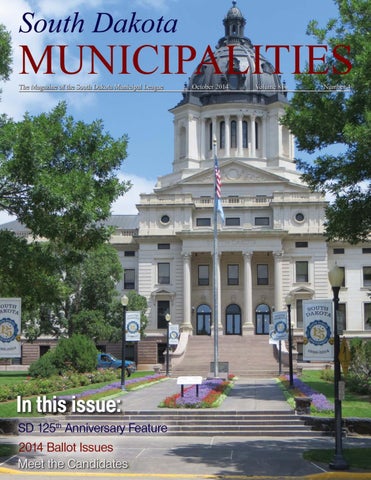
South Dakota MUNICIPALITIES
SD 125th Anniversary Feature: Statehood Celebration Events at State Capitol . . . . . . .7 Omnibus Enabling Act Set State for November Statehood . . . . . . . . . . . . . . . . . . .8 1889: The Year of Statehood . . . . . . . . . . . . . . . . . . . .9
Managing Editor: Yvonne A. Taylor
Editor: Carrie A. Harer
PRESIDENT Becky Brunsing Finance Officer, Wagner
DISTRICT CHAIRS Dist. 1 - Mike Grosek Mayor, Webster
1st VICE PRESIDENT Jeanne Duchscher Finance Officer, Parker
Dist. 2 - Tim Reed Mayor, Brookings
2nd VICE PRESIDENT Meri Jo Anderson Finance Officer, New Underwood TRUSTEES Laurie Gill Mayor, Pierre Greg Jamison Councilmember, Sioux Falls Sam Kooiker, Mayor, Rapid City Pauline Sumption Finance Officer, Rapid City Mike Wendland Mayor, Baltic PAST PRESIDENT Paul Young Councilmember, Spearfish
Dist. 3 - Amy Nelson City Manager, Yankton Dist. 4 - Debbie Houseman Finance Officer, Lake Andes Dist. 5 - Renae Phinney President, Ree Heights
2014 Ballot Questions . . . . . . . . . . . . . . . . . . . . . .10-13 Meet the Candidates for: US Senator . . . . . . . . . . . . . . . . . . . . . . . . . . . . . . . . .14 US Representative . . . . . . . . . . . . . . . . . . . . . . . . . . .15 Governor . . . . . . . . . . . . . . . . . . . . . . . . . . . . . . . . . .16 Secretary of State . . . . . . . . . . . . . . . . . . . . . . . . . . . .17 State Treasurer . . . . . . . . . . . . . . . . . . . . . . . . . . . . . .18 Public Utilities Commissioner . . . . . . . . . . . . . . . . . .19 SDML Welcomes New Staff Member . . . . . . . . . . . .20 Funds Available for Workforce Development . . . . . .20 Celebrate the 15th Annual Lights On Afterschool . . . 21 City of Yankton Approved for Grant . . . . . . . . . . . . .22
Dist. 6 - Karl Alberts Finance Officer, Aberdeen
Obituary: Harley Lux . . . . . . . . . . . . . . . . . . . . . . . . .23
Dist. 7 - Arnold Schott Mayor, McLaughlin
Policy Restricting Employees from Discussing Wage Info with Outsiders Ruled Unlawful . . . . . . . .24
Dist. 8 - Harry Weller Mayor, Kadoka
Ethan’s Unique Water Tower Gazebo . . . . . . . . . . . .26
Dist. 9 - Gary Lipp Mayor, Custer Dist. 10 - Fay Bueno Finance Officer, Sturgis
The Marijuana Myth . . . . . . . . . . . . . . . . . . . . . . . . . .30 Supreme Court Review 2014 . . . . . . . . . . . . . . . . . . .32 All in a Day’s Work . . . . . . . . . . . . . . . . . . . . . . . . . .37 SDML Publication Order Form . . . . . . . . . . . . . . . . .45
Columns
LEAGUE STAFF 1-800-658-3633 Fax: 605-224-8655 Yvonne Taylor Executive Director Sandi Larson Director of Risk Sharing Services Christine Lehrkamp Director of Research and Training Jeff Mehlhaff Director of Municipal Electric Services Carrie Harer Director of Marketing & Communications Lori Butler Director of Finance SD Public Assurance Alliance: Judith Payne Executive Director Bob Strachan Director of Underwriting Ron Burmood Director of Member Services Kristina Peterson Assistant Underwriter Deb Corkill Executive Assistant E-mail: yvonne, sandi, christine, jeff, carrie, lori, jpayne.sdpaa, bstrachan.sdpaa, rburmood.sdpaa, kpeterson.sdpaa, dcorkill.sdpaa @sdmunicipalleague.org
Director’s Notes . . . . . . . . . . . . . . . . . . . . . . . . . . . . . . .4 President’s Report . . . . . . . . . . . . . . . . . . . . . . . . . . . .5 Risk-Sharing News . . . . . . . . . . . . . . . . . . . . . . . . . .38 Washington Report: Senator Thune . . . . . . . . . . . . . .40
In Every Issue Community Calendar . . . . . . . . . . . . . . . . . . . . . . . . .44 Classifieds . . . . . . . . . . . . . . . . . . . . . . . . . . . . . . . . .46 Directory Changes . . . . . . . . . . . . . . . . . . . . . . . . . . .28 Municipal Calendar . . . . . . . . . . . . . . . . . . . . . . . . . .49
SOUTH DAKOTA MUNICIPALITIES (ISSN 0300-6182, USPS 503-120) is the official publication of the South Dakota Municipal League, published monthly at 208 Island Drive, Ft. Pierre, South Dakota 57532, phone 605-224-8654. This institution is an equal opportunity provider, and employer. Periodical postage paid at Pierre, South Dakota and additional mailing offices. Non-member subscriptions are available for $30.00 annually. The opinions expressed herein are not necessarily those of the South Dakota Municipal League. Postmaster: Send address changes to SOUTH DAKOTA MUNICIPALITIES, 208 Island Drive, Ft. Pierre, South Dakota 57532.
OCTOBER 2014
VOLUME 81, NUMBER 4
3
Director's Notes We hope you are taking a few minutes from preparing to come to Spearfish for the Annual Conference to read this issue! The City of Spearfish has worked hard and has enthusiastically welcomed this Conference, and we are very pleased to join them in offering a packed agenda of information, great speakers, and relevant topics this year. It seems early to be gearing up for the legislative session, but to us, a big part of the Annual Conference is hearing from you on the Policy Committees’ work on the annual Statement of Policy. And in case you think these policies don’t matter, look at our legislative agenda for the past years. Every bill is based on a statement you have adopted. It is incredibly important that you make sure we are representing the thoughts of your city when we talk to your legislators. The Conference Agenda contains a wealth of information. For General Sessions, we are especially excited to hear from Cory Chalmers, featured on the Emmy nominated TV series
4
Hoarders. Cory brings 19 years of experience in biohazard and hoarding remediation from across the country, cleaning up some of the worst hoarding cases ever seen. We are equally pleased to present Craig Schroeder, whose Youth Attraction Formula is a tool for cities to use to address persistent population decline, largely due to significant youth out-migration. Craig, who grew up in a town of 223 people, brings more than 20 years of agricultural and rural work experience in rural community economics and marketing. Finally, we look forward to hearing from the Mike Vehle, Chairman of the State Legislature’s Highway Needs and Financing Committee, as he discusses the future of our streets and roads. In short, we think you will learn a tremendous amount, get to meet and greet old and new friends, and have a great time at this year’s Conference. We can’t wait to see you all there! Until next month, remember we are always available at 1-800-658-3633 or yvonne@sdmunicipalleague.org. Yvonne Taylor Executive Director
SOUTH DAKOTA MUNICIPALITIES
President's Report Wow! How fast did this year go?! I can’t believe my year as the SDML President is almost over. I honestly enjoyed every minute of it! Well...writing these articles weren’t always the most “fun,” but I made it through. One thing that comes to mind when I think of the South Dakota Municipal League, is: “They got your back.” As city dynamics change whether it is law changes, employee changes or council changes, the SDML is always there to help! Sometimes we think our support system is there and then, “POOF”! It’s gone. Or... maybe it wasn’t really what we thought it was from the start. But when you get down to the nut and bolts of every day city business, there is one entity that you can count on no matter what. That is the SDML. They are here to guide, assist, and help with any situation or scenario that serving the public throws at you.
OCTOBER 2014
I would like to thank Yvonne, Christine, Carrie, Lori, Sandi, and Jeff for everything they do every day to make our work days easier. Thanks for having my back! I feel HONORED and PRIVILEGED to have served as the SDML President this past year and I thank you all for the opportunity. Just remember: Make it a good day! There is no such thing as a bad day, just bad moments in the day, and it is up to you what you make of it! Becky Brunsing President
5
2014 Municipal/School Election Workshops Presented by: South Dakota Municipal League Office of South Dakota Secretary of State Associated School Boards of South Dakota Three area election workshops are scheduled this winter to assist election officers in conducting elections. The Secretary of State’s office, Associated School Boards of South Dakota and the South Dakota Municipal League will again co-sponsor workshops covering all aspects of elections – from notices to the final canvass – including question-and-answer sessions. Municipal finance officers and school business managers have statutory responsibility to conduct elections in their local jurisdictions. Properly conducted elections are an integral part of the democratic process. The many hours of diligent work on the part of the election officers enhances candidate and voter participation, and provides for accurate and consistent elections. Election officers may choose to attend one of the following three election workshops: Rapid City Pierre Sioux Falls
December 10th December 11th December 12th
Ramkota Hotel Ramkota Hotel Ramkota Hotel
The workshops will begin at 9:45 a.m. local time and conclude at approximately 3:30 p.m. Registration is $25.00 per person and will cover coffee, workshop materials and lunch.
Registration Form 2014 Municipal/School Election Workshops Municipality: Name(Please Print)
Title
Please choose one workshop to attend:
Rapid City
Pierre
Sioux Falls
Number attending ______ @ $25.00 each = $_______________ *Make checks payable to SDML, Sorry no credit cards accepted. Registration Deadline: November 26, 2014 (No refunds will be given after this date.) Please send to: South Dakota Municipal League, 208 Island Drive, Fort Pierre, SD 57532 SDML Office Use Only: Date:_____________
Check #:________________
Amount: $_______________
Statehood Celebration Events at State Capitol A special event at the State Capitol to celebrate South Dakota’s 125th anniversary of statehood will feature a performance by the South Dakota Symphony Orchestra. “I am pleased the South Dakota Symphony Orchestra will be joining us in celebrating this landmark anniversary for our state,” said Gov. Dennis Daugaard. “It will be thrilling for South Dakotans to listen to the orchestra in the rotunda of the Capitol Building on the eve of the date President Harrison signed the proclamation admitting South Dakota to the Union.” While smaller ensembles of the South Dakota Symphony Orchestra have performed in the Capitol’s rotunda, this will be the first time a full orchestra of more than fifty members will perform there. “The South Dakota Symphony Orchestra is truly honored to be a part of this historic event,” Delta David Grier, SDSO music director, said. “The opportunity to participate in South Dakota’s 125th anniversary by bringing the full orchestra to play in the Capitol is a perfect fulfillment of our core mission. We look forward to being a part of the celebration!” The event will also include the rededication and lighting ceremony for the newly restored stained glass in the Capitol. The project to restore the historic stained glass skylights that began last year is expected to be completed in September when the final restored panels will return to the Capitol.
OCTOBER 2014
The statehood celebration event will take place at 7 p.m. CDT on Saturday, November 1. The event will be open and free to the public. General admission seating will be available with a ticketed reservation. All available tickets for seating on the second floor have been reserved. Standing room only will be available on the marble grand staircase and in the balconies above the rotunda floor on a first come, first served basis the night of the event. No ticket is needed for these observation areas. First Lady Inaugural Gown Exhibit Rededication A rededication of the newly refurbished First Ladies Inaugural Gown exhibit is scheduled for 10:30 a.m. on the first floor. The event is free and open to the public. Trail of Governors Statues Unveiling The unveiling of the three latest statues of former governors by the Trail of Governors is scheduled for 1 p.m. in the rotunda. The event is free and open to the public. Quilting Demonstration The Stately Stitchers quilting club are hosting a quilting demonstration from 10 a.m. to 2 p.m. at Lutheran Memorial Church. The public is invited to help make quilted ornaments which will be used to decorate one of the Capitol Christmas Trees later that month. The theme of the Capital Christmas Trees is 125 Years of Christmas in South Dakota.
7
SD 125th Anniversary Feature: Omnibus Enabling Act Set State for November Statehood On November 2, 1889, Dakota Territory gave birth to two states – North Dakota and South Dakota – when President Benjamin Harrison signed two statehood proclamations. Before signing, he instructed Secretary of State James Blaine to cover both proclamations under a sheet of paper. President Harrison signed both, and then shuffled them again so that no one, not even President Harrison, knew which proclamation was signed first. Although President Harrison signed South Dakota into statehood, the twin states could not have been created without the passage of the Omnibus Enabling Act on February 22, 1889. After originally opposing statehood for the Dakotas, President Grover Cleveland signed the Enabling Act into law which provided the process whereby six states – South Dakota, North Dakota, Montana, Washington, Wyoming and Idaho – could become states in 1889 and 1890. The most recent state to have entered the Union was Colorado in 1876. Democrats controlled the U.S. House of Representatives for most of the time between 1876 and 1888, and they didn’t want new western states admitted for fear of them sending Republican senators and representatives to Washington, D. C. When pro-statehood Benjamin Harrison won the Presidency in November of 1888, the lame duck Democrats passed the Enabling Act so they could get some credit for allowing the new states. The act divided Dakota along the seventh standard parallel and required the equitable division of the territory’s records and debts. It also required that the two new Dakotas set aside public lands for schools, public buildings and facilities.
8
On July 4, 1889, 75 delegates from southern Dakota Territory met in Germania Hall in Sioux Falls and wrote a state constitution for the people to consider. Four years earlier, Congress had rejected a convention that attempted to declare “South Dakota” as a state. The 1889 convention used the earlier constitution as a basis for their new proposal. On October 1, 1889, the people approved the constitution for the new state of South Dakota by a vote of 70,131 to 3,267 and elected Dakota Territory Governor Arthur Mellette as South Dakota’s first Governor. To assure passage, two controversial issues – prohibition and the selection of a state capital city – were not included in the proposed constitution, but were separate ballot measures. Most Republican leaders were actively or passively for prohibition. The Democrats and the Sioux Falls Argus Leader were against it, claiming it would be a restriction of individual freedom and impossible to enforce. Voters approved prohibition and South Dakota was a “dry” state until prohibition was repealed in 1897. Also on a separate vote, “Peerless Pierre” won the capital designation in 1889, but had to withstand two fierce challenges on the ballot from Huron in 1890 and Mitchell in 1904. Pierre won with expensive advertising campaigns. It took the city over 30 years to pay off its capital city fight debts of almost $500,000. South Dakotans struggled for many years before statehood became a reality. Over 40 bills had been introduced into Congress between 1871 and 1889 concerning statehood and the division of Dakota Territory. They all failed. But, the people persevered. They didn’t quit. When statehood was realized, it didn’t matter to them which proclamation was signed first.
SOUTH DAKOTA MUNICIPALITIES
SD 125th Anniversary Feature: 1889: The Year of Statehood The year 1889 was an eventful one, and not just because four new states were admitted to the Union. In January, Coca-Cola was originally incorporated as the Pemberton Medicine Company.
On October 1, 1889, soon-to-be South Dakotans approved a constitution and elected Arthur C. Mellette to be their first governor. Later that month, the state Legislature-elect met to select our first U.S. senators. Having no Capitol, the Senate met in the Presbyterian Church, while the House met in the county courthouse.
In February, Congress passed and out-going President Grover Cleveland signed the Enabling Act that set the procedures by which South Dakota and five other states were created in 1889 and 1890. The headline in the Huron Daily Huronite read, “It’s a Go.”
In November, reporter Nellie Bly started her trip around the world to beat the record of Phileas Fogg, hero of Around the World in Eighty Days. Bly did it in 72 days.
In March, Benjamin Harrison became the 23rd president. Prohibition promoters met in Huron to organize for fall elections. The Eiffel Tower opened, and the first U.S. golf course opened in Younkers, N.Y.
In San Francisco, the first jukebox was installed (maybe to scare away the crickets). Curtis Brady was issued the first permit to allow an automobile to drive through New York City’s Central Park, but only after he pledged to not frighten the horses. Jefferson Davis died in New Orleans and South Dakota became a state on November 2.
In April, Charlie Chaplin was born. The Oklahoma land rush began on April 22. In May, the modern brassiere was invented. The Johnstown, Pennsylvania, flood killed 2,295 people on May 30 and 31. On June 14, the first Flag Day was observed. The first long distance electric power transmission line was completed, delivering electricity from Williamette Falls to Portland, Oregon. The forerunner of the modern pizza was invented by Raffaele Esposito. He called it Pizza Margherita. On July 4, 75 delegates convened in Sioux Falls to draft a state constitution. On July 8, the Wall Street Journal was first published and the last bare-knuckles championship fight was held. It lasted 75 rounds. In August, San Francisco was invaded by millions of crickets. The Savoy Hotel opened in Great Britain. It was the first hotel equipped with private bathrooms. When owner Richard Carte ordered them, the builder was incredulous and asked Carte if the guests would be amphibious. The Savoy’s primary competitor had only four bathrooms for its 500 guests. Also in August, Kodak began selling the first commercially packaged celluloid roll film for their new Kodak camera and Thomas Edison was completing his first movie. In September, the Nintendo company began as a marketer of playing cards. The First General Conference on Weights and Measures started out by defining the “meter.” OCTOBER 2014
In December, the first bicycle with a back pedal brake was patented. Also in 1889, the Mayo Clinic was founded, rubber heels were introduced on shoes and the steam-powered dish washing machine was invented. The national debt was only $1,619,052,922 and John Philip Sousa composed the “Washington Post March.” Georgia declared Robert E. Lee’s birthday a state holiday and free mail delivery to the home was introduced in cities over 5,000. “The Burger” was the first petrol-driven agricultural tractor. It was built in 1889 in Illinois and promptly sold to a wheat farmer near Madison, South Dakota. It worked so well that six more were built and dispatched to the Dakotas. The first direct-dial telephone was invented by Almon B. Strowger. He was working as an undertaker in Kansas City, Missouri, and experienced a sudden decline in business. Strowger discovered that a telephone operator who was romantically involved with a rival was sending calls to his competitor. He responded by creating a device that allowed telephone users to place calls directly, without the need for operators. A lot happened in 1889. But without South Dakota statehood, it wasn’t that great of a year. Learn more about the 125th Statehood Anniversary at http://125.sd.gov/.
9
2014 Ballot Questions Pursuant to SDCL12-13-23, the Secretary of State is required to prepare and distribute public information concerning constitutional amendments, initiatives and referred measures. This pamphlet is prepared by soliciting statements from the proponents and opponents of amendments and measures. The title, explanation and effect of a vote for each ballot question were provided by the Honorable Marty Jackley, Attorney General. No other statements on this pamphlet reflect the opinion of the State or the Attorney General. The information was compiled by the Secretary of State as supplied by the writers, was not verified by the Secretary of State and does not reflect the position of the State regarding the legality or effect of the amendments or measures. The Secretary of State is not responsible for the contents, objectivity or accuracy of the statements written by the proponent and opponent writers in this pamphlet.
For election returns on November 4, visit the Secretary of State’s website at sdsos.gov starting at 8:00 p.m. CST. Please feel free to photocopy and distribute this pamphlet. Editor’s Note: Poll Hours for all elections are 7:00 a.m. to 7:00 p.m. local time. You can confirm your voter registration at sdsos.gov or you may contact your county auditor.
Election Day 2014 November 4th
This pamphlet is available at sdsos.gov and in large print, Braille or on tape by calling the SD State Library at 1-800423-6665.
10
SOUTH DAKOTA MUNICIPALITIES
Constitutional Amendment Q Title An Amendment to the South Dakota Constitution authorizing the Legislature to allow roulette, keno and craps in Deadwood. Attorney General Explanation The Constitution currently authorizes the Legislature to allow two kinds of games of chance in Deadwood: limited card games and slot machines. The proposed amendment authorizes the Legislature to also allow roulette, keno and craps in Deadwood. Under federal law, any games of chance authorized by the Legislature to be offered in Deadwood would also be allowed at onreservation tribal casinos. A vote “Yes” is for changing the constitution to allow the Legislature to authorize roulette, keno and craps in Deadwood. A vote “No” will leave the constitution as it is. Pro – Constitutional Amendment Q
Con – Constitutional Amendment Q
In 1988, South Dakota voters authorized a constitutional amendment allowing card games and slot machines within the city limits of Deadwood. At that time, the only other states allowing legalized gaming were Nevada and Atlantic City. Now, 25 years later, the available games in Deadwood have not changed despite gaming being available in 47 other states, including our neighboring states. A YES vote on Constitutional Amendment Q will allow roulette, keno and craps in addition to card games and slot machines, to be available in Deadwood and in on-reservation Tribal casinos. As several surrounding states have added roulette, keno and craps to the gaming choices available to their customers, the popularity of these additional games has Deadwood and Tribal visitors increasingly asking for the opportunity to play them here. As with any other successful business enterprise, South Dakota’s gaming operations must diversify and meet changing customer demands in order to compete with the gaming offered by surrounding states. Deadwood gaming tax revenues provide funding for Deadwood’s historic preservation efforts, South Dakota Tourism, Lawrence County and its schools and municipalities, South Dakota’s general fund, and historic preservation projects in many communities throughout South Dakota. Tribal gaming casino revenues fund numerous programs on each reservation. Several thousand wage-competitive jobs with upward career paths are provided by South Dakota gaming operations. Constitutional Amendment Q will produce additional jobs and benefit South Dakota’s economy. As Deadwood and Tribal gaming work to develop the tourism industry in South Dakota, Constitutional Amendment Q will play an important role. We thank the citizens of South Dakota for their 25 years of support for Deadwood and Tribal gaming and ask for your YES vote on Constitutional Amendment Q.
A “NO” vote on Constitutional Amendment Q will slow the almost constant expansion of gambling in the state of South Dakota. Currently, in the city of Deadwood, roulette, keno, and craps are not permitted, but limited card games and slot machines have been approved. A sixty percent supermajority vote by Deadwood city voters was previously required to approve legislation allowing the current forms of gambling in their city. However, passage of Amendment Q will allow the state legislature to authorize, on their own, roulette, keno, and craps in Deadwood. Thus, the citizens of Deadwood would not have their supermajority vote in determining whether or not they wish to limit the constant advance of gambling within their own city limits. Amendment Q diminishes local control. Whereas in most cases, the free market should be the primary regulator of business, in the case of an industry that generates so much addiction, societal ills, crime, and even suicide, the gambling industry should be subject to legal restraints. The National Council on Problem Gambling (NCPG) estimates that among South Dakotans, there are approximately 18,000 gambling addicts whose addictions inflict on the state a staggering annual cost of almost $16 million dollars. It is a fact that gambling in South Dakota is a problem for all of her citizens. When you’re dealing with one addict, you’re dealing with 8-10 other people that are affected because of the addiction. The NCPG also estimates that one in five problem gamblers will attempt suicide, about twice the suicide rate of other addictions. Do your part to help slow the expansion of gambling in South Dakota. Vote ‘NO’ on Amendment Q.
Mike Rodman, Executive Director, Deadwood Gaming Association
Submitted by Dale Bartscher, Executive Director – Family Heritage Alliance Action - 1825 Clearview Ln, Suite 202, Rapid City, SD 57702, 605-718-5433.
OCTOBER 2014
11
Initiated Measure 17 Title An initiated measure to require health insurers to include all willing and qualified health care providers on their provider lists. Attorney General Explanation Some health insurers offer health benefit plans in which the insurer maintains a list of health care providers. Plan members must use listed providers in order to obtain the maximum plan coverage, or to have coverage at all. “Health care providers” include doctors and other licensed health care professionals, clinics and hospitals. The initiated measure establishes who is entitled to be on the insurer’s list of providers. The measure requires that these insurers list all health care providers who are willing, qualified and meet the conditions for participation established by the insurer. The measure does not apply to all health insurers, nor to certain kinds of insurance and plans including those involving specified disease, indemnity, accident only, dental, vision, Medicare supplement, long-term care or disability income, and workers’ compensation. A vote “Yes” is for the law requiring health insurers to include all willing and qualified health care providers on their provider lists. A vote “No” is against the proposed law. Pro – Initiated Measure 17
Con – Initiated Measure 17
Initiated Measure 17—Patient Choice—will help control out-of-pocket costs and co-pays while improving medical outcomes. Patients deserve the freedom to choose their own doctor. Without IM-17, many patients are forced to use providers in insurance company networks or pay extra, and some are required to undergo unnecessary travel at their own expense. IM-17… Allows families to see doctors and other medical providers they know and trust. Cuts unnecessary re-testing by providers not familiar with their case histories. Reduces probability of diagnostic or prescription errors. Eases unneeded travel. Virtually eliminates outof-network personal medical fees. Increases competition, helping control spiraling medical costs. Insurance companies must admit to their networks providers who meet their standards and agree to the insurance companies’ terms. This will virtually eliminate out-of-network fees as a personal expense for most South Dakotans. The only study that deals with states’ transition to similar laws shows that competition will put downward pressure on costs. There is no credible research or empirical support for opponent claims that costs will go up. And with out-ofpocket fees reduced or eliminated, patients will themselves spend less. Nearly 70% of South Dakotans surveyed support the measure. Hundreds of medical providers across South Dakota have joined together to bring patients this freedom. It is endorsed by nearly every provider organization in the state, including, among others:
History tells us that government intervention into health care drives up costs for consumers and employers. Initiated Measure 17 would force all health plans to include any hospital or doctor to be in their network, regardless of existing contracts. This notion is known as “Any Willing Provider”. IM-17 will increase the cost of what you pay for health insurance premiums. Proof that IM-17 will drive up the cost for everyone. In March, the Federal Trade Commission concluded “Any willing provider . . . provisions can therefore undermine the ability of plans to reduce costs. This is likely to result in higher negotiated prices, ultimately harming consumers.” IM-17 is more government interference in health care. The Government doesn’t tell any other business who they have to hire. Schools are not required to hire any-willing teachers, and medical practices are not required to hire any-willing doctor. The Attorney General’s explanation reinforces the need to vote NO – you will see the language in quotes on the ballot. 1. Defined networks offer lowest possible price. “Some health insurers offer health benefit plans in which the insurer maintains a list of health care providers. Plan members must use listed providers in order to obtain the maximum plan coverage.” 2. IM-17 gives government the power to force insurers to list doctors and hospitals regardless of existing contracts that save consumers money. “The initiated measure establishes who is entitled to be on the insurer’s list of providers.” 3. IM-17 only applies to certain insurance plans, but everyone will end up paying more. “The measure does not apply to all health insurers, nor to certain kinds of insurance and plans including those involving specified disease, indemnity, accident only, dental, vision, Medicare supplement, long-term care or disability income, and workers’ compensation.”
SD State Medical Association, SD Orthopedic Society, SD Optometric Society, SD American Physical Therapy Association Independent Healthcare Associates, SD Academy of Physician Assistants They support IM-17 because having a consistent, ongoing relationship with a provider is in the best interest of quality care. Vote Yes on IM-17 Patient Choice! You shouldn’t have to change doctors if your job or insurance changes.
Vote NO on 17 Why pay more?
12
SOUTH DAKOTA MUNICIPALITIES
Initiated Measure 18 Title An initiated measure to increase the state minimum wage. Attorney General Explanation The initiated measure amends state law to raise South Dakota’s hourly minimum wage for non-tipped employees from $7.25 to $8.50 per hour, effective January 1, 2015. Thereafter, this minimum wage will be annually adjusted by any increase in the cost of living. The cost of living increase is measured by the change in the Consumer Price Index published by the U.S. Department of Labor. In no case may the minimum wage be decreased. In addition, the hourly minimum wage for tipped employees will be half the minimum wage for non- tipped employees as adjusted by any cost of living increase described above. These increases would apply to all employers in South Dakota, with limited exceptions. A vote “Yes” is for the increase in the state minimum wage. A vote “No” is against the change in the law. Pro – Initiated Measure 18 Here’s why voters should say YES on Initiated Measure 18 on Tuesday, November 4th, 2014: Raising the minimum wage means South Dakota is… Valuing hard work. South Dakotans show up, work hard, and never quit until the job is done. But many South Dakotans aren’t getting paid a fair wage for their unfailing work ethic. It’s time to reward hard work with an honest wage. Putting money in the pockets of hard working people who grow our economy. Workers with more money will spend it on the things their families need everyday. That boosts demand at small businesses and grows the economy. And a lot of those workers will be lifted out of poverty and off government assistance too. Promoting economic fairness. At a time when wages have stagnated and CEO pay is 331 times higher than the average American worker, South Dakotans want an economy that works for everyone. Initiated Measure 18 is going to make a huge difference for working South Dakotans. According to an analysis of the 2012 Current Population Survey, j 62,000 South Dakotans will earn more if voters pass Initiated Measure 18. j 78% of those folks are over the age of 20, often with a family to support. j 56% of those who benefit are women. Raising the minimum wage helps working families without negative impacts on employment. The most comprehensive research shows that raising the minimum wage has no adverse impact on employment. In fact, states that raised the minimum wage in 2014 actually saw faster job growth. With the soaring cost of food, gas, and housing since the last minimum wage increase five years ago, South Dakota families are working harder and harder just to make ends meet. But this year, voters can do something about it. Please vote YES on Initiated Measure 18 to raise the minimum wage. Submitted by: Mark Anderson, Chair of the Raise South Dakota ballot question committee.
OCTOBER 2014
Con – Initiated Measure 18 Initiated Measure 18 goes too far. It mandates a 17% hike in January, making South Dakota’s minimum wage higher than 43 other states. But it doesn’t end there. IM18 mandates another increase every single year, forever, based on economies in other states, even if South Dakota’s economy doesn’t do well. The unintended consequences of a mandated minimum wage increase every single year would hurt the workers and families it proposes to help. j
Experienced workers may not get the raises they deserve as employers are forced to pay entry level and unskilled workers more each year.
j
Many employers would be forced to eliminate part-time jobs and combine those duties with those of higher skilled workers.
j
Worker benefits at all levels could be reduced.
j
Young and unskilled workers will have a harder time getting jobs - and lose the chance to gain valuable work experience.
j
Prices will go up for goods and services - including essentials such as food and clothing – on all families, including unskilled entry level workers.
This mandate would hit small towns the hardest. As prices go up to cover increased operating costs, it drives customers elsewhere. Employers who can afford it are already paying more than the minimum wage to attract and keep employees in a competitive market. Initiated Measure goes too far and would hurt those it proposes to help. Vote NO to another “forever” government mandate! Shawn Lyons, South Dakota Retailers Association Michael Held, South Dakota Farm Bureau on behalf of NoMoreMandates.org
13
Meet the Candidates for US Senator Rick Weiland Democrat After traveling to all 311 of South Dakota’s incorporated towns, I am more convinced than ever that small towns are the backbone of our state. Obviously, changing market dynamics, global developments and the corrosive power of big money have exacerbated the challenges facing rural America. Some people will say that creating and sustaining a vibrant economy in rural America is an impossible one. I disagree. South Dakota’s small towns represent a way of life worth fighting for and I believe every candidate for the Senate should tell you how they plan to strengthen rural America. Here is my plan: South Dakota needs to pursue a dual strategy — finding ways to strengthen the traditional bases of agriculture and small manufacturing while simultaneously building the infrastructure to allow our communities to compete and win in the new economy. 1. Increased federal funding to USDA’s rural development programs. 2. Provide incentives and subsidies for South Dakota companies and corporate America to build out highspeed broadband to rural South Dakota. 3. Complete the funding and build out of the Lewis & Clark Rural Water System. 4. Pass legislation to allow the refinancing of old, highinterest student loan debt and help our young graduates stay here in South Dakota. 5. Increase collaboration between private capital, local elected officials and the federal government. The simple fact is that communities and states that have professionals with strong social networks are better positioned to build the organizational planning required to spur new businesses and improve existing ones. 6. Increase funding to rebuild our crumbling rural infrastructure. Let’s focus on how we can improve South Dakota while at the same time invest in the tools our towns and people need to compete for jobs in a rapidly transforming economy. 14
Mike Rounds Republican One word: Dysfunctional. That’s how most Americans would describe the current U.S. Congress. For too long, South Dakota has been cancelling out votes in the U.S. Senate. All the while, the federal bureaucrats and the Harry Reid led senate have been jamming through job killing policies and legislation. We’re literally paying for the dysfunction. It’s time to do something about it. Senator Thune needs an ally in the senate. Someone who doesn’t cancel out his vote. Fixing the dysfunction starts there – by having a unified voice for South Dakota. Working as governor, I know how to build a team and work together to solve problems. We need to stop cancelling out votes and get the people’s work done, on time! The bureaucrats work for us, not the other way around. People need to start talking to each other, not past each other. We need to create jobs and economic opportunity for the next generation and stop the bad policies that are being jammed through by the Washington bureaucrats. We need to lower taxes and live within our means. We balance our budget every single year in South Dakota. It’s time Washington, D.C. does the same! Obamacare needs to be repealed and replaced by a patient centered, market driven solution, that focuses on quality care for our loved ones. Obamacare threatens Medicare. We owe it to our seniors to make sure we have a solvent Medicare program. We need a North American energy solution. One that takes advantage of fossil and renewable fuels. We shouldn’t arbitrarily raise taxes or pick winners and losers. We should move to immediately approve the Keystone pipeline. We need a comprehensive energy policy that will end America’s dependency on foreign oil. These are just a few of the issues where you’ll find differing views from the candidates. Working as your governor, we focused on results. We kept our taxes low, created thousands of jobs, invested in education and lived within our means. I promise to do the same in the U.S. Senate. Please join us as we work to bring South Dakota common sense to the U.S. Senate – and put an end to the dysfunction. SOUTH DAKOTA MUNICIPALITIES
Meet the Candidates for US Representative Corinna Robinson Democrat Action Needed to Help Those Less Fortunate Let’s duly recognize that we are fortunate to have municipal officials that help residents resolve an extensive variety of problems. As a third generation daughter of South Dakota growing up in Rapid City, I have seen their efforts. At the heart of community efforts, such officials reference a wealth of informational archives and interact with our state’s Municipal League hotline. They serve diligently, reflecting their years of vast experience. I served as a military police officer in response to the 9/11 terrorist attack at the Pentagon. I provided security across Iraq during combat operations. I have experienced firsthand the terrorism, corruption and devastation that impacted citizens, townships and governments. For many years, I worked arduously alongside foreign and military officials, mayors, police and fire chiefs, and interagency personnel to help resolve complex problems. I chose to campaign to become South Dakota’s next Congresswoman because I want to continue to serve with integrity. I want to serve all our citizens regardless of political parties. I have travelled to over 158 towns since October. I often hear the desires for equal pay for equal work, affordable and quality healthcare, refinancing for higher education loans, and the assurance that unfair discrimination, workplace violence, and sexual harassment are abolished. We should carefully consider an increase in our minimum wage as the cost of living increases to enhance our employees’ standard of living. Over time, paying our laborers more will enrich our economy. It should reduce government spending for assistance programs. We must continually try to encourage people to work themselves out of poverty, and have hope. It is our ethical responsibility to care for veterans who fought for our freedom. We need action to strengthen our society as a government of the people, by the people, and for the people.
OCTOBER 2014
Kristi Noem Republican I don’t have to tell you that Washington is still a mess. The rules and regulations coming from Washington continue to show that the current administration does not understand rural America. Every day, I continue to fight against the USDA telling us what our kids can eat at lunch and the EPA trying to expand their authority to regulate ditches, stock dams and other low spots. Despite the dysfunction in Washington, I’ve been able to get things done for South Dakota. I am very proud that we have a five-year Farm Bill signed into law to provide certainty to farmers, ranchers and rural communities. The Farm bill included livestock disaster programs to help those ranchers impacted by Winter Storm Atlas and provisions to get boots on the ground more quickly in the fight against the pine beetle in the Black Hills. I was honored to be the first representative from South Dakota in nearly 20 years to serve on the conference committee that negotiated the final agreement on the Farm Bill. Congress has also begun to get its fiscal house in order, cutting discretionary spending for four years in a row – the first time we’ve done so since the Korean War. And we have done it in a way that prioritizes critical projects like the Lewis & Clark Rural Water System without increasing overall spending. Finally, the Black Hills Cemetery Act, which I authored, was passed by Congress and signed into law. This law transferred 9 historical cemeteries in the Black Hills to their rightful owners – the communities that have maintained them for generations. While we have made progress over the past two years, a lot of work remains. I humbly ask for your support this November so we can continue to lead the fight for a more efficient, effective and accountable government.
15
Meet the Candidates for Governor Susan Wismer Democrat Growing up on a farm in the northeast corner of the state, I learned to appreciate a hard day’s work and the services municipalities provide for the people of South Dakota. I have also seen firsthand the amount of work and creativity it takes to do less with more these days. I will support economic development by expanding housing, promoting ESL classes, and making sure communities have the tools to improve infrastructure. I will advocate for better training of our state’s workers in order to improve their skills, and I will fight to ensure communities have resources to support their own economic development efforts at a local level. South Dakota schools should be among the best in the nation. I will work to strengthen our public education system – from K-12 to technical colleges and universities. As governor, I will make education funding a top priority. I will work with school administrators to ensure their needs are met and our students receive the best education.
Dennis Daugaard Republican I am running for reelection because I want South Dakota to keep moving in the right direction. I ran four years ago because I believed that I had something to contribute, and I'm proud of the work we have done. We made tough choices to balance our state budget without raising taxes. We fought historic Missouri River flooding. We undertook landmark bipartisan reform of the criminal justice system. We made South Dakota the #1 state in America for business, and reached an all-time high for jobs. And we fully-funded our pension plan, paid off bonded indebtedness, increased our reserves, and passed a balanced budget amendment. A lot has changed since you elected me Governor. What hasn’t changed is my desire to serve the people of South Dakota. It has been a privilege to serve as your Governor, and I would appreciate your support for a second term. There is so much more that we can do together.
I am committed to improving the lives of South Dakota’s workers and families. Government policies should help build stronger families while also making South Dakota competitive in attracting workers. Not only do I support an increase to the minimum wage, but I also will overturn the current administration’s refusal to accept the federal expansion of Medicaid, providing 48,000 South Dakotans with access to affordable, preventative health care. The state can’t keep handing down decreased budgets, expecting local governments to do a lot more with very little, and then passing the blame to communities for any issues they face. Our state needs a leader who will build a strong working relationship with the South Dakota Municipalities League and listen to our communities. As governor, I will give local governments the tools and resources they need to succeed.
VOTE in Election 2014 on November 4th 16
SOUTH DAKOTA MUNICIPALITIES
Meet the Candidates for Secretary of State Angelia Schultz Democrat Angelia Schultz is ready to restore integrity and impartiality to the Office of the Secretary of State. Her education and career experiences will restore honor to the office in a fair and balanced manner, while helping attract new business to the state and increasing voter access to the ballot. Angelia has led with integrity in her life work. At the Defense Intelligence Agency and Pentagon, she held security clearances above Top Secret as an Executive Defense Intelligence Officer and Liaison to the Office of the Secretary of Defense under the Joint Chiefs of Staff. She conducted her work in a fair, impartial manner at the highest levels of national intelligence, directly supporting the Executive of the Pentagon and White House in their world-wide operations. Recognized for her leadership skills, she was selected to head teams that identified leadership targets for Information Operations/Information Warfare for our US Combatant Commanders on the ground in Iraq and Afghanistan. South Dakotans believe in fairness. For too long, there have been questions about the manner in which the Secretary of State’s office has been run. South Dakotans know that not only do free and fair elections start and end in this office – they know that businesses make their first stop there as well. That’s why it’s important to have an experienced, impartial leader in that office. Integrity is more than just about how one conducts oneself – it’s also about leaders who inspire integrity in others through fair, balanced governance, and that’s the leadership Angelia brings to South Dakotans. We demand good government and honest leaders. Political agenda should never be tolerated in the Secretary of State’s office where your votes, the cornerstone of American Democracy, are counted. And that’s why Angelia asks for your vote on November 4th. For more information about Angelia, visit her at www.angeliaforsouthdakota.com, on LinkedIn, http://www.linkedin.com/in/angeliaschultz, on Facebook, www.facebook.com/AngeliaForSouthDakota, or on Twitter @AngeliaForSD. OCTOBER 2014
Shantel Krebs Republican Protecting your right to vote and making sure that businesses run smoothly in South Dakota are just two reasons why the Secretary of State office is vital to all of us. I am Shantel Krebs and I am running for Secretary of State. I am proud to come from four generations of farming in Kingsbury County and have served the past 10 years in the South Dakota legislature. Here is my vision and five-point plan for the Secretary of State’s office: 1) Ensure every person that is registered to vote has the ability to vote and has that vote counted. 2) Focus on the guiding principles that this office was founded upon-one of them being customer service. In South Dakota we expect to talk to an actual person and receive an answer the same day. Our staff will remember that the taxpayers are our customers. 3) Expand military voting. We’ve made great strides in making it easier for military men and women to vote absentee. I would like to make that same access available to their families and students who are living overseas. 4) Develop South Dakota into a haven for corporate filings. I want to make sure there are no hindrances for businesses that choose South Dakota to file their corporations. We will update the current system and have staff that will handle the influx and changes in those advancements. 5) Use the advancement of technology wisely. Being sure to include the feedback from the people using the system to make sure it works for them. I commit that I will build a partnership with you-the municipalities-and my office will be a prompt resource for any elections questions. I look forward to working with each of you.
17
Meet the Candidates for State Treasurer Denny Pierson Democrat
Rich Sattgast Republican
Candidate did not respond.
It has been an honor for me to serve the people of South Dakota as their State Treasurer. These last three years, our state has faced many challenges that have been met with solid leadership. The Office of the South Dakota State Treasurer is complex, requiring the official to adapt to many different roles. Serving as the state’s banker, I negotiated a new banking contract that cut costs for state agencies across the board. As the administrator for Unclaimed Property, my office has processed record receipts and record returns. In just this last year we took in a whopping $122 million in Unclaimed Property receipts and returned over $10 million back to their rightful owners. Serving as a member of the State Investment Council, I helped oversee the state’s Investment Office as it hit record returns and was named one of the best investment offices in the nation. All of these accomplishments have helped make South Dakota stronger, and I am honored to have been a part of. As I run for re-election, I look forward to facing the challenges we have before us and will continue to work for the betterment of all South Dakotans.
SDML Invitation to Political Candidates Policy Whenever invitations are issued to political candidates to participate in the Annual Conference of the South Dakota Municipal League or the South Dakota Municipalities magazine, it is the policy of the SDML to invite only major party candidates to participate. For purposes of this policy, the major parties are the Democratic and Republican parties. When considering only the Democratic and Republican candidates, for some races there was only one candidate, therefore they are not included in this publication. A complete list of candidates can be found at sdsos.gov.
18
SOUTH DAKOTA MUNICIPALITIES
Meet the Candidates for Public Utilities Commissioner David Allen Democrat
Gary Hanson Republican
Candidate did not respond.
Thank you for your commitment and service to good government. Our families all benefit from your service. I know that local government positions are rewarding but very challenging positions. Wo r k i n g a s a c i t y commissioner, mayor and member of the Public Assurance Alliance were among the most rewarding experiences of my life. I am honored to presently serve as your Chairman on the Public Utilities Commission. Decisions by the PUC affect the safety, economic vitality, and quality of life of every person in our state. We must be certain that PUC dockets are thoughtfully considered and thoroughly examined in a fair-minded and non-partisan manner. I pledge to continue working for you to; Promote responsible renewable energy. j South Dakota is second in the nation for the percentage of electricity generated from wind. Pursue safe, dependable utility services at a fair and affordable price. j South Dakota’s electric rates are among the lowest in the nation. Protect consumers from unethical practices. j The PUC resolves over 2,000 consumer challenges every year. Expand and enhance telecommunication services to all of SD. j Hundreds of cell towers and antennas have been erected so far and high speed internet is expanding throughout the state. Influence strategic energy plans in order to decrease dependence on foreign countries. j I represent South Dakota nationally on renewable energy, electric transmission, and utility rate issues, and as an advocate for consumers. Keep politics out of the PUC j We should never again allow the PUC to become a partisan commission. Be fiscally responsible j We significantly reduced the PUC budget and have saved the taxpayers hundreds of thousands of dollars. I would sincerely appreciate your continued vote of support. My commitment to you will always be strong, constant and faithful. Together we will continue to provide a better future for South Dakota.
OCTOBER 2014
19
SDML Welcomes New Staff Member Kristina Peterson joined the South Dakota Public Assurance Alliance staff as Assistant Underwriter on September 9, 2014. A South Dakota native, Kristina grew up in Brandon, SD and currently resides in Sioux Falls with her husband and two children. She obtained her Bachelor’s in Business Administration Kristina Peterson from the University of Sioux Falls and previously worked for CNA Surety as an Underwriting Specialist. Kristina is thrilled to join the SDPAA team and excited to have the opportunity to work with the SDPAA and its Members. Contact Kristina at 800-658-3633 – Option – SDPAA or by email at kpeterson.sdpaa@sdmunicipalleague.org.
Matching Funds Available to Communities for Workforce Development A $1 million community incentive match program recently announced by Governor Dennis Daugaard will give communities across the state the opportunity to take an active role in addressing their own workforce issues. “As a result of the workforce summits, we know the business, education, government and other sectors all need to work together to meet our challenges,” said Governor Daugaard. “I want to hear community-specific ideas and innovative plans to meet those communities’ workforce needs.” Applications will be reviewed by the South Dakota Workforce Development Council in December to make recommendations to the Governor. The program is being administered by the Department of Labor and Regulation and the Governor’s Office of Economic Development. The proposals will be evaluated on several criteria, including cross-sector involvement, sustainability in the community, consistency with statewide initiatives and quality of matching funding. The application narrative must detail the targeted workforce need and the proposed activity, as well as the cross-sector engagement each community used to develop the proposal. Proposals must be submitted by 5 p.m. CDT on Friday, November 21, 2014 to SDWINS@state.sd.us. However, communities do not need to have their matching funds available until March 31, 2015. For more information and to download the application form, visit www.SouthDakotaWINS.com.
ARENS ENGINEERING municipal engineering water & wastewater engineering storm drainage - municipal streets Vernon Arens, PE 230 Capitol St. j Yankton, SD j 57078 605-665-2002 j Fax 605-260-2140 arenseng@iw.net
20
SOUTH DAKOTA MUNICIPALITIES
Celebrate the 15th Annual Lights On Afterschool on October 23 If you could give a child a safe place to go after school, would you? What about helping kids get better grades and go on to college? Or giving them time to explore new worlds and discover hidden talents? Launched in 2000, Lights On Afterschool is celebrated nationwide to call attention to the importance of afterschool programs for America’s children, families and communities and the resources required to keep the lights on and the doors open. There is a huge unmet need for afterschool programs in South Dakota. The facts are compelling: j
48,000 of South Dakota’s school-age kids care for themselves in the hours after school while their parents are at work.
j
Statistics show that 3 p.m. to 6 p.m. are the peak hours for juvenile crime and experimentation with drugs, alcohol, cigarettes and sex. Students in afterschool programs are less likely to participate in such risky behavior.
j
In South Dakota 75 percent of school-age children have all available parents in the workforce; the second highest rate in the nation. Afterschool programs help working families by providing a safe, enriching environment between 3 p.m. and 6 p.m.
The future of our nation depends on prosperous cities where every young person has an opportunity to succeed. We know communities are more likely to thrive when all children and youth have access to a safe place to learn and
OCTOBER 2014
grow, develop new skills, and build relationships. Effective afterschool programs improve education, safety, and health outcomes, equip youth with skills for a successful future, and help us build stronger, healthier communities. Your engagement is a critical piece to this puzzle! Lights On Afterschool events, like afterschool programs themselves, come in all shapes and sizes. From an open house to a community parade to a week-long celebration across the state, Lights On Afterschool brings children, families and communities together in support of afterschool programs. Participate in Lights On Afterschool October 23, 2014. As a municipal leader, your presence at a local event would send the message that afterschool is key to children’s success and help rally support for safe, stimulating afterschool programs. In addition, join your colleagues by issuing a Proclamation in your community to endorse Lights On Afterschool and affirm that we must keep the lights on and doors open for all children after school. Together your efforts will help communities across the state and nation to shine a light on the afterschool programs that keep kids safe, inspire them to learn and help working families. For more information and/or examples of what other communities are doing to support Lights On Afterschool, contact info@sdafterschool.org. Engaging community partners today to inspire YOUTH SUCCESS tomorrow “The only thing missing is U”
21
City of Yankton Approved for Local Infrastructure Improvement Program Grant The Board of Economic Development approved the city of Yankton for a $500,000 Local Infrastructure Improvement Grant. The funds will be used to assist Wilson Trailer, a business located in Yankton, with road and utility infrastructure improvements. The new road will also aid in the development of the industrial park, owned by the city and Yankton Area Progressive Growth (YAPG), adjacent to Wilson Trailer. “Maintaining infrastructure is vital for the success of our state economic development efforts,” said Governor Dennis Daugaard. “The approved funding will go toward constructing a road designed specifically for industrial use, and these funds will alleviate safety concerns, such as narrowness, surrounding the existing road.” “This award, along with the city of Yankton’s investment, is a big step toward furthering our economic development goals,” said Amy Nelson, city manager. “This is an exciting growth opportunity because completion of the project will
22
help support the expansion of one of the city’s largest manufacturing employers. It will also help retail and aviation related industries on the north side of Yankton.” About the Grant The Local Infrastructure Improvement Program provides grants to assist in funding the construction or reconstruction of infrastructure for the purpose of serving economic development projects. Any political subdivision of this state, tribal government or local development corporation may apply to the Board of Economic Development for a Local Infrastructure Improvement Grant under this program. For more information about the program and other Governor’s Office of Economic Development (GOED) financing programs, visit www.sdreadytowork.com/finance.
SOUTH DAKOTA MUNICIPALITIES
Obituary: Harley Lux Harley Lux, 58, of Hot Springs passed away on Monday, September 1, 2014 in Rapid City. Harley was born May 9, 1956 in Deadwood, SD to Adolph and Esther (Merkel) Lux. He graduated from Lead High School in 1974. Harley married Debra Leigh Rohrer on September 17, 1977. They were blessed with two adorable children; Haley Erin and Garret Leigh Charles. Harley held numerous volunteer positions and served his communities by being a member of the Lead–Deadwood School Board; the SD Municipal League and Economic Development. Harley currently worked for the City of Hot Springs as their City Administrator and previously was the Office Manager at the State Veterans Home as well as City Finance Officer for the City of Lead. He furthered his education by getting his Bachelors of Science Degree in Business Administration on May 13, 2006. He followed that up with a Master’s Degree in Strategic Leadership. Harley’s biggest pride was his family. He is survived by his wife Deb Lux of Hot Springs; his daughter Haley Lux and his son Garret Lux both of Rapid City; his grandson Liam Mark Thomas of Blue Springs, MO; his mother Esther Lux of Lead; his brother Mark Lux of Box Elder; his father-inlaw Roger (Ann) Rohrer of Lead; his brothers-in-law David (Brenda) Rohrer of Rapid City, Jim (Shary) Rohrer of Tucson, AZ and Allan Rohrer of Lead. Family and friends may sign Harley’s online guest book at www.kirkfuneralhome.com. Editor’s Note: Harley was a Past President of the Municipal League, serving as President 1993-1994, and served as President of the SD Governmental Finance Officers’ Association in 1989. He was active in creating the SD Public Funds Investment Trust (FIT) in 1991 and the Health Pool of SD in 1995 and served on the board of both for several years.
OCTOBER 2014
23
Policy Restricting Employees from Discussing Wage Info with Outsiders Ruled Unlawful This article is applicable to private employers but could serve as guidance for SD cities. The National Labor Relations Board correctly found a company’s confidentiality policy that could be interpreted to restrict employees’ dissemination of information about compensation, among other things, to individuals outside the company, violated the National Labor Relations Act, according to the U.S. Court of Appeals for the Fifth Circuit in New Orleans. Flex Frac Logistics, L.L.C. v. National Labor Relations Board, No. 12-60752 (5th Cir. Mar. 24, 2014), enf., Flex Frac Logistics LLC, 358 NLRB No. 127 (2012). The Fifth Circuit has jurisdiction over Louisiana, Mississippi, and Texas. The confidentiality clause at issue stated: Confidential Information Employees deal with and have access to information that must stay within the Organization. Confidential Information includes, but is not limited to, information that is related
to: our customers, suppliers, distributors; Silver Eagle Logistics LLC organization management and marketing processes, plans and ideas, processes and plans, our financial information, including costs, prices; current and future business plans, our computer and software systems and processes; personnel information and documents, and our logos, and art work. No employee is permitted to share this Confidential Information outside the organization, or to remove or makes copies of any Silver Eagle Logistics LLC records, reports or documents in any form, without prior management approval. Disclosure of Confidential Information could lead to termination, as well as other possible legal action. Focusing on the policy’s use of the expressions, “financial information, including costs” and “personnel information,” which it, like the NLRB, interpreted as encompassing wage information, the Court noted that a “workplace rule that forb[ids] the discussion of confidential wage information between employees . . . patently violate[s] [the NLRA].” The Court, as did the Board, concentrated on whether employees could reasonably construe the language in the policy to prohibit the discussion of wages and other terms of employment with outside parties (including unions), activity that is protected by the NLRA. Rejecting the company’s argument to the contrary, the Fifth Circuit agreed with the NLRB’s conclusion that employees could so reasonably construe the policy. That the NLRB had reached this result even though the confidentiality clause did not specifically refer to wages or other terms of employment did not impugn the validity of its conclusion, the Court determined; notably, no language in the policy excluded these subjects from the apparent reach of the prohibition on disclosing “financial information, including costs.” Indeed, the ban on discussing “personnel
24
SOUTH DAKOTA MUNICIPALITIES
information” could extend to communications involving other protected subjects. The employer’s argument that the NLRB’s decision was not supported by substantial evidence also was rejected. Its reliance on evidence that employees discussed wages among themselves and with management and that recruiters discussed wage information with current and prospective employees was misplaced, according to the Court. No evidence was presented by the employer that employees discussed their wages with non-employees. The employer also argued that its employees did not interpret the confidentiality provision to restrict their rights. The Court, however, said that the practice of employees is not determinative. The appropriate inquiry, it said, was whether “employees would reasonably construe the [disputed] language to” bar protected conduct. Employers should review their policies and procedures now and regularly – before the onset of union organizing, election proceedings, and unfair labor practice cases, where problematical language in policies can result in adverse consequences.
OCTOBER 2014
If you have any questions about this case or need assist in reviewing job descriptions and accommodations policies please contact Chris Hoyme, at hoymec@jacksonlewis.com. © 2014 Jackson Lewis P.C. This Update is provided for informational purposes only. It is not intended as legal advice nor does it create an attorney/client relationship between Jackson Lewis and any readers or recipients. Readers should consult counsel of their own choosing to discuss how these matters relate to their individual circumstances. Reproduction in whole or in part is prohibited without the express written consent of Jackson Lewis. This Update may be considered attorney advertising in some states. Furthermore, prior results do not guarantee a similar outcome. Jackson Lewis P.C. represents management exclusively in workplace law and related litigation. Our attorneys are available to assist employers in their compliance efforts and to represent employers in matters before state and federal courts and administrative agencies. For more information, please contact the attorney(s) listed or the Jackson Lewis attorney with whom you regularly work.
25
Ethan’s Unique Water Tower Gazebo The following is from Sonya Hespe, Ethan’s Finance Officer, at the dedication ceremony of the gazebo. In 1912 the original water tower that serviced the Town of Ethan was erected on this very spot. That four-legged tower held 50,000 gallons of water and stood hundreds of feet off the ground. It could be seen for miles from every direction. In 2009 Hanson Rural Water approached the town board about jointly building a larger capacity water tower. This new tower would still serve Ethan but would also be beneficial to rural users and the Fire Department. The old tower was in need of several thousand dollars in repairs so this was a great opportunity for the town to cost-share. Paperwork was started and a grant and loan were awarded to construct the new tower which you can see here. In the fall of 2011 the new tower was put into operation leaving the old tower empty after being mere months shy of 100 years of service. An iconic piece of Ethan’s history was brought down piece by piece as the old tower was demolished in 2012. Brett Scott, Ethan’s maintenance supervisor, watched as the lid was removed and lowered to the ground. Surprisingly the lid stayed in tact. Brett quickly called Nancy Schoenfelder, who at that time was the Town Board President and also a member of the Ethan Historical Society, to see if something could be figured out to salvage the lid.
26
Time was not in Ethan’s favor as the lid would be scrapped along with the other metal pieces and hauled away. So on a whim Brett and Nancy came up with the unique idea to build a gazebo using the tower lid as the roof. From the research found, there is only one other gazebo in the US like this and it’s located in Oklahoma. The Historical Society went to work holding fundraisers and received generous donations from the Weiland and Scheich families to help with the expense of constructing the gazebo. Most of the work was completed by Randy Schoenfelder but he had a lot of help from Brett and Tristan Scott, Denny Graves, Larice Hamilton, Dale Dierks, Tim Wermers, Pauline Munterfering, and the members of the Ethan Historical Society. Materials were donated by Bob Brenner, Munterfering Gravel, Dakota Manufacturing, and Weidenbach Concrete. The project is only about 95% complete with a little bit of construction remaining, some landscaping and a plaque will be added. The Historical Society and Town of Ethan would like to thank these individuals and businesses for their hard work, donations and dedication. We hope that this gazebo will be a new icon for several years to the Ethan community and used by families and people traveling through town.
SOUTH DAKOTA MUNICIPALITIES
SDML Directory Changes Oldham
Add:
Delete: CM Curt Nehlich Add: CM Kyle Obenauer
Springfield
Delete: FO Candace Grassel Add: FO Ashlea Pruss
Hot Springs
Delete: ADM Harley Lux FO Harley Lux
Veblen
Delete: CM Shane Rein
Viborg Mellette
Delete: CM Wayne Fischbach Add: CM Evan Morgan CM Ryan Palmer
Delete: PC Michael Hofeldt Add: PC Michael DeNeui
Volga
Add:
Wessington
Delete: FO Debra Herdman Add: FO Lisa Aalbers
Wilmot
Delete: CM Dan Chaloupka
Worthing
Delete: ADM Jeff Tanner
Armour
Delete: FO Michelle Bertram LSM Michelle Bertram
Conde
Delete: UM Ron Bawek Add: UM Chet Moss
Florence
Menno
Delete: PC Andrew McCoy
Miller
Delete: CM Kristin Hargens Add: CM Gale Auch
Oldham
Delete: Phone: 605-482-8707 Fax: 605-482-8706 UM Donald Jensen
Phone: 605-482-8098 Fax: 800-929-5920 Email: cityofoldham@outlook.com FO Teresa Krogman UM Tim Falsetta
FO Ashley Rentsch ES Chad Collins
Email Directory changes to info@sdmunicipalleague.org. Visit www.sdmunicipalleague.org for a cumulative listing of changes to the 2014-2015 Directory of Municipal Officials.
28
SOUTH DAKOTA MUNICIPALITIES
The Marijuana Myth This is an editorial article submitted to the Rapid City Journal by Pennington County Sheriff Thom. The comments in this article reflect the personal opinions of Sheriff Thom.
Consider: j
Fatal and serious injury accidents involving drivers high on marijuana increase in states that have medical or legalized marijuana. During the first six months of 2013, Washington State Troopers saw a 49 percent jump in positive tests for marijuana among drivers stopped for suspicion of DUI.
j
The U.S. Department of Justice reports that 50 percent of all on-the-job accidents and up to 40 percent of employee thefts are related to drug abuse.
j
Popular among youth, marijuana is a complicated, addictive drug that disrupts children’s brain development when used habitually. London’s Institute of Psychiatry estimated that at least 25,000 schizophrenics in the United Kingdom could have avoided the illness if they had not used cannabis.
j
Repeated marijuana use also adversely affects the lungs, liver, heart and reproductive organs.
With Colorado and Washington legalizing marijuana for personal use, and other states now permitting consumption of the drug for “medical” purposes, it makes sense to pose a key question: Is pot safe? My answer is a resounding no. Throughout my 36 year career in law enforcement I have witnessed the often-devastating impacts of drug abuse from a front row seat. The pro-marijuana lobby calls it a harmless plant. But statistics and experience tell us otherwise, and marijuana already has had a profound negative impact on society.
30
SOUTH DAKOTA MUNICIPALITIES
Legalizing marijuana for “medicinal” use has so far been the most common policy step taken by states. There are marijuana derivatives used for legitimate medical treatment, based on scientific evidence. But most often the case for medical marijuana is rooted in anecdotal examples, not science. And let’s be honest. For all their claims about wanting to use legalized weed to help the sick and dying, what the propot folks really want is full legalization of their favorite drug. To get there they are spreading misinformation about its benefits and irresponsibly minimizing its risks. Proponents also proclaim that legalizing marijuana can generate millions in tax revenue for government, a windfall many elected officials apparently find enticing. What they fail to acknowledge is this disturbing statistic — for every $1 in tax revenue generated by marijuana sales, it’s estimated that society will pay $10 to deal with the health impacts of marijuana use. Marijuana supporters justify legalization by noting that two other potentially dangerous substances, alcohol and tobacco, are legal, so we shouldn’t fear adding weed to the list.
OCTOBER 2014
Alcohol kills 100,000 people annually, while tobacco kills another 500,000. Legal drugs are the largest contributors to health care costs in our country. I am not suggesting we lock up every person who occasionally uses small amounts of marijuana. Jail alternatives, such as probation, community service or mandatory drug treatment, are appropriate for these offenders. I understand that effective drug policy requires three core components, education/prevention, enforcement and treatment. Proponents argue that legalizing marijuana would possibly reduce prices and thereby decrease criminal activity by users seeking to support their habit. In fact, the black market for pot will not vanish, but bleed into other states. Already, black market marijuana from Colorado is turning up for sale in South Dakota. Fortunately, those of us who call South Dakota home are not naïve. And I’m confident that when our state is again asked to legalize marijuana for “medicinal” or personal use, we won’t fall for the smoke screen (intentional pun) perpetuated by those who foolishly claim it’s harmless for everyone to get high.
31
Supreme Court Review 2014 By Lisa Soronen, State and Local Legal Center, Washington, D.C. The State and Local Legal Center (SLLC) files Supreme Court amicus briefs on behalf of the Big Seven national organizations representing state and local governments. In a 5-4 decision the Court held in Town of Greece v. Galloway that Greece did not violate the First Amendment by opening its meetings with a prayer. From 1999-2007 all pray givers were Christian, and some referred to Jesus. The Court concluded that legislative prayer is not required to be nonsectarian and that the prayers in this case weren’t coercive. In Marsh v. Chambers, the Court held the Nebraska Legislature didn’t violate the First Amendment by opening its sessions with a prayer delivered by a chaplain paid from state funds. The proposition that Marsh allows only nonsectarian prayer “is irreconcilable with the facts of Marsh and with its holding and reasoning.” Only allowing nonsectarian prayer would require state legislatures and local governments to “act as supervisors and censors of religious speech” and it isn’t
32
clear when a prayer is sectarian. Prayer before town board meetings isn’t coercive just because citizens who attend meetings often have business before the board. Prayers in this context—and the state legislative context where citizens can only address the legislature by invitation— aren’t intended for the public but for the lawmakers “who may find that a moment of prayer or quiet reflection sets the mind to a higher purpose and thereby eases the task of governing.” In Lane v. Franks the Court held unanimously that the First Amendment protects a public employee who provides truthful sworn testimony, compelled by a subpoena, outside the course of his or her ordinary responsibilities. Edward Lane, a program director at a public community college, claimed he was fired in retaliation for testifying at a criminal trial that he fired a state legislator who was on his payroll but wasn’t doing any work. The First Amendment protects public employee speech made as a citizen on a matter of public concern. In Garcetti v. Ceballos the Court held that when public employees speak pursuant to their official job duties they are speaking as
SOUTH DAKOTA MUNICIPALITIES
employees and not as citizens for First Amendment purposes. It was undisputed that Lane’s ordinary job duties did not include testifying in court proceedings. Lane learned about what he spoke about at work but “the mere fact that a citizen’s speech concerns information acquired by virtue of his public employment does not transform that speech into employee-rather than citizen-speech. The critical question under Garcetti is whether the speech at issue is itself ordinarily within the scope of an employee’s duties, not whether it merely concerns those duties.” The Court did not decide whether the First Amendment protects truthful subpoenaed speech made as part of a public employee’s ordinary job duties. In a unanimous opinion in McCullen v. Coakley the Court held that a Massachusetts statute making it a crime to stand on a public road or sidewalk within 35 feet of an abortion clinic violates the First Amendment. The Court reasoned the law “burden[s] substantially more speech than necessary” to achieve the state’s interests in ensuring public safety, preventing harassment, and combatting obstruction at clinic entrances. The Court offered state and local governments three suggestions, other than generic criminal statutes, to deal with public safety problems at abortion clinics: passing legislation similar to the federal
OCTOBER 2014
Freedom of Access to Clinic Entrances Act which prohibits injury, intimidation, or interference toward someone seeking an abortion; criminalizing following and harassing people entering a clinic; and criminalizing obstruction of clinic entrances. The SLLC’s amicus brief asked the Court not to rule in a way that would limit state and local government’s ability to use buffer zones to protect public safety in a variety of contexts. The Court held 6-2 in Schuette v. Coalition to Defend Affirmative Action that voters may by ballot prohibit affirmative action in public university admission decisions. In 2006 Michigan voters adopted a constitutional amendment which prohibited preferential treatment in admissions to public universities on the basis of race, sex, color, ethnicity, or national origin. The majority of the Court concluded this amendment does not violate the Equal Protection Clause of the Fourteenth Amendment. Justice Kennedy, in a plurality opinion joined only by Chief Justice Roberts and Justice Alito, concluded that this case is about who and not how the debate over racial preferences should be resolved. “There is no authority in the Constitution of the United States or in this Court’s precedents for the Judiciary to set aside Michigan laws that commit this policy determination to the voters.” Justices
33
Sotomayor and Ginsburg dissented; Justice Kagan did not participate in the case. While this case was limited to the use of race in public university admission decisions, Michigan’s constitutional amendment also prohibits the use of racial-preference in state and local government employment and contracting. Presumably, these provisions are also constitutional. In Burwell v. Hobby Lobby the Court held 5-4 that the Affordable Care Act’s birth control mandate violates the Religious Freedom Restoration Act (RFRA), as applied to closely held corporations. RFRA provides that the federal government “shall not substantially burden a person’s exercise of religion.” As relevant to state and local governments, the Court concluded closely held corporations are “persons” under FRFA. The Dictionary Act defines person to include corporations, and the Court saw “nothing in FRFA that suggests a congressional intent to depart from the Dictionary Act definition.” The Religious Land Use and Institutionalized Persons Act (RLUIPA) bars state and local governments from enforcing land use regulations that substantially burden “the religious exercise of a person.” If for-profit corporations are “persons” under RFRA they are also likely “persons” under RLUIPA. As Justice Ginsburg points out in her dissenting
34
opinion quoting the SLLC’s amicus brief, this will have negative consequences for state and local governments: “[I]t is passing strange to attribute to RLUIPA any purpose to cover entities other than ‘religious assembl[ies] or institution[s].’ That law applies to landuse regulation. To permit commercial enterprises to challenge zoning and other land-use regulations under RLUIPA would ‘dramatically expand the statute’s reach’ and deeply intrude on local prerogatives, contrary to Congress’ intent. Brief for National League of Cities et al. as Amici Curiae 26.” The Clean Air Act’s (CAA) Good Neighbor Provision prohibits upwind states from emitting air pollution in amounts that will contribute significantly to downwind states failing to attain air quality standards. In EPA v. EME Homer City Generation the lower court concluded that upwind states must be given a chance to allocate their emissions budgets when they are known, before the federal government can do so, and that EPA can only rely on physical contributions to air pollution when determining responsibility for downwind pollution. The Court, in a 6-2 opinion, disagreed. The Court concluded the CAA does not require that states be given a second opportunity to file State Improvement Plans (SIPs) after EPA has informed
SOUTH DAKOTA MUNICIPALITIES
them of their emissions budgets. The CAA makes it clear that once EPA has found a SIP inadequate, EPA has a statutory obligation to issue a Federal Improvement Plan. The Court further concluded that the Good Neighbor Provision does not require EPA to disregard costs and consider only each upwind state’s physically proportionate responsibility for each downwind state’s air quality problem. “EPA’s cost-effective allocation of emission reductions among upwind States, we hold, is a permissible, workable, and equitable interpretation of the Good Neighbor Provision.” States and local governments filed on both sides in this case. In Utility Air Regulatory Group v. EPA the Court held 5-4 that EPA cannot require stationary sources to obtain Clean Air Act permits only because they emit greenhouse gases. But, the Court concluded 7-2, EPA may require “anyway” stationary sources, which have to obtain permits based on their emissions of other pollutants, to comply with “best available control technology” (BACT) emission standards for greenhouse gases. The Court reasoned that permitting all newly covered stationary sources for greenhouse gas emissions “would place plainly excessive demands on limited governmental resources is alone enough reason for rejecting it.” EPA’s regulations would increase the
OCTOBER 2014
number of permits by the millions and the cost of permitting by the billions. To avoid the result described above, EPA issued the “Tailoring Rule,” which increased the permitting threshold for greenhouse gases from 100 or 250 tons per year to 100,000 tons per year initially. The Court concluded EPA “has no power to ‘tailor’ legislation to bureaucratic policy goals by rewriting unambiguous statutory terms.” Finally, the Court held if a stationary source is already being regulated because of its emissions of other pollutants it may be subject to BACT emission standards for greenhouse gases. “Even if the text [of the Clean Air Act] were not clear, applying BACT to greenhouse gases is not so disastrously unworkable, and need not result in such a dramatic expansion of agency authority, as to convince us that EPA’s interpretation is unreasonable.” In Harris v. Quinn the Court held 5-4 that the First Amendment prohibits the collection of an agency fee from home health care providers who do not wish to join or support a union. Medicaid recipients who would otherwise be institutionalized may hire personal assistants. In Illinois, the Medicaid recipient is the employer and is responsible for almost all aspects of the employment relationship, but the personal assistant is a state employee
35
for collective bargaining purposes. A number of personal assistants did not want to join the union or pay it dues. In Abood v. Detroit Board of Education the Court held that state and local government employees who don’t join the union may still be compelled to pay an agency fee to cover the cost of union work related to collective bargaining. The Court refused to extend Abood to personal assistants who aren’t “full-fledged” public employees. What justifies an agency fee is that unions must promote the interests of members and nonmembers alike, meaning they cannot negotiate higher pay for members or only represent members in grievances. This justification has little force where a union cannot negotiate pay or represent nonmembers (or members) in grievances. While the Court was highly critical of Abood, it did not overrule it. This ruling is a setback for personal assistants in other states that followed Illinois lead and allowed them to unionize. In Marvin M. Brandt Revocable Trust v. United States the Court held 8-1 that the United States does not own abandoned railroad rights-of-way it granted in the General Railroad Right-of-Way Act of 1875. The Court ruled against the United States “in large part because it won when it argued the opposite before this Court more than 70 years ago in the case of Great Northern Railway Co. v. United States.” The United States and the SLLC argued that the Court should not read Great Northern so broadly and that a series of federal statutes grant the United States title to abandoned 1875 rights-of-way (unless a state or local government establishes a “public highway,” including a recreational trail, within one year of abandonment). While the Justices discussed at oral argument the SLLC’s argument that state and local governments have relied on these statutes, the Court concluded they don’t apply because
36
“[they] do not tell us whether the United States has an interest in any particular right of way; they simply tell us how any interest the United States might have should be disposed of.” This case only impacts abandoned 1875 rights-of-way, not all abandoned railroad corridors. See RAILS TO TRAILS CONSERVANCY, HOW WILL THE DECISION AFFECT MY LOCAL RAIL-TRAIL, http://www.railstotrails.org/ resources/images/graphics/SCOTUS-decision-affectsinfographic_Rails-to-Trails-Conservancy02.png. In a 5-4 decision in Michigan v. Bay Mills Indian Community the Court held that Michigan’s suit against the Bay Mills Indian Community to stop the tribe from operating a gaming facility on non-Indian lands is barred by tribal sovereign immunity. Indian tribes retain historic sovereign immunity and cannot be sued unless Congress abrogates sovereign immunity. The Indian Game Regulatory Act (IGRA) abrogated sovereign immunity for gaming activity on Indian land that violates a Tribal-State compact. Bay Mills opened a casino about 125 miles from its reservation. Michigan asked the Court to overturn its precedent that held that there is no exception to sovereign immunity for illegal activity occurring outside of Indian lands. The Court refused “for a single, simple reason: because it is fundamentally Congress’s job, not ours, to determine whether and how to limit tribal immunity.” The Court pointed out that Michigan has many powers over illegal Indian gaming other than suing a tribe including: denying a gambling license, seeking an injunction for gambling without a license, injunctive relief against tribal officers for unlawful conduct, and prosecuting those who maintain or frequent an unlawful gambling establishment. And in their compacts states can and have negotiated a waiver of sovereign immunity for gaming outside Indian lands.
SOUTH DAKOTA MUNICIPALITIES
All in a Day’s Work: Complaints for the Record Books By Douglass Hanley I’ve had some 36 years of local government experience, with more than 32 years of it in Uwchlan Township, Pennsylvania. When I’m asked for advice on what I have learned during my career and if any of it is entertaining and humorous, I immediately think, “There isn’t anything funny about this job.” This, from a manager who was a real optimist back in 1978, when I started as a management intern at Derry Township (Hershey, Pennsylvania). Sweet and Sour I must say that over the years, the management profession can wear on you as all managers must plan for potential negative outcomes in any given situation and deal with the outcomes when they occur. This practice naturally can turn you into a pessimist. I’m surprised by my colleagues who, when leaving the profession, say how much they have liked specific aspects of their positions, along with the people with whom they have worked. When you’re in the real trenches of local government where residents can actually reach out and touch you, you get to see some bad aspects of human behavior. I’m not going to focus on the standard “does the good outweigh the bad” question as it relates to management. Managers probably have heard or tried to answer it before. I will say, however, that older managers like me do soldier on, do keep the faith, and do persevere, these being more important at times than talent, intelligence, or education. One piece of advice, however, is to never burn a bridge, because you don’t know when you’ll meet and perhaps need the person who is on the other side. Also, count your blessings. I have a great family, including my wife and three kids, and my management jobs have been truly rewarding during the past 36 years. Recalling Memorable Complaints At times, it is remarkable what people will call or complain about to a manager and this is a good topic of conversation with my colleagues. Here are a few complaints I’ve encountered:
Another time a resident, who the township staff knew was in complete control of his faculties, claimed he saw a goat boy running down one of the main state roadways. Seriously, he related the half boy, half goat story but, unfortunately for the resident, police couldn’t find him. And yet another resident many years ago complained that the government was bombarding his home with microwaves and radioactive materials so they could harass him and listen in on all his conversations. Perhaps it was a foreshadowing of today’s NSA activities? We’ve been told—not asked—by our residents that we have to come out and remove mice from basements or bats from attics; asked how to bury a dead horse; and been told our snow plows were going so fast that the snow coming off the end of the barrel knocked down people while they were walking on the sidewalk. We’ve even had residents throw their snow shovels at township trucks. These few examples show you that sometimes we do hear and see it all at the local government level. It’s been an interesting and at times incredible ride for me. After all, nurturing a community to maturity is a lot like raising teenagers. Just like them, when they graduate, get a good job and finally pay for your dinner, it makes it all worthwhile. It’s similar to staying the course until success is achieved on a large community project that is difficult and timeconsuming, just like the one we most recently completed— the widening of Route 100 in Exton, Pennsylvania, to six lanes. Believe it or not, it took 15 years to complete from the initial kick-off meeting to the bid letting in December 2013. Douglass Hanley, Township Manager, Uwchlan Township, Pennsylvania, dhanley@uwchlan.com. Reprinted with permission from the May 2014 issue of Public Management (PM) magazine published and copyrighted by ICMA (International County/City Management Association), Washington, D.C.
After a somewhat lengthy rain event, one resident who was a tennis player called to complain that worms had come out of their holes and had crawled up onto the tennis courts in a sufficient number so that it prevented play at a particular community court one day. The player felt that township personnel should come to the court, clean off the worms, and then put little fences around the courts to prevent this from ever occurring again. Even the board of supervisors couldn’t believe the resident’s idea. OCTOBER 2014
37
Risk-Sharing
section is complete this will fulfill the injured worker’s obligation to provide notice to you within 3 business days of the incident.
How to Report a Work Related Injury Reporting a work related injury seems like it should be an easy process. It really is easy, but there are a few key things that must be done to insure that the injury is reported properly. In the unfortunate event that a work related injury should occur, there are two very important South Dakota Workers’ Compensation Laws that apply: SDCL 62-7-10 requires, “An employee…must notify the employer of the occurrence of the injury…no later than 3 business days after the occurrence. Also, SDCL 62-6-2 requires, “An employer…who has knowledge of an injury that requires medical treatment other than minor first aid… shall file a written report with…the employer’s insurer (SDML Work Comp Fund or claims administrator, Claims Associates)…The report shall be filed within 7 calendar days, not counting Sundays and legal holidays, after the employer has knowledge of the injury…The report shall be made on a form approved by the Department of Labor. Any employer who fails to file a report as required by this section…is subject to an administrative fine of $100…” When an employee reports a work related injury, it is best to sit down with the injured worker and complete the South Dakota Employer’s First Report of Injury. This form is available online at www.claimsassoc.com, www.sdmlwcfund.com, or the Department of Labor website. First, help the injured employee complete the Employee/ Injury/Treatment section of the form. If the employee is incapacitated, you can complete the form on behalf of the employee. Be sure to include the date, time, location, and how the injury occurred. Also include to whom and when the injury was reported. After the Employee 38
Next, on the same First Report of Injury form you should complete the Employer/Employment Information section, which includes providing the employee’s status, such as Full-Time, Seasonal, or Volunteer, the employee’s hours, wages and occupation, etc. In this section, it is very important to fill in the class code and the Department that the injured employee works for (i.e. 5506 Street Department, 7720 Police Department, etc.). If you have questions about this part, be sure to call Insurance Benefits, Inc. for assistance. When the First Report of Injury is complete, the SDML Work Comp Fund recommends having the employee sign a Medical Authorization. This will help to expedite the gathering of medical records and bills from the treating physician/facility. This form is also available at www.claimsassoc.com or www.sdmlwcfund.com. Fax, mail or e-mail both forms to Claims Associates within 7 calendar days of receiving notification of the incident, not including Sundays and holidays. For example, if an employee is injured on Friday, May 23rd (the Friday before Memorial Day) and completes their section of the First Report of Injury, then you must complete the First Report of Injury and submit it to Claims Associates no later than Monday, June 2nd. You are required to keep a copy of the First Report of Injury on file for 4 years. As the employer, please be aware that SDCL 62-4-43 allows the injured employee to make the initial selection of his/her medical practitioner. If the employee desires to change his/her choice of medical practitioner, the employee must obtain approval in writing from the SDML Work Comp Fund’s claims administrator, Claims Associates, Inc. The employer’s claims representative may request the injured worker to attend appointments with another medical provider to obtain an independent medical examination (a second opinion). Here is an outline on how to report a work related injury: 1. Help injured worker complete a First Report of Injury and a Medical Authorization. Both forms are available at www.claimsassoc.com or www.sdmlwcfund.com. This must be done within 3 business days of the incident. The sooner the better. 2. Have the employee call the Nurse Injury Triage Hotline at 877-899-9112.
SOUTH DAKOTA MUNICIPALITIES
3. Within 7 calendar days of being notified, complete the Employer/Employment Information section of the First Report of Injury and Fax, Mail, or E-mail both forms to: Claims Associates, Inc. PO Box 1898, Sioux Falls, SD 57101-1898 Fax: 605-333-9835 E-mail to: claims@claimsassoc.com 4. Keep a copy of the First Report of Injury on file for 4 years. A common question is what to do when an employee is injured, but does not seek medical treatment? If the injury only requires minor first aid, then it probably is not necessary to fill out a First Report of Injury. But, if the injury is something like a strain or pulled muscle, then the SDML Work Comp Fund recommends submitting a First Report of Injury, especially if the employee makes a point to talk to you about the incident. If no medical treatment is sought by the employee, just write “Incident Only Report” at the top of the First Report of Injury. Then, at least the injury is properly reported in the event that the injury would require medical treatment at a later date. This is also the perfect opportunity to call the Nurse Injury Triage Hotline at 877-899-9112. A nurse will triage the injury and assist the employee with questions about their injury. This is a FREE service to our members. Reporting an injury does not affect your experience modifier if there is no medical treatment, so there is no penalty for reporting an incident. If you need assistance or guidance about reporting a work related injury, feel free to contact the Administrator for the SDML Workers’ Compensation Fund at 800-233-9073. Brad Wilson, CIC, AIC, SDWCS Insurance Benefits, Inc. Deputy Administrator - SDML Workers’ Compensation Fund
OCTOBER 2014
39
Washington Report: By Senator John Thune Since the beginning of this year, South Dakota and many other states have been particularly challenged by rail service delays, network congestion, and locomotive and railcar shortages, which have affected a wide range of shippers, including the agricultural community. From farmers and grain elevators, to auto manufacturers, energy providers, and retailers of all kinds, rail transportation challenges have affected the economy nationwide. Higher transportation costs can also increase the cost of getting products to market, which can negatively impact exports and our nation’s global competitiveness. As the former South Dakota rail director under the late governor George S. Mickelson in the early 1990s, I know first-hand the importance of effective rail access for not only agriculture producers but other shippers. In all my years of working on rail matters, I have never seen agriculture producers more concerned than they are now regarding their restricted capability to move grain to market in a timely manner. That is why I held a Commerce Committee hearing on September 10th on the rail challenges that South Dakota producers and other shippers are facing, underscoring that unless significant changes are made by railroads, this issue will only get worse as we enter the Fall harvest.
40
Rail Service Reaching Critical Juncture In South Dakota alone, this year’s harvest and what remains of last year’s is expected to exceed the statewide grain storage capacity by roughly eighteen percent. Grain has already been stored on the ground, posing a significant risk of spoilage and loss. As winter approaches, ethanol plants will also become more vulnerable to rail delays. Because of the nature of ethanol production, plants cannot simply be shut down during winter months. South Dakota ethanol producers like Glacial Lakes and Redfield rely upon adequate and timely service to prevent pipes from freezing, and major structural damage to their operations. While the Surface Transportation Board (STB) has been working to address the current rail service issues facing South Dakota, and other states in the northern tier of the U.S., this crisis has highlighted some of the inefficiencies that currently exist at the STB. On September 8th, Chairman Rockefeller and I introduced S.2777, The Surface Transportation Board Reauthorization Act, which is a common-sense bill to help address these inefficiencies so that the STB can better assist shippers and railroads when problems arise. On September 17th, the Commerce Committee approved the legislation clearing the way for future consideration by the full U.S. Senate. Rail service issues have certainly reached a critical juncture in South Dakota. That is why I have been working with local producers and others across the state to come up with solutions that will help provide some relief in the near term, while laying out options to address the underlying issues in the future.
SOUTH DAKOTA MUNICIPALITIES
American Council of Engineering Companies of South Dakota Members Engineering for a better South Dakota since 1956 VISIT US! www.cecsd.org
NOVEMBER Community Events For details visit www.travelsd.com. November 1 Forest Drive Fright Night Aberdeen Fall Coin and Currency Show Watertown SD R&R Hall of Famers 4th Dimension in Concert Watertown November 7 Jon Crane Show Sioux Falls 38 Special in Concert Deadwood
November 14 Hairball in Concert Deadwood
November 25 - December 27 Christmas at the Capitol Pierre
November 15 Fall Buffalo Auction Custer
November 28 1880 Train Holiday Express Hill City
Sip ‘n’ Shop at Prairie Berry Winery Hill City
Uptown Holiday Lighted Parade Watertown
Santa Saturday at the Empire Mall Sioux Falls
Sioux Falls Parade of Lights Sioux Falls
Sisseton Holiday Open House Extravaganza Sisseton
November 29 Platte Area Seed Stock Pen Expo & Cattle Dog Trial Platte
Women’s Escape Expo Watertown
November 7 - November 8 Pheasant Fiesta Watertown
November 19 - November 22 Christmas Belles Watertown
Paralyzed Veterans of America Pheasant Hunt Platte
November 21 Lighted Parade & Chili Cook-Off Sisseton
Culturefest Aberdeen
November 22 Sip ‘n’ Shop at Prairie Berry Winery Hill City
November 8 Sip ‘n’ Shop at Prairie Berry Winery Hill City
November 22 - November 23 Winterfest Aberdeen
Christmas at the Homestead North Sioux City
November 23 Christmas Belles Watertown
November 11 Veterans Day at Crazy Horse Memorial Crazy Horse
Holiday Celebration at Main Street Square Rapid City James Valley Model Railroad Open House Aberdeen 1880 Train Holiday Express Hill City Sip ‘n’ Shop at Prairie Berry Winery Hill City Greater Madison Chamber Show & Sell Madison November 29 - November 30 Winter Wonderland Watertown November 29 - January 2, 2015 Festival of Trees Brookings
SOUTH DAKOTA BASIC CODE Affordable Codification for Small and Mid-Sized South Dakota Municipalities A comprehensive model code of ordinances for municipalities featuring: x Subject matter encountered by municipalities x Annual state law updates x
x x
44
A comprehensive index and a title devoted to your unique local ordinances Published by American Legal and the South Dakota Municipal League For more information call or e-mail deRicci Getty at 1-800-445-5588 or dgetty@amlegal.com SOUTH DAKOTA MUNICIPALITIES
Publication Order Form The following publications are available from the SDML office. To order copies, please indicate the specific publication you are ordering, enter the quantity desired and fill in the mailing information at the bottom of this form. Please call 800-658-3633 if you have any questions. _____ Subscription to South Dakota Municipalities, the official magazine of the South Dakota Municipal League (1-year subscription, published monthly) $30.00 _____ Handbook for South Dakota Municipal Officials* $60.00 (This includes the 2012, 2013, 2014 Supplements.)
_____ Handbook for South Dakota Municipal Officials* - Non-Municipal Price $120.00 _____ Supplement to the Handbook for South Dakota Municipal Officials* $10.00/copy Please indicate which year or years: 2014 2013
2012
*The Handbook for South Dakota Municipal Officials is a copyrighted publication. No part of this publication may be reproduced, stored in a retrieval system, or transmitted, in any form or by any means, electronic, mechanical, photocopying, recording, or otherwise, without the prior express written permission of the South Dakota Municipal League.
_____ Sample Personnel Policies Manual $125.00 (Electronic version)
_____ 2014-2015 Directory of South Dakota Municipal Officials $20.00 _____ Guide to South Dakota’s Open Meetings Law FREE _____ 2014 Elected Officials Orientation Packet FREE (A printable version is on our website, www.sdmunicipalleague.org/library) Please indicate Form of Government: Aldermanic Aldermanic with City Manager Commission Commission with City Manager
Trustee Home Rule
Municipality/Organization _______________________________________________________ Name ______________________________________________________________________ Address ____________________________________________________________________ City _______________________________________State _______ Zip Code _____________ Amount Enclosed $______________Phone Number___________________________________ Email Address ________________________________________________________________ Send with payment to: (No credit cards accepted)
South Dakota Municipal League 208 Island Drive Ft. Pierre, SD 57532
SDML Office Use Only: Date:_____________
Check #:________________
Amount: $_______________
CLASSIFIEDS CLASSIFIED ADS POLICY: Member municipalities receive free insertions and free postings on the League website. Non-member advertisers are billed $50 per insertion. All ads are subject to editing if necessary. The next deadline is October 15 for the November 2014 issue. Email ads to carrie@sdmunicipalleague.org or fax to 605-2248655. Visit www.sdmunicipalleague.org for more classifieds. CITY MAINTENANCE: The City of Marion, South Dakota is seeking a qualified individual for the position of Full Time City Maintenance. Must be able to operate a variety of equipment. Work areas include but not limited to streets, parks, snow removal, water and sewer, rubble sit and swimming pool. Will be required to become South Dakota certified in water and wastewater. Liberal fringe benefits. Applications accepted until position is filled. Applications available at City of Marion Finance Office, P.O. Box 94, Marion SD 57043. ENGINEERING TECHNICIAN: The City of Huron has an opening for an Engineering Technician in the Engineering Department. Design and draft detailed construction drawings, topographical profiles and related maps and specifications for City projects. Uses computer assisted engineering design software and equipment to
46
include AutoCAD. Provides construction surveying on all city projects and participates in all aspects of field survey work. Wage: $18.78 – 23.32 per hour DOQ. Applications available online at www.huronsd.com, select “City Government” tab, then “City Employment” or at the City Finance Office, 239 Wisconsin Ave SW, P.O. Box 1369, 605-353-8505. Open until filled. FINANCE OFFICER: City of Mitchell, SD. The Finance Officer for the City of Mitchell directs the city’s financial planning and accounting practices as well as the relationships with lending institutions, shareholders, and the financial community. Oversees and directs treasury, budgeting, audit, tax, accounting, payroll and purchasing for the organization. Supervises a staff of seven and works closely with all other City Departments in the areas of budget development and implementation. Requires a Bachelor’s Degree in business, accounting, or related field with a minimum six years of experience in governmental accounting and management, or a comparable combination of education, experience, and training. CPA License or CMC Certification preferred. Knowledge of SD law pertaining to municipalities preferred. For full hiring details, refer to www.cityofmitchell.org. POLICE CHIEF: The City of Menno (population 608) is taking applications for a full-time police chief. Responsibilities include management of the police
SOUTH DAKOTA MUNICIPALITIES
department personnel and policies, enforcement of city ordinances, community relations, police patrol and other law enforcement duties. High School Diploma or G.E.D. required. Certified Officer preferred. Salary is dependent on qualifications and experience. Application and job description can be picked up at the finance office located at 236 S 5th Street, Menno, SD, or call 605-387-2427. Completed application can be sent to the City Finance Officer, PO Box 432, Menno, SD 57045. Deadline for applications is October 31, 2014. PUBLIC WORKS DIRECTOR: The City of Storm Lake, IA. This person must be highly organized, decisive, and an innovative leader with superb interpersonal skills, judgment and integrity. Candidates must also be results-oriented and committed to providing leadership that will inspire, motivate and empower staff to achieve established goals while fostering a team environment. Candidates will have experience budgeting, planning, and reading engineer plan sheets. The City prefers an applicant that has a bachelor’s degree with major study in Civil engineering, construction management, public administration, environmental science or related field and a minimum of eight years of experience in public works field to include experience working with storm water systems. Candidate should have at least five years of progressively responsible management and supervisory experience or a combination which provides
OCTOBER 2014
the required knowledge, skills and ability. City residency is required within 6 months of hire. The City of Storm Lake offers a competitive wage and great comprehensive benefits package and will be based on qualifications. For a full job description, please visit www.stormlake.org/jobs or contact Human Resources at 712-732-8000. Interested candidates should send a resume, compelling cover letter, and City of Storm Lake application to the City of Storm Lake, Attn: Human Resources, PO Box 1086, Storm Lake, Iowa 50588. Position will remain open until filled with first consideration being given on November 3, 2014. Offers of employment are contingent, pending successful completion of pre-employment requirements which include criminal background checks, physical and drug screening. The City of Storm Lake is an Equal Opportunity Employer and a Drug Free Workplace. Veteran’s preference may be requested. WATER TREATMENT PLANT FOREMAN: Watertown Municipal Utilities has a full-time opening for a Water Treatment Plant Foreman. Reporting to the Water Superintendent, this position is responsible for the technical and supervisory work in the direction of the municipal water treatment plant and related facilities. South Dakota Water Treatment Class III Certification and two years supervisory experience required. Salary commensurate with experience and qualifications. Wage rage of $26.94 - $30.72. Excellent
47
benefits package, including pension, health insurance, life insurance, 457 plan, paid sick leave and vacation. A completed application and resume, including salary history, references and a cover letter, are required. Job description and application are available at: Watertown Municipal Utilities, Attn: Human Resources, 901 – 4th Avenue SW, Watertown, SD 57201, E-mail: hr@watertownmu.com. Application and job description also available online at www.watertownmu.com. Position open until filled. EOE. WATER/WASTEWATER SUPERINTENDENT: City of Mobridge. This position is responsible for overseeing the daily operations and maintenance of the water and wastewater systems for the City. Candidates must have SD certifications in water and wastewater, a class A CDL or the ability to obtain with air brakes within six months of hire, and keep during employment with the Mobridge. Must also have supervisory experience. Graduation from high school or GED certification. Interested applicants must submit a completed City of Mobridge application and resume, including references and a cover letter. Benefits package includes SD retirement, health insurance, life insurance, paid sick leave and vacation. Job description and application available at the City of Mobridge, 114 1st Ave East, Mobridge, SD 57601; p 605-845-3555 or email steveg@westriv.com. Salary based on experience and qualifications. Position will be open until filled. WASTEWATER TREATMENT PLANT MANAGER/ OPERATOR: City of Mobridge. This position is responsible for operating and maintaining the daily operations of the wastewater treatment facility. Candidates must have or the ability to obtain a class III wastewater treatment certification, a class A CDL with air brakes within six months of hire, and keep during employment with the Mobridge Wastewater System. Graduation from high school or GED certification. Interested applicants must submit a completed City of Mobridge application to the Water Department, 114 1st Ave East, Mobridge, SD 57601; p 605-
48
845-3555 or email steveg@westriv.com. Salary based on experience. Position will be open until filled. FOR SALE: Sealed bids will be accepted by the City Council of the City of Emery, SD in the offices of the Municipal Finance Officer, located at 560 SD Hwy 262, Emery, South Dakota, until 1 p.m. on the 9th day of October, 2014. The bids will be opened at the City Council Meeting at 7 p.m., Monday, October 13, 2014. Bids will be accepted for: 1981 JD Road Grader Model 770A – Includes a v-plow and a wing Hours: 6000+. Bids must be sealed in an envelope labeled with the item you are bidding on - example: “JD Road Grader.” For more information call 605-449-4455 or email emerycity@triotel.net. The City of Emery reserves the right to reject any or all bids. FOR SALE: Sensus RadioRead Water Meter Equipment The City of Piedmont, SD has seventy-eight (78) new “Sensus RadioReaders” Model # M510P-F1-3W-X-P for sale. Asking price is $75.00 each. Sensus Radioread features the most robust, high-powered radio frequency transmitter available for use with walk-by or drive-by automatic meter reading systems. A handheld unit can be used for reading RadioRead equipped meters. If interested contact the City of Piedmont at 605-716-5495. FOR SALE: Water Meter Pits - The City of Piedmont, SD has nine (9) new Ford Meter Box Pits Model# PTFCBHH288-15-72 for sale. Asking price is $500.00 each. The pits provide a means to allow a meter (not included) to be read and maintained even though it is set deep in the ground to resist freezing. If interested call 605-716-5495. FOR SALE: Elgin White Wing Street Sweeper 345 ci International truck engine, self-propelled with curb brush, $2,500. Rosco pull-behind 7 1/2’ Street Sweeper new brushes in 2013, newer 4 cyl., air-cooled Wisconsin type motor (50 hrs), $2,000. Both are as is, where is. Contact the City of Wilmot at 605-938-4811.
SOUTH DAKOTA MUNICIPALITIES
Municipal Calendar S 5 12 19 26
October 2014 T W T 1 2 6 7 8 9 13 14 15 16 20 21 22 23 27 28 29 30 M
F 3 10 17 24 31
S 4 11 18 25
S
M
2 9 16
3 10 17 24
23
30
November 2014 T W T F 4 11 18 25
5 12 19 26
6 13 20 27
7 14 21 28
S 1 8 15 22 29
October On or before October 1 – The tax levies for the ensuing year must be certified to the county auditor. (SDCL 10-127; See Hdbk. Sec. 12.066) In October – The State Department of Revenue mails out liquor license application forms to all licensees to be completed and submitted to the local authorities for initial action at the first regular meeting of the governing body in November. (NOTE: This is an administrative determination so no statutory citation is possible.) Second Monday of October – Native Americans’ Day – State holiday (SDCL 1-5-1)
OCTOBER 2014
By October 15 – The secretary of revenue shall apportion the money in the local government highway and bridge fund. (SDCL 32-11-35; See Hdbk., sec. 12.255(6)) No later than November 1 – The special assessment roll for all assessments payable under the Plan One option must be delivered to the county auditor. (SDCL 9-43-105; See Hdbk., sec. 12.160) No later than November 1 – Delinquent special assessment installments which are payable under the Plan Two option must be certified to the county auditor. (SDCL 9-43-106; See Hdbk., sec. 12.160) No later than second Tuesday in November – Governing boards wishing to consolidate boards of equalization must approve a resolution outlining consolidated board membership no later than the second Tuesday in November. (SDCL 10-11-66; See Hdbk., sec. 12.120) Boundary changes – Municipalities must notify the Department of Revenue of any resolution or amendment enacted which changes the boundaries of the municipality. Notification shall be in written form, shall contain a copy of the resolution or amendment, and may be sent by electronic means or registered mail. Municipalities shall
49
also provide any changes and additions to streets and addresses. (SDCL 10-52-13; See Hdbk., sec. 14.172)
November No later than November 1 – The liquor tax reversion must be made. (SDCL 35-5-22; See Hdbk., sec. 11.600) No later than November 1 – The special assessment roll for all assessments payable under the Plan One option must be delivered to the county auditor. (SDCL 9-43-105; See Hdbk., sec. 12.160) No later than November 1 – Delinquent special assessment installments which are payable under the Plan Two option must be certified to the county auditor. (SDCL 9-43-106; See Hdbk., sec. 12.160) November 1 – All property subject to taxation shall be listed and assessed annually, but the value of such property is to be determined according to its value on the first day of November preceding the assessment. (SDCL 10-6-2; See Hdbk., sec. 12.105)
50
First Tuesday after the first Monday in November – The general election is held each even numbered year. (SDCL 12-2-2) November 11 – Veterans’ Day – State holiday (SDCL 1-5-1) No later than second Tuesday in November – Governing boards wishing to consolidate boards of equalization must approve a resolution outlining consolidated board membership. (SDCL 10-11-66; See Hdbk., sec. 12.120) Fourth Thursday of November – Thanksgiving Day – State holiday (SDCL 1-5-1) Boundary changes – Municipalities must notify the Department of Revenue of any resolution or amendment enacted which changes the boundaries of the municipality. Notification shall be in written form, shall contain a copy of the resolution or amendment, and may be sent by electronic means or registered mail. Municipalities shall also provide any changes and additions to streets and addresses. (SDCL 10-52-13; See Hdbk., sec. 14.172) Find the Municipal Calendar for the entire year in the SDML Handbook for Municipal Officials, Directory of SD Municipal Officials, or at www.sdmunicipalleague.org.
SOUTH DAKOTA MUNICIPALITIES
SDML j 208 Island Drive Ft. Pierre, SD 57532
Periodical