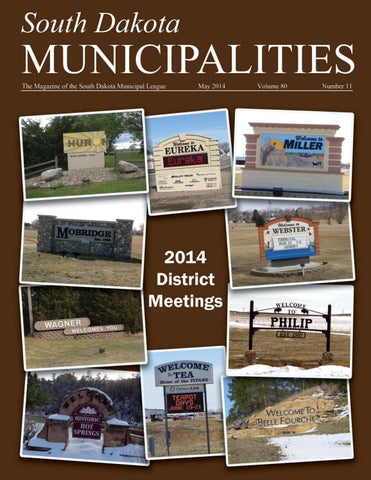
Official Monthly Publication
Member of National League of Cities
Contents Features
www.sdmunicipalleague.org
2014 SDML Excellence in Municipal Government Award Nomination Form . . . .5
South Dakota MUNICIPALITIES
Human Resource School . . . . . . . . . . . . . . . . . . . . . . .6
Managing Editor: Yvonne A. Taylor
Finance Officer of the Year Nomination Form . . . . . .7 Finance Officers’ School Agenda . . . . . . . . . . . . . . . .8
Editor: Carrie A. Harer
Crossing a Railroad with City Utilities . . . . . . . . . . .10 PRESIDENT Becky Brunsing Finance Officer, Wagner
DISTRICT CHAIRS Dist. 1 - Mike Grosek Mayor, Webster
The Value of Investing in Your Community’s Health . .12
1st VICE PRESIDENT Jeanne Duchscher Finance Officer, Parker
Dist. 2 - Tim Reed Mayor, Brookings
Brownfields . . . . . . . . . . . . . . . . . . . . . . . . . . . . . . . .16
2nd VICE PRESIDENT
Dist. 3 - Amy Nelson City Manager, Yankton
Meri Jo Anderson Finance Officer, New Underwood
Dist. 4 - Debbie Houseman Finance Officer, Lake Andes
TRUSTEES Laurie Gill Mayor, Pierre Greg Jamison Councilmember, Sioux Falls Sam Kooiker, Mayor, Rapid City Pauline Sumption Finance Officer, Rapid City Mike Wendland Mayor, Baltic PAST PRESIDENT Paul Young Councilmember, Spearfish
Dist. 5 - Renae Phinney President, Ree Heights Dist. 6 - Karl Alberts Finance Officer, Aberdeen Dist. 7 - Arnold Schott Mayor, McLaughlin Dist. 8 - Harry Weller Mayor, Kadoka Dist. 9 - Gary Lipp Mayor, Custer Dist. 10 - Fay Bueno Finance Officer, Sturgis
Economic Development Awards . . . . . . . . . . . . . . . .15
Abandoned Tank Removal Program . . . . . . . . . . . . .21 Tentative 2015-2018 Four-Year STIP . . . . . . . . . . . .22 Lifeguard Awareness Workshop . . . . . . . . . . . . . . . . .23 Obituary: Bernie Mengenhausen . . . . . . . . . . . . . . . .23 SDML Workers’ Comp Fund Grant Programs . . . . . .24 Communities Invited to Celebrate 125 Years . . . . . .25 Institute of Transportation Engineers Meeting . . . . .25 What is Leadership South Dakota? . . . . . . . . . . . . . .26 Seeking Mayors’ Travel Advice . . . . . . . . . . . . . . . .26 New Pension Financial Reporting Standards . . . . . .27 Connecting the Dots . . . . . . . . . . . . . . . . . . . . . . . . . .28 Weird Request Presents Triable Issue . . . . . . . . . . . .34 You Do Get What You Pay For . . . . . . . . . . . . . . . . .36
LEAGUE STAFF 1-800-658-3633 Fax: 605-224-8655
Columns
Yvonne Taylor Executive Director Sandi Larson Director of Risk Sharing Services Christine Lehrkamp Director of Research and Training Jeff Mehlhaff Director of Municipal Electric Services Carrie Harer Director of Marketing & Communications Lori Butler Director of Finance/Office Manager April LeBeau Administrative/Bookkeeping Assistant Judith Payne SD Public Assurance Alliance Executive Director Patsy Mikel SD Public Assurance Alliance Administrative Assistant
Director’s Notes . . . . . . . . . . . . . . . . . . . . . . . . . . . . . . .4
E-mail: yvonne, sandi, christine, jeff, carrie, lori, april, jpayne.sdpaa, pmikel.sdpaa @sdmunicipalleague.org
Risk-Sharing News . . . . . . . . . . . . . . . . . . . . . . . . . .38 Washington Report: Senator Johnson . . . . . . . . . . . . .40
In Every Issue Community Calendar . . . . . . . . . . . . . . . . . . . . . . . .44 Classifieds . . . . . . . . . . . . . . . . . . . . . . . . . . . . . . . . .47 Municipal Calendar . . . . . . . . . . . . . . . . . . . . . . . . . .49
SOUTH DAKOTA MUNICIPALITIES (ISSN 0300-6182, USPS 503-120) is the official publication of the South Dakota Municipal League, published monthly at 208 Island Drive, Ft. Pierre, South Dakota 57532, phone 605-224-8654. This institution is an equal opportunity provider, and employer. Periodical postage paid at Pierre, South Dakota and additional mailing offices. Non-member subscriptions are available for $30.00 annually. The opinions expressed herein are not necessarily those of the South Dakota Municipal League. Postmaster: Send address changes to SOUTH DAKOTA MUNICIPALITIES, 208 Island Drive, Ft. Pierre, South Dakota 57532.
MAY 2014
VOLUME 80, NUMBER 11
3
Director's Notes We will have wrapped up the ten district meetings by the time you read this, and while it will be nice to be home again, we really have had a great time visiting the towns hosting the meetings this year. From the farthest corner Northeast to its opposite in the Southwest, we’ve really seen a lot this year, and the warm welcome in every community was so special. We really appreciate the hard work each city put into arranging for the wonderful food and meeting places, door prizes, and entertainment – so to Webster, Huron, Tea, Wagner, Miller, Eureka, Mobridge, Philip, Hot Springs, and Belle Fourche – THANKS!
offered by the League – we have many fantastic opportunities to help you grow in your public service position.
District Meetings always renew a sense of amazement that there are so many bright, dedicated people, willing to serve their communities and give their time. Although we go to each town to present a legislative update, we always come away having learned more than we taught.
Yvonne Taylor Executive Director
Please also consider getting involved in the policy committee process. We have four committees, each of which meets in August, and again at the October conference. They will give you a great opportunity to discuss issues with your fellow officials, as well as to direct the activity of the League in the next legislative session. Finally this month, please turn to page 5 for the nomination form for the annual “Excellence in Municipal Government Award.” This year’s award will go to an elected municipal official – we are sure you know someone deserving of this award. Please take this opportunity to nominate someone who deserves recognition for their great service to municipalities. Until next month, remember we are always available at 1800-658-3633 or yvonne@sdmunicipalleague.org.
Back at the office, our attention now turns to our schools and seminars, culminating with the Annual Conference in Spearfish in October. At the last Conference, we had several general session speakers who all received rave reviews – and every one of them was suggested by a member. If you have thoughts on programs you would like to see at the Conference, please contact us! The April municipal elections have just passed, and along with the excellent incumbents, we will have a whole new group of elected officials to look forward to working with. I would urge everyone to take advantage of all the services
4
SOUTH DAKOTA MUNICIPALITIES
2014 SDML “EXCELLENCE IN MUNICIPAL GOVERNMENT AWARD” Official Nomination Form
2014 SDML Excellence Award
This year, the Excellence in South Dakota Municipal Government award will be presented to an elected municipal official in South Dakota. The award recipient will be selected from nominations received by the South Dakota Municipal League Past Presidents’ Committee. All nominations must be submitted in writing by August 15, 2014. The award will be presented at the SDML Annual Conference in Spearfish on October 9, 2014. Name of Nominee:
Title:
Address of Nominee: Significant contributions to the municipality:
Significant contributions to the community:
Significant contributions to other organizations:
Significant contributions to South Dakota Municipal Government:
Other Comments:
Submitted by: DEADLINE: August 15, 2014 Nominations are confidential Use additional paper if necessary.
Phone: Please submit to:
South Dakota Municipal League 208 Island Drive, Ft. Pierre, SD 57532 FAX to 605-224-8655
SD Governmental Human Resource School June 10 & 11, 2014 j Cedar Shore Resort j Oacoma, SD …of the 309 municipalities in South Dakota, less than 15 have full time professional Human Resource personnel. Most HR duties are added responsibilities for existing city staff. This training will help anyone with HR responsibilities become better informed in this field, learn who to call on when they need help and where to turn to find resources.
Preliminary Agenda Tuesday, June 10
3:45 to 5:15 p.m
Hot Topics in HR Steve Bogue, Attorney, McGrath North Mullin & Kratz, PC LLO, Omaha, NE Social and Dinner
12:15 p.m. Registration – Conference Center Lobby 1:00 p.m.
General Business Meeting
5:30 p.m.
1:15 to 2:45 p.m.
Complicated Issues involving the FMLA and ADA Don Knudsen, Attorney, Gunderson Palmer Nelson Ashmore, LLP and contract attorney for the SDPAA, Rapid City, SD speaker sponsored by SDPAA
Wednesday, June 11
2:45 p.m.
Break
3:15 to 3:45 p.m.
SD Public Assurance Alliance (SDPAA) update Judy Payne, Executive Director, SDPAA (SDML sponsored risk pool)
Continental breakfast provided 8:00 to Why Can't We Just All Get Along??? 11:30 a.m. Tips, Tools and Techniques for Better Communication in the Workplace Alice Dendinger, HR Consulting, Coaching and Mediation Expert, Austin, TX BONUS: Pre-registration is critical to successfully participating in this session. Please make sure you are registered to attend. Prior to the event, you will receive a code to complete a personalized profile online. Your personal results will be shared with you on June 11. Instructions and the code will be sent via email during the month of May.
speaker sponsored by SDPAA
2014 Human Resource School Registration Form Representing __________________________________________________ Name
Title
Email (Needed for June 11 session)
(Please print or type the name and title as you want them to appear on your name badge)
_____________________________________________________________________________________ _____________________________________________________________________________________ _____________________________________________________________________________________ Registration fee: $50.00 for affiliate members and $100.00 non-members. Accommodations: Be sure to mention you are with the SDML Human Resource Assoc. Make reservations by May 10 to guarantee the conference rate. Cedar Shore Resort, 605-734-6376, $92.95 + tax. _______ person(s) @ $50.00 each = $__________
_______ person(s) @ $100.00 each = $_________
Return registration with payment by May 27, 2014 to: SD Governmental Human Resource Association *No refunds will be given after May 27, 2014 208 Island Drive Ft. Pierre, SD 57532 Office Use Only:
Date:________________
Check #:________________
Amount:________________
Finance Officer of the Year
2014 - 2015 South Dakota Governmental Finance Officers’ Association
2014 - 2015 "FINANCE OFFICER OF THE YEAR" Official Nomination Form All nominations must be submitted in writing by May 15, 2014. The Finance Officer of the Year award will be presented during the 2014 Finance Officers’ School held June 11-13 in Oacoma.
Name of Nominee: _________________________________________________________________ Position: _________________________________________________________________________ Years of service to the municipality: ___________________________________________________ Contributions to the municipality as a Finance Officer: ____________________________________ _________________________________________________________________________________ _________________________________________________________________________________ _________________________________________________________________________________ Contributions to the community as a citizen: ____________________________________________ _________________________________________________________________________________ _________________________________________________________________________________ _________________________________________________________________________________ Significant contributions to any other organizations: ______________________________________ _________________________________________________________________________________ _________________________________________________________________________________ _________________________________________________________________________________ Personal accomplishments: __________________________________________________________ _________________________________________________________________________________ _________________________________________________________________________________ _________________________________________________________________________________ Other Comments: __________________________________________________________________ _________________________________________________________________________________ _________________________________________________________________________________ _________________________________________________________________________________ Submitted by: ________________________________________ DEADLINE: May 15, 2014 Nominations will be kept confidential. Use additional paper if necessary.
Phone: ____________________
Please submit to: South Dakota Municipal League 208 Island Drive Ft. Pierre, SD 57532 Fax: 605-224-8655
SD Governmental Finance Officers’ School June 11, 12, & 13, 2014 j Cedar 11, Shore Resort j Oacoma, SD Preliminary Agenda
Wednesday, June 11 8:30 a.m. – 3:30 p.m. WEDNESDAY ONLY: Banyon Data Systems – Utility Billing & Point of Sale, Fund Accounting, Payroll and New Products will be available for Q&A (Informal, come and go Q&A sessions) Door Prizes will be given away throughout the school – must be present to win. Noon – 5:00 p.m.
Registration – Conference Center Lobby
12:45 p.m.
WELCOME by Oacoma Mayor Mike Schreiber
1:00 – 1:30 p.m.
Business Meeting
1:30 – 2:00 p.m.
Grant Research (information on the Foundation Center) Brenda Hemmelman, Collection Services Librarian, SD Dept. of Education/SD State Library After Brenda is done she will be in the Breakwater room until 5 p.m. for an informal, come and go Q&A regarding grants research and what the State Library has to offer to help you.
2:00 – 2:30 p.m.
Legislative Update Yvonne Taylor, Executive Director, SD Municipal League
2:30 – 2:50 p.m.
Break Sponsored by Banyon Data Systems, Inc.
2:50 – 4:00 p.m.
“What’s Yours Like?”
2:45 – 5:15 p.m.
Golf Tournament – Chamberlain Country Club 33848 Golf Course Road, Oacoma (one mile west of Quality Inn); $20/person, includes cart
5:30 – 7:30 p.m.
Welcome Reception (outside on the deck – Area group NEFOG – games) Sponsored by Stockwell Engineers The Miller Foster Band will be playing from 7 – 10 p.m. Sponsored by the City of Oacoma Hospitality room opens from 8:30 – 11:30 p.m. Sponsored by Dougherty & Company LLC
Thursday, June 12 7:15 – 8:00 a.m.
Breakfast Buffet Sponsored by Infrastructure Design Group, Inc
8:15 – 9:45 a.m.
General Session Living with an Attitude of Altitude Keynote Speaker: Linda Henley-Smith “The Laugh Lady” Drawing upon her experiences as a teacher, counselor, author and trainer, as well as a lifetime in the entertainment business, Linda Henley-Smith provides an amusing and educational outlook on working, living, and surviving. Learn to manage the negative situations and people, get past the past, manage stress and deal with change. Her program is presented with humor, music, stories and an energy that is contagious.
9:45 – 10:00 a.m.
‘Light’ Break Sponsored by Helms & Associates and Schmucker, Paul, Nohr & Associates
10:00 – 11:00 a.m.
Concurrent Sessions (Pick one; these sessions will be repeated in the afternoon) j Budgeting 1, 2, 3 Panel Fay Bueno, Finance Officer, City of Sturgis; Mike Carlson, Finance Officer, City of Vermillion; Carolynn Anderson, Finance Officer, City of Wall; and Karla Nordyke, Finance Officer, City of Timber Lake j Utility Billing & Collections A – Z Panel Jane Kleinsasser, Accounting Manager, City of Huron; Donna Bieber, Finance Officer, City of Java; Linda Hoberg, Finance Officer, City of Webster; and Meri Jo Anderson, Finance Officer, City of New Underwood j Constitutional Debt Limit and How it’s Calculated Ray “Woody” Woodsend, Senior Vice President, Dougherty & Company LLC Todd Meierhenry, Attorney at Law, Meierhenry Sargent, LLP
11:00 – 12:00 p.m.
Concurrent Sessions (Pick one; these sessions will be repeated in the afternoon) j Nuisances Abatement Brad Solon, Division Manager, Building Services, City of Rapid City j Human Resources Basics Meghan Wooster, Associate Attorney, Boyce, Greenfield, Pashby & Welk L.L.P and a contract attorney for SDPAA j How to Hire an Engineer or Architect for Projects Jon Schmidt, Civil Engineer, Rural Development/United States Dept. of Agriculture
12:00 – 12:45 p.m.
Lunch Buffet Sponsored by HDR Engineering, Inc.
1:00 – 2:30 p.m.
General Session Keynote Speaker: Linda Henley-Smith Are you ready to laugh some more? Linda will wrap up her Living with an Attitude of Altitude presentation.
2:30 – 2:45 p.m.
Break Sponsored by CETEC Engineering Services, Inc.
2:45 – 3:45 p.m.
Concurrent Sessions (Pick one) j Budgeting 1, 2, 3 Panel Fay Bueno, Finance Officer, City of Sturgis; Mike Carlson, Finance Officer, City of Vermillion; Carolynn Anderson, Finance Officer, City of Wall; and Karla Nordyke, Finance Officer, City of Timber Lake j Constitutional Debt Limit and How it’s Calculated Ray “Woody” Woodsend, Senior Vice President, Dougherty & Company LLC Todd Meierhenry, Attorney at Law, Meierhenry Sargent, LLP j How to Hire an Engineer or Architect for Projects Jon Schmidt, Civil Engineer, Rural Development/United States Dept. of Agriculture
3:55 – 4:55 p.m.
Concurrent Sessions (Pick one) j Nuisances Abatement Brad Solon, Division Manager, Building Services, City of Rapid City j Utility Billing & Collections A – Z Panel Jane Kleinsasser, Accounting Manager, City of Huron; Donna Bieber, Finance Officer, City of Java; Linda Hoberg, Finance Officer, City of Webster; and Meri Jo Anderson, Finance Officer, City of New Underwood j Resources Basics Meghan Wooster, Associate Attorney, Boyce, Greenfield, Pashby & Welk L.L.P and a contract attorney for SDPAA
6:00 p.m.
President’s Social (cash bar) *Business casual dress
7:00 p.m.
Finance Officer of the Year Banquet Guest Speaker: Coach Don Meyer, Former basketball coach at NSU Sponsored by Howard R Green Company Hospitality room opens after Banquet until 11:30 p.m. Sponsored by Dougherty & Company LLC
Friday, June 13 Municipal Pride Day! Wear a shirt, hat or pin that promotes your city! 7:30 – 8:15 a.m.
Breakfast Buffet Sponsored by Short Elliott Hendrickson Inc. (SEH)
8:15 a.m.
Last minute announcements
8:30 – 9:30 a.m.
Making Automation Work for You Kenton Peterson, Treasury Management Sales Consultant, Wells Fargo Bank, N.A.
9:30 – 10:45 a.m.
DLA Refresher Rod Fortin, Director of Local Government Assistance, SD Department of Legislative Audit
10:45 – 11:30 a.m.
Liquor Laws Carol Logan, Section Coordinator – Special Tax Division, SD Department of Revenue
11:30 – Noon
Excise Tax Alison Jares, Deputy Director – Business Tax Division, SD Department of Revenue
Registration form can be found online at www.sdmunicipalleague.org under SDML Events.
Crossing a Railroad with City Utilities By Jeff Mehlhaff, Director of Municipal Electric Services Railroad Crossings Railroads over the last century have spurred development and sustained many communities across the State of South Dakota. Railroad tracks developed close to and through many cities across South Dakota. As cities have grown, so has the need to expand the municipality’s infrastructure. Crossing under the railroad tracks with city owned utilities is sometimes required because of the city’s geography.
Application and Details HB1194 requires a crossing application for any utility crossing under the railroad’s tracks with a utility line. The application needs to include a drawing showing the location of the proposed crossing and the railroad’s property, tracks and wires/lines that the utility will cross. The railroad may have additional requirements or special circumstances in certain crossings, but the utility has the right to object to those additional requirements.
When a municipality has to cross the railroad’s tracks, in the railroad’s right-of-way, there is generally an application and fee charged by the railroad. The fee has been negotiated between the railroad and municipality in some instances. The fees have ranged from hundreds to several thousands of dollars without any specific reasoning for the dollar amount. Much of the time, if the city needs to cross under the railroad with water, sewer, storm sewer or electric line, there has been no other choice than to pay the fee. HB1194, recently signed by the Governor, modifies and clarifies statutes related to crossing a railroad with a utility line.
One-time Standard Crossing Fee, Except in Public Right-of-Way HB1194 sets a one-time standard crossing fee of $750. The standard crossing fee of $750 is in lieu of any license, permit, application, processing fee, or any other fees or charges by the railroad for direct expenses incurred by the railroad. There is no fee for a crossing within the public right-of-way. Any time a utility crosses in the public rightof-way there will be no standard crossing fee. Past Payments and Previous Agreements Another provision in the bill addresses past payments for crossings. If a total of $750 has already been paid over the life HB1194 Affected Utilities Recent legislation, HB1194, addresses a new uniform way of handling a railroad crossing with a utility line. The bill addresses, specifically, crossing the railroad’s tracks with a utility line when crossing through the railroad’s right-ofway. Utility line includes water, electric, sewer, storm sewer, telephone or other kind of utility line. This bill affects all city utilities when crossing under railroad tracks. The language in the bill would apply any time a utility is crossing the railroad tracks with a city utility line in the railroad’s right-of-way. HB1194 is the default process for a crossing if the utility and railroad cannot agree. Nothing in the bill prevents a railroad and city utility from negotiating their own agreement. 10
SOUTH DAKOTA MUNICIPALITIES
of the crossing, no additional fee is required. If a utility had yearly or ongoing crossing fees they would no longer have to pay those yearly or ongoing fees if the total paid to date was at least $750. The utility also has to pay any reasonable flagging expenses associated with a new crossing. Crossing Railroads with City Utilities under New Legislation Depending on the circumstances of your potential railroad crossing, it may make sense to cross where a public rightof-way exists. If you need to cross the railroad try to identify where public right-of-ways exist in regards to the railroads tracks. Crossing in the public right-of-way eliminates the fee, which the railroad can charge. Sometimes it makes more fiscal sense to cross the railroad directly in the railroad’s right-of-way. If a municipality needs to cross the railroad in the railroad’s right-of-way try to cross in places where the railroad will not need additional requirements. Sometimes moving the utility line up or down another 20 to 100 ft. can make all the difference to the railroad. If issues, additional requirements or special circumstances exist, where the railroad and municipality can’t agree, the South Dakota Public Utilities Commission (SD PUC) has
MAY 2014
the ability to hear the dispute and make a determination in the case. It is less likely to have issues if the municipality is crossing in the public right-of-way. If you have any questions regarding how the new legislation on railroad crossings could affect a potential crossing, please contact your city attorney. Nothing contained in this document should be taken as legal advice.
Innovations in American Government Awards Offered by Harvard Kennedy School’s Ash Center for Democratic Governance and Innovation, the Innovations Award ($100,000) is the nation’s premier award for the public sector. It recognizes programs that demonstrate creative and effective government at its best. Also available this year is the Roy and Lila Ash Innovations Award ($100,000) for Public Engagement in Government. Applications are due on June 20, 2014 and are available at www.innovationsaward.harvard.edu.
11
The Value of Investing in Your Community’s Health: Why it is Important By Sandra Melstad, MPH, Public Health Consultant, South Dakota Department of Health Health and wellness can be influenced at the local level and community leaders play a vital role in addressing the health of their community. The community is a major piece of a broad public health system which seeks to assure local public health in partnership with sectors in the community, including health care systems, business, the media, academia, and government health infrastructure. By definition, public health is the “effort, science, art, and approach used by all sectors of society to assure, maintain, protect, promote, and improve the health of the people.”1 Understanding the factors that equate public health in a community can help leaders recognize the value of investing in their community’s health and why it is important. Health Costs to the Community – The Facts Each year more than 1.5 million people in the U.S. die from largely preventable chronic diseases such as heart disease, cancer, and diabetes; each a major cause of
12
illness.2 In South Dakota (SD) heart disease and cancer continue to be the leading causes of death.3 These diseases account for more than 75 percent of U.S. healthcare spending.4 By doing nothing to prevent these diseases, researchers estimate the annual cost could balloon to $4.2 trillion by 2023.5 The prevalence of chronic disease also burdens SD with preventable health care costs. According to the Milken Institute, it is projected that by 2023 SD will suffer $8.4 billion in lost productivity attributable to chronic diseases.6 If the prevalence of obesity, a risk factor for developing chronic disease, continues to rise in SD, health care spending attributable to obesity may cost the state $1,729 per adult by 2018.7 Factors that Contribute to Community Health Status A larger percentage of chronic diseases are correlated to four modifiable and costly individual health risk behaviors—lack of physical activity, poor nutrition, tobacco use/exposure, and excessive alcohol consumption.
SOUTH DAKOTA MUNICIPALITIES
According to Dr. Thomas Frieden, Director of the Centers for Disease Control and Prevention, “chronic diseases linked to obesity, poor nutrition, physical inactivity, and tobacco use, are the leading causes of death and disability in our nation.”8 Recent state health behavior data indicates that approximately one quarter of SD adults are obese, use tobacco, and/or do not get the recommended amount of physical activity.9 And 2009 data reported that SD had the lowest consumption rates of fruit and vegetables in the nation.10 In addition, the 2013 America’s Health Rankings identifies SD as 22rd in the nation in overall health determinants and outcomes, such as obesity, smoking rates, physical inactivity rates, and health inequalities. When compared to neighboring states rankings; North Dakota-9, Iowa-5, and Minnesota-1; SD is behind.11 Socio-economic and community-based factors are also major determinants associated with chronic disease, including12: j The decisions and activities of government at the local level, not just those that traditionally have been construed as matters of public health. Laws, regulations, and ordinances created by local government help make the community a healthier place, such as tobacco-free parks;
MAY 2014
j j
A community’s social assets and quality of physical infrastructure affect the health and well-being of its residents; and Environmental health risks, such as poor home and neighborhood conditions, disproportionately affect people with low socioeconomic states and in racial/ minority households.
Community Value Added Costs Investing in community-based prevention and health promotion is an integral factor in preventing chronic diseases and supporting a healthy community. The World Health Organization defines a healthy community as “one that is safe with affordable housing and accessible transportation systems, work for all who want to work, a healthy and safe environment with a sustainable ecosystem, and offers access to health care services which focus on prevention and staying healthy.”13 Understanding the value of investing in your community’s (neighborhood, city, county) health, also means knowing that “variations in population health status across communities reflect local conditions and resources.”12 Findings from research, conducted on 2006 data estimating the impact of preventive services, suggest that investing in an evidence-based package of preventive services (colorectal screening, smoking cessation, obesity
13
screening, etc.) for the general population could produce more than two million additional years of life each year they are delivered.14 Based on available community resources, “the physical, social, and economic environments of local communities affect residents’ health and exacerbate health disparities.”12 In spite of this, access to high-quality and affordable prevention measures (screening, education, etc.) are essential to saving lives, reducing disability, and lowering medical costs.
Learn how a community health needs assessment and improvement planning process provides an opportunity for your community to build a healthy community – Look for the June issue of South Dakota Municipalities to learn more or visit www.goodandhealthysd.org/communities. References 1. 2.
3.
Why Invest in Your Community’s Health Increased awareness of today’s emerging health concerns and costs are prompting communities to take action toward supporting a healthy community environment. An ideal healthy community will ensure residents access to resources which promote and sustain health, such as the presence of sidewalks and crosswalks, parks, public transportation, safe neighborhoods and streets, grocery stores with healthy foods, and access to affordable and quality health care. That same healthy community would also promote an environment with is conducive to healthy living, such as safe drinking water, pollution control, as well as access to affordable and safe housing. Public health strategies have traditionally been to educate individuals about unhealthy behaviors and the benefits of leading a healthy lifestyle, such as, smoking cessation, eating healthy, and being physically active. However, in recent years, research has shown that while “personal choice” drives whether or not an individual engages in healthful behaviors, “social and material environments can place major impediments in the paths of people attempting to lead healthier lives.”15 Research has shown that disproportionate access to goods and services, unhealthy environmental exposure, and poor quality and affordable housing often contribute to chronic disease; however, changing the community and environment people live in can reach many and be cost effective. Moreover, when compared to individual interventions (i.e. instructor-led exercise classes), environmental change may have initial costs followed by lasting effect (i.e., building recreational facilities to promote physical activity) and can generate government revenue and offset costs (i.e. excise taxes).16 Next Steps – How to Build a Healthy Community A healthy community depends to a large extent on human, institutional, organizational, environmental assets and other resources already available within the community. Understanding the community needs is the first step to building a healthy community and cannot be the sole responsibility of health care systems. Rather, the investment and collaboration of community stakeholder’s time and resources is key to understanding the health of a community. 14
4.
5.
6.
7.
8. 9.
10.
11.
12.
13. 14.
15.
16.
The Future of the Public’s Health in the 21st Century, Institute of Medicine, 2002. THeron MP, Hoyert DL, Murphy SL, Xu J, Kochanek KD, Tejada-Vera B. Deaths: final data for 2006. Natl Vital Stat Rep 2009; 57(14):1–134. South Dakota Department of Health. (2012). South Dakota Vital Statistics Report: A State and County Comparison of Leading Health Indicators. http://doh.sd.gov/statistics/2012 Vital/Mortality.pdf. National Center for Chronic Disease Prevention and Health Promotion (2009). Chronic Diseases – The Power to Prevent, The Call to Control: At A Glance 2009. Retrieved from http://www.cdc.gov/chronicdisease/resources/publications/aag /pdf/chronic.pdf. Winterfeld, A. (2009, December). Chronic Costs: Making Healthy Choices Easier for Americans Can Prevent Deadly Diseases and Save Money. State Legislature. Retrieved from http://www.ncsl.org/Portals/1/Documents/magazine/articles/2 009/SL_Dec09-Chronic.pdf. The Milken Institute (2003). An Unhealthy America: Economic Burden of Chronic Disease. Retrieved from http://www.chronicdiseaseimpact.com/ebcd.taf?cat=state&stat e=SD. United Health Foundation, American Public Health Association, Partnership for Prevention. (2009, November). The Future Costs of Obesity: National and State Estimates of the Impact of Obesity on Direct Health Care Expenses. Washington DC: Thorpe, K. Frieden, T. (2009). Centers for Disease Control and Prevention. South Dakota Department of Health. (2012). The Health Behaviors of South Dakotans. Retrieved from https://doh.sd. gov/statistics/2011BRFSS/default.aspx. Centers for Disease Control and Prevention. (2010, September, 10). State-Specific Trends in Fruit and Vegetable Consumption Among Adults — United States, 2000–2009. Morbidity and Mortality Weekly Report. Vol. 59 (53), 1125-1162. United Health Foundation (2013). State Rankings. In America’s health Rankings. Retrieved from http://www.americas healthrankings.org/rankings. Miller, W.D., Pollack, C.E., Williams, D. R. (2011). Healthy Homes and Communities, Putting the Pieces Together. American Journal of Preventive Medicine. 40(1S1): S48-S57. World Health Organization. (2014). Healthy Settings. Retrieved from http://www.who.int/healthy_settings/types/en/. Michael V. Maciosek, Ashley B. Coffield, Thomas J. Flottemesch, Nichol M. Edwards and Leif l. Solberg. Greater Use of Preventive Services in U.S. Health Care Could Save Lives AT Little Or No Cost. Health Affairs, 29, no. 9 (2010): 1656-1660. doi: 10.1377/hlthaff.2008.0701. Woolf, S. H., Dekker, M. M., Rothenberg Byrne, F, Miller, W. D. (2011). Citizen-Centered Healthy Promotion, Building Collaborations to Facilitate Healthy Living. American Journal of Preventive Medicine. 40(1S1): S38-S47. Chokshi, D.A., Farley, T. A. (2012, July 26). The CostEffectiveness of Environmental Approaches to Disease Prevention. The New England Journal of Medicine. 367; 4.
SOUTH DAKOTA MUNICIPALITIES
Governor Announces Economic Development Awards Gov. Dennis Daugaard recognized individuals and communities alike for their achievements and contributions to economic development in South Dakota at the Governor’s Office of Economic Development (GOED) annual conference. Gov. Daugaard recognized Ron Kraft of Yankton, Jim Meyer of Spearfish and the communities of Belle Fourche and Vermillion.
park and economic development corporation. In addition, the Vermillion Development Corporation is actively engaged in the community’s second capital campaign, which is working to raise money to fund economic development and quality of life initiatives. Congratulations to the Community of Vermillion.”
Kraft was honored with the Excellence in Economic Development Award, which is presented annually at the GOED conference. “Ron is described as a tireless leader and a life-long student of economic development,” said Gov. Daugaard. “He is willing to do whatever is asked, from book keeping to meeting with prospects to high-level strategic input and planning for the community of Yankton. It is my honor to present him with the 2014 Excellence in Economic Development Award.” Meyer, owner of Quarq Technologies, which develops and sells innovative high tech devices for the bicycle industry, was named the 2014 South Dakota Entrepreneur of the Year.
Belle Fourche accepting the Small Community of the Year award.
“After growing his company to 30 employees, Jim Meyer sold it in 2012 to a leading bike innovator, SRAM,” said Gov. Daugaard. “Even though he no longer owns the company, Jim still manages the R&D and manufacturing operations in Spearfish. Meyer is a great example of a South Dakotan who ventured out and then decided to come back to pursue his dream in our business-friendly state.” The Governor also recognized Belle Fourche and Vermillion as the small and large Communities of the Year. Small Community of the Year “Belle Fourche is transforming its economic development landscape. The community has been busy the last few years reorganizing its economic development corporation, hiring a full-time executive director and assisting in the construction of an industrial park,” said Gov. Daugaard. “In 2013, Texas-based Permian Tank announced it was expanding to the community. The expansion will bring up to 65 new jobs and $6.2 million in capital investment. There’s no doubt that Belle Fourche is deserving of the Small Community of the Year Award.”
Vermillion accepting the Large Community of the Year award.
Large Community of the Year “Vermillion is taking a multi-faceted approach to achieving economic development,” said Gov. Daugaard. “Vermillion is focusing on further developing its workforce, business MAY 2014
15
Brownfields What is a Brownfields Site? Brownfields sites are defined as “real property, the expansion, redevelopment, or reuse of which may be complicated by the presence or potential presence of a hazardous substance, pollutants or contamination.” What does a Brownfields site look like? Is it an abandoned gas station or petroleum bulk site? Maybe it is a salvage yard, rubble site, grain elevator or an abandoned hospital or school? Each community has these types of sites. Do You Have a Brownfields Site in Your Community? In the early 1990s, concerns were expressed nationally that many properties once used for industrial, manufacturing, or other commercial purposes were abandoned or underused due to the suspicion of contamination. Unknown environmental liabilities were keeping developers from restoring these properties to a productive use. The South Dakota Department of Environment and Natural Resources (DENR) has received federal funds to assist communities with the assessment and clean up of abandoned, idle or underused properties. Whether the property is vacant because of actual environmental contamination or the perception of possible contamination, redevelopment of these areas can increase property values, create jobs and generate local property and sales tax revenues.
16
Under the state’s Brownfields Program, we work with municipalities, realtors, and developers to identify potentially eligible Brownfields sites. Once identified and if the municipality is supportive, DENR uses these federal funds to hire an environmental contractor to perform record searches and on-site testing and if necessary, develop clean up plans and cost estimates for the property. In certain situations, DENR can also assist in the cost to clean up the contamination so the property can be redeveloped. These funds require no match from the community! Brownfields funds can be used for: j Phase I Assessments - record searches of the property. j Phase II Assessments (soil, ground water, and asbestos testing). j Cleanup plans and cost estimates can be developed. j In certain circumstances, removal and clean up of identified contamination. If you have a question or would like to learn more about the Brownfields Program, please contact Kim McIntosh at 605-773-3296.
SOUTH DAKOTA MUNICIPALITIES
Brownfields Success Stories Huron’s Water Park When Huron University closed its doors in 2005, there was a flurry of committee meetings, strategic planning sessions, and discussion on what would be done with the seven buildings located on the large 15.2-acre property. A number of private entrepreneurs looked at different buildings over the years for a variety of uses. After an extensive amount of research and financial planning, the city of Huron came up with the “Central Park” redevelopment concept for a new aquatic center (Water Park) and the renovation of the Campus Center. To construct the aquatic center, a number of environmental issues had to be addressed before the campus’s old buildings could be torn down. Each building
MAY 2014
contained asbestos, lead paint and a number of underground storage tanks were identified which needed to be removed. Through the use of the state’s Brownfields Program and Abandoned Tank Program, many of the environmental issues were identified and resolved. Today the property hosts a large facility, featuring a traditional 8lane competition and recreation pool, lazy river, and leisure pool. In addition, the park area includes a picnic area and shade shelters, playground, volleyball and basketball courts and an on-site campground for “destination visitors” to the water park. Through the fund-raising efforts of the community and the state’s Brownfields assistance, the aquatic center is an astounding family recreation facility for the community and east-central South Dakota.
17
Parkston’s Abandoned Gas Station Gas stations and body shops lined the streets of communities across the country for many years. However, times have changed and many small stations have given way to larger convenience stores. These small gas stations were abandoned. Perceived environmental impacts made lenders, developers and buyers weary of these properties.
meals. The facility brings people to the community of Gary from all over the area to attend special events such as destination weddings, Fourth of July celebrations, or just for a weekend get-away.
In 2012, the city of Parkston requested Brownfields assistance to investigate one of these abandoned gas stations. A records search, soil and ground water sampling and an asbestos survey were performed. The information obtained through the Brownfields Program was extremely helpful in proving the information needed to confirm that environmental impacts were minimal. A buyer has since made an offer with the intent of demolishing the run-down building and redeveloping the property for a new business endeavor. Once redeveloped, the city of Parkston hopes to receive the added benefit of increased tax revenue due to a higher productive use.
Above: Gary School in 2007. Below: Buffalo Ridge Resort and Business Center today. Gary – Former School Transformed Gary is a small town located along the South Dakota/Minnesota border. The state School for the Blind opened in 1900 and operated until the fall of 1961. After closure of the school, the large beautiful buildings began to deteriorate, roofs caved in, and the grounds became an eyesore to the community. Despite the efforts of the community to save the structure, the only apparent course of action appeared to be demolition. In 2008, a wind energy entrepreneur purchased the property and began what was described today as a whirlwind transformation. Funds from the Brownfields Program and the state’s Abandoned Tank Program were used to remove the abandoned fuel tanks and to assess and clean up the asbestos and lead contamination. Extensive refurbishment of the historic buildings and property took several years of very hard work and commitment. Today the Buffalo Ridge Resort and Business Center is a charming historic facility. The 37-acre property features a small trout lake, walking trails, a hotel, ballroom, conference center, and a restaurant offering gourmet 18
SOUTH DAKOTA MUNICIPALITIES
Phillips to the Falls – Brownfields Showcase For many years, an area in downtown Sioux Falls had been the location of a large salvage business and an industrial railroad hub. Over the years, this area of downtown Sioux Falls had become run-down. Historic operations of the salvage yard and the railroad had impacted soils with lead and other chemical contaminates. In 1996, the city of Sioux Falls received one of the first EPA Brownfields grants awarded in the nation. With the use of the Brownfields grant, Sioux Falls negotiated the land acquisition and developed plans to clean up the property and redevelop the area. Jumping ahead to 2014, the area known today as the Phillips to the Falls Redevelopment site is a model of what the Brownfields Program can do for a community. The once blighted area is undergoing incredible regrowth. New business centers, office spaces and upscale lofts are being constructed. Adjacent property owners are reinvesting in their property by rehabilitating many of the beautiful quartzite buildings and remodeling many of the other structures in the area.
safe, and attractive destination for locals and out of town guests. The city’s investment in the former blighted area and reinvestment in other areas along the river, has made the downtown a wonderful place to play, work, and live.
Above and below: Phillips Avenue now connects downtown Sioux Falls to Falls Park.
Downtown Sioux Falls is the city’s center for arts, business, and culture, with a wide range of entertainment opportunities for dining, and shopping. Thanks to the vision of city leaders to revitalize this portion of downtown Sioux Falls, this area has become a prosperous,
Operating salvage yard in 1996.
Brownfields Webinar You are invited to attend a free brownfields webinar on May 6, 2014 from 10:00 am to 11:15 am CST. Does your community have an abandoned building, old gas station or other potentially contaminated building that is impeding your future growth? This webinar is designed to help you and your community find answers. To register go to https://www.ksutab.org/education/ webinars/.
Conceptual plan for the property. MAY 2014
19
DENR Funded Brownfields Projects Aberdeen Alcester Belle Fourche Canistota Canton Custer Dell Rapids Elk Point Gary Huron (2) LaBolt Madison (2) Mitchell (6)
Parker (2) Parkston Redfield (3) Sioux Falls (9) Stephan Sturgis Turton Wagner Watertown (5) Waubay/Day Co Winner Yankton (4)
DENR’s Main Website – Information and resources on numerous environmental issues effecting your community: http://denr.sd.gov. Federal Environmental Protection Agency’s Brownfields Website – details on the Federal Brownfields Program: http://www2.epa.gov/region8/brownfields-region-8. Reprinted with permission from the Department of Environment and Natural Resources.
Important Links DENR’s Environmental Events Database – Database of known spills or releases, which may impact properties in your community: http://denr.sd.gov/spills. DENR’s Tank Database – Information on regulated aboveground and underground storage tanks in your community: http://denr.sd.gov/des/gw/tanks/search/Index.asp.
20
Dell Rapids Fire Station - 2011
SOUTH DAKOTA MUNICIPALITIES
Abandoned Tank Removal Program Get Your Abandoned Underground Petroleum Tanks Removed for FREE!!
property with eligible underground storage tanks that are no longer in service.
The SD Department of Environment and Natural Resources wants to protect our environment by removing all abandoned underground petroleum storage tanks.
The program is funded by DENR’s Petroleum Release Compensation Fund (PRCF). This is a fund created in part to address environmental problems associated with spills from tanks. The money comes from a tank inspection fee imposed on wholesale distributors of petroleum fuels.
Why should I consider getting my tank removed? Tanks should be removed for two reasons. First, as tanks corrode, any petroleum that may still be in them will leak into our state’s ground water. One gallon of gasoline has the potential to render one million gallons of water undrinkable. Leaks from tanks can also contaminate soil around the tanks and cause unhealthy gasoline vapors to seep into basements of private homes and businesses. Since these tanks are buried under several feet of soil, these problems can go unnoticed for years. Second, the longer these old tanks remain in the ground, the more corroded they become. As the tanks become more corroded, there is an increased risk of the tank collapsing, and someone, or something, falling into the hole or tank. What tanks will the state remove? The state wants to remove every out-of-service underground storage tank that was used to store a petroleum product. Examples of petroleum products are gasoline, diesel, fuel oil, aviation fuel, waste oil, etc. The state will not remove petroleum tanks that may be inaccessible, such as beneath a building. The free tank removals do not apply to tanks that were in service for the sale of petroleum fuels on or after April 1, 1988. Also, nonpetroleum tanks such as propane tanks, cisterns, and septic tanks are not eligible under this program.
Is there a lien placed on my property by the state? The answer is NO! When the program was first approved by the 2000 Legislature, the state was required to place a lien on the property for five years. However, a bill was introduced during the 2001 legislative session to eliminate the lien. The bill was approved by the legislature and, because of an emergency clause on the bill, went into effect immediately after it was signed. How do I give my permission to have my tanks removed? All you need to do is fill out the Tank Removal Form found online at http://denr.sd.gov/TankYank and return it to the address at the top of the form. How can I get more information? j Visit http://denr.sd.gov/TankYank j Call the Abandoned Tank Removal Program at 605773-3296; j E-mail denrinternet@state.sd.us; or j Write to: Abandoned Tank Removal Program, DENR, 523 E. Capitol Avenue, Pierre, SD 57501
How are the tanks removed? All you need to do is give the state permission to dig up your tanks and do any necessary cleanup. After you give your permission, the Department of Environment and Natural Resources (DENR) will hire private contractors to remove any remaining product from the tank, remove the tank, and test the soil. The contractor will also remove piping and contaminated backfill around the tank. The contractor then fills the hole. The state pays for all the costs associated with removing the tanks from your property and any additional cleanup that is needed. However, the state does not pay to have the site resurfaced with new pavement, concrete, gravel, or grass. What does the program cost me? The best news associated with this program is that with the exception of resurfacing costs, it is free to the landowner! This is an opportunity that you cannot pass up if you own MAY 2014
21
Tentative 2015-2018 Four-Year Statewide Transportation Improvement Program (STIP) The SDDOT has scheduled a series of meetings intended to inform the public of the projects that are planned in the state. The first meetings will be hosted by the Planning and Development Districts. These are informal meetings designed to give invitees a preliminary look at the 20152018 “Tentative” STIP prior to the formal Public Meetings. This “Tentative” STIP document lists the projects that the South Dakota Department of Transportation proposes in Federal Fiscal Years 2015 through 2018. The purpose of these meetings are to furnish interested persons and government offices with the 2015-2018 Tentative STIP and to review and discuss it prior to the formal Public Meetings. That way they can attend the public meetings better informed. Prior to formal public meetings being held, the SDDOT will be presenting the “Tentative” Statewide Transportation Improvement Program (STIP) at the following Planning and Development Districts. Informal Public Meetings June 25, 2014 – Aberdeen – 7:00 p.m. Northeast Council of Governments at their office, 2201 6th Ave SE. June 26, 2014 – Watertown – 10:00 a.m. 1st District Association of Local Governments at their office, 124 1st Avenue Northwest.
July 9, 2014 – Yankton – 10:00 a.m. 3rd Planning and Development District at their office, 1808 Summit Street. July 10, 2014 – Pierre – 10:00 a.m. Central South Dakota Enhancement District at the SDDOT Commission Room, 700 E Broadway Ave. July 10, 2014 – Rapid City – 7:00 p.m. Black Hills Council of Local Governments at their office 730 East Watertown St. Suite 102. Formal Public Meetings July 22, 2014 – Aberdeen – 7:00 p.m. Ramada Convention Center July 23, 2014 – Sioux Falls – 7:00 p.m. Ramkota Hotel July 24, 2014 – Pierre – 7:00 p.m. Ramkota Hotel July 29, 2014 – Rapid City – 7:00 p.m. Ramkota Hotel July 30, 2014 – Webinar – 1:30 p.m. Contact Dave.Voeltz@state.sd.us to register. For more information contact Dave Voeltz at 605-7733590 or email Dave.Voeltz@state.sd.us.
July 8, 2014 – Sioux Falls – 3:00 p.m. Southeast Council of Governments at their office, 500 N. Western Ave., Suite 100.
22
SOUTH DAKOTA MUNICIPALITIES
Lifeguard Awareness Workshop Sioux Falls Parks and Recreation Department invites you to the Lifeguard Awareness Workshop at Saturday, May 17, 2014 from 8:30 a.m. until 3 p.m. at Morningside Community Center located at 2400 South Bahnson Avenue. This is an opportunity to meet with other professionals in your field or individual lifeguards to share ideas and information. This dynamic one-day seminar is a guaranteed rewarding experience for both lifeguards and recreation professionals. Workshop includes seminars on Preventing Lifeguard Failure, Risk Management, Critical Incidents and Why You Need to Get Wet, along with keynote speaker Jim Wheeler, the Manager of the Aquatics and Leisure Services Division from the San Francisco Recreation and Parks Department. The fee is $25 per person. Registration deadline is 5 p.m. Friday, May 16, 2014. For information call Jean Pearson at the Parks Office at 605-367-8222 or go online to download the brochure at www.siouxfalls.org/parks.
Obituary: Bernie Mengenhausen Bernie Mengenhausen w a s born November 4, 1928, near Armour, SD, to John and Mary (Riddering) Mengenhausen. Bernie attended country school near Armour and Roswell until his 8th grade. Bernie married Elsie Schram on February 12, 1952, at Howard, SD. They shared 53 years of marriage and were blessed with three children, Sandi, Linda and John. Bernie worked for Hoffman Construction, Maroney’s Bar, and in 1964, accepted the position of Water Superintendent and later City Superintendent for the City of Howard. He retired in 1994 after 30 years with the city. Once retired, he became a city council member and was serving at the time of his death. He also worked as a part time Miner County Deputy Sheriff for 22 years. In 2013, Bernie was inducted into the SD Municipal League Hall of Fame for 50 years of service to the City of Howard. Bernie was a member of the Beach United Methodist Church and had served on the fire department (33 yrs.) and the ambulance service (16 yrs.) as a volunteer. Bernie was very active and loved to camp, fish and play cards. He enjoyed his gardening and loved to share his harvest with family and friends. He especially loved his family and enjoyed their visits, phone calls and would share stories of his life experiences and gardening expertise.
MAY 2014
23
SDML Workers’ Compensation Fund Extends Grant Programs for the 2014 Year Many of you are aware that for the past four years the SDML Workers’ Compensation Fund has offered two different grant programs to its members. Because these grant programs promote safety to our members, the SDML WCF Board of Trustees decided to offer both grant programs for the 2014 year on a first come first served basis until the grant funds are exhausted. This first grant is in partnership with Stryker EMS to assist our membership in purchasing a Stryker Power-PRO™ cot or a Stryker Stair-PRO® chair. The intent is to provide a safer workplace for the voluntary EMT’s, firefighters, police officers, and all local governmental employees that assist the ambulance services to provide emergency transfer of patients. Past grant recipients include: Watertown Faulk County Hoven Miner County Wall Yankton County Hecla Hudson Avon Lead Castlewood Amb District Groton Area Fire & Rescue LEMTA Perkins Co Amb Lennox Area Ambulance Wagner-Lake Andes Amb Vermillion Parker
24
Mitchell Marshall County Freeman Sturgis Spearfish Ambulance Gregory Gettysburg Edgemont Ambulance McIntosh Aberdeen Hill City Ambulance Viborg Tripp County Ambulance Clark Ambulance Service Willow Lake Ambulance Ipswich Ambulance Burke Ambulance
The second grant is in partnership with Stan Houston Equipment to assist members with the purchase of an ICS® Saw Package. The ICS® saw is very beneficial in reducing the risk of injury during activities that require the use of a chop saw, particularly to cut and repair broken water pipes in a confined space. Past grant recipients include: Dell Rapids Groton Webster Watertown Deadwood Philip Sturgis Onida Custer Woonsocket
Mitchell Wagner Winner Elk Point Lead Mission Pierre Colman Yankton Box Elder
Beresford Edgemont New Underwood Parker Rosholt Flandreau Marion Redfield Huron
To be eligible for these grants the applicant must be a member of the SDML WC Fund as of the date of the grant application and in the year the grant is awarded. Also, the member must meet several selection criteria, including compliance with loss control safety recommendations. The SDML Workers’ Compensation Fund has always stressed the importance of using safety equipment and following safety procedures. There are many components to a successful safety program, beginning with leadership direction and support, which then flows to the supervisors and employees. If you would like an application, please contact Insurance Benefits, Inc., 4901 S. Isabel Pl. #110, Sioux Falls, SD 57108, brad@sdmlwcfund.com, 800-233-9073.
SOUTH DAKOTA MUNICIPALITIES
Communities Invited to Celebrate 125 Years of Statehood Gov. Dennis Daugaard is inviting communities to plan events to commemorate South Dakota’s 125th anniversary of statehood this year. Gov. Daugaard explained, “Our state’s 125th birthday is a great opportunity for us to celebrate our state, understand our history and heritage, and do something good for future generations.” Local committees are encouraged to plan celebration events, promote local history and perform community improvement projects. Participating communities will be eligible for special commemorative highway signs and help with planning and promoting their local efforts. Statewide events, such as a special wagon train from Yankton to Pierre in September and the placement of stained glass back in the Capitol Building, are currently scheduled to commemorate the anniversary. Other celebration events are also being considered. During South Dakota’s Centennial of Statehood in 1989, towns held special events and raised money to restore old buildings, build or improve city parks, upgrade swimming pools and athletic fields, and rebuild local museums. “Twenty-five years ago, the local events really made an impact,” Gov. Daugaard said. “Donating your time to start a 125th community project may really make a difference for your town and for future generations.” Becoming a “Statehood Celebration Community” involves forming a local committee, filling out an application form and brainstorming local celebration, history and lasting legacy ideas. Information packets have been mailed to cities and local historical societies. For more information, visit http://125.sd.gov.
MAY 2014
Institute of Transportation Engineers Meeting The Institute of Transportation Engineers (ITE) is holding a unique event this summer at the foot of Mount Rushmore. They are holding a Joint Meeting of the Midwestern and Western Districts at the Rapid City Convention Center June 29 – July 2, 2014. Transportation professionals from 24 states (and beyond) will descend on Rapid City this summer to share traffic and transportation innovations, to discuss projects and programs that have improved mobility, to show off new products and features to improve roadway operations for motorists, bicyclists and pedestrians, and to network with leaders in the traffic and transportation profession. You are invited to attend this meeting, too! Learn what’s new in dealing with traffic and transportation issues in your community or jurisdiction. We are anxious to interact with city engineers and planners, public works officials, consultants and anyone interesting in learning what’s new and what’s been successfully implemented by others throughout the country. Check out the meeting website at www.2014ite.com to learn more about the full technical and social program. Registration and hotel information are also provided. If you are not yet a member of ITE, please consider joining, but you need not be a member to attend the meeting.
25
What is Leadership South Dakota?
Leadership South Dakota is a statewide program that is designed to provide its participants with an opportunity to be exposed to people and places that make South Dakota a special place to live. The program, sponsored by the South Dakota Community Foundation and coordinated by Dakota Education Consulting, will accept 40 participants each year and will host seven weekend sessions in the following communities: Brookings, Rapid City, Pierre, Kyle, Sioux Falls, Aberdeen and Chamberlain. These weekend retreats will provide participants with tours, leadership speakers, South Dakota history presentations and the opportunity to solve a problem that currently exists in our state. An “ideal” Leadership South Dakota candidate is an engaged citizen who has an interest in starting or growing a business, serving on a non-profit Board or leading at the community or state level. If you are interested in applying to be in the first Leadership South Dakota class, an online application is available at www.leadershipsouthdakota.com. If you know of someone who would be a good candidate for the program, nominations can be submitted through the website.
Seeking Mayors’ Travel Advice For a summer edition of South Dakota Magazine, editor Katie Hunhoff is asking mayors from every town in South Dakota to tell her the number one thing they want people to know about their town. “Whether it is a historic fact, an interesting place to visit, an outstanding eating place or a geographic oddity, we want to present our readers with a fun travel recommendation for every town in our state,” says Hunhoff. The mayors’ suggestions will be collected into a summer travel guide and printed in the May/June 2014 issue. “Try to choose things that might surprise people or give a new twist to something they may already know about your town,” says Hunhoff. “Our readers often plan their summer travels after reading the magazine. We’d love to give them some fresh recommendations and insights, whether they have been there before or not.” Please send your ideas, before May 15, to Katie Hunhoff at editor@SouthDakotaMagazine.com. Or call 1-800-4565117 for more information.
The application deadline for Leadership South Dakota is May 31. The program requires an investment of $3,000. Many participants may be able to secure the program investment from their employers. If not and if funding is a challenge, scholarship funds may be available. Make an investment today that will pay dividends for years to come. The next generation of leaders for South Dakota starts here.
26
SOUTH DAKOTA MUNICIPALITIES
New Pension Financial Reporting Standards By Neil Bomberg, National League of Cities Despite numerous requests from government finance organizations and individuals for an indefinite delay in the implementation of the accounting and financial reporting standards for public pensions, the Governmental Accounting Standards Board (GASB) announced last week that they would not delay implementation of GASB Statement No. 68, Accounting and Financial Reporting for Pensions. The requirements of Statement 68 will become effective in fiscal years beginning after June 15, 2014, and will require cities to report the “net unfunded accrued liability of their pensions” or the funds that have not yet been added to the pension plan but are expected to be needed to meet all retirement obligations. GASB issued a free toolkit that is designed to explain the new rules and provide cities with information that will ensure they are able to comply with Statement 68. The toolkit helps preparers, auditors, and users of state and local government financial reports understand and apply the revised pension accounting and financial reporting standards that GASB approved in June 2012.
MAY 2014
Statement 68 specifically applies to pension plans that administer benefits through trusts that meet the following criteria: j Contributions from employers (and by other governments and entities on behalf of the employers) are irrevocable; j Assets in the trust are dedicated to providing pension benefits to the plan members; and j Assets in the trust are protected from the creditors of the employers, the plan administrator, and the plan members (for defined benefit pensions). The vast majority of government pensions are administered through trusts meeting these criteria. Statement 68 applies primarily to defined benefit pension plans, which are used to provide specified pensions that specify the benefits to be provided to the employees after the end of their employment. This new toolkit complements the toolkit the GASB released in November 2013 for pension plans looking to implement GASB Statement No. 67, Financial Reporting for Pension Plans. Reprinted from National League of Cities, www.nlc.org.
27
Connecting the Dots By Jo Vitek, SDPCA Past President, Chief of Police (retired), Watertown, SD The following is a speech given at the SD Police Chiefs’ Association & SD Sheriffs’ Association Annual Conference Banquet May 1, 2014 in Deadwood, SD. In 1953, American Playwright Henry Foote wrote The Trip to Bountiful. It’s a story about an elderly woman’s journey alone through Texas in search of her birthplace. As its name implies, Bountiful is beautiful. Imagine in your mind’s eye a cascading landscape of wildflowers and rolling countryside. For forty years, Carrie Watts yearned to return to her birthplace, to smell the fresh air, to see the Scissortail fly, and to feel the dirt of the land. If she could only return to Bountiful once more, her life would be made whole. She begins her journey equipped with nothing more than nostalgic memories of the past. Along her journey, she encounters numerous obstacles but her obvious and infectious spirit inspires, convicts, and transforms the lives of the strangers she meets. They too become devoted to her dream. Despite overwhelming odds, Mrs. Watts is successful in her endeavor. Her son, Ludie finds her sitting in a rickety rocking chair on the front porch of her old
28
dilapidated home. Now that her journey is completed, she knows it is time to leave. As she walks ever so slowly towards Ludie’s car, she pauses to scan the stunning landscape and take in a deep breath of fresh air. She stops to admire a Scissortail in flight. Then, Mrs. Watts sits down in the meadow. She reaches down with her hand to feel the dirt of the land. She scoops some of the earth into her hand and as the dirt pours through her fingers she says something very profound, “We’re all a part of this! You leave it, but you never lose what it gave to you.” 1 In The Trip to Bountiful, there’s this notion that we’re connected to our origins. When you stop and think about it, we have a direct and distinct relationship with our genesis—the place where we began. No matter how far we travel from it, no matter where our journey takes us, we’re still connected to it and it remains a part of us. We never lose what it gives to us. We’re a part of something that’s big, huge, and important! It’s extraordinary! In fact, I’m going to suggest to you that as we journey in life if we don’t know and understand where we came from, the likelihood of successfully fulfilling our potential or reaching our destiny is zero to none!
SOUTH DAKOTA MUNICIPALITIES
It’s been said that we shouldn’t take life too seriously because we are all a part of something which is much larger than ourselves. When compared to the vast universe, we are nothing more than a minute drop in the bucket. Yet, on the other hand, we should take life very seriously because every one of us plays a critical role in the big scheme of things.2 I’m reminded of a game I used to play as a kid called Connect the Dots. Did you ever play Connect the Dots when you were a kid? You have to draw lines between the numbered dots. When all the lines are drawn, an object is revealed. It’s important to go in sequence, starting with the first dot then onto the second, so forth and so on. If you don’t go in order, you’re likely to “mess it up” and the hidden object will never be revealed. We can learn a lot from the games we played as kids. All of us are connected to the past. We’re connected to each other and we’re connected to those who will come after us. We share a common thread, which connects us to the past, the present, and the future. Unlike traditional societies, in covenant societies, we’re connected to the past, the present and the future. America is a covenant society and no matter how far we are removed from our beginnings, we remain a part of it. Our Pilgrim Fathers were fleeing religious persecution in search of religious freedom. Their society was born in an act of moral commitment, handed on to successive generations. Covenant societies such as ours exist, not because we have been here for a long time, nor because of some act of conquest, nor for the sake of some economic or military advantage. We exist to honor a pledge, a moral bond, an ethical undertaking.3 Many of us have been to Washington, DC. Some of you have gone there to honor our fallen brothers and sisters during National Police Week. Think about it. As you walk around the great monuments of Washington, you’ll find the statue of Abraham Lincoln. Around him on the walls of
MAY 2014
the memorial are the texts of two of the greatest speeches of history, the Gettysburg address and Lincoln’s second inaugural. You’ll find the Franklin Delano Roosevelt Memorial with its quotations from each period of the president’s life as a leader, most famously “The only thing we have to fear is fear itself.” As you walk along the Potomac, you’ll come to the Jefferson Memorial. There too you will find quotations from the Declaration of Independence: “We hold these truths to be self-evident.” In contrast, if you visit England, a traditional society, you’ll find many memorials and statues of great people, but there are no quotations. It’s a striking difference. One society – the United States of America – tells a story on its monuments, a story woven out of the speeches of its greatest leaders. The other, England, does not. It builds memorials but it doesn’t tell a story. 4 In America, we have to tell our story. We have to pass it on to the next generation. It is an essential element of a covenant society. It reminds all of us of why we are here. All of us need to know the story of our nation, to recite it, and make it part of his or her personal memory and identity. Unlike a myth, which merely claims to say what happened, a covenant always contains a specific set of undertakings that bind its members from the past, to the present and into the future. President Lyndon B. Johnson said it like this about the American covenant: “They came here—the exile and the stranger—they made a covenant with this land. Conceived in justice, written in liberty, bound in union, it was meant one day to inspire the hopes of all mankind; and it binds us still. If we keep its terms, we shall flourish.”5 We’re all a part of the American covenant. Since 2010, I’ve had the opportunity to travel across our country teaching the Leading By Legacy course for the International Association of Chiefs of Police (IACP). Each class consisted of a mix of chiefs, sheriffs, command and supervisory personnel. All of them were hard-working, honest folks who genuinely cared about their officers and the communities they served. It was about a year into the
29
trainings, when we discovered something fundamentally wrong—a “disconnect.” All of them took an oath to protect and defend the U.S. Constitution and their state’s constitution and yet, the vast majority of them never read or received any law enforcement training on the Declaration of Independence or the U.S. Constitution. Hardly any of them had ever read or received any training on their state’s constitution. So we posed this question to them and I pose it to you: How can you protect and defend something that you have never read or studied? I have a couple of confessions to make to you: On June 13, 2005, Circuit Court Judge Ronald Rohr swore me in as the Chief of Police in Watertown. I was in City Hall that afternoon. I remember standing there before God and a host of witnesses with my right hand raised. The judge asked me if I swore to uphold and defend the U.S. Constitution and then he asked me if I swore to uphold and defend the Constitution and the laws of the State of South Dakota. I confess, for a brief moment, I paused and said to myself, “Heck, I don’t know what South Dakota’s Constitution says nor do I know its laws.” Then, I replied, “I do.” Needless to say, I had my homework cut out for me! I mean you don’t get this stuff through osmosis even when you’re the chief of police! You can’t put a copy of South Dakota Codified Law or the South Dakota Constitution under your pillow
30
and hope that it mysteriously sinks in over night. You have to read it! All chiefs and sheriffs took an oath to protect and defend the U.S. Constitution and the Constitution of the State of South Dakota. But here’s the big question for you: Have you ever read either one of them? I want you for a minute to just think about your relationship as a law enforcement officer to the Declaration of Independence, the U.S. Constitution, and the Bill of Rights. I want you to listen carefully because this could be one of the most important messages that you have ever heard. Because if you do not develop a relationship and connect the dots with what I’m going to talk about, you’re going to go through your life and miss the very most important purpose for which you exist as a law enforcement officer. Have you ever asked yourself: Why do I exist? What is my purpose? Do I exist to just lock people up? Heck, that’s less than 10% of how you spend your time! Across America, there are roughly 18,000 police departments staffed with more than 600,000 police officers. In South Dakota alone, there are about 1,904 law enforcement officers.6 When you stop and think about it, law enforcement officers are the most visible representation of government in our communities across South Dakota
SOUTH DAKOTA MUNICIPALITIES
and in the United States. Not only do you represent the government, you are the government! But, in a very real sense, law enforcement officers do so much more than enforce the law. They also serve to protect and advance the underlying principles and freedoms of the American system of government.7 Another way of thinking about what we do and who we are is to consider the purpose of government. I like the analogy of the golden apple because it helps us to understand our higher purpose. Abraham Lincoln likened the Declaration of Independence to a golden apple which represents the highest ideals of the American Republic—beliefs in liberty, equality, and the right to self-determination. Lincoln said the U.S. Constitution was the silver frame around the golden apple that “holds it in place and provides the structure.” According to Lincoln, the frame was made for the apple and not the other way around. In other words, government’s purpose is to protect the golden apple—those God given, natural and unalienable rights of life, liberty, and the pursuit of happiness. Government exists to protect and defend those rights. We exist to protect and defend God given rights.8 In so many ways, the future of America is intrinsically linked to the ability of law enforcement to protect and
MAY 2014
defend it. We are part of a very noble profession. To think of it another way, we have to go back thousands of years before the law enforcement profession was established. Even then it had a name. In Plato’s vision of the perfect society—a republic that honors the core of democracy—the greatest amount of power was given to those he called the Guardians. Only those with the most impeccable character would be chosen to bear the responsibility of protecting the Democracy. These Guardians would love the community more than anything else, and never act in any way to harm it. They would be entrusted to preserve its ideals, the sanctity of human dignity, and life itself. About the Guardians Plato said, “It does not matter if the cobblers and the masons fail to do their jobs well, but if the Guardians fail, the democracy will crumble.” 9 In a very real sense you are the modern version of Plato’s noble Guardians. You are the silver frame, which serves to protect the golden apple. You exist to protect and defend God given rights—life, liberty, and the right to self-determination. There are many reasons why I love South Dakota and one of them happens to be our state’s motto: Do you know it? Under God, the people rule. It’s not about me and it’s not about you. We’re here to serve mankind, the people! “As a law enforcement officer, my fundamental duty is to serve mankind.”10 Those who have worn the badge before us and
31
those who will wear the badge after us are like us; noble guardians—and we’re publicly accountable to certain moral standards that are part of the text and texture of our national and state identity. We are honoring the obligations imposed upon us by our founders and we defend and protect them for future generations. As leaders, chiefs and sheriffs have a moral responsibility to develop their officers and deputies so that they are effectively prepared to become a living personification of the ideals of the American Republic. We serve as the gateway to the American Criminal Justice System and we stand at the foundation of American Social Justice. As guardians of a democracy we must, first and foremost, protect God given rights; and, second, we may take away God given rights only when justified. It’s not the other way around! As leaders we must walk this talk and tell this story to our followers so that they get the sequence right! Did you know that the best way to lead and teach core values is by example and that the second best way to lead and teach core values is by telling stories?11 What we do and what we say really matters! Each of us has been given a tremendous amount of responsibility and with it comes accountability. We can’t afford to fail as chiefs and sheriffs. If we do, our officers and deputies will fail. If they fail, the democracy will crumble. They will follow your lead. You may be thinking to yourself, I’ve never read the Declaration of Independence, U.S. Constitution, the Bill of Rights nor I have I ever read the South Dakota Constitution. I’ve got good news for you! It’s not too late to do something about it. Start reading it. When? Today! So, after making this startling discovery that the vast majority of law enforcement leaders across our country swore to defend and protect documents they have never read, I came home to Watertown and decided to check with my own officers. What do you think I discovered? I learned that the vast majority of my folks were in the same boat. More importantly, I realized that I had dropped the
32
ball as their leader. Collectively, we put our heads together and came up with a game plan: 1. We ordered pocket Constitutions for all of our personnel. 2. We ordered renditions of the U.S. Constitution, the Declaration of Independence, and the Bill of Rights and they’re now framed and hanging in a highly visible location that the officers frequent at the Watertown Police Department. 3. We began in-service training classes. 4. We brought in a local attorney who shared with us some of his expertise on the American founding. 5. We included a block of instruction in our field training program. 6. On a personal note, I ordered several books about the American founding and began to better educate myself so that I could be a better leader. Then, I reached out to Director Bryan Gortmaker of the South Dakota Division of Criminal Investigation and shared with him our discovery. Immediately, he went to work and added a block of training to ensure that every recruit in the State of South Dakota is educated on the founding documents. He also provided his staff with pocket Constitutions as well. Most recently, Law Enforcement Training (LET) has offered an online leadership-training course, which serves to help connect the dots to our American founding. According to LET, a large number of law enforcement personnel are enrolled in the online leadership class. There are several books that you’re required to read to complete the course. Two of the books are written by Donald Phillips and are entitled: Our Founding Fathers on Leadership and Lincoln on Leadership. Both are very good reads! I hope that many more will take advantage of this opportunity. The good news is that you can still contact Agent Scott Rectenbaugh at LET and enroll. It’s not too late to do so. Across our state, we have young and inexperienced officers. In some instances we have young and inexperienced chiefs and sheriffs. On a regular basis, they will find themselves in
SOUTH DAKOTA MUNICIPALITIES
difficult situations, facing circumstances, which cause enormous amounts of pressure and stress. They will be required to make split-minute decisions regarding liberty, life, and death. They will face ethical dilemmas on a daily basis. It is imperative they are armed with and rooted in the ideals and principles upon which our country was founded. Having this knowledge and belief will guide and direct them. It will connect them to their higher purpose as noble guardians of sacred—God given rights of life—human life, liberty—freedom, and the pursuit of happiness—the golden apple. It will connect them directly to the U.S. Constitution, the silver frame made to protect the golden apple. Without this knowledge and connection, they’re likely to get the sequence wrong. It’s likely they will never be able to fulfill their fundamental purpose. They will never be able to reach their intended destination. It’s not too late, you can still connect the dots and you can help your people connect the dots too. When you do connect the dots, no matter how far you travel from your origins, you’ll never lose what it gave to you. Thank you and God bless America. References 1. Foote, Horton “Henry,” The Trip to Bountiful, MGM, 1985. 2. Meier, Denis Father, Personal Interview, February 2014. 3. Sachs, Jonathan Chief Rabbi Lord, Freedom Means Telling The Story, Covenant & Conversation 5771, Ki Tavo, September 17, 2011. 4. Ibid. 5. Ibid. 6. Knecht, Kim, South Dakota Division of Criminal Investigation, Email, February 27, 2014. 7. O’Keefe, James, Protecting the Republic, 2004, page 83. 8. Hillsdale College, U.S. Constitution, A Reader, 2012, page 3. 9. Nila, Michael, The Nobility of Policing, 2008, page 7. 10. International Association of Chiefs of Police, The Law Enforcement Code of Ethics, 1957. 11. Simmons, Annette, Story Factor, 2006, page 20.
MAY 2014
33
Weird Request for Personal Body Grooming Presents Triable Issue of Sexual Harassment By Jerry L. Pigsley, Harding & Shultz, P.C., L.L.O. The Eighth Circuit Court of Appeals recently found a St. Louis area public employee had established a triable sexual harassment claim. McMiller v. Metro, Case No. 123536 (8th Cir. Dec. 26, 2013). The court addressed the two types of sexual harassment claims alleged by McMiller: “hostile-work-environment” and “quid-pro-quo.” Eartha McMiller sued the Bi-State Development Agency of the Missouri-Illinois Metropolitan District (“Metro”), her former employer, alleging that her supervisor had sexually harassed her in violation of Title VII. McMiller contended that her supervisor’s behavior resulted in a hostile work environment that amounted to constructive sex discrimination. She alleged that her supervisor kissed her face on two occasions, placed his arms around her or attempted to do so three times, and requested that she remove an ingrown hair from an area near his chin. The Eighth Circuit agreed with the trial court that the evidence presented in this summary judgment proceeding, “while
34
demonstrating conduct that ‘can at best be described as inappropriate,’ is insufficient to establish severe or pervasive harassment under our precedents.” Accordingly, the Eighth Circuit affirmed the trial court’s grant of summary judgment for the employer on the hostile work environment claim. However, the Eighth Circuit reversed the trial court’s grant of summary judgment for Metro on the “quid-pro-quo” harassment claim. McMiller claimed that her supervisor implicitly demanded sexual favors in exchange for influencing Metro to continue her employment, and that she was terminated because she refused to cooperate with her supervisor’s attempts to engage her sexually. The Eighth Circuit concluded that McMiller’s evidence was sufficient to generate a genuine issue of fact for trial on this theory. According to the appellate court, “[a] reasonable jury could conclude that [her supervisor] made a strange request for grooming assistance in an effort to bring McMiller into close physical proximity and to gratify him sexually in exchange for protecting her job.”
SOUTH DAKOTA MUNICIPALITIES
This decision provides guidance to municipalities on the boundaries of a hostile work environment claim under Eighth Circuit precedent, which is controlling in South Dakota. One of the judges on the three-judge appellate panel dissented, finding that there was a triable issue as to whether McMiller had been subjected to a hostile work environment. This decision also illustrates that a strange request from a supervisor to remove an ingrown facial hair may be found by a court to raise a sexual harassment claim under a “quid-pro-quo” theory. All of this may have been avoided if McMiller’s supervisor would have followed up on McMiller’s complaint to her that she “was being harassed” in her job. Editor’s Note: This article is not intended to provide legal advice to our readers. Rather, this article is intended to alert our readers to new and developing issues and to provide some common sense answers to complex legal questions. Readers are urged to consult their own legal counsel or the author of this article if the reader wishes to obtain a specific legal opinion regarding how these legal standards may apply to their particular circumstances. The author of this article, Jerry L. Pigsley, can be contacted at 402-434-3000, or at Harding & Shultz, P.C., L.L.O., P.O. Box 82028, Lincoln, NE 68501-2028, jpigsley@hslegalfirm.com.
MAY 2014
The Basic Economic Development Course (BEDC) will be held July 21-25, 2014 at the University of Minnesota Duluth Center for Economic Development in Duluth, Minnesota. This Course is a comprehensive educational experience on the theory and practice of economic development fundamentals and is accredited by the International Economic Development Council (IEDC). It fulfills the first prerequisites for those wishing to take the Certified Economic Developer (CEcD) Examination. Join some of the nation’s most knowledgeable and respected finance and economic development leaders, network with colleagues, and enjoy all Duluth has to offer! The cost is $600 per participant. Scholarships may be available. Registration deadline is June 25, 2014. For more information visit http://www.umdced.com/bedc/ or email umdced@d.umn.edu.
35
You Do Get What You Pay For By Jim Miller At the outset, I will make this admission: I am an apologist for the value of local government in our lives. And, as with all apologists, I am some times overly sensitive to criticism about the source of my passion. So it was when I read a short letter to the editor recently bemoaning the general ineptitude of local government officials because most had not worked in the private sector. The writer noted that: “In the private sector, poor performance has real consequences, like dismissal or failure of the business. Government at all levels would benefit, I think, if officials were required to have at least 10 years’ experience in a real job.” About this same time, there were several newspaper articles discussing how local government salaries had increased in recent years, with some top administrators now making more than the governor. Many reactions were negative— how can anyone working in local government make so much money? As with the letter to the editor, implicit in these responses is the belief that what government does is not worth what the private sector delivers.
36
My sensitivity was heightened because at the same time I was having a—how shall I say it?—less-than-satisfactory experience with an appliance company that has been in business for many years. My issue concerned a two-month-old wall oven that was malfunctioning. This vendor was not necessarily the cheapest, but the salesperson stressed the superior service we could expect. As someone who has spent his entire career in government, I could well appreciate the importance of quality service. My experience did not go particularly well. The service representative first offered that the problem was probably something electronic and that this can happen because, of course, ovens generate a lot of heat. When I realized he wasn’t trying to be funny, I controlled myself (admirably, I think) and calmly asked how soon they could service the oven, what with Thanksgiving now less than a week away. The unapologetic answer was the second week in December. Again exhibiting remarkable control, I reminded him that this oven was less than two months old, that we had also bought other appliances at the same time, and that having a malfunctioning oven for Thanksgiving wasn’t
SOUTH DAKOTA MUNICIPALITIES
really acceptable. After then talking with that person’s supervisor, they reluctantly agreed to service it three days later (unsuccessfully, it turned out). I thought of the salesperson’s assertion about the company’s outstanding service. I couldn’t help but think the company motto should have been something like: “Quality service, but not when you need it.” That motto on the side of a city snowplow would not ensure longevity for top administrators. I also wondered how much the appliance store manager made in comparison to the city administrator in that same city. The point, of course, is that no organization—private or public—is perfect. All organizations are only as effective as the commitment and expertise of the people who work for them. People—good, talented people—make the quality difference in all organizations. “You get what you pay for” may be a cliché, but like most clichés, it is often true. Such is the case when any organization hires those it will depend on to fulfill its mission. Local governments are complex organizations, providing widely different products such as police service and snowplowing. Even small cities may have multimilliondollar budgets. These organizations require the same level—
MAY 2014
if not more—of legal, finance, and management expertise as any private-sector organization of comparable size. People who work in the public sector are not there because they have no choice. They choose public service because they find it intrinsically rewarding. They know they likely will not be paid as much as they would in a similar privatesector job, but they do deserve to be fairly compensated for the important jobs they do on our behalf. With the looming retirement of so many in public service, we should be doing all we can to encourage talented young people to consider government careers, rather than degrading the importance of government service. We all have an interest in who will be performing the work of government in coming years. Jim Miller is executive director of the League of Minnesota Cities. Contact: jmiller@lmc.org or 651- 281-1205. Reprinted with permission from Minnesota Cities, a publication of the League of Minnesota Cities, copyright 2014.
37
Risk-Sharing Recommendations for Appointed Volunteers for Work Comp Purposes By Brad Wilson, CIC, AIC, SDWCS, SDML WC Fund Deputy Administrator The topic of covering volunteers for work comp purposes continues to be the most frequently asked question that we receive from our membership. Therefore, we would like to make you aware of the proper procedure if your city wishes to provide work comp coverage to volunteers. In South Dakota, volunteers are not automatically covered by the city’s work comp coverage. If you want to cover volunteers you must be intentional about it. To comply with South Dakota Work Comp statute SDCL 62-1-5.1 that addresses volunteers, you should have your volunteers on a roster and you must enter the roster into the city council meeting minutes. Or you can list the volunteers individually in the meeting minutes. A common example is if your city intends to cover volunteer fire departments and ambulance services, or recreational volunteers like coaches and referees, or even volunteer librarians. If you do not intend to cover volunteers, then no action is required. The applicable statute and procedure is as follows:
62-1-5.1. Volunteers serving state or political subdivision without pay—Computing or imputing wage—Certain persons not deemed volunteers. Any volunteer worker rendering services in or for any agency, department, institution, or instrumentality of the state or of any of its political subdivisions, including counties, townships, school districts, or municipalities, whose services have been duly recommended to the officer or governing body responsible for employment of personnel for the respective entity and duly appointed thereto by such officers or governing body, shall for purposes of this title be deemed an employee of the state or the political subdivision, as the case may be. The appointment shall be entered into the official records or minutes of the entity. In the event of injury or death, for the purposes of computing compensation for volunteer workers other than volunteer firefighters, a volunteer uncompensated worker’s employment earnings from all sources during the last six months of employment shall be used. In the event the volunteer uncompensated worker has never been employed, the worker shall be considered to be earning the state minimum wage over a forty-hour week. The worker’s average weekly wage shall be calculated by one of the methods in §§ 62-4-25 to 62-4-27, inclusive. In no event may payments to volunteer uncompensated workers exceed the maximum limitations for benefits as set out in this title. No local prisoner, state inmate, or federal inmate providing services to the state or any of its political subdivisions may be considered a volunteer worker under this section. Source: SL 1971, ch 278, § 1; SL 2001, ch 292, § 1. An easy way to make the entry in the city council meeting minutes is for the Finance Officer/HR Director (the person in charge of appointing volunteers) to recognize the volunteers at the next council meeting. The entry in the minutes could read something like this: “Volunteers for (the Name of your City) for (Date) 2014 were recognized
SOUTH DAKOTA BASIC CODE Affordable Codification for Small and Mid-Sized South Dakota Municipalities A comprehensive model code of ordinances for municipalities featuring: x Subject matter encountered by municipalities x Annual state law updates x
x x
38
A comprehensive index and a title devoted to your unique local ordinances Published by American Legal and the South Dakota Municipal League For more information call or e-mail deRicci Getty at 1-800-445-5588 or dgetty@amlegal.com SOUTH DAKOTA MUNICIPALITIES
and it is the intent of the City Council to cover these volunteers for work comp purposes. The list is on file at the (office that keeps records on file).” It is suggested that the person in charge of managing or appointing volunteers make certain that the volunteers are physically able to perform the job. If a volunteer is a minor, it is also recommended that supervisor be aware of the prevailing Child Labor Laws. This is to help YOU, the SDML WC Fund member, to protect your claims experience from unexpected workers’ compensation claims. These procedures do not apply to paid employees of the city. Employees on the city’s payroll are automatically covered for work comp purposes. Also, the city is under no obligation to provide volunteers with work comp coverage. If the city doesn’t want the exposure of covering volunteers for work comp purposes, then the city simply can do nothing and the volunteers own health insurance coverage will respond to any medical bills. If you have any questions please contact our office at Insurance Benefits, Inc., 4901 S. Isabel Pl. #110, Sioux Falls, SD 57108, by email: brad@sdmlwcfund.com or phone: 800-233-9073.
MAY 2014
39
Washington Report: By Senator Tim Johnson Rural communities in South Dakota continue to experience problems with long-distance or wireless telephone calls not being properly connected. The call completion problems extend beyond South Dakota and have affected rural telephone customers in dozens of states. These call failures create frustration and concern for family members trying to connect with friends and family, as well as small businesses losing business because they miss calls from customers. The problems also pose a serious public safety threat, such as when a police dispatcher cannot reach law enforcement or when a doctor cannot call a patient regarding follow-up care. Rural telephone customers affected by this problem are rightfully frustrated and demand a solution. I first learned about this issue from the manager of a rural health clinic in Canistota. The clinic has experienced a decline in business as a result of the call completion problems. Incoming calls regularly do not reach the clinic and go unanswered. Additionally, some patients have heard misleading messages about the clinic’s number
Legislation to End Dropped Rural Telephone Calls being disconnected, which leads them to believe the clinic has closed. This is just one example of the negative effect this problem is having on communities and Main Street businesses in South Dakota. To be honest, I could barely believe it when I first learned about this issue. Today, we should be worried about narrowing the digital divide—not worrying whether rural communities have access to basic telephone service. While many factors could be at play, the Federal Communications Commission believes the use of thirdparty “least cost routers” to connect calls is a leading cause of the problem. It appears that some of these intermediate providers are failing to properly complete calls to avoid the higher access charges associated with rural telephone networks. It is particularly challenging to resolve the problem because calls are often dropped before they reach the rural telephone network, making it difficult for rural providers to pinpoint when and where problems occur. Recently, I introduced in the Senate the Public Safety and Economic Security Communications Act. This legislation takes immediate action to stop the bad actors that are failing to complete calls to rural areas. The bill includes common sense reforms that will help end the discriminatory delivery of calls by requiring voice providers to register with the FCC and comply with basic service quality standards. The legislation will help ensure that small businesses, families, and emergency responders in every corner of South Dakota and across our country can once again rely upon the connection of their incoming telephone calls. Contact Senator Johnson’s office at 202-224-5842 or visit www.johnson.senate.gov.
ARENS ENGINEERING municipal engineering water & wastewater engineering storm drainage - municipal streets Vernon Arens, PE 230 Capitol St. j Yankton, SD j 57078 605-665-2002 j Fax 605-260-2140 arenseng@iw.net
40
SOUTH DAKOTA MUNICIPALITIES
American Council of Engineering Companies of South Dakota Members Engineering for a better South Dakota since 1956 VISIT US! www.cecsd.org
JUNE Community Events June 1 Deadwood Mickelson Trail Marathon Deadwood
Northern Bull Riding Tour Historic Prairie Village Madison
Poker Run & Harley Davidson Giveaway Watertown
Sangria Sunday at Strawbale Winery Renner
June 6 - June 7 The Original SD BBQ Championships Huron
The Dweebs Watertown
Wissota Races Watertown June 3 Lil Chef Sioux Falls
June 6 - June 8 2014 Regional High School Rodeo Watertown Wheel Jam Huron
Crazy Horse Dedication Anniversaries Crazy Horse Trolley on the Trail Deadwood June 5 Nature Day Camp: Nature’s Yuck! Garretson Summer Porch at Strawbale Winery Renner Summer Lecture Series Presentation at Crazy Horse Memorial Crazy Horse Summer Concert Series at Main Street Square Rapid City Thursday Nite Live Outdoor Concert Series Watertown June 5 - June 8 “The King and I” - A Musical Yankton June 5 - August 14 Music in the Garden Wessington Springs June 6 Kenny Rogers in Concert Deadwood Redlin Art Center 17th Anniversary Celebration Watertown
Fort Sisseton Historic Festival Lake City June 7 Zippity Zoo Day Sioux Falls Searching for Bigfoot! Brandon Kid’s Fishing Derby Yankton National Trails Day Hike: Badger Clark Trail Custer National Trails Day Hike: Prairie Trail Custer National Trails Day Hike: Little Devil’s Tower Trail Custer Basic Birding Arlington Basic GPS and Geocaching Lake Preston Geocaching 101 Canton Kids’ Fishing Derby Fort Pierre Creative Crafting Bruce South Dakota’s Birthday Breakfast Beresford
World Oceans Day Watertown African Dance Party Watertown Sioux Avenue Cruise Night Pierre June 7 - June 8 Crazy Horse Volksmarch Crazy Horse Siouxland Renaissance Festival Sioux Falls Denny Palmer Memorial Walleye Classic Mobridge June 8 Sangria Sunday at Strawbale Winery Renner Late Model Special Races Watertown Miss Prairie Village & Prairie Princess Pageants Madison June 10 - June 12 Prairies to Peaks Iron Horse Rail Summer Camp Hill City June 11 Nature Day Camp: Kids’ Fishing Day Hot Springs June 12 Nature Day Camp: Nature’s Yuck! Brandon Summer Porch at Strawbale Winery Renner Summer Lecture Series Presentation at Crazy Horse Memorial Crazy Horse
Want to submit an in-state event for the Department of Tourism’s Calendar of Events on www.TravelSD.com? Visit www.sdvisit.com/programs/coop/events/submit_event.asp.
44
SOUTH DAKOTA MUNICIPALITIES
JUNE Community Events Summer Concert Series at Main Street Square Rapid City Thursday Nite Live Outdoor Concert Series Watertown June 12 - June 14 SHCT Presents “Cut to the Chase” Hot Springs
Dutch Oven Cooking Demonstration Bruce
Summer Porch at Strawbale Winery Renner
Fruits and veggies and nuts - Oh my! Garretson
June 19 - June 21 Tabor Czech Days Tabor
Lewis & Clark Homestead Day Yankton Archery for Beginners Pickstown
June 12 - June 15 “The King and I” - A Musical Yankton
3rd Annual “It’s All About Science” Festival Sioux Falls
June 13 Art Walk - Rapid City Rapid City
Black Hills Mud Run Sturgis
Spook Yourself Silly Hike Yankton
Trio Con Brio Summer Solstice Celebration Watertown
June 13 - June 14 5th Annual Wheels and Squeals Beresford
June 14 - June 15 Family Fun Weekend Aberdeen
Wild Bill Hickok Days Deadwood
Art and Wine Festival at Main Street Square Rapid City
June 13 - June 15 Crazy Horse Stampede Rodeo & Gift from Mother Earth Celebration Crazy Horse Old Timer’s Days Volga June 14 Father’s Day Bluebird Box Workshop Hot Springs Luce Cabin Pioneer Day Madison Father’s Day Treats for Dad Arlington Parrot Program Canton 125th Anniversary Riddle Hunt Canton 8th Annual Ashley & Amanda Loban Golf Tournament Volga Luce Pioneer Day Madison
Old Settlers Days De Smet June 15 Wissota Races Watertown 1880 Train Father’s Day Special Hill City Sangria Sunday at Strawbale Winery Renner June 17 - June 19 Lakota Arts + Identities Workshop Brookings June 18 Nature Day Camp: Kids’ Fishing Day Belle Fourche June 19 Summer Concert Series at Main Street Square Rapid City Thursday Nite Live Outdoor Concert Series Watertown
Techno Treasure Hunt Walk in the Park Summer Lecture Series Presentation Fort Pierre at Crazy Horse Memorial Crazy Horse MAY 2014
June 20 Dalesburg Midsummer Festival Vermillion June 20 - June 21 Prairie Hills Art Show Wessington Springs Sunset Safari Watertown Estelline Rodeo Days Estelline June 20 - June 22 South Dakota Scavenger’s Journey Presho, Reliance, Oacoma, Chamberlain, Pukwana, Kimball, White Lake, and Plankinton Oahe Days Music and Arts Festival Pierre Becoming an Outdoor Family Madison June 21 The Big Mick Lead Strider Championship Series Rapid City SD State Hog Rally Bike Parade Watertown James Valley Model Railroad Open House Aberdeen Extreme Campers Challenge Canistota Wilderness Survival Challenge Yankton South Dakota Birthday History Hike Canton Become a Buffalo Buff Lake City June 21 - June 22 Arts in the Park Aberdeen
45
JUNE Community Events Brookings Kite & Bike Festival Brookings June 22 Prairie Village Variety Show Madison
June 27 - June 29 Black Hills Bluegrass Festival Sturgis Becoming an Outdoor Family Madison
Sangria Sunday at Strawbale Winery Renner
Halloween in June on Lake Herman Madison
June 23 - June 25 St. Francis Indian Day Pow Wow Saint Francis
Main Street Arts & Crafts Festival Hot Springs
June 24 - June 29 Down Home Family Music Festival Rapid City June 25 Nature Day Camp: Kids’ Fishing Day Custer
Halloween in June on Walker’s Point - Lake Madison Wentworth Montongator Joe’s Country Music Festival Madison Halloween in June Madison
June 25 - June 29 Duel on the Prairie Cowboy Fast Draw Mitchell
June 28 Guess Who’s Turning 125? Birthday Party Yankton
June 26 Crazy Horse June Night Blast Crazy Horse
Dutch Oven Cooking Demonstration Arlington
Summer Porch at Strawbale Winery Renner Halloween in June at Wild Water West Sioux Falls Summer Concert Series at Main Street Square Rapid City Thursday Nite Live Outdoor Concert Series Watertown June 26 - June 28 Crystal Springs Ranch Rodeo Clear Lake National Red Power Round Up Huron June 26 - June 29 Sturgis Camaro Rally Sturgis June 27 Dustin Lynch in Concert Deadwood The Great South Dakota Treasure Hunt Yankton
Birding Basics Canton Dutch Oven Gathering Pickstown Carp-A-Thon Garretson Red Rocks South Dakota Birthday Party Garretson Pampered on the Prairie Groton Watertown Uptown Summer Festival Watertown Wellmark Tour de Oahe Pierre June 28 - June 29 Sculpture in the Hills Hill City June 29 Sangria Sunday at Strawbale Winery Renner For more details visit www.travelsd.com.
June 27 - June 28 Yankton Area Relay for Life Yankton 46
SOUTH DAKOTA MUNICIPALITIES
CLASSIFIEDS CLASSIFIED ADS POLICY: Member municipalities receive free insertions and free postings on the League website. Non-member advertisers are billed $50 per insertion. All ads are subject to editing if necessary. The next deadline is May 15 for the June 2014 issue. Email ads to carrie@sdmunicipalleague.org or fax to 605-224-8655. DEPUTY FINANCE OFFICER: City of Pierre, SD. Under the direct supervision of the Finance Officer, is responsible for providing assistance in the implementation and direction of financial planning, budgeting, accounting policies/procedures, and maintaining and preserving accounting records. In the absence of the Finance Officer, performs related duties as required, including: keeping the Mayor and City Administrator promptly informed of all pertinent matters, assist with customer complaints or concerns regarding utility bills, and coordinating the Tuesday night commission Meeting, preparing agenda, attending meetings and keeping record of proceedings. Serves as City Accountant: maintains current and accurate general ledger; analyzes accounts for the nature and accuracy of transactions and prepares and posts adjusting entries; balances accounts receivable and payable
MAY 2014
subsidiaries, performs cash management functions, processes accounts receivable billings, and business license applications and renewals. Assists in monitoring fixed asset inventory, annual inventory, preparation of financial reports to Department heads, and assisting external auditors. Assists in the preparation of the annual budget, annual general ledger at fiscal year-end, interim and year-end comprehensive annual financial report. Monitors and Researches existing and new legislation to ensure continued compliance with federal, state, and local laws, regulations, or guidelines. Minimum Qualifications: Graduation from accredited college or university with a bachelor’s degree in Accounting, Finance, Business Management or Administration and 2 years experience in governmental accounting or finance/management or an equivalent combination of education and experience. CPA Preferred. Hiring Range: $60,094-69,691. Applications: Human Resources Office, City of Pierre, Box 1253 or 222 E. Dakota, Pierre, SD 57501, Phone 605-773-7429, www.cityofpierre.org. Open Until Filled. EOE. POLICE CHIEF: Aberdeen, SD. Under general supervision of the City Manager, is responsible for the administration, direction and coordination of personnel and activities of all divisions of the Aberdeen Police department; The Chief is responsible for the delivery of
47
CLASSIFIEDS information and guidance in accordance with department policies and procedures to ensure the accomplishment of department objectives; Possession of a Bachelor’s degree in Criminology, Criminal Justice, Business/Public Administration or other law enforcement related field or related administrative experience and six (6) years of experience in law enforcement, five (5) of which must have been in a supervisory capacity, or an acceptable equivalent combination of training and experience. Salary $75,144/yr. Apply to: City of Aberdeen, Human Resources, 225 SE 3rd Ave, Aberdeen, SD 57401, www.aberdeen.sd.us, hr@aberdeen.sd.us or SD Dept. of Labor. Apply by May 23, 2014, EOE. POLICE OFFICER: Freeman, SD. Part-time position. Reports directly to the Police Chief. Applicant shall have great communication skills; participate in patrolling and other law enforcement duties. High school diploma or GED required. Certified officer is preferred. Salary is dependent on qualifications and experience. Application and job description can be picked up at Freeman City Hall, 185 E 3rd St, Freeman, SD or call 605-925-7127. Send completed applications to Carroll Vizecky, City Administrator, PO Box 178, Freeman, SD 57029. Open until filled. POLICE OFFICER: City of Gregory has an opening for a full time police officer. Preference is given to a certified officer. A competitive wage along with health insurance and a State retirement plan is offered. A City application can be downloaded from the City’s website at: www.cityofgregory.com or contact the Finance Office at 120 West 6th St, Gregory, SD 57533. Phone 605-8358270. Open until filled. EOE. PUBLIC WORKS DIRECTOR/PLANNER: Deadwood, SD. The position reports to City Commission and serves as a department head. Requires a Bachelor’s degree in Engineering and/or minimum of five years of related experience. Applicant must demonstrate a thorough knowledge of public works administration practices. Salary negotiable depending on experience. Excellent benefits package. To apply, submit cover letter and resume to maryjo@cityofdeadwood.com or to City of Deadwood Finance Office, ATTN: Mary Jo Nelson, 102 Sherman Street, Deadwood, SD 57732. Position is open until filled. EOE. MUSEUM DIRECTOR: Belle Fourche, SD. Full time position. Plan, manage, and coordinate all aspects of the administrative and curatorial activities involved with the Tri-State Museum and its collections in compliance with the museum’s mission. Direct and coordinate day to day operations through staff and volunteers. Oversee all aspects of gift shop management. Manage the development and implementation of exhibits, programming, and events in 48
order to engage the community. Analyze and administer approved departmental budget. Oversee the care of the collections. Develop and implement plans, policies and procedures. Actively promote the Tri-State Museum and implement its mission through public programs and services. Oversee the safety and security of employees and guests, the collections and the facilities of the museum. Promote compliance with local, state, and federal laws, codes and regulations applicable to the museum’s facilities, operations, and administration. Work under the supervision of the Museum Board and in cooperation with the Belle Fourche City Council and Mayor. Participate in the development and fundraising efforts of the Tri-State Museum Foundation Board. Residency requirement applies. Bachelor’s degree from a four-year college or university; or one to two years related experience and/or training; or equivalent combination of education and experience. Excellent speaking and writing, communication, customer service, math, problem-solving skills. Computer skills: word processing, spreadsheets, and the ability to learn new programs. Past Perfect knowledge preferred. Please submit a cover letter, resume, and application. Applications are available at Belle Fourche City Hall, Human Resources, 511 Sixth Avenue, Belle Fourche, SD 57717 and at www.bellefourche.org under City Jobs. Salary depends on education/experience. Applications must be submitted to Human Resources Office at City Hall. EOE. FOR SALE: City of Vermillion, SD. 2011 Ford Crown Victoria police vehicle. Approx. 63,000 miles. Includes light bar, controller box, siren, back seat partition, molded plastic back seat and floor (as well as original back seat), Jotto Desk center console, black and white in color. Contact Chad Passick at 605-677-7070 for questions. Asking $6,500. See www.vermillion.us for pictures. FOR SALE: City of Iroquois, SD. Tennant Street sweeper. Approximate year is 1997 with approximately 387 hours. This unit is powered by a 4 cylinder Ford engine, propane fuel with cab. It has a sweeping width of 5 feet with a front dump bucket. Has a nearly new main broom and side brush. Starts a little hard but runs perfectly once started. Best offer over $2250. Wanted: a small sand spreader. Call 605-3548307 for information. FOR SALE: Call the City of Wilmot at 605-938-4811. 1975’- 80’ Ford 4500 3 Cyl diesel Tractor (1516 hrs on gauge), with a Ford Backhoe HD-15 2’ bucket and a Ford HD Loader 6’ Bucket. Front tires 11L 16”, Rear tires 16.9, 24” industrial lug. $4,500 as is, where is. Howard Price Turf Blazer 727 Lawnmower (829 hrs on gauge), 3 cyl diesel water cooled engine, with a 3 blade 5’ front deck, 4 wheel front drive/back steer. $1,000 as is, where is. Elgin White Wing Street Sweeper 345 ci International truck engine, self-propelled with curb brush, $5,000. Rosco pullbehind 7 1/2’ Street Sweeper new brushes in 2013, newer 4 cyl., air-cooled Wisconsin type motor (50 hrs), $3,850. SOUTH DAKOTA MUNICIPALITIES
Municipal Calendar S
M
4 11 18 25
5 12 19 26
May 2014 T W T 1 6 7 8 13 14 15 20 21 22 27 28 29
F 2 9 16 23 30
S 3 10 17 24 31
S 1 8 15 22 29
M 2 9 16 23 30
June 2014 T W T 3 4 5 10 11 12 17 18 19 24 25 26
F 6 13 20 27
S 7 14 21 28
May No later than May 1 – The liquor tax reversion must be made. (SDCL 35-5-22; See Hdbk., sec. 11.600) May 1 – Special assessment installments which are payable under either the Plan One or Plan Two options become delinquent. (SDCL 9-43-109; See Hdbk., sec. 12.160) First meeting following election – Except as otherwise provided, every officer of the municipality will begin to discharge his duties on the first meeting of the month next succeeding the election, or as soon as the officer has qualified. (SDCL 9-14-5; See Hdbk., sec. 5.115) First meeting following election – Appointed municipal officials are usually appointed. The appointment may be annual, or for an interval determined by the governing body. (SDCL 9-14-3) First meeting following election – In municipalities having the mayor and common council form of government, the council must elect a president and vicepresident for the ensuing year. (SDCL 9-8-7; See Hdbk., sec. 2.520) First meeting following election – In municipalities governed by a mayor and four commissioners, the board must designate by a majority vote, the following commissioners: Public Safety, Public Works, Utilities, and Finance and Revenue. Commissioners are assigned areas of responsibility under the law. (SDCL 9-9-18 to 9-9-24; See Hdbk., sec. 2.590)
must elect one of their members to serve as mayor for a term of one year. (SDCL 9-10-6; See Hdbk., sec. 2.615) By May 15 – The secretary of revenue shall apportion the money in the local government highway and bridge fund. (SDCL 32-11-35; See Hdbk., sec. 12.255(6)) Tax levy – The governing body of the municipality may impose an excess tax levy with an affirmative two-thirds vote of the governing body on or before July fifteenth of the year prior to the year the taxes are payable. The decision to increase taxes must be published within 10 days of the decision (certain publication size restrictions apply), and may be referred upon a petition signed by at least five percent of the registered voters in the municipality and filed within twenty days of publication of the decision. The referendum election shall be held on or before October first preceding the year the taxes are payable. (SDCL 10-13-36; See Hdbk., sec. 12.170) Last Monday of May – Memorial Day – State holiday (SDCL 1-5-1) June elections – Follow the Municipal Election Calendar for all election deadlines.
June June elections – Follow the Municipal Election Calendar for all election deadlines. Third Tuesday in June – A municipality may combine its election with a school district and hold the election on the third Tuesday in June. (SDCL 9-13-1.1; See Hdbk., sec. 7.050) First meeting following election – Except as otherwise provided, every officer of the municipality will begin to discharge his duties on the first meeting of the month next succeeding the election, or as soon as the officer has qualified. (SDCL 9-14-5; See Hdbk., sec. 5.115)
First meeting following election – In municipalities governed by a mayor and two commissioners, the board shall by a resolution adopted by a majority, assign and apportion between the members, all duties that are not assigned to the mayor. (SDCL 9-9-27; See Hdbk., sec. 2.595) First meeting following election – In those municipalities employing a city manager and under the commissioner form of government, at the first regular meeting in the month following the annual election, the commissioners MAY 2014
49
First meeting following election – Appointed municipal officials are usually appointed. The appointment may be annual, or for an interval determined by the governing body. (SDCL 9-14-3) First meeting following election – In municipalities having the mayor and common council form of government, the council must elect a president and vicepresident for the ensuing year. (SDCL 9-8-7; See Hdbk., sec. 2.520) First meeting following the election – In municipalities governed by a mayor and four commissioners, the board must designate by a majority vote, the following commissioners: Public Safety, Public Works, Utilities, and Finance and Revenue. Commissioners are assigned areas of responsibility under the law. (SDCL 9-9-18 to 9-9-24; See Hdbk., sec. 2.590) First meeting following the election – In municipalities governed by a mayor and two commissioners, the board shall by a resolution adopted by a majority, at the first meeting following the annual election, assign and apportion between the members, all duties that are not assigned to the mayor. (SDCL 9-9-27; See Hdbk., sec. 2.595)
No later than July 1 – Each municipal governing body shall provide to the Department of Public Safety, Division of Emergency Management, information that will enable emergency agencies to reach the members of the municipal governing board and the mayor at any time, day or night. The information necessary shall include home, business, and other personal telephone numbers including any facsimile transmission machines and cellular or mobile telephone numbers; home, business, and other personal addresses; employer’s name and telephone number; and home, business, and other personal email or internet addresses. In addition, each municipal governing body shall provide contact information for the municipal employees responsible for the following functions if the municipality employs a person in such a capacity: City administrator or city manager; Building inspection; Engineering; Electrical; Fire; Police and law enforcement; Public works; Streets and highways; Sewer and waste water; Water; Telephone; Utilities; Emergency services or civil defense; Coroner; and 911 coordinator. (SDCL 33-15-11.1; 33-15-11.2; See Hdbk., sec. 9.400) Find the Municipal Calendar for the entire year by visiting www.sdmunicipalleague.org.
First meeting following election – In those municipalities employing a city manager and under the commissioner form of government, at the first regular meeting in the month following the annual election, the commissioners must elect one of their members to serve as mayor for a term of one year. (SDCL 9-10-6; See Hdbk., sec. 2.615) Tax levy – The governing body of the municipality may impose an excess tax levy with an affirmative two-thirds vote of the governing body on or before July fifteenth of the year prior to the year the taxes are payable. The decision to increase taxes must be published within 10 days of the decision (certain publication size restrictions apply), and may be referred upon a petition signed by at least five percent of the registered voters in the municipality and filed within twenty days of publication of the decision. The referendum election shall be held on or before October first preceding the year the taxes are payable. (SDCL 10-13-36; See Hdbk., sec. 12.170) By June 30 – Applications for renewal of licenses for the sale of malt beverages should be filed before the expiration of June 30. (SDCL 35-4-2.5; See Hdbk., sec. 11.465) By June 30 – All mechanical or electronic amusement devices must be registered. The secretary of revenue shall distribute the registration fee to the municipality in which the device is located. (SDCL 10-58-3 and 10-58-5; See Hdbk., sec. 12.255(7)) 50
SOUTH DAKOTA MUNICIPALITIES
SDML j 208 Island Drive Ft. Pierre, SD 57532
Periodical