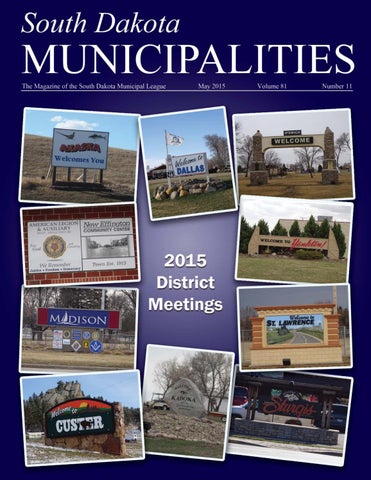
Official Monthly Publication
Member of National League of Cities
Contents Features Human Resource School . . . . . . . . . . . . . . . . . . . . . . .6
www.sdmunicipalleague.org
South Dakota MUNICIPALITIES Managing Editor: Yvonne A. Taylor
Editor: Carrie A. Harer
Finance Officer of the Year Nomination Form . . . . . .7 Finance Officers’ School Agenda . . . . . . . . . . . . . . .8-9 SDML and Riverside Technologies, Inc. Team Up for ConnectSD . . . . . . . . . . . . . . . . . . . . . .10 New After Hours Emergency Claims Reporting Availability for SDPAA Members . . . . . . . . . . . . . . .12
PRESIDENT Jeanne Duchscher Finance Officer, Parker
DISTRICT CHAIRS Dist. 1 - Mike Grosek Mayor, Webster
1st VICE PRESIDENT Meri Jo Anderson Finance Officer, New Underwood
Dist. 2 - Tim Reed Mayor, Brookings
Property Maintenance Code Enforcement and What It Means for Your Community . . . . . . . . . . . . .14
Dist. 3 - Amy Nelson City Manager, Yankton
Hot Springs Chamber, City Police Announce Youth Commendation Award Program . . . . . . . . . . .15
2nd VICE PRESIDENT Laurie Gill Mayor, Pierre TRUSTEES Greg Jamison Councilmember, Sioux Falls Sam Kooiker, Mayor, Rapid City Pauline Sumption Finance Officer, Rapid City Mike Wendland Mayor, Baltic Karl Alberts Finance Officer, Aberdeen PAST PRESIDENT Becky Brunsing Finance Officer, Wagner
Dist. 4 - Debbie Houseman Finance Officer, Lake Andes Dist. 5 - Renae Phinney President, Ree Heights Dist. 6 - Anita Lowary Finance Officer, Groton Dist. 7 - Arnold Schott Mayor, McLaughlin
Economic Development Awards . . . . . . . . . . . . . . . .13
Grants for Local Mosquito Control Programs . . . . . .16 Police Departments Receive Money . . . . . . . . . . . . .17 $83.2 Million for Environmental Projects . . . . . . . . .18 Interviewing Applicants: How to Avoid the Pitfalls . . .20 Top Ten Things to Cover When Documenting Performance and Discipline . . . . . . . .22 Supreme Court Ruling in Railroad 4-R Act Case . . .24
Dist. 8 - Harry Weller Mayor, Kadoka
Planning for Employee Turnover . . . . . . . . . . . . . . . .26
Dist. 9 - Gary Lipp Mayor, Custer
Are You Ready to Consider Cloud Computing to Reduce Your City’s IT Budget? . . . . . . . . . . . . . . .30
Dist. 10 - Fay Bueno Finance Officer, Sturgis
Any Device, Anytime, Anywhere . . . . . . . . . . . . . . .32
LEAGUE STAFF 1-800-658-3633 Fax: 605-224-8655 Yvonne Taylor Executive Director Sandi Larson Director of Risk Sharing Services Lori Martinec Director of Research and Training Jeff Mehlhaff Director of Municipal Electric Services Carrie Harer Director of Marketing & Communications Lori Butler Director of Finance Kristi Brakke Accounting Assistant Paula Lind Administrative Coordinator SD Public Assurance Alliance: Judith Payne Executive Director Kristina Peterson Director of Underwriting Ron Burmood Director of Member Services Paytra Nichols Assistant Underwriter Jerry Krambeck Member Services Representative Deb Corkill Executive Assistant
Can’t We All Just Get Along . . . . . . . . . . . . . . . . . . .34
Columns Director’s Notes . . . . . . . . . . . . . . . . . . . . . . . . . . . . . . .4 President’s Report . . . . . . . . . . . . . . . . . . . . . . . . . . . .5 Risk-Sharing News . . . . . . . . . . . . . . . . . . . . . . . . . .38 Washington Report: Representative Noem . . . . . . . .40
In Every Issue Community Calendar . . . . . . . . . . . . . . . . . . . . . . . . .44 Classifieds . . . . . . . . . . . . . . . . . . . . . . . . . . . . . . . . .46 Municipal Calendar . . . . . . . . . . . . . . . . . . . . . . . . . .49
SOUTH DAKOTA MUNICIPALITIES (ISSN 0300-6182, USPS 503-120) is the official publication of the South Dakota Municipal League, published monthly at 208 Island Drive, Ft. Pierre, South Dakota 57532, phone 605-224-8654. This institution is an equal opportunity provider, and employer. Periodical postage paid at Pierre, South Dakota and additional mailing offices. Non-member subscriptions are available for $30.00 annually. The opinions expressed herein are not necessarily those of the South Dakota Municipal League. Postmaster: Send address changes to SOUTH DAKOTA MUNICIPALITIES, 208 Island Drive, Ft. Pierre, South Dakota 57532.
MAY 2015
VOLUME 81, NUMBER 11
3
Director's Notes I’ve often joked that “we work in Pierre – we have very little contact with reality.” But District Meetings are our cure for that, and BOY, do you guys make reality look good! After more than 200 of these meetings, it still amazes me what a talented, dedicated, just genuinely good bunch of people city officials are.
Consider a recent question we put out, asking for some names of elected officials willing to work with the State on ambulance service issues. Instead of getting the one or two we expected, we have a long list of people who are on the city council, and also work as volunteer EMTs with their local ambulance service.
lurking under every city in South Dakota – original (ie, 100 year and older) mains, all the things that hide underground and work just fine – until they don’t. Then, how ya gonna fix it? We ran (again) into the “lawdy, lawdy, can’t raise a tax!” brigade during the recently ended legislative session. No one likes taxes – but you know what we like less? Backed up sewers, water outages, and potholes. And we have taxed our volunteers almost to the limit – not in money, but in their time, caring, and strength.
No one likes taxes – but you know what we like less? Backed up sewers, water outages, and potholes. When the next grass fire starts and someone calls 911, when the next water main breaks and cell phones start ringing, will the anti-tax guys answer?
When the next grass fire starts and someone calls 911, when the next water main breaks and cell phones start ringing, will the anti-tax guys answer? It is a privilege to work for you folks. Please remember we are always available at 1-800-658-3633 or yvonne@sdmunicipalleague.org. Yvonne Taylor Executive Director
During district meetings, we were warned that “we might have quite a few people missing tonight – there is a fire burning up north, and they are all volunteer firefighters.” During another meeting, cell phones began to ring during dinner at one table – water main break. These examples aren’t even your real jobs – they are what you do with your “spare time.” You are truly amazing. We worked a lot a few years back, getting our state-wide 911 system caught up with technology and working more efficiently – it might be the best system in the world – but “who ya gonna call?” We depend on our volunteers for ambulance and fire services, and look around – overall, they are getting older, getting tired, and for once in their lives, might actually like to have some spare time. We don’t seem to see the new generation of volunteers stepping up. We are going to need to address “Who ya gonna call?” We need to address water main breaks and sewer line problems. Not necessarily ‘who ya gonna call?’ but “How ya gonna fix it?” We have massive, expensive problems 4
SOUTH DAKOTA MUNICIPALITIES
President's Report Many thanks to all the communities that hosted SDML district meetings! It was an adventure across all corners of the state! I loved seeing different communities and the pride each city had in hosting the meetings. Thank you for your willingness to showcase your city with me! I am going to use this column this month to attempt to touch on a serious topic. And that is the financial wellbeing of your community. After visiting with many elected and appointed officials and the fact that there is always a turnover of finance officers and elected officials at this time of year; I think we need to remind ourselves of the responsibilities we have to assure the transparency of our finances. I have had conversations with Yvonne Taylor and Rod Fortin (SD Department of Legislative Audit) on how we, as the SDML, can help educate officials in the severity of this issue. A resounding common factor that I have seen is—if you do not understand the finances (monthly reports, computer software, etc) ASK for HELP. There are people (and agencies) available to answer your questions. Elected officials: Make sure you are receiving the proper monthly reports for your review. A cash report that is
reconciled to the bank balance. A list of claims for approval by the council— in order to pay bills. A recap of revenue and expenses should be given to you each month. Big city or small; we all follow the same guidelines/rules and regulations. Appointed officials: Finance officers can access the SDML List Serve for answers to all sorts of questions. Other finance officers are always willing to lend a hand. And of course, the SD Department of Legislative Audit is the resource available to you for accounting questions and problems. If it seems I have jumped on my soap box, it is because I want to have cities remember the challenges they face financially. We have a responsibility to our citizens to comply with procedures (legal and financial) that are essential for municipal government relations.
Mark your calendar!
We hope to discuss this more in depth at both the SD Finance Officers’ School in June and the SDML Conference in October. If you have any thoughts or comments on this topic; please feel free to contact me.
The SDML presents:
Until next month, remember: “Trust yourself. You know more than you think you do.” — Benjamin Spock
Budget Trainings for Finance Officers & Elected Officials July 15 – Ramkota, Rapid City July 16 – King’s Inn, Pierre July 22 – Ramkota, Aberdeen July 23 – Ramkota, Sioux Falls Visit www.sdmunicipalleague.org/sdmlevents for the agenda and registration.
MAY 2015
Jeanne Duchscher President
ARENS ENGINEERING municipal engineering water & wastewater engineering storm drainage - municipal streets Vernon Arens, PE 230 Capitol St. j Yankton, SD j 57078 605-665-2002 j Fax 605-260-2140 arenseng@iw.net
5
SD Governmental Human Resource School June 9-10, 2015 j Ramkota Hotel and Conference Center j Pierre, SD …of the 309 municipalities in South Dakota, less than 15 have full time professional Human Resource personnel. Most HR duties are added responsibilities for existing city staff. This training will help anyone with HR responsibilities become better informed in this field, learn who to call on when they need help and where to turn to find resources.
Preliminary Agenda Tuesday, June 9
5:30 p.m.
Social and Dinner at the American Legion
12:15 p.m. Registration
7:00 p.m.
Boat ride via Capital City Queen Sign up on-site at the Human Resource School Registration table. Seating is limited, first come, first served. The boat will leave from the dock at Fischers Lilly Park in Ft. Pierre for two-one hour boat rides at 7:00 p.m. and 8:00 p.m. Transportation to and from Fischers Lilly Park not provided.
1:00 p.m.
General Business Meeting
1:15 p.m.
Hot Topics in HR j Harassment j Family Medical Leave Act j Security j Payroll j National Labor Relations Board j Drug Testing, Alcohol, Tobacco & Vaccination Steve Bogue, Attorney, McGrath North Mullin & Kratz, PC LLO, Omaha, NE Speaker sponsored by SDPAA
Wednesday, June 10 7:30 a.m.
Continental Breakfast
8:00 a.m.
Affordable Care Act (ACA) Chad Weber, Partner, Eide Bailly LLP Speaker sponsored by SDPAA
2:45 p.m.
Break
3:15 p.m.
Hot Topics in HR cont’d
9:15 a.m.
Break
3:45 to 5:15 p.m.
Identity Theft and Local Scams Jody Swanson, Division of Consumer Protection, Attorney General’s Office
9:30 a.m.
Affordable Care Act (ACA) cont’d
10:30 to HR Brain Game! 11:30 a.m.
2015 Human Resource School Registration Form Representing __________________________________________________ Name
Title
(Please print or type the name and title as you want them to appear on your name badge)
_____________________________________________________________________________________ _____________________________________________________________________________________ Registration fee: $50.00 for affiliate members and $100.00 non-members. Accommodations: Be sure to mention you are with the SDML Human Resource Assoc. Make reservations by May 9 to guarantee the conference rate. Ramkota Hotel, 605-224-6877, $91.99 + tax. _______ person(s) @ $50.00 each = $__________
_______ person(s) @ $100.00 each = $_________
Return registration with payment by May 27, 2015 to: SD Governmental Human Resource Association *No refunds will be given after May 27, 2015 208 Island Drive Ft. Pierre, SD 57532 Office Use Only:
Date:________________
Check #:________________
Amount:________________
Finance Officer of the Year
2015 - 2016 South Dakota Governmental Finance Officers’ Association
2015 - 2016 "FINANCE OFFICER OF THE YEAR" Official Nomination Form All nominations must be submitted in writing by May 15, 2015. The Finance Officer of the Year award will be presented during the 2015 Finance Officers’ School held June 10-12 in Pierre.
Name of Nominee: _________________________________________________________________ Position: _________________________________________________________________________ Years of service to the municipality: ___________________________________________________ Contributions to the municipality as a Finance Officer: ____________________________________ _________________________________________________________________________________ _________________________________________________________________________________ _________________________________________________________________________________ Contributions to the community as a citizen: ____________________________________________ _________________________________________________________________________________ _________________________________________________________________________________ _________________________________________________________________________________ Significant contributions to any other organizations: ______________________________________ _________________________________________________________________________________ _________________________________________________________________________________ _________________________________________________________________________________ Personal accomplishments: __________________________________________________________ _________________________________________________________________________________ _________________________________________________________________________________ _________________________________________________________________________________ Other Comments: __________________________________________________________________ _________________________________________________________________________________ _________________________________________________________________________________ _________________________________________________________________________________ Submitted by: ________________________________________ DEADLINE: May 15, 2015 Nominations will be kept confidential. Use additional paper if necessary. Additional nomination letters are welcome.
Phone: ____________________
Please submit to: South Dakota Municipal League 208 Island Drive Ft. Pierre, SD 57532 Fax: 605-224-8655
SD Governmental Finance Officers’ School June 10, 11, & 12, 2015 j Ramkota Hotel and Conference Center j Pierre, SD Preliminary Agenda
Wednesday, June 10 10:30 a.m. – 12:30 p.m.
Banyon User Group – Lake Sharpe A & B Jeff Christensen, President, Banyon Data System, Inc. Utility Billing, Point of Sale, Fund Accounting, Payroll and New Products will be covered. Banyon will be available for individual Q&A following the User Group meeting until 3:00.
Door Prizes will be given away throughout the school – must be present to win. Noon – 4:00 p.m.
Registration – Conference Center Lobby
12:45 p.m.
WELCOME by Pierre Mayor Laurie Gill – Galleries B & C
1:00 – 1:30 p.m.
Business Meeting – Galleries B & C
1:30 – 2:00 p.m.
Public Library Survey & Discovering the ROI Value of Your Local Library – Galleries B & C Daria Bossman, State Librarian and Shawn Behrends, State Data Coordinator
2:00 – 2:45 p.m.
Legislative Update – Galleries B & C Yvonne Taylor, Executive Director, SD Municipal League
2:45 – 3:00 p.m.
Break – Conference Center Lobby
3:00 – 4:00 p.m.
Basic Accounting – Galleries B & C Rod Fortin, Director of Local Government Assistance, SD Department of Legislative Audit
2:45 – 5:15 p.m.
Golf Tournament – Dunes Golf Course 111 Fort Chateau Road, Fort Pierre (one mile North of Fort Pierre on Hwy 1806) $26/person, includes cart and 9 holes
5:30 – 7:30 p.m.
Welcome Reception and Dinner – outdoor space at RedRossa The City Slickers will be playing at 6:00 p.m. Hospitality room at Ramkota opens from 8:30 p.m. – 11:30 p.m.
Thursday, June 11 7:15 – 8:00 a.m.
Breakfast Buffet – Gallery A
8:15 – 9:45 a.m.
General Session – Galleries B & C Keynote Speaker: Juli Burney Multiple award winning teacher, humorist and author, Juli makes an amazing connection with her audiences. She is able to entertain with the ability of a headlining comedian while either motivating or training with ease as a nationally recognized speaker. Juli has been honored by her state as Artist of the Year because of her ability to help improve people’s lives through humor and effective use of communication tools.
9:45 – 10:00 a.m.
Break – Conference Center Lobby
10:00 – 10:55 a.m.
Concurrent Sessions (Pick one; these sessions will be repeated in the afternoon) j Utility Billing Panel – Galleries D & E Jennifer Mollman, Utility Billing Supervisor, City of Spearfish Meri Jo Anderson, Finance Officer, City of New Underwood Jane Kleinsasser, Accounting Manager, City of Huron j Federal Labor Standards Act (FLSA) – Galleries F & G James Marsh, Director, Division of Labor and Management, SD Department of Labor and Regulation j Elections: 1, 2, 3 – Amphitheater I Shantel Krebs, Secretary of State Kea Warne, Deputy Secretary of State
11:00 – 11:55 a.m.
Concurrent Sessions (Pick one; these sessions will be repeated in the afternoon) j The World of Liquor – Galleries D & E Marne Dooley, Revenue Section Coordinator, Property and Special Tax Division, SD Department of Revenue j IRS – Payroll Taxes, W-2s, 1099s, W-9s – Amphitheater I Jani Zweber, Accounting Services Manager, Ketel Thorstenson, LLP j Work Comp Coverage Basics – Galleries F & G Brad Wilson, Administrator, SDML Workers’ Compensation Fund
12:00 – 12:45 p.m.
Lunch Buffet – Gallery A
1:00 – 2:30 p.m.
General Session – Galleries B & C Keynote Speaker: Juli Burney Are you ready to laugh some more? Juli will wrap up her presentation.
2:30 – 2:45 p.m.
Break – Conference Center Lobby
2:45 – 3:40 p.m.
Concurrent Sessions (Pick one) j Utility Billing Panel – Galleries D & E
Jennifer Mollman, Utility Billing Supervisor, City of Spearfish Meri Jo Anderson, Finance Officer, City of New Underwood Jane Kleinsasser, Accounting Manager, City of Huron j Federal Labor Standards Act (FLSA) – Galleries F & G James Marsh, Director, Division of Labor and Management, SD Department of Labor and Regulation j IRS – Payroll Taxes, W-2s, 1099s, W-9s – Amphitheater I Jani Zweber, Accounting Services Manager, Ketel Thorstenson, LLP 3:45 – 4:40 p.m.
Concurrent Sessions (Pick one) j The World of Liquor – Galleries D & E Marne Dooley, Revenue Section Coordinator, Property and Special Tax Division, SD Department of Revenue j Elections: 1, 2, 3 – Amphitheater I Shantel Krebs, Secretary of State Kea Warne, Deputy Secretary of State j Work Comp Coverage Basics – Galleries F & G Brad Wilson, Administrator, SDML Workers’ Compensation Fund
6:00 p.m.
President’s Social – Casey Tibbs South Dakota Rodeo Center (210 Verendrye Dr., Ft. Pierre) Transportation will be provided. Business casual dress. Cash bar, no ATM onsite.
7:00 p.m.
Finance Officer of the Year Banquet – Casey Tibbs South Dakota Rodeo Center Speaker: Pastor Keith Bundy, Assistant Dean at DSU, Motivational Speaker Hospitality room opens after Banquet until 11:30 p.m.
Friday, June 12 Municipal Pride Day! Wear a shirt, hat or pin that promotes your city! 7:30 – 8:15 a.m.
Breakfast Buffet – Gallery A
8:15 a.m.
Last Minute Announcements – Galleries B & C
8:30 – 10:00 a.m.
City Policies – Galleries B & C Rod Fortin, Director of Local Government Assistance, SD Department of Legislative Audit Karl Alberts, Finance Officer, City of Aberdeen Doug Kirkus, Loss Control Contractor for the SDPAA and SDML Workers’ Compensation Fund
10:00 – 11:00 a.m.
Internal Controls and How to Prepare for an Audit – Galleries B & C Rod Fortin, Director of Local Government Assistance, SD Department of Legislative Audit
11:00 – Noon
Excise Tax and Sales Tax – Galleries B & C Alison Jares, Deputy Director, Business Tax Division, SD Department of Revenue
Registration form can be found online at www.sdmunicipalleague.org under SDML Events.
SDML and Riverside Technologies, Inc. Team Up for ConnectSD The South Dakota Municipal League (SDML) is pleased to announce a mutually beneficial partnership with Riverside Technologies, Inc. (RTI) for the benefit of the municipalities and partners of SDML. In a previous state sponsored and facilitated program called the South Dakota Broadband Initiative (SDBI), RTI was the primary equipment provider for the municipalities that received technical infrastructure improvements as a result of that project. In short, the equipment that is currently in municipal facilities across the state was provided by RTI. Examples of these include wired and wireless network equipment, servers, firewalls for edge security and end user devices such as computers, laptops and tablets. The SDBI project has now closed, so in the interest of sustainability of those technical improvements and maximizing potential, RTI would like to continue to offer the same products and services to municipalities and related organizations through a new project called ConnectSD. RTI has a long standing history with the public sector, and looks forward to delivering the same level of products and services to which they are accustomed through the ConnectSD project. Riverside Technologies, Inc. and the South Dakota Municipal League have teamed up to phase into this new program that will continue the deep pricing discounts and technical services for infrastructure improvements that were previously provided to South Dakota’s municipalities. Additionally, as a holistic approach, the previous municipal offerings will also be expanded to include technical consulting, network evaluations and infrastructure health assessments, ongoing support services, network monitoring, equipment provisions, best practices education and long term technical planning for SDML and its member municipalities.
school districts, higher education institutions, corporations, the State Government and municipalities. Some of RTI’s services include but are not limited to personalized solutions through embroidered bags, laser etching on laptops, and imaging or asset tags for deployment. They provide breakfix and warranty support and are authorized for warranty repairs for many solutions. Incorporated with their strong device solutions are incredible engineering and assessment offerings for wireless, storage, firewalls, networking and IT in general. Many customers employ RTI as a managed services provider or for network monitoring solutions. Regardless of your size or scenario RTI can assist you with solutions. Visit the ConnectSD website RTI values the opportunity to serve you. Visit the ConnectSD website either through visiting the SDML site, www.sdmunicipalleague.org, and looking under member services for ConnectSD or go directly to the link at www.riversidetechnologies.com/connectsd/cart. RTI looks forward to hearing from you soon to partner with you on solutions. They have resources spread across the state and always welcome your phone call or emails. Be sure to visit the RTI booth at the SDML’s Annual Conference in October too!
For more information, contact RTI today: 866-804-4388 or 866-812-5370 connectsd@riversidetechnologies.com www.RiversideTechnologies.com Passion | Creativity | Teamwork
About Riverside Technologies, Inc. RTI has been in existence since 1998 and has strong roots in South Dakota. They have worked with many of the 10
SOUTH DAKOTA MUNICIPALITIES
New After Hours Emergency Claims Reporting Availability for SDPAA Members By Judy Payne, Executive Director, SDPAA Wouldn’t it be nice if emergency situations that often lead to claims confined themselves to the 8am to 5pm, Monday through Friday workweek? Although major fires, floods, severe weather events, and serious accidents can happen anytime, it seems they often occur in the middle of the night or on weekends. To make sure the needs of our Members are consistently met, the SDPAA has established an after-hours emergency reporting telephone number. If an incident results in a fatality, serious bodily injury, or serious property damage, please call Claims Associates, Inc. immediately. During normal business hours call 888.613.7064. The after-hours emergency number is 888.430.2249. This number should be distributed to appropriate personnel within your entity. The emergency after-hours number will route you to an answering service who will relay information to a member of the Claims Associates staff. Claims Associates will immediately make contact with you to assess the situation and offer assistance. In some cases, such as large property losses, it may be necessary to start clean-up or pursue other mitigation measures. The situation may be such that investigation should begin immediately. Whatever the case, please make the call so Claims Associates can help you, which ultimately helps all of the Members of the SDPAA.
usually by contacting only Member personnel and, perhaps some third party witnesses. It is important for the Members to know that when these “high-risk situation” investigations are conducted, the Member involved is not “charged” with a claim or any claim adjustment or investigation expense, unless an actual claim results. Investigation of these situations is not taken into account in future underwriting or calculation of the Member’s contributions. In conclusion, our experience indicates that the earlier and faster the response to a serious claim situation, generally, the better the outcome. Likewise, early investigation into serious situations often places the Member and the Pool in the best possible position if a claim arises. And, in those situations if there is no claim, no one is any worse for the wear. As always, the SDPAA Team appreciates your support and looks forward to serving you. If you ever have questions or comments, please contact us at sdpaa@sdmunicipalleague.org or 800.658.3633.
We want to hear from you about serious situations, even if there is no immediate need for assistance or any “claim” being made. Events like serious car accidents, officerinvolved shootings, deaths or serious injuries occurring in jails, flooding from broken water mains, sewer backups, or brewing voter rights disputes often lead to claims. A good rule of thumb is: If the event is showing up in newspaper articles and local television newscasts, chances are claims are going to result. When these sorts of events occur, you might hear from us before any sort of claim or notice of a claim is made. In our experience, the best possible time to investigate a serious situation and collect any important evidence is as close to the time of the event as possible. It might be months or even years before a claim is asserted. In the meantime, key personnel might have retired, taken other jobs, or even passed away. Important documents or other physical evidence can be lost. And even under the best of circumstances, memories fade and first impressions become jumbled. If a claim does arise, we are in the best position to deal with it because we spent the time to do the investigation when the situation was fresh. For these reasons, the SDPAA wants Claims Associates to investigate, 12
SOUTH DAKOTA MUNICIPALITIES
Gov. Daugaard Announces Economic Development Awards Gov. Dennis Daugaard recognized two individuals and a community for achievements and contributions to economic development in South Dakota at the annual Governor’s Economic Development Conference on April 15 in Sioux Falls. Among the award recipients were Jim Doolittle of Belle Fourche, Dr. Ron Utecht of Sioux Falls and the community of Gregory.
the last 10 years developing technology for the medical industry,” said Gov. Daugaard. “He is one of the success stories of our statewide effort to increase research and technology in South Dakota. For his giant vision and innovative spirit, it is a great honor to award Dr. Utecht with the 2015 South Dakota Entrepreneur of the Year award.”
Created several years ago, the Excellence in Economic Development Award honors the dedication and commitment of eight South Dakotans, including Gov. George S. Mickelson, who lost their lives when returning home from an economic development event in Cincinnati, Ohio, in 1993. The award is presented annually at the conference. Doolittle was honored with this year’s award.
Finally, the governor recognized Gregory as the Community of the Year.
“Jim Doolittle has been active in economic development since the 1980s, bringing together economic development and education, creating a regional approach to economic development, and founding the Black Hills Business Community yearly banquet,” said Gov. Daugaard at this evening’s banquet. “Jim exemplifies the spirit of the great men who lost their lives. He is one of the most humble individuals I know and I’m pleased to honor him with this year’s Excellence in Economic Development Award.”
“In the last year alone, Gregory opened six new businesses, creating 20 local jobs,” Gov. Daugaard said. “They also saw a $32,000 boost in sales tax revenue, which is impressive for a town of only 1,200. Gregory also has purchased land for future development and created a workforce-training program to help current businesses. It is my pleasure to honor Gregory as this year’s South Dakota Community of the Year.”
Next, Gov. Daugaard presented the Entrepreneur of the Year Award, created in 2013, which recognizes a visionary who takes big risks to accomplish big dreams. A former professor of chemistry and biochemistry at South Dakota State University, Dr. Ron Utecht was named the 2015 South Dakota Entrepreneur of the Year. “Dr. Utecht won the first Giant Vision Business plan competition and has had a long and winding path over
MAY 2015
Gregory accepting the Community of the Year award.
13
Property Maintenance Code Enforcement and What It Means for Your Community By Jared Hybertson, Economic Development Coordinator, Centerville, SD
should be while working to keep aging buildings, homes and properties from becoming “eyesores.”
Has your community been discussing the topic of Code Enforcement, specifically looking at your ordinances that address nuisance properties? Ordinances such as these are in place to prevent and eliminate blight in your community. This topic can make people uneasy and can be controversial at times. For council members, city employees and the police force it’s no easy task when in a small community everyone is someone’s relation, neighbor, friend, or co-worker. Whether the topic makes you uncomfortable or not the fact remains that there is a need to address this topic in your community and at least consider doing more to tackle these issues.
Why control nuisances? Why should it be in your community’s best interest to address current offences and discourage future offenders? Controlling nuisances keeps communities safe, livable, and economically viable. In most cases this comes from how citizens perceive their community and how they want others to perceive their community. It is the duty of a City Government to protect its residents from environmental harms, while striving to enhance quality of life in their community. Keeping up the overall look and feel of a community gives residents a sense of place and community pride. The accumulation of junk, inoperable vehicles, overgrown vegetation, litter and other visual clutter are seen as a deterioration of the overall quality of life in a community.
So what technically is a nuisance property? The Municipal Research and Service Center (MRSC), defines a nuisance property as “an unreasonable or unlawful use of property that results in material annoyance, inconvenience, discomfort, or injury to another person or to the public. The unlawful use may involve doing something (example: piling garbage on residential property) or failing to do something (example: cutting or removing noxious weeds from residential property). Common nuisances include the accumulation of junk, animals, noise, dangerous buildings, sewage and unsanitary conditions, and encroachments on the public right-of-way that interfere with pedestrian passage.” These would also include dangerous or substandard buildings, open excavations, unpermitted businesses, zoning violations, construction or grading without permits, inoperative or abandoned vehicles, and excessive outside storage. In many communities the existence of problem areas like dilapidated buildings, untidy properties, and property overgrowth are often also associated with areas of crime and deteriorate property values for neighbors. What is Code Enforcement and how would it address these property issues? The South Dakota Association of Code Enforcement explains Code Enforcements mission is to “Identify and facilitate the abatement of physical conditions and characteristics of substandard and unsanitary properties. This applies to all structures and lands with conditions or characteristics that are such as to be detrimental to or jeopardize the health, safety and welfare of their occupants and/or the public. The existence of such conditions and characteristics threaten the physical, social and economic stability of the community as a whole.” Code Enforcement plays a major role in keeping property values where they 14
So how can you better address these types of issues facing your community? If your community has been researching Code Enforcement as an option, the idea of bringing on a part time Code Enforcement officer and adopting the International Property Maintenance Code could be brought in front of your City Council. Code Enforcement would go a long way in identifying and addressing these issues and assisting with these concerns. A Code Enforcement officer would work side by side with the City to meet the needs of the community by educating the public on ordinances, encouraging voluntary compliance, coordinating community cleanups, and public service projects, and pursuing legal remedies when necessary. The City is also available to help low income residents and the elderly find assistance programs if aid is needed. From an economic development stand point Code Enforcement is vital to the continued success and growth of your city. The enforcement of nuisance codes partnered with campaigns for community cleanups and beautification projects are all part of ensuring a safe, healthy, and desirable community. Coupled together these will all help in efforts to attract new residents and businesses. A community’s appearance and how it is perceived plays a large role in these decisions. Every community faces these similar struggles and challenges. For your community, Code Enforcement will go a long way to boost economic development and the overall appeal of your community.
SOUTH DAKOTA MUNICIPALITIES
Hot Springs Chamber, City Police Announce Youth Commendation Award Program Awards Provide Recognition for Good Behavior from Young Members of the Community What would you think if you were stopped by a police officer and were issued a “ticket” that gave you money to spend within your community? The City of Hot Springs Police Department in partnership with the Hot Springs Chamber of Commerce are doing just that! Titled the ‘Youth Commendation Award Program,’ City of Hot Springs Police officers during their normal patrol duties will be recognizing area youth (those 18 and under) for their good behavior within the community. Whether using a designated crosswalk, wearing a helmet while bicycling, picking up litter, or any other behavior that enhances the Hot Springs community, the Hot Springs police officers will seek to reward and recognize area youth by offering them both a certificate and $5 of Chamber Bucks, redeemable at any Hot Springs business. “The motto, ‘To Protect and Serve’ has been the creed of many law enforcement agencies across the nation, in fact
Chamber of Commerce Director Scott Haden (right) presents funding for the Youth Commendation awards to Chief of Police Mike Close.
it is a part of the City of Hot Springs Police Department’s mission statement,” said Chief of Police Mike Close. “All too often law enforcement is thought of as a reactionary force, but to be truly effective, we must also be proactive in ensuring safety, security and well-being for all. We see this program as the service component of the call to protect and serve, where we are working proactively to build our community by reaching its young members in a positive way.” “Think of it as a ‘positivity ticket,’” said Chamber Director Scott Haden. “This is an opportunity to reward the young members of our community for making great decisions that directly improve the well-being of our town.” The Hot Springs Chamber of Commerce has committed up to five, $5 Chamber Bucks awards to be given each month for up to six months. Officers will inform youth demonstrating positive behavior that they are eligible for the award during the officer’s normal patrol duties. Once notified, the award recipient can then go to the Hot Springs Police Department to collect a certificate along with the $5 in Chamber Bucks. Alternatively, community members are encouraged to write nominating letters to the Chief of Police for young members of the community they feel are deserving of the Youth Commendation Award. To learn more about the Youth Commendation Award please contact Mike Close, Chief of Police, at 605-7455200 or email pdchief@hs-sd.org. MAY 2015
15
Grant Funds Available for Local Mosquito Control Programs The Department of Health announced that grant funds are again available to help South Dakota cities, counties and tribes to help control mosquitoes and prevent West Nile virus (WNV). “Active mosquito control programs at the local level are a critical component of reducing the risk of West Nile,” said Secretary of Health Kim Malsam-Rysdon. “We’re pleased to have funding to help support those local efforts again this year.” Malsam-Rysdon said the department has a total of $500,000 available to support local mosquito control programs. Individual grant awards could range from $500 to $30,000 and will be based on the population of the applying jurisdiction and its number of human WNV cases through 2014.
support, including direct grant funding as well as mosquito control chemicals. Since the state’s first human case in 2002, South Dakota has reported 2,168 cases, including 677 hospitalizations and 32 deaths. Every county has reported cases. Grant applications are available on the department’s WNV website, westnile.sd.gov. The deadline for submitting applications is June 8. Grant awards will be issued after July 1. Direct questions to Susan Gannon at 605-773-3737 or susan.gannon@state.sd.us. Completed applications can be sent to Meghan Wittmis at meghan.wittmis@state.sd.us; fax, 605-773-5683; or mail, South Dakota Department of Health, 600 E. Capitol, Pierre, SD 57501-2536.
Since WNV emerged in South Dakota, the department has provided local control programs with $5.1 million in
16
SOUTH DAKOTA MUNICIPALITIES
Police Departments Receive Money Attorney General Marty Jackley announced that the following Police Departments have been awarded funds. The money was awarded out of the Drug Control Fund. The awards will assist local law enforcement in drug control and apprehension purposes. “The Drug Control Fund allows law enforcement to combat controlled substance abuse by funding local programs with monies seized from drug arrests,” said Jackley. “These funds will assist the Police Departments to better protect their communities.” Aberdeen Police Department and Brown County Sheriff’s Office Receive Money for Canine Unit The Aberdeen Police and Brown County Sheriff’s Office have been awarded $17,000 to be used for start-up costs for a canine unit to be used in drug investigations. “The Aberdeen Police Department wishes to express its sincere appreciation to Attorney General Marty Jackley and his office for awarding us financial assistance to obtain a canine unit for drug investigations. Canines are instrumental in the detection and interdiction of drugs, and we are confident that our upcoming availability to one will greatly enhance our efforts in these areas. We look forward
MAY 2015
to deploying this powerful asset in our future drug investigations,” said Chief Dave McNeil Flandreau Police Department Receives Money for Service Dog and Equipment The Flandreau Police Department has been awarded $10,000 for a police service dog, kennel and equipment to be used in drug investigations. “We are very thankful for the generosity of the Attorney General’s Office in assisting in the purchase of our new detector canine as combatting drug abuse is a principal priority of the Flandreau Police Department,” said Sergeant Anthony Schrad. Groton Police Receive Money for Taser The Groton Police Department has been awarded $1,262.38 for a taser to be used in drug investigations. Mobridge Police Department Receives Money for In-Car Video Recording System The Mobridge Police Department has been awarded $4,982 for an in-car video recording system to be used in drug investigations.
17
Gov. Daugaard Announces Nearly $83.2 Million for Environmental Projects Gov. Dennis Daugaard says the state Board of Water and Natural Resources has approved nearly $83.2 million for water and waste projects. The $83,176,482 total includes $14.1 million in grants and $69.1 million in low-interest loans, with $2.9 million of the loan total in principal forgiveness. “I am pleased to announce that this money is available to assist local communities,” said Gov. Daugaard. “Grant and loan awards will result in better drinking water, improved wastewater treatment and enhanced protection of the environment.” The grants and loans awarded by the board are administered through the Department of Environment and Natural Resources (DENR). Grants were awarded to: j DENR, $350,000 grant for waste tire and solid waste cleanup program j SECOG, $500,000 grant for regional solid waste and recycling loan program
Grant and loan packages were awarded to: j Big Sioux Community Water, $3.014 million for a project to deliver drinking water to Madison that includes a $2 million grant and $1.014 million loan j Clark, $5.485 million total for a wastewater treatment facility that includes $3 million grant and $2.485 million loan j Hosmer, $1.268 million total for wastewater system improvements that includes a $300,000 grant and $968,000 loan, with $714,400 in principal forgiveness j Humboldt, $2.086 million total for sanitary sewer collection and treatment that includes a $1,668,800 grant and $417,200 loan j Ipswich, $3.951 million total for wastewater system improvements that includes a $2 million grant and $1.951 million loan j Lennox, $2.433 million total for Main Street storm sewer and sanitary sewer improvements that includes a $560,000 grant and $1.873 million loan j Lesterville, $53,000 total for water meter replacement that includes a $26,500 grant and $26,500 loan
Loans were awarded to: j Canton, $1.550 million loan for drinking water source improvements j Howard, $1.764 million loan for lagoon expansion project j Kennebec, $1.16 million loan for wastewater system improvements j Northville, $140,000 loan for storm sewer improvements j Sioux Falls, $31.45 million total for two loans that provide $11.4 million for a Brandon road pump station force main, $18.53 million for outfall sewer replacement and $1.52 million for nonpoint source improvements in the Big Sioux River basin Loans with principal forgiveness were awarded to: j Brandon, $15.425 million total includes a $3 million loan for sanitary sewer improvements and a $12.425 million loan for drinking water system improvements, with $500,000 in principal forgiveness j Buffalo, $1.695 million for drinking water system improvements, with $600,000 in principal forgiveness j Tyndall, $1.57 million loan for drinking water distribution and storage upgrades, with $200,000 in principal forgiveness j Woodland Hills, $481,000 loan for drinking water distribution system improvements, with $384,800 in principal forgiveness 18
SOUTH DAKOTA MUNICIPALITIES
j
j j
j
Minnehaha Community Water Corporation, $1.8 million total for a systems improvement to deliver water to Big Sioux Community Water that includes a $900,000 grant and $900,000 loan Sioux Rural Water System, $4.515 million for water system improvements and to add new customers that includes a $2 million grant and $2.515 million loan Waubay, $1.78 million total for wastewater treatment facility improvements that includes a $700,000 grant and a $1.08 million loan, with $500,000 in principal forgiveness Wessington Springs, $702,000 total for Main Street infrastructure improvements that includes a $50,000 grant and $393,000 loan for sanitary sewer lines and a $50,000 grant and $209,000 loan for water mains
The grants, loans and principal forgiveness were awarded from DENR’s Consolidated Water Facilities Construction Program, Drinking Water State Revolving Fund Program, Clean Water State Revolving Fund Program and Solid Waste Management Program. The Consolidated Water Facilities Construction Program, funded in part by revenues from the sale of lotto tickets, provides grants and loans for water, wastewater and watershed projects. The Solid Waste Management Program provides grants and loans for solid waste disposal, recycling and waste tire projects. The Legislature annually appropriates dedicated water and waste funding for the Consolidated and Solid Waste programs through the Governor’s Omnibus Water Funding Bill. The Drinking Water State Revolving Fund Program provides low-interest loans for public drinking water system projects. The Clean Water State Revolving Fund Program provides low-interest loans for wastewater, storm water and nonpoint source projects. Principal forgiveness is a subsidy option that results in a reduced loan repayment amount for the borrower.
MAY 2015
DENR Unveils Interactive Database Maps At the Department of Environment and Natural Resources (DENR) Environmental and Ground Water Quality Conference, DENR demonstrated four new interactive database GIS maps. Searchable maps have been added to DENR’s GIS Interactive Map Dashboard, located at http://arcgis.sd.gov/ server/denr/gallery/default.html. The maps provide data for more than 13,250 spill sites, about 5,000 closed and active regulated storage tanks, more than 150 locations to take recyclable materials and 97,620 filings for water right dry draw location notices. These four interactive maps are in addition to the department’s interactive oil and gas map and construction aggregate map that have been available online. The oil and gas map opens 1,900 files for oil and gas holes and geologic logs from 96,595 other holes with a simple mouse click. The construction aggregate map shows the location of 4,651 active and closed construction aggregate mines across the state. “As part of DENR’s continuing efforts to implement Gov. Daugaard’s priority of making state government more open by expanding e-government, these interactive maps provide information from four more huge databases that can be searched online by the public 24 hours a day, seven days a week,” said DENR Secretary Steve Pirner. The interactive maps can be accessed from the department’s homepage at http://denr.sd.gov under “OneStop Shops” in the upper left-hand corner.
19
Interviewing Applicants: How to Avoid the Pitfalls By Abbey Moland, Attorney, McGrath North Employee interviews can provide a valuable means for employers to learn about a prospective employee, but the process can also be fraught with legal minefields. For example, consider a lawsuit that was filed in federal court against Wal-Mart Stores. In that case, the interviewer asked the applicant “What current or past medical problems might limit your ability to do the job?” Although not apparent to the interviewer at that time, the applicant’s right arm below his elbow had been amputated and he had been fitted with a cosmetic prosthetic device. The applicant was not offered the job and he filed suit under the Americans with Disabilities Act. The jury awarded the Plaintiff $157,500 because the Wal-Mart interviewer asked an illegal question. This award included $100,000 in punitive damages for the unlawful inquiry, $50,000 in punitive damages for discriminatory failure to hire, and $7,500 in compensatory damages. Most employers already know that questions concerning an interviewee’s race, color, creed, religion, national origin, ancestry, sex, union membership, sexual orientation, marital status, disability or age are unlawful and off limits during the interview process. The exception to this rule is where the attribute is central to the job. For example, you
20
may ask a candidate about their religion if you are a religious organization and the job requires the teaching of the principles of your particular religion. While avoiding unlawful subjects seems easy enough, it’s not always obvious what questions might be construed as inappropriate or elicit information relating to an applicant’s protected status that may subject an employer to liability. For example, the following questions or similar questions (or observations), while seemingly benign, are improper and tend to elicit information that the interviewer is not entitled to: j
j
j
What year did you graduate from high school? (This is an improper request for age-related information. If necessary, you may confirm that the individual is over 18, but the age-related inquiries must end there.); Are you a U.S. citizen? (Questions relating to citizenship are prohibited unless the position specifically requires one to be a U.S. citizen and the job posting states as such.); Do you have children? Can you get a babysitter on short notice for overtime or travel? (Stay away from questions targeting family or marital status-related information and may be construed as gender discrimination.);
SOUTH DAKOTA MUNICIPALITIES
j
With respect to individuals with disabilities or medical conditions, an employer should not ask questions relating to the employee’s medical status until after a conditional job offer is made. An employment offer to an individual with a medical condition, for example, can be withdrawn if it becomes clear that the individual cannot perform the essential functions of the job, with or without an accommodation, or the individual would pose a direct threat (a significant risk of substantial harm to themselves or others in the workplace).
1. Adopt an Equal Employment Opportunity/Harassment Policy. 2. Reserve the right to evaluate and confirm all information supplied by the applicant and condition employment upon truthful information supplied by the applicant. 3. Provide applicants with notice of their at-will employment status and the Company’s policies regarding working hours, overtime, drugs and alcohol, unlawful solicitation and other essential policies. 4. Establish written job descriptions setting forth the qualifications for all positions including the physical requirements for the job. 5. Only ask standardized, job-related questions. Stay away from topics that are not relevant to the job or the candidate’s qualifications. 6. Ensure that interviewers are consistent in their questioning of candidates. Train your interviewers as to what questions may lawfully be asked during the hiring process and how to redirect the conversation when an applicant volunteers “off limits” information. 7. Finally, have an experienced labor/employment lawyer review your hiring materials and employment policies.
In order to avoid potential pitfalls that can expose a company to liability, employers should also take a strategic and preventative approach to minimize the risk posed by the recruitment process and hiring decisions, including:
Our Firm’s employment lawyers can “audit” your Company’s hiring practices and procedures to insure they are in compliance with the law and legitimate inquiries are made to choose the best candidate for the position.
j j
j
Have you ever been arrested? (Questions about arrests and convictions that are NOT substantially related to the particular job are off-limits.); Is this your maiden name? (This sort of request is improper as it seeks marital status information.); How much longer do you plan to work before you retire? (Again, this request would tend to elicit age-related information and could communicate a preference for younger workers.); Do you have any impairments that may affect your performance in the position? (This is an improper request for disability-related information.)
Abbey Moland is an attorney at McGrath North. She can be reached at amoland@mcgrathnorth.com or 402-341-3070.
MAY 2015
21
Top Ten Things to Cover When Documenting Performance and Discipline By Aaron Clark, Attorney, McGrath North When employment claims and lawsuits are filed against employers, corrective actions and discipline records become key pieces of evidence. It goes without saying that a supervisor will have a difficult time convincing a jury that an employee deserved to be terminated if the underlying conduct is not properly documented. Judges and juries generally distrust employers who fire their employees without warning or without written proof that the employee was treated fairly under the circumstances. Performance and discipline documentation should notify and educate the employee regarding the employer’s expectations. When drafting these documents, supervisors and HR managers need to consider a secondary audience. This audience consists of lawyers, judges, juries and administrative agencies who may later be called upon to evaluate the fairness of the employer’s actions. Adopting good documentation practices will not necessarily prevent a lawsuit from being filed; however, it will put the
22
employer in the best possible position to defend the claim. Here are the top 10 things that a supervisor or HR manager should try to document when addressing job performance and discipline issues in the workplace. 1. Identify the standard or rule violated and state why the rule exists and how it was communicated to the employee. For example, a discipline notice might state “You have failed to wear your personal protective equipment which is designed to protect you from serious injury. You have been instructed multiple times regarding this requirement which is spelled out in the Company’s safety policy and reviewed during safety training.” 2. If applicable, explain how the employee’s conduct negatively impacts the employer. Suppose an employee fails to timely contact the employer to report an absence, the discipline notice might advise that “your failure to properly notify the Company regarding your absences places a burden on your supervisor and your fellow coworkers who are required to cover your work.”
SOUTH DAKOTA MUNICIPALITIES
3. Describe the facts and events supporting the violation of Company policy. You should summarize the relevant facts including any findings from your investigation regarding the employee’s conduct. 4. Identify any previous counseling or discipline given. In the notice, you should specifically identify the date and nature of any prior counseling or discipline issued to the employee. You can also attach this documentation as part of the write-up. 5. Document the employee’s response to the issue. If the employee acknowledges that he or she violated Company policy, you should record this fact in the discipline notice. 6. State your future expectations and counsel the employee on how to correct the problem. For example, if an employee had a verbal confrontation with a coworker, the employee might be instructed to treat coworkers in a professional and courteous manner and contact a supervisor before confronting another coworker. 7. Clearly state the consequences for additional violations. If the worker commits a serious infraction, the notice may state that “additional violations of this policy will result in your immediate termination from employment.”
MAY 2015
8. If applicable, document any assistance offered or provided by the Company to correct the problem. For example, if the employee committed a safety infraction, the employer may instruct the employee to attend additional safety training to ensure that he or she understands the Company’s expectations. 9. The notice should be dated and the author identified in the document. 10. The notice should also be presented and signed by the employee. If the employee refuses to sign, the employer should note the date and time the notice was presented and the fact that the employee refused to sign. Bottom Line: Performance and discipline documentation should demonstrate that the employee was treated fairly by the Company. An employee should never be surprised when he or she reaches the final step in the discipline process resulting in termination. Every performance record or document should be created with an understanding that it will be discoverable if a lawsuit is filed. Aaron Clark is an attorney at McGrath North. He can be reached at aclark@mcgrathnorth.com or 402-341-3070.
23
Supreme Court Ruling in Railroad 4-R Act Case Mixed for State and Local Government By Lisa Soronen, State & Local Legal Center In Alabama Department of Revenue v. CSX Transportation the Supreme Court held 7-2 that railroads can be compared to their competitors when determining whether a tax is discriminatory in violation of the Railroad Revitalization and Regulatory Reform Act (4-R Act). Different taxes paid by railroads and their competitors must be compared with determining whether a tax railroads pay is discriminatory. The State and Local Legal Center (SLLC) filed an amicus brief in this case disagreeing with the Court’s first holding and agreeing with its second holding. The 4-R Act prohibits state and local governments from imposing taxes that discriminate against rail carriers (railroads). Railroads in Alabama pay a four percent sales tax on diesel fuel as do other commercial and industrial purchasers. Motor carriers (trucks) pay an excise tax of 19cents per gallon and no sales tax. Water carriers pay no sales or excise tax on diesel fuel.
24
CSX sued Alabama alleging that it violated the 4-R Act by requiring railroads to pay a sales tax on diesel fuel and exempting its competitors. Since CSX filed its complaint, railroads paid less in sales tax than trucks paid in excise tax. The lower court ruled in favor CSX comparing railroads to their competitors only and refusing to consider the excise tax paid by trucks. According to the Court, the comparison class depends on the theory of discrimination alleged. Here, CSX argued that a tax disadvantaged it compared to its competitors so competitors are the comparison class. But the comparison class also must be “similar situated” to the railroad. Competitors could be a “similarly situated” class “since discrimination in favor of that class most obviously frustrates the purpose of the 4-R Act,” including restoring financial stability to railroads and fostering competition between railroads and other modes of transportation. The Court also concluded “[t]here is simply no discrimination when there are roughly comparable taxes.” So the lower court must compare the sales tax railroads pay and the
SOUTH DAKOTA MUNICIPALITIES
excise tax trucks pay even if comparing different taxes is difficult. Finally, the Court instructed the lower court to examine the justifications Alabama offered for why water carriers don’t pay any tax on diesel fuel when determining if railroads have been discriminated against. The SLLC brief argued that given state’s traditional power to tax the Court should interpret 4-R narrowly by comparing railroads to all commercial and industrial taxpayers, ignoring the labels of sales and excise tax and comparing total taxes paid, and taking into account relevant differences between railroads and their competitors. Forty-two states exempt trucks from sales tax on diesel fuel. While a ruling that the proper comparison class in this case is all commercial and industrial taxpayers would have been even better, the Court’s ruling that lower courts must look at total taxes paid, and justifications for why particular competitors don’t pay particular taxes, will mean that 4-R Act discrimination cases may be less likely to succeed. Some local governments in Alabama add additional sales tax to diesel fuel which CSX has also challenged. All of the Big Seven joined the SLLC brief along with SLLC associate members the International Municipal Lawyers Association and the Government Finance Officers Association. Sarah Shalf of the Emory Law School Supreme Court Advocacy Project wrote the SLLC brief.
Submit Nominations for Transportation Hall of Honor The South Dakota Department of Transportation is now accepting nominations for consideration of persons to be inducted into the South Dakota Transportation Hall of Honor. Darin Bergquist, Department Secretary and Hall of Honor Committee Chairman, says the committee is looking for people who have made a lasting or valuable contribution to the state’s air, highway or rail transportation. Anyone can to submit a nomination. The nomination form can be downloaded at www.sddot.com or by contacting Patricia Saukel at 605.773.3265 or Patricia.Saukel@state.sd.us. The deadline is Friday, June 5, 2015.
MAY 2015
25
Planning for Employee Turnover By Chester Moyer and Jeff Winter We see frequent reports about the wave of retirements that looms over the public sector, which would seem to indicate some urgency for succession planning – but solid planning for employee departures isn’t just about retirement. Most governments should take a look at how they’ve prepared for both the upcoming years of retirements, but also staff losses in general, which can happen at any time.
other anticipated departures can be shaded in green; areas of moderate concern, yellow; and areas where there is a worry over significant departures in the next five years, red. This visual aid will help the jurisdiction focus on the areas that need the most attention.
The government’s key executives as well as members of its oversight board will have to be involved in the analysis to properly address the impact departures are likely to have. Individual managers will be able to determine how Planning for the Future losing a given employee will affect the department, taking A strength of many governments is that they plan for the into account the talent, expertise, and knowledge that will future. Whether by specific legislative code or by more still be available. Management should also be able to help informal coordination, most jurisdictions put forth a determine whether there is already a viable candidate in substantial long-term planning place to replace an employee effort in ensuring that the leaving a key position, or if the Making time to develop a strategy community has ample social and jurisdiction will need to look for cultural opportunities, for instance, outside talent. They will also be for addressing employee age or that land use meets government aware of any anticipated changes demographics is about more than just objectives. Many governments in the amount or type of work convenience; it is also about having a have entire departments dedicated within their departments, along sound internal control environment. to this type of planning, which with resource allocations throughout focuses outward, on the future of the year. the region. Involving the governance board in the discussion makes Governments need to make a similar level of commitment succession planning more transparent. It also helps to look inward and consider their personnel infrastructure. managers understand their roles in handling the Jurisdictions need to make time to develop a strategy for changeovers (e.g., approvals of resource allocation or addressing employee age demographics, just like other organizational chart changes). Waiting until an employee strategic planning they undertake. This process is about leaves to address these issues creates a hurried process that more than just convenience; it is also about having a sound could lead to problems. internal control environment. Organizational Reporting and Job Redesign Anything that could potentially disrupt the jurisdiction’s Jurisdictions that know where to expect significant ability to achieve its objectives is something that should be retirements can use this information to reconsider their planned for, and that includes making sure the organization reporting structures. Effective analysis requires candid has an adequate workforce. By projecting the impact of discussion among decision makers, and participants might each departure, governments can gain a better be called on to imagine transitions for themselves. A understanding of its significance. The organization needs discussion about letting go of one’s own responsibilities is to have contingency plans that are clearly defined and likely to feel awkward, but the organization is best served understood by the parties who might be affected, and the by being open to change. For instance, it might make sense plans should address both short- and long-term needs. to eliminate reporting layers, or to rearrange reporting and oversight responsibilities. Identify Potential Skill Shortages To understand the potential impact of turnover, a Or consider adding responsibilities to create a new government should map out all the key members of its position for a talented existing employee, allowing a departments. This exercise provides the jurisdiction with jurisdiction to increase that person’s salary despite a pay an opportunity to assess the impact the departure of these freeze and retain that worker. This is an example of job employees would have on its operations, productivity, redesign, which can also be an effective cost-cutting communications, and culture. Management can use this measure. Increasing one person’s salary creates a smaller organizational chart to identify potential skill shortages. payroll expense than hiring an additional person. Other Units where there are no significant pending retirements or opportunities for job redesign often begin by identifying a 26
SOUTH DAKOTA MUNICIPALITIES
desired output (e.g., paying invoices) and looking for technology that can accomplish that process. Sometimes redesigning a specific job to fit a current employee is not the best solution, and in these cases, organizations might consider outsourcing the function altogether. Many functions are outsourced to private contractors, including: j Human resources, including screening for hiring, payroll, benefits, and health and wellness programs. j Aspects of accounting and financial reporting. j Internal auditing. j Significant portions of information technology and data warehousing. j Litigation support. j Public works. j Parts of parks and recreation programs, especially golf courses and recreation center management. Employee Development Psychologist Frederick Herzberg’s motivation-hygiene theory is often cited in discussions of employee engagement. In his research, Herzberg found that three of the most important motivators for employees are challenging work, responsibility, and recognition. A positive result of turnover in the senior ranks is the
MAY 2015
opportunity it creates for younger employees to fill those positions. Employees who are driven to succeed in an organization are demoralized when there is limited or no upward potential. When employees leave, the resulting transitions can create opportunities to provide employees with challenging work and additional responsibilities. Some ideas for doing so include the following: j Form a focus group to help recruit job candidates via social media. j Develop a 3- to 5-year mentorship and development plan for a younger worker to take over his or her boss’s job. The plan should include items such as going to professional meetings, attending national conferences, meeting contacts, working with the auditing firm, and so on. j Include the employee in HR interviews and checking of references. j Foster direct contact with key governance leaders. j Give him or her full responsibility for major projects such as finding an IT firm, selecting a health-care provider, hiring an audit firm, developing a banking relationship, staffing the finance committee, or presenting the annual budget to the City Council.
27
refocusing on the government’s internal needs by ensuring that Involving the governance board in the their unique talents are transferred discussion makes succession appropriately is right in line of the planning more transparent. It also outward focus associated with the helps managers understand their highest levels of leadership. Talking candidly about age Employee development also roles in handling the changeovers. demographics is often threatening requires decision makers to to more experienced workers, and understand the leadership if it is done carelessly, soon-to-be characteristics valued by the retirees will not fully engage in the process of addressing jurisdiction. Organizations generally have a vested interest succession and reassignment of job responsibilities. But if in promoting the employees who have demonstrated those it is done well, drawing on tenants of civil service, the desired characteristics over a number of years and in process can energize experienced workers and help them challenging circumstances. Promoting employees who retire feeling that they’ve left a positive legacy. haven’t proven they’re a good fit (based on traits such as going to the same graduate school, liking the person, Experienced employees can identify their unique talents having a lot in common, and so on) can lead to real through a combination of honest self-assessment and problems down the line. Likewise, having to hire from discussions with others. Do they regularly supervise large, outside the organization because of insufficient internal complex projects? Are they responsible for identifying talent can be disruptive, especially if the new hire doesn’t appropriate vendors, understanding subtle differentiators? mesh well culturally. Are they responsible for evaluating the quality of a construction project? Once these talents are identified, a Retirees: Leaving a Legacy plan should be developed to transfer the employee’s Governmental employees are civil servants – their careers knowledge and performance expectations to others. have been focused on serving others. In this spirit, Being identified as a high-potential employee and provided with unique leadership development opportunities are also potent forms of recognition.
28
SOUTH DAKOTA MUNICIPALITIES
– analyze the ramifications, and Knowledge transfer doesn’t have build this concept into their to take place overnight. If a When employees leave, the resulting strategic analysis, much like they person expects to retire in five transitions can create opportunities to already do with long-term capital years, transferring approximately provide employees with challenging projects analysis and ordinance a tenth of their responsibilities development. With good planning, each year for the next five years work and additional responsibilities. significant employee departures will mean that at their time of need not be entirely disruptive. re t i r e m e n t , h a l f o f t h e i r Rather, it can provide unique responsibilities will be addressed. opportunities for organizational redevelopment and Completing the process gradually allows time for promotions of existing talented employees. education and feedback. At the time of retirement, enough of the workload will be transferred to ensure that the Chester Moyer is on the executive committee in process is completely understood by all parties, and RubinBrown’s Public Sector Services Group. He started absorbing the remaining half of the responsibilities is a his career at RubinBrown in 2002 and is a frequent realistic project. Retirees can leave the organization presenter on governmental accounting and financial knowing that their responsibilities are in capable hands, reporting technical issues. Jeff Winter is the partner-inand that they will be remembered not only for their charge of RubinBrown’s Public Sector Services Group and competent work but also for their generous spirit in a partner in the Assurance Services Group. He has been helping develop others and for ensuring that citizens serving clients in the public sector for more than 32 years. receive the services for which they are entitled – a legacy most public servants would be happy with. This article was originally published in the February 2015 issue of Government Finance Review (www.gfoa.org). Conclusions Governments need to recognize the potential for turnover of critical employees – due to retirement or other reasons
MAY 2015
29
Are You Ready to Consider Cloud Computing to Reduce Your City’s IT Budget? By Dave Mims, President, Sophicity While cloud computing has been generating buzz for the past several years, this technology will continue to gain in popularity – especially among city/town governments. Leveraging cloud-based technology eliminates capital and operational expenses associated with servers, software licenses, maintenance fees, project labor for software upgrades, and more. Other benefits of the cloud include: 1. Lower, affordable, monthly costs for exactly what is needed. Pay monthly for needed hardware, software, and services. Information Technology (IT) is scalable – add or subtract users as necessary, and the cost is adjusted on the fly. 2. Clear, transparent ROI. Information technology has matured into a transparent reportable investment. A cost analysis of the money spent for traditional hardware, software, and services can be outlined and compared against a flat monthly operational-cost
30
model. When this cost analysis is performed, many cities/towns often uncover an opportunity for instant cost savings. 3. Included, no-cost hardware and software upgrades. With “pay as you go” IT service models, there is no longer any worry about upgrading hardware or software. With a municipality’s monthly costs, all upgrades are included. 4. Minimized risk of data loss and security breaches. With an IT environment that is monitored and maintained with consistent, upgraded, quality hardware, software, and services at a monthly cost, the burden of data retention, security, and maintenance falls upon the service provider. Recovering from theft or a disaster can be much quicker and more cost effective for the city/town.
SOUTH DAKOTA MUNICIPALITIES
The Changing Face of IT Many municipalities have over-spent, under-spent, risked data loss, slowed employee productivity, and jeopardized the completion of major projects during the last few decades while wrestling with information technology. As IT has evolved through mainframes, desktop computers, the 1980s software explosion, and the 1990s Internet explosion, the last decade found nearly all organizations having to harness information technology in some form. Like everyone else, municipalities have had no choice but to learn and wrap their minds around information technology’s revolutions and evolutions. “Pay as you go” IT services, reflected in flat monthly operational costs (versus expensive upfront capital costs), will lead to high quality, low cost technology infrastructures for cities and towns. A January 2009 article entitled “Buyer Beware” from Public CIO states: “Despite [service issues from vendors], government organizations still turn to the private sector for help with their IT management. This trend will accelerate as workers currently managing legacy systems retire, organizations update technology, enterprise-wide software applications are implemented and shared services arrangements are adopted, infrastructure and applications become more complex, and securing talent at government salary levels becomes more difficult.” Information technology is evolving toward more of an operational cost and less of a capital cost. This involves “pay as you go” monthly fees for hardware, software, and services that can be turned off and on, saving significant money for a municipality’s IT budget – and overall bottom line. An expensive upfront capital cost is often an obstacle for cities/towns when they want to invest in essential IT infrastructure. With a series of smaller, more predictable payments, it is easier to justify such costs to city/town decision makers. As can be seen, anyone concerned with a municipality’s IT budget needs to seriously consider cloud computing as a tool to reduce costs and save money. And with increasing budget shortfalls and greater calls for transparency, the time is ripe for municipalities to reexamine their IT budgets and find ways to save hard dollars through these emerging technologies. Five Questions to Consider 1. Have you ever discussed the municipality’s information technology spending in terms of money saved each year (ROI)? 2. Identify a list of hardware and software upgrades you need. Is the upfront cost of this hardware and software MAY 2015
prohibiting you from moving forward with upgrading the city/town IT infrastructure? 3. Look at your municipality’s IT budget. Are most of your costs related to capital expenses? Operational expenses? “Services” expenses? Do you know where the money allocated for your municipality’s IT budget is clearly going, and why? 4. Can you say with confidence that all servers, workstations, and network infrastructure components in your city/town are 100% current with patches, antivirus, antispyware, and security protection? If not, why? 5. Can you say with confidence that the city/town is not in danger of data loss or significant down time to critical applications at Public Safety or City/Town Hall? Are there risks for security breaches? Are you confident in your municipality’s security infrastructure? Are you taking advantage of available technology to streamline IT costs and operate more efficiently? Article reprinted with permission from the Maryland Municipal League. Dave Mims is president of Sophicity, which provides IT services and consulting to municipalities.
SD Municipal Attorneys' Association Meeting
What: Luncheon Meeting When: Friday, June 19, 2015 12:00 p.m. to 1:00 p.m. Where: Ramkota Hotel, Rapid City Visit www.sdmunicipalleague.org/sdmlevents for the agenda and registration.
31
Any Device, Anytime, Anywhere Mobile internet users in the United States will surpass desktop Internet users this year, according to statistics provided by the federal government. Users are accessing the web from a variety of devices—from smart phones and tablets to high-definition televisions and wearables such as smart watches. That rapid growth is changing the way websites are developed because mobile users expect the same user experience as a desktop user. Biggest issue for smartphones or other small-screen devices is a site’s formatting and display of content. To navigate through a traditional site, the user has to pinch, pan and scroll through the content. This is not a customerfriendly approach and leaves users frustrated. With a smart phone in nearly every pocket, people expect local governments to make website content easily accessible across platforms.
32
Mobile v. responsive The website visuals, structure and content should remain consistent for the user when the site is accessed from multiple devices, but it is unrealistic to build a site for every possible device and screen size. The most complete solution to this challenge is responsive design. In fact, it has been the standard for new web development since 2013. Responsive design is not a specific piece of technology, like a software product or an application. Rather it is a set of techniques used to ensure web content is displayed in a format that suits the width of the device used to access it. This approach is a significant departure from traditional website development. Another approach to delivering content to mobile devices is creating a mobile website. A mobile site is separate version for the main website that has been optimized for mobile browsing. It has a web address different from the main website, and the content
SOUTH DAKOTA MUNICIPALITIES
must be managed separately. As new devices are introduced, mobile sites have to be updated.
began in 1998 when Congress amended the Rehabilitation Act of 1973 to include Section 508. Under Section 508 and the Americans with Disabilities Act, state and local Responsive websites are different from mobile-specific governments must provide anyone with disabilities equal sites. A responsive site uses the same web address across access to services and programs. The U.S. government has devices and content updates are endorsed responsive design as a made from one location. Because better approach to providing responsive design only considers the greater accessibility to government According to a recent survey by browser ’s width, updates or information and resources. the Pew Research Center, 49 reconfigurations are not needed. percent of Internet users polled Transitioning While going the route of responsive The typical lifecycle of a website is say they feel better informed design may entail additional design two to five years. Because of the about civic and government and front-end development time, complexities of transitioning existing activities in their community the savings are realized by having to content and layouts to responsive thanks to digital technology. only develop, manage and maintain design, the ideal time to make the one site. move usually coincides with building a new site. Expectations of government websites Customer-centric government means responding to Reprinted with permission from the Municipal Association customers’ needs and making it easy to find and share of South Carolina’s newsletter Uptown, February 2015. information and accomplish important tasks. It all boils down to accessibility. Requirements of information technology accessibility in the government
MAY 2015
33
Can’t We All Just Get Along Establishing Good Council Relations By Erika D. Peterman The old adage “You can choose your friends but not your family members” is apt when it comes to relations among city council or commission members. A group of disparate individuals, each with his or her own opinion and unique worldview, charged with working together for the betterment of their communities. As anyone who has observed council meetings knows, it’s not always smooth sailing. The issues are often complex and can lead commissioners into difficult, contentious territory. Bob Lee, director of the Center for Florida Local Government Excellence and a former city manager for the cities of Naples and Gulfport, said it is important to remember that council members are first and foremost human beings who are, as Dale Carnegie said, not creatures of logic but of emotion.
34
“That can’t be overemphasized,” said Lee, who is also an assistant professor at Florida Gulf Coast University. “Every word they hear is filtered through a lifetime of experience. One word to one person may mean (something else) to another person.” Yet, collegiality and cohesiveness are important ingredients in getting things done. How can council members overcome their differences to do their jobs effectively? Regardless of whether it is a mayor-council or councilmanager form of municipal government, good listening and communication skills, self-awareness, a willingness to set aside ego for the greater good and being educated on the issues are all part of the mix, experts say. “This isn’t personal. This is all about the city,” said Lynn Tipton, director of the Florida League of Cities’ FLC University. “You’re one of five or you’re one of seven. What can you do to build a relationship where you learn to at least trust each other with regard to the city’s business?
SOUTH DAKOTA MUNICIPALITIES
You don’t have to be best friends. What you’re looking for is enough collegiality and enough respect for the office.” One of the challenges for elected city officials in Florida is that all of their discussions about city business must be carried out in public because of the state’s open government laws. If two council members have had a previous disagreement or blowup, they can’t just go out for coffee and work out their differences on the issues. Scott Paine, an associate professor of communication and government at the University of Tampa who served on the Tampa City Council from 1991 to 1999, said those conflicts sometimes fester and play out on a public stage.
Central Florida. “Elected officials tend to like to talk. But to be able to listen without preconceived notions is really hard, particularly if you aren’t a good listener. So it takes some training and a lot of concentration to be able to set aside your own ideas and really be able to hear what the other person is saying. It may be something that’s good.” Said Paine, “Invite the colleague to elaborate on something so that you have time to hear them a little more. You’re telling them ‘Your ideas are important to me. I need to understand what you’re trying to do.’ ”
“It’s an accumulation of all the sorts of social slights – the harsh words, the quick-tempered response – that remain unresolved because they can’t be resolved in private,” Paine said. “You’ve got to moderate yourself a lot more... than you do in other work settings.”
Establishing a sense of trust is another critical aspect said Crotty, who facilitates training to help elected officials work together more effectively. If there is a sense of trust and cooperation, that makes it easier to listen to others and go into discussions with the idea that there is no hidden agenda. And speaking of trust, gossiping about one’s fellow council members is a no-no.
A recurring theme is the importance of listening. As Lee put it, the key is to listen for understanding and not simply to respond.
“There’s no local government in Florida big enough where that gossip doesn’t get back to the person, and that’s hard for human beings to resist,” Lee said.
“One of the most difficult things for people to do is to be good listeners,” said Marilyn Crotty, who is director of the Florida Institute for Government at the University of
In terms of maintaining civility, Lee said the person chairing the meetings is critical in keeping the proceedings from running off the rails when conflict arises.
Some tips from the experts Get educated. For newly elected officials, Lynn Tipton recommends taking some time to get to know the job before attempting to initiate drastic changes: “Once they get elected, they need to take some time to work into the role and see what it’s like from the other side of the table,” she said. “They just might have a very different perspective than they did before.”
MAY 2015
Keep communication consistent. Bob Lee said the city manager should make sure each elected official receives the same information as all the others and that they are treated consistently in all communications. He also said it is wise for elected officials to be prepared before they go into a meeting and think about how they will respond to an issue they are particularly sensitive to.
Watch the tone. If addressed in a hostile tone, resist the urge to respond in kind. “There’s an old saying that if you roll in the mud with pigs, the pig’s going to enjoy it and you’re going to get all muddy,” Lee said. “Stay professional and stay focused.”
Focus on the issue, not the person. “There is no requirement on a city council that they have to like the other people, but you do need to respect them because they have been elected by the constituents to serve,” Marilyn Crotty said. “The ability to remove yourself as an individual from the discussion and just focus on the issues is really key.”
Remember it’s about the citizens. Scott Paine said that he has known city council members who were passionate and opinionated, but who also were good at remembering that they were in their positions because the people put them there. “It wasn’t all about them. I really do think that makes all the difference in the world.”
35
“Civility is something that many councils wrestle with all the time,” he said. “How the chair handles that can make every bit of difference in terms of what the outcome is and how people get along. If you have a mayor or a chair who reaches out to the others . . . and doesn’t allow the meeting to get out of hand, that can be very, very important.” Mike Abels, an instructor in the department of public administration at the University of Central Florida and a former city manager for the cities of Longwood, Palm Bay and DeLand, said strategic planning can serve to ameliorate council relations by orienting council members away from short-term, narrow issues to focus on the future and the broader, bigger picture. “When that occurs, then the decision-making gets focused around a longer-term plan,” he said. Another strategy is to hold workshops that can allow commissioners to get out of the immediate legislative process and discuss issues that are going to come up in the future. That way, they can “hammer out solutions without the glare of ‘We’ve got a problem and we’ve got to have legislation right now.’”
36
Some knowledge of group dynamics is helpful. Crotty noted that council members tend to fall into certain functional roles. For example, those in “maintenance” roles want to make sure the group accomplishes what it’s supposed to, but they’re also concerned about the people in the group – making sure everyone feels included and has opportunities to participate. “Task” people also want the body to achieve its goals but are focused on the agenda and moving things forward. Both can become frustrated with the other. Part of what Crotty does is to help members get a sense of where they fit in and to appreciate what those in the other camp bring to the table. And then there are those in “egocentric/blocker” roles who don’t care about the task at hand but have their own agendas. Crotty said they tend to be people who are aggressive and try to bully others. “They are trying to scare you so you’ll be quiet and they can take over,” she said. “You have to call these people out in public . . . and don’t ever rise to their level of name-calling. It isn’t unusual for council members to have light-bulb moments during the training. Crotty worked with one dysfunctional council whose members complained about
SOUTH DAKOTA MUNICIPALITIES
citizens being rude and obnoxious during meetings. Then, they realized that they were displaying the same behavior toward each other. “All of a sudden, one of them said, ‘We are the problem,’” Crotty said. From personal experience, Paine knows how far the animosity can go when council members clash. In 1991, by a 4-3 vote, the Tampa City Council voted in favor of an ordinance prohibiting discrimination on the basis of sexual orientation. Paine said the issue was highly polarizing and the vitriol reached “brutal” proportions. “There was a lot of hateful language back and forth,” he recalled. “It was just awful and left a very bitter taste.” However, it was also a “gut-check” for every member of the council, and Paine said his senior colleagues were instrumental in making the decision to move past the rancor. “(They) had the courage and integrity to step back and say, ‘We’re just not going to hike this way anymore. We’re going to move forward now.’ My senior colleagues set the tone.” When such situations arise, Lee said council members should remember another element of good inter-group relations: Forgiveness. “As elected officials, they’re going to make mistakes. They are going to say things they wish they hadn’t said. They’re going to get angry,” Lee said. “We all make mistakes. They need to learn to truly forgive themselves and forgive other people.” Erika Peterman is a freelance writer. Reprinted with permission of Quality Cities, published by the Florida League of Cities.
MAY 2015
37
Risk-Sharing
have. They should also sign a statement stating that they have done this. The rules may be the same as last year but that was a year ago and we tend to forget things as time goes by.
Spring/Summer Safety Checklist Spring has finally arrived and everyone is rapidly gearing up for another busy season at work and at home. Most supervisors agree that the to-do list continues to grow, creating an ever-increasing challenge to get everything done in a shorter period of time, often with the same number or fewer employees. During these busy times don’t forget the importance of safety and loss control. Safety and production are of equal importance. Don’t get caught up by watering down the importance of safety because of the growing demands placed on supervisors and employees to get the job done. Safety should be a value for your employees but making it a priority becomes even more important during the busiest of times. Don’t forget about off-the-job safety too. Employees should take home the safety lessons that they learn at work and incorporate them both on and off-the-job. Make spring/summer a safe time for everyone. Let’s take a look at a few issues that need to be addressed: Safety Orientation for Seasonal Employees For many seasonal employees, this is their first “real” job. Some are possibly going to be returning for the second or third summer. Others are going to be “retirees” who want to have something to “occupy their time” for a few hours each week. Take the time to make sure that each is going to be successful in their assigned jobs, but more importantly that they are safe while doing them. Each year a number of seasonal employees are injured on the job. Start seasonal employees out right by providing them with safety orientation training. Employees need to know how to safely perform each of the job duties that they are going to be assigned. Additionally make sure that they are told what personal protective equipment they are required to wear and demonstrate to them how to properly use the various pieces of PPE. Each seasonal employee, regardless of whether they are new or returning, should be provided with a copy of your written safety rules and be allowed time to read them and ask any questions that they might 38
Supervision of Employees Written rules and safety orientation are not always enough to ensure that employees will work safely. It is equally important that supervisors take the time to observe all employees at work, especially seasonal employees. At different times while performing safety audits, we have observed employees taking short cuts by not wearing the proper personal protective equipment or not following acceptable safe work practices. If they cut corners today and nothing happens, you can almost bet that they will repeat the unsafe act in the future. Remember many of these employees have not had much experience in performing many of the job tasks that they have been assigned. Often new or inexperienced employees are reluctant to ask for assistance because they do not want others to think that they can’t handle the job. As a supervisor, don’t wait for something bad to happen, work with and observe employees to make sure they are doing the job safely. Safety/Toolbox Meetings Most of us have the best of intentions when it comes to safety meetings. The problem is time or more often the lack of it. Granted, it is difficult to squeeze in safety meetings when everyone is busy. Don’t overlook the importance of “tailgate” or “toolbox” meetings during those busy times. Take a few minutes and review the basics of safety and the potential for liability for the various tasks your employees are about to perform. A 10-minute talk today can make a big difference. Is safety and loss control a priority in your organization? If you just answered yes, would all of your employees agree with you? If not, maybe you need to review your priorities. Safety will ultimately save you time and money. Work Zone Safety Unfortunately every year a number of workers and motorists are severely injured or killed in work zone crashes. Your #1 priority should be the safety of your employees and the motorists traveling through these zones. Another part of the equation is protecting your entity from potential lawsuits. The “Manual on Uniform Traffic Control Devices” clearly defines the proper use and location of signs, cones and barricades for work zones. These are the standards that will be used to determine whether you properly warned motorists in the case of any motor vehicle crash or injury sustained in one of your work zones. The MUTCD also states that the employees working in the right-of-way shall wear performance class 2 or 3 safety apparel that meets ANSI Standards. Too many SOUTH DAKOTA MUNICIPALITIES
times we hear the excuse, “we were only going to be working in the area for a short period of time and by the time we would set everything up, we could be done.” How far do you think that excuse will go in Court? Make sure that your crews are following the MUTCD whenever they are working on your streets or roads. Special Events Many communities host special events, especially during the summer months. While it will be great to have hundreds and maybe even thousands of visitors coming into your community, it will also increase your potential liability as well. Volunteer groups have probably been meeting for some time now looking for ways to entertain those who will be coming to town. Unfortunately volunteer groups do not always think about the potential liability exposures some of these events can create for you. If you have not already done so, we suggest developing a special events checklist to help make sure that these events are properly covered for indemnity, they are as safe as possible for those in attendance and you minimize the potential liability exposures for your entity. Many of these special events will necessitate that you obtain hold harmless agreements and certificates of insurance naming your city as an additional insured from various vendors and participants. The South Dakota Public Assurance Alliance can provide you with a sample Special Events packet to assist you with these efforts. Go to www.sdpaaonline.org and check out the samples that they have available online. Playground Equipment Each year approximately 75% of the injuries sustained on playground equipment are the result of falls from the
equipment to the surface below. Now is a good time to make sure that there is sufficient cushioning material beneath and around your equipment to protect a child from a fall. In addition to cushioning material, adequate fall zones also need to be established around your equipment. Most cushioning material requires frequent maintenance to make sure that it can still provide the proper cushioning protection to the users of your equipment. Now is also a good time to conduct a documented inspection of each piece of playground equipment in your parks. Make sure that the equipment is in good condition and that there are no broken or missing pieces. Make sure that you check equipment for wear, loose bolts and potential entanglement, protrusion and entrapment hazards. It is important to continue these documented inspections for the rest of the summer months. If you can produce a document stating that you inspected the equipment on a regular basis, there is a much better chance of defending your community in a lawsuit. The US Consumer Product Safety Commission has developed a very user-friendly publication entitled, “Handbook for Public Playground Safety”, to assist entities with playground safety issues. A copy of the handbook is available on the SDPAA web site at www.sdpaaonline.org. If you are installing new playground equipment make sure the equipment meets the CPSC guidelines and the ASTM standards for public playgrounds. Too often groups with good intentions donate or purchase playground equipment that does not meet these guidelines and standards. This can put your community at risk for civil liability if someone is injured on equipment not meeting these guidelines and standards. Whenever you install new equipment or alter existing playgrounds you now must meet the ADA standards. Your playground equipment vendor should be able to assist you to make sure your entity is in compliance with the equipment you purchase and the ADA standards for public playgrounds. There are many more areas that we could have touched on in this article. Our goal is to assist you in making the workplace as safe as possible for your employees and at the same time help you reduce the potential liability exposures for your entity. For further assistance please feel free to contact us at 888-313-0839. Have a safe and happy spring and summer. Doug Kirkus Loss Control Consultant South Dakota Public Assurance Alliance SDML Workers’ Compensation Fund dkirkus@safety-benefits.com
MAY 2015
39
Washington Report: By Rep. Kristi Noem Between the 2010-11 and 2012-13 school years, 1.2 million kids dropped out of the federal school lunch program. It was the first decline we’d seen in over a decade. According to the Government Accountability Office – a nonpartisan agency that serves as a watchdog over taxpayer-funded programs – the decline was largely due to challenges with the “palatability” of the food being served and the implementation costs of new federal mandates. Despite falling participation, the federal government wants to go even further. As is true for any parent, I want nothing more than my kids to be healthy and happy. I make sure the meals they get at home are nutritious and I expect the same when they go through the lunch line at school. But what the federal government has done to school lunches doesn’t work. It pushes every child into a one-size-fits-all mold, tying the hands of those who are closest to our kids and empowering bureaucrats in Washington to dictate what goes on the tray. These bureaucrats clearly aren’t cooks. Schools are struggling to get a pasta that holds together under the new whole-grain requirements. Tortillas and many breads are out of the question too. The ultra-low sodium levels, which are to be implemented soon, could push items like milk and cheese off the plate, because these foods have naturally occurring sodium.
Serving Up Some Commonsense The federal government has kicked commonsense out the window with these requirements because they think people in D.C. know better than a parent, local nutritionist, or school administrator. That’s a problem. What’s worse is that schools are breaking the bank trying to pay for the new requirements. I’ve heard from many schools that are being forced to pull dollars from the general fund in order to cover school meal costs. For many districts, that’s money that could have gone toward the school’s instructional programs. That should not happen. We need to give our local schools more flexibility on these requirements. Earlier this year, I introduced the Reducing Federal Mandates on School Lunch Act. This bill takes aim at the overly restrictive whole grain and sodium requirements while also giving administrators more flexibility on the rules that have increased their costs. I believe everyone in this debate has the same goal: To serve our kids healthy meals at school. But if schools have to divert scarce education dollars to comply with federal mandates that insist upon serving foods kids won’t eat anyways, we have to reassess the program. That’s the point we’re at now. We need to give control back to the people who are closest to the students, because our kids deserve better than a lunch designed by bureaucrats.
Workforce Training Videos The Department of Labor and Regulation has created videos highlighting the workforce training programs available to help people. These great success stories show a diverse group of participants who have taken varied paths through DLR to gain employment. Businesses may visit with DLR to set up on-the-job trainings, work experiences, and internships. Assistance with wages is available for eligible participants. View these testimonials on the DLR YouTube Channel at www.youtube.com/SouthDakotaDLR.
40
SOUTH DAKOTA MUNICIPALITIES
SD Veterans Bonus South Dakota is paying a bonus to members of the Armed Forces who were legal residents of the state for no less than six months immediately preceding their period of active duty and who served on active duty during one or more of the following periods. 1. August 2, 1990 to March 3, 1991 All active service counts for payment. 2. March 4, 1991 to December 31, 1992 Only service in a hostile area qualifying for the Southwest Asia Service Medal counts for payment. 3. January 1, 1993 to September 10, 2001 Only service in a hostile area qualifying for any United States campaign or service medal awarded for combat operations against hostile forces counts for payment. 4. September 11, 2001 to a date to be determined. All active service counts for payment. Veterans with qualifying service from August 2, 1990 to December 31, 1992 [Desert Storm] may receive one bonus of up to $500.00. Veterans with qualifying service after January 1, 1993 may receive another bonus of up to $500.00. Active Duty for training is not allowed for Bonus purposes. Only federal active duty is applicable for bonus purposes. Applicants living outside of South Dakota may obtain an application by email at john.fette@state.sd.us. Please include your branch of the military and dates of service. If you do not have email you may request an application and instructions by writing SD Veterans Bonus, 425 E. Capitol, Pierre, SD 57501-5070 or by calling 605-773-7251. Applicants living in South Dakota may apply through the nearest County or Tribal Veterans Service Officer.
MAY 2015
41
American Council of Engineering Companies of South Dakota Members Engineering for a better South Dakota since 1956 VISIT US! www.acecsd.org
JUNE Community Events June 3 Dedication Anniversaries at Crazy Horse Memorial Crazy Horse June 4 Summer Performance & Lecture Series at Crazy Horse Memorial Crazy Horse
June 6 - 7 SDQG Quilt Show Aberdeen
June 19 - 20 Prairie Hills Art Show Wessington Springs
Spring Volksmarch at Crazy Horse Memorial Crazy Horse
Wild Bill Days Deadwood
June 7 Mickelson Trail Marathon Deadwood
Music in the Garden Wessington Springs
June 9 - 11 Prairies to Peaks Iron Horse Rail Summer Camp Hill City
June 5 - 6 The Original SD BBQ Championships Huron
June 11 Aberdeen Aqua Addicts Water Ski Show Aberdeen
Dairy Fest Brookings June 5 - 7 Wheel Jam Huron
June 12 - 14 Old Timers Celebration Volga
June 6 Sisseton Car & Motorcycle Show & Swap Meet Sisseton
Hills & Valley Riding Club Annual Trail Ride Sisseton
Redfield Rummage Sale Redfield
June 13 - 14 Family Fun Weekend Aberdeen
Gatsby on the Green Brookings
June 19 - 21 Crazy Horse Stampede Rodeo and Gift from Mother Earth Crazy Horse June 20 Zippity Zoo Day Sioux Falls June 20 - 21 Aberdeen Arts in the Park Aberdeen Brookings Kite & Bike Festival Brookings June 21 1880 Train’s Father’s Day Special Hill City June 25 Questers Garden Walk Aberdeen June 26 - September 26 Night Blast at Crazy Horse Memorial Crazy Horse For details visit www.travelsd.com.
SOUTH DAKOTA BASIC CODE Affordable Codification for Small and Mid-Sized South Dakota Municipalities A comprehensive model code of ordinances for municipalities featuring: x Subject matter encountered by municipalities x Annual state law updates x
x x
44
A comprehensive index and a title devoted to your unique local ordinances Published by American Legal and the South Dakota Municipal League For more information call or e-mail deRicci Getty at 1-800-445-5588 or dgetty@amlegal.com SOUTH DAKOTA MUNICIPALITIES
CLASSIFIEDS CLASSIFIED ADS POLICY: Member municipalities receive free insertions and free postings on the League website. Non-member advertisers are billed $50 per insertion. All ads are subject to editing if necessary. The next deadline is May 14 for the June 2015 issue. Email ads to carrie@sdmunicipalleague.org or fax to 605-224-8655. Visit www.sdmunicipalleague.org for more classifieds. ASSISTANT CITY MAINTENANCE: The City of Kimball, SD. Work areas include but are not limited to water, sewer, streets, snow removal, rubble site, and swimming pool. Applicant must have a valid SD driver’s license. Wage is depending upon qualifications and experience. Position offers full benefits. Applications and job description available at Kimball City Finance Office, P.O. Box 16, Kimball, SD 57355 or telephone 605-7786277. Position open until filled. EOE. CODE ENFORCEMENT OFFICER: The City of Brookings is seeking a responsible individual for inspecting rental housing, enforcing housing codes, maintenance and nuisance ordinances; provides staff assistance to the Planning, Zoning and Housing Administrator in the area of zoning violations and land use complaints. Inspect existing
46
residential buildings and dwelling units to determine compliance with city ordinance standards, and safety regulations; determine compliance for life safety and egress regulations; accept complaints, conduct field inspections, maintain case files and gather supporting evidence of rental housing, property maintenance, and nuisance violation cases. Prepares forms and correspondence advising property owners and tenants of possible violations and time allowed for correcting deficiencies; consult file of violation reports and revisit premises at periodic intervals to ensure violations are corrected; maintain and update records for all residential properties used for rental purposes. Ensure compliance with housing and zoning regulations through voluntary action, court action, or Board of Adjustment; answer and explain requirements of housing standards ordinance to property owners, building contractors, and other interested parties. Position requires a Bachelor’s degree in Criminal Justice, Planning, Public or Business Administration, Political Science, Geography, Construction or other closely related field with two (2) years of experience in code enforcement, planning and zoning, or government relations preferred. Acceptable combination of education and experience in a related field may be considered. Prefer applicants with prior working knowledge/experience in city ordinances, standards, safety regulations and enforcement desirable, including public contact in a municipal setting. Visit www.cityofbrookings.org for detailed job description/
SOUTH DAKOTA MUNICIPALITIES
position profile. Range of pay is $19.29 - $23.47. Excellent benefit package. Position is open until filled. Submit City of Brookings application with resume to Attn: Human Resources Dept., City of Brookings, PO Box 270, Brookings, SD 57006-0270, Phone 605.697.8668, Fax 605.697.8661, dlangland@cityofbrookings.org. EOE.
months; and Commercial Driver’s License within 6 months. Benefits: Health Insurance, Paid Holidays, Vacation and Sick Leave, SDRS, Life Insurance and more. Applications available at www.cantonsd.org, City Hall, 210 North Dakota, Canton, SD 57013 or email Larissa.VanBeek@cantonsd.org. Position open until filled. EOE.
ECONOMIC DEVELOPMENT DIRECTOR: The City of Kimball, SD. This individual will be responsible for community development, business recruitment, retention, expansion, and perform duties as required by the SD Economic Development Partnership Program. This candidate must have a high school degree, computer knowledge and reside in Kimball, SD. Interested individuals are encouraged to apply by submitting a resume and cover letter to: Kimball City Office (Attn: Economic Development Director) PO Box 16, Kimball, SD 57355. Call 605-778-6277 for more information. Position will remain open until filled. EOE.
WATER TREATMENT PLANT FOREMAN: Watertown Municipal Utilities. Reporting to the Water Superintendent, this position is responsible for the technical and supervisory work in the direction of the municipal water treatment plant and related facilities. South Dakota Water Treatment Class III Certification and two years supervisory experience required. Salary commensurate with experience and qualifications. Wage rage of $27.75 - $31.64. Excellent benefits package. A completed application and resume, including salary history, references and a cover letter, are required. Job description and application are available at: Watertown Municipal Utilities, Attn: Human Resources, 901 – 4th Avenue SW, Watertown, SD 57201, E-mail: hr@watertownmu.com. Application and job description also available online at www.watertownmu.com. Position open until filled. EOE.
MAINTENANCE WORKER: The City of Philip, SD, is accepting applications for a full-time Maintenance Worker. Work areas include, but are not limited to water, sewer, streets, snow removal, rubble site, swimming pool and airport. The following certifications/licenses must be possessed or be able to obtain: Commercial Applicator’s License, Class I Water Distribution, Class I Wastewater Treatment and Collection, Commercial Driver’s License. Knowledge and experience with all types of equipment is desired. Individual must also be dependable, reliable, friendly, and able to work with others. Salary/wage is depending upon qualifications and experience. Applications and the detailed job description may be obtained from the City Finance Office, PO Box 408, Philip, SD 57567-0408; telephone 605-859-2175; or, email philipdfo@gwtc.net. The City Office is located at 140 S. Howard Ave., Philip, SD, Haakon County Courthouse, Fourth Floor. Office hours are 8:00 a.m. to 5:00 p.m. Monday thru Friday (Mountain Time). The position will remain open until filled. EOE. STREET DEPARTMENT SUPERVISOR: The City of Winner, SD. $40,000.00 annual salary or more DOE. Plus full benefits. Closing date: May 8, 2015. Must have a GED or HS Diploma. Must be 21 yrs old. Must have valid driver’s license and be able to obtain or have a CDL. For a complete job description and application contact the City of Winner at clerk@gwtc.net.
SURPLUS PROPERTY: Sealed bids for the 2006 Dodge 1500 Quad Cab Pickup and for the 1993 EMCO 8’ X 20’ Recycling Trailer that were declared surplus property will be received by the City of Eureka, McPherson County, SD, at the finance office until 7:05 p.m., June 8, 2015. Bids will be opened, read aloud and the top two bidders for each item must be present or be available by phone to be able to raise their bids. Office hours are 9:00 - 5:00, Monday through Friday. Bid envelopes must be plainly marked with the appropriate “Bid for the 2006 Dodge 1500 Quad Cab Pickup” or “Bid for the 1993 EMCO Recycling Trailer.” Each bid must contain a certified check, cashier’s check or draft issued by a solvent state or national bank in the amount of at least 5% of the bid amount payable without condition to the City of Eureka. The City of Eureka reserves the right to reject any and all bids and waive informalities by the virtue of statutory authority. Additional information can be obtained at the City of Eureka Finance Office, PO Box 65, Eureka, SD 57437-0655. Phone 605-284-2441.
UTILITIES OPERATOR: Canton, SD. The Utilities Operator performs a variety of duties involving general operations of water treatment and distribution, wastewater collection and treatment, storm sewer maintenance, and overall system construction and repair. This individual also responds to emergency situations involving disruptions in City services, snow and ice removal, etc. Must have or be able to obtain Class 1 Water and Wastewater Certifications within 18 months; and Class 2 certifications within 36 MAY 2015
47
“Smithsonian Night” Program to be Offered Monthly at Cultural Heritage Center The Museum of the South Dakota State Historical Society will begin hosting a new evening program each month beginning April 21. “Smithsonian Night” will be held on the third Tuesday of each month, and it will feature a special webcast of a program produced by, for or with one of the Smithsonian Institution’s museums. On Smithsonian Night, the museum and Heritage Store at the Cultural Heritage Center in Pierre will be open from 9 a.m. – 8p.m. CDT, giving visitors additional time in the early evening to visit the facility. Each special program will begin at 7 p.m. but visitors are welcome to tour the Museum and visit the Heritage Store from 4:30-8 p.m. during the extended evening hours on Smithsonian Nights. There will be no fee to view the programs, but standard admission fees will apply for visitors wanting to go into the museum galleries. “We really want to reach out to our audience with Smithsonian Night,” commented Jay D. Vogt, director of the South Dakota State Historical Society. “By extending our hours to 8 p.m. on Smithsonian Night, we hope that the person who can’t make it here during regular hours has additional opportunities to visit our facility.” The lineup of special programs for Smithsonian Night over the next several months will include: j j j j j j
April 21:“A History of America in 36 Postage Stamps” from the National Postal Museum May 19: “Organized Crime in the Mail” from the National Postal Museum June 16: “Taco Nation/Planet Taco: How MexicanAmerican Food Conquered the World” from the National Museum of American History July 21: “Space Junk: Fast Trash” and “Hot Air Balloons and Air Pressure” from the National Museum of Natural History August 18: “Training Underwater for Walking in Space” from the National Air & Space Museum September 15: “Bringing an Object to Life” from the National Air & Space Museum
the Smithsonian Institution, and this is a good way to give the public an idea of what is happening at the nation’s largest museum.” The South Dakota State Historical Society became a Smithsonian Affiliate in January 2013 and it is the only affiliate in South Dakota. About the South Dakota State Historical Society The South Dakota State Historical Society is a division of the Department of Tourism. The Department of Tourism is comprised of Tourism, the South Dakota Arts Council and the State Historical Society. The Department is led by Secretary James D. Hagen. The State Historical Society, an Affiliate of the Smithsonian Institution, is headquartered at the South Dakota Cultural Heritage Center in Pierre. The center houses the society’s world-class museum, the archives, and the historic preservation, publishing and administrative/development offices. Call 605-773-3458 or visit history.sd.gov for more information. The society also has an archaeology office in Rapid City; call 605-3941936 for more information. About Smithsonian Affiliations Established in 1996, Smithsonian Affiliations is a national outreach program that develops long-term collaborative partnerships with museums, educational and cultural organizations to enrich communities with Smithsonian resources. The long-term goal of Smithsonian Affiliations is to facilitate a two-way relationship among Affiliate organizations and the Smithsonian Institution to increase discovery and inspire lifelong learning in communities across America. More information about the Smithsonian Affiliations program and Affiliate activity is available at https://affiliations.si.edu.
“We tried to create a diverse programming schedule for Smithsonian Night,” commented Jay Smith, museum director, “There is a little something for everyone and we expect the program to continue evolving into the future. Each of the programs is entertaining as well as educational. We also want to highlight our affiliation with 48
SOUTH DAKOTA MUNICIPALITIES
Municipal Calendar S
M
May 2015 T W T
3 10 17
4 11 18 25
5 12 19 26
24
31
6 13 20 27
7 14 21 28
F 1 8 15 22 29
S 2 9 16 23 30
S 7 14 21 28
M 1 8 15 22 29
June 2015 T W T 2 3 4 9 10 11 16 17 18 23 24 25 30
F 5 12 19 26
S 6 13 20 27
May No later than May 1 – The liquor tax reversion must be made. (SDCL 35-5-22; See Hdbk., sec. 11.600) May 1 – Special assessment installments which are payable under either the Plan One or Plan Two options become delinquent. (SDCL 9-43-109; See Hdbk., sec. 12.160) First meeting following election – Except as otherwise provided, every officer of the municipality will begin to discharge his duties on the first meeting of the month next succeeding the election, or as soon as the officer has qualified. (SDCL 9-14-5; See Hdbk., sec. 5.115) First meeting following election – Appointed municipal officials are usually appointed. The appointment may be annual, or for an interval determined by the governing body. (SDCL 9-14-3) First meeting following election – In municipalities having the mayor and common council form of government, the council must elect a president and vicepresident for the ensuing year. (SDCL 9-8-7; See Hdbk., sec. 2.520) First meeting following election – In municipalities governed by a mayor and four commissioners, the board must designate by a majority vote, the following commissioners: Public Safety, Public Works, Utilities, and Finance and Revenue. Commissioners are assigned areas of responsibility under the law. (SDCL 9-9-18 to 9-9-24; See Hdbk., sec. 2.590)
By May 15 – The secretary of revenue shall apportion the money in the local government highway and bridge fund. (SDCL 32-11-35; See Hdbk., sec. 12.255(6)) Tax levy – The governing body of the municipality may impose an excess tax levy with an affirmative two-thirds vote of the governing body on or before July fifteenth of the year prior to the year the taxes are payable. The decision to increase taxes must be published within 10 days of the decision (certain publication size restrictions apply), and may be referred upon a petition signed by at least five percent of the registered voters in the municipality and filed within twenty days of publication of the decision. The referendum election shall be held on or before October first preceding the year the taxes are payable. (SDCL 10-13-36; See Hdbk., sec. 12.170) Last Monday of May – Memorial Day – State holiday (SDCL 1-5-1) June elections – Follow the Municipal Election Calendar for all election deadlines.
June June elections – Follow the Municipal Election Calendar for all election deadlines. Third Tuesday in June – A municipality may combine its election with a school district and hold the election on the third Tuesday in June. (SDCL 9-13-1.1; See Hdbk., sec. 7.050) First meeting following election – Except as otherwise provided, every officer of the municipality will begin to discharge his duties on the first meeting of the month next succeeding the election, or as soon as the officer has qualified. (SDCL 9-14-5; See Hdbk., sec. 5.115) First meeting following election – Appointed municipal officials are usually appointed. The appointment may be annual, or for an interval determined by the governing body. (SDCL 9-14-3)
First meeting following election – In municipalities governed by a mayor and two commissioners, the board shall by a resolution adopted by a majority, assign and apportion between the members, all duties that are not assigned to the mayor. (SDCL 9-9-27; See Hdbk., sec. 2.595) First meeting following election – In those municipalities employing a city manager and under the commissioner form of government, at the first regular meeting in the month following the annual election, the commissioners must elect one of their members to serve as mayor for a term of one year. (SDCL 9-10-6; See Hdbk., sec. 2.615) MAY 2015
49
First meeting following election – In municipalities having the mayor and common council form of government, the council must elect a president and vicepresident for the ensuing year. (SDCL 9-8-7; See Hdbk., sec. 2.520) First meeting following the election – In municipalities governed by a mayor and four commissioners, the board must designate by a majority vote, the following commissioners: Public Safety, Public Works, Utilities, and Finance and Revenue. Commissioners are assigned areas of responsibility under the law. (SDCL 9-9-18 to 9-9-24; See Hdbk., sec. 2.590) First meeting following the election – In municipalities governed by a mayor and two commissioners, the board shall by a resolution adopted by a majority, at the first meeting following the annual election, assign and apportion between the members, all duties that are not assigned to the mayor. (SDCL 9-9-27; See Hdbk., sec. 2.595) First meeting following election – In those municipalities employing a city manager and under the commissioner form of government, at the first regular meeting in the month following the annual election, the commissioners must elect one of their members to serve as mayor for a term of one year. (SDCL 9-10-6; See Hdbk., sec. 2.615) Tax levy – The governing body of the municipality may impose an excess tax levy with an affirmative two-thirds vote of the governing body on or before July fifteenth of the year prior to the year the taxes are payable. The decision to increase taxes must be published within 10 days of the decision (certain publication size restrictions apply), and may be referred upon a petition signed by at least five percent of the registered voters in the municipality and filed within twenty days of publication of the decision. The referendum election shall be held on or
50
before October first preceding the year the taxes are payable. (SDCL 10-13-36; See Hdbk., sec. 12.170) By June 30 – Applications for renewal of licenses for the sale of malt beverages should be filed before the expiration of June 30. (SDCL 35-4-2.5; See Hdbk., sec. 11.465) By June 30 – All mechanical or electronic amusement devices must be registered. The secretary of revenue shall distribute the registration fee to the municipality in which the device is located. (SDCL 10-58-3 and 10-58-5; See Hdbk., sec. 12.255(7)) No later than July 1 – Each municipal governing body shall provide to the Department of Public Safety, Division of Emergency Management, information that will enable emergency agencies to reach the members of the municipal governing board and the mayor at any time, day or night. The information necessary shall include home, business, and other personal telephone numbers including any facsimile transmission machines and cellular or mobile telephone numbers; home, business, and other personal addresses; employer’s name and telephone number; and home, business, and other personal email or internet addresses. In addition, each municipal governing body shall provide contact information for the municipal employees responsible for the following functions if the municipality employs a person in such a capacity: City administrator or city manager; Building inspection; Engineering; Electrical; Fire; Police and law enforcement; Public works; Streets and highways; Sewer and waste water; Water; Telephone; Utilities; Emergency services or civil defense; Coroner; and 911 coordinator. (SDCL 33-1511.1; 33-15-11.2; See Hdbk., sec. 9.400) Find the Municipal Calendar for the entire year in the SDML Handbook for Municipal Officials, Directory of SD Municipal Officials, or at www.sdmunicipalleague.org.
SOUTH DAKOTA MUNICIPALITIES
SDML j 208 Island Drive Ft. Pierre, SD 57532
Periodical