Official Monthly Publication
Member of National League of Cities
Contents Features
www.sdmunicipalleague.org
Human Resource School . . . . . . . . . . . . . . . . . . . . . . .6
South Dakota MUNICIPALITIES
Scholarship Funds Available . . . . . . . . . . . . . . . . . . . . .7
Managing Editor: Yvonne A. Taylor
Editor: Carrie A. Harer
Finance Officers’ School Agenda . . . . . . . . . . . . . . .8-9 Presidential Disaster Declaration Approved for December Storm . . . . . . . . . . . . . . . . .10
PRESIDENT Laurie Gill Mayor, Pierre
DISTRICT CHAIRS Dist. 1 - Mike Grosek Mayor, Webster
SDSU Community Vitality Bits and Pieces . . . . . . . .12
1st VICE PRESIDENT Mike Wendland Mayor, Baltic
Dist. 2 - Paullyn Carey Finance Director, Huron
Preparing Your Urban Forest for Storms . . . . . . . . . .18
2nd VICE PRESIDENT
Dist. 3 - Amy Nelson City Manager, Yankton
Anita Lowary Finance Officer, Groton
Dist. 4 - Becky Brunsing Finance Officer, Wagner
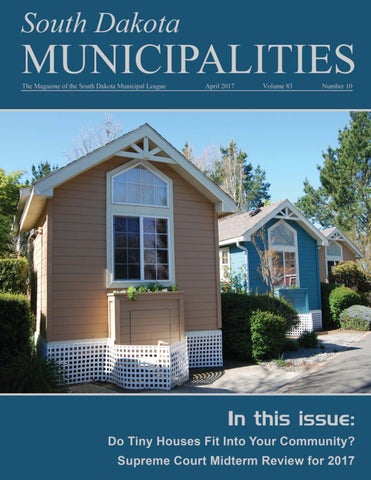
Do Tiny Houses Fit Into Your Community? . . . . . . .14
Spring Cleaning – Are You Covered? . . . . . . . . . . . .21 SDMEA Hometown Power – Superintendent/Foreman Conference . . . . . . . . . . . . .22
TRUSTEES Pauline Sumption Finance Officer, Rapid City
Dist. 5 - Renae Phinney President, Ree Heights
Karl Alberts Finance Officer, Aberdeen
Dist. 6 - Leland Treichel Mayor, Roscoe
Hope for Survivors of Child Sexual Abuse and Sexual Assault . . . . . . . . . . . . . . . . . . . . . . . . . . .26
Steve Allender, Mayor, Rapid City
Dist. 7 - Arnold Schott Mayor, McLaughlin
Supreme Court Midterm Review for Local Governments 2017 . . . . . . . . . . . . . . . . . . .32
Christine Erickson Councilmember, Sioux Falls
Dist. 8 - Harry Weller Mayor, Kadoka
Debbie Houseman Finance Officer, Lake Andes
Dist. 9 - Carolynn Anderson Finance Officer, Wall
PAST PRESIDENT Meri Jo Anderson Finance Officer, New Underwood
Dist. 10 - Fay Bueno Finance Officer, Sturgis
If Your Website Is in the Middle of a Forest, Will Anyone Hear It? . . . . . . . . . . . . . . . . . . . . . . . . .24
One Step Closer to the Supreme Court Ruling on Quill . . . . . . . . . . . . . . . . . . . . . . . . . . . . .33 Finance Officer of the Year Nomination Form . . . . .37
Columns Director’s Notes . . . . . . . . . . . . . . . . . . . . . . . . . . . . . . .4
LEAGUE STAFF 1-800-658-3633 Fax: 605-224-8655
President’s Report . . . . . . . . . . . . . . . . . . . . . . . . . . . .5
Yvonne Taylor Executive Director Sandi Larson Director of Risk Sharing Services Lori Martinec Director of Research and Training Chris Hill Director of Municipal Electric Services Carrie Harer Director of Marketing & Communications Lori Butler Director of Finance Carla McGregor Accounting Assistant Lisa Nold Office Manager SD Public Assurance Alliance: Judith Payne Executive Director Kristina Peterson Director of Underwriting Director of Member Services Paytra Nichols Underwriter Jerry Krambeck Member Services Representative Deb Corkill Executive Assistant
Risk-Sharing News . . . . . . . . . . . . . . . . . . . . . . . . . .38 Washington Report: Senator Thune . . . . . . . . . . . . . .40
In Every Issue Community Calendar . . . . . . . . . . . . . . . . . . . . . . . . .42 Classifieds . . . . . . . . . . . . . . . . . . . . . . . . . . . . . . . . .46 Directory Changes . . . . . . . . . . . . . . . . . . . . . . . . . . . .4 Municipal Calendar . . . . . . . . . . . . . . . . . . . . . . . . . .49
SOUTH DAKOTA MUNICIPALITIES (ISSN 0300-6182, USPS 503-120) is the official publication of the South Dakota Municipal League, published monthly at 208 Island Drive, Ft. Pierre, South Dakota 57532, phone 605-224-8654. This institution is an equal opportunity provider, and employer. Periodical postage paid at Pierre, South Dakota and additional mailing offices. Non-member subscriptions are available for $30.00 annually. The opinions expressed herein are not necessarily those of the South Dakota Municipal League. Postmaster: Send address changes to SOUTH DAKOTA MUNICIPALITIES, 208 Island Drive, Ft. Pierre, South Dakota 57532.
APRIL 2017
VOLUME 83, NUMBER 10
3
Director's Notes We will have wrapped up most of the ten district meetings by the time you read this, and while it will be nice to be home again, we really have a great time visiting the towns hosting the meetings this year. From the farthest corner Northeast to its opposite in the Southwest, we’ve really seen a lot this year, and the warm welcome in every community is so special. We really appreciate the hard work each city put into arranging for the wonderful food and meeting places, door prizes, and entertainment – so to Lake Andes, Big Stone City, De Smet, Hartford, Bowdle, Akaska, Miller, Murdo, Hot Springs, and Whitewood – THANKS! District Meetings always renew a sense of amazement that there are so many bright, dedicated people, willing to serve their communities and give their time. Although we go to each town to present a legislative update, we always come away having learned more than we taught. Back at the office, our attention now turns to our schools and seminars, culminating with the Annual Conference in Sioux Falls in October. At the last Conference, we had several general session speakers who all received rave reviews – and every one of them was suggested by a member. If you have thoughts on programs you would like to see at the Conference, please contact us! The April municipal elections are just around the corner, and along with the excellent incumbents, we will have a whole new group of elected officials we look forward to working with. I would urge everyone to try and take advantage of all the services offered by the League – we have many fantastic opportunities to help you grow in your public service position, and while it is hard to quantify, a knowledgeable, involved council will save you money in the long run. One case in point: a city in South Dakota that reached a pretty dysfunctional level before someone stepped in and even noticed, because it was being quite well hidden by a staff member. A council that had attended even one of our elected officials workshops would have had enough information to have waved a red flag well before it ended up with more than $100,000 in penalties. Make sure to keep an eye on the magazine and website for all the training opportunities this spring and summer. 4
Please also consider getting involved in the policy committee process. We have four committees, each of which meets in August, and again at the October conference. They will give you a great opportunity to discuss issues with your fellow officials, as well as to direct the activity of the League in the next legislative session. Until next month, remember we are always available at 1-800-658-3633 or yvonne@sdmunicipalleague.org. Yvonne Taylor Executive Director
SDML Directory Changes Bowdle
Delete: CM Shane Hanson Add: CM Gary Frankfurth
Dell Rapids Delete: CM Mary Klockman Ethan
Delete: FO Malcolm Tilberg Add: FO Betty Raymond
Hermosa
Delete: FO Shanna Harris
Hot Springs Delete: M Cindy Donnell Hudson
Delete: cityofhudson@alliancecom.net Add: townhudson@alliancecom.net
Java
Add:
T Charisse Janke T Sherri McGovern-Tulp
Sioux Falls Delete: BDG Ron Bell Add: BDG Butch Warrington Spearfish
Delete: ADM Joe Neeb PS Keith Hepper RD Alecia Hoffman SS Tim Robison Add: PS Tyler Ehnes RD Perry Mader
Due to upcoming elections this will be the last Directory Changes until after the 2017-2018 Directory of South Dakota Municipal Officials is printed in July. Visit www.sdmunicipalleague.org for a cumulative listing of changes to the 2016-2017 Directory of Municipal Officials.
SOUTH DAKOTA MUNICIPALITIES
President's Report I sure hope you were able to attend the Municipal League’s district meeting this year. I know I certainly enjoyed talking with many of you! The meetings are always a great opportunity to reconnect with acquaintances and network with colleagues. In fact, that’s probably my favorite part of the events! Equally important, however, is the update the League staff provides each year regarding the policy changes impacting local government. Trying to wrap our brains around all our local issues, not to mention changes to state and federal policy can be overwhelming. And it’s just one more reason that I’m very thankful for the Municipal League staff! The League diligently follows policy changes, analyzes impacts, and helps its members recognize the challenges and opportunities resulting from those changes. Furthermore, they take our concerns and our positions to the policy makers. The South Dakota Municipal League
APRIL 2017
provides the communities throughout our state with a collective voice for effecting positive change. The League staff is excellent at providing pertinent policy information and arming its members with the best mechanisms for dealing with change. Although change can be challenging, remember the Municipal League is here to help and the district meetings are a great way to find out how your colleagues are managing policy adjustments! Laurie Gill President
5
SD Governmental Human Resource School June 6-7, 2017 j Ramkota Hotel and Conference Center j Pierre, SD …of the 310 municipalities in South Dakota, less than 15 have full time professional Human Resource personnel. Most HR duties are added responsibilities for existing city staff. This training will help anyone with HR responsibilities become better informed in this field, learn who to call on when they need help and where to turn to find resources.
Agenda Tuesday, June 6
Wednesday, June 7
12:15 p.m. Registration – Conference Center Lobby
7:30 a.m.
Continental Breakfast – Conference Center Lobby
8:00 a.m.
Discipline, Discharge and Due Process in the Public Workplace: A Primer on How to Deal with Workplace Misconduct and Non-performance – Gallery A Steve Bogue, Attorney, McGrath North Mullin & Kratz, PC LLO, Omaha, NE
9:15 a.m.
Break – Conference Center Lobby
9:30 a.m.
Discipline, Discharge and Due Process in the Public Workplace, cont. – Gallery A
1:00 p.m.
General Business Meeting – Gallery A
1:15 p.m.
Bridging Generations – Gallery A Leah Braun, Principal, Harney Business Group
3:15 p.m.
Break – Conference Center Lobby
3:30 to 5:00 p.m.
Hot Topics in HR – Gallery A • Background Checks • Wage and Hour Laws • Collective Bargaining Laws • Child Labor Laws • Intersection of FMLA and ADA • Political and Religious Discussions in the Workplace Steve Bogue, Attorney, McGrath North Mullin & Kratz, PC LLO, Omaha, NE
5:30 p.m.
Social – Drifters Bar and Grille – Event Center
6:00 p.m.
Dinner – Drifters Bar and Grille – Event Center
10:30 to Facilitated Roundtable Discussion – 11:30 a.m. HR Scenarios – Gallery A Steve Bogue, Attorney, McGrath North Mullin & Kratz, PC LLO, Omaha, NE
2017 Human Resource School j June 6-7, 2017 Municipality Representing ____________________________________________________________ Name
Title
(Please print or type the name and title as you want them to appear on your name badge)
____________________________ _____________________ _________________________________ ____________________________ _____________________ _________________________________ Registration fee: $50.00 for affiliate members and $100.00 non-members. Accommodations: Mention you are with the SD Human Resource Association. Make reservations by May 6 to guarantee the conference rate. Ramkota Hotel, 605-224-6877, $95.95 + tax. _______ person(s) @ $50.00 each = $__________
_______ person(s) @ $100.00 each = $_________
Return registration with payment by May 24, 2017 to: SD Governmental Human Resource Association *No refunds will be given after May 24, 2017 208 Island Drive, Ft. Pierre, SD 57532 Office Use Only:
Date:________________
Check #:________________
Amount:________________
Scholarship Funds Available SD Building Officials’ Association Scholarship The scholarship is to attend the ICC Code Hearings Conference. Applicant must be a voting member of the South Dakota Building Officials’ Association and a voting member of the ICC or become one prior to scholarship award.
SD Police Chiefs’ Association Scholarship The scholarship is to attend the International Association of Chiefs of Police (IACP) Conference which will be October 21-24, 2017 in Philadelphia, PA and information can be found at: http://www.theiacpconference.org/.
The Scholarship fund allows for reimbursement for expenses related to registration, airfare, lodging, transportation, and meals not included in the conference package. Recipient is responsible for keeping all receipts and submitting them to the SDML for reimbursement. All reimbursement costs are subject to SDBOA board approval.
Applicant must be a member of the South Dakota Police Chiefs’ Association in good standing; must have at least five years of SD Law Enforcement experience; must be a current Chief of Police of a city under 10,000 in population; must never have attended IACP before; and must be a member of IACP.
One scholarship to be awarded to an individual that has not previously attended an ICC Code Hearing, and one scholarship will be awarded to an individual that may have attended a previous ICC Code Hearing in the past. Scholarships to attend the ICC Code Hearings are NOT limited to in-state use only. Approval of the applicant’s City Council, Commission, or Supervisor must be received with application.
A copy of applicant’s City Councils’ approval for the travel must be received with application.
All applications must be received in the office of the SDML, 208 Island Drive, Ft. Pierre, SD 57532 or fax to 605-224-8655, no later than July 1 each year to be eligible. Notification of award will be given a week later. An official scholarship form can be obtained by visiting www.sdmunicipalleague.org then the Building Officials section under the Affiliate Organizations tab. SD Association of Code Enforcement Scholarship The scholarship is to attend the American Association of Code Enforcement (AACE) Conference which will be October 23-27, 2017 in Cincinnati, OH/Northern Kentucky and information can be found at: http://www.aace1.org.
SDPCA will pay for roundtrip airfare, lodging for the conference dates only, IACP conference registration fee, transportation (taxi, airport shuttle; not rental car) and meals not included in the conference package. Recipient is responsible for keeping all receipts and submitting them to the SDML for reimbursement following attendance at the IACP conference. All reimbursement costs are subject to SDPCA board approval. Please submit application to the SDML, 208 Island Drive, Ft. Pierre, SD 57532 or fax to 605-224-8655 by June 1, 2017, to be considered for the scholarship. An official scholarship form can be obtained by visiting www.sdmunicipalleague.org then the Police Chiefs section under the Affiliate Organizations tab.
Applicant must be a member of the SD Association of Code Enforcement. SoDACE will pay for roundtrip airfare, lodging for the conference dates only, AACE conference registration fee, transportation (taxi, airport shuttle; not rental car) and meals not included in the conference package. Recipient is responsible for keeping all receipts and submitting them to SDML for reimbursement. All reimbursement costs are subject to SoDACE board approval. Please submit application to the SDML, 208 Island Drive, Ft. Pierre, SD 57532 or fax to 605-224-8655 by July 1, 2017, to be considered for the scholarship. An official scholarship form can be obtained by visiting www.sdmunicipalleague.org then the Code Enforcement section under the Affiliate Organizations tab. APRIL 2017
7
SD Governmental Finance Officers’ School June 7, 8, & 9, 2017 j Ramkota Hotel and Conference Center j Pierre, SD
Agenda Wednesday, June 7 10:30 a.m. – 12:30 p.m.
Banyon User Group – Lake Sharpe A & B Jeff Christensen, President, Banyon Data System, Inc. Utility Billing, Point of Sale, Fund Accounting, Payroll and New Products will be covered. Banyon will be available for individual Q&A following the User Group meeting until 2:00.
Door Prizes will be given away throughout the school – must be present to win. Noon – 4:00 p.m.
Registration – Conference Center Lobby
12:45 p.m.
Welcome by Pierre Mayor – Galleries B & C
1:00 – 1:15 p.m.
Business Meeting – Galleries B & C
1:15 – 1:30 p.m.
Legislative Update – Galleries B & C Yvonne Taylor, Executive Director, SD Municipal League
1:30 – 2:45 p.m.
Grant Funding for Municipal Projects – Galleries B & C Ted Haeder, Economic Development Officer, First District Association of Local Governments
2:45 – 3:00 p.m.
Break – Conference Center Lobby
3:00 – 4:00 p.m.
Basic Accounting – Galleries B & C Rod Fortin, Director of Local Government Assistance, SD Department of Legislative Audit
2:45 – 5:15 p.m.
Golf Tournament – Dunes Golf Course 111 Fort Chateau Road, Fort Pierre (one mile North of Fort Pierre on Hwy 1806) $26/person, includes cart and 9 holes
6:00 – 8:30 p.m.
Welcome Reception and Dinner – Gallery A Just Duet, dueling pianos, will be performing at 6:45 p.m. Hospitality room at Ramkota opens from 8:30 p.m. – 11:30 p.m.
Thursday, June 8 7:15 – 8:00 a.m.
Continental Breakfast – Conference Center Lobby
8:15 – 9:45 a.m.
General Session – Galleries B & C Keynote Speaker: Tami Evans
9:45 – 10:00 a.m.
Break – Conference Center Lobby
10:00 – 10:55 a.m.
Concurrent Sessions (Pick one; these sessions will be repeated in the afternoon) j Code Enforcement – Galleries D & E Geoff Fillingsness, Code Enforcement Officer, City of Beresford Dave Smith, Code Enforcement Officer, City of Sturgis j Using Social Media in Information Sharing for Local Governments – Galleries F & G Patrick Gerdes, NREMT, EMSI, COMT(3), COML(3) Special Projects, The Blue Cell, LLC j Retaining and Archiving Municipal Records – Amphitheater I Dana Hoffer, Manager, Division of Records Management, SD Bureau of Administration Chelle Somsen, State Archivist, SD State Historical Society
11:00 – 11:55 a.m.
Concurrent Sessions (Pick one; these sessions will be repeated in the afternoon) j The World of Liquor – Galleries D & E Jason Evans, Assistant Director, Property and Special Tax Division, SD Department of Revenue j Capital Asset Policy – Amphitheater I Rod Fortin, Director of Local Government Assistance, SD Department of Legislative Audit j Fraud – Galleries F & G Victoria Blatchford, Vice President, Relationship Manager, Wells Fargo
12:00 – 12:45 p.m.
Finance Officer of the Year Luncheon – Gallery A Finance Officer of the Year Award and Years of Service Pins will be presented.
1:00 – 2:30 p.m.
General Session – Galleries B & C Keynote Speaker: Tami Evans
2:30 – 2:45 p.m.
Break – Conference Center Lobby
2:45 – 3:40 p.m.
Concurrent Sessions (Pick one) j Code Enforcement – Galleries D & E Geoff Fillingsness, Code Enforcement Officer, City of Beresford Dave Smith, Code Enforcement Officer, City of Sturgis j Using Social Media in Information Sharing for Local Governments – Galleries F & G Patrick Gerdes, NREMT, EMSI, COMT(3), COML(3) Special Projects, The Blue Cell, LLC j Capital Asset Policy – Amphitheater I Rod Fortin, Director of Local Government Assistance, SD Department of Legislative Audit
3:45 – 4:40 p.m.
Concurrent Sessions (Pick one) j The World of Liquor – Galleries D & E Jason Evans, Assistant Director, Property and Special Tax Division, SD Department of Revenue j Retaining and Archiving Municipal Records – Amphitheater I Dana Hoffer, Manager, Division of Records Management, SD Bureau of Administration Chelle Somsen, State Archivist, SD State Historical Society j Fraud – Galleries F & G Victoria Blatchford, Vice President, Relationship Manager, Wells Fargo
6:00 – 8:00 p.m.
President’s Social and Dinner – outdoor space at RedRossa Hospitality room at Ramkota opens after Dinner until 11:30 p.m.
Friday, June 9 7:30 – 8:15 a.m.
Breakfast Buffet – Gallery A
8:15 – 8:30 a.m.
Last Minute Announcements – Galleries B & C
8:30 – 9:30 a.m.
Municipal Elections – Galleries B & C Shantel Krebs, SD Secretary of State
9:30 – 10:30 a.m.
Equalization Meetings – Galleries B & C Michael Houdyshell, Director, Property and Special Tax Division, SD Department of Revenue Wendy Semmler, Program Manager, Property and Special Tax Division, SD Department of Revenue
10:30 – 10:45 a.m.
Break – Conference Center Lobby
10:45 – Noon
Revenue – State and County Shared Revenues – Galleries B & C Heather Villa, Motor Vehicles Division, SD Department of Revenue Michael Houdyshell, Director, Property and Special Tax Division, SD Department of Revenue
Registration form can be found online at www.sdmunicipalleague.org under SDML Events.
Presidential Disaster Declaration Approved for December Storm Gov. Dennis Daugaard says 24 South Dakota counties and two tribes may receive federal funding assistance to help recover from a late December storm that did more than $9.1 million in damage to public property. The public assistance is made available through a Presidential Disaster Declaration signed by President Trump. Counties involved are Butte, Clark, Codington, Day, Deuel, Dewey, Edmunds, Fall River, Faulk, Grant, Haakon, Hamlin, Harding, Jackson, Jones, Marshall, McPherson, Meade, Pennington, Perkins, Roberts, Stanley, Sully and Ziebach. Also included is the Cheyenne River Sioux Tribe within Dewey and Ziebach counties and the Oglala Sioux Tribe within Jackson County. All of the counties and tribes included in the declaration were those included in the Governor’s request to the President. The storm started December 24 and continued through December 26. Blizzard conditions, high winds and freezing ice led to broken power poles, downed electrical
10
lines and stranded motorists. Three deaths were associated with the storm. Gov. Daugaard requested a disaster declaration on January 23 after public property damage information was verified by FEMA, state and local officials. A disaster declaration authorizes the federal government to provide recovery assistance for up to 75 percent of the eligible costs. Notice of Hazard Mitigation Grant Program Funding for Disaster 4298 South Dakota received a Presidential Disaster Declaration as a result of Christmas Day 2016 statewide severe winter storms. Subsequently, approximately $1,025,000 of funding is now available for local governments and certain private-non-profit organizations to apply for hazard mitigation projects that will reduce the loss of life and property by lessening the impacts of future disasters.
SOUTH DAKOTA MUNICIPALITIES
To find out more about the eligibility of mitigation projects or applying for these funds, contact Jim Poppen at 605-7733231 or jim.poppen@state.sd.us. Discussions on your project are vital to ensure all components of the application are completed. Applications due October 13, 2017. Timelines: j Applications due to state: October 13, 2017 and we highly encourage to submit your applications prior to deadline to ensure they are complete. j OEM reviews the applications for completeness: October/November 2017 j OEM presents applications to the State Hazard Mitigation Team: December 2017 j State Hazard Mitigation Team approved projects submitted to FEMA: January 2018 j FEMA has until February 1, 2019 to award projects j Period of Performance to complete approved projects: January 31, 2021 Notes: j State disaster assistance is available to sub-recipients who qualify by meeting certain criteria. Please contact Jim Poppen at jim.poppen@state.sd.us or 605-7733231 for more information. j In addition to this notice, Office of Emergency Management will be hosting applicant briefings and dates/times will be announced at a later date.
APRIL 2017
j
j
j
j j
Application and support documentation are located on the OEM website under Hazard Mitigation Grant Program, http://dps.sd.gov/emergency_services/ emergency_management/forms.aspx. FEMA has released a new version of the Benefit Cost Analysis software, version 5.3, which can be downloaded at https://www.fema.gov/media-library/ assets/documents/128334. When submitting an application for a phased project, you will need to indicate that you are requesting the project to be phased and provide a detailed scope of work and budget for each phase of the project. A new benefit cost analysis is required for phase 2. If you intend to request progress payments throughout the construction of your project then this will need to be indicated in your application. All agencies that have a stake in environmental and historical preservation for your project will need to have an environmental letter sent to them for their response on your project. These response letters must accompany the application. If construction is taking place on or near tribal property, it is a possibility the Tribal Historic Preservation Office may request a Class III Archeological Survey to be completed prior to award. This survey is an eligible expense.
11
SDSU Community Vitality Bits and Pieces By Kenneth Sherin and Paul Thares SDSU Extension Kenneth Sherin, Ph.D., has been chosen as the Program Director for the SDSU Extension Community Vitality program. Sherin has served as a Community Vitality Field Specialist in the Mitchell Regional Extension Center with SDSU Extension since June 2012. A North Carolina native, Sherin completed his doctoral studies in Rural Sociology and Organization Development at the University of Missouri in 2012. Sherin will continue to work from the Mitchell Regional Extension Center and he will travel to Brookings regularly for meetings and other administrative duties. Sherin is the second Program Director of the SDSU Extension Community Vitality team. David Olson, Ph.D.,
12
became Program Director after the SDSU Extension reorganization in 2011 and built a strong team of community resource professionals. Olson served as Program Director until he lost his battle with cancer in February 2016. Sherin said, “I want to build on Dr. Olson’s commitment to be the best resource for South Dakota communities who are seeking to stay or become vibrant, healthy communities.” Program Name Change The SDSU Extension Community Vitality program is the new name of the former Community Development program. The new name better reflects the goals and purposes of the program, as well as, the greater mission of South Dakota’s land grant university. SDSU Extension’s purpose is “to foster a learning community environment that empowers citizens to advocate for sustainable change that will strengthen agriculture, natural resources, youth, families, and the communities of South Dakota.” Sherin states, “South Dakota communities are worthy of our earnest effort to make available the best evidence-based, vetted, and relevant community and economic development resources.”
SOUTH DAKOTA MUNICIPALITIES
Vetted and Trusted Programs Currently, the SDSU Extension Community Vitality program offers researched and evidence-based community development tools for building capacity in areas of entrepreneurial development (business plan writing, and marketing), leadership skills workshops, community marketing for new resident recruitment, strategic planning for organizations and communities, community-based approach to workforce development, civic engagement processes, and non-profit board training. Sherin said, “The programs and resources of the SDSU Extension Community Vitality program are a great value for communities and organizations in South Dakota.” The community resource professionals deliver programs under the outreach mission of South Dakota State University. Therefore, the cost to communities and organizations is greatly reduced compared to other community resource providers in South Dakota. Sherin stated, “The SDSU Extension Community Vitality team provides great opportunities for South Dakota communities. The community resource providers collaborate with other Extension professionals across the nation and other South Dakota resource providers. Their connection to national and local resources benefits South Dakota communities by sharing the best in rural community and economic development resources with the citizens of South Dakota.” Adding to the Team Sherin will be working with an experienced team of community resource professionals including Kari O’Neill, Peggy Schlechter, and Paul Thares. The SDSU Extension Community Vitality team is seeking another team member to be based in the Watertown Regional Extension Center. Sherin said, “We are excited to be able to offer the opportunity for someone to join this great team.” (For more information visit YourFuture.sdbor.edu.) The SDSU Extension Community Vitality team is available as you seek to make your place a better South Dakota Great Place. For more information visit iGrow.org.
APRIL 2017
13
Do Tiny Houses Fit Into Your Community? By Jayna Watson, AICP Located in a scenic valley and surrounded by the Black Hills in western South Dakota, Spearfish was founded in the late 1800’s as an agricultural, education, and trade center in support of the gold boom taking place 20 miles southeast in the Lead-Deadwood-Central City area. The growth of the community has been a fairly sustainable rate at 2 percent per year since that era. Although the agricultural aspect of the area economy has significantly diminished over the years, Spearfish continues to be a regional provider of health care, post-secondary education, retail, and personal services. The core area of the city’s residential neighborhoods is over 125 years old and consists of lots measuring 50 x 140 feet, which at the time they were platted, represented a space adequate for a typical home built to the standards of that time; usually 1,000 square feet and less. In some locations, the owner controlled several contiguous 50 x 140 lots, and larger homes were built. As the city grew, housing lots in new neighborhoods became larger and changed in shape from narrow rectangles to wider rectangles so that the double and triple car garage plus larger house could fit on the lot. Spearfish is similar to other mountainous western towns where the housing inventory reflects a lot of choices at the upper end of the market and not as many in the lower end. The more affordable single family housing in Spearfish is mostly supplied by the older and smaller homes in the downtown core, subdivisions built in the 1980’s, manufactured homes, and a handful of homes built by Dakota Land Trust, a nonprofit housing trust. Nothing in the current housing discussion has created the same stir like the tiny house movement and Spearfish has
wrestled with trying to understand where this option fits into the menu of choices for housing in the city. This article will address the following key topics: j Defining the tiny house by how it’s constructed – either on wheels or on a foundation j Zoning and related standards for an exclusively tiny house neighborhood j Aesthetic considerations of the tiny house j Who are tiny home owners? j Tiny homes as a community development strategy Defining the Tiny House by How It’s Constructed To sort out the difference between a camping trailer, a tiny house on wheels, or tiny house as a permanent structure on a foundation, websites like http://americantinyhouse association.org/construction-guidelines helped us organize our thoughts and understand the various forms and versions of a tiny house in the context of what our building and zoning code requires. The Tiny House on Wheels There is not any single recognized authority for how a tiny house on wheels should be constructed; however, many helpful resources exist starting with the American Tiny House Association who has published a set of guidelines for building a tiny house on wheels. To some, a tiny home on wheels is simply the re-branding of the family camping trailer. The difference between the two can be found in how they are built. Camping trailers have lighter duty construction materials. For example, the exterior wall framing system of a camping trailer is usually 2 x 2 wood or steel with metal siding in order to limit the weight of the trailer as much as possible. By comparison, many commercial and do-it-yourself builders use 2 x 4 framing for the exterior walls and traditional residential siding which offers greater long term durability but does add
Ready for permanent placement on a foundation. Photo: Corey Aldrich. 14
SOUTH DAKOTA MUNICIPALITIES
Black Hills Tiny Cabins and Cottages prototype under construction. Photo: Corey Aldrich.
“Bunkaboose” wheeled tiny home model by Ecocabins. Photo: Ecocabins.com.
more weight. Both the tiny house on wheels and camping trailer have similar plumbing and electrical designs in how they connect to hard utility systems.
Zoning and Related Standards for an Exclusively Tiny House Neighborhood From the www.americantinyhouseassociation.org website, the following statement appears: “Our mission is to promote the tiny house as a viable, formally acceptable dwelling option for a wide variety of people.” The words “formally acceptable” mean that a community has pursued deliberate methods and means by which this kind of housing can exist. Many zoning standards are designed around the traditional single family house and garage already mentioned. For Spearfish, how a tiny home is constructed and placed on the site drives the zoning district it belongs in.
The Tiny House on a Foundation In Spearfish, for those wishing to build a tiny house on a permanent foundation, all construction must be done according to the International Residential Code (IRC), the plumbing, electrical, and fire code. The 2015 IRC requires a minimum of 120 square feet for a room. Adding in the requirements for a kitchen, bathroom and laundry room/ closet, a tiny house that is compliant with the code is likely to be a minimum of 300 square feet and larger. Loft spaces that are intended for occupancy require a standard stairway. If they are used for storage, a ladder is permitted. A local company in Spearfish, Black Hills Tiny Cabins and Cottages (BHTinyCC@gmail.com) has recently completed an IRC code compliant tiny home. A recent visit with coowner Corey Aldrich revealed his greatest concern is not about construction methods and building codes, but for finding sites and neighborhoods where the zoning regulations allow them, which leads to the next topic concerning how the zoning code views the tiny house.
APRIL 2017
Permanent Placement If the tiny home is placed on a foundation (and is building code compliant), they are permitted in all residential zoning districts in Spearfish. The minimum lot size in most Spearfish zoning districts is 8,000 square feet which is much larger than what is actually required for a tiny home neighborhood. For property owners that want to create lots that are smaller and more appropriately scaled to the tiny home, Spearfish has a special zoning district known as the
15
Development Review District which is similar to a planned unit development. Based on a tiny home of 400 +/- square feet plus space for off street parking, patio and/or deck space, trees and gardens, a minimum lot size around 2,000 square feet serves as the starting point for the lot size. Beyond the nuts and bolts of figuring out appropriate lot sizes and setbacks, the site planning for a neighborhood made of tiny homes must address important livability issues associated with a dense single family neighborhood. A few ideas to incorporate are: j Provide common open spaces to reduce predictability and monotony of a long row of houses j Create lots that are extra deep or wide to allow more flexibility for home siting and variety in setback j Plant themed landscaped areas in different locations with linked sidewalks or trails j Create curvilinear street alignments with median plantings and traffic calming features j Overcome the temptation to fill every square inch of the property with home lots j Provide a common storage building that has either shared space or individually separated space for bikes, lawnmowers, etc. Temporary Placement For those who want more flexibility and freedom to move about with their home, Spearfish allows the tiny house on wheels to be located in any commercial campground. Initially, we debated if the wheeled tiny homes could be placed in a manufactured home park. However, we determined this was not possible because unlike manufactured homes that are built to manufactured housing
Beautiful gardens are planted in front of the tiny homes at Quixote Village. Photo: Panza. 16
industry standards and have been inspected, there is no similar type of recognized building standard or building safety inspection on a wheeled tiny home. In campgrounds, the home must be connected to water and sewer utilities. No ‘dry’ (without any water or sewer hookup) parking of a tiny home is allowed. Aesthetic Considerations of the Tiny House Although a key ingredient of the tiny house is its low cost of construction, this should not translate into a collection of cheap and unattractive structures without any thought given to the importance of interior and exterior design and landscaped settings. Like traditionally built homes, the amenities and upgrades within a tiny home can include everything from the latest in communication technology, to energy efficient windows, to exotic wood floors. The same is true for the quality of the outdoor spaces surrounding the tiny home. Whenever possible, small courtyards, porches, and decks can be added to enhance livability and visual quality. Designed and built by Wheelhaus Inc., the cabins at the Fireside Resort in Jackson Hole, Wyoming are a larger version of the tiny house but illustrate the importance of exterior quality. A visit to www.wheelhaus.com reveals the attention given to design materials that tie into the rugged and rustic qualities of the Jackson Hole area. Mature vegetation, cozy decks, and patios surround the buildings at Fireside and further define a sense of permanence in this resort neighborhood. Who Are Tiny Home Owners? Whether by choice or by force, the tiny house concept has wide application to a number of people for permanent, year-round occupancy. As one solution to homelessness, Quixote Village in Olympia, Washington emerged from being a parking lot tent camp into a neighborhood of 30 tiny homes with half baths and utilities on 2.17 acres. This village is managed by the non-profit, Panza, which provides management support to the residents of the community as well as management of a community building that provides facilities such as showers, a laundry, a kitchen, and a community room. The cottages of this tiny home community are built on permanent foundations and provide a stable living environment for those previously unable to stay housed on their own.
Quality interior finishes are a key selling point for EcoCabins’ “Morrison” home. Photo: EcoCabins.
Looking at the tiny house solution from the other end of the socio-economic spectrum, people hoping to make their retirement funds stretch farther into the future are also attracted to the benefits of the tiny house which is nothing new to retirees that have SOUTH DAKOTA MUNICIPALITIES
enjoyed park model trailers that have populated retirement neighborhoods in the sunbelt for years. College students, small families, and singles are all potential tiny home owners because of its affordability and flexibility for how the home can be used in the next stage of the homeowner’s life. What serves as student housing today can work for senior housing tomorrow.
“……. you have the ongoing cost of maintaining the property in that you must keep it clear, clean and always mowed. Once you own it, that is really your only responsibility but there are steep penalties if you don’t. And, of course, paying your taxes. So keep all of this in mind if you are just purchasing land purely for speculation.”
Tiny Homes as a Community Development Strategy Spur, Texas, dubs itself as the “The old west town that welcomes new pioneers,” according to its website, www.spurfreedom.org. This west Texas community wishes to attract people wanting to escape the ills of big city living including high real estate costs, lack of community, and disconnection from society. While this town of 1,000 is growing as a result of its acclaimed status as being tiny house friendly, all tiny houses must be set on a permanent foundation which is an indication of the town’s desire for people make Spur their home and not just a stop-over. Spur’s website also provides a fittingly plainspoken-Texas-style admonishment that makes it clear that Spur wants to build a town of people who take care of their property, not neglect it:
The bottom line is that although they are not for everyone, the people who seek the tiny house lifestyle need the same amount of help and assistance to realize their dream as those who are building traditionally constructed homes. Setting up a reasonable and equitable path to allow tiny houses in our communities does not mean that every lot in town will have one. Market forces will ultimately determine if tiny housing is just a fad or a permanent player in housing choice. Jayna Watson, AICP is the City Planner for the City of Spearfish, South Dakota. She is the president of South Dakota Planners Association and serves on The Western Planner Editorial Board. This article was originally published in The Western Planner. Visit www.westernplanner.org to learn more.
APRIL 2017
17
Preparing Your Urban Forest for Storms Tips on how to minimize damage By Josh Behounek From my experience working with local governments, storm preparation is usually a huge concern among all residents and all departments. Urban forestry can be a concern, too.
Unlike other components of a community’s infrastructure, trees and urban forests continue to appreciate in value as they age and get larger, therefore increasing environmental functions and services.
When a storm event occurs, tree debris is often one of the first things a community must focus on. Trees can fail and when they do, they impact roadways, utility lines, street lights, intersections, personal property, and people.
Within a community, there are these two types of trees: assets and liabilities. Assets are trees planted in the right place for the right reason that do not pose an unacceptable level of risk to the community. Liabilities are trees posing an unacceptable level of risk to the community that do not provide an environmental function.
Before power can be restored and primary responders can do their jobs, trees will need to be pruned, removed, and cleaned up. While it is impossible to be completely prepared for a storm incident, it is possible to be ready to react and minimize negative impacts from tree damage.
Dealing with a storm involves three distinct phases. The initial phase is all about preparation before the storm. The second phase is what you are doing during the actual storm, and the third phase is cleanup following the storm event.
Your community’s urban forest is made up of both public and private trees, and they are an important part of the community’s infrastructure. Urban forests provide a host of environmental functions and services—from avoiding stormwater runoff, reducing energy consumption, increasing property values, absorbing CO2, and improving the quality of life in a community.
The Calm Before the Storm At the most basic level, an urban forest that is prepared for a storm event will be more resilient. This will save time and money, as well as provide a service to residents who do not have to live with the disruption and destruction from tree damage.
18
SOUTH DAKOTA MUNICIPALITIES
Tree risk assessments. Trees cannot be made to be 100 percent safe all of the time. However, they can be made safer by conducting tree risk assessments, which should be a component of every community’s urban forest management plan. Three levels of tree risk assessment can and should be performed throughout a community. Level 1 inspection is a simple drive-by or walk-by “windshield” survey done annually. Level 2 is a 360degree inspection taken from the ground level without the use of specialized equipment (see Figure 1). Level 3 inspection is also 360 degrees but involves such specialized equipment as an aerial lift, drone, or Resistograph. There are other types of tree risk assessment protocols but the most common one is the newest best management practice (BMP) developed by the International Society of Arboriculture (ISA). This methodology evaluates the “condition of concern” of a whole tree, branch, or trunk. The ISA BMP methodology evaluates: j Likelihood of failure. j Likelihood of impacting a target. j Consequences of the failure. By conducting a regularly scheduled tree risk assessment, work can be prioritized and trees identified as posing the most risk. Trees with the highest risk rating should be
Elgin, Illinois, Case Study In 2007, Elgin, Illinois, experienced two separate 70 mph wind events in a 24-hour period. These events generated more than 130 telephone calls and took three city tree crews and two contractor crews a total of seven days to respond to the calls. In 2009, Elgin conducted a street and park tree inventory of its 60,000 trees and prioritized maintenance activities. Using American Recovery and Reinvestment Act monies, the city systematically implemented a risk reduction plan to remove 800 of the highest liability trees. In 2010, the city was struck with an identical storm as the one in 2007, but this time, only 32 calls were received and two city crews handled all the calls in less than 24 hours. The city received 100 fewer calls and saved 765 man hours because of its proactive maintenance program.
APRIL 2017
Figure 1. A certified arborist demonstrates performing a Level 2 inspection.
prioritized for such maintenance as removal, pruning, or cabling and bracing. See the Elgin case study to find out how proactive risk mitigation can save you time and money. Response and Recovery Plans As noted earlier, one of the first issues that needs to be addressed when responding to a storm is clearing the streets and power lines from downed trees. Communication is key to ensuring that priority services are restored as soon as possible. Most communities probably have some type of emergency response plan or system in place, but few incorporate an urban-forest-specific response plan. The primary challenge from an urban forestry perspective with these types of plans is that once the initial cleanup is completed, there usually remains a large amount of debris and work that needs attention. Roads and power lines are cleared, but homeowners and the community still need to clear out all the other debris. A good recovery plan incorporates opening priority streets and managing remaining debris. This can include setting up debris collection areas, renting specialized equipment like tub grinders, and bringing in contractors or using staff from other departments to help with cleanup. One tool that can be useful for predicting how much debris a storm may produce is i-Tree Storm. This is free software 19
created by the USDA Forest Service and can be found at www.itreetools.org. i-Tree Storm uses 2 percent of random street segments to inventory trees more than six inches in diameter and within 50 feet of either side of the right-of-way. By using the software, a community can better predict how much debris will need to be cleaned up. Response and Cleanup The cleanup after a storm event can take anywhere from a couple of days to several weeks, depending on the severity of the storm and the condition of the urban forest. One of the first steps that a community should take once a storm has passed is to conduct a Level 1 Rapid Assessment. A qualified certified arborist can conduct this windshield “inventory” to properly identify immediate high-risk trees. This assessment should be done on all public streets and properties affected by the storm. The Texas Forest Service has developed a free Level 1 Tree Risk Assessment mobile app that can be found at an app store and at Google Play. Additional information can be found at http://texasforestinfo.tamu.edu/mobileapps.
20
If the storm is too large for your community to adequately respond, there is a high likelihood that the Federal Emergency Management Agency (FEMA) will be deployed. The U.S. Forest Service, in partnership with several state agencies, has also developed the Urban Forest Strike Team. UFST crews can be deployed immediately following a storm to assist communities in need that don’t have staff with urban forest management expertise to reduce unnecessary loss of urban tree canopy. UFST was created because trees are often removed that could have recovered and hazardous trees that should have been removed were retained. The team can help avoid these types of mistakes. Josh Behounek is coordinator of urban forestry services, Davey Tree Expert Company, Kent, Ohio (@treesrtheanswr; josh.behounek@davey.com). Davey Tree Expert Company is an ICMA Strategic Partner. Reprinted with permission from the March 2017 issue of Public Management (PM) magazine, published and copyrighted by ICMA (International City/County Management Association), Washington, D.C.
SOUTH DAKOTA MUNICIPALITIES
Spring Cleaning – Are You Covered? By Kristina Peterson, Director of Underwriting, SDPAA Spring is right around the corner, which is a good reminder to review if you have enough coverage in place to protect your entity if a claim should arise. One of the biggest questions SDPAA receives is regarding building contents values. What is included in the coverage values? Should vehicles and mobile equipment be included? Overall, contents values can sometimes be complex to figure out. SDPAA’s rule of thumb is any item not attached to the building itself, and any item not specifically listed on a statement of values, should be considered contents. Items that should be listed on a statement of values include fine arts, hardware or software items, mobile equipment and vehicles. For example, a shop building is listed with a building value of $100,000 and inside the building is an attached control panel, two lawn mowers, and office supplies with a desk, computer and chair. The building value should include the control panel as it is attached to the building. The two lawn mowers and the computer would be listed on their respective statement of values and the office supplies, desk and chair would be considered contents.
APRIL 2017
One way to review your contents values is on the Property Valuation Report, which is included in your renewal packet every year. It can also be sent to you at any time, upon request. In the report, each location is listed, with current building and contents values. If a contents value is listed at $0 and an incident occurs, there will be no coverage for the contents of the property. Therefore, it is extremely important to have updated values for both buildings and contents in the event of a claim. SDPAA recommends the contents values should represent the highest value of contents located in the building at any one time during the year. This allows for movement of small tools, materials, and supplies in and out of buildings, while sustaining proper coverage. In addition to the Property Valuation Report, SDPAA Members may request to receive an Excel spreadsheet of their property coverages, including buildings and contents, inland marine, EDP hardware, EDP software, fine arts, miscellaneous equipment and tools and auto physical damage. For any other questions, contact our office at 800-6583633 or email kpeterson.sdpaa@sdmunicipalleague.org.
21
By Chris Hill, SDMEA Director of Municipal Electric Services
This was MY first Superintendent/Foreman Conference and was everything I expected. I hope that it met everyone else’s expectations as well. It was great to meet so many
new people and get to know some of the personnel from the member municipalities. It would be even better if this conference could grow next year and more Superintendent/ Foremen could have the opportunity to attend. Getting together and building those relationships is one of the great services that being a member of the SDMEA offers. I also thought there were many wonderful presenters who were very knowledgeable about their topics and could be excellent contacts/references to any
Duane Henderson from Cree speaks about LED lighting in Municipalities.
Joni Livingston from Missouri River Energy Services gives an update about the Red Rocks Dam Project.
Alan Freng speaks to the group about the South Dakota Retirement System.
Casey Crabtree from Heartland Consumers Power District gave an update on HCPD’s Economic Development.
Superintendent/Foreman Conference - Watertown, SD
22
SOUTH DAKOTA MUNICIPALITIES
Allan Miller gives a presentation on incident command and emergency management.
DCI presents on recognizing one-pot meth labs.
electrical municipalities who are looking to improve the services for their consumers. The Vendor Show and Social did not disappoint as we had over 20 vendors who donated excellent door prizes. After the vendor show, a wonderful Prime Rib dinner gave us all a chance to relax and discuss the day’s presentations. As a committee, we are always looking for input and hope that if you have any topics that you would like to see presented in the future, or if you know of any vendors who may be good to have for our electrical departments, please let us know. My contact information is at the end of this article and we are always wanting fresh ideas to have for the conference.
Mike Willets discusses NESC and NEC.
Please spread the word for anyone who might be interested in attending as this experience will definitely benefit everyone’s HOMETOWN. Until next month! Questions? Comments? Email: Chris@sdmunicipalleague.org Call: 605-770-6299.
APRIL 2017
23
If Your Website Is in the Middle of a Forest, Will Anyone Hear It? By Victoria Boyko, Software Development Consultant, Sophicity: We put the IT in city Like the tree in the proverbial forest that no one hears when it falls, do you think that anyone “hears” your city website in a forest of internet information? In many cases, probably not. That’s unfortunate because city websites already have a few advantages that other businesses and organizations would love to have. j City websites are highly trusted. j People will search for information on your website. You’ve already got a ready audience of hundreds or thousands of people. j People often need your information such as news, event postings, city council minutes, or services. You’ve already got demand for your information. Yet, many city websites seem nonexistent and disappear on the internet when people search for them. Remember that most people will look for your website on a search engine such as Google or Bing. To show up on the first page of
24
search results, your website must follow a few best practices and show constant activity to prove to these search engines that your website is trusted, useful, and relevant. How can your city website emerge from the internet forest? Here are a few tips. 1. Share a link to your website with reputable organizations. Because you are a city, many organizations want to link to your website. If people are researching for city-related information on another website, then you want your city’s website listed there to help people find you. Examples of websites where you want your city’s website listed are: j Municipal leagues j The Wikipedia page for your city j State websites and directories j Tourism-related websites j County websites
SOUTH DAKOTA MUNICIPALITIES
If there isn’t a self-service feature to upload your own website link, then reach out to the organization and ask if you can provide a link to your city’s website. Many of these organizations will be more than happy to oblige. Make sure you focus on reputable websites. Don’t reach out to sketchy, suspicious, or little-used websites and online directories that may harm rather than help you. 2. Share links to timely and interesting city information on social media. Facebook. Twitter. YouTube. Use them if you can. Many of your citizens and other people interested in your city use these social media sites all the time. Share timely information such as emergency alerts, news, press releases, events, and photos. Any urgent or newsworthy information will be useful to people and they are likely to share it. When people share your links on social media, it helps your website feature more prominently on search engines. Don’t be afraid to ask people to share posts on social media by including a “call to action” (such as “Tell a friend!”). 3. Share your website link with newspapers and magazines when they write up stories about you. Another advantage for cities is that they are automatically of interest to media. When newspapers, magazines, and industry publications report on news or write up stories about you, make sure you provide your website link for them to feature on their websites. Media outlets are usually highly reputable sources on the internet. When reputable media publications link to your website, the search engines will see it as a sign to display your website higher up in search results.
APRIL 2017
4. Link to other websites on your city’s website. To get links, you must give links. If there are pages on your website where it would be useful to provide links to other websites, then do it. For example, you might provide links to tourist attractions or websites that help people find jobs. Linking to another organization’s website makes it more likely that they will reciprocate and link back to you. However, don’t abuse the sharing of links. Make sure each link provides useful information to people. 5. Produce regular, timely, useful content on your website. Search engines don’t like dead or stagnant websites. Those kinds of websites disappear in search results. That’s because Google or Bing considers those websites as not useful or vital—rather like an abandoned house. If you want people to find and link to your website, then you need to provide a stream of timely, useful content for people. That can help supply your social media feeds with new information and keeps people coming back to your website in anticipation of new content. Start with these five tips and you will begin to see your city’s website rise in visibility on search engines, social media, and other organization’s websites. This process can take a while but the steady investment of time is worth it. After all, you want your website to be seen. These tips will help you make it happen.
25
Hope for Survivors of Child Sexual Abuse and Sexual Assault A collaborative effort by Julianne Endres, Watertown Area Community Foundation; and Jo Vitek, SDPCA Past President, Chief of Police (retired) Watertown, SD, Law Enforcement Supervisor of Lake Area Technical Institute of Watertown, SD
a gift of hope and healing. Chief Jo’s HHH Fund is just another way the Watertown Area Community Foundation is “Looking Forward and Giving Back” while making a difference in the lives of our children in Watertown and northeast South Dakota.v
It happens more often than you think. One in four girls and one in six boys are sexually abused resulting in a minimum of 4,000 children being abused each year in South Dakota.i Jo Vitek, former Chief of Police of Watertown is among those who want to change those statistics. During her 36 years in law enforcement, she saw many of those children and literally felt their pain having been a victim of sexual abuse as a child herself. On a mission to help these children, Jo and her husband, Tony, established a fund at the Watertown Area Community Foundation with that focus. Chief Jo’s Hope, Healing & Hoof Prints (HHH) Fund introduces sexually abused children to a new friend—that of a horse through an equine experience at Joy Ranch.ii “Triple H” is the name of the multicolored horse that serves as the program’s mascot. He represents the hope and healing children find through experiences with the horses at Joy Ranch.
Jo and Tony did not select the area of NE South Dakota arbitrarily. The footprint of their service area was greatly influenced by Jolene’ Law Task Force (JLTF) that has been on a mission since the South Dakota Legislature formed it in the summer of 2014. Named after Jolene Loetscher, an abuse victim, the group consists of law enforcement, mental health professionals, tribal entities, victim witness advocates, politicians who are all coming together to make a difference for children who are sexually abused in South Dakota.vi “JLTF focused the last two years on making enhancements to mandatory reporting laws,” said Division of Criminal Investigations (DCI) Agent Cam Corey. The task force was instrumental in the implementation of the Center for Prevention of Child Maltreatment at the University of South Dakota and is in the process of establishing a pilot program that will strengthen the state’s response system and improve supportive services to the victims and their families. Watertown and Northeast South Dakota has been recommended as the location for that pilot program.vii
Native Americans have always known the horse to have strong spiritual power. Hence, it is believed that the horse will lead individuals in the “right direction.” A horse’s spirit is believed to be able to assist others in understanding their place in the circle of life.iii Joy Ranch—“a place where majestic horses graze in lush green pastures with a state-ofthe-art riding area”—is the perfect place for children to receive the gift of an equine experience.iv Now, whenever law enforcement from Sisseton Wahpeton Oyate or any of the 13 counties in Northeast South Dakota investigates an incident of child sexual abuse, before that child “walks out of the door,” the law enforcement officer can give the child
Mrs. Shelly Pieper’s Kindergarten Class at McKinley Elementary School in Watertown helped to create and design Triple H and his heart, which represents the brave and courageous heart of a war horse. 26
Governor Dennis Daugaard appointed Jolene’s Law Task Force to confront and tackle Child Sexual Abuse head-on and Watertown will be the location to headquarter a MultiDisciplinary Team to investigate and combat Child Sexual Abuse in Northeast South Dakota. Lake Area Technical Institute will likely be the location where officers and investigators are trained on child sexual abuse investigation
Equine Specialist Carmen Werning walking with a child survivor of sexual abuse referred by the Watertown Police Department to Chief Jo’s HHH program at Joy Ranch. SOUTH DAKOTA MUNICIPALITIES
protocol. Watertown’s Sanford Clinic will serve as the location of a future Child’s Advocacy Center. No longer will families and law enforcement officers have to travel to Sioux Falls for forensic interviews and examinations. The Governor and Jolene’s Law Task Force is doing a phenomenal job tackling this most important issue in South Dakota. Additionally, Mayor Steve Thorson of Watertown has pledged to do whatever he can to end Child Sexual Abuse in Watertown.viii The first evidence-based research on Adverse Childhood Experiences (ACE) happened in 1998. Since then, there have been 57 other publications through 2011. We have 13 years of current evidence-based research available to help us.ix So, we know the effects of Adverse Childhood Experiences. You can go online and Google—“Take the ACE Quiz” to get your own ACE score.x There is staggering proof that health, social and economic risks are the result of childhood trauma! We know that toxic stress damages the developing brain architecture and can lead to life-long problems in learning, behavior, and physical and mental health and that early high stress experiences imbed into the body with lifelong cognitive, emotional and physical health effects. Because of the research that has been done, we know there are correlations between Child Sexual Abuse and a number of social issues.xi
relational to the very core of our beings—created in the image of God who is not solitary but a Trinity of Persons in love. When you are sexually abused as a little kid—it messes you up—the sticky-adhesive stuff on your Band-Aid doesn’t work like it’s supposed to. Kids who are sexually abused don’t trust easily—their guard is up—they are super vigilant all the time. The very act of child sexual abuse damages a child’s ability to trust—to have healthy relationships with people, with community and with God. Child sexual abuse not only damages one’s physical body and mental/cognitive mind-set, but also disrupts one’s spiritual being. That’s not the way God intended it to be…” xiii “Today more than ever, political leaders, community leaders, preachers, teachers, police officers and other community members have to communicate, coordinate and collaborate to protect our most vulnerable population—our children,” Jo said. Strides are being made, for instance, the support of the above includes that of Doug and Lynn Sharp of Watertown. Their gift and a matching gift from Toyota resulted in thousands of dollars to support this effort. Today, Jo serves as the Supervisor of the Law Enforcement Program at Lake Area Technical Institute in Watertown were over 2,393 students are enrolled in one of twenty-
Alarmingly, only 11% of child sexual abuse incidents are committed by strangers. The vast majority of child sexual abuse incidents happen in relationship with a family member or someone else known by the child or family.xii In years gone by, law enforcement taught—Stranger Danger—but they had it wrong because the vast majority of the time the sex offender is NOT a stranger but someone who lives “right up under our noses.” “When a child through absolutely no fault of their own is sexually abused it pierces their very soul. It is a violation of the sanctity and wholeness of human life and when the sexual abuser is a family member or someone the child trusts—the wound is even more severe because it adversely impacts our ability to have healthy relationships. We are
APRIL 2017
27
HHH Referral Cards and SD Sexual Assault Aftercare Guide booklets produced by The SD Network and SD Department of Health. In addition to delivering the Sexual Assault Care Packages to the Police Chiefs and Sheriffs, the students provided Sexual Assault Awareness Talks to all faculty, staff and students enrolled in LATI’s 28 programs. Also, they recognized Attorney General Marty Jackley by presenting him with a JLTF Halo for protecting the children of South Dakota from child sexual abuse.
Jo Vitek depicted with horse Brandy at Joy Ranch for the Faith & Real Life Series event at Immaculate Conception Church in Watertown, SD on January 11, 2017.
nine programs. Hence, it is probable that some students were sexually abused as children; therefore, LATI counselors also make student referrals to Chief Jo’s HHH program at Joy Ranch. The Watertown community and LATI have joined forces to combat child sexual abuse and sexual assault through Title IX mandates and initiatives to include conducting peer-to-peer Sexual Assault Awareness Talks. DCI Agent Cam Corey is an Adjunct Instructor for LATI and instructs Criminal Investigations. This past fall, LATI Law Enforcement students received extensive training on child sexual abuse and sexual assault investigation protocols. Since that time, the students compiled and distributed Sexual Assault Care Packages for all Police Departments, Sheriff’s Offices and Tribal Police in NE South Dakota. The packages include up-to-date sexual abuse and assault protocol, as well as, Chief Jo’s
Sturdevant’s of Watertown provides copper washers which are transformed into halos. The transformation occurs when the LATI Robotics Department places the washers in a jig which holds 400 washers. The loaded jig is placed into the Epilog Laser and within 24-hours, the copper washers are transformed into Jolene’s Law Task Force Halos. Then, the Law Enforcement students package the Halos along with referral cards and distribute them to Police Chiefs and Sheriffs. The cards are distributed to children who have been sexually abused and the JLTF Halos are awarded to community members who help to combat child sexual abuse in communities across Northeast South Dakota. The synergy between Chief Jo’s HHH program, Jolene’s Law Task Force, Lake Area Tech’s Title IX mandates and initiatives coupled with political, religious and community support served as a catalyst to prompt and inspire survivors of child sexual abuse and sexual assault to emerge in mass. Whispers of, “’It happened to me,’” were echoed by “’Me, too.’” “’Me, too.’” A new entity was formed. In June of 2016, Hope In God (HIG) came into being. HIG a Christian network of women survivors of child sexual abuse and sexual assault who provide spiritual
Left: LATI Law Enforcement Instructor Asa Stiles presents Sisseton Wahpeton Oyate Chief of Police Gary Gaikowski and Criminal Investigator Isaiah Soldier with a Sexual Assault Law Enforcement Care Package at Agency Village, SD. Center: LATI Students Matt Nutter and Paige Frazee preparing packages for distribution to Chiefs and Sheriffs. Right: LATI Students Grey Tracy and Keifer Lesnar presenting Day County Sheriff Barry Hillestad (President of the South Dakota Sheriffs’ Association) with a package. 28
SOUTH DAKOTA MUNICIPALITIES
Students Chelsea Welbon, Lauren Jones, and Rachelle Hochstetter give a Sexual Assault Awareness Talk.
LATI Law Enforcement students Keifer Lesnar and Tyler Varns presenting Watertown Police Department’s Detective Sergeant Chad Stahl, Chief of Police Lee McPeek and Assistant Chief Tim Toomey with JLTF Halos and Chief Jo’s HHH referral cards. j j
Class Presidents Jerred Schreur (2016) and Shane Yost (2017) presenting Attorney General Marty Jackely with HALO—inscribed “JLTF, Prevent, Know, Respond.”
and emotional support for each other while increasing community awareness in Northeast South Dakota. HIG referral cards were created and distributed to law enforcement and churches to serve as a resource for those organizations. HIG’s leadership team consists of seven women who oversee five offerings: j Coordinators Kara Julius and Susan Buhler of Watertown lead a weekly HIG Wounded Heart Book Study for women survivors.
j j
Coordinator Christine Berger of Watertown leads HIG’s Heartwood offering—one-on-one mentoring for women survivors. Coordinator Jessica McClanahan of Watertown coordinates HIG Outreach awareness opportunities for church groups, businesses, schools and organizations. Coordinator Nancy Adair of Watertown oversees HIG Activities for women survivors. Coordinator Lisa Lyn Castonguay oversees and helps to establish Circle groups for women survivors.
Hope In God is on Facebook @WatertownSDHIGtrees and the internet at https://hopeingodweb.wordpress.com/. For additional information about the aforementioned offerings, email HopeinGodwatertownsd@gmail.com.
In addition to the aforementioned offerings, on February 24-26, 2017, HIG hosted it’s first-ever Hope In God Winter Retreat for Women Survivors of Child Sexual Abuse and Sexual Assault at Joy Ranch. Initially, they hoped that at least 50 women would attend the retreat. Then, registrations piled in and they reached capacity at 80 women causing the creation of a stand-by list. The women who attended the retreat were 18 to 83 years old and represented communities across Northeast South Dakota to include participants from Sisseton-Wahpeton Robotics Instructor Bob Poor and student Zach Hansen preparing to laser 400 Jolene’s Law Task Oyate and Fort Force Halos in the Epilog Laser at Lake Area Tech. Thompson. A few APRIL 2017
29
minors attended with their mothers. There were young mothers who brought their young babies with them. It was a beautiful weekend. The vast majority of women have never disclosed their sexual abuse nor have they reported the abuse to authorities. The HIG Winter Retreat provided hope and healing, as well as, emotional and spiritual support for all of women. While at the retreat, they heard
Joy Nelson, Jo Vitek, Carol Ford, Coni Stricherz, Kara Julius and Jessica McClanahan at Running’s Ladies Night in Watertown.
Harvest Baptist Church Pastor Lamar Whittemore (top) and Businessman and Journalist Brad Johnson (bottom) displaying their earned JLTF Halos.
from a variety of guest speakers to include: Angie Meseberg of the Beacon Center, Jenna Moffatt of Watertown Initiative to Stop Human Trafficking, Julie Wermers of Court Appointed Special Advocates, Father Denis Meier of Mother of God Monastery, Mary Beth Holzwarth of Gettysburg, Pastor Janine Rew-Werling of Hosanna Lutheran Church, Vice President Diane Stiles of Lake Area Tech, and DCI Agent Cam Corey of the Jolene’s Law Task Force. Attendees at the HIG Winter Retreat, participated in a variety of hope and healing sessions including: Art of Baking Bread, Clay Art, Contemplative Writing, Creative Art, Essential Oils of the Bible, God and Body, Healing Touch, Movement in Worship. During the Contemplative Writing experience, survivors were encouraged to write their stories with anonymity for future publication in a book titled: Courageous Women of the Prairie. Plans are underway to publish and sell the book to raise funds for future HIG Winter Retreats at Joy Ranch. HIG could not have hosted its first retreat without the financial support of churches, foundations, organizations, and community members who provided the funds needed. Those who want to help are encouraged to contact any of the designated HIG team leaders or Jo, herself. Monetary donations can be forwarded to: Chief Jo’s HHH Fund, Watertown Area Community Foundation, PO Box 116, Watertown, SD 57201; or Hope In God at Joy Ranch, 16633 448th Ave, Florence, SD 57235.
Attorney General Marty Jackley, Mayor Steve Thorson, Alyssa Hobkirk, Joy Nelson, Kara Julius, and Jo Vitek at National Night Out unveiling Hope In God’s logo drawn by Sister Barbara Younger of Mother of God Monastery in Watertown. 30
Unfortunately, child sexual abuse and sexual assault does not discriminate—it adversely affects all of us—all cultures—all ages. Chief Jo’s Hope, Healing and Hoof Prints and Hope In God are grass root initiatives that are spreading like a wildfires across the plains of South Dakota. Jo is as committed as ever to dedicate her time and energy to these ongoing initiatives. “I’m convinced God gave me 36 years in law enforcement—as “time in the desert” where He bent and pruned me.” she said. “He opened my eyes and SOUTH DAKOTA MUNICIPALITIES
The above icons represent the five individual offerings of Hope In God: Circles-small groups of women survivors across the plains, Heartwood-one-on-one mentoring, Outreach-Fishing for Souls, Wounded Hearts Study, and Activities-Summer and Winter gatherings, opportunities to grow and go forth.
ears and gave me experiences to transform my heart fashioning me to be able to fulfill His purpose. I’m in it for the long haul, for as long as the need exists.” Notes i Jolene’s Law Task Force, Final Report, January 2016. ii Watertown Area Community Foundation, Chief Jo’s Hope, Healing, and Hoof Prints Fund, http://watertown communityfoundation.org/chief-jo-vitek-hhh-fund/, January 27, 2017. iii Dell C, Chalmers D, Dell D, Sauve E, MacKinnon T. Horse as healer: Applying equine assisted learning to uncover and strengthen the spirit of first nations youth who abuse solvents. Pimatisiwin: A Journal of Indigenous and Aboriginal Community Health. 2008;6(1): 81–106. iv Lutheran Outdoors in South Dakota, Joy Ranch, http://www.losd.org/rentals/joy-rentals/, January 27, 2017. v Watertown Area Community Foundation, Chief Jo’s Hope, Healing, and Hoof Prints Fund, http://watertown communityfoundation.org/chief-jo-vitek-hhh-fund/, January 27, 2017. vi http://www.sdlegislature.gov/docs/referencematerials/ requiredreports/RR0127201514.pdf, January 27, 2016. vii Corey, Cameron, Personal Interview conducted by Julianne Endres of the Watertown Area Community Foundation, April 2016. viii Vitek, Jo, Faith and Real Life Series presentation given at Immaculate Conception Church in Watertown, SD, January 11, 2017. ix National Technical Assistance Center for Children’s Mental Health, Trama Informed Care: Perspectives and Resources, https://gucchdtacenter.georgetown.edu/ TraumaInformedCare/Module1Resources.html, December 2016. x National Public Radio, South Dakota Public Broadcasting, http://www.npr.org/sections/health-shots/ 2015/03/02/387007941/take-the-ace-quiz-and-learnwhat-it-does-and-doesnt-mean January 2017. xi National Technical Assistance Center for Children’s Mental Health, Trama Informed Care: Perspectives APRIL 2017
and Resources, https://gucchdtacenter.georgetown.edu/ TraumaInformedCare/Module1Resources.html, December 2016. xii Abel, Gene M. MD and Nora Harlow, The Abel and Harlow Prevention Study, An Excerpt from The Stop Child Molestation Book (Xlibris 2001), Study Text Revised April 2002, http://www.yellodyno.com/pdf/ Child_Molestation_Prevention_Study.pdf, December 2016. xiii Vitek, Jo, Faith and Real Life Series presentation given at Immaculate Conception Church in Watertown, SD, January 11, 2017.
31
Supreme Court Midterm Review for Local Governments 2017 By Lisa Soronen, Executive Director, State and Local Legal Center, Washington, D.C.
*Indicates a case where the SLLC has filed or will file an amicus brief.
Per this rule, “Where an officer intentionally or recklessly provokes a violent confrontation, if the provocation is an independent Fourth Amendment violation, he may be held liable for his otherwise defensive use of deadly force.” The Mendezes also argue that putting the provocation theory aside, the officers are liable in this case because their unconstitutional entry “proximately caused” them to shoot Mendez. Many Americans own guns. So, it is reasonably foreseeable that if officers barge into a shack unannounced the person in the shack may be holding a gun.
Police/Qualified Immunity It is undisputed that police officers used reasonable force when they shot Angel Mendez. As officers entered, unannounced, the shack where Mendez was living they saw a silhouette of Mendez pointing what looked like a rifle at them. Yet, the Ninth Circuit awarded him and his wife damages because the officers didn’t have a warrant to search the shack thereby “provoking” Mendez. In Los Angeles County v. Mendez* the Supreme Court must decide whether to accept or reject the Ninth Circuit’s “provocation” rule.
Elijah Manuel was arrested and charged with possession of a controlled substance even though a field test indicated his pills weren’t illegal drugs. About six weeks after his arrest he was released when a state crime laboratory test cleared him. If Manuel would have brought a timely false arrest claim it is almost certain he would have won. But such a claim would not have been timely because Manuel didn’t sue within two years of being arrested or charged. So he brought a malicious prosecution claim under the Fourth Amendment. An element of a malicious prosecution claim
The State and Local Legal Center (SLLC) files Supreme Court amicus curiae briefs on behalf of the Big Seven national organizations representing state and local governments.
32
SOUTH DAKOTA MUNICIPALITIES
in that the plaintiff prevails in the underlying prosecution. Manuel “prevailed” when the charges against him were dismissed; and he brought his lawsuit within two years of the dismissal. The question the Supreme Court will decide in Manuel v. City of Joliet* is whether malicious prosecution claims can be brought under the Fourth Amendment in the first place. The Supreme Court left this question open in Albright v. Oliver (1994). The Seventh Circuit concluded that if malicious prosecution violates the federal constitution, cases must be brought as due process claims not Fourth Amendment claims. The lower court found no violation of federal due process in this case because Illinois allows state malicious prosecution claims to be brought. United States Border Patrol Agent Jesus Mesa, Jr., shot and killed Sergio Adrian Hernandez Guereca, a fifteen-yearold Mexican national, who was standing on the Mexico side of the U.S./Mexico border. At the time of the shooting Agent Mesa didn’t know that Hernandez was a Mexican citizen. One question in Mesa v. Hernandez is whether qualified immunity may be granted or denied based on facts – such as the victim’s legal status – unknown to the officer at the time of the incident. The Fifth Circuit granted Agent Mesa qualified immunity based on the fact that Hernandez was a Mexican citizen even though Agent Mesa didn’t know that at the time of the shooting. A second question in this case is whether Hernandez has a Fourth Amendment right to be free from excessive force even though he was a Mexican citizen shot on Mexican soil. The Fifth Circuit relied on a 1990 Supreme Court case United States v. Verdugo-Urquidez to reach the conclusion Hernandez has no such right. Hernandez argues the Supreme Court should rely on the more recent Boumediene v. Bush (2008). In this case the Supreme Court “held that ‘de jure sovereignty’ is not and has never been ‘the only relevant consideration in determining the geographic reach of the Constitution’ because ‘questions of extraterritoriality turn on objective factors and practical concerns, not formalism.’” In Ziglar v. Turkmen, Ashcroft v. Turkmen, and Hasty v. Turkmen, a number of “out-of-status” aliens were arrested and detained on immigration charges shortly after 9/11. They claim they were treated in a “discriminatory and punitive” manner while confined and detained long after it was clear they were never involved in terrorist activities. They have sued former Attorney General John Ashcroft, former Director of the Federal Bureau of Investigation Robert Mueller, former Commissioner of the Immigration and Naturalization Service, James Ziglar, and two wardens and an assistant warden at the federal detention center where they were held. The detainees brought three claims: (1) substantive due process (confinement conditions failed to meet due process); (2) equal protection (detainees were confined to these conditions because of their race, religion, APRIL 2017
etc.); and (3) conspiracy under 42 U.S.C. § 1985(3) (government officials conspired together to violate equal protection rights of the detainees). The Second Circuit denied qualified immunity to all of the government officials on all three of these claims. The Supreme Court has agreed to review the Second Circuit decisions. All of the government officials make the same argument regarding § 1985(3). Previously, the Second Circuit had not ruled whether § 1985(3) applied to federal officials. So they argue, how could they have violated “clearly established” law? Regarding the first and second claim, Ziglar criticizes the Second Circuit for not considering the 9/11 context in the decision to detain
One Step Closer to the Supreme Court Ruling on Quill A state trial court judge in South Dakota has ruled that a South Dakota law requiring remote sellers to collect sales tax is unconstitutional. This ruling was expected for precisely the reason the judge stated—a lower court must follow Supreme Court precedent. In Quill Corp. v. North Dakota, decided in 1992, the Supreme Court held that states cannot require retailers with no in-state physical presence to collect sales tax. The South Dakota law directly contradicts this precedent. In 2015 Justice Kennedy criticized Quill in Direct Marketing Association v. Brohl noting that internet sales have risen astronomically since 1992 and states are unable to collect most taxes due on sales from out-of-state vendors. He stated the “legal system should find an appropriate case for this Court to reexamine Quill.” South Dakota v. Wayfair provides the Supreme Court the perfect opportunity to overturn Quill if the Court is ready. Judge Barnett seemed sympathetic to that outcome noting that he was bound by precedent “even when changing times and events clearly suggest a different outcome.” Last year Supreme Court nominee Judge Gorsuch ruled on Direct Marketing Association v. Brohl and (strongly) implied that given the opportunity the U.S. Supreme Court should overrule Quill. South Dakota will certainly appeal this decision to the South Dakota Supreme Court which will rule against the state as well. The U.S. Supreme Court can then decide whether it wants to review South Dakota v. Wayfair.
33
the Respondents. Similarly, Ashcroft and Mueller criticize the Second Circuit for viewing Respondents as “ordinary civil detainees” or “pretrial detainee[s]” instead of as persons “legally arrested and detained in conjunction with the September 11 investigation.” Finally, the wardens and associate warden claim that no clearly established law gave them authority to “unilaterally overrule the FBI’s terrorism designations and place respondents in less restrictive condition.” In White v. Pauly police officers went to Daniel Pauly’s house to get his side of the story that he was drunk driving. Daniel and his brother Samuel claim the officers stated they were coming in the house but failed to identify themselves as police officers. Officer Ray White arrived after the officers (inadequately) announced themselves. He hide behind a stone wall after hearing one of the brothers say “we have guns.” Daniel fired shots and Samuel pointed a gun at another officer. Officer White shot and killed Samuel. The Pauly brothers claim that Officer White used excessive force in violation of the Fourth Amendment and should be denied qualified immunity. The Supreme Court concluded that Officer White violated no clearly established law in this case. “Clearly established federal law does not prohibit a reasonable officer who arrives late to an ongoing police action in circumstances like this from assuming that proper procedures, such as officer identification, have already been followed. No settled Fourth Amendment principle requires that officer to second-guess the earlier steps already taken by his or her fellow officers in instances like the one White confronted here.” First Amendment The issue in Packingham v. North Carolina* is whether a North Carolina law prohibiting registered sex offenders from accessing commercial social networking websites where the registered sex offender knows minors can create or maintain a profile, violates the First Amendment. The North Carolina Supreme Court held that North Carolina’s law is constitutional “in all respects.” The court first concluded that North Carolina’s law regulates “conduct” and not “speech,” “specifically the ability of registered sex offenders to access certain carefully-defined Web sites.” The court then concluded that the statute is a “contentneutral” regulation because it “imposed a ban on accessing certain defined commercial social networking Web sites without regard to any content or message conveyed on those sites.” Finally, the North Carolina Supreme Court concluded the statute was narrowly tailored to prohibit registered sex offenders from accessing websites where they could gather information about minors. Registered sex offenders could still use websites “exclusively devoted to speech” including instant messaging services and chat rooms, websites requiring no more than an a user name and email address to access content, and websites where users must be at least 18 to maintain a profile. 34
The question the Supreme Court will decide in Expressions Hair Design v. Schneiderman* is whether state “no-surcharge” laws that prohibit vendors from charging more to creditcard customers but allows them to charge less to cash customers violate the First Amendment. Expressions Hair Design would like to charge three percent more to credit card customers for its goods and services but is prohibited from doing so by New York’s “no-surcharge” law, Section 518. Expressions argues that Section 518 regulates speech in violation of the First Amendment. Merchants are allowed to characterize a price difference as a “cash discount” but not as a “credit-card surcharge.” The Second Circuit disagreed concluding that the terms “cash discount” and “credit-card surcharge” are not mere labels. Section 518 regulates conduct and not speech—it prohibits a vendor from charging credit-card customers more than the sticker price. The issue in Lee v. Tam is whether Section 2(a) of the Lanham Act, which bars the Patent and Trademark Office (PTO) from registering scandalous, immoral, or disparaging marks, violates the First Amendment. The PTO refused to register the band name The Slants finding it likely disparaging to persons of Asian descent. The Federal Circuit ruled Section 2(a) is unconstitutional. Among other arguments, the court rejected the PTO’s argument that trademark registration and the “accoutrements of registration” amount to government speech. The court distinguished the Supreme Court’s recent decision in Walker v. Texas Division, Sons of Confederate Veterans (2015), where the Court concluded that specialty license plates were government speech, even though a state law allowed individuals, organizations, and nonprofit groups to request certain designs. “There is simply no meaningful basis for finding that consumers associate registered private trademarks with the government.” Relatedly, the Federal Circuit rejected the PTO’s argument that trademark registration is a form of government subsidy that the government may refuse to extend where it disapproves of a mark’s message. “[T]rademark registration is not a program through which the government is seeking to get its message out through recipients of funding (direct or indirect).” In Trinity Lutheran Church of Columbia v. Pauley the Supreme Court will decide whether Missouri can refuse to allow a religious preschool to receive a state grant to resurface its playground based on Missouri’s “superEstablishment Clause.” The Missouri Department of Natural Resources (DNR) offers grants to “qualifying organizations” to purchase recycled tires to resurface playgrounds. The DNR refused to give a grant to Trinity Church’s preschool because Missouri’s constitution prohibits providing state aid directly or indirectly to churches. Trinity Church argues that excluding it from an “otherwise neutral and secular aid program” violates the federal constitution’s Free Exercise and Equal Protection SOUTH DAKOTA MUNICIPALITIES
Clauses, which Missouri’s “super-Establishment Clause” may not trump. In Locke v. Davey (2004) the Supreme Court upheld Washington State’s “super-Establishment Clause,” which prohibits post-secondary students from using public scholarships to receive a degree in theology. The lower court concluded Locke applies in this case where: “Trinity Church seeks to compel the direct grant of public funds to churches, another of the ‘hallmarks of an established religion.’” Federal Agency Deference G.G. is biologically female but identifies as a male. The Gloucester County School Board prevented him from using the boy’s bathroom. He sued the district arguing that it discriminated against him in violation of Title IX. Title IX prohibits school districts that receive federal funds from discriminating “on the basis of sex.” A Title IX regulation states if school districts maintain separate bathrooms (locker rooms, showers, etc.) “on the basis of sex” they must provide comparable facilities for the other sex. In a 2015 letter the Department of Education (DOE) interpreted the Title IX regulation to mean that if schools provide for separate boys’ and girls’ bathrooms, transgender students must be allowed to use the bathroom consistent with their gender identity. The Supreme Court has agreed to decide two questions in Gloucester County School Board v. G.G.. First, should it defer to DOE’s letter interpreting the regulation? Second, putting the letter aside, should the Title IX regulation be interpreted as DOE suggests? The Fourth Circuit ruled in favor of G.G. The court gave Auer deference to DOE’s letter. The Federal Employees Health Benefits Act (FEHBA) governs federal employee health insurance benefits and authorizes the Office of Personnel Management (OPM) to enter into contracts with private health insurance companies to administer benefit plans. FEHBA preempts state law relating to the “nature, provision, or extent of coverage or benefits.” Coventry Heath Care argued that FEHBA preempts Missouri’s anti-subrogation law. The Missouri Supreme Court disagreed reasoning that Missouri’s antisubrogation law does not clearly “relate to the nature, provision, or extent of coverage or benefits.” In 2015 the
APRIL 2017
U.S. Supreme Court vacated and remanded the Missouri Supreme Court’s decision after OPM promulgated a rule saying that an insurance carrier’s rights and responsibilities pertaining to subrogation “relate to the nature, provision, or extent of coverage or benefits.” The Missouri Supreme Court again ruled that FEHBA doesn’t preempt Missouri’s anti-subrogation law. The Missouri Supreme Court refused give to Chevron deference to OPM’s rule reasoning “no binding precedent requiring courts to afford dispositive deference to an agency rule defining the scope of an express preemption clause.” In Coventry Health Care of Missouri v. Nevils* the U.S. Supreme Court again agreed to decide whether FEHBA preempts Missouri’s anti-subrogation law. Implicit in that question is whether Chevron deference applies to an agency’s regulation construing the scope of a statute’s express-preemption provision. In a one-paragraph concurring opinion a majority of the Missouri Supreme Court also concluded the section of FEHBA in question is unconstitutional per the Supremacy Clause because it attempts “to give preemptive effect to the provisions of a contract between the federal government and a private party,” here a health insurance company. The U.S. Supreme Court will also review this question. Miscellaneous The issue in Wells Fargo v. City of Miami* and Bank of America v. City of Miami* is whether Miami has statutory standing to sue banks under the Fair Housing Act (FHA) for economic harm caused to the City by discriminatory lending practices. The FHA allows “aggrieved person[s]” to sue. The banks argue that in Thompson v. North American Stainless (2011), the Supreme Court defined “aggrieved person,” under another federal statute, to require that a plaintiff fall within the zone of interests protected by the statute and have injuries proximately caused by the statutory violation. Unsurprisingly, the banks argue that the City doesn’t fall within the zone of interests protected by the FHA and that the banks’ conduct didn’t cause economic injury to the City. The Eleventh Circuit concluded Miami had statutory standing relying on a much older case, Trafficante v. Metropolitan Life Insurance
35
Company (1972), where the Supreme Court stated that statutory standing under the Fair Housing Act is “as broad[] as is permitted by Article III of the Constitution.” The parties do not dispute that the City of Miami has Article III standing in this case. So if the Court agrees that only Article III standing is required to also have statutory standing Miami has statutory standing to sue the banks. In Murr v. Wisconsin* the Supreme Court will decide whether merger provisions in state law and local ordinances, where nonconforming, adjacent lots under common ownership are combined for zoning purposes, may result in the unconstitutional taking of property. The Murrs owned contiguous lots E and F which together are .98 acres. Lot F contained a cabin and lot E was undeveloped. A St. Croix County merger ordinance prohibits the individual development or sale of adjacent lots under common ownership that are less than one acre total. But the ordinance treats commonly owned adjacent lots of less than an acre as a single, buildable lot. The Murrs sought and were denied a variance to separately use or sell lots E and F. They claim the ordinance resulted in an unconstitutional uncompensated taking. The Wisconsin Court of Appeals ruled there was no taking in this case. It looked at the value of lots E and F in combination and determined that the Murrs’ property retained significant value despite being merged. A year-round residence could be located on lot E or F or could straddle both lots. And state court precedent indicated that the lots should be considered in combination for purposes of takings analysis. The Supreme Court has agreed to decide whether federal courts of appeals versus federal district courts have the authority to rule whether the “waters of the United States” (WOTUS) regulations are lawful in National Association of Manufacturers v. Department of Defense. Per the Clean Water Act a number of decisions by the Environmental Protection Agency Administrator must be heard directly in federal courts of appeals, including agency actions “in issuing or denying any permit.” A definitional regulation like the WOTUS regulation does not involve the issuing or denying of a permit. Nevertheless, the Sixth Circuit Court of Appeals concluded that it has jurisdiction to decide whether the WOTUS regulations are lawful. Judge McKeague, writing for the court, relied on a 2009 Sixth Circuit decision National Cotton Council v. EPA holding that this provision encompasses “not only . . . actions issuing or denying particular permits, but also . . . regulations governing the issuance of permits.” The definition of WOTUS impacts permitting requirements. A concurring judge stated he believed National Cotton was wrongly decided but that the court was bound to follow it. Steven Sherman sued the Town of Chester alleging an unconstitutional taking as the town refused to approve a subdivision on plots of land Sherman intended to sell to 36
Laroe Estates. Laroe Estates advanced Sherman money for the land in exchange for a mortgage on the property. Sherman defaulted on a loan to a senior mortgage holder who foreclosed on the property. Laroe Estates, claiming to be the owner of the property, sought to “intervene” in the takings lawsuit. The district court concluded that Laroe Estates lacked Article III “standing” under the U.S. Constitution to assert a takings claim against the Town. The question the Supreme Court will decide in Town of Chester v. Laroe Estates* is whether Laroe Estates may intervene in this case even though it lacks standing. The Second Circuit held, based on prior circuit court precedent, Laroe Estates does not have to have standing to intervene in this lawsuit where there is a genuine case or controversy between the existing parties. When the Equal Employment Opportunity Commission (EEOC) investigates allegations of employment discrimination if the employer refuses to provide the information the EEOC requests the EEOC will issue a subpoena demanding the employer produce the information. If the employer refuses to comply with the subpoena the EEOC may ask a court to enforce it. The question in McLane v. EEOC is whether a court of appeals should review a district court’s decision to quash or enforce an EEOC subpoena de novo (“from the new”), instead of deferring to the lower court’s ruling. Of the nine federal circuits to consider this question, only the Ninth Circuit reviews EEOC subpoena requests de novo. In its opinion, even the Ninth Circuit admits it is “unclear” why it does so. The False Claims Act (FCA) allows third parties to sue on behalf of the United States for fraud committed against the United States. Per the Act a FCA complaint is kept secret “under seal” until the United States can review it and decide whether it wants to participate in the case. In State Farm Fire and Casualty Co. v. United States ex rel. Rigsby the Supreme Court held unanimously that if the seal requirement is violated the complaint doesn’t have to be dismissed. State Farm insurance adjusters alleged that after Hurricane Katrina, State Farm instructed them to falsely determine houses and property were damaged by flooding, instead of by wind. State Farm had to pay for wind claims and the federal government had to pay for flooding claims. While the claim was under seal the adjusters’ attorney disclosed the FCA complaint to national journalists. While the news outlets issued stories about the fraud allegations they didn’t reveal the existence of the FCA complaint. The Court concluded the FCA doesn’t require the “harsh” result of dismissal for a seal violation. When the FCA states that a complaint “shall” be kept under seal it specifies no remedy for a seal violation. But in other sections the statute explicitly requires dismissal for other actions of those bringing FCA claims.
SOUTH DAKOTA MUNICIPALITIES
Risk-Sharing
Effective July 1, 2015, SDCL 62-1-19-22 allows some independent contractors the option to provide an Affidavit of Exempt Status to your City in lieu of carrying workers’ compensation coverage. This only applies to independent contractors who meet the following criteria:
INDEPENDENT CONTRACTORS and the Work Comp Affidavit of Exempt Status Back in 2015, I wrote two articles on a new law that affects workers’ compensation and some independent contractors. Nearly two years after SDCL 62.1.19-22 became law, we still received questions about what the affidavit really does and when should it be used. In response to questions from our membership, we developed a Bulletin to help educate our members on how and when to use the Affidavit of Exempt Status with independent contractors. The SDML Workers’ Compensation Fund has always recommended that our members should require all independent contractors to provide proof of workers’ compensation insurance coverage before performing work for their City. The reason is to protect your City from the risk of a potential work comp claim. It also protects you from paying for the cost of the work comp coverage for the independent contractor after a payroll audit is performed.
1. They are a sole proprietor. (Not incorporated and not an employee of your City) 2. They do not have employees. (This includes paid temporary help from family, friends or any other person) 3. They contract directly with your City. (There is no General Contractor for the project) For example, it is common for a City to hire a janitor to clean City Hall each week. If the janitor is a sole proprietor, meaning that they do not have employees (including family members that are paid to help perform the janitorial duties) and are not set up as a corporation, an LLC or another type of business entity, then they are not required to carry workers’ compensation coverage under SD work comp law. So how can your City protect itself from a potential work comp claim or a payroll audit invoice? Here is how it works. Prior to the janitor beginning the work, the Affidavit must be signed and notarized by both the City and the Independent Contractor (the Janitor). The Affidavit requires that the contractor complete the Exempt Status Fact Sheet and attach it to the Affidavit. If the contractor would bring any employee to the job, including temporary, seasonal, part-time, a family member or friend, this Affidavit may not protect the City, therefore, the contractor would need to carry workers’ compensation coverage and provide proof that coverage is in force. Please keep in mind that per SDCL 62-1-22, you are not required to accept an Affidavit of Exempt Status as a
SOUTH DAKOTA BASIC CODE Affordable Codification for Small and Mid-Sized South Dakota Municipalities A comprehensive model code of ordinances for municipalities featuring: x Subject matter encountered by municipalities x Annual state law updates x
x x
38
A comprehensive index and a title devoted to your unique local ordinances Published by American Legal and the South Dakota Municipal League For more information call or e-mail deRicci Getty at 1-800-445-5588 or dgetty@amlegal.com SOUTH DAKOTA MUNICIPALITIES
substitute for a certificate of workers’ compensation coverage. The only way to completely protect your City is to require all independent contractors, including sole proprietors, to carry workers’ compensation insurance coverage and provide a certificate as proof that the coverage is in force. A copy of this Bulletin, the Exempt Status Fact Sheet and the Affidavit can be found through a link on our website at www.sdmlwcfund.com, under the Online Forms tab. This is one example of when the Affidavit should be utilized. Others could include lawn care, snow removal, road grading, painting, trenching and excavating. As with all legal matters, please consult your City Attorney before entering into any agreements. As always, be sure to contact our office if you have any questions and we will be happy to assist you. Telephone 800-233-9073; Fax 605-275-6193; info@sdmlwcfund.com.
Email:
Brad Wilson, CIC, AIC, SDWCS Administrator for SDML Workers’ Compensation Fund Insurance Benefits, Inc.
APRIL 2017
39
Washington Report: By Senator John Thune Ask any member of the Senate Agriculture Committee, of which I’m a long-time member, and they’d tell you that work on the farm bill never really ends. It doesn’t matter if it’s a farm bill year or not, I’m always listening to farmers’ and ranchers’ ideas about how I can provide assistance so they can run their operations more efficiently, earn a better living, and ultimately pass their farm or ranch on to the next generation. Today’s sluggish agriculture economy means it’s more important than ever for policymakers in Washington to find new, innovative ways to help present and future generations of farmers and ranchers stay on their land. We can work toward achieving that goal by providing reasonable alternatives to growing crops on land that produces the least, which would make family-run farms more profitable. After months of collecting feedback from farmers and other agriculture stakeholders, I’ve introduced a new farm bill program that’s intended to protect farmers’
A New, Innovative Program to Help South Dakota Farmers income in these tough economic times. My bill, the Soil Health and Income Protection Program (SHIPP), is an economic assistance tool that offers several conservation benefits. SHIPP will not compete with or replace the popular Conservation Reserve Program (CRP), but would be a voluntary alternative for farmers who don’t want to tie up their land for long periods of time. Most farmers are familiar with CRP. It’s a good, common-sense program that provides a long-term benefit to farmers, wildlife, and the environment. It creates a safe and healthy habitat for South Dakota’s pheasant population, which has an exponential impact on the state’s economy. But in order to enroll land in CRP, farmers must be willing to commit to a lengthy contract of up to 15 years. SHIPP, on the other hand, would give farmers the flexibility they need to plant their least productive cropland to a soil-enhancing, lowcost perennial conserving use crop for three, four, or five years. In return, they would receive an annual rental payment and additional crop insurance assistance. Every farmer knows exactly which portion of his or her land produces the least. Technology, like yield maps, for example, can help many farmers identify their poorest producing land. Other farmers know certain areas of their fields are less productive than others because of consistently excessive wetness, dryness, or other yieldreducing factors. Under SHIPP, farmers could enroll up to 15 percent of a farm’s least productive acres as long as they were planted or considered planted to a commodity crop for three consecutive years prior to enrollment. Once enrolled, the acreage must be planted to a perennial conserving use cover that can be hayed or grazed outside the designated primary nesting and brood-rearing season in the county in which the land is located. And SHIPP would be a low-cost program because it would encourage the removal of poor land from taxpayer-subsidized crop insurance premium subsidies and indemnities. SHIPP is just the first of several individual farm bill proposals that I’ll unveil throughout the year, and I look forward to hearing from South Dakotans about how we can improve this or any existing farm bill program, for that matter. By laying the groundwork for some of these key issues early in the process, we can make sure we’re doing all we can to meet the needs of today’s farming community.
40
SOUTH DAKOTA MUNICIPALITIES
MAY Community Events Hobby Show April 30, 2017 Mound City Crafts, music, entertainment, door prizes, and lunch. The theme is a tribute to Elaine Larson, former Mound City Utilities Manager, who passed away on February 20, 2017.
April 28 - May 7 “The Last Five Years” Community Theater Mitchell May 6 Frühlingsfest and Spring Market Rapid City Cinco de Mayo Festival Deadwood May 12 - 14 SiouxperCon Sioux Falls May 14 1880 Train Mother’s Day Express Hill City May 18 Summer Porch at Strawbale Winery Renner May 19 Tesla Car Rally Custer
42
May 19 - 20 Sioux Empire Film Festival Sioux Falls May 19 - 21 State Parks Open House and Free Fishing Weekend Pierre May 20 Spring Bird Watching Hike Sioux Falls Huron Turkey Days Huron May 21 Strawbale Winery Sangria Sundays Renner May 25 Summer Porch at Strawbale Winery Renner May 27 1880 Train Old West Shootout Hill City May 27 - 28 Annual SDRA Foothills Rodeo Wessington Springs May 28 Strawbale Winery Sangria Sundays Renner For details on each event visit www.travelsouthdakota.com.
SOUTH DAKOTA MUNICIPALITIES
American Council of Engineering Companies of South Dakota Members Engineering for a better South Dakota since 1956 VISIT US! www.acecsd.org
CLASSIFIEDS CLASSIFIED ADS POLICY: Member municipalities receive free insertions and free postings on the League website. Non-member advertisers are billed $50 per insertion. All ads are subject to editing if necessary. The next deadline is April 13 for the May 2017 issue. Email ads to carrie@sdmunicipalleague.org or fax to 605-224-8655. Visit www.sdmunicipalleague.org for more classifieds. ASSISTANT PUBLIC WORKS DIRECTOR/ GENERAL MAINTENANCE: City of Eureka, SD. Valid driver’s license required. No conviction by any state or federal agency for any crime punishable by imprisonment in a federal or state penitentiary. Appropriate character and behavior traits for public relations. High School graduate or GED certificate required. Experience preferred in heavy machinery operation and knowledge of all city departments and functions in all departments. Must possess or obtain a CDL. Have or ability to get water and sewer certifications by the state of South Dakota. Mosquito spraying certification. Pay based upon experience. Position open until filled. Apply at the City of Eureka, PO Box 655, Eureka, SD 57437. Contact the City Office at 605-284-2441 for more information regarding job description and application. Any and all applications may be rejected. EOE. CITY ADMINISTRATOR: Wayne, NE (pop. 5,663). Located in NE Nebraska and home to Wayne State College. Reports to an 8 member Council (4 year terms from wards) and a Mayor (4 year term). Responsible for General Fund Budget of $6.233 million, with a total operating budget of $34.677 million and 42 full-time employees in finance, administration, police, public works, building/zoning, technology, utilities (including electric generation and distribution), recreation, library and senior center. The City also has a Community Redevelopment Authority, volunteer fire department and a municipal airport which is under the jurisdiction of an airport authority. Requires B.A. degree (advanced degree preferred) and minimum of 7 years experience in a responsible municipal management position. Desirable experience includes: utilities management, economic development, finance/budget, urban planning, team building, and staff development. Salary range $83,200 to $106,160, depending upon qualifications and experience. Apply by April 15, 2017, to Ken Chamberlain, Mayor, 306 Pearl Street, Wayne, NE 68787. Phone 402-375-1733; fax 402-375-4712; email kchamberlain@cityofwayne.org.
managers in Streets & Sanitation, Water & Waste Water, Municipal Airport, and Engineering. This is a Department Head position which answers directly to the Mayor, and works cooperatively with the City Administrator and other Departments to accomplish goals that are tied to the mission of the City. Bachelor’s Degree in Civil Engineering, certification as a Professional Engineer, and experience sufficient to thoroughly understand the diverse objectives and functions of the Department, usually interpreted to require three to five years related experience. Starting wage $92,507 with excellent benefit package. Open until filled. For a full job description and application materials see www.cityofmitchell.org. EOE. ELECTRIC DEPARTMENT: City of Pierre, SD. Seasonal. Performs maintenance and troubleshooting of City owned electrical equipment and devices such as switches, outlets, breakers, fixtures, motors, contactors, ballasts, communication cables and devices. Installs conduit systems, wiring and electrical devices. Perform preventative maintenance on traffic signals and devices. Minimum qualifications: Valid driver’s license. Knowledge of the standard practices, methods, materials and tools of electrical system installation, repair, and maintenance as well as federal, state, and local electrical and building codes and safety regulations. Knowledge of the principles and practices of operation and repair of electrical circuits and systems. Skill in electrical repair and troubleshooting work. Skill in safe operation of aerial lifts and the use of a variety of power, hand, and bench tools and voltage/amperage meters. Salary: $15.00/hr. Applications: City of Pierre Human Resources, PO Box 1253, 222 E Dakota, Pierre SD 57501, 605-773-7429, www.cityofpierre.org. PATROL OFFICER: Brookings, SD. Full-time hourly position. Responsible for providing law enforcement services to citizens of Brookings. Must exercise independent judgment and use discretion acting decisively during times of crisis and emergency. Must be 21 years of age with no convictions of any crime by any state or federal government punishable by imprisonment in a federal or state penitentiary. Valid driver’s license required with acceptable driving record. Law Enforcement Standards and Training Commission certification must be
DIRECTOR OF PUBLIC WORKS/PROFESSIONAL ENGINEER: The City of Mitchell is seeking a Licensed Civil Engineer to manage the Public Works Department. Manages the design and construction of streets, storm and sanitary sewers, sidewalks, bike paths, and infrastructure for other community projects. Participates in long-range planning to meet the needs of the community and contribute to an atmosphere of progress and vitality. Directs division 46
SOUTH DAKOTA MUNICIPALITIES
obtained within one year of hire date. Will work rotation of various shifts. Hourly pay range $22.34 to $27.17/hr. Full benefit package with shift differential. To apply: Visit www.cityofbrookings.org for position description and completion of on-line application. AA/EOE. POLICE OFFICERS: The Rapid City Police Department is hiring full-time Police Officers to join its accredited law enforcement team! Want to join a progressive and accredited law enforcement? We offer a competitive total compensation package along with paid training. Positions start at $21.82 per hour. To be eligible for the testing process, applicants must possess one of the following: 1) Associate’s degree or a minimum of 64 hours of college credit from an accredited institution; or 2) Four years of certified law enforcement experience; or 3) Four years of active full-time military experience; or 4) An equivalent combination of education and experience. In addition, candidates must be at least 21 years of age, be a US Citizen, possess a valid driver’s license, and have not been convicted of a felony crime or serious misdemeanor offense. Dates of Test: Wednesday, May 17, 2017 (4:30 PM - 9 PM) McCann and PT Test only/Oral Boards begin Saturday, May 20th. OR Saturday, May 20, 2017 (7:30 AM - 1:00 PM) Oral Boards beginning Saturday after testing. OR Friday, April 21, 2017 (8:00 AM) Alexandria Tech, Alexandria, MN. In order to apply and be considered for
APRIL 2017
the testing, visit our careers site at: http://www.rcgov.org/ departments/community-resourceshuman-resources/ career-opportunities.html. POLICE OFFICER: The Viborg Police Department has an opening for a part-time Police Officer. This position will be under the direct supervision of the Chief of Police. Hours include days, nights, weekends and holidays. A certified officer is preferred but not required. Interested parties may obtain an application by contacting the Police Department or City Hall at 110 North Main Street in Viborg, South Dakota or by calling 605-326-5103 or 605766-6600. This position will be open until filled. EOE. SAFETY TRAINING COMPLIANCE COORDINATOR: Full time position. Responsible for the planning, development, and coordination of employee safety and training programs, in accordance with federal, state, and local regulations and policies; and development of written programs and policies for cities and utilities for their compliance with safety regulations. Training in industrial safety, first aid, and accident prevention and/or direct experience with gas, water, electric utility, and telecommunications operations and practices; and knowledge of computer software required. Applications accepted until position is filled. For more details go to www.nwicc.edu. Click on “Alumni & Community” and
47
then “NCC Job Postings.” Or, contact Human Resources Office, Northwest Iowa Community College, Sheldon, Iowa, 712-324-5061. AAEOE. WATER/SEWER/MAINTENANCE: City of Keystone, SD. Will work in all departments, streets, general maintenance, water, wastewater. Requires working outdoors in all weather conditions and will require some on call times. Benefits include, paid Health Insurance, sick leave, vacation time, and SD Retirement. Wage will be based on experience. Open until filled. Applications and job descriptions are available at Keystone Town Hall, located at 1101 Madill St in Keystone. Phone is 605-666-4827, or email townofkeystone@mt-rushmore.net. Applications may be found online http://www.keystonesd.govoffice3.com/. WATER WORKS SUPERINTENDENT: City of Aberdeen, SD. $74,026/yearly. Under supervision of the City Manager, is responsible for the administration, direction and coordination of personnel and activities in the operation and maintenance of the municipal water treatment facility; Supervises, hires, trains and disciplines all personnel assigned to the water treatment facility; Able to plan, direct organize and inspect the work of subordinate staff in the operation and maintenance of the water treatment facilities; Bachelor’s degree in Chemistry, Biology, or related field, and four (4) years of progressively
48
responsible experience in the water treatment field, three (3) years of which must have been in a supervisory position. Must obtain Class IV Water Operations Specialist Certification or the ability to obtain one within one (1) year. Apply by April 14, 2017 to City of Aberdeen, HR Dept, hr@aberdeen.sd.us. www.aberdeen.sd.us. FOR SALE: Street Sweeper, 2009 Elgin Pelican sweeper with 4782 hrs, single gutter broom, lower conveyor washout. Contact the City of Pierre Street Department at 605-773-7439. FOR SALE: Air Conditioning Unit: MFG: Lennox; Model: CHA16-513-5y; Electrical Rating 208/230 Volt 3 Phase, 60HZ. The City of St Lawrence purchased this a few years ago but due to it being 3 phase electric could not use it. Call City of St Lawrence Office Mon, Wed, Fri 8:30 am-11:30 am at 605-853-2246, or Dale Simons at 605853-3430. FOR SALE: Snow-Ex sander, Model V-Maxx 8500, polyvinyl hopper with hydraulic hoses. On steel frame for truck bed mounting. Sold as is. Contact the City of Eureka at 605-284-2441. Visit www.sdmunicipalleague.org for more classifieds.
SOUTH DAKOTA MUNICIPALITIES
Municipal Calendar S
M
April 2017 T W T
F
2 9 16
3 10 17 24
4 11 18 25
7 14 21 28
23
30
5 12 19 26
6 13 20 27
S 1 8 15 22 29
S 7 14 21 28
M 1 8 15 22 29
May 2017 T W T 2 3 4 9 10 11 16 17 18 23 24 25 30 31
F 5 12 19 26
S 6 13 20 27
April At least one day before the election – The Finance Officer must deliver the precinct registration lists to the local election officials. (SDCL 12-4-24; See Hdbk., sec. 7.170) Second Tuesday of April – Annual elections for the officers of a municipality are required to be held. (SDCL 913-1; See Hdbk., sec. 7.050) A municipality may combine its election with a school district election and hold this election on the school election date (third Tuesday in June) or on the first Tuesday in June, or in conjunction with the June primary. (SDCL 9-13-1.1; 9-13-37; 9-13-6) Second Tuesday in April – The consolidated board of equalization meets and completes equalization in no more than three weeks. (SDCL 10-11-66 through 10-11-76; See Hdbk., sec. 12.120) Within two days after the election is declared – The finance officer must notify all persons elected to office. The officials elected to office then have ten days after the first meeting of the month next succeeding the election to qualify for the office by filing an oath or affirmation of office. (SDCL 9-13-28) If the governing body chooses an election day other than the second Tuesday of April, as provided in SDCL 9-13, that Election Day must be established by January 14 of the election year. (SDCL 9-13-1)
APRIL 2017
Within seven days following the election – Election returns are to be canvassed. (SDCL 9-13-24; See Hdbk., sec. 7.600) Three weeks from Election Day – If a municipality has passed an ordinance requiring a secondary election and no candidate in a race involving three or more candidates receives a majority of the votes cast, a secondary election shall be held three weeks from the date of the first election. Provisions for tie votes in the first election are also provided for. The person receiving the highest number of votes at the secondary election is elected. (SDCL 9-1326.1; See Hdbk., sec. 7.600) June elections – Follow the Municipal Election Calendar for all election deadlines.
May No later than May 1 – The liquor tax reversion must be made. (SDCL 35-5-22; See Hdbk., sec. 11.600) May 1 – Special assessment installments which are payable under either the Plan One or Plan Two options become delinquent. (SDCL 9-43-109; See Hdbk., sec. 12.160) First meeting following election – Except as otherwise provided, every officer of the municipality will begin to discharge the duties of the office as soon as the officer has qualified by filing an oath or affirmation of office. The oath must be filed within ten days after the first meeting of the month following the election or appointment. (SDCL 9-14-5; See Hdbk., sec. 5.115) First meeting following election – Appointed municipal officials are usually appointed. The appointment may be annual, or for an interval determined by the governing body. (SDCL 9-14-3)
49
First meeting following election – In municipalities having the mayor and common council form of government, the council must elect a president and vice-president for the ensuing year. (SDCL 9-8-7; See Hdbk., sec. 2.520) First meeting following election – In municipalities governed by a mayor and four commissioners, the board must designate by a majority vote, the following commissioners: Public Safety, Public Works, Utilities, and Finance and Revenue. Commissioners are assigned areas of responsibility under the law. (SDCL 9-9-18 to 9-9-24; See Hdbk., sec. 2.590) First meeting following election – In municipalities governed by a mayor and two commissioners, the board shall by a resolution adopted by a majority, assign and apportion between the members, all duties that are not assigned to the mayor. (SDCL 9-9-27; See Hdbk., sec. 2.595) First meeting following election – In those municipalities employing a city manager and under the commissioner form of government, at the first regular meeting in the month following the annual election, the commissioners must elect one of their members to serve as mayor for a term of one year. (SDCL 9-10-6; See Hdbk., sec. 2.615)
50
By May 15 – The secretary of revenue shall apportion the money in the local government highway and bridge fund. (SDCL 32-11-35; See Hdbk., sec. 12.255(6)) Tax levy – The governing body of the municipality may impose an excess tax levy with an affirmative two-thirds vote of the governing body on or before July fifteenth of the year prior to the year the taxes are payable. The decision to increase taxes must be published within 10 days of the decision (certain publication size restrictions apply), and may be referred upon a petition signed by at least five percent of the registered voters in the municipality and filed within twenty days of publication of the decision. The referendum election shall be held on or before October first preceding the year the taxes are payable. (SDCL 10-13-36; See Hdbk., sec. 12.170) Last Monday of May – Memorial Day – State holiday (SDCL 1-5-1) June elections – Follow the Municipal Election Calendar for all election deadlines. Find the Municipal Calendar for the entire year in the SDML Handbook for Municipal Officials, Directory of SD Municipal Officials, or at www.sdmunicipalleague.org.
SOUTH DAKOTA MUNICIPALITIES
SDML j 208 Island Drive Ft. Pierre, SD 57532
Periodical