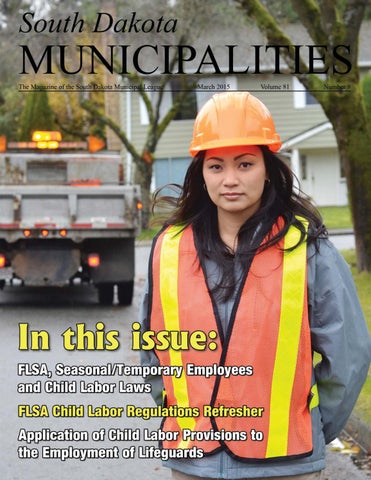
Official Monthly Publication
Member of National League of Cities
Contents Features SDML Welcomes New Staff Member . . . . . . . . . . . . .6
www.sdmunicipalleague.org
2015 District Meetings Schedule . . . . . . . . . . . . . . . . .7
South Dakota MUNICIPALITIES Managing Editor: Yvonne A. Taylor
Editor: Carrie A. Harer
PRESIDENT Jeanne Duchscher Finance Officer, Parker
DISTRICT CHAIRS Dist. 1 - Mike Grosek Mayor, Webster
1st VICE PRESIDENT Meri Jo Anderson Finance Officer, New Underwood
Dist. 2 - Tim Reed Mayor, Brookings
2nd VICE PRESIDENT
Dist. 3 - Amy Nelson City Manager, Yankton
Laurie Gill Mayor, Pierre
Dist. 4 - Debbie Houseman Finance Officer, Lake Andes
TRUSTEES Greg Jamison Councilmember, Sioux Falls
Dist. 5 - Renae Phinney President, Ree Heights
Sam Kooiker, Mayor, Rapid City Pauline Sumption Finance Officer, Rapid City Mike Wendland Mayor, Baltic Karl Alberts Finance Officer, Aberdeen PAST PRESIDENT Becky Brunsing Finance Officer, Wagner
Dist. 6 - Anita Lowary Finance Officer, Groton
Street Maintenance Association Meeting . . . . . . . . . . .8 Code Enforcement Training Conference . . . . . . . . . . .9 DOT Grants . . . . . . . . . . . . . . . . . . . . . . . . . . . . . . . .10 Police Chiefs Accepting Award Nominations . . . . . .10 FLSA, Seasonal/Temporary Employees and Child Labor Laws . . . . . . . . . . . . . . .11 FLSA Child Labor Regulations Refresher . . . . . . . . .12 Municipalities and Contractors’ Excise Tax . . . . . . .17 Employment of Lifeguards . . . . . . . . . . . . . . . . . . . .18 Chlorine Safety for Water Recreation Facilities . . . .22 Local Governments Win Cell Tower Supreme Court Case – For the Most Part . . . . . . . . .24 Supreme Court Review: Mid-Term 2014-2015 . . . . .26 Is E-rate 2.0 Worth the Effort? Yes! . . . . . . . . . . . . . . .28 2015 NLC Federal Action Priorities . . . . . . . . . . . . .29
Dist. 7 - Arnold Schott Mayor, McLaughlin
You’re in Office – but Are You Leading? . . . . . . . . .30
Dist. 8 - Harry Weller Mayor, Kadoka
New GASB Standards to Bring Changes in Financial Reporting for SDRS Employers . . . . . . . .33
Dist. 9 - Gary Lipp Mayor, Custer
Change Your Change Plan . . . . . . . . . . . . . . . . . . . . .34
Dist. 10 - Fay Bueno Finance Officer, Sturgis
LEAGUE STAFF 1-800-658-3633 Fax: 605-224-8655 Yvonne Taylor Executive Director Sandi Larson Director of Risk Sharing Services Lori Martinec Director of Research and Training Jeff Mehlhaff Director of Municipal Electric Services Carrie Harer Director of Marketing & Communications Lori Butler Director of Finance Kristi Brakke Accounting Assistant Paula Lind Administrative Coordinator SD Public Assurance Alliance: Judith Payne Executive Director Kristina Peterson Director of Underwriting Ron Burmood Director of Member Services Paytra Nichols Assistant Underwriter Jerry Krambeck Member Services Representative Deb Corkill Executive Assistant
Vermillion Police Department Awarded Money for Body Worn Police Cameras . . . . . . . . . . .39 , Workforce Training Services . . . . . . . . . . . . . . . . . . .41
Columns Director’s Notes . . . . . . . . . . . . . . . . . . . . . . . . . . . . . . .4 President’s Report . . . . . . . . . . . . . . . . . . . . . . . . . . . .5 Risk-Sharing News . . . . . . . . . . . . . . . . . . . . . . . . . .38 Washington Report: Senator Rounds . . . . . . . . . . . . .40
In Every Issue Community Calendar . . . . . . . . . . . . . . . . . . . . . . . . .44 Classifieds . . . . . . . . . . . . . . . . . . . . . . . . . . . . . . . . .46 Directory Changes . . . . . . . . . . . . . . . . . . . . . . . . . . . .5 Municipal Calendar . . . . . . . . . . . . . . . . . . . . . . . . . .49
SOUTH DAKOTA MUNICIPALITIES (ISSN 0300-6182, USPS 503-120) is the official publication of the South Dakota Municipal League, published monthly at 208 Island Drive, Ft. Pierre, South Dakota 57532, phone 605-224-8654. This institution is an equal opportunity provider, and employer. Periodical postage paid at Pierre, South Dakota and additional mailing offices. Non-member subscriptions are available for $30.00 annually. The opinions expressed herein are not necessarily those of the South Dakota Municipal League. Postmaster: Send address changes to SOUTH DAKOTA MUNICIPALITIES, 208 Island Drive, Ft. Pierre, South Dakota 57532.
MARCH 2015
VOLUME 81, NUMBER 9
3
Director's Notes The Legislative Session will only have a couple weeks left once you receive this, but believe me, the last days are the LONGEST days. At this writing, we have made good progress on many of the League’s goals, but the final results won’t be in until the 13th. We are looking forward to seeing you all as we visit the District Meeting communities of New Effington, Madison, Yankton, Dallas, St. Lawrence, Ipswich, Akaska, Kadoka, Custer, and Sturgis. We sincerely find great events and sites in each town we go to, and we really wish this opportunity to “leave the beaten path” were something all of our citizens and visitors could have.
4
Affiliate groups are active this time of year, with meetings scheduled for the Municipal Electric SuperintendentForeman Conference March 3-4; Building Officials ICC Seminar March 24 (Rapid City) and 26 (Sioux Falls); Street Maintenance Association meeting April 15-16; Police Chiefs’ Association and Sheriffs’ Joint Meeting April 22-24; and Code Enforcement Workshop May 6-7. Plans are also well underway for the annual Finance Officers’ School and Human Resource School. Please go to www.sdmunicipalleague.org for all the dates, agendas, and details so you can get these excellent training opportunities on your calendar. We hope to see many of you at District Meetings, but until then, remember we are always available at 1-800-6583633 or yvonne@sdmunicipalleague.org. Yvonne Taylor Executive Director
SOUTH DAKOTA MUNICIPALITIES
President's Report SDML Directory Changes Akaska
Delete: FO Marie Starks Add: FO Cindi Fritz
Avon
Delete: FO Tiffany Voigt
Bison
Delete: LSM Kelli Bruhn Add: LSM Merle Hulm
Bowdle
Add:
Brookings
Delete: STS Koss Delfinis Add: STS Matt Bartley
Custer
Add:
Hot Springs
Delete: BI Scott Simianer
Humboldt
Delete: finance@humboldtsd.com Add: amanda.siemonsma@humboldtsd.com
Mitchell
Delete: mwilson@cityofmitchell.org Add: mbathke@cityofmitchell.org FO Michelle Bathke
CM Erick Bieber
PD Scott Simianer
Mobridge
Delete: FC Brad Milliken SS Brad Milliken WS Brad Milliken Add: SS Justin Dame WS Justin Dame
Piedmont
Delete: FO Diana Evans T David Murphy Add: ADM Diana Evans FO Karlene Silver T Bill Paris
Wakonda
Delete: FO Celia Peterson Add: FO Nancy Andresen
Watertown
Delete: HR Lois Brinkman
Email Directory changes to paula@sdmunicipalleague.org. Visit www.sdmunicipalleague.org for a cumulative listing of changes to the 2014-2015 Directory of Municipal Officials.
MARCH 2015
The beginning of March. In order for the SDML Magazine to publish on the 1st of each month; the deadline for articles is much earlier – making my monthly ramblings to you seem to come closer and closer each month! The 2015 session of the SD Legislature is winding down. I want to thank all the people involved in the SDML that either testified, contacted or wrote to your legislator on behalf of a particular bill. With the end of the session comes the SDML District meetings! From New Effington to Yankton to Sturgis— and in between I will hit the road and find myself in communities that I have never seen before. During this year of my presidency I would like to see many city halls but the reality of it is that is not a possible task to fulfill. I am grateful for these meetings to meet new folks, chat with old friends and learn about your area. (And who can forget the awesome door prizes!) Until then, keep up the good work that you do for your community and we’ll see you soon! Jeanne Duchscher President
SD Police Chiefs’ Association & SD Sheriffs’ Association Joint Meeting & Spring Conference April 22-24, 2015 The Lodge at Deadwood, Deadwood Agenda and registration form are posted under SDML Events at www.sdmunicipalleague.org. Registration is due by April 1, 2015. Rooms can be reserved at The Lodge at Deadwood, 605584-4800. Room block will be released March 23, 2015.
5
SDML Welcomes New Staff Member Lori Martinec joined the League as the Director of Research and Training in February 2015. She graduated from Jamestown College with a Bachelor ’s Degree in P s y c h o l o g y, H i s t o r y / Political Science and a Secondary Education Certification.
Nominate Deserving Operations Specialists from your Water or Wastewater System The South Dakota Water & Wastewater Association (SDWWA) annually presents awards in various categories to deserving operations specialists in South Dakota. All nominations must be made by July 15. Awards are presented at the SDWWA Annual Conference which is being held September 16-18, 2015 at the Spearfish Holiday Inn.
Lori Martinec
Lori worked at the Juvenile Services Center in Rapid City as a Corrections Supervisor for over six years prior to moving to Pierre. She then worked for the state Department of Human Services, Division of Developmental Disabilities, as Program Manager for the Family Support 360 Medicaid Waiver Program for over three years. The program’s focus was to provide in-home services to children and adults with Developmental Disabilities.
A person does not have to be in attendance to receive an award. A nominating form and more info can be found at the SDWWA website, www.sdwwa.org.
It’s a Boy!!!
Most recently Lori worked as Program Manager for the Department of Social Services, Victims’ Services Program. The program’s focus was to provide monetary assistance to individual victims of crime and to administer state and federal grant funds that provide assistance to local and state victim’s services agencies. Lori lives in Pierre with her husband Tom and her three year old son Benjamin. She enjoys biking, cross-country skiing, fishing, gardening and refurbishing furniture. Lori is very excited about the opportunity to work with SDML members through her position. Contact Lori at 800658-3633 or by email at martinec@sdmunicipalleague.org.
Mehlhaff family welcomes
Carter John Born: January 24, 2015 Weight: 6 lbs 15 oz Length: 18.75 inches Proud Parents: Jeff and Brittany 6
SOUTH DAKOTA MUNICIPALITIES
2015 SDML District Meetings The SDML District Meetings are held every spring to report the outcome of the legislative session. The League President and staff look forward to traveling the state and seeing you at one of the meetings listed below. Legislators, representatives from state agencies and congressional delegates have also been invited to visit with you. For the League’s purposes, the cities in the state are divided into ten districts. One meeting is held in each district. A map of the districts and a listing of the cities by district can be found in the Directory of Municipal Officials or on the League’s website, www.sdmunicipalleague.org. A chair and vice-chair are elected annually at each district meeting. The chair serves on the League Board and in their absence the vice-chair fills in. The meeting starts with a social to allow you time to meet your peers from surrounding cities and renew
acquaintances. The social is followed by a meal and program. During the program you will hear from several people including the League’s President Jeanne Duchscher and Executive Director Yvonne Taylor. At the end of the evening the election of chair and vice-chair will be held. Each city present gets one vote. The last thing to decide before heading home is who will be hosting your district’s meeting in 2016. If your community is interested in hosting the meeting next year just volunteer when asked! Registration forms have been sent to all the city offices and are available at www.sdmunicipalleague.org/sdmlevents. Please discuss how many will be attending your district meeting and return the registration form to the League. If you can’t make it to the meeting in your district feel free to register for one that works for you. If you have any questions call the League at 800-658-3633.
2015 District Meetings Schedule Time
District
Date
Location
City
District 1
March 24
New Effington Legion 303 Main St
New Effington
6:00 p.m.
District 2
March 25
The Pub House 200 S Egan Ave
Madison
6:00 p.m.
District 3
April 1
National Field Archery Association 800 Archery Lane
Yankton
6:00 p.m.
District 4
March 31
Rumors 400 Service Road
Dallas
6:00 p.m.
District 5
March 19
St. Lawrence Fire Hall Community Room 106 N Commercial Ave
St. Lawrence
6:00 p.m
District 6
March 18
North Central Farmers Elevator Corporate Office 12 5th Ave
Ipswich
5:30 p.m
District 7
March 17
Akaska Community Center 109 E Main St
Akaska
6:00 p.m
District 8
April 7
Jigger’s Restaurant 80 SD Hwy 73
Kadoka
6:00 p.m
District 9
April 8
Custer
6:00 p.m.
Sturgis
6:00 p.m.
Laughing Water Restaurant at Crazy Horse Memorial 12151 Avenue of the Chiefs
(local time)
Attendees will not need to pay the entrance fee.
District 10
MARCH 2015
April 9
Holiday Inn Express Convention Center 2715 Lazelle St
7
SD Municipal Street Maintenance Association Spring Meeting April 15-16, 2015 j Spearfish Holiday Inn Convention Center j Spearfish, SD Wednesday, April 15
Thursday, April 16
Noon to 1:00 pm Registration – Registration Booth
8:00 to 9:00 am Asset Management and Pavement Condition Index for Municipalities Cedar Room Larry Weiss, SD LTAP
1:00 to 1:15
Welcome – Cedar Room
1:15 to 2:30
Retrofitting and Street Lighting Design Darlene Weber, EIT, CLEP, Electrical Designer and Matt VonHaden, P.E., Electrical Engineer, West Plains Engineering
2:30 to 3:00
Break – in exhibit area (Willow/Aspen/Spruce Rooms)
3:00 to 3:30
Cost Savings Analysis LED vs. HPS TBD
3:30 to 5:00
Round Table on Your City Street Projects
5:00 to 6:00
Exhibit Area Social – Willow/Aspen/Spruce
6:00
Banquet – Cottonwood Room
Registration Fee:
9:00 to 10:00
Front Foot Assessment for Street Maintenance Eric Davis, Assistant City Attorney, City of Spearfish
10:00 to 10:30
Break – in exhibit area (Willow/Aspen/Spruce Rooms)
10:30 to Noon
Snow Removal Operations Galynn Huber, Street/Fleet Manager, City of Sioux Falls Public Works Department *door prize will be given away
SDMSMA Member $50 and Non-member $65.
Accommodations: A block of rooms has been reserved at the Spearfish Holiday Inn (605-642-4683) at a rate of $94.99 + tax. **IMPORTANT: to guarantee this rate your reservation must be made by March 15, 2015. Be sure to mention you are with the Street Maintenance Association.
REGISTRATION Street Maintenance Association Meeting j April 15-16, 2015 Municipality __________________________________________________________________________________ Name
Title
______________________________________________________________________________________________ ______________________________________________________________________________________________ ______________________________________________________________________________________________ Return registration with payment by April 1, 2015 to: No refunds will be given after April 1, 2015. Office Use Only:
Date:________________
SD Municipal Street Maintenance Association 208 Island Drive, Ft. Pierre, SD 57532
Check #:________________
Amount:________________
SD Association of Code Enforcement (SoDACE) Information and Training Conference May 6-7, 2015 j Highland Conference Center j Mitchell, SD Wednesday, May 6 8:30 – 9:00 am Registration – Pre-Function Area outside Winchester/Remington/Beretta 9:00 – 9:15
3:15 – 5:00
Condemnation Procedures and Cost Assessments* Tom Frieberg, Frieberg, Nelson & Ask L.L.P. Geoff Fillingsness, Code Enforcement Officer, City of Beresford *An A-Z packet of materials will be provided for this session.
5:30
Social and Dinner and Presentation of the Code Enforcement Officer of the Year Award – Benelli (Nomination Form online at www.sdmunicipalleague.org.)
Welcome – Winchester/Remington/ Beretta
9:15 – 11:45
Towards a More Effective Code Enforcement Strategy Dale Powers, MA, AICP Mr. Powers is an independent code enforcement consultant based in Clear Lake, MN. He has nearly 20 years experience working with and for local governments. As a city administrator, city planner, county planner, and zoning administrator, he has worked in urban, suburban, and rural communities. His paper, Towards a More Effective Code Enforcement Strategy, was published in the March 2012 edition of the American Institute of Certified Planner’s trade publication Practicing Planner. 11:45 – 1:00 pm Lunch – Benelli 1:00 – 2:30
Thursday, May 7 9:00 – 10:15 am Code Enforcement Training and Certification: Reviewing options for cities and towns in SD – Winchester/Remington/Beretta Roy Fyffe, American Association of Code Enforcement (AACE)
Towards a More Effective Code Enforcement Strategy cont’d
10:15 – 10:30
Break – Pre-Function Area
2:30 – 2:45
Break – Pre-Function Area
10:30 – Noon
Code Enforcement Training and Certification cont’d
2:45 – 3:15
Business Meeting
Registration Fee:
Advance Registration: $50/SoDACE member and $90/non-member. On-site Registration: $60/SoDACE member and $100/non-member.
Accommodations:
One block of rooms has been reserved at the Comfort Inn and Suites (605-990-2400) at a rate of $89.00 + tax. A second block of rooms has been reserved at the Hampton Inn (605-995-1575) at a rate of $79.00 + tax. **IMPORTANT: to guarantee this rate your reservation must be made by April 21, 2015. Be sure to mention you are with SoDACE.
REGISTRATION SD Code Enforcement Training Conference j May 6-7, 2015 Municipality __________________________________________________________________________________ Name Title Email ______________________________________________________________________________________________ ______________________________________________________________________________________________ Return registration with payment by April 17, 2015 to: No refunds will be given after April 17, 2015. Office Use Only:
Date:________________
South Dakota Association of Code Enforcement 208 Island Drive, Ft. Pierre, SD 57532
Check #:________________
Amount:________________
DOT Grants The South Dakota Department of Transportation has developed a grant program to foster economic development and enhance community access in South Dakota. The program has three categorical purposes. The Industrial Park Grants will be made to any local unit of government for the development of new or expanded access for new industry located within industrial parks. Applications are due April 15, July 15, or October 15. The Agri-Business Grants will be made to any local unit of government for the development of new or expanded agri-business industries. Applications are due April 15, July 15, or October 15. Community Access Grants are state funds for towns less than 5,000 in population and are for the construction or reconstruction of major streets in each town such as Main Street, the road to the elevator, schools, hospitals, etc. Applications are due July 15. These programs provide for 60% of the construction costs of the project, not including engineering or utility work. Grant size is limited to $200,000. Application Should Include j Clear map showing the project location j Engineer’s Estimate j Resolution of support from the local sponsor Project Requirements j Designed in accordance with the South Dakota Department of Transportation Standard Specifications for Roads and Bridges j Must comply with the American’s with Disabilities Act j Funds cannot be used for routine maintenance j Must have plans and specifications stamped by a registered professional engineer All grants will be based on the criteria developed by the Department of Transportation. The expenditure authority for the program will be determined by the Transportation Commission. All grants must be approved by the Transportation Commission, and may be used to construct or reconstruct roads and streets in the community.
Police Chiefs Accepting Award Nominations The South Dakota Police Chiefs’ Association is accepting nominations for the following awards: Medal of Honor For members who willingly distinguish themselves through an act of courage, involving a risk of imminent serious injury or death, for the purpose of saving or protecting a human life or while taking an armed and immediately dangerous suspect into custody. Chief John Wainman Sr. Service Award For contributions by a member of the SDPCA which exceed the high standards and contributions normally made by members. Citizen’s Award of Merit Presented to a citizen, company or group who performed an exceptional act or demonstrated a continued pattern of actions that furthered the mission and goals of the SDPCA, or who have made a significant contribution to the law enforcement profession in the State of South Dakota. Officer of the Year All sworn officers are eligible. This includes law enforcement officers in US Park Service, Customs, Border Patrol, Sheriffs’ Offices, Tribal Agencies, University Police, Reserve Officers, and others below the rank of chief/sheriff. Nominations may be made for exceptional achievement in any police endeavor, including extraordinary valor, crime prevention, investigative work, community policing, traffic safety, drug control and prevention, juvenile programs and training programs. Deadline for submission is March 16. An official nomination form can be obtained by visiting www.sdmunicipalleague.org then the Police Chiefs section under the Affiliate Organizations tab.
All aspects of these grant programs are outlined in the Fact Sheets and Policies for Industrial Park, Agri-Business Access, and Community Access Grant Programs and can be found at http://www.sddot.com/business/local/economic/. For more information contact Paula Huizenga, Grants Program Engineer, paula.huizenga@state.sd.us or 605773-6253. 10
SOUTH DAKOTA MUNICIPALITIES
FLSA, Seasonal/Temporary Employees and Child Labor Laws It is important to regularly review Fair Labor Standards and Child Labor regulations PRIOR to seasonal hiring. Often we become complacent and continue to do things the way we have always done them. Reminders like this give us an opportunity to verify that we are adhering to the law. In this economy, none of us can afford to make mistakes that cost our communities back wages for overtime. The Fair Labor Standards Act (FLSA) allows for specific exemptions from minimum wage and overtime including administrative, executive and professional exemptions. For purposes of this article, we will assume that most employees hired for seasonal and temporary positions are non-exempt from minimum wage and overtime provisions. This means that these employees will be eligible to receive minimum wage at $8.50 per hour. Seasonal and temporary employees are eligible to receive 1.5 times the hourly wage for all hours worked over 40 in any given workweek as required by FLSA. FLSA DOES include an exemption from minimum wage and overtime for Seasonal Amusement or Recreational Establishments - Section 13(a)(3). Tests for this exemption include: a) does not operate for more than seven months in any calendar year; OR b) during the preceding calendar year, average receipts for any six months of such year were not more that 33 1/3% of its average receipts for the other six months of such year. It would seem apparent that a swimming pool or other facility that is open only for the summer months would qualify for this exemption from overtime and minimum wage provisions of the FLSA. But please note, if
MARCH 2015
seasonal employees who qualify for this exemption perform other jobs for the city, this exemption from overtime may not apply. Also please review the “FLSA Child Labor Regulations Refresher” article on pages 12-16. It is important to consider the duties that employees under age 18 are permitted to perform. With limited resources and limited staff, it becomes essential to understand the law. The majority of the questions that the Municipal League receives are regarding “children” under eighteen years of age (16-17) and if they are allowed to run lawn mowers. In a later article the actual Prohibited Occupations for 16-17 year olds (non-adult) are reviewed. Even though lawn mowers are not specifically mentioned, there are enough related references to this type of work that many cities across South Dakota do not use child labor for these duties. The League discourages cities from doing so but we will leave that to you and your City Attorney to work out. It would also be prudent to review the Child Labor Violation Penalties which is in a later article as well. These laws can be complicated and difficult to sort out. If there are questions, employers are required to follow the law that provides the greatest benefit to the employee. State codified law can be found online at http://legis.sd.gov/statutes/Codified_Laws/ under Title 60 Labor and Employment. The South Dakota Department of Labor staff is also a great resource. You also have access to SDML knowledgeable staff (800-658-3633) and the SD Governmental Human Resource Association.
11
FLSA Child Labor Regulations Refresher Reprinted from the United States Department of Labor Wage and Hour Division website. The information in this article is a snapshot of what is provided via the DOL website. For more details follow visit http://www.dol.gov/ whd/regs/compliance/childlabor101_text.htm.
Minimum Age Standards for Nonagricultural Employment 14 Minimum age for employment in specified occupations outside of school hours for limited periods of time each day and each week.
With summer just around the corner, it may be a good time to have a little refresher course on the Fair Labor Standards Act (FLSA) regarding child labor regulations. Employers may employ youth only under certain conditions and child labor regulations vary significantly depending on the age of the youth.
16 Basic minimum age for employment. At 16 years of age, youth may be employed for unlimited hours in any occupation other than one declared to be hazardous by the Secretary of Labor.
Federal Child Labor Provisions The federal child labor provisions, also known as the child labor laws, are authorized by the Fair Labor Standards Act (FLSA) of 1938. These provisions were enacted to ensure that when young people work, the work is safe and does not jeopardize their health, well-being or educational opportunities. By knowing, understanding, and complying with these provisions, employers, parents, and teachers can help working teens enjoy those safe, positive, early work experiences that can be so important to their development. Other Laws That Impact Child Labor Other federal and state laws may have higher standards. When these apply, the more stringent standard must be observed. All states have child labor provisions, compulsory school attendance laws, and establish the minimum ages and conditions under which youths may operate motor vehicles. Unless otherwise exempt, a covered minor employee is entitled to receive the same minimum wage, overtime, safety and health, and non-discrimination protections as adult workers.
12
18 Minimum age for employment in nonagricultural occupations declared hazardous by the Secretary of Labor. Occupation Standards for 14- and 15-Year-Olds The following list, which is not exhaustive, are jobs that 14- and 15-year-olds may not be employed in: 1. Any manufacturing occupation.1 2. Any mining occupation. 3. Most processing occupations such as filleting of fish, dressing poultry, cracking nuts, developing of photographs, laundering, bulk or mass mailings (except certain occupations expressly permitted as discussed below). 4. Occupations requiring the performance of any duties in workrooms or workplaces where goods are manufactured, mined or otherwise processed (except to the extent expressly permitted as discussed below; and as discussed in footnote 1). 5. Any occupation found and declared to be hazardous by the Secretary of Labor. 6. Occupations involved with the operating, tending, setting up, adjusting, cleaning, oiling or repairing of hoisting apparatus. 7. Work performed in or about boiler or engine rooms or in connection with the maintenance or repair of the establishment, machines, or equipment. 8. Occupations involved with the operating, tending, setting up, adjusting, cleaning, oiling or repairing of any power-driven machinery, including, but not limited to, lawnmowers, golf carts, all-terrain vehicles, trimmers, cutters, weed-eaters, edgers, food slicers, food grinders, food choppers, food processors, food cutters, and food mixers. Fourteen- and 15-yearolds may operate most office machinery and those machines that are expressly permitted. 9. The operation of motor vehicles or service as helpers on such vehicles. 10. The riding on a motor vehicle inside or outside of an enclosed passenger compartment except as permitted in #16 in the next list. 11. Outside window washing that involves working from window sills. SOUTH DAKOTA MUNICIPALITIES
12. All work requiring the use of ladders, scaffolds, or their substitutes. 13. All baking and most cooking activities except as discussed in the following #3. 14. Work in freezers and meat coolers and all work in the processing of meat for sale; however, youth are permitted to occasionally enter freezers only momentarily to retrieve items. 15. Youth peddling, including not only the attempt to make a sale or the actual consummation of a sale, but also the preparatory and concluding tasks normally performed by a youth peddler, such as the loading and unloading of motor vehicles, the stocking and restocking of sales kits and trays, the exchanging of cash and checks with the employer, and the transportation of the minors to where the sales will be made. 16. Loading and unloading of goods or property onto or from motor vehicles, railroad cars, and conveyors, except as discussed in the following #12. 17. Catching and cooping of poultry in preparation for transport or for market. 18. Public messenger service. 19. Occupations in connection with: a. Transportation of persons or property by rail, highway, air, on water, pipeline, or other means. b. Warehousing and storage. c. Communications and public utilities. d. Construction (including repair). Except 14- and 15-year-olds may perform office or sales work in connection with a, b, c, and d above when not performed on transportation media, on an actual means of transportation, or at the actual construction site.
4.
5. 6. 7.
8.
9.
10.
11. The following is the list of jobs the Secretary of Labor has determined will not interfere with the schooling, health, and well-being of 14- and 15-year-olds and therefore MAYBE performed by such youth. Any job not specifically permitted, is prohibited. 1. Office and clerical work, including operation of office machines. 2. Work of an intellectual or artistically creative nature such as but not limited to computer programming, the writing of software, teaching or performing as a tutor, serving as a peer counselor or teacher’s assistant, singing, the playing of a musical instrument, and drawing, as long as such employment complies with all the other provisions contained in §§ 570.33, .34, and .35. 3. Cooking with electric or gas grills that do not involve cooking over an open flame and with deep fat fryers that are equipped with and utilize devices that automatically lower and raise the baskets into and out of the oil or grease. NOTE: this section does not permit cooking with equipment such as rotisseries, MARCH 2015
12.
13.
broilers, pressurized equipment including fryolators, and cooking devices that operate at extremely high temperatures such as “Neico broilers.” Cashiering, selling, modeling, art work, work in advertising departments, window trimming and comparative shopping. Price marking and tagging by hand or by machine. Assembling orders, packing and shelving. Bagging and carrying out customer orders. Errand and delivery work by foot, bicycle, and public transportation. Except such youth may not be employed by a public messenger service. Cleanup work, including the use of vacuum cleaners and floor waxers, and the maintenance of grounds, but not including the use of power-driven mowers, cutters, trimmers, edgers, or similar equipment. Kitchen work and other work involved in preparing and serving food and beverages, including operating machines and devices used in performing such work. Examples of permitted machines and devices include, but are not limited to, dishwashers, toasters, dumbwaiters, popcorn poppers, milk shake blenders, coffee grinders, automatic coffee machines, devices used to maintain the temperature of prepared foods (such as warmers, steam tables, and heat lamps), and microwave ovens that are used only to warm prepared food and do not have the capacity to warm above 140 °F. Cleaning kitchen equipment. Minors are permitted to clean kitchen equipment (not otherwise prohibited), remove oil or grease filters, pour oil or grease through filters, and move receptacles containing hot grease or hot oil, but only when the equipment, surfaces, containers and liquids do not exceed a temperature of 100°F. Cleaning vegetables and fruits, and the wrapping, sealing, labeling, weighing, pricing, and stocking of items, including vegetables, fruits, and meats, when performed in areas physically separate from a freezer or meat cooler. Loading onto motor vehicles and the unloading from motor vehicles of the light, non-power-driven, hand tools and personal protective equipment that the minor will use as part of his or her employment at the work site; and the loading onto motor vehicles and the unloading from motor vehicles of personal items such as a back pack, a lunch box, or a coat that the minor is permitted to take to the work site. Such light tools would include, but not be limited to, rakes, hand-held clippers, shovels, and brooms. Such light tools would not include items like trash, sales kits, promotion items or items for sale, lawn mowers, or other power-driven lawn maintenance equipment. Such minors would not be permitted to load or unload safety equipment such as barriers, cones, or signage. The occupation of lifeguard (15-year-olds but not 14year-olds) at traditional swimming pools and water 13
amusement parks (including such water park facilities as wave pools, lazy rivers, specialized activity areas, and baby pools, but not including the elevated areas of water slides) when properly trained and certified in aquatics and water safety by the American Red Cross or a similar certifying organization. No youth under 16 years of age may be employed as a lifeguard at a natural environment such as an ocean side beach, lake, pond, river, quarry, or pier. 14. Employment of certain youth under specified conditions inside and outside of establishments where machinery is used to process wood products. See the DOL link at the beginning of this article for information on this exemption. 15. Work in connection with cars and trucks if confined to the following: j Dispensing gasoline and oil. j Courtesy service on premises of gasoline service station. j Car cleaning, washing, and polishing by hand. j Other occupations permitted by Child Labor Regulation No. 3, but not including work involving the use of pits, racks or lifting apparatus or involving the inflation of any tire mounted on a rim equipped with a removable retaining ring. 16. Work in connection with riding inside passenger compartments of motor vehicles except as prohibited in #10 in the previous list or when a significant reason for the minor being a passenger in the vehicle is for the purpose of performing work in connection with the transporting—or assisting in the transporting of— other persons or property. Each minor riding as a passenger in a motor vehicle must have his or her own seat in the passenger compartment; each seat must be equipped with a seat belt or similar restraining device; and the employer must instruct the minors that such belts or other devices must be used. In addition, each driver transporting the young workers must hold a valid state driver’s license for the type of vehicle being driven and, if the driver is under the age of 18, his or her employment must comply with the provisions of HO 2 (see chart). Employment Standards for 16- and 17-Year-Olds in Nonagricultural Employment The Hazardous Occupations Orders (HOs) for Nonagricultural Employment These Orders are published in Subpart E of Part 570 of Title 29 of the Code of Federal Regulations. The FLSA provides a minimum age of 18 years for any nonagricultural occupations which the Secretary of Labor “shall find and by order declare” to be particularly hazardous for 16- and 17-year-old persons, or detrimental to their health and well-being. This minimum age applies 14
even when the minor is employed by the parent or person standing in place of the parent. The seventeen HOs apply either on an industry basis, specifying the occupations in the industry that are not permitted, or an occupational basis irrespective of the industry in which found. Some of the HOs contain limited exemptions.
HO 1
Manufacturing and storing of explosives.
HO 2
Motor-vehicle driving and outside helper on a motor vehicle.
HO 3
Coal mining.
HO 4
Occupations in forest fire fighting, forest fire prevention, timber tract operations, forestry service, logging, and sawmilling.
HO 5*
Power-driven woodworking machines.
HO 6
Exposure to radioactive substances.
HO 7
Power-driven hoisting apparatus, including forklifts.
HO 8*
Power-driven metal-forming, punching, and shearing machines.
HO 9
Mining, other than coal mining.
Operating power-driven meat processing equipment, including meat slicers and other food slicers, in retail establishments (such as HO 10* grocery stores, restaurants kitchens and delis) and wholesale establishments, and most occupations in meat and poultry slaughtering, packing, processing, or rendering. HO 11
Power-driven bakery machines including vertical dough or batter mixers.
HO 12*
Power-driven balers, compactors, and paper processing machines.
HO 13
Manufacturing bricks, tile, and kindred products.
Power-driven circular saws, bandsaws, chain HO 14* saws, guillotine shears, wood chippers, and abrasive cutting discs. HO 15
Wrecking, demolition, and shipbreaking operations.
HO 16*
Roofing operations and all work on or about a roof.
HO 17* Excavation operations. * These HOs provide limited exemptions for 16- and 17-yearolds who are bona-fide student-learners and apprentices.
SOUTH DAKOTA MUNICIPALITIES
Enforcement of the Federal Child Labor Provisions The Wage and Hour Division, which is part of the Department of Labor, administers and enforces the child labor, minimum wage, overtime and recordkeeping provisions of the Fair Labor Standards Act. The Wage and Hour Division also has enforcement responsibility for programs covering such things as prevailing wages for government contracts, the payment of special minimum wages, farm labor, family and medical leave, immigration and polygraph testing. Wage and Hour Division Investigators, who are stationed across the United States, are authorized to conduct investigations and gather data on wages, hours of work, and compliance with all the provisions of the FLSA, including the child labor provisions. Age Certificates To help protect your city from unwittingly violating the FLSA minimum age standards, employers should possess proof of age for all employees under the age of 19. The FLSA provides an affirmative defense against child labor violations for employers who have on file a valid certificate showing that the employee is the required age. The use of these certificates is not mandatory under the FLSA, but the U.S. Department of Labor recommends that employers obtain a certificate if there is reason to believe a worker is not old enough to perform a given job, for instance, if he or she has an especially youthful appearance, or if he or she claims to be only a few years older than the required age.
j j j j j j j j
sex of the minor; signature of the minor; name and address of the minor’s parent or guardian; name and address of the employer, if the minor is under 18; industry of the employer, if the minor is under 18; occupation of the minor, if the minor is under 18; signature of the issuing officer; and date and place of issuance.
Penalties for Violation Civil Money Penalties Employers may be subject to a civil money penalty of up to $11,000 for each employee who is the subject of a child labor violation. The penalty may be increased to $50,000 for each violation that causes the death or serious injury of a minor, and that penalty may be doubled when the violations are determined to be repeated or willful. When a civil money penalty is assessed against an employer for a child labor violation, the employer has the right, within 15 days after receipt of the notice of such penalty, to file an exception to the determination that the violation or violations occurred. When such an exception is filed with the office making the assessment, the matter is referred to the Chief Administrative
DOL’s regulations set out the procedures for applying for, issuing, holding and disposing of certificates of age. The regulations authorize certificates to be issued by most of the states as well as DOL’s Wage and Hour Division. To secure certificates of age, employers must provide to DOL or an appropriate state agency documentary evidence of proof of birth for any minors they employ. The following documents generally are accepted as proof of birth: j birth certificate, j an attested transcript of birth, j a signed statement issued by a registrar of vital statistics for births in the area, j a baptism record, j certain family Bible records, j a passport, j a certificate of arrival in the United States, and j certain school records accompanied by a physician’s certificate. Generally, the regulations state, a valid certificate of age must contain the following information: j name and address of the minor; j place and date of birth of the minor; MARCH 2015
15
Law Judge, and a formal hearing is scheduled. At such a hearing, the employer may, or an attorney retained by the employer may, present such witnesses, introduce such evidence and establish such facts as the employer believes will support the exception. The determination of the amount of any civil money penalty becomes final if no exception is taken to the administrative assessment thereof, or if no exception is filed pursuant to the decision and order of the administrative law judge.
Additional Information For information about the federal child labor requirements, visit the YouthRules! at http://www.youthrules.dol.gov.
Injunction to Compel Compliance The FLSA authorizes the Department of Labor to seek injunctions against violators of the child labor provisions to compel their compliance with the law. Further violations could result in sanctions against such persons for contempt of court.
Locate the Wage and Hour Division office nearest to you, telephone the toll-free information and helpline at 1-8664US-WAGE (1-866-487-9243): a customer service representative is available to assist you with referral information from 8am to 5pm in your own time zone; or log onto the nationwide listing of Wage-Hour District Offices located at: http://www.dol.gov/whd/america2.htm.
Criminal Sanctions The FLSA also provides, in the case of a willful violation, for a fine up to $10,000; or, for a second offense committed after the conviction of such person for a similar offense, for a fine of not more than $10,000 or imprisonment for not more than 6 months, or both.
16
Inquiries about the Fair Labor Standards Act or any other law administered by the Wage and Hour Division may be addressed to any local office of the Wage and Hour Division. Additional information is available at http://www.dol.gov/ whd/index.htm.
Notes 1. Section 13(c)(7) of the FLSA, enacted in 2004, permits the employment of certain minors between the ages of 14 and 18, who have been excused from compulsory school attendance, inside and outside of places of business where machinery is used to process wood products. This provision, however, does not permit such minors to operate, or assist in the operation of power-driven woodworking machines.
SOUTH DAKOTA MUNICIPALITIES
Municipalities and Contractors’ Excise Tax When a municipality hires a contractor to perform construction services or realty improvement work for the municipality, the contractor will owe: j Contractors’ Excise Tax on the gross receipts from that work j Sales or Use Tax on all materials they use on the project j Contractors’ Excise Tax and Use Tax on materials the municipality supplies for the contractor’s work Owner-Furnished Material (OFM) is all materials the municipality furnishes to a contractor for use on a project. To help the contractor remit the proper taxes, the municipality should furnish the contractor with invoices showing the cost of all the materials it furnishes to the contractor for completion of a project. The contractor will owe the following taxes on ownerfurnished material: j State and applicable municipal use tax on the cost of the material, because the municipality did not pay sales tax for the material. j Contractors’ excise tax on the cost of the ownerfurnished material. Use tax billed and collected from the municipality is included in the contractors’ receipts and is subject to the excise tax. Examples of Realty Improvement: j Line installation, either above or below ground, for sewer, water or electricity j Moving electrical lines or transformers j Repairing a telephone pole, fire hydrant, stop sign, etc. j Laying concrete for a sidewalk on the property of a resident j Digging ditches and maintaining roads
Generally, Government entities cannot issue Prime Contractors’ Exemption Certificates to contractors performing construction services or realty improvements for that entity. However, when a municipality charges a customer for realty improvement work on the municipality’s property, the municipality is a prime contractor and, like every other contractor, must have a contractors’ excise tax license and is responsible for the 2% contractors’ excise tax. For these projects: j The municipality may issue a prime contractors’ exemption certificate to contractors they hire to do part or all of the work. j The contractors will not owe contractors’ excise tax. j The contractors owe use tax on materials the municipality furnishes for their use (OFM) and will owe sales or use tax on any material they purchase for the project. The exception is work for a municipal telephone company. All contractors, prime or subcontractors, owe contractors’ excise tax on their receipts when working for a municipal telephone company. Each contractor will owe sales or use tax on the material they provide for their use. They do not owe contractors’ excise tax on materials the municipality furnishes. What taxes can the contractor charge the municipality? By state law, contractors can list their tax expense as a separate line item on all contracts and bills. Contractors’ excise tax and contractors’ use taxes are part of the contractor’s total bill and are collectible from all entities, both public and private. Contact the SD Department of Revenue with any questions at 800-829-9188 or visit http://dor.sd.gov.
Example The owner (municipality) furnishes material (Cost $10,000). No sales or use tax was paid at the time of purchase. The project is inside city limits. The contractor provides the labor ($7,000). Contractor owes use tax on the cost of the material and excise tax on their charge for labor, taxes, and the cost of the owner-furnished material. The Bid Factor Worksheet shows how the contractor determines how much to invoice the customer. The return shows how the contractor reports this project on their contractors’ excise tax return.
MARCH 2015
17
Application of the Federal Child Labor Provisions to the Employment of Lifeguards Fact Sheet # 60: Application of the Federal Child Labor Provisions of the Fair Labor Standards Act (FLSA) to the Employment of Lifeguards
18 years of age Once a minor reaches 18 years of age, the federal child labor provisions no longer apply to their employment.
The Fair Labor Standards Act (FLSA), administered by the U.S. Department of Labor’s Wage and Hour Division (WHD), requires that most employees be paid at least the applicable federal minimum wage and overtime pay for all hours worked at time and one-half the regular rate of pay after 40 hours in a workweek. The FLSA also includes child labor and recordkeeping provisions. While some seasonal and recreational establishments such as outdoor swimming pools may be exempt from the minimum wage and overtime requirements of the FLSA if they meet certain tests, this exemption does not apply to the child labor or record keeping provisions of the FLSA.
16 and 17 years of age Sixteen and 17-year-olds employed as lifeguards may perform any nonhazardous job, for unlimited hours. The Secretary of Labor has declared 17 Hazardous Occupations Orders (HOs) which restrict the types of jobs and/or industries in which youth under 18 years of age may be employed. Although not exhaustive, the following list represents some common tasks which occur at establishments that employ lifeguards. Under the federal child labor provisions, workers under 18 years of age generally may not: j Operate or assist to operate, clean, oil, set up, adjust, or repair certain power-driven woodworking, metalworking, bakery, meat processing, and paper products machinery including meat slicers, compactors, balers, mixers, and saws. j Drive or serve as an outside-helper on a motor vehicle on a public road; but 17-year-olds who meet certain
Child labor Provisions of the FLSA The federal child labor provisions were enacted to protect the educational opportunities of minors and prohibit their employment in jobs and under conditions detrimental to their health or well-being.
18
SOUTH DAKOTA MUNICIPALITIES
j
j
specific requirements may drive automobiles and trucks that do not exceed 6,000 pounds gross vehicle weight for limited amounts of time during daylight hours as part of their job (see Fact Sheet #34). Operate power-driven hoists such as elevators, cranes, derricks, and high-lift trucks. However, 16- and 17-yearolds may operate and assist in the operation of most water amusement park and recreation establishment rides. Load, operate, or unload power-driven balers and compactors used in the disposal of waste. A limited exemption exists that permits the loading, but not the operating or unloading, of certain scrap paper balers and paper box compactors under certain specific conditions (see Fact Sheet #57).
14 and 15 years of age Fifteen-year-olds, but not youth less than 15 years of age, may be employed as lifeguards at traditional swimming pools and most facilities of water amusement parks. Such employment must meet the following conditions: j The 15-year-old must be trained and certified by the American Red Cross, or a similar certifying organization, in aquatics and water safety; and j The 15-year-old must be employed in compliance with all the other applicable provisions of the federal child labor rules contained in Child Labor Regulations No. 3 (see Subpart C of 29 CFR Part 570), including the restrictions on the hours and times of day that 15-yearolds may be employed as discussed below; and j The federal child labor rules require that 15-year-olds who are employed to teach or assist in teaching others how to swim must also be certified as swimming instructors by the American Red Cross or some other similar certifying agency.
conduct or officiate at swimming meets, and administer first aid. Additional ancillary lifeguard duties may include checking in and out such items as towels, rings, watches and apparel. Properly certified 15-year-old lifeguards are also permitted to use a ladder to access and descend from the lifeguard chair; use hand tools to clean the pool and pool area; and test and record water quality for temperature and/or pH levels, using all of the tools of the testing process including adding chemicals to the test water sample. Such youth would, however, be prohibited from entering or working in any chemical storage areas, including any areas where the filtration and chlorinating systems are housed. As mentioned, a core and defining duty of a lifeguard is the rescuing of swimmers in danger of drowning, often by entering the water and physically bringing the swimmer to safety. Under 29 C.F.R. § 570.34(l), any employee under the age of 16 whose duties include this core duty—such as a “junior lifeguard” or a “swim-teacher aide”—or whose employment could place him or her in a situation where the employer would reasonably expect him or her to perform such rescue duties, would be performing the duties of a lifeguard while working in such a position. For such employment to comply with these child labor provisions, the employee would have to be at least 15 years of age and possess the proper certification.
The occupation of lifeguard, as per 29 C.F.R. § 570.34(l), encompasses the duties of rescuing swimmers in danger of drowning, the monitoring of activities at a swimming pool to prevent accidents, the teaching of water safety, and providing assistance to patrons. Lifeguards may also help to maintain order and cleanliness in the pool and pool areas,
MARCH 2015
19
A traditional swimming pool means a water tight structure of concrete, masonry, or other approved materials located either indoors or outdoors, used for bathing or swimming and filled with a filtered and disinfected water supply, together with buildings, appurtenances and equipment used in connection therewith. A water amusement park means a facility that not only encompasses the features of a traditional swimming pool, but also includes such additional attractions as wave pools, lazy rivers, activities areas and elevated water sides. Properly certified 15-year-olds may be employed as lifeguards at water amusement park wave pools, lazy rivers, and activities areas, but not at the top of elevated water slides. Generally, all youth under 16 years of age are prohibited from operating or tending power-driven equipment and may not assist the public as they enter, “ride,” and leave water-park or amusement-park-type rides. Thus, minors under 16, even if properly certified as lifeguards, may not be employed as dispatchers, attendants, or slide monitors at the top of elevated water slides. Fifteenyear-olds who are properly certified may be employed as lifeguards stationed at the splashdown pools located at the bottom of elevated water slides. Youth under 16 years of age may not be employed as lifeguards at natural environment facilities such as rivers,
20
streams, lakes, ponds, quarries, reservoirs, wharfs, piers, or ocean-side beaches. Hours Limitations The employment of 14- and 15-year-olds, including those 15-year-olds employed as lifeguards, is generally limited to: j Outside of school hours; j 3 hours on a school day, including Fridays; j 8 hours on a nonschool day; j 18 hours in a week that school is in session; j 40 hours in a week that school is not in session. Also, such youth may not work before 7 a.m. or after 7 p.m. (except from June 1 through Labor Day when the evening limit is extended to 9 p.m.). Occupations Limitations Fourteen- and 15-year-olds, including properly certified 15year-olds who are employed as lifeguards, may not be employed in the following occupations that are often found at establishments that have traditional swimming pools: j Work involving the operation or tending of any powerdriven machinery and hoists (except office machinery). This prohibition includes work involving most amusement park and recreation establishment rides – including dispatchers on elevated water slides – and power-driven lawn mowers and trimmers.
SOUTH DAKOTA MUNICIPALITIES
j
j j j j
All baking and most cooking. These minors may perform cooking with electric and gas grilles that does not involve cooking with open flames. They may also cook with deep fryers that are equipped with and utilize devices that automatically lower and raise the fryer baskets into and out of the hot oil or grease. They may not operate NEICO broilers, pressure cookers, ovens or rotisseries. The cleaning of cooking equipment and the filtering, transporting, and disposing of hot oil and grease when the surfaces or hot oil or grease exceed 100° F. All work in construction, including demolition and repair. All work involving the use of ladders or scaffolding, except properly certified 15-year-old lifeguards may use a ladder to access and descend from the lifeguard chair. All work in freezers, but they may enter freezers equipped with safety latches, for brief periods of time, to retrieve items.
13 years of age and younger Youth under 14 years of age are generally not allowed to work in nonagricultural occupations. However, the FLSA does allow a parent who is the sole-owner of a business to employ his or her child in any occupations other than mining, manufacturing or those declared to be hazardous by the Secretary of Labor.
MARCH 2015
Where to Obtain Additional Information For more information on the FLSA child labor provisions, including a complete list of all hazardous occupation orders, visit the YouthRules! Web site at www.youthrules.dol.gov. For additional information on the Fair Labor Standards Act, visit the Wage and Hour Division Web site: http://www.wagehour.dol.gov and/or call our toll-free information and helpline, available 8 a.m. to 5 p.m. in your time zone, 1-866-4USWAGE (1-866-487-9243). When state child labor laws differ from the federal provisions, an employer must comply with the higher standard. Links to your state labor department can be found at http://www.dol.gov/whd/contacts/state_of.htm. This publication is for general information and is not to be considered in the same light as official statements of position contained in the regulations. Reprinted from http://www.dol.gov/whd/regs/compliance/ whdfs60.pdf.
21
Chlorine Safety for Water Recreation Facilities By Doug Kirkus While it might be hard to believe right now, summer is approaching and with that comes the opening of local swimming pools and aquatic facilities. Many of your entities will soon be in the process of hiring pool managers and lifeguards to assist you in the day-to-day operations of your water recreation facilities. The purpose of this article is to review one key component of employee safety, along with the safety of your patrons and your community. That key component is chemical safety; in particular, chlorine safety. Chlorine is used extensively in a variety of industries. Its largest use is in the manufacture of plastics. Chlorine is also the most widely used disinfectant in the world and it is often used to disinfect swimming pools. Sometimes hazards that can pose a potential health threat to employees and the public are “out-of-site” and therefore they are often “out-of-mind.” While the majority of South Dakota cities that we work with have discontinued the use of compressed chlorine gas for disinfecting swimming pools, there are some that are still using it. When used and handled properly, compressed chlorine gas poses little to no threat to your employees and public safety. Handled improperly, it can pose significant health risks and in some cases it can even be fatal. Inhalation of chlorine gas, greater than 15 parts per million (ppm), may lead to respiratory distress associated with airway constriction and accumulation of fluid in the lungs (pulmonary edema). The National Institute of Occupational Safety and Health (NIOSH) has determined that as little as 10 ppm of exposure to chlorine for a 30minute period could “pose an immediate threat to life, could cause irreversible adverse health effects, or could impair an individual’s ability to escape from a dangerous atmosphere.” An exposure of 430 ppm could be lethal over
ARENS ENGINEERING municipal engineering water & wastewater engineering storm drainage - municipal streets Vernon Arens, PE 230 Capitol St. j Yankton, SD j 57078 605-665-2002 j Fax 605-260-2140 arenseng@iw.net
22
30 minutes and an exposure to 1000 ppm can be fatal within minutes. In addition to exposure risks, liquid and solid chlorine products or chlorine gas can react violently with many substances. Chlorine gas is about two and a half times heavier than air. Consequently, if it escapes from a container or system, it will seek the lowest level in the building or area. Chlorine storage areas should be protected against accidental or unauthorized entry. Buildings or areas that house chlorine gas should be separated from the pool area. Warning signs should be posted, and doors should be locked. Access should be completely restricted and only authorized personnel involved with the handling of chlorine should be able to enter this area. Each of your water recreation facilities should provide employee training on the safe handling of chemicals. As a best practice, only properly trained full-time employees should work with chlorine gas. Part-time employees such as pool managers and lifeguards should be instructed on the hazards of chlorine gas and be directed not to work with it. While youth, as young as 15, can work as lifeguards child labor laws strictly prohibit “such youth from entering or working in any chemical storage areas, including any areas where the filtration and chlorinating systems are housed.” Each facility should develop a written emergency action plan/checklist. This plan/checklist should be readily available for the pool site’s personnel to aid in response. Periodic refresher training should also be provided to the full-time employees that have the responsibility to change out chlorine cylinders. Written procedures should be established that include what type of personal protective equipment (PPE) that needs to be worn to safely work with this chemical. According to The Chlorine Institute, “all personnel entering areas where chlorine is stored or handled should carry or have immediately available an escape-type respirator. The need to protect the eyes from chlorine should be part of the evaluation of appropriate respiratory equipment since some types of respirators also protect the eyes and additional protection is not needed if these are used.” The Chlorine Institute has published Pamphlet 82, Recommendations for Using 100 and 150 Pound Chlorine Cylinders at Swimming Pools, Edition 3. This pamphlet can be downloaded for free by visiting www.chlorineinstitute.org. It is an excellent resource that every water recreation facility operator should have on file. The accidental release of chlorine gas poses a potential health threat to your employees and it can also be hazardous to pool patrons as well as neighbors living in SOUTH DAKOTA MUNICIPALITIES
close proximity to your aquatic facility. Your emergency response plan/checklist should include input from law enforcement, emergency medical services, your fire department and your County’s emergency management officials. Once established, your written emergency response plan/checklist needs to be regularly communicated to your employees. Just like water rescue exercises, periodic on-site exercises involving the simulated accidental release of chlorine gas or other accidental exposures of chemicals at your facilities should be practiced. For those facilities that have discontinued the use of chlorine gas as a disinfectant, you still need to provide training and have written procedures for the safe handling of any liquid or solid chlorine product that you are now using to disinfect your water recreation facility. In addition to obtaining information from your chemical supplier, The Chlorine Institute has produced an outstanding 13-minute video entitled, “Pool Chemical Safety” that can be downloaded for free from their web site. This video is a “must see” for any employees who are assigned to work with chemicals at your pool. In addition to reminding employees of the importance of reading chemical labels prior to using them, every employer must provide employees with a Safety Data Sheet (SDS),
MARCH 2015
formerly known as a Material Safety Data Sheet (MSDS), for each chemical that they work with. SDSs can be obtained from your chemical supplier. These need to be made readily available to employees at the site where the chemicals are used or stored as they are the most complete resource on safe chemical handling. Employers must train employees on how to safely work with, handle and store any chemicals that they will be working with. They must also be trained on how to handle emergencies involving these chemicals. Every employer has the obligation to provide a safe work environment for their employees. While chlorine gas and other chlorine products can be potentially dangerous, you can minimize the risk by developing and implementing written safety rules and procedures, by properly training your employees and by providing and requiring them to wear appropriate personal protective equipment whenever working with chemicals. Additionally, employees must be trained on your emergency response plan/checklist including when and how to safely evacuate your facility. Doug Kirkus is a safety consultant for the South Dakota Public Assurance Alliance (SDPAA) and SDML Workers’ Compensation Fund. He can be reached at dkirkus@safetybenefits.com.
23
Local Governments Win Cell Tower Supreme Court Case – For the Most Part By Lisa Soronen In T-Mobile South v. City of Roswell, the Supreme Court held 6-3 that the Telecommunications Act (TCA) requires local governments to provide reasons when denying an application to build a cell phone tower. The reasons do not have to be stated in the denial letter but must be articulated “with sufficient clarity in some other written record issued essentially contemporaneously with the denial,” which can include the council meeting minutes. The Court agreed with the position in the State and Local Legal Center (SLLC)’s amicus brief that the reasons for a local government’s decision need not be in the same letter or document that denies the application, and that council meeting minutes can be a sufficient source for the reasons for the denial. The Court disagreed, however, with the SLLC’s argument that the council minutes need not be issued contemporaneously with the document denying the wireless provider’s application. T-Mobile applied to construct a 108-foot cell tower in a residential zoning area. Two days after a council hearing on the application, where city councilmembers voted to deny the application and stated various reasons for why they were going to vote against it, Roswell sent T-Mobile a brief letter stating that the application was denied and that T-Mobile could obtain hearing minutes from the city clerk. Twenty-six days later the minutes were approved and published. The TCA requires that a state or local government’s decision denying a cell tower construction permit be “in writing and supported by substantial evidence contained in a written record.” The majority of the Court, in an opinion written by Justice Sotomayor, held that local governments have to provide reasons for why they are denying a cell tower application so that courts can determine whether the denial was supported by substantial evidence. The Court rejected, however, TMobile’s argument that the reasons must be set forth in a formal written decision denying the application instead of council meeting minutes because nothing in the TCA “imposes any requirement that the reasons be given in any particular form.” But the Court also held that, because wireless providers have only 30 days after an adverse decision to seek judicial review, the council meeting minutes setting forth the reasons have to be issued “essentially contemporaneous[ly]” with the denial.
many of which routinely compile meeting minutes regardless of whether a cell tower application is being considered. But the Court’s requirement that a local government issue a denial letter and minutes at more or less the same time will be new to many local governments, and, as Chief Justice Roberts points out in his dissenting opinion, “could be a trap for the unwary hamlet or two.” Following this decision, local governments should not issue any written denial of a wireless siting application until they (1) set forth the reasons for the denial in that written decision, or (2) make available to the wireless provider the final council meeting minutes or transcript of the meeting at which the action was taken. The Roberts’ Court has been frequently characterized as “pro-business.” Justice Roberts’ dissent belies that viewpoint. His opinion repeatedly refers to T-Mobile’s savvy and culminates in this sarcastic assessment of how T-Mobile likely suffered no harm by receiving the minutes after the denial: “T-Mobile somehow managed to make the tough call to seek review of the denial of an application it had spent months and many thousands of dollars to obtain, based on a hearing it had attended.” Tim Lay, Jessica Bell, and Katharine Mapes of Spiegel & McDiarmid in Washington, D.C., wrote the SLLC’s brief which was joined by the National League of Cities, the United States Conference of Mayors, the National Association of Counties, the International City/County Management Association, and the International Municipal Lawyers Association. Lisa Soronen is the Executive Director of the State and Local Legal Center and a regular contributor to CitiesSpeak. Reprinted from CitiesSpeak.org, the official blog of the National League of Cities.
The Court’s ruling that written minutes can meet the TCA’s “in writing” requirement is favorable to local governments, 24
SOUTH DAKOTA MUNICIPALITIES
Supreme Court Review: Mid-Term 2014-2015 By Lisa Soronen, State and Local Legal Center, Washington, D.C. The State and Local Legal Center (SLLC) files Supreme Court amicus curiae briefs on behalf of the Big Seven national organizations representing state and local governments. *Indicates a case where the SLLC has or will file an amicus brief. The Telecommunications Act (TCA) requires that a state or local government’s decision denying a cell tower construction permit be “in writing and supported by substantial evidence contained in a written record.” In TMobile South v. City of Roswell* the Court held 6-3 that local governments have to provide reasons for why they are denying a cell tower application so that courts can determine whether the denial was supported by substantial evidence. The Court rejected, however, T-Mobile’s argument that the reasons must be set forth in a formal written decision denying the application instead of council meeting minutes because nothing in the TCA “imposes any requirement that the reasons be given in any particular form.” But the Court also held that, because wireless providers have only 30 days after an adverse decision to seek judicial review, the council meeting minutes setting forth the reasons have to be issued “essentially contemporaneous[ly]” with the denial. In a unanimous opinion in Integrity Staffing Solutions v. Busk* the Court held that the Fair Labor Standards Act (FLSA) does not require hourly employees to be paid for
Wastewater Operators Seminar April 29-30, 2015 RedRossa/Clubhouse Suites, Pierre Visit www.sdwwa.org for details.
Solid Waste Operator’s Workshop May 12-14, 2015 State Game Lodge, Custer State Park Visit www.sdswma.org for details.
26
the time they spend waiting to undergo and undergoing security screenings. Under the FLSA employers only have to pay “non-exempt” employees for preliminary and postliminary activities that are “integral and indispensable” to a principal activity. An activity is “integral and indispensable” to a principal activity “if it is an intrinsic element of those activities and one with which the employee cannot dispense if he is to perform his principal activities.” Security screenings are not intrinsic to retrieving and packing products and Integrity Staffing Solutions could have eliminated the screenings altogether without impairing employees’ ability to complete their work. State and local government employees who work in courthouses, correctional institutions, and warehouses routinely go through security screening at the beginning and/or end of the workday. In Heien v. North Carolina the Court held that a reasonable mistake of law can provide reasonable suspicion to uphold a traffic stop under the Fourth Amendment. A police officer pulled over a car that had only one working brake light because he believed that North Carolina law required both brake lights to work. The North Carolina Court of Appeals, interpreting a statute over a half a century old, concluded only one working brake light is required. The Court has long held that reasonable mistakes of fact do not undermine Fourth Amendment searches and seizures. Justice Roberts reasoned in this 8-1 decision: “Whether the facts turn out to be not what was thought, or the law turns out to be not what was thought, the result is the same: the facts are outside the scope of the law. There is no reason, under the text of the Fourth Amendment or our precedents, why this same result should be acceptable when reached by way of a reasonable mistake of fact, but not when reached by way of a similarly reasonable mistake of law.” In Carroll v. Carman the Court held, in a per curiam (unauthored) opinion, that the Third Circuit improperly denied qualified immunity to a police officer who “knocked and talked” to a homeowner at his back door, rather than his front door, without a warrant. The “knock and talk” exception to the Fourth Amendment’s warrant requirement allows police officers to knock on a resident’s door and speak to its inhabitants as any other person would. Officer Carroll knocked on the Carmans’ back door, which he described as looking like a customary entryway, in search of a man who had stolen a car and two loaded guns. The Court concluded that it wasn’t clearly established that the “knock and talk” exception only applies to knocks at the front door. The only circuit precedent the Third Circuit pointed to didn’t hold that knocking on the front door is required before officers go SOUTH DAKOTA MUNICIPALITIES
onto other parts of the property open to visitors. And other federal and state courts have rejected the Third Circuit’s approach. Notably the Court declined to decide the underlying legal issue in this case of whether police can “knock and talk” at any entrance open to visitors rather than only the front door. In Johnson v. City of Shelby, Mississippi, in a per curiam (unauthored) opinion, the Supreme Court held that police officers did not have to invoke 42 U.S.C. § 1983 in their constitutional claim against Shelby. 42 U.S.C. § 1983 is a vehicle for private parties to sue state and local governments for constitutional violations. In this case police officers alleged in their complaint that the city’s board of aldermen fired them for bringing to light the criminal activities of one alderman in violation of their Fourteenth Amendment due process rights. The Fifth Circuit dismissed the officers’ complaint because they didn’t invoke § 1983 reasoning that “[c]ertain consequences flow from claims under § 1983, such as the unavailability of respondeat superior [employer] liability, which bears on the qualified immunity analysis.” The Supreme Court pointed out that the Fifth Circuit was confused in its perception of the officers’ suit which was against the city. Unlike a municipal officer, a city cannot invoke qualified immunity. More generally, the Court stated that federal pleading rules don’t require a complaint to be
MARCH 2015
dismissed because it imperfectly states the legal theory supporting it. In M&G Polymers USA v. Tackett the Court held unanimously that ordinary principles of contract law apply to determining whether lifetime contribution-free retiree health insurance benefits are vested or terminate when the collective bargaining agreement (CBA) expires. The CBA in this case said that those who retire at a certain age with certain years of service “will receive” fully paid for health insurance. When the CBA expired M&G announced that retirees would have to contribute to the cost of health insurance. The Sixth Circuit agreed with the retirees, applying the Yard-Man inference from a 1983 Sixth Circuit decision, that the retiree benefits vest for life. The Court criticized the Yard-Man inference on many grounds but most fundamentally that it “violates ordinary contract principles by placing a thumb on the scale in favor of vested retiree benefits in all collective-bargaining agreements.” This case was decided under the federal Labor Management Relations Act, which does not apply to state and local governments. But the same question arises under public sector CBAs, and arbitrators and courts may look to this decision for guidance.
27
Is E-rate 2.0 Worth the Effort? Yes! By Debra Kriete, SD State E-Rate Coordinator
Second, technology plans are no longer a prerequisite.
E-rate, the largest technology program for libraries and schools, was established in 1997 when spending time online was far more novel than normal. The program began when national telecommunications policy was overhauled from an outdated monopoly framework to a competitive model. Erate too relies on competition to drive down prices. All libraries and schools must post an online bidding form known as Form 470. After evaluating bids, service arrangements are made; the annual costs of these services are quantified; and a discount ranging from 20% to 90% is applied to compute the amount of E-rate funding that the applicant may receive. Applicants must complete a funding application form, known as Form 471; answer supplemental questions; and, file other forms after funding is approved to recoup the E-rate discount benefit.
Third, libraries and schools now use the same method for computing discounts so there is no disadvantage to libraries. Fourth, for several years now, corrections are permitted to fix ministerial and clerical mistakes so these technicalities are no longer a reason for denying funding. Fifth, a new competitive bidding exemption has been introduced. Applicants that receive a commercially available Internet access service with a minimum of 100 mbps downstream and 10 mbps upstream at a monthly cost of $300 or less no longer have to post the Form 470 bidding form for this service. If service at this level is not available in your area, then a bidding form is still required for Internet. The E-rate filing window is open through March 26, 2015.
E-rate has been laden with regulatory requirements and strict, unforgiving deadlines. Applicants may have unsuccessfully tried to request funding in past years and then became disillusioned. In past years, there was not enough funding to approve requests for network equipment purchases except for applicants with the highest discounts. Library discounts were computed in such a manner that they usually did not qualify for this funding. E-rate has undergone a transformation to focus funding on broadband-centered purchases and to ease applicants’ administrative burdens. Two recent FCC Orders, one released in July and one issued on December 19, 2014, have created the new and improved E-rate 2.0.
There are many training materials available that explain the program requirements. See http://universalservice.org/sl/ about/outreach/online-learning.aspx. A webinar on how to apply for equipment funding (Category 2 funding) is available online at http://www2.eintercall.com/moderator/ presentation/Playback?id=080e1d72-9448-44b3-acb64174bb8c1c36.rpm. Questions about your E-rate application should be directed to South Dakota E-rate Coordinator, Debra Kriete, dmkriete@comcast.net. Sign up for Debra’s State E-rate listserv, www.k12.sd.us/MailingList/SD_E-Rate.
First, the annual E-rate funding cap has been increased substantially from $2.4 billion to $3.9 billion. All applicants now have a realistic opportunity sometime in the next five years to receive funding for their broadband services to their buildings as well as network equipment to have fast broadband coverage throughout libraries and schools.
28
SOUTH DAKOTA MUNICIPALITIES
2015 NLC Federal Action Priorities With input from NLC’s membership, NLC’s leadership selected this federal agenda to guide NLC’s advocacy efforts on Capitol Hill and with the Administration. The agenda emphasizes the connected nature of federal action and local economic efforts and helps cities drive forward an agenda that will empower people and businesses to make investments and see innovation explode in cities. Close the Online Sales Tax Loophole NLC calls on Congress to close the online sales tax loophole and pass e-fairness legislation to place brickand-mortar community businesses on a level playing field with online retailers and afford consumers more choice through fair competition. Allowing local governments the flexibility to collect the taxes already owed to them on remote online purchases removes an unfair disadvantage for local businesses, while helping cities close budget gaps. Collecting owed sales taxes means more money for basic services, such as roads and police officers, without increasing the overall federal deficit. Invest in Local Transportation Priorities NLC urges Congress to authorize a new, long-term federal surface transportation program that recognizes the central role of transportation to metropolitan and regional economies and includes local voices in planning and project selection. With a strong federal partnership, cities can continue transportation and infrastructure investments that ensure everyone in our communities has access to education, training and employment. The program must provide cities a greater role in decision-making for transportation projects to meet community goals and recognize the role of metropolitan economies to the nation’s
MARCH 2015
economic wellbeing and competitiveness. The overall transportation system must be made more efficient, including upgrades to older systems and the addition of new modes like light rail and bus rapid transit. Protect Municipal Bonds NLC opposes any attempt to eliminate or limit the traditional tax exemption for municipal bonds, whether as a part of a deficit reduction plan, a push for comprehensive tax reform or as an offset for new spending. As the Administration and Congress look for revenue to reduce the deficit and still fund programs, the federal income tax exemption provided to interest paid on state and municipal bonds (debt) is under threat. In addition to increasing taxes, the federal government can raise revenue by expanding what is subject to being taxed (broadening the base); as an alternative to raising taxes, interest paid on bonds issued by local governments currently not taxed could lose their exemption from taxation. For more information on each of the federal priorities visit http://www.nlc.org/influence-federal-policy/advocacy/ federal-advocacy-priorities.
29
You’re in Office – but Are You Leading? By Robert Casey; Member, Local Government Alignment, Reorganization and Consolidation Commission; former Municipal Administrator/Manager; past Executive Director, New Jersey Municipal Management Association This article is based on a paper in the NJLM Foundation’s “Friends of Local Government” series. The paper is the narrative of a presentation given by Mr. Robert Casey at the Mayor Leadership Training seminars offered by the New Jersey League of Municipalities. The entire narrative is available on the Foundation’s website at www.njlmef.org. As an elected official, you are expected to provide “leadership” both to the municipal organization and the community as a whole. Leadership is a great word, but what does it mean? According to the textbooks it includes: “setting direction and tone; prioritizing goals; getting your goals enacted by other elected officials; and implementing the goals.” These sound great, but the real question is: how do you go about doing these things? How can you accomplish what you feel is necessary for the municipality? And most
30
difficult of all, how can you get your fellow elected officials to join in the process? 1. Set goals. To succeed you need a clear understanding in your own mind of your long term goals: where you want your municipality to go over the next year and your term of office. You were elected to accomplish certain goals and you should always remember them. You will quickly become bogged down in the mundane issues of the ongoing activities of your municipality. Do not allow these daily issues to cause you to ignore what you believe needs to be done. Some suggestions: j Break your goals into sub-goals or implementation steps that will lead to addressing the larger goal you have and then to set time lines for these incremental steps. j Be open to modifying your goals as you become more knowledgeable about the organization and its capabilities; once in office you may find things different from what you expected.
SOUTH DAKOTA MUNICIPALITIES
j j j
Write down your goals and post them in your office as a daily reminder. Share your goals with others – become an advocate, use them as your guiding principles. Hold an annual meeting with elected officials and key staff to discuss everyone’s goals and to develop shared goals for implementation. This could be the most important meeting of the year.
2. Work through others. There are two key processes that govern change in municipal government: Co-optation and Incrementalism. The implementation of your goals requires the involvement of others. To affect change you must, as a minimum, have the acceptance of your goals and processes by others, even if you do not have their full support or concurrence. Co-optation is the process of involving those to be effected by a decision early in the process so that they “buy into” the process and the end result. This is especially true of those who may be in a position to throw a roadblock against accomplishing the goal. Incrementalism is the realistic way local government works. Change seldom comes in one large process; rather you slowly inch toward change, one piece at a time, one subgoal at a time. Municipal change occurs normally through evolution and not revolution. 3. Know your organization. You must have a good understanding of the actual functioning of your municipal government and what you can and cannot do as an elected official. You may find that
MARCH 2015
the reality of the position to which you were selected, is far different than you were led to believe. You should discuss with your attorney, your administrator or key staff person and even your predecessor (assuming you are on speaking terms) as to what is the actual real world function of the municipality from a legal as well as a pragmatic standpoint, as well as the actual current condition of the municipality from a fiscal, policy and priority basis. Your new ideas and goals may require a change in existing policy and procedures. Change is good and it is a strength of local government but not all movement is necessarily positive change. Municipalities are constantly evolving local policies and programs and the way to operate. However, if you want to change an existing policy or procedure – remember this existing policy or procedure normally evolved over time and in response to various competing demands. Remember a “camel” is a horse designed by a committee to reflect all of their desires. The camel may be an ugly beast but it is very good for the environment in which it is placed. All municipal policies are camels in their design and maybe in their actual operation. To make change you must first know in depth how the existing systems operate and why they operated in that manner. Who is impacted? Why? When? How? You must have a good idea of how you want to change the system. What you want to do.
31
Meet with those most directly involved to discuss the present and the future. You need to know the obstacles to what you want to do before you start so you can anticipate these difficulties in your planning process. Challenge them to overcome the identified problems within the existing framework or to implement what you want. However, also recognize that change often requires compromise to reflect the competing demands that can affect even the simplest of issues. The greatest obstacle to implementing a great policy is the delay to seek a perfect policy – that doesn’t exist! 4. Recognize your staff’s commitments and knowledge. Your municipal staff is normally neutral in the political process, in spite of what you may have heard from others who have not been in your position. Recognize that a good staff supports their elected leadership – regardless of who is elected. This is their job and responsibility. Do not blame them if you take exception to the discretionary policies of the prior administration. Their role is to provide the guidance for the policies and then to support the policies when they are finally established. Enunciate clearly to the staff the goals and objectives of this new administration. You must tell them and periodically remind them of these and the organization’s purposeful direction.
5. Don’t Micromanage. Break down your ideas into subgoals or a series of steps and set deadlines for components to be reviewed, examined, implemented, etc. Have the staff agree to these target time lines and then meet periodically with the staff to see how things are going. If you become too directly involved you may lose the perspective you need to make changes and compromises needed to accomplish your long term goal. 6. Persevere. Most importantly, don’t give up “tilting at that windmill” that you want to change. You may have to nibble at its edges for some time to get to where you want to be but be willing to recognize that even nibbles are progress. Don’t initially oversell a change – let everyone know that change will come incrementally and methods could vary as the implementation processes impact existing realities. Robert Casey is a former Municipal Administrator/ Manager, who served in four municipalities on a full time bases and provided consulting services or served as a temporary or interim Administrator on numerous occasions. This article is reprinted, with permission, from the January 2015 issue of New Jersey Municipalities.
Your staff serves as advocates for their particular function in the government and this is good. There are often disagreements amongst the staff especially in the competition for resources. Do not discourage this conflict. Instead, use it to further your knowledge of the total needs of the organization. Your administrator or manager should be the person providing the overview to you on how to implement what you want to do. You should meet with this person on numerous occasions and keep that person in your loop as to what your thoughts are. Don’t be afraid to ask for your staff to comment on your thoughts and plans. You need to know what they know, plus how they believe a particular issue can be handled. You serve as the catalyst to bring up the issue and to keep the discussions focused on the issue. You must appreciate the existing time and operational constraints on your employees. Find out what these are so you will have an understanding of the pressures on them as they may be pulled in two or more directions. In sum, your goal is to co-opt the staff into buying into your goals and ideas. Make them a part of your team, your solution, and not your opposition. 32
SOUTH DAKOTA MUNICIPALITIES
New GASB Standards to Bring Changes in Financial Reporting for SDRS Employers In June 2012, the Government Accounting Standards Board (GASB) approved a pair of Statements (Nos. 67 and 68) that will pose considerable change to the accounting and financial reporting of pensions by state and local governments. These Statements apply exclusively to governments and pension plans in which a government’s contributions to the trust used to administer a pension plan are (a) irrevocable, (b) restricted to paying pension benefits, and (c) beyond the reach of creditors. These criteria are true in regard to the contributions participating employers make to the South Dakota Retirement System (SDRS) on behalf of their employees. As a result, each SDRS-participating employer using the GAAP method of accounting will be required to implement these new standards in their financial reports effective with the fiscal year beginning after June 15, 2014. Because of the complexity of the new standards, SDRS has assembled an Authorized Agent training session that focuses on these GASB Statements and provides details on the type of information that will need to be included in the employer unit’s financial statements, including how to calculate and report costs and obligations associated with SDRS. It is strongly recommended that those responsible for preparing your unit’s financial statements, as well as your unit’s SDRS Authorized Agent(s), attend a training session. The 2015 training sessions will be held at centralized locations throughout the state. To register for a training session, visit
the SDRS website at https://apps.sd.gov/rt05memberdata/ seminar/AuthorizedAgentSignup.aspx. j
March 24, 2015: Aberdeen, Dakota Event Center
j
April 21, 2015: Rapid City, Hilton Garden Inn
j
April 28, 2015: Sioux Falls, Holiday Inn City Centre
j
June 16, 2015: Watertown, Event Center
j
June 23, 2015: Yankton, Kelly Inn
j
July 7, 2015: Pierre, RedRossa Italian Grille
j
August 18, 2015: Spearfish, Holiday Inn
j
October 15, 2015: Mitchell, Highland Center
j
November 4, 2015: Brookings, Swiftel Center
SDRS is continually assessing the level of support it can offer to employer units. As such, a contact list for GASBrelated communications has been established. To join the contact list, email Nicole.Gere@state.sd.us. Be sure to include the employer name, employee name to contact directly with GASB updates, job title, email address, and phone number. This contact list will assist SDRS in providing information to the proper personnel as efficiently and effectively as possible. Visit the SDRS website at http://sdrs.sd.gov/GASB/ for more information regarding the GASB Pension Standards.
Grant Seeking Workshop The SD State Library will host a free workshop for anyone interested in learning about grant seeking for a nonprofit organization. The workshop will be held at the MacKay Building first floor meeting room on Thursday, April 2 from 10 to 12 noon. Introduction to Finding Funders Learn to find funders for your nonprofit with the Foundation Center’s comprehensive funding research tool, the Foundation Directory Online database, available at the SD State Library. This searchable database provides information on more than 80,000 grant makers and a file of more than a half-million grant records that grant seekers can use to identify potential funders. Proposal Writing Basics Learn the key components of a proposal to a foundation. About the Instructor Kief Schladweiler received his M.A. in Library and Information Science in 1997 from the University of WisconsinMadison. He worked as a reference librarian for The New York Public Library before joining the Foundation Center’s New York Library in April of 1999.
MARCH 2015
33
Change Your Change Plan: Five Principles for Resolving Lingering Organizational Problems By Geoffrey Tumlin, Ph.D. This article was originally published in the June 2014 issue of Texas Town & City, and is republished here with the written permission of the Texas Municipal League and author Geoffrey Tumlin, Ph.D. Are some of your best people leaving for other jobs or other cities? Is there too much fighting going on among your executive directors? Does there seem to be a lack of motivation in some of your departments? If issues like these are present in your city, consider gathering a group of key leaders to tackle the lingering organizational problems. Everyone knows it’s demoralizing to work for an organization that can’t – or won’t – fix obvious problems. But the flipside is also true: a city that takes aim at a longstanding issue and resolves it, inspires confidence in its ability to handle future challenges. And the very good news is that your employees are more receptive to making work-related changes than you may think.
34
My colleagues and I have spent many years helping organizations of all sizes gather a critical mass of supporters and grapple with serious organizational problems. In our experience, few things unlock employee motivation as much as tackling a problem that’s negatively impacting their daily work life. In fact, fixing a persistent organizational problem provides a double-barreled return on investment: the problem gets resolved, and employees see that the organization has the capacity to self-correct. 1. Get plenty of cooks into the kitchen. Most organizational-level problems require a critical mass of supporters to resolve, so gather up your working group from the start. To address an important problem like disengaged employees, feuding department heads, or alienated staff, you need a number of employees who will work with you long enough to implement lasting solutions. The number of people you need will vary depending on the situation. For example, you’ll need a smaller number of people to deal with feuding managers than you will to address disengaged employees. Just remember that it’s
SOUTH DAKOTA MUNICIPALITIES
essential to include people early in the problem-solving process, as a mountain of research says that input is a crucial factor in generating buy-in. It’s much easier for people to support a change they had a hand in crafting in the first place. Organizational change initiatives fail for many reasons, but a main reason is that people reflexively resist solutions that they feel are jammed down their throats. Giving people who have a stake in the problem a meaningful voice in the solution usually channels their good intentions in support of finding a workable remedy to the issue. 2. Don’t tell people what they want to tell you. Problems are an organization’s worst-kept secret, but that’s actually a source of strength because by the time most organizations get around to addressing a lingering issue, employees have been thinking about it for months (if not longer). By then, there have usually been plenty of informal discussions about the problem, and people are more than ready to address the situation. By the time an organization addresses a simmering issue, it’s usually remarkably easy to get agreement on two things: (1) there’s something wrong, and (2) we need to do something about it. Unfortunately, it’s even easier for the formal leader of the meeting to just explicitly state these
MARCH 2015
two things. Even if the problem is obvious, what you miss by short-circuiting the process is the ready-made unity that’s on offer. Don’t squander the opportunity to secure this easy agreement. In any human interaction – but especially when you are trying to build consensus – remember this rule of thumb: never tell people what they want to tell you. People will work much harder to solve their problem than they will to solve your problem. And when it comes to longstanding – and, consequently, well-defined – organizational issues, those problems are the same. 3. Don’t get hijacked by the “how.” Once you have consensus that there’s a problem requiring resolution, don’t let that unity get dismantled by contentious debates about the “how.” The “how” – he steps to solve the problem – are obviously important, but can easily drive a wedge into your critical mass of supporters when discussed ad infinitum. It’s important to periodically remind the group of their unity around the problem and the need to solve it. The need to solve the problem is your rallying point: come back to it, let people regroup, and then move forward with a discussion about the steps toward a solution. Use the agreement around the need to solve the problem as a
35
reminder of the consensus and the shared commitment to resolve the issue. 4. Love the complainers. At first, it’s hard to separate the people who care the most about an organization (or a department) from the people who are complaining the most about it. As you start to tackle a lingering organizational problem, some of your biggest allies will have a strange way of showing their support. The people who care the most will often complain the most forcefully about problems, and express some of the most stinging criticisms. But you are going to need the energy and the passion of these committed complainers to make the change stick. Besides, a funny thing happens when you start making progress on the problem. The complainers who were sincerely focused on the problem will usually stop criticizing and start pushing. And the much smaller number of people who are still complaining – after you’ve included them in the process, and after you’ve made legitimate strides in addressing the problem – will reveal themselves as perpetual complainers who are unlikely to ever be satisfied. 5. Work on people problems last. People problems – like unmotivated employees, fighting department heads, or
36
frustrated staff – are often caused by structural problems (the underlying conditions; something your city or a department is or is not doing). What looks like a problem with Bob, Jim, and Suzy may really be a problem with new city policies. An apparent problem with the fire department or with the HR department is really a problem of unclear performance expectations. Or maybe you didn’t have an employee motivation issue until public works saw a dramatic decrease in road improvement projects. The strong link between individual behavior and work structure means that the most effective way to solve people problems is to first look for likely structural causes of the behavior. That’s because structural issues like unclear lines of authority, confusion on priorities, problems with oversight, ineffective meetings, or outdated organizational processes are usually responsible for a lion’s share of people problems. More than a handful of unmotivated employees, complacent managers, or discontent workers usually suggest that there’s a structural fix required before the people problems can be meaningfully addressed. Your supervisory structure might be out-of-date, new tasks might be more onerous than you’d expected, or something you can’t see might be
SOUTH DAKOTA MUNICIPALITIES
happening during interactions with citizens that’s sapping employee morale. Resist the urge to hire or fire your way out of people problems until you have addressed the structural part of the problem first. Structural solutions will often eliminate many of your people problems. And once you’ve addressed the structural issues, the much smaller number of people problems that remain become extremely obvious and can usually be addressed quickly and confidently. Consider gathering a group of key leaders to tackle an organizational problem that’s currently causing you headaches. You might be pleasantly surprised to discover just how ready a critical mass of your coworkers is to enact the kind of meaningful organizational change you’ve been looking for. Geoffrey Tumlin is the CEO of On-Demand Leadership and is the author of the critically acclaimed book, Stop Talking, Start Communicating, published in 2013 by McGraw-Hill. A graduate of West Point with a doctorate from the University of Texas at Austin, Geoffrey works with public, private, and governmental organizations throughout America. You can learn more about the author at ondemandleadership.com or at tumlin.com.
MARCH 2015
37
Risk-Sharing
monitor medical care and translate the medical findings for all to understand. They will provide recommendations when medical referrals are needed. Most importantly, they will work with the medical provider to establish appropriate restrictions and work with the employee and employer to coordinate a safe return to work.
Workers’ Compensation Claims Management Claims Associates finds that using a team approach leads to successful claims management. The adjusters investigate and supervisors provide oversight. However, what you may not realize is that we refer claims to nurse case managers as well. While the adjuster continues to make decisions regarding compensability, benefits, and legal issues, the nurses assist with the medical aspects of the claim. The nurses from Rehab Associates provide assistance on the claim to benefit the adjuster, employer, and the employee. The nurse case manager helps to coordinate and
38
Some members may be utilizing the benefit of the injury reporting hotline. This is a tool for all timely claim filing but also important for serious injuries. A nurse will provide guidance as the claims process begins and is available to answer medical questions as well. INJURY REPORTING HOTLINE Call Toll Free 877-899-9112 Questions/Contacts: Jennifer Andrisen Selzler, Claims Associates, Inc. 605-275-5250 Deb Whipple, Rehab Associates 605-275-5252 Brad Wilson, Insurance Benefits, Inc. 605-334-7252 Jennifer Andrisen Selzler SCLA AIC CSRP SDWCS SDML Workers’ Compensation Claims Manager
SOUTH DAKOTA MUNICIPALITIES
Vermillion Police Department Awarded Money for Body Worn Police Cameras Attorney General Marty Jackley announced that the Clay County Sheriff’s Office and the Vermillion Police Department have been awarded $27,348.60 for body worn police cameras to be used in drug investigations. The money was awarded out of the Drug Control Fund. The award will assist local law enforcement in drug control and apprehension purposes. “The Drug Control Fund allows law enforcement to combat controlled substance abuse by funding local programs with monies seized from drug arrests,” said Jackley. “If a local law enforcement agency determines that body worn cameras will assist then I support partnering with the use of monies derived from criminal profits and activities.” “Body worn cameras will be valuable in helping our officers in Vermillion and Clay County to demonstrate the facts of a case in court and remove any doubt. They will also help resolve any use of force concerns, which could occur during custodial arrest situations,” said Clay County Sheriff Andy Howe. The Attorney General’s Office has previously awarded the following agencies with body worn police cameras from the drug control fund: j 2012 Belle Fourche Police Department $8,433 j 2013 Custer County Sheriff’s Office $11,690.31 j 2014 Freeman Police Department $1,072.97 j 2014 Hutchinson County Sheriff’s Office $1,213.76 If you have any questions contact Sara Rabern at 605-7733215.
MARCH 2015
39
Washington Report: By Senator Mike Rounds Providing adequate care and support for our military personnel – during and after their service – is a fundamental responsibility of the federal government. In fact, national defense is the primary purpose of the federal government. The brave men and women in uniform sacrifice everything to protect our freedoms here at home, and we owe it to them to make sure they have everything they need when they return from service. In the Senate, I have the unique privilege to serve on two committees that focus specifically on our military personnel: The Senate Armed Services Committee (SASC) and Veterans’ Affairs Committee. We wasted no time getting to work to help our heroes in the Veterans’ Affairs Committee. One of the very first pieces of legislation we took up this Congress was the Clay Hunt Suicide Prevention for American Veterans Act. Tragically, too many returning veterans, still struggling with the invisible wounds of war, don’t seek the mental health care they need. By passing the Clay Hunt SAV Act, we hope to change that. The legislation takes important steps to supply returning veterans with the tools they need to safely acclimate to life back home. It would also streamline mental health resources to make them more effective and efficient. The Clay Hunt SAV Act passed the House and Senate unanimously, and I was honored to join the President as he signed it into law. I continue to be humbled by the stories of the brave men and women who fought and continue to fight for our country. I recently took part in a Congressional Gold Medal Ceremony in the United States Capitol. The ceremony honored World War II veterans who served in the First Special Service Force. In the year and-a-half these men fought in combat, they never once lost a mission. They specialized in rock climbing, skiing and amphibious stealth attacks in dangerous territory. A number of these heroes were present at the ceremony, and hearing their stories was inspirational. Though their bravery and sacrifices can never be fully repaid, we must make sure they and other veterans are properly compensated. We must never forget their sacrifice in service to our country. A recent SASC hearing focused on a commission report that called for an overhaul of the compensation layout 40
Taking Care of Our Veterans of our armed forces. The Military Compensation and Retirement Modernization Commission (MCRMC) recently completed their recommendation to overhaul how the military receives compensation and benefits, including regular and retirement payments. Right now, only about 17 percent of service members leave the military with any retirement benefits. The commission’s plan would bump that number up to 75 percent. From what I have read, there are some good ideas in the report. However, we have to honor the promises which we have made to those individuals currently in the retirement system. They honored their end, we must honor ours. We cannot balance our budget on the backs of service men and women or our veterans. We have a duty to care for our men and women in uniform and follow through on our promises to them, and it’s an honor to serve them in the Senate Armed Services and Veterans’ Affairs Committees. I will continue to find ways make sure these brave men and women have the support they deserve from the government of the country they fight so hard to defend. Senator Rounds’ Contact Information: Washington, DC Office Russell Senate Office Building Courtyard 4 Washington, DC 20510 Phone: 202-224-5842 www.rounds.senate.gov State Offices Pierre 111 Capitol Ave, Suite 210 PO Box 309 Pierre, SD 57501 Phone: 605-224-1450 Sioux Falls 320 North Main St, Suite A Sioux Falls, SD 57104 Phone: 605-336-0486 Rapid City 1313 West Main St Rapid City, SD 57701 Phone: 605-343-5035 Aberdeen 514 South Main St, Suite 100 Aberdeen, SD 57401 Phone: 605-936-0992
SOUTH DAKOTA MUNICIPALITIES
Workforce Training Services The Department of Labor and Regulation (DLR) provides a variety of workforce training services for both youth and adult job seekers. “The workforce training program is an important element in developing and growing South Dakota’s workforce,” said state Labor and Regulation Secretary Marcia Hultman. “Proper training leads to better jobs, which helps our state’s workforce and economy.” DLR workforce experts can help job seekers by offering career exploration, on-the-job training and tuition assistance. This opens up opportunities for career advancement and improved quality of life. The workforce training program also helps individuals improve their basic math and reading skills through preparation for GED® testing and the National Career Readiness Certificate. “We strive to help both youth and adults with career planning and guidance, and to understand the expectations of employers,” said Secretary Hultman. In the last program year, more than 300 individuals used the workforce training program to help cover class tuition for accounting, bio-medical, diesel technology, financial services, surgical technician and many other occupations. A list of local office locations and contact information can be found at www.sdjobs.org/localoffices.
SD Airports Conference March 18-19, 2015 Holiday Inn City Centre, Sioux Falls The SD Airports Conference will include a wide variety of topics that will appeal to both airport sponsors and engineers. Presentations to include: Wetland Mitigation, LIDAR Mapping & Stringless Paving, NextGen 101, Right of Way Procedures & Policies, Green Concrete Sawing and AOPA. $85 registration fee. Questions? Call 605-773-4430 or email Jennifer at Jennifer.boehm@state.sd.us.
MARCH 2015
41
American Council of Engineering Companies of South Dakota Members Engineering for a better South Dakota since 1956 VISIT US! www.acecsd.org
APRIL Community Events April 4 Eggstravaganza Rapid City
April 16 Charlie Daniels Band Deadwood
Banff Mountain Film Festival World Tour Rapid City
April 4 - April 5 Lions Club Ice Show Watertown
April 17 Johnny Rivers Deadwood
April 19 Brian Regan Live Comedy Tour Sioux Falls
April 8 - April 9 Million Dollar Quartet Sioux Falls
Walk Like a Man-Frankie Valli Tribute Band Watertown
Rodney Carrington Brookings
April 9 - April 11 Shrine Circus Aberdeen
April 18 Earth Day Bluebird Box Workshop Custer
Forks, Corks and Kegs Food and Wine Festival Deadwood
Lunafest Film Festival Custer
April 23 - April 25 Black Hills Fiber Arts Fair Rapid City
James Valley Model Railroad Open House Aberdeen
April 24 Arbor Day Celebration Sioux Falls
LATI Auto Club Car Show Watertown
April 25 RiverRat Marathon and Bike Ride Yankton
April 10 The Big Grape - Wine Tasting Sioux Falls Kathy Kosins Sioux Falls Artist Reception: Carol Brown Goldberg Brookings April 11 Spring Fling Home & Garden Show Hot Springs
Sea & Sky Saturday Sioux Falls April 18 - April 19 Annual AMA Coins Show Sioux Falls
April 22 - April 26 A Bad Year for Tomatoes Watertown
April 27 Arlo Guthrie, Alice’s Restaurant: 50th Anniversary Sioux Falls For details visit www.travelsd.com.
PQORTPQORTPQORTPQORT
44
SOUTH DAKOTA MUNICIPALITIES
CLASSIFIEDS CLASSIFIED ADS POLICY: Member municipalities receive free insertions and free postings on the League website. Non-member advertisers are billed $50 per insertion. All ads are subject to editing if necessary. The next deadline is March 13 for the April 2015 issue. Email ads to carrie@sdmunicipalleague.org or fax to 605-224-8655. Visit www.sdmunicipalleague.org for more classifieds. CHIEF OF POLICE: The City of Scotland, SD is taking applications for a full-time Chief of Police. Responsibilities include management of the police department personnel and policies, enforce city ordinances, police patrol and other law enforcement duties. High School Diploma or GED required. SD Certified Preferred. Salary is dependent on qualifications and experience. Applications and job descriptions can be picked up at the City Finance Office located at 530 Juniper Street, Scotland, SD or call 605-583-2320. Completed applications can be sent to City of Scotland, PO Box 316, Scotland, SD 57059. The position will remain open until filled. CITY ENGINEER: City of Watertown, SD (pop. 20,500) accepting applications for City Engineer. Under administrative direction of the Mayor, this individual provides professional engineering, technical and administrative supervision for the City’s Engineering, Planning, Zoning, and Stormwater programs and is the designated Americans with Disability Act Coordinator for the City. Minimum qualifications: Bachelor degree in Civil Engineering from an accredited college or university, a valid driver’s license, eight years of progressively responsible experience in public works field, and a minimum of four years of supervisory experience; required to have a Professional Engineer’s license in Civil Engineering (South Dakota Professional Engineer’s
46
license in Civil Engineering within six months of hire). A successful candidate must establish residency within Codington County within six months of hire. Registration as a Professional Land Surveyor is desirable. Salary DOE, excellent benefit package. Complete job description and City application form available at: City Hall Finance Office or http://www.watertownsd.us/Jobs.aspx. Send cover letter, completed City application and resume to: Human Resources Coordinator, PO Box 910, Watertown, SD 57201. Application deadline: 5:00 PM, March 31, 2015. DEPUTY FINANCE OFFICER: The City of Volga, SD (pop. 1,784) is seeking a full-time Deputy Finance Officer to assist the Finance Officer with utility billing, office duties and other financial processes as assigned. Candidates for this position must possess a high school diploma or GED with post-secondary experience preferred. A minimum of 4 years of education and/or experience in bookkeeping, utility billing or in a city office is preferred. Education may be substituted for experience. The ideal candidate will display excellent communication, strong customer service skills and have knowledge of accounting software. Candidates must also demonstrate the ability to engage the general public. Starting wage: $13.00- $16.00 per hour (doq) with a competitive benefits package. To apply, submit a cover letter, resume, salary history and three work-related references to Andrew Bremseth, City Administrator, City of Volga. Electronic: andrew@volgacity.com or mail to: PO Box 217, Volga, SD 57071. For more information or questions related to this position, contact Andrew Bremseth at 605-627-9113. Resumes will be accepted until March 9th at 4 PM. AA/EOE. ECONOMIC DEVELOPMENT DIRECTOR: The City of Kimball, SD is seeking a responsible individual to be our Economic Development Director. This individual will be responsible for community development, business recruitment, retention, expansion, and perform duties as required by the SD Economic Development Partnership
SOUTH DAKOTA MUNICIPALITIES
Program. This candidate must have a high school degree, computer knowledge and reside in Kimball, SD. Interested individuals are encouraged to apply by submitting a resume and cover letter to: Kimball City Office (Attn: Economic Development Director), PO Box 16, Kimball, SD 57355. Call 605-778-6277 for more information. Position will remain open until filled. EOE.
experience. Applications and the detailed job description may be obtained from the City Finance Office, PO Box 408, Philip, SD 57567-0408; telephone 605-859-2175; or, email philipdfo@gwtc.net. The City Office is located at 140 S. Howard Ave., Philip, SD, Haakon County Courthouse, Fourth Floor. Office hours are 8:00 a.m. to 5:00 p.m. Monday thru Friday (Mountain Time). The position will remain open until filled. EOE.
MAINTENANCE WORKER: The City of Arlington, SD is accepting applications for a full-time public works position. Work areas include, but are not limited to water, sewer, streets, snow removal, cemetery and rubble site. The candidate must have or be able to obtain within one year certificates required by the State of South Dakota to operate water and wastewater facilities; Class 1 Wastewater Treatment, Class 1 Water Treatment, Class 1 Water Distribution and Class 1 Wastewater Collection. Hold a valid South Dakota CDL or obtain one within the first 30 days and be able to be company vehicle insured. Position offers excellent benefits. Salary based on experience and qualifications. To apply: Submit completed application with resume to: City of Arlington, PO Box 379, Arlington, SD 57212. Applications are available at the Finance Office, 202 West Elm Street, Phone 605-983-5251. Fax 605-983-5358. Email cityofarlington@arlingtonsd.com. Position open until filled. EOE.
PUBLIC WORKS SUPERVISOR: The City of New Underwood, SD. Minimum Qualifications: High school graduate. Able to understand and effectively carry out oral or written instructions. Must have or be able to obtain within one year certificates required by the State of South Dakota to operate water and wastewater facilities; Class 1 Wastewater Treatment, Class 1 Water Distribution and Class 1 Wastewater Collection. Hold a valid South Dakota commercial driver’s license or obtain one within the first 30 days and be able to be company vehicle insured. Employment is contingent upon a pre-employment physical, drug screening and background check. Salary range is $11.00 to $16.00 an hour BOQ. Application and job description can be picked up at New Underwood City Hall, 423 S. “A” Ave, New Underwood, SD 57761 or online at www.newunderwood.com or call 605-754-6777. EOE.
MAINTENANCE WORKER: The City of Philip, SD, is accepting applications for a full-time Maintenance Worker. Work areas include, but are not limited to water, sewer, streets, snow removal, rubble site, swimming pool and airport. The following certifications/licenses must be possessed or be able to obtain: Commercial Applicator’s License, Class I Water Distribution, Class I Wastewater Treatment and Collection, Commercial Driver’s License. Knowledge and experience with all types of equipment is desired. Individual must also be dependable, reliable, friendly, and able to work with others. Salary/wage is depending upon qualifications and
UTILITY SUPERINTENDENT: The City of Arlington, SD is accepting applications for a full-time Utility Superintendent. The candidate’s responsibilities would include management of the Water, Sewer and Street maintenance operations and services, supervising staff, delegating work, managing snow removal and coordinating public work projects. Will supervise maintenance of the storm sewer system, weed management and mosquito control programs. The candidate must have or be able to obtain within one year certificates required by the State of South Dakota to operate water and wastewater facilities; Class 1
SOUTH DAKOTA BASIC CODE Affordable Codification for Small and Mid-Sized South Dakota Municipalities A comprehensive model code of ordinances for municipalities featuring: x Subject matter encountered by municipalities x Annual state law updates x
x x
MARCH 2015
A comprehensive index and a title devoted to your unique local ordinances Published by American Legal and the South Dakota Municipal League For more information call or e-mail deRicci Getty at 1-800-445-5588 or dgetty@amlegal.com 47
Wastewater Treatment, Class 1 Water Treatment, Class 1 Water Distribution and Class 1 Wastewater Collection. Hold a valid South Dakota CDL or obtain one within the first 30 days and be able to be company vehicle insured. Candidates must have the ability to maintain courteous and positive relationships with the public, construction crews and personnel from other agencies. Position offers excellent benefits. Salary based on experience and qualifications. To apply: Submit completed application with resume to: City of Arlington, PO Box 379, Arlington, SD 57212. Applications are available at the Finance Office, 202 West Elm Street, Phone 605-983-5251. Fax 605-983-5358. Email cityofarlington@arlingtonsd.com. Position open until filled. EOE. WATER TREATMENT PLANT FOREMAN: Watertown Municipal Utilities. Reporting to the Water Superintendent, this position is responsible for the technical and supervisory work in the direction of the municipal water treatment plant and related facilities. South Dakota Water Treatment Class III Certification and two years supervisory experience required. Salary commensurate with experience and qualifications. Wage rage of $27.75 - $31.64. Excellent benefits package. A completed application and resume, including salary history, references and a cover letter, are required. Job description and application are available at: Watertown Municipal Utilities, Attn: Human Resources, 901 – 4th Avenue SW, Watertown, SD 57201, E-mail:
48
hr@watertownmu.com. Application and job description also available online at www.watertownmu.com. Position open until filled. EOE. WANTED: The Town of Goodwin is looking for used Christmas lights/decorations, Please contact Michael Fieber, Mayor, Town of Goodwin 605-795-3631. FOR SALE: Sealed bids for a 1983 John Deere 672A Motor Grader (sold as is) will be received by the City Finance Officer at City Hall in Mobridge, South Dakota, until 5:00 PM on March 16th, 2015 and opened at 5:45 PM at the City Council Meeting on March 16th, 2015. For more information call 605-845-3555. The city reserves the right to reject any or all bids and to waive formalities. FOR SALE: The City of Platte is selling by sealed bids a 2006 Ford Crown Vic police car with 73,521 miles in good condition. Items included with the car are: a light bar, spotlight, the middle counsel which includes siren, horn, speaker, and light switch, a shotgun rack, car cage, and a police trunk pack. For more information please contact Chief Brandon Semmler at 605-207-0140. Please submit bids to City of Platte, Shauna Meyerink, PO Box 236, Platte, SD 57369, by April 2nd at 5:00 p.m. Visit www.sdmunicipalleague.org for more classifieds.
SOUTH DAKOTA MUNICIPALITIES
Municipal Calendar S 1 8 15 22 29
M 2 9 16 23 30
March 2015 T W T 3 4 5 10 11 12 17 18 19 24 25 26 31
F 6 13 20 27
S 7 14 21 28
S
M
5 12 19 26
6 13 20 27
April 2015 T W T 1 2 7 8 9 14 15 16 21 22 23 28 29 30
F 3 10 17 24
S 4 11 18 25
March First meeting in March – The financial officer is required to make an annual report to the governing body. The report must include the receipts, expenses, and financial condition of the municipality, including the amount of funds in the treasury at the time of making the report and where and in what amounts such funds are deposited or invested. The report shall be published within thirty days or upon completion of the annual audit in the official newspaper. Immediately after the report to the governing body, the finance officer shall file a copy of the report with the Department of Legislative Audit. A thirty day extension may be granted with approval. (SDCL 9-22-21; See Hdbk., sec. 12.080)
MARCH 2015
Not later than the third Monday in March – A copy of the assessment roll must be furnished to each requesting municipality. (SDCL 10-3-28; See Hdbk., sec. 12.105) Third Monday of March (Equalization meeting) – The governing body and the finance officer together representing the municipality with a member of the school board are required to meet for the purpose of equalizing the assessment of property. The Equalization Board may adjourn from day to day until the process has been completed within five days. (SDCL 10-11-13, 10-11-14; See Hdbk., sec. 12.120) On or before the fourth Monday of March – After completing the equalization the clerk of the equalization board is required to deliver the assessment roll to the county Director of Equalization. (SDCL 10-11-21; See Hdbk., sec. 12.120) At least six days prior to the last Tuesday of March – The county director of equalization must publish a list of all tax exempt property in the county. This publication must be in the official newspapers of the county. (SDCL 10-4-15.1; See Hdbk., sec. 12.105) On or before March 31 – The Urban Renewal Agency is required to file a report of its activities with the governing
49
body. The report must include a complete financial statement for the preceding year. (SDCL 11-8-47) The Urban Renewal Agency must file a similar report with the Auditor-General on or by the same date. (SDCL 11-8-48; See Hdbk., sec. 14.200, The Urban Renewal Agency) April election – Follow the Municipal Election Calendar for all election deadlines.
April At least one day before the election – The Finance Officer must deliver the precinct registration lists to the local election officials. (SDCL 12-4-24; See Hdbk., sec. 7.170) Second Tuesday of April – Annual elections for the officers of a municipality are required to be held. (SDCL 9-13-1; See Hdbk., sec. 7.050) A municipality may combine its election with a school district election and hold this election on the school election date (third Tuesday in June) or on the first Tuesday in June, or in conjunction with the June primary. (SDCL 9-13-1.1; 9-1337; 9-13-6) Second Tuesday in April – The consolidated board of equalization meets and completes equalization in no more than three weeks. (SDCL 10-11-66 through 10-11-76; See Hdbk., sec. 12.120)
50
Within two days after the election is declared – The finance officer must notify all persons elected to office. The officials elected to office then have ten days after the first meeting of the month next succeeding the election to qualify for the office by filing an oath or affirmation of office. (SDCL 9-13-28) If the governing body chooses an election day other than the second Tuesday of April, as provided in SDCL 9-13, that Election Day must be established by January 14 of the election year. (SDCL 9-13-1) Within seven days following the election – Election returns are to be canvassed. (SDCL 9-13-24; See Hdbk., sec. 7.600) Three weeks from Election Day – If a municipality has passed an ordinance requiring a secondary election and no candidate in a race involving three or more candidates receives a majority of the votes cast, a secondary election shall be held three weeks from the date of the first election. Provisions for tie votes in the first election are also provided for. The person receiving the highest number of votes at the secondary election is elected. (SDCL 9-1326.1; See Hdbk., sec. 7.600) June elections – Follow the Municipal Election Calendar for all election deadlines. Find the Municipal Calendar for the entire year in the SDML Handbook for Municipal Officials, Directory of SD Municipal Officials, or at www.sdmunicipalleague.org.
SOUTH DAKOTA MUNICIPALITIES
SDML j 208 Island Drive Ft. Pierre, SD 57532
Periodical