

From 2025 to 2030, the global AI investment will experience exponential growth by crossing $ 1 5 trillion by 2030 AI technologies from business use will be transferred to use full scale. The core ambassadors for this change include AI development services and AI consulting companies providing tailored, compliant, and scalable solutions. This report provides a sector-wise investment breakdown, enterprise adoption patterns, market dynamics, and future growth opportunities.
The global AI market is projected to grow at a CAGR of 37% from 2025 to 2030. Healthcare, Finance, Manufacturing to lead with over 50% combined investment share
Over 60% of enterprises will rely on external AI development services by 2030. Hybrid and edge AI deployment models gaining traction. Increasing demand for domain-specific and compliance-ready AI consulting services.

The report focuses on investments at corporate level in artificial intelligence, especially aimed at the growing demand for AI development services and AI consulting companies. These services include a wide range of offers, including customized model design, API integration and automation tools suitable for corporate peel. Advice companies play an important role in AI strategy construction, regulatory compliance and technical implementation -and ensure that AI solutions are not only effective, but also moral and scalable. The core industries analyzed in this report include health services, finance, retail, production, logistics and public sector, as they represent the highest part of AI expenses and innovation. This analysis excludes consumergrade AI applications, open-source hobbyist tools, and entertainmentfocused technologies.

1.The report covers trends and partnerships involving cloud and edge infrastructure that support enterprise AI adoption.
2.It examines use-case maturity levels across different verticals, offering insights into short- and long-term investment priorities.
3.It highlights the role of regulatory frameworks and ethical AI in influencing enterprise adoption and vendor selection.
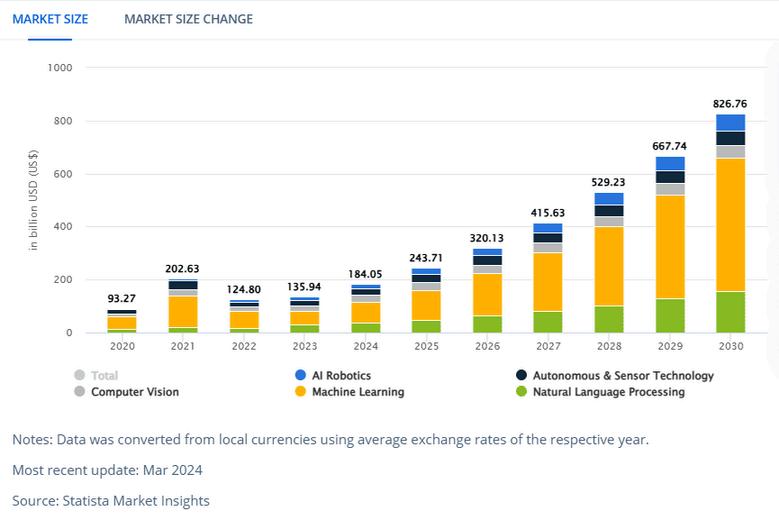
The global AI market is set for multiplied growth, projected to grow from $405 billion in 2025 to a astounding $1.55 trillion through 2030, representing a compound annual increase fee (CAGR) of about 37%. A big part of this increase is being fueled with the aid of the growing adoption of AI improvement offerings and strategic AI consulting engagements. These carrier-based segments are anticipated to account for almost 40% of total AI market revenue through 2030, as extra corporations shift from experimentation to large-scale AI integration.
AI consulting organizations are getting essential partners in aligning AI investments with strategic dreams, at the same time as AI development services are being used to build custom, area-precise answers for operational transformation.
Notes: Data was converted from local currencies using average exchange rates of the respective year.
Most recent update: Mar 2024
Source: Statista Market Insights
AI investment in the healthcare sector is projected to reach $280 billion by 2030, making it one of the most promising verticals for AI deployment The industry is increasingly turning to artificial intelligence for diagnostic imaging, virtual health assistants, drug discovery, and personalized treatment planning. AI is helping healthcare providers shift from reactive care to predictive and preventive models, especially through the use of machine learning algorithms trained on vast patient datasets. This demand is propelled by several macro trends: a globally ageing population, the digitization of health records, a rising incidence of chronic diseases, and the post-pandemic shift towards telemedicine and remote care. AI models are now supporting doctors with real-time recommendations, reducing medical errors, and optimizing clinical workflows.
Opportunity: There is a growing appetite for AI development services that specialize in building backend tools for hospital administration, predictive patient monitoring, and operational analytics that don’t require FDA approval, allowing for faster deployment cycles.
Strategic Note: Explainable AI (XAI) is increasingly essential, especially in patient-facing diagnostics and risk scoring. Healthcare organizations prioritize transparency in algorithmic decision-making to meet compliance requirements and gain physician trust.

Expected to increase by ~284% between 2025 and 2030
The financial sector is expected to see $ 240 billion in AI investment by 2030 Cases use fraud detection, Robo recommendation, AI-powered underwriting, and algorithmic trading. The push comes from growing cybersecurity demands and the need for real-time data processing.The industry is also moving toward predictive credit scoring, personalized financial advice, and real-time risk assessments, leveraging large language models (LLMs) and advanced analytics. The integration of AI into core banking and insurance operations is further accelerating enterprise-wide digital transformation.
Consulting Edge:
AI consulting companies offering compliance-ready, domain-specific models (e.g., Basel III, IFRS 17-aligned systems) are preferred by enterprise clients for risk-sensitive deployments.
Trend:
Explainability, auditability, and data lineage features are becoming critical for regulatory approval, especially in lending and insurance.
Opportunities:
Financial institutions are outsourcing strategic AI projects to reduce timeto-market.
Demand for AI development services in building proprietary models and integrating them with legacy fintech infrastructure is growing
Strategic Insight:
Banks and fintechs are prioritizing AI ethics and transparency to avoid bias and ensure compliance with emerging regulations such as the EU AI Act and U S Fair Lending laws.

Expected to increase by ~243% between 2025 and 2030
The AI market is motivated by an increase in the Enterprise Automation initiative with a view to reducing costs and increasing operating efficiency. Success in generic AI and large language models (LLM) are locked further upgraded abilities in the formation of materials and understanding of natural language In parallel, companies are looking for real-time analysis and hyper practical experiences Cloud-based AI platforms have used and made more scalable and accessible in industries.
Automation is now viewed as a board-level priority across sectors.
AI development services are in demand for real-time model deployment and LLM fine-tuning.
Despite the strong growth, many obstacles prevent adoption. The lack of concern for privacy and universally accepted moral AI framework leads to legal and prestigious risks In addition, there is still a barrier for small implementation costs for small to moderate size enterprises (SMB) There is also a noticeable disadvantage with AI-literated leadership, which makes it difficult to coordinate the AI strategies with commercial goals.
SMEs are hesitant due to unclear ROI and resource constraints.
AI consulting companies must offer scalable, budget-friendly advisory models.
As AI matures, the case forms with vertical specific use as the future in the health care system or a future in accurate therapy a maintenance -oriented area. The emergence of AI-AS-A-Service (AIAAS) model opens doors for plugand-play AI functions. In addition, intermediate level companies are allowed to use AI without making heavy investments in internal teams in consulting structures
AI development services tailored for niche use cases are in high demand
AI consulting companies can unlock growth through hybrid, subscriptionbased models.
However, the industry faces some structural challenges. AI tools limit standardization and scalability of difference deficiency. Companies often struggle to track ROI, especially in innovation-led deployments. Moreover, regulatory complexities vary across regions, making global rollout difficult.
AI vendors need to embed performance metrics into solution delivery.
Navigating compliance across borders is a growing role for consulting firms


rises are increasingly seeking AI models tailored cific industries (e g , AI in radiology, AI in writing) rather than general-purpose AI tools n-specific solutions offer higher accuracy, compliance alignment, and faster ROI.
With growing global concerns around bias, transparency, and ethical governance, organizations are being held accountable for the AI they deploy. Responsible AI is becoming a board-level priority, especially in healthcare, finance, and the public sector.
Impact areas:
Adoption of explainable AI (XAI)
Incorporation of bias audits and fairness metrics
Strong demand for AI consulting companies offering responsible AI frameworks and compliance integration
AI is being deeply integrated with the Internet of Things (IoT) to enable real-time decisionmaking in sectors like manufacturing, logistics, and energy. This convergence improves operational efficiency, fault prediction, and asset optimization.
Examples:
Smart factories using visual AI to flag defects
Connected vehicles optimizing routes and fuel use
Predictive maintenance using sensor + AI data
This is a lucrative area for AI development firms with experience in embedded systems and edge computing.
Due to complexity and shortage of internal AI talent, enterprises are turning to external AI development services and AI consulting companies for end-to-end project execution from ideation to deployment and monitoring.
Notable shifts:
Multi-year AI outsourcing partnerships are increasing
Co-innovation labs with vendors are becoming common
Demand is highest for firms offering custom development, compliance consulting, and post-deployment support

rage partnerships with hybrid AI vendors that offer AI development consulting and services abilities to reduce deployment risks and maximize
ion Points:
Choose vendors with domain-specific expertise e.g., finance, healthcare).
Focus on explainable, auditable AI models to ensure regulatory compliance.
Ensure the vendor offers integration with your egacy systems and scalable cloud options
AI development firms and consulting companies must differentiate through specialization, focusing on verticalized AI tools and strong data governance frameworks.
Action Points:
Build compliance-first AI solutions (especially in healthcare, BFSI).
Offer AI-as-a-Service (AIaaS) to lower entry barriers for mid-sized enterprises.
Embed Explainable AI (XAI) capabilities into every solution to increase adoption.
Focus investments on mid-sized AI consulting companies that have proprietary IP, sectorspecific models, or long-term enterprise contracts.
Action Points:
Identify firms with traction in regulated sectors (finance, public sector).
Look for low capital intensity + scalable delivery models (remote consulting, IP licensing)
Prioritize those with international expansion strategies or niche dominance
Create a supportive AI ecosystem through interoperability standards, SME enablement programs, and AI governance frameworks.
Action Points:
Provide tax incentives/subsidies for AI transformation projects in SMEs.
Promote open-data platforms and AI testing sandboxes to accelerate R&D.
Enforce guidelines around ethical use, bias prevention, and transparency in AI systems