– Mark your calendars for Diversion Day, being held on Saturday, May 30, from 9:00 a.m. to noon at 4687 Ute Highway in front of the Parks and Public Works Facility. Items accepted include yard waste, paint (latex or oil-based), books, glasses, candles, e-waste, and scrap metal. Registration is limited. Learn more and pre-register today. townoflyons.com/ diversionday
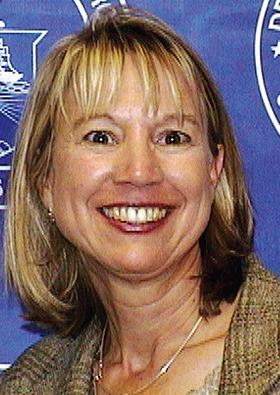
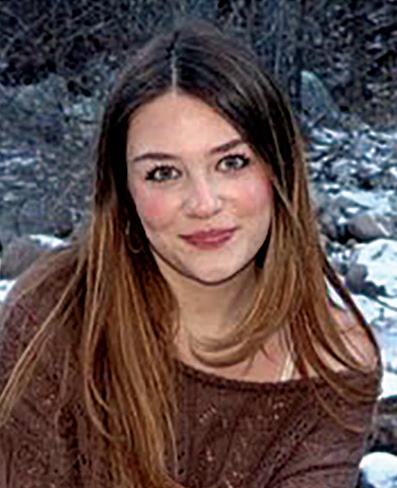
Lisa Ramsey retires: May 15 was her last day LYONS – I have some news for you. I am retiring from the Town of Lyons, and May 15 will be my last day. I have so enjoyed my time working for the town, and my very favorite part of the job has been working with the seniors. And the town has hired a wonderful replacement for me, Casey Peifer. She is very excited to meet you all and is already diving in to help plan the Sr. Picnic. I know she will do a fantastic job.
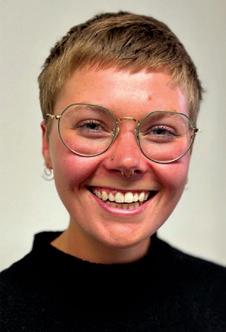
Casey Peifer will be the new Senior Events Coordinator
LYONS – I am Casey Peifer, and I will be officially taking over here for Lisa Ramsey in a few weeks. I am so looking forward to meeting those of you I haven’t yet had the chance to know and continuing to grow this community. I’ve been lucky enough to serve as a Park Host at LaVern Johnson Park this past year under Lisa’s guidance, so I know very well what a formidable task is ahead of me as I try to fill those shoes. I want you to know that I’m going to do my best, and I, too, expect this to be my favorite part of the job. I’m excited for our exercise classes, our outings, our lunches, our picnics, and so much more. Please don’t hesitate to reach out if there is anything I can help with, and I look forward to seeing you all next week. Contact the Town of Lyons for more information at 303-823-6622.
Wildfire mitigation work
Access the local rebate and match program
LYONS – Lyons residents can take action on their property:
Continue Briefs on Page 12
By Kay Sparks Redstone Review
LYONS – Two workshops preceded the May 4 town board meeting: Legislative Policy/Order of Business/BOT Priorities and Introduction to Water: Watershed Rights and Quotas.
Boulder County Sheriff’s Officer Sharon McKim reported that the trailer speed sign has been effective, reminding approximately 45 percent of drivers to slow down.
Town Administrator Victoria Simonsen reported that Den Rec (marijuana shop) is no longer in business, although another business is expected to occupy the building soon. There was a discussion with staff and a decision that, with the town board’s adoption of the Wildfire Resiliency Code, which takes effect July 1, 2026, there is a need to educate the community about requirements related to modifications of existing structures and the addition or replacement of fences. Details are available on the Town of Lyons webpage under Wildfire Resiliency Code requirements.
Administrator Simonsen also reported that Colorado’s three federal representatives have submitted the town’s request for $1.7 million in funding for wastewater plant dewatering equipment, marking the first step in the federal application process. The town expects to learn by November whether the request will be included in the federal budget. She also outlined both state and federal grant opportunities for improvements to Second and Third Avenues. The board approved continuing to pursue both funding options.
Lisa Ramsey, Parks and Recreation Coordinator, will retire in May. Cassandra Peifer, currently the park host at LaVern Johnson Park,
will fill the position. Joseph Folks has been hired as a maintenance worker for Parks and Public Works.
The Farmers Market will begin May 10 and continue weekly from 9 a.m. to 1 p.m. through October 4 at Sandstone Park. The vendor Simple Things will accept SNAP and WIC benefits. Meat and egg vendors are still needed.
The board passed two ordinances on first reading: one regarding water sprinkling irrigation and water shortage regulations, and another removing code language limiting the issuance of water taps. The board also approved a resolution authorizing a lease agreement with the Lyons Creative District.
The board heard two requests: one seeking flexibility in water dedication requirements for a potential development, and another requesting an exemption from a lease agreement.
As a follow-up to the workshops, the board requested additional information from staff regarding the Water Action Plan. Discussion of legislative policies will continue at future meetings.
The board then entered an executive session, after which it returned to a regular session.
April 20 town board meeting
The April 20 meeting of the Lyons Board of Trustees began with a reception for elected officials, followed by a brief meeting of the outgoing board, the swearing-in of newly elected officials, and the first meeting of the incoming board.
Outgoing board updates Town Administrator Victoria Simonsen reported on several upcoming initiatives and events: The Lyons Fire Protection District and Wildfire Partners hosted a spring limb drop-off and chipping event on May 9.
The town and Boulder County have launched the FY2026 wildfire mitigation rebate program. Boulder County residents may receive a free home wildfire assessment and up to $500 in rebates; Lyons residents are eligible for an additional town match of up to $500.
The town has secured funding to expand wildfire mitigation efforts in the Wildland-Urban Interface on town-owned properties.
Town Attorney Brandon Dittman reported that the proposed state Noise Abatement Law did not pass the Colorado legislature.
Incoming board actions
Following the adjournment of the outgoing board, the incoming board convened. Mayor Mark Browning and Trustees Greg Lowell, Mariah McCreary, Leigh Williams, Julie Jacobs, and Amy Schwartz were each sworn in. Mayor Pro Tem Jen Wingard will be sworn in at a future meeting.
The Board approved Resolution 2026-22 appointing key town officers, including the Clerk, Deputy Clerk, Treasurer, Town Attorney, and Municipal Judge. Douglas Matthews was appointed to the Planning and Community Development Commission (PCDC) by Mayor Mark Browning; two seats remain open.
The board directed staff to draft a resolution establishing a Sundance Film Festival Task Force, including an application process, for consideration at the May 4 meeting.
Trustees also reviewed potential updates to the Lyons Municipal Code. Staff and legal counsel were directed to proceed with minor revisions and to schedule a workshop for more complex topics. The board emphasized minimizing unnecessary requirements.
Board liaison assignments: Ecology Advi-
The hummingbirds have arrived in Lyons! Green Violet-ear hummingbird (Colibri thalassinus) in flight — nature’s living jewel in motion.
By Isabel Tarr Redstone Review
LYONS – May is Mental Health Awareness Month. Mental Health Awareness Month is a reminder that mental well-being is a vital part of overall health, inviting us to tackle the continued task of breaking down the stigma that surrounds the conversation of mental health, asking for help, and utilizing therapeutic resources.
Mental health does not exist in isolation, but ripples outward into families, workplaces, schools, and neighborhoods. When people are supported and able to cope, communities tend to be more connected, productive, and resilient. Mental Health Month is an opportunity to reflect on how we can best support each other as a village. If you are feeling in need of some extra community love, start the conversation.
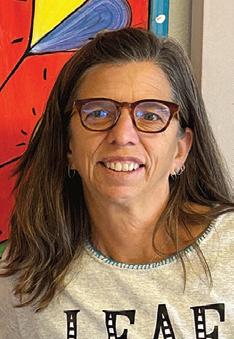
Kim Hinzy, the new Community Programs and Client Services Manager at Lyons Elevates All Fund (LEAF), stated that they are engaged in strategic planning in order to address the most pressing needs of our Lyons community. LEAF has expanded access to mental health services for youth, families, and couples, offering a variety of pathways to connect residents with the most appropriate resource to meet their needs. Their Food Pantry is ever-growing, and their financial assistance is continuing to support Lyons families.
Meeting these basic needs—food, housing stability, and financial support—is more than essential support; it is foun-
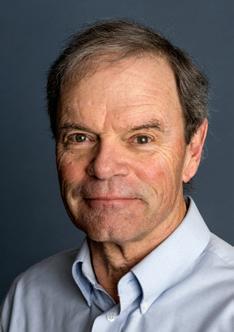
dan siddall
broker/owner
dational to mental health. “When these needs go unmet, everything else becomes harder to manage. At LEAF, we see this work as central to the well-being of our community,” said Hinzy. “Through strengthened partnerships and a growing presence in Lyons, LEAF remains committed to showing up for individuals and families during some of their most challenging moments.” More to come on their plans for offering various new programs geared toward mental wellness this summer. LEAF is open Monday through Thursday, 9 a.m.–3 p.m. For questions or support, contact Kim Hinzy at 303-823-6673, extension 2.
Looking for a way to get your mind and body moving? Movement and unity are essential to maintaining a healthy mind. Join us at the Senior Center every Tuesday and Thursday in the basement of the Walter Self Community Building at 9:30 a.m.–10:30 a.m. for a free senior exercise class. In the same building, on Tuesday, Wednesday, and Thursday at noon, the Boulder County Area Agency on Aging is continuing their Red Stone Cafe offering lunch to seniors with a suggested donation of $5. All are welcome; non-seniors or guests will need to bring $17.33 for their meal. It is a wonderful way to make connections, share stories, and build community over meals.
The Housing and Human Services Commission (HHSC) currently has an open position on the board, so if you are feeling inclined to get more involved with our wonderful community, please reach out. For more information, contact Kay Sparks, sparks3@nwi.net; to apply, go to the Town of Lyons website www.townoflyons.com.
Attention Seniors, your input is needed. Boulder County Area Agency on Aging is seeking input regarding what helps people age well and where there are unmet needs in our community. They collect this information every four years and use it for planning. Staff will be in Lyons on Wednesday, June 3, from 1:00 p.m.– 2:30 p.m. at Walt Self Senior Housing Community Room. If you’d like lunch before, the Senior Center has lunch available at
Ruth is a 9-year-old gentle giant with a soft heart and an even softer spot for a cozy bed. Often found sprawled out on something large enough to fit two small toddlers, she’s fully embraced the art of lounging. She may be a big girl, but don’t let her size fool you. Ruth is more “scaredy cat” than tough, and she’s happiest when she feels safe and settled.
She can be a little wary of strangers at first and asks for a slow, respectful approach. No quick reaches, please. But give her a moment, and she’ll come to you on her own terms. Once she does, you’ll meet the sweetest, most loving baby in a big dog body. Ruth is approved for dogs with a meet, cats, and children over 10.
After spending years in less-than-ideal conditions, Ruth is ready for a fresh start. She’s looking for a patient family who will give her the space and encouragement to build confidence. There’s so much love waiting in those big, soulful eyes.
Thank you, as always, for supporting our adoptables.
To see all our adoptable animals or get more details visit longmonthumane.org. Or stop in at the shelter at 9595 Nelson Road.
noon for $5 for those 60+. To make a lunch reservation, call 303-441-1415 by 1 PM Monday, June 1. Questions? Contact Lindsey Neville at lneville@bouldercounty.gov. Come on down.
Lyons Valley Townhomes: Two-bedroom townhomes are available. Rent is $1,903/month; water, sewer, and trash costs are included, utilities are not. There is a $28 application fee per applicant, a $500 security deposit, and $300 pet fee. Incentives being offered: $500 off the first month’s rent and $1,000 applied as a rent credit, which may be used at the resident’s discretion during the 12-month lease term. For more information, call the office at 720-600-4278.
Isabel Tarr, Housing and Human Services Commission member.
OBITUARY
Larry Wayne Cole, of Lyons Colorado, passed away April 16, 2026.
He was born in Boulder, Colorado, to Bill Wayne Cole and Ruby (Albers) Cole. Larry dedicated his life to hard work, family, and his passion for truck driving and restoring classic Ford pickups. He spent over 55 years restoring and caring for his 1954 Ford pickup, earning numerous car show awards. His wife fondly joked that while most wives are “football and fishing widows,” she became a “garage widow.”
He is survived by his wife, Carolyn (Flores) Cole; stepmother, Nancy Cole; brother, Randy Cole; daughters Cathy (Cole) Bashor, Cindi (Cole) Burch, Cindy (Kiehn) Shubert, Teresa (Kiehn) Boness, and Tracey (Kiehn) Carter; as well as numerous grandchildren, great-grandchildren, nieces, nephews, and cousins. He was preceded in death by his parents, stepfather, siblings, son-in-law, grandparents, and grandchildren, Blythe Marie Boness (22) and Caleb Aaron Moore (14).
In lieu of flowers, donations may be mailed to Cole, P.O. Box 213, Lyons, CO 80540, to be distributed to memorial scholarships in honor of Blythe and Caleb. No services are planned.
Larry Wayne Cole February 12, 1940–April 16, 2026
MAYOR’S CORNER
A new mayor steps into the Mayor’s Corner with a new agenda
By Mark Browning Mayor of Lyons, Redstone Review
LYONS – Among the benefits of being Mayor of Lyons is the opportunity to speak to Lyons citizens and area residents in this monthly “Mayor’s Corner” column.
For that, I’d first like to thank Susan de Castro Gierach and the Redstone Review staff. The challenges of putting out a small-town newspaper—especially an actual “paper paper”—are enormous in this digital age. We’re fortunate to have the Redstone as a community resource, and I’m glad to contribute to it.
I’d like to focus my first column, written in my first month as mayor, on two priorities discussed with citizens prior to the April 7 election: (1) increasing citizen involvement in more transparent town government, and (2) infrastructure needs. I’ll try to address other priorities (fire risk mitigation, economic vitality) in future columns. Citizen involvement: transparency Based on the election, Lyons citizens are highly involved in town government. Turnout (1,021 voters in the mayor’s race) was around 60 percent. That’s excellent for an off-year, only local election—a record, in fact, for Lyons.
With that active citizen involvement, Lyons needs to communicate well with residents and be transparent with citizens about town operations.
As to communication, I try to respond as promptly as I can to citizen inquiries; I did that as a trustee, and email volume has picked up noticeably in the short time I’ve been mayor. I’m not complaining. I
welcome communications from citizens. MBrowning@townoflyons.com is the proper address for town matters.
I’m also trying something I promised to do during the campaign: post on local social media a “sneak peek” at what may be on upcoming Board of Trustees (BOT) meeting agendas. Agendas are usually posted on Thursday afternoons prior to Monday meetings. I encourage everyone to sign up at townoflyons.com to receive agendas. But people who are busy (with work, kids, travel, school, whatever) may not have time to look through a full agenda on Friday or over the weekend.
For that reason, I’ll be posting short highlights (bullet points) of what’s most likely to come up at the next BOT meeting. That way, someone interested in a particular issue will know to watch for more detailed information when official agendas go out on Thursdays.
Doing that has raised a few eyebrows, and my early notice posts have limitations. Agendas can, and often do, change after
Earth Week celebrations well received
By Dawn Weller Redstone Review
LYONS – A very big thanks to all the commissions, organizations, and speakers that made Earth Week in Lyons a big success. Special recognition to the Sustainable Futures Commission, Ecology Board, and Town of Lyons for organizing the overall event.
The speakers, movie, and workshops were all well attended. Saturday’s Earth Expo at Bohn Park included river cleanup, tree planting, tables hosted by ecology-centered teams, music by Jessie Garland, and food from LEAF. We hope the community will continue to focus on making positive changes that benefit the environment, the community, and our future.
From the Sustainable Futures Commission and the Ecology Board.
the first draft. They can change again at meetings, since agendas aren’t final until the BOT approves them. But I’ll always note that agendas are subject to change, and I think citizens can understand that. To me (and to many who’ve said they appreciate the early notice), uncertainty about final content is outweighed by better, earlier notice to citizens.
Infrastructure:
Citizens and candidates seemed to agree that infrastructure—in particular, the wastewater treatment facility (WWTF), the north side culvert, and streets/sidewalks (especially Second/Third Avenue)—are our top priorities.
Brief updates on those:
WWTF – This is in the design phase. With Utilities Engineering Board (UEB) input, the exact components of the plant (badly in need of fixing) are being determined. That will drive the cost. Expect $5 million or more. A state low-interest loan (with a down payment of sorts from money already in the Water/Wastewater Fund) is the most likely source of funding.
Grants are, of course, better than loans for the town and its ratepayers. Congressionally-directed spending—an “earmark”—is being sought through the help of Senators Michael Bennet and John Hickenlooper and Congressman Joe Neguse. They’ve requested $1.7 million for Lyons, which is great news. Whether that money will actually be approved remains to be seen, though. We should know by year-end.
Culvert – The old (1890s) culvert running under downtown and up Steamboat Valley is near collapse in several places. Fixing only the most at-risk places is estimated to cost $500,000. There’s about $250,000 in the Stormwater Fund. For a while, it
looked like a state grant might fund the balance. Chances of that have decreased due to stiff competition, but a state loan may be available as a backup option. We should find out in the next few months.
Second/Third Ave. – A fantastic turnout (about 35 citizens—a lot for such things) at an April 29 meeting on preliminary design for Second and Third Avenue street and stormwater improvements provided a good kickoff for that major project. Town staff really appreciated citizen input and ideas, which will be helpful in proceeding with design. Funding sources are being explored for that project, too. The BOT on May 4 approved applying for a federal Building Resilient Infrastructure and Communities (BRIC) grant from FEMA. The Trump administration cancelled BRIC in April 2025, but a court ordered it reinstated. Uncertainties remain about that program, but “nothing ventured, nothing gained.” Again, low-interest state loans (with an application target of August) are the backup. Money is being set aside for a down payment on that loan: about $650,000 at year-end 2026 from the 0.5 cent sales tax increase Lyons voters approved in 2024. Estimated project cost? $3–$4 million, depending on what features are ultimately included. With those priorities and others identified by citizens in mind, I look forward to working with the new Board of Trustees and our fine town staff to get things done in the coming two-year term. Citizens, please stay involved and let us know how you think we’re doing.
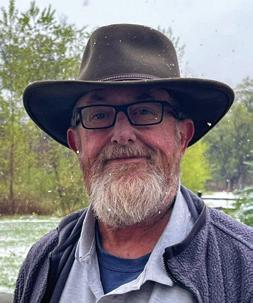
Mark Browning was sworn in as Mayor of Lyons on April 20, 2026. He has served three terms as a Lyons Trustee. He was also the chair of the Lyons District Library Commission and the former Assistant Attorney General for the State of Texas.
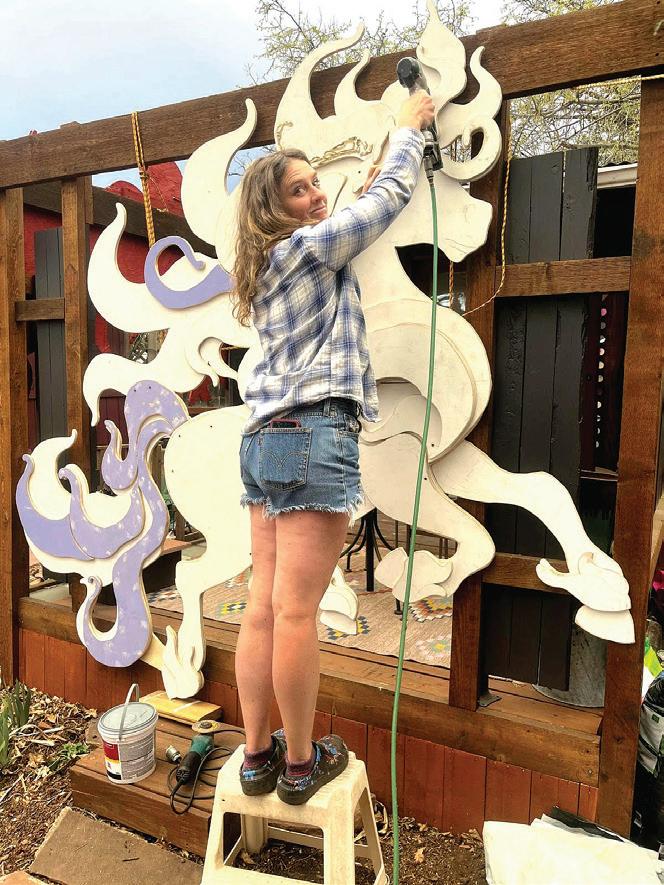
Ann Hall’s dynamic set design of this year’s music festivals
By Sally King Redstone Review
Annually- in the early spring
Ann Hall of Hall Ranch
Gets out her sketchbook
And dreams into- who it is that wants to appear As if by magic-
To be the visual representation Of this year’s theme Of our Rocky Grass and Folks Fest.
Artist as shaman It was the fire horse that appeared. And so, from early sketches
The horses will be cut out of plywood And painted large, Colors chosen to add joy as the audience gathers to take in the music. The art will make their first appearance at Telluride Then get trailered back here To be set up anew.
Artists make the world go round Often in the background- making beauty Adding to the joy on the planet. Yeah, Artists- yeah MusiciansYeah, Creators of Festivals.
Fire horse- galloping through our lives.
Sally King is a local artist who believes it’s imperative that each of us pop our head up out of the collective trace, to bring through our creative gifts. You can find her on her blog and website, hersoupot.net and sallywhiteking.com or e mail sallywhiteking@ live.com.
Browning
Weller
Ann Hall working on Fire Horse
OPTIONS
Why you really should care about Greenland
By Kati Gosnell Redstone Review
WANDLITZ, BRANDENBURG, GER-
MANY – When Americans think of their friendly neighbors to the north, a vision of flannel-clad hockey players who easily tolerate their frozen landscape typically comes to mind. This makes sense, as the further we move from the equator the colder the climate generally gets. In contrast, when they think of the continent of countries across the pond (Atlantic Ocean), an eternally balmy climate reminiscent of La Dolce Vita (the sweet life), with denizens sipping wine while clad in chic sandals and linen finery, hazily comes to focus.
In fact, if you manage to find a physical globe and steadily trace a latitude between the North American and European continents, you will find the climate for each aligned site is quite different, with Europe typically warmer than North America at the same line. For example, the 45-degree latitude approximately connects Bangor, Maine, to Bordeaux, France, in which both cities represent the narrated temperature biases quite well.
One reason for this drastic difference between northern latitude climates is the swift channeling under the surface of the Atlantic Ocean. Essentially, it is due to steady wind stress and the Earth’s rotation (among other things), which causes giant, steady gyres (think whirlpools) in every major ocean basin. The North Atlantic gyre rotates clockwise, forming a swift and vast river within the ocean, channeling and cycling nutrients, salts, heat, and energy around the basin.
The North Atlantic gyre moves westward through its southern section above the equator, gathering heat and salt along the
way. Off the US east coast, there is an intensified current section after it meanders through the Caribbean and Florida Straits, then up to off Newfoundland, known as the Gulf Stream. The Gulf Stream is one basis for this prominent temperature difference between the continents.
That is, all the heat and energy in the Gulf Stream collected from the equator and southern waters of the North American continent essentially flows northeastward with the gyre across the North Atlantic, before cycling south along Europe. As the current flows, it slowly loses its heat as the water mixes and moves through surrounding colder waters. However, there is still enough warmth transported and eventually remaining to maintain the relatively more hospitable climate and balmy weather felt in Europe. Though not the entire story, the Gulf Stream allows northern Europe to be more hospitable, effectively rainy and temperate, than regions of Canada, with broadly frozen tundra, at the same latitude.
mation, hence overturning surface water and channeling it all the way to the deep ocean. Basically, all the extra salt collected within the equatorial and Gulf Stream water makes it denser. Then, when some of this saltier, denser water breaks off from the Atlantic current and finds its way to
There is another very prominent and critical feature in the North Atlantic impacted by the gyre circulation and the Gulf Stream. This feature is overall responsible for global ocean circulation as well as the climate, habitability, marine life, and land-based agriculture, among other fundamentals. Very few people actually know about it. This is the Atlantic Meridional Overturning Circulation, or AMOC for short. Maybe you have recently heard about it? It’s kind of a big deal considering that the AMOC is the main current system in the Atlantic Ocean. The AMOC encompasses deep water for-
the freezing (surface) waters of the Nordic Seas or Labrador basin (between Canada and Greenland), it then cools down, making it even denser. Because denser waters sink deeper, this very dense water ‘quickly’ drops, sinking close to the basin bottom, eventually transforming into a traceable water mass known as North Atlantic Deep Water (NADW).
The physics and sinking of vast amounts of water forced into the basin, in turn, shifts and pushes NADW water out of the region and on a southward course through the approximate bottom center of the Atlantic Ocean (Side note: even as it’s important, NADW is still not the densest, deepest Atlantic water mass). This is one start of the ‘ocean conveyor belt’ which slowly moves deep ocean water from the north to the south Atlantic, swoops through the Indian Ocean, then around Antarctica and all the
way up through the south and north Pacific basins, where it finally returns to the surface ocean and coastal southern California surfer dudes and sea lions after about 1000 years. This process is incredibly important for the Earth’s ecosystems, oceans, creatures, and climate, and I could go on so many nerdy tangents about it. Sigh, maybe another time.
Now. Focusing back to the topic at hand, the AMOC. Among anchovies, whales, French wine aficionados, and especially oceanographers, there has been growing concern about AMOC weakening. Furthermore, because the AMOC and other ocean overturning sites are associated with a very substantial exchange of heat, oxygen, carbon, and nutrients, they are in fact key to the health and vitality of ocean ecosystems as well as the climate.
For sure, the AMOC mechanism creates a ‘sink’ for carbon, thereby removing it from the atmosphere and helping to ease climate change and its effects. Yes, oceans have been dampening most of the effects of climate change, so far.... But disturbingly, climate change also seems to be weakening the AMOC. This is because freshwater runoff from melting ice sheets (Greenland again) is diluting salts from the incoming Gulf Stream, and this, as well as all the excess heat that is being taken up in ocean water, is in turn weakening the water’s ability to become as dense as it needs to be to overturn and sink. To emphasize this reality, record-low levels of Arctic sea ice were measured last winter.
Like most science, there is much debate about whether and how extensively this could be happening, how much climate change factors compared to natural cycles, and how big the impact could really be. Considerable time and energy were put into creating models to figure things out, with varying results. However, most point
Continue Greenland on Page 12
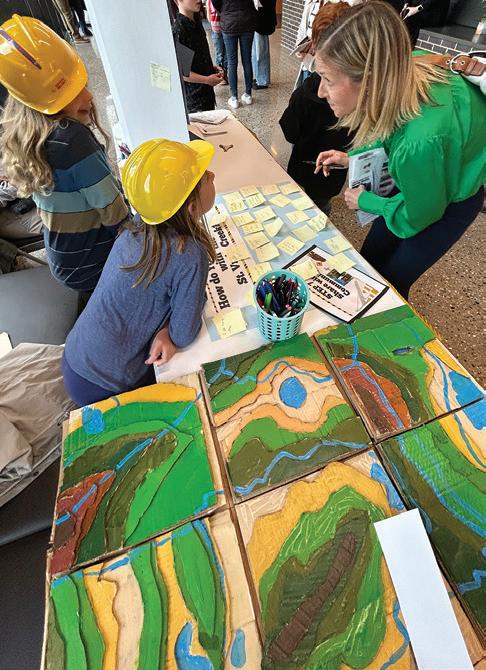
Fourth graders turn St. Vrain Creek data into experiences and art
By Baiba Lennard and Sarah Wegert Redstone Review
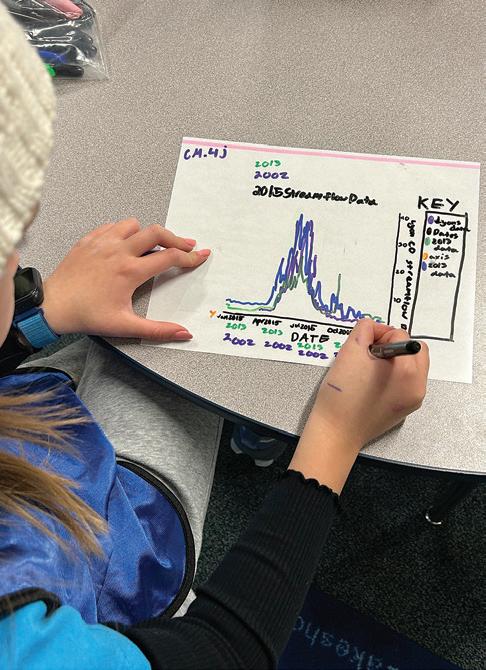
LYONS – Over the 2025–26 school year, Lyons Elementary School fourth-grade students and their high school mentors tackled an ambitious new museum installation project related to the St. Vrain Creek watershed.
The creeks are a vibrant focal point and gathering place for Lyons. Through an opportunity from CU Boulder’s Office for Public and Community-Engagement, the Data + Art + Science for Youth program (DASY), LES, and an extra grant from the Lyons Community Foundation, staff members Elena Russ, art teacher, Sarah Wegert, STEM teacher, and Baiba Lennard, Library/Media Tech, developed plans for Lyons-based art-science-data activities related to the flow of the St. Vrain Creeks.
Students didn’t just read about the water. Their journey included:
•Working with scientists from CU Institute for Arctic and Alpine Research to understand stream flow rate, analyzing historical flow data, learning about what scientists do in their field research at the Loch in Rocky Mountain National Park, the headwaters for the St. Vrain Creek
•Gathering data by measuring local flow rates at Bohn Park
•Presenting the information and process to the Lyons Ecology Board at the annual Lyons “Confluence” event
This project inspired students while making learning about their local community and how people interact with the St. Vrain Creek relevant. To this end, they developed a plan to share this data and information with the community. They conceptualized and created components for an interactive exhibition that is being installed at the Museum.
The blend of hard science, technology, art, and human storytelling paints a broader picture of the St. Vrain Creek— the hub and vital resource of Lyons. For a town defined
•Engineering a giant topographic map of the St. Vrain watershed
•Partnering with St. Vrain Valley School District (SVVSD) Innovation Center staff and Lyons High School Science and Leadership mentors to prototype an LED display that visualizes stream flow rates
•Querying local residents to collect stories and capture personal ways the Creek intersects with life in Lyons
last five years, the fourth graders became local historians, acting as “Museum Stewards.” They became familiar with the museum’s collections and content, and in the spring, they designed and created a curiosity-driven product related to or enhancing the museum’s collection. These experiences fostered an understanding of Lyons history, built observation, research, and critical thinking skills, sparked imagination, and brought the stories of Lyons and its people to life, especially for young visitors to the museum.
by its red sandstone rocks and rushing waters, these fourth graders are ensuring that the story of the St. Vrain is told with both scientific precision and artistic heart. The exhibit, How Do You Interact with the St. Vrain Creek, will debut to the public on June 27 at the Museum’s History Day Program.
The Lyons Redstone Museum has a long-standing partnership with the Lyons Elementary School. The 1881 Schoolhouse serves as a site where students engage in activities that align with grade-specific learning for the SVVSD. Over the
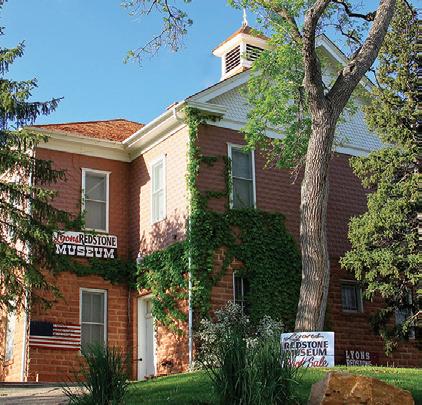
The museum is now open weekends in May on Saturdays 9:30 a.m. to 4:30 p.m. and Sundays, 12:30 p.m. to 4:30 p.m.; then, daily June through September. You can explore more of Lyons history through the historic district walking tour and the five virtual exhibits, all of which can be accessed from the website lyonsredstonemuseum.com. The museum relies on grants and donations to fund our operations, and your support is greatly appreciated. You can donate through our website or by mail to Lyons Historical Society, PO Box 9, Lyons, CO 80540.
Sarah Wegert is the Lyons Elementary School STEM Coordinator and Teacher, with 20 years of experience in St. Vrain Valley Schools as an instructional coach, coordinator, and classroom teacher. Sarah and her family reside in Pinewood Springs.
Baiba Sube Lennard is a lifelong educator with 30-plus years of experience. Currently, she develops and connects programming for students in the library, the classroom, and the museum while serving as Lyons Elementary’s Media Tech and seasonal Museum Educator at the Lyons Redstone Museum. She has called Lyons home for three decades.
Kati Gosnell enjoying Greenland.
This year’s theme for summer reading at the library is Unearth a Story
By Kara Bauman Redstone Review
LYONS – May gets busy in a hurry. School events stack up, calendars fill, and suddenly you’re wondering how it’s already the end of the academic year. We’re right there with you.
At your Lyons Community Library, that energy means one thing: Summer Reading is almost here. This year’s theme is Unearth a Story. Think buried treasures, unexpected finds, and books you didn’t know you were looking for. The program runs from June 1 through July 31, with reading challenges, special programs, and prizes.
about something bigger: staying connected to stories, to the library, and to each other, no matter your age.
Why do we do it? For fun. Summer Reading started as a way to prevent the “summer slide,” when kids can lose reading skills over the break. Here in Lyons, it’s
The Teen Summer Kickoff Party is set for Friday, May 22, from 6:00 p.m. to 8:00 p.m. Pizza, ice cream, games, karaoke, and crafts. Come hang out, bring a friend, and get signed up for Summer Reading while you’re here.
Tweens can join the Bookto-Movie Club on Tuesday, May 26, from 3:00 p.m. to 5:00 p.m. This month’s pick is Dog Man by Dav Pilkey. Read it, watch it, compare it, snack on it (not literally), and have some fun.
Kids learning to flyfish
By Volunteers from the St. Vrain Chapter of Trout Unlimited Redstone Review
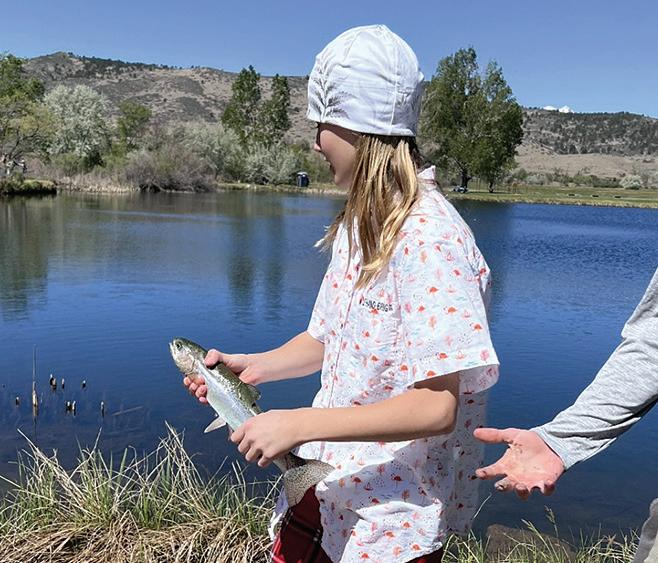
LYONS – Every year, the St. Vrain Chapter of Trout Unlimited offers a program to help kids learn to flyfish, which ends with a morning on the water in the Longmont area. As anyone who has taught kids knows, one of the hardest parts is location: somewhere they can practice casting and setting a hook without spooking every fish in sight. This year, Trout Unlimited (TU) is grateful to Cemex Lyons for letting us use the fishing pond on their property. Having room to spread out, sort out tangles, and try again without pressure made a real difference. The weather was ideal, and the fish
We kick off the first week of Summer Reading with the Mountain Buddies Children’s Concert at Sandstone Park on June 3 at 10:30 a.m. Expect silly songs, dancing, and a good time for kids and grown-ups alike. Weather backup is the Community Room.
Teens can jump into Throwback Thursday on June, 4:00 p.m. to 6:00 p.m., a night of classic 1990s crafts. Think shrinky dinks, tie-dye, friendship bracelets, and a little bit of mess. Dress accordingly.
We’re also settling into some weekly rhythms for the summer. Monday Makerspace will run every Monday at 3:00 p.m., and Summer Gaming Fridays will take over Fridays at 3:00 p.m. Whether it’s chess, Pokémon, Nintendo Switch, or bouncing among all three, it’s a great way to spend an afternoon.
For younger kids and families, Dinosaur Yoga on June 10 at 10:30 a.m. mixes movement, stories, and songs in English and Spanish. Can’t make it during the week?
Yoga Storytime with Ashley follows on Saturday, June 13, at 10:30 a.m.
cooperated.
TU Volunteers said they only had five students this year, but they were the most focused group they have seen come through the program. “They listened, they stayed with a problem until it was solved, and they cheered each other on when a fish finally came to the net. Three of the five sessions are devoted to fly tying, so for many of them, this was the day they caught their first fish on a fly they tied themselves. That is a satisfying arc to watch—from vice to water in a few short weeks,” said one TU volunteer.
Bluegill were the most common catch, with bass and trout in the mix as well. One young angler supplied the highlight of my morning: a trout that kept jumping, trying to throw the hook, while she stayed calm and kept tension on the line until she brought it to hand. Tallies for the day
For adults, don’t miss our Summer Reads Book Share on June 2 at 6:30 p.m. It’s a casual, low-pressure way to swap recommendations and discover something new. Bring a favorite or just show up ready to listen. We’ll have light refreshments and maybe a little “buried treasure” to keep things interesting.
And mark your calendars now for June 23. We’re thrilled to welcome author Nina McConigley for a special evening at the library. More details soon, but it’s one you won’t want to miss.
A quick note for families with little ones: storytime is taking a short break until the first week of June. Our librarians are busy behind the scenes, pulling together props, planning activities, and getting a little dusty as they “unearth” everything we need for a great summer.
And one more for families with little ones. If you live in the Boulder County portion of the 80540 zip code, your child can sign up for Dolly Parton’s Imagination Library and receive a free book in the mail every month from birth through age five.
included thirteen fish for the busiest rod and a fourteen-inch trout for the largest of the morning. Small group, big heart, and plenty of reasons to already be ready for next year.
Bauman Everett, age 12, proudly caught this beautiful 13-inch rainbow trout.
Zoe 11, returning her fish to the pond.
The final nail in the Coffin(top) Dam
Greg Lowell Redstone Review
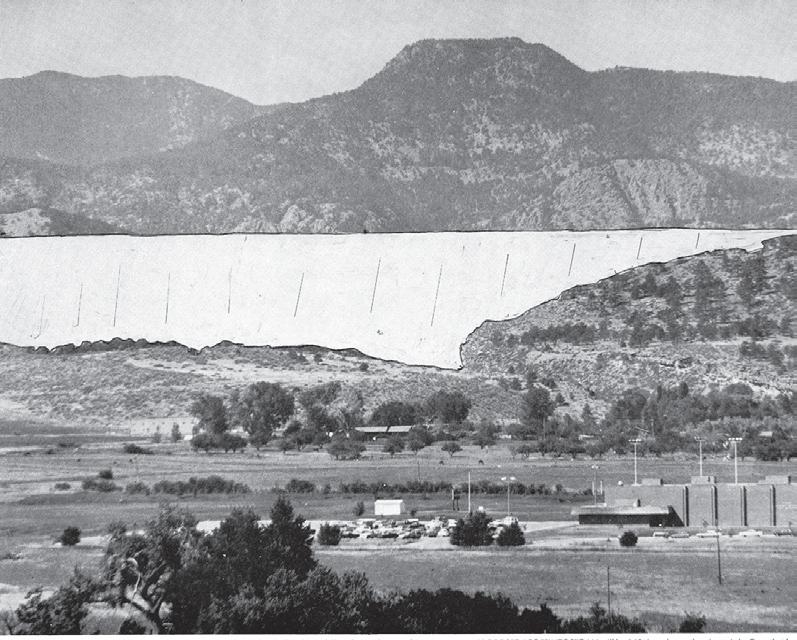
LYONS – For more than 40 years, the possibility of an enormous dam, 365 feet tall and spanning 2,000 feet, looming over the town of Lyons, has existed. But now, thanks to an agreement reached by the dam’s water storage rights owner with an environmental group, the proposed Coffintop Dam is history.
If built, the dam would have drowned the upstream canyon Route 7 passes through for a distance of five miles.
The St. Vrain Left Hand Water Conservancy District has held the water storage rights for the dam since 1971, and for more than a decade, has worked with community partners to explore alternatives that could use the Coffintop water rights, while also supporting increased stream flows during low-flow periods.
“The Coffintop project, as envisioned more than 50 years ago, no longer fits today’s needs or values,” said Christopher
The agreement reaffirms a new path forward for the District’s Coffintop Reservoir water rights—one that does not include construction of the large dam.
Smith, president of the District’s Board of Directors.
This change in philosophy and the intervention of the Save the World’s Rivers environmental group have brought an end to the project that was first protested by a Lyons citizen’s group.
The school year comes to a close
LYONS – As the school year comes to a close, students and staff at Lyons are guided through a mix of stress and excitement. From AP testing to awards night and graduation, May has become what the staff calls “Mayhem Week”—a busy stretch that, although difficult, allows students to reach milestones and recognize their achievements.
According to college counselor Aimee Brown, “The end of year brings an array of different priorities depending on the person.”
For students, a lot of them are thinking about finals and AP tests. For teachers, it’s about wrapping things up and making sure students finish the year out successfully.
Despite this pressure, this time of year brings the community together with a shared purpose. This energy comes with it. It’s nervous energy, but it’s driven by a common goal. Students want to do well, their peers want them to do well, and their teachers want them to do well.
AP testing is one of the most important academic events of spring, allowing students to demonstrate their knowledge and hard work given throughout the year, along with the potential for college credit.
At the same time, Lyons is preparing for some major celebrations, including Awards Night, the eighth-grade continuation ceremony, and graduation. These events highlight the students’ accomplishments and bring the community together to celebrate them.
The common sentiment among Lyons is that there is so much to celebrate.
The District was created, in part, to build Coffintop Reservoir on South St. Vrain Creek upstream of Lyons through a planned partnership with the U.S. Bureau of Reclamation.
While the reservoir itself was never built, two water storage rights associated with the project remain legally valid today.
In 2024, as required under Colorado water law, the District filed a routine six-year diligence application in Water Court to maintain those rights. Each of Colorado’s seven water courts—one for each major state watershed—was created in 1969 and has jurisdiction over all water right applications.
The filing caught the attention of Save the World’s Rivers, and they submitted a statement of opposition, which opened discussions between the two organizations about the future use of the Coffintop water rights.
“The Water Court process is complex,
Awards Night, in particular, is designed to both recognize achievements and motivate our younger students to excel. By including senior scholarships alongside the rest of the achievements, the event allows students to see what they can work toward.
“For ninth, tenth, and eleventh-grade students to see what they can achieve, I think that’s very motivating,” said Aimee Brown.
Even with the celebrations ahead, staff at Lyons emphasize the importance of staying focused throughout the final weeks. They recognize that motivation can drop as summer approaches, making it increasingly important for students to finish strong.
Growth is another defining part of the school year. From first-year students adjusting to high school life to seniors preparing for graduation, students develop both academically and as people.
Where students start tends to be quite different from where they finish, and they grow academically and socially, and by the end of the year, they are more confident in
and at the onset we were uncertain what Save the World’s Rivers hoped to achieve through it,” said Sean Cronin, the District’s Executive Director.
“We’re always watching proponents of dams,” said Gary Wockner, executive director of Save the World’s Rivers. “We were concerned about their plan to build Coffintop Dam.”
The two groups reached an agreement through the water court process, under which the District agreed to forgo using the Coffintop water rights for any new on-river reservoir, i.e. the dam. Instead, the District will go back to water court with plans to use the water storage rights at alternative locations, such as old gravel pits, that align with community needs and environmental and water management goals.
The District’s development and implementation of these alternatives is moving forward with engagement from important partners, including the Town of Lyons, City of Longmont, Boulder County Parks and Open Space, and local food producers.
Dam Concerned Citizens group fought the dam
their abilities.
These changes are especially visible during milestone events; from eighth-grade continuation to seniors’ graduation, they all mark important transitions in students’ lives.
For underclassmen, watching seniors graduate can be very inspiring. Lyons staff encourages younger students to take advantage of their time in high school and the opportunities it provides. “You want to hit the ground running from the first day of ninth grade,” said Aimee Brown
For seniors, the message of the achievements that come with hard work is what they carry into their next chapter.
As graduation approaches, the Lyons community reflects on a year of growth, hard work, and a sense of shared success. While finals week can tend to be overwhelming, it highlights what makes Lyons so special.
Layla Brown is a student at Lyons Middle Senior High School.
Layla Brown Redstone Review
Dam Concerned Citizens mockup of Coffintop Dam. Lyons Senior/Middle School is at lower right.
Non automatic: Hanging is better than spinning
By Peter Butler Redstone Review
LYONS – When you need to gain some personal credits with the better half in your household, you can do the laundry. The washer clangs, bumps, and rattles to its final spin, and eventually all is silent, and miraculously, the drywall in the laundry compartment is still intact. Now you have options for drying.
I occasionally have fantasies about being the emperor of the planet. I’m sure there are those amongst you that, coronated into that responsibility-laden position, might broadcast an encyclical enabling world peace, fixing global warming, and ending animal testing. But I have a more compelling concern: the complete and total elimination of the tumble dryer.
There is the obvious consideration that
this cubic yard of folded metal is an electricity-guzzling glutton, but there is the more important issue that the dryer does away with the traditional washing line and clothespins. Last time we needed a top-up, I was in the supermarket and asked an associate where to look, and she gave me a quizzical look as if she had spotted an extinct species.
“Those things for hanging clothes, right?”
And I sensed there was a gaping chasm of missing experience in her life so far. I must admit that we have a rather special washing line at our residential abode. In the background is the broadside of Steamboat Mountain, and, to the south, the bouncing curves of Indian Lookout.
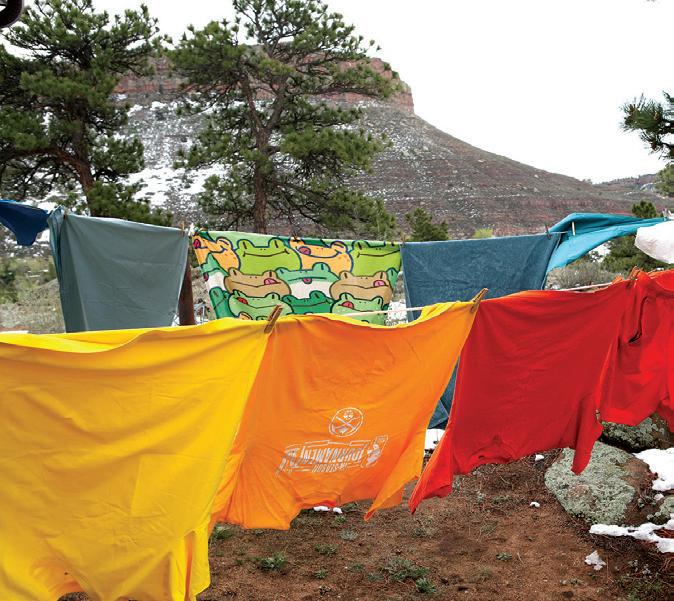
So, hanging the laundry is meditative and mystical. One end of the rope is attached to a corner of the house, and then the line droops its catenary curve (nope, not a parabola, you mathematical types) across about 20 feet of soil and pine needles to a small ponderosa, loops through a ring on the tree, and then swoops northwest, returning to the house wall. Most people think of this as a place of punishment, but I regard it as a location for solitary reflection and artistic creativity: a blank canvas twitching with expectation.
Peer into your washing basket, and some people might observe a compressed lump of crumpled fabric, but I see an artist’s palette just waiting to splash color onto the sky and
How AI and its massive data centers are quietly endangering the planet, our grids, and our future
Essay written by AI
Edited and modified by Don Hurst
EDMONDS, WA – In the seconds it takes to read this sentence, thousands of AI queries circle the globe—generating text, images, and insights at lightning speed. Each feels effortless, a whisper from the cloud. Yet behind every response lies a massive hidden cost: billions of gallons of water, terawatt-hours of electricity, and millions of tons of carbon dioxide. The infrastructure powering artificial intelligence consists of sprawling, energy-hungry data centers that are reshaping landscapes, straining resources, and creating vulnerabilities we can no longer ignore.
The AI surge has transformed data centers from simple storage hubs into hyper-
scale complexes filled with powerful GPUs for training and running massive models. Global data center electricity use now totals about 415 terawatt-hours per year—roughly 1.5 percent of worldwide electricity—and jumped 17 percent in 2025, far outpacing general demand growth. AI servers drive most of this increase, with accelerated workloads projected to grow 30 percent annually.
The numbers are enormous. One modern AI data center can draw as much power as 100,000 homes. A planned Meta facility in Wyoming would consume more electricity than all homes in the state combined. U.S. data centers could nearly double in demand from 80 to 150 gigawatts between 2025 and 2028—equivalent to adding Spain’s entire electricity needs in three years.
create a brand-new wonder that is unique in the art world. Actually, maybe I should call the Leo Castelli gallery in New York and negotiate an exhibition.
There is no rush here, but the first item needs to be small and square so that it is not abraded by wind-assisted flapping against the house siding. But then you can choose to be an Abstract Expressionist, an Impressionist, a Cubist, or any otherist you fancy. I don’t have any hard and fast rules—all that matters is that you care for your craft and inject every ounce of love and commitment to creating your unique display. Or maybe I should say, installation.
The artist Christo was famous for draping long swaths of silk across canyons, and maybe he was the appropriate mentor for your strivings. So, select and peg for a few minutes, and then you have earned the right to stand back and marvel at the color pattern you have forged. Feel free to make adjustments to improve visual juxtapositions. The wind might blow, and now you are a kinetic sculptor. If your palette is a bit muted, remember this deficiency the next
use up to 805,000 gallons of water per day for cooling—equivalent to the indoor use of over 16,000 residents. This has fueled local opposition in already polluted neighborhoods like Elyria-Swansea, where diesel backup generators raise air quality fears. Denver’s mayor called for a moratorium on new data centers, while state lawmakers debate bills offering tax incentives versus stricter rules on renewable energy, community benefits, and resource use. Energy demand is the bigger long-term concern: data centers could claim a significant share of Colorado’s electricity, rivaling major loads like Denver International Airport.
This energy appetite carries severe environmental consequences. AI systems alone could emit 32.6 to 79.7 million tons of CO� in 2025, matching New York City’s annual carbon footprint. Much of this comes from fossil-fuel-heavy grids. Tech companies promise renewables, but rapid growth often relies on gas plants or diesel backups, harming local air quality and public health.
Water use is an even more pressing issue. Servers need constant cooling to avoid overheating during intensive AI tasks. A midsized center can consume as much water daily as a small town; larger ones use up to 5 million gallons per day—enough for a city of 50,000. Including indirect water for electricity generation, U.S. AI data centers could require hundreds of billions of gallons yearly by the late 2020s. AI-specific projections for 2025 estimate a water footprint of 312.5 to 764.6 billion liters, comparable to global bottled water consumption.
In water-stressed western states, this creates sharp conflicts. In Colorado, home to roughly 57 data centers (many clustered in the Denver area), a proposed CoreSite hyperscale facility in north Denver could
The physical impact spreads further. Centers cover hundreds of acres with impermeable surfaces, displacing farmland and habitat. Waste heat raises local temperatures, forming urban heat islands. New power lines and substations strain communities. In multiple U.S. states, electricity prices near data hubs have surged up to 267 percent, with residents bearing higher bills. Grid stability faces new threats. Sudden power swings of hundreds of megawatts during AI training can cause frequency imbalances, equipment failures, and cascading blackouts. Concentrated demand and digital controls also heighten cybersecurity risks—a successful attack could deliberately destabilize regional power systems. The drive for AI supremacy encourages ever-larger models, often favoring speed over safeguards. Data centers provide the essential foundation; unchecked expansion could enable unintended consequences at a global scale—from widespread misinformation to more advanced autonomous systems.
Solutions exist but lag behind growth. Advances in efficient cooling, waste-heat recovery, better chips, and smarter siting can help. Some operators test water-free systems or small nuclear reactors. Regulators in Colorado and elsewhere are pushing for transparency, while investors demand accountability.
As AI reshapes society, its data centers deserve scrutiny. They are not invisible util-
LHS GRADUATING SENIORS 2026
LEAH ANDERSON JAMES BAER
JACOB BAERGA
NICHOLAS BARNES SAVANNAH BECK MAXWELL BOCCOLUCCI
LOGAN DUNCAN MORGAN ELSON
MARGARET FENDERSON DEMETRIO FOGGIA-GARBASH
ALLISON GUDMUNDSON
LAUREN HUNTER
ELLA LEINO MOLLY MAJOR BRODY MCCUE MICAH MCGHEE
AUDREY MCNEIL
ZACHARY STUERMAN
LEO GAULT
ALIAM BONNER SEREINA CHAVEZ
BAYLEIGH CLARK JACK DEVOE CHARLY DIEKMANN WILLIAM DUMBAULD
ANNA JOHANN OLIVER KEMP KAION KISHIYAMA JACOB LACROSSE JADEN LARSON
OZ LAUREN
JAMES NEWELL CHLOE OLSON
ALEXANDER PARKER CALEB PAZNOKAS GRADY PICKERING
SCOTT PIERCE
ANTONIA RAUKER LOGAN REITZ
LUCIA SANTESTEBAN JACK SHIPLEY BENJAMIN SPENCER
Why host an exchange student?
Mercer-Daty
By Tanya Daty Redstone Review
LYONS – Hosting an exchange student is a rewarding experience that brings the world into your home and local community. It offers a unique opportunity to build memories and friendships that last a lifetime while expanding your family’s horizons. By welcoming a student, you don’t just provide a place to stay; you gain a new son or daughter and a fresh perspective on the world.
Lyons has proven to be an ideal setting for this cultural exchange. Our student, Kseniya Rumbakh from Kazakhstan, and her fellow FLEX (Future Leaders Exchange) student, Anush Amirjanyan from Armenia, fully immersed themselves in our small-town life. They participated in choir, school musicals, and sports at Lyons Middle/Senior High School. Kseniya and Anush both served on the Student Advisory Commission. Kseniya even organized
a local food drive as part of a leadership project, demonstrating how these students contribute meaningfully to our community values of openness and service. Beyond local activities, hosting allows you to rediscover your own country through
new eyes. We shared the beauty of several National Parks and iconic cities like San Francisco and New York with Kseniya and Anush. These travels weren’t just sightseeing trips; they were shared milestones that deepened our bond and allowed us to showcase the diverse landscapes and culture of the USA.
The impact of hosting is profound and mutual. From the moment a student arrives, they bring light, curiosity, and warmth. Whether you are learning about their home traditions or helping them navigate daily life in Colorado, the experience fosters global understanding and personal growth for the entire host family.
Some benefits of hosting an exchange student include building memories and friendships that will last a lifetime, learning about other cultures from students ages 15–18 from over 45 countries, and expanding your horizons by welcoming
a new son or daughter to your family. If you think your family would like to have the same rewarding experience of welcoming an exchange student into your home, please contact me at tanya@daty.co to learn more about this exciting opportunity. What is FLEX?
FLEX is a highly competitive, merit-based exchange program funded by the U.S. Department of State and the Bureau of Educational and Cultural Affairs. It operates in Armenia, Estonia, Georgia, Hungary, Kazakhstan, Kyrgyzstan, Latvia, Lithuania, Moldova, Mongolia, Poland, Romania, Serbia, Slovakia, Tajikistan, Turkmenistan, Ukraine, and Uzbekistan.
Tanya Daty is the new local coordinator for AYA, Academic Year in America, a program of the AIFS Foundation. She has lived in Lyons for the past 14 years, where she has raised three children and welcomed her first exchange student.
Daty is a former chair of Lyons Elevates All Fund (LEAF), a former marketing director of Lyons Community Foundation (LCF), a former Trustee on the Lyons Town Board, and she served on several Lyons Elementary School committees when her children attended the school. She is currently teaching full-time.
By Aisha Ozaslan and Kim Hutton Redstone Review
While each community’s water situation is unique, the call to conserve is countywide.
BOULDER – Record hot temperatures and low winter snowfall have led to drought conditions across Boulder County and beyond. These conditions result in less water available in rivers and higher overall water demands, affecting both water supplies and ecosystems. In response to these challenging conditions, Boulder County water providers are joining together to promote community
conservation efforts across the region.
“Drought conditions do not stop at municipal boundaries,” said City of Boulder Utilities Department Director Joe Taddeucci. “We are much stronger when we work together. Uniting with water providers across the county is a powerful way to send a clear, consistent message that water conservation is critical.”
Water providers plan carefully for longterm sustainable supplies and drought preparedness. The response to dry conditions may vary between communities because each relies on different water supplies and has different water demands. This
is why some communities enact mandatory drought restrictions, whereas other communities do not, even while experiencing the same regional dry conditions. While recommendations and rules during this time may differ across water providers, water conservation is an important tool to support water supply resiliency for all communities.
“Each community responds to drought in a way that reflects its unique water supplies and storage strategies,” said Town of Erie Utilities Director Todd Fessenden. “While actions may look different from one community to another, we all share the same
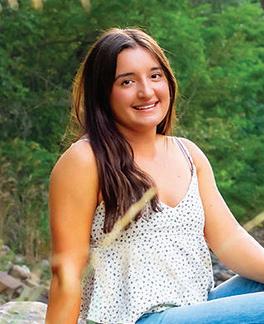
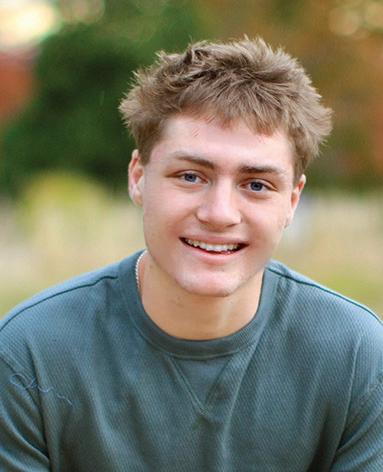
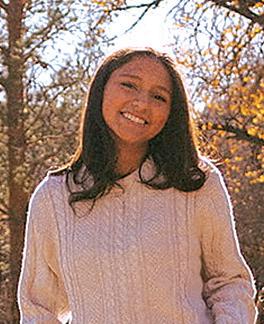
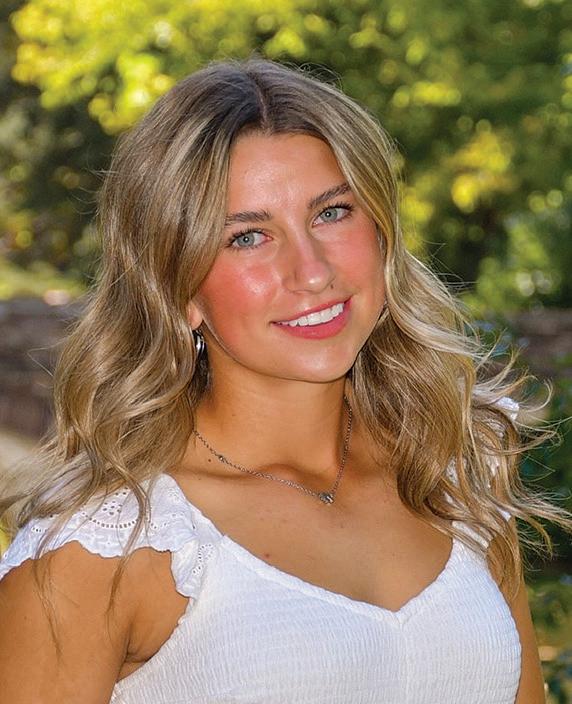
JACK WHITE LEVI ZIETKIEWICZ
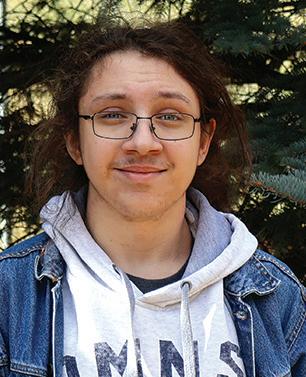
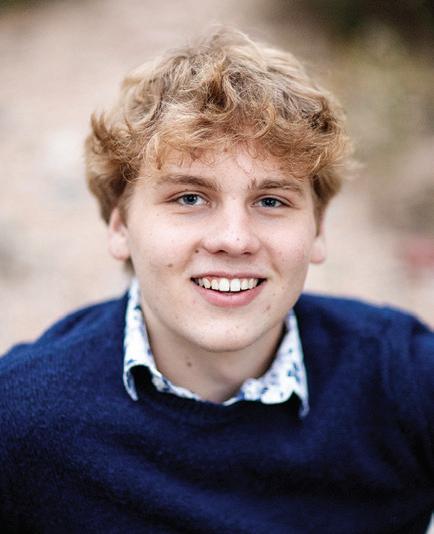
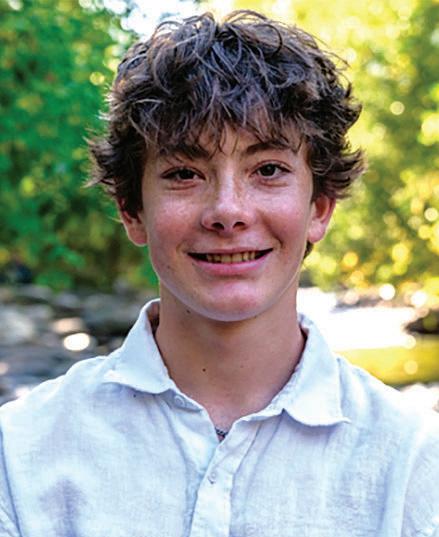
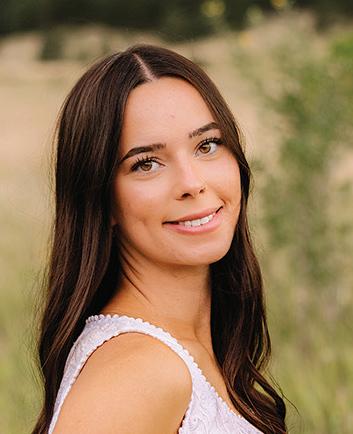
ELLA CAPLAN Silver Creek High School
TRISTAN DATY Niwot High School
JEANPIERRE JUILLAND KING Boulder High School
ALAYNA QUINN Niwot High School
Left to right: Kseniya Rumbakh (from Kazakhstan), Tanya Daty (from Canada), Anush Amirjanyan (from Armenia)
WHAT’S COOKIN’
Chicken tortilla soup
By Barbara Shark Redstone Review
LYONS – I love tortilla soup. It combines some of my favorite flavors—rich chicken broth, chiles, cilantro, cheese, and corn tortillas. Over the years, I have eaten and made several variations. This is my current favorite. Adapt the recipe to suit your taste. Use a vegetable broth, add zucchini, and skip the spicy chiles. Make it your own.
In a largeish pot, combine a quart of water, a chopped carrot, a chopped piece of celery, half an onion, and a handful of cilantro stems and bring to a boil. Add a pound of chicken thighs, whole or boneless and skinless, or two chicken breasts. Bring back to a gentle boil, then reduce the heat to low and poach the chicken, partially covered, for 45 minutes. Let cool in the broth. Discard bones and skin if used. Shred with a fork. Strain the broth and set it aside while
you prepare the seasoning base. Sauté a small onion, chopped, in a tablespoon of safflower or canola oil until translucent, 3–4 minutes. Add a couple cloves of garlic, minced, and cook for a minute. In a blender jar, combine the onions with 1½ cups of canned tomatoes (a 15-ounce tin) and a tablespoon of chipotle puree. Whizz until smooth, then cook in 2 teaspoons of oil until darkened a bit. Add to the strained chicken broth with additional water, if necessary, to make four cups. Taste for salt. Add chipotle to taste if you’d like more spice. Heat for a few minutes to meld the flavors.
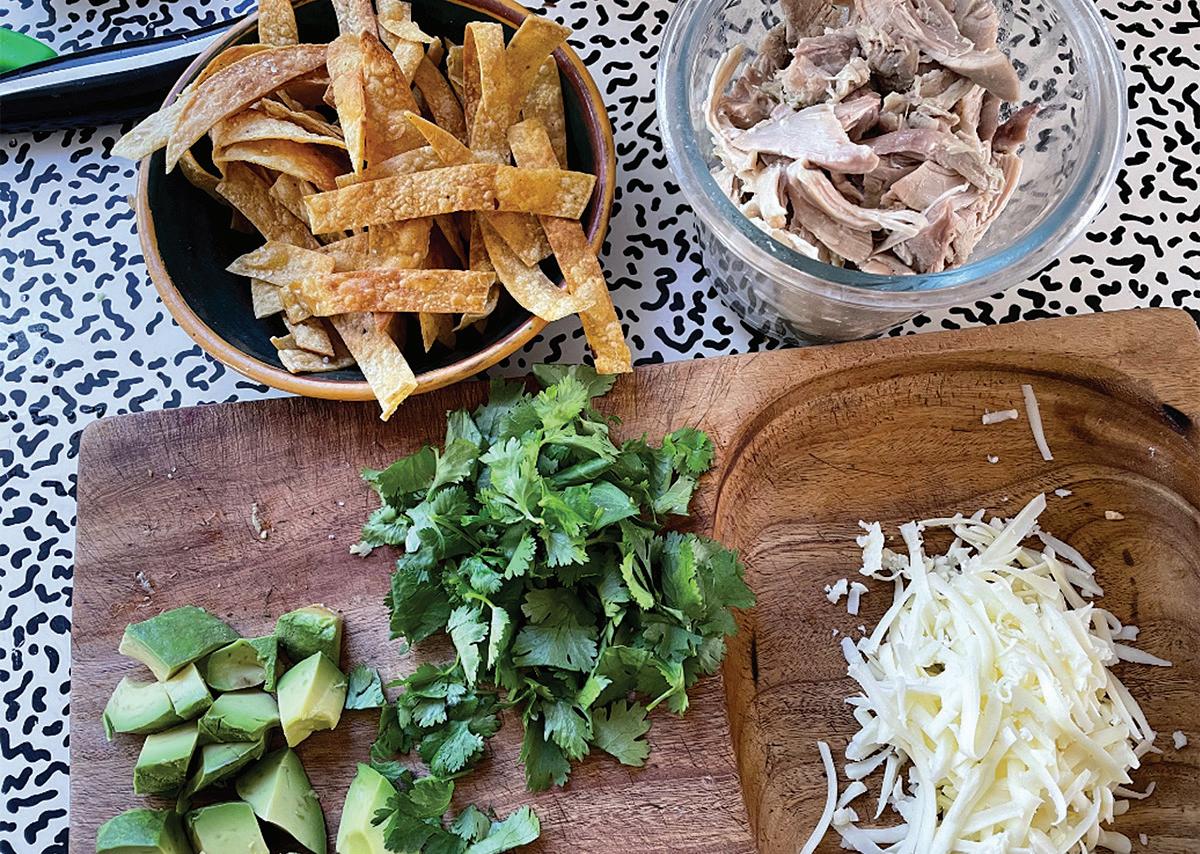
To serve, place portions of the shredded chicken in large bowls, with a handful of grated Monterey Jack, cheddar, Oaxaca, or other melting cheese, chopped cilantro, avocado chunks, diced red onion, strips of roasted green chile or jalapeños, and fried tortilla strips, broken tortilla chips, or totopos. Pour the hot broth over and serve with lime quarters on the side. Enough for three or four portions.
Barbara Shark is an artist and author of How I Learned to Cook, an Artist’s Life. She lives near Lyons, Colorado. For more recipes, read her blog - www.howilearnedtocookanartistslife.blog
Crown Hotel Lewes Mac and Cheese: A 1981 Greenpeace memory
By Catherine Metzger Redstone Review
SAN MIGUEL COUNTY – Lewes High Street in East Sussex, England, is lined with historic Georgian buildings and inns. The Crown Inn (Crown Hotel) at 192 High Street has operated since at least the 17th century (records say around 1638).
In December 1981,
for
headquarters to Lewes (Temple House), just down the steep hill from The Crown. I caught a bad cold walking on my breaks over the large pebbles of blustery Brighton Beach, just miles away from Lewes. But I enjoyed a memorable six-week stay at the Crown, where the macaroni cheese was excellent. I asked the chef for his recipe and have tried my best to remember, after all these years, what he told me about how he made it.
Lewes is famous for its spectacular Bonfire Night on November 5 (or the Saturday before if it falls on a Sunday). Celebrations commemorate the 1605 Gunpowder Plot (Guy Fawkes) and the 17 Protestant martyrs burned at the stake in Lewes during the 1550s. The first recorded parade was in 1679; by the 19th century, “Bonfire Boys” dragged blazing tar barrels through the High Street. Today, seven societies stage torchlit processions, giant effigies, fireworks, and barrel races—one of Britain’s biggest fire festivals, right past the Crown Hotel.
The Crown Hotel Mac & Cheese
Serves: 4 as a main course; Prep time: 45 mins.; Cook time: 22 mins.
Ingredients
Pasta
300–350 g (10½–12 oz) macaroni or elbow pasta
Onion-Infused Milk
700–800 ml (3–3½ cups / 24–27 fl oz) whole milk; 1 medium onion, thinly sliced and browned; 1–2 tbsp (15–30 ml) butter or oil. Optional: 1 bay leaf and a few peppercorns.
Sauce
60 g (4 tbsp/2 oz) unsalted butter;
50–60 g (–½ cup/1¾–2 oz) plain flour; ½–1 tsp (2.5–5 ml) English or Dijon mustard; –¼ tsp (0.5–1 ml) sweet paprika; 2 shakes Tabasco Original sauce; Salt and white pepper, to taste.
Cheeses (total ~280–350 g/10–12 oz)
150–200 g (5–7 oz) sharp Cheddar; grated fresh (I used a cheddar blend); 50–60 g (1¾–2 oz) white Cheddar, grated; 50–60 g (1¾–2 oz) Parmesan, grated (some in sauce, 2 tbsp for Panko topping)
Topping
1 cup (100–120 g/3½–4 oz) panko breadcrumbs; a knob/tablespoon of butter
Directions Grill sliced onions in 2 tbsp (15–30 ml) butter until soft and golden (15 min). Set aside.
Warm milk gently. Add grilled onions (and optional bay leaf and peppercorns). Steep on low heat 10–15 min, then strain. Keep warm. Cook macaroni al dente in well-salted water. Reserve 240 ml (1 cup) of pasta water, then drain.
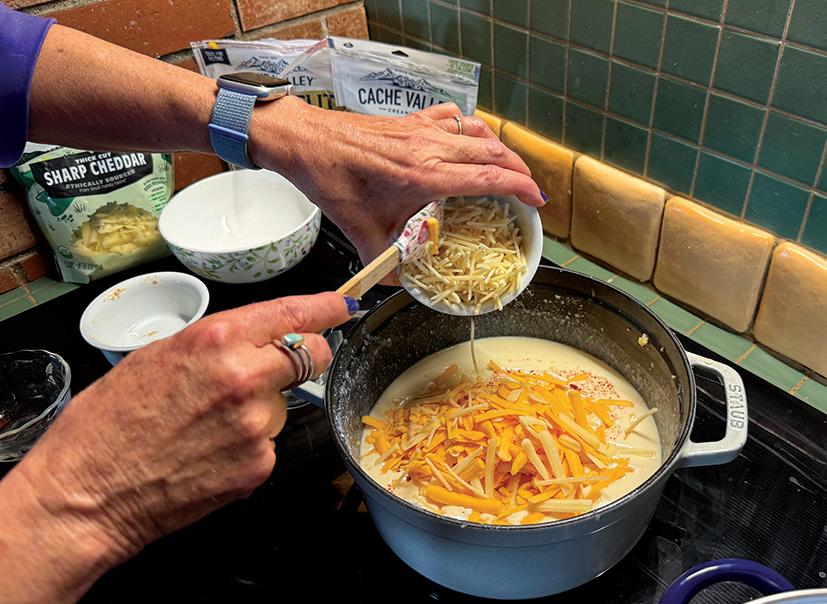
Melt 60 g butter. Whisk in flour and cook 2 min. Gradually whisk in warm infused
Continue Mac and Cheese on Page 12
I took minutes
the Greenpeace International meeting in Brighton as they prepared to move their
The Artemis II crew championed the need to continue space exploration
By Annie Muldrew-Pancoast Redstone Review
Planet Earth, You. Are. a. Crew. Mission Specialist Christina Koch, Artemis II
“In all of this emptiness—this whole bunch of nothing we call the universe—you have this oasis (of earth), this beautiful place that we get to exist in together.”
Commander Reid Wiseman from Artemis II during the 10-day flight around the dark side of the Moon.
RIVERSIDE – As a retired SVVSD teacher, I was recently brought back to the incredible feats of various space missions from the late 1960s and on. I remember my third-grade students getting really interested in space travel after the Apollo 8 spacecraft sent the first humans out of Earth’s orbit to reach the Moon in December, 1968.
Then Apollo 10 followed in late May with a dress rehearsal for the Moon landing, culminating in Apollo 11 astronauts Neil Armstrong and Buzz Aldrin walking the surface of the moon on July 20, 1969. Kids had space posters in their bedrooms at home and knew those famous Armstrong words by heart: “That’s one small step for man, one giant leap for mankind.”
programs (Science, Technology, Engineering, Mathematics). Around 2003, Sally Ride Day began to be celebrated every May 26, her birthday. Eleven years before she died in 2012, Dr. Ride had cofounded Sally Ride Science to inspire young people to enter science and engineering fields: “Science is fun. Science is curiosity. We all have natural curiosity. Science is a process of investigating. It’s posing questions and coming up with a method. It’s delving in.” (holidayinsights.com).
And delve back in so many of us did, glued to the tube with the live videos and photos
Years later, on June 18, 1983, mission specialist Sally Ride, born in 1951, was the youngest of five on the crew aboard the STS-7 launched from Kennedy Space Center on a successful week-long second flight of space shuttle “Challenger.” The first woman astronaut to go into space, Dr. Ride was a physicist, astronomer, and advocate for girls getting involved in STEM
taken by Artemis II on its incredible ten-day 694,481-mile mission (nasa.gov), the first crew to travel around the moon since the Apollo program ended. I admit my heart was pounding during the final countdown of this scientific marvel as I held my breath, tears in my eyes, watching that picture-perfect splashdown in the Pacific Ocean—a moment for the entire planet to celebrate.
Quotes by the awestruck crew taken from USA Today say it all: Commander Wiseman quipped, “It’s a special thing to be human, and it’s a special thing to be on planet Earth.” Pilot Victor Glover waxed eloquent often throughout the flight, saying, “Trust us, you look amazing; you look beautiful. And from up here, you also look like one thing…Homo sapiens, all of us. No matter where you’re from or what you look like, we’re all one people.” Mission Specialist Jeremy Hansen from the Canadian Space Agency said the crew was a “mirror reflecting” humanity; he urged people to find joy in contribution. Amazed by the expansive dark-
ing to take out the entire civilization of Iran in a ‘non-war.’ While the crew was encouraging others to consider this firstof-a-kind mission as a chance for further research, some politicians were wondering if the words from the White House could be construed as war crimes.
As the team encouraged the need for science and research, the government was busy continuing to slash funds to NASA as well as to its student-focused STEM program based in schools across the nation—a direct insult to the astronauts, past and present, and the entire NASA workforce, along with thousands of university research programs, academic science jobs, and K-12 programs. Bill Nye, the Science Guy, emphasized these cuts would all but dismantle much of NASA—an odd choice, he felt, for an administration that had pledged to put America first.
ness of the universe, Mission Specialist Christina Koch referred to the fragility of Earth as a “lifeboat” in the vast blackness of space.
That Easter week, however, was also filled with other mixed messages. While the astronauts were trying to bring people together with their “love your neighbor” message, the administration was threaten-
With all that confusion to digest, I myself just have to stay on the positive side in hopes that loud voices across the US may help to cool the talking heads in Washington and rev up enthusiasm across the country to keep this necessary scientific community thriving.
In their own words, during a welcome-home ceremony in Houston on April 11, the crew voiced their enthusiasm for the need to continue space exploration. Commander Wiseman pumped his fist and said, “We’re not stopping,” since the mission can help “create magic” by uniting the world. Encouraging working together, Mission Specialist Koch defined a crew as “inescapably, beautifully, dutifully linked...Planet Earth, You. Are. a. Crew.” So, let’s delve in with our own level of enthusiasm.
Annie Muldrew-Pancoast is a retired school teacher. She resides and writes in Riverside CO.
Artemis II crew: Reid Wiseman, Victor Glover, Christina Koch, and Jeremy Hansen.
COMMON CAUSE
Meeting people where they are: building the feeling of belonging in Lyons
McCool
By Daryl McCool and Kim Hinzy Redstone Review
LYONS – While in grad school to become a clinical social worker, there was a phrase that became embedded in my mind: “always meet the person where they are.” That phrase has taken on a stronger meaning for me in the first few weeks at Lyons Elevates All Fund (LEAF), in my new role as Community Programs and Client Services Manager.
Folks seeking support from LEAF are often juggling multiple challenges that can disconnect them from the foundational human needs that allow people to feel stable, safe, and connected. When a person is unable to meet their most basic needs, like food, shelter, safety, and belonging, it is unlikely they are experiencing optimal mental health. At LEAF, meeting a person where they are might mean helping them put food on the table, paying for an unexpected /car repair, bringing them a meal when food preparation is out of reach, or helping them catch up on rent when an emergency arises.
Meeting those foundational human needs led to the formation of LEAF more than a
LCF
decade ago, and it remains an integral part of the mission today. But meeting foundational needs is only part of the picture. People also need places where they feel seen, valued, and connected to others. Connection as a foundation
At LEAF, we believe community connection is not a luxury. Research increasingly points to social isolation as one of the most significant threats to mental and physical health, and men in particular are navigating a quiet crisis of disconnection. Friendships that flourished in school fade with time. Years pass, and the people who once filled a room go missing from it.
At LEAF, we believe the antidote to that disconnection begins with showing up and creating spaces where showing up feels possible. Access to wellness programs, therapy for all ages, and opportunities to connect with each other in meaningful ways allows for a well-rounded approach to mental health.
Two new series rooted in that mission
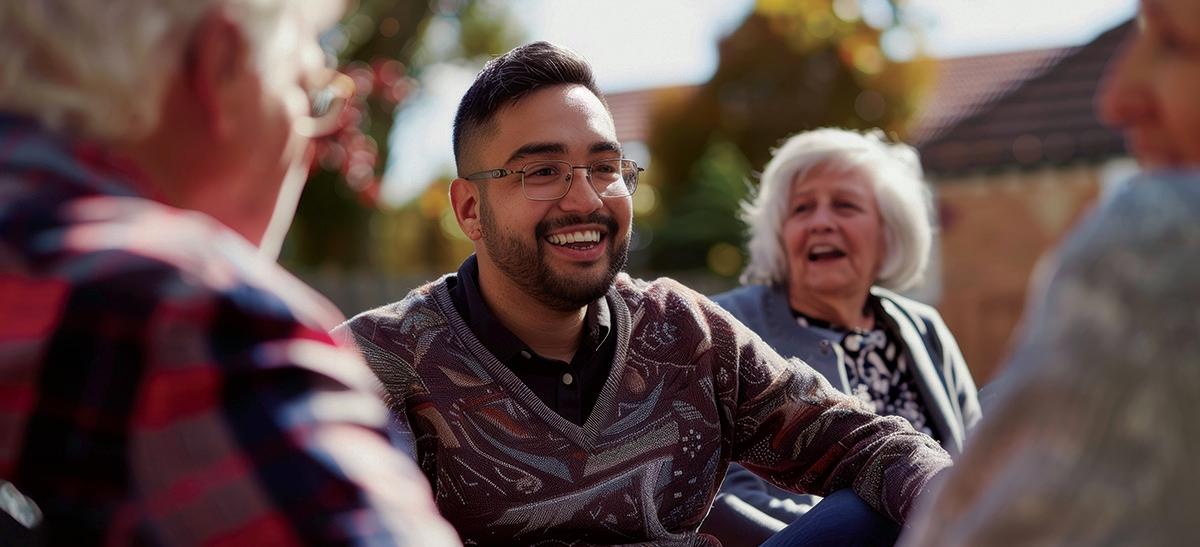
This spring, LEAF is launching a men’s
gathering series designed to do exactly that: create a regular, low-barrier space for men in the Lyons community to have honest conversations and find connection, exactly as they are.
The first gathering takes place on Tuesday, May 19, from 6:00 p.m. to 7:15 p.m. on the back patio at LEAF, located at 304 Second Ave. in Lyons. The format is intentionally simple. Attendees are asked to bring three things: themselves, an appetite, and an open mind.
This is not a one-time event. The May 19 gathering is the first in an ongoing series, with more dates to follow. Because a real community is built over time. A single dinner can spark something; a series can sustain it.
Connection, confidence, and belonging for youth
Just as adults need spaces for authentic connection, young people do too. Beginning June 1, 2026, LEAF, in collaboration with Dancing Spirit Equine Facilitated Learning and Coaching, will offer Unbridled YOU: Self-Discovery Through Horses, Art, and Nature for local youth.
At a time when many young people are navigating pressure, uncertainty, and constant noise, Unbridled YOU is designed to meet youth where they are, creating space to slow down, build confidence, and connect more deeply with themselves and others. It is a supportive, judgment-free environment
reflects on a spring of community connection
Simonsen
By Grace Simonsen Redstone Review
LYONS – The Lyons Community Foundation (LCF) is reflecting on April with gratitude for the many opportunities to connect with and give back to the Lyons community this spring.
We had a wonderful time attending the Easter service at Planet Bluegrass, where our amazing board members served drinks and sweet treats to community members gathering for the celebration. We’d like to extend a heartfelt thank you to Planet Bluegrass for the opportunity to raise funds through tips and donations, which directly support LCF’s scholarship and community grants programs.
LCF also enjoyed participating in Lyons’ community-wide Earth Day event. It was another great chance to share a little sweetness with neighbors while raising donations that help further our mission of supporting projects, programs, and people that strengthen our community.
If you missed us at our spring events, you’ll have plenty of opportunities to connect with LCF this summer. Board members and volunteers will once again be serving sweet treats, hot dogs, and drinks every Wednesday from June 17 through August 12 during the annual Sandstone Summer Concert Series at Sandstone Park. These free concerts, hosted by the Town of Lyons and supported through grants distributed by LCF, are a beloved community tradition.
The concert series offers a wonderful opportunity to enjoy live music, gather with friends and neighbors, and support local philanthropy at the same time. Donations col-
lected under the LCF tent help fund scholarships, grants, and other initiatives that uplift Lyons.
If you’re looking for a fun and meaningful way to get involved, LCF is currently seeking volunteers and baked good donations for this year’s concert series. Anyone interested can reach out at info@lyonscf.org.
Funds raised through community events like these help make programs such as the LCF scholarship program possible. On May 11, LCF was proud to attend the annual Awards Night at Lyons Middle/Senior High School to celebrate the accomplishments of this year’s graduating seniors and announce the 2026 scholarship recipients. We congratulate all of the students who applied and extend our best wishes as they take their next steps beyond high school.
Finally, LCF is excited to introduce its new logo. We’d like to thank local graphic designer Heather Prentice for helping refresh our look while keeping the spirit of the organization rooted in community.
To learn more about the Lyons Community Foundation, get involved, or make a donation, visit lyonscf.org.
Grace Simonsen is a longtime Lyons resident. She served on the board of Lyons Community Foundation before becoming the administrative assistant and the community outreach director for LCF in 2025.
A short eagle story
By Richard Dean, better known as Hoss Redstone Review
In the tall ponderosa, four calling out to be witnessed in this moment.
Sun on the horizon, crouched and waiting, little dog finds me.
The children fall from the tree first.
One, two, like parachutes their wings spread and churn the still air.
Over the stream the cold air sinks, pulling the young birds down.
Wings oaring hard they pull themselves up to the roosting cottonwood.
where they explore who they are without pressure to perform.
This four-session experiential program combines intentional interactions with horses, art activities, small group experiences, and time outdoors in nature to support emotional well-being and personal growth. Through hands-on learning and meaningful connection, youth will practice healthy boundaries, strengthen emotional awareness and regulation, build relationship skills, and develop tools to navigate challenges with resilience and authenticity.
Session dates: June 1, June 8, June 15, and June 22 from 5:30 p.m.–7:30 p.m.
This program is offered at no cost to community youth through funding support from Boulder County. To learn more or register, please contact Kim Hinzy at Kim@ leaflyons.org.
You are welcome here
Come visit LEAF Monday through Thursday from 9:00 a.m. to 3:00 p.m. or visit our website to learn about upcoming programs and the full schedule of the gathering series as it Whateverdevelops.brought you here, you are welcome. www.leaflyons.org
Daryl McCool joined LEAF in 2024 and serves as Creative Communications and Marketing Manager. She supports programming, events, social media communications, website, and outreach activities in our community.
Continued from Page 1
• Get a FREE home wildfire assessment through Wildfire Partners of Boulder County
• Access a $500 county rebate and an additional Town of Lyons matching rebate of up to $500, for home mitigation work for Town of Lyons residents.
Learn more: Wildfire Partners rebate program: wildfirepartners.org/rebate/ Town of Lyons matching rebates and assessment; info: townoflyons.com/826/Rebates-Home-Assessments.
If you use social media, be sure to follow @TownofLyonsGovernment on Facebook for the most accurate and up-to-date town updates and information.
Sundance Festival local task force Lyons is looking for support
LYONS – The Board of Trustees is setting up a local task force to help with the Sundance Festival, which is coming to Boulder in January 2027. The BOT is interested in being an active participant in the Sundance Film Festival with additional input from businesses, residents, and artists, to assist the Board of Trustees in identifying ways to support the festival, festival goers, local businesses, and artisans. If you are interested in helping, please submit the interest form today for consideration. To fill out an application, go to the Town of Lyons website.
The parents celebrate by falling from the tree and effortlessly arrive in the cottonwood making the flock whole.
Perching, the family engages in happy chatter and preen their golden spats.
Soon, silence falls as we watch the rays of joy dance on the cool stream face.
No Kings! Tanya Daty, Jeanne Moore, and Sally King
Board Continued from Page 1 Coffintop Continued from Page 6
sory Board and Parks and Recreation Commission, Lowell; Planning and Community Development Commission, Schwartz; Historic Preservation Commission, Williams; Human Services and Seniors Commission, Jacobs; Economic Vitality Commission and Sustainability Advisory Commission, McCreary; Utilities and Engineering Board, Wingard; Student Advisory Commission and Lyons Arts and Humanities Commission, Browning.
Kay Sparks lives in Lyons and she is the chair of the Housing and Human Services Commission.
Greenland Continued from Page 4
to the same thing: the AMOC is indeed weakening, and there is a scary chance that it could actually collapse. Troubling enough, it seems likely to occur much sooner and more rapidly than was expected.
At this point, data isn’t only coming from one study and type of measurement, but many different studies and types of data. In short, evidence is piling up that the AMOC is in trouble (can’t resist a pun… it’s on thin ice.) A recent Science Advances paper (by Portmann and coauthors) further raises the alarm and highlights how much the AMOC is weakening by using multiple tiers of evidence and research.
Stay tuned for the second installment of Kati Gosnell’s column, Why you should care about Greenland , to find out what could potentially happen and what people worldwide could be facing.
Kati Gosnell grew up and attended school in Lyons. She earned her PhD in Oceanography from the University of Connecticut. She has been working as a marine researcher in Germany since 2019. The company is SeaTerra in Wandlitz, Brandenburg, Germany. She is currently helping clean up degraded World War I and World War II munitions from the Baltic and North Seas and beyond.
Library Continued from Page 5
It’s a great way to build a home library, and we’re grateful to the Friends of the Library and the Longmont Community Foundation for their support.
So, whether you’re signing up for Summer Reading, dropping into a program, or just swinging by to grab your next favorite book, we hope to see you soon.
Your Lyons Community Library opens at 10:00 a.m. Monday through Saturday. We close at 7:00 p.m. Monday through Thursday, 5:00 p.m. on Fridays, and 2:00 p.m. on Saturdays. Our online catalog is available 24/7 at lyons.colibraries.org, and we’re always open for digital downloads on the Libby, CloudLibrary, and Kanopy apps. Give us a call at 303-823-5165 or email info@lyonsregionallibrary.com with any questions. Please see the calendar of events on our website for additional programs, program information, and registration instructions.
Kara Bauman is the Director of the Lyons Community Library and holds an MLIS from the University of Kentucky. She’s an avid fly angler, enjoys craft beer, and travels extensively to see her favorite band, Widespread Panic.
The late LaVern Johnson, Dean Redmond, and Ron Gosnell led Lyons citizens in a fight against the project when it was first proposed in 1980. Their group, Dam Concerned Citizens, was instrumental in alerting the public about the dangerous impact of the massive dam on the environment and the Town of Lyons. Among the concerns was the revelation that a fault line ran directly under the dam location, raising the prospect of dam failure and destruction of the town.
The failure of the Lawn Lake dam in Rocky Mountain National Park in July 1982, which drowned three campers and caused widespread destruction in Estes Park, added further alarm to the effort to stop the dam.
The dam would have held back a reservoir with some 80,000-acre feet of water and created a five-mile-long reservoir.
An effective tool in conveying the impact of the dam was a 3D model created by Gosnell and Redmond that they presented at public meetings with the St. Vrain and LeftHand Water Conservancy District and regulatory authorities. The model is on display at the Redstone Museum in Lyons.
A permit was issued to the District in February 1982 by the Federal Energy Regulatory Commission for the dam. The commission was involved because the dam would have provided hydropower. Later, a progress report by the same federal commission found that there was a “solid foundation upon which to proceed with subsequent studies and investigations required for the Coffintop Dam and Reservoir Project.”
Those subsequent studies required mitigation for the inundated canyon, including a 15-mile “scenic recreation corridor” along the St. Vrain River from Longmont to beyond Lyons.
The DCC kept up a steady pressure to defeat the dam through their presence at state regulatory and District meetings and media publicity until 1985 when state authorities removed the Coffintop Dam location from consideration.
But a Lyons Recorder editorial from that same year said that while the state authority “deemed it inappropriate to build a 365ft. dam along the South St. Vrain,” it may represent “just a short reprieve for the town since the dam has been a glimmer in developers’ eyes for over three decades.”
And so, the idea of the dam has lurked in the background since then until the District and the Save the Rivers reached the agreement to effectively kill the idea.
“The whole decades-long fight was always a citizen-based effort,” said Gosnell, who still lives in a log cabin that would have been at the base of the dam. “So many people were involved, some behind the scenes, some no longer with us, who all made a significant difference for this outcome.”
Greg Lowell was elected to a third term as a Lyons Town Board Trustee on April 5. He writes on ecology and various other topics for the Redstone Review.
AI Continued from Page 7
ities but deliberate choices about resources, priorities, and the future we want to power—especially in fast-growing states like Colorado facing drought and grid limits.
The core question remains: Can we build these machines responsibly, or will we allow them to overwhelm the world that sustains us? The shadow is already here—addressing it now is essential.
Don Hurst earned a Master of Science from the University of Missouri. He was a consultant at NCAR and taught computer science at multiple universities while working as a computer systems librarian. He freelanced as a programmer in Los Angeles and San Francisco, and also appeared as a movie extra in various films. He is now retired and lives with his wife near Seattle, learning Python and exploring AI.
Hanging Continued from Page 7
time you are in the T-shirt aisle at the thrift store: you should consider hue and color saturation as much as fit and comfort.
Presto chango. Your miniature Christo will embellish and gladden the local environment for a few hours or maybe a whole day. It will bring joy to a passing deer or turkey and even a person.
But eventually comes the sad moment when you must return items to your basket and take them indoors. The lines are bare again. Your disappointed neighbors and other local art-loving aficionados are just going to have to tough it out until you next have a stinky sock or that blouse you wore for two days in a row.
So next time the heap of dirty washing is getting too big to ignore, don’t think of it as a looming dark cloud that demotes you to the lowly ranks of a scullery maid. Imagine this scenario: It is just after dawn in Venice in the spring of 1523, and the gondola has delivered you to the studio of Titian at the water’s edge in the district of Cannaregio. As you enter, you gasp at seeing the almost finished Bacchus and Ariadne, which will be delivered to the ducal palace next week. You are his new apprentice, committed to spending the rest of your life devoted to beauty, and your eventual rise to international renown through masterly brushstrokes of fabric.
Peter Butler was born in India and lived in a house facing a giant kapok tree. Growing up in England, there were trees, but never quite enough. After qualifying as a biochemist, there was a gradual evolution into being a graphic designer. He and his wife, Deirdre, moved to the States in 1997 and to Lyons in 2000. Finally, there are enough trees.
Water Continued from Page 9
goal of using water wisely and protecting our long-term water supply.”
“Increased conservation now is the most effective tool we have to make our communities more resilient for future dry years. Outdoor water use makes up a large share of summer demand, so reducing lawn and landscape watering can make the biggest difference,” said City of Longmont Water Conservation Specialist Hope Bartlett.
As temperatures rise, Boulder County water providers recommend community members conserve water by:
Know your local watering rules and recommendations. Take advantage of water-saving incentives, including rebates offered by your water provider. You can also check indoor fixtures and sprinkler systems for leaks and make repairs right away. Find more water conservation tips and water use guidelines for your community on these water provider websites:
• City of Boulder (boulderdrought.net)
• City of Lafayette (lafayetteco.gov/ Drought)
• City of Longmont (bit.ly/watering-restrictions)
• City of Louisville (LouisvilleCO.gov/ WaterRestrictions)
•Left Hand Water District (lefthandwater.gov)
• Little Thompson Water District (littlethompsonwd.gov/conservation)
• Town of Erie (erieco.gov/Drought)
• Town of Lyons (townoflyons.com/496/ Summer-Lawn-Watering-Guidelines)
• Town of Nederland (nederlandco.gov/ utilities)
• Town of Superior (superiorcolorado. gov/Government/Departments/Sustainability/Sustainable-Water)
Aisha Ozaslan, Boulder County Media Relations at 303-501-2318. Kim Hutton, Water Resources Manager, Huttonk@bouldercolorado.gov.
milk. Simmer 3–5 min until thickened. Remove from heat. Stir in mustard, paprika, Tabasco, salt, pepper, and most cheeses until silky. Loosen with reserved pasta water if needed. Mix pasta into the sauce. Transfer to a greased ovenproof dish. Top with panko mixed with melted butter and reserved parmesan cheese. Bake at 190 degrees C/375 degrees F for 20–25 minutes until golden and bubbling. Finish under the broiler for 2–3 min for an extra-crisp top.
Serving Hot with a simple green salad and peas— classic Crown pub style.
In 2021–2022, the building underwent a major restoration and conversion into nine boutique apartments and commercial units (no longer operating as a traditional hotel/ pub). The exterior was carefully preserved and restored to its former glory, so it still looks very similar to the photos—just without the active hotel signage and entrance details it had in the 1980s.
Catherine Ripley Metzger has been cooking professionally and privately since 1979. She was a French cuisine journeyman at the celebrated Henri d’Afrique restaurant in Old Town Alexandria, Virginia. Today, she is the proprietor of the food blog www.foodfortheages.com and cooks with curiosity from the ground up in her log cabin home on the Western Slope of Colorado.
Continued from Page 12
Grant-funded public art
LYONS – The Town of Lyons is inviting artists to help transform everyday infrastructure into something memorable. Through the Creative Outlets program, a selected artist will design and paint a town utility box—turning a highly visible public space into a piece of local art. The goal is simple: bring creativity and color to unexpected places and contribute to Lyons’ growing public art scene. This is a grant-funded opportunity with a stipend provided. If you’re interested in leaving a lasting visual mark on the community, take a look at the details here: townoflyons.com/646/Creative-Outlets
Boulder County Parks and Open Space survey and open house regarding trail usage
BOULDER COUNTY – At the direction of the Board of County Commissioners, Boulder County Parks and Open Space will explore a pilot program to test alternating use on select existing trails that currently allow multiple uses. The pilot would temporarily assign specific days for different uses instead of having all activities occur at the same time. Learn more about the open house and/or take a survey to give your input. bouldercounty.gov/open-space/management/alternating-trail-use/ Bears are back
LYONS – With warmer weather, bears are becoming active and searching for food, which often leads them to unsecured trash. Taking simple precautions now, like securing your trash and removing other food sources, helps prevent bears from becoming dependent on human-provided food. When bears associate people with food, they pose a greater safety risk. Properly securing garbage protects both the community and the bears. Garbage kills bears.
Dog park composting program
LYONS – The town has launched a six-month pilot program at the Bohn Park dog park to compost dog waste, aiming to reduce landfill use and protect local waterways. The pilot program has replaced the existing trash bin with compost bins and provides 100 percent compostable bags on-site. Dog owners are required to use these bags and dispose of waste in the designated bins. The material is collected weekly for commercial composting. Only dog waste in compostable bags is allowed in the bins, and contamination must be avoided. Thank you.Mi, sinctot ationse accus ma vent voluptatur, sus.