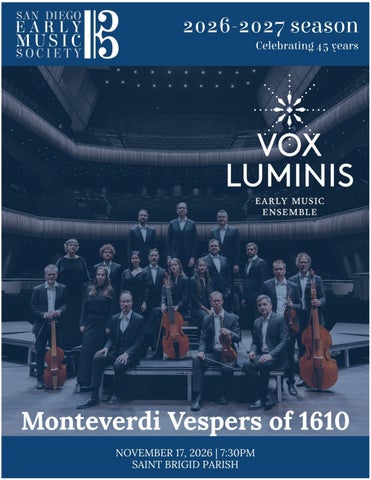
VOX LUMINIS | MONTEVERDI VESPERS OF 1610 Monteverdi’s Vespers of 1610 (formally titled Vespro della Beata Vergine) is a monumental work of sacred music that bridges the Renaissance and Baroque periods. Published while Monteverdi was working in Mantua, it combines traditional Gregorian chant with innovative compositional techniques of the emerging Baroque style. The work sets traditional Latin texts for the evening service of Vespers, including several psalms and the Magnificat. What makes it remarkable is Monteverdi’s creative treatment of these texts, employing multiple choirs, instrumental accompaniment, and the new dramatic style of the early Baroque, while using techniques such as echo effects, virtuosic solo passages, and contrasting textures between sections. The Vespers demonstrates Monteverdi’s mastery of both the older polyphonic style (prima pratica) and the newer, more expressive approach (seconda pratica). It’s considered one of the first great masterpieces of Baroque sacred music, showing how traditional church music could be combined with the emotional expressiveness and dramatic flair of opera, which was just emerging at the time.
VOX LUMINIS
PROGRAM
I. Deus in adjutorium meum intende Domine ad adjuvandum me festina II. Dixit Dominus III. Nigra sum IV. Laudate pueri V. Pulchra es VI. Laetatus sum VII. Duo Seraphim VIII. Nisi Dominus IX. Audi coelum X. Lauda Jerusalem XI. Sonata sopra Sancta Maria XII. Hymnus: Ave maris stella XIII. Magnificat
Cantus: Zsuzsi Tóth, Benedetta Zanotto Sextus: Sophia Faltas, Victoria Cassano Altus: Jan Kullmann, André Pérez Muíño Tenor: Raffaele Giordani, João Moreira Quintus: Jacob Lawrence, Massimo Lombardi Bassus: Guglielmo Buonsanti, Lorant Najbauer (substitute for Lionel Meunier) Violin I: Tuomo Suni Violin II: Ellie Nimeroski Viola I: Wendy Ruymen Viola II: Daniel Elyar Viola da gamba: Adrienne Hyde Violone: Isaline Leloup Cornetto I (& recorder): Martin Bolterauer Cornetto II (& recorder): Cathérine Renno Cornetto III (& recorder): Marleen Leicher Trombone alto: Joren Elsen Trombone tenor: Raphaël Robyns Trombone bass: Joost Swinkels Dulcian: Anaïs Ramage Theorbo: Simon Linné, Charlie Weaver Organ: Anthony Romaniuk Artistic direction: Lionel Meunier
Vox Luminis is represented exclusively in North America by Alliance Artist Management
Our Underwriters
Tonight’s performance by Vox Luminis is made possible by the extraordinary generosity of Elinor Merl and Mark Brodie. We also extend our heartfelt gratitude to Laurent Planchon, whose leadership and financial support helped bring this remarkable ensemble to San Diego. Please be sure to turn off any electronic devices that could make noise during the performance. No flash photography, filming, or recording without express permission from the performers. SAN DIEGO EARLY MUSIC SOCIETY | WWW.SDEMS.ORG | SDEMS@SDEMS.ORG
PROGRAM NOTES Vespro della Beata Vergine SV206 (pub. 1610) There’s something in the air in Europe as the 17th Century is born: Cervantes in Spain is penning the first novel, Shakespeare, just down the road from here, is radically reinventing how we see humanity on stage, and Caravaggio (not so far from tonight’s composer) is rewiring our vision with his use of light and (especially) darkness. Tonight’s music, too, is cutting-edge stuff. Monteverdi had penned one of the first operas — L’Orfeo — in 1607. Certainly the first great opera, it has innovation, emotional depth and searing dramatic impact. He had honed his use of harmony and texture in his madrigals (by 1610 he’d published around 100), and his “modernity” had offended the purists. He was finding new, more immediate (and still telling) ways of expressing emotion in music — of loss, love, longing, sorrow, joy — the very nuts and bolts of being most vividly, humanly alive. The Vespers show this skill through a religious prism, albeit sometimes a barely perceptible one. In them, Monteverdi offers us an instruction manual of ways to sing the Lord’s song: from solos, duets, and trios, to polychoral opulence, acoustic coups de théâtre and a summative account of what the composer had learned about composing vocal music in his time in Mantua. Listen, throughout, to his sure-footed musical pacing, how he understands so fundamentally how to create and release harmonic tension in the listener. Listen to his gift for illuminating text with variation of texture and, perhaps most of all, to just how right it all sounds. One can imagine the composer at his desk, turning the words over and over until arriving at the most eloquent rhythms, colours, melodic moves. From the opening fanfare — an ebulliently arresting call to prayer lifted from L’Orfeo — we are welcomed into this sonic universe with a warm smile. Even the first psalm, Dixit Dominus, that speaks of the Lord ‘dashing His enemy’s heads on the rock’ is approached with a spring in the compositional step. The implacable A minor tonality of this movement is briefly interrupted, as a priest wanders in to intone the Gloria Patri in an incense-shrouded G minor. From there, as throughout, the composer whisks away the tablecloth and leaves us with just one voice, singing a loving text from the Song of Solomon, Nigra sum. The grandeur of the church service is replaced by the intimacy of the bedroom, as the tenor weaves a line,
now harmonious and now dissonant, that bids his beloved arise and come to enjoy together the barely metaphorical “time of harvest.” The Laudate pueri, Dominum unfolds with joyous syncopation and antiphonal call and response, where Monteverdi weaves the plainchant melody through with acute precision and no little wit. He is so attentive to the possibility of text: listen for the opulence of ut collocet eum cum principibus (“that he may set him with princes”) or et de stercore erigens pauperem (“lifting the poor out of the mire”) for just two imaginative responses to this most colourful of psalms. In Pulchra es, we are back with the Song of Solomon — “thou art fair, my love.” Musically, this is as graphic as it’s permissible to be in church, if not more: the two voices rolling around together, rising above and falling beneath the other, the gestures simple, tender, with passing moments of delicious dissonance and tremendous complicity between the voices and underlying, utterly expressive harmony. The third psalm Laetatus sum (“I was glad”) opens with a funky walking bass as if to disavow what you just witnessed in the soprano duet. The crunching, rising clashes of the two tenor seraphim calling across heaven in Duo Seraphim is just one example of the composer achieving wonders with the most economical of means. If you listen to the offbeat text of Nisi Dominus (“Unless the Lord builds a House”), you might hear the clanging of heavenly bricklayers, as the plainchant melody this time gets stretched out and woven implacably through the texture. One of the features of the whole collection is Monteverdi’s ability to crown these intricate settings with an affirmative “Amen” of disarming simplicity — at the end of Nisi Dominus it’s just two chords, but goodness me…
Audi Coelum is a centrepiece — another setting of
tremendous sensuality, very close in construction to the great monologues in L’Orfeo, and closing with a Marian hymn (Benedicta es, “Blessed art thou”) of exquisite, profound ecstasy.
From there, we go 0–60 into Lauda Ierusalem, a dancing tapestry of irresistible joy, then picking up speed as the Sonata sopra ‘Sancta Maria’ shines a light on instrumental virtuosity. The Ave maris stella sets another Marian hymn in a range of ways, in a strophic structure, which makes the return to the first verse at verse seven a particular delight.
The big finish, as in the Vespers liturgy, is the Magnificat, the hymn of (rather than to) Mary at the Annunciation, and Monteverdi weaves this from one simple cell of plainsong, put under the microscope and manipulated with boundless imagination: music about music, and yet… The text is always the thing: each verse emerges with newly minted freshness, and culminates in a Gloria that for some echoes Venice’s east-facing aspect and a closing movement that seems to celebrate all that’s gone before.
This is a wonderful snapshot of a composer at the very peak of his powers. Moreover, it’s a celebration of harmony itself, of how it can elevate devotion and prayer, and of its potency to inspire divine faith and human desire in the hearts of both performer and listener. It’s an artefact of profound love, penned by a composer seemingly incapable of writing a meaningless note, and completely in love with the process of creating music. © Nicholas Mulroy 2026 Reproduction and distribution is strictly prohibited.
ABOUT THE ARTISTS LIONEL MEUNIER | ARTISTIC DIRECTOR Internationally renowned as the founder and artistic director of the award-winning Belgian vocal ensemble Vox Luminis, French conductor and bass Lionel Meunier is widely regarded as one of the most dynamic and highly acclaimed artistic leaders in the fields of historical performance and choral music active today. Praised for his detailed yet spirited interpretative approach, he is now increasingly in demand as a guest conductor and artistic director with choirs, ensembles, and orchestras worldwide. Lionel’s international breakthrough came in 2012 with Vox Luminis’ Gramophone Recording of Year award for their recording of Heinrich Schütz’s Musicalische Exequien. Under his leadership, Vox Luminis has since embarked on extensive concert tours throughout Europe, North America, and Asia; established multi-season artistic residencies at Wigmore Hall, Aldeburgh Festival, Utrecht Early Music Festival, and Concertgebouw Bruges; recorded and appeared in over 25 critically acclaimed albums. They won their second Gramophone Award in the 2019 Choral Recording of the Year category for their recording of Buxtehude. Their most recent recording for Ricercar in 2024 features Heinrich Schütz's Weihnachtshistorie. As a guest conductor, Lionel has worked with Orchestra of St. Luke’s at Carnegie Hall, Netherlands Bach Society, Danish National Vocal Ensemble, Netherlands Chamber Choir, Salzburg Bach Choir, and the Boston Early Music Festival Collegium and has led projects with Vox Luminis in collaboration with Orchestra B’Rock, Philharmonia Baroque Orchestra, and L’Achéron, among many others. Lionel maintains a close relationship with the Freiburg Baroque Orchestra and Consort, returning regularly to lead collaborative projects with Vox Luminis that cover a wide repertoire. He is a regular guest at The Juilliard School, where he leads projects with Juilliard 415 and students from Vocal Arts. Born in France, Lionel was trained as a singer and recorder player and began his career as a bass in renowned ensembles such as Collegium Vocale Ghent, Amsterdam Baroque Choir, and Capella Pratensis. In 2013, he was awarded the title of Namurois de l’Année (Namur Citizen of the Year) for culture in the Belgian town of Namur, where he lives with his family. VOX LUMINIS Since its inception in 2004, the early music ensemble Vox Luminis, under the direction of bass singer Lionel Meunier, has been internationally renowned for its distinctive timbre, both in its intimate productions with soloists and in its largest and most ambitious projects. Vox Luminis specialises in English, Italian and German music from the 16th to the early 18th centuries. Through approximately 70 concerts per year and numerous recordings, the ensemble aims to bring musical masterpieces to life and introduce previously undiscovered gems to the wider public. To this end, Vox Luminis harnesses its unique DNA, composed of soloists accompanied by a continuo and instrumentalists, and sometimes expanded with its very own orchestra and up to 40 different singing voices (Vox Luminis XL). Its mission? To bring vocal music to a wider audience, driven by excellence. The concerts, recordings, the workshops with audiences from different countries, and a diligent way of working all contribute to achieving this objective. The ensemble has won a Gramophone Award on two occasions: in 2012, for Schütz’s Musikalische Exequien (Baroque Vocal and Gramophone of the Year), and in 2019 for Buxtehude’s Abendmusiken (Choral). Vox Luminis has also been
awarded the Belgian Klara award for “Ensemble of the Year 2018”, the BBC Music Magazine award “Choral Award Winner 2018”, three Diapasons d’Or, and, on multiple occasions, the Preis der Deutschen Schalplattenkritik. The ensemble has conquered the world’s greatest concert halls, including Bozar and Flagey in Brussels, deSingel in Antwerp, the Auditorio Nacional and the Teatro Real in Madrid, the Auditori and the Palau de la Música in Barcelona, the Salle Gaveau and the Auditorium de Radio France in Paris, Wigmore Hall in London, the Philharmonies of Berlin and Cologne, the Laeiszhalle and the Elbphilharmonie in Hamburg, the Konzerthaus in Dortmund, the Lincoln Center in New York, the Jordan Hall in Boston, and Zaryadye Hall in Moscow. It has also performed at prestigious festivals such as the Festival van Vlaanderen, the Festivals de Wallonie, the Festival de Saintes, the Festival Oude Muziek Utrecht, the Musikfest Bremen, the Bachfest Leipzig, the Klangvokal Dortmund, the Salzburger Festspiele, the Aldeburgh Festival and the Boston Early Music Festival. Vox Luminis celebrated its 20th anniversary in 2024. To mark the occasion, it released an anniversary CD box via Ricercar. Vox Luminis also collaborated with American composer Caroline Shaw, winner of the Pulitzer Prize for Music and multiple Grammys, to create a world première for the Thüringer Bachwochen! In the past few years, Vox Luminis has built a solid, lasting partnership with the prestigious Freiburger Barokorchester and the Freiburger BarockConsort, working together on multiple projects per year. The ensemble is resident in the Concertgebouw Brugge and the Abbaye Musicale de Malonne (Namur).
Vox Luminis counts on the precious support of the Fédération Wallonie-Bruxelles (FWB), Wallonie-Bruxelles International (WBI) and the City of Namur.
TEXTS AND TRANSLATIONS I Deus in adiutorium Deus in adiutorium meum intende! Domine ad adiuvandum me festina. Gloria Patri et Filio et Spiritui Sancto. Sicut erat in principio et nunc et semper et in saecula saeculorum. Amen. Alleluia.
Make haste, O God, to deliver me! Make haste, O Lord, to help me. Glory be to the Father and to the Son and to the Holy Spirit. As it was in the beginning, is now, and ever shall be, without end. Amen. Hallelujah.
II Dixit Dominus Dixit Dominus Domino meo: Sede a dextris meis: Donec ponam inimicos tuos, scabellum pedum tuorum. Virgam virtutis tuae emittet Dominus ex Sion: dominare in medio inimicorum tuorum. Tecum principium in die virtutis tuae in splendoribus sanctorum, ex utero ante luciferum genui te. Iuravit Dominus, et non poenitebit eum: Tu es sacerdos in aeternum secundum ordinem Melchisedech. Dominus a dextris tuis, confregit in die irae suae reges. Iudicabit in nationibus, implebit ruinas, conquassabit capita in terra multorum. De torrente in via bibet: propterea exaltabit caput. Gloria Patri et Filio et Spiritui Sancto. Sicut erat in principio et nunc et semper, et in saecula saeculorum. Amen.
The Lord said to my Lord: sit at my right hand, until I make thine enemies thy footstool. The Lord shall send out the rod of thy strength from Zion: rule thou in the midst of thine enemies. At thy beginning in thy day of glory in the splendour of the holy places, before the first light I begat thee. The Lord hath sworn, and will not repent: thou art a priest for ever after the order of Melchisedech. The Lord at thy right hand shall destroy kings in the day of his wrath. He shall judge among the nations, fill them with the dead, and smash heads in many lands. He shall drink of the brook in the way: thus shall he raise his head. Glory be to the Father and to the Son and to the Holy Spirit. As it was in the beginning, is now, and ever shall be, without end. Amen.
III Nigra sum Nigra sum, sed formosa, filiae Jerusalem. Ideo dilexit me rex et introduxit me in cubiculum suum et dixit mihi: Surge, amica mea, et veni. Iam hiems transiit, imber abiit et recessit, flores apparuerunt in terra nostra. Tempus putationis advenit.
I am a black but comely daughter of Jerusalem. Therefore the king hath delighted in me and brought me to his chamber and said to me: Arise, my love, and come. For the winter is passed, the rain is over and gone, flowers have appeared in our land. The time of pruning is at hand.
IV Laudate pueri Laudate pueri Dominum, laudate nomen Domini. Sit nomen Domini benedictum ex hoc nunc et usque in saeculum. A solis ortu usque ad occasum laudabile nomen Domini. Excelsus super omnes gentes Dominus
Praise the Lord, ye servants: praise the name of the Lord. Blessed be the name of the Lord, from this time forth for evermore. From the rising to the setting of the sun, the Lord’s name be praised. The Lord is high above all nations,
et super coelos gloria ejus. Quis sicut Dominus Deus noster, qui in altis habitat, et humilia respicit in coelo et in terra? Suscitans a terra inopem, et de stercore erigens pauperem. Ut collocet eum cum principibus, cum principibus populi sui. Qui habitare fecit sterilem in domo, matrem filiorum laetantem. Gloria Patri et Filio et Spiritui Sancto. Sicut erat in principio et nunc et semper et in saecula saeculorum. Amen.
and his glory above the heavens. Who is like the Lord our God, who dwelleth on high, yet respected humbly what is in heaven and earth? He raised the simple from the dust, and lifted the poor from the mire. That he may set him with princes, even the princes of his people. Who maketh the barren woman to keep house, a joyful mother of children. Glory be to the Father and to the Son and to the Holy Spirit. As it was in the beginning, is now, and ever shall be, without end. Amen.
V Pulchra es Pulchra es, amica mea, suavis et decora filia Jerusalem. Pulchra es, amica mea, suavis et decora sicut Jerusalem, terribilis ut castrorum acies ordinata. Averte oculos tuos a me, quia ipsi me avolare fecerunt.
Thou art beautiful, my love, a sweet and comely daughter of Jerusalem. Thou art beautiful, my love, sweet and comely as Jerusalem, terrible as an army arrayed for battle. Turn thine eyes from me, for they make me flee away.
VI Laetatus sum Laetatus sum in his, quae dicta sunt mihi: In domum Domini ibimus. Stantes erant pedes nostri, in atriis tuis Jerusalem. Jerusalem, quae aedificatur ut civitas: cuius participatio eius in idipsum. Illuc enim ascenderunt tribus, tribus Domini: testimonium Israel ad confitendum nomini Domini. Quia illic sederunt sedes in iudicio, sedes super domum David. Rogate quae ad pacem sunt Jerusalem: et abundantia in diligentibus te. Fiat pax in virtute tua, et abundantia in turribus tuis. Propter fratres meos et proximos meos, propter domum Domini Dei nostri, loquebar pacem de te: quaesivi bona tibi. Gloria Patri et Filio et Spiritui Sancto. Sicut erat in principio et nunc et semper, et in saecula saeculorum. Amen.
I was glad when they said to me: we will go into the house of the Lord. Our feet shall stand in thy gates, o Jerusalem. Jerusalem, that is built as a city that is at one with itself. For thither the tribes go up, the tribes of the Lord: to the testimony of Israel to give thanks to the name of the Lord. For there are the seats of judgement, the thrones of the house of David. Pray for the peace of Jerusalem: they shall prosper that love thee. Peace be within thy walls, and plenty within thy palaces. For my brethren, and my companions, I will seek peace for thee, for the house of the Lord our God, I will seek to do thee good. Glory be to the Father and to the Son and to the Holy Spirit. As it was in the beginning, is now, and ever shall be, without end. Amen
VII Duo Seraphim Duo Seraphim clamabant alter ad alterum: Sanctus Dominus Deus Sabaoth. Plena est omnis terra gloria eius. Tres sunt qui testimonium dant in coelo: Pater, Verbum et Spiritus Sanctus.
Two seraphim cried to one another: Holy, holy, holy is the Lord God of Sabaoth. The whole earth is full of his glory. There are three who bear witness in heaven: the Father, the Word, and the Holy Spirit.
Et hi tres unum sunt. Sanctus Dominus Deus Sabaoth. Plena est omnis terra gloria eius.
And these three are one. Holy, holy, holy is the Lord God of Sabaoth. The whole earth is full of his glory.
VIII Nisi Dominus Nisi Dominus aedificaverit domum, in vanum laboraverunt qui aedificant eam. Nisi Dominus custodierit civitatem, frustra vigilat qui custodit eam. Vanum est vobis ante lucem surgere: surgite postquam sederitis, qui manducatis panem doloris. Cum dederit dilectis suis somnum: ecce hereditas Domini filii: merces, fructus ventris. Sicut sagittae in manu potentis, ita filii excussorum. Beatus vir qui implevit desiderium suum ex ipsis: non confundetur cum loquetur inimicis suis in porta. Gloria Patri et Filio et Spiritui Sancto. Sicut erat in principio et nunc et semper, et in saecula saeculorum. Amen.
Unless the Lord build the house, they labour in vain who build it. Except the Lord keep the city, he watcheth in vain who keepeth it. It is vain for you to rise before dawn: rise later, ye who have eaten the bread of sorrow. When he will give sleep to his chosen: Lo, children are an heritage of the Lord: a reward, the fruit of the womb. As arrows in the hands of the mighty, thus are the children of outcasts. Blessed is the man whose quiver is full of them: they shall not be ashamed when they confront their enemies in the way. Glory be to the Father and to the Son and to the Holy Spirit. As it was in the beginning, is now, and ever shall be, without end. Amen.
IX Audi coelum Audi, coelum, verba mea, plena desiderio et perfusa gaudio. —audio Dic, quaeso, mihi: Quae est ista, quae consurgens ut aurora rutilat, ut benedicam? —dicam Dic nam. ista pulchra ut luna electa, ut sol replet laetitia terras, coelos, Maria —Maria Maria virgo illa dulcis praedicata de propheta Ezechiel porta Orientalis —talis Illa sacra et felix porta, per quam mors fuit expulsa, introduxit autem vita —vita Quae semper tutum est medium inter homines et Deum pro culpis remedium —medium Omnes hanc ergo sequamur, qua cum gratia mereamur vitam aeternam. Consequamur —sequamur Praestet nobis Deus, Pater hoc et Filius
Hear, O heaven, hear my words full of longing and pervaded by joy. —(I hear) Tell me, I pray, who is she that shines like the dawn in her rising, that I might bless her? —(I will tell) Tell me, for she, beauteous as the moon, radiant as the sun, fills with joy the earth, heavens and seas, Mary —(Mary) Mary, that sweet virgin foretold by the prophet Ezekiel, the gateway to the East? —(Even she) That sacred and happy portal Through which death was driven out and life brought in? —(Even so) She who is always a sure intermediary between men and God, the cure for our sins? —(the Mediator) Let us all therefore follow her through whose grace we may be granted eternal life. Let us go with her. —(Let us follow) May God help us, God the Father, and the Son,
et Mater, cuius nomen invocamus dulce miseris solamen. —Amen Benedicta es, virgo Maria, in saeculorum saecula.
and the Mother on whose sweet name we call as a comfort to the wretched. —(Amen) Thou art blessed, virgin Mary, for ever and ever
X Lauda Jerusalem Lauda, Jerusalem, Dominum: lauda Deum tuum, Sion. Quoniam confortavit servas portarum tuarum: benedixit fillis tuis in te. Qui posuit fines tuos pace, et adipe frumenti satiat te. Qui emittit eloquium suum terrae: velociter currit sermo eius. Qui dat nivem sicut lanam: nebulam sicut cinerem spargit. Mittit cristallum suam sicut buccellas: ante faciem frigoris eius quis sustinebit? Emittet verbum suum, et liquefaciet ea: flabit spiritus eius, et fluent aquae. Qui annuntiat verbum suum Jacob: iustitias et iudicia sua Israel. Non fecit taliter omni nationi: et iudicia sua non manifestavit eis. Gloria Patri et Filio et Spiritui Sancto. Sicut erat in principio et nunc et semper, et in saecula saeculorum. Amen.
Praise the Lord, O Jerusalem: praise thy God, O Zion. For he hath strengthened the bars of thy gates: he hath blessed thy children within thee. He maketh peace in thy borders, and filleth thee with the finest wheat. He sendeth his commandment to the earth: his word runneth swiftly. He giveth snow like wool: he scattereth hoar frost like ashes. He casteth forth his ice like morsels: before his cold who can stand? He sendeth out his word, and melteth them: his spirit blows, and the waters flow. He sheweth his word unto Jacob: his statutes and judgements to Israel. He hath not dealt so with any nation: And his judgments he hath not made manifest. Glory be to the Father and to the Son and to the Holy Spirit. As it was in the beginning, is now, and ever shall be, without end. Amen.
XI Sonata sopra “sancta Maria” Sopra Santa Maria ora pro nobis.
Holy Mary, pray for us.
XII Ave maris stella Ave maris stella, Dei mater alma, atque semper Virgo, felix coeli porta. Sumens illud Ave Gabrielis ore, funda nos in pace, mutans Evae nomen. Solve vincla reis, profer lumen caecis, mala nostra pelle, bona cuncta posce. Monstra te esse matrem, sumat per te precem, qui pro nobis natus tulit esse tuus. Virgo singularis inter omnes mitis, nos culpis solutos mites fac et castos. Vitam praesta puram, iter para tutum, ut videntes Jesum
Hail, star of the sea, bountiful mother of God, and ever Virgin, happy gate of heaven. Taking that Ave from the mouth of Gabriel, preserve us in peace, giving Eve a new name. Loose the chains of the bound, bring light to the blind, drive out our ills, invoke all things good. Show thyself to be a mother, may he who was born for us receive our prayers through thee. Singular virgin, more gentle than all, absolve us from sin and make us gentle and pure. Grant us a pure life, prepare a safe way, that in seeing Jesus
semper collaetemur. Sit laus Deo Patri, summo Christus decus, Spiritui Sancto tribus honor unus. Amen.
we may rejoice for ever. Praise be to God the Father, glory to Christ on high, and with the Holy Spirit one triple honour. Amen.
XIII Magnificat Magnificat anima mea Dominum. Et exultavit spiritus meus in Deo salutari meo. Quia respexit humilitatem ancillae suae: Ecce enim ex hoc beatam me dicent omnes generationes. Quia fecit mihi magna qui potens est: et sanctum nomen eius. Et misericordia eius a progenie in progenies timentibus eum. Fecit potentiam in brachio suo: dispersit superbos mente cordis sui. Deposuit potentes de sede, et exaltavit humiles. Esurientes implevit bonis: et divites dimisit inanes. Suscepit Israel puerum suum recordatus misericordiae suae. Sicut locutus est ad patres nostros, Abraham et semini eius in saecula. Gloria Patri et Filio et Spiritui Sancto. Sicut erat in principio et nunc et semper et in saecula saeculorum. Amen.
My soul doth magnify the Lord, and my spirit hath rejoiced in God my saviour. For he hath regarded the lowliness of his handmaiden: for behold from henceforth all generations shall call me blessed. For he that is mighty hath done great things to me, and holy is his name. And his mercy is on them that fear him from generation to generation. He hath shewed strength with his arm: he hath scattered the proud of heart. He hath put down the mighty from their seat, and hath exalted the lowly. He hath filled the hungry with good things, and the rich he hath sent empty away. He hath sustained Isael his servant, remembering his mercy. As he promised to our forefathers, Abraham and his seed for ever. Glory be to the Father and to the Son and to the Holy Spirit. As it was in the beginning, is now, and ever shall be, without end. Amen.
About the San Diego Early Music Society The San Diego Early Music Society is a non-profit organization founded to showcase the musical treasures of the medieval, Renaissance, and Baroque periods, as performed on period instruments and in accordance with historical practice. The Society was established in 1981 and has presented concerts in churches, small halls, museums, and homes—settings for which the music was composed. Each year, the San Diego Early Music Society offers a vibrant season of concerts through two distinct series. The Main Series brings to our stages nationally and internationally acclaimed ensembles, both established and up-andcoming, whose performances and recordings are celebrated for their high quality and exceptional artistry. The Solo Series features renowned soloists and small ensembles from the US and abroad in more intimate settings, creating a highly personal concert experience. In addition, our Outreach Program seeks to share the beauties of medieval, Renaissance and Baroque music with audiences of all ages through free demonstrations, master classes and performances, often by local early music practitioners. To foster connection among lovers of music before 1750, each year we host an Early Music Sing-Along and an Early Music Showcase that attract large numbers of participants and audience members. Board of Directors and Staff President: Maxime Zondlowski | Vice President and Artistic Director: Laurent Planchon Secretary: Jean Lewis | Treasurer: Elisabeth Fidler Directors: Samuel Buse, Takae Ohnishi, William Propp Executive Director: Pamela Narbona Jerez | SDEMS Administrator: Brad Fox Box Office: Brad Rice and Sidney Browne Intern: Lara Haymes | Stage Crew: Gregory Santos
Acknowledgments We wish to express our heartfelt gratitude to all who have contributed to the San Diego Early Music Society with a financial gift or with a gift of their time. Ticket sales account for only a portion of our production costs. Thanks to your support, we can continue to present the best early music ensembles and soloists at prices that are affordable and accessible to all. The 2026–2027 season is made possible with support from the following individuals: Producer ($20,000+): Charles Perrin, Laurent Planchon Underwriter ($10,000-$19,999): Elinor Merl & Mark Brodie, Greta & Stephen Treadgold, the City of San Diego, Cisco Systems Partner ($5,000-$9,999): David L. Camp, David K. Jordan Benefactor ($2,500-$4,999): Sally & Andy Buffington, Jill & Dr. Hank Chambers, Vera Kalmijn in memory of Ad. J. Kalmijn, Maxime Stephan Zondlowski & Machel Allen Patron ($1,000-$2,499): Anonymous I, Robert & Virginia Black, Cindy Bruecks & David Craig, Ann Rea Craig, Einar & Sally Gall, David Jacobson, Dan & Cynthia Kronemyer, Anne & Andy McCammon, Michael Mullin Family Trust, Donald Niemann, Holly & Warren Otto, Garey & Valerie Ramey, Lee Talner, Dale & Pat Thompson, Dr. John & Penelope West Sponsor ($500-$999): Steven & Cynthia Dember, James Hannan, Karl & Greet Hostetler, Samuel Krueger, Mark R. Lester, Michele Michaels, Michael Novak, Mary & Dave Payton, William Propp & Anna Propp Covici, Victor Saldivar, Sherri & Brian Schottlaender, Anne Turhollow, Tanya Young & Michael McManus Sustainer ($250-$499): Anonymous II, Maurine Beinbrink, Doug Brandt, Carina Chiang & Ross Frank, Todd Cloaninger, Peter Cramer, James & Louise Davidson, Penny & Randy Hawkins, Bill & Montserrat Hohnhorst, Hollace Jones, Lanna C Lewin, Jean Lewis, Bob & Veronica Longstreth, Hal Meltzer, Takae Ohnishi, Kathlyn Robbins Supporter ($100-$249): Sara Baird & Jim Callahan, Samuel Buse, Robert Caldwell, Marie Elisabeth & Doug Clark, Geoffrey Clow, James Determan, Gerken Family Charitable Fund, Dr. & Mrs. Frederick Howden, Mark Jacobson, Roberta Kovitz & Gregory Jackson, Mark Landguth, Sue Marberry, Barbara Niemann, Vickie O'Riordan, Bradley Pinchot, Mary Katherine Reeber, Dr. Schiller, Betty Sherman, Steve & Stephanie Steinberg Friend ($50-$99): Kirby Baker, Dr. Mary Ann Calcott, Stephanie Friedrich, Jeff & Katrin Genzlinger, Philip Gomez, Geri Jenkins, Maria Kotsaftis & Dimitris Politis, Russell J. La Puma, Dr. David Ostrander, Gary & Zoraida Payne, Lisa Porfirio, Patricia Rose, Charles & Gigi Simmons, Janet Smarr, Y. Smith, Roland Soule, Valentina White Continuo Society: Vera Kalmijn, Sandy Lakoff in memory of Evelyn Lakoff, Michael & Constance Mullin, Jack & Helen Ofield, Samuel Lawrence Foundation, David Dwyer Smith, Sandra Stram in memory of Peter Farrell, Lee Talner. Continuo Society members are those who have remembered the San Diego Early Music Society
in their estate planning.
This list reflects donations received February 1, 2026, through present. We regret any errors or omissions on this page. Please contact us at sdems@sdems.org to inform us of any corrections.