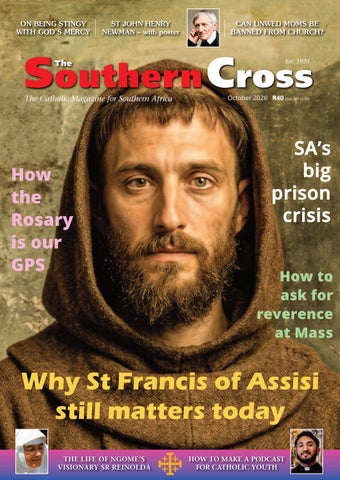
ON BEING STINGY WITH GOD’S MERCY
ST JOHN HENRY NEWMAN – with poster
CAN UNWED MOMS BE BANNED FROM CHURCH?
Southern Cross The
The Catholic Magazine for Southern Africa
How the Rosary is our GPS
Est. 1920
October 2026 R40 (incl. VAT in SA)
SA’s big prison crisis How to ask for reverence at Mass
Why St Francis of Assisi still matters today THE LIFE OF NGOME’S VISIONARY SR REINOLDA
HOW TO MAKE A PODCAST FOR CATHOLIC YOUTH
Never miss another issue!
Southern Cross The
Subscribe to South Africa’s Catholic magazine
which engages, entertains, edifies, educates, elucidates, evangelises, and enhances our faith!
PRINT, DIGITAL – OR BOTH!
digital.scross.co.za/subscribe
S outhern C ross
Est. 1920
The
The Catholic Magazine for Southern Africa Published Monthly PO Box 2372, Cape Town, 8000 Tel: 083 233-1956
www.scross.co.za LEADERSHIP TEAM:
Editor: Günther Simmermacher editor@scross.co.za Managing Director: Eugene Jackson md@scross.co.za Digital Editor: Claire Allen c.allen@scross.co.za Features Writer: Daluxolo Moloantoa daluxolo@scross.co.za Advisory Editor: Michael Shackleton ADVERTISING: advertising@scross.co.za
SUBSCRIPTIONS: subscriptions@scross.co.za
AnnuAl subscriptions: Print & Digital: R520 (SA); Digital only: R300; Print only: R520 (SA) Subscribe at www.scross.co.za/subscribe BOARD OF DIRECTORS: R Shields (chair), Cardinal S Brislin, Bishop N Rucastle (alt), S Duval, E Jackson, C Mathieson, N Mpushe, Fr H O’Connor, SL Pimentel, R Perrier, D Shikwambana, T Smith, G Stubbs, L Tseku
become an Associate and help thE southErn cross survive: www.scross.co.za/ associates-campaign/ Advertising ratecard is available from advertising@scross.co.za or download at www.scross.co.za/advertising /ScrossZA @scrossZA @scross_za
All content is copyrighted. Unauthorised reproduction in any form or distribution is forbidden.
The Southern Cross is published by the Catholic Newspaper & Publishing Co. Ltd (Reg. No: 1920/002058/06)
St Francis and mission Dear Reader,
N OCTOBER 3, THE CHURCH marks the 800th anniversary of the death of St Francis of Assisi. Pope Leo XIV has declared a Year of St Francis, which will conclude on January 10, 2027. The face on the cover is that of St Francis in a photorealistic depiction of the saint, based on a fresco created during his lifetime or shortly after his death. It was painted to commemorate St Francis’ visit to the Benedictine monastery at Subiaco in 1223. Another famous image was created soon after Francis’ death (see bottom of the page). We have created a photographic interpretation based on that artwork too. As a gift to our readers, both can be downloaded as printable A3 posters from our website at scross.co.za/francis-posters. This month we conclude our series of reflections on the life of St Francis, while Fr Paddy Noonan OFM pleads the case for the simple life modelled by the founder of his order. Raymond Perrier reflects on the relevance of the saint today, and on the back page we feature quotations illustrating the impact of St Francis on the life of the Church.
O
A shocking R7,2 billion bill
St Francis was shaped by the time he spent as a prisoner after being captured as a soldier in Perugia. He would no doubt endorse the sentiments expressed by Antonius Spek in his article on prison ministry. Spek confronts us with a shocking reality: South Africa spends about R7,2 billion a year on awaitingtrial prisoners who are ultimately released without conviction — and who may be scarred by the experience. In a crime-ridden country like ours, there is a temptation to treat prisoners with the same lack of dignity they might have shown their victims, or even to demand that they be put to death. This, however, is not the way of Christ or his Church. We are called to rise above our righteous indignation and
Welcome
recognise the sanctity even of the least admirable lives. It is a great challenge, but those engaged in prison ministry prove that it can be met in a Christ-filled way.
A mission statement
Still on the subject of St Francis, the sons and daughters of the founder of the Franciscans have been at the vanguard of missionary work, globally and in South Africa. In October, the Church marks Mission Sunday, and this year’s observance commemorates the 100th anniversary of the annual day of prayer and reflection, as Fr Jeremiah Browne notes in his beautiful reflection. Mission Sunday is also a call to action for all Catholics to participate in the Church’s mission of evangelisation. Pretoria-born and US-based seminarian Br George Thomas Kochumalil tells us how he is responding to that call through a podcast aimed at young people. We can all respond to the Church’s call in our own ways. A wonderful British television series, Call The Midwife, follows the women in the titular profession, some of them Anglican nuns. They are compassionate yet no-nonsense. I imagine that Benedictine Sister Reinolda May, a missionary from Germany, was cut from the same cloth. She helped bring thousands of children into the world, including a future Zulu king, and trained countless women as midwives. But her prominence rests on the Marian apparitions she reported, which are at the heart of the Ngome shrine in KwaZulu-Natal. On page 14 we tell Sr Reinolda’s remarkable story to mark the 125th anniversary of her birth. As always, thank you for reading The Southern Cross. God bless, Günther simmermacher (Editor)
Left: A fresco painted, probably during St Francis’ lifetime. Right: Fresco in the Sacro Convento in Assisi, painted around the time of his canonisation on July 16, 1228.
contents OctOber 2026
8
The high cost of prison overcrowding Beyond the huge cost of holding people in overcrowded prisons, the practice poses a serious moral challenge
10
Graphic artist’s faith by design From childhood sketches to church banners, Otsile Seleke sees art as a way to praise God
12
How to make a podcast for youth A Pretoria-born seminarian explains how he and his colleagues produce a podcast aimed at young Catholics
14
Unity is key to our mission in Christ Fr Jeremiah Browne reflects on what mission means, in our homes and parishes, in society, and in the Church
16
10 Graphic artist
Bishops on November 4 elections
with faith
The bishops of South Africa offer guidance on how to vote with a conscience in the upcoming municipal elections
21
Nuncio’s new book reviewed Bishop Sylvester David reviews Archbishop Henryk Jagodzinski’s new book Southern Africa, My Love
22
The SA nun who saw the Virgin Mary On the 125th anniversary of her birth, we look at the life of Ngome visionary Sr Reinolda May OSB
24
Suffering, the cross and the stigmata In the final part of our 4-part series on St Francis of Assisi, we look at his joy in suffering
26
What St Francis teaches us today Fr Paddy Noonan OFM explains how St Francis teaches the benefits of a simple life, not weighed down by ambition
EVERY MONTH 5
FROM OUR VAULTS
6
YOUR QUESTIONS ANSWERED
The Southern Cross 81 years ago We answer your questions about reverence at Mass, unwed mothers in the Church, and the fate of a heretic
17
SAINT OF THE MONTH The life of St John Henry Newman — with pull-out poster
27
POINT OF REFLECTION
24 St Francis’ joy in suffereng
Deacon Walter Middleton: The rosary is our GPS
28
RAYMOND PERRIER On the example of saints
29
FR RON ROLHEISER OMI On being stingy with God’s mercy
30
PRAY WITH THE POPE Fr Chris Chatteris SJ reflects on the pope’s prayer intention for October, on a mental health ministry
31
PRAYER CORNER Your illustrated prayers, to cut out and collect
32
TWO PAGES OF PUZZLES Two Crosswords, Wordsearch, Dropped Letters, Catholic Trivia Quiz, and Catholic Strands
34
COOKING WITH SAINTS Grazia Barletta tries out recipes dedicated to saints. This month: Mediterranean Lentil Salad
36
...AND FINALLY Marian Shrines Around the World, inspiring Quotes on St Francis of Assisi, and a Last Laugh
Did you know?
In our digital ed ition, all links to websites are live. Just click, and th e site opens in your br owser!
TRY IT!
The story of Ngome’s Sr Reinolda
22
12 A podcaster
for the youth
FROM OUR VAULTS 81 Years Ago: October 17, 1945
Southern Cross turns 25
The 1 306th issue of The Southern Cross is dedicated to the 25th anniversary of the national Catholic weekly. Among the congratulants are Bishops Delalle of Durban, Hennemann of Cape Town, Fleischer of Mariannhill, Meysing of Kimberley, Colbert of Port Elizabeth, Winterle of Kroonstad, Koenig of Oudtshoorn, and Grueter of Umtata. Altogether, 19 bishops send congratulations and tributes.
Pope blesses The Southern Cross
Pope Pius XII blessed The Southern Cross in a cable: “The Supreme Pontiff, on occasion of the Silver Jubilee of the foundation of the Catholic newspaper the Southern Cross, cordially felicitates the editor and staff on their fruitful labour in the apostolate of the press, and, while wishing the newspaper ever wider diffusion, lovingly imparts to all engaged with the publication of the Southern Cross and its readers a special apostolic blessing.”
The newspaper’s task
In his editorial, Fr Owen McCann writes that The Southern Cross “must, with the hierarchy and faithful, aim at presenting the Catholic Church in all its truth and grandeur, in all its charity and sanity to the people of South Africa as a whole”.
New apostolic delegate for SA
Mgr Martin Lucas SVD, the newly-appointed apostolic delegate to South Africa, will be ordained an archbishop at the Urban College of the Propagation of the Faith in Rome on October 28.
What else made news in October 1945:
• The United Nations formally comes into existence, with South Africa’s Prime Minister Jan Smuts among the chief architects of the new world organisation. • Shiploads of South African soldiers return home from Europe and North Africa as the government steps up the demobilisation of wartime forces. Veterans’ groups warn that returning servicemen face a growing housing shortage in major cities, including Johannesburg and Cape Town. • Preparations begin in Germany for the trial of top Nazi leaders at the upcoming Nuremberg Trials. • The Natal Indian Congress elects Dr Monty Naicker as president, promising stronger resistance to discriminatory legislation. • The Chinese Civil War begins between the government led by Chiang Kai-shek and Mao Zedong’s Communist Party. • Women in France are allowed to vote for the first time. The board of directors of the Catholic Newspaper and Publishing Company: (seated from left) Fr Owen McCann (editor), GA McLoughlin (chair), GW Peart, (back) CMJ Rowntree (secretary), FGE Coates, A Drew, Dr E Gauss and Capt JB Robertson (a former cricket international).
How can we ask for reverence at Mass?
Q. It is increasingly evident that some attendees at Mass need periodic reminding that behaviour on entering and during the time they are in the presence of Our Lord Jesus is vastly different from entering, for example, a hall to attend a concert. I have in mind to display kindly, well-chosen reminders on our church’s overhead screen to emphasise deference to decorum and respect from the time of entering the door of the church until exiting again. Something like that should never be necessary, but sadly reminding perhaps seems the only way. What sort of wording would you suggest?
R
EVERENCE IN CHURCH IS ALWAYS a lively topic among Catholics, perhaps because we do not all share the same instinct for what such reverence looks like. Since the Mass is the Eucharistic sacrifice, it is self-evident that our conduct should reflect its sacred character. At the same time, the Mass is also the gathering of the Christian community. A brief, warm greeting to a fellow parishioner — especially if there may be no opportunity after
Your Questions answered Do you have questions about our faith? Send them to: editor@scross.co.za
Mass — need not be policed. But where exactly are the lines of proper reverence drawn? A basic expectation must be that on entering and before taking our place, and whenever we leave our pew (except for Communion), we should make a reverent gesture towards the Blessed Sacrament — ordinarily a genuflection or a profound bow. Before Mass, if conversation is truly necessary, it should be kept brief and discreet so as not to disturb those who are preparing in prayer, or be taken to the foyer.
The lack of reverence around us can be distracting, but we should be careful not to allow irritation to draw our attention away from Our Lord. Some ideas for display on the overhead screen could include: Option 1: “Enter in silence — the Lord is here! Remember to genuflect to the Lord. Speak to God before Mass; speak to others after.” Option 2: “Reverence begins at the door. Remember to genuflect to the Lord. Honour the Lord with silence and prayer. Show respect — in posture, speech and heart.” Option 3: “Remember to genuflect to the Lord. Please no unnecessary talking in the church. Keep the church a place of prayer. Help others to pray by remaining quiet.”
What happened to Arius? Q. What happened to Arius after his heresy was rejected at the Council of Nicaea in 325?
E
VEN AFTER THE FIRST COUNCIL of Nicaea formally rejected Arianism and affirmed that Christ is “of one substance” with the Father, the heresy and its followers lingered for decades. At Nicaea, the one holy, catholic and orthodox Church clarified the nature of the Holy Trinity. After the Council, Arius was condemned and exiled, initially to the province of Illyricum (in modern-day Croatia/ Albania). His writings were ordered to be burned, and Emperor Constantine imposed civil penalties on those who persisted in teaching his doctrine. On paper, Arianism had been crushed. In reality, it wasn’t. Within a few years, political winds
6 The Southern Cross: October 2026
shifted. Several influential bishops who were sympathetic to Arius regained favour at court. Arius was eventually recalled from exile and formally reconciled in 336, having issued a carefully worded profession of faith. However, before he could be fully reinstated in Constantinople, he suddenly died there at the age of 80. Even without its chief proponent, Arianism flourished, especially in the East. Many bishops promoted various Arian or semi-Arian formulations, and for decades large parts of the Church were led by bishops who rejected or diluted Nicene theology. St Athanasius, the great opponent of Arianism, was exiled several times as emperors alternated between pro-Nicene and pro-Arian policies. The Arian movement also spread beyond the Roman Empire. Germanic tribes such as the Goths, Vandals and
(Günther Simmermacher)
Lombards were evangelised by Arian missionaries and adopted Arian Christianity, which then became entrenched in their kingdoms. The turning point came later in the 4th century. Under Emperor Theodosius I, Nicene Christianity received the backing of the imperial authority, and the First Council of Constantinople in 381 reaffirmed and expanded Nicene doctrine. From this point, Arianism steadily declined within the empire. By the 6th and 7th centuries, Arianism had largely disappeared, surviving briefly among some Germanic kingdoms before those rulers finally converted to Nicene Christianity.
Can unwed mothers be barred from sacraments? Q. Does having a child out of wedlock bar access to the sacraments? Can a priest deny baptism to such a child, or exclude the mother from Mass?
N
O, HE CANNOT. A PRIEST WHO denies access to the sacraments on such grounds is in error if the denial is based solely on the fact that a mother conceived or gave birth outside marriage. Such a position is not supported by Catholic doctrine, canon law, or authoritative papal teaching. Having a child out of wedlock does not, in itself, bar a Catholic from access to the sacraments. On the contrary, the Church teaches that such women should be met with pastoral care, encouragement and the offer of God’s healing grace, and definitely not with exclusion. The Church makes a distinction between sinful acts and the dignity of the human person, as well as between past actions and one’s present relationship with God. While sexual relations outside marriage are objectively sinful, the birth of a child is never a sin. A child is always a gift, and never a source of shame or a disqualification from sacramental life. This was restated in recent years by Pope Francis and by Cardinal Víctor Manuel Fernández, prefect of the Dicastery for the Doctrine of the Faith, the Church’s highest doctrinal office.
Fear of judgment Responding to concerns that some single mothers stay away from the sacraments out of fear of judgment or pastoral rigidity, Cardinal Fernández in 2024 said that women who conceive a child outside marriage and yet choose life “should be encouraged to have access to the healing and consoling power of the sacraments”. His response explicitly criticised situations where priests or parish communities block such women from
the sacraments or refuse to baptise their children. Pope Francis, as archbishop of Buenos Aires in 2012, rebuked priests who refused baptism to the children of single mothers, calling such action hypocritical and saying it “turns God’s people away from salvation”. As pope, Francis spoke with particular compassion of women who, despite hardship and stigma, choose to bring a child to birth and then find themselves “going from parish to parish” seeking baptism. Baptism is always available to a child born out of wedlock, provided there is a reasonable hope of Christian upbringing; the parents’ marital status is not a barrier. If this hope exists — even through grandparents or a supportive parish — baptism should proceed (Canon 868). Refusal here is a pastoral abuse.
Resort to confession The sacrament of Reconciliation is open, and strongly encouraged, to anyone who sincerely repents of past sin. Denying absolution purely because a woman has a child would be a serious misuse of the sacrament. Once sins are confessed and absolved, Holy Communion is not impeded. Cardinal Fernández emphasised that “being a single mother does not prevent that person
from accessing the Eucharist”, and that confession restores the person fully to sacramental life What can pose a difficulty is not the fact of the woman having had a child, but if she persists in an ongoing sexual relationship outside marriage without repentance or intention to change. Even then, the Church does not expel or abandon such persons, but walks with them pastorally, encouraging conversion and regularisation of their situation (that is, matrimony) where possible. Having had a child out of wedlock poses no obstacle to the sacrament of matrimony. In fact, marriage is often the proper pastoral solution when possible.
Show God’s mercy Importantly, Cardinal Fernández warned against reducing the Gospel to a harsh moral slogans. While Jesus does call sinners to conversion, the key message of the Gospel episode of the woman caught in adultery is not Jesus’ admonition “sin no more” (obviously she mustn’t), but the recognition that no one may cast the first stone. Echoing Pope Francis’ document Amoris Laetitia, the cardinal stressed that in difficult situations, especially for single mothers, the Church must offer “understanding, comfort and acceptance”, lest people feel judged and abandoned by the very Mother called to show God’s mercy. In short, a child born outside marriage is not an obstacle to grace. The sacraments remain open to all who seek God sincerely. The Church is called not to police motherhood but to uphold life, dignity and mercy. A priest who denies sacraments simply because a woman is an unwed mother misrepresents the Gospel, misapplies Church law, and wounds the Church’s mission.
Get the Radio Veritas App! Free on Google Play store
Livestream from www.radioveritas.co.za The Southern Cross: October 2026
The high cost of prison overcrowding South Africa spends an estimated R7,2 billion each year on awaiting-trial prisoners who are ultimately released without conviction, Antonius spek explains. Beyond the immense financial cost of holding people in overcrowded prisons, the practice poses a serious moral challenge in the light of Catholic social teaching.
S
OME OF THE SOCIAL AND economic challenges in South Africa contribute to crime — and to the resulting overcrowding of correctional centres, or prisons. The state has a duty to administer justice, but it must also respect the human dignity of every person — including inmates. Christ’s call to visit those in prison is not merely a call to charity. It points to the dignity of the imprisoned person. Christ is saying that, no matter what a person has done and no matter the shame of imprisonment, that person remains God’s child and possesses the same human dignity as every other human being. This is something to keep in mind, especially on the Catholic Church’s Prisoners’ Sunday on October 11. A fundamental principle of Catholic social doctrine is that every human person is created in the image and likeness of God and has inviolable dignity, value and worth. There are no exceptions. Fr Babychan Arackathara MSFS for many years served as a Catholic chaplain in some of the Western Cape’s most notorious prisons. He has noted that the approach of “Lock them up and throw away the key!” is a simplistic response to crime that simply is not working.
Criminals have a story In his book Light Through The Bars: Understanding and Rethinking South Africa’s Prisons, Fr Babychan notes that even criminals have stories, and that crime always has roots. The blurb to the book asks: “Can we move to the ideal of hating the crime but loving the criminal? What must we do to see that offenders are themselves victims and to engage them constructively? How do we break the cycles of addiction, trauma and crime to reach for reconciliation and transformation?” With that in mind, let us look at some key realities in our criminal justice system, especially the pressures facing our correctional centres.
8 The Southern Cross: October 2026
Pollsmoor Prison in Cape Town, one of South Africa’s many overcrowded jails.
According to the World Prison Brief, South Africa has approximately 167 343 prisoners behind bars, around 60 000 of them awaiting trial. According to the Daily Maverick, some 2 600 people are detained simply because they cannot afford bail of R1 000 or less. Many detainees remain on remand for extended periods — more than 5 000 for longer than two years — because of overloaded courts and delays in investigations. Studies on remand-detention in South Africa often show that many such detainees are eventually released because they are acquitted, charges are withdrawn due to lack of evidence, or they receive fines or non-custodial sentences rather than imprisonment.
A bill of R7,2 billion The high number of awaiting-trial prisoners contributes to a system operating at more than 155% capacity. It costs about R15 000 per month to detain one inmate. This means the state incurs a cost of R39 million per month (2 600 x R15 000) because of a once-off total bail amount of R2,6 million that prisoners could not afford. It is estimated that 11 out of every 16 awaiting-trial detainees (68,75%) do not ultimately receive prison sentences because of withdrawn charges, struck-off
cases or acquittals. So, of the 60 000 awaiting-trial detainees, only around 20 000 may eventually receive prison sentences. That means roughly 40 000 people may be held unnecessarily. How costly is that? Consider that 40 000 detainees who later walk free are held in prison at a monthly cost of R15 000 each. That amounts to R600 million per month — or a staggering R7,2 billion per year. There is a foundational principle in the US legal system that it is better for guilty people to go free than for an innocent person to be wrongly convicted. This concept is commonly known as “Blackstone’s Ratio” or “Blackstone’s Formulation”. The principle goes back to the English jurist William Blackstone, who wrote in the 1760s: “It is better that ten guilty persons escape than that one innocent suffer.”
What the Church says In the Catechism of the Catholic Church we read: “The works of mercy are charitable actions by which we come to the aid of our neighbour in his spiritual and bodily necessities. Instructing, advising, consoling and comforting are spiritual works of mercy, as are forgiving and bearing wrongs patiently. The corporal works of mercy consist especially in feeding the hungry, sheltering the
10 Reasons to support the Prison Ministry 1. Because Jesus tells us to. He said: “I was in prison and you came to visit me… Whatever you did for one of the least of these brothers of mine, you did for me” (cf Matthew 25:35-45). 2. Because Jesus himself was imprisoned. Jesus was jailed before he was the victim of the death penalty. Other inmates include St Paul, most of the apostles, Samson, and Joseph — and countless martyrs through the centuries. homeless, clothing the naked, visiting the sick and imprisoned, and burying the dead” (2447). Rather than throwing away the key, the Catholic Church calls on us to follow Jesus’ command to visit those in prison, thus bringing Christ to the incarcerated. The Church has prison ministries throughout the region of the Southern African Catholic Bishops’ Conference. Those interested in joining may contact their local diocesan chancery for details. You can support the ministry in one or more of the following ways: 1. Volunteer your time to visit prisoners in correctional centres. 2. Donate money or goods to support inmates and their families. 3. Donate money or goods to prison ministry organisations to help cover their running costs.
Antonius Spek is a board member of the Prison Care and Support Network in the archdiocese of Cape Town. For more see www.prisoncare.org.za
3. Because Scripture repeatedly speaks about prisoners. The word “prison” appears 74 times in the Bible and “prisoner” a further 37 times. 4. Because the Letter to the Hebrews commands it. “Remember those who are in prison, as though you were in prison with them” (Hebrews 13:3). 5. Because prisoners are our neighbours. Most parishes have a prison within 10km of them. 6. Because prison ministry can reduce reoffending. South Africa’s reoffending rate is estimated at 85%. Restorative justice programmes seek to reduce this. 7. Because it contributes to a safer society. Supporting prison ministry benefits not only inmates but also communities and families. 8. Because rehabilitation is better than hopelessness. A prisoner who encounters dignity, faith and support is more likely to return to society transformed rather than hardened by despair. 9. Because prison ministry is evangelisation. Sharing the Gospel is one of the Church’s central missions. 10. Because Christ calls us not to condemn. “Judge not, lest ye be judged.”
Faith
by Design
From childhood sketches to church banners and professional design, Otsile Seleke sees art as a way to praise God. Guided by his faith, the young creative uses his talents to proclaim truth, beauty and hope, as he tells Daluxolo Moloantoa.
E
VERY GENERATION PRODUCES young, committed Catholics who show how faith can be lived in many different ways. Otsile Thuto Seleke’s vocation lies in using his artistic talents to proclaim truth, beauty and hope. For the gifted illustrator, graphic designer and photographer from Mabopane, art has become a form of service through which he seeks to glorify God while enriching the lives of others. Born on December 18, 1992, in Welkom, Free State, Otsile is the son of Vincent Tekiso and the late Susan Moiloa Seleke. Although he was born in the Free State, his family’s roots are in Dinokana, near Zeerust in North West province. Through his mother, he descends from the Moiloa royal family of the Bahurutshe people, a lineage closely associated with the traditional leadership of the region. His father’s family also traces its indigenous roots to this historic area.
Inherited values
Despite this distinguished heritage, Otsile speaks far more readily about the values handed down by his parents and grandparents than about royal ancestry. His mother was a professional nursing sister whose compassion, discipline and devotion to serving others became a lasting example to her son. His father has devoted many years to public service through the Department of Correctional Services and currently serves as Labour Relations Unit Manager for North West province. From both parents he inherited an appreciation for integrity, perseverance and responsibility.
10 The Southern Cross: May 2026
His late grandfather, Molefe Jonathan Seleke, studied for the priesthood in the 1960s at St Peter’s Minor Seminary in Hammanskraal, north of Pretoria. Although he eventually discerned that God was leading him along a different path, his years at the seminary became part of family history. “My earliest memory of being Catholic,” Otsile recalls, “is hearing the story of my grandfather almost becoming a priest. As a child, I found this fascinating. It made the priesthood seem very close to our family.” That story planted a seed which would later influence his own spiritual journey. Raised in a close-knit multigenerational family in Mabopane, he grew up surrounded by grandparents, parents, aunts, uncles and cousins in an environment where faith, respect and hard work formed part of everyday life. He credits his grandparents with providing the stability and reassurance that allowed him to dream beyond his circumstances. “My grandparents never stopped encouraging me,” he says. “They believed education could change your life, and they constantly reminded me to work hard and trust God.”
Drawing since childhood
Even before he reached high school age, a gift began to reveal itself. From about the age of ten, Otsile spent hours drawing comic strips, illustrating stories and creating imaginary worlds with pencil and paper. “I don’t remember a time when I wasn’t drawing,” he says. “It was simply part of who I was.” What began as a childhood pastime gradually became a lifelong calling. After completing matric in 2010, Otsile studied Art and Design at Tshwane North
A prayer design by Otsile Seleke used by his parish of Christ the King in Mabopane, Pretoria archdiocese. The graphic artist is pictured top of the page at his church.
College in Pretoria. The programme introduced him to painting, sculpture, jewellery design, graphic design and the history of art. While he appreciated every discipline, illustration and drawing quickly emerged as his greatest passion. He dreamed of becoming a professional illustrator capable of producing children’s books, comics and visual stories that would both entertain and educate. To achieve that goal, he devoted countless hours to mastering observational drawing and developing the
technical precision required of a professional artist. A defining moment in his college years came when he became the first student at the campus to write the newly introduced N6 History of Art examination. But balancing demanding practical assignments with theoretical studies proved difficult, and his first attempt was unsuccessful. Rather than giving up, he persevered, rewrote the examination and successfully completed his diploma. “It taught me one of the most important lessons of my life,” he notes. “Talent is a gift from God, but perseverance is what allows this gift to grow.”
Fresh view of the Mass
Throughout this time, Otsile’s Catholic faith remained at the centre of his life. At Christ the King Church in Mabopane, he became an enthusiastic altar server, discovering a deeper appreciation of the Church through active participation in the liturgy. “Serving at the altar changed my relationship with the Mass,” he explains. “You witness the beauty of the liturgy from a completely different perspective.” Among the priests who left a lasting impression on him was Fr Stefano Kgatle, whose pastoral warmth, humility and dedication inspired many young parishioners. “I admired the way Fr Stefano treated people,” Otsile recalls. “His kindness and commitment made me think seriously about becoming a priest.” For a while, he discerned this possibility. Although he eventually realised that his vocation lay elsewhere, Otsile regards that period as an important stage in his spiritual growth. “I believe God prepares us through every experience. Even though I didn’t become a priest, those years taught me discipline, prayer and a lifelong love for the Church.” His commitment to the Church also influenced those around him. Among his closest childhood friends was Tshepang Dithipe, who would later answer God’s call to the priesthood. Otsile remembers encouraging his friend during those early years of discernment and today rejoices in seeing Fr Dithipe faithfully serving God’s people. Another turning point came during an altar servers’ retreat at the Most Holy Redeemer church, where he encountered professional photographer James Thwasa. Watching Thwasa work awakened an entirely new artistic interest. “I was amazed at how he could capture ordinary moments and make them
Otsile at work on his laptop.
extraordinary. That day I realised that photography could tell stories just as powerfully as drawing.” Photography soon became another important part of his creative life.
Designing for plays
Otsile’s professional career has continued to flourish. In 2024 he served as resident graphic designer at the South African State Theatre in Pretoria, where he produced promotional campaigns for numerous productions, including the internationally acclaimed South African play Sizwe Banzi Is Dead. Working at one of the country’s foremost performing arts institutions broadened Otsile’s experience and affirmed his
belief that art has the power to educate, unite and inspire. The graphic designer has never forgotten the parish that nurtured his faith. Christ the King parish commissioned him to produce artwork for several important liturgical celebrations. Among his projects are a large Nativity play banner displayed at the entrance to the church during Christmas and a striking banner promoting the parish’s Lenten and Easter programme. “When I create artwork for the Church,” he notes, “I don’t see it as just another design project. I see it as offering my talent back to God.” Looking ahead, Otsile hopes to produce illustrated books, comics and educational materials that celebrate African history, culture and the Catholic faith. He believes artists have a responsibility not merely to create beautiful images but also to preserve memory, communicate values and inspire future generations. His advice to young people pursuing careers in the arts is both practical and deeply rooted in faith: “Never stop learning. Be willing to work hard, even when success seems distant. Don’t compare yourself with others. God has given every person unique gifts. Develop yours with discipline, remain humble, and always remember that your talent is meant to serve others, not yourself.”
The Southern Cross: October 2026
11
I
Missionary by podcast Pretoria-born seminarian Br George Thomas Kochumalil never imagined that one dayhe would evangelise through digital media. He explains what co-creating a podcast titled “Tea With Thomas” involves, and why it is so rewarding for him.
Our Syro-Malankara Catholic Church, with its roots in F SOMEONE HAD TOLD ME A FEW YEARS AGO THAT I India, is blessed with a rich liturgical life, a profound would help create a Catholic podcast, I probably would have laughed. Not because the idea seemed unnecessary theology and a spirituality rooted in the ancient Antiochene tradition, shared by our sister rites, the Maronite and Syrian but because it felt far too big for me. Yet here we are: Catholic Churches. Yet for many young people, this richness the “Tea With Thomas” podcast is growing steadily, remains hidden behind the pace and pressures of modern reaching new hearts each week and teaching us what it life. Their world moves quickly. Attention is fragmented. means to witness Christ in a noisy, digital world. Depth is often traded for distraction. Although I am from Pretoria, the podcast is a ministry of We asked: How do we bring the Syro-Malankara Catholic Youth Movement meaningful Catholic conversations to of North America, as I am a seminarian for this world? How do we make the that Eastern rite in the US. The podcast treasures of our tradition accessible — The seed of this project was planted lets us present not diluted, but approachable? For us, long before microphones and cameras the answer was digital media. entered the picture. It began with three the faith as a Long-form conversations could live young Malankara Catholics — Aaron, lived experience on YouTube and Spotify. Short, accessible Jerick and Kayson — reflecting on the clips could reach people through Instagram, need for a space where young people Facebook and YouTube Shorts. The podcast could speak honestly about faith, format allowed us to present the faith not as a lecture but as culture, struggles and the subtle graces that shape us. a lived experience — offered through honest testimony, Before “Tea With Thomas” became a podcast, it was conversation and reflection. simply a hope: that we might offer something meaningful to Our primary audience is young Malankara Catholics: our Church, and perhaps even to those beyond it. That hope high school pupils, university students and young adults eventually evolved into a mission. navigating their earliest years of adulthood. But we have A South African never regarded our listeners as a “market”. For us, the in Rome: Br mission is to serve — to accompany those seeking clarity, George Thomas belonging or deeper understanding. Every episode, every Kochumalil in St guest invitation and every cup of tea poured on camera Peter’s basilica flows from this purpose. in the Vatican.
Building a Catholic podcast
12 The Southern Cross: October 2026
From the outside, podcasting looks deceptively simple: sit down, talk, upload. But the reality is far more complex — and far more humbling. Our team operates with defined roles that keep us grounded and accountable: l Three co-hosts who lead conversations; l A producer who records, edits and refines each episode; l Two advisers who offer spiritual and strategic guidance; l Three social media directors who help the content reach those who need it. Overseeing all of this is Fr Jerry Mathew, whose role is not only administrative but also deeply spiritual. He ensures that our content is faithful to the teachings of the Church, aligned with the magisterium, and rooted in charity. Every week, without fail, our team meets. We review footage, plan themes, brainstorm ideas and discuss what our community most needs to hear. Some weeks, the ideas flow naturally. Other weeks, there is a long silence before someone finally says, “Okay, what if we did a conversation on ...?” Creating a single episode often takes days. Filming takes
Why we carry on
hours. Editing takes even longer. And the final product? A conversation that lasts about 40 minutes. People often ask us, “Is it worth all the effort?” We always respond, “Absolutely.” Because our small, limited efforts are multiplied by God, who sees the intention — to spread his word with sincerity and humility.
Grace meets impact
The blessings that come from this ministry are sometimes visible, sometimes hidden, but they are always profound. 1. Growing in Faith Producing a Catholic podcast requires preparation — spiritual, intellectual and pastoral. We can’t speak casually about the Eucharist, discernment or Church history. We must study, pray, reflect and check our sources. In doing so, our own faith deepens. 2. Building Community Our team has become a family, bound not by blood but by mission. Every meeting, every prayer and every shared cup of tea builds a community rooted in Christ. 3. Becoming Witnesses We are not renowned theologians or scholars. We are young people navigating life, asking questions and seeking God. Our witness is one of honesty, not perfection. And authenticity, we have learned, evangelises. 4. Seeing the Church Come Alive When a teenager at a retreat says, “I’ve been watching your clips,” or a parent says their child shared an episode during dinner, we see the Church’s youthfulness with renewed clarity. The Church is alive — vibrant, curious and searching.
Despite these challenges, we continue because the mission is worth it. Our hope for the future is simple yet ambitious: to reach young Catholics in parishes — not for fame or for visibility, but for communion. We want every young person to know: The Church sees you! The Church hears you! The Church values your voice! “Tea With Thomas” is still young. So are we. We are learning, refining and growing with every conversation. Each episode feels like planting a small seed, trusting that God will bring the growth. As a young man discerning the priesthood, being part of a Catholic podcast has been one of the most humbling and grace-filled experiences of my life. It has taught me responsibility, discipline, collaboration and trust in Divine Providence. It has revealed the hunger young people have for authentic, faith-filled dialogue — and the power of digital evangelisation when done with sincerity. Our hope is that “Tea With Thomas” continues to be a place where faith is brewed slowly, thoughtfully and with love. If God wills it, this mission will continue — not because of us, but because of him who calls, equips and sends.
Br George Thomas Kochumalil was born in Pretoria and is a seminarian for the St Mary, Queen of Peace SyroMalankara Catholic Eparchy in the USA and Canada. He wrote about his vocation in our April 2026 issue. “Tea With Thomas” on Spotify and on YouTube at www.youtube.com/@TeaWithThomas
Evangelisation is beautiful, but it is not without its crosses. We want our content to be engaging, but it must above all be faithful. That has meant scrapping episodes, re-editing conversations and revisiting difficult topics. Fidelity always precedes entertainment. There is also the question of time management and the risk of burnout. Most of our team members are students or professionals. Balancing deadlines, responsibilities and prayer requires discipline and sacrifice, especially when working across timezones. Speaking about the faith publicly carries weight. We must approach every episode prayerfully, humbly and with a willingness to be corrected. Not every idea belongs on the podcast. Not every trend deserves attention. Not every guest aligns with our mission. Learning to say “no” is part of our vocational maturity. The Southern Cross: October 2026
13
Why unity is key to our mission in Christ
A hundred years ago, the Church first celebrated World Mission Sunday. To mark the centenary, Fr Jeremiah browne reflects on what mission means, in our homes and parishes, in society, and in the Church.
T
HIS YEAR, THE CHURCH celebrates a remarkable milestone: the 100th anniversary of World Mission Sunday. Since Pope Pius XI established World Mission Sunday on April 14, 1926, following a request from the Society for the Propagation of the Faith, Catholics throughout the world have united in prayer, sacrifice and generosity to support the Church’s missionary work. This worldwide solidarity reminds us that the Gospel knows no borders and that every local Church has a responsibility towards Christ’s universal mission. To mark this centenary, Pope Leo XIV has chosen the theme “One in Christ, United in Mission”. The theme captures both the heart of the Gospel and the identity of the Church, reminding us who we are as Christians and why the Church exists. In a world marked by division, conflict and uncertainty, the Holy Father emphasises that mission begins not with programmes or strategies, but with Jesus Christ himself. He writes: ”Being a Christian is not primarily about practices or ideas; it is a life in union with Christ.”
Keep focus on Christ
These words highlight a subtle but real temptation in Christian life today. We can become so caught up in parish duties — meetings, committees, fundraising, administration, and even charitable works — that we gradually lose sight of Christ, who is both the source and the goal of everything we do. Faith is not simply about doing things for God; it is, above all, about living in a deep and personal union with Christ. It is no surprise, then, that Pope Leo turns to Jesus’ great prayer before his Passion, “That they may all be one” (John 17:21), to remind us that the unity for which Jesus prayed is not an optional ideal but lies at the very heart
14 The Southern Cross: October 2026
Political divisions, racial tensions and economic hardship can easily foster suspicion and isolation. Even within our families and parish communities, misunderstandings and divisions can weaken our witness.
United in Mission
In his message for Mission Sunday, Pope Leo XIV writes: “No baptised person is exempt from mission: everyone, each according to their own vocation and condition of life, participates in the great work that Christ has entrusted to his Church.”
of the Church’s identity and mission. Communion with Christ naturally gives rise to communion with one another. “The mystery of union with Christ lies at the heart of mission,” the pope writes, and “the more united we are in Christ, the better able we will be to carry out together the mission that he entrusts to us.”
Every Christian is a missionary because he or she has encountered Christ
This message has particular significance for us in Southern Africa. We live in societies where many continue to experience the wounds of poverty, unemployment, inequality and violence.
In such a context, the call to unity is not abstract but deeply practical and urgent. It challenges us to become instruments of healing in our homes, our parishes and our wider communities. By choosing reconciliation over resentment, understanding over judgment, and solidarity over self-interest, we begin to reflect the unity for which Christ prayed. In doing so, we offer a credible and hopeful witness to a world that longs for peace and belonging. Unity, however, is not an end in itself but the foundation for mission. When we are truly united in Christ, our lives naturally become a witness that draws others to him. Pope Leo reminds us that every baptised person shares in this mission. It is not reserved for a select few; it is the responsibility and privilege of all who follow Christ. In living out this call, we become signs of hope, bringing the light of the Gospel into the everyday realities of our world. The Holy Father expresses this beautifully when he writes: “No baptised person is exempt from or indifferent to mission: everyone, each according to their own vocation and condition of life, participates in the great work that Christ has entrusted to his Church.” Too often we imagine that missionary work belongs only to priests, religious Sisters and Brothers, or those who travel to distant countries to proclaim the Gospel. While we rightly honour and support those who dedicate their lives to the missions, Pope Leo reminds us that mission begins much closer to home. Every Christian is a missionary because every Christian has encountered Christ.
How to Support the Missions Parents exercise their missionary vocation when they teach their children to pray and introduce them to the life of the Church. Teachers become missionaries when they educate with integrity and inspire young people to seek truth and goodness. Healthcare workers, business people, farmers, students, public servants and retirees all participate in the Church’s mission when they live their faith with honesty, compassion and hope. Even those who are elderly, housebound or sick continue to make an indispensable contribution through their prayers and the quiet offering of their daily struggles for the needs of the Church and the world.
Vision for local Church
Books from Redemptorist Pastoral Publications
Pope Leo is careful to remind us that unity does not mean uniformity. The Church is enriched by many cultures, languages, traditions and spiritual gifts. These differences are not obstacles to mission but expressions of the richness of God’s grace. As he explains, missionary unity “should not be understood as uniformity, but rather as the convergence of different charisms for the same purpose, namely to make Christ’s love visible and to invite everyone to encounter him”. This vision resonates strongly within the Church in Southern Africa. Our parishes reflect a remarkable diversity of peoples, cultures and languages. When we learn to value one another’s gifts and work together in charity, we become a living witness to the universality of the Gospel. Our diversity, united in faith, becomes a powerful proclamation that Christ gathers all people into one family.
Perhaps the most striking words in the pope’s message are found in the third section, where he reflects on the very heart of mission: “If unity is the condition of mission, love is its essence.” Everything the Church does must be rooted in love because the Gospel itself is the revelation of God’s faithful love in Jesus Christ. Evangelisation is never about winning arguments or increasing numbers. It is about helping others encounter the person of Jesus Christ, who alone can satisfy the deepest longing of the human heart.
More than a collection
For this reason, World Mission Sunday is much more than an annual collection. It is a reminder that the Church is one family, sharing both its spiritual and material resources so that the Gospel may reach every nation.
Evangelisation is not about point-scoring or increasing numbers
Through the Pontifical Mission Societies, the generosity of Catholics throughout the world supports young Churches, seminaries, catechists,
You can make a financial contribution to the Mission of the Church, through your local parish collection or directly to the National Pontifical Mission Societies: Account Name: Pontifical Mission Societies ABSA Bank Account: 4048 6053 13 Reference: Diocese + your cellnumber Or scan the QR code below:
schools, healthcare projects and countless pastoral initiatives in places where local communities cannot meet these needs alone. Many of us may wonder whether our own contribution can really make a difference. Pope Leo offers a reassuring answer: “Every gift, no matter how small, becomes a meaningful act of missionary communion.” Whether through prayer, financial support, encouragement of missionary vocations or the witness of a faithful Christian life, every one of us has something to offer. As we celebrate the centenary of World Mission Sunday, we are invited not only to give thanks for the generations of missionaries who have gone before us, but also to renew our own missionary commitment. The Church’s mission has not ended. Christ continues to send his disciples into a world searching for hope, truth and lasting peace. World Mission Sunday is celebrated every year on the second-last Sunday of October. This year it is on October 18.
Fr Jeremiah Browne is the national director of Pontifical Mission Societies in South Africa, Botswana and Eswatini. For more info, see www.missio-sacbc.org
For your Catholic news, every day:
By popular request, the 2023 Catholic Link series on illness, wellbeing, healthcare and related issues has been collated and compiled under one cover.
God’s will is indeed for us to have fullness of life, despite the R80 experience of human limitation and finitude. It is precisely there that we encounter a compassionate Christ who reveals to us the mystery of a God of mercy. May this booklet be a help to growing in a deeper spirituality for health and wellbeing, sickness and suffering. plus delivery
Order from our website www.rpp.org.za or email orders@rpp.org.za Office: Tue-Fri 08.30-13.00
scross.co.za
Don’t miss a thing!
Join us on Facebook: /ScrossZA
Sr Peninah Kamau 072 447-0153 vocationdirectressmsa@gmail.com The Southern Cross: October 2026
15
As South Africa prepares to vote in the local municipal elections on November 4, the bishops of South Africa have offered their guidance in a pastoral letter. It is signed by Cardinal Stephen Brislin, as president of the Southern African Catholic Bishops’ Conference.
SA Bishops: VOTE FOR LIFE
T
HE LOCAL GOVERNMENT elections of 2026, to be held on November 4, come at an important moment in the life of our nation. We remain grateful for the gift of democracy. At the same time, we cannot ignore the serious challenges facing our municipalities, especially the crisis of service delivery. Many of our municipalities are not working as they should. That is why we have seen many communities struggling daily with water shortages, uncollected waste, poorly maintained roads and lack of facilities for recreation for our youth. There are many reasons for the collapse in service delivery in our municipalities, such as • Nepotism and corruption. • The capture of municipalities by organised crime. • Instability in coalition politics at the local government level. • Cadre deployment in key municipal positions. • A lack of professionalism in the public service. • The politicisation of ward committees, which are supposed to serve as instruments of accountability.
Citizens’ corruption At the same time, we must also be honest about our own role as citizens. We contribute to the problem when we fail to play our part. This can be seen in the non-payment of municipal services, culture of bribing the staff at municipal offices, illegal electricity connections, unlawful occupation of land, vandalism of infrastructure, illegal dumping of waste, and the rise of violent crime. All of this points to a weakening of our sense of the common good — the spirit of ubuntu — both in our politics and in our daily lives. The common good calls us to think beyond ourselves
16 The Southern Cross: October 2026
and to act in ways that benefit everyone. We therefore appeal to all citizens, particularly the young people, to use the upcoming elections as an opportunity to renew our commitment to the common good. Voting is an important part of this. That is why we urge everyone to go out and vote. Nobody should remain at home.
How we choose life However, voting alone is not enough. Holding those in power to account is important. Real change requires deeper commitment. Casting our vote must go hand in hand with our willingness to work for the common good — both within political parties and in our everyday lives as citizens. In this context, the Word of God calls us to responsibility and hope: “I have set before you life and death, blessing and cursing: therefore choose life” (Deuteronomy 30:19). Choosing life means: • Electing leaders who are committed to serving their communities with honesty and dedication. • Being citizens who respect public property such as clinics, roads, and other infrastructure, and who reject vandalism and lawlessness. • Supporting public officials who refuse corruption and nepotism.
• Encouraging political parties to work together in the spirit of the common good, especially in coalition governments, rather than focusing only on their own interests. • Ensuring that ward committees are not captured by political parties or partisan interests but truly serve the community.
What we pray for Our prayer is that the 2026 municipal elections will be peaceful, free, and fair. We therefore call on all stakeholders — political parties, independent candidates, the media, civil society, and state institutions — to act responsibly. Every citizen must be able to vote without fear. The rule of law must be respected, and election results must be accepted in a spirit of peace and responsibility. As we prepare for these elections, we entrust our nation to God in prayer: May the Lord guide our leaders, strengthen our communities, and inspire all citizens to act with wisdom and courage. May he bless all those who work to ensure that the elections are fair and transparent. And may he help us to build a society where justice, peace, and human dignity are respected by all. Through Christ our Lord. Amen.
Saint of the Month: St John Henry Newman
The vicar of Oxford who went to Rome As a youth, John Henry Newman was anti-Catholic. Later, he became a Catholic, a cardinal, and one of the Church’s greatest thinkers.
W
HEN POPE LEO XIV declared St John Henry Newman a Doctor of the Church on November 1, 2025, he did more than honour a brilliant 19th-century convert from England. He affirmed that Newman’s intellectually rigorous and deeply pastoral voice speaks with authority to a modern world marked by doubt, ideological polarisation, and questions about morality. The questions Newman faced — about authority, tradition, conscience and the relationship between faith and modern culture — are still relevant today. This giant of Catholic thought was born in London on February 21, 1801, into a devout Anglican family. His father was a wealthy banker; his mother was descended from a notable family of Huguenot refugees. An avid reader with a deep love for the Bible, he spent his youth learning the violin, writing stories, and avoiding school games in favour of academic pursuits. At the age of 15, Newman became an evangelical Calvinist, holding the belief that the pope was the antichrist. As a student at Oxford he drifted back to the Anglicanism of his childhood, and in 1825 was ordained as a priest in the Church of England. Three years later he was appointed to St Mary’s parish in Oxford, where he made his mark as a popular preacher.
Newman was also a gifted poet. His most famous work in this genre is the hymn “Lead, Kindly Light”, written in 1833 while he was seasick on a ship. Gifted, intense and spiritually serious, Newman quickly emerged as a leading voice in the new Oxford Movement — a group seeking to recover the Catholic roots of Anglicanism. At the heart of his early work was a conviction that the Church of England stood in continuity with the ancient Church. Through sermons and essays, he and his colleagues argued for the apostolic nature of Anglicanism and the importance of tradition, sacramental life and ecclesial authority.
Slow drift to Rome
By 1839 Newman was hugely influential but also controversial. As he studied the early Church Fathers, he became increasingly uneasy about things he once had taken for granted. The more he examined the claims of Anglicanism, the more he found himself drawn towards the Catholic Church, which he A sketch of John Henry Newman in 1844, when he was 41, and a photograph of the future saint from between 1885-90.
AT A GLANCE Born: February, 21, 1801 in London, England Died: August 11, 1890 (aged 89) in Birmingham, England Beatified: 2010 Canonised: 2019 Feast: October 9 Patronages: Poets, converts, Catholic education, Pontifical Urbaniana University, Ordinariate of Our Lady of Walsingham
came to see as preserving the fullness of apostolic faith. In 1842 Newman moved to Littlemore, a parish near Oxford, living in semi-monastic conditions with a small group of followers. In February 1843 he publicly retracted all his polemics against Catholicism, and on October 9, 1845, after years of prayer, study and inner struggle, Newman was received into the Catholic Church. At a time when anti-Catholic sentiments were in the mainstream of English society, his conversion cost him in friendships, status and public reputation. In late 1846 Newman went to Rome, where he was ordained a priest on May 30 the following year. He returned to England as an Oratorian of St Philip Neri (our Saint of the Month in May 2025), and founded the Birmingham Oratory in 1848, where he would remain for almost all of the rest of his life. In 1850 renewed anti-Catholic sentiment exploded in England, following Pope Pius IX’s re-establishment of Catholic bishops in England. Newman answered these prejudices through a series of public lectures. In one of these, he challenged a former Dominican priest, Giacinto Achilli, who had been disciplined for sexual misconduct and turned anti-Catholic polemicist. Achilli sued for libel and won. Newman escaped a prison sentence but was fined £100 and lectured by the judge about his moral corrosion since becoming a Catholic.
A vision of education
Though mostly remembered as a thinker, Newman was also a pastor deeply attentive to ordinary people. As founding rector of the Catholic University of Ireland (now University College Dublin) from 1851-59, he articulated a vision of higher education that remains influential today. In The Idea of a University, he argued that education
The Southern Cross: October 2026
17
’
To obtain the gift of holiness is the work of a life.
‘
St John Henry Newman
The
Southern Cross
A Timeline of St Newman 1801
Born in London on February 21 into an affluent Anglican family.
1847
1816
Experiences a profound evangelical conversion as a teenager, shaping his lifelong religious seriousness.
1848
Founds the Oratory in Birmingham, which becomes his base for the rest of his life.
Begins academic studies at Oriel College, Oxford.
Serves as rector of the Catholic University of Ireland (now University College Dublin); writes The Idea of a University.
1822 1828
Appointed vicar of St Mary’s, Oxford, where he becomes a renowned preacher.
1833
Ordained a Catholic priest in Rome and joins the Oratory of Philip Neri.
The Birmingham Oratory
should form the whole person — cultivating intellectual discipline, moral insight and a capacity for truth. Newman’s most influential intellectual contribution is his understanding of doctrinal development. In his Essay on the Development of Christian Doctrine, he argued that authentic Christian teaching can grow and deepen over time — not by changing its essence but by unfolding what was always present. He offered a way of understanding how doctrines could be clarified without being abandoned. Equally significant is his emphasis on conscience. For Newman, conscience was the “aboriginal Vicar of Christ” — the inner voice through which a person recognises moral truth and is bound to follow it. The conscience requires formation, humility and obedience to truth.
1851-58
1864
Publishes his spiritual autobiography, Apologia Pro Vita Sua.
Helps launch the Oxford Movement, 1879 seeking to recover the Catholic Created a cardinal by Pope Leo XIII, roots of Anglicanism. and asks not to be made a bishop.
1833-41
Publishes the Tracts for the Times, becoming a leading voice in Anglican theology. Backlash follows 1841’s Tract 90, which argued that Anglican doctrine could align with Catholic teaching.
1843
Resigns from St Mary’s and withdraws to Littlemore, near Oxford, for prayer and study.
1845
Received into the Catholic Church on October 9, after years of discernment.
1890
Dies on August 11 in Birmingham at the age of 89; is buried alongside his friend Ambrose St John at Rednal in Birmingham.
Made a cardinal
2010
Beatified by Pope Benedict XVI during a state visit to Britain.
2019
Canonised by Pope Francis in St Peter’s Square on October 13.
2025
Declared a Doctor of the Church by Pope Leo XIV. Photos: Elliott Brown/Flickr, James Bradley/Flickr, Andrew Winning/Reuters/CNS
Left: Pope Benedict XVI celebrates the Eucharist at the beatification Mass for St John Henry Newman in Cofton Park, Birmingham, in 2010. Right: The saint’s shrine in the Birmingham Oratory.
20 The Southern Cross: October 2026
Some Catholics, including Pius IX, worried that Newman was too subtle or insufficiently traditional. But in 1879 Pope Leo XIII made him a cardinal, widely seen as public vindication, despite Newman being neither a bishop nor a curial official. Newman’s personal motto, Cor ad cor loquitur (“Heart speaks to heart”), captures his essence: he believed truth is encountered not only through argument but also in relationships — between people, and ultimately between the human soul and God. Newman’s health declined from 1886. He celebrated Mass in public for the last time on Christmas Day 1889, and died of pneumonia on August 11, 1890, aged 89. He was buried alongside his friend and fellow convert Ambrose St John at Rednal, the Birmingham Oratory’s country property. When the grave was opened in 2008, his coffin had disintegrated and no remains were found. Newman was beatified by Pope Benedict XVI during a visit to Britain in 2010, and canonised by Pope Francis on October 13, 2019. His feast day is October 9, the anniversary of his reception into the Catholic Church. On November 1, 2025, Pope Leo XIV proclaimed him a Doctor of the Church — the 38th saint to receive that title — and named him co-patron of Catholic education alongside St Thomas Aquinas.
Next month: St Andrew the Apostle
BOOK REVIEW
Nuncio declares his love Reviewed by Bishop Sylvester David OMI
A
southErn AFricA, My lovE (pArt onE (2024–2025), by Archbishop henryk M Jagodziński. 2026, published by the holy land commissariat For southern Africa. 397pp
stated: “This book is about love.” He argues that while traditional diplomacy is often associated with political calculations and international negotiations, the Church’s global representatives must anchor their work in love and dialogue, following the direct example of the Church’s most recent popes. Adopting Pope Francis’s theological framework of “encounter”, the author tracks his physical and spiritual immersion into Southern African cultures. Rather than viewing his host nations through a detached, administrative lens, the nuncio focuses instead on reciprocal human connections. He highlights the spiritual vitality of the region, inviting local communities to remain the true protagonists of their narrative.
RCHBISHOP HENRYK Mieczysław Jagodziński’s new and the priesthood are referenced and book, Southern Africa, My explored. His reflections on joy and the Love; Part One (2024–2025), is priesthood are captivating and could both a deeply personal memoir and a vital inspire many priestly vocations. diplomatic chronicle. The text details the In all this, the lay faithful are not apostolic nuncio’s opening chapter of his forgotten. Archbishop Jagodziński sees the diplomatic and pastoral mission across Church as “the People of God walking South Africa, Lesotho, Namibia, Botswana, together” and makes direct reference to and Eswatini. the “Role of the Lay Faithful”. Archbishop Structured like a journal, the book Jagodziński’s homilies are as inspiring as This book could fulfil a most they weaves together official addresses are authentic and practical. during state visits, grassroots The author does all this in useruseful catechetical function community engagements and homilies. friendly language, making his work The subtitle “Part One” clearly signals accessible to a wide spectrum of the genesis of an ongoing series. After He emphasised this focus in his launch readership. One can easily see this book reading this volume, I look forward with address: “This book is therefore not fulfilling a most useful catechetical function. anticipation to successive volumes. primarily about me. It is about the peoples Ultimately, Southern Africa, My Love The text brilliantly illuminates the dual of Southern Africa.” The text serves as a successfully bridges high-level statecraft realities of an apostolic nuncio. He must direct testament to the faith, resilience and with a genuine, grassroots love for the operate simultaneously as a Vatican generosity of the local populations — an Church and her people. The book urges us diplomat to sovereign secular governments experience that has clearly shaped his to listen not only to words but also to and as Rome’s pastoral liaison to local ministry. hearts. What I understand by this is that bishops’ conferences. one should not only listen to what a person Archbishop Jagodziński intentionally says, but also to who that person is. rejects the notion that diplomacy must be Throughout the book, one can detect a By compiling authentic homilies, cold or purely transactional. Instead, he sound, practical ecclesiology. In catechetical speeches and reflections, readers are redefines Vatican international relations fashion, the author repeatedly shows the provided with an invaluable window into through theological and pastoral lenses. At Church in operation, and one section explains how faith shapes modern geopolitics and the book’s launch in Pretoria, he explicitly the subject clearly. Similarly, religious life community building across the subcontinent. It is a highly recommended read for anyone interested in contemporary ecclesiastical From left: Archbishop Henryk Jagodziński, Archbishop history and Vatican diplomacy in Africa. Sithembele Sipuka and The book offers a first-hand view of how Bishop Sylvester David at the Holy See’s representative experiences a the Cape Town launch of region’s joys and tensions. For Southern Southern Africa, My Love. African Catholics, it provides recognition from Rome’s envoy — a gesture of solidarity in the language of encounter. This first instalment stakes its claim on affection and presence, inviting readers to see the subcontinent through the eyes of a papal diplomat who has chosen to openly declare his love.
Let vocations grow
Bishop Sylvester David is the auxiliary in Cape Town.
Southern Africa, My Love is available in Catholic bookshops and can be ordered from www.catholicshop.co.za The Southern Cross: October 2026
21
e SA nun who saw Mary She brought a king into the world and had ten apparitions of Our Lady, giving rise to the shrine of Ngome in
KwaZulu-Natal. On the 125th anniversary of her birth, we look at the life of Sr Reinolda May OSB.
O
NE NIGHT IN 1948, IN THE maternity ward of the Benedictine Mission Hospital in Nongoma, KwaZulu-Natal, a German nun with formidably bushy eyebrows brought a baby boy into the world. The boy was Goodwill Zwelithini. He would grow up to become king of the Zulu nation. In later years, he would seek out the woman who had delivered him, sitting in her small office to share knowledge and counsel. That woman was Sr Reinolda May OSB. October 21 marks the 125th anniversary of her birth. A midwife, a missionary and a friend to the poor of Zululand over five decades, Sr Reinolda also reported ten apparitions of the Virgin Mary, giving rise to Ngome, one of the most visited pilgrimage shrines in southern Africa. She was born as Franziska May on October 21, 1901, in Pfahlheim, a small town in the diocese of Rottenburg in south-western Germany, about 50km from Stuttgart. She was the youngest of nine children in a devoutly Catholic family headed by a master shoemaker and smallholder. Her parish priest, Fr Eugen Adis, was an energetic promoter of parish life and Catholic sodalities, and it was through the Sodality of Our Lady that young Franziska’s twin devotions — to the Eucharist and to Mary — were planted and took root. After her schooling at a boarding school run by Franciscan Sisters, Franziska applied to join the Missionary Benedictine Sisters of Tutzing, but was initially rejected on health grounds. She returned home to Pfahlheim, spent her days praying before the exposed Blessed Sacrament, and tried again. This time she was accepted.
22 The Southern Cross: October 2026
Coming to South Africa Franziska entered the convent on March 1, 1922, and three years later made her religious profession, taking the name Reinolda. On June 21, 1925, she received her missionary cross and soon after was sent to South Africa.
Sr Reinolda oversaw the birth of more than 28 000 children
Sr Reinolda made her final vows in Nongoma in 1928 and spent the next decade as a seamstress at the mission stations of Entabeni and Mbongolwane, learning isiZulu along the way and visiting local families on foot or on horseback. She was already acquiring the reputation that would define her life: a woman of boundless kindness and genuine warmth towards those the world overlooked.
A new chapter
A pivotal chapter opened in 1938. Bishop Thomas Spreiter of Eshowe, a strong believer in indirect mission work through schools and hospitals, had spent years lobbying Rome for permission to train Benedictine sisters in midwifery. Permission finally came in 1936. Sr Reinolda — then in her mid-thirties, with imperfect English and no secondary education — agreed to undertake the training. She studied hard, trusted in God, and in May 1938 received her
diploma in midwifery from Greys Hospital in Pietermaritzburg. The following month, the Nongoma Benedictine Mission Hospital opened, and she was placed in charge of its maternity division. The early years were tough. There was deep poverty and significant distrust within the community. Sr Reinolda prayed in the hospital chapel for fortitude, trained local midwives (with an astonishing success rate), and slowly earned the confidence of the people. She visited their homes, and cared for their sick and dying. The Zulu community gave her the nickname Mashiyane — “one who brings joy”. Over 38 years as the head of the maternity division, Sr Reinolda oversaw the birth of more than 28 000 children — including the future Zulu king. She kept meticulous records of every child who received emergency baptism in her ward and made it her business to ensure these children found their way Painting of Mary, Tabernacle of the Most High at Ngome.
Left: Sr Reinolda May and one of the 28 000 babies she helped bring into the world. Colourised photo. Right: The “Church on the Rock” in Ngome, which was built in 1984. Bottom: Southern Cross front-page report announcing Sr Reinolda’s death in 1981.
to Catholic schools. She helped the poor, distributed food and clothing, and guided lapsed Catholics back to the Church through the simple force of her character.
Visions of Mary
Then there were the apparitions. Between August 1955 and May 1971, while still at Nongoma, Sr Reinolda reported ten appearances of the Virgin Mary, who presented herself as a “living monstrance” and asked to be called the “Tabernacle of the Most High”. They were preceded by an unusual occurrence in December 1954, when Sr Reinolda perceived two mysterious figures — a woman in white and a monk. The woman held something covered in her right hand; the monk appeared to hold an offering. Something rose like incense, and then both figures vanished. Eight months passed before the Marian visions began. The first came on August 22, 1955, immediately after Sr Reinolda had received Communion. The Virgin appeared as a beautiful woman, dressed in white with a long veil, standing on the globe and surrounded by radiant light. Mary asked to be venerated as the “Tabernacle of the Most High”, encouraging Sr Reinolda to confide in her priest — who, in turn, treated her testimony with scepticism. Two further visions followed in quick succession in October, each deepening the message and broadening its reach: she was now to tell not just her confessor but everyone. During the fourth apparition, on March 15, 1956, Mary pointed north-west and asked that “a sanctuary be built at a place where seven springs well up and meet”, so that graces might flow and conversions follow. Seven springs, just as in Tabgha, the place on the shore of the Sea of Galilee, where Jesus
is believed to have called the fishermen to follow him, where he fed the multitudes and later appeared to his disciples. Three further visions occurred between 1956 and 1957, consolidating the message. In the eighth, in April 1958, Sr Reinolda felt a strong need for the creation of an image of Our Lady as she had appeared. It would be the last apparition for 12 years. On March 28, 1970, Sr Reinolda saw the devil in a dream. Mary then appeared to comfort her and directed her gaze to the Archangel Michael, who stood to one side bearing a lance, clad in a breastplate, with a cherub in white beside him. It was a vision of reassurance: the forces of protection outweighing those of darkness. The tenth and final vision came on May 2, 1971: the image of Mary, the Tabernacle of the Most High, came alive. The visions then ceased — 16 years after they had begun. Their work, it seemed, was complete.
Finding Ngome
Almost two years after the fourth apparition, Sr Reinolda identified the place Our Lady had indicated. On December 8, 1957 — the feast of the Immaculate Conception — she visited a sick person at Ngome, a farm 46 km from Nongoma which the Benedictines had bought in 1944 as a source of income for the mission. It also housed a small school. Suddenly, she felt a certainty that this was the place where the sanctuary should be built. Soon afterwards, a number of wells were discovered in the forest below the school — springs which no one had previously known were there, just where Our Lady had said they would be. The local bishop, Aurelius Bilgeri, treated the reported apparitions with extreme caution. He allowed the creation of a painting of Mary based on Sr Reinolda’s descriptions, as requested in the eighth apparition, and, as devotion grew, he permitted a small chapel to be built near the springs in 1966, though
he soon forbade organised pilgrimages to the site. Bishop Bilgeri died in 1973, two years after the final apparitions. His successor, Bishop Emmanuel Mansuet Biyase, took a more open approach, allowing the construction of a larger chapel in 1984. In October 1992, he declared Ngome a “Place of Prayer”; the following year the first organised pilgrimage arrived. Today, around 50 000 pilgrims visit annually — to pray at the shrine, to seek healing and reconciliation, and to visit Sr Reinolda’s grave at the Benedictine Inkamana Abbey in Vryheid.
A future saint?
Sr Reinolda headed the maternity division of the Benedictine Mission Hospital until her retirement in June 1976. Later that year, the South African government took over the hospital. She was transferred to Inkamana in 1980 as her health declined. Sr Reinolda died of cancer on April 1, 1981, at the age of 79. Her death made the front-page of The Southern Cross, and a great number of mourners attended her funeral, celebrated on April 6 by Fr Gernot Wottawah OSB, the future abbot of Inkamana Abbey, with 20 concelebrants. The formal cause for her sainthood began in January 2014, when the parish of St Joseph in Ngome asked Bishop Xolelo Thaddaeus Kumalo of Eshowe (now of Witbank) to consider her case. In October 2014, Cardinal Angelo Amato, prefect of the Congregation for the Causes of Saints, granted the nihil obstat — the formal declaration that there were no obstacles to proceeding. With that, Franziska May of Pfahlheim became officially known as the Servant of God, Sr Reinolda May OSB. Should the cause proceed through its remaining stages — a declaration of heroic virtue and then a confirmed miracle — South Africa would have its first beatified saint who is not a martyr. Mashiyane, the one who brought joy, would probably have found all the fuss rather excessive. There was, after all, work to do.
The Southern Cross: October 2026
23
St Francis of Assisi:
S
Suffering, the cross and the stigmata
This year the Church marks the 800th anniversary of the death of St Francis of Assisi. In the final part of a four-part series reflecting on different aspects of the saint’s spiritual example, Günther simmermacher looks at how St Francis found joy in suffering.
AINT FRANCIS OF ASSISI IS often remembered for joy: the troubadour singing in the countryside of Umbria, preaching to birds, delighting in the goodness of creation. This image is not entirely wrong, but it is incomplete. Francis’ joy was earned in suffering, discipline and surrender. At its heart stood the Cross of Christ as a lived reality. Francis’ spirituality was essentially cruciform, that is, oriented to Christ and his crucifixion. He did not seek suffering, and he did not try and evade it. He allowed suffering to form him, believing that conformity to Christ crucified was the truest measure of discipleship. His joy was the fruit of this true faith. From early in his conversion, Francis was drawn to Christ crucified. The decisive moment came before the cross in the small, rundown chapel of San Damiano, when Christ spoke to Francis, commissioning him to “rebuild my Church”. That crucifix remained central to Francis’ imagination for the rest of his life. He contemplated the Lord in his Passion: poor, stripped, and obedient even in his death. Francis saw in the Cross the humility of God. The Almighty chose weakness, exposure and vulnerability — both at the beginning of his human incarnation and at the end of it. For Francis, this was a personal calling: To follow Christ meant to imitate his path — to renounce power, embrace humility, and accept suffering when it came. Francis often spoke of Christ’s Passion, returning again and again to the image of God who loved to the point of bleeding wounds.
24 The Southern Cross: October 2026
This cruciform vision was at the root of Francis’ understanding of his vocation. But as the Franciscan movement expanded rapidly across Europe, he found himself increasingly burdened — physically, emotionally and spiritually. The burden of leadership weighed heavily on him. He struggled to reconcile his simple Gospel vision with the practical demands of a growing order that required structures, rules and compromises.
POOR HEALTH Francis suffered from chronic illness, likely including malaria contracted in the marshlands of central Italy. He developed a severe eye disease that caused intense pain and partial
For a man who loved walking and living outdoors, his confinement was a great trial blindness. His stomach ailments and weakness frequently left him bedridden. For a man who loved walking, preaching and living outdoors, this confinement was a great trial. He accepted suffering as a participation in Christ’s self-giving. He feared
A 14th-century copy of a painting of St Francis, showing his stigmata and eye disease. The original was commissioned in his lifetime.
comfort more than pain, believing that excessive care would blunt his dependence on God. When friends attempted to ease his condition, he sometimes resisted, concerned that relief might weaken his spiritual vigilance. But this was not stoic endurance. Francis wept, complained and struggled. His writings reveal vulnerability rather than heroism in suffering. What distinguished him was his conviction that suffering could be offered up rather than merely endured. Francis united his pain to Christ’s, seeing it as a form of companionship. The Cross was made present, and Francis saw that he was invited to share in it. In this sense, suffering became a way of intimacy with Jesus.
WOUNDS OF CHRIST The culmination of this identification with Christ Crucified came in September 1224, during a retreat on
Photo: Vatican Media/CNS
Pope Leo XIV prays at the tomb of St Francis in the basilica of St Francis in Assisi in November 2025. The Holy Father has proclaimed a special Jubilee Year of St Francis, which will run until January 10, 2027.
Mount La Verna, about 120km from Assisi. Seeking solitude and clarity, Francis withdrew to the mountain with a few companions. There he fasted and prayed, meditating intensely on Christ’s Passion and asking for the grace to experience, in his own body and soul, the love that led Christ to the Cross. According to early accounts, he then had a vision of a seraphic figure, ablaze with love, bearing the image of a crucified man. When the vision faded, Francis discovered that his hands, feet and side bore wounds corresponding with those of Christ. These marks — the stigmata — bled intermittently and caused him immense pain. Francis did not interpret the stigmata as a personal distinction or spiritual reward. On the contrary, he tried to conceal the wounds, instructing his companions to say nothing about them while he was still alive. His body now bore the imprint of the Gospel he had The cross of San Damiano, from which Christ instructed St Francis to “rebuld my church”.
lived. The stigmata did not elevate him above others but they tied him more closely to Jesus’ suffering humanity. From that point on, Francis’ physical weakness increased rapidly. Walking became difficult, and pain was a constant companion. Yet those close to him noticed a deepening peace.
A HYMN OF JOY In his final months, Francis composed what would become his most famous hymn: “The Canticle of the Creatures”. Remarkably, it was written in a time of extreme frailty. Nearly blind, sick and facing death, Francis sang praises. The Canticle names the elements of creation as brothers and sisters, each praising God in its own way. Later, Francis added verses on forgiveness and peace, and finally on “Sister Bodily Death, from whom no one living can escape”. Death, Francis taught, is not a terrifying enemy — unless you died in a state of mortal sin — but just a passage to new life. Francis’ final days were
Tony Wyllie & Co. Catholic Funeral Home
Personal and Dignified 24-hour service
469 Voortrekker Rd, Maitland, Tel: 021 593 8820
48 Main Rd, Muizenberg, Tel: 021 788 3728 carol@wylliefunerals.co.za andrew@wylliefunerals.co.za Member of the NFDA
marked by gestures of humility. He asked to be laid naked on the ground, evoking both the stripping of Jesus and his own renunciation of possession. He requested that the Passion According to John be read aloud. As he died on the evening of October 3, 1226, he recited Psalm 142, entrusting himself to God’s mercy. Francis’ death was painful but also radiant. Those present recognised that suffering illuminated his joy. Over 800 years, Francis has taught the Church an exacting truth: Christian joy emerges when life, even in its brokenness, is offered in love. Holiness, in Francis’ witness, is transformation through the Cross, through our suffering.
14 Bouquet St, Cape Town sales@catholicbookshop.co.za Tel: 021 465-5904 WhatsApp: 063 222-2724
St Francis’ pain was constant, yet there was a visibly deepening peace
In a culture that tends to seek happiness with minimal sacrifice, Francis’ witness — indeed, his whole life — inevitably unsettles us. His life insists that suffering, while never good in itself, can become redemptive when united to Christ. Francis teaches us that the deepest joy is found in being formed by the Cross, with the hope of everlasting life.
For all your Catholic reading, gifts, cards, sacramentals, repository items. Chalices, pyxes, candles, incense and charcoal, and more...
Visit our ONLINE SHOP at catholicbookshop.co.za The Southern Cross: October 2026
25
e power of a simple life
St Francis of Assisi taught us the benefits of a simple life, one not weighed down by ambition, status and possessions, as Franciscan Father paddy noonan explains.
O
NCE UPON A TIME, JUST OVER 800 years ago, there was a welloff teenager called Giovanni di Pietro di Bernardone, nicknamed simply Francis, in the small Italian town of Assisi, on top of a mountain. After fighting in the army, hoping to become a celebrity warrior, he was captured by the enemy and thrown into a putrid dungeon. In prison he took the first steps towards deciding to break ties with the powerful international world of fabrics of his well-known family. One day, Francis met a disfigured, outcast leper and, astonishingly, embraced him. Later he said that at that moment, “I left the world”. He was saying that he was giving up on the usual perks, kickbacks, bribes and murders of business competitors and was choosing to live in the greatest Kingdom of all; seeking God’s kingdom in a more focused way. In time he perceived a new joy, a new detachment and a new freedom in his life. He found the Epistle to the Philippians, which states: “But our citizenship is in heaven. And we eagerly await a Saviour from there, the Lord Jesus Christ” (3:20). This verse highlights that the believer’s primary allegiance and identity belongs to heaven, not earth, encouraging a lifestyle focused on Christ’s return, rather than worldly pursuits.
Nothing to lose Francis was now praying a lot. He wanted to come clean for God. When
St Francis renounces his inheritance in front of his father.
you agree to live simply, criminal syndicates and mafia cartels cannot buy you. They cannot control you by money, status, influence, property or gifts. And you better be ready: the corrupt will hate your integrity. By now Francis Bernardone had little to lose, no desire for gain, no loans or debts to pay off, and no luxury townhouses which he wanted or needed to
When you live simply, you can’t be bought
A
LEAVE A LEGACY Please remember us in your will
A bequest to us means you leave a legacy of spiritual enrichment for generations to come and is a beautiful way to give thanks for the gift of your faith
We are Social
S outhern C ross Th
Visit us • Follow us
C ros s Southern o ou out outh outhe outher T he
The Catholic Magazine for Southern Africa
26 The Southern Cross: October 2026
Est. 1920
scross.co.za
/scrossza
@scross_za
defend. “What a complicated way to live with all these things,” he thought. When you agree to live simply, you do not consider the immigrant, the refugee, the homeless person, or the foreigner as a threat to you or as being in competition with you. You have chosen their marginal state for yourself — freely and consciously becoming “visitors and pilgrims” in this world, as Francis put it, quoting 1 Peter 2:11. A simple lifestyle is quite simply an act of solidarity with the way most people have lived since the beginnings of humanity. When you voluntarily agree to live simply, you do not need to get into the frenzy of work for the sake of a salary or the ability to buy non-essentials or raise your social standing. You buy because you need, not because you want. Instead of shopping till you drop, you remain standing. You enjoy the freedom of not climbing, not comparing. You might climb for others, but not for yourself. Interestingly, this new clarity of vision inspired Francis to enter “politics” and complain to the politicians and municipal officials of Assisi about the widespread corruption within their own ranks. His family, who specialised in catering for the sometimesoutlandish fashions and delicate styles of the nobility, was devastated.
Time is life itself When you agree to live simply, you have time for God and others, because you have renegotiated in your mind and heart your very understanding of life. Time is not money, contrary to the common saying. Time is life itself! Can anyone identify now with the person who said: “I have become detached from my belongings. Material things are becoming meaningless”? When you agree to live simply, your lust for relationships through the Internet, your need for admiration, your desire to use or manipulate people for your personal pleasure, slowly — yes, often very slowly — falls away. Only then are you free to really live, to really love. It’s amazing, quietly exciting, and silently satisfying. Live simply so that others may simply live. That’s what St Francis discovered. That’s what he offers us today.
Fr Patrick Noonan OFM served several Gauteng parishes. He is the author of St Francis Uncensored (read our review at scross.co.za/2016/10/ francis-uncensored).
Let the holy GPS guide you
Deacon Walter Middleton: Point of Reflection
E
VERY NIGHT BEFORE I GO TO sleep, I take my rosary and say: “My Guide, my Protector, and my Strength: look after me.” I repeat the same thing in the morning when I get up. Recently it struck me that the prayer can be abbreviated by its initials: GPS. The rosary is indeed my GPS in life. A GPS helps travellers find the right way and keeps them from getting lost. In the same way, the rosary guides us towards Jesus Christ. Every mystery of the rosary reflects an important moment in the lives of Jesus and Mary. As we meditate on these mysteries, we learn how to live according to God’s will. It is a spiritual journey that leads us closer to God through the loving guidance of the Blessed Virgin Mary. In today’s fast-moving and troubled world, many people are searching for direction, safety and inner strength. The rosary provides all three, serving as our spiritual Guide, Protector and Strength on the journey of life. The rosary also teaches patience and discipline. By praying it slowly and thoughtfully, we learn to pause and listen to God. Like a GPS recalculating our route when we take a wrong turn, the rosary helps us return to God whenever we stray from him. Mary, our loving Mother, always points us towards her Son and reminds us of his words: “I am the way, the truth, and the life.” A GPS not only guides but also warns travellers of hazards ahead, such as roadworks. Spiritually, the rosary acts as a protector against the hazards of life: sin, fear, discouragement and evil. When we feel lost or are travelling a difficult road, a GPS becomes especially helpful. Likewise, the rosary gives us strength to endure the trials and burdens of life. It strengthens our faith, renews our hope, deepens our love for God, and redirects us when we have taken a wrong turn.
Of course, a metaphor can take us only so far. The rosary offers even more than a GPS. Life is filled with many challenges — sickness, family struggles, financial hardship, violence, anxiety and uncertainty about the future. During such moments, the rosary becomes a source
The Church has long regarded the rosary as a powerful spiritual aid. Through it, believers seek protection not only for themselves but also for their families, communities and even nations. Families who pray together experience deeper unity, forgiveness and love. In homes where the rosary is prayed regularly, there is always an improved chance of a greater sense of peace and faith. Every person experiences suffering in some form. There are times when we feel discouraged, exhausted or overwhelmed by life’s problems. In such moments, the rosary becomes a lifeline. As we meditate on Jesus carrying his cross, we find courage to carry our own crosses with patience and trust. Above all, the rosary strengthens our relationship with Jesus. Mary always leads us to her Son. She does not seek attention for herself but points us towards Christ. The more we pray the rosary, the more our hearts become united with the heart of Jesus.
A GPS helps travellers find the right way, just as the rosary guides us to Jesus
Go with God and Mary
In moments when we feel weak, lonely or afraid, the rosary reminds us that we are never abandoned. God walks with us, and so does Mary, Our Lady of the Wayside, who lovingly protects us as a mother protects her children (also see our May 2026 issue).
of comfort and shelter. When we hold the rosary beads in our hands, it is as though we are holding the hand of Mary herself. She intercedes for us before God and surrounds us with her maternal care.
Spiritual protection
The rosary protects the mind and heart by filling them with holy thoughts instead of negativity and fear. It calms anxiety, restores peace and reminds us that God is always near.
Rev Walter Middleton is a deacon at La Rochelle parish in Johannesburg.
The Southern Cross: October 2026
27
Lessons from the saints
Dr Raymond Perrier on Faith & Society
T
HIS MONTH’S ISSUE OF THE Southern Cross features a fascinating likeness of the gentle man of Assisi, in this year of St Francis and in the month when we mark 800 years since his death. I love the fact that, as Catholics, we can treat the saints as our everyday companions: walking alongside them when we are anxious, turning to them when in need, remembering their feast days and carrying special images in our wallets, like family photos. For us, they are not long-dead relics of the past but a vibrant part of the life of the Church, and the lives of each of us as Christians. This is what we are affirming each week when we say that we “believe in the Communion of Saints”. But there are two dangers in this. The first is that we “read back” into their lives assumptions from our age that would have been meaningless to them. For example, we now recognise that the expansion of European religious orders around the world was not unconnected to a wider project of colonisation and exploitation. But does it make sense to ask whether, for example, St Eugène de Mazenod saw himself as a coloniser when he sent his Oblates of Mary Immaculate to South Africa? The other is that we “read forward” from the lives of the saints into our own lives without always understanding differences in context. As St Francis was founding the Friars Minor as an itinerant order of men, he encouraged his dear friend Clare to create an order of women — as enclosed nuns. Can we then conclude that the natural and proper role for women religious is automatically less active than for men religious? Try having that argument with the empowered and liberated religious Sisters who do so much great mission work today.
Meeting the sultan
One incident of St Francis’ life is still relevant today, a time of division: his visit to the Muslim leader Sultan AlMalik Al-Kamil. What lessons can this teach us about interfaith dialogue today? The famous meeting took place in September 1219, at the height of the
28 The Southern Cross: October 2026
Maybe the evidence of the holiness of Francis’ mission lies in the fact that, not long after he left, Damietta was captured by the Crusaders. Perhaps. Except that this victory did not then lead to the seizing of Jerusalem, which was the Crusaders’ ultimate goal. Moreover, two years later, Damietta was recaptured by the Muslims and ultimately the Fifth Crusade — despite the support of the pope, multiple Catholic kings and a military leader who St Francis’ visit to the Sultan Al-Malik Al-Kamil at was a cardinal — Damietta is depicted in Giotto’s cycle of the saint’s life in ended in disaster. the basilica of St Francis in Assisi. It was painted in 1295. One interesting side story in all of Fifth Crusade in a town called Damithis is that the sultan — whether influetta in Egypt, which the Islamic army enced by Francis’ gentleness or a recogwas fortifying to help them control acnition of his own weak military cess to the Nile. position — offered peace terms which There is one version of the story were rejected by the Crusaders. Had which could be a great model of interthey accepted the sultan’s terms, it faith dialogue today: Francis, wishing would have given them control of to break the deadlock in the fighting, Jerusalem, which was what they goes to talk to and listen to the Sultan, wanted and which ultimately they both of them departing as friends. That failed to gain by force. is possible. Trying to extract lessons for today from across 800 years is either too simplistic (if you think history is black and white) or too confusing (if you recognise that most history is highly conThe saints tested).
are a vibrant part of our lives as Christians
But there is another version — which traces back to a 1267 sermon by Francis’s biographer St Bonaventure, though most historians regard it as legendary — that he in fact went to convert the “infidel”, and this led to a deathbed baptism of the Sultan. Meanwhile, another version claims that the attempt to convert him was not successful and Francis was sent away disappointed.
St Ignatius and the ‘Moor’
Might adding in the experience of other saints help us get a fuller picture? One of the best “encounter-with-aMoor” stories that I know is that of St Ignatius, the founder of the Jesuits. Ignatius was riding his horse in Spain and came across a Muslim with whom he got into a dispute about the perpetual virginity of Our Lady. After the Muslim had ridden off, Ignatius wondered if he should have stabbed the man to avenge Mary’s honour. Unsure what to do, he decided to let his mule make the decision for him. When the road came to a fork and the mule took the route not taken by
Fr Ron Rolheiser OMI
Stingy with God’s mercy
the Moor, Ignatius saw this as divine intervention and the Moor’s life was saved (presumably unaware of how random his safe outcome was). The lives of the saints include people who killed Muslims, people who were killed by Muslims, people who tried to convert Muslims (successfully or unsuccessfully), and people who engaged in dialogue. It seems that you can find saintly precedent for whichever approach you want to take. And if you are not sure which approach is best, does St Ignatius’ way provide a blueprint? In the absence of a mule, I for one do not intend to put my GPS on to some random route selection algorithm to decide whether to talk to my Muslim neighbour or stab him. Although the saints are held to be exemplary, they were far from infallible. We should certainly read about and reflect on their lives. But we should also be cautious of using them — unedited — as a direct model for our behaviour today. We need to look at our relationship with God as well.
Saints and the Gospel
In the context of modern-day South Africa, sitting in the Denis Hurley Centre between a Catholic cathedral and a mosque, I feel that God is calling me to work closely with my Muslim and Catholic neighbours to feed the hungry, heal the sick and welcome the stranger. I am comforted by stories of saints who have behaved similarly, and I also recognise that there are saints who have done the opposite. But the test I apply is less “What would Francis do?” and more “What would Jesus do?” — which is exactly what St Francis would have advised. I hope the Gospel gives me a guide to know how to respond in each context and, following Matthew 7:16, pray that we will grow to be trees that are known by our fruits.
S
HORTLY AFTER MY ORDINATION, doing replacement work in a parish, I found myself in a rectory with a saintly old priest. He was over 80, nearly blind, but widely sought out and respected. One night, I asked him this question: “If you had your priesthood to live over again, would you do anything differently?” From a man so full of integrity, I had fully expected that there would be no regrets. So his answer surprised me. Yes, he did have a regret, a major one, he said: “If I had my priesthood to do over again, I would be easier on people. I wouldn’t be so stingy with God’s mercy, with the sacraments, with forgiveness.” He explained: “You see, what was drilled into me in the seminary was the phrase: ‘The truth will set you free.’ So, I believed it was my responsibility always to give a hard challenge, and that can be good. But I fear that I was too hard on people. They have pain enough without me and the Church laying further burdens on them. I should have risked God’s mercy more!” This struck me because, less than a year before, as I took my final exams in the seminary, one of the priests who examined me gave me this warning: “Be careful,” he said, “never let your feelings get in the way. Don’t be soft, that’s wrong. Remember, hard as it is, the truth sets people free!” Sound advice, it would seem, for a young priest. However, after 50 years in ministry, I’m more inclined to the old priest’s advice: We need to risk more God’s mercy. The place of justice and truth should never be ignored, but we must risk letting the infinite, unbounded, unconditional, undeserved mercy of God flow more freely. The mercy of God is as accessible as the nearest water tap, and so we, like Isaiah, must proclaim a mercy that has no price tag: “Come, come without money, without virtue, come, drink freely of God’s mercy” (Isaiah 55:1). What holds us back? Why are we so hesitant in proclaiming God’s inexhaustible, prodigal, indiscriminate mercy?
What are the motives? Partly our motives are good, noble even. The concern for truth, justice, sound orthodoxy, proper morality, public form, proper sacramental preparation, and fear of scandal are not unimportant. Love needs to be tempered by truth, even as truth must be moderated by love. But sometimes our motives are less noble and our hesitancy arises more out of timidity, fear, legalism, the self-righteousness of the Pharisees, and an impov-
erished understanding of God. Thus, “no cheap grace is dispensed on our watch!” In doing this we are, I fear, misguided, less than good shepherds, out of tune with the God that Jesus incarnated. God’s mercy, as Jesus revealed it, embraces indiscriminately, like the sun that shines equally on the good as well as the bad, the deserving and the undeserving, the initiated and the uninitiated. One of the truly startling insights that Jesus gave us is that the mercy of God cannot not go out to everyone. It’s always free, undeserved, unconditional, universal in embrace, reaching beyond all religion, custom, rubric, political affiliation, mandatory programme, ideology, and even sin itself. For our part then — especially those of us who are parents, ministers, teachers, catechists and elders — we must risk proclaiming the prodigal character of God’s mercy. We must not dispense God’s mercy as if it were ours to dispense; dole out God’s forgiveness as if it were a limited commodity; put conditions on God’s love as if God needs to be protected; or cut off access to God as if we were the keeper of the heavenly gates. We aren’t. If we tie God’s mercy to our own timidity and fear, we limit it to the size of our own minds. A bad game. It is interesting to note in the Gospels how the Apostles, well-meaning of course, often tried to keep certain people away from Jesus, as if they weren’t worthy, as if they were an affront to his holiness or would somehow taint his purity. So they tried to send away children, prostitutes, tax collectors, known sinners and the uninitiated of all kinds. Always Jesus overruled them with words to this effect: “Let them come to me. I want them to come.”
The water of divine mercy Things haven’t changed. Perennially, we, well-intentioned persons, for the same reasons as the Apostles, continue trying to keep certain individuals and groups away from God’s mercy as it is accessible in Word, sacrament and community. Jesus managed things then; I suspect that he can manage them now. God does not need our gatekeeping. What God wants is for everyone — regardless of age, religion, culture, personal weakness, or lack of Christian practice — to come to the unlimited waters of divine mercy. The naturalist John Muir challenged Christians with these words: “Why are Christians so reluctant to let animals into their stingy heaven?” We are also, I fear, stingy with God’s prodigal mercy. The Southern Cross: October 2026
29
PRAY WITH THE POPE Every month Fr chris chatteris sJ reflects on Pope Leo XIV’s prayer intention
Beat the stigma!
Intention: Let us pray that mental health ministry be established throughout the Church, helping to overcome the stigma and discrimination of persons with mental illnesses.
A
MAJOR OBSTACLE TO THE treatment of mental illhealth is financial. Psychotherapy is expensive, and its expense, it seems to me, is driven by the law of supply and demand. There are clearly a large number of sufferers from mental illness in modern society — that’s the demand — but therapists are not as numerous as, say, general practitioners — that’s the supply. Thus, a Church ministry to serve those suffering from mental health problems would be a boon for the poor, and even the not-so-poor, who cannot afford or access mental health professionals. Such a ministry would also include spiritual support for sufferers of mental conditions. This would require that priests and spiritual directors be trained to provide pastoral care to the mentally ill in the same way that they are trained in pastoral care of the physically ill.
Training our priests
A fairly standard component of pastoral formation of budding priests
30 The Southern Cross: October 2026
and pastors is a supervised, assessed internship in a hospital. An implication of this is that a similar immersion in a psychiatric unit would be highly desirable. Such an initiative should, as the pope’s prayer intention suggests, help overcome the stigma around mental illness. It would not, however, be a silver bullet. The stigma of mental illness
A Church ministry should help overcome the stigma around mental illness is probably less prevalent in society than it used to be, but it still persists stubbornly. This begs the question: Why? After all, it is a common human experience to suffer from mental issues such as stress and depression, even if these are not severe. So why would we cling to the tendency to stigmatise those who
suffer from severe and chronic forms of these conditions?
The fear factor
Fear may be one of the reasons. As with contagious diseases, we may be afraid of getting “infected” by certain mental disorders. We may think that being around depressed people may draw us into depression too. We also fear what we do not really understand, and mental illness is indeed often very difficult to grasp. Is it genetic or situational? Is it somehow connected to the patient’s culture, or to something else I may not really understand? The Western scientific approach to physical illness provides us with a very clear way of understanding physical disorders. But when it comes to issues of the mind, things are by no means as clear. Furthermore, when a mental illness is proving difficult to diagnose and treat, this can elicit a suspicion that the “mystery illness” is “all in the mind”, a phrase that actually implies the sufferer is just imagining the ailment and could simply “snap out of it”. None of this is a helpful or caring response. Finally, it is often harder to be around the mentally ill than around the physically ill. The physically ill person normally appreciates being visited, whereas the mentally ill person might not be so receptive. If the patient is suffering from, say, paranoia, they might be hostile to the visit of a well-meaning and compassionate friend or family member. So, a more general education about the nature of mental health issues might also be needed, in addition to professional and pastoral care, to help us appreciate that mental illness truly is an illness, not something imaginary or shameful or contagious.
Prayer Corner Your prayers to cut out and collect
Do you have a favourite prayer? Please send to c.allen@scross.co.za
St Francis Word Search SANTO SUBITO
Connect the letters below vertically, horizontally, or diagonally to uncover 6 thinGs rElAtinG to sAinthooD (one letter per word).
Find the names of these terms relating to St Francis in this puzzle
ASSISI FRIARS CANTICLE DAMIETTA GIOTTO
GRECCIO GUBBIO LA VERNA LADY POVERTY PORZIUNCOLA
POVERELLO SAN DAMIANO STIGMATA TAU CROSS THREE KNOTS
DROPPED LETTERS: Place the missing letters to get professions mentioned in the Bible I I C
N
E
L
WERM
R
E
E
,
RAPH
E
SECK
Across
4. Saint with many brothers and sisters (7) 8. To hurt someone is not on and final (6) 9. Charged, like Jesus was (7) 10. Halo iterated to dawdle within (6) 11. Profane (6) 12 and 20. God’s personal messengers? (8,6) 18. Lip service can be like the crucifix on Good Friday (8) 20. See 12 across 21. Saul may change without a refuge (6) 22. Like a witch’s hat, can coil around (7) 23. Is debt upsetting in a small living room? (6) 24. War that is historically holy (7)
32 The Southern Cross: October 2026
T
FONT
H A
,
T T
, I E
PEND
SCARM
E
,
,
F
LESH
,
R
R I
,
P
L
KREM
T R
I
XENA
R
DEFON
E
MODE
DoWn
1. Where the cardinals are educated? (7) 2. A close continental (7) 3. Unexamined in the library (6) 5. Tells a story about noblemen (8) 6. Thug on the move leads to nothing (6) 7. Perfect models (6) 13. St Paul dipped into it when writing (8) 14. Get rid of his alb about nothing (7) 15. They alone may be saintly (7) 16. Kind of activity under church roof (6) 17. Starts initiates (6) 19. Nun in a theatre (6)
R
For all solutions turn to page 34
,
Cl
ue
3
ac
ro
ss
Quick Crossword Cl ue 12 do
ro ac
ac
ro
ss
ss
Cl
ue
16
do
w
n
Cl
Cl
ue
ue
8
15
ac
ac
ro
ro
ss
n
ss
w
18 ue Cl
ac
Cl
25
ue
ue
22
Cl ro ss
Across
1. Head of a seminary (6) 2. OT prophet and judge (6) 3. Familia Sagrada architect (5) 5. Levitating friar St Joseph (9) 6. Where Jesus raised widow’s son (4) 8. Late Cape Town archbishop (5) 10. English saint John Henry (6) 11. One of the Twelve (7) 13. Short for the name Ezekiel (4) 15. Bishop of Port Elizabeth (7,5) 16. YHWH (7) 17. Site of St Francis stigmata (2,5) 18. Town of St Thérèse (7)
19. Saintly (4) 20. Animal tamed by St Francis (4) 21. 12th word of the Gloria (6) 22. US Catholic TV star Stephen (7) 23. Vessel used to hold consecrated hosts (8) 24. OT King (4) 25. St Carlo’s surname (6) 28. Lord’s Table (5) 29. Postnominal for Missionaries of Africa (4)
DoWn
1. Bishop’s staff (7) 2. Jesus will return in ... (7) 3. Marian shrine in Austria and Mthatha (9) 4. Hail Mary prayer beads (6) 5. Sacrament of reconciliation (10) 6. Mary’s mother (4)
The Catholic Trivia Quiz
1. Which pope declared himself a “prisoner of the Vatican”? a) Pius V b) Pius IX c) Pius X 2. Who was the longest-serving bishop of Cape Town? a) Francis Hennemann, b) John Leonard c) Owen McCann
a) Bibiana b) Drogo c) Vitus 6. Which of the first followers of St Francis of Assisi was St Clare’s cousin? a) Bonaventure b) Leo c) Rufino 7. How old was Joseph when his brothers sold him into slavery? a) 17 b) 23 c) 30
3. What follows the homily at Sunday Mass? a) Collection b) Creed c) Offertory
8. Which diocese did Archbishop Dabula Mpako head before Pretoria? a) Mthatha b) Kokstad c) Queenstown
4. Which Apostle was the son of Alphaeus? a) James the Lesser b) Jude c) Thomas
9. Which of these hymns was written by a Catholic? a) Be Still For The Presence Of The Lord b) On Eagles’ Wings c) Shine, Jesus, Shine
5. Who is the patron saint of hangovers?
7. Heavenly messenger (5) 8. Writer of a Gospel (10) 9. Church foyer (7) 10. Bend knee before the tabernacle (9) 11. Penitential season (4) 12. Catholic Hunger Games author Collins (7) 14. Holy year of grace and pilgrimage (7) 15. Archbishop’s thin woollen band (7) 16. Catholic disco singer Gaynor (6) 17. Dedicated, pious (6) 18. St Peter’s first name (5) 19. Belief in a deity (6) 21 Fourth-century Church Father (5) 26. Italian region of Assisi (6) 27. Arabic for God (5) 28. Titulus inscription on the Cross (4)
Q8: Archbishop Mpako
Q10: Pope actor
10. Which Catholic actor played a pope in the 1972 film on St Francis, Brother Sun, Sister Moon? a) Alec Guinness b) Gregory Peck c) Richard Harris
Cooking with Saints
Every month in her Cape Town kitchen, GRAZIA BARLETTA prepares a
recipe inspired by the saints, and shares it with our readers in text and photos taken exclusively for The Southern Cross by the chef herself.
THIS MONTH GRAZIA PREPARED:
St James the Just’s Mediterranean Lentil Salad OME PEOPLE TEND TO CONFUSE the two leaders of the early Church named James, sometimes conflating St James the Greater with St James the Just. St James the Apostle (or the Greater) was one of the Twelve Apostles, the son of Zebedee and brother of St John. He was the first of the Apostles to be martyred (Acts 12:2), and is traditionally associated with Santiago de Compostela in Spain. St James the Just was not one of the Twelve, although some ancient sources identify him with St James the Lesser, son of Alphaeus. He wasin fact a close relative of Jesus and the first bishop of Jerusalem. He presided over the Council of Jerusalem (Acts 15), is traditionally regarded as the author of the biblical Epistle of James, and was martyred around 62 AD. Whether he was Jesus’ biological brother, as many Protestants claim, or a close cousin, as the Catholic Church has traditionally held — the biblical Greek word adelphos can be interpreted either way — continues to be debated. What is beyond doubt is that he was among Jesus’ closest relatives, probably knew him in childhood, and became one of the most important leaders of the early Church. Thinking about this gave me an idea for my family’s observance of St James’ feast day on October 23: a celebration of family, and of the relationships between siblings and cousins. A simple way to mark the occasion was to have everyone help me prepare a special meal. The meal I chose is a Mediterranean
Ingredients
S
• 1 cup black lentils (rinsed) or a tin of lentils • 1 bay leaf • 1 English cucumber, cut into large pieces • 1 red pepper, cored and chopped • 1 orange pepper, cored and chopped • 2 spring onions, trimmed and chopped • ½ cup fresh parsley leaves, chopped • ½ cup fresh mint leaves Dressing: 2 large lemons, juiced • 1-2 cloves garlic, minced • salt and black pepper • chilli flakes (optional) • ⅓ cup extra virgin olive oil
20-25 minutes, until the lentils are tender but not mushy. Drain any extra water.
lentil salad. It’s simple but wholesome, nutritious and delicious, and can be served as a side dish, a main meal or a healthy lunch. You can pair it with grilled chicken or salmon, stuff it into pita bread with hummus, or serve it alongside roasted vegetables, rice or quinoa. This salad is packed with nutrients, rich in protein and fibre, and supports heart health, digestion and weight management.
preparation: 35 min • servings: 2
Preparation:
1. Rinse the lentils, then put them in a pot with the bay leaf and about 3 cups of water (or enough to cover them). Bring to the boil over medium-high heat. Once boiling, lower the heat, cover the pot and let simmer for
2. While the lentils are cooking, prepare the dressing: In a big mixing bowl, add the fresh lemon juice, minced garlic, a good pinch of salt and black pepper, and (optional) chilli flakes. Slowly pour In the olive oil while whisking. Keep whisking until it all blends together. Taste and adjust as needed.
3. While the lentils are still warm, add them to the bowl with your dressing. Stir gently so the lentils soak up all that flavour. Let them cool for a few minutes.
4. Once the lentils have cooled a little (they can be slightly warm), add in the cucumber, bell peppers, spring onions, parsley and mint. Give everything a gentle toss so it all comes together. Try a bite and add more salt, pepper or lemon if needed.
You can also add olives, feta and cherry tomatoes. Serve it right away or let chill in the fridge. The salad keeps well for up to three days. 5. Enjoy with a prayer to St James the Just!
Grazia Barletta is an author, book designer, and food photographer & stylist. She can be contacted at graziabarletta1@gmail.com Follow her blog at www.momentswithgrazia.com and connect with Grazia on Facebook/Instagram: momentswithgrazia
SouthernCrossword: ACROSS:
Solutions
SANTO SUBITO
4 Francis, 8 Offend, 9 Accused, 10 Loiter, 11 Unholy, 12 Guardian, 18 Kissable, 20 Angels, 21 Asylum, 22 Conical, 23 Bedsit, 24 Crusade DOWN: 1 College, 2 African, 3 Unread, 5 Recounts, 6 Nought, 7 Ideals, 13 Inkstand, 14 Abolish, 15 Hermits, 16 Indoor, 17 Begins, 19 Sister
Dropped Letters: Fisherman, Shepherd, Innkeeper, Carpenter, Tax Collector, Midwife, Farmer, Tentmaker, Soldier
Quick Crossword: ACROSS: 1 Rector, 2 Samuel, 3 Gaudi, 5 Cupertino, 6 Nain, 8 Henry, 10 Newman, 11 Apostle, 13 Zeke, 15 Vincent Zungu, 16 Jehovah, 17 La Verna, 18 Lisieux, 19 Holy, 20 Wolf, 21 People,
34 The Southern Cross: October 2026
22 Colbert, 23 Ciborium, 24 Saul, 25 Acutis, 28 Altar, 29 MAfr DOWN: 1 Crosier, 2 Triumph, 3 Mariazell, 4 Rosary, 5 Confession, 6 Anne, 7 Angel, 8 Evangelist, 9 Narthex, 10 Genuflect, 11 Lent, 12 Suzanne, 14 Jubilee, 15 Pallium, 16 Gloria, 17 Devout, 18 Simon, 19 Theism, 21 Basil, 26 Umbria, 27 Allah, 28 INRI
Catholic Trivia Quiz: 1. b) Pius IX (after the reunification of Italy), 2. b) John Leonard (35 years, from 1872-1908. McCann 34 years, Hennemann 17 years), 3. b) Creed, 4. a) James the Lesser (and possibly Matthew), 5. a) Bibiana, 6. c) Rufino, 7. a) 17 (Genesis 37:2), 8. c) Queenstown, 9. b) On Eagles’ Wings (by Michael Joncas), 10. a) Alec Guinness
Next month in The Southern Cross A preview of some of our top stories in the novEMbEr issuE. Digital issue out on october 22• Subscribe at digital.scross.co.za/subscribe
The faith of Billie Holiday
Focus on St Peter’s
For info or to book contact Gail at info@fowlertours.co.za or call/WhatsApp 076 352-3809
Friar’s digital habit
www.fowlertours.co.za/stpaul
Final Words
Great Marian Shrines
Great Quotes on
ST FRANCIS ‘In Francis the image of Christ was renewed for the world.’ – St Bonaventure, theologian (1221-1274)
‘Francis reminds the Church that the Gospel must be lived before it is preached.’ – Fr Raniero Cantalamessa OFMCap, preacher (b.1934)
‘“Pax et Bonum” — the greeting of St Francis — is a challenge to make the Gospel a reality in our lives through peace and harmony in God’s family’ – Cardinal Wilfrid Napier OFM (b. 1941)
‘Francis was able to see the whole world as a mirror of the love and mercy of God.’ – Fr Thomas Merton OCSO, mystic (1915-1968)
‘Francis of Assisi is the saint of voluntary poverty and joyful service.’ – Dorothy Day, activist (1897-1980)
‘Francis of Assisi is the saint who most clearly showed that the Gospel can be lived literally and joyfully.’ – Karl Rahner SJ, theologian (1904–1984)
‘St Francis could rejoice in being poor, for he had discovered the true riches of heaven.’ – St Thérèse of Lisieux, writer (1872-1897)
‘Francis shows us that radical poverty is not misery but freedom for love.’ – Archbishop William Slattery OFM (b.1943)
‘St Francis understood that love must be put into action. Love, to be true, has to hurt.’ – St Teresa of Kolkata (1910-1997)
‘Francis did not merely praise God for His works; he praised God for His existence. – GK Chesterton, author (1874-1936)
‘Francis of Assisi is the example par excellence of care for the vulnerable and of an integral ecology.’ – Pope Francis (1936-2025)
‘Francis teaches us that the Gospel is not a theory but a life to be lived with total generosity.’ – Madeleine Delbrêl, author (1904-1964)
‘Francis reminds us that joy is the most unmistakable sign of the presence of God.’ – Fr Henri Nouwen, theologian (1932-1996)
around the World Our Dear Lady of Aachen Where’s that: In Aachen cathedral, western Germany
Our Lady’s connection: Miraculous statue
he cathedral of Aachen in western Germany is one of the most significant churches in Europe. Built by the Frankish ruler Charlemagne, who is also entombed there, and consecrated in 805 AD, it served as the coronation church of German kings and emperors of the Holy Roman Empire. Beyond its imperial history, Aachen cathedral has long been an important Marian pilgrimage site. Central to this devotion is the cathedral’s Gnadenbild (icon of mercy), a revered wooden statue of the Virgin Mary (inset photo). The devotion to Our Dear Lady of Aachen dates back to at least the 10th century. Much of the statue was destroyed in a fire in 1656. The head and right hand were saved and fixed onto a replica; the ashes of the original are stored in the statue’s back. Since the 15th century, every month the statue has been dressed in different precious robes, of which there are more than 400. Even more famous are the cathedral’s relics, kept in a golden reliquary dating from the 13th century (see main photo). They arrived in Aachen around 800 AD. According to tradition, these include Mary’s cloak, the swaddling clothes of the Infant Jesus, the cloth used at the beheading of John the Baptist, and the loincloth worn by Christ at the Crucifixion. The relics are exposed every seven years for ten days; the next display will take place in June 2028. Photos: Günther Simmermacher; Arnoldius/Wikimedia
T
The last laugh
O
ne day a ship spotted a signal fire on a deserted island. The captain sent a group of crew members to investigate. As they arrived on the island, they found a man and three huts. The leader of the rescue party asked the man how he had happened to land up on the deserted island. The man explained: “I am the sole survivor of a shipwreck.” The sailor then asked the man about the three mud huts. The shipwrecked man replied: “I built those. I live in the one in the middle, and the one on the left is where I go to church.” Asked what the third hut was for, the man sneered and snarled: “Oh, well, that’s where I used to go to church.”
Buy the Church Chuckles book of Catholic jokes!
email books@scross.co.za or go to www.digital.scross.co.za/church-chuckles
ESKAY CRUSHERS (Pty) Ltd
‘Francis of Assisi is the closest thing to a second Christ the Church has ever seen.’
For all your SAND and STONE requirements
– Peter Kreeft, theologian (b. 1938)
in Piet Retief, Southern Mpumalanga
‘In Francis, Christian existence became a song of praise,’ – Fr Romano Guardini, theologian (1885-1968)
Tel: 017 826 0054/5 | Cell: 082 904 7840 sales@eskaycrushers.co.za