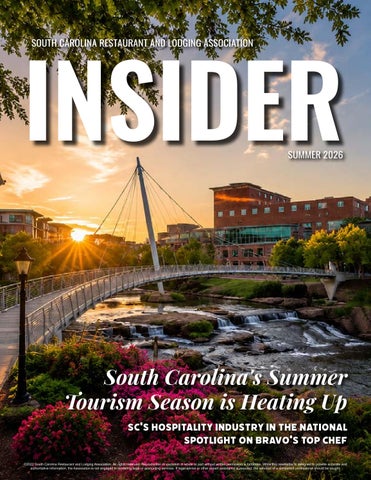
INSIDER SOUTH CAROLINA RESTAURANT AND LODGING ASSOCIATION
SUMMER 2026
South Carolina's Summer Tourism Season is Heating Up Sc's Hospitality industry in the national spotlight on bravo's top chef ©2022 South Carolina Restaurant and Lodging Association. All rights reserved. Reproduction or quotation in whole or part without written permission is forbidden. While this newsletter is designed to provide accurate and authoritative information, the Association is not engaged in rendering legal or accounting services. If legal advice or other expert assistance is required, the services of a competent professional should be sought.
AUGUST 13-23 • GREENVILLE/SPARTANBURG OCTOBER 8-18 • MIDLANDS
AN 11-DAY CELEBRATION CHOCK FULL OF FLAVOR.
LEARN MORE & SIGN UP TODAY AT SCRLA.ORG/EVENTS
It is a privilege to welcome you to this quarter’s edition of the Insider digital magazine. Stepping into the role of President & CEO over these last few months has been extraordinary, made even more rewarding by the time I have spent traveling our beautiful state. From the Upstate to the coast, hitting the road to meet face-to-face with our restaurateurs, hoteliers, and venue operators has given me invaluable insight into the dedication that drives our industry. Hearing your stories firsthand has provided clarity on our industry's challenges, an opportunity to celebrate your triumphs, and informed my vision for the future of the SCRLA. This past legislative session brought immense focus on and hard-fought battles to Columbia, illustrating exactly why our collective voice matters. While some legislative clocks ran out of time on sine die, our momentum certainly did not. The conversations we started this spring and continued on this summer have laid a foundation for the critical advocacy work that awaits us as we look toward a fresh legislative session next January. Moving forward, my vision for the SCRLA is rooted in proactive, unwavering grassroots advocacy and expanded member support. As we have transitioned into the summer tourism season and are gearing up for the pivotal general election this November, we will continue to amplify your voice, vet candidates who champion business growth, and provide the operational tools you need to thrive. Thank you for your continued engagement, your resilience, and your passion for hospitality. I look forward to meeting many more of you as my statewide tour continues, and to working side-by-side for the future of the Palmetto State’s hospitality sector. Sincerely,
Mark Newman President & CEO
WELCOME
Dear SCRLA Members,
MEET YOUR SCRLA TEAM & EXECUTIVE COMMITTEE The South Carolina Restaurant and Lodging Association provides superior value and effective communication by being the voice of the foodservice and lodging industry in government and public relations, educational programs, offering operational benefits, and creating opportunities for member involvement.
Mark Newman President & CEO Douglas OFlaherty Chief Operating Officer Lenza Jolley VP of Membership & Development Hannah Hopewell Director of Communications AnnMarie McManus Meetings & Events Manager Christal VanWickler Bookkeeper/Education Coordinator
Chad Patterson, Raldex Hospitality Chairman Jonathan Kish, Queen Street Hospitality Vice Chairman Randy DeVaux, Kingston Resorts Treasurer Kirk Watkins, Sizzling Steak Concepts Immediate Past Chairman
Members Dan Blumenstock, Lowcountry Hotels Darterian Moore, BreakThru Beverage SC Harris Mullis, Lee's Famous Recipe Andy Wolfe, Grand Palms Resort
Victoria Tobin Executive Director, MBAHA
Table of Contents 6 SCRLA Chapter Updates
27 Is Your Form I-9 Filing System AuditReady?
8 National ProStart Invitational
Build a Thriving Business 11 Top Chef: Carolinas Puts South 28 Navigating Hemp-Derived Products: Carolina Hospitality in the Spotlight A Compliance Guide for South Carolina with RestaurantOwner.com Food Service Establishments 13 Under the State House Dome: Wins, Exclusive Deals for Our Members Challenges, and What's Next 31 SCRLA Topgolf Takeover Raises As our member, you gain access to discounted pricing on Nearly $10,000 for Hospitality Advocacy exclusive restaurant solutions from RestaurantOwner.com. 19 Hospitality Day at the State House 32 Shaping the State House: What the JOIN NOW 23 Event Celebrating Tourism in South Statewide Primaries Mean for Hospitality Carolina, Honors Hospitality Employees Complete Solutions for Restaurants RestaurantOwner.com offers tools and trainings proven to help restaurant owners and their teams find lasting success.
Build a Thriving Find Business exactly what you need to support your restaurant with resources for Finances Leadership Marketing with RestaurantOwner.com Operations Startup & Growth Staffing Exclusive Deals for Our Members As our member, you for gainEvery access Stage to discounted pricing on Solutions of Your Restaurant Journey exclusive restaurant solutions from RestaurantOwner.com. Wherever you are on your restaurant journey, RestaurantOwner.com has the resources you need to run a thriving restaurant. Members gain access to: JOIN NOW
Process Checklists
Financial Templates
Hiring
Training
Operating
Guides Manuals for Restaurants Systems Complete Solutions
Live Webinars
Get 15% Off All RestaurantOwner.com Monthly Plans and 30%offers Off All Annual tools and Plans trainings proven to help restaurant owners and their teams find lasting success. Find exactly what you need to support your restaurant with resources for
Join RestaurantOwner.com’s community of 8000+ members to access Finances Leadership Marketing exclusive resources designed toOperations help you buildStartup restaurant success. & Growth Staffing
JOIN TODAY
restaurantowner.com/public/sc-sra-join-restaurantownercom.cfm Logo Here Insert Your Custom URL Here SolutionsInsert forYour Every Stage of Your Restaurant Journey Wherever you are on your restaurant journey, RestaurantOwner.com has the resources you need to run a thriving restaurant. Members gain access to:
HUBITALITY TO HOST SPARTANBURG COCKTAIL MASTERS 4TH ANNUAL COCKTAIL COMPETITION
Get ready to sip and celebrate at the 4th Annual Spartanburg Cocktail Masters, taking place Friday, September 25, 2026, from 6:00 to 9:00 p.m. at the Spartanburg Marriott. This exciting evening highlights the Upstate's vibrant mixology scene, bringing together local bartenders to showcase their creativity across spirit and mocktail categories. Attendees can sample top-tier creations, enjoy live music and local food pairings, and cast their votes for the coveted People’s Choice award. All proceeds benefit Hubitality, an emergency assistance fund supporting hospitality workers in need. Learn more at hubitality.org/spartanburg-cocktail-masters
À LA HEART GREENVILLE CELEBRATES 1 YEAR
The South Carolina Restaurant & Lodging Foundation launched À la Heart GVL over a year ago now during National Travel & Tourism Week 2025. À la Heart GVL provides emergency assistance to hospitality industry employees in Greenville County in times of personal crisis. Through the hard work and generous contributions of our family and friends, and in partnership with VisitGreenvilleSC, the Greenville Chapter of the South Carolina Restaurant and Lodging Association has established this fund. More information may be found at alaheartgvl.org.
SCRLA PRESIDENT MAKES HIS WAY AROUND THE STATE
Since stepping into his role, SCRLA President & CEO, Mark Newman, has been hitting the road to connect directly with the heartbeat of South Carolina’s hospitality industry. Traveling across the Palmetto State - from the coastal hubs to the Upstate - Mark has made it a top priority to meet faceto-face with restaurateurs, hoteliers, and venue operators to learn firsthand about their unique operational triumphs and challenges. This critical listening tour is already helping shape a unified, strategic vision that will continue to strengthen the SCRLA's advocacy in Columbia. Mark will continue his statewide tour over the coming months, so please stay tuned to our communications to see when and where he will be visiting next!
On Monday, April 27, the MBAHA proudly hosted the 2026 Trio Coastal Culinary Experience - an unforgettable evening celebrating flavor, creativity and community! With more than 200 attendees, 11 talented chefs, and five skilled bartenders, the event was a resounding success. Two exciting voting competitions were held: People’s Choice and Best All Around - and the results are in! People’s Choice Winner: Chef Jerrett "JK" King of O.A.K. Prime wowed guests with an Espresso Rubbed Prime Short Rib Dish with a Parsnip Truffle Puree paired with a Rock Shrimp Bisque. Chef was paired with students Nathan Beliveau, Cole Acosta, and A'Nia Vereen. Emily Kearns from Dave & Buster's impressed with her refreshingly tropical cocktail concoction, the "Dangerous Waters Island Punch", featuring coconut rum, blue curacao, pineappple juice, and premium citrus sour. Best All Around Winners (Judges' Choice): Chef Helia Lippert of Uncommon Chocolatier took top honors with her sensationally sweet "Global Silk Road" dish - a dark chocolate branch filled with passion fruit jelly, truffled sugar crystals, and butter-toasted kunafa. Chef was paired with students Sarabeth Rogers and Steve Banchi. And once again, Emily Kearns claimed victory with the Best Overall Cocktail for her now-iconic "Dangerous Waters Island Punch". A huge congratulations to all our winners and a heartfelt thank you to every sponsor, chef, mixologist and attendees who made this event so special. Also a special shoutout to the Chocolate Chip Band for soundtracking this fantastic evening with your groovy music. Your talent and passion were on full display.
Chef Jerrett "JK" King and team from O.A.K. Prime
Chef Helia Lippert and team from Uncommon Chocolatier
SCRLA UPDATES
MBAHA HOSTS REVAMPED ANNUAL TRIO EVENT IN APRIL
Hotels on the Hill On May 19-20, an SCRLA delegation of leadership and lodging members joined hoteliers from across the country in Washington, D.C., for the American Hotel & Lodging Association's (AHLA) annual Hotels on the Hill advocacy fly-in. AHLA brought the hospitality insustry's most pressing priorities directly to our nation's lawmakers. Property owners, operators, and state association representatives from across the country converged on Washington, D.C., to meet with federal legislators and ensure the hospitality sector's voice remains front and center in policy discussions. Stepping directly into the halls of Congress, our delegation met face-to-face with South Carolina’s federal lawmakers and congressional staff to champion the critical issues shaping the future of lodging and tourism. Our discussions focused on advancing essential workforce and immigration reforms - including the expansion of the H-2B visa program - securing crucial tax relief for small businesses, and addressing systemic challenges like liquor liability insurance. By bringing real-world hospitality stories directly to federal decision-makers, this concentrated advocacy effort ensures that the unique needs of South Carolina's lodging sector remain at the forefront of national policy. The relationships built and strengthened during the event will serve as a vital foundation for the ongoing national legislative battles ahead. The SCRLA team met with Representatives Russell Fry (top), Ralph Norman (middle) and William Timmons (bottom).
Culinary team and coach from Anderson Career & Technology Center
Management team from Golden Strip Career Center
2026 South Carolina ProStart Invitational Recap The South Carolina ProStart Invitational is the state’s premier competition for high school culinary arts and restaurant management students. This year, the 22nd Annual South Carolina ProStart Invitational took place March 1–3, 2026, in Greenville at the Embassy Suites Golf Resort and Conference Center, bringing together some of the most talented hospitality students from across the state. Approximately 100 students from 15 schools competed in the Culinary and Restaurant Management divisions, demonstrating their skills, creativity, professionalism, and passion for the hospitality industry. Students were evaluated by a distinguished panel of more than 100 industry and post-secondary judges on professional appearance, teamwork, decision-making, technical execution, safety and sanitation, and overall presentation. In the Culinary Competition, students were challenged to prepare a three-course meal in 60 minutes using only two butane burners, two eight-foot tables, and no electricity or running water. The competition tested not only their culinary skills, but also their ability to work under pressure, communicate as a team, and execute a polished final presentation. In the Restaurant Management Competition, students developed and presented an original restaurant concept to a panel of judges, complete with menu development, costing, marketing, operations, and critical thinking components. Teams were also challenged through verbal presentation and problem-solving rounds, allowing students to showcase their business knowledge and leadership potential. Congratulations to Anderson Career & Technology Center of Williamston, who earned first place in Culinary, and Golden Strip Career Center of Greenville, who earned first place in Restaurant Management. Both teams represented South Carolina at the 2026 National ProStart Invitational in Baltimore, Maryland, this April.
Team S.C. Takes 2nd Place in the Culinary Competition at the National ProStart Invitational in Baltimore The National ProStart Invitational is the country’s premier secondary school competition focused on culinary arts and restaurant management. Each year, more than 400 student competitors from across the nation put their skills to the test in front of industry leaders, state restaurant associations, educators, family, and friends, all while competing for scholarship opportunities from some of the nation’s top culinary and restaurant management programs. Team South Carolina proudly competed at the 2026 National ProStart Invitational at the Baltimore Marriott Waterfront. Anderson Career & Technology Center placed second in the Culinary Competition, an incredible achievement on the national stage. The success of South Carolina’s ProStart students is a strong reminder of the talent, dedication, and future leadership growing within the hospitality industry. Congratulations to all students, instructors, judges, sponsors, and volunteers who helped make the 2026 South Carolina ProStart Invitational a success.
From equipping you with profitable ingredients that make your menu shine, to simple business tools that grow your operation, to connecting you to restaurant experts – we’re here to support your business in every way! Our passion is helping foodservice operators like you, make it.
Visit us at usfoods.com to learn more. All rights reserved. ©2023 US Foods, Inc. 05-2023 RMK-20230515-2896700
Top Chef: Carolinas Puts South Carolina Hospitality in the Spotlight This spring, millions of food lovers across the country tuned in to Bravo’s Top Chef: Carolinas (Season 23), witnessing what we in the Palmetto State have known all along: our culinary and hospitality industry is world-class. While the bulk of the season centered around Charlotte, the show’s highly anticipated excursion into South Carolina provided an unforgettable showcase of our state’s exceptional dining scene, local flavor, and signature hospitality. The Ultimate Dinner Party at Soby’s The excitement reached a fever pitch in Episode 9, "The Ultimate Dinner Party," when the remaining contestants packed their knives and headed south to Greenville. Welcoming them with open arms was none other than restaurateur and SCRLA Board Member, Carl Sobocinski. Carl opened the doors to his iconic flagship restaurant, Soby’s New South Cuisine, tasking the chefs with throwing an upscale cocktail reception with small plates followed by a massive, eight-course collaborative dinner party. The guests? A room packed with South Carolina’s own esteemed culinary leaders, restaurateurs, and hospitality professionals. Serving a critical role as a guest judge alongside Top Chef mainstays Kristen Kish, Tom Colicchio, and Gail Simmons, Carl brought his deep industry expertise to the judges' table, offering insightful critique that highlighted our region's elevated standards.
From Downtown Dining to the Swamp Rabbit Trail The national spotlight on Greenville didn't stop at the dining room doors. The show stayed in town through Episode 11, drawing inspiration from the famous Swamp Rabbit Trail and MICHELIN North America’s headquarters for a high-stakes fine-dining challenge focused on rabbit. By showcasing the seamless blend of South Carolina's outdoor lifestyle, corporate partnerships, and Michelin-caliber culinary landscape, the episodes served as a masterclass in tourism marketing. It perfectly illustrated how a thriving food scene acts as an economic engine, drawing visitors and elevating the entire hospitality ecosystem. Why This Wins for Our Industry For SCRLA members, seeing Top Chef celebrate Soby’s and our local talent is a powerful reminder of the impact of our collective work. When our restaurants and leaders are featured on a global stage, it doesn't just boost reservations for one establishment, it drives culinary tourism across the entire state, proving that South Carolina remains a premier destination for food, lodging, and hospitality. Missed the broadcast? You can stream the full season of Top Chef: Carolinas on Peacock to relive Soby’s big night in the spotlight.
“Having viewed the episode, I couldn't be more happy and proud of our city and state for how amazing it looks on screen,” Carl shared following the broadcast. Carl Sobocinski, Shuai Wang, Kristen Kish, Tom Colicchio, Gail Simmons
Under the State House Dome: Wins, Challenges, and What's Next At 5:00 p.m. on Thursday, May 14, lawmakers gaveled out of the 126th Session of the South Carolina General Assembly, officially bringing the two-year legislative session to a formal close. For months, legislators, advocates, and stakeholders worked against the clock to move major pieces of legislation across the finish line before adjournment. In the final days of session, debates stretched into the evening, negotiations intensified behind closed doors, and lawmakers scrambled to secure final votes on some of the most consequential issues facing South Carolina. But the end of the regular legislative session did not mark the end of activity at the State House. Moments after lawmakers adjourned sine die, Gov. Henry McMaster issued an executive order calling the General Assembly back into a special session to address congressional redistricting following the U.S. Supreme Court’s ruling in Louisiana v. Callais. The court’s decision significantly altered the legal framework surrounding congressional district maps and immediately shifted attention toward South Carolina’s own congressional districts ahead of the 2026 election cycle, which ultimately did not come to fruition in the weeks following the end of the regular session. The regular session this spring was defined by a number of issues with direct implications for South Carolina’s hospitality and tourism industries. Throughout the 126th General Assembly, the South Carolina Restaurant & Lodging Association (SCRLA) remained laser-focused on advancing policies that strengthen the hospitality industry, support small business growth, reduce unnecessary regulatory burdens, and protect the longterm viability of restaurants, hotels, and tourism-related businesses across the state. Among SCRLA’s top legislative priorities this session were: • Reforming South Carolina’s liquor liability environment to improve the availability and affordability of insurance coverage. • Preserving fairness and accountability between shortterm rentals and traditional lodging establishments. • Modernizing South Carolina’s catering laws through passage of S. 1001. • Clarifying joint employer standards through passage of S. 1007. As the dust settles on the 126th General Assembly, several major victories emerged for the hospitality industry, while other key priorities remain unfinished business that will likely return when lawmakers reconvene in 2027.
Major Wins for South Carolina’s Hospitality Industry Liquor Liability Reform Finally Crosses the Finish Line Without question, the most significant legislative victory for South Carolina’s hospitality industry this session was the passage of comprehensive liquor liability reform. For years, South Carolina restaurants, bars, breweries, and entertainment venues have faced an increasingly unsustainable insurance marketplace. Dramatically rising liquor liability premiums, and in some cases the complete inability to obtain coverage, created an existential threat for many operators across the state. Businesses that had served their communities responsibly for decades suddenly found themselves paying several times more for coverage or being forced out of the market entirely. Recognizing the severity of the crisis, SCRLA joined by the Responsible Hospitality Reform Alliance (RHRA) worked alongside lawmakers, business groups, insurers, and our members to advocate for meaningful reforms to South Carolina’s civil liability framework. After years of debate and multiple legislative attempts, lawmakers ultimately passed H. 3430, a compromise reform package aimed at modernizing the state’s joint and several liability laws while maintaining accountability for bad actors. The legislation makes several substantial changes that are hopeful to bring much-needed stability to the insurance marketplace for businesses serving alcohol for on-premise consumption. Among the bill’s key provisions: • Limits joint and several liability by generally preventing defendants found less than 50% at fault from being held responsible for the full amount of damages. • Allows juries to allocate fault to additional parties in civil lawsuits. • Revises South Carolina’s dram shop liability laws and establishes new standards for alcohol-serving establishments. • Creates procedures for assigning fault between establishments and intoxicated individuals in DUI-related cases, with certain liability caps for establishments. • Establishes mandatory alcohol server training requirements for employees involved in alcohol sales and service. • Authorizes the South Carolina Department of Revenue to oversee training program standards and compliance requirements. • Includes measures aimed at stabilizing the liquor liability insurance market through enhanced reporting and oversight.
While no single bill will completely solve the challenges surrounding liquor liability insurance overnight, passage of H. 3430 represents a critical and long-overdue step toward restoring fairness and balance to South Carolina’s legal environment. For many hospitality operators, this legislation means relief, predictability, and hope that the state’s insurance market can once again become functional and affordable. Regulatory Reform and Small Business Relief Wins this Session Beyond liquor liability reform, lawmakers also spent considerable time this session debating broader regulatory and tax relief proposals aimed at improving South Carolina’s business climate. Among the most closely watched efforts was the Small Business Regulatory Freedom Act, legislation designed to reduce regulatory burdens on businesses and strengthen oversight of the state’s rulemaking process. The bill would establish additional independent review mechanisms to ensure state regulations remain within statutory authority, are not outdated, and that agencies are held accountable for compliance. The legislation would also require any proposed regulation with an estimated economic impact exceeding $10 million to receive approval from both the House and Senate before taking effect. Additionally, the bill seeks to end judicial deference to state agencies in legal disputes, a significant shift that supporters argue would create greater fairness and accountability for businesses challenging agency actions. For hospitality operators, these reforms could have meaningful long-term implications. Restaurants, hotels, bars, attractions, and tourism businesses routinely navigate complex regulatory requirements involving licensing, permitting, labor compliance, health regulations, alcohol service, environmental rules, and local inspections. Hospitality operators, particularly small and independently owned businesses, often bear disproportionate administrative costs associated with regulatory compliance. Although House and Senate leaders were unable to finalize the legislation before adjournment, the bill advanced to conference committee late in the session as negotiations continued between both chambers. One of the primary sticking points involved automatic sunset provisions included in the House version of the legislation. Even so, the significant movement of the bill this year reflects growing bipartisan momentum around regulatory modernization and government accountability.
Lawmakers also advanced portions of the Small Business Tax Cut Act of 2026 by incorporating the proposal into unemployment insurance tax relief legislation during the final days of session. The legislation would exempt the first $10,000 of a small business’s business personal property from county taxation, effectively eliminating the tax burden for many small businesses with limited taxable property while also reducing compliance and filing requirements. For hospitality businesses, business personal property taxes can significantly impact operating costs. Restaurants and lodging establishments often make substantial investments in equipment, furnishings, point-of-sale systems, kitchen infrastructure, technology, and other operational assets necessary to serve guests. The bill additionally included several reforms to South Carolina’s unemployment insurance tax system, including extending the benefit ratio lookback period from 12 to 20 weeks, lowering the solvency target for the Unemployment Trust Fund to return additional tax dollars to employers, and revising penalties for delinquent reporting. Collectively, these changes are intended to ease administrative and financial burdens on businesses while improving predictability and reducing costs for employers. Although several of these measures still require additional legislative action before becoming law, the strong focus this session on regulatory reform, tax relief, and reducing compliance burdens reflects a broader recognition among lawmakers of the challenges facing South Carolina businesses, including the hospitality industry. S. 1001 – Catering License Modernization One of SCRLA’s signature legislative priorities this session was S. 1001, legislation designed to modernize South Carolina’s catering laws. South Carolina’s existing catering framework has long created operational challenges for caterers, restaurants, and hospitality businesses seeking to provide off-site food and beverage service in a modern and competitive marketplace. S. 1001 sought to establish a more practical and business-friendly structure for catering operations while preserving responsible alcohol service standards and regulatory oversight. The legislation successfully passed the South Carolina Senate after extensive negotiations and advocacy efforts from SCRLA and industry stakeholders. However, despite
SCRLA President & CEO, Mark Newman, speaks with a reporter about SCRLA's legislative priorities outside of the State House
strong momentum and support, the House ultimately did not take up the bill before adjournment. Although the bill did not reach the Governor’s desk this year, significant progress was made in educating lawmakers about the operational realities facing South Carolina caterers and hospitality businesses. SCRLA fully expects catering modernization to remain a major legislative priority for the association moving forward. S. 1007 – Joint Employer Clarification Another major priority for SCRLA this session was S. 1007, legislation intended to provide greater clarity surrounding joint employer standards. The hospitality industry relies heavily on franchise models, contracted services, and flexible workforce structures. Unclear or overly broad joint employer standards can create significant uncertainty and legal exposure for business owners. S. 1007 sought to establish clearer statutory guidance regarding when a business may be considered a joint employer under South Carolina law. Despite support from the business community, the legislation was never granted a subcommittee hearing during the session and therefore did not advance. Although disappointing, the bill helped elevate broader conversations surrounding workforce flexibility, franchise operations, and employer liability, issues that are becoming increasingly important across the hospitality industry. Short-Term Rental Policy Remains a Growing Issue Short-term rental policy continued to generate debate during the 126th General Assembly.
SCRLA remained actively engaged throughout the session on legislation impacting the relationship between short-term rentals and traditional lodging establishments. The association continued advocating for policies that preserve fairness, accountability, consumer protections, and local oversight while recognizing the important role tourism plays in communities across the state. Legislation involving local regulation and oversight of short-term rentals once again sparked strong debate between state preemption advocates and supporters of local control. SCRLA partnered closely with the Municipal Association of South Carolina, the South Carolina Association of Counties, and other relevant community stakeholder groups in opposing efforts that would have stripped municipalities of the ability to regulate short-term rentals within their own jurisdictions. The hospitality industry has consistently supported a level playing field that ensures all lodging providers operate under fair and consistent standards related to safety, taxation, accountability, and community impact. Given the continued growth of the short-term rental market in South Carolina, this issue is expected to remain front and center in future legislative sessions.
Other Legislation Impacting the Hospitality Industry Income Tax Reform
Comprehensive income tax reform remained one of the most high-profile issues debated during this session. H. 4216, South Carolina’s sweeping income tax reform legislation, was signed into law and will take effect beginning in tax year 2026. The law reduces the state's top marginal income tax system into a simplified two-bracket model, with a 1.99% rate applied to taxable income up to $30,000.
The legislation also establishes a framework for additional future rate reductions tied to state revenue growth, putting South Carolina on a long-term path toward further income tax relief. Childcare Tax Credit Modernization Workforce challenges remained one of the hospitality industry’s most pressing concerns throughout the session. S. 47, legislation focused on modernizing South Carolina’s childcare tax credit structure, aimed to make childcare more affordable and accessible for both employers and working families. The proposal included mechanisms allowing employers to claim credits against withholding taxes while also creating additional refundable credits for childcare workers. For an industry that depends heavily on hourly and shiftbased employees, expanding access to affordable childcare could significantly improve workforce participation and employee retention. Although the legislation did not cross the finish line this year, lawmakers on both sides of the aisle continue to recognize childcare accessibility as a critical workforce issue.
Hemp and THC Beverage Policy Emerges as a Major Debate One issue that rapidly gained momentum during the final weeks of session was legislation involving hemp-derived consumables and THC-infused beverages. H. 3924 emerged as one of the most closely watched and heavily debated bills of the year as lawmakers grappled with how South Carolina should regulate the rapidly growing hemp-derived beverage and consumables market. As consumer behavior continues to evolve and demand for alternative beverage products increases, many hospitality operators have begun incorporating hemp-derived beverages into their business models and offerings. Throughout the legislative process, lawmakers considered competing proposals ranging from establishing a tightly regulated retail framework to significantly restricting or prohibiting certain intoxicating hemp-derived products. Given the rapidly evolving nature of both federal and state policy surrounding hemp-derived products, the issue quickly became a major point of focus for portions of the hospitality industry. SCRLA engaged extensively with lawmakers and members throughout the debate, emphasizing the importance of thoughtful regulation that protects public safety while also recognizing the significant economic impact these products are already having on businesses across the state. While the General Assembly adjourned without reaching a final agreement, H. 3924 remains alive and is currently in conference committee as House and Senate negotiators continue working toward a compromise. With ongo-
ing federal activity and continued legislative interest at the state level, hemp and THC beverage policy is expected to remain a major issue heading into 2027.
Looking Ahead to 2027 While the 126th Session of the South Carolina General Assembly has officially concluded, the work of advocating for South Carolina’s hospitality industry is far from over. This session produced meaningful victories, particularly in the area of liquor liability reform, while also laying important groundwork on issues ranging from workforce devel opment to regulatory modernization and tax policy. At the same time, several major hospitality priorities remain unfinished business. Catering modernization, joint employer clarification, workforce reforms, short-term rental policy, childcare accessibility, tax relief, and emerging hemp beverage regulations are all expected to return when lawmakers reconvene for the 127th General Assembly in 2027. The hospitality industry remains one of South Carolina’s largest economic drivers, supporting hundreds of thousands of jobs and generating billions in economic impact annually. Ensuring lawmakers understand the challenges and opportunities facing our industry will continue requiring strong engagement from our members across the state. SCRLA’s advocacy efforts this session were made possible because of the active involvement of members from every corner of South Carolina. Whether you participated in Hospitality Day at the State House, contacted your legislators, hosted elected officials at your business, contributed to the SCRLA PAC, testified before committees, or simply shared your perspective with our team – your voice mattered. As South Carolina’s hospitality industry continues evolving, SCRLA remains committed to serving as your voice at the State House and your partner in building a stronger, more resilient future for restaurants, hotels, attractions, venues, and tourism businesses across the Palmetto State. Together, we will continue ensuring hospitality remains one of South Carolina’s most powerful economic engines for years to come.
Build repeat business!
Earn positive online reviews!
AHLEI’s best-selling hospitality training program has been expanded to address the guest service needs of tourism businesses, so all employees can deliver superior service that keeps guests raving about your destination.
Tourism
“Outstanding customer service can transform a guest’s ordinary experience into a treasured memory.” –Todd Davidson, CEO, Travel Oregon
Legislative Forum
Hospitality Day: Taste of S.C.
Hospitality Day attendees visit with the team from a favorite southern staple, Lizard's Thicket
ProStart High School student chefs take a break from cooking to grab some lunch
Soby's famous Shrimp and Grits
Hospitality Takes Center Stage at the State House Each year, the South Carolina Restaurant & Lodging Association brings together industry leaders, lawmakers, hospitality professionals, and advocates to spotlight one of the state’s most dynamic and essential industries. In 2026, SCRLA expanded that effort with a two-day advocacy experience, combining the Legislative Forum & Grassroots Bootcamp with the annual Hospitality Day at the State House and Taste of South Carolina. Held April 21–22, the events provided SCRLA members with meaningful opportunities to connect with elected officials, discuss key industry priorities, and celebrate the impact of hospitality across South Carolina. The Legislative Forum & Grassroots Bootcamp kicked off on April 21, welcoming industry leaders, hoteliers, restaurateurs, and legislative guests for a day focused on education, advocacy, and engagement. Attendees heard from state leaders including Lt. Governor Pamela Evette, Senator Greg Hembree, Senator Deon Tedder, Representative Mark Smith, and candidates for South Carolina Commissioner of Agriculture. We also welcomed Sean Kennedy with the National Restaurant Association who spoke at length on critical legislative issues affecting SCRLA members. Throughout the day, breakout sessions focused on four key areas: economic impact, member value, advocacy, and workforce development. Members discussed the importance of strengthening relationships with elected officials, sharing real business data, and speaking with a unified voice on behalf of the hospitality industry. Conversations also centered on the value of SCRLA membership, the need for strong workforce pipelines, and the importance of positioning hospitality as a major driver of South Carolina’s economy and quality of life.
The momentum continued on April 22 with Hospitality Day at the State House, featuring the ever-popular Taste of South Carolina. More than 2,000 SCRLA members, sponsors, legislators, legislative staff, and hospitality supporters gathered at the State House to celebrate the industry and engage in important policy conversations. This year’s advocacy priorities included support for the SCPRT budget and the “Play It Forward” Initiative, liquor liability insurance reform, the establishment of a catering license, and expanded Culinary Arts Management degree opportunities within South Carolina’s technical college system. Together, these priorities support tourism growth, protect hospitality businesses, modernize regulations, and invest in the next generation of industry leaders. Of course, no Hospitality Day would be complete without the food. Guests enjoyed an outstanding Taste of South Carolina experience featuring 24 restaurants from across the state. Each participating restaurant showcased the creativity, talent, and hospitality that make South Carolina’s culinary scene so special. The strong turnout and meaningful participation over both days sent a clear message: South Carolina’s hospitality industry is united, engaged, and essential to the state’s continued success. Thank you to everyone who helped make these events such a success! Thank you to everyone who helped make the 2026 Legislative Forum & Grassroots Bootcamp and Hospitality Day at the State House such a success. We look forward to continuing this important work on behalf of South Carolina’s restaurants, hotels, and hospitality partners.
Event Honors Tourism in South Carolina, Celebrates Hospitality Employees At an April 22 event celebrating the Palmetto State’s $31 billion tourism industry, Governor Henry McMaster proclaimed May 3-9, 2026, is Travel and Tourism Week in South Carolina. Gov. McMaster said, “South Carolina’s tourism industry is fueled by our unmatched culture, hospitality, and unrivaled natural treasures, all of which make South Carolina the best state in the country to visit. Travel and Tourism Week is an opportunity to recognize the tourism industry, and to honor those who work tirelessly to help visitors and citizens discover everything South Carolina has to offer.” The governor’s proclamation aligns with the nationwide celebration of National Travel and Tourism Week (NTTW), which was created by Congress in 1983 to elevate the power of travel, and was unveiled during a celebration at the Governor’s Mansion. Tourism leaders from every corner of the state, including Visit Myrtle Beach's Partnership Director Johanna Hodge, the current president of S.C. Association of Tourism Regions, gathered for the celebration. Hodge announced Angela Livingston of Marriott's Ocean Watch Villas at Myrtle Beach was the reciepient of the South Carolina Hospitality Employee of the Year award. “Angela Livingston exemplifies exceptional guest care and hospitality,” Rajka Osim, General Manager, Marriott’s Ocean Watch Villas, shared in Angela’s nomination. “As a Pre-Arrival Specialist, she is the first point of contact for every visiting family, ensuring their needs are understood and met long before they arrive. Angela exemplifies outstanding service and dedication to the hospitality industry through her professionalism, reliability, and heartfelt commitment to both guests and the community.” Additionally, Joy Raintree, director of South Carolina State Parks, recognized South Carolina State Parks’ Rangers of the Year, including Joshua Haney of Huntington Beach State Park in Murrells Inlet for the Upper Coastal Region category. “Today is about recognizing what powers South Carolina’s $31 billion tourism industry – and that’s our people and our places,” said Duane Parrish, director of the South Carolina Parks, Recreation & Tourism (SCPRT). “Our people create the experiences visitors remember. It’s the warm smiles, friendly greetings, and shared stories, all steeped in the authentic Southern charm we are so well known for… Our places provide the foundation for visitor experiences, serving as both treasured destinations and powerful economic drivers.”
Angela Livingston, Marriott's Ocean Watch Villas Pre-Arrival Specialist
South Carolina Park Rangers honored during ceremony
Serving Up Trusted Workers’ Comp For Over 100 Years
Keep your restaurant and employees protected with EMPLOYERS—the preferred workers’ compensation insurance provider for the South Carolina Restaurant & Lodging Association. We’ll even sweeten the deal with a 5% premium credit for SCRLA members. Contact Kevin Osterman, Strategic Partnership Manager, at kosterman@employers.com to learn more.
AMERICA’S SMALL BUSINESS INSURANCE SPECIALIST.®
employers.com/scrla
Copyright© 2024 EMPLOYERS. All rights reserved. EMPLOYERS® is a registered trademark of EIG Services, Inc., and America’s Small Business Insurance Specialist.® is a registered trademark Employers Insurance Company of Nevada. Insurance is offered through Employers Insurance Company of Nevada, Employers Compensation Insurance Company, Employers Preferred Insurance Company, and Employers Assurance Company. Not all insurers do business in all jurisdictions.
A Legacy of Flavor: Daufuskie Island's Sallie Ann Robinson Inducted into the James Beard Book Awards Hall of Fame The culinary world turned its highest spotlight on South Carolina’s Lowcountry earlier this month as author, chef, and cultural preservationist Sallie Ann Robinson was officially inducted into the James Beard Foundation’s Book Awards Hall of Fame. Robinson, a sixth-generation Gullah native born and raised on Daufuskie Island, accepted the monumental honor during the 2026 James Beard Media Awards ceremony held at the Art Institute of Chicago. The James Beard Book Awards Hall of Fame recognizes a select group of food writers whose collective body of work has left an indelible, transformative mark on American culinary literature. For Robinson, the recognition honors a lifetime of chronicling and defending the distinct recipes, dialect, history, and folklore of the Gullah Geechee people. Preserving History Through Food Long before modern infrastructure, running water, or electricity reached the shores of Daufuskie Island, Robinson learned to cook over wood-fire stoves alongside her mother and grandmother. Without written instructions, dishes were passed down through physical repetition and sensory memory - a method Robinson has likened to "a song being sung." Her family relied entirely on hunting, fishing, and harvesting the land and sea, imparting a foundational respect for food and natural ingredients that defines her approach to this day. Her path to becoming a celebrated author began unexpectedly while working as a nurse. After preparing a traditional Lowcountry meal for a patient, she was asked if her recipes were documented anywhere. Realizing that generations of culinary heritage risk fading if unwritten, Robinson began translating her family's memories to paper. To give the dishes proper context, she paired her recipes with deep personal storytelling. Her celebrated titles, including Gullah Home Cooking the Daufuskie Way and Cooking the Gullah Way, Morning, Noon, and Night, have introduced food enthusiasts worldwide to staples like Smokin’ Joe Butter Beans and Ol’ ’Fuskie Fried Crab Rice, elevating the culinary genius of Sea Island traditions to global acclaim. A Multifaceted Cultural Ambassador Beyond her written work, Robinson remains a towering figure in South Carolina cultural tourism. She famously appeared as a child under the pseudonym "Ethel" in Pat Conroy’s legendary 1972 memoir The Water Is Wide, which detailed his time teaching on Daufuskie Island. Today, she operates Daufuskie Island Tours through the Gullah Heritage Society, offering visitors a firsthand look at the island's history through an authentic, ancestral lens. As a private chef, educator, and author, Robinson's induction cements her place as one of America's vital cultural guardians. Her recognition by the James Beard Foundation ensures that the resilient spirit and complex flavors of Gullah cuisine will continue to inspire and educate generations of culinarians to come.
Welcome to our New Members! Asure Operations LLC DINE - Greenville Magazine Dink's Place, LLC Enlo Espresso Groove FLOHIM Homewood Suites / Tru Honest Greens Jim 'N Nick's Bar-B-Q Myrtle Beach Lefty's West End Tavern MasterCorp Monteith Construction Myrtle Beach Magic Show Live Naman Hotels Old Town Crepes Myrtle Beach Primo Hoagies - Farrow Commons Royal Farms #508 Seabasil Thai & Seafood Southern Elevator Company Southern Spirit Restaurant & Bar Staybridge Suites Superhero Fire Protection Watkins Services, Inc. Wendy's Myrtle Beach
Is Your Form I-9 Filing System Audit-Ready? As hospitality operators, keeping up with standard HR paperwork can feel like a moving target during a busy shift. However, maintaining strict compliance with employment eligibility verification is a top operational priority under state and federal guidelines. We want to remind all members of a critical operational practice regarding Form I-9 storage, along with the mandatory retention formula to ensure your back-office stays entirely audit-ready. 1. The Golden Rule: Keep I-9s Separate from Personnel Files If federal agencies (such as ICE) or state regulators audit your business, they have the legal right to inspect your Form I-9 records. - Best Practice: Never file a Form I-9 or its attached identity copies inside an employee’s general personnel folder (alongside performance reviews, benefits, or applications). - Why it Matters: Separating these files ensures that auditors only see exactly what they are legally entitled to see. It protects employee privacy and prevents accidental exposure to unrelated organizational liabilities. Keep all I-9s in one secure, isolated central binder or a dedicated, restricted digital repository. 2. Master the I-9 Retention Math You cannot simply discard a Form I-9 the moment an employee leaves your team. By law, you must retain an employee's Form I-9 for whichever date is later: - 3 years from their original date of hire, OR - 1 year from their official date of termination. To help your management team visualize how this rule applies to common employee scenarios, use the reference table at the bottom of this page to determine exactly when a form can be safely removed from your files. 3. E-Verify Reminder As a reminder for South Carolina businesses utilizing E-Verify, the electronic system acts as a verification tool, not a replacement for the physical Form I-9. You must still complete, sign, and securely archive the paper or digital Form I-9 for every single individual on your payroll. Furthermore, if an employee presents a List A document (like a U.S. Passport), you must retain a clean photocopy of that document alongside their form to satisfy E-Verify's photo-matching mandates. Need Help Formulating an Internal Compliance Audit? Ensuring your management team is trained on these protocols shields your business from costly administrative fines. If you need standard filing templates or have questions about transition protocols for your compliance staff, reach out to the association headquarters in Columbia. Employee Scenario
Date of Hire
Date of Termination
3 Years From Hire Date
1 Year From Term Date
Safe to Purge Document (Later Date)
Long-Term Employee
05/10/2011
03/15/2025
05/10/2014
03/15/2026
03/15/2026 (Already clear to destroy)
Mid-Term Employee
09/15/2021
10/01/2025
09/15/2024
10/01/2026
10/01/2026
Seasonal / Short-Term
06/02/2025
01/31/2026
06/02/2028
01/31/2027
06/02/2028
Active Employee
11/12/2023
Still Employed
N/A
N/A
DO NOT PURGE (Must keep all active I-9s)
Navigating Hemp-Derived Products: A Compliance Guide for South Carolina Food Service Establishments As hemp-derived products become increasingly prevalent in the marketplace, the South Carolina Restaurant and Lodging Association (SCRLA) is committed to helping our members navigate the complex regulatory landscape surrounding these items. Understanding the specific boundaries set by the South Carolina Department of Agriculture (SCDA) is essential to protecting your business and ensuring your establishment avoids priority violations during food safety inspections. The "Big Three": Permitted Hemp Ingredients When incorporating hemp into food or beverages prepared on-site, the rules are very specific. Currently, only three hemp seed products have been determined to be Generally Recognized as Safe (GRAS) by the U.S. Food and Drug Administration (FDA) and are permitted for use as ingredients in your kitchen: - Hulled hemp seeds - Hemp seed protein powder - Hemp seed oil These are the only hemp-derived ingredients allowed for use in house-made recipes. Prohibited Additives and Priority Violations Adding other hemp-derived substances - specifically CBD or THC - to food or beverages is strictly prohibited for retail food establishments. The FDA classifies these as unapproved food additives, and their use in prepared items will result in a priority violation during an inspection. Prohibited additives include, but are not limited to: - CBD (Cannabidiol) - Delta-8 and Delta-9 THC - Tinctures and oils (other than the approved hemp seed oil) The "Line in the Sand": Prepackaged vs. Prepared To help our members operate successfully, it is critical to understand where the SCDA draws the "line in the sand" regarding these products. The Exemption: Finished Prepackaged Goods Establishments may sell finished, prepackaged hemp-derived products manufactured offsite. Because these items fall outside the current SCDA regulatory scope, they are not marked as priority violations when sold in their original, sealed packaging. This includes, but are not limited to: - Prepackaged edibles (e.g., gummies or brownies) - Premade, canned, or bottled drinkables, seltzers, and cocktails The Violation: Opening and Mixing The exemption for prepackaged goods only applies as long as the product remains in its original, unopened container. Once a seal is broken and the product is manipulated or used as an ingredient, it is considered an unapproved food additive. Common examples of actions that lead to a violation include, but are not limited to: - Beverage Service: Opening a prepackaged hemp-infused seltzer and pouring it over ice into a glass for a customer. - Bakery & Sweets: Opening a bag of hemp-infused chocolate chips to mix into house-made cookie dough or brownie batter. - Garnishes: Opening a package of CBD gummies to use as a garnish on a cocktail rim or dessert. - Additives: Using "infused" honey or CBD oils as a sweetener in house-brewed coffee or tea. Understanding the SCDA’s Role It is important to clarify that the SCDA does not currently have the regulatory authority to issue permits, licenses, or registrations for the addition of CBD or THC to human food and drink. Currently, there are no companies in or outside of South Carolina that hold an SCDA permit to produce products containing these substances. While the SCDA does not take enforcement action against manufacturers (as these items are not classified as food or drink within their scope), these products are produced without typical regulatory oversight.
Retail Sales Compliance & State Restrictions While selling prepackaged hemp-derived products does not trigger an SCDA food safety violation, establishments choosing to carry them must still comply with South Carolina’s strict retail standards to remain aligned with law enforcement and state guidelines. To protect your business, ensure your staff adheres to these requirements: - Age Verification: It is mandatory to verify that a customer is at least 21 years of age before selling any hemp-derived THC or consumable CBD product. - Behind-the-Counter Mandate: State guidelines dictate that consumable hemp products must be kept behind the counter or in a secured display area to prevent unassisted customer access. - Labeling & Transparency: Only inventory products that feature proper labeling, including a scannable QR code linked to a Certificate of Analysis (COA) to verify that the dry-weight Delta-9 THC content remains under the legal threshold of 0.3%. - No Appeal to Minors: Avoid stocking products that utilize look-alike branding mimicking popular candy lines or animated graphics designed to appeal to minors. National Outlook and Federal Policy Shifting From a broader perspective, the National Restaurant Association actively monitors policy changes that affect our industry. In the 2018 Farm Bill, Congress defined hemp to include cannabis plant derivatives containing no more than 0.3% Delta-9 THC by dry weight volume. This federal baseline sparked a multi-billion-dollar low-dose hemp beverage market, drawing interest from 26% of restaurant operators nationwide who are eager to serve these products once a clear regulatory framework is established. However, a critical "state of play" is currently unfolding. Due to subsequent legislative shifts, existing hemp-derived THC beverages face an impending effective federal ban unless Congress steps in to establish permanent rules. The National Restaurant Association strongly advocates for a safe, consistently regulated market—modeled similarly to the alcohol market—which would establish federal age verifications, product quality assurances, uniform labeling standards, and explicit protections ensuring that operators do not jeopardize their traditional alcohol licenses. Looking Ahead with SCRLA The conversation surrounding hemp-derived consumables is dynamic and shifting rapidly at both the state and federal levels. Because state legislative discussions regarding retail store boundaries, licensing, and restaurant exclusions are ongoing, what is legal to distribute today may be subject to new frameworks tomorrow. The SCRLA is on top of this issue and actively communicating with state lawmakers and the national office to advocate for your business interests. We remain your primary source for accurate, up-to-the-minute regulatory information. If you are ever uncertain whether a specific product or operational method satisfies current compliance metrics, please reach out to the SCRLA office directly before introducing it to your premises.
Quick Reference: Hemp & THC Compliance Table
YOU SERVE THEM. WE’LL SERVE YOU. We’re committed to helping your business be successful through our People, Products, and Platforms. With new capabilities, better value, personalized offers, unparalleled product assortment, trusted expertise and innovation — we have all the tools you need.
Visit Syscofoodie.com
SCRLA Topgolf Takeover Raises Nearly $10,000 for Hospitality Advocacy On Tuesday, May 19, 2026, the South Carolina Restaurant & Lodging Association hosted its Inaugural SCRLA Topgolf Takeover, bringing together members and hospitality supporters for an exciting day of friendly competition, networking, and advocacy. Held simultaneously in Charleston, Greenville, and Myrtle Beach, the event gave SCRLA members across the state the opportunity to connect, compete, and support an important cause. Together, participants helped raise close to $10,000 for the SCRLA PAC. Proceeds from the event benefit SCRLA’s advocacy efforts, which play a key role in supporting pro-hospitality candidates running for elected office. With critical elections on the horizon, this work matters now more than ever.
Statewide Champions: Charleston - Uptown Hospitality Group
Funded by voluntary contributions, the SCRLA PAC supports candidates who understand the importance of a thriving business climate and a strong workforce in South Carolina. By engaging in the political process, the PAC helps amplify the hospitality industry’s voice, protect jobs, and sustain one of the state’s most vital economic drivers. Of course, no tournament would be complete without a little competition. Congratulations to this year’s winners: Statewide Champions: Charleston - Uptown Hospitality Group
Greenville City Winners: Southeastern Laundry Equipment Sales
Greenville City Winners: Southeastern Laundry Equipment Sales Myrtle Beach City Winners: Kingston Resorts Thank you to everyone who participated in the 2026 SCRLA Topgolf Takeover and helped make the event such a success. Your support strengthens SCRLA’s advocacy efforts and helps ensure South Carolina’s hospitality industry continues to have a strong voice at every level.
Myrtle Beach City Winners: Kingston Resorts
Shaping the State House: What the Statewide Primaries Mean for Hospitality IThe foundation for South Carolina’s political landscape heading into the general election was officially solidified this past month, following the June 9 statewide primaries and subsequent June 23 runoff elections. For the hospitality, restaurant, and lodging sectors, these elections represent far more than just standard political matchups - they are the starting line for determining who will hold the votes on critical industry issues, from workforce development and tax structures to our ongoing battle for liquor liability insurance reform. With major executive offices and all 170 seats in the South Carolina General Assembly on the ballot this November, the primary results have set the stage for a critical legislative session in 2027. So let's break down the key takeaways, notable races, and what the results mean for SCRLA members: Federal Matchups Locked In At the top of the ticket, South Carolina's federal representation took clear shape. In the race for the U.S. Senate, incumbent Republican Senator Lindsey Graham secured his party’s nomination for a fifth term with 56.8% of the vote. He will face Democratic challenger and pediatrician Dr. Annie Andrews, who won her primary decisively with 61.5% of the vote. As federal labor regulations - such as joint employer standards - and macro-tourism initiatives continue to evolve, the SCRLA will remain engaged with both camps to ensure the voice of South Carolina hospitality is heard in Washington, D.C. The Race for the Governor's Mansion With incumbent Republican Governor Henry McMaster term-limited and ineligible to seek re-election, the race to lead the Palmetto State drew immense attention. Following a highly competitive seven-candidate primary on June 9, the Republican ticket moved to a high-stakes June 23 runoff. Current South Carolina Attorney General Alan Wilson ultimately secured the GOP gubernatorial nomination, defeating Lieutenant Governor Pamela Evette. Wilson will face Democratic State Representative Jermaine Johnson in the November general election. The state's next chief executive will play a pivotal role in reviewing economic policies, tourism funding, and regulatory overhauls that directly impact your bottom line. New Leadership on the Horizon for Agriculture After 22 years of dedicated service, long-time South Carolina Commissioner of Agriculture Hugh Weathers announced he would not seek another term, paving the way for fresh leadership over one of the state's most critical economic sectors. Following a tight four-way primary on June 9 and a subsequent runoff on June 23, Republican Cody Simpson secured the GOP nomination, defeating Danny Ford II. Simpson advances to the November ballot where he will face Democratic nominee DeShawn Blanding, Libertarian Michael Sullens, and United Citizens Party candidate Chris Nelums. Given the vital farm-to-table pipelines that sustain our state’s restaurants, the SCRLA looks forward to working closely with the next commissioner to support local supply chains and agricultural partnerships. The State House Shift The day-to-day business operations in the Palmetto State will heavily rely on the composition of the State House. While many legislative incumbents sailed through the June 9 primary, several key districts were forced into a June 23 runoff, which ultimately finalized high-stakes matchups for the fall. The primary cycle always brings a degree of turnover, meaning the hospitality industry will be greeting several new faces in Columbia next January. For our members, this turnover underscores the vital importance of grassroots advocacy. It means educating incoming lawmakers on the economic realities of running a restaurant, venue, or hotel before they cast their first votes.
Why the Primaries Matter for Your Bottom Line Primary elections are traditionally low-turnout events, yet they wield immense power over the regulatory environment of your business. The lawmakers who emerged victorious from this June cycle will directly influence the legislative battles that matter most to our industry, including: - Liquor Liability Insurance Reform: Finding a sustainable fix to the joint and several liability laws that are driving up premium costs and forcing local businesses to close their doors. - Tax and Regulatory Consistency: Defending against burdensome regulations while advocating for tax frameworks that promote growth and tourism. - Workforce Support: Ensuring state resources continue to support hospitality training pipelines, such as our ProStart initiatives. Looking Ahead to November With the primary season officially in the rearview mirror, candidates across both parties are shifting into full general election mode. Over the coming months, the SCRLA will continue to provide our members with the resources needed to make informed decisions at the ballot box. We encourage all members to connect with local candidates, invite them into your businesses, and show them firsthand the dedication, grit, and economic impact that defines South Carolina’s hospitality industry. The general election will take place on Tuesday, November 3, 2026. Your SCRLA Governmental Affairs team will continue to monitor all relevant information as we get closer to the Fall.
MBAHA Hospitality Golf Classic to be Held in August at Prestwick Country Club The Myrtle Beach Area Hospitality Association welcomes you to participate in the 35th Annual Hospitality Golf Classic on August 28th. It is the best way to network with the top Myrtle Beach hospitality professionals in our area. Year after year, the Myrtle Beach Area Hospitality Association Golf Tournament brings the fun! Save the date for August 28th and join other hospitality colleagues for an amazing day on the links at Prestwick Country Club, named one of Golfweek’s 2024 Best you can Play in the Carolinas and recently named one of the Best Public Courses You Can Play in South Carolina by the esteemed South Carolina Golf Course Rating Panel! The course was designed by Pete & P.B. Dye and includes some of the most beautifully sculpted holes in the area. The Par 72 course plays over 7000 yards from the Black Tees but boasts 6 sets of tees to fit every golfer’s game. This annual event begins with a shotgun start at 10:00 a.m. There will also be food, drinks, a silent auction and raffle prizes, so mark your calendar now and prepare for a day of networking and fun! Visit mbhospitality.org/golf-tournament to learn more!
South Carolina Approved Alcohol Training Program
ServeSafe Alcohol Online Course and Exam, South Carolina Effective January 1st, 2026, employees who serve alcohol for on-premises consumption and managers who oversee alcohol service must complete an SCDOR-approved alcohol server training program or complete it within 30 days of hire, in accordance with Act 42 (H.3430).
Designed for South Carolina’s H.3430
100% Online, Course & Exam
Available in English & Spanish
Flexible, “Recorded” Proctored Exam (no scheduling)
Meets SCDOR’s requirements
alcohol server training mandate, our ServSafe Alcohol program is fully online, state-approved, and meets requirements.
After passing the ServSafe Alcohol Exam, South Carolina alcohol service certificates can be downloaded from MYDORWAY.
XE] (IVXMǻIH XE] (SQTPMERX XE] (SRǻHIRX The ServSafe Alcohol Online Course The course features video, interactive roleplays, and real-world simulations— teaching alcohol laws, intoxication recognition, ID checks, and conflict management through immersive, scenario-based training. The ServSafe Alcohol Online Exam The exam is proctored by Record+(by ProctorU), which provides a secure exam launch, monitors and records the exam session, and then sends the recorded sessions for human review. There is no exam scheduling. The exam consists of 49 questions and requires a score of 75% to pass. Passing the exam successfully earns the ServSafe Alcohol certificate and the South Carolina alcohol service certificate, available for download (after a 7-day waiting period) from MYDORWAY.
Scan QR Code to Purchase