13 November 2026
scrippsvoice.com
Uncompromising commitment to inclusivity and justice. since 1991
5C Foreknowledge of ABC’s Presence at Halloween Parties By Charlotte Korer ’27 Editor-in-Chief
A
t around 10:15 p.m. on Friday, Oct. 30, a Pomona student was arrested near the Clark V Residence Hall on Pomona campus. The Los Angeles County Fire Department invited officers from the California Department of Alcoholic Beverage Control (ABC) to the campus, according to an email from the Associated Students of Pomona College (ASPC) sent to Pomona students and later forwarded to the other campuses. The officers were in unmarked vans and out of uniform, leading to confusion among students. “We were briefed alongside Campus Safety during our pre-event meeting that ABC agents were likely to be orbiting campus, but, thankfully, there were no incidents at Scripps involving them to our knowledge,” said Evelyn Cantwell ’28 and Avni Kalia ’28, SAS 5C event co-chairs who organized the SAS and Pomona Events Committee (PEC) collaborative party on Elm Tree Lawn. “Given that the arrest happened after most students had ventured out for the night, it’s hard for us to know how it might have impacted our event.” Office of Student Engagement (OSE) and Campus Safety briefed the 5C event co-chairs at 9:45 p.m. on Friday, around 30 minutes before the arrest on Pomona campus. On Oct. 31 at 4:46 p.m., the day after the arrest, SAS shared a message with the Scripps student body. Here is an excerpt: “Scripps is private property, and the ABC is only allowed to operate on public property. However, we understand that the general presence of ABC around the 5C campuses, especially given what happened last night, causes anxiety and puts students at explicit risk. As such, SAS is resharing the statement put out by Associated Students of Pomona College (ASPC), below. We hope that you are all able to have a safe rest of your Halloween and want to serve as a resource to you all.” There was no mention of SAS and Campus Safety's prior knowledge of ABC’s presence on the Claremont College campuses.
IN THIS ISSUE
Pomona Professor Remains After Use of Racial Slurs
Because the arrest occurred on Friday, there was a feeling of tension around the Claremont Colleges for Halloweekend festivities on Saturday night. “I was a bit more cautious going out on Saturday and more aware of my surroundings and made sure that my groups of friends and I stayed close together and we never went out by ourselves,” said Samantha Klaffenbach ’29. “It definitely made me a little bit more fearful to go out in the future, especially as a person of color.” It wasn’t just Scripps students feeling the tension of the arrest, especially with parties taking place across the 5Cs. “I go to CMC, so going to Scripps and Pitzer, I have to go into public property, and I just keep wondering what happened to my friends — who is [ABC] targeting?” said Charis Chu CMC ’30. “I feel like this kind of arrest is unfair in nature and going to make the students of color feel more unsafe.” Some students were more directly affected by the incident than others. Many students of color and international students have reported anxiety over going out after the arrest, as they are groups more vulnerable to abuses of power from law enforcement. “It was terrible. I definitely enjoy a position of real privilege, so it didn’t make me concerned for myself. But friends that are international students or on full-ride [scholarship] situations were definitely really worried about it, and it sucked,” Jesse Cufley ’29. “It’s a college campus. We should be practicing harm reduction; it shouldn’t be punitive or carceral.” While the law enforcement presence on Pomona’s campus caused stress among the student body regarding the safety of 5C nightlife, students at other 5C parties were fortunate to have a sense of normalcy in their evening. Most students at the SAS x PEC party at Scripps’s campus were unaware of what was happening a 15-minute walk south of them. Because of that unawareness, the SAS x PEC party was able to be a success. “We feel that collaborating with Pomona was a really valuable way
Students Give Themselves Over to Absolute Pleasure for Rocky Horror
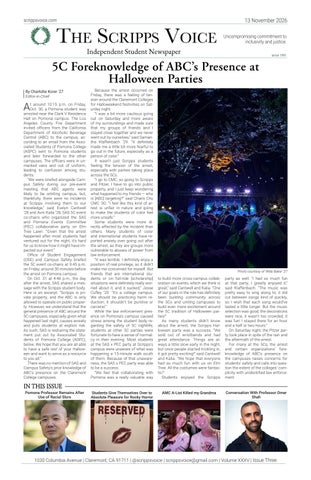
Photo courtesy of Willa Baker '27
to build more cross-campus collaboration on events, which we think is great,” said Cantwell and Kalia. “One of our goals in the role has definitely been building community across the 5Cs and uniting campuses to build even more excitement around the 5C tradition of Halloween parties!” As many students didn’t know about the arrest, the Scripps Halloween party was a success. “We sold out of wristbands and had great attendance. Things are always a little slow early in the night, but once people started trickling in, it got pretty exciting!” said Cantwell and Kalia. “We hope that everyone had so much fun with us on Elm Tree. All the costumes were fantastic!” Students enjoyed the Scripps
party as well. “I had so much fun at that party; I greatly enjoyed it,” said Klaffenbach. “The music was pretty easy to sing along to; it did cut between songs kind of quickly, so I wish that each song would’ve lasted a little longer. But the music selection was good, the decorations were nice, it wasn’t too crowded, it was fun! I stayed there for an hour and a half or two hours.” On Saturday night, the Pitzer party took place in spite of the rain and the aftermath of the arrest. For many at the 5Cs, the arrest and certain organizations’ foreknowledge of ABC’s presence on the campuses raises concerns for students’ safety and calls into question the extent of the colleges’ complicity with unidentified law enforcement.
AMC A-List Killed my Grandma
Conversation With Professor Omer Shah
1030 Columbia Avenue | Claremont, CA 91711 | @scrippsvoice | scrippsvoice@gmail.com | Volume XXXV | Issue Three
2 • Feature
Pomona Professor Remains Despite Student Discomfort at Use of Racial Slurs
By Louisa Chiriboga ’29 Copy Editor
D
uring the spring 2026 semester, Pomona’s Black Student Union (BSU) urged the college’s administration to address recent instances of racism and anti-Blackness reported on campus. One cited instance was the Chair of Sociology and Professor of Sociology and Asian American Studies, Hung Cam Thai, repeatedly using the n-word in his classroom during class discussions. Thai has worked at Pomona since 2001 and remains employed by the institution despite student backlash to his use of the slur. Currently, he teaches Qualitative Research Methods, a sociology class, and Contemporary Asian-American Issues. Both courses are available for students at all of the Claremont Colleges. According to an account by one student, during a session of the spring course she was enrolled in, Contemporary Asian-American Issues, Thai showed a documentary about a race riot that was produced as a result of xenophobic attitudes toward Chinese immigrants during the construction of the transcontinental railroad. The riot, known as the Los Angeles Chinese Massacre of 1871, killed at least 17 Chinese men and boys, or at least 10 per-
cent of the neighborhood’s Chinese population. The deadly event took place on a street called Calle de los Negros, which Thai translated into English using the N-word. Scripps does not offer a sociology major on campus, so Scripps students looking to pursue sociology must study off campus at Pomona. For sociology majors across the 5Cs, taking a class with Thai is unavoidable, which has sparked sentiments of discomfort, especially from students of color. “As a Black student at Scripps considering majoring in sociology, hearing this [incident] makes me uncomfortable taking classes in the department,” an anonymous Scripps student said. “I understand that discussions of racism often involve difficult material, but professors still have a responsibility to consider how their language affects students.” The college has encountered limitations in actions it can take against Thai due to California’s Leonard Law, which holds private and public educational institutions to the same standards of free speech as the United States Constitution’s First Amendment and prohibits these institutions from disciplining students and faculty who commit hate speech.
Pomona’s BSU hosted a town hall meeting on Mar. 25, 2026, with over 500 attendees to address Thai’s racist speech, as well as the issue of students using slurs in public places without administrative discipline. Many reports from students and the administration were filed against the BSU for policy violations at a club event. On Mar. 10, 2026, the college released a statement about the incidents of anti-Blackness on campus, but did not mention Thai explicitly. “Because of our obligation to protect individual privacy, we are unable to share additional details,” the statement read. Even so, the statement mentioned a report from a classroom describing a “faculty member” showing a documentary that contained multiple uses of the n-word and that the faculty member repeated the word afterward in discussion. The statement seemed to excuse the use of the slur by acknowledging its harmful connotation while not condemning the use of it by the nonBlack professor himself. “There will be times in our classrooms when engaging with difficult language is unavoidable. It is up to us to approach these moments not only with care, but also with awareness of both the historical and con-
temporary impacts of this language,” the statement said. The statement was signed by Interim Vice President for Academic Affairs and Dean of the College Brent Carbajal, Vice President for Student Affairs and Dean of Students Avis Hinkson, and Vice President, Chief Operating Officer, and Treasurer Jeff Roth. Many students felt that the statement was vague and did not adequately address their concerns. They still expected more from the administration to ensure that all students, especially Black students and other students of color, can feel comfortable entering certain departments and fields of study at predominantly white institutions with informed and supportive faculty members and mentor figures. “I want the administration and the department to properly address students’ concerns and ensure that students of color feel respected in the classroom,” the anonymous Scripps student said. The full statement made by Pomona’s administration in March can be found on the college’s official website under the tab “Statements/ Messages,” with the specific statement titled “Addressing Recent Anti-Black Bias Incidents in Our Community.”
5C Students Give Themselves Over to Absolute Pleasure For Rocky Horror By Louisa Chiriboga ’29 Copy Editor
O
n Oct. 29 at 7:30 p.m. and Oct. 30 at 10 p.m., a cast of 16 students at the Claremont Colleges performed their rendition of The Rocky Horror Picture Show. Thursday’s performance took place in Pitzer’s George C.S. Benson Auditorium, with all 311 seats filled, and Friday’s performance occupied the 200-seat Rose Hills Theater at Pomona. This article will focus mostly on Thursday’s performance, since that was the night I attended. The 5Cs follow a long-standing Halloween tradition of an on-stage ‘shadow cast’ dressing up as the movie’s characters and reenacting the dialogue and action via lip-syncing and miming as the film is projected with volume behind them. Through this practice, Rocky Horror is not simply a movie or a musical production – it is an experience. Throughout the play, audience members yelled out snide remarks in response to the movie’s lines as part of another tradition of affectionately mocking the source material. The Rocky Horror Picture Show was released in 1975 as an absurdist science fiction movie-musical. To provide a brief overview, a young all-American couple, Brad Majors (Barry Bostwick) and Janet Weiss (Susan Sarandon), stumble upon the mansion of an ‘alien transvestite’ and mad scientist Dr. Frank-N-Furter (Tim Curry) while seeking shelter after their car breaks down during a storm. Frank-N-Furter, who is from the planet Transsexual in the galaxy of Transylvania, forces Brad and Janet to enter his world of freakish science
experiments and sexual activity. Despite the film’s underwhelming initial release, in New York City in 1976, it became popular for audiences to go see Rocky in theaters and loudly respond to the characters while they speak on screen. The film maintains its relevance as a cult classic of queer media, a safe haven for LGBTQ+ people to enter an environment of shared joy. “[Rocky Horror is] weird, erotic, and overall a freakishly good depiction of what it is like to be a part of the LGBTQ+ community,” Venice Harrison ’29 said, who plays the show’s titular character. 5C Students began to line up to secure seats about 90 minutes before showtime, many in costume in the spirit of Halloween. Student ushers passed out bags with props for audience members that correspond with different plot points, such as gloves, playing cards, and party hats. Additionally, attendees who had never seen Rocky Horror before were marked with a bright red lipstick ‘V’ on their foreheads to signify their Rocky virginal status. Directors Ellie Deorsey PZ ’27 and Serenity White PZ ’27 introduced the production to the crowd and gave a thoughtful tribute to Tim Curry, who died on Aug. 25, 2026. Known for his iconic performance as Frank-NFurter in full drag, Curry was a lifelong ally to the LGBTQ+ community and advocate for raising money for HIV/ AIDS. Deorsey and White ended their speech with the movie’s famous invitation: “Give yourself up to absolute pleasure.” In the spirit of succumbing to “absolute pleasure,” the ‘virgins’ were
encouraged to come on stage. Once they lined up under the spotlight’s glare, they were instructed to give their best moan. The audience applauded after each participant’s attempt. The moaning competition was merely an appetizer for the displays of sexual desire to come that evening. The students’ performances were engaging, creative, and original, despite paying faithful homage to the source material. Audie O’Neal PO ’29 (Frank-N-Furter) masterfully managed to run around the stage and weave through the audience, jump on and off of tables, and simulate sex while wearing six-inch platforms and performing memorable numbers like “Sweet Transvestite” and “I Can Make You a Man.” Jace Furman PZ ’28 and AnnaSophia Nicely PO ’27, in the roles of Brad and Janet respectively, delightfully conveyed their characters’ youthful, virginal naivety in the song “Dammit Janet” before descending into the same reckless abandon as the sexually liberated aliens in “Touch-A, Touch-A, Touch Me” and “Once in a While.” Many of Furman’s and Nicely’s lines prompted the impassioned audience reaction of “Asshole!” to Brad and “Slut!” to Janet as foreshadowing for the true artificiality of the couple’s claim to purity. Harrison captured Rocky’s earnest innocence as a newly-constructed man of perfect form, complete with platinum hair, nipple pasties, drawn-on abs, and a spacey stare. The full cast executed energetic choreography and intricate depictions in “Science Fiction / Double Feature” and “The Time Warp,” while many audience members sang along.
This year’s production of The Rocky Horror Picture Show preserved another year in a valued 5C tradition, creating a sense of queer joy and Halloween spirit on campus.
TSV Editorial Staff 2026-2027 Charlotte Korer ’27 Editor-in-Chief Clara Ann Bagnoli ’28 Editor-in-Chief Louisa Chiriboga ’29 Copy Editor Phoebe Schwab ’29 Copy Editor Jiwoo Lee ’29 Copy Editor Sophie Mirza ’30 Copy Editor Norah Schwimmer ’30 Copy Editor Intern Claire Williams ’30 Copy Editor Intern Cecily Hauser ’30 Copy Editor Intern Hannah Fawley ’27 Head Design Editor Anna Grez ’27 Design Editor Ava Li ’29 Design Editor Margaret Judge ’29 Design Editor Lucy Heyd ’30 Design Editor Intern Elizabeth Clark ’27 Social Media Manager Genevieve Lagrant ’28 Webmaster
13 November 2026 • The Scripps Voice • Volume XXXV • Issue Three
Feature • 3
The KSPC Music and Art Mart Returns By Maggie McAteer ’30 Staff Writer
O
n Sunday, Nov. 8, several local 5C and Claremont members – selling everything from live portraits to vinyl records to an alto saxophone – flooded the Edmunds Ballroom at Pomona for KSPC Claremont’s biannual Music and Art Mart. In addition to vendors, KSPC hosted three live bands from the Los Angeles area, including the Claremont Colleges’ own student band Coast. The Music and Art Mart is KSPC’s only fundraiser of the semester, and, as a non-commercial station, it is one of their main sources of income. KSPC brought in funds from community entrance fees, station merch, and physical media sales. “We really just wanted to invite them here to have a space where we can celebrate handmade goods, celebrate physical media like vinyls and CDs, and invite the whole community to come collaborate and surround themselves with music,” said Soleil Ybarra PO ’27, one of three music directors for the station. Student vendors were similarly enthused about the event, expressing appreciation for the space to share their work. “Without this event, I probably wouldn’t be selling my art in this way and as publicly,” shared KSPC DJ-in-training Stella Grace Moseley ’30. Moseley was selling handmade ceramic jewelry and keychains, a passion she’s been developing over the last six years. Next to her was Matilda McKenzie PO ’29, who offered custom-designed temporary tattoos. “I’m always doing it for myself and my friends, and I just
thought it would be a good way to get involved in the KSPC volunteering, ” McKenzie said. KSPC made no profits off of student vendors, with tables being a free, sign-up-based opportunity, and student vendors kept 100% of their earnings. Other vendors had a different logic in their art. MaeYa Kotter PO ’28 and Becca Choe PO ’27 sold clothes, which they collected from local thrift stores and upcycled by screenprinting original designs on them. “It’s a fun way to be creative but still be very environmentally conscious,” Choe explained. “I think a lot of forms of art making can be wasteful in some ways, so this is a very fun way to make things but also take waste away from the world.” One unique aspect of the Music and Art Mart was that members from the broader Claremont community were invited to hawk their wares alongside students. “We can be a bit of a bubble, but the inclusion of community vendors and bands from LA, and inviting everyone to come onto our campuses, listen to music, and talk to students is such a great way for expanding our reach as a station,” said Ybarra. “It’s really cool to see everybody here with their families and little kids and how we’re a part of the Claremont community,” said Madeline Lodge ’30. Chicle!, a Spanish indie-funk band based out of L.A., was also in attendance as one of three performances. Lead singer Lelani Kiss also echoed the students’ sentiments. “[Our performance is] kind of like bringing a piece of the real world, not to say col-
lege isn’t the real world, but a piece of the outside world that you’re not typically used to and seeing the possibilities that are available to you.” CJ Harper, a community member, represented Claremont’s Folk Music Center. Located centrally in the Village, the Folk Music Center is a family-owned business that offers repairs, lessons, and instruments. It also serves as a museum. Harper supervised the sales of an eclectic collection of vinyls, which he described as “good music, but … also just kind of like this chaotic collision of things, you know, the joy of looking through it and finding something that you just vibe with.” This emphasis on physical media was something echoed by many across the event, because there were many vendors selling media, but some were more generally advocating for a departure from the digital age. Maya Dam PZ ’29 and Alyssa Wu PO ’28 were two of the latter, stationed at the event to spread the good word about their 5C organization, Luddite Club. Focused on helping students unplug and disconnect from their devices, Luddite Club was handing out zines, buttons, and cards for their “Week of Getting Off Challenge,” which challenges students to “be bored” and avoid checking their phones first thing in the morning. Dam said she sees listening to physical media as “a form of protest, because it’s such a simple action, but it’s what we can do. We need something we can feel and live with.” “It’s nice to listen to a CD instead of just scrolling through your Spotify and having recommended songs. We recommend you physically go
out there and curate something for yourself. I think that’s just more intentional,” said Wu. Something nearly everyone agreed upon was their excitement to see the live music performed periodically throughout the event. KSPC was able to secure 5C cover band Coast, as well as L.A. synth-pop duo Pride Month Barbie and the previously mentioned Chicle!. When Coast stepped up to the stage, there was a palpable shift in the mood. Chicle! guitarist and singer Tavo Casado described this from the performer’s perspective. “I really connect with the audience when I see people enjoying our music and enjoying the sound that we’re producing. And I think there’s something that’s really beautiful, and a connection between [the] crowd and the physical aspect of what I’m doing,” said Casado. “I think that human connection is really the best part of it. ” “I feel like when I put my headphones on, and I listen to music or whatever, it feels like I’m kind of closing off a part of the world around me. But when I listen to live music, it’s like I’m present in the world and I get to enjoy the music.” In general, the event seemed to be a huge success, with fans from both vendors and customers. Ybarra continued to share, “This [event] is super important [for KSPC] because we get to tell people about ourselves. We get to raise awareness about radio and physical media and the importance of public programming in an age where it’s all digital. We feel that physical media and radio [is] just a nice way to spice that up and remind people about this human-to-human connection that comes with media.”
Spine-Tingling Thrills: Spooky Spines at Denison By Claire Williams ’30 Staff Writer
H
eld at Denison in the Rare Book Room and the book stacks, Scripps’s Ella Strong Denison Library hosted its annual Spooky Spines and Twisted Tales event on Oct. 28 from 6:30 p.m. to 9 p.m., giving visitors a chance to collect candy through trick-or-treating… if they dared. Around the edges of the Rare Book Room, plays, transcripts, and novels containing eerie or ominous themes were featured. Supplementary slips of paper with the books’ titles, authors, and the publication date sat by each book. The room was decorated with “floating” candles, fake spiders, dim lighting, and cobwebs. Library employees waited behind tables to provide visitors more information about the books. Three books in the Rare Book Room display were “arsenic books”: Every Girl’s Book: A Compendium of Entertaining Amusements, for Recreation in Home Circles, published in 1860; The Forget-Me-Not: A Christmas, New Year, and Birthday Gift, published in 1855; and The Keepsake, also published in 1855. The University of Delaware’s Poison Book
Project described arsenic books as typically from the 1840s through the 1860s that contained arsenic from the “Paris” green or emerald green pigment used for cloth bookbindings or leather decorations. While these books weren’t dangerous to the general public, they could cause arsenic poisoning in those who spent a lot of time handling them. A more recent piece included was The Bible in Hell, written by Marshall Weber in 2007. Though the book is a fairly recent piece, the collage work and ink painting were made to look older through several techniques, including washes of turmeric and different teas. It also used work from several different artists to add the distinctive artistic ink smudges. The book lists big corporations or businesses with demons for each one. Some of the corporations listed on the opened page included Walmart, Bank of America, Coca-Cola, Pepsi, Home Depot, the World Bank, Microsoft, and Disney. Inspirations for The Bible in Hell included specific contemporary texts, as well as “magick bookes” from Europe in the Middle Ages. Several of the featured books contained drawings that lent to their spookiness. An illustrated 1914
edition of William Shakespeare’s play The Tempest was on display, showcasing images of dancing skeletons. Across the room, visitors could view a book on Hopi folklore and monsters. A black-and-white illustration of a scorpion took up the whole page of the large book; a description called it a “crab-serpentlike insect.” Other twisted tales on display in the Rare Books Room included a record of the Salem Witch Trials, as well as a work titled A System of Magick; or a History of the Black Art. The front page described the book as “being a historical account of mankind’s earliest dealings with the devil; and how the acquaintance on both sides first began.” One book even contained illustrations so small that a magnifying glass was placed next to it to help visitors to see the fine, intricate lines clearly. The other section of Spooky Spines took place in the book stacks, hidden from Denison’s entrance and the Rare Books Room by a curtain. A sign at the entrance warned visitors of the fright the main room of the library contained. As students walked through the alcoves, the library was almost completely dark and decorated with cobwebs and unsettling
music played. Woven through the alcoves, several Denison student employees who worked as scare actors with special effects makeup and prosthetic wounds followed the visitors and jumped out from behind the book stacks to scare them. They occasionally crouched on top of the chairs or tables, so they would appear at an unsettling height as visitors spotted them from the other side of the stacks. One employee, Amanda So ’28, crawled like a spider in a backbend position, leaping off of the tables and chasing visitors at a frightening speed. If visitors were brave enough to face Denison’s haunted stacks, a bucket of candy awaited them at the end! After gathering goodies, visitors then had to wander back, finding their way through the entrance curtain and out the exit. For any visitors on the skittish side, Denison was kind enough to offer candy near the entrance. Whether guests preferred jumpscares from employees in costume or learning about creepy books, Denison Library’s Spooky Spines and Twisted Tales was thoroughly enjoyable for the Halloween-loving students among us – and anyone who has a sweet tooth!
13 November 2026 • The Scripps Voice • Volume XXXV • Issue Three
4
AMC A-List Killed My Grandma By Maggie McAteer ’30 Staff Writer
I
finally brought myself to cancel my AMC A-List subscription this past week. It had been a long time coming; the service had brought me nothing but anxiety and an emptier bank account for the last few months, and yet I still hesitated to take the final step. Why was this so difficult for me? To understand the answer to that question, we need to examine what made me — and over one million others — sign up in the first place. In short, AMC A-List is a subscription service that lets its users see up to four movies a week at any AMC location and in any format (IMAX, Dolby, etc.) for the low, low price of $29.99 a month. Considering the average Friday night screening costs around $20 now, this seems like a steal. Up to 16 movies a month for basically the price of one (once you include popcorn and a drink, at least) — what’s not to like? When I signed up this past June, everything seemed perfect. I would go to the movies at least twice a week, even hitting the four-film maximum once or twice. By the end of the summer, I had seen 33 movies at AMC, essentially everything that came out. Not all of them were good, of course (don’t ask me about Young Washington, I still get painful flashbacks), but A-List gave me the freedom not to feel bad about watching a bad movie. If I had to pay $20 to go see a one-star film, I’d want a refund, but because I was seeing everything, it didn’t matter. And for the most par t, they were good. I saw movies I never
would have seen otherwise, like The Wrong Girls, Kristen Stewart’s stoner comedy, or Tuner, a movie about a piano tuner who embarks on a life of crime (while hooking up with Havana Rose Liu). For movies like Leviticus and Hadestown, A-List allowed me to justify rewatching them in the theater, instead of waiting until they came out on streaming to pass the good word on to my friends. I could also rationalize seeing rereleases, like Moonlight and Your Name., on the big screen. Sure, they were also available on streaming, but with A-List, I might as well have seen them in their full glory. When I moved to Claremont, everything came crashing down. As classes began, job applications were accepted or denied, and club meetings started happening essentially every evening, I realized that the glory days of my AMC summer were over. I didn’t have time to do all my Core reading, let alone take the 20-minute bus to Montclair and watch a two-hour movie. Not to mention that, although the theaters themselves are well managed, the Montclair AMC is not a very good theater. They’ve got all the blockbusters, sure, but the moment you want to watch Teenage Sex and Death at Camp Miasma, AMC makes you drive all the way to Covina. Montclair just doesn’t have the types of films that made A-List fun; they have the kinds of movies that the studio is going to put onto their streaming service immediately after its two-week theater run. So why didn’t I cancel immediately once I came to this conclusion? This was where the true evil of A-List emerged. Like a manipulative
girlfriend, it love-bombs you for the first few months, so when you’re thinking about leaving her, you’re the one who feels guilty. Each time I thought about cancelling, I would think, “Maybe I’ll have more time next weekend.” But of course, as midterm season approached, the workload only got worse. A wave of guilt consumed me each time I chose homework over AMC; I was spending so much money on it only to never use it. I couldn’t cancel because I thought I might use it someday, and in the meantime, shame ruled me. The theater was so close! (20 minutes by bus, there and back). And there were so many good movies coming out! (none of which played at Montclair). Besides, if you cancel A-List, you can’t get it again for six months! Yes, they literally blacklist you from using their subscription because they want you to think about your actions and remember the good times. The manipulati-
OPIN
ve girlfriend allegations only got stronger. But last week, I finally did it. I looked the devil in the eyes and told them that they can no longer have my heart and my $29.99 a month. I will instead be frequenting the recently opened Regency Theater in the village, which used to be the Laemmle Theater, and their $7.50 Tuesdays. AMC A-List isn’t bad in general; if you don’t have a job, or a family, or any other hobbies or interests, it’s fine. But if you’re in college, spending a ridiculous amount of time on homework each week and working a part-time job on top of that, it simply isn’t worth it. You are not likely to go as much as you’d like to, and having an A-List only makes you feel bad about yourself when you can’t make it out. And now that I think about it, with the cost of gas nowadays, driving to the movies four times a week wasn’t cost-efficient anyway.
Maggie McAteer ’30 • The Scripps Voice
The Amazon Corset Industrial Complex By Amanda So ’28 Staff Writer
I
looked down from my safe haven, the balcony of Green Beach at Claremont McKenna, onto a mosh pit of girls in variations of the same corset from Amazon, like a uniform that I was all too familiar with from the countless TikToks I had scrolled through while getting ready for that night. Meanwhile, I was covered in blood, head to toe, my white Victorian nightgown stained crimson. Lizzie Borden would have been proud. For a holiday designed to let people express their individuality, the corset costumes are almost indistinguishable from one another. While I appreciate the style of these corsets and how they make some women feel sexually empowered, I wonder whether we have begun to prioritize performing desirability over genuine creative expression. I cannot help but long for a time when sexy Halloween costumes were actual costumes, and not just vessels to show off the female form. Sexy Halloween costumes are far from new. Leg Avenue, the brand that popularized the quintessential Y2K sexy Halloween costumes sold in plastic bags, has dominated college girls’ Halloween lookbooks for years. These costumes feature
intricate lace paneling, exaggerated fit-and-flare silhouettes, and accessories that bring their respective characters to life. Like today’s Amazon corsets, Leg Avenue costumes showed off the female form, but they also had details that made them look like specific costumes at first glance. Take their 2000s rendition of Cinderella: a baby-blue and white lace-paneled corset minidress, a white faux-fur capelet with a flowing mesh train, an embellished black choker, white satin opera gloves, and white lace thigh-highs. This Cinderella was coquettish, campy, and sweetly sexy. Today's Cinderella, however, might sport a blue Amazon corset, a miniskirt, and perhaps a ribbon choker to pay homage to the original character. Swap the corset’s color and the accessories, and suddenly she can be Snow White, Aurora, or Tiana. I suspect this growing homogeneity helps explain the resurgence of vintage Leg Avenue costumes on TikTok. The girls yearn for distinct costumes again. An Amazon corset per fectly mirrors society's current beauty standards: a tiny waist, boobs up to the moon, and enough discomfort to make breathing feel optional. However, this brazenly sexy silhouette raises a question: does looking
desirable necessarily mean expressing desire? This brings me to prolific feminist philosopher and writer Audre Lorde. In her landmark essay Uses of the Erotic: The Erotic as Power, she distinguishes superficial sexual stimulation from genuine erotic power. For Lorde, true eroticism is rooted in joy, creativity, and self-knowledge, rather than the mere appearance of sexiness. In her essay, she wrote, “The erotic cannot be felt secondhand,” meaning that genuine erotic fulfillment must come from within, rather than from satisfying someone else’s expectations of pleasure and desire. Through this lens, the Amazon corset represents something beyond a Halloween costume: it is a standardized performance of feminine desirability. When the same silhouette dominates countless costumes, I wonder whether we’re dressing to embody our own fantasies or simply reproducing what we’ve been taught makes us attractive. To be clear, my issue does not lie with the women who wear these corset costumes. My issue is with the algorithm that convinced us all to buy one. TikTok’s algorithm exposes women to the same costume trends, making certain silhouettes seem like the default way
to look attractive on Halloween. Why on earth wouldn't you buy the $20 Amazon corset after seeing countless women praised for their bodies while wearing it online? Halloween supposedly celebrates individuality, yet our costumes increasingly reflect a collective ideal of feminine desirability. Having a plethora of costumes to choose from does not necessarily mean we have endless opportunities for self-expression. I am grateful that, generally, American women in college have the freedom to wear what we want and feel sexy and empowered while doing so. Women’s choices should not be policed, and the validity of sexual expression should not be placed on a scale of the creativity of their Halloween costumes. Still, Halloween is my favorite holiday, and I would like to see a bit more experimentation among the 5C student body. My wish does not involve abandoning sexy costumes — desire, playfulness, theatricality, and self-expression can coexist. So much of my joy comes from temporarily embodying someone else, even if that occasionally involves lots of blood and scar wax. Note to men: a red T-shirt with a large “M” on it is not a Mario costume. Do better.
13 November 2026 • The Scripps V
NION
5
VisionQuest IS the MCU (And I Hate It)
By Maggie McAteer ’30 Staff Writer
I
t’s no secret that the Marvel Cinematic Universe has been on its way out for a while now. After Ant-Man and the Wasp: Quantumania (2023), I think everyone pretty much gave up hope. That’s not to say there haven’t been exceptions — Thunderbolts* (2025) is one of the best things I’ve seen in years — but the general trend is clear. Marvel just isn’t putting out good media anymore. VisionQuest is no exception. The television show centers around the Vision, an AI synthetic robot created by Tony Stark as he navigates his identity with the help of other Stark-created AIs like J.A.R.V.I.S. and E.D.I.T.H. Matters become complicated when mysterious bounty hunter Paladin bursts into his life and brings with him the Vision’s possible child, Thomas Shepard. Then, time grows short as Paladin hunts the Vision and Thomas across Scotland, receiving orders from a mysterious client demanding the Vision’s death. It’s got humor, an incredible cast (including Ms. Diane “Philomena Cunk” Morgan), and the perfect setup for family angst; it should be great. Unfortunately, it’s poorly paced, with surprisingly cringy dialogue (even for a superhero show), and while it has a fun visual style, it’s generally just kind of boring. It’s not actively mind-destroying, unlike other recent MCU projects (Quantumania, looking at you), but it’s certainly not good in the way that Loki (20212023) or Wandavision (2021) were.
Those were intentionally crafted, and the effort and passion that went into them were clear. VisionQuest is just another checkmark on the list of “things to watch before Avengers: Doomsday.” And yet, I’ve been watching it anyway (and not just because of Doomsday). Even though I can tell that it’s poorly written as I stare at my laptop screen, I can’t bring myself to look away. I am somehow, against my better judgment, genuinely invested in this show. As it turns out, it’s not my fault; it’s Marvel’s, and the reason why I can’t stop watching VisionQuest is the same as why I and one million other people already have our tickets for Avengers: Doomsday: because, unfortunately, I have spent far too many hours of my life consuming Marvel films and shows to give up now. It’s more than that, though. All of this other media providing a background makes it so that the creators of the show don’t have to work as hard to get us hooked. We see the Vision’s name in the title and cheer because it’s been five years since Paul Bettany was on our screens playing a sexy robot. It doesn’t matter if the show is actually good or not; what matters is that the characters we’re obsessed with are back. Other filmmakers did the work to create interesting, well-designed characters and worlds, and now newer creators can just piggyback off of that and get easy views. One of the most beloved Marvel projects ever created is Wandavision. It follows Wanda Maximoff after the events of Avengers: Endgame,
and is simultaneously a poignant representation of grief and a masterclass in aesthetics. VisionQuest is essentially season three of Wandavision, with season two being Agatha All Along. I’ll be honest, part of the reason I started watching was that I hoped Wanda would be in it. I haven’t seen her in a while, and I’m starting to get anxious. Each series is connected through its focus on the Maximoff family (Wanda and Vision and their kids, Tommy and Billy), but they also share a similar commitment to visual aesthetics. Both Wandavision and Agatha were highly stylized series, and parts of VisionQuest seem to latch onto that as well. It’s most prominent in the scenes that take place in Vision’s Mindspace, which take their inspiration from Edward Hopper and M.C. Escher. While the visual style is great in those scenes, much of the time we’re in the “real world,” and it’s clear that not as much effort has been put into that aspect. It feels like VisionQuest is trying to straddle two worlds, pumping in just enough Wandavision nostalgia to keep us hooked while secretly trying to move into a more realistic, more typical modern superhero setting. The MCU has had this confused tone for a while now, refusing to pick a consistent style. Some films are relentlessly grounded, like Thunderbolts*, while others, like The Fantastic Four: First Steps, are desperately trying to depart from that style. Don’t get me wrong, I appreciate that not all Marvel movies look the same — it’s nice to get some variety in
Finals Week is the Best
By Louisa Chiriboga ’29 Copy Editor
Y
es, I know that this article’s title will frustrate some students, and I think that is valid. The last week of the semester undoubtedly stresses students out with meeting deadlines, essay submissions, working on projects, studying for tests, and worrying about what your final gradebook will look like. I am the first to admit that I have cried more than a few times in the Nucleus at 1 a.m. over a 12page paper I procrastinated on a little bit too much. However, if you embrace the inevitability of stress – and, most importantly, remember that everyone around you is just as stressed as you are – finals week is an opportunity to make some of the best memories of the semester. First, classes are not in session during finals week, nor are clubs. Of course, you are intended to use that time to study and complete assignments; however, it is a special time because your whole day is at your disposal without commitments – you are welcome to use your day however you would like. It is the perfect chance to trek all the way to Iron & Kin in the village to write your final paper for Professor Prakas’s Shakespeare: Tragedies and Romances course while
Voice • Volume XXXV • Issue Three
indulging in the coffee shop’s Peaceful latte without having to worry about being able to return to campus without being late for your next class. Additionally, you can use the lack of given structure to create the structure you want, free of the obligations of set commitments. You could create blocks of studying at the library, then migrate to the Motley, and then perhaps gather with your friends for an outside study session. Another perk for finals week is that, in the words of fellow TSV copy editor Phoebe Schwab, “Scripps administration is doing everything that they can to make sure that you don’t kill yourself.” This means that they are throwing every eccentric experience at you that they can dream up: therapy dogs on campus? Yes. Midnight breakfast and karaoke in SCORE at 9 p.m. where you can do a messy rendition of “Say Not to This” from Hamilton with your roommate? Of course! Free pizza in Honnold Mudd Library? You know it! The world is your oyster! Just don’t be a liability to Scripps! I may be biased as a Denison Library employee, but from all the odd events occurring on campus, my favorite has to be their classic-themed late-night study halls. While Denison’s typical hours are 9 a.m. to 4 p.m. on weekdays, their staff works overtime to
keep the library open till midnight, and on the weekend too! Fall semester finals week at Denison is Hogwarts-themed, perfect for the cold, wintery attitude on campus. Through a partnership with Scripps Associated Students (SAS), students studying at Denison at night receive snacks from a fully-stocked trolley cart every few hours while witchy music plays in the background. Last year, there was a Triwizard Tournament-themed raffle for students to win items by placing their names into a Goblet of Fire, and many students took lustful pictures with a cardboard cutout of Robert Pattinson as Cedric Diggory. In the spring, Denison transforms into the Land of Oz in the spirit of The Wizard of Oz, complete with a Yellow Brick Road leading down the lane of alcoves, ruby slipper-clad feet popping out of the fireplace hearth in the Holbein Room. Again, snacks are provided. Denison Library is never busier, with hordes of students coming with their friends to claim tables in this environment that makes studying pretty fun. More so, at least in my experience, the employment opportunities on campus are rampant during finals season. You don’t have to work around your class schedule to determine your hours, which means you can
there — but at this point, it feels difficult to reconcile them as one overarching universe. Even though classic Marvel films like Guardians of the Galaxy and Ant-Man had separate vibes, they weren’t so visually incompatible that it felt jarring to see them side by side. There’s also an aspect of fandom in this. The MCU was incredibly prominent for so long, so there is a huge fanbase. Due to the fact that there is so much time in between projects, these fans tend to go a little crazy. Fan theories flood online spaces, essayists analyze every frame of each new trailer, creating so much anticipation for the project that by the time it actually comes out, nobody cares about the intricacies of the writing; they just care about the plot. They want to know what happens, and in that pursuit, they are willing to overlook how the showrunners make it happen. Marvel knows this; it’s why they brought back Robert Downey Jr. for Doomsday. They’re aware that now, everyone who was even remotely invested in the Infinity Saga will want to watch this new Avengers film to understand how RDJ can be Victor von Doom. Will I still be watching Avengers: Doomsday even though it will probably be bad? Yes. Will I still be finishing VisionQuest even though sometimes the dialogue makes me want to claw my eyes out? Also, yes. Because, like a true Marvel fan, I buy into the sunk cost fallacy. I’ve come too far, and if Wanda Maximoff shows up in the finale, I need to be able to tell people I was there for it.
work much more. Last spring, I worked the late-night shifts at Denison and prepared items for Scripps Scrapps’s annual fall sale. It was glorious. Because you have the whole day to use how you need, you have a little more freedom for what to do on a weeknight. If you don’t have an essay due at midnight that night or a test the next day, you can watch a movie with friends, have a wine night, or indulge in a long group dinner. Remember, everyone else is stressed too, which I think adds to the fun. One of my favorite memories from freshman year was walking over to Margaret Fowler Garden, which was left unlocked late at night, and praying in the chapel with my friends for the effort we were dedicating to our studies during finals week to produce good results. What all of these aspects of finals week have in common is community. I have never felt closer to the people around me than during finals week. Call me sappy, but the shared stress and high stakes of the time cultivate a sense of understanding, empathy, and intimacy. Crying at 12:30 a.m. because you believe you are going to fail your test the next day after studying for hours, surrounded by your six closest friends, does wonders for the soul, actually.
6 • Column
Witchcraft, Ambiguous Endings, and an Emerging Collective Inability to Be Curious!
By Georgia French ’27 Staff Writer
W
hat is it about horror, supernatural, or weird movies that is just so damn intriguing? The shared quality these genres have feels difficult to pinpoint. After years of loving, watching, and thinking about this sort of media, I have become increasingly convinced that its indescribable quality is at the center of its appeal. In an attempt to put words to this feeling, I interviewed Pomona Professor Omer Shah, a scholar of Islam, anthropology, and all things strange and mysterious. Omer’s conversation began with discussing one of his first classes at Pomona. Its working title was simply “Anthropology and Islam,” which he quickly realized was too constrained categorically. I have taken two classes of his now – The Unseen and The Unknown and The Horror of Everyday Life – and I can confidently say his anthropology classes are unlike any other at these colleges. He is not interested in deploying the usual set of operations of an anthropology class. While we read and analyze ethnographies, the analysis encouraged in class discussion exists in the in-between. Concrete and clean conclusions are not the goal, as is appropriate when dealing with such a human-centered field
as anthropology. The messiness, nuance, and often irrationality of humanness are allowed in a way that is often minimized in systematized academia, anthropology included. Anthropological ethnographies center cultures deemed foreign or somehow “other.” This othering, which is more or less inherent to the field, has obvious consequences. A desire to observe and understand can quickly lend itself to affirming preconceived beliefs. One of the main topics of The Unseen & The Unknown, subject to complicating any pre-existing assumptions, is witchcraft. We read Witchcraft, Oracles, and Magic among the Azande by E.E. Evans-Pritchard. On this topic, Omer elaborated, “Witchcraft is this thing where we think this is gonna be a conversation of feminine knowledges, subalternate knowledges, queer knowledges, sure, but that’s the thing you already know. What I found exciting about witchcraft comes from an early anthropologist who questions: what about the witch who doesn’t have an image? What about this idea that any one of us could be a witch? That, to me, is a radical and exciting image, that elaborates something for me. That’s not to take anything away from our commitments to witchcraft as a femme, queer, subalternate knowledge, but it’s also to do the thing I think anthropologists are
meant to do, which is: the thing is not what you think it is.” “The thing is not what you think it is” felt like the overall premise of this class. I found this mode of thinking distinctly different from what is encouraged in most of the shows and movies that are coming out now. HBO Max’s The Pitt depicts every social minority they can fit into an episode, spelling out the intended message for viewers to a ridiculous degree. To summarize, every scene ends with something along the lines of, “and this is why you should treat single mothers with empathy.” Everything is exactly as you think it is. Whether it’s due to an assumption of media illiteracy or an accommodation to an audience whose undivided attention is impossible to attain, it makes for media that leaves no question unanswered, which is so boring. One of my questions for Omer was on this note of the possibility within inconclusiveness. I asked, “It’s common for supernatural media to end unsolved… Do you have any thoughts about why this is? How does the meaning of these ominous endings differ from that of an unsolved true crime piece of media?” He replied, “The immediate distinction that comes to my mind is [that] true crime works through a kind of incitement for our institutions to work. I think in
a lot of exciting horror movies or supernatural films, what’s exciting about them is the brokenness of our institutions. I think we can all acknowledge that there’s something not working in our institutions, whether they’re science or policing or the law. True crime calls it into being, if only these things worked well. I think for the horror film, you get to see something beyond: that our institutions don’t quite have the answer for, and there’s horror in that. There’s anxiety. But there’s also maybe pleasure and potential for some of us in wondering what else can emerge. What else is possible, and, again, I think a lot of that can be a political vocabulary for us. There’s something very micro about true crime. There’s something darker and danker that I locate in horror.” Towards the end of our conversation, I explained my dissatisfaction with newer media’s overly direct messaging and how everything is noticeably dumbed down. Omer happened to be reading a very topical book, Immediacy, or The Style of Too Late Capitalism by Anna Kornbluh, which argues that this style in culture is a symptom of our proximity to speed. Everything is expected to be quick, frictionless, and easily comprehended. These rules are seeping into every aspect of life, even movies! Don’t let it continue; please be curious, and allow yourself to be confused, I beg.
Do That Again, Malcolm! By Yaretzi Cedillo ’30 Staff Writer n Oct. 30, 2026, Gen Z’s favorite O white boy, Malcolm Todd, wrapped the North American leg of his Do That
Again Tour in his hometown of Los Angeles, at The Greek Theater. As an early Todd fan who had to miss previous concerts or performances because of schedule conflicts, when I heard in early June that tickets were going on sale, my desk quickly became a battleground. I had two laptops and one phone, each with its own Ticketmaster account laid out, and I patiently waited for the waiting rooms to open. Three days and nights passed. The flashbacks of my previous lost battles with Bad Bunny’s DTMF Tour and Young Miko’s Late Checkout Tour were my fuel. Then it happened — “You got the tickets.” My first college weekend was set: Friday at The Greek Theater with Todd and Saturween with friends at UCLA. The fall semester flew by, and the next thing I knew, the day arrived. As my friend and I arrived at the Greek, I saw a sea of red. The theme was clear: red, denim, and Halloween. It seemed that everyone understood the assignment. People swarmed around looking for the perfect spot for a photo with their digital cameras; it was difficult to remember that it was an intimate venue of just five thousand. The night started with opener 54 Ultra, a Puerto Rican-Dominican American artist. Although having a retro, Latin, and indie-pop sound, 54 Ultra brought lively energy, and many sang and danced along. Then, right before 9 p.m., the lights turned red, and Todd took the stage with “Jean Skirt,” the opener for his sophomore album Do That Again. The entire band, including Todd, was in sailor outfits, a unique touch
for Halloween. Everyone danced, sang, or even screeched along as he continued with his set. Every intro for well-known songs such as “Breathe,” “Difficult Love,” and “Walk to Class” had special orchestral introductions, leaving the audience in suspense. As the familiar guitar riff for the hit song “Bleed” began to play, two men dressed as Dr. Seuss’s Thing One and Thing Two began jumping around on stage, grooving, and throwing it back. As the “Bleed” performance continued, a familiar man in a blue beanie and brown coat took the stage: Omar Apollo. Todd had previously opened for Apollo, and when they collaborated for “Bleed,” it became a full-circle moment. Todd went on to perform “Roommates,” and spoke to the audience, asking them to put their phones away. “Let’s do that again,” he said, starting “Roommates” again. This second rendition had everyone jumping as red confetti fell from the sky. The lyric, “I’m losing the person I was when I found you,” seemed personal to everyone in the audience. And just like that, the night was over. Born on Sept. 15, 2003, in the Palisades, Los Angeles, Todd was surrounded by creativity. His father, Tim Hobert, is a former television writer and producer who wrote and coexecutive produced sitcoms such as The Middle, Scrubs, and Community. His mother, Jill Tracy, is a former actress with a background in musical theater. Todd described his childhood as one where everyone sang and performed, with the songs by icons like The Beatles, Stevie Wonder, and Jack Johnson filling the house. The Hobert household was seemingly the perfect breeding ground for musical artists, as it produced not only Todd but also fellow singer-songwriter Audrey Hobert, Todd’s older sister. While enrolled at the University
Yaretzi Cedillo ’30 • The Scripps Voice
of Oregon, Todd struck a deal with his parents. He would pursue music for one year to see if it panned out; if not, he would continue to attend university. The deal worked out in his favor. After clocking out of his shift at Cold Stone Creamery, he began uploading snippets of his music as Steve Lacey leaks, which gave him an audience that eventually evolved into a fandom. Then came his viral hits like “Art House” and “Roommates,” which led to him signing to Columbia Records in 2023. “Chest Pain (I Love)” became his first entry in the “Billboard Hot 100.” The hits continued with “Sweet Boy,” Don Toliver sampling
“Chest Pain (I Love)” for his hit “E85,” and most notably, “Earrings,” which has spent nearly 30 weeks on Spotify’s Weekly Global Chart as his highest-charting hit. Todd spoke to Paper Magazine about fame, explaining that his recognition only feels more substantial this year. “I really do feel famous now,” Todd said. In another recent interview with Interview Magazine, he explained that moving forward in his career, “My main goal is to just be as close to the initial relationship I have with music, where I’m creating to put out energy into the world and not for any statistic.”
13 November 2026 • The Scripps Voice • Volume XXXV • Issue Three
Column • 7
Almost Time for Your EIC to Say Adiós a Seville By Clara Ann Bagnoli ’28 Editor-in-Chief ola todos, Well, guys, I did it. I made it through my October of travel and midterms and have now entered what my friend coined during her study abroad here last year, the “Sevilla Countdown.” Recognition of international news Before I commence my usual casual correspondence, I do feel it is necessary to address the tragedy that occurred in Urda, Spain, on Oct. 28. A train coming from Madrid, the capital, to Seville, crashed at 100 miles per hour into a stationary train on the same track. As of now, there are 70 confirmed deaths and hundreds of injuries reported. My heart breaks for all of Spain — and for the locals who are not only mourning but angry. This was Spain’s second deadly train crash in the past ten months, and one of the most fatal railway crashes in Europe’s modern history. Two students from Cal Poly San Luis Obispo studying abroad were on those trains and are currently receiving lifesaving care in hospitals in Spain. I have friends who know them, who go to school with them, or study abroad with them. As terrible as the tragedy already is, my proximity to the disaster, and the possibility that I very much could have been on that train, has caused me to take a few steps back from my daily bubble. I am so lucky to be here, for the opportunity to learn and grow, and
H
feel blessed with my health and my safety. The “Sevilla Countdown” Today is Nov. 4. I have two weeks until housing registration and until my final trip outside of Spain. Three weeks until Thanksgiving — I do in fact have class on the Thursday holiday because, obviously, they do not celebrate it — but on the bright side, my mom is coming to visit. Four weeks until the final day of classes, and five weeks until my flight home. Midterm reflections If you had been sitting beside me in the Santa Gloria chain coffee shop as I wrote this, you would have heard the extended sigh I just released – a sigh similar to my reaction to receiving a midterm grade. They were not kidding when they said it is atypical for Spanish professors to give As. I initially was frustrated with my professor and felt slighted, but maybe it is the grading system I am used to that is to blame for my performance gap. I read recently that humanities degree-seekers encounter the bulk of grade inflation since the exams are more subjective. I pride myself on being a good student: I study, I do the readings, I take handwritten notes in class, I tend to hold off on completing The New York Times Crossword until after class, but another important mark of being a good student is being challenged. I am very challenged here. The language barrier is probably the biggest challenge for me.
All of my midterms consisted of short-answer questions (regarding vocabulary) followed by a cumulative essay written by hand in class. The kicker? All in Spanish. But I did it! I wrote 2-4 pages for each essay, and I felt like I articulated my points and was equipped with sufficient vocabulary and grammar to do so. Ironically, my biggest technical weak spot was not my Spanish abilities, but my handwriting. Damn. Barcaween Aside from academics, Halloween was a signpost of the beginning of the end of my time abroad. Like almost every other junior in Europe this fall, my friend group met up in Barcelona to celebrate the end of October. Unfortunately, there were heightened political tensions throughout Spain at the time; the cost of living and consequences of tourism were the main catalysts. Halloweekend unfortunately came with fears of riots and looting, terms I am far too used to hearing, prompting the activation of Level 4 (the maximum alert level in the public order protocol). Their security turned out to be successful, since the only evidence of “Blocus,” a term used to describe the threats on social media, was the boarding up of stores and increased police presence. My safety in clubs was also a concern. But again, I came out unscathed; I credit this to the competency and intelligence of my friends. I was never out of sight of at least
one of them; I danced only with them, drank from my own purchases, Ubered home, and left with the same group I came with. Some girls are less lucky. At one point, we stepped out to the beach for a breather (most popular clubs are located on the beach) and encountered people with stolen phones, who had drunk too much, taken a substance they maybe shouldn’t have, or were with men they were too inebriated to understand they maybe shouldn’t be with. As a confrontational person, I did inquire of a few girls to check on their safety. Unfortunately, I was met with surprising harshness. I hope they actually were okay. Final thoughts Since this is my last column of the semester, I suppose I will close with a final review. I liked Sevilla; I am glad I spent time here and not in Madrid or Buenos Aires (the other cities I was considering). I do not love Sevilla, though, and that is not her fault at all. I love the friends I have made here, even if we eventually lose touch, as I suspect. I love the independence I have here, but I look forward to my mom doing my laundry over winter break. I love learning and speaking Spanish, but I am far from fluent. For what it’s worth, I would rate studying abroad a 7.75/10. I can’t wait to see you all soon. Good luck on finals and enjoy your winter break! Saludos, Clara Ann
Situationships Spanning Centuries: Sense & Sensibility 2026 By Louisa Chiriboga ’29 Copy Editor
F
or all the conversations that disparage modern dating and hookup culture, it seems that miscommunication, emotionally-disconnected men, yearning for unrequited love, and expecting more from someone who does not want to give are not new. Director Georgia Oakley’s 2026 adaptation of prolific British author Jane Austen’s first-published novel Sense and Sensibility demonstrates that relationship dynamics – often a humbling tightrope walk of seeking to be loved and committing to properly being a lover through uncertainty – are not that different at their core from 1811. I must preface this review by admitting that, while I am an Austenite, I have not read Sense and Sensibility yet. I intended to read it before going to see the film in theaters this semester, but… midterms. As a result, this review cannot speak to the movie’s faithfulness to the source material. In short, the story follows the Dashwood family, composed of sisters Elinor, Marianne, Margaret, and their mother. After the death of Mr. Dashwood, the Dashwood women lose their estate and much of their wealth, and are forced to move from their Sussex estate to a small cottage in the country. Elinor and Marianne navigate falling in love with the men around them. They, often find themselves struggling with the pressures of needing to suppress their feelings in an era when marriage was almost entirely an economic proposition for financial security for
women – hence the title Sense and Sensibility. The casting was excellent. Daisy Edgar-Jones portrayed Elinor’s disciplined restraint and emotional precision, making it exceedingly painful to watch her maneuver feelings that she cannot fully express. Elinor’s and her romantic interest Edward Ferrars’s (George McKay) inability to communicate their desire to be together was especially agonizing, especially when compared to Marianne, played by Esmé Creed-Miles, whose unapologetic expression of passion and emotion is incredibly refreshing to see as a woman in any time period. Her intense expression of emotionality makes Marianne’s romantic disappointments practically physically unbearable as a viewer. Oakley ensures that neither Elinor nor Marianne are reduced to a caricature of rationality or emotional excess, respectively, by acknowledging the circumstances that produce their behavior. One of the film’s most compelling elements is the relationship between Elinor and Marianne. While romantic love is a main reason for the movie’s popularity and provides a lot of narrative momentum, the true love story is arguably between the two elder Dashwood sisters. Their disagreements, frustrations, and failures to understand one another are rooted in how deeply they care. Marianne becomes frustrated with Elinor for withholding emotion, and Elinor struggles to communicate the reasons behind her restraint. Elinor is concerned that her sister does not harbor the same control
and discipline. Their relationship demonstrates how difficult it is to love someone whose emotional manifestation is different from your own: neither sister is entirely right or wrong, and both are products of a repressive environment that largely does not value women’s thoughts, opinions, and emotions as valid or significant. The film also excels aesthetically. The dark, rainy atmosphere and constant emphasis on nature in the English countryside – characters running through the woods, spraining their ankles on the beach, and surveying the surrounding area atop fresh green hills – act as supplemental elements in conveying the characters’ emotionality. One particularly striking scene features a heartbroken Marianne walking through the woods in the rain after learning that the man she believed wanted to marry her is engaged to someone else. Startlingly, intense music plays in the background as a pack of hunting dogs swarms the forest. This scene does not attempt to make Marianne appear composed or dignified; on her own in the woods, surrounded by the natural world, she is allowed to experience heartbreak in its entirety and does not have to make it palatable to anyone around her. In a world that often uses female vulnerability to resign women to weakness, Oakley’s adaptation directly challenges that expectation. Marianne cries, rages, and screams. Simultaneously, Elinor is not posited as a pinnacle of female rationality – her restraint is communicated to
the audience as a form of emotional struggle in itself. The film allows for women to experience a wide range of feelings without expecting them to make themselves small. While watching, the portrayal of emotional vulnerability in the face of falling and failing in love felt distinctly liberating. Beyond Elinor and Marianne, there were several other notable performances in the film. McKay as Edward and Herbert Nordrum as Colonel Brandon, the sisters’ respective main love interests, are earnest, awkward, and endearing in entirely different ways. Stacy Martin was incredibly frustrating as the shrewd half-sister-in-law Fanny Dashwood, and the iconic Fiona Shaw added comic relief through her character Mrs. Jennings, a kind, cheerful, and exuberant widow who invites the Dashwood sisters to stay with her in London. Ultimately, the commitment to rawness, emotionally and physically, was what made the 2026 adaptation of Sense and Sensibility so resonant. Hair and makeup designer Nadia Stacey revealed that the actors did not wear makeup, and the natural world was used to communicate emotions. Additionally, the movie was intensely relatable, with recognizable patterns: overanalyzing conversations, misinterpreting affection, being infatuated with people who do not reciprocate feelings, and struggling to communicate our true desires. Sense and Sensibility asserts that vulnerability is not embarrassing and love does not have to come at the cost of agency.
13 November 2026 • The Scripps Voice • Volume XXXV • Issue Three
8 • Column
Horos(o much work to do, I’m dying)copes Taurus
Gemini
(April 20 - May 20)
(May 21- June 20)
Monetarily, you’re
I mean, it wouldn’t kill
killing it. I didn’t even
anyone if you cozied up
really working in your favor!
know it was possible
and watched a movie or
It seems like each song is
for someone to have so
two. Yes, productivity
perfectly curated to your
much money in their bank account. Maybe
feels great — until you burn out. Get
it’s the multiple jobs you’re working or the
a blanket, open up your laptop, and,
and your midnight Taco Bell order comes
secret side hustle your friends are yet to find
between you and me, skip an afternoon
on time with an extra Baja Blast! Lucky you!
out about, but it seems to be paying off. Hah.
class. You’ve definitely earned a day off.
Phoebe Schwab ’29 Copy Editor
Aries
(March 21 – April 19)
Damn, these parties are
liking; you’re being swarmed by friends and prospects,
Cancer
Leo
Virgo
(June 21 - July 22)
(July 23 – Aug. 22)
(Aug. 23 - Sept. 22)
There might be a secret
Maybe you just aren’t
I love rules and details
talent hiding somewhere
drinking enough water —
as much as the next
within you. Although I can’t tell what it is, I can feel it seeping out from your soul.
gal, but really, Virgo, you
could that be the problem?
can’t nitpick everything.
Either way, something is
Sometimes you need
Start experimenting. Try it all: line dancing, face
definitely wrong. Frankly, I’m unsure what to
to let go of the reins and let it happen.
painting, thermodynamic chemistry — you never
prescribe you. A night in? A good cry? A silent
Although I’m not sure what it is, I suspect you
know what could become your next party trick!
retreat? When in doubt: drink more water.
might. I supply the advice, but you apply it.
Libra
Sagittarius
Scorpio
(Sept. 23 - Oct. 22)
(Oct. 23 - Nov. 21)
(Nov. 22 – Dec. 21)
There’s something about
Feeling under the
You just can’t wait for
you this month, Libra.
weather? Maybe all that
Thanksgiving break,
You’ve got me twirling my
partying got to you. That
can you? I don’t blame
hair and kicking my feet.
doesn’t mean it’s not still
you; seeing family
Maybe the daylight savings light hits you
your birthday! Take a DayQuil and blow out
and eating good food sounds absolutely
differently, but you’re damn irresistible. Use
those candles! Preferably away from the
fantastic right now — cer tainly better
this to your advantage; flaunt it to everybody,
cake, though. Can’t have this party become
than midterms. Patience, my Sagittarius!
take on a foreign lover, I don’t know! Just do it!
a super-spreader. Still, happiest of birthdays!
You’ ll be home soon enough; enjoy it.
Capricorn
Aquarius
Pisces
(Dec. 22 – Jan.19)
(Jan. 20 – Feb. 18)
(Feb. 19 – March 20)
You’re quite mysterious
Look at you, putting
Jeez! Calm down! You’re
on this issue, Capricorn.
yourself out there! It
moving so fast I can
looks like you’re saying
barely tell what’s going
M a y b e y o u d o n’ t w a n t me to understand who you are right now. Wow, can’t deal with the truth, can you?!
yes to just about any opportunity that presents itself to you! I’m a huge fan! Your vibrancy will pay off
on! Is this a breakdown? Please, really, tell me! I can’t really get a
Well, I’ ll let you off the hook this time,
in practically every aspect of your life;
read on you on this issue, but I can tell it’s
but prepare to be read in the next issue.
I can promise you that. Keep it going!
not good. Try to get some sleep, maybe?
13 November 2026 • The Scripps Voice • Volume XXXV • Issue Three