

SCRIPPS
THE WOMEN’S COLLEGE · CLAREMONT
Celebrate Scripps’ Centennial
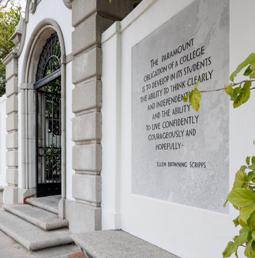
This year marks our centennial —a century since entrepreneur and philanthropist Ellen Browning Scripps established Scripps College to champion women’s education.
We invite you to make a gift in honor of this momentous milestone. No matter the amount, your generosity demonstrates how collective participation redefines what Scripps students can achieve in today’s world.
To give, please visit scrippscollege.edu/spring26 or scan the QR code. Thank you!
PRESIDENT’S VISION
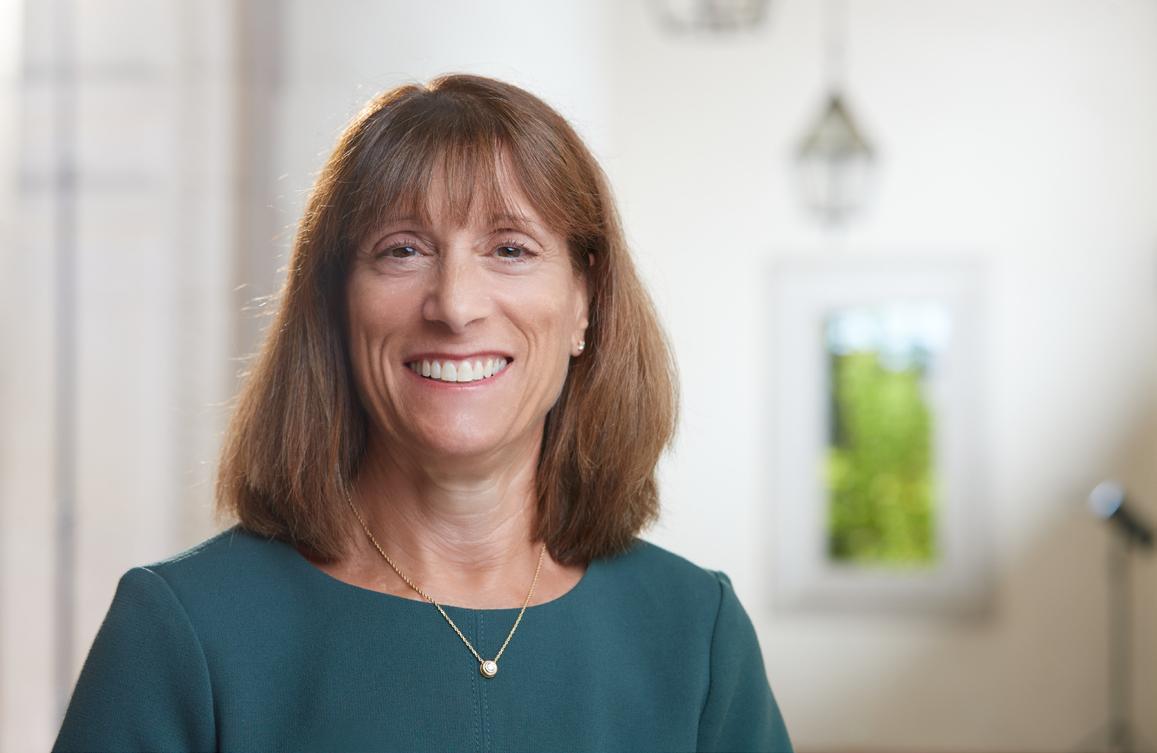
Every year, I look forward to springtime at Scripps. It provides a much-needed awakening, renewal, and the reward of extensive hours of learning, exploration, and collaboration that make our community so exceptional.
This moment also offers a chance to reflect on and celebrate our triumphs—many of which you will read about in this issue.
On May 1, the College launched our Centennial Celebration at Reunion Weekend with a festive block party. While we regret that we were unable to host the Ellen Browning Scripps medal ceremony due to unforeseen circumstances, we look forward rescheduling in the near future.
Our Board of Trustees Chair Laura Hockett ’85 also announced Scripps Forward, the Centennial Campaign.
Like the arrival of each new season, these occasions invite us to pause in gratitude for all that Scripps has achieved in its first 100 years and to anticipate with enthusiasm what it will accomplish in the next century.
Our centennial moment is now. As we move through the 2026-27 year, I urge you to connect with those in the Scripps community who have touched your life and consider how you can advance that impact. I look forward to experiencing this momentous and celebratory milestone in the life of the College with you.
With deep appreciation,

Amy Marcus-Newhall President of Scripps College
SPRING 2026
SCRIPPS MAGAZINE
Scripps is published by the Scripps College Office of Marketing and Communications.
STAFF & CONTRIBUTORS
Binti Harvey Vice President for External Relations and Institutional Advancement
Carolyn Robles Assistant Vice President for Marketing and Communications
Maureen Panos Director for Creative and Editorial Strategy
Emily Peters Senior Communications Manager
Caitlin Antonios Writer/Editor
Christina Kelly Senior Graphic Designer
Kendra Pintor Advancement Writer
David Torralva and Jay Williams
Photography
Beth Fraser Illustration
Elita Kutateli ’26
Contributing Student Writer
Ella Murdock Gardner ’22
Contributing Alum Writer
DISTINC_ Design and Art Direction
Precision Services Group
Printing
Scripps College 1030 Columbia Avenue, P.O. Box 2004 (USPS #486-940) Claremont, CA 91711 © 2026 Scripps College
BRAGGING RIGHTS
Points of pride and reasons to celebrate from around the Scripps community.
FROM THE ARCHIVES
Erin M. Curtis, Gabrielle JungelsWinkler Director of the Ruth Chandler Williamson Gallery, reflects on how Betye Saar and other Black artists have impacted Scripps.
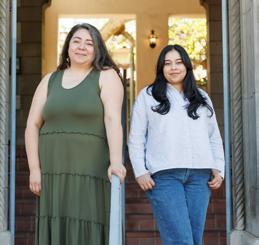
STAFF SPOTLIGHT: SCRIPPS COLLEGE ACADEMY CO-DIRECTORS
Read how Lyanne Dominguez ’13, SCA ’07 and Yamileth Renteria SCA ’12 are leading a new era of the Scripps College Academy, Scripps’ award-winning college access program.
SEEN & HEARD
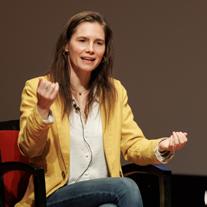
Highlights from author and criminal justice advocate Amanda Knox’s visit to campus.
WHY THE LIBERAL ARTS MATTER NOW MORE THAN EVER
Assistant Professor of History and Africana Studies Westenley Alcenat and Vice President for Academic Affairs and Dean of Faculty Mary Hatcher-Skeers make a powerful case for why the liberal arts remain essential to democracy and human flourishing. 12
ONE YEAR OUT: THE NUCLEUS
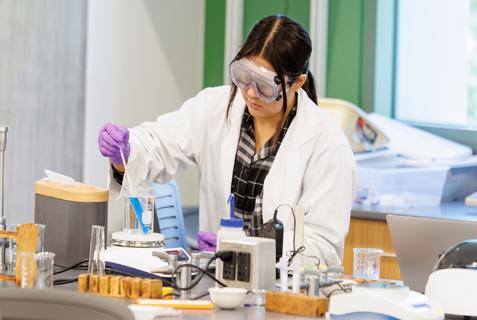
Scripps and Pitzer Colleges’ bold, interdisciplinary science center celebrates one year of innovation, curiosity, and STEM breakthrough. 14
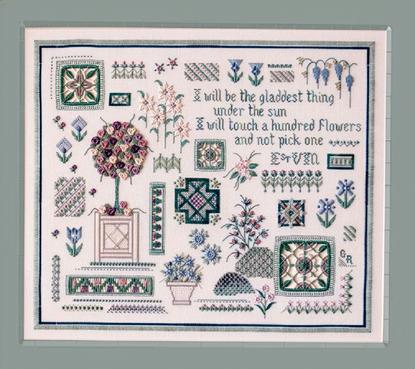
THREADS OF RESISTANCE: GAY ANN ROGERS ’65 NEEDLEWORK COLLECTION
Housed at Denison Library, Gay Ann Rogers ’65’s needlework history collection defies conventional perspectives on the craft and celebrates the legacy of women’s labor.
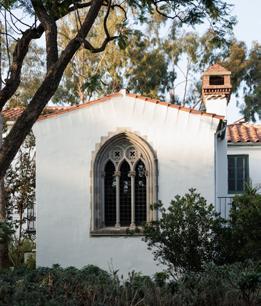
19 A LETTER FROM BOARD OF TRUSTEES CHAIR LAURA HOCKETT ‘85
Laura Hockett ’85 shares how Scripps impacted her and why the Scripps Forward campaign is critical for the College’s future.
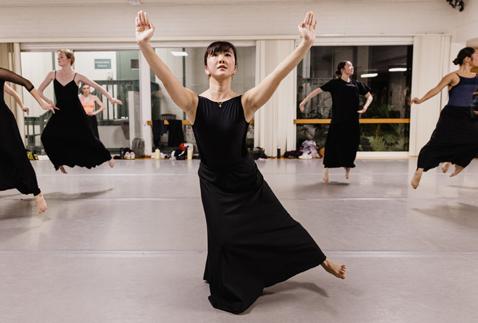
At Scripps, dance is not merely extracurricular expression. Learn how this powerful medium connects students to their bodies, history, and people beyond their lived experiences.
ALUM NEWS
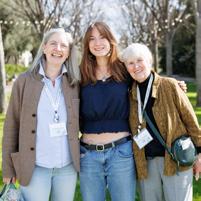

38 PEOPLE POWER: HOW VOLUNTEERS FUEL STUDENTS’ CONFIDENCE AT SCRIPPS
Launching a career can be paralyzing—but with Scripps volunteers in their corner, students are learning to refine their stories and master the art of the interview.
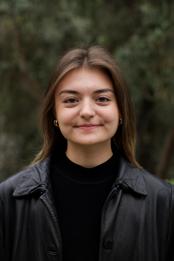
Senior Elita Kutateli ’26 shares how majoring in philosophy has given her the “mental sturdiness” to tackle life’s most complex questions.
Bragging Rights
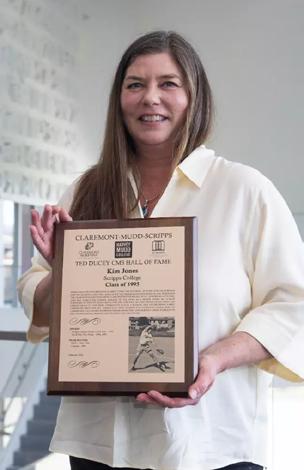
CMS TED DUCEY HALL OF FAME 2026 CLASS INCLUDES KIM JONES ’95
Congratulations to ClaremontMudd-Scripps Athletics Ted Ducey Hall of Fame inductee Kim Jones ’95! A standout pitcher for the Athenas, Jones was a two-time team MVP, earned first-team All-SCIAC honors, and was named Scripps’ Athlete of the Year as a senior. Her 1.97 career ERA still ranks fourth in the program’s history, and her 209 career strikeouts across two seasons rank sixth.
FACULTY NEWS
Scripps faculty continue to receive well-deserved recognition for their achievements in teaching, scholarship, and the arts. Associate Professor of Mathematics Christina Edholm was named the 2026 Etta Zuber Falconer Lecturer for excellence in mathematics and commitment to education, mentorship, and equity. Professor Ken Gonzales-Day,
Fletcher Jones Chair in Art, joined the Mike Kelley Foundation for the Arts board of directors, extending his impact within the broader contemporary arts community. Associate Professor of French and Francophone Studies Annelle Curulla received a Borchard Foundation Scholar-in-Residence award in France for her book project, Theater and Non-Theater in Eighteenth-Century France. Professor of Music Anne Harley, in partnership with Professor of Music Stacey Fraser at California State University, San Bernardino, received funding from the National Endowment for the Arts for a new song cycle to be performed at both institutions in spring 2027.

UPDATES FROM ABROAD
More than 150 Scripps students studied in 38 countries this year, reflecting the breadth of Scripps’ international offerings and students’ wide-ranging academic interests. The most popular destinations were Spain and Denmark, followed by France, England, and Australia. Students also explored a remarkable range of programs, participating in field-based and urban academic experiences.
Editor’s note:
In the fall 2025 issue of Scripps magazine, we incorrectly spelled the name of Elena Goss ’96. We apologize for the error and have updated the issue’s digital edition with the correct spelling.
Image courtesy of CMS Athletics
Isabel Wilder ’27 during her study abroad trip in Egypt
Associate Professor of Mathematics Christina Edholm
SCRIPPS STUDENTS EARN PRESTIGIOUS FELLOWSHIPS
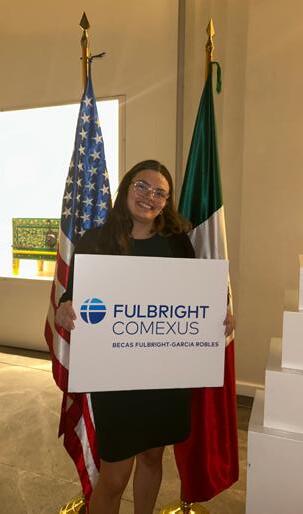
With seven students and alums earning Fulbright awards, Scripps College was once again named a 2025–26 Top Producing Fulbright Institution, extending a remarkable run of more than a decade. Tess Frazer ’26 and Noa Polish ’26 also received Thomas J. Watson fellowships, with Frazer traveling the world to examine horse–human communities and Polish studying under government officials, urban planners, and others to discover how to create imaginative public spaces. Scripps continues to shine in national rankings, placing fourth for Best College Dorms with The Princeton Review, while Research.com ranked Scripps ninth among the best fine arts degree programs in California.
WE ACT GRANT RECIPIENTS
Scripps students are improving communities through the Laspa Center’s We Act Grants.
This year’s recipients received nearly $30,000 to support seven innovative projects, including creating maternal health resources for Afghan refugees; supporting youth leadership through sports; and a summer storage pilot program for international and firstgeneration students. The 2025 recipients are Miriam Akhmetshin ’26, Madyson Chung-Lee ’26, Macy Gilroy ’27, Willow Lehrich ’26, Minna Lopez ’26, Rebecca Yao ’26, Ally Samson ’26, and Maria Duan ’26.
2026 INTERNSHIP CHALLENGE AND DAY OF GIVING
The Scripps community showed its generosity in powerful ways this spring, beginning with the 2026 Internship Challenge during Family Weekend. With support from 91 donors, the challenge raised more than $55,000 and unlocked a $35,000 matching gift from Carmen and Jim Ward to increase internship grants for students. That spirit of collective support continued during Scripps’ annual Day of Giving this March, exceeding the donor goal of 550 and raising over $190,000 for Scripps’ people, programs, and opportunities. Thank you!
LEARN MORE ABOUT SCRIPPS’ IMPACT
Scripps’ 2024–25 Annual Report has been released! Discover highlights of student research, awards, faculty grants, graduate outcomes, and more. Visit annualreport.scrippscollege.edu or scan the QR code.
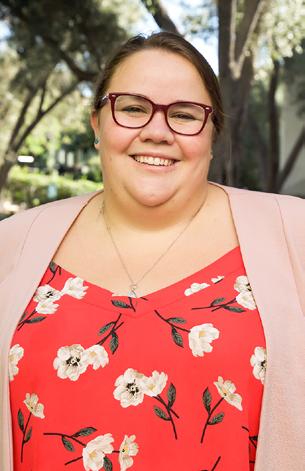
Madyson Chung-Lee ’26
Alondria Cobian ’25, Fulbright recipient in Mexico
Macy Gilroy ’27 (right)
From the Archives
By Erin M. Curtis, Director of the Ruth Chandler Williamson Gallery
FOUR ELEMENTS, ONE STORY
As Scripps College enters its second century in 2026, it will be joined by one of Los Angeles’s most influential artists. Betye Saar—mother of Scripps alum and artist Alison Saar ’78—will turn one hundred this July, a milestone that invites reflection on her life, visionary practice, and connection to Scripps.
Born in Los Angeles and raised in Pasadena, Saar studied design at the University of California, Los Angeles. She graduated in 1949 and quickly founded an enamel business with jewelry designer Curtis Tann, which was featured in Ebony, the iconic magazine dedicated to Black culture, in 1951. Graduate school printmaking classes shifted her career, and she began to create prints evincing an interest in mysticism.
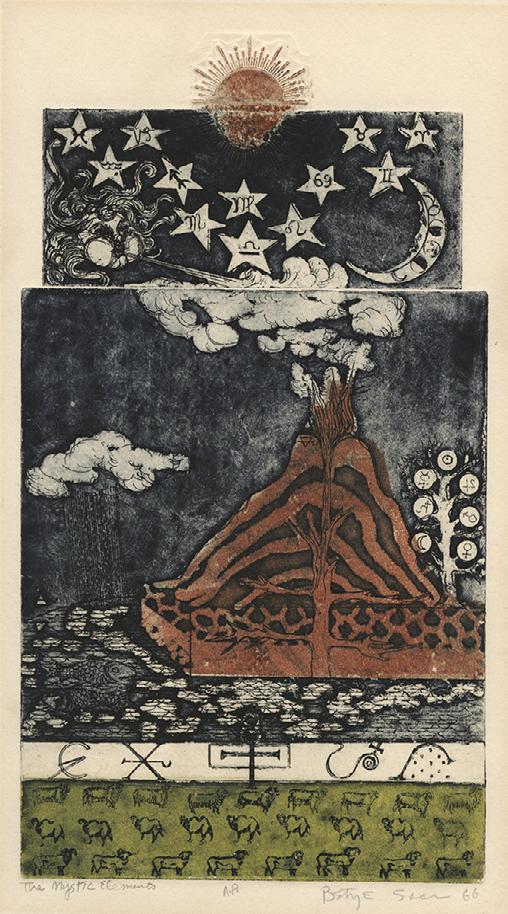
Scripps is fortunate to hold some of Saar’s works at the Ruth Chandler Williamson Gallery. The Mystic Elements (1966) demonstrates her fascination with sacred iconography, showcasing astrological symbols and representations of earth, air, fire, and water. The dense layering of images and complex construction became hallmarks of her later work.
Saar began combining her prints with found objects. Alongside LA-based Black artists like John
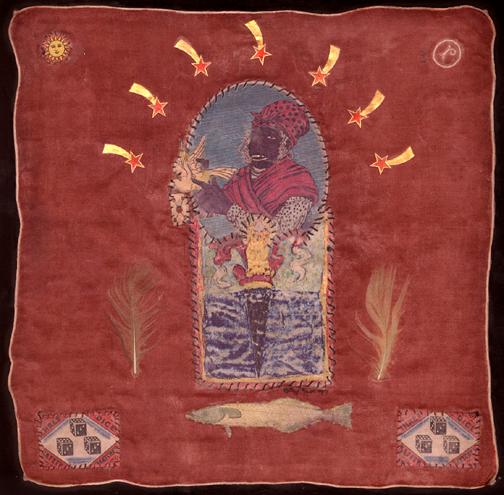
Outterbridge and Noah Purifoy, Saar shaped the dynamic medium of assemblage, which combines three-dimensional elements (often found objects). In the assemblage work Hoo Doo Lady with Three Dice (1977), Saar reclaims a racist caricature of Black women by surrounding it with a constellation of symbols, transforming derision into exaltation.
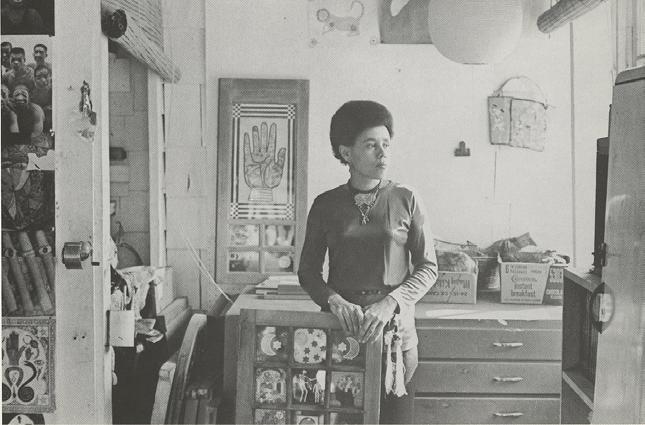
In 1970, artist, scholar, and Scripps’ first tenured Black professor Samella Lewis curated the exhibition 5: Benny, Bernie, Betye, Noah & John at the College, featuring works by Saar alongside Outterbridge and Purifoy as well as artists Benny Andrews and Bernie Casey. In the show’s pamphlet, Saar is pictured in her Laurel Canyon studio, holding her famous work Black Girl’s Window (1969) with a provocative caption: “The window is a symbolic structure
which allows the viewer to look into it to gain insight and to traverse the threshold of the mystic world.”
Eight years later, Alison Saar ’78 graduated from Scripps with a degree in art history, studying Black visual traditions under Lewis that inspired her own artistic career. Today, the College’s collection includes works by Samella Lewis, Betye Saar, and Alison Saar, most recently appearing in Gettin’ It Done, a 2023 exhibition of works by eight Black women that the Gallery’s former collections manager and registrar Kirk Delman organized to honor Lewis’s life and legacy. Betye attended the exhibition and saw The Mystic Elements on display—a poignant convergence of histories as inextricable as the four elements: Betye, Alison, Samella, and Scripps.
Betye Saar in her Laurel Canyon studio, 1970. Photograph by Bob Nakamura, Ruth Chandler Williamson Gallery, Scripps College.

Pamphlet for the exhibition 5:Benny,Bernie, Betye,Noah&John, organized by Samella Lewis for the Lang Art Gallery, 1970. Ruth Chandler Williamson Gallery, Scripps College.
Betye Saar, TheMysticElements, 1966. Intaglio print on paper. Scripps College, Samella Lewis Contemporary Art Collection. Gift of Abbiegail Weiser ’51, 84.5.2.
Betye Saar, HooDooLadywithThreeDice, 1977. Mixed media. Scripps College, Samella Lewis Contemporary Art Collection. Gift of Suzanne Muchnic ’62, 2019.16.1.
By Ella Murdock Gardner ’22
Meet the Scripps College Academy Program Leads
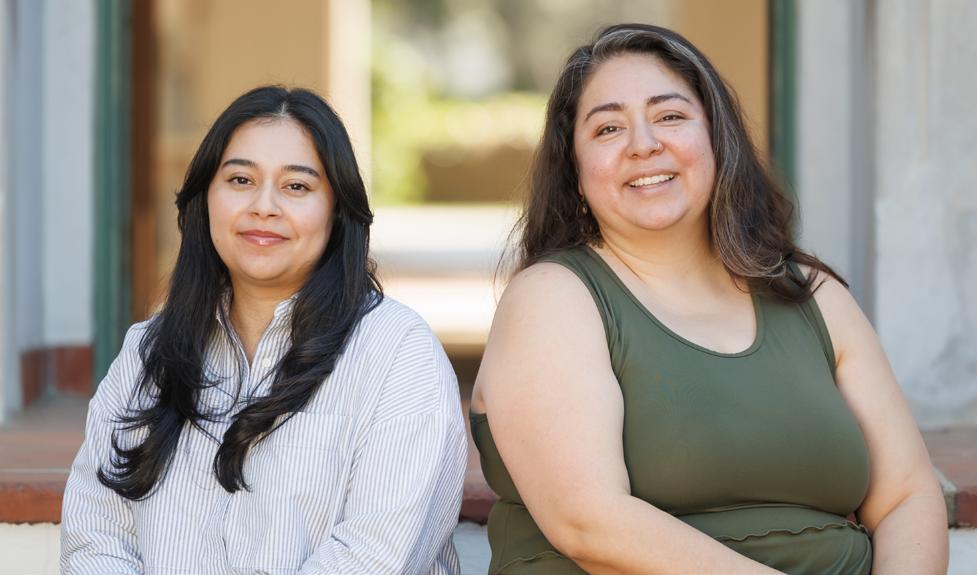
Yamileth Renteria SCA ’12 and Lyanne Dominguez ’13, SCA ’07
When Lyanne Dominguez ’13 was in high school and starting to think seriously about college, her parents fell victim to a scam.
Their daughter would be the first in their family to pursue higher education in the United States, and they wanted to do everything they could to support her. A business reached out promising college and career counseling—and while they put down a deposit, nothing ever came of it.
Determined to move forward, Dominguez enrolled in Scripps College Academy. The program not only freely delivered the guidance the scammers had offered, it also changed her life.
Scripps College Academy (SCA), a multiyear college access and success program, has been serving high schoolers in the Inland Empire and greater Los Angeles area since 2002. Its scholars spend two weeks on Scripps’ campus during the summer before 11th grade and continue to build skills during Saturday workshops until graduation. SCA continues to have a significant and measurable impact—last year, all of the students that responded to a survey sent by the College indicated they were headed to a college or university after graduation.
Today, the program is led by two of its former scholars: Dominguez SCA ’07, associate director of admission at Scripps, and Yamileth Renteria SCA ’12, SCA program coordinator. When we spoke in February, Renteria was busy visiting high school classrooms to
present about SCA. Dominguez herself grew up a mile away from The Claremont Colleges but had never heard of them until she attended a SCA info session.
SCA mirrors Scripps’ Core curriculum: faculty deliver lectures across a range of disciplines in week one and scholars present an independent project in week two. Dominguez recalls being nervous to present but was inspired by peers who quickly became friends and intellectual resources.
“I was constantly getting my mind blown during class. Having people I could talk through those ideas with? I didn’t want to leave that,” she says.
When Dominguez got home that summer, she hopped on her bike and rode right back to campus to hang out with the student workers as they packed up. She enrolled at Scripps two years later, joined its staff after graduation, and has remained engaged in the Scripps community ever since.
For Renteria, who grew up in Northeast Los Angeles, returning to Scripps last December was a homecoming. In her memory, everything about her 2012 SCA summer session shone: the California sun glinting on the lawns; the campus pool and gym; afternoons with friends in the computer lab.
“Scripps felt so grand to me, which is funny because it's such a small college,” Renteria says. “I had never seen any part of the world besides my neighborhood, and I was like, ‘this exists?’”
She later attended Brown University, where she discovered her true passion for education. “A mentor eventually sat me down and asked, ‘what really interests you?’” she says. “I said, ‘I just want to work in something that feels like SCA.’”
SCA serves high-achieving students who aim to be the first in their families to attend college, qualify for free or reduced-priced lunch, or attend Title I schools—though most meet all three criteria. The program is Scripps’ answer to a perennial challenge: to remove barriers to college for ambitious high schoolers. That mission has only become more urgent amid politicized efforts to kneecap programs that address disparities in access and opportunity.
When Renteria and Dominguez talk to students today, they recognize the same drive and anxieties about getting into college. What’s different now, they say, is the level of fear. SCA has long supported scholars from mixed-status families or who are undocumented themselves, but more students are questioning whether college will lead to the futures they imagine. “It's underlying every conversation,” Renteria says.
Fortunately, because of their backgrounds, Renteria and Dominguez are uniquely positioned to broach these sensitive topics.
“It’s a huge deal that SCA is now run by all Spanish-speaking women from immigrant families,” Dominguez says. “The fact that this new generation is being guided by those who have lived their experiences is the best thing for the scholars. There is such a connection between who we are and the community that we serve.”
As Renteria looks toward this year’s summer session and beyond, she hopes to find ways to keep joy at the center of the learning experience.
“The world puts girls and women down so much,” she says. “Doing an all-girls program, you learn a ton about yourself, your identity, and your community. I want students to take that feeling of empowerment into the world with the knowledge that they can find—and create—spaces like this.”
Yamileth Renteria SCA ’12 and Lyanne Dominguez ’13, SCA ’07
SEEN & HEARD
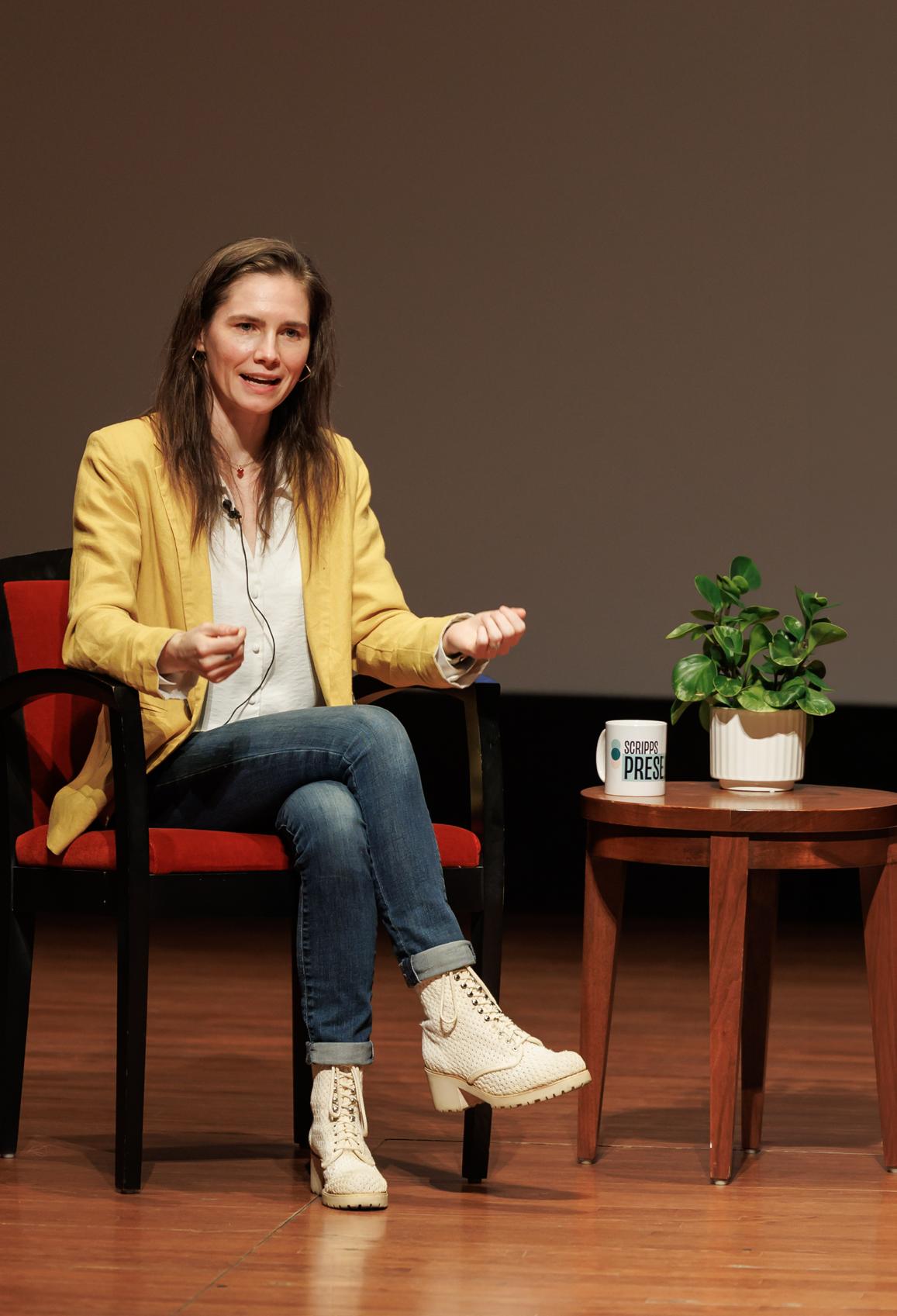
This March, author and criminal justice advocate Amanda Knox joined the Scripps community for a special Scripps Presents event in Garrison Theater.
In a discussion moderated by Director of the Laspa Center for Leadership Gretchen Maldonado, Knox recounted her experience of incarceration, the impact of media narratives, and how her ultimate acquittal reshaped her sense of identity and purpose.
“What I want people to take from my story is the idea that no matter how hard it gets, no matter how much you feel things are not fully in your control… there is always a path forward,” Knox said.
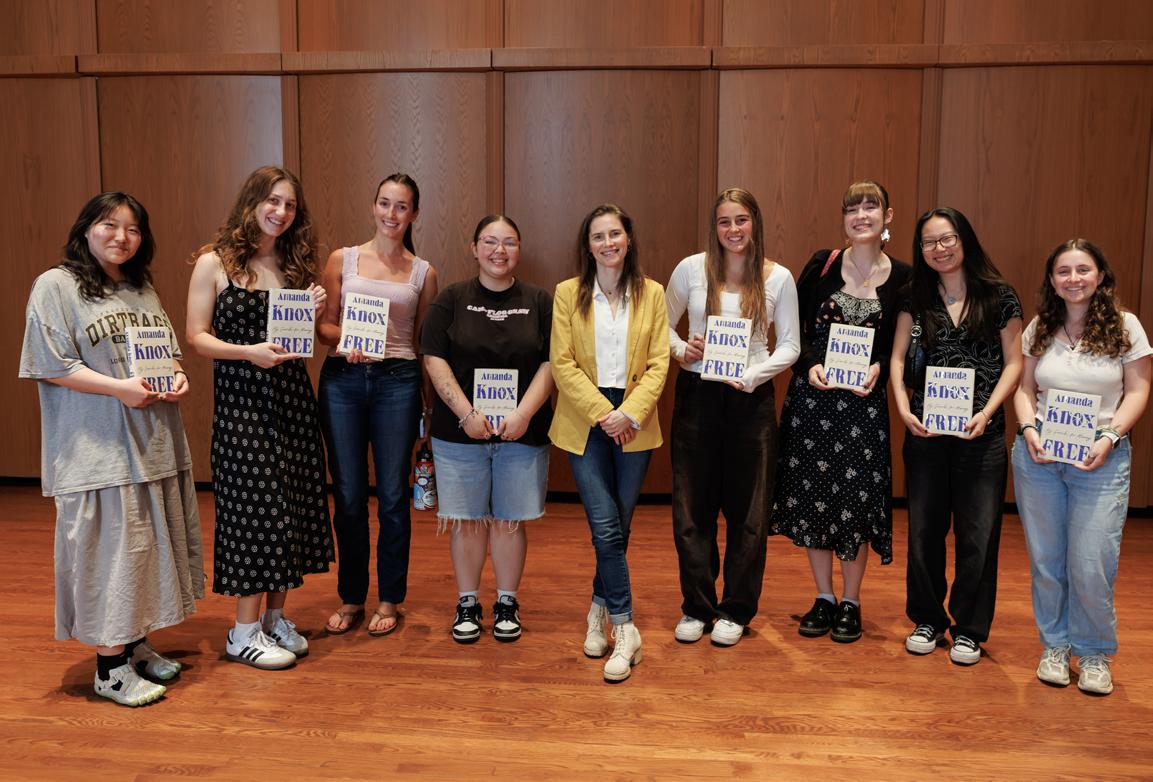
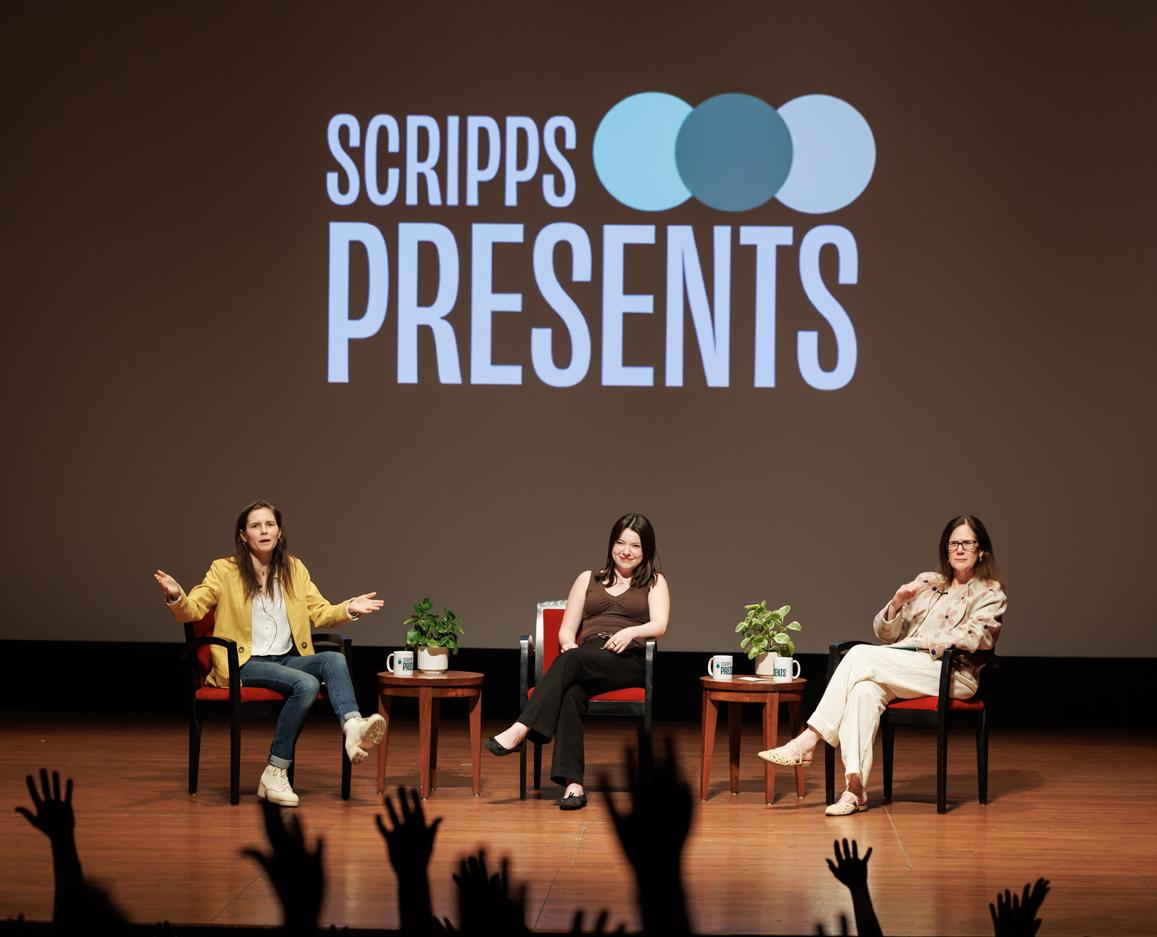
Scripps students and Amanda Knox (center)
Why the Liberal Arts Matter Now More Than Ever
By Assistant Professor of History and Africana Studies Westenley Alcenat and Vice President for Academic Affairs and Dean of Faculty
Professor Mary Hatcher-Skeers
Atroubling narrative is haunting American higher education—the specter of irrelevance.
Traditional liberal arts colleges are increasingly portrayed as quaint relics unable to justify their existence, yet beneath this utilitarian reckoning lies a profound misunderstanding: The liberal arts were never solely about vocational training. Their true mission has always been to nurture human capacities
essential for democratic life, critical thought, and enduring innovation. In a world reshaped by algorithms and polarization, the liberal arts are not antiquated luxuries—they are necessities.
Central to the skepticism directed at liberal arts education is the persistent economic anxiety stemming from the aftermath of the 2008 recession. Data from
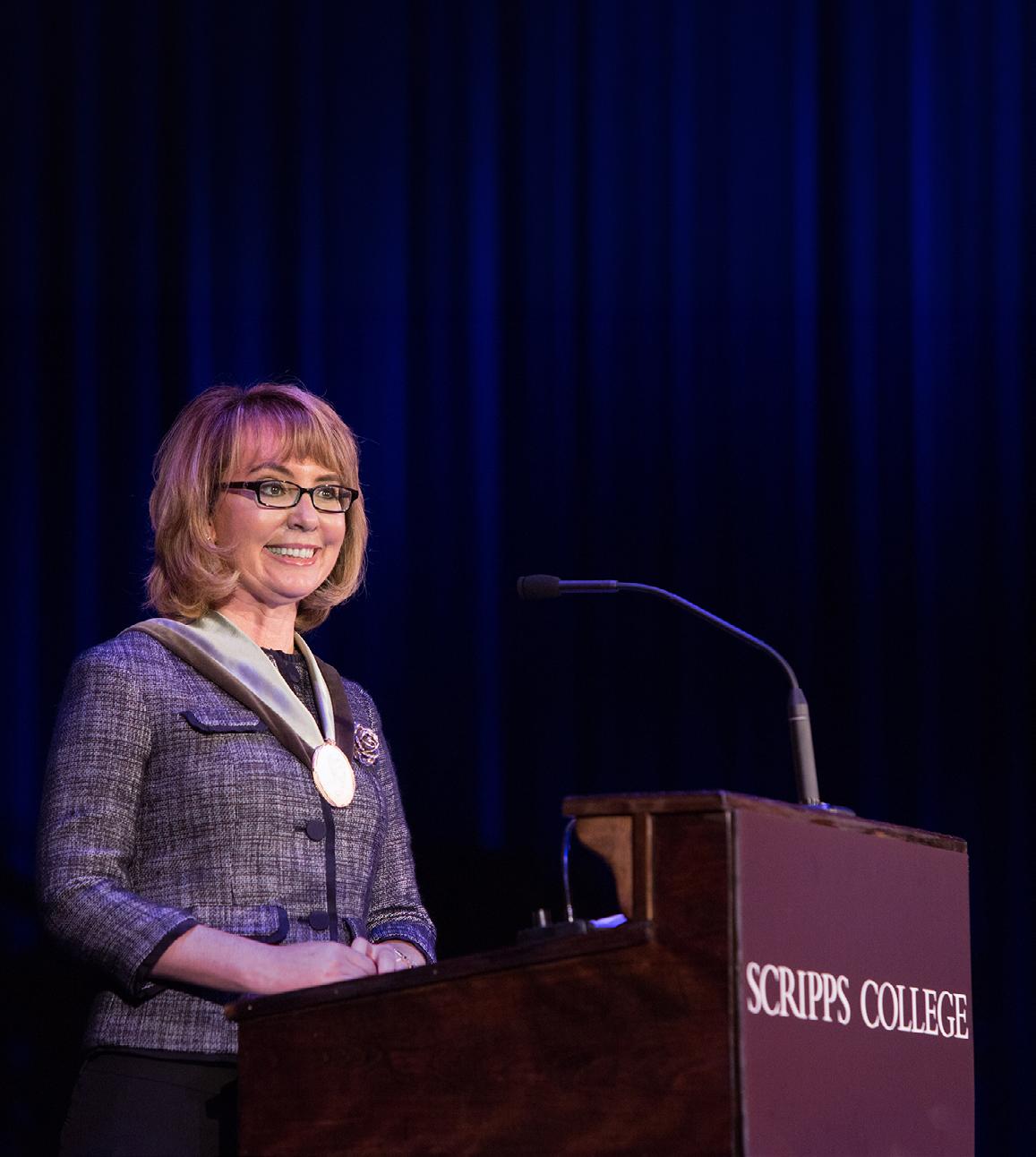
EBS Medal Recipient Gabby Giffords ’93
the Federal Reserve underscores a stark reality: since 1989, wealth among college graduates has surged by 83 percent, while non-graduates have remained economically stagnant. This division may foster the perception that only specialized technical degrees offer financial security. Yet, longitudinal studies challenge this view, revealing that liberal arts graduates often surpass their pre-professional peers in long-term career success. Research has found that about 30 percent of S&P 500 CEOs possess liberal arts backgrounds, defying assumptions about the supposed economic impracticality of humanities and social science degrees.
Why this paradoxical advantage? It arises precisely because the liberal arts cultivate resilience, adaptability, critical thinking, and ethical discernment— attributes which appreciate over a lifetime and automation cannot replicate.
The democratic foundations of American society were explicitly built upon liberal education. From its earliest days, American higher education emphasized the trivium— grammar, logic, rhetoric—and the quadrivium—arithmetic, geometry, music, astronomy—to prepare individuals not merely for employment, but for self-governance.
As Saint Augustine and Renaissance humanists argued, education equips citizens for civic engagement and moral discernment—essential attributes for sustaining a democratic polity. Shakespeare’s Henry VI dramatically illustrates this, demonstrating authoritarian regimes' fear of educated citizens capable of questioning power. Today, similar anxieties underlie political efforts to interfere with college humanities programs and to cut funding to the National Endowment for the Arts and National Endowment for the Humanities—revealing a deeper unease about intellectual independence and critical inquiry.
This fear of liberal education coincides with our current technological age. Artificial intelligence, epitomized by platforms like ChatGPT and Midjourney, seemingly threatens to automate creativity itself. Paradoxically, this technological revolution amplifies rather than diminishes the value of the liberal arts. AI excels at processing data but fails to grasp ambiguity, ethical complexity, and human emotion. It can analyze ethical frameworks but cannot feel moral responsibility; it can replicate poetic structures but not the heartbreak behind them. In
an era dominated by algorithms, the uniquely human abilities cultivated by liberal education—empathy, moral judgment, creative thinking—become indispensable. Indeed, our future demands not fewer philosophers and historians, but more citizens adept at interpreting meaning, confronting ethical dilemmas, and creatively synthesizing diverse perspectives.
Consider American leaders across a range of fields who emerged predominantly from liberal arts backgrounds, like Anthony Fauci, a classics major who led us through the COVID-19 crisis; or Supreme Court Associate Justice Ketanji Brown Jackson, a government major; or Scripps’ own Gabby Giffords ’93, a former congresswoman and current gun violence prevention activist who majored in Latin American history and sociology. These examples illustrate a broader truth underscored by José Antonio Bowen and C. Edward Watson in Teaching with AI: liberal education fosters adaptability and intellectual agility essential during times of unpredictable change. Rather than becoming obsolete, liberal arts graduates have consistently demonstrated their resilience, thriving precisely because their education emphasized critical thinking, communication, and ethical reasoning.
Finally, we must confront the erosion of liberal education. Today’s resurgence of authoritarian populism—marked by book bans, misinformation, and cultural polarization— thrives in environments lacking critical inquiry and ethical discernment. Without robust liberal arts curricula, societies risk intellectual stagnation and susceptibility to manipulation. The liberal arts stand not merely as academic disciplines, but also as bulwarks against illiberalism, essential for creating informed citizens who engage meaningfully in democratic life.
Abandoning the liberal arts does not secure economic dominance; rather, it imperils our collective capacity for innovation, adaptability, and critical thought. Conversely, embracing and revitalizing liberal education positions society not merely to navigate technological upheavals but to flourish through them. By preserving the liberal arts tradition, we affirm the enduring power of human ingenuity, integrity, and democratic citizenship—the very foundations necessary for a vibrant, thoughtful, and resilient society.
The liberal arts are not remnants of a bygone era. Simply put, we need the liberal arts—now more than ever.
One Year Out:
How The Nucleus is Ushering in a New Era of STEM Discovery at Scripps
By Kendra Pintor
When Scripps and Pitzer Colleges first envisioned The Nucleus—a bold, interdisciplinary hub designed to catapult STEM education into the future—the dream felt as ambitious as it was inspiring. Today, thanks to the generosity and shared vision of our donor community, that dream is here, transforming the lives of students and faculty every single day.
Opening just over a year ago, The Nucleus is a 65,000-square-foot, state-of-the-art science center featuring innovative laboratories, classrooms, community spaces, and light-filled courtyards that have quickly become a hotspot for discovery. Serving as home for the Department of Natural Sciences (formerly known as the WM Keck Science Department), this multimillion-dollar investment is already elevating the sciences in ways that ripple far beyond Scripps’ walls.
Where Innovation Meets Opportunity
Despite persistent gender disparities in STEM—the Women in STEM Network reported that women made up just 30 percent of the North American STEM workforce in 2025— Scripps College continues to defy national trends. Over the past five years, 40 percent of students have selected STEM majors. Scripps graduates also persist in STEM careers, with nearly 84 percent of alums remaining in the
field compared to half of US women employees who leave STEM jobs within 12 years.
Scripps is uniquely positioned to help close these gaps at The Nucleus. By expanding faculty, increasing access to cutting-edge research, investing in computational science, and offering interdisciplinary labs where students gain realworld skills, Scripps is helping women thrive in STEM.
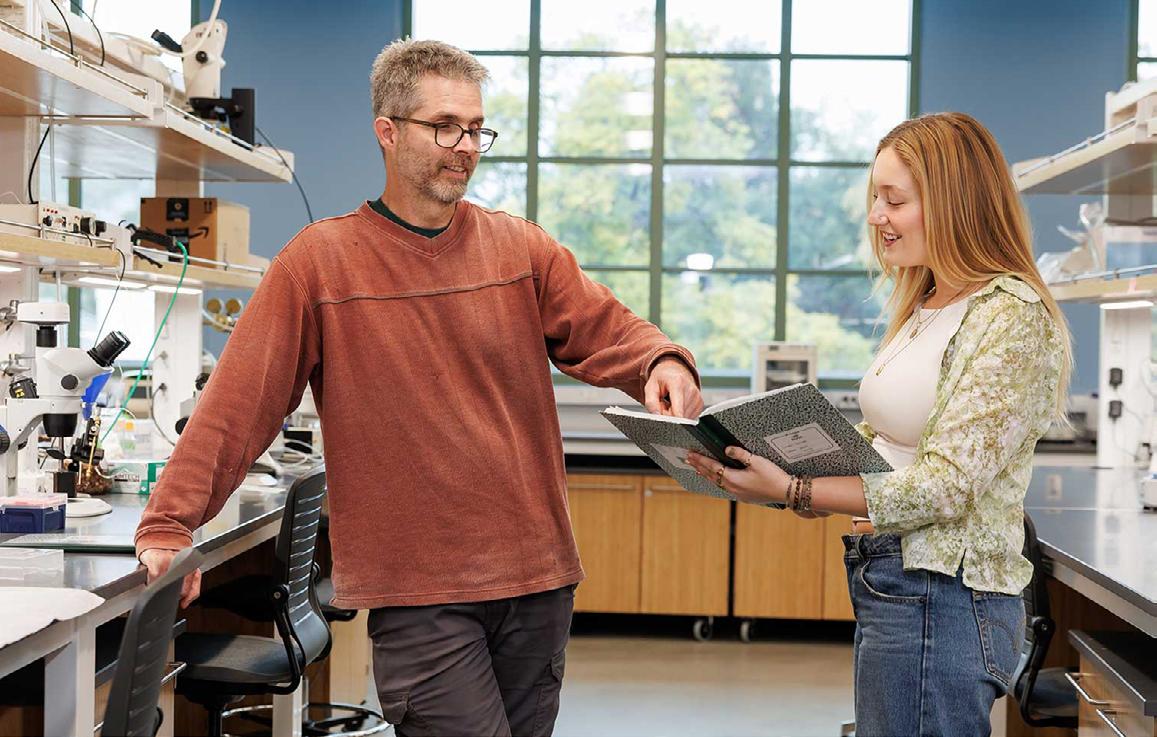
“The building is amazingly helpful in allowing students to engage in research,” says Professor of Biology Patrick Ferree, whose new lab sits in The Nucleus. Last year, Ferree led a team of students to a groundbreaking discovery on a paternal sex ratio (PSB) chromosome that can “kill” other genetic elements—findings they successfully published. “It’s one of most meaningful publications I’ve had as a professor here because it was done entirely by students in our department and without collaborators at other big institutions,” Ferree adds.
Ferree is not alone. Other faculty at The Nucleus have won major competitive grants this year from the National Science Foundation and the National Institutes of Health. With a 60 percent increase in teaching space, the Department of Natural Sciences has also expanded courses, offering dedicated labs for environmental
Professor of Biology Patrick Ferree and Emma Garman ’26
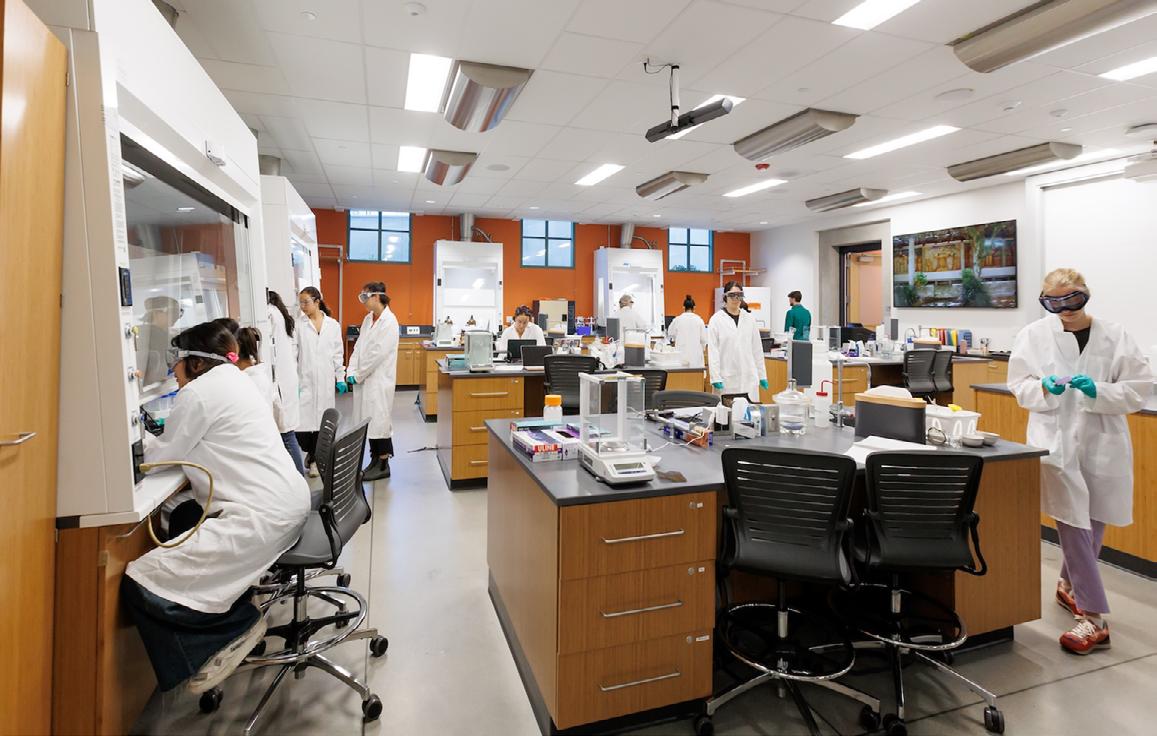
science, neuroscience, advanced physics, and a range of interdisciplinary courses for the first time.
These enhancements bring STEM and the humanities into meaningful conversation—an approach that defines the Scripps experience.
“I'm deeply grateful for the opportunity to conduct research within the Department of Natural Sciences,” says Audrey Granger ’28, a biochemistry major. “It’s always been my dream to work alongside such brilliant and passionate individuals. I am excited to contribute research with the potential to make a real impact in the world and build skills that will shape my future career.”
A Powerful Boost for STEM
This momentum now extends even further thanks to a remarkable $2 million gift from Trustee Sara Zion and Tushar Shah P’26. Inspired by their daughter’s transformative journey at Scripps, they established an endowed professorship in computational science—a field that touches everything from environmental modeling to medical decision-making.
The Nucleus has also deepened partnerships between Scripps and Pitzer Colleges through shared classes,
collaborative research, and new cross-college learning communities. It provides the infrastructure needed to meet rising enrollment in STEM programs while reinforcing both institutions’ reputations as leaders in innovative science education.
This extraordinary progress would not exist without the generosity of donors who believed in the promise of The Nucleus long before its walls were built. Gifts from Trustee Jennifer McDonnell P’18; the John Stauffer Charitable Trust; the Carolyn Lake Claremont Foundation; and several anonymous donors provided the fuel that brought the project to life.
“It’s deeply energizing to walk through the building and see students and faculty working side by side,” says Vice President for Academic Affairs and Dean of Faculty Mary Hatcher-Skeers. “At The Nucleus, they test ideas, ask bold questions, and learn from one another in ways that simply weren’t possible before.”
Additional philanthropic support will ensure that The Nucleus evolves new technologies, classes, and research opportunities so Scripps students and faculty can lead lives of scientific distinction, creativity, and purpose. The center’s first year is just the beginning of what we can achieve together—and of the discoveries to come.
Threads of Resistance
The
Gay Ann Rogers ’65 Needlework History
Collection Reveals Women’s History
By Kendra Pintor

When Gay Ann Rogers graduated from Scripps in 1965, she believed she had failed at what she had been told was her most important task: to find a husband. “Enormous failure indeed,” Rogers recalls with characteristic humor. Her mother instructed her to return home to remedy that.
Rogers said no.
Instead, she continued her education at Claremont Graduate School and began teaching high school English. Two years later—on her own terms—she married Jim Rogers, a history professor at Claremont McKenna College. Their partnership, she says, profoundly shaped her worldview and a decades-long career as a needlework designer, educator, and collector.
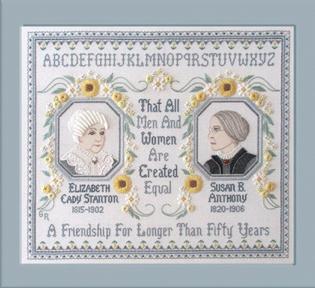
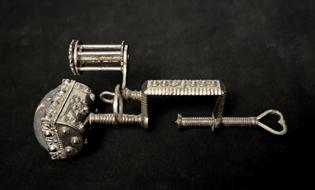
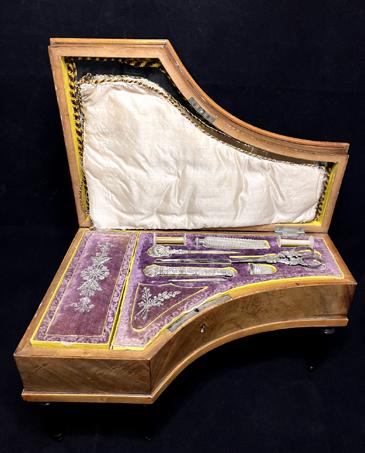
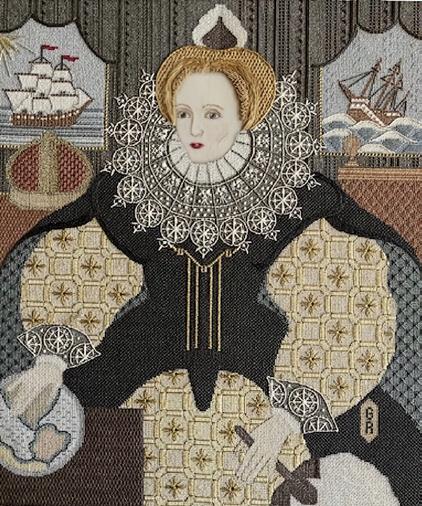
For the last eight years, Rogers has been donating her expansive collection to the Ella Strong Denison Library at Scripps. The Gay Ann Rogers ’65 Needlework History Collection brings together historic tools, textiles, lace, and needlework that illuminate women’s lives and labor across centuries. The collection reveals needlework not only as a craft and art form, but also as a tool of economic viability.
“The intellectual value of the Rogers Collection reveals how the legacy, culture, and economic realities of women's needlework are interwoven across centuries and sociopolitical boundaries,” says Jennifer Martinez Wormser ’95, director and Sally Preston Swan Librarian for the Ella Strong Denison Library. “It’s the perfect match for the opportunities we provide at Scripps College.”
Rogers began collecting early in life, encouraged by family members who valued making and preserving objects related to stitching. She accelerated collecting as an adult, often in response to students seeking to understand the traditions behind the technique.
“Literature has played a huge part in the way I have approached needlework,” Rogers says. “It’s always been about narrative for me.”
Grace Valashinas ’26, a foreign languages major concentrating in Spanish and French, has partnered with Denison to archive the collection and preserve its story online.
“What stood out to me most was the history behind each item,” Valashinas says. “Every tool represents something that millions of people around the world have daily used to
“You cannot separate women and their labor from the practice of needlework.”
generate income for their families, brighten their homes, or mend clothes.”
That perspective reframes needlework as more than a hobby. “Needlework is a crucial means of survival,” says Valashinas, who is researching Native American embroidery. “It’s so important to recognize the ways women, Indigenous people, and many others use these skills to tell their stories, continue centurieslong traditions, and bring people together. You cannot separate women and their labor from the practice of needlework.”
Rogers herself has encountered resistance to needlework’s role in women’s liberation. At a local feminist meeting that she attended with fellow consortium faculty wives, Rogers introduced herself as a needlework artist—and was promptly asked to leave. Later, she found affirmation through the Needlework Guild, whose members embraced the practice as meaningful, self-directed labor.
“It’s important to us, and we don’t care what anyone thinks of it,” Rogers reflects. “Anonymous women’s expression matters.”
In 2023, Denison featured selections from the collection in the exhibition Through the Eye of a Needle, curated by Sage Wong-Davies ’25, with plans for future shows. As the collection grows at Scripps, it continues to offer rare material evidence of women’s creativity, industry, and intellectual life.
Rogers notes that the collection achieves a different “important task” for Scripps—inviting new generations to engage with near-forgotten histories.
“I want to share my little world.”
Want to know more about Rogers and the collection? Read the full story by scanning the QR code.
Letter From Board of Trustees Chair Laura Hockett ’85
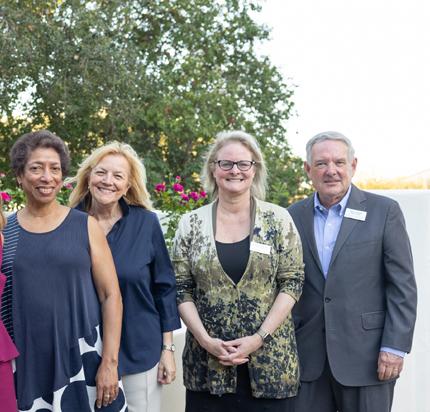
There’s magic in the word “era.” It suggests more than a stretch of time—it’s a season of becoming. When I arrived at Scripps in 1981, I was in my KROQ-music 80s era (if you know, you know) which can be described as seeking the new, alternative, and innovative. I met extraordinary women my first year, many who remain great friends. I was mentored by exceptional faculty and was afforded the amazing opportunity to spend a semester in Paris, which at that time was often difficult for STEM majors. Four years later, I graduated as a woman imbued with the courage to readily adapt to changing environments and the confidence to repeatedly take on new challenges, strengths that continue to drive me today.
Scripps’ incomparable blend of people, place, and opportunity is why I serve as chair of the Board of Trustees. The Board helps preserve what makes this institution incredible, collects insights on how it can continually improve, and readies Scripps College for the future. But we cannot do it alone.
I was honored to publicly announce Scripps Forward: The Centennial Campaign for Scripps College this past May. It is an ambitious effort to raise $100 million to secure a future of infinite possibility for the next century of women leaders.
Why do this now? Because the world our students are entering demands it. They are brilliant, fearless, and eager to bring about positive change in spaces that hold challenges at every turn. Scripps must be ready to provide every advantage to help them realize a better world.
Scripps Forward is built on three campaign pillars. These areas signify our greatest opportunities for collective impact:
• Expanding access by removing financial barriers to a Scripps education and ensuring students thrive throughout and beyond their college experience.
• Advancing innovation in faculty scholarship, undergraduate research, and academic and career pathways to prepare students to lead in a world that doesn’t yet exist.
• Strengthening community as we enhance our vibrant campus and cultivate visionary leadership to keep belonging, wellbeing, and shared purpose at the heart of Scripps.
This campaign is about engineering a future and culture we can be proud of. One where economic circumstance never limits intellectual promise; where flexible thinkers define, not follow, tomorrow’s innovations; and where investing in our peers is as powerful as investing in ourselves. It is about championing Scripps students today, the next century, and beyond.
Scripps College is my top philanthropic priority because I know that it makes a real difference: Every dollar is well spent and moves the mission forward. Please join me in supporting Scripps during this era like no other. Together, we will make Scripps’ next century even more transformational than its first.
With warmest gratitude,

Laura Hockett ’85 Chair of the Board of Trustees, Scripps College
The Scripps Forward Campaign Explained: What It Is and How to Help
Raising $100 million for the next 100 years of impact
START HERE
So, what exactly is a campaign?
A campaign is not a typical fundraising event. It’s a widescale, future-focused effort to accelerate the College’s priorities from goals to reality.
ACCESS
Exceptional students belong at Scripps, period. Finances shouldn’t be a barrier.
By increasing scholarships and reducing loans, we’ll enrich the campus experience, enhance our alum community, and broaden social impact. What will
Scripps Forward achieve?
The campaign centers on three pillars.
Why is Scripps launching a campaign now?
Global challenges have never been greater. Rather than abandon the liberal arts like some institutions have, Scripps must continue to rise as a portal to progress for a world hungry for our graduates’ wisdom, curiosity, and humanitarian values.
Why should I give?
We’ve all received help from someone. Every gift, act of service, or conversation about the campaign helps students you may never meet, but whose lives you’ll influence for the better.
INNOVATION
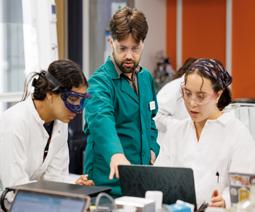
Innovation is essential to prepare graduates for success in a world that’s still being invented. Fueling new student and faculty research means defining, not following, the future.
Do campaigns really work?
Yes! Past campaigns have helped us achieve major milestones, including raising millions in new scholarships; founding Tiernan Field House, our wellness hub; creating our first sustainable, LEED gold-certified residence hall; endowing scores of new faculty positions; and much more.

How can I get involved?
This is our moment:
a once-in-a-century opportunity to preserve Scripps as the place where infinite possibility is fully realized.
We invite you to:
• make a gift at scrippscollege.edu/spring26
• use your voice by becoming a campaign advocate scrippscollege.edu/scrippsforward
• enjoy your Scripps community—stay engaged with upcoming events at scrippscollege.edu/events/calendar
COMMUNITY
Humans need intellectual and relational depth to be fully alive. Scripps Forward prioritizes new spaces and programming so our entire community can create a more just, vibrant, and inclusive world, together.

Scripps isn’t Scripps without you. Thank you!
Scripps staff and faculty break ground on the new Carolyn Lake Dance Center
Tiernan Field House
More Than Movement
Dance as Inquiry, Activism, and Memory
By Caitlin Antonios
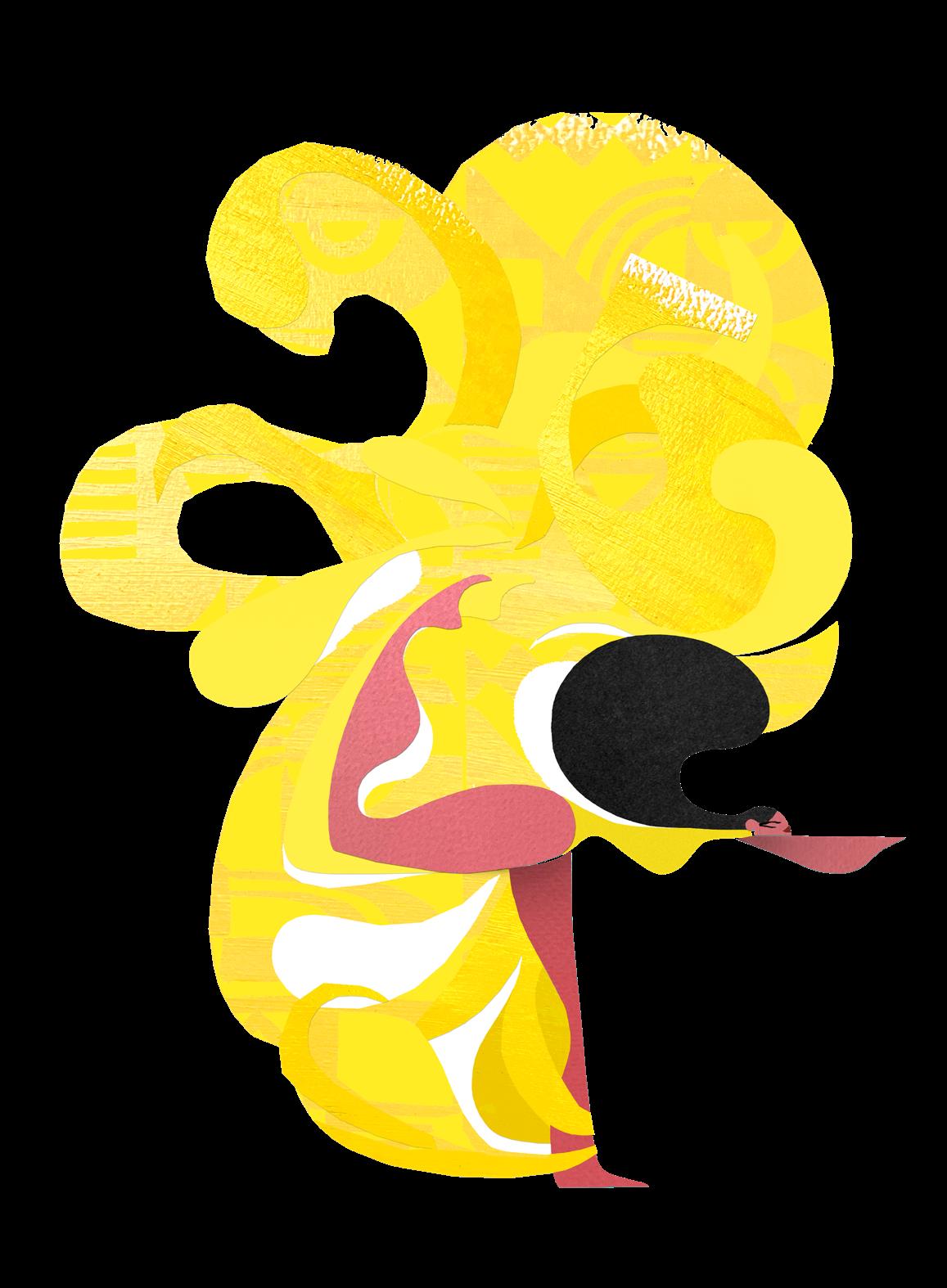
Illustration by Beth Fraser
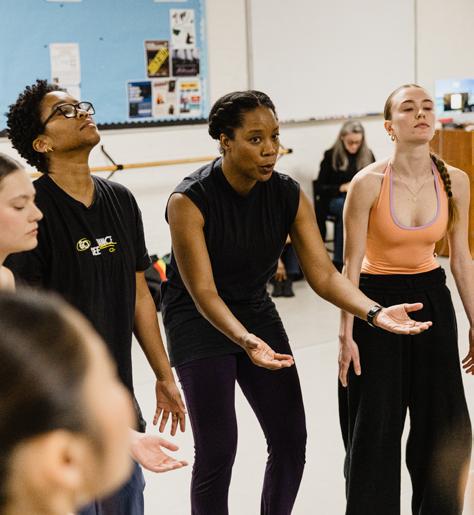
On a late Friday night in Scripps’ Richardson Dance Studio, 15 dancers stand barefoot in a circle. They breathe loud and heavy as they stretch, preparing their bodies for the next 20 unrelenting minutes of rehearsal for Scripps Dances, the crown jewel of the College’s dance program. Just beyond the circle, Assistant Professor of Dance Abdiel Jacobsen pounds on a djembe, a West African rope-tuned goblet drum, and clashes a small cymbal in rhythmic counts.
How does a dance performance like this come together? In part, it is the culmination of experienced eyes zeroing in on the need to gently extend a dancer’s fingertips or push a student’s chin a fraction of an inch higher during rehearsals. It is students finding mental focus amid the chaos of their academic and personal lives. It is the intentional connection of movements rooted in human sight, sound, and emotion.
On this campus, dance is not merely extracurricular expression. It is a method of inquiry that unites intellect and body—a core ideal of the liberal arts. Its place at Scripps gives students the tools to connect to their bodies; construct a window into history; and bond with peers and people beyond their lived experiences.
Do You Feel That Buzz?
It’s one of the many prompts that educator, actor, and former Martha Graham Dance Company dancer Nya Bowman throws at the students while they stretch. She is getting them in tune with their muscles and breath, generating the energy they’ll need to unleash their movements.
“That is what you have to hold on to,” Bowman says. “You imagine the buzz; the audience sees it.”
This spring, students from across the 5Cs auditioned to be part of Scripps Dances, the College’s annual dance repertory concert. Including original choreographed works from students and faculty, Scripps Dances showcased “Steps in the Street” and “Prelude to Action”—two pieces from the Martha Graham Dance Company, the oldest professional school of dance in the United States.
Both Scripps and the dance company are celebrating their centennials in 2026; a feat their founders could have only dared to hope for. Created by and for women, both institutions now face similar mileposts as the world increasingly questions their value.
In development for two years, Scripps Dances’ collaboration with the Martha Graham Company is due largely to Abdiel, who served as the company’s highestranking principal dancer for the better part of a decade. The performance included many guest lecturers who flew in from across the country, including movement artist, choreographer, curator, and educator Nia-Amina Minor, who partnered with Bowman to prepare students for their challenging performances; and former Martha Graham dancer O'Brien Distinguished Visiting Artist Kate Reyes and Blakeley White-McGuire, another former principal dancer with the company and author of The Martha Graham Dance Company: House of Pelvic Truth. Together, Bowman, Reyes, and White-McGuire introduced students to the Graham technique.
The Graham technique is characterized by contraction and release; sharp and deliberate shapes; grounded movement; audible breathwork; and emotional intensity. It requires not only stamina, but also extreme physicality and mental focus. The style embodies a central idea: The best way for dancers to communicate with the audience is to experience complete connection with every part of their body—or, as Bowman puts, “the buzz.”
If you’ve ever taken a Pilates class, you’ve tasted a sliver of Graham. She and the mind–body discipline’s founder, Joseph Pilates, mutually influenced one another when they met in New York in the 1930s. Like Pilates, Graham saw her medium as more than movement—it was a language to explore and exchange deeper truths.
Audrey Che ’27, a biology major with a minor in dance, is mastering that language. Since coming to Scripps, Che has joined the College’s annual fall showcase, In the Works, where students present their developing choreographed works. She was also one of the leads of Scripps Dances this spring and appeared in both Graham works.
Che plans to attend medical school after graduating next year and credits dance with helping her discover her path.
“Most of the women on my mom’s side of the family have danced, and my mom was the artistic director for a local Chinese dance group,” Che says. “It was really meaningful to dance with her throughout my childhood.”
Growing up in a predominantly White area in Kansas, Che found that dancing with other Chinese girls and connecting with their families built bonds that remain today. Before arriving at Scripps, her main dance experience came from ballet, which instilled the discipline and technique needed for her In the Works and Scripps Dances performances. Learning how movement could be medicine sparked her desire to pursue a future in healthcare—a goal she shares with her Scripps Dances co-lead, Mia Ciotti ’26.
A human biology major on the cross-cultural health and healing track with a Spanish minor, Ciotti has also participated in many Scripps concerts. Raised in a small Colorado town with an even smaller dance community, she delighted in traveling to new places thanks to dance competitions.
“Caring for my body through dance has been a big value of mine. It gives me a strong sense of self,” Ciotti says. “Dance has made me want to learn about healing, especially its diverse forms, and the cultural histories behind healing systems.”
Like Ciotti, Sarah Hansen ’27 describes her experience with Scripps’ dance community as a form of recovery. Prior to performing in both Graham pieces this year, she had studied ballet for years—yet early discontent with her experience fueled a desire to attend a women’s college and pursue research in both dance and history. Today, she is majoring in both at Scripps with a feminist, gender, and sexuality studies minor.
“Growing up, I didn't have a lot of queer representation for women in ballet. I always felt like there was something wrong with me, or like I wasn't a good enough dancer
because I was queer,” she says. “Being part of the Scripps Dances chorus truly feels like a movement of people together.”
Che, Ciotti, and Hansen agree that dance has pushed them to greater achievements, both academically and professionally.
“Dance speaks to a liberal arts education. We can be biology majors and the leads of a major artistic production,” Che says.
Hansen notes that Scripps Dances perfectly embodies what she loves about her chosen fields of study.
“[The show] creates a beautiful avenue for dancers to talk about what’s happening in the world,” Hansen says. “When I'm performing, especially ‘Steps in the Street,’ I envision when it was performed in the 1930s and again in the 80s. I ask myself, ‘What historical moments made those dancers perform that way? What were they frustrated by, curious about, or reflecting on?’”
Heels Off the Floor: Activating Resistance Through Modern Dance
In the dance world, Martha Graham and her company are iconic—and while awareness of her among the general public may be niche, her influence on artists is not.
The “Queen of Pop,” Madonna, trained under Graham in the late 70s. In a 2019 interview, Madonna called Graham her muse and inspiration growing up.
“Before her, there was classical dance: corsets and tutus and point shoes. Everything was covered and erect and poised and beautiful—but mechanical,” she said in the interview. “To me, she was a rebel.”
This shift was more than an aesthetic change. As John Martin, the first dance critic for The New York Times, put it in his 1989 book The Modern Dance, Graham’s take on contemporary dance “set itself positively against the artifice of classic ballet, making its chief aim the expression of inner compulsion.”
The two Graham pieces performed in Scripps Dances are part of a larger body of work titled Chronicle, which premiered in New York City in 1936. Before its debut,
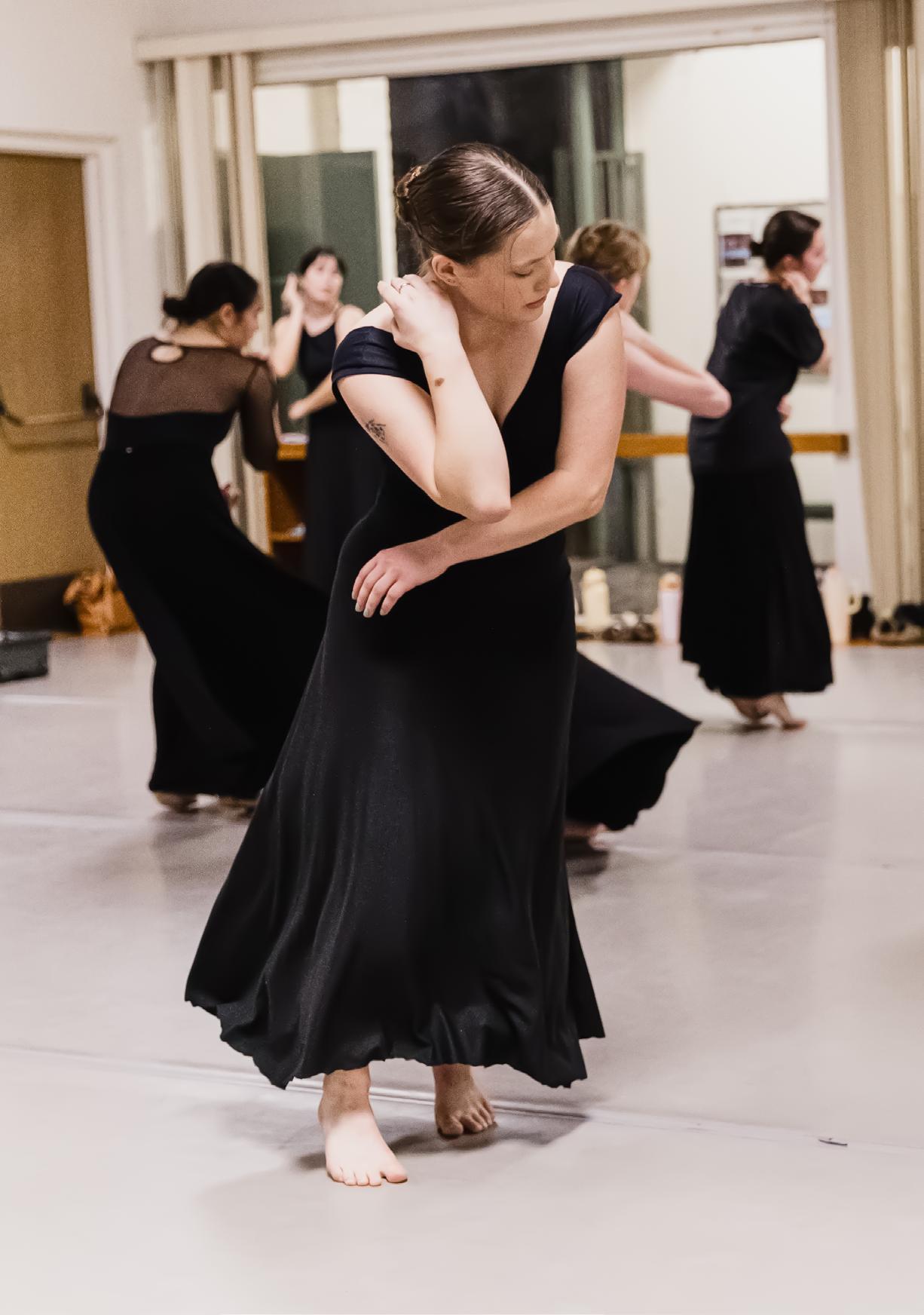
“Dance speaks to a liberal arts education. We can be biology majors and the leads of a major artistic production.”
Graham had been invited to perform at the Olympic Games, which were hosted in Germany that year. She refused in defiance of Nazi Party leadership—an “inner compulsion” that led her to compose the piece in direct response to European fascism ahead of World War II.
Chronicle was originally five sections. The company has reconstructed three, while two remain lost to history. The pieces seek to portray the spiritual devastation of conflict and the persistence of hope. Such rebellion has long been communicated through books, poetry, or rousing speeches. Yet dance’s storytelling power is decidedly visceral.
At roughly the midpoint of “Steps in the Street,” Scripps’ lead Che stands alone, slowly expanding her body outward while lowering to the floor. The chorus dancers walk in a line behind her. When the line ends, Che powerfully swings up from the floor to join them. Part two sees Ciotti begin the piece alone, elevated on a three-step platform. Members of the chorus appear as the music swells. As Ciotti descends the platform, she embodies hope as resistance—rising above in pursuit of a better tomorrow, a feat she can only accomplish because of the others around her.
The unending cycle of political and humanitarian crises keeps dance relevant as a form of commentary. In her first workshop with students, Bowman shared that she first performed “Steps in the Street” in New York City in
the wake of the 9/11 attacks. Rehearsals for the show—a portrayal of the power of community—took place as the United States’ conflict with Iran and deportation of immigrants within the country escalated.
But dance is a mechanism for more than geopolitical critique. While auditions for this year’s Scripps Dances welcomed 5C students of all gender identities, Scripps’ cast ended up featuring all women—just like Graham’s original show.
In creating their respective institutions in 1926, Martha Graham and Ellen Browning Scripps achieved monumental progress for women—right on the heels of what has been labeled as a “feminist void.” Following the Great Depression, which lasted from 1929 to 1939, women organized less and re-engaged traditional gender roles for the sake of family survival. Julia L. Foulkes, author of Modern Bodies: Dance and American Modernism from Martha Graham to Alvin Ailey, argues that dance until this period followed suit, primarily centering women as spectacle for the male gaze. Yet Graham’s simultaneous emergence cut that narrative.
“Modern dancers challenged this convention by displaying different visions of women on stage with the purpose not of titillation, but of defiance and demand,” Foulkes writes. “Modern dance changed what was on stage, who was in the audience, and the expectations of the audience.”
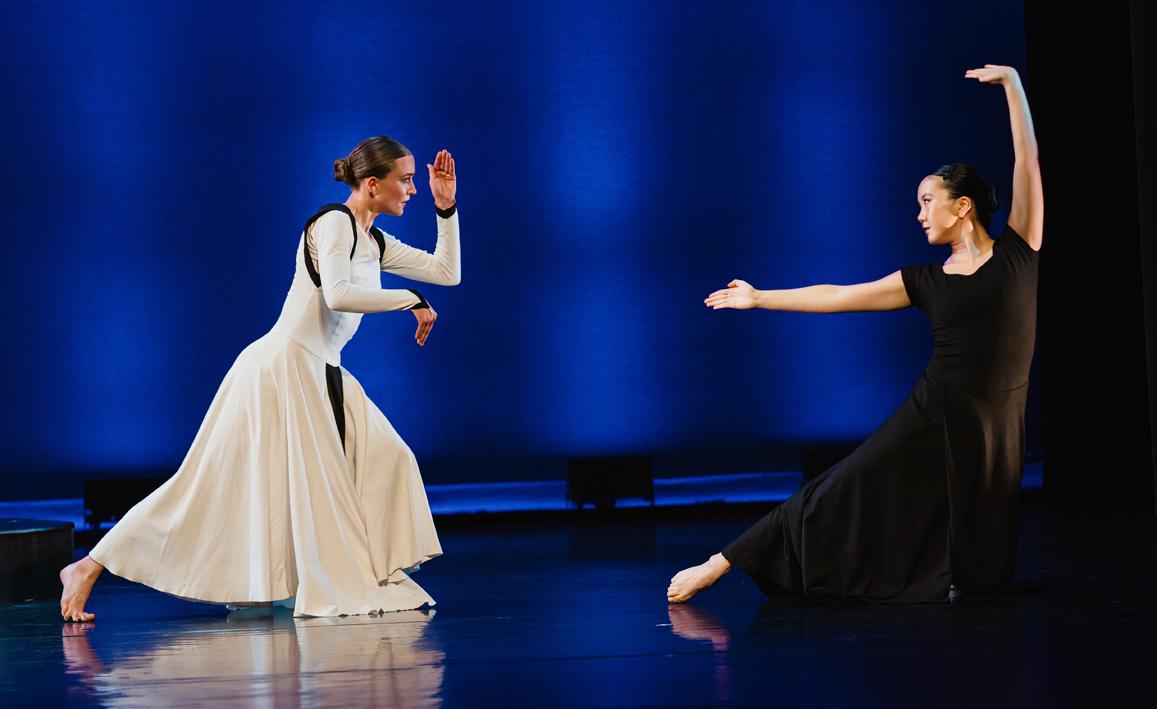
Mia Ciotti ’26 and Audrey Che ’27
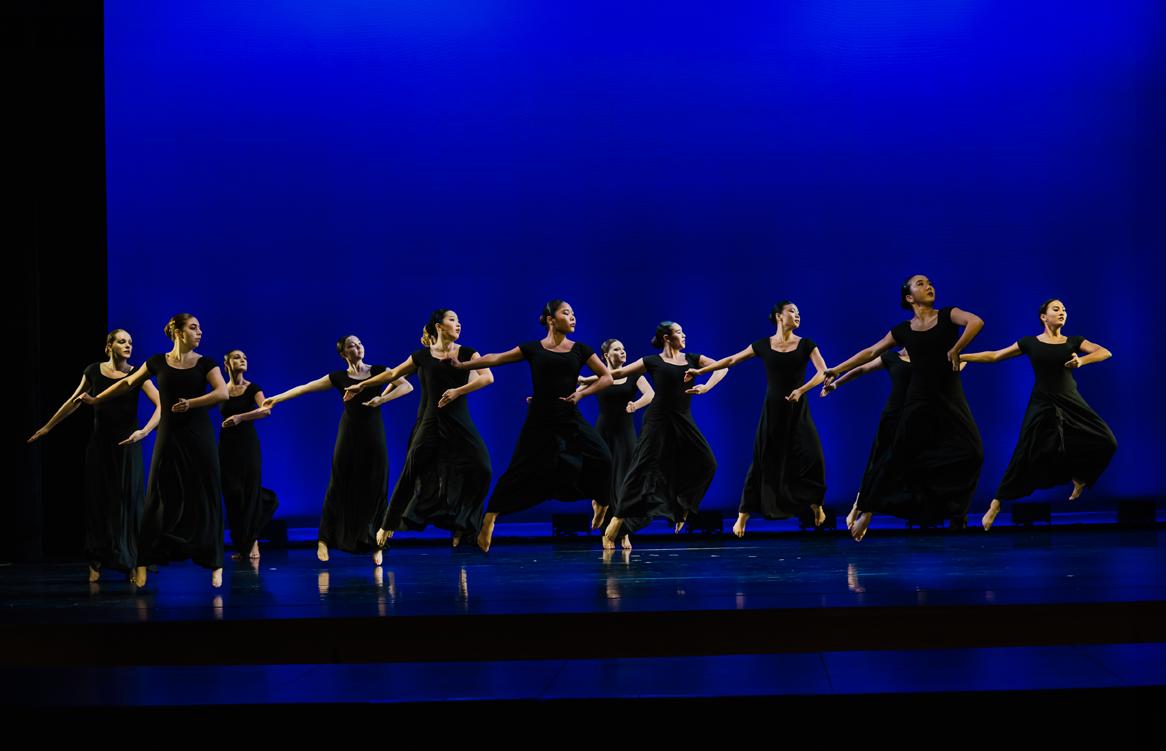
Don’t Come Forward, Go Up
In celebrating dance as a mode of inquiry and activism, it can be easy to overlook the tensions embedded in its past. But for artists like Abdiel (who uses they/them pronouns), the solution emerges from the problem itself: Dance can preserve history even as it interrogates it.
Abdiel is the driving force behind this year’s Scripps Dances and its collaboration with the Martha Graham Dance Company. Their eight-page résumé includes performances with dozens of companies across the globe as well as extensive research, competitions, awards, and teaching experience. While Graham is part of their journey, Abdiel’s current scholarship is focused on Latin Hustle—its creative evolution, queer lineage, and historical preservation.
At a recent Collegium for African Diaspora Dance conference at Duke University, Abdiel presented their research through the lens of Black “phoenixing” and how it relates to Latin Hustle. It’s context they intentionally weave into their dance courses at Scripps.”
“The generation of people who created this dance form were teenagers in the 1970s,” Abdiel says, noting how its first purveyors were impacted by everything from the Vietnam
War to the Civil Rights Movement to the AIDS epidemic. “Through community, this dance emerged, modeling a shared voice that meets resistance and rises from the oppressive ashes.”
Prior to joining Scripps, Abdiel was awarded a Dance/USA archive fellowship in recognition of their graduate study’s oral history research on Latin Hustle. The fellowship strengthened their archival practice, supporting the collection of community artifacts and partnerships with institutions such as the Center for Puerto Rican Studies (CENTRO) at Hunter College and the Caribbean Cultural Center African Diaspora Institute (CCCADI). Their work now extends to Dance Is Life, the organization they co-founded, as a key site for preserving the cultural and historical legacy of Latin Hustle.
“We found flyers and scrapbooks that center the Latino contribution and formation of this dance that was later erased through whitewashing and mass commercialization,” Abdiel explains.
For those who “aren’t that into dance,” Abdiel argues that physical movement is a critical form of historic preservation that anyone can value. In practice, respect for the medium can even bridge cultural differences.
“Dance was a sanctuary. It was their way of dealing with resistance and oppression,” Abdiel says. “You may not have that connection to the dance, but it's important to understand that could be a possibility for someone else.”
Necessary Reflection
While dance has liberated some, it has sublimated others.
When ballet legend Misty Copeland came to Scripps in spring 2025, Abdiel moderated the conversation, with students showing up in droves. Copeland addressed becoming the first Black principal dancer for the American Ballet Theatre in its 75-year history—a first that Abdiel well understood. Together, they discussed the challenges, burden, and power of being “the only” in a room.
In recent years, artists have continued to confront dance’s complicated past. Before guest lecturing at Scripps, Nia-Amina Minor co-founded Black Collectivity, a collaborative project exploring how the body carries memory and culture. In the global racial reckoning that followed the 2020 murder of George Floyd, former Martha Graham dancers began speaking out about their own difficult experiences with the company. In response, Nya Bowman— the company’s first Black woman to dance the iconic solo in Lamentation, an exploration of grief—is one of the founders of the Martha Graham Alumni Antiracist Alliance, created to address inequities in pursuit of healing.
Holding meetings to help members engage in antiracism work, the Alliance, which is not officially affiliated with the company or Graham dance center, invited dancers to bring Martha Graham quotes to life through choreography. Abdiel created a video with former Graham performer Stacey Kaplan, narrating a Graham quote through dance:
“All that is important is this one moment in movement. Make the moment important, vital, and worth living. Do not let it slip away unnoticed and unused.”
Stay in the Power of the We
At Scripps, understanding dance’s past and role in social activism is essential to grasp its current purpose. Abdiel, who identifies as a queer, genderfluid person of color, intentionally brought Minor and Bowman to Scripps during Black History Month to unpack this context with students—even as they mastered Graham’s choreography. In positioning dance as more
than “memorizing steps,” Abdiel continues to use the medium to provide platforms and curate spaces for other underrepresented people at—and beyond—the College’s gates.
But how is that done practically? On campus, the space curation is literal: Next year, the new Carolyn Lake Dance Center will officially open. Expanding the College’s capacity for teaching, rehearsal, performance, and community-building, the modern building represents decades of academic and philanthropic labor by those who uphold dance as vital to the Scripps experience.
For Abdiel, progress involves resisting the urge to place a person or institution on an untouchable pedestal. It’s saying, “thank you,” and acknowledging the work that remains to be done.
“I danced with Martha Graham for a long time and I have these relationships, but there’s trauma in that, too,” Abdiel says. “We need to evolve in our conversations. There is complexity and nuance in every person’s life, [but] when we revisit these moments of deep legacy, it is important to hold space for it all. Not just the good.”
These are the connective tissues that make dance such a powerful branch of discipline. Its ability to ask questions, preserve complex history, and incite humane action can be a balm to the world’s harsh realities. It’s reconciliation not performed as a solo act, but through collective movement.
In the introduction of her book, Foulkes writes, “this tension between individual identity and communal harmony lay at the core of the new modern dance.” Through dance, Scripps’ centennial allows us to examine what to illuminate for the next 100 years.
Bowman’s advice to students during her Scripps Dances workshop offers a clue.
“This is what this piece demands: community. Think of the ancestors who got you here. You’re touching, you’re here with your friend,” she said. “Stay in the power of the ‘we.’”
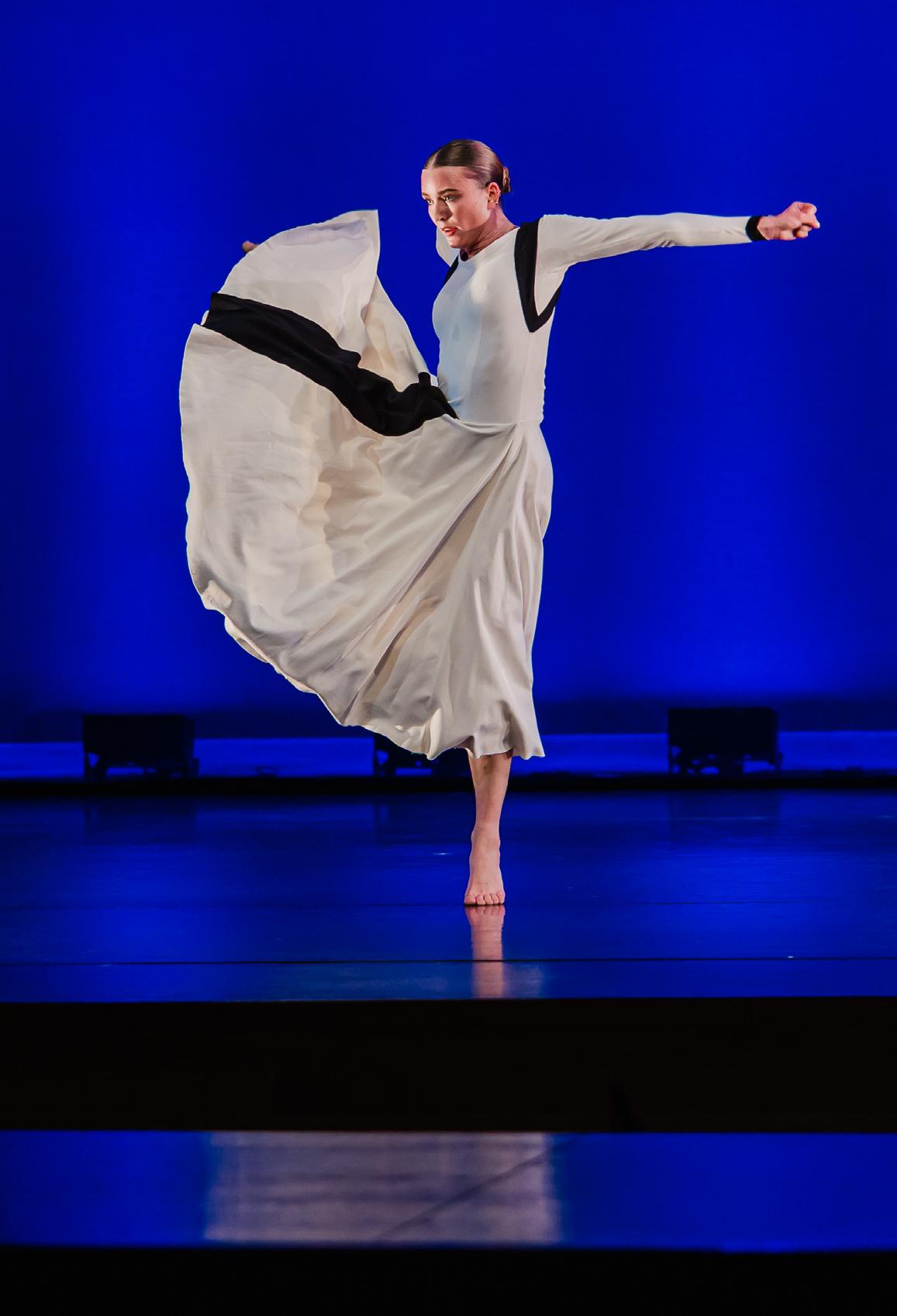
“Dance was a sanctuary. It was their way of dealing with resistance and oppression.”
Family Weekend
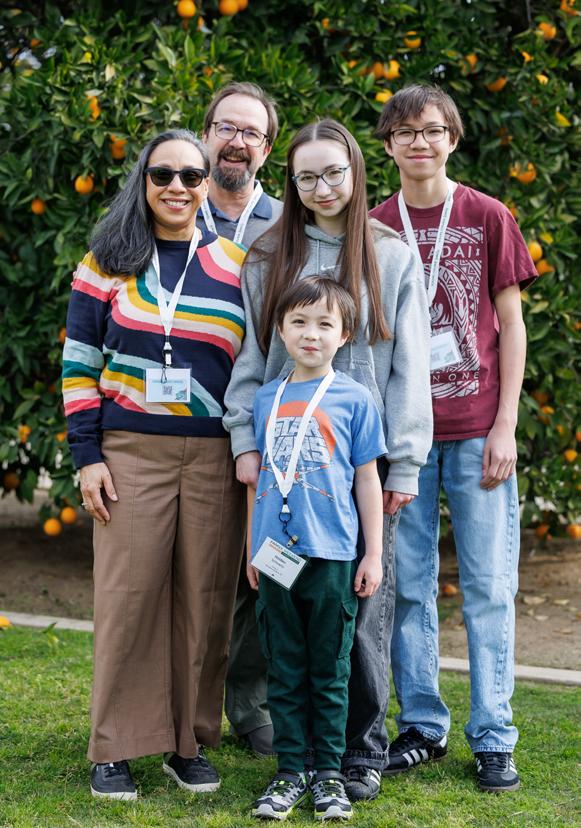
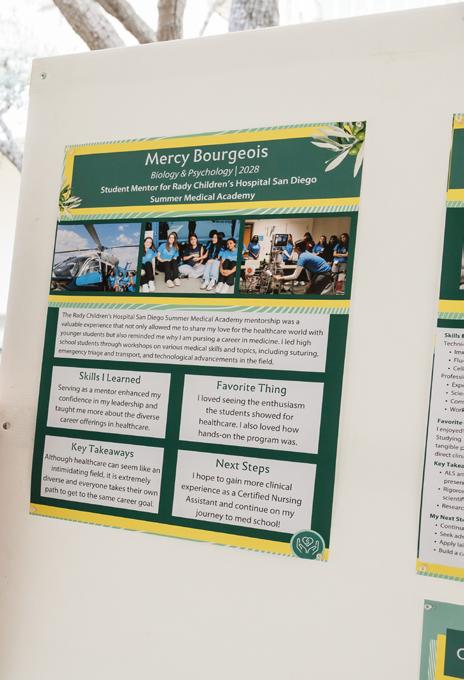
Family Weekend returned for a lively and meaningful Presidents’ Day weekend focused on connection, learning, and support for students. More than 550 family members traveled to campus to participate in academic sessions, meet faculty, and spend dedicated time with their students.
The weekend began with special programming for members of the Parent Leadership Circle, including a guided tour of the 81st Scripps College Ceramic Annual and reception and dinner with College leadership, including President Amy Marcus-Newhall.
For two days, parents and families were able to experience life at Scripps with programming that included lectures from Scripps faculty, work outs at Tiernan Field House, informational sessions about campus resources, and live performances.
Another highlight of the weekend was the 2026 Internship Challenge, which encouraged families to contribute directly to students’ professional development. The challenge inspired strong participation from the Scripps community, raising more than $55,000 from 91 donors. This generosity unlocked a $35,000 matching gift from Carmen and Jim Ward.
For upcoming events, volunteer opportunities, and resources for parents and families, please visit scrippscollege.edu/families.
Reunion Weekend
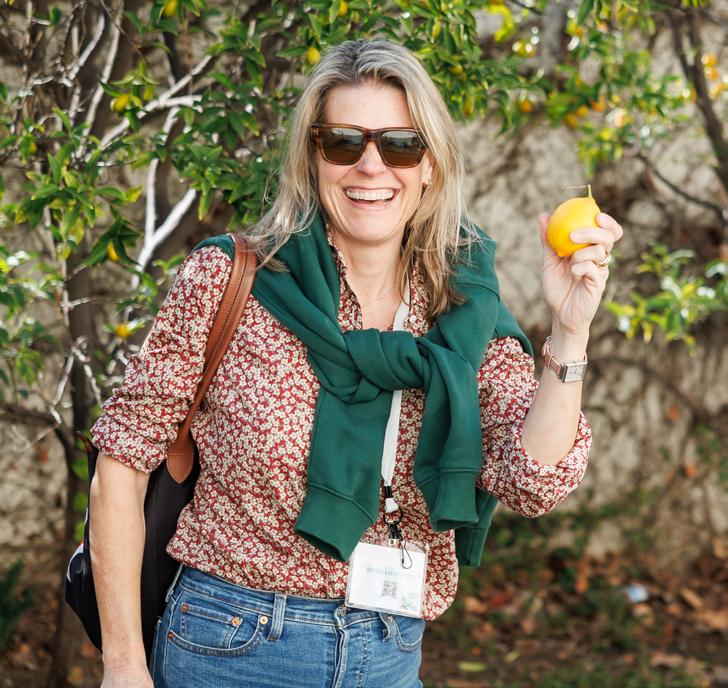
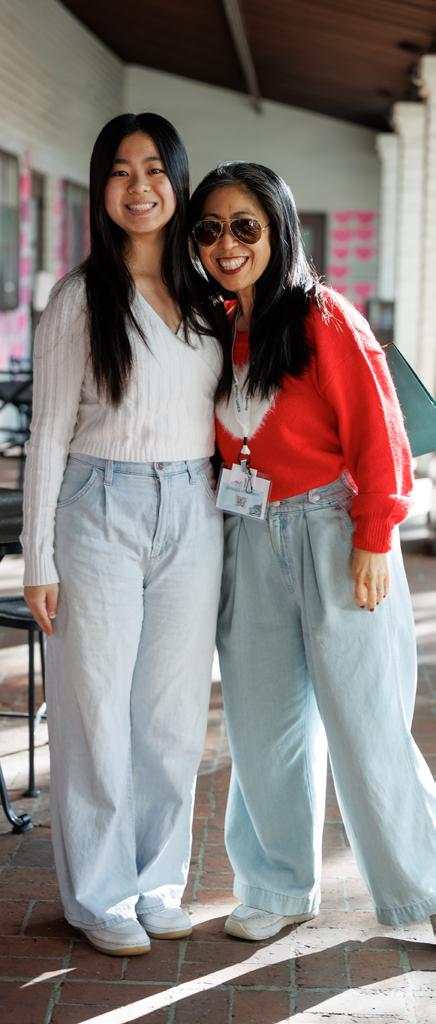
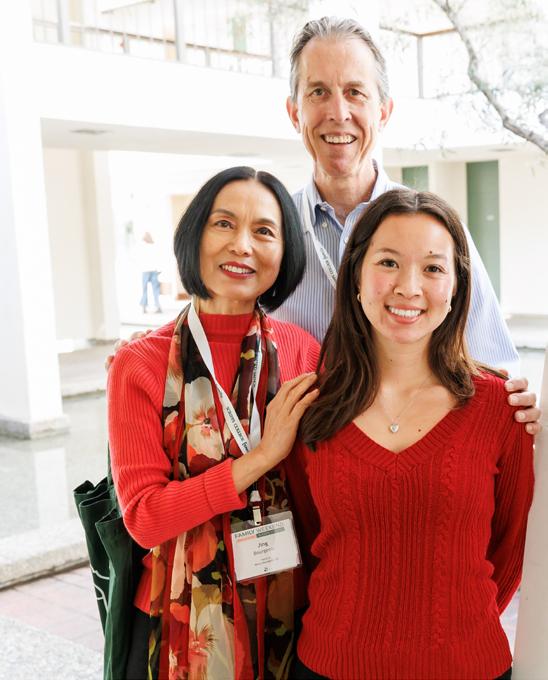
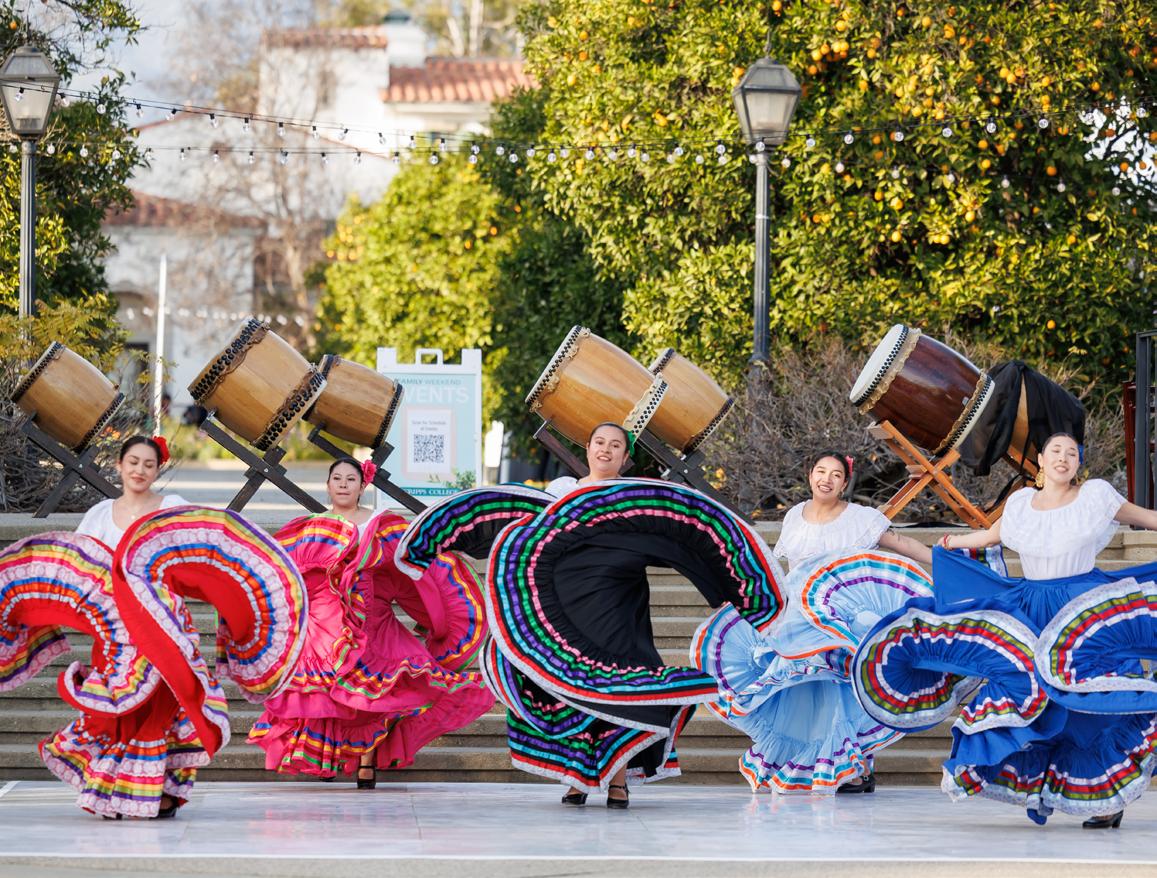
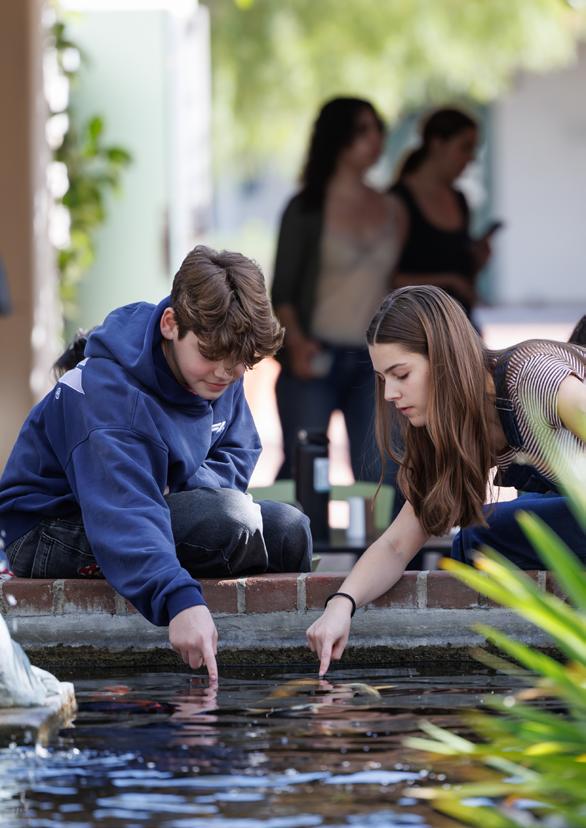
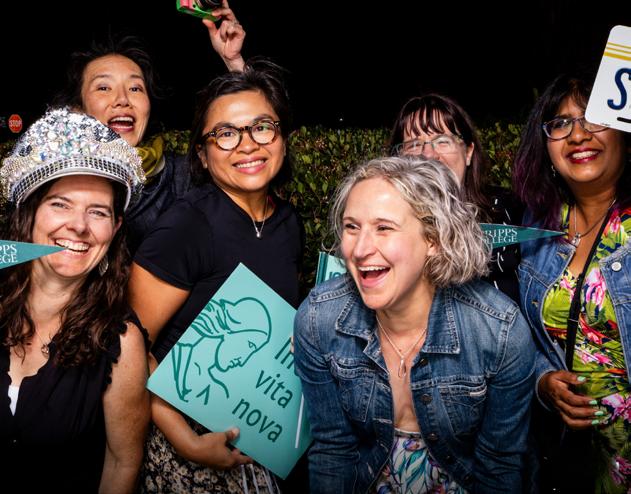
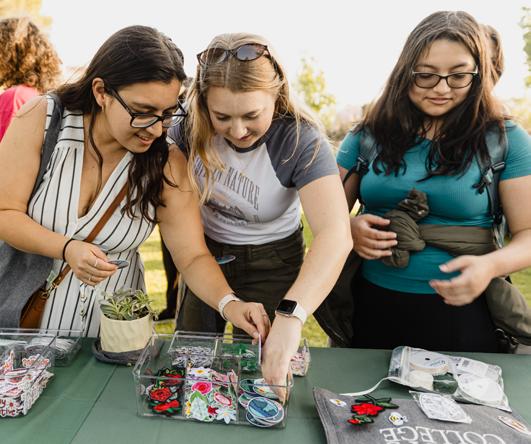
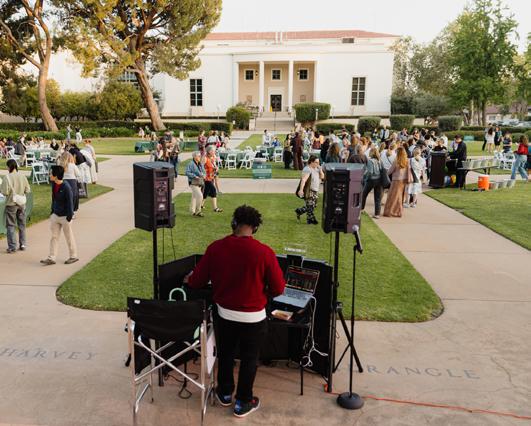
There was much to celebrate at Reunion Weekend this year as hundreds of alums reconnected on campus!
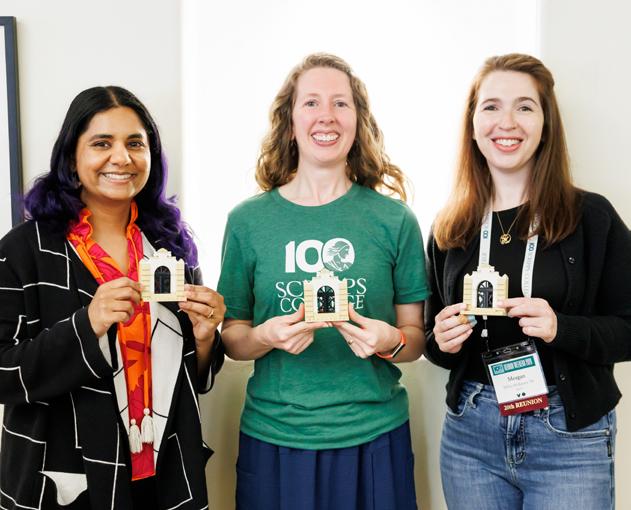
The weekend included beloved activities like botanical garden tours and networking mixers, as well as surprises like a Lego make-and-take of Honnold Gate led by Lego master builder Alice Pierce Finch ’96.
Attendees also enjoyed a preview of the forthcoming inaugural history book on Scripps in a discussion led by its author and former art critic for the Los Angeles Times, Suzanne Ely Muchnic ’62.
Celebrate Your Reunion by Giving Back!
Your reunion gift to The Scripps Fund fuels scholarships, internship grants, academic programs, mental health and wellness, and so much more for today’s students. All donations, pledges, and planned gifts of any amount made before June 30, 2026, will be counted toward your reunion class gift! Visit scrippscollege.edu/spring26 or scan the QR code.
Looking ahead to Reunion Weekend 2027? So are we!
Dates are subject to change.
Reunion Weekend 2027
Celebrating the classes ending in 2s and 7s April 30–May 2, 2027
Early arrival for the 50th Reunion Class of 1977 on April 29, 2027
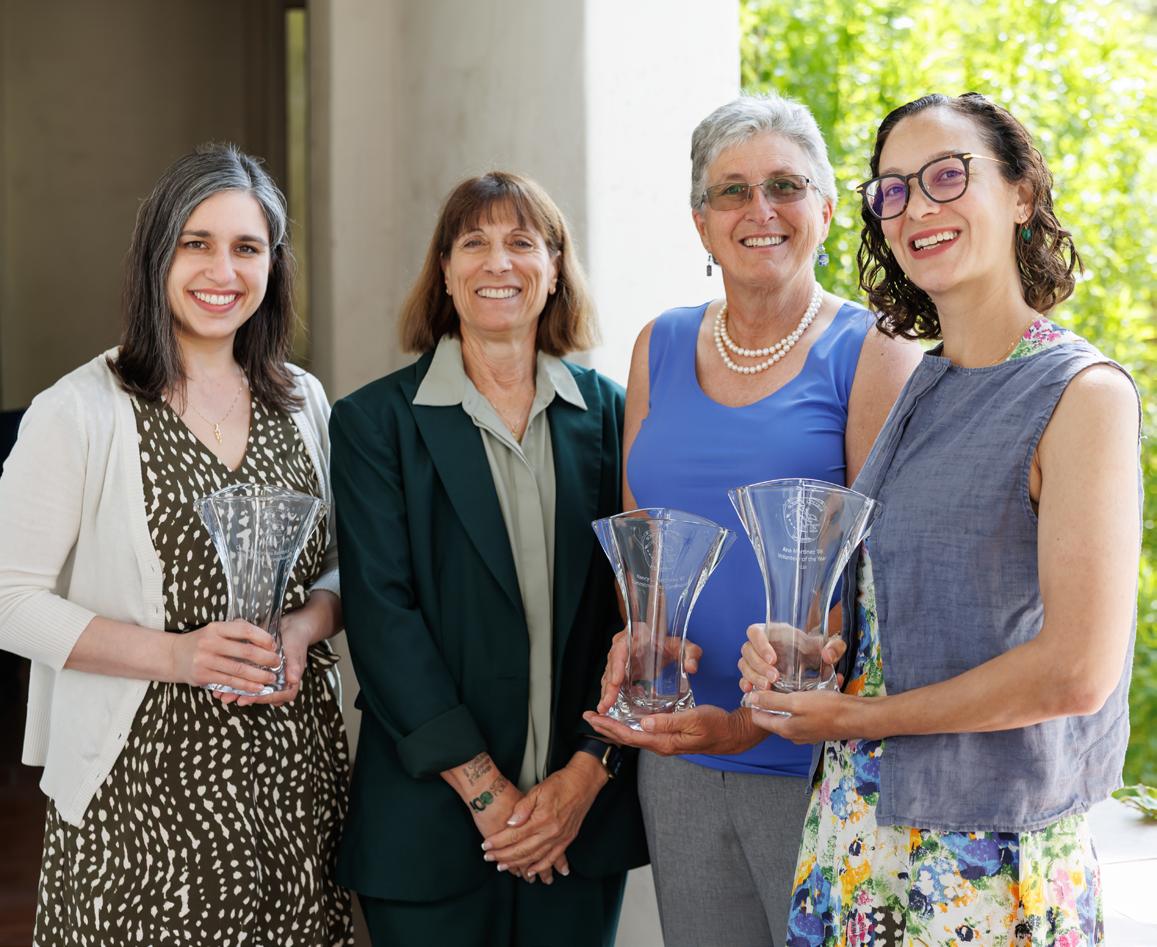
Congratulations to our 2026 Alumnae Awardees!
Commitment to Community: Nancy L. Matthews ’87
Distinguished Alumna of the Year: Regina Issakidis Gonthier ’71
Outstanding Recent Alumna: Christina Noriega Bambrick ’13
Volunteer of the Year: Ana Martinez ’06
“It is always a challenge to select Scripps alums for recognition from an amazing pool of candidates, but we feel that the achievements of our 2026 awardees truly stand out. With their exemplary professional and personal contributions, this outstanding group embodies the spirit of leadership, service, and lifelong engagement that defines the Scripps alum community.”
— Honors, Awards, and Recognition Committee Chair Yvette Herrera ’85
To read more about the award recipients or send them a congratulatory note, scan the QR code.
From left to right: Christina Noriega Bambrick ’13, President Amy Marcus-Newhall, Nancy L. Matthews ’87, and Ana Martinez ’06
REMEMBRANCES Spring 2026
Scripps College is honored to recognize the lives of departed alums.
1953
Paula Herb Wehmeyer, of Bellevue, Washington, on October 2, 2025
1959
Ann Sutherland Phillips *, of Las Vegas, Nevada, on September 22, 2025
1960
Katherine Laun Olson, of Evanston, Illinois, on September 21, 2025
1962
Sharon Aston Olsen, of Rimrock, Arizona, on September 12, 2025
1984
Angel Henrie Griffin, of Los Angeles, California, on November 19, 2025
1991
Jennifer Johnson, of Tempe, Arizona, on November 25, 2025
*Names with an asterisk indicate Elm Tree Society members.
The names listed here reflect those we have recently learned about but may not represent a complete record. To share news of an alum’s passing, please email us at alumnae@scrippscollege.edu.
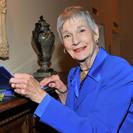
IN MEMORIAM: LIFE TRUSTEE ALYCE DE ROULET WILLIAMSON ’52
Scripps College honors the life and legacy of Life Trustee Alyce de Roulet Williamson ’52 who passed away March 2026.
After earning her degree in psychology from Scripps in 1952, Williamson remained a devoted alumna and philanthropist, joining the Board of Trustees in 2000 and establishing the Williamson Endowed Scholarship. Through her generosity, she profoundly shaped arts, culture, and healthcare in Los Angeles, serving in leadership roles with the Los Angeles Opera, the Los Angeles Philharmonic, ArtCenter College of Design, Pasadena Symphony and Pops, the Huntington Library, Children’s Hospital of Los Angeles, and many other organizations.
Williamson’s roots go deep at Scripps. The Ruth Chandler Williamson Gallery is named for her
mother-in-law, a patron of the arts, and she was the aunt of Scripps alumna Whitney de Roulet Bullock ’74 and sister-in-law of Victoria “Cici” Andrew Williamson ’58. She was predeceased by her husband, Warren “Spud” Williamson, a Life Trustee of Claremont McKenna College.
Remembered for her deeply giving spirit, Alyce de Roulet Williamson leaves a lasting imprint on Scripps College and Southern California.
CLASS No TES spring 2026
1958
Ann Sears Crocker (Bristol, Vermont) I graduated from Scripps in 1958. The foundation provided by the humanities program has been a lifelong gift.
1964
Julia Collins (Santa Barbara, California) Loving being at Casa Dorinda in Santa Barbara with three classmates from 1964 and my sister-in-law, Teta Korb Collins '67, too!
1969
Robert Rutman, on behalf of Janie Knowlton Rutman '67 (Manhattan Beach, California) I am writing this for my wife, who passed away in August of 2023. Janie was a member of the Class of 1967. She would want all of you to know how much her years at Scripps meant to her. The relationships she formed have endured and grown over the years, and she often spoke about the inspirational faculty that enriched her life. Janie's legacy now is her grandniece Sonja Farr-Morrissey '29, in her first year at Scripps. I am certain that Sonja's decision to apply to Scripps was influenced, in part, by stories she heard from Janie.
1971
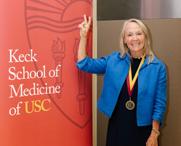
Carol L. Otis (Delray Beach, Florida) I attended the 50th reunion of my medical school class at USC School of Medicine, where we were presented with 50 Year Fellows medals. I was also featured by the Keck School of Medicine at USC as one of the four trailblazing women physicians on National Women Physicians Day.
1976
Betsy Janet Barker (Los Angeles, California) I have been published in two more anthologies! Near Life Experiences includes several haiku and my first environmental short story. The haiku are about coping with the severe chronic illness, ME/CFS. My first episode began in 1974 after my sophomore year at Scripps, and I was bedridden for the fall semester. By attending summer school, I was still able to graduate with my class and receive a degree in Asian studies. In 2019, my severe ME/CFS returned for the fourth time. I was forced to retire from the job I loved (managing critical computer systems for the County of Los Angeles) and I’ve been bedridden since. I joined the Pillow Writers group to use writing to express my deep feelings about the devastation ME/CFS has caused in my life. The understanding and support of this virtual group have helped me survive this misunderstood and mocked chronic condition. My first short mystery story was published in So West: Danger Awaits! in September 2025. In my story “Ruby Red,” the sleuth is a woman with ME/CFS who has built a good life despite the limitations of her disability. My purpose is to provide representation and to educate the public about surviving chronic illness and pain.
1990
Kymberli Ricks Colbourne (Surprise, Arizona) Greetings, all! About three years ago, my husband and I decided to take our show on the road and have been living full-time in our 35' fifth wheel, working at theaters across the country. I recently directed a beautiful show, Birds of North America, and played Amanda in The Glass Menagerie for Bag&Baggage Productions in Oregon.
Last winter, we decided to find a place to occasionally rest from our travels. We found a spot in Surprise, AZ, and no one was more surprised than we were to have a lovely community with lots of communal art studios and shops to feed our artistry when off the road. Would love to connect with alums as we travel!

A stop in beautiful Utah
1993
Lee Hargleroad Golpariani (San Diego, California) I’ve loved staying connected with my Scripps classmates over the years! Life is busy but rewarding—I’m almost an empty nester with my youngest still at home and the others off at college and graduate school. Professionally, I continue to work as a portfolio and program manager at Qualcomm, where I’ve been for over 10 years.
Four years ago, I founded Encino Conservancy, a San Diego-based nonprofit focused on regenerative agriculture, watershed restoration, enhancing native biodiversity, and wildfire resilience, in addition to vocational and youth education programs. Our team is actively applying for grants to expand these initiatives and restore a historic olive grove on our 120-acre property.
Recently, I enrolled at Kumeyaay College to deepen my understanding of local Indigenous history, culture, and language. Someday soon, I hope to transition from corporate life and dedicate myself fully to philanthropy!

Carol L. Otis MD FACSM receiving 50 Year Fellows Medal at her alma mater, the Keck School of Medicine at USC
CLASS No TES
spring 2026
1993
Kate Langan, PhD (Kalamazoo, Michigan) Alumnae and former colleagues from the on-campus computer lab gathered for a women's wellness retreat and symposium in Bend, Oregon, during which they shared research and reaffirmed their commitment to lifelong learning and restorative collaborative work. The proceedings were kicked off by Kathleen Langan '93 , who flew in from the heartland to present on a forthcoming publication of rubrics for measuring flourishing in respect to mental health challenges faced by Gen Alpha and Gen Z youth. Kathryn Bourgeois ’93 reported on her experiences living and working in Europe and Asia, bringing a fresh international perspective to current domestic issues. Nandini Lee '96 (a medical doctor) facilitated restorative conversations about how to negotiate mental health challenges in our home communities. Josie Kirkland '94 and Tara Tavi '92 reported from the front lines of public education, leading a panel discussion about challenges facing Title 1 schools at the intersection of politics, immigration, artificial intelligence, and public policy. Presentations were punctuated by cathartic body work seminars, hydrotherapy, and healing nature walks led by somatic therapist and event host Heidi Rusina '93. We celebrated our shared experiences with libations, chocolate cake, and sent fond regards to our cherished colleagues in absentia.
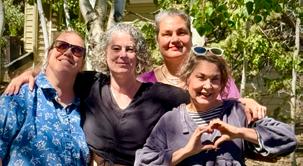
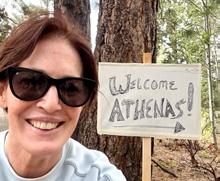
’93 and Heidi Rusina ’93
1996
Lisa Sergi Ramirez (Santa Ana, California) I am thrilled to announce that I have launched my campaign to run for Congress in CA-40. For me, this race is about protecting our Constitution, our democracy, and our community. We need courageous leaders in Congress who bring accountability, serve as the true balance of power, and represent the interests of the American people. I welcome all the support I can get from our Scripps community.
2002
Katie Van Heest (Portland, Oregon) It was a heartbreaking occasion, but Scripps alums turned out in force to support me at the memorial in Portland, Oregon, for my life partner, Rich Reece, who died in April 2025 of genetic stomach cancer.
2004
Emi Saito (Hong Kong) Hi! Just want to share that I am making educational songs with AI to help people learn Japanese. @EEmusic_eimiiestiistudios
2005
Erin Fry Sosne (Raleigh, North Carolina) I reconnected with Allison Pullins ’06 at a North Carolina Public Health Leaders Conference in Raleigh, NC.
2012
Alexandra Bowman Pincus (San Francisco, California) I married Noah Williams Jacoby on May 17, 2025, at the Gardens at Heather Farms. I was lucky enough to be surrounded by Scrippsies, including Ilona PhippsMorgan '13, Kathline Gomes '12, Leah Mortensen '12, Natalie Butterfield '12, Mirabelle Korn '12, Clio Korn '10, Tori Mirsadjadi '12, and Sara Townsend '12

2013
Lily Foss (Manchester, New Hampshire) My state representative career has really taken off, well beyond what I expected for my first term! I was beyond honored to speak in front of a crowd of 6,000 people this past Labor Day as part of a lineup that included Congressman Ro Khanna and Senator Bernie Sanders! If you'd like to see my speech, it's on my social media. I'm “Lily for NH” on all platforms.
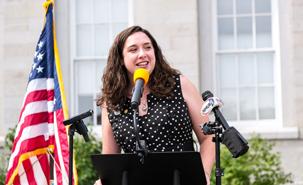
Speaking in front of the New Hampshire State House at a Workers Over Billionaires rally on September 1, 2025
Jose Kirkland ’94, Kathryn Bourgeois ’93, Nandini Lee ’96, and Tara Tavi ’92, not pictured: Kate Langan
2015
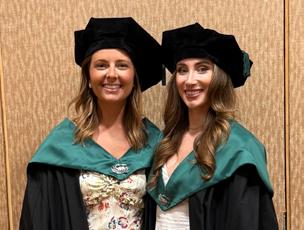
Liza Rizzo (Pittsburgh, Pennsylvania) Marie-Nicole Jeffroy-Maynard ’18 and I are the first Scripps alumnae to graduate from INSEAD (Europe’s top business school). We graduated in December, as members of INSEAD’s Class of ’25D. Marie-Nicole is continuing her career with the Admiral Group in London, and I am continuing my career with BCG in the US.
2016
Jessica Lin (Los Angeles, California) I am working on my first book, which will be published by Hachette Book Group. It will be a how-to guide on foraging fruit all over the world, with publication estimated for 2028. I can't wait!

photo
workshops
2018
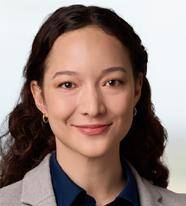
Janna Akers (Long Beach, CA) I was welcomed by Miller Nash LLP to the firm's employment law and labor relations team. Based in Long Beach, I help employers navigate and resolve workplace issues, including disputes involving discrimination, harassment, retaliation, wrongful termination, wage and hour claims, and unfair business practices.
Before joining Miller Nash, I practiced at a national law firm where I focused on labor and employment law. I also have experience handling civil matters such as personal injury and accident cases, which gives me a broad perspective on how to approach complex disputes.
2019
Layne Wells-Copeland (Indianapolis, Indiana) We celebrated love and the joining of our families and communities at our wedding in Chicago, Illinois, this past summer! In attendance were several 5C graduates and my first-year roommate-turned-bridesmaid, Mary van Schaick ’19.

2023
Sophia Frye (Redlands, California) In December 2025, I completed my master's degree in art history at Syracuse University's Florence Graduate Program in Renaissance Italian art. I spent a year living in Florence, immersed in Italian art and culture while completing my thesis on a tapestry series from Milan. I am so grateful for my education at Scripps, which gave me an invaluable background in Italian studies, studio art, and research experience.
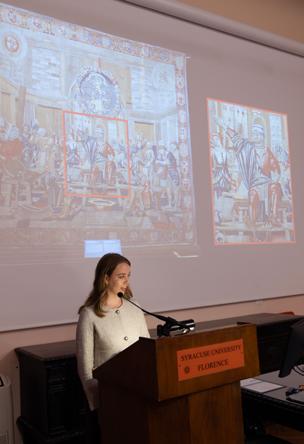
Sophia presenting her master's thesis at the Syracuse Graduate Program Symposium on December 5, 2025

Want to connect with other alums and submit a Class Note? Scan here to sign up for Olive Grove.
Close-up
of madrone fruit, known as the strawberry tree fruit, taken at one of my foraging
People Power:
How Volunteers Fuel Students’ Confidence at Scripps
By Caitlin Antonios
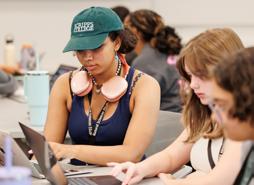
Job interview nerves can be paralyzing—sweaty palms, a bouncing knee, the discomfort of stiff soles. Scripps’ Office of Career Planning and Resources (CP&R)
Emerging Professionals Program (EPP) prepares students for that very moment so instead of paralysis, they’re ready to showcase their strengths to potential employers.
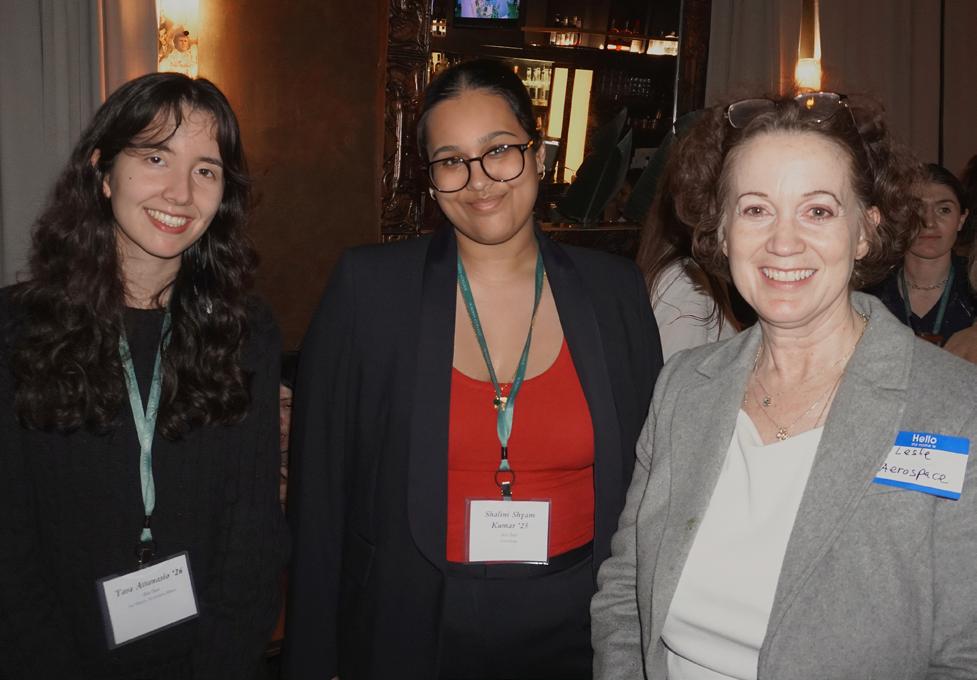
EPP is only possible because of the volunteers who dedicate their time to Scripps. This spring, 15 volunteers conducted three rounds of two-hour practice interviews with students. For some participants, it was their first time having to find professional clothing.
“We help students tell their story, know what ‘business professional’ looks like—we have free blazers they can borrow or have—and provide space in CP&R to have future interviews,” says CP&R Assistant Director Alexis Tai.
From journalism to public health to software development, volunteers came from a range of sectors to help. Some were Scripps alums or parents; others had no prior connection to the College, but desired to help young people enter the workforce. Since its launch, EPP has helped students start careers in top industries such as finance, tech, education, and communications, with most participants landing full-time employment or pursuing postgraduate degrees after graduation.
Macy Gilroy ’27, a sociology and organizational studies double major, was paired for one interview with Anita Brown ’10, a workforce planning analytics manager at World Vision, a global nonprofit fighting poverty.
“CP&R’s mock interviews greatly built my confidence,” Gilroy says. “The opportunity to receive constructive feedback in real time offered me a chance to reflect and grow, both professionally and personally.”
Fall Emerging Professionals Program mixer
“I made the best friends at Scripps, and it developed how I think and see the world.”
–Kohsheen Sharma ’18
Another volunteer, Kohsheen Sharma ’18, belonged to one of the first EPP cohorts. She now gives back by mentoring others.
“I found a lot of benefit connecting to other women in different career paths,” Sharma says. “I made the best friends at Scripps, and it developed how I think and see the world. Especially now that I have been working for a few years, I want to give back what I received from Scripps and EPP.”
After graduating with a degree in political science and economics, Sharma worked in private equity before moving into strategy and operations for a health tech startup. Recalling how overwhelming transitions can be, Sharma notes that networking and flexibility are key to a fulfilling and financially sustainable career.
“The biggest thing is learning to tell your story cohesively. Then you can explain anything—including a career pivot,” Sharma says.
But it’s not just about mock interviews. Volunteers are a necessary part of other career-focused training, like hosting students at their workplaces for Career Exploration Treks and supporting students by sending care packages during finals. Hosting networking pop-ups, speaking at regional engagement events, and conducting admission interviews are additional ways volunteers enrich the Scripps experience.
Adds Tai, “We owe everything to our volunteers for providing a positive experience so students can build their confidence in pitching who they are and what they have accomplished.”
WAYS TO GET INVOLVED
As Scripps College celebrates 100 years of impact and connection, we invite you to play a special volunteer role in this historic moment. Become a Centennial Champion and be the first to hear the latest developments about upcoming events and engagement opportunities.
As a Centennial Champion, you will:
• Connect with proud Scripps community members through Olive Grove to celebrate this milestone together
• Receive recognition through LinkedIn badges, Centennial Celebration merch, and more.
• Be part of this once-in-a-century moment and help shape the next hundred years at Scripps.
Scan the QR code to become a Centennial Champion today!
Looking for general volunteer opportunities? Scan the QR code for information
The Student Lens
In Praise of Philosophy
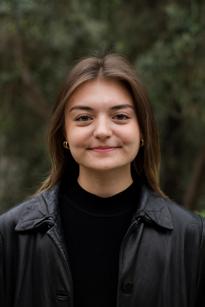
By Elita Kutateli ’26
I“Philosophy has taught me that clarity, words, and foundations matter.”
went to college thinking I was going to be an anthropology major, or at the very least a sociology major. I wanted to understand how people lived, how they made meaning, how power moved through ordinary life. I thought those areas of study were where my questions lived.
And they did—at first. I enjoyed those initial anthropology courses, but my introduction to ethics set me on a journey of studying philosophy instead.
The discipline of philosophy has given me a way to think about the values that drive me. I now have language to identify what counts as a good reason, what humans owe one another, what knowledge demands of us, what claims can withstand scrutiny, and what beliefs we inherit without further examination. Philosophy has changed how I move through the world.
Studying philosophy also requires a particular kind of humility. You walk into a classroom convinced you have a solid opinion—and within twenty minutes, a text, a professor, or another student reveals that the ground under your argument is not quite as stable as you thought. This can be unsettling, but now I love that feeling. It always leads me forward, whether to a place of reinforcement or to a new perspective.
Despite its reputation, the field has never felt lifeless to me. It is deeply human. It lives in the quiet panic and ultimate relief of discovering that confusion is not failure, but the beginning of thought.
As a graduating senior, one of the biggest gifts my major has given me is sturdiness. Not easy answers, but better mental habits. I am more comfortable with complexity and less impressed by easy slogans. Inundated by algorithms that are fighting for my attention at every turn, philosophy has taught me that clarity, words, and foundations matter. To build a life around ideas, policy, advocacy, scholarship, or service, you must understand—and care about—what those ideas rest on.
Maybe philosophy has made me a little cynical, too. Injustice is inherent to existence, and it can feel impossible to dissolve societal ills through personal actions. And yet, reflecting on my values spurs me to ask this of others so we can move together toward a better tomorrow.
I did not arrive at Scripps expecting philosophy to become the discipline that shaped me most. I certainly did not expect it to sharpen, rather than eradicate, my biggest questions. But I am so grateful it did, because that is what a liberal arts education should accomplish, especially one that centers women. Higher education is not only about exploring what you already like—it can also mean discovering the framework that puts everything else into focus.
I came to college wanting to understand people, power, and the world. I am leaving with that same desire and the tools to pursue it. That is what philosophy has been for me at Scripps: not a retreat from the world, but a way of meeting it more honestly.
What Else Turns 100 This Year?
1. A honey-loving bear we all know and love who’s always having fun adventures with friends
2. A major US broadcast network known for its peacock logo and decades of radio and television programming
3. Hemingway’s first major work, an early modernist novel based on aspects of his life
4. A famous highway that passes through eight states
5. Located on 5th and Grand Avenue in Los Angeles, this building was the first building in the city dedicated exclusively to library use
6. A pressurized item that makes everyday liquids—from paint to hairspray—into a fine mist
7. A tool that may bother your neighbors, but it makes woodcutting much easier
Celebrate 100 Years of Scripps College! 2026–27CentennialCelebration
Scripps’ yearlong Centennial Celebration kicked off in May at Reunion Weekend and the launch of the Scripps Forward campaign. Celebrate with us as we honor our past, present, and next 100 years!
Visit scrippscollege.edu/centennial to learn more.