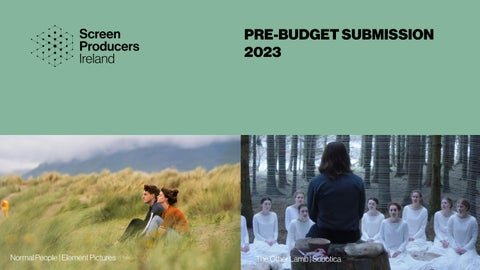
PRE-BUDGET SUBMISSION 2023
Normal People | Element Pictures
The Other Lamb | Subotica
About Screen Producers Ireland Screen Producers Ireland (SPI) is the national representative organisation of independent film, television, animation and digital production companies. With over 160 company members, SPI is recognised as the voice of independent audio-visual (AV) production in Ireland. SPI members are creative entrepreneurs who produce globally celebrated film, animation and TV content, creating high-value all-island and regionally spread employment, fostering Ireland’s media education eco-system along with preserving Ireland’s artistic heritage. SPI comprises a range of production companies, from emerging producers to producers of large-scale high-end film and TV drama, working in both the Irish and English language.
Dead Still | Deadpan Pictures
2
Introduction Today the Irish independent production sector has several, unmet financial needs which are preventing it from thriving. These financial restraints are acting as a barrier to innovation and growth, threatening sustainability. As set out in the Future of Media Commission report 2022, the AV sector is facing into a decade of reform that will render it “unrecognizable” from what we know today. As it stands today, our AV sector is not prepared for this level of change. The Irish AV sector can only reach its potential through a combination of cultural and public media service funding, and it is for this reason that provisions for both need to be prioritized in Budget 2023. In this submission we are emphasising the importance and need for a well-funded public media service and articulating a vision for the promotion Irish culture and Irish creative talent through sustainable funding of the sector.
Finky | Abú Media
3
A Summary of SPI’s recommendations for Budget 2023 Recommendation 1:
Recommendation 2:
Interim & Sustainable RTÉ funding
Increase TG4 funding
• Short-term: SPI supports the Future of Media Commission recommendation of an interim funding measure to RTÉ;
SPI supports TG4’s budget submission which seeks an additional €8.6M in investment in order to:
• Long-term: SPI is advocating for the delivery of a sustainable, publicly-supported funding mechanism for RTÉ, which recognizes the critical importance of public service media (PSM), that does not rely on the current, antiquated TV licence fee model.
Goal 1: Promote cultural diversity in our public service media. One of the strengths of the AV sector is the diverse backgrounds, experiences, and specialities that the hundreds of companies, all across Ireland, bring to content creation. We want to continuously improve the symbiotic relationship which exists between the sector and RTÉ through a sustainable funding mechanism.
• Establish Cúla4 as a dedicated Irish language children’s channel. • Establish a TG4+1 channel and TG4 HD on Saorview. • Increase our investment in Irish language content for under-35s audiences. • Increase our funding for Irish Language Drama Production & Industry Talent Development. • Establish a TG4 Digital News Service & Capabilities. • Expand TG4’s Portfolio of Curriculum-based Educational Resources.
Goal 2: Sustain the growth of TG4 and expand the potential audience for Irish language content.
4
A Summary of SPI’s recommendations for Budget 2023 Recommendation 3:
Recommendation 4:
Section 481: Extension & Regional Uplift
Increase Screen Ireland Funding
It is critical that Budget 2023 is used to announce the extension of Section 481 (as is currently constituted) from 2025, to give long range planning certainty to the sector.
In order for the Irish AV sector to meet the targets of AV Action Plan;
SPI are advocating to maintain the regional uplift. Furthermore, we wish to see it re-instated at a minimum of 5% beyond 2024.
We believe that it is crucial to the sector that there be an increase to the Screen Ireland capital budget of a minimum of further €2M.
We are also calling for the creation of an investment stream through Screen Ireland that would support production outside of the Dublin / Wicklow hub. Goal 3: To give certainty to productions, currently being planned, beyond 2024. To continue to stimulate the development of the sector regionally and to reverse the decrease of productions in the regions since the regional uplift percentage declined.
Goal 4: To enable Screen Ireland to continue to support the creation of indigenous independent Film, TV drama, animation and documentary content, through provision of development and production funding. 5
A Summary of SPI’s recommendations for Budget 2023 Recommendation 5: Introduce the AVMSD Content Levy
Recommendation 6: Increase investment in BAI Sound & Vision Fund
The EU Revised Audiovisual Media Services (AVMS) Directive (2018) gives Member States the ability to introduce levies on online media services which target audiences in their state.
The BAI Sound and Vision Scheme is designed to support original Irish content that would not otherwise be able to attract commercial investment.
Across Europe, levies and investment obligations have been introduced. In this regard Ireland is an outlier. Every year the levy is not introduced, the Irish sector losses out on investments of €25m or more. Ireland has a unique opportunity to introduce a levy to fund Irish stories on screen. As recommended by the Future of Media Commission, the AVMSD Content Levy introduction should be a core priority of the new Media Commission. , Goal 5: Promote the creation of additional, original Irish content. With a 3% levy, there would be an annual fund of circa €25m a year, delivering €100m of additional production activity annually. This could result in new TV drama and animation series, more feature films, and more high quality documentary films every year.
Using Section 156 of the Broadcast Act 2009, the Minister for Tourism, Culture, Arts, Gaeltacht, Sport and Media should continue to invest additional funding, as she has successfully done in 2020, 2021 and 2022.
Goal 6: Continue the trend of additional funding into the Sound and Vision Fund to give producers more opportunity to make Irish content for wider audiences. 6
SPI Recommendations In Detail
Recommendation 1: Interim & Sustainable RTÉ funding • Short-term: SPI supports the Future of Media Commission recommendation of an interim funding measure to RTÉ; • Long-term: SPI is advocating for the delivery of a sustainable, publicly-supported funding mechanism for RTÉ, which recognizes the critical importance of public service media (PSM), that does not rely on the current, antiquated TV licence fee model.
Room to Improve | Coco Content
7
Interim & Sustainable RTÉ Funding We believe that a vibrant public service media is central to the growth and development of the independent production sector, as this symbiotic relationship is fundamental in the creation of Irish-originated screen content.
They listen to their potential audiences to generate a product that will work, both on linear and online. The independent sector is uniquely placed to respond to the needs of Irish viewers. However, the current financial landscape does not allow the sector to fulfil its potential.
Cultural diversity is at the heart of public service media(PSM). The strength of our sector is the diverse backgrounds, experiences, and specialities that the hundreds of companies, all across Ireland, bring to content creation. The symbiotic relationship which exists between the sector and RTÉ, means sustainable funding for RTÉ is critical to the future of the independent sector.
It is widely accepted that the current TV Licence Fee regime is outdated and not fit for purpose, and ultimately, not serving the needs of RTÉ, licence fee payers, or the creation of Irish content.
The long-awaited Future of Media Commission report was published on July 12th, 2022, with government approving 49 out of 50 recommendations. However, the one recommendation they have not approved centres on the issue of the TV licence fee reform. It is Since 2009, RTÉ’s finances have been under severe pressure due to unclear as to how the Government intend to proceed with these Licence Fee non-payment, as well as “no TV” households, and recommendations while they have not addressed this very central uncertain commercial income. This has negatively impacted RTÉ’s one. finances, and as a consequence, their investment in original Irish We are disappointed that this recommendation has been rejected. It content. is a missed opportunity to harness the outcome of a diligent process When we look at the success of Normal People, Conversations with that the Commission undertook to solve the thorny issue of TV Friends, Kin….we know that Irish audiences are hungry for local, Irish Licence Fee reform. stories. Independent producers are creative entrepreneurs who are keen storytellers, entertainers, educators, and culturally savvy. 8
Interim & Sustainable RTÉ Funding In the immediate, SPI is supporting an interim funding measure to RTÉ, which is recommended in the FOMC report. We understand that the Government have set up an interim interdepartmental working group on TV Licence Fee reform to look at legislative and non-legislative solutions to improve the collection rate of the TV Licence Fee from households. Our fear is that this is a return to the position reform was in after the release of the report from the previous interdepartmental working group in 2019. Without action, the financial situation at RTÉ will deteriorate further and this will affect the stability of the independent production sector that creates content for it. Long term, SPI is advocating for the delivery of a sustainable, publiclysupported funding mechanism for RTÉ, which recognizes the critical importance of public service media (PSM), that does not rely on the current, antiquated TV licence fee model.
9
SPI Recommendations In Detail Recommendation 2: Increase TG4 funding SPI supports TG4’s budget submission which seeks an additional €8.6M in investment in order to: • Establish Cúla4 as a dedicated Irish language children’s channel. • Establish a TG4+1 channel and TG4 HD on Saorview. • Increase our investment in Irish language content for under-35s audiences. • Increase our funding for Irish Language Drama Production & Industry Talent Development. • Establish a TG4 Digital News Service & Capabilities. • Expand TG4’s Portfolio of Curriculum-based Educational Resources. Source: TG4 Pre-budget Submission
Foscadh | Tua Films
10
Increase TG4 Funding TG4 is Ireland’s only publisher/broadcaster, meaning that TG4 sources the majority of its programming from the Irish Language independent production sector. It is funded by direct Government support and through commercial income.
TG4 is the main commissioner in the independent Irish Language production sector, and it is the only consistent source of Irish Language TV programming for Irish Language audiences. Its status as a key investor in original Irish content for specific audiences cannot be overstated.
TG4’s public funding remains its key source of income, and it is vital that current funding is set at levels which can enable the service to be developed, to grow its audiences across all platforms, and to respond to the challenges it faces in an increasingly digital environment.
We need to capitalise on this moment for Irish language content and give TG4, and the Irish language producers and creatives, the opportunity to create more award-winning content that audiences want to watch.
The recent critical success of Arracht, Foscadh and An Caillín Ciúin is a sign of the potential for Irish language in Ireland and internationally. This success did not happen overnight. Thanks to funding for the Cine4 development programme from TG4, BAI and Screen Ireland, the producers and creatives behind the films were able to take the time needed to develop the projects to their full potential. With this support they were able to create work which resonates with audiences regardless of any language barriers.
SPI supports TG4’s ambitious plans for the future as outlined in their pre-budget submission.
Arracht | Macalla Teoranta
11
SPI Recommendations In Detail Recommendation 3: Section 481: Extension & Regional Uplift It is critical that Budget 2023 is used to announce the extension of Section 481 (as is currently constituted) from 2025, to give long range planning certainty to the sector. SPI are advocating to maintain the regional uplift. Furthermore we wish to see it re-instated at a minimum of 5% beyond 2024. We are also calling for the creation of an investment stream through Screen Ireland that would support production outside of the Dublin / Wicklow hub.
Foundation | Wild Atlantic Pictures
12
SECTION 481: Extension Section 481 is an essential tax incentive to Ireland’s independent production landscape. Section 481 provides a competitive film and TV tax incentive which is of benefit to indigenous productions, international co-productions and gives independent producers leverage to attract incoming productions to Ireland.
There were 21 features films, 19 TV dramas, 24 animation shows and 12 creative documentaries certified for tax incentive funding in Ireland. It is critical to announce the extension of Section 481 (as is currently constituted) from 2025, to give long range planning certainty to the sector.
The Irish film and TV sector is vibrant one - with a sophisticated infrastructure of production companies, studios, service companies The current cost / benefit analysis of Section 481 is due to be and personnel, all of which provide valuable employment in the Irish published on Budget Day and SPI believes it is an opportune time to economy, and generate rich, cultural content about Ireland, in announce the extension of the tax credit beyond 2024. Ireland. If Section 481 is not extended beyond 2024, even most domestic qualifying productions would be incentivized to move to other jurisdictions where tax credits continued to apply. Ireland would be at risk of becoming a "cultural desert", in terms of seeing its own stories on screen. Recent Fís Éireann/Screen Ireland figures show that there was a spend of €500 million in the Irish economy across film, television drama, documentary and animation production in Ireland in 2021. This level of spend on jobs and local goods and services represents the highest ever achieved and is a 40% increase on the previous record set in 2019.
13
SECTION 481: Regional Uplift Over the last number of years, Ireland has been home to some major productions such as "Foundation" made at Troy Studios in Limerick, produced by Apple+ which was the single largest production ever in Ireland, and two major Star Wars feature films shot on location throughout the Wild Atlantic Way. The regional uplift has proven to be a support for productions shooting outside the Dublin / Wicklow hub. Thanks to the extension of the 5% uplift announced in the last budget, there has been intensive production activity in Mayo, Donegal, Kerry and Galway generating regional employment and substantial economic impact. These productions alone saw investments in Ireland of hundreds of millions of Euro and served to showcase the ability of Irish crew and the beauty of Irish locations. This showcase is a powerful projection of Ireland on screen to audiences worldwide. This investment has also been vital to compliment the long-term development of crew hubs and talent academies across the country.
The reduction of the tax credit to 3% in 2022, has seen a considerable reduction in productions taking place in many regions. This is being felt by cast, crew and local economies across the regions. SPI are advocating to maintain the regional uplift. Furthermore, to counteract the lower levels of activity at the lower percentage, we wish to see it re-instated at a minimum of 5% beyond 2024. Longer term, consideration needs to be given to the creation of a cohesive plan for development of the regions for production. Alongside the development of academies and crew hubs, consideration should be given to the regional uplift being renewed at a meaningful percentage (of at least 5%), and that the current state aid map could negatively affect the potential of the uplift in the future. For these reasons we are also calling for a dedicated fund, via Screen Ireland, created to support regional film making in all places outside the Dublin / Wicklow hub.
14
SPI Recommendations In Detail Recommendation 4: Increase Screen Ireland Funding In order for the Irish AV sector to meet the targets of AV Action Plan; We believe that it is crucial to the sector that there be an increase to the Screen Ireland capital budget of a minimum of further €2M.
Nothing Compares | Ard Mhacha Productions
15
SCREEN IRELAND The Creative Ireland AV Action Plan, and Project 2040 Culture plan ‘Investing in our Culture, Language and Heritage 2018 – 2027’, commits to €200 million investment in Irish screen content through Screen Ireland. The plan noted that: “Under Pillar 4 of the Creative Ireland Programme, the
Government is committed to developing Ireland as a centre of excellence in media production through supporting the development of the Irish film, television and animation sectors.” We have consistently advocated for increases to Screen Ireland capital budgets to safeguard the future of Irish content. Without adequate capital funding for Screen Ireland, the Irish independent production sector would be at risk of becoming dependent on incoming, international productions and would not have the required capital investment to create original Irish content.
Over the past three years the Screen Ireland capital budget has increased from €18M to €32M, some of which is tied to COVID-19 measures, which has seen a significant in increase in investment in Irish creative content and additional investment into skills development and crew support. We acknowledge the increase in capital funding that Screen Ireland received in response to the COVID crisis. This was a substantial and welcome investment in the screen industry. There is a current opportunity to build on this investment by increasing funding for development, production, and distribution of original Irish content for Irish audiences in Ireland and internationally. We are calling for an increase to the Screen Ireland capital budget of a further €2M to continue its support in the creation of indigenous independent Film, animation and documentary content, support the development of the Irish AV sector in order to meet the targets of AV Action Plan.
16
SPI Recommendations In Detail Recommendation 5: Introduce the AVMSD Content Levy The EU Revised Audiovisual Media Services (AVMS) Directive (2018) gives Member States the ability to introduce levies on online media services which target audiences in their state. Across Europe, levies and investment obligations have been introduced. In this regard Ireland is an outlier. Every year the levy is not introduced, the Irish sector losses out on investments of €25m or more. Ireland has a unique opportunity to introduce a levy to fund Irish stories on screen. As recommended by the Future of Media Commission, the AVMSD Content Levy introduction should be a core priority of the new Media Commission.
Mo Shaol, Do Shaol | Macalla Teo
17
AVMSD Content Levy Ireland has the opportunity to introduce a new fund to provide support for the creation of original Irish content – at no extra cost to the exchequer. The AudioVisual Media Services Directive (AVMSD) content levy allows Ireland to place a levy on the Irish revenues of online media services and advertising in order to support the creation of original Irish content. Current Indecon estimates are that the levy would bring in a minimum of €25m a year, which means that ever year the levy is not operational, millions of potential investment into the sector is lost. The Online Safety and Media Regulation Bill will be starting its Dáil legislative process in September 2022. There is still an opportunity for Government to give certainty to the AV sector that it will introduce the content levy as soon as is possible once the Media Commission is established.
Specifically, SPI are advocating that the bill will: •
Put in a place an 80% quota for Irish independent productions to receive investment as part of the fund’s operation
•
Ensuring that the IP for the content stays with the Irish producer
•
Ensuring that Irish creative talent can benefit from the levy fund
•
Creating a development fund as part of the Scheme
The AVMSD Content Levy introduction should be core priority of the new Media Commission, as recommended by the Future of Media Commission. when it is established and be implemented in Ireland as soon as is possible.
The Content Levy has cross party support and was a key recommendation of the Report of the Joint Committee on the Pre-Legislative Scrutiny of the General Scheme of the Online Safety and Media Regulation Bill. 18
SPI Recommendations In Detail Recommendation 6: Increase investment in BAI Sound & Vision Fund The BAI Sound and Vision Scheme is designed to support original Irish content that would not otherwise be able to attract commercial investment. Using Section 156 of the Broadcast Act 2009, the Minister for Tourism, Culture, Arts, Gaeltacht, Sport and Media should continue to invest additional funding, as she has successfully done in 2020, 2021 and 2022.
Dagda’s Harp | Cardel
19
BAI Sound and Vision Fund The BAI Sound and Vision Fund is an essential element of the funding mix for producers who are making content that is, as set out by the Scheme of the Fund: (i) Difficult to make; (ii) Low Budget; and (iii) Counteract the limited geographic extension of certain languages and cultures. The Fund is perennially oversubscribed, which clearly demonstrates the gap that exists between the number of production companies trying to make content and the lack of funding that is available to help them create it.
This has been a huge success as it has allowed the fund to meet some of the excess demand that is present in the sector to make content. The Government should continue this policy so that the gap between funds awarded and funds applied for lessens and more original Irish content is made for Irish screens. Using Section 156 of the Broadcast Act 2009, the Minister should continue to invest additional money, as she has successfully done in2020, 2021 and 2022, into the Sound and Vision Scheme to support original Irish content that would not otherwise be able to attract commercial investment.
The current Minister for Tourism, Culture, Arts, Gaeltacht, Sport and Media has used the provision in the Broadcast Act 2009 that allows for direct injection of central government funds into the Fund. In 2021, the Minister invested an extra €10M into the fund which as allowed for targeted content creation on issues such as climate change, specific Irish language rounds and increased investment in the standard rounds. 20
Conclusion The Irish independent production sector creates culturally-rich Irish content, delivers quality employment, and supports local economies. The recently published Future of Media Commission report identifies the significant challenges that are being presented by the ever-evolving international landscape of media reforms. The recommendations in this document are about supporting the independent Irish production sector to evolve with these changes and mitigate any negative effects that may be produced by them. We envisage a sector that is ambitious, competes internationally, that creates compelling content for Irish and international audiences and sustains the careers of the best of creative talent on this island. This is an attainable vision, but we cannot do it without government vision and support, and specifically action on the recommendations outlined in this submission. Gamer Mode | Roundstone Media
21
77 Merrion Square South Dublin D02 DH22
Herself | Element Pictures
First Dates | Coco Content
Kin | Metropolitan Pictures