Survival
A Scouting Ireland challenge
72 Hours survival


72 Hours survival
Imagine yourself with a walking party. There Is a blast of wind, a lot of noise and you are engulfed in an avalanche of snow. You are sailing In a yacht a heavy wind blows, you lose your mast and are set adrift. How do you cope?
These situations are ones which people have found themselves in on occasions in the past and will, doubtless, find themselves in the future. For this reason a knowledge of survival can be as useful as a knowledge of first aid.
Although we live in a relatively civilised environment the ease of modern travel, coupled with the fact that Scouts are going to more remote areas, maintains the need for a knowledge of survival skills.
Before going further it may be as well to define the term ‘survival’ - ‘Survival is the art of remaining alive in and escaping from a hostile environment, without full facilities.’ This needs a few words of explanation. If you camp in the hills in winter with a good mountain tent, a warm sleeping bag, a stove with plenty of fuel and no shortage of food , this is camping not survival. Survival begins when some relatively essential item is missing and becomes more acute the less one has.
The American Rescue Service has said that country people or city people who
have had a lot of Scout training are the best survivors.
To stay alive the following must be considered
Without it one will eventually die although not as rapidly as one might think. In her book. Hey I’m Alive, Helen Klaben describes how she stayed alive for forty nine days on virtually nothing.
With no water available a man, even in a cool climate and doing no work, is unlikely to survive more than fifteen days.
Without these the physical condition of the survivor will deteriorate.
Untreated injuries or sickness will undermine the body to some extent especially if allied to a lack of shelter and food. Additionally the ability to escape on foot will be inhibited.
A person is a very small object and the earth is a very big place. Some means of attracting attention is vital for anyone in need of help. A mobile phone is excellent
if a signal is available if not then traditional means of communication will need to be used.
How to move, when to move, etc. now become vital questions to be answered.
This may not be to one-degree accuracy but in many types of terrain it is quite an effort to keep going in a constant compass direction without veering well off course.
Too big a load will reduce your chances of reaching help but too small a load may mean vital items are abandoned.
It happened - they have just found out your location and you need to get out of the city as soon as you can and head to the safe house in the northern woods approx. 90 miles away.
You have 10 minutes to grab what you can and stuff them in your pack and get out of there. The roads are likely to have road blocks so you will be on foot to avoid detection. You will need enough items to survive for 72 hours until you reach your safe house and to survive some time before resupply at the safe house.
Travel on foot - 3 miles per hour for 10 hours a day.
You can only travel for 10 hours a day - the max. weight you can carry in your bag is 15 Kilos so you can move fast. If you add additional items beyond this weight you must reduce you walking time by .5 of a mile per every two each kilos.
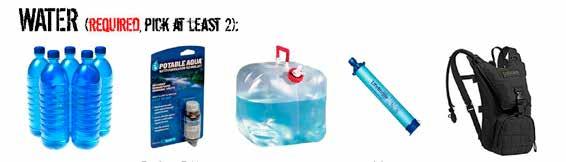
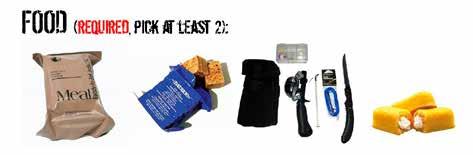
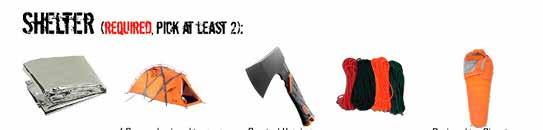
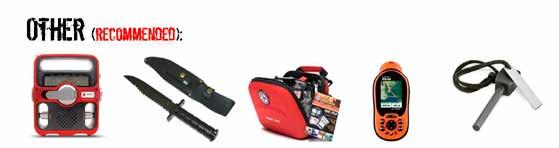
You must choose two items from each category.

0
0