THE PATROL GOES TO CAMP
A Scout who doesn’t know how to live happily and comfortably in the fields or the woods, can hardly be called a Scout. And a Scout Patrol is hardly a real Scout Patrol if it doesn’t go off as often as it can to camp on its own. This little book is to help you, as a Patrol, to take the trail which leads to the happiness which comes when half a dozen pals pitch their tents (or tent) under the sky, when the blue woodsmoke rises and mingles with the smell of good cooking . . .
1PREPARATORY WORK
Of course, even before your Patrol sets off with the trek cart, or cycling or hiking with your packs on your backs, there are a lot of things you can do at your Patrol meetings to make yourselves good campers. You can :—
1. Practise packing a rucsac.
2. Make a bed with blankets.
3. Become really expert at the knots and lashings you’re sure to need.
4. Practise pitching a tent correctly and quickly.
5. Make a Patrol scrapbook of photographs and drawings of different gadgets.
6. Make a set of duffel bags for each member of the Patrol.
7. Have an evening or two cooking simple dishes.
8. Draw sketches of an imaginary camp site (or get Skip to provide you with some) and decide how you’d plan your camp.
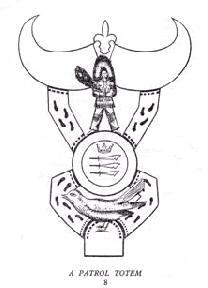
9. Carve a Patrol totem and paint it and fix it on a staff to plant outside the Patrol tent. Here was one a Patrol had years ago :—
10. Make a model camp site.
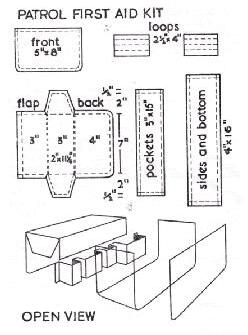
11. Make a first-aid pouch (or get your Mum or Girl Guide sister to lend a hand with the sewing machine). The sketch on the next page will help you. It might contain :
A small bottle of antiseptic ( e.g. Dettol).
Various sizes of elastoplast or something like it.
A small bandage.
A tube of some anti-burn stuff.
Some DMP (dimethylphthalate), or some good preparation containing it, against midges and the like.
2.WHERE TO CAMP
Where will you camp? Well, some Troops now have a camp site of their own, or your District may have a nearby District camp site or you may be not far from one of the dozen I.H.Q. camp sites. If none of these situations apply to you, then it is almost certain you live in a county where there is much lovely countryside and one of the greatest joys that a P .L. and his Second can experience is to go out exploring until they have found a little camp site of their own on a farm or a private estate and have explained to the owner who they are and what they are seeking, and persuaded these kind people (and most of them are when it comes to helping smart, enthusiastic Scouts) to let your Patrol come to camp there.
Of course, you will only keep such a camp site if you show yourself first-class campers and considerate and courteous Scouts! What must a good week-end camp site possess?
(1) nearness to drinkable water.
(2) a supply of wood for fires.
(3) land well drained and fairly flat.
(4) a pleasant outlook.
(5) availability — near enough, that is, for your Patrol to get to and return from in reasonable time.
3.PERSONAL AND PATROL GEAR
What you take with you, as individuals and as a Patrol, will depend on how you’re going to get there (by trekking or hiking or cycling) and the sort of site it is. Gradually as you become experienced campers you will find you can do without certain things — and as to which things, different campers have different ideas!
But to begin with, here is what every Scout has to get expertly into his pack : — Sleeping bag or two blankets.
Night wear (pyjamas or slacks and sweater).
Sweater
Camp dress (old shorts and shirt, etc.).
Plimsolls (or sandals).
Spare stockings.
Towel.
Toilet necess ities (toothbrush, paste, soap, comb, brush, etc.).
2 spare handkerchiefs.
2 plates, mug, knife, fork, spoon.
Groundsheet.
Notebook and pencil.
Of course, your Patrol may also decide — by a sort of Patrol by-law — that every Scout should bring a dish cloth or a drying cloth, or his own knotting rope, etc., etc. The list above is of essentials : obviously with certain weather forecasts you’ll also take a mac, and if you’re going to bike or cycle you’ll have to carry your share of the hike-tents and cooking pots and food, etc. And you may wish to take a torch or a song book with you.
As to how to pack, here are four rules to guide you: —
(a) Don’t, as we say, look like a Christmas tree. That is, put everything (unless it is perhaps your mac or groundsheet which you can carefully roll and strap outside) inside.
(b) Fill the bottom corners and don’t waste space as you pack slowly upward.
(c) Put in first what you’ll need last! — or if you prefer it, pack last what you’re going to need first. (This is where a pack with outside pockets is so useful.)
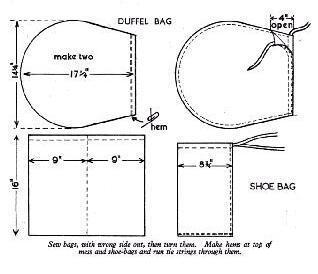
(d) Use “duffel bags” as much as possible. A simple duffel bag is a rectangular bag of any size (according to what you need it for) with a tape attached to the top for tying. Any Scout can soon make a set. I used to have about a dozen, some quite small for tea and sugar and flour, other bigger ones for plimsolls and the like. Opposite are two “patterns” for a mess-bag (for plates and cutlery and dishcloth) and a shoebag. Of course, polythene bags of different sizes can be very useful if you haven’t duffel bags.
Then you have to pack those things which will be shared by all the Patrol, and you will have to vary this list according to how and where you’re going. For example, an I.H.Q. site may have permanent latrines and washing facilities, or if you’re trekking, you may prefer to take a large (and rather heavy!) Patrol tent and the useful Patrol box — neither of which you could manage on your backs if you were hiking or cycling. In this latter case, as I’ve said, each Scout will have to carry his share of the lightweight hike tents and the food and the cooking gear and all the rest. So this is a list to guide you according to circumstances :-
Tent(s) with mallet(s), pegs, poles.
Axes.
Trenching tool.
Cooking gear.
Water buckets (canvas).
Washing bowls (canvas).
Materials for larder.
Sisal.
Programme material. Matches.
First Aid material.
Mending materials (a “hussif”).
Toilet paper.
Mirror .
The P.L. will make sure that he has a book of prayers, a map, and a compass with him, and that drying up cloths, cleaning materials, shoe brushes and polish, a nail brush, matches and salt have not been forgotten by everybody!
It is a very good idea to have a Patrol Box which you can take with you if you are trekking to camp, but which anyway can contain all the little things that you may need, especially for your programme at camp whether it’s badge-work or games.
For example in your box you might keep : — Rope. Cleaning material.
Lashings. Spare butter muslin. Maps. Tennis balls.
Spare mallet. Patrol library . Carborundum. Aluminium foil.
Spare tent pegs. First-aid box, etc.
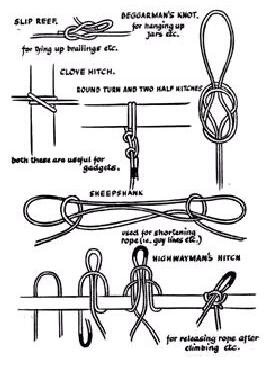
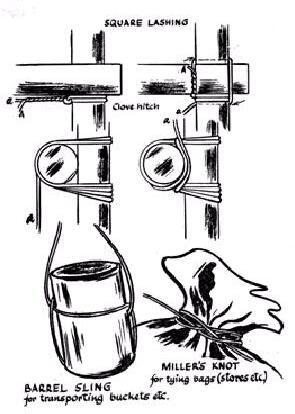
Now here, before we get to camp, are nine knots and lashings you should try to become expert atfor sooner or later you’ll need them : —
4.“AS YOU MAKE YOUR BED. ..”
A lightweight sleeping bag (or flea bag as we call it) is what most Scouts are keen to save up for.
Meanwhile until then you will be able to make your warm and comfortable blanket bed if you remember ( a) you need more underneath you than above you (for the cold rises from the ground), (b) the “fluffy” blankets are the best.
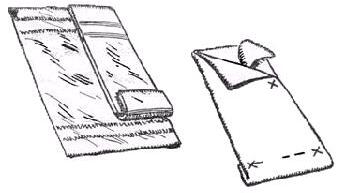
After a while you’ll probably devise a means of making your bed in your own way which you’ll swear is far better than any other method! I invented a most complicated way years ago of rolling in mine, which needed a dozen blanket pins at least. But one of the simplest and best plans is shown in the following diagram:—
And so, at long last, YOUR PATROL IS OFF TO CAMP
5.ON ARRIVAL
Now the Tenderfoot Patrol gives itself away at once when it arrives in camp by the ghastly muddle they get into. Everybody rushes round getting into everybody else’s way, falling all over the place, leaving one poor bloke to pitch the tent by himself, lighting a fire — and finding then no one’s collected any wood to keep it going. . . .
Your Patrol won’t be like that, will it? Here’s the best order and the way to share the chores.
(We’ll suppose there are six of you.)
A. Plan the lay-out of the site. (Six of you.)
This is done by the Patrol in Council so that everybody’s ideas can be heard. You have to decide where to put your tent, your kitchen, your bathroom, your latrines (unless, as I said earlier, these are centrally provided as at Gilwell).
In a little book such as this I can only give you brief hints, especially as much depends on the site, but here are one or two reminders :-
(i) Your tent should be on level ground, not on a slope.
(ii) Have the tent on the windward side of kitchen and latrines.
(iii) Don’t forget your “grease pit” in an annex to the kitchen or in rougher ground near a hedge, carefully marked.
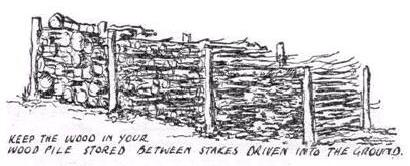
(iv) Don’t forget your woodpile and from the start arrange your wood as illustrated on the opposite page.
B. Pitch the tent(s) (four Scouts). Make the fireplace (two Scouts).
The general rule for pitching tents is first the four corner pegs, second the tent poles into position, third the guy pegs, fourth the sod cloth. Put down the groundsheet(s). Put the packs under cover. (A “Spider” is almost always a sign of an experienced camper. It is a piece of strong cord tied by clove hitches from one tent pole to another a few inches under the roof. You can hang things on it and get them off the floor.)
C. Collect wood quickly (two Scouts). Fetch water (two Scouts). Erect store tent or larder (one Scout). Design kitchen (one Scout).
Don’t keep too strictly to the numbers I’ve suggested for each task because the water (or wood) may be quite near — much depends on the site.
The sooner your kitchen is enclosed and designed the better. Don’t have a cramped kitchen so that no one can move without upsetting something. Have your gadgets neatly arranged well away from the fire. Your wood store should be an annexe off the kitchen.
D. Lay and light fire, and prepare meal (two Scouts). Make gadgets (two Scouts). Dig latrines (two Scouts). (The last two pairs should exchange jobs every few minutes.)
Rules for Firelighting
(i) Begin small, and light with your back to the wind.
(ii) Give the flames something to climb.
(iii) Lay on the wood in an orderly fashion — don’t just throw it on anyhow; in fact build your fire.
In the bigger Scout books, you will find charts telling you about the burning qualities of different woods. Here I can only give you briefly :-
The best tinder: birch, cedar, cypress, douglas fir, holly, hornbeam, larch, scots pine, silver fir, spruce, yew.
The best quick -burning woods: ash, birch, cedar, cypress, douglas fir, holly, larch, laurel, scots pine, silver fir, spruce, yew.
The best slow burning woods: ash, cypress, hornbeam, laurel, maple, oak, plane, sycamore, yew.
(A wood in more than one class is a good all-rounder!)
The worst woods: alder, chestnut, elder, poplar, willow (but, of course, even these aren’t hopeless if there’s nothing else!)
Storage of Food
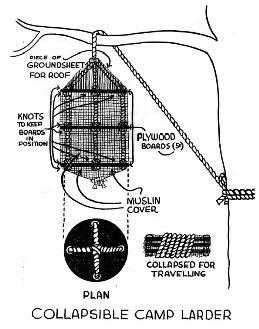
Even in a brief week-end camp a little larder should be contrived. If you’re “travelling light,” a collapsible larder such as the one illustrated opposite can be made beforehand and carried with you.
This can be hung in the shade from a sturdy tree, for to get your larder off the ground is essential. If you’re trekking, carry a box larder with a hinged lid. This should be erected on tent pegs off the ground.
Special precautions have to be taken about: milk, meat and fats, which should be kept in the refrigerator! — e.g. in a hole in the ground, or in your shady muslin larder of the tree tops. Keep as much as you can in tins with lightly fitting lids, which can be labelled. Or you can keep your milk in a billy of cold water with the milk bottle top covered with muslin weighted in the four corners. You can keep your fats wrapped in grease proof paper in the same way. I have known a larder for milk, etc., kept in a running stream!
Jams. Keep covered. Keep outside of jar “unsticky,” i.e. wash it!
Sugar. Keep covered. Be careful not to spill in the “larder” (or anywhere else).
Latrines
Gadgets
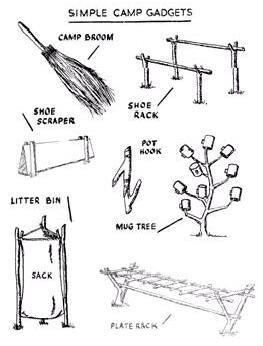
Gadgets are your camp furniture. Always remember that :
A good gadget: keeps things off the ground. is firm and reliable. is simple in construction. does its job!
A bad gadget: doesn’t keep things off the ground, either at all, or not for long. is wobbly and unsteady. ornamental rather than useful. Impractical!
Gadgets should be few but good, but you can’t have a very satisfactory camp without them. “A place for everything and everything in its place” is a fine camp motto. An experienced Scout will make good gadgets out of whatever his camp site offers. You’ll get heaps of ideas from Scout books and other camps and campers. Meanwhile here are a few ideas for you. Make those you will need first—and leave “luxuries” till last: a kitchen gate that swings to of its own accord is great fun but to start with a plate rack is more useful!
If there are no permanent latrines (and you will only find these on I.H.Q. and other permanent camp sites) you must be prepared to dig your own. Any camper, anyway, should know how to deal skilfully with this problem. You will do well to consult the farmer or landowner, on whose land you may be, first because he may prefer to offer you some hospitality in this matter, secondly because he may like you to confine your latrine-digging to a certain part of your site. At the most you will need a wet pit — circular, shallow, with drainage pebbles in it, about a foot diameter — and a dry pit, say 3 ft long by 1 ft wide and l ft deep. If you choose your latrine area carefully (in a spinney for example) you will be able to confine your screening to quite a little
hessian which you can carry rolled around one or two short circular poles.
Remember:
(i)a container is necessary for your toilet paper .
(ii)the latrines should not be too far from your “bathroom” so that hands can be washed after a visit to either pit.
(iii)the pits must be filled in with care and a “ Used “ sign placed on them for the information of future campers.
By this time your cooks should have a meal ready, so having washed your hands go and enjoy it while I add a few notes on dining room, bathroom and menus.
Dining Room
If you are a Patrol camping as part of a Troop camp but camping more or less on your own and cooking for yourselves and looking after yourselves as B.-P. meant you to, and you’re there for a week or ten days or even a fortnight, it’s a good thing to rig up a dining table with logs round it and a dining shelter over it. Let it rain then as it likes!
But for a week-end camp you may have to content yourselves with a dining room consisting only of a groundsheet.
But anyway
(i)don’t eat in the kitchen.
(ii)behave with good manners throughout - as you would if the Chief Scout were present.
(iii)serve in a decent orderly fashion.
(iv) put on washing-up water before you begin eating !
Bathroom
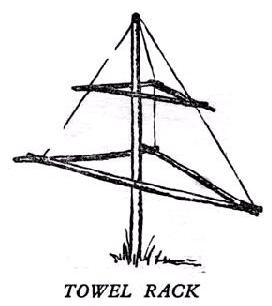
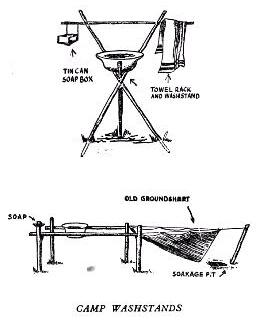
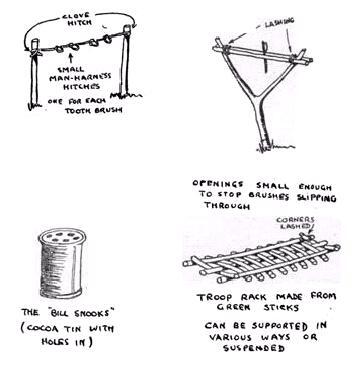
A camp bathroom need not be much more than a part of the site where it is agreed everyone washes. But having such a place does keep everywhere tidy and the little gadgets shown here all help : —
Don’t be afraid to be original: here for example, are four different ideas for a toothbrush holder. You can think of an equal number of ideas for almost any other gadget for any other purpose.
6.THE INNER MAN
This isn’t a cookery book (The Scouts’ Cook Book, No.23 in this series, will help you). Here are a few suggestions for varying the menu. Remember a Scout should be ambitious to become a good cook.
Breakfast:
Orange juice; tomato juice; fresh fruit; cereals; porridge.
Eggs (poached, scrambled, fried, boiled); kippers; sausages; haddock; bacon; fried potatoes and beans; scotch eggs; tea or cocoa.
Lunch or Dinner :
Salads; cold meat and vegetables; stew with dumplings; sausage meat in batter; fish cakes; omelettes; liver and bacon; kabobs. Steamed pudding (Lyons’ Packet Puddings in several flavours are excellent); fresh or stewed fruit with or without custard; plum duff; pancakes; apple fritters; jelly. Welsh rarebit; cheese dreams.
Tea :
Salad or fruit. Jam; cheese; honey; peanut butter; chocolate spread; with bread and butter. Cake.
Supper:
Soup or Cocoa and biscuits.
A Note on Cooking Gear
Every Patrol should decide from its own experience what it needs. A couple of Gilwell Canteens in the old days used to be enough for some, while others would take a large frying pan and a nest of billies. It depends, too, on what you’re going to cook and how you’re going to travel. Some Senior Scouts have cooked for a whole week-end with nothing but a small can for boiling water. So think what you’ll need, take all that you want but nothing extra. A set of billies and a frying pan generally speaking will see you through — but menus and cooking gear are dependent on each other remember.
7. THINGS YOU MAY DO
All camping is play — and that includes washing up and fetching wood and cleaning billies! Scouts are fellows who can look after themselves in the desert or in the jungle or exploring in the Arctic! Of course, you’re only just beginning to train yourselves but a real explorer is able to do all the simple jobs that you have to do — firelighting, cooking, washing up, mending and so on when you’re miles away from civilisation and out on your own or with one or two pals. But as well as the actual camping — that is the living in the open and looking after yourselves there’ll be plenty of time for the Patrol to do some other Scouting and to have some games. Here are a few ideas which you should plan beforehand: if you don’t know how to carry t hem out, get your Skipper or one of the A.S.M.s or Rover Scouts or Senior Scouts to give you some instruction beforehand :-
(i)One half of the Patrol follows a “trail” laid by the other half (the signs should be seeable by a keen-eyed Scout but not by the casual passer-by).
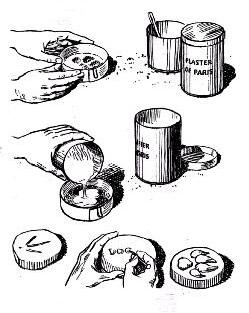
(ii)Make a set of plaster casts of bird and animal tracks and identify them.
(iii)Make a tree map of your camp site with all the trees identified.
(iv)Make a collection (and identify) all the wild flowers and grasses that inhabit your site.
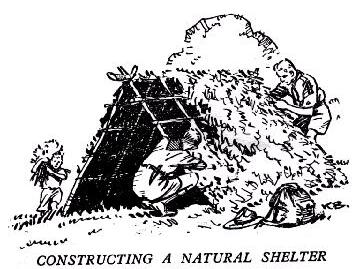
(v)Build a shelter (in a tree or on the ground) out of natural materials.
(vi)Practise sketch maps. Make a scale map of the camp site.
(vii)Make twists and flapjacks.
(viii)Practise estimation methods.
(ix)Practise real signalling from a distance — an opportunity you often can’t get at your H.Q.
(x)Try foil cooking.
You’ll find lots of other ideas in a little book in this series called “400 Ideas for Patrol Leaders,” in “The Patrol Leaders’ Handbook “ and from P.L.s’ Conferences and other camps, etc. But keep the Patrol engaged and busy!
EXPLANATION OF ILLUSTRATION
Make a collar from a strip of thin cardboard, 1” wide, with a clip or a pin. Place the collar around a clear track. Pour the estimated amount of water you will need into a can, add enough plaster of Paris to make a mixture as thick as melted ice cream. Pour mixture into the track. Let set for half an hour .Wash soil or mud off cast.
8.THINGS YOU SHOULD DO
Now we’ll imagine that you set out for camp after Saturday lunch, arrived, pitched camp, had a good tea and had a busy and happy hour or two at some badge work and games. Twilight is beginning to come on. It is at this time that the experienced camper puts a sweater on! For even on the hottest day in England, as the sun goes down the air begins to feel chilly, and to prevent a cold is easier than to cure one. Remember, the 11th Scout Law: “A Scout is not a fool!”
And this is the time, while there is yet daylight, for every Scout to get his bed made and to get the tent(s) cosy for the night. Roll down (and peg down) the brailings; see that the candle is firm in its holder or the hurricane lamp is in its place; see, too, that clothes aren’t left outside to get wet from the dew or a rain shower!
And then with the cocoa ready, there’s nothing like a yarn together round the fire (for a Patrol camp the kitchen fire has to be “camp fire” too! ) with a song or two. A little wind blows in the trees and an owl hoots: the stars begin to prick the sky. It’s the best time of all until the fire begins to become drowsy and so do you. So you stand together and the P.L. reads a simple prayer from the little book called “Prayers for use in the Brotherhood of Scouts,” and perhaps then you say softly together the Lord’s Prayer.
And so to bed.
AND LAST THING AT NIGHT —
(i)Clean your teeth, etc.
(ii)Cover your water buckets and your wood pile.
(iii)Cover your fire (with an iron bowl or something like it) so that you have some hot ashes in the morning.
(iv)See that nothing (e.g. an axe) is left out.
(v)Slacken your guy-lines.
(vi)Have Patrol prayers before lights out.
AND IN THE MORNING —
(i)Blow up your fire and get some water on.
(ii)Wash (and no half measures).
(iii)Brail up tent(s) and hang out blankets and pyjamas to air. Four of you will do this while two of you cook breakfast.
(iv)Eat breakfast and wash up. Morning duties
(v)Clear tent(s) and arrange all your belongings as though for inspection whether there’s inspection or not.
(vi)See that camp site is all ship-shape.
And then you’re ready for your programme. By the way, the second day of a week-end camp is usually a Sunday. Because you are camping that doesn’t mean you will forget your religious obligations, indeed it is all the more reason why you should fulfil them. Some of your Patrol may belong to religious denominations who will wish to attend a special service at their nearest churches if they are at all within range: these services may be early in the morning so the rest of the Patrol will do their best to help them get away in plenty of time. The churchgoers, in their turn, will do a bit extra of the camp chores after breakfast!
Then how about a little Patrol Scouts’ Own ? It need only take a few minutes. The Patrol Leader will read a prayer or two he has selected with care. You may be able to sing a hymn from your Scout hymn books. Certainly one of the Patrol could read a few verses from the Gospel. I’ve heard P .L.s before now give fine little talks on such occasions. Do all you can; at least you will stand together a moment in silent prayer and then perhaps repeat the Lord’s Prayer softly together.
9AT THE END OF THE CAMP
I expect you know what B.-P. said about leaving camp — “ Leave nothing but your thanks.” Back in the war years I had some fifty fellows from different parts of England camping in a great private residential park. A H.Q. Commissioner was coming to visit us but unfortunately there was some mix up about the dates and he actually arrived later the same day as we left. At I.H.Q.
afterwards he said: “I arrived too late to see the camp but I know they were all good campers because though I searched for two hours I couldn’t find the place where they’d camped !” We felt there couldn’t be better praise than that but I’m not sure that we didn’t get it from the distinguished owner of a large park in the Midlands where nearly two hundred Senior Air Scouts camped for a fortnight. We used this site two years running and the second year we were greatly honoured by our Chief Scout coming to camp with us for a long weekend. In thanking our host for allowing us to camp in his lovely grounds the Chief Scout said: “I hope the Scouts leave your ground as good as they find it.” “As good,” said my host, “they leave it a great deal better!”
So there you are. Leave your camp site as you’d like to find a camp site when you arrived. Here are some rules : —
(i)You should have burnt all garbage as you went along. Don’t leave it till the last minute.
(ii)Flatten out tin cans and bury them fairly deep. (If necessary take them home with you and see they reach the domestic dust-bin). Don’t leave them about.
(iii)Fill in your latrines and mark with a sign. Fill in your grease pit.
(iv)See that your fire is out. Bury the ashes. Returf your fireplace and water the edges of the turf.
(v)Make a human chain and go across the camp site slowly picking up any scrap of paper or matchstick or anything that needs scavenging.
Your commonsense and courtesy — which means consideration for others — should do the rest.
And remember throughout the Scout’s COUNTRY BEHAVIOUR
Don’t trespass on land sown with crops.
Don’t leave water taps dripping. Water is precious to the farmer.
Remove turf with care so that it can be replaced.
Leave all farm gates as you find them.
Only climb trees if you have permission.
Be sure to get permission before you pick fruit in the orchard.
Keep quiet near the farmhouse, particularly at night.
Be particularly careful about the risk of fire in dry weather.
Leave the animals alone unless you are given permission to help with them.
When getting firewood be careful not to injure living trees or to break down hedges.