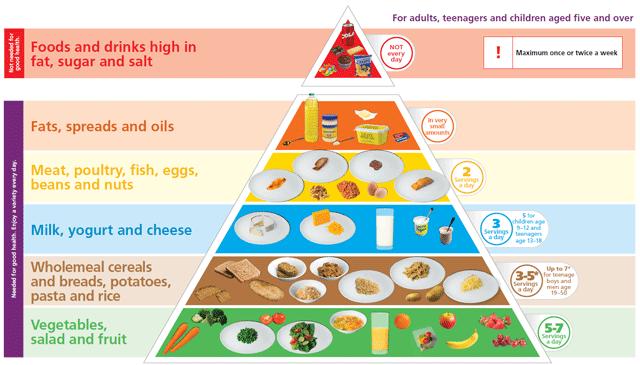
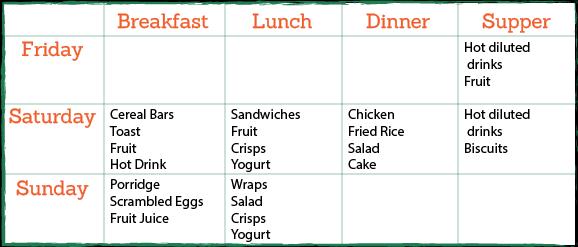
You need to plan a full balanced menu for the camp. The menu needs to accommodate the tastes and health of all the scouts and the partialities of the site. The scouts responsible for cooking should have experience of cooking on camp.
For info on a balanced diet, check out: safefood.eu
Things to think about when planning a menu:
• Is it a balanced menu? Do you have enough fruit and vegetables?
• How much will it cost?
• Do any Scouts have allergies & intolerances?
• Is there food that Scouts won’t eat?
• How will the food be stored?
• When will the food be bought? And, how will it be transported?
Equipment
Make out a list of the equipment based on the programme and the menu. In the lead-up to the camp, the equipment should be checked and packed ready for transport. The Patrol Quartermaster should coordinate this. Things to think about:
• Tentage, including dining shelter – Take tents out and check for wear, that all parts are present and in good condition
• Storage – Is your patrol box fit for purpose? Is your water container clean and in good condition?
• Lighting –How are your lanterns? Do you have fuel?
• Cooking gear – Whether fire or gas, is your cooking equipment safe and usable? If in doubt, ask your Scouter.
• Pots and Pans – Do you have a stock of good quality pots and pans for cooking? Are handles secure? Does everything have a lid?
• Cooking utensils – Is there anything missing or which has seen better days? Are your knives sharp and storable safely?
• Cooler box and ice blocks – Do you have enough? Do any of your ice blocks leak?
• Seating – If you use tables and benches, are they up for a camp?
• Axe and saw – Is your patrol axe sharp? Is it head sufficiently secure to the handle? Does your saw blade need to be replaced?
Transport
Careful planning needs to be made for transporting people and equipment. You need a clear plan that everyone understands. Lifts: For a local patrol camp, carpooling is the most cost effective and convenient way of getting to and from the site. Make sure a rota is made out, everyone has a lift, and everyone has the details.
Transporting the equipment: You can divide the equipment between the cars or if someone has access to a van or a trailer you can use that. Make sure you have plans to transport the equipment to and from the campsite. Also, you will need to have access to the Group stores.
Emergencies and Safety:
With the help of a scouter think out common risks associated with camping and then sugget what you would do. Here are some examples:
• Risk - An accident resulting in an injury. Mitigant – Ensure code of good behaviour by Scouts in place and take no silly risks
• Risk - An accident resulting in damage to equipment. Mitigant –Ensure all Scouts are trained in the proper use of all equipment
• Risk - Cancellation of accommodation booked. Mitigant –Arrange back up accommodation as a contingency
• Risk - Uncontrollable changes to travel plans. Mitigant – Have contact details for all relevant people and have an emergency plan for heading home
• Risk – Illness. Mitigant – Take all reasonable precautions in food preparation. Ensure first aid training up to date. Be aware of preexisting conditions. Have an appropriately stocked first aid kit.
• Risk - Bad weather conditions . Mitigant – Have a Plan B and Plan C that are not weather dependant
• Risk - Loss/theft of money/equipment. Mitigant – Have back up funds available at short notice in an emergency
Safety Checklist
• Do you have emergency contact details for the Scouters and the campsite?
• Will you always have a charged phone available? Is there way of charging a phone?
• Is the Camp Leader aware of any medical conditions and the actions that need to be taken if a situation arises?
• Do you have a safety plan in place?
• Do you have a fully stocked first aid kit?
Roles in organising a Patrol Camp
Every scout has a part to play in your Patrol Camp. Everyone should be involved in making the programme as successful, fun, and interesting as possible. This is a quick guide to helping you have everyone involved.
Participation: Scouts on their Terra Nova Award
You will mainly be getting used to the way the Patrol works. You will participate in the programme through partaking in activities and holding specific roles in the patrol, such as grubmaster or photographer.
Active Involvement: Scouts on their Endurance Award or assistant activity leaders
In the second year, Scouts take on more responsibility. You become more active in the Patrol and Troop by starting to organise parts of activities, holding more challenging roles (such as Treasurer or Quartermaster), and by passing on your skills to others. For the camp, you will plan, prepare (get equipment ready, understand the skills involved, know the schedule etc.), run, and review specific parts.
Leading: Scouts on their Polar Award or Activity Leaders
Scouts in their final year take on leadership roles, usually as PLs and APLs. You will run the camp with help from other scouts, and ensure everyone has a part to play. Also, your Scouters are their to support you and give advice when you need it, make sure you keep them up to date on everything that is involved.
Supporting: Scouters
Adult Scouters are mainly there to provide support to you, the Scouts, in running the programme. They work with the Activity Leaders by providing advice, guidance, and encouragement. Scouters have overall responsibility for the safety and wellbeing of all the scouts, and in preparing for and controlling risk.
Scout Individual Patrol
Terra Nova
• Personal Equipment
• Working on Crean Awards
Endurance (APL / Activity Leader)
• Personal Equipment
• Working on Crean Awards
Polar (PL / Activity Leader)
• Personal Equipment
• Working on Crean Awards
• Role agreed by the Patrol
• Taking part
• Role agreed by the Patrol
• Taking part
• Running a part of the activity
• Preparing (plan, equipment etc)
• Helping others
• Running the activity
• Leading by example
• Preparing (plan, equipment etc)
• Coordinating
• Helping others
• Sharing skills
• Ensuring safety
• Informing Patrol of schedule
• Making a budget, buying supplies
• Booking venues and activities
• Informing Troop of schedule
Scouter
• Personal Equipment
• Working on Scouter Training
• Supporting Patrols & Scouts
• Ensuring safety
• Assisting when needed
• Working with Activity Leaders
• Help with budget, planning, bookings etc
• Coordinating with Scout Group
• Acting as a role model
Activity Youth Leader Checklist
Programme
We have a planned programme for the activity
It helps all Scouts progress in their Crean Awards
Location
A suitable venue that you & Scouters are happy with Emergency services can access the site
The location is booked
Administration
We have an activity timetable
We have a wet weather plan
You and the Scouters are aware of any medical requirements
We have a charged mobile phone available
We have all bookings printed and in a folder
Finance
We have a well-planned budget
We will have contingency funds with us
Transport
Transport is arranged/booked
There is enough flexibility in our transport plan in case of delays
Equipment
We have all the equipment needed
We have tested all the equipment
We know how to use all our equipment safely
Training
We have the appropriate training for the activity
Emergency
We all know who to call in case of emergency
Scouter Checklist
Programme
The Patrol/PLC have a planned programme for the activity
It helps each Scout progress in their Crean Awards
We know what supports the Patrols/Troop needs
Location
They have a suitable venue for the programme planned
Emergency services can access the site
The location is booked
Administration
They have an activity timetable
They have a wet weather plan
You and the Youth Leader are aware of any medical requirements
They have a charged mobile phone available
They have all bookings printed and in a folder
Finance
They have a well-planned budget
They have contingency funds with them
Transport
Transport is arranged/booked
There is enough flexibility in the transport plan in case of delays
Equipment
They have all the equipment needed
They have tested all the equipment
They know how to use all our equipment safely
Training
We/they have the appropriate training for the activity
Emergency
All the Scouts know who to call in case of emergency
Campsites and Activity Centres
Scouting Ireland’s campsites and activity centres can are great venues that can facilitate a patrol camp. The can provide:
• A safe site, with facilities
• Activities
• Volunteer staff who can support the patrol
• Local knowledge and advise
• Some have a 24hr presence of volunteer staff
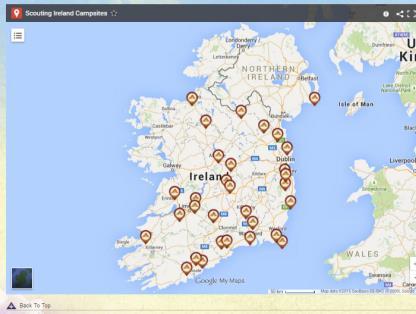
Tips for working with a Scouting Ireland campsite: Search through the directory and find the campsite which suits your needs (location, activities, budget).
• The PL or APL contacts the campsite and explains their plan
• Book any programme needed
• Get contact details for the site
• Some campsites might need a deposit in advance, the treasurer should send this on
Campsite/Activity Centres: goo.gl/DYpgYK
This directory has info on all Scouting Ireland campsites, camp fees, activities that they offer, as well as providing directions to the campsite.
Keeping Families Informed
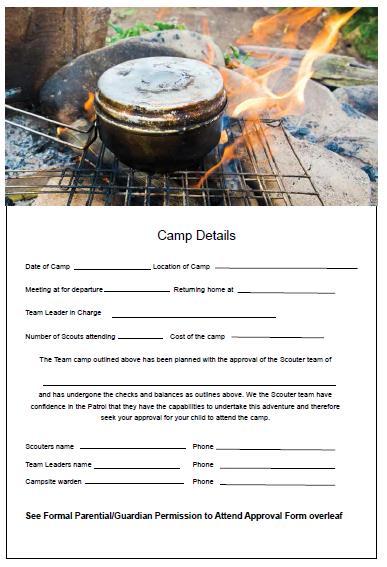
It is important to keep families informed what is involved in patrol camps, some people may by initially uncomfortable with the idea of a patrol camp. Check out the form at the end of this document as an example of a letter to send home to families. Some points to raise:
• Camping is an extremely important to the Scouting programme.
• Scouting seeks to train each team in such a way that it becomes self-sufficient both in terms of skills and as a working team of young people able to undertake different challenges.
• One of the most important opportunities for the Patrol is the opportunity to camp as a team on their own with adult support at a distance. This is no ordinary undertaking and a Patrol will have carefully planned for such an event.
• Patrol Camps are planned, well in advance, under the guidance of the adult Scouter.
• The Camp Leader has special training in the area of organising a camp and in leadership and responsibility.
• The Patrol has the skill set required – organisational ability, cooking skills, camping skills, first aid and an awareness of safety.
• A plan of action, budget for the event, programme, equipment list, emergency plans etc. are carefully drawn up and are fully reviewed by the adult Scouter in consultation with the Scouts.
• The camp must take place on a recognised campsite owned by Scouting Ireland and with a warden staff available on site (experienced adults who manage the campsite).
• Parents must provide written approval for Scouts to the camp.
• During the camp, adult scouters will visit the Patrol over the weekend to check on progress and well-being and will be in effect ‘on call’ should any difficulties arise.
• Camps are supported by their own adult Scouter. Adults are near at hand on the campsite in case of emergency, normally less than a few hundred meters away. So, the Team feels it is alone but in fact they are holding the camp in a controlled and safe environment.
Parent Guardian Permission to Attend a Team Camp Approval Form
This approval form only relates to the Team Camp outlined below. You as Parent/Guardian have signed other forms from the Scout Troop relate to Medical Details and general permission for your child. This information is still relevant, and you do not need to fill in another form this camp.
This form solely relates to the camp listed and details as listed. A parental/guardian approval is required for each Team Camp that your child attends.
We/I the Parent(s)/Guardian(s) of: ______________________________________________________
Are happy to provide permission for our child to attend the Team Camp as listed and outlined.
Date of Camp: _______________ Locations: _________________
It is our understanding that the Section/Group Scouters have provided the necessary training and support to all the Scouts participating in this adventure, and that they are confident in the leadership of the Team Leader and their Team to undertake this camp in a responsible manner.
Name & Date: ________________________________________