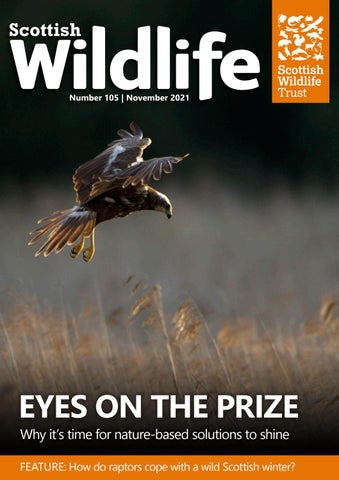
Number 105 | November 2021
EYES ON THE PRIZE Why it’s time for nature-based solutions to shine
FEATURE: How do raptors cope with a wild Scottish winter?
Social Welcome media from link/Web our Chair link
FIRST WORD From our Chair, Linda Rosborough © Scottish Wildlife Trust
I
t is time for action. The big Covid slowdown is finally coming to an end. World leaders are again free to come together and agree on big changes. Scotland has a new administration that sees an historic co-operation agreement. The pieces of the puzzle are there. We know we are in the throes of both a climate and a nature emergency, and that the two are inextricably linked. Future strategies and pious hopes are not enough. We need to see change and we need to see it now. A year ago, the Trust set out clear imperatives for Scotland in a Nature Recovery Plan published jointly with RSPB Scotland and WWF Scotland. In its recent Programme for Government, the Scottish Government committed to many of the changes that were called for in the plan. While very welcome, we still need greater urgency in several key areas, as outlined in our detailed response on page eight. Scotland must deliver on its longstanding commitments. We need to see substantial peatland recovery. We need to see change in agricultural support that leads to real change in farmers’ care of the land, not just lip-service and rebadging. And after several years of dither and delay, we need effective marine management. Urgent action on deer management is also long overdue – we know this is key to natural regeneration of our lost native woodlands. In the UK, Scotland pioneered the reintroduction of beavers, the ultimate
The Trust’s tree nursery in Assynt
ecosystem engineers. We know the benefits beavers bring for biodiversity and for the economy, and so need to see Scotland’s beaver populations expand further. Nature’s recovery should not be constrained by caution or timidity. We know how important Scotland’s wildlife is to the people of Scotland, and particularly to our members. The pandemic emphasised how much people need nature and wild places. Throughout this challenging time, the Trust has continued its efforts to protect Scotland’s wildlife and has carried out a range of work, from large-scale habitat restoration to access improvements. On Trust reserves, we are sowing new wildflower meadows, reinstating hydrology to restore lowland peat bogs, removing invasive species and improving grassland through our Flying
We know we are in the throes of both a climate and a nature emergency, and that the two are inextricably linked.
Flock and Hardy Herd. We are also growing native trees in volume from local seed at our tree nursery in Assynt. Crucially, we are helping people from all backgrounds to connect with nature – a powerful example of which can be read on page 34. Last year, we improved the habitat around the original nest site at Loch of the Lowes and were rewarded with a return of the ospreys this year after a 12-month absence from the cameras. But for all our efforts, and those of others in the conservation sector, we need governments – all governments – to step up and deliver. As you will read in this issue, when free from pressures and functioning as it should, nature provides a whole range of ready-made solutions that can help us mitigate climate change and improve the world’s resilience to its effects. It is a crucial message that the Trust’s Young Leaders will take with them to Glasgow as delegates gather for the COP26 summit in November. While there, we need the attendees to listen and then act. And we need both to happen now. NOVEMBER 2021 SCOTTISH WILDLIFE 3
Contents
Inside this issue
06
WIN MURRA STAY AT A PERT YSHALL, HSHI RE SEE P AG
18
E 33
06 REEDBEDS
Dominated by reeds, this habitat hides some of Scotland’s most secretive species.
08 NEWS
News round-up from the Trust and the wider world of conservation.
16 18
PROBLEM SOLVING
A guide to nature-based solutions.
ich Rowe explores how nature-based R solutions can be a vital tool in tackling the joint climate and biodiversity crises.
NATURAL TALENT
22
Q&A
24
COLD COMFORT
28
LEADING FROM THE FRONT
31
THE BIG PICTURE
We ask environmental scientist Sir Robert Watson about the potential of nature-based solutions. Marieke McBean reveals how Scotland’s birds of prey cope with the challenges of winter.
24
28
Charlie Drapala explains how the Trust’s Young Leaders are making a difference at UK level.
David Hamilton amazes with his macro photography of “wee mad beasties”.
32 34
WATCH OUT FOR
Things to enjoy in the coming months.
VIEWPOINT
Ruth Hunter reflects on a life-affirming connection with nature.
Marsh harrier over reedbed © Andrew Parkinson/ 2020VISION Scottish Wildlife magazine is published by the Scottish Wildlife Trust. © Scottish Wildlife Trust. No part of this magazine may be reproduced without the express permission of the publisher. All photography © Scottish Wildlife Trust unless otherwise stated. The Scottish Wildlife Trust accepts no liability for omissions or incorrect data in advertisements and letters. Views expressed in Scottish Wildlife are not necessarily those of the Scottish Wildlife Trust. ISSN: 0143 1234. Registered office: Harbourside House, 110 Commercial Street, Edinburgh EH6 6NF. Tel: 0131 312 7765. Fax: 0131 312 8705. Email: enquiries@scottishwildlifetrust.org.uk. Website: scottishwildlifetrust.org.uk. The Scottish Wildlife Trust is a company limited by guarantee, registered in Scotland (no. SC040247). It is also a Scottish registered charity (no. SC005792). Scottish Wildlife is published three times a year: March, July and November.
The Scottish Wildlife Trust is affiliated to The Wildlife Trusts, a UK-wide network of 46 Trusts with more than 2,000 wildlife reserves. 4 SCOTTISH WILDLIFE NOVEMBER 2021
Deadlines for news: 1 January, 1 May, 1 September. No unsolicited articles please. Scottish Wildlife is free to members. Membership rates from 1 April (excluding discounts for paying by Direct Debit): Individual (concession) £40 (£18); Joint (concession) £47 (£24); Family £57; Watch £18; Life (joint) £900 (£1,300); World/Overseas £45. Patron: HRH The Prince Charles, Duke of Rothesay. Chair: Linda Rosborough. Vice-Chairs: Karen Chambers, Bill Lambert, Kenny Taylor. Chief Executive: Jo Pike Managing Editor: Pete Haskell editor@scottishwildlifetrust.org.uk Contributing Editor: Rich Rowe Design: Connect connectcommunications.co.uk Advertising: Elliot Whitehead 0131 561 0021, Clare Stebbing 0131 561 0024. Printing: InkMark – inkmarkltd.com
Spotlight: Water rail
© Amy Lewis
SPECIES SPOTLIGHT:
WATER RAIL (Rallus aquaticus)
A secretive bird that craves the cover of dense reedbeds and waterside vegetation, the water rail is found in areas of wetland habitat up to 200m above sea level.
About half the size of a moorhen and slightly slimmer, the water rail’s relatively long legs and narrow body allow it to move quickly and freely through heavy cover.
One of Scotland’s most elusive species, the water rail is more often heard than seen, emitting an extraordinary range of grunts, groans, purrs and piglet-like squeals.
Easier to spot in winter when vegetation has died back and it is generally more widespread, the water rail often holds its tail cocked, revealing white undertail feathers.
Like other members of a bird family that also includes crakes and coots, the water rail is omnivorous, with a preference for small fish, snails and insects.
NOVEMBER 2021 SCOTTISH WILDLIFE 5
Spotlight: Reedbeds
BEDS OF PLENTY As the name suggests, reedbeds are a type of wetland that is dominated by tall, dense stands of common reed (Phragmites australis) which grow on low-level ground that is waterlogged for much of the year. Although mostly found around freshwater, reedbeds can thrive in brackish and tidal waters. In all such environments,
common reed is a particularly vigorous coloniser, with reedbeds often so dense that few other plants get a look in. In shallow water, low-growing aquatics such as water horsetail and some species of bladderwort have a toehold, while less waterlogged areas also feature water mint, marsh bedstraw and a scattering of taller
species such as yellow iris in among the thick mats of reed litter. Despite not being hugely rich in plant species, reedbeds nonetheless provide habitat for a range of invertebrates and small mammals – plus some of Scotland’s most secretive birds which creep and skulk through the towering vegetation.
WATER RAIL
COMMON REED
Much easier to spot in winter, the elusive water rail has chestnut-brown and black upperparts, a slate grey head and underparts, and a long red bill. When in flight, the bird’s pink legs and feet can be seen trailing behind.
A dominant species of vegetation in reedbeds, the common reed has hollow stems with feathery flower spikes that appear dark purple at first but fade to golden brown as the spikelets (which contain the flowers) grow bristles.
REED BUNTING
WHOOPER SWAN
A sparrow-sized bird, male reed buntings perch high on reeds during the breeding season, from where they sing a simple territorial call. In winter, reed buntings join mixed-species flocks to feed on farmland.
A winter migrant to lowland areas of wetland – whooper swans fly non-stop from Iceland in the autumn – these particularly vocal birds have a loud trumpeting call that sounds a little like an old-fashioned car horn.
6 SCOTTISH WILDLIFE NOVEMBER 2021
Spotlight: Reedbeds
A
B
C D
RESERVES
With wildlife often much more visible, winter can be a fantastic time to explore reedbed habitats. Here are five Trust reserves to visit over the coming months.
A CARRON DAM
WATER SHREW The largest of Britain’s shrews, the water shrew is semi-aquatic and most often found in habitats close to water, including the banks of reedbeds. They have low population density compared with most small mammals.
A partially drained reservoir near Falkirk, Carron Dam features an expanse of wetland, rich fen and deciduous woodland. Specialist plants such as gypsywort and waterplantain thrive in areas not dominated by reeds, with water voles and water rails sometimes glimpsed along the banks.
B BARNYARDS MARSH
Tiny but full of interest, this wetland reserve close to Elie in Fife has a range of vegetation types, such as reed canary grass, sedges and mosses. Look out for wintering birds, including snipe, which can be seen along a circular path through the marsh.
C KNOCKSHINNOCH LAGOONS
A mix of habitat – from open water to islands, marshland, reedbeds and willow carr – make this Ayrshire reserve particularly important for bird life, including a wide range of wintering wildfowl. The reserve can be explored using a network of footpaths.
D DRUMMAINS REEDBED
RAFT SPIDER Adult raft spiders often sit at the water’s edge resting their legs on the surface to feel for the vibrations of potential prey. Once detected, these large, chunky spiders use the surface tension of the water to dash out and catch their prey.
With expansive views across the Solway Firth, this dramatic stretch of coastal reedbed, saltmarsh and mudflats in Dumfries & Galloway is a magnet for wintering waders and wildfowl. There is a rough path through the reedbed to the merse (salt marsh).
E BALGAVIES LOCH
This inland loch close to Forfar is surrounded by reedbeds and willow carr – providing ideal habitat for water rail, great crested grebe and a variety of wintering wildfowl, including goldeneye, teal and wigeon. The reserve is also a haven for red squirrels.
NOVEMBER 2021 SCOTTISH WILDLIFE 7
Reedbed spread © Margaret Holland, Water rail © Amy Lewis, Common reed © Ross Hoddinott/2020VISION, Water shrew © Shutterstock, Reed bunting © Chris Lawrence, Whooper swan © Danny Green/2020VISION, Raft spider © Vicky Nall
E
Scottish Wildlife Trust news
Stronger focus on Scotland’s seas
Dr Samuel Collin, Living Seas Manager
8 SCOTTISH WILDLIFE NOVEMBER 2021
News from the Trust, our projects and the wider world of conservation
All the latest Trust news is available on our website scottishwildlife trust.org.uk © Danny Green/2020VISION
THERE is a welcome and growing interest in the health of Scotland’s marine environment. The Scottish Government’s recent Programme for Government (see Trust response opposite) highlights key actions that, if delivered, could mean significant steps towards recovering the health of Scotland’s seas. Unlike on land, conservation efforts in the marine environment are in their relative infancy. Historically, Scotland’s seas have been regarded as a limitless resource; at six times the size of Scotland’s land area, it was perceived as an environment too big to feel the impact of human activity. It is true that with the majority of marine life hidden beneath the waves, the scale and significance of our impact has been difficult to measure. And it is this ‘out of sight, out of mind’ challenge that has contributed to the continued and unsustainable exploitation of our seas. But now, as our knowledge of the marine environment continues to grow, the scale of our impact, and the need for urgent action, has become all too apparent. Declines in populations of seabirds and Atlantic salmon – two key indicator species of ecosystem health – are worrying. Meanwhile, reports of extensive habitat loss, in particular seagrass, highlight the extent to which human activities have impacted ecosystems from bottom to top. We continue to learn much about the multiple benefits that healthy seas can offer, from storing carbon and protecting coastlines to creating jobs and providing food security. Now, in the UN Decade on Ecosystem Restoration, significant actions are needed to reverse the decline of our seas. I remain optimistic that our seas can recover and hope that the Scottish Government’s actions will deliver the much-needed step changes in marine conservation that have been promised.
Latest news
KEEP UP TO DATE
A new Natural Environment Bill must be seen as an urgent priority
Response to Programme for Government THE Trust has welcomed the Scottish Government’s recent Programme for Government, published in September, but is encouraging greater urgency in several key areas. Ministers’ plans for the coming year include a number of commitments which the Trust advocated for in the Nature Recovery Plan, published jointly with RSPB Scotland and WWF Scotland. These include setting legally binding targets to protect and restore nature, renewing the commitment to Local Nature Networks in every local authority, transforming agricultural support and beginning to ensure that Scotland’s network of Marine Protected Areas delivers meaningful change. The Scottish Government has also pledged to hold a consultation on banning gardening products containing peat. However, the Trust believes that many measures could be introduced more urgently, and that there should be a stronger investment in a wider range of nature-based solutions to climate change and biodiversity loss. “The Scottish Government’s programme rightly recognises that nature loss and climate change are the greatest threats facing people and the planet today,” commented Jo Pike, the Trust’s Chief Executive. “The Government has announced many positive steps, but the emergency
facing our natural environment requires a more urgent response. “In particular, we would like to see the Natural Environment Bill brought to Parliament as a matter of priority. “If Scotland is serious about playing its part in the UN Decade on Ecosystem Restoration, this really shouldn’t be left until the third year of the Parliament in 2024.”
Key measures announced • A new Natural Environment Bill setting targets for nature restoration, including protecting 30 per cent of Scotland’s land and seas by 2030. • Beginning the process of designating 10 per cent of Scotland’s seas as highly protected by the end of 2022. • Ensuring that every local authority area will have a Nature Network by 2026. • The delivery of a new Biodiversity Strategy and a five-year action plan in 2022. • Moving 50 per cent of agricultural funding towards supporting public goods, including biodiversity, and a commitment to producing a Good Food Nation Bill. • A focus on economic, social and environmental wellbeing in the National Strategy for Economic Transformation.
Scottish Wildlife Trust news
© Dora Hamilton
The leucistic puffin on Handa
White puffin on Handa A RARE leucistic puffin caused quite a stir on Handa Island Wildlife Reserve during the summer. In contrast to its more colourful cliff-side neighbours, this young puffin has only a few black feathers and its bill is largely orange. It was seen several times around the island by our team, who hope it may return in future years. “When you live and work on Handa you are surrounded by amazing wildlife all the time, but this leucistic puffin is one of the most unusual things I’ve seen in my three seasons on the
island,” commented Handa Ranger Erika Faggiani. There are only a few reports of leucism in seabird colonies around the UK. This includes one puffin which bred on Handa in 2018 and 2019 and which had light brown feathers instead of the usual black colouring. There was a welcome increase in puffin numbers on Handa this year, with more than 1,000 birds counted, compared with 817 in 2020. Trust rangers also recorded a slight increase in the number of guillemots.
Spotlight on farming best practice THE Trust and NFU Scotland are calling on the Scottish Government to ensure that farmers and crofters can play their part in tackling the climate and biodiversity crises. A joint briefing has identified a number of measures that could be supported by ministers and which represent important first steps to delivering the urgent action needed. These include encouraging more efficient use of nitrates, work to assess and improve soil health, coordinated action to re-naturalise rivers and create new riparian woodland, and support to tackle invasive non-native species at a landscape scale. Organic livestock farmer and Trust Council member Carey Coombs said: “The majority of Scotland is managed for agriculture, so our industry has an almost unparalleled ability to support positive environmental change.” Unlocking this potential could bring great rewards for wildlife and people. “New networks of wildlife-rich hedgerows could criss-cross Scotland, rivers could be revitalised and shaded by trees, and farm businesses could lessen their carbon and nitrogen emissions,” added Carey. “But achieving our vision will require public funding and a supporting framework of regulation.” The Trust and NFU Scotland have co-developed a project called Champions for Change, showcasing farmers who are already changing the way they manage their land and which, if rolled out over more of Scotland’s farmland, could benefit wildlife and habitats. Read the full briefing and see case studies at scottishwildlifetrust.org.uk/ championsforchange
© Scottish Wildlife Trust
Mud fun
Part of the new outdoor learning area
A NEW outdoor education area at Montrose Basin Visitor Centre has been completed with help from local Tesco shoppers. Visiting groups, including schools and our Montrose Basin Wildlife Watch Group, now have a new activity space to enjoy, featuring a huge storytelling chair and a ‘mud kitchen’ for messy play. The project was awarded £4,000 from Tesco Community Grants, having come first in the ‘blue coin vote’ at two local stores. NOVEMBER 2021 SCOTTISH WILDLIFE 9
Scottish Wildlife Trust news
Changes to Council
IN BRIEF Nature of Scotland Awards
The Trust-led Coigach & Assynt Living Landscape Partnership and our volunteer Young Leaders have been nominated for the prestigious Nature of Scotland Awards. Our work on beaver reintroduction in partnership with the Royal Zoological Society of Scotland has also been nominated as one of the Conservation Successes of the Decade, decided by a public vote. Winners will be announced on 17 November. Fingers crossed!
Climate Scotland campaign
safeguarding heritage, natural beauty and ecological integrity. Dr Tim Duffy, John Morris, Anthony Robson and Jane Stuart-Smith were re-elected to the Council. Dr Tim Duffy is our new Vice Chair of Watch and Groups, while Ian Jardine becomes Vice-Chair of Conservation. Jane StuartSmith has been appointed Convenor of our Nominations Committee. The Trust would like to thank outgoing Council members Karen Chambers, Deryck Irving, Karen McKellar, Nicky Munro and Dr Kenny Taylor for their dedication and service.
© Scottish Wildlife Trust
© Scottish Wildlife Trust
The Trust has joined forces with organisations from across Scottish society to help gather thousands of voices from people who want more action on climate change. These messages will be delivered to the COP26 summit to send a strong message: we want meaningful commitments to protect the things we love, and to make a better future for us all. Add your voice at climatescotland.org
THIS year’s Annual General Meeting saw the election of two new members to our governing Council of Trustees. Having retired from a career in construction five years ago, Chris Arnold now holds a number of voluntary positions and is a keen wildlife photographer. His passion for nature stems from an upbringing in the countryside and, more recently, living next to a Local Nature Reserve in Edinburgh. Dr Julian Caldecott is a writer and ecologist whose key aim is to harness and build upon the country’s precious resource of public enthusiasm for
Enjoy a closer look at Scotland’s marine life
What lies beneath New species at Jupiter
The first buff arches moth (pictured) recorded in Stirlingshire Vice County was spotted at Jupiter Urban Wildlife Centre during a recent moth-trapping session. Buff arches are common across most of Europe but are found only in small numbers in the south of Scotland.
Wild goose watch
The Trust’s first ever online goose watch, filmed from the shore of Montrose Basin, had nearly 500 participants in September. A live camera captured clouds of pink-footed geese returning noisily to their evening roost. This exciting event was supported by players of People’s Postcode Lottery. As this issue of Scottish Wildlife went to press, more than 67,000 pink-feet had been counted on the Basin, with numbers expected to rise further. See a recording of the goose watch at scottishwildlifetrust.org.uk/events 10 SCOTTISH WILDLIFE NOVEMBER 2021
TWO new self-led snorkel trails have been added to our growing network of sites around Scotland, all developed through the Trust’s Living Seas programme. The new trails on the coasts of the Isle of Arran and Lochaber feature a range of wildlife-rich sites, including beautiful beaches, kelp forests and rocky shores. The trails have been developed in partnership with the Community of Arran Seabed Trust (COAST) and the University of the Highlands and Islands, respectively. “We hope that more people are encouraged to get in the water to see for themselves the wonderful marine life that lives here and therefore want to take steps to protect it,” commented Jenny Stark, COAST’s Outreach and Communications Manager.
A taste of the trails Clauchlands Farm, Arran A marine habitat within the Lamlash Bay No Take Zone, where no fishing has taken place since 2008. Lochranza, Arran A sheltered beach with plenty of juvenile fish, crabs and starfish among the seaweed. Loch Nan Uamh – Prince’s Cairn, Lochaber This is said to be the site of Bonnie Prince Charlie’s departure from Scotland in 1746. The rocky kelp grounds host many species of fish and crustaceans. Camusdarach Beach, Lochaber These beautiful white sands are the location of ‘Ben’s Beach’ in the 1983 film Local Hero. Enjoy views of the Cuillin hills while exploring rocky outcrops. Discover the trails at scottishwildlifetrust.org.uk/snorkeltrail
Scottish Wildlife Trust news
© Steve Gardner
© Nick Wright
By Royal Appointment THE Princess Royal visited the Trust’s stand at Oban Highland Games over the summer. People and Wildlife Manager Nick Wright and Argyll Group volunteer Diane Elliot explained the
role of our network of local groups, and shared memories of Princess Anne’s visit to the Scottish Beaver Trial, which came shortly after news of the first wild beaver kits born under the project.
Celebrating success in Coigach & Assynt © CALLP
THE Coigach & Assynt Living Landscape Partnership Scheme has created a short film to celebrate its achievements. Led by the Trust, the scheme’s 14 partners, including many local community groups, developed a programme of more than 30 projects worth nearly £5 million, supported though the National Lottery Heritage Fund and a range of other funders. Completed projects include upgrading and creating almost 13km of paths – not least over the iconic mountains of Quinag and Suilven – planting (pictured) and managing nearly 600ha of native woodlands, innovative training programmes for deer management and crofters, the excavation and restoration of an Iron Age broch, and an outdoor learning project that has worked with every
school in the area. The final projects are now under way following a delay due to Covid. While the scheme is coming to an end, Coigach & Assynt Living Landscape continues, with the Trust and partners remaining committed to an ambitious 40-year vision for the area. Watch a short film on the programme at coigach-assynt.org
Reds continue return to city parks
RED squirrels have returned to Aberdeen’s Victoria and Westburn parks thanks to ongoing work by the Trust-led Saving Scotland’s Red Squirrels project. With reds already thriving in the city’s Seaton and Hazlehead parks, these new sightings provide further evidence of the recovery of the species in the Granite City. “It’s been so long since red squirrels have lived in these parks that many people don’t even realise that they used to be common,” said Emma Sheehy, Conservation Officer for North East Scotland. “Aberdeen has plenty of mature, seed-bearing trees to support squirrels and although traffic can pose a risk to urban squirrels, the greatest threat is the invasive grey squirrel. Once they are removed, red squirrels can thrive.”
Surge in Wildlife Watch groups THE Trust’s network of Wildlife Watch groups is rapidly expanding with a total of ten new groups created in 2021, compared with around two or three in an average year. As a result, there are now a record number of groups around Scotland. “There has been unprecedented interest in setting up new Wildlife Watch groups in the last few months,” said Catherine
Leatherland, the Trust’s People and Wildlife Officer. “The pandemic has refocused people’s priorities and helped more people to realise the importance of nature in their everyday lives, particularly for children. “Outdoor learning is great for health and wellbeing but, from an educational and conservation perspective, if a child
makes a connection with nature in their formative years they are more likely to want to protect it in the future.” Wildlife Watch groups are led by enthusiastic volunteers with support from the Trust. For more information, visit scottishwildlifetrust. org.uk/wildlife-watch NOVEMBER 2021 SCOTTISH WILDLIFE 11
News
THE Trust-led Riverwoods initiative is picking up pace with the launch of a dedicated website and the appointment of Rory Sandison – formerly a Trust Reserves Manager – to lead the development stage. This innovative partnership initiative focuses on promoting better management of existing river woodlands and expanding native tree-planting along Scotland’s lochs and rivers. Its development has been supported by a generous gift from the estate of the late Donald McVean, an ecologist and Trust member. “Scotland’s streams and rivers cover 125,000km, ten times longer than our coast,” explained Rory. “There is an opportunity to help restore nature in Scotland by creating thriving riverbank woodlands and healthy, resilient river systems across the country.” Riparian woodlands are among Scotland’s richest wildlife habitats. They form a vital part of healthy rivers, for carbon and nutrient recycling and for these networks to provide ecosystem services such as clean drinking water, food production and flood control. Learn more at riverwoods.org.uk
© Felipe Bustos Sierra/Debasers Films
Riverwoods gathers pace
One of the performers in Cumbernauld’s woodlands
Magic in the woods SCHOOLCHILDREN in Cumbernauld were amazed to discover a host of magical beings inhabiting areas of woodland near their schools earlier this autumn. Ten-foot-high treehoppers, wood sprites, fairies and wizards were discovered making potions, practising their flying skills and playing traditional music. These fantastical beings were actually performers with Rowanbank Environmental Arts, commissioned by Cumbernauld Living Landscape to celebrate work to improve the walking and cycling routes between three local
neighbourhoods and the town centre, as part of the Green Routes project. Delivered by the Green Action Trust, the project was funded by the Scottish Government Town Centre Funds via North Lanarkshire Council, and Transport Scotland through Sustrans’s Places for Everyone programme. The idea for the project was developed by Cumbernauld Living Landscape. The work included improving sections of the path surface, installing play areas of boulders and huge tree trunks, planting trees and sowing wildflower meadows.
12 SCOTTISH WILDLIFE NOVEMBER 2021
© Scottish Wildlife Trust
THE outstanding efforts of long-serving volunteer Ken Knowles (pictured), who has actively supported the Trust’s conservation work in the Lothians for nearly 50 years, have been recognised with a Lifetime Achievement Award. Julian Warman, Reserves Manager for South East Scotland, who has worked closely with Ken over many years, commented: “Ken is one of the Trust’s longest-serving volunteers and indeed members. He is a true inspiration and a very worthy recipient of our Lifetime Achievement Award. “His strong passion for wildlife and dedication to conservation have been unwavering over the many years that I’ve known and worked with him.” Ken began volunteering with the Trust in the 1970s. He is currently Convenor of our Pepper Wood and Bawsinch & Duddingston Loch Wildlife Reserves, as well as Chair of
© Steve Hardy
Celebrating a lifetime of volunteering
the Lothian Reserves Committee. For a number of years, he was also Chair of our Lothians Group.
Welcome return for UK rarity NUMBERS of chequered skipper, one of Scotland’s rarest butterflies, are on the rise at Rahoy Hills Wildlife Reserve in Lochaber. Annual butterfly monitoring has taken place there since 1984 but the chequered skipper was only recorded in 2013, with relatively small numbers until 2019. This summer, Rahoy Ranger Steve Hardy counted 21 chequered skippers on the transect. The species died out in England in 1976 and is now found only in damp grassy habitats in the West Highlands.
NOVEMBER 2021 SCOTTISH WILDLIFE 13
Wider news
© Ewan Weston
© Gillian Day
Tag & trace
Cost of invasive species A MAJOR new study highlights how invasive species such as the grey squirrel and Japanese knotweed have cost the UK economy more than £5 billion over the past 40 to 50 years – one of the highest totals in Europe. Invasive species – those introduced and spreading outside of their native range as a result of human activities – are a growing threat around the world. The environmental impacts of these species are
one of the main causes of biodiversity loss and are well researched. Few studies, however, have summarised their economic impacts. Report author Dr Ross Cuthbert, from the School of Biological Sciences at Queen’s University, said: “The majority of costs were caused by direct damages, such as reductions in agricultural productivity and infrastructure repair costs, whereas very little was spent on the actual management of invasive species, and
A MARINE conservation mystery has been solved thanks to citizen science. Experts identified three orcas photographed in southern Norway this summer as part of a ‘mystery pod’ that was seen off Vatersay in the Western Isles in 2018. This is the first time orcas have been matched between Scotland and Norway. In July, citizen scientist Asmund Aasheim photographed a pod of six animals in Børøyfjorden and sent his pictures to the Norwegian Orca Survey, where Dr Eve Jourdain found the orcas were not familiar from national records. Looking farther afield, she found a match in the Scottish Killer Whale Catalogue. “From the moment I first took a look at Asmund’s photos, I knew these killer whales
14 SCOTTISH WILDLIFE NOVEMBER 2021
Seabird woe
THE latest biodiversity indicator from NatureScot has revealed that Scotland’s internationally important seabird populations declined by a staggering 49 per cent between 1986 and the most recent estimate in 2019. Arctic skuas continue to show the largest decline (81 per cent), with numbers of common tern also dropping sharply (by 48 per cent). In better news, guillemot numbers have risen by 17 per cent since 2016.
The matched pod of orcas seen off the Western Isles
were ‘different’ from our Norwegian killer whales,” said Dr Jourdain. “When it came to mind that I should browse the Scottish Catalogue, I had a strong feeling I would find them there. And bingo!” Researchers at the Hebridean Whale and Dolphin Trust (HWDT) and the authors of the Scottish Killer Whale Catalogue subsequently confirmed that three of the orcas seen in Norway were specific individuals recorded in the Scottish Catalogue. Dr Lauren Hartny-Mills, Science and Conservation Manager at HWDT, said: “We still have so much to learn about the movements of such highly mobile and wide-ranging animals, and it’s fascinating to be able to add another important piece to the puzzle.”
© Becky Dudley/HWDT
A match made in the Hebrides
especially prevention of future invasions. “Worryingly, we also found that invasion costs are increasing rapidly over time and are likely to continue rising in future as more invasive species arrive in the UK.” He added: “Investing in better biosecurity to prevent invasive species from arriving in the first place could reduce future economic impacts and be much cheaper than future damages or long-term control.”
THREE golden eagle chicks have been successfully satellite-tagged in the Cairngorms National Park, with the birds’ movements now tracked in real-time by national park staff and partners. The initiative will help provide a better understanding of the species’ movements, habitat preferences and overall mortality rate.
Commercial feature
Making spaces for nature with wildflowers Wildflower seeds are a great entry point into conservation – with seeding projects covering huge areas of new meadows or simply brightening a corner of the garden. Full of wildflowers and grasses, a meadow provides a complete habitat from the roots up. It’s a bit like a miniature forest. In the ‘canopy’, butterflies, hoverflies, bees and other flying insects feed on flowers of native plants, while the ‘forest floor’ is home to small mammals, toads, frogs and caterpillars. Bumblebees use the base of tufty meadow grasses or old vole burrows to make their nests. And below ground, the thick root systems of meadow grasses condition the soil which, in turn, stores carbon and traps water, so helping to prevent flooding. Meadows don’t have to be huge either. Native grasses and wildflowers can be used to make a pocket meadow in gardens, while lawns can be improved by being cut slightly less and by adding wildflowers such as selfheal, daisies, bird’s-foot trefoil and, of course, dandelions. Adding yellow rattle can help slow down grass growth to allow other wildflowers, which tend to take longer to grow, a chance to become established.
www.scotiaseeds.co.uk
For more than 25 years, Scotia Seeds has grown wildflower seeds for our customers who have used our seed packets and meadow mixes to make special spaces for nature. And in a world where nature has been crowded out, we know how vital these spaces are. At Mavisbank, the small farm that is our home, we have created a haven for wild birds, insects, mammals and amphibians by turning a single arable field into a patchwork of wildflower crops, hedges, woodland, ponds and meadows. This year we are delighted to have been shortlisted for RSPB Scotland’s 10th anniversary Nature of Scotland Awards in the business category. The awards, co-sponsored by NatureScot, mark a decade of celebrating Scotland’s nature champions. They recognise the individuals and organisations that are making a difference in their communities, businesses and schools to support Scotland’s wildlife and special places. We are proud to be on a shortlist that includes other great Scottish projects and are grateful to all our customers who have supported us over so many years.
0 1 3 5 6
6 2 6
4 2 5
Mavisbank, Farnell, Brechin, DD9 6TR
Nature-based solutions
PROBLEM SOLVING
W
e learn from a young age that a tree’s shade can provide welcome relief on a hot summer’s day. At a very basic level, the tree is providing us with a natural solution to the problem of being too hot. It seems obvious, then, that planting trees along the length of an urban street would provide that same cooling effect to the whole of the street. While the science is surprisingly complicated, this does indeed appear to be the case. When
Kelp forests Kelp forests are one of the most productive and diverse ecosystems on the planet. Restoring kelp forests not only provides more habitat for marine wildlife and increases the amount of carbon stored in our seas, but can also help to reduce coastal erosion and improve local marine tourism opportunities.
planting trees with the aim of reducing temperature (or reducing air pollution – another service that trees provide), we would be harnessing what is known as a ‘nature-based solution’. Nature-based solutions provide ways in which we can work with nature to help tackle social and environmental challenges such as climate change, food security and pollution. Here, we look at some examples of nature-based solutions in different habitats.
Sand dunes Protecting sand dunes and the associated habitat ensures that they can continue to act as a natural buffer against coastal erosion, tidal flooding and storms. They also make the shoreline a more attractive place to visit, bringing in tourists and trade for local businesses, and are home to a number of rare and highly specialised species.
Woodlands Protecting and restoring native woodland is the most commonly used example of nature-based solutions, providing habitat for wildlife while absorbing carbon, reducing air pollution and lowering the risks and impacts of flooding and droughts
AT A GLANCE REDUCE
Nature-based solutions can…
IMPROVE
flood risk
air pollution
air temperature
carbon storage
local biodiversity
soil quality
erosion
impact of droughts
storm impact
water quality
local tourism
mental health
16 SCOTTISH WILDLIFE NOVEMBER 2021
Nature-based solutions
Farmland With an increasingly wet climate, rural areas are becoming more vulnerable to flooding. Re-naturalising rivers – for example, by sacrificing small areas of farmland on flood plains to absorb excess rainfall – can help to protect crops, livestock and people, as well as improve water quality. Nature-based solutions in agricultural areas ensure food can be produced alongside space for nature, while also combatting climate change.
Towns and cities As well as providing shade to residents, urban street trees can reduce air pollution, erosion and flooding. Street trees also absorb carbon, provide habitat for urban wildlife, increase property prices, improve the mental health of residents, and have even been shown to reduce local crime rates.
Peatlands Peatland is the largest carbon store on land but much of Scotland’s peatland is degraded, causing it to release carbon. By restoring peatland to a healthy state, the peat-forming sphagnum mosses build up, trapping carbon in wet, oxygen-starved layers. Peatlands also help to clean our drinking water and reduce flooding.
Nature-based solutions [could] help move millions out of poverty, creating a more sustainable economy and restoring a healthier relationship with our planet. – Jim Yong Kim, 12th President, World Bank Group
FACT: Using nature to help us solve problems is not a new idea. The Ancient Egyptians used wetlands to help clean their drinking water.
FACT: Nature-based solutions can provide 37 per cent of the emission reductions needed by 2030 to keep global warming under 2oC.
FACT: Our economy relies on nature, with more than half of global GDP dependent on healthy ecosystems.
FACT: 70 per cent of UK drinking water comes from areas dominated by peatlands, saving us £1.5 billion in water treatment costs.
NOVEMBER 2021 SCOTTISH WILDLIFE 17
Nature-based solutions
NATURAL talent Both on land and in the marine environment, nature-based solutions are a vital tool in tackling the joint climate and biodiversity crises. The race is now on to implement them at the scale required, writes Rich Rowe
S
imple, effective and now making the term to past projects where it was all the difference. When the Trust just one of the goals, but this was a explored a solution for preventing classic example of a nature-based high levels of run-off and pollution solution,” explains Rebekah finding their way into the Red Strong, the Trust’s recently Burn at its Cumbernauld appointed Nature-Based Glen reserve, the answer Solutions Policy Advisor. lay in replicating nature. Having joined the Together with Trust in February, Scottish Water, a part of Rebekah’s role series of artificial is to advocate for the ponds were created to scaling up of naturemimic a natural river based solutions in catchment. Known as everything from One of the a Sustainable Urban planning to land use and SUDS ponds at Drainage System (SUDS), environmental policy. Cumbernauld the ponds successfully “There is also a lot of reduced the speed of run-off to public engagement around prevent localised flooding and also nature-based solutions, including a focus filtered and treated the water, reducing on communications as we build up to the pollutants that entered the burn. COP26 in Glasgow,” she adds. “We must be careful not to retrofit One key challenge is to ensure that such 18 SCOTTISH WILDLIFE NOVEMBER 2021
a term enters everyday language rather than being seen as obscure conservation jargon. “We do have to be careful with that,” admits Rebekah. “Instead, I often say, ‘Ways in which nature can help us deal with a problem’. That can be anything from the global issues of climate change and biodiversity loss to localised flooding or mental health problems.”
HELPING HAND
While nature has always helped us to solve problems, it is perhaps only now as the effects of the climate and biodiversity crises become apparent that we have begun to appreciate nature’s vast potential – and what is missing when natural processes do not work as they should. But what exactly are nature-based solutions and why are they so important? First and foremost, they support and promote nature, helping to restore and manage natural systems so that they function as intended – enabling species to thrive and biodiversity to flourish. That is important on its own, but the benefits to humans individually and collectively are also immense. Having more and better areas of natural space around us is well known to improve our physical and mental health. And perhaps most crucially when seen through the prism of the COP26 summit, nature provides ready-made solutions for
Nature-based solutions
© Joe Cornish/2020VISION
Fully restored, and with pressures removed, Scotland’s natural assets can deliver a range of nature-based solutions
mitigating climate change and improving the world’s resilience to its effects. The links between these elements are evident from examples of nature-based solutions already in action. The creation of SUDS ponds at Cumbernauld – a project within the Cumbernauld Living Landscape initiative – is just one of many efforts locally to improve natural places, connect them together and then enable people to experience them. Nature then is as much about people
as nature itself. “This is something we talk about a lot at the Trust,” notes Rebekah. “It’s not just about improving nature for nature’s sake, it’s also about having a consideration for what people might want from green spaces and how they use it. “We must look after nature, but also look after people’s enjoyment of that nature – including those who do not always feel as if such places are for them.”
A Seawilding diver harvesting seagrass seeds, Loch Craignish
LAND AND SEA
© Philip Price/Seawilding.org
The connections continue when looking at specific areas of habitat. Restoration of degraded peatland or a focus on native species as part of woodland restoration helps to capture and store carbon, but also enhances biodiversity and protects those living nearby from flooding, soil erosion and landslides. Similarly, in urban environments, trees, vertical greenery and green spaces can all work together to help address climate change and pollution in cities. Although it currently sees less emphasis than on land, such connections are equally relevant in a marine environment that, when healthy and fully functioning, captures carbon at a much higher level than any environment on land. And given that Scotland’s marine area makes up more than 60 per cent of UK seas, and covers six times that of Scotland’s land area, it is a potential jewel in the crown when it comes to nature-based solutions. Some of that potential is already being explored. In the north-east, the Marine Conservation Society and researchers from Heriot-Watt University are working alongside the Glenmorangie Distillery on a plan to return long-lost oyster reefs to the Dornoch Firth Special Conservation Area. As natural bio-filters, oysters contribute to the purification of wastewater from the distilling process, and in doing so help concentrate food for other species. This purification of the water and flow of food to the seabed improves overall biodiversity and creates nursery habitats for a host of other species – with the added benefit of providing jobs in the form of low-impact fishing and marine tourism. Elsewhere, in Argyll, the Seawilding Project is a community-led initiative to enhance biodiversity, improve water quality and store carbon as part of restoring degraded inshore marine habitats in Loch Craignish. There is a focus on native oyster beds, but it is also the site of Scotland’s first community-led seagrass restoration project. An excellent carbon sink, seagrass is responsible for around 15 per cent of all carbon stored in our oceans, and also serves as vital nursery habitat for commercially important fish. Sadly, however, the UK has lost more than 90 per cent of its seagrass meadows in recent decades. These losses are being reversed at Loch Craignish, where divers have collected seeds from remnant patches and planted them out in growbags tethered to the seabed to help expand areas of meadow. Such proactive measures are important, but the key to having a NOVEMBER 2021 SCOTTISH WILDLIFE 19
Nature-based solutions
© Jon Hawkins
People’s experience of nature is as important as nature itself
healthy marine environment is to remove some of the pressures that prevent sites from offering the naturebased solutions they are capable of in the first place. One of the most significant and widespread pressures on the marine environment comes from destructive fishing methods, especially the use of bottom-towed gear by trawlers in inshore areas that not only plough through habitat such as seagrass meadows but also disturb the sediment on the seabed. This practice can decimate two connected habitats: one that actively captures carbon and another that stores and locks it away. “Seagrass actively draws down carbon, but it’s the sediment that the seagrass is embedded in that stores the carbon,”
explains Bernadette Butfield, the Trust’s Marine Policy Officer. In fact, seabed sediments are one of the most overlooked nature-based solutions on the planet but must be left alone if they are to function properly. “The problem is that it is so often affected by destructive human activity, like the use of towed fishing gear, with vast amounts of carbon released from seabed sediments every time a trawler drags its nets along the sea floor,” says Bernadette.
NATURE AND THE ECONOMY
Crucially, the economic as well as the ecological or environmental imperative for nature-based solutions is now also increasingly clear. It was a point outlined
This is such a pivotal time for Scotland... we can use the experience of others to help deliver the scale of nature-based solutions that we need. in a recent, eminent report on the economics of biodiversity by Professor Partha Dasgupta from the University of Cambridge, who stressed just how much the economy is embedded in nature. “The Dasgupta Review strikes home the need for investment in nature-based solutions if we want a sustainable, long-term approach to the economy and to deliver what people value in terms of their wellbeing,” notes Dougie Peedle, the Trust’s Head of Policy. But is the case for investing in nature-based solutions being heard where it counts most? Having previously allocated significant funding for peatland restoration, as well as making commitments around forestry targets, the Scottish Government’s recently
20 SCOTTISH WILDLIFE NOVEMBER 2021
© Peter Cairns
Dolphin watching at Chanonry Point, Moray Firth
Nature-based solutions solutions Nature-based
© Edinburgh Living Landscape
Nature can thrive even in the most urban of settings
become a further mechanism for addressing the climate and biodiversity crises at the kind of scale that is required.
FURTHER AND FASTER
There remains some nervousness, however, with the Trust pushing for the Natural Environment Bill not to be left until the third year of Parliament as is currently planned. This is of particular concern when it comes to the marine environment, where the focus is very much on MPAs and their designation going forward as Highly Protected Marine Areas (HPMAs). While there is legislation in place to implement MPAs in inshore areas, there is no legislation with which to enact the HPMAs. “We really need the Natural Environment Bill to make that possible, otherwise the HPMAs will be delayed,” explains Bernadette. But while further and faster is a key theme, nature-based solutions are not a panacea. “They shouldn’t be viewed as an option just for offsetting continued business as usual,” says Bernadette. “We are way beyond that point. They must be in addition to rapid decarbonisation across all sectors.” Nor are they suitable everywhere, notes Rebekah Strong. “To work properly, they must be place-appropriate and be fair in that they reduce inequality and improve
access and benefits from nature for all.” With COP26 fast approaching, and both the Scottish and UK Governments emphasising that nature will be a prime focus, there is hope that there will be the right kind of conversation around nature-based solutions in Glasgow. “This is such a pivotal time for Scotland, but we must also recognise that no country should address this alone,” adds Dougie. “We can all learn from what’s happening elsewhere and, from a Scottish perspective, use the experience of others to help deliver the scale of nature-based solutions that we need.” Rich Rowe is contributing editor of Scottish Wildlife. © Scott Petrek
announced Programme for Government for the year ahead suggests that it is. Many of the positive steps announced are among those called for in the Trust’s Nature Recovery Plan, which was published together with RSPB Scotland and WWF Scotland in 2020. Chief among them is a commitment to setting legally binding targets for nature recovery through a new Natural Environment Bill, which will mean a statutory monitoring, enforcing and reporting framework that includes the protection of 30 per cent of Scotland’s land and seas by 2030. An additional key step, this time specifically in the marine environment, is a plan to ensure that Scotland’s network of Marine Protected Areas (MPAs) deliver meaningful change by implementing at least 30 per cent as highly protected (allowing some light extractive activity), of which 10 per cent are fully protected (no extractive activity) by 2030. There is hope, too, that a new National Planning Framework, due for consultation later in the year, will become an enabler for nature-based solutions, while a commitment to Local Nature Networks that emphasises the need for connectivity suggests a more joined-up approach. Similarly, the roll-out of Regional Land Use Partnerships nationally could
Enjoying a wild moment
NOVEMBER 2021 SCOTTISH WILDLIFE 21
Q&A News
Q&A
Sir Robert Watson Environmental Scientist
© Peter Cairns/2020VISION
SIR Robert Watson is one of the world’s most influential environmental scientists. He has held positions at NASA, the White House, the World Bank and Defra, and has chaired the Intergovernmental Panel on Climate Change and the Intergovernmental Panel on Biodiversity and Ecosystem Services (IPBES). During your time as Chair, IPBES published its landmark report on the five main drivers of biodiversity loss. How can a country address these? Governments must address the direct drivers of biodiversity loss (such as land and sea use, exploitation, climate change, pollution and invasive species), as well as the key indirect drivers (such as economic structure). They must also focus on transforming those sectors that are most responsible for destroying biodiversity – agriculture, forestry, mining and energy. Natural ecosystems need to be protected and degraded ecosystems restored using native vegetation. And all countries must pledge to achieve the Paris climate targets and transform their economies by eliminating perverse fossil fuel, agriculture, transportation and mining subsidies – complementing GDP with values of inclusive wealth in their decision-making and embracing a circular economy. What is the potential contribution from nature-based solutions? Nature-based solutions can play an important role in addressing both climate 22 SCOTTISH WILDLIFE NOVEMBER 2021
The use of native species is key to restoring degraded ecosystems
change and conserving and restoring biodiversity. However, they must be well-designed. Reforestation and restoration of degraded ecosystems using native vegetation is, generally, beneficial for biodiversity and carbon sequestration. However, reforestation with non-native species and afforestation can have unintended consequences for soils and water resources. Similarly, large-scale bioenergy using monoculture plantations, which replace native vegetation or use arable land, can be detrimental to biodiversity and food and water security. If Scotland is to show global leadership in the use of nature-based solutions, what should be the key areas of immediate focus? To acknowledge that the climate and biodiversity crises must be addressed together – and that the actions agreed at COP26 (climate) and COP15 (biodiversity) must be complementary. It is essential that when reforesting deforested areas or
restoring degraded ecosystems, such as peatland, that native species are used. The agricultural sector can be stimulated to be more sustainable using agricultural payments that result in improved soils and pollination services, while there is also potential in ‘greening’ urban spaces and restoring degraded coastal zones. Can you choose an example of a simple but impactful nature-based solution? Dune forest ecosystem rehabilitation following titanium mining in South Africa. This involved planting with fast-growing, annual exotic grasses, sunflowers (a nitrogen fixing plant), indigenous grasses and an endemic dune pioneer tree, followed by indigenous dune forest trees. Some ecosystem functions (erosion control and storm protection) recovered quickly, some within a decade (grazing and fuelwood) and others within a few decades (biodiversity, habitat structure). But a full complement of pre-degradation species has still not returned even after 40 years.
Commercial feature
Climate targets and the law Isabel MacSwan, a solicitor at Morton Fraser Lawyers, explores the legal framework behind climate targets It certainly feels like there has been increased media coverage of climate change in the past year – whether this comprises coverage of slow onset or extreme weather events, the findings of the report by the Intergovernmental Panel on Climate Change, or even distress at the lack of short-term accommodation in Glasgow in the lead up to the COP26 UN Climate Change Conference being held in the city in November. This has arguably had an impact on public perception of the issue; in a survey carried out by the Department for Business, Energy and Industry Strategy in March 2021, 80 per cent of the British public reported that they were either very concerned (33 per cent) or fairly concerned (47 per cent) about climate change. The conservation of the environment and a reduction in carbon dioxide emissions have now been firmly lodged as priorities on the global agenda and governments, businesses and individuals are all taking actions to mitigate their impact on climate change. However, with the fast-paced nature of the evolving solutions, it can be easy to lose sight of the legal framework that sits behind climate change actions and targets, both internationally and domestically.
WHAT IS THE INTERNATIONAL LEGAL FRAMEWORK?
The Paris Agreement is a legally binding international treaty on climate change which was negotiated under the 1992 United Nations Framework Convention on Climate Change. It entered into force on 4 November 2016, replacing the Kyoto Protocol. The Paris Agreement lays out a global framework to limit global warming to well below 2°C, and preferably to 1.5°C, compared with pre-industrial levels. COP26 will provide a platform for bringing together countries and delegates to accelerate actions towards the goals of the Paris Agreement.
HOW ARE CLIMATE CHANGE TARGETS REFLECTED IN OUR DOMESTIC LEGISLATION?
The Climate Change Act 2008 as amended (2008 Act) is the basis for the UK’s approach to responding to climate change. The 2008 Act requires the reduction of carbon dioxide and greenhouse gas emissions and provides for adaptation measures to the risks of climate change. In particular, the 2008 Act commits
the UK Government to reaching Net Zero by 2050. This includes reducing emissions from the devolved administrations, with Scotland being no exception. In Scotland, we also have the Climate Change (Scotland) Act 2009 as amended (2009 Act), in terms of which Scottish ministers have committed to reaching Net Zero by 2045 – five years ahead of the rest of the UK. The 2009 Act also sets interim targets for reductions of at least 56 per cent by 2020, 75 per cent by 2030 and 90 per cent by 2040. The lead-up to the COP26 summit is an ideal opportunity to increase our awareness and understanding of environmental issues and hopefully this article goes some way towards demystifying the legal framework of climate targets. Isabel MacSwan is a Solicitor with Morton Fraser Lawyers. For more information, visit www.morton-fraser.com or call 0131 247 1000 or 0141 274 1100.
NOVEMBER 2021 SCOTTISH WILDLIFE 23
Raptors
COLD CO
Night life: tawny owls are more often heard than seen 24 SCOTTISH WILDLIFE NOVEMBER 2021
Raptors
OMFORT An unforgiving time of year for all species, winter can be particularly challenging for those at the top of the food chain – including Scotland’s population of raptors. Marieke McBean learns more
© Shutterstock
O
wls, eagles, harriers, hawks and more. Scotland is home to a rich variety of raptors. Some, such as the osprey, are already long gone by this time of year, migrating to wintering grounds off the west coast of Africa, but many remain resident year-round. From juvenile birds establishing their own territories to mature adults defending an existing patch, all must do so while also facing the challenges of a Scottish winter. Talk of raptors and it’s ospreys and eagles that tend to hog the limelight, but what about some of Scotland’s less high-profile species? As the nights draw in, owls become especially noisy. Or that certainly feels like the case where I live in Highland Perthshire. Almost every evening I listen to the distinctive ‘twit-twoo’ as male and female tawny owls call to each other – the conversation continuing with a series of ‘ke-wicks’ and ‘hoo-hoos’. As highly territorial woodland birds, tawny owls are particularly vocal on autumn evenings, as adults reinforce their territories and pairs begin courting ahead of nesting in late winter. Nest sites themselves can be anything from holes in trees to vacated crow nests, old squirrel drays, nest-boxes and sometimes even rabbit holes. From December to February, the male busies himself with courtship feeding, delivering extra food to his much larger mate to cement the pairbond and to build up her condition before breeding. Although the most abundant owl in Scotland, tawny owls are usually heard rather than seen. Active only at night, they spend the day perched in a tree, their colouring allowing them to blend in perfectly with their surroundings. Like many raptors, tawny owls have a varied diet that ranges from small birds, mice and voles to frogs, worms and beetles. However, this food
supply can change significantly in winter. While owls are a species of raptor that benefits from the shorter daylight hours – with long nights ideal for hunting – mice and voles become scarcer and are harder to locate, with many prey birds migrating to warmer parts of Britain or to wintering grounds elsewhere. One example of a winter rarity is the meadow pipit – a prey species for many different raptors. “In summer, the hills are full of meadow pipits but they move south and west in winter and are completely gone from here,” points out Steve Hardy, the Trust’s ranger at Rahoy Hills on the Morvern peninsula. As a result, raptors are often forced to alter their diets, with some owls targeting communal winter roosts of sparrows, thrushes and finches to top up their feeding. But one challenge that cannot be avoided is bad weather – particularly heavy rain. “Rain can be really problematic for tawny owls as they have specially adapted wing feathers that have a soft, almost furry edge that enables them to hunt without a sound,” explains Steve. “But when there is a lot of rain, the birds can get waterlogged, which makes it very difficult for them to fly. When we have several really wet days in a row, I do wonder how some of them survive.”
DECLINING NUMBERS
Of course, sadly, not all of them do. In 2015, the UK conservation status of tawny owls changed from green to amber due to concerns around a long-term population decline. Loss of woodland habitat for nesting is thought to be a factor, but climate change might also be playing its part. “Really cold, late springs have an impact on everything,” continues Steve. “There are
NOVEMBER 2021 SCOTTISH WILDLIFE 25
Raptors
© Jon Hawkins
Buzzard numbers have recovered strongly over the past 30 years
© Margaret Holland
Field vole
Red kite
Spotting raptors
© Mike Snelle
Winter can be a great time to see raptors. Look for graceful kestrels hovering a few metres above the ground hunting for small mammals, sparrowhawks snatching songbirds in gardens and ghostly barn owls patrolling at dusk. And don’t forget to look at the behaviour of other birds for clues. “Larger birds will mob and chase away birds of prey, while smaller birds will make more noise when one is about,” explains Steve Hardy. “Being in tune with other wildlife will alert you to the presence of all kinds of birds of prey.” Some Trust reserves can be particularly good for certain species of raptor. These include: • Rahoy Hills, West Highlands. This remote area is great for golden eagles and sea eagles, particularly in late winter and Meadow pipit early spring when they © Peter Cairns begin courting; • Ben Mor Coigach, Wester Ross. The Trust’s largest reserve is another top spot for eagles, as well as sparrowhawks, kestrels and barn owls; • Talich, Easter Ross. This expanse of alder woodland is home to red kites (as is Belmaduthy Dam, on the nearby Black Isle); • Shewalton Wood, Ayrshire. This mix of woodland, grassland and wetland is full of prey items for kestrels, sparrowhawks, buzzards, barn owls and tawny owls. If really lucky, you might even see a hen harrier.
It is this kind of resourcefulness that has seen buzzards become the most abundant raptor in Scotland... no insects for small birds, which then has a knock-on effect – everything is held back. Smaller birds are unable to feed and then there is less food for the bigger birds.” Other raptors are struggling for reasons that have much less to do with climate, or the rigours of winter. Red kites, which roost communally in winter, continue to face illegal persecution, as do hen harriers – a bird synonymous with grouse moorland. But it’s not all bad news. The common buzzard is now living up to its name once again. Like many raptors, numbers have fluctuated in the past due to human persecution, but this most adaptable of species has recovered strongly over the past 30 years and now thrives throughout much of Scotland. Although juvenile buzzards disperse 26 SCOTTISH WILDLIFE NOVEMBER 2021
and become independent during their first autumn, they usually do not range far. Early on in the winter, adult buzzards may tolerate younger birds in their territories but that changes as soon as adults begin breeding behaviour, with the juvenile birds quickly driven away. The buzzard’s eclectic diet is one reason behind its remarkable comeback. Voles and young rabbits are the preferred prey but buzzards will also take other small mammals, a wide range of birds, frogs, toads and invertebrates such as beetles and earthworms. Carrion is also a key source of food, particularly outside the breeding season. Such a broad prey list requires a similarly wide range of hunting techniques – and again, the buzzard is well equipped. Depending on the target
species, they choose between low-level flight strikes, hovering, pouncing on prey from perches and stalking through fields looking for invertebrates. In winter, when birds and small mammals are much scarcer, they tend to hunt more from a perch rather than on the wing, while their diet becomes dominated by invertebrates, especially earthworms. It is this kind of resourcefulness that has seen buzzards become the most abundant raptor in Scotland – and a common sight on fence posts or soaring high in the sky close to woodland, their mewing calls echoing all around. It is a sight and sound to warm the spirits on even the coldest winter days. Marieke McBean is a freelance writer and photographer based in Highland Perthshire.
Leading from the front
Leading from the
FRONT
How the Trust’s Young Leaders are making a difference at UK level
One of the Trust’s Young Leaders, Charlie Drapala, explains how the group has led on a series of connected projects in the build-up to COP26
© Danni Thompson
A
diverse group of 12 people between the ages of 20 and 30, the Scottish Wildlife Trust’s Young Leaders have achieved much in the three years since we were all brought together. Born from the Scottish Government’s Year of Young People in 2018, the group was formed as a means of helping to increase our age group’s involvement in nature conservation and to ensure young people’s voices are heard throughout every aspect of the Trust’s work. Today, the Trust’s Young Leaders are a multifaceted group, attending parliamentary receptions and school workshops, hosting our own events and webinars, and speaking at events organised by other bodies as representatives of the Trust. This work has been recognised not only within the 28 SCOTTISH WILDLIFE NOVEMBER 2021
Trust, but also externally – with the Young Leaders being finalists in the 2021 Nature of Scotland Awards in the Youth and Education category. This year, in the build-up to the COP26 summit in Glasgow, the group was set its most challenging project yet by Jo Pike, the Trust’s Chief Executive: to lead the way on youth engagement towards COP26 across the entire UK Wildlife Trusts movement. We jumped at the opportunity. As a group, we already knew that we wanted to engage young people in the lead up to COP26, delivering something that was impactful, relevant and that would speak for young people from around the UK. After much discussion, we decided to create a framework for a Young People’s Nature Assembly that could be used by
organisations to host a series of events UK-wide. The aim was to gather opinion, outline what actions young people want to see emerge from COP26, and highlight a commitment to holding world leaders accountable long after delegates had gone home. Resembling a citizen’s assembly but with a specific focus on nature, the framework was designed to be easily transferable, making it straightforward for other groups to host an event and collate ideas from young people wherever they lived in the UK. Throughout September, Young People’s Nature Assembly events were hosted by Wildlife Trusts in Surrey, Nottinghamshire, Lancashire, Hampshire and Isle of Wight, as well as by the Scottish Wildlife Trust and Our Bright
Leading from the front
Future – a Wildlife Trusts-led partnership project involving young people aged 11 to 24. At the time of writing, the Trust is busy working through the many views expressed at each event ahead of creating a Youth Manifesto that will reflect the opinions of the young people involved. Once complete, the manifesto will be shared from the Trust’s website and through its social channels ahead of COP26. Clear themes have already emerged from both the Nature Assemblies and accompanying online surveys which asked what actions young people wanted to see from government, businesses and individuals, and how leaders should engage with young people on environmental issues. The online survey produced some telling headline statistics: 87 per cent of young people surveyed do not think that the Scottish and UK governments are taking enough action to reduce greenhouse gas emissions and tackle climate change; 88 per cent do not think
that businesses are taking enough action to tackle the climate emergency; while 95 per cent wished they could spend more time in nature. The clearest message of all is that young people want to see immediate action from government on a range of key issues, from energy and transport to food security and how we build our homes. There is an urgent call for further reductions in fossil fuel use and greater investment in green energy; improvements in public and active transport networks; a more sustainable approach to agriculture and fishing; higher taxes, and meaningful penalties, for the most polluting businesses; and greater incentives for making homes more energy efficient. Through a collaboration with Votes for Schools, we have also gathered the voices of school-age children as part of a COP26 survey pack created together with UNICEF. As part of the pack, schoolchildren have submitted answers to questions about COP26 on the Trust
website, with their thoughts also feeding into the Youth Manifesto. During the summit itself, we will release a series of short videos filmed primarily on Trust reserves in a range of settings that showcase how naturebased solutions can make a real difference on the ground. Through the Youth Manifesto, plus our video and social media work, we will deliver a clear and united message about the need to tackle the joint climate and biodiversity crises. We feel sure that all of the young people who have contributed, and who engage with the work produced afterwards, will carry a desire for action forward to COP26 and well beyond. The climate and biodiversity crises will not stop any time soon, and neither shall we. Charlie Drapala is one of three Young Leaders – together with Ally Lemon and Holly Owens – who have driven the COP26 youth engagement project. Keep up with the group’s work on Twitter @ScotWild_YL and @charlie_drapala NOVEMBER 2021 SCOTTISH WILDLIFE 29
10% off with code
NATURE21 Certified Wildlife Friendly products from our wildflower meadow in the Lothians of Scotland. Shortlisted for the RSPB Nature of Scotland Award 2021
Gift Sets : Herbal Teas : Room Mists : Skincare Profits go towards creating new and managing existing meadows, for the benefit of nature.
www.seilich.co.uk
The big picture
David Hamilton
AS was the case for so many people, lockdown in 2020 brought both disruption and opportunity for David Hamilton. Already a keen landscape photographer, he changed tack slightly and started to explore a whole new world of “wee mad beasties” on his doorstep. Unable to travel very far, David concentrated mostly on nearby Ruchill Park in Glasgow, but also other local spots such as Dawsholm Park and the Trust’s Possil Marsh Wildlife Reserve. “I started in macro photography as something to do in lockdown when I couldn’t travel,” he explains. “I got hooked and realised just how much getting into green space and discovering a whole new world was helping me cope.” David is quick to stress that his images are in no way meant as a scientific study of insects. “Instead, they are simply
designed to highlight this amazingly diverse world that exists around our feet every day,” he says. David began to share his images on social media and his followers grew and grew. “I could see that many others shared my fascination with the world of beasties we wouldn’t usually notice in our daily lives,” he adds. His images are mostly of what we might consider to be everyday insects – hoverflies, wasps, bees, spiders, stinkbugs, weevils, and more – but all are elevated to a different level; the macro photography shines a light on a remarkable mini-world, with every hair, horn, tentacle and technicolour eyeball captured in extraordinary, exquisite detail. Seeing these creatures up close, it is easy to see where the inspiration for monsters in sci-fi films comes
© David Hamilton
THE BIG PICTURE
from – some of the insects are terrifying, with fearsome jaws and lethal-looking pincers, while others simply demonstrate how supremely adapted they are to a specific habitat. This image of an ant pausing to drink was taken at one of David’s favourite spots in Ruchill Park. “There is a railing under a group of trees that never lets me down for insects,” he explains. “This ant slowed down just long enough for me to focus before marching on at high speed. “It was one of the few times I actually managed to get a clear shot.” Camera: Olympus OMD-EM1 mk2; Lens: 60mm 2.8f macro; Lighting: Nissin flashgun with a Cygnustech diffuser; Shutter speed: 1/250. Aperture: f8; ISO 200. For more of David’s work, search for @weemadbeasties on Instagram. NOVEMBER 2021 SCOTTISH WILDLIFE 31
Watch out for
Watch out for... Some things to enjoy over the coming months Book
Book
Do Earth – Healing strategies for humankind Tamsin Omond Published by Do Book Co ISBN: 978-1-914168-00-0 eBook ISBN: 978-1-914168-01-7 Paperback & eBook RRP £8.99 (eBook £5.99)
TAMSIN Omond covers a lot of ground in this powerful call to arms. It is part handbook for sustainable change and part memoir of her journey from the front lines of eco-activism, establishing pioneering groups such as Extinction Rebellion and Climate Rush, to the recognition that our situation demands more than just activism. It demands everyone. As a result, there is more discussion of connected and resilient communities than suggestions for environmentally friendly behaviours. It is a book that is much more about the how and why than the what. Published between the IPCC’s “unequivocal” conclusion on anthropogenic climate change and the world’s final best chance of doing something about it at COP26 in Glasgow, Do Earth reflects on the systemic issues that are throwing the planet out of kilter. With the acute perspective of an excluded outsider, the author, who identifies as transgender and non-binary, neatly skewers these “old excuses for dominating the world” as capitalism,
white supremacy and the patriarchy. This breadth brings coherence and clarity. It reminds us to consider the functioning of society and civilisation as an integral part of the global ecosystem, rather than something separate. And it provides a starting point for discussion, ideas and, most importantly, collective action. As Tamsin reflects: “It’s a big moment right now to be alive because, more than ever, everything we do really counts... it may be ten minutes to midnight, but that means we are now six hours from dawn.” Reviewed by Tim Frenneaux, founder and curator of online book club, Adventurous Ink.
Podcast
Wild Flower Half Hour www.wildflowerhour.co.uk PART of a suite of online content that celebrates the wildflowers that grow all around us, the Wild Flower Half Hour takes a sideways look at a wide range of topics. Ever wanted to know more about the flowers on our streets, or how to identify orchids even when they are not in flower? Then this is for you. And if you don’t fancy the podcast itself, you can always take part in the #wildflowerhour which takes place every Sunday from 8-9pm on Twitter, Facebook and Instagram. It’s a glorious sharing of pictures of wildflowers found in bloom in Britain and Ireland over the past week, with no need for any specialist knowledge. It will keep you going until wildflowers return in spring!
32 SCOTTISH WILDLIFE NOVEMBER 2021
A Scurry of Squirrels Polly Pullar, with Romain Pizzi Published by Birlinn ISBN: 9781780277042 Paperback RRP £14.99 POLLY Pullar’s passion for red squirrels goes all the way back to her childhood. Today, as a wildlife rehabilitator – as well as an award-winning writer and photographer – she knows the species on a profoundly personal level, having hand-reared numerous litters of orphan kits before eventually returning them to the wild. In a book that veers from personal memoir to natural history, the author shares her experiences and love for the squirrel and explores how our perceptions of the species have changed down the decades. Once an animal that was heavily persecuted, the red squirrel is now widely considered to be one of Scotland’s national treasures. The whole book is set against the backdrop of the author’s Perthshire farm, where she works to demonstrate how many species, not just red squirrels, can thrive when given the room and conditions to do so. It includes a foreword by renowned wildlife veterinary surgeon Romain Pizzi.
Watch out for
Book
Audio download
Seabirds, The New Identification Guide Peter Harrison, Martin Perrow & Hans Larsson Published by Lynx Edicions ISBN: 9788416728411 Hardback RRP £75
David Attenborough’s Life Stories – The Complete Collection 380 minutes BBC Digital Audio £13
Collected together for the very first time as an audio download, and due for release in December, this is the complete Series 1 and 2 of Life Stories – 40 short monologues about different aspects of the natural world, written and presented by Sir David Attenborough. Wry, inspiring and as infectiously enthusiastic as ever, Sir David leaves few stones unturned as he covers topics as diverse as monstrous flowers, dragons, insects that emerge from the earth every 17 years, fire salamanders, bird’s-nest soup, the real reason why animals sing and much more. Oh, and what is it about snakes that really unnerves him? A master storyteller.
“BIRDS that spend part or all of their lives interacting with the ocean” is the definition that the authors of this authoritative tome use to define a seabird and, given the number of scientific awards and publications they have amassed between them, they should know. From penguins to tropic birds, this beautifully illustrated book provides a range of details including the conservation status, geographic range and identification of all 434 species of the world’s seabirds. A very worthy and weighty addition to any seabird fanatic’s bookshelf!
Competition
Win an overnight stay at the enchanting Murrayshall
N
estled in the heart of 365 acres of spectacular Perthshire countryside is Murrayshall, a luxurious four-star country house and estate. Guests are urged to stay, play and unwind – and leave feeling invigorated. The evergreen heart of Perthshire, Murrayshall, in Scone, dates back more than 400 years and is the former home of Lord Lynedoch. This fine stately home, a Scottish landmark, has 40 sophisticated rooms and suites, offering visitors a hideaway that is full of natural tranquility. The extensive grounds offer 27 holes of parkland golf, with a range of activities across the surrounding area, plus you can enjoy award-winning food at the welcoming brasserie and bar. To make a reservation, or to find out more about this magnificent hotel, visit murrayshall.co.uk Murrayshall is a proud member of Scotland’s Personal Hotels, Scotland-hotels.com
COMPETITION Win an overnight stay including dinner at Murrayshall. The prize is for a winner and their guest sharing a twin/double room for one night, plus dinner for two. Subject to availability and exclusion dates apply: Christmas week, Hogmanay and New Year’s Day, Hogmanay fortnight and Valentine’s Day. Prize can be redeemed until the end of March 2022. For your chance to win, tell us: in which city will the COP26 climate summit take place? Send your entries to Scottish Wildlife Trust Competition, c/o Connect Publications, Studio 2001, Mile End, Seedhill Road, Paisley, PA1 1JS. Closing date: December 17, 2021. Entry data will be used by Connect Publications (Scotland) Ltd solely for managing this contest.
NOVEMBER 2021 SCOTTISH WILDLIFE 33
Viewpoint
© Keith Brockie
A still from the nest webcam that meant so much to Ruth (pictured below)
Viewpoint As part of our series of personal stories exploring nature’s capacity to surprise, inspire and heal, Ruth Hunter reveals how, during a hospital stay, connecting to nature through the Loch of the Lowes osprey webcam proved key to her mental and physical recovery IN MARCH 2021 I was admitted to hospital, where the doctors and nursing staff saved my life. I was given a private room with one frosted window which offered no connection to the outside world. Owing to Covid restrictions, no visitors were allowed. Staff came to my room with medication and meals. In my real, healthy, life I spend a lot of my time outside absorbing the life of the plants and wildlife all around me. To be wrenched from the natural world to this clinical room physically hurt. A kind friend suggested the Loch of the Lowes Osprey Webcam as a way of bringing the outside in. I connected to the webcam in the week the osprey eggs were laid. It became my morning routine to put on the webcam, turn up the volume and share with the parent osprey the
34 SCOTTISH WILDLIFE MARCH 2021
sounds of the forest, the sunlight glinting off the loch and the patient wait for the eggs to hatch. Staff who previously had no interest in the natural world were drawn into the fate of the osprey eggs, staying to watch the adult birds and listen to the sounds of the forest and loch. Some (in fact most) of them had never seen, or really known about, an osprey before. It was a chance for me to feel human and share my knowledge with them. There was excitement on the ward when the eggs finally hatched. By then, I was allowed to get out of bed in a wheelchair and I could share the sights and sounds of the osprey with the other patients on the ward. With the volume up to maximum on my tablet, at times the sound of screeching birds would echo down the corridor. When people
questioned the noise, the response was, “Oh, it’s just Ruth’s osprey” – the whole ward could now identify the call! It was awesome to watch the chicks being fed, how quickly they grew and their plumage mature. As they began to stretch their wings and gradually ready themselves to fledge, I was stretching my own legs out of the wheelchair, able to walk around the ward. The week they flew and left the nest was a happy moment. And yet this time watching them practise flying and learning to fish for themselves was tinged with melancholy, too. I still have more rehabilitation to do in hospital. They will fly south before I am ready to go home. But I know one day I will be free to see ospreys in real life – be it at Loch of the Lowes or perhaps even in west Africa!
The
Resilience Fund Preparing for the most important decade in nature restoration 2021 marks a crucial year for our natural world. The year when the UN Decade on Ecosystem Restoration began, and the year when Scotland hosts COP26. In recognition of this turning point for nature, and to ensure we are in the best possible position to rise to the challenges ahead, we recently launched the Scottish Wildlife Trust Resilience Fund. Will you take the pledge and support the Fund today? Find out more by visiting scottishwildlifetrust.org.uk/thefund
If just one in every 40 of our members donates the price of a cup of coffee each week, we could invest an extra £1.3 million towards the future of Scotland’s natural world by the end of the UN Decade on Ecosystem Restoration.