Wildlife
Number 116 | July 2025
Number 116 | July 2025
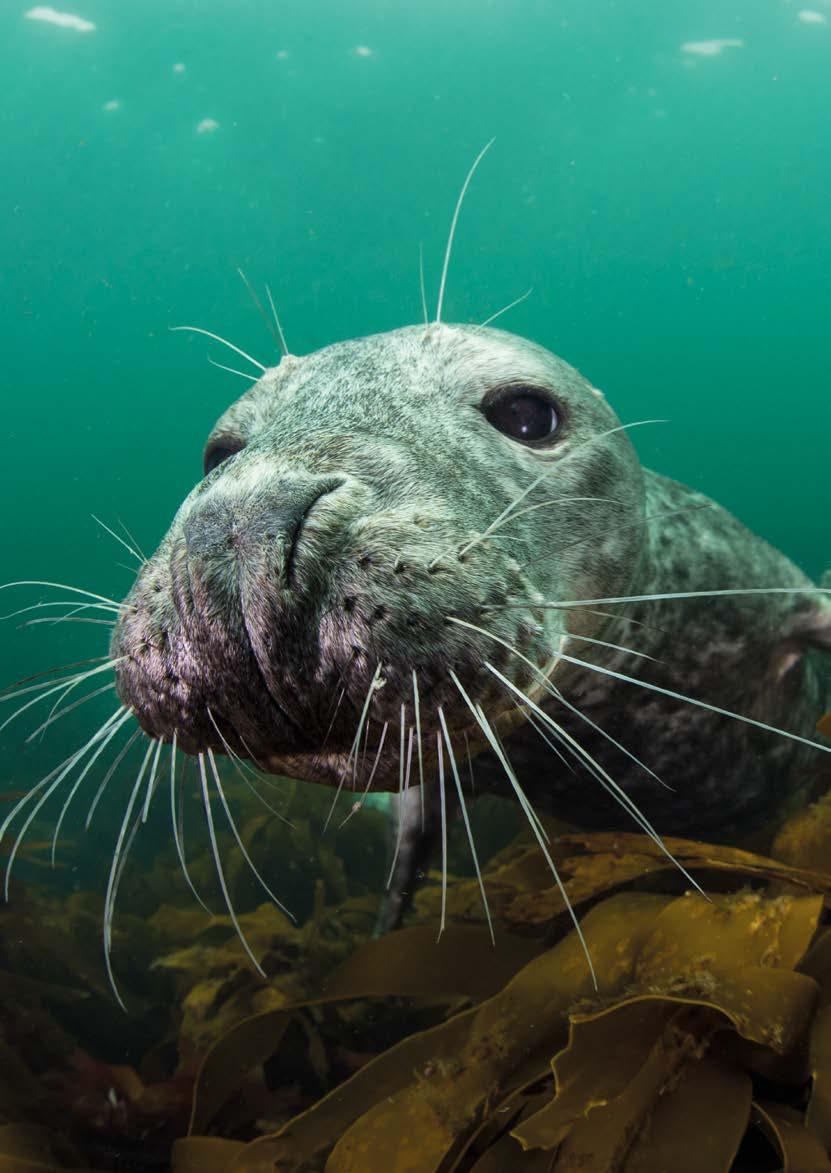
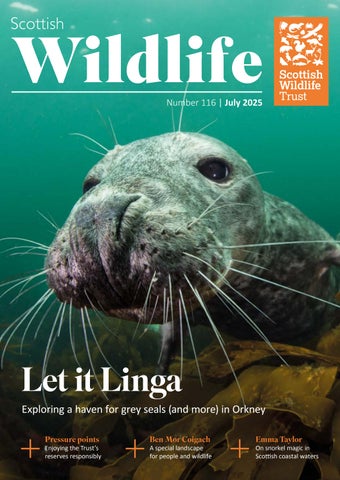
Exploring a haven for grey seals (and more) in Orkney
Pressure points
Enjoying the Trust’s reserves responsibly
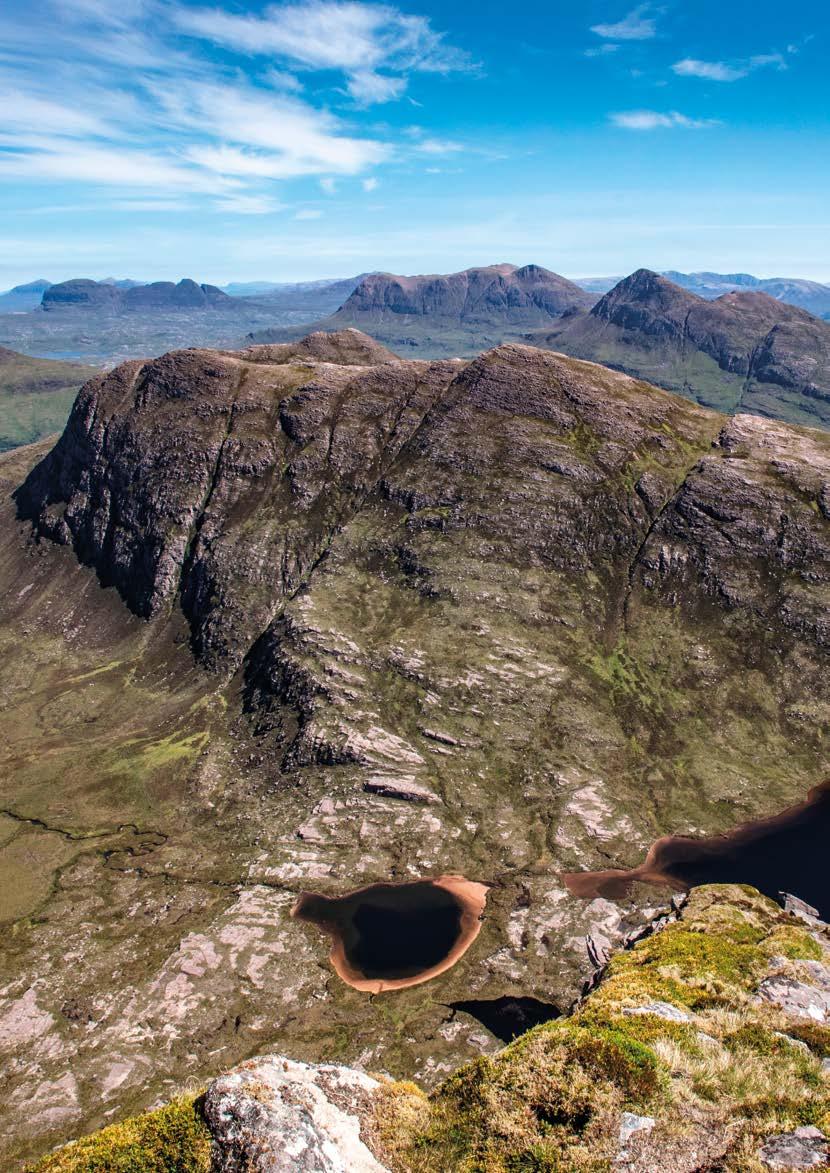
Mor Coigach A special landscape for people and wildlife

On a recent woodland walk in Edinburgh, I found myself reflecting not only on how lucky we are to be able to enjoy these special places but also on the woodland life that we don’t see. At this time of year, the trees are in full leaf and the paths are lined with dense, fresh growth on all sides, but so much of what sustains the woodland lies out of sight. Beneath the surface, incredible mycelial networks – fine, branching threads of fungi – spread through the soil, linking trees and plants. They quietly move nutrients, support seedling growth and help the woodland stay healthy during times of change. These networks aren’t visible, but they play a vital role in keeping the ecosystem functioning.
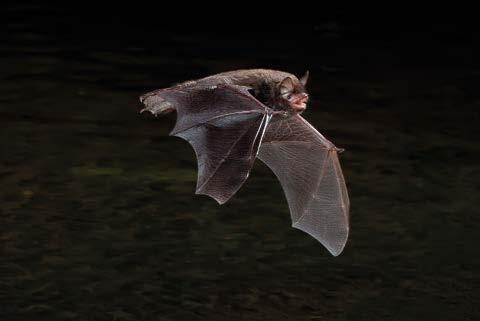
Much of nature works in this way – out of view but essential. Bats are a good example. As dusk stretches later into the evening during the summer months, bats emerge – often unnoticed unless you’re specifically looking or listening for them. Pipistrelles, the most widespread species in Scotland, can eat thousands of insects in a single night, helping to keep populations in balance. Brown longeared bats forage in woodland clearings, using their large ears to listen for prey. Daubenton’s bats skim low over rivers and lochs, feeding on midges and aquatic insects. These small mammals go largely unseen, but their presence is a sign of a healthy environment – and their absence would be felt far more than their presence often is.
In many ways, the same is true of the huge diversity of actions people take for nature. Across Scotland, our members, volunteers and supporters are helping wildlife in ways that don’t always attract attention but are making a difference. It might be choosing pollinator-friendly plants for a garden, recording sightings for a survey, clearing litter from a local green space, or starting a conversation about biodiversity at a community event. Some people choose to help nature by undertaking practical tasks, while others simply ask thoughtful questions
Across Scotland, our members, volunteers and supporters are helping wildlife in ways that do not always attract attention but are making a difference.
in the right places. None of these actions are headline-grabbing, but together they help shift the balance in nature’s favour.
In the news pieces and articles in this issue, we highlight a range of stories that reflect that collective effort. You can read about the Riverwoods grants helping to restore our river catchments and riparian habitats. We share findings from our Oceans of Value report, which sets out why healthy marine ecosystems matter to everyone. We focus on practical action in places such as Ben Mor Coigach and Ayrshire, report on responsible access on our reserves and explore the role of nature finance in supporting large-scale
restoration. There’s even a look beneath the surface – literally – with a piece on snorkelling in Orkney and the North East.
All of this work, whether visible or behind the scenes, contributes to a healthier, more resilient natural world. Nature doesn’t function in isolation, and neither do we. As you read through this issue, I hope you’ll recognise how connected these efforts are –and how valuable every contribution can be.
Thank you for being part of this work. It’s important we continue to notice and appreciate the efforts, seen and unseen, that so many are making for Scotland’s wildlife. ■
WE CELEBRATE WILD FLOWERS DURING THE 20 th INTERNATIONAL WILDFLOWER FESTIVAL Bohinj, 22 May - 7 June 2026
Discover the unique story of the International Wild Flower Festival, a one-of-a-kind event presented by nature itself and held in one of Europe's oldest national parks - Triglav National Park in Slovenia This unforgettable event showcases the awakening of alpine nature in full spring bloom. Reserve your unforgettable experience in the pristine environment of the Julian Alps.
BOTANICAL WALKS WITH EXPERTS I WORKSHOPS MEETING LOCAL PEOPLE I WILD FOOD IN RESTAURANTS

Big picture
Northern gannets, by Rebecca Nason
News
News round-up from the Trust and the world of conservation
Pioneers
Annie Robinson on responsible private investment in nature
Viewpoint
Emma Taylor shares some magical snorkel moments in Scottish waters
Seasons
Natural spectacles and how to help wildlife this summer
Species spotlight
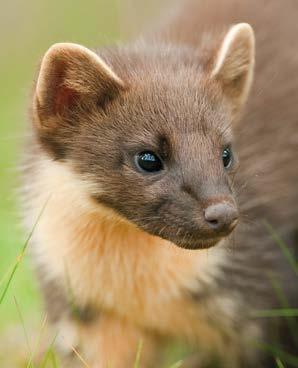
Pine marten – Scotland’s most nimble and elusive mammal
Reserve portrait
Ben Mor Coigach – a rugged working landscape
Watch out for
Things to enjoy in the coming months PLUS competition
Scottish Wildlife is published by the Scottish Wildlife Trust, a Scottish registered charity (no. SC005792) and company limited by guarantee (no. SC040247). Registered office: Harbourside House, 110 Commercial Street, Edinburgh EH6 6NF. Tel: 0131 312 7765.
Patron: King Charles III. Chair: Kenny Taylor. Vice-Chairs: Ian Jardine, Bill Lambert, Stephen Metcalfe. Chief Executive: Jo Pike. The Scottish Wildlife Trust accepts no liability for omissions or incorrect data in advertisements and letters. Views expressed in Scottish Wildlife are not necessarily those of the Scottish Wildlife Trust. ISSN: 0143 1234.

Rich Rowe explores why we all need to champion responsible access to Trust reserves
Seal song
Stuart Kenny learns about the abundant life found on two of the Trust’s most remote island reserves
Our AGM
Everything you need to know about this year’s AGM at Dundee Contemporary Arts in September
Scottish Wildlife is published three times a year –March, July and November – and is free to members of the Scottish Wildlife Trust.
Managing Editor: Pete Haskell – editor@scottishwildlifetrust.org.uk
Contributing Editor: Rich Rowe
Design: Connect – connectcommunications.co.uk
Advertising: Elliot Whitehead – 0131 561 0021
Printing: InkMark – inkmarkltd.com

Rebecca Nason
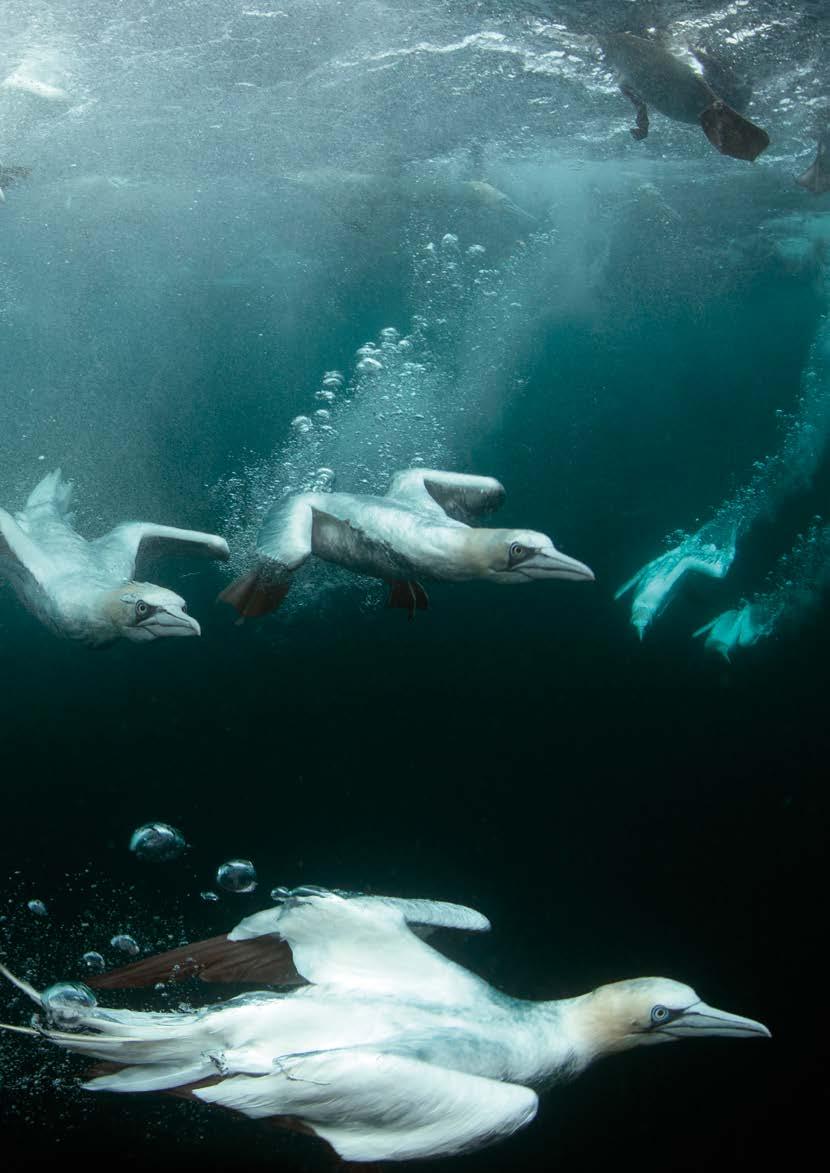
One September afternoon, I headed to the base of the 180m-high sea cliffs at Noss National Nature Reserve where my partner and I run the Noss Boat, Shetland Seabird Tours. Accompanied by Richard Shucksmith, a fellow photographer, the aim was to capture diving gannets from below the surface of the water. We opted for a dry method: a camera set-up attached to the end of a long pole with a remote shutter release cable held deep beneath the water. Although the hit rate is lower than when in the water with the gannets, we’ve had great success with this slightly more removed, shooting blind set-up. With good sea conditions and visibility, I released some fish discards through a bespoke adapted tube. The further down I could get the fish, the deeper
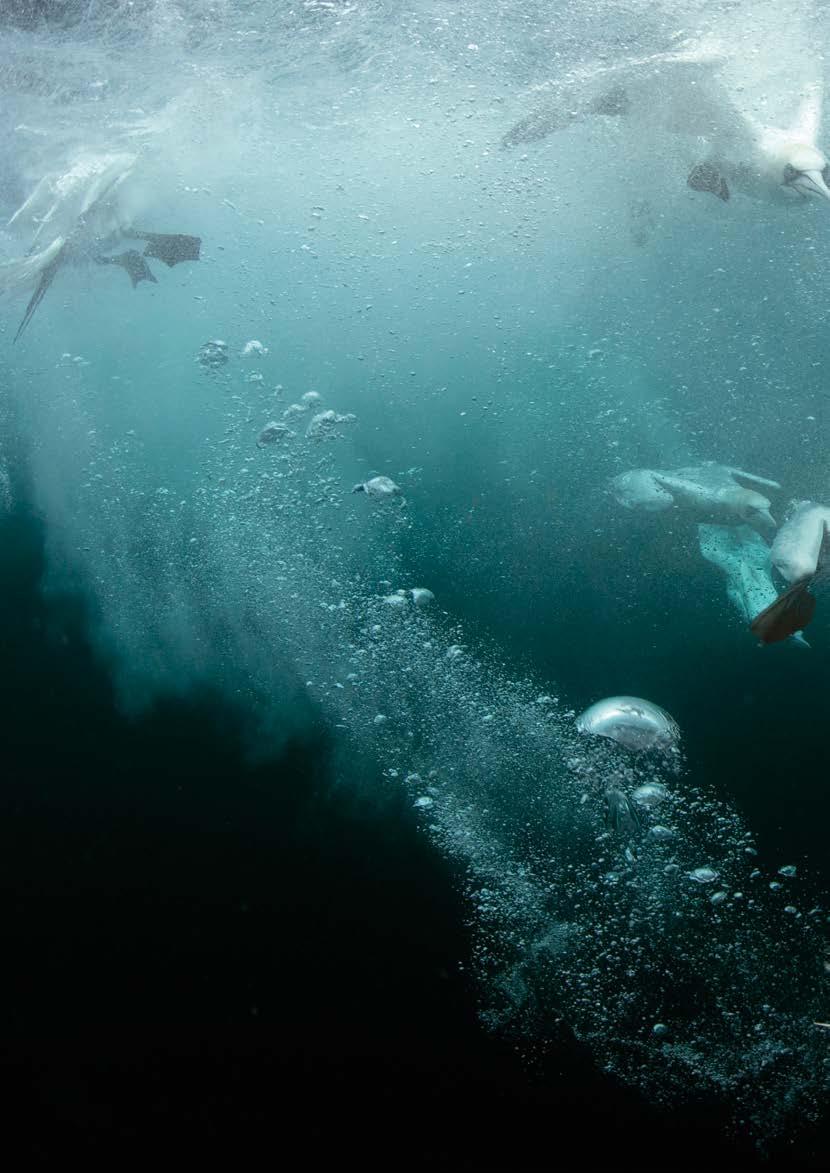
the gannets dived and the less suspended sea debris appeared in the shots.
The lower depths were darker, more satisfying, with clearer water. Here I concentrated on deeper, lone individuals which meant that bubbles were more concentrated in the wake of the birds rather than throughout the image.
This shot is a firm favourite. It’s incredibly rewarding to be able to photograph these almost reptilian, prehistoric-looking seabirds truly in their element below the surface.
Rebecca Nason
Camera: Nikon D4 with remote release, Nauticam underwater dome and dome port; Lens: 15mm fisheye; Shutter speed: 1/320sec; Aperture: f11; ISO: 1000.
rebeccanason.com
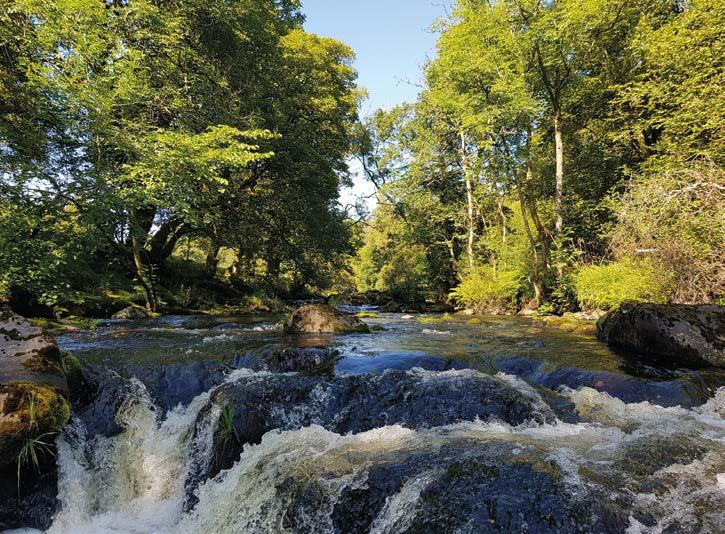
THE Riverwoods Blueprint Project, led by the Trust, has launched a grant scheme to kickstart new river woodland creation and restoration activities across Scotland.
The Riverwoods Development Grant will distribute a £200,000 fund among 10-20 environmental NGOs, charitable trusts, community groups, local public bodies and others in Scotland to produce river woodland development plans. These plans are an essential first step in enhancing local river health, creating new homes for wildlife and improving access to nature.
Many local organisations are aware of the threats facing riparian habitats and are motivated to implement solutions, but often
lack the funding for initial surveys, scoping and consultation. The grant seeks to overcome this barrier by supporting these vital early stages of river woodland creation.
Until the submission deadline of 28 July 2025, applicants can apply for up to £20,000 to develop plans and identify viable opportunities for expanding river woodlands across Scotland.
The river woodland development plans and subsequent restoration and creation activities will help to deliver significant benefits, including flood protection, improved water quality and better salmon fisheries. In doing so, they will also help address the pressing challenges of climate change and biodiversity loss.
Successful projects will also contribute to the Riverwoods Blueprint, a visionary plan for sustainable river woodland networks that will be developed over the next four years by the Riverwoods Blueprint Project team.
The Riverwoods Blueprint Project and the Riverwoods Development Grant are made possible by the National Lottery Heritage Fund and National Lottery players.
For more information on applying for a Riverwoods Development Grant, visit riverwoods.org.uk or scan the QR code.
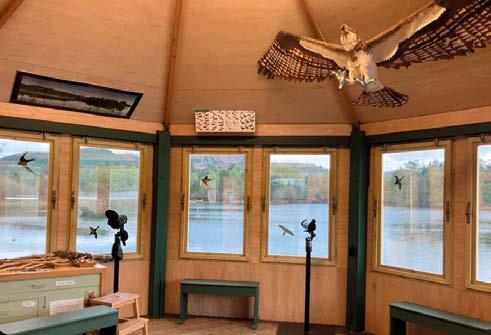
ALREADY one of our flagship reserves, Loch of the Lowes is ready to welcome even more visitors following a notable upgrade.
The Crannog Hide, named for its resemblance to the historical over-water dwellings, is now fully heated and insulated, with tinted windows that provide clear views of the loch and surrounding woods without causing any disturbance to the reserve’s wildlife. It is open to visitors every day, although we’d also love to hear from any community groups that would like to hire the space.
Complementing the Crannog Hide is an upgraded boardwalk which is fully accessible for wheelchair users and buggies, and a new
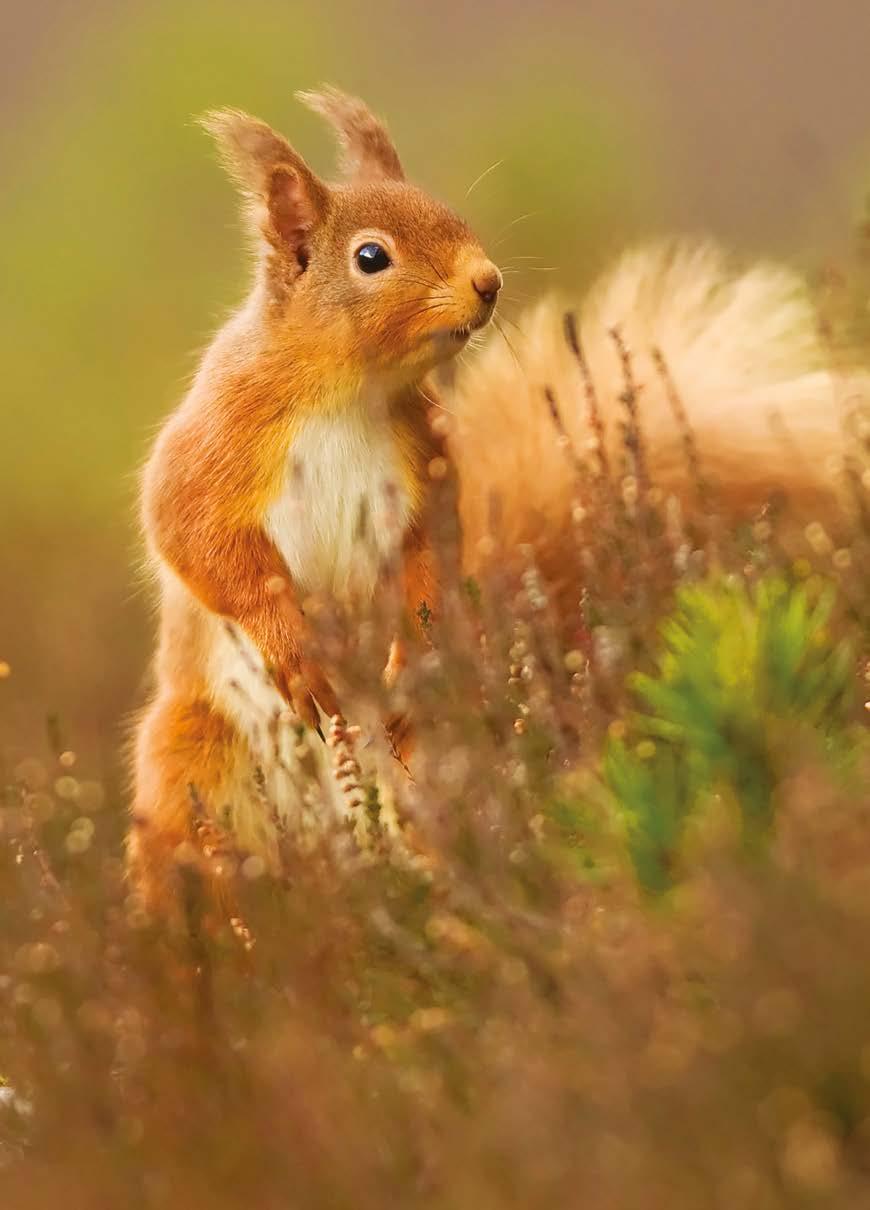
photography platform by the reserve’s feeding station. Such improvements add to the already excellent provision at the reserve, including a second hide overlooking the loch, a gift shop and the wildlife viewing window in our visitor centre where pine martens, red squirrels and a host of woodland birds can be enjoyed in comfort.
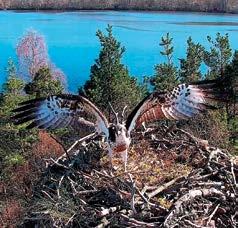
One of the biggest draws at Loch of the Lowes is the osprey nest, and the upgraded hide is perfectly situated for watching all the drama unfold. Find out the latest about the ospreys on page 12.
The refurbishment at Loch of the Lowes has been funded through the Scottish Landfill Communities Fund.
THE Trust has joined forces with RSPB Scotland, Marine Conservation Society, National Trust for Scotland and the Scottish Seabird Centre in opposing the development of a mega offshore wind farm in the Firth of Forth.
If approved, Berwick Bank would cover an area four times the size of greater Edinburgh with more than 300 wind turbines, each up to 355m in height. While we support renewable energy and the move towards net zero, the nature and climate crises are intrinsically linked and one cannot be solved at the expense of the other.
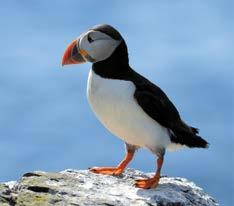
A development of this size would have a catastrophic impact on Scotland’s internationally important seabird populations, including gannets, kittiwakes and puffins. On the other hand, if the proposal is rejected this would pave the way for other developments that would have much less impact on nature.
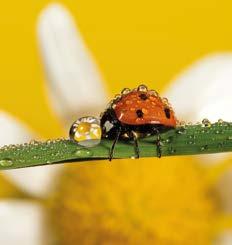
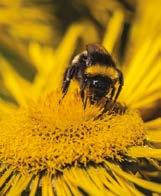
POLLINATORS are essential to our daily lives, yet their numbers have halved in just 40 years. Bees, beetles, hoverflies and a multitude of other pollinators play a vital role in UK agriculture, pollinating over £690 million worth of our food crops every year.
But their work doesn’t stop with crops. More than 75% of Scotland’s flowering plants depend, in part, on insect pollination. These plants form a rich mosaic of habitats, from wildflower meadows to woodlands, which boost soil health, provide carbon storage and make our landscapes more resilient to the impacts of climate change.
By acting now to reverse their decline, the outcomes for our economy, health and wellbeing can all be improved.
The Ayrshire Nectar Network is stepping up to provide a solution. This Trust-led project is transforming local Ayrshire landscapes into vibrant, nectar-rich havens where pollinators can thrive. By creating corridors and stepping stones of pollinator-friendly habitats, the Network is making it easier for them to feed, shelter and move through the countryside.
Monitoring shows promising signs: a 46% increase in bumblebee sightings and more than 80 linked pollinator sites established. But with funding challenges ahead, the project needs further support to keep growing.
Find out how you can get involved by scanning the QR code or visiting scottishwildlifetrust.org.uk/pollinators
Lynne Bates, Nectar Network Co-ordinator
Along with our partners, we are asking Scottish Government Ministers to reject Berwick Bank and instead focus on developments in less ecologically sensitive areas.
TO cap off our 60th anniversary celebrations earlier this year, we were delighted to welcome the team from the Scotland Outdoors podcast to Montrose Basin. In a chat with our Chair, Dr Kenny Taylor, they discussed everything from the Trust’s origins right through to the present day and beyond, with plenty of wonderful wildlife along the way. Listen to the whole episode on BBC Sounds at bbc.co.uk/ sounds/play/p0l7b5jn
THE Visitor Centre at our Montrose Basin reserve is celebrating its 30th anniversary this year. To mark this major milestone, the team is planning a range of exciting events that will highlight the reserve’s spectacular wildlife. Details are still being confirmed but will undoubtedly involve the Basin’s famous flocks of pink-footed geese, arriving in autumn.
THE South Reserves Team has been removing trees afflicted with ash dieback from Stenhouse Wood, Blackcraig Wood and Falls of Clyde. The disease takes the form of windblown spores that kill infected trees by preventing the circulation of water and nutrients. Removing these trees may help limit the spread, although as the disease is widespread across most of the country, the primary reason for felling or delimbing ash is to reduce the risk of diseased trees falling onto roads and paths.
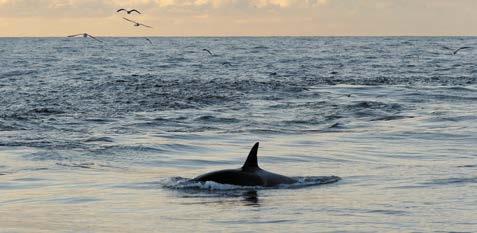
BACK in March, we published findings from a series of workshops delivered through the Oceans of Value project in 2023 and 2024.
Each workshop included a screening of the Oceans of Value film and a discussion session about the best ways to use and protect Scotland’s marine environment, as well as the barriers that exist in marine planning conversations. Questions for the discussion were developed with input from the Scottish Government Marine Directorate.
One participant said: “It is important to connect people meaningfully with [their marine area] if we expect them to have an interest in using and protecting it.” Another commented: “If people had access to the right information and were supported more in becoming more knowledgeable, they could feel more empowered to take part and have their say.” A third said: “I think a lot of the time
when these consultations happen, when we want to do things right, they sadly end up going wrong or people don’t welcome them because they haven’t been consulted properly. They haven’t been given the opportunity to or they haven’t been empowered to be able to, and to put across those opinions.”
These and other responses have been fed back to the Scottish Government Marine Directorate for consideration in the upcoming National Marine Plan 2.
With more than 350 people attending the 14 workshops, they provided an excellent opportunity to support coastal communities in raising awareness of marine priorities. The responses have also helped form the basis of our new marine project, Sea the Connection.
A full summary can be found in our final Oceans of Value report, which is available to read on the Trust’s website.
© Andrzej Majdanik Haicoo Photography
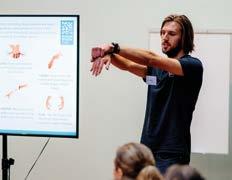
ONE of our Young Leaders and staff from our Engagement Team attended the Marine Conservation Society’s Youth Event in Glasgow recently. As well as demonstrating hand signals used to describe different species when diving (such as the octopus signal, pictured above), they discussed the importance of young people feeding into marine policy. Events like this are an excellent way to achieve this by amplifying and uniting diverse youth voices.
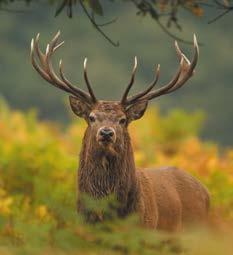
OVERGRAZING continues to be one of the most prominent threats facing our woodlands. Despite deer being native to Scotland, and red deer being among our most iconic species, their unnaturally high numbers in some areas can have a hugely negative impact on native woodlands.
In recent years, the Trust has adopted the standardised method for Woodland Herbivore Impact Assessments. Most recently undertaken on our Thornton Glen and Carron Glen reserves in April, these surveys will help us understand whether deer – or other herbivores – are preventing the regeneration of trees and shrubs. The assessments will also help identify potential management measures, such as the need to control deer numbers or create fenced enclosures to allow natural regeneration of woodland.
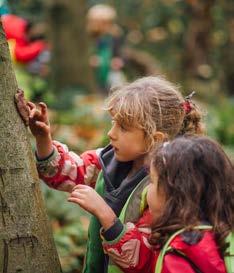
OUTDOOR learning provides many benefits for children, from boosting mental and physical health, to improving communication, problem solving and self-esteem. Plus, it can encourage a lifelong love of nature!
To support this, the Trust has launched a series of Discovery Den Activity Packs which parents, teachers and group leaders can use to inspire outdoor-themed learning.
Each pack is focused on a different theme –woodlands, coastal or freshwater – and contains a range of activities, many of which are linked to Scotland’s Curriculum for Excellence.
Among the activities are practical tasks such as building a pond for wildlife in a bucket, and crafts such as creating works of art from natural objects found outside. There is also a selection of indoor activities, spotter sheets and identification guides.
A great resource for the summer holidays, the suggested age range for the activities included is eight to 12 years, although most can be adapted for other ages.
Activity packs can be downloaded from the educators page within our Discovery Den, visit bit.ly/DenActivities
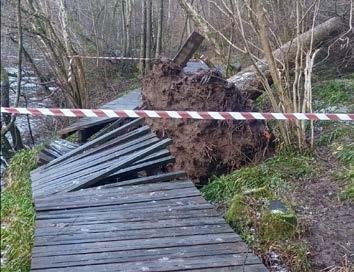
DESPITE the damage happening in January, our Reserves Team continues to clear up the devastation left behind by Storm Éowyn. Reserves in west and central Scotland, such as in Ayrshire and Cumbernauld, were hit particularly hard, but the impacts continue to be felt across the country.
Hundreds of trees were blown over by the storm, causing blockages on footpaths and destroying potential nesting sites ahead of the breeding season. We also saw damage to some of our infrastructure, such as the boardwalk along the Clyde Valley Walkway at Falls of Clyde.
The recovery work has been supported by an emergency appeal, to which supporters generously donated more than £20,000. In addition to other actions, this has allowed us to hire contractors to help repair the damage, enabling staff to focus on some of the more technical repairs. Thank you to everyone who contributed and to all our members and donors who continue to support us.
Recovery work is ongoing on many sites, so please take care when visiting any of our reserves and follow advice from local staff. We recommend checking reserve pages for any important notifications ahead of visiting and if you see anything that doesn’t look right, please contact us using the form on our website.
FOLLOWING the success of last year’s Words of the Wild nature writing competition, we have once again been inviting writers of all ages and experience levels to put pen to paper.
Supported by our Riverwoods Blueprint and Sea the Connection projects, and in association with the Scottish International Storytelling Festival, this year’s competition is themed ‘From source to sea’.
We’re delighted to have already received hundreds of creative and inspiring entries and hope to receive plenty more before the 12 July deadline.
Entries can be in the form of poetry, short stories, journalistic articles, essays, letters or even song lyrics. They can be up to 1,000
words and written in English, Scots or Gaelic. The judging panel includes notable names from the worlds of literature and conservation, such as former Scots Scriever Susi Briggs, renowned Scots poet Len Pennie and our very own Chair, Dr Kenny Taylor.
An adult and junior winner will be selected for each language, with more than £2,000 worth of prizes to be won. Adult prizes include a pair of binoculars from Viking Optical and a selection of nature books from Canongate. Junior prizes include a snorkelling set from Arran Active and a £100 wildlife equipment voucher from NHBS. The winners will be announced at the Scottish International Storytelling Festival in October.
As well as the competition, we’re also working on a second series of our Words of the Wild podcast, due for release in the autumn.
For more information on either the competition or the podcast, scan the QR code or visit scottishwildlifetrust.org.uk/ WordsOf TheWild
ACTION for Nature, the Trust’s long-running Ayrshire-based community engagement project, has been extended until at least 2026, thanks to funding from the National Lottery Community Fund’s Awards for All programme, and the Nationwide Colleague Grant Award.
The project, which began in 2015, offers a range of volunteer roles and activities to help residents manage local green and blue spaces, such as parks, woodlands and ponds. By joining weekly sessions, volunteers can undertake tasks including tree planting, path maintenance and removing invasive plants. It also works alongside existing community groups to enhance these local spaces and runs regular public events to connect people to the nature on their doorstep.
In addition, Action for Nature offers weekly wellbeing sessions that involve low intensity activities such as walking, weeding and pruning. These sessions provide a safe space for participants to develop social connections and enjoy the physical and mental health benefits brought about by spending time in nature.
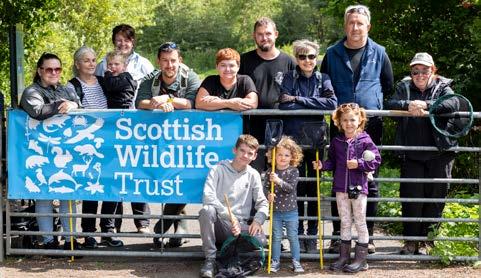
As well as working on many of the Trust’s reserves around Irvine and Kilwinning, the project supports community partners across
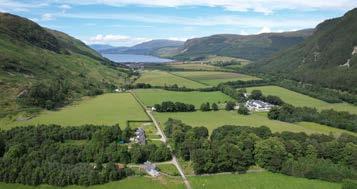
FOLLOWING the Trust’s acquisition of Inverbroom near Ullapool, we organised two public meetings as a way to meet interested local residents and hear their thoughts, views and ideas. We spoke with around 100 people, giving us an early insight into local priorities and interests, and discussed issues such as access, farming and deer management.
The long-term nature of our vision for Inverbroom means that we will not be moving
THE first osprey season at Loch of the Lowes since the passing of LM12 has seen a mixture of highs and lows, with the establishment of a new breeding pair but the loss of both their eggs.
Following the return of long-term breeding female NC0 in mid-March, we saw four different combinations of birds attempt to settle on the nest before two ospreys with history on the site established themselves as the dominant pair. The male, LM24 (previously known as the Dark Intruder), successfully defended the territory last year, while the female, now known as LF25, had previously attempted to oust NC0 on several occasions.
LF25 laid two eggs in early May but accidentally stood on one during a fish delivery a couple of weeks later. The second egg almost made it through the incubation period, but was predated upon by a crow on 8 June, days before it would have been expected to hatch. The parents had been leaving the egg unattended for increasing lengths of time, so they may have sensed a problem with it.
Our Wildlife Protection Team, which monitors the ospreys at Loch of the Lowes, are supported by players of People’s Postcode Lottery. The visitor centre is open seven days a week from 10:30-17:00 throughout summer.
forward on every area at once. In fact, some aspects will take many years to come to fruition, as is often the case when restoring entire habitats.
We will continue to meet with local communities as our work progresses and we are grateful to everyone who has already taken the time to speak with us.
For more information on some of the key points raised during these meetings, read our blog by visiting bit.ly/4jrUx0F
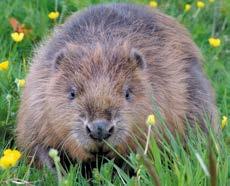
FOLLOWING the news that licensed beaver releases can now go ahead in England and Wales, a new report has shown that every £1 invested in natural flood management is expected to deliver £10 of benefits over 30 years.
The report, commissioned by RSA Insurance, an Intact company, and The Wildlife Trusts, highlighted the benefits of creating new ponds, restoring peatlands and releasing beavers on suitable sites.
These practices support habitats to absorb water during periods of high rainfall, reducing the impacts of flood damage, which costs the UK approximately £2.2 billion each year.
Additionally, a survey of surrounding communities found that more than 85% of respondents who had access to their local scheme felt it encouraged physical health and exercise, while 92% felt they were good spaces for positive mental wellbeing and provided opportunities to see nature.
These findings support the conclusions of a report published by the Scottish Wildlife Trust together with the University of Edinburgh’s Centre for Sustainable Forests and Landscapes in 2024. The report, Act now, save later, highlighted that failure to invest in nature now could have a devastating long-term impact on Scotland’s wildlife, climate and economy.
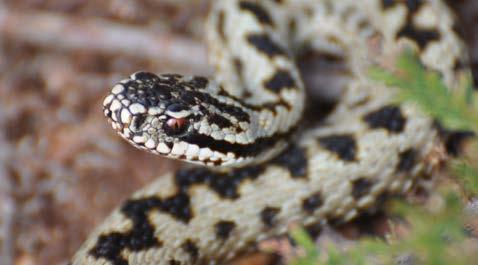
THE latest Scottish Adder Survey has revealed a worrying fall in the number of adder territories across the country.
The study, which is a partnership between NatureScot, Amphibian and Reptile Conservation and Amphibian and Reptile Groups of the UK, recorded adders in 364 10km squares. This is down from 567 when the survey was last undertaken in 1994 – a decrease of 36%.
As well as delivering practical surveys, the study also gathered information via a questionnaire that was promoted to land managers and naturalists across Scotland.
Scotland’s only native snake, adders face numerous threats such as disturbance by humans and habitat loss. In light of the new figures, NatureScot has stressed the importance of further study to determine what work is now required to reverse their fortunes.
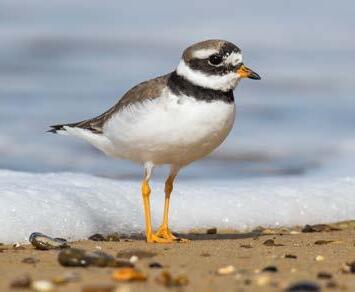
A NEW project in the Outer Hebrides is developing an ambitious plan to tackle the problem of invasive, non-native hedgehogs on the island of Benbecula.
Despite being a favourite on the Scottish mainland, hedgehogs have proven problematic in the Uists since being introduced in the 1970s in an attempt to tackle garden pests. From an initial seven hedgehogs believed to have been released on South Uist in 1974, the population has grown steadily and they now pose a major threat to ground nesting birds such as ringed plover, redshank and little tern, whose eggs they feed upon.
Saving Uist Nature, a partnership between RSPB Scotland, NatureScot and Scottish SPCA, aims to humanely capture hedgehogs on the island before translocating them and releasing them on the mainland. The initial delivery phase will test different trapping methods and remove hedgehogs from Benbecula, before scaling up to the larger island of South Uist.
Animal welfare experts will help determine release sites on the mainland which are suitable for the released hedgehogs and wildlife already on site.

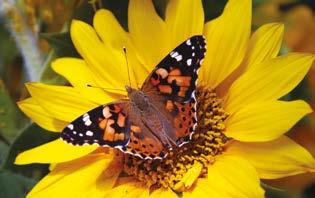
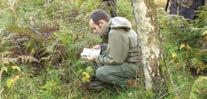
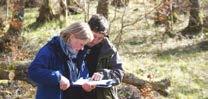

We explore some of the natural spectacles and animal behaviours that can be enjoyed this summer and how we can all help wildlife in the coming months
Take action · Build a dead hedge
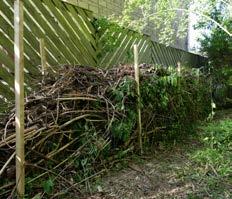
In the height of summer, when nature is full of growth and colour, it may seem strange to think about creating a dead hedge but doing so can provide a big win for wildlife – plus they are an ideal way to recycle woody garden waste. Although the hedge itself is dead, the structure will soon be full of life. Offering nesting, roosting and foraging habitat as well
as much-needed shelter, a hedge made of old prunings, cuttings, sticks and other vegetation will soon attract a range of insects, worms, birds and mammals.
Depending on its length, a dead hedge can also serve as a flightline for foraging and commuting birds and bats, or a device to separate areas of a garden, screen off unsightly spots or even replace fences which offer little for garden wildlife.
Best of all, a dead hedge is incredibly easy to create. It’s just an upright, chest-height structure with woody stems and cuttings placed or woven between vertical stakes. The stakes can be bought or created using sturdier branches cut from trees or shrubs. They should have a flat top for hammering in and a pointed end for ease of bashing into the ground.
First, insert a line of stakes, about a metre apart, along the intended length of the hedge. A second line of stakes can then be inserted either parallel to the first line or in a zig-zag. Again, they should be about a metre apart from each other and the first line of stakes to create a corridor in between.
It’s then just a case of building the dead hedge up over time, adding woody cuttings as and when you do a little pruning or tidying in the garden. It’s best to put lighter materials at the base of the hedge and heavier items on top to squish everything down.
As the hedge slowly breaks down, the nutrients are recycled into the earth below, meaning there’s no need for it to go into garden bins or on bonfires. You can also get creative by weaving in woody prunings or even grow climbers such as clematis or honeysuckle along the hedge for even more wildlife value. The choice is yours.
To find out more about creating a dead hedge, scan the QR code or visit bit.ly/DeadHedge
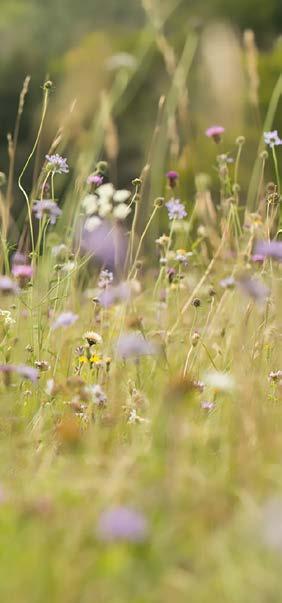
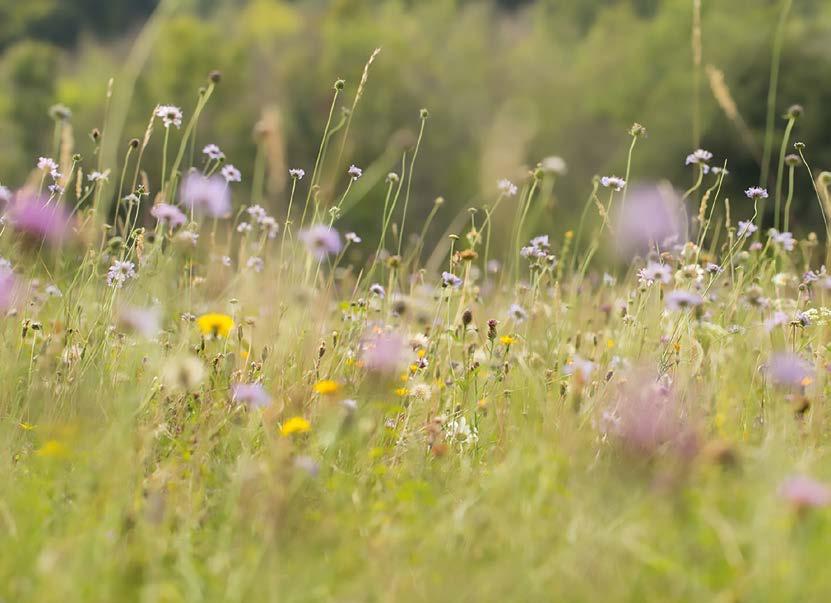
A riot of swaying, scented colour – not to mention the incessant buzz and hum of pollinating insects – there are few sights more uplifting than a wildflower meadow in full bloom. Often growing on soils with low fertility, such meadows can contain an astonishing number of species – clovers, red campion, yarrow, teasel, knapweed, ox-eye daisy, poppies and more.
Unlike highly bred garden plants, wildflowers are our true native flowers –natural and unaltered. With so many species present, a healthy meadow forms the basis of a rich food chain.
Wildflowers of course also provide bees, butterflies and other essential pollinators with food throughout the growing season. One common wildflower, bird’s-foot trefoil, is a food plant for more than 100 species of insects, which in turn support a whole range of mammals and birds.
There are many other benefits, too. The intricate root systems of an established wildflower meadow help stabilise soils and mitigate flooding by holding onto rainwater, while flower-rich grassland can store vast amounts of carbon. Some native wildflowers, such as self-heal, have antibiotic properties, while foxgloves contain a compound that can be used to treat heart disease.
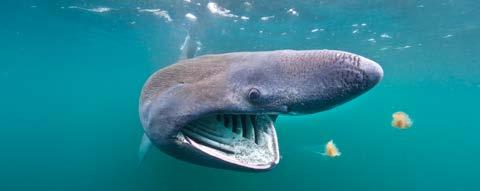
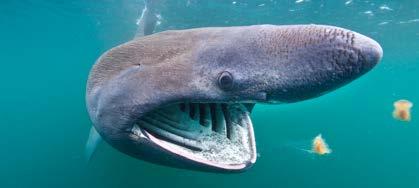
Mysterious giants of our seas, basking sharks make their return to Scottish coastal waters to filter feed on plankton blooms from spring until late summer. At up to 10m in length, the world’s second largest fish (only the tropical whale shark is bigger) can be spotted ‘basking’ at the surface, its dorsal fin high above the water and gaping mouth wide open as it filters millions of litres of water an hour through its gills.
The Sea of the Hebrides is a particular hotspot for these remarkable animals, many of which have migrated huge distances to spend the summer in our coastal waters. Relatively understudied compared with many species of shark, they spend much of their time offshore and in deep water.
However, recent satellite tagging programmes have revealed that some sharks migrate to and from Newfoundland, while others head here from the Azores and the Bay of Biscay.
Given their protected status in the UK today, it’s hard to believe that basking sharks were once hunted in Scotland, even as recently as 1994. They were targeted for the reserves of oil found in their large livers, which was used in lamps and as a constituent part of cosmetics and perfumes.
Basking sharks can be spotted on several of the Trust’s snorkel trails, especially around the Small Isles, North Harris and Torridon. If lucky enough to see one from the water, always follow the Shark Trust’s basking shark code of conduct.
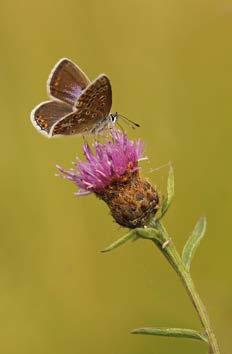
Common blue butterfly on
© Jon Hawkins/Surrey Hills Photography
Sadly, around 97% of wildflower meadows have been lost in the British countryside over the past 75 years, which is why the Trust is busy creating many more across its reserves and elsewhere.
Sites to visit
Good for wildflower meadows:
A Bo’Mains Meadow
B Fleecefaulds Meadow
C Gailes Marsh
D Keltneyburn
Good for basking sharks:
E Small Isles
F Mull
G Arran
H Torridon
I North Harris
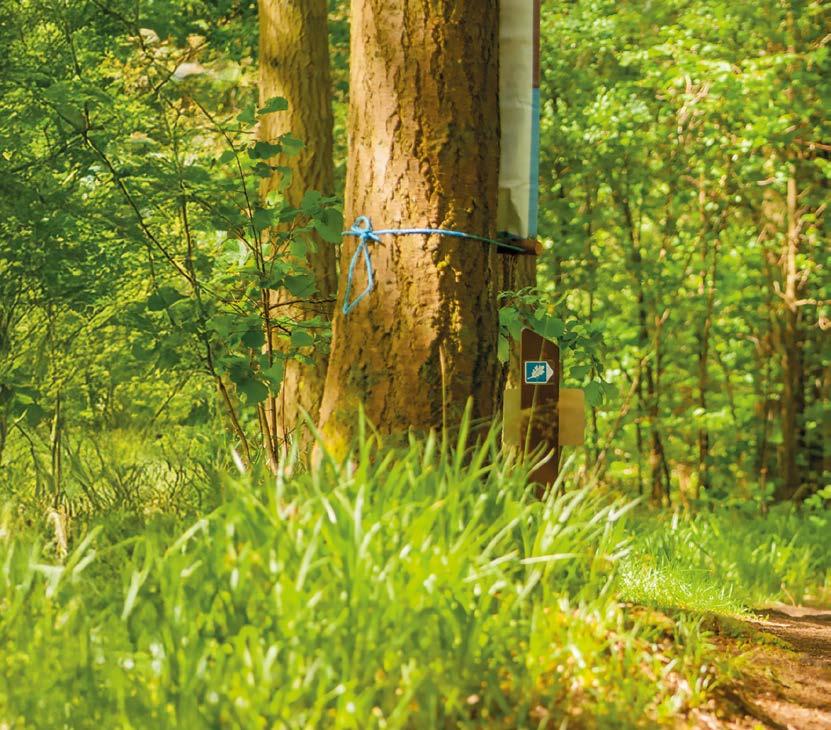
Established to protect native plants and animals, most of the Trust’s reserves are available for all to visit and enjoy. However, the delicate balance between preservation and accessibility is coming under increasing strain at some sites, writes Rich Rowe
From Newton Stewart in Dumfries and Galloway all the way to the Northern Isles, the Trust’s reserves offer a protective haven for some of Scotland’s most vulnerable plants and animals. Of course, they also provide an opportunity for people to observe Scotland’s wildlife first hand, something the Trust supports as it believes experiencing nature provides the inspiration and desire to protect it.
Therein lies a problem, however, with increased footfall often coming at the detriment of the habitat and species that visitors are coming to see. From once remote islands such as those of the Galápagos Archipelago to the foothills of the Himalayas, there are examples around the world of sites that have been a victim of their own beauty. And when a previously hidden gem can be brought to the attention of millions in the blink of an iPhone, how should this tricky balance best be managed?
While not as much on the global stage as such examples, some of the Trust’s wildlife
reserves have nonetheless seen visitor numbers increase significantly in recent years and, with it, increases in costs both to wildlife and the Trust itself.
Alan Anderson, the Trust’s Head of Reserves, is acutely aware of the challenges of balancing the Trust’s responsibility to protect wildlife on reserves with, wherever possible, enabling access to them. While it is fundamentally a good thing that more people are able to access nature, especially those from urban areas where fewer opportunities exist, there must still be an understanding of what reserves represent.
“There is a responsibility on all visitors to treat reserves as if they are visiting someone’s home because that is exactly what they are to wildlife,” says Alan. “They are not parks or camp sites or even gardens. In many cases, they are among the last refuges for some species and therefore need to be shown that same level of respect.”
It’s a challenge that has always existed to a degree. The vast majority of visitors do not come to cause damage, although
unintentional problems through actions such as stepping off designated paths or letting dogs run loose during ground-nesting season can still cause significant issues. But there is also, unfortunately, a minority who for whatever reason simply don’t care and will always abuse a site.
What’s different now is that the numbers have changed. “There are more people visiting sites generally which means that although the proportion of damaging behaviour has probably not changed, the small percentage that are causing problems now represents much higher overall numbers than before,” notes Alan.
The Trust is blessed with an incredibly active membership that brings a backbone of care, knowledge and support – not to mention eyes and ears on the ground.
“This is particularly true for our volunteers, many of whom are also members and have a key role in litter picking and maintaining paths, bridges, stiles and parking areas to allow the
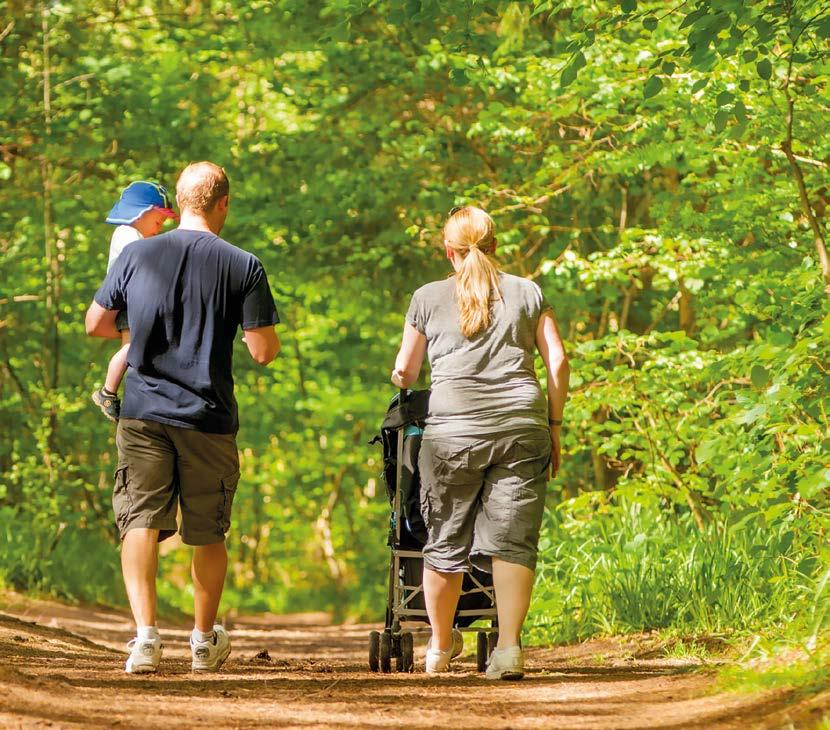
wider public to access our reserves,” says Alan. While the Trust’s many rural reserves remain relatively free of pressures, the challenges are greatest at more urban sites – with the legacy of the post-lockdown use of local green space still in evidence.
Following the immediate lifting of lockdown restrictions, sites such as Loch Ardinning Wildlife Reserve, just to the north of Glasgow, were hit especially hard. This once tranquil reserve, with areas of wetland, woodland and moorland known for its wildflowers, butterflies and dragonflies, became more of a country park or holiday destination than a wildlife reserve.
“We saw a huge increase in party camping, fly-tipping and cutting down trees for campfires,” notes Billy Gray, the Trust’s West Central Reserves Manager. “This has died down a little now but remains an issue.”
It’s a similar story at Possil Marsh Wildlife Reserve, a site in the heart of Glasgow where fen and swamp areas support nationally rare plants and which also serves as an important staging post for migrating
birds in spring and autumn. Here, regular incursions by quad and trail bikes have torn up footpaths and flattened vegetation.
Elsewhere, Cumbernauld Glen – a 300ha reserve in the centre of the town – sees a different kind of pressure; a green artery, Cumbernauld Glen is a thoroughfare used by thousands of residents each year as they walk and cycle to work and school.
One challenge at such a heavily used site is to ensure it is regarded as a natural asset and a place of value rather than simply somewhere to pass through. This is why, proportionately, there is a greater use of signage and maps at Cumbernauld that detail how to enjoy the area using dedicated paths that have been purpose-built for high use.
For Duncan Clark, the Trust’s Reserves Manager in Cumbernauld, it is littering, fly-tipping and unwanted garden plant escapees that are of particular concern today. “We emphasise that Cumbernauld Glen’s four woodland sites offer an amazing visitor experience for local people and by implementing essential habitat restoration we’re enhancing the reserves for the benefit of native flora and fauna,” he comments.
And change can come when problems exist. In response to mountain bikers digging trails through sensitive woodland habitat in the glen, the Trust oversaw construction of a dedicated mountain bike trail and planting
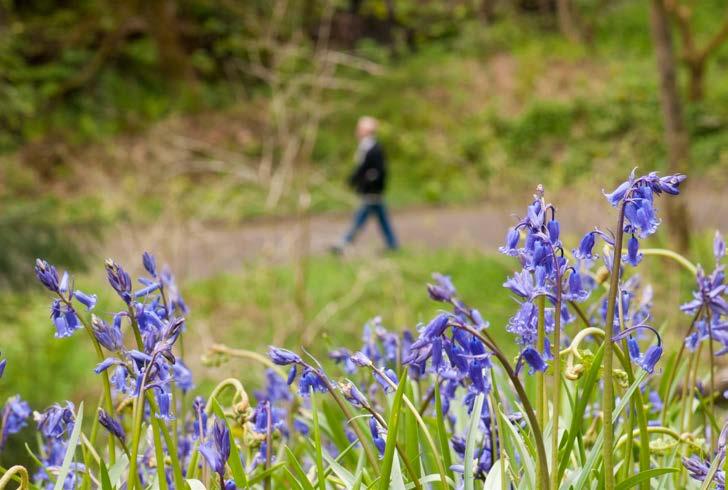
of native woodland back in 2007. “Native trees are establishing well along with the return of native bluebell, while cyclists now enjoy graded trails and alternative routes that lessen the negative impact on woodland,” says Duncan.
What is clear is that the ‘resilience’ cost to the Trust has increased – whether that be meeting the demands of higher footfall
through constructing more robust surfaces to footpaths, widening bridges and adding benches, or the repair of wilful damage. As such, the Trust is now increasingly vigilant about encouraging visitors to the sites that are more robust rather than those that are more vulnerable.
“Some reserves can take the numbers and some really can’t,” notes Alan. “At the Falls of Clyde, for instance, we know that pre-Covid the reserve saw 50,000 visitors a year so we were able to invest in the site accordingly.
“But for places like Loch Ardinning we didn’t anticipate the kind of pressure we are now seeing, so despite highlighting the importance of the site through new interpretation it just doesn’t have the infrastructure to cope.”
The truth is that bolstering infrastructure often requires taking financial resources from somewhere else, which is why the Trust can ill-afford the £20,000 a year it now spends on dealing with littering and fly-tipping or the costs associated with repairing fences and gates that have been cut down to enable access for quad bikes.
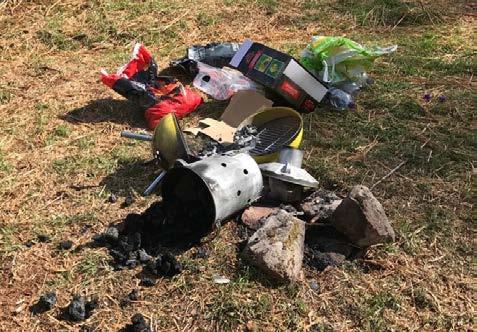
There is also understandable concern around increased wildfire risk posed by campfires and the use of disposable barbecues. The recent near miss for Ben Mor Coigach in April when nearby Stac Pollaidh
was alight, as well as a recent major wildfire suffered by the Woodland Trust at Glen Finglas, demonstrate just how much damage can be caused.
For Julian Warman, the Trust’s South East Reserves Manager, it speaks of the ‘disposability’ of some people’s approach to the outdoors. “I don’t understand how disposable barbecues were ever allowed to be a thing, and the cheapness of outdoor gear can result in campers just walking away and leaving everything behind,” he says.
One site where Julian and staff regularly experience the aftermath of wild camping is Linhouse Glen near Livingston. Here, the Trust has cleared overgrown areas of bracken to restore what was once an expansive speciesrich grassland on the reserve. As well as a range of wildflowers, the grassland now offers food and cover for brown hares and a host of birds.
“That grassland is also now very attractive to overnight campers,” says Julian. “Despite the warning notices, we get a lot of campfires, with rubbish left behind. It’s just a case of being on top of it – rubbish attracts rubbish, so we always remove it as quickly as possible.”
Here and elsewhere, the cost to wildlife should not be underestimated. The cutting of branches and whole trees for campfires removes habitat for invertebrates; cars parked on verges when parking areas are full flattens or removes vegetation; letting dogs off leads on reserves can lead to disturbance; and walking off designated paths often creates ‘desire’ lines through once quiet areas that others then follow.
While Scotland is celebrated for having some of the most liberal access laws in the world, the responsibilities that are enshrined within the Scottish Outdoor Access Code (see sidebar) are not always fully understood and can be difficult to apply. Often, there is awareness of the rights but not necessarily the responsibilities.
“Responsible access is great, however cutting down trees for firewood and leaving fire-scarred areas full of litter is not,” notes Alan. “In some respects, the code appeals to people’s better nature rather than being something that is actively enforced.”
This ‘better nature’ aspect can be a particular challenge for the Trust at some of its most sensitive sites. There are reserves such as Linga Holm and Little Linga in Orkney (see page 22), Long Craig Island in the Firth of Forth and Ballachuan Hazelwood in Argyll that need to be left alone to give wildlife breathing space and therefore are not promoted as visitor destinations.
Given an access code that allows valuable freedoms but which is also relied on to protect the countryside is now 20 years old, it feels more important than ever to articulate what responsible access looks like on the ground –and for those messages to be shared.
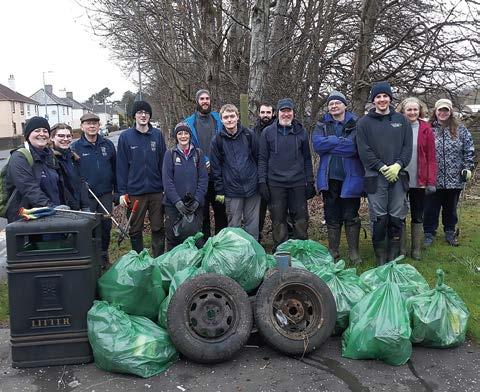
There is also understandable concern around increased wildfire risk posed by campfires and the use of disposable barbecues.
After all, much has changed since the code was first enacted. Dog ownership has soared across the UK, with 3.2m households acquiring a pet in the first year of the pandemic alone, and many owners now taking their dog with them on holiday. Technology has, of course, also changed significantly, with social media driving visitors to once hidden spots and kit such as camera drones having the potential to cause a high level of disturbance to nesting birds and other wildlife.
As ever, education is key, especially for future generations of outdoor users. Although the access code isn’t taught explicitly within Scotland’s Curriculum for Excellence, rights and responsibilities are interwoven throughout. NatureScot has also developed a variety of resources for educators and others who work with young people, including a Scottish Outdoor Access Code Activity Education Resource Pack that can be adapted for all age groups.
Given the additional pressures of the twin biodiversity and climate crises, understanding not just the rights but also the responsibilities involved in enjoying the outdoors is more important than ever – and no more so than at sites that exist specifically to protect Scotland’s most rare and vulnerable species. ■
Rich Rowe is Contributing Editor for Scottish Wildlife.
©
‘Respect, Protect, Enjoy’ was the message following the lifting of lockdown restrictions and is no less valid today as more people look to enjoy Scotland’s outdoors.
The Scottish Outdoor Access Code allows people to access most land – from hills and moors to forests, beaches, rivers, lochs and nature reserves – as long as they behave responsibly.
The code, which provides specific guidance for many outdoor activities, is based on three core principles:
• Respect the interests of others
• Care for the environment
• Take responsibility for your own actions.
For more, visit outdooraccess-scotland.scot
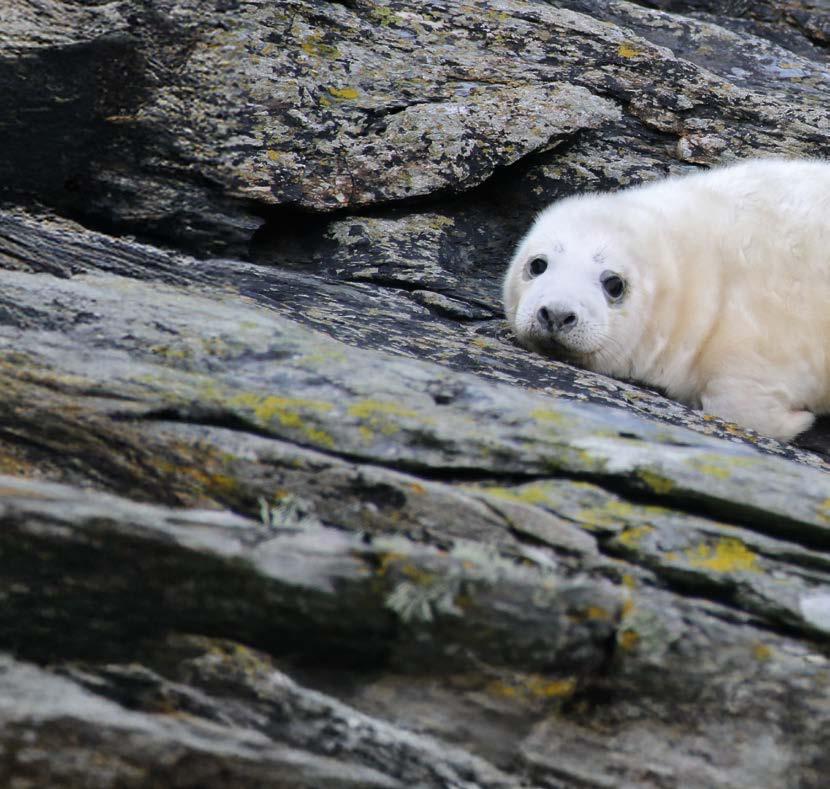
Stuart Kenny explores the abundant life found on two of the Trust’s smallest and most remote island reserves – places where grey seals gather to breed in vast numbers
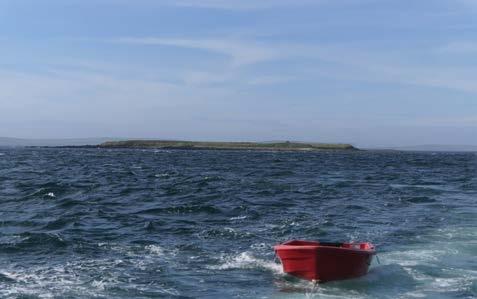
There is a small, roughly boomerang-shaped island one kilometre west of Stronsay in the Orcadian archipelago. Look for it from afar and it can be easily missed. The island is characteristic of Orkney in that way. Its low, flat topography makes it almost invisible from sea level but from the public roads of Stronsay – an island known for its scenic bays and natural rock arch – it’s possible to see the extensive grassland on the surface of the boomerang and the rocky coastline that surrounds much of its green interior.
The island is called Linga Holm and it is uninhabited – by humans at least. Peer through binoculars from the right spot in Stronsay and it becomes clear that there is more to this island – and to the even smaller outcrop of Little Linga two kilometres north –than it might initially seem.
Linga Holm and Little Linga are the northernmost reserves of the entire Wildlife Trust movement, with the former having been purchased by the Scottish Wildlife Trust in 1999 for safeguarding purposes, and the latter having been acquired in 2016.
Between them, these two islands are home to the third largest island population of breeding grey seals in the world – responsible for up to 10% of the UK’s grey seal pups annually. From September to December, the birthing areas of these islands are full of furry, white pups – more than 3,700 at last count.
Orkney magic
Orkney is a place that tends to move the mind to poetry, but it takes a local to properly capture the beauty. It was the great Orcadian poet and writer George Mackay Brown (born in Stromness, on Orkney’s defiantly named Mainland), who suggested that “the essence
of Orkney’s magic is silence, loneliness and the deep marvellous rhythms of sea and land, darkness and light”.
A visit to this enchanting archipelago confirms that Mackay Brown’s words bite deep. When the sun shines on Orkney, ancient standing stones cast long shadows; sandy beaches curve and brighten and the water turns turquoise and flickers and gleams in the warmth. When the westerly winds blow – a common occurrence, it is fair to say –huge waves break, crashing into the old red sandstone cliffs of the islands and battering the iconic sea stacks. The sound of the Orkney waves is emphatic. The sight is hypnotic.
Orkney is made up of around 70 islands, but only 20 are actually inhabited. The archipelago is world famous for its archaeology. Maeshowe is one of Europe’s finest chambered tombs, dating back 5,000 years and, remarkably, built so that the rear
wall of the central chamber illuminates on the winter solstice. Stories from Skara Brae, one of the best preserved neolithic villages in Europe, are taught to children around Scotland in schools today.
Both of those sites (as well as around 80% of the population of Orkney) are to be found on Mainland, which is also the biggest landmass, but many of Orkney’s uninhabited islands are utterly fascinating too – with wildlife often taking centre stage.
Kittiwakes, great black-backed gulls and razorbills nest in large numbers on the uninhabited Calf of Eday, while Eynhallow –an island sandwiched between Rousay and Mainland – has become known as ‘the island you can only visit one day each year’. Although there is no ferry, and navigating the tidal channels by boat is challenging, the Orkney Heritage Society organises a journey each summer. Like many uninhabited islands here, Eynhallow is a breeding ground for puffins and Arctic terns, while a study of fulmars on the island which began in 1950 is now one of the longest-running wildlife population studies in the world.
However, some Orcadian islands, such as Linga Holm and Little Linga, are left entirely to wildlife – although here, too, there are signs of human life. Linga Holm includes the remains of Bronze Age, Iron Age and Pictish houses. It was last inhabited by a household of six in 1841.
Still, you will struggle to pinpoint either of these tiny islands on a map. Neither Linga Holm or Little Linga are tourist sites or have infrastructure for visiting, due to the significance of the wildlife. The grey seals of Linga Holm are best described as ‘flighty’, meaning that they are particularly sensitive to human disturbance and likely to bolt for the sea and abandon the site altogether should humans encroach on their breeding ground.
The islands have been used by seals for breeding since 1989, and it’s believed that they first arrived because increasing
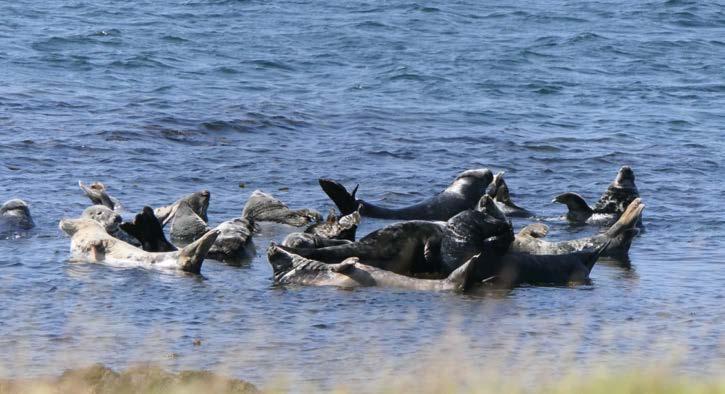
human disturbance on other islands forced them to find new ground. Larger than common seals, greys have a longer head with a sloping ‘Roman nose’ profile. The male nose is so distinctive that the seal’s scientific name, Halichoerus grypus, means ‘hooked-nosed pig of the sea’.
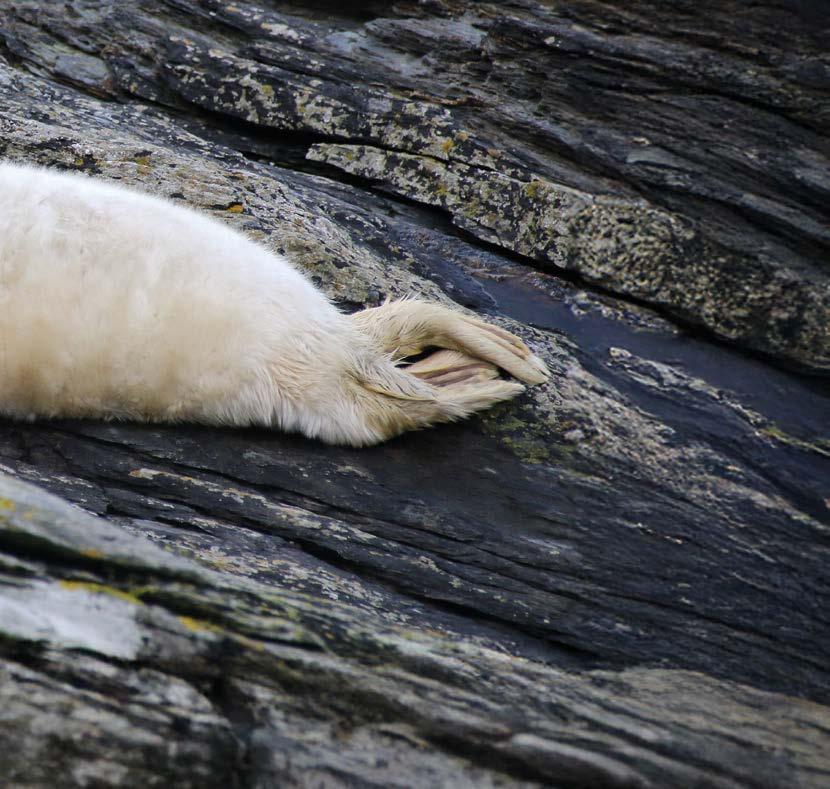
Females are pregnant for around 11 months and give birth to a single pup in the autumn. When they are born, with their wide eyes and white fur, the pups could be mistaken at a glance for clumsy young polar bears. They are also extremely vocal, with their cries sometimes sounding like a human baby.
But it’s not easy being a grey seal pup. They remain on land, nursing from their mothers for the first three to four weeks, before being abandoned to fend for themselves. Having gained weight rapidly thanks to the high fat content of the mothers’ milk, the pups live off these vital reserves of energy for several weeks before eventually entering the water in search of food.
Unlike common seals, whose pups can swim and dive only a few hours after birth, grey seal pups enter the water completely unprepared, often having to learn hunting skills from older seals. Unsurprisingly, early mortality rates are incredibly high, with up to 40% of pups not surviving their first year.
Those that do, however, reach sexual maturity around four years old and are ready to breed – at which time, bull greys often form harems which they defend vigorously from other males. They are big animals, with males reaching three metres in length and weighing in at 250kg. Males typically live for around 30 years, although the smaller females generally live longer.
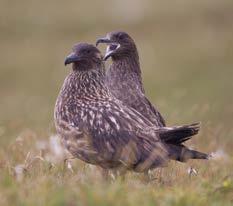
But the Lingas are not all about seals. The islands are also visited by ringed plovers, pipits, snipe, skylark, red-throated divers and seabirds, including great and Arctic skuas. Little Linga is also home to around 80 breeding pairs of cormorants that live in a large colony in the southwest of the island, as well as significant numbers of breeding fulmars and greylag geese.
Seal spotting, of course, is a regular pastime of any seasoned, coastal wildlife watcher –looking out for those dark heads popping up out of the water and curiously peering around. While it may not be possible to visit Linga Holm itself, there are outstanding seal spotting
opportunities elsewhere in Orkney. The island of South Ronaldsay, connected to Mainland by the jaw-droppingly beautiful Churchill Barrier causeways – site of one of the Trust’s snorkel trails – offers great seal watching, especially around Burwick and Windwick.
Whether in the water or hauled out on shore, seals should never be approached too closely, and especially around pupping time. But watched from a distance, seals have a mesmeric presence – with sometimes hours passing by in that special Orcadian light. ■
Stuart Kenny is an outdoor and sustainable travel writer who has explored much of Orkney.




This September, join us online or in person at Dundee Contemporary Arts as we reflect on the Trust’s achievements over the past year. The meeting will be followed by a light lunch and a guided walk at The Miley Wildlife Reserve
Event programme
10:30
11:00
11:10
11:40
11:50
12:30 Presentation by Angus & Dundee Local Group
12:50
12:55
13:00
14:00-16:00
Notice is given that the Scottish Wildlife Trust’s 61st Annual General Meeting (AGM) will be held on Saturday 20 September at Dundee Contemporary Arts (DCA) from 11am to 1pm.
In addition to the formal AGM, the event will include a presentation by Mark Warnes, Chair of the Angus & Dundee Local Group. This will be followed by a light lunch and the chance to meet with staff and other members.
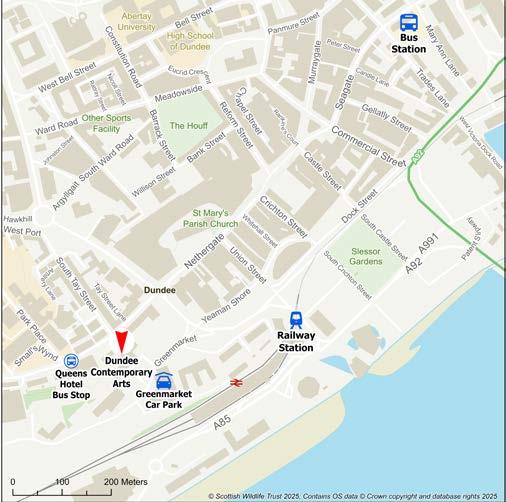
Located a few minutes’ walk from Dundee train station, the DCA is a vibrant contemporary arts centre and cinema, with airy exhibition spaces that are free to enjoy.
After lunch, volunteers from the local group have kindly offered to take guests on a guided walk through the Scottish Wildlife Trust’s Miley reserve (which, as the name suggests, is a mile long). Transport will be provided but spaces are limited, so please indicate when booking if you would like to join us for this walk.
AGM formal agenda
1. Apologies.
2. To approve the minutes from the 60th AGM held on Saturday 7 September 2024.
3. To receive the Council’s report and accounts for the year ended 31 March 2025. The Annual Report and Financial Statements can be downloaded from the Trust’s website. Copies are available on request from the Company Secretary.
4. To reappoint auditors of the Trust.
5. To note co-option of member to Council.
6. To elect members to Council.
6. Any other relevant business. All other business must be notified to the Company Secretary by 31 August 2025.
Martin Cullen (Company Secretary), Registered Office: Scottish Wildlife Trust, Harbourside House, 110 Commercial Street, Edinburgh, EH6 6NF.
Venue information
Dundee Contemporary Arts, 152 Nethergate, Dundee, DD1 4EA. T: 01382 213610
BY TRAIN: The venue is approximately a five-minute walk from Dundee train station.
BY BUS: The venue is approximately a 15-minute walk from Dundee
bus station. There is also a bus stop directly outside (Queens Hotel bus stop).
BY CAR: There is a multistorey car park immediately outside the building on Greenmarket.
ACCESSIBILITY: There is level access to the venue via the main doors on Nethergate. There is level or lift access to all public areas of the building. A visual guide is available on the DCA website.
Registration can be completed online or, if attending in person, by completing and posting the form below.
ONLINE: Please visit scottishwildlifetrust.org.uk/agmbooking Registration closes on Monday 15 September.
Name of member
Membership number
Name of second member (if applicable)
POST: Using block capitals, please complete and return the form to Membership Dept, Scottish Wildlife Trust, Harbourside House, 110 Commercial Street, Edinburgh, EH6 6NF. Forms must be received no later than Monday 15 September.
Please direct questions to our Membership team by calling 0131 312 4700 or emailing membership@scottishwildlifetrust.org.uk
I/we wish to attend (please tick all appropriate)
AGM (in person – if you wish to attend online, please register online using the details above)
Light lunch
Guided walk (transport included)
Dietary requirements
Access requirements
Council, which has responsibility for the governance of the Trust, is made up of Trustees elected from the membership. To be an effective Trustee requires time and effort, and members of Council are elected on the basis of what they can contribute by way of knowledge, contacts, expertise and skill (including finance, conservation and science, administration, and land management). A Trustee must act in the best interests of the charity as a whole.
Jen Baxter
Proposer: Dr Kenny Taylor; Seconder: Hayley Whyte
Jen has been a Trustee since 2022 and a member of the Finance and Audit Committee since 2023, enjoying supporting and challenging the Trust in meeting its 2030 strategy with sound financial controls. Jen brings a wealth of knowledge and experience of programme management, governance and assurance, having worked in change management in the banking sector for 25 years.
She is looking forward to serving a further three years as a Trustee and member of the Finance and Audit Committee at such an exciting time given the Trust’s recent purchase of Inverbroom.
Bob Gorzynski
Proposer: Dr Julian Caldecott; Seconder: Craig Marshall
Bob has always felt very close to the natural world but a painful epiphany on the consequences of our disconnection with nature brought a radical change in his life and career, refocusing on our innate connection to nature. A PhD led to Bob holding key supporting roles with North Wales Wildlife Trust, the Welsh Government and others.
Founder of the Voices of Connection Project, his experience in strategy, governance and business planning is combined with his passion for bringing nature and people together in new and inclusive ways. Bob lives in Comrie but is outside whenever possible.
Alastair Grier
Proposer: Lucy Graham; Seconder: Andrea Tomečková
Alastair studied geography for a degree and continued this interest into later life. He has previously been a member of Council for two terms and has served on the Finance and Audit Committee. He has strong Board experience in business and is currently serving on the Peter Vardy Foundation, which focuses on providing grants to childrenfocused charities. He also helps with the Bethany Trust Care Van providing food and drink to the homeless in Edinburgh.
Alastair is keen to become more actively involved again with environmental concerns and helping protect Scotland’s amazing natural habitat.
Stephen Griffin
Proposer: Bill Lambert; Seconder: Martyn Murray
Stephen is an experienced lawyer. After more than 20 years as a corporate lawyer with leading international law firm Linklaters, he now works for a wildlife conservation NGO which has projects in Europe,
This year, as the number of candidates exceeds the number of vacancies on Council, an election is necessary. One of the candidates is already on Council and would like to continue. Vacancies will be filled in accordance with the Articles of Association. Eligible members are offered the opportunity to vote for the nominees they would like to see elected to Council.
To vote, please visit scottishwildlifetrust.org.uk/2025vote
Voting closes on Thursday 4 September 2025 Vote online by 4 Sept
sub-Saharan Africa, Asia, the Caribbean and South America. His legal role there includes project design, acquisitions, cooperative projects, charity law compliance and governance.
He is also a trustee and the vice chair of another NGO which focuses on orangutans in Indonesia. Stephen enjoys walking, particularly in the Perthshire hills, running, loch swimming, wildlife photography and music.
Caroline Halliday
Proposer: Vi Shannon; Seconder: Margaret Simpson
Caroline has an environment and investment background and an active interest in habitat and wildlife restoration. Caroline’s career started in business, then moved to management within the Scottish Environment Protection Agency and environmental management with the National Trust for Scotland.
As a current member of the UK-wide Environmental Funders’ Network, Caroline now focuses on increasing collaborative funding between philanthropists and government, to invest in a wide spectrum of habitat conservation and improvement projects. With previous Chair, Trustee and Board roles, Caroline has strong governance experience and practical legal knowledge, which she would love to use to support the Trust.
Cory Jones
Proposer: Pippa Baker; Seconder: Tracy McLachlan
Cory brings 30+ years of experience in environmental education, biodiversity management and conservation leadership, having held Board roles with Wester Ross Biosphere and GALE Development Trust in the Highlands. As co-founder of a net zero training co-operative, they understand sustainability, governance and financial resilience. Cory led rural and urban regeneration initiatives and conservation projects as Head of Biodiversity at a Wildlife Trust and Education Manager at the Lake District National Park. They have an interest in mental health and its links to outdoor experiences. After more than a decade living in Wester Ross, they are now based on the Moray coast.
Jenny Law
Proposer: Andrea Tomečková; Seconder: Alistair McVittie
Jenny is a Finance Manager at the Church of Scotland, with specific responsibilities for General Trustees. She qualified as a Chartered Accountant in 2009 and worked in practice for 16 years. During this time, Jenny specialised in charity audit and accounting, working with a wide range of Scottish charities. She joined the Church of Scotland in 2021.
Moving out of practice has allowed Jenny the time to get involved in the wider charity sector, as a trustee and member of technical charity panels. Away from work, Jenny is a keen runner, to balance out her love of baking.
Through the generous additional support of our Wildlife Guardians, we can put even more resource behind safeguarding Scotland’s wildlife and wild places. Our Guardians are helping restore critical habitats, campaign for better wildlife protection, and inspire the next generation to become stewards of Scotland’s natural world.
We would like to say thank you, to each and every one:
GOLD Wildlife Guardians (giving >£50 per month)
John McMillan & Belinda Marr
Carol Pudsey
Rob Scoticus John Scott
SILVER Wildlife Guardians (giving >£30 per month)
Ian Brander
Caroline Casey
Mrs S and Mrs H Duncanson
Diane & Roger Guy
Kate Gwynn
Mr and Mrs Ian Hall
Dawn & Andrew Knight
Marlies MacLean
And 1 Gold Wildlife Guardian who wishes to remain anonymous
Colin McCormack & Alison Gough
Tim Moulds
Ivan W. Reid
BRONZE Wildlife Guardians (giving >£15 per month)
Ms Frances Affleck and Mr Mark Jackson
Mr & Mrs Allan
Stan & Katie Calder
Ron Carthy
Tom Clarke
Mrs Nancy Colman
David Cowan
Mr Graeme K Craig
Michael Dickson
Mrs S Evans
Wildlife Guardians
David & Linda Gibson
Nicholas and Wendy Gray
Mr G Hedley & Mrs I Thomson
Dr Jean Helling
Mr & Mrs J Hopkins
Barry Jarvie
David Jarvie
Robert Kerr
Andrew & Vicky Kilpatrick
Lesley King
Mr Ronald Kinnear
M Lancaster
Mr & Mrs McKechnie
Ian Mirfin
Ms E Munro
C Murray Pyott Family
Mr B Ritchie & Ms M Ritchie
Lawrence Robertson
Mr E & Mrs A Spearman
David P Riley
And 1 Silver Wildlife Guardian who wishes to remain anonymous
Mr John Strachan
Mr and Mrs Sturt
Elspeth Third
Miss B & HsN
Mr A Voas
Mrs Shona Wildi
Mr George Wood
Anne Wright
And 22 Bronze Wildlife Guardians who wish to remain anonymous
See a full list of all our 246 Wildlife Guardians at scottishwildlifetrust.org.uk/our-wildlife-guardians
If you are in a position to give a little extra each month and want to join this important community, we invite you to join us as a Wildlife Guardian. Just visit www.scottishwildlifetrust.org.uk/guardians or call 0131 312 4700 today!
nlocking nature finance from the private sector and investment funds is increasingly being seen as an important way to address the twin crises of climate change and biodiversity decline. We know we must rapidly scale up investment in nature and eliminate harmful subsidies that incentivise further nature loss. Numerous estimates highlight the funding gap for nature recovery in Scotland and it is clear that public and charitable finance alone isn’t enough.
So, how do we attract private finance and ensure it delivers meaningful outcomes for nature? In 2024, Scottish Government finalised its Principles for Responsible Investment in Natural Capital – recognising the importance of a high-integrity, valuesled market for responsible investment in natural capital.
Since then, the Scottish Biodiversity Strategy has set the ambition for Scotland to be Nature Positive by 2030, and to have restored and regenerated biodiversity by 2045. In addition, public funding mechanisms such as the Facility for Investment Ready Nature in Scotland programme, matched by lottery funding, have laid the groundwork
for responsible private investment in nature. Nature protection and restoration can be financed through landowner investment, public funding, philanthropy and charitable funding, private capital and markets, as well as regulatory and legislative tools such as tax incentives and polluter pays rules.
Integrating these diverse financing approaches ensures that all stakeholders contribute to a sustainable and resilient future for Scotland’s natural environment. Given the squeeze on public finances, we must explore how private investment can best deliver for nature and people and how changes to regulation and legislation can help make this form of investment easier to facilitate.
There is growing interest in channelling private finance into nature markets, which create tradable units or credits representing carbon, biodiversity and other ecosystem services. These markets enable businesses to offset environmental impacts or demonstrate ‘nature positive’ contributions while creating repayments for those investing financially in the restoration. By providing a mechanism for buyers and sellers to transact on ecosystem services, nature markets create a pathway
for financial flows that benefit both the environment and the economy.
Today, major environmental markets are developing across the UK. Most of these are voluntary, although there are requirements to comply through schemes such as Biodiversity Net Gain and nutrient neutrality in England. However, the Voluntary Carbon Market is expanding rapidly as corporations make net zero plans, demonstrating a clear demand for carbon credits.
In Scotland, efforts are underway to promote consistent commitments to biodiversity enhancement within planning through the development of a biodiversity metric; there is ongoing research on how to quantify biodiversity benefits within the voluntary Woodland Carbon Code and Peatland Code; and the Scottish Government is now leading on a new Ecosystem Restoration Code.
There is still much work to do. Developing metrics and market demand for biodiversity credits represent significant challenges, and the complexity of ecological systems raises questions about how to achieve the necessary flexibility in the use of these credits within their local, place-based context.
As codes and standards evolve, they will play a crucial role in ensuring that nature markets operate effectively, transparently and sustainably.
Some caution against the monetisation of nature, viewing it as potentially dangerous and counterproductive, with the risk of creating perverse incentives or unintended consequences. These concerns highlight the need for strong regulatory frameworks that not only protect biodiversity but also deliver tangible community benefits.
So, what really needs to be in place for private finance to truly deliver for nature, people and climate? Strong market rules and effective governance are critical to ensuring high integrity. Existing schemes such as the Woodland Carbon Code, the Wilder Carbon Standard (originally developed by Kent Wildlife Trust) and the Peatland Code – along with forthcoming schemes like the Saltmarsh Code – provide credible frameworks that help ensure transactions contribute positively to ecosystem restoration and protection.
As codes and standards evolve, they will play a crucial role in ensuring that nature markets operate effectively, transparently and sustainably. Additionally, there will be a need for clear standards, rules and publicly accessible maps to track where and how units are created and sold, while community
engagement, objectives and equitable benefit sharing are also key to long-term success.
In addition, there needs to be sustained demand for credits. While some companies invest for corporate social responsibility, broader participation requires economic drivers, such as tangible monetary returns for project investors, reduced operational risks or consistent demand for credits supported by clear regulatory requirements.
Making certain frameworks mandatory could help. The Taskforce on Nature-Related Financial Disclosures, for instance, requires businesses to assess and manage their reliance on nature and their supply chains’ impacts on nature.
Long-term clarity and certainty are equally important. Investing in nature credits for future sale requires manageable risks and reasonable certainty in the market over the lifetime of a project. Nature restoration needs to be a financially viable proposition for landowners, meaning that it can compete with or at least complement other land use income options.
As diverse nature finance mechanisms and markets develop in Scotland, the Scottish Government will need to explore
how multiple income streams interact and whether ecosystem services or credit types could be effectively combined or ‘bundled’, providing value for multiple beneficiaries.
Ultimately, while private finance and market mechanisms are essential to scale up and deliver on nature restoration in Scotland, they are only part of the solution. Meeting Scotland’s ambitious 2030 and 2045 targets will require integrating diverse funding sources along with public funding for statutory obligations for nature recovery.
For those who are interested in learning more or getting involved, the Nature Finance Pioneers is an active community discussing nature finance that is hosted by the Scottish Forum on Natural Capital for which the Scottish Wildlife Trust is the Secretariat. Find out more by visiting finance.naturalcapitalscotland.com ■
Dr Annie Robinson is Scotland Coordinator at the Chartered Institute of Ecology and Environmental Management (CIEEM). She was assisted in this article by Julia McCarthy, University of Edinburgh and CIEEM Scotland Committee, and Jason Reeves, CIEEM Head of Policy.
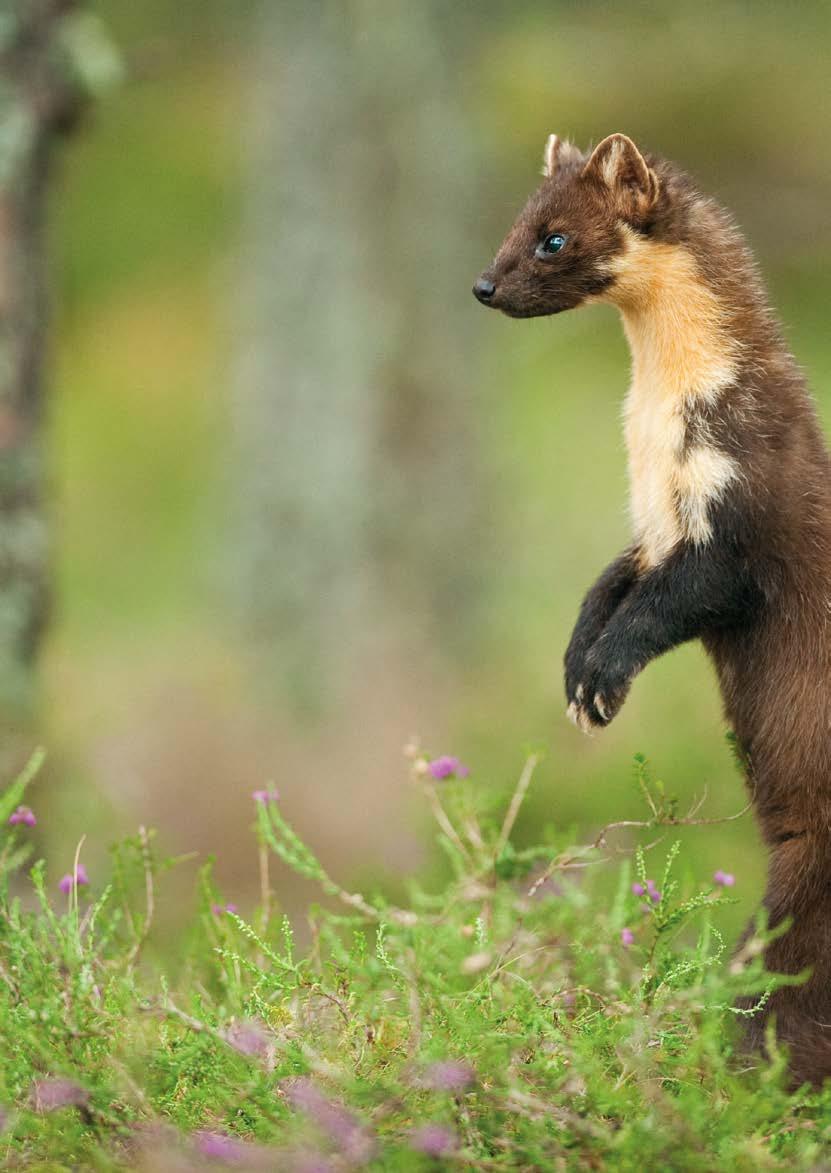
Martes martes
Mostly active between dusk and dawn, the pine marten is a notoriously elusive creature of woodland. But while tricky to spot, it is an animal that continues to recover lost ground, especially so in Scotland where populations are higher now than perhaps at any time in the past 100 years.
Once one of the most numerous carnivores on these shores, numbers declined dramatically during the 19th and early 20th centuries, with loss of habitat, hunting for the fur industry and predator control linked with game shooting decimating populations.
Today, pine martens are fully protected and while they remain critically endangered in England and Wales, they are once again established across much of Scotland north of the Central Belt, with outlying populations in the Borders and Dumfries & Galloway. Their cause has been helped not just by legal protection but also by the expansion of commercial forestry and regeneration of their preferred native woodlands.
A member of the mustelid family of mammals, pine martens are related to stoats, weasels, otters and polecats. Similar in size to a small domestic cat – with males around a third bigger than females – they have chocolate-brown fur and a creamyyellow ‘bib’ on the throat and chest.
Pine martens mostly rest up during daytime in dens made in tree hollows, old squirrel dreys and rocky crevices. Alert and agile, they are formidable predators and excellent climbers, with large claws and thick fur on the soles of the feet for grip, plus a long tail for balance.
Much like their mustelid cousins, pine martens are none too fussy when it comes to diet. Despite their climbing ability, they find most of their food on the ground, with rodents, birds, eggs, insects, frogs and fruit all featuring heavily. They have a particular liking for blaeberries which can account for a third of a pine marten’s diet in a good season. During late summer months, the animal’s presence is often revealed by the purple coloured scat left in regular latrine spots, such as boulders, logs and other prominent places.
Pine martens are nimble enough to prey on grey squirrels, which spend more time on the ground than their native red counterparts – with evidence suggesting that their presence can reduce numbers of greys to the benefit of reds. ■
Although challenging to observe, pine martens are present on a variety of Trust reserves, including Loch of the Lowes, Forest Wood and Cullaloe.
Anne Campbell, the Trust’s
Crofting Officer for
the Coigach & Assynt Living Landscape, reveals more about a community that has long had a special place in her heart
Home is always home, even when you have moved away. That’s how I feel about Ben Mor Coigach and the landscape all around.
I was born and brought up here but moved away in my late teens, as many do. I decided to return 12 years ago, partly because I missed the sense of community and belonging.
My professional role here began as Crofting Officer with the Coigach & Assynt Living Landscape Partnership in 2018. It was an opportunity to fully understand how crofting works in the area and explore what the project could do to support local crofters and the wider community.
Most people here have more than one job, balancing several different roles, including voluntary involvement on committees and in emergency services such as fire, coastguard and mountain rescue. Many crofters are self-employed or run small businesses from their crofts. Resourcefulness is key to all who live here.
In terms of the landscape, it is a rugged, extreme place but also one that is rich and alive. After a long, hard winter, with everything grey and colourless, a few days of early spring sunshine can make everything start to come to life. Sometimes during this magical time, what you see in the morning has changed by evening.
There is a little of everything here, from dramatic hills and open blanket bog to oceanic heath and Atlantic woodland. There is a similar variety of species, especially birds: ptarmigan on the high slopes; red- and black-throated divers, golden plover, curlew and greenshank that breed on the lochans and hill ground; and eagles (golden and white-tailed) that patrol over land and sea.
Water voles are found along many of the burns on the western slopes, while along the coastline of Loch Broom and out to sea, summer brings sightings of minke whale, porpoises and dolphins in addition to resident seals and otters.
As traditional crofting involves a form of low intensity agriculture, it often works hand in hand with nature. Many crofts are incredibly biodiverse, with native woodland plantings sitting alongside pockets of cultivation.
In February, the Trust completed a major peatland restoration project at Ben Mor Coigach, supported through the Scottish Government’s Peatland ACTION Fund, in partnership with NatureScot and other agencies, and Achiltibuie Common Grazings. The actions will help improve water quality flowing from the drinking water catchment and re-wet the landscape, helping return it to its natural state for the benefit of wildlife and carbon sequestration.
There is a little of everything here, from dramatic hills and open blanket bog to oceanic heath and Atlantic woodland.
The rest of this year is set to be equally busy, with developing plans for a second phase of peatland restoration, plus looking at opportunities for native woodland expansion and freshwater habitat enhancements. For all, we will continue to work closely with the crofting community and other partners. Looking further ahead, the Trust is also working with Coigach Heritage on the development of Lorg na Còigich, a public art installation by acclaimed local artists Will Maclean and Marian Leven that will commemorate the community’s successful resistance to evictions during the Highland Clearances. ■
Plan your visit
Dominating the landscape north of Ullapool, Ben Mor Coigach is the highest point of a range of hills that rise steeply from Loch Broom. Covering more than 6,000ha, it is the Trust’s second largest reserve and includes a mix of high peaks, coastline and crofted land. The reserve begins at the east end of Loch Lurgainn, around 16kms north of Ullapool. Experienced walkers can enjoy the spectacular Postman’s Path, a historic trail between Strathcanaird and Achiltibuie. Learn more by scanning the QR code or visit bit.ly/BMCoigach
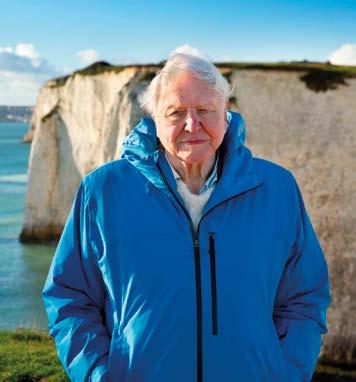
Released earlier this year to coincide with Sir David Attenborough’s 99th birthday, Ocean is the natural history legend’s boldest film ever and is an exemplar of powerful storytelling.
Despite Attenborough’s back catalogue of hundreds of hours of pioneering documentary filmmaking, this film portrays the plight of the world’s oceans in a way never before seen.
Whether it’s the harrowing footage of the destruction caused by bottom trawling or the shocking scenes of the worst mass coral bleaching event ever observed, it would be hard not to feel moved by this film. But don’t think that you will come away feeling even more eco-anxious.
In a style that is novel in Attenborough documentaries, Ocean features reflections from a handful of individuals who have observed change in their seas, negative and positive. These people – unnamed until the credits – share stories that are representative of the experiences of communities around the world.
From a West African artisanal fisherman who has seen fish stocks decimated by huge foreign fishing vessels to the compelling accounts from the Isle of Arran and Hawaii of how quickly marine habitats can bounce back when meaningfully protected, the film’s narrative is carefully balanced in a way that allows space for hope.
It is a film that everyone should see and which will hopefully have a lasting positive impact on the planet because, as Attenborough says: “If we save the sea, we save our world.”
Dan Bagur
Published by Pelagic Publishing
ISBN 978-1784274276
Paperback £28
Pine martens are a species that seem to captivate many of us despite most having never seen one in the wild. In this book, author and photographer Dan Bagur takes a deep dive into the biology and ecology of these deeply secretive mammals.
Having spent years observing pine martens across Europe, Dan’s knowledge of their lives is extensive. Chapters explore how these mustelids are perfectly adapted for woodland life, revealing insights such as the ‘Marten Maze’ that is to pine martens what a sett is to a badger and a holt is to an otter.
With many useful photographs as well as QR codes linking to a series of audio recordings, this book is sure to leave readers with an even greater desire to see one of these incredible animals first hand.
Ian Carter
Published by Whittles Publishing
ISBN 978-1849955874
Paperback £17.99
When author and ornithologist Ian Carter moved from Devon to a Galloway glen in search of wilder landscapes – or at least one more “self-willed” and where “sights and sounds are dominated by creatures other than ourselves” – he wasted little time in getting to know his new patch.
In one direction, the coast, with its mudflats, merse and sea cliffs. In the other, farmland and open hill ground with moorland, rocky outcrops, plantation woodland and pockets of native deciduous woodland.
This gentle, thoughtful book offers a sensory account of the area’s wild inhabitants – all within walking distance from the author’s new home. Ranging from sea to summit, it reveals a snapshot of the sheer variety of wildlife and habitat found in what is an often overlooked part of the country.
Technology has advanced at an unbelievable rate in recent years and, as a wildlife photographer, there are two pieces of kit I would not be without now – my thermal imager and trail camera.
Both come in a variety of models and makes to choose from. The Zeiss Secacam 7 I use records both stills and videos onto an SD card within the device, but better still it will send notifications to my phone when the camera is tripped, allowing me to see pictures instantly from the camera.
Why spend hours in a hide just waiting and hoping a badger will appear from its sett, or for a sparrowhawk to return to its plucking post, even an eagle to return to a dead carcass? By setting out a trail camera, its internal clock will give you all the information you need, such as time and how often your subject is visiting.
These cameras are very discreet and work 24 hours a day, making no noise or
Competition
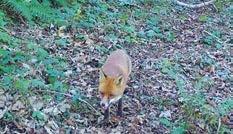
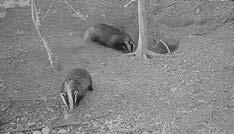
emitting any light that might scare a bird or animal.
Thermal cameras are no longer limited to elite film crews with big budgets and as they come in many different makes and models, there will be one out there to suit everyone’s needs and budget.
I personally use a small Pixfra device that fits either in my pocket or camera bag. There is a misconception that you would only use a thermal imager at night, which is not the case. I have successfully used them to locate roosting owls in the daytime, as well as checking holes in trees for nesting occupancy
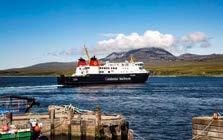
Islay’s diverse and rare wild inhabitants make it a hot spot for wildlife lovers and birdwatchers.
For those keen to explore everything the island has to offer, Bowmore Distillery Cottages offer the perfect retreat.
We’re giving one lucky reader and their guest the chance to win a two-night stay at the one-bedroom Mashman’s Cottage, plus breakfast at the neighbouring Harbour Inn and a tour for two of Bowmore Distillery.
We’re also offering one return ferry journey for two adults and one car on the Kennacraig to Islay ferry route, courtesy of Caledonian MacBrayne.
Bowmore Cottages are six charming, self-catering residences – from a cosy one-bedroom retreat to a spacious six-bedroom property. A number of the recently refurbished cottages date back to the early 1800s and all are a stone’s throw from Loch Indaal.
CalMac is the largest ferry operator in the UK with 35 vessels serving more than 50 destinations across 200 miles of Scotland’s west coast. CalMac prides itself on its customer service, safety and reliability.
For more information, visit bowmore. com/en-gb/bowmore-cottages and calmac.co.uk
For your chance to win, tell us: On which island is the Bowmore Distillery found?
Send your entries to Scottish Wildlife Trust competition, c/o Connect, Studio 4015, Abbey Mill Business Centre, 12 Seedhill Road, Paisley PA1 1JS.
The closing date is Friday 29 August 2025. Please include your name, address, email address and phone number.
Terms and conditions
Winner will be selected at random from all assembled entries. Over 21s only. Prize subject to availability and valid for six months from when reader is advised they have won. Distillery tour available on set days and must be booked in advance. Ferry travel must be redeemed in one trip. No cash alternative. Prize cannot be transferred. Exclusion dates apply. Entry data managed by Connect Publications (Scotland) Ltd solely for managing this competition.
and for surveys of red squirrels and pine martens.
They do, however, open up a whole new world when watching or filming wildlife after dark, as virtually every model has a builtin recording capability.
So, who knows, you might even get the chance to witness and film something in the natural world that has never been seen before. All it takes is the press of a button!
This sponsored review was written by professional photographer Keith Kirk for WildlifeCam.

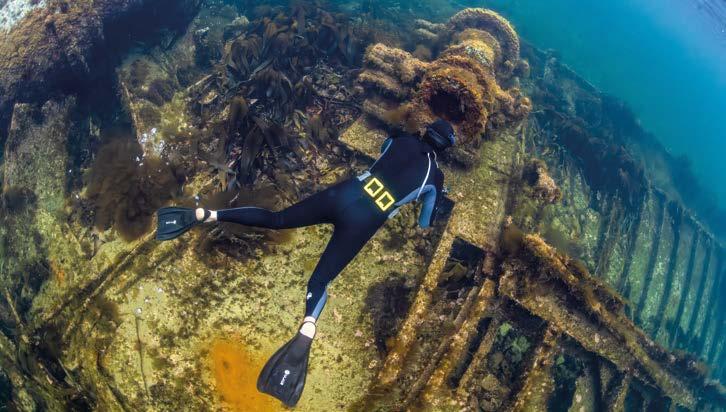
Snorkelling and SCUBA instructor Emma Taylor shares some magic moments in the waters of the North East and Orkney while researching a new book on Britain’s top snorkel spots
Over the past three years my family and I have been circumnavigating Britain’s coastline in search of the best snorkel spots. The opportunity to experience the many and changing faces of our coastline and connect with so many other inspiring ocean lovers has been such a privilege and nowhere more so than in Scotland – with one particular trip to the North East coast and Orkney leaving an indelible print on my heart and mind.
In stark contrast to the usual happy chaos of research with my husband, two children and excitable dog in tow, this was a rare solo trip with a plan to meet some fellow snorkellers along the way.
The trip began on the shores of Caithness, a stretch of coastline I had truly underestimated beforehand. It is perhaps less dramatic than the white sand beaches and intricately crenelated shores of the West Coast but I fell in love with the quiet beauty above water and was mesmerised by the scenery below the surface: flowing forests of kelp, flashing lights of iridescent comb jellies in the water column, fish darting here and there and perennially irritated-looking crabs busily picking their way across the seabed. With the silence of the underwater world completing the experience, it was perfect.
Next stop Orkney, where the experience was different but equally special. I explored islands, snorkelling with new friends. There
was laughter, we shared our sightings, dipped for plankton, repeatedly wriggled in and out of our wetsuits or dashed into the water armed just with a mask and snorkel for quick dips while waiting for ferries. This was a shared love of nature and the ocean at its best – fun, inspiring and empowering.
The snorkelling around Orkney is really something with its maritime history as evident below the water as it is atop. The mass of shallow, submerged wreckage has been reclaimed by nature and now forms magnificent artificial reefs easily accessible from the shore.
As I floated along beside Churchill Barrier 2, I was in marine heaven; crystal-clear water pierced by sunbeams, wrasse wandering in
and out of the anemone-adorned wreckage, all set against a marine garden of beautifully swaying seaweeds of every shade of green.
It was a wrench to tear myself away when I realised how many minutes had ticked by and that I had a ferry to catch. The exit itself, however, was not a speedy one as I found that the rocks of the shallows were carpeted in sea snails and sea hares (another beautifully ornate marine gastropod) to the extent that I struggled to find anywhere to place my feet. This led to a rather inelegant hobble out, after which I flopped onto the beach with a huge smile on my face.
As I write, I fear that no explanation will ever do justice to the mindful, engaging and rewarding experience of Scottish snorkelling. This is, however, your invitation to give it a try – I promise that both your heart and head will thank you for it. ■
Emma Taylor and husband Gordon are authors of Snorkelling Britain: 100 Marine Adventures (published by Wild Things Publishing). Get 20% off using offer code ‘LivingSeaspromo’.