Wildlife
Number 114 | November 2024
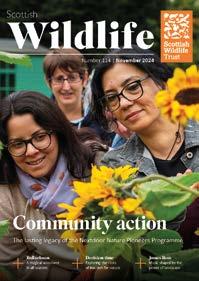
The lasting legacy of the Nextdoor Nature Pioneers Programme
A magical woodland in all seasons
Decision time Exploring the costs of inaction for nature
Ross Music shaped by the power of landscape
Ballachuan
James




Number 114 | November 2024
The lasting legacy of the Nextdoor Nature Pioneers Programme
A magical woodland in all seasons
Decision time Exploring the costs of inaction for nature
Ross Music shaped by the power of landscape
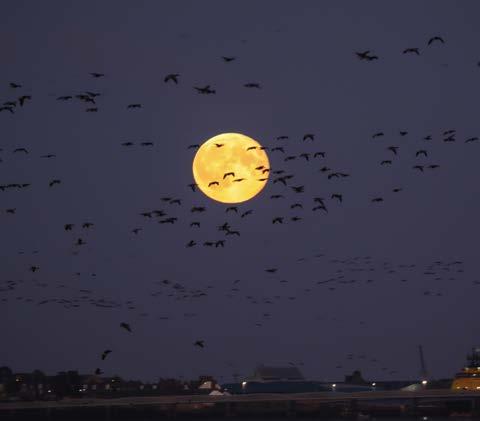
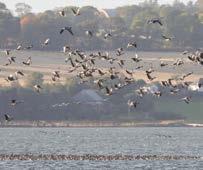
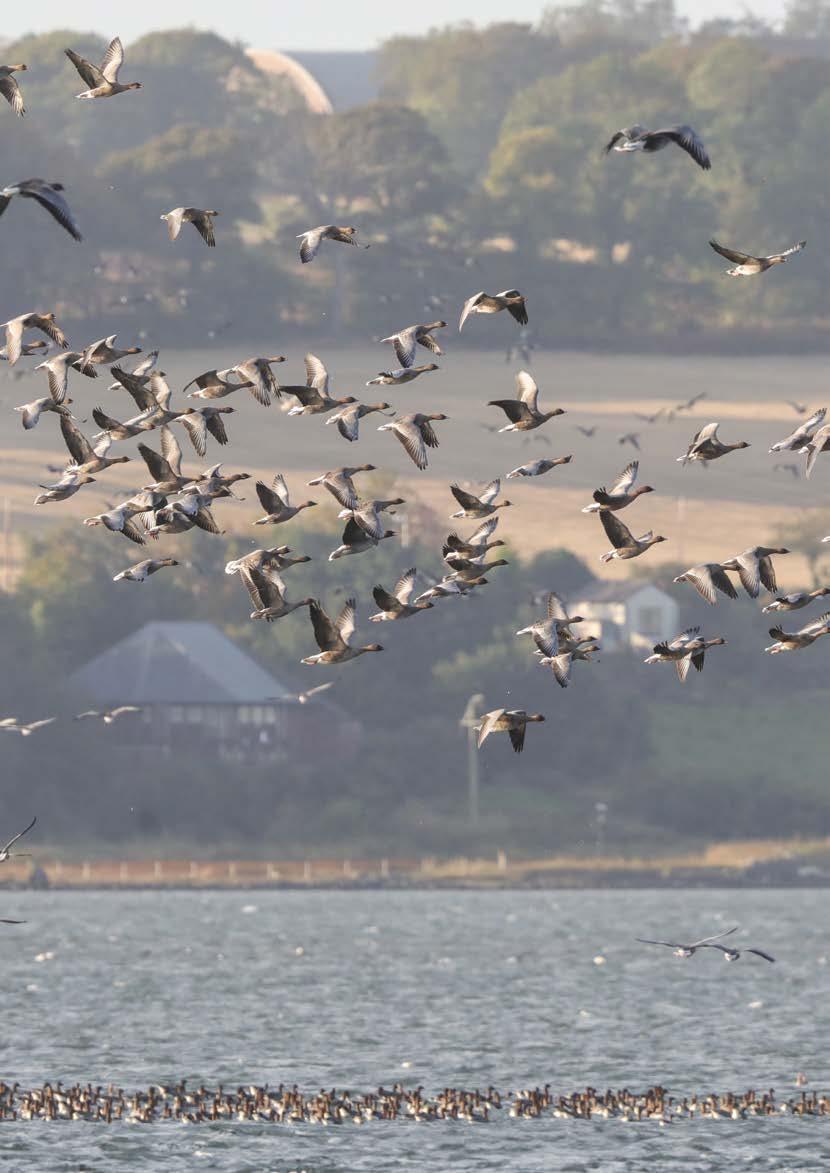
When skeins of pink-footed geese breeze into Scottish skies from Iceland each autumn, they bring a wild energy with them. To me, the sense of seasonal change they embody is as exciting as the coming of spring. Shapes of flocks, clamour of calls, colours of wings and beaks and legs: all can transform a scene from dull to vibrant and turn thoughts from static to dynamic.
It seems fitting that the Trust, now moving forward in its seventh decade, helps to host one of Scotland’s largest gatherings of pink-footed geese each autumn and winter at Montrose Basin. For energy, change and wildness are at the very heart of the organisation: energy of members and staff to work for nature and nurture it; an ability to change and to develop bold and positive concepts for that work as the nation, world and climate shift around us; and the thrill of the wild to inspire and motivate us.
There’s been ample evidence of such inspiration in recent months, not least through the Trust’s Words of the Wild initiatives, developed online and in writing as one of the ways to celebrate its 60th anniversary year. If you haven’t lent an ear to any yet, I recommend listening to the Words of the Wild podcast series. These recordings feature several Trust reserves, with people who know them well sharing stories and local knowledge in a conversational way. Great for armchair travels, or perhaps to prod you to journey to some of the featured reserves.
Personal experiences of Scottish wildlife and landscapes shared in prose or poetry have also been at the core of the Words of the Wild nature writing competition. By its close at the end of August, this had received more than 500 entries from writers ranging from primary school pupils to pensioners. Judging is now underway, with winners due to be announced at a special 60th Anniversary Parliamentary event at Holyrood in November.
This will also be when our 60th anniversary time capsule (a bespoke box of native wood)
Moving forward, there’s both sea spray and a dash of river water in some aspects of the Trust’s current work.
will be sealed. Contents have been decided in a variety of ways, including some suggested by panellists at the Trust’s National Members’ Day in Edinburgh in September and one by audience vote at that event.
Our two keynote speakers, science and wildlife presenter Liz Bonnin, who is President of the Wildlife Trusts, and record-breaking paddleboarder, vet and ocean conservation champion Cal Major, gave presentations there that will linger long in the memory. Feedback from people able to come to the day’s events has been very positive. “I didn’t know that AGMs could be such good fun,” commented one participant
about the morning session. My thanks to the speakers and to the many staff and members (including several of the Trust’s Young Leaders and to volunteers who received awards at the event) who made the day such a success.
Moving forward, there’s both sea spray and a dash of river water in some aspects of the Trust’s current work. As you’ll read in this issue, our network of snorkel trails –an amazing blue necklace – is now complete. And our major Riverwoods project has just had funding confirmed for its next phase of delivery. The grey geese birling down to inshore and loch would surely approve. ■
Big picture
Digger wasp, by Paul Fraser News
News round-up from the Trust and the world of conservation Pioneers
Alys Daniels-Creasey on the costs of inaction for biodiversity Viewpoint
Natural spectacles and how to help wildlife this winter
Species spotlight
Hitting the heights with the hardy ptarmigan
Reserve portrait
Montrose Basin – where natural rhythms hold sway
16
22 06 26 38
James Ross on how Scotland’s landscape has inspired his musical compositions
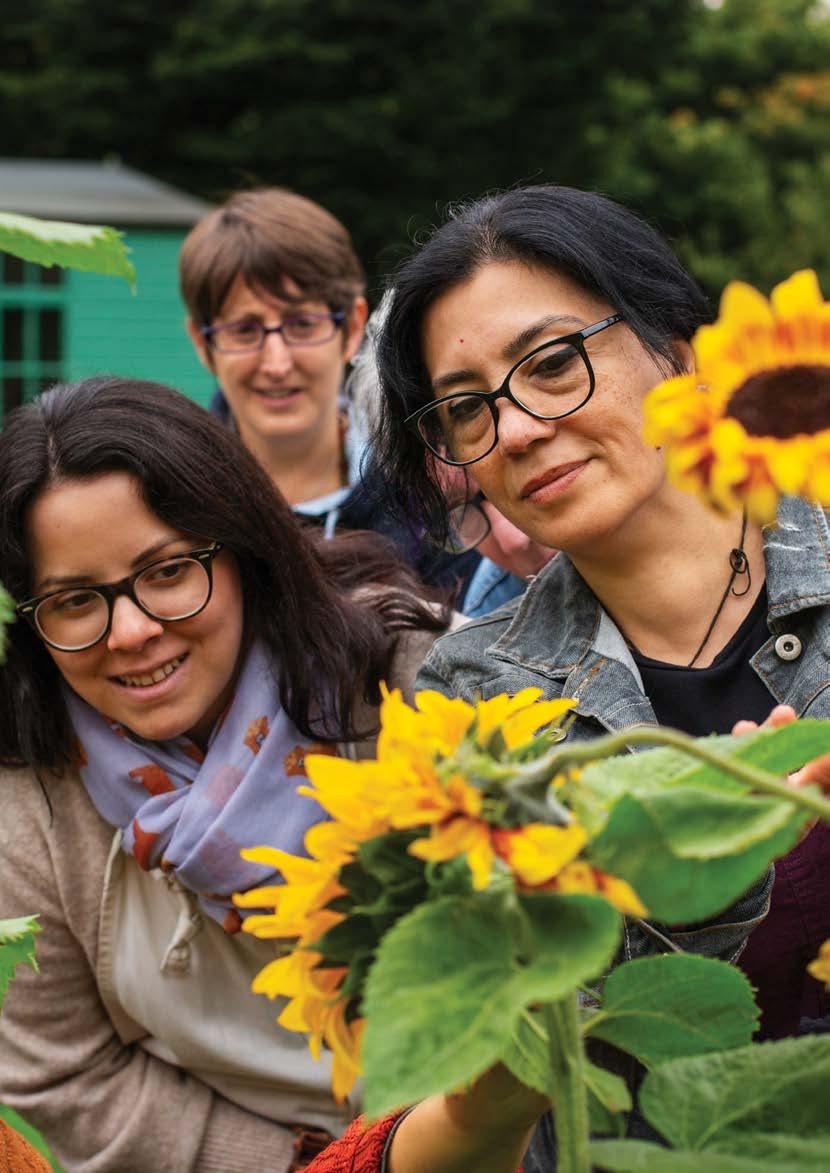
Front cover: Participants on the Nextdoor Nature Pioneers Programme © Jo Foo Photography
Ida Maspero explores how the Nextdoor Nature Pioneers Programme has helped facilitate action for nature within communities
The Trust’s Ballachuan Hazelwood reserve off the Argyll coast is one of the finest examples of its kind in Europe – with some of its most special features on full display in winter, writes Rich Rowe 05 14 28 30 36
Watch out for
Things to enjoy in the coming months PLUS competition
Scottish Wildlife is published by the Scottish Wildlife Trust, a Scottish registered charity (no. SC005792) and company limited by guarantee (no. SC040247). Registered office: Harbourside House, 110 Commercial Street, Edinburgh EH6 6NF. Tel: 0131 312 7765.
Patron: King Charles III. Chair: Kenny Taylor. Vice-Chairs: Ian Jardine, Bill Lambert. Chief Executive: Jo Pike.
The Scottish Wildlife Trust accepts no liability for omissions or incorrect data in advertisements and letters. Views expressed in Scottish Wildlife are not necessarily those of the Scottish Wildlife Trust. ISSN: 0143 1234.

The Scottish Wildlife Trust is affiliated to The Wildlife Trusts, a UK-wide network of 46 Trusts with more than 2,000 wildlife reserves. 16
Scottish Wildlife is published three times a year –March, July and November – and is free to members of the Scottish Wildlife Trust.
Managing Editor: Pete Haskell – editor@scottishwildlifetrust.org.uk
Contributing Editor: Rich Rowe
Design: Connect – connectcommunications.co.uk
Advertising: Elliot Whitehead – 0131 561 0021
Printing: InkMark – inkmarkltd.com

Paul Fraser
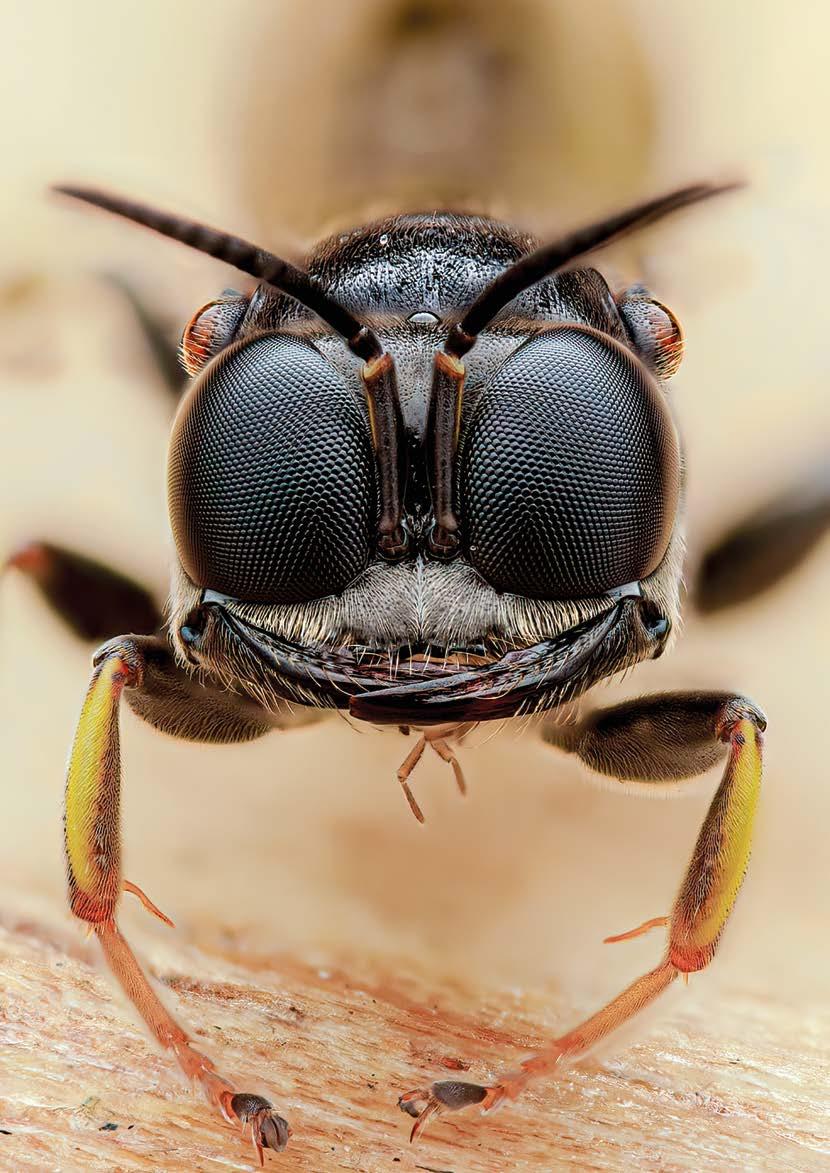
I first got into macro photography to educate my children during the Covid lockdown and, in doing so, became totally captivated by the mesmerising world of minibeasts.
I work in a rural community teaching an outdoor education activity called Nurture Nature to adults with learning disabilities. I made some raised planters
to attract insects for the students to enjoy and after a few months, I noticed sawdust on the top of the soil. When I looked in the hole that the sawdust had come from, I found these beautiful digger wasps.
I entered this picture into the Royal Entomological Society’s 2023 photo competition and it received a Specially Commended award in the Portrait
category. Winning awards is great but above all I hope my photography creates awe and wonderment for our unsung heroes: the insects.
Paul Fraser
Camera: Olympus OMD-EM1 mark 2; Lens: Olympus 60mm 2.8f macro (with Cygnustech diffuser); Shutter speed: 1/50s; Aperture: f5.6; ISO: 200
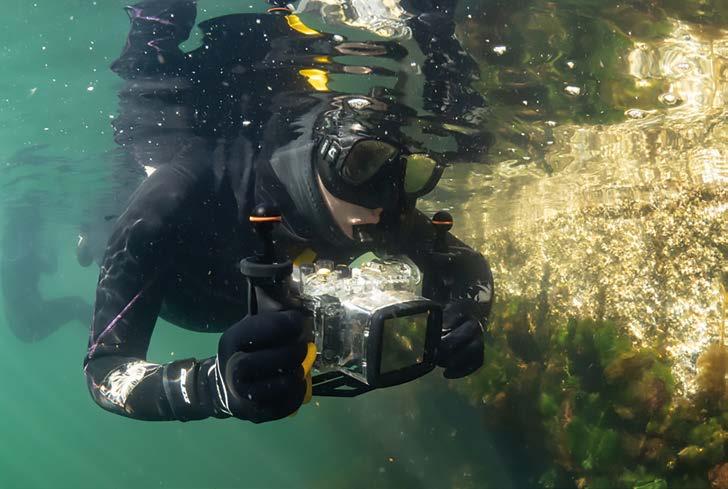
WE were delighted to launch three new snorkel trails over the summer and early autumn despite some weather-related delays. Delivered through our Living Seas project, the trails cover South Ayrshire, Orkney and the Small Isles.
In June, the South Ayrshire trail launched at the Maidens World Ocean Day Festival in partnership with Adventure Carrick and its charity, the Adventure Centre for Education. With the impressive Ailsa Craig dominating the views above the surface, the trail explores rugged skerries, ancient castles and even volcanic sea caves. It stretches from Big Isle, near Lendalfoot in the south, to Ballast Bank, set right within Troon in the north.
Then, in early September, we partnered with Kraken Diving for a celebration of all things marine in Finstown, Orkney. The islands’ unique
geography and history have combined to create a fascinating underwater landscape. As well as the natural spectacles of Orkney’s marine life, the trails explore artificial reefs created by shipwrecks from the Second World War.
On the same September weekend, the Small Isles trail was launched at Gallanach Bay. Developed in partnership with the Small Isles Community Council, the trail has sections across Muck, Eigg, Canna and Rum, each with their own distinct character. Snorkellers can explore kelp forests and sandy beaches, while looking out for wildlife such as otters and seals.
The launches in South Ayrshire, Orkney and the Small Isles mark the completion of the Trust’s snorkel trail network, which has been supported by the Esmée Fairbairn Foundation and now covers the length and breadth of Scotland. They join trails
in Arran, Berwickshire, East Lothian, Lochaber, Moray Firth, North Argyll, North Harris, North West Highlands, South Fife and Torridon.
All trails include both beginner and advanced sections and are supported by local equipment hire companies, allowing snorkellers of any experience the chance to discover a world beneath the waves.
Leaflets for the trails, including route guides, safety information and checklists of some of the marine life you might see can be downloaded from our website. You can also find tips on how to share your snorkel experience with the world.
For more, visit scottish wildlifetrust.org.uk/ things-to-do/snorkeltrails or scan the QR code.
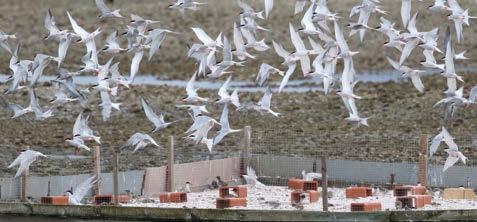
FOLLOWING a challenging few years, common terns are back with a bang at Montrose Basin, with more than 40 pairs nesting on a specially designed raft. Between them, they raised over 100 chicks, making this their best year on the reserve since 2017.
The raft, known as the “Maid of Sterna Stuff II”, was custom designed for the terns and has been situated carefully to ensure it always stays afloat, regardless of the tide. It allows them to safely build their nests without risk of predation by foxes, otters or other mammals. However, recent years saw a decline in the raft’s use. There were
no nesting terns on it in 2021 or 2022, which may partly be attributed to the devastating impact bird flu has had on many seabird populations. Then in 2023, some birds did nest on the raft, but only late in the season and in much smaller numbers than previous years.
Staff, volunteers and visitors therefore welcomed this year’s bustling colony with a mixture of excitement and relief. As we hope for another successful season next year, we’ll also be keeping a close eye on the chicks’ movements, with 87 being ringed by volunteers from the Tay Ringing Group.
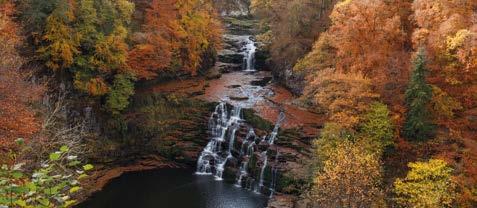
WE are delighted to announce that our ambitious Riverwoods Blueprint project has received over £1.8m from The National Lottery Heritage Fund, meaning we can now start the next phase of this exciting project. There are over 125,000km of rivers and streams in Scotland, however a recent survey showed that only 13% of riverside habitat is in good condition. This has led to a decline in important freshwater wildlife such as Atlantic salmon, brown trout and the critically endangered freshwater pearl mussel. During the project, three partner organisations – the Spey Catchment Initiative,
Tweed Forum and Kyle of Sutherland Fisheries Trust – will create and restore at least 100ha of river woodlands, involving the planting of at least 110,000 trees. The work undertaken in these demonstration areas will act as a blueprint for future conservation projects across Scotland. Through the project, we will also be able to offer a grant scheme to provide financial support for other woodland creation projects, as well as developing an online river woodlands resources hub and engaging with communities across Scotland.
AS with many things, land management practices and our understanding of their impact have evolved over time.
This is never more so than with commercial conifer plantations on deep peat – infamously incentivised by tax schemes in the 1960s and 70s. As they establish, the impact of initial drainage is compounded as the trees’ roots draw water from the underlying peat. The densely planted non-native trees eventually shade out ground flora and blanket the surface with dropped needles. All of this has a devastating impact on the specialist species which are adapted to wet bogs and it also releases carbon from the degrading peat mass. A dual threat to both biodiversity and climate.
Today, the Trust responds to this challenge on two levels. We promote the principle of “the right tree in the right place” and actively advocate for a more nature-friendly policy framework.
At the same time our management of over 100 wildlife reserves often includes redressing historic damage including tackling areas of non-native conifer plantation.
A prime example of this is at Largiebaan – the Trust’s second largest wildlife reserve spanning over 1,700ha on the Kintyre peninsula. The reserve is marred by a mature but failing conifer plantation which partly covers deep peat.
We are readying ourselves for a new major project – taking on the costly and complicated task of extracting the trees from what is a remote location before undertaking an ambitious programme of peatland restoration and native woodland creation. A challenge which is all the more exciting given the reserve’s location within Scotland’s temperate rainforest zone.
Can you help? Scan the QR code or visit scottishwildlife trust.org.uk/ savelargiebaan
Sarah Proctor Head of Major Projects
NEW solar panels have been installed on Handa Island, allowing us to further reduce the island’s dependence on fossil fuels. There is no mains electricity on Handa, but the panels will help power a new ultraviolet light that can purify the island’s water. This eliminates the need to chlorinate the water supply for the ranger and volunteer accommodation.
TWO new moth species were recorded during a recent survey at our Bawsinch and Duddingston Loch reserve. Southern wainscot (Mythimna straminea) and dingy footman (Eilema griseola, pictured) are almost exclusively found in England and Wales, so their sighting in Edinburgh is exciting news.
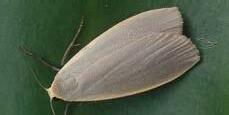
© Mark Cubitt
THE Trust has funding from the Scottish Government’s Peatland ACTION Fund to restore 136ha of peatland in the drinking water catchment above Achiltibuie, Ben Mor Coigach. The funds will enable us to reprofile gullies and hags, install dams and bunds, and translocate sphagnum moss. Contracted works began in September and are due to be completed by January 2025.
AS part of Cumbernauld Living Landscape’s latest Development Phase, we have been working alongside volunteers using specialist software to map and survey invasive nonnative species (INNS) and garden escapees. The surveys have indicated that they are causing widespread damage to the town’s native wildlife and habitats. We are now developing a method of working with local communities to remove these threats to greenspaces.
Yellow-rattle harvest
RESERVE staff at Shewalton Sandpits trialled a new technique for harvesting yellow-rattle, by towing a seed harvester behind a quad bike. It proved successful, as they gathered approximately 10kg of the semi-parasitic plant across less than half a hectare. Yellowrattle can help create the right growing conditions for other wildflowers and to purchase this much seed would otherwise have cost up to £4,000.
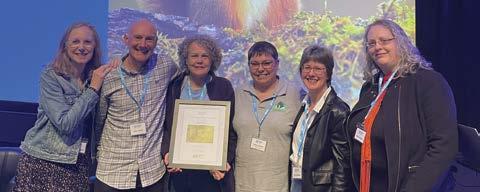
AT our National Members’ Day in September, we celebrated the contributions made by volunteers throughout the year with our Trustees’ Awards for Volunteering.
Annelise van Eeden was presented with the Young Volunteer Award, having been a Volunteer Ranger for the Trust first at the Falls of Clyde and now on the Isle of Eigg, where she works with communities to protect these special landscapes.
Our 2024 Species Champion Award went to Daisy McDonald, who has undertaken vital work in monitoring both great and Arctic skuas. Great skuas in particular have been devastated by the impacts of bird flu, but thanks to the work of people like Daisy, we’re developing a better
understanding of their populations and how we can help.
The Nature Ninjas took home the Group Award in recognition of their efforts across Cumbernauld, including planting over 4,000 trees and removing almost 1,000 bags of litter.
And last but not least, Finlay Dowell received the Lifetime Achievement Award. Finlay has undertaken monthly bird counts at Garnock Floods for 15 years, providing invaluable data on the reserve’s wildlife. He has also almost single-handedly prevented Himalayan balsam from taking over the reserve.
A huge thanks to all our volunteers for their wonderful dedication. To become a volunteer, visit scottishwildlifetrust.org.uk/volunteer
A SERIES of surveys on our Perthshire reserves have highlighted excellent invertebrate productivity, including some incredibly rare species. Noted ecologist Steven Falk undertook surveys across a number of the Trust’s reserves in June and July, including Keltneyburn and Tummel Shingle Islands.
While much of Britain has seen invertebrate numbers decline in recent years, in Steven’s own words the Perthshire reserves were “super productive”.
Among the discoveries were populations of the nationally scarce ermine-moth fly, Agria mamillata, which had only been recorded twice previously this century – both times in Kent. The species had never previously been recorded further north than Oxfordshire, so their discovery at Tummel Shingle Islands could represent a dramatic shift in what we know of their potential range.
Steven witnessed the ermine-moth flies attacking bird-cherry ermine moth caterpillars, which – as their name suggests – feed on the leaves of bird cherry trees.
Other rarities recorded on the reserves included scarce red-legged robberfly (Dioctria
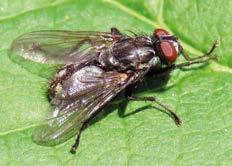
cothurnata), dashed slender robberfly (Leptogaster guttiventris) and orange-legged robberfly (Dioctria oelandica) – the latter at the very northernmost point of their range.
Steven predicts that the total number of invertebrates on the reserves will amount to several hundred species.
As well as being cause for celebration as an indicator of how wildlife is faring on the reserves, these results will be invaluable in helping us adapt our management in order to accommodate these rare species.

AS the first of its kind in Scotland, the Edinburgh Nature Network (ENN) is a pioneering approach to managing conservation activities and enhancing nature connectivity. Its creation was led in partnership by the Scottish Wildlife Trust and City of Edinburgh Council as part of the realisation of the Edinburgh Living Landscape.
With Nature Networks representing a long-term approach to managing conservation for local authorities, the end of September saw the Trust handing over the ENN toolkit and management of the network to City of Edinburgh Council to take forward.
Through this project, the Trust has developed a variety of maps, conducted workshops to bring expertise together and created a monitoring and evaluation
IN September, the Scottish Government announced its Programme for Government for the coming parliamentary year. We’re delighted that this included plans to introduce a Natural Environment Bill – a measure the Trust has long been calling for, alongside other environmental groups across Scotland.
The Bill will establish the framework for statutory targets for nature restoration and, importantly, the supporting elements of monitoring and enforcement. This means
the government will be legally obliged to implement and support measures that will protect and enhance nature.
The Trust has repeatedly said that a lack of cohesion across government is a key reason we are not meeting our targets. Failure to tackle the nature crisis and avert ecosystem decline would lead to multiple negative consequences to the natural world, the economy and society as a whole. We hope that this Bill will catalyse a new
SUPPORT from our 42,000+ members is critical to the Trust’s ability to protect Scotland’s wildlife for the future.
We have not changed our basic minimum subscription rates over the past six years and so, at this year’s Annual General Meeting, the motion for Council’s recommended amendments was approved.
In order to maintain our membership programme as accessible for all, we have taken some additional steps to expand the definition of our Concession category to encompass those who self-identify as low-income (in addition to unwaged, full-time students and those over the state pension age).
The table on the right shows the new minimum subscription rates, valid from 1 April 2025. There will be no change for the many members who are already voluntarily paying more than these minimum levels. There will also be no change to life membership prices.
Over the coming months we will write to you if any of these changes will affect you. Thank you for your ongoing support.
framework to demonstrate both the progress and impact of the ENN.
This framework will help guide actions for nature across Edinburgh and enable organisations and volunteers to report on the work they are delivering across the city.
The roll out of this framework has continued throughout 2024 and is now embedded within the City of Edinburgh Council’s Parks and Planning Teams.
Delivering enhancements to biodiversity and ecological connectivity through the ENN will make a significant contribution to achieving the Edinburgh Living Landscape vision of making Edinburgh one of the most sustainable cities in Europe by 2050.
For more information, visit edinburghlivinglandscape.org.uk
approach where all areas of government are pulling together.
While there were many positives from the announcement, we were disappointed that woodland restoration targets have been halved compared with previous years, while the target for peatland restoration has also been lowered.
It is clear that there is still work to do despite the positive commitment to the Natural Environment Bill.
Let us hope that in future the targets will help ensure delivery against our environmental ambitions.
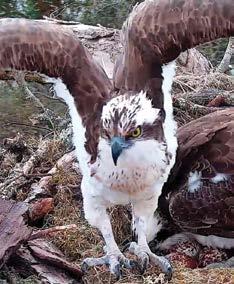
EARLIER this year, we reported that LM12, a male osprey which had bred at Loch of the Lowes since 2012, had died. While deeply saddened by this, we were relieved to learn in August that LM12’s death had been from natural causes.
With ospreys being a Schedule 1 protected species and LM12 being a particularly highprofile bird, Police Scotland launched an investigation into his death, including a postmortem examination. This revealed that he died as a result of bleeding stomach ulcers. We know LM12 was at least 15 years old, so this condition was likely a symptom of his advancing age.
After being driven to UK-wide extinction in the 19th Century, ospreys returned to Scotland in the 1960s. The first post-return record at Loch of the Lowes was in 1969 and generations of birds have enthralled visitors at the site since.
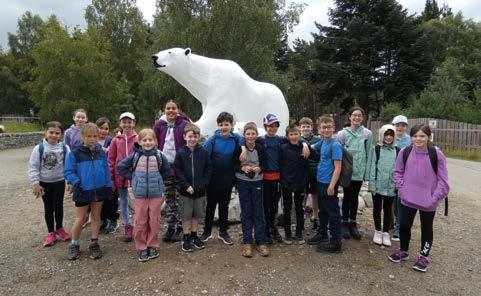
OUR Perth Wildlife Watch group had a wild time at the Highland Wildlife Park during a special trip in August. Thanks to funding from Skipton Building Society and from the Perth and Kinross Countryside Trust, 18 group members were able to attend and received a guided tour from the team at the park, followed by a chance to look around all the animals.
The participants all fed back that they’d had a great time, with the wolves and polar bears proving to be particular favourites. This was a fantastic opportunity for our young wildlife enthusiasts, and after such a success, the group hopes to be able to run another summer trip next year – fingers (and paws) crossed.
The ups and downs of each breeding season are viewed by tens of thousands of people each year thanks to live nest-side cameras that can be watched on the Trust’s website and YouTube channel – a journey that has included injuries, storm-ravaged nests and even love triangles.
Following his first arrival to the site in 2012, LM12 successfully raised 21 chicks, including seven with his most recent partner, NC0. But despite his passing, the legacy of ospreys at Loch of the Lowes is likely to continue, as NC0 was seen bonding with another male before they departed for their wintering grounds in Africa.
The staff and volunteers at the site, supported by players of the People’s Postcode Lottery, are now eagerly awaiting next year’s breeding season, while thousands of viewers worldwide hold their breath to see who will take up the mantle of this iconic osprey.
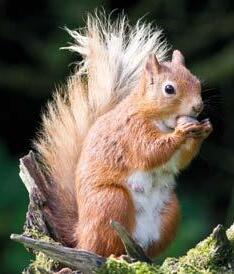
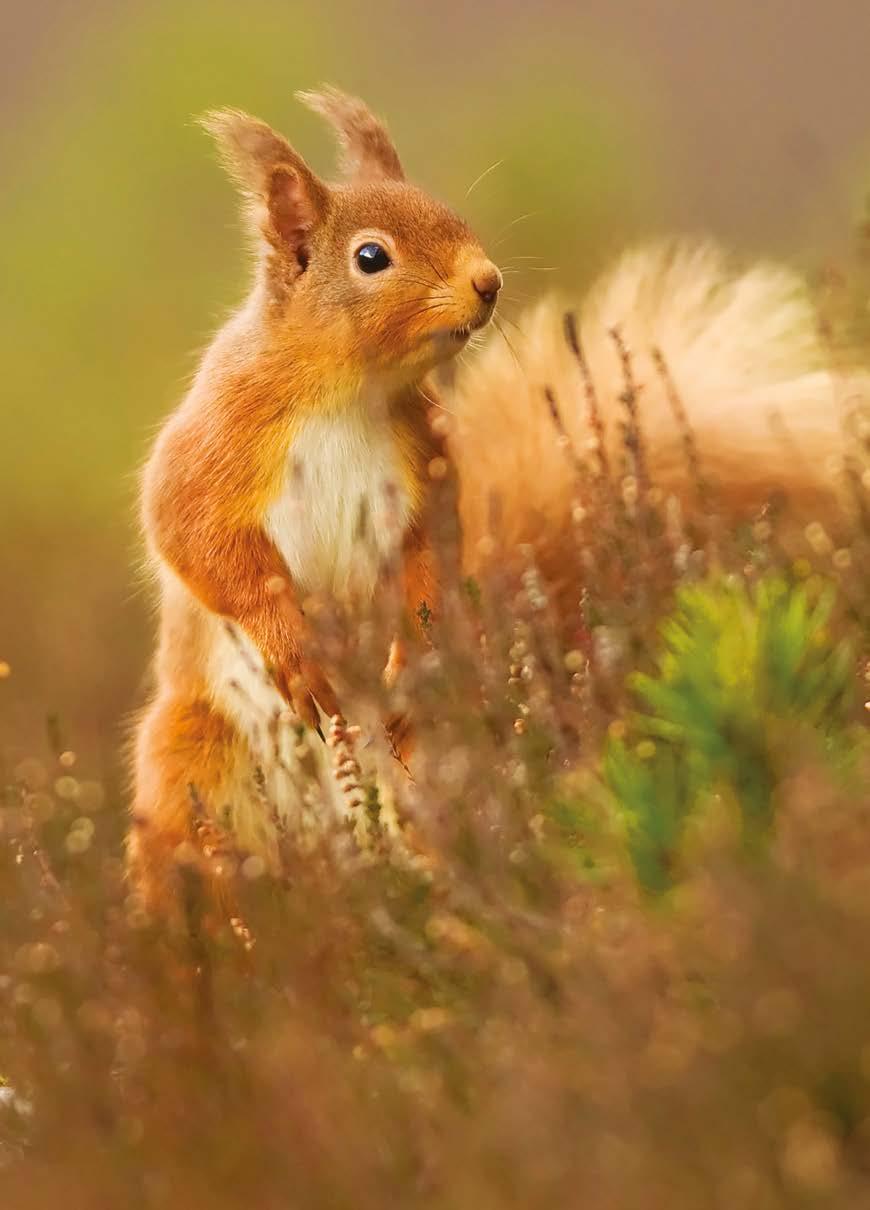
A RED squirrel has been spotted by a member of the public in their garden in Bishopbriggs, marking one of the southernmost sightings of this native Scottish species in the Central Belt in decades.
While we cannot say for certain how it made its way to the town on the outskirts of Glasgow, our Saving Scotland’s Red Squirrels project has been undertaking grey squirrel control in areas north of where it was spotted. Perhaps tellingly, pine marten numbers have increased across the Central Lowlands in recent years. Evidence suggests pine martens prey on non-native grey squirrels more than reds. These factors combined may have created an opening for a particularly pioneering individual.
The closest established population of reds is in Milngavie, five miles northwest of Bishopbriggs, with individuals spotted in and around the slightly nearer town of Kirkintilloch in 2023.
While the appearance of this lone red squirrel is unlikely to herald a new colony in the immediate future, it is nonetheless a positive sign that conservation measures are effective and could help reds expand their current ranges.
Members of the public are encouraged to watch for squirrels of both species and report sightings (ideally with photo and video evidence, when possible).
For more information and to submit your squirrel sighting, visit scottishsquirrels.org.uk
GREAT white egrets have successfully bred in Scotland for the first time. A pair of the heron-like birds fledged three chicks near RSPB Scotland’s Loch of Strathbeg nature reserve in Aberdeenshire.
Previously an occasional visitor to the UK, their first recorded breeding attempt in Britain was in Somerset in 2012. Since then, the birds have expanded their range northwards, culminating in this historic moment for Scotland.
The arrival of great white egrets symbolises the importance of international cooperation in conservation. One of the factors that is thought to have contributed to their spread has been the tightening of legal protections across Europe, where they were once hunted for their long, white feathers. While at the other end of their journey, new and enhanced wetland sites are providing them with more suitable habitat upon their arrival in Scotland.
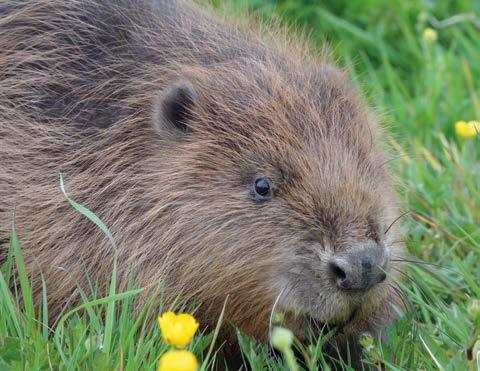
BEAVERS are now firmly established in Scotland, however, their reintroduction across England and Wales has repeatedly stalled. Now, the Royal Society of Wildlife Trusts has published a new paper in support of their release: A vision for the return of beavers to England and Wales
While beavers are recognised as a native species in England, they are contained within enclosed environments where their ability to develop ecosystems and support biodiversity is limited. In Wales, there is no legislation to support effective management of this keystone species. As a result, there have been no licensed releases of beavers in either country, despite promises from the UK and Welsh Governments.
The new report is calling for more action, including the publication of a beaver reintroduction strategy, support for land managers to provide space for beavers and confirmation that all wild beavers can remain in England and Wales.
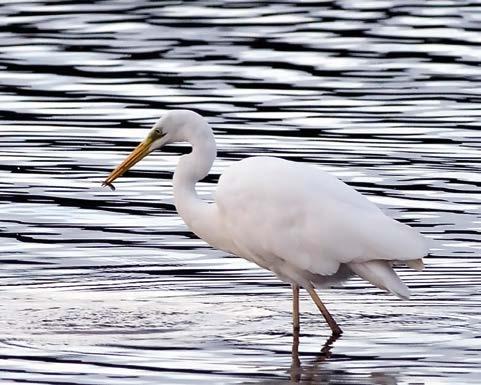
A great white egret with a fish in its mouth © Damian Waters
IF Scotland’s trees could talk, what would they say? That’s one of many important questions being asked by Forgotten Woodlands, a new project developed by NatureScot, Forestry and Land Scotland and Ainmean-Àite na h-Alba.
The project team has created a digital story map which includes 15,000 place names from across Scotland. Each entry contains words associated with woodlands or woodland species in Gaelic, Scots, Pictish or Old Norse.
Today, native woodland makes up just 4% of Scotland’s land area. However, it is hoped that this project will provide insight into how the landscape may have looked in years gone by and inform supportive management practices in the future.








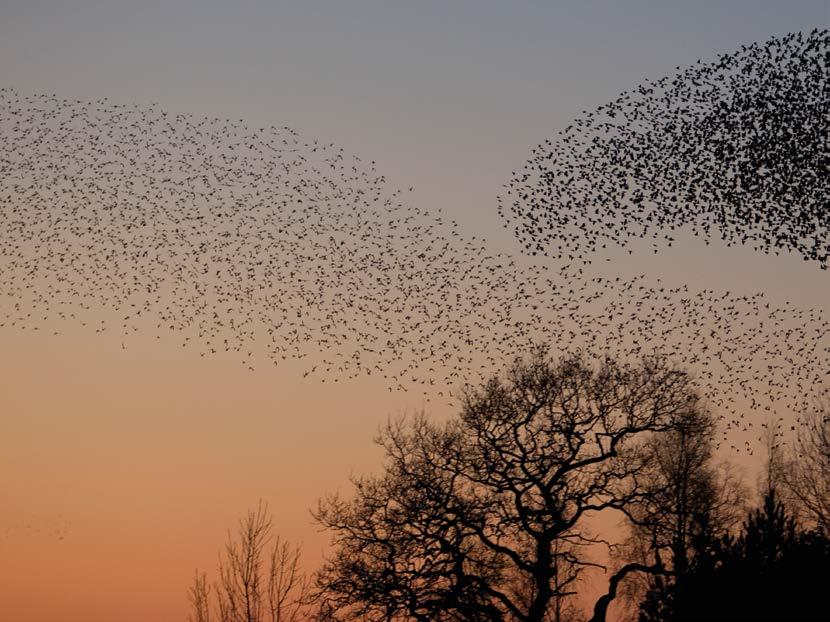
As winter takes hold, we explore some of the natural spectacles and animal behaviours that can still be enjoyed – plus highlight how we can all help wildlife in the coming months
AS regular home composters will know, there are many benefits of composting garden and kitchen waste: it reduces the amount of waste sent to landfill; creates habitat for a range of species; and provides a free way of improving garden soils.
Every well-cared-for compost heap is home to a whole community of organisms and insects that help break waste down as part of the nutrient cycle. Some also provide food for larger species, which is why hedgehogs are often found foraging for worms and other invertebrates nearby.
For those who have not yet tried composting, it’s really easy. Buy or build, it’s up to you. After that, all you need are three elements: waste, air and water!
The ideal compost heap or bin is one made from slatted wood, which allows animals to clamber in and out. If buying, choose one made with sustainable timber or make one using old pallets or upcycled wood – strap or nail them together, leaving one moveable side to allow access.
Siting your compost heap does need consideration as the contents need to remain moist and warm. If using an enclosed bin with a lid, it’s fine to place in a sunny spot but it will benefit from an occasional watering. If using an open compost bay, then a slightly shadier spot is best.
The secret to good composting is to feed your heap or bin with a mix of green (nitrogen-rich) and brown (carbon-rich) materials, ideally in thin, alternating layers. Green material includes grass clippings, weeds and uncooked vegetable peelings, while the brown includes coffee grounds, dried grass and shredded cardboard.
Avoid adding meat, bread, cooked food, dairy products or (meat-eating) pet waste as such items might attract rats.
Aim to keep your compost moist but not sodden. Turning it every couple of months can speed up decomposition but be careful what you use: plastic leaf grabbers are preferable to garden forks, especially in
winter when animals might be hiding or hibernating within the layers of compost. Your compost is ready to use when it is dark brown, crumbly and has a satisfyingly earthy smell.
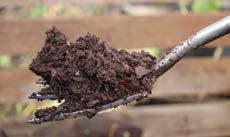
To find out more about home composting, scan the QR code.
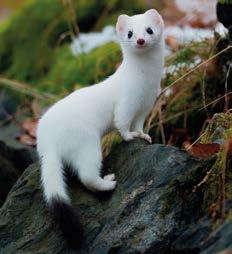
Stoat or weasel? It’s often hard to tell. These two carnivorous members of the mustelid family both have long, slender bodies. Stoats are slightly larger with the key giveaway being a black-tipped tail. In winter, however, there is something more obvious with which to tell them apart: the tip of their tails aside, some stoats turn from their usual light brown colour with a white underbelly to
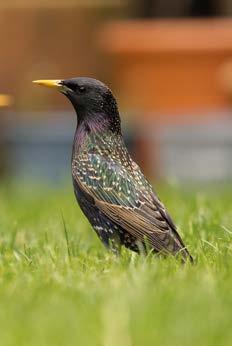
There’s something very special about a familiar species doing something extraordinary – and that’s exactly what happens with starlings in winter. Sociable birds at the best of times,
completely white. This cold weather adaptation, known as being in ‘ermine’, helps the animals blend in when there is snow on the ground, while the fur is especially dense for warmth.
Strangely, there are regional differences to when this happens. Between lateNovember and late-December it is stoats in north-east Scotland that make this change. Later in the year, around January, a percentage of stoats in south-west Scotland also turn white. All return to their usual colouring at some point between February and April. In England, stoats tend to stay the same colour all year round – but not always.
Predicting where to spot an ermine can be tricky. So, what’s going on? Typically, it is more likely in northern upland areas, although ermines have been reported as far south as Cornwall and Suffolk in recent years.
The whitening is influenced by various factors, from an individual stoat’s heredity to falling temperatures and snow cover. It is believed that harsh weather conditions one year can increase the likelihood of a change the following winter.
Whatever the reason, and wherever you are in the country, spotting a sleek stoat in ermine is a highlight of any winter for wildlife lovers.
during the winter months starlings take their group gatherings to extremes, with huge flocks coming together to roost and shelter from harsh weather and predators in reedbeds and copses of trees.
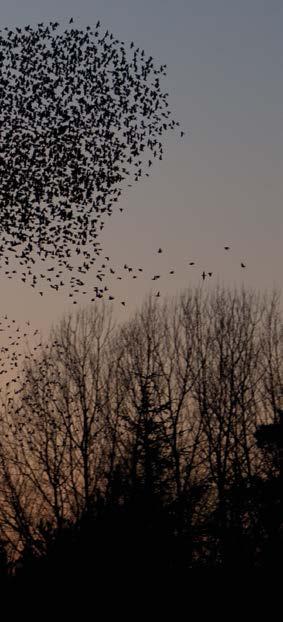
However, it’s what happens as they gather over their roost sites at dusk that can be truly mesmerising. Look into the sky and you may be rewarded with the sight of a dense cloud made up of many thousands of starlings pulsing in a series of shape-shifting aerial patterns (pictured) known as a ‘murmuration’.
In winter, resident starlings are joined by large numbers from continental Europe, attracted by the relative warmth of our island shores. As dusk arrives, flocks arrive from all directions, merging seamlessly to create these strikingly beautiful patterns in the sky. It is not known how these intricate and closely coordinated flights are choreographed but they can end as quickly as they begin, with the birds descending to their roost sites as if some secret signal has been given.
As well as offering safety from predators, it’s thought that such behaviour could also serve as a visual invitation for other starlings to join a night roost for the benefit of all. After all, larger roosts allow the birds to retain warmth at night as well as exchange information on good feeding sites.
Good for murmurations:
A Montrose Basin
B Brough
C Lockerbie
Good for stoats:
D Balnaguard Glen
E Loch of the Lowes
F Cullaloe
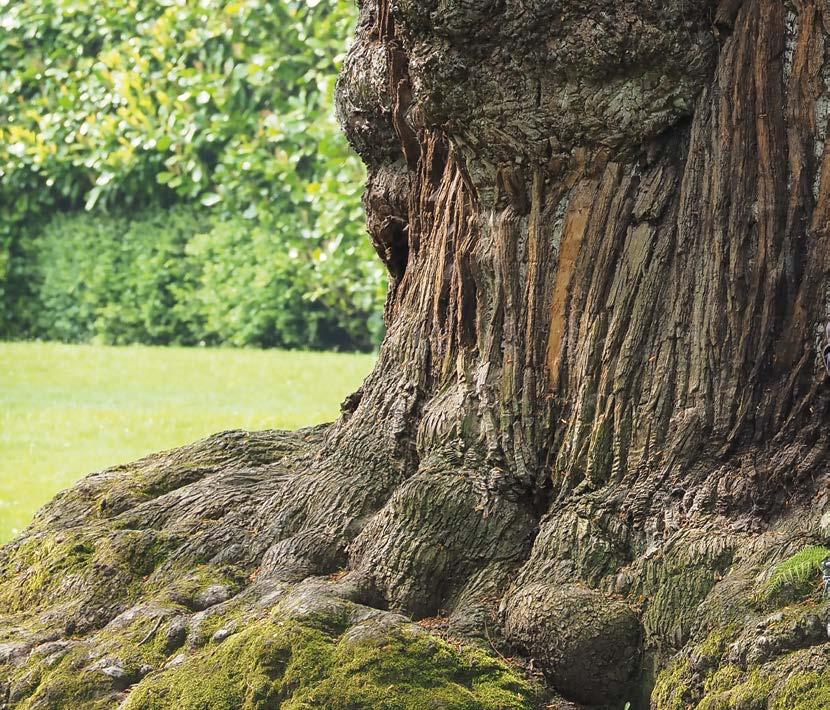
A major project to inspire and upskill people to take action for nature in their local communities recently came to a close. Ida Maspero learns about its impact and hears from some of the many participants
ane, from Craigshill in Livingston, had noticed that many of her neighbours started gardening in communal spaces over lockdown. “It looked lovely, but I was dismayed to see that nature had been excluded. I thought to myself: wouldn’t it be great to encourage folks to not be so tidy, to make space for nature and think of wildlife while gardening.”
Tammy from Musselburgh has a long-held interest in climate change and campaigning, and volunteers at her children’s Cubs group and a local community garden. “This led to my interest in trying to help increase community spaces that are good for people and nature,” she says.
Kate, also in Musselburgh, has worked in the mental health sphere for many years. “I love being in nature and have been helping
to control Himalayan balsam on a local river,” she explains. “But I wanted to take the next step and build the confidence to instigate a project myself, involving people with dementia.”
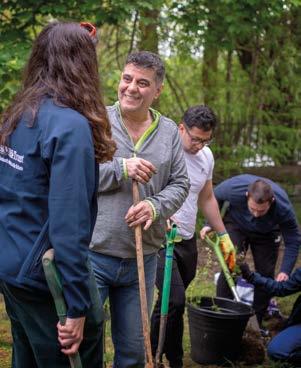
Jane, Tammy and Kate are among 39 people from 37 communities to have completed the Trust’s Nextdoor Nature Pioneers Programme, which concluded in September. The two-and-a-half-year project saw participants across four geographic cohorts participate in a free learning and skills development programme. The aim was to equip them with the know-how, resources and self-confidence to instigate action for nature in their local community, whether pursuing a project they already had in mind, or coming up with an entirely new idea.
Over six months, the Pioneers worked their way through online learning modules in their own time and participated in monthly
interactive webinars and regular in-person events, including idea-generating visits to established community projects.
The course material covered a wide range of topics. Participants learned basic wildlife ecology and how to survey habitats, plus how to engage others and run community events. They also learned core skills around how to approach landowners with ideas and where to look for potential sources of funding.
The Pioneers Programme was funded as part of Nextdoor Nature, a UK-wide initiative across The Wildlife Trusts made possible by £5m in funding from The National Lottery Heritage Fund to mark the late Queen’s Platinum Jubilee.
The funding opportunity came at just the right time to supercharge the Scottish Wildlife
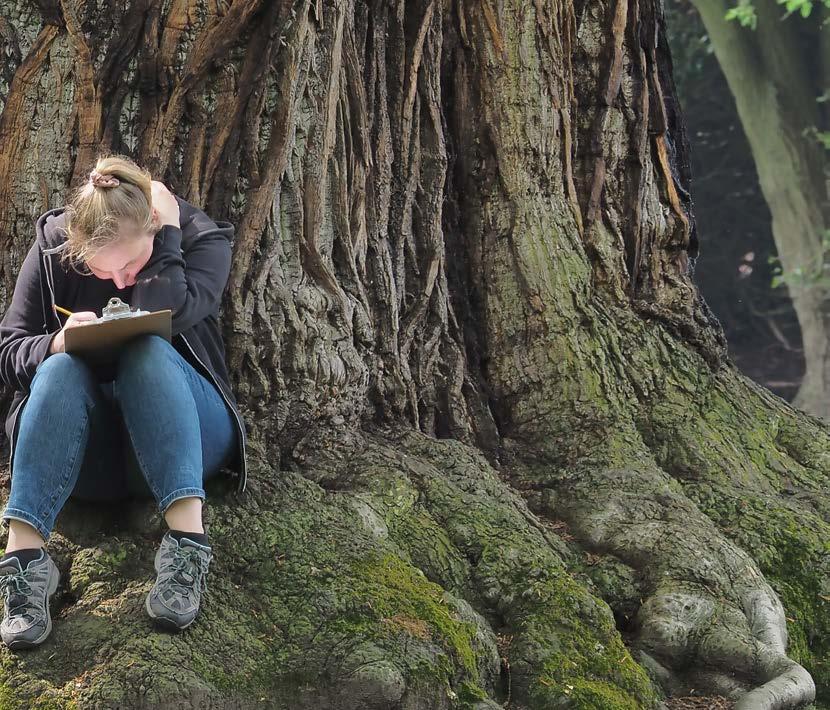
Trust’s own strategic ambition, as Pete Haskell, Head of Communications and Engagement, explains: “We were first made aware of the opportunity at the end of 2021. For us, it could not have been better timing – we had just signed off our new engagement strategy to 2030, which places an emphasis on facilitating community-led action at a grassroots level.
“We have long felt that the best and most scalable way to achieve impact for nature across Scotland was by empowering local people with the skills and confidence to lead on initiatives within their own communities.
“So, when this funding came along, we already knew exactly what we wanted to do. We were able to kickstart the delivery of our strategy and employ project staff to make our idea for local skills development a reality. Without the funding, it would have taken us much longer to roll out.”
The participants were grouped in four regionally focused cohorts – Greater Glasgow; the Forth catchment; Dundee to Aberdeen; and Edinburgh and the Lothians – and came from all walks of life. “Each person had a unique personal back story, existing connections in their communities and were
at different stages of their journey to do something for nature on their doorstep,” notes Pete.
Some, like Tammy and Kate, had lent a hand on other projects and wanted to get going on their own ideas. Others were already deeply involved in a project and wished to upskill on specific aspects. Like Anna in north Edinburgh, who coordinates an environmental initiative at the local parish church, which includes a swap shop, free workshops and events, and improvement of the church gardens.
“On the Pioneers Programme, I gained so much from visiting interesting places, like community gardens, and learning more about how nature and wildlife influence mental health,” she says. “Also useful were the practical pointers on obtaining small grants and other funding, and how to work with other local groups.”
Another participant, Cairns, a driving force behind a gardening-focused community group in the former mining village of Coalburn, South Lanarkshire, found that the experience helped equip him with additional skills with which to progress ambitious plans involving even more local groups and residents.
Just being encouraged to engage more with the wider public and the networking side has made a big difference.
Already knowledgeable about the natural world, what he found most beneficial were the more people-focused elements of the programme – the modules on team building, how to engage with the community and attract volunteers for projects.
“Just being encouraged to engage more with the wider public and the networking side has made a big difference,” he explains. “It also made me think about who we were not reaching, from the elderly to those who are less mobile and can’t make meetings or events – those members of the community who we were, unintentionally, excluding.”
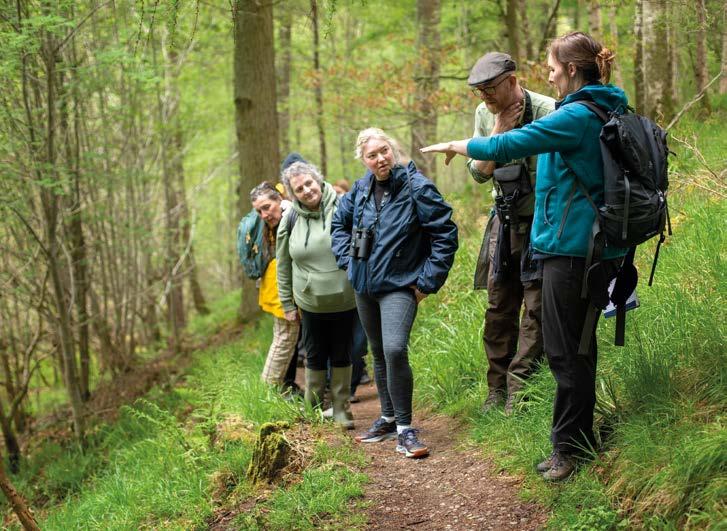
“As we see it, the impact and legacy of the programme is threefold,” notes Pete. “Firstly, there’s the impact on the individual participant: we want them to have gained the skills, knowledge and confidence to pursue a new idea or build on an existing activity.
“Secondly, there’s the impact on their wider community, the people in the neighbourhood who will benefit and hopefully also get involved. And of course, ultimately,
Our longer-term ambition is to foster a growing network of community leaders and to create an online space where people can stay in touch, support each other and share ideas.
we want nature to benefit too – to have more space to thrive.”
Zóra Tamás, Nextdoor Nature Community Engagement Officer, adds: “During the programme we found that councils and landowners can be very supportive of community projects, so I hope that many more will see the value of such projects and agreeing on the use of a site won’t be a big obstacle in the future.”
For many Pioneers, one of the most valuable aspects of the programme was meeting like-minded people and gaining a network of peers for support. “It’s been really valuable to make connections and share ideas and experiences with others in my cohort,” believes Anna. “We’re staying in touch, and I believe our relationship will remain valuable beyond the course.”
“It’s been lovely to spend time with people who care about nature as much as I do,” agrees Jane in Livingston, who also touches on the other main personal outcome of the programme. “I’m quite a shy person; it’s really given me confidence.”
Others feel the same. “It’s filled me with more confidence to set up a community project.” adds Tammy. “I’m not naturally a leader, so it’s given me the opportunity
to gain the skills I need to be in charge and develop my idea for something I can achieve in my community.”
Tammy also remarks: “It’s been great to do the different modules online at my own pace, in my own time. There’s also loads of resources and information available to help continue learning after the course is finished.”
With the final cohort of Pioneers having completed the programme in September, these flexible online learning modules, supporting resources and selected webinars are now available for anyone to sign up to and access for free. The Trust’s recently launched community action website, another output from the project, also features case studies highlighting communities at different stages of their journey to provide inspiration and demonstrate what’s possible to others.
Ultimately, the aim is to nurture a growing network of community leaders. “Our longerterm ambition is to foster a growing network of community leaders and to create an online space where people can stay in touch, support each other and share ideas,” explains Pete.
“There could even be the possibility of setting up a volunteer mentor scheme
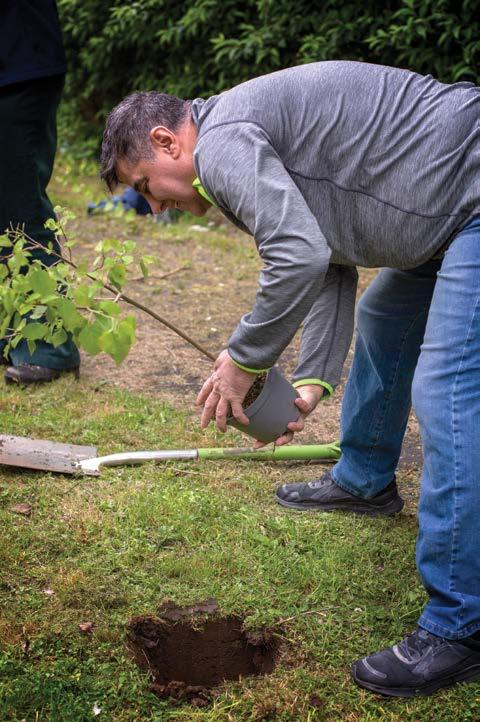
to team up people early on in their projects with someone who’s a bit further down the road.”
And how about the Pioneers’ own future plans? In Kirkcaldy, Karen has her sights set on turning a neglected, litter-strewn former car park into a haven for people and nature: “I’m in touch with the local council about permission to look after it, and I’m recruiting volunteers who’d like to get involved. I’m thinking fruit trees, maybe a sensory garden. Hopefully my project will encourage and inspire others to look after other pockets of neglected land.”
In Musselburgh, Tammy now feels better equipped to take forward her idea for developing the grounds at her local Scout Hall,
“so that it can be used for outdoor learning by Cub and Scout groups, but also by the wider community – a space for having fun outdoors and that’s better for wildlife and biodiversity”.
Kate is developing her project to bring people living with dementia closer to nature, joining forces with another community group to improve an under-loved greenspace in Musselburgh. “The Pioneers Programme equipped and inspired me to collaborate –you can do so much more by joining forces with other people!” ■
For inspiration and resources, visit community.scottishwildlifetrust.org.uk Enrol
If you would like to gain the basic skills needed to organise action for nature in your community, the online modules in our Nextdoor Nature Pioneers Programme are now available for anyone to sign up to.
Across eight weeks you’ll be taken through a series of weekly core modules covering a range of valuable and insightful topics to help you get your first community project off the ground.
What’s covered?
• Wildlife Ecology 101: An introduction to local wildlife, the basics of ecology and how different species interact.
• Actions for nature: How to identify actions that will make a positive difference for nature in your area.
• Engaging your community: How to effectively communicate, consult and engage with your local community.
• Running events: How to plan a successful community event.
• Nature and wellbeing: Nature’s benefits on our wellbeing, how we can make the most of our time outdoors and share those benefits with others.
• Funding your project: Top tips on where to find funding and how to put together funding applications.
• Health and safety: The basics of health and safety and your responsibilities when organising action in your community.
• Land and landowners: The importance of working with landowners and local authorities and how to approach them in a meaningful way.
These core modules are supported by an additional seven optional modules, focusing on topics including working with volunteers, wildlife surveying and how to set up a community group.
For more information and to enrol on the course, scan the QR code or visit learn.scottishwildlifetrust.org.uk


The Trust’s Ballachuan Hazelwood reserve off the Argyll coast is one of the finest examples of its kind in Europe – with some of its most special features on full display in winter, writes Rich Rowe
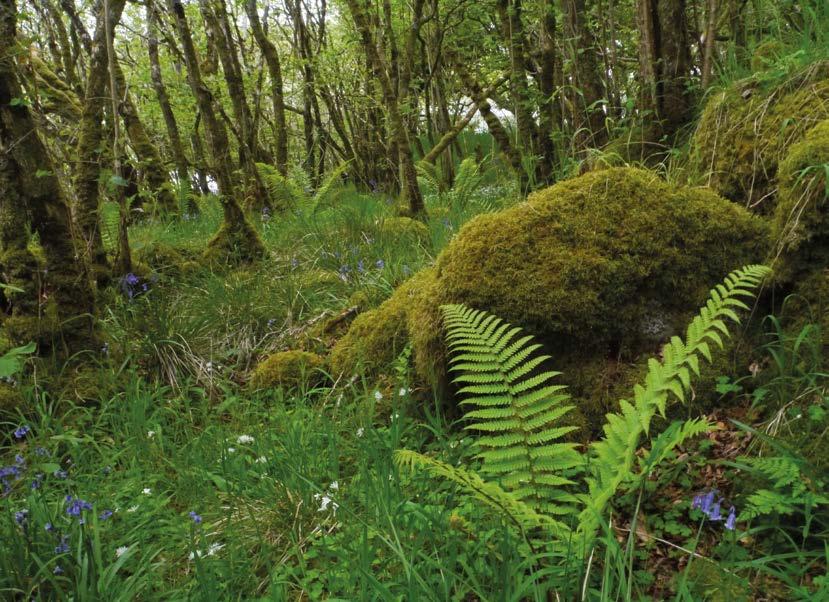
Spilling down to the sea at the southeast end of the island of Seil on Argyll’s Atlantic coast lies an ancient, and largely untouched, woodland where nature still holds sway. Atmospheric and ethereal, it is a place of low canopies, cool air, folktales and rich communities of rare lichens, fungi and bryophytes.
This is Ballachuan Hazelwood, a remnant of the temperate Celtic rainforest that once ran the length of the west coast of Britain, reaching as far as the Atlantic coasts of Spain and Portugal. Far older than Scotland’s Atlantic oakwoods, there are not many places like it left in the country, and certainly few quite as intact.
“While there are satellite fragments of this kind of woodland nearby, it is by far the largest area of stable, consolidated and high-quality Atlantic hazelwood in the area,” explains Billy Gray, the Trust’s West Central Reserves Manager.
Until recently, hazel was regarded as little more than an under-storey shrub that had to be coppiced to survive, but Ballachuan demonstrates otherwise. In all, the site covers
around 49ha, the bulk of which is pure hazel stand with the rest comprised of herb-rich grassland and coastal saltmarsh.
The canopy here is low – just three to five metres in height – while the trees stand so close together it can be hard to tell one from another. There is a sense of stillness, of being closed in, enveloped. Some might even say there is magic in the air: after all, Celtic mythology equates hazel with wisdom and poetic inspiration.
Ballachuan has a very different feel to the Atlantic oakwoods found at the Trust’s Shian Wood reserve and elsewhere along the Argyll coast. Such oakwoods have far higher canopies and typically include a broader range of species – often birch, alder, holly and rowan as well as oak. Many also bear the marks of an industrial past, with even-aged stands of oak once felled on rotation to provide charcoal for smelting and for its tannin-rich bark used for the tanning of leather.
Looking out across the Cuan Sound to Luing and mainland Argyll, Ballachuan was once
home to a small settlement of the same name (Baile a’ Chuain). But while people once lived here, the landscape remains largely unscathed.
Much of Ballachuan sits on a raised ridge of epidiorite, a hard metamorphic rock formed between the slates, schists and gneisses more commonly found in the Highlands. Although potentially profitable, this bedrock was left alone, while the woodland too was spared industrial use.
Instead, it had a different value. As Billy explains, the threat of famine was never far away and the woodland provided a natural larder where people could collect hazelnuts for roasting. “Life was tough, so nuts provided a staple food full of fats and protein,” he says. “The local story is that a pillowcase full of hazelnuts could see a family through the winter. The trees were valued as a sustainable crop that helped to feed the local population.”
That’s not to say, however, the woodland wasn’t harvested in other ways. Hazel grows new shoots all the time so that the trees, or ‘stools’ as they are known, are in a constant state of renewal, allowing them to live almost
indefinitely as long as they are not shaded out by taller trees.
These individual stems would be taken in a more careful, sustainable way for making or repairing creels, to use as fencing or as stakes for thatching houses. “Until the late 20th Century, when agriculture began to retreat, there were few trees on Seil, so the hazel stems were important,” notes Mike Shaw, who has worked a neighbouring farm at Kilbrandon for more than 70 years. “I can remember when hazel was in daily use on the farm.”
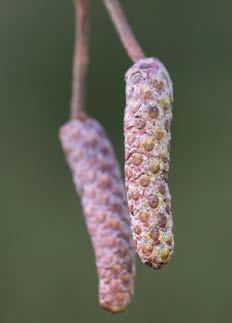
Summer is of course when deciduous woodland is at its most exuberant, but Ballachuan has much to offer all year round. As the sap begins to rise in early spring, an initial flush of bud burst brings hints of colour, including pale yellow male catkins and the tiny red flowers of female catkins.
By May, the ground is festooned with bluebells, while other flowering plants are also quick to utilise the light penetrating the still leafless canopy. Fast forward a month and that light is largely gone – the canopy serving as a green umbrella, holding in moisture and building humidity in the air below.
But what of winter, a time when the musty earthiness of autumn has dissipated and the multi-stemmed stools of hazel are bare and skeletal? This, says Billy, is when it pays to pause and appreciate the delicate detail found all around – a season when the interest is not so much in the trees as on them.
“Ballachuan is home to an exceptionally large number and variety of mosses and liverworts [bryophytes] and lichens – some of world importance,” he explains.
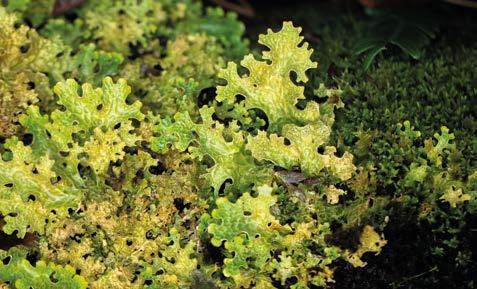
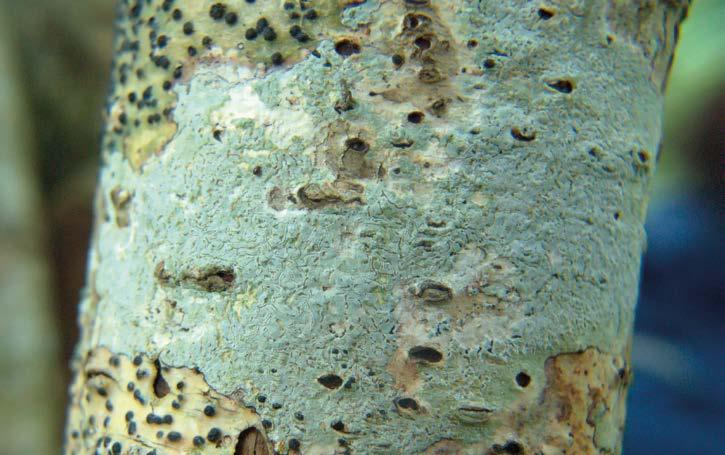
Centuries old in some cases, such lichens require old growth woodland and ecological continuity. One speciality of these woodlands are Graphidion lichens – a group of small
lichens that form mosaics on the smooth grey-brown bark of young hazel stems. Several of these are rare and endangered, including Graphis alboscripta (commonly known as white script lichen), which is almost entirely restricted to hazel and is endemic to the west coast of Scotland.
Older stems that have roughened, trapping moisture in their fissures, support bryophytes and larger, more leafy species from the Lobarion group of lichens such as the impressively sized tree lungwort.
Meanwhile, the mix and density of bryophytes found here is normally associated with areas that have wet, rocky ravines but such features are absent from Ballachuan. Optimal conditions for growth are instead created by the low canopy. “Look at a hazel stem at Ballachuan and you won’t even see the hazel,” smiles Billy.
Ballachuan is also home to a variety of strangely beautiful fungi: clusters of spring
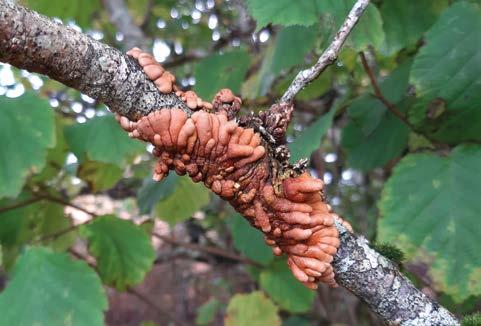
hazel cup that look like they belong on coral reefs, as well as the podgy, fingerlike projections of hazel gloves fungus, which is believed to only occur in ancient Atlantic hazelwoods.
Then there is the enigmatic glue fungus, another rarity only found on hazel that glues dead twigs to living branches. It even joins living branches together where they touch, which allows it to move – slowly – from branch to branch and even tree to tree.
This gluing strategy is a smart one as it prevents dead twigs falling to the ground, where they would be available for decomposition by soil fungi. “The advantage for the fungus is that it doesn’t have to compete on the ground with all the other fungi that is trying to recycle the deadwood,” explains Billy.
Historically, Ballachuan has only ever seen
a light-touch approach from people and the Trust is determined to keep it that way. Much of its work is about managing the light that reaches the woodland floor, with the aim of hitting the sweet spot between just enough to allow hazel regeneration but not so much that bracken takes over and smothers the ground.
The winter storms that barrel in play their part, taking down trees and creating the deadwood habitat that is so important to ground fungi. In the past, the grazing and bashing about of cattle would have assisted in thinning the canopy, but for now the browsing of roe deer does that job naturally, albeit with some selective thinning still required.
An assessment of browsing levels will be a key part of an ecological survey planned for next year. “At the moment we see moderate grazing and it feels about right but we need that additional data management to help inform our own selective intervention,” notes Billy.
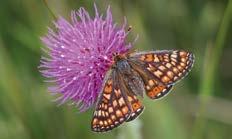
Work is also needed to preserve the area’s herb-rich grassland which is a breeding site of the endangered marsh fritillary butterfly. Much of that involves creating conditions for devil’s bit scabious, the butterfly’s almost exclusive food plant.
This is achieved together with a local farmer who grazes small numbers of cattle in three ‘compartments’ on rotation from June to November. “Devil’s bit scabious needs a sward of about 30-50cms – any more than that and the plant struggles,” explains Billy.
Ballachuan’s ecological integrity and separation from other woodland nearby helps protect it from the encroachment of rhododendron which has become such a problem elsewhere. Its isolation could also be a benefit in terms of biosecurity, providing a natural buffer should there ever be, for instance, a hazel equivalent of ash dieback. There is, however, the issue of genetic diversity. Growing with an open canopy above, hazel will self-perpetuate and live for hundreds of years. However, it’s not the original stool that lives that length of time. “Hazel creates clones, so you could be looking at eight separate stools that are all from the same tree,” notes Billy. “Propagating in this way is effective but it limits genetic diversity.”
In an attempt to increase that diversity, the Trust is now growing hazel at its tree nursery in Coigach and Assynt, with the aim of planting out two-year-old saplings at Ballachuan.
Hazel creates clones, so you could be looking at eight separate stools that are all from the same tree.
Meanwhile, Ballachuan is also seen as a genetic resource that could help consolidate hazelwood sites elsewhere – and not just the hazel itself. There is early work being done to explore the potential for future translocation of some of its rare lichens and bryophytes to other Trust reserves such as Largiebaan on the Mull of Kintyre.
Such a sprinkling of some of Ballachuan’s stardust elsewhere is an exciting prospect. After that, the main magic ingredient will be time – lots and lots of time. ■
Ballachuan Hazelwood is found on the island of Seil – one of the Slate Islands –just a few miles south of Oban. It is a wild and wet place, accessible only via a rough walking track. For more, visit bit.ly/BallachuanHazelwood
Rich Rowe is Contributing Editor for Scottish Wildlife
Celebrate 60 years of conservation with the Scottish Wildlife Trust by raising a glass to our founder, Sir Charles Connell
To celebrate our 60th anniversary this year, we’ve teamed up with Selkirk Distillers who have crafted a premium gin infused with a unique blend of angelica and orris root. With every bottle sold, Selkirk Distillers will donate £7 to the Trust.
Join us in raising a glass to commemorate six decades of conservation work and help us protect Scotland’s wildlife for the future. Order today at bit.ly/WildScotlandGin

Order today!
Alys Daniels-Creasey depicts the costs of inaction for biodiversity and what Scotland could look like in the future if we either delay, or take, action for nature now
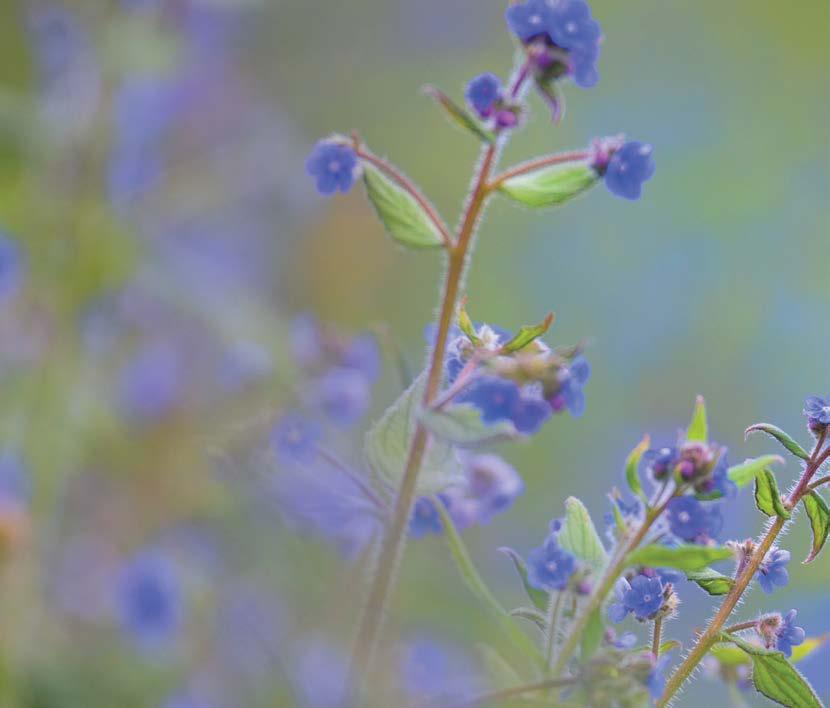
What will Scotland be like by 2045? This is the question the Scottish Wildlife Trust and the Centre for Sustainable Forests and Landscapes posed in a recent workshop with 19 experts and stakeholders working in economics, biodiversity and wider environmental fields.
The aim was to collectively understand what the nation might be experiencing (environmentally, socially and economically) if the country opts to either delay, or take, action to address biodiversity decline, and compare what these alternative futures might be like. Desk-based research provided both the context for the workshop and for developing the examples provided by participants to form the final report.
Due to a host of drivers, from shifting land use and climate change to environmental exploitation and people’s attitudes, biodiversity worldwide is in danger. Scotland is not immune to this, being one of the most nature-depleted countries on the planet. Although we already know about many of the issues associated with biodiversity decline, actions to address these are, in many
respects, falling short. What can we do about this gap between what we know and what we’re doing?
This project aimed to offer a small part of a solution to this question, bringing together diverse stakeholders from governmental departments and NGOs to academics and policy advisors, to explore how creative, bigger-picture thinking can be of use to such complex matters.
In the workshop, participants were guided through several activities to explore in more detail what Scotland might be like by 2045 depending on whether or not we choose to address the biodiversity crisis, and to what extent.
A delayed-action scenario, defined as a Scotland in which no further significant actions, policies or funding have been dedicated to addressing biodiversity loss, tracks the consequences of having suffered two further decades of environmental decline.
In this future, Scotland is likely to be struggling: the economy is declining as nature is no longer able to provide as before; uncertainties around food production and prices are rising; rural areas face depopulation;
social inequalities are worsening; and Scotland’s reputation as a potential environmental leader is damaged. This version of Scotland’s future is bleak, and likely not one most people would choose to live in.
A taking-action scenario, however, was described as a Scotland in which there is not just a strategy to remedy biodiversity decline, but new actions, policies and funding are taking a huge leap towards making this strategy a delivered reality.
Under this scenario, Scotland could be on a path to nature recovery, supporting the rest of society to thrive; Scottish industries and decision-makers fully understand, value and respect the importance of biodiversity; the nation has a sustainable economy operating within the bounds of a healthy environment; and all communities have viable economic and environmental futures. It all sounds rather idyllic.
Obviously, these two scenarios act to simplify extremely complex issues, and in doing so miss much of the nuance; under no illusions does this project claim to capture all that needs to be captured, or indeed subscribe to a naive notion that we’re either on track for
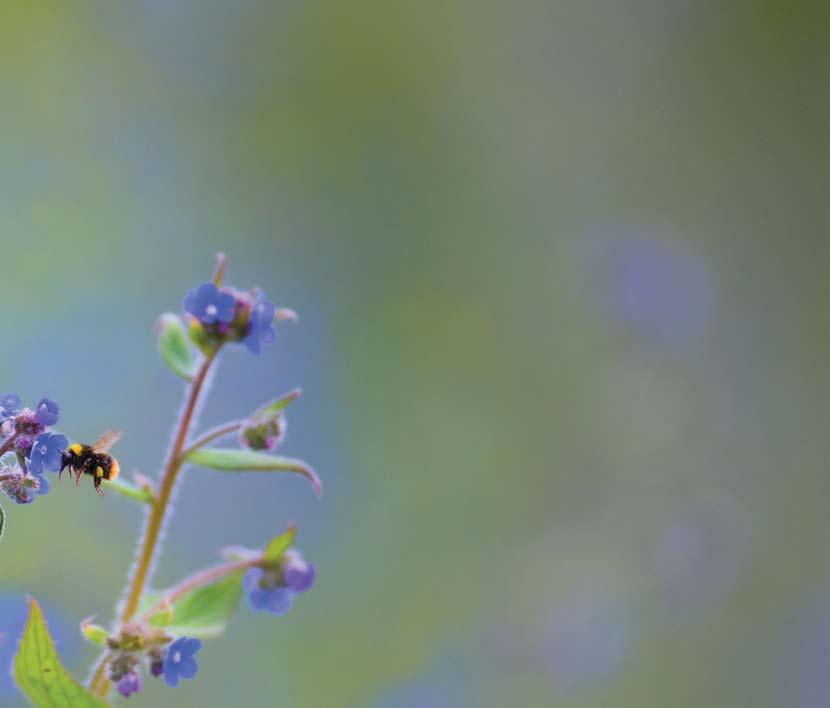
For Scotland to secure both a healthy relationship with biodiversity and a viable socio-economic future, the approach must change.
doomsday or utopia with no possibility for an in-between. Yet, comparing these notions of Scotland’s future side-by-side enables a distilling of the incredibly complicated problem of biodiversity loss into tangible snapshots of the damage and opportunities we may face related to habitats, species and ecosystem services to spark a muchneeded, timely conversation.
The project highlighted the possibility for potential destruction to not just disrupt environmental and social processes but cost the country well into the billions too. While not everything in life can, or should, be given a price tag, an economic focus within the workshop and the resulting report details some shockingly costly figures related to delaying action – for example, the £1.8bn it might cost annually to replace bee pollination services with hand pollination
should our natural providers of this ‘service’ be lost. Carrying out this work demonstrated how thinking through different pathways of (in)action is not just important for the outcome (the two scenarios) but for fostering a process of collaborative, cross-sector and innovative thinking.
But why is this needed now? The ecological and economic understandings of biodiversity decline already exist, very clearly outlining the severe consequences of ignoring and failing to act on these concerns. Yet, creative thinking and ongoing conversation is needed to piece everything together, hammer home the urgency of acting sooner rather than later and plan a way forward for the future.
For Scotland to secure both a healthy relationship with biodiversity and a viable socio-economic future, the approach must change. Biodiversity loss needs to be taken
seriously as a central priority in political and economic spheres. As a result, immediate action is needed, which won’t just improve environmental factors but is likely to cost less than if we wait for further loss (and knock-on impacts) to occur.
Acting now will also allow us to keep our options for the future open. Acting quickly, however, does not mean acting without consideration. Justice must be central when choosing next steps and innovating solutions; in line with Scotland’s route to a Just Transition, as laid out by the Scottish Government, biodiversity action must consider all people in all contexts, and no community should feel overburdened, underrepresented or marginalised when biodiversity actions are delivered. ■
Alys Daniels-Creasey is a Human Geography PhD researcher, commissioned by the Scottish Wildlife Trust and the Centre for Sustainable Forests and Landscapes to report on this topic. The full report, Act now, save later: Economic consequences of (in)action on biodiversity in Scotland, will be published in November.
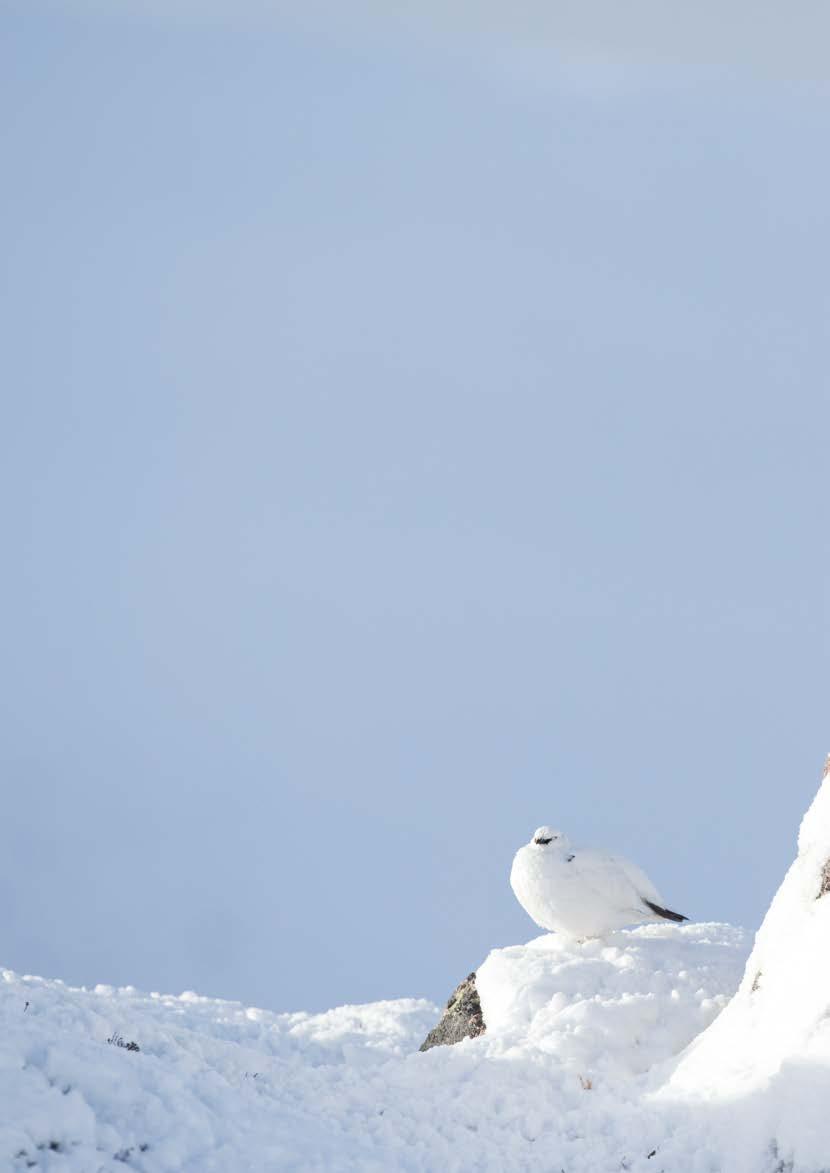
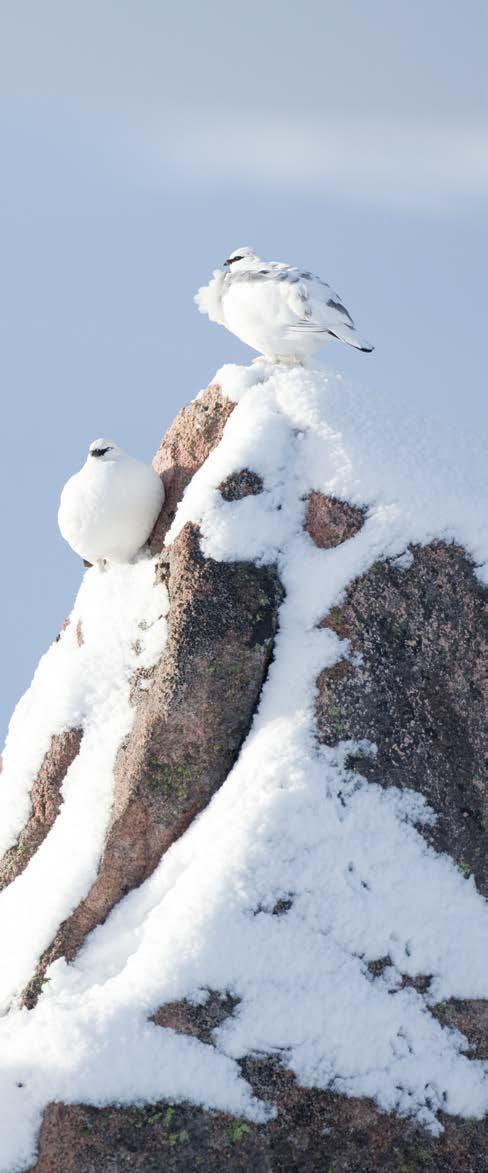
The smallest bird in the grouse family, the ptarmigan is one of relatively few animals on Earth that lives on Arcticalpine mountaintops for its entire life. Associated with rocky tundra habitat throughout the northern hemisphere, here in the UK it is found only on the highest mountains of Scotland – making it a species most familiar to climbers, skiers and hill walkers.
Resident year round, usually above 800m in altitude, ptarmigans rarely move far from breeding sites. Their preference is for sparsely vegetated areas where adults and young feed on fresh vegetation, seeds, berries and insects.
In summer, this plump bird’s upper plumage is a flecked mix of grey (males), mottled brown (females) and black on top with white bellies and wings. During the breeding season, males can be identified by their bright red eye ‘combs’– a feature also common to its larger cousins, red grouse, black grouse and capercaillie.
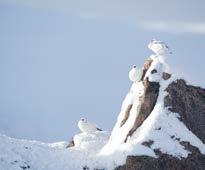
In winter, ptarmigans turn completely white – the only British bird to do so – except for its tail and eye patch, which remain black. This near all-white colouring sees the birds blend into snowy backgrounds, affording them excellent protection from predators such as golden eagles.
It is perhaps a confidence in their camouflage that sees ptarmigans often tolerate quite close approaches by passing walkers in winter.
But colouring is not the ptarmigan’s only adaptation to life in the freezer. In winter, the birds develop thick feathers on their feet which act as snowshoes when traversing between rocky outcrops, while they also have a remarkable metabolic ability to gain body mass during winter. Incredibly hardy, it is only in the very harshest of winters that they will descend to lower elevations.
The ptarmigan is Red-listed in the UK as a Bird of Conservation Concern due to severe population decline, with numbers now believed to be between 2,000 and 15,000 breeding pairs. Despite this, it is still legally hunted in small numbers, with the open season running from 12 August to 10 December.
A much greater challenge, however, is a warming climate; sometimes dubbed the ‘canary in the alpine’, the ptarmigan is an indicator species for the health of higher elevation ecosystems. With a range that is severely limited by its dependence on a shrinking tundra habitat, warmer temperatures may push the bird to ever higher elevations until – much like Arctic-alpine plants – there is nowhere else to go.
Meanwhile, its changing plumage could increasingly become more liability than asset, with any reduction in snow cover due to warmer temperatures turning their all-white feathers into an unfortunate beacon for would-be predators. ■
Ptarmigan can be seen high up on Trust reserves including Ben Mor Coigach and Rahoy Hills.
Joanna Peaker, the Trust’s Visitor Centre Site Manager at Montrose Basin, explains why this enclosed tidal estuary holds such year-round appeal
There are not many Trust reserves where the view is guaranteed to change every few hours, but that’s exactly what happens at Montrose Basin – a vast area of part-land, part-water that is shaped by the tide as it peaks and troughs twice a day.
It is exactly this constant churn that so excites, with the changes in tidal range not only altering the landscape of the basin but also revealing more about the wildlife that makes its home here through the seasons.
It’s a natural rhythm that I have grown to understand well over the years, having first begun working here as a Trust volunteer in 2017 and helping to manage the visitor centre since 2018.
Montrose Basin is a place of many characters and faces. I’ve seen it serene and tranquil on still days, with the sun gradually setting over the mudflats. There are other times when it is wild and like looking out over a stormy sea. I guess it’s temperamental, which only adds to the appeal.
The enclosed estuary of the River South Esk, which rises high above Glen Doll in the Grampian Mountains, has in its basin not just mudflats, but also saltmarsh, seagrass and reedbeds – all important areas of habitat.
There are other times when it is wild and like looking out over a stormy sea.
Comings and goings are at the heart of basin life. In autumn and winter, it is home to more than 100,000 migratory birds, including vast numbers of pink-footed geese, wigeon and other waterfowl and waders that rely on the tidal mudflats for roosting. It is at its busiest – and noisiest – in early October when the pink-footed geese are either taking off or landing, often en masse.
Spring sees the arrival of other migrants, with the basin attracting breeding colonies of sand martins, common terns and eider ducks. Summer is also great for watching ospreys fishing, while common seals haul out on the mudflats all year round.
But for me, one of the special joys is being able to enjoy views of kingfishers right in front of the visitor centre, often all winter long. Typically when seeing a kingfisher, it’s just a brief glimpse as it zips along a river at breakneck speed. But here, we’re lucky to have a resident bird that we see so often
that we have even begun to understand its daily routine.
We see it fishing, whacking fish against branches, preening, chasing off other kingfishers, hiding from sparrowhawks, catching leaves by accident and then dropping them and even hovering like a miniature, colourful kestrel. It’s a spectacle that I will never tire of watching. ■
Plan your visit
Overlooking one of the Trust’s flagship reserves, Montrose Basin Visitor Centre is open year-round (seven days a week from midFebruary to 31 October; Friday to Monday, 1 November to mid-February). Entry is free to Trust members. There are a number of walks that can be enjoyed on the reserve, with maps available from the visitor centre. Learn more by scanning the QR code or visit bit.ly/MontroseBasin
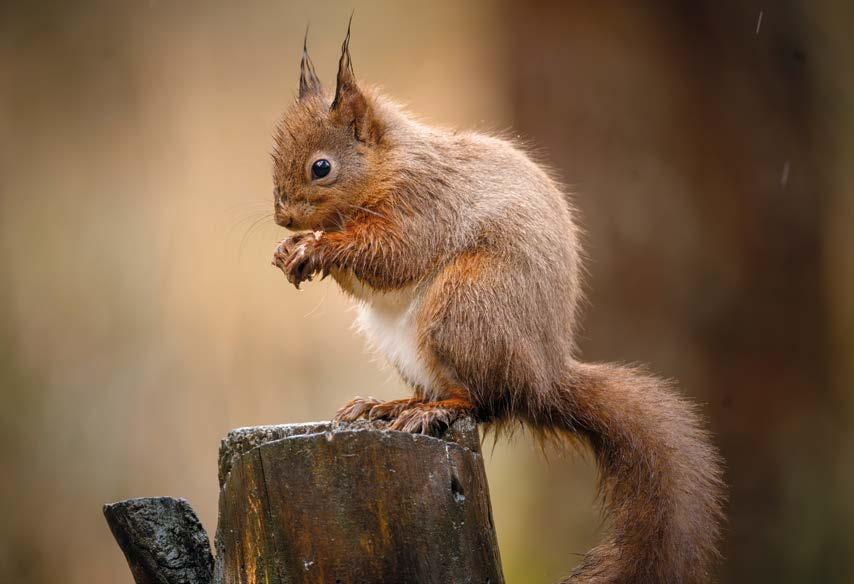





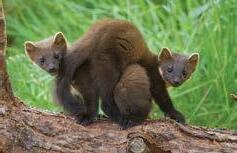
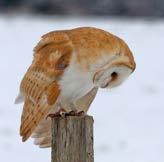
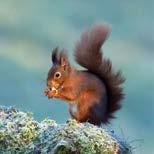
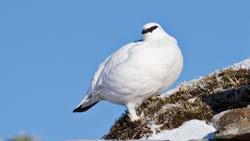
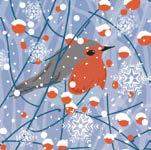
Share some winter wildlife with our packs of eight Christmas cards, featuring a barn owl, pine marten, red squirrel and whooper swan in the snow. Packs include two of each design with envelopes. Message inside reads:
“Season’s greetings – Beannachdan na h-Aimsire.”
£3.99
Order online or by post
Two packs of new Christmas cards for just £6.99
Previous Christmas card designs, just £2 per eight-card pack*
Go paper-free this Christmas by sending a personalised eCard using Making a Difference Cards. Choose from hundreds of designs, customise your own message and support the Trust with a donation from every card sent.
From £3
Order online
2025 Scottish Wildlife calendar
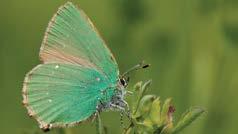
From snow-white ptarmigans to the dazzling green hairstreak butterfly, our calendar for 2025 features striking photographs of some of Scotland’s most iconic wildlife. Enjoy a new species accompanied with an informative description every month.
£9.99
Order online or by post
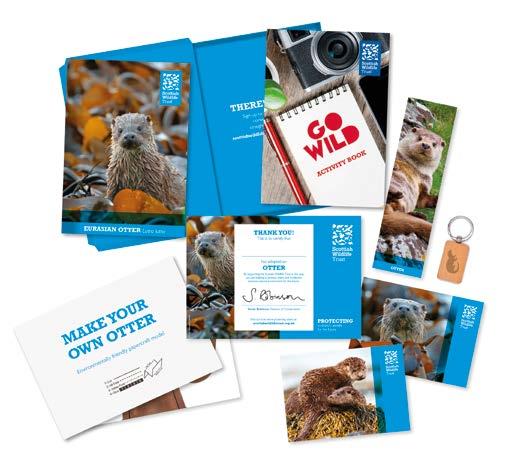
Our plastic-free animal adoptions make the perfect environmentally-friendly gift. Each adoption pack includes:
l A personalised adoption certificate
l A beautiful wooden keyring
l An exclusive papercraft model
l An informative animal fact file
l A fun-filled activity book
l A handy bookmark
l Two stunning postcards
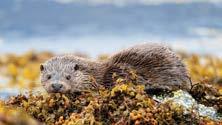
Choose to adopt an otter, red squirrel, beaver, puffin, seal or bumblebee and make a real difference to the future of Scotland's wildlife.
£30 Order online
Find out our top tips on having a sustainable Christmas online at scottishwildlifetrust.org.uk/ green-christmas

Crafted by Selkirk Distillers, our unique 60th anniversary gin is named in recognition of our founder, Sir Charles Connell. With every bottle of Connell’s Wild Scotland Gin sold, the Trust will receive a £7 donation to help us continue our work protecting Scotland’s wildlife.
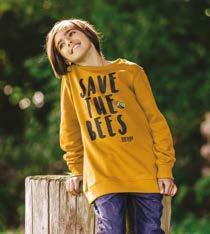
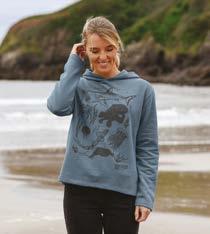
Made from 100% organic cotton and printed using low-waste technology in the UK, our clothing range features exclusive designs and every purchase helps protect the wildlife you love.
To see the full range, visit scottishwildlifetrust.teemill.com
£38 per 70cl bottle Order at bit.ly/ WildScotlandGin

Treat a friend or family member to a Scottish Wildlife Trust membership this Christmas. Your gift will give them the chance to experience and learn more about Scotland's incredible wildlife. At the same time, you'll be helping us look after our wildlife reserves, save native species from extinction, engage with community leaders and much more.
New members receive a subscription to Scottish Wildlife magazine, free entry to our visitor centres and a copy of our Exploring Reserves guide. Family subscription members also receive our junior magazine four times a year (recommended for children 5 - 14 years).
From £1.50 per month for concessions and £4.50 per month for families.
Order online
Visit scottishwildlifetrust.org.uk/gifts BY
Please complete the order form and post to: Christmas Orders, Scottish Wildlife Trust, Harbourside House, 110 Commercial St, Edinburgh, EH6 6NF
Please note that collection of items cannot be made from this address.
Order by Monday 9 December for delivery in time for Christmas**
n I enclose a cheque or postal order made payable to “Scottish Wildlife Trust”
n Please debit my credit or debit card (Amex not accepted)
Card number nnnnnnnnnnnnnnnn
Start date nn / nn Expiry date nn / nn
Security code* nnn *3 digit number on back of card
Cardholder’s signature
Cardholder’s name MY DETAILS CONTACT
Join in! Make sure that you always hear about our nature conservation work, events and how you can help support Scotland’s wildlife and special places. Opt-in to make sure you don’t miss out!
I am happy to be contacted by (please tick):
Email n YES n NO
Phone n YES n NO
GIFT AID
Increase the value of your eligible donations by 25% at no extra cost to you.
n
Book
We’re delighted to see the return of the Wild Writers Festival in Peebles from 22-26 January 2025. Now a five-day festival, again centred on the town’s Eastgate Theatre but also including a variety of external venues, the coming year’s festival will include elements of adventure stories and film.
At its heart, however, remains a celebration of writing that focuses on an appreciation of the natural world, with a refreshing mix of established and up-and-coming authors all sharing their ideas, influences and inspirations.
The format sees a mix of readings, meet-the-author sessions, Q&As, panel discussions and lively solo presentations. It’s a warm, welcoming event that has already gained quite a following.
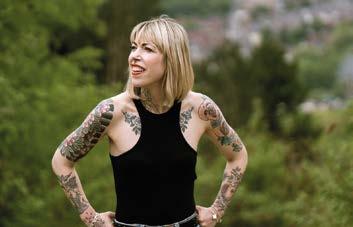
Authors such as Helen Mort (pictured), Leif Bersweden and Hugh Warwick are already confirmed, with full programme release in November. For more, visit eastgatearts.com
Ben Martynoga
Published by David Fickling Books
ISBN 9781788452779
Paperback £7.99
Following a decade in the lab exploring the insides of brain cells, biologist Ben Martynoga has turned his scientific eye to writing about a host of fascinating themes – from tech innovations to stress, creativity, running and now rewilding – as part of his Explodapedia series of popular science books for young adults.
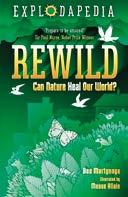
A celebration of the vital role that nature plays in all our lives – with fun illustrations by Moose Allain – Rewild is an eye-opening guide to understanding that humans are as much a part of the natural world as any other animal.
As the author notes in his acknowledgements, the book aims to tread a line between the horror – the last time that Earth’s biodiversity shrank so quickly was when a giant meteorite wiped out the dinosaurs – and the hope: there is much we can all do to help nature recover.
A big part of that involves understanding how nature goes about its business, filling this world with life, colour and everything that is needed for all species to prosper.
An underlying theme is that if we are serious about reversing the biodiversity crisis and preventing the climate emergency from spinning further out of control, humans must stop thinking of themselves as the only life forms that matter.
Powerful stuff, presented in a digestible and engaging way for enquiring young minds (while adults will learn plenty too!).
Our first foray into the world of podcasts earlier this year saw seven episodes go live, all of which remain available on our website as well as all major podcast streaming platforms.
The series sees hosts Ed and Rachel travel the length and breadth of Scotland exploring stories that give a rich insight into the Trust’s varied work over the past six decades.
Featuring staff and volunteers who provide on-the-ground updates from various projects, each episode tells stories from some of our reserves and digs deeper into a few of the
major challenges facing Scotland’s wildlife today, as well as reflecting on some of the milestone moments in our history.
Listen to our Words of the Wild podcast episodes by scanning the QR code or visit the website using the link above.
Natalie Sanders
Published by Birlinn
ISBN 9781780278940
Paperback £10.99
Born from an initial marine mammal survey expedition on a research boat operated by the Hebridean Whale and Dolphin Trust (HWDT) a decade ago, this is a passionate and poignant account of the tiny – and doomed – community of orcas found off the West Coast of Scotland.
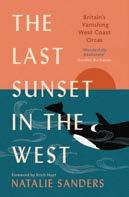
Comprising just 10 individuals, this group of animals – known by researchers as the West Coast Community – are genetically, ecologically and culturally different to other orcas that visit these waters. It’s a group that has been battling for survival for many years with, it is believed, just two elderly members of the community now left.
PLANNING a visit to our Montrose Basin reserve, as featured on pages 30-31? The nearby Links Hotel Montrose is the perfect peaceful base for exploring the surroundings – and we are offering one lucky reader the chance to win an overnight stay for two people, including dinner and breakfast.
Links Hotel Montrose is an extended Victorian property on the historic Montrose Mid Links. There are 36 bedrooms, in contemporary and more traditional styles, while the restaurant uses only the very best locally sourced meat, fish and poultry and Aberdeen Angus steaks. The hotel also has partnerships with local golf courses.
For more information, visit linkshotel.com
For your chance to win, please tell us the name of the nearby Scottish Wildlife Trust reserve. Send your entries to Scottish Wildlife Trust competition, c/o Connect Publications, Studio 2001, Mile End, Seedhill Road, Paisley PA1 1JS. The closing date is 31 January 2025. Please include your name, address, email address and telephone number.
Terms and conditions
Prize offered subject to availability. No cash alternative and prize must not be transferred. Exclusion dates will apply. Entry data will be managed by Connect Publications solely for managing this competition.
Long fascinated by orcas generally, the author – a marine biologist and consultant – found this isolated group of animals especially captivating and committed to learning as much about them as possible before their ancestral line was lost altogether.
Formidable hunters, orcas form tight family bonds not dissimilar to our own, with a life and social structure governed by feelings of love, compassion, empathy and grief. And while they may be the ocean’s top predator, orcas are far from immune from the various pressures facing the marine environment, with this community one of many around the world navigating the dangers of pollution, climate change, entanglement and the impact of military sonar.
Charting the lives of orcas from the Western Isles of Scotland to the Pacific Northwest, the book offers insight into the history of these remarkable animals, our relationships with them and what the loss of this group signifies.
It is a book of two parts: the first tells the story of the lives, and plight, of the individuals that researchers have come to know by name, while the second charts the voyage undertaken by the author aboard the HWDT research vessel, the Silurian
First published in 2023, this recently revised edition includes an update on the surviving members of the orca pod.

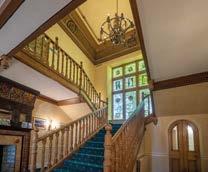
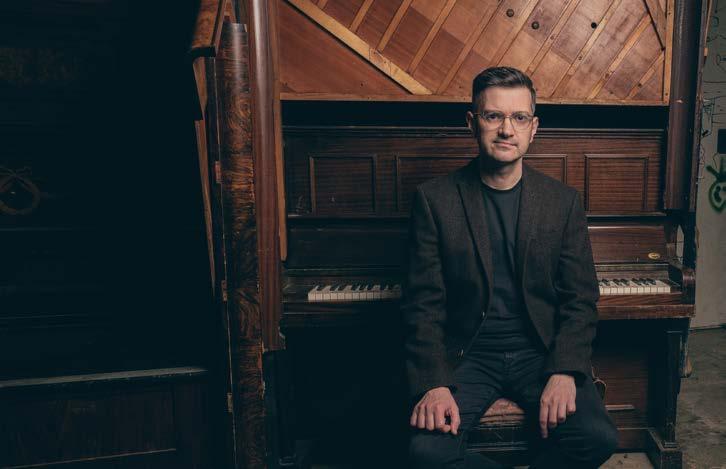
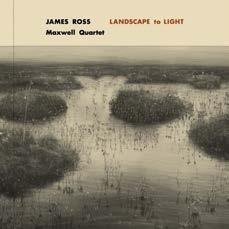
Acclaimed Scottish pianist and composer James Ross reveals how his latest album has been inspired by the landscape and lore of the far north of Scotland
Igrew up in the coastal town of Wick in the north of Scotland. My parents live close to the harbour and the sea cliffs that form its coast. My Dad worked as a fisherman and, growing up, he always shared his love of the sea with stories and folktales from the local area.
Performed with the Maxwell Quartet, my new album Landscape to Light is a series of compositions for piano and string quartet that celebrate the remarkable landscape of this part of Scotland. It brings full circle my interest in melding classical music together with the traditional music of my upbringing in the Highlands.
For the album, I’ve drawn inspiration from childhood memories, the landscape depicted by novelist Neil Gunn, the legends of fairy mischief passed down through generations and the natural beauty of the Flow Country. Several of the tracks are inspired by the grandeur of the Caithness coast and the fearsome power of the sea. I composed The Swilkie to refer to the most dangerous whirlpool on the north coast, which is wellknown for the strength of its tidal currents. Elsewhere on the album, The Grey Coast evokes the sublime, rugged beauty of Caithness’ coastline while the laments
Black Saturday and Seafarers Hymn remember the hundreds of lives lost off Scotland’s north coast over the centuries.
The Flow Country is the largest blanket peatland in Europe and straddles the counties of Caithness and Sutherland. Complex and colourful, and home to rare plants and birds, it also serves as a vast carbon store that contributes to the global fight against climate change. I am delighted that the Flow Country recently secured UNESCO World Heritage status to reflect its global importance.
When writing the music for Landscape to Light I visited the Flow Country at various times of the year, with the landscape being transformed by changing seasons and weather. I composed two pieces: a slow air evoking the stillness, expansiveness and natural beauty of this unique blanket bog, and a rhythmic piece for the sundew – a carnivorous plant which thrives in and around bog pools and flowers in summer.
The album’s namesake track is inspired by Neil Gunn’s evocative descriptions and vivid pictures of land, sea and nature in his collection of essays of the same title. The track is accompanied by a video by Scottish-Finnish cinematographer Minttu Mäntynen that captures the wild beauty of northern Scotland.
I now live in Glasgow but I am always drawn back – musically and personally – to the coast, landscape and the open skies of the north of Scotland. ■
James Ross’s latest album, Landscape to Light, is presented by Phenotypic Recordings – with the record company choosing to donate streaming revenue to the Scottish Wildlife Trust. The album cover features artwork by Magi Sinclair. For more on James’s work, visit jamesrossmusic.co.uk