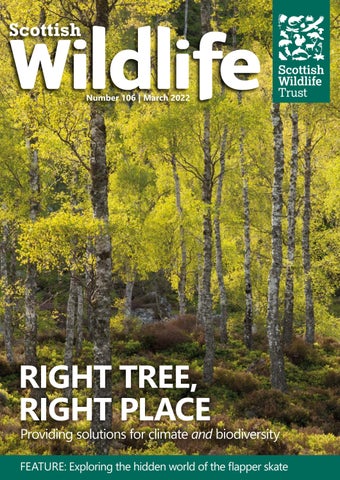
Number 106 | March 2022
RIGHT TREE, RIGHT PLACE
Providing solutions for climate and biodiversity
FEATURE: Exploring the hidden world of the flapper skate
Welcome from the Chief Executive
FIRST WORD From Chief Executive Jo Pike
I
n April, we launch the Scottish Wildlife Trust’s new Strategy 2030. Our survey last year saw members help shape the strategy that will guide our work over this crucial decade for nature. This year will also see the fifteenth meeting of the Conference of the Parties to the Convention on Biological Diversity (COP15 for short) in Kunming, China, to agree a global framework for nature’s recovery over the same period. While there is a lot to play for, the reality is that the search for new ways of tackling nature’s decline – and of scaling up the solutions we already have – must be a constant one. Whether it’s finding new ways to support communities to take action for nature in their local area, fresh opportunities to welcome people who have never been involved before or novel ideas to help politicians see how much people care about our precious habitats
Our survey last year saw members help shape the strategy that will guide our work over this crucial decade for nature. and species, it’s all part of a huge and growing collective effort for nature that we can all be part of. We saw how much work went into delivering COP26 in Glasgow in November. Important steps were taken in relation to recognising the vital role of nature in tackling the climate crisis, as well as real momentum behind the youth
movement – including through the Trust’s own Young Leaders. Yet we felt the frustration that more couldn’t be achieved, given the huge urgency to take decisive action. We now need to build on the small successes and do everything we can to accelerate the pace of change. This is why we will be devoting our energies to our five new goals, outlined in the news story on page 8. We will build on almost six decades of the Trust’s history, with the aim of getting as many people as possible behind the effort to reverse nature’s decline by 2030. As António Guterres, Secretary General of the United Nations, has said: “Making peace with nature is the defining task of the 21st Century. It must be the top, top priority for everyone, everywhere.” You can find Strategy 2030 on our website at scottishwildlifetrust.org. uk/strategy2030
© Mark Hamblin/2020VISION
The Trust will help drive what is already a huge and growing collective effort for nature
MARCH 2022 SCOTTISH WILDLIFE 3
Contents
Inside this issue
06
WIN A KNOC STAY AT INN, KOMIE SPEY SIDE SEE P AG
18
E 33
06 HEDGEROWS
Learn about these living boundary lines that play a vital ecological role.
08 NEWS
News round-up from the Trust and the world of conservation.
16
WOODLAND WORLDS
18
SOIL TO SKY
Discover the wide range of woodland habitats in Scotland.
Rich Rowe examines how an increase in native woodland cover offers one solution for tackling the linked climate and biodiversity crises.
22
Q&A
With Dr Helen McKay, Chief Forester for Scotland
24
SKATING ON THIN ICE
28
BUG BUZZ
31
BIG PICTURE
Felicity Martin explores the hidden world of the flapper skate – a largely unseen giant of the deep.
24
28
Dr William Clark highlights how insect farming could help us live and function more sustainably.
Christina Sinclair on the wonders of snapping sea eagles.
32 34
WATCH OUT FOR
Things to enjoy in the coming months.
VIEWPOINT
Cal Major on how two recent experiences further strengthened her passion for protecting our seas.
Silver birch woodland, Cairngorms National Park © Mark Hamblin/2020VISION Scottish Wildlife magazine is published by the Scottish Wildlife Trust. © Scottish Wildlife Trust. No part of this magazine may be reproduced without the express permission of the publisher. All photography © Scottish Wildlife Trust unless otherwise stated. The Scottish Wildlife Trust accepts no liability for omissions or incorrect data in advertisements and letters. Views expressed in Scottish Wildlife are not necessarily those of the Scottish Wildlife Trust. ISSN: 0143 1234. Registered office: Harbourside House, 110 Commercial Street, Edinburgh EH6 6NF. Tel: 0131 312 7765. Fax: 0131 312 8705. Email: enquiries@scottishwildlifetrust.org.uk. Website: scottishwildlifetrust.org.uk. The Scottish Wildlife Trust is a company limited by guarantee, registered in Scotland (no. SC040247). It is also a Scottish registered charity (no. SC005792). Scottish Wildlife is published three times a year: March, July and November.
The Scottish Wildlife Trust is affiliated to The Wildlife Trusts, a UK-wide network of 46 Trusts with more than 2,000 wildlife reserves. 4 SCOTTISH WILDLIFE MARCH 2022
Deadlines for news: 1 January, 1 May, 1 September. No unsolicited articles please. Scottish Wildlife is free to members. Membership rates from 1 April (excluding discounts for paying by Direct Debit): Individual (concession) £40 (£18); Joint (concession) £47 (£24); Family £57; Watch £18; Life (joint) £900 (£1,300); World/Overseas £45. Patron: HRH The Prince Charles, Duke of Rothesay. Chair: Linda Rosborough. Vice-Chairs: Karen Chambers, Bill Lambert, Kenny Taylor. Chief Executive: Jo Pike Managing Editor: Pete Haskell editor@scottishwildlifetrust.org.uk Contributing Editor: Rich Rowe Design: Connect connectcommunications.co.uk Advertising: Elliot Whitehead 0131 561 0021, Clare Stebbing 0131 561 0024. Printing: InkMark – inkmarkltd.com
Spotlight: European hedgehog
© Jon Hawkins, Surrey Hills Photography
SPECIES SPOTLIGHT:
EUROPEAN HEDGEHOG (Erinaceus europaeus)
Perhaps our most familiar wild animal, hedgehogs have a rounded body that is protected by dark, pale-tipped spines. The face and undersides are covered in coarse hair.
An animal with an eclectic diet, hedgehogs eat slugs, snails, beetles, earthworms, amphibians, bird eggs and anything else they can catch.
Although their eyesight is poor, hedgehogs have good hearing and a well-developed sense of smell. They are also fast runners, strong climbers and can even swim.
When threatened, hedgehogs roll into a tight ball of spines – actually modified hairs that can be raised using powerful muscles along their back.
Hedgehogs hibernate from around November to April in a sheltered nest of leaves or logs known as a ‘hibernaculum’, often close to or under hedgerows.
MARCH 2022 SCOTTISH WILDLIFE 5
Spotlight: Hedgerows
CORRIDORS OF LIFE A quintessential part of the rural landscape, hedgerows have served as living boundary lines for centuries, separating fields and demarcating gardens. But while very much a man-made construct, hedgerows play a vital ecological role, providing food, home, shelter and safe passage for a rich array of birds, mammals and even amphibians. They consist mainly of native woody tree, shrub and climber species, although Scottish hedgerows typically have fewer species than elsewhere in the UK due to the cooler climate. Hawthorn is a mainstay, but there are also smaller amounts of blackthorn, gorse and elder. Woody scramblers are common, including the ubiquitous bramble, various species of climbing rose, ivy and honeysuckle.
HEDGEHOG
All weave their way through the hedgerow to create a dense – and often thorny – thicket. Largely absent from the Highlands and Islands, where the land is either unenclosed or bounded instead by stone walls or fences, hedgerows are mostly found in lowland farmland areas. However, with the intensification in agriculture, and the push for larger fields, many have been lost in recent decades, with an associated decline in numbers of birds and mammals. Thankfully, this decline has slowed and with hedgerows now a UK Biodiversity Action Plan priority habitat, their value is more widely recognised – and not just as boundaries or barriers.
COMMON HAWTHORN
Mostly nocturnal, hedgehogs can be seen and heard snuffling around gardens and parks as they forage for food – with medium-sized, black droppings full of insect parts a tell-tale sign of their presence.
The pale green leaves of this hedgerow staple are often the first to appear in spring, followed by a profusion of pale-pink and highly scented blossom in May. Incredibly wildlife-rich, hawthorns teem with insects and birds.
WHITETHROAT
RINGLET BUTTERFLY
Arriving from sub-Saharan Africa in April, the whitethroat is a medium-sized, long-tailed warbler often found along hedgerows and scrubby grassland. The male birds build cup-shaped nests with females then deciding on which one to occupy.
6 SCOTTISH WILDLIFE MARCH 2022
A dark brown butterfly similar in appearance to the male meadow brown, the ringlet is named after the small circles on the underwings, which often vary in number and size. Bramble and wild privet are favourite nectar sources.
Spotlight: Hedgerows
RESERVES
Full of colour and scent, hedgerows burst into life in spring. Here are four reserves where they can be enjoyed in all their glory.
A CATHKIN MARSH
COMMON PIPISTRELLE
Often seen hunting in gardens and around streetlights at dusk, the common pipistrelle is the UK’s smallest and most common bat. Despite its tiny size – it can fit into a matchbox – pipistrelles can easily eat 3,000 insects in one night.
A lovely area of fen and marshy grassland near East Kilbride, Cathkin Marsh is home to a wide variety of birds, which can be viewed from the hide and boardwalk. An established hedgerow along the main entrance track provides breeding habitat for whitethroats and other warblers, as well as haws and sloes for finches and fieldfares in autumn.
B OLDHALL PONDS
One of the nine Irvine Greenspace reserves, Oldhall Ponds has a mosaic of willow carr, tall hedgerows, planted woodland and tussocky grassland that are full of birdlife. The ponds attract a host of breeding and wintering ducks – all visible from a pond-side path.
C CUMBERNAULD GLEN
A place where meadow and hedgerow blends into areas of ancient oak woodland, Cumbernauld Glen provides a haven for a wide range of wildlife. All can be enjoyed using an excellent network of footpaths. As well as spring colour, look out for the 16th Century dovecot hidden away in the trees.
DOG ROSE
This familiar thorny climber uses hooked prickles to gain purchase as it weaves between other shrubs and uses them for support. The dog rose’s large pink or white flowers have a sweet smell, while its red, berry-like hips are an important food source for birds in the autumn.
D LONGRIDGE MOSS
Bounded in places by areas of established hedgerow, Longridge Moss near Whitburn is an important lowland raised bog full of plants that are specially adapted to the wet, acidic conditions. There is plenty of birdlife here, too, from hedgerow species such as dunnock and yellowhammer to snipe, curlew and skylark. Brown hares can also be spotted in the heather.
MARCH 2022 SCOTTISH WILDLIFE 7
Hedgerow spread © Shutterstock, Hedgehog © Tom Marshall, Common hawthorn © Chris Gomersall/2020VISION, Common pipistrelle © Harry Hogg, Whitethroat © Chris Gomersall/2020VISION, Ringlet butterfly © Rachel Scopes, Dog rose © Lizzie Wilberforce
B
C A D
Scottish Wildlife Trust news
Latest news
News from the Trust, our projects and the wider world of conservation
A defining year for biodiversity
Dougie Peedle, Head of Policy
8 SCOTTISH WILDLIFE MARCH 2022
All the latest Trust news is available on our website scottishwildlife trust.org.uk
Our strategy for the decade ahead THE Trust has set out an ambitious new strategy that aims to put nature at the heart of the nation’s future. Strategy 2030 will be launched in April. It sets out five big goals for achieving our vision of a network of healthy, resilient ecosystems on land and sea, supporting Scotland’s wildlife and people. These goals will guide the Trust’s work for the rest of this decade, which the United Nations has designated the Decade on Ecosystem Restoration. The year 2030 marks a vital point for nature conservation. It is the deadline for achieving the UN Sustainable Development Goals, including halting biodiversity loss. It is also widely seen as the last chance to prevent catastrophic climate change. Jo Pike, the Trust’s Chief Executive, said: “There’s growing recognition that the nature and climate emergencies are the greatest threat humanity faces. The natural environment is our life support system and failing to take action to help nature recover will have major consequences for all of us. “Tackling these huge challenges will need people to work together more than ever. That’s why our new strategy is about getting as many people as possible behind the effort to reverse nature’s decline in Scotland by 2030. We can all help to reverse nature’s decline
In practice, that means we need to engage an even larger and much more diverse range of people in the Trust’s vital work in the coming years.” Members fed in to Strategy 2030 through a survey publicised in the March 2021 edition of Scottish Wildlife and feedback was summarised in the following issue. Read more at scottishwildlifetrust.org.uk/ strategy2030
Strategy 2030: Our Five Big Goals 1. Our wildlife reserves have directly contributed to nature’s recovery 2. Communities across Scotland are taking action for nature in an increasingly diverse, collective effort in which everyone can play their part 3. We have catalysed large-scale change through collaborative and pioneering initiatives to restore ecosystems on land and sea 4. Scotland is recognised internationally for the part it has played in the UN’s Decade on Ecosystem Restoration 5. Our foundations are stronger and more resilient than they have ever been. © Tom Marshall
IT’S going to be a busy, and important, year for biodiversity. COP15 concludes in Kunming, China, and will set the post-2020 global biodiversity framework. Here at home, the Scottish Government will bring forward a new Biodiversity Strategy in October. And both as we enter the second year of the UN’s Decade on Ecosystem Restoration. Some key decisions for this year have already been made. The Scottish Budget in December set out the Government’s priorities for 2022/23, with an allocation of £53 million to protect and restore nature. Unfortunately, not much of this is actually new money and is well short of the levels required to jump-start the necessary transformation in nature. Things need to change – with opportunities and challenges ahead. Firstly, the UK Autumn Budget and Spending Review 2021, announced in October, included significant increases in spending for biodiversity. Such rises do feed directly through into proportional increases in Scotland’s block grant but the sums involved are small, with no guarantee of how they will be allocated. Secondly, the Scottish Government will publish its Resource Spending Review in May, setting out plans for the remainder of this parliament. Initial signs are not encouraging but it is an opportunity to demonstrate the urgency needed and put biodiversity funding on a new footing. Thirdly, the new Scottish Biodiversity Strategy is a chance to ensure naturebased solutions are at the heart of our approach to wellbeing. With the strategy not ready until October, it must be properly factored into spending plans. All highlight that there is still much to be done if this big year for biodiversity is to turn into a transformative one.
KEEP UP TO DATE
Scottish Wildlife Trust news
© Russell Savory
Beavers may soon be found in many other river catchments around Scotland
Wildlife on the rocks
Beaver breakthrough Trust’s Director of Conservation. “They create new wetlands and naturally manage woodlands, and that in turn helps a huge range of other species to thrive. “More than 100,000ha of suitable beaver habitat has been identified throughout Scotland. Much of this is in the uplands where the potential for conflict is minimal. If we want beavers to help reverse the decline in Scotland’s wildlife at the pace and scale that’s needed, as many communities and land managers as possible have to grasp the opportunity to host a release.” The Trust is working with the Scottish Government and a range of stakeholders to help develop a forwardlooking national strategy for beavers. “To fully benefit from the return of beavers we need joined-up thinking,” added Sarah. “It’s vital that this strategy links up with the forthcoming Scottish Biodiversity Strategy, and that land managers are appropriately rewarded for managing habitat for beavers within the new system of land management subsidies.”
© Danni Thompson
A MAJOR milestone towards a thriving national population of beavers was achieved in November when the Scottish Government announced that the species can be introduced into new areas of the country. Releasing beavers into new river catchments will allow the species to spread at a much faster pace than through natural expansion. It also means that beavers can be moved away from areas where there is conflict with farming and other land uses, providing an alternative to lethal control. There are currently around 1,000 beavers in Scotland, split between the small population which was established by the Trust and the Royal Zoological Society of Scotland through the Scottish Beaver Trial, and a much larger population centred on Tayside. Previous government policy was to only allow beavers to spread naturally from these areas. “One of the most important reasons for reintroducing beavers to Scotland is their role as an ecosystem engineer,” commented Sarah Robinson, the
THE Scottish Wildlife Trust recently teamed up with alternative rock band Sea Power to raise awareness of the urgent need to tackle the nature and climate crises. The Trust worked alongside the band to produce a new video for Sea Power’s classic track The Great Skua, featuring striking footage of seabirds on Handa Island Wildlife Reserve. The video (which can be seen at scottishwildlifetrust.org.uk/ seapower) draws attention to the perilous state of Scotland’s seabirds and the vulnerable condition of many other species. It also aims to generate support for the Trust’s #HelpNatureHelpUs campaign. The collaboration has also helped the Trust to reach new audiences, with the video viewed thousands of times and shared on social media by influential figures such as Scotland’s Makar Kathleen Jamie, musician Ricky Ross and presenter Hugh Fearnley-Whittingstall. Sea Power are well known for their strong connection to the natural environment, with songwriting that covers themes such as disappearing ice shelves and biodiversity. “We’re always happy to work with people we feel aligned with,” said Martin Noble, the band’s guitarist. “The Scottish Wildlife Trust helps to restore and maintain important spaces for nature and works to ensure our ecosystems and wildlife are protected. Scotland has such amazing wildlife, much more needs to be done to protect it.” Join the #HelpNatureHelpUs campaign and sign our petition calling for urgent action to restore nature at scottishwildlifetrust.org. uk/helpnaturehelpus
Building our resilience WE are delighted that more than 500 people have donated to our Resilience Fund since its launch 12 months ago in the March 2021 issue of Scottish Wildlife. Designed to help people and wildlife thrive, the Fund will enable us to bolster our efforts in adapting
to the challenges ahead. Climate change is predicted to make extreme weather events such as November’s Storm Arwen – which damaged or felled eight million trees across Scotland – more regular. Rising temperatures may also provide more favourable conditions for invasive non-native
species, including giant hogweed. Thank you to all those who have made a donation so far to help ensure longer term resilience on our reserves and within our communities. To find out more and to donate, call 0131 312 4700 or visit scottishwildlifetrust. org.uk/thefund
Great skua chick, Handa Island
MARCH 2022 SCOTTISH WILDLIFE 9
Scottish Wildlife Trust news
IN BRIEF Dram fine
© Gill Hatcher
An auction organised by the Scotch Whisky Association has raised nearly £900 for the Trust. Three bottles of the limited-edition blend created to mark COP26 went under the hammer in November, with the Trust one of three environmental charities chosen to benefit from the sale. The whisky is packaged in sustainable materials, including a stopper made of recycled wood and cork dust. Bottles were presented to senior delegates and served at receptions during COP26.
Fresh chapter for Saving Scotland’s Red Squirrels
A diverse read To mark Scotland’s Year of Stories, the Trust is publishing a series of blog posts that demonstrate how people from a variety of backgrounds engage with nature. Read our blog at scottishwildlifetrust.org.uk/blog
Highly commended Coigach & Assynt Living Landscape Partnership Scheme was highly commended in the community initiative category of the 2021 Nature of Scotland Awards. Ten of the scheme’s 14 partners are drawn from local communities in the Northwest Highlands. The National Lottery-funded phase, which will finish at the end of March, has contributed significantly to advances in rural skills locally. © Chris Puddephat
Fast track to wildlife Fast-track ticketing is being introduced at our Loch of the Lowes and Montrose Basin Visitor Centres, so you can pre-purchase tickets. Visit scottishwildlifetrust.org.uk/visitorcentres
We’ll meet again The 58th Annual General Meeting of the Scottish Wildlife Trust will be held on Saturday 10 September. Full details, including how to book, will be announced in the July issue of Scottish Wildlife. 10 SCOTTISH WILDLIFE MARCH 2022
The project will be able to continue important work to safeguard red squirrels
SAVING Scotland’s Red Squirrels has secured initial funding for a new two-year phase, beginning in April, that will help the project to deliver on its key aims and plans around the country. Vital conservation work will continue in all the project’s priority areas to help mitigate some of the challenges the project has faced in recent years. During lockdown, much of the project’s grey squirrel control and survey work was suspended. Saving Scotland’s Red Squirrels has built a successful network of 18 volunteer groups in the south of Scotland as part of the Developing Community Action project funded by the National Lottery Heritage Fund. The aim now is to upskill these volunteers to enable them to continue red squirrel conservation work after the project comes to an end. In the north east, the project has worked towards removing an isolated population of grey squirrels that spread from Aberdeen into the surrounding
countryside. Grey squirrels are now largely limited to the city centre and eradication is considered achievable. Elsewhere, in the central lowlands, grey squirrels are successfully being prevented from spreading north of the Highland Boundary Line, although ongoing work remains essential if this is to remain the case. Saving Scotland’s Red Squirrels is a partnership project led by the Scottish Wildlife Trust.
Help save Scotland’s red squirrels Further funding is needed to put these plans into action, with £49,000 left to raise for this phase of the project. To find out how you can support this critical conservation work, visit scottishwildlifetrust.org.uk/SSRS
Nature Ninjas tackle the invaders CUMBERNAULD Living Landscape’s Nature Ninjas are working hard to remove invasive non-native plants from hotspots in the town. They have removed plants including dogwood, snowberry, crocosmia and cotoneaster from important sites for wildlife.
Clearing invasive plants allows native flora to recover, with associated benefits for a variety of species that depend on them. The volunteers have also piled cut branches into dead hedges, creating additional habitat for wildlife at
the same time. The Tackling the Invaders project is focused on sites identified in a strategy produced by the Cumbernauld Living Landscape project team with support from North Lanarkshire Council officers.
Scottish Wildlife Trust news
© Chris Cachia Zammit
Views over the loch
Tales from a special reserve A NEW edition of a booklet about Loch of the Lowes has been published to celebrate more than 50 years of the Scottish Wildlife Trust caring for the Perthshire wildlife reserve. The booklet, compiled and written by Visitor Centre Assistant Cherry Bowen, tells the complete story of the reserve and its wildlife, including the
many exciting developments that have taken place since the last edition was published in 1990. These include the arrival of beavers and nuthatches, plus of course installation of the hugely popular osprey webcam. The limited-edition booklet is now on sale from the Loch of the Lowes Visitor Centre.
From spirits to spades © Edrington
TO celebrate the 60th anniversary of spirits company Edrington, and principal shareholder The Robertson Trust, employees recently came together through their 60 Days of Giving More initiative to fundraise for the Scottish Wildlife Trust. As well as raising a total of £13,178 for the Trust, volunteers from Edrington came to volunteer at the Trust’s Ballagan Glen, Loch Ardinning and Cathkin Marsh reserves. Together they spent four days bashing bracken, clearing cross drains and rebuilding footpaths – work that will benefit people and wildlife alike. The Trust would like to thank everyone who donated and took part.
Edrington volunteers at Ballagan Glen
Farming policy THE Trust has called for the Scottish Government to provide more detail to help demonstrate how its new agricultural policy will help tackle the joint climate and biodiversity crises. With 80% of Scotland’s land used for agriculture, farming practices have a huge impact on the natural environment. Scottish agriculture has been shaped by the European Union’s Common Agriculture Policy since the 1970s, but the Scottish Government is now developing replacement policies that will guide farming, food production and land use for years to come. Early consultation shows that there is high-level ambition to address the nature and climate crises. However, the Trust does not believe the proposals published in a recent consultation document will allow the industry to fully play its part. Currently, the proposals also focus on tackling climate change over biodiversity loss, rather than addressing the two issues together. “Agriculture is reliant on a healthy natural environment and there are massive benefits to working in a nature-friendly way,” explained Bruce Wilson, the Trust’s Public Affairs Manager. “We need the Scottish Government to encourage innovation and greater adoption of practices that have a positive impact both on carbon emissions and on wildlife. “As things stand, we don’t think the Government’s agriculture policy will meaningfully solve the issues. There’s a high-level goal to tackle the climate and nature emergencies but there is not enough follow through to achieve that.” The Trust is already working with our partners to develop ways we can help Scottish Government to lift their ambition and pace.
Final intake of young volunteers from Europe UP to six volunteers from around Europe will support the Trust’s reserves team this year thanks to funding from Erasmus+. “I’m looking forward to discovering more about
nature and learning new skills to help protect and conserve it,” said Camille Vallette from the Loire Valley, France, who has joined our team in Irvine. Since 2014, the Trust has received grants equivalent to
£600,000 to fund placements lasting up to 12 months. During that time, more than 60 young people from a dozen European countries have benefitted from these opportunities, with many
going on to future careers in nature conservation. The UK’s exit from the European Union means that this year’s intake will be the last of this successful programme.
MARCH 2022 SCOTTISH WILDLIFE 11
Scottish Wildlife Trust news
THE Trust is seeking new trustees to help reinforce our governing body’s knowledge, expertise and diversity. We recognise that our work will benefit hugely from increasing equality, diversity and inclusion across all our activities, especially as we want everyone to reconnect with nature and be part of the effort to reverse the loss of biodiversity. Nature conservation has never been more important. This is a great opportunity to join a vibrant and committed board of trustees, which provides the governance function for our charity. Elected trustees will take office from this year’s AGM (held on 10 September) for an initial term of three years. Completed nomination forms must be returned by 31 May 2022. For more details, contact Susan McKenzie, Company Secretary, at smckenzie@ scottishwildlifetrust.org.uk
City butterfly havens
© Mark Hamblin/2020VISION
Join our governing council
Redshank
Mixed fortunes on Eigg
©
Gr
A TOTAL of 121 bird species were recorded on the Isle of Eigg in 2021, A RELAXED approach to mowing of which 75 were found to be breeding. greenspaces is helping butterflies to It was, however, a year of mixed better cope with the impacts of climate fortunes for some of the breeding birds. change in Edinburgh city centre. While a pair of redshank bred A total of 106ha of grassland successfully on the island for the first managed by City of Edinburgh th a o B time on record, and golden plover Council have been naturalised ham a bred for the first time since as part of the Edinburgh Living Landscape Nature 2004, eagles were less in your Neighbourhood project. These areas are now only cut once a year, creating important habitats for wildlife. Three butterflies A NEW Scottish Wild Salmon which are shifting Strategy has been published Wall brown butterfly their range due to rising which outlines the many threats temperatures have benefited facing the species and details the from the new habitats. The small wide range of actions that can be skipper, wall brown and speckled wood taken on land and at sea to help secure its recovery. butterflies all need areas of long grass to Sarah Robinson, the Trust’s Director complete their life cycle. All can be easily of Conservation, contributed to the wiped out if the grass is cut too often. development of the strategy on behalf As a result of the green network of Scottish Environment LINK. created by the new meadows, all three “This strategy is an important step species have been recorded in the city. forward,” said Sarah. “It acknowledges They also appear to have a stepping the barrage of threats faced by stone across the Firth of Forth into Fife, salmon, which includes unsustainable where they are now being seen for the aquaculture, loss of riparian habitat and first time.
successful. A pair of sea eagles that previously nested on Eigg relocated to nearby Rum, while the future of golden eagles on the island is also considered increasingly uncertain. The Scottish Wildlife Trust is a partner in the Isle of Eigg Heritage Trust, which has managed much of the island since a community buy-out in 1997.
Supporting Scotland’s wild salmon
12 SCOTTISH WILDLIFE MARCH 2022
artificial barriers blocking migration routes. The strategy also clearly shows the areas of greatest concern that are within the power of the Scottish Government to address.” To successfully breed, Atlantic salmon complete an immense migration which takes them from upland burns to the open ocean and back again. They are key indicators of the health of Scotland’s ecosystems and their decline reflects the wider health of the natural environment. The Trust-led Riverwoods initiative aims to create a network of healthy river systems across Scotland that will benefit wild salmon and many other species.
Wider news
Peat-free horticulture
A NEW report highlights how around 600 million breeding birds have been lost in the European Union and United Kingdom since 1980 – a striking loss that represents an overall decline of one in six breeding birds. Scientists from RSPB, BirdLife International and the Czech Society for Ornithology, which together compiled the report, found that a significant proportion of the losses came from massive decreases in common species. House sparrows have experienced the greatest decline, with 247 million fewer individuals, while 97 million yellow wagtails have been lost, along with 75 million starlings. “This report demonstrates loudly and clearly that nature is sounding the alarm,” commented Anna Staneva, BirdLife Europe’s Interim Head of Conservation. “While protecting birds that are already rare or endangered has resulted in some successful recoveries, this doesn’t seem to be enough to sustain the populations of abundant species.” But there is some positive news. While much of the decline in bird numbers occurred during the 1980s and 1990s,
© Chris Lawrence
The IUCN UK Peatland Programme has published a report showcasing successful peat-free horticulture. Peat-free Horticulture – Demonstrating Success highlights how the end of peat use is an opportunity not only to help the environment but also to enable a more sustainable horticulture industry. Peatlands are a key part of the global effort to tackle climate change as well as being of great importance for biodiversity. Both the UK and Scottish Governments have committed to banning the sale of peat in horticulture to protect peatlands from damage through commercial extraction. Gardeners and professional plant growers are increasingly finding better alternatives to using peat. A wide range of materials are available including wood fibre, bark and homemade compost, with many of these having their own environmental benefits such as reducing waste. Read the full report at www.iucnuk-peatlandprogramme.org
Alarming decline in Europe’s birdlife
House sparrows have suffered the heaviest losses of all
the rate of decline has slowed during the past decade. In the EU, the Birds Directive and the Habitats Directive provide legal protection to priority species and habitats and have been shown to benefit bird species, as well as enhancing habitat protection. For example, seven species of birds of prey have increased in recent decades following increased protection and reductions in pesticides and persecution, and the introduction of targeted recovery projects. © Matthew Power Photography
The fossilised skeleton at Rutland Water
There be dragons RUTLAND Water Nature Reserve in the East Midlands is well known for its present day wildlife, including breeding ospreys, but staff recently came across the fossilised remains of a giant former inhabitant. Joe Davis from Leicestershire and Rutland Wildlife Trust, which operates the nature reserve in partnership with Anglian Water, 14 SCOTTISH WILDLIFE MARCH 2022
discovered a fossilised skeleton by chance during routine work last February. A painstaking excavation which revealed the biggest and most complete ichthyosaur skeleton found in the UK took place during the summer. The find is also thought to be the first skeleton of a Temnodontosaurus trigonodon ever found in the country. Believed to be around 180 million years old, the ichthyosaur skeleton measures
almost 10 metres in length and has a skull weighing approximately one tonne. Ichthyosaurs lived in the seas between 90 and 250 million years ago. These marine reptiles varied in size from one to more than 25 metres in length, and resembled dolphins in body shape. Anglian Water is seeking funding to preserve the precious remains and to put them on public display in Rutland.
Woodland habitats
Woodland
F
rom the dark, needle-strewn floor of a conifer plantation to the lichenencrusted branches of ancient oak trees, the term ‘woodland’ encapsulates a huge diversity of habitats. When comparing different types of woodland, trees are clearly the common factor but, beyond that, there are sometimes few other similarities. Take, for example, a wet woodland at the margin of an upland bog that is dominated by downy birch and purple moor-grass and contrast this with a native pinewood where acid-loving blaeberry and crowberry dominate in the shade cast
Glades These areas of open canopy can result from a large tree falling or a woodland fire. The sudden in-pouring of light causes rapid (in plant terms) competition from seedlings, but browsing and trampling from herbivores such as deer can mean that glades remain open.
by Scots pines. Geology, altitude, rainfall, temperature, soil type and aspect can all influence the assemblage of species present in a woodland, and that’s before human influence is considered. But, while this stark difference exists between some woodlands, there is also incredible overlap among others to the extent that it takes an experienced woodland ecologist to determine where one woodland type gives way to another. Here, we present a typical structure that can be applied to most woodlands, as well as the key characteristics of the six main woodland types found in Scotland.
Deadwood Fallen branches and dead trees are a vital component of a healthy woodland ecosystem, supporting many types of fungal and insect life and slowly returning nutrients to the woodland floor.
Ground layer Just above the soil, this dark and dank layer is predominantly comprised of leaf litter and associated detritivores such as earthworms, woodlice and fungi. Mosses and lichens are also found here.
AT A GLANCE
Scotland’s six main native woodland types Upland oakwoods
Upland birchwoods
Upland mixed ashwoods
● Dominant tree species: oak or birch/oak mix ● Other tree species: rowan, holly and hazel ● Look out for: pied flycatcher, wood warbler and chequered skipper butterfly ● Explore at: Ayr Gorge Woodlands, Carstramon Woods
● Dominant tree species: birch (downy and silver) ● Other tree species: rowan, willow, juniper, aspen ● Look out for: pearl-bordered fritillary, redstart and chickweed wintergreen ● Explore at: Hermand Birchwood, Craigellachie NNR
● Dominant tree species: ash, alder, hazel, downy birch, oak ● Other tree species: wych elm, rowan, bird cherry ● Look out for: wood cranesbill, Lobarion lichens and redwing ● Explore at: Falls of Clyde, Ballachuan Hazelwood, Roslin Glen
16 SCOTTISH WILDLIFE MARCH 2022
Woodland habitats
© Shutterstock
worlds
PRESSURE POINTS
Canopy The highest vegetation layer of a woodland is the canopy, where the leaves of tall, mature trees such as oak, ash and birch are bathed in direct sunlight. Understorey Also known as the shrub layer or under-canopy, this is the level where shorter trees and woody shrubs such as hawthorn, hazel and elder compete for the dappled light that penetrates the canopy. Field layer The field layer can include species of fern and early-flowering plants such as bluebells and wood anemones, but the amount of vegetation can vary hugely depending on the amount of sunlight reaching this layer and the underlying soil type.
Lowland mixed deciduous woodlands ● Dominant tree species: oak, ash, birch ● Other tree species: hazel, bird cherry, rowan ● Look out for: bluebells, wood anemones and tawny owls ● Explore at: Cumbernauld Glen and Pease Dean
Threats to our native woodland come in many guises, from the browsing lips of deer to windborne diseases. Overgrazing by wild deer and domestic livestock is by far the most widespread threat. Constant browsing results in seedlings and saplings being eaten rather than forming the next generation of trees and shrubs. Invasive species pose another threat to woodlands, particularly Rhododendron ponticum (pictured) which forms dense thickets in the understorey, shading out other plants and preventing tree regeneration. Tree diseases can cause widespread woodland loss. Dutch elm disease has resulted in the loss of millions of elm trees in the UK and, more recently, ash dieback is having a similarly devastating effect. Climate change also poses a major threat to woodlands and woodland species as seasons are disrupted and new pests start to spread northwards.
Wet woodlands
Native pinewoods
● Dominant tree species: alder, willow and birch ● Other tree species: ash ● Look out for: lesser redpoll and crossbill ● Explore at: Glen Moss, Spey Bay, Loch Lomond (Endrick Mouth and Islands SSSI)
● Dominant tree species: Scots pine ● Other tree species: birch, rowan, juniper ● Look out for: red squirrel, pine marten and crested tit ● Explore at: Abernethy NNR, Glen Affric NNR
MARCH 2022 SCOTTISH WILDLIFE 17
Woodland
© Paul Hobson
SOIL TO SKY
While an increase in woodland cover offers one solution for addressing the linked climate and biodiversity crises, it is vital that the right trees are grown in the right place. Rich Rowe explores what that means on the ground
18 SCOTTISH WILDLIFE MARCH 2022
Woodland
Trees serve as nature’s air purifiers, locking up carbon as they grow
© Mark Hamblin/2020VISION
A
s the world seeks ways to combat the effects of climate change, the role of trees has taken centre stage. At first glance, it seems simple enough: the more trees we have, the more carbon dioxide is absorbed and stored away. Well, yes and no. As ever, it’s never quite that simple – and especially if the aim is to give climate and biodiversity goals equal billing. One of nature’s air purifiers, all trees lock up carbon as they grow. This is achieved through photosynthesis – a light-powered chemical reaction that sees leaves absorb atmospheric carbon dioxide and release oxygen to create the glucose that powers the tree’s growth. And as it grows, every part of the tree, from its roots to the tips of the smallest branches, acts as a carbon store until the tree eventually dies and decays. This carbon exchange also takes place at ground level, in the soil. A proportion of the carbon from fallen leaves enters the soil, turning woodlands into longterm carbon stores. In turn, the soils and the trees that grow from them provide habitat for a vast number of plant and animal species – from fungi, mosses and lichens to invertebrates, birds and mammals – with all contributing to a healthy, fully-functioning ecosystem. Given their crucial role in both carbon capture and biodiversity, there is a temptation to think that any tree is a good tree, and that mass planting is the way forward. But a focus on sheer numbers is a rather blunt ney instrument. After all, not all loo kC c i trees are created equal, N © while even the ‘best’ tree planted in an unsuitable place – such as already carbon-rich soils – can do more harm than good.
Rowan leaves in spring
trees, on the other hand, are relatively recent arrivals; whether brought here by Victorian collectors as ornamental specimens in gardens, for the growing of produce or, in the case of introduced conifer species, for timber production, they have only been present in the landscape for a few centuries. First brought to the UK in the 1830s, Sitka spruce now accounts for almost half of all woodland in Scotland. But while Sitka – the state tree of Alaska – and other introductions support a wide range of plants and animals in their home range, they just don’t have the same ecological relationship with Scotland’s native flora and fauna. Resolving this ecological disconnect is seen as key to ensuring the health and resilience of GOING NATIVE woodland areas Little Assynt With ambitious throughout Scotland. Tree Nursery greenhouse gas emission In the Northwest reduction targets in Highlands, the Trust-led Scotland (net zero by 2045) and Coigach & Assynt Living the wider UK (net zero by 2050), it’s Landscape (CALL) Partnership more important than ever that trees scheme – the National Lottery-funded planted now, or those that are allowed phase of which will complete at the to regenerate naturally, grow where end of March – has seen significant they can be most effective. work to expand and connect the For the Trust, this means a much area’s scattered fragments of keener focus on birch, oak, Scots pine, native woodland. hazel, ash, rowan and other native Together with partner species that together provide maximum organisations, local communities and gains. Having largely become established individuals, more than 300ha of here 10,000 years ago following the woodland have been planted, while melting of the ice sheets, such species other areas have been protected with have evolved alongside the other plants fencing to allow natural and animals that colonised the landscape. regeneration to take place safe Theirs is a shared history. Non-native from the grazing mouths of deer. MARCH 2022 SCOTTISH WILDLIFE 19
Woodland
With seeds sourced locally, the trees that grow on are perfectly suited to the climate and soil conditions of the area. In Lochinver, the Little Assynt Tree Nursery collects seed from local native stock to produce a range of trees and shrubs that are used for woodland schemes on both CALL partner ground and elsewhere in the Northwest Highlands. The ambition is to triple the current production of 30,000 trees per year. With seeds sourced locally, the trees that grow on are perfectly suited to the climate and soil conditions of the area: a positive step towards right tree in the right place. Elsewhere, the Trust continues to increase native tree cover at a variety of reserves, each with their own nuances. One focus during the early part of this year is Hare Moss near Selkirk in the Scottish Borders. Once largely a monoculture of Sitka spruce surrounding an area of open water, the current landowner recently harvested the last of the non-native trees – with the Trust now able to replant. The Sitka has proved damaging in many ways. “It’s totally the wrong thing to have on a wildlife reserve,” notes Julian Warman, the Trust’s Local Reserves Manager for the South of Scotland. “The trees were originally planted for forestry, so they were packed
20 SCOTTISH WILDLIFE MARCH 2022
UNSUITABLE GROUND
Sometimes, however, there is a strong case for having no trees at all. Altering a habitat by planting on what little is left of Scotland’s species-rich grassland, for instance, makes little sense, while doing so on areas of deep peat is a non-starter. From upland blanket bogs to lowland raised bogs, peatland covers more than 20% of Scotland’s total landmass and
together function as our largest terrestrial carbon store. Formed from accumulated layers of dead and decaying plant material under waterlogged conditions, such soils are more important even than woodland for capturing and storing carbon. This is because the organic matter – and the carbon it contains – accumulates and is stored for thousands of years rather than just for the lifetime of a tree. In the past, large areas of peatland were drained in an attempt to ‘improve’ the land for livestock grazing and forestry, but such practices are now known to be horribly short-sighted. It’s understood that when peatland is damaged and becomes exposed to air it dries out, with the result that it not only loses its unsurpassed ability to store carbon, but also begins to emit stored carbon back into the atmosphere. © Malcolm Lindsay
The remaining stands of Sitka have now been felled at Hare Moss
close together with practically no ground flora beneath. It was just a bed of old needles building up.” The trees also butted up to the watercourse, resulting in overshading and water acidification as fallen needles accumulated in the water. But with the ground now clear, the plan is to replant the area with a range of native ‘whips’ – smallish trees no more than half a metre high – that will allow a proper ground flora to develop, with all the associated benefits for biodiversity. In just a decade’s time, Hare Moss will look very different with a mix of grey and goat willow, common alder in wetter areas, hawthorn, blackthorn, rowan and hazel. “It will be a site-wide transformation,” predicts Julian.
Woodland
© Peter Cairns/2020VISION
An abundance of ground flora in this native pinewood
become clear through the climate process is that without long-term targets and small, incremental goals to get you there, it’s very difficult to make meaningful progress,” he says. For now, he points out, while high-level documents are often full of great ambition and promise, any follow through tends to immediately turn to climate and carbon, with only a passing mention of nature and overall ecosystem health. “The Trust completely acknowledges that climate change is a huge issue, but we don’t think that we can solve that without also solving the biodiversity crisis,” says Bruce. “As it is, a lot of the policy around woodland will lead to more trees, but whether that will be the right trees in the right place and native trees adding to biodiversity is questionable.” Rich Rowe is contributing editor of Scottish Wildlife. © Mark Hamblin/2020VISION
© Jon Hawkins, Surrey Hills Photography
© Jon Hawkins, Surrey Hills Photography
Little wonder that the Trust’s focus on areas of peatland in its care is to restore the health of the habitat. It does this through a combination of blocking ditches to raise water levels and either removing trees or ensuring that they don’t gain a roothold in the first place. “When these areas become drier, the conditions become much more favourable for trees which then accelerates the drying out process,” explains Julian. “So, in areas of deep peat – roughly four to eight metres – we spend a lot of time removing trees.” Encroaching seedlings are plucked painstakingly by hand or removed through light grazing, either using the Trust’s Flying Flock of sheep and cattle or working with neighbouring farmers to graze areas. At Longridge Moss, a lowland raised bog in West Lothian, sheep are allowed on to the moss every autumn and winter where they do a fine job of keeping it free of woody species. At one end of the moss, a previous owner had fenced off a section and planted trees in areas of deep peat. However, thanks to funding from NatureScot’s Peatland ACTION Project, the Trust has been able to take down the fencing, block drainage ditches and remove the trees. “We are now seeing positive changes in habitat and vegetation, including the growth of sphagnum mosses that are the key ingredient of peat,” reports Julian.
As such, annual planting targets have been increased from 12,000ha of new woodland a year in 2020 to 18,000ha a year by 2024 (of which 4,000ha a year will be native woodland). There is also a stated commitment to set evidence-based targets for native woodland and natural regeneration as part of a new Biodiversity Strategy due this calendar year. But while such focus is welcome, a feeling remains that woodland policy is still heavily slanted towards timber production and the carbon capture aspects of tree planting; a sense that until nature has legally binding targets similar to those already in place for climate, it will always play second fiddle in the minds of policy makers. And there is a clear mirror process between the two, believes Bruce Wilson, the Trust’s Public Affairs Manager. “If we think about COP26 as driving the climate side and COP15 [being held in China later this year] driving action around biodiversity targets, what has
Woodland species (clockwise from main): fly agaric; bluebells in dappled light; woodcock in glade
POLICY CONTEXT
As part of their cooperation agreement, the Scottish Government and Scottish Green Party have outlined an intention to expand Scotland’s forests through significant investment in woodland creation targets that they say will balance productive forestry and native woodland. Doing so, they acknowledge, is crucial to delivering on climate change targets, improving biodiversity and generating sustainable economic activity in rural communities. MARCH 2022 SCOTTISH WILDLIFE 21
Q&A
Q&A
Dr Helen McKay Chief Forester for Scotland
What needs to be done to deliver more native woodland in Scotland? The high deer density is the main factor limiting the expansion of native woodlands by natural regeneration. Unless deer numbers are reduced ten-fold, the expansion and regeneration of native woodlands through seeding is unlikely to be successful. If expansion is by planting rather than natural regeneration, more seed collectors and registered seed stands are needed. Do you think that the Scottish Government’s woodland creation targets are achievable (and do they go far enough)? Yes, I do think that the targets up to 2024 are achievable. However, even the current level of woodland creation (10,660ha in 2020) has been a major challenge. Meeting this target relies on not only having sufficient grant applications approved but also having enough planting stock available, enough staff or contractors to plant the trees and enough materials and people for site preparation. Snow cover and frozen ground can be other difficulties. Do they 22 SCOTTISH WILDLIFE MARCH 2022
© Helen McKay
What role can Scotland’s forestry industry play in tackling the climate and biodiversity crises? In many respects, forestry as it is currently practiced in Scotland contributes to biodiversity. The UK Forestry Standard ensures that all woodland activities receiving government support meet specific guidelines, including for biodiversity. Activities contributing to biodiversity include increasing species and structural diversity and the creation of habitat networks. Limiting climate change is being tackled mainly through an increase in the area of woodland established each year (the Scottish Government’s annual target is rising steadily towards 18,000ha by 2024). New planting is no longer allowed on deep peat and recent guidance reduces the disturbance of soils with shallower organic layers. Other important measures are managing the existing forests in such a way that their timber is suitable for products with a long lifespan and decarbonisation of forestry activities. go far enough? The target in the Government’s Scottish Forestry Strategy is that by 2032 forests cover 21% of Scotland’s land area. This is still well below the European Union average of 38%. My own view is that, provided the woods are appropriately located and well designed and managed, at least 25% of Scotland should be wooded. How is the forestry industry adapting as the impacts of climate change become more apparent? Many changes have already been made, such as developing contingency plans for storms and fires, however some difficult adaptation measures still need to be taken. The reluctance is due in part to the uncertainty about the likely future climate at the site in question – any changes that are introduced have to cope with the current set of circumstances as well as the somewhat uncertain future ones. Species change remains particularly difficult. From a commercial perspective, Sitka spruce is an easy species to establish; it grows quickly,
has good form and the timber has well-developed markets. Unfortunately, many of the alternative species have significant pest and/or disease problems. Nevertheless, there is a slow trend towards increasing the range of species and planting a small proportion of more southerly provenances. As Chief Forester for Scotland during this critical time, what do you hope your legacy will be? Mainly I hope for a less polarised debate about the type of forests we establish in Scotland. In a nature crisis, the area and condition of native woodland are vitally important, but I hope that there is a broader appreciation of the role played by commercial forestry, and the importance of strong regulation and governance to ensure sustainable, multi-objective forestry. I’d like wider recognition that if we don’t grow wood in Scotland, it risks degrading ecosystems in countries with weaker regulation and governance – the UK is the second biggest importer of wood and wood products in the world.
MARCH 2022 SCOTTISH WILDLIFE 23
Flapper skate
SKATING ON
THIN ICE A largely unseen giant of the deep, the flapper skate is as vulnerable as it is enigmatic. Felicity Martin reveals more about the life cycle of the species and what is being done to protect it
24 SCOTTISH WILDLIFE MARCH 2022
© Scottish Shark Tagging Programme
A line-caught flapper skate is brought to the surface
Flapper skate
Researchers measure a flapper skate
These giants are at the top of the food chain and have few predators apart from humans.
and 2m across the wings. Flapper skates have been known to weigh more than 100kg and are believed to live for 50 to 100 years.
PERFECTLY ADAPTED
and the blue skate (Dipturus flossada). That means that the numbers of each are even lower than previously estimated. The flapper skate is the larger of the two and has a more northerly distribution, so it is the one generally found in Scotland. When fully mature, it can reach up to 2.5m from nose to tail © Graham Saunders/NatureScot
Prawns are among the flapper skate’s prey items
© Jane Dodd /NatureScot
T
he springtime story of eggs hatching, chicks growing and fledglings taking their first flight is familiar to us all. But far off Scotland’s west coast, there are eggs that have been waiting an astonishing 18 months to hatch and the young inside are not about to take their first flight, but their first swim. These cold, clear waters are home to a true giant of the fish world: the flapper skate – a spectacularly large species that is now one of the most critically endangered animals on the planet. Skates belong to the same ancient lineage of cartilaginous fishes as rays and sharks: the elasmobranchs. Like other members of the family, flapper skates reproduce infrequently and are slow growing. They don’t breed at all until they are more than 10 years old and, even then, the females only lay up to 40 eggs every other year. Such an elongated reproductive timeline and low number of offspring makes populations slow to recover from any impacts. The species used to be known as the ‘common skate’ because of its abundance across the inshore waters of the Northeast Atlantic. Once fished commercially, the species declined so severely through overfishing that it became extinct over much of its range. The waters around Scotland’s west coast, the Northern Isles and Outer Hebrides are now among its last remaining strongholds. The common skate was listed as critically endangered in 2006, while in 2009 it became illegal for fisheries to target the species commercially. A year later, genetic analysis confirmed that the common skate is actually two species: now known as the flapper skate (Dipturus intermedius)
The skate’s flat profile, with eyes on the upper side and mouth underneath, enables it to lie hidden on the muddy sea floor, often at depths of 100m or more. Although its gills are on the underside of its body, the skate is equipped with spiracles – small openings just above the eyes leading to the respiratory system – that allow it to remain oxygenated while being partially buried in sediment. Flapper skates can move at lightning speed to catch passing prey, including other species of skate and shark. But they are not confined to bottom feeding, as they also swim higher to hunt mackerel, herring and other fish. Crustaceans and molluscs form a significant part of their diet, and they have powerful jaws to grind through shells. These giants are at the top of the food chain and have few predators apart from humans. Although fishing for flapper skate is banned, they continue to be caught accidentally as bycatch, especially in trawl nets. Recreational sea angling for flapper skate is permitted in Scotland on a ‘catch and release’ basis and people come from all over the world seeking what may be the biggest catch of their life. Considerable information on species size and distribution has come from charter skippers through tagging projects. When a skate is landed, it is scanned for a tag then measured and photographed MARCH 2022 SCOTTISH WILDLIFE 25
Flapper skate
© Macduff Marine Aquarium
before being released. Data collected from Skatespotter – an online database for skate identification purposes – highlighted that the inshore waters from Loch Sunart to the Sound of Jura support good numbers of mature flapper skate. Such data informed the decision, in 2014, to designate the waters as a Marine Protected Area (MPA) to provide protection for flapper skate.
LIFE CYCLE
Once caught in their thousands, they are now a rarity few of us will ever see – apart from perhaps their huge egg cases. 26 SCOTTISH WILDLIFE MARCH 2022
‘Cedric’ the juvenile flapper skate at Macduff Marine Aquarium (with gills clearly visible on the underside of his body) © Sally-Ann Spence
The life cycle of flapper skates remains shrouded in mystery. Their large egg cases, up to 28cm long and 14cm wide, are sometimes found on the tideline, looking like pieces of weathered bark with telltale ‘horns’ on the four corners. Recently, valuable information was obtained after a female skate spontaneously released an egg on a boat deck when she was lifted aboard. The charter skipper delivered the egg to NatureScot in spring 2019 and it was kept in the Scottish Association for Marine Science aquarium just outside Oban. It became the first flapper skate egg to be observed from laying to hatching. Once the embryo was well developed, a video camera was trained on the egg to capture its emergence. The recording shows the hatchling poking its snout out of one end then surging free as its wings unfold and flap vigorously. Hatched last autumn, the male skate ‘pup’ measured 27cm long – about the size of a sheet of A4 paper. He was immediately released into the Loch Sunart to the Sound of Jura MPA, gliding away through the water almost effortlessly. The total gestation proved to be 18 months, much longer than previously thought. In March 2021, scallop divers reported finding eggs on the seabed off Red Rocks, an islet east of Skye and Scalpay. The Trust supported a call for an Urgent MPA, which was later designated by Marine Scotland within the Inner Sound of Skye. Without it, the eggs would be at risk of damage from trawling, scallop dredging or abrasion from mooring ropes. During the summer, NatureScot’s marine team studied the
A flapper skate egg case
bouldery seabed of this area, using a drop-down video camera and then a remotely operated vehicle for a closer look. Divers had seen about 100 flapper skate eggs, but more detailed exploration revealed an estimated 462 eggs inside the MPA and around 725 eggs outside. As a result, it was decided that the initial year-long Urgent MPA designation would be extended for a further year from March 2022, and its boundary enlarged. The designation is temporary and a consultation is under way to determine what measures should be made permanent. Currently, all activities are banned in the area, but some users – such as scallop divers – argue that their practices do not endanger flapper skate eggs and should be allowed to continue. Flapper skates may seem distant to our lives, but they are at the apex of the marine food chain. Like other top
predators both on land and at sea, they help to keep their ecosystem in balance. Once caught in their thousands, they are now a rarity few of us will ever see – apart from perhaps their huge egg cases. However, there is an opportunity over the next few years to meet one at Macduff Marine Aquarium. A damaged egg that a researcher found in Orkney and nurtured in a fish tank hatched, in autumn 2020, into a flapper skate named ‘Cedric’. Once he grows to maturity, he will be released back to the sea to support the Orkney population. The public can aid understanding of where egg-laying areas are by reporting findings of egg cases through the Shark Trust’s Great Eggcase Hunt website, sharktrust.org/greateggcase-hunt Felicity Martin is a freelance outdoors writer based in Perthshire.
MARCH 2022 SCOTTISH WILDLIFE 27
News Bug buzz
BUG BUZZ
© Shutterstock
How insect farming could transform many aspects of our lives for the better
28 SCOTTISH WILDLIFE MARCH 2022
Social media link/Web Bug buzz link
We know all about the value of pollinating insects but how else might insects help us to live and function more sustainably? As Dr William Clark from Zero Waste Scotland explains, one answer is to farm them
I
nsects are a vital component of healthy ecosystems. The value of pollinators such as bees, butterflies and moths are well known, but many people may not realise that even species such as the much-maligned midge play a part in maintaining the environmental status quo. Many other insects help perform the important role of ‘nutrient cycling’, turning organic matter such as fruit, leaves and vegetables into a nutritious food for animals, with any excess nutrients returned to the environment. In many ways, insects serve as the foundation for entire food webs, with the benefits felt throughout the food chain all the way up to the very largest animals – including us. But as well as ensuring that ecosystems function as they should, is there a way that insects can also help to improve the sustainability of our agricultural industries? It is not so far-fetched. Insect farming has been a human practice as far back as prehistoric times. More recently, the Greeks and Romans regarded beetles that had been fed flour and wine as delicacies, and consumption of insects is mentioned in both the Old and the New Testament. It has even been suggested that we farmed insects before we farmed crops and animals. The need to look at different approaches to some of our farming practices is more important now than ever. With the global human population expected to reach 9.5 billion by 2050, a further 60 million tonnes of protein will be required to feed everyone. Even now, there is cause for concern. Agriculture already uses 51% of the world’s habitable surface and 70% of all freshwater extractions. It also accounts for more than 26% of greenhouse gas emissions and around 60% of biodiversity loss. As such, the onus is on us to learn how to do much more with much less.
This is where insects can help, with an alternative protein source already at hand. Among other species, the black soldier fly (Hermetia illucens) from South America has already gained global interest in this capacity. Its larvae are the most suited to ‘upcycle’ agricultural and food waste; they are highly amenable to farming; they grow up to 10,000 times their original size in just 14 days; and they have an excellent composition for use in fish, livestock and even human feeds. Such characteristics mean that it is possible to produce between 453,000 and 900,000 tonnes of protein per acre farming the black soldier fly. This compares favourably with 680 tonnes per acre for soy, 120 tonnes for poultry, 95 tonnes for legumes and 87 tonnes for beef. With such economies of scale, protein production using black soldier fly alone could significantly reduce emissions, relieve environmental pressure and shrink the size of farms. Not bad for a tiny insect. And these insects really are the gift that keeps on giving. The oils of the black soldier fly can be used as a feed supplement for pigs, poultry and fish – an alternative to the environmentally damaging production of soy meal and fishmeal – while their exoskeletons (or skins) make a sustainable and renewable bioplastic. Meanwhile, their frass (insect manure) serves as an excellent natural fertiliser for growing crops, returning goodness to the soil. In warm countries, these insects are also easy to farm using low technology equipment, while fish, pigs, poultry and even some pets are quite happy eating the larvae. Farms can be set-up almost anywhere and at any scale. It is because of this – plus the environmental, ecological, and economic benefits mentioned – that new insect farms are appearing around the world and in all economies at an incredible
pace. Even at the smallholder level, whether in Africa or Aberdeen, farmers are diversifying their feed strategy, reducing costs and maximising sustainability through farming black soldier fly for feeds. And as a great place to farm insects, Scotland can play its part. Zero Waste Scotland (ZWS) works to advance the circular economy and recognises the opportunity these insects can deliver. Working alongside traditional food production, insect farming makes the whole system – from livestock to crops and aquaculture – more sustainable, restorative and regenerative. It creates new businesses – check out companies such as Beta Bugs, Entocycle, Better Origin and InsPro – along with new products, services and jobs. ZWS works with stakeholders throughout the UK and overseas to support and advance the industry at all scales. It’s incredible to see the circular economy, or nature’s solution to be precise, in action. We know that we need to stop wasting food as well as add value to food waste where it does occur. Given our changing climate, and the need to reduce our impact on land and habitats if we are to meet net zero carbon and biodiversity targets, we must build in adaptation now before it really is too late. While not a silver bullet, measures such as insect farming could be one significant way of ensuring the sustainability of food production systems around the world – demonstrating that sometimes it is the smallest of things that can help tackle some of our biggest problems. Dr William Clark is a Research Analyst at Zero Waste Scotland. For more, visit zerowastescotland.org.uk MARCH 2022 SCOTTISH WILDLIFE 29
Advertise in Scottish Wildlife
Contact Elliot Whitehead Tel: 0131 561 0021 or email: elliot@connectcommunications.co.uk
The big picture
Christina Sinclair AS a marine biologist, outdoor educator and nature presenter on programmes such as BBC Scotland’s Landward, Christina Sinclair is well used to sharing stories from the natural world. But sometimes even she is blown away by some of her close encounters. In May last year, Christina went on a camping trip to the Isle of Mull. While there, she jumped at the chance to go on a boat trip around the island, hoping to catch sight of and, better still, photograph a white-tailed sea eagle. “Photography is something I’ve had a huge interest in from a young age, but I only really started taking it seriously a couple of years ago,” she explains. “Now it’s one of my favourite things to do.” The boat trip didn’t disappoint. “Before long, this individual arrived and put on a real display,” explains Christina. “It swooped and soared, showing off its beautiful plumage and huge talons, which I really wanted to capture. It wasn’t the easiest of shots
to take as I was shooting handheld with a big lens and the boat was rocking continuously. However, thanks to good light and a high shutter speed I got lucky!” Speed was also of the essence as the sea eagle didn’t stick around for long. “All of a sudden there was a commotion and the eagle vanished to be replaced by a pair of bonxies,” adds Christina. “I’d heard of the bonxie’s ruthless reputation but was still surprised at how quickly the eagle disappeared in their presence.” It was both a magical encounter in its own right and hugely timely. “It was great practice for photographing the birds ahead of a trip to Raasay to look for sea eagles and other marine life for an episode of Landward,” says Christina. Camera: Canon 7D Mark II; Lens: Sigma 150-600mm Contemporary; Shutter speed: 1/2500; Aperture: f/5.6; ISO 250. For more of Christina’s work, visit christinasinclair.com
MARCH 2022 SCOTTISH WILDLIFE 31
© Christina Sinclair
THE BIG PICTURE
Watch out for
Watch out for... Some things to enjoy over the coming months Film
Book
Vesper Flights Helen Macdonald Published by Penguin ISBN: 9780099575467 Paperback RRP: £9.99
Riverwoods SCOTLAND: The Big Picture CREATED by SCOTLAND: The Big Picture as part of the Riverwoods initiative, this inspiring feature-length documentary provides a compelling case study highlighting the fundamental importance of river woodlands. Whilst the common thread throughout is the challenging and varied life of the Atlantic salmon, this is not just a film about a fish. It is a film that explores the
inextricable link between salmon and their surroundings and how both are in a critical state. Narrated by Peter Capaldi and including insightful interviews with a range of scientists and conservationists, the film shines a light on the depleted state of Scotland’s river woodlands and the impact this has had on a variety of species – including us. But far from being a retrospective, this documentary also highlights some of the solutions to tackling the problem, from the obvious
act of tree planting to the role beavers and lynx could play in bettering the plight of salmon and the wider environment. With dramatic footage from some of Scotland’s remotest corners, this film provides a fascinating insight into the complexities of our natural world and the urgent need to restore our Riverwoods. For information on the screening tour of Riverwoods that begins on 18 March in Edinburgh, visit scotlandbigpicture.com/ riverwoods
HELEN Macdonald shot to prominence with her international bestseller H is for Hawk which told the story of her attempt to tame the almost untameable – a goshawk – following the loss of her father, an experienced falconer. Since then, she has focused on writing features and essays exploring our relationship with the natural world for magazines such as The New Yorker. This is a collection of some of the very best of that writing, plus a few new pieces, covering a giddy range of subjects. Among the 40 essays included here are explorations on catching swans, headaches and climate change, hunting for mushrooms, twentieth century spies and the challenges of ostrich farming. Quirky and eclectic, it is a book about observation, time, memory, loss and a myriad other themes. The one connecting thread is Macdonald’s clear love for the non-human world.
Book
The Peatlands of Britain and Ireland: A Traveller’s Guide Clifton Bain Published by Sandstone Press ISBN: 978-1912240241 Hardback RRP £24.99 FROM the mires of Dartmoor to the peat-covered islands of Shetland, this new book by 32 SCOTTISH WILDLIFE MARCH 2022
Clifton Bain – Programme Advisor of the IUCN UK Peatland Programme – is packed with information on the wonderful wetland world of peatlands. A fascinating introductory section taking the reader through the formation, wildlife,
history and value of peatlands is followed by a practical guide to some of Britain and Ireland’s most notable peatland sites. Launched at COP26 last year, this useful reference guide will have you reaching for your wellies and binoculars in no time.
Watch out for
Film
Book
Wildlife Photographer of the Year (portfolio 31)
Scotland: Our Climate Journey Royal Scottish Geographical Society and Scout Studio PRESENTED by The Royal Scottish Geographical Society, this powerful documentary examines Scotland’s role as one of the leading nations in climate policy and explores its progress to date in the fight against climate change. The film is narrated by individuals from across the country – be they industry leaders, politicians, activists or community organisers – who are all, in ways large or small, contributing to Scotland’s push to become carbon neutral as quickly as possible. It
demonstrates that while progress has been made, there is still much to do. As the film uncovers the journey of policy, industries, communities, farmers and scientists, it highlights how, through enacting solutions, technological innovation, an engaged core of NGO and youth activism, plus the will for a just transition into more sustainable practices, Scotland already has the necessary tools and expertise at its disposal. It offers a telling and insightful journey into how a nation is pulling together around a common goal.
Edited by Rosamund Kidman-Cox Published by The Natural History Museum ISBN: 9780565095208 Hardback RRP £25
The film premiered at Dundee Contemporary Arts Centre in November 2021, with further public screenings due to be announced shortly. For details, visit scotlands climatejourney.co.uk
THIS commemorative portfolio displays a full gallery of the 100 pictures awarded in the 57th Wildlife Photographer of the Year competition, announced in 2021, alongside fascinating stories of what they reveal and how they were created. Chosen by an international panel of judges from around 50,000 entries, the images are the work of photographers from dozens of countries. Together they represent a range of styles and ways of seeing the natural world – including our often conflicted relationship with it.
Competition
Win a stay in the heart of Speyside
F
ancy a break amid some of Scotland’s most breathtaking scenery? We’re offering one lucky reader and their guest an overnight stay in a master double room, plus dinner and breakfast, at the stylish Knockomie Inn near Forres, Moray. With a relaxed atmosphere, friendly service and excellent food and drink, this welcoming venue is the perfect base for exploring the local area, which includes Findhorn Bay, Loch Ness, Johnstons of Elgin, delightful beaches, forest and hillwalking options, and links and parkland golf courses. Afterwards, return to the Knockomie Inn for fine food and a warming fire. Don’t forget to check out the inn’s Gin Pantry and Malt Whisky Library. For more details, visit knockomie.co.uk Knockomie is a member of Scotland’s Hotels of Distinction, hotels-of-distinction.com
READER OFFER: For a Speyside spring break that won’t break the bank, book two nights in a master double or twin room, with three-course dinner on both nights plus full Scottish breakfast and a chilled bottle of Prosecco in your room on arrival – all for £99 per person, per night.
COMPETITION For your chance to win, simply tell us:
Upgrades to grand master and four-poster rooms are available at £10 and £15 per person per night respectively. Subject to availability, 1 April – 30 April 2022.
Which river runs by the town of Forres the Spey, the Findhorn or the Deveron? Send your entries to Scottish Wildlife Trust Competition, c/o Connect Publications, Studio 2001, Mile End, Seedhill Road, Paisley PA1 1JS. Closing date is 28 March 2022. T&Cs: Prize redemption is valid for 12 months and excludes bank holidays and other seasonal dates. Prize is offered subject to availability. Entry data will be used by Connect Publications (Scotland) Ltd solely for managing this contest.
MARCH 2022 SCOTTISH WILDLIFE 33
Viewpoint
Viewpoint In our latest story exploring nature’s capacity to surprise, inspire and heal, ocean advocate and world-record stand-up paddleboard adventurer Cal Major reveals how two contrasting experiences further strengthened her passion for protecting our seas LAST summer, I set out on my biggest stand-up paddleboarding challenge yet: paddling around the coast of my favourite country in the world – Scotland. I paddled 800 miles over 10 weeks, speaking with people along the way about biodiversity in our oceans, and why it matters to us all. On one rainy day on the west coast, just south of Cape Wrath, the exhaustion caught up with me. Bleary eyed at 5am, pushing off through drizzle and midges, I could never have anticipated what awaited me. Three miles from my destination that day, and just as my energy levels hit rock bottom, I received the adrenaline boost of a lifetime. I heard a ‘pfft’ sound behind me and, expecting dolphins, turned around to check out my visitors. But instead of the gentle rise and fall of the backs of dolphins, I saw three enormous, jet-black fins slicing through the water at speed as two male and one female orca came straight towards me. As they got closer, I realised the two largest fins were taller than I was, and that their bodies were twice the length of my board. I wish my reaction had been cooler. However, the adrenaline that suddenly surged through my entire
body caused a deep, visceral reaction that left me shaking like a leaf on my floating plank. Before I knew it, the two enormous males were circling my paddleboard, while the female swam underneath it, turning on her side to look up at me so that, for a fleeting moment, I locked eyes with a killer whale. Before I had even begun to process what was going on, they had turned around and begun to swim away, their fins gradually disappearing into the fog on the horizon. I hadn’t realised it was possible to feel any more passionately about protecting life in our ocean until I looked an orca in the eye. It is the most special moment I have ever had on the water. During the next few days of paddling, I both feared and longed for their return in equal measure. Perhaps because of this encounter, and the sense of responsibility I felt towards ensuring the protection of
these phenomenal creatures, what I discovered a few weeks later brought a sense of deep sorrow. A mile offshore, something floated on the surface. As I approached, the oil on the water and the stench confirmed my fears: it was a dead whale – a humpback calf, perhaps a year old, with pots and rope entangled around its fluke. It was a horrible reminder of how inadvertently powerful we are even when compared to one of the ocean’s largest animals. And, of course, it’s all connected; our ocean ecosystem is one complicated web incorporating not just orca and humpbacks but also the seagrass and the maerl, the flameshells and the algae, the kelp forests and the urchins, the mud-dwelling prawns and tiny invertebrates. And us. For me, coming across the ‘big stuff’ in the sea like this, humbled by their size as I floated along on my paddleboard, was an important reminder of our relationship with the ocean, and that to look after the charismatic creatures we all love so much, we also need to look after the little stuff that often gets forgotten about. For more on Cal’s campaigning conservation work, visit seaful.org.uk; calmajor.com
© James Appleton
Cal paddling along Scotland’s wild north coast 34 SCOTTISH WILDLIFE MARCH 2022