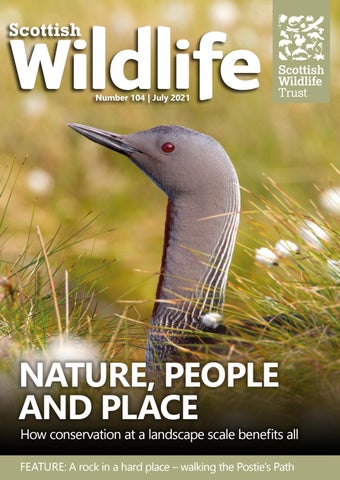
Number 104 | July 2021
NATURE, PEOPLE AND PLACE
How conservation at a landscape scale benefits all
FEATURE: A rock in a hard place – walking the Postie’s Path
Welcome Social frommedia the Chief link/Web Executive link
FIRST WORD From Chief Executive Jo Pike © Mark Hamblin/2020VISION
I
have really enjoyed reading through the responses sent in by members to the survey on our developing ‘Strategy 2030’ and would like to thank those of you who took the time to share your thoughts. Several hundred of you contributed ideas, resulting in thousands of valuable comments (I read every one), and it was especially encouraging to see a good spread of people with differing levels of knowledge and expertise. The content was wide-ranging. For example, you wanted to see continued action for peatlands, more protection for ancient woodlands, and restoration of marine habitats to support seabirds. You called for protection of pollinator-friendly habitats, large-scale reforestation with native trees, and more urgent action to help habitats and species at risk on our reserves. You pointed out the need for more long-term funding to tackle the challenge, which includes making our reserves more resilient to climate change. Wildlife corridors were another important theme, as was the use of our Living Landscapes as exemplars of ecological restoration at the landscape scale (the focus of articles on pages 16 and 18 of this issue). You also highlighted the need to protect species and habitats from further decline and save them indefinitely. Partnerships and collaboration play a central role in our work and it is good to know that members would like to see these continue and grow. You voiced
Reducing wildlife crime: species such as the hen harrier are still subject to persecution
strong support for working more with communities, as well as landowners, and felt more people needed the chance to become involved in conservation, especially young people. There was a sense that many people want to help but don’t know where to start. There were also calls for plastic pollution to be tackled, and damaging practices such as scallop dredging to be banned. You wanted to see native wildlife reintroduced and serious attempts made to slow the loss of insects and birds, as well as action for hedgehogs, more measures to protect mountain hares, and raising awareness about the importance of enabling native species to thrive. You wanted recognition that soil, insects and plants are all important. There was a desire to see a big decrease in wildlife crime, calls to show that economic development can go
These comments are helping shape our thinking about how we can have the biggest impact for wildlife over the coming decade.
hand in hand with restoration and protection, and a wish to see planning for wildlife incorporated in all new housing estates. In the UN Decade on Ecosystem Restoration, you wanted to see Scotland demonstrate more sustainable land use and become a world leader in marine protection. The four big goals were all strongly supported but you asked for some of the wording to be clearer. You also wanted to ensure that, in striving for Scotland to be a leader in restoring ecosystems, this is not about competition but about demonstrating excellence and sharing learning. These comments are helping shape our thinking about how we can have the biggest impact for wildlife over the coming decade. Conversations are also happening between staff, trustees and partner organisations to ensure we can rise to the challenge posed by multiple threats facing wildlife today. Follow the discussion at scottishwildlifetrust.org. uk/strategy2030 In the meantime, we will continue to deliver the vital work that you are supporting to protect Scotland’s incredible wildlife and wild places. JULY 2021 SCOTTISH WILDLIFE 3
Contents
Inside this issue
06
WIN AT TH A STAY KEYS E CROSS HO KELS TEL, O. SEE P AGE 3 3
18
06 NATURALISED PONDS
Naturalised over time, ‘man-made’ ponds provide vital areas of freshwater habitat.
08 NEWS
The latest news from around the Trust and the wider world of conservation.
16 18
AT SCALE
Explaining landscape-scale conservation.
CONNECTING THREADS
Sue Walker explores how the connected needs of people and nature are central to the Trust’s Living Landscape partnerships – and our next flagship initiative.
22
24
24
28
28
31
OUR AGM
Join us online this September for our 57th Annual General Meeting.
TAKING THE ROCK
Once a lifeline route, the ‘Postie’s Path’ on the Coigach peninsula has been given a major upgrade, writes Rich Rowe.
INTO THE DEPTHS
James Thorburn discusses the role of citizen science in shark, skate and ray conservation in Scotland.
THE BIG PICTURE
Zaneta Blaszczyk captures the courtship dance of the great crested grebe.
32 34
WATCH OUT FOR
Things to enjoy in the coming months.
VIEWPOINT
Lucy Jones on what nature means to her.
Number 104 | July 2021
NATURE, PEOPLE AND PLACE
How conservation at a landscape scale benefits all
FEATURE: A rock in a hard place – walking the Postie’s Path
Scottish Wildlife magazine is published by the Scottish Wildlife Trust. © Scottish Wildlife Trust. No part of this magazine may be reproduced without the express permission of the publisher. All photography © Scottish Wildlife Trust unless otherwise stated. The Scottish Wildlife Trust accepts no liability for omissions or incorrect data in advertisements and letters. Views expressed in Scottish Wildlife are not necessarily those of the Scottish Wildlife Trust. ISSN: 0143 1234. Registered office: Harbourside House, 110 Commercial Street, Edinburgh EH6 6NF. Tel: 0131 312 7765. Fax: 0131 312 8705. Email: enquiries@scottishwildlifetrust.org.uk. Website: scottishwildlifetrust.org.uk. The Scottish Wildlife Trust is a company limited by guarantee, registered in Scotland (no. SC040247). It is also a Scottish registered charity (no. SC005792). Scottish Wildlife is published three times a year: March, July and November.
The Scottish Wildlife Trust is affiliated to The Wildlife Trusts, a UK-wide network of 46 Trusts with more than 2,000 wildlife reserves. 4 SCOTTISH WILDLIFE JULY 2021
Red-throated diver at the nest, Sutherland © Mark Hamblin/2020VISION
Deadlines for news: 1 January, 1 May, 1 September. No unsolicited articles please. Scottish Wildlife is free to members. Membership rates from 1 April (excluding discounts for paying by Direct Debit): Individual (concession) £40 (£18); Joint (concession) £47 (£24); Family £57; Watch £18; Life (joint) £900 (£1,300); World/Overseas £45. Patron: HRH The Prince Charles, Duke of Rothesay. Chair: Linda Rosborough. Vice-Chairs: Karen Chambers, Bill Lambert, Kenny Taylor. Chief Executive: Jo Pike Managing Editor: Pete Haskell editor@scottishwildlifetrust.org.uk Contributing Editor: Rich Rowe Design: Connect connectcommunications.co.uk Advertising: Elliot Whitehead 0131 561 0021, Clare Stebbing 0131 561 0024. Printing: InkMark – inkmarkltd.com
Spotlight: Azure damselfly
AZURE DAMSELFLY
© Vicky Nall
SPECIES SPOTLIGHT: (Coenagrion puella)
One of seven species of small blue damselflies in the UK, the azure damselfly is among the most common in Europe, with a range that extends from Scandinavia to North Africa.
While much of an azure damselfly’s one-year life cycle is spent in the larval stage, they can be seen on the wing from May to September around most bodies of water.
One characteristic difference between damselflies and the closely related dragonflies is that damsels rest with their wings held along their body, while dragons hold their wings out straight.
Damselflies are generally not as strong fliers as dragonflies so, when hunting, their tactic is often to sit in wait for their insect prey and then catch it in mid-air with their legs.
Damselflies face a variety of threats including pollution, removal of wetland vegetation, and excessive dredging, drainage or removal of ponds and ditches. JULY 2021 SCOTTISH WILDLIFE 5
Spotlight: Naturalised ponds
POND LIFE Small but often brimming with life, ponds provide vital freshwater habitat for a vast array of species. While many ponds form naturally, there are also plenty of ‘man-made’ ponds that naturalise over time: old mill, distillery and curling ponds; ponds that form following mining subsidence; plus, of course, garden ponds of every shape and size. Whether standalone or as part of a wider area of wetland, these bodies
of water often punch well above their weight in terms of biodiversity. Healthy ponds and surrounding areas are a haven for water beetles, snails, dragonflies and other invertebrates, while they also provide a home for frogs, toads and newts, and attract an assortment of bird life. But such ponds are as much about plants as animals; without one there cannot be the other. From floating-leaved plants, which serve as ideal egg-laying
spots for many species, to submerged aquatics and marginals that colonise pond edges, all provide food, shelter and additional habitat. During the last century, many ponds were lost through deliberate infilling or suffered from water pollution, but recent years have seen something of a pond renaissance – not least with gardeners understanding more than ever the incredible wildlife value they bring.
AZURE DAMSELFLY
MOORHEN
Just 33mm in length, male azure damselflies are pale blue with bands of black along the body. Females are typically green with black markings, although a rare form also has blue markings on the abdomen.
A familiar bird of wetland areas, the moorhen is omnivorous, eating everything from insects and snails to small fish and berries. It spends more time out the water than its relative, the coot, and even climbs trees.
YELLOW FLAG IRIS
COMMON TOAD
The yellow flag iris is a common sight along waterways, ponds and fens. Its bright yellow flowers, with characteristic drooping outer petals, are thought to be the inspiration for the fleur-de-lis symbol used in heraldry and by the Scouts.
Common toads, which can live for up to 40 years, are known for their mass migrations back to their breeding ponds on the first warm, damp evenings of the year. There, the females lay their eggs in long strings of spawn, wrapped around aquatic plants.
6 SCOTTISH WILDLIFE JULY 2021
Spotlight: Naturalised ponds
A
D
C E B
RESERVES
Places where a tell-tale ‘plop’ or ‘splash’ often reveal much about the life all around, here are five watery reserves that can be enjoyed at any time of year.
A GARNOCK FLOODS (pictured)
GREAT CRESTED NEWT Known for their distinctive ‘dinosaur’ crests, male great crested newts employ an extravagant courtship display to woo females: they stand on their back legs, arch their bodies and wave their tails around as if they are dancing.
One of nine Irvine Greenspace reserves in North Ayrshire, Garnock Floods is a low-lying floodplain pasture with shallow pools and marshy areas. With a riverside walk and a small hide, there are great views of the many waders and wildfowl that are present at different times of year.
B HARE AND DUNHOG MOSS
Located near Selkirk in the Scottish Borders, Hare Moss is an area of open water that attracts a range of wildfowl throughout the year. Meanwhile, nearby Dunhog Moss is a fine example of an upland basin fen and a real hotspot for a variety of dragonfly and damselfly species.
C CULLALOE
Once the site of a pair of reservoirs before one was drained, Cullaloe in Fife sees a mix of wildlife-rich open water, wildflower meadow and marsh. Lapwing, sedge warbler and reed bunting all breed here, while great crested grebe and teal visit during the winter.
D CATHKIN MARSH
GREAT RAMSHORN SNAIL A relatively large species of air-breathing freshwater snail, the great ramshorn is found in still or slow-moving water. It feeds mostly on algae by scraping rocks with its radula – a tongue-like appendage that is embedded with tiny teeth.
During the summer months, this striking area of fen and marshy grassland in South Lanarkshire is an ideal spot to enjoy the many species of butterfly and dragonfly that flit and fizz through gorgeous displays of wildflowers. All can be viewed from a hide and boardwalk.
E MILKHALL POND
A former reservoir with a network of smaller ponds, Milkhall Pond in Midlothian provides classic open-water habitat, with a semi-submerged forest of aquatic plants that is alive with insects, amphibians and wildfowl. A path along the western side of the pond provides excellent views of the life all around.
JULY 2021 SCOTTISH WILDLIFE 7
Garnock Floods © John Cochrane, Azure damselfly © Dawn Monrose, Moorhen © Jon Hawkins, Surrey Hills Photography, Great crested newt © Shutterstock, Yellow flag iris © Vaughn Matthews, Common Toad © Jon Hawkins, Surrey Hills Photography, Great ramshorn snail © Paul Ruddoch/NatureSpot
Find out h ow to create you r own wildlife p ond at scottishwil dlifetrust. org.uk/po nd
Scottish Wildlife Trust news
Latest news
News from the Trust, our projects and the wider world of conservation
KEEP UP TO DATE
All the latest Trust news is available on our website scottishwildlife trust.org.uk
Tackling ash dieback
ASH dieback has spread rapidly throughout our woodlands, with some experts predicting it could kill around 80% of the UK’s ash trees. Research by the James Hutton Institute found that these trees support 955 species – 45 of which are entirely reliant on ash. And with a cost to the economy of around £15 billion, the wider impacts of this disease will be felt by people and wildlife for decades to come. On the Trust’s own reserves, ash dieback has been recorded over the last six years spreading across the country from south east to north west, with the Central Lowlands most affected, although we have been less impacted than most other Wildlife Trusts. Management of diseased ash on reserves concentrates on removing infected trees along paths and roadsides. The Trust is aware of the evidence that a small percentage of ash may be resistant to the fungus and therefore intends to maintain as large a number of ash trees in its woodlands as possible, in order to increase the potential pool of resistant specimens. Ash dieback damage is irreversible and threatens to change our landscapes forever. But, with your help, we can adapt. Donations to our appeal will help protect our wildlife reserves from the impact of ash dieback. Your donation will contribute to regular tree safety inspections, the removal of infected trees which pose a danger to people and encouraging natural Support decomposition our appeal wherever possible. visit scottishwildlif etrust. Alan Anderson, org.uk/ash Head of Reserves
8 SCOTTISH WILDLIFE JULY 2021
Successful breeding season for osprey pair A PAIR of nesting ospreys enjoyed a fruitful second breeding season at the Trust’s Loch of the Lowes Wildlife Reserve in Perthshire. Female osprey NC0 and male LM12 had to contend with particularly cold and wet spring weather, rival ospreys and human intruders to successfully raise their two chicks, which are expected to fledge at the end of summer. Sadly, a third chick died just a few days after hatching. Male LM12 has bred on the reserve for 10 years while his mate NC0, who was ringed near Loch Ness in 2017, is relatively inexperienced. In April 2020, at the start of their first season, the pair took flight to another nest due to disturbance and they managed to fledge a single chick. This winter, the Trust carried out significant work on the tree which supports their nest to make
it a more attractive location and upgraded security systems to monitor the second nesting site. “I’m pleased our work to give ospreys a safe and secure nest has paid off with a successful breeding season,” commented Sara Rasmussen, the Trust’s Perthshire Ranger. “While the ‘renovations’ we’ve carried out to the nest tree by cutting back branches might look severe, they give birds on the nest a greater chance to spot and react to intruding birds, helping them to feel more secure.” A team of more than 50 volunteers and staff helps maintain a 24-hour watch on the nest during the breeding season, thanks to support from players of People’s Postcode Lottery. Watch the ospreys fledge this summer on our live osprey webcam, scottishwildlifetrust.org. uk/ospreys
© Scottish Wildlife Trust
Two chicks being fed at the nest
Scottish Wildlife Trust news
© Scottish Wildlife Trust
The Trust team with presenter Iolo Williams (middle) on Handa
Springwatch turns its focus on Handa STUNNING footage of Handa’s wildlife, filmed by Ranger Johnny Rolt, was seen by millions of viewers during this year’s Springwatch. Viewers of the hugely popular programme on BBC2 were able to learn more about the array of bird life that breeds on Handa each year, from thousands of guillemots, razorbills and puffins on and around its sea cliffs
to great skuas on the island’s moorland interior. Presenter Iolo Williams even dissected a great skua’s pellet provided by our team to explain the bird’s predatory diet as part of a live segment. Johnny is one of two rangers spending the season on Handa Island this year together with four volunteers. The team is responsible for carrying out an
Cumbernauld’s biggest birdfeeder? © Damian Waters
THIS summer, a new meadow in Cumbernauld Community Park is being sown with a mix of oats and bird seed – a move that harks back to the area’s farmland past. This large meadow will provide food for a number of birds that have been particularly affected by a reduction in habitat, including skylarks, linnets and yellowhammers (pictured). Covering a hectare of the park, it
Visitor centres now open THE Trust’s four visitor centres around Scotland reopened to the public this spring. To ensure the safety of visitors, volunteers and staff, a number of Covidsafe measures are in place, including enhanced cleaning, use of perspex screens and hand-sanitising stations.
could potentially be Cumbernauld’s biggest birdfeeder! Once the agricultural meadow is established, Cumbernauld Living Landscape volunteers will scythe a pathway through it, allowing visitors to enjoy a close look at the wildlife in the new habitat. A further meadow, also in the park, will enhance the Nectar Network the Trust-led Living Landscape project is developing across the town – creating vital habitat for bees, butterflies and other pollinating insects. Cumbernauld Living Landscape works in partnership with the Friends of Cumbernauld Community Park, North Lanarkshire Council and the local community to bring these meadow projects alive. For more, visit cumbernauldlivinglandscape.org.uk
Trust members continue to benefit from free entry to all our visitor centres, but advance online booking at Loch of the Lowes and Montrose Basin is strongly recommended. Please be aware that we have set time slots in place with limits on the duration of your stay. For detailed information, visit scottishwildlifetrust.org.uk/visitorcentres
extensive programme of conservation work as well as ensuring that members of the public visit the island safely. “I spend much of my spare time capturing the island’s wildlife on film,” explained Johnny. “Handa has an incredible conservation story to tell and it’s a real honour to have had the opportunity to share my footage with the Springwatch audience.”
Call for action on deer THE Trust has welcomed the Scottish Government’s acceptance of 91 out of 99 recommendations made by the independent Deer Working Group, which aims to ensure that Scotland’s deer population is managed in the public interest. Given the importance of addressing the impact of wild deer as one aspect of tackling the crisis facing nature, urgent action is now needed from government agencies to implement these recommendations. Rebekah Strong, the Trust’s Nature-based Solutions Policy Advisor, said: “Unsustainable numbers of deer are a barrier to delivering two vital nature-based solutions: expanding native woodland and restoring Scotland’s degraded peatlands.” Key recommendations include new powers for NatureScot to monitor and enforce deer management more effectively. Tackling deer management is one of 11 actions set out in our Nature Recovery Plan.
JULY 2021 SCOTTISH WILDLIFE 9
Scottish Wildlife Trust news
© Clare Toner
IN BRIEF Building resilience
We are delighted to report that more than £63,000 has been donated to the Trust’s Resilience Fund since it was launched earlier in 2021. The Fund will help us to focus our delivery in three key areas over the next decade: ensuring climate resilience; building connections between people and nature; and promoting nature-based solutions. For more information and to support the Resilience Fund, visit scottishwildlifetrust.org.uk/thefund
Largiebaan lekking site © Mark Hamblin/2020VISION
The Trust’s Flying Flock at Cander Moss
Grazing at Cander Moss
2019. A permanent pen, gate and fencing have now been constructed to help move the flock on and off the reserve. Encroaching trees are a threat to the recovery of raised bogs. They can shade out sphagnum moss and absorb water – both of which are vital components of healthy peatland habitat.
© WDC/C Phillips
Black grouse (pictured) were observed to have established a new lekking site at the Trust’s Largiebaan Wildlife Reserve in Argyll this spring. A lek is an area where males of certain species gather to engage in competitive displays to attract females during the breeding season. Up to six males were seen displaying at the lek at Largiebaan, all hoping to attract a mate. Trust staff also recorded merlin and barn owls breeding at the reserve this year.
THE ever eager, and ever hungry, mouths of our Flying Flock are helping to prevent the encroachment of birch scrub at Cander Moss Wildlife Reserve in South Lanarkshire. Sheep were introduced to the reserve following initial work, funded by NatureScot, to manually maintain scrub in
Create a wild wish list
You can now create a wild wish list of reserves and activities as well as keep a virtual logbook of reserve visits and conservation activities by signing up for a free Scottish Wildlife Trust account on our website. Trust members can also use the account to access a back catalogue of Scottish Wildlife magazines. Sign up today at scottishwildlifetrust.org.uk/register
Wildlife Watch is back
A host of new Wildlife Watch groups have started up since the first lockdown, with Strathblane Primary School and St Bartholomew’s Nursery in Coatbridge the latest to join a growing network of more than 30 groups. Elsewhere, a number of new groups are also being established in Dumfries & Galloway, Fife, Perth & Kinross, and the Lothians. Check our website to find your nearest Wildlife Watch group, or get in touch with Catherine Leatherland (cleatherland@scottishwildlifetrust.org.uk), the Trust’s People & Wildlife Officer, if you’d like to set up a new group in your area. 10 SCOTTISH WILDLIFE JULY 2021
Alarm over use of acoustic deterrents THE Trust has called for devices that use loud noises to scare seals away from salmon farms to be phased out and replaced with less harmful alternatives. Acoustic deterrent devices have been widely used in Scotland’s seas. In addition to disturbing seals, they can both displace and physically harm species such as harbour porpoise (pictured) and minke whales. In March, the industry announced the removal of some acoustic devices from use to meet new requirements in the United States – one of the largest export markets for Scottish salmon. However, replacement devices that operate at a lower frequency could also have effects on other marine species. “Scotland wants to be a world leader
in sustainable aquaculture and this can only come through innovation that reduces the industry’s negative impact on the marine environment,” explained Dr Sam Collin, the Trust’s Living Seas Manager. “While the industry has recently moved to phase out some acoustic devices in response to demands from the US, it is not clear whether all types have been ruled out. We are concerned that replacement devices which operate at a lower frequency may have an impact on other non-target species. “We’d like to see the Scottish Government promote the use of less harmful alternatives to deter seals, including double netting made from more robust materials.”
Scottish Wildlife Trust news
© Jimmy Ng
Artist Clara Elliot
Exploring the fabric of Coigach & Assynt AN artist who creates textiles to explore the ‘fabric’ of places has been examining how interactions between red deer and people shape lives and the landscape of the north west Highlands. Clara Elliot’s work, part of Coigach & Assynt Living Landscape, aims to reflect the relationship between landscapes, people and ecology. Clara is an artist-in-residence in the truest sense of the term. She stayed in a studio at Glencanisp – owned by Assynt Foundation, the organisation leading the project – for six weeks to meet local
people and explore the area. “In a time of climate change and biodiversity loss, we are being asked to look again at the dynamics between humans, other species and the landscapes we inhabit,” she explained. “I’ll be using configurations of thread to make visible the ways in which red deer, people and local landscapes are entangled.” As part of the project, Clara has also organised workshops for local school pupils and adults to help them create their own artwork. © National Lottery
Installing a nest box at The Miley
Helping Dundee’s feathered friends A TEAM of handy National Lottery winners from across Scotland has joined forces to help wild birds by donating 25 nest boxes, all handcrafted during the winter lockdown, to the Trust. EuroMillions winners Fred and Lesley Higgins delivered the boxes to The Miley Wildlife Reserve in Dundee, where several of them were installed
to help attract songbirds. A further box, equipped with a built-in nest camera, was also delivered to the city’s Kingspark Primary School. The Miley is part of a disused railway within walking distance of Dundee city centre. In the 1990s, Trust staff and volunteers transformed the area from a mile-long rubbish tip into a haven for urban wildlife.
Fighting for nature AS the UN Decade on Ecosystem Restoration gets under way, the Trust is urging the Scottish Government to redouble its efforts to tackle the growing threats facing nature. Starting in summer 2021, the Decade is a rallying call for the protection and revival of ecosystems worldwide. It ends in 2030, which is the deadline for delivering the UN’s Sustainable Development Goals, and the year that scientists have identified as the last chance to prevent a catastrophic climate crisis. Here in Scotland, the Trust’s Nature Recovery Plan, published in partnership with RSPB Scotland and WWF Scotland, identifies 11 key areas where the Scottish Government can act quickly. “We saw strong support in Holyrood election manifestos for our 11 actions,” commented Bruce Wilson, the Trust’s Public Affairs Manager. “This builds on the significant progress made in the last Parliament, including moves towards more sustainable deer management, action on peatland restoration and the introduction of licences for grouse-shooting businesses. “We now need to see the Scottish Government knuckle down and put nature at the heart of decision making. One of the most important things they can do is develop a new Scottish Nature Network in the next planning framework.” The Trust is also working with allied environmental charities to call for legally binding targets for nature’s recovery through the Fight For Scotland’s Nature campaign. “Ambitious targets to tackle climate change have helped to spur action from across society and we now want to see the connected crisis facing nature given the same priority,” added Bruce. “Setting binding targets will help ensure the government does not lose sight of nature.” Support the call for legally binding targets for nature’s recovery at fightforscotlandsnature.scot/
JULY 2021 SCOTTISH WILDLIFE 11
News
A GROUP of almost 40 artists has collaborated to raise more than £2,000 to support wildlife conservation through an online exhibition. A percentage of all work sold through British Wildlife by British Artists was donated to the Wildlife Trusts in Cornwall, Scotland, Sussex and Yorkshire.
A fond farewell © Scottish Wildlife Trust
Counting crows TRUST staff and volunteers in Ayrshire have been astounded by an array of items (pictured) dropped into tree tubes by carrion crows at Shewalton Wood Wildlife Reserve. In spring 2020, the team was fascinated to see the crows passing objects to each other before dropping them into the tubes. The items were removed during annual maintenance at the end of winter. When volunteer Christine McGovern catalogued the finds, she discovered sticks, stones, bones, ceramics, glass, tin cans, plastic bottles and even tennis balls. This curious behaviour is thought to be part of the crows’ courtship ritual. Harry Richards, the Trust’s Ayrshire Community Engagement Officer, said: 12 SCOTTISH WILDLIFE JULY 2021
© Alison Irvine
© Stephen Rew
Helping wildlife through art
“Volunteering with the Trust is a fantastic way to help and to learn more about Scotland’s wildlife. We try to ensure every day is different and watching the crows last year was exactly that. “Sadly, a lot of the materials collected reflect the type of litter we’d find around the reserve, but they also picked up sheep horns and a huge range of bones. “Carrion crows and other corvids are very intelligent and social animals, and as far as we’ve been able to find out this is part of their mating behaviour.” In other news, the Trust’s work with volunteers and communities in Ayrshire received a welcome boost in April with a £37,554 funding award from the ScottishPower Foundation.
DR Jean Balfour (pictured) has stepped down as President of the Trust’s Fife and Kinross group after almost 40 years. During that time, she has supported the group committee in all its activities and chaired every single AGM. However, Jean’s association with the Trust goes back even further, as Jean is actually a founder member of the Trust. She also served as vice chair in the 1980s. While Jean has always been interested in wildlife, her specific expertise is in botany and, in particular, Arctic alpine ecosystems. Jean has participated in many expeditions across much of the Arctic and contributed to a variety of academic papers on the subject. In Jean’s ‘retirement’, she continues to enjoy the flowers and bird life around her home. The Fife and Kinross group, and all at the Scottish Wildlife Trust, would like to thank Jean for all that she has done for Scotland’s wildlife and the invaluable support she has given over so many years.
Help grow our Celebration Tree VISITORS can now dedicate a leaf in memory of a loved one or special event on our newly installed Celebration Tree at Loch of the Lowes Visitor Centre. The striking sculpture provides a wonderful way to celebrate those who are special to you, while also helping to support Scotland’s wildlife. Supporters can choose from a selection of gold, silver and bronze leaves which can be engraved with a personal message. To find out more, call Cécile on 0131 312 4772 or visit scottishwildlifetrust. org.uk/celebrationtree
Wider news
© Maggie Keegan
© Roger Phillips
Ballachuan Hazelwood, Seil Island
Multiple threats to native trees
Sir David calls for unity at COP26 SIR David Attenborough has been appointed the People’s Advocate at November’s UN Climate Change Conference (COP26) in Glasgow. The renowned broadcaster and President Emeritus of The Wildlife Trusts will use the role to present a compelling case for why climate action matters, evidence the progress under way, and highlight the actions that decision-makers
must take, both ahead of and during COP26. He said: “The epidemic has shown us how crucial it is to find agreement among nations if we are to solve such worldwide problems. But the problems that await us within the next five to 10 years are even greater. “It is crucial that these meetings in Glasgow, COP26, have success, and that at last the nations come together to
solve the crippling problems that the world now faces.” In February, Sir David warned the UN Security Council that climate change is “the biggest security threat modern humans have ever faced” and described COP26 as possibly “our last opportunity to make the necessary step-change” towards protecting the planet.
Citizen science powers latest bird report
For more, visit nescotlandbirdreport.org.uk
14 SCOTTISH WILDLIFE JULY 2021
Common cranes – one of the species recorded in the latest report
© Ron Macdonald
AN example of citizen science at its best, the latest North-East Scotland Bird Report has been published together with a new supporting website. The report has been compiled from more than 91,000 individual records from more than 420 named contributors. First compiled by University of Aberdeen students in 1974, it has evolved from a typed and photocopied booklet into a professionally printed, fullcolour publication. Contents include a systematic list of bird species recorded in the year, plus a range of accompanying articles, photographs, artwork and charts.
A MAJOR new report from the Woodland Trust highlights evidence of multiple threats that could have catastrophic consequences for woods and trees across the UK – and the many species that inhabit them. The first report of its kind to focus on native species, The State of the UK’s Woods and Trees 2021 highlights the combined impact of five specific threats: poor woodland condition; climate change; loss and fragmentation; pests, disease and pollution; and slow rate of new woodland creation/expansion. In Scotland, rare and dwindling areas of temperate rainforest are singled out as being especially under threat, with many suffering from all five of the threats identified in the report. “The warning signs in this report are loud and clear,” commented Abi Bunker, Director of Conservation and External Affairs, Woodland Trust. “If we don’t tackle the threats facing our woods and trees, we will severely damage the UK’s ability to address the climate and nature crises. Our wildlife havens are suffering, and we are storing up problems for future generations.”
Be part of Bog Day THIS year’s Bog Day – an international celebration of the brilliance of bogs, fens, swamps and marshes – takes place on 25 July. To honour these important habitats and to raise awareness of peatlands, the IUCN UK Peatland Programme is inviting people to share what peatlands mean to them, and to communicate their value through a series of mini videos, entitled Peatlands are… To get involved, visit bogday.org
Legacy
A lasting gift to Scotland’s wildlife
Anne Robertson, an inspiring and enthusiastic lover of our natural world, held a lifelong affinity for Scotland and its wild places. Anne worked tirelessly, both in her personal and professional life, to leave the world in a better place than she found it.
B
orn in London to Scottish parents, Anne grew up with frequent trips to visit family in the north. Graduating with a BSc in Botany, Zoology and Geology from Reading
Anne, not holding back from adventure, also enjoyed driving and maintaining Land Rovers throughout her career.
University in 1956, Anne was destined for a future of adventure. In the autumn of that same year, she joined the Hydrogeological Department of the Geological Survey and Museum (now known as the British Geological Survey), as one of their first female graduate employees. A trailblazer of her time, Anne undertook extensive fieldwork which was once predominantly carried out by male counterparts. A zeal for learning and discovery led Anne to become one of the UK’s first female down-hole geophysical loggers, carrying out water flow recordings and inspections in boreholes
and wells. Anne was also a passionate conservationist, holding a Life Membership of the Scottish Wildlife Trust for more than four decades. After retirement, Anne explored each of the cities, countries and continents she had always wanted to visit, including Antarctica, Greenland, Spitzbergen, the Falkland Islands, Uzbekistan, North America, Egypt, Svalbard and New Zealand. Anne’s passion for Scotland will live on through the generous gift she left in her Will, allowing the Scottish Wildlife Trust to continue with our work to help people and nature thrive alongside each other.
Every gift in every Will, no matter how large or small, really does make a difference to the future of Scotland’s wildlife. To find out more, call Cécile on 0131 312 4772 or email cdermit@scottishwildlifetrust.org.uk JULY 2021 SCOTTISH WILDLIFE 15
Landscape-scale conservation
AT SCALE What do we mean by landscape-scale conservation? In 2010, leading ecologist Sir John Lawton summed up in four words what was required to improve wildlife sites for nature: more, bigger, better and joined. Increasing the number and size of protected areas means more physical space for species to occupy. Improving the habitat on these sites makes them able to support more living things. And connecting these sites, whether through physical corridors or ‘stepping stones’ of habitat patches, means individuals can move more freely between them. But while wildlife reserves and other protected areas are undoubtedly an essential component of conservation, they can only do so much. In an era of the climate and biodiversity crises, it doesn’t work to simply ring-fence nature and ignore what lies beyond. More than ever, the wider landscape
now needs to play a role in supporting and restoring wildlife, and that means balancing the demands of society and our economy with the demands of nature. Landscape-scale conservation is an approach that tackles this tricky balancing act. Generally working across large areas and with a range of partners, landscapescale conservation initiatives look to deliver cross-cutting benefits that are good for nature and good for people. Working at this scale in collaboration with local landowners, businesses and communities can achieve far greater and longer-lasting successes than working on our own and can
COIGACH & ASSYNT LIVING LANDSCAPE
Location: North West Highlands Partner organisations: 14 Lead partner: Scottish Wildlife Trust Area: 635 km2 Projects to date: 30
ISLE OF EIGG
Location: Inner Hebrides Partner organisations: 3 Lead partner: Isle of Eigg Heritage Trust Area: 30 km2
GARNOCK CONNECTIONS
Location: North Ayrshire Partner organisations: 5 Lead partner: RSPB Scotland Area: 360 km2 Projects to date: 28 16 SCOTTISH WILDLIFE JULY 2021
reinforce a local sense of stewardship over the landscape. One important point to note is that, while the word ‘landscape’ may conjure a mental picture of rolling countryside, landscape-scale conservation is just as applicable in urban settings. Here, we highlight six initiatives that the Trust has been involved in that have all focused on different locations.
Landscape-scale conservation
Landscape-scale conservation should improve the landscape for people, wildlife and the economy. But what does that actually look like on the ground? Here are three mini case studies which highlight projects that deliver these benefits.
SIR JOHN LAWTON
© A Laming
The future of landscapescale conservation is not just about delivering more, bigger, better and joined-up nature reserves. It is also about winning hearts and minds.
RE-MEANDERING DUNDONALD BURN, GARNOCK CONNECTIONS Previously, the artificially straightened and high-sided Dundonald Burn that runs through the Trust’s Shewalton Wood Wildlife Reserve was poor for wildlife. Heavy rains would dislodge plants and silt, and cause flooding further downstream. Following a project to reinstate meanders along the burn (pictured above) and to make its banks less steep, the water flow has slowed, trapping sediment, reducing the risk of flooding and allowing wildlife to thrive once more.
© CLL
HEART OF SCOTLAND FOREST PARTNERSHIP Location: Highland Perthshire Partner organisations: 9 Lead partner: John Muir Trust Area: 30 km2 Projects to date: 8
WILD WAYS WELL, CUMBERNAULD LIVING LANDSCAPE
Spending time outdoors among nature makes people feel better about themselves and their lives. Focusing on those who are suffering from, or at risk of, poor mental health, this project has helped hundreds of people in and around Cumbernauld to reconnect with nature and reap the benefits of doing so. © Peter Cairns/2020VISION
CUMBERNAULD LIVING LANDSCAPE Location: Central Belt Partner organisations: 5 Lead partner: Scottish Wildlife Trust Area: 59 km2 Projects to date: 30
DEER MANAGEMENT, COIGACH & ASSYNT LIVING LANDSCAPE EDINBURGH LIVING LANDSCAPE
Location: Central Belt Partner organisations: 9 Lead partner: Scottish Wildlife Trust Area: 273 km2 Projects to date: 7
This project works closely with local communities to help manage numbers of red deer, as too many grazing mouths can decimate new and regenerating woodlands. By training stalkers, providing facilities for processing venison and through an innovative schools’ programme called Hill-to-Grill, the project is helping to protect the area’s wildlife, provide new job opportunities and highlight the value of venison to local people.
JULY 2021 SCOTTISH WILDLIFE 17
Contains public sector information licensed under the Open Government Licence v3.0.; Contains OS data © Crown copyright and database right (2021); Forestry and Land Scotland © Crown copyright and database right ‘2021’. Ordnance Survey Licence number 100021242; ©John Muir Trust contains OS derived data Ordnance survey licence number 100034628 2021; © Scottish Wildlife Trust (2021)
THREE PILLARS OF IMPROVEMENT
Landscape-scale conservation
Connecting
threads At the heart of our Living Landscape partnerships is an understanding that the health and wellbeing of people and nature are inextricably linked – an approach equally central to the Trust’s next flagship initiative, writes Sue Walker.
© Katrina Martin
“J
Local schoolchildren enjoying time in nature, Coigach & Assynt
18 SCOTTISH WILDLIFE JULY 2021
oined up. Connected. Interlinked. It is only by recognising the invisible threads that tie people and the natural world together that we can ensure that both are truly able to thrive,” explains Cathleen Thomas, the Trust’s Living Landscapes Programme Manager. And it is just such a philosophy that is embedded in the Living Landscape partnerships the Trust has brought together in three very different locations around Scotland: Coigach & Assynt, Cumbernauld, and Edinburgh. The origins of all three can be traced back to the milestone partnership project the Trust was involved in on the Isle of Eigg, which culminated in a community buy-out of the island in 1997. Since then, the Trust has worked with communities, charities, private landowners, research institutions, local authorities and government organisations on landscapescale conservation programmes (see page 16 for more information) that deliver for both the natural environment and for people. While each Living Landscape
Landscape-scale conservation
© Joe Cornish/2020VISION
Big ideas across a big landscape, Coigach & Assynt Living Landscape
partnership is unique, they all share common principles: to improve the health and resilience of nature at scale; to seek to deliver benefits for people and wildlife; and to deliver this change through bringing together strong partnerships.
SCALING UP
The same but different is one way to look at the Trust’s trio of Living Landscapes. “Although each has variations based on location, all aim to deliver environmental, social and economic improvements through a rebuilding of the natural environment at scale,” adds Cathleen. Now nearing the completion of its current phase, Coigach & Assynt Living Landscape (CALL) in the North West Highlands covers an area of 635 sq kms,
but has a population of just 1,400 people. Here, gnarly mountains stand in splendid isolation amid a sprawling canvas of lochans, woodland, moorland and crofts that paint the landscape in a variety of subtle colours. The seeds of this Living Landscape initiative were sown in 2010, when five local landowners, with the Trust as lead partner, came together to develop a long-term vision to bring positive change to the area. The partners worked with local communities to put together a successful bid to the National Lottery Heritage Fund, which resulted in a five-year funded scheme that began in 2016. With a total of 14 partners, 30 projects and nearly £5 million of funding, the scheme has focused not just on the area’s
While each Living Landscape partnership is unique, they all share common principles...
ecology and wildlife, but also on supporting rural industries, creating employment opportunities, recording the historical role of the community in the landscape, and attracting people to live in and visit the area. As this phase of the initiative comes to an end, those involved can reflect on a range of achievements that speak of nature recovery, economic opportunity, broadened horizons and cultural identity: more than 7.5 sq kms of native woodland has been planted or brought back to active management; well over 100 local people have been trained in deer management, farming techniques and other rural skills; local schoolchildren have enjoyed countless hours of engagement with nature; and a variety of paths have been created or upgraded (see Taking the rock, page 24). And in work that might be considered beyond the usual remit of an organisation such as the Trust, a host of historic buildings have also been restored – most notably the award-winning Iron JULY 2021 SCOTTISH WILDLIFE 19
Landscape-scale conservation
© Paul Barclay
© Tom Marshall
Teri Grieve hard at work as a Nature Ninja volunteer, Cumbernauld
anything but a concrete jungle. Now at its midpoint, CLL’s Creating Natural Connections programme comprises numerous and interconnected projects. All over the town, green spaces are being made more wildlife-friendly through tree planting, the creation of meadows and restoration of bog habitat. Crucially, people are now increasingly connected with the abundant natural resources around them. There have been projects to improve the accessibility of green spaces for buggy users and those with mobility issues, plus educational work that has given thousands of children opportunities to learn about the importance of nature on their doorstep and how to protect it.
© Beth Chalmers
Age Clachtoll Broch. “Without such support, our large, complex project just would not have been possible,” reflects Gordon Sleight, Project Lead, Historic Assynt, Clachtoll Broch Project. Being part of such a wide-ranging community partnership has brought huge value not just to specific projects, but also to individuals. When local residents Nigel and Meryl Carr wanted to extend a wildlife corridor from existing woodland on their own property to an adjacent area of rented land, CALL staff provided all the expertise and guidance needed. “It has taken four years, but with significant help from contractors, we have planted almost 11,000 native trees – mostly Scots pine, various willows, rowan, alder and birch – and now just have an area of riparian woodland to go,” explains Nigel. “We simply would not have been able to achieve this without the guidance and enthusiasm from the CALL partnership.”
Other initiatives are highly targeted. One project, Wild Ways Well, encourages people suffering from, or at risk of, poor mental health to embrace the healing power of time spent in green spaces. Another, the Nature Ninja volunteer group, provides skills and training to help create a pathway into conservation work. “Volunteering has helped develop my skills and confidence to work in conservation,” explains Teri Grieve, a young volunteer who has since secured a trainee post with the CLL team. “It also allowed me to maintain a connection to nature and gave me time to focus on something I was passionate about when I was yet to find work in the sector. Now as a trainee, I am able to help others make their own connection to nature.” As Cumbernauld continues to make great strides forward, a third initiative is still in its early stages 60km or so to the east in Edinburgh. Home to half-amillion people, there is perhaps no better place than Scotland’s alluring capital to demonstrate how working with nature can bring an entire city together. The raw ingredients are certainly there. Stand atop Arthur’s Seat – the mountain-inminiature in the middle of the city – and the views cover a patchwork of historic buildings, modern housing and new industries, all interspersed with parks and tree-lined streets, plus a nature-rich coastline nearby. With the ambition for Edinburgh to become one of the most sustainable cities in Europe by 2050, there could be big plans afoot. Over the past 12 months, the Trust has led the creation of an Ecological Coherence Plan as part of Edinburgh City Council’s Thriving Green Spaces project. This work has brought together experts and residents to map all existing wildlife habitats throughout the city, identify the
URBAN OBJECTIVES
Nearly 300 miles to the south, Cumbernauld Living Landscape (CLL) sits within the buckle of the Central Belt. A new town established in the 1950s to accommodate Glasgow’s expanding population, more than 50% of Cumbernauld is green space – kept as a resource for its population of about 52,000 people. With four Trust reserves within walking distance of the town centre, plus additional areas of woodland, meadow and loch, it is 20 SCOTTISH WILDLIFE JULY 2021
Learning about nature all around, Cumbernauld
It has taken four years, but with significant help from contractors, we have planted almost 11,000 native trees.
Landscape-scale conservation
BOLD AMBITION
Given the progress made to date, working with partners on a landscape scale to deliver environmental, social and economic improvements will be a central plank of the Trust’s work in the years to come – with the next major initiative perhaps the most ambitious of all. Launched in 2019, Riverwoods has a bold ambition to create a national
© Tom Marshall
ecosystem services they provide and highlight where more might be needed – be it in terms of contributing to cleaner air, climate change mitigation or pollination of plants. By combining this information with practical on-the-ground considerations, it will be possible to identify the right actions for the right places – work that will influence the future development of the city. “Our green and blue landscapes have never been more important as we look to nature for solutions to help us address the environmental and health challenges we face today,” explains Linda Anglin, Green Spaces Senior Project Manager, City of Edinburgh Council. “The Ecological Coherence Plan is providing us with valuable information about our local habitats and the benefits they provide. This will help us to make better informed decisions on where to focus resource so that we can create a city which is truly connected by a diverse and high-quality green and blue network, where both wildlife and people thrive.”
network of thriving riverbank woodlands and healthy river systems throughout the whole of Scotland. With 125,000 kms of rivers, streams and loch shores across the length and breadth of the country, the initiative will bring huge benefits to Scotland’s natural environment and wildlife. More connected and resilient ecosystems will, in turn, be better equipped to deliver the essential natural services that are so vital to our wildlife, economy and wellbeing. For the Trust, Riverwoods is a natural next step in its response to the twin climate and biodiversity crises. And like the other landscape-scale partnerships that have preceded it, Riverwoods will not just enable the Trust to connect with people and places that are normally out of reach but also support local community groups to realise ambitious projects that would be beyond their scope if going it alone. Perhaps most importantly of all, it provides an opportunity to work at a scale that just couldn’t be achieved by working solely at Trust reserves. Crucially, such an approach to conservation brings wildlife out of nature reserves and connects them to our gardens, local green spaces and communities – a vital, and often missing, stitch in the fabric of our landscapes that will give them, and us, a new lease of life. Find out more about Riverwoods at riverwoods.org.uk Sue Walker is the Trust’s Communications and Advocacy Officer for Living Landscapes.
Gardens will form a key part of Edinburgh’s ecological network
Butterfly-friendly plantings on an Edinburgh rooftop © RBGE JULY 2021 SCOTTISH WILDLIFE 21
Annual General Meeting
Join us online for this year’s AGM Enjoy some of our best wildlife footage of the year and have the chance to learn more about how the Trust has made it through a particularly challenging 12 months.
N
otice is given that the 57th Annual General Meeting of the Trust will be held online at 10am on Saturday 11 September. If you would like to attend, please visit scottishwildlifetrust. org.uk/agmbooking As well as the formal AGM, you’ll be able to hear presentations from
EVENT PROGRAMME 10:00 AGM – welcome and top wildlife highlights from 2021 10:10 Formal agenda 11:10 Saving Scotland’s Red Squirrels – project film preview 11:15 Comfort break 11:20 Presentations and questions 11:50 Handa – footage from the island 11:55 Close 12:00 Group chats (optional) 12:30 Ends
HOW TO REGISTER
To register for the AGM, please visit scottishwildlifetrust. org.uk/agmbooking Once your membership has been confirmed by one of our team, you will receive an email confirmation of your registration that will include the link required to join the event.
22 SCOTTISH WILDLIFE JULY 2021
our Chair and Chief Executive, and have the chance to ask questions about all aspects of the Trust’s work. The event will be interspersed with wildlife footage from our reserves and beyond, and there will be an exclusive preview of the Saving Scotland’s Red Squirrels project film.
AGM FORMAL AGENDA
1. Apologies 2. To approve the minutes from the 56th AGM held online on Saturday 12 September 2020. 3. To receive the Council’s report and accounts for the year ended 31 March 2021. The Annual Report and Financial Statements can be downloaded from the Trust’s website. Copies are available on request from the Company Secretary. 4. To appoint auditors of the Trust. 5. To elect members to Council. 6. Special Business: to consider and, if thought fit, approve the following resolution as a Special Resolution: THAT the Articles of Association of the Trust be amended by making the changes set out in the document produced to the meeting and initialled by the chair of the meeting for the purposes of identification. Full details of the amendments proposed are available from the website at scottishwildlifetrust.org.uk/AGM 7. Any other relevant business. All other business must be notified to the Company Secretary by 30 August 2021. Susan McKenzie (Company Secretary) Registered Office: Scottish Wildlife Trust, Harbourside House, 110 Commercial Street, Edinburgh, EH6 6NF. A member entitled to attend and vote at the above meeting is entitled to appoint another person as a proxy to attend and, on a poll, to vote in their place. A proxy form is available online for members who are unable to attend the meeting.
Annual General Meeting
NOMINATIONS FOR ELECTION TO COUNCIL Council, which has responsibility for the governance of the Trust, is made up of Trustees elected from the membership. To be an effective Trustee requires time and effort, and members of Council are elected on the basis of what they can contribute by way of knowledge, contacts, expertise and skill (including finance, conservation, science, administration and land
management). A Trustee must act in the best interests of the charity as a whole. This year, as the number of candidates is less than the number of vacancies on Council, no postal vote is necessary. Details of nominations to Council are shown below and vacancies will be filled in accordance with the Articles of Association.
STANDING FOR RE-ELECTION DR TIM DUFFY
JOHN MORRIS
STANDING FOR ELECTION CHRIS ARNOLD
Proposer: Nicholas Warren. Seconder: Madeleine Lawrie.
Proposer: Nicky Munro. Seconder: Linda Rosborough.
Proposer: Susan Davies. Seconder: Jane Stuart-Smith.
Tim is currently Vice-Chair and Planning Secretary of the Trust’s Lothians Group. He has previously served terms as Chair of that group and many terms as a Trustee on Council, during which time he has cycled between all the Trust’s wildlife reserves to raise money for the 50th anniversary. Currently Vice-Convenor of the Council’s Conservation subcommittee and recently retired from a career in the Natural Environment Research Council, Tim has three degrees in ecology and is now studying botany, Gaelic, Chinese painting, calligraphy and the clarsach.
John was educated at Allan Glen’s School in Glasgow and thereafter at Strathclyde University, where he graduated with an LLB Law degree in 1975. He worked in the legal profession for more than 40 years, retiring from full-time employment in April 2017, but continues to sit as a sheriff and High Court judge on a part-time basis. John first joined the Trust’s Council in 2018.
Chris’s passion for nature is borne from being brought up in the countryside and, more recently, living next to a Local Nature Reserve in Edinburgh. He has particular interests in birds and bees, having just completed a beginners’ beekeeping course. A member of several conservation charities, Chris has been involved in a number of charity fundraisers and is a keen wildlife photographer, regularly contributing photographs to nature websites. Having retired five years ago from a career in construction, Chris now holds various voluntary roles, including as a Trustee of the Scottish Seabird Centre and a Founding Chair of the Scops Arts Trust.
ANTHONY ROBSON
Proposer: Nicky Munro. Seconder: Linda Rosborough.
Anthony has been a Trustee on the Trust’s Council for the last three years. He is a commercial contracts solicitor and within his organisation has the role of a ‘sustainability champion’. As part of a committee, Anthony has been part of a number of successes including seeing beehives installed on office premises, as well as giving talks on wildlife seen within the Edinburgh Park estate. A keen traveller, walker, cyclist, photographer and wildlife artist, he spends a lot of time visiting the Trust’s reserves, whether looking out for adders at Woodhall Dean, or listening to argumentative little grebes at Milkhall Pond.
JANE STUART-SMITH
Proposer: Nicky Munro. Seconder: Linda Rosborough.
Jane lives close to Rahoy Hills Wildlife Reserve in Argyll and has served as a member of the reserve’s management committee for several years. An employment lawyer specialising in discrimination issues, Jane has experience advising boards on strategic and HR matters. Passionate about the importance of Living Landscapes and the connection between communities and nature, Jane is Chair of the Morvern Community Development Company, whose aim is to encourage sustainable economic activity in a very fragile region. She is also a member of the Agricultural Wages Board and has been a trustee of several local charities. Jane joined the Trust’s Council in 2018.
DR JULIAN CALDECOTT
Proposer: Dr Bruce F Mair. Seconder: Sue Cormach.
Julian’s life as an ecologist has mainly been spent in wildlife studies, conservation, consulting and writing about biodiversity loss, crises involving forests and water, climate chaos, and how they can be resisted or overcome. His key interests include peace with nature, the climate emergency response and reversing ecological harm through ecosystem protection, environmental education, local empowerment, rewilding and controlling invasive species, all supported by citizen science and partnerships. Julian’s key aim now is to promote globally aware and networked local actions in Scotland, building on the country’s precious resource of public enthusiasm for safeguarding heritage, natural beauty and ecological integrity.
JULY 2021 SCOTTISH WILDLIFE 23
Postie’s Path
Taking the rock Once a lifeline route for those living in remote communities on the Coigach peninsula in the northwest Highlands, the ‘Postie’s Path’ has been given a major upgrade. But it’s still no walk in the park, writes Rich Rowe.
S
een from the south side of Loch Broom, the route of the notoriously rugged Postie’s (or Postman’s) Path looks improbable. And, in places, impossible. Sandwiched between the deep waters of the loch and the intimidating cliffs of Garbh Choireachan, it is a path to quicken the pulse of even the most red-blooded of walkers. While much of the Coigach peninsula has long been reached by a single-track road that enters its lochan-strewn landscape further north, this particular stretch remains roadless, and gloriously wild. And it is exactly that wildness that appeals so much to visitors today. Passing through a super-sized crofting landscape of rock, bog and 24 SCOTTISH WILDLIFE JULY 2021
heather, the path hugs the coastline around Ben Mor Coigach, the Scottish Wildlife Trust’s largest reserve. It’s a formidable landscape softened only by views over the Summer Isles scattered further out to sea. But this path was not always about modern-day escape and adventure. Born of necessity rather than recreation, this ancient path was perhaps the most dangerous of three traditional routes that local people used to take around Ben Mor Coigach – or around ‘the rock’ (A’Chreag). It was named after the postmen who, in the 1860s, would ‘take the rock’ (A’gabhail na Creige) twice a week to deliver mail to communities between Ullapool and Achiltibuie. A distance
of 23km, the journey could be done in a single day in summer. Today, the path runs for just 11km between Achduart in Coigach and Blughasary at Strathcanaird but remains a serious undertaking. In truth, however, the name Postie’s Path is a little misleading – and a relatively recent addition. “It has only really been called that since the 1970s,” explains Anne Campbell who lives at Culnacraig near the western end of the path and now serves as Crofting & Rural Projects Coordinator with the Coigach & Assynt Living Landscape Partnership. “The story goes that it was initially used by people coming by boat from Ullapool as it was the closest route to the shore.”
© Michelle Henley
Postie’s Path
© CALL
Oblong-leaved sundew
LIFE AND COLOUR
nd
It’s a landscape that is as rich in life as it is in drama. In the summer months, the air is alive with the song of meadow pipit, golden plover, wheatear, stonechat and skylark, while higher ground and the skies above are home to ptarmigan and patrolling golden eagle. There is also magic to be found among the ling heather and blanket bog, including the striking yellow flowers of bog asphodel and sticky sundew. Elsewhere along the route, steep gorges and gullies harbour isolated pockets of woodland, where dwarf birch, oak, rowan, holly and aspen cling on, safely out of reach of grazing mouths. But, unsurprisingly given its location, time and the elements had taken their toll on this old mountain path, to the point where it had become increasingly difficult for walkers to find their © Mar gar way safely along its route. et Ho lla Steep, indistinct and poorly waymarked in sections, it was not uncommon for people to get stuck on the path overnight. “The challenging nature of the terrain and lack of clear from Ullapool and waymarking made it for the devout to pretty sketchy in places,” attend church. admits Michelle Henley, Schoolchildren in the Trust’s Reserves Ptarmigan secondary education Project Officer – North. would use the path to But that has now changed. return home at weekends, With support from the National while younger children used a spur of Lottery Heritage Fund, through the the path to reach a school at Achduart. Living Landscape Partnership, as well as “My granny used to tell stories about Ramblers Scotland and EB Scotland, the walking to the school, with each child Trust has led a project together with the carrying a peat,” remembers Anne. Keanchulish Estate to make significant “The path played a real connecting upgrades to the badly degraded path – role. Before the first road was built, this with the main sections finished earlier was the lifeline – the only way in and out. this spring by the contractor. And many people continued to use Rather than creating a smooth, it even after the road, which was not sanitised path, the focus instead even tarmacked until the 1960s.” was on improving access,
Looking east along the Postie’s Path with Loch Broom below
And it certainly wasn’t just posties who used the path; what was previously known as the Rock Path was part of a vital route network not only for mail, but also for the transport of livestock to market, for sourcing medical supplies
My granny used to tell stories about walking to school, with each child carrying a peat.
JULY 2021 SCOTTISH WILDLIFE 25
© Michelle Henley
Postie’s Path
Looking west along the path to the Summer Isles
26 SCOTTISH WILDLIFE JULY 2021
and there are further burns to negotiate, their waters tumbling across the path and down to bays where seals haul out on the rocks below. It’s an exhilarating stretch, made even more so by the views over nearby Isle Martin to Dundonnell at the foot of mighty An Teallach. It is perhaps this section that best reflects the character of the route: one that, despite its recent upgrade, remains rough, wild and uncompromising. And all the better for it. For more information on the work to upgrade the Postie’s Path, visit coigach-assynt.org Rich Rowe is contributing editor of Scottish Wildlife.
© Vaughn Matthews
Bird life all around (from left to right): golden plover, skylark and wheatear
people and wildlife. “At Culnacraig, there are remnants of old lazy beds [a method of arable cultivation used by crofters] close to the shore where an earlier township would have been,” explains Anne. “A little further along, there is also a Bronze Age hut circle almost on the path, although it is very hard to spot.” When heading east from Achduart, walkers might even be lulled into thinking that the path is easy going throughout, but it doesn’t last. As it crosses the Garbh Allt – a burn that marks the beginning of the Keanchulish Estate – the path becomes less obvious and considerably more challenging. The gradient steepens several notches
© Stefan Johansson
© Andrew Parkinson
stabilising the most challenging sections and waymarking the route, but still retaining the path’s wild mountain character. It is hard to imagine more gruelling physical work. Local stone was used throughout to ensure that the upgraded path remained in keeping, with helicopter airlifts used to ferry materials to the most exposed and hardest-to-reach sections. “Great effort has also gone into protecting important areas of habitat and landscape features along the route,” adds Michelle. The result is a path and a walk that still requires care and attention, but which offers a slightly less nervewracking experience. It also tells a rich story of inhabitants past and present – of
www.scotiaseeds.co.uk 0 1 3 5 6 6 2 6 4 2 5 Mavisbank, Farnell, Brechin, DD9 6TR
scotia seeds
Wilddlowers of Scotland seed packets & meadow mixes
Staycation Holiday Let Whiting Bay, Isle of Arran Lovely house 3 mins from beach, sleeps 8, All Mod Cons, Underfloor Heating, Wi Fi, Private Parking, Secluded Garden. Centrally located for all village shops and amenities. Ideal base to explore Arran Limited weeks available during Sept and Oct NO DOGS PLEASE
Contact Caroline
01355 302874 0795 161 3004 JULY 2021 SCOTTISH WILDLIFE 27
Into the depths
Into the depths Citizen science and a hidden group of marine animals. James Thorburn reveals how citizen science contributes to our understanding of Scotland’s population of sharks, skates and rays.
W
hen we think of Scotland’s wild and rugged coastline, sharks and their close relatives, skates and rays, are probably not the first species that spring to mind. However, this group of animals – collectively known as elasmobranchs – is found throughout Scottish waters, with many fulfilling an essential role in the marine ecosystem. These Scottish natives include some truly remarkable species, such as the basking shark – the world’s second-largest fish. Basking sharks are relatively familiar due to their habit of feeding at the surface, their mouths agape as they filter the water for plankton, and their dorsal fins standing high above the water. But most species of elasmobranchs remain largely out of sight. As such, they have an air of mystery about them, with even species such as the flapper skate – at almost 3m in length, Europe’s largest skate – remaining largely unknown. 28 SCOTTISH WILDLIFE JULY 2021
All elasmobranchs share common characteristics that make them particularly vulnerable to population decline. Slow-growing and late to mature, some species are unable to reproduce until well into their teens, meaning population recovery rates are slow. As such, commercial exploitation of these animals can and has led to rapid declines in numbers, resulting in elasmobranchs being among the most-threatened groups of animals in the marine environment. Sadly, the case is no different in Scottish waters, with many species having suffered severe historical population declines, even to the point
of localised extinction. This has led to a drive to collect data on the remaining populations of sharks, skates and rays to ensure management measures can help conserve them. One challenge the scientific community faces is finding these elusive species, although fortunately scientists are not alone in looking for them. Sea anglers have long been fascinated by many of the elasmobranch species in Scotland as, for many, they represent the biggest fish they will ever catch. Anglers have contributed significantly to our knowledge of elasmobranchs through a variety of citizen science programmes.
All elasmobranchs share common characteristics that make them particularly vulnerable to population decline.
Into the depths
A tagged spurdog being released from a research boat
© James Thorburn
Historically, trophy specimens were taken back to port to allow their weight to be verified and for records to be set. This practice is now outdated and anglers today are driven by catch and release, with a genuine interest in conserving populations. Some anglers take this passion a step further by contributing to mark and release tagging programmes, some of which have been in place since the 1970s. Such programmes represent a valuable data source for many species in coastal waters and, in some cases, have been used to form the basis of Marine Protected Area (MPA) designations to protect elasmobranchs in Scottish waters. Anglers remain integral to the ongoing monitoring of some of these sites by providing further tagging data and photographs to allow photoidentification of certain species. Such data has provided many valuable insights, including understanding how Scottish waters are connected to the rest of the North East Atlantic, with shark species such as tope migrating annually between Scotland and the Azores, the
Canary Islands and the Mediterranean. This data has also helped highlight how the unique seascape around Scotland’s west coast provides essential habitat for migratory species such as spurdog, and may offer refuge sites for species that have suffered severe population declines, including flapper skate. Once identified, management of these areas (such as through MPAs) can contribute to wider conservation efforts. Data from citizen science also helps the scientific community identify where more in-depth studies should be focused. For instance, the movement patterns suggested by mark and recapture data can be verified using electronic tracking tags, so helping scientists understand how the tagged individuals interact with different habitats throughout Scottish waters. Similarly, at-sea observations on the breeding behaviour of some species can be verified using minimally invasive techniques such as ultrasound and blood tests. Citizen science is, and will continue to be, an important tool in elasmobranch conservation. Reporting egg cases found
washed up on a beach, providing photographs of animals to allow photo identification, and participating in specific research projects all provide useful data and contribute to the overall picture of a group of animals that are an essential part of Scotland’s marine environment. As mid- to high-level predators, elasmobranchs maintain prey populations, so naturally balancing marine ecosystems and helping to support the existence of many other organisms. This benefits us too as healthy marine environments provide us with a host of ecosystem services. So, next time you gaze out to sea, perhaps hoping for a glimpse of a dolphin or a seabird diving for its catch, let your mind’s eye drift below the surface and connect with the wonderful diversity that is Scotland’s shark, skate and ray community. Dr James Thorburn is a Postdoctoral Research Fellow at the Scottish Oceans Institute, St Andrews University. His research focuses on how elasmobranch species live and interact in Scotland’s diverse seascape. JULY 2021 SCOTTISH WILDLIFE 29
Everything for wildlife, ecology and conservation Bat and bird boxes Field guides Binoculars & spotting scopes Bat detectors Moth traps & insect nets Wildlife gardening Natural history books And more... Huge product range
Rapid shipping
Exceptional customer service
Over 140,000 books & equipment products
UK & Worldwide
Specialist help and advice
www.nhbs.com | Serving conservation since 1985 | +44 1803 865913
The big picture
Zaneta (Zan) Blaszczyk
ORIGINALLY from the city of Lodz, Poland, it’s fair to say that Zaneta Blaszczyk has fallen in love with Scotland. After graduating in psychology, Zan (as she is known) first visited Scotland in April 2015, and again in June. By the following month, she had moved here for good. “When I think about it now, I can’t believe I was this brave to move to a new country in such a short period of time,” she laughs. And Zan wasted no time in exploring her adopted home – and especially its wildlife. Alongside studying for an MSc in Wildlife, Biology and Conservation, she began to volunteer for a variety of wildlife charities, which in turn led her to
rekindle a long-standing interest in photography. “I had always enjoyed photography, but never imagined making a career out of it,” she says. Zan had planned to photograph great crested grebes for some time and so when lockdown eased, she quickly headed to nearby Linlithgow Loch. “As soon as I arrived, I spotted a pair feeding just a few metres away from me,” she recalls. “I sat at the edge of the loch and watched them for some time.” After feeding, the birds reunited in a way that gave Zan the moment she had been waiting for. “As the pair swam towards each other, one bird suddenly disappeared beneath the water while the other reared up out
© Zaneta Blaszczyk
THE BIG PICTURE
of the water, paddling on its feet,” she explains. “A moment later, the second grebe reappeared. “Now on the same level, they began a mesmerising performance: a graceful series of head bobs and shakes, while showing off their crests. The female bent her head while looking straight into her partner’s eyes. I found this moment incredibly intimate. The display lasted around two or three minutes and was enthralling to watch.” Camera: Canon EOS 5D Mark IV; Lens: Canon 500mm Mk I + 1.4 TC III; Shutter speed: 1/2000; Aperture: f/5.6, 700mm; ISO 1,000. For more of Zan’s work, visit www.zanslens.co.uk JULY 2021 SCOTTISH WILDLIFE 31
Watch out for
Watch out for... Some things to enjoy over the coming months Book
Book
Restoring the Wild: Sixty Years of Rewilding Our Skies, Woods and Waterways
Losing Eden: Why Our Minds Need the Wild Lucy Jones Published by Penguin Ecology ISBN: 0141992611 Paperback RRP £9.99
YOU probably already possess a strong sense that having a close connection with the natural world is good for us, for wider society and for the planet itself. But it is much harder to put a finger on exactly why that might be the case. Enter Lucy Jones who, in this extensively researched examination of the relationship between the natural world and the human psyche, digs deep into the mechanisms at work to explain why contact with nature can be so therapeutic. It is a lovingly referenced work, written with a passionate enthusiasm wrung from first-hand experience of nature’s soothing balm. This personal perspective is framed with an incendiary immediacy as Lucy examines urgent ideas such as the ‘extinction of experience’. She quotes lepidopterist Robert Pyle – who asks, “What is the extinction of the condor to a child who has never known a wren?” – as she considers the connection between the explosion of social ills and our great environmental crises. There are also gifts for the reader
Roy Dennis Published by William Collins ISBN: 9780008368814 Hardback RRP: £18.99
among the caution and concerns, particularly her insights into the importance and impact of ‘awe’, which revel in the childlike wonder such a feeling brings. Luckily for us, it turns out that the more awe we experience, the more generous we become. This book will make you run screaming for the hills. Both in a good way and a bad way. Reviewed by Tim Frenneaux, founder and curator of online book club, Adventurous Ink.
Podcast
Trees a Crowd www.treesacrowd.fm BILLED as a podcast for those curious about the world around us, Trees a Crowd is a gentle, informal listen, hosted by artist, actor and wildlife enthusiast David Oakes. Each episode involves a series of conversations with scientists, creatives, conservationists, filmmakers and more as Oakes explores the beauty of the natural world and how it can inspire us in a variety of ways. Recent episodes have featured the likes of natural history cameraman Doug Allan, Cat Barlow from the South of Scotland Golden Eagle Project and the figures behind the recent community buyout of Langholm Moor. 32 SCOTTISH WILDLIFE JULY 2021
ONE of the driving forces behind the UK’s reintroduction agenda, and a long-time advocate for ecological restoration on a large scale, it is hard to think of a more influential recent figure in conservation than Roy Dennis. In Restoring the Wild, he recounts a lifetime of stories from the absolute front line of conservation. The book journeys from Dennis’s first project to reintroduce sea eagles to Fair Isle in the 1960s to current work establishing them on the Isle of Wight (with plans for the translocation of a dozen more juveniles this summer). In between are tales of many more species, from red kites to red squirrels and beavers, that are now gradually establishing themselves once more in various parts of the UK. Although his expertise and experience range across a wide variety of species, Dennis is best known as a specialist in raptor conservation and reintroductions. His early work on ospreys helped to restore the Scottish population and, later, led to their reintroduction in England. Dennis also spearheaded the reintroduction of the red kite to Scotland and England and worked on the Irish golden eagle project. Accessible and engaging throughout, Restoring the Wild provides a fascinating insight into the complexities of reintroducing lost species to these islands, and sets out a compelling case for why, despite the challenges, continuing this work is so essential for us all.
Watch out for
Book
Television
Field guide to sharks, rays & chimaeras of Europe and the Mediterranean David A. Ebert and Marc Dando Published by Wild Nature Press ISBN: 9780957394643 Flexibound RRP £28
Shark with Steve Backshall
Sky Original, Autumn 2021 Continuing the shark theme, naturalist and shark enthusiast Steve Backshall will front a new threepart series on Sky Original in the autumn that promises to delve into the world of a feared and often misunderstood family of predators in a way not seen before. Highlighting many of the 400 species of shark found around the world, the programme will take audiences to some of the most remote parts of the planet, from the tropics to the mysterious depths of our oceans. Teaming up with world-leading scientists, Backshall will not only celebrate the wonders of sharks – from sharks that walk on land to species that live for more than 400 years – but also shine a light on some uncomfortable truths around alarming losses to overfishing, shark finning and habitat destruction.
THIS authoritative field guide features all 146 species of sharks, rays and chimaera found in the waters around Europe and the Mediterranean. For each species, Dr David Ebert gives comprehensive details on identification, life history and status, while Marc Dando provides multiple colour illustrations of the finest detail. Side-by-side diagrams of similar species, teeth and egg cases provide further assistance for identification in the field. A must-have book for any selfconfessed shark geek!
Prize draw
Win a friendly stay at the Cross Keys Hotel
T
he Cross Keys is perfectly situated in the heart of the Scottish Borders, overlooking Kelso’s picturesque French-styled cobbled square. The hotel provides a comfortable and convenient base to explore all that Kelso and the Scottish Borders has to offer, including the historic four Border abbeys, fishing, walking, horse racing, golf, water sports and much more! The hotel is an ideal centre for business or pleasure situated in a peaceful corner of Scotland, yet still within easy reach of Edinburgh and Newcastle. So, whether it’s a relaxing break or an action-packed holiday that you are looking for, the warm and friendly welcome at the Cross Keys Hotel can be enjoyed by all. To make a reservation or to find out more about the hotel, simply visit cross-keys-hotel.co.uk
COMPETITION Win an overnight stay in the best available room with £40 dinner allocation and breakfast included. Prize valid until 31 December 2021; based on two sharing, dinner allocation excludes drinks. Just tell us: How many Border abbeys are there? Send your entries to: Scottish Wildlife Trust Competition, c/o Connect Publications, Studio 2001, Mile End, Seedhill Road, Paisley, PA1 1JS. Closing date: 31 August 2021. READER OFFER When booking accommodation, quote Scottish Wildlife magazine to receive a complimentary bottle of prosecco on arrival. Valid for stays booked directly via phone with arrival date before 31 December 2021.
Entry data will be used by Connect Publications (Scotland) Ltd solely for managing this contest. JULY 2021 SCOTTISH WILDLIFE 33
Viewpoint
© Gemma Brunton
Viewpoint In the first of a series of personal stories exploring nature’s capacity to surprise, inspire and heal, author and journalist Lucy Jones reveals some of the science behind why spending time in nature is so good for us. I’M WRITING this piece from the Solway Coast in Dumfries & Galloway where the hedgerows are filled with pink and yellow – red campion, gorse, buttercups, dandelions, stitchwort and valerian. Above, there are swallows and swifts, and, at night, the hoot of a tawny owl. Our walks are studded with sightings of orange-tip butterflies, moths, beetles and, at dusk, bats. Frankly, I am high as a kite on this heady late spring. I’ve studied the scientific evidence for why spending time in the living world is good for our mental health and wellbeing for a while. My book Losing Eden: Why Our Minds Need the Wild details the most compelling research I could find and also considers what we are losing in our unprecedented disconnection and estrangement from the rest of nature. When I’m soaking up the June colours in Galloway, I now know that the reason I want to be outside is a complex mixture of effects on my body, brain and mind. In natural spaces, our
34 SCOTTISH WILDLIFE JULY 2021
nervous systems can become balanced and we recover quickly and more completely from stress. Birdsong reduces the stress hormone cortisol. Watching trees moving in the breeze or rain drops falling on a canal can restore cognitive attention. Feeling awe at the sight of a red squirrel can reduce inflammation and increase feelings of wellbeing. Walking along a tree-lined street may decrease rumination, brooding and even sadness. So says the scientific research, of which there is now an unequivocal and robust evidence base which tells us that we need the natural world for our mental health. After a swim in the sea, exploring moonscapes of lichen and watching pinks flicker on the rocks, I feel mentally restored but also emotionally calm. The two are connected. When I am mentally overloaded and cognitively strung out, I feel stressedout and irritable. When my attention is restored and my brain gets a break, life feels easier.
Similarly, if my emotional life is balanced and stable, and I am psychologically well, my mental capacity is at its normal level. I find spending time in the living world has profound positive impacts on both these elements of my psyche. Just as there is incredible diversity and variety in our world in even a handful of soil, so there are myriad elements that make up the mental and emotional health of a person. I asked my four-year-old daughter why she likes spending time in nature. She said, because there are “lots of things there”. It’s a simple point but an important one. When we spend time in natural spaces, our bodies and minds are in unmeasurable communions with the various elements around us. And at this time of year, with everything in bloom, and the wildlife around us so busy, it’s easy to smile and think to yourself, what a wonderful world. Losing Eden: Why Our Minds Need the Wild by Lucy Jones is reviewed on page 32.
Wildlife wonders
Dive into Scotland’s amazing marine environment
www.seabird.org Conservation | Education | Community | Experience Image © Rob McDougall / Scottish Charity number: SC025837
DISCOVERY EXPERIENCE • BOAT TRIPS • CAFÉ • GIFT SHOP
BY APPOINTMENT TO HER MAJESTY QUEEN ELIZABETH II SWAROVSKI OPTIK SUPPLIER OF BINOCULARS
NL PURE 32 ONE WITH NATURE SEE THE UNSEEN