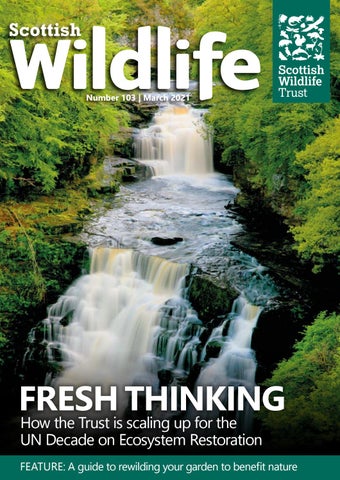
Number 103 | March 2021
FRESH THINKING How the Trust is scaling up for the UN Decade on Ecosystem Restoration
FEATURE: A guide to rewilding your garden to benefit nature
Welcome Social frommedia the Chief link/Web Executive link
FIRST WORD From Chief Executive Jo Pike © John MacPherson/2020VISION
W
e all have our own relationship with nature. It is time in the garden watching a butterfly, it’s a walk in the hills spotting a golden eagle overhead, an afternoon in a bird hide with binoculars, a trip on a boat looking for dolphins. Nature is a special place from childhood, a favourite view, the sound of a woodland stream. It serves different needs at different times. Research has suggested that the stronger your memories of the beauty of nature in childhood, the more likely you are to have a sense of purpose in later life. But even if that’s the case, your most memorable wildlife moment might be something you spotted only last week, or it could even be something yet to come – an experience just around the corner. Nature takes on an even greater significance when we consider the food we eat, the water we drink and the air we breathe. In reality, the natural world affects every aspect of our lives – it is part of us, and we are part of it. And yet nature is in crisis, and we risk realising this too late. The UN has designated 2021 to 2030 as the Decade on Ecosystem Restoration. 2030 is the deadline for achieving the 17 globally agreed Sustainable Development Goals – the world’s ‘blueprint to achieve a better and more sustainable future for all’. Increasingly, it is recognised that without restoring the natural world, we won’t achieve any of these goals. The Scottish Wildlife Trust’s vision is of a network of healthy, resilient ecosystems on land and sea, supporting
Breaching bottlenose dolphins – a treat for sea kayakers in the Moray Firth
Scotland’s wildlife and people. The Trust’s current strategy, which guides our decisions as we work towards our vision, runs until March 2022. We are now developing the next one, which we’re calling ‘Strategy 2030: Nature at the heart of Scotland’s future’. By 2030, we want to see nature’s decline reversed. At the same time, we want to see the restoration of nature helping to bring climate change under control, by locking up carbon on land and sea, and by increasing our resilience to flooding and other impacts. We also want to see people and communities reconnect to the natural
The Scottish Wildlife Trust’s vision is of a network of healthy, resilient ecosystems on land and sea, supporting Scotland’s wildlife and people.
world, championing its central role in our future. We know the Scottish Wildlife Trust can’t achieve these things alone, which is why we have identified four big goals to focus on from April 2022 to 2030. We are now asking for your views, which will help us identify priorities and milestones on this journey. Whether you’re thinking about the nature in your back garden or the species in Scotland’s vast deep seas, your feedback will be hugely valuable in helping shape the Trust’s ongoing response to the nature crisis. I very much hope you will consider taking a few minutes to answer the survey included with this issue. You can also support our new Resilience Fund (see page 21) and/or take a minute to create your personal account in a new section of the Trust’s website (see page 20) that lets you create your own personal journey to experience nature and help it recover. MARCH 2021 SCOTTISH WILDLIFE 3
Contents
Inside this issue
06
W YEAR IN A ’ OF O S WORTH READ UTDOOR ADVEING FROM NTUR INK. OUS SEE
16
PAGE 33
06 COASTAL CLIFFS
Scotland’s coastal cliffs are home to a remarkable assemblage of life.
08 NEWS
News round-up from the Trust and the world of conservation.
16
THE TIME IS NOW
As we enter a crucial decade, Rich Rowe explores the many different ways that the Trust plans to deliver transformational change for biodiversity across Scotland.
22 24
Q&A We speak with Chris Stark, Chief Executive
of the Climate Change Committee.
LET THE WILD BACK IN
Jim Ashton explains how gardens large and small can be rewilded to create a rich diversity of habitat.
28
SEABIRD SOUNDINGS
24
28
Kenny Taylor describes how Scotland’s seabirds can indicate change in the marine environment.
31 32 34
BIG PICTURE
Clare Harte is captivated by a family of foxes in a friend’s garden.
WATCH OUT FOR Things to enjoy over the coming months.
TALKING POINT Three of the Trust’s Young Leaders outline their hopes and resolutions for 2021.
Riparian woodland at Corra Linn, Falls of Clyde © Ronald W Weir. Scottish Wildlife magazine is published by the Scottish Wildlife Trust. © Scottish Wildlife Trust. No part of this magazine may be reproduced without the express permission of the publisher. All photography © Scottish Wildlife Trust unless otherwise stated. The Scottish Wildlife Trust accepts no liability for omissions or incorrect data in advertisements and letters. Views expressed in Scottish Wildlife are not necessarily those of the Scottish Wildlife Trust. ISSN: 0143 1234. Registered office: Harbourside House, 110 Commercial Street, Edinburgh EH6 6NF. Tel: 0131 312 7765. Fax: 0131 312 8705. Email: enquiries@scottishwildlifetrust.org.uk. Website: scottishwildlifetrust.org.uk. The Scottish Wildlife Trust is a company limited by guarantee, registered in Scotland (no. SC040247). It is also a Scottish registered charity (no. SC005792). Scottish Wildlife is published three times a year: March, July and November.
The Scottish Wildlife Trust is affiliated to The Wildlife Trusts, a UK-wide network of 46 Trusts with more than 2,000 wildlife reserves. 4 SCOTTISH WILDLIFE MARCH 2021
Deadlines for news: 1 January, 1 May, 1 September. No unsolicited articles please. Scottish Wildlife is free to members. Membership rates from 1 April (excluding discounts for paying by Direct Debit): Individual (concession) £40 (£18); Joint (concession) £47 (£24); Family £57; Watch £18; Life (joint) £900 (£1,300); World/Overseas £45. Patron: HRH The Prince Charles, Duke of Rothesay. Chair: Linda Rosborough. Vice-Chairs: Karen Chambers, Bill Lambert, Kenny Taylor. Chief Executive: Jo Pike Managing Editor: Pete Haskell editor@scottishwildlifetrust.org.uk Contributing Editor: Rich Rowe Design: Connect connectcommunications.co.uk Advertising: Elliot Whitehead 0131 561 0021, Clare Stebbing 0131 561 0024. Printing: InkMark – inkmarkltd.com
Spotlight: Great skua
© Amy Lewis
SPECIES SPOTLIGHT:
GREAT SKUA (Stercorarius skua)
One of four species of skua found in the northern hemisphere, great skuas breed on rocky coastal islands and moorland in the far northwest Highlands and islands.
In Orkney and Shetland, great skuas are known as bonxies, which is thought to derive from the Norse ‘bunksie’, meaning thick set.
Great skuas regularly harass other seabirds into dropping their catch, although they also predate smaller species such as puffins, kittiwakes and fulmars.
These aggressive, ‘piratical’ birds are truly formidable: they have even been known to force birds as large as gannets into the water and drown them for their catch.
Great skuas have little fear of humans and will readily divebomb anyone foolish or unlucky enough to step too close to a nest.
MARCH 2021 SCOTTISH WILDLIFE 5
Spotlight: Coastal cliffs
CLIFF HANGERS Shaped and scoured by the pounding surf below, Scotland’s coastal cliffs are home to one of the most colourful assemblages of life anywhere in the country. While specialist, salt-loving plants and wildflowers thrive on the maritime heath and grassland at the cliff edge, the cliffs themselves house raucous
seabird ‘cities’ – the sight, sound and smell of which rarely fail to enthral. Each species prefers a distinct position in the vertical pecking order. Puffins nest in burrows on clifftops, while fulmars, razorbills, guillemots, kittiwakes and other seabirds defy gravity as they pack every available ledge and crevice. Near
the base of the cliffs, glossy-green shags gather in large colonies. All feed in coastal waters that are home to a rich variety of marine mammals – many of which can be spotted from cliff-top vantage points. It’s a vertigo-inducing slice of life that says much about the health of our seas.
GREAT SKUA
FULMAR
Dark and stout from a distance, and with a characteristic hooked bill, this fearsome, piratical seabird has a wingspan of up to 140cm and shows white wing flashes in flight.
Fulmars produce a foul-smelling stomach oil that serves both as a defence mechanism when ejected from the bird’s mouth and as an energy reserve to feed hungry chicks.
FOX MOTH
SHORT-BEAKED COMMON DOLPHIN
Named after its colouration, the foxy-red male moths can be seen on sunny afternoons as they fly rapidly just above the ground in search of the much larger females.
6 SCOTTISH WILDLIFE MARCH 2021
Fast, acrobatic and highly vocal, common dolphins eat a varied diet of squid and fish, using co-operation to herd fish to the surface so they can catch them more easily.
Spotlight: Coastal cliffs
A
B C D
RESERVES Here are five reserves that provide a flavour of the glorious cliff habitat found around the Scottish coast.
A HANDA ISLAND (pictured)
SEA CAMPION In flower from May to September, this perennial herb has pink- and purple-veined calyx flowerheads with five white, bilobed petals – giving the illusion of ten petals instead of five.
Combining breathtaking scenery with a stellar cast of wildlife, Handa is one of the most wild and dramatic of all the Trust’s reserves. In summer, more than 70,000 seabirds breed on towering cliffs of Torridonian sandstone, while there’s every chance of spotting seals, minke whales, dolphins and basking sharks in the waters all around.
B LONGHAVEN CLIFFS
Longhaven’s pink-red granite cliffs provide not just spectacular views of seabird colonies, but also of the array of sea stacks, caves and arches that punctuate this part of the east coast. In summer, the clifftops are awash with colourful wildflowers, while seals bask on the rocks below.
C SEATON CLIFFS
Another east coast gem, with spectacular red sandstone cliffs, numerous sea caves, stacks, blowholes and arches. The reserve includes an array of wildlife-rich habitats, including wildflower meadows, sand dunes and woodland, while dolphins are often seen offshore.
D CARLINGNOSE POINT
SANDEEL Highly nutritious, these plankton-feeding fish are an important prey item for many other species, making them a vital link in the marine food web.
Perhaps not the most obvious pick as a key coastal cliff, but this disused quarry in North Queensferry is home to good numbers of breeding fulmar in spring and summer. The nearby grassland supports a range of rare plant species such as dropwort and field gentian.
E HILL OF WHITE HAMARS
Located on the south coast of South Walls, Orkney, the narrow inlets of Hill of White Hamars provide outstanding close-up views of cliff-nesting seabirds. There is plenty of other interest here too, with impressive coastal features, stunning wildflower displays and windswept seascapes.
MARCH 2021 SCOTTISH WILDLIFE 7
Handa Island © Danni Thompson, Great skua © Amy Lewis, Fulmar © Barrie Williams, Sea campion © Vaughn Matthews, Fox moth © Tapio Kujala. Short-beaked common dolphin © Chris Gomersall/2020VISION, Sandeel © Graham Saunders/NatureScot
E
Scottish Wildlife Trust news
Latest news
News from the Trust, our projects and the wider world of conservation
its part
See page 16
8 SCOTTISH WILDLIFE MARCH 2021
A step forward for Scotland’s seas THE SCOTTISH Government has designated four new Marine Protected Areas (MPAs), designed specifically to protect mobile species including basking sharks, minke whales and dolphins, alongside 12 new Special Protected Areas for marine birds. In 2018, the Trust joined forces with the Marine Conservation Society to campaign in support of the Sea of the Hebrides MPA in an effort to protect the basking sharks that travel great distances to gather in the area each summer. “We still have a lot to learn about basking sharks, but it is increasingly clear that helping them to thrive in Scotland’s seas is vital to their survival,” commented Dr Sam Collin, the Trust’s Living Seas Manager. “On behalf of everyone who supported our joint campaign, we are delighted that the
Scottish Government has now confirmed the designation of these new protected areas.” However, the Trust believes that the designation of protected areas is just the first step towards the protection and recovery of marine wildlife and is now calling for all of Scotland’s MPAs to be further supported through the implementation of effective management measures. Scottish Environment LINK’s Ocean Recovery Plan, developed by experts including staff from our Living Seas team, calls for at least 30% of Scotland’s seas to be managed under high levels of protection, where only low-impact activities are allowed. It also calls for at least a third of this area to be designated as ‘fully protected’, meaning a ban on all destructive or extractive activities.
© Alex Mustard/2020VISION
Dougie Peedle, Head of Policy
All the latest Trust news is available on our website scottishwildlife trust.org.uk
A basking shark filtering plankton from nutrient-rich waters in the Sea of the Hebrides
A pivotal year for nature
IN February, we saw the long-awaited publication of the independent, global review on the economics of biodiversity, led by Professor Sir Partha Dasgupta of the University of Cambridge. Its conclusions were that “our economies, livelihoods and wellbeing all depend on our most precious asset: nature”. This is a lesson that we have yet to learn in Scotland. We have seen a long-term decline in our natural capital of nearly 20% between 1950 and 2000, and no sustained improvement since. This is coupled with the grave plight of Scotland’s wildlife, where nearly half of the country’s species have declined in the last 25 years. The end result, as Dasgupta points out, is that we demand far more from nature than it can provide and need 1.6 Earths to maintain our current way of living. With Holyrood elections due in May, the arrival of what is already being regarded as a seminal report is good timing for Scotland. The next parliament needs a new economic strategy that recognises our dependencies on nature and commits to new investment in nature-based solutions. This must be far more ambitious than existing commitments to peatlands and forestry. It should embed a holistic approach across the whole of our natural environment, including urban and marine habitats. The next government must ensure that during the COP26 conference in November, when the eyes of the world fall on Scotland, we can demonstrate that we have truly taken Read how th Dasgupta’s advice e T rust will pla to heart. y
KEEP UP TO DATE
Scottish Wildlife Trust news
© Jennifer Young
Record-breaking squirrel survey
Award for a life’s work moths and freshwater invertebrates and goodness knows what else, but the thing I’m most proud of is all the people I’ve worked with, and all the students I’ve had the pleasure to teach. “Many of these students are now in senior positions in nature conservation and they are my legacy in many ways.” In addition, Dr Róisín Campbell-Palmer was awarded the Conservation Science prize for her long-running work on beavers, which has directly influenced conservation policy and helped to secure a long-term future for the species in Scotland.
Seeing double: red squirrel by a woodland pool
© Mark Hamblin/2020VISION
TRUST volunteer and former Council member Dr Mark Young (pictured) was presented with the Lifetime Achievement Award at the 2020 Nature of Scotland Awards. Mark is widely regarded as one of the UK’s foremost experts on micro-moths. During a long career lecturing at the University of Aberdeen, he inspired generations of students to pursue careers in conservation. He is also convenor at Longhaven Cliffs Wildlife Reserve and served on the Trust’s Council of Trustees from 1978-85 and 1990-97. Accepting the award, Mark said: “I’ve worked a lot with
THE 2020 Great Scottish Squirrel Survey, which took place from 21-27 September, saw a record number of squirrel sightings reported by the public. Between them, some 2,100 people – three times the number that took part in the first national survey in 2019 – logged more than 3,000 sightings of red and grey squirrels, providing valuable data for conservationists. A total of 548 grey squirrel and 2,612 red squirrel sightings were reported
during the week-long survey. Dr Mel Tonkin, Saving Scotland’s Red Squirrels Project Manager, said: “Reporting a squirrel sighting is a small act that helps to protect one of Scotland’s most charismatic yet threatened species. “Records from the week help us to create a detailed snapshot of the situation on the ground and allow us to make informed conservation decisions based on distribution and population changes over time.” Squirrel sightings can be recorded year-round at scottishsquirrels.org.uk
© Ron Mitchell
Winter of egret A GREAT white egret has wintered at Montrose Basin for the first time on record. First recorded on the reserve in August 2020, the bird was sighted on a regular basis throughout the winter months. Numbers have increased dramatically in Europe over the last 40 years due to increased habitat, greater legal protection and the changing climate. The species was first spotted on the Basin in 2011.
The great white egret at Montrose Basin
MARCH 2021 SCOTTISH WILDLIFE 9
Scottish Wildlife Trust news
Beaver feeding in a loch at Knapdale
Volunteers from Europe YOUNG volunteers from France and Spain hosted by the Trust through the European Voluntary Service have made the most of their introduction to practical conservation. Between March 2019 and July 2020, 15 volunteers contributed a total of 11,276 hours to the management of nearly half of our reserves, helping to maintain key areas of habitat, from peat bogs to species-rich grasslands. The volunteers learned valuable skills and gained experience that increased their employability – with 100% of those who responded to a follow-up survey having now found work or continued with further volunteering or study.
Record jack snipe count A TOTAL of 61 jack snipe (pictured) – a new UK record – were counted at Cathkin Marsh Wildlife Reserve this winter. These small waders migrate to the UK each year to escape the harsh conditions found in northern Europe. Sensitive grazing by the Trust’s hardy herd of Shetland cattle has created good conditions for snipe on the reserve, including shortened and thinned vegetation and open muddy areas where the birds can feed. © Dave Appleton
Save the date THE TRUST’S 57th Annual General Meeting will be held on Saturday 11 September 2021. Full details, including how to book, will be announced in the next issue of Scottish Wildlife.
Learning Zone EDUCATION activities on the Trust’s website have been viewed more than 32,000 times since the launch of our Learning Zone in April 2020. The Learning Zone is a growing collection of nature-based resources aimed at children of all ages. From making animal masks and nest boxes to indoor scavenger hunts, these resources are perfect for group leaders and teachers, as well as anyone looking for a day of fun with the family. Find out more at scottishwildlifetrust.org.uk/learn 10 SCOTTISH WILDLIFE MARCH 2021
Boost for Knapdale beavers THE FRAGILE population of beavers in Knapdale Forest is on a more secure footing as a result of a successful reinforcement project carried out by the Trust in partnership with the Royal Zoological Society of Scotland. A total of 21 beavers were released into Knapdale between 2017 and 2019, the majority of which were relocated from Tayside and originate in Bavaria. The new arrivals have helped increase the number, range and, crucially, genetic diversity of the beaver population within Knapdale. No successful pairing between the newcomers and the Norwegian beavers introduced during the initial Scottish Beaver Trial has been detected yet, but that is expected to happen in the near future. “As only a limited number of beavers were introduced during the trial, it was important to go back and release more beavers, giving them a good chance to thrive,” commented Gill Dowse, the Trust’s Knowledge & Evidence Manager. “After three years of fieldwork we can be confident this reinforcement
project has been a success, and that we have done all we can to bolster the wild population in Knapdale.” The long-term hope is that the isolated Knapdale population will connect with other wild beavers in the future either through natural expansion or further releases in the area around Loch Awe. The project’s final report, available on the Trust’s website, makes a number of recommendations for the future of beavers in Knapdale and Scotland. These include developing a national conservation action plan, permitting reintroductions in other suitable areas of Scotland and widening the ‘founder base’ by introducing more animals from Europe. “To ensure we fully benefit from the return of beavers and minimise future conflicts, it is important to develop a clear action plan for the future of this protected species,” added Gill. The Scottish Beavers Reinforcement Project was supported by a range of funders, including Trust Members and players of People’s Postcode Lottery.
Online climate discussion
AHEAD of the COP26 conference in Glasgow, our Young Leaders organised a discussion for young people aged 13 to 30 looking at climate change. This event, at the end of January, featured talks from a range of perspectives, including a young climate activist and an academic researcher. The audience was able to learn about climate change and its impacts, gain ideas on how individuals can help tackle the problem, and hear about the Trust’s current work in this area. They also had the chance to put questions to the panellists. A recording of this event, alongside talks on topics including lynx reintroduction, red kites and botany, is available on our website. To watch these and more, visit scottishwildlifetrust.org.uk/onlinetalks
© Russell Savory
IN BRIEF
Scottish Wildlife Trust news
Improving access VISITORS to the Trust’s Seafar Woods Wildlife Reserve and North Lanarkshire Council’s Ravenswood Local Nature Reserve will find both sites much easier to explore thanks to improvements carried out through Cumbernauld Living Landscape’s Creating Natural Connections project, which is being led by the Trust and supported by the National Lottery Heritage Fund. The improvement works, primarily funded by the Campsies Centre
Cumbernauld Ltd, included draining and resurfacing sections of muddy, rutted paths through areas of woodland that have much to offer throughout the seasons. Both are alive with birds all year round, and become full of wildflowers, bees and butterflies as the year progresses. Elsewhere, the boardwalk at Falls of Clyde Wildlife Reserve will also be upgraded this spring thanks to funding from Viridor Credits. Up to 60,000 people use the boardwalk annually.
© Clare Toner
The boardwalk at Falls of Clyde
Scottish Parliament passes Continuity Bill THE APPROVAL by MSPs of a final Continuity Bill just before Christmas ensures that environmental laws and regulations in Scotland following Brexit must now keep pace with the high standards set by the European Union. Thanks to campaigning by the Trust and Scottish Environment LINK through the Fight for Scotland’s Nature campaign, the final bill was strengthened significantly as it passed through the Scottish Parliament. As a result of this lobbying, Environmental Standards Scotland – the new environment watchdog agency created by the bill – has both a stronger legal standing and greater independence from government. Scottish Ministers are also now legally obliged to continue considering key principles including polluter pays and the precautionary principle in their decision making. However, MSPs did not give individuals the power to have their complaints investigated by the new agency. “The Continuity Bill is important for the future of Scotland’s environment because leaving the EU has taken away many of the most important safeguards we have,” commented Bruce Wilson, the Trust’s Public Affairs Manager. “We are pleased that MSPs have taken the opportunity to deliver strong legislation and there is still a great deal to do in this area. We will be engaging closely with government to ensure that high standards are maintained, and that Scotland’s environmental regulations are as strong as possible.”
Nectar Network continues to expand media channels and while out working,” reported Lynne Bates, Network Co-ordinator. “We’re keeping our fingers crossed for a good display of wildflowers in the summer.” The Nectar Network is also working with the Ayrshire Coastal Path to raise awareness of both the network and the importance of Ayrshire’s varied coastal habitats for pollinators. Eight new information panels have been erected along the path to help inform walkers.
© Lynne Bates
THE TRUST-led Irvine to Girvan Nectar Network project has sown five new wildflower meadows in Ayrshire. There are now areas of wildflowers at Dragon Meadow and Pond Meadow, while three further areas have also been created along coastal path edges and field margins in partnership with the Ayrshire Coastal Path and a local landowner. “We’ve had positive local feedback, both through our social
Preparing the ground at Dragon Meadow, Ayrshire
MARCH 2021 SCOTTISH WILDLIFE 11
Scottish Wildlife Trust news
© Andy Summers
© Scottish Wildlife Trust
Duddingston Loch from Edinburgh’s Holyrood Park
An ancient hazel
Capital coherence THE TRUST is leading on the creation of a new Ecological Coherence Plan for Edinburgh, developed alongside experts and city residents. The work involves identifying areas of open space that people would like to protect, including important areas of woodland that are good for people, plants and animals. Also under investigation are open areas that could be joined up to provide better connected habitat for both people and nature.
A big part of the plan involves making more of the ecosystem services provided to the city by the natural environment. In practical terms, this means identifying areas where trees and plants are performing the important job of absorbing pollution from cars and other vehicles in the city, as well as areas of ponds, rivers and wetlands that are able to capture water during heavy periods of rain and prevent the houses around them from flooding.
Join our governing Council THE Trust is looking for volunteers with expertise in ecology, conservation, digital communications, or fundraising to join our governing Council. Elected Trustees will take office from this year’s AGM (held on Saturday 11 September) for an initial term of three years. Completed nomination forms must be returned by 31 May 2021. Ian Jardine was co-opted as a Trustee earlier this year following a long career in nature conservation, including 15 years leading Scottish Natural Heritage (now NatureScot). He brings a wealth of experience to the Trust. To find out more about becoming a Trustee, contact Susan McKenzie, Company Secretary, smckenzie@scottishwildlifetrust.org.uk.
A rainforest in the north MANY people think of northwest Scotland as a landscape made up of striking mountains, dark lochans and blanket bog. However, a recent project that surveyed thousands of hazel trees across the Coigach and Assynt area has revealed that such trees are actually an intrinsic part of the landscape. The Hazel Audit Project, led by Assynt Field Club as part of the Coigach & Assynt Living Landscape Partnership (CALLP), found some trees of up to 1.5m girth – massive by hazel standards. The report of the findings also shows how the trees are closely woven into the area’s history, with hazelnut shells found in the Iron Age Clachtoll Broch and other archaeological sites. Chair of the Assynt Field Club, Andy Summers, commented: “The Assynt Field Club is extremely proud of this report. It proves something that we had always suspected – that Assynt has some very important relics of ancient hazel woodland.” Such areas of hazel woodland form part of Scotland’s Celtic rainforest and identifying where they cling on is a key first step in protecting them for the future. The full report is available on the CALLP website, coigach-assynt.org
Funding enables extension of conservation grazing SPECIES-rich grasslands are one of Scotland’s rarest habitats, having declined by 90% over the last 50 years. Thanks to new funding from NatureScot, the Trust is now working to protect and enhance this habitat across its reserves in Fife and Central Scotland. A £120,000 award from the NatureScot Biodiversity Challenge Fund will be
12 SCOTTISH WILDLIFE MARCH 2021
used to extend conservation grazing programmes on eight reserves, and purchase specialist equipment to support grassland management on a further five reserves. “Healthy grasslands support a wealth of wildflowers, invertebrates and birdlife, although sadly they are among Scotland’s most threatened wildlife
habitats,” explained Alan Anderson, the Trust’s Head of Reserves. “This funding will allow us to continue to pioneer the use of conservation grazing, using sheep and cattle to ensure that grasslands are working for wildlife. It will also ensure that we have the right equipment to carry out sensitive management where grazing is not possible.”
Wider news
© Highland Wildlife Park
One of the kittens at the Highland Wildlife Park
Wildcat breeding success critically endangered species. Scotland’s wildcats are on the brink of extinction due to habitat loss, persecution and breeding with domestic cats. RZSS is also now leading a new partnership project, Saving Wildcats, which aims to secure a future for the Highland tiger by breeding wildcats and releasing them into the wild. “Wildcats are one of Britain’s rarest and most endangered mammals which means that every one of these kittens is a potential lifeline,” commented David Barclay,
Coordinator of the UK conservation breeding programme. “Over the last few years, members of the wildcat breeding programme have demonstrated the immense value in working together to secure a future for this iconic species.” As part of the Saving Wildcats project, a dedicated conservation breeding for release centre is being built at the Highland Wildlife Park in the Cairngorms. This centre aims to release the first animals into the wild in 2022.
Buglife brings B-Lines to Scotland
14 SCOTTISH WILDLIFE MARCH 2021
© Paul Hetherington
RESPONDING to the decline in numbers of pollinating insects, invertebrate conservation charity Buglife has launched its B-Lines project across Scotland – an effort to reconnect wild places by creating a network of wildflower areas across the landscape. B-Lines include the best habitat for pollinators and priority areas where habitats can be restored, with farmers and landowners, local authorities and the general public all invited to get involved. “Launching B-Lines across Scotland will help us forge
Flower-rich meadows are vital for pollinators
strong regional partnerships so together we can ensure that the important ecological services provided by pollinators can be sustained,” explained Natalie Stevenson, Buglife Scotland Manager. “People across Scotland are realising how critical invertebrates are for a naturerich future and are beginning to change the way they manage areas of grassland, but there is so much more that we can do.” To find your nearest B-Line, and get involved, visit buglife.org.uk/b-lines
POLICE Scotland is almost halfway through a targeted, year-long campaign designed to tackle specific aspects of wildlife crime. Launched in October, Operation Wingspan began with a particular focus on trade in endangered species, although it has since expanded to cover the seven wildlife crime priorities set by the UK Wildlife Crime Tasking and Co-ordination Group and the National Wildlife Crime Unit. Priority areas include badger and raptor persecution, bat crime, poaching and cyber-enabled wildlife crime. The campaign is being delivered through a mixture of operational policing activity, internal training, strong partnership working and action to raise public awareness of wildlife crime. © Bob Coyle
THE Royal Zoological Society of Scotland (RZSS) has reported a record breeding year after 57 wildcat kittens were born within the UK conservation breeding programme in 2020. A total of 22 litters of kittens were welcomed across 10 of the zoos, wildlife parks and private collections working with the wildlife conservation charity. RZSS has managed the captive population of wildcats since 2015, ensuring it has the potential to support conservation efforts for this
Police Scotland targets wildlife crime
Wren with hungry chicks
Woodland birds bounce back SCOTLAND’s woodland birds appear to have recovered from the steep decline thought to be caused by unusually cold and wintry conditions in 2018 when the so-called ‘Beast from the East’ was linked to a 12% fall in the nation’s woodland birds. Happily, the latest British Trust for Ornithology’s national Breeding Bird Survey shows numbers of wren and goldcrest – two woodland species most affected by the harsh conditions – have increased by more than 20%. The longer-term trend for woodland birds is also mostly positive, with an increase of 59% between 1994 and 2019. Numbers of species such as chiffchaff, great spotted woodpecker and blackcap have all increased significantly during that period, although populations of species such as treecreeper continue to decline. Thanks to dedicated volunteers, the Breeding Bird Survey monitors population changes for 66 widespread breeding bird species in Scotland, helping to inform future conservation policy. For more, visit bto.org
Ecosystem restoration
THE TIME IS
NOW
As we enter the UN Decade on Ecosystem Restoration, the Trust is developing a new strategic approach that will help deliver its vision for transformational change for biodiversity across Scotland, writes Rich Rowe.
© Andy Rouse/2020VISION
16 SCOTTISH WILDLIFE MARCH 2021
© Terry Whittaker/2020VISION
© Luke Massey/2020VISION
Ecosystem restoration will enable a whole host of species to thrive, including heron, pine marten, dipper and otter
Ecosystem restoration
© Chris Puddephatt/Woodland Trust
© Niall Benvie/2020VISION
Tree planting in Assynt
A
The Coigach & Assynt Living Landscape is one of the largest landscape-scale restoration initiatives in Europe © Andy Rouse/2020VISION
year forward, but a year back. Twelve months ago, 2020 was touted as being a defining year for biodiversity, but then Covid-19 took hold. And, as yet, it has still to release its grip. So, can 2021 be that defining year instead? Once again, hopes are high, not least as this year marks the beginning of the UN Decade on Ecosystem Restoration – a global effort to prevent, halt and reverse the degradation of ecosystems worldwide. With an official launch date on World Environment Day (5 June), the UN Decade is a rallying call with a clear message: it is only through healthy ecosystems that the world can improve people’s livelihoods, counteract climate change and prevent the collapse of biodiversity. Led by the United Nations Environment Programme and the Food and Agriculture Organization of the United Nations, the UN Decade runs until 2030 – the deadline for the Sustainable Development Goals set by the UN General Assembly in 2015. It is also the timeline that scientists have identified as a key deadline for preventing catastrophic climate change and reversing the loss of biodiversity. Building political momentum will be key, as will the thousands of initiatives that are planned on the ground. It’s an ambitious, large-scale vision that requires bold action from individual countries everywhere, including Scotland.
FRESH THINKING
Informed by the restorative action outlined by the UN Decade, and the urgent need for transformational change, the Trust has refined its own strategic thinking. The result is a renewed focus on giving individuals and communities an opportunity to play their part, and on their own terms. The development of the Trust’s new strategic direction is underpinned by three key initiatives: detailed consultation with members (see enclosure with this issue) to help shape headline priorities identified for the next decade; the launch of a new Resilience Fund (see page 21); and, later in the year, the launch of a wide-ranging engagement campaign that will bring to life the Trust’s aspiration that everyone can play their part in saving the natural world. The three all tie together closely. “We want to provide the means for people to become involved in the way that best suits them, whether that’s on a practical level, financially, or by sharing ideas to help shape our strategy,” explains Jo Pike, the Trust’s Chief Executive. In a sense, this is not so much a new direction for the Trust as the next phase in its evolution. “The Trust has always been good at bringing different stakeholders together and finding common ground,” says Jo. “We can do this in a way that delivers benefits to many parts of society.” The evolution of the Trust has already seen a shift from its MARCH 2021 SCOTTISH WILDLIFE 17
Ecosystem restoration
© Peter Cairns/2020VISION
Red squirrel in woodland
18 SCOTTISH WILDLIFE MARCH 2021
SCALING UP
Scale is a key word, not just in terms of what is needed to stem the loss of biodiversity, but also in relation to the Trust’s ambition. “It’s about matching the scale of our ambition to the scale of our vision across both land and sea,” explains Jo. Recognising that reversing biodiversity loss is a collective endeavour, there is a particular eagerness to broaden participation. This might mean different things to different people. “Everyone a conservationist – that’s what we want,” stresses Jo. “Even though people might not label themselves as such, we need everyone coming together on this. We have to remove any barriers people might face in getting involved.”
TRACK RECORD
© Peter Cairns/2020VISION
early focus on the habitats and species within the boundaries of wildlife reserves to one which sees those reserves at the heart of an increasing number of landscape-scale partnerships. “The next stage is how we deliver change across the whole of Scotland,” explains Jo. “This means bringing together an even wider range of stakeholders than we might have worked with in the past to find that common ground.” Collaboration is vital, but so too is determining how to make the most meaningful contribution – in other words, when to lead and when to play a supporting role. “Both are equally important,” believes Jo. “The clearer we can all be about the contribution we can make to the effort to reverse the loss of biodiversity, the more likely we are collectively to succeed.” Through this more targeted approach, the Trust sees an opportunity to find solutions to challenges that are now better recognised than at any other time in its history – with climate change and biodiversity loss inextricably linked. “We know that by helping nature, we can fight climate change,” says Jo. “But we also know that the converse is not necessarily true. So, as a society, it’s vital to reduce our carbon emissions but if we only look at that, then that’s not necessarily going to help biodiversity. But if we look at restoring nature at scale, then that will also help us lock up huge amounts of carbon as well as make us more resilient to the effects of climate change such as flooding.”
Helping nature will also help fight climate change
Another piece of the puzzle comes in the shape of advocacy work and, in particular, a push for greater policy coherence. “Phasing out harmful subsidies, for example, is becoming more important than ever,” points out Jo. “We need to ensure that if hundreds of millions of pounds are spent in one area, the benefits are not cancelled out in another. Policy coherence is crucial if we’re to tackle the really big changes at the same time as delivering value for the taxpayer.” Already, the seeds of this more holistic approach have been sown through the Trust’s new Champions for Change collaboration with NFU Scotland. Together, the two organisations have called for a commitment to fairer, long-term funding for schemes that deliver tangible biodiversity and climate benefits. Both would also like to see a focus on investment in natural capital and genuine environmental improvement – actions that would help support the rural economy so it can play a key role in delivering a green recovery from Covid-19. With a strong track record in delivering a variety of on-the-ground conservation projects, the Trust brings credibility, clarity and considerable expertise to the conversation. And two projects in particular – one long-established, one just getting under way – highlight the kind of large-scale, joined-up thinking that will be so crucial going forward. Conceived by the Trust in 2009, the Coigach & Assynt Living Landscape Partnership (CALLP) initiative in the northwest Highlands reflects a long-held vision around scaling up nature conservation efforts from site-specific activity to an ecosystem scale. Encompassing more than 635 square kilometres of wild land, loch and sea, CALLP is one of the largest landscape restoration projects in Europe. From its outset, this partnership of community, charity and private landowners was about making nature conservation a far stronger element of socio-economic consideration and decision-making. “As well as working at multiple scales across a landscape, it continues to be about making the link between a healthy environment, a healthy economy, people’s wellbeing and ultimately the prosperity of Scotland,” explains Sarah Robinson, the Trust’s Director of Conservation. “Given where we are now, it was very much ahead of its time.” This kind of big thinking is mirrored in the Trust’s push for developing a Scottish Nature Network – a concept that was included in the recent Nature
Ecosystem restoration
© Chris Puddephatt/John Muir Trust
A CALLP volunteer repairs the Quinag path in Assynt
Recovery Plan, produced together with RSPB and WWF Scotland, as one of 11 immediate priorities for nature restoration in Scotland. “The idea is to connect all the best bits of habitat around the country, including our own reserves, and create corridors that allow species to travel between them,” explains Sarah. “This is so important as fragmentation is one of the biggest threats to biodiversity, but it’s super difficult to do.” Instead, and in something of a lightbulb moment, the Trust has set its sights on a network that already exists. Looking at a map of Scotland, it became clear how the country’s waterways – which together stretch for a staggering 125,000 kilometres – extend like fingers to almost every part of the land. This realisation has seen the Trust launch Riverwoods, a flagship project
that aims to improve this vast riparian zone. “If we can create riparian woodland and healthy, resilient river systems throughout Scotland, then we would go a long way towards creating an ecological network,” explains Sarah. Again, collaboration will be key, with many organisations already working on river restoration projects around the country. “We don’t want to appropriate these in any way but do wish to bring together these projects to share learning and identify how projects can be ecologically connected on the ground,” says Sarah.
EMBRACING UNCERTAINTY
But achieving such ambitious goals is rarely quick or easy, and not always linear in its progression. “The change we need will not necessarily happen in a way that we can predict, so we need to be
We need everyone coming together on this. We have to remove any barriers people might face in getting involved. more comfortable with some of that uncertainty,” notes Jo. And such uncertainty is no better illustrated than by the events of 2020 – a year like no other that, understandably, has influenced some aspects of the Trust’s thinking. “The talk of a green recovery is something new – it brings fresh impetus to linking environmental restoration with the health of the economy and creating jobs,” comments Jo. “With the renewed impetus and consciousness of these issues, we have a responsibility to respond.” But perhaps above all, the future for the Trust is about understanding and working to its strengths – not least a diversity that sees passionate members, volunteers and staff engage in everything from practical conservation work to high-level policy advocacy. “It is this diversity of approach that enables us to reach a wide audience of people and find that common ground,” believes Jo. “We must be brave, bold and speak out when needed, but most of all we need to work together with others to find solutions that help tackle the big problems that are common to us all.” Rich Rowe is contributing editor of Scottish Wildlife.
© Mark Hamblin/2020VISION
Healthy riparian woodland will be key to biodiversity recovery
MARCH 2021 SCOTTISH WILDLIFE 19
Digital engagement
© Katrina Martin/2020VISION
Personal touch CREATE YOUR FREE ONLINE ACCOUNT TODAY
Enjoy a more personalised online experience and gain access to exciting features and content in a new section of the Trust’s website.
20 SCOTTISH WILDLIFE MARCH 2021
© Katrina Martin/2020VISION
E
ver wanted to plan a tour of Trust reserves? Maybe keep a log of your conservation action? Or simply learn more about how to boost biodiversity in your area? All are now possible following the launch in March of a new section on the Trust’s website full of additional content and features to help members, supporters and volunteers plan and record their wildlife activity. By creating a Scottish Wildlife Trust account, users can tailor and personalise their Trust experience, making the website a tool for exploring Scotland’s nature in whichever way is of most interest. As well as account basics, such as being able to update contact details and preferences, users can now create wish lists of reserves to visit and activities that catch the eye, plus keep a virtual logbook of reserve trips and conservation action. Further personalisation is possible by signing up to receive recommendations and seasonal highlights based on recent activity, from best places to experience Scotland’s raucous seabird colonies to discovering areas of ancient woodland and top snorkel sites. Additional content is also available once users have created an account. While Trust members can browse a back catalogue of magazines and book
Cumbernauld Glen
member-only events, volunteers can access training materials and relevant documentation from a single place. Looking ahead, younger supporters will soon be able to work towards virtual badges to help them discover more about Scotland’s wildlife. “We’re delighted to go live with this new section of the website which we’ve had in mind for some time,” explains Pete Haskell, the Trust’s Head of
Communications & Engagement. “Our hope is that, by being able to plan and keep track of action and activity, users will feel more connected to the Trust and to Scotland’s wildlife.” Having had a sneak peek at the new functionality, Trust member Tracy Stone can’t wait to make use of all the features. “Over the last year, I’ve used the Learning Zone to find activities to do with my kids during lockdown,” she says. “Being able to save activities in a wish list will be really useful, while having badges that the children can work towards will be a nice incentive for them. “Active and outdoor experiences are really beneficial to each of our senses and while we all enjoy them differently, having a log helps us process and share the joy of those experiences.” And there are many more features planned for the coming months. “In the UN Decade on Ecosystem Restoration, we want to do everything we can to help people come together to help nature where they live – not just for wildlife but also for their own benefit,” says Pete. “We’ll be adding further functionality and launching a new engagement campaign to facilitate this later in the year.” To create your account, visit scottishwildlifetrust.org.uk
Resilience Fund
Rising to the challenge Ahead of a crucial decade for nature conservation, the Trust has created a dedicated fund to ensure that it is fully equipped to meet the many challenges that lie ahead. income at a time when Scotland’s natural world needs us more than ever before. “As Scotland’s leading nature conservation charity, it is vital that we increase our investment in nature before the damage becomes irreversible.” The new Resilience Fund focuses on three core areas of work that together speak of the symbiotic relationship between people, place and nature. The first focus is on building connections, expanding networks and increasing diversity around people’s engagement with the natural environment. “People are happier and healthier when they connect with nature – simply spending time outdoors brings a host of benefits for our physical and mental health,” comments Anna. “We want everyone, from all backgrounds, ages and ethnicities, to have the opportunity to enjoy the rewarding experiences that the natural world can provide. “But with one in nine Scottish species now facing extinction, we cannot take wildlife for granted or expect it to always be there, unless we act now.”
PLEA SE DONATE TODAY, AT
scottishw tr ust.org.uk ildlife /thefund
With climate change already impacting how the Trust manages its reserves, the second core focus of the new fund is to help build climate resilience. This means future proofing reserves to cope with the increased risk of coastal erosion, flooding and landslips; controlling the growing number of invasive non-native species that outcompete native plants and animals; and adapting traditional conservation techniques to strengthen ecosystems in the face of extreme weather events. “The third core focus is on promoting nature-based solutions,” says Anna. “This involves not just lobbying at a government level, but also demonstrating best practice across our own reserves.” From safeguarding woodlands and protecting pollinators to restoring areas of peatland, such work will help reduce flood risks, absorb pollution, improve water quality, encourage healthy, functioning ecosystems, and capture and retain carbon. “We know that the next decade will be pivotal in our efforts to counteract climate change, safeguard Scotland’s biodiversity and in turn enhance people’s futures,” adds Anna. “With a global focus on COP26 and the UN Decade on Ecosystem Restoration, there has never been a more urgent time to restore and protect our natural world.”
MARCH 2021 SCOTTISH WILDLIFE 21
© Andy Rouse/2020VISION
I
t is hard to overstate the importance of 2021, and the coming decade, for nature conservation – with strong leadership needed at both global and national level if genuine progress is to be made. And here in Scotland, the need for that leadership has never been more acute. As elsewhere in the world, Scotland’s climate and biodiversity face a serious crisis: ecosystems are in grave danger of collapsing; weather patterns are shifting; seasons are altering; and key habitats disappearing – all to the detriment of people and wildlife. In response, and to ensure that it is as well-equipped as possible to meet the challenges of the next decade, the Trust has launched an ambitious new Resilience Fund dedicated to protecting, restoring and enhancing Scotland’s natural environment. “The past 12 months have been difficult for many, including here at the Trust,” explains Anna Wright, the Trust’s Individual Giving Manager. “We are facing a significant loss in
Q&A News
Q&A
Chris Stark Chief Executive, Climate Change Committee
© Climate Change Committee
FORMERLY Director of Energy and Climate Change in the Scottish Government, for the past three years Chris Stark has served as Chief Executive of the Climate Change Committee – a statutory body that advises the UK and devolved governments on emissions targets, and reports to Parliament on preparing for and adapting to the impacts of climate change. If you had to sum up the past year in three words, what would they be and why? Change is here. I think we have seen throughout the past year our ability to change in an extraordinary way. What has Covid-19 taught us about the links between human behaviour and the state of our environment – and how might the experience influence our wider climate change ambitions? The pandemic has changed how we work, how we travel and what we value. That will ‘stick’ long after the memory of lockdown fades. Woodland, parks and our relationship with the outdoors have all become crucial for our wellbeing. I’ve never appreciated the greenspaces in my home city, Glasgow, more. So, perhaps we will accept the need to reach a better accommodation with nature. Climate change is often said to be a symptom of how we treat the planet’s resources. There are some parallels with this pandemic, as its roots are also in the clash between the modern economy and the natural world. Given the imperative to jumpstart the economy post-Covid, do you see opportunities to create more green jobs in Scotland? Scotland has jumped on woodland creation and peatland restoration as a major response to the economic crisis. I’m really pleased to see it, but I would still say that we haven’t fully embraced the opportunity, particularly in developing the new zero carbon industries we’ll need. We have developed a scenario that specifically prioritises lifestyle changes that can help achieve net zero – and demonstrate the changes needed in land use and agricultural practice so that they are more in tune 22 SCOTTISH WILDLIFE MARCH 2021
with the environment. If we get this right, land managers and farmers should expect to be rewarded for delivering these changes. That should be a positive message, not a threat to rural lifestyles. 2020 was meant to be a hugely significant year for action on the climate emergency. Do you think climate change has fallen down the priority list or will 2021 see an even greater sense of urgency? Of course, climate has fallen down the priority list – that’s entirely appropriate: Covid is an acute public health crisis. But I’ve been fascinated to see how high climate change has remained on the priority list. That feels new. It makes me very hopeful for what comes next – if we can tie together the economic recovery with green investments, we will see a lasting benefit. With the COP26 in Glasgow this year, we can’t duck it. But there’s much to feel positive about: the alternatives to fossil fuels are increasingly cheap, driving huge shifts in our energy outlook; we’ve seen how rapidly innovation can occur – not least in Covid vaccine development – and how
that can affect the outlook for climatepositive technologies like electric vehicles; and we have a new, supportive administration in the US, plus net zero commitments from the EU, China and South Korea. I think COP26 could be a real moment of optimism as the world emerges from the pandemic. This year marks the beginning of the UN Decade on Ecosystem Restoration. What are your hopes for what the decade might achieve? We’re only at the foothills of understanding the overlaps between the strategies needed to reduce emissions, improve biodiversity and respond to climate change itself. This is certainly the decade to get on track to net zero, but we need to do so in a way that benefits nature. We can’t approach trees and soils as technologies to be rolled out. And we’ll need to understand how the inevitable changes in the climate will interact with these strategies. It’s tremendously exciting, but we’ll need to get cracking to understand what works – we haven’t tried to do this before at the scale that’s needed.
MARCH 2021 SCOTTISH WILDLIFE 23
Wildlife gardening
Let the wild
BACK IN
Wildlife gardener Jim Ashton explores how gardens large and small can be rewilded to create habitat for a wide variety of species. Often, it begins with a pond.
A
tiny shimmer of blue drifts in instinctively disappears into cover, and out of the rushes, glints a clattering of wings and somersaults of sunlight reflected from four mark the arrival of an even larger visitor: miniature wings that beat in rapid, a female emperor dragonfly. She is shton A Jim hypnotic motion. As the azure here for breakfast – smaller © blue damselfly patrols damselflies are often on the the margins just above the menu – and also to lay her surface of the pond, tadpoles eggs. Next spring, a small swim in all directions in and formidable army of shallow water warmed larvae will stalk the by the morning sun. tadpoles amongst the lily Suddenly, the tranquil pads just below the surface scene is shattered as a of the water. Broad-bodied chunky, bright-blue torpedo It is the end of May and chaser of an insect appears, flitting left, I am kneeling beside a small right, and left again in a series wildlife pond at the heart of a rural of dashing movements. A male back garden – an oasis for wildlife and a broad-bodied chaser has arrived natural sanctuary for its owners. The to claim his territory. pond was created less than nine months But just as the azure damselfly ago and already looks as though it has 24 SCOTTISH WILDLIFE MARCH 2021
always been here. When work began on the garden in 2019, the plan was for the pond to be at its centre, with the rest of the design rippling out from its margins.
NATURAL INSPIRATION
In my work as a wildlife gardener, the natural world is always the inspiration for my project design. As I’ve discovered, the key to success when planning a haven for wildlife in gardens is to picture the site as a natural clearing in a wooded landscape. In simple terms, visualise woodland and scrub around the edges, moving down in height to tall grasses and robust plant species, then into open meadow and finally freshwater habitat at the heart of the scene. Ponds are among the richest ecosystems around. They don’t have to
Wildlife gardening
© Jim Ashton
© Jim Ashton
Planting woodland edge in winter
Small copper butterfly
be huge, but there are a few key points to consider if they are to provide great habitat for wildlife. Gently sloping sides are critical to allow safe access for all kinds of animals. Shallow, sunny margins, with warm water, provide an oasis for both invertebrates and developing amphibian larvae alike, and allow good planting opportunities, too. Longer vegetation, both in and around the pond, is crucially important for many species, particularly emerging amphibians that need cool, damp cover in which to hunt and shelter. Shyer species of birds and mammals, such as wren and water shrew, will also greatly appreciate them.
Common frogs with frogspawn
Nature rarely fails to impress, but it is truly extraordinary how rapidly aquatic animal species appear. This can literally be within a few hours of water filling a pond. I have known diving beetles and water boatmen to fly in within 24 hours and have even seen a female southern hawker dragonfly arrive while a pond was only half-full of water in search of a suitable spot to lay her eggs! Freshwater is endlessly wonderful.
NEXT STEPS
© Jim Ashton
Building up in scale, and with the pond in place, it’s time to think about the surrounding area. Open spaces lend themselves brilliantly to meadows, and they wrap naturally around wildlife ponds. Here, taller wetland plants blend seamlessly with wild grasses and nectar-rich wildflowers. Meadows are home to graceful marbled white and meadow brown butterflies, pygmy shrews and bank voles, and provide perfect hunting grounds for songbirds, bats and dragonflies. There are many ways to create a meadow, but the simplest and most organic one is to transform existing areas of grass. A surprising number of lawns across the UK are already full of wildflowers that never have a chance to flower and set seed. By simply relaxing mowing regimes, and planting additional species more typical of hay meadows, such as knapweed, ox-eye daisy, field scabious and sorrel, a wildflower meadow can soon be established. Beyond the pond MARCH 2021 SCOTTISH WILDLIFE 25
Wildlife gardening
© Jim Ashton
Song thrush in ivy
and meadow, the habitat can become wilder still as shrubs and scattered trees appear. This is where we enter a fascinating place – the magical woodland edge – where birds can nest and feed safely, invertebrates, amphibians and reptiles find all the shelter they need to survive the winter months, and bats forage for their nocturnal prey. When I plant woodland borders, I use a mix of native species, working up from
smaller shrubs at the front to taller woodland trees at the back, and climbing plants in between. When selecting the species to plant, there is always one fundamental question: what will best support local wildlife? Some of my favourite species, such as elder, are often overlooked by gardeners. Elder is brilliant for providing spring flowers for pollinators, late summer fruit for warblers and thrushes, plus soft branches with hollow centres that are
ideal for overwintering insects. When working with bigger spaces, oak, ash, Scots pine and wild cherry make a wonderful upper canopy, with birch, alder, aspen and rowan creating a sub-canopy below. A final shrub layer of hawthorn, hazel, holly and guelder rose creates ideal cover for many birds and small mammals, while it is also excellent for myriad species of invertebrate. As a bonus, honeysuckle grows well between all these plants.
FINISHING TOUCHES
© Jim Ashton
Leaf-cutter bee in hollow deadwood
26 SCOTTISH WILDLIFE MARCH 2021
In my work as a wildlife gardener, the natural world is always the inspiration…
© Jim Ashton
Whether transforming a smaller garden or a much larger space, it is also important not to forget the role of standing and fallen deadwood. Digging larger branches into the soil provides habitat for an array of wooddwelling beetles, solitary nesting bees and other insects. There is so much life that depends on death, so to speak. Meanwhile, logs and dead branches left on the ground will support not just insect life, but also small mammals such as wood mice and amphibians, including common toads and great crested newts. Reptiles, such as slow worms and grass snakes, also adore piles of logs, particularly in the sun, while pieces of bark laid in the vegetation, or piles
Wildlife gardening
Jim Ashton travels nationally designing, creating and looking after wildlife habitats, with projects ranging from private gardens to sites several hectares in size. wild-horizons.co.uk
Wood mouse
© Rosie Black
of leaves in autumn, also work wonders as shelter for many animals. When every crucial habitat is in place, and diversity begins to return to once sterile land, it becomes increasingly clear what our actions (and sometimes inaction) as gardeners bring to this complex web of life. By being mindful and observant, we can tune into these natural rhythms, and learn more about the intimate relationships between different species and their habitat. Observing in this way helps us understand when is a good time to act and when it is better to simply step back. It also quickly becomes apparent that a wildlife garden is a sanctuary all year round and that the animals that visit through the summer months may well have different needs to those present during the winter months. And at some point, while enjoying the vitality of a newly rewilded garden, there is often a wonderful realisation that such a space has not just made a difference to wildlife on the doorstep but is also an example of serious conservation in action. If this approach was adopted on a large scale, the benefits to UK wildlife would be truly phenomenal and our neighbourhoods would once again become rich, ecological stepping stones within the wider landscape.
Rustic garden at Jupiter, and (below) poplar and elephant hawk moths
Discovering Jupiter It’s amazing what can be achieved even in the most unlikely of places. In the middle of industrial Grangemouth, Jupiter Urban Wildlife Centre has become a haven for wildlife. Once the site of a railway siding, the Trust transformed this patch of waste ground into a thriving nature reserve and, since opening to the public in 1992, Jupiter has become a vital local greenspace. artin Every year, thousands of ire M Cla © schoolchildren and families visit Jupiter to discover the natural world and experience wildlife first-hand through activities such as minibeast hunting and pond dipping. The site features a variety of created habitats, including wildflower meadows, ponds and wetland areas, as well as an area of deciduous woodland which has naturally regenerated since the land was abandoned decades ago. Although a small reserve, this mosaic of habitats is home to a vast array of wildlife, including at least 12 species of butterfly, hundreds of moth species, healthy populations of common toads and palmate newts, and at least half a dozen damselfly and dragonfly species. With three themed wildlife gardens around the visitor centre, we hope to inspire visitors with features such as a
raised pond constructed from recycled materials, a skyscraper bug hotel and a living wall. But our gardens also showcase how easily nature can be brought into urban areas, with achievable ideas that anyone can try at home. The reserve’s upcycled garden is filled with ideas for making pre-loved items into eye-catching planters, while the rustic wildlife garden features a tiny pond brimming with life. Elsewhere, a contemporary garden demonstrates how space for nature can be easily incorporated into a more manicured garden. Crucially, Jupiter’s gardens continue to evolve, with new features and plants planned for this year. Look out for a new area showcasing top tips for helping nature when there is no outdoor space available at home. We also hope to recreate a small area of waste ground, demonstrating how a mixture of habitat creation and natural plant succession has transformed this former brownfield site into the flourishing urban nature reserve that it is today. Claire Martin, Ranger, Jupiter Urban Wildlife Centre
MARCH 2021 SCOTTISH WILDLIFE 27
Seabird soundings
SEABIRD SOUNDINGS How Scotland’s seabirds are key indicators of change in marine systems
Kenny Taylor explains how Scotland’s internationally important seabird colonies serve as key barometers of change in the wider marine environment.
28 SCOTTISH WILDLIFE MARCH 2021
T
here is something about a puffin with a beak-load of fish that never fails to fascinate. For many, the obvious question is: how does it catch and hold so many? Spines on the roof of its mouth and a notch where beak meets skull are part of the answer. But, for me, those multi-layered moustaches of glistening small fry raise even more interesting questions. They open a portal to the waters beyond the bird and shine a light into the ocean deeps. Other seabird species are available, of course, and the scenarios that make them so useful to people studying marine processes are broadly similar. To sketch the general picture: most seabirds concentrate their breeding activities in relatively few places and live for a long time. Some puffins can reach their thirties, for example (just one is known to have topped 40), petrels and albatrosses more than that. An adult tries to rear very few young in any one year but can keep breeding for many years. By focusing detailed research in a few
key colonies, seabird ecologists can keep tabs on the breeding, feeding and survival of seabird adults and chicks in consistent ways over long periods, sometimes based on the performance of known individuals. In turn, this information can help to determine how changes at bird level might relate to changes in prey species and the food of that prey – such as sandeels that feed on plankton in the North Sea. For scientists, studying some fish stocks and plankton is expensive, usually involving the use of specialist vessels that are only able to visit small areas of sea. Contrast this with the environmental sampling power of a large seabird colony, where tens of thousands of birds spread out to forage over large sea areas every day. Collecting food from some of them when they return from a fishing trip can have its challenges of weather, terrain and isolation for researchers. But it can still be cost-effective science. Scotland has long been part of international work to better understand
Seabird soundings
© Peter Cairns/2020VISION
Scotland has long been part of international work to better understand what seabirds can reveal about changing seas…
what seabirds can reveal about changing seas, including the energy-rich species of fish valued by birds and humans alike. The Isle of May National Nature Reserve, home to the largest puffin colony in the North Sea, is a key place for such research. This includes decades of work on puffins, guillemots and shags by Professors Mike Harris and Sarah Wanless and many reserve staff and students. In turn, information from those long-term studies can be compared with data from a sprinkling of other places, both elsewhere in Scotland and around the northern world. From the Firth of Forth to Arctic Norway, Maine and Newfoundland to Alaska, meticulous studies are being maintained, often in the face of difficulties in securing funding for long-term projects. The species and oceans may differ, but common themes emerge. The science shows that seabirds really are indicators of change in marine systems. Incredibly, the food the birds
collect can sometimes give pointers to changes in fish stocks several years in advance. This is because many seabirds that breed in the northern hemisphere eat young stages of their food fish. So, a poor year for young fish could presage a future slump in the adult stock. That is the case in the Gulf of Maine, where young herring brought to tern chicks can predict abundance of adult herring in a prime fishing area up to four years ahead. Technological advances, such as small ‘geolocators’ attached to feathers, mean that seabird movements can now be tracked as never before. That is how we know, for example, that fulmars from Eynhallow in Orkney (studied there since the 1960s) can travel to the middle of the Atlantic and back on a single feeding trip. The upshot is that the questions that can be asked about seabirds and how they link to changing, warming seas are getting ever-more intriguing. Can they show detail about fish stocks in much
smaller areas than those used to set fishing quotas? How do Scottishbreeding seabirds overlap with birds from other countries, and what does this mean for international conservation? Do changes in diet over decades reveal cycles at small scale or ocean-wide? The value of long-term seabird studies as part of this has also never been greater. Funding such work is one way that Scotland can continue to play a leading role in science that seeks to better understand marine systems in a time of rapid climate change. Fresh revelations will come, with fresh questions posed as a result. That’s what I think about when I see a puffin with a beak-load of fish: puffin power, pushing the boundaries of science. Dr Kenny Taylor is the Trust’s Vice-Chair for Conservation and a former seabird researcher who has travelled widely to colonies around the North Atlantic. MARCH 2021 SCOTTISH WILDLIFE 29
30 SCOTTISH WILDLIFE MARCH 2021
The big picture
© Clare Harte
THE BIG PICTURE Clare Harte
IT is perhaps no surprise that sisters Clare Harte and Kate Stevenson share such a passion for photography – and, in particular, Scottish wildlife and landscapes. Cameras have been a part of their lives since they were little, with their dad a well-established wedding photographer in Edinburgh. “There was always a camera around to capture our antics growing up,” remembers Clare. “Sadly, our Dad passed away in 2015, but he remains with us in everything that we do.” Today, the pair highlight their love of travelling around the country capturing some of Scotland’s most charismatic species and natural landscapes through their website, Scottish Sisters Photography.
Of course, travel hasn’t been possible for some time, but the sisters prove that memorable wildlife experiences can still be had close to home. Throughout the first lockdown, a friend of their mum’s shared videos of the foxes that were daily visitors to her garden in Edinburgh. “Living on the site of an old woodland, many locals are used to seeing foxes but when a vixen and her three cubs turn up in your garden during lockdown, there’s no need to go anywhere else!” says Clare. “So, when restrictions were eased, I paid a visit and sat quietly in the garden awaiting their arrival. This image was taken during my second visit. After drinking from the garden pond, water still
dripping from its chops, this young cub showed that foxes aren’t always quite as elegant as we think!” As the year progressed, the family friend was able to watch as the cubs grew bigger and bolder, often play-fighting in the garden and even teasing her dog through the patio door. “Apparently, by the noises being made during the night just now, it won’t be long before the arrival of even more tiny paws!” adds Clare. Camera: Canon 7dMKii; Lens: Sigma 100-400 contemporary; Shutter speed: 1/320; Aperture: f5.6, 168mm; ISO 640. scottishsistersphotography.com MARCH 2021 SCOTTISH WILDLIFE 31
Watch out for
Watch out for... Some things to enjoy over the coming months Book
Dara McAnulty Published by Little Toller Books ISBN: 9781908213792 Hardback RRP £16 (paperback published in March 2021) SOMETIMES you just know when a book is going to win awards. And sure enough, in September last year, this outstanding debut scooped the 2020 Wainwright Prize for UK Nature Writing – making Dara McAnulty the youngest ever winner of a major literary prize. Diary of a Young Naturalist chronicles a key year in the life of 15-year-old Dara at home in Northern Ireland. Dara was diagnosed with Asperger’s/autism when he was aged five; by age seven, he knew that he was different to the other children around him. Unable to break into the ‘regular’ world of talking about football or Minecraft, nature became not just an escape but also a life-support system. The profound connection to the natural world about which he writes so movingly is a gift that we can all benefit from. During the year documented in his diary, Dara experiences significant life changes as the family moves to a new home and community. It would be a stressful time for anyone, but particularly
© Adventurous Ink
Diary of a Young Naturalist
Book
so for Dara, who thrives on routine and familiarity. However, it is his affinity with the natural world which gets him through: “I hold each memory close. These are the things that will lighten the bad days.” He conveys this connection with an insistent and engaging clarity, revealing its necessity to us all, while also asking important questions of society. “Is this connection diminishing to the point of no return?” he wonders. An important new voice. Editor’s note: This is the first of a regular series of book reviews contributed by Tim Frenneaux, founder of online book club Adventurous Ink (see prize draw on opposite page).
Website
The Willowherb Review thewillowherbreview.com FOUNDED in 2018 by writer and environmental historian Jessica J. Lee – and named after a plant that thrives on disturbed ground – The Willowherb Review is a free, digital, literary magazine that showcases nature writing by emerging and established writers of colour from around the world. For Lee, a British-CanadianTaiwanese author, the online platform 32 SCOTTISH WILDLIFE MARCH 2021
is a response to what she sees as a diversity problem in nature writing. In her editor’s note in the first issue, published in Dec 2018, she writes: “Ultimately, each of these are works that speak of thresholds. Of hard borders and tidelines, new stages of love and life, and the ways the natural world can shape, soften, and sometimes overtake us.” It’s a fitting introduction to a range of work that now spans four issues, each packed with powerful prose, thoughtful poetry and striking visual art.
Poppy Goes Wild Nick Powell, with illustrations by Becca Hall Published by Little Steps Publishing ISBN: 9781912678266 Hardback RRP £14.99 THIS is the charming and beautifully illustrated story of Poppy, a young girl with big plans for her grandad’s farm. Having heard stories of the wildlife that used to live on the farm when her grandad was the same age, she is determined to restore some of that life to the farm today. At first her grandad is unsure but, listening to Poppy’s plans, he agrees to put them into action. Working together, the pair set about making small changes that have a big impact. They create wild areas of woodland edge alongside ploughed fields, return a field to hay meadows, use old techniques to create hedgerows, and restore areas of riverbank to attract Poppy’s favourite animal – the otter. This book, which is ideal for ages seven and up, comes with a series of online teaching notes and games – ideal for teachers and parents during these home-schooling times.
Watch out for
All images © Adventurous Ink
Prize draw
Win an annual membership to
Natural connections Tim Frenneaux, the founder and curator of online book club Adventurous Ink, explores the role that nature writing can play in connecting people with the natural world.
F
or thousands of years, our species evolved in harmony with the natural world, with every aspect of our being honed under huge skies, amongst the trees and beside the water. This fundamental connection is as essential as oxygen. We are truly, deeply at home in the natural world. And yet, in modern times and in the pursuit of ‘progress’, we have gnawed away at the deep roots that not only bind us, but also make us healthy and happy in our lives. We who value this connection must resist the tide that threatens to beach us above a barren high-water mark. One way to do this is to seek out stories and perspectives that enlighten us and bring new meaning. This is no different now than before; since time immemorial, stories of encounters with the natural world have taught us truth and helped us grow. And despite, or perhaps because of, the way that modern life threatens to stifle our kinship with nature, we have seen the rise of a whole new cohort of writers and adventurers who seek to
The most amiable, entertaining and informative companions on life’s journey.
share their experiences. Together, their insights help deepen our understanding and appreciation of the natural world. The authors featured in Adventurous Ink strike an accessible and engaging balance as they share their experiences – making them the most amiable, entertaining and informative companions on life’s journey. And despite their contemporary worldview, without exception they are great readers themselves, and celebrate their reference points with pride. Time in their company is like seeing the world through a thousand eyes. As curator, it is difficult to pick a favourite. However, Nan Shepherd’s seminal work The Living Mountain has been a constant touchstone. Her instinct of seeking to know rather than conquer, and her appreciation of light and sight mark her out as a true visionary, and a writer way ahead of her time. Ultimately, however, the wisdom and excitement packed into the pages of our books is not an end in itself. The end is where their stories take you.
We are delighted to have partnered with Adventurous Ink to offer the prize of a year’s worth of outdoor and natural history books – worth more than £150! A book club for outdoor folk, Adventurous Ink offers a simple way to experience a wide range of authors, all with something important to say about the natural world and our place within it. Here’s how it works. At the start of each month, subscribers receive a mystery book from leading authors, adventurers and independent publishers. Each title is chosen to inspire adventure and offer a connection with the natural world. And at the end of the month, subscribers gather online to discuss and develop their understanding of each book in a live, interactive interview with the author. To enter the prize draw, simply visit scottishwildlifetrust.org.uk/competition and submit your contact details by the end of April 2021. Existing subscribers will receive their prize as a free discount on future renewal fees, or a refund on any payments made. No purchase is necessary to enter. We will only share contact details of the winner with Adventurous Ink. If you wish to find out more, visit adventurousink.co.uk and sign up for curator Tim’s regular emails, which are at the heart of a growing online community of outdoor book lovers.
MARCH 2021 SCOTTISH WILDLIFE 33
Talking point
© Nina McIlroy
Talking Point
WE’D TO HA LOVE VE YOU SUG TALKINGESTIONS FR OR G POIN T TOPI CS Talk to us on Twitte r: @Sc otWild Faceb life ook: fa c e book.c scottish om/ or ema wildlifetrust il us: e nquirie @scott s ishwild lifetrus t. org.uk
From personal resolutions to hopes for strong government action, three of the Trust’s Young Leaders highlight some of their aspirations for 2021.
Personal change WHILST Covid-19 remains very much part of our day-to-day lives, I’m still looking forward to the year ahead. One of the things I’m most excited about is continuing my volunteer work as one of the Trust’s Young Leaders. I find being part of an amazing group of young people, all pushing to spread a shared passion for environmental conservation, very inspiring. Such hands-on involvement has driven me to do more personally to
ck
34 SCOTTISH WILDLIFE MARCH 2021
Be
SITTING on the wall of a disused harbour at St Abb’s Head National Nature Reserve was one of my highlights of 2020. I was struck by the beauty of the coastline, the cliffs towering above a wild sea. I also remember being delighted to discover that a walk close to home was a perfect break from the stresses of life during Covid times. It was a year in which I felt generally more connected to the sea. Multiple trips to the coast for walks and swims (or brief dips) heightened my appreciation of the waters around us. It was also an important year for marine conservation. The Scottish Government designated four new
Marine Protected Areas (MPAs) and 12 new Special Protected Areas, bringing the percentage of Scotland’s seas with such protection to 37%. But there are concerns that this protection is still not enough. With damaging practices such as bottom trawling still taking place © Im o ge in the majority of the n UK’s MPAs, my hope for 2021 is that we see further action to increase the protection of vital marine habitats. This will allow our seas, and marine life, to recover and thrive. One such species is the grey seal, which brings me to a favourite good news story of the year, and back to my highlight: in 2020, a record number of pups were born at St Abb’s Head. More stories like this in 2021, please! Imogen Beck
changing fashion trends – I knew I had to bring an end to my shopping in fast fashion stores. From now on, I plan to live my life by a simple rule: if I don’t need it, I won’t buy it. Nina McIlroy
A plea to government GOODBYE 2020, hello 2021. Although it was a year that we were all happy to leave behind, 2020 provided some lessons that will hopefully ensure this is the year when we turn things around for our planet. It’s a year that sees Glasgow finally welcome COP26, with the UK Government announcing that the Rt Hon Alok Sharma MP will now be full-time in his role as UN COP26 President. Elsewhere, China has committed to net zero emissions by 2060, the new US President has rejoined the 2015 Paris Agreement, while 2021 also marks the start of the UN Decade on Ecosystem Restoration (see page 16). But while this provides hope that we are heading in the right direction, a lot of work is still needed if we are to
© Alasdair Lemon
A marine wish
lower my carbon footprint. I’ve made the decision to go plant-based, a resolution I hope friends and family will notice and perhaps even join me in. I’ve also decided to cut my consumption of ‘stuff’ – something that my trend-orientated generation is often guilty of and I certainly have been in the past, especially when it comes to fast fashion. But when I discovered that this industry produces 92 million tonnes of waste and 2.1 billion tonnes of CO2 a year – much of it due to rapidly
truly tackle the joint biodiversity and climate emergencies. In particular, I would like to see four key government actions in the year ahead: (1) a greater acknowledgement that the climate emergency and biodiversity crisis are intrinsically linked; (2) a commitment to prioritise nature-based solutions in the fight against the climate emergency; (3) a financial commitment to ensure that every country can combat and adjust to climate change; and (4) an agreed pathway for reducing emissions to meet the 1.5°C target set at COP25. Alasdair Lemon