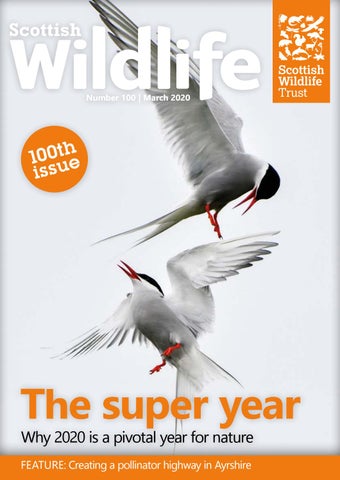
Number 100 | March 2020
The super year Why 2020 is a pivotal year for nature
FEATURE: Creating a pollinator highway in Ayrshire
Welcome Social frommedia the Chief link/Web Executive link
FIRST WORD From Chief Executive Jo Pike © David Tipling
O
n my way to give a talk at the Trust’s Dumfries and Galloway Group recently, I started wondering: just how many people think of 2020 as a special year? Personal milestones aside, how many of us actually view 2020 as an important moment in time? The reality is that, having failed to halt the global decline of wildlife, governments will take decisions this year which will profoundly affect what happens over the next decade. And what happens over the next decade could well determine the future of humanity. With key international meetings taking place in Edinburgh and Glasgow in 2020 (see pages 16-19), Scotland finds itself in the spotlight like never before. But maybe that all sounds too big to contemplate, too distant and something we can’t influence. After all, what difference can any one of us make in the face of a global loss of species that’s faster than humans have ever seen and a warming climate that is nearly out of control? I’d argue we need to look at things the other way around. Meaningful progress and lasting change almost always start small, and small is powerful. We are already seeing a real shift in public opinion, and when individuals start to take action, others follow suit and change begins to take hold. When growing numbers of people show they really care, that’s when governments start taking bigger steps. This year is also Scotland’s Year of Coasts and Waters, so we must sharpen our focus on restoring Scotland’s freshwater and marine
environments. This presents huge scope to lock up carbon, deliver wider benefits to local communities and help nature recover. As Sir David Attenborough has said: “The living world is a unique and spectacular marvel yet the way we humans live on Earth is sending it into a decline.” We do know how to solve the problems we are facing but there is only time to put things right if we act now. After all, each year we put things off, we only make the problem bigger.
Meaningful progress and lasting change almost always start small, and small is powerful.
As Sir David says, “We need to learn to work with nature rather than against it”. The issues of climate change and biodiversity loss are two distinct challenges but they are inextricably linked and we need to tackle them together. The First Minister has recognised that they are equally important. Personally, I hope that 2020 will be the year when the world realises that nature is not only one of our most powerful weapons in the fight against climate change but also a precious and irreplaceable thing in its own right, our life support system, and a powerful source of hope as we enjoy the first shoots of spring. Small is powerful. MARCH 2020 SCOTTISH WILDLIFE 3
Contents
Inside this issue
06
16
06 MEADOWS OF THE SEA
They help keep our seas clean and provide a diverse marine habitat. Explore life in a seagrass meadow.
08 NEWS
News round-up from the Trust and the world of conservation.
16
2020: THE SUPER YEAR
It's a huge year for nature and conservation with the climate emergency and biodiversity crisis top of the agenda in Scotland.
20 ONE PLANET LIVING
Find out simple steps you can take to live a more sustainable lifestyle – from how you eat to how you travel.
24
28
24
A NECTAR NETWORK
28
ROPELESS FISHING
Discover how golf courses and other local businesses are bringing the buzz back to Ayrshire.
Learn about the pioneering fishing technology that is being tested in Scotland to reduce whale deaths.
34
TALKING POINT
Find out how volunteering for the Trust has changed lives - sometimes in the most unexpected of ways.
BREAWIN A BREATHTAKING K BANKON THE LOCH S OF EARN SEE PAGE 33
Scottish Wildlife magazine is published by the Scottish Wildlife Trust. © Scottish Wildlife Trust. No part of this magazine may be reproduced without the express permission of the publisher. All photography © Scottish Wildlife Trust unless otherwise stated. The Scottish Wildlife Trust accepts no liability for omissions or incorrect data in advertisements and letters. Views expressed in Scottish Wildlife are not necessarily those of the Scottish Wildlife Trust. ISSN: 0143 1234. Registered office: Harbourside House, 110 Commercial Street, Edinburgh EH6 6NF. Tel: 0131 312 7765. Fax: 0131 312 8705. Email: enquiries@scottishwildlifetrust.org.uk. Website: scottishwildlifetrust.org.uk. The Scottish Wildlife Trust is a company limited by guarantee, registered in Scotland (no. SC040247). It is also a Scottish registered charity (no. SC005792). Scottish Wildlife is published three times a year: March, July and November.
The Scottish Wildlife Trust is affiliated to The Wildlife Trusts, a UK-wide network of 46 Trusts with more than 2,000 wildlife reserves. 4 SCOTTISH WILDLIFE MARCH 2020
Deadlines for news: 1 January, 1 May, 1 September. No unsolicited articles please. Scottish Wildlife is free to members. Membership rates from 1 April (excluding discounts for paying by Direct Debit): Individual (concession) £40 (£18); Joint (concession) £47 (£24); Family £57; Watch £18; Life (joint) £900 (£1,300); World/Overseas £45. Patron: HRH The Prince Charles, Duke of Rothesay. Chair: Linda Rosborough. Vice-Chairs: Karen Chambers, Amanda Forsyth, Kenny Taylor. Chief Executive: Jo Pike. Executive Editor: Ruchir Shah editor@scottishwildlifetrust.org.uk Production Editor: Pete Haskell. Design: Connect connectcommunications.co.uk Advertising: Elliot Whitehead 0131 561 0021, Clare Stebbing 0131 561 0024. Printing: InkMark – inkmarkltd.com Cover photo: Derek Todd
Spotlight: Seagrass
© Christine Howson, SNH
SPECIES SPOTLIGHT:
COMMON EELGRASS (Zostera marina)
Of the 72 species of seagrass that can be found globally, three occur in Scottish seas: common eelgrass, dwarf eelgrass and tasselweed.
Unlike species of seaweed (which are types of algae), eelgrass and other seagrasses produce roots, flowers and seeds, making them some of the few 'true' plants that live underwater.
Eelgrasses require a lot of sunlight to survive, so are found in relatively shallow waters. Common eelgrass grows just below the lowtide line, whereas dwarf eelgrass occurs between the low and high-tide line.
Seagrasses have been used by humans for more than 10,000 years, including to thatch roofs, stuff mattresses and as a packing material for shipping delicate goods.
Seagrass meadows are an important store of 'blue' carbon and, as such, protecting and restoring seagrass habitat can contribute towards tackling the global climate crisis.
MARCH 2020 SCOTTISH WILDLIFE 5
Spotlight: Seagrass meadows
Meadows of the sea IN CELEBRATION of 2020 being Scotland's Year of Coasts and Waters, we will be featuring three very different watery worlds over the next three issues, starting with seagrass meadows; one of the most diverse and dynamic of our marine habitats. Found in shallow coastal waters and estuaries, most of Scotland’s seagrass beds
are made up of common eelgrass which creates the illusion of an underwater meadow swaying in the current. This habitat is home to many species, from commercially important fish such as plaice and flounder, to rare and unusual animals including two species of seahorse. As well as this, seagrass meadows help
to keep our seas clean, stabilise the sediment around our coastline and are an important marine store of carbon. Despite this, it is estimated that an area of seagrass meadow equivalent to two football pitches is lost every hour around the world. Here are a few of the species that rely on seagrass meadows as a place to live and feed.
COMMON EELGRASS
LONG-SNOUTED SEAHORSE
With long, slender leaves that can grow up to a metre in length, this species of seagrass grows along muddy and sandy shores. Eelgrass produces seeds that can be carried large distances by currents before dropping to the seabed.
These unusual but instantly recognisable fish are very weak swimmers, curling their tails around seagrass leaves to avoid being carried off by currents. Seahorses have no teeth, so instead feed by sucking their shrimp-like prey into their mouths.
WIGEON
STALKED JELLYFISH
A short-legged, plump species of duck that overwinters in Scotland. Wigeon have grey bills with a slightly hooked black tip and males have a yellow forehead crest. They can often be seen feeding on eelgrass in the shallows.
These trumpet-shaped jellyfish are usually red, green or brown and grow up to 4.5cm long. They cling to seagrass leaves and seaweed fronds and can be hard to spot due to their small size and excellent camouflage.
6 SCOTTISH WILDLIFE MARCH 2020
Spotlight: Seagrass meadows
A
E
B C
RESERVES EXPLORING ON DRY LAND
Whilst we encourage everyone to take the plunge with a mask and snorkel to experience Scotland's seagrass meadows first hand, we appreciate that some people prefer to stay on dry land, so here are some meadow reserves that you can explore without getting wet!
A BO'MAINS MEADOW
EUROPEAN PLAICE Characterised by their orange spots, these oval-shaped flatfish can grow up to a metre long. Plaice, along with other commercially fished species such as pollock and herring, use seagrass meadows as nurseries for their eggs and young.
OS Landranger 65, NS988794 In the summer, the two meadows on this reserve are dappled with wildflowers including greater butterfly orchid, common spotted-orchid and twayblade. It is also a good site for birds, including tree sparrows, and a number of butterfly species.
B GAILES MARSH
OS Landranger 70, NS324358 Gailes Marsh features dry coastal grassland, marshland and a pond, all sheltered by mixed woodland. The speciesrich grassland and variety of wildflowers attract many butterflies, bees, hoverflies and other pollinating insects.
C AUCHALTON MEADOW
OS Landranger 76, NS335036 This orchid-rich grassland is on the site of 19th Century lime workings. Orchids, including fragrant orchid and greater butterfly orchid, thrive in these impoverished soils. During the summer, the wildflowers attract large numbers of pollinating insects, including the Scotch argus butterfly.
D HILL OF WHITE HAMARS
OS Landranger 7, ND322888 This Orkney reserve has impressive coastal features, including cliffs, caves, natural arches, stacks and blowholes. In spring, it blossoms with wildflowers including Scottish primrose, white campion and heath-spotted orchid. NATIVE OYSTER Also known as the common or European flat oyster, this species is the only true oyster that is native to our seas. Living up to 15 years, they are predominately found off Scotland's west and north coasts where they feed by filtering plankton from the water.
E FLEECEFAULDS MEADOW
OS Landranger 59, NO401088 Fleecefaulds Meadow is a mosaic of species-rich grassland, fen meadow and scrub woodland. In summer, wildflowers including globeflower, twayblade and cowslip attract a number of butterfly species. Brown hares graze in the meadow and warblers nest in the scrub.
MARCH 2020 SCOTTISH WILDLIFE 7
Seagrass bed © Ben James, SNH, Eelgrass © Paul Naylor, Long-snouted seahorse © Alexander Mustard,2020VISION, European plaice © Paul Naylor, Wigeon © David Tipling, Stalked jellyfish © Graham Saunders and Native oyster © Paul Naylor
D
Scottish Wildlife Trust news
© SCVO
Latest news
News from the Trust, our projects and the wider world of conservation
KEEP UP TO DATE
All the latest Trust news is available on our website scottishwildlife trust.org.uk © NP AONB
A super year ahead THIS is a super year for getting to grips with the climate and nature crises, and for me it’s a super year to be with the Trust as the newest member of its senior management team. The general public is switched on and putting pressure on governments and environmental NGOs to shift to a higher gear. Scotland is preparing for the eyes of the world, as it hosts the most significant climate conference in Glasgow in November, while Edinburgh will host an important delegation in April of the UN programme to set a new decade of biodiversity targets. Sadly we are also living in a time of fear, denial and division. At the Trust, we have realised that reconnecting with nature is as much about rediscovering our humanity as it is about protecting our natural world. This is why we are making a strong connection between the work to reverse the decline in nature with the UN Sustainable Development Goals. It’s on us now to demonstrate how interconnected our vision for nature is with tackling climate change, poverty and inequality, and finding better ways to support each other through the massive political, technological and social changes facing us over the coming decade. Ruchir Shah, Director of External Affairs
8 SCOTTISH WILDLIFE MARCH 2020
Grouse moor review falls short THE Trust has urged the Scottish Government to act swiftly to help restore Scotland’s upland habitats to their full potential. The long-awaited Review of Grouse Moor Management in Scotland was published by the Government in late December. The review makes a series of recommendations to address the impact of moorland management practices, including stronger regulation of the culling of mountain hares, muirburn (the burning of heather) and the use of medicated grit. However, it also recommends a five-year “probationary period” before introducing licensing for driven grouse moors. The Trust’s Director of Conservation Sarah Robinson said: “This review demonstrates the heavy cost of unsustainable grouse moor management in Scotland’s uplands, and that the problems associated with intensive grouse moor management go far beyond the illegal killing of wildlife. “Raptor persecution, burning large areas of heather and the unsustainable culling of mountain hares all have a
serious impact on our natural environment. “It’s encouraging that many of the recommendations in the review highlight the need for change, and we welcome the Environment Secretary’s indication that licensing may be introduced sooner than the five year ‘grace period’ proposed by the review. “The crisis facing nature is unprecedented and needs swift and urgent action. The Scottish Government should recognise there is an opportunity to restore iconic upland habitats to their full potential and ensure action is taken without unnecessary delay.” The Review, chaired by Professor Alan Werritty, was commissioned by the Government in 2017 as a response to continued evidence of illegal persecution of birds of prey including the finding that 40 young satellite-tracked golden eagles had disappeared in suspicious circumstances between 2004 and 2016, mostly on or near grouse moors. Scottish Land & Estates estimated in 2013 that one million hectares – an eighth of Scotland’s land area – is managed for driven grouse shooting.
Scottish Wildlife Trust news
Call for change in Scotland’s deer management © Mark Hamblin,2020VISION
THE Trust has welcomed a wide-ranging independent report on deer management in Scotland. The Deer Working Group’s review makes almost 100 recommendations that, if implemented, would move Scotland towards more sustainable populations of wild deer. Bruce Wilson, the Trust’s Public Affairs Manager, said: “Deer are a vital part of Scotland’s natural and cultural heritage but it’s clear that significant rises in numbers over the last 150 years have had a heavy cost on our natural environment. “In particular, grazing affects the biodiversity value of nearly half of Scotland’s native woodland, and costly fencing is needed to establish new woodlands.” The review’s
recommendations include more resources to monitor the impact of wild deer on the natural environment, measures to reduce the density of red deer over large areas of the Highlands, and stronger national regulation of deer numbers. In January, the Trust joined a coalition of 18 organisations to outline a fresh approach for deer management. Managing Deer for Climate, Communities and Conservation, published by Scottish Environment LINK, outlines how a new approach to managing Scotland’s wild deer could have wide-ranging benefits including reduced greenhouse gases, healthier peatlands and woodlands, more jobs in rural areas and a stronger venison industry.
Keeping an eye on wildlife at Lowes
THE webcam which allows people around the world to view daily life on the osprey nest at Loch of the Lowes Wildlife Reserve is being replaced thanks to a gift in memory of a fondly remembered volunteer. The donation from the family of Ruth Anderson, who volunteered at Lowes for 25 years, paid for a new webcam and recorder, as well as four trail cameras that will be placed around our Perthshire reserves to monitor mammals including red squirrels, pine martens and beavers. Sara Rasmussen, our Perthshire Ranger, said: “Having a camera on the osprey nest means that thousands of people can learn more about these amazing birds and it allows us to gather detailed information about feeding patterns and behaviour.” Ospreys are expected to return to the loch in midMarch. Through our Osprey Protection Programme – supported by players of People’s Postcode Lottery – volunteers and staff keep watch on the nest around the clock in the breeding season.
AROUND 300 people pulled on their wellies to help plant hundreds of trees at Broadwood Loch in December as part of the Trust-led Cumbernauld Living Landscape. Project Manager Fiona McGrevey said: “Despite muddy conditions, a huge number of families got stuck in, which shows the passion that people in Cumbernauld have for improving their local environment. “As the trees we’re planting
© Gill Hatcher
Tree planting in Cumbernauld at Broadwood grow, they’ll begin to support a huge range of wildlife, from beetles and moths to badgers and pine martens. Local people will also benefit from woods that are nicer places to explore.” About 4,000 trees have been planted at the loch as part of work supported by National Lottery players and Scottish Forestry. Dense woods dominated by non-native conifers are being replaced with native species including willow, oak and hazel. MARCH 2020 SCOTTISH WILDLIFE 9
Scottish Wildlife Trust news
Trust sets out priorities for marine conservation
IN BRIEF Uncovering Ardeer’s wildlife MORE than 1,500 different species have been recorded by local naturalists on the Ardeer Peninsula in Ayrshire. Despite the natural importance of this complex of sand dunes, Ardeer is one of the few places not covered by any formal designation and is under threat from substantial development. The Trust is working to raise awareness of the area’s importance and seek greater protection for it. © Laura MacGregor
The next generation
Council member commended DR TIM DUFFY, a member of the Trust’s Council, was awarded a special commendation in the Association of Local Government Ecologists’ Silver Anniversary Awards. Tim has coordinated planning work in the Lothians since 1984 and has been successful in ensuring that many important wild places in the area are formally recognised as Local Biodiversity Sites, giving them protection from development.
Save the date OUR 2020 National Members’ Day and Annual General Meeting will be held on Saturday 12 September at the National Museum of Scotland in Edinburgh. Full details, including how to book, will be announced in the next issue of Scottish Wildlife.
Keep up to date by email MANY of our members have signed up to receive regular information from us by email, including a monthly email newsletter and reminders about events in their local area. If you’d like to hear from us more often, please visit our website – scottishwildlifetrust.org.uk – to subscribe to email updates. 10 SCOTTISH WILDLIFE MARCH 2020
Dr Sam Collin, the Trust’s Marine Planning Manager. “Our so-called ‘blue carbon’ habitats such as seagrass meadows and kelp forests form vital stores of carbon in the marine environment. In fact, there is more carbon locked up in the top 10cm of our seabed than in all of Scotland’s peatlands combined. “Decisions taken by the Scottish Government this year will affect the long-term health of our seas for generations. If action is taken now to reverse the fortunes of our marine environment, we will have even more reason to celebrate our seas in years to come.”
Scotland’s seas in numbers
22%
The area of Scotland’s seas covered by Marine Protected Areas
11,000 MILES The length of Scotland’s coastline, the longest in Europe
600%
Scotland’s seas are six times larger than its land area
11 OUT OF 15
The number of indicators of Good Environmental Status the UK has not met
£3.8BN The value of marine industries to the Scottish economy (2016)
© Peter Cairns 2020VISION
THIS young pup is the future of our conservation grazing programme. Over the next few years, Gem will learn everything she needs to know to be able to help our Conservation Shepherdess Laura move the Trust’s Flying Flock around a number of our wildlife reserves across Scotland. For more information on this innovative project, visit scottishwildlifetrust.org.uk/flock
THE Trust has set out three key priorities to improve the health of Scotland’s marine environment in 2020, Scotland’s Year of Coasts and Waters. These priorities are: to put nature’s recovery at the heart of policies and decisions that determine how we use our seas; to increase public awareness of the importance of a healthy marine environment and the critical role it plays in our lives; and to establish a Marine Stewardship Fund to support the recovery and enhancement of the sea. “Ensuring Scotland has healthy seas that are full of life is one of the most important ways we can respond to the biodiversity and climate crises,” says
Scottish Wildlife Trust news
Award-winning wildlife DECADES of the Trust’s pioneering work in partnership with the Royal Zoological Society of Scotland to champion the return of beavers has been recognised with a prestigious Nature of Scotland Award. The RSPB Species Champion Award was presented to the Scottish Beavers team by broadcaster Euan McIlwraith and Trust Ambassador Gordon Buchanan at a ceremony in November. The role of Environment Minister Roseanna Cunningham in granting European Protected Species status to Scotland’s beavers also saw her named Political Advocate of the Year at the awards.
Meanwhile, the Badgers in the Landscape project, led by the charity Scottish Badgers in partnership with the Trust, was highly commended in the Innovation Award. And Ullapool Sea Savers, which works closely with our Living Seas project, was shortlisted in the Young People and Education category. Separately, Carron Dams Local Nature Reserve won two prizes at the Scottish Awards for Quality in Planning. Work by a partnership including the Trust, Falkirk Council and the local community saw new paths and artworks installed which have made the reserve a ‘dam fine place’ for people to explore.
THE first ptarmigan to be recorded on Rahoy Hills Wildlife Reserve in more than 20 years were spotted last summer. European Voluntary Service volunteers Elizabeth and Marta saw a group of two adult and three juvenile birds on Bienn Iadain during a plant survey in July. Rahoy Ranger Steve Hardy said: “Ptarmigan were seen on the reserve most years up until the 1990s, with the last sighting in 1996. “This could be a one-off but it’s possible that the removal of sheep from the reserve in 2017 has allowed upland plants such as alpine lady’s mantle to recover and flower, providing food that encourages ptarmigan to stay and breed on the reserve.” Found in the high uplands, ptarmigan are masters of disguise, swapping their snowy white winter plumage for a speckled grey appearance in summer.
A journey through Elphin THE wildlife, landscape and people of a Sutherland crofting community are celebrated in a large new tapestry created by volunteer needleworkers with support from Coigach & Assynt Living Landscape Partnership’s Community Grant Scheme. A Journey Through Elphin is on display in the local village hall and includes
39 features such as some of the area’s birdlife and iconic mountains. Over the last three years, funding for heritage projects has been awarded to 28 individuals and local organisations through the CALLP grant scheme, which is kindly funded by the National Lottery Heritage Fund and Scottish Natural Heritage.
MARCH 2020 SCOTTISH WILDLIFE 11
© Steve Gardner
© Simon Williams Photography
Ptarmigan turn up at Rahoy Hills reserve
From left: Euan McIlwraith, Alistair Longwell, Allan Bantick, Gill Dowse, Helen Taylor and Gordon Buchanan
Scottish Wildlife Trust news
© Mary Wilde
Wildlife Watch
PROUD Noah from Glasgow is the first member of the newly established Castlemilk Explorers Wildlife Watch to achieve a Hedgehog Award by completing eight activities to help or celebrate wildlife and the environment. Ten-year-old Noah’s parents Ruth and Chris said: “Castlemilk Explorers is great for getting the kids out and exploring the outdoor world and nature. The children love it.”
Path upgrade at Shian Wood THE path network at Shian Wood Wildlife Reserve has been upgraded to make it easier for visitors to explore and enjoy this precious fragment of ancient Atlantic woodland in Argyll. A legacy left to the Trust by a long-term member allowed us to carry out a series of path upgrades and install more than 150 metres of new boardwalk over the winter. Shian Wood, on the southern shores of Loch Creran, is a great place to see woodland birds, and its carpet of spring wildflowers is a magnet for butterflies.
Picture perfect portraits WE were delighted to see so many fantastic entries to our photography competition celebrating 100 editions of Scottish Wildlife magazine. Our panel of judges was made up of wildlife filmmaker and presenter Gordon Buchanan, wildlife and landscape photographer Mark Hamblin, and Country Director for People’s Postcode Lottery Annemiek Hoogenboom. They chose Life Member Derek Todd’s image of Arctic terns – featured on the front cover of this issue – as the winning image in the Adults category. When asked why they chose Derek’s
Caution: may contain wildlife A STUNNING new mural featuring some of the amazing birdlife found at Montrose Basin has been painted on the side of a shipping container at the visitor centre. The artwork by Paco Graff is part of a larger project to create a new outdoor learning base, with support from the Tesco Bags of Help scheme. 12 SCOTTISH WILDLIFE MARCH 2020
photo as the winner, Mark Hamblin said: “There is a real dynamism to this picture that elevated it from the other entries. “This, coupled with the action that has been captured perfectly along with the simplicity of the lighting, I found particularly appealing.” Mary Wilde’s superb image of a cuckoo signing in the rain (pictured above) was highly commended by the judges, and eight-year-old Felix Amos’s portrait of a pair of puffins was the winner of the Young Person category. See Felix Amos’s winning image on page 31.
New board members sought THE Scottish Wildlife Trust is looking for volunteers with expertise in ecology, conservation, digital communications or philanthropy to join its governing Council, elected by members. To find out more, please contact Susan McKenzie, Company Secretary, at smckenzie@scottishwildlifetrust.org.uk and we will be happy to provide further details. Completed nomination forms must be returned by 31 May 2020. Elected Trustees will take office from this year’s AGM (Saturday 12 September) for an initial term of three years. This appointment is unpaid.
MARCH 2020 SCOTTISH WILDLIFE 13
Wider news
Owl tracked from Arran to Morocco
EUROPEAN funding has been secured to deliver a wildcat recovery project led by the Royal Zoological Society of Scotland that includes the development of the UK’s first reintroduction centre for the species. Situated at the Highland Wildlife Park near Aviemore, this centre will provide facilities for breeding, veterinary care, remote monitoring and pre-release training. Wildcats could potentially be released into the Cairngorms National Park from 2022. An expert report published last year concluded there is no longer a viable wildcat population in Scotland, and the extinction of the species is highly likely without urgent action, including conservation breeding. © Elliott Smith
A FEMALE short-eared owl made a marathon migration from the west coast of Scotland to North Africa last year, reaching speeds of more than 50 miles per hour along the way. A satellite tag meant that researchers from the British Trust for Ornithology (BTO) could track the breeding female from her nest site on Arran to near Oualidia in Morocco. In October, a strong tailwind allowed her to power into France from Devon, covering a distance of about 500km in just six hours. Previous tracking by BTO researchers has recorded Scottish short-eared owls moving to Norway, with some birds appearing to make breeding attempts in both countries in the same season. Ongoing satellite tagging by BTO is helping to increase understanding of the habitat requirements and migration of the species.
© Russel Savory
A lifeline for Scotland’s wildcats
Greater ambition needed to limit climate change THE United Nations Environment Programme (UNEP) has called for increased international ambition to cut greenhouse gas emissions ahead of the global climate change summit in Glasgow in November. The organisation’s latest Emissions Gap Report demonstrates that even if all current commitments on climate change are met, global temperatures are still expected to rise by 3.2˚C. This is more than double the 1.5˚C limit agreed in Paris in 2015. A fivefold increase in efforts to reduce emissions is needed to get back on track. Inger Anderson, UNEP’s Executive Director, warned that failure to act on climate change means countries will need to reduce emissions by more than 7% each year between now and the end
of the decade to meet the Paris target, saying: “We need to catch up on the years in which we procrastinated. If we don’t do this, the 1.5˚C goal will be out of reach before 2030.” The UNEP report highlights that while the G20 nations account for 78% of greenhouse gas emissions, three quarters of these countries have yet to commit to a timeline for net-zero emissions. UN Secretary-General António Guterres added: “There has never been a more important time to listen to the science. Failure to heed these warnings and take drastic action to reverse emissions means we will continue to witness deadly and catastrophic heatwaves, storms and pollution.”
Wildlife Trusts call for rethink on HS2 THE Wildlife Trusts (TWT) continue to challenge plans for the HS2 rail project due to excessive environmental impacts. A comprehensive assessment published by TWT in December shows the immense damage that could be caused unless plans are changed. The natural habitats and protected wildlife sites affected include 33 Sites of Special Scientific Interest, more than 14 SCOTTISH WILDLIFE MARCH 2020
100 ancient woodlands, and almost 700 Local Nature Reserves. The proposed route would harm wildlife including barn owls, white-clawed crayfish and lizard orchids, and could cause rare species like the dingy skipper butterfly to become locally extinct. Almost 70,000 people signed a letter to the Prime Minister urging a rethink. Responding to the UK Government’s decision to press ahead with the plans, Nikki
Williams, Director of Campaigns and Policy at The Wildlife Trusts, said: “Green and sustainable transport is vital, but the climate emergency will not be solved by making the nature crisis worse. “It’s more critical than ever that the whole project is redesigned to avoid creating a scar that can never heal.” To find out more, log on to wildlifetrusts.org/hs2
2020: the super year
© Ed Marshall
2020 THE SUPER YEAR With both the climate emergency and biodiversity crisis now higher on the political agenda than ever before, 2020 promises to be a huge year for nature and conservation – with a golden opportunity for Scotland to take a leadership role, writes Rich Rowe. 16 SCOTTISH WILDLIFE MARCH 2020
2020: The super year
A
s we enter a new decade, it feels like we have reached a pivotal moment in our relationship with the natural world. A crossroads even. Do we continue to damage the health of ecosystems that all species depend upon, ourselves included, or do we work alongside nature as a powerful ally in mitigating against the volatility of a changing climate? With growing recognition of the links between the climate emergency and the biodiversity crisis, there is huge hope – and indeed expectation – that the two will be tackled together, internationally and domestically. And given the momentum generated in 2019, the stage is set to do just that; with policymakers challenged by the likes of Swedish activist Greta Thunberg, young campaigners organising school strikes, lobby groups such as Extinction Rebellion, plus the UK Committee on Climate Change presenting the most compelling evidence yet that urgent action is needed, environmental policy has never been so high on the political agenda. In addition to this welcome focus on climate change, 2019 was also the year when ground-breaking research generated a sense of urgency and high-level engagement around biodiversity loss. The shocking
If the Scottish Government’s Climate Change Plan is to be fit for purpose in light of the climate emergency, it needs a strong emphasis on natural climate solutions.
YEAR OF RECKONING
So many positive words, so much potential traction. But if 2019 was a year of momentum, then 2020 is the year of reckoning. Over the course of 12 months, several key strands of work will come together to potentially crystallise
high-level thinking around climate change and biodiversity loss. Such are the policy milestones that lie ahead that there is a distinct chronology to the year. Observers in Scotland are still waiting to hear more on updates set out in the Programme for Government, including the Scottish Government outlining to Parliament exactly how it plans to deliver a “step change” not just for biodiversity, but also to achieve the stated goal of net zero emissions by 2045. At the same time, it is also committed to updating the Climate Change Plan by the end of April. “Straight away this year, we have these important strands coming together,” comments Dougie Peedle, the Trust’s Head of Policy. “While there is still much to be done around things like how we heat our homes, improvements to transport, and industry facing up to the emissions they release, none of that is sufficient on its own. If the Climate Change Plan is to be fit for purpose in light of the climate emergency, it needs a strong emphasis on natural climate solutions.” Above all, what the Trust and others seek is a joined-up approach, with fine words about ‘transformative change’ matched by considered action. “We just can’t have the next steps on biodiversity without
© Rob Jordan, 2020VISION
Merlins are just one of the many species that rely on healthy peatlands.
assessment that a million species are at risk of extinction, as outlined in an inter-governmental Global Assessment Report on Biodiversity and Ecosystem Services, was as clear a call to action as there could be. Last August, the 196 Parties to the UN Convention on Biological Diversity met in Nairobi to open negotiations for a post-2020 global biodiversity framework – including hitting some of the many unmet targets previously set in Aichi, Japan in 2010. The process will culminate in October this year in China, where Parties are expected to adopt a new framework designed to safeguard all life on Earth. In Scotland, the Scottish Government placed on record its recognition that the climate emergency and biodiversity crisis must be tackled together. It later emphasised the point in its Programme for Government, published in late2019, which placed both much closer to the heart of policy actions for 2020 and beyond.
MARCH 2020 SCOTTISH WILDLIFE 17
2020: The super year
considering how natural climate solutions fit in with the Climate Change Plan published a few months later,” continues Dougie. “Similarly, we can’t have a truly beneficial biodiversity strategy if it is not also addressing climate change and the impact it has on biodiversity. “We urgently need natural climate solutions and greater investment in forestry, peatland, urban greenery and the marine environment to meet the new targets. “It’s all very tight, particularly the Scottish Government’s pledge to achieve a 75% cut in emissions by 2030.”
Often, it’s when people connect and become part of something bigger that the greatest change happens. And as if the first quarter of 2020 was not congested enough, the Infrastructure Commission for Scotland published its phase 1 report in January, setting out its advice for Government in preparing their 30-year strategy for developing grey infrastructure – the human-engineered solutions for transport, communications and water resources. The Trust wanted to see a few more colours worked into the planning palette. “It was pleasing that the Commission echoed our calls for a new strategic approach to green and blue infrastructure and we want to see Government heed this advice and maximise the biodiversity and climate
benefits and synergies between grey, blue and green,” stresses Dougie. It is for all these reasons that the Scottish Budget, which was delayed until February because of the UK general election, had added significance. “We needed a Scottish budget that faced up to the climate emergency and biodiversity crisis. It was a step in the right direction
but the significant funding allocated to peatland restoration over the next 10 years needs to be matched by additional funding for other natural climate solutions such as native woodland and blue carbon,” says Dougie.
SPOTLIGHT ON SCOTLAND
© Penny Dixie
A community pond is a fantastic way to attract wildlife
18 SCOTTISH WILDLIFE MARCH 2020
In what is almost uncanny timing – not to mention additional incentive – this flurry of policy planning is set against the background of Scotland hosting two important international events this year. Ahead of world leaders meeting in China this autumn, an international biodiversity workshop will take place in Edinburgh in April. It’s then the turn of the big one: the 2020 UN Climate Change Conference (COP26) in Glasgow in November, under the presidency of the UK Government. By then of course, the Scottish Government will have revealed its hand a good deal more. “When the international audience comes calling, it’s so important that we can demonstrate that our actions match our words,” believes Dougie. It’s also a golden opportunity for the Scottish Government to showcase Scotland as a global exemplar. “Given the
2020: The super year
© Katrina Martin, 2020VISION
Members of the community planting wildlife-friendly plants in Cumbernauld
Building bird boxes teaches skills and helps at nesting time © Peter Cairns, 2020VISION
© Peter Cairns, 2020VISION
Organising a litter pick is a simple but effective way of helping local wildlife
spotlight on Scotland over the next year, particularly through hosting COP26, there is an opportunity for us to really showcase what is possible through natural climate solutions,” comments Ruchir Shah, the Trust’s Director of External Affairs. “It is a much more positive message for our planet than the doom and gloom that has been
characterised in many media and campaign messages to date.” But while fresh thinking and transformative change at government level are crucial, it’s not just policymakers that have a part to play; individuals also have a significant role, although the difficulty is often knowing quite where to start. With something as
huge and complex as the biodiversity crisis, it’s easy to feel overwhelmed or a bit defeated. However, making changes as part of a wider community offers greater scope, and hope, for progress. Supporting people to work with others in the places they live and work reflects a ‘place-based approach’ to taking action, which will be the focus of the Trust’s new public engagement campaign due to launch later this spring. “We want to build on the increasing awareness around the climate and biodiversity crises by turning concern into action,” comments Pete Haskell, the Trust’s Head of Communications & Engagement. “Often, it’s when people connect and become part of something bigger that the greatest change happens.” What is clear is that there is no quick fix; nothing can be solved even in this ‘super year’ for nature, as 2020 has been dubbed, but it is a year that could be a genuine catalyst for change. “Ultimately, we want to build on the focus and energy that we will see in 2020 to do great things in subsequent years,” explains Ruchir. “This means being an exemplar globally, but also taking action in Scotland and getting people mobilised around natural climate solutions – that’s something we can play a very big part in as the Trust.” Given all that is on the table, it’s little wonder that the UK’s own Climate Change Commission highlighted at the end of last year that what is done in 2020 will determine how successful we are over the next 25 years. “It really is that pivotal – we cannot get through 2020 and miss all these opportunities,” stresses Dougie. “If we don’t get this right, the words of the Climate Change Commission will come back to haunt us.” Rich Rowe is an outdoors writer based in Innerleithen, Scottish Borders. richardrowe.co.uk MARCH 2020 SCOTTISH WILDLIFE 19
Biodiversity and sustainability
ONE PLANET With new global biodiversity targets due to be set later this year, it’s more important than ever for each of us to do what we can to live sustainably. Pete Haskell shares some top tips.
O
n Christmas Eve 1968, astronaut William Anders took what has been dubbed “the most influential environmental photograph ever taken”. Earthrise, as it has become known, was taken during NASA’s Apollo 8 mission – the first crewed mission to orbit the Moon. It shows Earth for exactly what it is – a single and finite planet. But humanity is not currently living within our planet’s means. Each year, the global population’s demand for ecological resources (such as timber and fish) and services exceeds what the Earth can regenerate in that year. The date on which we cross this line is known as Earth Overshoot Day. Last
year, it was calculated to be 29 July, meaning that we would need the equivalent of 1.75 Earths to continue living as we do. Of course, we don’t all lead equal lives, with the ecological footprint of people living in developed countries far exceeding those living in developing nations. In fact, if everyone lived like we do here in the UK, we would need 2.4 Earths to sustain ourselves. In the midst of a biodiversity crisis, the impact this has on our natural world has never been more apparent. The maths is simple: if we remove more fish from the sea than are born and naturally survive each year, the number of fish will decrease. This in turn means
that the number of fish-eating animals will also decrease. While there are many different examples like this, the outcome is often the same: our lifestyle comes at a cost to nature. But this doesn’t have to be the case. Living a ‘one planet lifestyle’ is possible and it may be simpler than you think. Making some conscious changes to the way we live, travel and eat can make all the difference to our personal ecological footprint. Here, we showcase three areas in which many of us could make small changes to reduce our impact on the natural world. To measure your own ecological footprint, visit footprintcalculator.org
Food There has never been a greater choice when it comes to food. Within a square metre of supermarket shelving, there might be products that have been grown, processed, packaged, stored and shipped from a dozen or more countries. With every single thing we eat having its own ecological footprint, the choices we make when buying food really do matter. Here are three simple principles to follow when making your choices:
20 SCOTTISH WILDLIFE MARCH 2020
Eat less meat (and choose good quality local meat when you do eat it) – Meat and dairy production account for 14.5% of all greenhouse gas emissions. With climate change being one of the top three threats to wildlife, eating less meat will help you reduce your impact on the natural world. For inspiration, visit meatfreemondays.com
Go local – Choosing produce that has been grown or reared on local, high-welfare and wildlife-friendly farms not only cuts down the distance it has travelled to your plate, but also helps to support local businesses and wildlife.
Waste less – We throw away the equivalent of one in every five bags of food shopping we buy, equating to 630,000 tonnes of food being wasted in Scotland every year. Meal planning, storing food properly and using the whole product are just some of the ways to avoid food waste. For more information, visit lovefoodhatewaste.com
Biodiversity and sustainability
© NASA
Travel While reducing our use of fossil-fuelled transport has been a much-repeated message for years, it is even more relevant today than ever before, with the transport sector remaining the largest source of greenhouse gas emissions in Scotland. As climate change is one of the leading factors in the net loss of nature, we must change the way we travel in order to protect and restore the wildlife we love.
See more wildlife – Walking or cycling instead of driving not only reduces your ecological footprint and improves your health and wellbeing, but also provides you with more chances for exciting encounters with wildlife.
Plastic With Blue Planet II being watched by almost 1 in 10 people on the planet, the impact that plastic has on our seas and wildlife has never received more attention. From microplastics being eaten by fish and shellfish, to the whale found dead on Harris last year with more than 100kg of litter in its stomach, the impact that plastic is having on our marine wildlife is devastating. Many of us have already made changes to reduce single-use plastics in our lives, such as using reusable bags and refillable water bottles, but here are a few other small changes that can make a difference:
Go to the bar – While many people have cut out single-use plastic drinks bottles, chances are that most have plastic bottles in their bathroom. Using bars of soap and shampoo is an easy way to further reduce the plastic in your house.
Say no to clingfilm – Every year in the UK, we use enough clingfilm to go around the world 30 times! Store your leftovers in reusable Tupperware boxes, glass jars or beeswax wraps to cut out this unnecessary plastic.
Get loose – Most of the fruit and veg we buy is packaged in plastic. Buying loose produce cuts this packaging out and also means you can buy the exact quantity that you need, reducing the risk of food waste.
Be more sociable – If you have to travel by car, sharing the journey with one other person immediately halves your footprint, but also turns that otherwise wasted time into a social occasion. Setting up a local car-sharing group using platforms such as Facebook or WhatsApp is an easy and quick way to share your travel plans with friends and neighbours to see if there’s an option to car-share.
Take a staycation – Why not be more penguin and take zero flights for a year (or more!). This can drastically reduce your ecological footprint, whilst giving you the opportunity to explore your local patch or parts of Scotland that you’ve yet to visit. Search ‘snorkel trails’ on the Trust’s website for inspiration!
MARCH 2020 SCOTTISH WILDLIFE 21
News Q&A
Q&A
Dr Kenny Taylor Vice Chair of our Council of Trustees
DR KENNY Taylor is a writer, broadcaster and lecturer with a background in animal behaviour, conservation and the media. Formerly the Scottish Wildlife Trust’s Northern Officer, he is a Vice Chair on our Council of Trustees and Convenor of our Conservation Committee. Kenny, you wrote an article on the Flow Country for Issue 1 of Scottish Wildlife, published in 1987. How have Scotland’s peatlands changed since you wrote that article? Awareness of how peatlands benefit biodiversity, carbon storage and drinking water has swelled, not least through decades of the Trust’s research, campaigning and practical action. But much peatland is still in very poor shape. Recent Scottish Government funding for restoration is great, but we need to do much more to boost this globally important habitat. It’s also shocking that NGOs, notably the RSPB, have carried so much of the cost of repairing the damage done by tax-break Flow Country tree planting. What other significant ecological changes have you witnessed in Scotland during this time? Change is part of what life is about. But it’s heartbreaking that so much change in nature over recent decades has been loss. Loss of abundance, whether plants, insects, fish, amphibians, seabirds, water voles, wildcats. Loss of snows and seasonal predictability as the climate changes. All of us who care about nature need now, more than ever, to seek solutions and to celebrate inspirational successes, such as native woodland expansion, red squirrel recovery, urban greening and species reintroductions. You’ve also written multiple articles on the state of Scotland’s seabirds. In this, Scotland’s Year of Coasts and Waters, what would you like to see happen 22 SCOTTISH WILDLIFE MARCH 2020
to turn the tide on seabird decline? There’s no quick fix for reversing seabird declines, since these are linked to ocean-wide processes, including rapidly warming northern waters and shifts in fish distribution. Seabirds range the ocean over, such as ‘Scottish’ puffins that can go to Newfoundland or Spain, fulmars from Orkney to Greenland. So international cooperation and support in data sharing, long-term monitoring and fisheries regulation could help. At a local level, mink and rat eradication can boost individual colonies, as shown on Handa, Canna and the Shiants. What do you think has been the Trust’s greatest achievement since your time spent as our Northern Officer? Picking one seems too limited – like being stuck with just one disc on that desert island – so I’ll be cheeky and choose three! Navigating choppy waters of prejudice to successfully reintroduce beavers to Knapdale has
huge symbolic and ecological value. Working with The Highland Council and the good folk of Eigg before, during and since the buy-out has historic and political importance. And engaging tens of thousands of members and many other people in our work – that’s another major achievement. What do you feel has been your greatest personal achievement in the world of conservation over this time? I’ll always appreciate how involvement with the Trust has allowed me to contribute to debate and action on major issues, such as in the Cairngorms and the Flows. I’m proud of helping to persuade the Scottish and other Wildlife Trusts to back the Eigg appeal and chairing Trees for Life through the purchase of the Dundreggan Estate. Overall, I hope that communicating my passion for nature, good science and social justice through different media has been positive. But the biggest challenges are still ahead, so the future is where I’m focused!
Advertorial
Waking up to new life this spring
S
PRING is a great time of year for watching birds in your garden, as they begin to prepare for their breeding season. You will notice an increase in birdsong as your garden residents start singing to find a mate. However, not all gardens have natural nesting sites and may require additional nest boxes for both shelter and breeding. Depending on the birds in your garden or those that you wish to attract, check which box is suitable for their needs first. Some birds, such as blackbirds and robins, tend to begin building nests and laying eggs earlier than other garden birds, so they may already have eggs or young chicks by early spring. Others won’t start nesting until later in the season and will be joined by millions of migrant birds arriving from far-flung corners of the globe. This makes the spring months one of the most interesting times for garden bird watching. You can give your new chicks and their busy parents a massive helping hand with a regular supply of food as garden feeders can make a real difference to life and death at this time of year.
Sunflower hearts are already de-husked seeds and therefore provide many calories for little effort. Peanuts are also a good source of energy, but ensure they are in mesh feeders to avoid birds choking on them. Alternative high-energy foods that are compact enough for every garden are CJ Wildlife Peanut Cakes and Peanut Butter for Birds. Soft-bodied invertebrates such as mealworms are incredibly rich in protein, making them an ideal food source for young chicks to grow and successfully make it through to adulthood. A shallow pond will attract a host of species and can be a joy to watch. The insects that are attracted to a pond will in turn attract birds and breeding amphibians. If you don’t have room for a pond, a small water dish can provide an important source of water for birds and small mammals all year round. Our wonderful hedgehogs are starting to grace us with their presence again as one of Britain’s best-loved mammals emerges from hibernation. Their emergence can vary depending on weather conditions and they may have
lost up to a third of their body weight, so finding food is their ultimate priority, especially for suckling mothers. Ideally, provide a specially formulated supplementary hedgehog food and some water to make life a little easier, but their preference is for garden invertebrates like slugs and snails so let them do the garden work for you. Frogs and toads are also emerging from their winter log piles and stones to return to their favourite breeding ponds, which can become quite overcrowded! Keep your ears open, too, and you might soon hear them croaking in the spring sunshine and on mild evenings. Frog and toad spawn are easy to identify, with frog spawn laid in large clumps, but toad spawn laid in flowing lengths. Finally, after the mating chases and hoarding of food in the winter, female squirrels will be giving birth to the first litters of young, kittens, who are totally dependent on their mothers for up to 10 weeks. It is such a joy to watching their antics as they gain their independence before the autumn. www.birdfood.co.uk
MARCH 2020 SCOTTISH WILDLIFE 23
Nectar network
Small blue butterflies have been successfully reintroduced to Ayrshire
A nectar network
Pollinators are essential to our daily lives, yet they are reported to have halved in number in just 40 years. Polly Pullar explores the Trust-led project that is looking to turn around the fortunes of pollinating insects along the Ayrshire Coast. 24 SCOTTISH WILDLIFE MARCH 2020
Nectar network
HABITAT HIGHWAY
The Irvine to Girvan Nectar Network in Ayrshire is one such project. An initiative led by the Scottish Wildlife Trust, it currently involves 10 organisations, 21 operators and an army of environmental volunteers who are working together on 32 sites. The ambitious aim is that there should be less than 100 metres between pollen-rich sites where pollinators can refuel and find shelter. Some of these sites already exist, but others are being created in order to form a habitat highway that will benefit numerous species, not only pollinators. “It’s an incredible project, not least due to the diverse community groups that have engaged with the venture,” explains Gill Smart, who has worked for the Scottish Wildlife Trust for more than 20 years and leads the project. “It all began when I joined a local business group, organised by Dundonald Links golf course, to share best practice on waste management,” she said. “The group wanted to expand its sustainability remit, and discussions
© Andy Jones
© Chris Lawrence
A
s well as being glorious additions to our diverse fauna, pollinators are vital to our survival. From bees and hoverflies to butterflies and beetles, they are responsible for pollinating 84% of our crops and as such are key to our economy, as well as our health and wellbeing. The famous quote attributed to Albert Einstein, “If the bee disappeared off the face of the Earth, man would only have four years left to survive,” is a stark assertion, but have we taken note? In 2017, during the launch of the Scottish Government’s Pollinator Strategy for Scotland, it was reported that there had been an estimated 51% crash in pollinator numbers since the 1980s. Last year’s State of Nature report re-emphasised that there has been no let-up in the net loss of nature in the past decade. Numerous factors have led to this catastrophic situation: the loss of more than 95% of the UK’s wildflower meadows since the 1930s; the relentless use of pesticides and agro-chemicals in intensive farming systems; and our increasing urban sprawl, to name a few. These changes have led to the demise and isolation of insect populations, marooned in small pockets of habitat where they struggle to survive. But hope can be found in the numerous inspirational and creative projects that are currently under way to try to reverse the decline.
ensued on how else they could collectively benefit the environment. “The topic of pollinator loss came up, and everyone agreed that there were things we could do to help the rather dire situation.”
NECTAR NETWORKING
Local golf courses were ideal for the initial focus and greenkeepers showed great enthusiasm for the idea. They understood the pressing need to look after their wilder areas and to encourage a smorgasbord of pollenrich flora vital for the survival of specific insects. Many actions for pollinators also have benefits for the golfer. For example, replacing certain areas of gorse bushes with wildflower habitat and heather banks can reduce turf diseases by improving airflow, create more diversity for insects and help to avoid losing too many golf balls in the rough. As Gill explains: “A great advantage of these links golf courses is that they are sited on sandy ground that is naturally low in fertility and therefore ideal for an abundance of wildflowers. If the ground was more fertile, fastgrowing grasses would dominate. “Sand also lends itself to the creation of bare areas that are important for species such as mining bees and digger wasps, and golf MARCH 2020 SCOTTISH WILDLIFE 25
Nectar network
© Polly Pullar
The flowers of the marsh thistle support a wide range of insect species
courses have all the necessary equipment and expertise to prepare the ground, sow seeds, cut vegetation and deal sustainably with green waste.”
AWARENESS IS KEY
The project’s vision includes landowners, businesses and factories as well as community and hospital gardens, parks, schools and graveyards, and those involved are offered support, advice and help to enable them to carry out work to enhance their area. It’s a project that embraces the entire community, and public awareness and engagement are key to its success. Since 2015, golf’s governing body – the R&A – has generously supported the network and, thanks to additional funding from Scottish Natural Heritage, it has been able to take on a full-time project coordinator, Lynne Bates. Lynne’s role is to further public engagement and to find a range of new pollinator sites. “Our key goal is that by March 2022 there will be 50 sustainable Irvine to Girvan Nectar Network sites and a movement amongst Ayrshire people to value and protect their local environment,” explains Lynne. “To do that, we need to keep increasing understanding of, and interest in, the importance of insects and the wider natural world both with the local community and local businesses. One of the benefits of a landscape-scale project that involves all the community is that people can contribute in many different ways.”
GETTING INVOLVED
From donating equipment and funds, to improving a patch of land for
Support this donating to project by ou scottishwild r appeal. Visit lifetrust.org.u k/ pollinators
The Nectar Network is an excellent example of how we can all participate in helping to reverse the problems faced by the natural world. pollinators, the team hopes to continue to build momentum with people of all ages and backgrounds. According to Gill, while sometimes it can be harder to inspire adults about insects, this isn’t the case when it comes to the younger members of the community. “We‘ve been working closely with schools and have been organising walks, events and bug days, as well as © Harry Richards
Bug hotels provide a home for many species of pollinator
YOU CAN HELP
practical classroom sessions,” she says. “Children are fascinated by insects and are eager to get involved. We make bug hotels with them and have taken them out tree-planting too. “Troon Primary School had a pollinator education day in 2018 that we were involved with, and the following spring a group of children joined us and helped us to plant 40 cherry trees at Fullarton Woods.” The Irvine to Girvan Nectar Network is an excellent example of how we can all participate in helping to reverse the problems faced by the natural world. It’s also about a willingness to make simple changes in our gardens too, an exciting project that could be rolled out all around Scotland. Small as they may seem, insects are life-sustaining. Without the small things, the intricate web of life in every ecosystem will crumble and collapse. This project makes clear that we must nurture this thought before it’s too late. Polly Pullar is a conservationist, freelance writer and photographer based in Highland Perthshire.
26 SCOTTISH WILDLIFE MARCH 2020
Ropeless fishing
ROPELESS FISHING TESTING ‘WHALE-FRIENDLY’ FISHING IN SCOTLAND
Entanglement in fishing gear is a risk to large marine animals around the world, but innovative fishing technology could help reduce this danger. Researcher Kim Sawicki explains how Scottish creel fisherman are currently testing so-called ‘ropeless’ fishing.
S
cotland’s inshore waters are home to a range of large marine animals including whales, dolphins, turtles, porpoises and basking sharks. Within this extraordinary ecosystem also thrives the many seafood species that are targeted by the Scottish inshore creel and trawl fisheries, such as lobsters, crabs and langoustines. To catch these species, creelers sink a fleet of 20 to 50 creel pots to the seabed. The pots are linked to each other by rope. The first and last pot also have a rope connected to a buoy at the surface of the water. Sadly, large 28 SCOTTISH WILDLIFE MARCH 2020
marine animals can become entangled in these ropes, and this often results in the injury or death of the animal. In 2019, the Scottish Entanglement Alliance (SEA) – a consortium initiated by the Scottish Creel Fisherman’s Federation – documented 13 marine mammal entanglements, 10 of which were fatal. The SEA project has identified 12 species at risk of entanglement in Scottish waters, including leatherback turtles, humpback and minke whales, and basking sharks. As entanglements can also be both dangerous and costly for
fishermen, it is in everyone’s interest to reduce this risk and research has shown that the best way to do this is to remove the ropes and buoys from the water column. One way that this can be done is by using what are known as ‘ropeless’ fishing devices, which use acoustic retrieval systems. Acoustic retrieval devices have a long history dating back to the 1960s and are widely used as a scientific instrument recovery tool. In recent years, fishermen in the United States and Australia have collaborated with various gear manufacturers to modify
Ropeless fishing
them for use by the commercial fishing industry and some are now being used in Australian fisheries. Ropeless fishing gear works by storing the rope and buoys in a container next to the creel pots on the seabed, thereby eliminating the risk of entanglement. When a fishing vessel is ready to collect its pots, the crew uses an acoustic retrieval system on the boat that sends a coded and barely perceptible signal to the receiver on the sea floor. This sound triggers the system to release the buoys, unfurling and lifting the ropes to the sea surface ready for collection. Because such a drastic change to the way any fishery operates is of utmost importance, it requires significant testing before being adopted by commercial operators. In the United States, where entanglement of large marine animals
© Tom McDonnell
A minke whale breaching. This species is particularly vulnerable to entanglement in Scottish waters.
such as the endangered North Atlantic right whale is a significant issue, it is currently illegal to fish without a surface marker buoy. However, this is not the case in Scotland and, due to my expertise in these systems and at the request of SEA partners, I was asked to demonstrate how two of these ropeless devices work. Since then, and following an overwhelmingly positive response from Scottish creelers, weekend trials of the systems have taken place all around Scotland’s coasts. Gaining a better understanding of processes on individual vessels and testing the systems like this has given a fantastic insight into how ropeless technology might be integrated into creel fishing operations, and the feedback we have sent to manufacturers is invaluable. Right now, the greatest hurdle to fishing without ropes and buoys
is that these surface markers are used by fishermen to establish where other crews’ gear is located so that they can avoid entangling equipment that is already on the sea floor. What is required is a single, cloudbased GPS gear-marking system that can be used by both static fishers (such as creelers) and mobile fishers (such as trawlers and dredgers) to establish where they can safely fish. Developing this system and carrying out further testing in Scotland is our next priority. The trials currently taking place in Scotland’s seas are of great importance and are likely to have wide-reaching positive impacts. Not only will this new technology help the fishing industry avoid costly snare ups, but it will also help significantly reduce the number of casualties of whales and other large marine animals around the world. MARCH 2020 SCOTTISH WILDLIFE 29
www.scotiaseeds.co.uk 0 1 3 5 6 6 2 6 4 2 5 Mavisbank, Farnell, Brechin, DD9 6TR
scotia seeds
Advertise in Scottish Wildlife
Scottish native wildflower producers
seed packets & meadow mixes 30 SCOTTISH WILDLIFE MARCH 2020
Contact Elliot Whitehead Tel: 0131 561 0021 or email: elliot@connectcommunications.co.uk
The big picture
© Felix Amos
THE BIG PICTURE Felix Amos
THIS fantastic photograph of a pair of puffins was taken by eight-year-old Felix Amos, and was chosen as the winning image in the Young Persons category of the photography competition the Trust ran to mark the 100th issue of Scottish Wildlife. “I took the photo on the Isle of May on a family visit there last summer,” explains
Felix. “I can see the island every time I visit my grandparents’ house, but it was the first time I’d been to the island. “My Opa (grandfather) has been there lots of times before to see the birds and take photos and he was really keen to take us. “I love this picture because it looks like the two puffins have had an argument
and don’t want to speak to each other! I had seen them do it before, so I waited and waited and waited for them to do it again, and then I took the picture. “This was the first trip I had used my dad’s large camera on, so I’m so happy to have won the competition!” Camera: Sony A230 MARCH 2020 SCOTTISH WILDLIFE 31
Watch out for
Watch out for... Some things to enjoy over the coming months Event
Book
The Great Global Nurdle Hunt Date: 13-22 March 2020
© Elise Armland
ENVIRONMENTAL charity Fidra is inviting people to join a worldwide survey of nurdles – lentil-sized pieces of plastic – this March. Nurdles are tiny pellets that are used to make nearly all plastic products. Spills occur at all stages of the manufacturing process and during transit. If not cleaned up properly these microplastic pellets make their way into the marine environment. Last year, the first Great Global Nurdle Hunt saw hundreds of community groups and individuals take part in a global search in more than 34 countries. In 2020, Scotland’s Year of Coasts and Waters, Fidra wants to get even more people involved in reporting the number of nurdles found on local beaches to demonstrate how far these microplastics can spread. To find out how to get involved, visit nurdlehunt.org.uk
Film © Lev Radin/Shutterstock.com
David Attenborough: A Life on Our Planet 16 April 2020 A NEW documentary film about the life and work of Sir David Attenborough will be shown in cinemas across the country for one night only this April. David Attenborough: A Life on Our Planet celebrates Attenborough’s decades-long career documenting wild places on every continent, and will be available to watch 32 SCOTTISH WILDLIFE MARCH 2020
on Netflix later in the spring. As well as reminiscing about his work as a naturalist and broadcaster, the film is also a chance for Attenborough to reflect
on the profound impact that humans have had on the natural world during his lifetime. To find your closest screening, visit www.attenborough.film
The Deep: The Hidden Wonders of Our Oceans by Alex Rogers Published by Wildfire Books ISBN 9781472253934 Paperback RRP £9.99 COMBINING first-hand tales from deep sea explorations with uncomplicated scientific explanations, Professor Alex Rogers paints a picture of a part of the world most of us will never see. As one of the world’s leading marine biologists, Rogers is ideally placed to write about the mysterious and awe-inspiring creatures that survive at depths of more than 5,000m. As well as walking the reader through the marvels of the deep ocean, Rogers highlights the importance of marine conservation. He delves into the practical applications of academic research for conservation law and his own involvement in promoting marine conservation on a global scale.
Prize draw
Win a night at the Trossachs’ best-kept secret
T
he Four Seasons Hotel READER is one of the best-kept secrets in the OFFER Trossachs National Park. Book a Classic Room and Sitting on its eastern natural tonic to all receive an upgrade to a Loch boundary, it has one of who visit. Local Partner, View plus a bottle of prosecco. the most breathtaking Aquila Ecology Scotland By quoting “Aquila” views in Scotland, that introduces visitors to Valid until 30 June, subject of westwards down the flora and fauna of the area to availability. length of Loch Earn. through guided tours. With Loch Earn being a The hotel has been long-established water sports independently run since the early centre, Perth & Kinross is a hub for 1900s and trades on a level of informality outdoor sports enthusiasts with the area between staff and guests that creates a offering fishing, shooting, cycling, golf, “home from home,” while providing all the wild swimming, cross country and home comforts you would expect. Four marathon running. Seasons is a member of Scotland’s Hotels of For the less active – and with increased Distinction www.hotels-of-distinction.com awareness of ecotherapy – Loch Earn’s Prize: One night’s dinner, from the incredible blue/green space provides a chef’s selection menu (or £30 towards the
a la carte menu), bed and breakfast (for two people) in the best available room, plus an escorted tour by one of our local partners, Aquila Ecology Scotland. To enter, tell us the name of the loch the Four Seasons Hotel looks down. Send your entry to Scottish Wildlife Trust Competition, c/o Connect Publications, Studio 2001, Mile End, Seedhill Road, Paisley PA1 1JS. Closing date is Monday 1 June, 2020. Terms and Conditions: Prize cannot be redeemed during weekends and special events. Black out dates may apply and the prize is subject to availability. Prize must be redeemed within six months of winner being notified. This data will be used by Connect Publications (Scotland) Ltd solely for the purpose of managing the competition.
100%
organic cotton clothing range now available online
“I’m proud to be fighting for Scotland’s wildlife. Join me in supporting the Scottish Wildlife Trust and get your t-shirt today.” Gordon Buchanan
Wildlife Filmmaker and Presenter
scottishwildlifetrust.teemill.com MARCH 2020 SCOTTISH WILDLIFE 33
Talking point
WE HEAR Y’D LOVE TO OF VO OUR STORIE L WITH TUNTEERINGS HE TRU ST Talk
© Steve Gardner
Talking Point
to us o Twitte n r: @Sc otWild Faceb life ook: fa scottish cebook.com / or ema wildlifetrust il us: e n quiries @scott ishwild lifetrus t. org.uk
The Trust is fortunate to have the fantastic support of a wide range of volunteers, but what does volunteering do for them? Career development
34 SCOTTISH WILDLIFE MARCH 2020
A SUMMER spent volunteering on Handa Island Wildlife Reserve in 2007 changed Chris Curtis’s life in ways he could never have imagined. As he helped Sian, one of the last ‘weekly’ volunteers to come ashore that season, he had no way of knowing that 13 years later they would be happily married. “Sian and I hit it off fairly quickly, we talked a lot about wildlife during the week. Our last night on the island was quite magical – the sky was full of stars and
the sea was glowing with bioluminescence,” said Chris. “Before we left Handa we’d swapped numbers, but I didn’t think too much about it. I went back down to Aberystwyth and a week later I got a text from Sian, saying, ‘I’ve just landed in Bristol, can you help me out?’ I had no idea she was going to be moving there, but I went and helped her
settle into her accommodation. Fairly soon, we were travelling back and forward to spend our weekends together.” Friendship soon blossomed into romance and today, Chris and Sian are settled in Oban. Fittingly, they revisited Handa on a day trip during their honeymoon, which they spent camping in Sutherland.
Improved wellbeing CONNECTING with nature saved Grant Fleming’s life. He was struggling with severe mental health problems and close to suicide when his social worker put him in touch with Cumbernauld Living Landscape’s Wild Ways Well programme. Joining a group of volunteers to clear snowberry and dogwood, repair paths and lay hedges helped Grant reconnect with nature, other people and himself. He says he first felt an emotional connection with nature while following a badger trail to a sett near his home. “I was just minutes from my front door, in woods that people walk past every day without a second thought, but I realised that I was surrounded by nature. Suddenly, I felt a powerful sense of joy and happiness.” Gaining skills and knowledge filled Grant with pride and confidence, and he quickly graduated from attending volunteer sessions to leading them. He is now a trainee with the project, helping others to gain the wellbeing
© Chas Moonie
DR MEL Tonkin found it challenging to return to work in the mid-1990s after 10 years bringing up her daughter, but volunteering gave her the confidence, skills and opportunity she needed to apply her PhD in squirrel ecology. “I don’t think I could have come back to work without volunteering. It was difficult because I had been away for a long time and things had changed so much. Computers and specialised software had been introduced.” Mel secured a placement with the Lothian Wildlife Information Centre which helped her develop new skills, and she later found herself being asked by the Trust to review the science around squirrels in Scotland. “We’d realised that unless we did something to protect red squirrels we would lose them forever. There were a lot of aspirations and visions, but no real practical plan for how to protect them.” As she returned to paid work in conservation, Mel’s expertise made her the ideal candidate to develop and project manage what has become the Trust’s largest project – Saving Scotland’s Red Squirrels.
Wedding bells
benefits he has experienced through practical conservation work. Grant said: “It wasn’t just taking part in volunteering that built me back up, or the sense of helping the environment, or even re-finding the emotional connection to nature and people that I had lost, it was a combination of all three elements. “But if it wasn’t for this experience, I probably wouldn’t be here today.”