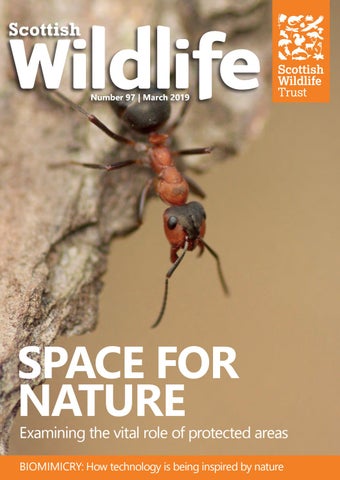
Number 97 | March 2019
SPACE FOR NATURE
Examining the vital role of protected areas BIOMIMICRY: How technology is being inspired by nature
ScottishWildlifeSpring2019.indb 1
15/02/2019 14:33
ScottishWildlifeSpring2019.indb 2
15/02/2019 14:33
Welcome from the Chief Executive
FIRST WORD By Chief Executive Jonny Hughes
T
his, sadly, is my last ‘First Word’ and I write it with mixed emotions. In April I’ll be moving to Cambridge to become the new Chief Executive of the United Nations Environment – World Conservation Monitoring Centre (UNEP-WCMC). As exciting as this new opportunity is, I will miss the Trust and all the many people I have worked with enormously. I have been involved with the Trust since graduating with a Masters in Ecology in 1991 and over the years worked as a volunteer, seasonal warden, regional manager, head of policy, director of conservation and eventually chief executive. This seems like an appropriate moment to reflect on our achievements over this time. My personal highlights include the return of the beaver to the wild in Scotland after an absence of over 400 years and the fact we have successfully made landscapescale conservation the ‘new normal’, turning theory into practice through our ground-breaking Living Landscape programmes. I am also proud that we have inspired tens of thousands of people about nature through our education and outreach work. Many volunteers and others who have joined us through government employment programmes have experienced life-transforming journeys. On the campaign front, we have catalysed the development of a range of environmental policies and laws and helped improve many others that needed reform. These include landmark pieces of legislation such as the Nature Conservation Act and Marine Act. We have also helped the government and wider society
Jonny Hughes at Coul Links, 1993
understand the true value of nature and how it underpins a healthy economy through our work on natural capital. Otters, ospreys, pine martens, Scots pine forests and raised bogs are among the species and habitats back from the brink thanks to our work. We have shown that wildlife conservation works and that nature’s retreat is not inevitable. Yet these successes are still set against a background of some worrying trends in the opposite direction. Seabirds are suffering as sea temperature changes disrupt the balance of marine ecosystems. Farmland wildlife is still reeling from decades of
As exciting as this opportunity is, I will miss the Trust and all the many people I have worked with enormously.
agricultural intensification and our mountains continue to be chronically overgrazed and regularly set ablaze despite the profound ecological damage this causes. Scotland, like the rest of the world, will face unprecedented pressures from climate change in the coming years. So the Trust has much work to do, not least in defending existing protections as exposed by the disgraceful Coul Links golf course application and the ongoing illegal persecution of raptors. We must also act quickly to reconnect fragmented habitats through a National Ecological Network, working constructively with farmers, foresters and landowners as we do so. I’m very pleased to be moving on at a time when the Trust is in such good heart. I leave behind a talented, passionate and knowledgeable team, primed and ready to protect Scotland’s wildlife into the future. MARCH 2019 SCOTTISH WILDLIFE 3
ScottishWildlifeSpring2019.indb 3
15/02/2019 14:33
Contents
Inside this issue
6
16
06 BOG LIFE
We delve into the wet world of Scotland’s peatlands to discover the variety of life that can be found thriving there.
08 NEWS
News round-up from the Trust and the world of conservation.
16
PROTECTED AREAS
With a range of designations protecting our natural world, Rich Rowe investigates what this means for nature conservation.
24 PRIORITY SPECIES
Cal Flyn discovers the influential plants and animals that form the Trust’s list of Priority Species.
28 BIOMIMICRY
28
24
Richard MacCowan explains how the natural world can inspire technological advancements.
31
THE BIG PICTURE
A colourful critter from Scotland’s seas, taken by world-renowned underwater photographer, Dr Alex Mustard.
34 VIEWPOINT
We hear from one of our Saving Scotland’s Red Squirrel’s volunteers.
WIN FOR A STAY THE TWO IN SC BORDOTTISH ERS SE E PAG
E 33
Scottish Wildlife magazine is published by the Scottish Wildlife Trust. © Scottish Wildlife Trust. No part of this magazine may be reproduced without the express permission of the publisher. All photography © Scottish Wildlife Trust unless otherwise stated. The Scottish Wildlife Trust accepts no liability for omissions or incorrect data in advertisements and letters. Views expressed in Scottish Wildlife are not necessarily those of the Scottish Wildlife Trust. ISSN: 0143 1234. Registered office: Harbourside House, 110 Commercial Street, Edinburgh EH6 6NF. Tel: 0131 312 7765. Fax: 0131 312 8705. Email: enquiries@scottishwildlifetrust.org.uk. Website: scottishwildlifetrust.org.uk. The Scottish Wildlife Trust is a company limited by guarantee, registered in Scotland (no. SC040247). It is also a Scottish registered charity (no. SC005792). Scottish Wildlife is published three times a year: March, July and November.
Deadlines for news: 1 January, 1 May, 1 September. No unsolicited articles please. Scottish Wildlife is free to members. Membership rates from 1 April (excluding discounts for paying by Direct Debit): Individual (concession) £40 (£18); Joint (concession) £47 (£24); Family £57; Watch £18; Life (joint) £900 (£1,300); World/Overseas £45. Patron: HRH The Prince Charles, Duke of Rothesay. Chair: Linda Rosborough. Vice-Chairs: Karen Chambers, Amanda Forsyth, Kenny Taylor. Chief Executive: Jonny Hughes. Editor: Jo Pike editor@scottishwildlifetrust.org.uk Production Editor: Pete Haskell. Design: Connect connectcommunications.co.uk Advertising: Elliot Whitehead 0131 561 0021, Clare Stebbing 0131 561 0024. Printing: InkMark – inkmarkltd.com Cover photo: © Luke Massey, 2020VISION
The Scottish Wildlife Trust is affiliated to The Wildlife Trusts, a UK-wide network of 46 Trusts with more than 2,000 wildlife reserves. 4 SCOTTISH WILDLIFE MARCH 2019
ScottishWildlifeSpring2019.indb 4
15/02/2019 14:33
Spotlight: Sphagnum moss
© Chris Lawrence
SPECIES SPOTLIGHT:
SPHAGNUM MOSS (Sphagnum spp.)
Commonly referred to as ‘peat moss’ or ‘bog moss’, there are around 380 species of Sphagnum globally, 34 of which have been recorded in the UK.
Sphagnum mosses are an essential component of peat bogs, thriving in wet and nutrient-poor conditions that many other plants can’t tolerate and creating habitats for a wide range of animals.
Mosses do not produce flowers or seeds, instead they produce spores inside a capsule. When the spores are ripe, pressure inside the capsule increases until the ‘lid’ is blown off, releasing the spores into the air.
Due to its ability to hold more than eight times its own weight in liquid, dried Sphagnum moss is known to have been used to dress wounds during the Battle of Flodden and World War I.
Over time, species of Sphagnum and other mosses can lock up huge amounts of carbon, making their conservation and restoration of key importance in lessening the effects of climate change.
MARCH 2019 SCOTTISH WILDLIFE 5
ScottishWildlifeSpring2019.indb 5
15/02/2019 14:33
Spotlight: Peatlands
BOG LIFE SCOTLAND’S peatlands cover more than 20% of the country and hold over 1.6 billion tonnes of carbon, an amount equivalent to that held in a third of the Amazon rainforest – despite being 250 times smaller. As well as being a carbon sink, healthy peatlands provide us with high-quality drinking water, reduce the risk of flooding and blanket many of the iconic landscapes for which Scotland is famed.
Peatlands also provide a home to a wide diversity of wildlife, from carnivorous plants to rare migratory birds, making them fascinating places to explore. So whether you’re squelching across one of the vast blanket bogs of the Highlands, or visiting one of the protected raised bogs in the Lowlands, have a look out for some of these species.
MERLIN
LARGE HEATH BUTTERFLY
Slightly larger than blackbirds, merlins are Europe’s smallest falcons, hunting low to the ground over peatland, heathland and grassland habitats where they feed on small birds such as meadow pipits.
This medium-sized brown butterfly can be found across Scotland on wet, open areas where Hare’s-tail cottongrass grows, as this is the main foodplant of the caterpillar. Adults can be seen between June and August.
SPHAGNUM
HARE’S-TAIL COTTONGRASS
Ranging in colour from red and pink to green and yellow, identification of Sphagnum mosses to species level can be tricky, but it’s well worth getting down on hands and knees and taking a close look at this living carpet.
Flowering in spring and summer, this important foodplant reaches 60cm in height and grows in clumps on wet, boggy ground. Despite its common name, this and other cottongrasses are in fact types of sedge, not grass.
6 SCOTTISH WILDLIFE MARCH 2019
ScottishWildlifeSpring2019.indb 6
15/02/2019 14:33
Spotlight: Peatlands
D C B A
RESERVES A CARSEGOWAN MOSS
OS Landranger 66, NT254735 Cranberry and bog rosemary grow amongst the carpet of Sphagnum moss on this reserve. Adders can be seen basking in summer and hen harriers, merlin and short-eared owls can occasionally be spotted hunting across the bog. HIEROGLYPHIC LADYBIRD Found among heather on peatlands across Scotland between March and November, these attractive ladybirds feed primarily on the larvae of heather leaf beetles and are one of the 46 species of ladybird found in the UK.
B HOSELAW LOCH AND DIN MOSS
OS Landranger 66, NT254735 Din Moss, at the south-west end of Hoselaw Loch, is one of the largest and most intact raised bogs in the Scottish Borders. Possible sightings at this reserve include large heath butterflies, skylarks and snipe.
C RED MOSS OF BALERNO
OS Landranger 66, NT164636 Deep peat has built up over thousands of years at what is the only raised bog in the City of Edinburgh. Sphagnum, cottongrass, sundews and heather blanket this reserve which can be explored via a circular boardwalk.
D BANKHEAD MOSS
OS Landranger 59, NO447103 Sphagnum, cottongrass and sundews thrive in this small raised bog in Fife. Brown hares and birds such as curlew, snipe and lapwing can be spotted from the boardwalk and hide.
E RED MOSS OF NETHERLEY
PALMATE NEWT With their shallow ponds and acidic soils, peatlands provide an ideal habitat for palmate newts. Growing up to 10cm and living for up to 10 years, newts can be spotted between March and October feeding on invertebrates.
OS Landranger 38, NO857938 Including one of the best examples of raised bog in north-east Scotland, this mosaic of fen, marsh and woodland is home to bog asphodel, carnivorous sundews and several species of dragonfly. For full reserve information, visit scottishwildlifetrust.org.uk/reserves
Main image © Ben Dolphin, Sphagnum © Mark Hamblin, Large heath butterfly © Shutterstock., Palmate newt © Philip Precey, Merlin © Rob Jordan, 2020VISION, Hare’s-tail cottongrass © Mark Hamblin/2020VISION, Hieroglyphic ladybird © Gilles San Martin
E
MARCH 2019 SCOTTISH WILDLIFE 7
ScottishWildlifeSpring2019.indb 7
15/02/2019 14:33
Scottish Wildlife Trust news
Latest news
News from the Trust, our projects and the wider world of conservation
KEEP UP TO DATE
All the latest Trust news is available on our website scottishwildlife trust.org.uk © Warren Media
March forward? March may prove to be a pivotal month for the ongoing saga of Brexit, but there are other important developments getting less of the limelight. The Scottish Government has rightly put protecting and enhancing Scotland’s natural capital - including soil, water and biodiversity - at the heart of key policies on the environment and the economy. The wide range of essential services (often called ecosystem services) that natural capital provides include the food and water we eat and drink, as well as the plant materials we use for fuel, building materials and medicines. Other vitally important natural services include climate regulation, flood defences, insect pollination of crops and carbon storage by peatlands, forests and seas. As such, the first publication by the Office for National Statistics of the Natural Capital Ecosystem Service Accounts for Scotland expected later this month should not be allowed to go unnoticed. It may not have the most exciting title and the data may still be incomplete, but this will provide much more detail on how the ecosystem services we all benefit from in Scotland are changing. We will be encouraging the Scottish Government to give as much prominence to these new accounts as it does to traditional economic accounts. The information must be put to good use and start to inform key policies if we’re to move from rhetoric to reality. Dougie Peedle is the Trust’s Head of Policy
New chapter for Cumbernauld Living Landscape A TRUST-led partnership is making the thanks to a transformational grant of most significant investment in £1,375,000 from the National Lottery Cumbernauld’s green spaces since the Heritage Fund and generous support town was created in the 1950s. from North Lanarkshire Council. Work This investment is part of Creating is now underway to raise the remaining Natural Connections, Cumbernauld £200,000 needed to fund the project. Living Landscape’s scheme to create “To truly connect Cumbernauld’s greater connections between people with wildlife we have work to people and wildlife. do to improve local green Over the next four spaces,” said Ian Mackenzie, years, 12,000 trees will be the Trust’s Living planted, hundreds of Landscapes Programme FIND hectares of urban Manager. “This funding OUT MORE woodland will be gives us an exciting Help us reconnect people improved, and six new chance to put nature and and wildlife in Cumbernauld. community rain people at the heart of the Donate today at gardens will reduce the town’s future.” scottishwildlifetrust.org. impact of flooding. Riona McMorrow, uk/donate Nearly 3,000 primary Acting Head of the National school pupils will be able to Lottery Heritage Fund in explore nature, community Scotland said: “We’re delighted groups will be empowered to have a even more people will get the opportunity greater say about the management of their to connect with nature and realise the local green spaces, and groups including benefits to their health and wellbeing.” people at risk of poor mental health will Creating Natural Connections is led by be given support to help improve their the Trust alongside North Lanarkshire wellbeing through access to nature. Council, The Conservation Volunteers, We’ve been able to get Creating Sanctuary Scotland and the James Natural Connections off the ground Hutton Institute.
]
8 SCOTTISH WILDLIFE MARCH 2019
ScottishWildlifeSpring2019.indb 8
15/02/2019 14:33
Scottish Wildlife Trust news
ust ble e fe
© Richard Shucksmith, SNH
© Luke Massey/2020VISION
P E
FOUR REASONS WHY SCOTLAND IS GLOBALLY IMPORTANT FOR NATURE
10% of Europe’s coastline 33% of all of Europe’s breeding seabirds 29% of Europe’s seals 5% of the world’s peatlands
Stepping up the fight THE Trust has added its support to a campaign calling for a new Scottish Environment Act to protect nature now and in the future. Fight for Scotland’s Nature has been launched by Scottish Environment LINK in response to the uncertainty caused by Brexit, as well as mounting evidence of the ecological crisis threatening Scotland. “Eighty per cent of Scotland’s environmental laws come from the EU. “Losing this protection when we leave the European Union could spell disaster for wildlife,” said our Head of Policy Dougie Peedle.
“Nature is our life support network. To ensure it remains protected, we need the Scottish Government to introduce a strong Environment Act to guarantee existing protections, as well as replicating the enforcement roles of bodies such as the European Commission and the European Court of Justice.” Fight for Scotland’s Nature is supported by 35 leading environmental charities. Add your own support to the campaign by signing the petition at fightforscotlandsnature.scot
Hoopoe hops in to Montrose © Ron Mitchell
THE first Eurasian hoopoe ever recorded at Montrose Basin Wildlife Reserve caused a stir for a few days in November with visitors flocking to see this colourful and exotic-looking bird. More often found in Southern Europe and Northern Africa, hoopoes are unmistakable due to their long beaks, colourful feathers and distinctive crests. Around 5-20 of these birds appear in Scotland each year, usually as a result of being blown off course during their autumn migration. Other winter highlights at Montrose Basin over the last year include regular sightings of little egrets and nearly 80,000 pink-footed geese.
Kelp dredging banned in Scotland DAMAGING plans to dredge thousands of tonnes of kelp from Scotland’s seas each year have been halted by the Scottish Parliament. In 2018, Marine Polymers Limited announced its intention to mechanically harvest 30,000 tonnes of kelp per year, exposing the seabed and causing potentially irreversible damage. This practice has been effectively outlawed by an amendment to the Crown Estate Bill that prevents seaweed from being unsustainably harvested. The Scottish Government has also announced a review of current kelp harvesting activity. Dr Sam Collin, the Trust’s Marine Planning Manager, said: “We welcome the principled stance MSPs have taken to protect Scotland’s seas. Our kelp forests are vital habitats that are already under threat from climate change and ocean acidification.” More than 2,000 members of the public, including many Scottish Wildlife Trust members, objected to the plans during a public consultation.
50 years of ospreys at Loch of the Lowes THIS year marks a half century of osprey conservation at Loch of the Lowes Wildlife Reserve. Ospreys made an appearance at the reserve shortly after its foundation in 1969 and have been at the heart of the Trust’s work there ever since (find out more about this in your next issue of Scottish Wildlife ). A number of celebrations are planned this year with support from players of People’s Postcode Lottery. These include an open weekend at our visitor centre in August, a new timeline celebrating important milestones and a year-long celebration on social media. MARCH 2019 SCOTTISH WILDLIFE 9
ScottishWildlifeSpring2019.indb 9
15/02/2019 14:33
Scottish Wildlife Trust news
© Andrew Parkinson,2020VISION
IN BRIEF Healthy working lives
THE Trust has achieved a Bronze Award in NHS Scotland’s Healthy Working Lives programme. Participation is designed to help improve health, safety and wellbeing in the organisation in a structured and productive way. © Jennifer Fulton
Young Leader Connie Dawson with Jonny Hughes
Young leaders
OUR new Young Leaders group is off to a flying start after a successful first meeting at Falls of Clyde Visitor Centre and Wildlife Reserve in November. The team continues to support the Trust’s work at public events, helping us to reach more young people, and have launched a new “Wildlife Champions” Facebook group to help people experience and share all that Scotland’s nature has to offer.
New Handa Ranger
LINNEA Hindriks from Germany will lead the Trust’s work on Handa Island Wildlife Reserve this season. Linnea was a volunteer Assistant Ranger in spring 2017 and enjoyed her time so much that she stayed for the whole season. Reserve Manager Sven Rasmussen said: “We are delighted that volunteering with the Trust gives people the skills and experience that helps them to find future careers in conservation.”
Sir John Lister-Kaye honoured by award
FORMER President of the Trust and Director of the internationally acclaimed Aigas Field Centre, Sir John Lister-Kaye OBE, has received a Lifetime Achievement Award in the 2018 Nature of Scotland Awards in recognition of a career in conservation spanning over 40 years.
Annual General Meeting
OUR 55th Annual General Meeting will be held on Saturday 21 September 2019. Further details including the venue will be announced in the next issue of Scottish Wildlife.
Earn Your Stripes A NEW three-year partnership project with the charity Scottish Badgers, funded by the National Lottery Heritage Fund, aims to create a skilled network of community wildlife champions across the Central Belt. Volunteers will be able to gain useful skills and be involved in activities such as badger surveys, video editing and public talks.
The programme will be accessible to groups who often do not have the opportunity for such training and development, such as young unemployed people and those with varying disabilities. Scottish Badger Week runs from 4-12 May 2019. To find out about events taking place around Scotland, please visit the Trust’s website.
Government urged to protect Scotland’s beavers THE Trust has issued a joint open letter, published in The Guardian, urging the Scottish Government to finally introduce the promised legislation that would grant beavers European Protected Species status. A report published by Scottish Natural Heritage has confirmed that unregulated culling has created “empty territories” in Tayside. No records are kept of the number of animals that have been culled, but estimates range from 50-240 beavers. Alongside the 16 other environmental charities and individuals who signed the open letter, we believe the lack of legal protection could stop the beavers’ natural spread throughout Scotland’s lochs and rivers, thereby putting the species at risk once again.
Go wild this June 30 Days Wild is a simple challenge to undertake one ‘random act of wildness’ each day in June. Last year, almost 30,000 people in Scotland took part, and we’re hoping for even more people to get involved this year. You can sign up for this year’s challenge from 14 April by visiting scottishwildlifetrust.org.uk/30DaysWild
10 SCOTTISH WILDLIFE MARCH 2019
ScottishWildlifeSpring2019.indb 10
15/02/2019 14:33
Scottish Wildlife Trust news
Move to save Ardeer
Fight for Coul Links continues © Andrew Weston
Sand extraction is taking place at five separate sites at Ardeer
ONE of Scotland’s best sites for nature is being threatened by a 65-year-old order which allows development to take place without planning permission. The Special Development Order covering the Ardeer Peninsula in Ayrshire means that developments including sand extraction and a “masterplan” of housing and leisure facilities do not need
the planning permission that would be required elsewhere in Scotland. Campaigning by organisations including the Trust and local naturalists has led to Ruth Maguire MSP submitting an amendment to the Scottish Parliament’s Planning Bill, which aims to revoke the order. This will be voted on in parliament in early 2019.
© Sandie Maciver - Point and Sandwick Trust
EXPERTS including our Chief Executive Jonny Hughes are warning of the damage that will be done to internationally important wildlife and habitats at a public inquiry into the planned golf course at Coul Links near Dornoch. “The Scottish Government’s response to Coul Links is a test of its commitment to caring for our most important habitats,” said Jonny. “We hope our evidence will lead to a swift rejection of plans to carve out a golf course in this truly special place.” The inquiry is due to begin in late February and is likely to last around six weeks. It will then be up to the Scottish Government to save the site for future generations.
Wildness and wellness Growing tribute on Lewis SAPLINGS grown by Little Assynt Tree Nursery have been planted in Stornoway on the Isle of Lewis to commemorate one of the worst maritime disasters of the 20th Century. Point and Sandwick Trust organised the living memorial for the 201 men, many of whom were sailors returning home after the First World War, who
died on 1 January 1919 when the HMY Iolaire sank just a few yards from shore. The nursery was established by the Trust-led Coigach & Assynt Living Landscape in 2013 to meet demand for local tree planting projects. It currently produces 30,000 native saplings per year and aims to increase production to 100,000.
JUPITER Urban Wildlife Centre has created a new group for people who want to experience the calming power of nature. The Wild Ways Well group meets informally once a month. The group takes part in relaxing activities including guided meditation and learning about bird calls before finishing off with refreshments and reflections on the session. One participant said: “Being mindful in the natural environment has helped to calm my mind, lift my spirits and boost my confidence.” To find out more, please contact our Falkirk Ranger at falkirkranger@ scottishwildlifetrust.org.uk MARCH 2019 SCOTTISH WILDLIFE 11
ScottishWildlifeSpring2019.indb 11
15/02/2019 14:33
Scottish Wildlife Trust news
A healthy environment may become a human right A HEALTHY environment could be legally acknowledged as a basic human right in Scotland following a recommendation made by the First Minister’s Advisory Group on Human Rights Leadership. Our Chief Executive Jonny Hughes
said: “We’re greatly encouraged by the recommendation to enshrine the right to a healthy environment in Scots law. It’s an important way to recognise that nature is our life support system. “We believe further progress can be achieved in this area in a number of ways
including increased access to environmental justice through the creation of a specialist court.” A recent report by the group highlighted that more than 100 countries around the world have already given improved status to environmental rights.
© Andrew Nuhi
50-day challenge raises funds for wildlife © Sheila Chapman
Bringing in the heavies SHETLAND cattle are helping to ensure Petershill Wildlife Reserve in West Lothian remains a haven for wildlife including rare wildflowers, insects and amphibians. These hardy beasts trample and graze long grass and protect the reserve’s species-rich grassland and lagoons from encroaching scrub. Reserve Manager Julian Warman said: “We’ve been reliant on volunteers
to cut and rake the reserve for many years. However, this is labourintensive work that cattle can do much more easily, and more effectively.” The cattle have been introduced to Petershill thanks to fencing and new gates provided by the LandTrust and our Lothians Local Group. The cattle are watched over by a dedicated team of local volunteers.
Callander group wins National Park award MEMBERS of the Trust’s Callander Local Group have been named Celia Burn Community Environmentalists of the Year in these annual awards organised by the Loch Lomond & The Trossachs Community Partnership. The award was given to the group in recognition of their outstanding work in environmental education and wildlife conservation in the area, which includes organising inspirational public talks, fundraising activities, toad patrols, orchid surveys and local wildlife recording. Secretary Lesley Hawkins said: “We’re very pleased to receive this recognition
of our environmental efforts. It reflects the great support we have from our members.” This award was presented in special memory of Celia Burn, who was renowned for her own personal contributions to raising environmental awareness and her deep-rooted community involvement. Dinah McDonald, Chair of The Community Partnership, said: “Our winners are ensuring that the National Park remains beautiful and productive.” Find out how to get involved with your local group on our website.
EDINBURGH artist Sheila Chapman has raised £865 for the Trust by painting one small nature painting every day for 50 days and donating the proceeds from their sale. The subjects of her artworks included birds, animals and landscapes. If you would like to help us protect Scotland’s wildlife by raising money for the Trust, please email Zoë Furnivall at zfurnivall@scottishwildlifetrust.org.uk
Innovative finance
MORE than 80 people attended the launch in February of the Scottish Conservation Finance Project, led by the Scottish Wildlife Trust and the Scottish Environment Protection Agency. The project aims to develop innovative sources of funding for nature conservation that will also provide social and economic benefits, as well as generating returns for investors. This could involve reducing flood risk, improving air and water quality, providing mental and physical health benefits, and locking up carbon. For more information, contact Amanda Joseph at ajoseph@scottishwildlifetrust.org.uk
12 SCOTTISH WILDLIFE MARCH 2019
ScottishWildlifeSpring2019.indb 12
15/02/2019 14:34
Are you putting something off? You’re not alone. Surveys suggest that 60% of us do not have an up-to-date Will. Understanding how important Will writing is to individuals and charities, we are pleased to be working in partnership with the National Free Wills Network to offer you the opportunity to write or update a simple Will for free.
© Tom Reichner
Once you have taken care of your family and friends, please consider leaving a gift in your Will to the Scottish Wildlife Trust, and make sure your wishes live on.
For more information on the Free Wills Scheme, or to request a free Will, go to scottishwildlifetrust.org.uk/freewills or call Zoë on 0131 312 4772.
ScottishWildlifeSpring2019.indb 13
15/02/2019 14:34
Wider news
© Mark Hamblin/2020VISION
Study finds rare Scottish fly is globally endangered
Potential wildlife crime breakthrough
THE International Union for Conservation of Nature (IUCN) has published a global assessment for Fonseca’s seed fly which found the species to be globally endangered, the same status as the Asian elephant, tigers and the blue whale. This classification is the second most severe category in the internationally adopted system and is used for species that are likely to become extinct if current threats to their survival are not removed or avoided. Craig Macadam, Conservation Director of Buglife, said: “We must do everything we can to ensure that the threats to this unique Scottish species are avoided and it is allowed to thrive.” Fonseca’s seed fly is only found on a short stretch of coast in northern Scotland. It lives on the fragile dune systems that line the coast between Dornoch and Loch Fleet where it is thought to depend on plants such as ragwort and sow-thistles. Nearly a third of its global range is currently threatened by the proposed golf course at Coul Links north of Dornoch.
Hen harrier
THE British Dragonfly Society is looking for community groups who are interested in working together to create or improve ponds in community green spaces as part of its People for Ponds project. For more information, contact Andrea Huspeth at andrea.huspeth@british-dragonflies.og.uk
on a hillside is currently difficult. Until recently it was only possible to lift fingerprints from bird feathers under laboratory conditions. However, scientists have now developed the ability to take identifiable prints on feathers that have been exposed to wind and rain. Helen McMorris, from Abertay University, said: “This technique potentially gives investigators the chance to
prove actual human involvement in raptor persecution, be it through an identifiable fingerprint or a touch mark from a human finger that identifies exact areas of contact on the bird of prey.” According to the latest RSPB Birdcrime report, there were 68 confirmed incidents of raptor persecution in 2017, with only four prosecutions and just one successful conviction.
reforestation efforts.” The Scottish Government has committed to actions as part of its pledge to the Bonn Challenge, including planting a total of 165,000 hectares of new woodland in Scotland
by 2030, and ensuring 3,000 to 5,000 hectares of new native woodland is established each year.
Bonn Challenge SCOTLAND has become the first country in Europe to sign up to a global challenge to restore landscapes and forests. The Bonn Challenge aims to secure the regeneration of 350 million hectares of deforested and degraded landscapes by 2030. This goal has been supported by First Minister Nicola Sturgeon, who said: “We will play our part in global efforts to increase woodland cover and restore landscapes, benefiting people and the environment. I hope our support will galvanise other governments to join
© Mark Hamblin/2020VISION
© Natural History Museum
Call for community groups to help dragonflies
FORENSIC techniques developed in Dundee could lead to an increase in the number of successful convictions for wildlife crime in the UK. While toxicology tests can prove that a raptor has been poisoned, and x-rays and post mortems can show clear evidence of shooting, conclusively proving whether a human has had any contact with a bird of prey found dead in a field or
Learn more at bonnchallenge.org
14 SCOTTISH WILDLIFE MARCH 2019
ScottishWildlifeSpring2019.indb 14
15/02/2019 14:34
ScottishWildlifeSpring2019.indb 15
15/02/2019 14:34
Protected areas
PROTECTED AREAS
P
rotected areas play an essential role in conserving the natural world. By protecting sites with locally, nationally or internationally important natural features, they make a vital contribution towards helping wildlife to survive (and thrive), as well as providing us with places to visit and enjoy. They can range in size from Marine Protected Areas that cover more than two million hectares of ocean, to the 0.1 hectare Imperial Dock Lock Special Protection Area in Leith, which is an important breeding ground for common terns.
Sites of Special Scientific Interest (SSSIs) are areas of land and water that best represent our natural heritage in terms of their flora, fauna, geology and geomorphology.
1,423
The number of SSSIs in Scotland
© Ben Averis
Sites of Special Scientific Interest
As well as coming in many shapes and sizes, protected areas can be designated under a range of different statutory and non-statutory frameworks. Some fall under international treaties or directives which offer a level of legal protection, whilst others are designated by local authorities to benefit the local wildlife and community. While all play an important role in protecting nature, we focus here on those which afford some form of legal protection to an area, with examples from some of our reserves.
Rahoy Hills on the Morvern peninsula is designated as an SSSI and an SAC. There are 12 protected features on this reserve, including its upland habitat, vascular plant assemblage and otter population.
12.7%
The area of land covered by SSSIs in Scotland
Special Areas of Conservation
2.47 249 The number of SACs in Scotland
million hectares The area of land and sea protected by SACs
© Alistair Jump
Special Areas of Conservation (SACs) are designated under the EU Habitats Directive in order to protect special habitats and non-bird species.
HABITATS
16 SCOTTISH WILDLIFE MARCH 2019
ScottishWildlifeSpring2019.indb 16
Maritime cliff
Lowland neutral grassland
Scots pine forest
Raised bog
Scots pine forest © Peter Cairns, 2020VISION; Raised bog © Euan Macdonald
PROTECTED FEATURES
For an area to be designated, it must contain one or more natural features for which the area is being protected. This can be for biological features, such as a particular habitat or species, or geological features, such as an ancient rock type or land formation. Here are a few examples of protected features within Scotland’s protected area network.
Tummel Shingle Islands near Pitlochry boasts one of the rarest habitats in the UK. It is designated as both an SSSI and an SAC, protecting features such as its freshwater shingle habitat and fly assemblage.
15/02/2019 14:34
Protected areas
Special Protection Areas (SPAs) are classified under the EU Birds Directive to protect birds that are rare, threatened or vulnerable in Europe, as well as regularly occurring migratory birds. million 153 1.23 hectares The number
Handa Island has SSSI and SPA designations, protecting the internationally important breeding colonies of kittiwakes, razorbills, guillemots and others on the island’s maritime cliffs.
The area of land and inshore waters protected by SPAs
of SPAs in Scotland
Ramsar sites
A Ramsar site is an area of wetland that is deemed to be of international importance. It is protected under the Ramsar Convention – an intergovernmental environmental treaty which came into force in 1975.
© Pete Haskell
Spey Bay boasts SSSI, SPA, SAC and Ramsar designations which together protect 25 features ranging from shingle, saltmarsh and wet woodland habitat to populations of oystercatcher, small blue butterfly and Atlantic salmon.
51
The number of Ramsar sites in Scotland
313,000hectares The area of Scotland’s wetland protected as Ramsar sites
Alloa Inches in the River Forth has SSSI, SPA and Ramsar designations, protecting a range of features from the salt marsh habitat to the many species of wildfowl and wader present on the reserve at certain times of year.
© Alison Robertson
Drummains Reedbed south of Dumfries is protected under SSSI, SPA, SAC and Ramsar designations. The estuary, saltmarsh and intertidal mudflats are all protected features, as are the Svalbard barnacle and pinkfooted geese that visit this reserve on their annual migration.
Dragonfly assemblage
Otter
Atlantic salmon
Many SSSIs, SACs and SPAs protect areas of marine habitat but in 2014, Scottish Ministers decided to strengthen the Marine Protected Area (MPA) network by creating a suite of Nature Conservation MPAs.
30 The number
of Nature Conservation MPAs in Scotland’s seas
22% The area of
Scotland’s seas that are protected under the MPA network
GEOLOGY
Great skua
Fluvial geomorphology
Torridonian rock
Dragonfly assemblage © Ross Hoddinott 2020VISION; Torridonian rock © Gordon Hatton
SPECIES
Marine Protected Areas
Contains SNH and Scottish Government (Marine Scotland) information licensed under the Open Government Licence v3.0, and OS data © Crown copyright and database right (2019).
© Danni Thompson
Special Protection Areas
MARCH 2019 SCOTTISH WILDLIFE 17
ScottishWildlifeSpring2019.indb 17
15/02/2019 14:34
Protected areas
Political uncertainties point to challenges ahead, but the Trust is as committed as ever to caring for legally protected areas – work that extends far beyond practical conservation efforts, writes Rich Rowe.
POCKETS OF PR S
haped by one of Scotland’s great rivers, the wonderfully scenic gorge that carves its way through the Trust’s Falls of Clyde reserve in Lanarkshire has attracted visitors for centuries. Unsurprisingly, given its ecological, cultural and historic value, it has also attracted a wide range of protective designations. One of the Trust’s most celebrated reserves – and its most visited – Falls of Clyde is a designated Site of Special Scientific Interest (SSSI) for its geology and mixed woodland, as well as being part of the wider Clyde Valley
Woodlands National Nature Reserve. And there’s more: located alongside the historic village of New Lanark, it is also partly within a cultural World Heritage Area. Given the sheer number of visitors, plus the reserve’s official designations, significant investment in visitor infrastructure – from footpaths to hand rails and safety barriers – is necessary at Falls of Clyde. But, as a protected area for ecological reasons, the Trust must also keep the site in ‘good condition’. In recent years, this has involved restructuring the dense woodland
that spills down the slopes of the gorge, removing non-native conifers and either planting native broadleaved trees, such as oak and hazel, or clearing space in the canopy so that the light can encourage natural regeneration of trees and shrubs. With more than 70 of the Trust’s reserves designated at national or international levels, it is a dedication to ecological improvement that is mirrored elsewhere. SSSIs are selected as areas of specific conservation value, while Special Areas of Conservation (SACs) protect specific habitats, and
18 SCOTTISH WILDLIFE MARCH 2019
ScottishWildlifeSpring2019.indb 18
15/02/2019 14:34
Protected areas
The Falls of Clyde reserve in Lanarkshire has attracted a range of protective designations
PROTECTION Special Protection Areas (SPAs) are selected to protect specific bird species. Some of the Trust’s reserves are all three. And then there are so-called Ramsar sites, wetlands recognised as having international importance under the Ramsar Convention, to which almost 90% of UN states are a signatory, and National Nature Reserves, although the latter does not have the legal underpinning that other designations do. Between them, they are the jewels in the crown of Scotland’s natural heritage.
More than 93% of designated features on Trust reserves are currently in favourable or recovering condition.
ON THE GROUND
As part of its commitment to managing protected areas, the Trust feeds into Scottish Natural Heritage’s (SNH’s) site condition monitoring programme, which assesses the condition of natural features of special interest on designated sites. On the SNH measure, more than 93% of designated features on Trust reserves are currently in favourable or recovering condition. Not all protected areas have work undertaken on them annually; if anything, the Trust’s non-designated sites have more MARCH 2019 SCOTTISH WILDLIFE 19
ScottishWildlifeSpring2019.indb 19
15/02/2019 14:34
Protected areas
© Craig Allardyce
Coul Links is one of the most protected places on the planet, but is currently under threat from development
practical work carried out to bring them up to the standard of designated ones. In recent years, there has also been considerable focus on extensions to Trust reserves and bringing protected areas under management – sometimes for the first time in decades. At Bawsinch and Duddingston Loch, for example, an area of SSSI-designated grassland is gradually being restored. This follows the Trust’s long-term agreement with the landowner to take on an adjacent parcel of land that was once grazed by Highland cattle, but which has long since been lost to scrub. Here, the Trust has worked with the Lothians Conservation Volunteers to remove the densest areas of gorse and then introduce cattle from its Flying Herd to continue the work. For the past two years, these unfussy grazers have suppressed gorse and dominant grasses, reducing competition for the native wildflowers that were once so prevalent on the site. “This is a long-term management
task, and it will probably be another five years before we see significant changes,” explains Alan Anderson, the Trust’s Head of Reserves. “It builds on the meadow management work we have undertaken elsewhere on the reserve over the last 30 years.” It’s a similar story at Red Moss of Netherley in Aberdeenshire – designated as both an SSSI and SAC for its importance as an active raised bog. Over the past five years, the Trust has increased the area under management for nature conservation by entering into long-term agreements with several surrounding neighbours. During this time, and with the help of Peatland Action funding, the condition of the bog has been greatly improved, with the installation of dams to raise the water table and the removal of trees to prevent the drying out of rare mosses on the surface of the bog.
A CLEAR VOICE
The importance of the Trust’s hands-on
At a minimum we want to maintain [EU] standards, but our aim is to push beyond that and set an example to other countries.
work is matched by its efforts to ensure that protected areas are not threatened by planning developments. It’s a fight that can appear never-ending. A decade after the Trump International Golf Links in Aberdeenshire was approved – despite the area being part of an SSSI – the Trust is a founding partner in a campaign to halt plans for another golf course, this time at Coul Links near Dornoch in Sutherland. Situated on a wild stretch of coastline, the site’s importance to wildlife is reflected in its three distinct levels of protection as an SSSI, SPA and Ramsar wetland site. “This is vital campaigning work,” explains Bruce Wilson, the Trust’s Public Affairs Manager. “Coul Links is one of the most protected places on the planet and yet it still faces the threat of development. “If protected sites are not actually protected in practice, it makes the designations meaningless.” The campaign saw almost 13,000 people sign up to an ‘e-action’ asking Scottish ministers to ‘call in’ the plans in recognition of the national significance of the issues involved. This campaign was successful and a public inquiry will now take place to help ministers reach a final decision. With coastal sand dune habitats rarer than rainforests globally, the Trust is firmly hoping for a positive outcome.
20 SCOTTISH WILDLIFE MARCH 2019
ScottishWildlifeSpring2019.indb 20
15/02/2019 14:34
Protected areas
Such individually significant cases capture headlines, but this kind of campaign work is also underpinned by a wider message. “Nature thrives in many places without designations, but the Trust sees a healthy suite of protected areas across Scotland serving as the backbone of a National Ecological Network,” says Bruce. Broad and ambitious, the development of such a network is being championed as a practical, long-term vision for enhancing Scotland’s natural assets. It’s a question of connecting the dots – creating ecological highways that allow species to move more readily across the landscape rather than being confined to the perimeters of a reserve or protected area.
BREXIT AND BEYOND
There is, of course, one issue that raises major questions about the future of environmental protection in Scotland. Given that SACs and SPAs are designated under European Union directives, and Ramsar sites are underpinned by these designations, what on earth will happen to such environmental protections following Brexit? It is a worry, admits Bruce, who points to two main concerns. “Firstly, we will lose key European environmental protection legislation,” he says. The Scottish Government has provided assurances that such protections will remain in place, but that only leads to the second concern.
“Up to now, we’ve had the European Court of Justice in place, but once the UK leaves the EU we will no longer have such overarching enforcement.” For its part, the Trust has made its expectations clear: whatever future relationship with Europe emerges, levels of environmental protection in Scotland should remain as high, or higher, than before. A key element of this is to ensure that the Scottish Government stays true to its stated commitment to keep parity with Europe. “We have called for a principle of non-regression in current environmental law and policy,” explains Bruce. This means the Scottish Government should track EU environmental policy developments, and revisions to EU regulations and directives. “Of course, if European countries erode that environmental protection – and it looks like some are teetering on the brink – then we would not regress and backtrack on already established environmental protections.” The challenge now is to ensure that the Scottish Government’s stated commitment is enforceable by law – ideally with the establishment of a domestic mechanism with the power to consider any breaches to the implementation of environmental legislation. “There are big issues around this,” says Bruce. “We must ensure that the mechanisms are in place to hold the Scottish Government to account.”
However, as with many aspects of the Brexit puzzle, there could well be some opportunities of interest. After all, there is existing international legislation that extends well beyond Europe. In terms of marine protection, Dr Sam Collin, the Trust’s Marine Planning Manager, points to the United Nations Convention on the Law of the Sea, which sets out a legal framework for marine and maritime activities, as well as the OSPAR Convention – a mechanism by which 15 governments and the EU cooperate to protect the marine environment of the North East Atlantic. “Scotland was one of the first to sign up for OSPAR’s goals for sustainable use of marine resources,” he explains. “There is plenty of strong legislative advice and guidance that we could implement as part of our own national legislation.” And, as Sam points out, while it’s positive that Holyrood has committed to maintaining EU standards, there is an opportunity to go one better. “At a minimum we want to maintain those standards, but our aim is to push beyond that and set an example to other countries,” he says. It’s an ambition that many who work on protected areas around Scotland would gladly sign up to. Rich Rowe is an outdoors writer based in Innerleithen, Scottish Borders. richardrowe.co.uk
© Pete Haskell
Scotland was one of the first nations to sign up to the goals set by the OSPAR Convention to protect marine resources in the North East Atlantic.
MARCH 2019 SCOTTISH WILDLIFE 21
ScottishWildlifeSpring2019.indb 21
15/02/2019 14:34
Q&A
Q&A
Dr Kathy MacKinnon Chair of the World Commission on Protected Areas
Dr Kathy MacKinnon is Chair of the World Commission on Protected Areas (WCPA), one of the six commissions of the International Union for Conservation of Nature (IUCN). The WCPA is a global network of more than 2,500 professionals who work on a voluntary basis on the planning, protection and management of protected and conserved areas. Can protected areas help reverse the alarming decline in biodiversity? Protected areas are the cornerstones of biodiversity conservation and critical to preventing further loss. The Protected Planet Report 2018 shows a continuing increase in both terrestrial and marine protected areas, but we must do more to ensure the global network covers all ecosystems and is well-managed. While many protected areas are in unspoilt wilderness, we are seeing exciting new opportunities to establish urban protected areas, like the Scottish Wildlife Trust’s Bawsinch and Duddingston Loch Wildlife Reserve in Edinburgh. These not only provide oases for wildlife and recreation but also serve to increase awareness of linkages between cities and the wider natural landscape on which they depend. The World Commission on Protected Areas celebrates its 60th year in 2020. What do you see as its biggest achievement? The Commission has a long history of promoting good practice and training on a wide range of topics, from governance to restoration and tourism. More recently, the Commission has influenced international policies by promoting protected areas as nature-based solutions to global challenges, including climate change. Several countries are now including protected areas in their national climate strategies. The Scottish Wildlife Trust is currently fighting to protect Coul Links in East Sutherland from a golf course development. What’s the place of economic arguments in cases such as this? I am very supportive of the campaign to save Coul Links. The UK, as a signatory to the international Convention on Biological Diversity, has an obligation to protect areas important for biodiversity. Coul Links, with its rare and unique habitats
and species communities, is such a site. Unfortunately, developers often invoke the argument of economic benefits to justify destroying natural habitats but biodiversity, once lost, may be impossible to restore. As conservationists, we need to get much better at convincing policymakers that they need to protect biodiversity, not just as a conservation imperative but as a national asset which can also deliver future social and economic benefits. What can members of the Scottish Wildlife Trust do to help advance the cause of protected areas? Everyone can play a part in conserving nature, whether by volunteering and supporting protected areas or managing their own gardens and plots of urban land to make them more wildlife-friendly. Such local initiatives can provide important refuges, stepping stones and habitats to connect more formal protected areas. Members can also help by lobbying their
politicians to support conservation efforts as a wise investment in a healthy and sustainable future. What has been your most inspirational moment as Chair of WCPA? There have been many inspiring moments. My work has allowed me to see tigers in India, gorillas in the Congo basin, the incredible Galapagos Islands and many other natural wonders. All of these magical moments have been possible because of the hard work and dedication of remarkable and inspiring people – government rangers, community leaders and private individuals, often working under difficult conditions and with limited resources. In Kenya, a remarkable public-private community partnership has created a corridor of 5 million hectares (50,000 sq. km) of land restored for wildlife from Mount Kenya through private and community conservancies in the northern rangelands. These and other similar stories give hope for the future.
22 SCOTTISH WILDLIFE MARCH 2019
ScottishWildlifeSpring2019.indb 22
15/02/2019 14:34
ScottishWildlifeSpring2019.indb 23
15/02/2019 14:34
Priority species
© Luke Massey/2020VISION
Under the
INFLUENCE
Species play many roles in the complex web of life. Some are restricted to very specific conditions, others have an enormous influence on their environment, and some are indicators of the health of a particular habitat. Cal Flyn investigates the Trust’s list of priority species which includes some of these influencers.
F
Wood ants (Formica aquilonia)
or those of us who are passionate about conservation, the endless parade of disastrous environmental news and statistics can become extremely disheartening. With one in 11 Scottish species thought to be facing extinction, and many others in steep decline, it can sometimes feel like we are facing an impossible task. So how can we best focus our efforts and improve awareness of the issues? It’s a question that the Scottish Wildlife Trust often asks itself and which resulted in the creation of a Priority Species List. “The Scottish Biodiversity List is a national list of species of concern,” explains the Trust’s Chief Executive Jonny Hughes. But this list – which currently numbers nearly 2,000 terrestrial species and more than 150
marine species – can be unwieldy. “As an organisation with a limited budget, it’s difficult to have an action plan for thousands of individual species. So around eight years ago, we came up with our own shorter list to help us focus our efforts and broaden people’s understanding of the role different species play.” That shorter list (which can be found on the Trust’s website) currently includes 23 ‘priority species’ which have been carefully selected to reflect all Scotland’s major habitats. Factors that contributed to a species’ selection included whether the species was endemic to Scotland – that is, found nowhere else in the world – or a so-called ‘keystone’ species, which is one that makes a disproportionate impact on its surroundings.
24 SCOTTISH WILDLIFE MARCH 2019
ScottishWildlifeSpring2019.indb 24
15/02/2019 14:34
Priority species
© Vilhjálmur Ingi Vilhjálmsson
Wood ants have a profound impact on other insects that feed on wood, act as food for a range of bird species and keep the soils of the woodland healthy. TINY BUT MIGHTY
“I’ve always been interested in wood ants,” says Jonny. “They are fascinating social insects and an important driver of diversity and ecological health in woodlands. They have a profound impact on other insects that feed on wood, act as food for a range of bird species and keep the soils of the woodland healthy.” There are three species in Scotland, including the endangered Formica exsecta. Wood ants are also a useful ‘indicator’ species, another factor that merits a species’ inclusion on the Trust’s priority list. Such populations serve as a helpful bellwether for the quality of their wider habitat. “To have the full range of wood ant present, you need highly diverse woodland in really good condition,” explains Jonny. Other indicator species named as priorities include the northern cranberry: “To help the cranberry you have to restore the hydrology of the © Lee Schofield
Yellow rattle
raised bog – make it wetter. And that also benefits a range of species like sphagnum and bog rosemary.” A small number of cases have also been included on the list because they are so beloved, such as the red squirrel and the wildcat. “Iconic species like these capture the public’s imagination,” says Susan Davies, who was until recently the Trust’s Director of Conservation. The Trust’s 30-year red squirrel strategy has been one of its most high-profile priority species projects, as has the Trust’s work on the introduction of beavers at Knapdale.
HANDLE WITH CARE
But many lesser-known species which play an important role in the ecosystem are just as important. The Scottish primrose, a pretty purple wildflower and one of our endemic species, is globally restricted to the coastal heathland on either side of the Pentland Firth.
Scottish primrose
“It’s a very specialist plant,” explains Alan Anderson, Head of Reserves at the Trust, “and we’re almost down to monitoring individual plants – there are around 1,000 plants remaining in four different colonies on our Hill of White Hamars Reserve on South Walls island in Orkney.” There, controlled grazing is key to its survival: too much, and the ground may be disturbed, or the flowers decapitated, too little and coarse grasses and other fast-growing plants will crowd it out. The Trust has come to an agreement with a neighbouring farmer, who grazes his sheep on the fields over the autumn and early winter, before removing the flock so the plant can flower freely in May and then (unusually) again in July. “When he’s running out of summer grazing he can then put the stock onto our land, so he benefits and we do too,” says Alan. A similar approach is required in the promotion of another priority species: yellow rattle. This many-tiered lowland wildflower was once considered a pest due to its impact on hay yields but is now MARCH 2019 SCOTTISH WILDLIFE 25
ScottishWildlifeSpring2019.indb 25
15/02/2019 14:34
Priority species
©Shutterstock
Juniper berries
appreciated for its repressive effect on grasses which, in turn, helps more delicate plants and flowers to get a foothold. So, though relatively common itself, it plays an important role in allowing grassland to return to species-rich meadow. “On our Fife reserves, like Fleecefaulds Meadow, we manage it through controlled grazing to keep the more vigorous species, such as thistles and hogweed, in check,” explains Alan. “We do the same on our Duddingston Loch reserve in Edinburgh, but in addition, we have sowed a meadow from scratch with native species including yellow rattle and manage it through cutting. “By keeping vegetation low, it allows seed to get into the ground and lets light in – and we get an assemblage of native species.”
LIFE IN THE TREES
Many trees are important keystone species, and juniper and aspen have each been picked out as priorities by the Trust. Juniper supports more than 40 species of insect and fungus, some of which are very dependent on the plant such as the juniper pug and the juniper carpet moth. Although apparently widespread, juniper grows extremely slowly and is showing very poor rates of
regeneration. Its increasingly fragmented populations are also facing a fungal epidemic. “We are trying two approaches: hands on and hands off,” says Alan. A five-year project at Grey Hill Grasslands Wildlife Reserve on the Ayrshire coast
By keeping vegetation low, it allows seed to get into the ground and lets light in – and we get an assemblage of native species. has seen juniper grown from cuttings and seeds in different locations and using different methods. “Seeds have done better than cuttings, and we have seen some success. We will be able to put new juniper into the natural habitat, albeit on a small scale – hundreds of plants, not thousands.” In the second approach, tested at Balnaguard Glen in Highland Perthshire, a 2km deer fence has been
installed in the hope that the juniper will naturally progress. “We’ll see how that goes and the idea is to eventually reopen the exclosure and allow deer back in because, in reduced numbers, they are still a key component of the woodland,” explains Alan. Aspen has been championed in the Trust’s tree nursery near Lochinver as part of the Coigach and Assynt Living Landscape. “Much native woodland has been lost through overgrazing by sheep and deer, so we’re bringing them on for two to three years before selling them to planting schemes in the area. “Aspen, particularly, is hard to grow. It grows from suckers under the ground and needs to be trained in such a way that allows sprouting, then separated from the original plant.” Aspen has a big impact on woodland diversity, and supports many rare species including the rare aspen hoverfly, which is thought to number less than 1,000 and depends on aspen deadwood to complete its lifecycle. Through the identification of priority species such as these, the Trust seeks to draw attention to the many ways in which different species, from muchloved to little-known, play a vital role in our ecosystems. Cal Flyn is a freelance journalist and writer from the Highlands.
26 SCOTTISH WILDLIFE MARCH 2019
ScottishWildlifeSpring2019.indb 26
15/02/2019 14:34
ScottishWildlifeSpring2019.indb 27
15/02/2019 14:34
News Biomimicry
BIOMIMICRY How nature inspires the material world
Civilisations have been looking to nature for unique solutions to problems for thousands of years, but it’s only since the mid-20th Century that this approach has started to become mainstream, explains Richard MacCowan.
W
ith millions of species on the planet, Earth could be considered one big research and development lab. And one that has been in action since life first began nearly four billion years ago. By investigating the functions and processes that have evolved in nature over this time, modern-day designers and engineers are developing new technologies and solutions based on the principles that persist in the natural world today. This process is called biomimicry. From engineering and design to business and
IT, industries are increasingly looking to nature for answers. Research by the Fermanian Business & Economic Institute predicts that in the US alone, biomimicry will add $425bn to gross domestic product and create two million jobs by 2030. In Europe, many industries are focusing efforts on tapping into this market. Nature is more resource-efficient than we are. As a species, humans use energy to overcome problems, whereas in the natural world it is predominantly about how material and structure is used.
There are examples in all facets of natural sciences. From plants to birds, fungus and fish, nature can guide us to new and remarkable innovations. It’s no wonder many of the most forwardthinking companies are looking to nature to guide their next discovery. One of the most successful examples of biomimicry is the hook and loop fastener, otherwise known as Velcro. In 1941, a Swiss engineer noticed how burdock seeds stuck to the coat of his dog via small hooks. He developed the idea over many years and patented it in 1955. Initially
28 SCOTTISH WILDLIFE MARCH 2019
ScottishWildlifeSpring2019.indb 28
15/02/2019 14:34
Biomimicry
Blue sharks are one of more than 30 species of sharks, skates and rays found in Scottish waters
From plants to birds, fungus and fish, nature can guide us to new and remarkable innovations. made of cotton, it wasn’t until the company manufactured this out of nylon and polyester that it became successful. What brought this innovation to the forefront was its use by NASA on spacesuits and by fashion designers such as Pierre Cardin. Let’s also consider sharks. Having been around for millions of years, they have evolved to have a cartilaginous skeleton and skin made of tooth-like dermal denticles which reduce drag through the water. A multitude of companies and products have been inspired by sharks, from the shark-skin swimsuits that caused controversy in the 2008 Summer Olympics, to aviation companies looking to reduce air resistance on planes. Another company inspired by shark skin is Sharklet Technologies. Initially developed by a materials scientist who was interested in stopping barnacles growing on ship hulls, he observed that Galapagos sharks have diamond-shaped
denticles that have millions of tiny ribs that repel microbial activity. After many prototypes, the team developed a working solution that repelled 85% of green algae compared to smooth surfaces. Unlike other anti-fouling coatings, this was accomplished without the use of chemicals. This same technology is now being used in the medical industry with catheters, tubes, wound dressings and contact lenses to repel bacteria. One of the areas often overlooked is how we can learn from nature to conserve our natural assets. BioMatrix Water is a company based in Forres, Moray, which develops environmental and technological solutions for water management. By replicating the filtration purposes of plants and microbes found in coastal zones such as saltwater marshes, they are creating floating islands and natural water filtration products that create new habitats, increase biodiversity and minimise destruction of existing ecosystems.
Where is the future of biomimicry heading? We understand more about how life works at the microscopic level, and replication of this for materials science will see us developing novel technologies that can replicate, or even surpass, those found in nature. Selfrepairing materials are being designed for use on aircraft and in buildings that will revolutionise the way we travel and live. Combined with the development of computer processing power, we will also see the creation of new technologies based on social insects such as bees and ants. This could allow for more ingenious breakthroughs in medical applications than those mentioned. Nature holds many secrets which we are only just beginning to unlock. Biomimicry is an area of innovation that will allow us to tap into the successful strategies and adaptations that have enabled species to evolve and survive for millions of years. Consider all the technologies in our lives that could be transformed by learning from nature. Richard MacCowan is the Founder and Managing Director of the Biomimicry UK Innovation Lab. More at bio-uk.org
MARCH 2019 SCOTTISH WILDLIFE 29
ScottishWildlifeSpring2019.indb 29
15/02/2019 14:34
ScottishWildlifeSpring2019.indb 30
15/02/2019 14:34
The big picture
© Alex Mustard, 2020VISION
THE BIG PICTURE Dr Alex Mustard MBE
WHILST this ethereal creature may look other-worldly, it is in fact a species of nudibranch, or sea slug, taken just off the island of Coll in the Inner Hebrides by renowned underwater photographer Dr Alex Mustard. “Although I take photographs underwater all around the world, I love shooting in home waters. People expect to see amazing animals with bright colours in my photos from coral reefs, so it’s fun to surprise them with the same things in shots taken just off our coastline.
“Scottish seas are home to many amazing marine creatures: from huge cetaceans and basking sharks to minute marvels, like this colourful sea slug.” Measuring less than four centimetres, this species (Polycera quadrilineata) is common around the British Isles, where it feeds on small encrusting invertebrates called bryzoans. Receiving an MBE in last year’s honours list for services to underwater photography, Dr Alex Mustard is one of the world’s leading underwater
photographers. Having started at the age of nine, he has since won countless competitions with his stunning shots of marine life, authored several awardwinning books and developed his own range of underwater filters. See more of Alex’s photographs at amustard.com Camera: Nikon D7000 in Nauticam NA-D7000 housing; Lens: Nikon 105mm with SubSee +5 Diopter; Strobes: 2 x Inon Z240; Shutter speed: 1/320; Aperture: f/32; ISO 200. MARCH 2019 SCOTTISH WILDLIFE 31
ScottishWildlifeSpring2019.indb 31
15/02/2019 14:34
Watch out for
Watch out for... Some things to enjoy over the coming months Reading
Television
The Tigers of Scotland Wild Films Ltd.
The Seabird’s Cry by Adam Nicolson Published by William Collins ISBN 978-0-00-816569-7 Paperback RRP £9.99
Having spent his life growing up around the seabird-clad cliffs of the Shiant Isles, author Adam Nicolson shares his passion for seabirds in this wonderful book. With each chapter dedicated to a different bird, from the familiar gannet and guillemot to the extinct great auk and the southerly albatross, the book takes the reader on a worldwide tour through time and culture, exploring the myths and mysteries of these oceanic denizens and their mastery of the elements. Combining science with literature and personal experiences, The Seabird’s Cry caters for all with an interest in these enigmatic birds. With many of our seabird populations in decline, Nicolson highlights their plight and reminds us of their value, and as he poetically paints a picture of summers spent watching squawking colonies in the fresh ocean air, you’ll find yourself immersed in another world.
This hour-long documentary narrated by Iain Glen of Game of Thrones fame, focuses on the fascinating world of the Scottish wildcat. Delving into the history of the species and the legends associated with this iconic predator, the film also focuses on the extensive work being done to save the species across Scotland. Shot in stunning 4K resolution, the film captures the breathtaking landscape through which these magnificent cats roam. Having worked closely with our partners at Scottish Wildcat Action
during the filming of the documentary, the Wild Films team have helped shine a spotlight on the plight of this once heavily-persecuted species. The film is available now through Netflix, Amazon Prime and iTunes.
Reading
The Dark Stuff: Stories from the Peatlands by Donald S. Murray Published by Bloomsbury Wildlife ISBN 978-1472942753 Hardcover RRP £16.99 The Dark Stuff is both captivating and enlightening as it takes the reader on a journey exploring the wealth of emotive connections between people and our often disregarded peatlands. Donald Murray draws from his own upbringing among the peatlands on the Isle of Lewis and captures the experiences of turf cutters and conservationists across Europe. This is a rich and skilfully compiled, assemblage of personal observations, stories and facts that delves into past and current perceptions of peatlands. This book makes an extremely valuable contribution to peatland conservation in demonstrating not just the benefits of peatlands to society but also the deep cultural associations that make them far from dull and worthless.
32 SCOTTISH WILDLIFE MARCH 2019
ScottishWildlifeSpring2019.indb 32
15/02/2019 14:34
Prize draw
Win a gourmet stay for two worth over £250
E
dnam House in Kelso enjoys an enviable position on the banks of the River Tweed, with views over Old READER Roxburgh. This OFFER yellow stone Two-Night Border Break, Georgian from £239 per night country Offer available Sundays to Thursdays house offers until 31 December 2020. Terms and conditions apply. A supplement of £20 a warm per room, per night applies from welcome to individually June to September inclusive. travellers decorated in a Please quote SW19 when booking. exploring the traditional rich history of the country house Scottish Borders. style. The AA rosetteSurrounded by beautiful awarded Riverside Restaurant countryside, it is popular with serves the finest local Scottish cyclists and walkers, and is a produce, complemented by fine particular favourite of fishers wines and whether you are given its access to one of enjoying dinner or full Scottish Scotland’s finest salmon beats. breakfast, the panoramic views There are 33 generouslyof the Tweed from your sized bedrooms and suites, all window add to the occasion.
menu for two with accompanying wine in the Riverside Restaurant • Afternoon Tea for two • Full Scottish breakfast • Accommodation for one night in a superior bedroom www.ednamhouse.com
The hotel’s extensive, well-stocked gardens offer the opportunity for a gentle riverside stroll, or a place to sit and simply soak up the tranquillity. The hotel offers some dog-friendly rooms and welcomes dogs in many areas of the hotel. Experience the finest gourmet break for two guests, including: • Five-course tasting
To enter, tell us which riverbank Ednam House sits on. Send your entry to: Scottish Wildlife Trust Competition, c/o Connect Publications, Studio 2001, Mile End, Seedhill Road, Paisley PA1 1JS Terms and Conditions – This prize is valid until 31 December 2019, and is subject to availability (excluding Sat eves) The prize is based upon two sharing a room, either twin or double configuration. Prize is nontransferable. This data will be used by Connect Publications (Scotland) Ltd solely for the purpose of managing the competition.
MARCH 2019 SCOTTISH WILDLIFE 33
ScottishWildlifeSpring2019.indb 33
15/02/2019 14:34
Viewpoint
Viewpoint Volunteer stories from around the Trust
WE’RE INTERE ALWAYS STE YOUR O PINIOND IN OBSER VATIOSNAND S
Speak to us o Twitte n r: @Sc otWild Faceb life ook: fa scottish cebook.com / or ema wildlifetrust il us: e nquirie @scott s ishwild lifetrus t. org.uk
© Nina Schönberg
THE VIEW FROM...
RACHEL KING, SAVING SCOTLAND’S RED SQUIRRELS VOLUNTEER ONE of my most memorable days volunteering with Saving Scotland’s Red Squirrels (SSRS) was spent with Nina Schönberg, Monitoring Officer for North East Scotland. We went out in search of a small forest in South Deeside which hadn’t been surveyed for a very long time. To get there we trekked through a freshly felled forest, negotiating stumps and piles of brash while lugging a heavy ladder, two camera traps and a host of other kit in constant spitting rain. We completed this brutal walk only to come face-to-face with a wall topped with barbed wire. As we waited to make contact with head office to find out what to do next, a group of around a dozen horses appeared on the opposite side of the wall to greet us. The curious animals allowed us to pet them for a short time before they all galloped off back up the hill – an awesome moment to witness. I started volunteering with Saving Scotland’s Red Squirrels in spring 2018, looking after four feeder boxes around the River Don in Aberdeen. I was then offered the exciting opportunity to assist Nina with analysing hair samples collected during the survey. Since then I’ve been helping out however I can: setting up and monitoring camera traps, maintaining feeder boxes and setting up new survey sites. Despite spending many days out in the field, I’ve actually still yet to see a red squirrel while volunteering. That said, I have seen a great deal of other wildlife such as jays and roe deer, which always adds a highlight to the day. I’ve always had an interest in Scottish
Rachel using a pole to retrieve a feeder box high up in the tree
wildlife and that led me to study Zoology and then Ecology at the University of Aberdeen. My studies there were focused towards species native to Scotland – particularly those subjected to threats such as invasive non-native species, hunting and disease – so I was naturally drawn to studying red squirrels. I was fortunate enough to gain
I find that being out in the woods for just a couple hours gives me a welcome break from my busy schedule.
experience during my Honours project, investigating how blood parasites of red squirrels were affected by the presence of greys. It’s great to be able to build on that experience by helping to protect red squirrels in a practical way. I’m currently juggling two jobs, one full-time and one part-time, so finding the opportunity to go out and volunteer is often challenging, but I find that being out in the woods for just a couple hours gives me a welcome break from my busy weekly schedule. It’s well worth the effort, and I’m hoping I might even see a red squirrel one day!
34 SCOTTISH WILDLIFE MARCH 2019
ScottishWildlifeSpring2019.indb 34
15/02/2019 14:34
ScottishWildlifeSpring2019.indb 35
15/02/2019 14:34
ScottishWildlifeSpring2019.indb 36
15/02/2019 14:34