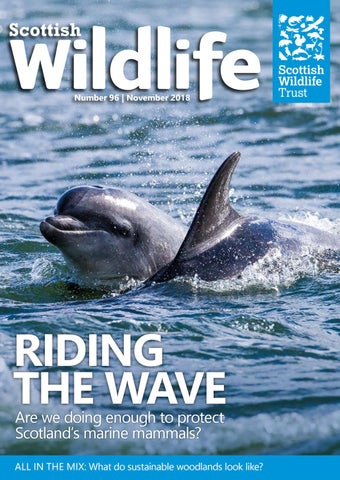
Number 96 | November 2018
RIDING THE WAVE Are we doing enough to protect Scotland’s marine mammals?
ALL IN THE MIX: What do sustainable woodlands look like?
Welcome from the Chair
FIRST WORD From our Chair, Linda Rosborough
I have been hugely impressed at what the Trust is achieving…
© Callum Bennets
A
big thank you to everyone who has been supporting the campaign to save Coul Links. Almost 13,000 people wrote to their MSP, successfully asking the Scottish Government to ‘call in’ the application to develop a golf course on our former wildlife reserve. With three levels of environmental protection in place (designation as a Site of Special Scientific Interest; a Special Protection Area; and international recognition as a Ramsar wetland), this is an important test case for Scotland of our commitment to safeguarding precious wild places and habitats. We will be following the next stages carefully. So thank you for your continued support. The dedication and enthusiasm of our membership was also apparent at this year’s AGM and National Members’ Day, which was full to capacity. In the morning, our new Articles of Association were carried unanimously, and other formal business taken care of. The afternoon saw inspirational speakers and the launch by Chief Executive Jonny Hughes of the Trust’s new publication, Living Cities, which you can view on our website. In this, the Year of Young People, we particularly wanted to encourage younger members to attend and many did, especially those in our new Young Leaders’ Network. Talking to some of
The dedication and enthusiasm of the membership was demonstrated at our full-to-capacity AGM and National Members’ Day
them afterwards, they said they were impressed that the Trust is a true membership organisation, with members acting as strong advocates and their views having a real input to governance and direction. I have been hugely impressed at what the Trust is achieving during my first year as Chair. I have learned so much more through visits to local groups and reserves, as well as through the work of Council. Work on our reserves continues throughout the year of course but as the weather gets colder, it’s nice to recall my visit to Handa in July when I met the volunteers and staff who look after the sites and the visitors. There happened to be work being carried out on the paths around the cliffs at the time. The aim
was to place stones so that people would choose to put their feet on them, and not wear down the grass. It was extraordinary to learn of the care going into the placement of each stone. Really understanding our natural environment and engaging with people; this is what the Trust does best. I think this is true for volunteers as much as it is for staff. So it was fitting that this year we celebrated the contribution of our volunteers with the inaugural Trustees’ Awards for Volunteering, the outcome of which is on page 11. I was genuinely amazed at the contribution people are making to protect wildlife in their area and found judging the nominations very difficult. A big congratulations to all those who were nominated and of course to our worthy winners. NOVEMBER 2018 SCOTTISH WILDLIFE 3
Contents
Inside this issue
6
18
06 CITY LIVING
Find out how you can help wildlife in the urban environment.
08 NEWS
News round-up from the Trust and the world of conservation.
18
ALL IN THE MIX
Rich Rowe investigates whether Scotland’s forests are fulfilling their potential to deliver public and environmental benefits.
24 MARINE MAMMALS
A recent spate of unusual sightings around Scotland’s coast leads Richard Baynes to investigate the status of Scotland’s marine mammals.
28 LAND THAT TIME FORGOT
28
24
Martin Valenti outlines a new project to create value from Scotland’s vacant and derelict land.
32 WATCH OUT FOR
Read our latest book reviews and find out about a new online hub for red squirrel conservation.
34 VIEWPOINT
David Shenton, winner of our inaugural Orca Award for Lifetime Achievement, tells us his volunteer story.
WIN LUXU A BRE RY STAT AK AT TH IO E IN SP N HOTE EYSID L SEE P E AG E 33
Scottish Wildlife magazine is published by the Scottish Wildlife Trust. © Scottish Wildlife Trust. No part of this magazine may be reproduced without the express permission of the publisher. All photography © Scottish Wildlife Trust unless otherwise stated. The Scottish Wildlife Trust accepts no liability for omissions or incorrect data in advertisements and letters. Views expressed in Scottish Wildlife are not necessarily those of the Scottish Wildlife Trust. ISSN: 0143 1234. Registered office: Harbourside House, 110 Commercial Street, Edinburgh EH6 6NF. Tel: 0131 312 7765. Fax: 0131 312 8705. Email: enquiries@scottishwildlifetrust.org.uk. Website: scottishwildlifetrust.org.uk. The Scottish Wildlife Trust is a company limited by guarantee, registered in Scotland (no. SC040247). It is also a Scottish registered charity (no. SC005792). Scottish Wildlife is published three times a year: March, July and November.
The Scottish Wildlife Trust is affiliated to The Wildlife Trusts, a UK-wide network of 46 Trusts with more than 2,000 wildlife reserves. 4 SCOTTISH WILDLIFE NOVEMBER 2018
Deadlines for news: 1 January, 1 May, 1 September. No unsolicited articles please. Scottish Wildlife is free to members. Membership rates from 1 April (excluding discounts for paying by Direct Debit): Individual (concession) £40 (£18); Joint (concession) £47 (£24); Family £57; Watch £18; Life (joint) £900 (£1,300); World/Overseas £45. Patron: HRH The Prince Charles, Duke of Rothesay. Chair: Linda Rosborough. Vice-Chairs: Karen Chambers, Amanda Forsyth, Kenny Taylor. Chief Executive: Jonny Hughes. Editor: Jo Pike editor@scottishwildlifetrust.org.uk Production Editor: Pete Haskell. Design: Connect connectcommunications.co.uk Advertising: Elliot Whitehead 0131 561 0021, Clare Stebbing 0131 561 0024. Printing: InkMark. Cover photo: © John MacPherson, 2020VISION
Spotlight: European robin
SPECIES SPOTLIGHT:
EUROPEAN ROBIN
© Mark Hamblin, 2020VISION
(Erithacus rubecula)
Voted as Britain’s National Bird in both 1960 and 2015, the robin has become something of a cultural icon, associated with Christmas and commemorated on Glasgow’s coat of arms.
Famous for nesting in unusual locations such as welly boots, hanging baskets and coat pockets, robins generally nest in concealed areas low to the ground or in open-fronted nestboxes.
Breeding from March, females will lay between four and six eggs, with one egg laid each day. Incubation takes just 13 days and two weeks later the chicks are ready to fledge.
Robins sing almost all year round, with a slight pause during their moult in late summer. Their songs change from strong and confident in spring to more subdued in autumn.
Fiercely territorial, robins will guard their territory throughout the year, occasionally attacking intruders to the death. The average territory size is about 1/6th of a football pitch.
NOVEMBER 2018 SCOTTISH WILDLIFE 5
Spotlight: Urban
CITY LIVING IT IS predicted that by 2050, the world’s population will be more than 9.5 billion people and that two out of every three of us will live in a town or city. While the urban environment currently takes up just 3% of the Earth’s surface, it is in these areas that most energy, food and materials are consumed and, as such, it is here that we can make the biggest difference. In many urban settings, the natural landscape has been unrecognisably modified, with grey infrastructure (such as buildings and roads) having replaced green and
blue (such as woodlands and rivers). To a large extent, this has pushed nature out of our towns and cities, but for many reasons – from combating climate change and biodiversity loss, to improving our own health and wellbeing – this needs to change. Fortunately, there are things that all urban-dwellers can do to make their patch better for wildlife, whether in a top floor flat in Inverness or a Victorian villa in Glasgow. Here are just a few examples of species that you can help.
ROBIN
NORTHERN BROWN ARGUS
During a cold winter’s night, a robin can lose up to 10% of its bodyweight, so putting out regular supplies of food such as mealworms and fat balls can help attract them to your garden and make a big difference to their survival.
This small, chocolate-brown butterfly is listed as a priority species on the UK Biodiversity Action Plan. It is usually found alongside its food plant, the common rock-rose, so planting this attractive yellow flower may attract the butterflies.
SEVEN-SPOT LADYBIRD
CORNFLOWER
The most common of the 15 species of ladybird found in Scotland, these familiar little beetles are sadly in decline. Ladybirds hibernate over winter, so a pile of logs in your garden can provide a much-needed hibernation space.
This bright blue annual wildflower used to be a common sight but has declined dramatically in the wild over the last 60 years. A wonderful plant for pollinators, it will grow happily in sunny gardens, window boxes and road verges.
6 SCOTTISH WILDLIFE NOVEMBER 2018
Spotlight: Urban
D
E
RESERVES
A JUPITER URBAN WILDLIFE CENTRE
OS Landranger 65, NS920810 In the middle of industrial Grangemouth, Jupiter is a fantastic example of how wasteland can be transformed into an urban green oasis. Providing a haven for wildlife, the centre is open all year round and is perfect for a family day out.
B POSSIL MARSH
HOUSE MARTIN Summer visitors to Scotland, house martins are similar in appearance to swifts and swallows, but can be told apart by their white rump and the shape of their forked tail. Putting up a house martin nest box under your eaves is a great way of attracting them.
OS Landranger 64, NS585700 This shallow freshwater loch to the north of Glasgow is surrounded by wetland habitats that support locally rare plant species and provide an important staging post for the spring and autumn migrations of warblers and wildfowl.
C LUGGIEBANK WOOD
OS Landranger 64, NS758730 Within a mile of Cumbernauld town centre, this woodland reserve takes in the meandering Luggie Water, along which kingfishers and dippers can be seen. Badgers are also spotted on occasion and, in November and December, you may even spot a leaping trout jumping out of the river.
D JOHNSTON TERRACE GARDEN
OS Landranger 66, NT254735 The Trust’s smallest reserve, Johnston Terrace Garden is in the heart of Edinburgh’s Old Town and is a perfect example of how a once neglected urban area can be transformed into a valuable space for nature.
E CORSEHILLMUIR WOOD
HEDGEHOG Travelling around a mile a night, hedgehogs can be seen from May to October and can be frequent night-time visitors to gardens. Making a small hole at the bottom of your fence can make your garden more accessible to this declining species.
OS Landranger 70, NS315435 One of the Trust’s Irvine Greenspaces reserves, this natural woodland beside Kilwinning has a canopy of mature birch, ash and willow, providing plentiful habitat for woodland birds. A surfaced path takes you around the perimeter of the wood and connects with nearby Eglinton Country Park. For full reserve information, visit scottishwildlifetrust.org.uk/reserves
NOVEMBER 2018 SCOTTISH WILDLIFE 7
Main image © Katrina Martin Robin © Pete Haskell, Northern Brown Argus © Velela, CC BY-SA 3.0, 7-spot ladybird © John Bridges, Cornflower © Richard Burkmar, Hedgehog © Tom Marshall
A B C
Scottish Wildlife Trust news
Latest news
News from the Trust, our projects and the wider world of conservation
KEEP UP TO DATE
All the latest Trust news is available on our website scottishwildlife trust.org.uk
The environment and the economy IT was encouraging to see the Scottish Government seeking views over the summer on the key ingredients for a new Environment Strategy to be published towards the end of the year. The Scottish Wildlife Trust welcomed the indication of the Scottish Government’s vision and has responded to the consultation highlighting the importance of setting out distinct policy targets, timescales and delivery mechanisms. There is, however, something of a puzzling disparity between the approach to the economy and the environment. The current Economic Strategy was updated in 2015 and emphasises that protecting and enhancing our natural capital is “fundamental to a healthy and resilient economy”. In the 2018/19 Programme for Government there is a clear commitment to underpin the Economic Strategy with delivery of an Economic Action Plan by October. A detailed action plan for the economy in advance of an Environment Strategy and action plan? This would appear to be putting the cart before the horse, given the recognition of how fundamental the health of our natural capital is for that of our economy. The Trust will be pushing hard in the coming months for the Scottish Government to address this disconnect with the expectation that by Christmas our stockings are brimming with joined up strategies and action plans for both the environment and the economy. Dougie Peedle is the Trust’s new Head of Policy. He was previously Chief Economic Adviser to the States of Jersey.
8 SCOTTISH WILDLIFE NOVEMBER 2018
New online hub for red squirrel conservation SAVING Scotland’s Red Squirrels has created a new online Community Hub where people all over Scotland can report red and grey squirrel sightings and get involved with local volunteering opportunities. Over 5,000 squirrel sightings were reported in 2017. In 2018, the Scottish Wildlife Trust-led project is looking to hit 10,000. Project Manager Dr Mel Tonkin said: “Our new website allows dedicated squirrel spotters to register and keep a personal record of their squirrel sightings. Comprehensive mapping allows them to view their own squirrel conservation data, as well as all of the project’s long-term data. “It’s a great way for people to see how their efforts are contributing to changes over time, and we hope that the hub will allow volunteers and supporters to
connect with other red squirrel enthusiasts in their area.” Each sighting received is added to a national database that helps the project to monitor changes in red and grey squirrel distribution over time and identify the best areas for conservation action. The new hub is a cutting-edge volunteer support facility, which has been made possible thanks to funding from National Lottery players. “Sighting a red squirrel in the flesh is an exciting but, sadly, increasingly rare experience,” said Lucy Casot, Head of the Heritage Lottery Fund in Scotland. “Organisations and communities can now join forces to help protect and care for Scotland’s red squirrel population.” Sign up for the Hub and record your squirrel sightings at scottishsquirrels.org.uk
Scottish Wildlife Trust news
TWELVE young people from across Scotland have been selected by the Trust to be part of a brand new volunteering initiative called the Young Leaders’ Network. This group has been set up to mark Scotland’s Year of Young People. Over the coming months these young
© Catherine Leatherland
Trust launches Young Leaders’ Network
Maisie and Chris Packham at Jupiter
leaders will use their creativity and passion for wildlife to develop a number of projects to help inspire more people to get involved with all aspects of the Trust’s work. This will include contributing to social media, blogs and videos, and attending events to promote the work of the network.
© Chris Gomersall, 2020VISION
Bioblitz records a slice of life at Jupiter
A boost for living seas A MAJOR funding award from the Esmée Fairbairn Foundation will allow the Trust’s marine conservation work to continue during a vital time for Scotland’s seas. The grant will allow us to increase our advocacy for a healthier marine environment and establish a centre of excellence for marine community engagement in Ullapool, building on work in the North West Highlands which began in 2015. Marine Planning Officer Dr Sam
Collin said: “Pressures including the planned expansion of salmon farming and uncertain management of fisheries following Brexit mean that the next five years are vital for marine conservation. “This funding will enable the Trust to continue playing an important role in ensuring the completion of Scotland’s network of Marine Protected Areas, and to advocate for future legislation that creates a balance between environmental, social and economic benefits.”
MORE than 100 different plants and animals were recorded at Jupiter Urban Wildlife Centre as part of Chris Packham’s UK-wide bioblitz tour in July. The 108 species recorded by our Rangers, local experts and members of the public included common finds such as oak trees, blue tits and mallard ducks, as well as the first ever record of the endangered leaf beetle Bromius obscurus in Scotland. Chris and his team visited 50 wildlife sites around the UK over ten days. In total they recorded more than 3,000 species.
© Steve Gardner, Scottish Beavers
Beavers go wild THIRTEEN beavers have been released into Knapdale Forest in Argyll over the past year as part of our work with the Royal Zoological Society of Scotland to reinforce the population created through the Scottish Beaver Trial. During the summer, night-vision cameras captured two of the newly released beavers grooming each other. This is a fantastic sign that they have accepted each other and will hopefully go on to form a mating pair. The reinforcement project in Knapdale has been part-funded by the generosity of Trust supporters, who donated almost £20,000 to our recent appeal, and by players of People’s Postcode Lottery.
Two beavers being released as part of the reinforcement project
NOVEMBER 2018 SCOTTISH WILDLIFE 9
Scottish Wildlife Trust news
© Vince Lowe
IN BRIEF Reaching out
New data protection regulations mean we can only email you news about our work if we have express consent to do so. If you have stopped receiving our monthly updates but would like to sign up again, please visit our website.
Pedal power
The Trust has received funding from Cycling Scotland to help further reduce its carbon footprint. A fleet of four electric bicycles will allow staff working in Edinburgh, Cumbernauld and Falkirk to decrease their reliance on cars for transport. © Andy Rouse, 2020VISION
Dippers draw crowds
MSP welcomes work in Cumbernauld
Improvements to the path network in Luggiebank Wood Wildlife Reserve in Cumbernauld have been praised by the local MSP following a visit this summer. “We’re lucky to have all of this wonderful woodland on our doorstep and the hard work put in by the Scottish Wildlife Trust is ensuring that our local greenspaces are well connected,” commented Jamie Hepburn. Luggiebank Wood reserve is part of Cumbernauld Living Landscape which aims to enhance, restore and reconnect green areas of the town. 10 SCOTTISH WILDLIFE NOVEMBER 2018
DAMAGING plans for a golf course at Coul Links in Sutherland are being reviewed by the Scottish Government, which will make the final decision regarding the future of the site. Around 13,000 people, including many Trust members, wrote to their MSPs raising their concerns following the Highland Council’s decision to approve the plans. Following this public pressure, Planning Minister Kevin Stewart announced that: “The proposal raises issues of national importance in relation to natural heritage issues and its compliance with Scottish planning policy and requires further scrutiny.” Coul Links is a beautiful, wild stretch of coastline in East Sutherland. It is so important for wildlife that it is protected as a Site of Special Scientific Interest, a Special Protection Area and as a Ramsar wetland site.
Our Public Affairs Manager Bruce Wilson said: “The response to the campaign was much higher than expected, which shows just how much this wild and special place means to people. We have sent a very clear message to MSPs that protected areas should mean just that. “We are hopeful that ten years on from the approval of the Trump International Golf Links in Aberdeenshire the Scottish Government has learned its lesson, and the Trust will continue to play a leading role in trying to ensure that these plans are driven firmly into the rough.” The Trust is working with organisations including Buglife, Butterfly Conservation, Marine Conservation Society, Plantlife, RSPB Scotland, and the National Trust for Scotland to help save Coul Links.
Beer money ENTERPRISING students from Heriot-Watt University brewed up support for the Trust’s work on Handa Island during the launch of their new beer, Divergence, a pilsner inspired by puffin migration. They raised over £200 which will contribute to protecting this beautiful island, home to significant numbers of breeding seabirds, including guillemots, kittiwakes and puffins.
© Natural Selection Brewing
Almost 2,000 people dipped into one of our pop-up People’s Postcode Lottery Dipper Watch events at Falls of Clyde this summer. Rangers and volunteers helped holidaymakers to discover the amazing river wildlife that resides on the reserve, including wagtails, dippers and herons. Look out for more events at Falls of Clyde in 2019.
Coul Links called in by Ministers
Scottish Wildlife Trust news
© George Stoyle, SNH
PLANS to dredge tens of thousands of tonnes of kelp from Scotland’s seas are facing opposition from groups including the Scottish Wildlife Trust. Marine Biopolymers Ltd has submitted a scoping report to Marine Scotland that involves removing up to 30,000 tonnes of seaweed from the west coast each year. Marine Planning Officer Dr Sam Collin said: “These proposals are at an early stage but they are of great concern. Kelp forests provide protection, food and nursery grounds for a broad range of species including crabs, seabirds and seals and have an important role in slowing coastal erosion. “We believe that large-scale mechanical removal, which would involve uprooting whole plants from the seabed, is not compatible with the healthy, living seas we want to see around Scotland.”
THE winners of our Trustees’ Awards for Volunteering were revealed at the Trust’s National Members’ Day in Edinburgh in September. These new awards reflect a range of contributions, including long service over many years and extraordinary accomplishments. Chair Linda Rosborough said: “Our natural environment would be all the poorer if it wasn’t for the tens of thousands of hours put in by our volunteers. They do so much on the Trust’s behalf, from fighting inappropriate developments and carrying out conservation work on wildlife reserves, to serving on
Willie Homer, inaugural winner of the Puffin Award for Special Contribution
First record of rare weevil in Highlands © Nigel-Richards
A RARE beetle has been found for the first time at Talich Wildlife Reserve in the Highlands. The Curculio betulae weevil was recorded by local naturalist Nigel Richards. He said: “As soon as I saw the weevil I recognised it was something different to the ones I’m used to seeing. It has
committees and Council and organising inspiring talks in their local areas.” This year’s award winners were: Willie Homer, who won the Puffin Award for Special Contribution; Rob Asbridge, who won the Rusty Bog Moss Award for the most unusual achievement; Sue Sexton and David Shenton, who jointly won the Juniper Award for Long Service; and David Shenton also was awarded the Orca Award for Lifetime Achievement. David Shenton reflects on three decades of conservation work in our Viewpoint feature on page 34. © Tracy Lambert
Dredging threat
Volunteer achievements recognised
only been recorded in central Scotland a handful of times and this is the most northerly record to date by a long way.” Curculio betulae is a 4mm-long weevil found on birch and alder trees. It has a slender and evenly curved rostrum, or snout, which is as long as its body. Reserve Manager Mark Foxwell said: “Much of the wildlife of the Highlands is under-recorded so it is great to hear about a new record for both the region and the reserve.” The reserve, which is managed by the Trust, is four miles south-east of Tain and is one of only two remaining alder woods in the Moray Firth area. It supports an abundance of birds, invertebrates, bats, badgers, roe deer and pine martens.
New Council members elected FOUR new members were elected to serve on our Council of Trustees at this year’s Annual General Meeting. These are Jim Henderson, John Morris, Anthony Robson and Jane Stuart-Smith. Dr Tim Duffy, who has previously served on Council, was elected for a further three years, and Trustees Deryck Irving and Nicky Munro were re-elected. A huge thanks to outgoing Council members Jimmy Campbell, Alastair Grier, Michael Johnston and Jon Barnes for their valuable contributions. Members also unanimously voted to adopt the proposed new Articles of Association at the AGM which can be viewed on our website.
NOVEMBER 2018 SCOTTISH WILDLIFE 11
Scottish Wildlife Trust news
© Tom Marshall
Metre by metre
Natterer’s bat
NEW habitats for pollinators are appearing across Scotland’s capital as part of our Edinburgh Living Landscape project. Standard Life Aberdeen is the latest organisation to join the Square Metres for Butterflies initiative, which is led by Butterfly Conservation. The company planted a rooftop heather garden on top of their data centre. Nine other pollinator-friendly plots have been created in the city at sites including the Scottish Parliament and a number of private offices, churches and a respite care centre.
Increasing focus on urban nature AS PART of an increased focus on urban nature, the Trust is publishing a series of articles focused on creating greener cities over the coming year. These blogs complement our new publication entitled Living Cities: towards ecological urbanism. This document for professionals including planners, designers and architects makes 20 practical recommendations, ranging from placing new perches for birds of prey in city centres to creating large green corridors through the landscape. Additionally, thanks to a recent funding award from Arcadia, a charitable fund of Lisbet Rausing and Peter Baldwin, the Trust will also host a major new global conservation initiative which has been launched in Edinburgh. The IUCN Urban Nature Alliance is chaired by our Chief Executive Jonny Hughes. The project aims to raise awareness of the value of ecosystems in urban areas through work including the creation of a new Urban Nature Index. Our Living Cities publication and the accompanying blog series can be viewed on our website.
Successful season for eiders at Montrose BREEDING eiders at Montrose Basin Wildlife Reserve have enjoyed another successful year. Surveys carried out by the Trust and ANGUSalive rangers show that eggs in 86% of the 454 monitored nests on the basin successfully hatched. Montrose Basin is nationally important for eider ducks and one of only three major breeding sites for the species in Scotland. Disturbance and predation are the two main threats faced by nesting eiders, but thanks to the consideration of dog walkers and other visitors to the reserve during the breeding season, disturbance has been kept to a minimum. 12 SCOTTISH WILDLIFE NOVEMBER 2018
New bat records for Rahoy Hills Wildlife Reserve FIVE species of bat, including the first Natterer’s bat ever recorded on Morvern, have been detected in the first survey of Rahoy Hills Wildlife Reserve in the West Highlands. Volunteer Erika Faggiani made the discoveries after setting up six bat detectors in woodland around Loch Arienas as part of her European Voluntary Service placement. These exciting findings expand the range map for both Daubenton’s and Natterer’s bat. Rahoy Hills Reserve Ranger Stephen Hardy said: “We had never looked at bats on the reserve before, but thanks
to Erika we now have a comprehensive species list that includes Natterer’s bat, a species not previously recorded on the Morvern peninsula. “This survey is a hugely worthwhile project which adds to our knowledge of the reserve’s wonderful biodiversity.” During her placement with the Trust, Erika also deployed bat detectors on Handa Island to confirm the presence of both common and soprano pipistrelles, as well as detecting Daubenton’s bats there for the first time. The bat recording project was supported by Scottish Natural Heritage and Coachman Bat Consultancy.
A gift for the future of ospreys
© Mike Rae
Loch of the Lowes – Lady the Osprey, by Marjorie Edgar As summer days grow shorter, there’s a stillness in the air A change is all around the Loch, as autumn tip-toes there We knew this day was coming, now it’s time to let her leave It’s sad to say “goodbye” this year, after all that she’s achieved She takes one long flight around the loch, its beauty makes her sigh So much has happened to her here, now to the south she flies We wish her a safe journey, may she stay strong and keep well Safe lodgings at her winter home where she’ll linger for a spell We can shed a tear should she not return Or we can cherish her memory and let it live on
A gift for the future of ospreys
M
arjorie Edgar loved volunteering at Loch of the Lowes and was an osprey enthusiast – it was these passions that inspired her to leave a gift in her will to the Scottish Wildlife Trust. Her daughter Gillian finds real comfort knowing her mum’s kindness will help protect ospreys for many years to come. Marjorie was a private person who was at her happiest when indulging in horticulture or surrounded by wildlife. As well as working at a garden centre, she tended to 2,000 seedlings every year, which she raised for charity. But it was the anticipation of the ospreys returning to Loch of the Lowes each spring which gave her the greatest joy. Her deep fondness for ospreys was lovingly reflected in some of her poetry.
Marjorie loved visiting Loch of the Lowes and was thrilled when she and her daughter Gillian were accepted for a Scottish Wildlife Trust volunteer position. Gillian fondly recalls spending Saturday evenings together in the hide, avidly monitoring the ospreys while also watching otters and the antics of a family of beavers. Marjorie got so much pleasure from the time she spent at the reserve, and she fervently hoped that the ospreys would continue to return long into the future. We are honoured that she chose to leave a gift in her will to the Trust. Now, with that gift, an invaluable new space has been created for current and future volunteers who will continue to monitor the ospreys and their habitat.
I know how much pleasure mum got from helping out at Loch of the Lowes. She loved every second of it and said it felt like she was going home when we were heading there. Gillian Ogg, Marjorie’s daughter
Every gift in every will, no matter how large or small, really does make a difference to the future of Scotland’s wildlife. To find out more call Zoë on 0131 312 4772 or visit scottishwildlifetrust.org.uk
Wider news
Lack of food drives loss of Arctic skuas
A STUDY of Arctic skuas has revealed that they could become extinct as a breeding species in the UK. The research by the RSPB’s Centre for Conservation Science found that the main driver of an 81% population decline is a reduction in the food available to the birds during the breeding season.
Scientists looked at data from 33 colonies in the north of Scotland between 1992 and 2015. In 1992, 1,061 breeding pairs of Arctic skua were recorded; but by 2015 this had fallen to just 200 pairs. Breeding success also fell, from an average of 0.9 to 0.3 chicks per pair. Arctic skuas are medium-
sized seabirds with falcon-like wings and long tail feathers. They rely on stealing small fish such as sandeels from other seabirds, leading to dramatic aerial chases. Scotland lies at the southern edge of the global breeding range for Arctic skuas, with their UK stronghold in Shetland and Orkney.
Tenth anniversary for water vole project
pollution and the spread of the non-native American mink. However, they have undergone a resurgence following a pioneering reintroduction project, which coincided with a drive by Forest Enterprise Scotland to
14 SCOTTISH WILDLIFE NOVEMBER 2018
five. The project aims to help groups target clean-ups more accurately, and identify areas that are rarely dealt with. In September, the project received £100,000 from the Scottish Government to allow it to be extended around the full Scottish mainland. Vicky Junik from the Moray
Firth Partnership said: “The easier it is to find out where the litter is, the easier it will be to mobilise clean-up efforts. “We’ve tried to focus on the harder to reach parts of the coastline so we can build a really comprehensive picture of the reality and scale of the challenge.”
Scottish Coastal Rubbish Aerial Photography (SCRAPbook), is a collaboration between the Marine Conservation Society, UK Civil Air Patrol and the Moray Firth Partnership. For more information visit SCRAPbook.org.uk
© Forest Enterprise Scotland
ONE of Scotland’s most successful conservation projects, the Trossachs Water Vole Project, has celebrated its tenth anniversary. Water voles became locally extinct in the Trossachs in the 1990s due to loss of habitat,
improve existing wetlands and waterways in Loch Ard Forest. More than 1,000 water voles were reintroduced into the area between 2008 and 2010. Mink control ahead of the releases helped them to become established. A decade on, water voles can be found along the Forth catchment from the hills above Loch Lomond to the lowlands around Stirling. The ongoing Trossachs project has been so successful that voles from the Trossachs are now being translocated to Northumberland to help recovery efforts in Kielder Forest.
Taking to the skies to tackle marine litter
A PROJECT linking pilots and conservationists is helping to identify litter hotspots around thousands of miles of Scotland’s coastline. Aerial photographs taken by pilots are being uploaded to the SCRAPbook website with the amount of litter classified on a scale of one to
© Ian Francis
SCIENTISTS are hoping to confirm if Scotland’s seas are a mating ground for basking sharks by analysing video footage of their sociable behaviours. Each summer, large numbers of basking sharks gather off the west coast of Scotland. While it is thought that they may come together to mate, there is currently no concrete evidence of this. “The footage we’ve collected gives a fantastic shark’s eye view of the environment,” said Dr Matthew Witt from the University of Exeter. “We can see sharks aggregating near the seabed, potentially forming social groups.” Data collected by the researchers will help inform future consultations on a Marine Protected Area by identifying why the area is important to the sharks. “There’s been limited research to show exactly what they’re doing here: do they come solely to feed on plankton, or are they courting each other and using our coast as a mating ground?” added Dr Suzanne Henderson from Scottish Natural Heritage. The researchers hope to return to Scotland in 2019 to obtain more footage to support this work.
© Alex Mustard, 2020VISION
Sociable sharks in the Sea of the Hebrides
Give more and pay less It was reported that in 2017, people in Scotland donated an impressive £1.2 billion to charity, accounting for 11.8% of the UK total. Children and young people, medical research and animal welfare continue to be the top three most supported causes. Charitable donations not only provide huge benefits to society, but they can also be extremely tax efficient for the donor. Generally speaking, the more you give to charity, the less tax you pay. The Gift Aid scheme was introduced by the UK government a number of years ago. It allows registered charities to reclaim income tax in order to boost the value of donations made. Charities can reclaim the basic rate of tax which UK taxpayers have already paid on the donation. This means that for every £1 donated, the charity can receive £1.25. Similarly, higher rate tax payers can also claim back the difference between the higher rate and the lower rate tax on the value of any donation. For example, 41% tax payers would be able to claim back 26.25p in tax relief for every £1 donated. This is a very valuable relief. Leaving part or all of your estate to charity can also reduce your Inheritance Tax liability. Sums left to a registered charity pass free of Inheritance Tax as they don’t count towards the total taxable value of your estate. Moreover, since April 2012, the rate of Inheritance Tax can also be reduced from the standard rate of 40% to 36%, for those who leave 10% or more of their net estates to morton-fraser.com
charity at the time of their death. In practical terms, this means:
• The charity’s registration number and its registered address;
• the total Inheritance Tax payable on the estate will be reduced;
• Some wording to cover the circumstances where the charity ceases to exist or merges with another charity and changes its name. It is common to include a clause which states that the Executors of the Will can pay it to a charity with similar charitable purposes in these circumstances but this would fully depend on your intentions;
• the higher the percentage of the net estate given to charity, the lower the Inheritance Tax will be; and • other beneficiaries will benefit from the lower tax bill. Gift Aid really is a simple way to boost the value of your donations during your lifetime at no extra cost to you. The Gift Aid rules require the completion of a Gift Aid Declaration Form which charities will be very happy to provide you with. It only applies to “gifts” and a charity can’t use Gift Aid where people have received something in exchange for the donation or entered and won a competition, for example. It’s important that all of the information requested on the Declaration Form is provided and is up to date. It’s also relatively easy to give a charity something in your Will. You can either leave a legacy, being a fixed sum of money or specific asset. Alternatively, it’s possible to leave the charity a share of the “residue”, which is the pot that remains after all expenses and other legacies have been paid. It’s important to take advice from someone who specialises in estate planning to help you work out what you can give away to charity to secure the lower rate. At the very least, the relevant clause in the Will should include: • The name and address of the charity; Edinburgh 0131 247 1000
• A receipt clause which allows the charity to accept the legacy and discharge your Executors from any future liability. By following these steps, you can support your favourite cause and reduce your tax bill at the same time; it really is a case of giving more and paying less!
Fiona Byron This article is for general information and guidance only, and is not to be relied upon as specific legal advice, which should be sought in all cases.
Glasgow 0131 274 1100
Woodlands
THE WAY OF THE WOODS
I
f you look up the word ‘woodland’ in the dictionary you will see it defined simply as “land covered with trees”. But for many of us, the word conjures up far more than just a patch of land with trees growing on it. Places of excitement and adventure, woodlands can be truly spectacular places where many a childhood memory is made. They can also be bursting with nature. From the
wood ants crawling through the leaf litter on the forest floor, up the lichen-encrusted trunks, past the woodpecker holes and squirrel dreys, to the top of the canopy, where bats roost and birds nest. But woodlands come in many shapes and sizes, and they can differ in what they have to offer. Here, we look at four different types of woodland and the benefits that they can provide.
Ancient woodland
Ancient woodlands are rare in Scotland, but are our richest habitats for nature. Trees of mixed ages and heights create a complex habitat structure that can support a wide range of species. The remnants of Atlantic oak and hazel woodlands along the west coast are an example of this type of woodland. These so-called Atlantic rainforests, where old gnarly trees are cloaked in
Riparian woodland
Woods that grow along the banks of lochs, lochans, burns and rivers are vital to the health of freshwater habitats and provide many vital services, including reducing flood risk and soil erosion. These woodlands are often abundant with nature: from the birds and bats that use riparian woodlands both as a navigational aid
lichens, liverworts and mosses, are the realm of wood warblers, pine martens and pearl-bordered fritillary butterflies. Another example of ancient woodlands are our majestic Caledonian pine forests. Scots pine trees dominate these woodlands, which are also home to Scottish rarities such as capercaillie, black grouse and the Scottish crossbill.
and a hunting ground, to the insects, small mammals and amphibians that spend their whole lives alongside fresh water. Riparian woodlands also serve an important role in connecting patches of larger woodland habitat, acting as wildlife corridors and allowing animals to travel across the country in search of partners and new territories.
Know your leaves...
Pedunculate oak
16 SCOTTISH WILDLIFE NOVEMBER 2018
Hazel
Rowan
Ash
Woodlands
POLLINATION
Healthy woodlands provide us with a vast array of benefits and services that we rely on for our wellbeing, prosperity and quality of life. The term ‘ecosystem services’ refers to the benefits that we freely receive from the natural environment, often without realising it. Here are some of the ecosystem services that woodlands can provide.
SPIRITUAL BENEFITS
BIODIVERSITY
CARBON STORAGE
SHELTER
CLIMATE REGULATION
STORM PROTECTION
RECREATION
RESILIENCE TO DISEASES
FRESH AIR EMPLOYMENT
New native woodland
Recently established woodlands are not as rich in nature as ancient woodlands, but they still provide valuable habitat for a diverse variety of wildlife. These woodlands are often the result of planting a mix of native tree species, although natural regeneration will soon obscure the human pattern in which they’ve been planted.
Large-scale planting of often non-native conifers began shortly after the First World War to provide the UK with a strategic reserve of timber. Today, plantations account for about 80% of Scotland’s forests, much of which is dominated by a single North American species: the Sitka spruce.
Downy Birch
TIMBER
NATURAL FLOOD DEFENCES TOURISM HEALTHY SOIL EDUCATION
Plantation woodland
MEDICINES
IMPROVED WATER QUALITY
FOOD WOOD FUEL
Many new native woodlands have been established in and around towns and cities. In these locations they play an important role for urban nature, as well as for the human inhabitants. Not only do they allow people to experience and enjoy nature every day; they also reduce the impact of flooding and help to cool the urban environment.
Plantations, particularly those that are dominated by non-native trees, are generally home to a smaller number of plant and animal species than native woodlands. However, if they are managed in a way that ensures they contain trees of different ages, they can still be important habitats, particularly for conifer-loving birds such as crossbills and siskins.
Alder
Goat willow
Wild cherry
NOVEMBER 2018 SCOTTISH WILDLIFE 17
Riparian woodland © Lisa Evans, Falkirk Council; New native woodland © Jonny Hughes; Plantation woodland © Richard Webb, CC-BY-SA 2.0
More than just trees
Woodland management
ALL IN THE MIX The commercial forestry model has evolved significantly in recent decades, but the challenge to ensure that Scotland’s forests fulfil their potential to deliver a complete range of economic, social and environmental benefits remains, writes Rich Rowe.
18 SCOTTISH WILDLIFE NOVEMBER 2018
Woodland management
Production of timber in Scotland is at its highest in living memory
I
t is fair to say that Scotland’s woodlands have rarely been the focus of so much attention. For the Scottish Government, forestry is key to the creation of rural jobs and a sustainable economy, while conservationists stress the vital role that native woodlands, in particular, play in delivering a variety of environmental benefits on a landscape scale. Given such attention, it’s no surprise that the Scottish forestry sector is booming. Today, it directly contributes almost £1 billion to the Scottish economy each year and supports about 25,000 jobs, ranging from forestry and timber processing to recreation and tourism. While the wider UK is as timberhungry as ever – it is the second biggest net importer of timber in the world after China – production of timber in Scotland is the highest in living memory, with multi-million-pound investments in wood processing plants. The bulk of timber harvested in Scotland (almost entirely softwood) goes to sawmills to become saw logs, some of which are used in construction. However, processed timber products, such as chipboard, as well as biomass are also big business. “Timber is now generally recognised as an extremely valuable resource, with forestry moving from being seen as a marginal industry to one that is a fundamental instrument of a sustainable
economy,” claims Eleanor Harris, Policy Researcher at the Confederation of Forest Industries (Confor). Given the determination to accelerate Scotland’s bio-economy, including the development of bio-plastics, the future could be bright for forest industries. Eleanor’s view is that: “In the future,
One of the least wooded countries in Europe, Scotland’s forest cover currently stands at around 18%, with much of that made up of commercial timber plantations. anything made from a barrel of oil will instead be made from trees.” But for now, a primary driver behind woodland creation is the Scottish Government’s commitment to carbon targets. One of the least wooded countries in Europe, Scotland’s forest cover currently stands at around 18%,
with much of that made up of commercial timber plantations containing a single, non-native crop species – Sitka spruce. In January 2017, the government’s Draft Climate Change Plan proposed expanding Scotland’s forests to cover 21% of the country by 2032. To achieve that, some 10,000 hectares of new woodland is set to be planted this year, with a plan to increase the level of planting to 15,000 hectares per annum by 2024. Within these planting targets is a stipulation that 60% of all new woodland created should be ‘productive’ – with a maximum 75% conifer for timber harvest, and 25% native broadleaves, open land and alternative conifers for landscape and biodiversity. The remaining 40% could be amenity or conservation woodland. The industry has been positive about the new targets, but there is a degree of concern from conservationists that with a key driver being the growth of forestry as a business entity, economic factors may be given greater priority than the health and resilience of our natural environment, or the delivery of recreation and education benefits. Almost 80% of Scotland’s woodlands are dominated by monocultural (single species) stands. In its recent 50 for the Future publication, the Scottish Wildlife Trust called for a transformation which would see more than half of these stands NOVEMBER 2018 SCOTTISH WILDLIFE 19
Woodland management
contain at least 25% native species. This would provide far more structural diversity and resilience, helping to foster nature-rich areas of woodlands. And that health and resilience takes many forms, with positive impacts that extend far beyond the woodland itself. As such, the Trust is calling for all new, or restructured, woodland to deliver a raft of benefits, including improved biodiversity; catchment-scale services (from flood prevention to carbon capture and storage); community value; and closer integration with other land uses such as wood pasture, wood crofts and hill farming.
TIMBER TOOLS
It’s true that the forestry industry in Scotland today looks different to just a generation ago. Although we still see square blocks of conifers that look to have been beamed down from space onto bare hillsides, or worse, onto areas of peatland, such plantations are considered an unwelcome relic of the past. Instead of the wrong trees being planted in the wrong place, the more © Pete Cairns, 2020VISION
Blocks of forestry plantation planted on blanket bog
20 SCOTTISH WILDLIFE NOVEMBER 2018
enlightened UK forestry standards that came into being in 1997 now help set the tone for how commercial forests are designed, and on what type of ground they should be planted. Stepping closer to the Trust’s vision for Scotland’s woodlands is the new 1,000-hectare forest created on land purchased from a sheep farmer at Jerah near Menstrie in 2015. The extensive woodland comprises 500 hectares of conifer, 130 hectares of native woodland (including birch and rowan) and 370 hectares of open ground. “This means it includes one of the largest areas of new native woodland created in the UK over the last 25 years, managed for the long term with private sector funding,” says Eleanor. Meanwhile, the recent passing of the Forestry and Land Management (Scotland) Act – a key component of which is a duty for Scottish ministers to promote sustainable forestry management – is a further sign of change. But, as the Trust sets out in its Land Stewardship policy, for forestry management to be truly sustainable it must reach far beyond seeing trees as
simply a cash crop. The sustainability of the industry and delivery of a broad range of public benefits should be at the heart of modern forestry – with the regulations and financial incentives to support them, it says. “We would like to see higher rates of grant support for the establishment of native woodland, ensuring that natural regeneration and sensitive planting schemes are attractive options for land owners and communities” explains Jonny Hughes, the Trust’s Chief Executive, “as well as much greater investment in hardwood timber production.” For its part, the Trust, of course, is interested in ensuring that Scotland has a network of healthy woodlands delivering benefits for wildlife and people. Simply planting trees is not the main priority on the reserves in its care. “Across the Trust, we try to focus on low intervention and look for natural processes to do the management for us, for example we encourage natural regeneration of native species over tree planting because this allows for a more diverse age structure,” explains Sven Rasmussen, the Trust’s
Woodland management
© Mark Hamblin, 2020VISION
Regenerating birch woodland at the Trust’s Falls of Clyde reserve
Reserves Manager for West Central Scotland. This approach can be seen at the Falls of Clyde reserve where, little by little, conifers are being removed and the gaps filled through natural regeneration of native species. Elsewhere, at heavilywooded reserves within the Cumbernauld Living Landscape, the focus is on creating diverse woodlands that deliver on key goals of reducing noise and air pollution, locking away carbon, and providing all sorts of other benefits associated with woodlands that people love spending time in. The Trust is also developing a new initiative called ‘Riverwoods’ aimed at improving the condition and connectivity of riverbank woodlands across Scotland to contribute to a National Ecological Network. Providing a real focus for a range of land managers, it’s another landscape-scale initiative that brings benefits in terms of improved water quality, flood mitigation, reduction in erosion and other vital ecosystem services. However, with so many variables at play, a flexible approach is often required. At Largiebaan, a large coastal site on the Mull of Kintyre, the Trust is exploring how best to tackle a nearly 100-hectare stand of non-native conifers which have been causing ecological damage because they were planted mostly on peatland.
The original plan was to remove the conifers – far from low intervention in this case but the long-term end justifies the means, says Sven – carry out peatland restoration work on areas of deep peat, and plant with broadleaf species such as oak, birch, rowan and hazel, elsewhere. However, following a recent peat depth survey that revealed a far more extensive area of deep peat than previously thought, the plans for native woodland creation have been scaled back.
Square blocks of conifers that look to have been beamed down from space ... are considered an unwelcome relic of the past. But this goes with the territory, says Sven. “We are trying to do what’s best for the land and must be prepared to adapt in the light of new information.”
A WOODLAND WAY OF THINKING
It is exactly this adaptive approach that the Trust hopes will be part of the way of thinking as new woodland is created across Scotland. Certainly, targets with clearly defined deadlines leave little space for slower, natural regenerative processes; it’s much more about planting and hitting targets now. It’s always wise to be watchful when a government starts focusing on targets, admits Charles Dundas at the Woodland Trust. “Some environmentalists worry that a future Scottish Government could take a single-minded approach and just plant the most commercial of crops – the wood that pays is the wood that stays. “We must be alive to that possibility, but we also have to be optimistic and collaborative in making sure that native woodlands play their part in the mix. We think there is enough space in Scotland that we can plant more trees and satisfy the wishes of both the commercial and conservation sectors.” As ever, there is a balance to be found; it’s seldom an either or when it comes to conservation and commercial planting. With a little finessing, the potential – and will – for even greater overlap between the two appears to be there. n Rich Rowe is an outdoors writer based in Innerleithen, Scottish Borders. richardrowe.co.uk NOVEMBER 2018 SCOTTISH WILDLIFE 21
Q&A
Q&A
Andrew Whittaker Strathearn Horse Logging © Andrew Whittaker
Some of our readers may be unfamiliar with horse logging. Can you tell us what it is? Horse logging in its simplest form involves felling selected trees by hand and then extracting them with the help of a horse. What are the environmental benefits of logging in this way? The benefits are numerous. Firstly, individual trees can be selected and removed without having to cut tracks through the forest. This means that each tree is only felled when it has reached its optimal size, and that the wind doesn’t whistle up the tracks and damage the rest of the woodland. Being able to select individual trees also means that a horse logger can go into tight areas within a woodland and remove invasive species. If a horse can fit between two trees, then it can pull material out through that gap. But the real benefit of working with a horse in the forest only becomes obvious when you look at soil structure. Mechanical timber forwarders can carry five-tonne 22 SCOTTISH WILDLIFE NOVEMBER 2018
loads and each of their eight wheels can weigh more than a horse, meaning that they cause a high level of soil compaction wherever they are driven. Soil compaction restricts water and nutrient cycles within the ground, so this can be highly damaging, but it’s almost entirely avoided with horse logging. How did you become a horse logger? My first memory is on the back of a horse and there are pictures of me on a horse before I could walk. My first profession was as a musician, but I eventually returned to my farming roots, working as a hill shepherd for the Scottish Agricultural College. One day I had a chance encounter with someone who used to be a horse logger, and after talking he offered me his old harness. Learning how to work with a horse on steep ground didn’t take too long, but horse logging isn’t about playing with a horse, it’s about providing professional, ecologically-sensitive forestry management. It’s better to look at me as a forester
who works with a horse. The horse just happens to be the best tool for the job. What do you think is the key to environmentally sustainable forestry in Scotland? Forestry in Scotland provides very little environmental diversity, with most plantings being of monocultural pines on a 25-year rotation. For Scottish forests to be of true value for the nation, we need to be looking at planning over a much longer timeframe. A tree’s lifespan can be hundreds of years, so at least some of our woods need to be planted for future generations. Probably the biggest thing that needs to change is that we need to massively reduce the deer population as all the diverse natural regeneration which occurs every summer is demolished by them ever winter. What do you see as the future for horse logging in Scotland? I believe that horse logging should not be seen as an ancient art, but as a very real and financially viable modern alternative.
Marine mammals
A NEW WAVE OF PROTECTION With several new Marine Protected Areas being proposed, Richard Baynes takes stock of Scotland’s marine mammals and investigates the current trends and threats to these enigmatic species.
O
n a wildlife-watching boat trip from Seil near Oban, I’m astonished at just how busy the sea can be. Clouds of seabirds torpedo themselves into the water; a sea eagle takes perch on an exposed rock keeping a watchful eye; common seals play in the surf whilst one of their cousins, a grey seal, cracks open a clam; and a group of sleek harbour porpoises roil through the water. But none of that prepares us for what comes next: the appearance of a pod of Scotland’s smallest whales. ‘Smallest’ is,
24 SCOTTISH WILDLIFE NOVEMBER 2018
of course, a relative term. At more than seven metres long, these minke whales appear bigger than our boat. One breaches a few hundred yards away and seconds later, another much closer to the boat crashes back down, leaving a short-lived scar of frothy white water on the sea’s surface. As they glide past us, water washes off their huge, glossy, slate-coloured backs. I’ve driven just two hours from Glasgow to see the kind of wildlife that people will readily travel the globe for,
and I’m rapidly realising that our waters are among the richest in the world for marine mammals. There are more than 20 species of cetacean – whales, dolphins and porpoises – that are regularly seen off Scotland’s coast. These include the North Sea’s only resident population of bottlenose dolphins. Recently however, there appear to have been an increasing number of more unusual sightings, both in terms of locations and the species that are being spotted. For example in April, it was headline news when a pod of killer whales was spotted in the Clyde Estuary. Similarly, four humpback whales were observed in the Firth of Forth in January and February. Even more strangely, bearded seals more accustomed to Arctic waters were spotted in Shetland and Lewis, and in March, a walrus turned up in Applecross. Whilst nothing quite that unusual presents itself on my trip in May, the skipper of the boat is nevertheless
Marine Mammals
It’s important to remember that more marine mammals are likely to be spotted when more people are looking for them. surprised to see minke whales so early in the year. Afterwards, my head is brimming with questions: are more marine mammals making their homes in Scottish waters? Will these unusual species eventually become resident here? And if so, what is the driving force behind this apparent change?
LOOKING FOR ANSWERS
My first port of call for answers is the Hebridean Whale and Dolphin Trust (HWDT) based in Tobermory on the Isle of Mull. “In the 16 years that we’ve been surveying cetaceans around Scotland’s coast, we‘ve identified various important areas for whales and dolphins, but not big changes in populations – with one notable exception, the common dolphin,” says HWDT Director, Alison Lomax. “When we first started running surveys on our boat, the Silurian, sightings of common dolphin were infrequent and there was even an early season when none were recorded, but now they are one of our most common species.” Alison explains that the reason behind this increase in common dolphins isn’t completely clear. It may be due to changes in prey movement or availability, or it may be linked to global climate change, after all sea temperatures are rising by half a degree every decade in the Hebrides. But she is reluctant to ascribe a cause to the recent spate of anomalous sightings. “It’s important to remember that more marine mammals are likely to be spotted when more people are looking for them,” she adds. “With more eyes out on the water and more people with smartphones in their pockets, it’s far easier to photograph and identify a rare species than it was just ten years ago.” I feel slightly disheartened at this prospect. Could it really be that the increase in sightings isn’t because there are more individuals to see, but a simple artefact of how readily information can be shared these days? The Scottish Wildlife Trust’s Marine Planning Officer, Dr Sam Collin, agrees with Alison, but adds that it’s not that conservation efforts aren’t making a difference: “If we think back to 60 years ago, whales were still being hunted in
Scotland and populations were at an all-time low. Because marine mammals are long-lived and slow to reproduce, numbers will take a long time to bounce back, so even if an increase hasn’t yet been recorded it doesn’t necessarily mean that it’s not heading that way.”
MOUNTING THREATS
It sounds positive, but Noel Hawkins, the Trust’s Living Seas Communities Officer, reminds me of the many ongoing threats to our marine mammals: “Despite all cetaceans being protected under EU law, they continue to face a wide range of threats, from chemical and noise pollution to collisions with boats and entanglement in fishing gear.” As a member of the British Divers Marine Life Rescue, Noel has helped rescue several whales that have been entangled in so called ‘ghost-gear’. “Fishing gear by its very nature is
Bearded seals, common in the Arctic, have been seen in Scotland in 2018
good at catching things,” he explains. “Inevitably, gear is occasionally lost or breaks loose during storms, and it then becomes a very indiscriminate threat to all marine wildlife.” Plastic pollution is another big problem. Noel explains how in 2015, a six-metre Cuvier’s beaked whale washed up at Broadford on Skye, and further investigation revealed that the whale’s stomach contained four kilograms of compacted plastic bags. Unfortunately, it doesn’t end there. Another more recent threat was highlighted in a statement put out on behalf of the Partnership for Action Against Wildlife Crime (PAW) Scotland. It stated that there is increasing concern over the use of camera drones around wildlife, with “several incidents involving drones disturbing seals at designated haul-out sites”.
Despite the name, common dolphins were once rare around Scotland, but numbers appear to be recovering
NOVEMBER 2018 SCOTTISH WILDLIFE 25
Marine mammals
© Noel Hawkins
An entangled humpback whale being freed
Fishing gear by its very nature is good at catching things. Inevitably, gear is occasionally lost or breaks loose during storms, and it then becomes a very indiscriminate threat to all marine wildlife. PROTECTING MOBILE SPECIES
But there may be a reason for hope. Later this year, the Scottish Government will open a consultation on four new proposed Marine Protected Areas (MPAs), three of which are specifically to protect mobile species including Risso’s dolphins, minke whales and basking sharks. “The designation of these three new MPAs for mobile species is a significant step forward for protecting marine mammals as they recognise that these species often return to the same sites to feed or breed. The designation and appropriate management of these MPAs will ensure much-needed protection for marine mammals returning to Scottish waters,” says Sam Collin. But Sam points out that one of the most important protections should be from tourism. “Many operators join the WiSe scheme and get trained to avoid disturbing animals,” he says, “but with 26 SCOTTISH WILDLIFE NOVEMBER 2018
The proposed MPAs will help to protect mobile species such as Risso’s dolphins
the wildlife-watching tourism industry larger than ever, the number of boats going out continues to increase, as do the associated noise pollution and disturbance levels. “It actually works to the detriment of the industry, so there needs to be tougher controls on tourism for marine mammals.” Sarah Dolman, Senior Policy Officer for the charity Whale and Dolphin Conservation, also calls for regulation of wildlife tourism including in the new MPAs, alongside rules for fishing and the noise from naval exercises, oil and gas extraction and wind-farm construction. Some things are intractable, and Sarah says one is pollution by the notorious PCB chemicals, whose production is now widely banned but which persist in the marine environment. Sadly, these chemicals will eventually wipe out Scotland’s west coast orcas. The fatsoluble chemicals have built up so much in the population that they have not produced a viable calf for 20 years. Just
eight individuals are now left. Nevertheless, Sarah feels optimistic. “At UK level we are working on a dolphin and porpoise strategy being led by Marine Scotland, and that suggests the government is very focused on understanding and protecting these animals. “In Scotland, the three proposed MPAs will be world firsts for these charismatic species, and that’s really positive.” Much of what the experts tell me chimes with my own experience. I was surprised and delighted to see six common dolphins leaping and diving in front of a CalMac ferry three years ago, but fishing gear and plastic waste on beaches seems to have grown exponentially in my lifetime. So whilst there will always be a degree of human impact on our marine mammals, it is imperative that we reduce the impacts that are in our power to prevent. Richard Baynes is a multi-media outdoor journalist based in Glasgow. richardbaynes.com
Vacant and Derelict Land
THE LAND THAT TIME FORGOT Martin Valenti, Strategic Director of the Vacant and Derelict Land Initiative, looks at the long-term problem of vacant and derelict land in Scotland and how the Scottish Land Commission and SEPA are seeking to create value from these forgotten spaces.
T
he amount of vacant and derelict land in Scotland has remained surprisingly static since the first register to collect such information was established 30 years ago. Sitting at around 12,000 hectares, there is land right across Scotland that is not being
28 SCOTTISH WILDLIFE NOVEMBER 2018
used for its best purpose, or which has fallen out of use. In the 21st Century, as it becomes ever clearer that we need to think carefully about competing pressures on our land, this represents an opportunity. The opportunity has prompted the
Scottish Land Commission and the Scottish Environment Protection Agency (SEPA) to join forces and establish a taskforce with the express purpose of reducing vacant and derelict land by half by 2025 and bringing the land back in to productive use. The campaign, ‘Not So
Vacant and Derelict Land
authorities as uneconomic to develop or suitable to reclaim for non-built use. This represents a real opportunity for people who care about wildlife to be part of the transformation by considering alternative uses for some of the sites. The taskforce is chaired by Scottish Enterprise Chief Executive Steve Dunlop and includes leaders from the public, private and social enterprise sectors, including representatives from the Central Scotland Green Network, Scottish Natural Heritage and the Royal Scottish Geographical Society. At the first meeting of the taskforce in September, Steve highlighted the central role communities will play in unlocking and transforming vacant and derelict sites through an engaging, entrepreneurial and imaginative approach. In disadvantaged areas of Scotland, it is estimated that three in every five people live within 500 metres of a vacant or derelict site. The taskforce will help drive practical action and look for innovative ways to make productive use of vacant and derelict land.
For nature conservationists, thinking about how rejuvenating vacant and derelict land can bring about long-term regeneration and renewal is key. It’s about reviving communities, increasing community empowerment, reducing inequalities and inspiring local pride, all while helping to restore the natural world. For the taskforce, this is about identifying what can be done with policy, legislation and action to release this land to benefit communities, making more of Scotland’s land do more for Scotland’s people. Included on the register are swathes of land that were once part of Scotland’s industrial heyday, and there have been many occasions over the years when brownfield sites such as former mining works have proven a haven for wildlife, which has in turn drawn the attention of conservation bodies. We won’t prescribe what productive use might be, but we aim to get all sectors lined up behind turning these unused sites back into assets for their communities.
SHETTLESTON COMMUNITY GROWING PROJECT, GLASGOW © Kenny McCubbin
Before
Shettleston Community Growing Project was set up in 2009 by local people who wanted a space to grow food for themselves and their families. With assistance from Shettleston Housing Association and Glasgow City Council, a suitable site was identified and funding was secured from the Scottish Government’s Climate Challenge Fund to turn the derelict and unloved space into an attractive and productive community allotment. The site now also features a community garden and wildlife area, and in 2016 a wildlife pond was constructed.
After
NOVEMBER 2018 SCOTTISH WILDLIFE 29
© Scottish Land Commission
Pretty Vacant’, was launched by Environment Secretary Roseanna Cunningham, who acknowledged that thoughtful re-purposing of derelict land can support the health, wellbeing and prosperity of Scotland’s population. The taskforce recognises that innovation will be key to achieving its goal. Driving transformative – not piecemeal – change will mean going beyond regulatory and planning compliance. If Scotland is to change the way it deals with the issue of vacant and derelict land, innovative approaches will be needed. Bringing land back into productive use can offer opportunities from housing and development to greenspaces and community gathering places. Some of the sites are already being used by communities as ‘unofficial’ greenspaces and the taskforce will look at how those sites can be reclassified and their use preserved. A quarter of the land on the 2017 Derelict and Vacant Land Survey (2,784 hectares) is considered by local
ADVERTISE WITH US...
To advertise please call 0131 561 0020 or email elliot@connectcommunications.co.uk
The big picture
Steve Gardner
“FOLLOWING a nap in the April sunshine, the hare awoke, headed for a patch of hard snow and started rolling around vigorously on its back. I’d never seen a hare grooming in this way before, but it looked very satisfying… and quite hilarious!” explains Steve Gardner. As well as being a Grants Fundraising Manager for the Trust, Steve is a passionate and very talented photographer who loves nothing more than spending time in the hills photographing wildlife.
“I love mountain hares, they have so much character and it’s always such a privilege to see and photograph them. Unfortunately, when I recall the day that I took this shot it’s tinged with sadness. Mountain hare culling has meant that it’s no longer possible to spend time in close proximity to hares in that area because the few that remain are very wary and run as soon as they see you.” A recent study concluded that mountain hare numbers in the eastern Highlands have been in decline for
© Steve Gardner
THE BIG PICTURE
many years due to land use change, and that the most recent severe declines are inextricably linked to large-scale culls of hares on grouse moor estates. The Trust is calling for an end to large-scale mountain hare culls and the introduction of a licensing scheme for grouse moor management. Camera: Canon EOS Kiss Digital X, Lens: Canon 100-400mm, Shutter speed: 1/2000, Aperture: F10 NOVEMBER 2018 SCOTTISH WILDLIFE 31
Watch out for
Watch out for... Some things to enjoy over the coming months Reading
Reading
Scottish Plant Lore
by Gregory J. Kenicer Published by the Royal Botanic Garden Edinburgh ISBN 978-1910877265 Hardcover RRP £25
The Secret Life of the Mountain Hare by Andy Howard Published by Sandstone Press Ltd ISBN 978-1912240272 Hardcover RRP £24.99 If it’s mountain hares you’re after, then this is the book for you! Written by Andy Howard who is, in Iolo Williams’ words, a “lagomorph google”, this new book provides an intimate insight into the lives of these beautiful and charismatic animals. Howard’s passion for mountain hares is apparent in both his stunning photographs, which adorn nearly every one of the book’s 200 pages, and his words, which take the reader on a journey through the seasons and highlight the plight of this heavily persecuted species. With increasing public concern about the status of mountain hares in Scotland, this book is a timely celebration of our native hare species and will hopefully help to inform and mobilise more of us to contribute to the ongoing conversation about the future of this Highland icon.
32 SCOTTISH WILDLIFE NOVEMBER 2018
Written by the Deputy Head of Education at the Royal Botanic Garden Edinburgh, this fascinating new book provides an insight into both the botanical and cultural history of some of Scotland’s plants and trees. Accompanied by photographs, historical field illustrations and contemporary watercolours, the book focuses on plants from five different habitats, including scurvy-grass from the seashore, stag’s-horn clubmoss from the open moors and the Shetland monkeyflower of the wetlands. The book highlights extraordinary historical uses of some common
species, from using bracken as a packaging material in which to safely ship potatoes, to using the sap of birch trees to make wine. So whether you’re an amateur gardener, a hobby forager or an avid cultural historian, this new book makes for a captivating read.
Online
Red Squirrel Community Hub Saving Scotland’s Red Squirrels has launched an online Community Hub to help more people get involved with protecting their local red squirrels. Made possible thanks to National Lottery Players, the hub is a meeting place for red squirrel enthusiasts, connecting people with volunteering groups in the project’s priority areas. Volunteers can use the hub to access helpful resources and manage their data online. It also helps to show how their efforts are contributing to the bigger picture across Scotland. Squirrel spotters across the country can also join the hub to keep a personal sightings record. Find out more and sign up at scottishsquirrels.org.uk
Watch out for
Prize draw
Win a luxury break at the Station Hotel in Speyside
S
et in the heart of Speyside sits a four-star boutique hotel that offers a truly unique experience. With the perfect blend of tradition and modern luxury, The Station Hotel in the quaint town of Rothes is the perfect base from which to explore the world-famous whisky country. Refurbished in 2016, you’ll find luxury accommodation, delicious food and the best in Scottish hospitality. See yourself as a bit of a whisky connoisseur? You’ll find an impressive collection of over 500 malts and blends including an array of rare and vintage whiskies in The Spirits Safe Bar. Or head to lounge bar Toots for a wee dram of your favourite whisky, cocktails, afternoon tea and casual dining.
Alternatively, dinner in Pagodas is a feast of local produce cooked to perfection. As a nod to the hotel’s location in Speyside, each bedroom is named after a distillery – past and present. With Hypnos beds and stunning Scottish décor, it is the perfect retreat after a day visiting the local historic castles or fishing and cycling at the many beautiful spots on the doorstep. To enter, tell us which town The Station Hotel is situated in. Send your entry to: Scottish Wildlife Trust Competition, c/o Connect Publications, Studio 2001, Mile End, Seedhill Road, Paisley PA1 1JS
READER OFFER One night dinner, bed and full Scottish breakfast.
Prize valid until April 30, 2019, subject to availability and excluding Christmas, New Year and Valentine’s Day dates. Entrants must be aged 18 or over. Drinks with dinner are not included in the prize. Travel is not included in the prize.
stationhotelspeyside.com
NOVEMBER 2018 SCOTTISH WILDLIFE 33
Viewpoint
Viewpoint Volunteer stories from around the Trust
WE’RE INTERE ALWAYS STE YOUR O PINIOND IN OBSER VATIOSNAND S
Speak to us o Twitte n r: @Sc otWild Faceb life ook: fa scottish cebook.com / or ema wildlifetrust il us: e n quiries @scott ishwild lifetrus t. org.uk
THE VIEW FROM...
DAVID SHENTON, LOCAL GROUP VOLUNTEER, KIRKINTILLOCH WHEN I joined the Scottish Wildlife Trust I was in my early 40s. I’d had such a lot of pleasure out of wildlife, mainly bird-watching, that I wanted to do something in return. One of the first things I was roped into through the local branch was helping to survey Loch Ardinning, which had been offered to the Trust as a reserve. Along with a couple of botanists, I spent a few months seeing what was worth conserving. The more we looked, the more we realised how good it was. One of the most obvious things was the water lobelia. Tufted ducks were breeding on the loch and there were several species of warbler. The muir was fairly intensively grazed and had potential for improvement. It was just such an attractive place in a plum spot, just north of Milngavie, that we could see there could be more public use. When the Trust agreed to take it on we formed a management group. At an early meeting someone suggested organising monthly work parties and they’ve been going ever since. We started by planting trees. Soon after we were able to see more small birds up on the moor, as well as down by the loch. Bluebells were always there, but they are thriving now the grazing is less intensive. We also started to improve the paths to make them more accessible, and in our first full year we organised a summer open day. Birch trunks and numbered posts marked out a rough nature trail that was so popular it became a permanent feature. One of my other main involvements has been on planning issues. The first big campaign where we helped score a success was the M80 motorway from
Stirling to Cumbernauld. The original preferred route went slap bang through the middle of the Kelvin Valley, damaging several good wildlife sites. We were delighted when it was decided on ecological grounds to upgrade the existing road instead. Today the biggest issue here is new housing. The pressure on habitats from the expanding suburbs is horrendous. It is hard to know what will happen in the long term and quite unfair that developers have a right to appeal decisions that members of the public don’t. Over the years I’ve found the way to get younger people involved with local
The biggest issue is new housing. The pressure on habitats from the expanding suburbs is horrendous. 34 SCOTTISH WILDLIFE NOVEMBER 2018
groups is through practical work and campaigning. When you get keen people together and show them there is a good social life you can convince them to do more and hopefully rope them into necessary things such as committees. I’ve had to step back now due to ill health myself but there is still a great deal to do at Loch Ardinning. Parts of the path over the muir are still a bit marshy underfoot and need to be improved. And near the entrance we’ve bashed down bracken to create a nice bit of habitat, particularly blaeberry for green hairstreak butterflies, that could be extended out further. The green hairstreaks haven’t turned up yet, but we live in hope. David Shenton is the inaugural winner of the Trust’s Orca Award for Lifetime Achievement, one of our Trustees’ Awards for Volunteering.