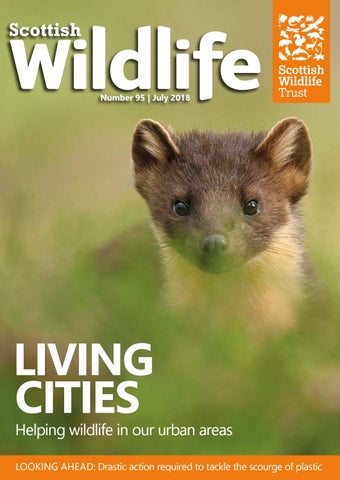
Number 95 | July 2018
LIVING CITIES
Helping wildlife in our urban areas LOOKING AHEAD: Drastic action required to tackle the scourge of plastic
Welcome Social frommedia the Chief link/Web Executive link
FIRST WORD From Chief Executive, Jonny Hughes
O
ur Trust has a long history of standing up for urban wildlife. Some of our most stunning wildlife reserves are located within our largest towns and cities. Edinburgh has Bawsinch and Duddingston Loch, a wetland and woodland haven to rival any found in the wider countryside. Glasgow has Possil Marsh, occupying a natural basin of fluvio-glacial origin between the River Clyde and the Kelvin (pictured) and home to scarce plants such as ivy-leaved duckweed and lesser tussock sedge. Cumbernauld has a connected network of wildlife-rich woodlands into which the pine marten has returned in recent years. But we are going further than just protecting nature in these special places. Guided by our vision to reconnect fragmented wildlife habitats across Scotland, we have been working to help nature expand beyond reserves, into the urban fabric itself. The Edinburgh Living Landscape ‘Pollinator Pledge’ has seen the creation of flower-rich habitats in spaces large and small right across the city. If you are a bee or a hoverfly, this means you have a chance to move when a lawnmower comes along and extinguishes the flower patch you called home. The Irvine to Girvan Nectar Network works on similar principles, creating flower super-highways for pollinators.
By bringing nature into cities, we also do ourselves a world of good.
The Kelvin in Glasgow is a valuable urban wildlife corridor
By bringing nature into cities, we also do ourselves a world of good. Wildliferich parks, streets and gardens can reduce flooding and air pollution, as well as improving water quality and increasing resilience to future climate change impacts. They also provide a natural health service and vital spaces for children to learn outside the classroom. The benefits of reconnecting children and adults with nature in urban areas are now well understood. In one study, middle-aged Scottish men from deprived yet greener urban areas had a death rate 16% lower than those in less green areas. In other research, pregnant women in the greener areas of Bradford had lower blood pressure and higher birth weights.
Studies such as these now run into the thousands. The conclusion is that we absolutely need nature for our health and wellbeing in towns and cities. At our National Members’ Day in Edinburgh on Saturday 22 September, we will be exploring this topic further and launching a new policy futures publication entitled Living Cities. I’m also delighted to announce that from August, the Trust will be hosting a global initiative with the International Union for Conservation of Nature called the IUCN Urban Alliance. Through this initiative we hope to position Scotland as a pioneer in what must be nothing short of a revolution in urban nature restoration. JULY 2018 SCOTTISH WILDLIFE 3
Contents
Inside this issue
6
16
06 ESTUARIES
Find out more about these important habitats, home to a wide range of specialist species.
08 NEWS
News round-up from the Trust and the world of conservation.
16
CITY SETTLERS
A closer look at the flora and fauna inhabiting our increasingly urban spaces, and how we can help them.
24 NATIONAL MEMBERS’ DAY
Join us in Edinburgh this September for our AGM and National Members’ Day.
28 OCEAN PLASTICS
The vexing topic of plastic waste and the damage it is doing to our seas.
28
34
32 WATCH OUT FOR
Read our latest book reviews and find out about World Cleanup Day.
34 VIEWPOINT
Eleven-year-old Talise Murphy shares her letter to the First Minister.
WIN LUXU A RY BRE TWOAK FOR I BORDN THE ERS SEE P A GE 3
3
Scottish Wildlife magazine is published by the Scottish Wildlife Trust. © Scottish Wildlife Trust. No part of this magazine may be reproduced without the express permission of the publisher. All photography © Scottish Wildlife Trust unless otherwise stated. The Scottish Wildlife Trust accepts no liability for omissions or incorrect data in advertisements and letters. Views expressed in Scottish Wildlife are not necessarily those of the Scottish Wildlife Trust. ISSN: 0143 1234. Registered office: Harbourside House, 110 Commercial Street, Edinburgh EH6 6NF. Tel: 0131 312 7765. Fax: 0131 312 8705. Email: enquiries@scottishwildlifetrust.org.uk. Website: scottishwildlifetrust.org.uk. The Scottish Wildlife Trust is a company limited by guarantee, registered in Scotland (no. SC040247). It is also a Scottish registered charity (no. SC005792). Scottish Wildlife is published three times a year: March, July and November.
The Scottish Wildlife Trust is affiliated to The Wildlife Trusts, a UK-wide network of 46 Trusts with more than 2,000 wildlife reserves. 4 SCOTTISH WILDLIFE JULY 2018
Deadlines for news: 1 January, 1 May, 1 September. No unsolicited articles please. Scottish Wildlife is free to members. Membership rates from 1 April (excluding discounts for paying by Direct Debit): Individual (concession) £40 (£18); Joint (concession) £47 (£24); Family £57; Watch £18; Life (joint) £900 (£1,300); World/Overseas £45. Patron: HRH The Prince Charles, Duke of Rothesay. Chair: Linda Rosborough. Vice-Chairs: Jon Barnes, Amanda Forsyth, Karen Chambers. Chief Executive: Jonny Hughes. Editor: Jo Pike editor@scottishwildlifetrust.org.uk Production Editor: Pete Haskell. Design: Connect connectcommunications.co.uk Advertising: Elliot Whitehead 0131 561 0021, Clare Stebbing 0131 561 0024. Printing: InkMark. Cover photo: © Terry Whittaker, 2020VISION
Spotlight: Sea trout
SPECIES SPOTLIGHT:
SEA TROUT
© Linda Pitkin, 2020VISION
(Salmo trutta)
Sea trout and brown trout are the same species. Whether or not a trout goes to sea depends on its genetics and environmental factors such as how much food is available.
While brown trout remain resident in freshwater, sea trout are ‘anadromous’, migrating to the sea to feed before returning to the river to spawn.
Young trout undergo many changes when preparing to go to sea. They change to a silvery colour and their eyes enlarge, as part of a process known as known as ‘smoltification’.
One way of telling salmon and trout apart is the shape of the tail – in salmon, the tail has a concave shape, whereas trout have a straightedged or convex-shape to their tail.
Trout scales have growth rings similar to a tree that can be ‘read’ to determine the age of a fish. These are formed from new tissue growing around the edges as the fish grows. JULY 2018 SCOTTISH WILDLIFE 5
Spotlight: Estuaries
WHERE THE RIVER ME ESTUARIES are a fascinating habitat of extremes. The same point in an estuary can be predominantly freshwater one hour and almost entirely saltwater the next, as the powers of the river jostle with the tide of the sea. Brackish water is more saline than fresh water, but not as salty as seawater, and estuaries form the most extensive brackish habitats worldwide. This transition between habitats is reflected in the underwater life
found in estuaries, as freshwater species give way to marine ones. In between are the specialised ‘euryhaline’ species that can tolerate both fresh and salt water, such as shore crabs, flounder and salmon. Fantastic bird-watching sites, estuaries and their surrounding habitats are particularly important for wintering waders and wildfowl. Here are just a few species that you might encounter along one of Scotland’s estuaries.
PINK-FOOTED GOOSE
CURLEW
Medium-sized geese with short necks, rounded heads and pink feet and legs. They overwinter in Scotland, arriving en masse in October and departing in spring to return to Iceland and Greenland to breed.
Europe’s largest waders, curlews are easily recognised by their long, downwardcurving bills. They can often be seen around estuaries during autumn and winter where they feed on worms, shellfish and shrimps.
SEA TROUT
EIDER DUCK
Returning to their native river in the summer and early autumn, trout will wait in deep shaded pools until it is time to spawn. Listen out for a large ‘splosh’ as they jump at night.
Scotland’s heaviest duck, the eider is characterised by its wedge-shaped bill. Males are black and white with a yellow-green nape, whilst females are brown. Eider ducks nest in their hundreds at the Trust’s Montrose Basin Wildlife Reserve.
6 SCOTTISH WILDLIFE JULY 2018
Spotlight: Estuaries
ETS THE SEA E
A C
RESERVES D
A MONTROSE BASIN
OS Landranger 54, NO700564 This reserve on the River South Esk features a rich mosaic of estuarine habitats including saltmarsh, reedbeds and tidal mudflats. It is an important roosting and feeding area for wildfowl and waders, including eider ducks and pink-footed geese. LUGWORM The coiled casts of these large marine worms, which live in U-shaped burrows in wet sand and mud, are a familiar sight on beaches and estuarine basins when the tide is out. However, the animal itself is rarely seen.
B CAMBUS POOLS
OS Landranger 58, NS846937 On the bank of the Inner Forth estuary, this wetland reserve demonstrates how small areas can become vital habitats for wildlife. A prime birdwatching site where you may even catch a glimpse of the elusive water rail.
C KILMINNING COAST
OS Landranger 59, NO634091 At the salty end of the estuarine spectrum, this stretch of species-rich coastline in east Fife looks out onto the invisible line where the Firth of Forth becomes the North Sea. Keep an eye out for nesting songbirds among the scrub.
D SOUTHWICK COAST
OS Landranger 84, NX913562 On the north of the Solway Firth, this reserve has wooded cliffs and extensive saltmarsh habitat that attract a wide range of birds and other wildlife. A path leads through the Needle’s Eye, a natural wave-cut arch, to the saltmarsh.
E SPEY BAY
SHORE CRAB A very common crab that can survive in a wide range of habitats, from rocky shores to estuarine mudflats, due to its ability to tolerate a range of salinities. Colour varies greatly, from green to brown, grey and even red.
OS Landranger 28, NJ325657 This reserve at the mouth of the River Spey features a succession of habitats, from bare shingle to coastal grasslands, brackish saltmarsh and wet woodland. In summer, bottlenose dolphins are regularly spotted at the mouth of the estuary. For full reserve information, visit scottishwildlifetrust.org.uk/reserves
JULY 2018 SCOTTISH WILDLIFE 7
Sea Trout © Jack Perks, Curlew © Terry Whittaker, 2020VISION, Lugworm cast © Andy Wakelin, Shore crab © John Haslam, Eider ducks © Derek Moore, Pink-footed goose © David Tipling, 2020VISION
B
Scottish Wildlife Trust news
© Steve Gardner
Latest news
News from the Trust, our projects and the wider world of conservation
KEEP UP TO DATE
All the latest Trust news is available on our website scottishwildlife trust.org.uk
Help secure a future for nature’s engineers As beavers forage, build lodges and construct dams, they have an incredible ability to create new wetlands, restore native woodland and improve conditions for a wide range of wildlife. So it was great news in late 2016 when the Scottish Government announced that the beavers reintroduced into Knapdale in Argyll, along with the population that has become established along the River Tay, will be allowed to remain and be given protected status. Scottish Beavers, a partnership between the Scottish Wildlife Trust and the Royal Zoological Society of Scotland (the two lead partners in the successful Knapdale trial), has now been tasked with monitoring and reinforcing the trial group. By making a donation, you can support this work, carried out under licence from Scottish Natural Heritage and with the permission and support of Forestry Commission Scotland, to help secure the future of beavers in Scotland.
Help ensure beavers are b for good. Don ack scottishwild ate at lifetr org.uk/dona ust. tebeavers
8 SCOTTISH WILDLIFE JULY 2018
A still from our osprey webcam at Loch of the Lowes
Brace for take-off THE resident ospreys at Loch of the Lowes in Perthshire are raising two chicks this summer. Male osprey LM12 has been busily delivering a steady supply of fish including trout and pike to the nest, giving the chicks an excellent chance of fledging later this summer. The female of the pair, LF15, laid three eggs in March and the last of the two chicks emerged on Thursday 24 May. The pair have now successfully hatched 10 chicks at Loch of the Lowes since they first paired in 2015. Rab Potter, Reserves Manager, said: “Spring had a late start this year, which seems to have pushed back the dates of when the ospreys arrived and laid their eggs, but we’re happy to see them raising two chicks this season. “It’s hard to say with certainty why the third egg hasn’t hatched. It’s
possible it was damaged by an intruding osprey earlier in the season, or that it failed during incubation.” The Trust’s Osprey Protection Programme is supported by players of People’s Postcode Lottery. This year, 40 volunteers and staff spent more than 1,000 hours helping to provide protection and security during incubation, as well as recording detailed information about the lives of ospreys at Loch of the Lowes. Sanjay Singh, Senior Programmes Manager at People’s Postcode Lottery, said: “Our players are proud to support the Osprey Protection Programme that ensures these magnificent birds of prey are guarded from human disturbance.” To stay up to date with the ospreys, visit Loch of the Lowes Visitor Centre and Wildlife Reserve, or watch our live webcam.
Scottish Wildlife Trust news
© Andrew Weston
Coul Links hangs in the balance Hughes said: “Consenting these plans completely undermines the credibility of the planning process and creates future uncertainty for both local communities and developers. We trust Scottish Ministers will now step in to avoid irreparable damage to an internationally important site.” The plans had been recommended for refusal by Highland Council due to the significant and permanent loss of sand dune habitat. The Council’s report also highlighted that the dune slack habitats at Coul Links are among the best in Scotland. Alistair Whyte, Head of Plantlife Scotland added: “We are on the brink of seeing the devastation of a globally important dune system and its precious wildflower habitat.”
Just a few reasons to #SaveCoulLinks ■ Coastal sand dune habitats are rarer than rainforests ■ Coul Links is home to over 1,200 species from otters and ospreys to rare plants and fungi ■ Thousands of birds including curlews,
oystercatchers and skylarks can be found there ■ Sand dunes are among the fastest disappearing habitats in the world ■ There are already six links golf courses within ten miles of Embo
Young leaders needed Are you a Scottish Wildlife Trust member aged 20–30? Could your passion for wildlife and the natural world help the Scottish Wildlife Trust realise its vision? This year, to mark Scotland’s Year of Young People, we’re proud to be launching a new volunteering initiative: the Scottish
Wildlife Trust Young Leaders’ Network. If you’d like to be involved in helping to set this up, find out more at scottishwildlifetrust.org.uk/youngleaders and apply online by 5pm on Friday 3 August. We look forward to hearing from you!
SEVERAL kind supporters have donated nearly £1,000 this year by raising funds directly through Facebook. They include Trust member Natalia Streeter, who chose to support us because she loves wildlife and nature. Natalia said: “I love all the good that the Trust does for Scotland’s wildlife, and I believe in the work that you do. “Facebook prompted me to raise money through a fundraiser for my birthday. It was so simple to set it up and share it with my friends on Facebook. I didn’t expect to raise much so I was pleasantly surprised to reach £375!” You can set up your own fundraiser for a birthday, anniversary or simply because you want to help protect Scotland’s wildlife, by clicking on ‘Create a Fundraiser’ on your Facebook profile. For more information please contact Zoë Furnivall zfurnivall@scottishwildlifetrust.org.uk © Jo Foo Wildlife Photography
THE Trust has joined several other leading environmental charities to call on the Scottish Government to step in to save the wildlife-rich coastal sand dunes at Coul Links in Sutherland. Highland councillors approved an 18-hole golf course on the site in June, going against the advice of their own officials, and despite the objections of more than 90,000 people and organisations, including Scottish Natural Heritage. The group of charities, which also includes RSPB Scotland, Plantlife Scotland and Buglife, has written to the First Minister asking the Scottish Government to ‘call in’ and reject the plans due to the harm this development would do to internationally important habitats and wildlife. Our Chief Executive Jonny
Facebook fundraising
Volunteers helping to monitor squirrel feeder boxes
Squirrel survey ABOUT 200 volunteers ventured into their local woods this spring to help monitor squirrel feeder boxes for the Trust-led Saving Scotland’s Red Squirrels project. Information collected by the volunteers contributes to an annual snapshot of red and invasive grey squirrel distribution. This helps deliver targeted conservation work to save protected red squirrels in priority areas of Scotland, such as Dumfries and Galloway and Loch Lomond and the Trossachs National Park. Colin Walker from Aberdeen said: “Scrambling through fallen branches and sliding down muddy slopes is worth it to know that reds are gaining ground and grey squirrels are being kept at bay.” Find out more about volunteering with Saving Scotland’s Red Squirrels at scottishsquirrels.org.uk JULY 2018 SCOTTISH WILDLIFE 9
Scottish Wildlife Trust news
© Alan Anderson
IN BRIEF
Willow spiling at Luggiebank
OBE for Robin Harper Former Trust Chair Robin Harper has received an OBE in the Queen’s Honours list for his services to nature conservation. Robin was Chair of the Trust between 2014 and 2017. In 1999, he was the first member of the Green Party to be elected to the Scottish Parliament.
Living riverbank built at Luggiebank Wood
Research prospectus A wide range of projects that would help answer important questions about Scotland’s environment are outlined in the Trust’s new research prospectus. Projects range from small, short-term surveys on our reserves, to PhDlevel research, and topics cover a wide range of areas, including outdoor education, marine conservation and land use. For more information visit scottishwildlifetrust.org.uk/research © Joanna Peaker / Scottish Wildlife Trust
MAJOR improvements to much of the path network at Luggiebank Wood Wildlife Reserve have been completed as part of Cumbernauld Living Landscape. In addition to creating new paths, access points and interpretation, willow ‘spiling’ has been used to stabilise the banks of the Luggie Water. This is a traditional technique where the live stems of coppiced willow are stacked along the watercourse, encouraging young shoots to take root thereby preventing further erosion. Reserves Manager Duncan Clark said: “This work completes a series of similar operations across all four of the Trust’s Cumbernauld Greenspace
reserves and will allow walkers and cyclists to appreciate the wildlife we have here, as well as improving links to the wider Living Landscape.” The project has been completed thanks to a grant of nearly £50,000 from Viridor Credits through the Scottish Communities Landfill Fund. Further funding from WREN will allow the Trust to thin 20 hectares of woodland in our Forest Wood, Luggiebank Wood and Seafar Wood reserves over the next year. This will help native species such as alder, oak and rowan to establish, benefiting a wide range of protected species including pine martens, bats and bluebells. © Harry Richards
Paddling deer goes viral A video of a roe deer swimming across Montrose Basin has been viewed more than 15,000 times on the Montrose Basin Visitor Centre’s Facebook page. Although this is rarely seen by people, roe deer are strong swimmers and will cross rivers and lochs when they need to.
Lambing update Conservation Shepherd Laura MacGregor delivered around 70 lambs this spring, including three sets of triplets, in an intense two weeks for the Trust’s Flying Flock. Years of careful selection for excellent fertility and ease of lambing has led to the Flock’s very short lambing period. 10 SCOTTISH WILDLIFE JULY 2018
A stock of local trees are being grown in raised beds
Nursing aspen in Ayrshire VOLUNTEERS have completed a new tree nursery at Shewalton Wood Wildlife Reserve in Ayrshire. Native saplings grown in the nursery’s raised beds will create a stock of local trees to be planted in the Trust’s Irvine Greenspace reserves. One of the raised beds is dedicated to growing aspen from cuttings taken
from Loch Libo and Feoch Meadows, two other Trust reserves. Aspen is a native species which is fairly rare in the west of Scotland, but with support and materials from social enterprise Eadha Enterprises, saplings grown in the nursery will be planted out in wildlife reserves in Irvine.
Scottish Wildlife Trust news
© Chris Gomersall, 2020VISION
Campaign success for pollinators THE European Union has acted to protect pollinators by banning the use of neonicotinoid insecticides on outdoor crops, something the Trust has been calling for since 2012 due to the harm that they pose to wild pollinators, including bumblebees and hoverflies. The Trust’s Chief Executive, Jonny Hughes, said: “This is very positive news. While it has taken a very long time to get to this point, we’re pleased that the overwhelming scientific evidence showing the harm caused by these chemicals has finally led to a ban on their use on crops.
“It is vital that protection for Scotland’s environment is not in any way weakened after Brexit. We hope the Scottish Government will demonstrate its commitment to protecting pollinators by showing its support for these restrictions.” Pollination provided by insects is worth an estimated £43m to the Scottish economy each year. The Trust believes that increasing support for more environmentally sensitive systems would enable farmers to grow healthy crops while cutting the use of harmful pesticides.
© Mark Foxwell
New wildlife trail at Falls of Clyde
A NEW trail at Falls of Clyde is helping families to discover the more elusive species that live on the reserve. The trail features eight posts with information about the lives of animals including badgers, otters, bats and dippers. The wildlife trail takes around an hour to explore fully and starts from the main entrance of the reserve at New Lanark. The trail has been supported by the Heritage Lottery Fund and South Lanarkshire LEADER through the Clyde and Avon Valley Landscape Partnership.
Scottish primrose flourishing at Hill of White Hamars SCOTLAND’S only endemic flower appears to be flourishing at the Trust’s Hill of White Hamars Wildlife Reserve due to a specific grazing regime designed to support it. Reserves Manager Mark Foxwell surveyed 13 populations of the flower on the Orkney reserve in May and found 1,804 flowers, more than twice as many as a 1993 survey that found 743 flowers. The Scottish primrose is found nowhere
in the world apart from in a few square miles of Orkney and the north coast of Scotland. Even there it is restricted to very specific places along clifftops. The low-lying primrose is easily swamped by grasses and other vegetation but is also sensitive to overgrazing. Flowers appear in summer, so the reserve is grazed by Shetland sheep during the winter.
Modernising our Articles of Association EARLIER this year, the Trust’s Council decided that the current Articles of Association required modernising in order to achieve the high standards of governance to which the Scottish Wildlife Trust aspires. The new constitution, which members will be asked to adopt at the Annual
General Meeting in September, has been drafted by our lawyers, Morton Fraser, following an approved template provided by the Scottish Council for Voluntary Organisations. The new version retains key aspects and the spirit of the existing constitution, including the rights of Trust members, and will help to
ensure a good balance of skills, experience, diversity and geographical representation on Council through the option to co-opt trustees. To view the proposed wording for the new Articles of Association in full, please visit our website: scottishwildlifetrust.org.uk/2018-AGM JULY 2018 SCOTTISH WILDLIFE 11
Scottish Wildlife Trust news
Funding boost for heritage projects
Jupiter features in bioblitz tour SPRINGWATCH presenter Chris Packham is calling into Jupiter Urban Wildlife Centre in Grangemouth on Saturday 14 July during a 10-day UK-wide bioblitz. A bioblitz creates a snapshot of all the wildlife that can be found in a particular area on a specific day. Experts on lichens, moths, small mammals and other wildlife will be on hand at Jupiter to help identify every species found. Chris says: “The UK is home to remarkable and beautiful wildlife and
A COMMUNITY Grants Scheme offered by our partnership project – the Coigach & Assynt Living Landscape – has awarded a total of £27,000 to seven local projects that enhance the area’s heritage. Scheme Manager Boyd Alexander said: “We’re pleased to be able to provide a very valuable and targeted source of funding to facilitate small projects that might not get off the ground without our help.” The Community Grants Scheme offers funding to projects that complement those taking place through the wider Living Landscape. Grants of up to £5,000 are available to organisations and £1,000 to individuals. Applications for funding will re-open in January 2019. © Scottish Wildlife Trust
Volunteers collecting litter from Tarbet’s beach
A big haul on Handa A WEEK-long clean-up on Handa Island Wildlife Reserve has helped to highlight the international nature of marine litter. Trust volunteers collected two boat-loads of waste from the island’s southern beaches and also found time to help clean Tarbet’s beach, the departure point for the island’s ferry. A survey of a small amount of the debris found fishing equipment that could be traced to as far afield as the USA and Canada. Handa Ranger Francesca Clair said: “Sadly large amounts of plastic waste are washed up on beaches all over Scotland’s coastline and even relatively uninhabited islands such as Handa aren’t immune to that.”
some wonderful habitats but it’s also in big trouble. In the case of some species this means we are fast approaching the last chance to make a difference. “I want the 2018 UK Bioblitz Campaign to be a 10-day snapshot of the state of our wild places and what lives there.” Jupiter’s Bioblitz is a free event that is open to the public. It takes place on Saturday 14 July, 10am–4pm. For more information visit our website.
Spotlight on salmon farming THE Trust has responded to two Parliamentary inquiries into the future of Scotland’s salmon farming this year. Many organisations, including the Trust, are concerned that ambitious targets to double the size of the industry by 2030 completely ignore the capacity of our seas to deal with the associated pressures that salmon farming can place on the marine environment. These pressures include unnaturally high numbers of sea lice, increased disease prevalence, and the release of waste, medicines and chemicals into the surrounding habitat. Marine Planning Officer Dr Sam Collin, who was asked to give evidence at an inquiry held by the Scottish Parliament’s Environment, Climate Change and Land Reform Committee, said: “It’s very clear that Scotland’s salmon farming industry has been allowed to grow too rapidly without full consideration of its impact on wild salmon and the overall health of Scotland’s seas.
Fish farming on Loch Ainort on Skye
“We welcome the spotlight that has been put on the industry during this inquiry. We hope it will lead to radical reforms in the way salmon farming is regulated and ultimately to greater protection of our marine environment.”
LEAP Frog Wildlife Watch has been named the Scottish Wildlife Trust’s group of the year and has also won the accolade for the best new group in the UK. The group meets once a month and organises events for children in North Ayrshire aged 6-12. Activities include seaside
12 SCOTTISH WILDLIFE JULY 2018
organised by this new group.” Newcastleton Wildlife Watch came second in the UK-wide Wildlife Watch Group of the year competition, run by The Wildlife Trusts, and Jupiter Wildlife Watch was highly commended. Leap Frog members celebrate
strolls, pond dipping, and torchlit walks to look for nocturnal wildlife. People and Wildlife
Officer Catherine Leatherland said: “We were really impressed by the number of outdoor activities
Leap Frog member Talise has written to the First Minister as part of Scotland’s Year of Young People. You can read her letter in Viewpoint (p. 34).
© Anne Stobbs
Leap Frog group leaps to the top
Wider news
Summer exhibition explores Edinburgh’s shoreline
AN exhibition in Edinburgh will explore the relationship between people, the sea, the wildlife that lives on its shoreline and the future challenges that this environment faces. Edinburgh’s Shoreline runs from 23 July to 23 September at the Royal Botanic Garden Edinburgh’s John Hope Gateway.
Project Manager Charlotte Johnson said: “We’re really excited to be giving communities a chance to make their own mark on the project. The exhibition could include everything from turning plastics found on the beach into displays that reflect on marine litter, to songs of local fishwives who sold
their catch door to door over a century ago.” Edinburgh’s Shoreline is part of Edinburgh Living Landscape, in which the Scottish Wildlife Trust is a Programme Leader. This project is supported by the Heritage Lottery Fund and the Green Infrastructure Community Engagement Fund. © Mike Cruise
Soggy siskin takes top prize THIS brilliantly captured photograph of a siskin on a rainy autumn day was announced earlier this year as the winner of the Wildlife Portrait category in the Scottish Nature Photography Awards. Taken from a garden shed-cum-hide in Ayrshire, photographer Mike Cruise said: “Who needs to travel?!” See all the winners at scottishnaturephotographyawards.com
Research reveals beavers do dam good work A study undertaken in Devon has demonstrated how beavers could help clean up polluted rivers by capturing soil and nutrients flowing from intensively managed farmland. Dams built by a single family of beavers helped to remove 14 SCOTTISH WILDLIFE JULY 2018
© RGBE
CONSERVATION charity Trees for Life is harnessing the power of local mushrooms to help restore native woodland at Dundreggan Estate in the Highlands. A pinch of black granules containing a special mix of spores collected from mushrooms on the estate is being introduced to tree planting holes on the hills and seedlings in the tree nursery. “This magical mushroom mixture could speed up the return of the Caledonian Forest and its wildlife,” said Doug Gilbert, Trees for Life’s Operations Manager at Dundreggan. “In tough, windswept environments, newly planted trees need all the help they can get – especially in their early years.” This trial will be monitored to see if the treatment improves growth and decreases the need for fertilisers. It is hoped the treated trees will have greater resistance to drought, heat and pests. Natural forest soils are full of important fungi, but in deforested areas forests still containing mushrooms are rare, small or fragmented. This means it can take years for fungal spores to land in the right place for newly planted trees – by which time the trees may be stunted or dead.
© Trees for Life
Mushroom mix used to boost reforestation
100 tonnes of sediment, mostly soil that had eroded from farmland upstream by slowing the flow of water through a series of pools. Levels of nitrogen and phosphorus, both of which can create problems for wildlife, were also reduced.
“We are heartened to discover that beaver dams can go a long way to mitigate soil loss and also trap pollutants which lead to the degradation of our water bodies,” said Professor Richard Brazier of the University of
Exeter. “Were beaver dams to be commonplace in the landscape, we would no doubt see these effects delivering multiple benefits across whole ecosystems, as they do elsewhere around the world.”
City settlers
CITY SETTLERS The Trust’s projects in urban areas help improve the health and wellbeing of individuals and communities, but what about the benefits to wildlife itself? Rich Rowe finds out more.
© Paul Hobson
16 SCOTTISH WILDLIFE JULY 2018
© Jakob Assarsson
City settlers
W
e’ve all heard the phrase “many hands make light work”, but sometimes the same applies to mouths. And that’s very much the case at Bawsinch and Duddingston – a wildlife reserve at the foot of Edinburgh’s Arthur’s Seat, where targeted grazing by the Trust’s Flying Flock of Chevease sheep and Shetland cattle is helping to create an area of species-rich grassland. Much of the focus of this conservation grazing has been on a recently acquired part of the reserve known locally as Murder Acre, after a riot in the 17th Century. Following a huge push by volunteers to clear the dense scrub that had built up, the job of removing old growth grasses and other vigorous plants has now passed to the Flying Flock. Having already spent two winters and a summer at the site, the animals recently returned for a second summer of grazing. These hardy, lowmaintenance breeds dovetail perfectly: while the sheep browse shorter grasses, the cattle happily graze out the tall, rank grass, creating space and light for wildflowers to gain a foothold. “We’ve seen a huge difference, with the area looking a lot more like a
grassland now,” says Julian Warman, the Trust’s Reserves Manager for South East Scotland. “Having grazing animals here over an extended period really changes things quite radically.”
Even if people only have access to window boxes in a flat, planting the right species can make a real difference for pollinators. This conservation grazing has allowed lady’s bedstraw, bird’s-foot trefoil, thyme and other wildflowers to repopulate the ground – all nectar-rich plants that attract bees and other pollinating insects. “The whole ecosystem has become richer,” says Julian. Although with more focus on tworather than four-legged helpers, this
work is mirrored elsewhere in Edinburgh, where the Trust is working to mobilise owners of more than 160,000 gardens across the city to establish a vast network of people and habitats that provide support to pollinators. One of many individual projects within the wider Edinburgh Living Landscape programme, the Pollinator Pledge encourages garden owners to sign up and take three simple steps to help pollinators through the seasons: to make space for nature in gardens; to plant with pollinators in mind; and to help expand the network by sharing the pledge with friends and neighbours. “The message is that even small actions are worthwhile, as it’s all about cumulative change,” explains Hebe Carus, the Trust’s Interim Living Landscape Programme Manager. “Even if people only have access to window boxes in a flat, planting the right species can make a real difference for pollinators.” Increasingly, it’s a message being extended city-wide – and not just at ground level. Elsewhere, Living Landscape programme partners Royal Botanic Garden Edinburgh and Butterfly Conservation Scotland have led on a project, dubbed Square Metre for Butterflies, that sees private sector businesses create pollinator-friendly plantings on underused rooftops and small, ground-level plots.
JOINING THE DOTS
It’s a similar story just 40 miles or so to the west, where the Cumbernauld Living Landscape programme is working to connect the town’s built and natural heritage – essentially joining the dots between the town’s many green spaces. And in this, Scotland’s Year of Young People, it is apt that the success of one recently-completed project was recognised when it was awarded the RSPB’s Nature of Scotland Youth and Education Award. For two and a half years, the trust-led Engaging Communities project has worked with local high schools and communities to improve three wildlife sites within Cumbernauld. As well as enabling young people to gain in confidence and improve their employability skills, the project has also enhanced biodiversity at each site. Invasive species have been removed, wildflower meadows are now more actively managed, and flowering plants such as devil’s-bit scabious, common toadflax and meadow cranesbill are all now present. At the time of writing, the Trust is applying for funding for a new Creating Natural JULY 2018 SCOTTISH WILDLIFE 17
City settlers
Since confirming their presence in 2013, there have been more and more sightings of pine marten at this site.
Connections project that builds on many of the relationships made through Engaging Communities. “We hope the new project will deliver lots of the aspirations we’ve always had for Cumbernauld Living Landscape, from woodland management to working on urban bogs,” explains Ian Mackenzie, Cumbernauld Living Landscape Project Development Manager. “It will also help us unlock the capacity that already exists in communities to improve their local environment and create a legacy. That’s an important part of it.” It’s a legacy that could well include the long-term return of native species such as pine marten. Since confirming the presence of the animal at Forest Wood Wildlife Reserve at the beginning of the Living Landscape project in 2013, there have been more and more sightings of pine marten at this site. “While we wouldn’t claim that our work alone has resulted in their return, our approach has always been that when we see these and other native animals start to come back, we must be managing the woodland and green spaces well enough for there to be good quality homes for them to move into,” comments Ian.
NATURAL ALLY
The return of pine martens could yet make a major contribution to another Trust-led project elsewhere in the country. Recent studies have confirmed that Scotland’s recovering pine marten population is having a positive impact on red squirrels by controlling the spread of the non-native grey squirrel – a development that delights Dr Mel Tonkin, who heads up the Trust’s Saving Scotland’s Red Squirrels programme. The research – first in Ireland, and most recently in Scotland – demonstrates that in areas where pine martens exist alongside both red and grey squirrels, there is a trend of decline in greys and an 18 SCOTTISH WILDLIFE JULY 2018
Red squirrel
Hoverfly on devil’s-bit scabious
increase in reds. Better still, the higher the density of pine martens, the more profound their impact seems to be. While the exact reasons are unclear, one belief is that red squirrels have evolved alongside such a tree-dwelling predator so are naturally more cautious of them, while grey squirrels are having to learn that behaviour from scratch. “Grey squirrels don’t overlap with a similar predator in their native range in the Americas, so don’t seem to sense that pine martens are a threat,” says Mel. Whatever the reason, it’s a very welcome development for a partnership project that has made great strides since launching almost a decade ago with a remit of working with landowners and
local volunteers to ensure that red squirrels remain a part of Scotland’s native wildlife. The biggest win to date has been in and around Aberdeen where the wide distribution of greys has been greatly reduced through trapping efforts, with the net result that reds are now increasingly being spotted in urban areas where they have been absent for many years. “When we started taking grey squirrels out of parks, we didn’t know as much as we do now about the ecology of squirrels in an urban setting, but reds are now getting really close to built-up areas of Aberdeen,” explains Mel. As well as a coordinated approach to
City settlers
© Mark Hamblin/2020VISION
© Amy Lewis © Katrina Martin
© Katrina Martin
Forest Wood Wildlife Reserve
It could even be that the return of pine martens could allow red squirrels to recover in areas that hadn’t even been considered before – including urban settings...
Pine marten
trapping and monitoring applied over a long period and across a wide area, efforts to improve the fortunes of reds have been helped by the animals themselves. As they have never really been very far away in this part of Scotland, when an area of woodland is cleared of greys it can quickly be reoccupied by the native species. “We’re beginning to think that by the end of this current five-year programme [March 2022], we might get somewhere near eradicating grey squirrels from north-east Scotland,” believes Mel. It’s an achievement to be proud of, although the work is not just about the return of red squirrels to Aberdeen and the wider area, but the bigger picture of
protecting the core Grampian and Highland red squirrel population. Given the abundance of greys to the south, it’s a focus that will probably always be needed, but nonetheless Mel is optimistic about the future of red squirrels in Scotland. It could even be that the return of pine martens could allow red squirrels to recover in areas that hadn’t even been considered before – including more and more urban settings around the country.
Rich Rowe is an outdoors writer based in Innerleithen, Scottish Borders. richardrowe.co.uk JULY 2018 SCOTTISH WILDLIFE 19
How to build a wildlife pond
BUILD YOUR OWN GARDEN OASIS
I
n the last century, more than half of all ponds in the UK countryside have been lost. With more than two thirds of freshwater species relying on pond habitats, one of the best things that you can do to add wildlife value to your garden or neighbourhood is to install a wildlife pond.
These freshwater havens can be as big or small as you like, even an upturned dustbin lid sunk into the ground and filled with water will soon be a hive of activity. And if you don’t have a garden, you could consider contacting the owner of a local green space to see if they would be interested in installing a wildlife pond with you.
Turf, gravel or flagstones can be used to cover the edge of the pond liner 1. Siting your pond The positioning of your pond is key to its success. Too much light and you will risk an algal infestation, but site it underneath an overhanging tree and you will be forever netting leaves out of it in autumn. The ideal location is a sheltered southwest-facing spot which is at least partially shaded. It’s always a good idea to mark out the shape of your pond with rope or a hose pipe before you get the spade out.
A sloping ledge or ramp should be included so that any animals that fall in can climb back out
2. Constructing your pond Once you are certain of the location of your pond, it’s time to dig. Ideally, the pond needs to be at least 90cm at its deepest so that your pondlife can escape the ice in winter, but you’ll need to dig around 15cm further down to accommodate the liner and ‘under-cushion’ (see below). It’s also a good idea to dig a planting shelf at around 45cm deep to sit your planters on. Finally, dig a trench around the perimeter of the pond for the overhanging pond liner to drop into. Remove any sharp stones or other objects from the bottom of the hole and then put down 5cm of under-cushioning. This could be sand, old carpet or even newspapers. Next, unroll a butyl liner and line the hole with it, allowing the edges to drop into the trench around the perimeter.
Floating-leaved plants are good places for the eggs of pond snails, dragonflies and newts
Submerged aquatic plants oxygenate the water and provide cover for pondlife
Native plants for your pond Floating-leaved plants Amphibious bistort
Submerged aquatic plants
mphibious bistort – oval leaves and little pink A flowers; favours a water depth of at least 30-60cm. ater crowfoot – indented leaves and simple W white flowers that appear in early spring.
20 SCOTTISH WILDLIFE JULY 2018
ater starwort – a mat-forming oxygenator W that grows in 15-60cm deep water. Hornwort
ornwort – a hardy submerged perennial H that dies back in winter but returns in spring.
Bog bean
How to build a wildlife pond
High foliage around some of the perimeter will help to provide cover and shade
3. Filling your pond Before filling with water, it’s a good idea to put a 5-10cm deep substrate such as sand or washed gravel into the bottom of your pond. Next, fill the pond with water. Rainwater is by far the best, but if this isn’t practical, you can make do with tap water. Once filled, trim the liner to size, leaving plenty of overlap to fall into the perimeter trench. Finally, backfill the trench with soil and place turf, flagstones or gravel over any exposed liner at the pond edges to avoid it degrading in sunlight.
Species that could benefit from your pond include:
Golden-ringed dragonfly
Pond skater
Emergent plants will send their leaves and flowers up above the water’s surface
Marginal plants will grow happily around the edge of your pond
Water beetle
Pond mud snail
Planting baskets can be used when first introducing plants to your pond
Common frog
POND SAFETY! Ponds can be hazardous places. Young
Palmate newt
children should be supervised at all times when near water. Visit rospa.com for more tips on pond safety.
Barn swallow
Emergent plants
Marginal plants
lowering rush – clusters of pink flowers on a F 1m-tall stem appear in late summer. og bean – delicate star-shaped flowers B appear in summer above wide mats of leaves.
Yellow iris
ater forget-me-not – clusters of small, pale W blue flowers appear in spring or early summer. Yellow iris – grows up to 1.5m in height with branched stems and large, yellow flowers.
European hedgehog
JULY 2018 SCOTTISH WILDLIFE 21
Water beetle © Richard Burkmar, Pon d mud snail © Buglife, Common frog © Mark Hamblin, 2020VISION
A planting ledge is useful for plants that prefer shallower water
Q&A
Q&A What is the Global Footprint Network and why did you set it up? We’re an international non-profit organisation that aims to change how the world manages its natural resources so that everyone can thrive within the means of our planet. We set it up to promote decision-making that recognises there are limits to what our planet can provide for us. Our Ecological Footprint tool enables individuals, cities and countries to measure the extent to which we live within the means of one planet. No other metric exists in the world that can comprehensively track how much people use compared to what our planet’s ecosystems renew.
Mathis Wackernagel Founder and CEO, Global Footprint Network
What’s the most important step individuals can take to help save our natural environment? In this context I love Antoine de Saint-Exupéry’s advice: “If you want to build a ship, don’t drum up people to collect wood and don’t assign them tasks and work, but rather teach them to long for the endless immensity of the sea.” In other words, help them fall in love with the endless immensity of the future. Perhaps more practical: ban the word “should” from your vocabulary. Because every time we say “we should do this and that”, what you are really communicating is “I don’t want to…”.
What is Earth Overshoot Day? On a personal level, can you see This is the day in the year by which any reasons to be optimistic? humanity has demanded as much from I am trained as an engineer. We nature (for food, fibres, timber, CO2 were not taught about hope and absorption and so on) as the planet can despair. Engineers learn to calculate renew in a year. This year, Earth whether the bridge is strong enough or Overshoot Day falls on Thursday 2 needs more beams, whether the August, which is the ecological plane has big enough equivalent of spending your entire wings, whether year’s budget in only seven months. We the kettle is can’t go on like this with the Earth’s natural resources, in the same way as we can’t constantly live beyond our financial means. This is Find out more why we also promote by visiting #MoveTheDate – because if we pushed back Earth overshootday.org Overshoot date by five days every year, we’d be using less than one planet before 2050. What role do you see for towns and cities to help tackle some of the world’s biggest environmental challenges? The battle for sustainability will be won, or lost, in cities. By 2050, the world’s population is expected to reach 10 billion people, with 70-80% of those living in urban areas. Cities that want to be resilient and successful will need to find ways to operate and provide for thriving communities within the limits of what nature can provide.
22 SCOTTISH WILDLIFE JULY 2018
sturdy enough to hold the pressure. Maybe we need to apply more engineering thinking to sustainability. Is our natural capital strong enough? And if not, what do we want to do about it? Sustainability is a necessity, not a question of hope. It is also the most fascinating question we are confronted with in the 21st Century. It is the ultimate quest, and we all have skin in the game.
AGM and National Members’ Day
JOIN US AT THE 2018 AGM AND NATIONAL MEMBERS’ DAY Have you ever wondered what Scotland should look like? What are the issues you care about most? Join us for what promises to be an exciting National Members’ Day, full of lively debate, inspiring images and exclusive previews of forthcoming activities.
W
© Peter Cairns/2020VISION
orld-renowned wildlife photographer and rewilding advocate Peter Cairns will be the keynote speaker at this year’s National Members’ Day, which will take place at the spectacular National Museum of Scotland in Edinburgh on Saturday 22 September. A Senior Fellow of the International League of Conservation Photographers with over 20 years of experience, Peter has travelled from Scotland’s spectacular mountaintops to its ocean floors, taking stunning photographs and footage as he goes. He has spent a long time
considering the question ‘What should Scotland look like?’ and is well placed to investigate this intriguing question. We are delighted that there will also be the chance to hear from Dr David Hetherington, the UK’s foremost expert on the lynx, and to take part in a new set of Special Interest Sessions before our ever-popular ‘Wildlife Question Time’. Booking is easy, either online, by post (using the form in this magazine) or by phone. We very much hope to see you there – and, to celebrate Scotland’s Year of Young People, if you’re a member under the age of 25, you can come free!
EVENT PROGRAMME 10.00 Registration and refreshments 10.30 Annual General Meeting 11.30 Presentations and questions 12.15 National Members’ Day and standing buffet lunch 13.00 Welcome to National Members’ Day – Linda Rosborough, Chair 13.05 Looking ahead – Jonny Hughes, Chief Executive 13.15 SCOTLAND: The Big Picture Keynote speaker – Peter Cairns, Wildlife Photographer 14.00 Hot topic: The lynx and us: a place for lynx in Scotland – Dr David Hetherington
24 SCOTTISH WILDLIFE JULY 2018
AGM and National Members’ Day
© Peter Cairns, 2020VISION
AGM AT NATIONAL MUSEUM OF SCOTLAND Notice is hereby given that the 54th Annual General Meeting of the Scottish Wildlife Trust will be held on 22 September in The Auditorium at the National Museum of Scotland, Chambers Street, Edinburgh, EH1 1JF from 10.30 to noon. AGM AGENDA 1. Apologies. 2. To approve minutes of the 53rd AGM held st the McIntyre Building: Room 201, University Avenue, Glasgow, G12 8QQ on 23 September 2017. 3. To receive the Council’s report and accounts for the year ended 31 March 2018. The annual report and accounts can be downloaded from scottishwildlifetrust.org.uk. Copies are available on request from the Company Secretary (see below for address). Copies will also be available at the AGM. 4. T o re-appoint auditors to the Trust: RSM, First Floor, Quay 2, 139 Fountainbridge, Edinburgh, EH3 9QG. 5. T o elect members to Council. 6. Any other relevant business. All other business must be notified to the Company Secretary by 31 August 2018. Company Secretary: Susan McKenzie Registered Office: Scottish Wildlife Trust, Harbourside House, 110 Commercial Street, Edinburgh, EH6 6NF.
View looking north along upper Glenfeshie, Cairngorms National Park, Scotland
14.20 S pecial interest sessions New this year! Keep an eye on our website for details.
e Cowgat
Cowgate
15.20 Wildlife Question Time
Sout
bers
et
Stre
ond
mm
Forrest Road
Festival Theatre Edinburgh
sto
Save the cost of a stamp and book online at scottishwildlifetrust. org.uk/2018-AGM Alternatively, post the enclosed booking form or book by phone on 0131 312 4700. All bookings must be received by 14 September.
t ee Str
BY BUS: A number of buses go via Edinburgh city centre and stop outside the Museum on Chambers Street, or nearby on George IV Bridge and South Bridge. For more information, visit lothianbuses.com or call 0131 555 6363. Dru
National Museum of Scotland
et
Stre
Bri
B o ok b y 31 August for our Early Bird discount!
ge
Cham
bers
h Brid
e Bridg
Cham
16.20 Event finishes
ary rm Infi
reet
rs St
be Cham
ge IV Geor
16.10 Closing address
BY TRAIN: The Museum is a 10-15 minute walk from Edinburgh Waverley train station.
ge h Brid
National Library of Scotland
Sout
14.50 Refreshments
Venue information
Pla
et
Stre
Surgeons’ Hall
ce
The Auditorium, National Museum of Scotland, Chambers Street, Edinburgh EH1 1JF. T: 0300 123 6789 Given the central location of the National Museum, we would strongly recommend that guests use public transport options where possible, as parking in the city centre is limited.
BY CAR: Follow signs to the city centre. There is pay and display parking available on Chambers Street. ACCESSIBILITY: There is level access to the Museum via the main doors to the Entrance Hall on Chambers Street and the Tower entrance on the corner of Chambers Street and George IV Bridge. See overleaf for Council nominations...
JULY 2018 SCOTTISH WILDLIFE 25
Nominations for election to Council
ELECTION TO THE TRUST’S COUNCIL Council, which has responsibility for the governance of the Trust, is made up of Trustees elected from the membership. To be an effective Trustee requires time and effort, and members of Council are elected on the basis of what they can contribute by way of knowledge, contacts, expertise and skill (including finance, conservation and
science, administration, and land management). A Trustee must act in the best interests of the charity as a whole. This year, as the number of candidates exceeds the number of vacancies on Council, an election is necessary. Vacancies will be filled in accordance with the Articles of
Association. Eligible members are offered the opportunity to vote for the nominees they would like to see elected to Council. Members can vote using the voting slip on the reverse of the address sheet (more available on request).
NOMINATIONS FOR ELECTION TO COUNCIL STANDING FOR RE-ELECTION
DERYCK IRVING Proposer: Karen Chambers. Seconder: Kenny Taylor A qualified ecologist and Head of Strategic Development for the Central Scotland Green Network – Europe’s largest greenspace project – Deryck has over 30 years’ experience of environmental projects in Scotland. This has included working directly with communities and also supporting environmental policy development with national and local government – with a particular emphasis on wildlife and people, climate change and the role of natural habitats as key components of the green infrastructure of our towns and cities. He has an international reputation as an urban ‘placemaker’. Deryck recently chaired the Trust’s review of its approach to volunteering. NICKY MUNRO Proposer: Karen Chambers. Seconder: David Stevenson As head of environment in the Scottish Government, Nicola led work on aspects of natural heritage including wildlife protection, National Parks and sponsorship of Scottish Natural Heritage. Her work extended to biodiversity, air and water quality, climate change and sustainability. Later work spanned responsibility for the planning system, charity regulation, volunteering and social inclusion, all relevant to the Scottish Wildlife Trust’s current activities. Now away from government, she has served for three years on the Trust’s Board and would like to serve for a further term. STANDING FOR ELECTION
DR TIM DUFFY Proposer: Karen Chambers. Seconder: Ken Knowles Tim is currently Vice-Chair and Planning Secretary of the Trust’s Lothians Group. He has previously served terms as Chair of that group and as a Trustee on the Trust’s Council, during which time he cycled between all the Trust’s wildlife reserves to raise money for the 50th anniversary. Currently a member of the Council’s Conservation sub-committee, Tim wishes to serve again on the Council to help see through the new five-year plan. Tim has three degrees in ecology and is now studying botany, Gaelic and clarsach, as well as being Head of Geoscience Interoperability at the British Geological Survey. 26 SCOTTISH WILDLIFE JULY 2018
WILLIAM HENDERSON Proposer: Colin Macintosh. Seconder: Ann Macintosh William is a retired solicitor/lawyer and a Notary Public and Writer to the Signet with many years’ experience in Private Practice as Principal in a well-known law firm in Edinburgh and with the Citizens Advice Bureau. Since retiring from practice a number of years ago, he has travelled widely and been involved in a number of voluntary organisations. William is passionate about wildlife conservation and has already been involved with the Scottish Wildlife Trust on a number of levels. JOHN MORRIS Proposer: Petra Collins. Seconder: Andrew Binnie Now 65-years old, John was educated at Allan Glen’s School in Glasgow and thereafter at Strathclyde University where he graduated with an LLB Law degree in 1975. He worked in the legal profession for over 40 years, retiring from full-time employment in April 2017, but continues to sit as a Sheriff and High Court Judge on a part-time basis. Primarily residing in Edinburgh, John also spends time in his house Angus which is very close to the Trust’s Loch of Lintrathen Wildlife Reserve, where he spends a great deal of his spare time. ANTHONY ROBSON Proposer: Maureen Child. Seconder: Mary Keane A financial services solicitor, Anthony is a member of the Friends of Figgate Park committee in Edinburgh. As well as being responsible for the production of a wildlife calendar to raise funds for improvements to the park, he gives talks to local schools and community groups about the park’s wildlife which includes kingfishers and the occasional otter. A keen traveller, cyclist, wildlife photographer and artist, he is a member of a number of conservation charities and a ‘Capturing the Coast’ participant. JANE STUART-SMITH Proposer: Hugh Raven. Seconder: Jonathan Hughes Jane lives close to Rahoy Hills in Argyll and has served as a member of the Management Committee for the reserve for several years. She is an employment lawyer specialising in discrimination issues and has experience advising Boards on strategic and HR matters. Living and working in the remote peninsular of Morvern, Jane is passionate about the importance of Living Landscapes and the connection between communities and nature in the wilder areas of Scotland. She is co-founder and manager of the award-winning Whitehouse Restaurant in Lochaline, a member of the Agricultural Wages Board and has been a trustee of several local charities.
JULY 2018 SCOTTISH WILDLIFE 27
Ocean plastics
A CIRCULAR ECONOMY FOR PLASTICS
Keeping waste in use and out of our oceans Imagine a world in which the concept of waste no longer existed. This is the vision that the Ellen MacArthur Foundation is working towards and it’s called the Circular Economy. Here, Sander Defruyt, lead of the New Plastics Economy initiative, highlights why taking this approach is vital if we are to tackle the growing problem of plastic in our oceans.
F
ew would disagree that plastic is an integral part of our economy and daily life, but an ever-increasing number of us are realising that we urgently need to rethink how we use it. Plastic products used only once before being thrown away represent a massive loss of value, a loss which comes at a huge cost to the economy as well as to the environment. Globally, just 2% of plastic packaging is recycled back into packaging. Despite the best efforts so far, the majority still ends up in landfill, incinerated or – worst of all – in the ocean. Each year more than eight million tonnes of plastic enter the ocean, where it can remain in its original form for hundreds of years, or much longer in the form of small particles. The destructive impact of plastics pollution on animal life is clear – no better highlighted than in Blue Planet II – and the potential risk to human health, while not always conclusive, raises concern. Research estimates that there are more than 150 million tonnes of plastic waste in 28 SCOTTISH WILDLIFE JULY 2018
the ocean today and that by 2050 there could be more plastic than fish. The three best known major international ocean clean-ups jointly deal with less than 0.5% of the annual volume of plastic marine litter. Efforts to clean up waste are crucial for dealing with the symptoms, but they don’t tackle the root cause. Nor does increasing the amount of plastic collected for recycling, which is important in itself but on its own not enough. In practice, 30% of all plastic packaging items are either too small (such as straws and sachets) or too complex (multi-layered materials) to be recycled. We need a different approach, one which prevents plastic from becoming waste and keeps it in the economy as a valuable material. This means we need to fundamentally rethink how we produce, use and reuse plastics. The New Plastics Economy initiative, set up in 2016 by the Ellen MacArthur Foundation, aims to do just that: to redesign the global plastics system based on the principles of a circular economy.
To achieve long-term change, we need ambitious initiatives around the world. As Ellen MacArthur describes it: “The problem of plastics pollution is a global one that needs a global approach, a shared vision and shared ambitions. However, when it comes to implementing a new plastics economy, we still need solutions that are appropriate for their local context, driven by local stakeholders.” WRAP, a UK-based charity that promotes positive economic and environmental action, recently launched The UK Plastics Pact together with the Ellen MacArthur Foundation. The initiative addresses the need for collective action – bringing together businesses, governments, local authorities, NGOs and citizens – and will help prevent unnecessary plastic packaging, which is almost exclusively single-use, from ever becoming waste. There are four ambitious targets by 2025: first, 100% of plastic packaging will be reusable, recyclable, or compostable by design. Second, 70% of plastic packaging will actually be recycled
Ocean plastics
We need a different approach, which prevents plastic from becoming waste and keeps it in the economy as a valuable material. We need to fundamentally rethink how we produce, use and reuse plastics. or composted. Third, unnecessary or problematic single-use plastic packaging will be eliminated through redesign, innovation, or alternative (reuse) models. Finally, on average 30% of all plastic packaging will be made of recycled content. After the UK, others will follow. In Chile, 7,000 miles away, a second Plastics Pact is being prepared that shares the same vision. Through this initiative, countries can demonstrate their leadership, share best practices, and inspire and challenge one another. To encourage the development of new ideas, the Ellen MacArthur Foundation
has come together with the Prince of Wales’s International Sustainability Unit to launch the New Plastics Economy Innovation Prize. Combined with the necessary infrastructure, the innovations dreamt up by the winners of this prize could prevent the equivalent of 100 rubbish bags of plastic per second from being created. For instance, the London-based Delta team took inspiration from the way nature uses membranes to encapsulate liquids (such as in eggs and fruits) and designed a machine that produces and fills biodegradable and edible sachets. These
can be used for a range of products such as shampoo and other personal supplies for hotels or for ketchup in restaurants. Triocup provides another example of the power of creative innovation. By developing a disposable, origami-like paper cup for your coffee, the tri-fold lid design replaces a plastic one that cannot be recycled and would normally end up as landfill. The cost of the extra paper needed for the Triocup is more than compensated for by not having to produce a separate plastic lid. Furthermore, the cups are easy to stack after assembly and made of 100% compostable materials. Initiatives like these demonstrate that businesses, governments, innovators and others have started to respond. By making the transition towards a circular economy, we can prevent plastic from ever becoming waste and keep it out of our oceans. This is how we create real solutions that match the scale of the challenge before us. To find our more about the Ellen MacArthur Foundation, visit ellenmacarthurfoundation.org JULY 2018 SCOTTISH WILDLIFE 29
30 SCOTTISH WILDLIFE JULY 2018
THE BIG PICTURE Danni Thompson
THIS beautiful photograph of a ruby-tailed wasp was taken by Danni Thompson, a conservation scientist and photographer who spent two seasons working as a ranger on Handa Island (2016-2017). Owned by Scourie Estate and managed in partnership with the Trust, Handa is justifiably famed for its seabird colonies, but also has a wealth of invertebrate life. “Handa is a very special place that
will always be in my heart,” explains Danni. “I’d never spent so long living in a reserve that I could get to know so intimately and I relished the chance to learn everything about the habitats and species that live there. “I was weeding the veg garden one day when I suddenly saw this beautiful wasp land on a bean leaf. I managed to catch it for a closer look and remembered that I’d seen the wasp in
© Danni Thompson
The big picture
an ID guide years before. I squealed in excitement to myself when I realised what it was!” More of Danni’s stunning photos from Handa can be seen in her recently published book, Handa Island, available from blurb.co.uk Camera: Nikon D3300; Lens: 18-55mm with extension tubes; Shutter speed: 1/80; Aperture: F10 JULY 2018 SCOTTISH WILDLIFE 31
Watch out for
Watch out for... Some things to enjoy over the coming months Reading
Reading
How to Give Up Plastic by Will McCallum Published by Penguin Life ISBN 978-0241363218 Hardcover RRP £12.99
The Lynx and Us
by David Hetherington and Laurent Geslin Published by Wild Media Foundation ISBN 978-0956842329 Hardcover RRP £25 While at first this may appear to be ‘just’ a beautiful coffee table book, and indeed the breathtaking photography of Laurent Geslin is worthy of any table, the written content lends this publication far more weight. Authored by Dr David Hetherington, the UK’s leading expert on the mysterious and often misunderstood lynx, this book provides the reader with a balanced, factual and easily accessible overview of the history and status of this beautiful cat in Europe. Using examples from across the continent, Hetherington describes how lynx interact with their environment including, of course, the human population and domestic and wild animals. He then investigates the suitability of Britain for reintroducing lynx and the associated challenges that this may bring. While the author’s preference is not hard to discern, the book has been written in a way that informs rather than tries to persuade, and will undoubtedly catalyse further debate on this secretive carnivore.
32 SCOTTISH WILDLIFE JULY 2018
How each of us can help tackle the issue of plastic pollution can sometimes be hard to wrap your head around, but this new book by Greenpeace UK’s Head of Oceans, Will McCallum, is a good place to start. While the introductory chapters are peppered with facts and stats that could disenchant the best of us (did you know that 90% of seabirds have plastic in their stomachs?), the rest of the book details a host of things that we can all do to reduce the amount of single-use plastic in our lives. From the obvious, such as getting (and using!) a reusable coffee cup or drinks bottle, to the less obvious, such as where you can buy toothpaste sold in glass jars,
McCallum focuses each chapter on a different part of our lives and details practical examples of actions we can all take to fight the plastic monster.
Event
World Cleanup Day
Saturday 15 September Ten years ago, 50,000 people came together in Estonia to clean up the entire country in just five hours. The organisers named the action Let’s Do It! and the result was the removal of 10,000 tons of illegal waste from Estonia’s forests and countryside. This year, Let’s Do It! intend on engaging 150 countries and 380 million volunteers – that’s 5% of the world’s population – in the largest clean-up operation in history. Starting in New Zealand and ending 36 hours later in Hawaii, the goal is simple: a cleaner world. Find out how you can get involved by visiting worldcleanupday.org
Watch out for
Prize draw
Win a night in a Baronial castle
O
ne lucky winner can enjoy a one-night stay on a dinner, bed and breakfast basis for two people at former Scottish Baronial castle, Cringletie House, located near Peebles. Cringletie House is only 30 minutes south of Edinburgh and with its stunning grounds and warm, friendly welcome is the perfect escape. The hotel is set in 28 acres of grounds where guests can enjoy a woodland walk or a stroll through the walled garden. For guests visiting Cringletie House with their best (four-legged) friend, the hotel welcomes wellbehaved dogs.
The hotel is almost an art gallery in its own right – every lounge is full of original paintings, each corridor also has original artwork, and for those who enjoy painting or drawing, the hotel grounds provide plenty of inspiration. READER When the owners OFFER renovated Cringletie Cringletie House is offering House, they made it a all readers the chance to receive fully wheelchair a complimentary bottle of pink fizz accessible hotel and to enjoy with dinner when booking included an extensive a ‘one night stay for two people’ range of disabled quoting ‘ScotWild18’. facilities, and as a result Cringletie has The reader offer and prize are offered subject to availability. Must be pre-booked, non been named in the Top transferable and no cash alternative. Ten of Accessible Hotels Not applicable during Easter and in the UK. Bank Holidays. cringletie.com
To enter, simply complete and return the membership survey included with this magazine or visit scottishwildlifetrust.org. uk/2018survey
JULY 2018 SCOTTISH WILDLIFE 33
Viewpoint
Viewpoint Volunteer stories from around the Trust
WE’RE INTERE ALWAYS STE YOUR O PINIOND IN OBSER VATIOSNAND S
Speak to us o Twitte n r: @Sc otWild Faceb life ook: fa scottish cebook.com / or ema wildlifetrust il us: e n quiries @scott ishwild lifetrus t. org.uk
TALISE MURPHY, LEAP FROG WILDLIFE WATCH GROUP (AGE 11) IN this, Scotland’s Year of Young People, we asked one of our young wildlife enthusiasts to write to the First Minister about why wildlife is important. Below is her letter. If Talise receives a reply, we will let you know in the next issue.
Dear First Minister,
If I ever got to meet you, I would ask you to help protect Scottish wildlife and the environment. I think it is important to look after wildlife because if we didn’t look after the environment the world would be covered by waste and it would be a horrible place to live in. No one would be able to spend their time outside as it would be dangerous because of pollution in the air and the amount that would build up, and we would also lose lots of precious animals as their homes would be destroyed. Because we look after the world it is a wonderful and safe place to live in for both humans and animals, but we must do all we can to protect them because they can’t do it themselves. I started going to the Scottish Wildlife Trust’s Leap Frog Wildlife Watch Group last year because I wanted to learn more about local wildlife and how I could help it. Leap Frog does lots of work to teach kids about nature in a fun way. My favourite session so far has to be the Mammal Mania event which my auntie hosted. She is an ecologist and told us lots of interesting facts about beavers including where we could visit them in Scotland. We were shown woodchips that beavers had chipped of off trees and video of real beavers. One thing I think people should do for the environment is reduce the amount of single use plastic they use. It is dangerous to wildlife as animals can get stuck in it
and they could suffocate. It also takes a while to disintegrate meaning it lies around on the ground for longer leaving wildlife at risk. I have enjoyed everything we have done at Leap Frog so far and can’t wait to attend more groups. Leap Frog have been planting flowers, trees as well as learning
If we didn’t look after the environment the world would... be a horrible place to live in. 34 SCOTTISH WILDLIFE JULY 2018
stuff about bugs, birds, mammals and much more. They always find a way to make teaching about wildlife fun. I hope you will come and visit our group so we can show you all the great animals we have in Ayrshire. Yours sincerely, Talise Murphy, age 11
Leap Frog Wildlife Watch group is based in North Ayrshire. The group were named the Trust’s Wildlife Watch Group of the Year in 2018.