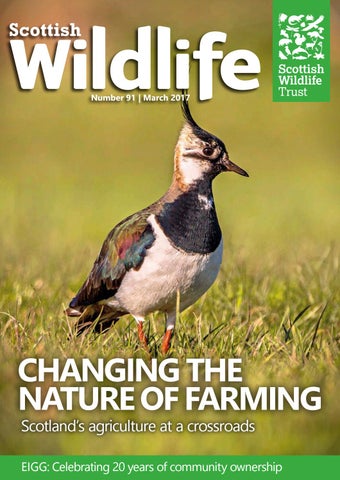
Number 91 | March 2017
CHANGING THE NATURE OF FARMING Scotland’s agriculture at a crossroads
EIGG: Celebrating 20 years of community ownership
Welcome from the Chief Executive
FIRST WORD From Chief Executive, Jonny Hughes
© Mark Hamblin, 2020VISION
T
his spring, the Trust will be launching two important new publications. One will shape how the Trust develops in the next half a decade. The other, we hope, will help to shape how the Scottish Government supports Scotland’s wildlife and ecosystems well into the next decade. Our new five-year plan was developed jointly by trustees and staff, drawing on ideas from the wider membership, experts and local community partners. While our vision of ‘a connected network of healthy, resilient ecosystems supporting Scotland’s wildlife and people’ remains unchanged, the plan does have some new elements. We have set out four goals: healthy ecosystems, protected places, thriving species and a Scotland that values and benefits from nature. To achieve these goals we have recognised the need for continued investment in three organisational foundations: valued and motivated people; sufficient and sustainably managed resources; and sound evidence and knowledge. By combining very clear goals with strong foundations we believe we can significantly grow the Trust’s profile, influence and most importantly, impact for wildlife by 2020 and beyond. Our programmes on Living Landscapes and Living Seas, ecological networks, peatlands, red squirrels, natural capital, education and public engagement will be strengthened. We will also campaign to save special sites from being lost to development and, of course, continue to expertly nurture our 120 reserves as safe havens for wildlife. In addition, we will pioneer new ways of managing our urban landscapes, actively inform the debate on future species re-introductions and
develop useful resources to ensure nature conservation is considered in social and economic policy, not just environmental policy. The second publication, our proposed new Land Stewardship Policy for Scotland, is a blueprint for the future – our contribution towards replacing the Common Agricultural Policy, which has sadly incentivised so much damage to our natural environment during its existence. This year, the Scottish Government is proposing to spend around £800 million to support farmers and land
Our new Land Stewardship Policy is a blueprint for the future.
managers. Of that £800 million, more than half is made up of payments made to farmers simply for being in business. In our Land Stewardship Policy we will argue that this money should continue to flow into the rural economy and thereby support the farming and forestry sectors. However, we believe it should be spent more effectively, to protect our precious natural assets and ensure clean water, productive soils, species recovery and habitat restoration, particularly of native woodland, scrub, peatlands and other wetlands. This new model will deliver not just for our natural environment; it will help secure Scotland’s reputation for environmental quality on which Scotland’s food and drink industry trades, and enhance the ability of our £1.4 billion nature-based tourism sector to market Scotland as a wild and exciting destination. I truly believe that investment in nature through a new Land Stewardship Policy is an investment in a resilient and diverse rural economy. SPRING 2017 SCOTTISH WILDLIFE 3
Contents
Inside this issue
8
16
06 THE DELIGHTS OF SPRING As the days begin to warm, wildflower meadows burst into bloom, attracting a wonderful variety of wildlife.
08 NEWS
News round-up from the Trust and the world of conservation.
16
THE SEEDS OF CHANGE
Louise Gray looks at the current system of agricultural subsidies and how this could be reformed under Brexit.
20 NATURE’S BOUNTY
Trust Ambassador Stephen Jardine
turns the spotlight on Scotland’s food and drink industry and the importance of a healthy natural environment to the sector.
20
28
24 DRUM ROLL FOR EIGG
Two decades on from the island’s
community buy-out, Kenny Taylor reflects on what this momentous event has meant for the islanders.
28 NATURAL SOLUTIONS Allowing nature to thrive can
have significant benefits for the human population, as Inger Andersen explains.
W NIGHIN A TWO TWO T STAY FOR IN A ARGYMAZING LL SEE PAGE 3
3
Scottish Wildlife magazine is published by the Scottish Wildlife Trust. © Scottish Wildlife Trust. No part of this magazine may be reproduced without the express permission of the publisher. All photography © Scottish Wildlife Trust unless otherwise stated. The Scottish Wildlife Trust accepts no liability for omissions or incorrect data in advertisements and letters. Views expressed in Scottish Wildlife are not necessarily those of the Scottish Wildlife Trust. ISSN: 0143 1234. Registered office: Harbourside House, 110 Commercial Street, Edinburgh EH6 6NF. Tel: 0131 312 7765. Fax: 0131 312 8705. Email: enquiries@scottishwildlifetrust.org.uk. Website: scottishwildlifetrust.org.uk. The Scottish Wildlife Trust is a company limited by guarantee, registered in Scotland (no. SC040247). It is also a Scottish registered charity (no. SC005792). Scottish Wildlife is published three times a year: March, July and November.
The Scottish Wildlife Trust is affiliated to The Wildlife Trusts, a UK-wide network of 47 Trusts with more than 2,000 wildlife reserves. 4 SCOTTISH WILDLIFE SPRING 2017
Deadlines for news: 1 January, 1 May, 1 September. No unsolicited articles please. Scottish Wildlife is free to members. Membership rates from 1 April (excluding discounts for paying by Direct Debit): Individual (concession) £33 (£18); Joint (concession) £46 (£24); Family £53 (£48); Watch £18; Life (joint) £800 (£1,200); Senior Citizen Life (joint) £500 (£700). Patron: HRH The Prince Charles, Duke of Rothesay. Chairman: Robin Harper. Vice-Chairs: Jon Barnes, Amanda Forsyth, Karen Chambers. Chief Executive: Jonny Hughes. Editor: Jo Pike editor@scottishwildlifetrust.org.uk Production Editor: Pete Haskell. Design: Connect connectcommunications.co.uk Advertising: Elliot Whitehead 0131 561 00212, Clare Stebbing 0131 561 0024. Printing: LexPlus. Cover photo: © Rudmer Zwerver
Spotlight
SPECIES SPOTLIGHT:
COMMON BLUE BUTTERFLY (Polyommatus icarus)
© Amy Lewis
While males of this species have bright blue upper sides as their name would suggest, females are primarily brown, with a highly variable amount of blue.
This species is found in a wide variety of habitats including meadows, woodland clearings, heathland, grassland patches such as roadside verges, and even sand dunes.
Adults typically lay their white eggs on the upper side of the leaves of food plants such as bird’sfoot trefoil, which the caterpillars will eat once they have emerged.
While common blues in southern England may have up to three broods a year, those in Scotland and northern England rarely have more than one.
Despite being the most widespread of the ‘blue’ butterflies in the UK, the common blue has seen a population decline of around 17% over the last 40 years.
SPRING 2017 SCOTTISH WILDLIFE 5
Spotlight: Wildflower meadows
THE DELIGHTS OF Each spring, wildflower meadows throughout Scotland begin to pop with colour and are soon brimming with the buzz of busy insects. These rich grassland habitats now occupy areas that were once wooded but cleared by man long ago for use as low-intensity agricultural land. They benefit from being grazed by cattle, including the Trust’s own Flying Herd, or periodically cut to prevent aggressive grasses and woody plants from smothering species such as those from the pea, daisy and orchid families. The bounty of vegetation and nectar that wildflower meadows provide attracts an abundance of insects and other invertebrates which in turn attract a variety of animals that feed on them. Here are just a few species to keep an eye out for next time you find yourself surrounded by the colourful delights that meadows can offer.
BARN SWALLOW
EUROPEAN MOLE
With their red throats and long tail streamers, these easily recognisable birds can often be seen swooping over meadows and open pasture between April and October.
Spending most of their lives underground, these rarely seen mammals aerate and drain the soil. They are common throughout mainland Scotland but are not found on many of the islands.
GREATER
MEADOW
BUTTERFLY ORCHID
CRANE’S-BILL
A distinctive orchid of hay meadows, open scrub and grassland, this orchid has a single spike up to 60cm tall with a significant number of greenishwhite flowers.
The most widespread of our native geraniums, the striking blue and violet flowers of meadow crane’sbill can be seen in meadows and roadside verges between June and August.
6 SCOTTISH WILDLIFE SPRING 2017
Spotlight: Wildflower meadows
SPRING
E
D
A
B
RESERVES A FEOCH MEADOWS
OS Landranger 76, NX263822 Traditional livestock farming ensures that this reserve has an abundance of wildflowers, which attract important butterfly and moth species. An area near the Feoch Burn in the west of the reserve is particularly rich in orchids during the summer months. YELLOW RATTLE This yellow, two-lipped flower can be seen between May and September. Its seeds ripen in July and rattle within a brown, papery capsule, traditionally said to indicate the meadow was ready to be cut.
B WHITLAW WOOD
OS Landranger 79, NT500132 Although predominantly known for its ash, elm and hazel woodland, Whitlaw Wood also has a small meadow that supports a good variety of colourful wildflowers and associated fauna in the summer.
C CARLINGNOSE POINT
OS Landranger 65, NT135809 This attractive, species-rich grassland supports several rare plant species including dropwort and field gentian. The reserve is also home to nesting finches and warblers in the summer, and gives a great vantage point for watching wildlife on the Firth of Forth.
D KELTNEYBURN
OS Landranger 52, NN773494 The beautiful meadow of Keltneyburn attracts a kaleidoscope of butterflies in the summer and is particularly noteworthy for its eight species of orchids. Dragonflies and damselflies can also be seen darting across the pond at this time. COMMON BLUE BUTTERFLY The common blue has been recorded in all areas of Scotland, but has declined in some areas in recent years. Butterflies typically emerge in June and July and have a lifespan of around three weeks.
E TALICH
OS Landranger 21, NH850786 Rich grassland flora can be found in clusters around the calcareous springs at Talich, encouraging a proliferation of orchids and a diverse range of invertebrates and birds. For full reserve information, visit scottishwildlifetrust.org.uk/reserves
SPRING 2017 SCOTTISH WILDLIFE 7
Wildflower meadow © Katrina Martin, Barn Swallow © Richard Bowler, European Mole © Steve Bottom, Yellow Rattle © Philip Percey, Greater Butterfly Orchid © Philip Percey, Common Blue Butterfly © Amy Lewis
C
Scottish Wildlife Trust news
Latest news
News from the Trust, our projects and the wider world of conservation
KEEP UP TO DATE
Visit our website for regular updates at scottishwildlifetrus t. org.uk
© Pete Haskell
Rediscover Montrose Basin MONTROSE Basin Visitor Centre has reopened following a successful £68,000 revamp. New displays and video screens have been installed, making it even easier to learn about the range of wildlife that thrives on the Basin throughout the year, including kingfishers, seals and pink-footed geese. “The improvements have gone down really well with our visitors,” said Visitor Centre Manager Caroline Hendry. “The visitor centre is a great place to learn about the importance of tidal estuaries or to simply sit with a coffee and marvel at the busy Basin through our viewing window.” The enhancement project was supported by the Heritage Lottery Fund, the Crown Estate, SUEZ Communities Trust, our North Angus Group and our Dundee & Angus Group. We hope to offer a warm welcome to as many of our members as possible and would encourage people to come and explore what’s on offer. The visitor centre is open daily from 10:30am - 5pm until 31 October. A number of exciting events are taking place in spring. For more information visit our website.
8 SCOTTISH WILDLIFE SPRING 2017
IN November last year, the Scottish Executive Jonny Hughes. “In the Government made the long-awaited coming decades beavers will do the announcement that beavers will be work of thousands of conservation allowed to remain in Scotland. volunteers and our landscapes will be This milestone decision has come richer in wildlife as a result.” more than 400 years after beavers were The return of beavers to Scotland’s hunted to extinction in Scotland, and lochs and rivers follows a decade of marks the first time that a mammal has work culminating in the Scottish Beaver been officially reintroduced anywhere Trial in Knapdale, a project led by the in the UK. Scottish Wildlife Trust and Royal The Scottish Government’s decision Zoological Society of Scotland (RZSS). means that the beaver The five-year monitoring phase of populations in Argyll and the Trial involved 11,817 hours Tayside can expand their of work by 60 volunteers and range naturally. The 13 independent y animals will be given organisations, nate toda o d e s a le P xt e n legal protection and which informed a e th rt to suppo landowners will be comprehensive study it is V . e s pha . rg given advice and of the impact of o t. s dlifetru support to manage returning beavers to the scottishwil k ac uk/bring-b their impacts. local environment. beavers Eurasian beavers are The Trust and RZSS one of the world’s best are now fundraising in natural engineers, with an order to carry out the next incredible ability to create stage of the reintroduction new wetlands, restore native process. This will involve woodland and improve conditions for a reinforcing the beaver population in wide range of species including Knapdale to ensure its long-term dragonflies, otters and fish. health and survival, as well as “The beaver is a bona fide ‘keystone developing activities that will support species’ that plays a unique role in its education and wildlife tourism in natural environment”, says Trust Chief mid-Argyll.
© Philip Price
Beavers are back!
Scottish Wildlife Trust news
SEVERAL events about Scotland’s beavers will be held at the Trust’s Loch of the Lowes Visitor Centre and Wildlife Reserve later this year. Two beaver watching evenings are scheduled for 14 April and 20 May, and a family fun weekend will take place on 27-28 May. Beavers were first spotted at Loch of the Lowes in 2012 and a breeding pair have since made the reserve their home. Perthshire Ranger Charlotte Fleming said: “We’re very lucky to have two hides right on the water’s edge, providing the perfect place to watch beavers in their natural environment. For more information, contact Loch of the Lowes Visitor Centre on 01350 727337
Trust launches new website
Rooftop habitat for butterflies THE first part of a patchwork of rooftop habitat for the northern brown argus butterfly has been created at the headquarters of Glenmorangie as part of Edinburgh Living Landscape. Patches of common rock rose are being planted to form a network of green roofs surrounding Arthur’s Seat to encourage the population of the butterfly to expand. The roofs will provide warmth, food and shelter in the city. The northern brown argus was frequently spotted by 18th-Century naturalists on Arthur’s Seat and identified as a separate species from the
brown argus in 1793. Butterfly collectors and changing land use including road-building led to its disappearance in 1869, but it was rediscovered in Holyrood Park in 2005 and the population has continued to increase each year. The Trust’s Living Landscape Programmes Manager Ian Mackenzie said: “Green roofs are launch pads that help wildlife make connections across urban areas. Using the ‘Square Metre for Butterflies’ project to boost these links will demonstrate how we can build nature into our future plans.”
PLANS to extend our work to protect Scotland’s red squirrels have been given the green light. We were delighted when more than 500 of our members responded to our summer appeal with donations totalling £40,329. These gifts have now helped unlock a grant of £2.46 million from the Heritage Lottery Fund for the next phase of Saving Scotland’s Red Squirrels. As well as enabling us to deliver our tried and tested strategy over the next five years, this investment will help us equip and share our expertise with networks of volunteers. By helping people monitor and protect red squirrels in their local area we will be putting red squirrel conservation on a much more sustainable footing. Find out more about Savings Scotland’s Red Squirrel at scottishsquirrels.org.uk © Pete Cairns, 2020VISION
IN February, the Trust launched its new website, designed to make it even easier to keep up to date with the Trust’s projects, news and events. The new website can easily be used on any device, and includes several new features such as online event bookings. If you’ve not yet seen the new website, take a look at scottishwildlifetrust.org.uk
Great news for Scotland’s red squirrels
© Phil Wilkinson
Beaver events at Loch of the Lowes
Trust continues to respond to Brexit THE Trust is playing an active role in ensuring that Scotland’s environment is protected after the UK leaves the European Union. At a minimum, we believe that the ‘Nature Directives’, which have been carefully developed over several decades to protect important species and habitats, must continue to be implemented in Scotland by the Scottish Government.
The Trust is also developing a wide-reaching Land Stewardship Policy, which sets out a vision for replacing the Common Agricultural Policy and provides a blueprint for sustainable land use in the future. These measures are vital for safeguarding Scotland’s wildlife, ensuring the health of our seas, and providing a high-quality natural environment which supports our prosperity and wellbeing.
SPRING 2017 SCOTTISH WILDLIFE 9
Scottish Wildlife Trust news
Magnificent Meadows NEW information panels have been installed at Bo’mains Meadow and Fleecefaulds Wildlife Reserves as part of the Save Our Magnificent Meadows project. The panels demonstrate the wide range of wildflowers found on each reserve, including devil’s bit scabious and ox-eye daisy. The Trust’s new full-time Falkirk Ranger, Clare Toner, has held several events themed around wildflower meadows, including learning about orchids and carrying out practical work such as scything and sowing seeds. The project also supports sustainable grazing on many of our reserves, with four Shetland cows spending the winter grazing at Bo’Mains. Led by Plantlife, Save Our Magnificent Meadows is a partnership made up of 11 organisations and is primarily funded by the Heritage Lottery Fund. The project aims to engage more people with meadows.
Trust left counting the cost of illegal fly-tipping DEALING with fly-tipping and litter on our wildlife reserves costs a staggering £15,000 per year. The cost of clearing up items such as mattresses, tyres and garden waste from reserves includes staff time and hiring contractors to remove large items and hazardous substances such as asbestos. This total does not include the costs to local authorities of clearing rubbish from roadsides adjacent to reserves, and the amount would be even higher if it weren’t for dedicated groups of volunteers who organise regular clean-ups. As our Head of Reserves, Alan Anderson explained: “Fly-tipping is
A NEW sand martin bank has been installed at Falls of Clyde in time for the birds’ return from Africa later this year. The bank was built by our regular reserve volunteers, students from Holy Cross High School in Hamilton, and Lothian Conservation Volunteers. Materials were paid for thanks to a donation in memory of Adam Brown, a young conservationist who was a frequent visitor to the reserve. Reserves Manager Steve Blow said: “Sand martins are 10 SCOTTISH WILDLIFE SPRING 2017
one of our earliest arriving migrants and a welcome herald of warmer weather. “A colony of these agile wee birds has lived nearby in the Hyndford quarry for many summers, feeding in good numbers over the river upstream of Bonnington Linn, so it’s great to be able to give them a boost.” There is a chance that kingfishers will also make a home in the bank, which is best viewed from the bridge over the Clyde above Bonnington Linn.
Fly-tipping can be reported to the police or local authority, or by calling the Dumb Dumpers hotline on 08452 30 40 90.
© Steve Blow
New high-rise home for returning sand martins
illegal, antisocial and dangerous to people and wildlife. It’s sad that some thoughtless individuals are dumping their waste on our reserves, forcing the Trust to use supporters’ money to clear up after them.” The worst affected reserves are sites in the Central Belt, but the problem is not confined to urban reserves, with some significant fly-tipping activities also affecting reserves in rural Aberdeenshire, the Scottish Borders and East Lothian.
Scottish Wildlife Trust news
LEGO is being used to bring people closer to nature in Cumbernauld. A number of macro photography events featuring the iconic toys have been held in the town’s green spaces for families and young people. Natural Networks Officer Paul Barclay said: “It’s amazing how quickly a disinterested ‘too cool for nature’ teenager melts in the face of a fourcentimetre-high Lego Storm Trooper with an environmental message. “It’s often difficult for people to realise that connecting with nature has a wide
© Tracy Lambert
Changing perspectives one brick at a time
range of benefits for health and wellbeing, which is why Cumbernauld Living Landscape is using a range of fun activities to encourage local people to get involved.“
IN BRIEF
Local groups and volunteers weekend THIS year, the Trust is holding a volunteer weekend at Bawsinch and Duddingston Wildlife Reserve in Edinburgh on 29-30 April. The weekend will include workshops, practical training sessions, guided walks and talks and a behind-the-scenes look at the Trust’s major projects. For more information, please visit our website.
© Ron Mitchell
Miley group awarded for its efforts VOLUNTEERS who care for The Miley Wildlife Reserve in Dundee have had their hard work recognised by being given a ‘Level 4 – Thriving’ award at the It’s Your Neighbourhood Awards ceremony. Keep Scotland Beautiful presented Dundee Miley Group with the award in recognition of its efforts, which include organising regular conservation work parties and litter picks on the reserve. Group members Tom and Mary Harwood were also given a Community Champion Award by Dundee City Council.
Money can grow on trees
Kingfisher mystery A NUMBER of national media outlets reported on a kingfisher mystery at Montrose Basin at the end of 2016, after a male kingfisher was photographed with a stash of three sticklebacks attached to its perch. Sticklebacks are common prey for the resident kingfisher, which kills the fish by striking them against a branch. This softens the fish’s stiff spines and makes them easier to swallow.
However, the bird appears to have gone a step further by using the spines to pin three sticklebacks to its regular branch. Angus Ranger Anna Cheshier said: “It’s hard to tell if the kingfisher has hung the fish on the branch accidentally or on purpose, but this is quite unusual behaviour that no-one seems able to explain. We’d like anyone who has seen anything like this before to get in touch.”
MORAY Wildlife Watch group has developed an innovative enterprise project to create wooden items including bird boxes and feeders to sell in the local community. The group has been awarded £850 from Forestry Commission Scotland through the Community Fund to hold a series of woodland workshops on topics including coppicing and green woodworking.
Annual General Meeting
OUR 53rd Annual General Meeting will be held on Saturday 23 September. Further details will be included in the next issue of Scottish Wildlife in July. SPRING 2017 SCOTTISH WILDLIFE 11
Scottish Wildlife Trust news
Garnock Valley Landscape Partnership takes a step forward PLANS to develop a forward-thinking landscape partnership across the Garnock Valley in Ayrshire have been given the go-ahead following a funding award from the Heritage Lottery Fund. Garnock Connections covers an area stretching from Lochwinnoch to Irvine. The partnership has secured the award as part of a £220,000 development phase, which also includes funding from Ayrshire LEADER. This phase will enable the creation of a suite of projects that will ultimately form a £2 million initiative
A SPECIAL amphibious cutting machine has been brought in to clear a dense jungle of reeds at the Trust’s Cambus Pools Wildlife Reserve. Cutting back the reeds will help to create a network of wetland habitats and make space for wildlife such as wading birds. Reserves Manager Rory Sandison explains: “Over the past 15 years, dense reeds have choked a once-open wetland on the banks of the Upper Forth. We’re now working to push back the reeds to create a diverse mosaic of habitats that are buzzing with life. “We have already seen kingfishers, grey wagtails, curlews, goldfinches and many more birds coming back to the site. The next stage will be to bring in some of the Trust’s rare breed Shetland cattle to graze on the 12 SCOTTISH WILDLIFE SPRING 2017
© Rory Sandison
Opening up Cambus Pools for wildlife
set to begin in 2018. The projects will aim to restore a network of wildlife habitats and historic sites, as well as encourage local people to become involved. The Scottish Wildlife Trust is a partner in the project alongside Historic Environment Scotland, North Ayrshire Council, RSPB Scotland, the Scottish Environment Protection Agency and Scottish Natural Heritage. Our Director of Conservation Susan Davies said: “This exciting project builds on other successful initiatives in
reserve, helping to slow the regrowth of the reeds and maintain the more open habitats.” The work is part of the Inner Forth Landscape Initiative and has been partfunded by the National Lottery through the Heritage Lottery Fund, and the LIFE+ Financial Instrument of the European Commission.
Ayrshire including the Irvine to Girvan Nectar Network. “It will help the Trust create more links between our wildlife reserves in Irvine and other sites to help wildlife move around the landscape.” The River Garnock’s wetlands, estuary and sand dunes provide an incredibly important habitat for nature. A recent survey found several rare invertebrates, including the hairy-footed flower bee, which has been found nowhere else in Scotland.
New board members sought THE Scottish Wildlife Trust is looking for new Board members whose expertise includes ecology, conservation, business management and/or philanthropy. To discuss the appointment or receive a nomination form, please contact Susan McKenzie, Company Secretary, by emailing smckenzie@ scottishwildlifetrust.org.uk Completed nomination forms must be returned by 31 May 2017. Elected Trustees will take office from this year’s AGM (Saturday 23 September) for an initial term of three years. The appointment is not remunerated.
Wider news
SCOTTISH Environment LINK’s Species Champions campaign has signed up 65 MSPs – a parliamentary majority. The campaign asks MSPs to lend their support to the protection of threatened wildlife by adopting a species. Champions include Highlands and Islands MSP Maree Todd, who explored the Trust’s North West Highlands Snorkel Trail last year in search of flame shells.
© Noel Hawkins
Pesticides cause bumblebees to lose their buzz
14 SCOTTISH WILDLIFE SPRING 2017
Signs of recovery for Scotland’s seabirds A REPORT published by Scottish Natural Heritage suggests encouraging signs for Scotland’s seabirds. By 2011, the number breeding around Scotland’s coast was half the amount recorded in 1986, when the UK Seabird Monitoring Programme first started. However, 2015 was a relatively successful year and the latest report shows that the overall decline has slowed and numbers may have stabilised over the past four years. The most recent data indicates that
in 2015, breeding success was higher than the long-term average for half of the 12 species assessed. These include Arctic skuas, black-legged kittiwakes and guillemots. Other species however, such as herring gulls, little terns and sandwich terns, had a lower than average success rate. Several conservation projects are helping to reduce the pressure on seabirds. These include establishing a network of protected areas and controlling predators such as brown rats and American mink.
‘Supercats’ could save the day for Highland tigers PEOPLE are being asked to transform their cats into ‘Supercats’ to help save the Scottish wildcat from extinction. It is estimated that there are fewer than 300 wildcats left in the wild. One of the biggest threats to their survival is cross-breeding with domestic cats kept as pets and farm cats. Now, Scottish Wildcat Action is encouraging owners to microchip, vaccinate and neuter their cats to prevent cross-breeding and the spread of sexually-transmitted diseases. “If all domestic cats become Supercats we can give wildcats their best chance of survival,” said Dr Roo Campbell, Priority Areas Manager for Scottish Wildcat Action. “To increase their numbers, it’s vital that they have more wildcat kittens, rather than the hybrids that come from cross-breeding.” The Supercat campaign has been endorsed by experts including Professor Anna Meredith from The Royal (Dick) School of Veterinary
Studies in Edinburgh, who added: “Neutering and annual vaccinations are important ways to avoid cats picking up conditions such as feline leukaemia and AIDS, and from spreading them into wild populations.” Scottish Wildcat Action is a national project supported by the Heritage Lottery Fund. It aims to halt the decline of this native species by 2020. Project partners include the Scottish Wildlife Trust, Royal Zoological Society of Scotland and Scottish Natural Heritage. To find out more, visit scottishwildcataction. org/supercat or follow Scottish Wildcat Action on Facebook and Twitter @SaveOurWildcats
Give your cat superpowers: n Neuter from four months of age before your cat reaches maturity to avoid cross-breeding, unwanted kittens and spreading disease n Vaccinate annually against diseases including feline leukaemia n Microchip to help identify your cat if it is lost or stolen.
© Pete Cairns
NEW research from the University of Stirling shows that bumblebees’ ability to perform ‘buzz pollination’ may be harmed by neonicotinoid pesticides, adding to growing evidence that the chemicals are a threat to wild pollinators. Buzz-pollinated plants, including crops such as potatoes, have tightlypacked pollen grains that many pollinators cannot access, but which bumblebees collect by producing vibrations with their flight muscles. The study suggests that the more bumblebees practice buzz pollination, the more pollen they collect over time. However, it also revealed that bumblebees exposed to a particular neonicotinoid pesticide did not collect more pollen, suggesting the insecticide affects their ability to learn. A moratorium limiting the use of three neonicotinoids on crops attractive to bees is under review by the European Food Safety Authority.
© Danni Thompson
Species Champions achieve a majority
A will for wildlife
A will for wildlife © Neil Aldridge
© Steve Gardner
AN Aberdonian who finally settled in St Andrews, Donald Stewart was a quiet man, one who took life seriously but who had a wonderful sense of humour. A member of the Scottish Wildlife Trust for over 30 years and an active supporter of his local group, Donald had a particular interest in birdlife and was always willing to encourage
©
Am yL ew is
younger or less experienced members of a group to share his identification skills, especially those for birdsong. His widow, Jean, cherishes fond memories of early summer evenings sitting together in the hide at Bankhead Moss listening to the call of water rail, reed buntings, willow and sedge warblers and watching the swooping dance of swallows
feasting on the abundant insect-life. For all these reasons, it was fitting that Donald chose to leave a gift in his will to the Scottish Wildlife Trust. We work with local communities to manage wildlife habitats across Scotland for the benefit of our native species and provide opportunities for people to connect with their natural environment.
Although fortunate enough to travel widely and see many exotic species, there was always a special place in Donald’s heart for his local wildlife reserves in Fife and Angus, especially Montrose Basin, Loch of Lintrathen, Kilminning Coast and Bankhead Moss.
WOULD YOU LIKE TO TALK TO US ABOUT LEAVING A GIFT IN YOUR WILL?
Please call Wendy Hill on 0131 312 4772 or email whill@scottishwildlifetrust.org.uk Alternatively, you can visit our website scottishwildlifetrust.org.uk/legacy for further information
The future of farming
SOWING THE SEEDS OF CHANGE
Farming in Scotland is about to change forever as the system of subsidies set up by the European Union is reformed under Brexit. Louise Gray looks at how the current system works and how farming in the future could be better for both people and wildlife.
F
or centuries, farming in Scotland has involved fighting nature. Look at our great writers: Lewis Grassic Gibbon, the author of Sunset Song, wrote about the ‘coarse, coarse land and the wet, raw and red clay.’ But of course he also wrote about the beauty of the landscape, ‘the peewits crying across the hills and the sweetness of the Scottish land and skies’. Today we still struggle to get the balance right between trying to control nature for our own ends, principally to grow food, and recognising that nature is our life support system. Farming is not just affected by the soil and the weather, of course. Global trade, commodity prices, world events, even war all have an impact. In the modern age, we have added climate change and biodiversity loss to the many challenges threatening our prosperity and wellbeing. For the last 40 years, the European Union (EU) has provided money to farmers. Initially the reason for this was to increase food production in order to end rationing after the war. More recently the system has been re-oriented towards addressing some of our environmental challenges, but conservationists argue that these changes have not gone nearly far enough. The system of subsidies has incentivised damage to our natural 16 SCOTTISH WILDLIFE SPRING 2017
environment, with a cost that is only just starting to be counted. So, with Brexit on the horizon and pressure on Government budgets, will farmers be able to rely on the subsidy system to keep them afloat – and is that even desirable? How will the biggest change to Scottish farming in a generation affect our landscape, our food prices and all those who love ‘the sweetness of Scottish land and skies’?
THE CURRENT SYSTEM OF SUBSIDIES
At the moment, farmers in Scotland receive about £690 million each year from the EU and Scottish Government. Most of the money is handed out in ‘direct payments’ on the basis of the amount of land a farmer owns or manages. This means the larger landowners get the biggest payments, which has led to bad press. In Scotland, there has been anger at payments to so-called ‘slipper farmers’, who own the land but don’t actively farm it. Barely a third of the money is awarded for environmental work, such as creating ponds or sowing the margins of fields with flowers and grasses. The most obvious reform would be to end these direct payments and only to reward farmers for producing ‘public goods,’ for example by creating new
woodlands to avoid soil erosion and flooding. Unsurprisingly, the National Farmers’ Union of Scotland (NFUS) argues strongly that support from the taxpayer must remain in place if farmers are to survive. Jonnie Hall, Policy Director of the NFUS, acknowledges that the majority of farmers in Scotland rely on direct payments from Europe to stay afloat. “It does not give me any pleasure to say Scottish agriculture’s dependence on support payments is extremely high,” he says. He argues that the very fabric of the countryside is in danger if subsidies are removed too quickly, as many farms will go out of business. This will have a
Forty years of EU subsidies have ensured affordable food, but have resulted in a less diverse farm landscape...
The future of farming
FARMING IN NUMBERS
£690m knock-on effect on the rural economy and community as other people working in the countryside, including vets, hauliers and fencers – in addition to the farmers themselves – move to the cities. Ultimately, warns Mr Hall, the landscape could suffer as animals disappear, and food prices could rise as we become more dependent on imports. “If there is anything Scottish agriculture does not need right now,” he adds, “it is more uncertainty.”
THE CHALLENGES AHEAD
The UK and Scottish Governments have acknowledged that the support payments cannot stop overnight and have guaranteed the current level of subsidies until 2020. However, after that, the picture is less clear. Following exit from the EU, the UK Treasury will absorb the money that once went to Brussels, some of which came back as farming subsidies, into the overall budget. The Scottish Government will get a share and be able to decide how much of that will be spent on agriculture. The NFUS wants the amount to remain the same, but with pressure to increase spending on health and education, is that really likely? There is also the question of what is most beneficial to Scotland as a whole.
Forty years of EU subsidies have ensured affordable food, but have resulted in a less diverse farm landscape in order to produce cheap crops. Field sizes have increased to accommodate larger farm machinery, with the loss of wildlife habitat in hedgerows (around 50% in the 20th Century); there has been a reduction in mixed farming, and a less diverse range of crops are grown on many farms, which reduces the range of habitats and food available for wildlife. Increased use of pesticides and herbicides has reduced the availability of weeds, seeds and insects and so farmland birds like corn buntings, grey partridges and skylarks have suffered. In the future, subsidies are more likely to focus on public goods. As well as nutritious food, the public wants clean air, unpolluted water, healthy soils and to be able to visit a countryside full of wildlife. Increasingly, we will need to consider how taxpayers’ money is being used to ensure that these benefits are realised. Anne Gray, Senior Policy Officer at Scottish Land & Estates, agrees that payments need to be more focused on so-called ‘ecosystem services’, in other words the vital services provided by nature
The amount of subsidies received by farmers in Scotland each year
26%
The percentage of the above figure that goes to supporting the environment
½
The amount of hedgerow lost from the UK’s countryside in the 20th Century
79.3%
The amount of land in Scotland that is farmed
65,000
The number of people directly employed in farming in Scotland SPRING 2017 SCOTTISH WILDLIFE 17
The future of farming
© Matthew Roberts
such as clean water, flood protection, carbon storage and pollination. She acknowledges that reliance on subsidies in the past have made some farms inefficient. In the future, she believes farmers will have to concentrate much more on producing profitable foodstuffs for the market, for example, diversifying a dairy farm to include ice cream production for a local tourism market. However, Anne believes that subsidies will still be needed for certain farms that maintain jobs in remote communities but struggle to produce a profit, and the change will have to be gradual. “If you take subsidies away too quickly, it is a massive cliff edge, so you want to make the transition gradual and reduce the pain,” she says.
A FUTURE FOR EVERYONE
For Tom Edwards, Policy Specialist at the Scottish Wildlife Trust, it is possible to keep farmers afloat while also ensuring payments benefit wildlife and support the vital services nature provides. “You can still channel the support into businesses but make sure the support is linked to practices which benefit the natural environment,” he says. “For example, at the moment not all farms are required to set aside land for wildlife, and those that are only need to set aside an area of 5%. In the future, we’d 18 SCOTTISH WILDLIFE SPRING 2017
like to see at least 12% of all farms devoted to providing wildlife habitat.” The Scottish Wildlife Trust wants taxpayers’ money to be conditional on meeting higher standards of wildlife, soil and water stewardship. But this does not mean putting farmers out of business. On the contrary, farmers will benefit from healthier soils and more vibrant wildlife, not only because successful farming needs healthy soil, but also because
Ultimately, finding a solution that benefits both the land and the people will be key. healthy ecosystems are more resilient to pressures like climate change. Whatever happens, there is no doubt that big changes lie ahead. At the moment, almost 80% of Scotland’s land area is used for farming, of which the majority is extensive grazing of cattle and sheep. These farmers have traditionally relied on subsidies to survive, but that is no longer certain. Already there are calls for ‘rewilding’
in certain upland areas to allow native woodland to return, along with species such as black grouse, crossbill and even lynx. At the same time, however, remote rural communities will still need jobs in order to survive. Ultimately, finding a solution that benefits both the land and the people will be key. In upland areas, for example, payments could support peatland restoration and the re-establishment of woodlands, which would help fight climate change and reduce flooding, as well as supporting wildlife-friendly livestock farming. We have some difficult decisions to make and they will affect everyone. Although most of us are no longer directly working on the land, we are indirectly involved because we eat the food our farmers produce and enjoy our rural landscapes and their wildlife, whether by going out in them, or simply knowing that they are there. In the coming years it is essential that we listen to both farmers and conservationists to try to find a system that starts to restore our ecosystems to better health while bringing social and economic benefits. One certainty is that the writers of the future will be describing a different landscape in Scotland, one that must work for all. Louise Gray is a freelance environmental journalist and author of The Ethical Carnivore.
Wildlife Holidays in the Tropics Sri Lanka with Bird and Wildlife Team Water Based Wood Stain
10
NT · V
2 OC 0
· CO
MPLI E
www.birdandwildlifeteam.com E-mail: birdteam@sltnet.lk
Our Water Based Stains have all the advantages of oil base stains: they spread easily, can be repaired, can be blended effortlessly, and have plenty of open time. The thicker formula allows controlled penetration, which will reduce blotching on hard-tostain woods such as Oak, Pine and Maple. This stain formula will make wood staining an enjoyable experience for you. Use Natural W.B. Wood Stain (clear finish) if you need to pre-seal the wood. Available in: Natural and 15 colours.
Also: Sanding Sealer, Dye Stain, Glaze Effects, Milk Paint, High Performance & VAR Top Coats, Pre-Cat Urethane, Enduro Lacquer, Conversion Varnish, Wood Turners Finish, Ready To Match (RTM) System, Pro Floor System, Exterior 450 Stains and Top Coats. Unit 13, Peffermill Parc, 25 King’s Haugh, Edinburgh, EH16 5UY www.generalfinishes.co.uk
Tel: +44 131 661 5553
Food, drink and the environment
NATURE’S BOUNTY Food and drink has become a great Scottish success story, but it hasn’t always been that way. Trust Ambassador Stephen Jardine takes a look at the importance of a healthy natural environment to Scotland’s food and drink industry.
A
generation ago, we were the land of the deep fried Mars Bar and our national cuisine was an international joke. How times change. Last year, turnover for the food and drink sector in Scotland reached £14.4 billion, with a growth rate twice that of the rest of the UK. The Scottish Government has been encouraging the growth and development of the indigenous food and drink sector and, at the same time, highlighting the quality and importance of our fresh, natural larder. The hope is that this will help combat some key health challenges, including an over-reliance on a diet dominated by processed food.
20 SCOTTISH WILDLIFE SPRING 2017
Against that background, scandals like ‘Horsegate’ have helped make consumers increasingly concerned about where their food comes from, and the importance of provenance has supported the growth and development of Scottish suppliers. The past decade has also seen a rise in our sense of national awareness. An increased sense of Scottishness has created fertile territory for food and drink companies based here to grow and develop their businesses. From farmers’ markets to the supermarket shelves, that means Scottish produce is now much more visible, but perhaps the biggest success has actually been overseas.
Latest figures show Scottish food exports have surpassed the £1.1 billion mark for the first time, with total food and drink exports valued at £5.1 billion. The value of salmon exports alone now stands at £450 million. So there can be no doubt about the importance of food and drink to Scotland.
Scottish food exports have surpassed the £1.1 billion mark for the first time.
Food, drink and the environment
Of course, all this success depends on one thing: Scotland’s natural environment. Yet it seems odd to think how few of us truly understand – or have ever even considered – the relationship between nature and what we put on our dinner table. THE WORLD STAGE A couple of years ago, I visited Singapore for the World Gourmet Summit. Scottish salmon was the star product, with chefs from around the world on hand to taste the product and perhaps put it on their menus. Over a few days, it became clear that they were purchasing more than just fish. They were buying into the beautiful, wild
and rugged image of Scotland. It is the same mindset that has made whisky our greatest food and drink export. The picturesque distillery amid hills and heather, fed by roaring streams, has become the standard image for the industry. People love Scotland’s natural environment and want it to be untainted by pollution or industrial development. We take that for granted at our peril. Scotland will never be able to compete on cost or quantity. Pile it high and sell it cheap is just not an option for us. Instead, we need to make the most of the premium status associated with products like whisky and seafood. To help safeguard that, an increasing number of food and drink businesses
in Scotland realise that nurturing and nourishing our natural environment is fundamental to their existence and future prospects. Through its work with the Scottish Forum on Natural Capital, of which the Scottish Wildlife Trust is a Founding Member, the Trust has been working with businesses to help increase their understanding of our reliance on nature as well as raising awareness of the impacts we have on the natural world. A WILD GOOSE CHASE? While it may seem like a challenge to make long-term environmental protection just as important as short-term profit margins, some SPRING 2017 SCOTTISH WILDLIFE 21
Food, drink and the environment
businesses have already started to take this approach. Located just 14 miles north of Glasgow, Glengoyne Distillery was founded in 1833 and has one of Scotland’s most popular whisky visitor centres. In recent years, the brand has put nature at the heart of what it does, embracing environmentally-friendly production. Alongside using only 100% natural ingredients, that means aiming to leave no trace when it comes to waste products or impact on the land. At the heart of the process is the water of life. The distillery’s supply comes from the Glengoyne Burn, which flows off nearby Dumgoyne Hill. Once water has been through the distillation process, residue from the spirit stills was traditionally taken away by tanker. Following a £170,000 investment, the residue is now poured onto a terrace of specially constructed reed beds where it is naturally purified before being released into a new wetland area. In time, the aim is for this to become a
22 SCOTTISH WILDLIFE SPRING 2017
Scotland’s world-famous wildlife and landscapes are what make us different and give us a competitive edge. haven for local wildlife. Glengoyne derives from the old name Glen Guin, or Glen of the Wild Geese, and with the geese already returning, the investment and commitment by the brand is paying off. So far, the process has already cut waste by 25%, but that’s not all. The distillery has now switched to 100% renewable energy and moves are also under way to introduce a new evaporation system that will reduce transport movements connected to the distillery by 25%. The fact that Glengoyne is supporting wildlife, working to reduce effluent and cutting air pollution from vehicle movements is unlikely to sell any more of their whisky in the short term. Instead, the investment and commitment is about safeguarding the future
prospects for the distillery as it moves towards its 200th anniversary. OUR COMPETITIVE EDGE There are, of course, many other examples of increasingly sustainable practices being adopted. From the Ethical Shellfish Company hand-diving for scallops off Mull to The Bay Fish and Chip shop in Stonehaven serving only MSC-certified fish in Vegware eco-friendly packaging, Scotland is alive with businesses that are becoming more aware of their responsibilities to our natural environment. After all, our world-famous wildlife and landscapes are what make us different and help give us a competitive edge. Safeguarding them becomes only more important as the years pass and the value and importance of a sustainable food and drink sector grows. Stephen Jardine is a Scottish Wildlife Trust Ambassador and food and drink columnist with The Scotsman.
Q&A
Q&A
Gordon Smith, Albert Bartlett
The healthy cycle
G
ordon Smith is the Environmental Manager at Albert Bartlett, suppliers of over 20% of the UK’s fresh potatoes. The company, which was established in 1948, has supported the Scottish Wildlife Trust for over 14 years and became a Platinum Corporate Member in 2005. How is a healthy natural environment important to your business? We source our potatoes from over 100 farms in the UK and Jersey, and whilst every stage on the farm to fork journey is important, having healthy soils and clean water is essential for growing the high-quality potatoes that Albert Bartlett has become renowned for. What is Bartlett’s doing to help look after Scotland’s wildlife? Albert Bartlett and its growers have established many environmental features on their farms including beetle banks and conservation areas that allow the wildlife to flourish in the surrounding field areas. Many of our growers are also members of environmental conservation schemes which help to ensure that wildlife is being both encouraged and independently monitored throughout our production area. What simple steps can businesses take to reduce their environmental impact? The first thing that any business should do is go back to basics by looking at possible ways to reduce their usage of natural resources such as water and energy. We’ve found that replacing old pumps and compressors with more efficient ones and switching off unused equipment can make a surprising difference. Conservation of natural areas surrounding business operations is also a relatively simple but effective measure to take. Engagement is a vital factor. If you don’t have your employees on board with
environmental initiatives such as water, energy and resource conservation, it will prove extremely difficult to implement and manage. We’ve also found that carrying out regular operational audits and sharing the findings with everyone is a great way to keep people motivated. What do you think businesses in the food and drink industry in Scotland can do to encourage consumers to buy more sustainably? Businesses must demonstrate to consumers that they are operating sustainably themselves. There is an increasing demand from customers for ethically and sustainable sourced produce, so demonstrating ecological initiatives is likely to increase loyalty. But it’s important for customers to take responsibility too, particularly with regards to disposal of packaging and food
waste. Food and drink packaging should send out a very strong message to consumers about sustainability and give advice on recycling where possible. What is your hope for the future of Scotland’s wildlife? Our hope is that nature will be able to thrive in an environment that is cared for by businesses and individuals alike. Education about environmental affairs is critical, and thanks to schools teaching it better now than in the past, I’m hopeful that future generations will have a far more proactive approach than past ones. At Albert Bartlett, we actively encourage local primary school children to visit our factory and learn about how we are passionate and proactive in considering wildlife and Scotland’s countryside, in the hope that they will respect it themselves in years to come.
Potatoes growing on the sunny Ayrshire coast
SPRING 2017 SCOTTISH WILDLIFE 23
Eigg
A DRUM ROLL FOR EIGG As we approach the 20th anniversary of the community buy-out of the Isle of Eigg, Kenny Taylor reflects on how this momentous event came about and what it has meant for the islanders that call Eigg home.
T
his is the place where what once was empty space is now solid rock, in a hill whose Sgurr Ridge is an icon of the inner isles. Where sands that seem otherwise inert can make strange music underfoot. Where a whole community has worked together with wider supporters to change the course of recent Scottish history. Not one of these is an overstatement. For the Isle of Eigg is where amazing things have happened, both in eons past and in the last few decades. For the last 30 years, the Scottish Wildlife Trust has been part of that unfolding story.
24 SCOTTISH WILDLIFE SPRING 2017
The Trust’s early involvement in the island is easy to understand. Even by Hebridean standards of wildlife and scenery, Eigg is superb. It sits just south of Skye, between Arisaig and Mallaig to the east and Rum to the west. The scope that this small isle gives to appreciate natural variety at first hand is tremendous. Native woods of ash and hazel, bogs and lochans, otters and dolphins, eagles, harriers and orchids are all part of the Eigg scene. The fact that so many different habitats and species can thrive here is testament to the way that
generations of Eigg islanders have used and accepted them as part of island life. It’s a connection that became obvious to John Chester soon after he arrived. The Trust’s ranger on Eigg from 1986 until 2015 and author of The Birds of Eigg, he tells me: “A big plus here was the positive feeling in the community towards wildlife and conservation. “There was no suggestion, for example, of people persecuting birds of prey. If anything, the goodwill has grown. I get reports all the time of what wildlife people have seen.” When I first visited him in the
Eigg
THE BAD OLD DAYS
From early in the 19th Century onwards, a succession of rich and largely absentee landlords had owned Eigg. It was a pattern
The scope that this small isle gives to appreciate natural variety at first hand is tremendous. sadly familiar across large swathes of the Highlands and Islands, where the most polarised system of land ownership in Western Europe made communities subject to the whims of owners who – at best – were benevolent despots. “By the early 1990s,” says Maggie Fyffe, secretary of the Isle of Eigg Heritage Trust, “the idea that we could do better – much better – really sunk in.
“Folk were being messed around, with leases not renewed and threats of eviction.” One of the possible evictees was John Chester, whose photograph, standing with a neighbour’s sheepdog outside his home at Kildonan, featured in Scottish newspapers. By this time, Eigg was already in a strong media spotlight. Early coverage had majored on the flamboyance of the then owner and his jet-setting friends. Now the stories were more about unease within a community that felt
SPRING 2017 SCOTTISH WILDLIFE 25
© Kenny Taylor
summer of 1986 in my role as the Trust’s Northern Officer, his biological recording work was in its infancy. He challenged my stamina as we went stravaiging over coast, wood, bog and hill and then partied long into the night at Cleadale. It was during that trip that John said to me: “Kenny, from now on, I’m an Eigg resident first and a Trust employee second.” That might seem a strange thing to say to your line manager, but thanks to what I’d experienced and the folk I’d met through him over those few days, it made sense. And in the years ahead, that feeling grew even stronger. By the time the chance came for the islanders to buy Eigg and take control of their own destiny, the Trust was seen as an obvious part of that picture: part of a community of shared interest.
Eigg
The summit of An Sgurr
26 SCOTTISH WILDLIFE SPRING 2017
Eigg
unable to get security for homes and businesses. When the island was put on the market in 1995, a first attempt to have a community buy-out foundered. But the seed had been sown. After a brief spell of asset-stripping, the buyer decided to sell Eigg again, and now the islanders were better prepared. A campaign team was put together. This time, the community asked both the Scottish Wildlife Trust and The Highland Council to be involved as full partners. The Isle of Eigg Heritage Trust (IEHT) was formed to enable the partnership to buy and manage the island for £1.5 million. Legal advice on the team was superb, thanks to the late Simon Fraser, who had helped the recent successful estate purchase by the Assynt Crofters’ Trust.
LET’S CRACK IT
In the end, some 10,000 people, including many members of the Wildlife Trusts, supported the appeal. businesses been established. Houses have been renovated and built. Use of renewable energy means Eigg has the world’s first community electricity grid powered solely by wind, water and sun. The Scottish Wildlife Trust has played a part in boosting employment opportunities, including through work to cherish and use native woodlands and protect different vegetation through stock-proof fencing. Visitors and locals
alike have benefited from creation of new paths by Trust volunteers and others, while the role of the Trust’s ranger is valued as highly as ever. The Trust continues to play an active role in the IEHT board, currently through the Highlands and Islands Reserves Manager, Mark Foxwell, and is helping to develop new woodland management plans. Both in scale and in spirit, working with partners across a large area, you could think of the Trust’s role on Eigg as being part of a trailblazing and very successful Living Landscape project. But it’s also much more than that, showing how a willingness to work with others, seize the day and have a vision of a better future for people and wildlife can be made a reality, however large the challenges may seem. Small wonder the sands can sing. Dr Kenny Taylor is a writer, broadcaster and Scottish Wildlife Trust Council Member. © Kenny Taylor
From the outset, it was clear that the partners meant business. Planning meetings could go on until the wee hours on the island, I remember, often involving senior staff from The Highland Council, plus local councillors and Eigg representatives, including Maggie Fyffe, Karen Helliwell and farmers Colin and Marie Carr. Having locked horns in the past with The Highland Council over environmental issues, it was an unusual, but excellent experience to now be working towards a common goal. “Support from the Scottish Wildlife Trust was a huge boost,” says Maggie Fyffe. Part of my role on the campaign team was to write a leaflet for the appeal, with natural history advice from John Chester and local history information from Camille Dressler. This helped what became a substantial contribution by the UK-wide Wildlife Trusts to the fundraising. “It was the first time that members of all the 47 Wildlife Trusts had received an appeal like that with their magazines,” says Maggie. “It brought in tens of thousands of pounds.” In the end, some 10,000 people, including many members of Wildlife Trusts, supported the appeal. Success came in early April 1997, with acceptance of an offer from the IEHT. “It was still scary for the next few weeks,” says Maggie, “until pledges of money had come through.” The official handover took place on 12 June 1997. Since then, much has been achieved on Eigg for both people and wildlife. Approaching the 20th anniversary of the buy-out, it’s those achievements that are to the fore. Since 1997, the population has grown from around 65 people to approximately 100. Young people have returned and new
The Eigg Appeal brought in tens of thousands of pounds, much of it from Wildlife Trust members across the UK
Bottlenose dolphins off Kildonan
SPRING 2017 SCOTTISH WILDLIFE 27
Nature-based solutions
NATURE-BASED SOLUTIONS: AN UNEXPECTED BUT POWERFUL ALLY
In the face of challenges brought about by climate change and an increasing human population, Inger Andersen looks at how nature can bring huge benefits if we allow it to thrive.
S
© Rob Needham
ometimes help comes from the most unexpected of allies. Sometimes these allies are rarely seen, noticed or even appreciated. The Eurasian beaver – recently reintroduced in Scotland after being hunted to extinction over 400 years ago – may not be large in stature or in numbers, but its positive impact and what this success means to the bigger picture is greater than it may appear at first. These highly secretive, often scorned creatures provide hugely valuable services to watersheds. In the eight years since they were released at Knapdale in Argyll as part of a carefully monitored trial reintroduction, led by the Scottish Wildlife Trust and the Royal Zoological Society of Scotland, this small group of individuals has had a noticeable impact by creating new wetlands that regulate flooding and reinvigorate woodland that has been lost due to human development. Whilst important to Argyll’s watershed and Scotland’s natural 28 SCOTTISH WILDLIFE SPRING 2017
heritage, the services offered by this single species in this one remote area of Scotland also represents something much larger and reminds us of a global force for change that can no longer be taken for granted. We are well aware of the scale and urgency of the challenges we face. Over the next 40 years, we need to find a way to double our supplies of food, water and
We need to find a way to double our supplies of food, water and energy to meet the needs and dreams of some 9 billion people by 2050...
energy to meet the needs and dreams of some 9 billion people by 2050, all while keeping global temperature rises under the 2˚C (ideally 1.5˚C) ceiling agreed under the Paris Climate Agreement. The outlook is not all doom and gloom, with some impressive shifts in recent years such as the renewable energy boom, but we are yet to discover that breakthrough ‘silver bullet’ technology that could dig us out of this hole. It is in the absence of that silver bullet that we must look to a mix of solutions, solutions that can be deployed almost immediately and with little opportunity cost. Natural solutions – also known as ‘nature-based solutions’ – are everywhere and working all the time to maintain the fragile equilibrium that sustains all life on Earth. The definition of nature-based solutions, recently agreed by the International Union for Conservation of Nature’s (IUCN’s) 1,300+ members at the 2016 World Conservation Congress, is:
Nature-based solutions
© Uppercut Productions
Beavers have created new next to the Dubh Loch at wetland habitat Knapdale
“actions to protect, sustainably manage, and restore natural or modified ecosystems that address societal challenges effectively and adaptively, simultaneously providing human wellbeing and biodiversity benefits”. The short version being, if you look after nature, it will look after you. The world’s forests, for example, offer solutions to a multitude of major global challenges, including climate change and poverty. In the past few decades, the world’s forests have absorbed as much as 30% of annual global anthropogenic CO2 emissions. Meanwhile, they lift people out of poverty by providing low income communities with sources of food, income and shelter. The World Bank estimates that one in 11 people with access to forests is lifted out of extreme poverty. Healthy forests also protect people from natural disasters; coastal mangroves help protect millions of people in coastal communities against the hurricanes, floods and droughts that are now occurring more and more frequently as a result of climate change. In addition, they foster gender equity: women’s access to forest resources and tenure rights is a hugely powerful means of promoting new and equitable gender dynamics, given their responsibility for
meeting household food and fuel needs. Remarkably, and in the face of these win-wins, the natural systems that offer these solutions and life-giving services are being undermined at alarming rates, so much so that today more than one third of all land is considered degraded. Forest cover is at its lowest levels in human history and we are losing species at around 1,000 times the natural rate. Thankfully, world leaders are responding and increasingly recognise the need to safeguard nature and the services it offers. More than half of all the pledges made by countries under the Paris Climate Agreement reference the role that natural solutions must play in mitigating and adapting to climate change. The world’s primary platform for multilateral action – the UN Sustainable Development Goals – is underpinned by the pursuit of a healthy, functioning planet Earth that can support the needs of future generations. This will be an important focus for the third World Forum on Natural Capital this November, a pioneering initiative led by the Scottish Wildlife Trust, and I am proud that IUCN will once again be a partner. I witnessed further evidence of this
ongoing awakening while at the 2017 World Economic Forum in Davos, Switzerland, where I was encouraged by the high-level interactions between government and business leaders, scientists, international organisations, and civil society on the necessity to integrate natural solutions into global responses to major risks, the red line throughout being a need to foster coordinated, inter-sectoral and, above all, urgent action to halt and eventually reverse the destruction of the natural systems that sustain all life on Earth. Nature is forgiving, so when we invest in nature, it will invest in human resilience and prosperity. Nature will continue to offer a wealth of potentially game-changing solutions to global challenges, but it has limits, and if current trends of over-exploitation and resource depletion continue unabated, we will undermine these potential solutions and lose a powerful ally forever. In short, we can no longer afford to ignore our natural allies, no matter how small they may appear at first. Inger Andersen is Director General for the International Union for Conservation of Nature. SPRING 2017 SCOTTISH WILDLIFE 29
News
30 SCOTTISH WILDLIFE SPRING 2017
Top tips
FEEDING GARDEN BIRDS A short guide from Vine House Farm to help you get the most out of feeding the birds in your garden. DIFFERENT FOODS
There are five main types of bird food: • Straight seeds are seeds that aren’t mixed with anything and include black sunflower, niger, oil seed rape, peanuts, and red and white millet. • Seed mixes contain different blends of seeds, the main advantage being that a greater mix of seed types will attract a greater variety of bird species. • Husk-free seed mixes are similar to the above but with the husks removed, meaning that there is less mess to clear up under the feeder and birds which can’t crack husks (e.g. blackbirds) can also eat the mix. • Suet (also called fat) comes as blocks, balls and pellets. Lots of birds will feed on suet as it provides a vital source of energy for them, particularly in the winter months.
• Hanging seed feeders are for straight seeds and seed mixes, and are primarily used by finches and tits. If your feeder has rounded rather than straight perches, robins will also use it. • Hanging niger feeders are exclusively for niger seed because they have much smaller holes to prevent the seeds from pouring out. • Hanging mesh and cage feeders for peanuts and suet pellets are used by a wide range of birds including finches, tits, sparrows, nuthatches and great spotted woodpeckers. • Squirrel-proof versions of all of the above (except the niger feeder) have an outer cage which lets small birds in, but keeps squirrels and larger birds out.
• Ground feeders are essentially a tray which sits just off the ground and are ideal for species such as blackbirds, song thrushes, dunnocks and collared doves that can’t use hanging feeders.
OTHER THINGS TO REMEMBER
Positioning: try to keep it in a relatively open area where cats have nowhere to hide and pounce. If you don’t have a tree to hang feeders on then a feeding station which pushes into the ground is the best solution. Cleaning: it’s vital to keep bird feeders clean to reduce the chance of diseases spreading. A range of products such as feeder disinfectants and brushes are available through the Vine House Farm website. Water: it’s just as important as food to most garden birds, not just for drinking but also bathing. Putting a bird bath in and ensuring that the water is kept clean will make your garden all that more appealing. For more information on feeding birds in your garden, visit the Vine House Farm website: vinehousefarm.co.uk SPRING 2017 SCOTTISH WILDLIFE 31
© Amy Lewis
• Live mealworms are a brilliant food to provide in spring for the breeding and fledgling season.
DIFFERENT FEEDERS
Different types of feeders are designed for different types of food, but the other consideration is that some birds prefer, or can only use, certain types:
Watch out for
Watch out for... Some wildlife highlights to enjoy over the coming months Reading
Call of Nature: The Secret Life of Dung By Richard Jones ISBN 9781784271053 RRP £16.99 What’s brown and sounds like a bell? Dung. Entomologist Richard Jones tackles the often sticky subject of digestion, defecation and decomposition in this entertaining and informative guide to nature’s ultimate recyclers. “From the enigmatic dung-rolling beetles to bat guano and elephant droppings, dung creates a miniature ecosystem to be explored” and this book is the perfect guide. Starting from a social history of sewage, the author moves swiftly through the evolution and ecology of dung communities and highlights their
importance in environmental regulation, for “without them we would be wallowing in our own or our farm animals’ ordure”. Complete with an illustrated identification guide to dung types from armadillo to wombat and a guide to inhabitants and feeders on dung that includes species that you are most likely to come across when exploring a dung heap, the book concludes with a useful and comprehensive scatological dictionary – every schoolboy’s dream. Nick Wright
Reading
Event
Seasons: Spring, Summer, Autumn, Winter (box set)
Wild Film Festival Scotland
By Melissa Harrison ISBN 9781783963096 RRP £39.99
Dumfries, 24-26 March
This impressive collection of works, edited and compiled by award-winning Melissa Harrison and published in support of The Wildlife Trusts, will captivate nature lovers far and wide. Featuring both poetry and prose, the four books celebrate and explore the changing seasons through a spectrum of different lenses: familiar and unfamiliar, old and new, famous and amateur. From Robert Louis Stevenson to William Shakespeare, Thomas Hardy to Virginia Woolf, and a whole host of unknown but talented modern day writers, this anthology of works will make you want to get outside and experience nature whatever the season. 32 SCOTTISH WILDLIFE SPRING 2017
Scotland’s newest wildlife film festival features a packed programme of fabulous films from across the world, special guests and breath-taking photography. Simon King, President Emeritus of The Wildlife Trusts, and broadcaster Iolo Williams are among 20 speakers alongside Sacha Dench, the ‘human swan’ who flew a motorised paraglider 4,500 miles from the Arctic to the UK with migrating Bewick’s swans. The central themes of the festival are Amazing Journeys, Wild Places and Rewilding. Some 30 films will be shown including Hebridean Summer, winner of the Wildscreen Panda Award for Best Series. Find out more information at wildfilmfestivalscotland.co.uk/
Watch out for
Competition
Win a two-night stay at the Argyll Hotel
T
he Argyll Hotel sits beside the beach on the beautiful and remote Kintyre peninsula. The conservatory restaurant and lounge area offer fantastic views across the Atlantic Ocean, as does the outdoor terrace where you can watch a whole host of waders and seabirds. Inland, keep your eyes peeled for golden eagles, ospreys and mountain hares. Relax in the snug bar or pool room with our range of Scottish craft gins, malt whiskies and local real ale, then dine in our conservatory restaurant with stunning views, enjoying our menus which are locally sourced and freshly prepared to order by our chef team.
The Prize Two nights B&B plus threecourse dinner for two people sharing either a double or twin room plus a packed lunch each to take with you as you explore. www.argyllhotelkintyre.co.uk email: info@argyllhotelkintyre. co.uk phone: 01583 421212 To enter, tell us: On which peninsula is the Argyll Hotel? Send your entry to: Scottish Wildlife Trust Competition, c/o Connect Publications, Studio 2001, Mile End, Seedhill Road, Paisley PA1 1JS. Or email hello@ connectcommunications. co.uk with “Scottish Wildlife Trust Competition” in the subject line before midnight on 31 May 2017.
ER READ 2017 G N I R SP FFER O
es thre B plu 99 1 hts B& £ ig r n Two ner fo ril) e din cours 30 Ap rch – 7 a M T201 (1 W S e od Use c
Answer Name Address Postcode Telephone Email
Interested in advertising in Scottish Wildlife? Contact Elliot Whitehead on 0131 561 0021
SPRING 2017 SCOTTISH WILDLIFE 33
Viewpoint
Viewpoint Your stories from around Scotland
WE’RE INTERE ALWAYS STE YOUR O PINIOND IN OBSER VATIOSNAND S
Speak to us o Twitte n r: @Sc otWild Faceb life ook: fa scottish cebook.com / or ema wildlifetrust il us: e nquirie @scott s ishwild lifetrus t. org.uk
THE VIEW FROM…
CAMILLA-ERIKA CAMPBELL, 30 DAYS WILD BLOGGER FOR the last two years I have taken part in the 30 Days Wild challenge run by The Wildlife Trusts. Every day for the month of June I would try to do something “wild” and share my experiences. Wildlife has always been an interest of mine, but it wasn’t until I bought my first house on the outskirts of Aberdeen that I started to get more involved. Not only did I now have my own garden, but I also lived just a short walk from the River Don which provides regular sightings of herons and other birdlife. My interest in nature grew, and my partner and I would spend weekends going further afield to check out different nature spots. In 2015, I heard about 30 Days Wild and loved the initiative. It would give me the perfect excuse to go out and seek different experiences and post them on social media. Last year I heard about the idea of blogging for 30 Days Wild and, having blogged previously, I decided it would be a great way to document my ‘random acts of wildness’ in a way that I couldn’t through a single image on Facebook or Twitter. I won’t deny it, blogging every day for a month wasn’t easy, especially around a full-time job and trying to revise for exams! Nevertheless it was a welcome break that allowed me to share my nature photographs and write about what I got up to. I also wanted to make sure I made the most of my wild month, so I was always planning how I could experience new things. I learnt so much through the process, finding out what to do if you find a young injured bird, about the Eider duck initiative at Sands of Forvie, and about the importance of pollinators. I was also lucky enough to go on holiday to the west coast of Scotland which is full of stunning scenery and wildlife. I plan to blog again this summer, with one slight change. This year, we are expecting our first child and I can’t wait to introduce our son to his natural surroundings. By June, when 30 Days Wild will once again kick off, he will be around four months old and everything 34 SCOTTISH WILDLIFE SPRING 2017
we do will be new to him. How exciting! I look forward to another challenging month of blogging, looking through the eyes of my son and planning some sensory experiences. Hopefully this will ignite his passion for wildlife and we can turn 30 Days Wild into an annual family wildlife adventure!
Keep an eye out on our website for updates on how you can get involved in this year’s 30 Days Wild challenge, which begins on Thursday 1 June. You can follow Camilla-Erika Campbell on her blog: camillaerikacampbell.wordpress.com