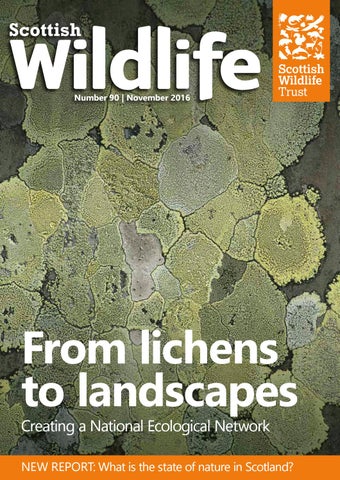
Number 90 | November 2016
From lichens to landscapes Creating a National Ecological Network
NEW REPORT: What is the state of nature in Scotland?
Welcome from the Chairman
©Ivon Bar tholomew
FIRST WORD From Chairman, Robin Harper
The Trust is well placed... to meet the ecological and funding challenges that a post-Brexit Scotland may bring.
©Donna Mathieson
I
n 2014, I was delighted to be asked to become Chair of the Scottish Wildlife Trust. My time in this role has been incredibly rewarding and the activities that I have been involved with very wide-ranging. My first official role was to accept the award for Scotland’s Tree of the Year at the Scottish Parliament, somewhere I was very familiar with during my career as a Green Party MSP. Since then, I have attended a number of pioneering and influential events, including the launch of the Edinburgh Living Landscape project at the Royal Botanic Gardens and the second World Forum on Natural Capital, attended by 600 delegates from 45 countries. Both of these events were partnerships initiated by the Trust. I have also had the privilege of supporting events and meetings run by our extremely dedicated network of local group members and Wildlife Watch leaders. My visit to Newcastleton Wildlife Watch Group (almost in England it’s so far south!) is a particular high point. Watch leader Wendy Patterson provides the local children with such fantastic opportunities, from learning to safely light fires and saw wood, to moth identification and free play. The total immersion of the children in these learning experiences is most
impressive. I was excited and inspired by the day I spent with them, as I have been with many other volunteer activities that I’ve had the privilege to assist in one way or another. I am very proud to lead such a supportive and collegiate Council, one which has improved our governance and striven for ever more effective ways to make use of the pool of talent that we are so fortunate to have access to. And what a wealth of expertise, passion and commitment the Trust has across its 40,000+ members, volunteers, staff and trustees. Indeed, the Trust is well placed to deliver its long-term goals and to meet the ecological and funding challenges (and opportunities) that a post-Brexit Scotland may bring. I will be stepping down from my role as Chair in September 2017 on age grounds. It will be with pride that I hand
over the mantle to the 12th Chair of the Scottish Wildlife Trust in the knowledge that it is in good heart, well run and in good financial shape. The commitment, enthusiasm and ability of staff and volunteers to deliver is a constant inspiration to me. I hope that my support as Chair over the next year will continue to help facilitate the stream of accomplishments and I thank Jonny Hughes for his inspirational leadership as Chief Executive. The Trust will be advertising for my replacement in January. If you are, or know of, an experienced leader with the ability, empathy and commitment to chair Scotland’s leading nature conservation charity, please email the Convenor of the Nominations Committee, Tony Cameron with your details: tcameron@ scottishwildlifetrust.org.uk NOVEMBER 2016 SCOTTISH WILDLIFE 3
Contents
Inside this issue
16
6
06 HIDDEN WORLD
Exploring the unique and diverse rainforests of Scotland’s Atlantic coast.
08 NEWS
News round-up from the Trust
and the world of conservation.
16
ECOLOGICAL NETWORKS
F ind out what the Trust is doing to help create a network of protected sites across Scotland.
25 CHRISTMAS CATALOGUE Choose from a range of gifts to
treat a friend or loved one, and support the Trust at the same time.
30 STATE OF NATURE
A look at the report published in the autumn, and some of the trends identified.
30
34
34 BREXIT
W hat might Brexit mean to wildlife in Scotland? Jonny Hughes shares his thoughts.
38 VIEWPOINT
T he Community Networks Officer at Cumbernauld Living Landscape, Paul Barclay, discusses his work.
WIN DINN E B BREAED AND R, K FAST TWO COU IN A LUXFOR NTRY U HOU RY SEE P SE AGE 37
Scottish Wildlife magazine is published by the Scottish Wildlife Trust. © Scottish Wildlife Trust. No part of this magazine may be reproduced without the express permission of the publisher. All photography © Scottish Wildlife Trust unless otherwise stated. The Scottish Wildlife Trust accepts no liability for omissions or incorrect data in advertisements and letters. Views expressed in Scottish Wildlife are not necessarily those of the Scottish Wildlife Trust. ISSN: 0143 1234. Registered office: Harbourside House, 110 Commercial Street, Edinburgh EH6 6NF. Tel: 0131 312 7765. Fax: 0131 312 8705. Email: enquiries@scottishwildlifetrust.org.uk. Website: scottishwildlifetrust.org.uk. The Scottish Wildlife Trust is a company limited by guarantee, registered in Scotland (no. SC040247). It is also a Scottish registered charity (no. SC005792). Scottish Wildlife is published three times a year: March, July and November.
The Scottish Wildlife Trust is affiliated to The Wildlife Trusts, a UK-wide network of 47 Trusts with more than 2,000 wildlife reserves. 4 SCOTTISH WILDLIFE NOVEMBER 2016
Deadlines for news: 1 January, 1 May, 1 September. No unsolicited articles please. Scottish Wildlife is free to members. Membership rates from 1 April (excluding discounts for paying by Direct Debit): Individual (concession) £33 (£18); Joint (concession) £46 (£24); Family £53 (£48); Watch £18; Life (joint) £800 (£1,200); Senior Citizen Life (joint) £500 (£700). Patron: HRH The Prince Charles, Duke of Rothesay. Chairman: Robin Harper. Vice-Chairs: Jon Barnes, Amanda Forsyth, Karen Chambers. Chief Executive: Jonny Hughes. Editor: Jo Pike editor@scottishwildlifetrust.org.uk. Production Editor: Pete Haskell. Design: Connect connectcommunications.co.uk. Advertising: Elliot Whitehead 0131 561 00212, Clare Stebbing 0131 561 0024. Printing: LexPlus. Cover photo: © Adrian Davies
Spotlight
SPECIES SPOTLIGHT:
COMMON HAZEL (Corylus avellana)
Hazel can be coppiced (deliberately cut to encourage multiple stems), but when left to grow naturally, trees can reach up to 12m and live for up to 80 years.
Hazel is distributed throughout much of Europe as well as in some parts of the Middle East and North Africa.
In late winter/early spring, hazel trees produce yellow catkins, their male flowers which release pollen that is carried on the wind to the small red female flowers of other hazel trees.
Hazelnuts provide an important source of food for red squirrels, woodpeckers, jays, nuthatches and many other species.
In 1995, archaeologists found evidence of large-scale hazelnut processing dating back 9,000 years on the island of Colonsay.
NOVEMBER 2016 SCOTTISH WILDLIFE 5
Spotlight: Celtic rainforests
HIDDEN WORLD The wet and rugged west coast of Scotland is home to some of the richest communities of plants and fungi in the country. The climate along this Atlantic fringe provides ideal conditions for a vast array of mosses, liverworts and lichens which proliferate in forests of oak, hazel, birch, ash and rowan. These incredible Atlantic woodlands are true rainforests; with few dry spells and few frosts, the atmosphere is humid, mild and thick with the smell of organic matter. They are also host to a multitude of animals, from rare butterflies and wood ants, to pine martens and pied flycatchers. Here are a few of our favourite species to look out for when visiting Atlantic woodlands:
CHEQUERED SKIPPER With its UK stronghold now largely confined to Lochaber, the chequered skipper is a fastflying butterfly which can be seen between late May and late June.
LUNG LICHEN
COMMON HAZEL This deciduous, broadleaved and multi-stemmed shrub has a smooth, grey-brown bark which is often encrusted with lichens. Leaves appear in spring (after catkins) and are hairy on the underside.
(Lobaria pulmonaria)
WESTERN FEATHERWORT
This large foliose lichen is bright green, leathery and lobed, and grows on the bark of trees in damp coastal habitats. It consists of a fungus, a green algae and a bacteria.
This rare liverwort is restricted to Atlantic woodlands, where it grows on near-vertical surfaces of rocks and trees.
6 SCOTTISH WILDLIFE NOVEMBER 2016
(Plagiochila atlantica)
Spotlight: Celtic rainforests
B A D
E
RESERVES
A BALLACHUAN HAZELWOOD
Cloaking a low ridge overlooking Cuan Sound, this reserve supports many species of lichens, bryophytes and fungi, including the rare hazel gloves fungus. The wetland area provides a rich habitat for .butterflies, while pine marten roam the woodland, and otters and porpoises can sometimes be seen from the shore. PIED FLYCATCHER This beautiful black and white bird is slightly smaller than a house sparrow and is found in mature woodlands on Scotland’s west coast between May and August.
B RAHOY HILLS
Rahoy Hills encompasses a diverse range of habitats, from windswept grasslands, mires and heaths to cliffs, lochans and Atlantic oak woodlands. A path from Black Glen to Arienas Point provides the perfect opportunity to discover this rugged upland reserve.
C BEN MOR COIGACH
Ben Mor Coigach dominates the landscape north of Ullapool. Covering more than 5,000 hectares, it combines a mixture of high peaks and spectacular coastline. The Postman’s Path clings to the coast and goes through the remaining fragments of Atlantic oak woodland that once dominated this landscape.
D SHIAN WOOD
An ancient semi-natural woodland typical of the Atlantic coast, Shian Wood stands on a low ridge jutting out of Loch Creran. In spring, the floor is cloaked with wildflowers, enticing many butterflies, and the trees provide nesting sites for breeding birds. PINE MARTEN Pine martens are agile but somewhat elusive mammals that are most likely to be seen at dusk. They use regular latrines, usually on a boulder or log, so if you find droppings keep a look out.
E CARSTRAMON WOOD
Carstramon Wood is one of the largest seminatural broadleaved woodlands in south west Scotland. The oak trees provide lush conditions for ferns and lichens, and in spring, bluebells carpet the floor while redstarts, pied flycatchers, song thrushes and wood warblers flit about the forest. For full reserve information, visit scottishwildlifetrust.org.uk/reserves
NOVEMBER 2016 SCOTTISH WILDLIFE 7
Atlantic oak woodland © Pete Haskell; Chequerd Skipper © Haeferl; Common Hazel © Hans Braxmeler; Pied Flycatcher © Margaret Holland; Lung Lichen © Lotus Johnson; Western Featherwort © Jonathan Sleath; Pine Marten © Karl Franz
C
Latest news
News from the Trust, our projects and the wider world of conservation
KEEP UP TO DATE
Visit our website for regular updates at scottishwildlifetrus t. org.uk
© Pete Cairns
© Mark Foxwell
New chapter for CALL THE Coigach – Assynt Living Landscape Partnership has secured funding worth £2.9 million from the Heritage Lottery Fund, with additional support from other funders, to enable delivery of a wide range of projects over the next five years. Development Manager Richard Williams said: “On behalf of the whole partnership, I’d like to thank players of the National Lottery for supporting us through the Heritage Lottery Fund. “This award represents the culmination of more than five years of planning and hard work by a huge number of people and organisations. All of the funders have shown great commitment to the programme and we look forward to delivering projects that offer wide-ranging benefits for the local area, communities and people.” This support will help to deliver 28 projects that will collectively enhance the area’s natural, built and cultural heritage. These include creating new native woodland, offering outdoor learning to all local schools, major repairs to mountain paths on Suilven, and work to excavate and stabilise the Iron Age Clachtoll Broch. The Coigach – Assynt Living Landscape is one of the largest landscape-scale restoration projects in Europe, aiming to benefit the wildlife, people and local economy in the north west of Scotland.
8 SCOTTISH WILDLIFE NOVEMBER 2016
Scottish wildcats captured on camera THE largest ever survey of one of the nation’s most threatened species has been carried out by Scottish Wildcat Action. Over a 60-day period, more than 130 volunteers monitored a total of 347 trail cameras in five wildcat priority areas: the Angus Glens, Northern Strathspey, Strathbogie, Strathavon and Strathpeffer. Painstaking analysis of the 200,000 images captured by the cameras showed 19 cats that scored well on their pelage (markings) and so are believed to be Scottish wildcats. However, they also detected 40 hybrid cats and 44 feral/ domestic cats. This highlights just how outnumbered the remaining wildcats are, which is of great concern given that the biggest threat to the species is genetic dilution through cross-breeding. The next step within the wildcat
priority areas is an ambitious Trap, Neuter, Vaccinate and Return programme (TNVR) to catch feral cats for neutering and vaccinating at the vets. Cat owners in Scotland can also help by ensuring pet cats are neutered from four months old and given annual vaccinations to prevent disease spreading to the remaining wildcat population. Scottish Wildcat Action is a partnership project that unites leading experts from more than 20 key organisations, including the Scottish Wildlife Trust. It is supported by the Scottish Government and the Heritage Lottery Fund. Read more about the TNVR programme in Scotland at scottishwildcataction.org or follow @SaveOurWildcats on Facebook and Twitter.
Scottish Wildlife Trust news
© Rory Syme
Trust Chief Executive reelected to IUCN global Council THE Trust’s Chief Executive Jonny Hughes has been re-elected to the global Council of the International Union for the Conservation of Nature (IUCN) for a second term. Jonny was first elected at the IUCN World Conservation Congress in 2012. He said: “The world needs a strong Union for nature more than ever before. I am
honoured that members of the IUCN across the world chose to re-elect me to serve for a second term as Councillor. In the next four years, I look forward to influencing the future direction of nature conservation internationally, taking many great ideas from the Scottish Wildlife Trust to the global stage.” © Noel Hawkins
Children from Chernobyl visit Jupiter CHILDREN from Belarus living with the impact of the 1986 Chernobyl disaster had the chance to explore Jupiter Urban Wildlife Centre in September to enjoy activities including den building and pond dipping. They visited the centre in Grangemouth during a respite trip to Scotland that can boost their immune systems for up to two years. Gail MacDonald, from Chernobyl Children’s Life Line which organised the trip, said: “Fun is the most important aspect while they are with us, so we visit a range of child-
friendly places. They were so engaged and enthralled during their visit to Jupiter – it’s definitely a highlight of the trip. “It’s fascinating to watch them because even though they are at an age when many Scottish children start to disappear behind electronic screens, they don’t have that in Belarus so they just have a fantastic time. The children get a real benefit from the fresh air and uncontaminated food and water. Raising their immune system gives them respite from colds and other simple infections.”
Floating classroom connects children to the Living Seas
Primary school pupils from Ullapool, Lochinver and surrounding villages experienced life aboard the Hebridean Whale and Dolphin Trust’s research vessel Silurian to learn about Scotland’s cetaceans as part of the Trust’s Living Seas Highland Cetacean Week.
Living Seas Communities Officer Noel Hawkins said: “The response has been extremely positive, with schools and pupils saying that they found their visits very interesting and involving. It’s a good example of how organisations can work together to raise the profile of the area’s wildlife.”
It’s been a record osprey season IT has been a record season for breeding ospreys on the Trust’s wildlife reserves this year. A total of 10 young birds have successfully fledged from three reserves, with a hat-trick of chicks at Loch of the Lowes joined by an amazing four chicks in one nest in Angus, and another three in Dumfries and Galloway. Alan Anderson, Head of Reserves, said: “It’s nearly 50 years since ospreys first began to breed at Loch of the Lowes. There are now around 420 pairs of ospreys across the UK and we’re incredibly proud to have played a part in their return and recovery.” The Trust’s osprey webcam at Loch of the Lowes, supported by players of People’s Postcode Lottery, has been viewed more than a million times this summer. NOVEMBER 2016 SCOTTISH WILDLIFE 9
Scottish Wildlife Trust news
IN BRIEF
Seed collection in Assynt
ROWAN berries have been collected within the Coigach-Assynt Living Landscape project area as part of an initiative to create a comprehensive seedbank of the UK’s native trees for research and long-term conservation. The Trust is a partner in the UK National Tree Seed Project, run by the Royal Botanic Gardens, Kew.
Big turnout for dolphin talk
Water rails breeding at Red Moss of Netherley
THE Trust’s North of Scotland Group hosted a sell-out talk by dolphin expert Charlie Phillips at the Eden Court Theatre in Inverness. Charlie shared his incredible images and stories of the resident population of bottlenose dolphins in the Moray Firth, which he has been monitoring for several years. Nearly 200 dolphins live in the area, and part of the Firth has been made a Special Area of Conservation as a result.
ONE of the nation’s most elusive wading birds has been confirmed to be breeding at the Trust’s Red Moss of Netherley reserve, a mosaic of woodland and wetland habitat near Stonehaven. Volunteer Reserve Wardens Nick Littlewood and Rose Toney captured images of adult and juvenile water rails over the summer using a remote camera in a box baited with mealworms. Nick said: “Water rails are far more often heard than seen and while they have been heard calling at the reserve for many years, there was little
Footpath upgrade at Gight Wood
Art inspired by Rahoy Hills EDINBURGH artist Colin Duncan has raised almost £1,200 for the Trust through the sale of paintings inspired by a visit to Rahoy Hills Wildlife Reserve in Morvern. Colin said: “Rahoy Hills is an extraordinary place and to draw and paint there has been a privilege. The resulting paintings are in direct response to being there, walking and immersing myself in its unique landscape.” 10 SCOTTISH WILDLIFE NOVEMBER 2016
© Bruce Shortland
PATHS in Gight Wood Wildlife Reserve near Ellon have been upgraded thanks to funding from Suez Communities Trust. As a result, a missing link in the circular path around the wood has reopened after being closed for safety reasons in late 2015. Reserves Manager Rab Potter said: “Gight Wood is a very scenic reserve with a fantastic range of wildlife. Thanks to this funding, we have been able to re-open the footpath to the public to allow them to fully experience the beauty and wildlife of this special place once again.”
evidence that they were breeding here. “We found that rails were frequent visitors to our remote camera this summer, including a number of black, fluffy chicks that started to visit from early July. “Rails were recorded on several parts of the reserve using the cameras and we think there were at least two breeding pairs.” Water rails are common but incredibly secretive waders that live on freshwater wetlands. Just 130 breeding pairs were recorded in the whole of the UK in 2014, but the true population is likely to be much higher.
Bo’mains Meadow bursting with wildflowers An annual count of greater butterfly orchids at Bo’mains Meadow reserve in Bo’ness has documented a dramatic rise in numbers. Volunteer Roy Sexton recorded 1,228 spikes of the plant during a count in July, compared to 529 in 2015 and just 180 in 2014. Reserves Manager Rory Sandison said: “Last winter, the reserve was grazed by cattle for the first time as part of the Save our Magnificent Meadows project. “We’ve since seen a spectacular increase in greater butterfly orchids, and the betony and great burnet also look to be doing well.”
Scottish Wildlife Trust news
Volunteers say ‘adios’ to the Highlands European Voluntary Service volunteers Pedro Vidal and Saúl Aradas have completed a year-long placement in the Highlands with the Trust. During their time in Scotland, Pedro and Saul completed tasks including fencing, woodland management and deer stalking. The volunteers also had the chance to develop their own project, tracking and mapping water voles at Ben Mor Coigach. Pedro said: “We have had the chance to get to know some amazing reserves like Loch Fleet, Eigg and Handa. Volunteering for the Scottish Wildlife Trust has been greatly rewarding, both from a professional and a personal point of view. We felt useful and active at all times and the placement offered time for working and learning a wide variety of skills.” The Trust has been awarded further Erasmus+ funding to host four young Europeans on long-term practical placements with Duncan Budge, Reserves Project Officer in North East Scotland. The volunteers, from France, Portugal and Spain, will be undertaking a range of practical conservation tasks on our wildlife reserves in the region starting in the autumn.
Giant badger spotted at Falls of Clyde A LARGE mural of a badger has been painted on the side of Bonnington Mill Power Station at our Falls of Clyde reserve near Lanark. The mural was painted over several days by street artist ‘ATM’ and can be seen on the Clyde Walkway, a route that passes several stunning waterfalls including the Corra Linn. ATM said: “I started painting street art of native species in 2013. My aim is to show the beauty and significance of these creatures, to make people think about
their value and hopefully inspire a change in some of our more thoughtless and damaging practices. “Badgers have rich and complex social lives, and they deserve our respect. As the brutal and misguided badger cull continues in England, I hope this painting will make more people realise their importance. This is the first time I’ve worked in Scotland, but I hope it will be the first of many. A capercaillie in Aberdeen, a crested tit in Aviemore and a Scottish crossbill in Inverness come to mind!”
Concerns over Coul Links © Mark Foxwell
THE Trust has expressed serious concern about plans for a golf course at Coul Links near Dornoch. This former Scottish Wildlife Trust reserve is one of the few remaining examples of an undisturbed dune system in Scotland and an important habitat for winter birds and wild flowers. It is a Site of Special Scientific Interest and a European Special Protection Area. Outline plans from the developers show that 55 hectares of dune within the SSSI would be replaced by grass. The Trust’s Chief Executive Jonny Hughes was a seasonal ranger at Coul Links in the 1990s. He said: “It’s difficult to explain to those who haven’t visited the links what an exceptional stretch of unspoiled coastline this is. I’ve personally recorded Scottish wildcat, breeding little terns and rare plants such
as coralroot orchid on the site. “Allowing another sand dune SSSI to go the way of the Trump development at Menie Links would be an unforgiveable and tragic loss of a protected area. The Scottish Wildlife Trust will do all it can to ensure this
special place is protected for future generations.” A full planning application is expected by the end of 2016. RSPB Scotland, Buglife, Plantlife and the Marine Conservation Society are also campaigning against the plans.
NOVEMBER 2016 SCOTTISH WILDLIFE 11
Scottish Wildlife Trust news
New Wildlife Watch group in Cumbernauld
A NEW Wildlife Watch group has been established in Cumbernauld following a successful series of pop-up sessions this summer. The group is for children aged 8-12 and meets on the third Sunday of every month at Eriskay Longhouse in Palacerigg Country Park. Since starting in August, group members have enjoyed activities including bug hunting, pond dipping and foraging in the woods. The group has been supported by Cumbernauld Living Landscape Community Engagement Officer Tracy Lambert. To join in the fun, email cumbernauldwildlifewatch@ scottishwildlifetrust.org.uk 12 SCOTTISH WILDLIFE NOVEMBER 2016
THANKS to all of our members who attended the Trust’s AGM and National Members’ Day on Saturday 24 September at the National Museum of Scotland. The day was a great success, with Ben Garrod giving a thrilling illustrated talk about the making of the BBC television programme
Attenborough and the Giant Dinosaur, and our Wildlife Question Time panel expertly chaired by Scottish Wildlife Trust Ambassador Stephen Jardine. James Campbell and Colin Macintosh were elected to Council, and Alastair Grier and David Lindgren were re-elected.
Helicopter makes Handa path repairs possible More than 120 tonnes of stone and path-building materials have been airlifted to help contractors and volunteers repair the paths on Handa Island. The worn paths on the reserve are being repaired to help visitors safely experience one of Europe’s most important seabird colonies, which is owned by Scourie Estate and managed in partnership with the Trust. Reserves Manager Sven Rasmussen said: “Around 7,000 people visit Handa every year, which puts the paths under a fair amount of pressure. Wellmaintained paths are essential for our conservation work because they help people avoid disturbing nesting birds or trampling delicate habitat.” The project is being funded by a contribution from Highland Council through the Landfill Communities Fund.
© Rachel MacKenzie
REGENERATING birch woodland at Shewalton Wood reserve in Irvine has resulted in a big boost in birdlife. During a single visit in late spring, 220 singing male birds were recorded, including 54 willow warblers, 23 chiffchaffs, 39 sedge warblers, 9 grasshopper warblers, 11 blackcaps and 15 whitethroats. Brocade and small china mark moths and a large skipper were also recorded over the summer for the first time on the reserve, one of several greenspaces in Irvine managed by the Trust.
AGM and Members’ Day 2016
© Callum Bennetts
Wildlife boost in Irvine
Montrose Basin Visitor Centre improvements THE visitor centre at Montrose Basin Wildlife Reserve will be closed for the month of January for improvements to the visitor experience and interpretation. This enhancement project is supported by players of the National Lottery through the
Heritage Lottery Fund. During November and December, the visitor centre will be open an additional day each week – from Friday to Monday 10.30am-4pm (closed on Christmas Day and Boxing Day). The hides and walks on the reserve are open
24 hours a day throughout the year. The reserve is home to a wide range of winter migrants, including pink-footed geese, wigeon, teal and greenshank, as well as a resident kingfisher who comes to feed in front of the centre most days.
A flying visit from an iconic masterpiece
4 November – 18 December 2016 Admission free Carel Fabritius The Goldfinch 1654 Mauritshuis, The Hague. National Galleries of Scotland is a charity registered in Scotland (No.SC003728)
Wider news
Keep It Clean campaign launched FORESTRY Commission Scotland is urging people to ‘Keep It Clean’ to help minimise the risk of tree diseases spreading to healthy forests. One easily preventable way that tree diseases are spread between woodlands is by being transported in mud and debris stuck to walking boots, bike tyres and dogs’ paws. By taking time to brush off mud after going on a woodland walk, the chances of any diseases spreading in this way is greatly reduced.
Dr Anna Brown, the Forestry Commission Scotland’s Head of Tree Health, said: “Practising good biosecurity and arriving clean is one of the key aspects of maintaining healthy forests and woodlands. Everybody loves a visit to the woods, so if we want to continue to enjoy them, we should all be ready to play our part to protect them.” Tools, walking poles, tripods and backpacks can also get muddy, so taking a little time to brush these off can also help. © George Stoyle
Scottish photographer scoops award This stunning image of a lion’s mane jellyfish taken off Hirta, St Kilda, was the overall winner of the British Wildlife Photography Awards 2016. Photographer George Stoyle said: “I was working on a project to assess the current biological status of major sea caves around some of the UK’s most remote islands. “At the end of one of the dives, I was swimming back to the boat when I came face to ‘face’ with the largest jellyfish I’ve ever encountered. “As I approached cautiously, I noticed that a number of juvenile fish had taken refuge inside the stinging tentacles.” To view all of the winning images from this year’s competition, visit bwpawards.org/
© Norrie Russell
Creating a legacy for peatlands THE IUCN UK Peatland Programme, hosted and chaired by the Scottish Wildlife Trust, is organising its sixth annual conference in Shrewsbury from 29 November-1 December 2016. The conference brings together the peatland community from across the UK, to discuss the big issues in peatland management and restoration. This year’s conference will explore the financial, policy and regulatory implications for UK peatlands and 14 SCOTTISH WILDLIFE NOVEMBER 2016
endeavour to find lasting management structures that will see the UK leave future generations with healthy, functioning peatlands. Restoration work and research from across Scotland will be showcased at the conference, including the recent success of Scottish Natural Heritage’s Peatland Action initiative under the National Peatland Plan. Find out more at iucn-uk-peatlandprogramme.org
On Wednesday, Jean helped protect osprey chicks.
On Thursday, she helped plant trees for red squirrels. On Friday, she helped change the law to safeguard our land and seas.
On Saturday, it was five years since Jean passed away.
Make your wishes live on by writing us into your Will. Jean’s gift to the Scottish Wildlife Trust in her Will was a simple yet powerful way to keep her wishes alive. You can do the same.
To find out more call Wendy on 0131 312 4777 or visit scottishwildlifetrust.org.uk/legacy Scottish registered charity (no. SC005792)
©Colin Prior
Once you’ve taken care of your loved ones, please consider including a gift to the Scottish Wildlife Trust in your Will. No matter how big or small, you can be sure it will make a difference to Scotland’s wildlife.
Ecological networks
Joining the dots The Scottish Wildlife Trust’s vision statement refers to “a network of healthy, resilient ecosystems”, but what does this look like in practice? Here, we describe what is meant by the term ‘ecological networks’ and why these are important to nature conservation.
WHAT IS AN ECOLOGICAL NETWORK?
E
cological networks are nature’s highways, where areas of good quality habitat are connected, either physically or ecologically, so that wildlife is able to move easily across the landscape. The physical elements can be large or small, natural or man-made – from urban green roofs, tree-lined streets
and cycle ways to restored peat bogs, protected areas and landscape-scale conservation projects. By allowing species to move across the landscape, ecological networks decrease the risk of extinction, increase genetic exchange and improve an ecosystem’s health and resilience to climate change.
WHAT DOES AN ECOLOGICAL NETWORK LOOK LIKE? STEPPING STONE CORRIDORS
These consist of a series of small habitat patches that are not physically linked, but are close enough to provide sufficient shelter/ food/rest to enable passage between two core areas.
LANDSCAPE CORRIDORS
These consist of a mosaic of habitats that are able to provide a safe passage between two core areas.
CORE AREAS
These could include wildlife reserves, local conservation areas and marine protected areas.
LINEAR CORRIDORS
These are uninterrupted strips of habitat, for example a hedgerow, roadside verge or river.
16 SCOTTISH WILDLIFE NOVEMBER 2016
BUFFER ZONES
These surround core areas and serve to protect them from disturbance outside of the core area.
Ecological networks
WHAT BENEFITS CAN ECOLOGICAL NETWORKS BRING TO SCOTLAND?
PEATLANDS
FRESHWATER
WOODLANDS
URBAN
More than 20% of Scotland’s land area is peatlands, storing as much carbon as one third of the Amazon Rainforest. Restoring peatlands across Scotland would help fight climate change, provide clean drinking water and protect us from flooding, and support species such as snipe, curlew, golden plover, cranberry and common lizard.
With more than 125,000km of rivers, 220km of canals and in excess of 30,000 freshwater lochs, our waterways can act as important corridors between multiple habitats. Reducing the amount of pollutants entering freshwater would significantly improve water quality, benefiting species such as freshwater fish, otters and water voles, and making them nicer places for people to enjoy.
Scotland was once dominated by woodland, but today only 18% of its land area is wooded and less than one quarter of this is made up of native species. What does exist is small and often fragmented, meaning woodland wildlife is marooned in ‘islands’ of habitat. Transforming some of the large conifer plantations to more mixed woodlands by increasing native trees would help increase the habitat available to woodland species.
More than 80% of Scotland’s population live in towns and cities, a ‘habitat’ dominated by man-made surfaces seemingly devoid of nature. Street trees, wildflower verges, green roofs and ponds are a few ways that we could make these areas much more permeable to wildlife, as well as better and more attractive places to live.
FRAGMENTED LANDSCAPE
CONNECTED LANDSCAPE
NOVEMBER 2016 SCOTTISH WILDLIFE 17
Ecological networks
NATURE’S HIGHWAYS
With the pressures on our landscape at an all-time high, Director of Conservation Susan Davies explains how the Scottish Wildlife Trust is helping to contribute towards the creation of a National Ecological Network.
O
ver the years, we have grown accustomed to the landscapes that we see on a day-to-day basis, whether it’s travelling through them, seeing them from our windows, enjoying them recreationally or utilising them for food, fuel and water. For many, these landscapes are also a
18 SCOTTISH WILDLIFE NOVEMBER 2016
direct source of income and way of life. Yet they are constantly changing. Many people will have noticed some of the most obvious changes, for example from encroachment of housing developments, large-scale commercial forestry plantations, renewable energy developments, and
an increased number of hill tracks. However, we may not really be aware of more subtle changes resulting from pressures such as climate change, habitat fragmentation and intensification of land use. This gap in awareness is borne out by research, which shows that nearly three-quarters of the Scottish public
Ecological networks
believes that our finest landscapes are being well looked after. The reality, sadly, is that all of these pressures have had a significant impact on our semi-natural habitats, increasing their isolation in the landscape and reducing their resilience to the stresses placed on them. The capacity of our natural environment to deliver a wide range of benefits such as flood protection, food and wood supplies, drinking water, carbon storage, recreation and tourism has been impaired. At the Trust, we firmly believe that by connecting habitats in our land, sea and townscapes, we will improve their condition and resilience to further pressures and help people as well as wildlife. This approach to managing our landscapes is what the Trust refers to as the National Ecological Network. The concept of ecological networks is not a new one – it is based on the theory of island biogeography which has been around since the 18th century. We don’t, however, have to go back into the archives to find reference to the importance of such networks. The policy
Principles of Ecological Networks • Landscape connectivity – linear strips of native vegetation along roadsides, around field margins and along river and ditch banks. • Habitat connectivity – through stepping stones that allow species to move between larger patches of habitats. • Ecological connectivity – that support the life-cycles of plants and animals both temporally and spatially by providing shelter, food and breeding and resting sites.
We firmly believe that by connecting habitats in our land, sea and townscapes, we will improve their condition and resilience wildlife.
arguments for them have been set out in international conventions, including the Convention on Biological Diversity and the European ‘Nature’ Directives, and are also espoused in Scottish Government policy documents. In order to share experiences on ecological networks, and to galvanise action towards practical application of the concept, the Trust organised the first-ever National Ecological Networks Conference in 2013, an event that attracted nearly 200 visitors from across the globe.
TIME FOR ACTION
It is perplexing though, that despite knowing the importance
NOVEMBER 2016 SCOTTISH WILDLIFE 19
Ecological networks
© Patricia & Angus Macdonald / Aerographica
The Trust’s Woodhall Dean reserve is a good example of a landscape corridor
We believe that stepping up to create a National Ecological Network is just a question of scale... migratory birds such as willow warbler, chiffchaff and the secretive lesser whitethroat to move across the landscape. These are also essential core areas from which ‘green’ fingers could radiate outwards as a contribution to a National Ecological Network. Elsewhere, through our Cumbernauld Living Landscape, we are working with the local community to enhance, restore and reconnect the parks, woodlands and gardens that make Cumbernauld one of the greenest towns in Scotland (more than 50% of Cumbernauld’s town centre is made up of green spaces). We’ve helped map the green spaces, identified management zones and assessed the range of benefits that can be maintained and enhanced for the future. All of this means that wildlife (including Cumbernauld’s now famous pine martens) will be more likely to thrive and the local community will be able to enjoy the many benefits of a healthy and resilient natural environment.
of caring for our landscapes, and having the policies to take this forward, we seem as a society to have developed a bit of apathy to implementation. We plan our grey infrastructure, so why not our green or blue? Perhaps it’s time for a clear national debate about what we want our landscapes to provide for us both now and in the future. The Trust is involved in many practical projects on our wildlife reserves and through our Living Landscapes that form the building blocks for a National Ecological Network. Here, we are taking steps to improve existing habitats, create buffers and stepping stones, and improve connections at the landscape scale. The first step is, of course, protecting the last remnants of isolated habitats in our landscapes. A good example of this is our work on lowland raised bog reserves such as Red Moss of Balerno, the only remaining bog in the City of Edinburgh, and Red Moss of Netherley, one of the best remaining examples of a raised bog in the Aberdeen area. Our management helps to 20 SCOTTISH WILDLIFE NOVEMBER 2016
protect the hydrological function of these sites and the deep peat that has accumulated over thousands of years. Rich in sphagnum mosses, bog asphodel, cranberry and sundew, these special places also contain pools that support a diversity of insects such as dragonflies and damselflies.
STEPPING STONES
Scaling up to stepping stones, we have some fine examples from our management of woodland reserves in East Lothian – Thornton Glen, East Lammermuir Deans, Woodhall Dean and Brock Wood. These woodlands are the last surviving remnants of native forests in an otherwise agricultural-intomoorland landscape. Situated in steepsided gullies, these protect a rich mix of native alder, aspen, ash and oak, and provide the right conditions for a spectacular display of spring flowers such as bluebells and wild garlic. Although relatively isolated in the landscape, these remaining reserves are crucial stepping stones that allow
BIG AMBITIONS
In the north west of Scotland, we have also embarked on one of the most ambitious landscape-scale restoration projects in Europe. Thanks to generous funding from the Heritage Lottery Fund, we have just kicked off the five-year Coigach-Assynt Living Landscape Partnership, working with local communities and partners to restore the health of the whole ecosystem by improving and reconnecting habitats, especially native woodlands, and creating rural employment and volunteering opportunities. As well as bringing social, economic and environmental benefits to the area, the project will serve as a blueprint for similar landscape-scale projects elsewhere. Ultimately, we believe that stepping up to create a National Ecological Network is just a question of scale – of both geography and ambition. The knowledge and the tools to implement it have been demonstrated by the Trust and others. Surely the time has come to put some impetus into the action required to deliver the benefits that will come from its creation.
Ecological networks
© Brian Tunnard
Spey Bay, a Trust reserve in Moray, is a Natura 2000 site
European Ecological Networks Neil McIntosh looks at ecological networks in a European context. Since the early 1980s, the concept of ecological networks has become increasingly important in European nature conservation. Within the European Union, core areas of habitat are protected under the Birds and Habitats Directives, which form the backbone of a network of sites known as Natura 2000. Covering 18% of the EU’s land area and almost 6% of its marine territory, Natura 2000 is the largest co-ordinated network of protected areas in the world and helps to protect Europe’s most valuable and threatened species and habitats. In Scotland, the number of Natura 2000 sites changes as new protected areas are designated. As of January 2016, there were 396 Scottish Natura 2000 sites, 36 of which are Scottish Wildlife Trust reserves.
Natura 2000 sites are the EU Member States’ contribution to a larger ecological network known as the Emerald Network, launched by the Council of Europe under the Bern Convention in 1989. In addition to Natura 2000 sites, the Emerald Network includes Areas of Special Conservation Interest in 19 other European countries and four African states. In addition, some EU countries or regions have their own ecological network plans. For example, in 2012/13 the Balkan Region Ecological Network project worked towards the establishment of a coherent and functional network throughout the Balkan peninsula. The project targeted an integrated approach with land-use sectors, physical planning and the need for climate
change adaptation to be taken into account, all of which are very applicable in Scotland. As major threats to biodiversity often extend well beyond individual countries’ borders, there is a clear opportunity to scale-up approaches, take joint actions on a regional scale and exchange knowledge and experience to achieve sustainability. To this end, several European network organisations, such as Eurosite and European Centre for Nature Conservation (ECNC), exist to share experience, learn and build practical conservation management knowledge on these issues. Neil McIntosh is Deputy Executive Director and Head of Strategy and Innovation at ECNC. NOVEMBER 2016 SCOTTISH WILDLIFE 21
Ecological networks © Stuart Russell
Q&A
Andrew Russell, ReRoute
The right direction A
ndrew Russell is a member of ReRoute, Scotland’s youth biodiversity panel which is made of a group of volunteers from throughout the country who are working in partnership with Scottish Natural Heritage and Young Scot. ReRoute aims to increase young people’s active involvement and engagement with Scotland’s natural environment.
Does the idea of creating a National Ecological Network inspire you and if so why? Absolutely! ReRoute is working with SNH and Young Scot to get young people involved in Scotland’s Biodiversity Strategy and Route Map to 2020, so improving ecological connection in Scotland is an important part of this. A National Ecological Network would be really important for the wildlife as it would bring together several disconnected populations, but we also think it could connect more people to their natural surroundings. Things like green roofs, cycle ways and footpaths make areas more appealing and encourage people to connect to the biodiversity around them.
22 SCOTTISH WILDLIFE NOVEMBER 2016
What do you see as the benefits of working in partnership with organisations such as the Scottish Wildlife Trust? At ReRoute we want to speak to as many organisations like the Scottish Wildlife Trust as possible in order to learn about how they work with young people, and what more could be done to encourage young people to be connected to their natural environment. These
organisations have experience and expertise about Scotland’s biodiversity and wildlife and we want to ensure that young people can benefit from and contribute to this. What’s your dream for Scotland’s environment? I want to see more young people connected to nature and contributing to the discussions and decisions made about their natural environment. If young people are able to take part in these conversations and help efforts to conserve and enhance Scotland’s nature, Scotland’s environment will have a strong generation of stewards looking after it. ReRoute want young people growing up caring about and protecting our environment and nature. We want Scotland’s Biodiversity: A Route Map to 2020 to be delivered and for these efforts to continue throughout our lifetime! For more information on ReRoute, follow #SNHReRoute or visit youngscot.net/ reroute or young.scot/reroute © YoungScot
It’s not just habitats that need to be connected, it’s also people. In the age of electronic devices and constant screen time, what do you think is the key to reconnecting people with nature? Understanding what interests people and working with that is what matters. Many of us nature-lovers enjoy spending time outdoors, but it is important to think about what would encourage others. Being outdoors has so many benefits for people our age – from helping with exam stress, to keeping fit to enjoying time with friends! Although some people might see technology as a barrier, it can be a great tool for doing these things – just think about the parallels between Pokemon Go and birdwatching!
Young Scot has been doing some important work to engage young people with nature and recently attended the Trust’s National Members’ Day to talk about this. What do you feel young people can bring to nature conservation? At ReRoute, we’ve spoken to many young people about their opinions of nature and they have a huge amount to contribute now and in the future. We want other people our age to enjoy Scotland’s amazing landscapes and environments. We are working with environmental organisations to ensure they take into account what young people can offer – from volunteering to making positive lifestyle choices to pursuing careers in the sector.
Water Based Wood Stain Our Water Based Stains have all the advantages of oil base stains: they spread easily, can be repaired, can be blended effortlessly, and have plenty of open time. The thicker formula allows controlled penetration, which will reduce blotching on hard-tostain woods such as Oak, Pine and Maple. This stain formula will make wood staining an enjoyable experience for you. Use Natural W.B. Wood Stain (clear finish) if you need to pre-seal the wood. Available in: Natural and 15 colours. 10
NT · V
2 OC 0
· CO
MPLI E
Also: Sanding Sealer, Dye Stain, Glaze Effects, Milk Paint, High Performance & VAR Top Coats, Pre-Cat Urethane, Enduro Lacquer, Conversion Varnish, Wood Turners Finish, Ready To Match (RTM) System, Pro Floor System, Exterior 450 Stains and Top Coats. Unit 13, Peffermill Parc, 25 King’s Haugh, Edinburgh, EH16 5UY www.generalfinishes.co.uk
Tel: +44 131 661 5553
Christmas gift ideas
CHRISTMAS GIFT IDEAS
FRE UK de E for ord livery £40. A ers over from C ll proceed s h help fu ristmas sal protec nd our wo es rk ting wildlife Scotland’s for future the .
Exclusive to the Scottish Wildlife Trust, our collection of wildlife Christmas cards and our 2017 Wildlife Calendar are the perfect purchase for nature lovers everywhere, with all proceeds helping to support our conservation efforts. Purchase multiple items and benefit from a range of special offers.
2016 CHRISTMAS CARDS This year’s Christmas cards feature a beautiful goldfinch, a red squirrel, a mountain hare and the snowy landscape of Assynt. Sold in packs of 8 (2 each of 4 designs) with envelopes. Message inside reads “Season’s greetings Beannachdan na h-Aimsire”.
£3.99 2017 SCOTTISH WILDLIFE CALENDAR IAL SPEC RS OFFEs of new
9 pack l Two s cards: £6.9 a m t is a Chr istm s us Chr t £2 io v e r s lP signs ju card de pack of 8 per cards.*
Our 2017 Wildlife Calendar is packed with amazing photographs of some of Scotland’s most incredible species.
£8.99 NOVEMBER 2016 SCOTTISH WILDLIFE 25
Christmas gift ideas
COMMON SEAL
PUFFIN
ADOPT AN ANIMAL! Our adoption packs make the perfect Christmas gift. Choose from a range of iconic Scottish animals and make a real difference to the conservation of your chosen species. Your adoption pack will include a personalised certificate, a fun-filled fact sheet, a selection of wildlife stickers and either a superb wildlife print, a cuddly toy (beaver, otter, red squirrel, puffin, seal) or a hardback book (osprey). What’s more, all profits go towards protecting Scotland’s wildlife for the future. Please ensure you complete both sides of the payment form.
£19.99 Number 90 | November 2016
From lichens to landscapes
Creating a National Ecological Network
NEW REPORT: What is the state of nature in Scotland?
26 SCOTTISH WILDLIFE NOVEMBER 2016
BEAVER
OSPREY
OTTER
RED SQUIRREL
GIVE THE GIFT OF MEMBERSHIP By giving the gift of membership to a friend or family member this Christmas, you can make a real difference to Scotland’s wildlife. New members receive a subscription to Scottish Wildlife magazine, free entry to our visitor centres and 120 wildlife reserves across Scotland, a free copy of our Exploring Reserves guide and more. For further information, visit scottishwildlifetrust.org.uk/ giftmembership or call 0131 312 4700.
Christmas gift ideas
ORDER FORM MY DETAILS
Title First name Last name
Address
Postcode Telephone Email
Membership no. (if known) Please tick if you are happy to receive information from us by email
PAYMENT
n I enclose a cheque or postal order made payable to “Scottish Wildlife Trust”
n Please debit my credit or debit card
Card number
nnnn nnnn nnnn nnnn Start date nn/nn Expiry date nn/nn
Security code*
nnn
*3 digit number on back of card
Cardholder’s signature
Cardholder’s name
By giving your details above, you give permission for the Scottish Wildlife Trust to contact you. Your details will be kept confidential and will not be shared with any third party.
GIFTAID
n
Tick to GiftAid your donation
I confirm that the Scottish Wildlife Trust may claim GiftAid on any donations I have made in the last 4 years and in the future until I cancel this declaration. I am a UK taxpayer and understand that if I pay less Income Tax and/or Capital Gains Tax than the amount of Gift Aid claimed on all my donations in that tax year it is my responsibility to pay any difference. I understand Council Tax and VAT do not count and that the Scottish Wildlife Trust will reclaim 25p on every £1 donated.
Cardholder’s signature
Date
CARDS AND CALENDAR
Number Total (£)
SPECIAL OFFERS
Number Total (£)
2016 Christmas cards
£3.99
2 packs 2016 Christmas cards offer £6.99
2017 Wildlife Calendar
£8.99
Previous Christmas card designs*
Number Total (£)
ADOPT AN ANIMAL Six species to choose from
£19.99
£2
*This offer is only available when purchasing another product. Card designs may differ from those pictured. Continued overleaf
NOVEMBER 2016 SCOTTISH WILDLIFE 27
Christmas gift ideas
ADOPT AN ANIMAL Which animal are you adopting?
Please choose a gift:
n n n
Toy (or book for osprey adoption) Print Certificate only (please provide email address)
If you are adopting an animal for yourself, please fill in the ‘My Details’ section overleaf. If your adoption is for someone else, fill in their details below. For multiple adoptions, please write these on a separate sheet of paper and enclose them with your order. Title
First name
Last name
Address
Postcode
Send my adoption pack:
To me
To the recipient
Special message for certificate (max 80 characters):
DONATION In addition to my total, I would like to make a Christmas donation to the Scottish Wildlife Trust of:
£
POSTAGE
£
TOTAL
£
(£3.49 for all UK orders up to £40, FREE if over £40)
For office use
PLEASE RETURN THIS FORM TO: Christmas Orders, Scottish Wildlife Trust, Harbourside House, 110 Commercial Street, Edinburgh EH6 6NF
DELIVERY INFORMATION: Orders must be received by Sunday 11 December 2016 for Christmas delivery in the UK. We cannot
guarantee delivery before Christmas after this date. Postage costs £3.49 on all UK orders up to £40; FREE over £40; Europe £5.50; Rest of World £8. For large quantities please email enquiries@scottishwildlifetrust.org.uk. Allow 10 days for delivery.
Don’t forget to click through from easyfundraising to raise free donations for the Scottish Wildlife Trust every time you shop. 1. Visit easyfundraising.org.uk 2. Support the Scottish Wildlife Trust 3. Start shopping and raise much needed funds with over 2,700 retailers
28 SCOTTISH WILDLIFE NOVEMBER 2016
2,70 well-kn 0 o retailer wn s
© Bob Coyle
CHRISTMAS SHOPPING ONLINE?
State of Nature Report
Osprey © Chris Cachia Zammit 30 SCOTTISH WILDLIFE NOVEMBER 2016
State of Nature Report
AN
UNNATURAL STATE Launched in September, the second State of Nature report reveals a raft of worrying statistics, with almost one in ten Scottish species at risk of extinction. Rich Rowe investigates.
W
hen the inaugural State of Nature report was unveiled by Sir David Attenborough in May 2013, it marked a genuine first. Never before had so many nature conservation organisations pooled resources to compile essentially a stock take of our native species. With 60% of the species studied found to have declined in recent decades, and many under threat of disappearing altogether, there has never been a starker warning about the health of our natural world. Fast forward three years and the State of Nature 2016: Scotland report has been released, with the Trust one of a coalition of more than 50 nature conservation bodies contributing to its findings. The most comprehensive document of its kind ever produced, this companion to the latest UK-wide report highlights the numerous pressures on wildlife alongside messages of hope: examples of how conservation bodies,
governments, the private sector and the general public are working together to benefit nature in Scotland. Make no mistake, some of the findings are of huge concern. The report reveals that almost one in ten Scottish species studied is at risk of extinction. Some species have prospered, but there are worrying declines in many groups, including more than half of vascular plants, such as juniper, and 39% of butterflies. There are also major concerns for a quarter of Scotland’s birds, from upland species such as curlew and dotterel to seabirds such as kittiwakes and puffins. In all, 65 Scottish species are considered critically endangered in the UK.
ALL CREATURES GREAT AND SMALL
Scotland’s wildlife has an importance that extends far beyond these shores. While high-profile species such as the
golden eagle, Scottish wildcat and red squirrel often capture the headlines, Scotland is home to a complex web of life that sees an estimated 46,000 species of animals, plants and fungi – including internationally-important assemblages of species ranging from bryophytes to wintering waterbirds. Although much of it appears wild at first glance, Scotland’s landscape is largely a managed one. And what the latest report makes clear is that Scotland has seen a particularly dramatic change in how that land has been managed over the past 50 years, with the intensification of some land management practices having a significant impact on native species. Whether it be historic land management practices in upland areas – heavy grazing, burning, drainage and predator control – or the intensification of food and timber production, the message is very NOVEMBER 2016 SCOTTISH WILDLIFE 31
State of Nature Report
Dotterel © Tom Marshall
clear: our actions greatly impact the natural world, and rarely for the better. It’s not just on land that changes are being recorded. Out at sea, human activities and the more recent impact of climate change are having a particular impact on marine habitats, with a resulting decline and alteration in many species’ distributions and populations. Perhaps most worrying of all are the report’s findings on Scottish species on the IUCN Red List – a comprehensive inventory of the global conservation status of biological species. Of the 7,964 terrestrial and freshwater species that have been assessed in Great Britain, 75% (or nearly 6,000 species) are found in Scotland. And for those Red List species groups that occur here, 18% of butterflies, 15% of dragonflies and 12% of mosses, hornworts and liverworts are classified as being at risk of extinction from Great Britain.
It’s very hard to get native ground flora back once lost from semi-natural ancient woodland. HABITAT RESTORATION
One key to addressing the decline in Scotland’s wildlife is the restoration of native habitat, with perhaps no better example of how fragile, degraded environments are being restored than the Trust’s work to breathe life into areas of peatland in its care. From the Solway Coast to Aberdeenshire, on-the-ground conservation efforts are undoing damage caused by decades of peat extraction, drainage, burning, grazing and inappropriate tree-planting. With few untouched areas of peatland left in Scotland, the aim is to restore fullyfunctioning ecosystems that in turn create conditions for specialist native plants and animals to thrive. But there is even more at stake than that: healthy peatland captures and stores thousands of tonnes of carbon, while damaged areas of peatland simply release it, so contributing to climate change. Elsewhere, the Trust’s efforts to restructure remaining pockets of native woodland are returning life both to the canopy and the woodland floor. “The overall aim for all our woodland sites is to increase the native component and, where possible, expand that woodland 32 SCOTTISH WILDLIFE NOVEMBER 2016
cover,” explains Julian Warman, the Trust’s South East Scotland Reserves Manager. At Whitlaw Wood near Hawick in the Borders, dense stands of sycamore and beech were removed a decade ago, allowing native elm, ash and hazel to return, and light to reach the woodland floor. As a result, it is now a very different place. “There is far more bird life, while the rich ground flora has also returned,” explains Julian. “That’s particularly satisfying because it’s very hard to get native ground flora back once lost from
semi-natural ancient woodland.” Woodland work often also involves the removal of non-native invasive species such as Rhododendron ponticum – a particular problem in the Highlands – although on Julian’s patch, it is Himalayan balsam that poses the biggest threat. A riverbank plant that uses water to disperse its thousands of seeds, this highly invasive species often gets away from rivers, smothering native plants and flowers as it goes. Native wildflowers are also the focus of the Trust’s famed Flying Flock. This
State of Nature Report
unique project, which sees specialist livestock graze a variety of grassland reserves across Central Scotland, involves a flock of 200 Chevease sheep, plus a herd of rare-breed Shetland cattle. “As well as delivering sustainable conservation grazing to our grassland sites, the project aims to demonstrate good practice, and inspire other grassland owners to manage their grasslands in a sustainable way,” explains Rory Sandison, East Central Scotland Reserves Manager. One important site is Bo’Mains Meadow reserve near Falkirk. “We have grazed there with sheep for many years, but since our recent introduction of cattle grazing, we have seen a dramatic improvement in the condition of the meadow, with plants such as betony, great burnet and greater butterfly orchid all increasing in numbers and extent,” reports Rory.
BUTTERFLIES AND BIRDS
Habitat is similarly vital when exploring the return of lost species. When the Trust took a lead role in reintroducing the small blue butterfly in Ayrshire – a UK Biodiversity Action Plan species that became locally extinct in the early 1980s – the starting point was to ensure a plentiful supply of its single food source: the sandy soil-loving kidney vetch. Following work to extend coverage of the plant, and a carefully-managed translocation in 2013, this year saw the small blue breed successfully at the Trust’s Gailes Marsh reserve and neighbouring Dundonald Links Golf Course for the third summer in a row. Thanks to funding from the R&A, the already fruitful partnership with Dundonald Links has since extended to other courses along the Ayrshire coast, with greenkeepers sowing kidney vetch to help expand available habitat for the butterfly.
Brilliant emerald dragonfly © Pierre Papon / British Dragonfly Society
We have seen a dramatic improvement in the condition of the meadow, with plants such as betony, great burnet and greater butterfly orchid all increasing in numbers and extent.
The return of the small blue also serves as a link to creating conditions for other pollinators as part of a wider Nectar Network programme – a project that involves working with local authorities and a range of businesses to create a network of connected, pollinator-friendly sites between Irvine and Girvan. Elsewhere, the focus is more on people than habitat. Since ospreys first arrived at the Trust’s flagship Loch of the Lowes Reserve in 1969, a total of 76 chicks have successfully fledged – a major contribution to Scotland’s estimated breeding population of 250 pairs today. “Perthshire is a real hotspot for ospreys,” says Charlotte Fleming, the Trust’s Perthshire Ranger. “We’ve always had the habitat here, so nothing needed to change on that front. With ospreys, it’s more about the human impact.” This year has been a particularly successful one, with ten chicks fledging from nests on Trust sites, including a remarkable four from one nest. The Loch of the Lowes pair also did well again, raising three chicks for the second season running. The fact that so many chicks have fledged successfully at Lowes is in large part because of the hundreds of thousands of volunteer hours that have gone into protecting the nest from human disturbance.
“A lot of people get behind these birds and help them,” says Charlotte. “This year, our nest webcam at Lowes saw a million hits from over 100 countries, so the birds have a huge following. Add to that the 25,000 visitors a year we see at the centre, and there’s a great opportunity to spread the word about the birds and their protection.” As the State of Nature report emphasises, it is exactly this kind of public interest and engagement, together with a more connected, landscape-scale approach to conservation, that will be crucial if there is to be a true change in the fortunes of Scotland’s wildlife. Rich Rowe is a freelance outdoors writer based in Innerleithen, Scottish Borders.
] FIND OUT MORE To read the full State of Nature Report, visit scottishwildlifetrust. org.uk/SoN2016
NOVEMBER 2016 SCOTTISH WILDLIFE 33
Brexit
BREXIT:
What does it mean for Scotland’s wildlife? In the coming years, the recent EU referendum result could have big implications for wildlife. Here, our Chief Executive Jonny Hughes explains how the EU has contributed to conservation in Scotland.
T
he EU has been important for our wildlife in two principal ways. First, the body of EU-derived legislation that applies in Scotland provides protection for many of our most vulnerable habitats and species, our water environment and our marine and coastal ecosystems. EU environmental directives have become essential tools for safeguarding Scotland’s biodiversity. Take, for example, European Special Areas of Conservation – the highest level of protection we have for important habitats in Scotland. An American billionaire looking to build a golf course on rare sand dunes would find it near impossible to get his way if the area was protected under EU law. Sadly, this is not always the case where the site has only national level protection.
34 SCOTTISH WILDLIFE NOVEMBER 2016
Crucially, such protection often means recovery. Several species listed under the Habitats and Birds Directives have seen their numbers stabilise or increase in the years since they were given legal protection. Across Europe, research shows that birds given the highest level of protection by European laws are faring significantly better than other bird species.
If these EU laws cease to apply or are diluted, the health of our freshwaters, our endangered wildlife and our seas could be severely compromised. For these reasons, we are calling on the Scottish Government to retain all those acts of the Scottish Parliament that have transposed EU environmental directives and to implement them fully, just as if we were a member of the EU. There are promising signs that the Scottish Government is keen to do this. A few weeks after the referendum result, the Environment Secretary Roseanna Cunningham MSP pledged “to continue to play the role that we have been playing in contributing to EU-wide environmental policies”. While this statement stops short of pledging to retain and fully implement EU environmental directives in a
Brexit
post-Brexit future, it is nevertheless a sign that Scotland wants to continue to play an active part in achieving the EU-wide goal of reversing biodiversity loss. Second, Scotland’s wildlife benefits from funding provided by the EU. These funds have been important in helping us manage our wildlife reserves and for enabling projects such as the Trust-led peatland campaign. We are, therefore, concerned about potentially sharp drops in funding for nature conservation from EU sources. This is the reason why we have publicly called on both the Scottish and UK Governments to provide assurances that funding levels under, for example, forestry and agri-environment schemes, the EU LIFE Programme and the European Volunteering Scheme will be maintained. Again, in the short term, the signs are positive. In August, the UK Government announced that farmers in receipt of funds through the EU Common Agricultural Policy can be assured that “agrienvironment schemes agreed before the Autumn Statement will be fully funded”. What this means is there is likely to be a transitional period of a few years while landowners and farmers prepare for an uncertain future from 2020 onwards. What happens after 2020 is more difficult to predict, as the design of any UK Agriculture Policy will be partly dictated by the architecture of trade deals being negotiated with other countries. These deals will involve complex negotiations, with some countries
In this era of uncertainty, the Trust will continue to act with integrity, to innovate, to pioneer and to work collaboratively with our partners for a brighter future for nature. possibly pressing the UK to reduce agricultural subsidies, particularly any linked to production. Scotland currently spends around half a billion pounds on subsidies for farmers and landowners every year. This money comes largely from the EU and needs to be spent according to EU Common Agricultural Policy rules. After 2020, with the possibility of Scotland being freed from EU rules, we could begin to design our own land use policy. A top priority for the Trust is to work closely with the Scottish Government, the Scottish Parliament and others to help develop such a policy. Our hope is that together we can shape a forward-looking, sustainable approach to land management, where public money pays for public goods in the form of nutritious local food, clean water, healthy soils, protected habitats and thriving species. However, there are big question marks around whether current levels of spend can be maintained after 2020, along with uncertainties regarding whether Scotland will have its hand forced on adopting at least parts of a UK agricultural policy framework.
Whatever scenario plays out, the Trust will work at the highest level to champion smart and targeted investment in Scotland’s environment. What happens next with fisheries policy post-Brexit is perhaps even more difficult to predict than future agriculture policy. The geopolitics of sea fisheries in the EU are difficult and negotiations on issues such as total allowable catches can be rancorous. The Trust’s position remains that overfishing must end. One thing is certain, it would be both economically and ecologically calamitous if either the UK or Scottish Governments ignored scientific advice on maximum sustainable yields. Whatever the next decade brings, the Scottish Wildlife Trust will endure as the voice for nature in Scotland. We will also continue to gather knowledge and evidence from beyond our borders, working with our friends in The Wildlife Trusts, the International Union for Conservation of Nature (IUCN), Scottish Environment Link and many others. In this era of uncertainty, the Trust will continue to act with integrity, to innovate, to pioneer and to work collaboratively with our partners for a brighter future for nature.
NOVEMBER 2016 SCOTTISH WILDLIFE 35
Watch out for
Watch out for... Some wildlife highlights to enjoy over the coming months Television © BBC / David Willis
Planet Earth II November on BBC1 A decade since the original Planet Earth graced our screens, this new series, presented once again by Sir David Attenborough, promises to reveal the world from a completely new perspective using significant advances in both technology and our understanding of nature. Filmed in ultra-high definition in jungles, deserts, mountains, grasslands and cities, the new six-part series explores the unique characteristics of Earth’s most iconic habitats, and the extraordinary ways animals survive within them. Charlotte Moore, Controller of BBC TV channels, said: “Filmed over three years across the globe with all the very latest technology, the series uncovers stories about the natural world we have simply never been able to witness before.” This series will be broadcast on BBC1 in November and December.
Reading
Reading
Simon King’s Nature Watch: How to track and observe wildlife
RHS Companion to Wildlife Gardening
By Simon King Published by Quadrille Publishing ISBN 978-1-84949-476-2 RRP £20
By Chris Baines Published by Frances Lincoln ISBN 978-0-7112-3791-9 RRP £25
Simon King has been tracking wildlife for five decades. Childhood searches for insects and toads at the bottom of the garden paved the way for award-winning films featuring big cats in Kenya and killer whales in Patagonia. This new book is a ‘how to’ guide for spotting a wide range of wildlife, from newts to birds of prey. Each species is accompanied by useful notes on where and when to look for them, alongside guides to their tell-tale signs including scat, footprints and fur. Many mammals are rated on the keenness of their sense of sight, hearing and smell, and there are a variety of top tips – from how to build a hide to what gear to wear. Happy tracking!
The revised edition of Chris Baines’ best-selling How to Make a Wildlife Garden, this book provides a wealth of information on the how, why, what, when and where of wildlife gardening. Starting with an excellent overview of the important role that our gardens can play for wildlife, Baines goes on to give practical advice on how to create and then supplement habitats that will attract and support nature in your backyard. Covering everything from woodlands and hedgerows to green walls and wildflower meadows, this easy-to-read and highly informative book is a fantastic go-to-guide for all your wildlife gardening questions.
36 SCOTTISH WILDLIFE NOVEMBER 2016
Watch out for
Competition
M
uckrach Country House Hotel is a 4-star 13-bedroom Victorian shooting lodge set in the heart of the Cairngorms National Park in the Scottish Highlands. The Cairngorms is a region with unique wildlife, such as the capercaillie, the osprey, the red squirrel, the pine marten and the wildcat, as well as the stunning mountains, lochs and ancient woodlands. Muckrach offers 13 individually designed bedrooms with Hypnos beds, chandeliers, contemporary bathrooms, fabric wallpapers and unique wall art. The public rooms offer opulence and comfort. The library allows you to relax in the Chesterfields, enjoying a coffee and reading your book, while the drawing room lends itself to an afternoon tea with friends or a pre-dinner gin and tonic.
In the restaurant, enjoy fabulous food created by our chefs using the best local and regional products.
THE PRIZE: ONE NIGHT DINNER, BED AND BREAKFAST FOR TWO PEOPLE AT MUCKRACH COUNTRY HOUSE. WWW.MUCKRACH.COM To enter, tell us: Over how many years was the new BBC series, Planet Earth II, filmed? Send your entry to: Scottish Wildlife Trust Competition, c/o Connect Publications, Studio 2001, Mile End, Seedhill Road, Paisley PA1 1JS. Or email hello@ connectcommunications. co.uk with “Scottish Wildlife Trust Competition” in the subject line before midnight on 31 December 2016.
Answer Name Address Postcode Telephone Email
GLACIER BOOKS
MOUNTAINEERING & POLAR EXPLORATION SPECIALISTS www.glacierbooks.com
SCOTLAND’S LARGEST SELECTION OF MOUNTAIN & POLAR TRAVEL BOOKS - UK & Worldwide Climbing & Walking - Wildlife & Natural History - Alps – Dolomites – Pyrenees - Himalayan & Asian Travel - Greenland – Spitsbergen - North & South America - The Polar Regions - FREE Valuations - FREE Catalogues - FREE Booksearch On Any Subject - WE BUY BOOKS
Wildlife Holidays in the Tropics Sri Lanka with Bird and Wildlife Team
BROWSERS WELCOME, PLEASE PHONE FIRST For helpful service, please contact Chris or Anne Bartle, Ard-Darach, Strathview Terrace, Pitlochry, PH16 5AT
Tel: +44 (0) 1796 470056 Email: info@glacierbooks.com NEW, SECONDHAND & ANTIQUARIAN BOOKS
www.birdandwildlifeteam.com E-mail: birdteam@sltnet.lk NOVEMBER 2016 SCOTTISH WILDLIFE 37
Viewpoint
Viewpoint Your stories from around Scotland PAUL BARCLAY, COMMUNITY NETWORKS OFFICER, CUMBERNAULD LIVING LANDSCAPE BEING outdoors, among nature, makes people feel better. This is a theory that’s increasingly gaining traction and it’s one I really believe in. In 2016, I began working in Cumbernauld with the Scottish Wildlife Trust on a mental health project called Wild Ways to Wellbeing, which aims to turn this theory into fact. I have to admit that I have a personal stake here – I’ve suffered from mental health problems all my life. Only a few years ago I was almost completely unable to function in society, confined to my home by panic attacks, social anxiety and depression. Over the years, I’d tried all sorts of ‘cures’– medication (with its crippling side effects); meditation; hypnosis; relaxation; ‘self-help’ courses; talking therapies; exposure therapies; cognitive behavioural therapy; even a device that delivered electric shocks to my head! This whole process was incredibly expensive for the NHS, and mentally and physically exhausting for me. Crucially, none of it worked. I’d been like this for most of a decade and the consensus was that I would never get any better, would never hold down a job or live “normally”. I was without hope and dangerously depressed. But there was one chink in the armour of my illness – I loved wildlife. I loved nature. I didn’t know anything about it, but I knew that I wanted to learn. And when you’re in the grip of depression, actually wanting to do something is a miracle all in itself. So I tried one last time. I began to study wildlife and conservation. Slowly I expanded my horizons, I came across some amazing people and organisations that took a chance on helping me and I began volunteering. In 2014, I was lucky enough to land my first-ever job with the Inner Forth Landscape Initiative, which built my confidence to the point that when I 38 SCOTTISH WILDLIFE NOVEMBER 2016
Speak to us o Twitte n r: @Sc otWild Faceb life ook: fa scottish cebook.com / or ema wildlifetrust il us: e nquirie @scott s ishwild lifetrus t. org.uk
© Tracy Lambert
THE VIEW FROM…
WE’RE INTERE ALWAYS STE YOUR O PINIOND IN OBSER VATIOSNAND S
learned that Cumbernauld Living Landscape and The Conservation Volunteers were looking for a trainee to work on a mental health project, I knew I had to apply. The Wild Ways to Wellbeing project combines exposure to nature with a mental health concept called the Five Ways to Wellbeing. I hadn’t known it, but I’d used the five ways – be active, take notice, keep learning, connect and give – as tools in my own journey.
Using this structure, we take groups of people suffering from, or at risk of, mental health problems out among the trees and greenspaces to experience how being outdoors, interacting with nature, can change lives. It’s early days, but so far the results are very positive and I feel privileged to have been able to contribute in a small way. Being outdoors among nature is making us all feel better – who would have thought it?