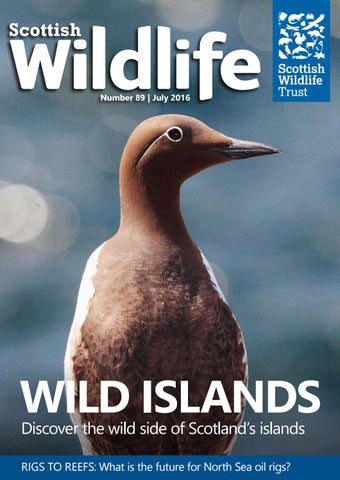
Number 89 | July 2016
WILD ISLANDS Discover the wild side of Scotland’s islands RIGS TO REEFS: What is the future for North Sea oil rigs?
Welcome from the Chief Executive
FIRST WORD From Chief Executive, Jonny Hughes
I
slands are special places, and particularly so in Scotland. Our island archipelagos off the west and north coasts are among the most beautiful landscapes and seascapes I have ever seen. My favourite book as a child was I Know an Island by the naturalist R M Lockley. I’d spend hours copying his hand-drawn maps, dreaming of one day living on one of the islands he described, spending months studying Manx shearwaters or Leach’s petrels. And who isn’t jealous of Frank Fraser Darling’s adventures on islands such as North Ronaldsay and Tanera Mòr in the 1930s, captured so eloquently in his book Island Years? The wildlife that R M Lockley and Fraser Darling describe in their writing is astonishing. Scotland’s islands contain much of the UK’s most spectacular and internationally important wildlife, even if you don’t count the huge diversity of species immediately off the coast under the waves. Bass Rock has more than 150,000 breeding northern gannets, the largest colony on the planet. Handa Island, one of the Trust’s reserves, has in excess of 70,000 breeding seabirds including guillemots, razorbills, puffins and two species of marauding skuas – watch your head! The Hebrides contain several rare orchid sub-species within the floristically rich machair grasslands – a habitat created from a deep and mutually respectful association between island communities and nature. Our islands are the best places to see otters and sea eagles and some of the few places where the call of a corncrake can still be heard or the pirouettes of red-
necked phalarope seen. Many insects, including the northern colletes bee and the great yellow bumblebee, also have their UK strongholds on Scottish islands. Yet the ecosystems on islands are delicately, almost precariously, balanced. When a non-native invasive species is introduced, it can very quickly have profound impacts on the resident flora and fauna. Brown and black rats predate
Handa beach © Steve Gardner
seabird eggs relentlessly, invasive plants such as Rhododendron ponticum spread rapidly and muscle out native scrub habitats, while American mink have devastating impacts on ground-nesting birds. Our experience with brown rats on Handa suggests early intervention and ongoing monitoring is essential to tackle invasive species and to prevent the problem quickly getting out of control. We hope you enjoy the articles on islands in this issue and are inspired to visit some of the Trust’s island reserves. They may not be easy to get to, but you’ll be rewarded with some of the most dramatic scenery and unique wildlife spectacles anywhere in the world. I would also like to take this opportunity to invite you to this year’s National Members’ Day and AGM, which will take place at the National Museum of Scotland on 24 September. This should prove to be another fantastic day and a great opportunity to meet some of your fellow supporters. More details of the event can be found on page 24.
Our island reserves may not be easy to get to, but you’ll be rewarded with some of the most dramatic scenery anywhere in the world. JULY 2016 SCOTTISH WILDLIFE 3
Contents
Spotlight
Inside this issue
6
16
SPECIES SPOTLIGHT:
6
LIFE ON THE EDGE Scotland’s beautiful coastline
boasts a bustling world of different species. Find out what to keep an eye out for when visiting clifftops.
8
ATLANTIC PUFFIN (Fratercula arctica)
NEWS
ews round-up from the Trust and N the world of conservation.
16
ISLAND LIFE
Rich Rowe explores the Trust’s island reserves, including the new acquisition of Little Linga.
20 ISLAND EXPLORER © Dave Goulson
Join Jamie Grant as he meets the renowned sea kayaker Brian Wilson, who paddled the entire Scottish coastline in the 1980s.
24 MEMBERS’ DAY AND AGM Join evolutionary biologist and
24
28
television presenter Ben Garrod at this year’s National Members’ Day in Edinburgh.
28 DECOMMISSIONING
Could there be benefits to leaving oil rigs in the North Sea when they reach the end of their industrial lives?
32 WATCH OUT FOR
A selection of previews and reviews.
E 32
Scottish Wildlife magazine is published by the Scottish Wildlife Trust. © Scottish Wildlife Trust. No part of this magazine may be reproduced without the express permission of the publisher. All photography © Scottish Wildlife Trust unless otherwise stated. The Scottish Wildlife Trust accepts no liability for omissions or incorrect data in advertisements and letters. Views expressed in Scottish Wildlife are not necessarily those of the Scottish Wildlife Trust. ISSN: 0143 1234. Registered office: Harbourside House, 110 Commercial Street, Edinburgh EH6 6NF. Tel: 0131 312 7765. Fax: 0131 312 8705. Email: enquiries@scottishwildlifetrust.org.uk. Website: scottishwildlifetrust.org.uk. The Scottish Wildlife Trust is a company limited by guarantee, registered in Scotland (no. SC040247). It is also a Scottish registered charity (no. SC005792). Scottish Wildlife is published three times a year: March, July and November.
The Scottish Wildlife Trust is affiliated to The Wildlife Trusts, a UK-wide network of 47 Trusts with more than 2,000 wildlife reserves. 4 SCOTTISH WILDLIFE JULY 2016
Deadlines for news: 1 January, 1 May, 1 September. No unsolicited articles please. Scottish Wildlife is free to members. Membership rates from 1 April (excluding discounts for paying by Direct Debit): Individual (concession) £33 (£18); Joint (concession) £46 (£24); Family £53 (£48); Watch £18; Life (joint) £800 (£1,200); Senior Citizen Life (joint) £500 (£700). Patron: HRH The Prince Charles, Duke of Rothesay. Chairman: Robin Harper. Vice-Chairs: Jon Barnes, Amanda Forsyth, Karen Chambers. Chief Executive: Jonny Hughes. Editor: Jo Pike editor@scottishwildlifetrust.org.uk. Production Editor: Pete Haskell. Design: Connect connectcommunications.co.uk. Advertising: Elliot Whitehead 0131 561 00212, Clare Stebbing 0131 561 0024. Printing: Inkmark. Cover photo: © Francesco de Marco
© Lister Cumming
© Darren Williams
OVERWIN AN AT THNIGHT S RAASE MAGICTAY AY H AL OUSE SEE P AG
Renowned for their brightly-coloured bills, puffins’ beaks are only this colourful during spring and summer. In autumn, they shed their outer bill and spend the winter with a smaller, less colourful beak.
Puffins are very adept at both flying and swimming. They can fly at speeds of 55mph and can dive to depths of 200 feet underwater.
Breeding puffins reunite with their partners at the same nest site each year. Females lay a single egg and the pair take turns incubating the egg and then feeding the puffling once hatched.
A rasping tongue and serrations on the upper bill mean that puffins can carry multiple fish in their beaks at once. The average catch is around 10 fish per trip.
The Atlantic puffin is one of four puffin species worldwide, the others being the horned puffin, tufted puffin and rhinoceros auklet.
JUNE 2016 SCOTTISH WILDLIFE 5
Spotlight: coastal cliffs
Spotlight: coastal cliffs
E
B C
D
Scotland has more than 6,000 miles of coastline, ranging from sandy beaches to towering clifftops. From a distance, some cliffscapes look unimaginably hostile, but get a little closer and a bustling world of species living life on the edge is revealed. From the clifftops, where puffins nest in burrows between wildflowers, down the rock face, where millions of seabirds nest in relative safety from predators every year, to the rocky shore and the seas below, coastal cliffs are an excellent place for memorable wildlife experiences. Here are a few species to keep an eye out for when visiting cliff sites:
RESERVES A HANDA ( PICTURED )
GREY SEAL
OS Landranger 9, NC138480 Over 70,000 seabirds breed on Handa’s Torridonian sandstone cliffs each summer, including internationally important numbers of guillemots, razorbills and great skuas (bonxies). This dramatic island provides stunning ocean panoramas and the chance to spot dolphins, minke whales and basking sharks.
Pupping season between midSeptember and January is a great time to watch seals and their pups hauled out on beaches and rocky outcrops.
MINKE WHALE
KITTIWAKE
Measuring 7-10m when fully grown, minke whales are frequently seen in coastal and in-shore waters around the Hebrides between April and October.
This medium-sized gull nests on cliffs between February and August before heading out to sea to spend the winter fishing.
B LONGHAVEN CLIFFS
OS Landranger 30, NK116394 With pink-red granite cliffs, this reserve offers spectacular views of seabird colonies and natural features such as sea stacks, caves and arches. Seals can be spotted basking on the rocks below and in summer the clifftop is swathed in wildflowers.
C ISLE OF EIGG
OS Landranger 39, NM474875 This diverse island offers cliffs, beaches, rocky shores, woodlands, raised bogs, moorland and wildflower meadows. Otters hunt along the shoreline while fulmars nest on the cliffs and raptors soar high above.
D SEATON CLIFFS
OS Landranger 54, NO667416 This reserve boasts spectacular red sandstone cliffs with numerous sea caves, stacks, arches and blowholes. The cliffs support a mosaic of habitats and an abundance of life, with over 300 species of invertebrate recorded on the wildflower meadows alone.
E HILL OF WHITE HAMARS
PUFFIN
GREAT YELLOW BUMBLEBEE
SCOTTISH PRIMROSE
Puffins can be seen nesting in burrows between March and August. While it’s possible to get close to puffins, it’s recommended to stay at least 50m away to avoid disturbing the birds.
One of the UK’s rarest bumblebees, the great yellow is now restricted to Caithness, Sutherland and the Western Isles, where it can be seen on flower-rich machair habitat.
Often found near the coast, this endemic species is only found on the north coast of the mainland and Orkney, flowering between May and July.
6 SCOTTISH WILDLIFE JULY 2016
OS Landranger 7, ND322888 One of the Trust’s most northerly reserves, Hill of White Hamars provides excellent short-range viewing opportunities of nesting seabirds. In spring, the reserve blossoms with wildflowers, including Scottish primrose, white campion and heath-spotted orchid. For full reserve information, visit scottishwildlifetrust.org.uk/reserves
JULY 2016 SCOTTISH WILDLIFE 7
Handa cliffs © Steve Gardner; Minke © Pete Haskell; Grey Seal © Steve Gardner; Kittiwake family © Margaret Holland; Puffin © Lister Cumming; Great yellow bumblebee © Dave Goulson; Scottish primrose © Mark Foxwell
LIFE ON THE EDGE
A
Scottish Wildlife Trust news © Pete Cairns, 2020VISION
Latest news
News from the Trust, our projects and the wider world of conservation
KEEP UP TO DATE
Visit our website for regular news upda tes at scottishwildlife trust.org.uk
Dr Mel Tonkin Saving Scotland’s Red Squirrel Project Manager
A donation of any amount will help. Please visit scottishwildlifetrust. org.uk or call 0131 312 4700 to donate.
8 SCOTTISH WILDLIFE JULY 2016
© George Stoyle, SNH
OUR determination to save Scotland’s red squirrels is beginning to reap rewards. Reds are returning to areas where they’ve not been seen for decades, so we know our strategy is working. But we urgently need more resources. The Heritage Lottery Fund (HLF) has seen the progress we’ve made and given its initial approval for a fantastic five-year award of £2.46million. However, to get this exciting new phase off the ground we need to raise £40,000 by October. And the clock is ticking. Scotland is home to 75% of the UK’s red squirrels but they are under grave threat. Non-native grey squirrels outcompete reds for food and in many places carry squirrel pox – almost always lethal to reds. The Scottish Wildlife Trust has been leading the Saving Scotland’s Red Squirrels project since 2008. With HLF’s support, we can share this expertise and equip many more volunteers and land managers to protect red squirrels in their local areas. We need to act now but can only begin when the funds are secured. Your donation could help unlock millions of pounds to help save our red squirrels before it’s too late. Go online or call to donate.
A NEW series of snorkel trails have been developed to encourage people to go underwater to discover Scotland's incredible marine life such as ballan wrasse, sunstars and cuttlefish. The self-led North West Highlands Snorkel Trail is the first of its kind in Scotland. From kelp forests to maerl beds, the nine trail locations are between Gairloch and Lochinver, and include Tanera Mòr, Achmelvich and Gruinard Bay. The Trust’s Living Seas Communities Officer Noel Hawkins said: “The trail is designed to show beginners and advanced snorkellers some of the best locations to see marine
© Steve Gardner
You can help unlock £2.5million to save red squirrels
Dive in to Scotland’s living seas
Film-makers capture heart of Handa THE recent BBC One series Highlands Scotland’s Wild Heart showcased amazing footage of wildlife, including a dramatic sequence featuring guillemot chicks leaping from 400-foot high cliffs on Handa Island with only tiny, unformed wings to steer. Jackie Savery from production company Maramedia said: “It wouldn’t have been possible to make a programme like this without the warm welcome and help from both Scourie Estate and the Scottish Wildlife Trust. “We gained unprecedented access to Handa to film its bustling seabird colony, and enjoyed invaluable support from the Trust's staff and volunteers who work tirelessly to conserve the internationally important habitat." Handa Island is a wildlife reserve owned by Scourie Estate and managed
in partnership with the Trust. It is an internationally important colony for guillemots and other seabirds, hosting hosting over 70,000 nesting birds each summer. The Trust’s Handa Rangers for 2016 are Danni Thompson and Tom Ovenden. They are helped by four hard-working Assistant Rangers: Rebecca Crawford, Andrew Ferguson, Russell Ford and Kate Owen. The team is embarking on a threeyear project to repair the path on the island. This has been supported by the Highland Council Landfill Communities Fund but more funds need to be raised to ensure that the path is kept in good condition. Donate on our website by searching for ‘Handa footpath appeal’.
New Director of Conservation THE Trust has appointed Susan Davies as its new Director of Conservation. Susan has 25 years’ experience of conservation at a senior level, most recently as Acting Chief Executive of Scottish Natural Heritage.
She said: “I’m thrilled to join Scotland’s leading wildlife charity. The Trust has the vision and the big ideas that are needed to address the significant challenges facing nature today.”
Highland ponies grazing at Montrose Basin HIGHLAND ponies are making a big impact at the Trust’s Montrose Basin reserve. The ponies are used to graze an area of salt marsh to keep down vegetation and keep pools clear for wading birds. “The ponies are perfect for grazing the saltmarsh. They need to eat more material than sheep and cattle and their short strong legs make them incredibly hardy and tough,” said Reserve Ranger
Anna Cheshier. “Highland ponies are not often used in conservation, but they have real merit and a positive impact has been made to the saltpans. This role can only help to secure the future of this rare, native breed.” The ponies' speciality is wading into deep water in search of fresh shoots which helps to keep the pools open for wading birds.
life in the area. "It also highlights the importance of keeping these locations healthy so that they can continue to support a wide range of species. "To keep wildlife and people safe along the trail we are promoting the Snorkeller's Code and highlighting the 'three Ts', which means no touching, taking or teasing of marine animals, plants or shells." The snorkel trail has been created as part of the Trust’s Living Seas programme and is supported by the Esmée Fairbairn Foundation. Find out more at scottishwildlifetrust.org.uk/ snorkeltrail
40,000 thank yous
THE Trust has reached the amazing milestone of having 40,000 members for the first time in its history. Members are invaluable supporters of our work to protect Scotland’s wildlife for the future. One recent new member is Mel Chadd (pictured above) from Perthshire,
who signed up at Scotland’s Big Nature Festival. Mel said: “My favourite wild place in Scotland would have to be the Isle of Mull for the diverse range of wildlife and scenery. We chose to join the Trust so that we can visit reserves and support its conservation work.”
Help for Living Landscape CUMBERNAULD Living Landscape has received £10,000 from Tesco’s Bags of Help. The funding will support key improvements around St Maurice’s Pond suggested by local high school pupils including improving the safety of the boardwalk across the pond, adding a welcome sign, and planting a
small community orchard. The Trust has also received £44,959 from WREN to enhance access into Forest Wood Wildlife Reserve through landscaping, improved paths and entrances, and the installation of interpretation including ‘Living Window’ frames. JULY 2016 SCOTTISH WILDLIFE 9
Scottish Wildlife Trust news
30 Days Wild
DEAN Jones has swapped life on the Greek island of Samos to become the Trust's new wildlife ranger on the Isle of Eigg. He replaces John Chester, who retired last year after more than 30 years on the island.
OVER 1,700 people accepted the Trust’s 30 Days Wild challenge to do something to get closer to nature every day in June. From looking for bats on an evening stroll to leaving a patch of lawn to grow wild, it was fantastic to see so many people engaged. A study of
Wildlife Watch groups spring up
Duke of Edinburgh Award at Montrose MONTROSE Basin has been hosting Duke of Edinburgh award volunteers since 2008. The team at the visitor centre helps young people, who volunteer for one hour a week, to complete their bronze, silver and gold awards. Tasks include filling the bird feeders, clearing leaves, recycling, cleaning the hide, talking to the public and bird identification. We are delighted that Nathan Guy, who started in 2013, has achieved his silver and gold award while at the Trust. Nathan turned 18 last year and now volunteers on a Saturday morning.
Little Linga gifted to the Trust THE Trust has been gifted the small island of Little Linga off Stronsay in the Orkney Isles. Little Linga is a significant breeding ground for Atlantic grey seals with approximately 500 pups being born on the island each year. It is also home to around 80 pairs of cormorants that nest on raised beds of seaweed, and 200 pairs of fulmars.
Birdbox boost for Alloa’s wildlife
Progress on harbour porpoise protection THE Trust has joined a number of organisations in welcoming a proposal to designate a Special Area of Conservation (SAC) for harbour porpoises on the west coast of Scotland. The 5,200-square mile Inner Hebrides and the Minches SAC is still in the process of consultation. It would stretch from the Isle of Gigha to the east coast of Lewis. The Trust is highly supportive of the proposed Inner Hebrides SAC, but is disappointed that two further areas, the Outer Moray Firth and the North Channel and Outer Solway, are not at this advanced stage of consultation.
discover the wildlife that lives in their local area and helps them to explore the natural world. New groups in Breadalbane and Assynt have also been established recently, bringing the total to 33 groups across Scotland. If you are interested in setting up a new one in your area, please contact Donna Mathieson on 0131 312 4712.
RARE BIRD SIGHTING AT MONTROSE BASIN
A rare glossy ibis was spotted at Montrose Basin reserve in May. This brightly-coloured wader is more often seen
summering in southern Europe but is increasingly finding its way to the United Kingdom due to changing habitats.
Reds bounce back in the Granite City
Dr Sam Collin, the Trust’s Marine Planning Officer said: “Scotland’s harbour porpoise populations are at risk from a number of threats that include disturbance from sonar and military activity, habitat loss and entanglement in fishing gear. “Although harbour porpoises are the smallest cetaceans found in Scottish waters, they are highly mobile creatures and there is very strong evidence to support the creation of a network of SACs that includes the Solway and Moray Firths. These sites should be progressed without delay.”
© Ronnie Stokes
10 SCOTTISH WILDLIFE JULY 2016
TWO new Wildlife Watch groups have been established in Gatehouse of Fleet, including the first group aimed at children under six. Nurture in Nature is a toddler group that meets every week in a local wood to give children a chance to play and explore. Wildlife Watch is the junior branch of the Scottish Wildlife Trust that gives young people the chance to
© Niki Clear
STAFF from Jupiter Urban Wildlife Centre helped pupils from Sunnyside Primary School in Alloa to build 12 bird boxes, which have been put up in their school and the centre of the town. The school regularly takes part in work to improve the town centre for people and wildlife.
the 2015 challenge found that it led to a sustained increase in people’s happiness, health and connection to nature. Two months after taking part in the initiative, the number of people reporting their health as excellent increased by over 30 per cent.
© Neil Black
THE Trust's tree nursery created at Little Assynt through the Coigach-Assynt Living Landscape has become a supplier to the Woodland Trust. The nursery will supply trees for the Croft Woodlands project in the local area. Willie Beattie from the Woodland Trust Scotland said: "We're delighted to be working with the Little Assynt Tree Nursery. It's s an expanding business producing high-quality seedlings in the heart of a crofting community."
© Matthew Roberts
Assynt tree nursery boost
New Ranger on Eigg
© Sarah Long
IN BRIEF
Scottish Wildlife Trust news
RED squirrels contine to recolonise Aberdeen, according to early results from a survey carried out this spring. Saving Scotland’s Red Squirrels Project Officer Stephen Willis said: “We still need to finalise this year’s survey but we are picking up more red squirrels in the city than ever before. “They are doing very well in forests on the edge of Aberdeen and it’s probably just a matter of time before we see more reds appearing in the city suburbs. “There are several areas
where reds have been recorded for the first time, including Seaton Park. Undoubtedly these successes are due to our robust approach to grey squirrel control.” Many householders and landowners have also been engaged in the project which is supported by Aberdeen Greenspace Trust, Forest Enterprise Scotland, Aberdeen City Council and Scottish Natural Heritage. Find out more about Saving Scotland’s Red Squirrels at scottishsquirrels.org.uk
JULY 2016 SCOTTISH WILDLIFE 11
Scottish Wildlife Trust news
Falls of Clyde internships
HAT-TRICK FOR LOWES OSPREYS
THE nesting pair of ospreys at Loch of the Lowes reserve have proven to be very capable parents again this year and have hatched three chicks for the second season in a row. The male, LM12, had to work hard to bring enough food back to the nest and at
one point was spotted catching two fish in one dive! Our osprey webcam, which is supported by players of People’s Postcode Lottery, has been viewed over 750,000 times since the female returned in March.
ASSISTANT Rangers Lauren Moore and Susanne Maas have completed their sixmonth volunteer internships at Falls of Clyde Wildlife Reserve. They have taken part in a range of tasks on the reserve including practical management, species identification and surveys, and public engagement. Lauren, who is returning to the University of Salford where she is studying Wildlife Conservation, said: “I’ve learnt lots of transferable skills that will be relevant for me in the future and this is a great way to make a difference. You can see how lots of small tasks go on to have a larger impact.”
Calling on Government FOLLOWING May’s Scottish Parliament elections, the Trust set out four key priorities for the new Government, including full implementation of the United Nations Sustainable Development Goals and the creation of a National Ecological Network. Visit our website for full details.
Island (S)hopping I’m willing to bet that, at some point in their lives, everyone has dreamed about owning their own private island. Admittedly the majority will be visualising a sun drenched tropical paradise in a temperate climate, but there are those of us who would eschew butterflies for midgies and coconuts for brambles. Islands are, by their very nature, a very unique type of property so in this article, we will touch upon some of the more unusual legal issues which need to be considered when it comes to purchasing and owning one. Foreshore In Scots law, the foreshore is defined as the area of the shore between the high and low water marks of ordinary spring tides. Ownership of the foreshore is complicated. As a general rule, the foreshore in Scotland is owned by the Crown but there are exceptions to this: the Crown can grant ownership of an area of the foreshore to another entity; or ownership of the foreshore can be established through a period of uninterrupted possession for 20 years or more. In Orkney and Shetland, there is another possibility. A system of law still exists in Orkney and Shetland known as Udal law. This derives from the Norse legal system which applied in the islands when they were part of the Norwegian Kingdom. Although these islands have formed part of Scotland since the 15th century, Udal law has never been formally abolished and still subsists where it has not been superseded by laws from Scotland, UK or Europe. Unlike the position in the rest of Scotland, under Udal Law the Crown has no prior rights to the foreshore, therefore the presumption is that the foreshore is owned by the proprietor of the adjoining udal title. Another peculiarity of Udal law is the definition of the foreshore is slightly different. Rather than extending to the low water marks of ordinary spring tides, the foreshore under udal titles extends to the “lowest ebb” which may fall at a lower point than the spring tide.
12 SCOTTISH WILDLIFE JULY 2016
Seabed and Continental Shelf It is unlikely, though not impossible, that in purchasing an island you would acquire any land beyond the foreshore. Ownership of this land is governed by conventions from the United Nations which have been transposed into UK law. Scotland’s territorial seabed extends to 12 miles from the coastline and this area is owned by the Crown. Beyond the territorial seabed, the Crown has rights of exploration and exploitation in relation to Scotland’s adjoining continental shelf area out to 200 nautical miles. Beachcombing, Treasure Hunting and Beached Whales The tides can bring in all sort of items to your beach but the old adage of “finders, keepers” doesn’t tend to hold true. In Scots law, an item found anywhere in Scotland which is not otherwise owned or for which no demonstrable heir can be found is deemed to belong to the Crown. Ancient Rights of the Crown The Crown in Scotland has a number of ancient rights, the origins of which have been lost in time but which remain valid and enforceable to this day. One such right is the right to take all naturally occurring salmon, oysters and mussels in Scotland. These rights were until recently exercised by the Crown Estate Commissioners although Marine Scotland, on behalf of the Scottish Ministers, now have the right to all naturally occurring salmon, oysters and mussels. Another right of the Crown in Scotland is to “Royal Fish”. This right allows the Scottish Government, on behalf of the Crown, first claim to all “Royal Fish” found dead and stranded on the shoreline of Scotland. Precisely what it is that constitutes a “Royal Fish” is somewhat vague but the Scottish Government has relied upon a historic definition of stranded whales too large to be drawn to land by a “wain pulled by six oxen” which the Scottish Government have interpreted
as being any whales which measures more than 25 feet long. If a whale measuring less than 25 feet long or a porpoise, dolphin or sturgeon is unfortunate enough to wash ashore on your island, the local authority is responsible for arranging for the disposal of the same. Community Right to Buy Under the Land Reform (Scotland) Act 2003, communities throughout Scotland can register an interest in land in the Register of Community Interests in Land which grants the community body a pre-emptive right to buy the land when it comes up for sale. As a purchaser, it is important that this potential interest is covered in your Purchase Contract to ensure that the purchase is valid and the land transfers to you. Environmental The general rule in Scotland is that the “polluter pays”. The Environmental Liability (Scotland) Regulations 2009 provide that operators who might represent a risk of significant damage or cause significant damage to land, water or biodiversity will have a duty to avoid such damage occurring or, where damage does occur, a duty to reinstate the environment. However, if the polluter cannot be found then responsibility for remediation will pass to the landowner. As such, it is important to ensure that environmental liability is dealt with properly in the Purchase Contract. Every piece of land is unique and islands are no different in that respect. Therefore if you are considering your dream purchase it is important to engage early with a solicitor to ensure you are aware of all the risks and challenges associated with that. Sadly, there’s nothing the legal profession can do about the midgies. For further information on the purchase of your dream island please contact Gail Watt or Cameron Grieg on 0131 247 1000
Wider news
Hope for white-tailed eagle chicks
On Wednesday, Jean helped protect osprey chicks.
THERE are high hopes that a white-tailed sea eagle chick will fledge on Loch Broom near Ullapool this year for the first time in a century. Two chicks have been spotted in a nest on the shore of the loch this summer. If good weather continues there is a good chance that the chicks will make it to fledging.
Branching out for a Woodland Charter MORE than 50 organisations, including The Wildlife Trusts, are working together to develop a new Charter for Trees, Woods and People. This charter will be launched in 2017, marking 700 years since the medieval Charter of the Forests, signed by Henry III. The new initiative aims to ensure that trees and woods
thrive as part of people’s lives and landscapes across the UK. As part of the campaign you can share your own personal story related to trees and woods. All of the stories collected will help to form the new Charter. Share your tree story at: www.treecharter.uk
New network promotes value of native seeds
© Doug Welch
THE European-funded NASSTEC (Native Seed Science, Technology and Conservation) project is training 12 young researchers in the growing sectors of native seed science, production and technology. The aim is to create a European network for knowledge exchange and to increase people’s awareness of the use of native seeds in restoration activities at any scale. The massive decline experienced by global biodiversity in the last century is well known, but only recently have we started to realise how critical the use
of native plant material is in the conservation of local biodiversity and in habitat restoration. In order to achieve these goals, NASSTEC fellows, supported by host industries and institutions including Scotia Seeds, the Royal Botanic Gardens, Kew, and the James Hutton Institute, are investigating native seed characteristics to use them more efficiently in restoration activities, connecting with European stakeholders to strengthen collaboration and dialogue, and promoting the use of quality standards in the native seed trade.
On Thursday, she helped plant trees for red squirrels. On Friday, she helped change the law to safeguard our land and seas.
On Saturday, it was five years since Jean passed away.
Have you got the bottle?
THE British Trust for Ornithology (BTO) is calling the public to follow and record the nesting activity of a familiar garden bird. The house martin is a summer visitor to Scotland which builds a circular nest under the eaves of houses and other buildings.
The BTO will be carrying out a survey to investigate the timing of breeding and the number of broods raised, and how this varies across the UK. If you have house martins nesting on or close to your house, visit BTO’s website to find out more.
Visit: www.bto.org/housemartins-2016
14 SCOTTISH WILDLIFE JULY 2016
represents around 300,000 people in Scotland. The campaign was launched by the Association for the Protection of Rural Scotland (APRS) in September 2015 to urge Scottish Ministers to introduce a national deposit return system for drinks packaging. Thirty-seven countries or regions around the world have deposit return systems, which reduce litter and increase recycling of drinks packaging. Three of the five political parties in the last Scottish Parliament supported deposit return in their 2016 manifestos.
Make your wishes live on by writing us into your Will. Jean’s gift to the Scottish Wildlife Trust in her Will was a simple yet powerful way to keep her wishes alive. You can do the same. Once you’ve taken care of your loved ones, please consider including a gift to the Scottish Wildlife Trust in your Will. No matter how big or small, you can be sure it will make a difference to Scotland’s wildlife.
To find out more call Wendy on 0131 312 4777 or visit scottishwildlifetrust.org.uk/legacy Scottish registered charity (no. SC005792)
©Colin Prior
Help track house martins
THE Trust is one of more than two dozen organisations from business, the recycling sector, charities and community groups supporting the ‘Have You Got The Bottle?' campaign. Together, this coalition
JULY 2016 SCOTTISH WILDLIFE 15
Focus on islands
Focus on islands
ISLAND LIFE From uninhabited skerries to vibrant communities, the Trust works on a variety of islands around the Scottish coast, many of which are home to an extraordinary density of wildlife, writes Rich Rowe.
P
assengers travelling by ferry between the scattered northern isles of Orkney could be forgiven for not even noticing Little Linga. This uninhabited and seemingly unremarkable island off the coast of Stronsay is barely the size of a couple of football pitches, but its importance as a wildlife refuge is such that Little Linga recently became the Trust’s latest reserve. “It’s the sound and smell that hit you first,” explains Mark Foxwell, Reserves Manager for the Highlands and Islands. The centre of the island is home to a large colony of cormorants, their seaweed nests built high in the low-lying interior. While the adults guard their brood, black-backed gulls
and other aerial predators circle above, looking for opportunities to snatch any unguarded chicks. In autumn, a very different scene plays out as hundreds of Atlantic grey seals come ashore to pup. Little Linga and Linga Holm – a rocky outcrop already in the Trust’s care – are key breeding grounds for the seals, the rugged coastlines seething with life as thousands of white-coated pups call for food and attention. “Such places have a real character and atmosphere of their own,” says Foxwell. “Walking on them is like stepping into a David Attenborough film. There are not many places that feel quite so untouched.”
ISLAND NATION
Scotland has almost 800 islands dotted around its more than 6,000 miles of coastline. Some are large, well-populated and known the world over, but there are plenty of others that are wild, remote and rarely visited, let alone inhabited. With the addition of Little Linga, the Trust now works on eight island reserves and manages a further four reserves that are on islands. All vary greatly in size, human population and habitat. “Our ethos has always been to have a network of reserves that range both geographically and in terms of habitat,” explains Head of Reserves, Alan Anderson. Often, the Trust’s island reserves contain fragmented habitat that is important in the context of decline on the mainland. A good example is Eilean na Creige Duibhe, a tiny islet just off the west coast near Plockton, known for its covering of remnant pine wood (not to mention an impressive heronry). “It’s a secure place where species can survive away from threats faced on the mainland,” explains Anderson. But the importance of such islands
extends far beyond their rocky shores. “Part of our role is to highlight not only how important our coastal waters are for a variety of species, but also the threats that exist, from changes in water temperature to damaging fishing practices, pollution and poorly-sited marine development,” adds Anderson.
SEABIRD CENTRAL
Several of the islands in Trust care are known for their assemblages of seabird species – vast populations that represent the most visible part of an interconnected, but largely unseen, marine ecosystem. And there are few sites more important for seabirds than Handa Island in the north west Highlands. Managed in partnership with the island’s owner, Scourie Estate, Handa is one of the largest seabird colonies in the UK and as such is a key indicator of the health of the wider marine environment. It’s also an island of great physical contrast. Surrounded by thrusting upland scenery, Handa’s gently sloping southern shore is fringed with sandy beaches, one of which serves as a landing area for the small boat that ferries passengers across
the sound from Tarbet. It’s not unusual to spot basking sharks trawling the clear waters or red-throated divers flying overhead during the crossing. Head inland and Handa’s sandy fringes soon give way to rugged moorland – the domain of bonxies (great skuas) and Arctic skuas – which in turn ends abruptly at a bank of 400-foot
Of particular appeal to visitors are the puffins that nest in burrows on the Great Stack... cliffs at the north end of the island. The sudden exposure can be a shock to the 6,000 or so visitors who make their way to the cliffs via a circular path around the island each year. Here, Handa’s ancient Torridonian sandstone has weathered perfectly to
create a network of ledges that support internationally important numbers of guillemots and razorbills, as well as kittiwakes, fulmars, shags and various gulls. Although seabird numbers are not what they once were on Handa, it remains a wonderful assemblage of species. Of particular appeal to visitors are the puffins that nest in burrows on the Great Stack – a giant, freestanding pillar that holds a seething mass of nearly 10,000 guillemots on one face alone. A few years ago, the puffins began to recolonise the main island following the eradication of rats from Handa, but the recent discovery of the rodent’s return now threatens not only the puffins, but many other ground-nesting species. Another major concern is what’s taking place out at sea. With climate change bringing rising sea temperatures, key prey items such as cold-water-loving sandeels are being pushed further north and out of range of some seabirds. “The picture varies from species to species and also depends on the timeframe you look at,” explains Sven Rasmussen, Reserves Manager for West Central
Cormorant colony on Little Linga © Mark Foxwell
16 SCOTTISH WILDLIFE JULY 2016
JULY 2016 SCOTTISH WILDLIFE 17
Focus on islands
Scotland. “But it’s fair to say that most seabirds are not doing particularly well.”
HUMAN INFLUENCE
With a seasonal ranger, a team of volunteers, plus ad hoc contractors who between them work on everything from seabird monitoring to a current major upgrade of footpaths, Handa is occupied for six months of the year – a seasonal influence that is mirrored on other islands where the Trust works. At the Trust’s Hill of White Hamars reserve, a coastal strip on the island of South Walls in Orkney, the land has traditionally been lightly grazed right up to the cliff line. This results in a wonderful profusion of wildflowers, including the endemic Scottish primrose. “The hill farmer, Ian Davidson, grazes as much as possible outside the flowering period, although with this being Orkney, it’s a pretty short window,” explains Mark Foxwell. “Ian can’t put his sheep on the island much beyond October as they’d be blown off the cliff.” There is a similar light-touch approach in the Summer Isles, a sparkling chain of islands just a stone’s throw from Achiltibuie in the north west Highlands. The Trust owns several of the islands, from the large but uninhabited Isle Ristol – managed as common grazing land with a resulting flower-rich machair habitat – to the likes of Carn Iar, Stac Mhic Aonghais and Sgeir Ribhinn that are little more than skerries. With the Summer Isles falling within the Coigach-Assynt Living Landscape (CALL), the Trust’s work focuses as
Focus on islands
much on people’s interaction with the habitat as the habitat itself. “CALL’s philosophy, if that’s the right word, is to enable the landscape to function better and boost opportunities for the people who live and work within it,” says Foxwell. “Making these islands more accessible and increasing tourism opportunities can also bring socioeconomic benefits to one of the least populated parts of the UK.” The Summer Isles also sit within the recently-developed Wester Ross Marine Protected Area (MPA), which extends from the peninsula at Rua Reidh across a mosaic of sea lochs, bays and island channels as far north as Enard Bay. Through its Living Seas programme, the Trust contributed to the designation of the MPA by collecting video survey data of the maerl beds in the area – rare and sensitive habitat that requires protection if it is to recover and thrive in the future. It’s underwater biodiversity that Noel Hawkins, Living Seas Community Officer, aims to highlight with the launch of a new Snorkel Trail from Gairloch to Clachtoll this summer. “The nine trail sites offer some of Scotland’s best snorkelling where a
Ian can’t put his sheep on the island much beyond October as they’d be blown off the cliff.
whole host of marine species can be seen,” he explains. “It’s a means of both helping people engage more with the sea and highlighting the rich diversity of underwater life that is present here.”
PEOPLE AND NATURE
But of all the islands where the Trust works, it is the Isle of Eigg where the influence of people is felt most keenly. Having played a major role in the community buy-out of the island in 1997, and had a ranger present there for more than three decades, the Trust has a long association with Eigg. Today, it remains a partner in the Isle of Eigg Heritage Trust, but now takes a back seat in terms of day-to-day land management. In almost 20 years of community ownership, the islanders’ commitment to sustainable, low-impact living has contributed to a growing self-sufficiency, an increasing population, and ongoing landscape restoration – with benefits for a wide range of species. “I would argue that Eigg was our first true Living Landscape project,” suggests Anderson. “It’s an island where nature conservation is integrated with the lives of people, the economy and the landscape. There’s such a positive feel to the place.” And it’s likely Eigg will continue to play a flagship role as the Trust proceeds to conserve the rich variety of species and habitat on the islands where it works, as well as highlighting the wider importance of these vital marine habitats. Rich Rowe is a freelance outdoors writer based in Innerleithen, Scottish Borders.
Bonxie attacking Guillemots on Handa © Steve Gardner
18 SCOTTISH WILDLIFE JULY 2016
SCOTLAND’S HIDDEN ISLANDS WHAT ARE SEAMOUNTS?
S
eamounts are underwater mountains that can be found in deep oceanic waters, rising thousands of meters up from the seafloor but not breaking the ocean’s surface. Although seamounts are not islands in a typical sense, they do share many similarities by providing ‘islands’ of habitat suitable for many species that would not be able to survive in the surrounding deeper waters, such as cold-water corals and deep-sea sponges. These living reefs attract other species such as whiting, orange roughy, sharks and octopuses, creating valuable hotspots for marine biodiversity. Scottish waters contain three of these mysterious deep-water formations – the Hebrides Terrace, Anton Dohrn and Rosemary Bank seamounts. All three seamounts were formed by volcanic activity around 70 million years ago and their presence has a large influence on underwater currents and marine life off the west coast. We know seamounts are ecologically important, but our knowledge of the organisms that inhabit them and their influence on the wider marine community is still limited.
HERE ARE A FEW FASCINATING FACTS ABOUT SCOTLAND’S SEAMOUNTS The tallest of Scotland’s seamounts is the Hebrides Terrace. Rising 1,400 metres above the seafloor, from bottom to top it is larger than Ben Nevis (1,345 metres).
Two of Scotland’s seamounts (Rosemary Bank and the Hebrides Terrace) were designated as Marine Protected Areas in 2014 due to the unique habitats found on them.
Seamounts are important habitats for commercially soughtafter orange roughy. These deep-sea fish can live for up to 150 years and mature very slowly, making them extremely susceptible to overfishing.
Some deep-sea sharks, skates and rays use cold-water coral reefs on seamounts as nursery habitats, laying their eggs in between the hard coral structures. © JC073 Changing Oceans Expedition, Heriot-Watt University, NERC, JNCC
The cold-water coral Lophelia pertusa grows in the deep waters throughout the North Atlantic. Growing at just 1mm per year, it relies on dead plankton floating down from surface waters as a source of food. JULY 2016 SCOTTISH WILDLIFE 19
Focus on islands
Focus on islands
Brian Wilson is vocal about the need to protect Scotland’s valuable and unique coastal and marine habitats
ISLAND EXPLORER T
Three decades on from his Blazing Paddles adventure, Brian Wilson is still finding new delights to explore in Scotland’s waters, as Jamie Grant discovers.
20 SCOTTISH WILDLIFE JULY 2016
wildness and habitation as well as great views on to the other islands,” said Brian. Journeying in sea kayaks is also still very much part of Brian’s life. This year he featured in the BBC Adventure Show special The Canoe Boys. Together with ex-footballer Michael Stewart, he retraced the first sea journey by kayak from West Dunbartonshire to Skye by Alastair Dunnett and Seamus Adam in 1934. Michael and Brian covered the 200-plus miles in replicas of the original kayaks, made from teak and canvas. Well received in the press, they are now dreaming up “the next stage of the adventure”.
There is still no better way of exloring Scotland’s islands than on a small and silent craft. His time spent travelling around Scotland’s coast in a kayak has given Brian a deep appreciation of marine habitats and wildlife. He has skirted sea cliffs thronging with nesting seabirds, watched a male orca breach only a couple of metres from his boat and cheekily stroked the whiskers of a seal napping in the surf. “Because kayaking is such a quiet activity, wildlife such as seals and otters are much less afraid of you, meaning you can get much closer without disturbing them,” said Brian. Brian has always been passionate and outspoken about the need to protect Scotland’s coastal and marine habitats.
He has noticed a marked decline in seabird populations in the past 30 years, with many of the issues he raised in Blazing Paddles unresolved. “The seabirds have had a run of bad years because there are far fewer fish for them to catch in the inshore waters,” he said. Although he welcomes the new network in Scotland of Marine Protected Areas, he worries they don’t go far enough. “My view is that trawling should be banned completely in sensitive areas like the Firth of Lorne,” he said. “I’m also concerned that the new regulations aren’t being enforced effectively.” Scotland’s coastal communities also feature in Brian’s writings. He admires islanders for being “tough, resourceful and appreciative of their environment”. Some islands he has returned to time and time again. In the three decades since he wrote his book, the challenge of sustaining island communities has, if anything, intensified. “Community partnerships like the Coigach-Assynt Living Landscape are a great way of supporting rural livelihoods,” said Brian. “I would like to see islands grouping together more to get listened to.” Since Brian’s island odyssey in 1985, sea kayaking has developed into a popular adventure sport. Mobile phones and GPS have also made it a lot safer, although he feels very lucky to have experienced all the adventure and remoteness of being totally self-reliant. One thing hasn’t changed though and that’s the experience. “There is still no better way of exploring Scotland’s islands than on a small and silent craft,” concluded Brian.
© Jamie Grant
hirty-one years ago a young man set off in a sea kayak on a daring 1,800-mile journey from Dumfriesshire all the way around the Scottish coastline to the Forth Estuary. Brian Wilson’s meandering route took in the Outer Hebrides and some of the most fearsome waters in Europe: the Dorus Mor, the whirlpool at Corryvreckan, the Butt of Lewis and the Pentland Firth. His classic 1988 account of this solo adventure, Blazing Paddles, is both a soliloquy to the ‘cold loveliness’ of the sea and an impassioned call to action to protect fragile marine habitats from the combined threats of pollution, aquaculture and overfishing. Paddling around Scotland gave Brian fresh perspective on our 790-odd islands. He imagined what it must have been like for the pilgrims who reached these shores on unstable crafts. Rather than isolated land masses cut off by the sea, he came to see them as connected and accessible by the water surrounding them: “I felt… all the conquering awe of the first seafarers who, also in manpowered boats, challenged these grim northern seas,” he wrote. Brian, now lives near Ullapool, where he has settled and worked variously as a heather thatcher, stone dyker, kayak instructor, walking guide and Scottish Wildlife Trust Warden for the Rahoy Hills Wildlife Reserve in Morvern. Over the years, he has deepened his connection to many of Scotland’s islands, working as a Field Officer for the British Trust for Conservation Volunteers (now TCV) on Jura, Arran and Mull. For sheer drama, he would choose the west coast of Harris, but it’s Colonsay that has truly captured his heart. “Colonsay has a wonderful mix of
Jamie Grant is a photographer and freelance writer based in Perthshire. JULY 2016 SCOTTISH WILDLIFE 21
Focus on islands
Q&A
Richard Williams, Development Manager
A life more travelled
R
ichard Williams is the Development Manager for the Coigach-Assynt Living Landscape (CALL) Partnership, currently in the development phase thanks to support from the Heritage Lottery Fund. You lived on Tanera Mòr for five years. What was your lasting impression of your time on the island? Peacefulness! Despite being just a mile and a half offshore, the island is a world away from the mainland. The shelter afforded by the east-facing bay is one of the main physical characteristics of the place. This has provided a safe anchorage for centuries and played a key role in the island’s history and success. That shelter, combined with an absence of herbivores, allows for a rich array of vegetation and native trees and with it a wonderful biodiversity and feeling of calm. Tanera Mòr sits within the area for the CALL project, in which you play a key role. Is there anything you feel especially proud about that you’ve helped the Trust achieve so far?
What are some of the challenges that you’ve had to overcome when living and working in the Summer Isles? Being an island and being off-grid means that you have to be your own utility provider. Learning about the mechanics and regular maintenance of both our power generation and water supply and treatment systems was a very steep but satisfying learning curve for me. Being able to diagnose and fix problems, generally quicker than mainland providers can (!), gives a great feeling of empowerment and self-reliance. Scotland’s islands are an important draw for tourists. Do you think people are starting to recognise the many benefits to our economy of protecting nature? Absolutely. Tourism is an increasingly important part of the local economy. Local providers and businesses understand that visitors want to experience a beautiful environment and see iconic species. The seas around the
islands are home to a great array of marine life and during the summer months host exciting visitors such as the pod of orca which was resident for a month or so back in 2013. Visitors flocked to the area as a result with boat trips experiencing record demand and other local businesses benefiting from the increased numbers. What’s your hope for the future of Scotland’s environment? I hope that people appreciate the wonderful and diverse environment that our country is blessed with, but at the same time recognise the huge pressures placed on it. If we want our environment to continue to thrive, and indeed recover and improve in certain areas, then we all need to work hard to achieve this. But I think the first step is to get more people out into the environment to appreciate and enjoy what we have and that way hopefully more people will be committed and enthused to help protect and enhance our wonderful assets.
In November 2015, we submitted our Stage Two Application to the Heritage Lottery Fund (HLF) for the CALL Partnership Scheme. This represented the culmination of almost five years of hard work, planning, engagement and consultation, and to have reached such an important milestone in the project’s development was very satisfying indeed. This summer, we’ll find out whether we have been successful in securing £2.9million from HLF to deliver 28 individual projects over the next five years. Exciting times ahead! 22 SCOTTISH WILDLIFE JULY 2016
JULY 2016 SCOTTISH WILDLIFE 23
AGM and National Members’ Day
social media link / email link
BOOK YOUR PLACE ge ar rm Infi
et
Stre
ers
et Stre
idge
Ch
mb
Forrest Road
Festival Theatre Edinburgh
Bri
sto
ond
mm
Dru
National Museum of Scotland
et Stre
et tre yS
(National Members’ Day begins at 12.15)
h Br Sout
ge
Brid
Cha
ers amb
10.00 - 16.00, 24 September 2016
h Brid Sout bers
Cham
e IV
Evolutionary biologist, television presenter and bone guru Ben Garrod will be our special guest for this year’s National Members’ Day. Join us at the National Museum of Scotland in Edinburgh for what promises to be an entertaining and insightful event.
Cowgate
rg Geo
AGM and National Members’ Day
Cowgate
National Library of Scotland
eet Str
Surgeons’ Hall
Pla
ce
EARL DISC Y BIRD OUN T BOOK
30 AU BEFORE G ONLY UST FOR £1 PERS 0 PER ON
Please complete this form using CAPITALS and return to: Membership Department, Scottish Wildlife Trust, Harbourside House, 110 Commercial Street, Edinburgh EH6 6NF (by 16 September 2016 or, if paying early bird rate, by 30 August 2016.)
Venue information
Alternatively, book your place online at: scottishwildlifetrust.org.uk/2016-AGM
The Auditorium, National Museum of Scotland, Chambers Street, Edinburgh EH1 1JF. T: 0300 123 6789
Name of first delegate
Given the central location of the National Museum, we would strongly recommend that guests use public transport options where possible, as parking in the city centre is limited.
Membership number
BY TRAIN: The Museum is a 10-15 minute walk from Edinburgh Waverley train station.
Name of second delegate (if applicable)
BY BUS: A number of buses go via Edinburgh city centre and stop outside the Museum on Chambers Street, or nearby on George IV Bridge and South Bridge. For more information, visit lothianbuses.com or call 0131 555 6363.
Non-member guests (two max.)
BY CAR: Follow signs to the city centre. There is pay and display parking available on Chambers Street.
Contact address
13.00 National Members’ Day welcome
W
e are delighted to announce that Ben Garrod has agreed to speak at this year’s National Members’ Day in September. Having presented several BBC television programmes including Attenborough and the Giant Dinosaur and his award-winning series Secret Life of Bones, Ben has become a familiar face on our screens in recent years. He is also a Teaching Fellow at Anglia Ruskin University and has recently completed a PhD with University College London and the Zoological Society of London entitled ‘Primates of the Caribbean’ which looked into monkey 24 SCOTTISH WILDLIFE JULY 2016
evolution on tropical islands. Ben will deliver an intriguing and thoughtprovoking talk and will later sit on the Wildlife Question Time panel, chaired by Scottish Wildlife Trust Ambassador, Stephen Jardine. Our other panelists include Trust Chairman Robin Harper, and our new Director of Conservation, Susan Davies. AGM AT NATIONAL MUSEUM OF SCOTLAND Notice is hereby given that the 52nd AGM of the Scottish Wildlife Trust will be held on Saturday 24 September in The Auditorium at the National
Museum of Scotland, Chambers Street, Edinburgh, EH1 1JF from 10.30 to 12.00 noon. AGM AGENDA 1. Apologies 2. To approve minutes of the 51st AGM held at the New Lanark Mill Hotel, New Lanark Mills, South Lanarkshire ML11 9DB on 19 September 2015. 3. To receive the Council’s report and accounts for the year ended 31 March 2016. The annual report and accounts can be downloaded from scottishwildlifetrust. org.uk . Copies are available on request from the Company Secretary (see
below for address). Copies will also be available at the AGM. 4. T o re-appoint auditors to the Trust: Geoghegans, 6 Colme Street, Edinburgh EH3 6AD. 5. To elect members to Council 6. Any other relevant business. EVENT PROGRAMME 10.00 Registration and refreshments 10.30 AGM 11.30 Presentations and questions 12.15 Standing buffet lunch
13.15 Keynote speaker: Ben Garrod 14.00 Mobilising our membership 14.30 Refreshments 15.00 Wildlife Question Time, chaired by Stephen Jardine 15.50 Closing address ELECTION TO THE TRUST’S COUNCIL Council, which has responsibility for the governance of the Trust, is made up of Trustees elected from the membership. To be an effective Trustee requires
time and effort, and members of Council are elected on the basis of what they can contribute by way of knowledge, contacts, expertise and skill (including finance, conservation and science, law, business, administration and land management). A Trustee must act in the best interests of the charity as a whole. This year, as the number of candidates equals the number of vacancies on Council, no postal vote is necessary. Details of nominations to Council are shown overleaf and vacancies will be filled in accordance with the Articles of Association. For a full list of nominations for election to Council, please see overleaf.
Postcode Telephone Email Would you like to submit a question for our panel? A selection will be used on the day.
✃
© Darren Williams
ACCESSIBILITY: There is level access to the Museum via the main doors to the Entrance Hall on Chambers Street and the Tower entrance on the corner of Chambers Street and George IV Bridge.
Continued overleaf AUGUST MONTH JULY 2013 2016 SCOTTISH WILDLIFE 25
If you are involved in a Local Group, please let us know which one
NOMINATIONS FOR ELECTION TO COUNCIL
Office held. e.g. Chair, Secretary (if applicable)
Standing for Re-Election I/we wish to attend (please tick all appropriate)
Alastair Grier
Proposer: Amanda Forsyth. Seconder: Tony Cameron Alastair has a Geography Degree and a Masters in Economics, Politics and Management from the University of St Andrews. He has been working with the Trust for several years, initially as an advisor and then as a member of Council. Alastair was a key supporter of the initial World Forum on Natural Capital. As well as working with the Trust, Alastair helps with the Bethany Homeless Charity and coaches junior rugby. Alastair is Group Commercial Director at Blackcircles.com (one of Scotland’s largest online companies) and Non-Executive Director of United Employment Lawyers (a specialist employment law company). Prior to this, Alastair was Chief Operating Officer at RBS and Managing Director at Direct Line. Alastair is a keen environmentalist who wants to help preserve Scotland’s natural habitat to be enjoyed by future generations, including his two young children.
AGM only (free to all members) Members’ Day at £15 (full price) or £10 (early bird by 30 August) per person. Includes refreshments and a buffet lunch. Please use this space to let us know about any access requirements you may have
David Lindgren
Please state if you have any special dietary requirements (please tick) Vegetarian
Coeliac
Vegan
Nut allergy
Other (please specify)
I enclose a cheque for £ ............................... (payable to Scottish Wildlife Trust) for ....... people or please debit my account (Switch / MasterCard / Visa) (please circle) Card number Expiry date
/
Start date
/
Issue number (Switch only) Security code* *This is the last three digits on the signature strip of your card.
Cardholder’s signature Cardholder’s name
26 SCOTTISH WILDLIFE JULY 2016
Standing for Election James Campbell
Proposer: Robert Benson. Seconder: Sir John Lister-Kaye A former Chief Officer of Lothian & Borders and Fife Fire and Rescue Services and currently a Non-Executive Director of the Scottish Fire and Rescue Service, James’ wildlife passion stems from his childhood. He has studied rural and urban wildlife across Scotland and is driven to do his utmost to ensure Scotland’s natural habitat and wildlife thrives for future generations. James would bring to the Trust significant experience in working closely with communities and in negotiating with local and central governments. He has particular expertise in strategic and business planning, transformational change and managing budgets within tight spending constraints.
Colin Macintosh
Proposer: Andrew Holmes. Seconder: Catherine Holmes Graduating from St Andrews University (Botany, 1973), Colin joined the Council for Nature (London) as secretary and editor of the journal Habitat before moving into public administration. He retired from City of Edinburgh Council in 2007; his career experience encompassing human resources and facilities management. In Yorkshire (2007-2015), Colin was Chairman of Azerley Parish Council and Trustee of Yorkshire Wildlife Trust (2012-2015). On moving to Aberfeldy, he joined Dun Coillich Community Land Trust and became a committee member of the Scottish Wildlife Trust’s Pitlochry and Highland Perthshire Local Group. His wildlife interests centre on birds, botany and badgers – currently comparing the behaviour of Highland badger-groups with lowland badgers.
✃
If you have any questions about your booking, please contact the Membership team on 0131 312 4700 or email membership@scottishwildlifetrust.org.uk
Proposer: Amanda Forsyth. Seconder: Tony Cameron David Lindgren has enjoyed the challenges of his role on the Council of the Scottish Wildlife Trust in the last three years. As a member of Council, he has brought his knowledge of legal matters, including issues of corporate governance, to Council meetings (as perhaps befits a lawyer who advises and sits on the boards of other public organisations) as well as a genuine and lifelong concern for Scotland’s wildlife and its countryside. He would very much like to be re-elected in order that he might continue to provide such help to the Trust, particularly now that he is so much more familiar with the concerns and management of the Trust and its Council.
Decommissioning
Decommissioning
Decommissioning: The future of North Sea oil rigs
As oil rigs in the North Sea approach the end of their industrial life, Professor John Harwood looks at what’s next for these steel and concrete goliaths.
W
e know now that, for the world to avoid potentially catastrophic climate change, up to 80% of fossil fuels will need to stay in the ground. But have you ever wondered what will happen to all the oil rigs in the North Sea when, for whatever reason, they reach the end of their working lives? The answer is that legally they must be disposed of on land, reused, or recycled: a process known as decommissioning. This is an expensive and technically very challenging job for the industry, and comes at a cost to taxpayers too. There are nearly 500 oil and gas installations, 10,000 km of associated pipelines and 5,000 wells on the UK continental shelf alone. The estimated cost of removing them, and their accumulated drill cuttings and debris, over the next 25 years is likely to be well over £40 billion. The UK and Scottish Governments have agreed to provide tax relief on these costs, meaning that the taxpayer could end up paying around half of that total. From a wildlife point of view, surely it will be a good thing to get rid of all that
28 SCOTTISH WILDLIFE JULY 2016
unsightly, and potentially dangerous, steel and concrete? The answer is not as straightforward as it seems. It depends on understanding the balance between environmental and socio-economic costs and the benefits of decommissioning. The financial costs are obvious and enormous, but what about the environmental impacts?
THE RISKS
Decommissioning, even if it is carried out in a sensitive way, will cause a huge amount of disturbance to marine life on a scale at least as great as the ongoing construction of offshore wind farms. Also, contaminants that are trapped in the sediment around the rigs and pipelines may be released into the water column. Furthermore, once the steel and concrete has been brought ashore it must still be disposed of in a safe and sustainable way. It is possible of course that many of these negative environmental effects may be able to be minimised by appropriate mitigation, albeit at an additional financial cost.
POTENTIAL BENEFITS
There may also be environmental benefits to leaving at least some of these structures in place (‘disposal at sea’). Fishing boats are currently excluded from a zone around all offshore oil and gas structures on the UK continental shelf, and from the area around some subsea wellheads. So these zones, which make up around 1% of the total area of the North Sea, could provide a refuge for over-exploited fish stocks. ‘No Take Zones’, usually located on spawning grounds or other biologically important areas, have been shown to provide significant benefits to fish stocks. While there is no evidence that the exclusion zones around oil and gas structures fit this bill, they may still provide a benefit to marine life by providing new habitat for species whose conservation is a high priority. For example, the cold-water coral Lophelia pertusa, which has been declining as a result of mechanical damage by fishing gear, has been found growing on North Sea oil rigs. Therefore, it is tempting to think of these rigs as ‘artificial reefs’: structures
deliberately placed on the seabed to mimic some of the characteristics of a natural reef. However, they were not designed or located for this purpose, and more research is needed before potential conservation benefits can be evaluated.
A PRAGMATIC APPROACH
The Trust believes that, at present, there is insufficient scientific evidence for a change in the current regulations on decommissioning offshore infrastructure. However, it supports a pragmatic approach that considers the likely environmental costs and benefits of removal on a case-by-case basis. If approval is given for some of these structures to be left in place, there could be massive savings to the industry – savings which could be placed in a ‘marine restoration fund’ and used for projects to improve the ecosystem health of the marine environment. John Harwood is a Trustee of the Scottish Wildlife Trust and was a Professor of Biology at St Andrews University until 2009.
Rigs to reefs In the USA, reusing decommissioned oil platforms as artificial reefs and allowing marine life to thrive around them is well established. The first ‘Rig to Reef’ operation was in Florida in 1979 and since then approximately 150 additional artificial reefs have been created. In the northern waters of the Gulf of Mexico, there are more than 4,500 oil and gas platforms, the highest concentration of platforms anywhere in the world. It has been estimated that fish densities around these platforms are 20-50 times higher than in the
surrounding open waters and that their hard structure invites a wide variety of corals, sponges and invertebrates to settle there. The combined presence of these structures has had a significant impact on marine life in an area that is predominantly a sandy habitat. The artificial reefs in shallow, coastal waters has also had a positive impact on local recreation. Populations of small fish that gather around the artificial reefs attract larger mobile predators, including sought-after game fish like wahoo and grouper, and the rich biodiversity on the reefs themselves attract scuba divers and budding underwater photographers.
JULY 2016 SCOTTISH WILDLIFE 29
Wildlife gardening
BY MARTIN GEORGE, WILDLIFE ADVISER AT CJ WILDLIFE
A SUMMER
OF LOVE
Looking after our native species brings great reward
S
ummer is the season that seems to belong to invertebrates. From the smallest springtail, perhaps living its entire life in one clump of moss, to large, dashing dragonflies or painted lady butterflies that migrate over hundreds of miles, insects underpin ecosystems. They pollinate plants, recycle waste materials and act as food for other creatures, including birds and mammals. Invertebrates are an essential part of a thriving garden, so whatever your particular wildlife interest, encouraging the smallest life forms will probably help. One of the best ways to encourage the more obvious species is to appeal to the pollinators: the bright, active bees, butterflies, moths and hoverflies, among others, that add so much life to a hot summer day. Providing a range of plants that will supply nectar and pollen throughout the year will add some interest to the garden whatever the season, and the presence of these insects will in turn attract predators that further add to the biodiversity of the space. As an added bonus, the larvae of many hoverfly species are voracious predators of aphids. By adding a variety of microhabitats to your garden you can further increase the number and variety of species present
30 SCOTTISH WILDLIFE JULY 2016
and, in turn, the creatures that will prey or parasitise some of them. An area of unmown grass, as large as you dare, is probably second only to a garden pond in terms of adding wildlife value, and can also act as a refuge for amphibians or help birds such as house sparrows to fledge more chicks. A compost heap isn’t just a great way or recycling nutrients instead of buying in commercially-produced composts, which may contain peat removed from some of Europe’s few remaining areas of bog land, but will also provide a home for an entire suite of invertebrate recyclers. Some insects will spend the winter as adults, emerging in the spring to renew the population, and depend on finding safe overwintering sites. Walls or tree stumps covered in ivy are a favoured site for many species, including some butterflies and ladybirds, and once mature the ivy will also produce a valuable late source of pollen and nectar, and an equally important supply of berries that will last into late winter. It’s also helpful to leave seed heads in place over the winter as miniature insect hotels, and to add some artificial habitats, such as insect boxes to further increase the number and range of creatures that
survive, ready to get the garden’s ecosystem moving when spring returns. A garden rich in invertebrates, and with a range of habitats such as unmown grass and compost heaps, will also be beneficial for hedgehogs. Deservedly famous for their slug-eating services, they will benefit greatly from a garden that allows access to the surrounding environment so the hedgehogs can roam freely. A hole in a fence the size of a CD case is all that they require, but providing a source of supplementary food such as cat food or a specialist hedgehog food will also be appreciated. In July the first young hedgehogs, still dependent on their mothers, will start to leave the nest and explore, before becoming independent in August and September, when the challenge for all hedgehogs is to gain enough weight to survive the winter and to find a safe hedgehog nest box or other shelter in which to hibernate. It’s encouraging that simple acts such as choosing wildlife-friendly plants or putting out a bowl of hedgehog food can help to create a more wildlifefilled garden.
Watch out for
Watch out for... Some wildlife highlights to enjoy over the coming months To come...
Reading
The Nature of Autumn by Jim Crumley ISBN: 9781910192467 RRP £12.99 Published on 25 August 2016 Renowned nature writer Jim Crumley charts the colourful progression of autumn from September to November, embarking on a series of wild walks and explorations of his beloved countryside. Along the way he experiences the red deer rut, finds phenomenal redwood trees and is serenaded by swans. He also finds himself inspired by Robert Burns, and imagines the origins of the poem To a Mouse. For Crumley, described by the Guardian as ‘the pre-eminent Scottish nature writer’, the autumn of 2015 was unlike any other. It marked the 40th anniversary of his father’s death, giving this particular autumn a deeper meaning which is captured in lyrical prose.
A comprehensive guide to insects in Britain & Ireland By Paul D Brock ISBN: 1874357587 Paul D. Brock’s exhaustive compendium of the insects of Britain and Ireland is a must-read for anyone with an interest in our native invertebrates. Pitched as the most complete guide to British insects ever published, with more than 2,700 photographs spanning 500 pages, the book includes comprehensive sections on all insect orders, including beetles, flies, ants, bees and wasps. The guide provides clear photographs of a wide range of insects to assist in identification. The text gives information on behaviour as well as present-day conservation status. There are also pointers to help avoid misidentification. Seldom observed behaviour is captured in many photos, giving a fascinating insight into the secret world of our tiny neighbours. Seasoned enthusiasts will appreciate notes on areas to look for rarities, and where to look for additional information on particular insect groups. See overleaf for an exclusive reader discount.
Competition
Win an overnight stay at Raasay House
R
ugged, wild and undisturbed by the noise of modern life, the Isle of Raasay is a hidden gem that lies between the Scottish mainland and the Isle of Skye. Raasay is a microcosm of Scotland's natural and cultural history. Sea eagles, otters, golden eagles and seals can be found in abundance on this tranquil island. As a winner of this prize, a warm welcome awaits you at Raasay House. You will enjoy uncovering this well-kept secret and
32 SCOTTISH WILDLIFE JULY 2016
exploring this magical island for yourself. The Prize One lucky winner can choose from one night B&B in a deluxe sea-facing room, two nights B&B in a standard room, or three nights B&B in an economy room. To enter, tell us: Which group of islands does Raasay belong to? Send your entry to: Scottish Wildlife Trust Competition, c/o Connect Publications, Studio 2001, Mile End, Seedhill Road, Paisley PA1 1JS. Or email hello@ connectcommunications. co.uk with “Scottish Wildlife Competition” in the subject line before midnight on 31 August 2016.
Answer Name Address Postcode Telephone Email
Viewpoint
Viewpoint Your stories from around Scotland
WE’RE INTERE ALWAYS STE YOUR O PINIOND IN OBSER VATIOSNAND S
Speak to us o Twitte n r: @Sc otWild Faceb life ook: fa scottish cebook.com / or ema wildlifetrust il us: e nquirie @scott s ishwild lifetrus t. org.uk
THE VIEW FROM…
MORAG DUNLOP, FLEXI-VOLUNTEER
Morag Patterson © Jana Neumannova
IT’S not every day that the chance to make a giant conker comes my way, but variety is high on the list of reasons I enjoy flexi-volunteering. Like most folk, I volunteer for noble reasons, but also very practical ones. On the nobler side, I volunteer with the Scottish Wildlife Trust as a way of giving something back to the countryside. My Scottish grandparents made sure that my brother and I had a real appreciation of the landscape they loved, in Ayrshire and beyond, and it is good to be helping to conserve that for the future. On the practical side, there is no pressure in being on the flexi-list, so I can volunteer around my home and freelance commitments. The requests vary, asking for help for an hour, an afternoon, or a day of a volunteer’s time. Volunteers can help with events on reserves and at festivals. There are calls for office-based help and some tasks can be done from home. I can pick tasks which I will enjoy and that I feel confident doing. I can volunteer for tasks where I will be patiently taught new skills, or dust off long-unused ones. I can simply pass if I see a task that makes me think: “I’d rather stick pins in my eyes!” (I didn’t volunteer to wear the Sandy the Squirrel costume!). Since the scheme began in March 2014, I’ve helped at events, outdoors and in.
I’ve had the chance to be part of Gardening Scotland, the ‘Wild Day Out’ in West Lothian, the Traquair Fair, and the Tweeddale Forest Festival. I’ve held the fort at the kids’ table, made masks and supervised the colouring-in. I’ve chatted with members of the public about the Saving Scotland’s Red Squirrels Project, and the Trust’s wider work. I’ve met and greeted people (perhaps yourselves, gentle readers) at the Trust’s AGM, and the Natural Capital conference in Edinburgh.
Wildlife Holidays in the Tropics Sri Lanka with Bird and Wildlife Team
www.birdandwildlifeteam.com E-mail: birdteam@sltnet.lk 34 SCOTTISH WILDLIFE JULY 2016
For a more hands-on day, I can go out with my local South-East Reserves Team. I’ve annihilated balsam, learnt to strim paths, mended boardwalks, and baled hay from wildflower meadows. Trust staff brief their volunteers well for tasks and always thank anyone who has given up their time to help. I’ve met and laughed with interesting people of all ages, from many different countries. I’ve learnt more about campaigns, sites, flora and fauna as folk are generous in sharing their knowledge. Roll on this summer season of volunteering!