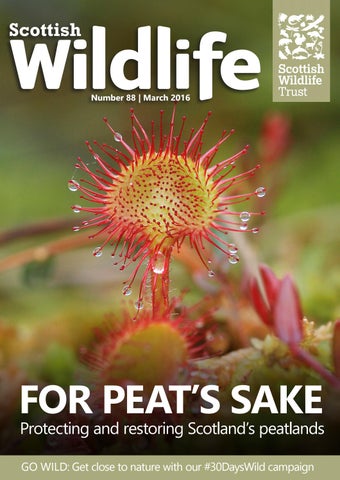
Number 88 | March 2016
FOR PEAT’S SAKE
Protecting and restoring Scotland’s peatlands GO WILD: Get close to nature with our #30DaysWild campaign
Welcome from the Chief Executive
FIRST WORD From Chief Executive, Jonny Hughes
Y
ou’ll notice a couple of changes in this issue of Scottish Wildlife. Our regular feature articles, news, reviews and competitions are all still included, but we have added a new Spotlight section, starting on page 5. In each issue, we’ll use this section to highlight some of Scotland’s most incredible species and habitats, and let you know where to find them. You’ll also find a separate membership survey included. Our members and supporters are the lifeblood of the Trust, which is why your feedback is so important to us. Letting us know your thoughts and opinions will help guide our work and how we communicate this with you. Not only that, but send your completed survey back to us by 1 April and you’ll be in with a chance of winning a luxury break for two in the Loch Lomond and Trossachs National Park. In this issue, we have an extended feature on one of my favourite habitats: peatlands. Despite my love of them, though, peatlands are a liability. I say this because across the planet, peatlands are currently releasing roughly the same amount of greenhouse gases into our atmosphere as the entire global aviation industry. Add in the fact that peatlands cover just 3% of terrestrial land surface and the sheer scale of the contribution that poor land management is making to climate change becomes all too clear. The history of peatland abuse worldwide has sadly also played out in Scotland. We are a particularly boggy country, so have a special
By using nature-based solutions... we can help mitigate the severity and frequency of flooding. responsibility for bringing these evocative habitats back into rude health. The good news is that peatlands are a liability that could, with some political will, be quickly transformed into an asset. We know how to restore peatlands and we increasingly understand the value of the carbon, water, wildlife and landscape benefits that accrue from such restoration. Availability of funds and the willingness of landowners to engage are all we now need to achieve change on a massive scale. The Trust has a long history of bringing back bogs from the brink. Last year I had the opportunity to show the Minister for Environment Aileen McLeod our innovative re-wetting work at Carsegowan Moss Wildlife Reserve, a true fragment of wilderness in Dumfries and Galloway owned and managed by the Trust. You can read about the technique of ‘bunding’ and scrub removal work at Carsegowan, much of which has been carried out by our tireless volunteers, in Rich Rowe’s article on page 18. It will secure a bright future for rare and threatened plants such as bog © Jon Hawkins, surreyhillsphotography.co.uk
rosemary, white-beaked sedge, cranberry and the carnivorous sundew. Carsegowan is one of many sites to have benefited from Scottish Natural Heritage’s Peatland Action Fund. Both Scottish Ministers and Scottish Natural Heritage should be commended for setting up this initiative – though even they would agree that we have a long way to go to fully transform our boggy liabilities into assets for the nation. Of course, there are many other habitats besides peatlands across Scotland that need investment if they are to realise their full potential for supporting communities of both wildlife and people. By working with nature, we can start to tackle many problems facing our environment and society. Take, for example, the recent devastating flooding that has affected thousands of people in Scotland and northern England. By using naturebased solutions such as encouraging forest recovery in the uplands, reducing overgrazing and restoring wetlands, we can help mitigate the severity and frequency of flooding. In a post-climate change world, nature-based solutions will increasingly become a necessity. Yes, they may need to be combined with man-made defences, but until we make our ecosystems more healthy and resilient, these artificial defences will simply continue to fail. Be it peatlands as carbon stores, street trees as air pollution filters, meadows as pollinator havens, forests as sources of endless sustainable materials or well-managed oceans as infinite larders, working with nature in all its wonder and complexity is our only future. MARCH 2016 SCOTTISH WILDLIFE 3
Spotlight
Inside this issue
6
16
SPECIES SPOTLIGHT:
3 5
WELCOME
8
NEWS
From CEO Jonny Hughes
SPOTLIGHT
In this new section we focus on otters and one of their Scottish habitats, freshwater lochs.
EW N
Contents
EURASIAN OTTER (Lutra lutra)
News round-up from the Trust and the world of conservation.
16 FOCUS ON PEATLANDS
Discover the wonderful world of peatlands and how the Trust is leading the way in peatland restoration.
24 #30DAYSWILD
Join us in getting wild this June with our 30 Days Wild campaign.
24
28
28 GREEN INFRASTRUCTURE
David Sim describes what is meant by green infrastructure and why it is becoming increasingly important.
32 WATCH OUT FOR 34 VIEWPOINT
A selection of previews and reviews.
One of our international volunteers tells of her experiences working with the Trust in Dundee.
WIN A LUXURY BREAK FOR TWO IN ARROCHAR
© Margaret Holland
SEE PAGE 33
Scottish Wildlife magazine is published by the Scottish Wildlife Trust. © Scottish Wildlife Trust. No part of this magazine may be reproduced without the express permission of the publisher. All photography © Scottish Wildlife Trust unless otherwise stated. The Scottish Wildlife Trust accepts no liability for omissions or incorrect data in advertisements and letters. Views expressed in Scottish Wildlife are not necessarily those of the Scottish Wildlife Trust. ISSN: 0143 1234. Registered office: Harbourside House, 110 Commercial Street, Edinburgh EH6 6NF. Tel: 0131 312 7765. Fax: 0131 312 8705. Email: enquiries@scottishwildlifetrust.org.uk. Website: scottishwildlifetrust.org.uk. The Scottish Wildlife Trust is a company limited by guarantee, registered in Scotland (no. SC040247). It is also a Scottish registered charity (no. SC005792). Scottish Wildlife is published three times a year: March, July and November.
The Scottish Wildlife Trust is affiliated to The Wildlife Trusts, a UK-wide network of 47 Trusts with more than 2,000 wildlife reserves. 4 SCOTTISH WILDLIFE MARCH 2016
Deadlines for news: 1 January, 1 May, 1 September. No unsolicited articles please. Scottish Wildlife is free to members. Membership rates from 1 April (excluding discounts for paying by Direct Debit): Individual (concession) £33 (£18); Joint (concession) £46 (£24); Family £53 (£48); Watch £18; Life (joint) £800 (£1,200); Senior Citizen Life (joint) £500 (£700). Patron: HRH The Prince Charles, Duke of Rothesay. Chairman: Robin Harper. Vice-Chairs: Jon Barnes, Amanda Forsyth, Karen Chambers. Chief Executive: Jonny Hughes. Editor: Jo Pike editor@scottishwildlifetrust.org.uk. Production Editor: Pete Haskell. Design: Connect connectcommunications.co.uk. Advertising: Elliot Whitehead 0131 561 00212, Clare Stebbing 0131 561 0024. Printing: Inkmark. Cover photo: © Vicky Nall
Primarily a fresh-water species, otters also live along the coast where they hunt in salt water; however, these otters still require regular access to fresh water to clean their fur.
Otters are highly territorial, the size of territories depending on the amount of food available. Droppings, or ‘spraints’, are used as scent messages to mark the edge of territories and are said to smell like jasmine tea!
Otters are one of Scotland’s top predators, feeding predominantly on fish but also eating crabs, frogs, water beetles and occasionally birds.
The early 1960s saw otter populations plummet, but successful restoration of habitats and waterways has led to a significant increase in numbers. They are now no longer considered threatened in Scotland.
The Eurasian otter is the most widespread of the world’s 13 otter species. Its range includes Europe and parts of Asia and Africa.
MARCH 2016 SCOTTISH WILDLIFE 5
Spotlight: freshwater lochs
Spotlight: freshwater lochs
FRESHEN UP
B D
C E
A
RESERVES
A YETHOLM LOCH (Pictured) An important area for breeding and wintering wildfowl, Yetholm Loch Wildlife Reserve on the edge of the Cheviots includes several wetland habitats which attract a variety of wildlife. A path leads to a hide for birdwatching and otter-spotting. B BALGAVIES LOCH
OTTER
KINGFISHER
SNIPE
Sightings may be rare, but for your best chance of spotting otters, visit at dawn or dusk and keep very quiet. Also look out for spraints and paw marks around the edges of lochs.
Kingfishers are territorial so if you’re lucky enough to spot one, stick around for a while and there’s a good chance you’ll see it again.
Relatively stocky waders, snipe can often be seen at the fringes of lochs and on exposed mud banks, where they use their long straight beaks to dig for snails, insects and earthworms.
Balgavies Loch Wildlife Reserve includes a wide range of habitats, from reedbeds and willow carr to wildflower-rich woodland and grassland areas. A haven for red squirrels, breeding songbirds, wintering wildfowl and the occasional osprey, the reserve has wheelchair access from the car park.
C LOCH LIBO
Loch Libo is a long freshwater loch with aspen growing in the shallow waters and a hillside cloaked in mature sycamore and ash woodland. Rare plants such as cowbane, water parsnip and greater tussock-sedge grow along the shore and there are also signs of otters and water voles. The loch attracts waterfowl during the winter months.
AWSINCH AND D B DUDDINGSTON LOCH
The only example of a natural freshwater loch in the city of Edinburgh, Duddingston Loch is an important site for breeding and wintering wildfowl and includes areas of mixed woodland, scrub, grassland and reedbeds. Access to the bird hide on the southern side is by prior arrangement through the Trust’s head office.
E KNOWETOP LOCHS
COMMON DARTER
THREE-SPINED STICKLEBACK
COMMON FROG
A summer and autumn species, the common darter is a type of dragonfly which hunts insects by suddenly darting forward from a hovering position, hence the name.
Measuring between 4-6cm long, this common fish is found throughout Britain and Europe. Despite its name, it can have up to four spines in front of its dorsal fin!
Most active at night, common frogs can be seen in all but the winter months, during which they hibernate. In spring, listen out for the males croaking to attract females.
6 SCOTTISH WILDLIFE MARCH 2016
This reserve includes two small freshwater lochs, separated by a ridge of birch woodland, fringed by reed-swamp, bog and willow scrub. The habitats support otters, water rail, adders, barn owls and pipistrelle bats. Much of the reserve is marshy but a circular path leads between the two lochs. For full reserve information, visit scottishwildlifetrust.org.uk/reserves
MARCH 2016 SCOTTISH WILDLIFE 7
Otter © Margaret Holland; Kingfisher © Jon Hawkins; Snipe © Shutterstock; Common Darter © Shutterstock; Three-spined Stickleback © Jack Perks; Common Frog © Pete Haskell; Main image © Keith Robeson.
With more than 30,000 freshwater lochs in Scotland, these important wildlife habitats can be an exciting place to explore. Ranging from small kettle hole lochans right up to the great expanses of Loch Lomond – the largest freshwater loch by surface area at 71 km2 – these habitats support a vast diversity of wildlife. The flora and fauna that live in a loch depend upon a variety of factors, from the physical dimensions of the loch to the chemical make-up of the water. Here are a few species that regularly frequent freshwater lochs.
Scottish Wildlife Trust news
Help save our bees
Latest news
News from the Trust, our projects and the wider world of conservation
KEEP UP TO DATE
Visit our website for regular news upda tes at scottishwildlife trust.org.uk
©Ronnie Stokes
IN December, the Scottish Wildlife Trust launched a campaign with Buglife Scotland calling on the Scottish Government to permanently ban three types of pesticides from use on outdoor crops in Scotland, as they are known to harm bumblebees, honeybees and other wildlife.
If you don’t have access to the internet, please contact us and we can provide a draft letter for you to To support this use and campaign, visit contact scottishwildlifetrus t. addresses org.uk/savebees for your MSPs.
8 SCOTTISH WILDLIFE MARCH 2016
and capable of acting together to protect red squirrels in the long-term. Project Manager of Saving Scotland’s Red Squirrels, Dr Mel Tonkin, said: “We’re delighted that the Heritage Lottery Fund has given us this support. “People love red squirrels and we want to harness that enthusiasm to get the community involved in their conservation. This grant will give us the chance to share our expertise with a range of people who are passionate about their local red squirrel populations.” Look out for details on how to become involved with the Developing Community Action project on the Saving Scotland’s Red Squirrels website scottishsquirrels.org.uk
Strengthening deer management THE Scottish Wildlife Trust is supporting calls from Michael Russell MSP and Claudia Beamish MSP for deer management in Scotland to be tightened up through the Land Reform Bill. In some areas of Scotland, high deer numbers are causing damage to internationally important habitats, including ancient woodlands and peat bogs.
Deer management by landowners is currently done on a voluntary basis. However, the Rural Affairs, Climate Change and Environment Committee believes this is not tackling the issue and has urged the Scottish Government to consider strengthening the approach to deer management. Michael Russell MSP
said: “The Land Reform Bill contains some provisions on deer management but they do not, in my view, go far enough and I am therefore grateful for the help of the Scottish Wildlife Trust, RSPB Scotland and others in formulating some amendments to start to find an effective way to tackle this serious and growing problem.”
LAST November saw the successful delivery of the second World Forum on Natural Capital. The two-day international event in Edinburgh was organised by the Scottish Wildlife Trust in partnership with the United Nations Environment Programme, International Union for Conservation of Nature, World Business Council for Sustainable Development, Natural Capital Coalition and The Wildlife Trusts. Having brought together nearly 600 business leaders, environmental experts and government representatives from more than 40 countries, the World Forum provided an opportunity to examine the most up-todate developments in the rapidly evolving field of natural capital. Key participants included renowned
entrepreneur Richard Branson; Patron of the Scottish Wildlife Trust HRH Prince Charles; Nicola Sturgeon, First Minister of Scotland, and many other influential figures from across the world. Plenaries and breakout sessions offered insights and case studies demonstrating the economic benefits of protecting and restoring our natural environment. A letter urging world leaders at the COP21 climate talks in Paris to safeguard natural capital was signed by more than 200 key attendees, and sent to the Executive Secretary of the United Nations Framework Convention on Climate Change. To view photos, speakers’ slides and plenary speeches from the 2015 World Forum, visit naturalcapitalforum.com
Green fingers in Cumbernauld THE Cumbernauld Living Landscape has launched a new project thanks to a grant from the Heritage Lottery Fund and North Lanarkshire Council. The project, known as Natural Connections, will focus on working with local schools and communities over the next two years to improve three important wildlife sites in Cumbernauld. MSP for Cumbernauld and Kilsyth, Jamie Hepburn, said: “These great sites are vital for the health and happiness of our communities. The Natural Connections project hopes to bridge the growing disconnect between people and nature in my hometown of Cumbernauld.”
New Perthshire Ranger in post THANKS to funding from both Scottish and Southern Energy and Scottish Wildlife Trust members, Charlotte Fleming has been appointed as our Perthshire Ranger for the next three years. Her role will involve co-ordinating the osprey protection and monitoring work with support from the dedicated Loch of the Lowes volunteers, developing and delivering an education programme, and leading conservation tasks on all of the Trust’s Perthshire wildlife reserves throughout the year.
Trust opposes ship-to-ship oil transfers IN February, the Trust opposed a licence application by the Cromarty Forth Port Authorities to carry out ship-to-ship oil transfers in the Moray Firth. Moray Firth is an important biodiversity hotspot for marine wildlife, known for resident populations of bottlenose dolphins; birds such as osprey, common terns, and redshank; schools of Atlantic salmon; and grey seals that haul out on the local beaches. The proposed
© Harry Hogg
As part of the campaign, we asked you to show your support by writing to your local MSPs to express your concern and we are delighted at the response so far. If you haven’t yet supported the campaign but would like to, there is still time to take action. Please visit our campaign webpage for more information and to email the MSPs that represent you.
A NEW phase within the Saving Scotland’s Red Squirrels project has received initial support from the Heritage Lottery Fund. The project, which has been running for the last seven years, will now focus on developing a network of active voluntary red squirrel conservation groups in key areas of the country. Red squirrels have suffered a severe decline, primarily due to competition and disease from the invasive nonnative grey squirrel. By capturing people’s natural enthusiasm for the charismatic red squirrel, this new phase of the project aims to create communities of volunteers and land managers who are motivated, resourced
THE Trust is pleased to announce that the University of Edinburgh has become the newest partner in the Edinburgh Living Landscape. Hoping to make Edinburgh the best European city to live in by 2050, Edinburgh Living Landscape aims to create a city fit for the future with healthy and beautiful areas that are resilient to climate change, as well as being highly valued and accessible to Edinburgh’s citizens. The University of Edinburgh, along with the City of Edinburgh Council, has already been closely involved in one of Edinburgh Living Landscape’s most exciting projects, the Urban Pollinators Project. By converting patches of grassland to wildflower meadows, the project aims to boost numbers of bees, butterflies and other pollinating insects within the city. This will benefit local beekeepers, food growers and gardeners, while increasing the beauty of Edinburgh’s many parks. The Edinburgh Living Landscape Programme Leader, Dr Maggie Keegan, said: “We are delighted that the University of Edinburgh has formally joined the Edinburgh Living Landscape partnership.”
Trust brings leaders together
© Malcolm Cochrane
Research shows that neonicotinoids persist in the agricultural landscape; reduce bumblebee capacity to provide a pollination service; potentially impact upon soil invertebrates; contaminate wildflowers at arable margins; leach into watercourses; and may lead to a decline in insectivorous birds and butterflies in farmed systems.
Community action for red squirrels
Edinburgh Living Landscape
transfer of up to 8.5 million tonnes of crude oil annually would increase the risk of an oil
spill in the area, which would threaten the delicate ecosystem. Local businesses would
also be affected in the event of a spill. The local wildlife attracts thousands of tourists, contributing at least £4 million a year to the economy. The Scottish Wildlife Trust’s Marine Planning Officer, Dr Samuel Collin, said: “The risks posed by ship-to-ship oil transfers are too great to be acceptable and this application represents a step in the wrong direction for marine conservation.” MARCH 2016 SCOTTISH WILDLIFE 9
Scottish Wildlife Trust news
Scottish Wildlife Trust news
Peatland Code launched
IN BRIEF
THE World Forum on Natural Capital, organised by the Scottish Wildlife Trust with a host of international partners in November, saw the launch of an important mechanism to enable the business community to help fund peatland restoration, thereby helping in the effort to prevent catastrophic climate change. The Peatland Code acts as a corporate responsibility scheme, providing a framework that enables businesses to quantify the carbon benefits of peatland restoration work they fund. For farmers, gamekeepers and land managers such as the Scottish Wildlife Trust, the Code is designed to provide additional income, supporting a wider programme of restoration work than could be achieved through public funds alone. The Code has been developed by the IUCN UK Peatland Programme, which
THE Trust has received more funding from Erasmus+ to place four volunteers within our visitor centres in early March for a one-year period. We look forward to welcoming volunteers from Malta and France to Loch of the Lowes, and from Italy and Hungary to Montrose Basin.
Woodland management
If you are interested in volunteering to help to maintain a reserve, please get in touch with Peter Gilbert on pgilbert@ scottishwildlifetrust.org.uk
Work parties
If you are interested in joining a future work party, please get in touch with Peter Gilbert on pgilbert@scottishwildlifetrust.org.uk
National Members’ Day and AGM THE Trust’s 52nd Annual General Meeting and National Members’ Day will be held on Saturday 24 September at the National Museum of Scotland, Edinburgh. Further details will be included in the next issue of Scottish Wildlife.
10 SCOTTISH WILDLIFE MARCH 2016
SEVEN Shetland cows, part of the Trust’s Flying Flock, can now be found just two miles from Edinburgh’s city centre, grazing a new extension to the Bawsinch & Duddingston Loch Wildlife Reserve. This area of land had not been grazed for more than 10 years and was thick with gorse, brambles and grass, which had displaced the once flowerrich vegetation. After negotiating the reserve extension with Historic Environment Scotland, areas of scrub were cleared by volunteers and new fencing and gates were installed.
The project was made possible by a generous donation from Lothians Conservation Volunteers from a legacy left to them by the reserve’s previous long-serving convenor, Colin McLean. It forms part of the Save Our Magnificent Meadows project – a partnership of 11 organisations led by Plantlife and funded primarily by the Heritage Lottery Fund. The Trust is very grateful to the Holyrood Park Ranger Service for undertaking a daily check of the cattle.
Critically endangered fungus found at Gordon Moss A RARE fungus has been discovered at the Trust’s Gordon Moss Wildlife Reserve in the Scottish Borders. Willow gloves (Hypocreopsis lichenoides), so called as it grows on willow and resembles a tiny hand with gloved fingers clasping a stem, is classified as critically endangered on the Red Data List of Threatened British
Fungi. As willow glove recently disappeared from its only known site in Wales, this makes the population at Gordon Moss extremely important. Sarah-Louise Davies from the Fungus Group of South-East Scotland made the exciting discovery.
More information is available at iucn-ukpeatlandprogramme.org
Flood damage on reserves
© Ron McBeath
THE North of Scotland Reserve Project Group hosted 10 volunteer work parties throughout 2015, with a combined effort of more than 1,120 volunteer hours channelled into some of the finest wild places in the north of Scotland. The volunteer teams contributed to practical projects on Handa Island, Spey Bay, Ben Mor Coigach and Rahoy Hills, carrying out tasks such as woodland management, boardwalk construction, fencing and tree planting. The team would like to thank all those who applied and were involved with these unique opportunities.
Trust’s flying flock restores grasslands
hopes to incorporate additional benefits of peatland restoration in the future, including benefits for wildlife.
DO you have a passion for wildlife conservation? As a diverse and inclusive charity, the Scottish Wildlife Trust is looking for new board members with expertise in nature, conservation, business management and/or philanthropy. To discuss the role or to request a nomination form contact Susan McKenzie, Company Secretary, on 0131 312 7765, or email smckenzie@ scottishwildlifetrust.org.uk Completed nomination forms must be returned by 31 May 2016. Elected Trustees will take office from this year’s AGM (which takes place on Saturday 24 September at the National Museum of Scotland, Edinburgh) for an initial term of three years. The appointment is not remunerated. ©John Wright / Rutland Osprey Project
AN important objective of the Trust’s Spey Bay Wildlife Reserve is to preserve the long-term integrity of native habitats such as the flood plain alder woodland. At the end of last year, a volunteer team carried out some woodland management work to reduce the presence of non-native sycamore trees. The resulting timber was sold locally and the funds obtained used to procure alder saplings to repopulate the area.
©Shutterstock
Overseas volunteers
Wanted – new board members
THE flooding that devastated so many areas over the Christmas period also left its mark on some of our reserves. Footpaths at our Gight Wood Wildlife Reserve in Aberdeenshire suffered significant damage when the River Ythan burst its banks, leaving the footbridge surrounded by floodwater and the path surfaces washed out. The cost of repairs on this reserve alone is likely to exceed £20,000. Fortunately, the floodplain here absorbed a lot of water that would otherwise have exacerbated the damage downstream in Ellon and other settlements, bad though it was. In Keltneyburn, water running off the reserve and surrounding land was considered such a problem that a local resident organised a digger to dig a ditch across the reserve in order to take the flow away from the neighbouring track. Over in Angus, our voluntary Reserve Warden, who has a cottage on the reserve, was cut off when the bridge on the access track was washed away. Thanks to our Dundee Reserve Project Group, a replacement bridge was constructed a few days later. While the rain only lasted a few hours, the clear-up continues, with thousands of pounds having to be raised to repair the damage and many hours of staff and volunteers’ time to ensure the reserves can be reopened.
Scottish osprey spotted in West Africa AN osprey born and tagged on one of the Trust’s reserves near Forfar, Angus, three years ago was spotted in January in Senegal, West Africa. The male osprey, known as Blue YD, was spotted by staff and volunteers from the Leicestershire & Rutland Wildlife Trust, who were visiting as part of their Osprey Flyways Project which aims to educate African school children on the incredible story of osprey migration. During this year’s trip, the team travelled to Lompoul sur Mer, western Senegal, to locate another satellite-tagged female bird from Rutland known as 30(05). It was here, on a 30km stretch of white sandy beach
where around 100 ospreys spend their winters, that the chance encounter with Blue YD took place. Jonathan Pinnick, Assistant Manager at the Scottish Wildlife Trust’s Loch of the Lowes Visitor Centre, which is worldfamous for its ospreys, said: “It’s wonderful to learn more about the life of a bird that we have followed since it was a fledgling and it shows the value of tagging in allowing us to track the life history of individual birds. Perhaps he will be spotted back in Angus this summer, hopefully breeding and helping the continued recovery of the osprey population in Scotland.”
MARCH 2016 SCOTTISH WILDLIFE 11
Scottish Wildlife Trust news
People’s Postcode Lottery Peregrine Watch THIS year, our People’s Postcode Lottery Peregrine Watch at the Trust’s Falls of Clyde Wildlife Reserve will begin on Sunday 20 March after a launch event the previous day. Follow the clues on the peregrine trail through the woods to our manned Peregrine Watch site, where telescopes will be available to view wild peregrine falcons nesting on the side of the gorge. For more information, please consult our Events and Activities booklet or call the Falls of Clyde Visitor Centre on 01555 665262.
Spring weather and the importance of live food BREEDING in Britain is a risky business due to our changeable spring weather. Birds have the animal kingdom’s highest body temperature and use up much of their fat reserves overnight keeping warm. Adults must consume up to 30% of their bodyweight in food every day to maintain themselves, and growing nestlings need even more sustenance. Birds’ biggest enemy in bad weather is starvation, not cold. The chicks of most garden birds need live food in order to survive. Insects provide an unbeatable combination of protein, fat, minerals and moisture. The moisture element is crucial as birds can only give their young liquids through food. Even seed-eating specialists such as greenfinches and goldfinches feed insects to their broods, while remaining strict vegetarians themselves. Supplementary feeding is therefore particularly worthwhile in the breeding season. Live mealworms (darkling beetle larvae) are an excellent choice, boasting 48% protein, 40% fat and with a high moisture
12 SCOTTISH WILDLIFE MARCH 2016
content. Vine House Farm’s extensive range of bird care products includes both live mealworms and feeders. A percentage of income from every order (for any product) is given to your local Wildlife Trust and if it’s your first purchase, Vine House Farm will send an extra £5.
Over the last six years more than £1 million has been donated in this way to The Wildlife Trusts. This money isn’t added to Vine House Farm’s prices but simply taken from their profits. By buying from Vine House Farm you might be helping wildlife more than you think.
Wider news
AT THE end of October, Atlantic puffins were among four UK bird species that the International Union for Conservation of Nature (IUCN) added to its Red List of Threatened Species. Although there are still approximately 580,000 breeding pairs of puffins in Britain, this number is half that of the 1970s and the population continues to decline. Reduced food availability, pollution and climate change are at the root of the problem, and this muchloved and iconic species is now listed as ‘vulnerable to extinction’. Turtle doves, Slavonian grebes and pochards were also listed for the first time. ©James Lowen
New visitor programme on Eigg
Aberdeen Wildlife Watch A NEW Wildlife Watch group has got off to a great start in Aberdeen. The group, in conjunction with Aberdeen Local Group, launched in January and kicked off with a Saturday beach clean and a Sunday drop in session for families, where they made seed bombs and bird feeders. In February, the group built nest boxes, and they now look forward to an action packed spring and summer full of activities such as adder spotting, soil science and dolphin watching! Full programme details available in our Events and Activities booklet. 14 SCOTTISH WILDLIFE MARCH 2016
Calling all young birders THE Scottish Ornithologists’ Club (SOC) has launched its search for another six promising young birdwatchers to take part in this year’s Young Birders’ Training Course – a joint project between the SOC and the Isle of May Bird Observatory Trust. Open to individuals aged 16-25 years, the successful applicants will spend a week in July on the Isle of May gaining invaluable practical skills in a wide range of bird survey techniques. Participants will be able to draw on the talents and knowledge of highly experienced bird ringers, researchers and surveyors, while also having the
opportunity to learn more about the island’s cultural history. The deadline for completed applications is 5pm on Monday 2 May 2016. For more information, please visit the SOC website the-soc.org.uk
STUDY the strand line of any Scottish beach and it’s likely that you’ll find plastic cotton bud sticks among the seaweed. Due to their size, cotton bud sticks are rarely captured by sewage treatment, so those that are flushed down the toilet instead of being put into a bin will regularly find their way into the sea and onto beaches. One UK water company estimates that 100,000 cotton buds are flushed through its system every week. In Scotland, 13,500 sticks were recorded from a single 100m stretch of beach, and researchers have found them in the stomachs of fulmars and loggerhead turtles. East Lothian-based charity, Fidra, which runs The Great Nurdle Hunt, is soon to launch The Cotton Bud Project. Working with manufacturers and retailers, they are calling on companies to move away from using plastic sticks and instead use biodegradable alternatives such as paper.
If someone is trying to find out who owns a property, they can search this register. However, it can sometimes be difficult to find the answer if the property does not have a postal address that appears on a recent deed on the register and the person searching does not know the details of any previous deeds which transferred ownership of the property.
Correction: A news article in the previous issue of Scottish Wildlife incorrectly suggested that the SOC “operated from 1986 to 2009”. It was their publication, Scottish Bird News, which finished in 2009, not the organisation, which is now in its 80th year of operation.
Cotton buds littering Scotland’s beaches
For more information, visit fidra.org.uk and keep watch for The Cotton Bud Project’s dedicated website.
Voluntary Registration of Land - why bother? Back in 1979 the Land Register was established by the Land Registration (Scotland) Act. By 1981, the Land Register was up and running and land registration began to replace the recording of deeds in the Sasine Register. Established in 1617, the Sasine Register is one of the world’s oldest public property registers and is a chronological register of deeds.
© David Jones
EARTH Connections Eco Centre on the Isle of Eigg is offering a new experience for visitors this summer. From May, visitors will be able to book an Eco-break package at a date of their choosing to learn about a wide range of subjects. Wildlife watching, yoga, cycling, beekeeping and gardening are all on offer and the Earth Connections team will endeavour to make up a programme that suits each visitor. To enquire about available dates, please contact Earth Connections Eco Centre on 01687 482495. Further information can also be found at: earthconnections.co.uk
© Samuel Hood
Puffins under threat
In contrast, the Land Register is an Ordnance Survey map based public register of interests in land which allows questions as to land ownership to be answered based on a map based search. Since 2002 this can be accessed online through Registers Direct for a relatively small fee, making the information easily accessible to the public. Land registration results in the production of a Land Certificate or Title Sheet which incorporates a red lined plan showing the extent of the property owned - all backed up by a state indemnity. Land registration was introduced gradually as different counties became operational and it took 12 years for the Land Register to become fully operational in all counties across Scotland. Prior to the Land Registration (Scotland Act) 2012 (which came into force at the end of 2014) the
main route to land registration arose when a property was transferred for value. However, the 2012 Act widens the triggers for compulsory land registration to include any transfer of title even where no price is being paid. Although we have been using the Land Register for over 20 years, by 2014 the Land Register was reported to comprise 1.5 million titles, representing only 58% of all potential property titles in Scotland and 26% of Scotland’s land mass. In the interests of transparency and to permit the public easily to ascertain who owns what, it is generally seen as a good idea for all properties to be on the Land Register. As such, in May 2014, the Scottish Government confirmed that they had asked the Registers of Scotland to complete Land Registration in Scotland within 10 years. To achieve this stated aim, given the fact that not all unregistered land will change hands over that relatively short period, a central part to this will be voluntary land registration. So what might the task of voluntary registration involve and what are the benefits to the landowner? In an ideal case, a non land registered title might comprise one deed in favour of the current owner, with a clear red lined OS based plan attached to it. However, in many other cases there might be a whole jigsaw of different parcels of land that make up the overall title, acquired on different dates, with other deeds referred to for title conditions. For good measure, the extent of the property might be based on a written description with boundary measurements or even reference to who owned the adjoining property two hundred years previously!
Because the land registration process involves plotting the extent of the property on the OS map, a prerequisite to this is that there is an adequate narrative description or a plan to enable this to be done. It needs to be ascertained whether the property can be identified, whether the boundaries correspond with the physical features defined on the current OS map and whether there is any competition with existing registered titles. This can sometimes result in remedial conveyancing and/ or a new plan being required. As well as the cost of reviewing and submitting the titles, a fee is also payable to the Registers based on the valuation of the property. What then are the benefits of applying for a voluntary registration? Registered titles are guaranteed (with some exceptions) by the state. When you sell or transfer your property the buyer can be certain of its ownership and this, in theory, should make for a more straightforward transaction. A major attraction for estate owners is the opportunity to confirm the extent and nature of their ownership and identify any title problems which could be remedied for the future. As registration provides a clear and reliable statement of the boundaries of a property, the potential for boundary disputes is also hopefully reduced. Finally, the costs of registration in the future are expected to rise. Acting now could save you money in the future.
For further information and advice on the voluntary registration of land please contact Laura Moore on 0131 247 1000
Focus on peatlands
Focus on peatlands
NATURE’S GIFT Peatlands are a habitat for many exciting and rare species. They also provide a range of vital services that help sustain our economy and improve our quality of life. But how much do you know about peatlands?
Peatland
/ˈpiːtland/ noun. plural: peatlands
An area of land in which waterlogging prevents the complete decomposition of dead plant material. This un-decomposed plant material steadily accumulates as a thickness of peat, the presence of which is the defining feature of a peatland.
DRAINAGE AND CONVERSION TO FARMLAND
They store They help to slow thousands of the flow tonnes of carbon, of water preventing over land, the release WHY ARE reducing of CO2 HEALTHY flooding into the risk in PEATLANDS atmosphere. lowland IMPORTANT? areas.
IUCN UK Peatland Programme
WHY ARE PEATLANDS UNDER THREAT?
IN THE UK, MORE THAN 80% OF ALL PEATLANDS HAVE BEEN DAMAGED. THIS IS PRIMARILY DUE TO:
...BUT YOU CAN HELP Amateur gardeners account for 58% of peat use – choose a peat-free alternative next time you’re buying compost!
They provide us with high-quality drinking water.
ROUNDLEAVED SUNDEWS are carnivorous plants which grow among Sphagnum moss. Sticky dewlike drops glisten from the tips of the sundew’s red tendrils, attracting and catching passing insects.
© Shutterstock
COMMON LIZARDS can be spotted basking on peatlands during the summer months. Did you know that these lizards give birth to live young?
WETLAND WORDS
With so many different words associated with peatlands, it’s easy to get bogged down! Here are a few of the more common words and their definitions: © James Lowen
© Margaret Halland
GOLDEN PLOVER and other wading birds such as CURLEW and DUNLIN nest on peatlands during the summer months, where there is an abundance of insects to feed on.
© Pete Matthews
© Scottish Wildlife Trust
16 SCOTTISH WILDLIFE MARCH 2016
© Pete Matthews
ADDERS thrive in peatlands, where their black-brown diamond markings ensure they are well camouflaged. Britain’s only venomous snakes, they feed primarily on small mammals and birds.
SPHAGNUM MOSSES are the building blocks of a peatland. Able to hold a huge volume of water, they form dense and colourful carpets across the peat, which help it stay waterlogged.
FERTILISATION OF PEAT SOILS
DID YOU KNOW?
WHAT LIVES ON PEATLANDS? CRANBERRIES can be found growing wild on healthy peatlands where the acidic soil and plentiful water supply provide the perfect conditions for this low-lying shrub.
PEAT EXTRACTION FOR HORTICULTURAL USE
MIRE
A wetland that supports peat-forming vegetation. There are two main types of mire: bogs and fens.
BOG
A distinct wetland type which is waterlogged only by direct rainfall.
BLANKET BOG
A bog habitat where deep deposits of peat blanket the hilly landscape. Primarily in the uplands.
RAISED BOG
A bog habitat characterised by an accumulation of peat that rises above the surrounding landscape. Primarily in the lowlands on wet floodplains.
FEN
A mire which receives water from surface runoff and/or groundwater in addition to rainfall.
CARR (AKA BOG WOODLAND)
A waterlogged woodland. Alder, birch and willow are usually the main types of tree present.
OVER 1.6 BILLION TONNES OF CARBON ARE STORED IN SCOTTISH PEATLANDS –
THAT’S A THIRD OF THE CARBON HELD IN THE AMAZON RAINFOREST DESPITE BEING 250 TIMES SMALLER IN AREA
Peatlands act as a natural filter
70% of our UK
DRINKING WATER comes from peatlands PEAT FORMS AT A RATE OF JUST
1MM PER YEAR
VAST PEATLAND LANDSCAPES HAVE TAKEN THOUSANDS OF YEARS TO FORM
MARCH 2016 SCOTTISH WILDLIFE 17
Focus on peatlands
Focus on peatlands
FOR PEAT’S SAKE F
18 SCOTTISH WILDLIFE MARCH 2016
many having suffered the ill-effects of decades of burning, grazing, peatextraction, tree-planting and drainage for agriculture. Cander Moss, which sits alongside the M74 near Larkhall, is a classic example of a lowland raised bog that no longer functions as it should. A site that has been in Trust care since the 1990s, much of the restoration work here to date has been relatively small-scale: volunteers have installed dams to raise water levels – essential for the process of active peat formation – while areas of encroaching scrub and small trees have been cut and removed. But that work ramped up considerably last year when, with funding from the Scottish Government’s National Peatland Plan (resources targeted specifically at positive peatland management), the Trust was able to clear a large and established pine plantation on
It’s a messy, invasive job, but a necessary one to ensure that the peat bog recovers... the western edge of the site that was having a drying effect on the peat bog. “Trees draw water out of peat bogs and in this case, the edge of the peatland had dried out to the extent that it had wasted away by a foot or so,” explains Steve Blow, the Trust’s Reserves Manager for South Scotland. “It was so dry that there was no longer any peat-forming vegetation beneath the pines.”
BIG PICTURE
© Damian Waters Drumimages.co.uk
or now, it looks far from pretty, but the work taking place on Cander Moss Wildlife Reserve in South Lanarkshire – the felling, clearing and use of a technique known as ‘bunding’ – is an essential part of restoring vital natural processes to what is a particularly fragile type of environment. As living, breathing organisms (on the surface at least), healthy peat bogs are the ultimate ecosystem service providers: capturing and storing vast amounts of carbon; retaining and purifying water; even increasing our resilience to climate change. A fully-functioning peat bog is a natural wonder – a waterlogged world of Sphagnum mosses, bog rosemary, cotton grass, sundew and cranberry that is home to a host of birds, insects, mammals, reptiles and amphibians. Sadly, there are very few untouched areas of peatland left in the country, with
© Montgomeryshire Wildlife Trust
The Trust’s long history of campaigning to protect Scottish peatlands is matched by extensive on-the-ground efforts to restore this most vulnerable, and valuable, of habitats, writes Rich Rowe.
Specialist forestry machinery was used to fell and extract around 500 tonnes of pine, plus another 300 tonnes of birch and brash. “With the peat being so deep – up to seven metres in places – we had to lay a mat of brash for the extraction machinery to work on, and then remove as much of the brash as possible afterwards,” says Steve. The final stage, now under way, involves the creation of a network of cell ‘bunds’ to hold water on the bog. It’s a messy, invasive job, but a necessary one to ensure that the peat bog recovers from the top down. The technique involves using an excavator to dig down and bring up black, waterlogged peat which is then used to construct a vertical wall of healthy peat up to two metres from top to bottom. The wall projects about 15cm above the ground, with the top covered in vegetation to prevent it from drying out. “Each cell bund forms a physical barrier within the bog,” explains Steve. “Although still permeable, the water flows through much more slowly, with each bund creating a connection with the good condition peat below.” It’s a technique that has been used to good effect elsewhere, including at the Trust’s Carsegowan Moss Wildlife Reserve on the Solway Coast. The work, which took place in January last year, saw the building of a two-kilometre-long linear bund along three sides of the reserve, with additional cells to keep water in the core areas of the site. “Carsegowan is already noticeably wetter, so the bunds are working,” explains Steve. Back at Cander Moss, it should take about four weeks to work on the roughly four-hectare area where the trees once stood. Cander will then serve as a demonstration project for land managers, highlighting how such work can help the recovery of damaged peatland. In all, the Trust manages some 235ha of raised peat bogs at nine reserves around the country. As Alan Anderson, the Trust’s Head of Reserves, explains, all are either in favourable condition or are recovering due to ongoing management work. “In other words, as long as we continue to undertake practical conservation work, they should improve to such an extent that they function as active peat-building bogs,” he says. At the core of that work is the restoration of fully-functioning ecosystems – creating MARCH 2016 SCOTTISH WILDLIFE 19
Focus on peatlands
Focus on peatlands
© Pete Matthews
© Scottish Wildlife Trust
much to clear scrub and birch, put in small dams and erect large A-frame dams – some of which had to be airlifted in by helicopter last year. But not all of the Trust’s peatland work is on quite the same scale. At Longridge Moss in West Lothian, Trust volunteers have installed a series of small dams across old drainage ditches using recycled plastic piling – relatively simple work that has raised water levels and made a real difference to the peat surface. “We have regular volunteer groups from Dalkeith and Grangemouth, plus a range of corporate volunteers – from banks to property management companies,” explains Julian Warman, the Trust’s South East Scotland Reserves Manager. “The corporate days out are a good opportunity to highlight the importance of peatland to a different audience.” And the moss here also has help
from another source. During the winter, livestock from neighbouring farms graze the area, removing unwanted scrub that could contribute to the drying out of the bog. In spring, the sheep and cattle come off and the area is left wild and ungrazed. “It can be quite colourful with the yellow of bog asphodel and red cranberry nestled amongst the flowers and fruits of other plants,” explains Julian. Elsewhere, at Red Moss of Balerno, the Trust recently replaced a 700-metre long circular boardwalk that enables thousands of visitors each year to get up close and personal with what is Edinburgh’s only raised peat bog. “It’s in a great spot on a main route into the Pentland Hills, close to Threipmuir Reservoir,” says Julian. “The walkway, which is wheelchair accessible, includes excellent information for visitors, so it’s a great showcase for
why we should care about maintaining healthy areas of peatland.” But the Trust is well aware that peatland restoration is a long-term job. While it is relatively quick and easy to produce physical change on the surface of a peat bog by raising the water table, actual regeneration of the peat beneath takes rather longer. At some sites, the layers of peat have taken almost 10,000 years to accumulate, but have been degraded over a fraction of that time. “We are working with just a remnant of what once existed,” says Steve Blow. “We can make the surface wet again very quickly, but it will take a long time to return the depth of peat that was there before. It’s our job to help it along the way as much as we can.” Rich Rowe is a freelance outdoors writer based in Innerleithen, Scottish Borders.
Dams have been installed at Cander Moss to raise water levels
20 SCOTTISH WILDLIFE MARCH 2016
By taking action now, we have the opportunity to deliver one of the great environmental outcomes of our time... Programme recently launched the Peatland Code – a new initiative aimed at attracting businesses to join in with public investment in restoring peatlands. “Through action now, we have the opportunity to deliver one of the great environmental outcomes of our time, avoiding the huge imposed costs of leaving our peatlands damaged and allowing future generations the pleasure of these natural wonders,” explains Clifton.
SHOW AND TELL
The Trust’s hands-on work not only helps to restore degraded areas of peatland, but also helps highlight and share best practice conservation methods. At Red Moss of Netherley –
a 100ha reserve in Aberdeenshire that sees a wonderful mosaic of fen, marsh and open pools – the Trust works with the European Voluntary Service to host volunteers who spend a year learning about managing a range of habitats and undertaking practical conservation training. “We currently have volunteers from France, Spain and Greece working with us,” explains Rab Potter, Reserves Manager for North East Scotland. “It’s a big help having them for a whole year, as it provides real continuity. It’s also a great learning opportunity for them.” The work performed by overseas volunteers ties in with the considerable efforts of local teams such as the Dundee Reserves Project Group, which has done
© Norman Russell
conditions that enable the many native plants and animals that rely on such wetland habitat to thrive. But it’s also a task with global implications, for while healthy peatland actively absorbs vast amounts of carbon, damaged and dried out peat oxidises and releases that carbon into the atmosphere. It’s essentially a stark choice between having a valuable, long-term carbon sink or a source of greenhouse gases. “At the global scale, our peatland reserves capture and store thousands of tonnes of carbon, and by maintaining the anaerobic conditions, combined with vegetation cover, we prevent the release of CO2 that would contribute to global warming,” explains Alan. Fortunately, says Clifton Bain, Director of the International Union for Conservation of Nature’s UK Peatland Programme, chaired and hosted by the Scottish Wildlife Trust, we are entering an era where the value of healthy peatlands is much better recognised. For its part, the IUCN UK Peatland
MARCH 2016 SCOTTISH WILDLIFE 21
Focus on peatlands
Q&A
Clifton Bain, IUCN UK Peatland Programme
Protecting our peatlands C
lifton Bain is the Director of the IUCN UK Peatland Programme, hosted by the Scottish Wildlife Trust. His favourite fact about peatlands is that the commercially extracted peat we use in our gardens was probably forming when the Vikings were in Scotland! What are the main threats to Scotland’s peatlands and what can be done to help? Peatlands face new threats from building developments such as windfarms and housing schemes, as well as from industrial mining for horticultural peat. However, the main issue for peatlands is the huge scale of past damage from drainage for agriculture and forestry. Although this is no longer permitted, this has left a legacy of more than 80% of our peatlands now in a damaged and deteriorating state. What support has the Scottish Government given towards peatland restoration? It has shown a lead as one of the first countries in the world to commit to peatland conservation and restoration as part of its climate change efforts. It has also led the way with a National Plan for Peatlands and dedicated new funding to pay for peatland restoration.
22 SCOTTISH WILDLIFE MARCH 2016
What are the key challenges for peatland restoration? While we need to ensure that the public recognise that peatlands are more valuable in their healthy state, the urgent challenge facing us is to restore damaged peatlands and conserve them. Public funds alone will not achieve this, which is why the Peatland Code was developed by the programme to help secure additional private sector funding to help meet the target to restore (or have under conservation management) one million hectares of peatland by 2020. What are the climate benefits of peatland restoration? Peatland restoration helps tackle climate
© Emma Goodyer
What progress in peatland restoration has been achieved so far? Since the IUCN UK Peatland Programme was formed in 2009, there has been tremendous progress, with the range and extent of peatland restoration having increased dramatically over the last few years. Scottish Government funding through the Peatland Action scheme run by Scottish Natural Heritage has seen £8 million in new funding since 2012 and has delivered almost 8600ha of peatland restoration. In addition, there have been
major restoration programmes such as those funded by the Heritage Lottery Fund and EU Life aimed at restoring peatlands, including the Flow Country – one of the world’s largest blanket bogs.
change by reducing the greenhouse gas emissions that come from damaged peatlands. For example, by restoring 100ha of peatland, the greenhouse gas savings after 30 years are 22,000 tonnes. This is equivalent to removing the annual emissions from 12,000 cars. If we restored 100,000ha of damaged peatlands, the greenhouse gas savings after 30 years would be equivalent to 40% of Scotland’s total annual greenhouse gas emissions. What can members of the general public do to support Scotland’s peatland restoration? Get to know your local peatland, especially those managed as nature reserves. There may be volunteering opportunities to help with restoring the peatland or recording wildlife. If you are a gardener, always try to use peat-free alternatives and encourage your local garden supplier to stock them.
It can take thousands of years for a peatland to develop
#30DaysWild
#30DaysWild
WILD Fall for nature DAY 1
Can you do something wild every day for 30 days in June? 30 Days Wild is a campaign which challenges you to do something wild every day in June. That’s 30 days and 30 random acts of wildness! Author and naturalist James Lowen suggests four exciting days out at some of our finest locations. From wooded waterfalls to towering cliffs, from a converted industrial wasteland to a remote moorland wilderness, the Trust’s 120 reserves offer ample opportunity for wildlife adventure. Why not try one each weekend during your June of #30dayswild?
24 SCOTTISH WILDLIFE MARCH 2016
FANCY watching the intimate family life of the world’s fastest bird (peregrine) followed by an audience with one of Britain’s most elusive mammals (badger)? If so, Falls of Clyde is the place to be. The famous linns of Dundaff, Corra and Bonnington have attracted visitors for centuries – yet it is increasingly the wildlife of the River Clyde’s gorges and ancient woodlands that commands attention. Since the 1950s, when pesticides weakened eggshells and populations crashed, Britain’s peregrines have resurged. Viewpoints over nests are now widespread, but between March and July, none offers closer views than here. Follow the peregrine trail through stunning deciduous forest to the seasonal watchpoint, then gawp as the falcons preen, feed and call.
When the show abates, search for woodland wildflowers. Common cow-wheat flourishes near the watchpoint; golden saxifrage, water avens and yellow pimpernel decorate the boardwalk; and wood sorrel and common spotted orchid dot the floor throughout the forest. While your eyes are cast downwards, test your prowess as a nature detective. Can you spot real-life clues that betray the presence of badgers? Snuffle holes, trees scratched bare at their base and ‘badgerways’ (paths used by generations) provide unequivocal evidence that Brock lives here. But where? Find out by joining a ranger for a ‘Luxury Badger Safari’. The highlight is an opportunity to view these much-loved mammals amble around their sett. How can you not fall for this brilliant woodland reserve?
life Jupiter Urban Wild
Centre
Urban oasis
Test your prowess as a nature detective. Can you spot real-life clues that betray the presence of badgers?
AS a saucer-eyed child looks on, a hedgehog snuffles in scrub at the Scottish Wildlife Trust’s Jupiter Urban Wildlife Centre. It is amazing that child, creature and reserve are here at all. In the 1990s, Jupiter rose phoenix-like from the ashes of Grangemouth’s industrial wastelands to become Scotland’s most vibrant urban nature oasis. There is no better place to introduce children (or your own inner child) to wildlife wonders. A path winds through woodlands and meadows, connecting ponds with demonstration gardens. Jupiter lets you get your hands dirty exploring nature (via organised events such as ‘Spiderman(ia)’ and ‘Pondemonium’ plus self-led activities) and inspires you with the art of the possible (‘upcycling’ waste materials such as tyres to create wildlife-rich habitats in tiny spaces). There are willow sculptures to admire, benches on which to rest and even a barbecue on which to cook up a feast.
WILD DAY 2
That’s if the kids will let you. More likely, their competitive edge will be sharpened by the chance to earn – appropriately – Jupiter’s Hedgehog Award. For each of eight activities completed, participants receive a hedgehog sticker. A clean sweep gets them a personalised certificate. So bring (or borrow) a child to indulge in pond-dipping (can you net ramshorn snail or palmate newt?), revel in mini-beasting (turn over logs to reveal devil’s coach-horse) and play wildflower bingo (yellow flag iris is obvious, but can you spy northern marsh orchid?). And keep an eye out for that hedgehog...
MARCH 2016 SCOTTISH WILDLIFE 25
#30DaysWild
#30DaysWild
WILD DAY 3
Huffin’ and puffin THE memory of Longhaven Cliffs’ industrial past is fainter than at Jupiter, as pool-filled quarries and the dismantled railway fade into history. This leaves centre-stage for Longhaven’s seabird city. Scotland hosts Europe’s most scintillating breeding colonies of winged wanderers that otherwise spend the year at the mercy of marine elements. A hike along Longhaven’s granite cliffs enables you to insinuate yourself into a soap opera in which guillemots, razorbills, kittiwakes and puffins vie for star billing. Longhaven is not for the fainthearted, demanding tough climbs and descents before you peer over steep cliffs. But the payback is immense. A seabird colony assaults the senses: a wall of sound and a sight for sore eyes.
Across jagged stacks, arches and promontories, you can witness loving and courtship, foraging and feeding, bickering and chuntering.
Look closely to differentiate the participants. Kittiwakes are delicate gulls with wingtips dipped in ink. Razorbills are blacker than guillemots, with stouter bills. Puffins are... unmistakable! Suited and booted, with a riot of colour for a beak and a teardrop for an eye. As you follow an auk tearing from cliff face to sea, scan the swell for marine mammals. Bottlenose dolphin pods flank the coast in search of shoals of fish. Common seals lounge on rocks or loll offshore. Finally, peruse the ground beneath your feet. Flowers – devil’sbit scabious, red campion, thrift and more – drift along slopes towards the cliff edge. Can you discern a full rainbow of colours in Longhaven’s floral palette?
WILD DAY 4
Monarch of the Ben RESPECT to the postmen who once served Achiltibuie village, north west of Ullapool. Before the community joined the road network, delivering letters obliged intrepid messengers to negotiate six miles of rugged and remote terrain. The route followed has become known as the Postman’s Path and hems the coastline below the 743m high, table-shaped mountain of Ben Mor Coigach. This reserve is the Scottish Wildlife Trust’s largest, with 5,000ha of stony peaks, moorland slopes, hair-raising coastline and crofts. Visiting it is nearer an expedition than an adventure, as the ‘path’ is notoriously sheer, boggy, crumbling and indistinct. But with long June days at your disposal, you will have time to tread carefully and
navigate diligently. The rewards make the effort worthwhile. The scenery, both coastwards and inland, is spectacular. On a fine day, the Hebrides etch themselves onto the western horizon. And there are ample creatures, great and small. Red deer hinds and calves trot across the fells, and you may chance upon non-breeding stags gathering energies for autumn’s rut. Wheatears flit from rock to rock, white bottoms bobbing. Along the shoreline, ringed plover and oystercatcher scurry. In waters beyond, look for eider, black guillemot and divers. Golden-ringed dragonflies – menacingly hooped in yellow and black – patrol streams. A variety of upland
plantlife exploits the reserve’s panoply of niches. Lochans harbour bog bean and water horsetail, while mires host round-leaved sundew and butterwort. Crowberry and Alpine lady’s-mantle grow on the tops, and roseroot clings to crags. Above them all soars a golden eagle, surveying its domain. Magical.
#30DAYSWILD, MADE EASY Not every Scottish Wildlife Trust member can criss-cross Scotland for their #30DaysWild. But nor do you need to. Here are 30 suggestions that anyone can do, regardless of age, location or ability. 1. ROLL A LOG TO FIND A CREEPIE-CRAWLIE. 2. HUG A TREE. 3. SKETCH A BIRD, STARTING WITH OVALS FOR BODY AND HEAD.
22. WATCH A SPIDER SPIN A WEB. 23. MAKE A PINE-CONE ANIMAL. 5. COUNT A TREE’S RINGS TO DETERMINE ITS AGE. 24. CONVERT A PLATE INTO A BIRDBATH. 6. FIND A FLOWER AND COUNT DIFFERENT TYPES OF BEE. 7. GO NIGHTWALKING (EQUIPPED WITH WARM CLOTHING AND A TORCH).
26. SIT BY A WINDOW, AND HAVE A RAINDROP RACE. 27. WIGGLE YOUR TOES IN A CHILLY STREAM...
9. TRACE ANTS’ MEANDERINGS ONTO PAPER. 28. ...OR GO FOR A WILD SWIM! 10. SNIFF FIVE FLOWERS AND DESCRIBE THEIR SCENT. 11. GENTLY SHAKE A BUSH TO DISLODGE BUGS. 12. MAKE AN OWL CALL WITH YOUR HANDS.
29. CLIMB A TREE. 30. VISIT YOUR NEAREST SCOTTISH WILDLIFE TRUST RESERVE: NINE IN EVERY TEN PEOPLE IN SCOTLAND LIVE WITHIN TEN MILES OF ONE.
13. MAKE LEAF BUNTING, PEGGING LEAVES TO TWINE. 14. WATCH A WILDLIFE WEBCAM, FOR EXAMPLE ON THE TRUST’S WEBSITE. 15. FOLLOW A SNAIL TRAIL.
18. MAKE A LEAF RUBBING.
26 SCOTTISH WILDLIFE MARCH 2016
25. EXPLORE UNDERWATER BY POND-DIPPING OR ROCK-POOLING.
8. HAVE FORTY WINKS... OUTSIDE.
17. COUNT HOW MANY BIRDS YOU SEE IN 15 MINUTES.
Until 30 September 2016, Bradt Travel Guides is offering Scottish Wildlife Trust members a special discount of 20% on James Lowen’s books 52 Wildlife Weekends and A Summer of British Wildlife. Visit bradtguides.com and enter discount code SWT at the checkout.
21. FOLLOW A BUMBLEBEE FROM PLANT TO PLANT.
4. FIND SHAPES IN CLOUDS.
16. SOAK ROPE IN WARMED RED WINE AND SUGAR TO ATTRACT MOTHS.
MEMBER OFFER
20. PLAY BIRD-BEHAVIOUR BINGO: CAN YOU SEE BIRDS DRINKING, EATING, FLYING, PREENING...?
Sign up this April to take on the 30 Days Wild challenge. For more information on how to get involved with 30 Days Wild and details on how to sign up, simply visit: scottishwildlifetrust.org.uk/30DaysWild
19. GO BEACH-COMBING AFTER A STORM. Remember never to leave children unattended where there are risks, including open water. Provided you assess all risks carefully, you will reap the rewards!
MARCH 2016 SCOTTISH WILDLIFE 27
Green infrastructure
Green infrastructure
With more than 81% of Scots living in urban areas, green infrastructure is more important than ever, writes David Sim.
A
s an architect and urbanist who works with city planning all over the world, I might seem an unlikely contributor to Scottish Wildlife. But if we are going to talk about nature, then people are part of the picture – and my job requires working with human habitat, which is almost always urban. When asked what makes the foundation for human wellbeing, again and again I find myself chanting: “fresh air, exercise and meeting people”. Green spaces in and around the human habitat are vital for good physical and
mental health and, with half the world living in urban environments, planning green infrastructure is becoming ever more important. So what do we mean by green infrastructure? Is it the green colour on a plan? Post-war development in Scotland had plenty of that – usually it just means grass. Grass is better than tarmac but only just. What always worries me is that the green colour on a map or a plan doesn’t necessarily translate into diversity of wildlife or meaningful places for people to spend their time.
For me, green infrastructure means inter-connected natural environments, respecting, protecting and supporting flora and fauna, water and the ground itself. My interest is connecting people to these environments. I have learned that to make things work well, you have to understand the environment from the point of view of the people who use it – not the logic of engineering, the art of the architecture, the rules of economics or even the wisdom of the ecologist. Too often, by missing the human dimension, well-intentioned, Wasteland can provide a valuable habitat for flora and fauna
28 SCOTTISH WILDLIFE MARCH 2016
carefully planned and heavily funded projects and policies have failed. While working on An Camas Mor, the planned community in the Cairngorms National Park, I heard the expression “living with the weather”. This has really stuck with me – and it makes sense on every level, from dressing appropriately (“no such thing as bad weather…”) to surviving climate change. If we are to be good neighbours with nature, we have to spend more time experiencing the outdoors, learning to know our climate better, literally living with the weather. Spending time outdoors having encounters with nature – from meeting a red squirrel face-to-face or seeing a blue tit on your window-sill, to eating wild berries, paddling in a burn or enjoying the awe-inspiring panorama of a mountain – is vital because nature is not just something you look at. There are smells and sounds, things to touch and sometimes even things to taste. You don’t get this inside a house or inside a car. This may sound incredibly obvious but so much of the new built environment – homes, institutions and workplaces – is orientated to staying indoors or in vehicles. Modern retail parks allow people to spend a whole day of shopping, eating and entertainment without setting a foot outdoors. Even hospitals, which exist to promote human healing and well-being, often have no real
Horizontal gardens maximise available space
©Giancarlo Liguori / Shutterstock.com
Green Infrastructure: the foundation of human well-being?
Louvre shutters and French windows in Barcelona, Spain. Room temperatures are easily controlled with different combinations of windows, doors and shutters.
Bird Boxes in Malmo, Sweden. Bird boxes provide much needed nesting space for birds and are a reminder of the city’s other residents.
Street trees in Melbourne, Australia. Trees improve air quality and provide pedestrians with protection from the sun and wind as well as providing a habitat for birds, insects and mammals.
Green infrastructure means inter-connected natural environments, respecting, protecting and supporting flora and fauna, water and the ground itself. relation to the surrounding landscape and no places for patients and staff to encounter or engage with nature. Sealed windows look onto dreary inner courtyards rather than opening onto the living environment outside. And this is despite all the evidence that contact with nature speeds up the healing process. In designing the people environment to better connect to the natural one, a balcony or a French window might be the start, or verandas and porches on houses, encouraging people to get closer to nature even at
home. Designing for walkability is important too: encouraging people to start the day with a pleasant stroll from their front door, perhaps along a tree-lined street with hedges rather than fences. If we can think more about green as a threedimensional phenomenon, not just surfaces, that would be a significant step. A quiet place to wait for the bus could give a momentary connection to one’s surroundings. A really great place for the kids to hang out and play could challenge and inspire them to connect with nature.
At the same time, I think we can plan for more joinedup houses, sometimes with smaller gardens, narrower streets and smaller public spaces – all using less land but, thanks to a better micro-climate (with smaller spaces better protected from the wind), encouraging walking and spending time outdoors. And at a bigger scale this protects the greater (unbuilt) landscape from unnecessary sprawl. Most planned projects can be divided into what I would call “hardware” (all the
physical stuff that gets done at the start to make the place) and “software”. By this I mean what happens after the place has been made – the maintenance, the education, the behaviour of the users – in fact everything to do with the culture of living in and using places. I think generally we spend too much time and effort on the hardware and not enough time on the software. David Sim is Creative Director at Gehl Architects in Copenhagen, Denmark. MARCH 2016 SCOTTISH WILDLIFE 29
Wildlife gardening
BY MARTIN GEORGE, WILDLIFE ADVISER AT CJ WILDLIFE
Springing
INTO ACTION Looking after the wildlife in your garden in the warmer months.
S
pring is a time of change in many ways – the days get longer, the temperatures become warmer and new growth and life can be seen all around. The things that we can do for our garden wildlife also changes. Here are some of our top tips to keep in mind over the coming months.
you can go one better and equip such an area with a hedgehog house to keep them safe. Other things to look out for include making sure potential traps such as cattle grids or step-sided ponds have a simple escape ramp or rigid netting to help any hedgehogs escape if they fall in.
Planting for butterflies
Feeding the birds can be particularly important in spring when seed-eating species struggle to find food. By providing a reliable supply of good quality food mixes, ones that are rich in sunflower hearts or black sunflower seeds, we can help the adult birds feed their youngsters, before feeding themselves.
A butterfly-friendly garden needs two types of plants: food plants for caterpillars and nectar plants for adults. Caterpillars feed on a variety of plants, with stinging nettles being a particular favourite for species such as comma, peacock, red admiral and small tortoiseshell. When the first insects emerge in spring they urgently need to find food, which is why early flowering plants are so important. Try to have a succession of plants coming into flower from early spring right through to late autumn.
Food for hedgehogs
Good quality hedgehog food, along with a clean source of water, can be a big help to hedgehogs when refuelling after hibernation and preparing to breed. Providing a reliable source of food can encourage them to visit your garden regularly and a good incentive is that whilst there, they will often eat lots of slugs.
Shelter for hedgehogs
A quiet, undisturbed corner in which hedgehogs can build their nests is another fairly simple way to help. Or
Continue to feed birds
Start to provide mealworms
Mealworms are a year-round favourite with birds such as robins but a surprising range of other species, including house sparrows and hedgehogs, will benefit from them during the warmer months. Blackbirds and song thrushes find mealworms particularly helpful if there is a period of prolonged dry weather when earthworms become hard to find.
Long grass
Have some long grass in a damp area, ideally close to a pond, to provide a safe feeding area for amphibians and hedgehogs. Long grass also provides a great feeding area for birds such as house sparrows, which will search among the grass for insects to feed to their young.
Bat boxes
Bats readily take to bat boxes. Simply find a quiet location that gets at least some full sunlight during the day, is sheltered from strong winds and has a clear flightpath in. If you need more encouragement, then consider that a single pipistrelle, one of 17 species that breed in the UK, can eat 3,000 midges in a single night!
Bird boxes
Many of our common garden birds would naturally nest in cavities in dead trees. However, that sort of nest site is understandably not very common in gardens. A well-designed nest box can be a big improvement on a natural site and with the breeding season nearly upon us, now is a great time to add some to your garden. Put nest boxes up by late March for the best chance of having occupants this year, although some species with long breeding seasons may use boxes that are put up as late as July. As well as helping the birds, it can be fascinating watching them carry nesting material in and then, after a pause while the eggs are incubated, start to make ever more frequent feeding trips until the young birds finally leave the nest, filling the garden with their calls. Some species may have two or more broods of youngsters over the spring and summer, and the box will go on to earn its keep in autumn and winter as the birds will often use nest boxes as a safe roosting site. Siting is fairly straightforward: just find a north-facing spot that is protected from driving wind. Most birds prefer a clear flight path to the entrance and a position that is free from disturbance; siting the box at least two to five metres above ground will lift the nesting birds above most human activity. Robins and wrens prefer open-fronted nest boxes in well-hidden locations, such as behind a thorny climber. Avoid locations such as on top of a fence which would be too accessible for cats and squirrels, and then it’s just a case of watching to see who moves in! For more information or to order and receive a 10% discount, please visit www. birdfood.co.uk/scottishwildlifetrust16 or call 0800 731 2820. Deliveries to mainland UK, including Highlands and Islands, are £3.25 each or free on all orders over £25. MARCH 2016 SCOTTISH WILDLIFE 31
Watch out for
Watch out for
Watch out for Some wildlife highlights to enjoy over the coming months Television
Highlands - Scotland’s Wild Heart April on BBC Two This fantastic new four-part series will treat viewers to a beautiful portrait of life in the Highlands. Due to start on BBC Two in mid-April, it follows the course of the seasons over a wild year in the Highlands, revealing how the animals and people of this stunning part of the world manage to turn adversity to their advantage and make a real success living there. Three years in the making, the team, which includes Scottish Wildlife Trust Ambassador and award-winning cameraman Gordon Buchanan, filmed for more than 300 days across the full gamut of Scottish weather. The series, which is narrated by Ewan McGregor, captures some of the most iconic Highland wildlife – red and roe deer, seals, orca, red squirrels, golden eagles and many more make show-stopping appearances in what is set to be one of the most spectacular Scottish wildlife series ever made.
To enter our prize draw, simply fill in and return the membership survey which was included with this magazine. Send your completed membership survey to: Scottish Wildlife Trust, Harbourside House, 110 Commercial Street, Edinburgh EH6 6NF. Alternatively you can complete the survey online at scottishwildlifetrust.org.uk/2016survey. Surveys must be received by midnight on 1 April 2016 for inclusion in the prize draw. Subject to availability and nontransferable. Terms and conditions apply and are available on request.
by Richard Bardgett ISBN: 9780199668564 RRP £18.99
2 OC 0
· CO
Richard Bardgett discusses soil and the many, sometimes surprising, ways humanity has depended on it throughout history, and analyses the role soil plays in our lives, despite increasing urbanisation. Bardgett considers how superior soil management could combat global issues such as climate change, food shortages, and the extinction of species. Looking ahead, he argues that it is vital for the future of humanity to halt soil degradation, and to put in place policies for the future sustainable management of soils.
Our Water Based Stains have all the advantages of oil base stains: they spread easily, can be repaired, can be blended effortlessly, and have plenty of open time. The thicker formula allows controlled penetration, which will reduce blotching on hard-tostain woods such as Oak, Pine and Maple. This stain formula will make wood staining an enjoyable experience for you. Use Natural W.B. Wood Stain (clear finish) if you need to pre-seal the wood. Available in: Natural and 15 colours. 10
Festival as our special guests demonstrate how everyday life relies on a healthy natural environment. Through a series of discussions, debates and team challenges, you will discover how seemingly unrelated things are actually connected. Can you link red squirrels to algae? Beavers to chewing gum? Prepare to be surprised, intrigued and entertained. Join in the fun, and see if you can make any natural connections on Thursday 31 March. To find out more visit: sciencefestival.co.uk
Water Based Wood Stain
NT · V
Thursday 31 March – 17.30-18.30 – Anatomy Lecture Theatre – Summerhall – Edinburgh
Earth Matters: How soil underlies civilisation
MPLI E
Natural Connections
32 SCOTTISH WILDLIFE MARCH 2016
T
he Arrochar Hotel is situated in a truly picturesque location at the foot of the Arrochar Alps, overlooking the shores of Loch Long and sat at the fringes of the western Highlands. The hotel is an ideal base for walking and touring around the area. Loch Lomond is located just two miles away, offering an array of water activities and beautiful loch-side walks. If it’s Munro-bagging that you’re after, Beinn Narnain, Ben Ime, Ben Vane and Ben Vorlich are all close by. The hotel has 76 comfortable en-suite bedrooms that offer stunning views. The hotel’s Loch View Restaurant is a perfect place to enjoy breakfast and dinner and perhaps one of the Scottish evenings that they regularly host. Less than an hour from Glasgow, this is the perfect place to relax and enjoy wonderful hospitality and incredible views.
Reading
Science Festival
Join us on an entertaining voyage of discovery at this year’s Edinburgh International Science
Competition
Also: Sanding Sealer, Dye Stain, Glaze Effects, Milk Paint, High Performance & VAR Top Coats, Pre-Cat Urethane, Enduro Lacquer, Conversion Varnish, Wood Turners Finish, Ready To Match (RTM) System, Pro Floor System, Exterior 450 Stains and Top Coats. Unit 13, Peffermill Parc, 25 King’s Haugh, Edinburgh, EH16 5UY www.generalfinishes.co.uk
Tel: +44 131 661 5553 MARCH 2016 SCOTTISH WILDLIFE 33
Viewpoint
Viewpoint Your stories from around Scotland
WE’RE INTERE ALWAYS STE YOUR O PINIOND IN OBSER VATIOSNAND S
Spea Twitte k to us on Faceb r: @ScotWild ook: f life scottish acebook.com / or ema wildlifetrust il us: e nqu @scott ishwild iries org.uk life.
THE VIEW FROM...
VASILIKI MAKRI, EVS VOLUNTEER
I’D like to tell you about the adventures and discoveries of five European Voluntary Service (EVS) volunteers in Dundee. But first, let me tell you something about EVS. EVS is a Europe-wide project that has been running for the last 20 years, offering financial support to people aged 18-30 years old to volunteer in a country other than their own for up to 12 months. It aims to enhance the employability skills of young people and motivate them to travel in Europe in order to broaden their horizons. It is with this programme that two Spaniards, two Greeks (including myself) and one person from France ended up in Dundee for a year to volunteer at the local Scottish Wildlife Trust Wildlife Reserves. The reasons we became involved differ for each of us, but one thing that we all have in common is our love of wildlife. Personally, I have volunteered for nature for many years in my country and since I was young I have been in love with Scotland: its music, food and culture. Additionally, the opportunity to volunteer with an organisation as dynamic and active as the Scottish Wildlife Trust was attractive, since its activities span the whole of Scotland and focus on many different themes
34 SCOTTISH WILDLIFE MARCH 2016
(woodland management, invasive species control, education and many more). So, what do we actually do as conservation volunteers? A typical day starts by going to the office, where we find out the task of the day. Luckily there are many reserves to visit, so we can explore new places each week such as Seaton Cliffs, Red Moss of Netherley, Loch of the Lowes, Montrose Basin and many others. Each one of them is quite different but equally beautiful. And then the work starts! All the work is manual and can be very technical. We build new bridges and take apart old ones, cut down trees and build dams in order to increase the amount of water and re-establish peatlands, teach schoolchildren how to plant trees, repair
anything at the local visitor centres, control invasive plant species and visit areas in order to monitor any changes. All this would be quite daunting, especially for five foreign volunteers, if it wasn’t for the great atmosphere and attitude of the team and the Scottish Wildlife Trust staff. In the beginning, when we didn’t even know the names of the tools, everyone was patient and helpful and taught us how to use tools, like axes and chainsaws, safely. They also showed us the city, and taught us the basics of kilt-wearing and Scottish speaking. Not only did they make the ups and downs of cultural transition much easier, they also made it a lot of fun. All in all, it’s going to be a very interesting year here in Dundee.
the UK • 8 Stores across 75 years • Established for cing • Competitive pri ge & advice • Expert knowled service • Award winning
nwide io t a n s e r o t s : it Vis uk . o c . o t o h p l a c . w Click: ww 000 5 3 0 0 3 3 3 0 : l l a C