Number 86 | August 2015
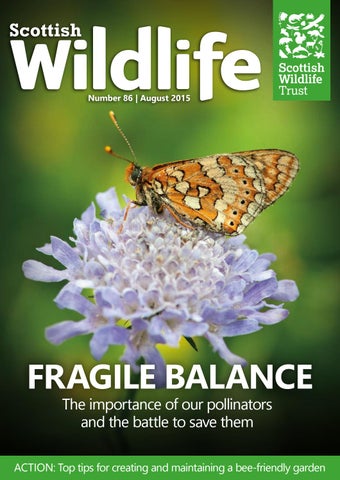
FRAGILE BALANCE The importance of our pollinators and the battle to save them
ACTION: Top tips for creating and maintaining a bee-friendly garden
Welcome
Inside this issue FEATURES 18
21
28
13
THE BATTLE FOR OUR BEES
18
MAGNIFICENT MEADOWS
21
IN OUR HANDS
As the EU-wide moratorium on neonicotinoids comes to an end in December, Richard Rowe reports on the urgent need to protect our pollinators from pesticides. A UK-wide project to preserve wildflower meadows will see £110,000 injected into the Trust’s careful management of these meadows in the Central Belt and Fife.
Buglife’s Conservation Director, Craig Macadam, tells of his work on the front line to protect invertebrates from the multitude of threats they face.
28 ANNUAL GENERAL MEETING
Book now for the AGM on 19 September at New Lanark. Lunch after the meeting will be followed by a visit to the Falls of Clyde Wildlife Reserve.
REGULARS 4
4
10
24
LATEST NEWS News round-up from the Trust and our partnership projects.
24 Q&A
Evie Murray from Leith Community Crops in Pots answers questions.
26 TOP SPOTS
A selection of suggested reserves to explore around the country.
26
31
31 VIEWPOINT
WELCOME Jonny Hughes, Chief Executive
Over 80% of the world’s flowering plants could not reproduce without pollinators and around one third of all the food we eat is dependent on pollinators. And yet this gentle army faces enormous pressures, from the cornucopia of chemicals present in our food chains to ongoing habitat loss. Pollinators are a great example of the critical ‘natural capital’ on which humankind depends and yet so often takes for granted. Losing pollinators would be an economic, humanitarian and environmental disaster and yet we still indiscriminately use high-risk pesticides such as neonicotinoids on our crops and in our gardens (neonicotinoids are freely available in most garden centres).
So let us allow a hundred million flowers to bloom. There is still time to reverse declines in bees and wild pollinators, whether it’s sowing WIN native wildflower seeds in our READING A R gardens and window boxes, LIST BREAELAXING campaigning for the stricter IN TH K FOR T A selection of WO ES regulation of pesticides, or books – including BORDCOTTISH advocating to Government E R Brian Moss’ study of S SEE P AGE that it makes better use of the the inland waterways 33 £2.5 billion in subsidies which of the UK. will be given to Scottish farmers between now and 2019. Trustee Tim Duffy talks about his cycling challenge.
32
Scottish Wildlife magazine is published by the Scottish Wildlife Trust. © Scottish Wildlife Trust. No part of this magazine may be reproduced without the express permission of the publisher. All photography © Scottish Wildlife Trust unless otherwise stated. The Scottish Wildlife Trust accepts no liability for omissions or incorrect data in advertisements and letters. Views expressed in Scottish Wildlife are not necessarily those of the Scottish Wildlife Trust. ISSN: 0143 1234. Registered office: Harbourside House, 110 Commercial Street, Edinburgh EH6 6NF. Tel: 0131 312 7765. Fax: 0131 312 8705. Email: enquiries@scottishwildlifetrust.org.uk. Website: scottishwildlifetrust.org.uk. The Scottish Wildlife Trust is a company limited by guarantee, registered in Scotland (no. SC040247). It is also a Scottish registered charity (no. SC005792).
Scottish Wildlife is published three times a year: March, August and November. Deadlines for news and letters: 1 January, 1 June, 1 September. No unsolicited articles please. Scottish Wildlife is free to members. Membership rates from 1 April (excluding discounts for paying by Direct Debit): Individual (concession) £33 (£18); Joint (concession) £46 (£24); Family £53 (£48); Watch £18; Life (joint) £800 (£1,200); Senior Citizen Life (joint) £500 (£700). Patron: HRH The Prince Charles, Duke of Rothesay. Chairman: Robin Harper. Vice-Chairs: Jon Barnes, Amanda Forsyth. Chief Executive: Jonny Hughes. Editor: Jo Pike editor@scottishwildlifetrust.org.uk. Production Editor: Pete Haskell. Design: Connect Publications (Scotland) Ltd connectcommunications.co.uk Advertising: Elliot Whitehead 0131 561 0020, Clare Stebbing 0131 561 0024. Printing: Inkmark. Cover photo: Adrian Davies.
The Scottish Wildlife Trust is affiliated to The Wildlife Trusts, a UK-wide network of 47 Trusts with more than 2,000 wildlife reserves. AUGUST 2015 SCOTTISH WILDLIFE 3
ALAN ANDERSON Head of Reserves
Wildlife matters
However, pollinators are not all bees; hoverflies, butterflies, moths and other insects also ensure that pollen is moved around the crops in the fields, the trees in the woods and flowers in our gardens. Without them, not only would we lose the hardest workers in the animal kingdom but we, as just one tiny part of that kingdom, would struggle to feed ourselves. Yet, as agriculture and urbanisation have expanded to satisfy a growing population, the pollinators have decreased through the loss of natural habitats: grasslands, forest and wetlands. In our own little corner of the world, the Scottish Wildlife Trust is working hard to maintain and expand pollinator-rich wildflower grassland reserves, such as those in highland Perthshire, the Lothians and Fife, the latter grazed by our own sheep and cattle. Further west in Ayrshire our colourful meadows are being supplemented by the Nectar Network, a series of new habitat creation projects linking wildflower areas on our Clyde Coast reserves with new ones on neighbouring land such as golf courses and factory ground. This is providing corridors for bees, hoverflies and a host of other native species. As a Trust supporter, you can directly help bees and butterflies by volunteering on our wildflower reserves. To find out more, please contact Peter Gilbert at pgilbert@ scottishwildlifetrust. org.uk
Find out which of our reserves are great for pollinator spotting on page 26-27
4 SCOTTISH WILDLIFE AUGUST 2015
Latest news
News from the Trust, our projects and the wider world of conservation
All the latest Trust news is available on our website: scottishwildlife trust.org.uk
From left to right – Chris West , Colin Bean, Roisin Campbell-Palmer, Karen Taylor, Minister for Environment, Climate Change and Land Reform Dr Aileen Mcleod, Simon Jones, Phillipa McKee
Minister visits beaver trial T
he Minister for Environment, Climate Change and Land Reform, Dr Aileen McLeod, visited the Scottish Beaver Trial in May for the first time to learn more about the project ahead of a decision on the future of beavers in Scotland. The visit allowed Dr McLeod to meet staff involved in the trial – along with representatives from local businesses, Forestry Commission Scotland and Scottish Natural Heritage – to hear more about beavers and the trial’s impact on the local area. The five-year scientific monitoring period of the trial, in which the Trust was one of two lead partners and which was overseen by Scottish Natural
Heritage, came to an end in May 2014. Scottish Ministers will decide later this year on whether to allow beavers to remain in Scotland and if wider reintroductions will take place. The decision will take into account the results of the Scottish Beaver Trial, findings from the Tayside Beaver Study Group and a consideration of European experiences. Following presentation of the final report on the Scottish Beaver Trial to the Minister on 12 June, the Scottish Wildlife Trust joined forces with a wide-ranging group of conservation organisations to write to Dr McLeod, calling for beaver reintroductions to be supported by the Scottish Government.
Green network upgrade in Cumbernauld THE Cumbernauld Living Landscape is going from strength to strength and has recently seen commitment of over £500,000 to improve the town’s green network. With the support of a wide range of funders, the Trust’s woodland reserves
in and around the town will be improved and made more accessible. This work will be complemented by the activities of a newly appointed Community Engagement Officer, Tracy Lambert, who will work with young people to improve local wildlife sites.
© Roisin Campbell-Palmer
HIGH summer is the time to see pollinators at their most industrious. From dawn to dusk the bee rarely rests, moving from flower to flower, making the most of the available bounty before the first frosts of the autumn. Essentially the bee is a taxi taking its pollen passengers between destinations; some get off at one flower, some fly on to the next.
KEEP UP TO DATE
Scottish Wildlife Trust news
Call to ban cull of mountain hares T he Trust is working with a group of nine other high-profile wildlife and conservation organisations to call on the Scottish Government to impose a three-year ban on all mountain hare culling on grouse moors until safeguards are in place to inform sustainable management, and to meet our international conservation obligations. The mountain hare is Britain’s only native hare and plays a vital part in the complex ecosystem of Scotland’s uplands and moorlands, including acting as an important source of prey for golden eagles, one of Scotland’s most iconic birds. Mountain hares are often found in good numbers on grouse moors with their large expanses of heather and are protected against
indiscriminate methods of killing under the European Union’s Habitats Directive. The Scottish Government has a legal duty to maintain the mountain hare population in a state of good health. However, mountain hares are now routinely culled on a large scale on many grouse moors in Scotland. This practice has developed relatively recently in the belief that it protects red grouse
Hydro scheme objection THE Trust has objected to an application for construction of a hydro-electric scheme within the An Teallach Site of Special Scientific Interest in the north west Highlands. The development would have impacts on the upland plant assemblage for which the site is designated and could also potentially affect oceanic bryophyte and lichen populations in the gorge habitat. Living Landscapes Policy Officer John McTague said: “The Trust supports small-scale hydro developments as part of Scotland’s energy portfolio, but this location is completely unsuitable. “Site of Special Scientific Interests are designated as examples of some of the country’s best wildlife sites. They are not appropriate locations for projects involving excavations and track construction on this scale.”
against the tick-borne louping ill virus, despite the lack of scientific evidence to support this claim. Last December, Scottish Natural Heritage (SNH), along with other partners, announced a three-year study to trial methods of measuring mountain hare numbers to better inform the assessment of their population status, as well as the identification of any appropriate management measures. As part of this, SNH called for a voluntary restraint of large-scale mountain hare culls on grouse moors. In response to this call for a moratorium, the Scottish Government has also promised to take action on culling associated with grouse moor management that leads to negative impacts on the viability of mountain hare populations.
RSPB Scotland has joined the pioneering Saving Scotland’s Red Squirrels project to help save the red squirrel from extinction. The project has been running for five years, led by the Scottish Wildlife Trust along with Scottish Natural Heritage, Forestry Commission Scotland, Scottish Land & Estates, and the Red Squirrel Survival Trust. The red squirrel is the UK’s only native squirrel and numbers have declined rapidly since the introduction of greys from North America in the 19th Century. Since 1952, 95% of red squirrels in England and Wales have been wiped out. Today, 75% of the UK’s population is found in Scotland. Greys still threaten the existence of the native reds because they compete for food and habitat, and transmit the deadly squirrel pox virus. Many thanks to the Deeside Knitwits for donating a fantastic knitted red squirrel (left) to raise funds for the Saving Scotland’s Red Squirrels project.
© Steve Willis
RSPB joins fight to save Scotland’s red squirrels
If you would like to get involved as a Planning Volunteer, please contact John McTague on 0131 312 4771 or email jmctague@ scottishwildlifetrust.org.uk
World Forum on Natural Capital WE are pleased to confirm that Professor Dieter Helm, Chair of the Natural Capital Committee, will be among the speakers at the second World Forum on Natural Capital in Edinburgh this November. Since participating in the inaugural event, Professor Helm has continued to champion the importance of natural capital and has recently published a new book, Natural Capital: Valuing the Planet. The Trust is working with international partners to organise this event in order to promote better decisionmaking for biodiversity. For more information on the event, please visit naturalcapitalforum.com AUGUST 2015 SCOTTISH WILDLIFE 5
Scottish Wildlife Trust news
© Scottish Wildlife Trust
IN BRIEF Wildcat Action conservation team © Pete Cairns, Northshots
THE new team to support conservation action for Scottish wildcat populations has set to work. Led by Dr Roo Campbell, the team is made up of four Project Officers (Matt Wilson, Keri Langridge, Emma Rawling and Hebe Carus) and a Communications Co-ordinator (Vicky MacDonald), who is based at the Scottish Wildlife Trust.
Wild camping challenge WILDLIFE enthusiast Cerys Trayner has started her yearlong camping challenge to raise funds for the Trust. Over the next year, Cerys is giving up home comforts as she braves the wilderness of Scotland. Keep up to date with her journey by following her on Twitter – @CerysTrayner – or by reading her blog: wildlandwildplaces. wordpress.com.
Woodland planting funds VIRIDOR have funded habitat improvements at the Upper Nethan Gorge Wildlife Reserve, where we have planted more than 4,000 new trees. The area was semi-improved pasture, but will now be enhanced to act as a buffer to the existing woodland, which is part of the Clyde Valley Woodlands Special Area of Conservation.
Peat extraction debate IN May, peat extraction for horticulture was the subject of a Members’ Debate in the Scottish Parliament. A motion was submitted by Rob Gibson MSP, and the Trust provided a briefing to all supporters, explaining why we would like to see commercial
water purification) and the consequent need to conserve this rare habitat from commercial peat extraction for horticulture. You can read the Trust’s policy on peat extraction and horticulture on the Policy & Campaigns section of the website.
Book now for pink-footed geese events EVERYONE who lives in and around Montrose knows that autumn has arrived when they hear the tell-tale trumpeting sound of thousands of pinkfooted geese flying overhead. It makes for a spectacular sight, as wave upon wave fly over the centre and land in the Basin. Last year, there were a record-breaking 79,970 geese by mid-October. The best way to see this spectacle is through one of Montrose Basin Visitor
Centre’s special events tailored to giving the public the best possible experience of viewing the geese. Check out the events booklet for more information on our People’s Postcode Lottery Goose Breakfast and Pink Sunset events this October. Booking is essential and charges apply. Please contact Emma Castle-Smith to register your interest at montrosebasin@ scottishwildlifetrust.org.uk
Big news about a small butterfly
© Jim Black 6 SCOTTISH WILDLIFE AUGUST 2015
peat extraction for horticultural purposes phased out. There was wide recognition in the debate of the exceptional value of lowland raised bogs to biodiversity, as well as the ecosystem services they provide (such as carbon storage and
THE small blue butterfly is flying in Ayrshire again after a 33-year hiatus. This rare and elusive species became locally extinct in the 1980s. Volunteers worked hard to boost the quantity of its caterpillar’s only food plant, kidney vetch, on the Trust’s Gailes Marsh reserve and adjacent golf courses. This culminated in the release of
30 small blues in 2013. None were seen the following year, which raised concerns that breeding had been unsuccessful, but they have since been spotted on many occasions in 2015. The future of this diminutive butterfly in Ayrshire is now assured thanks to a partnership project of businesses and golf courses championing the small blue.
Scottish Wildlife Trust news
The benefits of nature
T
o help increase the public’s understanding of nature as our life support system, the Trust has led a pioneering Scottish pilot project to map the ‘services’ nature provides. The project involves a geographic information system toolkit – called EcoServ – that produces grid-based maps showing ‘hot spots’ of ecosystem services. The toolkit also maps the capacity of the natural environment to produce
specific ecosystem services and the societal need for these. The maps are overlaid to demonstrate where capacity and need coincide and where gaps exist. Nine services are currently mapped by the toolkit: accessible nature, education, green travel, pollination, noise regulation, local climate regulation and carbon storage, as well as water and air purification. The toolkit was initially developed in Durham with funding from The Wildlife
Ayrshire volunteer support
THANKS to generous support from the William Grant Foundation, we have a new Community Engagement Officer in Ayrshire, Harry Richards. Harry has been recruiting volunteers, organising dozens of work days, managing habitat and running public events throughout the summer. You can contact Harry at hrichards@scottishwildlifetrust.org.uk.
Trusts and has been adapted to work with Scottish data and trialled over North Lanarkshire. Working with the Seven Lochs Wetland Park and relevant local authorities, maps have been produced for North Lanarkshire and Glasgow. A detailed illustrated case study has been produced for Cumbernauld to demonstrate the mapping process and results. This will shortly be available on the Cumbernauld Living Landscape website. This pilot was run in partnership with the Scottish Environment Protection Agency, Scottish Natural Heritage, North Lanarkshire Council, and Glasgow and Clyde Valley Green Network. For more information, please email Jonathan Winn: jwinn@ scottishwildlifetrust.org.uk
IN BRIEF Wildflower meadows blooming PARTNERS in the Edinburgh Living Landscape have been undertaking work to benefit people and wildlife across the city. The City of Edinburgh Council is creating wildflower meadows, which will provide beautiful displays of colour as well as benefiting bees and other pollinators. Meanwhile, Edinburgh and Lothians Greenspace Trust has launched the Tree Time project, which aims to get local businesses to sponsor the planting of large, prominent street trees as well as creating new urban woodlands. The Scottish Wildlife Trust is also working on a toolkit to help decision-makers assess the quality of green infrastructure in new and existing developments. Follow Edinburgh Living Landscape on Twitter @EdinLandscape or search ‘Edinburgh Living Landscape’ on Facebook.
Summer internships OUR summer volunteer interns started in June and July. We have recruited eight volunteers for three months at Cumbernauld, Falls of Clyde, Montrose Basin and Loch of the Lowes. The range of roles includes Landscape Architect, Volunteer Ranger, Community Outreach Assistant and Visitor Centre Assistant.
50 for the Future Falls of Clyde viewpoint restored AS part of the Clyde and Avon Valley Landscape Partnership Project, the historic viewpoint beside Corra Linn has
been restored to provide the closest views of this spectacular waterfall. Closed earlier this year when loose stonework was
identified, funding from the Heritage Lottery Fund and the South Lanarkshire Renewables Energy Fund has allowed the damaged section to be repaired and all stonework repointed.
RESPONSES to the Trust’s ‘50 for the Future’ survey have been collated and presented to the Conservation Committee. The finished document will be available to members at the Annual Members’ Day following the 51st Annual General Meeting on 19 September in New Lanark.
© Scottish Wildlife Trust AUGUST 2015 SCOTTISH WILDLIFE 7
Scottish Wildlife Trust news
Closures at reserve for tree felling THE next phase of woodland restructuring at Falls of Clyde is planned for this autumn, when several hundred conifer trees will be felled and extracted from a number of locations throughout the reserve. This creates new gaps in the tree canopy to allow the native broadleaved species to expand and diversify the woodland habitat. Some temporary path closures will be necessary to ensure public safety, but these will be kept as short as possible to minimise the impact on visitors. Please keep an eye on the reserve webpage for updates.
New Jupiter garden team AFTER the incredible makeover in the Wildlife Gardens at Jupiter Urban Wildlife Centre, officially opened in 2014 by Angus MacDonald MSP, a new volunteer team has been established to keep the gardens looking their best. Volunteers will be upcycling the Rubbish Garden by transforming old tyres and pallets into planters, whilst in the Buzzing Back Gardens, tasks will include planting vegetables and looking after a vertical flowerbed.
Boost for Living Seas THE Trust is set to step up its efforts to achieving ‘Living Seas’ around Scotland thanks to the support of the Esmée Fairbairn Foundation. Two new projects will allow the Trust to champion wildlife in the emerging marine planning system in Scotland, and promote marine conservation in the seas of the north west Highlands.
8 SCOTTISH WILDLIFE AUGUST 2015
© Paul Naylor
IN BRIEF
Maerl survey informs MPA decision P
roposals to protect some of Scotland’s most important seabed habitats from potentially damaging fishing methods have been announced by the Scottish Government. Under the draft legislation published in June many Marine Protected Areas (MPAs) will be closed to scallop dredging and will limit trawling to safeguard fragile underwater ecosystems such as cold water coral reefs and flame shell beds. One such area, known as the Wester Ross MPA, covers the seas off Ben Mor Coigach, the largest of the Trust’s 120 wildlife reserves, and the Summer Isles archipelago. Justification for wider management in MPAs was
aided by a Trust survey of the Wester Ross MPA, which used an underwater camera system to capture video evidence of locally known but undocumented maerl beds. Living Seas Communities Officer, Noel Hawkins, said: “It’s great to see that the Trust-supported survey has contributed to improved management in the Wester Ross MPA. The success of any MPA relies on the local involvement and support that is clearly evident here, and although there is a great deal of local interest at the moment, there has also been concern over the effectiveness of their management. “The Trust and other local groups now want to see these
strong plans for legal protection from damaging fishing methods get the backing of the Scottish Parliament to ensure the MPA is allowed to become one that benefits the environment and those who live, work and visit here.” The activity of fishing in MPAs was subject to a consultation by the Scottish Government last winter that prompted thousands to call for more ambitious management of protected areas in Scottish seas. In addition to Wester Ross, draft legislation covers the Loch Sunart to Sound of Jura, Small Isles and South Arran MPAs. The new measures will come into effect later this year.
Wildlife Watch groups enjoy new kit LAST year, the Trust secured a £10,000 grant from Awards for All to support Wildlife Watch clubs. St Andrews Wildlife Watch, known as Wild Things, has now used its portion of the grant to buy a camera trap, which has become their favourite piece of equipment. During a recent ‘Bioblitz’, the camera captured footage of badgers, a mouse and moths. The group is currently trying to get footage of more night visitors to their local pond.
High Banton School Wildlife Watch group used its Awards for All money to
take the entire school on wildlife canal cruises. The pupils netted minibeasts and observed them before releasing them back into the wild. A new Wildlife Watch group has also started at Inverewe Gardens in the Highlands in collaboration with the National Trust for Scotland, which runs the gardens. This takes the number of joint clubs to three, with the others in Newhailes and Lochalsh.
Scottish Wildlife Trust news
Osprey legacy at Lowes T
© Scottish Wildlife Trust
he Trust was delighted to welcome the arrival of a new female osprey at its Loch of the Lowes Wildlife Reserve, near Dunkeld, in March. Wildlife enthusiasts from around the world had been patiently waiting to see if the celebrated female osprey, affectionately known by many as the ‘Lady of the Loch’, would return for what would have been her 25th year at the site. Sadly, she did not. However, on 1 April a young female osprey appeared in the nest at Loch of the Lowes. She subsequently pair-bonded with the resident male and laid three eggs, which all hatched successfully. The Trust is continuing the satellite tracking programme this year following the tagging of two of the new chicks. The chicks, once fledged, will begin their long migration to western Africa. You can follow their progress on our website at: scottishwildlifetrust.org.uk
Positive response to nature campaign AS part of a campaign led by The Wildlife Trusts (of which the Scottish Wildlife Trust is a member), we encouraged supporters to take action in May to ensure that the European Union’s ‘Nature Directives’ are not weakened as part of the EU’s REFIT process, in which
European legislation is evaluated. The Birds and Habitats Directives provide vital support to threatened species, and are responsible for designating ‘Natura’ sites. These represent some of the most exceptional wildlife sites in Europe, including Scottish Wildlife Trust reserves
such as Red Moss of Netherley, Montrose Basin, Loch of the Lowes and Keltneyburn. The campaign saw an incredibly positive public response with well over 350,000 people showing their support to protect European species under threat.
© Scottish Wildlife Trust
Victorian trail is unveiled
Trailer is making a big impact in Dundee! THE generous donation of a flatbed trailer from John Graham of Dumfries has enabled the team in Dundee to carry out much-
needed maintenance work on our reserves. It can be difficult to find funding for this type of equipment, so practical donations
such as this are always welcome. If you might be able to help, please contact Wendy Hill on whill@ scottishwildlifetrust.org.uk
A VICTORIAN-THEMED trail at our Falls of Clyde Wildlife Reserve offers visitors a new interpretation of the truly magnificent landscape. The new trail leaflet, part-funded by the Heritage Lottery Fund and supported by Clyde and Avon Valley Landscape Partnership, leads visitors through the old Bonnington Estate. The tour, as seen on BBC2’s Great British Railway Journeys, celebrates the history of Falls of Clyde. Led by storyteller and folklorist Allison Galbraith in full Victorian costume, the tour focuses on the Lockhart-Ross family, who left a legacy of paths, viewing platforms and designed landscapes on the old estate. Download the trail from our website. AUGUST 2015 SCOTTISH WILDLIFE 9
Wider news
BOTANICAL fraud on the island of Rum is the unlikely setting for a new play that’s coming to this year’s Edinburgh Fringe Festival in a tale of deception, greed and ambition that is based on a true story. In the 1940s, the scientific world was rocked by the discovery of many rare plants on Rum by Professor John Heslop Harrison. However, the credibility of these discoveries was questioned and the botanical elite despatched John Raven – classical scholar and botanist of note – to Rum to investigate. They suspected the Professor had been growing rare plants and passing them off as genuine discoveries. The Rhum Plants is on at Sweet Venues (venue 18) on the Grassmarket on 6-30 August at 15.30 each day (except 19 & 26 August). For more information search for ‘The Rhum Plants’ at edfringe.com DID YOU KNOW... The former owner of the island, Sir George Bullough, changed the island’s name from Rum to Rhum soon after he inherited it in the 1890s as he did not want to be known as the Laird of Rum due to the alcohol connection. However, its name was officially changed back to Rum in 1991. Rúm is also sometimes seen; this is the Gaelic spelling of the island’s name.
Report sightings of hen harriers
Heads Up for Harriers is calling on members of the public to report their sightings of hen harriers. The project aims to understand the threats facing Scotland’s hen harriers – and ultimately promote recovery of the species – by working in partnership with land managers. Found primarily across moorland throughout Scotland, hen harriers numbered around 500 pairs in 2010. However, in many areas, they are now struggling to breed or are absent. Elsewhere in the UK, they are faring even worse. This is due to a variety of factors including illegal persecution, land use changes and predation of eggs and young by foxes, crows and other predators. You can report sightings by phoning 07767 671973, or emailing HenHarrier@snh.gov.uk
10 SCOTTISH WILDLIFE AUGUST 2015
©BDMLR
Trowels and tribulations
Whale rescue on Skye British Divers Marine Life Rescue (BDMLR) responded to a dramatic mass beaching of pilot whales in June at Brogaig Bay on the Isle of Skye when 21 animals came ashore. Initially, 18 of the pod were refloated but unfortunately some of the whales proceeded to restrand on Staffin Island. Despite this, 14 individuals were rescued thanks to the unwavering diligence of the BDMLR volunteers. British Divers Marine Life Rescue Area Co-ordinator for Skye and Wester Ross, Noel Hawkins, said: “Despite the emotional and physical strains these incidents pose, they are also intensely rewarding when animals survive. “It is also a great example of the
lengths people are prepared to go to for wildlife. Along with BDMLR volunteers were Marine Scotland, Maritime and Coastguard Agency, Police, Vets, the Marine Conservation Society and locals living nearby. Sadly, the distances make it hard to have the people and equipment on hand around the coast of the Highlands to cope with such events so we really need more volunteers.” Following this incident, BDMLR launched an appeal for a new whale pontoon which reached its £4,000 target in just three days – eventually raising £4,500. The new pontoon was unveiled at a pier wildlife day in Ullapool on 11 July and will help BDMLR deal with similar challenging cases in the future.
Project Scotland celebrates its first 10 years
FORMED in 2005, ProjectScotland offers 16 to 30-year-olds the opportunity to change their lives and make a positive contribution to their community through volunteering with charities. This year they will celebrate 10 years of supporting young people to gain new skills and work experience, and to reach their potential. The Scottish Wildlife Trust has worked with the charity since 2006, hosting more than 230 ProjectScotland volunteers. From Conservation Volunteers and Visitor Assistants to Volunteer Rangers and Event Co-ordinators, our charity has been strenghtened thanks to the talent and energy of ProjectScotland volunteers. Find out more at projectscotland.co.uk
On Wednesday, Jean helped protect osprey chicks.
On Thursday, she helped plant trees for red squirrels. On Friday, she helped change the law to safeguard our land and seas.
On Saturday, it was five years since Jean passed away.
Make your wishes live on by writing us into your Will. Jean’s gift to the Scottish Wildlife Trust in her Will was a simple yet powerful way to keep her wishes alive. You can do the same.
To find out more call Wendy on 0131 312 4777 or visit scottishwildlifetrust.org.uk/legacy Scottish registered charity (no. SC005792)
©Colin Prior
Once you’ve taken care of your loved ones, please consider including a gift to the Scottish Wildlife Trust in your Will. No matter how big or small, you can be sure it will make a difference to Scotland’s wildlife.
Wildlife Cruises Daily From John O'Groats June, July and August 2.30pm for 90 Minutes
SHARKS &
WILDLIFE TOUR
SEAL & LAGOON TOUR
www.baskingsharkscotland.co.uk 07975-723140 - info@baskingsharkscotland.co.uk
Basking Shark_Jul15.indd 1
John O'Groats Ferries Tel: 01955 611353 Web: www.jogferry.co.uk
14/07/2015 15:53
John O'Groat's Ferry_Aug14.indd 1
12 SCOTTISH WILDLIFE AUGUST 2015
08/07/2015 11:30
Pollination
The battle for
our bees With some bee numbers in serious decline, the pressure is on to improve the fortunes of these key insect pollinators, particularly as an EU-wide moratorium on the use of harmful pesticides comes to an end in December, writes Richard Rowe.
AUGUST 2015 SCOTTISH WILDLIFE 13
Pollination
I
t’s nothing fancy but, in the height of summer, the herb patch in my back garden is a place of intense activity. The chives, lemon balm, thyme, rosemary, mint and other aromatics that jostle for space attract squadrons of pollinating insects, each performing a function with an importance that extends far beyond the micro-environment of a domestic garden. In truth, the life cycle of flowering plants is something we rather take for granted; each spring, as the sun warms the soil, plants re-emerge, they flower, are pollinated and the cycle begins again. However, there could be a shock in store, as many of our key insect pollinators – from the domesticated honey bee to wild bumblebees and solitary bees – face multiple threats, which could mean bad news for us all. Pollination is important for the simple reason that most flowering plants require it for reproduction. Without it, our ecosystems wouldn’t function as they should, gardens would not bloom, and commercial crops would not grow. Some 75% of crops grown worldwide for human 14 SCOTTISH WILDLIFE AUGUST 2015
Bumblebees are now commercially produced for crop pollination in more than 50 countries. consumption benefit from insect pollinators – a free ecosystem service worth an estimated $215 billion to food production. In Scotland alone, around £43 million of agricultural production is thought to be directly linked to pollination. With sheer numbers on its side, the honey bee is the single most important crop pollinator – which is why a sharp fall in colony numbers in recent decades across Europe and, particularly, North America, is such a concern. Pollination is not just about honey bees though. “About 8% of all flowering plants, including crops important for Scotland’s
economy, such as blueberries and cranberries, have flowers that are better adapted to be pollinated by bumblebees and solitary bees,” explains Scottish Natural Heritage (SNH) entomologist Athayde Tonhasca. “These wild bees also perform better than the honey bee for apples, pears, plums, cherries, strawberries, raspberries and many garden flowers.” Compared with the honey bee, the size and health of wild bee populations are much harder to determine – there are more than 20,000 species of bee worldwide, and 250 species in the UK alone – but it’s believed that many have experienced localised declines. “In Scotland, ranges of four of the 12 social bumblebee species have contracted,” explains Tonhasca. “If these reductions in species diversity are related to population sizes, there could be future deficits in pollination.” It is precisely because there are insufficient numbers of wild bees that bumblebees are now commercially produced for crop pollination in more
Pollination
I look at a dandelion and see a restaurant for bees.
© Jon Hawkins - Surrey Hills Photography
Campaigning The Scottish Wildlife Trust has long campaigned for a permanent
© Gilles San Martin
than 50 countries. It’s big business, with the UK seeing an estimated 60,000 bumblebee boxes (artificial hives) imported each year for the pollination of tomato, soft-fruit crops and orchard fruits. Combined threats Scientists point to a complex web of often interacting pressures to explain the decline in bee numbers. Beekeepers are all too aware of the impact of parasites such as the varroa mite on honey bee colonies, while habitat loss is also a major issue – especially in the UK where more than 90% of grasslands and meadows have been lost to farmland over the past century. This conversion of once food-rich land has not only deprived wild bees of the floral diversity required during an often brief flight season, but also undisturbed areas for nest sites. Additionally, there is the impact of a group of pesticides known as neonicotinoids – the newest and most widely used class of insecticide, and those most strongly implicated in bee declines. Neurotoxins that target the insect’s central
nervous system, neonicotinoids are often applied as seed treatments in crops such as oilseed rape, cereals and potatoes. They are systemic, so spread through every part of the plant, including the pollen and nectar of flowering crops; are highly persistent in the soil, leading to significant concentrations in wild flowers near field margins; and also enter freshwater systems. In Europe, for now at least, politicians have listened to the findings of a scientific community whose growing body of research suggested that neonicotinoids had made their way through the regulatory process without proper evaluation of the threat posed to key insect pollinators. Having conducted its own review, the European Food Safety Authority declared that neonicotinoids posed ‘an unacceptable risk’ to bees – a finding that led to a moratorium on their use across EU member states for a period of two years, from December 2013. The moratorium, which was fiercely opposed by the multi-billion dollar pesticide industry, prohibited the use of three commonly used neonicotinoids on flowering crops, or the sowing of treated seeds during the period when bees are foraging. It didn’t, however, ban their continued use on crops such as winter wheat, on horticultural crops, and in
many common garden centre products. When first proposed, the UK and Scottish governments voted against the moratorium, arguing that further evidence of harm to pollinators was needed. The scientific evidence has since become available and is compelling. In a recent article in The Ecologist, Dave Goulson, Professor of Biological Sciences at Sussex University, highlighted a number of new studies in his own area of expertise, bumblebees, which together suggest that “field-realistic doses of neonicotinoids adversely affect fecundity, mortality, pollen collection, susceptibility to disease and overall colony performance”. The findings corroborate Goulson’s own earlier groundbreaking research on the effects of such chemicals on bumblebees. Other recent work highlights that the environmental impact of neonicotinoids reaches beyond just bees, with declines in butterflies, aquatic insects and even insect-eating birds now linked to neonicotinoid pollution. In the same article, Goulson could not be more clear about the shortcomings of the current regulatory framework when he writes: “The current regulatory system for pesticides – which does not take into account sub-lethal effects, chronic effects, or simultaneous exposure to multiple pesticides and other stressors – is woefully inadequate in capturing what actually happens to organisms in the real world.”
A varroa mite on a bee nymph
AUGUST 2015 SCOTTISH WILDLIFE 15
Pollination
ban on the use of neonicotinoids on outdoor crops in Scotland, and will raise its voice once more as time ticks towards the end of the EU moratorium in December. “There is very clear evidence that these toxic chemicals harm wild pollinators and honey bees,” says Dr Maggie Keegan, the Trust’s Head of Policy. “We want to see the Scottish Government ban neonicotinoids permanently, and hope the UK Government makes the same decision.” As part of the Scottish Government’s research into the plight of pollinators, SNH has drafted a Pollinator Strategy for Scotland, which is now being considered by Holyrood ahead of consultation and publication. The Trust is keen for the strategy to tackle the multiple threats now faced by bees and other wild pollinators. “In many places, bees have to navigate a hostile and fragmented landscape devoid of wild flowers, native hedgerows, trees and nest sites, while at the same time being confronted by a cocktail of harmful chemicals when foraging on crops such as oilseed rape,” says Keegan.
“To reverse the pollinator decline, which also has economic ramifications, the new strategy must tackle all of these issues. The Trust would also like to see a monitoring scheme introduced to show what actions are working well and where more effort is needed to safeguard Scotland’s pollinators.” Government action is an important step, but we can play a part too, with recent research set to help us all make more informed choices when buying pollinator-friendly plants and seed mixes. As part of a wider UK Insect Pollinator Initiative, the University of Leeds’ AgriLand project has seen researchers examine the pollen and nectar content of the top 200 flowering plants in the UK – the results of which will steer future decisions about developing plant mixes for specific environments. Similar analysis continues following the related Urban Pollinator Project, although the focus here is on adding seed mixtures high in nectar and pollen to selected city habitats (in Bristol,
Edinburgh, Leeds and Reading) and then measuring the impact on pollinator species. “Most plants tend to be either very good for pollen or nectar, but not both,” explains Dr Graham Stone from the University of Edinburgh, one of the lead institutions on the project. “But when building wild flower meadows, they are most efficient when containing plants that offer both.” The oxeye daisy is one plant found to be rich in pollen and nectar, while there are some surprises that may not be entirely to the liking of gardeners. “Some weeds, such as dandelions, are just knockout for both,” explains Stone. “I look at a dandelion and see a restaurant for bees – pull them up and we deny bees huge amounts of pollen and nectar.” Gardeners that show greater tolerance of weeds can make a big difference for other reasons too. With so many plants and seed mixes not flowering until late spring, early-flowering weeds bridge the seasonal gap when queen bees emerge but few flowers are available. Although minor, it’s the kind of change in approach that might well be needed if we are to safeguard the future of our vital insect pollinators.
How to help 2. PLANT POLLINATORFRIENDLY FLOWERS Plant flowers and trees which produce blossom at different times of the year. Look out for the ‘bee-friendly’ label in garden centres and nurseries and avoid ‘double flowers’ which don’t produce nectar. 1. AVOID NEONICOTINOIDS Neonicotinoids (usually thiacloprid) are present in some insecticides sold by garden centres, so check the ingredients before buying. Also try to encourage natural pest control such as ladybirds.
3. OFFER POLLINATORS A DRINK Bees and other pollinators can get thirsty! A small dish of water with a few pebbles in it (for ease of access) will give them the chance to drink.
4. LOVE YOUR WEEDS! Wildflowers such as foxgloves and dandelions are an excellent source of pollen and nectar. Leaving a corner of your garden to grow wild is a fantastic and easy way to help pollinators thrive. 5. INVOLVE YOUR MSP Now is the time to tell your local MSP that you want to see harmful neonicotinoids banned for good. Look out for the Trust’s autumn campaign before the moratorium comes to an end in December.
16 SCOTTISH WILDLIFE AUGUST 2015
Meadow conservation
MAGNIFICENT Only fragments of Scotland’s traditional meadows remain. The Scottish Wildlife Trust is taking an innovative approach to conserving them, thanks to funding from a UK-wide project. Ida Maspero reports.
18 SCOTTISH WILDLIFE AUGUST 2015
All images © Ida Maspero
MEADOWS
Meadow conservation
CATTLE OR SHEEP?
A
roe deer is grazing in the wet meadow as we start our stroll round the Trust’s Fleecefaulds reserve on a sunny spring day. A peacock butterfly settles among the horsetails around us and later, an unusually yellow common frog is flushed from the grass. Two buzzards circle overhead, their haunting, mewling calls evoking a distant wilderness. Located near Ceres in rural Fife, Fleecefaulds is surrounded by intensive agriculture, yet seems a million miles away from it all – and it’s clearly bursting with life. “This reserve is a mosaic, a patchwork of grassland, marshland and scrub with a character all of its own – it has the feeling of wildness,” enthuses Rory Sandison, Reserves Manager for East Central Scotland (left). “Fleecefaulds is something really special – it’s one of my favourite reserves.” We wander down the slope across the uneven terrain – the fact that there are no footpaths here adds to the sense of remoteness. Beyond a stand of hawthorn scrub, we seek out a pool of bright yellow globeflowers. “This is the only site we know of in this district for this species; it was first recorded here 15 years ago and seems to be spreading nicely,” says Sandison proudly. Fleecefaulds is one of the ten or so Scottish Wildlife Trust reserves with a meadow or grassland element to benefit
Once widespread, Britain’s meadows have seen staggering declines. from a four-year, UK-wide project called Save Our Magnificent Meadows. Led by Plantlife and funded by the Heritage Lottery Fund, the project is aimed at conserving Britain’s remaining fragments of wildflower meadows. In Scotland, it’s injecting £110,000 into the Trust’s careful management of precious meadows in the Central Belt and Fife. Once widespread, Britain’s meadows have seen “staggering declines”, explains Plantlife Chief Executive Marian Spain. “Just 2% of those that existed in the 1930s remain, due to the intensification of agriculture and grazing in recent decades. Meadows support a tremendous amount of biodiversity including a variety of pollinators – many species of bee, bumblebee, butterfly and moth – which have also suffered massive declines in the face of intensive agriculture.” It’s important to bear in mind, adds Sandison, that “meadows are habitats created by human intervention: we shaped the grasslands by clearing trees for grazing. They have been part of the
The Trust has been undertaking conservation grazing with both cattle and sheep since 2001. The decision whether, and when, to graze cattle or sheep on a reserve depends on the desired impact on the meadow, explains Rory Sandison: “Sheep nibble with their front teeth and will take the grass down to a fine carpet very quickly, allowing other plants a chance to come through, especially in spring. “By contrast, cattle wrap their tongues around clumps of grass and pull them out, resulting in what we call structural variation. They can push their way through scrubby sites and their heavy hooves create small areas of bare earth. It may look a bit messy, but it creates niches for invertebrates and for seeds to germinate. “We use a combination of our sheep and cattle on most sites, based on the structure of the vegetation. By having our own flock, we can fine tune our grazing plan for each reserve.”
landscape for as long as people have been grazing their livestock in Scotland, so thousands of years. Therefore, we are managing a human-induced habitat that requires constant maintenance – be it through traditional hay meadow management and livestock grazing, or mechanical means.” Before being gifted to the Trust in 1998 by Frank Spragge, Fleecefaulds had been managed ad hoc as a traditional meadow by local farmers who recognised it as something of a special place. These days, the character of the traditional meadow is maintained through careful grazing by the Trust’s own ‘flying herd’ of robust, rare-breed Shetland cattle. Engaging volunteers is also pivotal to a sustainable meadow management plan, believes Sandison. “Our volunteers monitor the reserve during the summer to get the grazing just right. They also help with other aspects of keeping the stock, including calving, lambing and identifying sick or injured animals.” AUGUST 2015 SCOTTISH WILDLIFE 19
Meadow conservation
© Coronation Meadows
YELLOW RATTLE Best time to see: May - July A semi-parasitic flower that feeds off nutrients in nearby grass roots. In doing so it helps restrict the vigorous grasses, allowing more delicate wildflowers to emerge. Its ‘rattle’ is from tiny seeds in their pods.
COMMON SPOTTED-ORCHID Best time to see: June - July Our most common orchid enlivens many places, particularly chalk and limestone downs. Its flowers can vary from deep to light pink and the leaves are marked with spots.
FRINGE BENEFITS A murmuration of starlings rises up from the ground as we start our walk around Bo’mains Meadow, another fragment of Scottish grassland that is part of the Save Our Magnificent Meadows project. Located on the fringes of Bo’ness and surrounded by arable fields, its commanding views over the Forth are a strong attraction. Originally the site of a drinking water reservoir that has since been filled in, Bo’mains has been cared for by the Trust for 20 years. “The area above the reservoir would have been unaltered by farming so as not to pollute the water supply – that’s what saved this grassland,” explains Sandison. It’s late May and our wander through the top meadow reveals the attractive leopard-print leaves of common spotted orchids among the clovers, violets and speedwell already in flower. We make the welcome discovery of a few adder’s tongue ferns. “In summer, this 20 SCOTTISH WILDLIFE AUGUST 2015
MEADOW VETCHLING Best time to see: June - Aug A favourite of farmers and cattle alike: its roots fix nitrogen from the air making the soil more fertile and its protein-rich seeds are a good source of food when mixed in hay.
MEADOW MAGIC Besides Fleecefaulds and Bo’mains, you can find meadow magic at the following Fife reserves, among others: • Jupiter Urban Wildlife Centre, Grangemouth • Kilminning Coast, by Crail, East Neuk • Carlingnose Point, North Queensferry • Lielowan Meadow, near Saline • Cullaloe, near Aberdour For more information, please visit: scottishwildlifetrust.org.uk/visit/reserves
will be a riot of colour, buzzing with insect life,” says Sandison. The reserve is also an important site for tree sparrows, a species that has suffered a huge population decline in the UK over the past 50 years. Just weeks before, some of the Trust’s sheep had been grazing here, cropping the grass short to allow the diverse range of
GREATER BUTTERFLY ORCHID Best time to see: June - July This dainty flower is largely pollinated by moths, attracted by a vanilla scent that grows stronger at night. The lesser butterfly orchid looks very alike - the main difference is the size and position of its pollen sacs.
wildflower species, such as the yellow rattle, to come through. The challenge at Bo’mains, explains Sandison, is “to increase the extent of the meadow” into the bowl of the former reservoir. The grazing sheep have a vital role to play, as will the use of two new pieces of equipment: a vacuum seed harvester, which will help disperse wildflower seeds, and a weed wiper, which will help combat invasive weeds. “The four-year Save Our Magnificent Meadows funding is boosting the capacity of our flying flock and herd, and is helping us buy key equipment. However, the most important thing to come out of it is to find new ways of operating into the future, and engaging with people and volunteers. People are at the heart of our efforts to preserve Scotland’s remnant meadows.” For more information, go to magnificentmeadows.org.uk
Inspired by nature
Without insects, it’s not just the birds that would go hungry. Our ecosystems depend on the support of invertebrate pollinators but they are facing a fight for survival. Jamie Grant meets a man dedicated to protecting the bugs from pollution, pesticides and climate change.
IN OUR HANDS AUGUST 2015 SCOTTISH WILDLIFE 21
Inspired by nature
C
raig Macadam was cleaning out the gutters of his home in Falkirk this spring when a tiny white splash among the winter’s collected detritus caught his eye. It was the tiniest, most delicate of flowers, bravely clinging to life. Craig, who has dedicated much of his working life to invertebrates, immediately wondered which small insect had pollinated it. The possibilities are almost limitless. Scotland has somewhere in the region of 24,000 different species of invertebrates living from the tops of mountains to the depth of the seas. Many of the butterflies, moths, bees, flies and beetles are pollinators, with some specifically adapted to individual plants. For example, long-tongued bumblebees such as the garden bumblebee can pollinate foxgloves as they probe deep into the flower to reach the nectar. When he isn’t inspecting life in his gutters, Craig is on the front line of the battle to protect invertebrates from habitat loss, pollution, pesticides and climate change. As Conservation Director for Buglife, he works to encourage farmers and gardeners to reduce pesticide use and campaigns to establish “pathways for pollinators” across fragmented cityscapes. For all his dedication to the big issues, Craig has never lost his childlike impulse to stop and focus on the wonderful, veiled world of plants and insects. Like so many other naturalists, Craig’s fascination with the natural world was forged during his early years. Growing up in the Angus village of Inverkeilor, he was one of only 12 children in his class at primary school. “Our headmaster, Mr Thomson, was fantastic,” he said. “He would take us out for long walks exploring the surrounding farmland and coastline.” Craig’s love of bugs came from “guddling around” with a fishing rod on the banks of the Lunan Water. To have any chance of catching the wily brownies on the fly, he had to keep a keen eye on the hatchings of flies. Thirty odd years on, he is still identifying freshwater invertebrates with a particular emphasis on mayflies, stoneflies and caddisflies (the ‘riverflies’) for the Riverfly Recording Schemes. After leaving home, Craig studied civil engineering and took a long detour to find his way back to insects. He designed sewers and surveyed water mains for the old Central Regional Council for several years before becoming an Environmental Policy Officer, dedicated to monitoring drinking water quality from rivers and reservoirs across central Scotland. During 22 SCOTTISH WILDLIFE AUGUST 2015
We have to give species at the edge of their range enough buffer space to move and adapt. this time he started formally researching freshwater invertebrates, key indicator species for the health of any watercourse. When Craig was offered redundancy, he decided to make the leap into full-time conservation. He never looked back. Working first as a Biodiversity Officer for Falkirk Council
and then for Buglife Scotland, Craig has artfully blended hard science with campaigning and advocacy to help raise awareness about invertebrates and the threats they face. “Climate change is by far the greatest challenge,” he commented. “We have to give species at the edge of their range enough buffer space to move and
Inspired by nature
A NOSE FOR EVOLUTION One of the best examples of an invertebrate pollinator evolving alongside an individual plant is the famous ‘Darwin’s moth’ (Xanthopan morganii praedicta). In 1862, a British horticulturalist sent Charles Darwin a rare orchid (Angraecum sesquipedale) from Madagascar with a beautiful, star-shaped flower and an exceptionally long nectary. Darwin believed that there must be a moth that would have evolved alongside the plant with a long enough proboscis to pollinate it. In 1903 Darwin’s prediction was finally proven with the discovery in Madagascar of a sub-species of hawk moth which had an extraordinary 20cm-long proboscis, uniquely adapted to this singular orchid. All photos © Jamie Grant
Buglife Conservation Director Craig is tireless in his campaign to give invertebrate pollinators a fighting chance
adapt.” Their role as pollinators makes adaptation even harder as plant and insect are often interdependent. One can’t survive without the other. Invertebrates play a critical, if largely unsung, role in supporting our ecosystems, and Craig is quick to stress that we should all be concerned about their fate. Without bugs, it isn’t just the birds that would go hungry. Every third mouthful we eat in Scotland depends indirectly on the tireless work of pollinators. They may not be as charismatic as furry mammals, but the plight of invertebrates,
If you look closely enough, you will notice all these parallel lives carrying on cheek by jowl right beside us.
and bees in particular, is now increasingly on our radar. So much so that the fate of both pollinators and freshwater mussels has recently been hotly debated in the Scottish Parliament. Despite all this concern, Craig is heartened by just how tenacious plants such as the white flower in his gutter and their pollinators can be. “That is what really inspires me about urban areas,” he said. “If you look closely enough, you will notice all these parallel lives carrying on cheek by jowl right beside us.” Craig is the Reserve Convenor for the Trust’s reserve at Carron Dam. From wetlands to wildflowers, this reserve is a partially drained reservoir just outside Falkirk which, during spring and summer, teems with insect life. When he wanders through it with his bug net he becomes that boy on the banks of the Lunan again – scooping up a catch full of curiosity and wonder with every sweep of his arm. AUGUST 2015 SCOTTISH WILDLIFE 23
Q&A
Q&A
Evie Murray, Leith Community Crops in Pots
Citizens nurtured to connect with nature
L
eith Community Crops in Pots is a Scottish charity that runs several interconnected projects. They use food-growing projects in schools as a means of educating children, parents and teachers about the connections between our food choices, nature and wellbeing. They also manage a large community growing space on Leith Links and host a range of public events to engage the wider community. 1. How does your work benefit health and wellbeing? There is abundant evidence that contact with nature and gardening is good for people’s health. There are the physical benefits of exercise and nutrition, emotional benefits in the sense of connecting with nature and other people in a joint endeavour and, perhaps most significantly, developmental benefits for children. Nature-play is a big part of what we attempt to offer, and the multiple benefits for children’s physical, mental and emotional wellbeing are now well established. 2. How do you hope to help biodiversity? We have two aims in this regard. Firstly, we aim to provide food plants for pollinating insects. Secondly, we hope to maintain heritage varieties of plants. Needless to say, we also advocate gardening along organic principles, without insecticides and herbicides. 3. Do you work with local children? We work in three local primary schools, one high school, one nursery and a local family centre. Furthermore, children love to visit our local community growing space on Leith Links, called Leith Community Croft, where they are free to run around and learn about nature and food without being directly lectured. 4. Do you think projects like yours are important for urban biodiversity? Yes, I believe the evidence shows that urban areas are extremely important for wildlife, 24 SCOTTISH WILDLIFE AUGUST 2015
and small changes in individuals’ attitudes and behaviours can add up to significant improvements to wildlife habitat. 5. How do you get people to change their behaviour towards the environment? We believe that the best way to get people to change their behaviour is to get them engaged in grass roots, enjoyable, community activity, such as growing food together, celebrating the simple pleasures of our natural world, and watching their children enjoy the natural world. An interesting approach to behaviour modification is so-called “social norms” methodology. People are influenced by what their peers are doing, so if you survey people’s behaviour with regard to, for example, food
waste, and then feed back the results using sentences such as “most people in this area compost their leftovers rather than send them to landfill” then it tends to influence those who are not composting to do so. We are conducting extensive surveys on such things, and shall be feeding back the results, emphasising the positive aspects of what we find, and then repeating the surveys. We are confident that we shall, indirectly, have a positive impact on biodiversity. Evie Murray is the Founder and Chairperson of Leith Community Crops in Pots (L-CCiP). L-CCiP is partly funded by Keep Scotland Beautiful’s Climate Challenge Fund. For more information, visit leithcommunitycropsinpots.com
NATIVE WILD FLOWER SEEDS MEADOW SCYTHES MEADOW MIXES YELLOW RATTLE SEED PACKETS
www.scotiaseeds.co.uk 01356 626 425
Mavisbank, Farnell, Brechin DD9 6TR
Unique and Unspoilt
£25 donation to SWT from each booking*
Book a gorgeous self-catering cottage and help the Scottish Wildlife Trust
Tigh na Mara interior, Salen, Argyll
Main Image: Barabhaig, Camus Croise Bay, Isle of Skye Inset images: Facebook competition entry photos of a pine marten,dolphin and puffin
At Unique Cottages, we love Scotland’s amazing wildlife Our customers constantly sing the praises of the wonderful creatures they see when staying in one of our 450 fabulous holiday cottages. As a Scottish Wildlife Trust member, we know you feel the same, so we’ve developed a special offer, just for you.
www.unique-cottages.co.uk
Each time you book a break of one week or more at one of our specially-selected properties, we’ll donate £25 to the Scottish Wildlife Trust.
/uniquecottages
Just quote this special promotional code SWT2015 when you book and you can enjoy the sights and sounds of Scotland’s landscape and wildlife, and also help to protect it.
@UniqueCottages
Terms &Conditions: Promotion runs until 30 June 2016. *Offer applies to bookings of 1 week or more, subject to availability
AUGUST 2015 SCOTTISH WILDLIFE 25
Top spots
Visit
GAILES MARSH Sheltered sandbanks and colourful wildflowers combine to make this one of the best places near the Ayrshire coast to discover some of Scotland’s insects.
A
s well as the marsh that lends it its name, this 18-hectare reserve has a large pond, areas of dry grassland and some mixed woodland. The botanically rich and sheltered nature of the site supports many pollinating insects such as butterflies, bees and hoverflies, several of which are nationally rare. This is where the successfully reintroduced small blue butterfly is being sustained thanks to our unique partnership with neighbouring golf courses. Getting there Travelling north by car on
26 SCOTTISH WILDLIFE AUGUST 2015
the A78, take the first exit off the Newhouse Roundabout signposted for Irvine and go straight ahead at the next roundabout. The reserve is a short distance along Marine Drive, on the left. Park on the short lane off the access road to Western Gailes Golf Course. Access is via a stile 75m along the cycle path to the east. The route There is no formal footpath and visitors tend to follow a simple circuit between the marsh and the boundary fence. Enter at the stile and sign. Go straight ahead through the trees and follow
the grass track round to the right and then left. When you reach trees again, turn right and emerge opposite a farm gate. If you go left again, you can now make a counterclockwise circuit, with the pond on your left, to eventually bring you back to the stile. Points of interest 1 This area had been planted with conifer woodland in the 1970s and the ground was bare. It was amazing how quickly the species-rich grassland returned when the trees were felled. The ridges created by the planting process are ideal small mounds for bees to nest in. Winter horse grazing prevents the grass becoming too thick and out-competing the wildflowers. 2 Kidney vetch is the sole food plant of the small blue butterfly. This is where we augmented the plant’s cover, through planting and sowing,
before releasing 30 butterflies in 2013. The adjacent golf course, Dundonald Links, also increased its kidney vetch and was delighted to have the first wild-bred small blue to be seen in 33 years in May 2015. 3 The pond is groundwaterfed, so levels fluctuate throughout the year depending on the weather (it’s not unusual for the path to be flooded in winter). Conditions are good for aquatic invertebrates and more than 30 species of water beetle have been recorded here. Sand martins feed over the pond and marsh during the summer.
The strange, tall, concrete fence posts are the remnants of a radar station east of the reserve that was present between WW2 and the 1970s. It may also be the reason there are obsolete power poles in the marsh. Over the fence is the golf course’s 4
Top spots
© Scottish Wildlife Trust
Gailes Club House
TOP SPOTS
Car Park
KILMINNING COAST OS LANDRANGER 59
6
1
© David Wright
5
P
Track
4
Track
3 2
BO’MAINS MEADOW OS LANDRANGER 65
Fence
Club House The Cottage
© Roy Sexton
© Crown Copyright and database rights 2015. Ordnance Survey Licence No: 100028223
Easily accessible on the Fife Coastal Path, our Kilminning Coast reserve is a stretch of species-rich grassland and coastal scrub. Sightings here range Grid ref: NJ893053 from rare wildflowers such as kidney vetch and ragged robin, to migrant and breeding birds such as the Eurasian wryneck and yellow-browed warbler.
Dundonald (Loch Lomond) Golf Course
Grid ref: NJ893053
HILL OF
© Scottish Wildlife Trust
© Janet Packham
The northern meadow in this reserve is an interesting area of wet and marshy grassland and is the site of an old reservoir that has been filled in. The southern meadow is a wonderfully undisturbed space which comes alive in the summer with a display from over 100 species of flowering plants including the greater butterfly orchid and the twayblade.
WHITE HAMARS OS LANDRANGER 7
Common blue butterfly
nature area where schools undertake educational work. You are welcome to explore it via the stiles.
6 The clearing to the left is a good place to sit quietly and watch for roe deer or listen for songbirds. The timber and brash from felling trees is deliberately left as habitat for fungi and wood-boring insects. Scrubby thickets develop as brambles colonise the logpiles, providing nectar, fruit and cover for a whole new range of creatures.
AUCHALTON MEADOW
© Scottish Wildlife Trust
This area is very sheltered and heats up quickly, especially in summer, offering the best chance of seeing butterflies, hoverflies and solitary bees. Tiny holes in the low bank beside the path are most likely entrances to bee nests. Lizards also like this area as they require external 5
heat to control their body temperature.
Staggering coastal features including cliffs, caves, stacks, arches and blowholes guarantee an interesting visit to our reserve on Orkney. Narrow inlets provide Grid ref: NJ893053 excellent short-range opportunities to view cliff-nesting seabirds, and in the spring a range of wildflowers blossom across the reserve.
OS LANDRANGER 76
This orchid-rich grassland is best visited in the summer when it is abuzz with pollinators visiting the abundant wildflowers. On the site of a 19th Century lime workings, kilns, spoil mounds, tracks and a small quarry can still be seen.
Grid ref: NJ893053
AUGUST 2015 SCOTTISH WILDLIFE 27
Annual General Meeting
New Lanark Mill Hotel is the setting for this year’s AGM
NOTICE OF ANNUAL GENERAL MEETING This year, our Annual General Meeting (AGM) will be held on Saturday 19 September in New Lanark. The meeting will be followed by a light lunch and the opportunity to visit the Falls of Clyde Wildlife Reserve. If you wish to attend, please complete the booking form overleaf or visit scottishwildlifetrust.org.uk/agmbooking AGM AT FALLS OF CLYDE Notice is hereby given that the 51st AGM of the Scottish Wildlife Trust will be held on Saturday 19 September at the New Lanark Mill Hotel, New Lanark Mills, South Lanarkshire ML11 9DB, from 11am to 12.30pm. A light lunch will be provided, followed by the opportunity to visit the Falls of Clyde Wildlife Reserve before returning to the hotel for afternoon tea. AGENDA 1. T o approve minutes from the 50th AGM held at the Royal College of Physicians, 9 Queen Street, Edinburgh EH2 1JQ on 20 September 2014. 2. T o receive the Council’s report and accounts for the year ended 31 March 2015. The Annual Report and Financial Statements can be downloaded from scottishwildlifetrust.org.uk Copies are 28 SCOTTISH WILDLIFE AUGUST 2013
available on request from the Company Secretary (see below for address). Copies will also be available at the AGM. 3. To re-appoint auditors to the Trust: Geoghegans, 6 Colme Street, Edinburgh EH3 6AD. 4. T o elect members to Council. 5. Special Resolution (see below). 6. Any other relevant business. All other business must be notified by 29 August 2015 to: Susan McKenzie (Company Secretary) Scottish Wildlife Trust, Harbourside House, 110 Commercial Street, Edinburgh EH6 6NF. EVENT PROGRAMME 10.30 Registration and refreshments 11.00
AGM
12.00 Presentations and questions 12.30
Light lunch
13.15 Visit to Falls of Clyde Wildlife Reserve 14.30
Afternoon tea
ELECTION TO THE TRUST’S COUNCIL Council, which has responsibility for the governance of the Trust, is made up of Trustees elected from the membership. To be an effective Trustee requires time and effort, and members of Council are elected on the basis of what they can contribute by way of knowledge, contacts, expertise and skill (including finance, conservation and science, administration, and land management). A Trustee must act in the
VENUE INFORMATION Bonnington Rooms, New Lanark Mill Hotel, Mill No. 1, New Lanark Mills, South Lanarkshire ML11 9DB T. 01555 667 200 | E. hotel@newlanark.org BY TRAIN: Two every hour from Glasgow Central or Motherwell to Lanark railway station. Local buses and taxis at the bus stance, adjacent to Lanark Railway station and Lanark VisitScotland Information Centre.
Membership Department, Scottish Wildlife Trust, Harbourside House, 110 Commercial Street, Edinburgh EH6 6NF (by 4 September)
PARKING: The main car park is at the top
best interests of the charity as a whole. This year, as the number of candidates exceeds the number of vacancies on Council, an election is necessary. Vacancies will be filled in accordance with the Articles of Association. Eligible members are offered the opportunity to vote for the nominees they would like to see elected to Council. Members can vote using the voting slip on the reverse of the address sheet (more available on request), or online at scottishwildlifetrust.org.uk/ agmelection For a full list of nominations for election to Council, please see overleaf
PROPOSED SPECIAL RESOLUTION Explanation: The Trust is considering the possibility of moving the summer magazine from August to July. This would allow the three magazine issues to be spaced out evenly throughout the year. As the summer magazine contains AGM-related information including nominations to Council, it is proposed that the closing date for nominations would be moved from 30 June to 31 May, to allow relevant information to be included within the magazine.
Alternatively, book your place online at scottishwildlifetrust.org.uk/agmbooking of the hill that descends into the village. A complimentary coach will take guests from the car park down to the hotel. Blue Badge Holders may park in the village, but spaces are limited. ACCESSIBILITY: The village has been made as wheelchair-friendly as possible. A mobility needs information guide is available from newlanark.org/visitorcentre/ access, or call 01555 661 345.
Proposed wording: It is proposed that paragraph 29.1 of the Trust’s Articles of Association be amended to read as follows: “The Council shall be made up of such members as shall have been proposed by one fully paid-up member of the Trust and seconded by another fully paid-up member of the Trust and, in the event of there being more nominations than vacancies, subsequently elected by postal voting in accordance with paragraph 29.2 below. Written notice of any such nominations or proposals for election in such form as the Council shall require (and which may take the form of an electronic communication) must be in the hands of the Secretary not later than 31 May in each year. Candidates must, by the same date, confirm in writing that they are fully paid-up members of the Trust and are willing to stand for election. No election of members of the Council shall take place until the number of members of the Council is less than 14 and those persons who are members of the Council as at the date of adoption of these Articles shall continue to be members of the Council until the conclusion of their current term of office and shall then resign.”
Name of first delegate
Membership number
Name of second delegate (if applicable)
Contact address
Postcode
Telephone
Please note that this is a ticketless event.
✃
PLEASE NOTE: Some online route planners and satnav devices give directions to enter New Lanark via The Beeches. However this country track is NOT recommended for vehicles. Please follow brown road signs which will direct you to New Lanark via Hyndford Road.
10.30-14.30 Saturday 19 September 2015 (AGM from 11.00-12.30) Please complete the booking form below using CAPITALS and return to:
BY BUS: There is a bus service between Buchanan Bus Station in Glasgow and Lanark. For details of this service, phone Stuart’s Coaches on 01555 773 533. BY CAR: New Lanark is around an hour’s drive from Glasgow (25 miles/40 kms) or Edinburgh (35 miles/56 Kms) and is well signposted from all major routes. Code for satnav is ML11 9BY
BOOK YOUR PLACE
Continued overleaf MONTH 2013 SCOTTISH WILDLIFE 29
NOMINATIONS FOR ELECTION TO COUNCIL
If you are involved in a local group, please let us know which one
KAREN CHAMBERS
Proposer: Amanda Forsyth • Seconder: Tim Hailey Karen is seeking re-election to Council having been a fully engaged participant in all Council meetings over the last three years. She has provided valuable contributions to various subgroups over this period, including being part of the selection panel for the new Chief Executive and providing advice on issues such as reserves information. Karen has been engaged with the Scottish urban and rural environments for 30 years, working with a wide range of government organisations and local communities, particularly at the interface between people and the natural environment and has co-produced two environmental documentaries. Before establishing her own consultancy, Karen was Associate Director of an Edinburgh environmental planning practice and was for two years Project Officer for the Millennium Forest for Scotland. Karen has lectured in Ecology to Masters Landscape Design students at Edinburgh and Heriot Watt Universities, has also worked on the development of a Darwin Initiative project in Sri Lanka, and has worked in other capacities in England and Northern Ireland.
Office held. e.g. Chair, Secretary (if applicable)
I/we wish to attend (please tick all appropriate) AGM Wildlife reserve
RONALD ARTHUR EDWARDS
Light lunch
Afternoon tea
Please use this space to let us know about any access requirements you may have
Proposer: Tim Hailey • Seconder: Robin Harper Ron worked as an environmental professional in senior technical management, in both a regulatory role and private industry, specialising in contaminated land remediation. For his doctorate in the 1980s, Ron undertook the recovery of Kinghorn Loch, which was severely polluted, securing its present excellent environmental quality. This was achieved in co-operation with Alcan and he recently presented at international conferences on Red Mud and arsenic pollution. As a Fife Councillor he specialised in planning and strategic development. Now in retirement, he chairs a local trust committed to environmental improvement and enterprise, and believes he can make a valuable contribution to the Scottish Wildlife Trust.
SAMANTHA (SAM) FORSBERG
Proposer: Sir John Lister-Kaye • Seconder: Robin Harper As a lifelong supporter of animals and the environment, Sam has regularly donated money to many charities including the Scottish Wildlife Trust, but wants to contribute in a more sustainable way to the Trust with her relevant skills, experiences and connections. As a local business owner and business coach, originally from Australia, Sam has lived in Europe for 14 years. Scotland is her home by choice, and she is particularly passionate about engaging young people in conservation. In 2010, Sam wrote a children’s novel and dyed her hair to look like a Scottish Wildcat’s tail in order to raise funds to help save them.
Please state if you have any special dietary requirements (please tick)
Vegetarian Coeliac Vegan Nut allergy Other (please specify)
DERYCK IRVING
Proposer: Chris Spray • Seconder: Scot Mathieson A qualified ecologist, Deryck has almost 30 years’ experience of environmental projects in Scotland with a particular emphasis on urban wildlife. Deryck has a wide range of experience working directly with communities and also supporting environmental policy development with national and local government. Deryck has an international reputation as an urban ‘placemaker’. In his work role at Greenspace Scotland, he has recently pioneered new approaches to the management of the urban environment in the face of climate change and the role of natural habitats as key components of green infrastructure of our towns and cities.
MICHAEL FREDERICK JOHNSTON
How many spaces will you require on the complimentary coach from the top car park to the hotel?
Proposer: Jonathan Hughes • Seconder: Robin Harper Michael is a media professional with a strong track record in business management and has worked in press, radio and television. He led the integration of The Scotsman Publishing Ltd into Johnston Press plc and was Managing Director of The Scotsman, Scotland on Sunday, Evening News & scotsman. com. Michael is a board member of Butterfly Conservation and Creative Edinburgh, a governor of St Columba’s Hospice and a former director of the Edinburgh International Festival. Michael is also vice president of Edinburgh Chamber of Commerce. He has a passion for wildlife and the environment.
NICOLA MUNRO
30 SCOTTISH WILDLIFE AUGUST 2013
✃
FURTHER INFORMATION If you have any questions about your booking, please contact the Membership team on 0131 312 4700 or email membership@scottishwildlifetrust.org.uk
Proposer: David Stevenson • Seconder: Tony Cameron As Head of Environmental Policy in the Scottish Government, Nicola led work on aspects of natural heritage including wildlife protection, national parks and sponsorship of Scottish Natural Heritage. That work also extended to biodiversity, climate change and sustainability. In the post that followed, her work spanned reform of the planning system and responsibility for charity regulation, volunteering and social inclusion. Since retirement, Nicola has been a board member of two Scottish charities and Scotland’s consumer council. Exploring Scotland’s countryside and wildlife sites has always been a pleasure and an education. Nicola is married with two grown-up children and one nature-hungry grandchild.
Viewpoint
Viewpoint
SUPPORT TIM on JustGiving.com or join him for the last leg of his incredible journey!
Your stories from around Scotland THE VIEW FROM...
Tim Duffy, Trustee
I HAVE been involved with the Trust, as a member of the Lothians Group, Conservation Committee and Council, for 23 years. To celebrate the Trust’s 50th anniversary last year, I decided to embark on a sponsored series of bicycle rides taking in all 120 Scottish Wildlife Trust reserves, along with our former Director of Finance and Resources, Paul Ritchie. So far, we have completed the first three legs of the series in the Lothians, Fife and along the entire western seaboard from Largiebaan, Mull of Kintyre, to Handa island. As a member of the Scottish Wildlife Trust’s Conservation Committee for many years, I had always wanted to see for myself the extent and biodiversity of the managed reserves across Scotland and here was the perfect “green transport” and fundraising opportunity! My first observation was that our reserves are indeed widely spread across Scotland, with the current estimate of the total cycling distance to reach them all in the order of 2,000 miles. Between them, they represent the wide variety of basic habitat types we have in Scotland and, with many of them also having Site of Special Scientific Interest and other national designations, they provide safe refuge for a wide variety of special, endangered and iconic species. Meeting volunteer reserve convenors as we go around, ranging from those who have been volunteering for 40+ years on the same site to others much younger and more recently involved, it becomes apparent that it is the local knowledge and stewardship of their particular “jewel in the crown” which make the Scottish Wildlife Trust reserves stand out. We are now preparing for the final three legs of the tour, which will be: Orkney to Stirling; the Borders reserves; and finally – the finale back to Bawsinch reserve where it all began! If you would like to support our efforts, by contributing “leg re-energising” sponsorship, just search for “Tim Duffy” at JustGiving.com, where Trust members and the public are encouraged to donate.
I’d also like to make a special appeal to any businesses and individual supporters of the Trust who have “spare shares” they would like to donate, which will help support our work for the next 50 years. Personally, I’d also like to make a special appeal to any businesses and individual supporters of the Trust who have “spare shares” they would like to donate, which will help support our work for the next 50 years. If anyone would like to join Paul and me on our last day of the reserve tour (bank holiday Monday 21 September),
you can meet us at the Jupiter Urban Wildlife Reserve in Grangemouth for a 10am start to cycle in convoy the final 33 miles to the Bawsinch reserve. Refreshments will be provided at the end. Please email Nick Wright (nwright@scottishwildlifetrust.org.uk) for more information or to register your interest. AUGUST 2015 SCOTTISH WILDLIFE 31
Book reviews
Reading list A selection of some of our favourite recent releases Brian Moss
Lakes, Loughs and Lochs Published by Collins £60 RRP ISBN: 978-0007511389 THIS book gives a comprehensive account of the natural history of Britain and Ireland’s inland waters. The study of life in British lakes and rivers has been traditionally neglected in natural history publications, and yet the intricacies of plant and animal ecology as a whole can be readily studied in a pond or lake. In Brian Moss’s much-anticipated new volume, he gives a passionate account of the natural history of our lakes, loughs and lochs. Our understanding of lakes has
Will Cohu
Out of the Woods: The Armchair Guide to Trees Published by Short books RRP: £8.99 ISBN: 978-1780722351 OUT of the Woods takes the reader on a revelatory ramble through country and city – from woodlands of majestic oak and ash to mean streets lined with cherries. Containing numerous tips for recognition and rich in tree biography and gossip, this book will enable you to tell your birch from your beech as you pass at 70mph, and will inspire even the most unreformed couch potato to pull on the wellies and brave the local park in search of the national treasures scattered all around us.
32 SCOTTISH WILDLIFE AUGUST 2015
changed enormously in recent decades. From new techniques using stable isotopes and molecular biology to ambitious approaches using whole lakes for experiments; from advances in chemical methods that detect tiny traces of organic substances to the development of new electronic instruments, it is becoming increasingly urgent to make use of these advances to help maintain and conserve some of the most damaged of the Earth’s ecosystems. Freshwaters form the fascinating threads that stitch together the landscapes of our planet with a myriad of exchanges involving an array of organisms, from algae and insects to hippopotami and
otters. Healthy lakes and their shores influence our quality of life and they strengthen the economy. They are important ecosystems that can sustain a healthy balance of aquatic life, provide us with much enjoyment, and help support our socio-economic needs. At the same time, they suffer the consequences of human uses of the land – increasing urbanisation, intensive farming, drainage and an invasion of non-native species, to name but a few. Moss explores the richness of their ecology, emphasising the need to view these freshwater systems as a whole, and not to manage or assess them in isolation, as well as the importance of ongoing conservation efforts.
Dave Goulson
Matthew Oates
A Buzz in the Meadow
In Pursuit of Butterflies: a Fifty-Year Affair
Published by Penguin Random House RRP: £8.99 ISBN: 978-0099597698 IN 2003 Dave Goulson bought a derelict farm in the heart of rural France, together with 33 acres of surrounding meadow. Over the course of a decade, he created a place for his beloved bumblebees to thrive along with myriad insects of every kind. In this book you will learn how a deathwatch beetle finds its mate, about the importance of houseflies, why butterflies have spots on their wings, about dragonfly sex, bed-bugs and wasps. But it is also a wake-up call, urging us to cherish and protect life on earth in all its forms. A Buzz in the Meadow is a captivating look at our natural world and a call to arms for nature-lovers everywhere.
Published by Bloomsbury £18.99 RRP ISBN: 978-1472924506 Matthew Oates has led a butterflying life. Naturalist, conservationist and passionate lover of poetry, Matthew Oates has devoted himself to butterflies: to their observation, to singing their praises, and to ensuring their survival. Based on 50 years of detailed diaries, In Pursuit of Butterflies is the chronicle of this life. Oates leads the reader through a lifetime of butterflying, across the mountain tops, the peat bogs, sea cliffs, meadows, heaths, the chalk downs and great forests of the British Isles. Full of humour, zeal, digression, expertise and anecdote, this book provides a profound encounter with one of our great butterfly lovers, and with a half-century of butterflies in Britain.
Competition
WIN AN OVERNIGHT STAY FOR TWO, TWO-COURSE A-LA-CARTE DINNER AND BREAKFAST, STAYING IN A DOUBLE EN-SUITE ROOM OVERLOOKING THE VILLAGE GREEN
T
he Wheatsheaf Hotel & Restaurant overlooks the village green of Swinton, in the idyllic Scottish Borders, just 12 miles from the east coast and 50 miles south of Edinburgh. It is a great base to discover the Scottish Borders, north Northumberland and the beautiful Berwickshire coastline. Known for its first-class food and friendly service, The Wheatsheaf has many accolades including winner of Best Restaurant in the Borders region for 2013 and 2014 at The Scottish Hotel Awards. Cosy lounges, comfortable bedrooms, great food, and a
good wine and whisky selection provide convivial surroundings for a relaxing break. For further information, please visit: wheatsheaf-swinton.co.uk
Answer Name Address
To enter our prize draw, simply tell us how far south The Wheatsheaf is from Edinburgh. Send your entry to: Scottish Wildlife Trust Competition, c/o Connect Publications, Studio 2001, Mile End, Seedhill Road, Paisley PA1 1JS. Or email hello@ connectcommunications. co.uk with “Scottish Wildlife
Postcode Telephone Email Competition” in the subject line before midnight on 30 September 2015. Subject to
availability and non-transferable. Terms and conditions apply and are available on request.
SPECIALIST OUTDOOR FABRICS & ACCESSORIES • Water resistant and breathable Fast Mail fabrics Order • Wind resistant microfibres Service • Technical fleeces and thermal fabrics • PVC coated polyesters, clear window fabric • Extensive range of buckles, webbing and clips etc. • Threads, patterns, water resistant zips • Repair products and seam seal tape
www.pennineoutdoor.co.uk
T: 01524 263 377
Pennine Outdoor Ltd, Central buildings, Main Street, Bentham, Lancaster LA2 7HE
Pennine Outdoor_Aug15.indd 1
15/07/2015 12:01
AUGUST 2015 SCOTTISH WILDLIFE 33
In your garden
For a lifetime of wildlife CHILDREN are fascinated by nature but you don’t have to take them to a zoo or a wildlife reserve to introduce your young ones to wildlife - you can simply invite the wildlife to you. All you have to do is to get a little ‘wild’ in the garden. The trouble with many gardens is that a lovely manicured lawn and decking area is not very inviting to wildlife – in fact, it’s somewhat of a sterile and inhospitable environment. Wildlife naturally seeks food and water for survival, and that means anything from fragrant native flowers to insects, berries and seeds. Unfortunately, much of the UK’s natural habitat has disappeared, so it’s more important than ever to give wildlife a helping hand in our gardens. Installing a water feature is a great start. All animals, from birds to bumblebees, need to drink, so
a bird bath can attract a whole host of animals. A deep pond can also be a hive of activity, providing a valuable breeding space for insects and amphibians which in turn attract birds and bats. Flowering plants are important for insects such as butterflies,
moths and bees, and planting bulbs and seeds can be a fun activity to do with the kids. Some relatively easy-to-grow plants such as forget-me-nots, foxgloves and honeysuckle are great for attracting pollinators. Planting trees and shrubs
Scotland’s Rural College
Courses in Countryside and Environmental Management
SRUC offers part-time distance learning postgraduate courses (MSc/PgDip/PgCert) in Countryside Management. The course is designed to be studied at home and to fit in with other commitments. Individual modules can also be studied for CPD purposes. At undergraduate level we offer degree, HND, HNC and NC courses in Countryside Management and the management of Environmental Resources. Courses can be studied full-time or part-time in locations across Scotland. Our HNC Countryside and Environmental Management can also be studied by distance learning.
Take a look at our website for further information: www.sruc.ac.uk/education 34 SCOTTISH WILDLIFE MARCH 2015
provides another wonderfully rich habitat for a myriad of species, from fungi and woodlice to birds and squirrels. Hanging feeders from trees will be an additional attractant to birds, especially when food is scarce. If you have a spare patch of garden, let it go wild and cultivate your own country meadow with wild grasses and flowers to attract butterflies and bees, and get the children to gather up piles of wood, cuttings and leaves which will act as ‘insect hotels’ for species to flourish and attract even more wildlife. If you and your children can do a few of these things you will not only help wildlife flourish, but you’ll also be bringing your garden to life. Your reward will be the sights and sounds of nature happily existing in harmony in your back garden – and providing a wonderful wildlife laboratory for your children to enjoy. n
Header
the UK • 8 Stores across 75 years • Established for cing • Competitive pri ge & advice • Expert knowled service • Award winning
nwide io t a n s e r o t s : it Vis uk . o c . o t o h p l a c . w Click: ww 000 5 3 0 0 3 3 3 0 : l l a C
36 SCOTTISH WILDLIFE MONTH 2015