Scottish
Number 84 | November 2014
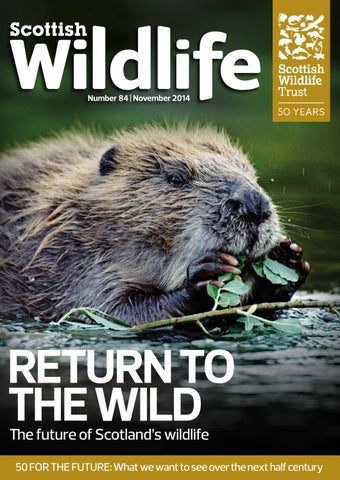
RETURN TO THE WILD The future of Scotland’s wildlife
50 FOR THE FUTURE: What we want to see over the next half century
Welcome
Inside this issue FEATURES 30
14
32
WELCOME
14
RETURN TO THE WILD?
24
LOOKING AHEAD
30
HIDDEN DEPTHS
Jonny Hughes, Chief Executive
REACHING the milestone of our 50th Anniversary has given us a chance to do two things we perhaps don’t do enough of as a Trust.
Ida Maspero talks to writer George Monbiot and Andrew Bauer of the National Farmers’ Union Scotland about what rewilding might mean in practice. As we near the end of our 50th Anniversary year, now is the time to look forward to what we might achieve for Scotland’s wildlife over the next 50 years.
The first is to quietly reflect on our achievements. Reflection is important; it helps us understand why we have been successful in some areas and less so in others, and ensures we keep learning.
It may be the second largest fish in our oceans but surprisingly little is known about the basking shark. Richard Baynes investigates the gentle giant of Scotland’s seas.
32
The second is we’ve had the chance to celebrate. Celebration isn’t just fun; it helps bring us together as a community of members, staff, volunteers and supporters. Celebration fosters that collective spirit which gives the Trust its strength.
BREATH OF FRESH AIR
With fewer than one in 10 children playing regularly in wild places, Jamie Grant travels to meet one pioneering volunteer doing her bit to redress the balance.
REGULARS
5
9
4
28
LATEST NEWS
News round-up from the Scottish Wildlife Trust and the world of conservation.
28
Q&A
The Scottish Youth Parliament’s Nairn McDonald talks about the Scottish environment.
34
34
This collective spirit was much in evidence at our National Members’ Day, a fantastic event which was at once entertaining, inspiring and, at times, emotional as we said farewell to our Chairman Allan Bantick.
36
TOP SPOTS
Visit Lanarkshire and explore the Trust’s fascinating Nethan Gorge.
36
VIEWPOINT A selection of your thoughts and opinions.
LOOK FOR ING A UNIQ WILD UE LIFE GI CHRIFT THIS STMA S? SEE P A GE 1
9
Allan has been an exceptional servant to the Trust and leaves a fine legacy for our new Chairman Robin Harper to build on. We are very much looking forward to working with Robin in the coming years. So here’s to the next 50 years, and to a vibrant Scottish Wildlife Trust community achieving great things for wildlife across Scotland!
Scottish Wildlife magazine is published by the Scottish Wildlife Trust. © Scottish Wildlife Trust. No part of this magazine may be reproduced without the express permission of the publisher. All photography © Scottish Wildlife Trust unless otherwise stated. The Scottish Wildlife Trust accepts no liability for omissions or incorrect data in advertisements and letters. Views expressed in Scottish Wildlife are not necessarily those of the Scottish Wildlife Trust. ISSN: 0143 1234.
Scottish Wildlife is published three times a year: March, August and November.
Registered office: Harbourside House, 110 Commercial Street, Edinburgh EH6 6NF. Tel: 0131 312 7765. Fax: 0131 312 8705. Email: enquiries@scottishwildlifetrust.org.uk Website: scottishwildlifetrust.org.uk. The Scottish Wildlife Trust is a company limited by guarantee, registered in Scotland (no. SC040247). It is also a Scottish registered charity (no. SC005792).
Patron: HRH The Prince Charles, Duke of Rothesay. Chairman: Robin Harper. Vice-Chairs: Patric Baird, Jon Barnes, Amanda Forsyth. Chief Executive: Jonny Hughes. Editor: Jo Pike editor@scottishwildlifetrust.org.uk. Production Editor: Oliver Davies. Design: Connect connectcommunications.co.uk. Advertising: Jennifer Whyte 0131 561 0022, Clare Stebbing 0131 561 0024. Printing: Inkmark. Cover photo: Shutterstock
Deadlines for news and letters: 1 January, 1 June, 1 September. No unsolicited articles please. Scottish Wildlife is free to members. Membership rates from 1 April (excluding discounts for paying by Direct Debit): Individual (concession) £33 (£18); Joint (concession) £46 (£24); Family £53 (£48); Watch £18; Life (joint) £800 (£1,200); Senior Citizen Life (joint) £500 (£700).
The Scottish Wildlife Trust is affiliated to The Wildlife Trusts, a UK-wide network of 47 Trusts with more than 2,000 wildlife reserves. NOVEMBER 2014 SCOTTISH WILDLIFE 3
WILDLIFE MATTERS Robin Harper, Chairman
The Trust is in a very healthy condition and I must extend my gratitude to former Chairman, Allan Bantick, and former Chief Executive, Simon Milne, for allowing me to inherit responsibility for a Trust that is in such great shape. We have a strong and growing membership and this enables us to continue important longstanding activities, as well as pursuing new and innovative ways of achieving the Trust’s vision of a network of healthy, resilient ecosystems. Despite being a relatively small organisation, the Scottish Wildlife Trust is leading by example with its groundbreaking projects and has a significant and growing influence at Scottish, UK and European levels, which is something I hope to assist in promoting. As an education professional, I know how important it is to ensure the next generation becomes enthusiastic about wildlife and biodiversity, so I do hope that I can help the Trust to influence the Scottish Government to create an ecologically literate society for the future.
Latest news
News from the Trust, our projects and the wider world of conservation
All the latest Trust news is available on our website: scottishwildlife trust.org.uk
Safeguarding our seas
T
he Scottish Government has created 30 new Marine Protected Areas (MPAs) aimed at safeguarding the most important habitats and species in Scotland’s seas. These protected sites range from the vast offshore areas of the Firth of Forth Banks to more familiar coastal areas such as East Caithness Cliffs and the sea lochs of Wester Ross. An overwhelming 99% of responses to a public consultation held during the summer of 2013 backed the proposal to designate the new MPAs. The Trust campaigned successfully for the designation of at least 29 of the 33 possible MPAs that went to public consultation, and argued that this must include the unique habitats of the Firth of Forth Banks, which was presented as an optional site. Advice to the Scottish Government on additional MPAs to protect whales, dolphins and basking sharks – as well as draft Special Protected Areas for seabirds – was also published. The advice recommends four extra MPAs, including the Sea of the
Hebrides, an area between Skye and Mull, to protect minke whales and basking sharks. In the coming months, the Trust will be working hard to ensure this advice is followed by the Scottish Government.
Saxon moth makes return THE discovery of a Saxon moth at Falls of Clyde is causing a flutter. It is the first time that this particular moth has been found in the area since records began in the 1850s. Although the distribution of the Saxon is quite widespread across the country, due the under-reporting of species in South Lanarkshire its presence has never been reported. This highlights the need for members of the public to report their sightings (via organisations such as Butterfly Conservation) to help build an accurate picture both of the species’ distribution and the diversity of wildlife present on our reserves.
Our 50th Anniversary is important, not just to reflect on achievements but to take stock, to see if we are on the right track and to see where we can improve. The Trust has many things to look forward to in the future, with a range of activities – including our Saving Scotland’s Red Squirrels project, our Living Landscapes and the legacy of the Scottish For details of our Beaver Trial – set to take us ac hievements this from strength to strength. year, visit Finally, I would like to take scottishwildlifetrus t. the opportunity to wish org.uk/achievemen ts you a Happy Christmas and New Year. I look forward to meeting many of you as I travel around our local groups. 4 SCOTTISH WILDLIFE MONTH 2013
KEEP UP TO DATE
© Sally Sharrock
IT is an incredible honour and very exciting to take up the position of Chairman during our 50th Anniversary. I am really looking forward to the next three years, although I am not pretending that it will be easy. It will certainly mean a lot of hard work and focus.
Scottish Wildlife Trust news
Boost for peatland restoration THE Trust has been awarded around £130,000 for peatland restoration on five of our wildlife reserves. The funding has been awarded by Scottish Natural Heritage (through the Peatland Action Fund) and the Esmée Fairbairn Foundation. This will enable the Trust to deliver the Lowland Peatland Restoration Challenge, a range of works to restore and enhance raised bogs on Bankhead Moss (Fife), Cander Moss (South Lanarkshire), Carsegowan Moss (Dumfries and Galloway), Longridge Moss (West Lothian) and Red Moss of Netherley (Aberdeenshire).
Scottish Wildlife Trust news
© Paul Watt HRH The Prince Charles His Royal Highness is presented with a a being presented with handmade red squirrel cuddly Red Squirrel toy toy
Red recovery meets with royal approval I
n July – as part of the Trust’s 50th Anniversary celebrations – the Trust’s Patron, His Royal Highness The Prince Charles, visited one of the estates working with our Saving Scotland’s Red Squirrels project. The Prince was interested to learn about the experience of Glendelvine Estate, where concerted grey squirrel control has brought the charismatic red squirrel back from the brink. Four years
HRH The Prince Charles visits Glendelvine Estate to see the work of the Trust-led Saving Scotland’s Red Squirrels project ago, red squirrels were on the verge of disappearing from the area altogether but now, thanks to the partnership, the species is once again locally abundant. On a short walk around the estate, His Royal Highness met the owner, Sir Gavin Lyle, and Project Manager, Dr Mel
Tonkin, to hear about the project’s approach to grey squirrel control. The Prince was also presented with a handmade red squirrel as a birthday gift for Prince George. The toy was crafted by a member of the Trust’s staff, Corinne Thompson.
Woodland festival The inaugural Assynt Woodland Festival took place in Lochinver on Saturday 13 September. The festival was the culmination of a week of activities and events held across Assynt, involving many Coigach – Assynt Living Landscape (CALL) partners, local artists and the Highland Council Ranger Service. Activities included bowl and spoon carving, apple juice pressing, wool dying and a display of woodland arts. The CALL team were in attendance to discuss Landscape Partnership projects planned for 20152020. The festival was the brainchild of Chris Goodman, a woodworker who attended the CALL Romanian exchange trip earlier this year (see page 36 for details). Chris was inspired by the visit to arrange a celebration of Assynt’s woodland culture.
Call for entries To mark the Trust’s 50th Anniversary, the North of Scotland Group is holding a wildlife photography competition, sponsored by Ffordes Photographic. Open to all amateur photographers, there are two categories: adult and school student. Entries for the competition must comprise three photos that illustrate Scottish wildlife on land, in the air and in water (which can be either fresh or saltwater). The entry fee is £5 for adults and £3 for school students. The closing date for entries is Monday 31 August 2015. For more information email pbaird@scottish wildlifetrust.org.uk NOVEMBER 2014 SCOTTISH WILDLIFE 5
Scottish Wildlife Trust news
© Beth Chalmers
IN BRIEF
Thanks again to Handa volunteers ANOTHER Handa season has come to an end and the Trust would like to thank all the volunteers who made the long journey to the island and helped make the 2014 season a successful one. Special thanks must also be given to our long-term volunteers who have provided invaluable help to the Handa Ranger. The Trust will start preparations for the 2015 season early in the New Year so please keep an eye on the volunteer section of our website.
Parliamentary stall DURING September, as part of our 50th Anniversary celebrations, the Trust engaged with around 100 MSPs – including First Minister Alex Salmond – at a week-long exhibition outside the Debating Chamber of the Scottish Parliament. See page 37 for pictures from the event.
Long service CONGRATULATIONS to three members of staff for reaching 20 years’ service with the Trust. Known to many of our members and supporters, Duncan Budge, Eddie Degnan and Peter Gilbert, have shown real dedication to the Trust over the past few decades and we applaud them on reaching such a milestone.
Footpath work IN August, the Ayrshire Reserve Project Group restored the bank and the path at Garnock Floods Wildlife Reserve, which were saturated when the River Irvine burst its banks following the very wet weather in the spring.
Swan scaring THE Trust is looking for weekend volunteers to help the Montrose Ranger, Anna Cheshier, undertake the annual swan management programme. This will start in November 2014 and will continue until March 2015. If you are interested in helping out, please contact Peter Gilbert at pgilbert@ scottishwildlifetrust.org.uk
6 SCOTTISH WILDLIFE NOVEMBER 2014
Gabriella DiTano’s ‘Living Window’ in Cumbernauld town centre
Inspiring views of Cumbernauld D uring August and September, empty shop fronts in Cumbernauld town centre were transformed into works of art as part of the Cumbernauld Living Landscape. Although known for its modernist architecture, an amazing 50% of Cumbernauld is made up of green spaces, meaning it is one of the greenest towns in Scotland. The ‘Living Window’ project aimed to celebrate this green space, connecting local residents with the town’s natural environment. Thanks to funding from the Heritage Lottery Fund’s Sharing Heritage programme, the project was
able to bring together three of Scotland’s finest up-and-coming artists with eight local community groups, producing a series of artworks that celebrated the parks, gardens and woodlands that make Cumbernauld unique. Members of the public were then encouraged to explore each ‘Living Window’ artwork in the Cumbernauld and Antonine shopping centres, introducing them to the amazing variety of green spaces in the town. To find out more about the Cumbernauld Living Landscape, visit its new website at cumbernauldlivinglandscape.org.uk
Don’t miss our Planning Volunteer Day THE annual Planning Volunteer Day will be held on Wednesday 3 December in the offices of Architecture and Design Scotland at Bakehouse Close, 146 Canongate, Edinburgh. All planning volunteers and members with an interest in responding to planningrelated issues in their local area are welcome to attend. A booking form will be sent out in due course but expressions of interest would be welcome. Please contact jmctague@scottishwildlifetrust.org.uk for more information.
Scottish Wildlife Trust news
‘Wild Woods’ programme inspires school children Members’ Day 2014 NATIONAL Members’ Day in September was a success, with special guest Dr George McGavin delivering a fascinating talk to a full house of 300 people. During the event, a 50th Anniversary film by People’s Postcode Lottery was premiered, celebrating the work of the Trust. Broadcaster and Trust Ambassador Stephen Jardine chaired a lively ‘Wildlife Question Time’, about the important issues facing wildlife and the environment. Panel guests included Aubrey Manning OBE, Trust Chief Executive Jonny Hughes, outgoing Trust Chairman Allan Bantick, special guest Dr George McGavin and recent Experts for Nature graduate Elizabeth Drake.
Experts for nature IN September, the Trust’s Experts for Nature programme culminated in the graduation of 10 trainees. Supported by the Heritage Lottery Fund, the course offered trainees a unique opportunity to learn a variety of nationally recognised ecological surveying skills, as well as receiving intensive training on species identification for a wide array of animals and plants.
© Paul Redman
T
he Trust has received funding from Big Lottery Communities and Families for the ‘Jupiter’s Wild Woods’ programme. Jupiter Urban Wildlife Centre already provides a crucial green space where local children can learn and play, with 1,500 school children attending educational sessions last year. Thanks to the Communities and Families funding, this number will not only increase but will also see a wider range of educational opportunities become available, with pupils now able to take part in Forest Schools sessions. Forest Schools is a long-term educational approach where children can learn, be inspired and play in a woodland environment. Introduced in America in the 1920s, it is now internationally recognised and taught across the world. The Jupiter Forest Schools sessions will be offered free of charge to local primary schools and will be run in conjunction with a local company, Under the Trees.
The brightly coloured cinnabar moth is a frequent visitor to Jupiter
Spotted a squirrel recently? RED squirrels are being spotted in parts of Aberdeen where they have been absent for many years. We are now calling on the public to let us know about any other sites where squirrels can be spotted. Thanks to continued funding from Aberdeen Greenspace, Biffa Award and the Red Squirrel Survival Trust, an intensive trapping programme to remove
greys has seen red squirrels become increasingly common in the city. In order to build up an accurate picture of where squirrels can be found across Aberdeen, we need public assistance. To report your red and grey squirrel sightings across any of the project areas, please visit scottishwildlifetrust.org.uk/ reportsquirrel
Helping our children grow
S
cottish children are losing contact with nature at a dramatic rate. Sadly, only one in 10 children now play regularly in wild places, compared with nearly half of their parent’s generation. The Scottish Wildlife Trust is working hard to ensure that more children are given the opportunity to get outdoors and connect with wildlife and wild places, through Wildlife Watch groups and a variety of ranger-
led activities across Scotland. Last year we gave over 10,000 children the chance to experience outdoor activities, from building dens and bug hotels to detecting bats and rummaging in rock-pools. This year we will help even more children discover nature. A new Wildlife Watch group is starting in Stirling, in partnership with the National Trust for Scotland (NTS), at the Battle of Bannockburn site and the popular Montrose Basin
Wildlife Watch Group has just relaunched at Montrose Basin Visitor Centre. Please help us to inspire the next generation by supporting these activities. In the words of David Attenborough: “no one will protect what they don’t care about and no one will care about what they have never experienced.” For more information and to make a donation, visit scottishwildlifetrust. org.uk/donate NOVEMBER 2014 SCOTTISH WILDLIFE 7
Scottish Wildlife Trust news
IN BRIEF
Sponsored cycle
© Lynne Laing
CONGRATULATIONS to the ASPIRE team at Lloyds Banking Group, who each completed a 150-mile sponsored cycle ride to raise funds for Falls of Clyde Wildlife Reserve. A wildlifethemed quiz and cash for recycling drinks cans took the total raised to an impressive £1,476.
Woodworking masterclass for group
Picture perfect VALENTINE Art Reproductions and artist Georgina McMaster have produced a series of paintings to raise funds for the Trust. Each picture captures the beauty of an iconic Scottish species, and the impressive, limited edition reproductions are hand-processed to retain the look and feel of the original painting. A range of new sizes are now available, and the Trust receives 65% of the profits from sales of reproductions. Visit scottishwildlifetrust. org.uk/wildlifeart for more details.
Putting down roots THE Little Assynt Tree Nursery is going from strength to strength, and this year it is expected to produce upwards of 40,000 trees. Once the project reaches peak capacity in a few years’ time, we hope to see 130,000 trees grown every year for woodland restoration across Coigach and Assynt.
Volunteer interns FOLLOWING a successful pilot in the summer, recruiting for the next round of volunteer internships will begin shortly. These will start early in 2015 and a number of roles have already been identified. If you are interested, watch out for adverts on the volunteer section of our website.
Winter at Lowes LOCH of the Lowes Visitor Centre has launched a series of new seasonal wildlife activities, including a whodunnit trail and a winter solstice family fun day. Many of these events are great for inspiring children and sparking a love of wildlife. Please see our Events and Activities booklet for more details.
8 SCOTTISH WILDLIFE NOVEMBER 2014
W
ith funds from Awards for All, Moray Wildlife Watch Group has inspired local teenagers with a series of green woodworking sessions. Groups of 12 to 15 year olds in the area learnt traditional skills and crafts while demonstrating patience, concentration and hard work throughout the day. Wood for the workshops was sourced from local wind-blown trees and, over the next two sessions, the
groups will make wooden stools. The nearby Knockando Estate has also offered the use of an amazing piece of woodland for participants to practise bushcraft skills. The estate gamekeeper will talk to the children about countryside management and conservation, provide red deer antlers for craft activities and transport equipment onto site. Elsewhere, the children will learn to fish and cook wild foods with a bushcraft instructor.
MSP opens new Jupiter gardens The refurbished wildlife gardens at the Trust’s Jupiter Urban Wildlife Centre have been reopened by MSP for Falkirk East, Angus McDonald. Thanks to a £36,000 grant from The Veolia Environmental Trust – awarded through the Landfill Communities Fund – we are undertaking an extensive upgrade at Jupiter to reinvigorate the wildlife gardens, improve all-abilities access around the site and upgrade the reserve’s interpretation and signage. The initial phase of the project is now finished. The gardens have been completely redesigned and are now separated into three distinct areas. The ‘Upcycled Garden’ shows how domestic products can be repurposed into wildlife-friendly features. The ‘Rustic Garden’ has raised timber
planters filled with vegetables and herbs, and also includes garden birdfeeders, insect homes, a pond and a small wildflower meadow. The ‘Contemporary Garden’ is a modern design which incorporates wildlife features, including a wildlife tower and low-growing wildflowers.
Scottish Wildlife Trust news
Bag tax welcomed THE Trust has welcomed the introduction of a charge on single-use carrier bags in Scotland. From 20 October, shoppers have been charged 5p for bags in an attempt to reduce waste and relieve pressure on landfill. Chief Executive of the Trust, Jonny Hughes, said: “Plastic bags can cause harm to all sorts of animals, such as hedgehogs and small birds, but they are particularly dangerous when they end up in the sea as they can be mistaken for jellyfish or other prey. Marine litter, including plastic bags, kills at least a million seabirds and 100,000 animals globally each year.” The Trust’s three visitor centres have now implemented a charge for bags, with all proceeds going to help fund our conservation work. When shopping on your local high street, why not encourage independent retailers to donate proceeds from their bag charge to the Scottish Wildlife Trust?
Record breakers A RECORD number of pink-footed geese have descended on Montrose Basin Wildlife Reserve this autumn. On average, 60,000 pink-footed geese arrive at Montrose each year, where they spend the winter months after making a colossal 1,200km migration from Greenland and Iceland.
Fun at the Falls of Clyde!
This year, however, a staggering 78,970 geese have been recorded, beating the previous record of 65,060 which was set in 2010. Around 372,000 pink-footed geese spend the winter in the UK, thought to be around 90% of the world’s population.
Buzz of excitement for Nectar Network and other businesses. By planting wildflowers for coastal dune systems, the Nectar Network creates and connects habitat for butterflies, hoverflies and rare, solitary bees such as the northern colletes mining bee, which has been spotted at Gailes Marsh Wildlife Reserve.
© Gill Smart
T
he Trust is demonstrating an innovative way to help rare bees, which could be replicated across Scotland. A five-kilometre ‘Nectar Network’ is being created along Ayrshire’s coast – from Irvine to Troon – to connect wild pollinators on the Trust’s Gailes Marsh reserve to land owned by Dundonald Links
TAKE a trip to the Falls of Clyde for our lanternmaking event on Sunday 9 November. This promises to be a lovely way of spending time with the family. Also at Falls of Clyde, the team has launched woodland adventure birthday parties, suitable for ages three to 14. Favourite themes have included nature explorers, fox fun, fairies and elves. Parties are adventurepacked, with activities such as den building, nature crafts and parachute games all proving popular. Packages start from £7.50 per child. For information call 01555 665 262 or email lmark@ scottishwildlifetrust.org.uk
BE PREPARED
One of the fi rst Knapdale beavers © Steve Gardne r
BE PREPARED “Making a Will isn’t something I thought about until quite recently – I’m 44. On the one hand, I know the odds are that I won’t die for a few decades yet. On the other, I have friends and colleagues who have seen partners, brothers and sisters pass away in their 30s and 40s. I’m a fairly organised person and a believer in the motto “be prepared” so I took the decision and wrote my Will. I’m now rather hoping it will quietly gather dust for many years. Once I had made the decision to write a Will, I wanted to make sure it reflected who I am. On and off I find myself thinking about what’s important to me in my life. It comes down to two main things. People and the planet we live on. I try to reflect this in all aspects of my life, which is why I wanted to do so in my Will.
If I had one wish for Scotland’s wildlife I would return some of the animals we humans have killed off. I’m a big fan of the Scottish Beaver Trial and would love to see a wild lynx here one day.
Paul Ritchie
Lynx © Lefteriskatsouromallis
Paul Ritchie was the Scottish Wildlife Trust’s Director of Finance and Resources for seven years and saw at first hand how important gifts in Wills are to the Trust’s work. Here he talks about his personal decision to make a Will and include gifts to charity.
Gifts to family members feature prominently, and so do gifts to charity, including the Scottish Wildlife Trust. Like many people, I have more than one charity which is close to my heart. My gift to each is a proportion of my estate – which may turn out to be a lot of money or a little. Either way I know it will make a difference to causes I care about.
There is no ‘typical’ person who leaves a gift in their Will to the Scottish Wildlife Trust. What each shares is a deeply held wish to help protect Scotland’s wildlife for the future. If you want to talk to us about leaving a gift in your Will, call Wendy on 0131 312 4772.
Wider news
IN BRIEF
St Kilda cruises FOR over 60 years the
REFORESTING Scotland, with the support of the European Environmental Paper Network, is offering a prize for the smartest and most practical idea to stop wasteful paper use. Paper and cardboard are the single biggest element of our waste streams, yet paper is a highly valuable material. Entrants are invited to email up to 500 words about their paper-saving idea to prize@environmentalpaper. eu by Tuesday 31 March 2015, with winners having the chance to put their ideas into practice. Simply explain how paper is currently used in your organisation and how much your idea would save. Reforesting Scotland also want to know who would be involved in your plan and
how the prize money would help you achieve it. Ideas will be judged for their innovation, practicality, whether they require a modest investment, are testable in a real-world environment, and are likely to achieve measurable reductions in paper use. There are two prizes of £600
– one for children and one for adults – plus a £400 bonus for the ‘best’ idea. The prize money must be spent on making the idea a reality. If you want to discuss your entry prior to submission, contact Mandy Haggith at prize@ environmentalpaper.eu © Matthew Roberts
National Trust for Scotland (NTS) has been operating a hugely popular annual cruise taking in the best of the country’s coastline and islands. The cruises get you close to Scotland’s remarkable wildlife. On their 2014 cruise to St Kilda and the Northern Isles, a team of NTS rangers guided the guests through a circumnavigation of the UNESCO-listed St Kilda archipelago, home to more than half a million seabirds, while stepping ashore at Hirta gave visitors a chance to see the unique St Kilda wren. Zodiac boat trips in Village Bay took passengers close to rafts of puffins. Time at sea offered the chance to spot orcas and minke whales and in Orkney and Shetland highlights included arctic skuas, otters and the rare Scottish primrose.
Call for paper cuts!
New Falls of Clyde novel THE Scottish Wildlife Trust’s Falls of Clyde reserve in South Lanarkshire is the backdrop for C A Hope’s historical fiction novels, The New Lanark Trilogy. The second book of the series is now available - New Lanark: Living with a Visionary - and builds upon the popularity of New Lanark: Spinning New Lives. © C A Hope 12 SCOTTISH WILDLIFE NOVEMBER 2014
Rural volunteers required PROJECTSCOTLAND, a charity that helps young people get on in life through volunteering, is currently looking to find and train a new batch of volunteers and mentors across the country, especially in rural areas. ProjectScotland volunteers commit to at least 20 hours a week for three
months, and take up roles as varied as marketing, path restoration and visitor centre support. The initiative helps young people to develop their own skills and confidence, all while enhancing their CV. More than 75% of ProjectScotland volunteers move on to jobs, education
or training. The project also gives young people access to a mentor while they volunteer. That person is given training and then commits about an hour a week to help a volunteer think about their future. For more information, visit projectscotland.co.uk/ mentors
Morton Fraser FP
Rewilding
Return to the Rewilding is a term yet to be conclusively defined, but it has recently become a hot topic in conservation. What exactly is it, what does it mean for Scotland and what place is there for people in a ‘rewilded’ landscape? Ida Maspero investigates.
14 SCOTTISH WILDLIFE NOVEMBER 2014
© Mark Hambin, 2020Vision
WILD?
Rewilding
© Philip Price, lochvisions.co.uk
BEAVER TO GO HERE
I
n the Moffat Hills, a once-bare, sheepgrazed valley is gradually being cloaked in native woodland – tree saplings that have been planted over the past decade by teams of dedicated volunteers are transforming this 650-hectare site owned by the Borders Forest Trust. In December last year, the charity purchased the 1,800-hectare Talla and Gameshope Estate next door, offering the potential for ecological restoration of a vast, continuous swathe of the Southern Uplands (dubbed the Carrifran Wildwood). Hundreds of kilometres north in Glenmoriston, near Loch Ness, the 4,000-hectare Dundreggan Estate and many neighbouring properties are also being transformed, with Trees for Life restoring the Caledonian Forest over a vast area to the west of the Great Glen. At Dundreggan, wild boar – once extinct in Scotland – root around in the woodland undergrowth. Do these landscapes offer a glimpse of rewilding in Scotland? Environmental author (and rewilding proponent) George Monbiot certainly thinks so, citing both Carrifran Wildwood and the Caledonian Forest as examples of Scottish rewilding initiatives in action. Monbiot has introduced the concept to a broad readership through his column in The Guardian and his book Feral. According to him, rewilding is “the mass restoration of ecosystems. In Scotland, on land, this means the re-establishment of keystone species, the removal of impediments such as fences and drains, the planting of islands of trees when the nearest seed sources are a long way away and then, to the greatest extent
Britain has less wild land than almost anywhere on Earth. Global forest cover is 31%, the European average is 37%. In Britain it is 12%. possible, leaving nature to get on with it.” A hundred or so miles north of Trees for Life’s project area, and on a larger scale still, the Coigach-Assynt Living Landscape is putting many of these ideas into practice with a project spanning 40 years and a very large area – some 60,000 hectares. A partnership between the Scottish Wildlife Trust and an array of other private, public and community landowners in the area, it hopes to bring both ecological restoration and economic benefits to an area of great scenic beauty, which faces many economic challenges.
Poor diversity While all three of the projects mentioned involve rewilding of some sort, the term itself is by no means tightly defined. As a conservation approach, it centres on large-scale ecological restoration, but has several offshoots. Pleistocene rewilding, for example, proposes the recreation of ecosystems that existed in North America and Europe until about 10,000 years ago, including the return of megafauna such as bison, wild horses, proboscideans (members of the elephant family) and big cats. For Monbiot, though, it is not simply about recreating an ecosystem that existed at some point in the past. “It is about the future: letting the
natural world develop as it will. In our changing climate, on our stripped soils, the ecosystems that will emerge in rewilded areas will not be the same as those that prevailed in the past.” The case he makes for rewilding vast swathes of the uplands of Scotland, in particular, is persuasive. Deforested and dominated by sheep farming and an overpopulation of deer, these are denuded landscapes where impoverished habitats support relatively poor biodiversity. “Britain has less wild land than almost anywhere on Earth. Global forest cover is 31%, the European average is 37%. In Britain it is 12%. Through a series of appalling management practices, over hundreds of years, we have stripped away almost all our trees and the other deep vegetation essential for sustaining most wildlife. Bizarrely, it is our uplands – the places least suitable for farming – that are barest, by contrast to the situation in most other countries. This also has devastating downstream effects, such as a cycle of flood and drought, as there are no trees in the hills to hold back the rain. Few countries are in greater need of some rewilding than Scotland.” However, the fact that rewilding often implies reintroduction of extinct wildlife – including predators – makes it problematic to the farming community, as Andrew Bauer, 15
Rewilding
The eurasian lynx (below, right) was once a common feature of the landscape in Sutherland, home of the Coigach-Assynt Living Landscape
Deputy Director of Policy at the National Farmers’ Union Scotland (NFUS) explains. “We have reservations about this – we’re not opposed to reintroductions in principle, but we’re concerned by the rather simplistic notion that because an animal was there in the past we can reintroduce it without thinking too carefully about it. Rewilding in a careless, child-in-a-sweetie-shop way would be detrimental to everybody in the long term. “However, if species reintroductions are done carefully, with proper safeguards in place, we are not opposed in principle.” The Scottish Beaver Trial at Knapdale in Argyll – in which the Scottish Wildlife Trust is a lead partner – has demonstrated just such a measured approach. The five-year monitoring phase of the project has now come to an end, with a verdict on the beavers’ future due next year from Scottish Government. “I believe the Scottish Beaver Trial is one of the most inspirational projects in British conservation,” says Jonny Hughes, Chief Executive of the Scottish Wildlife Trust. “It demonstrates how scientific monitoring, coupled with meaningful local consultation, can lead to a considered decision about the benefits and drawbacks of reintroducing a particular species.”
16 SCOTTISH WILDLIFE NOVEMBER 2014
Keystone species For both Monbiot and the Scottish Wildlife Trust, the reintroduction of keystone species is a vital part of any such approach. “Keystone species are essential members of the ecosystem, driving crucial ecological processes that create opportunities for many other species to thrive,” explains Monbiot. “An ecosystem without keystone species behaves in radically different ways to an ecosystem that retains them.” But is the reintroduction of beavers simply the thin end of the wedge – paving the way for the return of bears and wolves – as some opponents fear? Though Hughes believes the reintroduction of these two animals to Scotland is a very long way off, he does have his sights set on a more adaptable predator. We asked Andrew Bauer of NFUS, left, and George Monbiot for their views on rewilding
“This might put the cat among the pigeons, but we believe it’s time to start talking about the lynx. The overpopulation of deer – including the lynx’s favourite prey, roe deer – is one of the main drivers of negative ecological impact in the uplands. The lynx would help to redress some of that imbalance and that can only be a good thing for the ecology of Scotland.” Hughes does, however, understand the farming lobby’s concerns over predator reintroduction. “Undoubtedly there would be instances of lynx taking livestock, so there would need to be a properly defined compensation scheme in place for when that happens. At the same time, it will bring increased tourism and that’s good news for the rural economy.”
Turning rural economics on its head Convincing traditional farming interests that rewilding initiatives in Scotland can take account of – and bring greater prosperity to – rural upland communities is a challenge, Bauer points out. “As a farmer or crofter I’d be asking – where do my views come into it? Does my livelihood – my sheep and cattle – not matter? It is true that, in the past, farming
Rewilding © John McCarthy
did not give enough consideration to the environment, but with rewilding, there is a risk of the pendulum swinging too far the other way: it’s all about the environment and not enough about the people who live on the land. “I am not saying it’s impossible for the two to coexist, and I am not disputing that rewilding holds some opportunities for income from wildlife tourism and so forth. But I am unconvinced that Scotland in 2014 is the place for it.” Acknowledging farmers’ concerns for their livelihoods, Monbiot and Hughes point to the fact that current land management and farming practices are perpetuated by agricultural subsidies. Hill farmers rely on payments under the Common Agricultural Policy (CAP), while grouse moors are often subsidised by private money. By reforming the agricultural subsidy system and turning rural economics on its head, a very different outcome could be achieved, argues Hughes. “I am not advocating a dramatic reduction in payments to farmers. We need a shift in what we’re asking farmers to deliver: rather than just meat production, we should be rewarding them for delivering a range of so-called ‘ecosystem services’ too – water NOVEMBER 2014 SCOTTISH WILDLIFE 17
Rewilding
and flood management, carbon sequestration, soil protection, biodiversity and good stewardship of their land. “The number of livestock may go down slightly, but livestock farming will be more sustainable and you’ll get all those public benefits. What’s more, healthier landscapes will attract more tourists and inward investment, creating new opportunities and income streams for rural communities.”
A place for people Ultimately, Monbiot’s concept of rewilding as a mass restoration of functional ecosystems for the future – rather than harking back to a point in the past – chimes closely with the Scottish Wildlife Trust’s own view, according to Hughes. “A return to some idealised state in the past just isn’t possible or desirable in Scotland; we should be looking to the future. It’s about self-willed land– enabling Scotland’s ecosystems to be in a healthy state where natural processes take their course. Once invasive species have been removed and there’s a healthy balance between vegetation, herbivores and carnivores, nature can be left to heal.
“The Trust would like to see connectivity between fragments of habitats and ecological restoration on a landscape scale, with some significant areas in the Highlands where land is left to do its thing, provided the number of herbivores, such as deer, can be brought down to allow the recovery of woodland. “At the same time, we would also like to incorporate cultural landscapes, which can be highly biodiverse. Agricultural productivity doesn’t need to be in conflict with biodiversity.” In short, says the Trust, local communities should be at the heart of large-scale ecological restoration. “We’d like to see thriving landscapes, but also thriving communities where people benefit from that ecological recovery – whether through direct management of the land, inward investment or tourism.” “Humans are an integral part of these landscapes. By working together, these places can be good for nature and for the communities that live and work there,” concludes Hughes. “We’d like to show there can be positive change.”
The Little Assynt tree nursery has brought jobs to the area
Members of the wider community have been involved and engaged in the Coigach - Assynt Living Landscape project from the outset
© Niall Benvie, 2020 vision
18 SCOTTISH WILDLIFE NOVEMBER 2014/15
CHRISTMAS GIFT IDEAS FREE UK delivery for orders over £40. All proceeds from Christmas sales help fund our work protecting Scotland’s wildlife for the future.
The Scottish Wildlife Collection In celebration of the Trust’s 50th Anniversary this year, we commissioned renowned Scottish illustrator Iain McIntosh to design a series of wildlife-themed gifts. These beautiful illustrations – inspired by Victorian pen and ink natural history drawings – form part of a unique collection designed exclusively for the Scottish Wildlife Trust.
ILLUSTRATED MUG £9.99, 4 FOR £34
RECYCLED A5 NOTEBOOK £4.99
ILLUSTRATED APRON £21.99
COTTON SHOPPING BAG £5.99
SCOTTISH SPECIES TEA TOWEL £9.99
Choose from badger, osprey, peregrine, puffin and red squirrel designs
Choose from badger, osprey, peregrine, puffin and red squirrel designs
Choose from hedgehog, osprey, puffin and red squirrel designs
Choose from hedgehog, osprey, puffin and red squirrel designs
Collage of species: badger, osprey, peregrine, puffin and red squirrel
Adopt an Animal £18
Adopt an Animal and make a real difference to the conservation of some of Scotland’s most spectacular species. Your adoption pack will include a certificate, fun factsheet, a selection of stickers and either a superb wildlife print or a soft, cuddly toy.* What’s more, all profits from the sale of adoption packs go towards helping our conservation efforts in Scotland. Choose from: badger, beaver, osprey, otter, peregrine, puffin and red squirrel.
BEAVER
OSPREY
OTTER
PEREGRINE
BADGER
PUFFIN
RED SQUIRREL
*Excludes osprey adoption, where the choice is between a wildlife print or a Scotland’s Birds of Prey book.
Please return orders to: Christmas Orders, Scottish Wildlife Trust, Harbourside House,110 Commercial St, Edinburgh EH6 6NF
CHRISTMAS GIFT IDEAS
CARDS AND CALENDARS Exclusive to the Scottish Wildlife Trust, our collection of wildlife Christmas cards and 2015 wildlife calendar are the perfect purchase for nature lovers everywhere, with all proceeds helping support our conservation efforts. Purchase multiple items and benefit from a range of special offers.
n/ ©Mark Hambli 2020VISION
£3.99
©Steve Gardner
©Chas Moonie
©Peter Cairns
8 cards, 4 different designs. Message inside: Season’s greetings. Beannachdannah-Aimsire
©Margaret Holland
2013 CHRISTMAS CARDS ©Steve Gardner
2014 CHRISTMAS CARDS
SPECIAL OFFERS
Moonie ©Chas
©Scottish Wildlife Trust
l 2014 Christmas cards + 2013 Christmas cards: £5.99 l Scottish Wildlife calendar + 2014 Christmas cards: £11 l Scottish Wildlife calendar + 2014 Christmas cards + 2013 Christmas cards: £13
2015 SCOTTISH WILDLIFE CALENDAR
©Steve Gardner
Features 13 wildlife images and Scottish Wildlife Trust reserve information.
£8.99 Wildlife calendar 2015 Features exclusive wildlife images and Scottish Wildlife Trust reserve information
GIFT MEMBERSHIP By giving the gift of membership to a friend or family member this Christmas, you can make a real difference to Scotland’s wildlife. New members receive a subscription to Scottish Wildlife magazine, free entry to our visitor centres and 120 wildlife reserves across Scotland, a free copy of our Exploring Reserves guide and much more. For further information, visit scottishwildlifetrust.org.uk/giftmembership or call 0131 312 4700.
Please return orders to: Christmas Orders, Scottish Wildlife Trust, Harbourside House,110 Commercial St, Edinburgh EH6 6NF
CHRISTMAS GIFT IDEAS
ORDER FORM MY DETAILS Title First name Last name
Address
Postcode Telephone Email
Membership no. (if known) Please tick if you are happy to receive information from us by email
50th ANNIVERSARY COLLECTION No. of mugs required:
No. of A5 notebooks required:
No. of aprons required:
Badger
Osprey
Badger
Hedgehog
Puffin
Red squirrel
Puffin
Red squirrel
Peregrine falcon
Osprey
Puffin
Osprey Red squirrel
Peregrine falcon
ADOPT AN ANIMAL Which animal are you adopting?
No. of cotton bags required:
Osprey
Hedgehog Puffin
Red squirrel
No. of tea towels required:
Please choose a gift: Toy (or book for osprey adoption) Print Certificate only (please provide email address)
n n n
If you are adopting an animal for yourself, please fill in the ‘My Details’ section above. If your adoption is for someone else, fill in their details below. For multiple adoptions, please write these on a separate sheet of paper and enclose them with your order. Title
First name
Last name
Date of birth (optional)
Address
Postcode Telephone Email
Is recipient over 18?
Yes
No
Send my adoption pack:
To me
To the recipient
Special message for certificate (max 80 characters):
Please return orders to: Christmas Orders, Scottish Wildlife Trust, Harbourside House,110 Commercial St, Edinburgh EH6 6NF
CHRISTMAS GIFT IDEAS
ORDER FORM CARDS AND CALENDAR
Number
2014 wildlife Christmas cards
£3.99
2015 wildlife calendar
£8.99
Total (£)
£11
Calendar + 2 sets of cards offer
£13
Card number
Start date Expiry date
ADOPT AN ANIMAL 7 species to choose from
I enclose a cheque or postal order made payable to ‘Scottish Wildlife Trust’ Please debit my credit or debit card
2014 + 2013 wildlife Christmas cards £5.99 Calendar + Christmas cards offer
PAYMENT
/ /
Security code*
£18
*3 digit number on back of card
Cardholder’s signature
50TH ANNIVERSARY COLLECTION Mug
Cardholder’s name
£9.99, or 4 for £34
A5 notebook Apron
£4.99
By giving your details above, you give permission for the Scottish Wildlife Trust to contact you. Your details will be kept confidential and will not be shared with any third party.
£21.99
Cotton bag
£5.99
Tea towel
£9.99
GIFTAID Tick to GiftAid your donation
DONATION In addition to my total, I would like to make a Christmas donation to the Scottish Wildlife Trust of:
£
POSTAGE
I confirm that the Scottish Wildlife Trust may claim GiftAid on any donations I have made in the last 4 years and in the future until I cancel this declaration. I pay enough UK Income and/or Capital Gains Tax each year to cover the amount that all charities I donate to can reclaim in the tax year. I understand Council Tax and VAT do not count and that the Scottish Wildlife Trust will reclaim 25p on every £1 donated.
Cardholder’s signature
Date
(£2.99 for all UK orders up to £40, FREE if over £40)
£
TOTAL
£
For office use
GREAT! THEN YOU CAN HELP THE SCOTTISH WILDLIFE TRUST
The Scottish Wildlife Trust has signed up with easyfundraising.org. uk, a free online service where thousands of people raise money for charities every time they shop.
DELIVERY INFORMATION: Allow 10 days for delivery. Orders must be received by Monday 8 December 2014 for Christmas delivery in the UK. We cannot guarantee delivery before Christmas after this date. Postage costs £2.99 on all UK orders up to £40; FREE over £40; Europe £5; Rest of World £7.50. For large quantities please email enquiries@swt.org.uk.
2,700 well-kn own retailer s
HOW TO START RAISING MONEY • Simply visit: easyfundraising.org.uk/causes/scottishwildlife • Register to support with your name and email address • Start shopping and raise money every time you shop for FREE!
Please return this form to: Christmas Orders, Scottish Wildlife Trust, Harbourside House,110 Commercial St, Edinburgh EH6 6NF
© Bob Coyle
CHRISTMAS SHOPPING ONLINE
Tick here if you do not wish to receive information about other aspects of our work
Our vision
LOOKING AHEAD
OUR50YEARVISION What does the next half century have in store for Scotland’s wildlife and wild places?
A
s we near the end of our 50th Anniversary, it is time to look ahead and consider what we would like to see for Scotland’s wildlife in the next half century. In order to achieve our vision of healthy, resilient ecosystems across Scotland’s land and seas, we will need to protect and restore wildlife on a larger scale than ever before. Our Living
Landscapes projects, underpinned by our network of wildlife reserves, will continue be at the heart of this effort. We want to hear your views on how to make the Trust’s vision a reality. How will we restore our uplands so they are once again full of life? How can we ensure that red squirrels thrive for generations to come? And how can we re-connect children with nature?
UPLANDS The uplands of Scotland contain a range of nationally important habitats and many of our most iconic species. However, centuries of exploitation have seen the loss of native forests, near extinction of mountain woodlands, draining of peatlands and widespread soil degradation. Tackling systemic problems such as overgrazing will be pivotal if these habitats are to recover. Significantly reduce wild deer numbers in most areas of the uplands to encourage the natural recovery of native woodland, including mountain woodlands and sub-alpine scrub. Restore 90% of the degraded blanket bogs in the uplands to secure their value for wildlife, carbon storage and water quality. Move to less intensive management of grouse moors by a sharp reduction in burning and by encouraging woodland and scrub regeneration. Revitalise our upland ecosystems through the restoration of native species, restructuring large conifer plantations, bringing back lost species such as the lynx and converting bracken to native woodland and scrub. 24 SCOTTISH WILDLIFE NOVEMBER 2014
By our next birthday, in April, we plan to compile a list of ‘50 things for Scotland’s wildlife’ – a set of clear actions which we think will be critical to realising our vision for Scotland. We want your views to help decide the final 50, so please visit the ‘50 things’ survey on our website, which will be open until the end of January 2015. Below are some ideas to get you thinking...
LOWLANDS The lowlands of Scotland still contain important remnants of natural habitat within a landscape now used principally for food production. Protecting these habitats must remain a priority, but we also need to reconnect them through a range of wildlife-friendly features, such as riverside woodlands, hedgerows, wide field margins, trees in fields and farm woodlands. Expand woodland and wood pasture cover to around a third of Scotland’s land area including the conversion of non-native plantations to diverse native forests . Undertake a wider reintroduction of beavers to Scotland and encourage their presence across the lowlands, bringing benefits to wetland and woodland wildlife. Significantly increase the proportion of agricultural land managed for the benefit of wildlife and reform public subsidies to reward farmers for wildlifefriendly practices.
URBAN
Dramatically reduce nitrogen loading and diffuse pollution from agriculture, preventing pesticides and other chemicals being washed into our rivers and streams.
Wildlife can flourish in our towns and cities; the challenge is to transform the grey into green. This means converting tarmac, concrete and mown grass ‘deserts’ into places where wildflowers, native trees, pollinators and birds can thrive, reconnecting people with nature and encouraging communities to take ownership of their local green spaces. Designate Scotland’s first Urban National Park, celebrating the fantastic wildlife to be found in our towns and cities. Revitalise Scotland’s green spaces through the planting of native trees and shrubs, and the creation of wildflower meadows. Ensure planners and urban designers put nature at the heart of new developments, including green roofs, green walls and micro-habitats as standard features. Reduce the impacts and costs of flooding byremoving redundant paving, concrete and tarmac to create natural, permeable surfaces. NOVEMBER 2014 SCOTTISH WILDLIFE 25
Our vision
MARINE AND COASTAL Scotland’s seas include spectacular rocky reefs, maerl beds, sandy bottoms and cold water coral habitats rich in wildlife. Marine Protected Areas should help safeguard these and other important habitats, but we also need to help marine life recover elsewhere, particularly by ending overfishing. This will ultimately improve productivity and bring economic, social and environment benefits. Ensure that Scotland’s network of Marine Protected Areas safeguards our most important marine species and habitats. End overfishing, moving to sustainable fishing practices where decisions are based on science and the long-term interests of both wildlife and coastal communities. Ensure that developments at sea – from fish farms to wind farms – avoid damage to marine habitats and make a positive contribution to the health of our marine environment. Help seabirds, basking sharks, whales, dolphins and seals recover in Scotland by expanding the network of Marine Protected Areas.
ALL SCOTLAND Scotland is defined in large part by its magnificent wildlife. If we are to be successful in restoring our natural environment, those of us who believe in the intrinsic value of nature need to reach out and explain how nature underpins a vibrant economy and society. The whole of Scotland needs to be part of the big nature restoration challenge over the next 50 years. End persecution of raptors and other protected wildlife through genuine cultural change, driven in part by better enforcement of the law and higher penalties for offenders. Establish a National Ecological Network in which nature restoration projects of all shapes and sizes collectively contribute to healthy, resilient ecosystems across Scotland. Work with farmers and landowners to save Scotland’s red squirrels, tackling the threats posed by grey squirrels in target areas including Aberdeen, the Borders and along the ‘Highland Line’. Take the classroom out into nature to ensure young people experience the natural world first hand, boosting their health, wellbeing and academic achievement. 26 SCOTTISH WILDLIFE NOVEMBER 2014
Q&A
Q&A
Nairn McDonald, Scottish Youth Parliament
A mutual respect
W
already in existence and the risks to the flora and fauna after the works. But these new systems can only work if the contractors, farmers, and developers have the knowledge and training to spot potential dangers to wildlife.
e asked Nairn McDonald, Member of the Scottish Youth Parliament and Chair of its Environment and Rural Affairs Committee, how his generation views the challenges and opportunities facing Scotland’s environment in the next 50 years. Scotland’s environment has changed significantly during the last 50 years and is likely to continue to do so. What do we need to do to ensure these changes benefit everyone? In our society, we need to ensure there is a basic and core level of respect for the environment. To achieve this, we need there to be a minimum level of knowledge that allows generations to grow up with an inbuilt sense of respect. If you had a blank sheet of paper, what would Scotland’s environment look like in 50 years’ time? On my sheet of paper, there would be an agreeable balance between urban and rural, and all children would have developed respect for their natural environment. The concept of sustainable development would be at the core of everything we do. How do you feel about rewilding? Rewilding is an interesting concept. The
There is a need for more green space in urban areas
idea of restoring corridors of passage and whole habitats is certainly a great idea but how it would work is another story. I think there is a need for more green spaces within urban areas, and I would like to see a type of rewilding in empty spaces in the inner city. How can we balance the need for people to make a living from the landscape with the interests of other flora and fauna? We need to develop a more robust system of surveys and research in areas highlighted for major work or development. When we are to work the land, we should ensure we are aware of who or what already lives there. If you’re planning on changing a piece of land, you should have to look at the ecosystems
What are the current strengths and weaknesses in the way Scotland’s environment is managed, and how could or should these be changed? The strength is in the growing number of people giving land over to nature and natural growth, and the way that current leaders are increasingly considering the impact potential work may have on the whole ecosystem. The weakness is that the general public aren’t always aware of the diverse and interesting wildlife we have in the country. Also, children aren’t encouraged enough to develop a sustainable interest in the environment, so then they grow up without the inbuilt respect we see in some people. I believe for us to live in a country where human life doesn’t impede natural development and vice versa, we need the next generation to be educated from the start about being eco-friendly. Nairn McDonald represents the constituency of Cunninghame South. The Scottish Youth Parliament is the democratically elected voice of Scotland’s young people. Visit www.syp.org.uk
Fair Isle Bird Observatory
Mingarry Lodges - Self catering in the West Highlands Enjoy close encounters with Pine Martens, Red Squirrels and other Highland Wildlife. Our two 4-star woodland log cabins provide the perfect wildlife retreat in the scenic Ardnamurchan area on the West Coast of Scotland.
Experience the magic of Fair Isle with a stay in the Observatory Guest House. Comfortable, spacious en-suite, full-board accommodation in a stunning location. Get up close to puffins, explore the spectacular scenery or just relax and take in the views.
Ideal for nature lovers, walkers and photographers.
Tel: 01595 760258
www.mingarrylodges.com Tel: 01967 431532
Email: fibobooking@btconnect.com
28 SCOTTISH WILDLIFE NOVEMBER 2014
Open April to October
Web: www.fairislebirdobs.co.uk
NOVEMBER 2014 SCOTTISH WILDLIFE 29
News The basking shark
Hidden
DEPTHS
It might be the second largest fish in our oceans but surprisingly little is known about basking sharks. How many are there? What risks do they face? Richard Baynes investigates the gentle giants of Scotland’s seas.
“W
hat’s that? A seal with a pup swimming behind it?” The two creatures move in perfect sync – several metres apart – through clear, still, sunlit water. My friend and I scramble down rocks to get closer and that’s when we see it’s just one big – very big – creature: a basking shark swimming lazily towards a small skerry. For 20 minutes we watch spellbound as, a few metres away, the shark sweeps around the rock, its snout visible, its great dorsal fin following. Water is pushed into its enormous mouth just below the surface, and it filters out its plankton supper before ejecting the water through its huge, head-encircling gills. The sighting, near Gairloch, is aweinspiring, but the wonder we felt at seeing a basking shark also highlights how little we actually know about them. How many are there? What are their habits? What risks do they face and how can we protect them? The conservation community is only now beginning to find the answers to some of these questions.
As recently as the mid-1990s, a sighting such as this could just as easily spark a rush for harpoons as a tourist boat or scientific delegation: what makes the world’s second-largest fish such a spectacle also made them a valuable commodity. They are slow, aren’t scared by boats and feed at the surface. They can be 11m long and weigh seven tonnes and, unlike other big sharks, their plankton diet means they won’t eat us. The only risk to humans is an animal crashing into small boats. Their meat, hide and especially their enormous livers were the fishermen’s prize, one liver producing 400 gallons of squalene oil, used in industry and to light homes. In the UK, 250 basking sharks were caught in 1947 but, by 1960, 4,500 were landed in the north east Atlantic alone. Tex Geddes’s book, Hebridean Sharker, documents the exciting, grisly life of a shark fisherman. He learned to catch sharks from a small boat, remove their livers in the water and then discard the mangled carcasses – all while at sea – to make the fishery more efficient. Basking shark fishing was finally banned in the UK in 1998 and is outlawed in European waters; however, there is little doubt that the species suffered heavily at
the hands of overfishing. Low fecundity – a basking shark takes up to 20 years to mature and produces few young after a gestation of a year – makes the species particularly vulnerable. The International Union for Conservation of Nature Red List of threatened species cites them as vulnerable worldwide and endangered in the north east Atlantic. Like so many other species, however, the scale of decline is unknown. “We have so many questions to answer,” says Scottish Natural Heritage’s (SNH) basking shark expert Dr Suzanne Henderson. Between 2002 and 2006, a major survey of basking sharks was undertaken by The Wildlife Trusts, backed up by Scottish Wildlife Trust staff and volunteers. This was the basis of a report for SNH,
Basking shark fishing was finally banned in the UK in 1998 and is outlawed in European waters; however, there is little doubt that the species suffered heavily. 30 SCOTTISH WILDLIFE NOVEMBER 2014
social media Thelink basking / email shark link
Co l
Tir e
e
Basking shark hotspot
Canna
Basking shark hotspot
years but her interest in basking sharks goes beyond the science, she admits. The creatures have a real magnetism. “They are huge and very graceful at the same time. Every time you go back and see them it takes your breath away how big they are – and how little we know about them.” They have caught the public imagination too, says Alex Kinninmonth, Living Seas Policy Officer at the Scottish Wildlife Trust. “We’re on the crest of a wave with the basking shark at the moment. It’s a charismatic and iconic species – easy to identify – and people are fascinated that we can see it in our waters. It’s particularly exciting that Scotland is taking a lead role in planning an MPA specifically for the basking shark and other mobile species.” No rules have been agreed yet for the proposed Sea of the Hebrides MPA but it will protect basking sharks – and minke whales – from risks that could include entanglement in nets or creel lines, and disturbance by tourist boats. The MPA, likely to go out for consultation early next year, could also help planners decide on offshore energy developments which could endanger basking sharks. The Trust’s work is at the heart of the drive for a new MPA but, as Kinninmonth warns, it’s not a done deal. “One of the keys to making sure the Sea of the Hebrides MPA goes ahead is to encourage the public to support it when it comes out for consultation. “With any migrating species, we can only look after the bit we have jurisdiction over in Scotland. What we don’t have – and what would be great to see – is other parts of the UK following suit: giving more protection around Cornwall, for example. “We also need to be aware of the dangers outside of Europe, especially where fins are taken for shark-fin soup.” As Henderson suggests, it is essential that research continues into this remarkable species, strengthening the scientific case for protection. “An aerial survey would be really useful, with a boat-based survey at the same time. As ever, though, it’s all to do with what funding is available.” Although exact figures are hard to come by, she believes protection measures already in place have helped maintain – if not increase – basking shark numbers in Scotland. “There are still large numbers out in the hotspots, and there seem to be quite a lot of large, mature sharks as well – these are positive signs,” she says. If you have spotted a basking shark in Scotland recently, you can report your sighting via the Marine Conservation Society: www.mcsuk.org/sightings/ baskingshark.php
NOVEMBER 2014 SCOTTISH WILDLIFE 31
© JP Trenque
Hyskeir
Adapted from “Basking Shark Hotspots in West Scotland”, 2010
setting out hotspots where basking sharks gather on the West Coast of Scotland – particularly around the islands of Coll and Tiree, and the rocky islet of Hyskeir, south west of Canna. That led to Henderson’s current project, with the University of Exeter, to tag sharks and learn more about them. It has shown sharks can range further south of Scotland than previously thought, as far as the Canary Isles. It also confirmed the importance of summer hotspots around Coll and Canna, and has led to an SNH proposal for a new Scottish Marine Protected Area (MPA) in the Sea of the Hebrides, to add to the 30 created earlier this year. Henderson’s tagging will help unlock other mysteries too, including the number of sharks still left in the wild. As she explains, only sharks at or near the surface can be counted. Those she has tagged have gone as deep as 1,000m. Knowing how long sharks spend deep underwater – and when – will help scientists extrapolate from a surface count a more accurate estimate of shark numbers. “Putting a number on them is difficult but this will help,” says Henderson. She has worked with the species for
l
They are huge and very graceful at the same time. Every time you go back and see them it takes your breath away how big they are – and how little we know about them.
Inspired by nature
BREATH OF
FRESH AIR A recent study suggested that fewer than one in 10 children play regularly in wild places, highlighting the need to reconnect our children to wildlife. Jamie Grant travels to the Scottish Borders to meet one pioneering volunteer doing her bit to redress the balance. © Jamie Grant Wendy Patterson’s passion for nature is inspiring a new generation in the Borders
B
ugs in the Scottish Borders have been treated to some particularly luxurious accommodation this autumn. Their new hotel is a multistorey construction of the finest wood pallets, packed full of sticks and grasses, located in a small patch of woodland near the village of Newcastleton. The little hands that made it have since moved on to building homes for overwintering hedgehogs. There are also plans afoot to build nest boxes for tawny owls, mould clay faces into trees and collect autumn leaves for artful laminations. Every Friday afternoon, Newcastleton primary school children head out on a
serious wildlife mission, with some good old-fashioned fun thrown in for good measure. When they aren’t identifying wild plants or searching for wee beasties, you will find them climbing trees, swinging off branches or simply sipping hot chocolate brewed in a Kelly kettle. There isn’t a single flat screen to be seen. It’s just the sort of activity that so many of us remember from when we were growing up, and wish for our own kids and grandchildren. A muddy childhood spent scrabbling around in leaf litter and building dens that will never, despite all expectations, last the winter. Life lived at full tilt, in the moment, outdoors.
Sadly, it is a childhood that is being denied to a generation. According to research by the National Trust, only one in 10 children in the UK now play regularly in wild places. The Newcastleton primary kids are some of the last children running wild in the woods in Britain today, with ‘stranger danger’, health and safety and the lure of technology keeping the rest at home. The American author Richard Lowe summed up this most modern of conditions as ‘Nature Deficit Disorder’, its impact measurable in terms of rising levels of obesity, anxiety and attention difficulties in young people. Lowe warns that, “for a generation, nature is becoming more of an abstraction than a reality. Increasingly, nature is something to watch, to wear, to ignore.” The Trust’s Wildlife Watch groups are designed to redress the balance. Wendy Patterson’s group in Newcastleton, for instance, has been running in the woods behind her house for the past two years now. She started with just five children and an old tarp to shelter under in the heavy rain and snow. Numbers have since swelled to 18, with older kids stepping in to help out. Even when the weather is awful, they can now retreat to the wooden circular shelter they built themselves, decorated with dream catchers. Importantly, Wendy wants these group meetings to be child-led. “I’m not interested in being their teacher,” she tells me. “I have an idea of what direction we are going but it is up to them to choose what they want to do each week.” She has worked in Forest Schools in the past – which have more of a bushcraft emphasis – but prefers the conservation focus of Wildlife Watch. She drafts in local experts to help carry out wildflower surveys, monitor bats with detectors and ring the woodland’s resident tawny owls. Wendy set up her Wildlife Watch group to help improve her own children’s appreciation of the natural world. Jake (aged nine) has loved it and now wants to set up a wildlife rescue centre. He would like to be a wildlife photographer when he grows up and hopes to get his first hide for Christmas. On the other hand, Amber (aged six) admits that she mainly enjoys their woodland forays for the toasted marshmallows by the fire! Wendy is also finding that the simple act of getting kids together in the great outdoors has the power to heal. She has noticed a real growth in the self-esteem of
I’m not interested in being their teacher, I have an idea of what direction we are going but it is up to them to choose what they want to do each week. 32 SCOTTISH WILDLIFE NOVEMBER 2014
Inspired by nature
© Jamie Grant
INTERESTED IN SETTING UP YOUR OWN WILDLIFE WATCH GROUP? The Scottish Wildlife Trust is looking for volunteers from all over the country to help set up and run groups for children aged five to 14. For more information, contact Alexa Seagrave on 0131 312 4712 or email aseagrave@ scottishwildlifetrust.org.uk
Wendy has noticed a real growth in the self esteem of many children attending Newcastleton Wildlife Watch Group sessions
many children attending and their parents have reported a marked growth in their confidence. “I’m not just taking them into the woods,” she says. “I’m trying to connect, to make a difference with them.” There are numerous reasons for this transformation. Many of the group activities involve team working and problem solving, and Wendy is convinced that Wildlife Watch gives children a chance to try things even if they don’t always work out. “I try and show them that failing isn’t always a bad thing. These activities help them cope and learn from it,” she comments.
I’m not just taking them into the woods, I’m trying to connect, to make a difference with them. Then there is that unquantifiable bit of magic – giving children a chance to get a true sight of the sky, to watch something grow. One of Wendy’s favorite games is to ask each child in her group to find a seasonal ‘journey stick’ with a spiral of thread attached to it. They then take a walk together through the woods, deciding what they want to tie to their stick and what they wish to leave behind. Through this and activities like
it, Wendy hopes they have picked up a love of nature that will stay with them for a lifetime. As the evening light filtered through the trees and the kids sit contentedly around drinking hot chocolate at the end of a long day, I ask Wendy what she hopes for in the next 50 years. “I’d like my grandchildren to grow up in a world exactly like this,” she replies. n NOVEMBER 2014 SCOTTISH WILDLIFE 33
Top spots
VISIT
NETHAN GORGE One of the best examples of seminatural woodland still surviving in the Clyde Valley, this picturesque reserve is the perfect place to explore this autumn
T
birch and hazel, which has a carpet of bluebells in May and some impressive old oak trees which provide food and homes for a myriad birds and beasties. This is ancient woodland and is the most diverse and rich of woodland habitats, supporting insects, micro-organisms, fungi, plants and animals. Some of the more noticeable species include green woodpecker, birch polypore fungus, long horn beetles and ravens nesting on the craigs.
he River Nethan is a significant tributary of the Clyde, rising in the hills above Coalburn and flowing past Lesmahagow before entering the deep gorge formed after the last Ice Age, when glacial meltwater cut its way through the softer sandstones and coal measures found in Lanarkshire.
The route Stop for a moment on the A72 bridge that crosses the Nethan to look upstream for kingfishers and dippers, then head through the Lower Nethan Gorge entrance gate
34 SCOTTISH WILDLIFE NOVEMBER 2014
3 Look behind you to catch a glimpse of Craignethan Castle, owned and managed by Historic Scotland. Built in the 1530s by Sir James Hamilton of Finnart and used by Sir Walter Scott as inspiration for Tillietudlem Castle in ‘Old Mortality’, the castle is now open to the
2 As you start to drop down the wooden steps, there is a small viewpoint off to your left which gives the best view back down the gorge towards the Clyde Valley. The craigs
and follow the path up three long flights of steps, passing through oak and birch woodland. 1 After the second flight of steps, the path winds through
Reserve entrance
1 3
Draffanmuir
5 Reserve entrance
4
P
2
Woodside
North Hillend
6 To Blackwood
Blackhill
Hazelbank
© Crown Copyright and database rights 2014. Ordnance Survey Licence No. 100030835
Getting there By car, take the A72 Clyde Valley road between Hamilton and Lanark to Crossford. In the middle of the village is a public car park behind the village hall – the reserve entrance is a short walk north along the A72. As this is a linear route it is possible to return the way you came. Use minor roads to return via a different route or catch one of the many buses that run from Blackwood and Kirkmuirhill to either Lanark (e.g. 258, 8 and 8A) or Hamilton (X50), and then take the 317 Lanark to Hamilton bus to Crossford.
were quarried for stone and on the opposite bank there used to be a coal mine. Activity ceased in the 1930s, though, and the buildings and infrastructure were removed. Nature has since reclaimed the slopes, and a storm in the 1950s washed away the bridge that once allowed coal carts to cross the river.
Top spots
© Steve Blow
TOP SPOTS LOCH ARDINNING, OS LANDRANGER 64
LAGOONS, OS LANDRANGER 65
5 At the fork in the path, stay left and head to the viewpoint at the old viaduct – one of the
One of the reasons this reserve is so diverse is because it combines dense woodland with open grassy areas like this one. Variable in species richness, the mosaic of open habitats and closed canopy give ample opportunities for wildlife to thrive. The flatter, wetter areas support meadowsweet and wild angelica, and the drier areas contain knapweed, common spotted orchid and agrimony. These open areas need to be cut regularly by staff and volunteers or, where possible, grazed with cattle, sheep or ponies. Carry on along the path to the reserve entrance. Turn left for Blackwood or right to follow the minor road back towards Tillietudlem.
Bogburn Flood Lagoons consists of three open freshwater pools surrounded by marshy Grid ref: NS972679 grassland and swamp, a habitat favoured by wildfowl. The wet areas have reed, sedge, horsetail and meadowsweet beds. There is also semi-natural broadleaved woodland and grassland on the reserve. TUMMEL SHINGLE ISLANDS, OS LANDRANGER 52
Tummel Shingle Islands host one of the rarest habitats to be found in the United Kingdom: Grid ref: NN963552 freshwater shingle. Shingle provides an ever-changing environment in which over 400 species of plants thrive, as well as a good number of invertebrates. The footpath to Ballinluig Tummel Island is currently closed due to a major landslide; however, an alternative route is in operation.
CHANONRY POINT, OS LANDRANGER 27
Chanonry Point on the Black Isle is one of the best places to see dolphins in Scotland. The narrow peninsula offers fantastic views across the Moray Firth to Fort Grid ref: NH747556 George. Close-up views of dolphins can be seen at any time but the best chance of seeing them is on a rising tide. The main viewing area is on the shingle beach behind the lighthouse.
© Chris Fifield-Smith
4 By dropping down the farm track and heading a little way out into the field, you get a great view of the river, the woodlands on either side and the field. The sloping parts of the field support some nice plant species, including lady’s mantle, black knapweed and cat’s ear. With continued grazing, we hope to improve this species diversity. In the flatter area below, volunteers have planted native broadleaf species to create a wider woodland fringe to the river. Head back up the path and over the gate, then turn left and follow the field edge to the corner, where another kissing gate takes you onto a disused railway line.
highest in Scotland in its day. This provides views up the gorge and across to some of the old stone pillars that carried the railway line across the river. Listen out for buzzards and peregrines. Head back to the fork and turn left to follow the path along more disused railway line and over the burn. Continue on this path to where the banks drop away on the right and the views open up again.
© Eric McCabe
public between April and September. Follow the access road away from the castle, which takes you to the minor road through Tillietudlem. At the road, turn left and then take the kissing gate into the field. Follow the edge of the hedge and this brings you to a stile into part of the recently acquired extension to Upper Nethan Gorge.
© Scottish Wildlife Trust
BOGBURN FLOOD
© Alfie McDonald
With a combination of loch and woodland, Loch Ardinning is an attractive haven for wintering and breeding wildfowl. Its moorland is home to curlew and black grouse and dense sedge Grid ref: NS564777 beds are a magnet for invertebrates such as azure damselfly. Clearings carpeted with wildflowers attract a host of insects in the wet woodland.
NOEMBER 2014 SCOTTISH WILDLIFE
35
Viewpoint A selection of your thoughts and opinions THE VIEW FROM… Chris Goodman, part of the Coigach – Assynt Living Landscape IN May, four people from the Coigach– Assynt area were part of an exchange trip to Romania to share ideas about issues, challenges and opportunities for rural communities. Land ownership in the area we visited was very similar to here, with families owning smallholdings alongside common grazings and some private and state-owned land. Interestingly, most families produced more than enough food for themselves, and one we met only needed to buy coffee, sugar and cooking oil. Many villages were self-sufficient for firewood, which was used for heating homes and water, baking bread and even distilling plum brandy.
Most families had a small sawmill and, higher up in the Apuseni Mountains, could produce and export sawn timber to generate much-needed revenue, as well as gift newly married couples enough green wood to build their own homes with.
WE'RE ALWA YS INTERESTED YOUR OPINIO IN NS AND OBSERVATIO NS
Speak to Twitter: @Sc us on Facebook: fa otWildlife ce scottishwild book.com/ or email us: lifetrust @scottishwildenquiries lifetrust. org.uk
Villagers foraged for mushrooms and nuts in the woodlands and their orchards produced a great harvest of apples, pears, cherries and plums. There were virtually no fences as cattle were herded, sheep were taken into the mountains for the summer and deer numbers were carefully controlled. Wild boar helped support a profitable hunting industry (alongside the deer) and villagers could claim compensation from the hunting association should their crops or woodland be damaged by these animals. The area was also rich in a diversity of wildlife which puts Romania in an enviable position of being able to market itself internationally for wildlife tourism. Of course, there are many challenges facing rural Romania; however, the exchange trip has prompted lots of ideas about how we too could be more selfsufficient in Scotland, and hopefully these ideas will filter through into Coigach– Assynt projects in the future.
Remembering Frank Spragge, 1930-2014 Frank Spragge, known to his intimates as Ned, died while leaving a party on 22 June 2014. Among his fellow guests were many members of the Trust and he had spent a hugely enjoyable afternoon in their company. He was a man of wide interests: in people, natural history, archaeology and far-flung places. As a naval officer he served in the Mediterranean and New Zealand, and he worked with US Naval Research in the Shetlands and in London. Frank became a Life Member of the Trust in 1965: an act of faith in the year after its foundation. As Chairman of the Fife and Kinross Branch, he encouraged an enduring tradition of vigorous participation in Trust affairs by the local members and was for many years their representative on Council, which he chaired from 1987 to 1990. He was also a respected member of
36 SCOTTISH WILDLIFE NOVEMBER 2014
the Council of the Royal Society for Nature Conservation, predecessor to the Royal Society of Wildlife Trusts. Few have served the Trust more effectively than Frank. He brought to its affairs a concern for wildlife in all its forms; a wealth of good ideas, advice and insights; superb powers of organisation; and a valuable air of authority. His work in the 1970s to establish the Lady Elizabeth Lindsay Memorial Trust for promoting natural history in Fife’s primary schools was pioneering. His generous gifts of the wildlife reserve at Fleecefaulds Meadow and the Spragge Conservation Scholarship at the University of St Andrews are tangible memorials. Members of the Trust have precious memories of the hospitality dispensed by Carol and Frank at Ceres and at their cottage overlooking the wildlife reserve at Loch Fleet. We join with our Patron in conveying our condolences to Carol and her family in thankfulness for the friendship of a great personality and for a life well lived.
© RMM Crawford
Hugh A P Ingram, former Trust Chairman, pays a personal tribute to a close friend and respected colleague.
Viewpoint
Book reviews RSPB Spotlight: Otters
NICOLA CHESTER Published by Bloomsbury £9.99 ISBN: 978-1472903860
An accessible and lively account of an intriguing and much-loved animal which is still endangered, despite a resurgence that has seen it expand from the remote countryside into our cities. Chester’s charming, informed text brings this elusive mammal into sharper focus, explaining how the species lives, eats, plays and breeds. As well as our cultural concepts of otters, Chester examines the many challenges they have faced, exposing what brought them to the brink of extinction. She also looks at the challenges involved in trying to find and watch otters in the wild.
TWITTER FEED As part of the Scottish Wildlife Trust’s 50th Anniversary celebrations, we held a week-long exhibition this September outside the Debating Chamber of the Scottish Parliament. Nearly 100 MSPs came over to show their support for Scotland’s wildlife – here is a small selection of the Tweets from the event. Thanks to First Minister @AlexSalmond for helping us to celebrate our 50th Anniversary @ScotParl. #ScottishWildlife
Labour leader @JohannLamont supporting the Trust and #Scottishwildlife
The Helm Guide to Bird Identification
KEITH VINICOMBE, ILLUSTRATED BY ALAN HARRIS Published by Bloomsbury £25.00 ISBN: 978-1408130353 This book is described by The Daily Express as “a godsend to anyone wanting to tell a bar-tailed from a black-tailed godwit, a firecrest from a goldcrest or a greenfinch from a siskin.” It covers specific identification issues by looking at tricky species pairs or groups of birds, comparing and contrasting their respective features. Designed as a field companion, this book supplements standard field guides and provides a great deal of additional information. As well as detailed descriptions, the book includes extensive illustrations. This book provides a visual feast for armchair naturalists as well as a practical guide for active travellers.
On the Trail of Red Squirrels
Minister for Environment and Climate Change @ PaulWheelhouse supports the Trust during the 50th. #ScottishWildlife
@JamieMcGrigor loves #ScottishWildlife
Great to see @AlisonJohnstone supporting #ScottishWildlife
FOLLOW US ON TWITTER
twitter.com /ScotWildlife
WILL NICHOLLS Published by Wagtail Press £25.00 ISBN: 978-0955939525 Wildlife photographer Will Nicholls undertakes a journey to find the elusive British red squirrel, documenting its secret life with a combination of words and beautiful photographs, a number of which have won awards. A real visual feast, the book provides a wonderful window into the life of the red squirrel. Nicholls interweaves his experience studying these fascinating creatures with factual information about all aspects of the squirrel. One reviewer said: “A beautiful book about the red squirrel in Northumbria. This much endangered creature has been beautifully captured by Will; his passion for the red squirrel shines through.”
NOVEMBER 2014 SCOTTISH WILDLIFE 37
Viewpoint
WIN AN OVERNIGHT STAY FOR TWO, INCLUDING DINNER, BED AND BREAKFAST, AT THE FABULOUS RAASAY HOUSE
R
aasay House has a selection of high-quality rooms and a range of exciting outdoor activities. From deluxe double rooms to hostelstyle ‘lodge’ rooms, our comfortable, cosy 4-star guest accommodation (VisitScotland) has something to suit every taste. Our menu showcases the best in local produce and our daily specials reflect a wealth of local seafood. As well as being a great place to relax, this beautiful and unspoilt island location provides a fabulous ‘natural playground’ for those who like to explore the outdoors. We have over 30 years’ experience in delivering exhilarating outdoor activity sessions for individuals, Answer families, groups and schools. At Raasay House we are proud to offer a unique island experience for all. Name For further information email info@raasay-house.co.uk tel: 01478 660 300 or visit raasay-house.co.uk To be entered into our prize draw, tell us: In what year did writer Samuel Johnson stay at Raasay House? Send your entry to: Scottish Wildlife Trust Competition, c/o Connect Communications, Studio 2001, Mile End, Seedhill Road, Paisley PA1 1JS. Or email hello@ connectcommunications.co.uk before midnight on 31 January 2015. Subject to availability. Non-transferable. Terms and conditions apply.
Feeding the birds in winter Many of us welcome the sight and sound of wild birds in our garden. Providing good quality, supplementary food is one of the most successful ways to attract more birds and encourage different species to visit. However, it’s not always easy to know what the feeding preferences are for each species and which foods are most beneficial. Some birds, such as robins, blackbirds, thrushes and chaffinches, prefer to feed from the ground or a table, whereas others (like sparrows, tits and greenfinches) are more adept at clinging to hanging feeders. That said, if there is food on offer and they are hungry, braver birds may attempt to feed from any of your feeders, and it is not unusual to see a robin tucking into the seeds in a hanging feeder. During the winter months, as well as catering for birds’ feeding preferences, it’s important to take into account the calorie content of the food you offer. With fewer daylight hours for feeding and longer, colder nights to endure, calorie rich foods will help the birds in your garden consume the energy 38 SCOTTISH WILDLIFE NOVEMBER 2014
THE PRIZE One night stay with dinner, bed and breakfast in a ‘Johnson’s Double or Twin’, which are elegant rooms situated in the main house in ‘The Johnson Rooms’. These rooms are named after the writer Samuel Johnson who stayed in Raasay House in 1773.
READERS GET 15% OFF
quote ‘Scottish Wildlife’ at time of booking
Address
Postcode Telephone Email
required quickly and efficiently, giving them a better chance of survival. Sunflower hearts are a firm favourite with many birds. They can be distributed via a feeder or a bird table and are naturally high in oil. You can buy straight sunflower hearts or choose a good quality seed mix. The advantage of a mix is that it will contain a combination of ingredients to entice more species, but check the package to make sure it contains a high percentage of hearts as these provide the vital oils needed. Fat-based products are also a great source of energy for birds. Special cakes made from peanut flour and suet – or ‘fat balls’ – are a
traditional favourite in winter and are packed full of calories. You could also try peanut butter. With up to 730 calories per 100g, it’s an instant energy boost for smaller birds. Natural food sources diminish significantly from November to March, particularly once we get frost and snow, so you may need to increase the amount of food you put out and the number of feeding areas you have. This will help to keep even more of your feathered friends fit and healthy this winter. Martin George, Wildlife Advisor at CJ Wildlife
NOVEMBER 2014 SCOTTISH WILDLIFE 39
Chevron