Scottish
Number 83 | August 2014
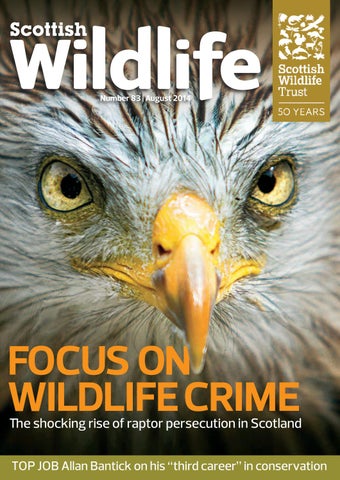
FOCUS ON WILDLIFE CRIME
The shocking rise of raptor persecution in Scotland TOP JOB Allan Bantick on his “third career” in conservation
Welcome
Inside this issue FEATURES 18
14
21
WELCOME Jonny Hughes, Chief Executive
14
WILDLIFE CRIME
18
A TEAM EFFORT
21
A THIRD CAREER
32
NATIONAL MEMBERS’ DAY
The shocking deaths of 22 birds of prey in Ross-shire earlier this year highlighted the unwelcome rise of raptor persecution in Scotland, as Jeremy Watson reports. Safeguarding wildlife on our reserves is a team effort. Richard Rowe visits Falls of Clyde and Loch of the Lowes to meet some of the Trust’s unsung heroes.
Allan Bantick describes how the call of the wild led him to become involved with the Trust and looks back on his time as Chairman.
Celebrated zoologist Dr George McGavin is the guest speaker at the Trust’s 50th Anniversary National Members’ Day in Edinburgh this September.
REGULARS
6
10
4
24
LATEST NEWS
26
TOP SPOTS
Q&A
29
VIEWPOINT
News round-up from the Scottish Wildlife Trust and the world of conservation.
24
26
Wildlife artist Georgina McMaster creates stunning pieces to raise money for the Trust.
HAVING been involved with the Scottish Wildlife Trust as both a volunteer and member of staff since 1992, I was excited and honoured to take up the position of Chief Executive in March. The Trust’s positive impact and influence on Scotland’s natural environment is growing every day. We are in good health thanks to an expert and dedicated staff team and the many thousands of members and supporters working for wildlife across Scotland. The threats to Scotland’s wildlife loom as large as ever, whether directly through the shocking levels of persecution outlined in this issue, or indirectly through recent Government policy decisions on agriculture, which fail to properly safeguard species and habitats in farmed landscapes.
29
I would like to take this opportunity to thank former Chief Executive, Simon Milne, and our current Chairman, Allan Bantick. Allan stands down in September after two terms WIN to make way for the former Green WOR £250 TOP TH OF MSP Robin Harper. Allan will be much O GEARUTDOOR missed for his tremendous energy AQUAFROM and selfless dedication to the cause PAC SEE P we all share. AGE 30
Explore one of the Trust’s most important grassland reserves Fleecefaulds Meadow. A selection of your thoughts and opinions.
Scottish Wildlife magazine is published by the Scottish Wildlife Trust. © Scottish Wildlife Trust. No part of this magazine may be reproduced without the express permission of the publisher. All photography © Scottish Wildlife Trust unless otherwise stated. The Scottish Wildlife Trust accepts no liability for omissions or incorrect data in advertisements and letters. Views expressed in Scottish Wildlife are not necessarily those of the Scottish Wildlife Trust. ISSN: 0143 1234.
Scottish Wildlife is published three times a year: March, August and November.
Registered office: Harbourside House, 110 Commercial Street, Edinburgh EH6 6NF. Tel: 0131 312 7765. Fax: 0131 312 8705. Email: enquiries@scottishwildlifetrust.org.uk Website: scottishwildlifetrust.org.uk. The Scottish Wildlife Trust is a company limited by guarantee, registered in Scotland (no. SC040247). It is also a Scottish registered charity (no. SC005792).
Patron: HRH The Prince Charles, Duke of Rothesay. Chairman: Allan Bantick. Vice-Chairs: Patric Baird, Jon Barnes, James Ivory. Chief Executive: Jonny Hughes. Editor: Jo Pike editor@scottishwildlifetrust.org.uk. Production Editor: Oliver Davies. Design: Connect connectcommunications.co.uk. Advertising: Jennifer Whyte 0131 561 0022, Clare Stebbing 0131 561 0024. Printing: Inkmark. Cover photo: Shutterstock
Deadlines for news and letters: 1 January, 1 June, 1 September. No unsolicited articles please. Scottish Wildlife is free to members. Membership rates from 1 April (excluding discounts for paying by Direct Debit): Individual (concession) £33(£18);Joint(concession)£46(£24);Family£53(£48);Watch£18;Life(joint)£800 (£1,200); Senior Citizen Life (joint) £500 (£700).
The Scottish Wildlife Trust is affiliated to The Wildlife Trusts, a UK-wide network of 47 Trusts with more than 2,000 wildlife reserves. AUGUST 2014 SCOTTISH WILDLIFE 3
WILDLIFE MATTERS Dr Maggie Keegan, Head of Policy and Planning
IT is a sad fact that some of Scotland’s rarest species and habitats are still threatened by wildlife crime. Wildlife crime includes a range of illegal and harmful activities, from raptor persecution and badger baiting to inappropriate disposal of chemicals, fly tipping and introduction of invasive non-native species. Such crimes often occur in very remote areas, making it difficult to catch those determined and selfish individuals who believe the law doesn’t apply to them. The plight of the freshwater pearl mussel – one of the most critically endangered molluscs in the world – is a case in point. Scotland holds up to 50% of the global population and the species is fully protected by law; however, this has not prevented 72 suspected criminal incidents occurring over the past 14 years, leading to the destruction of many freshwater pearl mussel sites in Scotland. Examples of criminal activities include a pearl fishing incident that resulted in the death of 50% of that population, and unauthorised river dredging which caused the near loss of an entire breeding bed (at least 900 animals were killed).
4 SCOTTISH WILDLIFE AUGUST 2014
News from the Trust, our projects and the wider world of conservation
KEEP UP TO DATE
All the latest Trust news is available on our website scottishwildlife trust.org.uk
Tim and Paul’s 50th Anniversary adventure LONG-SERVING Trustee, Tim Duffy, and Paul Ritchie, until recently the Trust’s Finance Director, have started a 2,000-mile sponsored cycle round the Trust’s 120 reserves. The epic journey began in May when Tim and Paul cycled between the 20 Lothian reserves, where they were met and encouraged by reserve volunteers. The next major stage will start on 1 September from Largiebaan up the west coast, via all the island reserves, finishing in Orkney. Mark Beaumont,
broadcaster, adventurer and Scottish Wildlife Trust Ambassador, hopes to join Tim and Paul on a later stage of their cycle. Tim and Paul hope members will consider donating in support of their challenge as a ‘one-off’ 50th Anniversary celebration. To donate, search for “Tim Duffy” on justgiving.com, or follow the links from the events pages of swtlothians.org.uk Businesses or individuals can also donate any ‘spare’ shares in order to help the Trust for the next 50 years.
Osprey project on track THANKS to the continued support of members and donors, the Trust’s osprey satellite tracking project has now entered its fourth year. While no eggs hatched at Loch of the Lowes this year, the Trust still hopes to track a few young ospreys as they make their 3,000-mile migration south. The perils of this journey were clearly demonstrated last year, when a young bird from Loch of the Lowes (Blue YZ) sadly perished in Guinea-Bissau during her first winter. With the help of satellite data, staff were able to trace her final movements to a remote rural area. However, to find the exact location of Blue YZ, more old-fashioned techniques were required. Osprey experts in Scotland
and Spain passed on the bird’s last known location to a Portuguese anthropologist, Marina Temudo, who was working in the area and who generously volunteered to travel © and find the bird. She P located Blue YZ’s remains in an area of rice fields and cashew nut plantations, complete with the satellite transmitter, which was still intact. Perthshire Ranger Emma Rawling said: “The silver lining to tragically losing this young bird is the link we’ve been able to establish with people in our bird’s destination countries. “This will hopefully lead to future collaborations to better aid osprey conservation as a whole.” h nna Ha
Scottish Wildlife Trust members can help by remaining vigilant and reporting any suspicious activity to the police. With your help, we For information can bring an and advice end to these on combating activities wildlife crime, visit and secure paw.scotland.gov.u k the future of this and other threatened species.
Latest news
hil
More recently, a population on a Perthshire river was totally wiped out because not enough was done by developers to prevent silt and oil from entering the river. The Scottish Wildlife Trust believes the total fine of around £15,000 was paltry compared to the damage inflicted.
Scottish Wildlife Trust news
Scottish Wildlife Trust news
Roseanna Cunningham, Michael Russell and Paul Wheelhouse with Bruce the Beaver
Fitting end for the Scottish Beaver Trial Scottish Parliament event celebrates five years of a truly inspirational project
T
he monitoring period of the Scottish Beaver Trial has now come to an end and the huge amount of scientific data collected over the past five years is in the process of being analysed by 13 independent monitoring partners, led by Scottish Natural Heritage. In particular, the effort of staff, students, volunteers and scientists in Knapdale has shone through. More than 11,000 hours of field work were completed over the
course of the Trial, helping collect much of the data which is now being examined. It has also been calculated that, while undertaking field surveys, the team at Knapdale covered 1,900 kilometres – roughly the same distance as walking from Land’s End to John O’Groats. In addition, 31,000 people have been engaged in beaver-related walks, talks and education sessions in the past five years. To mark the end of the monitoring period of the Scottish Beaver Trial, a special event was held at the Scottish Parliament in May, attended by staff, supporters and volunteers. Bruce the Beaver (the Trial’s furry mascot) was
a star attraction at the event. Even the three MSPs who have held the post of Environment Minister during the course of the project – Roseanna Cunningham, Michael Russell and Paul Wheelhouse – were keen to meet furry mascot Bruce. The Scottish Beaver Trial has now entered a ‘holding period’ until a Ministerial decision on the future of beavers in Scotland is reached. As this is not expected until at least 2015, we will maintain a low-key programme of beaver monitoring and management in Knapdale, along with educational guided walks during the spring and summer months.
People’s Postcode Lottery funding boost THE Trust will receive an extra £50,000 from players of People’s Postcode Lottery this year, taking the total amount raised by players to an amazing £3.3 million. Jonny Hughes, Chief Executive of the Trust, said: “We’re enormously grateful to players of People’s Postcode Lottery who – as well as giving the Trust an extra £50,000 – will also give an additional £2 million to the charities they support. “These vital funds will allow the Trust to
Stirling efforts
MEMBERS of the Stirling Members’ Centre planted 100 devil’s bit scabious plants at Cambus Pools Wildlife Reserve earlier this year. These plants were grown from seed collected locally by Sue and Roy Sexton and will further increase the diversity of the species-rich grassland. Further volunteer days will take place at Cambus Pools this year, so contact Stirling Members’ Centre if you would like to get involved.
Top-class fundraising THE Conservation Club at The Mary Erskine School in Edinburgh raised an impressive £4,444 from their Wildlife Warrior Challenge. The sponsored event saw 122 pupils dress in a variety of costumes to overcome obstacles on an assault course. Well done to all involved!
Sad news continue to maintain and protect its 120 reserves across Scotland, providing a haven for wildlife such as otters, red squirrels and golden eagles.”
ON the eve of Scottish Wildlife going to press, we were saddened to hear of the death of Lieutenant Commander Frank Spragge, Chairman of the Trust from 1987 to 1990. An obituary will be included in the next issue. AUGUST 2014 SCOTTISH WILDLIFE 5
Scottish Wildlife Trust news
IN BRIEF
CAP disappointment
THE Scottish Government has recently submitted its plan for implementing the Common Agricultural Policy (CAP) which represents £4.2 billion of public funds. Unfortunately, despite the best efforts of the Trust and supporters of our campaign, the Scottish Government has chosen to incentivise some nonenvironmentally friendly practices and give very little money to schemes that enhance the environment. The Trust has expressed its disappointment on the issue and will continue to call for greater funding for environmental practices in the future.
Meadows blooming MANY thanks to all those who attended the Magnificent Meadows vegetation monitoring training day hosted by Ben Averis at Fleecefaulds Meadow. If you fancy visiting the reserve, see page 26 for a walking route.
Don’t get caught out! IF you have recently stopped paying tax, please remember to let us know. Gift Aid is hugely important to the Scottish Wildlife Trust and we are grateful to all our supporters who have signed Gift Aid declarations. However, if your tax status has changed we may no longer be able to claim. To ensure your details are up to date, call 0131 312 4700 or email membership@scottishwildlifetrust.org.uk
Call for photos THE annual Jupiter Photo Competition is closing on 15 August. There are three categories for budding photographers and more experienced snappers: Under 10, 10-16 and Adult. For more information or to enter please contact Rosie Black on jupiterranger@scottishwildlifetrust.org. uk or call 01324 486 475.
Our apologies THE Trust would like to apologise for a few historical inaccuracies in the last issue of Scottish Wildlife which have been pointed out by readers. The first local members’ group was formed in 1965 (not 1967), and on page 19 “saving parrots” should have read “saving puddocks”. The Trust’s offices at this time were in Dublin Street, and not Duke Street. Finally, on a point of clarification, the statistics in the otter article relate to the sea otter and not the European otter.
6 SCOTTISH WILDLIFE AUGUST 2014
Gordon is our new ambassador RENOWNED wildlife filmmaker Gordon Buchanan has become an ambassador for the Scottish Wildlife Trust. Originally from Mull, Gordon is known for his groundbreaking natural history programmes, including ‘Wild Burma’, ‘The Dark: Nature’s Nighttime World’, ‘Land of the Lost
Wolves’, ‘Lost Land of the Tiger’, ‘Lost Land of the Volcano’ and ‘Lost Land of the Jaguar’. Gordon said: “I was honoured to be asked by the Trust to become an ambassador and I really look forward to being a champion for its continued dedication to preserving Scotland’s wildlife.”
Improvements at Addiewell ADDIEWELL Bing Wildlife Reserve in West Lothian has been enhanced thanks to a Landfill Communities Fund grant of £11,550, received through the LandTrust from Avondale Environmental and West Lothian Council. An area of non-native lodgepole pine was felled by contractors and then replanted with native trees by
volunteers to increase the area of woodland available for wildlife. A woodland ride was enhanced by removing trees that were starting to shade out the valuable flowerrich grassland it supports. Access improvements were also made – including rebuilding steps – and a boardwalk was constructed to make it easier for people to visit the reserve.
MARCH 2014 SCOTTISH WILDLIFE 7
Scottish Wildlife Trust news
Fiona Saywell, Richard Williams and Elaine Macaskill
Volunteer internships IN March, the Scottish Wildlife Trust launched a new volunteer internship programme designed to recruit a small number of volunteers to support activities ranging from visitor centre work to a landscape architecture project. In June, we welcomed six new volunteer interns, with an induction day held in Edinburgh. Volunteer Development Officer Peter Gilbert said: “This is the first intake and so far it has proved very popular. The Trust hopes there will be many more in the future.”
Blooming good management THE Reserve Project Group for the Highlands and Islands has been working on Talich Wildlife Reserve since 2006, restoring woodlands and grasslands. This year, they were amazed to find more than 80 examples of the rare lesser butterfly orchid in a meadow. Records show that this species used to be common in the area and it seems improved meadow management is starting to have a positive impact.
Cash boost for Wildlife Watch WILDLIFE Watch groups will be benefiting from an Awards for All grant of £9,329. The funds will be used to give Wildlife Watch leaders more resources and training (including camera trap equipment and bushcraft materials), as well as providing trips. Wildlife Watch encourages and nurtures young people’s interest in wildlife and the environment by creating learning opportunities and inspiring children to connect and engage with nature. The Trust has more than 25 Wildlife Watch groups operating around the country. To find out more or to join a group, please visit our website.
8 SCOTTISH WILDLIFE AUGUST 2014
Growing community in Coigach-Assynt THE Coigach – Assynt Living Landscape initiative has three new employees, funded by the Heritage Lottery Fund (HLF) as the result of our successful first round Landscape Partnership Scheme bid. Richard Williams was appointed as the Development Manager in March 2014. He lives in Achiltibuie with his young family and, for the past five years, has lived on and co-managed the island of Tanera Mòr in the Summer Isles. Fiona Saywell and Elaine Macaskill have recently been appointed on a job-share basis as the Assistant Development Managers. Fiona is the part-time Project Officer with Culag Community Woodland Trust and lives in Drumbeg with her husband and
two children. Elaine is moving back to the family croft in Inverkirkaig with her young family and has been working in Dingwall for Forestry Commission Scotland. The Landscape Partnership aims to deliver a range of projects that will provide landscape-scale benefits while celebrating the area’s cultural, built and natural heritage. The development team would be delighted to speak to anyone who is interested in learning more about the CALL project. Contact the team at: rwilliams@coigach-assynt.org, fsaywell@coigach-assynt.org, emacaskill@coigach-assynt.org or phone 01571 844 638.
MPA announcement expected AS this magazine goes to press, the designation of a network of new Marine Protected Areas around the Scottish coast is expected. An overwhelming 99% of respondents to last year’s Scottish Government proposals supported the creation of Marine Protected Areas (MPAs).
The Trust is hopeful that the recommended 29 sites will all be designated, including the unique Firth of Forth Banks. However, designation alone will not ensure MPAs contribute to the recovery of our marine wildlife. Over the coming months the Trust will be
trying to ensure there are plans for regulation and enforcement in every single MPA in Scottish seas. The Trust is also calling for the creation of protected areas for whales, dolphins and basking sharks. Be sure to check the Trust’s website for updates.
© Richard Williams
IN BRIEF
Scottish Wildlife Trust news
© Lizzie Drake
The Experts for Nature trai nees
Perfect sea views harbour porpoise and minke whales on a trip with Tobermory-based Sea Life Surveys. Given the potential for the expansion of marine renewable energy around Scotland’s coasts, marine wildlife
Become a Community Wildlife Champion THE team at Falls of Clyde are looking for people with some spare time to help raise awareness and run fundraising activities on behalf of the Trust in the local community. Working as part of a group, these enthusiastic people will attend events like the Sponsored Night Walk and the Duck Race at Falls
of Clyde, as well as events in the wider local area. They will also help identify future opportunities for fundraising in the area to ensure that Falls of Clyde is well supported. For more information, contact Lyndsay Mark at lmark@ scottishwildlifetrust.org.uk or call 01555 665 262.
surveys are becoming an increasingly valuable skill for ecological surveyors, and the team were extremely grateful for HWDT’s support. The current Experts for Nature course will conclude this autumn.
Primary school pupils clean up PUPILS from Abronhill Primary enjoyed their first Forest Schools lesson after a cleanup was launched by the Cumbernauld Living Landscape to improve the environment of Red Burn, which is located behind the school. It comes after the school’s Eco-Committee contacted local MSP Jamie Hepburn about the area, which is used for outdoor lessons and forms part of the Trust’s
Cumbernauld Glen Wildlife Reserve. The MSP contacted Cumbernauld Greenspace Reserves Manager, Duncan Clark, who inspected the site. The Scottish Wildlife Trust secured a grant from the Carillion Natural Habitats Fund to improve the biodiversity of the woods and Carillion staff removed non-native plants. By cleaning up, the volunteers showed how small actions can have a big impact.
AUGUST 2014 SCOTTISH WILDLIFE 9
© Mike Beard
THE Experts for Nature trainees recently travelled to Mull for training in marine mammal surveys with the Hebridean Whale and Dolphin Trust (HWDT). After an informative day with HWDT, the team were treated to excellent views of
Scottish Wildlife Trust news
Maggie Keegan and John Wilson MSP with Sandy the Squirrel at the Holyrood debate
Holyrood debate marks 50 years Wilson, congratulating the charity on protecting Scotland’s wildlife for the past 50 years. Having gained cross-party support, the motion led to a special celebratory debate in the chamber at Holyrood.
‘Natural highways’ for wildlife THE Trust has welcomed the Scottish Government’s endorsement of a National Ecological Network – a ‘natural highway’ for wildlife – in Scotland’s new national planning strategy published in June. This high-level spatial plan – ‘Scotland’s Third National Planning Framework’ – will influence every major development for the next 25 years. Over the past year, the Trust has called on the Scottish Government to give a clear direction to planners that natural features are just as vital as the built environment within the planning 10 SCOTTISH WILDLIFE AUGUST 2014
process. Ecological networks will help reconnect Scotland’s fragmented habitats which will allow wildlife to move more easily. Head of Policy and Planning for the Trust, Dr Maggie Keegan, said: “The Trust is pleased that the Scottish Government’s new high-level planning strategy recognises the importance of a National Ecological Network, thereby giving a clear steer to decision-makers that enhancing and connecting the natural environment cannot be considered an afterthought.”
HEARTENED by the success of Saving Scotland’s Red Squirrels in and around Aberdeen, Aberdeen Greenspace has generously increased its funding for the project. Red squirrels have made a real comeback in the area, returning to gardens in Cults, Bieldside, Hazlehead, Newton Dee and Bridge of Don as the grey squirrel population has declined. Aberdeen Greenspace channels money from the Landfill Communities Fund into projects which enhance the natural environment of Aberdeen. The extra funding has enabled the project to take on a Control and Monitoring Officer for the next three years. Project Officer Steve Willis said: “This funding will help us make a final push to reduce grey squirrel numbers to a manageable level, allowing us to scale down our control efforts in the future. “Our aim is for red squirrel sightings to become commonplace in Aberdeen’s parks and woodlands. This would be of huge benefit not only to our native wildlife but also to the people of Aberdeen.” © Elliott Neep, elliottneep.com
THE Scottish Wildlife Trust was the subject of a debate on 27 May at Holyrood to mark its 50th Anniversary. On the Trust’s official birthday in April, a parliamentary motion was lodged by MSP for Central Scotland, John
Red revival receives funding boost
The Community Empowerment (Scotland) Bill Following two consultation processes, in June 2012 and November 2013, the Community Empowerment (Scotland) Bill (“Bill”) was introduced to the Scottish Parliament on 11 June 2014. The Bill covers a wide variety of issues and we’ll focus on a few of those relevant to our readership. Many of you will be familiar with the Community Right to Buy (“CRTB”) powers established in terms of the Land Reform (Scotland) Act 2003 (“2003 Act”). The headline change in the Bill - or certainly the change that is receiving the most press attention - is that the CRTB is to be extended to cover the whole of Scotland, and not just rural areas. This would result in the CRTB being available to those in urban areas with a population of over 10,000. As it stands, the CRTB allows Scottish community bodies (“CB”) representing areas with a population of less than 10,000 to apply to register an interest in land with the Registers of Scotland, in the Register of Community Interests in Land. Once that interest is registered, the CB has the opportunity (by way of a pre-emptive right) to buy that land if and when it comes up for sale. This basically means that if the seller decides to sell the land in question,
the CB, because of its registered is property owned by a local right, gets first refusal over that land. authority for the common good of the local authority’s inhabitants. It must be remembered that whilst On most occasions, such property the CRTB allows a CB to register would originally have been owned an interest in land at any time, it by the historic burghs which, can only buy the land if the owner following local government decides to sell. However, in respect reorganisation, now form part of of land that is abandoned or today’s local authorities. Information neglected, the Bill includes a new about common good property is power for a CB to acquire land not easily obtainable by the public, without the need for a willing seller. and the Bill proposes that each local Land is to be eligible for such an authority establishes a register of acquisition if in the opinion of the their common good property. Scottish Ministers it is “wholly or The last part we’d like to highlight mainly abandoned or neglected”. relates to allotments. As it stands, In coming to that decision, it has the law relating to allotments is been suggested that the matters to fairly complex and comprises of a be considered should include the number of historic Acts. Seeking to physical condition of the land; the modernise and clarify the law, current use of the land; and any the Bill contains a duty on local negative economic or environmenauthorities to actively manage tal impact the land has on the local waiting lists for allotments, and area. Of course, one person’s idea to take steps to provide more of neglect my be another person’s allotments if the waiting list exceeds idea of managed conservation. certain trigger points. In addition, Where, in relation to such local authorities are to be preventabandoned or neglected land ed from disposing of or changing the Scottish Ministers approve the the use of an allotment site without CB’s application, the owner will be the consent of the Scottish Ministers. required to transfer the land to the CB, which would be required to pay It will be interesting to follow the market value for the land. progress of the Bill at Holyrood and Another notable provision in its passage will no doubt help the Bill relates to common good to maintain the lively debate in property. Common good property Scotland around land reform.
For further advice on on this topic please contact: Richard Wilson Senior Solicitor in the Private Client Division on Richard.Wilson@morton-fraser.com or 0131 247 1104 AUGUST 2014 SCOTTISH WILDLIFE 11
Wildlife Cruises Daily From John O'Groats June, July and August 2.30pm for 90 Minutes
The sharks have arrived in the Hebrides. Tours run till Sept to see the big fish!
www.baskingsharkscotland.co.uk 07975-723140 - info@baskingsharkscotland.co.uk 12 SCOTTISH WILDLIFE AUGUST 2014
John O'Groats Ferries Tel: 01955 611353 Web: www.jogferry.co.uk
Wider news
Persecution protest in Inverness
Research project into potential link between pine marten recovery and grey squirrel decline A NEW research project investigating the relationship between the pine marten and red and grey squirrels in Scotland has just been launched at the University of Aberdeen. The project, which will run until the end of 2017, is led by Dr Emma Sheehy and Professor Xavier Lambin, and is funded by Forestry Commission Scotland, the Irish Research Council and Marie Curie. Dr Sheehy said: “We will test the hypothesis that the recovering Scottish pine marten population is causing
the grey squirrel to decline in range and numbers. “There have been numerous reports over the last few years that – as the pine marten has recovered in certain parts of Scotland – the red squirrel has also returned to woodlands where grey squirrels had previously been well established. “If we can verify these reports, it would represent a real scientific breakthrough and could have an impact on red squirrel conservation in the future. However, we cannot jump to any
conclusions. Our priority is to ascertain the status of all three species in these areas and indeed the nature of their interactions.” The team will also investigate how the abundance of the recovering pine marten population varies throughout the Scottish landscape, how varying pine marten abundance influences squirrel populations, and what the key factors influencing pine marten numbers are, such as genetic diversity and competition from foxes.
Consultation on peatlands THE consultation on the future of Scotland’s peatlands has opened with the publication of a draft National Peatland Plan. Peatlands are rare and vulnerable habitats of international importance and are an essential component of Scotland’s natural capital. Urgent action is needed to repair and conserve them to avoid the potential future costs to society from carbon emissions, loss of water quality and harm to wildlife. Scottish Natural Heritage,
© Pete Matthews
working with the Scottish Government and a range of stakeholders, has drafted a National Peatland Plan to highlight the importance of peatlands. To achieve the plan’s objectives, Scottish Natural Heritage is seeking the views of all those with an interest in ensuring that peatlands are managed as national assets which benefit society as a whole. For more information and to submit a response, visit snh.gov.uk. The consultation closes on 12 September.
A PUBLIC demonstration has been held in Inverness, protesting against the recent spate of raptor deaths in the Highlands. Organised by RSPB Scotland and supported by a coalition of partners (including the Scottish Wildlife Trust), the event comes after 16 red kites and six buzzards were found poisoned near Conon Bridge in Ross-shire. During the event, local people carried ‘ghost raptors’ through the streets before staging a demonstration. Speaking at the event, Scottish Wildlife Trust Chairman Allan Bantick said: “We stand shoulder-toshoulder with the RSPB in deploring these horrific acts against Scotland’s wildlife and call for action to stamp it out.”
Free access to journals OVER the years, the Scottish Naturalist and the Western Naturalist have published a great many important papers documenting the history and development of Scottish natural history. Now, the Biodiversity Heritage Library (BHL) would like to make access to these journals free. Copyright holders who do not wish to have their material included are asked to contact mail@ the-soc.org.uk, preferably before 1 December, as arrangements are in place to have material excluded.
AUGUST 2014 SCOTTISH WILDLIFE 13
© Alan Tissiman, RSPB Scotland
© Terry Whittaker, 2020VISION
Pine marten project launched
IN BRIEF
Raptor persecution
RAPTOR PERSECUTION
The shocking truth In 2013, the number of birds of prey poisoned in Scotland doubled. Following the deaths of 22 birds near Conon Bridge in Ross-shire earlier this year, Jeremy Watson reports on the unwelcome rise of raptor persecution in Scotland and asks: what can be done to prevent it?
F
or parliamentary language, it was among the strongest condemnations ever heard. Paul Wheelhouse, Minister for the Environment and Climate Change, talked of his “anger, revulsion and utter frustration”. What had happened in Ross-shire was, in his words, “cruel, barbaric and outdated” behaviour that was “dangerous” to some of our rarest species and a “stain” on Scotland’s reputation. Earlier this year, 22 birds of prey – 16 red kites and six buzzards – were found dead in a small area of the Highlands near Conon Bridge, in Ross-shire. By condemning these actions during the May Scottish Parliament debate, the Minister was merely articulating widespread public repugnance towards what he termed a “pernicious” crime. Such was the depth of public outrage, the deaths triggered a protest rally in Inverness attended by more than 100 people, including Scottish Wildlife Trust
14 SCOTTISH WILDLIFE AUGUST 2014
Chairman Allan Bantick. Environmental organisations and landowner groups clubbed together to raise a £27,400 reward for information leading to prosecution, and elsewhere wildlife crime officers raided a number of farms in the local area. Sadly, the size of the reward and official confirmation that traces of an illegal – but so far un-named – poison had been found in at least 15 of the birds has as yet failed to lead to anyone being charged with a criminal offence. Despite all the new measures introduced by the Scottish Parliament to stamp out illegal persecution of raptors, it appears poisoning on a mass scale is still taking place. What makes this news even more worrying is that the target appears to have been red kites reintroduced as part of a long-standing conservation initiative on the Black Isle. The recent deaths are part of a pattern of red kite persecution that has claimed around 100 birds across Scotland since 1989. The comparison with
Peregrine falcons have also been victims of poisoning
Raptor persecution
© Mike Snelle
a similar reintroduction programme in the Chiltern Hills in southern England – cited by Mr Wheelhouse – is startling. Between 1989 and 1994, kites from Spain were imported and released into the Chilterns by the RSPB and Natural England. There are now estimated to be 600 breeding pairs in the area, six times the number in the Black Isle. Of course, the Chilterns is not an area in which the interests of game shoots and conservation clash as resoundingly as in the Scottish Highlands – where grouse hunting is a core commercial activity for many moorland estates. As the Holyrood debate heard, however, the illegal poisonings in Scotland are likely to be the work of a few rogue individuals who see raptors as liabilities, rather than assets. Rogue individuals do not just exist in the Black Isle. The Ross-shire deaths fit into a pattern, recorded in government statistics, of 83 raptor poisonings between 2009 and 2013. As well as red kites,
the list includes buzzards, peregrine falcons, golden eagles, tawny owls, sparrowhawks and white-tailed eagles. The Scottish Government has worked hard over recent years to strengthen the hand of law enforcement agencies on wildlife crime, including the 2011 Wildlife and Natural Environment (Scotland) Bill, which contained – among other measures – the concept of ‘vicarious liability’, in which landowners or their agents could be prosecuted, fined and jailed for the actions of their employees. Legal agencies were also required to step up their wildlife crime activity, with the Crown Office and Procurator Fiscal Service setting up a wildlife and environmental crime unit. Police Scotland expanded its wildlife crime officer network from eight to 14. Signalling government intent, Mr Wheelhouse said he would personally chair a new Partnership for Action Against Wildlife Crime Scotland,
encompassing both environmental and landowning groups. However, the Ross-shire incident revealed all too clearly that not everyone in the Scottish countryside was listening. “The shocking spate of raptor poisonings highlights the fact that some individuals remain determined to flout the law,” says Dr Maggie Keegan, Head of Policy and Planning for the Scottish Wildlife Trust. “Sadly, it is also obvious that the recently strengthened wildlife crime legislation has failed to halt or change the behaviour of some.” The Trust wants to see secure and long-term funding for the National Wildlife Crime Unit, as well as continued funding of a pesticide and biocide disposal scheme to rid Scotland of illegal poisons such as carbofuran, which is commonly used to kill raptors. It also wants law enforcement agencies to hand out tougher sentences and fines for convicted AUGUST 2014 SCOTTISH WILDLIFE 15
Raptor persecution
© RSPB Scotland
Sixteen red kites were found dead recently in Ross-shire, leading to widespread condemnation
THE CURSE OF WILDLIFE CRIME Pine marten The pine marten was once found throughout Britain but, by the turn of the 20th Century, its distribution had been limited to north west Scotland, where the species survived in areas of remote forest and rocky moorland. Legal protection in 1988, however, appears to have halted the decline and the species is now spreading across Scotland, with sightings as far south as Cumbernauld.
offenders, sending out a strong message that wildlife crime of any sort will not be tolerated. Although jail sentences of six months and fines of £5,000 were introduced in 2004, the maximum deterrent has never been deployed. The Trust is also backing the use of the vicarious liability provision once a conviction has been secured to send a signal to landowners that they need to take responsibility for staff. Two cases under the new legislation are currently making their way through the courts. “We will be keeping a very close eye on how these cases develop,” Dr Keegan adds. Others believe increased regulation for game management is critical, with Duncan Orr-Ewing of RSPB Scotland pointing out that although Scotland has one of the most intensive game management systems in the northern hemisphere, it is also among the least regulated. “We need effective licensing,” he says. “There are a range of models that other countries use, which is why what would work best for Scotland is being investigated.”
Above all, what most groups on the conservation side of the argument require is a change of culture on those Highland estates still wedded to the concept that raptors are a threat. In the May debate, Claire Baker, the Shadow Cabinet Secretary for Rural Affairs and the Environment, put it succinctly when she said: “We cannot eradicate this type of crime without changing the culture. There are still elements of land management that think such activity is acceptable, perhaps even necessary, and we must all work together to challenge and change that culture.” The Scottish Wildlife Trust – and the wider conservation community – agrees. While there are signs that some grouse-shooting estates are realising that wildlife such as raptors are an economic asset, progress remains frustratingly slow. Until consensus is reached in every area of the rural economy, events such as those that have blighted Ross-shire over the past year will continue to occur. We cannot and will not stand idly by.
Sadly... the recently strengthened wildlife crime legislation has failed to halt or change the behaviour of some. 16 SCOTTISH WILDLIFE AUGUST 2014
Mountain hare Mountain hares face persecution because they have been implicated in the transmission of the louping-ill virus. They are shot and snared by gamekeepers to help control disease, even though scientists say there is “no compelling evidence” that this works. Ecologists such as Dr Adam Watson have found “massive declines” over the last 20 years on grouse moors, while the most recent Scottish Natural Heritage survey found that more than 24,500 mountain hares were shot or snared by 90 sporting estates in a single year. Badger Badger persecution comes in many forms, from badger baiting and digging out setts to careless operation of machinery in forestry or agricultural operations. Under the Nature Conservation (Scotland) Act 2004, people convicted of the most serious badger-related offences face unlimited fines and up to three years in prison. Ian Hutchison, Species Protection Officer at Scottish Badgers, said: “Badgers are not only cruelly baited but also sealed in setts and buried alive, snared, shot, poisoned and tortured. Sadly, most of these crimes go unreported.” Freshwater pearl mussel Their name is a strong clue as to why freshwater pearl mussels are persecuted, albeit only around one in every thousand shells contains a pearl. This explains the massive declines in their numbers and range; the species remains on the brink of extinction. Scotland’s rivers contain around half of the world’s population and the species is now one of the top six wildlife crime priorities established by the Scottish Government.
MAKE YOUR OWN OUTDOOR GEAR WE HAVE EVERYTHING YOU NEED! • Multipurpose webbing and buckles for rucksacks, belts and bags etc. • Fabrics for tents, fly sheets and tarps • Bag fabrics and canvas • Midge netting
Tel: 01524 263 377 www.pennineoutdoor.co.uk sales@pennineoutdoor.co. uk
Pennine Outdoor Ltd, Central buildings, Main Street, Bentham, Lancaster LA2 7HE
AUGUST 2014 SCOTTISH WILDLIFE 17
A team effort
PHOTOGRAPHY: PAUL WATT
Open all
HOURS The peregrines and ospreys that nest at two key Trust sites are protected by a community of people from all walks of life who share a remarkable dedication to safeguarding these vulnerable species. Richard Rowe travels to meet some of the Trust’s unsung heroes.
H
igh above the Clyde gorge, on the boundary between woodland and field, sits a tiny caravan, its wheels concealed by vegetation. The modest living space has been extended with an awning just large enough to house a fold-up table, two chairs, a bike, plus a make-shift clothes line. It is not much to look at, but the caravan is an integral part of the Falls of Clyde Peregrine Watch – and home for four months of the year to Adam Murphy, the Trust’s Peregrine Protection Officer (pictured, right). It is fair to say that such living quarters would not be to everyone’s taste, but Adam takes it all in his stride. “I’ve been here since early March and probably smell as bad as some of my neighbours at times,” he says cheerfully, pointing to a badger run that passes in front of the caravan. When peregrines first nested at the Falls of Clyde in 1997, having been driven here following repeated persecution elsewhere, the Trust adopted a low-key approach to the eyrie. However, that all changed a couple of years later when the nest site proved accessible enough for someone
18 SCOTTISH WILDLIFE AUGUST 2014
to slide down and knock the chicks off their ledge. Although those responsible were never prosecuted, it was thought to have been the work of local ‘doomen’ – pigeon racers who had long made it clear how they felt about having peregrines nearby. Their threat remains, as does the one posed by career criminals who service a lucrative black market for stolen eggs in the Gulf states. Since 2000, the Trust has maintained a 24-hour watch that marries high-tech surveillance with a human presence. Alongside nestwatching duties, the team also provides interpretation for thousands of visitors each year, taking advantage of some of the best views of nesting peregrines in the UK. The watch runs from when the birds begin to nest at the end of March until mid-June when the chicks normally fledge, although sadly this year the egg failed to hatch.
Dual role Now in his second season living on site, Adam’s daily commute is a two-minute walk down a stepped path
A team effort
to his ‘office’ – a wooden shed overlooking the gorge. With his easy manner and obvious passion for the job, he seems well-suited to fulfilling a tricky dual role: personable ranger by day, cool-headed protection officer by night. From 10am to 8pm each day, Adam is assisted by a team of around 30 volunteers, all recruited and trained by the Trust. They are the heartbeat of the operation. One such volunteer, Scott (pictured left), now 20 and a zoology undergraduate, has been coming since he was just six years old. “I’ve seen the birds here every year since I was very young, so they have been part of my growing up,” he says. On the day of my visit, Scott is joined by Tiffany, a French intern, and Denis, a retired engineer who has volunteered here on Sundays for the past five years. “I enjoy looking after the birds,” he says, “but it’s also about people – the visitors, the full-timers, the young volunteers. It’s so interesting being with people just starting out in their careers.” However, once the last of the visitors and volunteers have headed home, the woods belong to the bats, owls, badgers and, of course, Adam. He switches into protection officer mode, armed with a night-vision nest camera, a powerful torch, mobile phone and, perhaps most importantly, his wits – although it’s the birds themselves that provide the main alarm system after dark. “They are very loud when disturbed,” explains Adam. “I’m quite a light sleeper which probably works well for a job like this, so I tend to hear everything that goes on.”
I’m quite a light sleeper which probably works well for a job like this, so I tend to hear everything that goes on. AUGUST 2014 SCOTTISH WILDLIFE 19
A team effort
such as the osprey – I get caught up in their story,” he explains. Much has changed since those early days. He adds: “For the first few years, egg thieves were a worry pretty much every time we came in. Back then, we really relied on our senses – twigs cracking, torchlight in the dark, that kind of thing. The technology we have now has helped enormously, although it’s not quite so exciting!” Thankfully, the threat of egg theft has lessened, although not disappeared – as evidenced by an attempt on an osprey nest in Dumfries-shire in 2013. Perhaps the biggest issue today, for many breeding birds and not just ospreys, is unwitting disturbance by misguided photographers who stray too close to nest sites. “Part of the rationale of having a fantastically-positioned hide with cameras is to relieve pressure on wild pairs nesting elsewhere,” explains Emma. “People can come here for the best possible views and photographs without causing disturbance.”
Human element
The team at Loch of the Lowes
Osprey watch At the Trust’s Loch of the Lowes reserve near Dunkeld, the on-site accommodation is a little more plush – a purpose-built cabin that houses three residential volunteers. All keep unsociable hours as they assist with the now renowned Osprey Watch that swings into action in March each year. It has been quite a change of scene for volunteer Species Protection Officer Victoria Pinion, whose previous volunteering involved primate studies in Paraguay and Kenya. “My main role is nest protection and recording of behaviour – I’m essentially the dawn watchman,” she explains. Having been driven to the point of extinction in the UK in 1916, ospreys first nested at Lowes in 1969. Nest watches have been carried out in their current form here since 1990, initially to counter the threat of egg thieves following several previous attempts to raid the nest. Now for eight weeks (from when the first egg is laid to when they hatch), the nest site is protected round the clock by an array of cameras, CCTV, plus a human presence. There are always two people in the main loch-side hide – a member of staff or long-standing volunteer trained to deal with emergency situations, and one 20 SCOTTISH WILDLIFE AUGUST 2014
of more than 70 volunteers who assist with the watch. Some choose a two or four-hour shift in the morning or evening, while others take on the big one: an eight-hour night shift. The whole operation is overseen by Emma Rawling, the Trust’s Perthshire Ranger. She looks weary when we meet, hardly surprising given two months of late nights and early starts. “When training volunteers, we always say they are part of an early-warning system that helps prevent a problem before it becomes a direct threat to the birds,” explains Emma. “It also helps monitor and prevent other illegal activity on the loch, such as poaching or irresponsible camping.” Some volunteers have made watching ospreys almost a life’s work. Having first got involved in protecting ospreys at Loch Garten in the mid-1980s, Robin Scott began volunteering at Lowes in 1992 and has done so every year since. “I just love birds and there is a certain satisfaction in helping protect a species
The watch today is as much about prevention and education as interception, although once or twice a year there is an incident that “reminds you why you spend all those hours sitting in a cold hide at ridiculous o’clock,” says Emma. At the beginning of this season, just after the ospreys had laid their first egg, two people were spotted walking almost underneath the nest site. The volunteers on duty followed emergency procedures, the police were called and the two were apprehended at an exit point on the wildlife reserve. Although they claimed ignorance saying they were just going for a walk, they would have had to climb three fences and pass three separate signs explaining why that part of the loch was off-limits from April to July. “We welcome people on all Trust reserves but responsible access is essential to protect wildlife on site,” says Emma. The overall objective is to stack the odds in the birds’ favour, although the watch team can’t mitigate for events such as natural predation. This year a crow took one of the osprey eggs, while pine martens have also taken eggs in the past. “What we can do is ensure we are not allowing human disturbance to have an impact,” says Emma. “We’ll do whatever it takes to keep the birds safe and give them the peace and quiet they need to breed successfully.”
There is a certain satisfaction in helping protect a species such as the osprey – I get caught up in their story.
Allan Bantick
Allan Bantick at the Strathspey Badger Hide, which he helped to build
Top
PHOTOGRAPHY: JAMIE GRANT
JOB In September 2008, former RAF survival instructor and record producer Allan Bantick became the 11th Chairman of the Scottish Wildlife Trust. Six years on and with the Trust celebrating its 50th Anniversary, Oliver Davies travels to meet one of Scotland’s foremost wildlife champions.
I
t all began with an otter in the River Spey. Allan Bantick – the Trust’s Chairman and devoted conservationist – watched the creature as it walked along the bank, stopping for a moment before slipping silently into the water. Not content with the personal thrill, Allan wanted to share the information, so he contacted Scottish Natural Heritage. They put him in touch with a group of local conservationists who were extremely keen to embrace a new, committed volunteer. This soon led to a place on the Scottish Wildlife Trust’s North Region Committee and the rest, as they say, is history. Born in 1939, Allan served in the RAF for 26 years, spending the final 10 years teaching outdoor pursuits, survival and mountain rescue in the Scottish Highlands. Based in AUGUST 2014 SCOTTISH WILDLIFE 21
Allan Bantick
Shutterstock image
© Allan Bantick
the RAF’s winter survival school in Grantown on Spey, he taught aircrew survival skills to young pilots, which included leaving them to fend for themselves in the Cromdale Hills without any provisions. To lift their spirits he would occasionally crawl into their camp at night to leave them a tin of corned beef, or a pike from a local loch. Allan was also in the Cairngorms Mountain Rescue for 10 years and went on to walk all of Scotland’s Munros. All this time spent in the wilds of the Highlands clearly made its mark, bringing Allan face-to-face with some of Scotland’s most elusive animals. “I was lucky enough to see eagles and otters back in the day when they really were very rare,” he tells me. A few years later – having left the RAF – Allan decided to remain in Grantown and
use his skills as a musician and sound engineer to build and run his own recording studio and record label. Days were spent recording musicians from all over the Highlands, while in the evening, his attention switched to entertaining the grannies on bus tours, singing songs and telling tales of Scotland’s magnificent wildlife. Little did Allan know that wildlife would play such an important part in his next career move. Having joined the North Region Committee and become heavily involved in conservation in the Highlands, Allan was fortunate enough to meet, work with and learn from a variety local experts. Over the years, he has helped in the ringing and satellite tagging of ospreys, in the latter case holding them as far from his face as possible while their harnesses are sewn on. He has built bird boxes for
It’s incredibly important to talk to people and get them to work together – not just the usual suspects but people from all walks of life. 22 SCOTTISH WILDLIFE AUGUST 2014
crested tits and goldeneye ducks and dotted them around the woods, the crested tit boxes each having a slot at the top to allow for what he calls their “distinctive John Terry hairstyle” and the goldeneye boxes mounted on slippery poles to deter pine martens. He also helped to build the Strathspey Badger Hide which, with Allan at the helm, has engaged thousands of visitors to the area. In fact, so involved in conservation has he been over the past few decades, it is Allan himself who is now known locally as the wildlife expert – although you would never catch Allan using the phrase. Since becoming Chairman in 2008, Allan has had to swap his boots and camouflage for a suit and travel the length and the breadth of the country,
Allan Bantick
To have any wild creature abused in any way is completely unacceptable in civilised society... we need to see laws tightened and legal loopholes removed.
spreading the word about the work of the Scottish Wildlife Trust and encouraging people to get involved in wildlife conservation. “It’s incredibly important to talk to people and get them to work together – not just the usual suspects but people from all walks of life who can make a real difference to the future of Scotland’s wildlife,” he explains. Allan cites as his personal highlight the releasing of the first beaver in Knapdale as part of the Scottish Beaver Trial, alongside the then Environment Minister Roseanna Cunningham. By then Allan was already heading up the Scottish Beaver Trial steering group, and he has long been a champion of reintroducing beavers across the country. Elsewhere, highlights have included meeting Trust Patron HRH Prince Charles and delivering speeches at both the Scottish Parliament and Westminster. Due to step down in September, Allan tells me it has been a real
privilege to work with the Trust’s staff, volunteers and members. He is proud that the organisation is now recognised as a thought leader in conservation in Scotland, with pioneering projects such as the Coigach – Assynt Living Landscape and the groundbreaking World Forum on Natural Capital highlighting its growing influence. He also mentions the importance of policy work, which has helped the Trust make compelling arguments that policymakers in Government listen to. “We don’t hold back,” Allan says. “We say what we think but we back it up with evidence.” One issue that Allan would like to see government take immediate action on is wildlife crime. “To have any wild creature abused in any way is completely unacceptable in civilised society,” Allan says. “Parliament was justifiably outraged at the recent red kite
fatalities in Ross-shire. We need to see laws tightened and legal loopholes removed.” Nowhere is this more pressing than with the sickening practice of baiting badgers with dogs. Scottish SPCA research indicates that this crime is on the increase in the Central Belt of Scotland, with more than 40 cases reported last year alone. “The evidence is that badger crime is on the increase again,” says Allan, who has acted as an expert witness on the subject in the past. “There have been convictions but it is still far too easy to skip around the law. Even when people are prosecuted, sentencing doesn’t always reflect the seriousness of the crime.” With his spell as Chairman coming to an end, Allan tells me he is going to have more time to refine his nest box designs, as well as monitor the nightly sorties of his badgers. He is also looking forward to spending more time with his wife Heather, who has been a huge support over the last six hectic years. They might even find time to play more golf together. At a mere 74 years old, Allan hopes that the knowledge, skills and contacts he has built up over his lifetime will still be of use. He is not ready for a quiet retirement. AUGUST 2014 SCOTTISH WILDLIFE 23
Q&A
Q&A
Georgina McMaster, artist
Georgina likes to bring out the soul and character of an animal in her paintings
Brush with the wild B
orn in 1980, Georgina McMaster trained at Edinburgh College of Art from 1998 to 2002 and has since developed a reputation as one of Scotland’s foremost wildlife artists. Now, in a unique collaboration with the Scottish Wildlife Trust and Valentine Art Reproductions, Georgina is producing a trio of portraits of much loved species to raise funds for the charity. What inspires you to paint wildlife? I love animals and was brought up with lots of them. We recently bought a wee German shorthaired pointer puppy called Poirot... although he’s not so wee now! I also really enjoy creating the feeling of the animal and bringing out its character. What are your favourite native Scottish animals to paint and why? Hares are a favourite because to me they are mystical and beautiful. I also like red squirrels because of their colour and their delicacy, and deer because they are so powerful and strong.
24 SCOTTISH WILDLIFE AUGUST 2014
How do you approach a new piece of artwork? I decide on the subject, do background research and find out where I can see them in the wild. It’s important to “meet’ them in their natural environment to see how they move and interact with their surroundings and also to get a feel about their character. Then I take lots of photos and sketches. Back at my studio I decide on the size and composition then sketch out and start painting. What do you look to bring out in your paintings of animals? I really look to bring out their character as well as a particular look or situation. I begin by drawing out a rough outline then I like to start on some detail of the animal, like an eye – it is so important to get
this right as it brings the painting to life at an early stage and gives you confidence to continue. What are you working on now? I am currently working in collaboration with the Trust to paint three commissions: an osprey, wildcat and red squirrel. I’ve travelled all over the north of Scotland to see these animals in the wild and make sketches and take photos. The paintings took two months to complete and I am so pleased to be helping raise money for these endangered animals. What role do you think art plays in supporting the conservation of wildlife and the environment? It raises the profile of conservation and it is an excellent medium to reach a wider audience. Even though I love photography, I think that a painting is so much nicer as it is more expressive in its use of colour and texture.
Valentine Art Reproductions, in partnership with the Scottish Wildlife Trust, are offering strictly limited editions of three beautiful new wildlife originals by Georgina McMaster
“Ginger Nut”
“Highland Tiger”
“Lady of the Loch”
65% of the profits from reproduction sales will go to the Scottish Wildlife Trust For sales details and availability, visit scottishwildlifetrust.org.uk/shop
Top spots
VISIT
Fleecefaulds Meadow Just south of Ceres, in the centre of Fife, lies Fleecefaulds Meadow – one of the Scottish Wildlife Trust’s most important grassland reserves.
D
onated to the Trust in 1998 by the late Lieutenant Commander Frank Spragge, Fleecefaulds Meadow is a 13.2 hectare mosaic of species-rich grassland, fen meadow and scrub woodland. The speciesrich grassland habitat is particularly important – 180 plant species have been recorded including perhaps the sole surviving community of globeflower in Fife. Fleecefaulds was named as a Coronation Meadow in 2013 as part of celebrations to mark the 60th Anniversary of the Queen’s Coronation. Getting there From Cupar, travel south on the A914 for approximately half a mile before turning left onto Ceres Road. Follow this road for two miles and then turn left onto Cupar Road. Continue straight ahead onto Main Street (0.3 miles) before turning right onto St Andrews Road (B939). Continue for 0.1 miles then go
26 SCOTTISH WILDLIFE AUGUST 2014
left onto South Croftdyke, following this for 0.1 miles before bearing right. A further two miles along this road you will reach the car park (grid reference NO400084).
The wider view looks over much of East Fife, from Cupar to St Andrews. Turn right through the field gate and walk down the slope under the canopy of trees.
from just above the fen meadow. The fen meadow is dominated by meadowsweet and horsetail. One of three areas of globeflower on the reserve is found here.
The route Fleecefaulds Meadow has no formal footpath network and the reserve is steep in places and usually quite wet. Please take care when walking and choose the route that suits you best. Visitors should also be aware that the reserve is grazed with cattle and sheep. This route starts at the field gate at the end of the car park, takes you down the gentle slope past the ‘Queen’s Gean’, then across the reserve to the main speciesrich compartment before returning to the car park.
2 Scrub woodland developed over much of Fleecefaulds Meadow in the late 1970s and 1980s. Trust volunteers have reduced the scrub but some has been left in situ as it is an important habitat. Many woodland edge birds, such as sedge and willow warblers and finches, nest within the scrub. Nearby ‘Queen’s Gean’ is planted with seed taken from Balmoral.
5 Having cut across the site, carefully climb over the stile. This southern compartment, at its best between June and August, is a beautiful area of lowland species-rich grassland. The sward here is very rich in floral plants, including early purple orchid, fragrant orchid, adder’s tongue fern, twayblade, moonwort and, dominating the sward later in the season, devil’s-bit scabious and knapweed. Butterflies which are commonly seen on the reserve include small copper, red admiral, painted lady and orange tip. Return to the car park by retracing your steps back over the stile and turn up the hill. Please take care going up the slope and choose a route that you find comfortable.
1 From the entrance into Fleecefaulds, you get an excellent view down the steep slope of much of the reserve. The fen meadow lies at the base of the glen with an area of grassland beyond.
3 From ‘Queen’s Gean’, cross the small boardwalk and wander down through a carpet of wildflowers – ox-eye daisy, orchids, yellow rattle, eyebright, bulbous buttercup and many more. If you turn and look up the hill, you can trace your route down from the trees at the top. 4 Cut across the reserve,
Top spots
TOP SPOTS BALLACHUAN HAZELWOOD OS LANDRANGER 55
Ballachuan Hazelwood cloaks a low ridge overlooking Cuan Sound and supports an exceptionally large number of lichens, mosses, liverworts, Grid ref: NM763153 hornworts and species of fungus. The wetland area provides a rich habitat for butterflies, with marsh fritillaries present, while the woodland has a rich ground fauna and is a good site for breeding birds and summer migrants.
FEOCH MEADOWS
This reserve, also a Coronation Meadow, is part of a working farm, whose main interest lies in the species-rich Grid ref: NX263822 grassy knolls near the burn. The majority of the site comprises grassy and marshy ground worth exploring for its rich biodiversity. The large number of flowering plants make the reserve excellent for butterflies and dragonflies can usually be found along the burn on summer days.
HADDO HOUSE AND COUNTRY PARK OS LANDRANGER 30
Fleecefaulds
3
2
4
Haddo House and Country Park is an early example of the 18th and mid-19th Century Grid ref: NJ868347 landscape. The park comprises a pleasant mix of open water, mature woods and grassland, some of which contains a diverse range of wildflowers. The backbone of the park is the central avenue, reputed to be one mile from the rear of Haddo House to the commemorative urn at the top of the deer park. TALICH
1
OS LANDRANGER 21
P
5 Windygates
Talich is one of the largest areas of alder wood in Easter Ross. Outwith the woodland, a rich grassland flora is found in clusters around calcareous springs. Woodland birds and a diverse range of invertebrates thrive, along with an abundance of orchids.
Grid ref: NH850786
© Jim Higham
Contains Ordnance Survey data © Crown copyright and database rights 2014. Ordnance Survey Licence Number 100030835
OS LANDRANGER 76
AUGUST 2014 SCOTTISH WILDLIFE 27
Viewpoint A selection of your thoughts and opinions THE VIEW FROM…
WE'RE AL A YS INTERESTW E D YOUR OPINIO IN NS AND OBSERVATIO NS
Speak to u Twitter: @Sc s on Facebook: fa otWildlife cebook.com / scottishwild li or email us: fetrust en @scottishwil quiries dlifetrust. org.uk
Reptile Group (since 2008) and the National Trust for Scotland’s Inveresk Lodge Garden, I was familiar with smooth, palmate and alpine newts but had never actually worked with great crested newts until I joined the course. Experts for Nature enabled me not only to work with great crested newts (twice with the National Trust for Scotland rangers at Culzean in Ayrshire) but to meet the people responsible for licensing – Scottish Natural Heritage. As a result, in May of this year I was granted a six-year licence. Hopefully, I will now be able to put this to good use and learn more about great crested newt populations in Scotland. My only regret is that I won’t be staying until the very end of the course, as I have recently been offered a permanent job with Edinburgh Council. I look forward to passing on my new skills and knowledge so that we will have another generation of wildlife enthusiasts.
Rachel Edmans, Experts for Nature trainee TIME flies when you’re having fun and this has certainly been the case for the last 16 months, ever since I joined the Scottish Wildlife Trust’s Experts for Nature team. It’s been a wonderful experience, from meeting botany and bat experts to travelling the length of the country in search of new species to discover and survey. Highlights have included the trips to the islands of Arran and Mull; helping with the Scottish Beaver Trial; and the business aspect of the course, which led me to put some of my ideas of running my own environmental education consultancy into practice. My greatest achievement has been to successfully gain a great crested newt licence, as I’ve had a lifelong interest and love of amphibians. Having previously volunteered with my local Amphibian and
For all the latest news from our Experts For Nature team, visit their blog: swt-dess.tumblr.com
Gardening for wildlife IT’S tempting to think that wildlife has it easy at this time of year and that there is little we can do to help, but there are always simple ways to encourage a variety of wildlife to visit our gardens. Unskilled young birds and experienced adults will be regularly frequenting our gardens and both will benefit from a consistent supply of good quality food to help them through any local shortages. Seeds high in oil, such as sunflower hearts, are a staple favourite all year round but live foods such as mealworms or earthworms can be a big help during dry spells. Another way to provide insect food is to simply leave an area of grass uncut. Not only will this increase the number of insects present but it should allow a variety of wildflowers to appear and will also act as a refuge for frogs, toads and newts. If you are mowing or strimming keep a close watch for wildlife and if possible reduce the height of
long grass first and then come back to finish the cut later. The mown grass can be added to the compost heap to produce another valuable wildlife habitat. It is advisable to leave large pruning jobs until the end of August when the bird breeding season is coming to an end. Water is another vital component of a wildlife garden. All that you need is a shallow birdbath (ideally sited a couple of metres from any cover that might hide a cat), or a pond with gently sloping sides. Ensuring you have the essentials of food, water and shelter will help to sustain your garden wildlife now and in the winter months ahead. Martin George, Wildlife Advisor at CJ Wildlife AUGUST 2014 SCOTTISH WILDLIFE 29
Viewpoint
WIN £250 OF TOP OUTDOOR GEAR Aquapac and the Scottish Wildlife Trust are offering readers the opportunity to win a range of great waterproof gear worth more than £250.
A
quapac was established in the UK in 1983 when the founders needed a waterproof case to house their personal stereos while windsurfing. Today, Aquapac produces bags and pouches in three ranges: Stormproof, TrailProof™ and Submersible. All of Aquapac’s products are built to keep personal belongings dry, dust and sand-free whatever the weather. The winner of our competition stands to take home the following: Aquapac Stormproof Phone Case Whatever phone you have, Aquapac has a stormproof case for it. With a roll-top seal and a transparent window, you can make calls and text quite normally through the case. RRP: £16 Aquapac Toccoa™ Daysack Part of the new TrailProof range, the Toccoa is 100% waterproof and offers tough, uncompromising protection for all your gear. With a roll-seal closure, comfortable shoulder straps and a grab handle on top, the Toccoa is a versatile bit of kit. RRP: £50
Aquapac Messenger Bag In dodgy weather, whether you’re walking or cycling, your laptop will stay safe and dry cocooned in this stylish padded bag. RRP: £95 Aquapac 40L Upano™ Duffel: When you find you’ve got to lug stuff around with you in wet weather, this waterproof duffel bag really comes into its own. With a roll-top seal and made from durable PU-coated nylon it’s a takeanywhere bag for a myriad of pursuits. RRP: £90
For further information on Aquapac’s weatherproof gear, visit www.aquapac.net To be entered into our prize draw, tell us: Who is the Trust’s keynote speaker at this year’s National Members’ Day?
FACEBOOK POLL We asked our Facebook followers: Is sentencing for wildlife crime, such as badger baiting, stringent enough? 2% said
YES 98% said
NO
FOLLOW US ON FACEBOOK facebook.com/scottishwildlifetrust
TWITTER FEED Why not join the conversation on Twitter by letting us know: What should be done to deter wildlife criminals? FOLLOW US ON TWITTER twitter.com /ScotWildlife
Send your entry to: Scottish Wildlife Trust Competition, c/o Connect Communications, Studio 2001, Mile End, Seedhill Road, Paisley PA1 1JS. Or email : hello@connectcommunications.co.uk before midnight on 30 August 2014.
Answer Name Address
Postcode
✃
Telephone Email
30 SCOTTISH WILDLIFE AUGUST 2014
We’re calling on members to share their autumn moments with us. Send your pictures of the changing season to @ScotWildlife using the hashtag #scottishautumn We’ll publish some of the best on our Facebook page.
Viewpoint
Book reviews
Otters: Return To The River LAURIE CAMPBELL AND ANNA LEVIN Published by Birlinn £14.99 ISBN: 978-1780272061 FOR a long time, Britain’s otter population appeared to be on a downward spiral, with numbers decimated by pesticide poisoning and habitat disturbance. Otters were marginalised to remote coastal areas but, thanks to conservation efforts, these elusive predators are making a comeback throughout the UK – and this resurgence is celebrated in this beautiful book which looks at the life of otters that have returned to the River Tweed. For more than two decades, Laurie Campbell – one of Scotland’s leading natural history photographers – has documented otters on the Tweed. He has now clocked up thousands of hours in the field: crouching in riverbank hides, wading chest deep into the water, hanging off bridges and gleaning sightings tips from walkers, anglers, poachers and bailiffs alike. The resulting images are a testimony to this dedication, and to his wealth of skill and experience in both photography
Wildflower Wonders
BOB GIBBONS Published by Bloomsbury £19.99 ISBN: 978-1472909824 From the USA’s Mojave Desert to the Italian Dolomites and the Stirling Range of Australia, this book showcases some of the world's most spectacular displays of wildflowers. Each site is accurately detailed and described by Gibbons, who has visited nearly all of the places featured. As well as stunning images of each location, there are chapters on the animal life found at the sites and their conservation status. Many people go far and wide in search of spectacular flower displays but this book provides a visual feast for armchair naturalists as well as active travellers.
and field craft. Writer Anna Levin sets this work in the context of Laurie’s own life story as she accompanies him to the riverbank. Her notebooks offer a vivid glimpse of a photographer at work and of the otters that enchant them both. This beautiful book is lavishly
Frog Meets a Bog Beast
LINDA BUTTON ILLUSTRATED BY IAN R WARD Published by Matador £6.99 ISBN: 978-1783063277 This paperback picture book presents a delightful tale with a twist, combining beautiful images and an engaging rhyme. It’s the first printed book in the ‘My Animal Puzzle’ Book series and is designed to set the scene fora collection of thoughtful, entertaining stories. Whether read out loud or quietly before bedtime, this short story encourages communication skills among young readers. It also includes a mini ‘Bog Field Guide’ and ‘How To Make Your Own Frog’ craft activity. Suitable for adult supported reading, early readers and children aged 4-8, it raises the issues of courage, friendship, nature and exploring different environments.
illustrated throughout, divided into seasonal chapters charting Laurie’s personal quest to capture these endearing creatures in their natural habitat. It also offers an insight into Laurie’s philosophy – to look closer to home, rather than further away, to connect with our own natural environment.
RSPB Spotlight: Puffins
EUAN DUNN Published by Bloomsbury £9.99 ISBN: 978- 1472903549 Part of the Spotlight series (designed to introduce readers to the lives and behaviour of our favourite birds and mammals), this book focuses on one of the most popular. The puffin remains one of Scotland’s most beloved species and is certainly one of the most identifiable. Despite that popularity, surprisingly little was known about puffin ecology until recently. Dunn provides a revealing account of their life cycle, behaviour and breeding: what they eat, how they interact and where they migrate during the winter. He also exposes the threats puffins face and advises on the best places to see them.
AUGUST 2014 SCOTTISH WILDLIFE 31
AGM and National Members’ Day
AGM and National Members’ Day
Celebrated zoologist, filmmaker, presenter and all-round bug enthusiast Dr George McGavin will be our special guest for the Trust’s 50th Anniversary National Members’ Day. Join us at the Royal College of Physicians of Edinburgh for what promises to be a fascinating and inspirational event
Highlights l Buffet lunch with Dr George McGavin l Dr George McGavin delivers a thoughtprovoking talk followed by an interview with Stephen Jardine l Talk from our new Chief Executive Jonny Hughes on the future of the Trust l ‘Question Time’ with guests including Aubrey Manning OBE 32 SCOTTISH WILDLIFE AUGUST 2014
social media link / email link
BOOK YOUR PLACE THE Trust is delighted to announce that Dr George McGavin has agreed to join us as the keynote speaker at this year’s National Members’ Day in Edinburgh. As well as being a familiar face to millions on television – hosting numerous nature documentaries and acting as The One Show’s resident bug expert – George is also a distinguished academic, having spent thirty years as a zoologist at institutions including Oxford University. George’s BBC television credits include ‘Lost Land of the Jaguar’, ‘Lost Land of the Volcano’, ‘The Dark: Nature’s Night-time World’, ‘Lost Land of the Tiger’ (all alongside Trust ambassador Gordon Buchanan), ‘Expedition Borneo’, ‘Miniature Britain’ and the multi-award winning documentary ‘After Life: The Strange Science of Decay’. His most recent series, ‘Monkey Planet’, was shown on BBC 1 in April. Join us to find out more about one of Edinburgh’s most famous sons, returning to the capital to help mark 50 years of the Scottish Wildlife Trust. George will deliver a thoughtprovoking talk, followed by an in-depth interview with fellow broadcaster and Trust ambassador Stephen Jardine. Topics are likely to include George’s formative years in
Scotland, his enduring fascination with insects, and his experiences filming wildlife all over the world. Later on in the day, Stephen Jardine will chair a lively ‘Question Time’ session in association with People’s Postcode Lottery, with panellists including former Trust Chairman and broadcaster Aubrey Manning OBE and Dr George McGavin. The event will also feature a presentation on the aims and aspirations of the Trust over the coming 50 years, and a wildlife shop selling produce from our visitor centres. National Members’ Day (12 noon to 4.30pm) will follow the Trust’s 50th AGM (10.30am to 12 noon), which offers members the opportunity to shape the future of the organisation and comment on what has happened over the past year. Items on the agenda include electing new members of Council, appointing auditors and receiving the Council’s report and accounts for the year ending 31 March 2014. For a copy of the full accounts or to notify us of any other business (by 5 September 2014), please contact Jessica Ryder, Executive Assistant at: Scottish Wildlife Trust, 110 Commercial Street, Edinburgh, EH6 6NF. A full agenda for the AGM is available on our website.
10.30am- 4.30pm, 20 September 2014 (National Members’ Day begins at noon)
EARL DISC Y BIRD OUN T BOOK
30 AU BEFORE G ONLY UST FOR £1 PERS 0 PER ON
Please complete this form using BLOCK CAPITALS and return to: Membership Department, Scottish Wildlife Trust, Harbourside House, 110 Commercial Street, Edinburgh EH6 6NF by 12 September 2014 or, if paying early bird rate, by 30 August 2014. COMPLETE THE FORM BELOW OR BOOK ONLINE scottishwildlifetrust.org.uk/membersday Name of first delegate Membership number Name of second delegate (if applicable) Non-member guests (two max.) Contact address
Postcode
eet n Str Quee
f
reet es St Princ
The ver Mound Hanoet Stre
ns Quee
er ry Rd
as Dundet Stre
Royal College of Physicians of Edinburgh
Pl York
BUS STATION
Venue information
Telephone Email Would you like to submit a question for our panel? A selection will be used on the day.
Public transport: only 10 minutes’ walk from Edinburgh Waverley train station. Excellent bus services, visit traveline.info By car: meter parking on street but expensive. Nearest car parks at St James Centre, Leith Street and Castle Terrace. Accessibility: the venue is fully wheelchair accessible. Contact the venue for more information.
✃
Royal College of Physicians of Edinburgh, 9 Queen Street Edinburgh EH2 1JQ. Tel. 0131 225 7324
Continued overleaf AUGUST MONTH 2014 2013 SCOTTISH WILDLIFE 33
If you are involved in a local Members’ Centre, please let us know which one
NOMINATIONS FOR ELECTION TO COUNCIL
Office held. e.g. Chair, Secretary (if applicable)
Robbie Mann
I/we wish to attend (please tick all appropriate) AGM only (free to all members) Members’ Day at £15 (full price) or £10 (early bird by 30 August) per person. Includes tea/coffee and a buffet lunch Please use this space to let us know about any access requirements you may have
Proposer: Roger Hissett Seconder: Wendy Annan Robbie Mann was born in Ayrshire and says that his interest in nature originated from countryside walks with a very knowledgeable grandfather. He is currently Vice Chairman of the Ayrshire Members’ Centre. In the past he has helped run various clubs, chairing a few, and was an Area Director on the Scottish National Ski Council representing the south west of Scotland. His other interests are photography (nature photography in particular) and walking. He is 55 years old and has worked in the aircraft industry since leaving school. He is currently the Chair of Trustees of Spirit AeroSystems pension scheme.
Professor John Harwood
Proposer: Jean Stewart Seconder: Deborah Cottam John Harwood is a Professor of Biology at the University of St Andrews. He was Director of the Sea Mammal Research Unit – which advises UK and Scottish Government on the conservation of seals and whales – from 1978-1996, and Director of the Centre for Research into Ecological and Environmental Modelling from 2004-2009. At the moment, his main interest is in developing methods for assessing and mitigating the effects of anthropogenic disturbance on marine ecosystems.
Please state if you have any special dietary requirements (please tick) Vegetarian Vegan Other (please specify)
Coeliac Nut allergy
I enclose a cheque for £ (payable to Scottish Wildlife Trust) for
people
or please debit my account (Switch / MasterCard / Visa) (please circle) Card number Expiry date / Issue number (Switch only) Security code*
Start date
/
*The security code is the three digit number on the signature space on the back of the card.
Cardholder’s signature
Tony Cameron Esq C.B.
Proposer: Allan Bantick Seconder: Robin Harper Tony Cameron grew up in Galloway and now lives in Edinburgh. A retired civil servant, Tony was latterly Board Chairman and Chief Executive of the Scottish Prison Service and prior to that Head of the Agriculture and Food Group of the Scottish Executive. Following his retirement, Tony was World President of a large criminal justice charity and late last year ended his term as Chairman of one of Scotland’s leading social care charities. Tony is proud to have been a Trust member for over 25 years. He believes that Scotland’s wildlife continues to need protection and that the Trust is the organisation best able to champion and deliver it.
Dr Kenny Taylor
Cardholder’s name
If you have any questions about the day itself, contact Nick Wright on 0131 312 4750 34 SCOTTISH WILDLIFE AUGUST 2014
✃
If you have any questions about your booking, please contact the Membership team on 0131 312 4700 or email membership@scottishwildlifetrust.org.uk
Proposer: Peter Tilbrook Seconder: Alan Anderson Dr Kenny Taylor is a Black Isle-based writer, broadcaster and lecturer with a background in animal behaviour, ecology, wildlife surveys, conservation and the media. Formerly the Scottish Wildlife Trust’s Northern Officer, he has played prominent roles in campaigns and debate about peatland afforestation, mountain development, the buy-out of Eigg, GM crop trials and restoration of native woodlands and native species. Former Chair of many groups – including Trees for Life and Cairngorms Local Biodiversity Action – he continues to be involved in a variety of groups promoting environmental education and local arts. Kenny is known across Scotland for his many books, magazine features, talks and broadcasts.