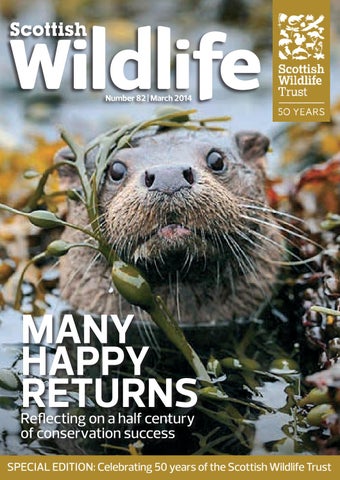
Scottish
Number 82 | March 2014
MANY HAPPY RETURNS
Reflecting on a half century of conservation success
SPECIAL EDITION: Celebrating 50 years of the Scottish Wildlife Trust
Welcome
Inside this issue FEATURES 22
18
18
26
A FOND FAREWELL Simon Milne MBE, Chief Executive
THE PIONEERS
As the Trust celebrates its 50th Anniversary, Jamie Grant finds out how it all began from two of its earliest members of staff, Christopher Mylne and Lorraine Campbell.
As I leave the post of Chief Executive, I reflect with so much pride on what the Trust has achieved over the last ten years.
20
MAJOR MILESTONES
On 14 April 1964, Sir Charles Connell and a dedicated group of conservationists set up the Trust. 50 years on, we look back at some of the highlights.
22
Observing an osprey catch a fish at Loch of Lintrathen, seeing the first beaver released into the wild in Scotland for 400 years, identifying eight species of orchid flowering at Keltneyburn, and being in Assynt for the launch of Europe’s biggest Living Landscape project, will all stick in my mind.
BACK FROM THE BRINK
26
Having come dangerously close to extinction several decades ago, the otter has made a remarkable comeback over the past 50 years, as Richard Rowe explains.
CHANGING VIEWS?
ive decades ago, peatlands were often seen as either a handy source of compost F or a barrier to productive farmland. Are perceptions finally beginning to change?
REGULARS 5
16
4
30
LATEST NEWS
News round-up from the Trust and the world of conservation.
14
PROJECT UPDATES
30
TOP SPOTS
Updates on the Trust’s red squirrel and beaver projects.
32
32
36
Q&A
‘Fly Lady Fly’ singer Ruairidh McDonald talks wildlife.
34
Explore some of the Trust’s most longstanding wildlife reserves.
It is working on so many different levels that makes the Trust effective – from protecting individual species and reserves to restoring the ecology of whole river catchments, plus , of course, influencing legislation and engaging with individuals and communities.
VIEWPOINT
A selection of your thoughts and opinions.
W BREAIN A TW K FOR DINNO WITH A BO ER AND A IN O T TRIP BAN S EE PA GE 3
7
It has been an honour to have served the Trust, and I have no doubt it will go from strength to strength in the next 50 years. Thank you for your support. Simon Milne leaves to take up the post of Regius Keeper at the Royal Botanic Garden Edinburgh. Recruitment for his successor is underway.
Scottish Wildlife magazine is published by the Scottish Wildlife Trust. © Scottish Wildlife Trust. No part of this magazine may be reproduced without the express permission of the publisher. All photography © Scottish Wildlife Trust unless otherwise stated. The Scottish Wildlife Trust accepts no liability for omissions or incorrect data in advertisements and letters. Views expressed in Scottish Wildlife are not necessarily those of the Scottish Wildlife Trust. ISSN: 0143 1234.
Scottish Wildlife is published three times a year: March, August and November.
Registered office: Harbourside House, 110 Commercial Street, Edinburgh EH6 6NF. Tel: 0131 312 7765. Fax: 0131 312 8705. Email: enquiries@swt.org.uk. Website: scottishwildlifetrust.org.uk. The Scottish Wildlife Trust is a company limited by guarantee, registered in Scotland (no. SC040247). It is also a Scottish registered charity (no. SC005792).
Patron: HRH The Prince Charles, Duke of Rothesay. Chairman: Allan Bantick. Vice-Chairs: Patric Baird, Jon Barnes, James Ivory. Chief Executive: Simon Milne. Editor: Jo Pike editor@swt.org.uk. Production Editor: Oliver Davies. Design: Connect connectcommunications.co.uk. Advertising: Jennifer Whyte 0131 561 0022, Clare Stebbing 0131 561 0024. Printing: Inkmark. Cover photo: © Laurie Campbell
Deadlines for news and letters: 1 January, 1 June, 1 September. No unsolicited articles please. Scottish Wildlife is free to members. Membership rates from 1 April (excluding discounts for paying by Direct Debit): Individual (concession) £33 (£18); Joint (concession) £46 (£24); Family £53 (£48); Watch £18; Life (joint) £800 (£1,200); Senior Citizen Life (joint) £500 (£700).
The Scottish Wildlife Trust is affiliated to The Wildlife Trusts, a UK-wide network of 47 Trusts with more than 2,000 wildlife reserves. MARCH 2014 SCOTTISH WILDLIFE 3
WILDLIFE MATTERS
Jonathan Hughes, Director of Conservation
Scottish Wildlife Trust news
Celebrating volunteers Tracy Lambert
touch as soon as possible. To register your interest, please contact Peter Gilbert at pgilbert@scottishwildlifetrust.org.uk. © Phil Hannah
SOMETHING astonishing has OVER the past 50 years, dedicated happened in the volunteers have been at the very heart 50 years since the of the Trust’s work. To recognise the Scottish Wildlife dedication of the 1,000 people that give Trust was born. their valuable time and expertise, a We have entered celebratory 50th Anniversary Volunteer a new geological Reception is being held at the Scottish epoch: the Parliament on the evening of Wednesday Anthropocene. 19 March. We are living We hope as many volunteers as through an era possible will attend the event; however, of profound places are filling up fast so please get in changes to the planet’s biosphere, changes which are happening almost entirely due to the influence of human activity. It is within this context that the Trust faces its next 50 years. In our first 50 years we achieved perhaps more than we ever could have expected. Who would have predicted that the pine marten would return to the urban woodlands of Cumbernauld? Could we have guessed in 1964 that we would be caring for an impressive 120 wildlife reserves across Scotland, more than any other conservation body? Other successes include the return of the osprey, the otter and the beaver, as well as much stricter protection for some of our internationally important habitats, such as the rich Atlantic oakwoods of the West Coast, the iconic Caledonian pinewoods and the great peatland expanses of the Highlands and Islands. Thanks to the amazing commitment of our supporters, the Trust has been at the heart of these and many more successes, whether it be through campaigning for better environmental laws in the corridors of power, or by getting our hands dirty with practical conservation projects. First Minister Alex Salmond with Despite this heartening progress, Head of Policy Maggie Keegan and Chairman Allan Bantick the Trust is needed more now than ever before. In the next 50 years, the global population is predicted to grow by 40% to more than 9.5 billion, putting even greater pressure on ecosystems the world over, including here in Scotland. We will face this challenge in the way THE inaugural World Forum on we have always done: Natural Capital, organised by the harnessing the power Trust, was a resounding success, of our members to with 500 delegates from 35 countries ensure Scotland’s Tell us arriving in Edinburgh on 21 and wildlife is about your 22 November. protected and The event also marked the restored for its plans for the launch of the Scottish Forum on intrinsic value, 50th Anniversary Natural Capital, a new project both now and bringing together public, private in the future. on Twitter: and voluntary sector organisations @ScotWildlife to protect and rebuild Scotland’s natural capital. The First Minister, Alex Salmond,
Capital success
4 SCOTTISH WILDLIFE MARCH 2014
announced the Scottish Government’s support for the initiative in his address on this urgent issue to delegates during the event. The Scottish Forum on Natural Capital will enable businesses and policy makers to make informed decisions about their impact on the environment, to assess the financial and other benefits they obtain from Scotland’s natural capital, and to make a concerted effort to protect it. For more information, visit naturalcapitalscotland.com
Scottish Wildlife Trust news
© John McCarthy
THE Coigach – Assynt Living Landscape (CALL) project has been celebrating the success of a recent Landscape Partnership bid, which has seen the Heritage Lottery Fund (HLF) award a development grant of £100,000. This award is the first step towards receiving up to £3 million to help conserve and enhance the landscape by regenerating native woodland, restoring peatlands and improving vital pathways which connect local people to nature. The CALL Landscape Partnership bid is unusual in that it covers the largest geographical area of any application HLF received and yet has the smallest population. It is testament to the quality of projects involved and the importance now placed on landscape-scale
GREEN SHOOTS IN COIGACH AND ASSYNT restoration work that this bid has proved successful. Chief Executive of the Scottish Wildlife Trust, Simon Milne, said: “We are thrilled that the Heritage Lottery Fund has awarded this grant. “This money brings environmental benefits through the myriad of restoration projects planned, as well as social and economic benefits by providing jobs
and promoting tourism.” Head of the Heritage Lottery Fund in Scotland, Colin McLean, said: “Nature lies at the very heart of what makes Scotland special and nowhere is that more evident than the astounding scenery of Coigach and Assynt.” The CALL project has also been boosted by the news that our tree nursery appeal has now reached its original £20,000 target.
First TV advert launched THE Trust launched its first ever television advert earlier this year, urging people to consider leaving a gift to the Trust in their Will. The footage was captured by a small, flying hovercam in Knapdale Forest (home to the Scottish Beaver Trial) –
providing us with a low impact, low cost approach. With over 16% of our income last year coming directly from people choosing to leave a gift in their Will, this is an incredibly important part of our work, helping fund groundbreaking projects like the Coigach –
Assynt Living Landscape and Saving Scotland’s Red Squirrels. Adding a gift to charity in
A big thank you to everyone who donated, helping the nursery produce up to 100,000 trees a year by 2015. If you cannot wait that long, there are already lots of trees for sale from the nursery, including downy birch, alder, hazel, rowan and grey willow. Contact Nursery Manager Nick Clooney on 01571 872 010 for more information.
your Will offers each of us the opportunity to contribute to good causes in a way that may not be possible during our lifetime. Some gifts in Wills are relatively modest, some substantial – every one helps. To find our more about the campaign and to watch the advert, visit scottishwildlifetrust.org.uk/ legacy
MARCH 2014 SCOTTISH WILDLIFE 5
Scottish Wildlife Trust news
© Trevor Dines, Plantlife
SNIPPETS
Scottish Beaver Trial consultation
As we approach the end of the monitoring phase of the Scottish Beaver Trial in May 2014, the Scottish Beaver Trial Partners (the Scottish Wildlife Trust and Royal Zoological Society of Scotland) are gauging the opinions of the general public and businesses on the impacts of the Knapdale beavers and the Trial process. For more information and to complete the survey visit scottishbeavers.org.uk.
Honour for former Chairman
Congratulations go to Dennis Dick – a former Trust Council member and Chairman from 2005 to 2008 – who was made an MBE in the recent New Year’s Honours List for services to biodiversity, conservation and environmental sustainability in Scotland.
Fantastic Mr Fox
s Hi ger © Ro
se tt
Viewfield Manor Caravan Park at Torranyard has very generously donated £896.41 to the Scottish Wildlife Trust. The money came from visitor donations and a special charity day. Viewfield Manor’s mascot, Vinny the Fox, presented the cheque to Reserve Manager Gill Smart in the company of Steve Tokelove from the park, at Corsehillmuir Wood.
Open weekend
The Trust is holding a free open weekend at the Falls of Clyde, Loch of the Lowes and Montrose Basin Visitor Centres to celebrate our 50th Anniversary on 12 and 13 April. For more information see our website.
Nominations for Council
Nomination forms for the 2014 election for the Trust’s Board of Trustees (Council) are available now. Individuals with significant experience of agriculture, commercial forestry or land/estate management would be particularly welcome. If you are interested and wish to discuss the appointment with the Chairman, Allan Bantick, please contact – in the first instance – Jessica Ryder (Executive Assistant) on 0131 312 7765, or email jryder@ scottishwildlifetrust.org.uk. The appointment is not remunerated. Elected Trustees will take office from this year’s AGM for an initial term of three years. The AGM will be held on Saturday 20 September 2014 in Edinburgh (venue to be confirmed). Further details will be included in the next magazine.
6 SCOTTISH WILDLIFE MARCH 2014
CASH BOOST WILL PROTECT MEADOWS THE Trust has received £110,000 from the Heritage Lottery Fund to help protect meadows in Fife. The award is part of a larger £3 million project led by Plantlife that aims to save the UK’s remaining fragments of meadows. Natural wildflower meadows were once widespread – but sadly across the UK only 2% of the meadows that existed in the 1930s remain. Nearly 7.5 million acres of wildflower meadow have been lost so far and they are still being destroyed. This award will expand the pioneering grazing scheme – the Flying Flock – which, since 2001, has helped protect and restore some of Scotland’s
most valuable grassland habitats. The Flying Flock is the Trust’s flock of hardy sheep, which moves between grasslands to improve its biodiversity through carefully timed conservation grazing. The Trust’s Reserve Manager for East Central Scotland, Rory Sandison, said: “This award will be used to purchase more stock and equipment, enabling the Flying Flock to help more grassland sites than ever before. “Sites such as Bo’mains and Fleecefaulds Meadow are once again vibrant grasslands rich in wildlife thanks to the continued efforts of our sheep and rare-breed Shetland cattle.”
Scottish Wildlife Trust news
Wetland success story THE Trust would like to thank the many organisations, groups and individuals who have been involved with the Cathkin Marsh Wetland Project over the last 13 years. Cathkin Marsh will continue to be managed as a wildlife reserve by the Trust, but the project itself will end on 31 March. Since 1999, the Trust has managed Cathkin Marsh with funding from Glasgow City Council, who officially gifted the reserve to the Scottish Wildlife Trust in 2008. The wetland project has enabled the Trust to employ a succession of Project Officers who have co-ordinated a wide variety of work, including the creation of ten ponds and a grazing project. A bird hide suitable for wheelchair users and 800 metres of all-abilities footpath and boardwalk have also been created.
Lend a helping Handa r
ON 31 March the popular and muchloved Handa volunteer programme ne will begin its © Steve Gard 2014 season. This year, thanks to players of People’s Postcode Lottery, the Trust will be sending 50 volunteers to help engage visitors and provide a friendly welcome to the island. These opportunities always prove extremely popular, and are a great way of getting away from it all while experiencing the unique environment of an island bothy. The Trust is also hosting a number of longer term volunteers who will provide invaluable help to ranger Laura Cunningham, and cover practical, seabird monitoring and visitor information roles. 8 SCOTTISH WILDLIFE MARCH 2014
Sandy the Squirrel pictured with staff from People’s Postcode Lottery
ICING ON THE CAKE TO MARK the start of the Trust’s 50th Anniversary, Sandy the Squirrel joined staff at People’s Postcode Lottery headquarters on George Street, Edinburgh to enjoy a giant hazelnut-shaped cake. The cake was specially commissioned by the Trust and was made by Edinburghbased 3D Cakes, whose previous clients include Prince William and David Beckham. Supporters such as players of People’s Postcode Lottery have allowed the Trust
to continue the vision set out by founder, Sir Charles Connell, and a small number of others 50 years ago. Head of Charities and Communication for People’s Postcode Lottery, Clara Govier, said: “The Scottish Wildlife Trust is an amazing charity that is doing fantastic work to protect Scotland’s precious wildlife. “Players of People’s Postcode Lottery congratulate the Trust.”
Two groups’ hard work recognised TWO of Scotland’s Wildlife Watch groups have been recognised for all their hard work at the Watch Group of the Year Awards. Congratulations go to the Newcastleton group who were runners-up in the Best New Group category. They have been busy working to protect red squirrels in their area, finding out all about the problems facing the species as grey squirrels encroach on their territory. They have also been putting up road signs to warn drivers to look out for our furry friends. The group completed their Level 1 John Muir Award this year, discovering what lives on their back doorstep, conserving their local patch and sharing what they have found.
They even produced a DVD all about what they have been up to. Congratulations also go to the North Berwick group who came joint third in the Watch Group of the Year category. Well done everyone for all your endeavours! To find your nearest Wildlife Watch group, search ‘Activities for children’ on our website.
MARCH 2014 SCOTTISH WILDLIFE 9
Scottish Wildlife Trust news
Thousands speak up for Scotland’s seas
Sustainable future for farming?
OVER 1,500 Trust members and supporters have spoken up in favour of the creation of Marine Protected Areas in Scottish seas. Between July and November last year, the Trust encouraged members of the public to respond to the Scottish Government’s consultation via our website, and we were delighted with the reaction. In total, 10,000 responses were received for the consultation, with an announcement from the Scottish Government expected later in the year.
THE Scottish Government is currently reviewing details of the next Scottish Rural Development Programme (SRDP). The SRDP provides money for agri-environment schemes that help farmers carry out green management activities such as the control of invasive non-native species, creation and maintenance of species-rich grassland, planting of riparian woodland and the management of lowland raised bogs. The Scottish Wildlife Trust has responded to the consultation in order to help secure the best outcome for wildlife, and we are grateful to the hundreds of supporters who added their voice to the campaign via our website.
© Martha Tressler
Communities can have the biggest impact
SOUTH of Scotland MSP Claudia Beamish has visited Falls of Clyde Wildlife Reserve in New Lanark to open a newly completed boardwalk on the banks of the River Clyde. This boardwalk uses recycled plastic posts in its construction, which will last many years longer than the traditional timber legs of the original. The work will benefit the tens of thousands of visitors who enjoy Falls of Clyde every year, including those keen to get a bird’s-eye view of nesting peregrine falcons. Our peregrine season begins on 22 March and offers an unparalleled 10 SCOTTISH WILDLIFE MARCH 2014
© Steve Blow
MSP opens new boardwalk at Falls of Clyde opportunity to watch peregrines up close. The new boardwalk has been funded by the Heritage Lottery Fund (as part of the Clyde and Avon Valley Landscape Partnership) and the South Lanarkshire LEADER Programme. These funders have also supported improvements to the footpath and visitor interpretation at Nethan Gorge.
THE pine marten may be a big draw for the Cumbernauld Living Landscape but it is the communities of the town that can have the biggest impact. In recognition of this, the project – in association with The Conservations Volunteers – has recruited Tracy Lambert as its first Natural Communities trainee. This one-year training role will enable Tracy to work with local groups to improve their understanding of the natural environment while also developing her own skills. To see how she is getting on check out her Cumbernauld Living Landscape Facebook page. If you are interested in volunteering, the Cumbernauld Reserves Project Groups are often seeking volunteers to get involved in all sorts of practical conservation work in Cumbernauld and beyond. If you are interested in getting involved, contact Peter Gilbert at pgilbert@scottishwildlifetrust. org.uk.
SYHA
Wider news
Help needed to inform a national survey on polecats
SPOTTED A POLECAT? up-to-date information on the current distribution of the polecat in Britain. The polecat is a native British mammal and a
© Elliot Smith
THE Vincent Wildlife Trust has launched its latest national polecat survey, to run from 2014 to 2015, and needs your help to gather
Have you seen the elusive polecat?
member of the mustelid (weasel) family, which includes the otter, stoat and weasel. Polecats are generally dark in colour with a striking mask-like pattern of dark and light fur on the face. The polecat is closely related to the ferret and escaped or feral ferrets may breed with wild polecats, producing hybrids which are generally paler in appearance than true polecats. The species suffered a severe decline due to historical persecution and became confined to midWales by the early 20th Century. Thankfully, populations have slowly recovered since then, with polecats now widely distributed in Wales and central England, and outlier populations in northern England and Scotland. The Vincent Wildlife Trust is keen to receive any records of polecats, polecatferrets or feral ferrets, dead or alive, from anywhere in mainland Britain. Ideally, records should be validated by photographs to allow the animals to be identified. They will also be collecting muscle samples from carcasses for genetic analysis, to investigate hybridisation between polecats and polecat-ferrets. To submit records or for more information about the survey, email enquiries@vwt. org.uk or visit vwt.org.uk.
Annual Wild Spring Festival to host biggest programme to date WITH nature awaking after the winter, a host of species migrate home to spend the summer in Dumfries and Galloway. The region is teeming with wildlife in spring, a special time of year which offers plenty of opportunities to experience brilliant birdlife and amazing
animals up close. Dumfries and Galloway’s Wild Spring Festival – Scotland’s largest and longest running wildlife festival – will present its biggest programme to-date, with over 100 family-friendly events, many of which are either free or cost less than £5 per person.
Almost all events are led by wildlife experts from the region and take in natural delights from bats to badgers, moths to sharks… not forgetting the region’s cheekiest inhabitant, the red squirrel. For details on the festival and full, searchable listings visit wildseasons.co.uk.
Calling all gardeners! GARDENERS’ World would like to meet champions of wildlife gardening and find great examples of wildlife gardens. Interested parties should submit a couple of images of their wildlife garden in full bloom, with a few bullet points about specific features of their patch. The programme is particularly interested in gardens with wildlife ponds, and those regularly being visited by hedgehogs. If you would like to be put forward for a nomination please contact Ryan Gavan at rgavan@ scottishwildlifetrust.org.uk. A selection of the best entries will then be supplied to BBC Gardeners’ World for formal judging.
European elections EUROPEAN elections take place on 22 May and, with more than 80% of Scotland’s environmental legislation coming from Europe, it may be more important to vote than you think. More information on the elections and members of the European Parliament can be found at europarl.org.uk.
MARCH 2014 SCOTTISH WILDLIFE 13
Project updates
The Scottish Beaver Trial team were also Highly Commended at the Nature of Scotland Awards 2013
The Scottish Beaver Trial is a time-limited reintroduction of the Eurasian beaver in Knapdale, mid-Argyll, which has seen beavers returned to the wild in Scotland for the first time in 400 years. Project partners:
With thanks to our supporters including:
Best conservation project in the UK
A
s you read this project update, springtime will nearly be within reach. The darkest days are over and an almost imperceptible green hue seems to rise from the ground as woodland and waterside plants respond to rising temperatures and changing light levels. For many of our native herbivorous mammals, however, this is a lean, hungry time and they are surviving on their last reserves of body fat. For the beaver families in Knapdale it is no different and, although they are better prepared than many, with their cosy lodges and carefully prepared winter food caches, we know from our live trapping work that they are at their lowest body weight at this time of year. But by late spring they will be piling on the pounds, feasting on aquatic vegetation and bursting leaf buds. In the last few months, the Scottish Beaver Trial team have not only been busy with fieldwork and educational activities, but also with
14 SCOTTISH WILDLIFE MARCH 2014
With the Scottish Beaver Trial recently named ‘Best Conservation Project in the UK’ by readers of BBC Countryfile magazine, Project Manager Simon Jones sees cause for celebration as the project nears its finale. collecting awards to add to the project trophy cabinet. Back in October, the team received a ‘Highly Commended’ at the Nature of Scotland Awards ceremony in Edinburgh. This was bettered last month when we were honoured to receive the ‘Best Conservation Project in the UK’ award from the readers of BBC Countryfile magazine. Although the 15 beavers living wild in Knapdale are oblivious to the fact, the coming weeks mark a very special occasion in the history of Scotland and the Scottish Wildlife Trust. Saturday 31 May marks the official conclusion of the five-year field monitoring phase of the Scottish Beaver Trial. Scotland will have seen the first ever formal reintroduction of a
mammal species, a groundbreaking conservation project that has been followed by millions of people across many countries. That this event should coincide, by chance, with the 50th Anniversary of the Scottish Wildlife Trust is fitting; it is something of which we as members, volunteers, supporters and staff should all be rightly proud. Will the Scottish Beaver Trial lead to other licensed releases of beavers in Scotland and become one of the many lasting legacies of the Scottish Wildlife Trust? Personally, I believe it will and that is thanks to many of you reading this. So if you haven’t been already, make sure you book your trip to the Heart of Argyll in this special year.
Please help save our red squirrels
Red squirrels
THE ROAD TO RECOVERY
As we celebrate our 50th Anniversary, we have a golden opportunity to ensure that red squirrels remain an integral part of Scotland’s landscape for generations to come. Project Manager Dr Mel Tonkin asks for your support.
T
here’s no quick fix to the decline of native red squirrels in Scotland, a decline which goes back 150 years to the introduction of the larger non-native grey squirrel. Greys are able to outcompete reds for food and habitat and also carry squirrelpox – a virus lethal to reds but to which the greys are immune. However, five years in, the Saving Scotland’s Red Squirrels project has shown that – with sustained long-term effort – it is possible to reverse this decline and ensure that future generations will still have © Hil ary the chance to see this Gau nt engaging species in the wild. We now have robust evidence that our strategy is working – the Saving Scotland’s Red Squirrels project is doing just what it says on the tin. As we near the end of the second phase of the project, we are about to publish a detailed report which proves that we have made significant progress towards conserving red squirrel populations in Scotland.
Reds are returning… Over 2013, the Trust analysed records collected by staff, landowners controlling grey squirrels, volunteers in our monitoring and trap-loan schemes and the general public. This data reveals that the collapse in Scottish red squirrel numbers has been halted and there are numerous examples of red squirrels returning to areas from which they had been absent for many years. A heavily In Aberdeen, breeding pregnant red squirrels have been red squirrel recorded in suburban gardens and are now seen regularly in parks that only a few years ago were overrun by grey squirrels. This red squirrel recovery is replicated in parts of Perthshire, Angus and northern parts of Stirling. The photo, above, of a heavily pregnant red squirrel was sent in by a delighted householder in Aberdeen who had not seen reds in her garden for the 14 years she had lived there. So not only can reds return, but they can start to breed soon after colonising an area.
Greys are retreating…
This data reveals that the collapse in Scottish red squirrel numbers has been halted. 16 SCOTTISH WILDLIFE MARCH 2014
Springtime surveys over several years show a trend of grey squirrel numbers dropping in several areas – sometimes dramatically so. We have seen a reduction in the spread of grey squirrels in rural Aberdeenshire and the disappearance of greys from the Strathyre area of Loch Lomond and the Trossachs. Our data shows that if grey squirrel trapping is co-ordinated, systematic and
sustained, it is possible to virtually eradicate grey squirrels from targeted areas. But the key word is sustained. If trapping is not maintained, re-invasions by grey squirrels will soon take the situation back to square one. Squirrelpox – holding the line in southern Scotland One aspiration of the Saving Scotland’s Red Squirrels project in southern Scotland has been to contain the spread of the squirrelpox virus and prevent it from reaching the uninfected grey squirrels of central Scotland. While our project activities have considerably slowed the spread of the virus, it is still pushing slowly northwards. However, more heartening news is that our data confirms that, as long as the number of greys in surrounding areas are kept at very low levels, red populations can recover from an outbreak of squirrelpox and go on to thrive. This is the case whether or not the surrounding greys carry the pox virus, and it provides an alternative way to sustain red squirrels in the south if we do not manage to halt the northwards spread of squirrelpox. Other encouraging news in south Scotland came from the first ever surveys across the region, carried out in 2013. Far from hanging on by the skin of their teeth as many people thought, red squirrels were present in 58% of the surveyed areas, while greys were only detected in 25%. The reds are dominant in Dumfries and Galloway, south western parts of the Borders and South Ayrshire, while greys reign in the eastern Borders and across more northerly parts of the region. We will now apply this data to focus efforts even more effectively in the south.
Please help save our red squirrels
© Elliott Neep, neepimages.com
The Trust is committed to delivering the Saving Scotland’s Red Squirrels project long-term. It’s vital not to lose momentum. What is certain is that red squirrel populations would not be in nearly such good shape without the Saving Scotland’s Red Squirrels project. The Scottish Wildlife Trust is committed to delivering this project in the long-term – it’s the only hope for our remaining red squirrel populations – and it’s vital not to lose momentum. These inroads into red squirrel conservation could not have been made without the support of our members and their donations over the past five years. Now that we have firm evidence that this approach can work, please consider donating today to support our efforts in 2014 and beyond.
YOUR GIFT CAN HELP SAVE SCOTLAND’S RED SQUIRRELS:
£30 £60 £120 £550
could pay for a bag of red squirrel feed could pay for five squirrelpox tests could pay for a camera trap to monitor squirrel populations
could pay for one week of expert advice and co-ordination for landowners and volunteers
WAYS TO DONATE Online at scottishwildlifetrust.org.uk/donate By phone on 0131 312 4700 y cheque to “Scottish Wildlife Trust”: B Freepost RSTC-UEBT-AZKR Saving Scotland’s Red Squirrels Scottish Wildlife Trust Harbourside House 110 Commercial Street Edinburgh EH6 6NF
ABOUT THE PROJECT Saving Scotland’s Red Squirrels is a multipartner project led by the Scottish Wildlife Trust, Scottish Natural Heritage, Forestry Commission Scotland, Scottish Land & Estates and the Red Squirrel Survival Trust. MARCH 2014 SCOTTISH WILDLIFE 17
The Pioneers
THE PIONEERS With the Trust celebrating its 50th Anniversary on 14 April this year, Jamie Grant travels to meet two of its earliest members of staff to find out how it all began.
T
he Scottish Wildlife Trust’s first newsletter, dated April 1965, doesn’t look like much on my desk – just ten pages of typeface print on yellowing, moth-eared paper bound with a couple of rusty staples. Produced just one year after the Trust was incorporated, it is the fledgling charity’s first printed communication to just 400 members. Founder Sir Charles Connell opens the document with the words, “On behalf of the Interim Council of the Scottish Wildlife Trust, I would like to thank all the individuals and groups who have helped us to make a start.” Reading on feels like peering through a telescope: a tantalising glimpse of the Trust from 50 years ago. Run on a shoestring from the office of the Scottish Centre for Ornithology and Bird Protection in Edinburgh, the only staff were Sir Charles Connell and a part-time secretary. But the long list of Council members is testament to the huge volunteer effort that drove the organisation forward from the start. Members cited include several professors, a general, prominent landowners, a museum curator, the presenter Tom Weir and representatives from the Forestry Commission and The Nature Conservancy (later Scottish Natural Heritage). Sir Charles Connell must have had formidable powers of persuasion to tempt such a diverse interest group to sit around the same table, and he stresses in the newsletter the importance of “the friendliest of contacts with likeminded societies, institutions and individuals.” Most of the newsletter is dedicated to efforts to set up branches (now called Members’ Centres) across the country. An “active and enthusiastic group of members” in the Borders leads the way, working with local naturalists and scientists to conduct an ecological survey in the Tweed Valley. There are no reserves, although plans are obviously afoot with a comment that “the Scottish Wildlife Trust, for example, could create or help in creating Nature Reserves without any statutory basis.” Prophetic words indeed. Within a year of that first newsletter the Trust would acquire its first three reserves: Enterkine Wood near Ayr, Hare and Dunhog
18 SCOTTISH WILDLIFE MARCH 2014
Christopher Mylne joined the Trust as Public Relations Officer in 1966
The Trust’s first newsletter
Sir Charles Connell must have had formidable powers of persuasion.
Mosses south of Selkirk and Duns Castle in Berwickshire, with its loch and mature woodland. The path was now set for the Scottish Wildlife Trust to develop into one of the foremost conservation organisations in Scotland. Reading through these newsletters was the starting point in my search for the early pioneers of the Trust who could give me a flavour of the times. After 50 years the ranks have thinned, with many – including Sir Charles Connell – sadly no longer with us. However, I did manage to track down two early members of staff – Christopher Mylne and Lorraine Campbell. By the time Christopher Mylne was employed as a part-time Public Relations Officer by the Trust in 1966, he was already well known as a Scottish naturalist, ornithologist, film-maker and lecturer. He had made his name working for seven years at the RSPB’s new film unit, where he produced eight wonderful nature films for the BBC including Return of the Osprey, Swallows at the Mill and Urchin of the Hedgerow.
The Pioneers
Never doubt that a small group of thoughtful, committed citizens can change the world; indeed, it’s the only thing that ever has.
Christopher Mylne’s film work includes a feature on St Kilda (pictured), in which he drops a stone from the top of the Conachair and counts 12 seconds before it hits the sea
© Scottish Viewpoint
His films were so popular at the time that he filled every seat at the Royal Festival Hall thirteen times over. I meet Chris at Fiddlers Croft on the bank of Linlithgow Loch, spying grebes though a pair of field glasses. Birds, especially migratory birds, have been his passion since he first hunted for nests as a boy at Dalhousie Castle Preparatory School. Although now physically less active, his enthusiasm is undimmed and he tells me excitedly of the 34 different species of birds that he counted at the same spot on the loch last spring. His flashing smile and laugh are as infectious now as they must have been all those years ago, when his slideshows and lectures for the Trust were a powerful tool for recruiting new members. Chris spent much of his time with the Trust photographing and filming the new reserves. He remembers frequently disappearing for a week or two at a time into the wilds in a VW campervan packed with provisions and equipment. A one-man band, he devised, scripted, filmed and edited Trust films such as
A Place for Wildlife himself. He even took charge of the narration, although both Magnus Magnusson and David Attenborough also feature in his films. Chris made a seminal contribution in helping shape the public’s attitude towards the countryside and wildlife at a point when film was bringing the natural world into people’s living rooms for the very first time. His films for the BBC have long been overtaken by bigger budgets and the digital revolution, but these will never match the charm of his solitary encounters with wild animals, including a remarkable peek at a Leach’s Storm-petrel on St Kilda. A favourite moment in the St Kilda footage is when Chris drops a stone from the top of the towering Conachair, Britain’s highest sea cliff, and counts 12 long seconds before it hits the sea. St Kilda, and islands in general, have always been Chris’s first love. He writes of the magic of an island home. “The beauty of birds, the miracle of migration, the stars at night in black
winter, the joy of a workable human community; and last, but not least, the companionship of a collie dog.” In contrast to Chris’ fieldwork, most of Lorraine Campbell’s memories are of working at the Trust’s headquarters at Duke Street in Edinburgh, above Sir Charles Connell’s legal office. She remembers several long flights of stairs to a single room where she hung curtains from her home and brought her own typewriter. Here she worked as Assistant Secretary to Bernard Gilchrist from 1970 to 1983. Although “terribly badly paid”, she really enjoyed her time there and “met a lot of lovely people.” Lorraine mainly worked on marketing and fundraising for the Trust. She produced the newsletters – writing stories, collecting illustrations and hand cutting the pages down to size before taking them to the printers. She also remembers a big drive for new members, with trips out to the Highland Show armed with a collection tin, information boards and boundless enthusiasm. It was often a hard sell to an indifferent public, and she remembers one man explaining to his curious daughter that the Trust was dedicated to “saving parrots”! She has noticed that most people are now better informed and more sympathetic towards wildlife than back in the 1960s and 1970s, and is convinced that “the Scottish Wildlife Trust has played a big part in all of this.” The April 1965 newsletter is physical proof of what early pioneers like Chris and Lorraine helped build within the space of a single lifetime. From such humble beginnings, the Scottish Wildlife Trust now has more than 35,000 members, 120 reserves, around 100 staff and more than a thousand volunteers. It reminds me of one of my favourite quotes, by Margaret Mead: “Never doubt that a small group of thoughtful, committed citizens can change the world; indeed, it’s the only thing that ever has.” MARCH 2014 SCOTTISH WILDLIFE 19
50th Anniversary
50 YEARS OF THE SCOTTISH WILDLIFE TRUST
1964
Key milestones of our first half century
The Scottish Wildlife Trust is formed in Edinburgh by a group led by Sir Charles Connell
The Trust acquires its first reserve – Enterkine Wood in Ayrshire
1966
Tweed Valley “Branch” becomes the first local members’ group
1967
Culzean in Ayrshire becomes Scotland’s first country park
1969
Ospreys breed successfully at Loch of the Lowes for the first time
1971
Trust membership exceeds 5,000
1973
First outbreak of Dutch Elm Disease in Scotland
1976
The Scottish Wildlife Trust objects to otter hunting and calls for stronger laws to protect them on Scottish land
Notorious pesticide DDT banned in Britain
1984
1978
The Watch club is born – a new club for junior members of the Trust
1979
20 SCOTTISH WILDLIFE MARCH 2014
1984 1981 Headquarters move to Johnston Terrace, Edinburgh
The Trust reports on the effects of acid rain on fresh water habitats in Scotland
50th Anniversary
The Braer oil tanker runs aground just off Shetland, spilling oil into the North Sea, severely affecting sea birds. The Scottish Wildlife Trust responds with the ‘Thin Green Line Appeal’ to raise money for the conservation effort
1999
1993
Devolution: the Scottish Parliament is established
1996 The Trust joins with the local community to buy the Isle of Eigg
2001 50 sheep are purchased for the Trust’s unique Flying Flock conservation grazing project
2003 The UN reports that an area twice the size of China is now protected
1992 Rio Earth Summit
2008 Trust’s 1992 The peatland conservation campaign is launched The Scottish Wildlife Trust campaigns for greater legal protection for the basking shark
The Scottish Government grants a licence for the trial re-introduction of beavers in Knapdale
1991
1990 HRH The Prince Charles, Duke of Rothesay becomes the Trust’s new Patron
first issue of 1987 The theTrust’s magazine – Scottish Wildlife - is published
Scotland’s 2009 Saving Red Squirrels
is launched to protect the remaining 120,000 living in Scotland
2011 The Trust launches its first Living Landscape project in the remote north west of Scotland
Now with well over 35,000 members, the Trust celebrates its 50th Anniversary!
2014
MARCH 2014 SCOTTISH WILDLIFE 21
Otters: a 50 year success story
Back from the
BRINK Once largely confined to coastal areas of Scotland, otters have made a welcome return to inland river systems over the past 50 years – a remarkable recovery that represents a real conservation success story, writes Richard Rowe.
A
lmost everyone remembers the first time they spotted an otter. It’s that kind of animal: sleek, sinuous and secretive – a true symbol of the wild. My first sighting was at a pier in Broadford on Skye. A large dog otter was swimming back and forth in the harbour, diving every now and again. Unexpectedly, he emerged from the water and hopped onto the quayside to investigate a stack of creels. Finding nothing of note, he loped off with that awkward, arched-back gait that otters have, and slipped back into the water. It was a magical encounter – and one 22 SCOTTISH WILDLIFE MARCH 2014
that many more people are now also likely to experience. Having been on the brink of extinction across much of Britain, the otter has returned to every river system across Scotland, England and Wales. It’s quite a reversal of fortune for an animal that knows all about hard times. Having suffered decades of persecution through hunting and then been further decimated by agricultural and industrial pollution in rivers, numbers declined so dramatically in the post-war period that otters became largely confined to remote waterways and coastal areas of west
Having been on the brink of extinction across much of Britain, the otter has returned to every river system across Scotland, England and Wales.
Otters: a 50 year success story
© Elliot Neep, neepimages.com
OTTER FACTS Age: An otter’s average lifespan is around five years. This can increase in captivity. AQUATICS: Otters use their webbed feet to swim and can dive up to 300ft when searching for food. SKILLS: Otters can remain under water for up to four minutes. COAT: Otters’ fur is the densest of any mammal, with more than 1,000,000 hairs per square inch. Scotland. Outside such areas, otter sightings became very rare indeed. Much has changed in the 50 years since the Trust was founded. Since its earliest days, the Scottish Wildlife Trust has led the fight to protect this muchloved species. “I looked at the minutes of a Council meeting from 1968 and noticed there was still a 10-shilling bounty on otters,” comments Chief Executive, Simon Milne. “That really kick-started our campaign to end persecution. Something had to change.” From those very early days, the Trust
pushed for greater protection of otters, as revealed in excerpts from Council minutes at the time. They include discussions (in 1972) around “areas that might be secured to safeguard otters”, with Mull mooted as a possible site for an otter sanctuary. Later, in 1976, further minutes noted how there has been “a move ... to get the otter declared a protected animal in England only, but this was turned down by those in Wales and Scotland who wished an overall policy to be adopted.” When it eventually came – in 1979 for England and Wales, 1982 for
Scotland – the ban on otter hunting was hugely significant, as was the withdrawal of various toxic pesticides that were responsible for the poisoning of many top-of-the-food-chain species. Today, having further benefited from extensive habitat improvement efforts, plus re-introductions in some areas of the UK, otters now swim freely even in once heavily polluted rivers such as the Clyde, Tyne and Thames. Fully protected across Europe, the biggest non-natural threat to otters now comes from road mortality. While the animal’s short MARCH 2014 SCOTTISH WILDLIFE 23
Otters: a 50 year success story
PLACES TO SPOT AN OTTER ON SCOTTISH WILDLIFE RESERVES Loch of the Lowes
Cullaloe
Ayr Gorge
Duddingston Loch
Lower Nethan Gorge
Bemersyde Moss Knowetop Lochs
reproductive window – otters only live for around five years and do not breed until aged two – has meant a relatively slow recovery, the return of this charismatic species nonetheless demonstrates what can be achieved through collective will and concerted action between conservation bodies, governments and individuals. “We [conservationists] simply cannot work in isolation,” comments Milne.
Otters in Scotland A member of the mustelid family (which includes the badger, pine marten and stoat), the otter is at the very top of the river food chain and, as such, is an excellent indicator of the wider ecological health of waterways and associated habitat. While otters have returned across Britain, Scotland remains the hotspot with an internationally important
population. Unusually, around half of all otters found in Scotland are coastal dwellers that feed almost exclusively at sea. Unlike their inland counterparts, coastal otters happily feed during the day, with the sheer abundance of fish and crustacean prey ensuring that they need relatively small home ranges (as little as five kilometres of coastline). By comparison, those living in freshwater are largely nocturnal, occupy far larger home ranges and have a much broader diet. They typically feed on fish, eels and crayfish, while spawning frogs and toads become an important part of their diet in spring time. Although still secretive, otters are a regular sight at the Trust’s Falls of Clyde reserve at New Lanark – much to the delight of Steve Blow, Reserve Manager for the South of Scotland. “Pollution in the Clyde saw a massive crash in fish numbers and so otters also fell away,” he explains.
We have a family group within the reserve and regularly see cubs being put on shelves of rock, while the mother teaches them how to hunt. 24 SCOTTISH WILDLIFE MARCH 2014
“Improvements in water quality and agricultural practices have allowed rivers to regenerate and top predators to return.” At the Falls of Clyde, as with so many sites around the country, otters have benefited from a healthy mix of natural habitat, including tree-lined sections of water perfect for otter holts. They also benefit from the availability of a range of prey species and lack of disturbance. As Blow explains, the nature of the gorge at Falls of Clyde is such that otters can be seen quite easily in winter when there is less foliage – even from the Visitor Centre. “We have a family group within the reserve and regularly see cubs being put on shelves of rock, while the mother teaches them how to hunt,” he says. The return of the otter to the British landscape is a wonderful story, and one that breeds hope for the species long into the future – particularly as conservation bodies and governments continue to embrace more of a landscape-scale approach to renewing the ecological health of our natural environment. Richard Rowe is a freelance outdoors writer and contributing editor for Scotland Outdoors magazine.
© Margaret Holland
Otters mark their territory with droppings called ‘spraints’, which have distinctive smells (from mown hay to jasmine tea!)
Mountain woodland ADVERT
Changing views: putting the case for peatlands
The UK has around a tenth of Eurpoe’s peatlands, almost two thirds of that in Scotland, like Blar nam Fiadh near Nairn
Changing views...
PUTTING THE CASE FOR PEATLANDS
50 years ago, peatlands were often seen either as a handy resource for compost or an unwelcome barrier to productive farmland. 50 years on, perceptions might finally be beginning to change, as Richard Baynes reports.
26 SCOTTISH WILDLIFE MARCH 2014
G
etting onto the moor from the lay-by means stepping over fly-tipped plastic and paper, rubble and cement bags. Picking through ragged bags and ditches, the midwinter wind tugs at me and black ooze, just firm enough to walk on, sucks at my boots. Finding beauty here takes effort but as the rain stops, the winter sun comes out to help, the sky widens, and droplets on the grass and heather glitter. A moorland bird rises and dashes off, and a clear-watered pool’s choppy surface reflects blue.
Fannyside Muir is a couple of miles from Cumbernauld, but this could easily pass for ground undisturbed for years, perhaps since these pine fence-posts toppled. Seeing their rich bog-preserved gleam in the sunlight, I start to appreciate the moor. The rubbish, the emptiness: we have not always valued places like this raised bog as we value dramatic mountains, seashores and glens. It’s like the difference between a big cat and a beetle, one striking and charismatic, the other easy to overlook.
Changing views: putting the case for peatlands
Reds and greens: healthy peatland is an amazingly rich and colourful carpet of sphagnum mosses
But, just as we’ve learned that it’s not only charismatic animals that matter, appreciation is growing that peatlands need our help. While peat – vegetation laid down in a wet, oxygen-poor environment – is found in most countries, the UK has around a tenth of Europe’s peatlands, almost two-thirds of that in Scotland. Peatlands are a rich environment, with rare plants depending on waterlogged conditions, including spectacular sundews and bladderworts that trap insects. About 27,000 hectares of Scottish peatland is lowland raised bog such as Fannyside, the winter roost of Scotland’s only flock of taiga bean geese. The UK has an eighth of the world’s blanket bog, the thinner peat we associate with hill land: Sutherland’s Flow Country is the biggest area of it in Europe. But in all these peaty riches there’s hardly a square kilometre that hasn’t been interfered with. Beyond domestic fuel digging, damage gathered pace with the Highland Clearances and ‘improvement’ of land for sheep grazing.
Finding beauty here takes effort but as the rain stops, the winter sun comes out to help, the sky widens, and droplets on the grass and heather glitter. Government grants were given for draining peatlands from Victorian times until the 1980s, with surges after both World Wars. Jonathan Hughes, the Trust’s Director of Conservation, says: “Bogs were viewed as places which were only valuable if they could be turned into something else: that ‘something else’ being more productive grazing land.”
Once you dig ditches into peatlands, water essential for sphagnum moss runs away. Burn vegetation, put livestock on, and typically the ground is broken up, allowing scrub woodland in. As Hughes says: “Once trees get in they change the whole nature of the site.” As well as species being lost, tonnes of carbon are released as the peat dries and decays. It damages water supplies and the swifter runoff leads to flooding. Few people drain peat now, but much damage has already been done. Hughes worked on a survey of Scottish raised bogs in the early 1990s. Repeated two years ago by the Scottish Wildlife Trust (and one of the largest surveys of its kind undertaken) it found improvements on conservation sites whilst elsewhere neglect had seen ditches filling in and some water loss being reversed. However, trees move even more quickly into broken peat once grazing stops. In the second survey, almost half the sites had deteriorated and 74% of the bogs are now encroached by woods. There are newer threats too: despite non-peat alternatives, raised bogs are ‘mined’ in MARCH 2014 SCOTTISH WILDLIFE 27
Changing views: putting the case for peatlands
74% of bogs surveyed two years ago are now encroached by trees, like those at the edge of Creca Moss near Gretna
28 SCOTTISH WILDLIFE MARCH 2014
Flanders Moss at sunset has a real sense of the primeval, being out there is like stepping back in time.
© Mike Lane
Scotland for garden peat, and wind turbines have been proposed in various locations. The Scottish Wildlife Trust is leading the way both on its reserves and elsewhere, such as Portmoak Moss in Perthshire, 100 acres of peatland with eight different types of sphagnum, and flowers such as bog asphodel and marsh lousewort. The Scottish Wildlife Trust and the Woodland Trust are removing trees and blocking ditches to raise water levels there. Meanwhile, back at Fannyside Muir, Forestry Commission Scotland (FCS) has recently bought 90 hectares, working with the Trust and others to conserve taiga bean geese’s wintering ground. Unfortunately, though, most peatland lies in private hands. Clifton Bain, the Director of the International Union for Conservation of Nature’s UK Peatland Programme, believes money is key to restoring it. “Just saying we should protect peatland for nature’s sake – the moral case – simply wasn’t working. Sites were still being damaged and investment in their restoration just wasn’t happening.” Conservationists have had to convince Government of the financial value of peatlands. One value is for recreation: paths have been created on sites such as Portmoak, and a viewing tower stands on the great Flanders Moss near Stirling. “Flanders Moss at sunset has a real sense of the primeval,” says Hughes. “Being out there is like stepping back in time.” Peatlands’ value to water supplies and as a carbon store and flood prevention aid
Taiga bean geese overwinter at Fannyside Muir
has had to be demonstrated, too. Improving peatlands stops runoff being discoloured and so saves water suppliers – and ultimately consumers – money. The Scottish Government has now given almost £17 million for peatland restoration. “We have articulated the range of values of peatland in a much more compelling way than we did in the past,” Hughes adds. Bain’s enthusiasm for bogs is unquenchable; he recommends that peatland visitors get down on their knees to view plants close up. “Healthy peatland is an amazingly rich, colourful carpet of sphagnum mosses, reds and greens,” he says. The IUCN UK Peatland Programme began in 2009 to aid peatland restoration in the UK, overseen by environmental bodies including the Scottish Wildlife Trust. The programme intends a million hectares of UK peatlands to be in a
healthy condition – wet and growing – by 2020. Bain says it’s not impossible, but while he’s delighted with the Scottish Government’s new money and existing grants for land managers to restore peatlands, he believes two further financial steps are needed. First, private sector money must be brought in. Early signs suggest that a growing number of companies are recognising the benefits of preserving peatlands and saving carbon. Then, once restoration work is carried out, Bain says land managers must have an incentive – a new system of grants – to maintain peatland. “The reason peatlands are in the sorry state they’re in is because they weren’t valued and people would constantly change them to get something more valuable – a profit or an income,” he says. “If we can’t get the value of healthy peatlands back to the landowners in some way then we are going to go on having landowners constantly looking for ways to change the peatlands. That’s exactly what we don’t want.”
Top spots
Visit
LOCH FLEET
A9
nd
e
Th
u Mo
Balblair
One of our oldest reserves, Loch Fleet has been looked after by the Scottish Wildlife Trust since 1970.
L
och Fleet is a wild destination full of wildlife, spectacular landscapes and historical interest throughout the year. Much of this is very easy to see and a visit is bound to be rewarding. Acquired in 1970, this is one of the Trust’s oldest reserves; it is also a National Nature Reserve. Getting there Loch Fleet lies immediately south of the town of Golspie on the east coast, 50 miles north of Inverness. It is best accessed from a series of car parks along the minor road from Golspie to Littleferry. The routes Loch Fleet is so varied that at least three routes are needed to see the highlights! Route 1 On a good path, this route takes you through the beautiful and majestic Balblair Wood. Many unusual and rare plants of the pinewood floor live here, many with strange names. Flowered wintergreen, common wintergreen, twin flower, creeping ladies tresses, lesser twayblade and chickweed wintergreen.
30 SCOTTISH WILDLIFE MARCH 2014
When you have finished looking down, look up and you may see a Scottish crossbill or crested tit. In the 1990s you might even have seen a red squirrel, but sadly not today. After about a kilometre you will come to a spur off the main track that takes you to the new Loch Fleet bird hide, which is an excellent spot to look out over the Loch Fleet estuary – a vast area of mudflats and sandflats. Here waders and wildfowl can be seen in great numbers – eider, merganser, shelduck, oystercatcher, long-tailed duck, common scoter, greylag geese, knot, dunlin, bar-tailed godwit, goldeneye and widgeon. Route 2 This takes you from Littleferry car park to a point that looks out over the southern half of the estuary. There is not much of a path, but you can follow the coast on a shingle beach and enjoy the contrast of the sea on your left and the pine forest on your right. Look out for the large colony of common seals that pull up on the sandbanks off the point.
Loch Fleet
A9
Skelbo
Skelbo Wood Loch Fleet
Keltneyburn
Loch Libo Knowetop Lochs
At low tide up to 50 of them can be spotted hauled up on the sand. Route 3 This circular route takes you on a tour of Ferry Links and the coast. Park in the car park on the left just before Littleferry. The route is quite
Hare and Dunhog Moss es
clear and takes you through the old sand dunes that are now well vegetated. In summer, butterflies are the main attraction: grayling, green hairstreak and dark green fritillary. Over the years the action of sea and wind have changed the shape of this
P
Top spots
TOP SPOTS HARE AND DUNHOG MOSSES OS LANDRANGER 73
Route 1
P
Hare and Dunhog Mosses, acquired by the Trust in 1966, are small wetlands tucked into hollows in a windswept hill and dale landscape. Hare Moss was dammed in the early 1960s and converted into a small lochan. It has become an important site for wintering wildfowl and waders. Look out for colourful orchids on display in June. KELTNEYBURN OS LANDRANGER 52
P P
Littleferry
Route 3
Route 2
Keltneyburn, a Scottish Wildlife Trust reserve since 1970, is a meadow notable for its wildflowers, including eight different species of orchid. The old curling pond is a haven for insects such as dragonflies and the steep wooded gorge is covered with broadleaved woodland. KNOWETOP LOCHS OS LANDRANGER 84
Knowetop Lochs also became a Trust reserve in 1970. Two small lochs are separated by a ridge of birch woodland, fringed by reed swamp, bog and willow scrub with areas of wet and dry heath. This diverse range of habitats supports an equally diverse range of species, including otter, adder, Scotch Argus, large heath, barn owl and water vole. LOCH LIBO
© Crown Copyright 2014. All rights reserved. Ordnance Survey Licence No 100028223
coast. You will see where recent storms have broken through the dunes and the sea has flooded inland. Returning along the pristine beach you will reach the mouth of the River Fleet. At low tide the river rushes into the sea, emptying the estuary. At high tide the flow is reversed and
the sea rushes in to create brackish Loch Fleet. Littleferry was once an important landing for ferries. In the days before the Kessock, Cromarty, Dornoch and Fleet bridges, travelling north involved an arduous series of boats, finishing at Littleferry.
OS LANDRANGER 64
A Trust reserve since 1973, Loch Libo has a range of habitats, from open water with a sandy shoreline to reed swamp, floating bog and willow and aspen scrub. The north bank has lovely mature deciduous woodland. The reserve is a haven for mammals such as shrews, voles and mice, and birds such as sparrowhawks, kestrels, owls and buzzards.
MARCH 2014 SCOTTISH WILDLIFE 31
Q&A
Q&A
Ruairidh McDonald, aged 14, singer
Look up and around you As a younger member, how did you develop an interest in nature? I developed an interest in nature when I heard about the record-breaking osprey, ‘Lady’, who lives at Loch of the Lowes Wildlife Reserve. Her story is incredible; she is probably the oldest osprey in the UK, so I decided to go and see her for myself at the reserve. I was blown away, she is an amazing sight! Lady is quite majestic and acts like she owns the loch and all of the Highlands. My music mentor, Fiona Kennedy, told me all about her and decided to write a song along with fellow writer Nils Elders. ‘Fly, Lady Fly’ is about Lady flying from the Highlands (where I live) all the way, 3,000 miles to West Africa. The song, which is still raising money for the Trust, is available to buy on iTunes, Google Play and Amazon. What would you hope to see for Scotland’s wildlife in the next 50 years? I would like to see more nature reserves and viewing areas all over Scotland. It would be great to see someone in schools telling us about the wildlife on our own doorstep. What do you think could be done in the future to safeguard wildlife? I think making people aware of how to protect wildlife is one of the main things. Everyone needs to know ways which they can help and
32 SCOTTISH WILDLIFE MARCH 2014
see for themselves. I enjoy going to see Lady as she is the main focus of my song and quite a bird.
Ruairidh’s interest in nature began when he heard about the Loch of the Lowes ospreys
how to prevent bad things from happening to them. I am a member of the Scottish Wildlife Trust and really enjoy hearing news and receiving letters about the wildlife and ways I can help. Where is your favourite place in Scotland for wildlife? I like going to see wildlife in the Cairngorms near my home. There are so many great spots where you can sit for ages and watch the squirrels, ospreys and deer. Do you have a favourite Scottish Wildlife Trust reserve, and why? Loch of the Lowes in Dunkeld is definitely my favourite reserve to visit. The Visitor Centre is great, as is the viewing area and live webcam where you can see what’s happening in the nest. I highly recommend that people visit to
How do you think young people can help wildlife? Young people can help wildlife by becoming more aware of what’s around them and how amazing it is to have all this activity going on. Even if you don’t live in the country, hopefully someone will take you to a park, a loch, or on a walk and then just look up and around you and put your phone away! Do you think young people have enough contact with nature? I don’t think young people get enough contact with nature because we very rarely get outdoor learning. I think it would definitely benefit my age group actually going outside to see and hear more about it, especially if someone who really knows about nature and wildlife tells you a bit of the background. When I visited the hide at Loch of the Lowes I learnt more in five minutes from the ranger than I ever knew before. It was brilliant to hear about all the characteristics of the birds, the predators, the fights they have, the journeys they make and their habits. If more kids my age could do this it would help us all understand how to protect our wildlife more, as well as learning all about nature.
Viewpoint
Viewpoint A selection of your thoughts and opinions
Ayrshire Members’ Centre AYRSHIRE has been likened to the smaller ‘half’ of a saucer that has broken in two. There is high ground around the rim, mostly low ground in the middle, and the broken edge is a long, west-facing coastline. We have many rivers, often with wooded valleys, and the main land use is pasture for cattle or sheep. As a result, our 15 reserves are mainly a mixture of smallish woodlands and meadows with a good range of orchids and other plants. We are proud to claim that we had the first Trust reserve – Enterkine Wood, with its badgers’ sett and wonderful spring display of bluebells – which was
Speak to us on Twitter: @Sc otWildlife Facebook: fa cebook.com / scottishwild lifetrust or email us : enquiries @scottishwild lifetrust. org.uk
© Ted McLachlan
THE VIEW FROM…
WE'RE ALW INTERESTEDAYS YOUR OPINIO IN NS AND OBSERVATIO NS.
A new weekend volunteers’ group has been set up in Ayrshire
taken over in February 1966. In those days, most of the work on reserves had to be done by local members. We are very pleased to have recently set up a new weekend volunteers’ group so that our members can once again regularly ‘get their
hands dirty’ if they wish. Perhaps because we have never had one big, dominating reserve, Ayrshire members have long been active in responding to local planning applications. We are lucky in that the three Ayrshire councils notify us if an
application would affect a Wildlife Site. We don’t often have to object outright, but we see our comments and suggestions as an important contribution to protecting wildlife in the wider Ayrshire countryside. As with many other Members’ Centres, we are having to give a lot of attention to our future, as finding dedicated volunteers is not easy. However, we are determined to find the next generation of enthusiasts to continue the good work. We can’t imagine Ayrshire without its Trust group. Roger Hissett is Chairman of Ayrshire Members’ Centre
FIND YOUR LOCAL GROUP ON OUR WEBSITE
LEARN ALL ABOUT IOLO’S LIFE
Learn about all aspects of wildlife with the BWWC by attending one of the many talks they have organised 34 SCOTTISH WILDLIFE MARCH 2014
EVER wondered what it would be like to be a wildlife presenter? Well wonder no more. Join the Bird Watching and Wildlife Club (BWWC) for a talk by Iolo Williams which will provide a fascinating insight into his life as a wildlife presenter. Iolo started working for the Royal Society for the Protection of Birds (RSPB) in 1985 and in his role as Species Officer for Wales he monitored rare birds such as red kites, chough and black grouse. He would also advise key landowners and investigate crimes against wild birds. It was Iolo’s investigations that brought him to the attention of the media and in
During his time at the RSPB Iolo Williams monitored rare birds including red kites
1998 he decided to leave the RSPB to work in television and radio. Since then he has presented many wildlife programmes. To hear all about it head to The Grant Arms on 21 April at 8.30pm to hear ‘Iolo Williams, a Life with Wildlife’. The event is free and open to all. The BWWC has several talks on a variety of subjects
running from April to July so if you’d like to learn about anything from ‘Magnificent Peregrines’ to ‘Remote Australia’ then check out an event.
]FIND OUT MORE Visit bwwc.co.uk for more information.
Complete kits from £59
Create your very own wildlife TV channel with a Gardenature nest box camera system! Wide range of Habitats and Camera Kits including Trail Cameras, Time-Lapse, Bird Cam and much more...
Loch Garten
Call: 01473 563 000
www.gardenature.co.uk
MARCH 2014 SCOTTISH WILDLIFE 35
Viewpoint
FACEBOOK POLL
From our postbag
John Marshall, Cupar
Our Facebook followers were asked: Are you optimistic for the future of wildlife in Scotland over the next 50 years? 43% said
YES © Elliot Neep, neepimages.com
Dear Editor, Wildlife photography in magazines and on TV can be stunning, with incredible backdrops and detail, but give me a personal glimpse, that fraction of a second, any day… That flash of turquoise by the river (kingfisher), an overgrown rat lumbering through the nettles (an otter), something orange-red with flashes of white spiralling at great speed up a Douglas fir (red squirrel). Whenever I have attempted a photo, the picture misses something critical – the observed wildlife – and that precious moment is lost. Now I am wiser I just look, listen and marvel. That’s what wildlife means to me. Keep up the good work.
57% said
NO
FOLLOW US ON FACEBOOK facebook.com/scottishwildlifetrust
Book review Illustrated Trees of Britain and Europe
DAVID MORE AND JOHN WHITE ISBN: 978-1408123669 Hardback: £35 The second edition of this and detailed lifelike illustrations, fabulous guide to British and the historical commentary and European trees is very welcome growing advice ensure that this and deserves to be in the book book is much more than just a collection of anybody with an catalogue of trees. interest in trees. It is also a celebration of tree Covering almost 2,000 native diversity and a tribute to the and introduced trees (species and legacy of plant hunters, botanists cultivars) with amazing artwork and silviculturists, of which by David More, this 800-page Scotland has had more than its tome is definitely not a fair share. More and field guide, unless you White are to be like carrying a heavy congratulated on a READERS’ rucksack! superb publication OFFER In addition that does justice to refreshingly to their immense uncomplicated knowledge written and skill. Highly DISCOUNT descriptions recommended.
35%
READERS’ OFFER: Scottish Wildlife readers can get a signed copy of Illustrated Trees of Britain and Europe for £24.50 (RRP £35). Call 01256 302 699, email direct@macmillan.co.uk or visit www.bloomsbury.com and quote promotion code GLR 9VZ.
36 SCOTTISH WILDLIFE MARCH 2014
Viewpoint
TWITTER FEED We asked our Twitter followers: What do you think will be the biggest challenge to #wildlife in #Scotland over the next 50 years? Here are some of the responses:
WIN A VIP OVERNIGHT STAY FOR TWO Win an overnight stay perfect for wildlife lovers at The Regent Hotel in Oban, Argyll. Prize is for two people and includes a delicious dinner, full breakfast and a boat trip out to the islands to see the wonderful wildlife.
Stuart Glen @stuglen Jan 24 @ScotWildlife Maintaining a connection with the next generation - ever more distant from nature. #lastchildinthewoods #wildlife in #Scotland Rona Ballantyne @RonasWildlife @ScotWildlife habitat loss
Jan 24
Nils Bunnefeld @bunnefeld Jan 24 @ScotWildlife Conservation conflicts between different stakeholders with conservation interests and socio-economic interests (livelihoods) Erik Paterson @erikpaterson Feb 9 @ScotWildlife Think there is a worrying disconnect between cityfolks and greenspace. And a worrying loss of greenspace in some places.
To be entered into our prize draw: Simply tell us which anniversary the Scottish Wildlife Trust will celebrate this year. Send your entry to: Scottish Wildlife Trust Competition, c/o Connect Communications, Studio 2001, Mile End, Seedhill Road, Paisley PA1 1JS. Or email : hello@connectcommunications.co.uk before midnight on 30 April 2014.
Answer
+ you’re also talking about…
Name
Ruth Shepherd @ruthshep91 @ScotWildlife @lomondtrossachs Thanks for the workshop SSRS! Fact: grey squirrel hair looks like a porcupines quill under the microscope
Address
Craig Macadam @bugsymac1 Thanks to all the volunteers that helped at our pond clearance days at @ScotWildlife @falkirkcouncil #CarronDamsLNR
Postcode Telephone Email
THE Regent, part of the Bespoke Hotels group, is a beautiful art deco hotel, based on the esplanade of Oban, opposite the pier.
FOLLOW US ON TWITTER twitter.com /ScotWildlife
✃
Leigh Morris @MorrisLeigh First snowdrops at @ScotWildlife Hadfast Valley Nature Reserve pic. twitter.com/itp2YxHpo5
Boasting beautiful views across the sea to the Isle of Mull, the hotel is a mixture of classic Victorian and art deco architecture, and is an ideal base for exploring the West Coast of Scotland. With 83 rooms, complete with modern facilities, three bars and the Marine Restaurant, business and leisure guests will enjoy a comfortable stay. The hotel is close to popular tourist attractions including: The Waterfront Centre, The Chocolate Factory and the War and Peace Museum. To be in with a chance of winning a fantastic break filled with adventure, tranquility and relaxation simply answer the question above. The Regent Hotel is offering a wonderful prize for two people which includes bed and breakfast, dinner, and a scenic wildlife boat trip. Terms & Conditions apply. All bookings are subject to availability. Offer valid from May to September 2014. Visit: bespokehotels.com/regenthotel and coastal-connection.co.uk
MARCH 2014 SCOTTISH WILDLIFE 37
Promotional feature from one of our partners
FOOD FOR THOUGHT AT VINE HOUSE FARM B
uying your bird food and other products such as feeders and bird boxes helps wildlife in more ways than you might think. Firstly, putting high-quality food out for the birds in your garden helps their chances of survival and can improve breeding success rates. On the point of ‘high quality’, it’s important to understand that the difference in product quality between bird food brands is considerable, with some of the food available on the market having little nutritional value to birds. The policy at Vine House Farm is only to supply high-quality product. Secondly, every time you buy from Vine
38 SCOTTISH WILDLIFE MARCH 2014
Why buying high-quality bird food products helps protect wildlife in so many ways House Farm, you’re helping the Scottish Wildlife Trust because some of your money will end up with them. This money isn’t added to the prices Vine House Farm charges – which are some of the most competitive on the market – but is simply taken from the profits Vine House makes. What’s more, if you haven’t purchased from Vine House Farm before, we’ll make an additional donation to the Trust of £5
when you place your first order. And thirdly, buying from Vine House Farm means that you’re supporting the vital wildlife conservation work we carry out on our 2,000-acre farm. This work not only includes practical measures to create and enhance areas for wildlife and put into practice farming methods which keep wildlife in mind, but also spreads the word in the UK farming community about how successful farming and wildlife conservation can go hand-in-hand. For more information, visit vinehousefarm.co.uk or call 01775 630 208.
Life
MARCH 2014 SCOTTISH WILDLIFE 39