Scottish
Number 81 | November 2013
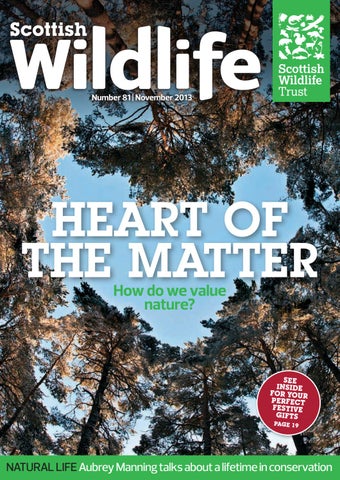
HEART OF THE MATTER How do we value nature?
SEE INSIDE FOR YOUR PERFECT FESTIVE GIFTS PAGE 19
NATURAL LIFE Aubrey Manning talks about a lifetime in conservation
Welcome
Inside this issue FEATURES 12
16
12
26
WHAT PRICE NATURE?
Sustainability campaigner Tony Juniper asks the question: can and should we place a value on nature’s goods and services?
16
TURNING THE TIDE
With billions being spent on protecting our communities from the threat of floods, is there not a more natural and cost-effective solution?
26
LIFE ON THE ROCKS?
oss of habitat and overgrazing are threatening the survival of our native juniper, L but a pioneering project in Ayrshire is finding ways to reverse the decline.
30
THE ELDER STATESMAN
Aubrey Manning OBE – author, academic and former Trust Chairman – reviews the Trust’s achievements over the past 50 years.
REGULARS 6
11
4
24
LATEST NEWS
News round-up from the Trust and the world of conservation.
10
PROJECT UPDATES
Updates on the Trust’s beaver and red squirrel projects.
24
Q&A
Actor Bill Paterson is a city boy, but that does not stop his love of nature.
32
36
32 RESERVE FEATURE
IN FOCUS Simon Milne MBE, Chief Executive
As the Trust approaches its 50th anniversary, it is wonderful to see that membership is growing so healthily this year. Our work is connecting a growing number of people across Scotland (and beyond) with wildlife and its conservation – through our wildlife reserves, campaigning, and educational activities, plus our pioneering partnership projects such as this month’s World Forum on Natural Capital (see page 6). Our conservation efforts – be they in the countryside, in people’s gardens or through Parliament – rightly focus on the issues that still need to be addressed, which of course are many.
Top spots to get your winter fix of Scottish flora and fauna.
However, as the end of the year approaches and you see a red squirrel, walk through a local wood, or hear the unmistakable LUXUWIN A VIEWS AND ‘wink-wink’ of thousands of FOR RY BREAK REVIEWS pink-footed geese flying to DELI TWO IN G A selection of their roost, please take time DUN HTFUL OON reviews and to reflect on what you and SEE P AGE the Trust are achieving for our top tips. 37 wildlife and wild places.
36
Thank you for your amazing support. Scottish Wildlife magazine is published by the Scottish Wildlife Trust. © Scottish Wildlife Trust. No part of this magazine may be reproduced without the express permission of the publisher. All photography © Scottish Wildlife Trust unless otherwise stated. The Scottish Wildlife Trust accepts no liability for omissions or incorrect data in advertisements and letters. Views expressed in Scottish Wildlife are not necessarily those of the Scottish Wildlife Trust. ISSN: 0143 1234.
Scottish Wildlife is published three times a year: March, August and November.
Registered office: Harbourside House, 110 Commercial Street, Edinburgh EH6 6NF. Tel: 0131 312 7765. Fax: 0131 312 8705. Email: enquiries@swt.org.uk. Website: scottishwildlifetrust.org.uk. The Scottish Wildlife Trust is a company limited by guarantee, registered in Scotland (no. SC040247). It is also a Scottish registered charity (no. SC005792).
Patron: HRH The Prince Charles, Duke of Rothesay. Chairman: Allan Bantick. Vice-Chairs: Patric Baird, Jon Barnes, James Ivory. Chief Executive: Simon Milne. Editor: Jo Pike editor@swt.org.uk. Production Editor: Oliver Davies. Design: Connect connectcommunications.co.uk. Advertising: Jennifer Whyte 0131 561 0022, Clare Stebbing 0131 561 0024. Printing: Inkmark. Cover photo: Scots pine woodland © Mark Hamblin, 2020VISION
Deadlines for news and letters: 1 January, 1 June, 1 September. No unsolicited articles please. Scottish Wildlife is free to members. Membership rates from 1 April (excluding discounts for paying by Direct Debit): Individual (concession) £33 (£18); Joint (concession) £46 (£24); Family £53 (£48); Watch £18; Life (joint) £800 (£1,200); Senior Citizen Life (joint) £500 (£700).
The Scottish Wildlife Trust is affiliated to The Wildlife Trusts, a UK-wide network of 47 Trusts with more than 2,000 wildlife reserves. NOVEMBER 2013 SCOTTISH WILDLIFE 3
Allan Bantick, Chairman
WE all value wildlife in different ways. Personally, I placed a high value on the pleasure I got from seeing my first beaver kit in Knapdale – the first beaver born in the wild in Scotland for 400 years. Some might value the beaver in other currencies. An ecologist might value its role in restoring natural processes, a local hotelier might be pleased at the increase in tourists and, in days gone by, the worth of the beaver was assessed by the value of its pelt and the medicinal properties of Will you help us grow Scotland’s wildlife-rich woodlands? its castoreum. THE Little Assynt Tree Nursery is thousands of hectares, re-connecting Of course, the value of wildlife to breaking new ground, supplying local vital habitat networks. humans is incidental in many ways if native trees and shrubs for an ambitious, The first growing season has been you believe, as I do, in nature’s intrinsic landscape-changing planting hugely successful – the nursery is value. Nevertheless, nature’s economic programme in the north west Highlands. brimming with healthy young trees and social value cannot be denied, as The nursery specialises in growing and the first rowan saplings have just illustrated by the hotelier and pelt rare species such as aspen, wych elm, been sold. trader above. oak, juniper and holly to ensure that this However, the nursery can only Halting the decline of biodiversity threatened genetic material survives. continue this vital work with the must not be left to conservationists, It represents the first step in resupport of people like you. We need to scientists and land managers alone. All establishing native woodlands across the raise £20,000 to meet our target of parts of society, including businesses, Coigach and Assynt area, a vital part of growing 100,000 native trees by 2015. To must take responsibility for protecting the Living Landscape vision which will find out more and make a donation, visit our environment; we must realise that see millions of trees planted across scottishwildlifetrust.org.uk/donate ‘natural capital’ underpins our economic prosperity as well as our social, physical and spiritual wellbeing. Safeguarding our natural capital is now a global priority, and Scotland is taking a leading role in addressing it. This month, the Scottish Wildlife Trust and a range of INNELLAN Wildlife Watch Group in international partners are hosting the first Argyll has become part of the ever World Forum on Natural Capital. The THE Scottish Wildlife Trust has welcomed curriculum at a local school. event aims to encourage business leaders the decision taken by the Scottish The group, which has been running to make the right decisions for nature, as Parliament’s Rural Affairs Committee for two years, has impressed teachers well as for their bottom line. to scrutinise how deer management so much with its fun and interactive As the Trust nears its 50th birthday, agreements – which help control Scottish take on outdoor learning that it has I am proud that we remain at the cutting deer numbers – are impacting on been officially invited to run the group edge of conservation. Much has been biodiversity, habitats and climate change. during school time. achieved over the past 50 years but The Trust believes that in some parts Leaders will have an opportunity to there is still much to be done in setting the of Scotland deer numbers are too high teach every pupil at Innellan Primary agenda for the next 50. and this puts pressure on Scotland’s School, with a base within the school The strength of our Trust lies in the ecosystems. complete with computers, binoculars breadth and effectiveness Head of Policy, Dr Maggie Keegan, said: and wall space to display projects. of our activities. From “The Scottish Wildlife Trust knows from In addition to helping regenerate working with site condition monitoring of our nationally parts of the school grounds as a politicians and For details and internationally protected sites that wildlife sanctuary, the group also business leaders to of the World nearly a quarter have been damaged by promotes activities such as collaborating with overgrazing and trampling pressure. bird-watching and growing schools, volunteer Forum on Natural “It is difficult to see how Scotland will wildflowers. groups and whole Capital, visit: achieve its 2020 biodiversity target – or Group founder and leader, communities, we naturalcapital its commitment to increasing woodland Eleanor Stevenson, commented: are all working cover as part of mitigating and adapting “It’s so good that the school together to ensure forum.com to climate change – without getting deer values the input of our Wildlife a brighter future for numbers under control.” Watch group so highly.” Scotland’s wildlife.
Breaking new ground
Back to school for Wildlife Watch
4 SCOTTISH WILDLIFE NOVEMBER 2013
Trust welcomes decision on deer management
© Coigach - Assynt Living Landscape
WILDLIFE MATTERS
Scottish Wildlife Trust news
Scottish Wildlife Trust news
Picture perfect at Jupiter THE winners have just been announced for Jupiter Urban Wildlife Centre’s annual photography prize. Competition was fierce, with hundreds of entries flooding in across all three categories. However, after careful deliberation, the judges managed to decide who would take this year’s titles. The winners were Luke Roberts (10 and under), Chloe Weir (11 to 16, entry right) and Barrie Weir (adult). Congratulations to everyone who took part. The Trust would also like to thank the sponsors of the competition, CalaChem.
3,000 miles and counting Blue YZ – an osprey chick tagged at Loch of the Lowes in July this year – has embarked on her epic migration south. The osprey left Lowes on 5 September and arrived in Guinea just six weeks later, a distance of over 3,000 miles. Incredibly, this included a stretch of nearly 1,000 miles across the inhospitable Sahara Desert. At points during her flight, Blue YZ approached a flying speed of 50 km/h. This is the third osprey chick to be tagged on a Trust reserve in the past two years. Our thanks go to Trust members and supporters who have donated over £13,500 to this vital project so far. You can follow the progress of the tagged ospreys online at scottishwildlifetrust.org.uk/ ospreytracking
Cumbernauld named in annual awards
Duo’s marathon effort LOUISE Bell ran the Glasgow Half Marathon on 6 October in memory of her stepfather, who was about to start volunteering for the Scottish Wildlife Trust before tragically passing away. Louise has raised a fantastic £750 for the Trust. If you would like to show your support, you can donate online at: justgiving.com/louise-bell6 Also, big congratulations go to Ryan Gavan, the Trust’s PR & Communications Officer, who ran the Crathes Half Marathon in 1 hour 35 minutes to raise money for the Trust and to say thank you to players of People’s Postcode Lottery for all their support. Search for ‘Raise Funds’ on our website for ideas on how you can help.
CUMBERNAULD Living Landscape has been credited with helping to transform the town from a Carbuncle Award winner to one of Scotland’s beautiful towns. Almost eight years since it last won a Carbuncle Award, the town recently won the Beautiful Scotland Award in the ‘Small City’ category. The judges of the award have credited the obvious enthusiasm of the Cumbernauld Living Landscape project partners as a driver in the transformation of the area. They also stated that the Cumbernauld Living Landscape project will create a template that other towns and cities could utilise in the future to make similar improvements.
Donations fly in for the Flying Flock appeal WE are delighted to announce that our recent appeal for funds to support our Flying Flock has exceeded our £20,000 target. Thank you to everyone who donated to this vital project. We are still accepting donations to support the flock and every penny raised will contribute to its long-term future. For all the latest, visit our Conservation Shepherd Laura’s blog at scottishwildlifetrust.org.uk/flyingflockblog NOVEMBER 2013 SCOTTISH WILDLIFE 5
© Liberal Democrats
Scottish Wildlife Trust news
Nick Clegg visits Cathkin Marsh
Global event in Edinburgh
6 SCOTTISH WILDLIFE NOVEMBER 2013
Clegg visits Cathkin DEPUTY Prime Minister, Nick Clegg MP, visited the Scottish Wildlife Trust’s Cathkin Marsh Wildlife Reserve on 14 September to announce that England will join the rest of the UK in requiring retailers to charge for plastic bags. Under Scottish Government proposals, retailers in Scotland will also be required to charge a minimum of 5p for a single-use bag from October 2014. Mr Clegg said: “Plastic carrier bags take hundreds of years to degrade and can kill animals. It’s a testament to fantastic organisations like the Scottish Wildlife Trust – whose army of staff and volunteers do so much to keep our landscape
clean, open and accessible – that we’ve been able to make this announcement.” Chief Executive of the Scottish Wildlife Trust, Simon Milne, said: “We are delighted that Mr Clegg has taken the time to make this announcement. All the Wildlife Trusts across the United Kingdom will welcome this new policy.” Head of Policy, Dr Maggie Keegan, said: “Wildlife is unaware of the border between Scotland and England and the Scottish Wildlife Trust believes today’s announcement will lead to a positive change in consumer behaviour that will benefit wildlife throughout the UK.”
THE Trust has made an archaeological discovery at Balnaguard Glen Wildlife Reserve in Perthshire. Volunteers were repairing field walls on the hillside and noticed one of the wall stones was shaped like a shallow basin. The find was later identified as a Neolithic quern stone. Perthshire Ranger, Emma Rawling, said: “The Trust knew the Balnaguard hillside was rich in natural and human history, with evidence of human impact spanning remote prehistory in the area. “However, what is great about this find is that it happened while some of our dedicated volunteers were out doing repair work. “Not only have they made an impact for the Scottish Wildlife Trust, they have also had an impact on our understanding of the history of the site.” The quern stone will now be on show to the public at the Perth Museum and Art Gallery. © Emma Rawling
BUSINESS leaders, environmental experts and government representatives from around the world will gather at the inaugural World Forum on Natural Capital in Edinburgh on 21 and 22 November. The event is being organised by the Trust with a host of international partners and will be the world’s first major global conference devoted to the rapidly evolving concept of natural capital. It will enable Scotland to play a leading role in helping to protect the valuable natural assets upon which we all rely. At the time of writing, 24 countries are already going to be represented. The full list of worldclass speakers can be found on the event website at naturalcapitalforum.com/ speakers. The story behind the event is also available on the site. Director General of the International Union for Conservation of Nature (IUCN), Julia MartonLefèvre, said: “There is no doubt that we must address the importance of properly valuing what Nature gives us as our life support. The World Forum comes at the right time for this key aspect of humanity’s future development.” For more information on the conference and to book your place, visit naturalcapitalforum. com. Readers of Scottish Wildlife are entitled to a discount, which can be claimed by emailing Caroline Vevers at cvevers@ naturalcapitalforum.com.
Neolithic find at Trust reserve
Small Blue returns to Ayrshire
©
Sc hm eeg an
SCOTLAND’S smallest butterfly has returned to Ayrshire for the first time in 30 years. The Small Blue was last seen in Irvine, on the North Ayrshire coast, back in 1983. The Scottish Wildlife Trust and Butterfly Conservation Scotland collected 30 butterflies from a monitored site on the Moray coast. The butterflies were then transported 225 miles to the Trust’s Gailes Marsh Wildlife Reserve and neighbouring Dundonald Links Golf Course.
Kidney vetch (Anthyllis vulneraria) grows in abundance at both sites, providing a perfect habitat for the Small Blue. Reserves Manager for the Ayrshire Greenspaces, Gill Smart, said: “This project illustrates the need to prevent species dying out in the first place as bringing them back is not a simple matter. However, research was undertaken by the Scottish Wildlife Trust and Butterfly Conservation Scotland into the ideal locations, and hopefully now they will thrive once again.”
Scottish Wildlife Trust news
The consultation on Scotland’s Marine Protected Areas will end on 13 November
SNIPPETS
Excellent example The Trust has been asked to submit our reserve data to the World Database on Protected Areas as a pilot for conservation organisations, receiving extremely good feedback in the process. The International Union for Conservation of Nature is now using our submission as an exemplar for other non-governmental organisations.
Mill excavation
HAVE YOUR SAY
Visit scottishwildlife trust.org.uk/livingseas to respond to the consultatio n. Follow our marine campaign on Twitter: @ScottishSeas
A FOUR-MONTH consultation on the creation of Marine Protected Areas (MPAs) in Scottish seas will come to a close on 13 November. Over 1,000 members of the public have already answered our call to save Scotland’s seas by responding via the Scottish Wildlife Trust website. If managed well, the new MPAs will protect nationally important marine habitats and species such as seagrass beds, flame shells and sandeels. Living Seas Policy Officer Alex Kinninmonth said: “This is a make-orbreak moment for our marine wildlife. There is still a danger that the scientific recommendations will not be followed and
the planned network will not be completed with new protected sites for species such as basking sharks, dolphins and seabirds. “A large public response can make the difference when the final decisions are made. Thank you to everyone who’s responded so far, and if you’ve haven’t already done so, please visit our website before 13 November.” As part of the campaign, journalist and photographer Jamie Grant has been to meet a variety of people who depend on the sea for their livelihood, documenting their thoughts on marine conservation. The ‘sealife’ series of photo stories is available at scottishwildlifetrust.org.uk/ livingseas
Fun for all the family on Skye SKYE Members’ Centre attended the Skye and Lochalsh Environment Forum Family Fun Day on 28 September. The day included debates, talks and a photography competition. The Trust’s People and Wildlife Manager, Nick Wright, said: “This is a great example of a Members’ Centre engaging with the local community to bring extra awareness and profile for the Trust. “The Trust is really proud of all the work our Members’ Centres do and events like this help to showcase that work to the wider community and get people inspired about wildlife.”
The Trust has teamed up with the Clydesdale Mills Society to excavate one of the many former mills at the Falls of Clyde. Bonnington Sawmill began life in the 18th Century providing fencing materials and logs. It also had a grindstone to sharpen tools and kitchen knives. If you would like to volunteer on this project, call 01555 665 262.
Bird sightings Pink-footed geese numbers at Montrose Basin continue to rise sharply through the autumn as they arrive from their northern breeding grounds in Iceland and Greenland. Ospreys have been spotted on the reserve, as well as rare waders such as the curlew sandpiper, while the kingfishers are back and can be spotted almost daily over the next couple of months.
Record breakers The Trust has uploaded almost 139,000 reserve species records to the NBN Gateway, an increase of more than 50,000 on previous records. Efforts to improve data quality have seen in excess of 90% of records being verified. For more information visit our website.
Members’ Survey Thank you to the nearly 1,000 of you that took the time to complete our Members’ Survey. Results are currently being collated, but our congratulations go to Richard Collins who has won a four night stay at the Grant Arms Hotel.
Search begins With less than a year to go until Allan Bantick’s retirement as Chairman of the Trust, Council has begun the search for a new Chair, who will take up the post at next year’s AGM. Potential candidates should contact the Company Secretary by 30 November 2013.
NOVEMBER 2013 SCOTTISH WILDLIFE 7
© Paul Naylor
STILL TIME TO SUPPORT OUR MPA CAMPAIGN
Wider news
© Lister Cumming
NEW WILDCAT ACTION PLAN Six-year proposal aims to safeguard the future of this endangered native species
SEPTEMBER marked the launch of the Scottish Wildcat Conservation Action Plan. The Scottish wildcat population is in decline and under threat, principally through cross-breeding with the domestic cat, but also from habitat loss and disease. Minister for the Environment and Climate
Change, Paul Wheelhouse MSP, who launched the six-year plan, said: “This is one of the most ambitious conservation plans ever produced in Scotland, and the Scottish Wildcat Conservation Action Group will need every encouragement to succeed. “In co-ordinating the plan, Scottish Natural Heritage will
© Gus Jones
Pearl mussels in peril
8 SCOTTISH WILDLIFE NOVEMBER 2013
consequences of increased water abstraction and major proposed developments. As well as exposing mussels, low water levels concentrate pollution, to which young mussels are particularly sensitive. BSCG is seeking support to take its case against excessive new development in the Park to the UK Supreme Court. You can find out more about their campaign at bscg.org.uk
approach working with landowners, which the Scottish Wildlife Trust feels is the most effective form of conservation. “Losing the Scottish wildcat would be a real loss for future generations – and the Trust hopes to aid Scottish Natural Heritage in their efforts.”
Badger developments WORK has started on a £120,000 scheme to build homes for badgers affected by the new Aberdeen Western Peripheral Road, a scheme opposed by the Scottish Wildlife Trust on the grounds that it would pass directly through their habitat. The new setts around Balmedie will also require increased security measures in order to halt attacks from badger baiters. This comes at the same time as the badger cull continues south of the border. The Scottish Wildlife
Trust (as part of the UKwide Wildlife Trusts movement) is strongly opposed to the action, and is calling for an increase in badger vaccination programmes to prevent the disease from spreading. Scotland remains officially bovine TB-free thanks to the combined efforts of the Scottish Government and land managers across Scotland – highlighting the fact that improved bio-security is the best way to prevent incidence of bovine TB in the long term. © Elliott Neep, neepimages.com
THE dry summer weather has left dozens of young freshwater pearl mussels high and dry in the Cairngorms National Park. Pearl mussels are globally endangered and the population in the River Spey is internationally important. The Badenoch and Strathspey Conservation Group (BSCG) is asking the Spey Fisheries Board to commission an appraisal of the
work closely with the government and its agencies as well as a wide range of organisations, land managers and indeed householders.” Chief Executive of the Scottish Wildlife Trust, Simon Milne, said: “The Trust looks forward to contributing to this important action plan. “It is a landscape-based
A will for wildlife
A will for wildlife © Neil Aldridge
© Steve Gardner
AN Aberdonian who finally settled in St Andrews, Donald Stewart was a quiet man, one who took life seriously but who had a wonderful sense of humour. A member of the Scottish Wildlife Trust for over 30 years and an active supporter of his local Members’ Centre, Donald had a particular interest in birdlife and was always willing to encourage younger or
©
Am yL ew is
less experienced members of a group to share his identification skills, especially those for birdsong. His widow, Jean, cherishes fond memories of early summer evenings sitting together in the hide at Bankhead Moss listening to the call of water rail, reed buntings, willow and sedge warblers and watching the swooping dance of swallows
feasting on the abundant insect-life. For all these reasons, it was fitting that Donald chose to leave a gift in his will to the Scottish Wildlife Trust. We work with local communities to manage wildlife habitats across Scotland for the benefit of our native species and provide opportunities for people to connect with their natural environment.
Although fortunate enough to travel widely and see many exotic species, there was always a special place in Donald’s heart for his local wildlife reserves in Fife and Angus, especially Montrose Basin, Loch of Lintrathen, Kilminning Coast and Bankhead Moss.
WOULD YOU LIKE TO TALK TO US ABOUT LEAVING A GIFT IN YOUR WILL? Please call Wendy Hill on 0131 312 4772 or email whill@swt.org.uk Alternatively you can visit our website scottishwildlifetrust.org.uk/legacy for further information
NOVEMBER 2013 SCOTTISH WILDLIFE 9
OU HE
L
98%
raised £1
7,0
0 0 TO G
O
Project partners:
With the fight to protect Scotland’s only native squirrel species reaching a critical stage, Minister for the Environment and Climate Change, Paul Wheelhouse MSP, visits the Saving Scotland’s Red Squirrels project.
With thanks to our supporters including:
AT the start of September, the Scottish Wildlife Trust welcomed a visit by the Minister for the Environment and Climate Change, Paul Wheelhouse MSP, to Southesk Estate in Angus to see the vital work undertaken by Saving Scotland’s Red Squirrels (SSRS). During his visit, Mr Wheelhouse had an opportunity to inspect squirrel traps in the area and discuss the most recent developments with Project Manager Dr Mel Tonkin. The meeting also provided an opportunity to showcase
the project and demonstrate how working in partnership with landowners has benefited this much-loved species. Mr Wheelhouse said: “Red squirrels are one of Scotland’s most recognisable and loved animals. The work of SSRS in raising awareness of their plight in north east Scotland is extremely important to preserving their future across Scotland.” The Trust’s Chief Executive, Simon Milne, said: “Saving Scotland’s Red Squirrels is an excellent example of how conservation bodies and
Have you spotted a squirrel recently? The Gannochy Trust Garfield Weston Foundation J & JR Wilson Trust Loch Lomond and Trossachs National Park The Robertson Trust
THE Scottish Wildlife Trust is collecting information on the distribution of red and grey squirrels right across Scotland. This allows us not only to identify areas of importance where habitat management or grey squirrel control will benefit red squirrel populations, but also to understand natural changes in their populations. If you have spotted either a red or grey squirrel recently, please let us know by visiting scottishwildlifetrust.org.uk/reportsquirrel
10 SCOTTISH WILDLIFE NOVEMBER 2013
landowners can – and indeed must – work together to safeguard our wildlife. “The Earl of Southesk and more than 200 landowners are putting a huge amount of effort into ensuring that one of our most popular animals has a future in Scotland.” Lord Southesk said: “It was very good to see the Minister taking the time to visit the project in action and we hope he will remain supportive of the programme to protect Scotland’s wonderful red squirrel populations.” Saving Scotland’s Red Squirrels is a multi-partner project to secure the future of the UK’s only native squirrel species. Three quarters of the UK’s remaining red squirrels live in Scotland, but their future has come under threat from the spread of the deadly squirrelpox virus, the expansion of nonnative grey squirrel populations and wider loss of habitat.
© Elliott Neep, neepimages.com
NY
P?
Saving Scotland’s Red Squirrels is a multipartner project to protect the UK’s only native squirrel species. The project is controlling selected grey squirrel populations and halting the incursion of the deadly squirrelpox virus.
Ministerial approval for red squirrels
CA
Project updates
Project updates
Meet the ultimate ecosystem engineers Simon Jones, Project Manager of the Scottish Beaver Trial, considers the vital role beavers could play in mitigating the effects of climate change in Scotland. a great success, as five new kits arrived to three of the four families in the Trial area. The experience of previous seasons has shown us that not all kits are likely to survive their first year, so our fingers are crossed that some will grow into healthy, breeding adults. Hundreds of visitors to the area have enjoyed taking part in our twice-weekly guided walks over the summer months – thank you to Trust members who have travelled to Knapdale to visit the release site and support this groundbreaking project. My next magazine update will see us just a few weeks away from the official end of the Scottish Beaver Trial. Watch this space to find out what will happen to the Knapdale beavers in 2014!
Project partners:
With thanks to our supporters including:
CA
As beaver ponds slow down the water running through a catchment area, they can also help to level out the peaks and troughs of water flow downstream that follow after periods of heavy rain or dry spells. These findings have led to discussions about how widespread populations of beavers – along with their dams – might be providing important ecosystem services to us all by filtering and regulating water supplies. In a changing climate – where rivers in the UK may be exposed to greater fluctuations in water levels – might the beaver help us to make some deposits in the natural capital bank? Of the Knapdale beavers themselves, this summer was
The Scottish Beaver Trial is a time-limited reintroduction of the Eurasian beaver in Knapdale, mid-Argyll, which has seen beavers returned to the wild in Scotland for the first time in 400 years.
NY
OU HE
L
98%
P?
© Philip Price, lochvisions.co.uk
THE summer of 2013 will live long in the memory on the west coast for the weeks of warm, dry weather we enjoyed. Argyll does have a reputation for, shall we say, ‘above average’ rainfall, but we do regularly bask in glorious, sunny weather in April and May, when I would suggest that the region is at its best. So, while I was sheltering in the shade of a huge, lichenfestooned ancient Atlantic oak in Knapdale recently, it got me thinking about how our climate is changing and how beavers in Scotland might one day be able to play a role in helping humans adapt to the challenges this will bring. Beavers are ecosystem engineers. They modify and create new habitats through their tree felling and damming behaviour. Research from Europe and North America has shown how beaver dams filter water flowing from their ponds, trapping sediments and occasionally pollutants in the process.
raised £5
6,0
0 0 TO G
O
NOVEMBER 2013 SCOTTISH WILDLIFE 11
News Natural capital
What price
NATURE? For over 100 years, conservationists have argued that nature is priceless and yet biodiversity continues to decline. Tony Juniper, a leading writer and campaigner on sustainability issues, asks whether a change is needed in society’s approach to the environment.
N
ature is beautiful: it sustains the human spirit and has values that should be protected for their own sake. Such has been the message from conservation groups for more than a century. But despite widespread agreement that this is indeed the case, across the world natural areas continue to be degraded, species are declining and many are being lost forever. This is not because people dislike nature or believe that the degradation of the environment is desirable. Rather, it is the result of an all too familiar (and dangerous) cultural storyline. This holds that the degradation of nature is the inevitable price of progress and that in order to sustain economic growth we must sacrifice natural systems. A logical corollary of this, at least for many policymakers and business groups, is that laws and policies which protect natural areas are a barrier to development and that, in order to grow economically, societies need to 12 SCOTTISH WILDLIFE NOVEMBER 2013
limit their ambitions for sustaining the natural world. If this is the main problem, then perhaps part of the solution is to set out the case for the economic value of nature. As I sought to demonstrate in my recent book, What has nature ever done for us?, our mainstream way of looking at
If we didn’t have nature we would all starve and the world wouldn’t have any green in it. Ben Smith, Trust member, aged 8
economics and ecology is incorrect. A healthy natural environment is essential for economic development, not a drag on it or an alternative. Take the example of reducing carbon dioxide levels in the air. Countries and companies are, quite rightly, spending billions of pounds on low-carbon energy technologies, more efficient vehicles and carbon capture and storage technologies to tackle the issue. However, while this is all essential, too often we forget that nature is doing a lot of this work for us already, effectively for nothing. Peatlands and forests are just two examples of ecosystems that remove vast quantities of CO2 from the atmosphere and store it in soils and vegetation. The cost of protecting and restoring such ecosystems, when viewed from the point of view of how much it costs to cut carbon through other routes, is very low. A recent report from the Scottish Wildlife Trust estimated that the capital cost of restoring all of Scotland’s lowland
social media link Natural / email capital link
LOW RES
© Mark Hamblin, 2020VISION
Life is the wonder of our planet but it is vulnerable to powerful forces... Homo sapiens has the duty of stewardship – for the sake of the world as well as our children’s children. Jack Matthews, Fife & Kinross Members’ Centre
raised bogs would be about £21 million. only deliver climate change benefits, but A tiny sum, particularly when you also employment and economic consider that the social cost of this opportunities, not least through tourism. carbon being released into the Alongside the economically valuable atmosphere could be as high as reductions in carbon emissions that £5 billion. come from protecting and Of course, another benefit restoring peatlands and of doing this restoration forests, there is also an work would be the opportunity to reduce some conservation of one of of the risks that will Europe’s rarest wildlife accompany what are now habitats. About 40% of the inevitable climatic shifts. European Union’s lowland As you will read raised bogs are found in elsewhere in the magazine, Clare Harkess, Scotland, so this would not reduced flood risk is one Artist only be sensible climate obvious example of a natural change policy, but also a major solution to a human problem. contribution to an international Around the world, bogs and woods are conservation priority. helping protect communities from the A similar picture emerges with the more frequent extreme rain that is restoration of native woodlands, something coming in the wake of climate change. the Trust has embraced through the By contrast, there are plenty of cases Coigach – Assynt Living Landscape where flooding has been made project in north west Scotland. This worse because habitats have been ambitious and visionary project will not degraded. The terrible floods that
Without nature, nothing exists.
NOVEMBER 2013 SCOTTISH WILDLIFE 13
Natural capital
Nature sustains our food supply, through the natural replenishment of soil fertility, pest control and the pollination of crops.
Tony Juniper argues that policy-makers and businesses need to understand that nature is critical to future economic prosperity
hit the Lake District in 2009 are a recent case in point. When it comes to water, natural habitats not only help to moderate the arrival of too much of it in one place all at once. Intact ecosystems reduce soil erosion, helping ensure that rivers and streams run clear, thereby reducing the need for expensive technology to remove particles before piping water to industry and homes. This benefit can be worth many hundreds of millions of pounds per year, and it is for this reason that in some parts of the world water companies are finding ways to conserve natural areas as an alternative to costly engineering. Nature also sustains our food supply, through the natural replenishment of soil
why in spring hundreds of fertility, pest control and the farmers can be seen climbing pollination of crops. trees with feather dusters, Some two thirds of the Fish stocks moving the pollen grains world’s crops require have decline between the blossoms insect pollination and d if we don’t lo and because the bees which a lot of this work is once did the work for done by wild insects, after them n ok ow, we nothing have been including bees (see won’t have a Scottish Wildlife, totally wiped out. ny Issue 79). This service These activities have a the future. in on its own is worth real economic cost, Ian Whinney, cr eel some $180 billion per year something which fisherman globally. individuals, businesses and It is sometimes hard to governments need to be aware of as imagine what this might mean in they plan for the future. practice, until one looks at those areas of Put quite simply, nature is not a ‘nice south west China where heavy pesticide to have’ – it is critical to future economic use killed not only the pests found in fruit prosperity. Perhaps if that message got orchards, but also the pollinators. This is through in politics and business, we might have a more informed and productive debate about the role of conservation in our modern world. There is not a choice between ecology and economy: one is a wholly-owned subsidiary of the other, and it is ecology that is the bigger fish.
The unprecedented increase in human population means that managing the pressure we put on our natural habitat is the key challenge of our generation.
Alastair Grier, Chief Operating Officer, Business and Commercial, RBS 14 SCOTTISH WILDLIFE NOVEMBER 2013
Tony Juniper is a writer and independent campaigner and sustainability advisor. His recent best-selling book, What has nature ever done for us?, is published by Profile Books.
Natural solutions
TURNING the tide With flood damage costing homes, businesses and agriculture up to £850 million a year, the way we manage Scotland’s land and water has never been of greater importance. Rob Edwards reports on the growing trend for natural solutions to man-made problems.
N
ear Cringletie in the Scottish Borders, the river is starting to meander again. For the first time in two centuries, Eddleston Water is being allowed to flow down to join the Tweed in Peebles as it once used to – gently, lazily and naturally. Since the early 19th Century, water around here has been progressively straitjacketed. Cutting through the green, curving countryside, it has looked like an unnatural slit in the earth, sliced straight by human hand parallel to the A703. But in August, the Scottish Environment Minister, Paul Wheelhouse MSP, donned a bright blue hardhat and sat in a shiny orange mechanical digger to oversee the opening of a new bend in the river. It is called ‘re-meandering’, and it represents an attempt by modern-day engineers to undo the damage that has been done by their predecessors. In the
16 SCOTTISH WILDLIFE NOVEMBER 2013
past, to recoup land for roads, railways, buildings and farms, rivers have been redirected, realigned and remade. The trouble is, this has tended to make them flow faster, moving more water, more quickly and causing floods in communities downstream. Eddleston Water frequently floods Cuddyside in Peebles, which is why it is highlighted by the Scottish Environment Protection Agency (SEPA) as an area of high flood risk. In 2012, the river burst its banks as many as six times after heavy rain, causing much disruption and upset to local residents. For this reason, the Scottish Government, SEPA, farmers, landowners and a host of other agencies have come together to try to work with the river rather than against it. As well as reinserting bends, they are opening up natural flood plains, creating
ponds and restoring wetlands. They are breaching artificial riverbanks, damming agricultural ditches and erecting wooden barriers in the middle of the river. They are planting trees and grasses near and far from the river to reduce the amount of rain running off surrounding land. “There are a whole range of natural flood management measures that can be put in place,” explains Dr Derek Robeson from the Tweed Forum, which co-ordinates the work. “By using nature and natural process to help slow the flow of rainwater into river systems, farmers are co-operating in finding solutions to flooding problems in our towns and villages.” As well as reducing flooding, Robeson points out that the changes could help wildlife, attracting more salmon, otters and lamprey to the river, as well as
Natural solutions
©Steve Douglas
Cuddyside in Peebles is frequently flooded by Eddleston Water
Paul Wheelhouse MSP at the controls of an excavator removing final sods of earth to allow Eddleston Water to re-meander
Cities and towns need to become water smart and use natural features such as trees, green roofs, swales, parks and other green drainage systems to slow water movement. enhancing riverside habitats for other animals and plants. Similar projects aimed at reducing flooding are mobilising across Scotland. Dr Maggie Keegan, Head of Policy and Planning at the Scottish Wildlife Trust, points out that the Metropolitan Glasgow Strategic Drainage Partnership, which brings together SEPA, Scottish Water and local authorities, is trying to use green infrastructure wherever possible to slow the flow of water. ©Shutterstock, Peebles
She says: “Cities and towns need to become water smart and use natural features such as trees, green roofs, swales, parks and other green drainage systems to slow water movement. Using such green features instead of grey or ‘hard fixes’ is a cost effective way of reducing flood risk, and it also delivers multiple benefits such as improving the quality and liveability of urban places. “At the same time, the urban
environment becomes much more attractive to wildlife.” Keegan argues that this kind of thinking also needs to be applied to whole river catchments, saying: “This can be achieved by planting or encouraging natural tree regeneration and restoring degraded peat bogs upstream. “Downstream, we need to restore wetland systems within the natural flood plain.” The dangers of flooding for homes and businesses were bound to increase in Scotland because rising carbon pollution has disrupted our climate. In some areas, for example, winter rainfall has increased by up to 60%. According to Peter Singleton, SEPA’s Environmental Futures Manager, there is no longer any such thing as ‘natural weather’, because it is all influenced by pollution.
NOVEMBER 2013 SCOTTISH WILDLIFE 17
Natural solutions
“Our current understanding of climate change means we will see warmer and wetter weather in the future,” he predicts. SEPA’s latest flood risk assessment, in 2012, suggests that there are 243 areas of Scotland “potentially vulnerable” to flooding. They cover a huge swathe of the Central Belt, large patches of the south and north, and substantial areas of the islands. SEPA estimates that one in every 22 homes, and one in every 13 businesses, are at risk of flooding, amounting to over 125,000 properties. The greatest numbers at risk are properties around the firths of the Clyde and Forth plus Loch Lomond, while there are high proportions of properties at risk in Findhorn, Nairn and Speyside, and around the Tay and Tweed. Crucial care, education and emergency services are also vulnerable. One in ten fire stations are at risk of flooding, as are 5% of hospitals and health centres, 5% of residential care homes and 4% of schools. In 2014, SEPA is planning to publish new, more detailed, maps of flood hazards. These are expected to give communities more information about the exact areas at risk, what the impacts could be, and how best to cope with them.
18 SCOTTISH WILDLIFE NOVEMBER 2013
Over the last two decades, the average cost of damage to homes, businesses and agriculture is estimated to have been between £720 million and £850 million a year. Over the last two decades, the price of dealing with 17 major floods and countless minor ones in Scotland has been immense. The average cost of damage to homes, businesses and agriculture is estimated to have been between £720 million and £850 million a year. Experts say that this is only going to get worse, and that it is essential to deploy natural flood management to combat the risk. “Over the past 50 years, Scotland has seen a significant increase in winter rainfall and more heavy rainfall events,” says Kirsty Irving, Flood Risk Manager with Sniffer, a charity which works with public agencies to improve climate resilience. “This trend will continue in the decades to come.” The key, she argues, is to keep water
upstream to lessen the impact on households and businesses downstream, adding: “This is a core part of the new flood risk management plans being developed across Scotland.” This means that more woodlands will be planted, more wetlands created and, in urban areas, more sustainable drainage systems developed to give water places to soak away. Let us hope, as at Cringletie, this also means more rivers meandering as they are supposed to. In the face of a changing climate, we need nature’s help more than ever. Rob Edwards is Environment Editor of the Sunday Herald and a correspondent for The Guardian. His writings are on his website: robedwards.com
CHRISTMAS GIFT IDEAS FREE UK delivery for orders over £40. All proceeds from Christmas sales help fund our work protecting Scotland’s wildlife for the future.
The Scottish Wildlife Collection
To celebrate the Trust’s 50th anniversary next year, we have commissioned renowned Scottish illustrator Iain McIntosh to design a series of wildlife-themed gifts. These beautiful illustrations – inspired by Victorian pen and ink natural history drawings – form part of a unique collection designed exclusively for the Scottish Wildlife Trust.
ILLUSTRATED MUG £9.99, 4 FOR £34
RECYCLED A5 NOTEBOOK £4.99
ILLUSTRATED APRON £21.99
COTTON SHOPPING BAG £5.99
SCOTTISH SPECIES TEA TOWEL £9.99
Choose from badger, osprey, peregrine, puffin and red squirrel designs
Choose from badger, osprey, peregrine, puffin and red squirrel designs
Choose from hedgehog, osprey, puffin and red squirrel designs
Choose from hedgehog, osprey, puffin and red squirrel designs
Collage of species: badger, osprey, peregrine, puffin and red squirrel
Adopt an Animal £18
Adopt an Animal and make a real difference to the conservation of some of Scotland’s most spectacular species. Your adoption pack will include a certificate, fun factsheet, a selection of stickers and either a superb wildlife print or a soft, cuddly toy.* What’s more, all profits from the sale of adoption packs go towards helping our conservation efforts in Scotland. Choose from: badger, beaver, osprey, otter, peregrine, puffin and red squirrel.
BEAVER
OSPREY
OTTER
PEREGRINE
NEW FOR 2013 - BADGER
PUFFIN
RED SQUIRREL
*Excludes osprey adoption, where the choice is between a wildlife print or a Scotland’s Birds of Prey book.
Please return orders to: Christmas Orders, Scottish Wildlife Trust, Harbourside House,110 Commercial St, Edinburgh EH6 6NF
CHRISTMAS GIFT IDEAS
CARDS AND CALENDARS Exclusive to the Scottish Wildlife Trust, our collection of wildlife Christmas cards and 2014 wildlife calendar are the perfect purchase for nature lovers everywhere, with all proceeds helping support our conservation efforts. Purchase multiple items and benefit from a range of special offers. 2013 CHRISTMAS CARDS
2012 CHRISTMAS CARDS
8 cards, 4 different designs. Message inside: Season’s greetings. Beannachdan na h-Aimsire
£3.99 SPECIAL OFFERS l 2013 Christmas cards + 2012 Christmas cards: £5.99 l Scottish Wildlife calendar + 2013 Christmas cards: £11 l Scottish Wildlife calendar + 2013 Christmas cards + 2012 Christmas cards: £13
2014 SCOTTISH WILDLIFE CALENDAR Features 13 wildlife images and Scottish Wildlife Trust reserve information.
£8.99 Wildlife calendar 2014 Features exclusive wildlife images and Scottish Wildlife Trust reserve information
GIFT MEMBERSHIP By giving the gift of membership to a friend or family member this Christmas, you can make a real difference to Scotland’s wildlife. New members receive a subscription to Scottish Wildlife magazine, free entry to our Visitor Centres and 120 wildlife reserves across Scotland, a free copy of our Exploring Reserves guide and much more. For further information, visit scottishwildlifetrust.org.uk/giftmembership or call 0131 312 4700.
Please return orders to: Christmas Orders, Scottish Wildlife Trust, Harbourside House,110 Commercial St, Edinburgh EH6 6NF
CHRISTMAS GIFT IDEAS
ORDER FORM MY DETAILS Title First name Last name
Address
Postcode Telephone Email
Membership no. (if known) Please tick if you are happy to receive information from us by email
50th ANNIVERSARY COLLECTION No. of mugs required:
No. of A5 notebooks required:
No. of aprons required:
Badger
Osprey
Badger
Hedgehog
Puffin
Red squirrel
Puffin
Red squirrel
Peregrine falcon
Osprey
Puffin
Osprey Red squirrel
Peregrine falcon
ADOPT AN ANIMAL Which animal are you adopting?
No. of cotton bags required:
Osprey
Hedgehog Puffin
Red squirrel
No. of tea towels required:
Please choose a gift: Toy (or book for osprey adoption) Print Certificate only (please provide email address)
n n n
If you are adopting an animal for yourself, please fill in the ‘My Details’ section above. If your adoption is for someone else, fill in their details below. For multiple adoptions, please write these on a separate sheet of paper and enclose them with your order. Title
First name
Last name
Date of birth (optional)
Address
Postcode Telephone Email
Is recipient over 18?
Yes
No
Send my adoption pack:
To me
To the recipient
Special message for certificate (max 80 characters):
Please return orders to: Christmas Orders, Scottish Wildlife Trust, Harbourside House,110 Commercial St, Edinburgh EH6 6NF
CHRISTMAS GIFT IDEAS
ORDER FORM CARDS AND CALENDAR
Number
2013 wildlife Christmas cards
£3.99
2014 wildlife calendar
£8.99
PAYMENT
Total (£)
Please debit my credit or debit card Card number
2013 + 2012 wildlife Christmas cards £5.99 Calendar + Christmas cards offer
£11
Calendar + 2 sets of cards offer
£13
Start date Expiry date
ADOPT AN ANIMAL 7 species to choose from
*3 digit number on back of card
Cardholder’s signature
Cardholder’s name
£9.99, or 4 for £34
A5 notebook Apron
By giving your details above, you give permission for the Scottish Wildlife Trust to contact you. Your details will be kept confidential and will not be shared with any third party.
£4.99 £21.99
Cotton bag
£5.99
Tea towel
£9.99
GIFTAID Tick to GiftAid your donation I confirm that the Scottish Wildlife Trust may claim GiftAid on any donations I have made in the last 4 years and in the future until I cancel this declaration. I pay enough UK Income and/or Capital Gains Tax each year to cover the amount that all charities I donate to can reclaim in the tax year. I understand Council Tax and VAT do not count and that the Scottish Wildlife Trust will reclaim 25p on every £1 donated.
DONATION In addition to my total, I would like to make a Christmas donation to the Scottish Wildlife Trust of:
POSTAGE
/ /
Security code*
£18
50TH ANNIVERSARY COLLECTION Mug
I enclose a cheque or postal order made payable to “Scottish Wildlife Trust”
Cardholder’s signature
£
Date
(£2.99 for all UK orders up to £40, FREE if over £40)
£
TOTAL
£
Tick here if you do not wish to receive information about other aspects of our work
DELIVERY INFORMATION: Orders must be received by Monday 9 December 2013 for Christmas delivery in the UK. We cannot guarantee delivery before Christmas after this date. Postage costs £2.99 on all UK orders up to £40; FREE over £40; Europe £5; Rest of World £7.50. For large quantities please email enquiries@swt.org.uk
For office use
DO YOU SHOP ONLINE? GREAT! THEN YOU CAN HELP THE SCOTTISH WILDLIFE TRUST
2,700 well-kn own retailer s
The Scottish Wildlife Trust has signed up with easyfundraising. org.uk, a free online service where thousands of people raise money for charities every time they shop. At the Scottish Wildlife Trust we know that it’s not always easy to give a donation. But you can still help us, just by shopping online as you normally would.
Easyfundraising.org.uk works in a similar way to many other loyalty shopping sites, but instead of earning points, you’ll raise a donation for the Scottish Wildlife Trust and it won’t cost you a penny. It’s as simple as that! Every time you make a purchase, stores will donate a percentage of what you’ve spent to the Scottish Wildlife Trust. You can shop with all your big brands. For example, Amazon, John Lewis, Marks & Spencer, Sainsbury’s and it will not cost you a penny more.
HOW TO START RAISING MONEY • Simply visit: easyfundraising. org.uk/causes/ scottishwildlife • Register to support with your name and email address • Start shopping and raise money every time you shop for FREE!
Please return this form to: Christmas Orders, Scottish Wildlife Trust, Harbourside House,110 Commercial St, Edinburgh EH6 6NF
Q&A
Q&A
Bill Paterson, Actor Bill with actress Alison O’Donnell, filming ‘Shetland’ on Fair Isle
Bill’s walk on the wild side You grew up in Glasgow: what was your childhood contact with nature? I was lucky - we spent every summer holiday in Millport on Cumbrae and I was scarcely out of the water. I’d finish the holiday with webbed feet and was immersed in the wonder of the rich diversity the Clyde had in those days. I recall porpoise chasing shoals of fish and the rock pools being alive with anemone, shrimp, crab, razor clams. If I’d been smarter at science I might have been a marine biologist! Also, every few weeks we visited Balloch Farm, near Condorrat. I’d do my bit – collecting the eggs from the hens and, when I got big enough, helping bring the cattle in. All this only 14 miles from Dennistoun. How has your relationship with nature developed as an adult? In my early days I was fascinated by geology and geography, perhaps more than wildlife. Cumbrae was a good place to get hooked since it’s basically a big lump of red sandstone with lava dykes cutting across it. 24 SCOTTISH WILDLIFE NOVEMBER 2013
Quite dramatic in its own wee way. In my late teens I took up climbing and would visit the Arrochar Alps, the Crianlarich Hills and Glencoe or take a quick bus trip to the Whangie in the Kilpatrick Hills. These days I don’t do as much hillwalking as I’d like. There’s a shortage of crags in north London. However, I’m out in the open air as much as I can.
there’s easy access from the cities. You can be a geographer in Edinburgh without leaving the Royal Mile! There are major features that in many countries you’d have to go a long way to see.
Do you have a favourite spot in Scotland and if so, why? Everywhere I go I think, ‘this is great - I must tell people all about it’. I love Assynt in north west Sutherland, but it’s hard not to plump for that wee corner in Cumbrae that looks over to Arran and Bute. Sea, sky, rock, geography and a basking shark if you’re lucky.
Why do you think people should value nature? Excuse the pun, but I think it should be second nature. We shouldn’t isolate ourselves from it. There appears a growing tendency for nature to be sanitised and ‘protected’. There are too many notices and warnings. We must strive for balance so these places remain wildernesses and we are not nannied into enjoying ‘The Whangie Experience’, for example.
You’ve travelled far and wide. What inspires you most about the landscape when you come back to Scotland? In this tiny geographical space there’s such an array of landscapes and geology. In small corners of Scotland you’ll see everything from recent floodplains to the oldest rocks on the planet. The variation is wonderful, plus
How can individuals make a lasting contribution to the wellbeing of our flora and fauna? You can do a lot worse than just leave it alone! I’d say that each of us in our own part of the world should leave wilderness as much as we can; don’t manicure it and you’ll be surprised at what happens.
Juniper
On the
rocks 26 SCOTTISH WILDLIFE NOVEMBER 2013
Juniper
With its berries a key component of gin, plus myriad other culinary and medicinal properties, juniper is a tree of many uses. Sadly, due to a variety of external threats, it is also in dire trouble, as Richard Rowe discovers.
I
t is not often that a tree makes you think of a favourite tipple, but then juniper is no ordinary tree. This shrubby evergreen, with its characteristic foliage of tiny, blue-green needles, is prized for its aromatic berries, the oil from which is used to impart the ‘piney’ flavour to gin. The two are so intrinsically linked that the word ‘gin’ derives from genièvre or jenever, the French and Dutch words for ‘juniper’. Its alcoholic associations don’t end there either; genevrette, a beer-like drink in France, is made from equal parts barley and juniper berries, while in medieval times the berries were also used to flavour whisky in Scotland. But ‘berry’ is slightly misleading. As one of Scotland’s three species of native conifer, juniper berries are actually tiny cones. The oil is extracted through pressing, although the cones can also be crushed and ground like peppercorns for a variety of culinary uses, including adding a resinous, slightly citrus flavour when cooking lamb, venison or pork. The berries’ many culinary uses are matched by their medicinal properties. Their first recorded use was on an Egyptian papyrus, indicating that juniper berries were used as part of a recipe to cure tapeworm infestations. The fact that the berries also contain chemicals that stimulate contraction of the uterine muscles saw them used in the Middle Ages to assist during labour (and, in higher doses, even abort unwanted pregnancies), while, for centuries, herbalists have prescribed juniper oil for the treatment of a variety of conditions, such as flatulence, for which it is still used today. By comparison, the actual wood of juniper has far fewer uses, although it has still played an important role in ritual and folklore down the ages. When burned, the wood gives off very little visible smoke but is extremely aromatic – a property that has seen it used for the purifying of temples, driving out of evil spirits, cleansing of houses during times of plague, and in Celtic fire festivals.
Rise and fall A two-year project is underway to address the decline of juniper trees
Widely distributed throughout the northern hemisphere, in the UK common juniper is a plant of two distinct habitats: the lowland, chalky soils of southern England and the somewhat wetter upland moors of Scotland – a traditional
stronghold. Here, there are two subspecies: an upright, shrubby tree that is an important under-storey component of Caledonian pinewoods, and a prostrate form found within the montane scrub that grows at the edge of the tree line. Juniper was once so prolific in the Highlands that its berries were collected in bulk and exported to Dutch gin distillers, but the situation is very different today. Although losses are not as profound as south of the border, juniper is now absent from almost a quarter of the sites where it was once found in Scotland, with many of the remaining populations under threat. It is little wonder that juniper has priority status in the UK and Scottish Biodiversity Action Plans. There is no single root cause for the decline, with factors such as over (and under) grazing, the burning of moorland, wider changes in land use, a potentially devastating new Phytophthora fungal disease, and lack of natural re-seeding all contributing factors. It is fair to say that the tree does not always help its own cause. Seeds are slow to germinate, the plants themselves are slow growing and can take up to a decade to produce seed and, unlike most trees, juniper is dioecious – meaning that male and female flowers are borne on separate plants. Without healthy numbers of male and female bushes, there is no cross pollination and no new plants.
Road to recovery Recognition of the value of juniper – and an understanding of its conservation status – has seen the launch of the Ayrshire Juniper Recovery Project at the Trust’s Grey Hill Grasslands reserve – a project instigated by Peter Gordon, Director of William Grant & Sons, a distillery in nearby Girvan that produces Hendrick’s Gin. Although Scottish juniper is not used in the production of its own gin, the distiller is eager to help protect the health of the species locally, and its charity committee has provided a grant of £12,840 to fund a two-year programme, led by the Trust together with the Scottish Rural College (SRUC). “Juniper is struggling in our part of the world and this is a great example of communities and NOVEMBER 2013 SCOTTISH WILDLIFE 27
Juniper
28 SCOTTISH WILDLIFE NOVEMBER 2013
© Gill Smart
business working together to meet the needs of future generations of this species,” comments Gill Smart, the Trust’s Reserves Manager for south west Scotland. Believed to be the most productive of five known sites in Ayrshire where juniper is found, the reserve covers an area of sheep-grazed hillside where the trees grow as gnarled thickets over exposed rocks. Most are thought to be more than a century old. The first phase of the project, which began in July, has seen the Trust work with countryside management students from SRUC’s Ayr campus and volunteers to survey the site and take cuttings and seeds. These are now being grown on in polytunnels at three nurseries belonging to the Trust, SRUC and another partner, Stairway Trees, with the young plants eventually being replanted on the reserve. It is a real fact-finding mission, explains lecturer Ian Cornforth, who is leading the project at SRUC. He says: “This year’s work will provide a baseline to help future students monitor progress and ultimately provide guidelines to landowners on how best to encourage juniper and other species of
Ian Cornforth of the Ayrshire Juniper Recovery Project at Grey Hill Grasslands
montane scrub on their land.” Students will also survey other juniper sites in Ayrshire and scout for additional populations. Such is the genetic diversity of juniper that populations can be very specific to their location – what grows in one place will not necessarily grow in another. “At this stage, the work is about halting any further decline, identifying what we have and rebuilding stocks with the right kind of young material,” says Cornforth.
The Trust’s Gill Smart adds: “Success for us would be to plant out over 1,000 trees, then have others follow our lead. If we lose juniper, that’s one more species gone from the biodiversity mix of the area. Why let that happen when we can do something about it?” Gin drinkers the world over will raise a glass to that. Richard Rowe is a freelance outdoors writer and contributing editor for Scotland Outdoors magazine scotoutdoors.com
THE LONG VIEW
A lifetime IN CONSERVATION With the Scottish Wildlife Trust turning 50 next year, few people are more qualified to cast an eye over the charity’s achievements than Aubrey Manning – author, academic, broadcaster and former Trust Chairman. Jamie Grant travels to meet him.
A
ubrey Manning’s love of the natural world was first sparked when his family moved from London into the countryside during the Second World War to avoid the Blitz. Aged 10, he spent long days exploring the fields, woodlands and hedgerows around Englefield Green in Surrey. It was the beginning of a lifetime love affair with conservation, from reading Zoology at Oxford to becoming Professor of Natural History at Edinburgh University between 1973 and 1997. While most people see their retirement as an opportunity to relax, for Manning it was just the start of a distinguished writing and broadcasting career, including the BBC series, ‘Unearthing Mysteries: Sounds of Life’s Origins’. Perhaps best known for his seminal book An Introduction to Animal Behaviour, Manning has since focused his formidable intellect on human behaviour and the vexing question of how we can find an equitable balance with our planet’s resources. He is, at heart, a human ecologist, happy to cross disciplines and take a controversial stance on issues such population control to further the understanding of our immensely complex relationship with the natural world. I meet up with Manning in the Scottish Wildlife Trust’s smallest reserve, Johnston Terrace, in the heart of Edinburgh. With the Trust’s old offices just round the corner, it seems a fitting setting for a wideranging discussion on the organisation as it approaches its 50th birthday. Manning has followed the Trust ever since it was first formed by Sir Charles Connell in 1964, and was the Trust’s Chairman between 1990 and 1996. When he first became Chairman, he remembers the Trust being mainly focused on its wildlife reserves and compares their acquisitions 30 SCOTTISH WILDLIFE NOVEMBER 2013
to being “a bit like stamp collecting”. “We often raised the money to buy a reserve but struggled to manage the costs of maintaining them,” he comments. “The Trust is now more discerning about buying new reserves and I think we should only be acquiring extremely rare habitats to protect groups of species.” The purpose and use of Trust reserves has also shifted. Rather than being fenced off and ‘protected’, they have become much more public spaces for people to visit and connect with the natural world. The reserve at Johnston Terrace, with its tiny meadow and rockery, is just one example. People wandering up to the Tattoo in summer can peer over the wall and see wild geraniums, bumblebees and a pond with newts in it. “Encouraging people to experience the natural world brings an awareness that we are sharing the planet with everything else on it, and from there comes concern,” says Manning. “As population and development pressures grow, the wilder places where nature can be seen are going to become more and more precious.” With the planning system still heavily weighted against environmental concerns, the Trust is keen to highlight the economic value of finite natural resources. Manning is convinced society should be taking this concept of ‘natural capital’ much more seriously. “In the past, conservation has undersold itself, seeking to protect rare species and habitats without pointing out that these sites are also extremely economically important,” he tells me. He would like to see the debate around the environment’s delivery of ‘natural service systems’ taken one step further. With his biologist’s hat on, he argues that we should be planning for the next 200,000 years of man’s tenure on Earth, particularly how we can keep our life support systems going. “The fact is that without the biosphere, we don’t have an existence on the planet
because we rely on it for food, water, oxygen and the circulation of water,” he comments. “In the end, it comes down to our very survival as a species.” Manning advocates moving from a throughput economy where resources are gobbled up and thrown away as waste, to an economy without material growth. “We can take a sustainable crop from the energy provided by the sun, but we can’t afford to carry on consuming the nuts and bolts of Gaia,” he says. “It is very simple really. Just look at this garden and you can see that there is no waste – everything goes around.” Manning would like the voice of the conservation movement to be much louder in the circles of power: “I am not suggesting that conservationists run the country, but we ought to have an input in the matter of constraints that many economists underestimate.” A practical and positive approach to conservation is essential to this. While there are plenty of bad news stories around, Manning remains “a fan of the human species” and is convinced that we can find a better balance with nature. “I always think of the words Plato ascribed to Socrates: ‘Without love, there is no wisdom, only learning’, and we have to learn to love the natural world,” he says. “There are ways forward and the natural world is extremely forgiving,” Manning adds, parting the reeds by the pond to see what lies beyond. “You can see that in places like Johnston Terrace, where you only have to give nature a little space and it moves in. Nature is always pushing against the boundaries.” At 83 years old, he has somehow managed to keep in touch with that inquisitive, daring and irreverent boy who once explored a Surrey countryside more than 70 years ago. Jamie Grant is a freelance writer and photographer dedicated to environmental issues. He lives in Glen Lyon, Perthshire. Visit jamiemurraygrant.co.uk
THE LONG VIEW
Aubrey Manning has devoted his life to conservation
Encouraging people to experience the natural world brings an awareness that we are sharing the planet with everything else on it.
© Jamie Grant NOVEMBER 2013 SCOTTISH WILDLIFE 31
Top spots
The footpath along the banks of the River Ythan provides superb views across the river. You may notice several dead standing trees, which are mostly elm. These are left in situ, as they pose no danger to the public and provide an excellent habitat for invertebrates and birds such as woodpeckers and owls. Otters are occasionally seen along this stretch.
3
Visit
GIGHT WOOD Don’t let winter keep you away from the wilderness – it is often the best time to spot wildlife
G
ight Wood, purchased by the Trust in 1994, occupies 34 hectares of a steep sided valley on the River Ythan. It comprises some of the largest and least disturbed native woodland in Aberdeenshire. The woods consist of a mixed deciduous canopy of ash, oak, birch and two cherry species, with an understorey of hazel, sloe and willow. Getting there Access to the reserve is best gained from the Forestry Commission car parking area on the B9005 Methlick to Fyvie
road. From there, a walk through forestry plantation brings you to a track across a field (take care of the cows at certain times of the year), to the remains of Gight Castle and the entrance to the reserve. A sometimes rough, waymarked circular footpath around the reserve is then easily followed.
2
The bridge over the river at Hagberry Pot gives a first glimpse of the steep-sided woodland. Legend has it that the Hagberry Pot – the deep pool on the right hand side of the bridge – is bottomless. During the covenanting wars, Gight Castle was ransacked by the covenanters and the excommunicated Catholic Laird of Gight threw his jewels into the Pot to prevent them being taken by the covenanters. Despite many attempts, the jewels have never been found.
32 SCOTTISH WILDLIFE NOVEMBER 2013
5 4 Otter Bridge
The route Start at the reserve entrance and follow the footpath down the slope to the footbridge across the river. The circular path will bring you back to halfway down the initial slope. Turn left to return to the reserve entrance.
Although not actually within the reserve boundary, you cannot fail to see the remains of Gight Castle at the entrance to the reserve. The castle itself is in a state of disrepair and you should not enter the building, although you can walk around it. There has been a house of some sort on this site since the 1300s, with previous owners including Jack Byron (father of the famous Lord Byron), who sold the estate to the Gordons of Haddo to pay off gambling debts. The castle was abandoned in 1791 after Lord Haddo fell from his horse at the nearby well and was killed.
1
© Iain Smith
6 3
Top spots
Trust reserve Access path Claimed right of way
P Car park
Stonehouse
Little Gight
Badiebath Wood
2
1
Gight Castle As you cross Otter Bridge, look to your left and you will see a squirrel rope bridge. This was erected once it was realised that much of the red squirrel population was living in the dense conifer plantation but feeding in the reserve, mainly on the large store of hazelnuts. The squirrels did not appear to like sharing a bridge with humans and so this rope bridge was erected.
4
© the Cowie family
Gight Wood Climbing to the top of the reserve, the footpath passes several very large oaks, which give us an indication of just how old this woodland is. Underneath is a large stand of hazel, which shows signs of having been coppiced in the past. We are beginning to coppice this hazel again as this method provides additional habitat within the wood and ensures a plentiful supply of hazelnuts for red squirrels.
5
6
The path now runs along the top of the woodland, where you can catch glimpses of the river below. Most of the large beech trees on the boundary of the reserve are remnants of trees planted around 1850. This section of the footpath is a good place to see many of the plants, lichens and fungi that make Gight Wood such a special place.
Kylerhea Balnaguard Glen Garnock Flood
Bawsinch and Duddingston Turn over to discover more top spots
NOVEMBER 2013 SCOTTISH WILDLIFE 33
Top spots
BALNAGUARD GLEN OS LANDRANGER 52
© Martyn Jenkins
© Steve Garvie
TOP SPOTS
© Theo Loizou
A wonderful juniper woodland on the slopes of the Perthshire hills, Balnaguard Glen offers spectacular views across the valley. A signposted circular route leads you round the reserve through a stand of juniper onto higher ground. The reserve is home to a variety of butterflies, with red squirrels and deer sightings also possible.
KYLERHEA OS LANDRANGER 33
Kylerhea is a fairly young, mixed conifer plantation on the slopes above the Kylerhea Narrows. This is an atmospheric place with breathtaking views and the opportunity to see a variety of
GARNOCK FLOOD
BAWSINCH AND DUDDINGSTON
OS LANDRANGER 70
OS LANDRANGER 66
Garnock Floods is a low-lying floodplain pasture with shallow, seasonal ponds. This is an excellent reserve for wildfowl, especially during the winter months when large numbers of ducks are attracted to the nearby estuary. Grazing by cattle keeps the banks open for wigeon and waders to feed.
34 SCOTTISH WILDLIFE NOVEMBER 2013
Duddingston Loch is the only example of a natural freshwater loch in Edinburgh. It is an important site for wildfowl and herons. Other habitats include mixed woodland, scrub, grassland and reedbed. Access to the hide is by prior arrangement. Call 0131 312 7765 for more information.
coastal wildlife. A dedicated hide gives you a chance of seeing otters, and on most days you should be able to see grey and common seals and a variety of seabirds.
Views and reviews
Green fingers
Indigenous species such as rowan provide a bounty for wildlife
© Richard Burkmarr
© Gillian Day
This season’s top tips
Book review What has nature ever done for us? TONY JUNIPER ISBN: 978-1846685606 PAPERBACK: £9.99
I MUST admit that when I was first told that I would be reviewing Tony Juniper’s book, What has nature ever done for us?, my heart sank. Why would I want to read a book about money and economics? I could think of nothing worse! I was, however, pleasantly surprised and delighted by what I read. The book is informative and well researched and split into very concise, easy-to-read chapters. As it says on the back cover, “...[this] book is full of immediate, impactful stories.” Juniper translates rather grand ideas into very relatable examples, from vultures in India to New York City’s water supply. It’s very easy to see how valuable natural processes are financially, far beyond what we would normally assume. The book begins by talking
36 SCOTTISH WILDLIFE NOVEMBER 2013
AS the evenings draw in and the leaves start to fall, autumn is a time when we can consider taking a breather from gardening. But we can still help wildlife by providing food and shelter for our winter residents and visitors. If you have a lot of leaf litter, instead of raking it up for disposal as green waste, find a place to store it either in an open sack or just piled up in a quiet corner of the garden or under a hedge. Not only will it make leaf mould – which improves soil condition and can be used as mulch – it will also be home to a whole host of invertebrates and, if you are lucky, provide a ‘des res’ for a hibernating hedgehog. Autumn is also the best time to plant a tree and, if you want to attract song thrushes, redwings, fieldfares or even the odd group of waxwings, then you will need to plant trees bearing autumnal red berries such as rowan, hawthorn or whitebeam. The beautiful spring blossom will also be a magnet for bumblebees, hoverflies, solitary bees and early emerging butterflies. For more wildlife gardening tips and to download our free leaflet, visit: scottishwildlifetrust. org.uk/gardening
about Biosphere Two (the Earth being Biosphere One) that was built in America in the mid-eighties. Having only just been born at the time, it was interesting to read something I’d only ever imagined happened in films: a man-made, selfcontained world that showed just how complex our natural biosphere is. Juniper has divided chapters into different natural assets or services provided by nature, from light to pollinators, each beginning with monetary facts that always astounded me. This book shows us how intrinsically connected nature and humanity are, and how dependent our survival is on such simple things as (for example) horseshoe crabs. I challenge anyone to read it and not learn something new! Laura Whitfield, Falls of Clyde Ranger READERS’ OFFER: Scottish Wildlife readers can get a signed copy of What has nature ever done for us? for £9 (RRP £9.99), plus postage and packing. Call 0207 841 6300 and quote the code ‘Scottish WT Tony Juniper’.
Competition
WIN A VIP OVERNIGHT STAY FOR TWO Win a VIP overnight stay for two people in the Lamont Suite in the romantic Abbots Brae Hotel - to include a bottle of Champagne and chocolates in your room, followed by a three-course dinner in the restaurant and a full Scottish breakfast. To be entered into our prize draw: Simply tell us which species – featured in this issue – is a key component of gin. Send your entry to: Scottish Wildlife Trust Competition, c/o Connect Communications, Studio 2001, Mile End, Seedhill Road, Paisley PA1 1JS. Or email : hello@connectcommunications. co.uk before midnight on 30 November 2013.
Answer Name Address
Postcode Telephone Email NESTLED high among established woodland, with sensational views over the Firth of Clyde and surrounded by some of the most breathtaking scenery you will ever see, Abbots Brae has earned itself an enviable reputation as a luxurious home away from home. We’re very lucky to enjoy the company of much wildlife in our gardens, including rabbits, red squirrels, roe deer, pheasants and many small birds! The hotel is ideally situated for your break and to explore the Cowal Peninsula with its wealth of stunning scenery and wildlife.
Abbots Brae Hotel, West Bay, Dunoon, PA23 7QJ. Tel: 01369 705021. abbotsbrae.co.uk Or contact us free on 0800 500 3093 and mention this competition to get 10% off our standard B&B room rates!
✃
Why not take advantage of our special autumn break offer: Autumn breaks in Scotland – available until 21 December 2013.* Stay for three nights bed & breakfast and pay for only two! *subject to availability
NOVEMBER 2013 SCOTTISH WILDLIFE 37
Views and reviews © Amy Lewis
THE VIEW FROM… Lindsay Bamforth, Wildlife Watch Group Leader I’M passionate about wildlife and think it’s important to capture and nurture the enthusiasm many children have for it. I enquired about volunteering as a Wildlife Watch leader after hearing about the hiatus in the Edinburgh group in summer 2012. As a supporter of the Scottish Wildlife Trust, I saw this as a fantastic opportunity to help, while meeting like-minded people and having some fun. I was put in touch with a number of others and, with the support of the Trust’s People and Wildlife Officer, Donna Mathieson, we decided to relaunch the group. Our first challenge was to decide how to run it: when would we meet, where, what age group should we target and – crucially – how would we tell people about
38 SCOTTISH WILDLIFE NOVEMBER 2013
WANT TO JOIN IN? em
ail edinburgh. wildlifewatch@ hotmail.co.uk
Wildlife Watch carves out a niche for itself
the group and attract interest? Having a number of leaders was a real advantage in division of labour. We’ve squeezed in a lot since our first meeting, including themed arts and crafts, games, scavenger hunts and wildlife spotting. Activities have continued whatever the weather.
Being involved in the group is really enjoyable and a great way to gain new experiences. The Trust has been on hand for support every step of the way, and provides opportunities to engage with other group leaders as well as access to resources for ideas. Volunteers are essential to
the Wildlife Watch network. What could be more rewarding than inspiring the next generation about something you love? Edinburgh Wildlife Watch is aimed at 5-10 year olds and usually meets on the last Sunday of the month between 10am-12 noon, at a cost of £1 per child.