Scottish
Number 80 | August 2013
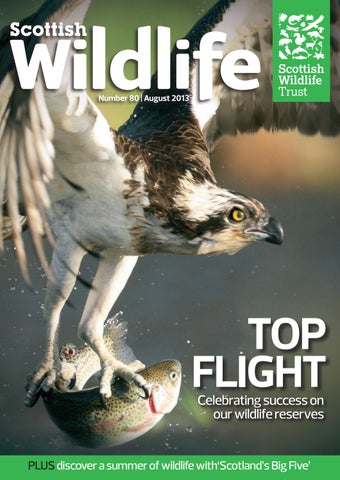
TOP FLIGHT Celebrating success on our wildlife reserves
PLUS discover a summer of wildlife with‘Scotland’s Big Five’
Welcome
Inside this issue FEATURES 14
19
29
IN FOCUS
14
SYMBOL OF SUCCESS
Simon Milne MBE, Chief Executive
Pushed to the brink of extinction in the early 20th Century, the stirring sight of ospreys returning to Scotland is a real conservation success story.
19
SCOTLAND’S BIG FIVE
The focus of this edition is on our wonderful network of wildlife reserves. Since we bought our first site in 1966, the management of reserves has been a core part of our conservation efforts.
What better place to celebrate the Year of Natural Scotland than at one of our wildlife reserves? We show you where to see ‘Scotland’s Big Five’.
22
LIFE AT THE SHARP END
29
CUMBERNAULD LIVING LANDSCAPE
From clearing out alien invaders to planting trees, Reserve Project Officer Sam Purkis shares his passion for practical conservation.
These days, reserves not only provide safe havens for wildlife, they also demonstrate best conservation techniques, support our policy work and provide places for people to enjoy and learn about the natural world. Some sites have formed the basis for our ambitious Living Landscapes projects, extending conservation beyond traditional boundaries.
Cumbernauld, famous for its roundabouts and 1960s architecture, is also the home to a groundbreaking Living Landscape project.
REGULARS 7
10
4
25
LATEST NEWS
News round-up from the Trust and the world of conservation.
10
PROJECT UPDATES
Updates on the Trust’s beaver and red squirrel projects.
25
Q&A
Cameraman Gordon Buchanan shares his passion for Scotland.
26
Looking after our reserves is a huge team effort, involving volunteers and staff across the country – an enormous thank you to everybody who helps manage and fund our work.
34
EADOWS 26 MAPPEAL The vital role played by the Trust’s ‘Flying Flock’.
VIEWS AND 34 REVIEWS
A selection of letters, reviews and top tips.
PL COMEASE PL OUR ETE MEM B SURV ER’S EY (ENC LOSE D
)
A big thank you also to those of you that are planning on completing the enclosed Members’ Survey. As a membership organisation, it is vital that the Trust hears directly from its members and benefits from your views. You will also have the chance to influence the organisation at our AGM in Montrose (see page 36 for details).
Scottish Wildlife magazine is published by the Scottish Wildlife Trust. © Scottish Wildlife Trust. No part of this magazine may be reproduced without the express permission of the publisher. All photography © Scottish Wildlife Trust unless otherwise stated. The Scottish Wildlife Trust accepts no liability for omissions or incorrect data in advertisements and letters. Views expressed in Scottish Wildlife are not necessarily those of the Scottish Wildlife T rust. ISSN: 0143 1234.
Scottish Wildlife is published three times a year: March, August and November.
Registered office: Harbourside House, 110 Commercial Street, Edinburgh EH6 6NF. Tel: 0131 312 7765. Fax: 0131 312 8705. E mail: enquiries@swt.org.uk. Website: scottishwildlifetrust.org.uk. The Scottish Wildlife Trust is a company limited by guarantee, registered in Scotland (no. SC040247). It is also a Scottish registered charity (no. SC005792).
Patron: HRH The Prince Charles, Duke of Rothesay. Chairman: Allan Bantick. ViceChairs: Patric Baird, Jon Barnes, James Ivory. Chief Executive: Simon Milne. Editor: Jo Pike editor@swt.org.uk. Production Editor: Oliver Davies. Design: Connect connectcommunications.co.uk. Advertising: Jane Dean 0131 561 0020. Printing: Inkmark. Cover photo: Osprey © Mike Rae.
Deadlines for news and letters: 1 January, 1 June, 1 September. No unsolicited articles please. Scottish Wildlife is free to members. Membership rates from 1 April (excluding discounts for paying by Direct Debit): Individual (concession) £33 (£18); Joint (concession) £46 (£24); Family £53 (£48); Watch £18; Life (joint) £800 (£1,200); Senior Citizen Life (joint) £500 (£700).
The Scottish Wildlife Trust is affiliated to The Wildlife Trusts, a UK-wide network of 47 Trusts with more than 2,000 wildlife reserves. AUGUST 2013 SCOTTISH WILDLIFE 3
Alan Anderson, Head of Reserves
OUR reserves are very special places for wildlife. At one end of the country, we have the Hill of White Hammars in Orkney, home to the extremely rare Scottish primrose (Primula scotica); at the other we have Carstramon Wood, Your guide on near Gatehouse of Fleet, one of the top the Grand Tour five bluebell woods in the UK. In-between we have 118 other reserves – more than any other conservation organisation in Scotland – from the oasis of Johnston Terrace Visitors to the spectacular beauty spot can discover Wildlife Garden in Edinburgh to the vast 6,000 hectare upland of Ben Mor more thanks to resident expert Lady Geraldine Coigach. FALLS of Clyde in New Lanark is now memories and wee stories with the The purpose of our reserves is home to a unique ‘Grand Tour’ every refined visitors of the Falls of Clyde. threefold: to protect rare and vulnerable Sunday, led by a costumed interpreter If you think you know everything there species; to restore and expand and storyteller. is to know about this part of the world, habitats; and to contribute to wider Guests are invited to join the fictional think again!” countryside initiatives, in particular the Lady Geraldine Lockhart-Ross on a The Grand Tour will depart every Living Landscapes projects on which splendid promenade around the Sunday at 11am from outside New the Trust is leading. reserve, celebrating the spectacular Lanark Hotel. Visit As you will read elsewhere in the scenery and wildlife wonders of the scottishwildlifetrust.org.uk/events magazine, a huge amount of effort Falls of Clyde. for more information on this and goes into keeping our reserves in Lady Geraldine commented: “I am a host of other events at Falls of tip-top condition, from native delighted to be sharing my New Lanark Clyde this season. woodland regeneration and wildflower meadow cutting to pond creation and tree planting. One of the biggest tasks is maintaining and upgrading paths, hides, car parks, gates and stiles. As THE Isle of Eigg the health and recreation benefits Heritage Trust has of walking and cycling are being recently published increasingly promoted, we are seeing CUMBERNAULD’S resident pine ‘The Birds of Eigg’ a corresponding increase in visitors to marten continues to be an exclusive – an illustrated our reserves. and elusive star attraction. The Trust book researched Over 100 events are held on has captured some tantalising images and written by our reserves each year, along with of a tail, torso and a pair of ears with a John ‘the bird’ environmental education activities brand new trail camera installed Chester (reserve involving over 15,000 children and thanks to players of People’s Postcode warden on the adults. In this way, our reserves provide Lottery, but we are still eagerly island since 1986) far more than a haven for wildlife – awaiting a ‘prize winning’ portrait and friends. The book features over 30 they also inspire tens of thousands shot. Since it was installed in late May, beautiful illustrations by artist Ben of people all over the country. the camera has recorded images of Cormack, together with bird records Looking after 20,000 jay, red fox, badger, tawny owl, stretching back as far as the 1700s. hectares of land is only roe deer, wood mouse and Meanwhile, the Falls of Clyde possible thanks woodcock. All this activity is provide the stunning backdrop for a to the hard work For more evident in an area covering series of new historical novels by of the Trust’s information less than 25 square metres. author C. A. Hope. Weaving fictional members, staff The diversity of wildlife is characters with real people and events, and volunteers, on our reserves, testimony to the quality of ‘New Lanark - Spinning New Lives’ in particular our check out scottish habitat and green space in depicts the remarkable birth of the voluntary reserve wildlifetrust. the area, a key focus of the cotton mill village under David Dale. convenors, rangers newly formed and reserve work org.uk/visit Visit scottishwildlifetrust.org.uk/shop Cumbernauld Living teams. A big thank to purchase both titles Landscape project. you to you all.
Grand Tour at Falls of Clyde
Pine marten pictured in Cumbernauld
4 SCOTTISH WILDLIFE AUGUST 2013
Essential reading
Lady Geraldine Lockhart-Ross © Paul Watt
WILDLIFE MATTERS
Scottish Wildlife Trust news
Scottish Wildlife Trust news
Puffin on Handa © Steve Gardner
ESSENTIAL repairs are needed to Handa’s path to prevent visitors disturbing nesting birds and damaging fragile habitats. As the small ferry boat bobs across from the mainland, Handa Island welcomes its visitors with glimpses of sweeping beaches and dramatic cliffs. Home to one of the largest seabird colonies in Europe, Handa offers a spectacular wildlife viewing experience. Despite its remote location off the Sutherland coast, the island receives thousands of visitors every summer. Unfortunately, over time, the passage of footsteps combined with severe local weather conditions has eroded the island’s path, and repair work on such a remote island is costly. The Trust has already secured grant aid and donations to cover some of the costs of these vital repairs. By donating today you can help us to raise the final £7,000. Visit scottishwildlifetrust.org.uk/ donate or call 0131 312 4700
Moray Wildlife Watch Group perform a ‘ play in a day’
Drama in the hedgerow! Moray Wildlife Watch Group has put together an outdoor performance with the help of some experts – bringing some famous mice to life. Thanks to funding from People’s Postcode Lottery and Forestry Commission Scotland, the group hired The Walking Theatre Company, from Argyll, to deliver some outdoor drama training and put together a unique ‘play in a day’. The play was based on the popular ‘Brambly Hedge’ series of children’s’ books by Jill Barklem, which focuses on a family of mice who live in a hedgerow. The play was performed to an invited audience in the grounds of Gordon Castle.
Boardwalk at Red Moss © Paul Watt
Trust welcomes new plan for saving nature THE Trust has welcomed the new Scottish Biodiversity Strategy, which chimes with our own vision for nature conservation. The Scottish Biodiversity Strategy was launched by Paul Wheelhouse MSP (pictured left) at Jupiter Urban Wildlife Centre and it sets out how the Scottish Government will care for our natural environment over the next eight years and deliver on its international commitments.
Full circle at Red Moss A renovated boardwalk at Red Moss of Balerno has been opened by Caroline Sanderson of WREN. The new boardwalk is 350 metres long and its completion means that the entire circular route over the raised bog habitat is accessible to wheelchair users. Two new panels informing visitors about raised bogs have also been installed as part of this project, which was generously funded by WREN through the Landfill Communities Fund and a donation from Lothians Members’ Centre.
Goose breakfasts at Montrose ONE of the most amazing wildlife spectacles of the year is nearly upon us, with Montrose Basin Visitor Centre playing host to the People’s Postcode Lottery Goose Breakfast. This year’s events are on Sunday 29 September and Sunday 27 of October from 6.30am to 9.30am. The morning starts with the spectacle of over 60,000 pinkfooted geese taking off from the Basin at dawn, set against the backdrop of the Montrose skyline. Then it is back to the Visitor Centre to enjoy breakfast and meet the staff and volunteers. After breakfast, Anna Cheshier, the Montrose Basin Ranger, will be around to hold a question and answer session about the geese and the reserve. AUGUST 2013 SCOTTISH WILDLIFE 5
Brambly Hedge event © Moray Wildlife Watch Group
Handa appeal
Scottish Wildlife Trust news
© Coigach - Assynt Living Landscape
World Forum on Natural Capital
THIS November, the Trust is organising the World Forum on Natural Capital, together with the United Nations Environment Programme, the International Union for the Conservation of Nature,The Economics of Ecosystems and Biodiversity for Business Coalition, the World Business Council for Sustainable Development and The Wildlife Trusts. The World Forum will be held in the Edinburgh International Conference Centre on 21 and 22 November, bringing together world-class speakers, cutting-edge case studies and senior decision makers from different sectors, in order to turn the debate in to practical action. Find out more by visiting www.naturalcapitalforum.com
From small acorns A tree nursery at Little Assynt – part of the Trust’s groundbreaking Coigach – Assynt Living Landscape project – has been Highly Commended in this year’s Scottish Finest Woods Awards (Community Woods category). The nursery is a great example of collaboration, with the Trust working alongside partners, funders (the Robertson Trust) and the local community to deliver
a flourishing nursery that will produce up to 100,000 native trees when it reaches peak capacity. A variety of community activities are now centred on the nursery, including regular volunteer days, children’s activities and student visits from Ullapool High School. Project Manager Viv Halcrow accepted the award alongside Anna MacKay, Chair of Culag Community Woodlands Trust.
Local Nature Reserve designated THE Trust’s Carron Dams reserve has recently been declared a Local Nature Reserve (LNR). With the development of a management group composed of the local community, Larbert High School and Falkirk Council, there is real momentum behind the reserve to improve its biodiversity for wildlife and people. The LNR was opened by Falkirk Council Leader Craig Martin and Angus MacDonald MSP on a beautiful day in May. Attendees were particularly impressed by the activities organised by Larbert High School pupils, who use the reserve as an extension of their school campus.
People’s Postcode Lottery staff volunteer at Jupiter Call for a greener national plan
6 SCOTTISH WILDLIFE AUGUST 2013
Pupils from Falkirk High School at Carron Dams
Great news for Scotland’s bees AFTER a European Union vote on 28 April – which saw 15 countries in favour of banning neonicotinoids (insecticides harmful to bees and other pollinators) – the European Commission has set in motion a twoyear moratorium on the use of three types of the chemicals on certain crops. The moratorium will come into effect in December, and all EU member states – including
Scotland as a region – will have to comply. The Scottish Wildlife Trust would like to thank everyone who supported our campaign, including Dr Chris Connelly of the University of Dundee and Professor Dave Goulson of Sussex University, whose new book, ‘A Sting in the Tail’, has just been published. Left: Bees are crucial pollinators
Honey bees © Margaret Holland
THE Trust is calling on the Government to place the creation of high-quality green spaces, where people want to live, at the heart of the new National Planning Framework 3 (NPF3) and Scottish Planning Policy (SPP). The environment is at the heart of all human activity and any meaningful planning strategy should promote accessible, highquality, biologically diverse and connected green infrastructure. ‘Designing in’ naturerich and connected green infrastructure across Scotland (collectively called a ‘National Ecological Network’) would bring social and economic benefits to both urban and rural areas.
STAFF from People’s Postcode Lottery took part in a volunteer day at the Trust’s Jupiter Urban Wildlife Centre recently. Sales and Retention Agent Keith Harper, part of the team who got their hands dirty on the day, said: “It was great to go along and help out with the team at Jupiter. The weather was fantastic and I was delighted to be with my colleagues planting hundreds of trees. I was absolutely exhausted by the end of the day but felt very proud of what we had all achieved.” Players of People’s Postcode Lottery have so far raised an incredible £2.3 million for the Trust.
Scottish Wildlife Trust news
Far-reaching plans to protect Scotland’s marine wildlife are progressing A long-awaited network of Marine Protected Areas (MPAs) around Scotland has edged closer to becoming reality as the Scottish Government has launched a public consultation on proposals for up to 33 new MPAs to protect and recover nationally important marine biodiversity and geodiversity in Scottish seas. If all proposed sites are designated, MPAs would cover 23% of Scotland’s sea area, providing havens where species and habitats such as kelp forests, sea grass beds and flame shells are protected from damaging activities. Further sites
for basking shark, minke whale, whitebeaked dolphin and Risso’s dolphin are expected to be put forward in 2014. The consultation marks an important step in a long campaign, during which the Trust has fought for better protection of our marine wildlife. We now need members to show their support for MPAs by responding to the consultation. The consultation will run until November and a series of public events are being planned by the Government across Scotland to cover the proposals in more detail.
HAVE YOUR SAY Visit scottishwildlife trust.org.uk/livingseas or follow our marine campaign on Twitter: @ScottishSeas
Golden chick? AN osprey chick has hatched at Loch of the Lowes in Dunkeld, which could become the 50th chick to fledge from the bird affectionately known by many as ‘Lady’. The event has been celebrated by our volunteers, members and webcam followers around the world.
Basking shark© JP Trenque
STEP UP FOR MARINE PROTECTED AREAS
SNIPPETS
Reserve report THE Trust, in partnership with seven other charities, has commissioned the University of the Highlands and Islands to review the socio-economic and environmental impact of their landholdings. While these organisations own less than three per cent of Scotland, they spend over £37 million a year on land management and employ almost a third of their 1,000 staff in this area. They are also supported by 5,000 volunteers contributing 270,000 hours of their time annually.
Leisler’s bat on Bute THE Trust is delighted to announce the recording of the first Leisler’s bat on the Isle of Bute. Helen Simmons, one of a team of 10 trainee ecologists on the Trust’s Experts for Nature programme, managed to record the sighting using the team’s new bat detector when she went home to Bute for the weekend. The sighting represents the most northerly record of the species on the west coast of Scotland, a record confirmed by bat expert John Haddow, who runs the Scottish Leisler’s Bat Project alongside Stuart Spray.
Fly Lady, Fly! A new song to celebrate ‘Lady’, the resident female osprey at Loch of the Lowes, has been released. The Trust will receive a donation for every sale of ‘Fly Lady, Fly’, which is performed by 11 year old Ruairidh McDonald. The single is available to download on iTunes.
A flying visit
CABINET secretary for Finance and Perthshire North MSP John Swinney visited Loch of the Lowes recently to meet with Trust Chairman Allan Bantick, Director of Conservation Jonathan Hughes (all pictured left), and staff and volunteers at the Centre. Mr Swinney caught a glimpse of the new osprey chick via our live nestcam, and discussed the important conservation work carried out by the Trust in Perthshire.
Call for pictures THE Scottish Wildlife Trust will be celebrating 50 years of pioneering conservation work in 2014. If you have any fascinating stories or photographs relating to the Trust that you would like to share with us, please contact Ryan Gavan on rgavan@swt.org.uk
AUGUST 2013 SCOTTISH WILDLIFE 7
Wider news
MEADOWS FIT FOR THE QUEEN At the end of 2012, HRH The Prince Charles, Duke of Rothesay, suggested a remarkable nationwide project – a meadow in every county across the UK to mark the 60th anniversary of The Queen’s Coronation. The first stage of Coronation Meadows was launched recently at Highgrove House, Prince Charles’ home in Gloucestershire, with 60 flagship meadows announced. Coronation Meadows are outstanding examples of flower-rich grasslands, surviving fragments that support our wildlife and
© Trevor Dines, Plantlife
Prince Charles launches Plantlife and Wildlife Trusts partnership to grow a meadow in every UK county to mark the 60th anniversary of the Queen’s coronation which are often the result of years of careful management. Included in the list were four Scottish Wildlife Trust reserves: Bo’mains Meadow, Keltneyburn, Fleecefaulds Meadow and Feoch Meadows. Prince Charles said: “This year, we are celebrating my mother’s coronation so surely there is no better moment to end this destruction and to stimulate a new mood to protect our remaining meadows and to use them as springboards for the restoration of other sites and the creation of new meadows right across the UK.”
‘State of Nature’ report aims to take stock
Environmental measures have not been given enough prominence
CAP reform disappoints
8 SCOTTISH WILDLIFE AUGUST 2013
such as clean water and biodiversity, in return for massive public investment. Unfortunately, it appears these measures have been significantly watered down. The Trust’s Director of Conservation Jonathan Hughes said: “We haven’t seen the radical reform of land management payments that we were hoping for. The Trust still firmly believes that the Common Agricultural Policy must be made much ‘greener’ to help restore Scotland’s ecosystems .”
assessed are under threat of disappearing from our shores altogether. However, the report also illustrates that targeted conservation has produced inspiring success stories – see page 14 for one such example. In his foreword, Sir David Attenborough commented: “It is heartening to see so many organisations coming together to provide a single voice, stating loud and clear what is happening to our wildlife.” Hedgehog © Ben Hall, RSPB images
FOLLOWING weeks of talks, agreement on Common Agricultural Policy (CAP) reform has now been reached. The CAP will cost European taxpayers around €384 billion for the 201420 period, maintaining its status as the biggest single expenditure in the EU. One of the original goals of the latest round of CAP reform was to “green” the huge payments that are given to farmers to secure greater public benefits,
FOR the first time ever, the UK’s wildlife organisations have joined forces to undertake a health check of nature in the UK and its overseas territories. Working side-by-side, 25 wildlife organisations (including the RSPB and The Wildlife Trusts) have done a thorough stock take of all our native wildlife. The report reveals that 60% of the species studied have declined over recent decades. More than one in ten of all the species
Wider news
Sustainability Essay Competition THE 2013 ICAS Sustainability Essay Competition, sponsored by Grant Thornton UK LLP, asks how businesses can contribute to a more sustainable society. The competition aims to promote debate and is open to all, including students, accountants and those working in related fields worldwide. The first prize is £3,000, second £750, third £250, plus £1,000 for the best ‘under 25’ essay. Entrants are encouraged to submit a 1,500 word essay by 30 September 2013 in response to the following topic: “Organisations are under greater scrutiny to ensure that they effectively manage risk and are required to engage with their suppliers and other external stakeholders in order to reduce the embedded environmental and social impacts across their value chains. “With increasingly complex supply chains, how can businesses manage risk and report performance effectively, to help to contribute to a sustainable society and to ensure their own long term sustainability?” Full details can be found at icas.org.uk/sustainabilityprizeessay
New phone app to help protect bees
Waitrose bee app © Waitrose
WAITROSE is asking people across the UK to get involved in a fun but important project to help protect bees and other pollinating insects. The retailer has worked with international environment charity Earthwatch to develop a free app, enabling users to collect vital data about the pollinators in their gardens and the plants they prefer to visit. Users take pictures of the insects visiting flowers and bushes in their garden, then click to upload to a University of Sussex research project database. It is hoped the data will help improve knowledge of pollinator activity. Visit www.waitrose.com/bees to download the app. AUGUST 2013 SCOTTISH WILDLIFE 9
NY
OU HE
L
98%
P?
CA
Project updates
raised £1 Saving Scotland’s Red Squirrels is a multipartner project to protect the UK’s only native squirrel species. The project is controlling selected grey squirrel populations and halting the incursion of the deadly squirrelpox virus.
7,0
0 0 TO G
O
Get the big picture
Project partners:
A huge volunteer effort is helping Saving Scotland’s Red Squirrels get an accurate picture of red and grey squirrel distribution in Scotland. Project Manager Mel Tonkin explains all.
With thanks to our supporters including:
DESPITE the exceptionally cold, wet winter and late spring this year, our squirrel presence/ absence surveys began as usual in March. We know squirrels must feed daily, but we found they were slow to visit the feeder boxes, seeming to prefer to keep exposure to the wet and cold to a minimum. As a result, some monitoring sites only registered the presence of squirrels in the last fortnight of the six-week surveys. Even so, for surveys in project areas north of the Central Belt, initial results suggest red squirrels are still as widespread as last year. Conversely – from our results so far – grey squirrel presence seems well down on last year; however, it is still too early to draw firm conclusions.
The Gannochy Trust Garfield Weston Foundation J & JR Wilson Trust Loch Lomond and Trossachs National Park The Robertson Trust 10 SCOTTISH WILDLIFE AUGUST 2013
In the south of Scotland, more than 100 new tetrads (or 2km square survey areas) were set up and surveyed for the first time this spring. Initial assessments of red squirrel distribution are encouraging, with the species noted at several key areas, including along the River Tweed in Berwickshire where squirrelpox has affected red squirrels in the past. To the 130 or so volunteers that helped with the surveys, we say a huge thank you for the magnificent effort; we could not have covered the huge survey area without you. Full results of these surveys will be published on the website when they are ready. Also under way is our second year of squirrelpox monitoring.
Changes are afoot…
In May, our long-term Project Officer for Argyll and Trossachs – Lewis Pate – left us for pastures new in the wilds of Knoydart. In his place, we welcome Megan Webster, who comes to us from somewhere even more remote – Hawaii! She joins us at a critical time as we try to work out how to sustain effective squirrel population management in the long term.
Last year, grey squirrel blood samples were collected from sites at regular intervals across the landscape in order to establish the distribution of the disease. By repeating the sampling each year, we will be able to track any changes in its spread, ensuring that our containment efforts are directed at the right places to prevent transfer to the uninfected grey squirrels of the Central Belt, which in turn would threaten Scotland’s core red squirrel populations further north. We have been assisted in these efforts by some clever mathematical modelling developed by scientists at Heriot Watt University, which helps represent the way squirrelpox virus spreads through the landscape. The model used our existing data to predict the most likely rates and routes of disease dispersal and the way it is affected by grey squirrel control. This exciting collaborative work gives us new tool to help us contain this devastating disease. scottishwildlifetrust.org.uk/squirrels
Project updates
Intrepid beavers embark on year five
NY
OU HE
Unbelievably, the Scottish Beaver Trial has now entered its fifth and final year. With kits hopefully on the horizon and a packed programme of events and guided walks, Project Manager Simon Jones looks forward to a busy summer. fresh, green vegetation and longer days. As I write this update, news has just come in from the field team that at least one of the adult females is very noticeably pregnant and has been out of the family lodge at close to 6pm each night, taking every opportunity to fatten herself up ahead of the imminent arrival of her kits. The field team and volunteers will be keeping up regular watches throughout the summer months on the 12 beavers we have, looking out for the first signs of any new arrivals – fingers crossed! At least two of the Knapdale families have bred each year since the start of the Trial, but sadly some of the youngsters have not made it to adulthood, including three of the four kits born in 2012.
The Trial continues to draw interest from far and wide, and alongside the popular guided walks that run twice weekly throughout the Easter and summer holidays we have welcomed many visiting school children as part of the project’s education programme. Our Education Ranger, Oly Hemmings, has been travelling the length and breadth of Argyll (and beyond) delivering beaver related lessons that link directly to the Curriculum for Excellence operated by our primary and high schools. It is hard to believe that we are now only nine months away from the end of this groundbreaking reintroduction, and that within another year the long-term future of beavers in Scotland may be decided by the Scottish Government. Let’s hope that decision is the right one for the beavers, and for us.
The Scottish Beaver Trial is a time-limited reintroduction of the Eurasian beaver in Knapdale, Mid-Argyll, which has seen beavers returned to the wild in Scotland for the first time in 400 years. Project partners:
With thanks to our supporters including:
Left: ‘Beavers at Home’ lesson at Glassary Primary School
L
97%
P?
© Scottish Beaver Trial
CA
MANY readers may not be aware that the Scottish Beaver Trial is taking place on a Scottish Wildlife Trust reserve. The Trust has had an involvement in the Knapdale area for almost 30 years, following the first agreement between Lorn and Mid-Argyll Members’ Centre and landowners Forestry Commission Scotland to manage a small peninsula and cluster of wooded skerries known locally as the Faery Isles. In 2002, this agreement evolved once again and became the Knapdale Habitats Partnership Area, covering a much larger area of native Atlantic woodlands, freshwater lochs and productive conifer plantations. Within this reserve sits the Scottish Beaver Trial area, which itself covers nearly 45 square kilometres of beautiful west coast landscape. With spring arriving so late this year, it was interesting to see how the four beaver families adapted to the late arrival of
raised £5
6,0
0 0 TO G
O
AUGUST 2013 SCOTTISH WILDLIFE 11
What’s on your bucket list?
scottishwildlifetrust.org.uk/legacy
Osprey conservation
SYMBOL of success Loch of the Lowes in Perthshire has been home to one remarkable osprey – affectionately known by many as ‘Lady’ – for more than 20 years. Helen Armitage celebrates a remarkable conservation success story.
I
n spring 2013, under the rather tongue-in-cheek headline ‘Early bird causes evolutionary flap’, Nature magazine reported that a new contender had emerged for the title of oldest bird on Earth – Aurornis xui. This prehistoric, pheasant-sized species took the crown from Archaeopteryx, following the discovery in China of the fossil of a new species, some 10 million years older, that marked the earliest days of the evolutionary path that leads to modern birds. This path, now believed to have started with a bird-like creature that lived some 160 million years ago, has not always been smooth. As the recent ‘State of Nature’ report’s assessment of UK native wildlife reveals, our modern birds 14 SCOTTISH WILDLIFE AUGUST 2013
– and other wildlife – are in trouble. There has been a decline in 60% of the species studied over recent decades, with more than one in ten of all species now at risk of vanishing from our isles. However, the report also highlights that targeted conservation has led to inspiring success stories. With determination, resources and public support, it is possible to turn around our wildlife’s fortunes. The stirring sight of ospreys returning from their sub-tropical wintering grounds to the UK in late March and early April, after a gruelling migration of some 3,000 miles across desert and ocean, is a particularly pertinent example. Historically driven to the brink of extinction by centuries of human
persecution and habitat loss, they began to recolonise the ancient Caledonian pine forest by Loch Garten in the late 1950s. Little more than 10 years later, in 1969, a pair arrived at the Trust’s Loch of Lowes Wildlife Reserve in Dunkeld. Ospreys have been breeding there almost every year since. Further south, a translocation programme of osprey chicks from north east Scotland to Rutland Water saw ospreys breed in England for the first time in 150 years, in 2001. Three years later, a breeding pair in the Glaslyn Valley marked the species’ first officially recorded nesting in Wales. Ospreys have bucked a trend that has seen UK nesting-bird numbers fall from 210 million in 1977 to 160 million in 2012.
Osprey conservation
©Mike Rae
Conservationists are working tirelessly to increase the birds’ spread still further, with some suggesting that the UK population could one day reach 2,000 pairs.
©Steve Gardner
Our resident female, affectionately known as ‘Lady’
Osprey parents watch over their latest chick
© Kevin Hacker AUGUST 2013 SCOTTISH WILDLIFE 15
Osprey conservation Main and inset ©Mike Rae
Aided both by protective legislation and dedicated conservation work, the UK now has some 230 osprey pairs. Their breeding grounds are centred in Scotland, where favourable conditions abound: flat-topped trees for their nest sites, and lakes, rivers and sea from which to fish and feed. Buoyed by recent successes, conservationists are working tirelessly to increase the birds’ spread, with some suggesting that the UK population could one day reach 2,000 pairs, with ospreys even returning to hunt on the River Thames in central London. The estimated global population of 25,000 to 30,000 breeding pairs in 1989 has, by 2013, increased to 40,000 to 50,000. The birds’ range spans five continents. It had been thought that they had withstood speciation (or the formation of new and distinct species); however, the eastern osprey – once deemed the smallest subspecies – has now been identified in Australasia as a separate species from the European/ American variety that frequents Eurasia, the Americas and the Caribbean. It was 44 years ago that ospreys first nested at Loch of the Lowes, only the fifth known nest in the UK at that point. Since 1991, the nest has been occupied each Ospreys are adept hunters and only eat fish
16 SCOTTISH WILDLIFE AUGUST 2013
Her extraordinary resilience in the face of a multitude of external threats has captured the public’s imagination. breeding season by a female osprey, affectionately known by many as ‘Lady’. This year, atop her usual loch-side Scots pine, in a latticework nest of sticks, grass and moss that has grown to the size of a double bed, it is hoped that she will break her own remarkable record, when her 50th chick fledges from the nest. Now thought to be in her mid to late 20s, Lowes’ resident female has lived at least twice as long as most other ospreys; indeed, she has already outlasted three of her mates! In spring 2012 – her 22nd breeding year – she took up with a new one. Her extraordinary resilience in the face of a multitude of external threats has captured the public’s imagination, with more than one million people from 150 countries tuning in to the Lowes osprey webcam every year, highlighting her importance in engaging people with their natural environment. Public interest and engagement is vital for the continued success of these birds. Despite the incredible achievements at Loch of the Lowes and places like it, ospreys remain amber listed as a bird of conservation concern, with many threats to their recovery. Some 40-60% of ospreys, for instance, die in their first year, and there is still fragility in the UK numbers, insufficient for adequate genetic diversity. A single disease could wipe out the entire recolonisation. All this means that supportive measures – such as cracking down on wildlife crime, running 24-hour nestprotection programmes and working internationally to protect osprey
migration routes – are vital. Equally, there is much to learn from satellitetagging the chicks, with the Trust soon to launch its second osprey tagging project thanks to £7,800 worth of members’ donations. At Lowes, the Trust is also engaging with local Perthshire schools that follow the osprey webcam as a class activity and, internationally, proposals have been put forward to twin Scottish schools with their counterparts in West Africa to enable a younger generation to learn more about wildlife and conservation. An emblem of bird conservation worldwide and a key element of international cultural exchange, ospreys are an inspirational example of how the fortunes of endangered species can be revived – if only we have the vision and resources to protect them. Helen Armitage is a writer and book editor with an MA in Screenwriting and Screen Research. She has ghosted several biographies and one novel.
]FIND OUT MORE Helen Armitage’s book, ‘Lady of the Loch: The Incredible Story of Britain’s Oldest Osprey’, published by Constable, is widely available – from the Scottish Wildlife Trust’s online shop, in bookshops and online. You can also view the Trust’s osprey webcam live at scottishwildlifetrust.org.uk/ospreycam
Scotland’s Big Five
The majestic red deer stag is one of ‘Scotland’s Big Five’ you can see in our reserves
Discover a summer of
Wildlife with Scotland’s Big Five!
T ]
WILDLIFE HOTSPOTS Explore the Trust’s 120 reserves online at scottishwildlifetrust. org.uk/visit
o celebrate the Year of Natural Scotland, Scottish National Heritage and VisitScotland (with additional funding from the Scottish Government) have teamed up to launch ‘Scotland’s Big Five’, a campaign encouraging people to get out and enjoy Scotland’s outstanding wildlife by focusing on five of the country’s favourite wild animals. The species on the list are all high profile, have a strong association with Scotland, a broad geographical spread and are species that members of the public stand a good chance of seeing in the wild. After much
debate, the final five were made up of the following species: the red deer, otter, red squirrel, golden eagle and harbour seal. The campaign encourages people to get outdoors and explore some of the places where the species can be found. Given the huge diversity of species recorded on Scottish Wildlife Trust reserves over the years, you might not be surprised to learn that this includes all of the Big Five.
Turn over to find out where to see ‘Scotland’s Big Five’ AUGUST 2013 SCOTTISH WILDLIFE 19
Scotland’s Big Five
Natural wonders: clockwise are the golden eagle, the red deer, the harbour seal, the red squirrel and, opposite, the otter
To take part in the Scotland’s Big Five debate, visit www.snh.gov.uk/big5, search for @SNH_Tweets or #scotlandsbig5 on Twitter, or visit the Scottish Natural Heritage Facebook page.
GOLDEN EAGLE LARGIEBAAN OS LANDRANGER 68
20 SCOTTISH WILDLIFE AUGUST 2013
RED DEER BEN MOR COIGACH OS LANDRANGER 15
RED LOC OS L
SQUIRREL H OF THE LOWES LANDRANGER 52
Scotland’s Big Five
The famous five…
and where to find them! GOLDEN EAGLE LARGIEBAAN
Almost at the foot of the Mull of Kintyre, Largiebaan is just a giant’s step from the Giant’s Causeway on the Antrim coast. It is a vast expanse of upland grassland and coastal heath, ideal habitat for spotting golden eagles, but also barn owls and kestrels. Some 30 plant communities have been identified, with more than 300 individual species including yellow milk vetch (Astragalus cicer), mountain avens (Dryas octopetala) and thyme broomrape (Orobanche alba) – all nationally scarce. Many visitors are now accessing the reserve from the new Kintyre Way –a long-distance footpath that runs down the peninsula. RED DEER BEN MOR COIGACH
At nearly 6,000 hectares, Ben Mor Coigach on the shores of Loch Broom is the Trust’s largest land holding. Although the setting is dramatic, the open landscape is not a natural creation and, as elsewhere, the deer population has risen to such an extent that the Trust now controls numbers in order to prevent the further loss of native woodland and to promote its natural regeneration. As part of the wider Coigach-Assynt Living Landscape, the Trust is working with neighbouring landowners to protect the remaining woodland habitat and supplement it through planting of trees from local seed. A new tree nursery was established here in 2012. OTTER BEMERSYDE MOSS
OTTER BEMERSYDE MOSS OS LANDRANGER 74
HARBOUR SEAL MONTROSE BASIN OS LANDRANGER 54
Deep in Walter Scott country, Bemersyde Moss is one of the largest natural freshwater habitats in the Borders. Its irregular shoreline, islands, wet woodlands and calm waters provide both shelter and food for the otter. Tufted duck, teal, poachard, wigeon, whooper and mute swans can be seen on the
water, while small numbers of the elusive water rail have bred here. All (except the water rail) can be viewed from a hide which is linked by a raised walkway to the parking area. In order to maintain the open water feature, we have recently brought in a trucksaw – a floating platform with underside cutting blades – to remove some of the encroaching vegetation. HARBOUR SEAL MONTROSE BASIN
Just minutes from the centre of town, Montrose Basin is an enclosed estuary of the South Esk and covers 750 hectares. A daily tidal cycle brings in a rich soup of nutrients that attracts large numbers of wildfowl, waders and up to 60,000 migrating geese each year. Harbour seals can be seen all year round basking on the mudflats at low tide. They hunt shoals of salmon and sea trout that migrate through the estuary. High-powered telescopes provide magnificent opportunities to view wildlife, and the 4* Visitor Centre offers a host of child-friendly activities, including species peepholes, interactive quizzes and a well-stocked wildlife shop. RED SQUIRREL LOCH OF THE LOWES
While Loch of the Lowes is most famous for its breeding ospreys, a variety of other species have been increasingly captivating the public and, unlike the visitors from West Africa, these can been seen all year round. The Visitor Centre viewing window offers close contact with finches, siskins, great spotted woodpeckers, tits and even the occasional sparrowhawk (attracted by the feeders!). Red squirrels also dart opportunistically around the centre on an almost daily basis, while pine martens have been known to inhabit the woodland surrounding the loch (perhaps keeping the grey squirrels away). Find out about the people who look after our reserves AUGUST 2013 SCOTTISH WILDLIFE 21
Reserve conservation
Hard at work: Sam Purkis (right) and volunteer Rachel Mackenzie (below)
Life
at the sharp end With 120 wildlife reserves to look after throughout Scotland, Reserve Project Officers such as Sam Purkis have plenty to keep them occupied – from clearing out alien invaders to skimming mud from car parks. Jamie Grant travels to meet him.
A
n industrial unit outside Dalkeith is an unlikely headquarters for a Scottish Wildlife Trust Reserve Project Officer, but Sam Purkis’ lock-up is an ideal jumping-off point to far wilder locations across Lothian and the Borders. As I step inside, I am dazzled by an Aladdin’s cave of tools, garden machinery, overalls, boots and anything else required to kit out a small army of conservation recruits. Already impatient to get into the field, Sam leads me into his office at the back to show me his biggest challenge: logistics. From here, he co-ordinates a core team of about 60 volunteers with military precision. “The hardest part is getting them and all the equipment they need out to remote locations,” he tells me. With more than 20 Trust reserves to manage, Sam’s work is never done. In the spring and summer, he is busy clearing out alien invaders such as Japanese knotweed (Fallopia japonica), maintaining paths and meadow cutting. During autumn and winter, he turns his attention to dredging ponds of giant horsetail (Equisetum telmateia) and cutting back trees. Life for Sam at the sharp end of wildlife conservation can be wide ranging and complex. While primarily based in the Lothians, his work has seen him travel as far afield as the remote Handa Island in Sutherland (building boardwalks), or the picturesque Pease Dean in Berwickshire (tackling invasive non-native species). Closer to home, his team undertakes a variety of work in the fragile habitats of Duddingston Loch and the wide open spaces of Red Moss of Balerno, on the 22 SCOTTISH WILDLIFE AUGUST 2013
edge of the Pentland Hills. The work can be hugely demanding, with Sam and his team often taking on jobs that most contractors would shy away from. One of their toughest tasks is venturing in wetsuits into ponds every November to fish out weeds and branches. “You should try carrying a winch into a reedbed. Oh, my goodness!” Sam says, with a roll of his eyes. It is fair to say that Sam and his volunteers do not measure their rewards for all this hard work in currency. United by a common passion for wildlife, they endure long days in all weathers to get a glimpse into hidden worlds: a newt, a rare orchid, an adder curled up in the sun. Then there was the fox that walked on water. “We were taking a break one winter by the loch at Bawsinch when a fox walked out on ice covered with a thin layer of water and sat down right in front of us to scratch his ear,” recalls Sam. These are the moments that must make the whole job worthwhile for Sam and the team. The hands-on work of Sam and seven other Reserve Project Officers is essential to the upkeep of the Trust’s 120 wildlife reserves, not to mention the wide variety of wildlife that they support. With each Officer pulling in three to four volunteers a day, it all adds up to a huge amount of skill, experience and sheer brawn that is being dedicated all year round to conservation. It is no surprise, then, that a recent study found that 97% of designated features on Trust reserves are in a favourable or recovering condition – more than any other conservation
organisation in Scotland. Of course, none of this would be possible without the Trust’s backbone of volunteers. When Sam fires out an email calling for a work party to help on a challenge, he is rarely disappointed. Recently, he tempted 20 people into joining him in the unedifying task of skimming a deep layer of mud off the car park at Hadfast Valley Wildlife Reserve, near Dalkeith. These are a just a few of more than 1,000 unsung heroes across Scotland who give their time for free. I catch up later with volunteer Rachel Mackenzie, strimming a path with Sam at Hadfast. After 30 years in a tax office, followed by a lengthy illness, she has found conservation work a wonderful change of scene. “I know so much more about plants and fauna and have recently got my chainsaw qualification,” she says. “It has also been great working with such a social, interested and enthusiastic bunch of people.” By the end of the day, Sam and Rachel have hewn through the undergrowth to uncover a zigzag path for walkers through Hadfast’s rare shrubland of hawthorn (Crataegus monogyna), blackthorn (Prunus spinosa) and hazel (Corylus avellana). The hundreds of small birds such as willow warblers and chiffchaffs that this reserve supports are in full song. With the hardships of winter forgotten, I leave Sam in equally high spirits. “I love my work,” he tells me. “This is the best job I’ve ever had.” Jamie Grant is a freelance writer and photographer dedicated to environmental issues. He lives in Glen Lyon, Perthshire. Visit jamiemurraygrant.co.uk
Reserve conservation
United by a common passion for wildlife, Sam and his volunteers endure long days in all weathers to get a glimpse into hidden worlds: a newt, a rare orchid, an adder curled up in the sun.
WOULD YOU LIKE TO VOLUNTEER? From practical conservation on our wildlife reserves to office work, writing letters to MSPs and organising local events, there is something for all. Visit scottishwildlifetrust.org. uk/volunteer or call Peter Gilbert on 0131 312 4732.
AUGUST 2013 SCOTTISH WILDLIFE 23
24 SCOTTISH WILDLIFE AUGUST 2013
Q&A
Q&A
Gordon Buchanan – Cameraman at work
The view of Eigg from Arisaig – one of Gordon’s favourite places
Home is where the heart is What would you like to see being done to safeguard Scotland’s wildlife? Habitat preservation and restoration is key, particularly forests and woodlands. The one thing I always say to myself when I drive through Scotland’s wild places is that there needs to be more trees. Part of that restoration is the reintroduction of all feasible species. The proper, natural workings of all habitats depends on the presence of the species that helped create that habitat in the first place.
Do you have a favourite Scottish Wildlife Trust reserve, and why? I’d have to say that the Isle Of Eigg is my favourite. It is stunning and has a ruggedness that rivals anywhere on the planet. The west coast is where my heart is; it’s where I grew up. The islands and surrounding water give
me a peace that I’ve yet to find elsewhere.
What inspires you most about the Scottish landscape? The space that we have free of people in Scotland is really special and it a rare thing around the world these days. On land, along the coast and at sea, there are wild and remote places that need to be preserved and managed to cater for the needs of all our plants and animals. Where do you stand on deer management? I love trees, as do deer. I fully support efforts to maintain Gordon’s popularity isn’t always a good thing!
and restore woodland habitats. Heavy management of deer numbers benefits countless other species. I see culling of deer as working for the greater good.
We have heard a rumour that you had a frightening experience with a baby elephant? Back when I was making a film in Panna National Park in India, my wife Wendy came to visit. I took her to see a three month old domestic elephant at the Mahout camp close by. It was very exuberant, to say the least. Basically, the baby elephant took a liking, or a disliking to me, not sure which. It chased me around the place pressing me against trees and walls. It was as if I was being bullied by an incredibly cute but very powerful toddler! AUGUST 2013 SCOTTISH WILDLIFE 25
Meadows appeal
WE’RE GRAZING A TRAIL Our ‘Flying Flock’ protects Scotland’s meadows – one munch at a time.
D
uring the past 50 years, Scotland has witnessed a shocking 90% decline in species-rich grassland. These grasslands – more commonly referred to as wildflower meadows – are among the most threatened wildlife The orange habitats in the country. tip butterfly Grazing with the depends on wildflower right kind of livestock is meadows the best way to encourage wildflowers to flourish on grasslands and reduce this decline. For over ten years now, the Scottish Wildlife Trust has been steadily improving the quality of its meadows using our own flock of sheep – the ‘Flying Flock’. It has been an outstanding success,
but it is a costly operation and this vital conservation project is facing a funding shortfall. We are applying for a grant to help fund the flock for three years from January 2014, but in the meantime we need £20,000 to fill our funding gap. Your support is urgently needed. Your donation can help to maintain this unique programme, protecting even more of Scotland’s threatened grassland habitats and allowing traditional wildflower meadows to flourish.
Laura, our Conservation Shepherd, tells the story…
As the shepherd looking after the
Grazing with the right kind of livestock is the best way to encourage wildflowers to flourish on grasslands and reduce this decline. 26 SCOTTISH WILDLIFE AUGUST 2013
Scottish Wildlife Trust’s conservation grazing animals, I’m delighted to be given this opportunity to write to you asking for your support. I feel privileged to have as my workplace some of the Trust’s most beautiful wildlife reserves, enabling me to see first-hand the impact of conservation grazing on some of Scotland’s most threatened grasslands. Take Bo’mains Meadow for example, the only Site of Special Scientific Interest (SSSI) of its type in the Falkirk and Clackmannanshire areas. For years, invasive species such as creeping thistle (Cirsium arvense) were restricting the growth of more vulnerable species such the greater butterfly orchid (Platanthera chlorantha). Enter the Flying Flock of sheep, for whom creeping thistle – and other undesirable species – are a tasty treat. The result is that after four years of annual rotation grazing, wildflower species are flourishing. A spectacular display of ox-eye daisy (Leucanthemum vulgare) orange hawkweed (Pilosella aurantiaca), yellow rattle (Rhinanthus minor) and common spotted orchid (Dactylorhiza fuchsii) now carpet the reserve every summer. Our grazing project relies upon traditional breeds which have evolved for the challenges of rough grazing in a Scottish climate. Changes in agriculture
Meadows appeal
Introducing the new members of our conservation team
Shepherd Laura Cunningham has seen the ‘Flying Flock’ turn grassland into flourishing meadows
IN the early days of the programme, the shepherd looked after a flock of 50 sheep. Today I care for up to 300 animals. This includes a small breeding herd of Shetland cattle, which were introduced to supplement the grazing programme in 2009. Two of our home-bred calves will join the ranks this year and – if resources allow – we hope to graze at least three new SSSI meadows, increasing the number of hectares covered to 70. We are also planning to strengthen our team of local volunteers, who are on hand in all weathers to help me check the stock and play a part in monitoring the botanical improvements to the grasslands.
meant that finding private graziers with the right livestock in the right place was becoming more and more difficult, so, in 2001, the Scottish Wildlife Trust came up with the innovative Flying Flock concept. A flock of hardy Shetland sheep moving between grasslands to improve their biodiversity through carefully timed conservation grazing. These rare breeds are versatile and enthusiastic browsers – literally experts in their field. I have taken the flock to graze sites from Montrose Basin in Angus to Aberlady in East Lothian and many in between. From wildlife reserves to communityowned meadows to a former opencast coal mine – the flock keeps munching. As the first of its kind in Scotland, the flock has encouraged environmental charities, landowners and government agencies to use this type of grazing. Our robust monitoring programme was set up by an experienced ecologist and clearly shows that target species in our meadows have improved significantly. Scotland’s wildflower meadows are disappearing. Please donate to keep our ‘Flying Flock’ protecting Scottish grasslands. Regardless of size, your gift will make a difference.
]FIND OUT MORE
Read all about Laura’s work with the Flying Flock on her blog: scottish wildlifetrust .org.uk/flyingflockblog
© Katrina Martin
species
© Trevor Dines
Wildflowers provid e food and shelter for many
Please help us to keep the momentum going in the important battle to protect Scotland’s threatened meadows by donating now. Visit scottishwildlifetrust. org.uk/donate or call us on 0131 312 4700. Please do what you can to support me and my “Flying Flock” to protect Scottish grasslands. Every gift, regardless of size, makes a difference and is gratefully received.
Fleecefaulds and Bo’mains Meadows – two sites grazed by the Flock – were selected as “Coronation Meadows”, two of the top 60 wildflower meadows in the UK
BECOME A FLYING FLOCK FAN!
Sign up to a monthly Direct Debit to support conservation grazing and receive a six-monthly email update on activities. Visit scottishwildlifetrust.org. uk/donate
How your generous support will help to protect our magnificent meadows l £24 could buy a wildflower identification key, a vital tool to assist the volunteers with botanical monitoring on the grazed sites l £48 could cover the cost of vaccinating 50 lambs against a range of diseases l £75 could provide indispensable
waterproof gear and wellies for a volunteer stock checker l £110 could buy five 25kg bags of coarse mix livestock feed to help tide the animals over in the winter months l £250 could pay for half of the annual shearing day for the Flying Flock.
AUGUST 2013 SCOTTISH WILDLIFE 27
Cumbernauld Living Landscape
© Katrina Martin/2020VISION
GREEN is the new GREY
Marrying the long-term needs of wildlife, habitats and people in an urban setting is no easy task, but that is exactly what the Cumbernauld Living Landscape hopes to achieve, as Richard Rowe discovers.
S
tanding on a hillock overlooking Cumbernauld Community Park, we look out over a sea of green. In the distance, the narrow strip of Northside Wood Wildlife Reserve offers a slice of wildness beneath the gaze of some of
Cumbernauld’s rather less celebrated urban architecture. Such is the expanse of green – from gardens to woodland, fields and beyond – that I wonder quite where the town’s 55,000 or so inhabitants are all hiding. AUGUST 2013 SCOTTISH WILDLIFE 29
Cumbernauld Living Landscape
Core values
At the core of the Cumbernauld Living Landscape is an emphasis on the value of green spaces not just as habitats for wildlife, but also for the quality of life they afford to local communities. The project’s aims are necessarily ambitious: to work with communities, schools and partners to improve, restore and better connect the many green areas that are already part of the fabric of the town, 30 SCOTTISH WILDLIFE AUGUST 2013
© Katrina Martin/2020VISION
The view is quite a surprise to this first-time visitor, not least as Cumbernauld has not always received the best of press. A new-town built in the 1960s to help relieve pressure from nearby Glasgow, Cumbernauld town centre in particular has been pilloried for its urban planning. But from our vantage point, it is the green that stands out, rather than the grey. It is this marriage between the town’s natural and built heritage that is the focus of the Cumbernauld Living Landscape, a new initiative launched by the Scottish Wildlife Trust and partners in May. It is the Trust’s second such landscape-scale restoration plan, following the launch of the Coigach – Assynt Living Landscape in September 2011. The two are, of course, very different animals, albeit they share the same DNA, reconnecting fragmented habitats on a large scale. While one is located in a wild area where deer outnumber the human population, the Cumbernauld Living Landscape will operate in a far more public arena. Here, the project will draw upon a cast of thousands, with the Trust – which has four reserves in the area – working with project partners North Lanarkshire Council and Forestry Commission Scotland, plus strong support from the Central Scotland Green Network, local groups and volunteers. It is an important collaboration that demonstrates the value of working together to achieve much more for both wildlife and people, believes Duncan Clark, Reserves Manager for the Trust’s Cumbernauld Greenspaces. “Having us combine in this way gives us real weight when we’re developing this project, particularly in getting buy-in from the local community,” he explains.
e to the Living Landscape Members of the community contribut
while also ensuring their inclusion in any Living Landscape Facebook page. future urban developments. Such a sighting has proved an With its local reserves – Forest Wood, important hook for helping deliver Luggiebank Wood, Cumbernauld Glen the Living Landscape message, and Northside Wood – all so well says Ian Mackenzie, Project integrated into the town, the Trust is in a Development Manager. prime position to influence public “Having a pine marten here is perception. All four green spaces, gifted another way of emphasising the in 1995 by the then Cumbernauld value of these woodlands, plus Development Corporation the importance of habitat (which was responsible for networks. That’s very building the town), feature much part of the Living DID YOU ancient, semi-natural Landscape – ensuring KNOW... woodland that provides a that we have the Cumbernauld is one host of recreational connections and of five ‘new towns’ built opportunities for local resilient habitat in in Scotland after World War Two people, as well as habitat for a place to allow such range of wildlife. wildlife to thrive here.” In what proved to be But the Living Landscape is not impeccable timing, a passing pine just about one high-profile species, or marten was caught on a Trust camera even large-scale projects. Instead, it will trap in Forest Wood just as the Living be delivered through a variety of Landscape initiative was launched. An individual projects – some large, some animal more readily associated with small – that all contribute to the bigger Highland pinewoods, the sighting picture. As Mackenzie points out, certainly captured the public’s attention, speaking with local residents about with a notable spike in ‘likes’ on the wildlife gardening will be just as
]
Having a pine marten here is another way of emphasising the value of these woodlands, plus the importance of habitat networks. That’s very much part of the Living Landscape.
Cumbernauld Living Landscape © Richard Rowe
Leading from the front
© Katrina Martin/2020VISION
important as reconnecting areas of woodland. It is a point illustrated by the sheer number of ideas that have been added to an original portfolio of works, many of them generated by active community groups that have already done much to enhance their local environments. With many projects already completed or underway – from the laying of hedges and creation of wildflower meadows in Cumbernauld Glen, to the development of a heritage interpretation project in Cumbernauld House Park – programme leaders are now exploring which ideas can be supported and developed further.
Given its own presence in Cumbernauld, Duncan Clark believes it is vital that the Trust demonstrates leadership on its own reserves. “We’d like others to learn from our experience and better understand what it is we are trying to say about ecosystems and biodiversity,” he says. The Trust has already stepped beyond what might be considered its usual remit, with the restoration of a 16th Century dovecote and the construction of a dedicated mountain bike trail, (both in Cumbernauld Glen), just two of the projects it has overseen. Most recently, it was able to bring its expertise to bear on the design, location and landscaping around a series of sustainable urban drainage system (SUDS) ponds, as part of a major project with Scottish Water. Now complete, the ponds will do much to improve the water quality of the burns that flow through Cumbernauld Glen, as well as providing a range of new and improved habitats for wildlife such as otters, bats, water voles, insects, amphibians and many birds including wagtails, swifts, swallows and kingfishers. Back on perhaps more familiar ground, the Trust has received grant funding from North Lanarkshire Environmental Key Fund to develop a network of access routes at Northside Wood near the centre of town, and recently received more than £50,000 in funding from Biffa Award to develop a project that will enhance the biodiversity of the Forest Wood reserve. The overall hope is that Cumbernauld Living Landscape will become a model for other communities to follow – perhaps even forming the beginnings of a national ecological network. “I think with Cumbernauld being so urban and in the heart of Scotland, we can really capture people’s imagination,” believes Clark.
]FIND OUT MORE Children learn about the countryside
For more information on the project, including how to get involved, visit www.facebook.com/ CumbernauldLivingLandscape
AUGUST 2013 SCOTTISH WILDLIFE 31
Views and reviews
The Scottish Wildlife Trust is grateful to those green tourism businesses listed below for their support through its Working for Wildlife programme.
change header to read ‘its’ on line 3!! Increase size of trust logo!!
32 SCOTTISH WILDLIFE AUGUST 2013
Views and reviews
THE VIEW FROM… Ainoa Pravia, volunteer IN 2010 – when I finished my MSc in Conservation in Edinburgh – it was difficult to find volunteering or paid work in the UK with virtually no experience and a credit crunch just kicking in. I ended up taking two paid positions in the US and Germany from which I learned a lot, but since I had lived in Edinburgh for a few years, I really wanted to keep working in Scotland. As you can imagine, I was thrilled when I got a placement at the Trust’s Loch of the Lowes Wildlife Reserve supporting Emma, the Perthshire Ranger. There’s no doubt that you get as much out of a volunteering opportunity as you want, but an enthusiastic mentor brimming with wildlife and conservation knowledge and a great team of staff and volunteers make things
WANT TO VOLUNTEER?
Contact Peter Gilbert on 0131 312 47 32 Volunteering helped Ainoa’s love of nature take off
a lot easier… as do volunteers’ homemade cakes and biscuits! An initial volunteering period of three months ended up as seven, including becoming the acting ranger for a few weeks
while the ranger was on holiday. Even better, this valuable experience led me to my first paid conservation job in Scotland as a Species Protection Officer at Lowes, which I absolutely love
– even if it does mean working exclusively on the night shift! Ainoa Pravia is now the Species Protection Officer at Loch of the Lowes
AUGUST 2013 SCOTTISH WILDLIFE 33
Views and reviews
Green fingers
Cracks and crevices provide refuge for wildlife
This season’s top tips
IS your garden buzzing at this time of year? With the exertions of spring out of the way, hopefully your garden is now be a hive of activity, full of the scents and sounds of summer; perhaps even the occasional burst of sunshine. But how well has nature fared in your garden this season? August is a particularly good time of year to take stock, reflecting on what is working in your garden and what is not. For instance, do you have enough variety – using a combination of close cropped, short, medium, tall, densely packed, climbing and shrubby plants to create an array of homes for wildlife? Have you incorporated enough native plant species? Is there enough shelter in your garden – a log pile, cracks or crevices in walls – for wildlife to take refuge? Elsewhere, avoid using chemicals to kill creepy crawlies or weeds. Pesticides can knock vital layers out of the food chain, and there are a number of more organic methods to achieve the same aim, such as manure or homemade compost. And finally, if you have a bird feeder, it actually makes sense to keep food supplies at a fairly low level at this time of year. This helps train young birds to search for food Keep supplies themselves and not rely solely on your low at this generosity. Of course, come wintertime time of year your food will be invaluable to see them through the harsh winter months. By making a few subtle changes, your patch of green space could be a real wildlife oasis this time next year, providing a crucial link between our reserves and the urban landscape around them. Why not give it a try?
Your letters including several hundred stunning images of foxes, badgers, otters, hares, deer, flora and fungi and birdlife. I’m not in a position to donate vast financial funds, but I hope the use of these images can help raise more awareness and donations for the charities concerned.
Picture perfect Dear Editor, I recently contacted The Wildlife Trusts and made them an offer that I was hoping they could not refuse! As a token of my gratitude and support for The Wildlife Trusts’ never-ending battle to save and enhance our wild places, I wanted to offer all The Wildlife Trusts completely free and unrestricted use of my British wildlife image catalogue, 34 SCOTTISH WILDLIFE AUGUST 2013
Elliott Neep, Wildlife Photographer and Tour Leader www.neepimages.com
Crayfish sighting Dear Editor, I don’t know how popular crayfish are in Scotland but I spotted one tonight in
the Dighty Burn at Bridgefoot, just north of Dundee. I was looking over the bridge and from a distance of maybe 10 to 12 feet saw what looked like a four inch long crayfish. I’ve never seen one before so thought I’d get in touch to share this sighting with you. Sean Evans, Dundee
Our response: CRAYFISH are not native to Scotland but there are two species which have been introduced. The white clawed crayfish is native to Europe and its presence is not of concern. The American signal crayfish, however, is an invasive species and presents a significant risk to biodiversity. It consumes large quantities of plants Crayfish are not native to Scotland
and invertebrates and also predates amphibians and fish. The Rivers and Fisheries Trusts Scotland lead an invasive species and biosecurity programme and you can report your sighting via their website. Dr Maggie Keegan, Head of Policy and Planning
WHY NOT WRITE TO US? You can contact the Editor at editor@swt.org.uk or by writing to the Editor, Scottish Wildlife Trust, Harbourside House, 110 Commercial Street, Edinburgh EH6 6NF. *Please note that the Scottish Wildlife Trust reserves the right to edit letters. Submitted letters should be no more than 150 words. Deadline for receipt of letters: 1 January (March issue). 1 June (August issue) and 1 September (November issue).
Views and reviews
Book review The Ancient Pinewoods of Scotland: A Traveller’s Guide CLIFTON BAIN ISBN: 978-1908737250 HARDBACK: £24.99 FOR those who like an outdoor challenge but don’t fancy the prospect of struggling up 282 munros, there is now a more sedate alternative – visiting all the remaining fragments of ancient pinewood in Scotland. Clifton Bain has produced a wonderful traveller’s guide to the surviving remnants of what is surely Scotland’s most evocative habitat. The book
is both a superbly clear and practical guide containing key information on each remnant, and a richly illustrated experience which captures the timelessness, beauty and diversity of Scotland’s pinewoods. Drawings by wildlife artist Darren Rees, the maps and inspiring photographs are all top quality and complement the informative text perfectly. I can’t recommend this book enough and I for one intend to ‘do the pinewoods’ of Scotland, as well as continuing to slog up those munros. Jonny Hughes, Director of Conservation
Argyll Publish
READERS’ OFFER: Scottish Wildlife readers can buy ‘The Ancient Pinewoods of Scotland: A Traveller’s Guide’ for £19 (RRP £24.99) plus postage and packing. To place your order, call 01256 302 692 and quote the code 8JM.
AUGUST 2013 SCOTTISH WILDLIFE 35
Annual General Meeting
Montrose is the setting for this year’s AGM
NOTICE OF ANNUAL GENERAL MEETING
This year, our Annual General Meeting (AGM) will be held on Saturday 5 October at the Park Hotel, Montrose. The meeting will be followed by a light lunch and the opportunity to visit Montrose Basin Wildlife Reserve. Please complete the booking form overleaf or visit scottishwildlifetrust.org.uk/agmbooking
AGM in Montrose Agenda Notice is hereby given that the 49th AGM of the Scottish Wildlife Trust will be held on Saturday 5 October 2013 at the Park Hotel, 61 John Street, Montrose DD10 8RJ, from 11am to 12.30pm. It will be followed by a visit to Montrose Basin from 1.30pm to 2.30pm, with lunch at 12.30pm to 1.15pm.
36 SCOTTISH WILDLIFE AUGUST 2013
1. T o approve minutes of the 48th AGM, held at the Royal College of Physicians of Edinburgh, 9 Queen Street, Edinburgh EH2 1JQ. 2. T o receive the Council’s report and accounts for the year ended 31 March 2013. The Annual Report and Financial Statements can be downloaded from the Trust’s website: scottishwildlifetrust.
org.uk Copies are available on request from the Company Secretary, Scottish Wildlife Trust, Harbourside House, 110 Commercial Street, Edinburgh EH6 6NF. Copies will also be available at the AGM. 3. To appoint the auditors of the Trust. 4. T o elect members of Council. 5. Any other relevant business. All other business must be notified to the Company
Secretary by 16 September 2013. Simon Milne (Company Secretary) Registered Office: Scottish Wildlife Trust Harbourside House 110 Commercial Street Edinburgh EH6 6NF Book online to attend the AGM: scottishwildlifetrust.org.uk/ agmbooking or use the form opposite
VENUE INFORMATION The Park Hotel 61 John Street, Montrose DD10 8RJ T. 01674 663 400 E. reservations@parkmontrose.com
BOOK YOUR PLACE 10.30am – 2.30pm, Sat 5 Oct 2013 (AGM from 11am – noon) Please complete this form using CAPITALS and return to: Membership Department, Scottish Wildlife Trust, Harbourside House, 110 Commercial Street, Edinburgh EH6 6NF by 20 September 2013. COMPLETE THE FORM BELOW OR BOOK ONLINE scottishwildlifetrust.org.uk/agmbooking
Name of first delegate Frequent bus and train services from Edinburgh, Glasgow, Aberdeen and all intermediate stations. The hotel is a short walk from the High Street in the quiet mid-links area of the town. A free shuttle bus service will be provided to and from Montrose Basin Wildlife Reserve after the AGM.
By car
From the south, follow signs to
Event programme 10.30 Registration and refreshments 11.00 AGM 12.00 Presentations and questions 12.30 Free light lunch 13.15 Free bus to Montrose Basin Wildlife Reserve 13.30 Reserve visit (indoor and outdoor options) 14.30 Free bus to Park Hotel
Election to the Trust’s Council
Council is made of up of Trustees elected from the membership (plus the Company Secretary), all of whom have a responsibility for the strategic management of the Trust. To be an effective Trustee requires time and effort, and members of Council are elected on the
Arbroath and then Montrose (A92). From the town centre, look out for signs for the beach. From the north, take the A90 to Stonehaven and then join the A92 coastal road to Montrose. The hotel has a car park with 57 spaces and free on-street parking is also available.
Accessibility
The hotel is wheelchair friendly. Contact the venue for more information.
basis of what he or she can contribute by way of knowledge, contacts, expertise and skill (including finance, conservation and science, administration, and land management). A Trustee must act in the best interests of the charity as a whole. This year, as the number of candidates equals the number of vacancies, those nominated (other than any candidate subject to a counter motion) shall be deemed elected as members of the Council at the AGM. If any fully paid-up member of the Trust wishes to put a counter motion opposing the election of a candidate, they must inform the Chairman via the Company Secretary not less than 48 hours before the meeting. For a full list of nominations for election to Council, please see overleaf
Membership number
Name of second delegate (if applicable)
Contact address
Postcode
Telephone
✃
Public transport
Continued overleaf MONTH 2013 SCOTTISH WILDLIFE 37
NOMINATIONS FOR ELECTION TO COUNCIL
If you are involved in a local Members’ Centre, please let us know which one
Dr Tim Duffy
Proposer: Ken Knowles Seconder: Gordon Swann
Office h eld. e.g. Chair, Secretary (if applicable)
Tim Duffy has three degrees in Applied Ecology, including a recently completed PhD - ‘An Environmental Information System for Planners’. He is the current Chair of the Scottish Wildlife Trust Lothians Members’ Centre and believes that Members’ Centres should encourage their active members to stand for Council. He is a Planning Secretary and Local Biodiversity Site Committee Member for the Lothians, Convener of both the Red Moss of Balerno Wildlife Reserve and the City of Edinburgh Council’s Easter Craiglockhart Hill Local Nature Reserve, and is now Deputy Convenor of the Trust’s Conservation Committee, not to mention President of Lothian Gaelic Choir!
I/we wish to attend (please tick all appropriate) AGM
Light lunch
AND Montrose Basin OR Wildlife viewing guided walk from the Visitor Centre
Amanda Forsyth
Please use this space to let us know about any access requirements you may have
Please state if you have any special dietary requirements (please tick)
Proposer: James Ivory Seconder: Tim Hailey
Please let us know how many spaces you will require on the free shuttle bus between the Park Hotel and Montrose Basin Wildlife Reserve*
38 SCOTTISH WILDLIFE AUGUST 2013
Alastair is Chief Operating Officer of Business and Commercial Banking at The Royal Bank of Scotland (RBS). Alastair started work as a Graduate Trainee Derivatives Trader at AIG in 1993, joining Glaxo Welcome in 1996 in a variety of UK roles before moving into Manufacturing Division Procurement across North and South America, Asia and Africa. Alastair joined RBS in 2003 as Global Head of IT Purchasing and has held a number of senior roles. Married with two children, Alastair is keen on most sports, coaching rugby at a local school. He has a strong interest in environmental issues and as a volunteer assists the Trust with strategic development.
David Lindgren
Proposer: Heather Bantick Seconder: Colonel Patric Baird
David Lindgren is 51 years old and has been a corporate lawyer for more than half his life, working in Edinburgh, Glasgow and London. He currently works as a partner in a legal firm in Edinburgh, but sometimes feels that he only lives when he goes to his little house in the Cairngorms National Park each weekend. His knowledge of corporate governance and general legalistic approach is of use to the Boards of the other public organisations on which he sits. He hopes to bring this and his passion for Scotland’s wildlife and countryside to the Scottish Wildlife Trust.
✃
FURTHER INFORMATION If you have any questions about your booking, please contact the Membership team on 0131 312 4700 or email membership@swt.org.uk
A graduate of St Andrews University and longstanding member of the Trust, Amanda Forsyth qualified as a Chartered Accountant in 1993 before moving into investment management. She has worked with Greig Middleton, Standard Life (later to become Standard Life Investments) and Standard Life Group ahead of its demutualisation. In 2006, she moved to work at Adam & Company to manage portfolios for charity clients, including the Scottish Wildlife Trust. She now works for Murray Asset Management as an Investment Manager with special responsibility for new business development, as part of which she contributes regularly to BBC Radio Scotland’s ‘Good Morning Scotland’ programme.
Alastair Grier
Vegetarian Coeliac Vegan Nut allergy Other (please specify)
* Please note, parking is limited at Montrose Basin.
Proposer: Allan Bantick Seconder: Robin Harper