Number 77 | August 2012
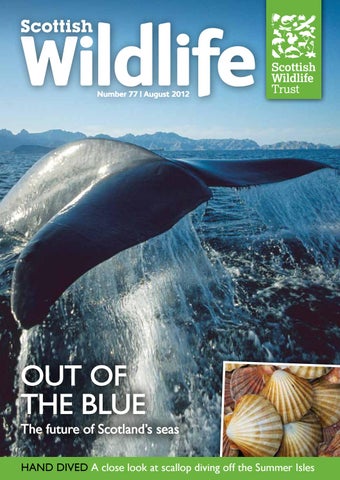
Out of the blue The future of Scotland’s seas Hand dived A close look at scallop diving off the Summer Isles
2
Scottish Wildlife | August 2012
Inside this issue Features Page 12
Page 25
Page 21
In focus Simon Milne MBE, Chief Executive
12 16 21 25
GIANTS OF THE DEEP
Richard Rowe asks if the blue whale – the largest animal ever to have lived – could make an unlikely comeback to Scottish waters.
national members’ day and agm
Naturalist and TV presenter Simon King is our guest at our 48th AGM and National Members’ Day at the Royal College of Physicians of Edinburgh.
Fishy business?
Farmed salmon is Scotland’s largest export but the rapid expansion of the industry threatens the health of our seas, as Rob Edwards reports.
The Secret world of scallop diving
Jamie Grant meets Andy Holbrow, a man whose day job involves diving to depths of up to 30 metres in search of scallops off the Summer Isles.
Regulars
6
4 10
11
Latest news The latest round-up of news from the Scottish Wildlife Trust and the world of conservation
Project Updates Updates on our beaver and red squirrel projects
Top spots
28
31
33
31 Q&A Simon King, naturalist, presenter and President of The Wildlife Trusts, answers our questions
and Reviews 32 views A selection of letters, reviews and top tips for wildlife
28 Spey Bay on the Moray Firth Scottish Wildlife magazine is published by the Scottish Wildlife Trust. © Scottish Wildlife Trust. No part of this magazine may be reproduced without the express permission of the publisher. All photography © Scottish Wildlife Trust unless otherwise stated. The Scottish Wildlife Trust accepts no liability for omissions or incorrect data in advertisements and letters. Views expressed in Scottish Wildlife are not necessarily those of the Scottish Wildlife Trust. ISSN: 0143 1234. Registered office: Harbourside House, 110 Commercial Street, Edinburgh EH6 6NF. Tel: 0131 312 7765. Fax: 0131 312 8705. Email: enquiries@swt.org.uk. Website: scottishwildlifetrust.org.uk. The Scottish Wildlife Trust is a company limited by guarantee, registered in Scotland (no. SC040247). It is also a Scottish registered charity (no. SC005792).
A big welcome to the nearly two and a half thousand new members who have joined the Trust since the last issue of the magazine! We remain indebted to our many members and supporters, without whom our pioneering activities – including red squirrel conservation, habitat restoration, education and environmental campaigning – would simply not be possible. Our work does not stop at the shoreline. Beneath the surface of our seas are landscapes as beautiful and varied as those on land. The world’s oceans are home to nearly 50% of all species and their long-term health is as important to mankind as it is to the creatures that call it home. This issue of the newly redesigned Scottish Wildlife explores some current marine conservation issues; we hope that we can count on your support to save our seas.
Book your place at our Natio nal Mem bers’ D ay a n d AG M . See page 16
We also hope that you will come and enjoy listening to world-famous naturalist, broadcaster and wildlife filmmaker Simon King at our National Members’ Day on Saturday 29 September. This will be a very popular event, so book early to avoid disappointment!
Deadlines for news and letters: 1 January, 1 June, 1 September. No unsolicited articles please. Scottish Wildlife is free to members. Membership rates from 1 April (excluding discounts for paying by Direct Debit): Individual (concession) £33 (£18); Joint (concession) £46 (£24); Family £53 (£48); Watch £18; Life (joint) £800 (£1,200); Senior Citizen Life (joint) £500 (£700). Patron: HRH The Prince Charles, Duke of Rothesay. Chairman: Allan Bantick. Vice-Chairs: Jean Barr, David Grundy, James Ivory. Chief Executive: Simon Milne. Editor: Jo Pike editor@swt.org.uk. Production Editor: Oliver Davies. Design: LBD www.lbd.uk.net. Advertising: Daniel Evans 0131 551 6095 / 07733 223 210 or danoban@btinternet.com. Printing: J. Thomson Colour Printers, Glasgow. Cover photo: Blue whale tail © Tui De Roy / Minden Pictures
Scottish Wildlife is published three times a year: March, August and November.
The Scottish Wildlife Trust is affiliated to The Wildlife Trusts, a UK-wide network of 47 Trusts with more than 2,000 wildlife reserves.
Scottish Wildlife | August 2012
3
Scottish Wildlife Trust News
Wildlife matters Alex Kinninmonth, Living Seas Policy Officer With a surface area six times larger than Scotland’s land mass, over 10,000 miles of coastline and around 6,500 species of plants and animals, it is easy to be overwhelmed when presented with the facts of Scotland’s coasts and seas. Managing the marine environment is a complex and extremely challenging task. Two years have passed since the Marine (Scotland) Act 2010 was adopted, which aims to ensure our seas are managed sustainably. A key measure will see the creation of new Marine Protected Areas (MPAs), zones of the sea where sea life is protected from damage or disturbance. MPAs are not necessarily the ‘no take zones’ that they are often perceived to be; in many cases, low-impact recreational and commercial activities will be able to continue. Legal protection will, however, allow greater scrutiny of activities and developments within the MPA. A well selected and well managed network of MPAs should work as a collective whole, maintaining healthy and resilient ecosystems where wildlife thrives. MPAs are not a panacea but they are a critical part of efforts to restore the health of our waters and balance the demands we place on them. A new marine planning system, along with Europe-wide measures and commitments – including a new Common Fisheries Policy – will also play a vital role. Decisions made by Scottish Ministers over the coming year will affect the health of our seas and their ability to go on providing the myriad goods and services that are often taken for granted. Recommended sites will go to consultation early next year and a strong public voice will be required to see MPAs move from proposals to a successful reality. Scotland has a long and deep-rooted maritime history; we will be calling on government to add another pioneering moment and show the world what can be done to protect our seas. Follow Alex on Twitter: @ScottishSeas
4
Scottish Wildlife | August 2012
© Steve Gardner
Spotlight on red squirrels The Scottish Wildlife Trust has launched a webcam focusing on red squirrels, while great spotted woodpeckers, siskins and greenfinches are all visible too. The People’s Postcode Lottery Squirrelcam is based at Loch of the Lowes in Dunkeld. The Squirrelcam has been launched due to incredible demand for our other wildlife webcams and has been established thanks to the generous support of People’s Postcode Lottery. The Squirrelcam is online now alongside our other cameras at Falls of Clyde and Montrose Basin. Meanwhile, the Trust-led project to
save Scotland’s red squirrels has been given the green light from Scottish Natural Heritage for a further two years. Saving Scotland’s Red Squirrels (SSRS) focuses on Scotland’s remaining red squirrel populations in the Highlands, Argyll, north east Scotland and northern Tayside. Phase Two of the project, which now incorporates Red Squirrels in South Scotland, began in April and we urgently need to raise the last £250,000 to deliver all its targets.
Trust embarks on new prestigious partnership
ate Keep up to d latest with all the n Trust news o our website.
The Scottish Wildlife Trust has formed a new partnership with the prestigious department store, The House of Bruar. The ‘Harrods of the North’, based in rural Perthshire ten miles north of Pitlochry, has hosted an exclusive event to celebrate the Trust’s work to save Scotland’s red squirrels. On the evening, Eddie Hallam – sculptor, conservationist and Trust member, whose work is regularly exhibited at The House of Bruar gallery – entertained guests with the story of how he is crafting a red squirrel bronze, due to be auctioned in support of SSRS later this year. We are delighted to be joining forces with The House of Bruar: an iconic Scottish brand helping an iconic Scottish species.
Scottish Wildlife Trust News
Many happy returns The Trust’s Jupiter Urban Wildlife Centre in Grangemouth celebrated 20 years as a wildlife haven and educational resource with a visit from journalist and broadcaster Sally Magnusson in May.
Snippets Ideal Homes Show exhibition The Trust was delighted to work with the Prince’s Foundation for Building Community for a second year running at the Ideal Home Show Scotland in June, designing a wildlife-friendly garden outside the Prince’s House. The event played host to over 38,000 visitors at Glasgow’s SECC.
Volunteers celebrate Trusts’ Centenary To celebrate 100 years of The Wildlife Trusts, a small number of Scottish Wildlife Trust volunteers attended a garden party at Highgrove, where they met the Trust’s Patron Prince Charles, the Duke of Rothesay. Jupiter anniversary © Greg Tinker
First opened by Sally’s father Magnus, Jupiter has come a long way since its beginnings in 1992. Through much hard work the reserve has been transformed from what was once disused industrial wasteland into a green wildlife oasis containing a great variety of wildflowers, woodland birds, fungi, insects and amphibians around the specially created ponds. As part of the anniversary celebrations, the Trust unveiled wildlife-inspired mosaic artworks and ceramic tiles for the Centre, designed and made by local young people with the help of mosaic artist Jaine Marriot and ceramic artist Fiona Byrne-Sutton. Thanks to support from local chemical plants Syngenta and Calachem, Jupiter is now looking forward to another 20 years in the spotlight.
Welcome relief on Handa A new season at one of the Trust’s most unusual reserves – the island of Handa in Sutherland – has brought some welcome relief for thousands of visitors. A new composting toilet has been built: a major undertaking given the island’s remote location. Materials arrived on the island via an amphibious landing and a helicopter air drop in early March. The toilet is set up in fine ecological style – it has a grass roof and separates liquids and solids for better composting. The Trust hopes to sell fertiliser created by the toilet back to businesses on the mainland and money raised will help fund conservation work on the reserve in the future. Our thanks go to Highland Council, Scottish Government and European Union Highland LEADER Programme 2007-2013.
Sand martins © Andy Wakelin
Montrose migrants Summer migrants are beginning to return to Montrose Basin. Sand martins and swallows are back and nesting, while terns are returning and beginning to settle on the purposebuilt tern raft.
New shoots in Coigach and Assynt A TREE nursery has been established as part of the Coigach – Assynt Living Landscape project in the north west Highlands. The ambitious landscape restoration project has built the nursery – based five miles east of Lochinver – on land owned by one of the project partners, Culag Community Woodland Trust. Project Manager Viv Halcrow said: “The nursery will gather native trees to be used as planting stock for new woodlands in the project area.” Once established, the tree nursery will be producing tens of thousands of trees every year.
Handa toilet © Ian mackenzie
Scottish Wildlife | August 2012
5
Scottish Wildlife Trust News
Snippets Biodiversity benefits at Carstramon The Trust recently carried out tree felling at Carstramon Wood in Dumfries and Galloway, with the aim of restructuring the woodland and creating opportunities for new trees to establish themselves. Some timber is to be removed and some left as deadwood, which is beneficial for invertebrates, fungi and small birds.
Possil now possible
Eigg hatching
Thanks to funding and volunteers from the Carillion Natural Habitats Fund, access on an urban reserve in Glasgow has been greatly improved. The path at Possil Marsh, near Bishopbriggs, was badly damaged and often flooded in wet weather. It has now been repaired and improved: the widened path now enables wheelchair access at the southern end of the marsh. This project is a great example of how corporate volunteers can contribute to and gain from our conservation work.
BELOW is a picture of the first Great Skua chick ever to hatch on Eigg. The species bred for the first time on Eigg last year but failed at the egg stage – probably due to the terrible May weather. Trust Ranger on Eigg, John Chester said: “The species has been colonising down the west coast for some years. They began summering around the Small Isles around 10 years ago and have bred on Rum and Canna for around the past five.”
Hunterson campaign success
Carstramon Wood © STEVE BLOW
Peregrine chicks Nesting peregrines returned to the Falls of Clyde earlier this year, giving birth to two female chicks. The chicks were ringed and their nest protected from egg thieves, thanks to funding from People’s Postcode Lottery.
Longhaven improvements Thanks to funding from the SITA Trust, improvements to access and safety at Longhaven Cliffs in Aberdeenshire have been completed. This reserve is a beautiful stretch of cliff-top six miles south of Peterhead.
IUCN opportunity The Trust’s Director of Conservation, Jonny Hughes, is standing for election as an International Union for Conservation of Nature councillor. If elected in South Korea this September, Jonny will be able to help shape the future of nature conservation on a global stage.
PLANS for a coal-fired power station at Hunterston in North Ayrshire have been abandoned. The Trust was part of a sustained campaign by the conservation movement against a development that would have devastated a Site of Special Scientific Interest (SSSI). The area where the power station was planned has nationally important eelgrass beds and the best intertidal mudflats for feeding wildfowl and waders in the Clyde, as well as supporting other wildlife including otters, seaside centaury – a nationally scarce plant – and a rare type of cuckoo bee. Chief Executive Simon Milne commented: “We are delighted with this news and relieved that the right decision has been made for people and wildlife.”
The Trust has published its new five year plan, entitled Our nature, our future, detailing what the Trust aims to accomplish between 2012 and 2017. The document is available to view on our website. Osprey chick © Steve Gardner
Scottish Wildlife | August 2012
Recruiters required The Trust is looking for wildlife enthusiasts to help recruit new members at pre-booked venues and events. Ideal for those seeking to supplement a pension or looking for a change of pace, the role offers good income potential and is available for three to five days per week, including some weekend working. Full UK driving licence and own transport essential. For more information on becoming a Trust recruiter, contact Howard Fairless on howard@fairless98.freeserve.co.uk
Twenty-two and counting for incredible osprey
Our nature, our future
6
Great Skua chick © Lizzie Drake
The remarkable female osprey at Loch of the Lowes in Dunkeld has returned to breed for a 22nd year. The bird, known affectionately as ‘Lady’, landed on the nest at the end of March and quickly found a new mate. Thousands of viewers online have followed each new development in the story, from the ospreys mating through to the laying of three eggs in mid-April. Unfortunately, only one of the eggs hatched but after a failed breeding season last year staff, visitors and volunteers have been celebrating. This chick is the 49th that the female osprey has raised over her quite incredible lifespan and has been satellite tagged to provide vital scientific data on osprey behaviour.
Scottish Wildlife Trust News
Report calls for lowland raised bog protection
DESS team on Tanera Mòr © CLAUDIA GEBHARDT
Bioblitz in the Borders The Trust’s young team of field ecologists have been busy gaining new skills at reserves and projects right across the country. Developing Ecological Surveying Skills (DESS) is a unique field-based course for young people, aiming to fill the current skills gap in field surveying and help secure the future of such skills in Scotland. The Trust has recently been awarded over £300,000 from the Heritage Lottery Fund towards another 18-month course. Would-be field ecologists are queuing up for such training; the current course attracted over 450 applicants for just ten places. In the last few weeks, the current batch of trainees have helped at a ‘Bioblitz’ at Cauldshiels Loch in the Borders and travelled to the Summer Isles to do a National Vegetation Classification as part of the groundbreaking Coigach – Assynt Living Landscape project. Their results will help the project staff plan habitat restoration work. £34,000 is still needed to ensure the next course is ready to begin in April 2013.
Jamie Hepburn MSP visits Cumbernauld RESERVES In May, the Trust welcomed local MSP Jamie Hepburn to its reserves in Cumbernauld to tell him all about a long-term plan for the area. Cumbernauld Living Landscape is a 50 year vision to improve the quality of the local environment by linking up greenspaces. The visit was an opportunity to showcase partnership projects that are already underway and celebrate one of Cumbernauld’s environmental improvement initiatives. The project has already begun to link up and improve the wildlife habitat on reserves and, thanks to a partnership with Scottish Water, there have also been improvements to the quality of Cumbernauld’s natural watercourses and riparian habitat. This will help otters
and kingfishers (amongst others) in Cumbernauld Glen, creating one large pond and several small wildlife ponds.
Jamie Hepburn at Cumbernauld Living Landscape © Bruce Wilson
Scotland’s lowland raised bogs – some of the most important assets in the fight against climate change – have been badly damaged but can be repaired, a new Trust report has highlighted. The report – the most comprehensive survey of lowland raised bogs in the last 15 years – says it would cost £43,500 to return a typical lowland raised bog to good condition. The capital cost of restoring all of Scotland’s lowland raised bogs to good condition is estimated at £21 million, which compares favourably to the social cost of the carbon being released into the atmosphere – estimated at an eye-watering £5 billion. Lowland raised bogs contain and trap a large amount of carbon. Protecting them will contribute significantly towards meeting Scotland’s ambitious carbon emission targets, as well as protecting our valuable biodiversity.
volunteers welcomed
Planning volunteers © Bruce Wilson
Dr Maggie Keegan, the Trust’s National Planning Co-ordinator, joined Colonel Patric Baird and other North of Scotland Members’ Centre volunteers on a field trip close to Ben Wyvis recently. The Members’ Centre invited Maggie and Bruce Wilson, Living Landscapes Policy Officer, to spend a day with volunteers to talk about planning and wildlife. The morning’s planning presentations were followed by a site visit to the proposed Clach Liath wind farm at the foot of Ben Wyvis to investigate the impacts of the wind farm on wildlife. Are you interested in becoming a planning volunteer for the Trust? Please contact Maggie Keegan at mkeegan@swt.org.uk Scottish Wildlife | August 2012
7
Wider News
A flourishing Scotland Scottish Environment LINK, the Scottish Wildlife Trust, Sniffer, CIFAL Scotland and Scottish Business in the Community have published a report, A Flourishing Scotland, to discuss Scotland’s achievements since the last Earth Summit in 1992. The report summarises ten celebrations from the past 20 years along with ten ambitions for Scotland in the coming 20 years. The compilation of this report has proven to be a valuable exercise, capturing some of the major issues which need to be addressed collectively in order to make the shift to a truly sustainable economy in Scotland. One suggestion is that Government should start measuring ‘natural capital’ rather than relying solely on traditional measures of GDP. You can read the report – A Flourishing Scotland – on our website.
Proof of climate change through vegetation study Climate change has impacted on upland plants and vegetation over the past half century, new evidence from north west Scotland has revealed. Research funded by Scottish Natural Heritage (SNH) and the Natural Environment Research Council (NERC) has revealed for the first time the impacts of climate change on mountain landscapes. Dr Louise Ross of Aberdeen University and colleagues reassessed study plots throughout north west Scotland, last surveyed by pioneering botanists Donald McVean and Derek Ratcliffe 50 years ago. Species which have increased the most prefer warmer, drier and more acidic conditions. Grasses have increased at the expense of dwarf shrubs, flowering plants and lichens. Professor John Birks – a specialist in upland vegetation at the University of Bergen, Norway who collaborated in the work – said this proof of climate change in Scotland was important: “We have evidence of climate-related changes in the flora and vegetation in the mountains of Norway but this study is an important first for the north west part of the UK.” 8
Scottish Wildlife | August 2012
Chequered Skipper © Philip Precey
Highland home of hardy butterflies Scotland could be harbouring previously undiscovered colonies of one of the country’s rarest butterflies. The small, fast-flying Chequered Skipper – which is extinct in England – now only occurs in the UK within a 30-mile radius of Fort William. However, recent work by Butterfly Conservation Scotland and the Joint Nature Conservation Committee has predicted the butterfly’s distribution could be underestimated by around 20% at a 10 km level and as much as 400% at a finer 1 km resolution. The Chequered Skipper is usually on the wing from mid May until the end of June. It can be seen on warm and sunny days, even during brief spells of sunshine, feeding on nectar: particularly bugle, marsh thistle and orchids. The butterfly was formerly found in England, where it used to be relatively common in East Midland woodlands. It began to decline in the 1960s before finally being declared extinct in 1976.
Exposure for Trust’s Cumbernauld reserves An ambitious nature photography project designed to change people’s thinking about our natural environment has concluded its work in Cumbernauld. Katrina Martin has been a young champion for the 2020VISION project, taking innovative photographs of the environment of Cumbernauld at the same time as working at the Trust’s Cathkin Marsh reserve, south of Glasgow. July saw the launch of the UKwide exhibition at the Royal Botanic Gardens in Edinburgh.
2020VISION exhibition © Katrina Martin/2020VISION
LOOKING TO THE FUTURE
Kinneil Woods © FALKIRK COUNCIL
LOOKING TO THE FUTURE Eleanor and Fred Kania have been members of the Scottish Wildlife Trust for five years. Here, Eleanor explains why she and her husband have chosen to remember the Trust with gifts in their Wills. "SCOTLAND’S wildlife is special to us in so many ways, not least because of the species which are unique to it – the Scottish wildcat, Scottish crossbill and Scottish primrose. Of course, we also have the most red squirrels in Britain. Personally I still cherish early memories of wildlife expeditions with my father and hope children will always be able to experience the joy of seeing the mammals, birds, insects and wildflowers which we have been lucky enough to see all our lives. We think the family events run by the Trust are a great way of encouraging children to learn about the countryside and we know that gifts in our Wills could support these activities.
Scottish wildcat © ELLIOT SMITH
© EMMA BRADSHAW
I’ve been fascinated by every aspect of wildlife since an early age when my father introduced me to wildflowers and birds in Kinneil Woods, Bo’ness. There was even a nature table in my bedroom! I believe we should all play a role in protecting Scotland’s wildlife – creating ponds; planting bee-friendly flowers; erecting bird feeders and bug lodges in our gardens, on balconies and in window boxes; and, of course, by being members of the Scottish Wildlife Trust. We want the Trust to continue protecting the precious habitats on its wildlife reserves for many years to come – but we're aware that this requires constant funding, with costs only going up. That’s why we gain satisfaction from knowing that, as well as our membership subscriptions now, the gifts in our Wills will one day help protect Scotland’s wildlife for future generations."
WOULD YOU LIKE TO TALK TO US ABOUT LEAVING A GIFT IN YOUR WILL? Please call Wendy Hill on 0131 312 4772 or email whill@swt.org.uk Alternatively, you can visit our website scottishwildlifetrust.org.uk/legacy for further information
Scottish Wildlife | August 2012
9
PROJECT UPDATEs
Joining forces to save Scotland’s red squirrels Saving Scotland’s Red Squirrels is a multipartner project to protect the UK’s only native squirrel species. The project is controlling selected grey squirrel populations and halting the incursion of the deadly squirrelpox virus. Project partners
Saving Scotland’s Red Squirrels © Steve Gardner
With thanks to our supporters including:
J & J R Wilson Trust Garfield Weston Foundation 10
Scottish Wildlife | August 2012
Mel Tonkin reports on some exciting developments in the Saving Scotland’s Red Squirrels project, and welcomes several new members of staff to the team. I am DELIGHTED to announce that – thanks to the generosity of supporters including Scottish Natural Heritage and Forestry Commission Scotland, plus donations from members of the public – the Saving Scotland’s Red Squirrels project is embarking on its next two year phase. The Saving Scotland’s Red Squirrels team would like to thank all our supporters for their amazing generosity, which will enable us to continue our conservation work and build on our early successes. As we move into the second phase of the project, there are a couple of important developments to update you on. In particular, Saving Scotland’s Red Squirrels (SSRS) has now merged with the longrunning Red Squirrels in South Scotland project to run as one
strategic national initiative. The South Scotland arm will continue to concentrate on protecting the rest of Scotland’s red squirrels from the scourge of squirrelpox. Although the pox threat has increased over the past year, we are hopeful that the new Red Squirrels Northern England project – which has now begun landscape-scale grey squirrel control – will soon start to make a difference to the northwards drift of squirrelpox, leaving SSRS to tackle the disease that’s already in Scotland. 2012 has also seen us welcome several new members of staff: in the north east, Steve Willis takes over from Annie Harrison, who left us in February for marine bird and mammal work. Steve joins project officers Ken Neil in Tayside, Lewis Pate in Argyll and the Trossachs and
Karen Ramoo in the Scottish Borders, and newcomer Heinz Traut joins us in Dumfries and Galloway. This is in addition to the sterling work of our grey squirrel control team. With 159 landowners trapping under Rural Development contracts and our many dedicated trap-loan recipients, our Red Squirrel Protection Network is becoming quite formidable. The project’s annual surveys were completed in the spring thanks to Emma Bryce, assisted by the project officers and a team of 22 volunteers. A huge thanks to you all. Phase Two of the project may only just be underway but the momentum is with us and we remain confident that the next 18 months will bring us nearer to a safe future for red squirrels.
PROJECT UPDATES
Beavers swap places in Knapdale, Argyll The Scottish Beaver Trial is a time-limited reintroduction of the Eurasian beaver in Knapdale, Mid-Argyll, which has seen beavers returned to the wild in Scotland for the first time in 400 years. Project partners
Scottish Beaver Trial © Steve Gardner
With thanks to our supporters including:
As the Scottish Beaver Trial enters its fourth year, Simon Jones reports on some unexpected behaviour from two of our families, as well as welcoming a new staff member to the project. Although we are now entering year four of the Scottish Beaver Trial, we are still gaining new insights into how beavers behave in the wild. One such example is the tale of the partner swapping antics of two of our neighbouring pairs. Seemingly they have not read the text books which tell you
Staff and volunteers in Knapdale
© Simon Milne
that beavers pair for life! Elaine and Eoghann set up home on the remote Creagh Mhor Loch after their release in June 2010. Further downstream on Lochan Buic lived Trude and her mate Christian. All seemed normal until last autumn when our field team discovered that Eoghann and Christian had swapped places with one another! This was followed shortly afterwards by Eoghann apparently disappearing from his new home for nearly three months before reappearing this spring as if nothing had happened. These observations – and subsequent discussions with our colleagues at Telemark University College in Norway (from whence our first beavers came) – have shown that the faithful beaver is not quite as adverse to temporarily swapping mates as was once thought, particularly in the mating season.
In other news, we were very glad to welcome a new member to the Scottish Beaver Trial team this April. Oly Hemmings has joined us as the Scottish Beaver Trial Education Ranger and is leading on our local educational activities and public events in and around Knapdale. Oly has lived in the Mid-Argyll area for several years and has a background in outdoor education. She is also well known locally for her time spent at the Forestry Commission and The Dalriada Project. Further information: If you want to meet Oly or one of the other members of the team then why not join one of our guided walks every Tuesday night until 28 August and every Sunday night until 26 August? The walks are popular so booking is essential. Call 01546 603346 or see scottishbeavers.org.uk for details. Scottish Wildlife | August 2012
11
Giants of the deep
12
Scottish Wildlife | August 2012
Giants of the deep
Once a regular feature of Scottish waters, the blue whale is now only rarely seen, thanks in large part to the intervention of man. However, as more concerted attention is given to the health of our seas, this giant of the deep could yet make a welcome return, writes Richard Rowe.
S
cotland is blessed with one of the richest marine environments in Europe but even with more than 20 species of cetacean, increasing numbers of basking sharks, important year-round seal populations and some of the most vibrant seabird colonies anywhere on Earth, the roll call is far from complete. Whaling records indicate that the deep waters off the west coast and the Northern Isles were once also home to a population of blue whales – the largest animal to have ever lived. For anyone lucky enough to encounter a blue whale today, its long, broad head slipping effortlessly through the water, the experience is likely to live long in the memory. Weighing in at as much as 200 tonnes – its tongue alone can weigh four tonnes – and reaching almost 30 metres in length, it is a formidable beast. Such dimensions are hard to picture but consider this: a blue whale’s blood vessels are wide enough for a human to swim through. Also known as the Great Northern Rorqual, or Sibbald’s Rorqual (named after a Scottish naturalist), the blue whale’s more common name can be a little misleading. At the surface, much of its huge body is a pale bluish-grey, although it can just as easily be a mottled grey or even a greyish white; it is only when seen underwater that it appears as a bright aqua blue. Unlike other large whales – such as the humpback – which betray their presence with spectacular leaps into the air, blues are more discreet, with only young animals known to breach with any regularity. With acrobatics rare and a particularly small dorsal fin given their size, blues are instead most often spotted thanks to a blow that can reach heights of up to 12 metres.
ABOVE: The largest animal that has ever lived, the blue whale can weigh as much as 80 great white sharks. © Mike Johnson / EarthWindow.com LEFT: The spectacular sight of a blue whale’s lower jaw as it scoops up water and krill into its pleated pouch. © Hiroya Minakuchi / MINDEN PICTURES
Scottish Wildlife | August 2012
13
While many cetaceans are highly social, often travelling in pods, blues are usually only found singly or in pairs. They tend to travel at a leisurely pace, their deep calls – sometimes just a grunt, other times a long moan – carrying up to 1,000 km.
Small feeds big
The largest animal on Earth has a diet that relies almost entirely on one of the smallest: krill, a tiny shrimp-like creature that is a staple food for many marine animals and a crucial link in the global marine food chain. Like all members of the rorqual family of whales, the blue’s mouth has longitudinal pleats that allow its throat to expand as it gulps huge volumes of food-rich 14
Scottish Wildlife | August 2012
water. The water is then expelled through metrelong baleen plates that hang from its upper jaw and filter out the food. Highly mobile, blues have a near global distribution, with three main populations: in the North Pacific, the North Atlantic and a third in the southern hemisphere. In the North Atlantic, blue whales are found from the Caribbean to West Africa and as far north as Greenland. Whaling records highlight that small numbers regularly passed just west of Britain and Ireland, with recent acoustic monitoring and sightings showing limited numbers in deep waters off Shetland and the Faroes. That we are not more aware of their presence is due to one activity: whaling. At first, the blue whale’s sheer size was a blessing, with the animals simply too big for early whalers to catch, kill and process. However, as technology improved and whaling methods became more sophisticated, the animal’s epic proportions saw it become the most valuable prize of all. “With the invention of steam ships and mechanised harpoons, it became possible to hunt them and, as so much money could be made from a single whale, they were heavily targeted,” explains Laura Smith, Scottish Wildlife Trust Ranger at Spey Bay on the outer Moray Firth. Estimates suggest that the pre-whaling population of blue whales worldwide stood at around 200,000. However, during the late 19th and early 20th centuries, up to 30,000 animals were taken each year – with more than 11,000 taken from North Atlantic waters alone during the first half of the 20th Century. With the hunting of blue whales banned since 1966, the primary threats they face today are
ABOVE: Scientists discover the body of a blue whale floating belly up in the Santa Barbara Channel in 2007. An autopsy revealed fatal injuries from a collision with a ship—probably one speeding cargo in or out of Los Angeles. © FLIP NICKLIN / MINDEN PICTURES
LEFT: A trick of perspective. The blue whale is so large that a man could swim through its arteries. © Mike Johnson / EarthWindow.com
Giants of the deep
During the late 19th and early 20th centuries, up to 30,000 animals were taken each year, with more than 11,000 taken from the North Atlantic alone. ship strikes, noise and chemical pollution. Their numbers remain severely depleted, however. “The current worldwide population is thought to be somewhere between 10,000 and 25,000 and it is believed that there are between 600 and 1,500 in North Atlantic waters,” says Smith. The North Atlantic population is split into eastern and western groupings, with the majority of sightings in the east around Iceland and the Azores – both major destinations for marine wildlife tourism. “It is very rare to see blue whales in areas where substantial numbers were taken during whaling – including around the British Isles. We think that the population has risen by just over 5% since the ban on hunting but more photo identification studies are needed to get a clearer idea.” While numbers are on the up, the recovery is slow. It can take six years for the animal to become sexually mature and even then females only produce a single calf every two or three years. And, as Smith explains, there are also concerns about dwindling food supplies. Krill are very sensitive to changes in sea temperatures and as those temperatures rise, so krill numbers have declined – bad news for far more than just blue whales.
Concerted efforts
Quite whether the blue whale will ever become a more regular sight in Scottish waters is difficult to say with certainty but the hope is that current efforts to improve and safeguard the marine environment, both close to home and internationally, will have a positive impact. Together with other bodies such as the Whale and Dolphin Conservation Society (WDCS), the Scottish Wildlife Trust continues to exert pressure on
the Scottish Government to ensure that a network of Marine Protected Areas is established in Scottish waters. This move follows the passing of the Marine (Scotland) Act in 2010 which requires Scottish Ministers to establish a network of protected areas in inshore waters. “We’re actively influencing the decision-making process on the location of these new Marine Protected Areas, although we’re disappointed that a final decision has now been delayed until 2013,” says the Trust’s Living Seas Policy Officer Alex Kinninmonth. “This will leave important species and habitats still unprotected three years on from the Marine (Scotland) Act. We’re even more concerned that protection for critical habitat for cetaceans such as Risso’s dolphin and minke whale may now be further delayed until 2014 or even later so we really need to keep the pressure on.” Crucially, in pushing for these protected areas, a more joined-up approach is evident – one that moves away from selecting individual areas based on the merit of one particular species to a network of sites designed to regenerate the wider marine environment. Much like the ecosystem-scale conservation approach increasingly being adopted on land, this network approach aims to ensure that all UK cetacean species are covered by the new protected areas. “Whales are highly mobile animals but they nevertheless tend to have specific areas that are important to them, such as seasonal breeding or feeding grounds,” explains Smith. “If these areas can be protected, the chances of survival are greatly improved.” If such protection does come to fruition, the future for blue whales and its cousins may yet be a bright one after all.
ABOVE: Unlike other large whales, blues tend not to betray their presence with spectacular leaps into the air. Only young animals are known to breach with any regularity. © FLIP NICKLIN / MINDEN PICTURES
Richard Rowe is editor of Scotland Outdoors, the award-winning quarterly magazine for all those with a love of Scotland’s outdoor world. scotoutdoors.com Scottish Wildlife | August 2012
15
Simon King © Brydon Thomason
National Members’ Day Renowned naturalist, presenter, cameraman and Wildlife Trusts President Simon King OBE will be our special guest for the 48th AGM and National Members’ Day. Join us at the Royal College of Physicians of Edinburgh for what promises to be a unique and inspiring event.
Highlights • Buffet lunch with Simon King OBE • Simon King delivers a lively talk followed by an interview with Stephen Jardine • Centenary film of The Wildlife Trusts • ‘Question Time’ with guests including Mark Beaumont
16
Scottish Wildlife | August 2012
We are delighted that Simon King OBE has agreed to join us as the special guest at this year’s National Members’ Day and AGM. As well as being one of television’s most recognisable and trusted personalities, Simon has been an active campaigner on wildlife issues for many years, culminating in his appointment as President of The Wildlife Trusts in November 2010. Join us as we find out more about the man behind the camera. Simon will deliver a lively talk followed by an in-depth interview with popular broadcaster and Trust ambassador Stephen Jardine. Topics are likely to include Simon’s passion for wildlife, his career and his involvement with The Wildlife Trusts. Another highlight will be Stephen Jardine chairing a ‘Question Time’ session in association with People’s Postcode Lottery, with panellists including round-the-world cyclist and adventurer, Mark Beaumont, and Simon King. The event will also feature a presentation on the aims and
aspirations of the Scottish Wildlife Trust for the year ahead and extracts from a film celebrating 100 years of The Wildlife Trusts movement. National Members’ Day (from 12 noon) will follow the Trust’s 48th AGM, which offers members the opportunity to shape the future of the organisation and comment on what has happened over the past year. Items on the agenda (see cover sheet) include electing new members of Council, appointing auditors and receiving the Council’s report and accounts for the year ended 31 March 2012. Further information If you would like a copy of the full audited annual accounts or would like to notify us of any other business (by 21 September 2012), please contact the Company Secretary, Simon Milne, at: Scottish Wildlife Trust, 110 Commercial Street, Edinburgh EH6 6NF.
National Members’ Day AND AGM BOOK YOUR PLACE
Early bird discount Book before 31 August for only £10 per person
10.30am–4.30pm, 29 Sept 2012 (Members’ Day begins at noon) Please complete this form using BLOCK CAPITALS and return to: Membership Department, Scottish Wildlife Trust, Harbourside House, 110 Commercial Street, Edinburgh EH6 6NF by 21 September 2012 or, if paying early bird rate, by 31 August 2012.
COMLETE THE FORM BELOW OR BOOK ONLINE
scottishwildlifetrust.org.uk/ membersday Name of first delegate Membership nUMBER Name of second delegate (if applicable)
and AGM
Non-member guests (two max.)
w alk
Contact address
le
it h
d u nd a s St
P york
l
buS StatiOn een
t
h brid ge
nd
Pl
m ou
ic k
t he
dw
n rd
an
Telephone
lothia
Sh
waverley StatiOn
nort
d ry r
e s St Princ
Postcode
e s St Princ
St over
sfer
e ns S
h a nn
Qu
Q ue
Venue information Royal College of Physicians of Edinburgh
9 Queen Street Edinburgh EH2 1JQ Tel. 0131 225 7324
Would you like To submit a question for our panel? a selection will be used on the day.
Public transport: only ten minutes’ walk from Edinburgh Waverley train station. Excellent bus services, visit traveline.info By car: meter parking on street. Nearest car parks at St James Centre, Leith Street and Castle Terrace. Accessibility: the venue is fully wheelchair accessible. Please contact the venue for more information.
CONTINUED OVERLEAF... Scottish Wildlife | August 2012
17
If you are involved in a local Members’ Centre, please let us know which one
Office held (Chair, Secretary etc. if appropriate)
Nominations for election to Council Col. Patric Baird
Proposer: Jim Miller Seconder: Geraldine Connah
I / we wish to attend ... (please tick)
AGM only (free to all members)
Members’ Day at £15 (full price) or £10 (early bird) per person. Includes tea/coffee and a buffet lunch.
Please use this space to let us know about any access requirements
Patric spent six years dairy farming prior to 31 years in the Army and 11 as an MOD civil servant. He saw service in the UK, Australia, Northern Ireland and Germany. He was Head of the British Delegation for pay and conditions for all locally employed civilians in Germany, working with the German Finance Ministry and Trade Unions, and in eight other countries, again at national government and union level. Thanks to his military postings he has been able to study and film flora and fauna in eastern and western Europe. Patric is currently Chairman of the North of Scotland Members’ Centre and Highland representative to the SOC Council.
Karen Chambers
Proposer: Dr John Sheldon MBE Seconder: Tim Duffy Please state if you have any special dietary requirements (please tick)
Vegetarian
Vegan
Coeliac
Nut allergy
Other (please specify)......................................................
I enclose a cheque for £..................... (payable to Scottish Wildlife Trust) for ......... people
or please debit my account (Switch / MasterCard / Visa) (please circle)
Card number
Expiry date
/
Start date
/
Issue number (Switch only) Security code*
*The security code is the three-digit number in the signature space on the back of the card.
Cardholder’s signature
Karen has been engaged with the Scottish urban and rural environments for over 20 years, working with a wide range of government organisations and local communities, particularly at the interface between people and the natural environment. Before establishing her own practice she was Associate Director of an Edinburgh environmental planning consultancy and, for two years, Project Officer for the Millennium Forest for Scotland. She has lectured in ecology to Masters Landscape Design students at Edinburgh and Heriot Watt Universities and co-produced a couple of environmental documentaries. Spare time activities include printmaking and hill walking. Karen has three grown children.
Tim Hailey
Proposer: Allan Bantick Seconder: Tim Duffy Having retired from a career in business in the food, drink and banking sectors, particularly focused on Marketing and Business Development, Tim has taken on a number of management board responsibilities in the charitable sector. These include Fife Society for the Blind, Glenrothes YMCA and Burntisland Development Trust. Also, as a locally elected Community Councillor, he is actively involved in working with local Councillors and community groups in developing improving strategies for his local community and environment.
Prof. Chris Spray MBE
Proposer: Prof. David Houston Seconder: Prof. John Harwood Cardholder’s name
Further information If you have any questions about your booking, contact the Membership team on 0131 312 4700 or email membership@swt.org.uk
18
Scottish Wildlife | August 2012
Chris is a wetland ecologist and ornithologist by training, having spent ten years at Aberdeen University doing his PhD and subsequent studies on crows, mute and whooper swans and on birds in pine plantations. After 20 years working in England, he returned to Scotland in 2004 and spent the last five years as Director of Environmental Science at SEPA. He has just taken up the chair of Water Science & Policy at the UNESCO Centre at Dundee University. He is a former council member of Durham Wildlife Trust, the National Biodiversity Network, RSPB, BTO and WWT, and is currently on FBA Council. He has served on both the England and Scottish Biodiversity Committees. He received the MBE in 2000 for services to environmental conservation in the water industry.
ST KILDA WHY NOT TRY SOMETHING DIFFERENT? Imagine every day in a different location. Sheltered, peaceful sealochs with miles of coastline and no roads in sight. Bustling little villages, brightly painted ready to welcome you. Historic castles, home to clan chiefs for generations. Tropical gardens where exotic plants flourish in northern climes. These delights with the accompanying seabirds, dolphins in the bow waves, seals lazily watching from their reefs and passing whales are waiting for you. Take a break on M.V. Kylebhan when we visit a number of Islands on each trip, including St Kilda. Sailing from Oban through the Western Isles, enjoy the ever changing scenery and freedom to explore at your own pace. Send for details to: Kylebhan Charters, 3 Barclay Court, Old Kilpatrick G60 5HX tel/fax: 01389 877028 mobile 07775 508242 e-mail: kylebhan@aol.com
Scottish Wildlife | August 2012
19
Thinking abouT rural diversificaTion? Avoid the bear traps! Spurred on by the pressures of the current recession, many landowners are considering diversification projects. Often the legal structure and compliance with regulations are, if not overlooked, given a back seat, or just put to one side. To ensure any diversification project is successful, you should think about the following matters in order to avoid potential legal and financial pitfalls.
family dynamics, succession and available skills Landowners should consider who is to be undertaking the venture. Does someone in the family have the existing skills, knowledge and time to implement the project? If they need to bring in someone else to run the project, this would be an extra cost to consider. Landowners should also consider how the project will affect family dynamics. How is inheritance of the venture to be managed? It might be appropriate to create a ‘family charter’ to set out expectations.
health and safety A recent tragic death at Warwick Castle (in respect of which the operator was fined £350,000 and had costs awarded against them of £145,000) highlighted the importance of compliance with
20
Scottish Wildlife | August 2012
health and safety legislation. However, in addition to visitors, landowners and project managers need to be aware of potential claims from employees.
licences and consents Where the diversification venture involves hosting events, landowners must remember to obtain the appropriate consents and licences, which may include public entertainment licences, liquor licences, wedding licences or late hours catering licences. They must also consider the implications of environmental health legislation and any relevant local by-laws.
Tax Tax, particularly income tax, will be an important factor in determining the most appropriate ‘vehicle’ to run the venture. Do not forget VAT and if leases are to be involved, Stamp Duty Land Tax. Accountancy advice to ensure the
new venture sits neatly within/ alongside any existing business is essential.
changing legislation What may seem a viable project one day could suddenly be rendered non viable due to increased regulation or unexpected policy changes e.g. the recent reduction in feed-in tariffs for solar energy.
conclusion Undertaking anything but the most simple diversification project can lead to unexpected consequences without proper planning and advice at the right time. Those thinking of undertaking diversification projects should have initial discussions with professional advisers at an early stage, which should be relatively inexpensive and represent money well spent to plot an informed course to the establishment of a viable business.
for further general advice on rural diversification, please contact helen Mchugh, trainee solicitor in the Private client division at Morton fraser on helen.mchugh@morton-fraser.com or 0131 247 3153. Morton fraser has offices in edinburgh, glasgow & london. for details of our seminar programme please visit our website where you can enrol online: www.morton-fraser.com/events
www.morton-fraser.com
fishY Business? Rob Edwards reports on the billion-pound fish farming industry and asks if wildlife will pay the price for our growing appetite for salmon.
N
early every day in the summer, David Ainsley takes tourists on his boat, Porpoise II, to look for wildlife amidst the unassuming beauty of water, rock and hill that characterises the west coast of Scotland. If they are lucky, they get to see eagles, dolphins, porpoises, seals and minke whales, as well as the famed Corryvreckan whirlpool. For more than 20 years, Ainsley has been running a successful wildlife-watching business from his home on the island of Seil, eight miles south of Oban. But now he is worried that the wildlife – and with it his livelihood – could be blighted by the billion-pound fish farming industry. A Polish-owned company, the Meridian Salmon Group, has applied for planning permission to double the production of a nearby salmon farm in the Sound of Seil off Ardmaddy and move it 900 metres south. Conservationists fear this will lead to more shooting and scaring of seals, more pollution and a greater threat to the area’s priceless natural heritage.
“Salmon farming is an important industry but some farms are unnecessarily killing wildlife and affecting wildlife tourism,” Ainsley says. “The salmon farm at Ardmaddy is a classic example of an inappropriately located farm.” In their anxiety to prevent seals from eating salmon, fish farmers sometimes shoot them, or try to frighten them with loud underwater blasts of noise. But according to Ainsley, this can interfere with the echo-sounding vital for dolphin and porpoise navigation. “It’s like blinding them,” he argues. With support from the Scottish Wildlife Trust’s head office, Ainsley, who is Treasurer of the Trust’s Lorn & Mid Argyll Members’ Centre, has spearheaded a campaign against the fish farm which has led to more than 800 objections. All local members were contacted and many have lent their support to the campaign. Pollution from the existing salmon farm was declared ‘unsatisfactory’ in 2010 by the Government’s green watchdog, the Scottish Environment Protection Agency (SEPA). Scottish
ABOVE: The salmon farming industry continues to expand, including recent controversy over fish farm proposals near the islands of Eigg, Canna and Colonsay. © laurie campbell
Scottish Wildlife | August 2012
21
ABOVE: Natural predators of salmon, seals can come into conflict with farms causing fish losses and damage. Persistent seals can be shot under licence as a last resort. © Martha Tressler
BELOW: A billion-pound industry. Farmed salmon is Scotland’s single largest food export, with a worldwide retail value of over £1 billion. © KEVIN Lawver
22
Scottish Wildlife | August 2012
Production of Atlantic salmon has risen nearly fivefold from 32,350 tonnes in 1990 to around 157,400 tonnes in 2011, and now involves 30 companies at about 250 sites along the west coast.
Natural Heritage has also expressed concern that chemicals used to treat the fish could spread to the nearby Firth of Lorn Special Area of Conservation, protected under law because of the rarity of its reefs. Meridian’s expansion plans for Ardmaddy are still to be assessed by Argyll and Bute Council. The company insists that it is “totally committed to ensuring best practice” and describes claims of damage to wildlife as “unsubstantiated”. Their managing director Mark Warrington says: “If there was conclusive data on this, we would look to change our operations.” The arguments over Ardmaddy are being replicated across Scotland, as the salmon farming industry continues to expand. Recently, there have been conflicts over fish farms proposed near the islands of Eigg, Canna and Colonsay, and there will doubtless be many more to come. Production of Atlantic salmon has risen nearly fivefold from 32,350 tonnes in 1990 to around 157,400 tonnes in 2011, and now involves 30 companies at about 250 sites along the west coast and on the islands. Farmed salmon is Scotland’s single largest food export, with a worldwide retail value of over £1 billion and major sales in the US, China and France. Scotland is the world’s third largest producer of farmed salmon, after Norway and Chile. But for the industry – backed by the Scottish Government – this is not enough. It wants to become even bigger and is aiming to increase the production of all farmed finfish by 50% by 2020. The industry has brought jobs and income to remote communities but this has come at a price. “There is no doubt that salmon farming has given
Fishy business?
a boost to rural communities in the Highlands and Islands but this has to be balanced against environmental costs,” says the Scottish Wildlife Trust’s Director of Conservation, Jonny Hughes. “The salmon farming industry trades on the reputation of Scotland’s natural environment as a wild and beautiful place rich in nature. Our coastal seas bring in £127m per year from wildlife tourism alone. To operate in a way that damages Scotland’s wildlife not only puts our seas at risk, but the future of hugely important industries like tourism and fisheries.” The problems are manifold. As well as the fish wastes that smother the seabed under cages, farmers regularly have to use pesticides to try and kill off the sea lice that eat the salmon alive. Surveys by SEPA in 2008 and 2009 found pesticide contamination in the sediments of all nine sea lochs tested on the north west coast. Research by the Salmon and Trout Association suggests that pesticide residues in some locations are above safety levels set to protect wildlife. The danger – according to the association’s lawyer, Guy Lindley-Adams – is that lobsters, crabs and prawns could be killed. The solution, he says, is to introduce “closed containment units” for fish farming to prevent pollution from leaking out. Meanwhile, there is mounting evidence that sea lice are growing increasingly resistant to pesticides and can spread to wild fish, damaging their populations. Farmed salmon also escape when nets are ripped by storms, diluting the genetic integrity of wild salmon by interbreeding. The risks to wild fish in some areas are “significant”, according to Dr Alan Wells, Policy Director of the Association of Salmon Fishery
Boards. He is looking to new aquaculture legislation promised by Scottish ministers to help tackle some of the problems. The Scottish Wildlife Trust will be actively following the Bill through the Parliament, advocating the highest environmental standards and encouraging members to back this effort in order to ensure that development of aquaculture in the future is sustainable. Both organisations are calling for stronger controls on the management of fish farms and for new powers to limit the amount of salmon being farmed. Such moves are strongly opposed by the salmon farming industry, which is resisting further regulation. “There appears to be little sense in bringing forward a Bill which consists of regulation and bureaucracy serving no purpose other than to tie salmon farmers to computers instead of allowing them to rear fish,” says Scott Landsburgh, Chief Executive of the Scottish Salmon Producers’ Organisation. The Scottish Wildlife Trust disagrees. As Hughes explains: “We’d like to see Scotland become a world leader in sustainable aquaculture; this Bill is a key step towards achieving that. For the good of the environment and the long-term sustainability of the industry, the Scottish Government needs to say no to further expansion of aquaculture in many areas.” The clash between the companies and conservationists is not going to lessen, or be easily resolved. But many would argue that Scottish ministers must be careful not to sacrifice the long-term value of the natural environment for the short-term demands of business. There is much at stake.
ABOVE: There is mounting evidence that sea lice are growing increasingly resistant to pesticides and can spread to wild fish, including this Orcadian wild sea trout. © Colin Kirkpartick
Rob Edwards is Environment Editor of the Sunday Herald and a correspondent for The Guardian. His writings are on his website: robedwards.com Scottish Wildlife | August 2012
23
More of a joy than a job Making a living on the wild water – battling the elements at depths of up to 30 metres – may not be everyone’s cup of tea but for Andy Holbrow it is a way of life. Jamie Grant meets one of Scotland’s few remaining scallop divers.
A
ndy Holbrow checks his dive watch, adjusts his face mask and takes long strides in his fins to the back of his boat. He teeters at the edge for a moment in his cumbersome dry suit before leaping into the Atlantic’s freezing waters. I watch a trail of lazy bubbles snake back up as he disappears under the waves. Most of us rarely venture into the silent and weightless world below the surface of the sea. For Andy, diving down 30 metres in search of scallops off the Summer Isles is just another day at the office. “This is more of a joy than a job,” he admits when I first meet him on the foredeck of his dive boat, The Lady Nicola. “Even when my fingers are frozen and there is snow on the deck I still love it.” Andy has been into diving ever since he explored his first wreck in the English Channel at the age of sixteen. He tried working as a building surveyor in London but couldn’t resist the call of the sea. He gave up work on land to salvage
wrecks and work as a dive instructor in Plymouth, before discovering the Scottish Highlands. He fell in love with Achiltibuie, a small village on the northerly fringe of the British Isles, while on a dive holiday twenty years ago. “When I first I dropped over the side I was blown away by the visibility,” he tells me. “After the murky depths of the English Channel I could suddenly see 40 metres through crystal water.” Andy settled in the village and has since built up a small business supplying scallops to discerning chefs in hotels and restaurants throughout the north west Highlands. With a mortgage on the boat he has to work to tight margins and needs to spend at least 200 days a year at sea. It is no easy task when faced by the combined forces of the weather and religion. Strong easterlies keep him in port and Sundays are for ‘the stones’ (church) in this corner of the world. A bright orange float bobs up next to the boat.
ABOVE: Scallop diver Andy Holbrow heads out on this stretch of the Atlantic coast at least 200 days a year, though not always in such perfect weather! © Jamie Grant
Scottish Wildlife | August 2012
25
ABOVE: As soon as the scallops are hauled on board they are sorted for size and stored live in deep tanks of running water. © Jamie Grant
26
Scottish Wildlife | August 2012
Andy’s diving partner leans overboard and hooks it with a long gaff. Attached is a string bag of scallops, floated up by Andy from the seabed. This is the first of three bags that he will collect before his air runs low and he has to return to the surface, stopping once on the way up to avoid the bends. As soon as the scallops are hauled on board they are sorted for size and stored live in deep tanks of running water. Hand diving for scallops ensures that they are undamaged and all of the juveniles are returned to the sea to breed. Of the 1,000 scallops that Andy catches on a good day, over 30% are put back alive and unharmed.
His approach is closer to farming than the indiscriminate fishing that is stripping bare so much of the marine environment. Andy has an intimate knowledge of the grounds around the Summer Isles and he rests areas that he has harvested to give stocks a chance to recover. “I populate new areas with juveniles and spot dive them every six months until I am sure that numbers are healthy enough to fish,” he says. It is a precarious balance. Dredgers occasionally arrive to scour out the preferred scallop breeding grounds in the channels between the islands. They drag heavy metal rakes across the seabed to drive scallops into nets. Nothing goes back into the water alive and the rakes leave behind long trails of destruction. “We see the carnage afterwards – the broken scallops, crushed crabs and dead fish,” Andy comments. “If this sort of practice happened on land it would have been banned a long time ago.” Plans are afoot that may help transform the
More of a joy than a job
Slicing a knife deftly between the two halves of each scallop he flicks opens the shell to reveal a gleaming treasure of white and orange meat inside.
health of the inshore waters around Achiltibuie and the Summer Isles. The Coigach – Assynt Living Landscape project was launched by the Scottish Wildlife Trust and partners in June 2011. This ambitious project uses the ecosystem approach, linking up tens of thousands of hectares of land and sea and rebuilding our natural environment for both people and wildlife. Of the seven landowning partners involved, six have land that borders the sea, making the marine environment a crucial piece of the jigsaw. Project partners Lizzie and Richard Williams own the island of Tanera Mòr and are the Summer Isles’ sole permanent residents.
Dredgers occasionally arrive to scour out the preferred scallop breeding grounds in the channels between the islands. They drag heavy metal rakes across the seabed to drive scallops into nets.
“It is still early days for the project but it is absolutely essential that we look at the marine side,” says Richard. “We can’t separate the land from the sea.” The Summer Isles is also in the frame to be designated a Marine Protected Area. It is expected to be on a list of potential sites that the Scottish Government is due to publish before the end of the year. Whether or not it is ultimately chosen depends on a public consultation next year. Andy would like to see a Marine Protected Area that keeps the dredgers and trawlers out of the waters around the Summer Isles: “The fact that there are no white fish left in these inshore waters is a sure sign that the ecosystem is under real pressure. Whether a Marine Protected Area works or not depends on how well it is enforced.” Andy finally breaks the surfaces and clambers in all his diving gear back onto the boat. He still has to shuck his catch of several hundred scallops before he can head home. Slicing a knife deftly between the two halves of each scallop he flicks opens the shell to reveal a gleaming treasure of white and orange meat inside. I can’t resist taking a few back home with me to try. Scallops this fresh needs nothing more than a couple of minutes in lemon and butter to taste the way the sea smells. They are all the sweeter for knowing where they came from and how sustainably they were caught.
ABOVE: The perfect catch. Of the 1,000 scallops that Andy catches on a good day, over 30% are put back alive and unharmed. © Jamie Grant
Jamie Grant is a freelance writer and photographer dedicated to environmental issues. He lives in Glen Lyon, Perthshire. jamiemurraygrant.co.uk
Scottish Wildlife | August 2012
27
Top spots for wildlife
View across Spey Bay © Vicky Felgate
VISIT Spey Bay Spey Bay is one of the Scottish Wildlife Trust’s most beautiful coastal reserves. It is the largest shingle beach in Scotland, situated at the mouth of the Spey, the fastest flowing river in Scotland. Constant shifts and changes caused by the river create a range of habitats from bare shingle to wet woodland, brackish saltmarsh and coastal grasslands. In summer, breeding terns fill the skies while hunting ospreys and bottlenose dolphins are regularly spotted at the mouth of the river.
st kilda Spey bay
This enjoyable two-and-a-half-mile circular walk takes you along the coast and then back through woodland and coastal grassland. Visitors are also encouraged to pay a visit to the Whale and Dolphin Conservation Society’s Visitor Centre on the same site.
isle of eigg
Getting there
kilminning coast
Birdwatchers’ Car Park is situated in the village of Kingston, at the end of Kingston Road (B9015), overlooking the Spey estuary. There is a bus service between Elgin and Kingston, details of which can be found on the Moray Council website, moray.gov.uk. See OS Landranger 28 for a more detailed map. ABOVE: Northern marsh orchid Dactylorhiza purpurella © Laura Smith Bottlenose dolphin © Laurie Campbell Coastal defences © Laura Smith
ailsa craig
Other top spots
Gannet © Alan Laing
28
Scottish Wildlife | August 2012
St Kilda
Kilminning Coast
(OS Landranger 18)
(OS Landranger 59)
St Kilda is home to the largest colony of seabirds in northern Europe, including a quarter of the world’s population of northern gannets. The majestic scenery above water is mirrored by cliffs, caves and reefs plunging into the far depths of the ocean. It became Scotland’s first UNESCO World Heritage Site in 1986.
Kilminning Coast © Laura Cunningham
Kilminning Coast is a stretch of species-rich grassland and coastal scrub. There are rare grassland and wetland plant species found here, along with migrant and breeding birds in the scrub. Seabirds and occasionally dolphins can be seen offshore. The Trust’s unique ‘Flying Flock’ of sheep also regularly graze the land.
TOP SPOTS
Explore Spey Bay The route Start at Birdwatchers’ Car Park in the village of Kingston, on the western side of the Spey estuary. Walk along Beach Road onto Spey Bay Wildlife Reserve at the Lein. When the path forks, take the right hand fork which runs alongside the beach and follow this path until you reach the firing range. Turn left here and then left again, onto the woodland track which will bring you back to where you started. Once out of the woods, you will see a narrow track through the gorse on your right. Follow this for a short detour to the pond.
Highlights The Spey estuary provides some great wildlife watching opportunities. Breeding shelduck, common and arctic terns and many species of wader can be seen from here, as well as hunting ospreys and even otters.
well as kidney vetch, a favourite of the caterpillar of Britain’s smallest butterfly – the small blue. Climb the hill with the bollard on the top for views across the Moray Firth to Caithness. From here, you may see foraging seabirds and even dolphins. The dolphins of the Moray Firth are the largest bottlenose dolphins in the world. Every summer they come to the mouth of the Spey to feed on salmon and sea trout. Along the coast, partially buried by shingle, is a row of tank traps and pillboxes – remnants of Second World War coastal defences put in place to slow a possible German invasion from Norway. These were made using shingle extracted from the Lein. The effect of this industry still lingers – the Lein is below sea level and often floods in certain areas.
On a sunny day, palmate newts like to catch the rays on the gravel at the bottom of the pond and up to nine species of dragonfly and damselfly can be spotted. Palmate newts are the smallest and most aquatic newts in Britain. They prefer gently sloping pools of acidic water and have been known to live for up to 20 years. Above: Thrift Armeria maritima © Laura Smith Below left: Sunset on the estuary © Laura Smith Below right: Spey Bay from the air © Brian Tunnard
An amazing array of plants grow on the shingle of the Lein; in summer there is a carpet of colour. Northern marsh orchids, common spotted orchid and coralroot orchids can be found here, as
Track
Moray Firth
Drains
Kingston on Spey
Strip
eB
urn
Car park
Lein
Path Reserve boundary 0
Guillemots © Steve Gardner
125
250
500 m
Springbank Edder Innes
Ailsa Craig
Isle of Eigg
(OS Landranger 76)
(OS Landranger 39)
The dramatic seacliffs of Ailsa Craig are home to the third largest gannetry in the UK, comprising 36,000 pairs. Guillemots, razorbills, black guillemots and puffins are also seen. The site is designated as a Site of Special Scientific Interest and a Special Protection Area because it supports 73,000 breeding seabirds.
Isle of Eigg © Ben Averis
Eigg is dominated by ‘an Sgurr’, a pitchstone ridge offering breathtaking views of the west coast. The island boasts a startling array of habitats, with coast, unimproved farmland, willow and hazel scrub, native woodland, raised bog and moorland. Look out for eagles, ravens, grey and common seals, otters, dolphins and minke whales.
Scottish Wildlife | August 2012
29
30
Scottish Wildlife | August 2012
Q&A © Marguerite Smits Van Oye
Q&A: Simon King Ahead of his appearance at the Scottish Wildlife Trust’s National Members’ Day in September, filmmaker and Wildlife Trusts President Simon King speaks to us about wildlife watching in Scotland, the future for conservation and running around in pantaloons! Where is your favourite place in Scotland to watch wildlife? Every part of Scotland that I’ve visited holds a charm and a magic unlike anywhere else but if I could only go to one place, it would have to be Shetland. I lived there with my family for over a year and I’ve been going back ever since. It’s an open arms, open door kind of place. Shetland feels like a slice of the Arctic, from the skuas and puffins to the vast numbers of arctic terns. Otters are a major highlight; they are all over the UK now but my encounters with them in Shetland have been wonderful. There’s also a chance you’ll bump into a killer whale.
How did you get into making wildlife films? I’m a naturalist and I’ve been lucky enough to indulge my hobby and to do so through the medium of TV, film, writing, photography and drawing. I was first involved in TV when I was 10 years old, starring in a film called The Fox. It was a drama directed by my father, set in the Victorian period. For the most part I ran around in pantaloons catching frogs!
If you could ask our Governments to do one thing today for wildlife, what would it be? Recognise its importance. Government has to recognise the significance of neglecting our natural world. In every discussion, on any topic, the natural world plays a critical role. But the single policy that needs immediate attention is marine conservation around the British Isles. There are 127 Marine Conservation Zones proposed around the British Isles; only by joined up thinking are we going to see a sustainable future for
the life in our seas. This is the Living Seas message that The Wildlife Trusts are working so hard to implement.
The Wildlife Trusts are celebrating 100 years of nature conservation. What do you think the UK’s natural environment will look like in another 100 years? I think it’s going to look fabulous. We’re lucky in the sense that we’re already aware of what’s happening to the environment: that’s the first hurdle. We may not yet be doing everything we should but at least we know what needs to be done. That said, I think the environment will be rather different to the one we look at today. In my lifetime it’s gone from a very obvious temperate zone to a more Mediterranean climate. In Somerset there are now great white egrets nesting; I wouldn’t be surprised if in 100 years there are great white egrets and Dartford warblers nesting in Scotland, for example.
What do you think the Scottish Wildlife Trust’s next big project should focus on? The European lynx would fit a niche – it would be interesting to have an apex predator like that back in the ecosystem, in an environment as wild and wonderful as Scotland. But first we’ve got to change attitudes to our most beautiful and iconic apex predators, such as golden eagles and white tailed sea eagles. Recently, a golden eagle was found poisoned to death in Ardnamurchan – it just makes you weep. Who in this day and age thinks it’s justifiable to take the life of a golden eagle? If we’re going to live in harmony with the natural world, we can’t push it to the point of collapse.
Scottish Wildlife | August 2012
31
VIEWS AND REVIEWS
The view from... Fife and Kinross Members’ Centre
Chirp app for iPhone
This great little app from iSpiny features a wide selection of songs and calls of birds in north west Europe, the USA and Canada, which are regularly updated with new entries. It could not be simpler to use – just type in the name or search for the image of a bird, tap the screen to hear its song and tap again to stop. The screen also has helpful tips on song structure and variation in song types. Also available from the same company and worth a look is ‘Bird Guide Britain: A field guide to British birds’. Visit the Apple AppStore and search for ‘Chirp app’, or go to www.spinysoft.co.uk/Chirp.shtml. Available at £1.99.
© Emm a bradshaw
In Fife and Kinross Members’ Centre, the idea of a Wildlife Watch group or children’s club has often been proposed Folk night in the ice house but not taken up due to the perennial Sat 15 September at 7:30pm-9pm lack of volunteers. So when the Join us in the atmospheric Tugnet Ice House at the mouth of proposal to start a joint club came from the Spey for an evening of folk music in a truly unique venue. Nikki Macdonald, Education Officer at Refreshments and food served. Contact Laura Smith, St Andrews Botanic Garden, it was very Spey Bay Ranger, for more details on 01343 820 339. welcome. The Botanics provides an ideal venue, rich in wildlife. In September 2011 we started a programme of monthly Saturday morning meetings as a joint effort between the St Andrews Botanic Garden Education Trust, the Scottish Wildlife Trust and the Fife Rangers, with LETTER help from student volunteers. Activities in the first year included Dear Editor pond dipping, rock pool guddling, a fungal foray and a somewhat I believe that the debate about the messy session making bird cake! We Although future of Scotland should be multiencourage the children to keep a many of us love dimensional and that in this, the year ‘Wildlife Diary’ to record their activities a neat and tidy of the Rio+20 Earth Summit, the vision with the club as well as their own garden and of Scotland’s future should include sightings during the rest of the month. are constantly a permanent commitment to our The children were invited to suggest digging out a name for the club; from a large and woodlands and natural heritage. As weeds and varied field we chose ‘Wild Things’. The part of that, I wish to propose that the mowing grass, adult helpers felt this was appropriate Scottish Government and Parliament we are not always considering the enormous reserves adopt the Scots Pine as the national providing places that attract wildlife. of energy and enthusiasm displayed tree of Scotland. The Scots Pine is We can still make beautiful spaces by by the club members, as well as their known and loved by many Scots mowing less in small pockets of the genuine fascination with all aspects of and having it as a national symbol garden. the natural world. will encourage Scottish citizens in Insects thrive in long grass providing This was our first year, but we hope assessing, improving and being food for birds, hedgehogs, frogs and to keep the programme going in involved with their environment. toads. If you cut the long grass in late the future and are putting together England has its Royal Oak; it is time for summer and seed with yellow rattle, ideas for next year’s activities. Other Scotland to have its national tree! Rhinanthus minor, in the autumn possibilities include establishing Mr Hamilton, Glasgow you will create space for the ‘Wild Things’ as a Wildlife wildflowers as the yellow Watch group, but we rattle outcompetes grasses still need a dedicated W hat do JOIN and makes them less organiser to take the you think? dominant. programme in hand! YOUR LOCAL Before you know it, NTRE Deborah Cottam is you could be well on the MEMBERS’ CE Vice-Chair of the way to establishing a l groups’ *The prize letter wins a copy of Search for ‘loca Fife and Kinross wildflower meadow in Nature Tales and a bottle of te si eb w on our Members’ Centre your own back yard! The Balvenie Signature 12 Year ils.
Event spotlight
Green fingers:
Your letters
Pine for PRIZE Scotland?
this season’s top tips
for deta
32
Scottish Wildlife | August 2012
Old – an outstanding hand-crafted single malt with The Balvenie’s trademark honeyed character.
VIEWS AND REVIEWS
Book review Send in your photos
Wind farm worries
Rhona Anderso n has sent in this spe ctacular close-up of a lapwing.
Dear Editor
Our response:
The Scottish Wildlife Trust with WWF, Friends of the Earth Scotland and RSPB Scotland are opposing the proposed carbon capture coal-fired power station at Hunterston (Scottish Wildlife, Issue 76: ‘Public Local Enquiry at Hunterston’). Regrettably, the latter three bodies support wind farms in the mistaken belief that they displace fossil-fuelled electricity generation and reduce greenhouse gas emissions. Unreliable and uncontrollable grid-connected wind electricity needs back-up 24/7 from controllable sources. Wind farms are environmentally destructive, causing permanent land degradation and an alteration of local topography. Funding from wind farms should not obscure these facts.
As you rightly state, we opposed Hunterston and, with the help of our members, campaigned strongly against it. We are delighted that the development has recently been dropped (see page 6). Regarding wind farms, the Scottish Wildlife Trust does not oppose them per se but would only support developments with minimal impact on wildlife. We objected, for example, to the Clyde Wind Farm extension because of the high collision risk to geese and Stornoway Wind Farm because of impacts on divers and blanket bog. Wind farms are part of the renewable energy-generating portfolio but the first priority must be to reduce energy demand and consumption.
Mr Nelson, Lanark
Dr Maggie Keegan, National Planning Co-ordinator
Nature Tales: Encounters with Britain’s Wildlife Compiled by Michael Allen and Sonya Patel Ellis Elliott & Thompson, 2010 ISBN: 978-1907642210 Paperback £9.99
Here is a fascinating selection of short pieces from diverse people writing about their encounters with something in nature – a river, a tree, a fish, a bird. All have involved acute observation, sometimes momentary, sometimes prolonged. All record fascination and what often comes through also is a sense of wonder and indeed of love. We glimpse this with passages from Gilbert White, Charles Darwin, David Lack and Dorothy Wordsworth. Vivid images of a trout from Henry Williamson and a peregrine from J.A.Baker caught me immediately but every reader will find their own. In his foreword, Michael Allen, past Chairman of The Wildlife Trusts, notes the amazing tradition of great natural history in Britain. This is a book to keep nearby and dip into for the calm beauty the natural world offers us. Prof. Aubrey Manning
You can contact the Editor at editor@swt.org.uk or by writing to the Editor, Scottish Wildlife Trust, Harbourside House, 110 Commercial Street, Edinburgh EH6 6NF. *Please note that the Scottish Wildlife Trust reserves the right to edit letters. Submitted letters should be no more than 150 words. To be eligible to receive the prize of Balvenie whisky, submissions can only be accepted from those aged 18 years and over. The Scottish Wildlife Trust reserves the right to request age confirmation. Deadline for receipt of letters: 1 January (March issue), 1 June (August issue) and 1 September (November issue).
Readers’ offer:
To purchase Nature Tales for the special price of £6.50, including postage and packing (RRP £9.99), please telephone Macmillan Distribution Limited on 01256 302 692 and quote the code ‘7ID’.
Scottish Wildlife | August 2012
33
The Scottish Wildlife Trust is grateful to those green tourism businesses listed below for their support through its Working for Wildlife programme. Balbedie Farm Cottage, on the Fife/Kinross border near the Loch Leven Nature Reserve The cottage which sleeps four/six is on a working farm and is fully equipped for a relaxing holiday. Easy access to Edinburgh, Perth & beyond. Contact: Jane Turnbull. T. 01592 882242 / E. jane@vturnbull.freeserve.co.uk
Galvelbeg House B & B, Perth Road, Crieff At the entrance to the Perthshire Highlands. A warm welcome awaits from Nigel and Stella Franklin, En-suite rooms, Wi-Fi, TVs and welcome trays with baking. Well-behaved dogs welcome. T. 01764 655061 / E. info@galvelbeghouse.co.uk www.galvelbeghouse.co.uk
Boots n Paddles, 14 Cabrich, Kirkhill, Inverness Nature-based activity days and holidays. Explore the Highlands with us by canoe, mountain bike, and on foot. Leave No Trace awareness and training courses available. T. 0845 6125567 / E. mike@bootsnpaddles.co.uk www.boots-n-paddles.co.uk
Glenloy Wildlife, Banavie, Fort William Fully inclusive holidays based in Glenloy Lodge along the Great Glen, offering guided exploration of the wildlife of the Western Highlands. See pine martens, eagles, otter, black grouse, divers, cetaceans, seals, seabirds, butterflies, orchids & more. T. 01397 712700 / E. info@glenloylodge.co.uk www.glenloy-wildlife.org.uk
C-N-Do Scotland, Stirling Scotland’s premier walking operator – inspiring adventures since 1984. Guided, self-guided and bespoke holidays throughout the Highlands, Islands and wild, hidden places. Quality, safety and fun are the hallmarks! Get out there! Get in touch! T. 01786 445703 / E. info@cndoscotland.com www.cndoscotland.com
Holiday Cottage, Kenmore, Aberfeldy Family holiday cottage one mile west of Kenmore, at foot of Drummond Hill on the north shore of Loch Tay. Sleeps six. Great walking in the Perthshire hills and many outdoor activities nearby. Well behaved dogs welcome. T. 01259 781214 / E. drummondholidays@aol.com
East Lochhead Country House, Lochwinnoch B&B & self-catering. An excellent base for visiting Ayrshire, Clyde Estuary, the Trossachs and the islands of Arran, Bute and Cumbrae. Thistle Award winners for Sustainable Tourism and Gold members of Green Tourism Scheme. T. 01505 842610 / E. admin@eastlochhead.co.uk www.eastlochhead.co.uk
Linwater Caravan Park, East Calder A Gold David Bellamy Award touring park set in farmland, west of Edinburgh. Good amenities, lovely walks to Almondell Country Park and Union Canal. Try our Timbertents, a great alternative to camping. T. 0131 333 3326 / E. queries@linwater.co.uk www.linwater.co.uk
Mingarry Lodges, The Old Chapel House, Mingarry Find time for nature by taking a holiday in Moidart, the gateway to Ardnamurchan. Our two log cabins provide a perfect Highland retreat, combining rustic charm with home comforts. Great walking, wildlife, bird watching, beaches and castles nearby. T. 01967 431532 / E. info@mingarrylodges.com www.mingarrylodges.com Stein Inn, Macleod’s Terrace, Waternish, Skye A traditional 18th century inn in the north west of Skye, with breathtaking views of the Minch and within easy access to the Cuillins and the wild beauty of Skye. Comfortable accommodation with good food, real ales and malt whiskies. T. 01470 592362 / E. angus.teresa@steininn.co.uk www.stein-inn.co.uk Whitchester Christian Guest House, Hawick Comfortable Victorian country house in the beautiful Scottish Borders, woodlands and gardens. Enjoy the peaceful ambience and our home cooked food. T. 01450 377477 / E. enquiries@whitchester.org.uk www.whitchester.org.uk
For more information on this small business supporters’ scheme, a benefit of which is a free listing in Scottish Wildlife magazine, contact Wendy Hill on 0131 312 4772 or email whill@swt.org.uk
Money for nothing...
how to raise money for Scotland’s wildlife Do you shop online with retailers such as M&S, Argos, Boden, Tesco or Waitrose? We’ve teamed up with fundraising website www.easyfundraising.org.uk so you can raise money for the Scottish Wildlife Trust every time you shop online! Use easyfundraising to shop with any of 2,000 well known stores and a percentage of what you spend is passed to the Scottish Wildlife Trust at no additional cost to you! You may even save money on your shopping with vouchers, codes and deals. Some retailers will also give us free donations via easyfundraising you can raise 50p right away by registering to receive Groupon’s newsletter or a generous £4.50 when you register with eBay!
And what’s more, for every new supporter who registers and raises £2, easyfundraising will donate an additional £1! Please register to support us at www.easyfundraising.org.uk /causes/scottishwildlife and do all your shopping through easyfundraising. If we all used easyfundraising, just think how much we could raise for Scotland’s wildlife!
If you have any questions, please contact Wendy Hill on 0131 312 4772. 34
v2 SWT Easy Fundraising - HLF.indd 1
Scottish Wildlife | August 2012
17/02/2012 15:33
Scottish Wildlife | August 2012
35
36
Scottish Wildlife | August 2012