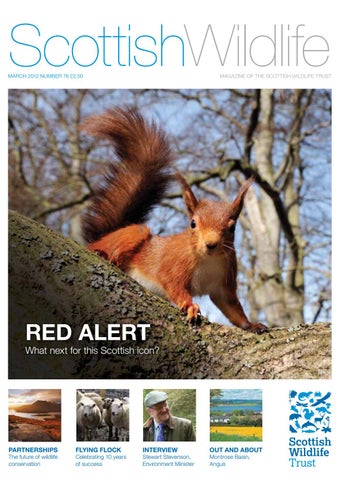
ScottishWildlife March 2012 Number 76 £2.50
Magazine of the Scottish Wildlife Trust
Red alert
What next for this Scottish icon?
Partnerships
The future of wildlife conservation
Flying Flock
Celebrating 10 years of success
INTERVIEW
Stewart Stevenson, Environment Minister
Out and about Montrose Basin, Angus
Inside this issue
Features
Red alert for Scotland’s squirrels
12
Scotland’s flock stars
17
Jupiter comes of age
20
Perfect partnersHIPS
24
With the three-year Saving Scotland’s Red Squirrels project coming to an end soon, Severin Carrell asks what the future holds for this Scottish icon.
Registered office: Harbourside House, 110 Commercial Street, Edinburgh EH6 6NF tel: 0131 312 7765; fax: 0131 312 8705 email: enquiries@swt.org.uk The Scottish Wildlife Trust is a company limited by guarantee, registered in Scotland (registered number SC040247).
Some unlikely pioneers have emerged in the field of conservation grazing. Lorraine Simpson meets the Scottish Wildlife Trust’s “Flying Flock”.
It is also a Scottish registered charity (charity number SC005792).
www.scottishwildlifetrust.org.uk
Jamie Grant tells the story of a unique wildlife garden in the heart of urban Grangemouth, about to celebrate its 20th anniversary.
Scottish Wildlife magazine is published by the Scottish Wildlife Trust. © Scottish Wildlife Trust. No part of this magazine may be reproduced without the express permission of the publisher. All photography © Scottish Wildlife Trust unless
Reconnecting Scotland’s fragmented habitats is a team game. Find out more about our landscape and species partnerships.
otherwise stated. The Scottish Wildlife Trust accepts no liability for omissions or incorrect data in advertisements and letters. Views expressed in Scottish Wildlife are not necessarily those of the Scottish Wildlife Trust. Number 76: March 2012 Charity number: SC005792 ISSN: 0143 1234 Patron: HRH The Prince Charles, Duke of Rothesay Chairman: Allan Bantick Vice-Chairs: Jean Barr, David Grundy, James Ivory Chief Executive: Simon Milne Editor: Jo Pike editor@swt.org.uk Production Editor: Oliver Davies Design: L.B.D. www.lbd.uk.net Advertising: Daniel Evans 0131 551 6095 / 07733 223 210 or danoban@btinternet.com Printing: J. Thomson Colour Printers, Glasgow Cover photo: Red squirrel © Laurie Campbell
The Scottish Wildlife Trust is affiliated to The Wildlife Trusts, a UK-wide network of 47 Trusts with over 2,300 wildlife reserves.
Regulars
Scottish Wildlife Trust and wider news 4 Q&A
29
Project news
10 Reviews
31
Reserve profiles and top spots
26 Letters
33
The latest round-up of news from the Scottish Wildlife Trust and the world of conservation
Stewart Stevenson MSP, Minister for the Environment and Climate Change, answers our questions
Updates on the Scottish Beaver Trial in Knapdale Montrose Basin
Books, websites and apps with a wildlife focus Readers’ comments on the last Scottish Wildlife and other wildlife issues
In focus 100 years ago, Charles Rothschild founded the Society for the Promotion of Nature Reserves, the organisation that became The Wildlife Trusts. This association extended to Scotland in 1964 and now covers the whole of the UK. Rothschild’s achievements are well worth celebrating. They mark the real start of protecting sites for wildlife in the UK, providing the inspiration for so much of our work today. His ideas for whole “nature habitats” as well as species, built on sound research and survey, and the need to promote support from individuals are as valid now as they were in 1912.
Scottish Wildlife is published three times a year: March, August and November. Deadlines for news and letters: 1 January, 1 June, 1 September. No unsolicited articles please. Scottish Wildlife is free to members. Membership rates from 1 April (excluding
The Scottish Wildlife Trust is very proud to be part of The Wildlife Trusts movement. With a collective membership of 800,000, over 2,300 nature reserves, extraordinary influence and unrivalled volunteer and staff support, the Movement is extremely well placed to take action for the next 100 years. At an appropriate time, do raise a glass to Charles Rothschild and his vision.
discounts for paying by Direct Debit): Individual (concession)
£33 (£18)
Joint (concession)
£46 (£24)
Family
£53 (£48)
Watch
£18
Life (joint)
£800 (£1,200)
Senior Citizen Life (joint)
£500 (£700)
Simon Milne MBE, Chief Executive
Scottish wildlife | Magazine of the Scottish Wildlife Trust
3
Scottish Wildlife Trust news Mink appeal success We are delighted that our recent appeal for funds in support of the Scottish Mink Initiative has raised a total of £9,510 to date. The Scottish Mink Initiative is an ambitious partnership project to remove the threat of mink attack in target areas across northern Scotland. This is a prime opportunity to save water voles, birds, fish and a variety of small mammals from devastating attacks by a voracious predator accidentally introduced to the UK less than 70 years ago. Thank you to everyone who donated to the appeal. Anyone wishing to find out more or make a donation can do so by visiting our website or by contacting the Membership Department.
Keep your kilt on, Darren Aberdeen-based DJ and entrepreneur Darren Millar is planning to keep his kilt on for all 366 days of 2012 to raise money for the Trust. He will undertake a different challenge every month, including a skydive and a bungee jump. Darren said: “Before this year, I only got my kilt out for weddings and other special events. I’m tired of that attitude; I want to wear it every day! I’ve loved wildlife all my life so it seemed natural to wear my kilt for the Scottish Wildlife Trust.” You can donate to Darren’s campaign by visiting justgiving.com/inhiskilt
Storm damage at Lowes © Rab Potter
Storms hit reserves Scotland has been hit by a series of major storms over the winter and some of our wildlife reserves have taken a battering. Particularly affected by the gale force winds were reserves in Lanarkshire, Falkirk and Perthshire, where Loch of the Lowes Visitor Centre was closed as trees blocked the car park and woodland walk. Our Dundee Conservation Team was called upon to support the Perthshire Ranger in removing the timber and before the light faded the Centre was up and running again. Storms also hit the island of Eigg, where dead wood from felled trees will now be used for house building and fuel.
Celebrate 100 years of The Wildlife Trusts with a wildlife moment
© Darren Millar
4
Scottish wildlife | Magazine of the Scottish Wildlife Trust
We are celebrating 100 years of The Wildlife Trusts movement with a number of special events. We would like people across Scotland to join us for a wildlife moment, held throughout this year. Joining with other Trusts across the UK, we want to tell everyone about our woodland wildlife in April, our garden wildlife in July and our wetland wildlife in September. Full details are in the Events and Activities booklet. We hope these events will inspire people about the amazing habitats on their doorstep and get even more people to join the Scottish Wildlife Trust. Since 1912, The Wildlife Trusts have managed wildlife reserves, protected species and influenced governments for the benefit of future generations. We hope this success continues for the next 100 years.
Scottish Wildlife Trust news SNIPPETS Rare birds spotted We are always happy to hear of rare sightings on our wildlife reserves. Since the last issue, we have seen a flock of glossy ibis on the Isle of Eigg and a rare pallid harrier over Garnock Floods. Please let us know if you see anything interesting or unusual on a Trust reserve!
Login2Law North Berwick Wildlife Watch group © Donna Mathieson
Watch for success A Scottish Wildlife Watch club has won an award for the best new group in the UK. Wildlife Watch is the junior branch of The Wildlife Trusts and there are 25 Watch groups in Scotland. In the UK Watch awards, North Berwick won the Best New Group and came second in the Best UK Group. Moray Wildlife Watch group were highly commended in the Best UK Group category for the second year running. Jenny McAllister, one of the North Berwick group leaders, said: “To be recognised on a national platform is a fantastic achievement for everyone who has made the Scottish Seabird Centre’s Wildlife Club such a success. We always try to keep the activities fresh and exciting and we have had great feedback from the kids and their parents.”
Windows on wildlife with over three million hits The Scottish Wildlife Trust’s three wildlife webcams attracted over three million views last year. The cameras – located at Loch of the Lowes, Montrose Basin and the Falls of Clyde – are streamed live onto the web with generous support from People’s Postcode Lottery. Visitors from 187 countries viewed the webcams online, including more than 90,000 from Finland. There were even two visits from the Solomon Islands in the South Pacific!
Feeders protect birds at Montrose When bird droppings and food mix together on the ground, the effects can be deadly. The disease in question is called trichomonosis and is especially harmful to finches. After experimenting with several solutions, volunteers at Montrose Basin believe they have found the answer. They have installed a waterproof EVA foam on the floor underneath the bird feeders, and by cleaning these and the foam floor regularly, the disease appears to have been contained. If you are experiencing problems with trichomonosis on your bird feeders, why not try this method and let us know the results!
Login2Law is an innovative way to access legal services online. The site not only offers valuable legal advice, but also lets you prepare your legal documentation before having it checked by qualified lawyers. A basic Will costs just £60 and the Trust benefits too; we receive 10% of the cost of every Login2Law Will referred from our website. To find out more, please visit scottishwildlifetrust.org.uk/legacy
Members’ Day and AGM 2012 The Scottish Wildlife Trust’s National Members’ Day and Annual General Meeting 2012 will be held on Saturday 29 September in Edinburgh. Further details will be included in the next magazine.
Council nominations Nomination forms for election to the Scottish Wildlife Trust’s Board of Trustees (Council) at the AGM can be requested from Simon Milne, Company Secretary, Harbourside House, 110 Commercial Street, Edinburgh, EH6 6NF. Completed forms must be received by 30 June 2012. Information on nominees will be available in the next magazine.
Trump’s got the hump
Greenfinch © Bob Coyle
Donald Trump is trying to bend the planning system again, but has failed with a bid to block a planned offshore wind farm in the bay opposite his golf resort. We fought Trump over his plans for the Menie Links, north of Aberdeen, and will be keeping a close eye on the development as it progresses.
Scottish wildlife | Magazine of the Scottish Wildlife Trust
5
Scottish Wildlife Trust news Bank on an improved Moss A project to improve the condition of a rare raised bog in Fife has been completed. The work, on our Bankhead Moss reserve, was funded by Fife Environment and Communities Fund and has taken three years to complete. We have installed dams and removed invasive species to restore the bog, with its characteristic domed centre. This vulnerable habitat will also be better protected thanks to improved access - including new bridges and boardwalks so visitors will have less of an impact. We have also improved the hide, installed bird and bat boxes and extended the surrounding wetland area. Why not take a trip to Bankhead Moss, five miles south west of St Andrews, where you can see bog plants, reed bunting, snipe, lapwing and maybe even otter?
Pond dipping at Jupiter © Stephen Owen
Jupiter anniversary
Wildly practical people wanted We have some great opportunities to join a practical volunteer team for a week on our spectacular Northern reserves. The Trust is running trips throughout 2012 based at Loch Fleet, Ben Mor Coigach and Handa Island. Please contact Glen Campbell at gcampbell@swt.org.uk for more details. Meanwhile, The Mammal Society is running a course on beaver ecology and conservation at the Scottish Beaver Trial in Knapdale, Argyll. This enjoyable one-day course is ideal for anyone who wants to learn more about beavers. Covering ecology, biology, habitat, field signs and conservation, the course will also provide the latest news on the reintroduction at Knapdale. Scottish Wildlife Trust members can book their place on the course at the reduced rate of £85.50 by calling 023 80237874.
Beaver ecology course © Steve Gardner
6
The Trust’s unique wildlife garden in the heart of urban Grangemouth will be 20 years old this summer. Jupiter Urban Wildlife Centre was previously a railway marshalling yard, but with the help of local industrial companies it has been transformed into a thriving wildlife haven and education centre. The chemical companies Syngenta and Calachem are on Jupiter’s steering committee, and contribute their ideas and time as well as ongoing funding. Jupiter is going from strength to strength and now has links with many local schools. A recent project, funded by People’s Postcode Lottery, has seen pupils from Grangemouth High School create mosaics inspired by the garden. These will be used to brighten up the bollards at the entrance to the reserve. It is not just school groups either; local people have taken Jupiter to their hearts, too. Volunteers have recently installed bird boxes with cameras in the garden thanks to funding from Falkirk Environment Trust.
Public Local Inquiry at Hunterston The Trust is continuing to fight the proposed coal-fired power station at Hunterston, North Ayrshire. If given the go-ahead, about half of the Portencross Coast SSSI – which has nationally important eelgrass beds and the best intertidal mudflats for feeding wildfowl and waders on the Ayrshire coast – will be destroyed. The site is also important for seaside centaury (Centaurium littorale) – a nationally scarce plant – and a type of cuckoo bee which is rare in Scotland. North Ayrshire Council has objected to the application, which triggers a Public Local Inquiry (PLI). The Trust will be joining forces with other environmental organisations such as WWF, Friends of the Earth Scotland and RSPB Scotland to present the environmental case at the PLI.
Scottish wildlife | Magazine of the Scottish Wildlife Trust
Seaside centaury © Joost J Bakker
Scottish Wildlife Trust news Hidden benefits of peatlands revealed The enormous importance of peatlands for people and wildlife has been revealed with the publication of the findings of the IUCN UK Commission of Inquiry on Peatlands. Following an 18-month inquiry involving more than 300 individuals and 50 organisations, the findings present clear evidence of the importance of the UK’s peatlands. The ecosystem services that peatlands provide include biodiversity, carbon storage and Flanders Moss © Lorne Gill purifying and storing water. They are found at the source of around 70% of the UK’s drinking water. Peatlands cover less than 3% of the Earth’s land surface, but contain twice as much carbon as the world’s forests. Scotland is home to the majority of the UK’s peatlands, including internationally important lowland raised bogs and blanket bogs.
Putting down roots A community tree nursery is going to be established as part of the Trust’s largest landscape-scale conservation project. The nursery – an important part of the Coigach & Assynt Living Landscape project in the north west of Scotland – will provide several part-time jobs for local people. They will set up the site, run the nursery and create opportunities for the local community to get involved. Existing woodlands will be enlarged, connected and enriched with carefully planned planting. New areas of native woodland will be established using planting stock from the nursery, which in turn will use locally collected seed. Project Manager Viv Halcrow said: “At the moment it is difficult to source enough local-origin seedlings, particularly of less common species such as wych elm. Seedlings from this nursery will be used by the partners to establish new woodlands and improve the condition of existing woods. “This is a fundamental part of the project, which is about supporting economically fragile local communities while ensuring the long-term health of habitats and species.”
Nethan Gorge go-ahead
Lower Nethan Gorge © Steve Blow
Thanks to a fantastic response from a members’ appeal, the Trust has acquired 24 hectares of woodland as an extension to our Nethan Gorge wildlife reserves in South Lanarkshire. We have concluded the legal paperwork and the land is now formally under Trust ownership. The reserve is a Site of Special Scientific Interest (SSSI) and is predominantly oak, ash and alder woodland. There is also the opportunity to extend this habitat by planting several thousand more trees in a pasture which was part of the purchase. The acquisition was supported by a £30,000 grant from Viridor Credits, one of the UK’s leading waste management companies. The Nethan Gorge reserves are located between the villages of Blackwood and Crossford; a revised reserve map will be added to the Trust’s website, under Upper Nethan Gorge Wildlife Reserve.
Wildlife matters Allan Bantick, Trust Chairman
Allan Bantick
Five years ago, the Scottish Wildlife Trust launched its vision for a network of healthy, resilient ecosystems. At that point, scientists were starting to recognise that large-scale and integrated conservation projects were the ones that stood the best chance of addressing habitat fragmentation. There was also the need for a more strategic and unified approach to policy, planning and the management of the countryside outwith reserves. A coherent package of conservation measures needed to be developed, ranging from species based initiatives and reserve management to landscape-scale projects. All of these required us to become expert in partnership working, something we had always done well in the past but never quite at the same scale. This is now being achieved. One of our largest species-based projects is the Scottish Beaver Trial, where the Trust is in partnership with the Royal Zoological Society of Scotland and Forestry Commission Scotland. In addition, we work closely with the project’s independent monitors, Scottish Natural Heritage, who are also our partner in the Saving Scotland’s Red Squirrels project, along with Scottish Land and Estates and over 300 landowners/managers. Partnerships are also at the heart of the Trust’s pioneering Living Landscape projects, including the 60,000-hectare Coigach & Assynt Living Landscape, where we are working with the Assynt Foundation, John Muir Trust, and a growing number of other landowners to rebuild the natural environment for the benefit of wildlife and communities. We are lucky to have partnerships with so many groups, organisations and individuals across Scotland, including our generous funders such as People’s Postcode Lottery, local authorities, and a host of landowners, with whom we continue to deliver measurable benefits for wildlife. Thanks to you all for your support. Follow Allan on Twitter: @AllanBoat
Scottish wildlife | Magazine of the Scottish Wildlife Trust
7
Wider news Wildcats on the prowl A University of Oxford WildCRU study has photographed 13 wildcats over a four month period. Four of the animals were identified as ‘pure’ wildcats and nine as hybrids. The study, in conjunction with SNH, set up 20 camera traps on two estates in the Cairngorms National Park. Wildcats were only captured when the snow was less than four inches deep. It is believed that this is because the Scottish wildcat has trouble moving around in deep snow. Along with wildcats, 26 other species were spotted by the cameras, including capercaillie and tawny owls. Rabbits were the most frequently seen animal. Daubenton’s bats © Claudia Gebhardt
Bat protection counts
Wood ant and guest ant © Stewart Taylor
Look out for wood ants The Trust is joining other conservation organisations in Scotland to celebrate the humble wood ant this summer. Ants are the most significant predator in Britain’s woodlands (by biomass consumed) and are going to be the focus for National Insect Week from 25 June to 1 July. Our junior Wildlife Watch groups will be learning all about this incredible ant and there will be events and activities across the country. 8
Scottish wildlife | Magazine of the Scottish Wildlife Trust
Since 1999, an international group of conservationists have met regularly at the Nietoperek Bat Reserve in Western Poland to undertake a census of hibernating bats in just one day, from sunrise to sunset. Nietoperek is a protected site thanks to the huge numbers of different bat species which hibernate there. In fact, it is Europe’s most important bat hibernation site. John Haddow, Scottish bat specialist, says: “The bats here are much more accessible, which on one hand makes them more vulnerable, but on the other means that they can be counted in the same way we have been doing since the 1990s.” The site is made up of a large underground system of tunnels and bunkers, built as a German fortification system before the Second World War. The area became part of Poland at the end of the war, as part of border changes imposed by the Allies. It now provides ideal habitat for over 30,000 bats. Temperatures in the tunnels – about 30 metres underground – are relatively stable, which means that the bats can lower their metabolic rate and save energy during the winter when food is scarce. As European protected species, Polish bats enjoy a similar protection to those in Scotland and access to the tunnels during the hibernation period is permitted only for research. Both the bats and researchers flock to Nietoperek from different parts of Europe. As Haddow explains: “It is important to send the message loud and clear to the nature conservation authorities in Poland that bat conservationists from other countries know about and care passionately for Nietoperek and its bats.” Survey organiser Dr Tomasz Kokurewicz from Wroclaw University says: “We need at least 25 highly qualified bat workers who are able to identify bats to the species level without handling them. The census also gives us a chance to exchange information and plan further cooperative studies on bats.” This year, the team of bat specialists counted 35,045 bats and, for the first time in five years, numbers have Tunnels in the Nietoperek Bat Reserve © Claudia Gebhardt gone up.
Wider news Strong ties with UNESCO World Heritage Site Our 4-star Visitor Centre at the Falls of Clyde is developing strong ties with its neighbour, the New Lanark Visitor Centre - part of the offering at New Lanark UNESCO World Heritage Site. The World Heritage Site is a beautifully restored 18th century cotton mill village. Discover its fascinating history and the life and times of mill manager and social pioneer Robert Owen as you visit the expertly restored buildings. Take the opportunity to see historic machinery in operation as wool is spun on a 19th century mule; you can even buy some in the gift shop. New Lanark and the Falls of Clyde have been working together on inspiring events and activities. In January, members of the public gathered on the roof garden of the New Lanark Visitor Centre as part of the BBC’s Stargazing Live series. Visitors were treated to an expert’s knowledge of the sky at night and nocturnal wildlife. In the coming months, we hope the partnership will go from strength to strength. The Trust’s Falls of Clyde ranger will lead two mini-beast hunts through New Lanark during the Easter holidays. On 17 June, New Lanark Visitor Centre will be hosting a midsummer evening on Scotland’s largest roof garden. There will be live music, plant stalls, stargazing, and a talk on wildlife gardening by Trust experts. The New Lanark Visitor Centre Passport ticket allows visitors entry to all the exhibition areas; Passport holders can also visit the Falls of Clyde for half price. So there’s never been a better time to visit New Lanark!
Falls of Clyde Visitor Centre and New Lanark World Heritage Site
Scottish wildlife | Magazine of the Scottish Wildlife Trust
9
Project updates
Infra-red insights into beaver behaviour Simon Jones reports on some interesting technological developments at the Scottish Beaver Trial in Knapdale, mid-Argyll. Simon Jones
Beavers have a reputation for being hard-working, stocky little creatures that go about their tree-felling and dambuilding activities in a determined, almost single-minded manner. Perhaps it is these qualities that endear them to many people who admire their work ethic and stoicism, a fondness that many of us do not share for their rodent cousins – rats and mice. Over at Knapdale, a recent technological development in the Scottish Beaver Trial has given us a remarkable insight into the real lives of our four beaver families, who have now been living in the wild for two and half years. Back in October, we were kindly lent some remote, infra-red trail cameras from our host partners, Forestry Commission Scotland. After some trial and error finding out exactly where and when to locate the cameras, our expert field team has captured some fascinating footage. The videos show beavers hauling felled trees, carrying armfuls of mud to plaster their lodges, and grooming each other. The footage makes for entertaining viewing, but it is also useful as a means of remotely assessing the presence of particular family members, what their body condition is like, and whether identification and tracking tags are still attached. As well as being another active year for our beavers, 2012 will also see an increase in events and activities for visitors to the trial site and schoolchildren across Scotland. I hope that within the coming weeks a new beaver pond
Children at the Scottish Beaver Trial Education Pack launch © Scottish Beaver Trial
platform will be completed, giving visitors the opportunity to sit quietly by a beaver pond teeming with wildlife. It should also offer the chance of glimpsing one of Scotland’s rarest mammals. A full programme of spring and summer guided walks and activity days this year will also give people the chance to learn more about this fascinating animal and
take part in fun, hands-on activities. You can see some of our new beaver footage on the Scottish Beaver Trial blog: blog.scottishbeavers.org.uk. Be sure to visit the trial website to keep up to date with all the latest news and dates of forthcoming beaver events.
The Scottish Beaver Trial, a partnership project between the Scottish Wildlife Trust, the Royal Zoological Society of Scotland and Forestry Commission Scotland, is a time-limited trial reintroduction of the European beaver in Knapdale, Mid-Argyll.
Project partners:
With thanks to our supporters including:
10
Scottish wildlife | Magazine of the Scottish Wildlife Trust
The Scottish Wildlife Trust can now do even more for wildlife in Aberdeenshire thanks to the generosity of the late Elma Lawton – a supporter who remembered the Trust with a gift in her Will.
With thanks to Elma laWton… Elma was passionate about nature. in 1986, she pledged her long-term commitment to support projects at her local scottish Wildlife trust reserve – Glen muick & lochnagar – by including a gift in her Will. Unfortunately, when Elma died in 2010, this wildlife reserve was no longer under the management of the trust. however, we wanted to ensure that scotland’s wildlife, which formed such an important part of Elma’s life, would still benefit from her generous gift.
HELping To Honour your WiSHES the scottish Wildlife trust benefits most from gifts that are left with no restriction, allowing us to use the money where it is needed most. nevertheless we would welcome the opportunity to discuss your wildlife interests, which will be taken into consideration alongside current conservation priorities at the time your gift is received.
We do, however, appreciate that some prefer to restrict how their gift should be used – as Elma did when she pledged her legacy in 1986. in such instances, you might consider including a reference in your Will on how you would prefer your legacy to be used if we cannot comply with your original intentions. this will help ensure your wishes are honoured and that scotland’s wildlife will benefit from your generous gift as planned.
thankfully, the executors of Elma’s Will kindly agreed to broaden the terms of the Will, supporting projects in wider aberdeenshire – an area Elma loved and considered ‘home’.
By remembering the Scottish Wildlife Trust in her Will, Elma made sure her commitment to wildlife would be reflected long after she had gone. Her gift is now supporting our vital work to protect red squirrel populations in Aberdeenshire. if you would like to talk to us about leaving a gift in your Will, please call Wendy Hill on 0131 312 4772 or email whill@swt.org.uk. Alternatively, visit our website scottishwildlifetrust.org.uk/legacy for further information
Red alert for Scotland’s squirrels
With the three-year Saving Scotland’s Red Squirrels project coming to an end soon, Severin Carrell asks what the future holds for this Scottish icon.
Above © Steve Gardner
12
T
here is something enchanting about the red squirrel, an element of its character which is highly prized. Unlike its heavier, more familiar grey cousin which has so effectively colonised Britain’s cities, reds have a certain something. It may be their natural inquisitiveness combined with that noticeable wariness, a caution which makes clear they are genuinely wild. You can catch flashes and glimpses of reds in many Scottish forests. Some may even sit watching you, their noses twitching and ears erect. But in my experience they will sit at a safe height and distance. If you stand particularly still and keep a good way off, you can see reds at play. I remember seeing several darting energetically around the upper heights of a forest in the Angus Glens north of Kirriemuir one autumn evening, sometimes tumbling down to the needle-strewn forest floor, freezing suddenly, then dashing upwards again in chase.
Scottish wildlife | Magazine of the Scottish Wildlife Trust
These experiences – tempered by their elusiveness – lend everything to their reputation as one of the most cherished species in Scotland. “Whatever their X factor is, they’ve certainly got something,” says Dr Mel Tonkin, Project Manager for Saving Scotland’s Red Squirrels (SSRS). A career naturalist, Tonkin is one of a small army of ecologists and conservationists confronted with an extremely difficult predicament: to protect one species, she must help to trap and kill another. In this case, it is red versus grey. The Scottish Wildlife Trust leads a multi-agency programme working in partnership with Scottish Natural Heritage, Forestry Commission Scotland and the landowners’ group, Scottish Land and Estates. SSRS is charged with reducing grey squirrel numbers in key target areas to protect the UK’s largest surviving population of reds from extinction.
That predicament is made more acute by criticism from animal rights campaigners, often allies in other areas. They regard the culling – running in three main areas along the English border, the southern edge of the Highlands and a discrete programme around Aberdeen – as unjustified. “I don’t think any conservationist likes having to kill anything,” Tonkin says. “I have felt quite uncomfortable with the cull of grey squirrels but I came to the conclusion a long time ago that it’s the only way to keep our red squirrels. “I don’t want to vilify grey squirrels as it’s not their fault they are here. It’s meddling by humans which has brought this about.” Ever since their introduction by Victorian landowners in the 1870s, the American grey squirrel has colonised much of the UK mainland. Larger and more robust, it out-competes its smaller cousin for food and habitat, squeezing out reds from vast areas of England. Crucially, the greys also carry squirrelpox, a virus which, whilst harmless to greys, causes skin ulcers, scabs and lesions in reds. Squirrelpox is fatal in 100% of cases involving red squirrels. Accurate figures about the distribution of red squirrels are hard to come by, but the most authoritative – from 1997 – suggests there are roughly 160,000 across the UK, with 75% of these in Scotland. By contrast, there are an estimated three million greys across the UK, with around 300,000 in Scotland. Once widespread across Britain, up to 95% of the red squirrel population has disappeared across England and Wales. Only a few small and embattled populations remain, such as on the Isle of Wight, where a “kill on sight” strategy against greys has been in place for some years, and a strong but shrinking population in Northumberland and Cumbria along the Scottish border.
Squirrelpox is fatal in 100% of cases involving red squirrels. If greys are allowed to expand unchecked, red squirrels are likely to become functionally extinct in the UK. Scotland is now where England was a few generations ago: home to significant numbers of reds, but standing on the brink of the same disastrous loss. It is an argument that the Trust is having to make with increasing urgency; the current three-year project ends on 31 March. With significant early evidence that the cull is working, SSRS now has to make a vigorous case for further funding, competing against other species programmes for cash. “Once squirrelpox arrives among red squirrels, the local population crashes and grey squirrels quickly occupy the empty habitat – permanently unless
ABOVE A once common sight across Scotland, there are now only 120,000 red squirrels left in the wild © Alan Laing
BELOW One of the many victims of the squirrelpox virus © Moredun Research Institute
Scottish wildlife | Magazine of the Scottish Wildlife Trust
13
humans intervene,” explains Jonny Hughes, the Trust’s Director of Conservation. “This allows grey squirrels to take over even where the habitat would otherwise favour red squirrels. Not continuing with the work would spell disaster for Scotland’s red squirrels north of the Central Belt.”
The Scottish culling and eradication programmes are focusing on three areas, each with differing but complementary functions. Firstly, and perhaps most importantly, there is a need to prevent the spread of squirrelpox in the south – helped by major landowners, the Forestry Commission and forestry companies. The long-running Red Squirrels in South Scotland project has been working tirelessly to prevent its spread. The Borders scheme is complemented by a new £1 million English project funded by Biffaward,
Above The long-running Red Squirrels in South Scotland project has been working tirelessly to prevent the spread of squirrelpox © Steve Gardner
LEFT Feeder box hair trap, used to keep track of red and grey squirrel distribution © Chris Sutherland
14
Scottish wildlife | Magazine of the Scottish Wildlife Trust
Scotland’s red squirrels need your support The funding for the Saving Scotland’s Red Squirrels project is about to end. Our work over the past three years has had a real impact reversing the decline of red squirrel populations – but we must do more. Please help us to seize this opportunity by donating today at scottishwildifetrust.org.uk/donate or by calling 0131 312 4753. stretching from the Tweed Valley to Carter Bar, Kielder and westwards to the Solway. The Red Squirrels Northern England project is, in Tonkin’s words, “the first time we have had this strategic control on the English side. Previously, it was focused exclusively on refuge sites.” The second area of focus is the creation and defence of a grey squirrel exclusion zone along the southern edge of highland Scotland. On a line running south west from Montrose to Argyll is a network of trapping and monitoring sites, often along heavily-wooded river valleys, designed to prevent greys expanding northwards from the Central Belt. There is a third, very specific project: to remove greys entirely from a discrete pocket in the Aberdeen area. Greys were introduced to Aberdeenshire in the 1970s, and whilst the Trust has no clear figure for its numbers there, “compelling evidence” exists that the culling programme has seen it virtually disappear from south Deeside, around Banchory. Reds are reappearing near Stoneywood and Milltimber, close to urban Aberdeen. Grey squirrel numbers are dwindling too outside the city. Some of the sampling sites have shown “a significant change in favour of red squirrels”, Tonkin explains. “If our campaign continues, greys could be all but eradicated from the region within 10 to 12 years.” Across Scotland, evidence suggests the culling programmes are succeeding and there is, significantly, no evidence that greys are spreading beyond a designated zone. So far, roughly 5,000 greys have been trapped and humanely put down in Tayside, Lomond and Aberdeenshire. In Pitlochry, a small grey population has been removed, and reds are being more frequently seen around Dunkeld and Alyth. At Drumlanrig, north of Dumfries, heavy and
This has the potential to be a real conservation success story if we give it the chance to work. persistent grey control has allowed a red squirrel population to recolonise after being wiped out by a bout of squirrelpox. Tonkin and Hughes stress the importance of continuing this important work. It might take another 15 years to truly succeed, but this would help secure the red squirrel’s future in Scotland for generations. Relaxing the culling and control for just a year or two could undo all the previous work. “It would be a crying shame to turn our back on the red squirrel now. We’ve persuaded people to volunteer and take-on trapping; persuaded landowners to do something for conservation,” says Tonkin. “The public understand this issue and many people feel very passionate about saving the red squirrel. This has the potential to be a real conservation success story if we give it the chance to work.”
ABOVE The grey squirrel was first introduced to Scotland by Victorian landowners in the 1870s
Severin Carrell is the Scotland correspondent for The Guardian. He has also been environment correspondent for Scotland on Sunday and an environment reporter for the Independent on Sunday.
Scottish wildlife | Magazine of the Scottish Wildlife Trust
15
KNOW YOUR PROPERTY A reminder to “look before you leap”! In December, the owner of property which included a river bank was ordered by the Court of Session to remove decking (worth £3,000) he had installed.1 Passing judgment, Lord Reed decided that the decking interfered with a Linlithgow syndicate of anglers’ right to fish for salmon in the River Tummel. Even though it was possible to fish in other parts of the river or with different techniques, the decking was still deemed an infringement of the anglers’ rights. Lord Reed aptly stated, “one is entitled to object if a stranger occupies a chair on one’s decking even if one has other chairs to sit on.” This case should serve as a stark reminder that landowners should be vigilant when planning to develop their property. The lesson to be learned is that owners should not build on or develop their land until they are satisfied that another party’s property rights will not be infringed. In many instances, an owner will seek planning permission from the local authorities.
1
Tummel Valley Leisure Limited against Branislav Sudjic [2011] CSIH 82
However, planning permission itself does not remove any legal barriers that may be in place. Such legal barriers, or “title conditions”, may limit an owner’s use of his land or give rights over his land to a third party. Often an owner may not be aware of all the title conditions that affect his land; as such, a full examination of title is advised before any development proceeds. Title conditions include “real burdens” which run with the land and affect what owners can or cannot do on their property and may restrict development. There may also be servitudes, which affect your land by giving rights to other people to make use of your land. Servitudes can exist even if not specifically referred to in your title deeds. Your lawyer should be consulted for advice on what conditions may exist.
It should be noted Lord Reed decided that the fact the offending decking had no affect on the financial value of the fishing rights was irrelevant. The removal of the decking was ordered simply because it infringed the fishermen’s right to enjoy their property, being the right to fish for salmon in the river. So, legal advice must be sought before developing land to ensure that the rights of others are not infringed. It is wrong to assume that simply because an infringement of rights of property does not decrease the value of the rights infringed, the infringement is therefore negligible and of no consequence.
For further general advice on title conditions and title examinations, please contact Andrew McLaughlin, trainee solicitor in the Private Client Division at Morton Fraser on andrew.mclaughlin@morton-fraser.com or 0131 247 1103. Morton Fraser has offices in Edinburgh, Glasgow & London. For details of our seminar programme please visit our website where you can enrol online: www.morton-fraser.com/events
www.morton-fraser.com
Scotland’s flock stars An elite team of grazers is supporting the conservation of species-rich grasslands in Scotland. Lorraine Simpson meets the Trust’s “Flying Flock”. ABOVE The Flying Flock and Mole the sheepdog work together to create species-rich grassland © Gary Eastwood Photography (garyeastwoodphotography.com); The Crufts Magazine
RIGHT The ultimate aim is to encourage biodiversity in sites of conservation interest © Alistair Whyte
T
he Scottish Wildlife Trust’s “Flying Flock” is one of a kind in Scotland, devoted specifically to conservation grazing, a method of using livestock to maintain and encourage biodiversity in sites of conservation interest. The Flock travels across the Trust’s reserves, as well as assisting other landowners and farmers in the maintenance of diverse, wildlife-rich habitats. It all began in 2001, when the Trust purchased fifty Shetland sheep. Under the watchful eye of shepherd Laura Cunningham – who joined a year later – the Flock grew to over 400 sheep, and the founding breed has now been crossed with Cheviot and Texel tups. These flock stars have since been joined by a bovine backing group – a “Flying Herd” complete with four pedigree Shetland cows and three calves. These cows roam farther, eat more than the sheep do and are used in combination with the Flock whenever needed.
Grazing has a number of important environmental benefits, including the removal and reduction of biomass. These activities allow less competitive species to flourish and support the growth of new flora and fauna. The Flock also makes a sizeable economic
Scottish wildlife | Magazine of the Scottish Wildlife Trust
17
ABOVE The Flying Flock has been supported by contributions from member appeals, donations and legacies, as well as funding from the Heritage Lottery Fund, Scottish Natural Heritage and Fife Environment Trust © Laura Cunningham BELOW The Flying Herd support the Flock in their grazing efforts © Laura Cunningham
18
Grazing has a number of important environmental benefits, including the removal and reduction of biomass, and the spreading of nutrients.
Scottish wildlife | Magazine of the Scottish Wildlife Trust
contribution, providing a regular supply of wool and conservation quality lamb. These help to cover the running costs of the project and demonstrate that it is possible for conservation grazing to produce a commercially viable product. The lamb has recently been tested by Edinburgh-based, Michelin-starred chefs Dominic Jack and Tom Kitchin – both famed for their use of the finest local ingredients – with Jack describing it as “absolutely fantastic produce”. Each year, the Flock undertakes a busy grazing schedule, from Trust reserves to sites owned by the likes of East Lothian Council and Fife Council. Some sites benefit from light, year-round attention; others from more intense grazing at specific times, such as after the flowering period. In each case, the Trust works with partners to ensure the Flock is used to best advantage, increasing the availability of wellmanaged grassland in Scotland. In addition to being enjoyable places to visit, grasslands act as carbon sinks, purify drinking water and are a habitat for threatened insects. Clear evidence of the Flock’s positive impact on these areas has come from regular monitoring of four Sites of Special Scientific Interest – Kilminning Coast and the meadows at Fleecefaulds, Lielowan and Bo’mains. The condition of each site has improved significantly over time, with notable increases in
species-rich flora being recorded, including the greater butterfly orchid (Platanthera chlorantha) found at Bo’mains Meadow. The project’s success has been acknowledged by Scottish Natural Heritage, which recently reclassified the Kilminning site as “recovering” after eight years of targeted grazing by the Flying Flock. Alistair Whyte, Reserves Manager for East Central Scotland, is justifiably proud of the Flock’s achievements. “We’ve built up a good picture of what works and what doesn’t, and issues such as grazing regimes and stocking densities are carefully considered and monitored. We’ve also produced scientific papers on the results of the monitoring programme to demonstrate the effectiveness of conservation grazing to the widest possible audience.” The project regularly features in workshops and discussions on the topic, helping both to share good practice and highlight the benefits of working with the local community in partnership. In the case of the Trust’s Fife reserves, for example, local volunteers provide valuable support by checking livestock and carrying out monitoring on the ground. It is a model that is already being replicated elsewhere, with trials on new habitats taking place in areas such as the Trust’s Rahoy Hills reserve, in Morvern.
As Mark Foxwell, Reserve Manager for the Highlands and Islands, explains: “This summer, we will be using partners’ sheep from the Ardtornish Estate to improve grassland habitats. The approach is to everyone’s advantage; instead of using the Flying Flock we will have the use of the Estate’s sheep. The Estate will produce mutton and lamb and can employ shepherds to manage the flock, which in turn will benefit the local economy.” Similar techniques are soon to be employed on the Trust’s Ayshire grassland reserves (including Grey Hill near Girvan), with the monitoring programme in particular being influenced by the Flying Flock model. If the trial proves successful, it will be rolled-out nationwide to cover every grassland the Trust manages. Overall, the Flying Flock project is a great example of how low-impact, sustainable intervention can bring a site into favourable condition and generate competitive produce – music to any landowner’s ears.
ABOVE Having munched their way to success, the Flock is now being transported to a new site © Laura Cunningham The Flock is a regular visitor to the unique Charles Jencks landart sculpture alongside the M90 © Oliver Davies
Lorraine Simpson is a freelance writer and researcher based in Scotland.
Scottish wildlife | Magazine of the Scottish Wildlife Trust
19
Jupiter comes of age Jamie Grant visits an urban oasis on the outskirts of Grangemouth that is about to celebrate its 20th anniversary.
20
Scottish wildlife | Magazine of the Scottish Wildlife Trust
T
he Jupiter Urban Wildlife Centre is tucked away at the edge of an industrial estate in Grangemouth. Squeezed between a railway line and a timber yard, it is an incongruous setting for a wildlife reserve. There is a constant rumble of traffic from the M9 motorway and petrochemical factories glint like silver spaceships on the horizon. And yet, in this most industrial of settings, Urban Ranger Stephen Owen is quietly overseeing an extraordinary tale of wildlife restoration. Since 2007, he has been in charge of this innovative project that has seen four hectares of waste land converted into a thriving urban wildlife centre. The beginning of the story dates back to the late 1980s, when the chemical giant ICI first approached the Trust with the idea of creating a wildlife reserve. ICI leased a long strip of derelict railway sidings to the Scottish Wildlife Trust and ‘The Jupiter Project’ was born. The resulting urban wildlife centre has been run in partnership with the chemicals industry ever since. Stephen is looking forward to celebrating the project’s 20th anniversary in May. Back in 1992, Magnus Magnusson opened the centre, ceremonially planting an oak sapling that has since grown into a healthy young tree. The land around it has been transformed into woodland, ponds, meadows and a wildlife garden. Stephen takes me on a tour of the centre, starting with a display that encourages visitors to bring wildlife back into their own gardens. There is a coppice plot, hedgehog boxes, solitary bee sanctuaries and a border with native wildflowers that attract butterflies, moths and caterpillars. LEFT A unique and inspiring educational resource © Jamie Grant BELOW Stephen Owen, Jupiter Ranger © Jamie Grant
Scottish wildlife | Magazine of the Scottish Wildlife Trust
21
“Seasonality is important when designing a wildlife garden,” Stephen explains. “It really helps to choose plant combinations that provide nectar for as long as possible, such as early flowering cowslips and late flowering knapweeds.” The garden also promotes species that provide rich seed banks for goldfinch and greenfinch over the winter months. All of the plants in this garden are grown in the centre’s native wildflower nursery. Stephen leads me through a polytunnel packed with tiny seedlings destined for meadows, pond edges and window boxes. The nursery is run commercially by the British Trust for Conservation Volunteers (BTCV) as a programme for people who are out of work or have learning difficulties. Their work on the reserve is designed to build individuals’ confidence, practical skills and fitness. The volunteers have recently been hard at work digging new ponds in the reserve’s open woodland. Stephen has been astonished by how quickly aquatic life has taken hold. “Within two days of putting in a new pond it was swarming with little creatures,” he said. “All the children that visit Jupiter love pond dipping; it seems to be an innate fascination.” It is the people who come to the Jupiter Urban Wildlife Centre that bring the project to life for Stephen. Over 4,000 visitors, mainly from Grangemouth and Falkirk, come every year. He sees each conservation activity as an opportunity to get people involved, whether it be putting in ponds, tree planting or constructing an ‘amphibian hibernaculum’ from dead branches, turf and rubble. Stephen likes to put on events that encourage visitors to return to the centre in different seasons. The last was a willow lantern procession through the woods to mark the coming of the New Year. “The snow made it a special night. I’m drawn to this urban wildlife setting because I love working with people,” he says. Stephen grew up in Dundee and Glasgow, but visited the countryside frequently with his parents. Perhaps seeing the natural world through a narrow looking glass gave him a true appreciation of the green spaces that are on our doorstep. “You really don’t have to be somewhere dramatic and remote – wild places are just around the corner wherever you are.” We walk deeper into the woodland, a mix of alder, silver birch and willow. In the winter, there is no screen of green leaves to obscure the centre’s urban surroundings. This wild wood has to compete with 22
Scottish wildlife | Magazine of the Scottish Wildlife Trust
smoke stacks, goods trains and barbed wire fences for our attention. But the adjacent railway line has also provided a slender wildlife corridor to the wider landscape. Foxes, roe deer, rabbits and hedgehogs have colonised the woods. The skies bring an abundance of birdlife, including flocks of goldfinch and siskins in the winter. And in the densest heart of the young wood, I sense something more – the ancient stillness of nature waiting to burst into life with the coming spring. In no more than 20 years, this strip of derelict land has become a small, vital haven for the natural world and a refuge for people as well as wildlife. I asked Stephen what he hoped visitors would take away from the Jupiter Urban Wildlife Centre and his answer was simple: “The desire to come back and explore again.” Jamie Grant is a freelance writer and photographer dedicated to environmental issues. He lives in Glen Lyon, Perthshire.
ABOVE © CalaChem and © Jamie Grant
Scottish wildlife | Magazine of the Scottish Wildlife Trust
23
Perfect partners
This work relies upon the financial support of a whole range of funders, including:
A selection of our current projects
1
© Mark hamblin / 2020 VISION
For our conservation efforts to be truly successful, we need to consider an area far wider than our 120 wildlife reserves. These wildlife havens are an important part of the story, but in order to reconnect whole habitats in Scotland, we need to work together with other conservation organisations, landowners, local communities, funders and government. Partnership working is essential to the delivery of the Trust’s vision, and as you can see from the map, these projects cover the length and breadth of Scotland.
Coigach & Assynt Living Landscape
2
4
1 Handa Island
5
• Scourie Estate
2 Coigach & Assynt Living Landscape
6
The biggest habitat and landscape restoration project in the UK, covering over 60,000 hectares in the north west Highlands. • • • • •
The Assynt Foundation Culag Community Woodland Trust Eisg Brachaidh Isle of Tanera Mòr John Muir Trust
7
3 Scottish Mink Initiative A community-based initiative which aims to protect native wildlife by removing invasive American mink from the north of Scotland. • Cairngorms National Park Authority • Rivers and Fisheries Trust of Scotland and numerous local fisheries trusts • Scottish Natural Heritage • Spey Fishery Board • University of Aberdeen
4 Isle of Eigg • Eigg Residents’ Association • The Highland Council • Isle of Eigg Heritage Trust
5 Rahoy Hills • Ardtornish Estate
© Steve Gardner
Scottish Beaver Trial
24
Scottish wildlife | Magazine of the Scottish Wildlife Trust
6 Scottish Beaver Trial In 2009, beavers were reintroduced in Knapdale, mid-Argyll, after an absence of 400 years. Kits were born in 2010 and 2011. • Forestry Commission Scotland • Royal Zoological Society of Scotland
© Alan Laing
partnersHIPS 9 Destination New Cumnock • Coalfields Environment Initiative • East Ayrshire Council • East Ayrshire Woodlands • RSPB Scotland • Scottish Natural Heritage • Scottish Resources Group
3 10
10 Spey Bay
3 11 14
11 15
16
18 17 12 8
Saving Scotland’s Red Squirrels
13
9 11
• Crown Estates • Garmouth and Kingston Golf Club • Whale & Dolphin Conservation Society
11 Saving Scotland’s Red Squirrels A co-ordinated effort to contain the threat of squirrelpox and stop the spread of grey squirrels north of the Central Belt. • • • • • •
Forestry Commission Scotland Red Squirrels in South Scotland Scottish Land and Estates Scottish Natural Heritage Southern Uplands Parnership Over 300 landowners
12 Jupiter Urban Wildlife Centre • BTCV Scotland • CalaChem Fine Chemicals • Syngenta
15 Flying Flock • • • • •
East Lothian Council Fife Coast and Countryside Trust Fife Council Macduff Trust Scottish Resources Group
16 Inner Forth Futurescapes • Clackmannanshire Council • RSPB Scotland
17 Communities Along the Carron • Over 20 NGOs, community groups, government agencies and local authorities
18 Cumbernauld Living Landscape Restoring, recreating and reconnecting wildlife habitat across 5,000 hectares of land in and around Cumbernauld. • • • •
Forestry Commission Scotland North Lanarkshire Council Scottish Water Numerous community groups
7 Irvine Bay • North Ayrshire Council • RSPB Scotland
8 Clyde and Avon Valley Landscape Partnership • • • • • • • • •
Central Scotland Forest Trust Clydesdale Community Initiatives Forestry Commission Scotland North Lanarkshire Council New Lanark Trust RSPB Scotland Rural Development Trust Scottish Natural Heritage South Lanarkshire Council
• • • • • • • •
© Scottish Wildlife Trust
13 Policy and campaign work British Medical Association Central Scotland Green Network Edinburgh City Council Partnership for Action Against Wildlife Crime (PAWS) Prince’s Trust for the Built Environment Real World Learning Partnership Scottish Environment LINK Scotland Woodland Forum
14 Montrose Basin • • • • •
Angus Council Crown Estate Commissioners National Trust for Scotland Railtrack Scotland Various private landowners
Cumbernauld Living Landscape
Scottish wildlife | Magazine of the Scottish Wildlife Trust
25
RESERVE PROFILE
Montrose Basin
On the east coast of Scotland, Montrose Basin is located on the enclosed estuary of the river South Esk, covering over 750 hectares with a rich mosaic of salt marsh, reedbed, mixed agricultural land, fresh, brackish and sea water, and extensive mudflats. The site is an important roosting and feeding area for a variety of passage migrants, as well as being internationally important for breeding eider and wintering waders and wildfowl, attracting up to 65,000 pink-footed geese in winter. THE ROUTE Before arriving, check tide times via www.montrosebasin.org.uk, or by calling the Centre. Starting from the Old Mill car park (NO668592) off the A935, follow the footpath for a moderate 1¼ mile walk across grassy paths and farm track towards either the Wigeon or Shelduck Hide. If you visit two hours either side of high-tide, head to the Wigeon Hide (NO684590) first.
POINTS OF INTEREST
and roe deer are a frequent sight here, particularly early in the morning.
In the small area of woodland immediately after leaving the car park, keep your eyes and ears open for great spotted woodpeckers and sparrowhawks. As you enter the reserve, cross the old railway line. At high tide, much of this land is below sea level and is protected by the sea wall. As you walk along through the farmland on Mains of Dun, take time to watch and listen for common whitethroats; grasshopper, sedge and willow warblers; reed buntings and yellowhammers. It is also common to see buzzards, linnets, twite, meadow pipits and skylarks overhead. This area is home to breeding grey partridge, a species of conservation concern. Brown hares
Turning left as the path forks, head to the Wigeon Hide – a good vantage point over the mudflats, saltmarsh and brackish pools. Look out for curlew, dunlin, godwits, knot, shelduck and eiders. You might be lucky enough to see species such as little stint, spotted redshank or whimbrel. Visitors should note that cattle may be grazing in the field adjacent to the hide.
Walk back along the track and follow the grass path round the large field on your left towards the Shelduck Hide. From here there is a view across the river South Esk as it joins the estuary. Leaving the Shelduck Hide, head back up the track opposite. Stop and scan the reedbed and Mill Burn (NO676581)
26
Scottish wildlife | Magazine of the Scottish Wildlife Trust
Top spots for wildlife Loch Fleet, Highland
which at low tide can attract feeding godwits, green sandpiper, ruff and redshank, before continuing onto the hide which offers views of the river. Species such as goosander, red-breasted merganser and various gulls can be seen from here. Keeping an eye out for butterflies, join the path heading back to the car park. 7 Visit the Visitor Centre at Rossie Braes on the A92 (NO701565) at the start or end of your walk. Enjoy panoramic views from the viewing gallery with refreshments in our cafe. Friendly staff and volunteers are on hand to give the latest update on birds spotted on the reserve.
(OS Landranger 21 NH794965) Loch Fleet is a large tidal basin with sand dunes, coastal heath and pinewoods, situated four miles south of Golspie. The pine woodland supports species such as Scottish crossbill, crested tit and pine marten. Orchids and butterflies thrive in the heathland.
Loch Fleet © Ron Bury
Shian Wood, Argyll
(OS Landranger 49 NM907418) An ancient semi-natural woodland typical of the Atlantic coast of Scotland. The wood stands above the surrounding land on a low, flattened ridge which juts out from the southern shore of Loch Creran. Under the trees, the flora includes primroses, yellow pimpernel, wood sorrel and bluebells. Shian Wood © John Douglass
Fetlar, Shetland
(OS Landranger 2 HU655900) Britain’s premier site for red-necked phalarope, with over half the country’s breeding population. Shetland’s fourth largest island is also a haven for birds in summer, with red-throated divers, golden plovers, skuas and wild rock doves regularly spotted.
FURTHER INFORMATION Getting there: The reserve covers a large area and a car is required to explore it in its entirety. The Visitor Centre, however, is only 1¼ miles south of the town on the A92. There is free parking and the Centre is wheelchair accessible.
Red-necked phalarope © Mike Baird
Frequent rail services are available from Edinburgh, Glasgow, Aberdeen and all intermediate stations. www.scotrail.co.uk Regular buses from Montrose town centre to Ferryden (short walk to Visitor Centre). The Montrose town centre to Arbroath/Dundee bus has a request stop at the top of the drive. www.stagecoachbus.com Nearest town: Montrose Start & finish: NTS Old Mill car park (NO668592); Wigeon Hide (NO684590); Shelduck Hide (NO676577) Distance: 2 miles
Thurso
Ullapool
Loch Fleet Inverness
Shian Wood
Aberdeen
Fetlar
Perth
Oban
Time: Allow 2 hours Terrain: Much of the route is farm track and grassy paths. Stairs to hides.
Glasgow
Grade: Easy/moderate
Edinburgh
Ayr
Accessibility: Unsuitable for wheelchairs (except Visitor Centre) Shaded Relief Copyright: © 2012 ESRI
Scottish Scottishwildlife wildlife| Magazine | Magazineofofthe theScottish ScottishWildlife WildlifeTrust Trust
2727
Stewart Stevenson MSP with Trust Chairman Allan Bantick and Scottish Beaver Trial Field Operations Manager Roisin Campbell-Palmer
Q&A: Stewart Stevenson MSP Jonny Hughes, Director of Conservation, interviews the Minister for Environment and Climate Change. What does Scottish wildlife mean to you? It’s something I notice every day. On Sunday night I had steak for dinner, then on Monday morning the fat went on the bird table for the bullfinches. I got my camera out, but unfortunately the bullfinches weren’t collaborating! Looking at wildlife is something I value. What measures do you think the Scottish Government can take to improve the overall health and resilience of Scotland’s ecosystems? There are a range of measures we can take. We have been using the Scottish Rural Development Programme to finance the reinstatement of hedgerows, which create biodiversity at insect and small bird level. This creates the food chain that other animals depend on. But Government can’t do this alone. There are many bodies and groups of volunteers who have the energy, time and commitment to help us do this job.
The Scottish Wildlife Trust is currently involved in two major projects: Saving Scotland’s Red Squirrels and the Scottish Beaver Trial. Where do you see beavers and red squirrels in 10 years’ time? The red squirrel is an iconic species; we already have the momentum from the public to do something. We still have significant colonies in the north and the north east of Scotland, but if we don’t seek to prevent the ingress of squirrelpox we’ll continue to see red squirrel colonies attacked. We’ll be looking at the support we can give to the red squirrel over the coming years. People have a broadly positive view about beavers; however, when you reintroduce a species there are some people who might be disadvantaged. We have to look at both sides and negotiate with local landowners. I know from my visits that the local economy is benefiting from beavers through tourism. I really hope we’re successful at Knapdale. I’m sure that the work going on is taking us in the right direction.
Scotland trades on its natural environment, and it brings in significant revenue by attracting tourism, businesses and entrepreneurial talent. Is it not a false economy to cut budgets for nature protection? There is no question that our natural environment is an economic asset. We sell our food and drink around the world because consumers see Scotland as a country that looks after its natural environment. Part of the job we in Government should be doing is making sure that those that benefit economically from our natural environment play an appropriate role in protecting it.
What would you like your legacy to be as Minister for Environment and Climate Change? It might seem an odd thing, but I’d like it to be said that “he did no harm”. When you’re faced with a competition between economic interests and environmental interests, if at least I can say I did no harm, that’s really good. If we can do something about the Scottish wildcat; if we can see some way in which the capercaillie can have a better environment and if the red squirrel is more secure at the end of my time in office, that would be enough for any Environment Minister.
Scottish wildlife | Magazine of the Scottish Wildlife Trust
29
ST KILDA WHY NOT TRY SOMETHING DIFFERENT? Imagine every day in a different location. Sheltered, peaceful sealochs with miles of coastline and no roads in sight. Bustling little villages, brightly painted ready to welcome you. Historic castles, home to clan chiefs for generations. Tropical gardens where exotic plants flourish in northern climes. These delights with the accompanying seabirds, dolphins in the bow waves, seals lazily watching from their reefs and passing whales are waiting for you. Take a break on M.V. Kylebhan when we visit a number of Islands on each trip, including St Kilda. Sailing from Oban through the Western Isles, enjoy the ever changing scenery and freedom to explore at your own pace. Send for details to: Kylebhan Charters, 3 Barclay Court, Old Kilpatrick G60 5HX tel/fax: 01389 877028 mobile 07775 508242 e-mail: kylebhan@aol.com
30
Scottish wildlife | Magazine of the Scottish Wildlife Trust
Reviews British Wildlife Photography Awards – Collection 2 AA Publishing, 2011 ISBN: 978-0749571153; Hardback £25 This book is a collection of the very best images submitted to the British Wildlife Photography Awards. The quality of the photographs is superb and each is accompanied by notes from the photographer, explaining the story behind the image. A wide range of species are covered in the book, including many creatures that might well be found in your garden or local park. This is a sumptuous celebration of British Wildlife in all its forms and is highly recommended. Steve Gardner, photographer Readers’ offer: Scottish Wildlife readers can purchase this book at the special price of £20 (plus free postage and packing in the UK) by calling 01903 828535, quoting offer code BWPA02. Offer valid until 31 March 2012.
The Puffin
Mike Harris and Sarah Wanless T. & A. D. Poyser, 2011 ISBN 978-1408108673; Hardback £50
British Arachnological Society www.britishspiders.org.uk
The British Arachnological Society website is a great place to find out about spiders and their kin. There is lots of accessible information, including links to “Spiders in the News”, membership information and details of courses. The recording schemes link lets you participate in species surveys, view current distribution maps, photos and ecological information.
An important and delightful book by the world experts on the species. It is concisely written and packed with information yet it is highly readable, the bare facts being illuminated by lively anecdotes and explanations as to how the facts were discovered. Based largely on the authors’ long-term work on the Isle of May, but including results from across the species’ world range, this is a comprehensive account of the puffin’s life history, behaviour and ecology, including its interactions with man. The text is illustrated with splendid drawings by Keith Brockie, numerous photographs, tables and graphs, making the book a joy to read. Prof Jeremy Greenwood CBE Readers’ offer: Use discount code GLR 6WI and receive a 20% discount with free postage and packing in the UK. Call 01256 302699 to order.
The Tree of Life Web Project tolweb.org/tree
The Tree of Life Web Project is a collaborative effort of biologists and nature enthusiasts from around the world, containing more than 10,000 web pages of information about biodiversity, classification and evolutionary history of living organisms. Initially confusing to navigate through and bewildering in its complexity, as you travel from the root of all life along divergent branches and on to individual species this website soon reveals itself to be a great resource that illustrates some of the latest research into evolutionary relationships between organisms.
Roger’s mushrooms app This application from leading fungi expert Roger Phillips features over 1,500 different species of fungi from North America and Europe expertly illustrated and packed full of information to aid identification. Features include descriptive keys, details of habitat and information on edibility. With both Latin and common names listed and a search option to help identify specimens, this app is a valuable digital fungi field guide. Visit www.rogersmushrooms.com/apps.asp or download from the iPhone App Store.
Would you be interested in reviewing a book? If so, then get in touch by emailing editor@swt.org.uk
Scottish wildlife | Magazine of the Scottish Wildlife Trust
31
Your letters You can contact the Editor at editor@swt.org.uk or by writing to Editor, Scottish Wildlife Trust, Harbourside House, 110 Commercial St., Edinburgh, EH6 6NF. *Please note that the Scottish Wildlife Trust reserves the right to edit letters. Submitted letters should be no more than 150 words. To be eligible to receive the prize of Balvenie whisky, submissions can only be accepted from those aged 18 years and over. The Scottish Wildlife Trust reserves the right to request age confirmation. Deadline for receipt of letters: 1 January (March issue), 1 June (August issue) and 1 September (November issue).
Remembering Russell Coope
The star letter wins a copy of British Wildlife Photography Awards – Collection 2 and a bottle of The Balvenie Signature 12 Year Old – an outstanding hand-crafted single malt with The Balvenie’s trademark honeyed character.
As a frequent visitor to Aberdeenshire, I was thrilled to hear from my friends in the area of the growing success of the Trust’s red squirrel project and look forward to the day when in this part of Scotland our native squirrel is no longer at threat. I am aware that the project requires the killing of the invasive and non-native grey squirrel, but accept that this is the harsh reality of conservation. I am pleased that the Trust and all those involved are showing the necessary leadership and commitment to tackle the problem head-on. Patricia Mackie
My husband, Professor Russell Coope (featured in Scottish Wildlife, Issue 75), sadly passed away at the end of last year, aged 81. From his earliest schooldays Russell was fascinated by wildlife, particularly beetles. He first studied Geology at Manchester University in the early 1950s and carried on his research in the geology department in Birmingham until his retirement in 1994. His main research was on beetles of the Quaternary period and the implications of the climatic variations that could be seen in different layers of the well-preserved fossil beetles that he found in deposits dating from the Ice Ages. He had a great interest in and knowledge of wildlife in general, was always pleased to share this enthusiasm with others and was an active member of Wildlife Trusts in England and Scotland. Russell and I have four children and seven grandchildren. Beryl Coope
Deer debate While broadly accurate, your article (‘Numbers Up’, Issue 75) is somewhat backward looking. There has been a steady process of change over recent years and, as Peter Fraser correctly points out, deer numbers have declined following successive heavy culls in many areas of the upland range, and deer are now scarce for stalking purposes. It is worth noting that domestic livestock numbers have also fallen in many upland situations and in some areas undergrazing is an emerging issue. The same cannot be said of roe deer, and the formation of Lowland Deer Network Scotland - launched late last year - is intended to pre-empt problems which may arise from that situation. Richard Cooke, Chairman of the Association of Deer Management Groups
Noisy neighbours Each spring I tend to sleep with the bedroom window open a little bit. This means I can listen to the springtime dawn chorus without having to get out of bed. Slightly less welcome at first light are the courting communications of the great spotted woodpeckers... rat-a-tat-tat. That’s what it sounds like to my ears, anyway. A large oak near the house has long been a favourite tree: it produces the sound with the most resonance. This year, however, one enterprising woodpecker has discovered the new tin roof of a large shed, with horrifying results – a slightly higher pitch but double the volume! Its roof-top sessions last for ages, so its skull must be incredibly tolerant. Alan Finlay
SEND US YOUR PHOTOS! Andrea M. Borsden of Inverness sent in this appealing picture of a young stag earlier this year. If you would like us to consider one of your images for publication in Scottish Wildlife, please e-mail editor@swt.org.uk
Scottish wildlife | Magazine of the Scottish Wildlife Trust
33
The Scottish Wildlife Trust is grateful to those green tourism businesses listed below for their support through its Working for Wildlife programme. Balbedie Farm Cottage, on the Fife/Kinross border near the Loch Leven Nature Reserve The cottage which sleeps four/six is on a working farm and is fully equipped for a relaxing holiday. Easy access to Edinburgh, Perth & beyond. Contact: Jane Turnbull. T. 01592 882242 / E. jane@vturnbull.freeserve.co.uk
Galvelbeg House B & B, Perth Road, Crieff At the entrance to the Perthshire Highlands. A warm welcome awaits from Nigel and Stella Franklin, En-suite rooms, Wi-Fi, TVs and welcome trays with baking. Well-behaved dogs welcome. T. 01764 655061 / E. info@galvelbeghouse.co.uk www.galvelbeghouse.co.uk
Boots n Paddles, 14 Cabrich, Kirkhill, Inverness Nature-based activity days and holidays. Explore the Highlands with us by canoe, mountain bike, and on foot. Leave No Trace awareness and training courses available. T. 0845 6125567 / E. mike@bootsnpaddles.co.uk www.boots-n-paddles.co.uk
Glenloy Wildlife, Banavie, Fort William Fully inclusive holidays based in Glenloy Lodge along the Great Glen, offering guided exploration of the wildlife of the Western Highlands. See pine martens, eagles, otter, black grouse, divers, cetaceans, seals, seabirds, butterflies, orchids & more. T. 01397 712700 / E. info@glenloylodge.co.uk www.glenloy-wildlife.org.uk
C-N-Do Scotland, Stirling Scotland’s premier walking operator – inspiring adventures since 1984. Guided, self-guided and bespoke holidays throughout the Highlands, Islands and wild, hidden places. Quality, safety and fun are the hallmarks! Get out there! Get in touch! T. 01786 445703 / E. info@cndoscotland.com www.cndoscotland.com East Lochhead Country House, Lochwinnoch B&B & Self-catering. An excellent base for visiting Ayrshire, Clyde Estuary, the Trossachs and the islands of Arran, Bute and Cumbrae. Thistle Award winners for Sustainable Tourism and Gold members of Green Tourism Scheme. T. 01505 842610 / E. admin@eastlochhead.co.uk www.eastlochhead.co.uk
Holiday Cottage, Kenmore, Aberfeldy Family holiday cottage one mile west of Kenmore, at foot of Drummond Hill on the north shore of Loch Tay. Sleeps six. Great walking in the Perthshire hills and many outdoor activities nearby. Well behaved dogs welcome. T. 01259 781214 / E. drummondholidays@aol.com
Mingarry Lodges, The Old Chapel House, Mingarry Find time for nature by taking a holiday in Moidart, the gateway to Ardnamurchan. Our two log cabins provide a perfect Highland retreat, combining rustic charm with home comforts. Great walking, wildlife, bird watching, beaches and castles nearby. T. 01967 431532 / E. info@mingarrylodges.com www.mingarrylodges.com Stein Inn, Macleod’s Terrace, Waternish, Skye A traditional 18th century inn in the northwest of Skye, with breathtaking views of the Minch and within easy access to the Cuillins and the wild beauty of Skye. Comfortable accommodation with good food, real ales and malt whiskies. T. 01470 592362 / E. angus.teresa@steininn.co.uk www.stein-inn.co.uk Whitchester Christian Guest House, Hawick Comfortable Victorian country house in the beautiful Scottish Borders, woodlands and gardens. Enjoy the peaceful ambience and our home cooked food. T. 01450 377477 / E. enquiries@whitchester.org.uk www.whitchester.org.uk
For more information on this small business supporters’ scheme, a benefit of which is a free listing in Scottish Wildlife magazine, contact Wendy Hill on 0131 312 4772 or email whill@swt.org.uk
Money for nothing...
how to raise money for Scotland’s wildlife Do you shop online with retailers such as M&S, Argos, Boden, Tesco or Waitrose? We’ve teamed up with fundraising website www.easyfundraising.org.uk so you can raise money for the Scottish Wildlife Trust every time you shop online! Use easyfundraising to shop with any of 2,000 well known stores and a percentage of what you spend is passed to the Scottish Wildlife Trust at no additional cost to you! You may even save money on your shopping with vouchers, codes and deals. Some retailers will also give us free donations via easyfundraising you can raise 50p right away by registering to receive Groupon’s newsletter or a generous £4.50 when you register with eBay!
And what’s more, for every new supporter who registers and raises £2, easyfundraising will donate an additional £1! Please register to support us at www.easyfundraising.org.uk /causes/scottishwildlife and do all your shopping through easyfundraising. If we all used easyfundraising, just think how much we could raise for Scotland’s wildlife!
If you have any questions, please contact Wendy Hill on 0131 312 4772. v2 SWT Easy Fundraising - HLF.indd 1
34
Scottish wildlife | Magazine of the Scottish Wildlife Trust
17/02/2012 15:33