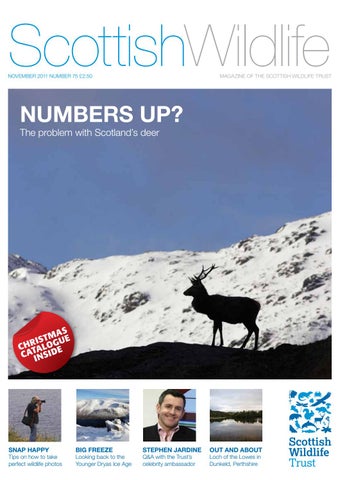
ScottishWildlife November 2011 Number 75 £2.50
Magazine of the Scottish Wildlife Trust
Numbers up? The problem with Scotland’s deer
as m t is UE Chr LOGE D C ATA INSI
Snap happy
Tips on how to take perfect wildlife photos
Big freeze
Looking back to the Younger Dryas Ice Age
Stephen Jardine Q&A with the Trust’s celebrity ambassador
Out and about Loch of the Lowes in Dunkeld, Perthshire
Inside this issue
Features
Numbers up?
12
A shot at glory
16
Surviving the big freeze
25
Extreme habitats
30
With deer deaths hitting the headlines last winter, Richard Baynes examines the complex issue of deer management.
Registered office: Harbourside House, 110 Commercial Street, Edinburgh EH6 6NF tel: 0131 312 7765; fax: 0131 312 8705 email: enquiries@swt.org.uk The Scottish Wildlife Trust is a company limited by guarantee, registered in Scotland (registered number SC040247).
Mountain hares make for spectacular photographs, provided you can get them to stand still! Mark Hamblin explains all.
It is also a Scottish registered charity (charity number SC005792).
www.scottishwildlifetrust.org.uk
Jamie Grant travels to Highland Perthshire to discover the secrets of the Younger Dryas Ice Age.
Scottish Wildlife magazine is published by the Scottish Wildlife Trust. © Scottish Wildlife Trust. No part of this magazine may be reproduced without the express permission of the publisher. All photography © Scottish Wildlife Trust unless otherwise stated.
Peter Ranscombe investigates Scotland’s windiest, wettest, coldest and highest habitats.
The Scottish Wildlife Trust accepts no liability for omissions or incorrect data in advertisements and letters. Views expressed in Scottish Wildlife are not necessarily those of the Scottish Wildlife Trust. Number 75: November 2011 Charity number: SC005792
Regulars
Latest news
ISSN: 0143 1234 Patron: HRH The Prince Charles, Duke of Rothesay Chairman: Allan Bantick Vice-Chairs: Jean Barr, David Grundy, James Ivory Chief Executive: Simon Milne Editor: Jo Pike editor@swt.org.uk Production Editor: Oliver Davies Design: L.B.D. www.lbd.uk.net Advertising: Daniel Evans 0131 551 6095 / 07733 223 210 or danoban@btinternet.com Printing: Stewarts of Edinburgh Cover photo: Red deer silhouette © Mark Hamblin
The Scottish Wildlife Trust is affiliated to The Wildlife Trusts, a UK-wide network of 47 Trusts with over 2,500 wildlife reserves.
Scottish Wildlife is published three times a year: March, August and November. Deadlines for news and letters: 1 January, 1 June, 1 September. No unsolicited articles please. Scottish Wildlife is free to members. Membership rates from 1 April (excluding
The latest round-up of news from the Scottish Wildlife Trust and the world of conservation
£33 (£18)
Joint (concession)
£46 (£24)
Family
£53 (£48)
Watch
£18
Life (joint)
£800 (£1,200)
Senior Citizen Life (joint)
£500 (£700)
Stephen Jardine, TV personality and Trust ambassador, answers our questions
35
Project updates
10 Reviews
36
Reserve profiles and top spots
Letters 32 Readers’ comments on the last
37
Updates on our landmark beaver and red squirrel projects Focus on Loch of the Lowes
Books, websites and apps with a wildlife focus
Scottish Wildlife and other wildlife issues
In focus Times are changing. Cuts in public services, increased cost of living, less job security... the list goes on. Conservation and environmental issues are not at the forefront of the minds of politicians or the majority of the population. This means that the need for conservation organisations such as the Scottish Wildlife Trust is greater than ever. We need to work both on our own and in partnership, not only to carry out vital practical conservation work across Scotland, but also to keep the pressure on politicians and other decision makers to protect our wildlife and wild places for the future. It would be wonderful if everyone who reads this magazine could recruit just one new member over the next twelve months. Every member of the Scottish Wildlife Trust is vital to help us spearhead urgent conservation work. One new member can help us improve the habitat of red squirrels by planting six native trees, or inspire future generations by sending an education pack to your local school. It could even make the difference between winning and losing a wildlife campaign. Can I count on you to recruit just one new member?
discounts for paying by Direct Debit): Individual (concession)
4 Q&A
Simon Milne MBE, Chief Executive
To receive you r free “One New Mem ber” pack, please co ntact membership@ swt.org.uk, or call us on 01 31 312 7765. Scottish wildlife | Magazine of the Scottish Wildlife Trust
3
Scottish Wildlife Trust news Dammed if you don’t A group of employees from the Macrae Edinburgh seafood production facility at Livingston spent a day on Tailend Moss, in West Lothian. Macraes employees helped to block old ditches which were originally dug in an attempt to drain this raised bog. The new dams will prevent this important habitat drying out and disappearing, helping a range of plants and animals that have evolved to survive in the wet, acidic conditions. As well as being a corporate member of the Trust, Macraes have just signed up to sponsor Tailend Moss for another three years.
10 years of the Flying Flock © Laura Cunningham
Ten years of the Flying Flock The Trust’s innovative Flying Flock is celebrating a decade of conservation grazing. The Flock travels round Fife grazing sites, which encourages greater biodiversity. Beginning in 2001 with 50 sheep, there are now over 200 sheep grazing seven Trust reserves in total, as well as some local authority sites. Sustainable grazing is a good method of managing rare wildflower meadows and other habitats. This groundbreaking project is demonstrating how getting the right levels of grazing can make a big difference to threatened wildflowers. The Scottish Wildlife Trust also sells Flying Flock meat and wool, with the proceeds going back into supporting the Flock. Alistair Whyte, the Trust’s Reserve Manager for East Central Scotland said: “The make-up of the Flock has changed in the last decade, but our aim has not. The sheep are now going to more reserves than ever, maintaining rare habitats and species for the benefit of present and future generations.” We are planning a celebration for the Flock’s 10th anniversary in the next few weeks, so keep your eyes peeled!
Gardens with nature in mind The Trust has designed two wildlife gardens for a new housing development in Knockroon, on the outskirts of Cumnock, East Ayrshire. We have worked with property developers Hope Homes and the Prince’s Foundation for the Built Environment. The estate is part of the Prince’s vision for heritage-led regeneration in the area. The two contrasting gardens demonstrate how easy it is to create a variety of homes, hiding places and shelters for wildlife using native and wildlife-friendly herbs, perennials, climbers, shrubs and trees.
Developing volunteer conservation skills The Trust has been developing the conservation skills of some of our valued volunteers, thanks to funding from the Central Scotland Forest Trust and Scottish Natural Heritage. 19 volunteers have been trained in West Lothian and Lanarkshire to undertake a range of practical conservation tasks, and we hope that the programme will also encourage new volunteers to work with the Trust. Amongst other tasks, volunteers have helped build a boardwalk at Hermand Birchwood reserve, control non-native species at Addiewell Bing and maintain footpaths at Upper Nethan Gorge. The Trust’s Training Co-ordinator Peter Gilbert said, “volunteering is a great way for ordinary people to protect the environment but it has always been underfunded. We are grateful to the Central Scotland Forest Trust and SNH for supporting this project.” 4
Scottish wildlife | Magazine of the Scottish Wildlife Trust
Knockroon wildlife gardens © Maggie Keegan
Scottish Wildlife Trust news SNIPPETS AGM and Members’ Day At the Trust’s recent AGM and Members’ Day in Dundee, Allan Bantick was re-appointed as Chairman, while former Green parliamentarian Robin Harper and biology professor John Harwood were elected to the governing Council. We are looking forward to using their expertise and enthusiasm to further the aims of the Trust.
We have moved! The spectacular east coast of Eigg, where developers want to site a fish farm © Scottish Wildlife Trust
Fighting inappropriate fish farms The Trust has been fighting three proposed fish farm developments: at Seil Sound, Eigg and Islay. Each of the proposed fin-fish farms could have potentially devastating effects on local marine wildlife and the wider environment. David Ainsley of Lorn and Mid-Argyll Members’ Centre, who has been leading the Trust’s campaign against the fish farm at Seil Sound, near Oban said: “the salmon farm could be highly damaging to some of Argyll’s best loved coastal wildlife including dolphins, porpoises and seals.” The proposed Islay development – now abandoned after pressure from the Trust and local people – was due to be sited just 3km from a European protected site designated for its large colony of common seals. On Eigg, the local community have voted overwhelmingly against the proposed fish farm. In spite of Scottish Salmon’s claim that they “don’t see communities as an obstacle” to their plans, the Eigg Residents’ Association has opposed the scheme, with Eddie Scott, their Chair, saying: “It will damage our green credentials and our tourism business and surely it cannot go ahead in the face of complete local opposition.” The Scottish Wildlife Trust will continue to campaign against developments that are damaging to wildlife. Visit our website for all the latest updates.
Cattle at Cambus Pools The Scottish Wildlife Trust has been awarded funding from Clackmannanshire and Stirling Environment Trust to carry out improvements at our Cambus Pools Wildlife Reserve, near Alloa. Fencing will be upgraded to allow us to graze this wetland site with our newly acquired herd of Trust cattle. Other works will include managing the reedbeds and, in future years, creating new open water habitat on site.
Upgrades at Cumbernauld Glen Improvement work to our Cumbernauld Glen reserve has recently been completed. Funding from North Lanarkshire Environmental Key Fund has allowed us to upgrade the steps and path down to the glen. There are also new interpretation panels for the tree and mountain bike trails. Cumbernauld Glen is a key part of our innovative Cumbernauld Living Landscape project.
The Trust’s headquarters has moved to Leith. After 20 years, we have moved out of Cramond House to an office more suited to the 21st Century, greener and more accessible to our members. Our new address is Harbourside House, 110 Commercial St., Edinburgh, EH6 6NF. Telephone numbers and email addresses remain the same.
Biodiversity awards Our Chairman Allan Bantick recently joined the Environment Minister to present Scotland’s first ever Biodiversity Benchmark awards. The awards, run by the Royal Society of Wildlife Trusts, were given to Aggregate Industries for work protecting nature on two quarries in Shotts, Lanarkshire and Glamis, Angus.
Help the water vole The Trust is part of an ambitious initiative to remove the threat posed by American mink to water voles in target areas across northern Scotland. 97% of the funding for this project is already secure; we now need to raise the remaining £29,000 to reach our target. To donate in support of this project, visit scottishwildlifetrust.org.uk or call 0131 312 4753.
Our apologies Two mistakes were made in the last issue regarding photo credits. Our sincere apologies go to Helen Lockhart for not including a credit on page 23, and Dean Bricknell for crediting his photograph on page 5 to the Scottish Wildlife Trust.
Scottish wildlife | Magazine of the Scottish Wildlife Trust
5
Scottish Wildlife Trust news Rare bats in Ayrshire The rare Nathusius’ pipistrelle (Pipistrellus nathusii) and Leisler’s bats (Nyctalus leisleri) have been discovered by Conservation Teams at Culzean Country Park, in Ayrshire. Evidence was found for the first time that Leisler’s bats are breeding in this part of Scotland. Altogether, seven species of bats were recorded on site, with two further species possibly being present. If confirmed, this would mean that all known Scottish bat species have been found in the same location. The team was led by the Trust’s Developing Ecological Surveying Skills group, whose programme leader Claudia Gebhardt said: “Finding these rare bats in Ayrshire is a real achievement. Before this discovery, nobody knew if these species actually occurred in this part of Scotland.”
New shoots in Coigach Volunteers were joined by a work party from Elmwood College in Fife to plant aspen trees on Ben Mor Coigach. For more than three years, we have been enhancing and preserving the small and very fragmented aspen woodland on the mountain. This is just the first of what we hope will become a regular tree planting programme in Coigach over the coming years. In other news from the area, a Project Officer for the Coigach and Assynt Living Landscape project has started work. Viv Halcrow will work with local people to help make our Living Landscape vision a reality.
Tree planting can now take place at Nethan Woods © Graham Burns
Fundraising success at Nethan The Trust has reached an important fundraising target to connect Lower and Upper Nethan Gorge in the Clyde Valley. Thanks to the support of Scottish Wildlife Trust members and the general public, we have raised over £30,000 in just a few months to help save and enhance the area. Thank you so much to everyone who has given to our appeal. Matched by a £30,000 grant from Viridor Credits and a gift left in a member’s Will, we are delighted to say that we have now reached our fundraising target. The money will be used to buy land in between the two reserves, connecting fragmented SSSI woodland and increasing the area of established broadleaved forest which is being positively managed for nature conservation. We want to allow wildlife to thrive and freely move around a much larger area. But we mustn’t stop here. There is a great deal more to do to make Nethan Gorge a thriving home for wildlife. Over the coming years, we plan to establish our newest reserve on the site, building fences, planting trees and converting pasture into healthy woodland.
Drystane dykes at Woodhall A generous donation of walling stone from the Lafarge Quarry at Dunbar has been made to the Trust’s Woodhall Dean Wildlife Reserve, in East Lothian. The stone will be used by volunteers to rebuild a section of dry stone wall along the boundary of this important woodland reserve, which supports one of the largest areas of oak woodland remaining in the Lothians. The walls could become shelter for adders, an important species at Woodhall Dean.
Tree planting at Culag © Niall Benvie
6
Scottish wildlife | Magazine of the Scottish Wildlife Trust
Hunterston fight goes on Backed by a record 20,000 objections, the campaign to stop the Hunterston power station in Ayrshire continues. Unfortunately, a judicial review backed by the Trust was rejected. The Court of Session ruled that the Scottish Government didn’t break their own rules when they gave the coalfired power station national planning status. Nonetheless, our policy and planning team will continue to press Scottish Ministers to veto the development. You can add your voice to the campaign by visiting our website.
Campaign continues © Niall Benvie
Scottish Wildlife Trust news Better than bog standard Recent improvements at Longridge Moss in West Lothian have been made possible by a funding award from the Levenseat Trust. These works include replacing over 400 metres of stock fencing to allow this lowland raised bog to continue to be grazed by sheep and cattle, blocking ditches with plastic piling dams, ragwort control, hedgerow planting, a vegetation survey and a new reserve sign. Longridge Moss is a rare example of a lowland raised bog, where wet and acidic conditions support vegetation dominated by Sphagnum moss. It is a home for plants and animals such as cranberry, bog asphodel, dragonflies and snipe.
A recent Live ‘n’ Deadly event © Lynne Laing
Live ‘n’ Deadly Scottish kids went Live ‘n’ Deadly with the Scottish Wildlife Trust and the BBC at a recent event in Glasgow. The popular CBBC programme has been running a series of roadshows across the UK, and Trust staff were on hand for the Glasgow event to make sure visitors got to grips with Scotland’s amazing wildlife. As well as shows presented by Live ‘n’ Deadly regular Steve Backshall on snakes and birds of prey, there was also a chance for three Scottish wildlife and conservation charities to get children up close and personal with our native fauna. The Trust showcased the Scottish Beaver Trial project using pelts, skulls and sticks. They also engaged with the young audience using swans’ feet, a stuffed osprey and our famous beaver suit! The stand was very well received, hosting an estimated 8,000 young people on the day.
Wildlife matters
Tony King, Head of Policy at the Scottish Wildlife Trust
Volunteering at Jupiter © Stephen Owen
People’s Postcode Lottery at Jupiter Staff at People’s Postcode Lottery – funding partners of the Trust – recently joined Ranger Stephen Owen at Jupiter Urban Wildlife Centre to help lay paths. Speaking after the event, Jennifer Rodger of People’s Postcode Lottery said: “Stephen was great. His knowledge and passion really made the day what it was. The team loved every minute and can’t wait until the next one.” A big thank you to People’s Postcode Lottery staff for their hard work.
Much of the Trust’s policy work may seem to be knee-deep in jargon. We spend our days talking of ecosystem services, high-nature-value farming, marine conservation zones, ecological coherence and an alphabet soup of officialese Tony King acronyms: LFASS, SRDP, EHIs, SSSIs, SACs and LULUCF. What this hides is the importance of all these terms for delivering a biologically diverse environment, better for wildlife and better for people. I am always conscious that lots of politicians aren’t that interested in wildlife. All politicians, however, are keenly interested in voters. And that is why concepts like ecosystem services and all the other ugly jargon terms are so important. They help to answer the question, “what has wildlife ever done for us?” We should never assume that others share our appreciation of the value of a wildlife-rich world. Of course, there is more to it than that. There is a moral argument for saving wildlife and we shouldn’t be afraid to say so. Aside from nature’s intrinsic value, people have the right to live in a wildlife-rich environment. Remember when you were a child (if you are still a child, bear with me); remember how wildlife – be it in the window box, the back garden, park or farmer’s field – shaped who you are. Every child has the right to grow up in a biologically diverse, healthy environment. But if growing up and living in a wildlife-rich environment is a human right, it also carries responsibilities. The most important of these is to ensure that present and future generations can continue to enjoy that right.
Scottish wildlife | Magazine of the Scottish Wildlife Trust
7
Wider news IN BRIEF Scotland’s greenspace map – a world first Greenspace Scotland has published a unique map of the country. Scotland’s Greenspace Map is a world first – an innovative Geographical Information System (GIS) based map which provides comprehensive information on the location, extent and type of greenspace across all of Scotland’s urban settlements. You can see this new map at greenspacescotland.org.uk
National Museum re-opens The National Museum of Scotland re-opened this summer, with an animatronic T-rex walking down Edinburgh’s Chambers Street. The Museum includes galleries showcasing animals’ amazing abilities in the wild. The crowning glory is their Wildlife Panorama gallery, where hundreds of specimens hang from the ceiling.
Surveying sharks Scenes reports that the Shark Conservation Society is undertaking a survey around the Outer Hebrides. The isles are believed to be one of two clusters in UK waters for sightings of great white sharks. Visiting vagrant sharks rely on a good supply of seals. For shark lovers, remember that basking sharks can be seen off Scottish Wildlife Trust reserves at Handa Island and the Isle of Eigg in the summer.
Perfect time to VisitWoods The Woodland Trust has joined forces with the Scottish Wildlife Trust, Forestry Commission Scotland and Scottish Natural Heritage to support VisitWoods – a collaborative project aimed at encouraging more people to enjoy woods and forests in Scotland and across the UK. At the heart of the project is visitwoods.org.uk, a new interactive website showcasing thousands of woods you can visit in Scotland, including 47 Scottish Wildlife Trust reserves. Uploading your photos and comments is simple. Just go to visitwoods.org.uk, find your favourite wood (search by name or location), register and add your reviews and images to the blog or photo gallery.
Autumn colours © M Barton/WTPL
Citizen scientists help to conserve birds in Scotland More than 2,000 new volunteer bird surveyors signed up to take part in five long-term bird surveys in Scotland during the Building Bird Monitoring in Scotland project. The project included training events, new promotional leaflets and advertising opportunities for volunteering. Mandy Cook, British Trust for Ornithology (BTO) Scotland Development Coordinator explained: “Many of the project participants said that one-to-one mentoring to improve their birding and survey skills... was what they really needed. As a result, we are looking to set up a bespoke mentoring scheme, with the aim of developing many more highly skilled citizen scientists.” The project was funded by Scottish Natural Heritage, The Gillman Trusts, the BTO and the Scottish Ornithologists’ Club.
Butterflies count!
Small pearl-bordered fritillary © Grahame Boath
8
Scottish wildlife | Magazine of the Scottish Wildlife Trust
Almost 1,000 ‘Big Butterfly Counts’ were made in Scotland this summer for Butterfly Conservation. The average number of individual butterflies seen per count was down by 11% compared to last year’s figures, with the small tortoiseshell being the most common butterfly in Scotland this year - much more common here than in the rest of the UK. In other butterfly news, Grahame Boath, Reserve Warden at the Scottish Wildlife Trust’s Cullaloe Wildlife Reserve in Fife, discovered a new species there this summer. The small pearl-bordered fritillary is scarce in Fife and this new record is a great addition to the species list for the reserve.
Tom Kinsey’s Legacy Tom Kinsey was born and brought up in Sheffield, but took Scotland to his heart when he arrived to work in the Department of Humanities at Glasgow University in 1953. A member of the Scottish Wildlife Trust for over 26 years, Tom retired in 1990 and pursued his love of exploring the Scottish countryside. A keen hill-walker and knowledgeable bird-watcher, Tom only learnt to drive in his 60s to enable him to reach his other favourite places across Scotland, including New Lanark. It was Tom’s great love for Scotland’s wildlife that prompted him to leave a gift in his Will to the Scottish Wildlife Trust. With his support, we were recently able to extend our Loch of the Lowes reserve with an additional 32
acres of land designated as both a Site of Special Scientific Interest (SSSI) and a Special Area of Conservation (SAC). The well-known tree that hosts the osprey nest sits on this newly acquired land and is now safely under the control of the Trust. This land provides a greater area of protection for red squirrels and several other exciting new habitats, including an unusual basin fen acting as a barrier between the osprey nest and the public. Tom’s brother William said, ‘The purchase of this land is particularly poignant as Tom loved watching ospreys. He also spent many hours looking for the elusive pine marten and really would be pleased at how his gift has been used’.
If you are considering including a gift in your Will to the Scottish Wildlife Trust, or have already done so (especially one where a particular region, area of work, or purpose is specified), please do let us know. This will enable us to thank you properly and confirm that we can accommodate and respect any specific wishes you may have.
If you would like to talk to us about leaving a gift in your Will, please call Wendy Hill on 0131 312 4772 or email whill@swt.org.uk. Alternatively, visit our website www.swt.org.uk/legacy for further information Images: osprey © Steve Gardner, pine marten © Karl Franz.
Scottish wildlife | Magazine of the Scottish Wildlife Trust
9
Project updates
What next for the red squirrel? Dr Mel Tonkin
In five months’ time, the Saving Scotland’s Red Squirrels project will come to the end of its official three-year run. Mel Tonkin, Project Manager, looks back over the past three years and considers the next step for Scotland’s red squirrels.
The Saving Scotland’s Red Squirrel project may be nearing an end, but preparations are already underway for the Scottish Wildlife Trust to move forward with a follow-up project to consolidate the gains we have made for red squirrels. Council has given the go-ahead for the Trust’s fundraising team to start identifying potential sources of funding. Before planning the next phase of the project, we need to review what has been achieved so far and whether red squirrels have benefited from the work in Project areas. To this end, a report with analysis of our trapping and survey data has gone to Scottish Natural Heritage (our major funding partner) to support our conviction that the red retreat has stopped where grey squirrel populations have been removed or reduced. With government budget cuts already biting, it is not yet clear what resources government agencies will be able to commit to a Project continuation. Our recommendation is that we need another three years to collect enough data to develop long-term, affordable red squirrel protection that is adopted by landowners, local authorities and conservation bodies in target areas. In the meantime, cessation of trapping would set us back to our starting point. Fortunately, we already have 36 cooperating landowners trapping under five-year Rural Development Programme funding (accessed by our Project Officers), and this year’s applications – if successful – should double this number
Raising awareness of red squirrels in Scotland © Steve Gardner
in 2012. Our own Control Officers will still be needed in urban areas and in strategic gaps without other cover, however. SSRS is greatly indebted to our surveyors – Lindsay Henderson and Cara Roberts – who got our 100 tetrad surveys and 14 sightings transect sites set up and delivered to schedule. A huge thank you to our volunteer surveyors – we couldn’t have managed without you! Also thanks to everyone who recorded a squirrel sighting on our website – a fantastic 2,316 records
have been logged since June 2010. To help us reach 2,500 before March, visit www.scottishsquirrels.org.uk It is absolutely vital that we communicate the case for the continuation of the project. Over the next few months, we will be running a couple of big campaigns to raise awareness (and funds!) for Scotland’s red squirrels – your support at this time would be a huge boost to our conservation efforts.
www.scottishsquirrels.org.uk
Project partners:
With thanks to our supporters including: The Dulverton Trust
10
H D H Wills 1965 Charitable Trust
Scottish wildlife | Magazine of the Scottish Wildlife Trust
J & J R Wilson Trust
The Robertson Trust
Project updates
Busy beavers in Knapdale Simon Jones
As autumn arrives in Knapdale, the team can now catch their breath after the busy summer months, as Simon Jones, Scottish Beaver Trial Project Manager, explains.
Many long nights sitting on the edge of midge-infested lochs were finally rewarded in late July, with the first glimpse of two new beaver kits at the Dubh Loch and Loch Linnhe sites. The clumsy aquatic antics of these youngsters show that swimming is a mixture of both natural instinct and trial and error! The delight of seeing this year’s kits was tinged with sadness, however, as one kit was later found dead, with post mortem results suggesting that it had been the victim of a predator. Although this is a disappointing loss, it is an inevitable part of such a groundbreaking trial reintroduction, and over the five years of the project we will continue to see new beavers born, juvenile beavers disperse, and some beavers die of natural causes. Along with all of the ongoing scientific fieldwork and monitoring, there continues to be a strong ‘people side’ to this highprofile project. This summer, the trial partners ran guided walks for the public once a week to the Dubh Loch, with up to 70 people a night turning up to see the newly-created beaver pond (and hopefully glimpse the impressive beaver that created it!). September also saw the launch of the Scottish Beaver Trial Education Pack, which has been sent to every school in Scotland. The pack includes a variety of beaver-based resources for primary and high schools, and we were delighted that Mike Russell, Minister for Education and the local MSP, took time to launch the pack at Lochgilphead Joint Campus.
New beaver kit at Loch Linnhe © Rob Needham
built, creating wildlife-rich ponds in an intensively managed landscape of agriculture and forestry. Clearly, not all landowners have been happy with their new tenants, but the Danish Forest and Nature Agency reacts quickly if dams or water levels need to be managed, and they seem to be striking a balance which the majority of people support. The result, in my view at least, is something that we in Scotland can learn from – a bold but practical way for us to live with the beaver once again.
This event – and an earlier visit to the site by Stewart Stevenson, Minister for the Environment and Climate Change – clearly shows that the Scottish Government views the trial as an important part of our efforts to protect and enhance Scotland’s species and habitats. This point was brought home to me on a recent visit to the Danish beaver trial projects. Their first trial started almost 10 years before our own, and their government is now reviewing the outcomes. Beaver numbers have grown from 11 in 1999 to an estimated 156 in 2011. Many new dams have been
The Scottish Beaver Trial, a partnership project between the Scottish Wildlife Trust, the Royal Zoological Society of Scotland and Forestry Commission Scotland, is a time-limited trial reintroduction of the European beaver in Knapdale, Mid-Argyll.
Project partners:
With thanks to our supporters including:
Scottish wildlife | Magazine of the Scottish Wildlife Trust
11
Numbers up? With deer numbers hitting the headlines last winter due to freezing temperatures, Richard Baynes examines the complex issue of deer management
Above Red deer sparring © Jon Hawkins
12
I
will never forget seeing a dying red deer hind. A blizzard had swept in overnight in the high, wild land east of UIllapool. The temperature had fallen five or six degrees. We stood on the edge of the burn in the softness of fresh flakes, the last snowfall swirling and the sun peeking through. The red deer hind walked – painfully slowly – towards us on the opposite bank. She had left her run for the low ground too late and, thin and ragged, she crashed into the water, knees buckling as she tried to find purchase on the slippery stones. As she sank into the stream, we turned away, unable to watch. Later we saw her body lying still in the water. According to the Scottish Wildlife Trust, deer populations in Scotland have risen threefold in the last 40 years, leading to environmental degradation
Scottish wildlife | Magazine of the Scottish Wildlife Trust
and road accidents. It also means more deer will die of starvation in winter, especially with more big freezes like those of the last two years forecast. Scottish Natural Heritage puts red deer numbers at 350,000 to 500,000, but admits there could be more. Mark Foxwell, the Scottish Wildlife Trust’s Reserve Manager for the north of Scotland, knows the effects of deer overpopulation on some estates. He has seen vegetation vanishing, trees failing to regenerate, peat broken up (releasing carbon dioxide) and flash floods because the land is not retaining as much rainfall. “It can be grim,” he says. The Trust has argued that Scottish Natural Heritage – which has absorbed the old Deer Commission Scotland – should be given greater powers to control
wild deer numbers and set explicit ecological targets for deer management. But there is a central conflict in deer management in Scotland between conservation-minded landowners and some traditional sporting estates. The latter want more deer for their shooting clients and suggest fencing deer out to conserve vegetation. Conservationists, on the other hand, talk mainly of reducing deer numbers, arguing that fencing can act as a barrier to other wildlife and produce unnaturally uniform blocks of vegetation. If the two sorts of estates could work in isolation, it would be less of a problem, but deer know no boundaries, and whatever happens on one estate will doubtless affect its neighbour, too. Peter Fraser of the Scottish Gamekeepers’ Association works on a stalking estate near Braemar. He says red deer numbers have dropped “quite alarmingly” in the past decade, by 35% or so. “In many areas we are finding it difficult to find stags to shoot,” he says. He blames culls on neighbouring estates such as Mar Lodge, owned by the National Trust for Scotland. “They have successfully wiped out the deer from the centre of their ground and what happens when you remove the deer from an area is the ground freshens up, the deer from outside move in. So they’re still killing deer.” He says stalking is worth £105 million a year to the Scottish economy – providing 2,000 full-time jobs – and that the tourist trade in his area has been hit by the cut in deer numbers. His view is backed by the landowners’ group Scottish Land and Estates, which – whilst agreeing that high deer numbers can cause damage – argues that: “Too few deer can result in economic and social deprivation... Sustainable management of deer which maintains a healthy population should be a shared goal.
There is a central conflict in deer management in Scotland between conservation-minded landowners and some traditional sporting estates. “Those whose livelihoods do not depend on deer should take account of the impact upon the economic activity of neighbours, particularly when considering reducing the number of deer on their land, and should consider alternatives to culling, such as fencing.” But Thomas MacDonnell, factor of the privatelyowned Glenfeshie Estate in the Cairngorms, is one person who says biodiversity without fencing
ABOVE Changing the landscape: deer on the Alcan Estate, Kinlochleven © Keith Laverack
BELOW Managing the Glenfeshie Estate © Peter Sandground
Scottish wildlife | Magazine of the Scottish Wildlife Trust
13
and good stalking can go hand in hand. The estate controversially had a cull directed by helicopters imposed on it by the Deer Commission Scotland in February 2004, in order to protect the woodland. MacDonnell says this was a turning point. He and the estate’s wealthy owners turned the traditional policy of maintaining high deer numbers on its head.
14
Scottish wildlife | Magazine of the Scottish Wildlife Trust
Deer were culled at night, driven from the important valley-bottom woodland until numbers had shrunk from 1500 to 400, mainly on the high ground. The result was regeneration of the area’s Scots pines for the first time in 100 years. Walking through the estate, it is easy to see the change: the valley is now scattered with sturdy pine seedlings, low-lying shrubs are regenerating and the stunning alpine glen feels fresh and alive. MacDonnell is delighted, and not just with the trees: “I thought that we wouldn’t have been able to continue stalking, at least for a short period. But
Above Red deer stags in velvet © Paul Duncan Left Deer management can help regenerate Scots pine © Peter Sandground BELOW A controversial helicopterdirected cull was ordered in 2004 © Peter Sandground
Problems on the roads
actually we haven’t had to compromise: we make as much from stalking as we ever did.” Part of the reason for this is that the estate has found that many stalking enthusiasts relish the challenge of a hunt where the animals are scarcer and more wary, and the terrain tougher. Around 130 miles from Glenfeshie – in a giant fridge at Glencanisp Lodge – Mark Lazzeri, Development Manager of the Assynt Foundation, shows me a stag carcass. There is a bullet wound in its side, the scar of an antler wound from the rut and thick fat laid down for winter. The stag was shot as part of the Assynt Foundation’s deer management policy, which strikes a balance between deep culling and maintaining a herd for sporting purposes. The Foundation, a community organisation which bought Glencanisp and Drumrunie estates seven years ago, is part of the newly-formed Coigach and Assynt Living Landscape project (see Scottish Wildlife, Issue 74) covering a vast tract of land running north from the Scottish Wildlife Trust’s Ben Mor Coigach estate to provide landscape-scale conservation. On the Trust’s reserve ground and in Drumrunie, deer numbers have been radically reduced to around four animals per square kilometre. But on the larger Glencanisp Estate – with soaring Suilven at its heart – numbers are double that. The stalking is selling well, making much-needed cash for the Foundation and at the same time ensuring that the natural environment is maintained. Lazzeri believes that culling plus some kinds of fencing are the ways forward: “There is no single ‘right’ way of managing deer – but they have to be managed,” he says.
While red deer are a road hazard, those most at risk from traffic are roe deer. Some 300,000 are thought to be present in Scotland, mostly in and around the Central Belt where the roads are busiest. To try and reduce roe deer numbers, culling has taken place in areas such as Mugdock Country Park on the edge of Glasgow. Major woodlands like Mugdock are the ‘wells’ from which growing roe deer populations flow outwards, causing problems on the roads. Recent road developments in the Central Belt have seen the erection of deer-proof fences, and bodies such as the Central Scotland Forest Trust has been encouraged to think about how deer can be diverted away from busy carriageways when regenerating woodland.
It is down to Scottish Natural Heritage to try to help conservation and sporting interests live alongside each other. It can step in to prevent deer numbers causing damage – as it did at Glenfeshie – but it cannot impose a general reduction to aid conservation. Alastair McGugan, Scottish Natural Heritage’s deer management advisor, is non-committal over whether there are too many deer in general. The furthest he will go is to say that high deer numbers can damage biodiversity and landowners should “think about how many deer they have.” He adds: “We have to ask, where do we want to take the countryside? Do we want a countryside which is more diverse?” The answer for estates owned by conservation organisations is yes, and as a consequence they are leading the way in deer reduction. But places like Glenfeshie and Glencanisp are also showing the conventional pattern of the stalking estate can be changed; that cutting deer numbers – with the benefits it gives to all flora and fauna (including the deer themselves) – is possible within the traditional economy of the Highlands.
ABOVE The Glenfeshie Estate in the Cairngorms © Peter Sandground
Richard Baynes is a freelance journalist and broadcaster specialising in outdoor and environmental issues. He is based in Glasgow.
Scottish wildlife | Magazine of the Scottish Wildlife Trust
15
A shot at Glory Mountain hares make for spectacular photographs, provided you can get them to stand still! Mark Hamblin explains all
16
Scottish wildlife | Magazine of the Scottish Wildlife Trust
E
xtreme environments don’t come any more hostile than the high tops of the Scottish Highlands, where even in summer gale force winds, driving rain or dense fog can make things very uncomfortable and often downright dangerous for us mere mortals. Winter, of course, brings further hazards and hardships, and whilst winter wonderland views look great from the comfort of an armchair, it’s an altogether different proposition working in these conditions. But I love it – snow, that is – and was delighted to land the job of photographing mountain hares for the 2020VISION project as part of the story about the restoration of the Scottish uplands (featured in Issue 74 of Scottish Wildlife). The big problem with snow – especially when it’s lying half a metre or so deep as it was last winter – is that it’s incredibly difficult to get around, both by car and on foot. Eventually, however, I was able to venture out into the hills in search of my quarry. Looking somewhat like the ‘Michelin Man’ under layers of clothing and carting my usual heavy camera kit and tripod I set out – tentatively. Mountain hares are relatively easy to locate if you know where to look, but they have an annoying habit of disappearing from view as soon as a human figure appears on the horizon. Previous experiences with hares had been largely frustrating – lots of swearing and cursing but precious few decent images! As I plodded very slowly uphill through kneeand often thigh-deep snow, a number of thoughts entered my head. Why on earth am I doing this? Surely there is an easier way to make a living? Why didn’t I invest in a pair of snow shoes? The going was tough – really tough – and I nearly turned back several times. Whilst I enjoy a challenge, this was getting ridiculous and, most frustrating of all, I hadn’t seen a single hare.
Scottish wildlife | Magazine of the Scottish Wildlife Trust
17
Continuing upwards, I finally flushed out several hares about 200m in front of me, which promptly ran uphill and disappeared from view. A few more paces and two more shot from cover at an incredible rate of knots. This response is quite typical, but now and again it’s possible to find a very confiding individual that will sit tight and allow a very close approach – an eventuality I was hoping for any time soon as I broke through the snow’s hard crust and disappeared down a hidden gulley for the umpteenth time! Having finally arrived at the spot where the group of hares had flushed, I took off my backpack and rested for a while, not really sure what to do next. Then all of a sudden a hare appeared over the ridge and began to run in my direction. A break at last but the hare was quickly bearing down on me and my camera was tucked away in my bag. Trying to quickly extract a 500mm lens from a zippered bag and attach it to a camera with numb fingers was bound to fail… and it did. Expletives followed! The hare was now long gone and my patience was wearing very thin. Nonetheless, they say that fortune favours the brave and believe it or not, moments later, a second hare appeared for a repeat performance. With camera now in hand, I threw myself onto the snow in an attempt to blend in – not easy when clothed head to toe in black, but it worked – and unaware of my presence it came to within 10 metres of me. If anything, it was now too close, but I wasn’t complaining. These were my first images of Lepus timidus for the project – the first of many I hoped. I continued to follow in the footprints of mountain hares for the rest of the winter, sometimes with close
encounters, often with just fleeting glimpses, but always with a feeling of awe and admiration for a creature that has become so perfectly adapted to its environment – one that tested my own feeble levels of endurance each time I set foot on the mountain.
Mark’s top tips for winter wildlife photography 1. The combination of snow and suitable weather doesn’t happen very often so make the most of any opportunities. 2. Be prepared to go out in bad weather. Pictures taken in falling snow add a real sense of drama and help convey the harsh conditions. 3. Find suitable locations in autumn or early winter when the going is easier. Species like mountain hares are faithful to an area. 4. Keep your photo kit to a minimum and make sure you have fresh batteries in your camera and a spare set kept warm in a pocket. 5. Dress appropriately and take spare dry, warm clothing. Always inform someone of your route and take a fully charged mobile phone.
18
Scottish wildlife | Magazine of the Scottish Wildlife Trust
ALL IMAGES © Mark Hamblin
Christmas Gift Ideas adopt an animal for Christmas L IA R C E E SP OFF
puffin adoption only £15.00 One of Scotland’s most recognisable birds, the puffin nests on cliffs and islands in various locations on the Scottish coast. Adopting a puffin makes a really wild gift for a friend or loved one - or even for yourself! - and will make a real contribution to our conservation efforts in Scotland. Your adoption pack will include a certificate, fun factsheet and a puffin print or soft cuddly puffin toy.
© Michael Davison
© Jonathan Usher Smith
© Steven Kane
© Jimmie Reid
Alternatively, you can adopt one of these iconic animals
Osprey – £10
Beaver – £15
Peregrine – £30
Red squirrel – £30
Adopt one of Scotland’s wonderful ospreys and you’ll be helping to protect the habitat of these spectacular birds. Your money will help fund our 24hour nest watch to protect the birds and their eggs. You can monitor the nests yourself via our live web-cam.
By adopting a beaver, you will be helping to support a trial that has reintroduced beavers to Scotland for the first time in 400 years. Your money will help to monitor their progress in the wild and the habitats they are creating in the local environment.
By adopting a peregrine you will be helping to protect the habitat of these magnificent birds. Your money will help fund Operation Peregrine, protecting against the illegal theft of eggs and young from the nest during the breeding season.
Scotland’s native red squirrels need your help! Only 120,000 remain here in the wild, and without urgent action they could be lost forever. By adopting one you will be helping to secure the future of this beautiful and endangered animal.
Your adoption pack will include a certificate, fun factsheet and a selection of stickers.
Your adoption pack will include a certificate, fun factsheet, a selection of stickers and a fantastic giant-sized beaver poster!
Your adoption pack will include a certificate, fun factsheet, a fabulous peregrine photo, a birdwatching book and a DVD with footage of our peregrines at the Falls of Clyde.
Your adoption pack will include a certificate, fun factsheet, a selection of stickers, superb giant-sized red squirrel poster plus a cool squirrel t-shirt!
Scottish wildlife | Magazine of the Scottish Wildlife Trust
19
Christmas Cards
Limited OFFER!
2011 winter wildlife cards 9 £4c..9free
in very i del
v4 Portrait SWT Christmas Cards 10.indd 3
01/09/2010 09:50
v4 Portrait SWT Christmas Cards 10.indd 5
01/09/2010 09:50
v3 Landscape SWT Christmas Cards 10.indd 5
4 cards, 4 different designs
The message inside these cards is: Season’s greetings Beannachdan na h-Aimsire. All proceeds from the sale of these cards will benefit Scotland’s wildlife.
v3 Landscape SWT Christmas Cards 10.indd 3
01/09/2010 09:52
01/09/2010 09:52
Purchase 2011 winter wildlife cards and receive this pack of last year’s cards for only £2.00 extra with free delivery.
2012 Calendar r! ffe O i a l s t ma s
Spec 1 Chri 2012 01 nd r 2 ds a r fo c ar le nda . 0 0 ca y £12 onl
Features 13 exclusive wildlife images and Scottish Wildlife Trust reserve information. Profits from sales of the 2012 wildlife calendar will help support our conservation efforts in Scotland.
£8
inc. .99 del free iver y
Scottish Wildlife Trust gift membership By giving a gift of membership you can make a real difference to Scotland’s wildlife. Your friend or family member will receive: • Free entry to our Visitor Centres and over 120 wildlife reserves throughout Scotland • Free or discounted entry to exclusive members-only events and guided walks • A free subscription to Scottish Wildlife, our award-winning magazine, published three times a year • A free copy of our wildlife reserves guide, Exploring Reserves • The opportunity to get involved at a local level through our Members’ Centres Giving a gift of membership couldn’t be simpler. Just choose the membership category and fill in your details on the order form. 20
Scottish wildlife | Magazine of the Scottish Wildlife Trust
order form My details: Title First name
I am adopting: (if applicable) Surname
For myself
For a friend or loved one
Which animal are you adopting?
Address
If you are adopting animals for multiple people please fill in their details, which animal they are adopting, t-shirt size (if adopting a red squirrel), choice of print or toy (if adopting a puffin) plus any special message (maximum 80 characters), on a separate sheet of paper and send it in with your registration.
Postcode
I AM ADOPTING AN ANIMAL FOR: Title First name Surname
Telephone Email
Date of birth (optional)
Membership number (if applicable)
Address
GIFT MeMBERSHIP: (if applicable) I AM BUYING THIS MEMBERSHIP FOR: Title First name Surname Postcode Telephone Date of birth Partner’s name and date of birth Title First name
Email Surname
Are they under under 18?
Yes
No
Membership number (if known) Date of birth (optional)
Please send my adoption pack directly to: Me Person the adoption is for
Children’s names and dates of birth First names Surnames
Dates of birth
(optional)
If you are adopting more than one animal and have not indicated where the individual adoption packs are to be sent, they will all be sent to your address. For red squirrel adoption only please choose a t-shirt size: Child:
XS (age 3-4)
Address Adult:
S
S (age 5-6) M
M (age 7-8) L
L (age 9-11)
XL (age 12-13)
XL
If you have adopted a red squirrel for more than one person, please let us know which size t-shirt is to go to which person.
Postcode
For puffin adoption, please choose a gift:
Telephone
Soft toy
Email Welcome pack: please send to me
to the recipient
In future, send renewal letters to me
to the recipient
Puffin print
Would you like a special message to appear on the certificate? (maximum 80 characters)
Special message (maximum 80 characters)
Please note: orders must be received by 9 December 2011 for Christmas delivery in the UK. Please return this completed form to: Christmas Orders, Scottish Wildlife Trust, Harbourside House, 110 Commercial St, Edinburgh EH6 6NF Scottish wildlife | Magazine of the Scottish Wildlife Trust ContinueD overleaf
21
order form My Order: For office use
FRE
E
del i on very all orde U K rs
Item
No.
Cost
2011 winter wildlife Christmas cards
£4.99
2010 and 2011 Christmas cards offer
£6.99
2012 Scottish Wildlife Trust calendar
£8.99
Calendar and Christmas cards offer
£12.00
ADOPT AN ANIMAL
Total
Payment: I enclose a cheque or postal order made payable to “Scottish Wildlife Trust” Please debit my debit card or credit card Card number
Start date
M M / Y
Y
Expiry date
M M / Y
Y
Issue number (Switch only) Security code*
Limited edition puffin
£15.00
*The security code is the three-digit number in the signature space on the back of the card.
Osprey
£10.00
Cardholder’s signature
Beaver
£15.00
Peregrine
£30.00
Red squirrel
£30.00
Cardholder’s name
GIFT OF MEMBERSHIP Individual
£33.00
Concession
£18.00
Joint
£46.00
Joint concession
£24.00
Family
£53.00
Watch (junior membership)
£18.00
World
£35.00
Life
£800
Senior citizen life
£500
Joint life
£1,200
Joint senior citizen life
£700
By providing your details above, you give permission for the Scottish Wildlife Trust to contact you. Your details will be kept confidential and will not be shared with any third party. Gift Aid Declaration To Scottish Wildlife Trust, Harbourside House, 110 Commercial St, Edinburgh EH6 6NF. Charity registration number SC005792. I would like the Scottish Wildlife Trust to treat all donations and subscriptions I have made in the last 4 years and those I make in future as Gift Aid donations until further notice. Using Gift Aid means that for every £1 you give the Scottish Wildlife Trust we can get an extra £0.25 from HM Revenue & Customs helping your gift go further. To qualify for Gift Aid you must be a UK taxpayer and what you pay in income tax or capital gains tax must be at least equal to the amount that we can reclaim in the tax year.
DONATION In addition to my total, I would like to make a Christmas donation to the Scottish Wildlife Trust of:
£
Total
£
Signature
Date Tick here if you do not wish to receive information about other aspects of our work.
Please note: orders must be received by 9 December 2011 for Christmas delivery in the UK. We cannot guarantee delivery before Christmas after this date. Please return this completed form to: Christmas Orders, Scottish Wildlife Trust, Harbourside House, 110 Commercial St, Edinburgh EH6 6NF Free p&p is for mainland UK only. For overseas orders please email enquiries@swt.org.uk or call us on 0131 312 7765. 22
Scottish wildlife | Magazine of the Scottish Wildlife Trust
Scottish wildlife | Magazine of the Scottish Wildlife Trust
23
Is Your Investment ConsCIenCe ‘Clear’? Have you ever considered the impact your investment portfolio is having on the wider social, political and environmental sphere?
Like many, you may have made your investment based purely on the prospects of return. However, unwittingly you could be investing in companies or funds concerned with activities which are contrary to your personal views e.g. a tobacco company, one with a poor environmental record, or even one that uses child labour. An increasingly popular way to address this is ethical investment, or Socially Responsible Investment (SRI). This can offer greater control over these matters in line with your personal views whilst achieving comparable returns with other portfolios. Broadly speaking there are 3 main approaches to ethical investment:
negative screening This is the most common form of ethical investment and would involve your fund manager avoiding investing in certain companies or industries in line with your wishes. You can set the parameters within which your fund manager is to invest e.g. exclusion of a particular company entirely, or when 5% of a company’s turnover is represented by a certain activity. However, due to the diverse activities of some companies and
24
Scottish wildlife | Magazine of the Scottish Wildlife Trust
the management board on your behalf on matters such as carbon emissions control or poor employment practices.
their subsidiaries, it may be difficult to totally exclude a company or sector using negative screening. This is more likely to be achieved through the two following pro active approaches.
Positive screening This involves an active decision to invest in those companies with a commitment to certain social, ethical or environmental standards. This could involve focussing on one particular sector such as renewable energy or include a range of areas e.g. community involvement or ethical supply chain management. Your fund manger would then select the companies to invest in based on the criteria you have set them.
Dialogue and engagement This approach goes a step further than positive screening in that it involves dialogue with a company and use of your power as a shareholder to encourage more ethical business practices. You could do this in an overt manner e.g. by exercising your vote at shareholder meetings to press for change or in a more covert manner e.g. your fund manager, as the institutional shareholder, could have discussions with
The above approaches are often not taken in isolation with fund managers using a combination of the three. Ultimately the balance of the approach taken will be weighted to best suit your views. Beyond investment portfolios there are also many other ethical investment opportunities in the market today including pension plans, life cover, bank accounts and general insurance.
For further advice on ethical investments generally, please contact Chris ness, Wealth Planner in the Private Client Division at morton Fraser on chris.ness@morton-fraser.com or 0131 247 1101. morton Fraser has offices in edinburgh, Glasgow & london. For details of our seminar programme please visit our website where you can enrol online: www.morton-fraser.com/events
www.morton-fraser.com
Surviving the big freeze
Jamie Grant travels to Highland Perthshire to discover the secrets of the Younger Dryas Ice Age. ABOVE View across the Tummel Valley in Perthshire © Ronald W Weir
RIGHT Ammonite © Olivier Bac
I
meet Professor Russell Coope on the front step of his house, overlooking the wilds of Loch Tummel in Highland Perthshire. His home immediately strikes me as an apt setting for a palaeontologist who has dedicated much of his life to studying the natural history of ice ages. This Highland landscape was once carved out by a glacier several kilometres deep. Professor Coope shows me into a small study crammed with the remains of animals that have roamed the area. The skull of a sabre-toothed tiger gathers dust next to a set of woolly mammoth teeth and otter, fox and wildcat pelts. At 81 years old, his passion for the natural world remains undimmed. After a long career lecturing in palaeontology at Birmingham University, he still studies fossils for academic institutions around the country. I explain that I have come in search of the answer to a perplexing question: how would wildlife adapt if we were to be thrown into an ice age? Core ice samples from the Arctic shelf and analysis of ocean sediments provide detailed records of how the climate has shaped the Earth’s distant past. These data, together with the fossil record, might help tell the story of how life on our planet has learnt to adapt to periods of extreme cold in the past. The world has actually enjoyed a remarkably benign climate for several thousand years. Europe experienced a prolonged period of cold, severe winters between the 16th and 19th centuries (when the River Thames famously froze over and frost fairs were held on the ice), but these are unlikely to have
caused big changes in the density and distribution of plants and animals. I spoke to Dr Mark Spencer, a botanist at the Natural History Museum in London, who confirmed that, “from a botanical point of view, within the UK, there is no evidence of large-scale species extinction during this cold period.” The last truly big freeze in the Northern Hemisphere was the Younger Dryas Ice Age 10,000 years ago, when the polar ice cap stretched right down the west coast of Scotland into Loch Lomond. With average winter temperatures constantly well below freezing, the landscape would have resembled the sparse,
Scottish wildlife | Magazine of the Scottish Wildlife Trust
25
ABOVE Prof Russell Coope with his beetle specimens © Jamie Grant The Ice Age helped shape the modern landscape © Jamie Grant
26
treeless tundra of northern Scandinavia. It was so cold during this period that even the last of the woolly mammoths in the British Isles are thought to have perished. Professor Coope’s main interest for the past fifty years has been in much less exotic creatures. He was overseeing the excavation of the remains of a woolly mammoth back in January 1955 when he noticed what looked like tiny black shells surrounding the bones. On closer inspection, the shells turned out to be the fossilised remains of tens of thousands of beetles. “Beetles are important climate indicators because they have such robust skeletons… they make great fossils,” Coope tells me. Professor Coope has been studying them ever since. The table in his study is covered with petri
Scottish wildlife | Magazine of the Scottish Wildlife Trust
dishes filled with black soil from different core samples. He invites me to peer into his microscope to see a whole new world of 100,000-year-old beetle parts. There is a strange beauty to these abstract shapes suspended in water. Some of their wing covers still glitter like brilliant, emerald jewels. Professor Coope’s findings mirror research published by climate scientists. He found that the Northern Hemisphere appears to be have oscillated wildly between hot and cold over the past three million years. He found warm-weather beetle species that would have lived in Britain alongside the hippopotamus 120,000 years ago. Flash forward to 40,000 years ago (the blink of an eye in geological time) and these beetles have been replaced by High Arctic species that are only found today in northern Russia. This pattern of dramatic shifts between glacial and interglacial periods is repeated again and again in the fossil record. “Climate change is not gradual as we have been led to believe but happens suddenly, intensely and frequently,” comments Coope. “The Younger Dryas Ice Age is thought to have replaced the previously temperate period in the space of just a few decades.” This climatic instability has only given wildlife one survival strategy: movement. To avoid extinction, species have had to make dramatic shifts in their
I have no evidence that these beetles have evolved at all in the Northern Hemisphere in the last million years. To me, the stability amongst my animals is due to the instability of the climate … it is as though evolution keeps getting reset to zero.
geographical range to stay within their environmental limits. More mobile species such as winged insects, birds and plants that disperse their seeds widely in the wind have found it relatively easy to adapt. For the more pedestrian species – including many of the beetles that Coope has studied – these sorts of movements are much harder. Professor Coope pulls up a large, wooden drawer neatly lined with hundreds of tiny beetles mounted on needles. He picks one species, Donacia semicuprea, and shows me how it is identical to some of the 100,000-year-old beetles that I studied under the microscope. “I have no evidence that these beetles have evolved at all in the Northern Hemisphere in the last million years,” Coope explains. “To me, the stability amongst my animals is due to the instability of the climate… it is as though evolution keeps getting reset to zero.”
We are messing around with the trigger that causes climate change. We don’t know what the consequences will be but they are likely to be fairly ferocious.
By the time I step back outside Professor Coope’s house, the possibility of another glacier stretching through the Tummel Valley seems much more real than I had previously imagined. The debate rages over whether these dramatic shifts in temperature are caused by atmospheric changes, sunspot activity, or even the Gulf Stream switching off. The only certainty is that burning fossil fuels adds a whole new variable into the mix. Coope puts it bluntly: “We are messing around with the trigger that causes climate change. We don’t know what the consequences will be but they are likely to be fairly ferocious.” Looking back at the remote past, we can see that animals and plants are far more adapted to extreme changes in our climate than we give them credit for. But if there was another big chill or episode of sudden warming in the Northern Hemisphere, the option of massive shifts in range is no longer open to many species. Many of the land routes for wildlife to move through have been fragmented by development, nonnative forestry and, in the lowlands, intensive agriculture. “Not only are we changing the environment, we are also making the solution to that change impossible for much of our wildlife,” says Professor Coope. “We have to devise a system of wildlife corridors to allow plants and animals to move on a huge scale.”
ABOVE 100,000-year-old fossil beetles in the microscope © Hamish Nicholson
Jamie Grant is a freelance writer and photographer dedicated to environmental issues. He lives in Glen Lyon, Perthshire.
Scottish wildlife | Magazine of the Scottish Wildlife Trust
27
28
Scottish wildlife | Magazine of the Scottish Wildlife Trust
Luxury Self Catering Holiday Cottages and Apartments near St Andrews in the Kingdom of Fife
The grounds are home to a variety of wildlife, magnificent trees and wildflowers, ideal for rambling, cycling and exploring the East Neuk of Fife, with its sandy beaches and picturesque fishing villages. Pitcairlie House , Auchtermuchty, Fife, Scotland, KY14 6EU • 01337 827418 07831 646157 • www.pitcairlie-leisure.co.uk • reservations@pitcairlie-leisure.co.uk
ST KILDA WHY NOT TRY SOMETHING DIFFERENT? Imagine every day in a different location. Sheltered, peaceful sealochs with miles of coastline and no roads in sight. Bustling little villages, brightly painted ready to welcome you. Historic castles, home to clan chiefs for generations. Tropical gardens where exotic plants flourish in northern climes. These delights with the accompanying seabirds, dolphins in the bow waves, seals lazily watching from their reefs and passing whales are waiting for you. Take a break on M.V. Kylebhan when we visit a number of Islands on each trip, including St Kilda. Sailing from Oban through the Western Isles, enjoy the ever changing scenery and freedom to explore at your own pace. Send for details to: Kylebhan Charters, 3 Barclay Court, Old Kilpatrick G60 5HX tel/fax: 01389 877028 mobile 07775 508242 e-mail: kylebhan@aol.com
Scottish wildlife | Magazine of the Scottish Wildlife Trust
29
Extreme Habitats Peter Ranscombe investigates Scotland’s windiest, wettest, coldest and highest habitats.
Above Snow bunting in the Cairngorms © Geoff Wong BELOW A weather station on Cairn Gorm © Nick Bramhall
30
Windiest The highest wind speed recorded in the UK was a gust measuring 173mph (150 knots) on the summit of Cairn Gorm on 20 March 1986. At lower levels, the fastest measured wind speed was 142mph (123 knots) at Fraserburgh, on the Aberdeenshire coast, on 13 February 1989. High wind speeds can create challenges for seabirds fishing off Scotland’s coasts. While birds will not fly in extremely high winds, many species have developed adaptations that allow them to fish in stormy seas. The northern gannet (Morus bassanus) has backward-pointing “elbow” joints that allow it to fold its wings so that
Scottish wildlife | Magazine of the Scottish Wildlife Trust
they are streamlined along its body, allowing it to plunge dive from a height of 30 metres into the sea at speeds of up to 60mph. A network of air sacks between the bird’s muscles and skin cushion the impact, while its forward-facing eyes and bright white feathers allow gannets to spot other birds on the water, indicating rich sources of fish. Wettest Scotland’s west-coast mountains regularly receive more than 4,000 millimetres of rain each year, making them the wettest part of the country. In particular, Sloy Main Adit, in Argyll, holds the record for the most rain received in a single day, notching up 238 millimetres on 17 January 1974. This wet climate, warmed by the Gulf Stream’s North Atlantic Drift, gives rise to “Scotland’s rainforests”, ancient deciduous woodlands filled with birch, hazel and oak trees. These woods include Doire Donn, or “brown wood”, an ancient oak and birch woodland above the shore of Loch Linnhe, which is known for its butterflies – including the pearl-bordered fritillary (Boloria euphrosyne), a butterfly in serious decline in many areas – and its rich community of more than 112 species of bryophyte, the family of lower plants that include mosses and liverworts. Further south, Forestry Commission Scotland’s Knapdale reserve – host of the Scottish Beaver Trial – is home to lichens such as tree lungwort (Lobaria pulmonaria) and various species of old man’s beard (Usnea spp.), which thrive with the high rainfall and clean air.
Coldest The Cairngorm Mountains are the coldest area in the UK and also the country’s largest alpine landscape, with the mean annual temperature on the summit of Cairn Gorm itself standing at just 0.5°C, according to data from the Met Office. Birds and mammals have adapted their appearance to blend in with the rocky landscape during the summer and the snow during the winter. The rock ptarmigan (Lagopus muta) sheds its feathers three times a year – white in the winter, a mottled brown in the summer and grey in the autumn – camouflaging the bird from the prying eyes of hunting golden eagles (Aquila chrysaetos). Snow buntings (Plectrophenax nivalis) can survive the harsh winters in the Cairngorms thanks to their highly-insulating plumage, with the small breeding population mainly made up of birds from the Icelandic sub-species. The mountain hare (Lepus timidus) also turns pure white in the winter to blend into the landscape. Its thick grey-blue undercoat earns it the common name of “blue hare” in some areas. Highest At 1,344 metres (4,409 feet), the summit of Ben Nevis is not just the highest peak in Scotland but also the UK’s tallest mountain. The peak is so frequently surrounded by cloud that Ben Nevis receives the fewest hours of sunshine of any location in the UK, averaging just 736 hours per year, or 16% of the total possible amount.
Few flowers grow on the summit plateau above 1,200 metres, with the vegetation limited mainly to lichens and mosses. Specialists that can survive in such exposed conditions include woolly fringemoss (Racomitrium lanuginosum), which can form extensive, characteristic grey carpets at high altitudes. The moss can even survive total drought for up to a year. Further down, scree slopes give way to more varied habitats, supporting a range of plants including common butterwort (Pinguicula vulgaris), which cannot extract enough nutrients from acidic bogs and so has instead developed a sticky fluid on its leaves to attract insects that the plant then digests.
Above Climbing up towards Ben Nevis © Andrew Bowden Scotland’s wettest region includes Loch Lomond, the UK’s largest lake © Ian Dick
Peter Ranscombe is a business correspondent for The Scotsman and Scotland on Sunday newspapers and writes about science and wildlife on a freelance basis. He is a Trust member and a former reserve convenor.
Scottish wildlife | Magazine of the Scottish Wildlife Trust
31
RESERVE PROFILE
Loch of the Lowes a walk in big tree country Loch of the Lowes is one of the Scottish Wildlife Trust’s flagship reserves. It is a large freshwater loch with a diverse aquatic flora, fringed by areas of fen, reedbeds and semi-natural woodland. The Fungarth Trail (waymarked with green signposts and yellow markers) takes you from the small, historic town of Dunkeld to Loch of the Lowes. It is a pleasant ramble through mixed woodland and open country, offering varied wildlife watching opportunities throughout the year. THE ROUTE Starting from Dunkeld Bridge, head along the High Street and turn right up Brae Street. An initially steep climb levels off and after 0.75 miles turn left up a farm track. Follow the track until it forks, then bear left towards the woods heading uphill. Keep with the path as it passes to the left of a large metal gate and go through a wooden gate, dropping down to the road skirting the loch. Cross over and after 0.25 miles you will come to the reserve car park. The Visitor Centre is down the wide track at the far end of the car park.
POINTS OF INTEREST The River Tay is Scotland’s longest river and has a catchment area of some 2,000m2. From its source on the slopes of Ben Lui it flows eastwards and then south to the Firth of Tay. World famous for Atlantic salmon, autumn is an excellent time for spotting larger individuals making their way upstream to spawn.
The large mature oaks of Craig Wood, sitting on the slopes above the Tay, are home to a wide range of flora and fauna. Keep an eye out for great spotted woodpeckers and treecreepers tapping at the ancient bark in search of their insect prey.
From the top of Fungarth Hill, there are views of pastoral farmland and the rugged hills to the north. Look east and Loch of the Lowes is just coming into view.
Loch of the Lowes
Dunkeld
Dunkeld Bridge
Craig Wood Fungarth Hill
32
Scottish wildlife | Magazine of the Scottish Wildlife Trust
The conifer woodlands around Dunkeld are some of Scotland’s oldest managed forests. It is estimated that the Dukes of Atholl planted some 27 million conifers between 1738 and 1830, using a variety of techniques, including scattering seed by cannon! The short woodland path beside the loch is ideal for an early morning or evening stroll. Early risers in spring will be enchanted by the profusion of birdsong. Nocturnal inhabitants, including pine marten and several bat species, may be seen after dusk.
Top spots for wildlife Bemersyde Moss
© Scottish Wildlife Trust
Between April and September, ospreys fish for perch and pike in the calm waters of the loch. Wintertime sees a host of new arrivals including goldeneye, wigeon and whooper swans. 7 No walk would be complete without a visit to our 4-star Visitor Centre. Get a bird’s eye view of the osprey nest via our HD camera, and observe red squirrels and woodland birds through the large viewing window. Enjoy a well-earned cup of tea or coffee and browse the wellstocked gift shop.
Knockshinnoch Lagoons
© Zabdi Keen
(OS Landranger 71 NS608137) Knockshinnoch Lagoons is a haven for breeding and wintering birds. Being on a migratory route between the Solway and the Clyde, the site’s mud banks attract many passage waders including some unusual species. Open water, islands, marshland, reedbeds, willow carr and birch thickets ensure yearround bird interest.
Crinan Woods
FURTHER INFORMATION Getting There: First Scotrail operate regular services to Dunkeld and Birnam Station from Edinburgh, Glasgow, Perth and Inverness. The start of the walk is approximately 0.75 miles away (see station poster for directions). www.scotrail.co.uk
(OS Landranger 74 NT614340) Bemersyde Moss is a long, narrow strip of marsh and open water lying in a “kettlehole”, a shallow depression formed at the end of the last ice age. The reserve consists of areas of open water, willow scrub, reed and marsh vegetation. It also supports significant numbers of wintering wildfowl, including pink-footed and greylag geese, widgeon and teal.
© Woodland Trust
(OS Landranger 55 NR789939) Crinan Wood rises 100 metres above the picturesque village of Crinan, and the famous Crinan Canal. Visitors can enjoy spectacular views west to the Isle of Jura and north to Mull. Looking across Crinan Loch, they can see the historic 12th Century Duntrune Castle and survey the 1,200 boggy acres of National Nature Reserve.
Stagecoach operate an hourly bus service (Number 23/27) from Perth to Dunkeld which stops at the start of the walk. This bus continues on to Aberfeldy or Pitlochry. www.stagecoachbus.com
Thurso
Nearest Town: Dunkeld Start & Finish: Start: Dunkeld (NO02674247); Finish: Loch of the Lowes Visitor Centre (NO041435) Distance: 2 miles Time: Allow 1 hour Map: OS Sheet 52 Terrain: Much of the route is unsurfaced. The first 0.75 miles is tarmaced and the final 0.25 miles is hard surfaced footpath. There are a couple of steep climbs.
Ullapool
Bemersyde Moss Inverness
Knockshinnoch Lagoons
Aberdeen
Crinan Woods Loch of the Lowes Glasgow
Edinburgh
Ayr
Grade: Easy/moderate Accessibility: Unsuitable for wheelchairs (except for the last 0.25 miles)
Perth
Oban
© Crown Copyright 2010. All rights reserved. Ordnance Survey Licence number 100028223. Shaded Relief Copyright: © 2009 ESRI
Scottish Scottishwildlife wildlife| Magazine | Magazineofofthe theScottish ScottishWildlife WildlifeTrust Trust
3333
ely “Absolut fantastic ” produce
, ic Jack Domin -starred n Micheli ef ch
G IN AT S R R EB EA EL 0 Y 1
The Scottish Wildlife Trust has teamed up with Puddledub to bring you professionally butchered, vacuum-packed, lean and tasty lamb!
C
Flying Flock lamb for sale Collect pre-ordered lamb from: • •
Puddledub’s shop in Kennoway, Fife Farmers’ markets in Dundee, Cupar, Glasgow, Kirkcaldy, St. Andrews, Perth
It is also delivered locally to West Fife and can be couriered anywhere in mainland UK.
Help celebrate 10 years of the Flying Flock and support the Scottish Wildlife Trust’s work by placing an order today. Call Laura Cunningham on 07739 428229. FlyingFlockAdvert_v1.indd 1
34
Scottish wildlife | Magazine of the Scottish Wildlife Trust
21/10/2011 15:54
Q&A: Stephen Jardine Television personality and Scottish Wildlife Trust ambassador Stephen Jardine talks to us about his passion for Scotland’s wildlife, and how it relates to his new venture, Taste Communications. What is your most memorable wildlife experience? Spotting an otter for the first time, last year. I was walking the dog out of a forest in Dumfries and Galloway and it crossed about 10 metres ahead of me. It was magical to see such a rare and unusual animal up-close. I stopped in my tracks and watched in wonder. Why did you decide to become an ambassador for the Scottish Wildlife Trust? I come from south-west Scotland, which is a wonderful area for spotting wildlife but I think we take it for granted far too often. If we don’t safeguard what we have for future generations, then we have nothing. I think the Scottish Wildlife Trust does a fantastic job and every one of its members is effectively an ambassador. What do you hope to be able to achieve for Scotland’s wildlife in this role? I wanted to use my profile to raise awareness of the work done by the Trust and to make people look more closely at the wonderful natural world around us.
You’ve recently been involved in establishing Taste Communications, which you describe as “Scotland’s Food Champions”. Do you see any links between this and the work of the Scottish Wildlife Trust? One very relevant link is with the Scottish Wildlife Trust’s lamb from the “Flying Flock”, which celebrates its 10th anniversary this year. The Flock moves around grazing flower-rich grasslands to improve biodiversity; it is still the only one of its kind in Scotland. Tom Kitchin, who places great importance on using the finest, freshest, local produce, has served the lamb in his restaurant. How much chance do you get to enjoy the great outdoors? I live in Edinburgh near the sea and walking our dog often presents lots of surprising opportunities to spot wildlife. Our garden is also home to a vibrant community of garden birds and foxes. Wildlife is all around us – if we just look for it. What’s your favourite place in Scotland? Dumfries and Galloway. I’m a keen mountain biker and there are some amazing forest trails where I’ve seen woodpeckers, roe deer and lots of red squirrels.
Scottish wildlife | Magazine of the Scottish Wildlife Trust
35
Reviews The Book of Shells
PRIZE
BOOK
Jerry Harasewych and Fabio Moretzsohn A & C Black 2010 ISBN: 978-1408125274; Hardback £35 The punning title of this handsome book might lead you to expect a lavishly illustrated tome and at over 600 pages you would be right. The bulk of the book is made up of oneto-a-page descriptions of sea shells, illustrated by colour photographs alongside a brief description of the shell and, sometimes, the animal that made it; there is also a small and more technical description of the size, distribution and habitat of each species. The Book of Shells works well if you like molluscan sea shells (nothing of brachiopods, for example) and are curious to know a little more about them. Whilst the book falls down slightly, perhaps, in trying to be technically correct and generally accessible at the same time, this remains well worth a read. Comparing a specimen with a picture in a book is never going to give a completely reliable identification, but for an enjoyable couple of hours learning a few new facts about sea shells look no further. Readers’ offer: Scottish Wildlife readers can purchase this book at the special price of £28.00 (plus free p&p in the UK) by calling 01256 302699, quoting offer code GLR 6LU.
The Atlas of Birds: Diversity, Behaviour, and Conservation
British Dragonfly Society british-dragonflies.org.uk
A new-look website illustrating the work of the British Dragonfly Society. Everything you need to know about dragonflies can be found here, including a new online recording system, a section on the biology and ecology of dragonflies and details of the best places to see them. Also of note are the excellent photographs of adult dragonflies designed to aid identification. Hopefully this will be expanded at a later date to include photos of larvae and exuvia.
Mike Unwin Christopher Helm, 2011 ISBN: 978-1408134702; Paperback £16.99 Informative ecological text is given a coffee table gloss with numerous data bites supported by page-turning graphics, diagrams and photographs. Seasoned experts as well as novices and those with a general interest in the diverse field of avifauna will all learn a fact (or ten!) as Unwin covers the what, why and where of birdlife across the globe. Whilst much attention is focused on the negative impacts of humans and the threats facing birds and the ecosystems they rely on, conservation remains a strong theme throughout the book. The final section is given to describing the positive achievements made by the ever-increasing efforts of individuals, public and international bodies. Readers’ offer: Scottish Wildlife readers can purchase this book at the special price of £13.99 (plus free p&p in the UK) by calling 01256 302699, quoting offer code GLR 6LV.
British Wildlife Photography Awards bwpawards.org
Established in 2009 and sponsored by organisations including The Wildlife Trusts, RSPB and WWF, the British Wildlife Photography Awards is quickly gaining a reputation for excellence, attracting some of the UK’s top amateur and professional photographers. This website showcases some of the winning entries from previous years and details competition rules and entry requirements for 2012.
Conker Tree Science – Leaf Watch app Since 2002, Britain’s conker trees have been under attack from the invasive leaf miner moth, and this app shows you how to identify affected trees and allows you to submit photo records and data to the project. Currently no records exist for the leaf miner in Scotland; armed with this app, you could make a significant contribution to knowledge of distribution of this pest and participate in an important citizen science project. Preview page on the iTunes website: http://bit.ly/iphone-leafwatch Preview page on the Android Marketplace website: http://bit.ly/android-leafwatch
Would you be interested in reviewing a book? If so, then get in touch by emailing editor@swt.org.uk
36
Scottish wildlife | Magazine of the Scottish Wildlife Trust
Your letters You can contact the Editor at editor@swt.org.uk or by writing to Editor, Scottish Wildlife Trust, Harbourside House, 110 Commercial St., Edinburgh, EH6 6NF. *Please note that the Scottish Wildlife Trust reserves the right to edit letters. Submitted letters should be no more than 150 words. To be eligible to receive the prize of Balvenie whisky, submissions can only be accepted from those aged 18 years and over. The Scottish Wildlife Trust reserves the right to request age confirmation. Deadline for receipt of letters: 1 January (March issue), 1 June (August issue) and 1 September (November issue).
Sharing the success at Ladybank
The star letter wins a copy of The Book of Shells and a bottle of The Balvenie Signature 12 Year Old – an outstanding hand-crafted single malt with The Balvenie’s trademark honeyed character.
I was heartened to read, in “Beyond Boundaries” (Issue 74), that the Scottish Wildlife Trust is not forgetting the crucial role that communities will play in achieving its vision for wildlife. The article refers to ecosystems as a new “pillar” of conservation, alongside the two traditional pillars of species and sites. But without people and an understanding of what really matters to them – for example jobs, or whether the local school stays open – no new pillar of conservation will ever achieve results. I very much hope that the partners involved in the Coigach and Assynt Living Landscape will continue to place local communities at the heart of everything they do.
The “Gentle Warriors” article (Scottish Wildlife, Issue 74) made me very cross. What irritated me was the way Jamie Grant wrote about this – in particular, the case involving North Annsmuir Wood near Ladybank. I was involved with this case from very early on as a local resident and long-time member of the Ladybank Forest Users Group (LFUG). We have worked closely with many organisations, in particular the Fife Coast and Countryside Trust (FCCT) Rangers and Biodiversity Officer, the Forestry Commission and the Fife Red Squirrel Project Officer to protect the red squirrels around Ladybank and raise awareness of these endangered mammals. But there is absolutely no mention of the numerous other individuals and organisations who spent enormous amounts of time on this case and who, along with the local Scottish Wildlife Trust, successfully opposed this development. This sort of reporting where the Scottish Wildlife Trust is trumpeted as the sole saviour of our wildlife leads to friction with other organisations and like-minded folk. Elspeth Christie, Ladybank
Introducing sea eagles I am not clear on where the Scottish Wildlife Trust stands on the RSPB/SNH introduction of sea eagles to the east coast of Scotland. The Historical Atlas of Breeding Birds (1875-1900) shows the erne confined to the extreme north-west of Scotland as rare or occasional in breeding terms. The text claims that the last lowland ernes were extinct from the Solway Firth by 1800. There is no record of them breeding on the east coast, if they ever bred there at all. What is the logic behind introducing this very large raptor along the east coast at a time when seabird colonies are showing quite severe signs of stress from other causes? The implications of sea eagle introduction seem to run counter to most other conservation policies and actions. JRG Jennings (Dr) Our response: The Scottish Wildlife Trust supports the reintroduction of sea eagles to the east coast of Scotland. The Historical Atlas of Breeding Birds (1875-1900) will not mention breeding white tailed eagles on the east coast, as the last breeding pair became extinct before that period. Reintroductions are subject to strict guidelines laid down by the IUCN, involving vigorous assessments of the potential impacts prior to approval being granted. As far as we know, there has been no evidence of significant disturbance to seabird colonies as a result of the white tailed eagles.
Amanda Pritchett, Aboyne Simon Milne MBE, Chief Executive
SEND US YOUR PHOTOS! Donna MacMillan sent in this picture of five red deer stags in velvet by her friend Paul Duncan. Velvet is a blood-rich skin which allows the annual growth of stags’ antlers, which grow faster than any other mammal bone. Please send your photos to editor@swt.org.uk and your image could be published in the next issue!
Scottish wildlife | Magazine of the Scottish Wildlife Trust
37
The Scottish Wildlife Trust is grateful to those green tourism businesses listed below for their support through its Working for Wildlife programme. Balbedie Farm Cottage, on the Fife/Kinross border near the Loch Leven Nature Reserve. The cottage which sleeps 4/6 is on a working farm and is fully equipped for a relaxing holiday. Easy access to Edinburgh, Perth & beyond. Contact: Jane Turnbull Tel: 01592 882242 Email: jane@vturnbull.freeserve.co.uk Boots n Paddles, 14 Cabrich, Kirkhill, Inverness IV5 7PH Nature-based activity days and holidays. Explore the Highlands with us by canoe, mountain bike, and on foot. Leave No Trace awareness and training courses available. Tel: 0845 6125567 Email: mike@bootsnpaddles.co.uk See www.boots-n-paddles.co.uk Cloverknowe Cottages, Pathhead Farm, Cockburnspath TD13 5XB Situated conveniently for the beautiful Berwickshire and East Lothian coast with their lovely beaches and great places to walk. Ideal for visiting St Abbs Head, John Muir Country Park and Bass Rock. We offer detached 3* and 4* VisitScotland accredited self catering cottages. Well behaved dogs welcome. Tel: 01368 830318 Email: mlauder@supanet.com See www.cloverknowecottages.co.uk C-N-Do Scotland, Stirling Scotland’s premier walking operator – inspiring adventures since 1984. Guided, self-guided and bespoke holidays throughout the Highlands, Islands and wild, hidden places. Quality, safety and fun are the hallmarks! Get out there! Get in touch! Tel: 01786 445703 Email: info@cndoscotland.com See www.cndoscotland.com East Lochhead Country House, Largs Road, Lochwinnoch, Renfrewshire, PA12 4DX B&B & Self-catering. A warm welcome to East Lochhead awaits you. An excellent base for visiting Ayrshire, Clyde Estuary, the Trossachs and the islands of Arran, Bute and Cumbrae. Thistle Award winners for Sustainable Tourism and Gold members of the Green Tourism Business Scheme. Tel: 01505 842610 Email: admin@eastlochhead.co.uk See www.eastlochhead.co.uk
Galvelbeg House B & B, Perth Road, Crieff PH7 3EQ A warm welcome awaits you from Nigel and Stella Franklin at Galvelbeg House, Crieff at the entrance to the Perthshire Highlands. A traditional B&B with comfortable en-suite rooms, Wi-Fi, TVs and welcome trays with home baking. Well-behaved dogs are welcome. Tel: 01764 655061 Email: info@galvelbeghouse.co.uk See www.galvelbeghouse.co.uk Glenloy Wildlife, Banavie, Fort William Fully inclusive holidays based in Glenloy Lodge along the Great Glen, offering guided exploration of the wildlife of the Western Highlands. See visiting pine martens, eagles, deer, otter, black grouse, divers, cetaceans, seals, seabirds, rare butterflies, orchids & more. Tel: 01397 712700 Email: info@glenloylodge.co.uk See www.glenloy-wildlife.org.uk Letter Farm B & B, Loch of the Lowes, Dunkeld, Perthshire PH8 0HH We are adjacent to the SWT Loch of the Lowes Reserve, just a mile away. Enjoy a peaceful and relaxing break in our comfortable farmhouse on a family run stock farm. Watch Osprey while taking your tea on the patio! Tel: 01350 724254 Email: letterlowe@aol.com See www.letterfarm.co.uk Mingarry Lodges, The Old Chapel House, Mingarry, Acharacle, PH36 4JX Find time for nature by taking a holiday in Moidart, the gateway to Ardnamurchan. Our two log cabins provide a perfect Highland retreat, combining rustic charm with home comforts. Great walking, wildlife, bird watching, beaches and castles nearby. Tel: 01967 431532 Email: info@mingarrylodges.com See www.mingarrylodges.com Rabbie’s Trail Burners, Edinburgh and Glasgow Escape to Europe’s last great wilderness with Rabbie’s award-winning small group tours to the Highlands and Islands. Hosted by one of our passionate driver/guides we promise to get you in touch with the people, places, history and legends of Scotland. Tel: 0131 226 3133 Email: tours@rabbies.com See: www.rabbies.com
Rhian Guest House, Tongue, Sutherland IV27 4XJ Hidden away in the wild Sutherland landscape, Rhian provides first class B&B accommodation. Set in over 30 acres of private grounds, there are ample opportunities for watching birds and other wildlife nearby. Tel: 01847 611257 Email: wildlife@rhiancottage.co.uk See www.rhiancottage.co.uk Rusko Holidays, Gatehouse of Fleet, Castle Douglas DG7 2BS Wonderful wildlife and birdwatching self catering holidays in South West Scotland. Lovely large house and 3 charming cottages with open fires set amid magnificent scenery, near the coast and wildlife reserves, on the edge of the Galloway Forest Park. From £234pw Tel: 01557 814215 Email: info@ruskoholidays.co.uk See www.ruskoholidays.co.uk Stein Inn, Macleod’s Terrace, Waternish, Isle of Skye, IV55 8GA A traditional 18th century inn in the northwest of Skye, with breathtaking views of the Minch and within easy access to the Cuillins and the wild beauty of Skye. Comfortable accommodation with good food, real ales and malt whiskies. Tel: 01470 592362 Email: angus.teresa@steininn.co.uk See www.stein-inn.co.uk Whitchester Christian Guest House, Borthaugh, Hawick TD9 7LN Comfortable Victorian country house in the beautiful Scottish Borders, woodlands and gardens. Enjoy the peaceful ambience and our home cooked food. Tel: 01450 377477 Email: enquiries@whitchester.org.uk See www.whitchester.org.uk
For more information on this small business supporters’ scheme, a benefit of which is a free listing in Scottish Wildlife magazine, please contact Wendy Hill on 0131 312 4772 or email whill@swt.org.uk
Our Working for Wildlife programme is a great way for green tourism businesses to engage with the Scottish Wildlife Trust. Becoming a member demonstrates your commitment to protecting Scotland’s unique wildlife and habitats for the future. In return, we offer a range of benefits including a listing in our membership magazine, Scottish Wildlife (circ. 17,500 households), information materials for your guests and clients, and a link from our website to yours.
For further information, please contact Wendy Hill on 0131 312 4772 or email whill@swt.org.uk
38
Scottish wildlife | Magazine of the Scottish Wildlife Trust